The post Khachkar Studios’ Masterclass #3 now available in three languages appeared first on The Armenian Weekly.
]]>Built on the case study, “Armenian Churches Joining the Movement,” the program is described by the organization as a candid look at where Armenian Christianity stands today and what it will take to change course.
The core statistic is hard to miss: on an average non-holiday Sunday, only seven of every 1,000 U.S. Armenian women ages 18–29 attend church, or 246 women in total, leaving 34,181 absent. Set against 23 Orthodox Christian groups studied, U.S. Armenian churches rank 22nd for attendance.
The Masterclass opens with two questions for leaders: do we care, and are we ready to take responsibility for major change? It then lays out four goals and seven steps meant to rebuild attendance and put Transparency, Accountability and Performance – the framework Khachkar Studios refers to as T•A•P – at the center of how parishes operate.
The presentation also takes on financial transparency, training and education, church operating models and Social Return on Investment (SROI), pairing each topic with practical tools for tracking weekly progress, from attendance reports to the outreach message, “Bring a Friend. Bring a Family Member.”
Khachkar Studios has set aside $100 million to help the Armenian community absorb these findings and act on them. Its directive to leaders is short: measure what matters, publish it, act on it.
Khachkar Studios ends where it began: join the movement, and bring someone with you to church this Sunday and every Sunday. The program and all supporting materials sit at https://khachkarstudios.com/masterclass3/.
The post Khachkar Studios’ Masterclass #3 now available in three languages appeared first on The Armenian Weekly.
]]>The post MCMA opened its second season with ‘Crossroads’ appeared first on The Armenian Weekly.
]]>Violinist and MCMA founder and artistic director Haig Hovsepian was joined by cellist Ismael Guerrero and pianist Matias Cuevas for an ambitious program featuring Gayane Chebotaryan’s Piano Trio, Astor Piazzolla’s The Four Seasons of Buenos Aires arranged by José Bragato, and Johannes Brahms’s Piano Trio No. 1 in B major, Op. 8.
The evening opened with Chebotaryan’s rarely performed Piano Trio, giving the audience an opportunity to encounter a distinctive work that deserves renewed attention. The musicians brought its Armenian character vividly to the forefront, using finely judged timing, expressive character and rhythmic vitality to illuminate the many nuances of Chebotaryan’s writing. Their interpretation gave the work a compelling presence from the outset and made a strong case for its place in the chamber repertoire.
The transition to Piazzolla could hardly have been more dramatic. The Four Seasons of Buenos Aires filled the church with the energy, sensuality and intensity of tango. Hovsepian, Guerrero and Cuevas moved effortlessly between explosive passages and quieter, more atmospheric moments, embracing the work’s sharp contrasts with both virtuosity and spontaneity. Throughout, the three voices responded to one another with an immediacy that made the performance feel constantly alive.
Brahms’s Piano Trio No. 1 in B major, Op. 8 brought the evening to its expansive conclusion. The musicians gave the work space to unfold with warmth and breadth, balancing its sweeping melodies with the close interplay between violin, cello and piano. Building toward an exhilarating finale, the last movement brought the evening to a thrilling close.
Taken together, the three works revealed the remarkable range of the piano trio, moving from Chebotaryan’s lush Armenian soundworld through Piazzolla’s tango-infused Buenos Aires to Brahms’s German Romanticism. The contrasts were striking, yet the musicians’ chemistry and close musical communication gave the program a strong sense of continuity.
The performance drew an enthusiastic response from the audience, culminating in a standing ovation and a second return to the stage for bows. The evening continued with a reception following the concert, giving audience members an opportunity to meet the artists.
With ‘Crossroads,’ MCMA launched its 2026-27 season with a program that reflected the organization’s commitment to presenting chamber music that connects musical traditions and brings audiences closer to works they might not otherwise encounter.
The season continues Dec. 5 with Tradition Unbound, featuring Hovsepian, cellist Sterling Elliott and pianist Janice Lu in a program exploring the intersection of classical music and jazz.
For tickets and additional information, please visit https://www.mcmartists.org/concert-season/tradition-unbound or https://www.haighovsepian.com/.
The post MCMA opened its second season with ‘Crossroads’ appeared first on The Armenian Weekly.
]]>The post Finding family in an engineering internship appeared first on The Armenian Weekly.
]]>The first project I worked on was a CAD model of a ground station that Geocosmos uses for imagery, along with an add-on ultra-high-frequency, or UHF, antenna. The difficulty of this project was ensuring the CAD model had the correct measurements and range of movement for the UHF boom arm. I had to go to the ground station and manually measure every part to create an accurate digital representation. Using Onshape, I built a working model of the ground station and how its az/el motor rotates. Then, using that digital ground station, I was able to create the UHF boom arm add-on and check wind loading, ground clearance and other constraints.
Next, I built two software tools: Geo-assist and ME-assist. Geo-assist is a fully local AI tool that runs on the in-house virtual machine. Its primary purpose is to ingest sensitive documents and allow users to prompt the system about those documents. It also cites the source it uses, lowering the amount of time needed to sift through documents on OneDrive. The other tool, ME-assist, is a mechanical engineering assistant that is not local. It uses API keys to answer mechanical engineering questions and pulls from reference information built into its code. It gives the team a reliable application to check against.
My last project was developing an inspection and maintenance procedure for one of the ground stations. It includes weekly, monthly and annual checklists, a master log and many procedural walkthroughs. The final maintenance document was more than 100 pages, detailing how to maintain the station, address software alerts and replace consumables. This is the document that keeps the station running, so I could not afford to guess on any step.
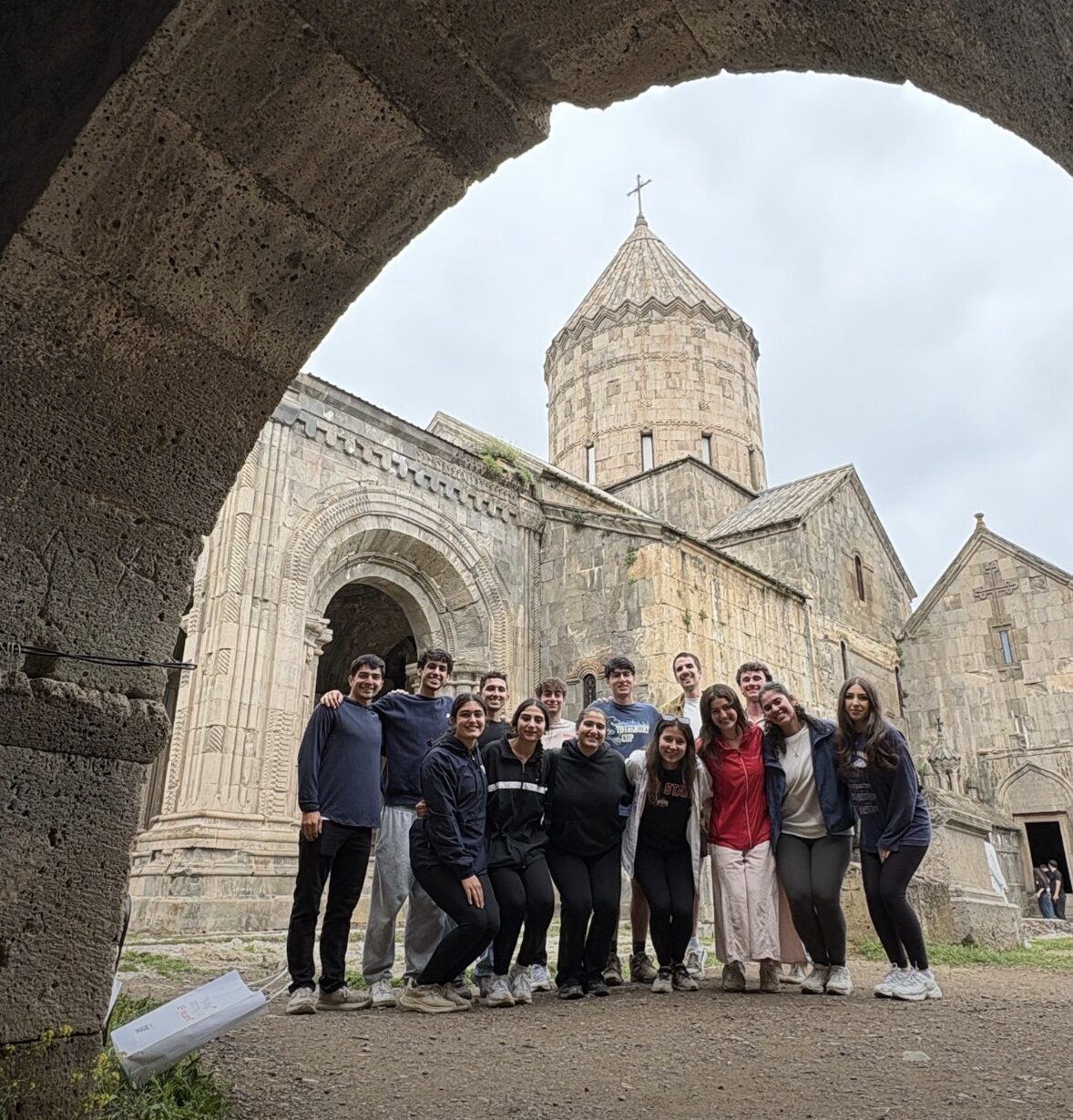
Outside of work, our group traveled all over Armenia, and my favorite place was Karahunj. Karahunj is a field of standing stones in Syunik. Researchers believe the holes bored through these stones were used to track the sun and stars thousands of years ago. The wind ran through my hair as I looked out at the lavender flowers and mountains in the distance. Apart from its history, it is the most beautiful place I have seen.
If asked about the best part of this experience, I would have to say the people. My coworkers were very warm and went out of their way to include me even though I was struggling with the language. One memory that will stick with me is when our team finished a meeting and went to a mall to get food and play VR laser tag. I was two weeks into my internship, yet it already felt like I was part of the family. That is the best example I can give of the warmth of the Armenian people.
The post Finding family in an engineering internship appeared first on The Armenian Weekly.
]]>The post Book Review: ‘The Kaleidoscope of Destiny’ appeared first on The Armenian Weekly.
]]>Stories of genocide are often told through the lens of victims and perpetrators. “The Kaleidoscope of Destiny” complicates that distinction by asking what happens when a young Armenian must navigate a world in which compassion comes from unexpected places, and danger comes from people he thought he understood.
This debut novel by Sarah Ignatius will be published by Koehler Books on Sept. 22. Ignatius, of Armenian descent, has served as the executive director of the National Association for Armenian Studies and Research (NAASR), worked as a human rights lawyer authoring an in-depth report on the U.S. asylum system for Harvard Law School’s National Asylum Study Project, and has taught immigration and asylum law at Boston College Law School.
Ignatius’s novel follows 14-year-old Arakel during the Armenian Genocide, starting with his childhood innocence before the deportation and his friendships with an Armenian boy and a Turkish boy. Looking ahead to when they would graduate school in two years, the trio plans to travel to China along the Silk Road, navigating by the stars at night. Arakel takes his role as the navigator seriously and studies astronomy, unaware that this new knowledge meant to guide their future adventure will eventually help him navigate a very different journey — one of survival.
Arakel’s world shatters when his father is imprisoned, his older brother is sent to the military, and Arakel is left to care for his 7-year-old sister, Anoush, along with his mother, grandmother and their donkeys, as they embark on a forced march under dire conditions.
Ignatius explores what humanity looks like in the midst of inhumanity, guiding readers alongside Arakel to understand it. Central to the theme is challenging the idea that someone’s morality can be determined by their identity.
Separated from his family and struggling to survive, Arakel encounters Turks, Kurds, Bedouins, Arab camel drivers, Germans and a wandering dervish. Through his journey, readers might share his skepticism and be taken aback by the unexpected compassion he encounters along the way. Amid the challenges, it is acts of kindness that provide him with solace.
Ignatius’s writing brings every experience to life through the senses. Readers can almost smell the stench of human waste and dead bodies, hear the screams of women taken by gendarmes, feel the pain of hunger, thirst and desperation, and taste the meager crumbs that stave off starvation. One particularly haunting passage describes Arakel walking through the Euphrates River among floating bodies. Ignatius describes these moments as “crossing into the land of the dead” — imagery so powerful that I found myself sobbing as I read.
However, even through the pages of unspeakable horror, the novel’s message of friendship and hope continues to encourage. I enjoyed watching Arakel’s relationships with his childhood friends develop before the genocide. Even later, his new friendships suggest that Arakel’s capacity to connect with others survives alongside him.
Ignatius describes these moments as “crossing into the land of the dead” — imagery so powerful that I found myself sobbing as I read.
The title, “The Kaleidoscope of Destiny,” hints at a significant theme of the story. A kaleidoscope rearranges the same pieces into shifting patterns, much like how each person Arakel encounters reshapes his view of the world. They may start as enemies, then become strangers, then potential allies and finally human beings.
The novel brought to mind Fred Rogers’ famous words, “When I was a boy, and I would see scary things in the news, my mother would say to me, ‘Look for the helpers. You will always find people who are helping.’”
Perhaps that is one of the novel’s most important messages. Family members of survivors can often recount stories of the kind people who may have risked severe consequences, yet their humanity led them to acts of kindness of all sizes.
In my family, my grandfather never forgot the Armenian wife of a Turkish officer who hid him in a barn until she arranged to safely transfer him to an orphanage.
Arakel’s story shows that while history may define groups, individuals still have choices. “The Kaleidoscope of Destiny” reminds us to weave into the fabric of our narratives the stories of kindness from unlikely corners.
I highly recommend this novel to readers of historical and literary fiction, those interested in World War I and Armenian history, and readers exploring themes of human rights.
Arakel’s story shows that while history may define groups, individuals still have choices.
Ignatius’s book launch begins Sept. 22 at NAASR, followed by talks in Belmont and Worcester, Massachusetts; Providence and Cranston, Rhode Island; Kittery, Maine; and Washington, D.C. For details, visit Ignatius’s website.
The post Book Review: ‘The Kaleidoscope of Destiny’ appeared first on The Armenian Weekly.
]]>The post ALC’s Siranush Sahakyan to discuss Armenian hostage cases in LA appeared first on The Armenian Weekly.
]]>Sahakyan, executive director of the Armenian Legal Center for Justice and Human Rights (ALC), will address the community at a free Town Hall in Burbank on Tuesday, Sept. 22, then present a legal analysis of Azerbaijan’s cases against Armenian civilian leadership at UCLA School of Law on Thursday, Sept. 24. Both programs are open to the public.
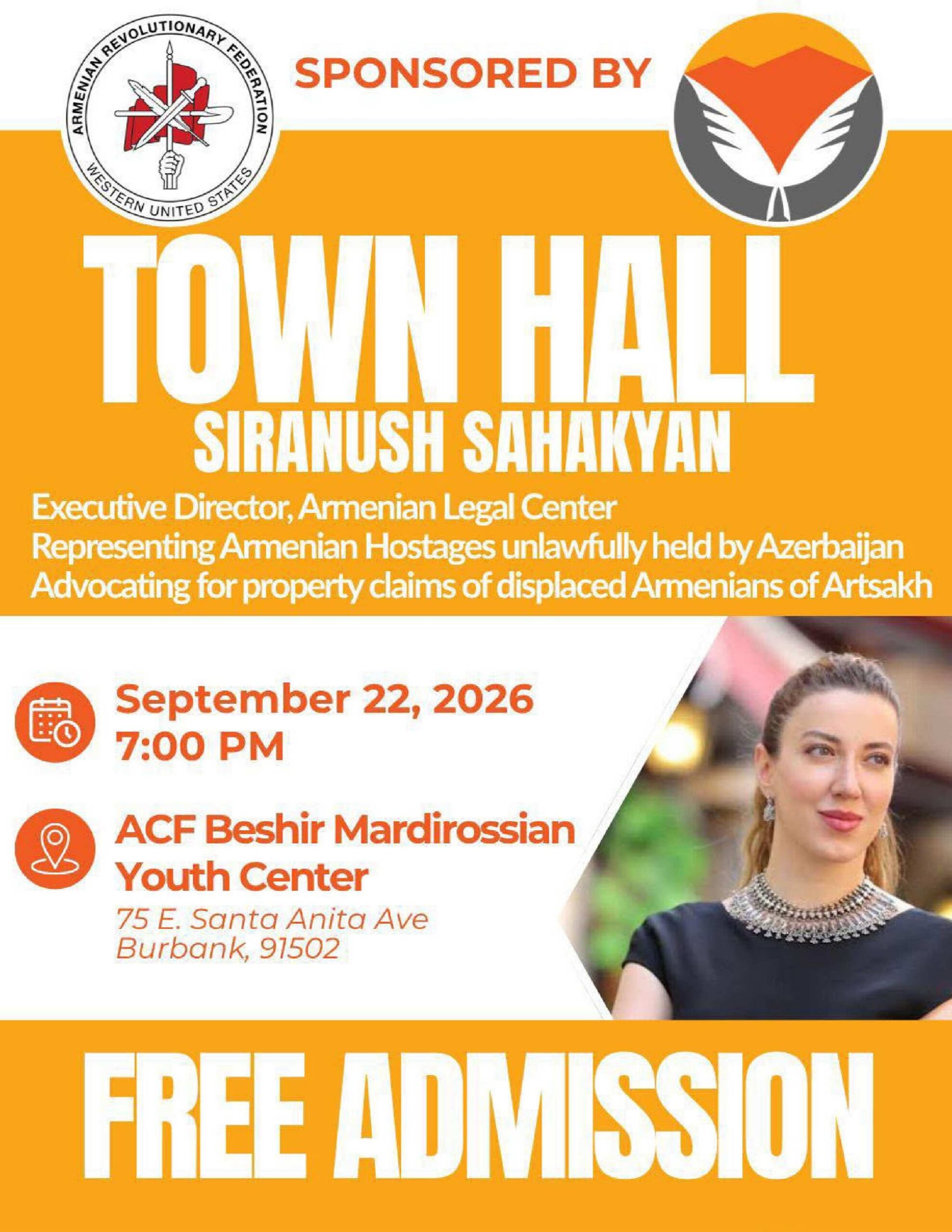
Event details:
Town Hall with Human Rights Attorney Siranush Sahakyan
Tuesday, Sept. 22, 2026, 7 p.m. PDT
Location: ACF Beshir Mardirossian Youth Center, 75 E. Santa Anita Ave., Burbank, CA 91502.
Sponsor: Armenian Revolutionary Federation Western United States
Admission: Free and open to the public
Focus: The latest developments concerning Armenian hostages held by Azerbaijan and property claims of Armenians forcibly displaced from Artsakh
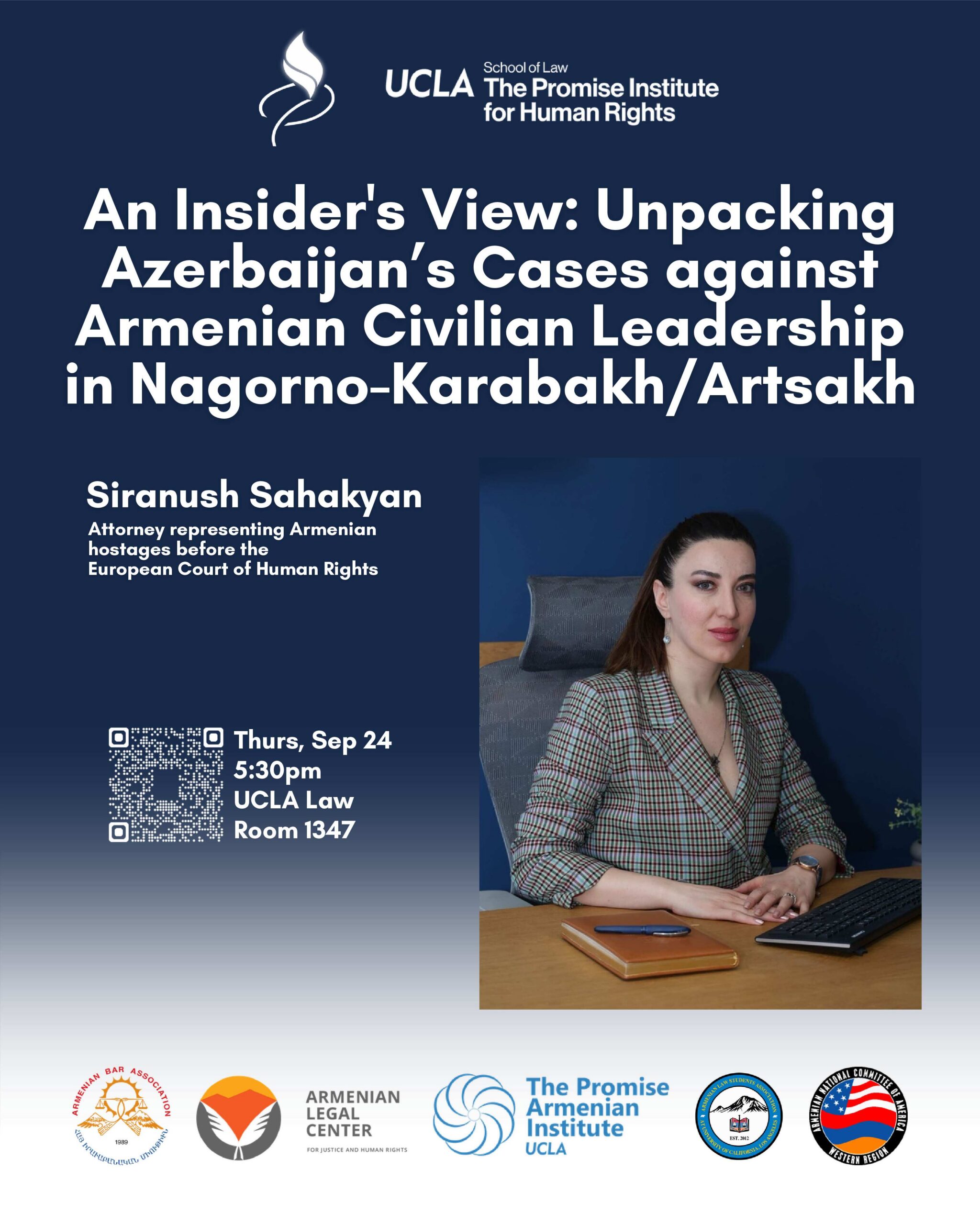
An Insider’s View: Unpacking Azerbaijan’s Cases against Armenian Civilian Leadership in Nagorno-Karabakh/Artsakh
Thursday, Sept. 24, 2026, 5:30 p.m. PDT
Location: UCLA School of Law, Room 1347, Los Angeles, CA 90095
Host: The Promise Institute for Human Rights at UCLA School of Law
Co-sponsors: Armenian Bar Association, Armenian Legal Center for Justice and Human Rights, The Promise Armenian Institute at UCLA, UCLA Armenian Law Students’ Association, and the Armenian National Committee of America Western Region
Admission: Free and open to the public. Registration requested: https://docs.google.com/forms/d/e/1FAIpQLSfDN0YiJLGvPtuV7sxWgdsvZTYxJ9hVPMstFLLWOx2cR9N3-Q/viewform
Media outlets wishing to attend the Sept. 22 event or schedule an interview should RSVP to Kevork Hagopjian, (818) 472-6756, or email media@armenianlegal.org by Monday, Sept. 21.
Background
Siranush Sahakyan is the executive director of the Armenian Legal Center for Justice and Human Rights and serves as president of the International and Comparative Law Center, representing Armenian hostages and their families before the European Court of Human Rights.
Last month she submitted a collective application to the Court concerning violations of the rights of 15 Armenians held in Azerbaijan, including political and military leaders of Artsakh. That filing follows a separate application in the case of Artsakh State Minister Ruben Vardanyan, sentenced to 20 years following proceedings Sahakyan has described as fundamentally illegitimate. Her review of the Baku verdict found the judgment failed to identify direct testimony establishing that Vardanyan personally committed, ordered, or directed many of the acts attributed to him.
The hostages are held in what Sahakyan calls conditions of “absolute isolation,” with no physical access to relatives, independent doctors or attorneys, consular representatives, or the International Committee of the Red Cross, which closed its permanent delegation in September 2025 at Azerbaijan’s decision. No ICRC visits were permitted throughout 2026, ending independent oversight of detainees’ treatment.
Sahakyan delivered the keynote on Sept. 15 at the Armenian National Committee of America’s “Accountability | 2026, Artsakh: Justice. Freedom. Right of Return.” program on Capitol Hill, marking three years since Azerbaijan’s genocidal ethnic cleansing of Artsakh, and met with over a dozen congressional offices calling for Global Magnitsky sanctions against Azerbaijani war criminals.
The post ALC’s Siranush Sahakyan to discuss Armenian hostage cases in LA appeared first on The Armenian Weekly.
]]>The post Attempts at cultural erasure in Artsakh, “uprooting” opposition at home appeared first on The Armenian Weekly.
]]>Around 150 representatives from 58 countries and nine international organizations participated in the visit, accompanied by Hikmet Hajiyev, assistant to Azerbaijani President Ilham Aliyev and head of the Presidential Administration’s Foreign Policy Affairs Department.
The delegation traveled through Stepanakert, Shushi, Martakert and Karvachar, including visits to the medieval Armenian monasteries of Gandzasar and Dadivank. Azerbaijani state media described it as the 22nd diplomatic visit organized to territories under Azerbaijani control since 2020. The official program showcased roads, tunnels, residential construction, businesses, infrastructure and Azerbaijani resettlement, presenting foreign representatives with Baku’s account of reconstruction and development.
More than 100,000 ethnic Armenians arrived in Armenia in less than a week after Azerbaijan’s September 2023 military operation. UNHCR later recorded 101,848 refugees from Karabakh as having arrived in Armenia.
The International Court of Justice subsequently ordered Azerbaijan to ensure that people who left Nagorno-Karabakh after Sept. 19, 2023, and wished to return could do so in a “safe, unimpeded and expeditious manner.”
The concern raised by Armenian religious institutions, cultural specialists, displaced Artsakh organizations and opposition figures is not limited to the physical absence of Armenians. Their broader accusation is that Azerbaijan is attempting to sever Artsakh’s surviving cultural landscape from its Armenian historical identity.
Critics increasingly describe that process as de-Armenianization: the removal of a population followed by the reinterpretation, appropriation or alteration of the historical markers that demonstrate that population’s centuries-long presence.
Gandzasar and Dadivank recast as “Caucasian Albanian”
At Gandzasar and Dadivank, Hajiyev did not present the monasteries to foreign diplomats as monuments of medieval Armenian Christianity. He described them as part of the Christian heritage of Caucasian Albania.
Hajiyev described Hasan Jalal Dawla, who commissioned Gandzasar’s principal church in the 13th century, as a “Caucasian Albanian ruler” and characterized the monastery as evidence of the centuries-old Christian heritage of Caucasian Albania. Hajiyev also accused Armenians of compromising the monuments’ architectural authenticity through restoration work conducted during the period of Armenian administration.
The setting gives the statements their political significance.
Physical possession of a monument permits the state controlling the territory to decide which history foreign visitors hear, which terminology appears on signs and official materials, which identity is emphasized and which identity is gradually pushed to the margins.
Gandzasar stands at the center of that dispute. Its history is connected to the medieval Armenian principality of Khachen, the Hasan-Jalalian dynasty and centuries of Armenian ecclesiastical life.
Dadivank likewise contains Armenian inscriptions and has functioned for centuries within the Armenian Christian and cultural landscape of the region.
The issue is the contemporary use of that history to detach surviving Christian monuments from their documented Armenian institutional, linguistic, religious and cultural history.
Armenian Revolutionary Federation (ARF) member and lawmaker Artur Khachatryan described the process as the continuing “Albanianization” of Armenian churches in Artsakh. He argued that the same historical narrative could eventually be directed against monasteries and churches within the internationally recognized territory of the Republic of Armenia.
Garnik Danielyan, a member of the ARF Armenia Supreme Body, described Hajiyev’s conduct at Gandzasar as another manifestation of a policy directed “not only against our cultural heritage, but against Armenian identity in general.”
The Mother See of Holy Etchmiadzin strongly condemned Hajiyev’s portrayal of Gandzasar and Dadivank as Caucasian Albanian, calling it “blatant falsification and an encroachment upon the historical memory and spiritual heritage of the Armenian people.”
The Mother See also criticized the participation of foreign diplomats and called on the Armenian authorities to take concrete steps to defend Artsakh’s cultural heritage.
The spectacle of the “blank manuscripts”
During the diplomatic visit, Hajiyev opened books displayed inside the museum and showed the delegation blank pages. Members of the visiting group could be seen laughing during the presentation. The spectacle appeared designed to cast doubt on Armenian claims concerning the manuscript tradition associated with Gandzasar. The books, however, were not ancient manuscripts.
Matenadaran Director Ara Khzmalyan subsequently explained that original manuscripts had never been displayed at the Gandzasar branch because the facility lacked the preservation and security systems necessary to store them. The objects exhibited there were reproductions created specifically for museum display. The original manuscripts and archival documents are held at the Matenadaran in Yerevan.
Khzmalyan responded: “We have no blank pages in our manuscripts or our history.”
Former Artsakh Culture Minister Lernik Hovhannisyan likewise described Hajiyev’s presentation as manipulation, explaining that valuable books and other cultural materials had been removed for safekeeping during the 2020 war, while exhibition materials remained at the branch.
Foreign diplomats and the normalization of a new reality
The participation of about 150 foreign representatives transformed the visit from an Azerbaijani domestic presentation into an international political event. Diplomats were not simply visiting reconstructed infrastructure. They were being shown a version of post-2023 Artsakh in which Azerbaijani reconstruction and resettlement occupied the foreground, while the displaced Armenian population largely disappeared from the visual and political narrative.
Artsakh organizations have argued that such visits risk normalizing the consequences of the population’s displacement. The Committee for the Protection of the Fundamental Rights of the People of Artsakh summarized the problem: Homes were being presented without their owners and churches without their faithful.
The Committee also said it was equally astonishing and deeply troubling that none of the diplomats who took part in the visits publicly addressed the fate of Armenian prisoners of war, civilians and political hostages illegally held in Azerbaijan or the trials being conducted against them.
The Committee also stated: “The destruction of churches in Stepanakert, the desecration of the historic Armenian cemetery in Shushi and the deeply troubling fact that the centuries-old Armenian monastery of Gandzasar is presented as ‘Albanian’ cannot go unnoticed.”
Yerevan’s response
The Foreign Ministry did not initially issue its own formal statement challenging Hajiyev’s presentation. Foreign Minister Ararat Mirzoyan later said the government believed the “necessary steps” had been taken and emphasized that the Matenadaran was the institution better equipped to address the historical question.
Asked specifically why the Foreign Ministry had not issued a statement, Mirzoyan said the authorities were “very satisfied with the position and conduct of the Matenadaran” and pointed to the subsequent visit of EU Special Representative Magdalena Grono to the institution.
That response is precisely what critics have challenged.
Their argument is not that historians or the Matenadaran should remain silent. The criticism is that a cultural institution was effectively left to answer a political operation conducted by the Azerbaijani presidency before representatives of dozens of foreign governments.
Prime Minister Nikol Pashinyan eventually addressed the controversy in parliament on Sept. 16, saying the Armenian side’s position regarding the origin of Gandzasar had already been presented by the director of Yerevan’s Mesrop Mashtots Matenadaran Institute of Ancient Manuscripts, whom he described as the “most competent official” on the matter.
Sergey Shahverdyan, president of the Artsakh Tourism and Culture Development Agency, placed responsibility partly on official Yerevan, arguing that the absence of sustained Armenian state advocacy creates space for Azerbaijan’s interpretation to spread internationally. He summarized his criticism with a stark formulation: “Cultural genocide is legitimized not only in Baku. It becomes possible where Yerevan remains silent.”
Magdalena Grono and the danger of reducing history to “competing narratives”
EU Special Representative Magdalena Grono became a focal point of the controversy after participating in the Azerbaijani-organized visit. Following the trip, she referred to “deeply diverging views and narratives” regarding the origins of certain cultural sites.
The formulation provoked criticism because it appeared to reduce a question involving inscriptions, manuscripts, architectural history and centuries of documented Armenian ecclesiastical activity to a competition between two contemporary national narratives.
Grono subsequently visited the Matenadaran in Yerevan and clarified that she did not dispute the Armenian historical presence in Karabakh or its “rich footprint.”
The episode nevertheless illustrates the effectiveness of the diplomatic environment Azerbaijan has created.
Ruling party challenges the ARF’s role in Armenian political thought
Only days after the controversy surrounding Azerbaijan’s presentation of Armenian cultural heritage in Artsakh, another dispute over Armenian political identity erupted in Armenia’s National Assembly.
During debate over amendments concerning the oath of government members, Civil Contract lawmaker Arman Yeghoyan turned to the Armenian Revolutionary Federation and declared that, for Armenia’s perpetuity, independence and sovereignty, “Dashnak ideology must be uprooted from Armenian political thought,” telling ARF lawmaker and Armenia Supreme Body member Kristine Vardanyan that she should be “the last Dashnak.”
Vardanyan responded saying Yeghoyan had torn away the governing party’s mask.
“No matter how much you fight against the ARF and its ideology, the ARF will only become stronger,” Vardanyan said. “Just as the Turks did not succeed in their program, neither will you,” she said.
Vardanyan labeled the governing faction “Young Bolsheviks,” accusing it of combining objectives of the Young Turks with Bolshevik political methods.
“During these 135 years, there have been many Arman Yeghoyans,” she said. “Forces much greater than you have fought against the ARF. Try. Try again. I repeat: you are only making us stronger.”
Critics quickly drew a parallel around the language of erasure: While Armenian institutions were protesting attempts to remove Armenian identity from Artsakh’s historical narrative, a member of Armenia’s governing majority was speaking from the National Assembly podium about “uprooting” a 135-year-old Armenian political ideology from Armenian political thought.
From political opposition to attempts at ideological erasure
Yeghoyan’s remarks were also met with applause and laughter from members of the Civil Contract faction.
Former State Revenue Committee Chairman and Wings of Unity governing council member Davit Ananyan made this distinction particularly clear. He stressed that he is not an ARF member and has reservations about some of the party’s recent political decisions, while describing its contribution to Armenian identity, Diaspora organization and the continuity of Armenian national institutions as undeniable.
For political scientist Edgar Elbakyan the ARF is not the beginning of Armenian national self-preservation, but one historical institutional expression of a struggle for self-defense and control over one’s homeland that long predates the party itself.
Elbakyan argued that hostility toward the ARF cannot always be reduced to criticism of the party’s mistakes or political conduct. He distinguished legitimate criticism from an effort to delegitimize the national-political ideas associated with it.
Political scientist Vladimir Martirosyan approached the controversy through historical continuity. He argued that Kristine Vardanyan would not be the final ARF member and predicted that future generations of young members would instead study today’s political actors as another temporary episode in the party’s much longer history.
Yerkir.am Editor-in-Chief Vahe Sargsyan highlighted the sharp contrast between the governing camp’s current rhetoric and Pashinyan’s own assessment of the ARF only seven years earlier. In his January 2019 message to the ARF’s 33rd General Congress, Pashinyan described its historical path as heroic, tragic and at times controversial, while emphasizing that the party had “always shared the fate of its people.” Later that year, during a meeting with ARF representatives in Los Angeles, Pashinyan again said he “highly appreciated” the party’s work in safeguarding Armenian identity and described preservation of that identity as an essential mission.
The post Attempts at cultural erasure in Artsakh, “uprooting” opposition at home appeared first on The Armenian Weekly.
]]>The post Fuel the fire — all roads lead to Jersey appeared first on The Armenian Weekly.
]]>This year, all roads led to Jersey. From near and far, the New Jersey “Arsen” community welcomed AYFers, alumni, families and friends as they made their way to Teaneck for the 92nd AYF-YOARF Olympic Games for a weekend full of competition, culture and camaraderie. Just by being there, attendees fueled the fire that has kept the AYF traditions alive for the past 92 years and that will continue to burn with a brightness only made possible by the gathering of thousands of proud Armenians.
Across the weekend, New Jersey came alive with the spirit of the AYF and athletic competition. Golfers took to the course. Tennis players battled through rallies on the courts. Swimmers dove into the pool. Softball teams competed under the sun. Track and field athletes pushed themselves to their limits. And when the sun went down, the Olympics continued as the Teaneck Marriott at Glenpointe transformed into a New Armenia, housing thousands of Armenians over the weekend and providing them the space for the much-anticipated dances each night.
As we look back on the 2026 Olympics, it’s easy to remember the high scores, the medals, the championships and the moments of victory. But those moments are only small sparks that helped fuel this year’s fire. The full strength of our success was in the kindling:
It was in the first-time Camp Haiastan camper seeing their ungers and ungerouhis for the first time since their session ended.
It was in the alumnus transported back 30 years after bumping into an old AYF friend.
It was in the grandparent watching their tournigs shuffle through shourcbars on the dance floor, proud to have passed on the moves.
It was in the newly crowned Olympic Kings and Queens and Varadian Spirit Award winners whose lifelong dedication to our organization was formally recognized.
It was in the newly sworn-in AYF member experiencing the sense of AYF fraternalism and Olympic spirit for the first time — but certainly not the last.
It was in the future AYFers who proudly participated in the opening ceremonies, donning their chapter gear and ushering their peers into the next generation.
To our athletes: thank you. Thank you for competing with heart, for representing your chapters with pride, for pushing yourselves and each other. Whether you were a high scorer or simply just gave everything you had, you are the reason these Games continue. You didn’t just compete — you fueled the fire.
To our coaches: thank you for the countless hours that nobody sees. The practicing, planning, organizing, strategizing, encouraging and preparing that happen long before an athlete ever steps onto the field. Your work keeps the competitive spirit of the AYF alive.
To our families and friends: thank you for showing up, for celebrating with us, for being there. The AYF Olympics have never just been a spectator event. Everyone plays a role, and your energy from the sidelines was part of the experience.
To our alumni: thank you for returning to the Games. You helped light the fire before us, and by returning year after year, you help ensure that it continues burning for the next generation.
To our sponsors, supporters and donors: thank you for investing in this tradition and helping make the 2026 AYF Olympic Games possible. Your support does more than fund a weekend. It supports our organization, chapters, communities and future generations of AYFers for the next year and beyond.
To our subcommittees and volunteers: thank you isn’t enough. Long before the first guest arrived in New Jersey, you were already working, planning, organizing. You were answering questions, solving problems, vetting locations, thinking about our guests’ experience. When the weekend finally came you prepared venues, moved tables, welcomed guests, handed out Hye Passes and AdBooks, sold merch, stayed up late and woke up early. And you did the invisible work that made it possible for everyone else to simply enjoy the weekend. You weren’t doing it for recognition, but because you believe in the spirit of the AYF and our Olympic Games.
And to everyone who traveled to New Jersey: thank you for choosing the AYF. You could have spent your Labor Day weekend anywhere, but you chose Jersey. You chose the AYF community and our Olympics, and for that we are eternally grateful.
For 92 years, the Games have moved from community to community, with each host leaving its own mark on the history of the AYF. This year, all roads led to Jersey. Years from now, someone will look back at the 2026 Olympics and remember a moment. Maybe it will be a race. Maybe it will be a dance. Maybe it will be a conversation in a hotel hallway at 2 a.m. Maybe it will simply be the feeling of standing in a room filled with Armenians and realizing just how large this family really is. That is how the fire burns — with each generation stoking it.
With that in mind, the road continues, and its next stop is Chicago for the 93rd AYF-YOARF Olympic Games hosted by the Chicago “Ararat” chapter in 2027. We can’t wait to see what they have in store.
Until then, we’re proud to have fueled the AYF fire for another year.
The post Fuel the fire — all roads lead to Jersey appeared first on The Armenian Weekly.
]]>The post Twenty-five seconds: The remarkable story of Shavarsh Karapetyan appeared first on The Armenian Weekly.
]]>The Armenian athlete was Shavarsh Karapetyan, a 23-year-old swimmer from Soviet Armenia whose life had been shaped by discipline, endurance and collective responsibility. Born in 1953, he was drawn to water from a very early age, developing a natural affinity for swimming. He then devoted his energy to training before eventually becoming an exceptionally talented finswimmer, a demanding discipline requiring extraordinary control, breath capacity and precision underwater.
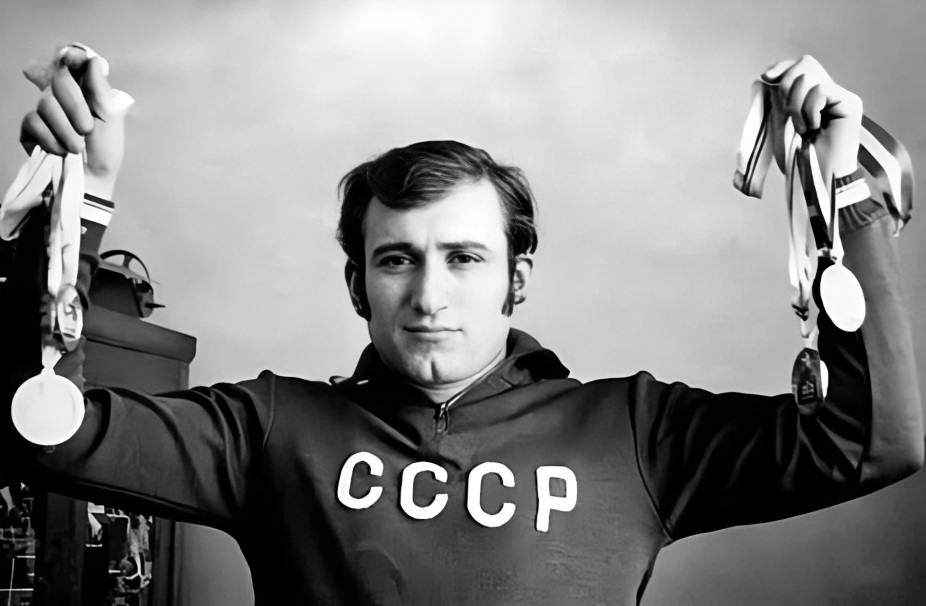
During his career, Karapetyan became a Merited Master of Sports of the USSR and an 11-time world record holder in finswimming. He won seven Soviet championships, 13 European championships and 17 world championships, for a total of 37 gold medals. Those who knew him described a man shaped less by ambition than by duty — someone for whom effort and courage were inseparable, and for whom the idea of turning away from someone in danger would have been unthinkable.
What followed at Yerevan Lake goes beyond anything ordinary. Karapetyan reached the submerged trolleybus and immediately descended into the freezing water, where visibility was almost nonexistent. He located the vehicle and used his legs to break a window, creating a fragile point of escape. From there, he began pulling passengers out, returning again and again into the wreck despite exhaustion, cold and injury. In total, he would make dozens of dives, each descent lasting roughly 25 seconds, repeatedly bringing survivors toward the surface in near darkness. Around 37 people were brought out in this way, while nine others managed to escape through the opening he had created. Of the 46 ultimately rescued from the bus, only about 20 survived despite medical attention at the scene. Karapetyan continued until his body could no longer respond, collapsing after what would be remembered as one of the most extraordinary acts of rescue ever recorded.
The aftermath ended his athletic career at elite level. He was hospitalized in critical condition and remained unconscious for about 45 days, with severe injuries, sepsis, double pneumonia and lung damage leaving him permanently affected. Yet this was not the only time his name was associated with acts of heroism. In 1974, he helped prevent a bus carrying 30 passengers from plunging into a mountain gorge after it began rolling out of control, managing to reach the driver’s area and steer it away from danger. In 1985, he was again involved in rescue efforts during a building fire near Yerevan’s Sports and Concert Complex, where he assisted firefighters and suffered burns in the process. Each incident, whether large or small, reinforced a pattern that those around him would later recognize: an instinctive response to danger and a constant willingness to help those in need, without hesitation or self-interest.
Recognition for the 1976 rescue did not come immediately. In the Soviet Union, information about major accidents was often delayed or simply never made public, and the story of the trolleybus initially remained a local story before later spreading nationally when Komsomolskaya Pravda published an article without mentioning the death toll. The story triggered an extraordinary response, with thousands of letters of gratitude arriving from across the country, many addressed simply to “The Armenian Republic, Yerevan, Shavarsh Karapetyan.”
Over time, official honors followed, alongside broader public recognition that extended far beyond sport. He was awarded distinctions including the Order of the Badge of Honor and other state medals, and his heroic act was later commemorated internationally, including with an asteroid named after him, 3027 Shavarsh. Years later, during the 2014 Olympic torch relay in Russia, he was also invited to carry the Olympic flame as an exceptional athlete and a true hero. Reflecting on that moment, he simply said: “I was carrying the torch for Russia and for Armenia.” Karapetyan himself has often resisted the framing of heroism, preferring to speak instead about duty and human responsibility, summed up in his words: “Anyone can find himself in a place where somebody needs help, and more than once, too. The main thing is to remember what makes you human.”
Fifty years later, the surface of Yerevan Lake has returned to stillness. Life continues along its shores, and the place no longer carries any visible trace of what unfolded beneath the water that day in 1976. Yet the memory endures in a different form — passed through stories, testimonies and the names of those who survived. It is remembered as a tragedy of both loss and survival, but also as a moment that revealed something far more enduring about human instinct and responsibility.
For Shavarsh Karapetyan, the man who dived into the freezing water without hesitation, it remains a story of humanity and kindness — values that mean a great deal to him, expressed in his words: “Kindness is nurtured by love. We have to teach our children to love each other from the very beginning.” On this 50th anniversary, the lake stands quiet again, holding within its depths the echo of a true Armenian hero who went into the unknown, when everything could have been lost.
The post Twenty-five seconds: The remarkable story of Shavarsh Karapetyan appeared first on The Armenian Weekly.
]]>The post The Region in Brief appeared first on The Armenian Weekly.
]]>Armenia’s Constitutional Court ruled Sept. 16 that the country’s obligations under the Armenia-U.S. TRIPP framework comply with the Constitution. The agreement will now proceed to the National Assembly for ratification.
Under the Armenia-U.S. framework, the TRIPP Development Company is envisioned with a 74% U.S. controlling stake and a 26% Armenian stake for an initial 49-year period. If the arrangement is extended for another 50 years by mutual consent, Armenia’s stake would increase to 49%. The Armenian government maintains that all TRIPP infrastructure inside Armenia will remain under Armenian sovereignty and jurisdiction.
Disagreement with Baku over terminology nevertheless continues. Azerbaijani Foreign Minister Jeyhun Bayramov again referred to the route as the “Zangezur Corridor.” Bayramov said physical construction of the Armenian section is expected to begin in early 2027.
Azerbaijan
Azerbaijani Foreign Minister Jeyhun Bayramov described relations between Azerbaijan and Turkey as having reached a level with “no equivalent in the world,” highlighting the shared political vision of Presidents Ilham Aliyev and Recep Tayyip Erdoğan and the frequency of their high-level contacts. Speaking alongside Turkish Foreign Minister Hakan Fidan in Baku, Bayramov said the two leaders had visited each other’s countries eight times during 2025-26.
The statement reinforces the continuing consolidation of the Azerbaijani-Turkish strategic partnership at a time when the two governments are coordinating closely on regional transport, energy and connectivity projects. Bayramov continued to refer to the Armenia-based portion of the TRIPP project as part of the so-called “Zangezur Corridor,” saying the approximately 42-kilometer section lies on Armenian territory, with its entry and exit points on the Azerbaijani border. Baku says its road and railway infrastructure toward Armenia is advancing rapidly, with the highway around 95% complete and the railway approximately 75% complete.
Georgia
Georgian Prime Minister Irakli Kobakhidze called for what he described as “Russophobia” to be stopped “at its root,” arguing that anti-Russian xenophobia is foreign to Georgian society and is being artificially encouraged by outside political forces.
Kobakhidze distinguished opposition to Russian government policies from hostility toward Russian people, pointing to the 2008 war and Russia’s continuing occupation of Georgian territory while arguing that even those events did not produce widespread hostility toward individual Russians. He alleged that foreign-backed forces are now attempting to manufacture anti-Russian sentiment to generate political escalation and economic instability.
The Georgian government, he said, intends to maintain what it calls a “pragmatic yet principled” policy toward Moscow.
Iran
Iran has rejected Washington’s latest public overture for negotiations, with Supreme National Security Council Secretary Mohsen Rezaei saying Tehran will not enter talks until its conditions are met.
The diplomatic deadlock comes as the U.S.–Iran war approaches seven months. On Sept. 15, the U.S. House of Representatives voted 220-204 for a war powers resolution seeking to terminate unauthorized U.S. military operations against Iran. All House Democrats and seven Republicans supported the measure.
Diplomatic activity is nevertheless continuing outside the direct U.S.-Iran channel. Chinese Foreign Minister Wang Yi met Iranian Foreign Minister Abbas Araqchi in Beijing on Sept. 16 and urged both Tehran and Washington to exercise restraint, revive the interim peace framework reached in June and resume substantive negotiations.
The maritime dimension remains one of the war’s most serious regional consequences. Traffic through the Strait of Hormuz has fallen sharply, while attacks and disruptions across Gulf and Red Sea routes have contributed to major increases in oil and refined-fuel prices. Brent crude has recently approached $110 per barrel, intensifying inflationary pressure internationally.
The conflict is also increasingly spilling into neighboring theaters. Saudi Arabia and Iran-aligned Houthi forces in Yemen exchanged attacks this week, while U.S. officials reportedly met Houthi representatives in Oman in an effort to preserve arrangements protecting American shipping and prevent further expansion of the war.
For Armenia, instability involving Iran remains particularly consequential. Iran is currently supplying additional gas volumes while Russian deliveries are temporarily suspended.
Russia
Russian Foreign Minister Sergey Lavrov said Moscow does not intend to prevent Armenia from choosing its partners or development path but made clear that Russia does not intend to subsidize Armenia’s preparations for possible EU membership through the economic benefits Yerevan receives as a member of the Eurasian Economic Union.
Lavrov recalled that President Vladimir Putin and Prime Minister Nikol Pashinyan agreed during their meeting in Bishkek to hold a separate bilateral discussion concerning Armenia’s EAEU membership and European integration.
The political tension coincides with renewed attention to Armenia’s energy dependence. Russia temporarily suspended natural gas deliveries through the North Caucasus-Transcaucasia pipeline from Sept. 15 to 25 for planned maintenance. Gazprom Armenia said consumers would not face restrictions because domestic reserves and increased supplies from Iran would compensate for the interruption. Armenia imported approximately 82% of its gas from Russia last year, underscoring the continuing scale of that dependence.
Central Bank Governor Martin Galstyan separately warned that a possible increase in the price of Russian gas could simultaneously raise inflation and depress economic activity. He described such a development as an extreme “X-type” scenario requiring a “strong and unconventional” monetary policy response.
Turkey
President Recep Tayyip Erdoğan used an AK Party meeting in his home province of Rize to frame the government’s next stage around the “Century of Türkiye” agenda.
Erdoğan said that after 25 years of political struggle, Turkey had established strong foundations across the economy, defense industry, technology, health care, agriculture and tourism.
“The construction of the Century of Türkiye has begun,” Erdoğan said, adding that Turkey was moving closer each day to its ambition of becoming a “world giant.”
The remarks complement Ankara’s increasingly assertive regional posture and come as Turkey deepens strategic coordination with Azerbaijan, expands its role in regional transport projects and seeks greater influence over the South Caucasus, Central Asia and Europe.
The post The Region in Brief appeared first on The Armenian Weekly.
]]>The post ICLaw, PRWB submit report on enforced disappearances in Armenia to U.N. appeared first on The Armenian Weekly.
]]>The report addresses the criminalization of enforced disappearance in Armenia and the legal safeguards established to prevent it. It notes that Article 451 of the Criminal Code of the Republic of Armenia criminalizes enforced disappearance and that it is also provided for as a constituent act of crimes against humanity and war crimes. At the same time, the report points to a number of legislative gaps, including the possibility of granting amnesty or pardon to persons who have committed enforced disappearance, except in cases where the act is qualified as a crime against humanity or a war crime.
The report also addresses the Law on Missing Persons in Conditions and Situations Created as a Result of Military Operations, adopted in March 2026. It notes that the law is an important step, as it regulates a number of issues related to the search for missing persons, the rights of their families and the establishment of a unified register. However, according to the report, the law applies only to persons who went missing during an armed conflict or in circumstances related to it. Addressing enforced disappearances that occurred during the military operations of 2020 and 2023, the report notes that investigations into them have been conducted as war crimes and/or crimes against humanity. At the same time, dozens of documented cases of Armenian servicemen forcibly disappearing while in Azerbaijani custody have been recorded.
The report also separately addresses the initial peace agreement between Armenia and Azerbaijan. It notes that the document provides for addressing the fate of persons who went missing or were forcibly disappeared during the armed conflict, including through the exchange of information, searches and the return of remains. “Although the inclusion of this issue in the peace process is an important step toward ensuring the continued search for missing persons and efforts to establish their fate and whereabouts, no tangible progress has been recorded beyond the announcement of the agreement,” states the report. The authors of the report propose not waiting for the peace agreement to enter into force and immediately activating mechanisms for searching for missing persons and determining their fate, with the participation of an independent and neutral international party.
The post ICLaw, PRWB submit report on enforced disappearances in Armenia to U.N. appeared first on The Armenian Weekly.
]]>