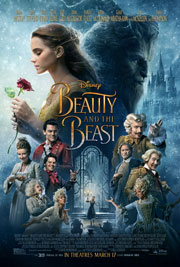
 As sweet and lovely as Disney’s 1991 animated film “Beauty and the Beast” is, the story has some, um, inconsistencies. Belle somehow manages to get an injured, beaten Beast up on a horse to bring back to the castle. There is a painting of an adult Prince that could not possibly have been painted. And how is it that the local village has no knowledge of an enchanted castle just a short ride away? All of these issues, thankfully, are addressed in the live-action remake of the film, and the emotional stakes are raised quite a bit in the finale (though not in the manner that you might think). The production design is gorgeous, Belle’s yellow dress is as stunning as Cinderella’s blue dress in the 2015 remake of that film, and Emma Watson is an inspired choice to play Belle, and is quite the singer as well.
The movie takes a while to find its rhythm, though. The three biggest musical numbers in the movie’s first half bite off more than they can chew, as if Disney had told director Bill Condon, “Just ask yourself: what would Baz Luhrmann do? And then ask us if we think Baz would do that, and we’ll tell you whether or not you’re right.” Condon captures the excessiveness of a Luhrmann number but not its energy, and that is a very important distinction. The movie’s second half, though, is much better. The relationship between Belle and the Beast comes into focus, and one small cameo makes a world of difference in the end.
In a rural area of France, a vain, shallow prince (Dan Stevens), who is somehow not a king despite having lost both of his parents, throws lavish parties and is all about appearances. One night, during one of those parties, a haggard old woman barges in and asks if he will give her shelter. Disgusted by her appearance, he refuses, but she warns him that beauty comes from within. When he rejects her a second time, she transforms into a beautiful enchantress and curses his castle and all who live in it for their superficial ways. The enchantress gives the prince a magical rose as a reminder of his mistake. He has until the last petal falls to know love and be loved in return, or he will spend the rest of his life as a monster.
In a nearby village, lovely bookworm Belle (Watson) endures a safe and rather dull existence with her widowed inventor father Maurice (Kevin Kline). The village’s resident hunk, the boorish Gaston (Luke Evans), wants to marry Belle simply because she’s the prettiest girl in town, but she refuses all of his advances. Maurice leaves town to sell some wares but stumbles upon the Beast’s castle, and the Beast takes Maurice prisoner. Maurice’s horse returns to his house, and Belle rides to the castle to offer herself in exchange for her father. The Beast is shocked by this, as it’s the most selfless act he’s ever witnessed, but he agrees. The plan is for Belle to spend the rest of her life in a cell in a tower, but the Beast’s cursed wait staff are not about to let their best shot at breaking the spell languish in a tower cell.
Most of the characters in the castle stay true to their animated origins (Emma Thompson, as Mrs. Potts, even replicates the accent of the original Mrs. Potts, Angela Lansbury), though Stevens’ Beast is not as beastly as his predecessor. Since he wasn’t transformed as a tween, this Beast received a full, proper education, and while he’s obviously not happy about his predicament, he’s much less volatile and worldlier. The townsfolk, however, are another story. Watson’s Belle has a chip on her shoulder. If animated Belle was self-deprecating to a fault, Watson takes great pleasure in refusing Gaston’s advances. (This chip was earned too, and there is a jarring, anti-women scene to prove it.) Likewise, Kline’s Maurice is not the “harmless crackpot” of the original, either. His Maurice is still heartbroken over the death of Belle’s mother but is no pushover.
This brings us to Josh Gad’s LeFou (French translation: “The Fool”). LeFou is clearly as in love with Gaston as all of the other maidens not named Belle, but he is not merely the closeted gay friend. This Fool is no sycophant; indeed, he’s much smarter than Gaston, smart enough to know that he doesn’t have a shot with Gaston but has fun trying to confuse his handsome but feeble-minded friend from time to time, while dishing some sound advice on why Belle is immune to Gaston’s charms. It’s a bold choice, especially for a Disney film, but it absolutely works.
There are things that each version of “Beauty and the Beast” does better than the other. Knowing this up front, strangely, will make for a more enjoyable viewing experience here. The adoration that the filmmakers have for the source material is apparent – there are several moments where pieces of dialogue, and camera shots, are lifted straight from the animated film – but at the same time, they recognize that these are different times, and that calls for a different film. The original, despite its storytelling shortcomings, is the better, more consistent film (it was the first animated film nominated for Best Picture for a reason), but at the same time, the present-day updates are most welcome.
3.5 / 5 Stars
Starring: Emma Watson, Dan Stevens, Luke Evans, Josh Gad, Kevin Kline, Ewan McGregor, Ian McKellan, Emma Thompson, Gugu Mbatha-Raw
Director: Bill Condon




Adam Sandler has said that the goal of “Pixels” was to be a modern-day version of an early-period Amblin Entertainment film (think “The Goonies,” “Gremlins” and “Who Framed Roger Rabbit”), something entertaining but also absolutely bonkers, and plays by its own rules. By that measure, “Pixels” is a smashing success. This movie is ridiculous, but in watching it, you realize that it’s been a long time since a live-action summer movie had the nerve to be ridiculous. It’s been this superhero movie or that graphic novel, and with the exception of “Scott Pilgrim vs. the World,” they’ve all been deathly serious. “Pixels” revels in its silliness, and in the process gives the audience some wildly entertaining battle and chase sequences as a bonus. This is one absurd, but fun, movie. If it had a theme song, it would be “Weird” Al Yankovic’s “Dare to Be Stupid.” That’s a compliment, for the record.
When Sam Brenner (Sandler) was a teen (in 1982), his future was impossibly bright. He was the best video gamer in town, but his hopes were crushed when smack-talking Eddie Plant came to town and beat him in a tournament. (Eddie is played by Peter Dinklage, who modeled his look after real-life Donkey Kong champion, and “The King of Kong” supervillain, Billy Mitchell. If you have not yet seen this movie, stop reading this and watch it right now. NOW, damn it.) The footage of that tournament was sent into space, where it was received by an alien race…and interpreted to be a declaration of war.
Thirty-three years later, the aliens arrive, in the form of the 8-bit video game characters that were in the video, destroying a US military base in Guam, and then a major international landmark. Sam now installs high-tech audio and video systems, while his teen years buddy Will Cooper (Kevin James) is the President of the United States. President Cooper, once he realizes what they’re up against, brings in Sam, and their onetime gamer friend-turned-conspiracy theorist Ludlow Lamonsoff (Josh Gad) to advise the military, much to the military’s chagrin, on how to defeat their enemy. Later, when Sam and Ludlow show that they are better soldiers in this war than the actual soldiers, the government makes a deal with the now-incarcerated Eddie to enlist the help of the self-branded “Fireblaster” (that nickname is so very ‘80s, and so very douchey). They’ve already lost the first two battles, though, so using video game logic, if they lose one more, it’s game over for the planet.
Those who have seen Sandler’s films will recognize several of the beats here. Sam is a blend of Happy Gilmore’s washed-up underdog and the Zen calm of Sandler’s “Grown Ups” character (honestly, I can’t be bothered to look up his name, that movie was so bad). The meet cute, in this case with customer Violet Van Patten (Michelle Monaghan), is gleefully unhinged, the kind of thing that would never happen, but makes perfect sense in a cinematic universe where the plot needs to get to the next level by any means necessary as quickly as possible. And where people are crushed by Frogger.
Gad’s character, however, makes zero sense, even in this wacky universe. He is an endless stream of contradictions – the friendless virgin who berates men who could murder him with one finger, the shy guy who sings with the band at a party, and then dances inappropriately in front of the President. Even in a movie where all disbelief can be reasonably suspended, he stands out as a problem. (There is also the matter in which they handle the video game love of Ludlow’s life, but at the risk of spoiling the ending, we will only say that their solution is creepy, and seemingly biologically impossible.) Dinklage stands out in a similar manner. He’s trying a little too hard to be a jerk, and while it’s clear that he’s supposed to be a jerk, he sounds and acts more like a WWE villain – a guy angrily reading cue cards.
“Pixels” is the edgiest film that director Chris Columbus has ever done, which might be the most backhanded compliment of all time on a number of levels. His movies are impossibly safe, and yet, compared to the directors who have helmed most of Sandler’s films (Dennis Dugan, we’re looking in your direction), Columbus was the right guy for the job. He understands the scale of a film like this, having directed the first two “Harry Potter” movies, and given that his directorial debut was “Adventures in Babysitting,” it’s safe to say that he understands the ‘80s as well. For a movie that gets its laughs mostly from dated references, it’s nice to see a film like “Pixels” overwhelm a crowd like it did (and it did). Perhaps there is still room in the pop culture universe for some silliness after all.
]]>
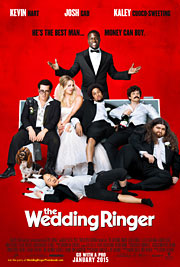

The premise for “The Wedding Ringer” has a blind spot the size of Texas. If someone were to actually do what Kevin Hart’s character does here, it would not be long before they ran into one of their former clients’ spouses, or a girl they hooked up with after the reception, or a family member of the wedding party (you get the idea), while pretending to be the new character. Not to mention, the movie wrings laughs out of a scenario where men spin a hideous web of lies to their wives-to-be as a means of impressing them, which is the worst possible way to start a marriage. It’s a house of cards, with a near-zero level of plausibility, and yet, “The Wedding Ringer” works in spite of all of these things. Hart and Josh Gad have great chemistry, the script is surprisingly smart for such a broad comedy (they don’t stoop to making the supporting characters dunces in order for the plot to work), and there is an underdog mentality to it that is intoxicating.
Doug Harris (Gad) has a problem. He’s about to get married to out-of-his-league Gretchen (Kaley Cuoco-Sweeting), but he doesn’t have any friends, and therefore no best man or groomsmen. The wedding planner sniffs this out (Gretchen, conveniently, is still in the dark about this), and suggests that Doug meet Jimmy Callahan (Hart), who runs a business providing services for men who need a best man. Doug, however, doesn’t just need a best man: he needs a best man and a whopping seven groomsmen, something Jimmy has joked about but never executed before. The groomsmen Jimmy recruits are less than ideal, but Doug goes along with it given the circumstances. As Doug and Jimmy get to know each other – Jimmy has a strict ‘This is a business arrangement, and we are not friends’ policy – and as Gretchen’s family gets to know Jimmy, lines get blurred.
The path of the plot is apparent – to make matters worse, some of the trailers show scenes from the final five minutes of the movie, ugh – but it’s still fun to see how the characters get there. Gretchen has a moment so funny and so completely out of character with a comedy that it begs to be spoiled (but of course, we won’t), and any critic who gives away the film’s last line should be caned. This movie is painfully self-aware of its shortcomings, but it works like a dog to make up for them in other ways, like the unthinkable gauntlet the men run during Doug’s bachelor party. It’s one of the most stupidly funny things you’ll see all year.
Anyone can see the third act coming down Broadway. There is the disapproving parent trying to acceptably vent his frustration that his daughter is marrying below her level, the late reveal about Gretchen’s past, the suspicious sibling, the groomsmen panicking once their fake backgrounds are questioned…from the very beginning, everyone in the theater knows that these things are going to happen. Fortunately, the movie has accumulated so much goodwill by then that it doesn’t really matter how predictable some of it turns out to be. This is how the story should end; to do otherwise would be more ridiculous than what actually happens in the movie, which is pretty damn ridiculous.
In the midst of all of the chaos is Hart delivering his finest performance to date. Jimmy Callahan is by no means deep (quite the opposite, in fact), but he has more depth than anything Hart has ever done, and Hart runs with it. Gad has the luxury of letting Hart carry the film, which makes the moments where Gad steps up all the sweeter (the highlight being their dance routines at someone else’s wedding). Everyone else is basically a plug-and-play character, though Olivia Thirlby makes the most of her role as Gretchen’s sister Alison, and grown-ups will love the flag football game between Doug’s friends and Gretchen’s father’s football buddies.
“The Wedding Ringer” is a two-and-a-half-star plot crossed with three-and-a-half-star dialogue and a four-star eagerness to please. It’s not great by any means, but it is very entertaining, and as January releases go, it’s a borderline gift to get a movie this enjoyable.
]]>

Sex addiction is a tricky topic – some believe that it’s a genuine disease that deserves to be treated on the same level as drugs and alcohol, while others think it’s a convenient excuse for a certain type of behavior – which is probably why so few movies have been made on the subject. But whereas 2011’s “Shame” took a darker look at the effects of sex addiction, writer/director Stuart Blumberg’s “Thanks for Sharing” is more interested in the recovery phase. As a result, it’s bound to garner much less attention than the NC-17 rated Steve McQueen drama, and rightfully so, because this is pretty standard indie fare that’s only elevated by its ensemble cast.
The film follows the intersecting lives of three men in various stages of recovery. Eco-friendly businessman Adam (Mark Ruffalo) has been sober for five years, and when he finally jumps back into the dating pool at the behest of his sponsor Mike (Tim Robbins), he meets the beautiful Phoebe (Gwyneth Paltrow), who has obvious concerns about his “addiction.” Mike, meanwhile, is a 12-step guru who trusts so much in the program that he doesn’t believe his drug addict son Danny (Patrick Fugit) – who suddenly returns home one night after a years-long absence – could possibly get clean on his own. And lastly, there’s Neil (Josh Gad), a schlubby doctor who’s been court ordered to attend sex addiction meetings and assigned Adam as his sponsor. Neil is in denial about the whole thing, but when he gets fired from his job for secretly filming up his boss’ skirt, he decides to take the program more seriously with the help of a fellow sex addict named Dede (Alecia Moore, aka Pink).
As you might expect from a movie called “Thanks for Sharing” (and written by the same guy behind the dialogue-heavy “The Kids Are All Right”), this is a very talky film that relies even more than usual on its actors to drive the story. Luckily, Blumberg’s directorial debut is buoyed by solid performances from top to bottom. Ruffalo is one of the most reliable actors working today, and though he doesn’t disappoint here, his story is the least interesting of the bunch, partly due to Paltrow’s underdeveloped character. Robbins and Fugit turn in some good work as the emotionally distant father-son pair, but the Neil/Dede subplot is the most enjoyable because we get to witness their recovery from the ground floor. Unfortunately, despite some good chemistry between Gad and Moore (in her most high-profile movie role to date), it doesn’t get nearly as much screen time as the other two stories.
Regardless of your opinions on sex addiction, “Thanks for Sharing” works well as a general introduction to any sort of addiction recovery, particularly with its general theme of serving others in order to serve yourself. Of course, that’s also its biggest problem, as the film seems more concerned with drilling the program’s philosophy into the audience’s heads than developing its characters, sometimes more closely resembling a self-help video than a piece of entertainment. Still, it deserves credit for its stark honesty, refusing to pull any punches or let its characters off the hook too easily, and that goes a long way in not only creating a more realistic story, but one that’s more enjoyable than its subject matter might suggest.
]]>