20 October 2026
- 32 rights groups warn Macron against legitimising Bahrain’s repression.
- Over 700 arrests and 33 children stripped of citizenship.
- Groups demand the release of political prisoners, an end to unfair trials and an immediate moratorium on executions.
Thirty-two human rights organisations, including the Bahrain Institute for Rights and Democracy (BIRD), Human Rights Watch and the International Federation for Human Rights (FIDH), have written to French President Emmanuel Macron ahead of his visit to Bahrain, urging him to prioritise human rights in his discussions with King Hamad bin Isa Al Khalifa.
Macron’s visit forms part of a Gulf tour from 19 to 21 October, encompassing Kuwait, the United Arab Emirates, Bahrain and Qatar. Despite ongoing unrest in France, Macron landed in Bahrain this afternoon, where he was welcomed by King Hamad and his sons.
Video footage of Macron’s arrival: Associated Press (AP).
In their joint letter, dated 16 October, the organisations warn that Bahrain is experiencing its most severe crackdown on dissent since 2011 and that closer political and security cooperation with France risks emboldening the Bahraini authorities.
The letter documents more than 700 arrests since the outbreak of the war between Iran, the United States and Israel. It also details the revocation of citizenship of 69 Bahrainis, including 33 children, the youngest of whom was just 19 days old at the time. It raises concerns about the mass prosecution of 69 defendants, including 46 detained Shia clerics, amid allegations of torture, coerced confessions and serious violations of fair trial rights.
It also highlights the death in custody of 32-year-old Sayed Mohamed Al-Mousawi, whose body was returned to his family bearing visible signs of torture, and the plight of 19 prisoners facing the death penalty, 18 of whom have exhausted their legal remedies.
The organisations demand the immediate and unconditional release of political prisoners, including Danish-Bahraini human rights defender Abdulhadi Al-Khawaja, Swedish-Bahraini dissident Sheikh Mohammed Habib Al-Muqdad, opposition leader Hassan Mushaima and academic Dr Abduljalil Al-Singace, all imprisoned for more than 15 years. Dr Al-Singace has been on a liquid-only hunger strike for over five years.
The organisations warn that unless Macron makes concrete demands for human rights improvements, including the release of political prisoners, his visit “risks legitimising Bahrain’s repression and sending a dangerous message to its rulers that they can continue imprisoning critics, persecuting religious leaders and stripping children of their citizenship without facing any consequences to their relations with France.”
Sayed Ahmed Alwadaei, Advocacy Director at the Bahrain Institute for Rights and Democracy (BIRD), said:
“Since the outbreak of the Iran war, repression in Bahrain has intensified sharply. Bahrain’s ruler is jailing critics, stripping children of their citizenship and presiding over widespread torture. Thirty-two-year-old Sayed Mohamed Al-Mousawi was tortured to death in custody. Macron must raise these abuses publicly or risk legitimising this brutal repression.
France must not sacrifice human rights for lucrative Gulf deals under the guise of regional security. Bahrain must not be allowed to buy France’s silence. Those responsible for serious human rights abuses must face consequences, not rewards from France.”
Antoine Madelin, FIDH Advocacy Director, stated:
“The current crisis should remind President Macron that lasting energy security depends on respect for human rights and peace. France must look beyond immediate supplies and support the open, democratic societies on which a stable future depends. Bahrain’s diverse and plural society deserves that support. Macron must speak out against the repression that is closing civic space and press for the release of those imprisoned for exercising their rights. Seeking Bahrain’s support makes defending these freedoms more urgent, not less.”
The organisations urge Macron to press Bahrain to release political prisoners, end the mass prosecution of Shia clerics, restore citizenship to those stripped of it, and establish an immediate moratorium on executions. They also call for human rights safeguards on French security assistance and independent assessments before concluding agreements with Bahrain.
— END —
]]>Restore Status, End Discrimination Against Shias with Iranian Heritage
(Beirut, June 11, 2026) –The Bahraini government on April 27, 2026 revoked the nationality of 69 citizens, including infants. All were Shia Muslims ofIranian heritage, the Bahrain Institute for Rights and Democracy (BIRD) and Human Rights Watch said today. BIRD’s research found that at least 46people, more than half of them children, were rendered stateless.
“Bahraini authorities have long discriminated against the country’s Shia majority population,” said Niku Jafarnia, Bahrain and Yemen researcher at Human Rights Watch. “But stripping people of nationality, claiming that they are citizens of a foreign country where most of them have no legal ties is an extreme escalation.”
BIRD and Human Rights Watch spoke to nine people affected and two relatives of others affected. Researchers also reviewed the Bahraini government’s related statements and decisions, as well as documents supporting the nationality of some of those affected.
Of those affected, 33 were children, including 10 toddlers, with the youngest only 19 days old, based on BIRD analysis, underscoring the arbitrary and collective nature of the measure. The majority of Bahrainis are Shia, who have long been oppressed by the Bahraini government.
The Interior Ministry stated that the people stripped of citizenship are “of non-Bahraini origin.” While all are of Iranian descent, based on BIRD’s analysis – a background shared by up to 14 percent of Bahrain’s population – many of those interviewed said that their families had been in Bahrain for several generations and did not have Iranian nationality. Supporting documents reviewed showed that families had held Bahraini nationality for several generations, one of them for over a century.
One woman, whose husband and 9-month-old baby had been stripped of citizenship and left stateless, said of her husband: “Four generations [of his family] were born in Bahrain, all of them were born in Bahrain, he is Bahraini by birth. My kid, his father, grandfather, and their great grandfather are Bahrainis.” All of those interviewed said that the authorities had changed their nationality to Iranian.
On April 28, those stripped of nationality were ordered to go to the Passport and Immigration Authority, where they said they were forced to turn in their passports, IDs, and related papers.
One man, who said he was there from 8 a.m. to 5 p.m., described the scene: “They were looking at us as if we were their enemies… we waited hours without water, without food.”
He and others were forced to sign documents stating that their nationalities had been revoked, and that they would leave the country by an unspecified date. He was forced to sign these forms on behalf of his entire family, including other adults. The man added that Passport and Immigration police beat a man who refused to sign to compel his signature.
Bahraini authorities then began deporting some of them, attempting to send them to Iran but they did not succeed. Other people were sent to Turkey, but Turkish authorities forced them to return to Bahrain. Thereafter, people interviewed said, Bahraini authorities detained them in a hotel and later sent some of them to Oman.
One man said the Bahraini authorities “treat[ed] us like mafia, like criminals, just wanting to throw us out.” One official directly threatened him with imprisonment, stating “if you come back to Bahrain… you will not see the light of day again.”
Multiple families with roots in Bahrain reaching back at least two generations have been torn apart. One woman sad: “Now [our] family is separated…[my sister] was crying because she left her child in Bahrain… three weeks [earlier], we were all gathering at my family house… [Now], we are divided into four countries by force.”
The government has justified its action by citing counterterrorism efforts and regional tensions amid the US-Israel/Iran conflict. The Interior Ministrystated that officials were acting on the basis of national security, claiming that the targeted individuals “expressed sympathy for, and glorified, Iran’s sinful hostile acts, or engaged in espionage with foreign parties.”
According to BIRD’s research, five of those stripped of their citizenship were prosecuted in proceedings that reportedly failed to meet international fair trial standards. One defendant was fined and sentenced to five years in prison solely for peaceful social media posts. Two others were sentenced to life imprisonment on espionage-related charges, while two received 10-year prison sentences for allegedly “filming” and “glorifying” the Iranian attacks. The defendants were reportedly denied access to legal counsel prior to appearing before the court, a longstanding concern in Bahrain’s prosecution of political and national security cases.
The citizenship revocation comes on the heels of Bahraini authorities’ sweeping arrests of people who were exercising their right to peaceful expression amid the conflict. In some cases, Bahraini authorities have sought the death penalty, accusing the defendants of espionage.
The Bahraini government has discriminated against its Shia population for years, including by targeting Shia clerics and arresting and prosecuting human rights defenders of Shia backgrounds.
In 2019, Bahrain amended its citizenship law to allow officials to revoke citizenship based on a cabinet decision alone, removing the need for a royal decree. The changes also ended a requirement to publish the names and ID numbers of those affected, reducing transparency and making it harder to identify children stripped of citizenship.
In 2024, the Bahraini government issued a royal decree, amending the citizenship law by removing judicial oversight over citizenship revocations and classifying such decisions as sovereign acts, meaning there is no way to challenge revocation of citizenship.
Article 15 of the Universal Declaration of Human Rights, widely regarded as reflecting customary international law, states that everyone has the right to a nationality and that no one shall be arbitrarily deprived of his nationality. Article 13 of the Universal Declaration and article 12 of the International Covenant on Civil and Political Rights, which Bahrain has ratified, guarantee the right to enter one’s own country. In 1999, the Human Rights Committee, which interprets the covenant, stated that, “’The scope of ‘his own country’ is broader than the concept ‘country of his nationality,’” and that it would apply to people who have been stripped of their nationality in violation of international law.
A United Nations report from 2013 states that, “International law… obliges States to provide for an opportunity for the meaningful review of nationality decisions, including on substantive issues.” The report states that if the citizenship of a national is revoked, “lodging an appeal should suspend the effects of the decision, such that the individual continues to enjoy nationality – and related rights – until such time as the appeal has been settled.”
Article 29 of the Arab Charter on Human Rights, which Bahrain has ratified, states that, “Every person has the right to a nationality, and no citizen shall be deprived of his nationality without a legally valid reason.”
“Close scrutiny of those accused of “threatening national security” reveals that nearly half of them are children, including 10 toddlers who are now stateless,” said Sayed Ahmed Alwadaei, advocacy director at the Bahrain Institute for Rights and Democracy. “Many families who have lived in Bahrain for generations have been forced to leave their homes and, in some cases, leave their children behind. Bahrain’s rulers have been emboldened to commit these egregious violations of international law and get away with destroying the future of innocent children because of the silence of their backers in London and Washington. They must be held accountable.”
]]>Their votes angered the King and prompted 37 of their colleagues in Parliament, including the Speaker of Parliament, to sign a petition calling for their removal.
During a parliamentary debate on 28 April, the MPs opposed a royal decree issued in 2024 that removed judicial oversight from all matters related to citizenship, classifying them as sovereign issues, and eliminated the possibility of legal challenge or appeal against citizenship revocations. The debate resulted in the approval of the 2024 royal decree, with 33 votes in favour, three against, three absent, and the Speaker not voting. The three who voted against the decree have since faced serious threats from the King, culminating today in the vote to strip them of their Parliamentary seats.
The vote came just one day after the authorities stripped 69 individuals of their citizenship on national security grounds for the government’s claims that they held “sympathy for and glorifying Iran’s sinful, hostile acts”. The mass revocation extended to the targeted individuals’ families and children, including infants. All individuals stripped of nationality in the revocation are Shia Muslims of Iranian heritage.
Two of the three MPs who later voted against the decree spoke in Parliament.
In a session published on the Parliament YouTube channel, Abdulnabi Salman emphasized the necessity of oversight in a just government, stating that “Always, the existence of oversight over any of the authorities would achieve justice and a sense of fairness and trust.” He also spoke out against collective punishments, adding, “It is true that whoever harms this country must be punished, but punishments must not be collective, God forbid, or be taken as reactions, because the matter relates to the fate, future, and trust of the people in the system and the judiciary.”
Mamdooh Al Saleh argued against the extension of the punishment to family members and stated: “…but what is the fault of the children and the grandchildren? They may have no guilt; they did not participate in their father’s crime or mistake.”
Three days after the debate, and following a meeting with UAE leaders, Bahrain’s King issued remarks to the press accusing the MPs of siding with “traitors” and warning that they must apologise to “the people” or face the same fate as those they were supporting: the stripping of their citizenship and deportation. His furious rhetoric suggests his personal views, in particular regarding the 2024 royal decree that he issued himself, and raises serious concerns of authoritarian abuse of power.
The King’s comments were welcomed by six Arab states, with the UAE and Kuwait expressing support immediately, then followed by Morocco, Saudi Arabia, Syria, and Jordan.
Also today, Bahrain’s National Press Day, a journalist from Al-Ayyam was barred from entry to the parliamentary session due to a personal objection from the Speaker of the House of Representatives regarding a recent article headline.
Bahrain is ranked among the worst countries in the world for press freedom, placing 170th out of 180 countries in the latest ranking by Reporters Without Borders.
In response to today’s vote, Sayed Ahmed Alwadaei, Director of Advocacy at the Bahrain Institute for Rights and Democracy, said:
“No elected representative should face the threat of deportation and citizenship revocation for casting a vote against the King’s wishes. That they were forced to apologise to the King – and that their apology did not save them from destroying their career and future – exposes the reality of political life in Bahrain: under dictatorship, dissent is equivalent to political suicide.”
]]>This marks the first such mass revocation since 2019, when Hamad bin Isa Al Khalifa ordered the restoration of citizenship to 551 individuals.
No information has been provided regarding the identities of those affected, whether they have been arrested, whether they are inside or outside the country, or whether they hold another nationality.
Commenting, Sayed Ahmed Alwadaei, Advocacy Director at the Bahrain Institute for Rights and Democracy (BIRD), said:
Background
On Sunday 19 April 2026, King Hamad held a high-profile meeting with senior officials in which he directed the government to begin a crackdown on Bahraini nationals accused of having “betrayed the nation.” The directive explicitly calls for a review of entitlement to Bahraini citizenship, with “appropriate legal procedures” to follow. The following day, Monday 20 April, the Cabinet convened under the Deputy Prime Minister and formally incorporated these directives into its work programme.
The significance of this development is difficult to overstate. Between 2012 and 2019, Bahrain revoked the citizenship of at least 990 nationals, rendering the majority stateless in breach of international law. The language now being used by the King and Cabinet mirrors the framing used to justify those earlier campaigns. There are strong grounds to be concerned that what is now being set in motion represents a comparable or larger-scale operation.
The timing is also notable. The King’s announcement came only four days after a meeting with the Kuwaiti Foreign Minister. Kuwait is itself currently engaged in a mass citizenship revocation campaign, and the proximity of the two events raises concerns about coordinated approaches across Gulf states.
The event included a panel of experts who discussed the brutal crackdown on political opposition, human rights defenders and journalists, that Bahrain has faced since 2011. Hannah Philips from AOHR moderated the event and opened the discussion. She first focused on the suppression of freedom of speech and association and the deliberate denial of medical care and religious freedoms in Bahrain’s prisons. She went on to highlight Bahrain’s prison rate – the highest per capita in the Arab World, before introducing the panelists.
Lucilla Berwick, Research and Advocacy Associate at BIRD, discussed the findings of BIRD’s recent joint report with Americans for Democracy and Human Rights in Bahrain on the abuses female activists and human rights defenders have faced since 2017 in the country, a pattern never documented at length before.
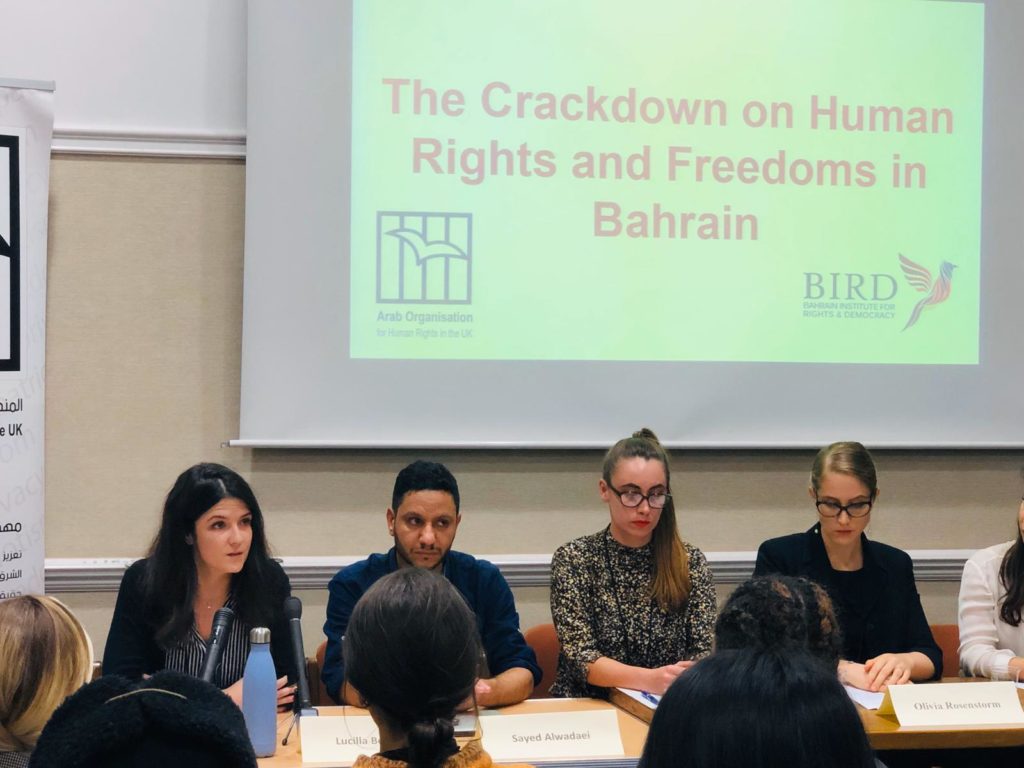
Her remarks focused on multiple violations and abuses experienced by the nine women featured in the report, from the moment of their arrest, through their interrogation, trial and detention. These include physical, psychological and seuxal torture, denial of legal representation and inhumane prison conditions. Lucilla went on to describe the detrimental impacts of UK foreign policy, including training to police and security forces, which has “in some circumstances contributed to human rights abuses in Bahrain.”
In particular, she focused on the £6.5 million of technical assistance spent by the Foreign Office since 2012 to train oversight institutions which have been internationally criticised for their lack of independence. While the Foreign Office boasts about the success of these bodies, many victims tell another story. Investigations have routinely found no fault in the actions of state officials, often justifying abuses entirely. Yet, Lucilla said, “these are the very organisations that the Foreign Office continues to tell torture victims to refer their complaints to.”
Bahar Saba, Middle East and North Africa Caseworker at Reprieve, discussed the dramatic increase in executions in Bahrain, which resumed in 2017 after a seven-year moratorium. “Bahraini courts continue to sentence individuals to death in proceedings that fall far short of international standards,” she asserted.
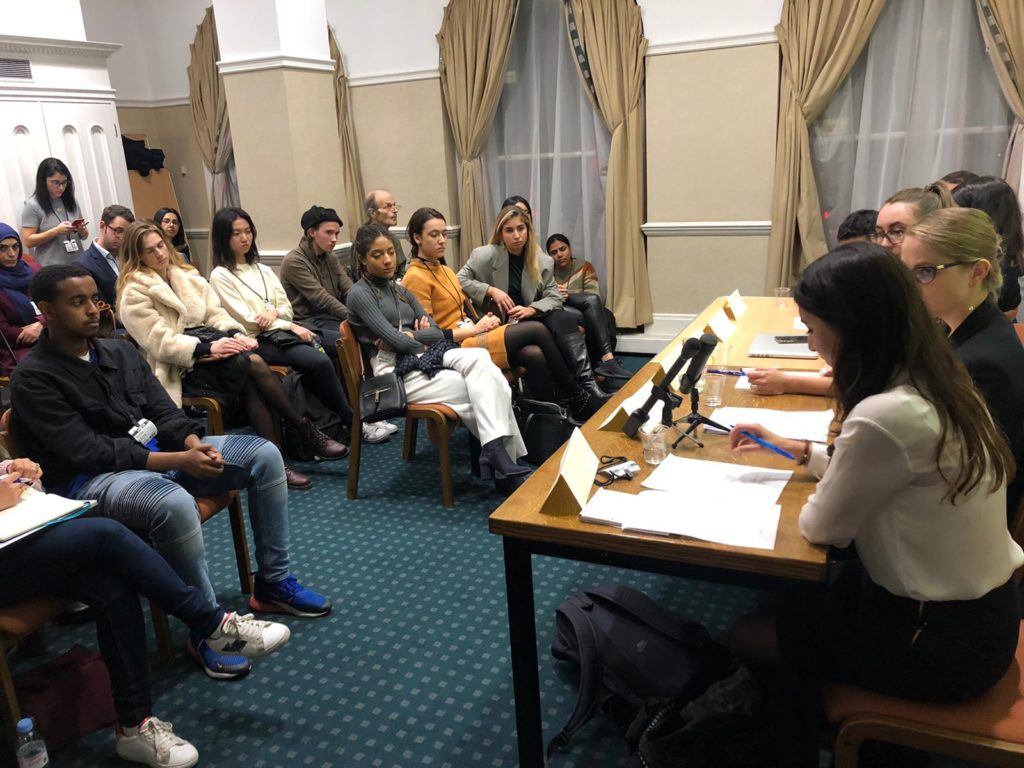
Bahar discussed the concerning cases of death row inmates Maher Al-Khabbaz, Mohammed Ramadan and Hussein Moosa, focusing on the torture they were subjected to to estract confessions. Not only does the death penalty itself conflict the International Covenant for Civil and Political Rights (ICCPR), of which Bahrain is a signatory, but those sentenced to death regularly report due process violations and torture. “Despite its international obligations, Bahrain’s use of the death penalty continues to infringe on the right to life” she emphasised.
Bahar concluded by discussing how the number of individuals on death row has tripled despite the UK’s technical assistance programme. She particularly criticised the Ministry of Interior Ombudsman and the Special Investigations Unit, two beneficiaries of the programme, who she asserted have continued to cover up cases of torture, allowing individuals to be sentenced to death on the basis of forced confessions. Bahar called for greater transparency and more robust investigations.
The third speaker, Bahraini activist Ali Mushaima, spoke about his experience in Bahrain’s prisons and imprisoned father, 71-year-old opposition leader Hassan Mushaima, who continues to be denied medical care while serving an unlawful life sentence at Jau prison. “I myself, was in prison three times. The first time was when I was only 15 years old. I remember all the details… how they tortured me, the dates, and the cell I stayed in” Ali recounted.
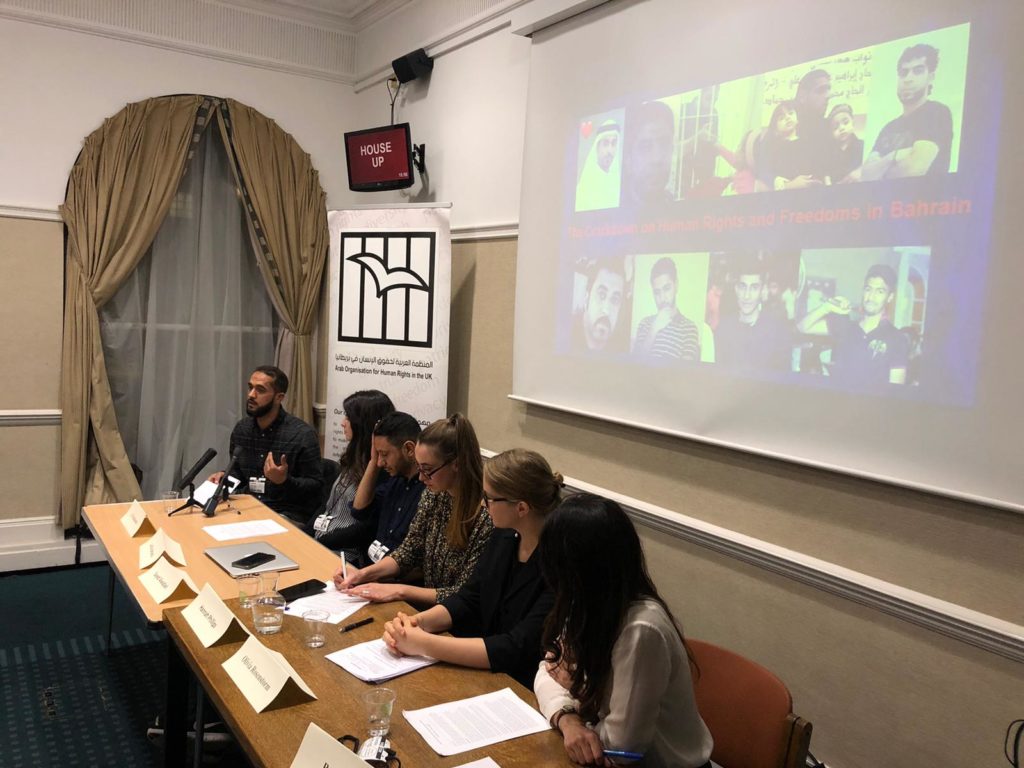
Hassan Mushaima is recovering from lymphoma and suffers from multiple health conditions including diabetes, gout and high blood pressure. However, prison authorities have routinely failed to provide him with specialist care. “In order to get medical treatment, you have to agree to be humiliated” Ali said, referring to the shackles the administration imposes on political prisoners which violate the Mandela Rules on the treatment of prisoners.
In August 2018, Ali spent 63 days protesting outside the Bahraini embassy in London to demand Bahrain provide him with medical care. For 46 of those days he was on hunger strike. “You can imagine the severity of the situation if someone has to sleep on the street in London to demand medical attention for their father in Bahrain.” Ali also drew attention to the wave of hunger strikes in Bahraini prisons since August, including dozens currently refusing food in Jau Prison.
Olivia Rosenstrom, a barrister at Temple Garden Chambers, discussed the types of violations the Bahraini government is implicated in and the legal remedies that can be taken in order to stop them.
She emphasised Bahrain’s failure to fulfil its international obligations. The detention and harassment of photographers, journalists and activists, and the general crackdown on freedom of expression violates several treaties, including the ICCPR. She also condemend the continued use of coerced confessions in Bahraini courts, which violates the Convention Against Torture and Other Cruel, Inhuman or Degrading Treatment or Punishment (CAT), to which Bahrain is party. Olivia also mentioned some of the consequences of citizenship revocation, including barriers to free movement and access to education, employment and medical care.
Olivia went on to assert the necessity of human rights conditions on trade and security agreements. Unfortunately, the UK and EU appear to be taking a “pragmatic and commercial” approach to their relationship with Bahrain, prioritising strategic aims over. Olivia concluded by providing some concrete solutions; 1) to push for a UN General Assembly inquiry into the human rights abuses in Bahrain; 2) to apply economic pressure and sanctions from the EU, UK and other countries and 3) refer human rights abusers to the International Criminal Court and impose sanctions to offenders travelling to the UK.
The final speaker, BIRD’s Director of Advocacy Sayed Ahmed Alwadaei, opened his remarks by playing a tearful message from his mother-in-law Hajer Mansoor, who complained about the poor and cruel conditions in the Isa Town Prison, where she is currently imprisoned in reprisal for Sayed’s work. The call reveals “the level of pain caused by the abuses taking place in prison” Sayed said.
Sayed went on to recount a phone call from Jau prison he received in July this year, which made him realise that two torture victims, Ali AlArab and Ahmed Almalali, would be executed within hours. “This is what I call the feeling of helplessness, and there’s nothing worse than helplessness.” Commenting on the failure of international condemnation to halt the executions, he emphasised the need for concrete action by states, rather than mere statements of concern.
He concluded by discussing the case of Moosa Mohammad, a Bahraini activist who climbed onto the rooftop of Bahrain’s London embassy to protest the executions. Moosa was brutally beaten by embassy staff members and police were forced to storm the building. He complained that Bahrain has faced “zero consequences” and criticised the UK government’s failure to respond. If Bahrain are emboldened to attack protesters in front of British police without consequence, imagine what they can do in Bahrain, when no one is watching, Sayed asked. He concluded by stressing the importance of parliament holding the UK government to account. “We do have a say,” he said, “and with everyone’s support, hopefully we can get there.”
The discussion was followed by a question and answer session, in which panelists reflected on the failures of governments and the international community to end abuses in Bahrain and hold the perpetrators to account. Solidarity was shown with Bahrainis from an audience member from repressive Eritrea, who shared her country’s experience with international human rights mechanisms and their limitations.
]]>BIRD has documented nine individuals currently at risk of imminent execution in Bahrain, having exhausted all their legal remedies. Since the start of the holy month of Ramadan on 5th May, Bahrain has upheld the death sentences for eleven men, including nine for political related offences and two for drug offences.
Yesterday, Foreign Office Minister Lord Ahmad of Wimbledon responded to a parliamentary question stating that the government opposes the death penalty “in all circumstances and countries” and is closely following both cases.
Sayed Ahmed Alwadaei, Director of Advocacy at BIRD, commented “The worrying increase in death sentences in Bahrain betrays an appalling disregard for human life. Ali Alarab and Ahmed Almalali have been subjected to appaling acts of torture and a deeply flawed trial. The use of confessions extracted under torture to condemn people to death has now became the norm in Bahrain.
These men’s lives hang in the balance; without serious action from Bahrain’s allies, in particular the United Kingdom, the United States and the European Union, they are at serious risk of execution. It is time for them to act on their shared values and publicly urge Bahrain to quash the sentences of Ali Al-Arab and Ahmed Al-Malali.”
Read the full UN statement below:
GENEVA (21 May 2019) – UN human rights experts* have appealed to Bahrain to halt the imminent executions of Ali Mohamed Ali Mohamed Hakeem al-Arab and Ahmed Isa Ahmed Isa al-Malali, amid serious concerns that they were coerced into making confessions through torture and did not receive a fair trial.
The two man were reportedly arrested, one of them without a warrant, on 9 February 2017 within the context of a joint security operation. They were allegedly prevented from attending their trial, sentenced to the death penalty in absentia and stripped of their nationality, which was later reinstated.
Prior to the conviction, Ali Mohamed Ali Mohamed Hakeem al-Arab was reportedly forcibly disappeared for a month, during which he was subjected to torture to obtain confessions which were then used against him in court. He was allegedly charged with killing a police officer, firing on a security patrol and injuring one of its officers, assisting in an attempted prison escape, and possession of firearms. He did not have access to legal counsel before the trial proceedings began.
Ahmed Isa Ahmed Isa al-Malali was reportedly struck by two bullets in his right hand during the arrest. The bullets were allegedly only removed 23 days later. He was also reportedly tortured and forced to sign a confession which, if accurate, violates the Convention against Torture. He was subsequently charged with possession of firearms, membership in a terrorist cell and the alleged killing of a security officer. He allegedly did not have access to legal representation until late in the trial proceedings.
“We urge the Government of Bahrain to immediately halt the executions of the two men, to annul the death sentences against them and to ensure that they are retried in accordance with international law and standards,” the experts said.
The experts reiterated that capital punishment may only be carried out for the most serious crimes and after a legal process which has included all possible safeguards to ensure a fair trial. “The two individuals should have never been convicted on the basis of what appears to be seriously flawed trials. Executions in these conditions would amount to arbitrary executions,” they stressed.
“All allegations of arbitrary arrest, enforced disappearance and torture must be promptly, thoroughly and impartially investigated with a view to holding those responsible to account and preventing similar occurrences from happening again in the future.
“We have raised multiple cases with the Bahraini authorities,” the experts said. “We urge the Government to establish an official moratorium on all executions with a view to abolish the death penalty.”
The experts had previously sought clarifications from the Government on this case.
*The UN experts: Ms. Agnes Callamard, Special Rapporteur on extrajudicial, summary or arbitrary executions; Ms. Fionnuala Ní Aoláin, Special Rapporteur on the promotion and protection of human rights and fundamental freedoms while countering terrorism; Mr. Nils Melzer, Special Rapporteur on torture and other cruel, inhuman or degrading treatment or punishment; Mr. Diego García-Sayán, Special Rapporteur on the Independence of Judges and Lawyers; and Mr. José Antonio Guevara Bermúdez, Chair-Rapporteur, Working Group on Arbitrary Detention.
The Special Rapporteurs are part of what is known as the Special Procedures of the Human Rights Council. Special Procedures, the largest body of independent experts in the UN Human Rights system, is the general name of the Council’s independent fact-finding and monitoring mechanisms that address either specific country situations or thematic issues in all parts of the world. Special Procedures experts work on a voluntary basis; they are not UN staff and do not receive a salary for their work. They are independent from any government or organization and serve in their individual capacity.
]]>This is the largest single incident since the use of this new tool of repression began in 2012 and takes the current number of citizenship revocations in Bahrain to 990, 180 of which occurred in 2019 alone.
The Bahrain Institute for Rights and Democracy (BIRD) condemns the outcome of this deeply unfair trial in the strongest possible terms and urges the authorities to quash the sentences and restore the citizenships.
Of the 139 individuals convicted, the court sentenced:
- 69 to life imprisonment
- 39 to 10 years
- 23 to 7 years
- 1 to 5 years
- 7 to 3 years
Of the 139 individuals convicted, 138 were also revoked of their citizenship. The court also imposed fines on 109 defendants. More specifically:
- 96 of them were fined BHD 100,000
- 12 were fined BHD 500
- 1 was fined BHD 231.8
The charges involved in the case the Public Prosecution refers to as “Hezbollah Bahrain” include:
- Forming a terrorist cell inside the country linked to Iran
- Launching terrorist attacks
- Possessing weapons without permission
- Training and using weapons and explosives
This is not the first incident where the Bahrain judiciary has held a mass trial to convict individuals on terrorism-related offences. In May 2018, 115 individuals were sentenced to prison and revoked of their citizenship.
Commenting, the Director of Advocacy at the Bahrain Institute for Rights and Democracy (BIRD), Sayed Ahmed Alwadaei, said “This ruling proves yet another time the corruption in Bahrain’s judiciary. A mass trial cannot produce a just result and rendering people stateless in a mass trial is a clear violation of international law. This is the worst verdict on record since 2012”.
Background information
Withdrawing nationality has become a growing tool of repression against critical voices in Bahrain. The power of citizenship revocation was officially formalised by the July 2014 Amendments to the 1963 Citizenship Law, which allowed the government to withdraw Bahraini citizenship from those who were charged on terrorist-related activities. Predominantly, this trend has affected political activists who have sought to speak out about human rights abuses in the country.
BIRD’s Records of citizenship revocation per year
- 180 in 2019
- 304 in 2018
- 156 in 2017
- 90 in 2016
- 208 in 2015
- 21 in 2014
- 31 in 2012
In one case alone, 17 individuals were revoked of their citizenship and sentenced to ten years’ imprisonment on various charges relating to arson and terrorism.
In the second case, 3 individuals were revoked of their citizenship out of 17 defendants, again for charges pertaining to terrorism-related offences, while another 5 lost their Bahraini nationality in the third case.
The Bahrain Institute for Rights and Democracy (BIRD) has been documenting revocation of citizenship in Bahrain. With yesterday’s verdicts, 849 individuals have been stripped of their Bahraini nationality since 2012. 2018 marked the worst calendar year to date, with 304 instances of revocation.
Commenting, Director of BIRD, Sayed Ahmed Alwadaei, said: “Bahrain’s judiciary does not appear to be slowing down its punitive use of citizenship revocation. The total disregard for international law is audacious, especially since future generations will suffer the consequences of the collective punishment dished out by authorities.”
]]>The Bahrain Institute for Rights and Democracy (BIRD) condemn the sentence and urge the authorities to restore the citizenships.
Zakeya is the first woman to have her citizenship revoked since the beginning of 2019, but only the third female since 2012.
The Court fined all the 12 defendants between BDH100-500 and sentenced:
-
7 individuals to life imprisonment
-
2 individuals to 10 years’ imprisonment
-
1 individual to 5 years (Zakeya AlBarboori)
-
1 individual to 3 years
BIRD closely followed Zakeya’s case following her arrest and that of her niece, Fatema, in May 2018. Both were forcibly disappeared for two weeks, for most of which Zakeya spent in solitary confinement. In early June 2018, both of them were charged by the Public Prosecution with joining a terrorist cell. On 27 June 2018 Fatema was released and her charges dropped. Zakeya did not receive the list of charges against her until a hearing on 31 January 2019.
Commenting, BIRD’s Director of Advocacy, Sayed Ahmed Alwadaei, says: “Zakeya was subjected to enforced disappearance, harsh interrogations, prolonged solitary confinement and has now been condemned with imprisonment and statelessness. The revocation of citizenship presents a new and alarming indication that this punitive tool will now be applied to women as freely as it is applied to men.”
Background on Zakeya’s Case
At the time of the arrest on 17 May 2018, around ten masked police officers dressed in plain clothes were accompanied by smaller groups of officers in uniform (commandos). No warrant was presented when officers conducted the raid, during which they confiscated belongings. Zakeya and Fatema were taken to the Criminal Investigation Directorate (CID).
On 18 May, the police conducted a second raid at 4am without a warrant, during which they terrorised the entire family.
Bahraini police interrogated Zakeya for six consecutive days. Whenever enquired about Zakeya’s whereabouts, the CID would deny her being in their custody, thereby making her forcibly disappeared for two weeks. The police held Zakeya in solitary confinement for 28 days, which amounts to torture according to a UN expert.
Zakeya was brought to court on 6 June 2018 without prior notice nor legal counsel. Zakeya’s detention was extended for a month and has been extended regularly ever since.
At a hearing held on 31 January 2019, Zakeya’s lawyer received a list of charges against Zakeya for the first time. She is wrongfully accused of belonging to a terrorist cell, possessing explosives and receiving funding from Iran.
]]>This brings the current number of Bahraini nationals on death row sentenced in political cases to 20.
As this deeply unfair trial concludes, the Bahrain Institute for Rights and Democracy (BIRD) condemns the ruling in the strongest possible terms and urges Bahraini authorities to issue a moratorium on executions, pending the abolition of the death penalty once and for all.
Commenting, BIRD’s Director of Advocacy, Sayed Ahmed Alwadaei, said: “This devastating injustice epitomises the brutality of a regime committed to crushing dissent at any cost. Zuhair has been subjected to the most horrific acts of abuse following his arrest, having been tortured, stripped naked, and sexually assaulted by the Bahraini authorities. As if this wasn’t enough, the corrupt judiciary sentenced him to death for a crime confessed to under duress.”
The trial involved 5 individuals in total accused of organising and managing a terrorist group, causing explosions and possession of explosives and weapons, as well as attempting to kill a police officer. The Court sentenced:
- The first defendant to life imprisonment and a fine of BHD 500
- The second defendant to death and a fine of BHD 500
- The third defendant to death and a fine of BHD 500
- The fourth defendant to 10 years
- The fifth defendant to 7 years imprisonment
The citizenship of all five individuals has been revoked as well. This brings the total number of Bahraini revocation of citizenship cases to 805 since 2012, with an unprecedented 299 cases occurring in 2018 alone.
The Bahrain Centre for Human Rights (BCHR) interviewed the family of Zuhair Ibrahim and documented the severe torture he was subjected to at the Criminal Investigation Directorate (CID) after being arrested on 2 November 2017. He was electrocuted, punched and kicked, hanged from his hand and feet, stripped naked and sexually assaulted, and they threatened his sons and wife with death and being discarded in the sea. Zuhair’s wife was also severely beaten and threatened with rape. BCHR reported that after 13 days of interrogation at the CID, when “he was on the verge of death”, Zuhair eventually signed a pre-prepared confession.
In total, Zuhair was held at the CID for 55 days and then transferred to the Dry Dock Prison. He was able to see his family after 70 days of detention.
Background
Death Penalty in Bahrain
Despite pressure from the UN and the international community, the death penalty remains an integral part of the Bahraini legal system. There are currently 20 Bahraini nationals on death row, all sentenced in political cases.
In January 2017, three torture victims, Abbas AlSameea, Sami Mushaima and Ali Alsingace, were executed six days after the Court of Cassation upheld their death sentence. This is widely considered to be the first execution related to political unrest in Bahrain since 1996.
Records of Citizenship Revocation per Year
According to BIRD’s documentation, there have been 805 cases in which the citizenship of a Bahraini national has been revoked by the government since 2012.
- 299 in 2018
- 156 in 2017
- 90 in 2016
- 208 in 2015
- 21 in 2014
- 31 in 2012