The fund selects the top five yielders per sector, weights each position near 2%, caps each sector near 10%, and rebalances quarterly. The result is 51 holdings, with the top ten representing only about 22% of assets. That structure spreads dividend risk widely: no single company failure can meaningfully dent the distribution. The trailing payout ratio sits at 53%, meaning the underlying holdings collectively distribute about half their earnings. SDOG’s expense ratio is 0.36%, and beta is 0.72.
A closely tracked personalized melanoma vaccine met its main goal. Its effect on distant spread came in far smaller than an earlier study suggested in a late-stage trial. Moderna (NASDAQ:MRNA) stock is down 7% to $185.74 in morning trading, a move that reprices the commercial upside of its flagship cancer program. That decline extends a selloff that started when the results leaked, and it reflects a judgment on how big the benefit is, since the trial cleared its primary hurdle.
Merck (NYSE:MRK) co-develops the vaccine with Moderna and supplies Keytruda, the immunotherapy the shot is paired with in the trial; MRK stock is down 0.2% to $145.61. Meanwhile, BioNTech SE (NASDAQ:BNTX) stock is down 3% to $85.65, a smaller slide for the other messenger RNA (mRNA) developer in the group. Pfizer (NYSE:PFE) stock is down 0.2% to $29.96, essentially holding steady as the diversified drugmaker in the comparison.
Biotech as a group is moving in the opposite direction. The iShares Biotechnology ETF (NASDAQ:IBB) is up 0.2% to $208.21, putting the sector fund on the other side of the slide in Moderna stock. Broader stocks are stronger as well, with the SPDR S&P 500 ETF Trust (NYSEARCA:SPY) up 0.3% to $762.27.

The Leaked Melanoma Data
The numbers leaked before a scheduled presentation. Moderna then released detailed late-stage results for intismeran autogene, its personalized melanoma vaccine, on October 22, set for a European oncology conference in Madrid. Combined with Keytruda, the shot met the main goal of reducing return or death risk, but distant metastasis results fell well short of the earlier mid-stage study.
Selling in Moderna stock is continuing this session. The distant-spread miss outweighs the main-goal win the company flagged in August.
Moderna’s Single-Platform Model Takes the Hardest Hit
Moderna’s business rests entirely on mRNA medicines, so the cancer vaccine carries an outsized share of its pipeline value, and that concentration helps explain why Moderna stock is sliding while the biotech fund edges higher.
BioNTech, an mRNA developer with its own cancer pipeline, has exposure that spreads well beyond this readout. Its shares are falling by a far smaller margin.
Pfizer’s diversified portfolio protects it from any one cancer vaccine result. Merck, Moderna’s partner on the shot, also has a much larger oncology business anchored by Keytruda.
What the Melanoma Data Means for Moderna
Moderna’s next test is whether the full melanoma dataset holds up as the basis for a regulatory filing, since even with a weaker read on distant spread, a trial that met its main goal could still support that submission. Shareholders can watch for the filing plan Moderna lays out around the complete results.

Any recovery in Moderna stock may depend on whether the market comes to see a modest benefit on distant spread as commercially meaningful. BioNTech and Pfizer offer a reference point, since both companies carry pipelines that extend well beyond this one vaccine.
Reviewers at regulatory agencies would see the full dataset only after Moderna and Merck submit it, which keeps the shot’s commercial outlook uncertain for now. Traders may prefer to keep their exposure smaller until the debate over Moderna’s melanoma vaccine data resolves.
The post Moderna Tumbles 7% as Cancer Vaccine Selloff Deepens; BioNTech Falls 3%, Pfizer Holds Steady appeared first on 24/7 Wall St..
]]>Merck (NYSE:MRK) reports third-quarter results on Thursday, Oct. 29. KEYTRUDA still anchors the business, but I’ll be watching whether newer launches are growing fast enough to cushion the drug’s 2028 patent loss.

New Launches Are Carrying More of the Load
Last quarter, revenue rose 5.07% to $16.61 billion, beating the $16.37 billion consensus. The non-GAAP loss of $0.13 per share came in smaller than the expected $0.2576 loss despite a $2.31 per share charge tied to Terns Pharmaceuticals (NASDAQ:TERN). Management also raised 2026 sales guidance to $66.3 billion to $67.3 billion.
Product mix changed toward newer launches. KEYTRUDA slid 1% to $7.904 billion, while subcutaneous KEYTRUDA QLEX rose to $463 million from $128 million in Q1. WINREVAIR grew 75% to $588 million.

The FDA has since added HYPERION data to WINREVAIR’s label, and Merck and Daiichi Sankyo withdrew their accelerated approval application for I-DXd in small-cell lung cancer. Shares closed at $145.27, up 40.88% year to date but down 1.9% over the past month.
Consensus Has Drifted Lower
| Metric | Consensus | Prior Year | YoY Change |
|---|---|---|---|
| Q3 EPS | $2.0947 | $2.58 | -18.8% |
| Q3 Revenue | $17.35B | $17.276B | +0.4% |
| FY2026 EPS | $2.6603 | $8.98 | -70.4% |
| FY2026 Revenue | $67.05B | $65.01B | +3.1% |
Q3 EPS estimates have fallen from $2.2810 90 days ago. The year-ago quarter also included roughly $250 million of wholesaler timing benefit that management says will not repeat.
LIPFENDRA’s Debut and QLEX Conversion Top My List
LIPFENDRA, the first approved oral PCSK9 inhibitor, gets its first full quarter on the market. Management cautioned that access and adoption will take time, so I’ll be watching early prescription trends and payer coverage against 30 million U.S. patients on lipid-lowering therapy who remain above recommended LDL levels.
QLEX conversion is the second test. Adoption picked up after a permanent J-code arrived in April, and every patient moved to subcutaneous dosing helps defend the franchise.
For WINREVAIR, more than 1,800 new U.S. patients received prescriptions in Q2. You should look at whether the expanded label and international launches keep that pace.
On the pipeline, I want updates on sac-TMT and its 17 Phase 3 trials, calderasib’s KRAS G12C program, and the intismeran vaccine partnered with Moderna (NASDAQ:MRNA) following Phase 3 melanoma data. Doctors called those results a major advancement amid reports of a possible data leak. Offsets matter too: JANUVIA/JANUMET fell 31% last quarter, and OHTUVAYRE faces an unwind of Q2 specialty pharmacy buying.
A Shallow Hill Needs Visible Proof
CEO Robert Davis calls the KEYTRUDA exclusivity loss “more of a hill than a cliff,” backed by over 20 new products representing greater than $70 billion of commercial opportunity. Analysts still cut full-year EPS estimates 10 times in the past 30 days, with no upward increases. Measurable traction from LIPFENDRA, QLEX and WINREVAIR this quarter would make that hill look a lot easier to climb.

The post Beyond Keytruda: The Critical Pipeline Metrics to Watch in Merck’s Q3 Results on Oct. 29 appeared first on 24/7 Wall St..
]]>Every drugmaker eventually loses its biggest product to generics or biosimilars. For an income investor, the question is whether newer drugs bring in enough cash to cover the dividend before the old blockbuster’s sales fade. This group shows how much is at stake: Merck (NYSE:MRK) brought in $8.367 billion from its KEYTRUDA franchise in a single quarter. AbbVie (NYSE:ABBV) is already absorbing Humira biosimilars. Amgen (NASDAQ:AMGN) is losing sales on Prolia and XGEVA, and Gilead Sciences (NASDAQ:GILD) is maintaining its HIV franchise after its COVID drug faded. Below, we judge each dividend first on coverage, cash flow, and track record. Yield comes second.
AbbVie: Skyrizi and Rinvoq Are Already Paying for the Post-Humira Dividend
AbbVie yields 2.3%, and its quarterly dividend is now $1.73 per share, up from $1.64 in 2025. The payout has gone up every year since AbbVie became a standalone company. It started at $0.40 a quarter in 2013.
Dividend safety: Trailing GAAP EPS of $3.54 is below the $6.83 annual dividend because of deal-related charges. Adjusted EPS guidance of $13.87 to $14.07 better reflects how well the payout is covered. The free cash flow yield of 3.5381% is higher than the 2.3150% dividend yield, so cash flow covers the payout. Net debt runs at 2.26x EBITDA and interest coverage is 6.94x. Book equity is negative because of the Allergan deal. With the $10.9 billion Apogee Therapeutics acquisition pending, the CFO said AbbVie remains “committed to achieving a net leverage ratio of two times within two to three years following the deal close.”
Patent exposure: Humira sales came in at $756 million in Q2, down 35.9%. Over the same quarter, Skyrizi brought in $5.505 billion (up 24.4%) and Rinvoq $2.525 billion (up 24.5%). Management said Skyrizi’s “composition of matter patent expires in 2033” and its regulatory data protection “does not expire until 2031.”
Bull case: Revenue grew 10.2% to $16.99 billion, and management now expects $21.7 billion in Skyrizi revenue for the full year. The stock trades at a forward P/E of about 16. The drugs replacing Humira are already growing fast enough to fund dividend increases.
Risk: AbbVie now depends heavily on two drugs. One CNBC guest said the company is “still pretty levered to now two drugs or arguably three.”
Merck: A Trailing Payout Ratio That Overstates the Danger
Merck yields 2.24% on a quarterly dividend of $0.85, up from $0.81. The payout has gone up every year since late 2013, when it was $0.44. Merck has frozen its dividend before, though: it held at $0.38 from 2005 through 2010.
Dividend safety: At first glance, Merck’s coverage looks bad. Trailing EPS of $1.26 falls far short of the $3.32 annual dividend, and the trailing P/E is about 119. The forward P/E is about 15, though, and that gap suggests one-time charges are skewing the trailing figure. This year’s adjusted EPS guidance of $2.66 to $2.76 already includes one-time R&D charges of $3.62 per share for Cidara and $2.31 per share for Terns. The CFO was direct: “We remain committed to the dividend, intending to increase it over time.” Merck is also on pace for about $3 billion in buybacks this year.
Patent exposure: KEYTRUDA sales were $7.904 billion in Q2, down 1%, with a 2028 loss of exclusivity ahead. The new KEYTRUDA QLEX version added $463 million. The CEO described the coming loss of exclusivity as “more of a hill than a cliff.”
Bull case: WINREVAIR sales rose 75% to $588 million. LIPFENDRA was approved as the first once-daily oral PCSK9 inhibitor, and sac-TMT is in 17 Phase 3 studies. Management raised full-year sales guidance to $66.3 billion to $67.3 billion.
Risk: The CFO expects U.S. KEYTRUDA growth to “moderate as we increasingly reach peak penetration across several key indications.” That slowdown comes before exclusivity ends.
Amgen: A Raise Every Year Since 2011, Backed by Strong Cash Flow
Amgen yields 2.24%. Its quarterly dividend of $2.52 is a 6% increase from a year ago. Amgen has increased its dividend every year since its first dividend in 2011, when it paid $0.28 a quarter.
Dividend safety: The $9.80 annual dividend is covered by trailing EPS of $16.10 and by adjusted EPS guidance of $22.30 to $23.50. Q2 free cash flow jumped 82.6% to $3.489 billion. Buybacks for the year are capped at $3.0 billion, and the company bought back no shares in the first two quarters, which leaves more cash for the dividend and debt reduction.
Patent exposure: Prolia fell 32% to $759 million, and XGEVA fell 34% to $352 million. Enbrel slipped 4% under IRA price-setting pressure. Management called the Prolia and XGEVA decline “in line with our expectations given several biosimilar competitors have now launched.”
Bull case: Six key growth drivers rose 26% and now make up nearly 70% of product sales. Repatha grew 37%. Amgen also benefits from biosimilars itself: its biosimilar portfolio brought in $855 million in Q2. MariTide, its obesity drug, is in 10 Phase 3 studies, which gives Amgen a long-term growth option the other three lack.
Risk: Debt outstanding is $57.3 billion, the largest load in this group relative to Amgen’s size.
Gilead Sciences: HIV Growth Is Funding the Dividend as Veklury Fades
Gilead yields 2.06%, less than any of the other three, on a quarterly dividend of $0.82. The payout has gone up every year since 2015, when it was $0.43.
Dividend safety: Gilead reported a Q2 GAAP net loss of $10.496 billion, driven by acquired R&D write-offs. Free cash flow still came in at $3.432 billion. Excluding acquisition charges, non-GAAP EPS guidance of $8.50 to $8.85 easily covers the $3.22 annual dividend. According to the CFO, Gilead returned “approximately 49% of our free cash flow to shareholders in the first half of 2026” through dividends and buybacks combined.
Patent exposure: Veklury sales collapsed 81% to $23 million, and HIV competition is the main long-term threat. For now, HIV sales are still growing: up 12% to $5.693 billion. The CEO said the HIV portfolio is “durable well into the end of the next decade.”
Bull case: Yeztugo, Gilead’s long-acting HIV prevention shot, brought in $232 million, up from $15 million a year earlier. Descovy rose 48%. Two FDA decisions are coming up: anito-cel on December 23, 2026 and once-weekly oral lenacapavir for HIV prevention by February 2, 2027. The forward P/E is about 16.
Risk: Acquisitions have cut Gilead’s cash to $3.179 billion from $10.6 billion at year-end, leaving less room if a launch disappoints.
Ranking the Four Dividends on Patent-Cliff Readiness
AbbVie is furthest along: Skyrizi and Rinvoq are already replacing Humira’s lost sales and paying for dividend increases. Amgen has raised its dividend every year since 2011 and has strong free cash flow, so its debt load is the main thing to monitor. Merck’s commitment to the dividend is firm, and its trailing payout ratio looks worse than it is because of one-time charges. Gilead has the lowest yield, but its HIV growth gives the dividend the clearest path past Veklury’s collapse. None of these four trip the classic warning signs of a dividend about to be cut, but if you want the checklist we use to screen for those, we put all seven of them in a free dividend trap guide.
The post AbbVie’s Dividend Survived Humira’s Patent Cliff. Will Merck and Amgen’s? appeared first on 24/7 Wall St..
]]>Full late-stage results for the personalized melanoma vaccine from Moderna (NASDAQ:MRNA) and Merck (NYSE:MRK) came back positive, yet the selling hasn’t stopped. Those numbers landed short of the loftiest hopes built into a long rally. Moderna stock is down 4% to $193.62 in morning trading. The move extends an 18% plunge from the prior session as the market reprices what the vaccine is worth to the company.
Biotech as a whole is holding steady, which keeps the damage concentrated in Moderna and its closest large-cap peers. The iShares Biotechnology ETF (NASDAQ:IBB) is unchanged at $209.54, so the slide in Moderna stock looks like a company-specific event. Large-cap stocks are slightly softer too, with the SPDR S&P 500 ETF Trust (NYSEARCA:SPY) down 0.4% to $761.03, a much smaller dip than Moderna’s.
Meanwhile, Merck stock is at $146, down 0.8%. That’s a fraction of the decline in Moderna stock, even though the drugmaker co-developed the vaccine. Pfizer (NYSE:PFE) stock is at $30.22, down 0.7%, a move far closer to the dip in Merck stock than to the slide in Moderna stock.
Leaked Melanoma Data Resets Moderna’s Rally
Merck and Moderna released full late-stage data for intismeran autogene, their personalized melanoma vaccine given with Merck’s Keytruda. The release came after details leaked ahead of a medical-conference presentation scheduled for this weekend. Bloomberg reported on the possible leak as Moderna and Merck shares fell. Compared with Keytruda alone, the combination cut the risk of melanoma recurrence or death.
That result landed near what analysts expected. It fell short of the highest hopes, and it also showed a smaller benefit than an earlier, smaller trial produced in a different patient group. A long rally in Moderna stock began in August, when the company announced the trial had met its primary goal. Expectations built during that run left little room for a merely solid readout once the details came out. Positive data still triggered a steep correction.
Vaccine Carries Far More Weight for Moderna Than Merck
The personalized cancer vaccine sits at the center of Moderna’s growth story, which leaves Moderna stock exposed to any gap between the data and the hype. Every approved Moderna product is a respiratory vaccine, so oncology carries much of the long-term upside the market had been paying for during the rally. Such concentration explains why Moderna stock is taking heavier selling than Merck shares.
For Merck, the program is an add-on to Keytruda, its blockbuster cancer drug. Keytruda already supports Merck’s oncology business, which keeps the reaction in Merck stock muted while its partner sinks. Merck’s bull case rests on the combination widening Keytruda’s reach, while its bear case centers on cooler enthusiasm for the add-on after the full data.
Pfizer is a diversified drugmaker whose results rest on a broad product base spanning vaccines, oncology and primary care. That breadth protects Pfizer against any single trial readout. It also leaves the company with little direct stake in the melanoma vaccine’s success.
BioNTech (NASDAQ:BNTX) is also developing cancer immunotherapies. That puts it in the same research field as Moderna’s personalized vaccine.
Conference Presentation Is Moderna’s Next Test
A key question for Moderna is whether the full presentation at the medical conference this weekend changes how the market reads the data. Moderna stock goes into that event after a steep slide that has already stripped out much of the optimism built during the rally.
Merck’s role in that presentation could show whether the smaller selloff in Merck stock holds as doctors and analysts pick apart the full results. Shareholders should see if the iShares Biotechnology ETF holds steady. Investors weighing their exposure should adjust their holdings carefully given how concentrated the selling is in Moderna and Merck shares.
The post Moderna Sinks 4% After 18% Plunge as Melanoma Vaccine Selloff Extends; Merck and Pfizer Slip appeared first on 24/7 Wall St..
]]>A late-stage melanoma vaccine report that was posted online and quickly pulled is driving a violent repricing in Moderna (NASDAQ:MRNA) shares, even though its findings looked favorable on their face. Moderna stock is at $184.87, down 25% this afternoon, a drop that reveals the elevated expectations built into the shares. Even after the slide, Moderna shares are up 526% year to date (YTD), a run that raised the bar for the full readout.
Merck (NYSE:MRK) is Moderna’s partner on the personalized vaccine, intismeran autogene, which pairs the shot with Merck’s immunotherapy Keytruda. Damage across the biotech group looks contained, with the iShares Biotechnology ETF (NASDAQ:IBB) down 2%. Broader-market selling is smaller, as the SPDR S&P 500 ETF Trust (NYSEARCA:SPY) is down 1.32%.
Retail sentiment toward Moderna stock has turned alongside the selloff. On WallStreetBets, Reddit chatter about the company registers as bearish, with a post titled “$MRNA is stupid” drawing the most engagement.
Briefly Posted Melanoma Results Spark Heavy Selling
Results from the late-stage trial briefly appeared online. The personalized melanoma vaccine Moderna is developing with Merck was posted on a medical news website shortly after midday on October 22 and taken down soon afterward. That posting came ahead of a scheduled presentation at the European Society for Medical Oncology (ESMO) Congress on October 24. According to the report, the vaccine combined with Keytruda lowered the risk of melanoma returning or death compared with the immunotherapy alone, and Moderna declined to comment.
In August, Moderna and Merck said the trial met its main goals without releasing detailed results. Earlier data pointed to a clear benefit. Five-year Phase 2b results presented at the American Society of Clinical Oncology (ASCO) meeting in 2026 showed a 49% reduction in the risk of recurrence or death with the combination versus Keytruda alone. Moderna has described the melanoma readout as an important pivotal catalyst, central to its push to build an oncology franchise beyond respiratory vaccines.

mRNA Rival BioNTech Slips While Pfizer Edges Up
Moderna and BioNTech (NASDAQ:BNTX) both build vaccines and cancer therapies on messenger RNA (mRNA) technology, while Pfizer (NYSE:PFE) is a diversified drugmaker. BioNTech stock is trading at $89.26, down 2%, a far smaller decline despite the shared platform. Meanwhile, Pfizer stock is at $30.11, up 0.9%, moving against the selloff in Moderna shares.
The leaked report pointed to a lower risk of recurrence or death, and the August statement from Moderna and Merck already confirmed the trial met its main goals. Skeptics counter that the enormous run in Moderna stock this year already reflected a great deal of optimism.
BioNTech and Pfizer are moving far less sharply, showing how specific the selling is to this readout, as BioNTech bulls point to its own personalized cancer pipeline, while bears flag shrinking COVID vaccine sales. Pfizer’s bull case rests on its diversified portfolio, though bears note declining COVID vaccine demand.
Autogene cevumeran, an individualized mRNA cancer immunotherapy in BioNTech’s pipeline, overlaps directly with the personalized approach Moderna and Merck are taking. For Pfizer, the clearest mRNA link is the Comirnaty COVID-19 vaccine developed with BioNTech. Every approved Moderna product is an infectious disease vaccine, making intismeran autogene central to its growth plans.
Moderna’s Melanoma Vaccine Data Faces Its ESMO Test
The next test is whether the full ESMO presentation backs up the favorable picture in the briefly posted report, and Merck has its own stake since Keytruda is the backbone of the combination regime.
Intismeran autogene is in nine Phase 2/3 trials across melanoma, non-small cell lung cancer, bladder cancer and renal cell carcinoma, giving that result read-through for Moderna’s wider oncology program. Investors weighing their exposure should size their MRNA stock positions carefully given how sharply the shares can swing on trial data.
The post Moderna Tumbles 25% After Apparent Early Leak of Melanoma Vaccine Data; BioNTech Dips, Pfizer Edges Higher appeared first on 24/7 Wall St..
]]>Merck (NYSE:MRK) or Pfizer (NYSE:PFE): which drug company dividend holds up better for retirement-focused investors right now? Pfizer pays roughly 5.7% against Merck’s 2.2%, and that gap is Pfizer’s whole pitch. On coverage and dividend growth, Merck comes out ahead. Most of Pfizer’s extra yield is pay for extra risk.

Income Safety: Merck’s Payout Has Cash to Spare
Pfizer pays $0.43 a quarter, or $1.72 a year, with shares at $30.06. Merck pays $0.85 a quarter ($3.40 a year) on a $151.48 stock. Part of Merck’s lower yield comes from its rally: shares rose 77.98% over the past year, compared with 29.48% for Pfizer.
Coverage is where the two split. In 2025, Pfizer generated $11.7 billion in operating cash flow and spent $2.63 billion on capital expenditures. It then paid $9.77 billion in dividends, which works out to about 108% of free cash flow. Free cash flow in the first half of 2026 covered only about 51% of the dividends Pfizer paid. Merck’s 2025 dividends used about 66% of free cash flow. In the first half of 2026, free cash flow covered 174% of the payout, even after acquisition charges pushed GAAP earnings into a loss.
Pfizer also has net debt of 3.01 times EBITDA, with leverage expected “to remain around current level or modestly higher through this transition period.” Its chief executive says the dividend holds up “even [in] the most stretched scenarios that we are running.” Even so, Pfizer has no buybacks planned in 2026. Merck is on pace for approximately $3 billion in repurchases. Winner: Merck.

Valuation: Pfizer’s Discount Is Real
Pfizer’s 2026 adjusted EPS guidance is $2.80 to $3.00. At the midpoint, the stock trades at about 10 times earnings. Merck’s 2026 guidance of $2.66 to $2.76 is affected by one-time charges of $3.62 per share for Cidara and $2.31 per share for Terns. Based on its 2025 non-GAAP EPS of $8.98, Merck trades at about 17 times earnings. Pfizer is cheaper. Its dividend also uses about 59% of forecast adjusted earnings, compared with Merck’s roughly 38% of 2025 non-GAAP EPS. Winner: Pfizer, and the market is pricing in its problems for good reason.
Growth and Patent Cliffs: Merck’s Replacements Are Already Selling
Both companies face patent cliffs. KEYTRUDA makes up nearly half of pharmaceutical revenues at Merck. The company’s chief executive calls the loss of exclusivity “more of a hill than a cliff” and expects “a shallow dip with a fast return back to growth.” Merck’s replacement products are already contributing. WINREVAIR sales rose 75% to $588 million, KEYTRUDA QLEX added $463 million, and LIPFENDRA won FDA approval. Merck also raised its 2026 sales guidance to $66.3 billion-$67.3 billion.
Pfizer is still absorbing the fall in its COVID products: Paxlovid sales dropped 95% and Comirnaty 34%. It also faces about $1.1 billion in revenue losses from generics and biosimilars. Vyndamax exclusivity runs to June 2031, but management targets a return to growth from 2029 onward. Its obesity drug berobenatide is aiming for a first approval in 2028. Winner: Merck.
Dividend Track Record Seals It
Merck raised its quarterly payout from $0.61 in 2020 to $0.85, about 39% growth. Over the same period, Pfizer’s went from $0.38 to $0.43, about 13%. Pfizer has held at $0.43 since January 2025, and management links future increases to the period after its exclusivity losses. Over five years, Merck shares returned 117.44%, while Pfizer fell 9.17%. Jim Cramer summed up the Pfizer case in May: “Pfizer does not have any earnings momentum.”

Verdict: Merck Is the Stronger Dividend for Retirement Income
Merck wins this comparison. Retirees need a check that keeps up with inflation and a payout funded by cash the business actually generates. Merck has both: free cash flow covers its dividend with room to spare, and the payout has risen since 2020. Pfizer’s 5.7% yield provides more income today, paired with a dividend likely to stay flat through the end of the decade. Its payout currently uses more than all of its free cash flow, which is the risk behind that yield. In the next earnings reports, check whether Pfizer’s operating cash flow recovers enough to cover its dividend and whether Merck’s newer drugs keep growing as KEYTRUDA growth slows.
The post Pfizer’s High Dividend Yield May Be a Warning. Here’s How Merck Compares appeared first on 24/7 Wall St..
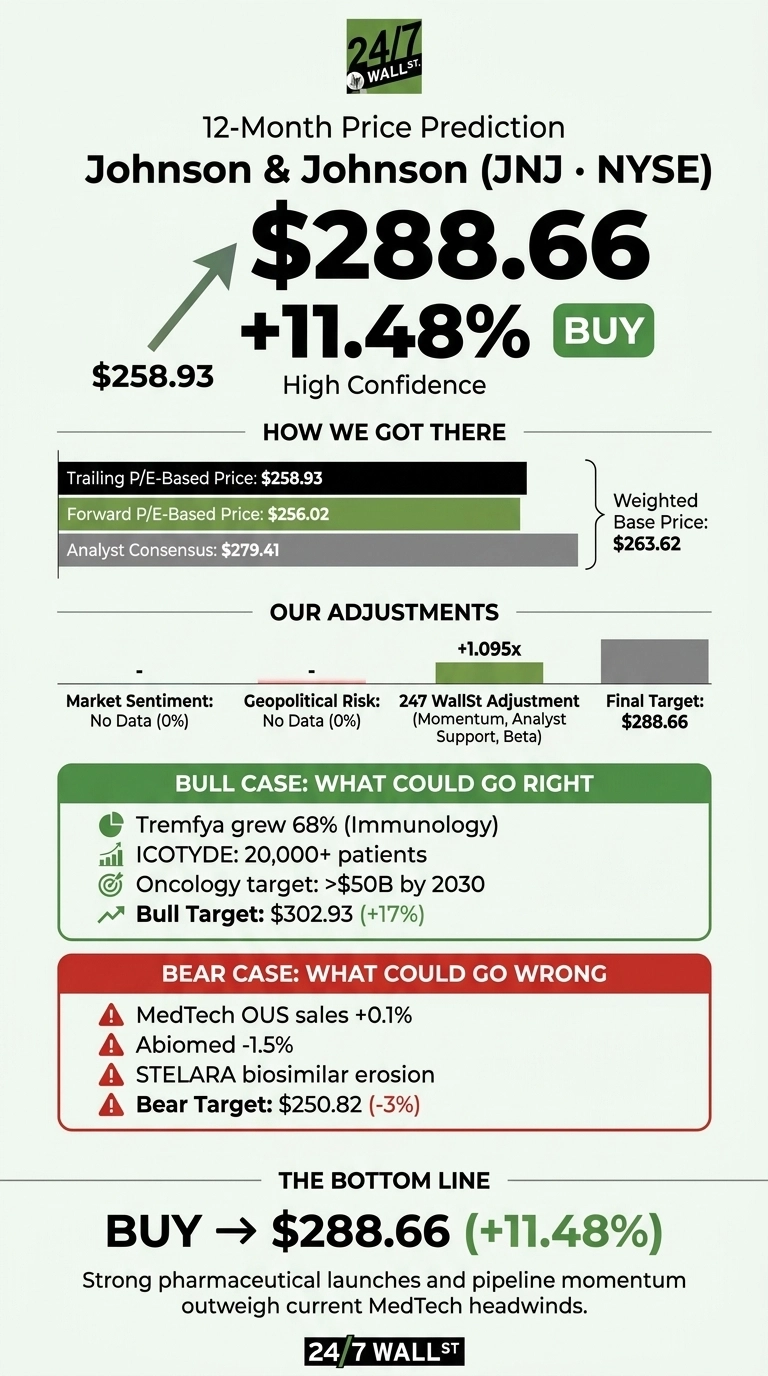
]]>Our 24/7 Wall St. price target for Johnson & Johnson (NYSE:JNJ) is $288.66 over the next 12 months. From the $258.93 close on October 20, that works out to 11.48% upside, and our rating is buy.
| Metric | Value |
|---|---|
| Current Price | $258.93 |
| 24/7 Wall St. Price Target | $288.66 |
| Upside/Downside | 11.48% |
| Recommendation | BUY |
| Confidence Level | 90% |

Our confidence in this call is high. Right now the growth comes from pharma. Last quarter Innovative Medicine grew 7.9% and MedTech grew 2.5%. Over the next year, I think the stock depends on whether devices can close that gap. If MedTech steadies, our target is likely too low.
A Talc Charge Hid a Solid Third Quarter
Shares dropped 1.3% to $255.99 at midday. They are up 2.97% for the week, down 5.19% over the past month and up 25.69% year to date. The 52-week range is $180.59 to $281.07.
In the quarter reported October 13, sales came in at $25.4 billion. Adjusted EPS was $2.59, while GAAP EPS fell to $0.09. About $7 billion of charges explain the drop: the proposed talc settlement plus costs tied to the Firefly Bio deal and the Cell BioMedicines partnership.
Management cut adjusted EPS guidance to $11.05 to $11.15. Leave out the $0.64 deal impact and EPS growth would be close to 9%.

Why Bulls See More Than $300
Our bull case reaches $302.93, which is 17% upside. Tremfya grew 68%, and management sees it becoming a $10 billion-plus franchise. New data released October 19 showed durable fistula remission in Crohn’s disease.
The oral psoriasis drug ICOTYDE has more than 20,000 patients on therapy. CAPLYTA reached $1 billion in year-to-date sales. J&J is targeting more than $50 billion in oncology sales by 2030.
Wall Street is supportive too: there are 16 Buy or Strong Buy ratings and a consensus target of $279.41.

MedTech Is the Business That Has to Catch Up
Our bear case is $250.82. MedTech sales outside the U.S. rose just 0.1%. Abiomed fell 1.5% and surgery fell 1%. Timothy Schmid, speaking for MedTech, put it plainly: “Simply put, we can do better, and we absolutely will.”
Two more risks add to the pressure. Firefly Bio and Cell BioMedicines are expected to reduce 2027 EPS by $1.36 per share, and Stelara keeps losing sales to biosimilars.
The other side deserves weight. U.S. MedTech grew 4.8% and Shockwave grew 17.2%. MedTech’s adjusted margin improved to 22.9%, and VARIPULSE Pro is still awaiting U.S. approval. Separating the Orthopaedics business should also sharpen the focus on the device units that remain.

J&J Trades at a Premium to Merck and AbbVie
| Company | Forward P/E | Quarterly Revenue Growth |
|---|---|---|
| Johnson & Johnson | 21 | 5.9% |
| Merck | 15 | 5.1% |
| AbbVie | 16 | 10.2% |
Merck (NYSE:MRK) is a direct oncology competitor with similar growth. Its forward P/E is 15, which suggests investors are paying extra for J&J’s broader set of drug launches.
AbbVie (NYSE:ABBV) has also had to replace sales from a major immunology drug facing biosimilars. It is growing faster at 10.2% and trades at a lower multiple. Against these two peers, our target looks reasonable but leaves little room for MedTech to disappoint.
Pharma Momentum Supports Our BUY Rating
Our 24/7 Wall St. price target is $288.66, with a buy rating and 90% confidence. What tips the call is that strong launches are outrunning Stelara’s decline.
I’d be a buyer if the December 8 Enterprise Business Review shows a credible plan to fix MedTech. I’d stay on the sidelines if device sales outside the U.S. keep stalling into 2027. On balance, I think the drug pipeline earns J&J its premium.
| Year | 24/7 Wall St. Price Target |
|---|---|
| 2026 | $261.98 |
| 2027 | $287.67 |
| 2028 | $314.27 |
| 2029 | $338.34 |
| 2030 | $358.63 |
These projections assume J&J keeps executing on its double-digit growth plan. The biggest swing factors are a faster MedTech recovery on the upside and new litigation costs on the downside.
The post JNJ Stock Has a New Growth Story, but One Business Needs to Catch Up appeared first on 24/7 Wall St..
]]>Moderna‘s (NASDAQ:MRNA) push into cancer treatment is drawing heavy buying as a closely followed melanoma presentation approaches. Shares of Moderna are up 7% to $241.89 during the trading session, running ahead of larger drugmakers and the healthcare sector fund.
Meanwhile, Bristol Myers Squibb (NYSE:BMY) stock is up 5% to $61.55. Pfizer (NYSE:PFE) stock is up 2% to $30.12, in line with the broader healthcare group.
Bristol Myers Squibb and Pfizer are far larger drugmakers. A single trial readout therefore carries more weight for Moderna stock, which has a market value of $96.2 billion.
Melanoma Data Heads to Madrid
Merck (NYSE:MRK) is Moderna’s partner on the program, and its immunotherapy Keytruda supports the combination. The companies will present late-stage melanoma data on October 24 at the European Society for Medical Oncology congress in Madrid. A Moderna investor webcast will follow. That study tests intismeran autogene plus Keytruda against Keytruda alone after surgery.
Moderna and Merck previously announced improvements in recurrence-free and distant-metastasis-free survival, with overall survival still under evaluation. Five-year Phase 2b data debuted this year. Presented at the American Society of Clinical Oncology meeting, it showed a 49% reduction in the risk of recurrence or death with intismeran plus Keytruda versus Keytruda alone. Management noted on its Q2 2026 earnings call that the Phase 3 study requires a minimum of 18 months of follow-up.
Healthcare Rally Outpaces the Dow
Moderna, Bristol Myers Squibb and Pfizer shares are all rising alongside a broad healthcare rally. The Health Care Select Sector SPDR ETF (NYSEARCA:XLV) is up 2% to $179.60. Among those names, Moderna stock is posting the largest gain by a clear margin.
For a broad-market comparison, the SPDR Dow Jones Industrial Average ETF Trust (NYSEARCA:DIA) is up 0.9% to $523.65. Healthcare stocks are outpacing the Dow-tracking fund by a wide margin, with Moderna and Bristol Myers Squibb shares setting the pace.
Moderna stock made up just 0.4% of the healthcare fund’s net assets as of the latest report, versus 5.5% for Merck, 2% for Bristol Myers Squibb and 2.4% for Pfizer. That small size means the fund’s advance rests mostly on bigger names, which makes the outsized gain in Moderna stock stand out.
Pipeline Hopes Meet a Thin Revenue Base
Intismeran could become Moderna’s first cancer product. Management spoke during the call. They stated, “We have been establishing the manufacturing in Massachusetts in a dedicated facility that will be able to support launch.” The company also repeated its outlook for up to 10% revenue growth in 2026.
Moderna’s core business offers little buffer if the data disappoint. Its Q2 report showed revenue of $145 million and a net loss of $782 million, and the company projects year-end cash and investments of $4.7 billion to $5.2 billion. That leaves Moderna stock heavily dependent on pipeline wins.
Madrid Sets the Next Test for Moderna
A key question is whether the full data presented on October 24 match the improvements Moderna and Merck already announced. Another is whether Moderna management’s confidence holds up under questioning on the webcast.
Sharp moves in either direction are possible for Moderna shares once the detailed results arrive. A shortfall could pressure Moderna stock, while a clean confirmation could extend its run. It may be wise to keep one’s share position sizes small until the data arrives.
The post Moderna Jumps 7% While Melanoma Vaccine Data Looms; Bristol Myers Squibb Rises 5%, Pfizer Advances 2% appeared first on 24/7 Wall St..
]]>Pfizer (NYSE:PFE) declared its quarterly dividend again on Oct. 6, 2026, at $0.43 per share. That’s the same amount it has paid since early 2025. The board held the payout steady after years of annual raises. The last increase took it from $0.42, a bump of about 2.4%. With shares at $29.58, up 24.96% year to date, the stock still yields roughly 5.80%. That raises the question: can Pfizer keep paying it?
Earnings Cover the Dividend, but Cash Flow Is Thin
Pfizer’s 2026 adjusted EPS guidance is $2.80 to $3.00. Against that guidance, the $1.72 annual dividend works out to a payout ratio of about 57% to 61%. Cash flow looks less comfortable. In 2025, operating cash flow minus capital spending came to about $9.08 billion, while dividends cost $9.77 billion. That means the payout ate up about 108% of free cash flow. In the first half of 2026, free cash flow was roughly $2.48 billion, while the company paid $4.9 billion to shareholders. GAAP profits keep taking hits from write-downs, including a $3.8 billion impairment on Sigvotatug vedotin in the second quarter.
Debt From Pfizer’s Dealmaking Limits Its Options
Total debt rose from $35.8 billion at the end of 2022 to $63.2 billion by June 30, 2026, while cash sat at just $976 million. Management put leverage at 2.7 times and offered no promise that it would fall soon:
“Given the LOE impact over the next few years, we expect leverage to remain around current level or modestly higher through this transition period.”
Buybacks are on hold. Pfizer’s 2026 guidance assumes no share repurchases, and $3.3 billion of authorization remains unused.
Pfizer’s Plan to Replace Revenue Lost to Patent Expirations
Generic and biosimilar competition will cost Pfizer about $1.1 billion in revenue this year, and the larger loss-of-exclusivity (LOE) wave, when key patents expire, is still to come. To offset it, launched and acquired products grew 18% operationally in the second quarter. A patent settlement extends U.S. exclusivity for Vyndamax, a heart-disease drug, to June 2031. Cost programs aim for about $9.7 billion in net savings through 2029. Chief executive Albert Bourla addressed the payout directly on the second-quarter call:
“We feel extremely confident that, even in the most stretched scenarios that we are running, we will be able to maintain our dividend. So I want, once and for all, to make that clear to all: the dividend will be maintained, and eventually, after the LOE period, we will start growing it again.”
He also pointed to a “risk-adjusted, high single-digit revenue CAGR from year-end 2028 through year-end 2033,” with obesity drugs from the Metsera deal aiming for a first approval in 2028.
How Bristol Myers and Merck Compare
Despite its own generic erosion, Bristol-Myers Squibb (NYSE:BMY) still raised its dividend to $0.63 per quarter. That was a 1.6% increase and its 17th consecutive annual raise. Bristol also lifted its 2026 EPS outlook to $6.75 to $7.00. Chief executive Christopher Boerner said, “The Growth Portfolio continues to deliver.”
Merck (NYSE:MRK) is paying the cost of rebuilding its pipeline. One-time charges of $9.0 billion for Cidara and $5.7 billion for Terns pulled its 2026 non-GAAP EPS outlook down to $2.66 to $2.76. Merck can absorb charges of that size from a $360 billion market cap. Pfizer is worth about $168.6 billion.
Verdict: Safe for Now, With No Growth Until the End of the Decade
Adjusted earnings cover the dividend well, and management has staked its credibility on keeping it. Free cash flow, though, has fallen short of the payout, and the debt load leaves little room for error. The current $0.43 looks safe through the patent-expiration years. Pfizer’s own plan also makes clear that raises are unlikely to resume before the 2029 return to growth. Until then, keep an eye on free cash flow coverage and leverage.
The post Pfizer’s Dividend Freeze Raises a Bigger Question About Its Cash Flow appeared first on 24/7 Wall St..
]]>Our 24/7 Wall St. price target for Johnson & Johnson (NYSE:JNJ) is $291.60 over the next 12 months. That means 15.57% upside from the model’s reference price of $252.32. Our rating is a buy, and our confidence is high.
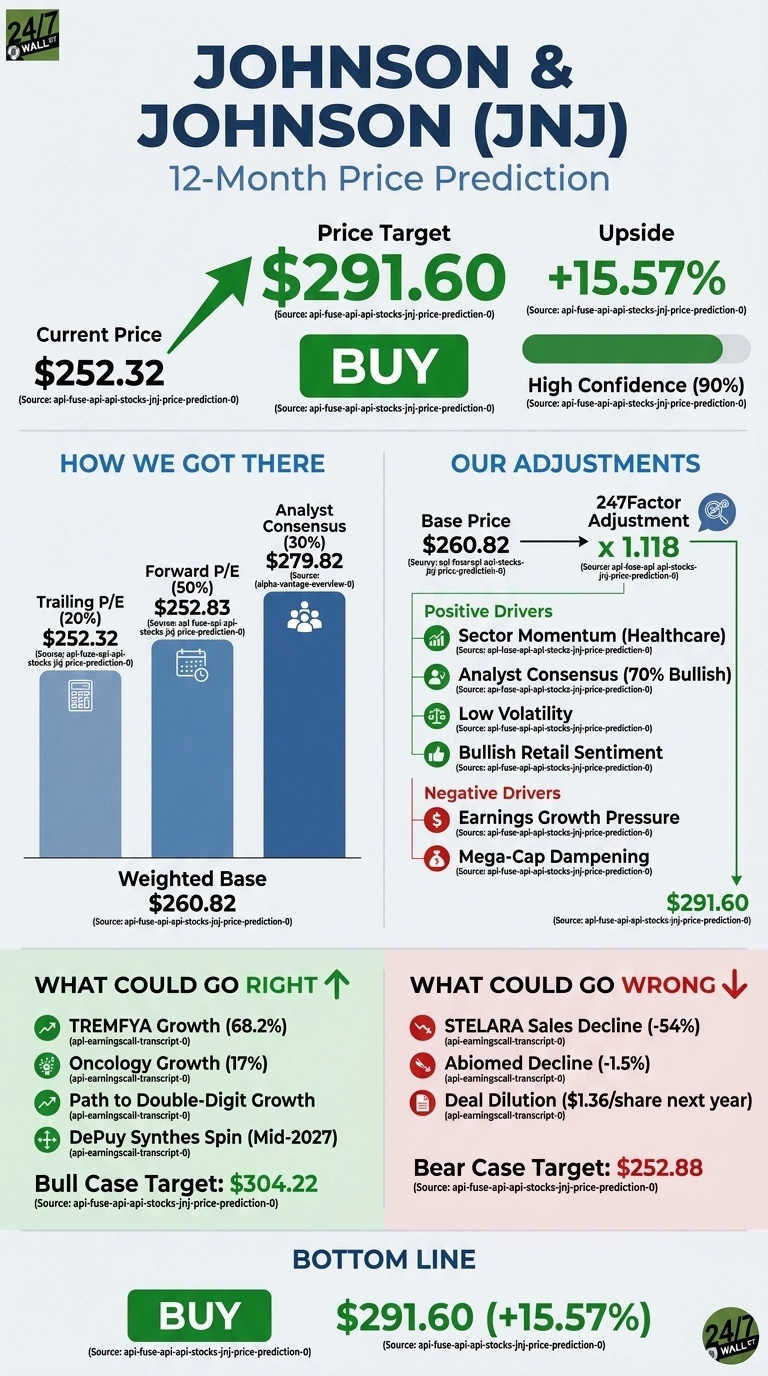
| Metric | Value |
|---|---|
| Current Price | $252.32 |
| Price Target from 24/7 Wall St. | $291.60 |
| Upside/Downside | 15.57% |
| Recommendation | BUY |
| Confidence Level | 90% |
J&J has a beta of 0.206, a dividend yield of 1.99%, and 64 consecutive years of dividend increases (the kind of multi-decade run we screened for in our free Dividend Kings guide, which you can grab here).
Its oncology business is also growing at a double-digit pace. Shares traded at $257.62 noon Thursday, up 1.46% on the session.
MedTech Miss Cools a Strong 2026 Run
The stock is up 26.49% year to date and 38.02% over the past year. It has slipped 3.27% over the past month and now sits between a 52-week low of $180.59 and a 52-week high of $281.07.
J&J reported third-quarter results on October 13. Sales rose 6% to $25.4 billion, and adjusted EPS came in at $2.59. Innovative Medicine grew 7.9%. MedTech grew only 2.5%, and shares fell after the device miss.
Management also reset adjusted EPS guidance to $11.05 to $11.15 to account for the Firefly Bio and SAIL Biomedicines deals. It announced a $5.5 billion resolution of the ovarian talc litigation as well.
Why Bulls See $304 and Beyond
The bull case is $304.22. TREMFYA grew 68.2%, and management believes it can become a “$10 billion plus franchise.” Oncology grew about 17%, and J&J wants to be the top oncology company by 2030 with sales above $50 billion.
Management sees “a clear path to double digit growth by the end of the decade” without any further acquisitions. More catalysts are on the calendar: the OTTAVA robot, a DePuy Synthes spin targeted for mid-2027 and a December 8 Enterprise Business Review.
On the ratings side, 16 analysts rate the stock a Buy or Strong Buy.
What Could Go Wrong for J&J
The bear case sits at $252.88, essentially flat. STELARA sales fell 54%, and Abiomed declined 1.5%. The deal dilution is $1.36 per share next year, which puts our forward EPS input at risk.
As a counterpoint, management said EPS growth would approach 9% without those transactions, and the talc agreement could remove a long-running drag.
How J&J Compares to Merck and AbbVie
Merck (NYSE:MRK) is a direct oncology rival. It trades at 15x forward earnings, but KEYTRUDA’s patent expiration explains part of that discount.
AbbVie (NYSE:ABBV) competes with TREMFYA in immunology. It trades at 16x forward earnings while growing revenue 10.2%.
| Company | Forward P/E | Dividend Yield | Revenue Growth (YoY) |
|---|---|---|---|
| J&J | 21 | 1.99% | 6.6% |
| Merck | 15 | 2.34% | 5.1% |
| AbbVie | 16 | 2.43% | 10.2% |
J&J accounts for a premium multiple, so our target looks somewhat aggressive next to these peers. That premium gets diversification and a lower risk of losing exclusivity on a single key drug.
Why J&J’s Defensive Profile Supports Our Target
A 24/7 Wall St. price target of $291.60 supports a buy with 90% confidence. Durable pharma growth is the deciding factor.
The thesis strengthens if TREMFYA and oncology keep growing faster than STELARA declines. It weakens if MedTech weakness spreads beyond Abiomed and international markets.
Our model projects these values if current trends hold.
| Year | Price Target from 24/7 Wall St. |
|---|---|
| 2026 | $255.36 |
| 2027 | $291.60 |
| 2028 | $323.87 |
| 2029 | $351.98 |
| 2030 | $380.13 |
J&J would need to keep executing on its current strategy for these projections to hold. The DePuy Synthes spin or new pipeline results could move the path significantly in either direction.
The post Johnson & Johnson Stock Could Be a Defensive Play for the Years Ahead appeared first on 24/7 Wall St..
]]>Bristol Myers Squibb (NYSE:BMY) pays $0.63 per share each quarter, up from $0.62 in 2025, for an annualized $2.52. At the latest price of $60.57, the yield is roughly 4.2%. The raise was a small 1.6%, but it marked the 17th consecutive annual increase and the 94th consecutive year of payments. The quarterly rate has rose every year since $0.37 in 2015.

The dividend’s future depends on whether the newer drugs that fund the check can grow faster than generics eat away at the older ones.
Raised Guidance Leaves Plenty of Coverage
After second-quarter EPS of $2.04 exceeded the $1.597 estimate, management raised 2026 non-GAAP EPS guidance to $6.75-$7.00 from $6.05-$6.35. Measured against that range, the dividend uses only 36% to 37% of earnings. Operating cash flow came in at about $3.4 billion for the quarter. Based on today’s share count, one quarter’s dividend costs roughly $1.3 billion. The company also paid down $1.2 billion of debt.
“Business development remains a priority, and we are regularly evaluating opportunities in the therapeutic areas we know best, while continuing to return cash to shareholders through our commitment to the dividend.”
That was David Elkins on the July earnings call.
Growth Drugs Are Covering for the Old Blockbusters

Second-quarter Growth Portfolio sales rose 15% to $7.56B. Camzyos grew 60%, Breyanzi 41% and Reblozyl 29%. Eliquis brought in $4.481B, up 22%. The older drugs kept shrinking: Revlimid fell 49% and Pomalyst dropped 71%.
“The Growth Portfolio continues to deliver, achieving 15% growth in the quarter, and represents an expanding share of our overall business.”
That was CEO Christopher Boerner.
Eliquis Patent Expiry and Debt Will Decide the Dividend’s Future
Management expects Eliquis sales to step down by $1.5 to $2 billion in 2027. Adam Lenkowski explained why:
“Eliquis LOE, as you’re aware, is April of 2028.”
The company is counting on milvexian to replace Eliquis, but the atrial fibrillation results has slipped to the first quarter of 2027. Pipeline news has been mixed. On October 12, the idiopathic pulmonary fibrosis drug admilparant met its Phase 3 primary endpoint only at the lower of two doses, and the stock reversed lower even though a cancer trial succeeded the same day. Barron’s called the results “confounding.” Total debt stands at about $43.1 billion, which helps explain why the latest raise was so small.
Pfizer Pays More, and Merck Has Its Own Patent Problem
Pfizer (NYSE:PFE) yields about 5.8% on a $0.43 quarterly payout. However, it carries net debt of 3.0x EBITDA and plans no share repurchases in 2026. Merck (NYSE:MRK) has its own patent expiration ahead with Keytruda, whose second-quarter sales slipped 1%. Merck also took a $2.31 per-share charge for its Terns acquisition. Bristol Myers sits in the middle of the group: it has more growth momentum than Pfizer and a lower yield.
Dividend Verdict for Income Investors
Bristol Myers shares have risen 17.26% year to date and 45.03% over the past year, which has pushed the yield down. Even so, a payout under 40% of guided earnings, strong cash flow and a growing portfolio of newer drugs make the dividend look safe. The tradeoff for income investors is raises near 2% while the company pays down debt and works through the Eliquis patent expiry. For retirees who want checks to arrive without ever selling the shares, we laid out how to build that kind of ladder in a free guide. Keep an eye on milvexian’s 2027 data. It will show whether dividend increases can speed up after 2028 or stay this small.
The post Bristol Myers Squibb’s 4.2% Dividend Yield Comes With a Trade-Off Investors Should Know appeared first on 24/7 Wall St..
]]>Profit taking is hitting one of biotech’s hottest trades, and the selling is landing heaviest on the stock that ran the furthest. Moderna (NASDAQ:MRNA) stock is down 10% to $214.03 in morning trading, giving back part of a steep run tied to its personalized cancer vaccine.
Meanwhile, BioNTech SE (NASDAQ:BNTX) stock is down 2% to $88.59, a much smaller decline. Pfizer (NYSE:PFE) stock is up 0.3% to $29.54, inching higher against the biotech selling.
The iShares Biotechnology ETF (NASDAQ:IBB) is down 2%, a fraction of the slide in Moderna stock. Over the same period, the SPDR S&P 500 ETF Trust (NYSEARCA:SPY) is down 0.1%, leaving the broad market close to flat.
Profit Taking Follows a Steep Cancer Vaccine Run
Moderna stock’s pullback reads as profit taking after a steep climb. In August, Moderna reported that intismeran autogene, given alongside Keytruda, met its primary endpoint in a late-stage melanoma trial. That result sent Moderna shares to their best single-day gain ever.
Merck (NYSE:MRK) is Moderna’s partner on intismeran autogene and the maker of Keytruda, the immunotherapy combined with the vaccine. Phase 2b follow-up at five years showed a 49% reduction in the risk of recurrence or death for the combination versus Keytruda alone. Together, Moderna and Merck are now running nine Phase 2 and Phase 3 trials across melanoma, non-small cell lung cancer, bladder cancer and renal cell carcinoma.
Goldman Sachs raised its price target on Moderna stock on Thursday while keeping a Neutral rating. The firm pointed to full late-stage melanoma data for intismeran autogene, due at the European Society for Medical Oncology (ESMO) Congress later this month. Selling in Moderna stock arrives with that presentation still ahead.
Respiratory vaccines such as Spikevax, mRESVIA, mNEXSPIKE and the flu-plus-COVID shot mCOMBRIAX still anchor Moderna’s commercial business. A joint procurement contract with the European Commission covers up to 24 million doses of mRESVIA for six countries. Oncology, however, carries most of the recent momentum in Moderna stock.
Selling Stays Concentrated in Moderna
Both Moderna and BioNTech use messenger RNA technology. They build vaccines and cancer therapies, while Pfizer is a diverse drugmaker and BioNTech’s longtime partner on the Comirnaty COVID-19 shot. Moderna stock is falling far harder. It is down much more than BioNTech stock and the iShares fund, while Pfizer stock is inching higher, pointing to selling concentrated in the name that ran the furthest.
BioNTech combined its mRNA work with antibodies and antibody-drug conjugates, led by pumitamig, a bispecific candidate in seven global registrational trials. Its pipeline also includes autogene cevumeran, an individualized mRNA cancer immunotherapy that lines up most directly against the Moderna program.
Melanoma Readout Sets Up Moderna’s Next Move
The optimistic outlook for Moderna depends on the full melanoma data confirming the August result. On the Q2 2026 earnings call, Moderna management stated that a dedicated Massachusetts facility could support the initial indication and that “we’d be ready to go next year if all went perfectly to plan.” Management also asserted that translational data from the American Society of Clinical Oncology meeting showed “we do see neoantigen-specific T cells, and we know those T cells can kill the tumor.”
A bear case could contend that Moderna stock already prices in a strong readout. Recent results offer little buffer, with Moderna’s Q2 revenue of $145 million and a loss of $1.97 per share that came in line with expectations. Guidance from Moderna calls for up to 10% revenue growth in 2026, leaving the valuation heavily tied to oncology.
Investors can watch for whether the full melanoma data at ESMO matches the August headline. Until that readout arrives, investors should keep their positions in Moderna stock moderate given how much of the recent run rests on oncology.
The post Moderna Tumbles 10% as Profit Taking Hits Cancer Vaccine Rally; BioNTech Eases, Pfizer Stays Put appeared first on 24/7 Wall St..
]]>Jim Cramer used his October 15 Mad Money broadcast to argue that every investor needs a designated driver for their portfolio. He pointed out that stocks with no data center exposure have been soaring as money flowed into non-tech names. The examples he gave included consumer staples, waste haulers, and pharmaceutical companies.
He also warned that overconcentrated investors risk getting blown out and giving up on stocks altogether, as many did in 2000, 2008, and 2022. Cramer made a similar case in June, during an earlier break in data center stocks: “These stocks will lag while the data center roars, but they preserve your sanity when you get a tsunami-like sell-off in the hottest stocks out there.”
Quality Is Quietly Winning Across the Market
A Fast Money segment the same night picked up the theme: “All eyes are on semiconductors or hyperscalers, so nobody cares. Meanwhile, health care is doing some amazing things.” The show added that health care “is outperforming the S&P 500 for the year.”
Small caps share the same preference for profits: “Profitable Russell 2000 stocks have double the performance of non-profitable ones… Last year non-profitable small caps outperformed profitable ones 2 to 1. Now it’s essentially the opposite,” according to On Investing, Charles Schwab’s podcast. Volatility is creeping higher as well. The CBOE Volatility Index rose to 16.87 on October 14, which is still inside its normal range.
Staples Carrying the Load
Coca-Cola (NYSE:KO) shares are up 33.1% year to date. Second-quarter adjusted EPS of $0.97 beat the $0.93 estimate, and management raised full-year guidance to 5% organic revenue growth and 9% to 10% comparable EPS growth, according to its 8-K filing. The chief executive credited an “all-weather strategy, building balanced, quality, top-line growth.”
Procter & Gamble (NYSE:PG) has raised its dividend for 70 consecutive years. Organic sales were flat in its fiscal fourth quarter. Fiscal 2027 guidance calls for core EPS to be in line to up 3% despite a roughly $1 billion commodity and transport drag. P&G still plans about $10 billion in dividends and $5 billion in buybacks.
Church & Dwight (NYSE:CHD) posted 5.8% organic growth, nearly double its 3% outlook, led by TheraBreath and Hero. It declared its 502nd consecutive quarterly dividend and raised its 2026 adjusted EPS outlook to $3.74 to $3.81.
Pharma and Trash Pickup Round Out the Ride
Johnson & Johnson (NYSE:JNJ) is up 22.2% this year, though shares have fallen 5.2% over the past month and slid after a MedTech miss in its third-quarter report. Second-quarter oncology sales rose 17.3% to $7.41 billion. Investors are now asking whether the planned Orthopaedics separation can fix the medtech side.
Merck (NYSE:MRK) has risen 36.4% year to date. Keytruda franchise sales reached $8.37 billion in the second quarter, and Winrevair grew 75%. The chief executive characterized Keytruda’s loss of exclusivity as “more of a hill than a cliff,” citing a pipeline of over 20 new products. The quarter’s adjusted loss of $0.13 per share resulted from a one-time charge related to the Terns Pharmaceuticals acquisition.
Waste Management (NYSE:WM) offers a different kind of stability. Core price rose 5.7%, and free cash flow grew 34.5% to $1.10 billion in Q2. Management cut revenue guidance but raised its margin outlook to 31.0% to 31.2%. Operating expenses stayed below 60% of revenue for the sixth consecutive quarter. The shares are up a modest 2.7% this year.
A Practical Concentration Check for Retirement Savers
Start by listing every holding, index funds included, and estimate how much of the portfolio depends on AI chips, cloud spending, and data center construction. Broad market funds can carry significant weightings in megacap tech, so actual tech exposure may be larger than it appears. Then consider how the portfolio would do if that piece fell sharply.
Boring holdings earn their place by paying you while you wait. These companies keep paying dividends regardless of what chip stocks do. Third-quarter reports over the coming weeks will show whether pricing power and raised guidance hold up with consumers under uneven pressure. P&G’s next dividend is scheduled to be paid on November 16.
The post The Stocks That Will Get Investors Home Safe When Tech Cracks appeared first on 24/7 Wall St..
]]>Should an investor saving for retirement put their next dollar of income capital into Amgen (NASDAQ:AMGN) or Merck (NYSE:MRK)? The two yields are near identical. Amgen’s annualized forward dividend of $10.08 on a $437.04 share price works out to about 2.31%. Merck pays $3.40 on a $149.91 stock, a yield of about 2.27%. Each stock has rallied hard this year, Amgen up 36.25% year to date and Merck up 45.38%, so the choice comes down to what sits beneath each check.

Dividend Safety: Amgen Has the Cushion Income Investors Need
Amgen guides 2026 non-GAAP EPS of $22.30 to $23.50. At the $22.90 midpoint, the forward dividend uses roughly 44% of earnings. Second-quarter free cash flow reached $3.489 billion, up 82.57%, and cash rose to $13.989 billion. The blemish is $57.3 billion of debt, but cash generation covers the payout well.
Merck’s 2026 non-GAAP EPS guidance is $2.66 to $2.76, depressed by one-time charges of $3.62 per share for Cidara and $2.31 per share for Terns. Against the $2.71 midpoint, the dividend represents about 125% of this year’s guided earnings. On 2025 EPS of $8.98, coverage looked far better at about 38%. Chief Financial Officer Caroline Litchfield said on the Q2 call, “We remain committed to the dividend with the goal of increasing it over time.” She also said “Business development remains a high priority,” which means more deal charges could land. Winner: Amgen.
Dividend Growth: Amgen Raises Faster Every Year
Amgen lifted its quarterly payout from $2.38 to $2.52, a 6% increase. Since the $1.76 rate of 2021, the dividend has grown about 43%, and the record stretches back to $0.28 in 2011.
Merck moved from $0.81 to $0.85, roughly 4.9%. From the $0.65 rate of 2021, its payout is up about 31%. Merck’s steps are reliable but smaller, a sign that acquisitions get first call on its capital. Winner: Amgen.
What Backs the Payout: Amgen’s Growth Is Already in the Numbers
Amgen’s six key growth drivers rose 26% and made up about 70% of Q2 product sales. Repatha grew 37% and IMDELLTRA 115%, more than making up for Prolia’s 32% biosimilar decline. Management raised 2026 revenue guidance to $38.2 billion to $39.4 billion. Amgen fell nearly 10% on a September trial setback, and the MariTide obesity program still rides on 10 Phase 3 studies.
Merck’s Keytruda family brought in $8.37 billion in Q2, but core Keytruda growth was -1%. Chief Executive Rob Davis calls the coming exclusivity loss “more of a hill than a cliff” and points to “greater than $70 billion of commercial opportunity” from more than 20 new products. WINREVAIR rose 75%, yet full-year revenue guidance implies just 2% to 4% growth. Amgen is already showing the replacement growth Merck is still promising. Winner: Amgen.

Verdict: Amgen Screens Stronger on Income Metrics Now
Amgen takes all three rounds. It pays a slightly higher yield, covers that payout with less than half of guided earnings, raises faster, and has growth products large enough to offset its patent losses today. It also trades at about 17 times forward earnings, which leaves room for the income story to compound.
If this kind of dividend-vs-dividend screen is how you build an income portfolio, we ran the same exercise across the longest-tenured payers in the market and ranked ten of them by valuation in a free Dividend Kings guide.
Merck’s case rests on a pipeline re-rating, and its dividend exceeds this year’s guided earnings. For income investors focused on coverage and growth, Amgen’s payout screens stronger on these metrics. Keep an eye on Merck’s late-year dividend declaration (the last two raises were declared in November) and on Amgen’s December declaration, which delivered its last increase on 2025-12-09.
The post AMGN vs. MRK: Which Pharma Giant’s Dividend Actually Has Room to Grow appeared first on 24/7 Wall St..
]]>Moderna (NASDAQ:MRNA) has risen 658.2% year to date, from $29.49 at the end of 2025 to $223.60 in premarket trading on Thursday. That premarket price is 1.2% below Wednesday’s $226.30 close. Investors who missed the run now face a valuation question. Analyst targets and valuation data help answer that question.
Melanoma Data Turned a COVID Stock Into a Cancer Story
On August 19, shares rose 177%, Moderna’s best day ever. The jump came after its personalized cancer vaccine, developed with Merck (NYSE:MRK), showed promise in its first late-stage trial. Before that, five-year Phase 2b data presented at ASCO 2026 showed a 49% reduction in the risk of return or death when intismeran was added to Keytruda. Jim Cramer called the vaccine “miraculous” on Mad Money on August 31. On October 1, he said the shift away from COVID “verifies the excitement and the move.” Valuation metrics add harder numbers to that view.
Moderna has four approved products: Spikevax, mRESVIA, mNEXSPIKE and mCOMBRIAX. It also has nine Phase 2/3 intismeran trials covering melanoma, lung, bladder and kidney cancer, plus rare disease programs. On September 25, a panelist on CNBC’s Fast Money said investors now see that “Moderna could have six or seven drugs by 2028.”
Analysts Value Moderna Far Below Its Price
The consensus analyst price target is $122.67, well below the current share price. A separate valuation model puts fair value at $134.45 and rates the stock at Sell. Hold ratings dominate the analysts’ consensus. Shares trade at 38.75 times trailing sales. When a stock trades this far above analyst targets, either Wall Street has not caught up with the story or the stock has gotten ahead of the company’s results. Investors have to decide which.

The Five-Year Chart Most Coverage Skips
Even after this run, shares are 31.0% below their price five years ago, when they traded at $324.21. The valuation model still flags a sharp year-over-year earnings decline. Moderna lost $782 million in the second quarter on revenue of $145 million. The pipeline also carries risk: the norovirus vaccine failed to meet its statistical endpoints at a Phase 3 interim analysis. Today, the share price reflects future pipeline value amid ongoing losses.
November 6 Is the Next Test
Third-quarter results are scheduled for November 6, and management expects about 55% of second-half revenue to land in the third quarter. Investors will see whether that happens. The report also needs to show cash on track for $4.7 billion to $5.2 billion at year end, along with a regulatory timeline for intismeran. In July, management said that if the melanoma data were positive, “we would obviously make the case for an accelerated review.”
Concentration Risk Looms Over Biotech Rallies
On August 27, Suze Orman spoke with a caller whose partner had pushed her to put everything into a single biotechnology stock. Orman called that “reckless speculation.” Orman also asked why he hadn’t made the investment himself: “Why didn’t he, if he was so certain, build his own savings and invest his own money?” She was warning about concentration and process, and that point applies at any price. A little speculative exposure to a story like Moderna’s can work if it stays small and follows rules, the sizing and safety rails we laid out in a free speculation guide. Concentration in one clinical-stage biotech magnifies portfolio risk.
Verdict: Price Runs Far Ahead of Valuations
At this price, Moderna trades well ahead of both analyst and model valuations. The $223.60 share price is far above both the $122.67 analyst consensus and the $134.45 model estimate. That means the price already assumes regulatory approval, a successful launch, and strong sales that Moderna has not delivered yet. If the cancer vaccine succeeds, the upside case improves. If anything slips, the gap between the current price and analyst targets leaves room for a painful drop. The November 6 report and further regulatory progress will show whether results can catch up to the share price.
The post Moderna Stock Is Soaring on Cancer Vaccine Buzz. Is It Too Late to Get In? appeared first on 24/7 Wall St..
]]>For retirees, the hardest part of giving up a paycheck is losing the regular stream of cash that came with it. Social Security pays part of the bills. Savings have to cover the rest, ideally without forcing a sale during a selloff. Bank certificates of deposit do little here: the national average 12-month CD pays 1.73% annual percentage yield (APY). The 10-year Treasury yields 5.31%, but that coupon remains fixed for a decade. Every one of the six companies below raised its dividend over the past year.
The Dogs of the Dow strategy targets the highest-yielding blue chips in the Dow Jones Industrial Average, and these six names are current Dogs of the Dow. Splitting $500,000 equally puts about $83,333.33 into each stock. At current forward yields, that $500,000 would produce more than $16,500 in annual passive income. Below is what each position generates, from lowest yield to highest.
Merck: A Rising Payout Through the Keytruda Transition
- Forward Yield: 2.40%
- Shares for $83,333.33: 589.3
- Annual Passive Income: ~$2,003.77
Merck (NYSE:MRK) is a large-cap drugmaker built around Keytruda, which posted family sales of $8.4 billion in the second quarter of 2026. The yield ranks lowest in this group because the shares have risen 37.13% year to date to $141.40, which spreads the $3.40 forward dividend over a higher price.
On paper, this year’s coverage looks thin. Full-year EPS guidance of $2.66 to $2.76 includes a $2.31 per share upfront charge for the Terns Pharmaceuticals deal, so the payout tops reported 2026 earnings. Coverage from underlying earnings is stronger once one-time charges are excluded. CFO Caroline Litchfield said, “We remain committed to the dividend to increase it over time,” and CEO Rob Davis called Keytruda’s loss of exclusivity “more of a hill than a cliff.”
Coca-Cola: Asset-Light Margins Fund Steady Raises
- Forward Yield: 2.44%
- Shares for $83,333.33: 960.7
- Annual Passive Income: ~$2,036.74
Coca-Cola (NYSE:KO) sells concentrates and syrups to bottlers worldwide. The company’s asset-light approach delivered a 34.9% operating margin in the second quarter, when revenue grew 6.7% to $13.38 billion. The yield is modest because the shares have gained 26.49% year to date.
The $2.12 forward dividend works out to about 64% of trailing EPS of $3.33. Management raised 2026 guidance to comparable EPS growth of 9% to 10% and free cash flow of about $12.4 billion. The quarterly payout rose to $0.53 from $0.51 in 2026.


Amgen: Biotech Cash Flow Behind a 6% Raise
- Forward Yield: 2.51%
- Shares for $83,333.33: 207.7
- Annual Passive Income: ~$2,093.20
Amgen (NASDAQ:AMGN) is a large-cap biotech with 17 products running above $1 billion annualized. It pays a $10.08 forward dividend on a $401.30 share price. CFO Peter Griffith noted the $2.52 quarterly payout represents a 6% increase over the prior year.
Coverage is the strongest in this group. Raised 2026 non-GAAP EPS guidance from $22.30 to $23.50 means the dividend absorbs roughly 45% of the low end, and second-quarter free cash flow reached $3.5 billion. Risks include biosimilars, which cut combined Prolia and Xgeva sales by 33%, and $57.3 billion in debt.
Procter & Gamble: 70 Straight Years of Dividend Growth
- Forward Yield: 2.92%
- Shares for $83,333.33: 558.2
- Annual Passive Income: ~$2,430.39
Procter & Gamble (NYSE:PG) owns Tide, Pampers, Gillette, Crest, and Olay, products consumers rebuy in any economy. The company just marked its 70th consecutive year of dividend increases and 136th consecutive year of payments. Shares are up just 6.46% year to date, keeping the yield above those of Coca-Cola and Merck.
The $4.354 forward dividend equals about 63% of fiscal 2026 core EPS of $6.89, supported by $15.84 billion in free cash flow. For fiscal 2027, P&G plans about $10 billion in dividends and $5 billion in buybacks, despite an expected after-tax commodity headwind of roughly $1 billion.


Chevron: Record Output Lifts Free Cash Flow
- Forward Yield: 3.41%
- Shares for $83,333.33: 399.7
- Annual Passive Income: ~$2,845.72
As an integrated oil major, Chevron (NYSE:CVX) operates in oil and chemicals. The Hess acquisition drove production to a record 4,070 thousand barrels of oil equivalent per day (MBOED). Energy stocks carry higher yields because investors price in commodity cycles, and Chevron pays a $7.12 forward dividend.
The dividend takes about 69% of trailing EPS of $10.39. Cash flow gives a stronger read: second-quarter free cash flow hit $18.10 billion, Chevron cut debt by $8.41 billion in the quarter, and net debt to EBITDA stands at 1.08x. A 20-year, 2.67 GW power deal with a tech giant adds revenue outside oil prices.


Verizon: Ultra-High-Yield With an “Ironclad” Pledge
- Forward Yield: 6.11%
- Shares for $83,333.33: 1,799.9
- Annual Passive Income: ~$5,093.59
Verizon Communications (NYSE:VZ) is the largest U.S. wireless carrier and also runs Fios fiber broadband. Telecom is a mature, capital-intensive business carrying substantial debt, so the market prices Verizon at a forward P/E of about 9. That valuation is what makes this the group’s only ultra-high-yield name.
The $2.83 forward dividend uses about 57% of the low end of raised 2026 adjusted EPS guidance of $4.99 to $5.04, and free cash flow is guided to $21.94 billion to $22.14 billion. Net unsecured debt of $136.5 billion remains the biggest risk. Management calls the dividend “ironclad” and has raised it for the 20th consecutive year.


Six Dow Dividend Payers, One Income Stream
| Name | Forward Yield | Annual Dividend Income |
|---|---|---|
| Verizon | 6.11% | $5,093.59 |
| Chevron | 3.41% | $2,845.72 |
| Procter & Gamble | 2.92% | $2,430.39 |
| Amgen | 2.51% | $2,093.20 |
| Coca-Cola | 2.44% | $2,036.74 |
| Merck | 2.40% | $2,003.77 |
| Total | 3.30% | $16,503.42 |
Together, these six holdings produce $16,503.42 in annual income on a $500,000 investment, for a combined yield of 3.30%. Verizon contributes $5,093.59, Chevron adds $2,845.72, P&G brings in $2,430.39, Amgen delivers $2,093.20, Coca-Cola supplies $2,036.74, and Merck contributes the remaining $2,003.77.
Compounding drives this basket’s long-term value. Reinvested dividends buy more fractional shares, raising the next payment, and annual increases stack on top. For retirees who don’t need every dollar yet, that rising income can outpace rising costs. (The whole point of a dividend ladder is never having to sell a share, and our free guide shows how to build one.) Watch upcoming dividend announcements, quarterly earnings, and guidance updates, especially Merck’s Keytruda transition and Verizon’s debt load.
The post How to Turn $500,000 Into a Lazy $16,500 Yearly Passive Income Stream appeared first on 24/7 Wall St..
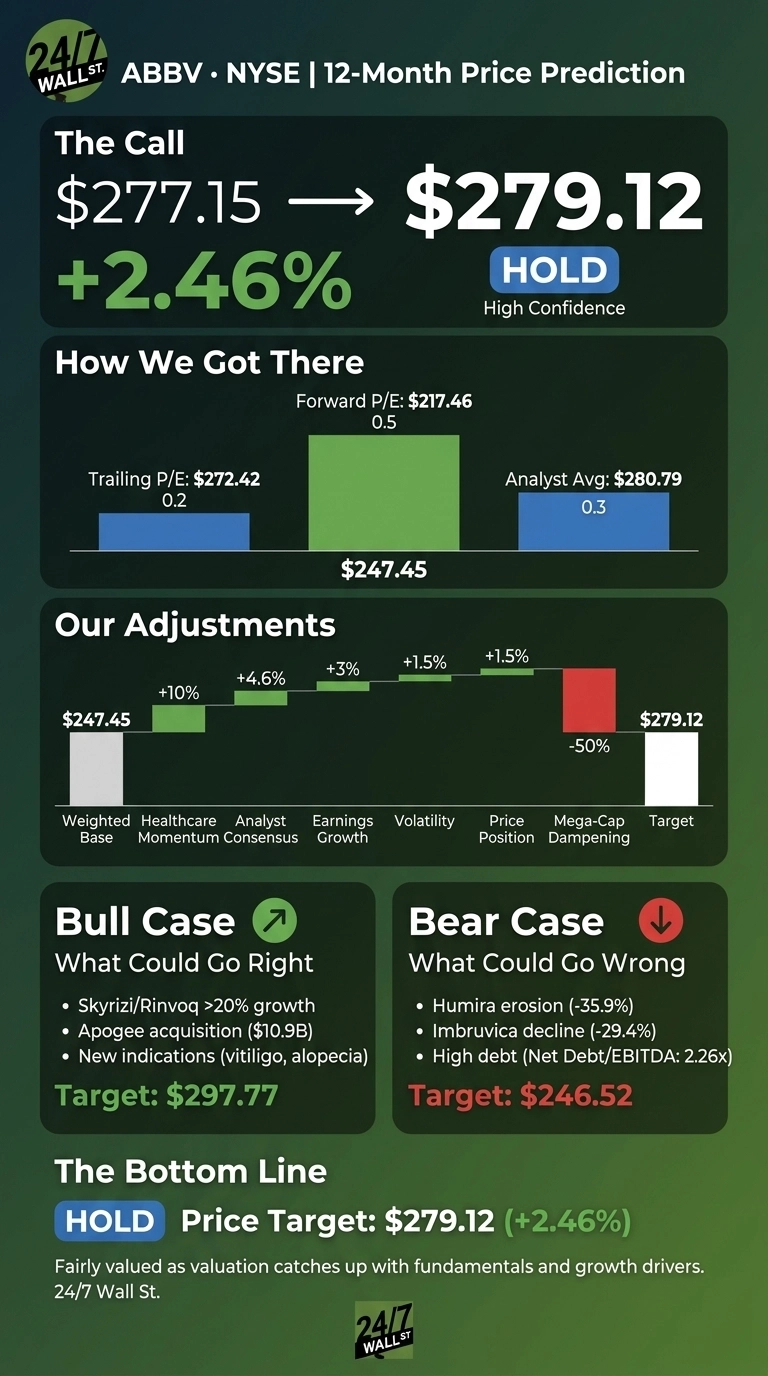
]]>AbbVie (NYSE:ABBV) trades at $277.15 midday Friday. Our 24/7 Wall St. price target is $279.12 over 12 months, representing 2.46% upside from the model price.
Our high confidence reflects broad growth: Skyrizi, Rinvoq and neuroscience each delivered growth above 20% last quarter. AbbVie completed its Apogee Therapeutics acquisition on September 3, 2026. The stock sits near the $280.79 consensus target, limiting upside.

A Breakout Above the 52-Week High Shows Momentum Building
Shares rose 6.62% over the past week, 11.4% over the past month and 24.16% year to date, breaking above the prior 52-week high of $274.94.
Second-quarter revenue of $16.99 billion rose 10.2%, ahead of the $16.76 billion consensus. Adjusted EPS of $3.65 met the $3.64 estimate. Management raised revenue guidance by $300 million to about $67.6 billion. The FDA approved JUVMO (tavapadon) for Parkinson’s disease, and Temab-A received two Breakthrough Therapy Designations.
Why Bulls See $297 Within Reach
Skyrizi sales reached $5.51 billion last quarter, up 24.4%, with management expecting $21.7 billion for the full year. Rinvoq peak sales in vitiligo and alopecia areata alone could approach $2 billion. Apogee’s zumilokibart posted positive Phase 2 results in atopic dermatitis, positioning it as a credible billion-dollar candidate.
A new under-the-skin Skyrizi dose for Crohn’s disease could accelerate growth starting “really early in 27”. Wall Street gives 8 Strong Buy and 16 Buy ratings to the stock. The bull case reaches $297.77.

Humira Erosion and Debt Keep Risks on the Table
Humira sales fell 35.9% to $756 million, and Imbruvica dropped 29.4%. Net debt stands at 2.26x EBITDA. The trailing P/E of 114 reflects $5 billion in acquired R&D charges in 2025.
On forward earnings, the stock trades at 16x. Management targets two times net leverage within two to three years. Our bear case is $246.52.

How AbbVie Compares to Merck and Eli Lilly
| Company | Forward P/E | Quarterly Revenue Growth (YoY) |
|---|---|---|
| AbbVie | 16x | 10.2% |
| Merck | 15x | 5.1% |
| Eli Lilly | 24x | 47.7% |
Merck (NYSE:MRK) faces a similar patent cliff. Keytruda sales of $7.904 billion declined 1%. Merck trades at a discount to AbbVie, which makes sense given AbbVie’s faster growth.
Eli Lilly (NYSE:LLY) competes in immunology through Ebglyss, whose sales rose 131%. Lilly’s premium multiple reflects much faster growth. AbbVie sits between both peers.
AbbVie Price Prediction 2026-2030
Our 24/7 Wall St. price target of $279.12 carries a hold rating and 90% confidence. After the rally, valuation has caught up with fundamentals. Approval of the Skyrizi Crohn’s dose or strong Rinvoq dermatology launches could turn positive.
Accelerating Humira declines or higher Apogee integration costs would call for caution. For now, AbbVie looks fairly valued.
The 24/7 Wall St. price target model projects where AbbVie could trade if current growth trends hold.
| Year | Price Target from 24/7 Wall St. |
|---|---|
| 2026 | $274.36 |
| 2027 | $279.12 |
| 2028 | $289.22 |
| 2029 | $300.38 |
| 2030 | $314.29 |
These estimates assume AbbVie executes its immunology strategy. Key swing factors: Skyrizi’s patent defense ahead of 2033 expiration and how quickly Apogee drugs reach market.
The post Prediction: AbbVie’s Next Billion-Dollar Opportunity Is Taking Shape appeared first on 24/7 Wall St..
]]>Vaccine and biotechnology names are leading a sharp sector rally, and a small protein-vaccine developer is posting the biggest gain of the group. Novavax (NASDAQ:NVAX) shares recently changed hands at $12.77, up 16%. Also rallying, Moderna (NASDAQ:MRNA) shares are at $219.30, up 11%, a double-digit gain that still trails Novavax stock.
Meanwhile, Merck (NYSE:MRK) shares trade at $146.18, up 3%, representing a more measured gain for the largest drugmaker of the three. To frame the sector move, the iShares Biotechnology ETF (NASDAQ:IBB) is up 3%. For contrast, the SPDR S&P 500 ETF Trust (NYSEARCA:SPY) is up 0.5%, leaving biotechnology well out in front of the broad market.
Sector-Wide Bid Lifts Vaccine Developers
No announcement, filing, analyst action, trial result or scheduled event accounts for the move in Novavax shares, and no fresh company-specific catalyst was identified. Breadth tells the rest of the story: a biotechnology fund rising far more than the broad market, with two vaccine developers posting double-digit gains at once. Novavax shares are riding that wave, just with greater amplitude.
That combination reads as a sector-wide bid in vaccine and biotechnology names. Within that bid, Novavax stock is the most sensitive of the group, which fits a business whose value depends on uneven milestone payments from larger partners.
Three Business Models Explain the Spread
Novavax makes protein-based vaccines paired with its own Matrix-M adjuvant, a different approach from messenger RNA platforms such as Moderna’s. Over time, the company has moved toward licensing that technology to larger partners and away from commercializing vaccines itself, and partners carry the cost of bringing products to market under that arrangement.
That shift moves Novavax’s economics toward royalties and milestone payments. Such payments arrive unevenly and depend on partners hitting development steps, so Novavax shares respond sharply to anything that changes the odds of reaching them.
Moderna sells its own messenger RNA products and runs its own commercial operation, while Merck is a diversified large-cap drugmaker whose vaccine business is one line among many. Those structural differences are why the same sector bid moves the three companies by very different amounts.
Licensing Upside Meets Sentiment Risk
Novavax’s bull case is built on capital efficiency. Its licensing model needs little capital to scale, and it gives the company exposure to its partners’ commercial reach without paying to build a sales force of its own. When partners keep advancing, that structure can convert their progress into revenue without heavy spending.
The skeptics may see a simpler and less comfortable story. The gain is a sentiment move. With nothing company-specific behind a double-digit gain, a stock that depends on partner milestones gives holders no way to tell when the next one lands.
What to Watch Next
Partner milestone news could set the next direction for Novavax stock, since those payments shape the company’s revenue. Anyone following the group can watch for whether the biotechnology fund holds its lead over the SPY ETF, which would signal that the sector bid has staying power.
Position sizes in Novavax stock should stay modest, given how far the shares can travel on sentiment alone. Defining their risk in advance may matter more for a milestone-driven name than for a diversified drugmaker like Merck.
The post Novavax Soars 16%, Moderna Surges 11%, Merck Climbs 3% as Biotech Rallies appeared first on 24/7 Wall St..
]]>Pfizer (NYSE:PFE) pays a 6.16% dividend yield. For a drugmaker worth roughly $159.5 billion, a number that large works as a warning label. The question for income investors is fairly simple: is that yield a reward for patience, or is the market saying the payout is in trouble?
Why Pfizer’s Yield Looks So Big
Yield is the annual dividend divided by the share price. Pfizer pays $1.72 per share a year. When the price falls, the same payment becomes a bigger percentage. Five years ago the stock traded at $32.55, which would yield about 5.28% today. Shares now sit at $27.98, down 14.04% over five years, despite an 18.2% gain in 2026.
The peers make the point clearer. Bristol-Myers Squibb (NYSE:BMY), which has its own patent expiration to worry about, yields 4.2%. Merck (NYSE:MRK), whose growth story still has investors’ confidence, yields just 2.33% and trades at 15 times forward earnings. Pfizer trades at 10 times.
Cash Coverage Is Thinner Than Earnings Suggest
Measured against adjusted earnings, the dividend looks comfortable at about 59% of the center of Pfizer’s $2.80 to $3.00 adjusted EPS guidance. Cash flow is tighter. In 2025, operating cash flow of $11.7 billion minus $2.63 billion in capital spending left free cash flow of about $9.08 billion. Dividends cost $9.77 billion, roughly 108% of free cash flow. In the first half of 2026, operating cash flow was $3.45 billion while dividends took $4.9 billion.
The balance sheet carries $63.2 billion of debt, with net debt at 3.26 times EBITDA. Management expects leverage to stay around current level or modestly higher through patent expiration. Pfizer made no buybacks in 2025 and expects none in 2026. The dividend has stayed at $0.43 per quarter since January 2025, confirmed again on October 6, 2026.
Bourla Says the Dividend Will Hold
On the second-quarter call, CEO Albert Bourla took the question head on:
“We feel extremely confident that we will, even the most stretched scenarios that we are running, we will be able to maintain our dividend. So I want once and for all to make that clear to all that the dividend will be maintained and eventually after the LOE period will start again growing it.”
That plan faces significant challenges. Paxlovid revenue was $21 million in the quarter, down 95%, and 2026 COVID revenue outlook fell to about $4 billion. A failed Phase 3 trial cost $3.8 billion in write-downs and caused a GAAP quarterly loss. Making up for this, launched and acquired products grew 18%, cost cuts are expected to save $6.7 billion through 2029, and a patent settlement protects Vyndamax in the U.S. until June 2031.
What Has to Go Right Before 2029
To hold the payout, Pfizer needs cost savings on schedule, newer drugs growing at double digits, and its obesity drug reaching first approval by 2028. Risks include late-stage trial failures, U.S. drug-pricing pressure, or leverage rising well past slightly higher.
Here is the answer. The dividend is safe. Pfizer has the earnings buffer, a CEO who has publicly committed to it, and room to borrow while it waits for growth to return. The 6.16% yield is the market charging for that wait.
Investors collect a frozen payout, partly paid for with debt, until growth returns around 2029. That is slow income with a solid floor. The risk is how long the wait lasts.
The post Pfizer’s Dividend Yield Is Above 6%. Wall Street May Be Sending a Warning appeared first on 24/7 Wall St..
]]>Cantor Fitzgerald raised its price targets on four drugmakers and left every rating unchanged.
On the Overweight side, Eli Lilly (NYSE:LLY) went to $1,440 from $1,410 and AbbVie (NYSE:ABBV) went to $290 from $285. On the Neutral side, Merck (NYSE:MRK) went to $145 from $120 and Pfizer (NYSE:PFE) went to $28 from $27.
Every target moved higher, but Cantor still has its strongest conviction in Lilly and AbbVie.
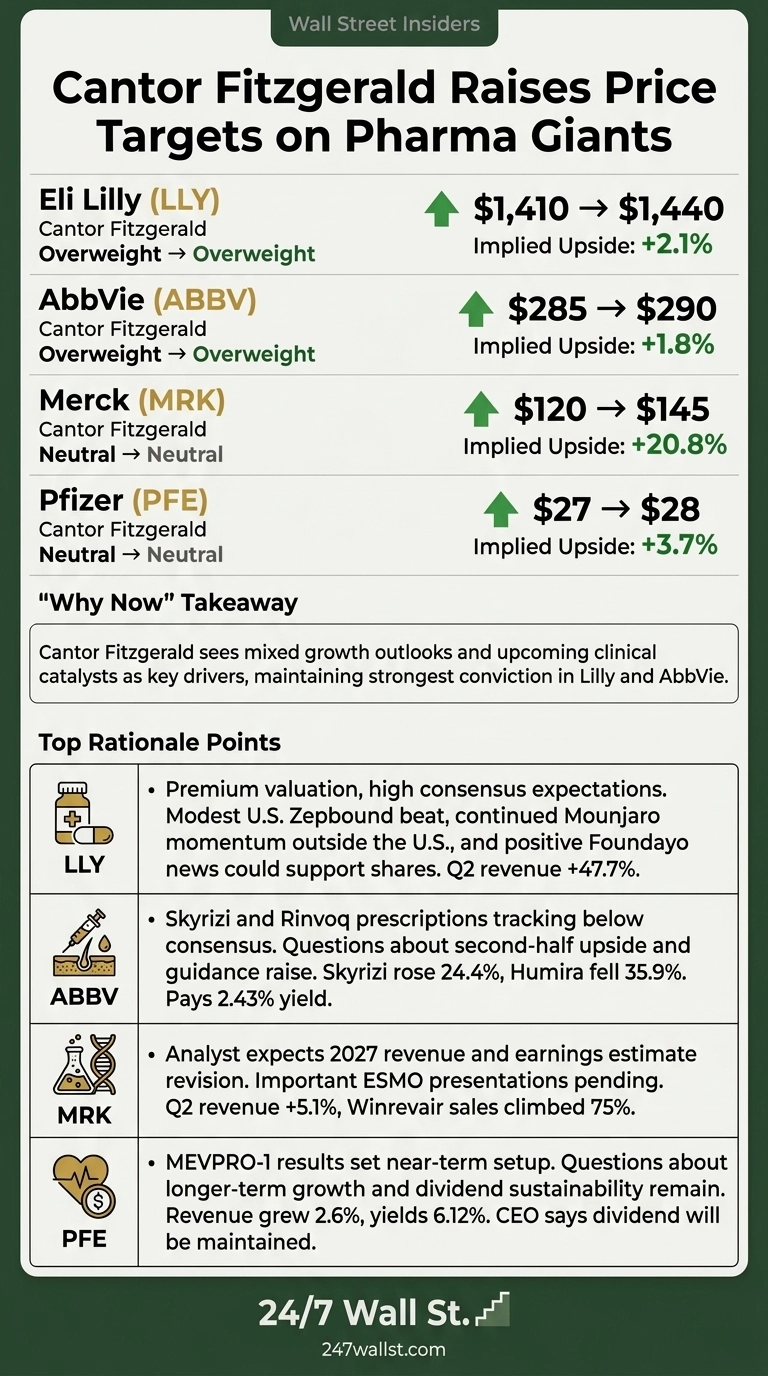
| Ticker | Company | Firm | Action | Old Rating | New Rating | Old Target | New Target |
|---|---|---|---|---|---|---|---|
| LLY | Eli Lilly | Cantor Fitzgerald | Target Raised | Overweight | Overweight | $1,410 | $1,440 |
| ABBV | AbbVie | Cantor Fitzgerald | Target Raised | Overweight | Overweight | $285 | $290 |
| MRK | Merck | Cantor Fitzgerald | Target Raised | Neutral | Neutral | $120 | $145 |
| PFE | Pfizer | Cantor Fitzgerald | Target Raised | Neutral | Neutral | $27 | $28 |
Analyst’s Case: Four Different Setups
Analyst Carter Gould said Lilly faces a high bar due to its premium 2027 valuation and high consensus expectations. A modest U.S. Zepbound beat, continued Mounjaro momentum outside the U.S., and positive Foundayo news could support the shares despite pricing pressures.
On AbbVie, Cantor said Skyrizi and Rinvoq prescriptions are tracking below consensus, raising questions about second-half upside and whether AbbVie can raise guidance again. The firm also noted mixed expectations for lutikizumab data in hidradenitis suppurativa (HS).
Gould expects a 2027 revision to Merck’s revenue and earnings estimates, competing with several important ESMO presentations the week before. For Pfizer, the MEVPRO-1 results largely sets the near-term setup, with questions about longer-term growth and dividend sustainability remaining open.
Company Snapshot: Growth Rates Diverge Sharply
- Lilly: Q2 revenue rose 47.7% to $22.97B, and Lilly raised its 2026 revenue guidance to $85–$87B.
- AbbVie: Revenue grew 10.2%. Skyrizi rose 24.4% while Humira fell 35.9%.
- Merck: Revenue rose 5.1%. The quarter included a $2.31/share charge for the Terns acquisition, and Winrevair sales climbed 75%.
- Pfizer: Revenue grew 2.6%, and Pfizer cut its 2026 COVID revenue expectation to about $4 billion.
How It Stacks Up
| Ticker | Company | Cantor Rating | Consensus Price Target |
|---|---|---|---|
| LLY | Eli Lilly | Overweight | $1,329.21 |
| ABBV | AbbVie | Overweight | $280.29 |
| MRK | Merck | Neutral | $156.28 |
| PFE | Pfizer | Neutral | $29.03 |
Cantor’s targets for Lilly and AbbVie sit above Street consensus; its targets for Merck and Pfizer sit below. That split matches the firm’s ratings.
Why the Move Matters Now
Merck has been the best performer of the four this year, up 38.48% year to date, compared with 11.15% for Lilly. Lilly trades near 24x forward earnings, compared with about 10x for Pfizer.
Several catalysts are close. Pfizer expects its first results in the prostate cancer trial in the fourth quarter, and Merck hosts an ESMO investor event on October 26.
What It Means for Your Portfolio
For income investors, Pfizer’s 6.12% dividend yield is its main draw. CEO Albert Bourla said “The dividend will be maintained”, though Cantor lists sustainability as an open question (we highlighted the seven warning signs that usually come before a dividend cut in a free report here: Dividend Traps).
AbbVie pairs a 2.43% yield with double-digit growth. Skyrizi prescription data will show whether that growth holds.
For long-term investors, Lilly and AbbVie have Cantor’s strongest support, while Merck and Pfizer depend more on upcoming catalysts. Keep an eye on the clinical results and 2027 estimate revisions as they come.
The post Cantor Fitzgerald Lifts Price Targets on Four Pharma Giants Amid Mixed Growth Outlooks appeared first on 24/7 Wall St..
]]>Three companies with nothing in common operationally happened to pay their quarterly dividends on the same day, October 7: Merck (NYSE:MRK), Seagate Technology (NASDAQ:STX), and HP (NYSE:HPQ). One sells prescription drugs, one builds storage drives for data centers, and one makes laptops and printers. The payment date is the only thing linking them, and that makes the date a useful lens for examining how three very different businesses reward the people who own them.
Merck Paid the Biggest Check per Share
Merck is a pharmaceutical company that develops and sells prescription medicines and vaccines, led by its cancer drug Keytruda, and it also runs an animal health business.
- Paid on October 7: $0.85 per share
- On 100 shares: $85
- Same quarter a year earlier: $0.81 per share, an increase of 4.9%
- Annualized at the current rate: $3.40 per share
- Share price (premarket, October 8): $142.08
- Dividend yield at that price: 2.4%
The business behind the payment is growing. Second-quarter revenue reached $16.61 billion, up 5.1% from a year earlier, and management raised its full-year 2026 sales guidance to a range of $66.3 billion to $67.3 billion. The Keytruda franchise alone brought in $8.37 billion in the quarter, which explains why investors paid close attention when Barron’s reported that Keytruda had been dealt a legal setback on October 7. The shares have climbed 34.1% year to date, which has pulled the yield lower.
Seagate Raised Its Payout as Shares Climbed
Seagate makes hard disk drives and other data storage hardware, and much of it goes to cloud companies that need huge amounts of capacity to store the data behind AI services.
- Paid on October 7: $0.74 per share
- On 100 shares: $74
- Same quarter a year earlier: $0.72 per share, an increase of 2.8%
- Annualized at the current rate: $2.96 per share
- Share price (premarket, October 8): $794.55
- Dividend yield at that price: 0.4%
The company has plenty of cash behind the payout. Free cash flow hit a record $3.1 billion in fiscal 2026, the company retired $1.40 billion in debt, and it returned $810 million to shareholders through dividends and buybacks. The low yield is a function of the elevated share price. The stock is up 180.9% year to date on demand for AI-driven storage. It has also been volatile: shares fell 11.2% over the past week after MarketWatch reported steep drops for Western Digital and Seagate on October 2.
HP Pays the Smallest Check and the Highest Yield
HP makes personal computers, printers, and printer supplies. It is a separate company from Hewlett Packard Enterprise (NYSE:HPE), which sells servers and networking equipment to businesses.
- Paid on October 7: $0.30 per share
- On 100 shares: $30
- Same quarter a year earlier: $0.29 per share, an increase of 3.5%
- Annualized at the current rate: $1.20 per share
- Share price (premarket, October 8): $32.09
- Dividend yield at that price: 3.7%
HP generated $1.57 billion in free cash flow in its fiscal third quarter, while dividends cost it $274 million. Management raised full-year free cash flow guidance to $3.0 billion to $3.2 billion, helped by AI PC demand that lifted Personal Systems revenue 18%. Income investors face several risks: HP carries a stockholders’ deficit of $92 million, its PC operating margin narrowed to 4.6%, and the company is navigating a CEO transition.
Why Some Shareholders Got Nothing on October 7
Plenty of people who own these stocks right now received nothing on October 7. The reason is the ex-dividend date, which is where income investors get confused most often.
Every dividend goes through four steps:
- Declaration date: The board announces the amount and the schedule. Seagate, for example, declared this payment on July 29, 2026.
- Record date: The company checks its books to see who officially owns the shares. Those owners get paid.
- Ex-dividend date: The deadline for buying in time. Because stock trades take time to settle, you must own the shares before the ex-dividend date to appear on the record books. If you buy on or after the ex-dividend date, the seller keeps the dividend.
- Payment date: The cash actually lands in your account.
All three companies had their ex-dividend dates in September:
| Company | Ex-Dividend Date | Payment Date |
|---|---|---|
| HP | September 9 | October 7 |
| Merck | September 15 | October 7 |
| Seagate | September 24 | October 7 |
If you bought any of these three in late September or early October, you missed the cutoff, and your first payment will come next quarter. The weeks between the ex-dividend date and the payment date are a waiting period, and only investors who were already on the books by the cutoff get paid at the end of it.
Largest Check, Biggest Raise, and Highest Yield Go to Different Stocks
All three paid more than in the same quarter last year. Merck gave the largest raise at 4.9%, HP came next at 3.5%, and Seagate raised the least at 2.8%. The size of a raise shows how confident management is and how much cash it has to spare. Whether the stock is fairly valued is a separate question that requires its own analysis.
The per-share amount must be considered alongside the share price to be meaningful. Merck paid the most per share, and HP pays the most relative to what the stock costs, with a 3.7% yield. Yield is the annual dividend divided by the share price. In plain terms, it is the income you collect each year for every dollar invested in the stock. A 3.7% yield means about $3.70 a year for every $100 invested. Seagate’s 0.4% yield shows that for its shareholders, the dividend is a small part of the return and the share price drives most of it.
What Income Investors Should Take From October 7
October 7 brought three routine quarterly payments from three businesses that are each growing their payouts. What to watch next: each board’s upcoming dividend declaration for the following quarter and the next earnings reports, including:
- HP’s CEO transition and PC margins
- Merck’s response to the Keytruda legal setback
- Whether AI storage demand keeps supporting Seagate’s shares
Before buying for the next payment, check the ex-dividend date.
The post HP, Merck, and Seagate Just Paid Their Shareholders. Here’s What Landed in Their Accounts. appeared first on 24/7 Wall St..
]]>Through Oct. 7, the S&P 500 has returned 13.75% year to date. That is a solid year by historical standards. Three stocks have gone far past it, with gains measured in the hundreds of percent over the same window. The harder question for investors is whether any of these runs still has room, or whether the good news is already in the price.
To rank them, we used four tests: year-to-date return against the index, earnings quality (profits and earnings beats), forward visibility (backlog, contracts and guidance), and valuation relative to what the business is expected to earn. Counting down from #3, we cover Moderna (NASDAQ:MRNA), Dell Technologies (NYSE:DELL) and SanDisk (NASDAQ:SNDK).
#3 Moderna: A Cancer Vaccine Win Sparked a Biotech Rerating
Moderna has returned nearly 537% this year, rising from $29.49 to $196.48. The catalyst was cancer treatment. Moderna said its Phase 3 intismeran melanoma study with Merck (NYSE:MRK) produced the first statistically significant and clinically meaningful adjuvant benefit of its kind. Detailed data was set for an ESMO presentation, and the stock gained 28.79% over the past month.
The operating business has not caught up. Second-quarter revenue was $145 million, +2.1% YoY, and the net loss came to $782 million. Management guides to up to 10% revenue growth for 2026. The shares now trade well above the average analyst target of $120.67, and they fell 7.75% in the latest session. The pipeline win is real. The valuation already assumes it turns into commercial revenue.
#2 Dell Technologies: A $95 Billion AI Backlog Sets Up Next Year
Dell has returned more than 353% year to date, and AI servers explain the move. In its fiscal second quarter, non-GAAP EPS of $7.04 beat the $4.90 estimate, and revenue rose 57.8% to $46.97 billion. Management said the company “booked a record $60.9 billion in orders, recognized a record $16.4 billion in revenue and exited the quarter with a record $95 billion backlog.”
Full-year guidance now calls for $192 billion in revenue and non-GAAP EPS of $25.50. The weak spots are margins and cash. Free cash flow fell 47% to $986 million, and management described the company as “supply constrained.” At roughly 30x earnings, the stock is fully valued. Even so, the backlog gives Dell revenue visibility well into next year, and the stock rose 8.44% over the past month. All of that server demand still has to be powered, cooled and connected by somebody, and we covered seven of those suppliers in a free AI infrastructure report.
#1 SanDisk: NAND Became Core AI Infrastructure
SanDisk leads the group with a nearly 515% return, climbing from $237.38 to $1,692.42. AI inference drove demand for flash storage, and the fiscal fourth quarter showed the result. Non-GAAP EPS of $39.25 beat the $33.28 estimate, revenue rose 371.6%, and gross margin reached 84.6%.
Visibility is what sets apart SanDisk from a typical memory cycle. Its multi-year customer agreements carry a minimum of $93.9 billion in expected revenue, and management now cites “over four years of visibility.” First-quarter guidance calls for EPS of $44 to $46. The stock trades at 23x trailing earnings and just 8x forward earnings, against an average analyst target of $2,136.54. The main risks are memory-price cycles and its Kioxia reliance. Shares are down 2.62% over the past month, which leaves room if pricing holds.
Which Run Still Has Room? Which Looks Finished?
Against a 13.75% index return, all three cleared the bar by a wide margin. Their expectations now split. SanDisk still has the most room. Signed revenue, guidance pointing to higher earnings and a single-digit forward multiple mean the fundamentals are still ahead of the stock. If NAND pricing breaks, the contract floors limit how much earnings can fall.
Dell is a steady second. Its $95 billion backlog supports more upside, but margin pressure caps how far the multiple can expand. Moderna looks finished for now. It is trading above analyst targets on a single trial result while still losing money, so the stock needs approvals and new revenue to support its price. In the coming months, keep an eye on SanDisk’s contract pricing, Dell’s free cash flow and the full ESMO data for Moderna.
The post 3 Stocks That Have More Than Doubled the S&P 500’s Return This Year appeared first on 24/7 Wall St..
]]>Shares of Moderna (NASDAQ:MRNA) are trading as though the company’s messenger RNA (mRNA) cancer vaccine has already cleared its final test, even though the complete Phase 3 dataset has yet to be presented publicly. In afternoon trading, Moderna stock has risen 8%, reaching $204.60, extending a sharp rerating tied to the melanoma program. That gain stands far apart from a biotechnology group moving at a much slower pace.
At the same time, the iShares Biotechnology ETF (NASDAQ:IBB) is up 0.9%, a fraction of the gain in Moderna stock. For a broad-market gauge, the SPDR S&P 500 ETF Trust (NYSEARCA:SPY) is up 0.7%, which marks the rally in Moderna stock as a single-stock event driven by one pipeline story. Buyers are focused directly on the melanoma program, given the lead Moderna stock holds over both funds.
Checking in on the peers, BioNTech (NASDAQ:BNTX) stock is up 0.7% to $97.59, a modest move for another mRNA developer with cancer ambitions. Meanwhile, Pfizer (NYSE:PFE) shares are sliding 2% to $27.37, leaving the drugmaker on the weaker side of the vaccine trade. BioNTech and Pfizer once shared a vaccine franchise, and the split between them now tracks how close each company sits to a cancer catalyst.
What the Melanoma Program Means for Moderna
Merck (NYSE:MRK) is Moderna’s partner on intismeran, a personalized mRNA cancer vaccine coupled with Merck’s Keytruda. In August, Moderna and Merck announced that intismeran met the primary endpoint of a Phase 3 trial in melanoma patients whose tumors had already been surgically removed. Patients on the combination went longer without their cancer returning or spreading than patients on Keytruda alone, a meaningful reduction in recurrence.
Moderna has yet to present the complete dataset from that trial. Full validation depends on that complete dataset. Citigroup analyst Geoff Meacham has noted this, and the data is expected at the European Society for Medical Oncology (ESMO) congress in Madrid later this month. Bank of America analyst Alec Stranahan has described the result as a watershed moment that effectively allows Moderna to diversify away from infectious disease and potentially eases persistent capital pressures.
Moderna Moves Apart From Biotech Peers
BioNTech is running a comparable personalized mRNA cancer immunotherapy, autogene cevumeran, in partnership with Genentech. That program targets adjuvant colorectal and pancreatic settings and is at an earlier stage than Moderna’s melanoma effort, which fits with BioNTech stock posting a far smaller gain.
Moderna shares were up 594% year to date through the prior session’s close, a revaluation built against a result nobody outside the trial has seen in full. An approved oncology franchise would give Moderna a second revenue pillar beside the company’s established infectious-disease vaccine business, a prospect that explains the enthusiasm and raises the cost of any disappointment in Madrid.
What to Watch Next
The ESMO presentation in Madrid is the next dated moment where the gap between the price of Moderna stock and the trial evidence either closes or widens. The key question is whether the complete dataset confirms the recurrence benefit Moderna and Merck described in August. A strong presentation could support Stranahan’s view, while any soft spots in the data could give weight to Meacham’s call for full validation.
For BioNTech and Pfizer, the Madrid data may serve mainly as a read on how the market values personalized cancer vaccines, and traders may want to watch whether BioNTech stock tracks the reaction in Moderna stock to the full data.
Moderna stock has already priced in a great deal of success, so the downside from a mixed presentation could be steep. Investors should consider that Moderna shares may have run far ahead of a dataset that’s still awaiting full public review.
The post Moderna Surges 8% as Full Melanoma Readout Nears; BioNTech Ticks Up, Pfizer Slips appeared first on 24/7 Wall St..
]]>Our 24/7 Wall St. price target for Pfizer (NYSE:PFE) is $33.18 over the next 12 months. From today’s $27.60 share price, that implies about 20.2% upside. Our model rates the stock a buy, and its confidence is high.
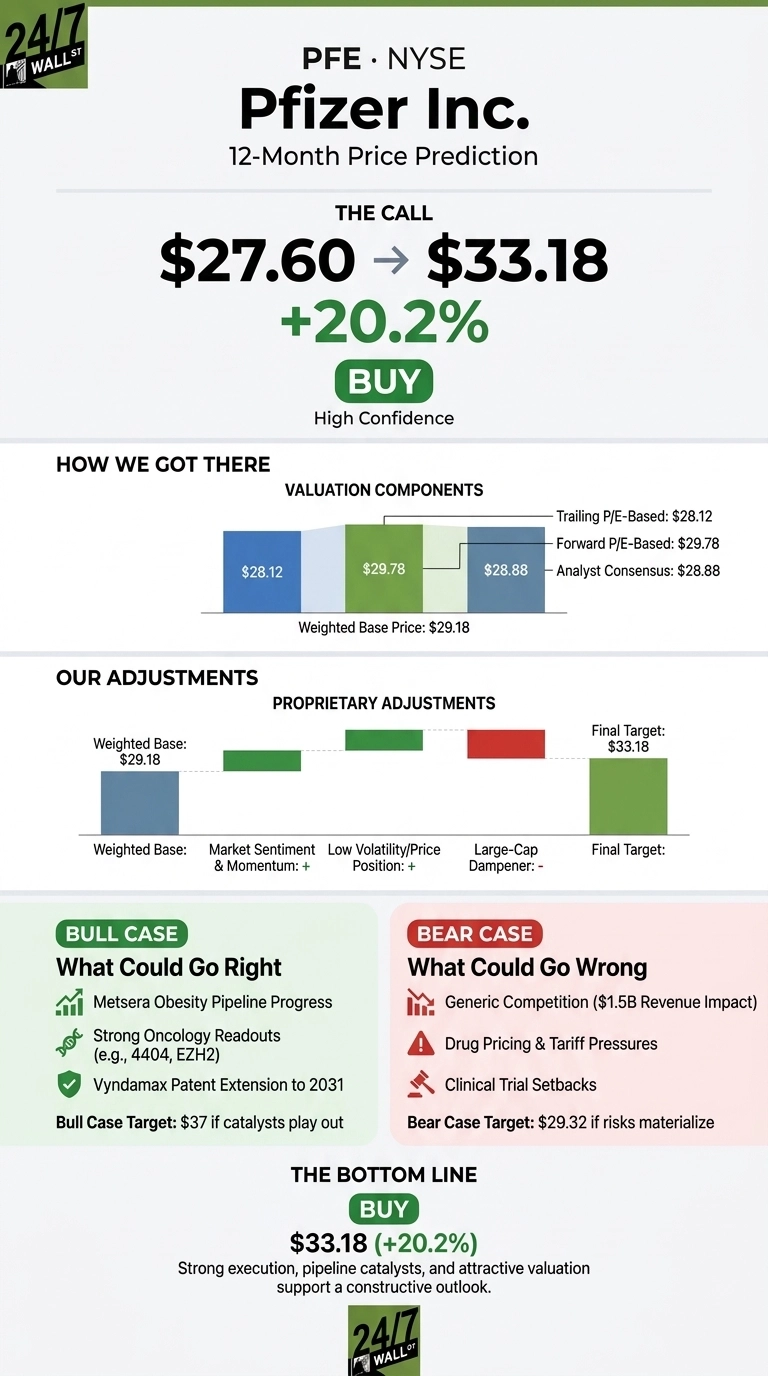
| Metric | Value |
|---|---|
| Current Price | $27.60 |
| Price Target from 24/7 Wall St. | $33.18 |
| Upside/Downside | 20.2% |
| Recommendation | BUY |
| Confidence Level | 90% |
The COVID drag is getting smaller, and the rest of the portfolio keeps growing. In the second quarter, launched and acquired products grew 18% operationally. With the stock at 10 times forward earnings and a $1.72 annual dividend, shareholders collect income while the obesity and oncology pipeline grows.
Ten Straight EPS Beats Have Lifted Pfizer 16.6% in 2026
Pfizer is up 16.6% year to date and 8.58% over the past year. Over the last month it has slid 3.33%, including 2.85% this week. Shares sit about 5.5% below the $29.21 52-week high and around 22.3% above the $22.57 low.
Second-quarter revenue came in at $15 billion, and adjusted EPS of 77 cents beat expectations. That makes all ten of the past ten quarters ahead of consensus. Stripping out COVID products, revenue grew 5% operationally.
Management raised the 2026 revenue center by $500 million even after cutting COVID expectations to about $4 billion. The FDA also expanded Padcev into muscle-invasive bladder cancer, where Phase 3 data showed a 35% reduction in the risk of death.
Why Bulls See $37 Within Reach
Obesity is the biggest swing factor. The Metsera deal gives Pfizer a shot at the first monthly GLP-1 peptide in a market management sizes at $150 billion. Phase 2b data showed placebo-corrected weight loss of up to 12.3%, and Pfizer is aiming a first approval in 2028.
In oncology, the PD-1 x VEGF bispecific 4404 posted a confirmed response rate of about 68%, and the first EZH2 prostate readout is expected in the fourth quarter.
The Vyndamax settlement also extends U.S. exclusivity to June 2031, and cost programs aiming around $9.7 billion in savings through 2029. If these pieces come together, our bull scenario hits $37.

What Could Keep Pfizer Stuck Near $29
Analysts remain conservative, with 16 Holds versus 10 Buy ratings. Generic competition will strip about $1.5 billion from 2026 revenue. Most-Favored-Nation pricing discounts average 50%, and tariffs remain a risk. A lung cancer study missed overall survival. In the bear case, the stock hits only $29.32.
One-time items explain some of the weak GAAP numbers: the second-quarter reported loss of 4 cents per share included a $650 million in-process R&D charge from the InnoVent deal. Adjusted R&D rose 12% operationally, mostly to fund oncology and obesity programs.
Pfizer Trades Below Merck and Close to Bristol Myers Squibb
Merck (NYSE:MRK) partners Keytruda with Padcev in bladder cancer and trades at 15x forward earnings with a lower dividend yield.
Bristol Myers Squibb (NYSE:BMY) shares Eliquis with Pfizer and trades at 9x forward earnings.
| Company | Forward P/E | Dividend Yield |
|---|---|---|
| Pfizer | 10x | 6.03% |
| Merck | 15x | 2.28% |
| Bristol Myers Squibb | 9x | 4.02% |
At our target, Pfizer would trade at about 11x forward earnings. That is still well below Merck’s multiple, so the peer group makes our target look reasonable, if anything conservative.
Our Model Says Buy, and the Dividend Adds Income Along the Way
I’m staying with the 24/7 Wall St. price target of $33.18, a buy rating and 90% confidence. What tips the scale is a single-digit multiple on a business that keeps beating estimates.
I’d view Pfizer as attractive if Metsera’s Phase 3 program stays on schedule and the non-COVID business keeps growing. I’d turn more conservative if pricing reform or tariffs start cutting into the 2026 guidance. For now, the valuation and dividend support our model’s outlook.
| Year | Price Target from 24/7 Wall St. |
|---|---|
| 2026 | $29.14 |
| 2027 | $33.22 |
| 2028 | $37.26 |
| 2029 | $40.98 |
| 2030 | $44.30 |
These projections assume Pfizer delivers on management’s goal of returning to growth from 2029 onward. Obesity trial results and drug pricing policy could drove the stock well above or below these figures.
The post Pfizer’s Turnaround Could Be Bigger Than Investors Think, Set For 20% Upside appeared first on 24/7 Wall St..
]]>Eli Lilly (NYSE:LLY) trades at $1,184.92, which gives it a market value of about $1.057 trillion. The 24/7 Wall St. price target for Eli Lilly is $1,401.42 over the next 12 months. That means 18.27% upside and earns a high-confidence buy rating from our model.
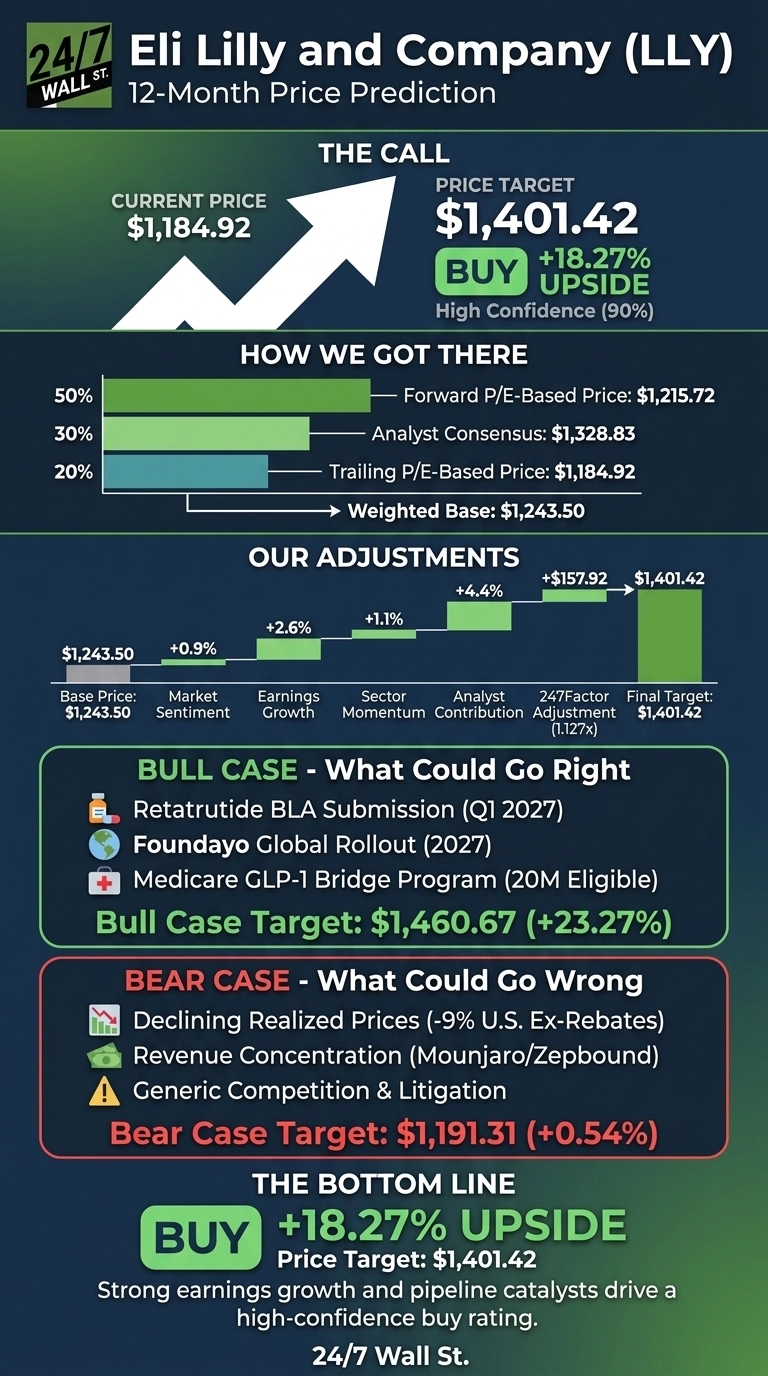
24/7 Wall St. Price Target Summary
| Metric | Value |
|---|---|
| Current Price | $1,184.92 |
| Price Target from 24/7 Wall St. | $1,401.42 |
| Upside/Downside | 18.27% |
| Recommendation | BUY |
| Confidence Level | 90% |
If shares hit our target, Lilly would be worth about $1.25 trillion. A $2 trillion valuation would take a share price near $2,243 on today’s share count. It sits above our base-case 2031 milestone of $2,000.56, so the headline goal depends on the pipeline outperforming.

A Blowout Q2 and Fresh Retatrutide Data Keep Lilly Near Its Highs
Shares have gained 1.21% over the past week, 10.74% year to date and 64.04% over the past year. The stock sits 8.3% below its 52-week high of $1,292.65.
Second-quarter revenue of $22.97 billion rose 47.7% and beat the $20.69 billion consensus. EPS of $8.38 exceeded the $6.58 estimate even after $3.03 of acquired IPR&D charges. Management also raised full-year revenue guidance to $85 billion to $87 billion.
September added to the momentum. The FDA approved Onswik, a once-weekly insulin, on September 24. At the EASD meeting, Lilly presented new retatrutide results and a comparison in which Foundayo beat oral semaglutide.

Why Bulls See $1,460 and Beyond
Lilly plans to file retatrutide in Q1 2027, after trial patients lost up to 71.2 lbs. Foundayo prescribers rose to about 36,000, and a global rollout is planned for 2027.
Medicare’s GLP-1 Bridge Program opened coverage to 20 million eligible Americans. Analysts expect 2027 EPS of $47.5425, up from $44.4568 90 days ago. The consensus target is $1,328.83. Our bull case hits $1,460.67, or 23.27% upside.

Falling GLP-1 Prices Could Stall the Rally
Excluding rebate adjustments, U.S. prices fell 9% last quarter. Mounjaro and Zepbound brought in $14.9 billion, most of Lilly’s revenue. Generic semaglutide is now on sale in India and Brazil, and the retatrutide filing pathway faces litigation. One analyst rates the stock Sell and another Strong Sell.
The bear case of $1,191.31 suggests little gain from here. On the other side, the IPR&D charges come from acquisitions and do not repeat. Volume growth also more than made up for lower prices.
Lilly Earns Its Premium Over Novo Nordisk, Merck and AbbVie
Novo Nordisk (NYSE:NVO) is Lilly’s direct GLP-1 rival. It trades at 12x forward earnings, but quarterly earnings fell 20.6%. Merck (NYSE:MRK) shows what a mature pharma multiple looks like. AbbVie (NYSE:ABBV) competes with Lilly in immunology.
| Company | Forward P/E | Quarterly Revenue Growth |
|---|---|---|
| Eli Lilly | 24x | 47.7% |
| Novo Nordisk | 12x | 2.1% |
| Merck | 15x | 5.1% |
| AbbVie | 16x | 10.2% |
Lilly is growing revenue several times faster than any of these peers. That growth supports its higher multiple and makes the 24/7 Wall St. price target look reasonable.
Lilly Still Has Room to Run
The 24/7 Wall St. price target of $1,401.42 carries a buy rating and high confidence. What tips the scale is rising earnings estimates.
Bulls stay in control if volume continues outpacing price cuts and retatrutide files on schedule. Bears take over if U.S. price declines grow faster than prescriptions. Right now, the growth numbers favor the bulls.
Here is where our model projects Lilly trading if current growth trends and market conditions hold.
| Year | Price Target from 24/7 Wall St. |
|---|---|
| 2026 | $1,233.89 |
| 2027 | $1,406.11 |
| 2028 | $1,583.87 |
| 2029 | $1,748.51 |
| 2030 | $1,889.79 |
These projections assume Lilly continues executing its current strategy. Retatrutide’s approval or faster GLP-1 price erosion could drive results well above or below this path.
The post Prediction: Eli Lilly Could Be the Next $2 Trillion Drugmaker appeared first on 24/7 Wall St..
]]>Johnson & Johnson (NYSE:JNJ) or Merck (NYSE:MRK): which pharma dividend looks stronger for retirement-focused income right now? Both stocks have rallied hard in 2026. Merck is up 40.18% year to date and J&J is up 29.1%, so the easy price gains are already secured. The question now is which payout holds up through the next decade of patent expirations. I compared them on dividend strength, patent cliff exposure, and balance sheet risk.
Dividend Strength: J&J Raises Like Clockwork
Merck offers the higher starting yield at 2.22%, against 1.96% for J&J. Merck’s annualized forward dividend is $3.4 per share on a $0.85 quarterly payment. J&J’s is $5.36 per share after a 3.1% raise to $1.34 declared April 14, 2026.
J&J’s dividend history shows a raise every year from 2009 through 2026, climbing from $0.46 to $1.34 per quarter. Merck has stepped up recently, from $0.77 to $0.81 to $0.85, yet its record includes a flat stretch at $0.38 from 2010 into 2011.
Coverage visibility also favors J&J. It produced $19.7 billion of free cash flow in 2025 and guides to a full-year figure “approaching $21 billion.” Merck’s management said, “We remain committed to the dividend with the goal of increasing it over time,” but supplied no payout ratio or free cash flow figure. Winner: J&J.
Patent Cliff Exposure: Merck Faces the Steeper Climb
Loss of exclusivity means cheaper generic or biosimilar copies can enter the market, and sales of the original drug drop fast. That lost cash is the same cash that funds the dividend.
J&J is living through it now. Stelara sales fell 55.7% in the second quarter, yet total sales rose 5.6% operationally. Stelara had shrunk to 4% of Innovative Medicine, and the rest of that business grew over 14%. Tremfya grew 71% to its first $2 billion quarter, and J&J counts 28 products and platforms each above $1 billion in annual sales.
Merck’s exposure is concentrated. Keytruda represents nearly half of pharma revenue, and the franchise grew just 4% to $8.4 billion last quarter as management noted moderating U.S. growth. Three Phase 3 oncology trials failed: LITESPARK-012, KEYNOTE-975 and KEYNOTE-866. CEO Rob Davis calls the transition “more of a hill than a cliff,” mentioning more than 20 new products and “greater than $70 billion of commercial opportunity,” with growth resuming in the early 2030s. Positive sac-TMT data in endometrial cancer helps, but J&J has already taken its hit while Merck’s still lies ahead. Winner: J&J.
Balance Sheet Risk: Merck’s Deal Spree Costs More
J&J ended the second quarter with about $21 billion of cash against $49 billion of debt, a net debt position near $28 billion. Litigation is a ongoing drag, including a $330M first-quarter charge, and the Orthopaedics separation adds execution risk. Those costs remain small relative to free cash flow. Pressuring the payout would take a litigation outcome far larger than anything recorded so far.
Merck’s burden is self-inflicted. The Cidara and Terns deals carry roughly $14.8B in combined one-time charges, and financing costs push full-year other expense to about $1.4 billion. Management says “Business development remains a high priority.” Another large deal stacked on Keytruda erosion is the scenario that pressures the dividend. Winner: J&J.
Verdict: J&J Owns the Retirement Income Slot
J&J wins outright. It has a longer raise record, disclosed cash coverage, and a patent cliff already in the rearview. Merck still offers the higher yield and a cheaper multiple: its forward P/E is 15 against 21 for J&J, and analysts target $155.76 versus a $144.54 share price. Next up: J&J’s Enterprise Business Review on Dec 8, 2026 and whether Merck lifts its payout after holding it at $0.85 all year.
The post JNJ or MRK: One Dividend Is Built to Last, One Faces a Reckoning appeared first on 24/7 Wall St..
]]>Buyers are stepping into Moderna (NASDAQ:MRNA) shares, evidently. The move comes one session after a Citigroup (NYSE:C) downgrade to Sell, a sign the market still prizes the company’s cancer vaccine pipeline over the valuation warning. Moderna stock is climbing 3% to $198.71 in morning trading. Such a bounce sets up a clear test of whether pipeline optimism can survive a bearish call from a major bank.
Meanwhile, BioNTech (NASDAQ:BNTX) stock is inching up 0.6% to $98.93, a far smaller gain from the other big name in messenger RNA. Pfizer (NYSE:PFE) shares are slipping 0.2% to $28.46, leaving BioNTech’s vaccine partner flat water. Both moves look small next to the gain in Moderna stock, which keeps the focus on one name.
The sector fund is in the red as the iShares Biotechnology ETF (NASDAQ:IBB) drops 0.3% to $209.96. At the same time, the SPDR S&P 500 ETF Trust (NYSEARCA:SPY) is slipping 0.3% to $760.64. That split marks the rally in Moderna stock as a single-name repricing while the broad market drifts lower.
Citigroup Downgrade Rests on Valuation
In the previous session, Citigroup downgraded Moderna stock to Sell from Neutral and lifted its price target to $80 in the same note. Citigroup built the call on valuation, pointing out that Moderna shares had climbed 222% since the melanoma trial results were reported. This framing leaves the underlying science unchallenged and moves the whole debate onto the price investors are paying for Moderna.
Under Citigroup’s reading, the melanoma win is already reflected in Moderna stock, which leaves less room for gains without fresh evidence. Geoff Meacham of Citigroup cautioned in August that full validation of the result depends on Moderna’s complete data. A higher target paired with a lower rating signals a firm that respects the science and still balks at the price.
Melanoma Vaccine Keeps Buyers Interested
Intismeran autogene is the personalized cancer vaccine at the center of the debate, and Moderna is building it on messenger RNA technology with Merck (NYSE:MRK) as the development partner on the program, and the vaccine was tested in combination with Merck’s Keytruda. In a pivotal trial, the treatment hit its primary endpoint in patients whose melanoma tumors had already been surgically removed.
Moderna’s complete data hasn’t been presented publicly yet, and it’s expected at a European oncology conference in Madrid in late October. Until those numbers are out, read-across to other tumor types remains an open question for Moderna, and it is still the variable that moves Moderna stock most, because it determines how far the platform could reach.
What to Watch Next
Late October brings the next scheduled test, when Moderna’s complete data is due in Madrid. Shareholders can watch for evidence of read-across to other tumor types in Moderna’s full results, since that upside sits beyond the melanoma win Citigroup argues Moderna stock already reflects. Detailed findings that support broader use could reinforce that upside view for Moderna.
Moderna’s upside argument rests on a pipeline that could extend well beyond melanoma, while the downside view leans on Citigroup’s $80 target for Moderna stock and a share price that already bakes in the trial win. Investors should watch whether BioNTech stock continues to track Moderna’s direction or settles back toward the biotechnology fund. Each side has a strong case, and that balance favors a patient approach.
The post Moderna Climbs 3% Despite Citigroup’s Downgrade to Sell; BioNTech Inches Higher, Pfizer Treads Water appeared first on 24/7 Wall St..
]]>Moderna (NASDAQ:MRNA) stock is drawing attention Wednesday after Citigroup downgraded the biotech company to Sell from Hold, arguing that the recent rally has pushed the valuation well ahead of what its pipeline can reasonably support. Moderna sank 6% to $191.36 in early trading following the downgrade.
The move comes after an extraordinary run for Moderna, which had climbed nearly 590% in 2026 heading into Wednesday’s session. By comparison, the broader market and biotechnology benchmarks have delivered much smaller gains, highlighting just how much investor expectations around Moderna’s cancer-vaccine program have changed.
Moderna’s Citi Downgrade
Citi analyst Geoff Meacham lowered Moderna to Sell from Hold while raising the price target to $80 from $60. The higher target reflects updated sales and operating assumptions, yet the target remains far below Moderna’s recent trading level of about $203.46.
Citi’s concern centers on intismeran autogene, Moderna’s personalized cancer vaccine being developed with Merck’s Keytruda. Moderna and Merck recently reported that the combination improved recurrence prevention in melanoma, but detailed trial results have not yet been disclosed, leaving questions about how broadly the treatment could work across other cancers.
MRNA Versus Merck and Pfizer
The contrast with larger pharmaceutical peers is notable. Merck (NYSE:MRK) was recently trading around $149.11, up about 0.3%, while Pfizer (NYSE:PFE) was around $28.65, down roughly 0.2%, based on the latest available regular-session data.
Merck has a direct connection to the Moderna story because Merck’s Keytruda is being tested alongside intismeran. Pfizer, meanwhile, provides another large-cap pharmaceutical reference point, with Pfizer stock showing considerably less volatility than Moderna during the recent biotech rally.
What IBB and SPY Are Showing
The broader ETF picture also puts Moderna’s move into perspective. The iShares Biotechnology ETF (NASDAQ:IBB) rose 0.04%, while the SPDR S&P 500 ETF Trust (NYSE ARCA:SPY) gained 0.29%.
Those relatively modest moves contrast sharply with Moderna’s enormous recent swings. Moderna stock gained 6.98% on Sept. 24 and 12.27% on Sept. 21, while IBB and SPY have generally experienced much smaller daily moves over the same period.
What Moderna Investors Are Watching
Citi’s downgrade does not mean Moderna’s cancer program has failed. Meacham acknowledged that intismeran could become a leading melanoma treatment, but argued that the stock price increasingly assumes successful expansion into several additional tumor types and very large commercial sales.
The next major test could come with additional intismeran data expected at the European Society for Medical Oncology meeting in late October. For investors, the key issue may be whether forthcoming clinical results can support the lofty expectations now embedded in Moderna’s valuation, particularly after such a dramatic run.
Moderna stock‘s volatility Wednesday also illustrates why the stock can be difficult to evaluate using the day’s percentage move alone. Meanwhile, Merck, Pfizer, IBB, and SPY remained comparatively subdued, leaving investors to weigh a highly specific company catalyst against broader market conditions.
The post Moderna Sinks 6% on Citi Downgrade; Merck and Pfizer Stay Flat appeared first on 24/7 Wall St..
]]>Our 24/7 Wall St. price target for Eli Lilly (NYSE:LLY) is $1,400.55 over the next 12 months. With shares at $1,168.45, that points to 19.86% upside. Our model rates the stock a buy with high confidence.
| Metric | Value |
|---|---|
| Current Price | $1,168.45 |
| Price Target from 24/7 Wall St. | $1,400.55 |
| Upside/Downside | 19.86% |
| Recommendation | BUY |
| Confidence Level | 90% |
A 90% confidence reading means the inputs agree with each other: earnings are growing fast, analysts are overwhelmingly positive, and the valuation checks line up.
Lilly is growing faster than any other mega-cap drugmaker. Its incretin franchise keeps getting bigger, and retatrutide gives it a second act. The main question is how long that growth lasts.
Record Growth Meets a Late-Summer Pullback
Shares rose 1.35% this week but slipped 1.76% over the past month. They are up 8.73% year to date and 61.27% over one year. The stock sits 9.61% below its 52-week high of $1,292.65.
In the second-quarter earnings report, revenue came in at $22.97 billion, up 47.67% and ahead of the $20.69 billion estimate. EPS of $8.38 beat expectations of $6.58.
Mounjaro grew 91% to $9.94 billion, and management raised full-year revenue guidance to $85 billion to $87 billion. Since then, the FDA has approved Mounjaro to reduce cardiovascular risk (August 28) and cleared the once-weekly insulin Onswik (September 24).

Why Bulls See Retatrutide as the Next Leg
Lilly plans to file for U.S. approval of retatrutide in Q1 2027. In trials, weight loss at the highest doses neared “bariatric surgery levels”. The oral drug Foundayo went from about 8,000 prescribers to 36,000, and Medicare’s GLP-1 Bridge Program expanded U.S. obesity coverage by 35%.
Analysts have raised 2027 EPS estimates 19 times over the past 30 days, bringing the consensus to $47.3443. 24 analysts are bullish on the stock. Investor Ken Langone recently floated a much higher multi-year value. In our bull case, shares reach $1,460.
Pricing Erosion Could Cap the Rally
Excluding rebate changes, U.S. prices fell 9%. Revenue also depends heavily on Mounjaro and Zepbound. Reported earnings took a hit from $2.78 billion in IPR&D charges (costs linked to acquired research projects), and the tax rate rose to 23.3%.
Still, those charges bought pipeline assets, and management expects higher volumes to make up for lower prices. The bear case of $1,172.51 has shares about flat.
How Lilly Compares to Novo Nordisk and Merck
| Company | Forward P/E | Quarterly Revenue Growth (YoY) |
|---|---|---|
| Eli Lilly | 24 | 47.7% |
| Novo Nordisk | 12 | 2.1% |
| Merck | 15 | 5.1% |
Novo Nordisk (NYSE:NVO) is Lilly’s direct GLP-1 rival. Its quarterly earnings fell 20.6% year over year. That shows what happens to a GLP-1 maker’s valuation when growth stalls, and it explains why investors pay a premium for Lilly.
Merck (NYSE:MRK) is a large-cap pharma stock valued as a steady grower. It has a consensus target of $153.65 and single-digit growth. Lilly trades at a higher forward P/E than both peers, but it is growing about ten times faster. On that basis, our 24/7 Wall St. price target looks reasonable.
Growth Justifies the Premium
The 24/7 Wall St. price target of $1,400.55 takes a buy rating at 90% confidence. What tips the balance is how fast earnings estimates are rising.
I would grow more confident if retatrutide’s filing stays on schedule and Foundayo keeps gaining prescribers. My view would weaken if U.S. price declines start to outpace volume growth. For now, the numbers support Lilly.
| Year | Price Target from 24/7 Wall St. |
|---|---|
| 2026 | $1,233.80 |
| 2027 | $1,403.36 |
| 2028 | $1,592.79 |
| 2029 | $1,717.31 |
| 2030 | $1,856.66 |
Lilly needs to keep executing on its incretin franchise and pipeline for these projections to hold. A retatrutide approval could push results higher, while sharper government pricing pressure could pull them lower.
The post Prediction: Eli Lilly’s Next Growth Wave Could Surprise Investors appeared first on 24/7 Wall St..
]]>Anyone who put $1,000 into Merck (NYSE:MRK) ten years ago is sitting on a 239.48% gain in share price alone. The drama is recent. The stock rose 95.25% over the past year and 44.50% year to date, moves that look nothing like a typical pharma year. At $149.00, shares have traveled most of the way from a 52-week low of $79.67 toward a high of $156.00.
Keytruda Built Merck, and Now Merck Is Buying Its Next Act
Merck is a large-cap drugmaker anchored by Keytruda, a cancer immunotherapy that has expanded from metastatic disease into 13 earlier-stage indications. In the second quarter of 2026, the Keytruda family grew 4% to $8.4 billion of $16.6 billion in total revenue. Annual revenue rose from $39.498 billion in 2015 to $64.926 billion in 2025.
Some products stumbled. Gardasil sales in China fell to zero in 2025, and full-year Gardasil sales declined 39%. Merck responded by buying Verona Pharma (about $10 billion), Cidara (about $9.2 billion) and Terns. Pulmonary hypertension drug Winrevair grew 88% to $525 million in Q1 2026.
Merck Trailed the S&P 500 for a Decade, Then Lapped It
10-Year Return
- Initial Investment: $1,000
- Price Return: 239.48%
- S&P 500 (same period): 254.29%
5-Year Return
- Initial Investment: $1,000
- Price Return: 131.14%
- S&P 500 (same period): 76.39%
1-Year Return
- Initial Investment: $1,000
- Price Return: 95.25%
- S&P 500 (same period): 15.79%
Over ten years, Merck slightly fell behind the index on price. The five-year and one-year windows flip that decisively. Timing mattered: shares traded at $78.93 at the July 2025 earnings filing and $127.69 by August 2026. Selling during that slump meant missing much of the decade’s return.
Rising Dividends Did Quiet Work
Merck pays $0.85 quarterly, up from $0.81 before its latest raise, for an annualized $3.40. In 2016 the payout was $0.46, with no cuts in the history since. Reinvested, those checks make the real decade better than the price figure implies (if a rising payout on a blue-chip is the kind of position you build a portfolio around, we ranked ten of the longest dividend-growth streaks by valuation in a free Dividend Kings report).
Why the 119x Trailing P/E Misleads
The trailing P/E is 119 on trailing EPS of just $1.25. Acquisition charges distort it: a $9 billion Cidara charge pushed Q1 2026 EPS to -$1.28, and Q2 EPS came in at -$0.13. The forward P/E of 15 better reflects earnings power.
I’d Hold Through Merck’s Hill
Merck would get my $1,000 today if Keytruda Qlex ($463 million in quarterly sales) and the pipeline, including positive Phase 3 data for sac-TMT, replace Keytruda revenue as patents expire. CEO Rob Davis calls that period “more of a hill than a cliff.”

The stock is a pass for me if early 2026’s three failed Phase 3 oncology results signal a pattern, or if roughly $14.8 billion in acquisition charges buys less growth than promised.
At 15x forward earnings, I lean toward owning it. The decade’s lesson: much of the gain arrived in one short burst, which rewards holding through slow years rather than trading around them.
The post Merck Turned $1,000 Into $3,395 in a Decade but the Real Story Happened in the Last Year appeared first on 24/7 Wall St..
]]>Johnson & Johnson (NYSE:JNJ) trades at $270.26. The 24/7 Wall St. price target points to $311.49 over the next 12 months, which means 15.3% upside. Our model rates the stock a buy with 90% confidence, which is a high-conviction reading.
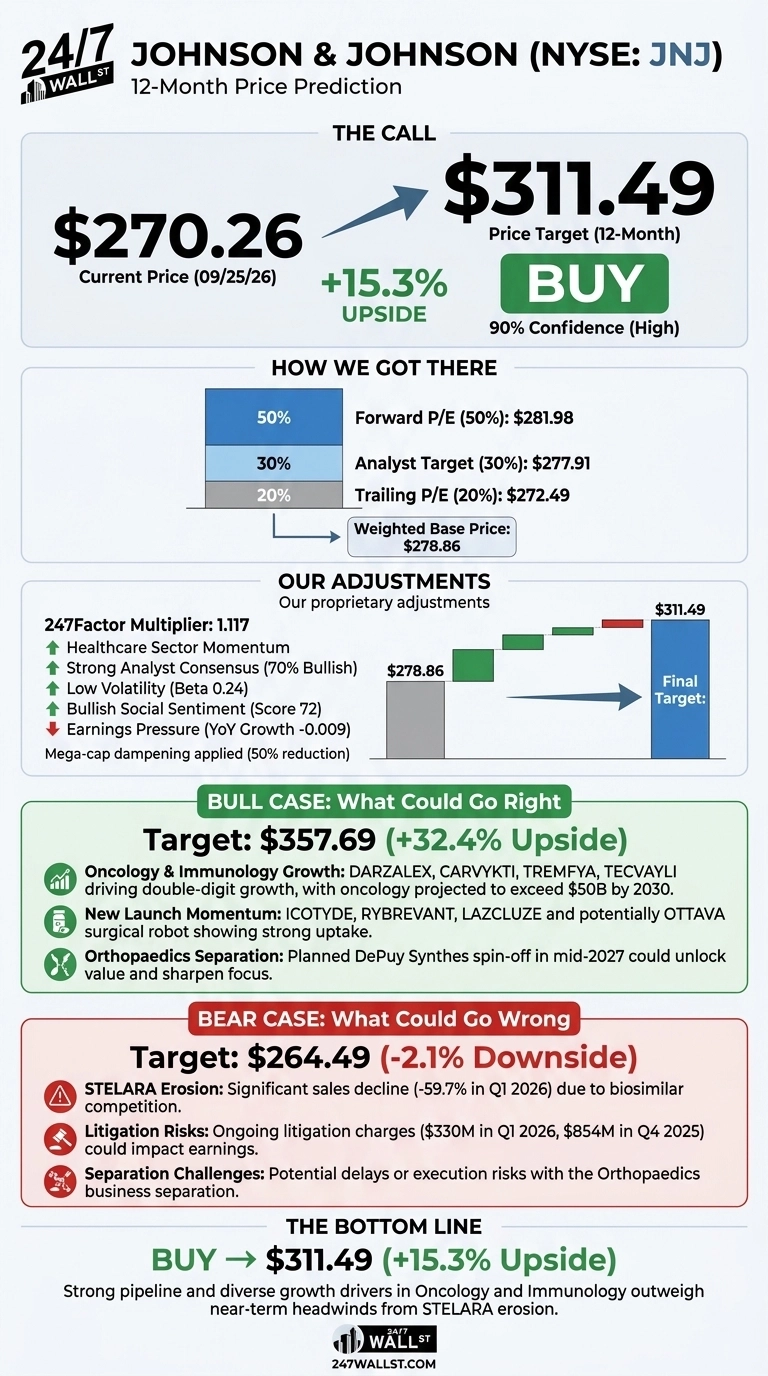
24/7 Wall St. Price Target Summary
| Metric | Value |
|---|---|
| Current Price | $270.26 |
| Price Target from 24/7 Wall St. | $311.49 |
| Upside/Downside | 15.3% |
| Recommendation | BUY |
| Confidence Level | 90% |
On September 25, J&J reported CARVYKTI infusion led to five-year treatment-free remissions in 50% of patients with early line multiple myeloma.
The same day, TREMFYA became the first and only IL-23 inhibitor to significantly improve spinal pain in axial psoriatic arthritis. Management says it has “line of sight to double-digit growth by the end of the decade.”
A 56% Rally Has J&J Knocking on Its Record High
Shares gained 56.4% over the past year and 32.69% year to date. The stock sits 3.8% below its 52-week high of $281.07.
July’s second-quarter report supported the run: sales reached $25.3 billion, up 5.6% operationally, and adjusted EPS of $2.90 rose 4.7%. Excluding STELARA, J&J grew at double-digit rates. Management raised adjusted operational EPS guidance to $11.50 to $11.65.
Oncology and Immunology Could Carry J&J to $357
Management expects J&J to become the No. 1 oncology company by 2030, with oncology sales above $50 billion. Last quarter, DARZALEX topped $4 billion, CARVYKTI grew 47.7% and TECVAYLI grew 56.1%. TREMFYA rose 71% to $2 billion, and more than 11,000 patients started oral psoriasis drug ICOTYDE.
Catalysts include a milvexian results, possible FDA clearance for the OTTAVA surgical robot and the DePuy Synthes separation targeted for mid-2027. Analysts lean positive with 5 Strong Buy and 11 Buy ratings against 1 Sell and consensus target of $277.91. Bulls see $357.69, a 32.4% gain.
Stelara Erosion and Litigation Could Stall the Rally
JNJ’s STELARA sales fell 59.7% to $656 million in Q1. Biosimilar competition cut second-quarter growth by about 460 basis points. Litigation charges were $330 million in Q1 2026, following $854 million in Q4 2025. Analysts lowered consensus fiscal 2026 EPS to $11.0733 from $11.5743 90 days ago.
Q1 free cash flow fell 55.42%, but management expects full-year free cash flow approaching $21 billion, above the $19.7 billion generated in 2025. A bear case of $264.49 means a fall of just 2.1%.
J&J Trades at a Premium to Merck and AbbVie for Good Reason
Merck (NYSE:MRK) is J&J’s most direct oncology rival, trading at 15 times forward earnings. KEYTRUDA sales rose 12% to $8.03 billion in Q1. The discount reflects concentration risk: KEYTRUDA makes up nearly half of pharmaceutical revenue as its patent expiration approaches.
AbbVie (NYSE:ABBV) competes through Skyrizi, which grew 24.4% to $5.505 billion last quarter. AbbVie trades at 16 times forward earnings with revenue up 10.2%. It offers a cheaper growth profile, though Humira’s fall mirrors J&J’s STELARA problem.
| Company | Forward P/E | Consensus Target |
|---|---|---|
| Johnson & Johnson | 21 | $277.91 |
| Merck | 15 | $153.65 |
| AbbVie | 16 | $278.61 |
J&J trades at a premium multiple, so further gains must come from earnings growth. Compared with these peers, the 24/7 Wall St. price target looks reasonable.
Pipeline Breadth Tips the Scale Toward J&J
The 24/7 Wall St. price target of $311.49 carries a buy rating and 90% confidence. Breadth tips the scale: 28 products and platforms each generate more than $1 billion annually.
The case strengthens if TREMFYA, ICOTYDE and myeloma drugs grow faster than STELARA declines heading into the December 8 Enterprise Business Review. The case weakens if litigation costs rise or the orthopaedics separation is delayed. J&J’s growth engine is working.
| Year | Price Target from 24/7 Wall St. |
|---|---|
| 2026 | $281.04 |
| 2027 | $311.78 |
| 2028 | $345.98 |
| 2029 | $372.01 |
| 2030 | $398.71 |
The projections depend on J&J continuing to execute on its current strategy. Milvexian trial results or a faster STELARA fall could drove the numbers well above or below these levels.
The post Johnson & Johnson’s Next Growth Engine Is Taking Shape appeared first on 24/7 Wall St..
]]>For a Dow-focused retirement investor at the 24% federal bracket, the tax code treats qualified dividends favorably at the 15% long-term capital gains rate rather than the marginal rate. That still means a taxable portfolio throwing off $50,000 in qualified Dow dividend income hands $7,500 to the IRS every year, permanently, while the same holdings inside a Roth IRA keep every dollar.
Roth Versus Taxable on Six Dow Blue Chips
Every stock below is a current Dow Jones Industrial Average component, ranked by dividend yield. Prices and yields are as of the September 24, 2026 session.
| Stock | Price | Annualized Dividend | Yield |
|---|---|---|---|
| Chevron (NYSE:CVX) | $206.40 | $7.12 | 3.45% |
| IBM (NYSE:IBM) | $231.75 | $6.76 | 2.91% |
| Amgen (NASDAQ:AMGN) | $407.59 | $10.08 | 2.39% |
| Merck (NYSE:MRK) | $149.48 | $3.40 | 2.20% |
| Goldman Sachs (GS) | $932.33 | $20.00 | 1.79% |
| JPMorgan Chase (JPM) | $338.07 | $6.60 | 1.70% |
Chevron leads the group after raising its quarterly payout from $1.71 to $1.78, backed by $22.6B in Q2 2026 operating cash flow. IBM’s unbroken quarterly dividend streak dating to 1916 makes it a Roth staple. Amgen just stepped its quarterly payout to $2.52, extending a decade of increases from $0.28 in 2011. Goldman is the most aggressive grower, lifting its dividend from $3 in early 2025 to $5 in 2026, and JPMorgan followed with a bump to $1.65 quarterly.
Sizing the Delta at 24%
The framing case in this series: a $500,000 position yielding 8% generates $40,000 annually; at the 24% bracket the taxable account keeps $30,400, while the Roth keeps the full $40,000, a $9,600 annual advantage. Dow blue chips yield less, so the delta scales down accordingly. On a $500,000 equally weighted basket of the six names above, the blended yield sits in the low-2% range, producing roughly $12,500 in annual qualified dividends. At the 15% qualified rate, the taxable account surrenders about $1,875 per year; the Roth keeps it.
Bracket Multiplier on the Same $12,500 Income Stream
| Ordinary Bracket | Qualified Rate | Annual Roth Advantage |
|---|---|---|
| 22% | 15% | $1,875 |
| 24% | 15% | $1,875 |
| 32% | 15% or 20% | $1,875 to $2,500 |
| 37% | 20% plus 3.8% NIIT | $2,975 |
The top-bracket investor loses the most, because qualified rates step to 20% and the net investment income surtax layers on. The higher the bracket, the more urgent the Roth placement decision.
Compounding Cost of Leaving Them Taxable
Reinvested inside a Roth at a conservative 4% yield-on-cost, the recurring $1,875 annual advantage on this Dow basket compounds to roughly $22,500 over 10 years and $55,000 over 20 years in tax-free income that a taxable account would have surrendered. That is the permanent cost of Roth exclusion, before any share-price appreciation on names that have already returned 594% over 10 years for Goldman and 553% over 10 years for JPMorgan.
Action Items Before Year-End
- Pull last year’s 1099-DIV and identify which Dow payers sit in your taxable account. Multiply the qualified dividend total by 15% (or 20% if you cross the LTCG threshold) to see your annual tax cost.
- Run the Roth conversion math on your highest-yielders first. On this list, Chevron and IBM produce the largest income drag in a taxable account and the largest Roth benefit.
- If a full conversion is off the table, direct new Roth contributions and dividend reinvestments toward the two highest-yielding names above rather than the sub-2% payers.
The post How a Roth IRA Can Keep Thousands More of Your DJIA Dividend Income Compounding appeared first on 24/7 Wall St..
]]>Starting a dividend portfolio comes down to one good decision. For a beginner with $2,000 to put to work, that decision can be a single fund: the Schwab U.S. Dividend Equity ETF (NYSEARCA:SCHD). One ticker, one trade and a diversified position across roughly 102 U.S. large-cap dividend payers.
Here is the core math, using inputs pulled at generation rather than any hand calculation. SCHD closed at $33.74 on Sept. 22. The fund pays quarterly, with an annualized forward dividend of $1.01 per share and a trailing 12-month total of $1.048. A $2,000 stake at that price builds a starter position that throws off modest but real cash flow, paid four times a year. Setting the expectation clearly matters here: a $2,000 position generates a small dollar figure at any realistic dividend yield. The value lies in the habit and the compounding.
Why SCHD Instead of the Highest Yield You Can Find
SCHD’s argument is methodology. The fund tracks a rules-based index that screens for dividend quality and consistency rather than raw yield. That approach filters out the two most common traps beginners walk into: Shrinking payers dressed up as bargains, and single-stock blowups where a double-digit yield signals distress. The screen leans toward companies with durable cash flows, a long record of paying, and financial strength to keep paying.
The tradeoff is that SCHD’s headline yield sits below what a mortgage REIT or leveraged closed-end fund would show. With the 10-Year Treasury yielding around 5% as of Sept. 22, SCHD’s distribution rate looks unspectacular in isolation. The reason to accept that is total return and growth of income over time. SCHD has returned 27.89% over the past year, 61.56% over five years and 234.82% over 10 years on a price basis. The dividend has stepped higher over that same window, with quarterly amounts rising from the 12-cent range in late 2011 to the 25-cent to 28-cent range in 2025 and 2026.
What You Actually Own
SCHD holds a broad mix of large, cash-generative US companies. Based on the May 31, 2026 NPORT snapshot, the top positions include:
- QUALCOMM at 6.74% of net assets
- Texas Instruments at 5.90%
- UnitedHealth Group at 5.09%
- Coca-Cola at 3.96%
- Merck at 3.86%
- Chevron at 3.83%
From there the roster reads like a dividend playbook: Verizon, Procter & Gamble, ConocoPhillips, Amgen, PepsiCo, Home Depot, Abbott Laboratories, Altria, Bristol-Myers Squibb, Accenture, Lockheed Martin and Blackstone. Sector exposure spans consumer staples, healthcare, energy, financials, semiconductors, communications, and industrials. Total net assets stand at roughly $94.9 billion, which keeps trading costs low and spreads tight.
Limits Worth Knowing Before You Buy
One fund is a starting point on the way to a finished portfolio. SCHD is entirely US large-cap dividend equity. There is no bond allocation, no international exposure, no small-cap or growth tilt. When the value factor lags, SCHD lags. It also holds cyclical weight in energy, financials, and semiconductors, so it moves with the economy. Recent trading reflects that: SCHD is down 4.17% over the past month but remains up nearly 22% year to date.
For a first dividend position, that profile is a feature. A beginner gets diversified ownership of quality payers, an income stream that has grown over more than a decade, and a single-line brokerage entry that can be added to over time. Later positions can layer in bonds, international stocks, or higher-yield vehicles once the base is in place. The point of the first $2,000 is to start the compounding clock, and SCHD is a straightforward way to do it.
The post You Only Need $2,000 and 1 Fund to Start Building a Dividend Portfolio. Here’s the ETF to Use appeared first on 24/7 Wall St..
]]>Big Pharma has always sold two things to income investors: a fat check and the anxiety that a single patent expiration could shrink the cash flow behind it. The four names below face genuine loss-of-exclusivity risk this decade, yet all four are defending their payouts with diversified launches, deep pipelines, and cash generation that dwarfs the dividend. One standout is Johnson & Johnson which just marked its 64th consecutive year of dividend increases, and it is the anchor for a group that has kept paying through every previous patent cliff that has been thrown at it.
Johnson & Johnson
Johnson & Johnson (NYSE:JNJ) raised its quarterly payout in April to $1.34 per share, a 3.1% increase that marked the 64th consecutive annual raise and reaffirmed its Dividend King status. The annualized forward dividend sits at $5.36 per share against a current share price of $268.95.
Dividend safety here is about as fortified as it gets in large-cap pharma. Management reiterated on the Q2 call that it is on track for full-year 2026 free cash flow approaching $21 billion, with $8.7 billion generated year-to-date and roughly $21 billion in cash and marketable securities on the balance sheet. The payout is covered many times over by cash flow, and the FY2026 adjusted EPS guide of $11.50 to $11.65 leaves ample room over the annualized dividend rate.
The bull case is diversification at scale. J&J now has 28 products and platforms each generating more than $1 billion in annual revenue, and Q2 sales grew 5.6% operationally to $25.3 billion despite an approximate 460 basis point headwind from Stelara. Oncology is the engine, with Darzalex above $4 billion in the quarter and Tremfya delivering 71% growth to $2 billion.
The risk: STELARA biosimilar erosion is real and ongoing, with Stelara sales down 55.7% in Q2. If Tremfya and Icotide fail to backfill the immunology franchise as quickly as management expects, growth flattens even with the rest of the portfolio humming.
Pfizer
Pfizer (NYSE:PFE) carries the highest yield in the group. At $27.95 per share, the trailing dividend yield is 6.14%, which puts it firmly in ultra-high-yield territory. The quarterly payout of $0.43 per share has held since the 2025-01-24 ex-dividend date, with an annualized forward dividend of $1.72.
Pfizer generated $3.45 billion of operating cash flow in Q2 and returned $4.9 billion to shareholders via the dividend in the first half of 2026. Leverage sits at 2.7 times, elevated but manageable, and the company has explicitly ruled out buybacks for 2026 to protect the payout. CEO Albert Bourla was blunt on the call: “We feel extremely confident that we will, even the most stretched scenarios that we are running, we will be able to maintain our dividend.” He added that “the dividend will be maintained and eventually after the LOE period will start again growing it.”
The bull case runs through the launched-and-acquired portfolio, which generated $3.2 billion in Q2 revenue and grew 18% operationally, with PADCEV up over 20%. Management raised full-year revenue guidance to $60.5 billion to $62.5 billion and expects a return to growth from 2029 onward.
The risk: the Eliquis, Vyndaqel, and Ibrance loss-of-exclusivity wave is the largest in the group, and COVID revenue continues to shrink, with full-year COVID guidance revised down to approximately $4 billion from $5 billion. A 6%+ yield is the market’s way of pricing that transition.
Merck
Merck (NYSE:MRK) pays a quarterly dividend of $0.85 per share, with an annualized forward rate of $3.40. Against a share price of $151.04, that is a mid-single-digit yield backed by the strongest oncology franchise in the sector. The dividend was raised from $0.81 to $0.85 with the 2025-12-15 ex-dividend date, continuing a steady annual step-up pattern.
Safety looks solid despite optics: FY2025 non-GAAP EPS came in at $8.98, which comfortably covers the annualized payout. FY2026 EPS guidance of $2.66 to $2.76 is depressed by a $2.31 per share upfront charge tied to the Terns acquisition, so the underlying earnings power remains intact. Management stated plainly: “We remain committed to the dividend with the goal of increasing it over time,” alongside plans for roughly $3 billion in share repurchases in 2026.
The bull case is Keytruda-plus-what-comes-after. The franchise delivered $8.4 billion in Q2 sales, up 4%, and Merck is stacking new growth engines: WINREVAIR sales of $588 million, up 75%, plus more than 20 new products representing over $70 billion of commercial opportunity. CEO Rob Davis called the Keytruda transition “more of a hill than a cliff.”
The risk: KEYTRUDA still represents roughly half of pharma revenues, and the 2028 loss of exclusivity is the single biggest revenue-concentration event any of these four faces. Any slippage in the replacement portfolio would be felt immediately.
Bristol Myers Squibb
Bristol Myers Squibb (NYSE:BMY) trades at $62.50 per share with a quarterly dividend of $0.63 and an annualized forward rate of $2.52. The dividend history is the deepest in the group: 94 consecutive years of dividend payments and 17 consecutive annual increases, both verified against the payment record.
FY2026 non-GAAP EPS is guided to $6.05 to $6.35, easily covering the annualized payout. Q2 operating cash flow was approximately $3.4 billion, and the company paid down another $1.2 billion of debt during the quarter, ending with roughly $11.5 billion in cash and marketable securities. Net debt of around $33.6 billion is the highest constraint here, but it is falling.
The bull case is a growth portfolio finally big enough to matter. Growth-portfolio sales rose 14% in Q2 and now represent nearly 60% of total revenue, led by Eliquis at approximately $4.5 billion, up 21%, plus double-digit gains across Camzyos, Breyanzi, Reblozyl, and Cobenfy. Management expects more than 10 new medicines by the end of the decade, with the Milvexian atrial-fibrillation readout timed to bridge the April 2028 Eliquis U.S. LOE.
The risk: Revlimid and Pomalyst erosion is happening now. Revlimid fell 63% and Pomalyst 22% in Q1 2026 following generic pomalidomide entry in March and unlimited generic lenalidomide from January 31, 2026. The legacy portfolio is expected to decline 12% to 16% in 2026, and the growth portfolio has to keep outrunning that headwind.
Takeaway
These four names give income investors different flavors of the same durability trade. JNJ offers the deepest streak and the widest moat, Merck brings the strongest single franchise plus a pipeline priced for skepticism, Bristol Myers trades on the widest legacy-versus-growth gap, and Pfizer pays the biggest yield in exchange for the largest LOE wave to clear. Payout coverage looks defensible across the group, and every management team went out of its way to reaffirm the dividend in its most recent call.
The post 4 Elite Dividend Stocks Yielding Up to 6.14% With Diversified Pipelines That Protect Your Payout appeared first on 24/7 Wall St..
]]>Shares of Moderna (NASDAQ:MRNA) are rallying again as investors position ahead of a late-October data drop that could validate the first personalized cancer therapy tested at scale. Moderna stock is at $181.51, up 5% in Tuesday morning trading, and it is up 516% year to date (YTD).
Broader biotech isn’t matching that pace. The iShares Biotechnology ETF (NASDAQ:IBB) is at $209.04, up 0.9%, while the SPDR S&P 500 ETF Trust (NYSEARCA:SPY) sits at $774.24, up 0.1%. That gap frames today’s Moderna move as a company-specific event rather than a sector re-rating, and it puts the burden on the upcoming clinical data to justify the run rather than on any broader biotech bid.
Melanoma Data Set for October 24 Presidential Symposium, according to Moderna
The catalyst is a well-flagged calendar item. Moderna said detailed Phase 3 results for intismeran autogene, its personalized cancer therapy developed with Merck (NYSE:MRK), will be presented at the European Society for Medical Oncology Congress in a Presidential Symposium on October 24. Presidential Symposium slots are reserved for first-time disclosures of practice-changing late-stage trials, which is why the accepted late-breaking abstract carries the weight it does.
Those data come from Moderna’s INTerpath-001 study, which enrolled 1,137 participants and tested intismeran in combination with Merck’s Keytruda against Keytruda alone in high-risk melanoma patients whose tumors had been surgically removed. Moderna reported last month that the trial met its primary endpoint of recurrence-free survival and a key secondary endpoint of distant metastasis-free survival. Both companies described the improvements as statistically significant and clinically meaningful, yet they released no underlying numbers, so investors have priced Moderna stock on a conclusion rather than on a curve.
Intismeran is customized to mutations found in each patient’s own tumor. Moderna and Merck are running the therapy across nine mid-stage and late-stage studies in other tumor types, including non-small cell lung cancer, bladder cancer and renal cell carcinoma. A convincing melanoma dataset would give the platform a reference point that extends to those other Moderna programs, while a softer curve than the market expects can compress the multiple just as fast as expectations pushed it here.
BioNTech Contrast Sharpens the Melt-Up Story
The other large messenger RNA developer isn’t participating in the same way. BioNTech SE (NASDAQ:BNTX) stock is at $100.42, up 2% in Tuesday morning trading, and BioNTech stock is up 5% year to date. That single-digit annual figure against Moderna’s triple-digit move tells you the market is pricing an intismeran-specific outcome rather than a broad re-rating of the messenger RNA platform.
Moderna’s repricing this year reflects a bet on a top-line conclusion. The bull case is that ESMO confirms a large, durable benefit that reads through to the other tumor types already in the clinic under the intismeran program. However, a top-line without numbers can look very different once the hazard ratio, confidence interval and follow-up curve reach public view, and BioNTech’s flat year is a reminder that platform enthusiasm alone hasn’t lifted the peer set.
What to Watch
Investors can watch for the magnitude and durability of the recurrence-free survival benefit when Moderna presents at ESMO, since that number is what Moderna stock already prices in. Traders may want to keep an eye on whether momentum in Moderna stock can hold into the presentation without a fresh incremental catalyst between now and late October.
The distant metastasis-free survival curve deserves particular attention because it speaks to whether intismeran is preventing the disease from spreading rather than merely delaying local recurrence, and that distinction bears directly on the durability question the follow-up data will ultimately answer. Moderna’s own commentary has consistently framed the mechanism around neoantigen-specific T-cell activity, so consistency between the translational data and the clinical curve will matter for the read-through to the wider intismeran program in lung, bladder and renal disease.
Position sizing matters more than direction on a stock like this. A single-event name trading on a conclusion rather than a dataset carries binary risk into a late-breaking oncology readout, and their exposure should reflect that binary character. Investors leaning bullish on Moderna should scale in gradually and keep their overall exposure contained, while those less convinced can wait for the October 24 detail before adding to their positions and reassess once the curve is public.
The post Moderna Adds Another 5% and Is Up 500% in 2026. Can MRNA Stock Continue the Melt-Up? appeared first on 24/7 Wall St..
]]>Moderna (NASDAQ:MRNA) shares are surging Monday morning after the company announced that its Phase 3 adjuvant melanoma study for intismeran autogene, an investigational messenger RNA individualized neoantigen therapy, was selected for a Presidential Symposium slot at the European Society for Medical Oncology congress in Madrid. The stock is at $167.90, up 9% in Monday morning trading, extending a sharp multi-week run that has repriced the equity around this one clinical program.
Merck (NYSE:MRK) is the pharma partner on intismeran autogene and supplies pembrolizumab, the checkpoint inhibitor combined with the vaccine in the study. Merck stock is at $148.95, up 1%. BioNTech (NASDAQ:BNTX) runs its own late-stage individualized messenger RNA cancer immunotherapy programs and is trading higher on platform read-through. BioNTech shares are at $97.71, up 2%.
The iShares Biotechnology ETF (NASDAQ:IBB) is at $207.28, up 1%. Meanwhile, the SPDR S&P 500 ETF Trust (NYSEARCA:SPY) is at $770.54, up 1.16%. Moderna’s advance runs several times either fund’s move, placing today’s reaction firmly in one name rather than in biotech as a group.
Presidential Symposium Slot Reframes the Catalyst
Moderna announced that three abstracts on intismeran autogene were accepted at the European Society for Medical Oncology congress in late October. The Phase 3 INTerpath-001 study, which tests intismeran autogene plus pembrolizumab against pembrolizumab alone as adjuvant treatment for patients whose melanoma had been surgically removed, was selected for the Presidential Symposium, according to Moderna. That presentation is scheduled for October 24, and Moderna will host a live investor webcast the same day. Two poster presentations covering studies in resectable pancreatic cancer and in completely resected early-stage non-small cell lung cancer round out Moderna’s presence at the meeting.
No new efficacy result was released Monday. The melanoma result itself was first reported in August, and what today’s Moderna announcement adds is the venue and a fixed date. A Presidential Symposium is the congress’s highest-profile placement, typically reserved for datasets its organizers expect to shape clinical practice. The session therefore reprices the expected significance of the presentation rather than any result readers can yet examine. In practical terms, the market is treating the scheduling itself as a signal about what the Moderna dataset probably shows, since a slot that competes for airtime with plenary talks isn’t handed out for a marginal readout.
Merck and BioNTech Move Modestly on Read-Through
Merck co-owns intismeran autogene and is barely moving Monday, mirroring the split that appeared when the melanoma result was first reported in August. The same readout stands to reshape what Moderna is as a business, while barely registering against Merck’s much larger oncology franchise. That’s why the pembrolizumab partner is up a fraction while Moderna is up 9%.
BioNTech runs its own individualized messenger RNA cancer immunotherapy pipeline, and platform read-through can lift peers when a rival program posts a favorable signal. The move in BioNTech is real but modest, which suggests the platform read-across isn’t doing much heavy work Monday. This reads as a Moderna-specific rerating rather than a group re-rating of messenger RNA oncology as a category. Traders often assume a favorable individualized cancer vaccine dataset would validate the whole modality, but the price action Monday doesn’t carry that broader read.
What to Watch Next
The next real data for Moderna arrives on October 24, when the Phase 3 dataset is presented and Moderna’s investor webcast walks through the details in the same session. Between now and then, Moderna price action is running on expectation rather than fresh data, and any additional abstract text or sell-side previews can move the stock in either direction. Investors can watch for whether the Moderna stock setup holds into the event and how analyst commentary evolves as any preview material appears. Options activity around the late October window is likely to reflect that concentrated event risk.
The bull case for Moderna is straightforward: a Presidential Symposium slot isn’t a neutral scheduling detail, since the congress reserves that placement for data its organizers expect to change clinical practice. However, the complication is that the market is paying today for an assessment of a dataset no one outside the trial has seen, and Moderna has already been repriced once on this program. That argues for a measured approach to their position sizing rather than a full commitment ahead of the readout. Traders may want to check for whether Moderna stock holds $167 into the close as the first real test of demand at these levels.
The post Moderna Surges 9% as Phase 3 Melanoma Data Wins Presidential Symposium Slot; Merck and BioNTech Edge Higher appeared first on 24/7 Wall St..
]]>For a retirement portfolio that leans on pharma dividends, the choice between Amgen (NASDAQ:AMGN) and Merck (NYSE:MRK) comes down to one question: which check is more likely to keep getting bigger through the next wave of patent expirations? Both companies deliver quarterly income today. Only one has the coverage, the growth cadence, and the portfolio breadth to keep raising through the cliff.
Yield and Raw Income Today
Amgen pays a quarterly dividend of $2.52 per share, an annualized forward payout of $10.08. At $385.28, that lands at a yield of roughly 2.6%. Merck pays $0.85 quarterly, or $3.40 annualized, and at $146.65 yields 2.29%.
On starting yield, Amgen wins. It is not a wide gap, but for a retiree sizing positions to hit an income target, the difference compounds. An investor putting $100,000 to work today gets meaningfully more current cash from AMGN, and the gap holds even after Merck’s 85.17% one-year rally compressed its yield. Winner: Amgen.
Pace and Consistency of Raises
Both boards raise annually, and both raised again this year. The verified quarterly progression tells the story.
Amgen: $2.13 (2023) to $2.25 (2024) to $2.38 (2025) to $2.52 (2026). Management characterized the latest hike as a 6% increase, matching the pace of the prior year’s raise.
Merck: $0.73 (2023) to $0.77 (2024) to $0.81 (2025) to $0.85 (2026). The 2026 hike from $0.81 to $0.85 is a smaller step in dollar terms and in percentage terms than Amgen’s.
Amgen has been pushing 6% raises consistently while Merck’s step-ups have been closer to the mid-single-digit range with a smaller relative bump this cycle. For an income holder who needs the payout to outrun inflation, Amgen’s steeper trajectory matters more than Merck’s slightly larger share count leverage. Winner: Amgen.
Durability Against the Patent Cliff
This is where the matchup is decided. Merck’s Keytruda franchise generated $8.4 billion in Q2 2026 sales, and the CFO warned that “total U.S. Keytruda year-over-year growth will moderate as we increasingly reach peak penetration.” The company’s answer is a $70 billion commercial opportunity across more than 20 new products, with the CEO framing loss of exclusivity as “more of a hill than a cliff.” That is a bet on pipeline execution, and the Q2 quarter absorbed a $5.7 billion charge tied to the Terns acquisition, pushing GAAP earnings to a $0.13 per share loss.
Amgen’s income base is broader by design. In Q2 2026 the company reported $3.5 billion in free cash flow, 22 products with double-digit growth, and 17 products annualizing above $1 billion. Six growth drivers, Repatha, Evenity, Tezspire, rare disease, innovative oncology, and biosimilars, grew 26% collectively and now represent nearly 70% of product sales. Biosimilar erosion is already visible in Prolia and Xgeva, down 33% together, and the dividend kept rising through it.
The balance sheet is the caveat. Amgen carries $57.3 billion in debt at roughly 3.2x EBITDA, higher leverage than Merck’s investment-grade profile. But quarterly free cash flow of $3.5 billion comfortably covers a payout that runs near $1.4 billion per quarter, and management’s raised 2026 EPS guidance to $22.30 to $23.50 keeps coverage climbing. Winner: Amgen.
Verdict
For the retirement-focused income investor, Amgen is the pick. It pays more today, raises faster, and rests on 17 billion-dollar products rather than one $8 billion franchise staring at loss of exclusivity. Merck is a fine capital-appreciation story if the pipeline delivers on the CEO’s “shallow dip” promise, and it belongs in a growth-tilted portfolio betting on the Keytruda successors. But dividend durability is a diversification question, and Amgen already has the diversification Merck is still trying to build.
The post Amgen or Merck: Which Drugmaker Has the Stronger Dividend Growth Story? appeared first on 24/7 Wall St..
]]>A 6.20% dividend yield in big pharma usually means one of two things: a mispriced income stock or a payout the market has already begun to doubt. Pfizer (NYSE:PFE) trades at $27.67 and the payout’s own behavior is the tell.
Raise Pattern: A Streak That Just Went Quiet
Pfizer had lifted its quarterly dividend every year for more than a decade, moving from $0.18 in 2010 to $0.42 across 2024, with the annual bump landing on the January payment. That January step-up happened on schedule at the start of 2025, taking the quarterly to $0.43.
Then the pattern broke. The January 2026 ex-dividend payment came in at $0.43, matching the prior four quarters instead of rising. The May and July 2026 declarations were also $0.43, and the next payment, dated September 1, 2026, holds the same rate. The streak has stalled while the payout remains intact.
Is the Check Funded?
On adjusted earnings, coverage is comfortable. Pfizer reaffirmed 2026 adjusted diluted EPS of $2.80 to $3.00 against a run-rate $1.72 annual payout. Q1 2026 adjusted EPS of $0.75 beat consensus and marked a fifth consecutive quarter above estimates. Cash outflow is real: $2.4 billion in dividends went out in Q1 alone, and $9.8 billion for full-year 2025.
Management has removed the other lever. Pfizer completed no buybacks in 2025 and anticipates none in 2026, even with $3.3 billion of authorization sitting unused. Leverage ended Q2 2026 at 2.7 times. On the August 4, 2026 call, Cecile Guégan, incoming interim CFO, said Pfizer would keep “maintaining, and over the long term, growing the dividend.” Chairman and CEO Albert Bourla went further:
“We feel extremely confident that we will, even the most stretched scenarios that we are running, we will be able to maintain our dividend. The dividend will be maintained and eventually after the LOE period will start again growing it.”
Peers Aren’t Fighting the Same Backdrop
Contrast the freeze with two peers. Merck (NYSE:MRK) lifted its quarterly from $0.81 to $0.85 starting with the December 2025 ex-date. Bristol-Myers Squibb (NYSE:BMY) nudged its payout from $0.62 to $0.63 with the January 2026 ex-date. Both raised. Pfizer did not.
The pressures behind that pause are visible in the mix. Comirnaty fell 59% and Paxlovid fell 62% in Q1 2026, with roughly $1.5 billion in additional generic and biosimilar headwind guided for the year. Offsetting that: launched and acquired products grew 22% operationally, and Vyndamax exclusivity now runs to June 2031.
Growing or Frozen?
The 6.20% yield is real, adjusted-earnings coverage is intact, and management has publicly committed to defending it. For now, income holders are collecting a maintained dividend at the current rate. Until the payout ticks higher again, Pfizer remains a yield story.
A double-digit yield often signals a cut coming, and even a 6% payer with a frozen streak deserves a second look. We laid out the seven warning signs to watch in a free dividend trap guide.
The post Pfizer’s Dividend Yield Is Enormous. But Is the Payout Still Growing? appeared first on 24/7 Wall St..
]]>Diversifying income across genuinely uncorrelated cash-flow engines is more powerful than owning five versions of the same defensive stock. The five names below span biopharma, semiconductors, package delivery and waste management services, and their cash flows respond to completely different drivers: patent cliffs, chip cycles, freight volumes and municipal disposal contracts. The shared hook is durability. To frame the range, United Parcel Service (NYSE:UPS) carries a 6.54% dividend yield at the high end while Waste Management sits at 1.62% at the low end, and every name in between is a proven cash generator.
AbbVie: Immunology Cash Flow Funding a Growing Payout
AbbVie (NYSE:ABBV) currently yields 2.63% on an annual dividend of $6.83 per share, with the board having declared a $1.73 quarterly payment that puts the annualized forward dividend at $6.92.
Safety comes from the immunology franchise now anchoring results. Second-quarter revenue was nearly $17 billion, up 10.2%, with Skyrizi at $5.5 billion (up 24%) and Rinvoq above $2.5 billion (up 23.7%) more than covering Humira erosion. Management raised full-year adjusted EPS guidance to $13.87 to $14.07 and pointed to “strong cash flows, balance sheet, and business outlook” supporting the payout. The dividend history shows successive annual bumps from $1.41 in 2022 to $1.48, $1.55, $1.64 and $1.73 through 2026, a consistent raise pattern since the 2013 spin-off.
Bull case: Skyrizi and Rinvoq are structurally accelerating, the Skyrizi composition-of-matter patent runs through 2033, and management continues to layer on deals like the $10.9 billion Apogee Therapeutics acquisition to extend the pipeline.
Risk: leverage is elevated after buybacks pushed book equity negative, and management is targeting a two-times net leverage ratio within two to three years of the Apogee close. Pipeline hiccups would tighten dividend headroom.
Merck: KEYTRUDA Cash Plus a Commitment to Raise
Merck (NYSE:MRK) yields 2.31% on an annual dividend of $3.32 per share. The current quarterly is 85 cents, up from 81 cents in the 2024 to 2025 cycle and 77 cents the year before, an annual raise cadence that stretches back through the visible record.
The safety story starts with KEYTRUDA. Keytruda family sales rose 4% to $8.4 billion in the quarter, and CFO Caroline Litchfield said directly, “We remain committed to the dividend with the goal of increasing it over time.” Full-year non-GAAP revenue guidance sits at $66.3 billion to $67.3 billion, and Merck is on pace for approximately $3 billion in share repurchases this year alongside the dividend.
Bull case: CEO Robert Davis framed the loss-of-exclusivity risk plainly, calling the LOE “more of a hill than a cliff” and expecting “a shallow dip with a fast return back to growth.” The pipeline supporting that view includes a stated commercial opportunity “greater than $70 billion” from over 20 new products. Shares have run hard, up more than 38% year to date (YTD) as of midday Sept. 17, and more than 81% over the past year, so income buyers are paying up for the reset.
Risk: The KEYTRUDA patent transition is real, and GARDASIL weakness in China shows how quickly a franchise can move against Merck. A slower ramp on new launches would compress coverage during the transition.
Texas Instruments: Analog Cash Machine in Cycle Upturn
Texas Instruments (NASDAQ:TXN) yields 2.19% on an annual dividend of $5.62 per share. The current quarterly is $1.42, raised from $1.36 in the 2024 and early 2025 records and $1.30 in 2024, extending a long visible pattern of annual increases stretching back through 38 cents in 2016.
Coverage is improving fast because the analog cycle turned. Second-quarter revenue was $5.5 billion, up 23% year over year, with operating profit at $2.3 billion, or 42% of revenue, up 48% year-over-year. Trailing 12-month free cash flow reached $6.5 billion, up from $1.8 billion in the second quarter of 2025, and TXN paid $1.3 billion in dividends during the quarter. Management repeated its “commitment to return all free cash flow to shareholders.” The balance sheet holds $7 billion of cash and short-term investments against $14 billion of debt.
Bull case: CEO Haviv Ilan told analysts, “I think we are in the start of a cycle that is very, very broad,” with industrial up around 30% year on year and data-center revenue doubled year-over-year. The 300mm build-out is largely funded, freeing more free cash flow to fund the dividend as capex normalizes toward the $2 to $3 billion guided range.
Risk: semiconductor cyclicality cuts both ways. Shares are already up 46.38% YTD, and a stall in industrial or auto demand would slow the free-cash-flow rebuild that the dividend growth model depends on.
UPS: Ultra-High-Yield With a Transformation Overhang
United Parcel Service is the ultra-high-yield name in the group at 6.54%, on an annual dividend of $6.56 per share. Investors need to understand what that yield reflects: the quarterly has been $1.64 across seven consecutive ex-dates from February 2025 through August 2026, so the streak is currently a hold rather than a fresh raise after the small move from $1.63 in 2024 to $1.64 in 2025.
The coverage math is tightening but still workable. Full-year 2026 guidance calls for adjusted diluted EPS of approximately $7.22, free cash flow of approximately $5.5 billion, and planned dividends of around $5.4 billion, subject to Board approval. Consolidated Q2 revenue was $22.8 billion, up 7.6%, with U.S. domestic operating margin up 100 basis points year-over-year and 400 basis points from the first quarter. UPS ended the quarter with $4.7 billion in cash and no outstanding commercial paper.
Bull case: The deliberate Amazon glide-down. Management removed approximately 2 million pieces per day of lower-quality Amazon volume and approximately $4.5 billion of related expense, calling the reconfiguration “a leaner, more automated, more agile network that will deliver operating leverage as volume grows.” Revenue per piece rose 9.3% year over year as mix shifted toward SMB and healthcare.
Risk: The dividend consumes nearly all guided free cash flow before the pension contribution, so any hiccup in the volume recovery or another quarter of heavy transformation charges would put the payout under fresh scrutiny.
Waste Management: Boring Cash Flow, Reliable Raises
Waste Management (NYSE:WM) yields 1.78% on an annual dividend of $3.54 per share, with the current quarterly at 94 cents and an annualized forward dividend of $3.78. The dividend record shows steady annual increases: 75 cents quarterly in 2024, 82 cents in 2025 and 94 cents in 2026, with a continuous quarterly payment history extending back to 1999.
This is the most boring cash-flow profile in the group, which is the point. Q2 free cash flow was $1.10 billion, up 34.5% year over year, and first-half free cash flow reached $2.02 billion, growing more than 56%. Full-year guidance calls for FCF of $3.75 to $3.85 billion against total first-half returns of $1 billion in buybacks and $764 million in dividends. Leverage finished the quarter at 2.96 times, within the targeted range of 2.5x to 3x.
Bull case: Pricing power meeting automation. Core price was expected to exit 2026 above 5.5%, collection cost growth was held to less than 1.7% despite roughly 4% labor cost inflation, and recycling plus renewable energy operating EBITDA grew nearly 33%.
Risk: this is a low-growth income name. Shares are down 2.93% YTD, volumes ran -1.8% and Stericycle integration still carries costs. The tradeoff sits in the total-return contribution from price.
Putting the Basket Together
Five industries, five distinct cash-flow engines, one shared attribute: each business generates enough operating cash to fund a dividend that has been raised on a regular cadence in the visible record. AbbVie and Merck lean on immunology and oncology franchises. Texas Instruments is riding the analog upcycle back to full free-cash-flow conversion. UPS offers the highest yield with the tightest coverage and Waste Management provides the steadiest, most defensive payout of the group.
If you want to extend this basket toward names with 50-plus-year raise streaks, we ranked ten of them by valuation in a free Dividend Kings report. Own them together and a patent setback, a chip downturn, a freight slowdown, or a bad recycling commodity year cannot take down the income stream at the same time.
The post 5 Stocks, 5 Different Industries, 1 Thing in Common: Reliable Income appeared first on 24/7 Wall St..
]]>Cancer vaccine momentum is doing the work for Moderna (NASDAQ:MRNA) once again on Thursday, extending one of the sharpest one-month runs in large-cap biotech this year without a fresh disclosure attached to it.
Moderna stock is up 6% to $154 in morning trading, and the stock is up 137% over the past month. That extended rally traces back to the late-stage adjuvant melanoma readout reported in August, and the tape is still repricing off that single event for Moderna.
The sector backdrop isn’t providing the lift. The iShares Biotechnology ETF (NASDAQ:IBB) is up 1% to $204.5, a modest bid rather than a sector melt-up. Meanwhile, the SPDR S&P 500 ETF Trust (NYSEARCA:SPY) is up 1% to $763.49, so the broad tape is essentially matching biotech’s pace and Moderna stock is doing this on its own.
Riding a Wave of Confidence
No Moderna announcement, filing, analyst action or trial result landed this morning to explain the move. What’s still driving the tape is the five-year Phase 2b adjuvant melanoma data presented at ASCO 2026, which showed intismeran autogene plus KEYTRUDA delivered a 49% reduction in risk of recurrence or death versus KEYTRUDA alone.
Merck (NYSE:MRK) is Moderna’s partner on that individualized neoantigen program, which now spans nine Phase 2/3 trials across melanoma, non-small cell lung cancer, bladder and renal cell carcinoma. Moderna’s chief development officer, David Berman, stated on the second-quarter call that “the data that we’ve shown at ASCO confirms that when we give the neoantigen vaccine, we do see neoantigen-specific T cells, and we know those T cells can kill the tumor.”
Moderna also guided to an interim analysis from its Phase 3 adjuvant melanoma trial in the second half of 2026, with management saying it is “highly confident” the interim will be conducted this year. That is the pipeline event the past-month move in Moderna is really underwriting.
What the Peer Tape Says
BioNTech (NASDAQ:BNTX) stock is up 1% to $97.00, a muted response given BioNTech runs its own individualized messenger RNA cancer vaccine program alongside Genentech. The gap matters here, because the closest peer using the same underlying technology is barely moving, which suggests the market is paying for Moderna’s specific asset rather than the messenger RNA cancer vaccine category as a whole.
Management at BioNTech has downplayed cross-read on the melanoma result. On the second-quarter call, chief medical officer Özlem Türeci stated that “in terms of biology and indication, we don’t see any Read through opportunities. Melanoma versus colorectal cancer, these are very different biologies and indications and responsiveness to immunotherapy and in particular antigen-specific T-cell antigens.” That framing from BioNTech helps explain why the stock isn’t running with Moderna today.
Also catching a sympathy bid, Novavax (NASDAQ:NVAX) stock is up 2% to $9.5 as a vaccine-sector name in the group. Novavax isn’t a participant in the messenger RNA cancer vaccine program described here, and its move today reads as group beta more than a discrete company catalyst.
Weighing the Cases on Moderna
The bull case for Moderna stock rests on optionality the market hasn’t yet seen data for. The adjuvant melanoma result is in hand, and the read across bladder, renal cell and lung has to be earned, not assumed, since checkpoint biology and neoantigen response can vary sharply across tumor types.
Moderna’s own outlook fits that framing. For 2026, the company guided to up to 10% revenue growth and year-end cash of $4.7 billion to $5.2 billion, numbers that fund the pipeline but don’t on their own justify the stock’s month. Chief executive Stéphane Bancel described oncology as a key focus for the second half of 2026, which puts more weight on the intismeran interim than on the base vaccine franchise for Moderna.
The complication is priced into that 137% one-month figure. A stock that has more than doubled in a month has priced a broad franchise off one indication, and the muted move in BioNTech is the tell that buyers are underwriting Moderna’s specific program rather than the platform. Until the full dataset arrives, Moderna stock is trading on a thesis rather than on a disclosure.
What to Watch
The full dataset from the August readout hasn’t yet been presented publicly, and the oncology congress in Madrid in late October is the next scheduled opportunity for it. Investors can watch for whether Moderna and Merck use that venue to release the underlying survival curves, subgroup detail and safety picture behind the headline number.
Ahead of that, the interim analysis from Moderna’s Phase 3 adjuvant melanoma trial is the swing factor for the next leg. Traders may want to check for whether Moderna issues that readout before Madrid, and whether management pairs it with accelerated-review language rather than waiting for the full analysis.
For position sizing on Moderna stock, a name that has traveled this fast in a month carries elevated give-back risk on any dataset that lands short of the setup that built the run. A cautious approach to fresh Moderna share exposure will keep one’s position small enough that a single conference slide can’t dictate the outcome for their portfolio.
The post Moderna Climbs 6% as Cancer Vaccine Trade Extends a 137% Month; BioNTech and Novavax Edge Higher appeared first on 24/7 Wall St..
]]>Eli Lilly (NYSE: LLY) and Merck (NYSE: MRK) both just posted second quarter results, and the split screen is telling. Lilly is compounding on an incretin franchise that keeps widening. Merck is racing to rebuild around a KEYTRUDA patent cliff. Same sector, radically different setups heading into 2030.
Incretins Do the Heavy Lifting. KEYTRUDA Starts to Plateau.
Lilly reported Q2 revenue of $22.97 billion, up 47.7% year over year, with Mounjaro at $9.94 billion (+91%) and Zepbound at $4.93 billion (+46%). Volume rose 60% while price fell 13%, which is the tradeoff you want when demand is this deep. CEO Dave Ricks said “Lilly’s momentum continues, as we delivered 48% revenue growth and raised our full-year guidance.”
Merck’s Q2 revenue landed at $16.6 billion, up 5%, with the KEYTRUDA family at $8.4 billion, growing just 4%. Management admitted U.S. KEYTRUDA growth will moderate as the drug reaches peak penetration. A $5.7 billion Terns acquisition charge pushed the company to a reported loss.
| Business Driver | Lilly | Merck |
| Main Growth Engine | Mounjaro and Zepbound | KEYTRUDA, plus new launches |
| Q2 Revenue Growth | 47.7% | 5% |
| Management Focus | Scaling supply | Diversifying beyond one drug |
Compounding Franchise vs. Portfolio Reconstruction
Lilly is layering assets onto a franchise that already works. Retatrutide showed weight loss “approaching bariatric surgery levels” in Phase 3, and orforglipron (branded Foundeo) is now the first once-daily oral GLP-1. Prescriber counts for Foundeo jumped from roughly 8,000 to 36,000 in one quarter. FDA also cleared Mounjaro for cardiovascular risk reduction in type 2 diabetes on August 28.
Merck’s strategy leans on offsets. Lipvendra, the first oral PCSK9 inhibitor, targets 30 million undertreated U.S. patients. WINREVAIR grew 75% to $588 million, and SAC-TMT hit Phase 3 in endometrial cancer. CEO Rob Davis frames the KEYTRUDA transition as “more of a hill than a cliff.” I want to believe him, but GARDASIL China stayed weak and three Phase 3 oncology trials missed. The rebuild is real. The timing remains the open question.
| Lens | Lilly | Merck |
| Forward P/E | 24 | 15 |
| Core Bet | Incretin dominance through 2030 | New launches replacing KEYTRUDA |
| Key Vulnerability | Novo Nordisk, capacity | KEYTRUDA loss of exclusivity |
What Decides the Next Two Years
For Lilly, I am watching the retatrutide BLA in Q1 2027, Foundeo’s global rollout, and whether the extra $4.5 billion in Indiana capacity keeps supply ahead of demand. For Merck, the tell is whether Lipvendra access builds fast enough and whether tulisokibart delivers a second UC readout to complete its filing package.
Why Lilly Looks Like the Cleaner Growth Story Through 2030
The setup favors Lilly on growth durability. The math is simple to me: a raised FY2026 guide of $85 to $87 billion in revenue, an 85.8% gross margin, and a pipeline stacked with retatrutide, orforglipron, and PCSK9 gene editing. The stock trades at a forward P/E of 24, a premium multiple that reflects the quality of the earnings growth. Merck at a forward P/E of 15 and a 2.29% yield fits a value or income investor better. If you want fewer surprises and a longer runway of durable growth, Lilly screens as the more durable growth profile.
The post Eli Lilly Vs. Merck: One is a No-Brainer to Hold Through 2030 appeared first on 24/7 Wall St..
]]>Eli Lilly (NYSE:LLY) recently closed at $1,114.90, while the average Wall Street 12-month price target sits at $1,318.66. Citi is far more aggressive, carrying a Street-high $1,600 target that implies roughly 45% upside from here.
Eli Lilly is the runaway leader in the GLP-1 obesity and diabetes market, with Mounjaro and Zepbound now doing roughly $14.9 billion in combined quarterly revenue. It is also a diversified pharma with more than 40 active phase three programs across oncology, immunology and neuroscience.
Wall Street has been paying close attention because Lilly is one of the largest weight-loss stories in market history, and the recent pullback has opened a rare gap between where the stock trades and where analysts think it belongs.
Why Lilly Just Gave Back Two Months of Gains
Lilly dropped 8.44% over the past month, sliding from $1,218.49 to $1,115.70. That is a real air pocket in a stock this heavy, and it happened against an S&P 500 that only fell 1.06% over the same window. The selloff was clearly company and sector specific.
Two dynamics have weighed on sentiment. Realized U.S. prices dropped roughly 9% excluding rebate adjustments, feeding a narrative that the incretin market is entering a price-war phase. On top of that, Lilly booked $2.78 billion of acquired IPR&D charges from deals including Orna, Kelonia, Ajax and Centessa, muddying reported earnings and raising questions about capital discipline.
The reaction looks outsized versus what actually happened operationally. Q2 revenue still grew 48% year over year, and Lilly raised full-year 2026 revenue guidance to $85 to $87 billion. The market is punishing pricing headlines while the underlying franchise keeps expanding.
What Citi and the Analyst Majority Still See
Because Citi’s target implies more than 40% upside, this is the analytical heart of the story. Citi analyst Geoff Meacham raised his target from $1,500 to $1,600 with a Buy rating, framing Lilly’s incretin franchise as a structural, multi-year volume story.
The bull thesis rests on three pillars. First, Mounjaro and Zepbound still take roughly 6 out of 10 total U.S. obesity prescriptions and about 7 out of 10 injectable ones. Second, Foundeo, the once-daily oral GLP-1, expanded from 8,000 prescribers to 36,000 prescribers in a single quarter, with a global rollout set for 2027. Third, retatrutide, Lilly’s triple-agonist, showed weight loss approaching bariatric surgery levels in TRIUMPH-1, with a BLA submission planned for Q1 2027.
The broader analyst community backs the direction if not the magnitude. Coverage splits into 6 Strong Buy, 18 Buy, 4 Hold, 1 Sell and 1 Strong Sell. Recent revisions skew positive: fiscal 2027 EPS estimates rose from $44.49 ninety days ago to $47.26 today, and the 2026 quarter ending September 30 has drawn 13 upward revisions against just 1 downward.
The catalysts investors are watching are concrete: label expansion for tirzepatide into cardiovascular risk (already approved August 28, 2026), the retatrutide filing early next year, and the Foundeo international launch.
Novo and Merck Show Lilly Is the Outlier on Upside
The pharma peer group has moved in different directions, and Lilly’s gap to target is by far the widest. Novo Nordisk (NYSE:NVO) trades at $43.07, down 5.96% over the past month and 11.3% year to date. Its consensus target of $47.23 implies just under 10% upside, and analysts are cautious with 3 Buys and 11 Holds.
Merck (NYSE:MRK) has gone the other way, up 8.28% in the last month and 38.76% year to date. At $143.87 against a $152.96 target, upside is only about 6%, with 5 Strong Buy, 15 Buy and 8 Hold ratings.
Across this group, the largest analyst-implied upside sits with Lilly by a wide margin. That points to a Lilly-specific reset within a mixed sector.
Lilly by the Numbers Right Now
Lilly trades at $1,114.90 with a market cap near $995 billion and a forward P/E of 24. The consensus 12-month target of $1,318.66 implies about 18% upside; Citi’s $1,600 implies roughly 44%. Targets are one data point, subject to revision.
Coverage is deep. Alpha Vantage lists 30 rating firms tracking the stock, and forward EPS estimates for 2027 have climbed to $47.26 from $44.49 ninety days ago.
On performance, Lilly is up 4.32% year to date and 48.46% over one year. The S&P 500 is up 12.08% year to date and 16.22% over one year. Lilly has lagged the index this year despite delivering four straight EPS beats.
My Take: Franchise Strength Versus Price War Risk
The bull case holds if you believe retatrutide files on schedule in Q1 2027, Foundeo scales as an oral GLP-1, and volume growth continues to overwhelm the price givebacks that spooked investors this quarter. That is the path to Citi’s $1,600: incretin volume compounds, pipeline optionality gets valued, and the multiple normalizes on 2027 EPS closer to $47.
The bear case builds if the U.S. price decline of 9% excluding rebate adjustments is the start of a Zepbound margin unwind, if oral competition erodes injectable share faster than Lilly can convert its own users, or if IPR&D charges keep obscuring the earnings picture.
I lean bullish. The operating results are too strong, and Wall Street’s revisions are trending higher. Citi’s $1,600 is a stretch case, but even the consensus $1,318.66 rewards patience from these levels.
The post Eli Lilly Fell Like a Rock Over the Last Month: This Big Bank Expects 45% Returns Over The Next Twelve appeared first on 24/7 Wall St..
]]>Moderna (NASDAQ:MRNA) stock is up 8% to $147.37 in Friday morning trading, a sharp single-name move on a session when biotech as a group is quiet and broader U.S. equities are only modestly higher. The SPDR S&P Biotech ETF (NYSEARCA:XBI) is down 0.1%, so the sector benchmark isn’t providing any lift for Moderna. Broad-market context comes from the SPDR S&P 500 ETF Trust (NYSEARCA:SPY), which is up 1% and sets the backdrop rather than acting as a driver of Moderna stock’s rally.
BioNTech (NASDAQ:BNTX) stock, Moderna’s closest cancer-vaccine peer, is up 0.5% to $96.85. At the same time, Merck (NYSE:MRK) stock, Moderna’s partner on the personalized cancer vaccine program, is down 0.3% to $144.23. With BioNTech nearly flat and Merck slightly red, Moderna is moving against both its sector and its most direct partner, which frames Friday as a stock-specific event for Moderna alone.
The scale of the recent run makes the setup unusual. Moderna stock is up 143% over the past month, so the shares had already repriced dramatically before Friday’s session began, and today’s advance sits on top of an already extended chart that any additional gain has to justify on its own.
Looking for a Catalyst With MRNA Stock
A wire and disclosure sweep this morning turned up no Moderna announcement, no regulatory decision, no clinical readout, no analyst rating change and no filing that lines up with a move of this size. On the schedule of company-specific events for Moderna, Friday is empty. That absence is the most important fact for interpreting Moderna stock’s action, because it removes the usual candidate explanations before any positioning story is even considered.
Moderna’s last real catalyst landed in August, when the personalized cancer vaccine the company develops with Merck met its goal in a late-stage melanoma trial by reducing recurrence and spread. Moderna shares nearly doubled on that news, and the past-month gain cited above is largely that event still being reflected in the price. Nothing new has replaced it, so Friday’s advance is happening against a backdrop where the fundamental news flow has already been priced in.
Momentum or Squeeze? Positioning Takes Over
With no news to explain Friday’s move in Moderna and biotech peers not participating, the useful lens is positioning. A stock that has traveled this far this fast draws in momentum buyers who chase the trend, and it also punishes anyone still short into the strength. From the outside, those two flows can look almost identical in the price action, especially in a name where recent history has trained buyers to expect further upside.
Separating momentum from a genuine squeeze in Moderna stock would require short interest data, borrow costs and float turnover figures. Without those inputs, any confident label would be premature. What can be said is that positioning is the residual explanation once sector, broad market and company news have all been ruled out as drivers.
BioNTech stock’s muted reaction reinforces the read on Moderna stock. If the cancer-vaccine theme were re-rating across the group today, BioNTech would be participating with more conviction, and Merck wouldn’t be red on the day. The lack of confirmation across the peer set argues that Moderna’s session is a positioning event centered on who owns the stock and how.
What to Watch Next
For Moderna stock, the near-term question is whether Friday’s gain holds into the close or fades as the day wears on, which is often how positioning-driven moves resolve when no fresh news arrives. A close near the highs would keep the momentum bid intact into next week, while a fade would suggest that early short covering did most of the heavy lifting and left few natural buyers behind it.
Given the size of the past-month run, investors considering new exposure to Moderna can look for signs that the next real clinical or regulatory milestone is close enough to justify chasing at these levels. Chasing a stock already up triple digits in a month has a right way and a wrong way to do it, and we put ten rules for the right way in a free breakout buyer’s guide. Anyone already long Moderna stock can keep their position sizing modest until the story reconnects to a dated event rather than to flow, since momentum and squeeze dynamics tend to unwind quickly once the trigger fades.
The post Moderna Rallies 8% on 2026 Melt-Up Momentum Even While BioNTech and Merck Stay Flat appeared first on 24/7 Wall St..
]]>Eli Lilly has joined the trillion-dollar club, and the question every long-only investor is asking is whether the run has more room. My take: yes, but the easy money is behind us.
Eli Lilly (NYSE:LLY) trades at $1,123.98 with a market cap of $1.002 trillion. Our 24/7 Wall St. price target for Lilly is $1,220.42 over the next 12 months, implying 8.58% upside. The recommendation is buy with high confidence at 90%.
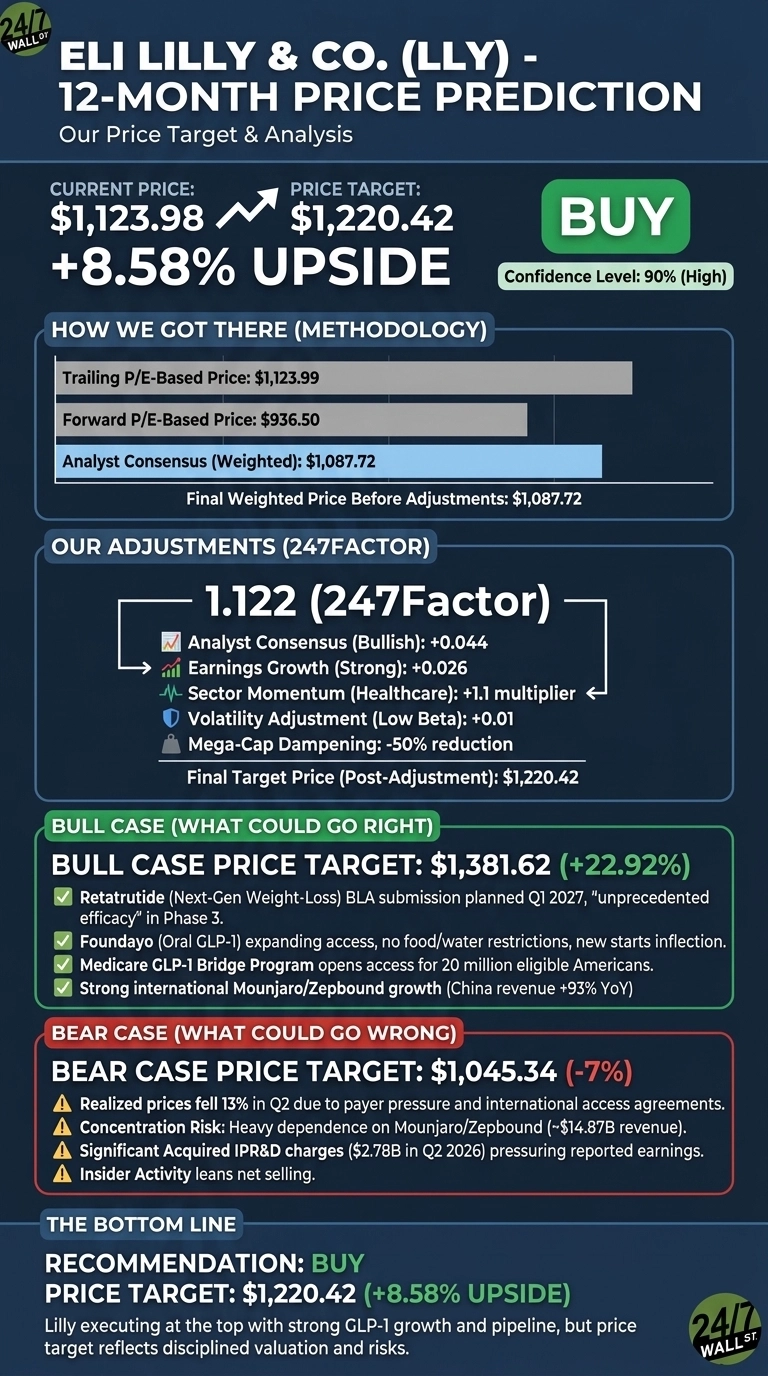
24/7 Wall St. Price Target Summary
| Metric | Value |
|---|---|
| Current Price | $1,123.98 |
| 24/7 Wall St. Price Target | $1,220.42 |
| Upside | 8.58% |
| Recommendation | BUY |
| Confidence Level | 90% |
How Lilly Got to a Trillion, and Where Shares Sit Now
Shares are up 50.72% over the past year but down 8.61% over the past month as investors digest a scorching run. LLY sits below its 52-week high of $1,292.65 and well above the low of $707.59.
The engine remains Mounjaro and Zepbound: Q2 2026 revenue reached $22.974 billion, up 47.67% year over year, with EPS of $8.38 beating consensus by 27.27%. Mounjaro alone posted $9.94 billion (+91% YoY), and management raised full-year revenue guidance to $85 billion to $87 billion.
Bull Case for $1,381 and Higher
The bull path takes LLY to $1,381.62, a 22.92% gain. The catalysts are real. Retatrutide, Lilly’s triple-agonist, delivered what management called “unprecedented efficacy” across three Phase 3 trials, with a BLA submission planned for Q1 2027.
Foundayo, the first oral GLP-1 with no food or water restrictions, expanded to 36,000 prescribers, and the Medicare GLP-1 Bridge Program opened access for 20 million eligible Americans at $50 per month. International incretin market share of 55% and China revenue growth of 93% in constant currency show the runway is global.
What Could Go Wrong
The bear scenario takes shares to $1,045.34, a 7% decline. Realized prices fell 13% in Q2, and concentration risk is real, with the incretin franchise generating roughly $14.87 billion of the quarter’s revenue.
Acquired IPR&D charges of $2.78 billion pressured reported earnings, and insider activity leans net selling. To be fair, bulls would note the IPR&D charges reflect aggressive pipeline building (Orna, Kelonia, Ajax, Centessa) that expands the long-term shot count, and pricing declines have been more than offset by 60% volume growth.
How Lilly Compares to Novo Nordisk and Merck
Novo Nordisk (NYSE:NVO) is the only true GLP-1 peer, and the valuation gap is stark. NVO trades at a forward P/E of 14 with quarterly revenue growth of just 2.1%, versus Lilly’s 47.7%. That gap validates Lilly’s premium multiple.
Merck (NYSE:MRK) offers a diversified big-pharma contrast. Merck’s forward P/E of 16 looks cheap on paper, but quarterly earnings shrank 19.3% year over year on Keytruda patent-cliff concerns.
| Company | Forward P/E | Quarterly Revenue Growth |
|---|---|---|
| Eli Lilly | 24 | 47.7% |
| Novo Nordisk | 14 | 2.1% |
| Merck | 16 | 5.1% |
The peer set makes our 24/7 Wall St. price target look reasonable: Lilly deserves a premium, but not an unlimited one.
Eli Lilly Price Prediction 2026-2030
The 24/7 Wall St. price target of $1,220.42 and buy rating at 90% confidence reflect a company still executing at the top of its industry.
The tipping factor is guidance: four straight EPS beats and a raised outlook are hard to fade. I’d be a buyer here if retatrutide’s BLA stays on track for Q1 2027. I’d stay on the sidelines if realized-price declines accelerate past 13% in coming quarters.
Looking further ahead, here is where our model projects LLY could trade, assuming continued execution.
| Year | 24/7 Wall St. Price Target |
|---|---|
| 2026 | $1,154 |
| 2027 | $1,224 |
| 2028 | $1,308 |
| 2029 | $1,399 |
| 2030 | $1,474 |
These projections assume Lilly continues executing on its GLP-1 leadership and pipeline. Significant upside could come from a clean retatrutide launch, while downside risk centers on payer pricing pressure and eventual GLP-1 competition.
The post Eli Lilly Stock Has Become a Trillion-Dollar Giant. Is It Too Late to Buy? appeared first on 24/7 Wall St..
]]>Pfizer’s 5.91% dividend yield anchors the story, and a pipeline finally catching a bid adds meaningful upside. My 24/7 Wall St. price target reflects that.
Pfizer (NYSE:PFE) trades at $28.77 as of midday September 3, 2026. My 24/7 Wall St. price target is $32.72 over the next 12 months, implying 13.84% upside, with a buy recommendation and high confidence (90%). Add the dividend and the total return case strengthens.
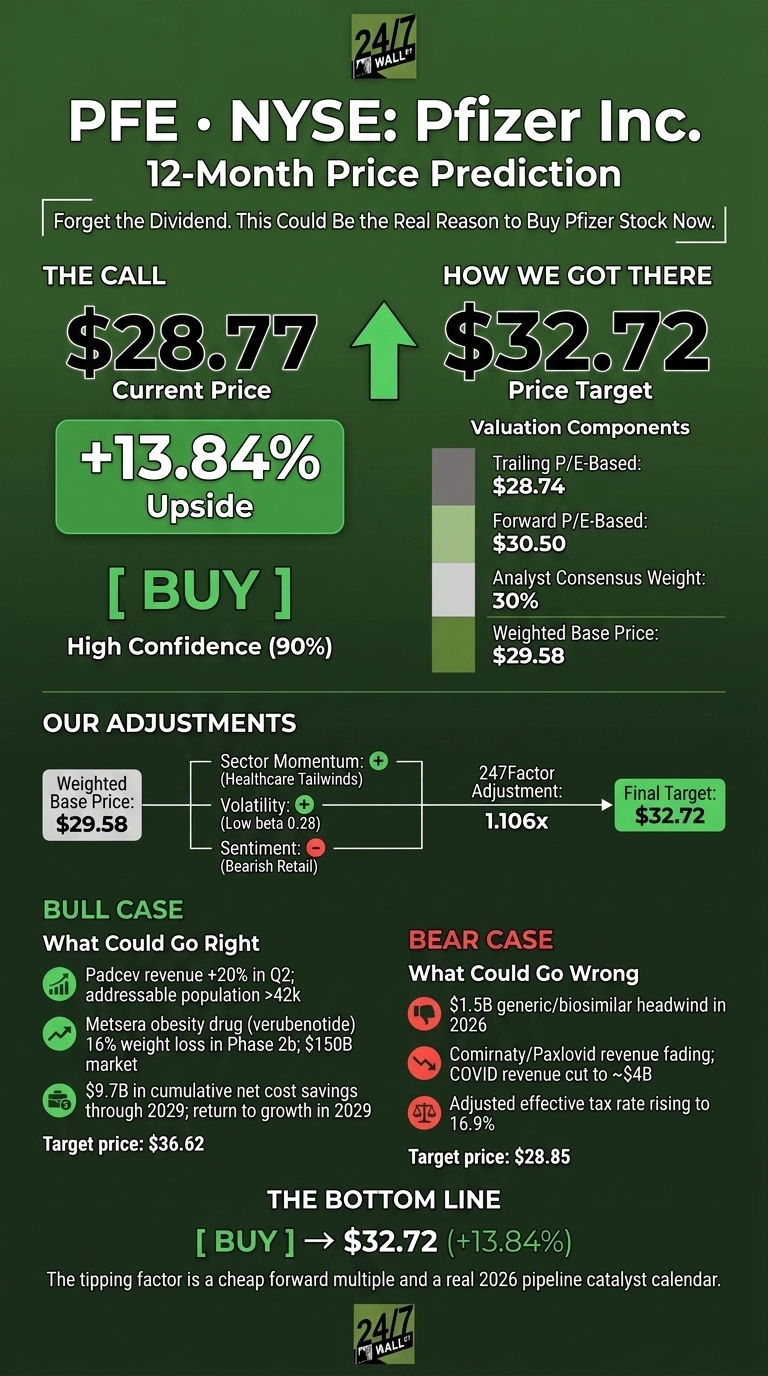
| Metric | Value |
|---|---|
| Current Price | $28.77 |
| 24/7 Wall St. Price Target | $32.72 |
| Upside | 13.84% |
| Recommendation | BUY |
| Confidence Level | 90% |
A Momentum Shift Backed by Real Numbers
PFE has quietly rerated in 2026. Shares are up 22.6% year to date and 15.94% in the past month, closing near the 52-week high of $29.09.
Q2 2026 revenue landed at $15 billion with adjusted diluted EPS of 77 cents. Management raised the revenue guide midpoint by $500 million to $60.5 to $62.5 billion. The company beat adjusted EPS in all ten of the past ten quarters. CEO Albert Bourla called this the “defining period” for Pfizer, and operating momentum supports it.
Bull Case Points to $36+
The bull scenario points to $36.62, a 27.42% total return. Padcev revenue grew over 20% in Q2 with an addressable population of more than 42,000 patients in the U.S. for muscle-invasive bladder cancer.
The Metsera-derived monthly GLP-1 verubenotide showed approximately 16% mean weight loss over 32 weeks in Phase 2b extension data, entering a market sized at $150 billion. Add $9.7 billion in cumulative net cost savings through 2029 and a return to growth in 2029, and the multiple could expand.
What Could Go Wrong
The bear case caps near $28.85, essentially flat. Risks include a $1.5 billion generic and biosimilar headwind in 2026, Comirnaty and Paxlovid fading with COVID revenue cut to approximately $4 billion, and the adjusted tax rate stepping up to 16.9%.
Bulls counter that the operating hit reflects heavy R&D investment, with $2.5 billion deployed internally in Q1 alone and roughly 20 key pipeline assets funding post-2028 growth.
How Pfizer Stacks Up Against Merck and Bristol-Myers
Merck (NYSE:MRK) faces KEYTRUDA loss of exclusivity while diversifying into cardiometabolic and vaccines. Merck guided 2026 non-GAAP EPS of $5.04 to $5.16 on revenue of $65.8 billion to $67 billion. PFE at a forward P/E of roughly 9x trades at a meaningful discount.
Bristol-Myers Squibb (NYSE:BMY) manages Revlimid and Eliquis erosion via a growth portfolio led by Camzyos and Breyanzi. BMY guides 2026 non-GAAP EPS of $6.05 to $6.35, putting its forward P/E near 11x. PFE’s lower multiple plus a dividend nearly double BMY’s supports the buy call.
Why Pfizer Screens as a BUY Here
My 24/7 Wall St. price target for Pfizer is $32.72, a buy at high confidence. The tipping factor is a cheap forward multiple and a real 2026 pipeline catalyst calendar: five regulatory decisions, eight key readouts, and 19 pivotal study starts.
I’d be a buyer if you believe Padcev, Metsera obesity assets, and cost savings can offset the loss-of-exclusivity cliff. I’d stay on the sidelines if Most-Favored-Nation pricing and Section 232 tariffs will define the next two years.
Here is where my model projects PFE could trade, assuming current growth trajectories and market conditions hold.
| Year | 24/7 Wall St. Price Target |
|---|---|
| 2026 | $29.59 |
| 2027 | $32.55 |
| 2028 | $36.09 |
| 2029 | $39.18 |
| 2030 | $41.78 |
These projections assume Pfizer executes on Metsera, oncology, and cost savings. Significant upside or downside could come from obesity trial readouts or Most-Favored-Nation pricing actions.
The post Forget the Dividend. This Could Be the Real Reason to Buy Pfizer Stock Now appeared first on 24/7 Wall St..
]]>Today’s major mRNA headline is a competitive threat to Moderna (NASDAQ:MRNA), and the stock is climbing anyway. That tension is the story on the tape, and it’s worth reading as a platform bet rather than a flu vaccine call. This MRNA stock rally sits inside a much larger year-to-date advance, so the reaction function matters more than the magnitude.
Moderna stock is up 6% to $148.32 midday, extending a run that had the stock up 376% year to date through Monday’s close. Behind the move is a rival program from GSK (NYSE:GSK), with GSK stock up 0.7% to $50.60. No Moderna release accompanied the move.
The iShares Biotechnology ETF (NASDAQ:IBB) is up 0.3% to $209.70. Meanwhile, the SPDR S&P 500 ETF Trust (NYSEARCA:SPY) is down 0.7% to $761.68. Biotechnology is modestly outperforming a falling broad market, and Moderna is far above both, which places this move in the name rather than the sector.
GSK Moves a Rival mRNA Flu Shot to Phase III
GSK stated it will advance its seasonal mRNA-based influenza vaccine into a Phase III trial after positive mid-stage results, and hopes to begin that trial in September 2026. In the Phase IIa Flu-028 study, 971 adult volunteers were randomised, and recipients of the multivalent candidate showed higher immune responses than those given marketed standard-dose and high-dose comparators, with what the company called an acceptable safety and short-term inflammatory profile.
Results were presented at the OPTIONS XIII influenza conference in Washington, DC. The company is advancing an optimised B-strain haemagglutinin form, and the study would be the first late-stage evaluation of an mRNA flu vaccine targeting both haemagglutinin and neuraminidase. Sanjay Gurunathan is GSK’s head of vaccines and infectious disease research and development.
Moderna’s mFlusvia, its mRNA seasonal flu shot, won U.S. Food and Drug Administration approval in August 2026, after the agency initially declined to review it at all. GlobalData forecasts mFlusvia sales of $831 million in 2032. A rival candidate reaching market would compete with mFlusvia directly.
Platform Read-Through Versus Direct Competition
One tape reading is that a large, conservative pharma company is committing capital to the exact modality that U.S. policy defunded last year. U.S. Health Secretary Robert F. Kennedy Jr. cut government funding to 22 mRNA vaccine development initiatives worth $500 million in August 2025. Private financing for the modality fell 82% in 2025 against 2023 levels.
Moderna’s Phase III melanoma success for intismeran autogene, its mRNA cancer vaccine, reopened analyst interest in the platform after months of skepticism. Merck (NYSE:MRK) is a co-developer on that program and holds significant economic rights to the therapy. That trial used Keytruda as the comparator arm, and the data pointed to additive efficacy over Merck’s Keytruda alone in the adjuvant setting, which surprised much of the sell side.
This platform question also reads across to BioNTech SE (NASDAQ:BNTX) as another mRNA developer with commercial infrastructure in place. GSK’s decision to fund a late-stage mRNA flu program, in that context, looks to some traders like third-party validation of the modality itself. The market appears to be paying for that read-through rather than pricing the future revenue GSK might take from mFlusvia.
Bear Case Deserves Real Weight
Jefferies senior equity research analyst Andrew Tsai stated that investors were unlikely to rush back into mRNA therapies, with longer-term interest hinging on whether the drug class succeeds across a broad range of solid tumors. That framing puts a ceiling on how far one Phase III entrant from a large pharma company can carry a re-rating in the near term.
Pair that view with the fact that MRNA stock’s 376% year-to-date run means a 6% session is now ordinary volatility for Moderna stock rather than a signal. The stock has moved much more than that on individual data releases this summer, and single-session activity carries less signal at these price levels than it did in prior years.
What to Watch Next
A core question is whether competitive validation of a platform is worth more to Moderna than the revenue a competitor would take from mFlusvia. Both readings are defensible on today’s information, and the market has picked the platform read for now. Fresh trial data or a slowdown in the pace of mFlusvia’s launch could shift that balance quickly.
Investors can watch for whether Moderna stock holds its gains and how sell-side analysts frame the GSK study details in follow-up notes. Given the size of the year-to-date advance, traders should consider keeping their position sizes modest and treating single-session moves as noise rather than confirmation.
The post Moderna Rises 6% Despite GSK Moving Rival mRNA Flu Vaccine to Phase III appeared first on 24/7 Wall St..
]]>Dividend investors who held Schwab U.S. Dividend Equity ETF (NYSEARCA:SCHD) through the value-stock drought of the past two years now face a strange problem. SCHD has returned 29% year to date and trades near $35 per share, roughly 1.5% below its 52-week high. The rally has pulled SCHD’s trailing distribution yield down to about 3.1%, close to the lowest level the fund has offered in years. A quality dividend index just delivered stock-like returns while becoming a less generous income source.
Anyone putting fresh money into SCHD is buying a different proposition than long-term holders locked in during 2022 and 2023, and the comparison against a 4.7% 10-year Treasury has grown harder to ignore.
What SCHD Is Built to Do
SCHD tracks the Dow Jones U.S. Dividend 100 Index and screens for companies with consistent dividend payments, strong cash flow to debt, high return on equity, and reasonable yield. The result is a portfolio anchored by durable payers like Qualcomm (NASDAQ:QCOM), Texas Instruments (NASDAQ:TXN), UnitedHealth (NYSE:UNH), Coca-Cola (NYSE:KO), and Merck (NYSE:MRK). Its job is to deliver a rising income stream from quality large caps at a 0.06% expense ratio.
The return engine is dividends plus modest capital appreciation. SCHD avoids options overlays, leverage, and junk-rated payers, which is why its long-run performance has tracked earnings and dividend growth rather than multiple expansion. Over ten years, the fund has returned 242%, in line with the compounding investors expect from a disciplined dividend-growth basket.
Does the Yield Still Do the Work?
At 3.1%, every $100,000 in SCHD produces roughly $3,130 a year before taxes. Producing $3,000 a month in average income now requires close to $1.15 million in investment, a materially thinner payout than the fund delivered two years ago at lower prices. For readers working with smaller balances, we sketched a $1,500-a-month plan built on a $250K starting balance in a free income guide.
The 10-year Treasury complicates the pitch. At 4.7%, government paper pays more current income than SCHD, which has no equity risk. What SCHD offers in exchange is dividend growth: the trailing twelve-month payout of $1.048 far exceeds the under-$0.20 quarterly checks shareholders received a decade ago. That growth is the compensation for accepting a starting yield below the risk-free rate.
The latest quarterly distribution of $0.2525 came in below the $0.2569 paid the prior quarter, so income has not climbed in a straight line even as the price has.
Tradeoffs at a New High
Buyers today are paying an earnings multiple of 19 for the underlying basket, which is reasonable by market standards but well above the level at which SCHD traded during its 2022 and 2023 accumulation windows. Net assets climbed to roughly $94.9 billion by May 2026 from $71.6 billion at the end of 2025.
The tilt toward energy, healthcare, staples, and industrials means SCHD will lag in growth-led markets and look defensive when technology leads. Reddit sentiment throughout the run has remained bullish, and that kind of retail enthusiasm at prices near highs is itself a data point worth pricing in.
Investors who want more current income can pair SCHD with short-term Treasuries to capture today’s curve while letting the dividend-growth engine reassert itself over time.
My Take
The easy money in SCHD has been made for now. A 30% one-year return in a quality dividend index is not repeatable, and the yield compression that came with it means new capital is buying less income per dollar than at any point in recent memory. The underlying strategy still works, and the 0.06% expense ratio is hard to beat.
Long-term holders have reason to stay the course because the dividend-growth engine is intact, and selling would trigger taxes on gains most did not expect to be realized this soon. For buyers with fresh cash focused on income today, splitting the allocation with Treasuries makes more sense than piling in at a 3.1% yield when the 10-year pays 4.7%. SCHD still fits the profile of a core dividend holding; it is simply a less urgent entry point at $35 than it was at $27.
The post SCHD Is Up Nearly 30% and Its Yield Is Back Near 3% | Did Dividend Investors Miss the Easy Money? appeared first on 24/7 Wall St..
]]>Moderna stock is giving back a large chunk of Tuesday’s rally. The pullback reopens a question that a summer melt-up has largely papered over: what does a market capitalization near $59 billion actually value on this income statement?
Moderna (NASDAQ:MRNA) stock is down 7% to $148.02 midday Wednesday, and no fresh company news is on the wire to explain the slide. Also lower, BioNTech SE (NASDAQ:BNTX) stock is down 2% to $111.60, a much shallower giveback that suggests the pain is Moderna-specific.
The iShares Biotechnology ETF (NASDAQ:IBB) is down 0.6% to $215.04, so the biotech cluster is barely wobbling. Meanwhile, the SPDR S&P 500 ETF Trust (NYSEARCA:SPY) is unchanged at $765.57, keeping the broad market backdrop quiet.
Profit-Taking After a Vertical Run
Moderna stock closed 14% higher on Tuesday, back above $150, after Wolfe Research upgraded Moderna stock to Peer Perform from Underperform. The firm offered no new price target and pegged unadjusted peak sales at $9.2 billion across the four main indications for intismeran, the personalized cancer vaccine Moderna is developing with Merck (NYSE:MRK).
That upgrade capped a violent ascent. Moderna stock was up 439% year to date through Tuesday’s close, so a 7% giveback here reads as profit-taking after a rally that stretched the chart well beyond any near-term news catalyst.
The move has been remarkably compressed on a shorter frame as well. Moderna stock was up 194% over the trailing month through Tuesday’s close, so a 7% single-day pullback sits well within the range of recent daily swings for the name.
Modest Fundamentals for a $59 Billion Cap
Moderna carries no trailing P/E ratio, because there is no trailing profit to divide into. Q2 2026 revenue was $145 million, up 2.1% year over year, and the loss of $1.97 per share matched the $1.97 consensus estimate exactly. The net loss narrowed to $782 million from $825 million a year earlier, aided by cost of sales that fell 22% to $93 million on manufacturing productivity gains.
Q1 2026 was noisier for Moderna: a loss of $3.40 per share on $389 million in revenue, with a net loss of $1.34 billion that absorbed an $878 million non-recurring litigation settlement charge. Full-year 2025 revenue was $1.94 billion, down 39%, and the company posted a net loss of $2.82 billion, or $7.26 per share.
Moderna’s management guides to up to 10% revenue growth in 2026 and year-end cash and investments of $4.7 billion to $5.2 billion. The bull case is a pipeline story where Wolfe Research alone sees $9.2 billion in peak sales from one program, and that pipeline value is legitimately hard to capture in a trailing earnings multiple. The bear case is that a $59.09 billion valuation now embeds a drug that isn’t yet approved on a revenue base of $145 million a quarter.
BioNTech Repricing With Less Drama
BioNTech stock is moving far more calmly on the same session, and that gap matters. Moderna stock has repriced harder in both directions during the last week, so the read-across from Moderna stock’s session to the wider mRNA group looks weaker than it did a month ago.
The read-across works in both directions here. Moderna stock’s rally has been about proprietary pipeline optionality rather than a rising tide for mRNA platforms, which makes BioNTech SE’s muted follow-through a coherent signal on its own terms.
Merck sits in the story as the partner name on intismeran. The Moderna and Merck program is running together with KEYTRUDA across melanoma, non-small cell lung cancer, bladder cancer and renal cell carcinoma, which is where the $9.2 billion peak sales figure ultimately has to be earned.
What to Watch Next
Given the violence of recent moves, investors sizing their exposure here may want to keep their position sizing modest and define their risk budget before adding on either dips or breakouts. Single-session swings of 7% down one day and 14% up the day before aren’t a backdrop in which full-size trades protect capital well.
Investors can watch for whether Moderna stock get capture and maintain the $150 level, which would frame the current pullback as a healthy shakeout rather than the start of a broader unwind after the year-to-date run. Moreover, traders could look for signs that the biotech cluster stays firm as Moderna decompresses, since a widening gap between the mRNA leader and its sector suggests the market is now trading pipeline outcomes over platform hype.
The post Moderna Drops 7% Despite a Fresh Wolfe Research Upgrade, BioNTech Slips appeared first on 24/7 Wall St..
]]>The setup around Merck (NYSE:MRK) shares heading into September is unusual for a mega-cap pharma. Wall Street’s consensus target sits below the current stock price, meaning analysts would have to raise their numbers for $200 to come into view. There’s a lot to consider in the near future: a dense stretch of FDA decision deadlines, known as PDUFA dates after the Prescription Drug User Fee Act, arrives between September and late October.
Merck stock was up 19% over the past month to $155.99, outpacing the iShares Biotechnology ETF (NASDAQ:IBB), which was up 15% over the same span to $216.16. Merck shares were up 45% year to date (YTD) through Monday’s close, one of the strongest large-cap pharma runs of the year.
Meanwhile, Moderna (NASDAQ:MRNA) stock was up 157% over the past month through Monday’s close, to $138.89, as Merck’s cancer vaccine partner captured its own share of pre-ESMO enthusiasm. The two companies’ fates are increasingly linked through the intismeran autogene program.
Catalyst Calendar Drives the Case
The near-term case for Merck stock reaching $200 depends on a compressed run of regulatory and clinical events this fall. WINREVAIR’s supplemental application carries a PDUFA date of September 21, followed by WELIREG combined with Lenvima on October 4. Ifinatamab deruxtecan has a PDUFA date of October 10, giving Merck three separate label events to open the fourth quarter.
Merck’s biggest data drop sits at month’s end. The full dataset for intismeran autogene, the personalized cancer vaccine Merck is developing with Moderna, is expected at the ESMO conference in Madrid, running October 23 to 27. Moderna management expects the Phase 3 adjuvant melanoma interim analysis in the second half of 2026, and a positive result could unlock estimate revisions across Merck’s oncology franchise. Moderna is already building dedicated commercial manufacturing capacity in Massachusetts for a potential launch alongside Merck.
KEYTRUDA Engine and the Bear Case
Merck’s Q1 2026 results underscored the operating engine behind the rally. KEYTRUDA franchise sales rose 12% to $8.03 billion, and WINREVAIR jumped 88% to $525 million on continued pulmonary arterial hypertension demand. Merck reported a non-GAAP loss of $1.28 per share, narrower than the $1.47 loss consensus expected, with the shortfall driven by a $9 billion charge from the Cidara Therapeutics acquisition; it marked Merck’s fourth consecutive quarter topping consensus EPS.
Management raised its full-year 2026 guidance to sales of $65.8 billion to $67 billion and non-GAAP EPS of $5.04 to $5.16. On the Q2 2026 call, Merck CEO Robert Davis described the KEYTRUDA loss-of-exclusivity period as “more of a hill than a cliff,” adding that investors will see “a shallow dip with a fast return back to growth.” Davis also flagged a commercial opportunity greater than $70 billion from over 20 new products in development.
The bear case still carries weight. KEYTRUDA accounts for nearly half of Merck’s pharmaceutical revenue and faces a patent cliff, GARDASIL sales in China have fallen to zero, and the pending Terns Pharmaceuticals deal adds roughly $5.8 billion in one-time charges. Larger peer Pfizer (NYSE:PFE) is building its own oncology and obesity pipeline, and mRNA oncology developer BioNTech SE (NASDAQ:BNTX) is advancing pembrolizumab combination studies that could reshape the next wave of immuno-oncology, offering alternative exposure to the same theme for anyone hedging single-name risk.
What Could Push MRK to $200
The move from here to $200 needs Merck to deliver, plain and simple, though it would certainly also help if analysts lift their MRK price targets. Momentum alone can’t close the gap given that Merck stock trades near 56x forward earnings against forward EPS of $5.74. A clean sweep on the September and October PDUFA calendar combined with a compelling intismeran readout at ESMO could reset consensus on Merck’s post-KEYTRUDA growth curve and shift the analyst target higher.
Traders can watch for a clean separation in the melanoma vaccine data and a WINREVAIR label expansion that clears without concessions. Merck’s beta of 0.211 keeps single-day moves in the stock modest, so any repricing toward $200 likely comes in incremental steps. A predicted price of $260.48 from quantitative models sits far above the analyst target of $147.77, and the two views need to converge for $200 to look like a base case.
Investors should size their positions with the fall calendar treated as event risk in both directions. A miss on any of the four catalysts, particularly a mixed melanoma readout at ESMO, could invite profit-taking after the YTD run. Position sizing that keeps their exposure balanced against the KEYTRUDA cliff and Terns-related charges leaves room to add on any pullback into the ESMO print.
The post Merck Just Gained 19% in a Month. What Would It Take to Get MRK Stock Up to $200? appeared first on 24/7 Wall St..
]]>Two names built on the same platform have stopped moving together this morning. Moderna (NASDAQ:MRNA) stock is up 11% to $154.15, a Tuesday morning session standing well apart from anything happening across the broader biotech sector. Meanwhile, BioNTech (NASDAQ:BNTX) stock is up 2% to $115.10, a much lighter session for a name that’s traded as Moderna’s mRNA partner for years.
For sector context, the SPDR S&P Biotech ETF (NYSEARCA:XBI) is up 3% to $168.45. That means BioNTech isn’t only lagging Moderna today; it’s trailing the sector fund that holds it. The comparison against the fund is what makes the gap inside the mRNA pair legible. Biotech is having a good session, and Moderna is having a different kind of session entirely, while BioNTech sits below the fund, making the split inside the mRNA pair even sharper than the headline figures alone would suggest.

No Catalyst Behind the Moderna Move
There’s no company-specific news driving Moderna’s 11% rally today. No new filing, no product announcement, no partnership update, and no analyst action tied to the session. A stock jumping 11% on nothing is itself a fact about how the name is being traded, driven by positioning rather than information. Nothing new was learned when Moderna rose today, so there’s nothing to reassess if the run turns — when flow reverses, the case reverses with it, because there was never an underlying case built during this session.
Retail sentiment supports that read. Moderna’s average Reddit sentiment score of 87.7 sits in very-bullish territory, and the most-discussed content leans into large-gain narratives from WallStreetBets and other trading forums. Crowded positioning of that kind tends to move on its own weight rather than on fresh information. The distinction matters for how the position should be managed: a Moderna move built on flow and sentiment has a shorter half-life than one built on a data readout, a contract win, or an approval decision. When there’s nothing to underwrite Moderna’s price on the way up, there’s nothing to underwrite it on the way down either.
A Decoupling That’s Been Building All Year
Moderna stock was up 371% year to date through Monday’s close. BioNTech stock was up 19% year to date through Monday’s close, against 35% for the SPDR S&P Biotech ETF over the same window. BioNTech has trailed the biotech sector fund for the full year while Moderna has multiplied by several times over the same period. For peer reference, it’s also worth mentioning that Merck (NYSE:MRK) stock is up 2% today to $153.81 and is now up 46% in 2026 so far.
Today’s session figures are the visible edge of a divergence that’s been building for months, not a single-day quirk. The pair trade that treated Moderna and BioNTech as one mRNA position no longer describes what’s happening in either name. The market has separated the two stocks in a way that the underlying mRNA platform itself has not.
Moderna is running at several times the ETF’s session move, and investors treating these names as one mRNA pair are watching that framework break in real time. Break the comparison out at the sector level and the point sharpens further. BioNTech is trailing the SPDR S&P Biotech ETF on both today’s session and the year to date, while Moderna is beating the same fund on both windows.
For an investor holding both, the practical takeaway is that the mRNA basket no longer functions as one position. Sizing decisions that treated Moderna and BioNTech as interchangeable exposure have been quietly out of step for months. Today’s session put that behavior directly on the quote screen, and the fund comparison is what makes it obvious.
Position Sizing Is the Discipline
Investors should consider keeping their position sizes modest on Moderna here. A run of this size with no catalyst attached can reverse just as quickly and for equally little reason, and there’s no new information to lean on if it does (we wrote a free playbook on speculating with just 5% of a portfolio, sizing rules included, here). That’s a risk-management observation rather than a directional forecast on the stock.
BioNTech presents the opposite question. It shares the platform and the theme, yet has captured almost none of today’s move and has lagged the sector fund for the year. Owning BioNTech into this stretch has clearly been a different exercise than owning Moderna, both on today’s session and across the year to date.
Traders can watch for whether Moderna holds today’s gains into the close, and whether BioNTech starts to close the gap to the fund that owns it. Either outcome would say more about how these names are being traded than about the mRNA platform both companies still share. Discipline in sizing is the right answer for both names today, until something in the underlying story actually changes.
The post Moderna Rallies 11%, BioNTech Ticks Up: Is the mRNA Trade Down to One Name? appeared first on 24/7 Wall St..
]]>On CNBC’s Squawk on the Street Monday morning, Jim Cramer said the tape has soured on the trade that carried the market for most of the past year. “We’re defaulting to all right, give me anything but tech, give me anything but data center. We’ve got. They dug their own graves,” he said, describing money leaving hyperscaler capex plays and moving into enterprise software and pharmaceuticals.
David Faber pressed on the mechanics. “There is a part of tech that’s showing some momentum. And interestingly, it’s of course, well, if we don’t move as quickly as might otherwise be the case, because the data center opposition is such that things are not getting built as quickly. Well, who’s the potential beneficiary? Software companies,” he said.
The segment framed a rotation triggered by bond market volatility and spreading political opposition to data center construction in states including Texas, Pennsylvania, and Virginia. The names Cramer and Faber circled included ServiceNow (NYSE:NOW), Salesforce (NYSE:CRM), Adobe (NASDAQ:ADBE), and Johnson & Johnson (NYSE:JNJ).
Data Center Backlash Is Real Right Now
Cramer’s sharpest claim is that the backlash is self-inflicted. “They fooled people. Some people thought it was good. Some people thought it was bad. Whatever they wanted to do, it was the wild west of data centers. It would have been better had they made an agreement ahead of time,” he said.
Whether community objections are fair does not change the outcome for investors. A delayed project remains delayed regardless of the merits.
State-level friction is now on record. Colorado Legislative Council Staff cataloged 2026 state actions covering rate design, cost-shifting, and permitting for large-load projects, including California Senate Bill 57, Illinois Senate Bill 25 requiring Clean Air permits for data center construction, and Maryland Senate Bill 937.
PJM Interconnection’s independent market monitor concluded that data center load growth is the primary reason for recent and expected capacity market conditions, the kind of grievance that hardens political opposition and slows approvals.
Software Beneficiary Case Deserves Scrutiny
Faber’s logic is that constrained capacity drives value to companies that sell efficiency on existing infrastructure. ServiceNow’s Q2 results support this, with subscription revenue of $3.877 billion, up 23% year-over-year in constant currency, and management stating that ServiceNow AI ACV exceeded expectations, surpassing $1 billion.
Salesforce tells the same story with different vocabulary. Marc Benioff described Agentforce ARR surpassing $1 billion and combined AI and data ARR reaching $3.4 billion, alongside a $25 billion accelerated share repurchase disclosed in its Q1 FY2027 press release.
The rally shows in the tape. NOW is up 29.63% over the past month, CRM is up 27.74%, and ADBE is up 22.73%, though all three remain down year-to-date.
The insulation argument has a hole. Every platform ultimately runs on the same compute utilities that are being fought over, and ServiceNow’s CFO flagged that accelerating AI adoption and more customers utilizing hyperscale partnerships are pressuring subscription gross margin, the cost side of the same constraint.
Pharma Rotation Rewards Balance Sheets More Than Pipelines
Cramer pointed to Johnson & Johnson’s balance sheet and pipeline. Joaquin Duato said J&J has 28 products and platforms that each generate more than $1 billion in annual sales, with worldwide Q2 sales of $25.3 billion, up 5.6% operationally.
That is a defensive story with a low beta of 0.231, and JNJ is up 33.4% year-to-date, typical of a rate-driven rotation into healthcare.
Merck (NYSE:MRK) differs. Rob Davis pointed to “greater than $70 billion of commercial opportunity we have from over 20 new products”, and MRK is up 45.25% year to date on pipeline milestones driving the move.
Moderna (NASDAQ:MRNA) is the odd one out. MRNA is up 115.47% in the past week alone on melanoma vaccine data, with Merck showing a 49% reduction in recurrence/death risk versus KEYTRUDA alone, and Reddit sentiment has run very bullish, with scores ranging from 78 to 95, a speculative catalyst trade on clinical data.
Buyback Signal Is the Sharpest Idea
Cramer said “we are in an irrational market” where stock performance is set by buyback size rather than fundamentals. Salesforce is the cleanest example, having retired 103 million shares, representing 11% of shares outstanding through a debt-funded ASR.
When a market rewards share count reduction that aggressively, it tells you investors currently trust financial engineering more than revenue growth. That reflects a stance about demand durability.
The rotation works only if software winners convert AI usage into resolutions customers pay for, and if pharma pipelines survive regulatory contact. ServiceNow’s line that “Customers aren’t paying us for tokens, they’re paying for resolutions” is the version of that bet worth watching.
Data center delays can end as quickly as they began, and a single disappointing pipeline readout can undo months of pharma outperformance. The buyback frustration Cramer voiced is likely the more durable observation.
The post “Give Me Anything But Tech”: Jim Cramer’s Bold Call on the Market’s Next Big Rotation appeared first on 24/7 Wall St..
]]>On August 19, 2026, Merck (NYSE:MRK) and Moderna (NASDAQ:MRNA) announced positive topline Phase 3 results from INTerpath-001 for intismeran autogene, an individualized neoantigen therapy paired with Keytruda in resected melanoma. The trial beat Keytruda alone on recurrence-free survival, and no specific efficacy numbers have been released yet. Nothing is approved. Still, both partners needed this. Merck faces the Keytruda U.S. patent cliff in 2028; the franchise generated $31.641 billion in 2025 sales, according to Genetic Engineering and Biotechnology News. Its mRNA collaborator, Moderna, needs a success story outside COVID.
The key here is that every individualized dose requires sequencing a patient’s tumor and running a bespoke manufacturing batch. That drives demand for sequencing capacity and bioprocessing consumables on a per-patient basis. Here are five companies positioned to benefit if this therapy reaches the market.
BioNTech, the Rival That Rose Anyway
BioNTech (NASDAQ:BNTX) is developing autogene cevumeran with Genentech, with enrollment complete in adjuvant colorectal cancer and a readout expected in 2027. Shares jumped 21.6% over the past week on read-across. BioNTech itself pushed back on that logic, telling analysts “new antigen vaccines are not created equal.” Traders bought the modality anyway.

Illumina, the Sequencing Toll Booth
Illumina (NASDAQ:ILMN) supplies the NovaSeq X systems used to identify tumor neoantigens. Shares rose 15.6% on the week to $223.22. Clinical markets already represent about 65% of sequencing consumables revenue, and CEO Jacob Thaysen told investors “oncology continues to lead the pack.” It is a razor-and-blade model that benefits whichever vaccine wins.


Pacific Biosciences, the High-Beta Version
Pacific Biosciences (NASDAQ:PACB) offers long-read HiFi sequencing and rose 5.8% over the past week to $1.28. However, this is a micro-cap with a $419 million market cap and a beta of 2.318. A percentage move on a dollar stock is not the same risk profile as one on a large cap, and long-read sequencing has less direct exposure to neoantigen workflows today than short-read platforms.
Repligen, the Pure-Play Bioprocessing Pick
Repligen (NASDAQ:RGEN) sells filtration, chromatography, and process analytics used to manufacture biologics. Per-patient production is consumables-intensive. Q2 delivered $204 million of revenue with 13% organic growth, and CEO Olivier Loeillot said the pending BioLife acquisition “fast-tracks our cell therapy leadership.” Shares trade at $181.62.


Danaher, the Diversified Way to Own It
Danaher (NYSE:DHR) owns Cytiva and Pall, the deepest bioprocessing franchise in the group, plus Leica Biosystems in cancer diagnostics. Q2 bioprocessing orders grew mid-teens, and CEO Rainer Blair called the Life Sciences result “their strongest quarter in several years.” Danaher offers less upside torque than Repligen but more downside protection, and it does not need this specific therapy to succeed.


Counterweight and What to Watch
Leerink Partners analyst Daina Graybosch called the market reaction “overly optimistic,” warning that melanoma has the highest tumor mutational burden, so read-across is not automatic, and that per-patient manufacturing caps gross margin near 50% to 75% versus roughly 90% for monoclonal antibodies. That margin compression is exactly what shows up as revenue for the toolmakers. Even so, Leerink raised its 2032 intismeran forecast to $1.4 billion, while Morningstar now projects $16.8 billion by 2035.
Watch the actual efficacy numbers at the upcoming medical meeting and whether the result extends to lung, bladder, and renal cancers, where intismeran is already being evaluated across nine Phase 2 and Phase 3 studies. That is the falsifiable checkpoint.
The post Cancer Vaccine Breakthrough Lifts 5 Biotech Names. Here’s Who’s Best Positioned. appeared first on 24/7 Wall St..
]]>Eli Lilly (NYSE:LLY) is trading at $1,255.40, and management has guided fiscal 2026 revenue between $85 billion and $87 billion. That puts the $100 billion revenue mark within reach.
Our 24/7 Wall St. price target for Lilly is $1,480.01, implying 17.89% upside over the next 12 months. Our recommendation is buy, with confidence level 90%.
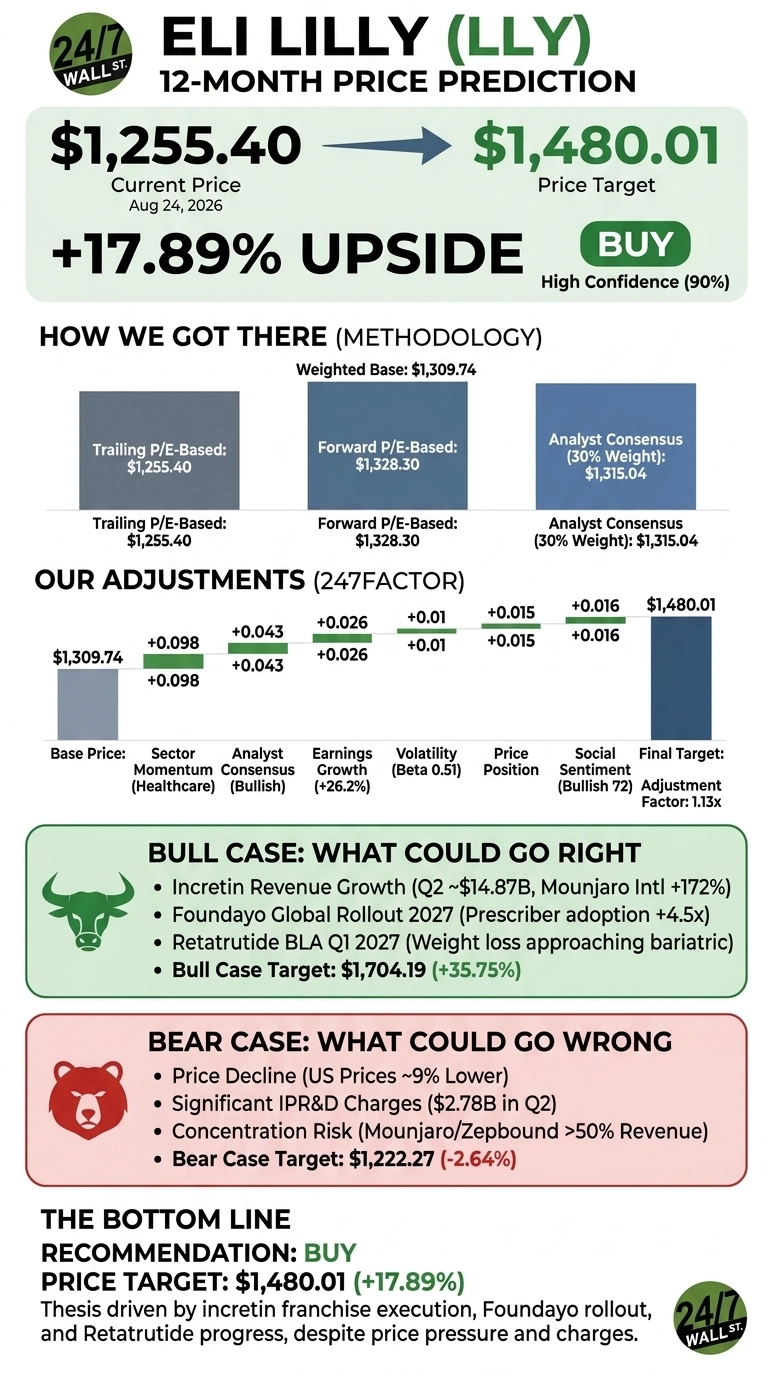
| Metric | Value |
|---|---|
| Current Price | $1,255.40 |
| 24/7 Wall St. Price Target | $1,480.01 |
| Upside | 17.89% |
| Recommendation | BUY |
| Confidence Level | 90% |
Why Lilly’s Stock Looks Different in August 2026
Lilly is up 6.38% over the past week, 8.1% over the past month, and 77.98% over the past year, trading just under its 52-week high of $1,292.65.
Q2 2026 drove the rerating: revenue of $22.97 billion grew 47.67% year over year and beat consensus by 11.06%. EPS of $8.38 beat by 27.27%. Mounjaro delivered $9.94 billion (+91%) and Zepbound another $4.93 billion. In May, Lilly became the first drugmaker to hit a $1 trillion market value, and it now sits above that at $1.12 trillion.
Why Bulls See a Breakout Ahead
The bull case rests on three engines. First, the incretin franchise generated nearly $14.87 billion in a single quarter, with Mounjaro international sales growing 172%.
Second, orforglipron (Foundeo), the approved oral GLP-1, is rolling out globally in 2027, with prescriber adoption jumping from approximately 8,000 to 36,000.
Third, retatrutide, whose TRIUMPH-1 trial showed weight loss approaching bariatric surgery levels, is on track for a Q1 2027 BLA.
CEO David Ricks called “Lilly’s future, after 150 years, has never been brighter.” Our bull-case scenario points to $1,704.19, a 35.75% total return, consistent with 5 strong-buy and 17 buy consensus ratings.
What Could Go Wrong
Realized U.S. prices fell roughly 9% ex-rebate, and Lilly took $2.78 billion in IPR&D charges from heavy M&A activity. Bulls counter that these charges reflect deliberate pipeline investment in Verve, Ataibeckley, and Kelonia, and that non-GAAP performance margin expanded to 54.8%.
Concentration is another risk: Mounjaro and Zepbound represent more than half of revenue, and Novo Nordisk’s Wegovy pill launch will contest the oral category. Our bear case implies $1,222.27, a -2.64% return.
How Lilly Compares to Novo Nordisk and Merck
Novo Nordisk (NYSE:NVO) is the only true incretin peer, with Q1 2026 adjusted sales falling 4% at constant exchange rates as U.S. pricing eroded. Novo trades at a market cap of $156.4 billion, roughly one-seventh of Lilly’s, despite a comparable GLP-1 franchise. That valuation gap reflects the market’s premium for Lilly’s growth trajectory.
Merck (NYSE:MRK) provides the large-cap pharma valuation floor. Merck guides FY2026 non-GAAP EPS of $5.04 to $5.16 on revenue of $65.8 billion to $67 billion, roughly comparable to Lilly with a fraction of the growth.
Merck’s market cap of $376.4 billion versus Lilly’s $1.12 trillion reflects the growth premium. Against that field, Lilly’s forward P/E of 35 looks rich but defensible, and our 24/7 Wall St. price target of $1,480.01 reads as reasonable.
Eli Lilly Price Prediction 2026-2030
I’m sticking with the buy call and the 24/7 Wall St. price target of $1,480.01 at 90% confidence. The tipping factor is retatrutide readouts stacked against a raised revenue guide and margin expansion of nine percentage points.
I’d be a buyer if the Q1 2027 retatrutide BLA lands on schedule and Foundayo international launches track UAE uptake. I would stay on the sidelines if U.S. price erosion accelerates past management’s guided offset.
Here is where our model projects Lilly could trade, assuming current trajectories hold.
| Year | 24/7 Wall St. Price Target |
|---|---|
| 2026 | $1,324 |
| 2027 | $1,480 |
| 2028 | $1,673 |
| 2029 | $1,823 |
| 2030 | $1,988 |
These projections assume Lilly continues executing on its incretin franchise and pipeline. Meaningful upside or downside could result from retatrutide’s regulatory outcome, orforglipron’s international ramp, and U.S. GLP-1 pricing policy.
The post Eli Lilly Has a $100 Billion Revenue Story in the Making, 18% Upside Ahead appeared first on 24/7 Wall St..
]]>Moderna (NASDAQ:MRNA) stock is down 7% to $135.22 in Monday morning trading, cooling off after one of the most explosive runs in biotech this year. The pullback follows a vertical ascent that carried shares to a record high of $176.66 during last week’s advance. Volume has been heavy since the opening bell as short-term traders lock in gains.
The give-back looks orderly. Moderna stock was up 392% year to date (YTD) through Friday’s close, so a single-session dip of this size still leaves the run largely intact. That proportion is the story here. For context, the iShares Biotechnology ETF (NASDAQ:IBB) is down 1% to $211.73.
Reddit sentiment on Moderna remained very bullish through the weekend even as the drawdown developed, suggesting the retail base has not turned. Institutional positioning is the swing factor.
Profit-Taking, Not a New Catalyst
No new company announcement, trial update, regulatory action or analyst downgrade has been reported today. The phase 3 melanoma data that fueled the rally is unchanged, and Moderna hasn’t disclosed material news since its July 31 second-quarter report. Traders are simply booking gains after a parabolic move.
Options positioning reinforces the read. The put-call ratio across Moderna’s full chain sits at 1.06, with heavier hedging visible in longer-dated 2027 expirations. That skew is consistent with holders locking in profits and buying downside protection.
Melanoma Data Still Anchors the Bull Case
The catalyst behind the rally remains intact. Moderna’s intismeran autogene, an mRNA-based individualized neoantigen therapy, was tested in combination with Merck‘s (NYSE:MRK) Keytruda in a late-stage melanoma trial, and at a pre-specified interim analysis the combination met its primary endpoint of recurrence-free survival and a key secondary endpoint of distant metastasis-free survival.
The trial enrolled patients with completely resected stage IIB, IIC, III or IV cutaneous melanoma who had not received prior systemic therapy. Merck shares are down 1% to $150.61 this morning.
For Moderna, the readout was the first positive phase 3 for an individualized neoantigen therapy and for an mRNA-based cancer therapy, and the first phase 3 to show a clinically meaningful improvement over Keytruda alone. Safety profiles were generally positive with no new safety signals, and the study continues to evaluate overall survival.
The commercial opportunity is substantial. The U.S. is expected to register 112,000 new melanoma cases this year with 8,500 deaths, and roughly 330,000 cases were diagnosed globally in 2022. A cancer indication of this size explains why the market repriced Moderna’s oncology pipeline in a matter of days.
Additional pipeline catalysts remain on deck. Registrational data from Moderna’s propionic acidemia program and continued follow-up across the intismeran oncology franchise in bladder cancer, non-small cell lung cancer and renal cell carcinoma are all expected. That optionality is a meaningful part of what the recent rally has been discounting.
Peers Along for the Ride
Merck, Moderna’s partner on the intismeran program, has ridden the same wave from a different starting point. Merck stock was up 47% year to date through Friday’s close, supported by the Keytruda franchise and the melanoma combination’s implications for label expansion.
BioNTech (NASDAQ:BNTX), the other high-profile mRNA name, has lagged the Moderna stock surge. BioNTech stock was up 22% year to date through Friday’s close, reflecting a slower oncology pivot and ongoing patent litigation with Moderna. This morning, BNTX shares are down 4% to $111.47. Neither peer carries a comparable session move today, which underscores the Moderna-specific stock unwind.
What Investors Should Watch Next
For investors sitting on paper gains, this is the moment to think about position sizing in Moderna. A 7% single-day pullback against a triple-digit YTD run is small in proportion, though sharp moves in both directions tend to cluster around parabolic stocks (we made the case for riding a mania while planning the exit in a free handbook here: The Bubble Survivor’s Handbook). Trimming into strength and setting explicit downside levels should keep exposure manageable.
New entrants should be especially cautious. Moderna still posts material losses, with a Q2 net loss of $782 million on revenue of $145 million. The business remains dependent on pipeline execution to justify its current market capitalization, so sizing any new position modestly should keep drawdown risk in check given the volatility profile.
Social sentiment has amplified the swings. Moderna has drawn heavy attention on Reddit’s WallStreetBets forum, with one high-profile MRNA post drawing 4,995 upvotes and 484 comments. Retail flow of that character tends to accelerate moves in both directions, which argues for tighter risk controls on any fresh entry.
Keep an eye on Moderna stock into the close for a read on whether buyers step back in near the $130 area. Any read-through commentary on the intismeran overall-survival follow-up could shape follow-through direction. Absent a fresh headline, today’s action is a positioning event rather than a thesis change.
The post Moderna Sinks 7% as Traders Book Profits on a 392% Year-to-Date Surge; BioNTech Drops 4%, Merck Slips appeared first on 24/7 Wall St..
]]>Our 24/7 Wall St. price target for Pfizer (NYSE:PFE) points to $32.36 over the next 12 months, implying 15.27% upside from the recent close of $28.07. Our recommendation is buy, with high model confidence of 90%. Pipeline momentum, a re-rated 2026 guide, and a 6.19% dividend yield tip the scale toward a rebound thesis.
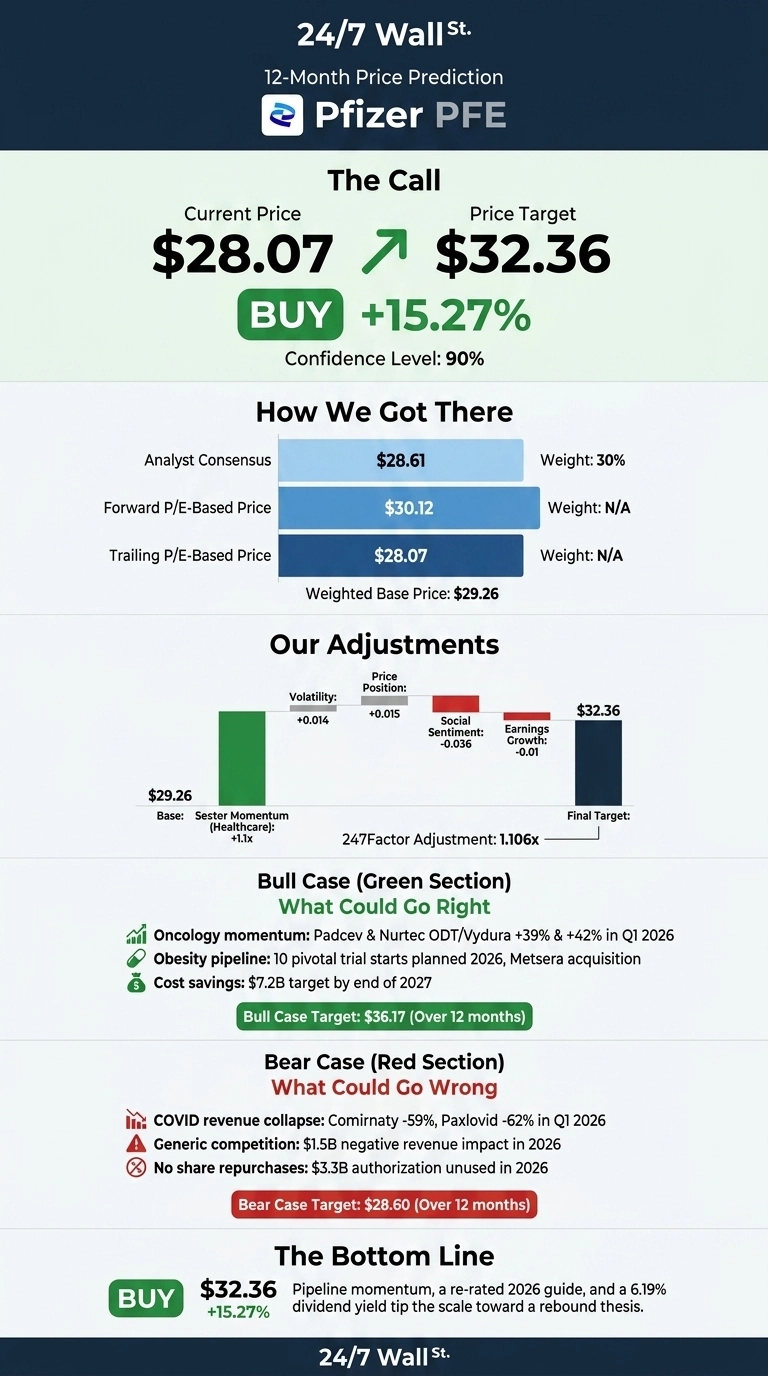
| Metric | Value |
|---|---|
| Current Price | $28.07 |
| 24/7 Wall St. Price Target | $32.36 |
| Upside | 15.27% |
| Recommendation | BUY |
| Confidence Level | 90% |
A Quiet Rebound Is Already Underway
Pfizer has quietly become one of healthcare’s better price stories in 2026. Shares are up 18.58% year to date and 15.08% over the past month, closing at $28.07, essentially at the 52-week high of $28.44.
Q2 2026, reported August 4, delivered $15 billion in revenue, adjusted diluted EPS of 77 cents, and a raised revenue guide of $60.5 to $62.5 billion, even with a $4.3 billion writedown stealing headlines. CEO Albert Bourla noted this was the “ninth time we exceeded consensus expectations for revenues in the last ten quarters.”
Why Bulls See a Breakout Ahead
The bull case rests on execution. Launched and acquired products grew 22% operationally in Q1 2026, with Padcev up 39% and Nurtec ODT/Vydura up 42%. Pfizer expects 19 pivotal study starts over the next 12 months across oncology, obesity, and immunology.
Management is guiding to a high single-digit revenue CAGR from year end 2028 through 2033. If the obesity pipeline hits, our bull-case model reaches $36.17 within a year, and $52.18 over five.
Risks Worth Watching Now
The bear case starts with COVID: Comirnaty fell 59% and Paxlovid 62% in Q1 2026. Generic and biosimilar competition will drag roughly $1.5 billion off 2026 revenue, and no buybacks are planned despite a $3.3 billion authorization.
Q1 operating income fell 31.44% year over year, though bulls would argue that reflects heavy R&D reinvestment ($5.5 billion deployed in the first half of 2026) that funds the post-2028 growth ramp. Our bear-case path bottoms near $28.60.
How Pfizer Compares to Merck and Bristol Myers Squibb
Merck (NYSE:MRK) is the closest big-pharma peer on oncology and vaccines, anchored by KEYTRUDA, which posted $8.03 billion in Q1 2026 sales, up 12%. Merck guides 2026 non-GAAP EPS of $5.04 to $5.16 (absorbing a Cidara charge). Ex-charge, Merck trades near 18x forward earnings versus Pfizer at 10x. That valuation gap is the entire reason Pfizer looks like the rebound trade.
Bristol Myers Squibb (NYSE:BMY) shares Pfizer’s patent-cliff narrative and co-markets Eliquis. BMS guides 2026 non-GAAP EPS of $6.05 to $6.35, putting it near 11x forward earnings. Bristol Myers is priced for a similar rebound story to Pfizer, which supports the view that our 24/7 Wall St. price target is reasonable.
Pfizer Price Prediction 2026-2030
Our 24/7 Wall St. price target of $32.36 and buy rating carry 90% confidence. The single factor that tips the scale is the combination of a 6.19% dividend yield with a genuine pipeline reacceleration.
The bullish setup strengthens if oncology and obesity readouts continue to land and COVID declines stabilize near management’s $4 billion guide. The thesis weakens if Paxlovid disappoints again or the Metsera obesity data underwhelm in 2027.
| Year | 24/7 Wall St. Price Target |
|---|---|
| 2026 | $32 |
| 2027 | $35 |
| 2028 | $38 |
| 2029 | $41 |
| 2030 | $45 |
These projections extend our base-case CAGR of 9.7% and assume Pfizer executes on its 2028+ growth reacceleration. Significant upside or downside could come from obesity approvals, Vyndamax post-2031 competition, or Section 232 pharmaceutical tariffs.
The post Pfizer Stock: Wall Street Sees a Rebound, Here’s Our Price Target appeared first on 24/7 Wall St..
]]>Barclays’ Emily Field, Head of U.S. Biopharma Equity Research, told CNBC on Monday, August 24, that the biotech M&A freeze is over. She sees capital markets reopening, large-cap pharma buyers committing to more deals, and fresh oncology data proving that innovation extends well beyond weight-loss drugs.
Why Biotech M&A Suddenly Froze
Field described the prior slowdown in blunt terms. “For a while we had the GLP-1 story, though it felt that that was very company-specific. And then at the beginning of the Trump administration, there were so many questions about broader policy, drug pricing. And so it felt like it put M&A, which really is the lifeblood of the biotech industry, kind of on pause for a while,” she said.
She believes we’re at a turning point: “We get to 2026, and it feels like the capital markets are open for a lot of biotech companies. We’re starting to see more M&A from the large pharma buyers. And then also some real innovation I think has really got markets excited. We had Revolution Medicines’ pancreatic cancer data earlier this year. And then just last week, we saw the Phase 3 results for the cancer vaccine from Moderna and Merck,“ Field said.
Cancer Vaccine Catalyst Behind the Call
Moderna (NASDAQ:MRNA) and Merck (NYSE:MRK) are co-developing intismeran autogene, a personalized mRNA cancer vaccine. Moderna’s CEO told investors the program is advancing across “a broad portfolio of nine Phase II and Phase III studies,” and that the Phase 3 study in adjuvant melanoma is fully enrolled. The five-year Phase 2b data at ASCO 2026 showed a 49% reduction in risk of recurrence or death with the vaccine plus KEYTRUDA versus KEYTRUDA alone, per Moderna’s Q2 press release.
The market reaction was immediate. Moderna jumped 177%, and Merck rose 12.5% on the readout covered by CNBC on August 20. Moderna shares are now at $145.04, up 392.13% year to date. Merck trades at $152.54, up 47.07% year to date, with Keytruda-family sales growing 4% to $8.4 billion in Q2.
Revolution Medicines Put Pancreatic Cancer Back in Focus
Revolution Medicines (NASDAQ:RVMD) is the other data point Field highlighted. The RAS(ON) inhibitor developer’s RASolute 302 Phase 3 in previously treated metastatic pancreatic cancer showed median overall survival of 13.2 months versus 6.7 months for chemotherapy, with a hazard ratio of 0.40.
CEO Mark Goldsmith said the company has “rapidly translated unprecedented Phase 3 results for daraxonrasib into an active Expanded Access Program and the filing of our first New Drug Application.” Shares sit at $209.46, up 162.98% year to date, on a $45 billion market cap that keeps Revolution firmly on the industry’s oncology M&A radar.
Patent Cliffs Make More Acquisitions Inevitable
Field says expiring patents will make more acquisitions inevitable: “The large-cap pharma companies have basically, even after having done deals, for example, AbbVie after the announcement of the deal earlier this summer, was very vocal that they’re still committed to doing more business development. Merck, even with the pipeline success that they’ve had on their own, has done a number of sizable deals, has indicated that they’re still going to be very active,“ she said.
AbbVie (NYSE:ABBV) announced a $10.9 billion acquisition of Apogee Therapeutics expected to close in Q3 2026, and management said it has “ample financial capacity for more business development.” Merck’s Rob Davis called Keytruda’s coming loss-of-exclusivity “more of a hill than a cliff,” a comment underpinned by the Cidara ($9.0B), Terns ($5.8B), and Verona Pharma acquisitions.
The Catalysts That Could Keep the Boom Alive
Field’s closing point ties it together. “These large pharma companies are just going to be continuing to look at biotech to supplement their portfolios,“ she said. Merck faces its Keytruda patent cliff. AbbVie is managing Humira erosion, with Q2 sales down 35.9% to $756 million. Both need external innovation to hit growth targets in the 2030s, and Field’s argument is that the market narrative has widened beyond GLP-1s to reward it.
The post Top Biopharma Analyst Sees Biotech M&A Market Reopening After a Long Freeze appeared first on 24/7 Wall St..
]]>Investors who pick JEPI over SCHD almost always do it for the yield gap. The JPMorgan Equity Premium Income ETF (NYSEARCA:JEPI) pays monthly checks of around 8% of its current share price, while the Schwab U.S. Dividend Equity ETF (NYSEARCA:SCHD) pays closer to 3%. That spread sells JEPI on every dividend forum and retirement blog, and the cash genuinely lands in the account.
The problem is that the two payouts are treated very differently at tax time. SCHD pays qualified dividends taxed at long-term capital gains rates. JEPI’s monthly distribution is mostly ordinary income taxed at the holder’s full marginal wage bracket, because the fund earns most of its yield from equity-linked notes rather than from the stocks it holds.
Once that difference is applied to the tax code, the gap between the two funds is not what the headline number implies. Where you hold each fund matters more than which fund you hold.
How JEPI Actually Makes Its Money
JEPI owns a defensive slice of U.S. large caps, with top positions such as Broadcom (NASDAQ:AVGO), Ross Stores (NASDAQ:ROST), Amazon (NASDAQ:AMZN), Apple (NASDAQ:AAPL), and Howmet (NYSE:HWM), each at 1.7%. Those stocks pay dividends, but the yield doesn’t come from them.
The yield comes from an options overlay JPMorgan implements through equity-linked notes, or ELNs. An ELN is a structured note issued by a bank that pays a coupon derived from selling out-of-the-money S&P 500 calls, packaging what would otherwise be options premium as note interest instead.
The IRS treats that coupon as ordinary income at the holder’s marginal rate. When JEPI receives ELN income and distributes it, the ordinary-income character passes through to shareholders. That is why the monthly check is taxed like a paycheck.
SCHD holds dividend-paying U.S. equities like Qualcomm (NASDAQ:QCOM), Texas Instruments (NASDAQ:TXN), UnitedHealth (NYSE:UNH), Coca-Cola (NYSE:KO), and Merck (NYSE:MRK), collects the dividends, and passes them through. Because the fund satisfies the holding-period rule, virtually all of that distribution qualifies for the lower rate.
What the After-Tax Yields Actually Look Like
JEPI’s annualized forward distribution of about $4.40 on a share price of $58 pencils to a yield near 7.6%. SCHD’s annualized forward of $1.01 on $35 sits near 2.9%. That is a pre-tax gap of roughly 4.7 points.
In the top federal bracket, qualified dividends are taxed at 20% plus the 3.8% net investment income tax, for a combined rate of 23.8%. Ordinary income tops out at 37%, and with NIIT that becomes 40.8%. Apply those, and SCHD’s yield lands near 2.2% after tax, while JEPI’s lands near 4.5%. The gap has compressed from 4.7 points to about 2.3.
In the middle bracket, say a 24% marginal filer below the NIIT thresholds, qualified dividends are taxed at 15%, so SCHD nets roughly 2.5%. JEPI’s ordinary income is taxed at 24%, so it nets roughly 5.8%. Still a real lead, but the 4.7-point sticker has become closer to 3.3.
The tax code takes a bigger bite out of JEPI’s yield than SCHD’s at every bracket. JEPI still generates more spendable cash, though less than the pre-tax comparison advertises, and the higher the bracket, the more the advantage erodes.
Where Each Fund Belongs
In a taxable brokerage account, the after-tax number funds retirement spending. A top-bracket investor holding JEPI in a taxable account hands back nearly 41% of every distribution, which is why the compressed gap matters for placement decisions. It is one of several IRS rules that quietly reshape retirement income, and we mapped the rest in a free tax trap report.
Move both funds inside a traditional or Roth IRA and the calculation collapses. Distributions in a tax-advantaged account are shielded from current taxation, so JEPI’s ordinary-income character costs nothing while it sits there. The full pre-tax yield gap survives intact.
SCHD’s qualified-dividend character earns no extra credit inside an IRA, because that character was already going to be taxed favorably outside. Putting SCHD in the taxable account and JEPI in the tax-deferred account uses each fund’s strengths where they actually pay off.
If choosing between these two funds purely for yield and planning to hold in taxable, JEPI is a worse deal than the sticker suggests, and SCHD deserves another look. If IRA space is available, JEPI’s income engine works closer to its advertised strength, and that is where it belongs.
The post The Hidden Tax Cost of JEPI’s Monthly Income Machine appeared first on 24/7 Wall St..
]]>The mRNA trade is whipsawing for a third straight session as the market keeps repricing a single trial readout with no fresh clinical information hitting the tape Friday. Friday’s swing is happening while the broader market barely moves, with the S&P 500 up 0.3% and the NASDAQ 100 up 0.1%. That backdrop shows the volatility is being generated entirely inside the biotech complex, not by any macro shift.
Moderna (NASDAQ:MRNA) stock is up 8% to $143.79 Friday morning, extending a violent two-way pattern that has defined the week. Also, BioNTech (NASDAQ:BNTX) shares are up 4% to $114.97, tracking the broader mRNA platform trade. Meanwhile, Merck (NYSE:MRK) stock sits at $149.36 as investors weigh how much of the melanoma readout accrues to the Keytruda franchise.
Moderna rallied 177% on Wednesday after the Phase 3 melanoma win, gave back 18% on Thursday, and was indicated sharply lower Friday before reversing into today’s gain — a repricing exercise as traders reset exposures around a single event.
Third-Session Whipsaw With No New Data
Friday’s session lacks a fresh clinical trigger. The underlying story is unchanged. Moderna and Merck reported that intismeran, their individualized mRNA cancer vaccine, met its primary endpoint in a Phase 3 melanoma trial, showing improvement in recurrence-free and metastasis-free survival when combined with Merck’s Keytruda in patients whose tumors had been surgically removed. It’s the first successful late-stage trial of its kind, and the complete dataset has not been presented publicly and could come at the ESMO conference in Madrid running October 23 to 27.
Sentiment got a boost earlier in the week when Tesla (NASDAQ:TSLA) CEO Elon Musk posted on X that “Despite its obvious misuse during Covid, mRNA has tremendous promise for curing diseases,” adding that “Artificial RNA essentially makes curing diseases a software problem.” Musk was replying to Eric Topol, scientist and founder of the Scripps Research Translational Institute, who framed the melanoma result as building on signs of success in personalized mRNA work against pancreatic, triple-negative breast, and non-small cell lung cancers.
Retail flows have amplified the volatility. One widely shared WallStreetBets post titled “$500k overnight $MRNA” drew 4,914 upvotes and 476 comments, and Reddit sentiment on Moderna currently reads as very bullish across 52 qualified mentions.
Why the Names Are Moving Differently
Moderna owns the readout outright. A credible oncology franchise reshapes the company on top of its infectious-disease base, so Moderna stock carries the full weight of every reassessment. That’s why the stock is up 352% year to date and swinging in double digits between sessions.
BioNTech is running its own individualized mRNA cancer immunotherapy, autogene cevumeran, with Genentech in adjuvant colorectal and pancreatic settings. BioNTech stock trades on broader platform read-across, which is why its move is a fraction of Moderna’s and its year-to-date gain sits at 16%.
Merck co-owns the same pivotal trial, yet Keytruda already anchors a broad approved oncology portfolio. Incremental economics of a single adjuvant melanoma indication are small next to that franchise, though Merck stock is up 44% year to date. The iShares Biotechnology ETF (NASDAQ:IBB) is at $212.28 and up 25% year to date, and Moderna’s presence inside the fund means a single constituent swinging this hard pulls on the ETF’s tape.
What to Watch Now
The positioning tells the story today. Moderna’s full-chain put/call ratio sits at 0.86, with individual expirations swinging from 0.79 near-dated to 8.54 in early October, the kind of chain that produces two-way violence. BioNTech’s chain is 0.28 overall, calmer and call-tilted, which fits its smaller move.
Watch for whether Moderna holds its Friday bid into the close after two prior sessions of full reversals, and whether the ESMO calendar in late October pulls positioning forward, since the complete dataset is the next hard information event for the mRNA trade. Position sizing should reflect that Moderna can still deliver double-digit moves on no news at all (we wrote a free playbook on speculating with just 5% of a portfolio, sizing and exit rules included, here).
The post Moderna Rallies 8%, BioNTech Climbs 4% as the mRNA Trade Whipsaws for a Third Session appeared first on 24/7 Wall St..
]]>Moderna (NASDAQ:MRNA) shares have crashed 20% as of 12:00 PM ET on Thursday after delivering one of the biotech sector’s most extraordinary single-day moves of 2026. CNBC co-anchor Andrew Ross Sorkin told viewers that Moderna’s Phase 3 results for its experimental cancer vaccine sent the stock soaring 177% on Wednesday, while partner Merck (NYSE:MRK) rallied 12.5%.
As Sorkin summarized on air, “The mRNA based shot, in combination with Merck’s immunotherapy called Keytruda, met key goals in a trial of patients with higher risk or advanced melanoma whose detectable cancer had been removed.“
Moderna Crashed 20% After Exploding 177%
The scale of Wednesday’s 177% move for Moderna reflects the commercial optionality investors assign to a working mRNA cancer vaccine platform. Moderna entered the news cycle carrying serious pipeline overhangs, including a $950 million litigation settlement paid in July 2026 and a norovirus program that did not meet statistical criteria for early success at a Phase 3 interim analysis. However, a validated oncology franchise changes that story.
Now, the stock is down 20% on Thursday, as it appears investors are taking profits and reconsidering how impactful this potential cancer vaccine would be for the business. MRNA’s one-week performance sits at 117.31%, and year-to-date at 369.03%.
The Personalized Cancer Vaccine Behind the Rally
The vaccine, known as intismeran autogene (mRNA-4157), is an individualized neoantigen therapy. In the five-year Phase 2b KEYNOTE-942 adjuvant melanoma readout presented at ASCO 2026, intismeran plus KEYTRUDA delivered a 49% reduction in risk of recurrence or death versus KEYTRUDA alone. Moderna disclosed on its Q2 2026 call that the Phase 3 adjuvant melanoma study is fully enrolled, with the interim analysis expected in the second half of 2026.
Moderna CEO Stéphane Bancel framed the setup in the company’s Q2 2026 press release in late July, saying Moderna would “continue to anticipate important pivotal readouts for our intismeran in melanoma and propionic acidemia programs.” Management has said nine Phase 2 and Phase 3 studies are underway across melanoma, NSCLC, bladder cancer, and renal cell carcinoma.
Why This Could Extend Merck’s KEYTRUDA Franchise
KEYTRUDA is Merck’s largest product and its most exposed asset heading into loss of exclusivity. Q2 2026 KEYTRUDA family sales reached $8.4 billion, up 4%. CEO Rob Davis has argued the loss of exclusivity transition is “more of a hill than a cliff,” with a “shallow dip with a fast return back to growth.”
An approved adjuvant melanoma combination would extend the franchise’s clinical utility into earlier lines of therapy.
The Biggest Risks After Moderna’s 20% Drop
Moderna’s historic rally reflects the possibility that its mRNA platform can become much more than a respiratory-vaccine business. A successful melanoma launch could create an entirely new oncology franchise for Moderna while strengthening Merck’s KEYTRUDA portfolio ahead of its patent expiration.
The upside is enormous, but with Thursday’s 20% drop, it appears shares are coming back down to Earth a bit after the 1-day 177% rally on Wednesday. Investors are already paying for a great deal of clinical and commercial success before approval has arrived.
The post Moderna Plunges 20% One Day After Cancer Vaccine Breakthrough Sent Shares Up 177% appeared first on 24/7 Wall St..
]]>Shares of Moderna (NASDAQ:MRNA) stock are down 18% to $142.70 in Thursday midday trading, unwinding a meaningful piece of Wednesday’s historic 177% rally. The reversal follows a Phase 3 win for Moderna’s personalized cancer vaccine, a result that repriced Moderna stock so violently in one session that a retrace looked close to inevitable.
BioNTech (NASDAQ:BNTX) stock is falling 4% to $108.39 as the German mRNA developer hands back part of its own read-across rally. BioNTech shares had entered Thursday up 19% year to date (YTD) on enthusiasm around the broader mRNA oncology platform.
Merck (NYSE:MRK) stock is slipping 1% to $150.63, a barely perceptible move for the pharma giant despite co-owning the same pivotal trial. Merck shares were still up 47% YTD heading into Thursday’s session.
The iShares Biotechnology ETF (NASDAQ:IBB) is down 2% to $213.64, while the Invesco QQQ Trust (NASDAQ:QQQ) is down 0.5% to $712.41. Biotech is taking the heavier hit today, and Moderna sits inside IBB as a holding, so an 18% decline in a single large constituent pulls the fund down with it.
Cancer Vaccine Win Sparks a Two-Day Roundtrip
Moderna and Merck announced that intismeran, their personalized mRNA cancer vaccine, hit its primary endpoint in a Phase 3 trial. The readout showed a meaningful reduction in melanoma recurrence in patients whose tumors had already been surgically removed.
The combination arm paired intismeran with Merck’s Keytruda against Keytruda alone. Patients on the combination lived meaningfully longer without their cancer returning or spreading, validating years of Phase 2 signals previously reported at ASCO 2026.
Why the Rally Reversed So Hard
JPMorgan’s Jessica Fye framed the setup on Moderna stock bluntly, writing that the firm sees “success in adj melanoma as priced in with the stock sitting at ~$25bn market cap prior to the news,” and that “we see the read-across to other indications as critical.” That framing captures why the Moderna trade is giving so much back today.
Bank of America’s Alec Stranahan struck a more constructive tone, calling the result “a watershed moment for Moderna, in our view, effectively allowing the company to diversify away from infectious disease and potentially easing persistent capital overhangs.” Citigroup’s Geoff Meacham cautioned that full validation depends on the complete dataset, potentially due at the ESMO conference in Madrid running October 23 to 27.
Same Trial, Very Different Materiality
The split between Moderna and Merck shares is a clean way to read Thursday’s tape. Moderna carries a market cap of $56.18 billion, and a Phase 3 adjuvant melanoma win reshapes what Moderna is as a business. It hands the company a credible oncology franchise on top of its existing infectious-disease base.
Merck carries a market cap of $371.63 billion with Keytruda already anchoring the company’s oncology portfolio. The same trial result barely registers in Merck stock because the incremental economics are small relative to a Keytruda franchise already generating billions of dollars per quarter across a long list of approved indications.
BioNTech is running its own individualized mRNA cancer immunotherapy, autogene cevumeran, in partnership with Genentech, in adjuvant colorectal and pancreatic settings. BioNTech shares rallied earlier in the week on the platform read-across for mRNA oncology, and BioNTech stock is now handing some of that enthusiasm back. Readers interested in the wider pharma tape can see our prior coverage on which drugmaker stock has dominated in 2026.
What to Watch Next
The unresolved question is whether the melanoma result reads across to other tumor types, since the full Moderna dataset has not been presented publicly yet. Traders can watch for the complete data drop at ESMO in Madrid in late October, the next scheduled catalyst that could either confirm or complicate the bull case on Moderna stock.
Position sizing on Moderna stock matters more than direction here. The single-session round trip shows how narrow the tape can get around one readout, and a moderate weighting keeps a portfolio’s exposure to the next data point manageable while the tumor-type read-across question on Moderna’s platform stays open.
The post Moderna Sinks 18% After 177% Cancer Vaccine Rally, BioNTech Falls 4%, Merck Slips appeared first on 24/7 Wall St..
]]>Pre-Market Stock Futures:
Futures are trading lower after a wild day on Wall Street, as stocks took off after Treasury Secretary Bessent announced the Treasury would double its current bond buyback, targeting 10- to 20-year and 20- to 30-year maturities. That sparked an initial big rally, which tapered by the close; still, all of the major indices finished the day higher. The Russell 2000 roared back after a rough Tuesday and finished at 3,032, up 0.48%, while the Dow Jones Industrials closed at 53,463, up 0.22%. The tech-heavy Nasdaq closed the day at 26,331, up 0.16%, and the S&P 500 closed at 7,707, up 0.21%.
Treasury Bonds:
An announced bond buyback brought more than just the Treasury into the government-debt buying picture. Yields plunged across the Treasury curve, especially on the long end where the buybacks are concentrated. When it was all said and done on Wednesday, the 30-year long bond yield plunged almost 10 basis points to close at 5.19%, while the benchmark 10-year note was last seen at 4.64%, down almost 7 basis points. Many in the fixed-income complex felt the move was a political ploy, and that with the bond vigilantes ostensibly taking care of some of the Federal Reserve’s inflation problems, it was unnecessary.
Oil and Gas:
Oil closed higher on Wednesday, with both benchmarks ending the session near 4-week highs. Continued geopolitical tension in the Middle East and slow traffic through the Strait of Hormuz remain the biggest obstacles for a sector still trying to stabilize. By the final bell, Brent Crude closed at $91.65, up 0.69%, while West Texas Intermediate was last seen at $84.39, up 0.39%. Natural gas also had a solid day, finishing the session up 1.37% at $2.81.
Gold:
Precious metals had a huge day Wednesday, as bullion surged to close above the critical $4,500 level at $ 4,521, up 4.35%, while Silver joined the party, finishing at $66.89, up 5.83%. Yahoo Finance noted that Wednesday’s rally was driven by a sharp drop in long-term U.S. Treasury yields and a weaker U.S. dollar after the Treasury Department announced plans to double its bond buyback operations.
Crypto:
Cryptocurrencies surged higher on Wednesday, driven by the U.S. Treasury’s decision to double long-term bond buybacks to ease liquidity, a new SEC proposal outlining a crypto regulatory framework, and a high-profile crypto industry summit held at the White House. At 8 AM EDT, Bitcoin was trading at $71,960, while Ethereum was trading at $2,308.
24/7 Wall St. reviews dozens of analyst research reports every day to identify fresh investment ideas for investors and traders alike. These daily analyst notes include recommendations on stocks to buy, sell, or avoid, as well as new coverage initiations. Important reminder: No single analyst report should ever be the sole basis for buying or selling a stock.
Here are some of the top Wall Street analyst upgrades, downgrades, and initiations from Thursday, August 20, 2026.
Upgrades:
- Analog Devices (NYSE: ADI) was upgraded to Outperform from Market Perform at Bernstein, with a $465 target price.
- Crown Castle (NYSE: CCI) was upgraded to Overweight from Equal Weight at Barclays, which trimmed the target price for the shares to $85 from $92.
- Etsy (NYSE: ETSY) was upgraded to Buy from Neutral at Bank of America, which has a $105 target price for the stock.
- EPR Properties (NYSE: EPR) was raised to Overweight from Equal Weight at KeyBanc, with a $70 target price.
- Merck & Co (NYSE: MRK) was upgraded to Overweight from Equal Weight at Morgan Stanley, which lifted the target price for the healthcare giant to $179 from $116.
Downgrades:
- Allstate (NYSE: ALL) was downgraded to Underperform from Market Perform at Keefe Bruyette, which lowered the price target for the insurance giant to $250 from $255.
- Cactus (NYSE: WHD) was downgraded to Neutral from Buy at Citigroup, which has a $75 target price for the shares.
- Coty (NYSE: COTY) was cut to Sector Perform from Outperform at RBC Capital, which lowered the target price to $3 from $8.
- Liberty Latin America (NASDAQ: LILA) was cut to Underweight from Equal Weight at Morgan Stanley, with an unchanged $7 target price.
- TJX Companies (NYSE: TJX) was downgraded to Neutral from Buy at Citigroup, with a $154 target price.
Initiations:
- Alphabet (NASDAQ: GOOGL) was initiated with a Buy rating at Rosenblatt, with a $410 target price.
- eBay (NASDAQ: EBAY) was started with a Buy rating at Rosenblatt, which has a $120 target price for the stock.
- Incyte (NASDAQ: INCY) was started with a Buy rating at Canaccord, with a $152 target price objective.
- Madison Square Garden Entertainment (NYSE: MSG) was initiated with a Neutral rating at Piper Sandler, with an $86 target price.
- Shopify (NASDAQ: SHOP) was initiated with a Buy rating at Rosenblatt, with a $175 target price.
The post Here Are Thursday’s Top Wall Street Analyst Research Calls: Alphabet, Analog Devices, Crown Castle, ebay, EPR Properties, Etsy, Merck & Co., Shopify, TJX Companies, and More appeared first on 24/7 Wall St..
]]>Among U.S. large-cap drugmakers, one name has clearly outrun the pack in 2026 so far. Merck (NYSE:MRK) leads, Amgen (NASDAQ:AMGN) sits second, and Pfizer (NYSE:PFE) trails as a distant third.
Merck stock is up 44% year to date (YTD) at $151.67. Meanwhile, Amgen stock is up 35% YTD at $440.84, which isn’t bad at all but it trails MRK’s performance this year.
Pfizer shares are up 14% YTD at $28.23, and for the broader context, the VanEck Pharmaceutical ETF (NASDAQ:PPH) is up 14% YTD at $117.61.
All three of the aforementioned names finished the year to date ahead of the sector fund, with Pfizer only modestly so. Obesity drugs have dominated pharma headlines this year, yet the leader here got there without an obesity franchise, while the two companies with obesity programs landed second and last. That’s an observation to weigh, not a causal claim.
Merck Takes the Lead in 2026
Merck stock has climbed 44% YTD to $151.67, dwarfing every peer in this comparison. Merck is a research-intensive biopharmaceutical company known as MSD outside the United States and Canada. Its oncology franchise is anchored by KEYTRUDA, the world’s top-selling cancer immunotherapy.
The Merck portfolio extends well beyond oncology to include WINREVAIR for pulmonary arterial hypertension and OHTUVAYRE for COPD. Its vaccine lineup features GARDASIL 9 for HPV and CAPVAXIVE for pneumococcal disease, and its infectious disease portfolio adds BRIDION, PREVYMIS, and the newly approved IDVYNSO for HIV-1. Merck also runs an Animal Health segment including the BRAVECTO parasiticide line and the newly approved NUMELVI for canine dermatitis.
59% of Merck’s pharmaceutical sales are generated in the United States. What stands out about the company’s 2026 run is that it happened without a GLP-1 obesity franchise, in a year when that category has dominated sector sentiment.
Amgen Holds Second Place
Amgen stock has advanced 35% YTD to $440.84, a solid second in this three-way race. Amgen markets more than 20 products, with 17 annualizing above $1 billion in sales. Key franchises include Repatha for cholesterol, EVENITY for osteoporosis, TEPEZZA for thyroid eye disease, UPLIZNA, IMDELLTRA for small cell lung cancer, BLINCYTO, and TEZSPIRE for severe asthma.
The Amgen pipeline is anchored by MariTide, an antibody-peptide conjugate in Phase 3 development for obesity featuring monthly or less frequent dosing. Additional candidates include olpasiran for cardiovascular outcomes, xaluritamig for prostate cancer, and dazodalibep for Sjögren’s disease.
The company also runs a substantial biosimilars business including AMJEVITA, MVASI, PAVBLU, and WEZLANA. Amgen stock is a component of both the Dow Jones Industrial Average and the Nasdaq-100 Index.
Pfizer Lags, but Pays the Yield
Pfizer shares are up 14% YTD to $28.23, well behind both peers here. The Pfizer portfolio spans primary care including Eliquis, the Prevnar vaccine family, and Nurtec ODT for migraine, specialty care anchored by the Vyndaqel family for cardiomyopathy and Xeljanz for immunology, and oncology including Ibrance, Padcev, Xtandi, and Lorbrena.
The company has approximately 20 key pivotal studies planned for 2026, with programs spanning obesity, immunology, a Lyme disease vaccine candidate, and Hympavzi for hemophilia. The company also operates Pfizer CentreOne, a contract manufacturing business, and participates in the U.S. government’s TrumpRx program providing discounted medicines to Americans.
With a 6.3% dividend yield and a P/E ratio of 20x, Pfizer stock offers income appeal. That yield is a meaningful reason investors continue to hold Pfizer shares despite weaker price performance in 2026.
The VanEck Pharmaceutical ETF as Benchmark
Currently, the VanEck Pharmaceutical ETF is up 14% YTD at $117.61. That fund figure runs through Tuesday while the individual stock figures are current, so the measurement windows don’t line up exactly.
The VanEck Pharmaceutical ETF is a concentrated fund holding a small number of large pharmaceutical names rather than a broad healthcare vehicle. A narrow pharma vehicle like PPH carries concentration risk: patent-cliff exposure and regulatory risk sit in just a handful of holdings, which can amplify single-name headlines in either direction.
What to Watch From Here
Investors can stay tuned for the next round of pipeline readouts and regulatory decisions across the three names. The obesity race remains the sector’s dominant narrative, yet the 2026 leader among these drugmakers got there on oncology and newer launches rather than a GLP-1 franchise. That could hold, or it could shift as more late-stage data lands.
The gap between Merck stock and Pfizer stock is wide, and Pfizer’s yield still gives income investors a reason to keep the position. A cautious approach with moderate position sizing may make sense for anyone chasing performance late in a strong run.
The post Which Drugmaker Stock Has Dominated in 2026: Merck, Pfizer, or Amgen? appeared first on 24/7 Wall St..
]]>Among the pharma names investors debate most, Eli Lilly (NYSE:LLY) at $1,216.46 screens most constructively, Novo Nordisk (NYSE:NVO) at $45.92 looks range-bound, and Merck (NYSE:MRK) at $135.97 screens as fairly valued. All three trade in a market obsessed with GLP-1 economics and Merck’s KEYTRUDA patent cliff, and each has priced in a very different version of the future.
The scoreboard already tells a story. Lilly is up 10.63% year to date, Merck has ripped 31.09%, and Novo has slipped 7.57%, versus an S&P 500 gain in the high single digits. Who is winning the incretin war and who is stuck defending share is largely settled at these prices.
Eli Lilly: Why the GLP-1 Leader Still Has the Strongest Setup
Lilly’s Q2 delivered $14.9 billion in combined Mounjaro and Zepbound revenue, non-GAAP EPS of $8.38, and total revenue growth of 48%. Management raised 2026 guidance to $85 to $87 billion in revenue and $35.50 to $36.50 in EPS.
Foundeo, the oral GLP-1, has scaled from 8,000 to 36,000 prescribers, and Retratrutide’s TRIUMPH readouts set up a Q1 2027 BLA that CEO Dave Ricks says gives Lilly “a pretty large lead over any competitors with a triple acting medicine.”
The mean analyst target sits at $1,310.90 across 28 analysts, with 22 Buy or Strong Buy ratings. A forward P/E of 32x is not cheap, yet quarterly revenue growth of 47.7% and gross margin of 86.3% give the multiple room.
Targets are a data point, not a promise, but at $1,216 manufacturing capacity and price realization are the main things to watch while demand keeps compounding.
Novo Nordisk: Priced for Bad News While Recovery Remains Distant
Novo’s Q2 landed adjusted sales of DKK 78.5 billion with CER operating profit growth of 11%, and Wegovy pill has cleared 5 million prescriptions with roughly 90% of the oral obesity market. Valuation looks arresting at a forward P/E of 14x with a 4% dividend yield.
The bear case is loud. Full-year 2026 guidance still calls for 0% to -6% sales growth at CER, the SUSE cardiovascular trial for siltivecumab failed with a MACE hazard ratio of 0.99, monlunabant absorbed a $4 billion impairment, and list price cuts of roughly 50% on Wegovy and 35% on Ozempic take effect January 1, 2027.
A mean target of $47.03 across 14 analysts, of which 10 rate Hold, implies almost no upside from here. Patience wins until pricing bottoms and Cagrisema’s Redefine 11 data clears.

Merck: KEYTRUDA Cliff Priced In, Pipeline Still Ahead
Merck’s YTD rally reflects renewed confidence in CEO Rob Davis’s pitch that the KEYTRUDA loss of exclusivity is “more of a hill than a cliff.” Q2 KEYTRUDA franchise sales of $8.4 billion grew 4%, WINREVAIR hit $588 million up 75%, and Davis’s $70 billion new-product framework is de-risking faster than expected on positive SAC-TMT and Tulasocobar readouts.
Shares now sit right at the $137.73 mean target across 28 analysts. Forward P/E of 50x reflects a depressed EPS base from a $2.31 per share Terns charge inside 2026 guidance of $2.66 to $2.76.
With Lipvendra, the first oral PCSK9, launching and IDXD approval expected in the second half, the setup is constructive, but the easy money after a 31.09% YTD move has been made.
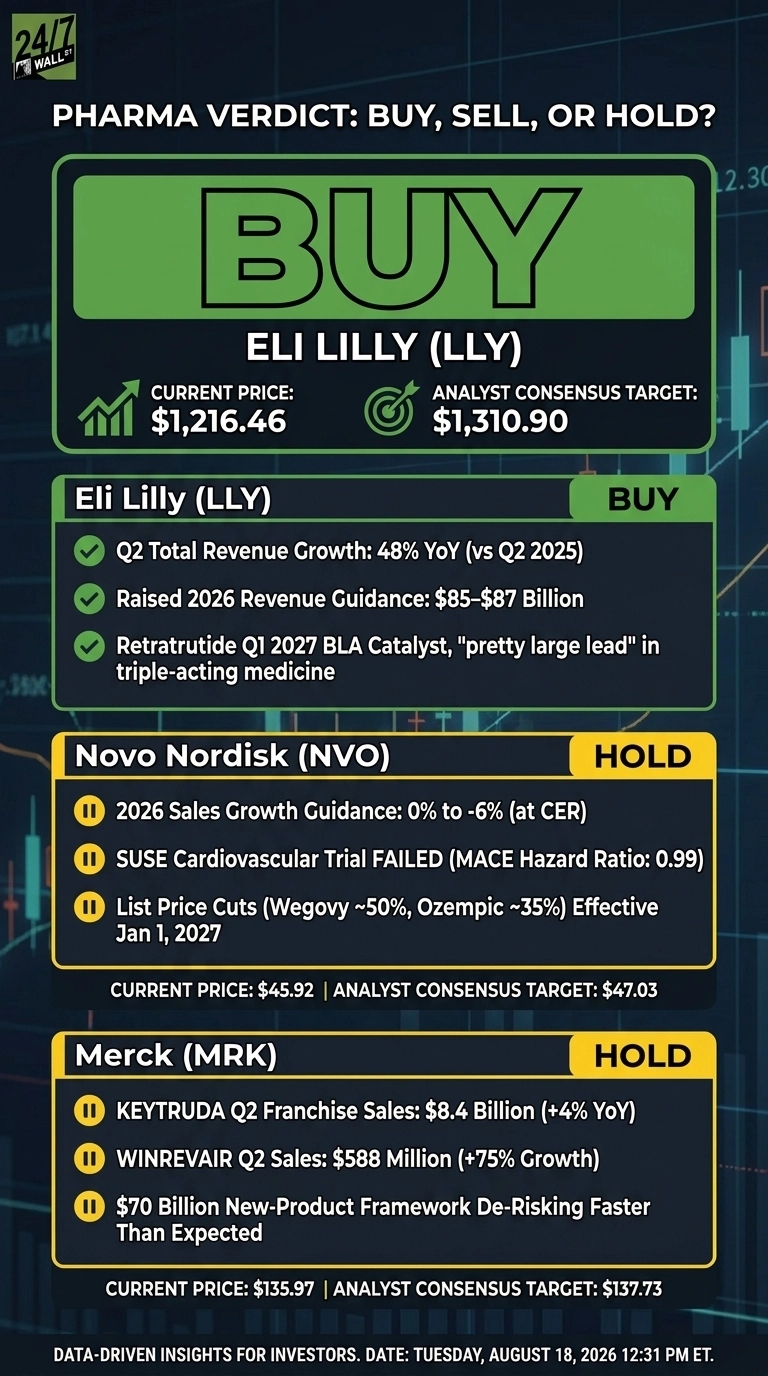
The Bottom Line at Today’s Prices
At $1,216.46, Lilly screens most attractively on incretin dominance and a Retratrutide catalyst Wall Street has not fully valued. Novo looks range-bound at $45.92 until pricing stabilizes and pipeline setbacks stop compounding. At $135.97, Merck trades near fair value after a strong run, with the 2027 catalyst calendar deciding the next leg.
The post Eli Lilly, Novo Nordisk and Merck: Buy, Sell or Hold? appeared first on 24/7 Wall St..
]]>Eli Lilly (NYSE:LLY) has quietly transformed itself into the first pharmaceutical company ever valued above $1 trillion, and yet the market may still be underpricing what comes next. Retatrutide, orforglipron, and a stacked oncology and neuroscience bench point to a growth runway that our proprietary model believes justifies a materially higher stock price over the next twelve months.
Our 24/7 Wall St. price target for Eli Lilly is $1,415.89, implying 19.67% upside from the current $1,183.16 quote. The recommendation is buy at 90% confidence. The model combines accelerating earnings, defensive beta, and pipeline blockbuster optionality.
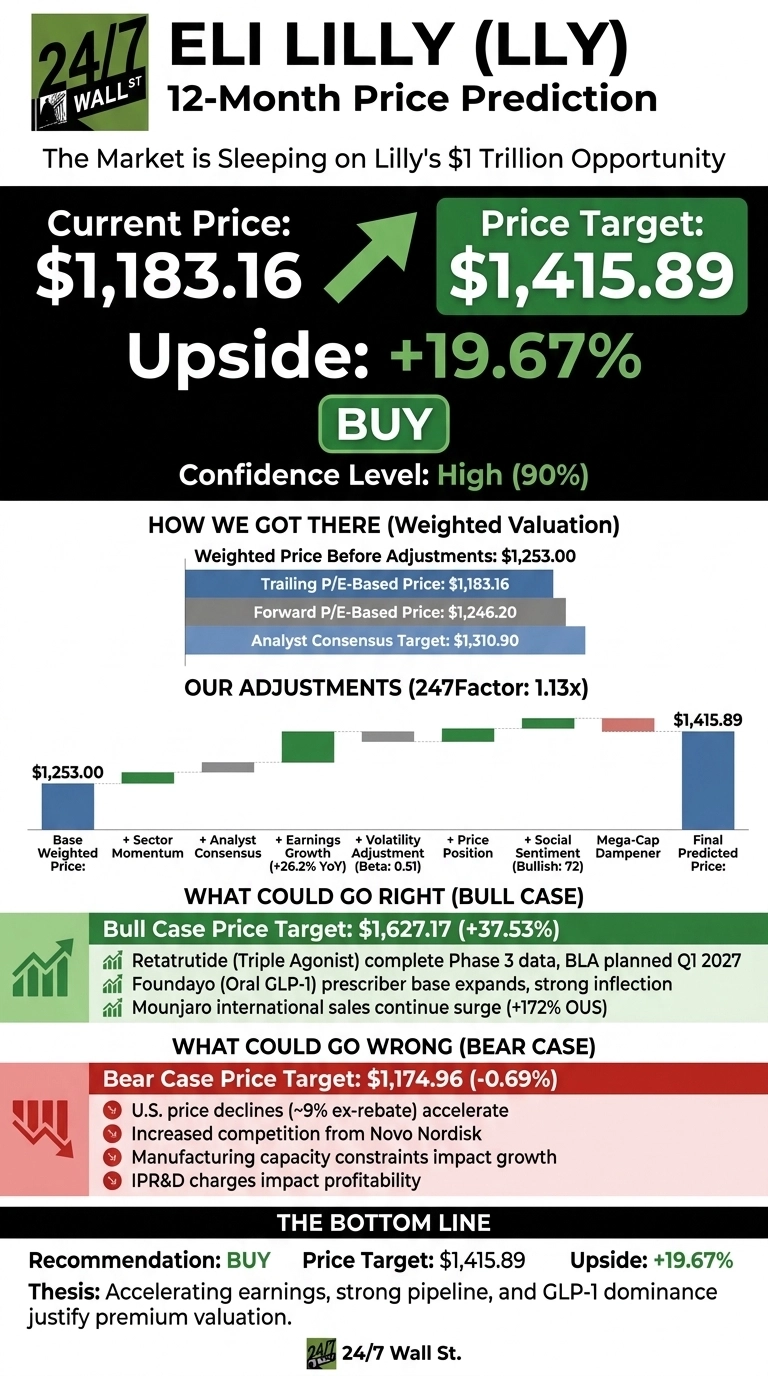
24/7 Wall St. Price Target Summary
| Metric | Value |
|---|---|
| Current Price | $1,183.16 |
| 24/7 Wall St. Price Target | $1,415.89 |
| Upside | 19.67% |
| Recommendation | BUY |
| Confidence Level | 90% |
A Trillion-Dollar Milestone, Then a Cool-Off
Lilly became the first pharmaceutical firm worth $1 trillion in late May, and shares are up 69.79% over the past year and 10.63% year to date. The stock is down 3.82% over the past week and sitting about 5% below the 52-week high of $1,247.66.
That pullback follows a Q2 report that was one of the cleanest earnings reports in large-cap pharma this cycle: revenue of $22.974 billion (up 47.67%), EPS of $8.38 beating expectations, and management raising FY26 revenue guidance to $85 to $87 billion.
The Case for $1,600+
The bull scenario points to $1,627.17, or 37.53% upside. Retatrutide, the triple GLP-1/GIP/glucagon agonist, produced weight loss approaching bariatric surgery levels across three positive Phase 3 trials, with a BLA submission planned for Q1 2027. AJMC called it a “trillion-dollar drug”, defensible given Lilly already owns roughly 6 out of 10 U.S. obesity prescriptions.
Foundayo, the only oral GLP-1 approved for anytime dosing, jumped from 8,000 to 36,000 prescribers in a single quarter. Add in the Medicare GLP-1 Bridge Program covering 20 million eligible Americans at $50 per month, and the analyst consensus target of $1,310.90 looks conservative.
What Could Go Wrong
The bear case pins fair value at $1,174.96, essentially flat. Risks include U.S. realized prices falling roughly 9% excluding rebate adjustments, Novo Nordisk competing for share, and manufacturing capacity constraints.
The Q2 tax rate spiked to 23.3% because of $2.78 billion in IPR&D charges from four acquisitions. Insider activity has skewed to net selling across 14 recent transactions. The IPR&D drag reflects aggressive pipeline building (Orna, Ajax, Centessa, Kelonia), and gross margin expanded to 85.8%.
How Lilly Compares to Novo Nordisk and Merck
Novo Nordisk (NYSE:NVO) trades at a forward P/E of just 14 with quarterly revenue growth of only 2.1% and earnings contracting 20.6% year over year. Lilly’s premium multiple is earned.
Merck (NYSE:MRK) offers a useful big-pharma contrast. Merck’s forward P/E is 50, with revenue growth of only 5.1% and EPS growth of negative 19.3%. Lilly’s 32x forward earnings paired with 47.67% revenue growth compares favorably on a growth-adjusted basis.
| Company | Forward P/E | Revenue Growth YoY |
|---|---|---|
| Eli Lilly | 32 | 47.67% |
| Novo Nordisk | 14 | 2.1% |
| Merck | 50 | 5.1% |
Eli Lilly Price Prediction 2026-2030
The 24/7 Wall St. model output is a buy rating at 90% confidence, with a price target of $1,415.89. Retatrutide is the tipping factor. If the BLA lands on time and the label spans obesity, sleep apnea, and osteoarthritis, the bull scenario at $1,627 becomes the base case. The thesis weakens if U.S. pricing erosion accelerates past 15% or Novo delivers a surprise oral formulation win.
| Year | 24/7 Wall St. Price Target |
|---|---|
| 2026 | $1,415.89 |
| 2027 | $1,585 |
| 2028 | $1,760 |
| 2029 | $1,910 |
| 2030 | $2,054.78 |
These projections assume Lilly executes on retatrutide’s launch and continues expanding Foundayo internationally. Significant upside or downside could result from GLP-1 competitive dynamics and U.S. drug-pricing policy.
The post Stock Forecast: The Market is Sleeping on Eli Lilly’s Next $1 Trillion Opportunity appeared first on 24/7 Wall St..
]]>Shares of Moderna (NASDAQ:MRNA) are rocketing higher Wednesday morning, with the stock up 93% to $121.76 in early Wednesday trading after the company and partner Merck (NYSE:MRK) announced that their Phase 3 melanoma trial met its primary endpoint. Merck stock is up 7% to $144.60 on the news.
The catalyst is the first positive Phase 3 readout for a personalized mRNA cancer therapy, an outcome that validates a platform Moderna has spent years building. Moderna shares closed Tuesday at $62.96, down 2% on the session, and the stock has already climbed 114% year to date through Tuesday’s close.
Merck stock closed Tuesday at $135.17 and is up 30% year to date through Tuesday’s close. If early levels hold, Moderna is on track for its biggest ever single-day gain and could open at more than two-year highs.
Phase 3 Melanoma Trial Delivers on Primary Endpoint
The Phase 3 INTerpath-001 trial tested Intismeran Autogene alongside Merck’s immunotherapy Keytruda in patients with high-risk stage IIB-IV melanoma whose tumors had been completely removed by surgery. The combination produced statistically significant and clinically meaningful improvements in recurrence-free survival and in distant metastasis-free survival compared with Keytruda alone.
Enrollment reached 1,137 patients, with two-thirds receiving Intismeran plus Keytruda and the remainder receiving Keytruda alone. No new safety concerns emerged, and the trial will continue to assess overall survival.
Dean Y. Li, President of Merck Research Laboratories, summed up the results succinctly:
These first Phase 3 findings for Intismeran in combination with Keytruda as adjuvant therapy reinforce the promise of a more personalized approach to cancer treatment. We believe individualized neoantigen therapies have the potential to redefine how patients with completely resected stage IIB-IV melanoma are treated.
The results reinforce the earlier Phase 2b Keynote-942 study, where at five years the combination reduced the risk of recurrence or death by 49% and the risk of distant metastasis or death by 59% versus Keytruda alone. The companies are now exploring the approach across nine Phase 2 and Phase 3 trials covering melanoma, lung, bladder, kidney, pancreatic and gastric cancers.
Peers Trade Higher, but the mRNA Read-Across Is Uneven
Pfizer (NYSE:PFE) stock is up 1% to $27.50 in early Wednesday trading, and Pfizer shares are up 15% year to date through Tuesday’s close. The pharma giant benefits indirectly from renewed enthusiasm around oncology combinations, though it has no direct role in the trial.
BioNTech (NASDAQ:BNTX) is the more interesting peer read. Its shares rose 1% Tuesday to close at $92.75 and are down 3% year to date through Tuesday’s close. As the other major mRNA cancer developer, BioNTech has been roughly flat in 2026 while Moderna has run hard, and today’s validation of individualized neoantigen therapy could reset that narrative.
XLV ETF Reflects a Diluted Move
The Health Care Select Sector SPDR Fund (NYSEARCA:XLV) is up 2% to $172.36 in early Wednesday trading, and the ETF is up 11% year to date through Tuesday’s close. As a broad healthcare sector fund holding dozens of large-cap names, any single biotech carries a small weight.
That means Moderna’s outsized jump translates into a modest lift at the fund level, even with Merck’s participation adding weight to the move. Investors seeking direct exposure to mRNA oncology innovation would need the underlying names rather than a diversified sector fund.
What to Watch Next
Retail sentiment on Moderna tracked very bullish heading into the U.S. session, and Moderna options flow is skewed to calls, with the full-chain put/call ratio at 0.46. The Wall Street consensus price target of $50.84 now sits far below the indicated open, so revisions are likely.
The next data checkpoints will come at an upcoming international medical meeting, where the companies plan to present detailed trial results and discuss regulatory submissions. Traders could look for signs that the combination expands into the other tumor types under active study.
Investors may want to keep an eye on whether Moderna shares hold their early gains through the close. A durable move above $120 could confirm a genuine platform re-rating rather than a one-day squeeze.
The post Moderna Rockets 93%, Merck Jumps 7% as Melanoma Therapy Meets Primary Goal in Phase 3 Trial appeared first on 24/7 Wall St..
]]>Kailera Therapeutics (NASDAQ:KLRA) closed most recently at $18.51, between a post-IPO high of $28.23 and low of $16.39, with a $2.40 billion market cap. Shares are down 2.5% on the week and 28.8% since shares began trading in April. Kailera holds $1.17 billion in cash and marketable securities, posted a Q2 net loss of $111.31 million, and has runway into mid-2028. It is clinical-stage and pre-commercial with no product revenue. Kailera shares a strategic, multi-billion-dollar licensing and co-development partnership with Jiangsu Hengrui Pharmaceuticals.
Why a Strategic Buyer Would Want It
Ribupatide injection (KAI-9531), a GLP-1/GIP dual agonist, anchors the global Phase 3 KaiNETIC program of 4,700+ participants, with data in 2028. The U.S. Phase 2b high-dose trial (264 participants) is fully enrolled, with data expected mid-2027. Ribupatide oral enters global Phase 3 in H1 2027; KAI-7535 posts Phase 2 data in 2027; tri-agonist KAI-4729 begins Phase 1 by end-2026. CEO Ron Renaud calls Kailera “well positioned to deliver differentiated treatment options to people living with obesity.”
What an Acquirer Would Actually Be Buying
Per the Kailera S-1, the Territory excludes China, Hong Kong, Macau and Taiwan: a buyer takes U.S., Europe and Japan while greater China stays with Hengrui. Kailera has paid $100 million upfront, issued 5,677,603 preferred shares valued at approximately $96.4 million at issuance, and made a $10.0 million technology transfer payment. What remains is up to $200.0 million in clinical and regulatory milestones, up to $5.725 billion in commercial milestones, and tiered royalties ranging from low-single-digit to low-tens percentages of net sales, subject to customary reductions, on a Licensed Product-by-Licensed Product and country-by-country basis. New-form and combination options carry mid-seven or low-eight figure exercise payments; Hengrui manufactures clinical materials on request while Kailera bears Territory costs. Ex-greater-China rights are the draw; the commercial milestone stack and royalty range are the drag against acquirer margin math.
Kailera would have owed Hengrui specified percentages of any consideration received had it partnered before November 15, 2025; it did not, so a buyer today faces cleaner economics on that provision. The agreement contemplates acquisition: the GLP-1 competitive restriction to May 15, 2026, carried express change-of-control exceptions. Whether Hengrui’s consent is required for a change of control remains the key diligence question. Hengrui held 19.9% of outstanding capital at issuance, so a buyer negotiates opposite a partner that is also a shareholder.
Ranking the Plausible Acquirers
- Pfizer (NYSE:PFE), $153.2 billion market cap. Albert Bourla has flagged obesity leadership; the Sciwind ecnoglutide launch shows China-in-licensing comfort.
- AstraZeneca (NASDAQ:AZN), $242.6 billion market cap. The CSPC obesity/T2D collaboration signals appetite.
- Merck (NYSE:MRK), $335.1 billion market cap. Keytruda patent cliff. Merck could quickly establish a competitive foothold in the lucrative GLP-1 weight-loss market after facing earlier internal clinical trial setbacks.
- Novo Nordisk (NYSE:NVO), $201.1 billion market cap. Acquiring next-generation oral and multi-target obesity treatments that threaten Wegovy and Ozempic would protect its market dominance.
- AbbVie (NYSE:ABBV), $440.8 billion market cap. Can afford to aggressively expand its pipeline into metabolic health and diversify its revenue.
- Amgen (NASDAQ:AZN), $224.6 billion market cap, the wildcard. MariTide progressing in Phase 3 may render Kailera redundant.
Eli Lilly (NYSE:LLY) plainly does not need an external asset.
What About Private Equity or Alternative Capital?
This option would rank last. Kailera is funded into mid-2028, pre-commercial with no revenue to lever, and no sponsor underwrites Phase 3 obesity readouts arriving in 2028. Realistic non-strategic paths are an ex-U.S. regional partnership, a royalty or milestone monetization against ribupatide, or Hengrui adding to its stake.
What to Watch
Seven analysts rate Kailera Buy or Strong Buy with a mean target of $42.40. Catalysts include Phase 2b ribupatide data mid-2027, KAI-7535 Phase 2 and KAI-4729 Phase 1 in 2027, and KaiNETIC Phase 3 in 2028. A 13D or 13G filing, or unusual options activity, would sharpen any takeout signal.
The post Kailera Therapeutics: The Record-Breaking Obesity IPO Big Pharma Cannot Ignore appeared first on 24/7 Wall St..
]]>Revolution Medicines (NASDAQ:RVMD) closed at $205.55 on August 11, 2026, giving the pre-commercial oncology platform a market cap of $44.1 billion. The stock is up 158.1% year to date, 492.4% over one year, and 664.1% over five years. Liquidity stands at $3.94 billion in cash and marketable securities, bolstered by $2.23 billion in spring 2026 capital raises and up to an additional $1.5 billion available under Royalty Pharma arrangements. FY2026 GAAP operating expenses are guided to $2.10 billion to $2.20 billion. There is no product revenue yet, EPS runs at −$8.87 for the trailing 12 months, and no deal talks have been confirmed.
Why a Strategic Buyer Would Want It
RAS mutations drive roughly 30% of cancers, and Revolution has the deepest late-stage RAS(ON) pipeline in biotech. Lead asset daraxonrasib delivered median overall survival of 13.2 months versus 6.7 months for chemo in second-line pancreatic cancer (HR 0.40; p<0.0001). The FDA accepted the NDA and granted Priority Voucher review. CEO Mark Goldsmith called it “a transformational period” tied to “unprecedented Phase 3 results.” Elironrasib (85% ORR in 1L G12C NSCLC), zoldonrasib (82% ORR in G12D NSCLC), and RMC-5127 underscore the scarcity case.
Ranking the Plausible Acquirers
5. Pfizer (NYSE:PFE). CEO Albert Bourla says, “I’m particularly encouraged by what we’re seeing in oncology.” With EBITDA of $25.38 billion and a stretched balance sheet post-Seagen, a more than $50 billion check is a reach.
4. Johnson & Johnson (NYSE:JNJ). It has a $626.1 billion market cap, AAA credit, and a stated $50 billion oncology target by 2030. The company already bought Firefly Bio for KRAS degraders. Discipline on price is the offset.
3. Bristol Myers Squibb (NYSE:BMY). Owns Krazati (KRAS G12C) and has an existing clinical collaboration on daraxonrasib plus navlimetostat. The strategic fit is tightest. Net debt near $33.6 billion is the constraint.
2. Roche. The Genentech oncology machine and Swiss balance sheet make Roche a live bidder for scarce RAS platforms, despite trading outside the United States.
1. Merck (NYSE:MRK). Keytruda posted $8.03 billion in Q1 but faces a patent cliff. CEO Robert Davis pledged to “transform our portfolio to one with a diversified set of growth drivers.” Merck deployed $9.0 billion on Cidara and also pursued Verona, Terns, and Halda. Motive plus means makes Merck the most obvious buyer.
What About Private Equity or Alternative Capital?
A traditional take-private leveraged buyout (LBO) is impractical for a $44 billion pre-revenue company. The realistic alternatives: additional structured royalty tranches (extending the Royalty Pharma facility), a large PIPE anchored by crossover funds, or expanded regional partnerships in the style of the recent BeOne Medicines collaboration. This path ranks below a strategic pharma bid.
What to Watch

Analysts are positive and have a mean price target of $214.71. Catalysts include the FDA decision on daraxonrasib, RASolve 307 and colorectal readouts, and any 13D/13G activity. Insiders were net sellers of roughly $48.6 million over 90 days.
The post Why Revolution Medicines May Be Big Pharma’s Next Takeover Target appeared first on 24/7 Wall St..
]]>Pre-Market Stock Futures:
Futures are trading modestly higher as we have arrived at the day everyone on Wall Street has circled on their calendars. The July consumer price index will be released at 8:30 AM EDT, and the producer price index will be released at the same time tomorrow. Economists forecast headline CPI to rise 0.1% month-over-month and 3.4% year-over-year, with core CPI expected to increase 0.2% month-over-month and 2.5% year-over-year. One thing is for sure; if the numbers come in hot and above expectations, the stock market could see a bout of heavy selling. All of the major indices finished the day lower on Tuesday, except the small-cap Russell 2000, which closed at 3,027, up 0.32%. It remains the leading index in 2026, up 21.5% year to date. The technology-heavy Nasdaq was down the most on Tuesday, closing at 26,445, down 0.60%, while the S&P 500 finished the day at 7,728, down 0.32%. Last but not least, the Dow Jones Industrial Average closed the session at 53,791, down 0.34%.
Treasury Bonds:
Yields were modestly lower across the entire Treasury curve, as everyone in the fixed-income arena again awaits today’s and tomorrow’s inflation numbers. A reading above expectations is likely to hasten the return of sellers, though the response could be less than expected, as rates have surged higher over the last month. While a number below the estimates is likely good news for equity markets and could prompt some buying of corporate and government debt, as yields have reached their highest levels in 20 years, especially on the long end. The 30-year long bond finished the day at 5.25%, while the benchmark 10-year note was last seen at 4.69%.
Oil and Gas:
Prices were higher once again across the energy complex as traffic in the Strait of Hormuz has slowed to a crawl, with only 6 vessels making the passage on Monday. Iran made the bold announcement that the Straits will remain closed until the United States meets its conditions, a claim highly unlikely, as both countries hurled demands for reparations at each other earlier this week. Brent Crude closed Tuesday’s trading at $89.13, up 3.83%, while West Texas Intermediate was last seen at $83.36, up 1.23%. Natural gas closed lower at $2.75, down 1.54%.
Gold:
After a good August stretch for the precious metals, the sellers stepped in on Tuesday, citing the same concerns others across Wall Street have: the July inflation numbers. Gold closed Tuesday down 0.49% at $4.366, while Silver finished the session at $64.79, down 1.61%.
Crypto:
Bitcoin slipped roughly 1.2% on Tuesday, declining toward the $63,500–$64,000 range. The broader crypto market capitalization fell about 1% to $2.19 trillion, as a failed attempt to break above $65,000, renewed U.S.–Iran geopolitical tensions, and ETF outflows prompted cautious pre-CPI consolidation. At 8 AM EDT, Bitcoin was trading at $64,097, while Ethereum was trading at $1,912.
24/7 Wall St. reviews dozens of analyst research reports every day to identify fresh investment ideas for investors and traders alike. These daily analyst notes include recommendations on stocks to buy, sell, or avoid, as well as new coverage initiations. Important reminder: No single analyst report should ever be the sole basis for buying or selling a stock.
Here are some of the top Wall Street analyst upgrades, downgrades, and initiations seen on Wednesday August, 12, 2026.
Upgrades:
- Hilton Worldwide Holdings (NYSE: HLT) was upgraded to Buy from Hold at Deutsche Bank, which has a $365 target price for the shares.
- Idex Corporation (NYSE: IEX) was upgraded to Outperform from Neutral at Mizuho, with a $280 target price.
- Intuitive Surgical (NASDAQ: ISRG) was raised to Outperform from Perform at Oppenheimer, which has a $500 target price.
- Merck & Co. (NYSE: MRK) was upgraded to Outperform from Neutral at Daiwas, with a $143 target price for the pharmaceutical giant.
- Okta (NASDAQ: OKTA) was raised to Outperform from Market Perform at Citizens, with a $170 target price.
Downgrades:
- Tencent Music Entertainment Group (NYSE: TME) China Renaissance downgraded the stock to Hold from Buy, with a $9.30 target price.
- The Gap (NYSE: GAP) was downgraded to Hold from Buy at Jefferies, which trimmed the target price for the legacy retailer to $23 from $29.
- Legend Biotech Corporation (NASDAQ: LEGN) was downgraded to Perform from Outperform at Oppenheimer, without a target price.
- Novo Nordisk (NYSE: NVO) was downgraded to Hold from Buy at Berenberg, with a $47 target price objective.
- On Holding (NYSE: ONON) was downgraded to Outperform from Strong Buy at Raymond James, which lowered the price target to $38 from $52.
Initiations:
- Genmab (NASDAQ: GMAB) was started with an Outperform rating at BNP Paribas, which has a $40 target price for the shares.
- Marriott International (NYSE: MAR) was initiated with an Outperform rating at CICC, with a $410 target price.
- Mercury Systems (NASDAQ: MRCY) was started with an Overweight rating at Piper Sandler, with a $126 target price.
- Monolithic Power Systems (NASDAQ: MPWR) was initiated with a Buy rating at GF Securities, with a $1,706 target price.
- Unusual Machines (NYSE: UMAC) was started with an Overweight rating at Piper Sandler, with a $38 target price.
The post Here Are Wednesday’s Top Wall Street Analyst Research Calls: The Gap, Genmab, Hilton Worldwide, Intuitive Surgical, Marriott International, Merck, Novo Nordisk, Okta, and More appeared first on 24/7 Wall St..
]]>Eli Lilly (NYSE:LLY) delivered a monster quarter with revenue growth, a fourth consecutive EPS beat, and a fresh guidance raise. The stock has climbed 9.86% in the past week alone. Our proprietary model sees room to run.
Eli Lilly trades at $1,231.94 as of August 10, 2026. Our 24/7 Wall St. price target is $1,427, implying 15.83% upside over the next twelve months. Our model rates Lilly Bullish, with high confidence at 90%.
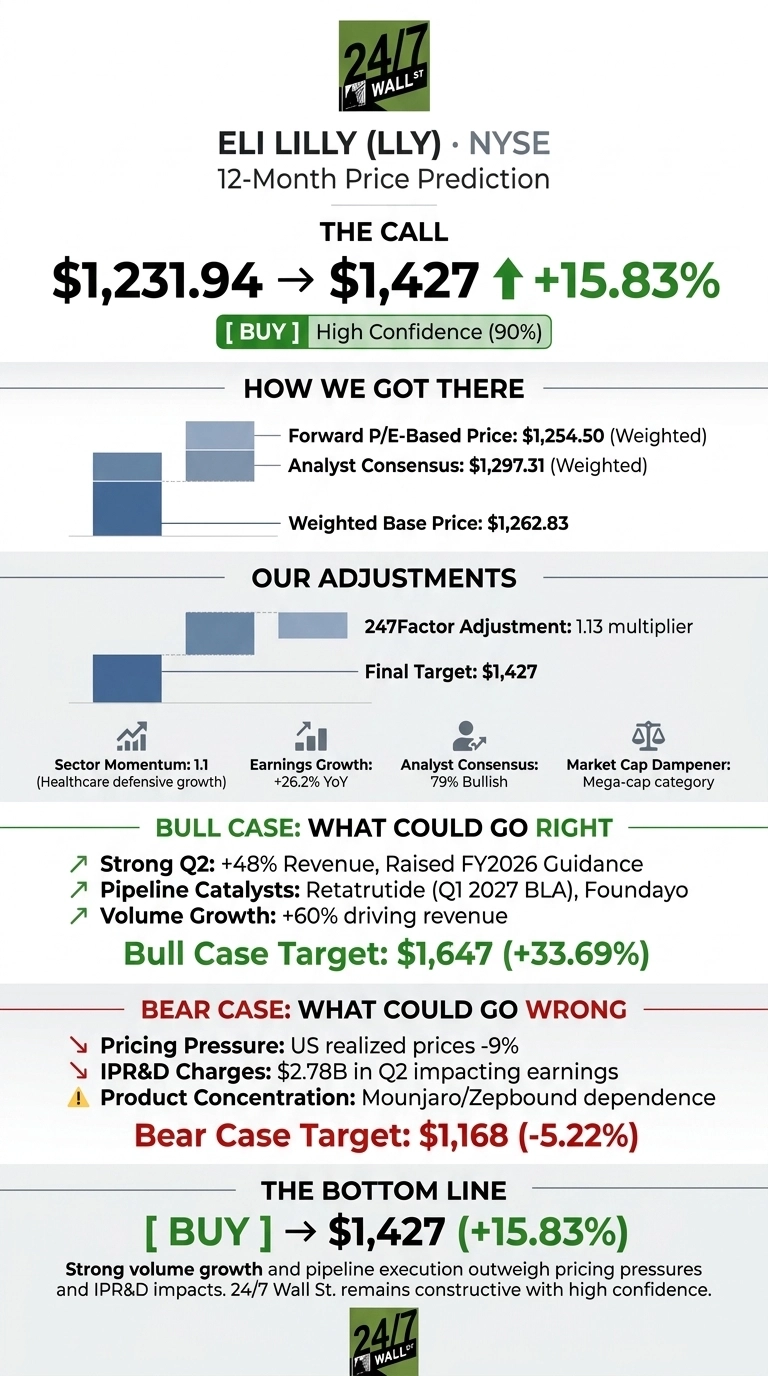
24/7 Wall St. Price Target Summary
| Metric | Value |
|---|---|
| Current Price | $1,231.94 |
| 24/7 Wall St. Price Target | $1,427 |
| Upside | 15.83% |
| Model Rating | Bullish |
| Confidence Level | 90% |
A Blowout Quarter Reset the Narrative
Lilly is up 15.02% year to date and 98.29% over the past year, sitting just 4% below its 52-week high of $1,249.45.
Q2 revenue landed at $22.97 billion, beating expectations, and EPS of $8.38 came in 27.27% above the $6.5845 consensus. Mounjaro alone did $9.94 billion (+91%), boosted by international growth after China added the drug to its National Reimbursement Drug List. Management raised full-year revenue guidance to $85 to $87 billion and lifted the performance margin range to 49% to 50.5%.
The Case for $1,647 and Higher
Our bull scenario points to $1,646.99, a 33.69% total return. Retatrutide, the next-generation triple-agonist obesity drug with a complete Phase 3 data package and Q1 2027 BLA, drives the thesis.
Layer in Foundayo, the oral GLP-1 pill approved for obesity and submitted for type 2 diabetes, plus VERVE-102’s 62% LDL-C reduction. Wall Street is aligned with 22 buy ratings against just 2 sells, and CEO David Ricks calls Lilly’s future “never been brighter.”
The Risks Worth Watching
Our bear case suggests $1,167.64, a 5.22% decline. U.S. realized prices fell roughly 9% excluding rebates, and Q2 absorbed $2.78 billion in IPR&D charges from four acquisitions.
Concentration in Mounjaro and Zepbound remains a real risk if a competitor breaks through. Bulls argue the IPR&D hit is non-recurring and pricing pressure is swamped by 60% volume growth. At an implied forward P/E of 39, Lilly needs to keep executing.
How Lilly Compares to Merck and AbbVie
Merck (NYSE:MRK) trades at $130.92 and is up 26.22% YTD, outpacing Lilly. It offers Keytruda-driven oncology exposure at a fraction of Lilly’s multiple, making Lilly’s forward P/E of 39 look demanding. But Merck lacks a GLP-1 franchise growing 91%.
AbbVie (NYSE:ABBV) at $247.97 is up 11.09% YTD, roughly tracking Lilly on a one-month basis but lagging over one year at 29.1% versus Lilly’s 98.29%. AbbVie navigates Humira erosion while Lilly rides a franchise still accelerating. The peer group makes our 24/7 Wall St. price target reasonable: Lilly deserves a premium, but not an unlimited one.
Eli Lilly Price Prediction 2026-2030
The 24/7 Wall St. price target of $1,427 reflects a constructive setup at 90% confidence. The volume-driven growth engine is real, and retatrutide is a near-term catalyst the market has yet to fully price.
The bull thesis strengthens if retatrutide’s BLA stays on track for Q1 2027 and Foundayo scripts ramp cleanly. The thesis weakens if U.S. pricing declines accelerate past the current 9% pace or if payer pushback broadens. For now, momentum plus pipeline wins.
| Year | 24/7 Wall St. Price Target |
|---|---|
| 2026 | $1,300 |
| 2027 | $1,427 |
| 2028 | $1,569 |
| 2029 | $1,725 |
| 2030 | $1,896 |
These projections extend our base case annualized return of 9.94% and assume Lilly executes on retatrutide, Foundayo, and manufacturing scale-up. Meaningful deviation could come from GLP-1 competition or a broader pricing reset from U.S. payers.
The post Eli Lilly Beat Big and Raised Guidance. Wall Street Sees More Room to Run appeared first on 24/7 Wall St..
]]>Pfizer (NYSE:PFE) and Merck (NYSE:MRK) refreshed the dividend debate with their latest quarterly reports.
Pfizer defends one of Big Pharma’s fattest yields while its COVID franchise fades. Merck absorbs multi-billion dollar deal charges to reload a pipeline behind Keytruda. Two payouts, two very different risk profiles for income investors.
COVID Runoff Drags Pfizer While Keytruda Keeps Merck Humming
Pfizer’s most recent quarter showed the post-pandemic pivot in motion. Revenue reached $14.45B, ahead of the $13.80B estimate, with launched or acquired products growing 22% operationally.
Padcev jumped 39% to $591M on urothelial cancer share gains, Nurtec ODT climbed 41% to $353M, and Eliquis added 13% to reach $2.17B. Comirnaty fell 59% and Paxlovid dropped 62%. Adjusted EPS of $0.75 marked a fifth straight beat, though net income slid 9.44%.
Merck’s story tilts toward scale. Revenue landed at $16.29B, topping the $15.85B consensus. Keytruda produced $8.03B, up 12%, and the subcutaneous version Keytruda QLEX added $128M out of the gate. Winrevair surged 88% to $525M. Reported EPS of -$1.28 was dragged by a $9B Cidara acquisition charge, alongside a Gardasil slide of 19% after China’s catch-up program ended.
Yield Hunter vs. Growth Compounder
The dividend math tells the real story. Pfizer pays $0.43 quarterly ($1.72 annualized) against a 6.75% yield, with raises every Q1 since 2010. Merck lifted its quarterly dividend from $0.81 to $0.85 starting Q1 2026, with a forward annualized rate of $3.40, roughly 2.6% at recent prices.
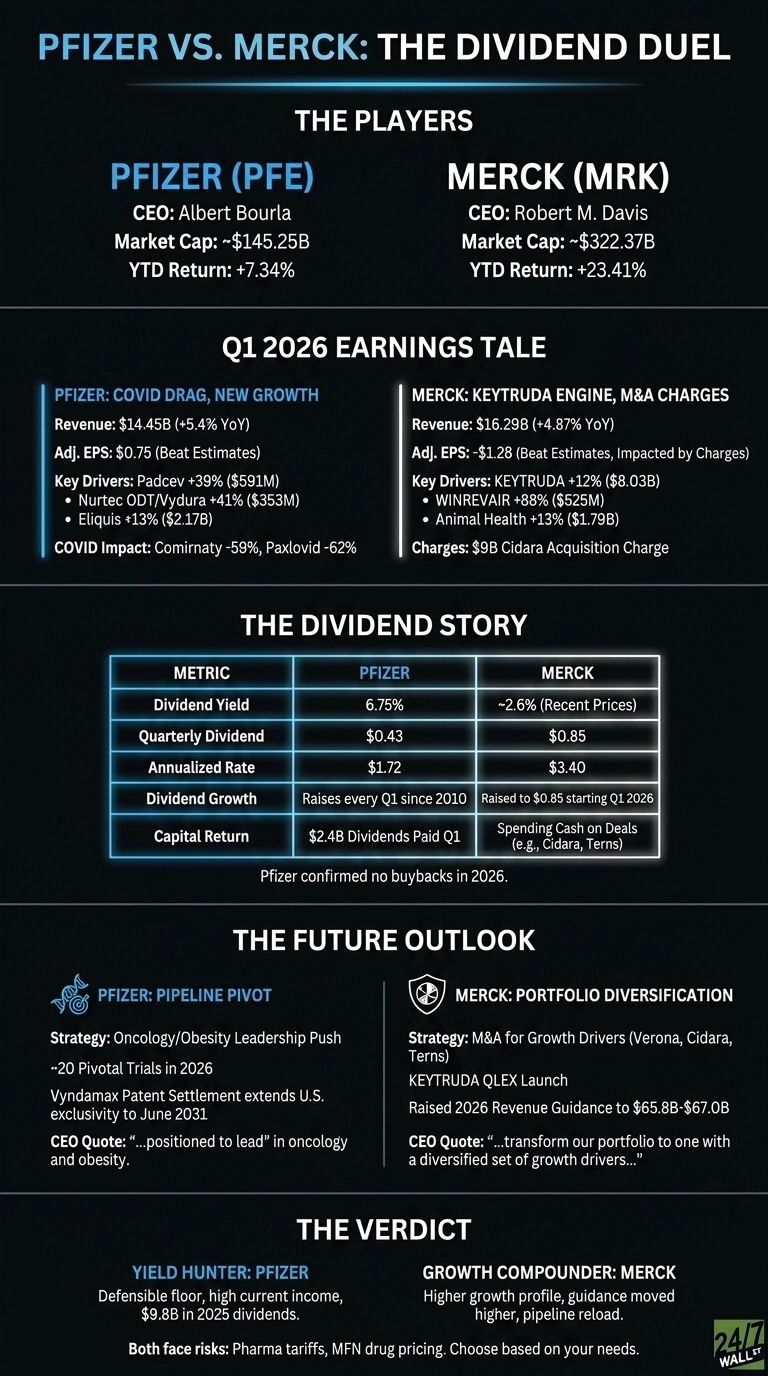
| Lens | Pfizer | Merck |
| Dividend Yield | 6.75% | 2.6% |
| Core Growth Engine | Oncology and migraine launches | Keytruda plus Winrevair |
| Biggest Overhang | COVID runoff, Eliquis LOE | Keytruda patent cliff late decade |
| 2026 EPS Guidance | $2.80 to $3.00 | $5.04 to $5.16 |
| YTD Stock Return | 7.34% | 23.41% |
Pfizer paid out $2.4B in dividends in the March quarter and confirmed no buybacks in 2026.
Merck is spending cash on deals: Verona Pharma, Cidara, and a pending Terns transaction adding $2.35 per share in charges. CEO Robert Davis told investors the goal is “a diversified set of growth drivers across a broad set of therapeutic areas.” That signals a portfolio pivot ahead of any payout expansion.
The Next Test Is Pipeline Delivery
Pfizer runs roughly 20 pivotal trials in 2026, including 10 from the Metsera obesity purchase. Albert Bourla flagged “oncology and obesity, two areas where I believe Pfizer is positioned to lead.”
The Vyndamax patent settlement extending U.S. exclusivity to June 2031 removes a real overhang for dividend coverage. Watch whether obesity Phase 3 readouts show differentiation against GLP-1 incumbents.
Merck’s watchlist differs. Keytruda QLEX adoption, Winrevair’s PAH ramp, and the Terns closing shape whether the raised $65.8B to $67B revenue band holds. Interest expense climbed from $313M to $479M, so leverage carries a real cost.
Why I’d Split the Vote Based on What You Need
On current income and a defensible floor, Pfizer stands out. A 6.75% yield backed by $9.8B in 2025 dividend payments and Vyndamax exclusivity is a real cash story, even if the stock recovered only 7.34% year to date.
Growth investors will find Merck more interesting. Shares are up 65.67% over the past year, guidance moved higher, and the pipeline reload buys optionality before the Keytruda cliff. The main downside risk for both names is pharma tariffs or MFN drug pricing landing harder than expected. That risk is real, and neither yield is truly bulletproof.
The post After Q2 Earnings, Is Pfizer or Merck the Smarter Dividend Play? appeared first on 24/7 Wall St..
]]>I’m going to put our year-end call on the table before anything else. Our AbbVie (NYSE:ABBV) year-end verdict is a buy, and our proprietary model sees more room to run despite the stock already sitting near record highs.
The 24/7 Wall St. price target for AbbVie is $297.71, implying 20.92% upside from the current $246.20 level. We rate ABBV a buy with a 90% confidence level, our highest tier.
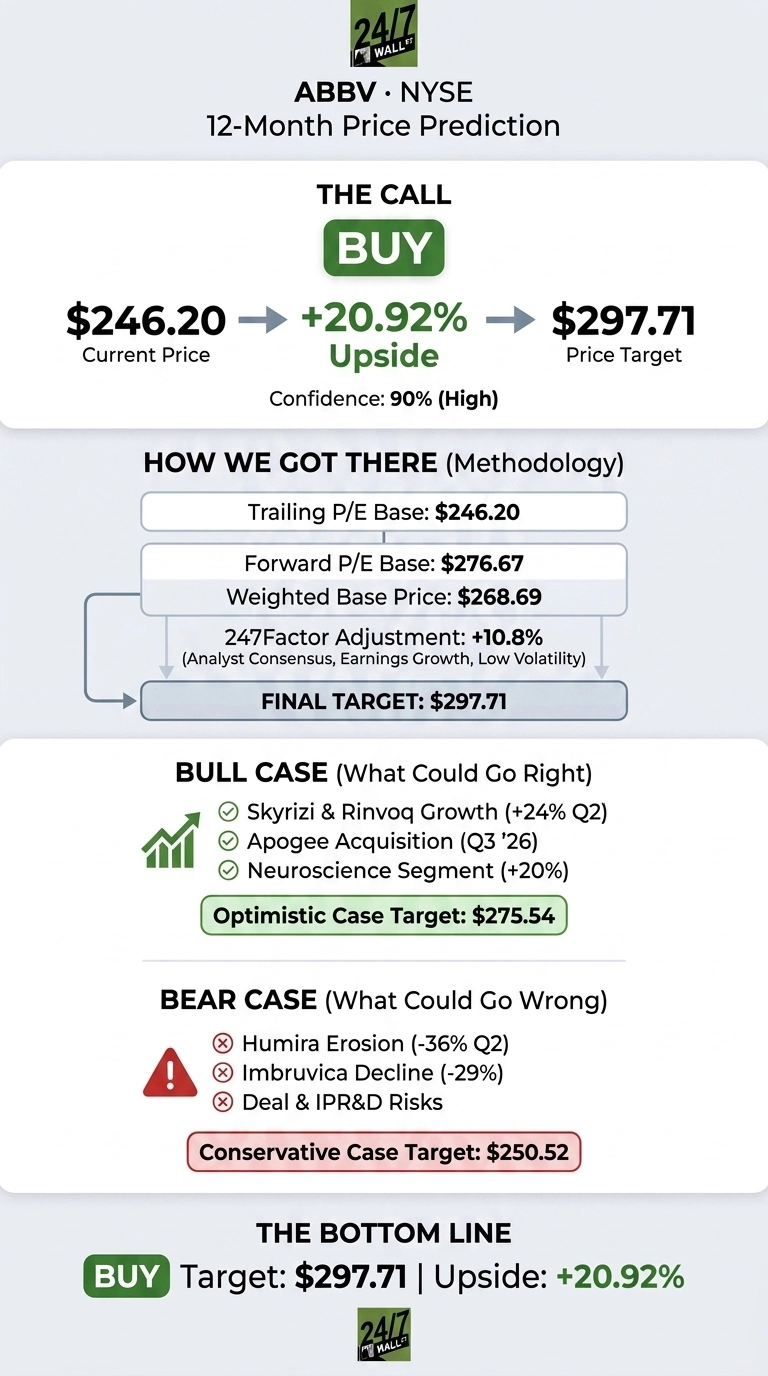
24/7 Wall St. Price Target Summary
| Metric | Value |
|---|---|
| Current Price | $246.20 |
| 24/7 Wall St. Price Target | $297.71 |
| Upside | 20.92% |
| Recommendation | BUY |
| Confidence Level | 90% |
Skyrizi and Rinvoq Are Doing the Heavy Lifting
AbbVie is up 12.42% year to date and 36.88% over the past year, and the July 31 close pushed shares within roughly 1% of the $267.47 52-week high.
Q2 2026 revenue landed at $16.99 billion, up 10.2%, with adjusted EPS of $3.65 beating the $3.08 consensus. Skyrizi generated $5.51 billion (+24.4%) and Rinvoq added $2.53 billion (+24.5%), more than offsetting the 35.9% Humira decline. The pending $10.9 billion Apogee Therapeutics acquisition is expected to close in Q3 2026.
The Case for $300+
Bulls have real fuel here. Immunology revenue grew 15.1% in Q2 while Neuroscience jumped 20.3%, and the Apogee deal adds zumilokibart (anti-IL-13 for atopic dermatitis) to a franchise that is already gaining share against Dupixent.
Wall Street’s consensus target sits at $270.39 with 24 Buy or Strong Buy ratings against just one Strong Sell. If Skyrizi and Rinvoq sustain 20%+ growth into 2027 and Vyalev (Parkinson’s) scales, our bull-case scenario points to a $438.43 five-year target.
What Could Go Wrong
The risks are visible. Humira revenue fell 35.9% and Imbruvica dropped 29.4%, and management trimmed FY26 EPS guidance to $13.87–$14.07 to absorb $0.14 of Apogee dilution. A trailing P/E of 71 looks stretched, and one independent AI model in our data pins fair value at $198.76.
Bears would note aesthetics is flat and shareholders’ equity is negative. In fairness, the elevated multiple reflects sizable IPR&D charges ($0.58 per share YTD) that mask real cash generation, and forward P/E of 18 tells a cleaner story. Our bear-case floor is $250.52.
How AbbVie Stacks Up Against Merck and Bristol Myers Squibb
Merck (NYSE:MRK) is the natural bull-case foil. Merck trades on a forward P/E of 48, more than double AbbVie’s 18, largely because KEYTRUDA’s patent cliff is closer than AbbVie’s next wave. Our target implies AbbVie can hold a premium multiple more comfortably than Merck.
Bristol Myers Squibb (NYSE:BMY) is the value counterpoint, changing hands at a forward P/E of just 10 with a 3.87% dividend yield. BMY’s Growth Portfolio grew 12% in Q1, but heavier generic erosion on Revlimid keeps its multiple compressed. Against that backdrop, AbbVie’s forward multiple looks reasonable by comparison.
| Company | Forward P/E | Analyst Target |
|---|---|---|
| AbbVie | 18 | $270.39 |
| Merck | 48 | $135.19 |
| Bristol Myers Squibb | 10 | $64.91 |
Bottom Line on Our ABBV Target
Our 24/7 Wall St. price target of $297.71 reflects a buy rating with 90% confidence, and the tipping factor is the combined trajectory of Skyrizi and Rinvoq, which continue to expand their combined revenue base.
The bullish scenario strengthens if the Apogee deal closes cleanly in Q3, while the setup weakens if Skyrizi or Rinvoq growth decelerates below 15% in Q3 2026. Our model favors entries on any pullback into the low $240s.
| Year | 24/7 Wall St. Price Target |
|---|---|
| 2026 | $297.71 |
| 2030 | $438.43 |
These projections assume AbbVie continues executing on Skyrizi, Rinvoq, and the Apogee integration. Significant downside would emerge from Skyrizi biosimilar pressure post-2029 or an Apogee pipeline setback.
The post Prediction: AbbVie Will End The Year at This Price appeared first on 24/7 Wall St..
]]>The Schwab U.S. Dividend Equity ETF (NYSEARCA:SCHD) sells one number in bold: a 0.06% expense ratio. On $10,000 invested, that headline fee costs about $6 a year. That fee is the smallest cost this ETF quietly extracts from a taxable holder, and the March 2026 reconstitution proved it.
What You Are Actually Paying
Let’s start with what is immediately visible — the low expense ratio. At 6 basis points, SCHD looks cheap. That said, similar funds, like the Vanguard Dividend Appreciation ETF (NYSEARCA:VIG) still charges less, at 0.04%, or about $4 per $10,000. The direct fee gap is roughly $2 a year on a $10,000 stake. Admittedly, that is a small difference. However, the real cost lies underneath.
SCHD tracks the Dow Jones U.S. Dividend 100 Index. The index reconstitutes each March, with the March 2026 reconstitution being one of the largest turnover events in fund history. Every name added or dropped forced the ETF to trade. As such, every appreciated share sold inside that trade became a realized gain the fund could pass to shareholders as a distribution.
The payout history shows this in practice. SCHD paid $0.8241 per share in Q2 2024 and $0.7545 in Q3 2024, well above the fund’s normal quarterly cadence of roughly $0.25 to $0.28. Post-reconstitution distributions like these arrive on your 1099 as income for shares you never actually sold, taxed at your income bracket in the year Schwab decides.
The Concentration the Factsheet Downplays
The May 31, 2026 NPORT filing shows how top-heavy this “diversified” ETF has become. Qualcomm (NASDAQ:QCOM) alone accounts for 6.74% of net assets. Add Texas Instruments and UnitedHealth Group, and the top three positions carry 17.73% of a 102-holding portfolio.
Energy is another cluster. Chevron (NYSE:CVX) sits at 3.83%, ConocoPhillips (NYSE:COP) at 3.51%, and Devon, EOG, SLB and ONEOK fill in around them. Analyst commentary puts SCHD’s total energy weight at nearly 17%, well above the S&P 500. That said, concentration cuts both ways. Qualcomm shares are down 18.86% over the past month and 12.81% year to date, and that pain flows straight into the ETF’s largest slot.
The Performance Gap Less Talked About
Here is the part the marketing tends to skip. Since February 2022, SCHD returned 46% while dividend-growth peer CGDV returned 113%. Over the last decade, SCHD trailed WisdomTree’s DGRW by roughly 38%. The screen that excludes megacap tech and demands a 10-year dividend record seemingly has a bill attached. And that hidden cost never shows up on the expense ratio line.
Holders pay through single names too. Merck (NYSE:MRK) sits at 3.86%, Abbott Laboratories (NYSE:ABT) at 2.96%, and Altria (NYSE:MO) at 2.94%. Altria’s high yield is fully taxable at ordinary rates for most holders; SCHD’s screen accepts high-yield names like Altria because the dividend keeps coming.
The Cheaper Mirror
Investors who want broad U.S. dividend exposure with lower fees and lower turnover have options. VIG charges 0.04% and screens for consecutive dividend growers, skewing to more diversified megacaps. The trade-off is real: lower headline yield, less energy exposure, and far less reconstitution churn in your taxable account.
What This Means for You
SCHD’s 24.03% year-to-date gain is real, and the dividend growth streak is also real. However, before your next contribution, ask whether the March reconstitution tax bill, the Qualcomm-heavy top of the book, and the decade-long gap versus dividend-growth peers add up to more than the six-basis-point sticker suggests. The fee is the price on the label. The costs live underneath.
The post SCHD’s 0.06% Fee Hides the Real Cost: How March Reconstitution Triggered $0.8241 Per Share in Surprise Distributions appeared first on 24/7 Wall St..
]]>Mizuho Securities healthcare sector specialist Jared Holz laid out the case for a potential blockbuster pharmaceutical tie-up on CNBC Monday morning, arguing that reported talks for AstraZeneca to acquire Bristol Myers Squibb could make financial sense if the buyer aggressively cuts the combined company’s cost base.
The Billions in Cost Cuts a Deal Could Unlock
Holz framed the logic bluntly. “If you take these two companies and you slash expenses, that would be the main thing here. You cut costs in a big way, and you basically aggregate these assets. It’s not totally unreasonable,” he said. He extended the point to the target’s R&D value: “If AstraZeneca thinks that Bristol’s assets, their R&D pipeline, is at all decent and there’s a lot of costs they can cut, it’s not unreasonable.”
AstraZeneca (NASDAQ:AZN) traded around $157.23 on Monday, August 3, carrying a market cap of roughly $263 billion. Bristol-Myers Squibb (NYSE:BMY) traded around $64.79 on Monday, with a market cap of about $132 billion. Bristol-Myers has already been executing its own belt-tightening, targeting the remaining $2 billion in cost savings by the end of 2027, driving a head start on potential synergies.
Bristol-Myers has ridden a rebound this year, gaining 25.14% year-to-date and 57.98% over the past year, though it still trades at a discounted forward P/E of roughly 10.
Eli Lilly’s $1 Trillion Valuation Is Forcing Rivals to Think Bigger
AstraZeneca’s CEO, Pascal Soriot, said a week ago that the company does not need M&A to thrive and survive. That stance carries weight given AstraZeneca’s Q1 2026 revenue of $15.29 billion, up 13% year over year, and a pipeline that includes 16 blockbuster medicines with 20+ Phase 3 readouts expected in 2026.
Still, Holz argued that scale pressure is reshaping the industry. “Eli Lilly has emerged as by far the largest company in pharmaceuticals, a $1 trillion-plus market cap. Everyone else is 600 billion or below, including J&J and Merck and Pfizer and AbbVie,” he said. Eli Lilly (NYSE:LLY) saw a 56.32% one-year gain, and GLP-1 franchise revenue, with Mounjaro posting $8.66 billion in Q1 2026, up 125% year over year.
Why Antitrust Regulators May Let This Blockbuster Deal Through
On regulatory risk, Holz pointed to structural depth in the sector: “The pharmaceutical industry is one of the most fragmented, large cap industries we have. There are over 15 large cap companies between the US and Europe that compete here.” That fragmentation, combined with an administration Holz described as open to large corporate deals, softens the antitrust overhang that has scuttled megadeals in other sectors.
Merck (NYSE:MRK) has already been active on the deal front, working through its $9 billion charge related to Cidara, its pending acquisition of Terns Pharmaceuticals, and its Verona Pharma transactions as it braces for the KEYTRUDA patent cliff. Merck shares have climbed 25.53% year to date, echoing the broader repricing across pharma names investors expect to consolidate.
The Holz call also connects to Jim Cramer’s earlier framing of a coming biotech and pharma M&A wave, in which “the banks making these acquisitions can make fortunes from cost cutting.” The large-cap pharmaceutical industry would likely benefit from large-scale cost savings if there were consolidation.
The post Top Healthcare Analyst: A $400 Billion AstraZeneca-Bristol Myers Deal Could “Cut Costs in a Big Way” appeared first on 24/7 Wall St..
]]>AbbVie (NYSE:ABBV) enters its July 31 Q2 earnings report with a 2.62% dividend yield, raised earnings guidance, and two blockbuster drugs growing above 20%. Skyrizi and Rinvoq have already replaced Humira as the company’s growth engines, strengthening AbbVie’s case as a combination of income, growth, and relatively low volatility.
AbbVie Offers Growth at Just 18x Forward Earnings
ABBV changes hands at $265.52 with a forward P/E of 18x and a PEG of 0.43, with a beta of 0.28. Wall Street’s consensus target sits at $267.79 across 16 Buy and 8 Strong Buy ratings. AbbVie trades at a multiple below the S&P 500 average paired with growth prospects and roughly a quarter of the market’s volatility.
A 5.5% Dividend Increase Strengthens the Income Case
AbbVie’s annualized dividend of $6.74 per share means the stock offers a 2.62% yield. The most recent quarterly hike lifted the payout to $1.73 from $1.64, a 5.5% raise. Management raised full-year adjusted EPS guidance to $14.08 to $14.28 and pointed to Q2 EPS of $3.74 to $3.78 on roughly $16.7 billion in revenue.
Skyrizi and Rinvoq Have Become $32 Billion Growth Engines
Skyrizi hit $4.48 billion in Q1 2026 (up 30.9% YoY) and Rinvoq added $2.12 billion (up 23.3%). Management raised full-year Skyrizi guidance to $21.6 billion and Rinvoq to $10.2 billion. CEO Rob Michael said flatly, “We expect to exceed the peak consensus that’s in those models.”

AbbVie Has Already Crossed the Patent Cliff Facing Merck
Pfizer (NYSE:PFE) has returned -22.52% over five years and is up just 3.67% year-to-date, versus ABBV’s 163.87% five-year and 16.19% YTD return, with far weaker top-line momentum.
Merck (NYSE:MRK) has rallied hard (61.08% in one year), but it carries a Keytruda concentration problem and a 2028 patent cliff. ABBV has already crossed the biosimilar valley Merck is walking toward.
The Bottom Line: AbbVie Has Successfully Rebuilt Its Growth Engine
Humira revenue continues to decline as biosimilar competition intensifies, but that erosion no longer defines AbbVie’s overall trajectory. Skyrizi and Rinvoq generated a combined $6.60 billion last quarter, helping total immunology revenue grow 16.4%.
AbbVie now expects the two drugs to generate nearly $32 billion in annual sales, while its dividend continues to rise. The July 31 report will show whether those newer products can keep driving growth and support another increase to full-year guidance.
The post 3 Major Reasons for Investors to Buy AbbVie Stock Before July 31st appeared first on 24/7 Wall St..
]]>The ALPS Sector Dividend Dogs ETF (NYSEARCA:SDOG) pays a trailing dividend yield of 3.4%, distributing $2.38 per share annually across quarterly payments. SDOG applies the Dogs of the Dow logic to the full S&P 500, isolating the five highest-yielding stocks in each of ten GICS sectors and equal-weighting them.
The question is whether that mechanical yield-chasing produces a durable income stream or concentrates capital in businesses whose dividends are at risk. A holding-by-holding look at SDOG suggests the answer is mostly the former, with two clear exceptions worth understanding.
How SDOG Manufactures Its Yield
Where the Income Actually Comes From
- Lockheed Martin (NYSE:LMT) is the fund’s largest position at 2.49%. The dividend stepped up to $3.45 quarterly, but Q1 2026 free cash flow was negative $291 million against $816 million in dividends paid. That quarter did not cover its payout. Management reaffirmed full-year FCF guidance of $6.5 to $6.8 billion, which would restore coverage, but F-16 program charges and fixed-price contract risk make the H2 recovery a real assumption rather than a given.
- Edison International (NYSE:EIX) yields 4.4% and raised its quarterly to $0.8775, its 22nd consecutive year of dividend growth. Board confidence held even as Southern California Edison extended roughly 1,500 Eaton Fire settlement offers exceeding $500 million. The company targets a 45 to 55% payout of SCE core earnings and expects no new equity issuance through 2030. SB 254 established an $18 billion continuation fund that materially caps utility exposure.
- Kinder Morgan (NYSE:KMI) grew Q1 free cash flow 73% to $687 million, Moody’s upgraded the credit to Baa1, and net debt to adjusted EBITDA fell to 3.6x. The $10.1 billion project backlog is 92% natural gas, giving the 2% dividend hike genuine runway. This is the safest income contributor in the top five.
- Merck (NYSE:MRK) carries a 2.6% yield and $0.85 quarterly payout. GAAP results are distorted by $14.8 billion in Cidara and Terns acquisition charges, but non-GAAP FY26 EPS guidance of $5.04 to $5.16 and KEYTRUDA growth of 12% to $8.03 billion keep cash generation intact. Long-term KEYTRUDA patent exposure is the risk.
- Chevron (NYSE:CVX) delivered its 39th consecutive annual increase and pays $1.78 quarterly. Q1 free cash flow was negative $1.55 billion on $2.9 billion of timing effects, but FY25 free cash flow was $16.6 billion. WTI at $79.20 sits comfortably above breakeven levels for the dividend.
Total Return Alongside the Payout
Yield only matters if the NAV holds up. SDOG is up almost 20% year to date and 27% over the past year at $71. Dividend growth of nearly 9% compounds on top of price appreciation, so shareholders are not paying for yield with capital erosion.
The Verdict
The post The 3.4% Income Play That Beats the Dogs of the Dow Strategy appeared first on 24/7 Wall St..
]]>Eli Lilly (NYSE:LLY) has accelerated despite its $1 trillion scale. Revenue grew 55.5% in Q1 2026, management raised full-year guidance by $2 billion, and the FDA cleared Foundayo, the first any-time-of-day oral GLP-1.
Our 24/7 Wall St. price target for Eli Lilly is $1,365.51, implying roughly 15% upside from the current $1,186.85. We rate LLY a buy with high (90%) confidence.
24/7 Wall St. Price Target Summary
| Metric | Value |
|---|---|
| Current Price | $1,186.85 |
| 24/7 Wall St. Price Target | $1,365.51 |
| Upside | ~15.1% |
| Recommendation | BUY |
| Confidence | 90% |
Foundayo Reset the Growth Story
LLY is up 8.59% year-to-date and 50.84% over the trailing year, recovering from an April low of $903.99.
Q1 2026 delivered $19.80 billion in revenue, beating the $17.80 billion consensus, with non-GAAP EPS of $8.55 versus the $6.79 estimate. Mounjaro revenue jumped 125% to $8.66 billion and Zepbound climbed 80% to $4.16 billion.
Recent headlines mixed bullish coverage of the $6.3 billion Centessa acquisition and a $6.5 billion Houston manufacturing plant against a fresh Novo Nordisk lawsuit alleging deceptive GLP-1 comparison ads.

The Case for $1,429 and Higher
Bulls argue Foundayo unlocks an oral obesity market that injectables never fully addressed. CEO Dave Ricks noted the drug can reach “over 1 billion people around the world with obesity and related conditions” with regulatory reviews underway in over 40 countries. Early launch data showed 80% of prescriptions were new-to-class.
Retatrutide, the next-gen triple agonist, delivered up to 37 pounds of weight loss in Phase 3. Morningstar flagged LLY as positioned for “industry-leading growth”. Our bull-case scenario carries the stock to $1,429.03, roughly 12.5% above current levels.
What Could Go Wrong
Pricing pressures loom. Q1 realized prices fell 13%, offsetting a 65% volume gain, and Mounjaro’s inclusion on China’s National Reimbursed Drug List will pressure international prices. Novo Nordisk’s false-advertising lawsuit and emerging generic semaglutide competition add legal and competitive headwinds.
Q1 carried $584 million in IPR&D charges plus $279 million in litigation and restructuring. Most charges reflect deliberate M&A spend (Centessa, Orna, Kelonia, Ajax) that expands the pipeline. Our bear scenario prices LLY at $1,123.10, an 11.6% drawdown.
How Eli Lilly Compares to Merck and Novo Nordisk
Merck (NYSE:MRK) is the value counterpoint. Merck guided FY2026 revenue of $65.8 billion to $67 billion and non-GAAP EPS of $5.04 to $5.16, with Q1 growth of just 4.87%. That is a fraction of Lilly’s 55.5% pace, explaining why Lilly commands a forward P/E of 33x while Merck trades at mid-teens multiples. Growth still wins.
Novo Nordisk (NYSE:NVO) is the direct GLP-1 rival. Novo’s Q1 underlying adjusted sales fell 4% at constant currency, and management guided full-year growth to -4% to -12% CER after slashing Wegovy list prices by roughly 50% effective January 2027. Against that peer set, our LLY target looks reasonable.
Eli Lilly Price Prediction 2026-2030
Our 24/7 Wall St. price target of $1,365.51 reflects a buy rating with 90% confidence. Foundayo converts a large injectable-averse population into addressable demand.
The setup looks constructive if the Foundayo launch tracks to plan into Q3, and more cautious if realized prices deteriorate past mid-teens headwinds. Growth of this quality at this scale is rare.
| Year | 24/7 Wall St. Price Target |
|---|---|
| 2026 | $1,365.51 |
| 2027 | $1,470 |
| 2028 | $1,565 |
| 2029 | $1,640 |
| 2030 | $1,711.70 |
These projections assume Lilly executes on Foundayo, retatrutide, and pipeline acquisitions. Significant upside or downside could result from GLP-1 pricing regulation, Novo Nordisk competition, or acceleration of oral obesity adoption globally.
The post This Catalyst Makes Eli Lilly a Top Growth Stock in 2026 appeared first on 24/7 Wall St..
]]>Schwab U.S. Dividend Equity ETF (NYSEARCA:SCHD) sits at the center of income-focused portfolios for a reason. SCHD tracks the Dow Jones U.S. Dividend 100 Index, screening for companies with at least 10 years of dividend payments, strong cash-flow-to-debt ratios, and consistent dividend growth. The fund currently offers a 3.2% dividend yield on $1.05 in annual distributions per share, backed by a 55% payout ratio at the fund level.
How SCHD Generates Its Income
Cost drag is minimal, as SCHD charges a 0.06% expense ratio against roughly $100.8 billion in assets, leaving nearly all of the underlying dividend stream intact for shareholders.
Evaluating the Top Holdings
- Coca-Cola (NYSE:KO) anchors the safety case. The company just raised its quarterly payout to $0.53 from $0.51, extending a 63-year streak of annual increases. FY2026 guidance calls for roughly $12.2 billion in free cash flow against $8.8 billion in dividends paid in 2025, leaving a meaningful cushion. Coca-Cola’s 28% net margin and 43% return on equity show a business that funds its dividend from operations, not balance-sheet stretching.
- Chevron (NYSE:CVX) raised its quarterly dividend to $1.78, its 39th consecutive annual increase. Q1 2026 free cash flow ran negative on timing effects, but FY2025 delivered $16.6 billion in free cash flow against a dividend load well under half that figure. The 3.8% yield is real, but energy-sector cyclicality means CVX’s payout is durable across cycles while still exposed to oil-price swings.
- Merck (NYSE:MRK) warrants the closest look. Merck lifted its quarterly dividend to $0.85 from $0.81, and the current payout is easily covered by earnings. The complication is structural. KEYTRUDA generates roughly half of pharma revenue and faces a late-decade patent cliff, and Merck has taken on $14.8 billion in combined acquisition charges for Cidara and Terns to diversify. The dividend is safe today; the pipeline transition determines whether growth continues past 2028.
- Lockheed Martin (NYSE:LMT) raised its quarterly dividend to $3.45, supported by a record $194 billion backlog. Q1 2026 free cash flow was negative on working-capital timing, but FY2026 guidance calls for $6.5 to $6.8 billion in free cash flow. Program-execution charges on F-16 and classified work are the recurring risk, but multi-year revenue visibility from the backlog is why the dividend keeps rising.
Total Return Context
Total return matters as much as yield here. SCHD trades at about $33, up 21% year to date and roughly 26% over the past year, with a 55% five-year gain. That total return context matters because the 10-year Treasury is near 4.6% and Fed funds are at 3.75%, both of which yield more than SCHD’s 3.2% payout in cash terms. Investors are accepting a lower current yield in exchange for dividend growth and equity appreciation, and historical numbers show that trade has worked.
The Verdict
The post Why Retirees Are Choosing This $100.8 Billion ETF Over Individual Dividend Stocks appeared first on 24/7 Wall St..
]]>The First Oral PCSK9 Pill Is Here
The FDA’s approval of Merck (NYSE:MRK) enlicitide decanoate, marketed as Lipfendra, marks the first once-daily oral PCSK9 inhibitor cleared for adults with high LDL cholesterol, including heterozygous familial hypercholesterolemia. Phase 3 CORALreef trials showed LDL-C reductions of roughly 56% and 59% versus placebo. That level of efficacy in a pill (not a shot) could dramatically expand the PCSK9 market. Several companies are exposed to this shift. Let’s look at five stocks to see who actually stands to benefit most.
The Companies in the Crosshairs
Beyond Merck, the key names are Amgen (NASDAQ:AMGN), which sells the injectable PCSK9 leader Repatha; AstraZeneca (NASDAQ:AZN), a cardiovascular giant with its own oral PCSK9 program; Novo Nordisk (NYSE:NVO), the oral peptide pioneer; and UnitedHealth (NYSE:UNH), whose Optum Rx pharmacy benefit arm anchors formulary decisions.
How Each Business Is Positioned
| Company | PCSK9 Exposure | Key Angle |
|---|---|---|
| Merck | Direct (LIPFENDRA) | First oral entrant, diversifies beyond Keytruda |
| Amgen | Direct (Repatha) | Injectable incumbent with strong outcomes data |
| AstraZeneca | Adjacent | Broad cardiovascular franchise, an oral PCSK9 asset |
| Novo Nordisk | Indirect | Oral cardiometabolic platform, no LDL drug |
| UnitedHealth | Payer/PBM | Cheaper oral option could reshape formularies |
Merck reported Q1 2026 revenue of $16.29 billion, up 4.9% year over year, and needs new franchises ahead of the 2028 Keytruda patent cliff. Lipfendra fits precisely into that gap. Amgen’s Repatha continues to expand: Q1 2026 Repatha sales reached $876 million, up 34% year over year, and the Vesalius-CV trial showed a 25% reduction in major cardiovascular events in primary prevention. That outcomes data still matters to cardiologists.
AstraZeneca’s current cardiovascular revenue is heavily anchored by legacy blockbusters Crestor and Farxiga. Merck’s speedy FDA approval signals a highly receptive regulatory environment that de-risks AstraZeneca’s pipeline and creates a race for a fast-following second place. Yet Lipfendra represents an immediate, direct threat to AstraZeneca’s next-generation cardiometabolic growth strategy rather than just an abstract ecosystem shift.
Novo Nordisk’s connection is thematic. Its oral Wegovy pill validated that patients will take oral cardiometabolic drugs at scale, but Novo does not sell an LDL-lowering therapy, so exposure to the cholesterol market is indirect. For UnitedHealth, an oral PCSK9 likely carries lower administration and specialty-pharmacy costs than injectables, which helps Optum Rx manage spend and could improve adherence. Major insurers and PBMs have historically resisted injectable PCSK9 inhibitors because of their high costs and the burdensome prior-authorization paperwork required for coverage. They could use Lipfendra as leverage to force Amgen and its peers to deeply discount their injectables, ultimately improving their own profit margins.
Straight From the Earnings Calls
Merck CEO Robert Davis: “We are moving with speed to transform our portfolio to one with a diversified set of growth drivers across a broad set of therapeutic areas … as we enter a particularly robust period of Phase 3 data readouts.”
Amgen CEO Robert Bradway: “Our first quarter results demonstrate the strength of our business, with 16 brands achieving double-digit growth, enabling us to grow through expected patent expirations and increased competition.”
UnitedHealth CEO Stephen Hemsley: “Our results and outlook reflect the continuing progress in our work to simplify how we operate, improve both affordability and the health care experience.”
Davis’s commentary sounds the most catalyst-driven. Bradway leans on breadth. Hemsley’s comments align with the cost-management thesis for payers.
Who Actually Benefits Most
Merck is the clearest winner. Lipfendra opens a potentially multi-billion-dollar oral cardiometabolic franchise at exactly the moment the company needs to diversify. Shares are up 24.1% year to date and 60.2% over the past year, reflecting positive market reception of the pipeline story. UnitedHealth is a quieter beneficiary, since a cheaper oral option strengthens Optum Rx’s negotiating hand. Amgen faces real competition but retains a fast-growing Repatha with strong outcomes data. AstraZeneca and Novo Nordisk have less riding on PCSK9 specifically, though both remain strong in adjacent cardiometabolic categories.
The Bottom Line
The first oral PCSK9 pill changes the cholesterol treatment landscape. Merck is best positioned as the approval holder, with UnitedHealth benefiting on the payer side. Amgen keeps a defensible injectable franchise, while AstraZeneca and Novo Nordisk participate more indirectly. Investors should watch Lipfendra launch metrics, formulary placement decisions, and Repatha’s volume trajectory over the next several quarters.
The post The First Oral Cholesterol Pill Is Here. Which of These 5 Stocks Benefits Most? appeared first on 24/7 Wall St..
]]>Johnson & Johnson (NYSE:JNJ) is up 24.03% year to date and 65.92% over the past year, riding oncology strength and a raised full-year outlook. Our proprietary model sees room to run.
Our 24/7 Wall St. price target for JNJ is $277.85, implying 9.45% upside from the current $253.85. The recommendation is buy with 90% confidence, high by our standards for a mega-cap.
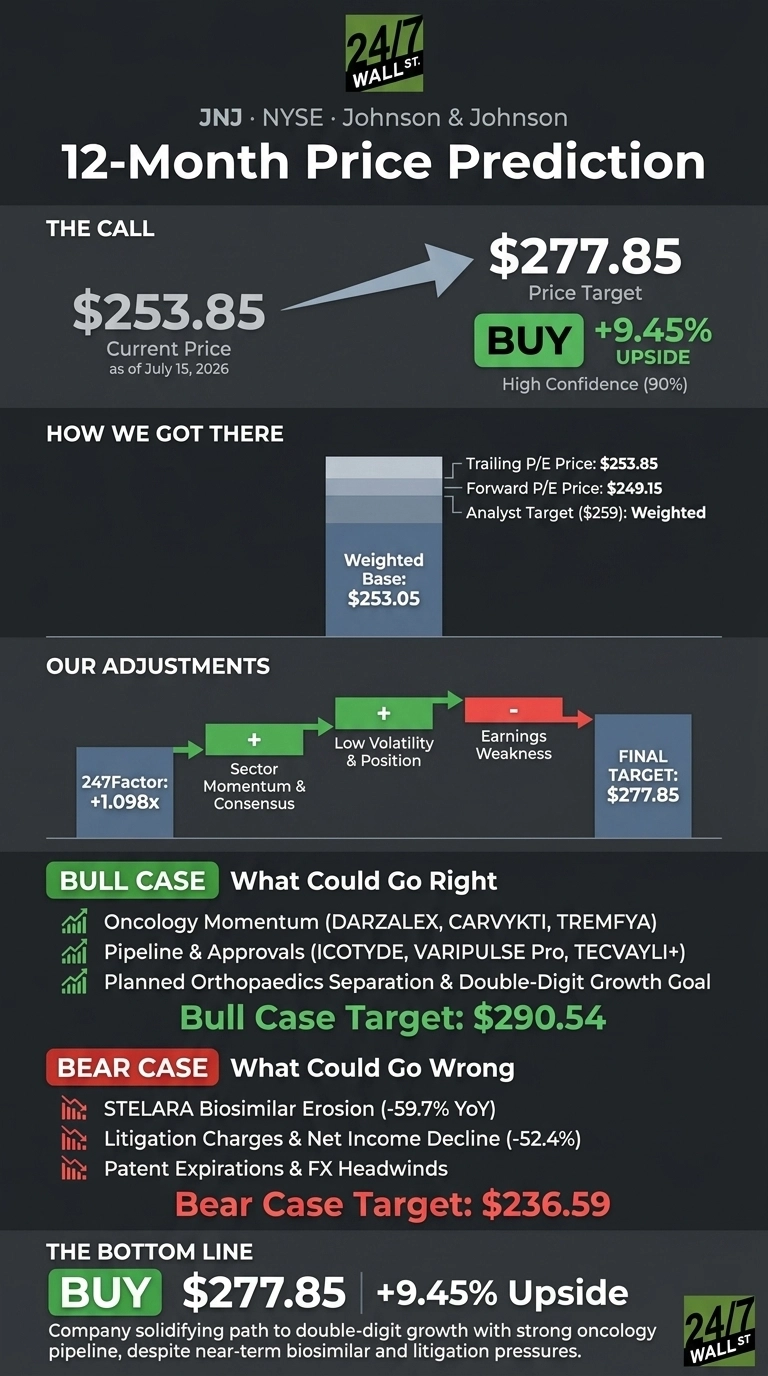
24/7 Wall St. Price Target Summary
| Metric | Value |
|---|---|
| Current Price | $253.85 |
| 24/7 Wall St. Price Target | $277.85 |
| Upside | 9.45% |
| Recommendation | BUY |
| Confidence Level | 90% |
A Year of Accelerated Growth Is Playing Out
JNJ delivered Q1 2026 revenue of $24.06 billion, up 9.9% year over year, with adjusted EPS of $2.70 beating the $2.6773 consensus. Q2 2026 reinforced the trajectory with reported sales of $25.3 billion (up 6.6%) and adjusted EPS of $2.90, prompting another guidance raise.
Management now targets full-year revenue of $100.30 billion to $101.30 billion and adjusted EPS of $11.45 to $11.65. The stock traded as low as $155.89 in the past 52 weeks and now sits just below its $269.43 high after a 5.01% pullback in the last week.
Why Bulls See a Breakout Above $290
Oncology remains the engine. DARZALEX grew 22.5% to $3.96 billion in Q1, TREMFYA surged 68.3%, CARVYKTI jumped 62.1%, and RYBREVANT/LAZCLUZE climbed 82.7%. Recent approvals for ICOTYDE, VARIPULSE Pro, and TECVAYLI plus DARZALEX FASPRO extend the runway.
Management committed to double-digit growth by decade’s end, and the planned Orthopaedics separation could unlock a valuation re-rating. Our bull case price target over the next 12 months is $290.54, a 14.45% total return.
What Could Go Wrong
STELARA collapsed 59.7% to $656 million as biosimilar competition intensified, and litigation charges of $330 million weighed on GAAP net income, which fell 52.4%.
Bulls view the decline as optics driven by TREMFYA absorbing STELARA share, with the litigation charge running as a non-recurring item. Our bear case target is $236.59, a 6.8% drawdown if patent cliffs bite harder than expected.
How JNJ Compares to Merck and Pfizer
Merck (NYSE:MRK) is the closest oncology-driven comp given KEYTRUDA’s dominance. Merck guides 2026 non-GAAP EPS of $8.93-$9.03 on revenue of $64.3B-$64.8B, but a $0.37 Cidara acquisition charge muddies the trailing picture. JNJ’s diversified MedTech plus Innovative Medicine mix looks cleaner, supporting our target’s forward P/E of roughly 23.
Pfizer (NYSE:PFE) trades at a trailing P/E of just 14 with a dividend yield near 6%, versus JNJ’s 30 P/E and 2.01% yield. Pfizer looks statistically cheaper, but the discount reflects post-COVID revenue erosion and patent-cliff risk. JNJ’s premium is earned, and our target leaves room versus the sell-side consensus of $259.
I’d Buy It Here
The 24/7 Wall St. price target of $277.85 with 90% confidence and a buy rating reflects a company hitting on innovation while paying investors to wait through a 64th consecutive dividend increase.
I’d be a buyer if the December 8 Enterprise Business Review confirms the double-digit growth path. I’d stay sidelined if litigation charges reaccelerate or if the Orthopaedics separation gets delayed.
| Year | 24/7 Wall St. Price Target |
|---|---|
| 2026 | $277.85 |
| 2027 | $298.00 |
| 2028 | $318.00 |
| 2029 | $337.00 |
| 2030 | $356.79 |
These projections assume JNJ executes on its path toward double-digit growth by decade’s end. Significant upside or downside could result from oncology pipeline outcomes or the Orthopaedics separation.
The post Prediction: This Dividend King Could End The Year With a New All-Time High Stock Price appeared first on 24/7 Wall St..
]]>Johnson & Johnson (NYSE:JNJ) has been one of 2026’s quieter winners in large-cap healthcare, and our proprietary model sees room to run. With a landmark $100 billion revenue year in progress and 11 Innovative Medicine brands growing at double digits, the setup is more offensive than defensive.
Our 24/7 Wall St. price target for Johnson & Johnson is $278.53, implying 8.39% upside from the recent close of $256.98. We rate JNJ a buy with 90% confidence. The pipeline is derisked, the dividend is a 64-year fortress, and the DePuy Synthes separation removes an anchor from reported growth.
| Metric | Value |
|---|---|
| Current Price | $256.98 |
| 24/7 Wall St. Price Target | $278.53 |
| Upside | 8.39% |
| Recommendation | BUY |
| Confidence Level | 90% |
From Litigation Overhang to Pipeline Story
JNJ has rallied 67.04% over the past year and 25.56% year to date, trading near its 52-week high of $269.43.
Q1 2026 was the catalyst: revenue of $24.06 billion beat consensus by 1.89%, adjusted EPS of $2.70 extended the beat streak to four, and management raised full-year guidance to $100.30 billion to $101.30 billion in revenue with adjusted EPS of $11.45 to $11.65. Standouts included DARZALEX at $3.96 billion (+22.5%) and TREMFYA at $1.61 billion (+68.3%).
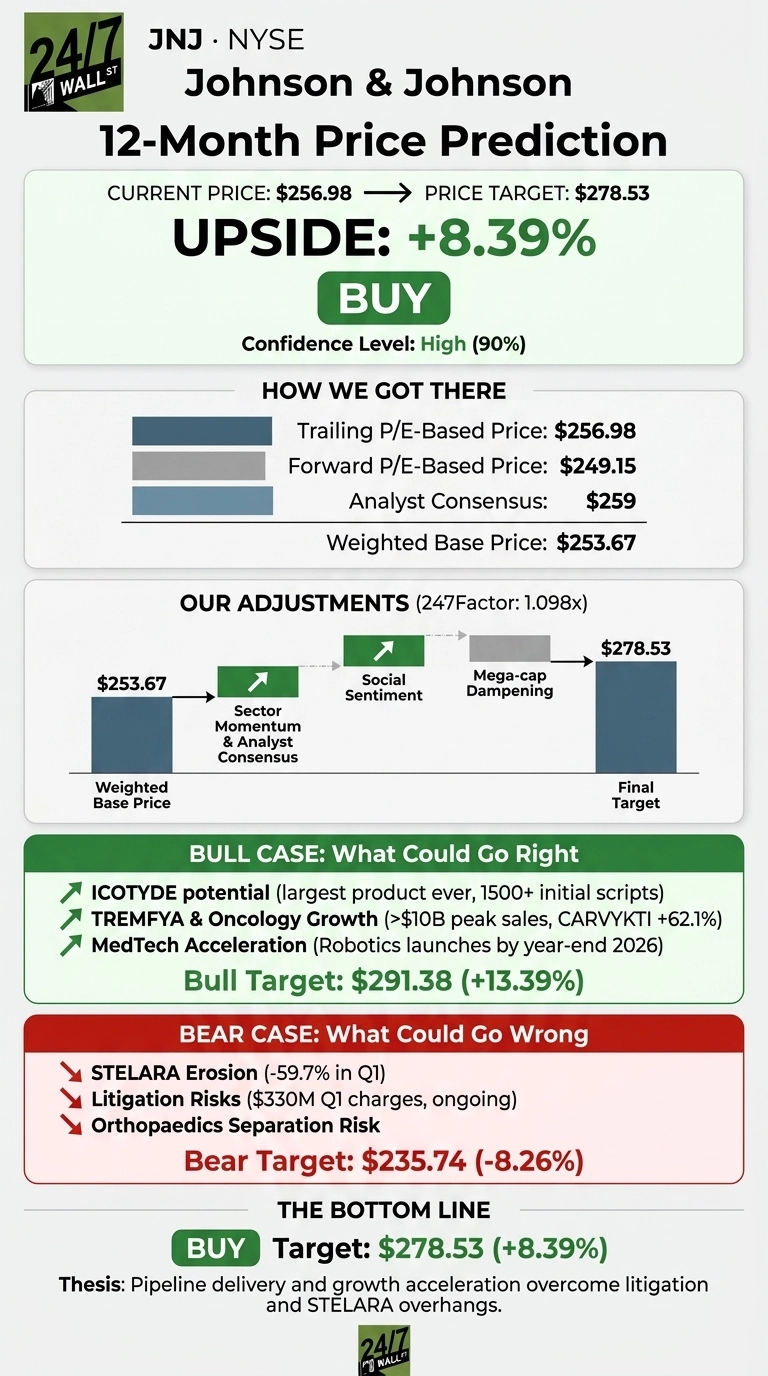
The Case for $291 and Beyond
Our bull scenario puts JNJ at $291.38 in twelve months. Three catalysts drive it. First, ICOTYDE, the first oral IL-23 for psoriasis, which CEO Joaquin Duato said “could be one of our largest products ever” after 1,500 patient prescriptions in the first weeks post-launch.
Second, TREMFYA is tracking to peak sales above $10 billion, with RYBREVANT/LAZCLUZE growing 82.7% and CARVYKTI up 62.1%.
Third, MedTech growth accelerates as OTTAVA and MONARCH robotics both launch by year-end 2026. Polymarket traders are pricing a 92.5% probability JNJ beats Q2 earnings.
What Could Go Wrong
Our bear scenario drops JNJ to $235.74, a downside of -8.26%. STELARA fell 59.7% in Q1 as biosimilars eroded Innovative Medicine growth, and Q1 net income dropped 52.4% on litigation charges of $330 million.
Bulls counter that adjusted EPS still beat, free cash flow guidance sits at roughly $21 billion, and STELARA erosion was fully baked into the raised outlook. The Orthopaedics spin carries execution risk, and a PEG ratio of 4.94 leaves little forgiveness on a growth miss.
How JNJ Compares to Merck and Pfizer
Merck (NYSE:MRK) is the cleanest comparison on oncology franchise concentration. Merck’s 2026 EPS guide of $5.04 to $5.16 reflects heavier one-time charges from the $9 billion Cidara deal, and KEYTRUDA at $7.91 billion in Q1 represents concentrated patent-cliff risk that JNJ’s 28 billion-dollar brands do not carry.
Pfizer (NYSE:PFE) shows the valuation contrast. Pfizer trades at a trailing P/E of 18 with a 7.09% dividend yield, reflecting COVID-cliff and Eliquis loss-of-exclusivity concerns. JNJ trades at a forward P/E of 22 with a 2.01% yield. JNJ is delivering accelerating 9.91% revenue growth while Pfizer’s 2026 revenue is guided flat. Our $278.53 target looks reasonable against this peer set.
JNJ Price Prediction 2026 to 2030
Our 24/7 Wall St. price target of $278.53, buy rating, and 90% confidence rest on a simple thesis: JNJ is exiting its litigation and STELARA overhang as the pipeline delivers.
The thesis strengthens if ICOTYDE traction holds through the psoriatic arthritis readout later in 2026. It weakens if the DePuy Synthes separation slips or a fresh talc settlement dwarfs the current run rate. On balance, the setup favors the bull case.
Extending the model forward using JNJ’s guide to double-digit growth by decade-end, our 5-year base case reaches $353.01, a 37.37% total return.
| Year | 24/7 Wall St. Price Target |
|---|---|
| 2026 | $278 |
| 2027 | $298 |
| 2028 | $318 |
| 2029 | $335 |
| 2030 | $353 |
These projections assume JNJ executes its pipeline and completes the Orthopaedics separation on schedule. Meaningful deviation could come from a talc mega-settlement or an ICOTYDE peak-sales surprise well north of TREMFYA’s $10 billion trajectory.
The post This Healthcare Giant Still Checks Every Box for Long-Term Investors appeared first on 24/7 Wall St..
]]>Eli Lilly (NYSE:LLY) has whipsawed shareholders in 2026, but the setup heading into the second half looks compelling. Our 24/7 Wall St. price target for Eli Lilly is $1,336.12, implying 12.41% upside from the current $1,188.58 quote. We rate the stock a buy with high confidence, driven by the incretin franchise, a raised 2026 outlook, and the Foundayo launch.
24/7 Wall St. Price Target Summary
| Metric | Value |
|---|---|
| Current Price | $1,188.58 |
| 24/7 Wall St. Price Target | $1,336.12 |
| Upside | 12.41% |
| Recommendation | BUY |
| Confidence Level | 90% |
The Q1 Blowout That Reset the Story
Lilly closed at $1,188.58 on July 10, off 2.09% for the week but up 10.97% year to date and 51.38% over the last year. Shares sit roughly 1% below the $1,249.45 52-week high and well above the $619.40 low.
Q1 2026 was the reset. Revenue landed at $19.80 billion, growing 55.5% year over year and beating consensus by 11.25%. Non-GAAP EPS of $8.55 cleared estimates by 25.88%. Mounjaro more than doubled to $8.66 billion, Zepbound grew 80%, and management raised full-year revenue guidance to $82.0 to $85.0 billion with EPS of $35.50 to $37.
Why Bulls See a Breakout Toward $1,395
The bull case rests on Foundayo. Orforglipron is the only approved GLP-1 pill that can be taken any time of day without food or water restrictions, and it delivered superior blood sugar and weight loss versus oral semaglutide in a head-to-head Phase 3 trial published in The Lancet.
Pair that with retatrutide’s Phase 3 win, Taltz plus Zepbound in psoriasis, and four bolt-on acquisitions announced in Q1, and the pipeline looks stacked. Our bull scenario models a $1,395.55 price a year out, a 17.41% return.
The Risks Worth Watching
Prices are the pressure point. Realized prices fell 13% in Q1 as rebates, cash-pay cuts on Zepbound, and China’s NRDL listing for Mounjaro reset the curve. Q1 also absorbed $584 million in acquired IPR&D charges and $279 million in litigation-related items. Insider activity has skewed toward selling, and composite prediction sentiment sits at 38.89, tilted bearish.
Lilly is investing aggressively behind those charges, with new manufacturing sites and four acquisitions targeting cell therapy, sleep-wake disorders, in vivo CAR-T, and myelofibrosis. Our bear scenario points to $1,102.52, a 7.24% drawdown.
How Lilly Compares to Novo Nordisk and Merck
Novo Nordisk (NYSE:NVO) is the natural GLP-1 comp. Novo trades at a forward P/E of just 15, versus Lilly’s 33, but Novo’s revenue grew only 24% last quarter against Lilly’s 55.5%. That growth gap explains why the market underwrites Lilly’s premium.
Merck (NYSE:MRK) offers a large-cap pharma counterpoint. Merck trades at a forward P/E near 24 with quarterly revenue growth of just 4.9% and earnings that contracted year over year. Lilly’s growth rate is roughly ten times Merck’s, making the higher multiple defensible. Against this peer set, our $1,336.12 target looks reasonable.
Eli Lilly Price Prediction 2026-2030
The 24/7 Wall St. price target of $1,336.12 and buy rating carry 90% confidence. Growth acceleration tips the scale. The bull path hinges on Foundayo scripts ramping as expected and 2026 EPS landing at the high end of the raised $35.50 to $37 range. The setup weakens if realized price declines widen beyond the current 13% drag or a pharma tariff surprise reprices the sector.
Extending our model out, here is where our projects Lilly could trade, assuming Foundayo scales and incretin growth normalizes into the high teens.
| Year | 24/7 Wall St. Price Target |
|---|---|
| 2026 | $1,336 |
| 2027 | $1,455 |
| 2028 | $1,570 |
| 2029 | $1,675 |
| 2030 | $1,778 |
These projections assume Lilly continues executing on the incretin buildout and pipeline diversification. Meaningful upside or downside could come from oral GLP-1 penetration, tariff outcomes, or biosimilar timing.
The post Prediction: 1 New Reason Eli Lilly Stock Could Still Be Headed Higher appeared first on 24/7 Wall St..
]]>Schwab U.S. Dividend Equity ETF (NYSEARCA:SCHD) pays a quarterly distribution from roughly 100 quality-screened U.S. dividend stocks. The fund holds $71.6 billion in assets at an expense ratio of just 0.06%, and it tracks the Dow Jones U.S. Dividend 100 Index, which requires 10 consecutive years of dividend payments and screens on cash flow to debt, ROE, dividend yield, and dividend growth. That methodology is the first line of defense in the SCHD dividend safety story.
How the fund generates its yield
SCHD’s income comes from ordinary dividends paid by its underlying holdings. The top 10 positions each sit near 4% of assets and together account for roughly 41% of the portfolio. Rebalancing happens annually in March, so current names reflect the December 31, 2025 fact sheet: Bristol-Myers Squibb, Merck, ConocoPhillips, Lockheed Martin, Chevron, Verizon, AbbVie, Cisco, Coca-Cola, and Altria. Six of them drive the safety conversation.
Top holdings under the microscope
AbbVie (NYSE:ABBV) sits at 3.99% of the fund. Q1 2026 revenue rose 12% to $15 billion, with Skyrizi up 31% to $4.48 billion. AbbVie raised full-year adjusted EPS guidance to $14.08 to $14.28 and lifted its dividend to $1.73 per quarter, the fifth straight annual raise. Humira erosion is real, and immunology successors are filling the gap. Coverage looks solid.
Coca-Cola (NYSE:KO) is a textbook aristocrat. Operating margin expanded to 35% in Q1 2026, free cash flow jumped 132% to $1.76 billion, and full-year FCF guidance sits near $12.2 billion against a dividend that just stepped up to $0.53 per quarter. This marks the 63rd consecutive annual increase. There is no realistic scenario in which this payout is at risk.
Chevron (NYSE:CVX) pays $1.78 per quarter for a yield near 4.2%. Q1 free cash flow swung negative to -$1.55 billion on working capital timing and derivative mismatches, but full-year 2025 FCF of $16.6 billion and 16 straight quarters of $5 billion-plus in shareholder returns tell the real story. Chevron’s 39-year streak of raises reflects a commitment management is unlikely to break for a cyclical trough.
Lockheed Martin (NYSE:LMT) is the closest call. Q1 free cash flow was -$291 million while dividends paid ran $816 million, and program charges hit F-16, C-130, and CH-53K. Management reaffirmed FY26 FCF of $6.5 billion to $6.8 billion and raised the dividend 5% to $3.45 per quarter, its 23rd straight increase. Full-year coverage remains intact.
Verizon (NYSE:VZ) yields around 6.5% and carries the highest scrutiny. Total debt climbed to $172.5 billion after closing the Frontier deal on January 20, 2026. Even so, 2025 free cash flow of $20.1 billion covered the $11.5 billion dividend 1.75x, and 2026 guidance calls for FCF of $21.5 billion or more. Elevated leverage is a genuine risk if rates spike, but today’s coverage is comfortable.
Merck (NYSE:MRK) posted a GAAP loss of -$1.28 per share in Q1, driven entirely by a $9.0 billion Cidara acquisition charge. KEYTRUDA grew 12% to $8.03 billion, and full-year non-GAAP EPS guidance moved up to $5.04 to $5.16 against a $0.85 quarterly payout. The reported loss is accounting noise, and operational cash generation supports the dividend.
Total return context and the verdict
SCHD has returned 20% year to date and 23% over the past year, with a 10-year gain of 227%. Income durability rests on cash-generating businesses, and the annual rebalance culls names that let dividend growth stall. For conservative investors seeking growth and income, SCHD’s distribution reads as safe. Aggressive income hunters chasing higher yields will prefer options-based funds, and growth-tilted dividend investors can consider peer growth-oriented dividend ETFs that trade current yield for faster payout growth.
The post Six Dividend Aristocrats Keeping SCHD’s Income Stream Bulletproof This Year appeared first on 24/7 Wall St..
]]>Shares of Moderna (NASDAQ:MRNA) are up 14% to $68 and change in afternoon trading Friday, extending a remarkable run for the mRNA pioneer. Intraday, MRNA stock hit a new 52-week high of $69.29.
The rally easily outpaces peer vaccine makers. Merck (NYSE:MRK) stock is up 2% to $128, while Pfizer (NYSE:PFE) stock trades up 2% to $24 and change. On a single-session basis, Moderna stock is clearly leading the vaccine complex.
There’s no fresh same-day headline that cleanly explains the size of the move. Instead, traders appear to be extending momentum from a de-risking event last week, combined with bullish pipeline messaging and a likely short-covering component in a heavily traded name.
FDA Panel De-Risking and Pipeline Optimism Fuel the Run
The biggest catalyst in the rear-view mirror was an FDA advisory committee unanimously endorsing Moderna’s flu vaccine, mFlusiva (mRNA-1010), for adults 50 and older. That vote is a key step ahead of the August 5, 2026 PDUFA date, which would mark Moderna’s fifth approved product if cleared.
Moderna also held a Science Day this week highlighting its push beyond vaccines into oncology and autoimmune disease, including T-cell engagers, an in-vivo CAR-T program, and a personalized cancer vaccine, with messaging around a 2028 break-even goal. Jefferies raised its MRNA price target to $53 from $45, while keeping a Hold rating.
The fundamental backdrop has been improving. Moderna’s Q1 2026 revenue came in at $389 million, up 264% year over year and beating consensus by 65%, with the company reaffirming guidance for up to 10% revenue growth in 2026 in its most recent 10-Q filing.
Moderna Leads, but Merck Won the Week
Zoom out and the picture gets more nuanced. Over the past month, Moderna stock is up 45%, while Merck stock has added 7% and Pfizer stock has fallen 6%. Year to date, the gap is even wider, with Moderna up 130% against Merck’s 21% gain and Pfizer’s modest 3% decline.
Pfizer remains the laggard. Comirnaty revenue fell 59% to $232 million in Q1 2026, underscoring how reliant the company still is on its non-COVID portfolio. Pfizer’s forward P/E ratio of 8x and 7% dividend yield keep it a value-and-income story rather than a momentum trade.
The Street Is Still Cautious on Moderna
For all the enthusiasm, the sell-side has not fully signed off. The MRNA stock consensus analyst target price sits at $43.45, well below today’s quote, with 16 Hold ratings against a smaller cluster of Buys and Sells. Leerink sits near $24 and Morgan Stanley near $33, meaning Moderna stock is running ahead of where most of the Street is positioned.
Moderna’s insiders have been net sellers as well, with 75 recent insider transactions tilting toward selling. That doesn’t invalidate the bull case, but it argues for keeping position sizes modest given MRNA stock’s volatility profile and forward P/E ratio of 23x on still-uncertain forward earnings.
What to Watch Next
The next clear data point is the August 5, 2026 FDA decision on mRNA-1010. Investors can also watch upcoming Phase 3 readouts for norovirus, intismeran in melanoma, and propionic acidemia, any of which could shift the medium-term narrative for Moderna.
For today, the answer to the title’s question is clear. On a single-day basis, and across the past month and year to date, Moderna stock is decisively outperforming Merck stock and Pfizer stock. Whether the stock can hold above the $65 level into next week may say more about momentum traders than about the underlying biotech story.
The post Moderna Is Up 14% Today: Is It Outperforming Other Vaccine Stocks Like Merck and Pfizer? appeared first on 24/7 Wall St..
]]>
Pre-Market Stock Futures:
Futures are trading higher this morning, but if you’ve ever heard the old saying, “when the chips are down”, that was the poster child phrase for Tuesday’s session, as technology stocks, and specifically the semiconductor stocks, followed a worldwide sell-off that initially began in Korea and carried around the globe. When it was all said and done, all of the major indices finished the day lower, with the tech-heavy Nasdaq leading the way, dropping 2.22% to close at 25,587, while the S&P 500 dropped 1.44% to close at 7,365. Even the resilient small-cap-loaded Russell 2000, which is still the leading index this year, up almost 20%, closed down 0.96% at 2,975. The legacy Dow Jones Industrials almost finished the day higher, but succumbed to selling into the close, finishing down just 0.09% at 51,666. With the second quarter coming to an end, we could see more end-of-quarter reallocation and selling as portfolio managers prepare for window dressing.
Treasury Bonds:
After a dreadful Monday that saw yields rise across all maturities, yields were modestly lower across the curve on Tuesday as safe-haven and end-of-the-month maneuvering brought out buyers. By the final bell, the 30-year-long bond closed flat at 4.95%, while the benchmark 10-year note finished the day at 4.50%. We could see more buying the rest of the week and early next week.
Oil and Gas:
Just as on Monday, the sellers returned on Tuesday as oil prices fell across major benchmarks, with reports that more tankers were moving through the Strait of Hormuz. Needless to say, Iran was enthusiastic about letting them through the passage, where 20% of all oil is transported, after receiving a 60-day reprieve from sanctions on Iranian oil purchases. When the session ended on Tuesday, Brent Crude closed at $76.91, down 1.27%, while West Texas Intermediate was last seen at $73.07, down 1.07%. Natural gas, which has been on a winning streak as the commodity becomes a hot topic for powering data centers, closed at $3.16, down 2.89%.
Gold:
Gold continued its downward trend Tuesday, despite China’s continued massive purchases of the precious metal, which hit a 26-month high in May and are up a stunning 76% year-to-date. The final print for Gold was $4,112, down 1.92%, while Silver ended at $61.46, down 5.38%. Hawkish commentary by Federal Reserve officials and a strong dollar were both cited as reasons for the ongoing selling of both Gold and Silver.
Crypto:
The cryptocurrency market experienced a broad sell-off on Tuesday, as digital assets fell in tandem with a major plunge in high-flying global technology and chip stocks. Analysts cited a hawkish shift in the Federal Reserve’s outlook, thin liquidity, and record institutional outflows from ETFs. Again, end-of-quarter selling was likely a factor as well. At 8 AM EDT, Bitcoin was trading at $62,540 while Ethereum was quoted at $1,675.
24/7 Wall St. reviews dozens of analyst research reports every day to identify fresh investment ideas for investors and traders alike. These daily analyst notes include recommendations on stocks to buy, sell, or avoid, as well as new coverage initiations. Important reminder: No single analyst report should ever be the sole basis for buying or selling a stock.
Here are some of the best Wall Street analyst upgrades, downgrades, and initiations seen on Wednesday June, 24, 2026.
Upgrades:
- Invitation Homes (NYSE: INVH) was upgraded to Overweight from Equal Weight at Wells Fargo, which nudged the target price for the shares to $33 from $31.
- Macerich Company (NYSE: MAC) was upgraded to Buy from Neutral at Citigroup, which bumped the target price to $28 from $24.
- Nucor (NYSE: NUE) was raised to Overweight from Sector Weight at KeyBanc, with a $274 target price.
- Varonis Systems (NASDAQ: VRNS) was upgraded to Overweight from Equal Weight at Stephens, which lifted the target price for the stock to $45 from $33.
Downgrades:
- Apogee Therapeutics (NASDAQ: APGE) was downgraded to Neutral from Outperform at Mizuho, with a $135 target, up from $110. AbbVie is buying the company at that level.
- Flowserve (NYSE: FLS) was downgraded to Hold from Buy at TD Cowen, which has a $70 target price for the shares.
- Nuvalent (NASDAQ: NUVL) was cut to Market Perform from Outperform at Bernstein, which slashed the target price for the stock to $124 from $172.
- Principal Financial Group (NYSE: PFG) was cut to Underperform from Neutral at Bank of America, which trimmed the target price for the shares to $95 from $98.
- V2X (NYSE: VVX) was downgraded to Market Perform from Outperform at Raymond James, without a price target.
Initiations:
- Devon Energy (NYSE: DVN) was reinstated at Goldman Sachs with a Buy rating and a $54 target price.
- Klaviyo (NYSE: KVYO) was assumed with a Buy rating at Goldman Sachs, with a $26 target price.
- Merck & Co (NYSE: MRK) was initiated with an Outperform rating at CICC, with a $138 target price.
- Take-Two Interactive Software (NASDAQ: TTWO) was initiated with a Buy rating at BTIG, which has a $290 target price for the company.
- Twilio (NYSE: TWLO) was started with a Buy rating at Goldman Sachs, which has set a $300 target price for the stock.
The post Here Are Wednesday’s Best Wall Street Analyst Research Calls: Devon Energy, Flowserve, Klaviyo, Macerich, Merck, Nucor, Take-Two Interactive Software, Twilio, and More appeared first on 24/7 Wall St..
]]>Bank of America has predicted that the Federal Reserve will be forced to raise interest rates by 75 basis points this year, with the first 25-basis-point hike in September. They also see additional 25-basis-point hikes in October and December. The energy shock from the war with Iran drove inflation higher, with the CPI rising in May to 3.8%, the sharpest increase in three years and well above the Fed’s 2% target. This, in turn, has prompted lenders to demand higher rates to protect returns. Meanwhile, investors sold bonds amid rising inflation and concerns about U.S. debt, which lifted Treasury yields. Since mortgage rates are based on the 10-year Treasury yield plus a risk premium, they rose in tandem. On the fiscal side, federal interest payments now exceed spending on Medicaid, national defense, and all nondefense discretionary programs combined, adding further upward pressure on long-term borrowing costs.
The team at Bank of America frames the rate increase argument on the hand that new Fed Chair Kevin Warsh was dealt, noting the following when discussing the potential for rate hikes this year:
We now expect three 25-basis-point Fed hikes this year, in September, October, and December. This would take the policy rate to 4.25-4.5%. We were skeptical of the need for cuts in 2025. Both the data and our updated read of the Fed’s reaction function suggest it will reverse those cuts in short order. We think the Fed will stay on hold next year. Inflation is likely to remain sticky, keeping the real policy rate from becoming overly restrictive. Meanwhile, the Fed’s inflation problem has gotten unambiguously worse. Core PCE could reach 3.5% in May, nearly 70bp higher than it was a year ago. The pickup has been partly due to tariffs and other one-offs. The Fed was willing to look through the tariffs, but it is losing patience after the latest round of supply shocks. Also, housing-driven disinflation has now mostly run its course, while other core services remain very sticky.
Typically, when interest rates go higher, these four sectors tend to win:
- Financials
- Energy
- Healthcare
- Consumer Staples
We screened our 24/7 Wall St. dividend stocks database for quality companies that pay big, dependable dividends and generate reliable passive income. We found four companies, one in each sector, that are solid bets if the upward trend in interest rates remains and Bank of America is correct in three rate hikes. All are rated Buy by the top Wall Street firms we cover.
Financials: Wells Fargo
Financials are the biggest winner. Banks earn a wider spread between what they pay depositors and what they charge borrowers. Insurers earn more on their investment portfolios. The sector almost mechanically benefits from rising rates, as net interest income rises.
Wells Fargo (NYSE: WFC) operates in 35 countries and serves over 70 million customers worldwide. This money-center giant makes sense, given its 2.09% dividend, as many of the issues that plagued the company over the past five years appear to have been resolved. This financial services company offers a diverse range of banking, investment, mortgage, and consumer and commercial finance products and services in the United States and internationally.
The company operates through four segments. The Consumer Banking and Lending segment offers a diverse range of financial products and services tailored to meet the needs of consumers and small businesses. These include checking and savings accounts, credit and debit cards, as well as home, auto, personal, and small business lending services.
The Commercial Banking segment provides financial solutions to private, family-owned, and specific public companies. Its products and services include banking and credit products across various industry sectors and municipalities, as well as secured lending and lease products, and treasury management services.
The Corporate and Investment Banking segment offers a suite of capital markets, banking, and financial products and services, such as:
- Corporate banking
- Investment banking
- Treasury management
- Commercial real estate lending and servicing
- Equity and fixed-income solutions
- Sales, trading, and research services to corporate, commercial real estate, government, and institutional clients
The Wealth and Investment Management segment provides wealth management, brokerage, financial planning, lending, private banking, and trust and fiduciary products and services to affluent, high-net-worth, and ultra-high-net-worth clients. It also operates through financial advisors in brokerage and wealth offices, consumer bank branches, independent offices, and digitally through WellsTrade and Intuitive Investor.
Barclays has an Overweight rating and a $108 target price.


Energy: Chevron
Energy benefits because rate hikes typically coincide with inflation, and oil and gas prices are a primary driver of inflation. Higher commodity prices equal higher revenues. It’s the inflation hedge play, and it has been the strongest-performing S&P sector so far in 2026.
Chevron (NYSE: CVX) is an American multinational energy company that primarily focuses on oil and gas. It is a safer option for investors looking to position themselves in the energy sector, and it pays a substantial 3.84% dividend, which was raised by 5% earlier this year. The company operates integrated energy and chemicals businesses worldwide.
Chevron operates in two segments. The Upstream segment is involved in:
- Exploration, development, production, and transportation of crude oil and natural gas
- Processing, liquefaction, transportation, and regasification associated with liquefied natural gas
- Transportation of crude oil through pipelines, and transportation, storage
- Marketing of natural gas, as well as operating a gas-to-liquids plant
The Downstream segment engages in:
- Refining crude oil into petroleum products
- Marketing crude oil, refined products, and lubricants
- Manufacturing and marketing renewable fuels
- Transporting crude oil and refined products by pipeline, marine vessel, motor equipment, and rail car
- Manufacturing and marketing of commodity petrochemicals, plastics for industrial uses, and fuel and lubricant additives
It also involves cash management, debt financing, insurance operations, real estate, and technology businesses.
Mizuho has an Outperform rating and a $230 target price.
Healthcare: Merck
Pricing power and steady demand insulate the top healthcare names. They don’t directly benefit from higher rates, but they tend to hold up well because their earnings do not erode as much as those of interest-sensitive sectors.
Merck (NYSE: MRK) develops and produces medicines, vaccines, biological therapies, and animal health products. It is not just a healthcare company but a global force in the industry, paying a solid 2.84% dividend.
Merck operates through two segments. The Pharmaceutical segment offers human health pharmaceutical products in:
- Oncology
- Hospital acute care
- Immunology
- Neuroscience
- Virology
- Cardiovascular
- Diabetes
- Vaccine products, such as preventive pediatric, adolescent, and adult vaccines
The Animal Health segment discovers, develops, manufactures, and markets veterinary pharmaceuticals, vaccines, health management solutions and services, and digitally connected identification, traceability, and monitoring products.
Merck serves:
- Drug wholesalers
- Retailers
- Hospitals
- Government agencies
- Managed healthcare providers, such as health maintenance organizations
- Pharmacy benefit managers and other institutions
- Physicians
- Physician distributors
- Veterinarians
- Animal producers
Merck’s growth is a result of its efforts and strategic collaborations. The company works with AstraZeneca, Bayer, Eisai, Ridgeback Biotherapeutics, and Gilead Sciences to jointly develop and commercialize long-acting HIV treatments, demonstrating a commitment to innovation and growth.
UBS has a Buy rating with a $145 target price.
Consumer Staples: Altria
Although consumer staples do not directly benefit from interest rates, they still emerge as relative winners. By delivering essential products, they maintain stable revenues regardless of the broader economic cycle, making them attractive to investors seeking a reliable safe haven.
Altria (NYSE: MO) is one of the world’s largest producers and marketers of cigarettes and other tobacco-related products. This stock offers value investors a great entry point. Altria manufactures and sells smokable and oral tobacco products in the United States and is the undisputed yield leader among consumer staples Dividend Kings. Its annual dividend of $4.24 per share currently yields 6.1%.
The company primarily sells cigarettes under the Marlboro brand, as well as:
- Cigars and pipe tobacco, principally under the Black & Mild and Middleton brands
- Moist smokeless tobacco and snus products under the Copenhagen, Skoal, Red Seal, and Husky brands
- on! Oral nicotine pouches
- e-vapor products under the NJOY ACE brand
It sells its tobacco products primarily to wholesalers, including distributors and large retail organizations, such as chain stores.
Altria used to own over 10% of Anheuser-Busch InBev (NYSE: BUD), the world’s largest brewer. In 2024, the company sold 35 million of its 197 million shares through a global secondary offering. That represents 18% of its holdings but still leaves 8% of the outstanding shares in its back pocket. Altria also announced a $2.4 billion stock repurchase plan partially funded by the sale.
UBS has a Buy rating with a $76 target price.


The post Bank of America Sees Interest Rates Exploding Higher Soon: Play It Safe With 4 Dividend Giants appeared first on 24/7 Wall St..
]]>The Health Care Select Sector SPDR ETF (NYSEARCA:XLV) is having a frustrating year. The fund sits at $149, down about 3% year-to-date while the broader market grinds higher. The good news for XLV holders: the fund has clawed back roughly 14% over the past year, and the 2026 setup looks meaningfully different from the policy fog that smothered healthcare in 2025. The two things that will decide whether XLV finally rejoins the S&P 500 over the next 12 months are very specific, and both deserve close attention.
The fund and where it stands now
XLV is a market-cap-weighted slice of S&P 500 healthcare, and that weighting matters more than usual right now. The top five names, Eli Lilly (NYSE:LLY), Johnson & Johnson (NYSE:JNJ), UnitedHealth Group (NYSE:UNH), AbbVie (NYSE:ABBV), and Merck, dominate the basket. Lilly alone carries a nearly $1 trillion market cap, making it the gravitational center of the fund. That single name is up roughly 41% over the past year, while UnitedHealth has rebounded about 23% year-to-date after a brutal 2025 marked by a cyberattack and DOJ scrutiny.
Sector demand is structurally sturdy. Personal consumption on healthcare services reached $3.70 trillion in April 2026, up roughly $206 billion year-over-year. The question is who captures that spend, and at what margin.
The macro factor that matters most: drug pricing policy
Watch the pricing agreements between Washington and large pharma. PineBridge’s 2026 outlook flags that a 15% cap on pharmaceutical imports was agreed to in recent bilateral trade deals between the US and key trading partners, alongside more workable Medicare and Medicaid pricing negotiations. AbbVie and Merck have already cut deals trading U.S. manufacturing investment for tariff and pricing exemptions. If the framework holds, the policy overhang that compressed XLV multiples in 2025 keeps lifting.
What to monitor: CMS announcements on Inflation Reduction Act Part D negotiation rounds, and any USTR press releases on pharma tariff carve-outs. Check monthly, and event-driven around any executive order. The transmission to XLV is direct: four of the top five holdings derive over half of revenue from prescription drugs, so every basis point of net price preserved flows to operating income. A reversal, meaning new most-favored-nation pricing or removal of carve-outs, would hit Merck and AbbVie hardest given KEYTRUDA’s roughly $8 billion quarterly run rate and AbbVie’s reliance on Skyrizi and Rinvoq pricing.
The fund-specific factor: Lilly’s GLP-1 franchise is XLV
Concentration risk in XLV is really GLP-1 risk. Lilly’s Mounjaro generated $8.7 billion in Q1 2026, up 125% year-over-year, and Zepbound added $4.2 billion, up 80%. Together, the franchise drove 65% of Lilly’s Q1 revenue. With Lilly as the fund’s largest weight, XLV’s NAV is unusually sensitive to one product family.
The variable to watch is realized price. Lilly posted 65% volume growth against a 13% realized price decline in Q1, primarily from China’s NRDL listing and rebate pressure. Volume has masked the price slide so far. The newly approved oral GLP-1 Foundayo (orforglipron) is the swing factor: if launch pricing holds in the U.S. and Europe, Lilly’s $82 billion to $85 billion 2026 revenue guide looks conservative. If insurer formularies force aggressive rebates, the price decline accelerates and the largest XLV constituent re-rates lower. Lilly reports Q2 in early August, and the orforglipron net price commentary on that call is the single most important data point for XLV holders this summer.
What to act on
The macro signal: if U.S. trade deals preserve the 15% pharma import cap and Medicare negotiations stay on the current track, XLV’s policy discount keeps narrowing. The fund-specific signal: Lilly’s Q2 earnings disclosure on orforglipron pricing will set the trajectory for roughly the largest weight in the fund, and by extension, for XLV itself.
The post The 2 Factors That Will Decide Whether XLV Finally Catches the S&P 500 in 2026 appeared first on 24/7 Wall St..
]]>After years of lagging the market, healthcare may be taking on a new role in investor portfolios.
Speaking on CNBC, Mizuho healthcare strategist Jared Holz reframed the sector, arguing that years of underperformance have turned drug stocks from a defensive holding into something more interesting for growth-heavy portfolios. “I think you just have to look at health care as almost like a value sector,” Holz said, pointing to drug pricing pressure and managed care headwinds that have dragged on large-cap pharma while tech ripped higher.
The performance gap is hard to argue with. The Nasdaq-100 is up 63.91% over the past two years, while Merck stock has slipped 4.32% over the same window.
The Case for Healthcare as Value
Many investors have spent the past several years concentrating heavily in technology, particularly AI-related stocks. As those positions have grown, healthcare has increasingly become the place where valuations appear more reasonable, and expectations have fallen.
“If you’re very, very full to the gills with growth and you want to take a little bit off and you’re trying to find some names that have underperformed, that’s really what it’s come down to,” Holz said.
He stopped short of predicting a major healthcare rally: “It’s sort of like it’s cheap. I’m not sure what it’s going to do. But if you want to take a small position as an offset, I guess.”
Holz is suggesting healthcare may serve as a counterbalance for investors whose portfolios have become heavily tilted toward growth and AI-related names.
Merck Could Be Interesting for Its Keytruda Franchise
For investors looking at large-cap pharmaceuticals, Holz pointed to Merck (NYSE:MRK) as one of the clearest examples of a value opportunity. The stock trades at a forward P/E of 23 and carries a 2.74% dividend yield, while Wall Street’s average analyst price target of $129.74 sits above the current $115.17 price.
The bigger story, however, remains Merck’s flagship immunotherapy drug, Keytruda. “The thing that is sort of most resonating, maybe, is just the power of Merck’s Keytruda and the fact that there are so many companies that are using Keytruda as the backbone for their therapy. No one can seem to get the results that they want in monotherapy,” Holz said at ASCO. That dynamic forces would-be challengers into partnership rather than head-on competition.
Merck’s Q1 2026 revenue came in at $16.29 billion, beating the $15.82 billion estimate, with Keytruda franchise sales of $8.03 billion, up 12%. Merck raised its 2026 guidance to $65.8 billion to $67.0 billion in revenue and $5.04 to $5.16 in non-GAAP EPS.
Summit Represents a Higher-Risk Alternative
Summit Therapeutics (NASDAQ:SMMT) sits at the other end of the spectrum, as a $12.48 billion market cap clinical-stage biotech trying to build a Keytruda challenger with ivonescimab, a bispecific PD-1/VEGF antibody licensed from Akeso. Shares are down 13.75% over the past year, with the analyst average target at $28.47 against a $15.71 close.
Summit presented HARMONi-6 overall survival data at the ASCO 2026 Plenary on May 31, and an FDA PDUFA decision on ivonescimab for EGFR-mutated NSCLC is set for November 14, 2026. Holz highlighted one of the key debates surrounding the story. Much of the company’s strongest data has come from studies conducted in China, raising questions about how those results will translate to Western patient populations and regulators. With $598.7 million in cash against a quarterly burn of $114.7 million, the runway is adequate, but the binary risk is real.
What to Watch
Analyst Jared Holz sees value emerging after years of underperformance.
For investors whose portfolios have become increasingly concentrated in AI, software, and mega-cap technology stocks, healthcare offers exposure to a different set of drivers at valuations that often look more reasonable. Merck represents the higher-quality, cash-generating version of that idea, while Summit represents the higher-risk, catalyst-driven version.
The post Mizuho Strategist: Healthcare Is Now a Value Sector as Pharma Stocks Underperform Tech appeared first on 24/7 Wall St..
]]>A 63-year-old retiree with $400,000 parked in the Schwab U.S. Dividend Equity ETF (NYSEARCA:SCHD) likely picked it for the 100-stock screen and the reliable income stream. The top 10 positions now make up 41% of the fund, which means roughly $164,000 of that nest egg sits in ten names. For a fund managing $94 billion, SCHD’s concentration profile deserves a closer look before anyone treats it as a one-ticker solution.
The strategy and the income engine
SCHD tracks the Dow Jones U.S. Dividend 100 Index, screening for companies with at least 10 consecutive years of dividend increases and strong balance sheets. The return engine is simple: collect dividends from mature, cash-generative blue chips and let the index reconstitute once a year in March. Investors get a current yield of 3.27% at a 0.06% expense ratio, among the cheapest in the category.
The screen has a real edge for retirees, as names like Merck (NYSE:MRK) raised its quarterly payout from $0.77 in 2024 to $0.85 in early 2026, and Bristol Myers Squibb (NYSE:BMY) nudged its quarterly dividend from $0.62 to $0.63 over the same window. Steady raises at the holding level translate into a stable income floor at the fund.
Heavier than the S&P 500 at the top
The top 10 names carry individual weights between around 3%: Qualcomm leads, followed by Texas Instruments, UnitedHealth, Chevron, Coca-Cola, ConocoPhilips, Verizon, and Amgen. The combined reading of the top stocks is heavier than the S&P 500’s 36% top-10 concentration, even though the headline index is famously crowded at the top with mega-cap tech.
On the other hand, sector tilts compound the issue. Energy sits near 16% after the March 2026 reconstitution trimmed it from 24%, with two oil majors in the top five. Healthcare runs roughly 18%, anchored by three drug makers. Single-stock risk inside SCHD runs higher than the 100-name headcount suggests.
Does it deliver?
Over the past year, SCHD returned 29%, edging out SPY’s 27% as the rotation into value lifted dividend names. Stretch the window, and the picture flips. SCHD’s five-year total return of 50% trails SPY’s 79% by nearly 30 percentage points. That gap is the price an SCHD owner paid for skipping the AI-led rally between 2023 and 2025. Over ten years, SCHD’s 233% still lags SPY’s 258%, though by a narrower margin.
The tradeoffs
- Concentration drift between reconstitutions. March is the only month when weights reset. A buyer in October owns a different fund than one buying in April, with the top names having drifted meaningfully in the interim.
- Sector cyclicality. Heavy energy and healthcare weights mean oil prices and drug-pricing politics move the fund disproportionately versus a broad index.
- Growth opportunity cost. The dividend screen excludes most mega-cap tech, the dominant return source for nearly a decade of U.S. equity history.
Where SCHD fits, and where to pair it
SCHD serves as an income-anchored core holding for retirees seeking yield and quality screening at near-zero cost. Capping it at 30%-40% of the equity sleeve is sensible given the top-10 weight. The Vanguard High Dividend Yield ETF (NYSEARCA:VYM) holds roughly 620 names, with a top-10 concentration of near 24%, and has returned 69% over five years. The iShares Core Dividend Growth ETF (NYSEARCA:DGRO) features Apple, Microsoft, and Broadcom at the top, providing the tech overlap SCHD lacks. Pairing SCHD with either flattens single-stock risk without abandoning the income mandate that drew the 63-year-old to the fund in the first place.
The post SCHD’s $85 Billion Strategy Now Concentrates 41 Percent of Your Money in Just Ten Stocks appeared first on 24/7 Wall St..
]]>Pfizer (NYSE:PFE) and Merck (NYSE:MRK) both just closed earnings chapters that frame the 2026 dividend debate clearly. Pfizer wrapped fiscal 2025 with a $0.66 adjusted EPS Q4 beat. Merck followed with a Q1 2026 report dominated by a $9 billion Cidara acquisition charge. Two very different income stories for yield hunters.
One Pays You to Wait. One Pays You to Believe.
Pfizer is now a 6.58% yielder, distributing $9.8 billion in 2025 dividends at $1.72 per share. That payout sits on a $3.22 adjusted EPS base, so coverage looks comfortable even with COVID revenue fading. Non-COVID growth told the real story: Abrysvo jumped 136%, Eliquis added 10%, and oncology biosimilars surged 77%.
Merck pays a smaller yield of 2.74% on a $3.28 annual dividend, but the underlying business is growing faster. KEYTRUDA delivered $8.03 billion in Q1 2026, up 12%, while WINREVAIR rocketed 88% to $525 million. Animal Health added a steady 13%. The recent quarterly dividend bump from $0.81 to $0.85 signals confidence.
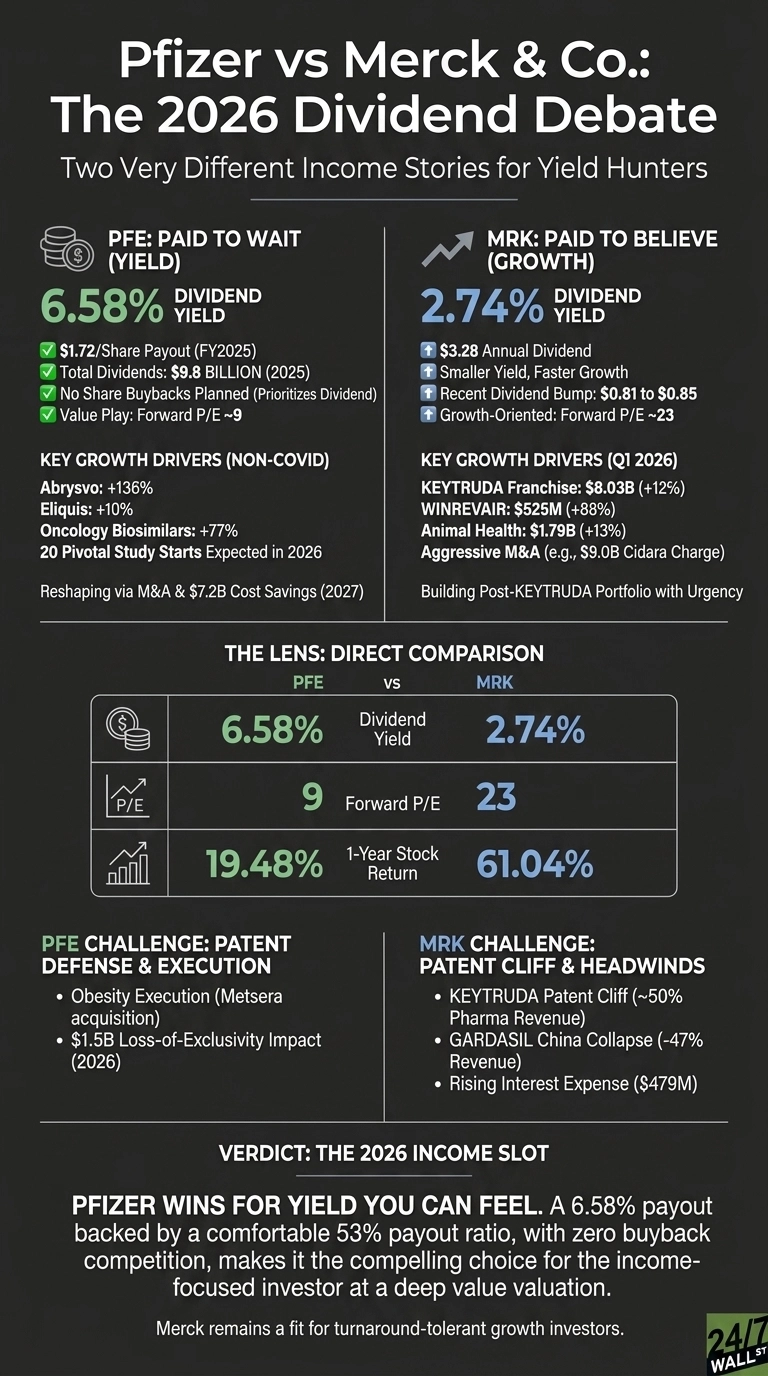
| Lens | Pfizer | Merck |
| Dividend Yield | 6.58% | 2.74% |
| Forward P/E | 9 | 23 |
| 1-Year Stock Return | 19.48% | 61.04% |
Yield Hunter vs. Pipeline Believer
Pfizer is reshaping itself through M&A. CEO Albert Bourla told investors “2026 will be an important year rich in key catalysts, including our expectation for approximately 20 key pivotal study starts”.
The $7 billion Metsera buy pushes Pfizer into obesity, and management is chasing $7.2 billion in net cost savings by 2027. Buybacks remain off the table, which I read as a clean signal that the dividend is the priority.
Merck is building a post-KEYTRUDA portfolio with urgency. The Cidara deal closed, Terns is pending at roughly $5.8 billion, and Verona Pharma already contributed $131 million in Q1. The risk: GARDASIL revenue in China fell 47%, and interest expense climbed to $479 million. Faster growth, heavier balance-sheet lifting.
The Next Test Is Patent Defense
For Pfizer, I will be watching whether Metsera’s ultra-long-acting GLP-1 candidates can credibly compete with Novo and Lilly. The $1.5 billion loss-of-exclusivity headwind in 2026 is manageable, but obesity execution is the swing factor.
For Merck, the KEYTRUDA biosimilar clock is the dominant concern, given it represents roughly 50% of pharma revenue. WINREVAIR and the animal health franchise need to keep compounding.
Why I Lean Toward Pfizer for the 2026 Income Slot
If you want yield you can actually feel, Pfizer wins this matchup. A 6.58% payout backed by a 53% payout ratio and zero buyback competition for cash is hard to ignore at a forward P/E of 9.
Merck is the better operating business and its 61.04% one-year gain proves it, but you are paying 23 times forward earnings for a 2.74% yield. For a turnaround-tolerant growth investor, Merck still fits. For my dividend bucket in 2026, Pfizer’s combination of value and income reads more compelling.
The post Pfizer vs Merck: Chasing High Yield vs Higher Returns appeared first on 24/7 Wall St..
]]>The Schwab U.S. Dividend Equity ETF (NYSEARCA:SCHD) has built its reputation on paying reliable, growing quarterly distributions to income investors, and the latest data confirms why holders trust the fund. SCHD paid $0.2569 per share on March 30, 2026, continuing an uninterrupted quarterly schedule that stretches back to 2011. For retirees and dividend-growth investors weighing whether SCHD’s payout can withstand the current rate environment, the underlying mechanics of this fund tell a reassuring story.
How SCHD Generates Its Income
SCHD tracks the Dow Jones U.S. Dividend 100 Index, a screen that requires consistent dividend payment history, financial strength, and yield quality. The fund passes through dividends from roughly 100 large-cap U.S. companies, charging an expense ratio of just 6 basis points. With $71.6 billion in net assets as of December 31, 2025, the fund has the scale to keep trading costs minimal and distributions predictable.
The Companies Doing the Heavy Lifting
The top holdings are a roll call of mature cash generators. The biggest position is Bristol-Myers Squibb near 4.3%, followed by Merck, ConocoPhillips, Lockheed Martin, and Chevron all clustered around 4%. These five names dominate the income stream and span pharmaceuticals, energy, and defense, three sectors with very different macro drivers.
Bristol-Myers and Merck both face patent cliff concerns on key drugs, but their dividends are backed by sturdy operating cash flow and disciplined payout ratios well below the levels that typically signal strain. Lockheed Martin’s dividend rests on a multi-year defense backlog, the most predictable revenue stream in the holdings list. ConocoPhillips and Chevron tie the fund’s income to oil prices, and Chevron in particular has raised its dividend for decades through commodity cycles. The remaining top holdings, including Verizon, AbbVie, Cisco, Coca-Cola, and Altria each near 4%, add staples and telecom ballast that historically keep paying through recessions.
No single position exceeds 4.3% of assets, which means a dividend cut from any one company would shave only basis points off the fund’s total distribution. That structural diversification is the single most important safety feature SCHD offers.
Reading the Recent Distribution Pattern
One data point can confuse holders looking at raw history. SCHD paid $0.6110 in Q1 2024 and $0.8241 in Q2 2024, then normalized to the $0.2488 to $0.2782 range across 2025. The drop reflects a share-count adjustment that left the underlying per-share income intact. On a per-share basis adjusted for that change, the underlying income stream kept growing, consistent with the steady climb from $0.1217 in Q4 2011 to today’s level.
Total Return and Rate Backdrop
Price action has reinforced the income case. SCHD trades at $32, up 25% over the past year and 18% year to date. The 10-year Treasury yield at 4.61% raises the bar for dividend ETFs, but SCHD holders have collected total returns well above that hurdle.
Corporate profits hit a record $4.4 trillion in Q4 2025, up 10% year over year, giving the underlying companies room to keep raising payouts.
Why SCHD’s Payout Looks Durable From Here
SCHD’s distribution is among the safest in the dividend ETF universe. The index methodology screens out fragile payers before they enter the fund, diversification caps single-name risk, and the holdings list reads like a checklist of decades-long dividend payers. Reddit sentiment tracks the fundamentals, with 11 of 12 scored mentions registering bullish between April 21 and May 17, 2026. For income investors weighing single-stock risk against diversified exposure, SCHD’s structure addresses that trade-off directly. The trade-off is yield: those reaching for higher current income through covered-call funds will get more cash today but with NAV erosion that SCHD has avoided.
The post Why retirees are banking on SCHD’s 15-year unbroken dividend streak appeared first on 24/7 Wall St..
]]>Few stocks have polarized investors in 2026 like Eli Lilly (NYSE:LLY). After a stunning Q1 earnings report and raised full-year guidance, the question is whether the valuation has run ahead of fundamentals. Here is where I land on the $1,000 debate.
The 24/7 Wall St. Price Target for Eli Lilly
Eli Lilly trades at $948.45 as of writing. Our 24/7 Wall St. price target is $1,085 over the next 12 months, implying roughly 14.3% upside. The recommendation is buy with a confidence level of 70%. Management raised guidance, Mounjaro is now the best-selling drug globally, and Foundayo opened a new oral-GLP-1 chapter.
| Metric | Value |
|---|---|
| Current Price | $948.45 |
| 24/7 Wall St. Price Target | $1,085 |
| Upside | 14.3% |
| Recommendation | BUY |
| Confidence Level | 70% |
From $640 Lows to a Blowout Q1
Lilly is up 26.43% over the past year and 424.27% over five years, but down 9.13% year to date after peaking near the $1,132.06 52-week high. Q1 2026 reset the narrative. Revenue came in at $19.80 billion, up 55.5% year over year, and non-GAAP EPS of $8.55 beat consensus by $6.79. Mounjaro delivered $8.66 billion, overtaking Merck (NYSE:MRK)’s Keytruda as the world’s top-selling drug. Shares jumped 9.8% on the report and added another 4.32% in the week since.
Why Bulls See a Breakout Toward $1,230
The bull case is straightforward. Cantor Fitzgerald lifted its target to $1,230 with an Overweight rating, citing Mounjaro demand and Foundayo momentum. Foundayo, the only oral GLP-1 dosable any time without food or water, reached 20,000 patients with 80% of scripts from new-to-class users. Barclays has raised the price target to $1,400 with an Overweight rating.
Retatrutide’s Phase 3 readout delivered 11.1 to 16.6 kilograms weight loss, with a full consumer campaign set for Q3. International revenue is growing 81%. If Foundayo inflects in 2027 and retatrutide adds a second leg, $1,230 looks reachable.
The Risks Worth Watching
The bear case starts with concentration. Mounjaro plus Zepbound generated roughly $12.8 billion of the $19.80 billion Q1 total, and pricing is eroding. Realized prices fell 13%, with full-year price headwinds guided to low to mid-teens.
Lilly Endowment recently sold 15,828 shares near $995, and a Form 144 disclosed a 300,000-share proposed sale. Bulls counter that the $584 million IPR&D charge and $279 million in restructuring costs are non-recurring, and 65% volume growth proves elasticity offsets price. A bear scenario targets roughly $820, a 24 forward multiple on guidance’s low end.
The Bottom Line: Mind the Pricing Curve
Our price target is $1,085 with a buy recommendation and 70% confidence. The deciding factor is raised guidance: management lifted the revenue range to $82 billion to $85 billion after one quarter, with Foundayo contribution still ahead. The thesis strengthens if the next two quarters confirm Foundayo’s payer access translates into prescription velocity. The setup weakens if pricing concessions deepen beyond mid-teens or pharma tariffs materialize in 2026 guidance.
Our model projects Lilly’s trajectory assuming current growth and gradual multiple compression as the GLP-1 franchise matures.
| Year | 24/7 Wall St. Price Target |
|---|---|
| 2026 | $1,085 |
| 2027 | $1,210 |
| 2028 | $1,320 |
| 2029 | $1,425 |
| 2030 | $1,510 |
These projections assume Lilly executes on Foundayo, retatrutide, and international expansion. Significant upside or downside could result from biosimilar entry or breakthrough data from competitors like Novo Nordisk and Structure Therapeutics.
The post Eli Lilly Price Prediction: This Is Where The Stock Will End This Year appeared first on 24/7 Wall St..
]]>The average American household spends about $519 a month on groceries, based on the latest BLS Consumer Expenditure Survey figure of $6,224 a year, and grocery prices are still rising: food-at-home prices were up 1.9% year over year as of March 2026. Add about $280 for utilities and roughly $100 for phone and internet, plus a streaming subscription or two, and the bill clears $905 a month. A portfolio of $185,000 generating a blended yield of 6.4% throws off $11,877 a year, or roughly $990 a month. That covers a buffet-sized hole in the household budget, with about $85 left over.
The trick is the yield. Hit it with the wrong instruments and you erode principal. Hit it conservatively and you need closer to a third of a million in capital. Here is the math at three tiers, using $12,000 a year as the round target.
Conservative Tier: 3% to 4% Yield
At a 3.7% yield, $12,000 a year requires about $324,000 in capital. This is the broad dividend-growth ETF range, anchored by funds like the Schwab U.S. Dividend Equity ETF (NYSEARCA:SCHD). SCHD holds quality payers like Bristol-Myers Squibb (4.3%), Merck (4.1%), ConocoPhillips (4.1%), and Lockheed Martin (4.1%), with an expense ratio of 0.06%. The fund has returned 229% over the past decade.
You give up income today. You gain dividend growth, principal appreciation, and diversification across healthcare, energy, telecom, and consumer staples. This is the sleep-at-night tier.
Moderate Tier: 5% to 7% Yield
At a blended 5.8% yield, $12,000 a year requires about $209,000. This is the high-dividend equity and REIT range. Two anchors:
Realty Income (NYSE:O) is a triple-net REIT that pays monthly. The current dividend is $0.2705 per share per month, with the next payment landing May 15, 2026. The yield sits at about 5%, and management has now strung together 113 consecutive quarterly increases. Portfolio occupancy sits near 99%, and the stock has gained about 18% over the past year.
Verizon (NYSE:VZ) yields about 5.8% and just bumped its quarterly payout to $0.7075. Free cash flow comfortably covers the dividend, and shares trade at roughly 10x forward earnings. Growth here is slow, but the income is durable.
Aggressive Tier: 8% to 10% Yield
At 10%, $12,000 a year requires only about $120,000. This is the business development company, mortgage REIT, and leveraged covered call range.
Ares Capital (NASDAQ:ARCC) is the largest publicly traded BDC. The dividend is $0.48 a quarter, unchanged since early 2023. Q1 2026 brought core EPS of $0.47 on total investment income of $763 million, with non-accruals at 2.1%. The yield is real, but the capital does the heavy lifting: shares are roughly flat over the past year, and BDC distributions tend to track interest rates rather than grow with inflation.
The Compounding Catch Most Income Investors Miss
A high current yield can look like a shortcut, but stretch the math across 20 years and the story changes. Realty Income raised its dividend roughly 5.2% year over year in early 2026. SCHD’s underlying basket has historically grown payouts faster. Ares Capital’s quarterly dividend, meanwhile, has stayed at $0.48 for three years.
Inflation makes that gap matter. CPI climbed roughly 3% from May 2025 through March 2026, which means a flat $0.48 dividend loses buying power every year. By contrast, a 3.7% yield growing 7% to 8% annually can double the income stream inside a decade. The aggressive tier maximizes today’s check; the conservative tier maximizes the check your grandchildren will cash.
What to Do Next
- Track your actual essentials, not your salary. If groceries, utilities, and phone come to $900 a month, the target is $11,000 a year, not a percentage of gross pay. The 10-year Treasury near 4.4% sets the floor for what risk-free income costs.
- Blend the tiers deliberately. A $185,000 sleeve split across SCHD, Realty Income, Verizon, and Ares Capital can land near 6% blended yield while preserving some growth. Pure aggressive is fragile; pure conservative is capital-intensive.
- Stress-test for a dividend cut. Model your monthly bills if the BDC sleeve cuts 25%. If the math still works, the portfolio is built. If not, shift weight toward the dividend-growth tier before you need the income.
The post A $185,000 Portfolio That Covers Your Groceries, Utilities, and Phone Bill Every Month appeared first on 24/7 Wall St..
]]>An $83,400 annual paycheck falls below the U.S. median household income of $87,460, the most recent figure reported by the Census Bureau in September 2026. That does not make it a small number. Replacing it with a portfolio, with no employer involved, is the practical challenge this article works through. The basic formula is simple: income target divided by yield equals capital required. The more important question is what changes across three yield tiers, and why the lowest-yielding option often comes out ahead over a full market cycle.
Use the roughly 5.6% blended yield implied by the headline as the anchor. $83,400 divided by 0.0556 equals roughly $1,500,000. Lower the yield and the capital requirement rises. Raise the yield and the required capital falls, but the trade-offs change in ways that matter. Here is what each tier actually delivers.
The Conservative Tier: 3% to 4% Yield
This is the dividend-growth-and-blue-chip range. To generate $83,400, you need roughly $2,085,000 at a 4% yield or $2,383,000 at 3.5%. The flagship example in this space is the Schwab U.S. Dividend Equity ETF (NYSEARCA:SCHD), a broad dividend-growth fund that tracks the Dow Jones U.S. Dividend 100 Index. As of late October 2026, total fund assets stand at approximately $108 billion, and the expense ratio remains a lean 0.06%.
The fund’s top holdings have shifted meaningfully since earlier in 2026. Texas Instruments now sits at the top of the portfolio at roughly 4.9% of assets, followed by Chevron, ConocoPhillips, Procter & Gamble, and Coca-Cola. Consumer staples lead sector allocation at about 20%, with healthcare at roughly 19% and energy at about 16%. The year-to-date total return through late October 2026 has reached approximately 32%, outpacing the broader market as investors rotated toward value and quality dividend names. That kind of run is not guaranteed to repeat, but it illustrates the compounding power of dividend-growth investing over time. This is the sleep-at-night tier: the most capital upfront, but with principal more likely to appreciate and dividends more likely to grow.
The Moderate Tier: 5% to 7% Yield
Here the capital requirement drops sharply, to about $1,191,000 at 7% and roughly $1,635,000 at 5.1%. This is the home of net lease REITs, preferred shares, covered call funds, and high-dividend equity funds. Realty Income (NYSE:O) is the standard-bearer in this category. As of late October 2026, the company’s monthly dividend stands at $0.2715 per share, or $3.258 annualized, and the yield has risen to approximately 5.7% as the share price has pulled back from earlier highs. Realty Income has now paid 115 consecutive quarterly dividend increases, its 135th increase since its NYSE listing in 1994.
Full-year 2026 AFFO guidance of $4.44 to $4.45 per share implies approximately 4% growth, and AFFO per share rose 3.8% in the second quarter alone. Realty Income has also been building out a data center investment platform: a $6 billion hyperscale data center joint venture with Cloud Capital, seeded with three stabilized facilities in Northern Virginia leased to investment-grade tenants on 15-to-20-year triple-net leases, gives the company a growth angle that pure net-lease peers cannot match. Separately, in September 2026, Realty Income and KKR announced a euro-denominated joint venture to hold European net lease assets across Spain, Ireland, Poland, and the Netherlands. Even with that expansion, the core trade-off versus the conservative tier holds. REIT distributions are taxed as ordinary income rather than qualified dividends, which matters significantly in a taxable account at higher brackets.
The Aggressive Tier: 8% to 14% Yield
Capital required falls to $834,000 at 10% and $695,000 at 12%. This is the territory of business development companies, mortgage REITs, leveraged covered call funds, and high-yield bond funds. The income is real, but principal erosion is common in this tier. Distributions get cut. Many of these instruments pay out of capital rather than earnings, and the price chart often slopes downward even as the checks keep arriving. The practical result is spending down the asset rather than living off its growth, which is the opposite of what most income investors intend.
Why Lower Yields Often Win
A 3.5% yield that grows 8% annually doubles the income in roughly nine years. A 12% yield with no growth stays flat, or shrinks. With the 10-year Treasury now yielding approximately 5%, the opportunity cost of sitting in cash is very real, but so is the inflation drag on fixed income streams that never grow. Purchasing power preservation is the real game. Starting at $83,400 with 8% annual income growth reaches roughly $166,800 within a decade. Starting at $83,400 flat keeps you at $83,400 while prices continue to rise.
Three Things to Do This Week
- Calculate actual spending, not gross income. If you net roughly $80,100 after federal tax on a qualified-dividend-heavy mix, your real replacement number is lower than $83,400.
- Compare 10-year total returns of a dividend-growth ETF against a high-yield product. Total return, not just yield, is what funds retirement.
- Model REIT distribution taxes in your bracket. Net lease REIT income is ordinary, not qualified. The same headline yield can produce very different after-tax results depending on account type.
Editor’s note: This update corrects the U.S. median household income figure to $87,460, reflecting the Census Bureau’s September 2026 report on 2025 income data. SCHD’s top holdings were refreshed to reflect Texas Instruments, Chevron, ConocoPhillips, Procter & Gamble, and Coca-Cola at the top of the portfolio, with consumer staples leading sector allocation; total fund assets were revised to approximately $108 billion; and the fund’s year-to-date total return was updated to approximately 32% through late October 2026. Realty Income’s annualized dividend was updated to $3.258 per share with a current yield of approximately 5.7%, the $6 billion data center joint venture was correctly attributed to Cloud Capital (not KKR), and the separate KKR euro-denominated European net lease joint venture announced in September 2026 was added. The 10-year Treasury yield reference was updated to approximately 5% as of late October 2026.
The post A $1.5 Million Portfolio That Quietly Pays You $83,400 a Year, No Job Required appeared first on 24/7 Wall St..
]]>Schwab U.S. Dividend Equity ETF (NYSEARCA: SCHD) and Vanguard High Dividend Yield ETF (NYSEARCA: VYM) sit on most income investors’ shortlists. Both entered 2026 with fresh distributions and updated holdings. The two funds chase dividends through very different rule sets, and the gap between them is wider than the surface suggests.
Quality Screen vs. Yield Net: How Each Fund Builds Its Book
SCHD tracks the Dow Jones U.S. Dividend 100 Index, a quality-weighted screen that demands cash flow strength, return on equity, and a 10-year dividend record. The result is concentrated. Bristol-Myers Squibb sits at 4.26% of the fund, followed by Merck at 4.14% and ConocoPhillips at 4.10%. Healthcare names BMY, MRK, and ABBV anchor three of the top 10 slots, with energy and consumer staples doing most of the rest.
VYM casts a wider net. The fund tracks the FTSE High Dividend Yield Index, which sweeps in roughly 400 to 500 above-average yielders without strict quality gates. That breadth softens single-stock risk and tilts the portfolio toward financials and industrials that SCHD’s screen often filters out.
| Lens | SCHD | VYM |
| Expense Ratio | 0.06% | 0.04% |
| Net Assets | $71.6 billion | Not disclosed |
| Index Style | Quality + yield screen | Broad yield basket |
| Top Sector Tilt | Healthcare, Energy, Staples | Financials, Industrials, Healthcare |
The Distribution Trail Tells Two Stories
SCHD pays steady but smaller per-share checks. The March 2026 distribution came in at $0.2569, following $0.2782 in December 2025. VYM’s payouts run far larger per share. VYM’s March 2026 dividend was $0.8617, with the December 2025 payment at $0.9474. The dollar gap reflects share price, not yield. SCHD closed May 7, 2026, at $31.54, while VYM finished at $155.16.
Why the Returns Have Diverged
Performance has split sharply. VYM has returned 67.14% over five years, well ahead of SCHD’s 46.06%. Year to date: SCHD up 15.95% versus VYM up 8.7%. Over a decade, the leader flips: SCHD’s 229.46% beats VYM’s 204.10%. The quality screen wins long; the wider basket has won lately.
What I Am Watching Through Year End
I want to see whether SCHD’s healthcare-heavy book holds up if drug pricing pressure returns, and whether VYM’s financial weighting can keep adding to gains if the rate curve flattens. SCHD’s 2024 distributions were unusually large ($0.611 to $0.8241 per quarter), and 2025 looked like a reset, so the next four payouts will tell us what the new run rate is.
Why I Lean SCHD for Income, VYM for Total Return
For me, the choice depends on the job. If I want a focused, quality-screened dividend stream and I am comfortable with healthcare and energy concentration, SCHD reads cleaner. If I want broader exposure, slightly lower fees, and bigger recent capital gains, VYM is the practical pick. Retirees prioritizing predictable raises may favor SCHD. Investors who want yield without giving up market breadth will sleep better in VYM. I would not own both at full size. They overlap enough that one slot in a portfolio is plenty.
The post Vanguard High Dividend Yield ETF Delivers 67% Five-Year Returns Against Schwab U.S. Dividend Equity ETF’s Steadier 229% Decade Gain appeared first on 24/7 Wall St..
]]>Dividend income arrives whether markets rally or sell off. For investors seeking recurring cash flow, high-yield equities remain the cleanest source outside a paycheck. They settle in cash, clear immediately, and can be redeployed or spent without selling property or waiting on private placements.
Pharma is one of the few sectors where mature franchises, regulatory moats, and predictable free cash flow fund decades of uninterrupted payouts. Patent cliffs and pricing pressure compress multiples, which is why several big-cap drugmakers now trade with yields well above the S&P 500 average. That setup gives income investors same-day liquidity, no leverage, and a payout backed by global drug demand.
We screened our 24/7 Wall St. dividend equity research database and found six companies that, combined, can generate over $850 a year in passive annual income on a $25,000 investment ($4,166.67 per stock).

AstraZeneca
- Yield: 1.71%
- Shares for $4,166.67: 22
- Annual Passive Income: $71
AstraZeneca (NASDAQ:AZN) is a UK-domiciled global drugmaker with leadership in oncology, rare disease, and biopharmaceuticals. Q1 2026 revenue grew 13% to $15.29B, with oncology up 20% on Tagrisso, Imfinzi, and Enhertu. Management intends to lift the FY26 dividend to $3.30 per share, a meaningful step up from $1.565 paid in 2025. Institutions hold roughly 64.5% of the float.
Johnson & Johnson
- Yield: 2.26%
- Shares for $4,166.67: 18
- Annual Passive Income: $94
Johnson & Johnson (NYSE:JNJ) is a Dividend King with 64 consecutive years of increases, most recently a 3.1% raise to $1.34 per quarter payable June 9, 2026. Innovative Medicine grew 11.2% in Q1 led by DARZALEX and TREMFYA, offsetting STELARA biosimilar erosion. The yield sits at the bottom of the group because the market pays up for AAA-rated balance-sheet quality and a planned Orthopaedics separation.
Merck
- Yield: 3%
- Shares for $4,166.67: 36
- Annual Passive Income: $125
Merck (NYSE:MRK) anchors the portfolio with KEYTRUDA, which generated $8.03B in Q1 (up 12%), alongside fast-growing WINREVAIR and a recovering Animal Health segment. The quarterly payout was raised to $0.85, an annualized $3.40. Shares were pressured by the $9B Cidara acquisition charge and GARDASIL weakness in China. With institutional ownership at 81.3% and a forward P/E near 22, the dividend is funded by KEYTRUDA cash flow with years of exclusivity remaining.
AbbVie
- Yield: 3.19%
- Shares for $4,166.67: 20
- Annual Passive Income: $133
AbbVie (NYSE:ABBV) inherited Abbott’s aristocrat lineage and now pays $1.73 per quarter, an annualized $6.92. Skyrizi and Rinvoq are absorbing the Humira cliff: Q1 2026 revenue rose 12.4% to $15B, and management raised FY26 adjusted EPS guidance to $14.08 to $14.28. Capital is flowing into US capacity, including a $1.4B Durham campus.
Bristol Myers Squibb
- Yield: 4.11%
- Shares for $4,166.67: 72
- Annual Passive Income: $171
Bristol Myers Squibb (NYSE:BMY) trades at one of the lowest forward multiples in big pharma, around 9, which is why the yield is rich. The Growth Portfolio expanded 12% to $6.23B in Q1 on Eliquis, Camzyos, and Breyanzi, while legacy Revlimid generics drag. The quarterly dividend was raised to $0.63, and roughly $5B remains under buyback authorization. Institutions own 83.4% of shares, supporting a payout ratio of 69.75%.
Pfizer
- Yield: 6.44%
- Shares for $4,166.67: 158
- Annual Passive Income: $268
Pfizer (NYSE:PFE) carries the highest yield, paying $0.43 per quarter for an annualized $1.72. The headline yield reflects post-COVID revenue normalization (Comirnaty -33%, Paxlovid -70%) offset by a non-COVID portfolio growing 9% operationally. The trailing payout ratio of 126.47% is the watch item, but FY26 guidance of $2.80 to $3 in adjusted EPS recovers coverage. Institutions hold 67.9%, and the $7B Metsera obesity deal opens a fresh growth lane.
| Ticker | Investment | Yield | Annual Income |
|---|---|---|---|
| PFE | $4,166.67 | 6.44% | $268 |
| BMY | $4,166.67 | 4.11% | $171 |
| ABBV | $4,166.67 | 3.19% | $133 |
| MRK | $4,166.67 | 3.00% | $125 |
| JNJ | $4,166.67 | 2.26% | $94 |
| AZN | $4,166.67 | 1.71% | $71 |
Combined, these six positions generate roughly $863 in annual passive income on a $25,000 investment, a blended yield of 3.45%. Reinvested at the same blended yield, that income compounds while underlying franchises develop the next decade of pipeline assets. Pharma payouts arrive from balance sheets that survive recessions, regulatory shocks, and patent cliffs. For an income portfolio that needs to keep paying through every market cycle, that durability matters.
The post 6 Pharma Dividend Stocks Yielding Up to 6.44% — and They’ve Survived Every Market Crash appeared first on 24/7 Wall St..
]]>Pre-Market Stock Futures:
Futures are trading higher on Wednesday as news of an impending end to the Iran war is sending oil prices dramatically lower. This news comes after a bounce-back Tuesday that benefited from lower oil prices, some strong earnings, and solid buying from retail investors. At the same time, hedge funds continue to sell into any market strength. In fact, BTIG reported that the 2nd-largest hedge fund selling of technology stocks in a decade matches the 3rd-largest retail fund flows into the QQQ ETF. With that in mind, the Nasdaq soared to yet another all-time high on Tuesday, closing the day up 1.03% at 25,326, while the S&P 500 also closed at an all-time high on Tuesday, up 0.81% at 7,259. The Dow Jones Industrials checked in with a gain of 0.73% to close at 49,298. The big winner on the day was the small-cap-heavy Russell 2000, which has been the leading index this year, closing up 1.64% at 2,841, and that also was another all-time high.
Treasury Bonds:
After hitting some high yields Monday, not seen in months, yields were lower across the Treasury curve as buyers jumped in, especially on longer-dated U.S. debt. While concerns over the potential for inflation to continue to edge higher and the possibility of no interest rate cuts until 2027 continue to hover over the market, 5%+ yields on the 20- and 30-year bonds were too much to ignore. The 30-year long bond finished trading Tuesday at 4.99%, while the benchmark 10-year note was last seen at 4.42%.
Oil and Gas:
Some selling across the energy complex was a major positive on Tuesday, as both major benchmarks finished the day lower. The lack of negative news about Iran and the passage of some ships escorted by the U.S. Navy safely through the Strait of Hormuz contributed to lower prices. Brent Crude finished the day at $110.30, down 3.64%, while West Texas Intermediate closed the session at $102.80, down 342%. The last trade for Natural gas was reported at $2.76, down 3.59%.
Gold:
As has been the rule lately, when stock prices go higher, Gold and Silver often follow along in tandem, and that was the case on Tuesday. Gold closed the day higher by 0.76% at $4,556, while Silver was last seen at $72,74, higher by 0.18%. This comes after it was reported that Central Banks from around the world were net sellers of gold in March, with a stunning 30 tonnes of outflows.
Crypto:
The cryptocurrency market surged, with Bitcoin (BTC) breaking above $80,000 for the first time in three months and reaching $81,500. The rally was powered by more than $500 million in fresh inflows into spot Bitcoin ETFs, robust institutional buying, and growing investor appetite for higher-risk altcoins. The bullish momentum held steady despite persistent geopolitical tensions in the Middle East. At 8 AM EDT, Bitcoin traded at $82,490, while Ethereum was quoted at $2,411.
24/7 Wall St. reviews dozens of analyst research reports daily to identify new investment ideas for both investors and traders. Some of these daily analyst calls cover stocks to buy. Other calls cover stocks to sell or avoid. Remember that no single analyst call should ever be used as a basis to buy or sell a stock.
Here are some of the top Wall Street analyst upgrades, downgrades, and initiations seen on Wednesday, May 6, 2026.
Upgrades:
- Advanced Micro Devices (NASDAQ: AMD) was upgraded to Buy from Neutral at Goldman Sachs, which launched the target price for the chip giant to $450 from $240.
- American Eagle Outfitters (NYSE: AEO) was upgraded to Equal Weight from Underweight at Barclays, with a $19 target price.
- LCI Industries (NYSE: LCII) was raised to Buy from Neutral at Roth Capital, which has a $164 target price for the shares.
- GlobalFoundries (NYSE: GFS) was raised to Positive from Neutral at Susquehanna, which doubled the target price for the shares to $100 from $50.
- Palantir Technologies (NASDAQ: PLTR) was raised to Buy from Hold at Argus, which has a $190 target price objective.
Downgrades:
- Abercrombie & Fitch (NYSE: ANF) was downgraded to Underweight from Equal Weight at Barclays, which cut the target price for the retailer to $76 from $95.
- Coupang (NYSE: CPNG) was downgraded to Neutral from Buy at Citigroup, which trimmed the target price for the stock to $22.20 from $23.
- IAC (NYSE: IAC) was downgraded to Hold from Buy at Jefferies, which stays with a $44 target price for the company.
- Reddit (NYSE: RDDT) was downgraded to Accumulate from Buy at Phillip Securities, which dropped the target price for the stock to $200 from $240.
- TopBuild (NYSE: BLD) was cut to Hold from Buy at Loop Capital, which kept a $485 target price for the shares.
Initiations:
- Celsius Holdings (NASDAQ: CELH) was initiated with a Neutral rating at Rothschild & Co Redburn, which has a $47 target price for the company.
- Dakota Gold (NYSE: DC) was initiated with an Outperform rating at CIBC, with an $11 target price.
- Kymera Therapeutics (NASDAQ: KYMR) was started with a Buy rating at Canaccord, with a $106 target price.
- Merck & Co (NYSE: MRK) was reinstated with a Neutral rating at Citigroup, which has a $125 target price for the pharmaceutical giant.
The post Here Are Wednesday’s Top Wall Street Analyst Research Calls: Advanced Micro Devices, American Eagle Outfitters, GlobalFoundries, IAC, Merck, Palantir Technologies, Reddit, and More appeared first on 24/7 Wall St..
]]>Merck (NYSE:MRK) delivered its fourth consecutive earnings beat, but shares slipped on the earnings report. With acquisition charges clouding the quarter, here is where the stock heads next.
The 24/7 Wall St. Price Target for Merck Is $135.70
Our 24/7 Wall St. price target for Merck is $135.70 over the next 12 months, implying 24.29% upside from the current $109.18. Our recommendation is buy, with a confidence level of 90%. A defensive healthcare profile, deep Phase 3 pipeline, and stock trading well below its 52-week high create an attractive setup for patient investors.

| Metric | Value |
|---|---|
| Current Price | $109.18 |
| 24/7 Wall St. Price Target | $135.70 |
| Upside | 24.29% |
| Recommendation | BUY |
| Confidence Level | 90% |
A Quarter Dominated by KEYTRUDA and Acquisition Charges
Merck reported Q1 2026 revenue of $16.29 billion, growing 4.87% year over year and beating consensus by 2.77%. Non-GAAP EPS of -$1.28 topped the -$1.47 estimate, a 13.15% beat. The headline loss reflects a $9.0 billion Cidara acquisition charge, with operating performance remaining intact.
KEYTRUDA generated $8.03 billion (up 12%), while WINREVAIR jumped 88% to $525 million. Management raised full-year guidance to $65.80 billion to $67 billion in revenue and $5.04 to $5.16 in non-GAAP EPS.
Despite the beat, shares slipped 1.6% on the day and are down 9.24% over the past month, though up 32.8% over the past year.
The Case for $141 and Beyond
The bull thesis rests on pipeline depth. The CEO highlighted “we are moving with speed to transform our portfolio to one with a diversified set of growth drivers across a broad set of therapeutic areas… as we enter a particularly robust period of Phase 3 data readouts.”
Near-term catalysts include the June 19, 2026 WELIREG + KEYTRUDA adjuvant RCC PDUFA, the August 17, 2026 KEYTRUDA + Padcev MIBC decision, and the October 10, 2026 ifinatamab deruxtecan PDUFA.
Wall Street consensus is 62% bullish with 18 buy/strong buy ratings versus zero sell ratings. Our bull-case scenario lands at $141.16 for a 29.29% total return.
What Could Go Wrong
The bear case centers on the KEYTRUDA patent cliff, GARDASIL’s China collapse (down 19% with China revenue down 47%), and three failed Phase 3 oncology trials (LITESPARK-012, KEYNOTE-975, and KEYNOTE-866).
Bulls counter that $14.8 billion in combined Cidara and Terns charges represent investments in long-duration growth, while GAAP losses mask non-GAAP profitability backed by an 82% gross margin.
The bear-case scenario lands at $114.09, modest 4.5% upside that still reflects the floor provided by Merck’s defensive characteristics and forward P/E of 22x.
The Bottom Line on Merck
The 24/7 Wall St. price target of $135.70 and buy rating reflect 90% confidence that pipeline execution outweighs the noise. The bull case rests on KEYTRUDA’s expanding indications and WINREVAIR’s 88% growth bridging the company through patent expirations.
The bear case strengthens if more Phase 3 trials fail or China weakness spreads to other franchises. The setup, near 52-week lows on a stock with a 2.94% dividend yield and 15x trailing P/E, marks one of the more attractive valuation setups Merck has shown in months.
Here is where our 24/7 Wall St. price target model projects Merck could trade, assuming current pipeline execution and healthcare sector dynamics hold.
| Year | 24/7 Wall St. Price Target |
|---|---|
| 2026 | $135.70 |
| 2027 | $150 |
| 2028 | $168 |
| 2029 | $187 |
| 2030 | $207.82 |
These projections assume Merck executes on its pipeline strategy. Significant upside or downside could result from KEYTRUDA biosimilar timing or breakthrough Phase 3 data from the June 1, 2026 Oncology Investor Event at ASCO.
The post Merck Stock Looks Undervalued as KEYTRUDA Growth and Pipeline Offset Near-Term Headwinds appeared first on 24/7 Wall St..
]]>The “Dogs of the Dow” is a well-known strategy first published in 1991 by Michael O’Higgins. The plan aims to maximize investment returns by purchasing the 10 highest-yielding dividend stocks in the Dow Jones Industrial Average each year. The highest-yielding stocks are also the lowest-priced stocks in the venerable average, as the lower a stock (or bond) is priced, the higher the attached yield or coupon becomes.
Since the turn of the century, the Dogs of the Dow have outperformed the overall Dow and the Small Dogs of the Dow, which are the five highest-yielding stocks, even more so. The fact that investors are buying the highest-yielding companies in the venerable index improves the chances for total return gains. From 2000 through the early 2020s, the Dogs strategy posted strong average annual returns, generally beating the Dow by a few percentage points over the entire period. The plan is not foolproof; it struggled during the dot-com bust (early 2000s) and the tech-driven growth surge post-pandemic (2020-2021), when growth stocks soared, and value stocks lagged. The Dogs also lagged in 2025 as the AI-driven rally continued for the third straight year.
The Dogs often shine in tough markets (like 2008 or 2022), protecting investors’ capital much better than the broader market by holding stable, high-yielding blue-chip companies. This makes them an excellent choice for Baby Boomers searching for safety and passive income. While the AI/data center rally has pushed stocks and indices to all-time highs, it could still be a force the rest of 2026. The reality is that the stock market, as measured by the S&P 500, is expensive, trading at 28 times trailing earnings and 20.9 times forward earnings. With the midterm elections on the way this year, investors can expect heightened volatility, so the Small Dogs may be the perfect play for 2026 for growth and income investors wary of a major sell-off, which could be much larger than the recent quick correction.
Why do we cover the Dogs of the Dow?

Dividend stocks like the Small Dogs of the Dow offer investors a reliable source of passive income. Passive income generates revenue without requiring the earner’s continuous active effort, making it a desirable financial strategy for those seeking to diversify their income streams or achieve financial independence. We listed the current Small Dogs from highest yield to lowest. All of the Small Dogs are rated Buy at the top Wall Street firms we cover.
Verizon
Verizon Communications (NYSE: VZ) is an American multinational telecommunications company that continues to offer tremendous value. It trades at 9.13 times its estimated 2026 earnings and pays a 5.76% dividend. Verizon provides a range of communications, technology, information, and entertainment products and services to consumers, businesses, and government entities worldwide.
Verizon’s trailing 12-month interest coverage ratio is 4.6× to 5×, providing ample cushion for dividend payments. With a very predictable revenue stream from telecom services, the company has less exposure to commodity cycles. In addition, the large scale helps in financing and absorbing shocks.
It operates in two segments:
- Verizon Consumer Group
- Verizon Business Group
The Consumer segment provides wireless services across the United States through Verizon and TracFone networks, as well as through wholesale and other arrangements. It also provides fixed wireless access (FWA) broadband through its wireless networks and related equipment and devices, such as:
- Smartphones
- Tablets
- Smartwatches
- Other wireless-enabled connected devices
The segment also offers wireline services in the Mid-Atlantic and northeastern United States through its fiber-optic network, Verizon Fios product portfolio, and copper-based network.
The Business segment provides wireless and wireline communications services and products, including:
- FWA broadband
- Data
- Video and conferencing
- Corporate networking
- Security and managed network
- Local and long-distance voice
Network access services to deliver various IoT services and products to businesses, government customers, and wireless and wireline carriers in the United States and internationally.
Raymond James has an Outperform rating with a $56 target price.
Chevron
Chevron (NYSE: CVX) is an American multinational energy company primarily focused on oil and gas. It is a safer option for investors looking to position themselves in the energy sector, and it pays a substantial 3.56% dividend, which was raised by 5% earlier this year. Chevron operates integrated energy and chemicals businesses worldwide through its subsidiaries. Berkshire Hathaway bought a very well-timed 8 million additional shares in the fourth quarter and now owns 130.15 million shares, which equal 6.5% of the float and 8% of the portfolio.
The company operates in two segments. The Upstream segment is involved in the following:
- Exploration, development, production, and transportation of crude oil and natural gas
- Processing, liquefaction, transportation, and regasification associated with liquefied natural gas
- Transportation of crude oil through pipelines, and transportation, storage
- Marketing of natural gas, as well as operating a gas-to-liquids plant
The Downstream segment engages in:
- Refining crude oil into petroleum products
- Marketing crude oil, refined products, and lubricants
- Manufacturing and marketing renewable fuels
- Transporting crude oil and refined products by pipeline, marine vessel, motor equipment, and rail car
- Manufacturing and marketing of commodity petrochemicals, plastics for industrial uses, and fuel and lubricant additives
It also involves cash management, debt financing, insurance operations, real estate, and technology businesses.
Wells Fargo has an Overweight rating with a $222 target price.
Procter & Gamble
Procter & Gamble (NYSE: PG) was founded more than 185 years ago as a soap-and-candle company. It has paid dividends to shareholders since 1891, raised them for 70 straight years, and currently pays a 2.87% dividend. The company focuses on providing branded consumer packaged goods worldwide.
This is one of the most widely held Dividend Kings, with a portfolio of essential consumer brands that generate steady cash flow through all economic cycles. Procter & Gamble remains a favorite among retirees because its products are used in millions of households every single day. Even during economic downturns, consumers continue buying P&G products, which helps support reliable dividend payments.
The company’s segments include:
- Beauty
- Grooming
- Health Care
- Fabric & Home Care
- Baby
- Feminine & Family Care
The company’s products are sold in approximately 180 countries and territories primarily through mass merchandisers, e-commerce, including social commerce channels, grocery stores, membership club stores, drug stores, department stores, distributors, wholesalers, specialty beauty stores, including airport duty-free stores, high-frequency stores, pharmacies, electronics stores, and professional channels. It also sells directly to individual consumers. It has operations in approximately 70 countries.
Procter & Gamble offers products under such brands as:
- Head & Shoulders
- Herbal Essences
- Pantene
- Rejoice
- Olay
- Old Spice
- Safeguard
- Secret
- SK-II
- Braun
- Gillette
- Venus
- Crest
- Oral-B
- Ariel
- Downy
- Gain
- Tide
- Always
- Always Discreet
- Tampax
- Bounty
Jefferies has a Buy rating with a $175 price objective.
Merck
Merck (NYSE: MRK) develops and produces medicines, vaccines, biological therapies, and animal health products. It is not just a healthcare company but a global force in the industry, paying a solid 3% dividend after raising it for 15 consecutive years.
Merck operates through two segments. The Pharmaceutical segment offers human health pharmaceutical products in:
- Oncology
- Hospital acute care
- Immunology
- Neuroscience
- Virology
- Cardiovascular
- Diabetes
- Vaccine products, such as preventive pediatric, adolescent, and adult vaccines
The Animal Health segment discovers, develops, manufactures, and markets veterinary pharmaceuticals, vaccines, health management solutions and services, and digitally connected identification, traceability, and monitoring products.
Merck serves:
- Drug wholesalers
- Retailers
- Hospitals
- Government agencies
- Managed healthcare providers, such as health maintenance organizations
- Pharmacy benefit managers and other institutions
- Physicians
- Physician distributors
- Veterinarians
- Animal producers
Merck’s growth is a result of its efforts and strategic collaborations. The company works with AstraZeneca, Bayer, Eisai, Ridgeback Biotherapeutics, and Gilead Sciences to jointly develop and commercialize long-acting HIV treatments, demonstrating a commitment to innovation and growth.
UBS has a Buy rating with a $145 target price.
Coca-Cola
Coca-Cola (NYSE: KO) is an American multinational corporation founded in 1892. This company remains a top long-time holding of Warren Buffett, whose 400 million shares are 9.3% of the float and 9.9% of the portfolio. The stock pays a dependable 2.66% dividend.
Coca-Cola is the world’s largest beverage company, offering consumers more than 500 sparkling and still brands. Led by Coca-Cola, one of the world’s most valuable and recognizable brands, the company’s portfolio features 20 billion-dollar brands, including:
- Diet Coke
- Coca-Cola Light
- Coca-Cola Zero Sugar
- Caffeine-free Diet Coke
- Cherry Coke
- Fanta Orange
- Fanta Zero Orange
- Fanta Zero Sugar
- Fanta Apple
- Sprite
- Sprite Zero Sugar
- Simply Orange
- Simply Apple
- Simply Grapefruit
- Fresca
- Schweppes
- Dasani
- Fuze Tea
- Glacéau Smartwater
- Glacéau Vitaminwater
- Gold Peak
- Ice Dew
- Powerade
- Topo Chico
- Minute Maid
Globally, it is the top provider of sparkling beverages, ready-to-drink coffees, juices, and juice drinks. Through the world’s most extensive beverage distribution system, consumers in more than 200 countries enjoy the company’s beverages at a rate of over 1.9 billion servings per day. And remember that the company owns 19.5% of Monster Beverage (NASDAQ: MNST), which continues to deliver strong financial results.
UBS has a Buy rating with a $90 target price on the shares.
The post Warren Buffett Owns 2 of the Small Dogs of the Dow: Here’s Why You Need to Own All 5 appeared first on 24/7 Wall St..
]]>The S&P 500 (^GSPC) is off to the races this morning, up 0.50% thanks to tailwinds from mega-cap earnings beats and a sharp pullback in oil prices, even as the Fed’s preferred inflation gauge ran hotter than expected. The broader markets are seeing the glass half full, pushing the S&P 500 (^GSPC) to a gain of 8.5% for the month if today’s performance holds.
A key Fed inflation gauge climbed 0.7% in March, the sharpest monthly jump in years, pushing the annual rate to 3.5% as gas prices drove costs further from the Fed’s 2% target. Q1 GDP came in at 2%, missing the 2.2% estimate but better than originally thought. Lower oil eases the inflation glide path the Fed needs to keep rate-cut optionality alive. The FOMC held the funds rate at 3.5% to 3.75% Wednesday, but the 8-4 dissent was the widest split since October 1992. The 10-year Treasury yield is anchored near 4.4%, giving equity multiples room to breathe.
Big Tech earnings reshuffle the leaderboard
Four of the Magnificent Seven reported after Wednesday’s close, and Wall Street is responding today with a series of moves.
Alphabet (NASDAQ:GOOGL) beat estimates with Q1 EPS of $5.11 versus $2.63 expected and Google Cloud revenue up 63%, with backlog nearly doubling to $460 billion. Shares rose to about $375 after hours.
Amazon (NASDAQ:AMZN) delivered AWS growth of 28%, the fastest in 15 quarters, sending shares up roughly 3% before the bell.
Microsoft (NASDAQ:MSFT) beat on EPS and reported its AI business at a $37 billion annual run rate, up 123% year-over-year, but shares slipped about 2% on softer revenue guidance.
Meta Platforms (NASDAQ:META) was the laggard, down 9% pre-market after raising 2026 capex guidance to $125 to $145 billion, posting a $4.03 billion Reality Labs operating loss, and confirming a long-dated investment-grade debt sale.
In response: . Morgan Stanley held Overweight on Microsoft, Bank of America reiterated Buy on Amazon with a price target raise to $310, and JPMorgan lifted its Alphabet target to $460 while maintaining Overweight. Meta drew the most attention. JPMorgan downgraded the stock to Neutral from Overweight, though Wells Fargo held its Overweight and kept the faith. Bank of America reiterated Buy on Nvidia with a $300 target, and Oppenheimer initiated Palantir at Outperform with a $200 price target.
Pharma and industrials broaden the rally
Eli Lilly (NYSE:LLY) reported 56% revenue growth to $19.8 billion, with Mounjaro up 125% and Zepbound up 80%; full-year sales guidance was lifted by $2 billion. Merck (NYSE:MRK) topped estimates on Keytruda strength and narrowed its sales range to $65.8 to $67.0 billion, though a $9 billion Cidara charge drove a GAAP loss.
Separately, Caterpillar (NYSE:CAT) climbed 5% pre-market on 22% revenue growth, with Power Generation sales up 41% on data center demand. The company also trimmed its full-year tariff hit projection to $2.2 to $2.4 billion.
Oil reversal collides with hot inflation
Brent crude reversed lower after touching a four-year high near $138 on April 7, easing back to $110 to $114 range as Iran risk premium cools. WTI sits around $100, well off its $114.58 peak. The relief comes against a hot March PCE report: headline inflation rose to 3.5% year-over-year, the highest since August 2023, with core PCE at 3.2%, fueled by an 11.6% monthly jump in energy.
What to watch from here
The VIX sits near 17.8, well below the 31 reading from late March, suggesting markets are absorbing the inflation surprise without panic hedging. The 10-year Treasury at 4.4% remains the swing factor against rich tech multiples. Watch Apple’s report tonight and any fresh Iran headlines that could push oil back up.
What To Watch Next
Apple (NASDAQ:AAPL) reports after the close, the last Magnificent 7 print of the cycle and the swing factor for whether this rally extends or stalls. Watch the iPhone services line and any commentary on China demand, then track WTI for confirmation that the Iran risk premium keeps deflating
The post S&P 500 Rides Tech Earnings Wave Despite Inflation Warning Shot appeared first on 24/7 Wall St..
]]>The data shows SCHD has become a notable anchor holding for long-term dividend-focused portfolios, and after looking at the numbers, the case for continued accumulation is worth examining.
Schwab U.S. Dividend Equity ETF (NYSEARCA:SCHD) has drawn attention for three specific reasons.
Reason 1: The Dividend Growth Machine Is Real
This fund doesn’t just pay a yield and stop. The dividend history tells a compounding story that’s hard to ignore. Back in Q4 2011, SCHD paid $0.1217 per share. The most recent payment: the Q1 2026 distribution came in at $0.2569 per share, paid on March 30, 2026. The quarterly cadence has been uninterrupted for over a decade. That consistency matters enormously when reinvesting dividends automatically. Every quarter, those payments buy new shares, which generate more dividends, which buy more shares. The fund’s structure reinforces this: SCHD tracks the Dow Jones U.S. Dividend 100 Index, which selects stocks based on the quality and sustainability of dividends, meaning the underlying holdings are screened to reduce the risk of dividend cuts that would break the reinvestment cycle.
Reason 2: The Cost Structure Is Nearly Zero
The friction of owning this fund is minimal. SCHD carries a total expense ratio of 0.060%. At that price, the fund is essentially free to hold. Every dollar not paid in fees stays invested, compounds through reinvestment, and works across decades. Total net assets stand at $86,210,719,492.56 with 2,809,050,000 shares outstanding as of April 14, 2026, giving the fund the scale and liquidity that eliminates any concern about closure or poor execution. The SEC yield as of April 13, 2026 is 3.35%. With the 10-year Treasury yielding 4.30%, SCHD offers not just yield but dividend growth over time in a way that a Treasury note never will.
Reason 3: The Portfolio Moat Is Built for Durability
SCHD owns a collection of businesses that have survived recessions, rate cycles, and market panics. The top holdings include Chevron (NYSE:CVX) at 4.48%, UnitedHealth Group (NYSE:UNH) at 4.36%, ConocoPhillips (NYSE:COP) at 4.3%, Merck (NYSE:MRK) at 4.1%, Texas Instruments (NYSE:TXN) at 4.08%, and Coca-Cola (NYSE:KO) at 4.02%. These aren’t speculative names. Consumer Staples and Healthcare together account for 38.8% of the portfolio, providing a defensive core that holds up when growth stocks crack. Portfolio turnover sits at just 30%, confirming this is a buy-and-hold strategy at the fund level. The price performance validates the thesis: over the past ten years, SCHD has returned 219.12%, rising from $9.62 to $30.71.
The Risk to Acknowledge
Yes, with the 10-year Treasury at 4.30%, SCHD’s yield sits below the risk-free rate right now, which makes the fund less compelling on a pure income comparison basis. But that framing misses the point: this is not a static coupon. It is a growing income stream attached to a portfolio of durable businesses at six basis points in annual cost, and the fund has a documented history of consecutive annual dividend increases spanning over a decade.
The Bull Case for Continued Accumulation
The Fed funds rate has dropped from 4.5% to 3.75% since late 2025, and that shift benefits dividend-paying companies directly through lower borrowing costs. SCHD is up 12.9% year-to-date in 2026 and the dividend reinvestment flywheel keeps accelerating. Each new share added buys into that compounding engine. Retail investor discussion across r/investing, r/stocks, and r/dividendinvesting has remained consistently bullish through early 2026, with sentiment scores reaching as high as 72 on March 31, 2026. Investors who add on dips and reinvest every quarterly distribution position themselves to benefit from that compounding dynamic over time.
The post Here’s Why I Can’t Stop Buying This Dividend Growth Dynamo appeared first on 24/7 Wall St..
]]>