 In the past 30 years, major advances have been made when it comes to treating several serious diseases. Today, there are 85% fewer deaths from leukemia and 63% fewer fatalities from heart disease than there were then. Meanwhile, while AIDS was once considered a death sentence, people with the disease can now live to old age. Not to mention that a remarkable third of the people who have strokes not only live — but leave the hospital without any disability.
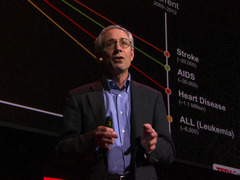 Thomas Insel: Toward a new understanding of mental illness
“These are just remarkable changes,” says Thomas Insel, Director of the National Institute of Mental Health, in today’s talk given at TEDxCaltech. “All of them boil down to understanding something about the disease that has allowed us to detect early and intervene early.”
Thomas Insel: Toward a new understanding of mental illness
“These are just remarkable changes,” says Thomas Insel, Director of the National Institute of Mental Health, in today’s talk given at TEDxCaltech. “All of them boil down to understanding something about the disease that has allowed us to detect early and intervene early.”
Sadly though, Insel says, the news isn’t good across the board. The rate of suicide, he says, has not changed at all over the last three decades. About 90% of suicides are related to mental illness. And while 1 in 5 people will be affected by a psychiatric disorder, scientists still understand dangerously little about these diseases. In fact, says Insel, we don’t even know what to call them. The terms preferred at the moment – “mental disorders” and “behavioral disorders” — are misleading, because they point to symptoms rather than to the disease itself.
“Both of those terms which have been in play for a century or more are actually now impediments to progress,” says Insel. “What we need conceptually here is to rethink these disorders as ‘brain disorders.’”
In this talk, Insel reveals why he believes we are about to turn a corner in understanding the brain, which he calls an “organ of surreal complexity.” As scientists get a better understanding of its workings and development, they’ll start to understand the patterns of brain disorders. It’s possible that, as with heart disease, scientists will be able to identify risk factors. To hear how this could lead to early detection of brain disorders — and even interventions before a person so much as experiences or displays symptoms — watch this fascinating talk.
“The good news stories in medicine are early detection and early intervention,” explains Insel. “If we waited until the heart attack, we would be sacrificing 1.1 million lives every year in this country to heart disease. That’s precisely what we do when we decide that everyone with one of these brain disorders has a ‘behavioral disorder’ – we wait until the behavior becomes manifest.”
Insel’s talk reminds us of two powerful TED playlists.
First it reminds us of the list “All Kinds of Minds,” which features several TED Talks from people who’ve had the experience of living with a brain disorder. It begins with legal scholar Elyn Saks describing her own experience of schizophrenia, moves on to activist autism activist Temple Grandin describing how her mind works, and builds to Joshua Walters, who is bipolar, asking: What’s the balance between medicating craziness away and riding its creative edge?
Insel’s talk also reminds us of the playlist “How does my brain work?,” which brings together talks about incredible research that’s helping scientists better understand our minds. It begins with neuroscientist Daniel Wolport giving a fascinating theory on why the brain evolved, moves on to Allan Jones and his initiative to map of the brain, and ends with Michael Merzenich giving evidence of the brain’s plasticity.
Also very worth checking out: Thomas Insel’s blog, where he just last week wrote about CLARITY, the newest way scientists at Stanford University are looking at the brain »
]]>How do we negotiate when to sell a stock, whether to rat out a partner in crime, how to play a poker hand, or what to ask for when negotiating a job offer? In each of these situations, the actions of others will greatly affect our outcomes — and yet, we have no idea what they are thinking. These are the kinds of situations that game theory has helped mathematicians and economists parse for decades.
In today’s talk, given at TEDxCalTech, behavioral economist Colin Camerer surveys new research that is taking game theory to the next level — by taking fMRI and EEG scans of people’s brains as they engage in bargaining games. The idea is to see what brain circuitry is used as people make decisions, and to map out what agreement and disagreement look like in the brains of humans … and in chimpanzees, who appear to be better at these negotiations than we are.
While the seeds of game theory were planted as early as Plato, the field gained prominence in the 1940s and 1950s, thanks to the work of John von Neumann (who wrote Theory of Games and Economic Behavior) and John Nash (of A Beautiful Mind fame). Since then, eight game theorists have won the Nobel Prize in Economics. To hear about new neuroscience approaches to this classic area of study, watch Camerer’s talk. And below, read some recent several articles about how game theory can apply to our everyday lives.
- What makes a person decide to donate a kidney? As Stanford economist Alvin Roth has shown, it is largely a question of game theory and market economics. According to the October 2012 Reuters story, “Alvin Roth Transformed Kidney Donation System,” in 2004, Roth created the New England Program for Kidney Exchange, a method that used computers — and an algorithm designed by UCLA mathematician Lloyd Shapley — to pair groups of donors and create the types of kidney donation chains depicted on Grey’s Anatomy. Before this system, says Reuters, there were just 19 kidney transplants from live donors in the United States. In 2011, that number rose to 443. In total, about 2000 people have received kidneys through Roth’s system. And in October of 2012, both Roth and Shapley were awarded the Nobel Prize in Economics for their work in taking “stable allocations” from an abstract concept to a reality.
. - Another real-life problem that Roth has tackled: in extremely large school systems, how can students be matched with the right school? In the Forbes magazine story, “What Al Roth Did to Win the Nobel Prize in Economics,” journalist Susan Adams takes a look at how Roth leveraged the tools of game theory to tame the high school matching system in New York City, where 80,000 8th graders must be dispersed to 700 schools every year. She writes, “Before Roth got involved, the matching system was so screwed up that a third of the city’s eighth graders didn’t even participate.”
. - In their book, It’s Not You, It’s the Dishes, journalists Paula Szuchman and Jenny Anderson wonder if the daily negotiations of marriage are more like playing a game of poker than most people realize. In the article “Marriage and the Art of Game Theory,” which ran on the Daily Beast in July of 2012, Szuchman writes, “Game theory is the study of how we make decisions in strategic situations. Classic examples: the Cuban missile crisis, soccer penalty kicks, and the first scene of The Dark Knight. When you find yourself debating whether to wait for the bus another minute or give up and walk, you’re facing a game-theory dilemma … To cooperate or not to cooperate? To budge or stand your ground? To say ‘OK, fine’ or ‘not a chance’? These are questions married people find themselves asking with surprising frequency.”
. - Could game theory explain why so much head-butting happens in the United States Congress, especially as they approached the fiscal cliff in late 2012? (Watch Adam Davidson’s talk explaining the fiscal cliff.) In The Atlantic op-ed “How Game Theory Explains Washington’s Horrible Gridlock,” Mohamed A. El-Erian applies the principles of game theory to Congress’ negotiation over the budget. He writes, “Here is the typical cycle: Responding to the ‘national call,’ the two parties’ initial narratives trend towards ‘grand bargains’ aimed at removing headwinds to growth, jobs, and prosperity. As differences prevail, this gets replaced by a ‘mini bargain,’ or one that would deliver some progress together with momentum for future success. As this also proves elusive, negotiations get quite acrimonious. If and when an 11th-hour compromise emerges, it lacks both content and momentum: The majority of meaningful decisions are postponed, and both Democrats and Republicans emerge from the experience more bitter — at each other, and also within their respective parties.” (Also see: “Game Theory Expert Analyzes Fiscal Cliff.”)
. - Of course, the economic standoff of late 2012 wasn’t fully resolved — it was in large part delayed, leading to the more recent “sequester.” In the article “The Strange Game Theory of the Sequester,” Pacific Standard writer David Dayen wonders if Barack Obama is using game theory tactics in moving forward on sharp budget cuts. He writes, “Making clear the impact of forced austerity may offer the best hope for discrediting and reversing it. When faced with closures of national parks, shutdowns of government offices, delays in needed services like the disposition of federal benefits, and long lines at the airport due to a reduction in TSA personnel and air traffic controllers, the thinking goes, perhaps Congress will get moving on a less painful solution.”
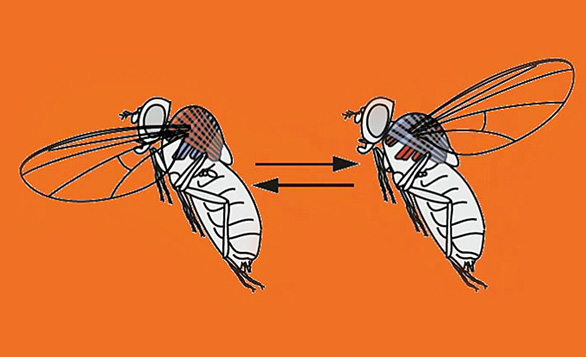 “Raise your hand if you think that basic research on fruit flies has anything to do with understanding mental illness in humans,” David Anderson begins today’s talk, given at TEDxCaltech.
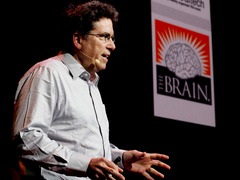 David Anderson: Your brain is more than a bag of chemicals
While few hands shoot in the air, Anderson goes on to explain the connection — that research conducted by manipulating brain chemicals in fruit flies is giving us valuable insight into the brain circuitry of emotions and mental illness. And these neural underpinnings are more complex than many think.
David Anderson: Your brain is more than a bag of chemicals
While few hands shoot in the air, Anderson goes on to explain the connection — that research conducted by manipulating brain chemicals in fruit flies is giving us valuable insight into the brain circuitry of emotions and mental illness. And these neural underpinnings are more complex than many think.
“We tend to believe — and the popular press aids and abets this view — that [psychiatric disorders] are a chemical imbalance in the brain,” says Anderson. “As if the brain were some kind of bag of chemical soup full of dopamine, serotonin and norepinephrine.”
The brain circuitry of mental disorders are complex, and yet the medications we’ve used to treat them for the past two decades work from a simple model — they treat every part of the brain as if it were the same. This is one of the big reasons that current psychiatric medications don’t work well, says Anderson, and why they have many unpleasant side effects that lead many to avoid them.
Explains Anderson, ”Using them to treat a complex psychiatric disorder is like trying to use engine oil by opening up the can and pouring it all over the engine block—some of it will dribble into the right place, but a lot of it will do more harm than good … What we need to do is use our ingenuity and our scientific knowledge to try to design a new generation of treatments that are targeted to specific neurons and specific regions of the brain that are affected in particular psychiatric disorders.”
Anderson’s lab approaches this challenge in an interesting way — by asking questions like, “How long will a fruit fly stay angry if we inhibit its dopamine system?” To hear how this all works, watch this fascinating talk — a must-see for anyone who has or knows someone with a mental disorder.
Fruit flies, otherwise known as Drosophila, are the workhorse of brain research. Here, a playlist of TED Talks about research with these amazing insects.
 Gero Miesenboeck: Re-engineering the brain
Gero Miesenboeck reengineers a brain Instead of mapping the brain by recording the activity of every neuron — a daunting task — Gero Miesenboeck works the other way around. At TEDGlobal 2010, he shares his reverse engineering approach, revealing how manipulating neurons leads to a clear understanding of what they do. |
 Michael Dickinson: How a fly flies
Michael Dickinson: How a fly flies From an engineering standpoint, it is incredible that fruit flies are able to lift off, given the size of their bodies and the delicate structure of their wings. In this talk from TEDxCaltech, Michael Dickinson shares the marvel — and how it is made possible by the fly’s nimble brain. |
 Eva Vertes: Meet the future of cancer research
Eva Vertes looks to the future of medicine At age 17, Eva Vertes discovered a compound that stopped the damage in a fruit fly’s nervous system, caused by heavy metals. Many think this could be a first step toward a treatment for Alzheimer’s. In this talk from TED2005, Vertes walks us through that research, and shares an exciting possibility — that cancer could potentially be used as a treatment. |
 Read Montague: What we're learning from 5,000 brains
Read Montague: What we’re learning from 5,000 brains Fruit flies and mice have long been the organisms we use to study the brain. At TEDGlobal 2012, Read Montague shares the tool — fMRI — which is allowing his lab to study thousands of human brains as they interact with each other. |
And some TEDx Talks to watch:
]]>