


We welcome new quilt trails across Arkansas and hope you will join Arkansas Quilt Trails! Read further to find out how.
Arkansas Quilt Trails was begun as a way of preserving local history while beautifying our communities for residents and visitors alike.
All quilt blocks should be painted on a wood or metal surface with good quality exterior paints. Patterns should be sent to the county coordinator who will get approval from the state committee. Once a county has twelve approved blocks installed, a signed owner agreement for each block, and a story submitted for each block, we will add the new trail to the Arkansas Quilt Trails website. We ask that block designs are sent to us for approval in advance of painting them as this helps prevent duplication of patterns. Of course, we will also review existing blocks and in most cases, will approve them for inclusion on the trail.
Stone, Searcy, Van Buren, Perry, Baxter, Washington, Logan, Pike, Izard, Independence, Jefferson, Franklin, Benton, Newton, Sharp, Crawford, Saline, Montgomery, Carroll, Pope, Little River, Boone, White, and Sebastian counties now have official trails, while trails are being developed in another 20+ counties. See list below.
If you are interested in starting a quilt trail in a county that is not listed below, contact
Arkansas Quilt Trails State Coordinator Renee Carr at 870-615-2195 or
Following are the names and phone numbers of volunteer County Quilt Trail Coordinators across the state of Arkansas. If you have a question about a particular quilt block location in their county or would like to add a quilt block to that county’s trail, please contact the appropriate county coordinator.
Arkansas County – Fara Foster (northern half of county) 870-673-7001; Beth Goodwin (southern half of county) 870-344-1723
Baxter County – Virginia Cornett, 870-421-5299, Karen Cornett, 870-421-5520
Benton County – Mechel Wall, 479-531-5950
Boone County – Connie Rogers, 870-577-5922
Carroll County – Star Lee, 870-654-9615
Clark County – Derek Franklin, 870-245-7258
Clay County – Shannon Williams, 870-598-7257
Cleburne County – seeking a coordinator
Conway County – Amy Marlar, 501-276-8185
Crawford County – Cathy Mason, 479-276-6183
Crittenden County – Sherry Lovelady, 901-359-4571
Drew County – Shannon Rodriguez, 870-367-8583
Faulkner County – seeking a coordinator
Franklin County – Lynda Evans, 479-209-2488
Hempstead County – Terrie James, 870-777-5771
Independence County – Jessica Hogue, 870-307-4440
Izard County – Pat Kilpatrick, 678-570-8314; John Biegel, 817-690-3190
Jefferson County – Sharon Price, 870-540-9572
Johnson County – Diann Lyons, 479-979-8382
Lincoln County – Cathy Edmonds, 870-818-5775
Little River County – Deanna Sivley, 903-748-1738
Logan County – Chris Walker, 479-518-7858
Madison County – Joy Noir Phillips, 479-957-4604
Marion County – Sue Studnar, 870-424-6168
Miller County – Maggie Harris, 870-818-1522
Mississippi County – Pam Pruett, 870-740-0986; Emily Ellis, 870-278-1755; Melinda Martin, 870-838-9101
Montgomery County – Kara Black, 870-867-2311
Newton County – Quinnell Land, 870-688-1389
Perry County – Trinity Neeley, 501-889-2554
Pike County – Marla Stewart, 870-223-3963, Jackie Beck, 870-828-8199
Polk County – Bridgett Martin, 479-216-3286
Pope County – Deanna Bohanan, 479-223-9411
Pulaski County – Anita Grisham, 501-628-7088
Saline County – Debbie Susky, 501-860-1155
Searcy County – Darryl Treat, 501-941-4828
Sebastian County – Judy Dedmon, 479-252-1265; Jennifer Cook, 479-430-3718
Sevier County – Gayla Irvan, 870-279-5219
Sharp County – Jessie Stauffer, 870-283-9470 or 870-219-0450
Stone County – Renee Carr, 870-615-2195
Van Buren County – Looking for a new coordinator!
Washington County – Rita Zelei, 479-422-6030
White County – seeking a new coordinator
White River Quilt Trail-viewable by boat, Karen Cornett, 870-421-5520 and Virginia Cornett, 870-421-5299
]]>Stone County is located in north central Arkansas in the Ozark Mountains. The county seat is Mountain View, “The Folk Music Capital of the World.” Please take a leisurely drive through our beautiful countryside and into Mountain View to see each quilt block in person. You’ll always find good food and music, people having fun, plenty of places to stay, and a hopping court square reminiscent of days gone by. Quilts and quilting have been a part of the culture here since the first settlers arrived. Every quilt has a story, bits of people’s lives, pieced and stitched into it. Likewise, each of our quilt blocks tells a story about the people and places that make Stone County special. Enjoy the stories shared here about each block. We welcome your comments at the bottom of the page!

6957 Luber Rd.
Mountain View AR
#1-01 – Bear Tracks is located at the Don & Carol Adams residence at 6957 Luber Road, Mountain View, Arkansas. Park in the yard and go through the gate to see the two blocks on the barn. The other two blocks are on the house. Bear Tracks is the first of four blocks painted by owners Don & Carol Adams. The Adamses had two quilt blocks hanging on this barn before the notion of a Stone County Quilt Trail was conceived, so theirs has the distinction of being first. Carol Adams shares the story of her quilt blocks: Quilts, for my family, have always been very special. They were essential to warmth in the winter and they brought us, our family and friends, together as in a social community. On Sunday afternoons, after a large country meal, at my Grandmother’s, we would unroll the quilt and frame from the bedroom ceiling. Our storage place, that for daily routines was out of the way, yet handy to unroll as the group gathered. Our group included three or four generations. There was always much discussion of family news and family histories to learn of. I remember, as a child, sitting beneath the quilt, threading needles for the quilters. I felt like I was in a cozy cave with all my special family surrounding me. The chatter of the conversations above me was very comforting. Now, I enjoy painting and showing my Barn Quilts. There are four on our property. Two are mounted on our old barn. The one pictured above is eight foot square and is called Bear Tracks. This design is over one hundred years old.

6957 Luber Rd.
Mountain Vew AR
#1-02, Pinwheel, is also at 6957 Luber Rd., Mountain View AR. This pattern was chosen because of the continual wind that blows on our mountain. Our quilts were always very traditional in pattern and fabrics used. We loved a quilt that had pieces of fabrics used in making our dresses. Looking for these special fabrics was truly a treasure hunt for us. Many memories came back from each fabric as it was discovered. One might say that our quilts were very utilitarian, and they were, but when snuggled under one or two of them on a very cold snowy night, they were beautiful, warm and cozy. All we could think of was the fuzzy warm memories of the love that was stitched into them. Blocks #1-01 and #1-02 have been up for more than a decade while blocks #1-03 and #1-04 were more recent additions when the Stone County Quilt Trail was developed.

6957 Luber Rd.
Mountain View AR
#1-03, Turkey Tracks is on the Adamses house at 6957 Luber Rd., Mountain View. They chose the pattern as it reminds them of the turkey calls they hear behind their house. Carol Adams shares, “I still quilt today, but with my modern sewing machine. Some are art quilts that are very colorful and beautiful with many, many, many fancy stitches. I love to see them mounted on walls to decorate our homes or on display at county and state fairs. When I think about it, none of them will ever be loved as much as one we can actually sleep under that was handmade with the many stitches of a needle threaded by the younger members and handed off to the generations of stitchers around the quilt.” We appreciate Carol sharing her family memories of quilting and the feelings she still has today when seeing those beloved quilts!

6957 Luber Rd.
Mountain View AR
#1-04, Basket in a Basket, concludes the four blocks found at Don and Carol Adams’ home at 6957 Luber Road, Mountain View AR. It is a well known pattern that Carol likes. It was added to their collection in 2016. Once the Stone County Quilt Trail began in 2016 with a small brochure to direct visitors, Carol was asked if she had seen many visitors to her blocks. She replied with a grin, “the first car I saw that came looking at our quilt blocks had California plates.” We chuckled over that and hoped the quilt trail would bring visitors from near and far. Our thanks go to Don and Carol Adams for being pioneers in the Arkansas Quilt Trails development. Their many years of traveling the country and looking at barn quilts inspired them to have their own. Now they are inspiration for others to paint the brightly colored blocks and preserve the history of quilting.

12585 Highway 9
Mountain View AR
#1-05 Front Porch Memories at 12585 Highway 9, Mountain View, AR is five miles south of the court square at Mountain View. The name was chosen to honor the Ozarks tradition of visiting with family and neighbors on the front porch. Many tales have been spun, family lore shared, and homemade pie enjoyed on front porches. The barn quilt was constructed and painted by Glenda Osten with later color modifications made when the barn was painted red. Jennifer King and family, from Cleveland County, bought this large farm in 2015 to satisfy her dad’s yearning for his own place in the mountains. As kids, Jennifer and her sister, Tammie, spent several road trips a year in the Ozarks. Her dad, James Via, has bought and sold real estate as well as been a contractor, building homes and apartment buildings since the 1960’s. The farm now has new owners but the barn quilt remains. Now for a little history about Sugar Hill…How did Sugar Hill get its name? Native Burlean Blackwell related a story she had been told that a Mr. & Mrs. Young who lived up Sugar Hill had seven daughters. When the girls reached dating age, the guys from Mountain View began dating them, and the young men dubbed the place “Sugar Hill.” There’s also a landmark up the gravel Sugar Hill Road. About one mile on the right is a rock bench. It has a sign that says “Sugar Hill Historical Resting Rock.” In the days before automobiles, residents from Sugar Hill walked to the general store out near the old Richwoods School House on Highway 9. It was a hard climb on the return, toting their provisions up the hill, and they needed a place to stop and rest. Sugar Hill is part of the West Richwoods community which was among the earliest settled, long before Stone County was formed.

101 E. Main St.
Mountain View AR
#1-06 Music Warms the Heart, is at 101 E. Main St., Mountain View AR. The quilt block is owned by Hannah Dyke and was originally painted on wood by Glenda Osten in 2014. In 2024 the block was redone on aluminum and painted by Philip and Renee Carr. Hannah chose this pattern as a tribute to early settlers. She shares: “The early settlers arriving in this area met many challenges. The one thing they had in common was the sound of music. Neighbors gathered in homes, barns, and outside for entertainment — singing and dancing their troubles away. This block is a tribute to their lives and determination to develop a better place for their families.” Indeed, folk music is the biggest draw for visitors to the area and is an endearing and enduring heritage that is being preserved. We appreciate Hannah’s tribute to our local music makers, both past and present!

624 Highway 9
Fox AR
#1-07 and #1-08, The Union and Confederate Star barn quilts hang on the barn of Philip and Renee Carr at 624 Highway 9, Fox, Arkansas, in the Rushing Community near the Stone/Van Buren County line. The confederate star is temporarily down and being replaced soon. Parking available on opposite side of highway. The barn was inherited from Renee’s parents, Rodney and Angalee Rushing. The two quilt blocks each feature a different star. The north-facing quilt square is the Union star, painted by Glenda Osten and the south-facing quilt square, painted by Philip Carr, is the Confederate star. The quilt blocks are a tribute to Rodney’s paternal great-grandparents who moved to Rushing in the early 1870’s. The Confederate Star is in memory of John Weaver Hinkle and his wife, Lucy Kenner Hinkle, who moved from Alabama and built the log cabin which still stands today, across the highway to the south and across the county line. Their eighth child, Dan, was born in the cabin in 1876. John Hinkle was a confederate soldier and fought in numerous battles including Murfreesboro and Chickamauga.

624 Highway 9
Fox AR
#1-08, Union Star, on the north side of the barn at 624 Highway 9 Fox AR is the Union Star. The blcok is in honor of Ephraim Owen Rushing and his wife Basha Elizabeth Holland Rushing. The Rushings were part of a of six-family wagon train that moved to Fox Mountain from southern Illinois in 1872. The other families were Harper, May, Branscum, Broyles, and Holland. Ephraim O. Rushing was a Union soldier and fought in the Siege of Vicksburg. Once the Rushing and Hinkle families moved to Arkansas, they lived just one mile apart. A Hinkle daughter and a Rushing son, Phillip Malanthy Rushing and Nioma Hinkle, married in 1888 and are Rodney’s grandparents. Rodney’s parents told him that the two families did not talk about the Civil War. Likely it was such a sensitive subject with the men fighting for opposing sides that they believed it best to move on and leave it in the past. The barn on which these quilt squares hang was built in the late 1940’s by Clarence and Winnie (Rushing) Hinesley with their young sons Carson and Wendell. Rodney and Wendell Hinesley narrated a story about their Hinkle great-grandparents that is found on YouTube.com/FoxArkansas or by searching “John & Lucy Hinkle Homestead.”

1032 Park Avenue
Mountain View AR
#1-09 Log Cabin quilt block. Located at 1032 Park Avenue, Mountain View, Arkansas at the Ozark Folk Center State Park. It’s on the General Store building in the large parking lot of the park. This barn quilt depicts a log cabin quilt block, a quilt pattern that became popular after the American Civil War as sewing machines became common. This block is simple to piece, preserves fabric from old clothing, creates a practical item, and provides unlimited design possibilities. In the Ozarks, the log cabin quilt blocks often featured a red square in the center, representing the heart and hearth. The heart square in the center of this barn quilt block holds the logo of the Ozark Folk Center State Park, and the young people of past and future. The fabric of each piece of the log cabin block was painted by a dedicated group of volunteer artisans. The design grew organically from the basic pattern of the log cabin block to show every aspect of the park. Look carefully and see crafts, music, herbs, gardens, instruments, artistry and elegance, painted by hand, in a complete picture of a log cabin barn quilt block. The Ozark Folk Center State Park is like the log cabin block, a simple place of buildings created to showcase the heritage of the Ozark people. Like the log cabin quilt block, this park has taken that design and grown into a community that allows creativity in craftsmanship and music to flourish. Many hands worked to make this block, including Troy Odom, printer; Dona Sawyer, glass artisan; Tom Wier, knife maker; Rachel Mathews, copper flame painter; Jennifer Whitman, fiber artist; Bob Nichols, carpenter; Linda Odom, apothecarist; Melody Conatser, basket weaver; Summer Woodsong, wood carver; Robin Woodsong, wood carver; Judi Munn, potter; Dick Augustine, engineer; Danny Shepherd, jack of all trades; Donna Nichols, design artist; Sandy Gonzales, artist; Ray Stafford, teamster; Janice Clark, leather worker; Jeanette Larson, shepherd; and John Morrow, Superintendent, Ozark Folk Center State Park. The mission of the Ozark Folk Center State Park is to perpetuate, present and promote the Ozark way of life in an educational and enjoyable manner through craft demonstrations, musical programs, the Heritage Herb Garden, workshops, and other special events.

1056 South Riverview Lane
Mountain View AR
#1-10 McEntire Family Block, at 1056 South Riverview Lane, Mountain View, is located in a neighborhood near the Sylamore bridge. It’s actually in Izard County, but due to close proximity became part of the Stone County Quilt Trail. Now that Izard County also has a trail, you’ll find it listed there as well. It was painted by Jay and Margaret McEntire and placed on their home which sits next to the beautiful White River. Easy paved entry and exit from the residence to view it. The two flags represent this family’s U. S. Patriotism and is a tribute through our SAR and DAR memberships and to our family ancestors that served as patriot soldiers in the American Revolution.The trees and paw prints symbolize our commitment to preserving natural places and to protecting the environment. This also includes restoring historic buildings and planting trees and native grasses, on over 400 acres…and counting! (Side note: Jay is the only person in the world that has been given permission by the Brazilian government to pull logs out of the Amazon River and it’s tributaries. We did this for many years. He was a board member of the Rainforest Preservation Association that, to date, has saved over 8 million acres of land. This group was led by Don Davis, a Brazilian missionary for most of his life.)

1104 Sylamore Rd.
Mountain View AR
#1-11 Arkansas Crossroads. The Arkansas Crossroads Block was first printed in the Kansas City Star in 1941. Former owner Betty Woods shares: I chose this block for the Dulcimer Shoppe because of our location in Mountain View. You turn north at the crossroads of Highways 5, 9 & 14 to find us. The Dulcimer Shoppe was founded by Lynn & Mary McSpadden along with Lynn’s brother Larry in 1962. At that time they were living in Forrest City, Arkansas. They moved the production to Mountain View in 1972 and built a larger building in 1975 which is the current location. We have manufactured over 63,500 mountain dulcimers and have approximately 120 dealers in the United States and overseas. Jim & Betty Woods purchased the Dulcimer Shoppe in January 2001 after moving to Arkansas from Texas. They retired in 2020 and the current owner, Tim Grothen, is keeping the dulcimer tradition alive. Mountain View is home to the Ozark Folk Center, Folk Festival in April, Bean Festival and Outhouse Races in October as well as wonderful music shows year around. There is always music on the square.

2829 Highway 87
Mountain View AR
#1-12 Swirling Leaves at 2829 Highway 87, Mountain View, Arkansas is on the residence of Donna & Bob Nichols. Located 4 miles from Mountain View’s City Hall. The residence has a nice semi-circle drive for easy entry and exit from Highway 87. Donna’s mother, Karen Walk, painted this block as a Christmas gift a few years back. Karen is a former Stone County resident who now lives in Wichita County, Kansas. Donna estimates that her mother has painted about 150 barn quilts over the years. She’s obviously a key contributor to that county’s claim to fame as the Barn Quilt Capital of Kansas. The Swirling Leaves quilt block has special meaning to Donna since it is a reminder of her mom’s creativity and work ethic. Karen selected the pattern for Donna because of the beautiful hardwood trees in Stone County.

6271 Hwy 9
Mountain View AR
#1-13, Bread Basket, at 6271 Highway 9, Mountain View AR is found in the Turkey Creek community, about 12 miles south of Mountain View. A few years ago, the Kennon family purchased the farm from Viola Schlabach who had lived and worked there with her husband, Earl, for 40 years. They raised their 4 children in the rock and cedar shake home they built together as a family. The Kennons are honored to be able to continue the small farm tradition by raising livestock on the farm again. The four baskets symbolize the two families’ four children. Austin Kennon is the Agriculture Science teacher at Mountain View School and Amber works on the farm and home-schools their four children. Both are passionate about teaching and encouraging young people. They enjoy working with the FFA and 4-H kids in the community. The Kennon children are active members of Stone County 4-H and enjoy raising, training and showing livestock, as well as gardening and community service projects with their 4-H Club. When looking for a pattern for their block, Amber came across the bread basket and knew that this was “the one.” Mrs. Viola was always gifting her delicious, made from scratch, cinnamon rolls and bread. She and Earl were well known in the community for their kindness and service to others. Amber said, “I was so blessed to have childhood memories of them both, and to again get acquainted with Mrs. Viola and her family during the process of buying the farm. Mrs. Viola has moved to Virginia to be closer to many of her children, grandchildren and great grandchildren but I wanted our block to honor her and the time that she and her family spent in this community.”

206 School Ave.
Mountain View, AR
#1-14, Crazy Quilt, is at 206 School Ave., Mountain View, AR. The Crazy Quilt pattern reached the peak of its popularity from 1890-1910. Local artist Kay Thomas designed this pattern to be representative of crazy quilts of the area, some of which are on display inside the building in the Stone County Museum. The technique involves using scraps to piece blocks, then embellishing to show off embroidery skills. It was a way to turn leftovers into masterpieces. Crazy quilts often made use of woolens and silks and were tacked, without batting, instead of quilted. Kay is an avid quilter and designed the quilt display at the Stone County Museum as well as a pictorial quilt calendar featuring quilts in the museum and around Stone County. The process of making the quilt block starting with Kay sketching and coloring it on paper, then transferring the line drawing to the board which was set up on saw horses in the auditorium of the building. Kay taped off the sections and we had a painting party with Young Single Adults from the Searcy Stake of The Church of Jesus Christ of Latter-day Saints painting the large sections. Kay came back, adding a few artistic embellishments at a time over a several day period until arriving at the final creation. The 6’x6′ quilt block was installed by Philip Carr and John Thomas on May 2, 2017. Inside, the Stone County Museum has a collection of about 12 quilts on display. One of the crazy quilts was donated by Edwin Luther. It belonged to his grandmother, Dessie Jones, who married Dr. J.E. Luther. Family tradition says it was a wedding gift from the Wolf family of Norfork. The museum houses Stone County artifacts dating from the late 1800’s to 1940’s. The Freda & Loy Massey Research Room contains many family histories in binders as well as other local research materials. The museum and research room are open to the public at no charge from mid-April to mid-October on Thursday, Friday, and Saturday from 1:00pm-4:00pm. The Edwin Luther Auditorium is available for rentals and hosts the quarterly Stone County Historical Society meetings and other programs. The Historical Society publishes Heritage of Stone twice a year which is provided at no additional charge to members from their $20 annual dues. Copies may be purchased by the public at the museum or at the Stone County Leader on the court square. To become a member of the society, mail dues to PO Box 210, Mountain View, AR 72560.

162 N. Peabody Ave.
Mountain View, AR
#1-15, Country Patriotic Flag, at 162 N. Peabody Ave is inside the courthouse grounds. It was chosen to honor the many men and women of Stone County who have served in the U.S. military. Names of those who gave the ultimate sacrifice of their life are inscribed on the memorial in front of the courthouse facing Main Street. The quilt block hangs on the stone building housing the Stone County Veterans Affairs Office. Men and women from the Stone County Honor Guard spend many hours volunteering their time at funerals, parades, and programs throughout the year. The Stone County Veterans Affairs Office is open on Tuesday and Wednesday from 8am to 4:30pm and on Thursdays from 8am to noon. Malcolm Sumrall is the Veterans Services Officer and welcomes veterans to contact him at 870-269-4277. The building on which this quilt block hangs was formerly the county jail. Interior walls have inscriptions from former prisoners who wished they were elsewhere. This quilt block had many hands working on it. Philip Carr sketched the pattern onto the board. Young Single Adults from the Searcy Stake of The Church of Jesus Christ of Latter-day Saints painted it on Saturday, April 22, 2017. John Thomas added the border a few days later. The block was installed by Philip Carr on May 2, 2017.

5002 Hwy 9
Mountain View AR
#1-16, Schoolhouse, is at 5002 Highway 9, Mountain View AR. It’s about 13 miles south of Mountain View. The Schoolhouse pattern was chosen to honor the history of this one-room school that was built in 1925 and educated many students over its 22-year existence as a school. It was later used as a church, community center, and polling site. Today it is only used for special programs and an occasional wedding. The Schoolhouse block was the sixteenth block added to the Stone County Trail, a case of serendipity. The number 16 has historical significance to public schools in our nation’s early days when the sixteenth section of land was reserved for public schools. The Turkey Creek School is owned by the nonprofit organization Rural Educational Heritage Inc. In 2016, volunteers from the organization put a new roof on the building which had served it for 92 years. They also scraped off old paint, and added a fresh coat of white stain to the exterior. It sparkles again and, hopefully, is good for another 90 years! Mrs. Elsie Compton was one of the teachers at Turkey Creek. At age 101, she and some of her former students were filmed at the Turkey Creek School, talking about their school day memories. Watch the video on the FoxArkansas Youtube channel at https://youtu.be/mI9y3WqOyOk. Mrs. Compton provided another interview at age 100 in which she talked about teaching in one-room schools. https://youtu.be/ful0-Ub2fhM. A youth band performed folk music on the steps at an event in 2013. https://youtu.be/AU55-dgbV0A.In 1924 Altha Hinesley (Green) taught a summer term in the George Green house and was supposed to finish the school year after harvest in the new building. However the building was not completed until the first of the year in 1925. As a result the first classes in the new building were begun in the winter time with a little “sheet iron” stove in which they burned tie “juggles” for wood. Water was carried from a spring. A well was dug later. Grades one through eight were taught. This was typical of the one-room schools. Mrs. Green reported that she had some nice big charts for teaching the “ABC Class.” The blackboard that is in the building now was that one that was originally used. Ruby Morris Berry told of Mr. Robert Hawkins building desks and seats for the school out under the shade trees while school was in progress. Coleman Morris also remembered that George Green and Robert Hawkins were hired to build the school house. Jeff Morris cut wood for the fire and would deliver it on Fridays so he could hear his children’s recitations. Boys sat on the left side of the one-room school and used the door on the left side of the building. The boys’ outhouse was in the edge of the woods on the left side. Girls sat on the right side of the building and used the door on the right side of the building. Their outhouse was located on the right side of the grounds. As a student left the school room for the outhouse, they laid their book in the door way so other students would know to wait their turn. Some of the directors of the Turkey Creek School were: Sam Duncan, Luther Green, Harrison Berry, Jeff Morris, Logan Berry, Malone Morris, Coleman Morris, and Leland Branscum. After World War II, bus transportation became available in the area and Rural Special School with grades 1-12 was built to accommodate students from a wider area. In 1947 the Turkey Creek School consolidated into Rural Special School, located about four miles away. The Schoolhouse Quilt Block was sketched by Philip Carr and painted by Young Single Adults from the Searcy Arkansas Stake of The Church of Jesus Christ of Latter-day Saints.

106 E. Washington
Mountain View, AR
#1-17, Dresden Plate is located at 106 E. Washington on The Meeting Place building at the parking lot of the Wildflower Bed & Breakfast, NE corner of Court Square in Mountain View. The dresden plate pattern was introduced in the 1920’s and quilts of this design provided a splash of color during the Great Depression in the 1930’s. The pattern is alternately known as Friendship Ring, Aster, Dahlia, and Sunflower. Chris and Shelley Smith are the owners of the Wildflower Bed & Breakfast, a 100-year old structure originally known as The Commercial Hotel. The Smiths built the Meeting Place at Mountain View on the back lot of the B&B to provide a place for friends to gather for showers, parties, contra dances, musicals, etc. An old-fashioned quilting bee would also work nicely in the spot. The Smiths are transplants to Mountain View and are wholeheartedly contributing to the preservation of folk music, beautiful spaces and their historic building. The Dresden Plate quilt block was constructed and painted by Barn Quilt Artist Glenda Osten co-creator of the Stone County Quilt Trail.

219 S. Peabody St.
Mountain View AR
#1-18, Ozark Country Inn block is at 219 S. Peabody St in Mountain View, within sight of the historic courtsquare. This original quilt block design is named for the historic home it adorns which now serves as a Bed & Breakfast called Ozark Country Inn. It is a tribute to the long history of families who have lived and loved God and country. The builder and owner of this 1906 home, Hamilton S Mabry Sr., also owned a stave mill (sawmill) in Mountain View. He helped to form the Farmer’s Bank around 1914 and served as President and Winfred Rosa as cashier. Later the bank was changed to the Bank of Mountain View. He and his wife Hallie had six children. It has been said that in all of the county Mabry had the most kin serving in the military, 14 in all. One of his sons, Tom died in WWII. Hamilton S Mabry Sr. also served as county judge from 1927-1928. His son Hamilton S Mabry Jr. was a Navy Seabee and was wounded in Okinawa in WWII. He managed a sawmill and became V.P. of the bank. He married Myrtle and they had a daughter Betty Anne. Nathaniel Coleman Maxey and his wife, Seddie Franks, had 2 daughters, Faye Nellie and Maye Lola, and lived in the home. He was a family practice doctor and delivered many of the children in Stone County. One lady who lives in Mountain View said her daddy paid Dr. Maxey a chicken for delivering her. Dr. Maxey came from a long line of physicians, he being the 4th generation. He is buried in Flatwoods Cemetery and his family still lives in Stone County. Former owners, Leonard and Debbie Jadrich, created the block as well as a motto for the inn: “making friends and memories”. Past and present owners have been leaders and servants in the community, attended church, believers in God, served our country and continue the hospitality to all who come to the Ozark Country Inn. The Inn is now owned by Chris and Krissa Smith and he continues the tradition that visitors will have a B & B experience even better than their own home.

16262 AR-263
Fox AR
#1-19, the Unfolding Star, hangs on the Fox Community Center at 16262 AR-263, Fox, AR 72051. Painted by Philip Carr with embellishments chosen by Renee Carr, it’s a tribute to Fox musicians, local veterans, and long marriages. It’s sponsored by Rural Educational Heritage Inc. The center of the block features a fox paw print to recognize the name of the town, established officially in 1905 when the post office became known as Fox. This also became the name of the unincorporated community. The golden wedding bands at each corner represent the “Golden Wedding Wall” inside the community center that has over 100 photos of couples who’ve reached the 50-year anniversary milestone. The white stars on blue background represent the 240 veterans from the Fox area who are pictured and surround three walls of the community center, honoring the contributions of our U.S. veterans. The musical instruments painted on the block: guitar, mandolin, banjo, and fiddle are a tribute to the homegrown folk musical talent which has come from this mountain community over the last century and has influenced many beyond Fox Mountain. The Scotch-Irish influence from the early settlers who came from the southern U.S. is found in the Ozark Mountain folk music. Floyd Holland, born 1891, was a self-taught banjo picker. He lived to be 95 and was an early banjo player and singer at the Ozark Folk Center and performed at the first Arkansas Folk Festival in 1963 at the music event in the high school gym. Today the banjo tradition is kept alive on Fox Mountain by the talented Darrell Barnett. Though his roots are in Shirley, he had the good fortune to marry Carla Kocher Barnett, a great-granddaughter of Fate Morrison who also made his musical mark on the community. Brothers David Jackson Lafayette “Fate” Morrison (b. 1905) and William “Willie” Morrison (b. 1907) descended from early settlers in the Meadowcreek valley and Fox. The fiddle playing brothers helped preserve the folk music heritage of Stone County. At this link you can listen to their old-time fiddling with guitarist Seth Mize playing Wednesday Night Waltz. https://www.slippery-hill.com/recording/wednesday-night-waltz-0 Throughout the 1960’s and early 1970’s, the three joined with Timbo neighbor Jimmy Driftwood playing for audiences all across the country, bringing an awareness of folk music and Stone County that would help pave the way for the Ozark Folk Center to launch in 1973. A folk music band from Fox performed at the 1972 inauguration of Richard M. Nixon. Willie and Fate Morrison played fiddle, Otis Johnson played guitar, Harlie Dampf played banjo and Willie’s son, Glenn, played mandolin. Glenn chuckles at the memory of this group of mostly Democrats playing at the inauguration of a Republican president. It was customary over the years for Fox community members to socialize by attending “Play Parties.” A couple would host the gathering at their home, and visitors came with their musical instruments. The jam session would last for hours. Lonnie Lee (b. 1926) and his wife, Neda (b. 1928) made their home in Lonnie’s native Fox after their marriage in 1945. He was a logger and sawyer. Local performer Dave Smith credits the Lee’s hospitality with their Saturday night musicals for providing the setting where he could learn to play the old-time folk instruments and learn songs when he moved here as a 20-year old in the 1970’s from northern Illinois. Lonnie played the guitar and was happy to teach others. Dave Smith was an attentive student and became a talented musician, playing guitar, fiddle, mandolin, banjo, and accordion. He is a guest performer and sometimes Master of Ceremonies at the Ozark Folk Center. Over thirty years ago Dave and his friends, Robert & Mary Gillihan, formed a band called Harmony that is still performing. True to their name, their vocals are harmoniously beautiful. Perhaps Dave’s most important contribution is sustaining the Ozark Mountains folk music by teaching Rural Special School students to play folk instruments through the Music Roots program. Dave is also the host of the weekly Ozark Highlands Radio show which broadcasts folk music programs throughout the world. Listen to an August 2018 interview of Dave Smith http://www.hppr.org/post/interview-dave-smith-ozark-highlands-radio. Jeff Glover of Fox is the producer of the Ozark Highlands radio show. He has his own musical talents, playing a muted trumpet and performing on occasion with his children Fox and Rori. They play favorites from the 1920’s-1950’s era, and their tight harmonies really take you back in time for an enjoyable experience. There are also bagpipers on Fox Mountain. Glenn Morrison, son of the aforementioned Willie Morrison and Laura Cummings Morrison, learned how to play bagpipes after his retirement from teaching school. Another bagpiper, Cindy Chiodini, moved to Fox Mountain in 2000 and learned to play the bagpipes. She is a volunteer with the Stone County Honor Guard and performs at countless parades, events, and for funerals of veterans. The Fox Mountain Bluegrass Band played and sang for almost two decades with members including brothers Bill and Corbet Bonds, Scott Branscum, Benny & Kathy Morrison Kocher, their daughter Carla Kocher Barnett with Carla’s banjo playing husband, Darrell Barnett. Occasionally they are joined by singer Bethany Barnett. Otis & Patsy Stevens of Alco were with the group in the early days. Finally, gospel music has had a strong presence and influence around the Fox community. From the 1930’s through 1970’s many residents, both youth and adults, attended singing schools and learned to recognize and sing shaped notes. With nine churches on the mountain, a wide-variety of songs and music can be enjoyed today from acapella style to quartets, choirs, soloists, bands, piano, and even one saxophone-playing pastor. You might hear I’ll Fly Away or Just a Little Talk with Jesus mixed in with some more contemporary gospel songs at Sunday morning worship service.

116 Howard Ave.
Mountain View AR
#1-20, Sunbonnet Sue hangs on Aunt Minnie’s Yellow House, at the NW corner of the Stone County Court Square, 116 Howard Avenue in Mountain View. It is a 4’x4′, painted by Glenda Osten. Proprietor Jana Wickham, owns and operates Aunt Minnie’s Yellow House but it is a three generation undertaking with her son and her mom, Pat Cash, a.k.a Aunt Minnie playing key roles. Jana’s family on both her mom’s and dad’s side have very deep roots in the town of Mountain View and Jana enjoys keeping tabs on all that through genealogical research and recording family history. Aunt Minnie’s Yellow House has become an iconic fixture anchoring the northwest corner of the square. It’s yard is a haven for pickers and grinners and this Sunbonnet Sue is ready to jam with her fiddle. There is a lot to write about Sue – she’s been around for quite some time. Quilt blocks of Miss Sunbonnet began showing up as early as the 1800s, but popularity with crafters only began to grow after the publication of the Sunbonnet Babies Primers in the early 20th century. Bertha Corbelt and Eulalie Osgood Grover (what a name!) teamed up to teach children how to read through illustrated anecdotes about Sunbonnet Sue, Fisherman Fred and Suspender Sam. Teachers, parents and children fell in love with Sunbonnet & Co. due to her sweet temperament, wholesome vignettes of everyday life and that adorable ever-present bonnet. In a nutshell, Sue was the 20th century Elsa. Sunbonnet Sue has definitely had staying power! Aunt Minnie’s Yellow House gift shop is a destination in itself, carrying kitchenware, splatterware, clothing, jewelry, t-shirt screen printing, monogramming, and the list goes on. Take a look at AuntMinniesYellowHouse.net.

13731 Hwy 263
Fox AR
#1-21, The Berry-Morris Star, located at 13731 Highway 263, Fox, AR, was made in honor of the Berry and Morris families. In the early 1900’s two families homesteaded neighboring farms on Turkey Creek in southwest Stone County on what today is called the Coleman Morris Road. Logan and Goldie (McMullin) Berry had twelve children who helped milk and care for their dairy cows and farm. Jeff and Gertie (May) Morris had eleven children who helped in their Dad’s mercantile store as well as gardening and farming. It was inevitable that a romance would develop between some of the neighbor children as they grew up. As Ruby Morris Berry liked to relate, “Aubrey jumped the rock fence between our farms and came calling!” Aubrey and Ruby married in 1938 and soon began their own family that would grow to eleven children. The names of the Berry and Morris couples are painted in the center yellow star of the quilt block as anchors of the family. The names of Logan and Goldie Berry’s children are painted in the twelve outer points of the navy star, starting with the eldest, Olvie (Finch), at center right and going clockwise around the star in birth order with Aubrey (Berry), Oval (Chambers), Albert (Berry), Silas (Berry), Edith (Johnson), Thomas (Berry), Wilma (Holland), Evelyn (Johnson), Lila Belle (Sutterfield), Jimmy (Berry), and Marie (Barnum). The names of Jeff and Gertrude “Gertie” Morris’ children are painted on the inside of the navy star starting with the eldest, Malone (Morris) at center right and going clockwise by birth order with Ola (Finch), Celia (Ivy), Retha (Hastings), Elsie (Compton), Coleman (Morris), Edith (Johnston), Genevieve (Copeland), Ruby (Berry), Cleo (Morris), and Loyce (Ackerman). Aubrey, born 1914, was industrious and found ways to involve his growing family in making a living while Ruby stayed busy caring for the children, cooking, and sewing their clothes. Aubrey began working in the timber for Eppes Mabry of Mountain View and after a few years began buying his own tracts of timber to harvest, moving his family to Roodhouse, Greene County, Illinois for several years while he worked there. He always moved his sawmill to the worksite. Turkey Creek drew them back home where they farmed and Aubrey continued in the timber until another kind of harvest called them to east Arkansas where they began working in the cotton fields around Blytheville. Aubrey and Ruby sharecropped and the girls picked cotton and were fast pickers! Turkey Creek called them back just in time for their eldest daughter, Angalee, to finish school at Rural Special School where all eleven children would attend. By this time Aubrey and Ruby had moved to a house across from the school near Fox. More work opportunities would call them away. They loaded up the family and headed north to Michigan to work in the cherry harvest in 1951. They made a stop at Michigan Blueberry Growers Warehouse where, because of their young children, they were told, “You need to be picking blueberries!” They arrived at the Kiel Blueberry Farm where the owner looked inside the car and seeing the carload of children said, “Lord-a-mercy!“ He hired them on the spot. That started a tradition that lasted 20 summers, from 1951 to 1970 as the Berry family made the trek north to Grand Haven, Michigan each June where Aubrey worked as a field boss for the Kiel’s and continued after the Reenders family bought the blueberry operation. He and Ruby and all eleven children picked blueberries until it was time to return home for school each fall. The kids were especially good pickers and liked to compete with one another on production. The names of Ruby and Aubrey’s children are painted on the inside of the outer diamonds of the quilt block, starting with the eldest Angalee (Rushing) at top right, and going clockwise in birth order: Gearldee (Dodd), Shirley (Sutterfield), Dayle (Bonds), Gayle (Morrison), Janice (Miller), Deloris (Brewer), Faye (Rushing), Jay (Berry), Randy (Berry), Marty (Berry). Their spouses’ names also appear in the diamond along with their children’s name at the outer tip of the diamond. This completes a four-generation chart for the family. The quilt block is an especially fitting tribute since Ruby hand-pieced and quilted many quilts over her lifetime. She made quilts for 32 grandchildren upon their graduation from high school. Spending 20 summers in Michigan would inevitably lead to another romance as the Berry children grew up. That’s what happened when Jay Berry married Judy Reenders and persuaded her to move to his home in Fox, Arkansas. They brought along with them experience in growing blueberries and were among the earliest growers in Stone County. Their four children Brian, Adam, Tonya, and Brittany were all involved in the family operation. The quilt block was designed by Renee Rushing Carr, a granddaughter of Aubrey and Ruby Berry, who is an avid genealogist. The block was painted by her husband, Philip Carr, with names added by Renee. The artistic elements of cotton boll, blueberry cluster, saw, and logging truck in each corner were painted by Scott Miller, a grandson of Aubrey and Ruby, to represent the family’s work ethic. The quilt block is located in the yard of Jay and Judy Berry where antique machines are also on display including an antique road grader that was used to improve the road (now Highway 14) between Mountain View and Batesville in 1924, a Fordson tractor, a two-bottom horse drawn plough, and a horse drawn two-row planter. They ask that visitors pull into the driveway to view the block and to turn around on the grass before leaving since backing out on the highway can be dangerous.

201 W. Main St.
Mountain View AR
#1-22, Pinwheel Star and #1-23, Diamond in the Squares are located at 201 W. Main Street, Mountain View AR. They can be found on the old blacksmithing forge behind the Urban Forge retail store in beautiful downtown Mountain View. The name Stone County Ironworks has been around for decades, but the unique art of blacksmithing has been around for hundreds of years. The pair of quilt blocks on the side of our Old Forge represent the old and new. The darker quilt square represents the history of the unique craft of blacksmithing and the new with brighter colors represent what our craftsman do today. Our blacksmith artisans craft our products using tools and techniques that are over 100 years old. Our oldest tools were made in 1844, but the hammer, the anvil, and fire are still essentials of the trade. As for the new, our artisan blacksmiths are constantly coming up with new techniques for the new modern approaches and designs. After viewing our Old Forge outside, step inside our retail store for a glimpse of modern blacksmithing creations made a couple miles down the road in Mountain View, Arkansas. Hours are 10AM – 6PM Tuesday-Saturday. Learn more at https://urbanforge.com/.

201 W. Main St.
Mountain View AR
Today the Mountain View Iris Festival Committee maintains the lot where quilt blocks #1-22 and #1-23 are located. They brought the decorative fish pond back to life, planted irises and landscaped, and added two beautiful quilt blocks. The 2′ x 2′ blocks were painted by Iris Committee Member Kay Thompson who is a quilter and painter. Committee members planted irises around the historic court square and along city streets for visitors and residents to enjoy in the springtime and during festival. The Mountain View Iris Festival is hosted each year on the first weekend in May. Learn more about Iris activities at https://mountainviewirisfest.com/. The committee accepts donations and memorials to fund the festival and beautification efforts.

102 E. Main St.
Mountain View AR
#1-24, The Tipi block is at 102 E. Main St., Mountain View AR. It is located on a historic building next to the court square. The pattern is painted onto metal and hangs on the alley side of the building. It’s visible from Main Street, but you can best view it by pulling into the alley way street. Wikipedia tells us the building is listed on the National Historic Register. The Farmers and Merchants Bank is a historic commercial building name for its original occupant. It is a two-story stone structure, with a flat roof obscured by a parapet. Built out of rusticated stone, it has vernacular Romanesque styling in its rounded window and door openings on the first floor, and its crenellations at the top of the parapet. It was built in 1910, during the city’s first major period of stone construction, by Bill Laroe, who also built the Stone County Courthouse. Quilt block owner Virginia Ivy shares the story behind the block selection. From pre-recorded history to today, it is the creeks and rivers that drew people to Stone county and kept us here. These waterways were the first superhighways through the rough Ozark terrain. Our quilt (and others that have been commissioned forthcoming) were created by Steve Mollenkof to reflect our passion for being on the water and to remind us to go with the flow. Along south Sylamore Creek, you can rent an authentic tipi on sublime private property in a ‘holler.’ You had better be a brave driver with a big truck ; it’s an adventure to find this secret spot. Don’t feel like off-road prowling? You can rent the upstairs recently built loft of the historic building that has been described as the “best of SOHO chic blended with the finest southern authenticity.” Ivy Vacations LLC 870.292.6936
#1-25, We are sorry, but this block has moved out of state with its owner.

802 E. Main St.
Mountain View AR
#1-26, Stone Quilters is named in honor of Stone County quilters, past and present, who’ve made quilts and kept the quilting tradition alive. It’s located at the Stone Bank pavilion, behind the bank, on Heritage Drive. Local quilters are quilting into their 80’s, 90’s, even 100’s. Elsie Morris Compton of Turkey Creek lived to be 102 and quilted most days during her retirement years, sometimes singing as she quilted. Her sister, Retha Morris Hastings, made quilts that she shipped to almost every state in the country. Another sister, Ruby Morris Berry, made quilts for family members including 32 grandchildren as they graduated high school. Her daughters continue the quilting tradition. Lois Dodson worked as quilter at the Ozark Folk Center into her 90’s. Over her lifetime she had made and sold over 700 quilts! Blanche Richardson was a skilled quilter who also spent years in the quilt shop at Ozark Folk Center. A transplant from the Florida Keys from over four decades ago, Susan Jewell kept the tradition alive at the OFC. She enjoyed the monthly quilting at Shady Lawn Mennonite Church on Highway 5 South on the first Thursday of the month. It was there that Esther Mast helped Susan learn to quilt. Nancy Snyder of St. James is also a talented quilter at the OFC quilt shop. Neva Foll was well known for her quilting as was Ortha Younger of Pleasant Grove. Genevieve Dawson. Lula Hudspeth, Judy Johnson, and Katie Lockhart are names synonymous with quilting. Waneda Bontrager and Edna Mast from the Happy Hollow area are prodigious quilters. Linda Siebert Havner was a quilt shop owner and quilter in Mountain View several years ago and has a shop in Calico Rock at present. Daphne Higginbotham and Renee Riggan quilted and operated quilt shops in more recent years. Carla Smith from the Sunnyland community is a talented quilter, and Jan Hickman adds her artistry to quilting. Betty Woods brought her love of quilting with her from Texas and after retiring from co-owning and operating the Dulcimer Shop, she now has more time to spend quilting. Kay Thomas’s love of quilts and quilting is evidenced by a quilt display she created at the Stone County Museum that includes 12 beautiful antique quilts. She quilts her own creations today. Anna Brewer parlayed her experience at the Blanchard Shirt Factory into a machine quilting business that was a resource to residents and visitors over the years. The Crazy Quilters group has historically met on the 1st Saturday of the month at the First United Methodist Church in Mountain View. If there are other Stone County quilters who should be recognized or remembered, please make a comment on this page, so their names can be added. The Stone County Quilters block is painted in the gold and green colors of Stone Bank. It was painted by Philip and Renee Carr. Stone Bank hosts the Veteran spotlight program that each month honors a veteran residing in the county and then a celebration for all Veterans in advance of Veterans Day in the fall. The bank is also a sponsor of the Arkansas Craft School as well as Ozark Highlands Radio which originates from Mountain View at the Ozark Folk Center.

9396 Highway 5
Mountain View AR
#1-27, Iris Crossroads: Memories of Grandmother’s Garden, is an iris-and-butterfly theme quilt square found at 9396 Highway 5, Mountain View. It welcomes Stone County travelers approaching Mountain View’s southern city limit. Look for it on the right, less than a half mile after crossing the Highway 5 Purple Heart Bridge over Raccoon Creek. Quilt block designer/owner Kay Adkins explained, “The inspiration for the iris design came from favorite childhood memories of traditional Easter and Mother’s Day family gatherings at my Grandparent’s home in Dallas, Texas. “My Grandmother’s favorite hobby was tending to her irises and rose bushes, and maintaining her lawn—which she enjoyed doing herself well into her late 80’s.” Simmons’ family Easter celebrations created many special memories. Kay said, “I remember being required to stay dressed up in our Easter best until the whole Simmons ‘clan’ had arrived at Grandma’s. We grandkids were nagged to keep our clothes clean.” Before sitting down to Easter dinner, there were traditions to uphold: First: family pictures in the garden- each family, then each generation with Grandma—her kids, her kids with their spouses, grand kids, great grand-kids, etc. Next: the ‘parade’ through the iris and rose garden pathway; Dolled-up in bonnets, frilly dresses, white gloves, and white patent leather shoes and purses, the aunts and girl cousins strolled the rose and iris garden ‘runway’ to document the parade for the (grainy quality) 8mm home movies we treasured! “We grand-kids thought we would NEVER get to change clothes, fill up on ham, yeast rolls, and devilled eggs. And not just because we were uncomfortable and hungry. Mainly we were anxious to rush back to the flower garden with our Easter baskets for the egg hunt (irises are perfect plants for hiding Easter eggs!).” Iris bulbs from Grandma’s house were divided often, and given to any family members or friends wishing to carry on the iris legacy.
5 Bearded Iris color varieties/names represented in Iris Crossroads:
- Purple iris arrangement in the center: Fiddlin’ Around.
- Blue iris: Amas
- Yellow iris: Pure as Gold
- Orange iris: Orange splash
- Lavender iris: August Treat
5 Butterfly varieties (All native to Arkansas. One is the official Arkansas STATE Butterfly!)
- Top right: Monarch
- Upper center: Spring Azure
- Left Center: Eastern Tiger Swallowtail
- Lower Left: Red spotted Purple
- Lower Right: Dianna Fritillary (Arkansas State butterfly!)

2608 E. Main St.
Mountain View AR
#1-28, Ohio Star, and #1-29 Red White & Blue, are at 2608 E. Main St., Mountain View. Owner Kathy Lupkes shares the story. I remember as a young girl my grandmother helping quilt at church. My sister quilted for years and I treasure the quilted potholders she made me though now tattered and worn. In Iowa was where I first saw barn quilts…amazing beauty adorning the countryside. As we moved to Arkansas I was happy to see all the barn quilts here on all the different buildings. Since we now had a barn I decided it needed a quilt. So I made a simple red, white, and blue for our barn and an Ohio Star for our other little red building. In the future I think I need to do a little one for the chicken house.

2608 E. Main St.
Mountain View AR
Enjoy a visit in our town of Mountain View as you explore quilt blocks.

501 Knox Ave.
Mountain View AR
#1-30, Hearts of Steel, is an Arkansas Craft School quilt block located at the Windgate Craft Annex, 501 Knox Avenue, Mountain View, Arkansas. The Hearts of Steel quilt block can be seen prominently displayed on the south side of the Annex, facing Gayler Street. The Windgate Craft Annex, also known as the Forge, houses the creative blacksmithing and blade smithing classes offered by the Arkansas Craft School (ACS). Blacksmithing is an ancient art that has been practiced for thousands of years and has played a vital role in the development of human society throughout history. Blacksmiths, also known as “smiths”, used tools such as anvils, hammers, and tongs to manipulate the metal, as well as heat it in a forge to make it more pliable. The term “blacksmith” comes from the practice of using black coal to heat the blacksmithing forge. Once, the smith used the strength of their arms to fashion essential items of tools and weapons, but now more creative works such as jewelry, artistic embellishments like fixtures on buildings and sculptures, decorative ironwork, as well as the restoration of historical objects is the trade of the smiths. The brightly painted Hearts of Steel quilt pattern in the ACS colors of fire red, carbon black and Laguna yellow was inspired by the Lone Star quilt pattern. The pattern lent itself to the use of the anvil. The hearts in the design represent the love of creating in metal whether it be steel, iron, copper, brass, tin, or aluminum. The creation of the quilt square, Hearts of Steel, was done by ACS board members. The original design and color scheme was created by Jamie Murawski, constructed by Stanley Brown, and artistically painted by Khaki Minick and Lauren Caston. The Arkansas Craft School is a nonprofit 501(c)3 organization whose mission is to promote a vibrant, creative community that inspires a life affirming appreciation of and support of the arts. In addition to the programs taught at the Forge, the ACS encompasses many styles of craft arts, both contemporary and traditional. With two locations in Mountain View, the ACS is dedicated to the growth, appreciation, and instruction of craft arts offering year-round community enrichment workshops in metal clay, fiber, glass, jewelry, wood, photography, studio arts, and young artist programs. Additionally, the ACS offers sixteen weeks of Career Competency Training. Licensed by the Arkansas Department of Higher Education, the ACS is certified to provide programing in Artistic Blacksmithing, Fine Woodworking, Textile/Fiber Arts, Ceramic/Pottery or Jewelry Making. Upon completion of the Career Competency program students are awarded a Certificate of Competency in their specific discipline.

441 Jimmy Creek Rd.
Fox AR
#1-31, Great Ozark Outdoors, at 441 Jimmy Creek Road, Fox, AR is on Todd and Kim Hudspeth’s home. Kim shares the story of heritage and a love of the great outdoors that the quilt block represents. The six horizontal stripes represent the generations that this property has belonged to. The top line belongs to Kim’s great great Grandparents John “Ed” Branscum and his wife Martha Kendall Branscum who owned a store not far from the property, the next white line belongs to her great Grandparents John and Bessie Perry who lived and farmed the property and then saw fit to give the land to their children. The next patch represents Duane and Loretta Perry who were Kim’s grandparents. Skip to the bottom lines the first belongs to Kenny and Debbie Perry (Kim’s parents) who built a farm on the property many years ago. The next white line represents Todd and Kim and them now living on the property. The final red line represents their children who now reside on the property as well. The vertical stripes represent Todd and Kim coming from two different families but melding together to tie it all together. The fish facing forward is a representation to always look ahead and keep moving forward. Todd, Kim and all their children are avid outdoorsmen and really enjoy hunting and fishing the deer and fish are to represent that love. The deer are a representation of their four children. The peaks and valleys around the fish are to represent the landscape of this area, the hills and the valleys that this beautiful area is known for as well as a reminder of the ups and downs of this life.

300 Mountain Crest Rd.
Mountain View AR
#1-32, JJ Forge quilt block is at 300 Mountain Crest Rd., Mountain View, AR. This barn quilt was created with much thought and fun by Joe and Jacqueline Felber with a little help from the grandkids. It is on the rusty red shop of JJ Forge. Inspired by the love of God, family, community and quilts, this piece says much about our work and our life. The anvil is in the center. It has been a symbol of metalsmithing for centuries. When you hear the ping, good things are happening. Either you are working, inspired, teaching, or just playing around. It’s all good! Surrounding the anvil is a sawtooth star, also known as a morning star. The star is silver with copper trim depicting the metals often used for art and function. Native Americans believe the symbol honors and protects the recipient in their travel through life. We hope for those traveling the quilt trail will not only have traveling mercies, but enjoy the beauty of each quilt’s style and representation. The four corners are green or a patina, black representing iron, and silver metalic with copper brands or marks for our four grandchildren: Bryce, Ty, Kaden, and Wade. They actually designed these brands and helped in creating this part of the project. We are grateful to be a small piece of this connecting quilt group in Stone County and the fun and creative time we were able to spend on this project. May all those who gaze upon our barn quilt find some kind of creativity or imagination. “If you hear a voice within you say, ‘you cannot paint’ then by all means paint, and that voice will be silenced.” Vincent Van Gogh

875 S. Bayou Dr.
Mountain View AR
#1-33, Bride’s Bouquet, is at 875 S. Bayou Dr., Mountain View, AR. Olene Gilbert says it was an “accidental meeting” when she first met Hoover Gilbert. Olene was teaching at Timbo School in Stone County. Mr. Poff, the principal, decided to take the young people in the community to see a movie at the Uptown Theater in Mountain View. Mr. Poff had a truck with camper that they rode in. Hoover was in the group and had a date for the movie. Olene was staying with a family in Timbo during her teaching assignment there and they invited her to go to the movie too. Hoover loved to tell the story, “I took one girl into the movie and I brought another girl (Olene) out of the movie.”
Olene went home to Desha for summer break. There were no phones then, so the couple wrote letters to one another. About their courtship, Olene remembered, “It was understood we would get married, he didn’t propose.” They decided by letter that they would get married. Hoover’s mother, Ollie Gilbert, was visiting her sister in Wynne, AR. Hoover wanted to go get his mother and bring her home. In the meantime he got a marriage license. On the way to Wynne, Hoover and Olene decided to get married on the trip. Olene was 20 and Hoover was 21. They picked up his mother and borrowed $5 from her. He got hotel rooms for the three of them for $1 per person. That left him with $2 in his pocket. They searched and found a minister, Reverend Upchurch, at the parsonage of First Baptist Church in Bald Knob. After they were married, Hoover asked the minister what he owed him. The minister said, “what’s she worth?” Hoover said $2.00, that’s all I’ve got!”
They rented a place in Big Flat and Olene taught the next term there. Hoover went back out of town to work for awhile. In that era, schools dismissed school for six weeks in the fall for families to go to “the bottoms” (east Arkansas) to pick cotton. The young couple decided to go to the Little Rock area to find work. Olene’s father was a carpenter and her parents had moved to Sylvan Hills for work. Olene went to work doing office work and worked the switchboard for Faucett Real Estate Company and road the bus to work. Hoover worked for a service station at Little Rock. They had an apartment at Levy. She was expecting their daughter, Susan. The policy was that a worker could not continue working if she was “showing” so Olene had to quit work when about 3-4 months pregnant. Their daughter, Susan, was born in 1951. Hoover would say throughout his life, “Susan is the best thing that happened to us.” When Susan was 16 months old, the family moved to the San Francisco Bay Area. Olene worked at Berkeley Radiation Lab for the Atomic Energy Commission as a secretary and stenographer when they were developing the H-bomb. Hoover worked for Standard Oil refinery and service station. After a year, they returned to Stone County where Olene taught at Big Flat. By summertime Olene persuaded Hoover to go to college. She had a two-year degree and wanted to get her four-year degree. He was 25 and thought he was too old, but she convinced him to do it. Olene got a job teaching at Greenbrier High School, going to college classes on Saturday and summer school to finish her degree. Hoover went straight through fall, spring, and summer terms. He finished in May 1958 and Olene completed her degree in August 1958, both at what is today the University of Central Arkansas.
Hoover did his practice teaching at Sylvan Hills. They were just starting a sports program and offered him the job of basketball coach. Eventually he was also the athletic director. Olene was hired as math teacher at Sylvan Hills. This started a tradition of them always working at the same school which provided them more togetherness and the opportunity to support one another. Coach’s team went to state the first year he coached. Olene was cheerleader sponsor, pep club sponsor, attended all the games, rode the pep bus, sponsored senior play and homecoming, and kept the gate at all home games. She recalls how very helpful the parents were.
By 1967, they were back in Stone County. Olene taught math at Mountain View and Hoover was the director of the new NADC program. In 1968, the Gilberts built a house in Fox on land they had purchased while living in Sylvan Hills. In 1969, they were both teaching and coaching in Timbo. In 1975 Olene became the business teacher and librarian at Rural Special High School, just a mile from their house. A semester later Hoover became the coach of all four basketball teams there. She was always at the games and supportive of all the teams. He built winning teams that worked hard together and wanted to do their best for Coach. Mountain View senior girls had a 24-year streak of winning the Stone County tournament. In coach’s second year at Rural Special, he led the Rebel girls to their first Stone County tournament victory, and they repeated the following year. The boys won the Stone County tournament each of his years at Rural Special. His Rebel senior teams did not lose a game on their home court in the 1978-1979 year, and they lost very few road games. Olene taught business classes which included typing, a skill used every day by most of her former students even to this day. She was again the biggest supporter of the teams in addition to their daughter, Susan, who by then was the Home Economics teacher at Rural Special School.
In their retirement years, Olene and Hoover babysat their granddaughters, Erin and Lauren, until they started school. They went to all their granddaughters’ activities and he coached their peewee teams.
When asked for any advice for couples, Olene replied. “Do a lot of give and take. Do things together.” “Stick together through thick and thin.” After they retired, the couple went fishing together, raised cattle together, and went to the cattle sales together. They went to music shows and danced together at the Folklore Society. They loved the “Pickin’ Park” on the square in Mountain View, the Jimmy Driftwood Barn, and the Senior Center, just any place they could enjoy together.
Though Olene did not have a bride’s bouquet when she got married, the bride’s bouquet quilt pattern has special meaning to her. She says it’s representative of the nonfading 73 years of love she and Hoover shared together. He passed away in 2023 at age 94. He loved flowers as she did. When he saw something in bloom, he would pick one and give it to her. Olene reflected, “You don’t have to have an expensive wedding for it to last.”
The Bride’s Bouquet was painted by Philip and Renee Carr, both former students and ball players of Coach and Mrs. Gilbert.

223 W. Main St.
Mountain View AR
#1-34, Farmer’s Daughter, is at 223 W. Main St., Mountain View, AR. You will find the small block facing Main Street between the two entrance doors. A larger 4’x4′ version is found inside the store on the deli wall. If you arrive during business hours, please come in and take a look! Todd and Tina Ramsey of Timbo are the owners of the Farmer’s Daughter Vendor Market. It was only fitting to have the traditional Farmer’s Daughter pattern on their business building. The Farmer’s Daughter has significant meaning to the owners of the vendor’s market, for the farmer that is referred to here is the very first farmer ever (God), and Tina claims to be only one of many of his daughters! Their greatest enjoyment is meeting new folks and sharing their story. Please stop by and view the Farmer’s Daughter quilt block and come on in and find some wonderful antique or vintage treasures as well. You won’t be sorry you did!
]]>
Searcy County Quilt Trail
Searcy County is located in north central Arkansas in the Ozark Mountains. The county seat is Marshall. Take a drive around beautiful Searcy County and you’ll find that it’s “Always in Season!” Come see each quilt block in person. Searcy County is the “Elk Hunting Capital of Arkansas,” and the “Chocolate Roll Capital of the World.” The county hosts about 48 miles of America’s First National River, the Buffalo National River, in addition to a renowned bakery, great restaurants, the only year-round drive-in movie theater in Arkansas, an incredible furniture store, fabulous backcountry horseback riding, stunning night skies, awesome waterfalls, photogenic barns, amazing lodging options, fun motorcycle roads, world-class hiking, epic bicycling, farm tours, and fabulous old towns and buildings. Quilts and quilting have been a part of the culture here since the first settlers arrived. Every quilt has a story, bits of people’s lives, pieced and stitched into it. Likewise, each of our quilt blocks tell a story about the people and places that make Searcy County special. Enjoy the stories shared here about each block. We welcome your comments at the bottom of the page!

544 Cozahome Rd.
Harriet AR
#2-01, Dogwood Blossom is TEMPORARILY DOWN FOR REPAIRS. Painted by Jack Benefiel, the six foot by six foot quilt block is on the barn at Dogwood Hills Guest Farm of Harriet, not far off of Arkansas State Highway 14. Dogwoods are one of the prettiest small trees in the Ozarks with beautiful white blossoms during spring and very nice foliage in autumn as well. Dogwood Hills Guest Farm has a three-bedroom private farmhouse with a deck and a hot tub and beautiful views. A working farm with 72 acres of hiking trails just minutes from the Buffalo National River. They also offer family farm tours and monthly farm-to-table dinners. More info at https://www.facebook.com/DogwoodHillsBB/

4533 Hwy 66
Leslie AR
#2-02, Apple Blossom is located at 4533 Highway 66, Leslie, Arkansas…between Oxley and Leslie. Painted by Jack Benefiel with pattern supplied by the Searcy County Quilt Guild. The six foot by six foot quilt block is on a barn owned by Mike and Janie Crow. Mike is the 4th generation of his family to farm there. The location is on a working cattle farm but near the old Elberta Fruit Farm that no longer exists. In the early 1900s there were thousands of peach, pear, and apple trees in the area.

103 Oak St.
Leslie AR
#2-03, Crossroads quilt block hangs at 103 Oak Street, Leslie, Arkansas. Painted by Jack Benefiel with pattern supplied by the Searcy County Quilt Guild. The six foot by six foot quilt block is located in historic Leslie at “Antiques And” near the intersection of Arkansas State Highway 66 and US Highway 65. The Leslie downtown is a Commercial Historic District. This crossroads town of less than 500 residents harkens back to a bygone era of Americana. A railroad spur, the Dinky Line, once hauled mighty white oak timber from the hills to the world’s largest barrel making factory in Leslie in the early 1900’s. Today Leslie is home to antique stores, shops, multiple parks, restaurants, and a wood-fired brick oven that produces Old World Sourdough Bread. A motorcycle route, the Leslie Lasso, and a gravel grinder bicycle route called Ozark Grinder Trail transit Leslie.

100 Frost Street
Gilbert AR
#2-04, Mariner’s Compass adorns the corner lot of the Gilbert General Store at 100 Frost Street, Gilbert, Arkansas. Painted by Jack Benefiel and Kathy Bergeron. The historic Gilbert General Store is a short walk from the Buffalo National River where thousands of “mariners” in canoes, kayaks, and rafts journey along America’s first national river. The Gilbert General Store, built in 1901, is listed on the National Register of Historic Places under the name Mays Store. The community was founded in 1902 and today is a resort town known as the “Coolest Town in Arkansas,” in part due to its cold winter temperatures. The proprietors sell provisions and supplies; rent cabins, canoes and kayaks; and provide shuttling for river excursions. GilbertStore.com

200 West Fair St.
Marshall AR
#2-05, The Berry Shed quilt block is at 200 West Fair Street in Marshall, Arkansas. It was designed by Darryl Treat and Kathy Bergeron and painted by Kathy Bergeron. The six foot by six foot quilt block is on the end of the old berry shed in Marshall just off of US Highway 65 and captures the rich agricultural history of Searcy County that was once known as the “Strawberry Capital of the World.” The Flintrock Berry Growers Association produced some of America’s cleanest strawberries during its heyday from the 1950s till the 1970s! Peak production of strawberries in Searcy County was 1958. That year there were 643 members with 2,240 acres of berries being grown. The berry shed standing today was built in 1949. A second shed was constructed in 1956 to the west of the current building. That building was destroyed by fire several years ago. The berry shed also was home to a vibrant green tomato industry and today lives on as a venue for the Searcy County Farmer’s Markets. Find info at Facebook.com/SearcyCountyFarmersMarket

6861 Hwy 27 North
Marshall AR
#2-06, Oak & Reel quilt block is found at 6861 Highway 27 North, Marshall, Arkansas. It was designed by Darryl Treat and Kathy Bergeron and painted by Kathy Bergeron. The six foot by six foot quilt block is located on a barn between Morning Star and Harriet along Arkansas State Highway 27. The quilt block depicts the leaves of the Southern Red Oak. Hardwoods, and oaks in particular, make up much of the Ozarks forest. The timber logging industry has been vital to the Searcy County economy for more than 100 years and local sawmills are still in operation near this quilt block.

Leslie AR
#2-07 and #2-08 Bowtie and Pinwheel quilt blocks at 2146 Old 66 Road, Leslie, AR 72645. Located two miles from the Highway 66 Country Mart in Oxley on the Ozark Grinder Trail bicycle trail. The barn was built in 1950 by Odie Paxton, current owner Luther Branscum’s grandfather. Oak trees were logged and milled on site to build the barn. Janice Branscum, Luther’s wife, made the frames and painted the quilt blocks. Each are four by four feet. Luther’s family has owned the farm, Tick Creek Farm, since the 1800s. Tick Creek Farm is still in operation as a working cattle farm. Tick Creek runs across the road from the barn. Hay is still stored in the barn.

110 US Highway 65
St. Joe, Arkansas
#2-09, A modified “At the Depot” quilt block was chosen by the St. Joe Depot Railroad Museum at 110 US Highway 65 in St. Joe. The block is five feet by five feet and was painted by Cynthia Garmoe. The Missouri & North Arkansas (M&NA) Railroad began about 1895 from Missouri to Eureka Springs, Arkansas. With that success, the railroad was built to the town of Harrison. At that time the owners of the railroad saw a need to extend on farther southeast and eventually to the Mississippi River at Helena, Arkansas. The railroad came through Searcy County in early 1900 and St. Joe in 1902, the year this depot was built. This was a very big event for each town to get a railroad stop and a depot, bringing increased economic prosperity and population growth. After World War II there was less need for the ore Searcy County was producing. There were also better roads with larger trucks. Another railroad strike was also a factor in the closing of the railroad, which came in 1946. After which, the rails were taken up and the steam engines were scrapped. However, the depot buildings were spared. The almost 120-year old St. Joe Depot is still standing today. In about 2009 the Mayor of St. Joe, the late John B Henley, was successful in purchasing and repairing the rundown old depot building. The depot was restored more than 96% to original condition, down to the colors. Today the Historic Railroad Depot Museum is operated by volunteers and is open every Saturday 10 am to 4 pm, except during winter. The St. Joe Depot Railroad Museum is an incorporated 501(c)(3) charity. All donations are tax deductible to the extent allowed by law.
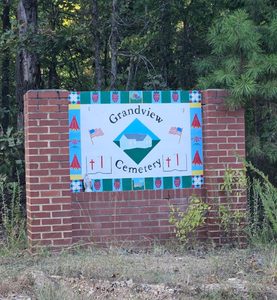
#2-10, Grandview Cemetery, Quilt Block on Grandview Road for the Grandview Cemetery. Painted by artist Bailee Kelley. Commissioned by Darryl Treat. Darryl’s Great Grandfather William Cephas Ragland, his Grandparent’s Thomas Ray Patterson and Margaret Ragland Patterson, and his parents William Glenn Treat and Joan Patterson Treat all donated land to create the Grandview Cemetery northeast of Marshall. The cemetery depicts the old, one-room Grandview School in the center where William Cephas Ragland was a teacher. It also depicts various cultural items such as strawberries representing our strawberry grower heritage, our flag, as almost 40 veterans are buried in the cemetery to date, dogwood blossoms and wildlife depicting our hunting culture!

196 Hwy 16 West
Witts Springs, AR.
#2-11, Bicycle Dresden Plate quilt block pattern was chosen to represent and promote the Pedestal Rock 40 and Lick Fork 62 Gravel Grind Bicycle Ride held the third Saturday of October each year. It is a 6 foot by 6 foot quilt block and was designed and painted by Cynthia Garmoe of Witts Springs. This quilt block pattern was one of the most popular quilt patterns made in the 1920’s and 1930’s, the same time period that the Witts Springs School was constructed. The Pedestal Rock 40 and Lick Fork 62 bicycle ride is held the third weekend in October each year. Bicyclists from all over the state and surrounding states come for a day of enjoyment, good food and enjoy a beautiful ride through the Boston Mountains. The Pedestal Rock 40 has a 10, 20, 40 and a 62 mile ride all on a paved road. The Lick Fork Gravel Grind has an 18, 30, 45, and a 62 mile ride, with at least 80% being gravel road. It also is very challenging with the Lick Fork 62 having 6,700 feet of elevation change on the ride. The quilt block is along the Ozark Grinder Trail, a fabulous gravel grinder bicycle trail covering multiple counties. It is also just off the Bear Creek Growl motorcycle route. Witts Springs is a mountain hub for outdoor fun, sitting at approximately 1,900 feet in elevation and is a launching point for hiking the nearby Ozark Highlands Trail, rock climbing at Stack Rock, horseback riding in the Ozark National Forest, waterfall photography at Falling Water Falls and Six Finger Falls, and camping at the Richland Creek Recreation Area & Campground. The Witts Springs community was known to have had Subscription School before the Civil War. The district has had 4 or 5 school houses. After one of them burned, the school used an old church for some time. The present Witts Springs School Building was started in 1934 and finished in 1935. The building is a rock structure built out of native stone, all collected in the surrounding area. It is a double rock wall structure of sandstone and rough sawed pine lumber. When the building was constructed there was no electricity in Witts Springs so the building was built with high ceilings and high windows to let in natural light. The building served as the Witts Springs High School until it closed in 2005. Through the impressive work of community volunteers, the building is about 70% restored and serves as a community building for the Witts Springs community. When restoration is completed the building will serve multiple purposes; family gatherings, weddings, parties, receptions, bed and breakfast, and for the community’s signature bicycle rides.

9826 Hwy 65
St. Joe, AR.
#2-12, Crossed Canoes quilt block pattern, four feet by four feet, was painted by Cynthia Garmoe and is located at 9826 Highway 65, Saint Joe, Arkansas 72675. From local historian James Johnston, “Silver Hill got its name because in the 1880s and later a man known in Searcy County as “Indian Woodard” came in and told people that he had discovered a rich silver mine. He blindfolded men from time to time and led them individually into a mine where he took off their blindfold and showed them stacks of silver, either as ore or as blocks. Then he blindfolded them and took them out. None of the men was ever able to locate the place where they had been taken. Based on what some of the men said, it was believed that the mine was somewhere on Silver Hill. Many people dug around the mountain looking for the mine, but never found anything that looked like a mine. Unlike other Indian mine scams in 1880s Arkansas, Indian Woodard never tried to raise money from the locals to investigate the mine. He has relatives in Madison County, Arkansas and in Oklahoma. He was a Sioux Indian from Nebraska, if I remember correctly, who was a Union Civil War veteran.”
Today gold, not silver, is mined in Silver Hill in the form of tourism dollars as thousands of floaters canoe, raft, and kayak down America’s 1st National River, The Buffalo National River! Silver Hill is home to both Buffalo River Outfitters and Silver Hill Float Service. A National Park Service report shows that 1.5 million visitors to Buffalo National River in 2017 spent $62.6 million in communities near the park. That spending supported 911 jobs in the local area and had a cumulative benefit to the local economy of $71.1 million. Silver Hill is the gateway to the Buffalo National River Tyler Bend Visitor Center! The quilt block also bears the #33 for the long ago departed Silver Hill School District #33.

14466 N. Highway 65
St. Joe, AR 72675
#2-13, Ohio Star, IS TEMPORARILY DOWN FOR REPAIRS. It’s a 4′ x 4′ block painted by owners Jay and Suzanne Jackson at 14466 N Hwy 65 Saint Joe, AR 72675, across the highway from Ozark Timber. Suzanne said, “The older I get the more interest I have in old quilts and old barns. I wish they were able to tell all the stories they know. I can remember being a little girl and watching my Great-Great Aunts sit around sewing quilts with other family members. The Ohio Star, to me, is simple yet meaningful, like the times that I spent as a little girl watching that generation in my family quilt. This barn quilt dedicated in memory of Helen Bryan and Iness Bryan.”

Oxley Store & Diner
6899 Hwy 66
Leslie, AR 72645
#2-14, Bear Tracking, is at 6899 Highway 66, Leslie, AR 72645. The 6 foot by 6 foot quilt block is located at the Oxley Store & Diner in Oxley which is situated along both a bicycle trail and a motorcycle route. The pattern was chosen by Tom Wimberly and painted by Kathy Bergeron. Currently, there are about 5,000 black bears in Arkansas. There is a well-regulated hunting season and the bear population is rising slowly. Bears have often been seen in the Oxley community. Oxley is a good staging site for some local attractions including Stem Rock Natural Area that features fabulous geological outcroppings including a free-standing pedestal rock. accessed by a 1.5 mile round-trip hike or bike from the paved side road just 1.1 miles from the Oxley Store. It’s also a good place to set off and enjoy the Ozark Grinder Trail on bicycle. The Oxley store was built around 1968 by Aretha Passmore. It was operated by Loretta Smith, Aretha’s daughter for many years. Loretta built an addition to the store in the early 1970’s to make it the size it is today. Owned by several different people including Russell Treat and Carl Mayes, Jim and Frieda Wilson, Victor and April Boyd among others. It is currently owned by Angela Grant.

894 Airport Rd.
Marshall AR
#2-15, 4A5 Airport, is found at the 4A5 Searcy County Airport, Airport Road, 894 Airport Rd., Marshall, AR. Cindy Garmoe of Troll Mountain Studio & Gallery of Witts Springs painted it. It looks great on the corner of the hangar at the end of Airport Road. Stop by to check it out. The Searcy County Airport features hangar space, a pilot’s lounge, 100LL self-serve fuel (credit cards accepted) and more. Great for pilots looking to fly in to experience the scenic Buffalo National River area. #searcycounty

105 Armory Street
Marshall, AR 72650
#2-16, Canine, is a 6′ x 6′ quilt block at the Searcy County Fairgrounds at 105 Armory Street Marshall, AR was hand-painted by local artist Patricia Estes with materials donated by Betty and Tommy Wimberley. The Border Collie prominently displayed on the block is a livestock herding dog, particularly fitting for Searcy County since it is livestock country. The most recent farm census data showed $12 million in market value of livestock sold annually in Searcy County. Average farm size is 285 acres and 168,795 acres are farmed in the county. The quilt block is mounted to the Searcy County Youth Show Arena. 2018 was the 93rd Searcy County Fair.

123 Lily Pad Trail
Witts Springs
TEMPORARILY UNAVAILABLE FOR VIEWING. #2-17, Stars and Stripes, a three feet by three feet quilt pattern was chosen by Vickie Garner because she had made this pattern into a quilt. Painted by Cynthia Garmoe, it is located at Highway 16 West at 123 Lily Pad Trail, Witts Springs, Arkansas. The Witts Springs community formed Witts Springs Community Voices several years ago to revitalize their community. Plenty has happened since, including restoration of buildings on the former Witts Springs school campus which is now available for groups to rent and enjoy the beautiful mountain setting with plenty of nature to explore by hiking or cycling, both mountain bike and motorcycle.

Witts Springs AR
TEMPORARILY UNAVAILABLE FOR VIEWING. #2-18, Farmer’s Daughter, a three feet by three feet quilt pattern was chosen by Vickie Garner because she had made this pattern into a quilt. Painted by Cynthia Garmoe, it’s located at Highway 16 West at 123 Lily Pad Trail, Witts Springs, Arkansas. The traditional pattern is believed to be from the Civil War era and is certainly a nice tribute to the farmers and their daughters (and sons) who have farmed the hilly and rocky farmland around Witts Springs for generations.

#2-19, U.S. Air Force, is a quilt block painted by local artist Cindy Garmoe. It is located on the back (north) side of Brigadier General Joe Wilson’s barn at 8057 Lick Fork Road near Witts Springs, approximately five miles from Hwy 16. The Quilt Block represents Gen Wilson’s 30+ years of worldwide service in the US Air Force as a Jet Engine Technician, Crew Chief, and Maintenance Officer/Commander on T-37, T-38, F-105, F-4, F-16, A-10, RC-26, KC-135 & C-130 aircraft. Gen. Wilson deployed and supported combat operations in Bosnia, Iraq and Afghanistan. Occasionally today, Air Force C-130s can be seen training in the skies above Searcy County near the Wilson’s home.

#2-20, Hippie, is a 4’x4′ quilt block painted by local artist Cindy Garmoe for resident Kay Moore. The quilt block is located at 2451 Browntown Road, Witts Springs, Arkansas. When Kay asked Cindy to make a barn quilt, she specified flowers like she stuck on the bumper of her yellow Volkswagen bus in her early years. Cindy said, “you want a Hippie Quilt!” So the beautiful Hippie quilt block hangs on Ms. Moore’s 100-year old barn. Come see it and please turn around in her driveway as the road past her house is basically a jeep trail. Browntown Road is just off the scenic Lick Fork Road where every October the very challenging Lick Fork Gravel Grind is held for gravel grinding cyclists.

four miles north of Marshall,
at 6403 U.S. Highway 65, St. Joe, Arkansas
#2-21 Bear’s Paw on Bear Creek quilt block is located 4 miles north of Marshall, AR or 7.5 miles south of St. Joe, AR at 6403 US Highway 65, St. Joe, Arkansas. The block is five feet by five feet and set as a diamond to give a nod to our state flag. It was painted by Cynthia Garmoe and placed on the barn/office at Bear Creek Log Cabins Vacation Rental. Pat and Libby Conner own the ranch. Libby Ferguson Conner’s great grandfather and family came to Searcy County in 1867. Bear Creek runs through the family’s 1200 acre working ranch as it makes its way to the Buffalo National River. The quilt block depicts the many aspects of what to expect here on the ranch in Searcy County and the Ozarks in general. The natural resources of Arkansas are plentiful, and vacationers and locals alike enjoy site-seeing, fishing, swimming, kayaking, and canoeing in our many clean water streams in the area including the one right on the property. The many hills and valleys are perfect for hiking, mountain biking, and ATV or Side by Side travel. You can expect to see an array of wildlife and possibly photograph white tail deer, elk, American Bald Eagles, and an occasional Black Bear, fox, otters, ground hogs, raccoons, Great Blue Herron and many other species. The Buttresses here along the creek are a unique geological land formation unique to the state and are a sight to behold. Bear Creek Log Cabins offers several cabins for family gatherings, reunions, weddings, retreats, and a couples get away. We are just minutes from Tyler Bend Visitor Center on the Buffalo National River. We are glad to be able to share the hospitality of our heritage here in the Arkansas Ozarks.

#2-22, Dogwood Blossom quilt block is located at 2885 North Tomahawk Road, St. Joe, AR 72675. Painted by Tara Carey, the 3 foot by 3 foot quilt block is on the side of Joe Reed’s home shop about 5 miles off of 65 south right at the edge of Searcy County near Tomahawk Baptist Church. The shop used to be a water house for the spring-filled holding tank built by Joe’s dad Jerry Reed. A few year’s ago Joe and his son Jerry Joe tore out the holding tank and converted the building into a shop for Joe. Joe and Billie Reed are natives of Searcy County and have lived here for over 30 years. Billie is dedicating the quilt block to her mom Shirley Jean “Mills” Tate who was born in a log cabin in Pindall, AR on April 10, 1948 and passed December 16, 2017. Her Mom loved to draw and carve dogwoods. She also loved to tell the story of the dogwood tree. The location is near Tomahawk Creek which feeds into the Buffalo National River. Joe builds Adirondacks, pet urns for a veterinary clinic in Harrison, AR and other projects. For more of his work seehttps://www.facebook.com/TomahawkCreations2016/.

#2-23, “Sunrise in the Ozarks” is a colorful 6’x4′ quilt block painted by Cindy Garmoe and displayed on the front of the Goodman Realty Office located at 501 Highway 65 in Marshall pays tribute to the rooster. Sue Goodman shares “I love the folk art images so many of our quilt blocks display on the tour through the Ozark Mountains, but Sunrise in the Ozarks is my favorite.” Not only is it beautiful and very well done, but this particular one pledges honor to roosters and hens. Chickens played a vital part in survival and developing this mountainous region we call home, and they deserve recognition. Long ago, settlers here in Searcy County depended on chickens for money and food. The old-timers that are still here will tell you that eggs were the same as money. You took them to the store, the proprietor would exchange money for your eggs. When my mother was a child, one egg equaled one penny. She said they used the money to buy coffee, sugar, flour, baking powder, and other items they did not raise themselves. At that time, eggs were so important that it was rare in her household to eat them. She said in fact, when her mother made cornbread she did not use an egg. Today, we wouldn’t think of making cornbread without an egg. Chickens go to bed early and wake up early. If you have chickens, the first thing you will hear in the morning is the rooster crow. The old-timers believed you should go to bed with the chickens and get up with the chickens. They really believed that one should live by the old saying, “Early to bed, early to rise, makes a man healthy, wealthy, and wise.” Roosters and hens were extremely important here in these mountains long ago. Listening to the old-timers talk about the importance of chickens makes me wonder what they would have done without them. Cindy Garmoe’s quilt block pays well deserving tribute to the chickens of the Ozark Mountains.”
s

5834 Trace Ridge Rd, Leslie AR
#2-24, Patriotic Tribute, is at 5834 Trace Ridge Road, Leslie AR. Be looking on the right side of the road and don’t let your GPS take you past it. Amy and Jim McCarthy painted it patriotic to honor service members. Their son, Dylan, served in the Army. The nearby town of Leslie has additional quilt blocks to see and has a Commercial Historic District hosting a wood-fired brick oven bakery and some of Arkansas’ best old-world sourdough bread! Great restaurants and antiques await in Leslie. Don’t forget to pick up a chocolate roll from a convenience store along US Highway 65. After all, Searcy County is the Chocolate Roll Capital of the World. In addition to a disc golf course, rodeo, and the quilt trail, Leslie is home to the Growl-Lasso motorcycle route and the Ozark Grinder Trail for bicycles. Search searcycountyarkansas.com/lodging for places to stay during your visit. You’ll find other patriotic sites around the county including Veteran’s Memorial Hall at 108 Noah Horton Memorial Drive. The beautiful building and pictorial tributes to the county’s veterans make it worth a visit.

200 East Main St., Marshall AR
#2-26, The Children of Promise quilt block is a composition of smiling children, sunshine, love, hope and faith. Painted by Cindy Garmoe, the 4×4 block can be viewed at Hattie House Youth Center and Park, located at 200 East Main Street, Marshall, in Searcy County, Arkansas. Sitting on an extra large lot fronted with a wrought iron fence, the architecturally beautiful 1913 yellow brick house that once held the local mental health office was obscured by an overgrowth of shrubbery and trees. The Jim G. Ferguson Library Foundation asked board member and library director Pat Halsted if she had a use for the property. She said that she knew exactly what they were to do with it, because the Lord had placed it, including its name, upon her heart. It would be Hattie Park, named for library founder Jim G. Ferguson’s wife Hattie Maude Mays Ferguson. The Foundation signed over the revamping, clearing, design, management and care of the property to the Jim G. Ferguson Searcy County Library. Using Foundation funds, the immense job of removing and disposing of overgrowth and of leveling the soil began. The beautiful yellow brick house was quickly revealed, but it was as badly in need of repair as its grounds had been. The deathly gray-mauve color on its inside walls would never do for Hattie House, whose trademark “happy colors” would be yellow and orange. The walls were painted a cheerful yellow and the mismatched linoleum was replaced with bright yellow commercial tile. Repairs and upgrades, from floor to ceiling, were completed on time and within budget. Halsted said more than once that with the blessing of God, everything seemed to be falling into place. Once the direction was clear, donations from the Ferguson family poured in, for all of the playground equipment. The community and library friends–both near and far– also responded with donations of money, games, equipment and professional services.
Hattie House Youth Center and Park was born April 4th, 2017. On the grounds, mulberry, pecan, apple, pear and nectarine trees can be found, as well as a community garden. The playground boasts multi-age areas of play, from baby swings to paved basketball courts, and there are ample park benches and picnic tables. To address the mental, physical and spiritual needs of all of our children, each of the seven rooms of Hattie House accommodates a specific child-oriented teaching, craft or activity. There is a room for free literacy tutoring, an arts and crafts room, a Wii game room, a cards and board game room, a reading room, a music room and a ping-pong and air hockey room. Every child who comes to Hattie House is offered a nutritious snack and drink from the completely remodeled kitchen. There is also a health and hygiene pantry which contains items for any child with a need. The Children of Promise quilt block therefore represents a culmination of the vision for Hattie House Youth Center and Park. While our initial mission has been completed, we continue to strive to find new ways to improve the lives of our smallest citizens. As Jesus said (Mark 10:14), “Let the little children come to me, and do not hinder them, for the kingdom of God belongs to such as these.”

3130 East Hwy 16
Tilly AR
#2-27, Harness Ranch, is at 3130 East Highway 16, Tilly, Arkansas. Bear Creek Ranch was purchased in 2018 by Bear Mountain Investments, owned by the Patty and Roger Harness family. In 2006, the first property was bought with the lodge. Today the contiguous property consists of 5500 acres. Most of the property is made of hardwood and about 1000 acres is open pasture and food plots. The most unique thing about the property is that some of the land was Roger’s ancestor’s land. A great-great grandmother has a hollow named after her and his great-grandfather’s homestead is located on this property. Some of these properties have been out of our family for over a hundred years. The Ranch is a working cattle ranch operation. Many recreational opportunities are enjoyed here by family and friends. The outstanding artwork of the painted quilt was done by our neighbor, Cindy Garmoe.

196 Highway 16 West
Witts Springs AR
#2-28 “Rocky Topography of Arkansas” by Marilyn Lawhon. Four foot by four foot quilt block painted by Toni Newby at 196 Highway 16 West, Witts Springs, AR 72686. Original art from the Collection of Historic Arkansas Museum. 1986 Arkansas Quilt Contest Entry – 3rd Purchase. Pieced, appliqued, and embroidered. Mountainburg (Crawford County) 72 ½ x 57 ½ in. The Statehood Sesquicentennial Quilt Contest sponsored by First Federal Bank of Arkansas. Collection of Historic Arkansas Museum Accession No. 86.26.4. The replica painted quilt block adorns the exterior of the Richland Waterfalls Welcome Center in Witts Springs. The welcome center is a private collaboration between Witts Springs Community Voices and the Greater Searcy County Chamber of Commerce. Open 8am till 7pm seven days a week. Free! Waterfalls are best viewed after ample rainfall. Great information about the waterfall-abundant Richland watershed. The Richland Waterfalls Welcome Center is a one-of-a-kind welcome center with a primary focus on the waterfalls of the Richland Creek Watershed. More than 30 waterfalls are featured by the welcome center. Richland Creek and tributaries, such as Falling Water Creek, traverse some of the most stunningly beautiful, rugged, and remote landscape in all of middle America. Most of the watershed is within the boundaries of the Ozark National Forest and drains to a northbound rendezvous with the Buffalo National River. The Richland Creek Wilderness contains 11,801 acres in the Ozark’s Boston Mountains. Wildlife such as Black Bear and Rocky Mountain Elk inhabit portions of the watershed. There are no official trails to any of the waterfalls, however the US Forest Service advises that you hike on existing unofficial trails. There is poor to nonexistent cell phone coverage in most areas. Please practice “Leave No Trace.” Witts Springs is the gateway to the Richland Creek Wilderness of the Ozark National Forest. At approximately 1,900 feet in elevation, Witts Springs is a launching point for hiking the nearby Ozark Highlands Trail, experiencing the Richland Waterfalls Welcome Center, visiting a Civil War Historic Marker, horseback riding in the Ozark National Forest, following the Arkansas Quilt Trail, rock climbing at Stack Rock, area ATV rides, whitewater kayaking and waterfall photography along the Falling Water Creek and Richland Creek watersheds, hunting, camping at the Richland Creek Recreation Area & Campground, riding the Growl and Lasso and Lost Mine Run motorcycle routes, viewing the amazing naturally dark night skies, and cycling the Ozark Grinder Trail gravel grinder bicycle route. The annual Pedestal Rock road bike ride and Lick Fork gravel grind takes place here each October, as well as the 1,000+ mile Arkansas High Country Race, an epic bikepacking adventure race that transits the area each June! For more information visit https://searcycountyarkansas.com/attractions or call the chamber of commerce at 8704482557. The welcome center is a collaborative project of the Greater Searcy County Chamber of Commerce and Witts Springs Community Voices. Special thanks is owed to Mr. Roger Harness, The Nature Conservancy of Arkansas, Flintrock Video Productions, Ozark Mountain Region, Mr. Rick Henry, Mr. Andrew Hendrix, Dana Treat Photography, and the US Forest Service.” Information and photos also found at https://www.arkansas.com/witts-springs/services/richland-waterfalls-welcome-center

5834 Trace Ridge Rd.
Leslie AR
#2-29, Waving Flag, is near quilt block #2-24. This 4’x4′ is a Waving Flag on the cow shelter right by the driveway at 5834 Trace Ridge Road, Leslie AR. Created by Angelica Nunez and Amy McCarthy. Please be wary of the bull. Amy and Jim McCarthy’s son, Dylan, served in the Army and they are very proud of him and all other service members. They are a very patriotic family with several other American flags. The nearby town of Leslie has additional quilt blocks to see and has a Commercial Historic District hosting a wood-fired brick oven bakery and some of Arkansas’ best old-world sourdough bread! Great restaurants and antiques await in Leslie. Don’t forget to pick up a chocolate roll from a convenience store along US Highway 65. After all, Searcy County is the Chocolate Roll Capital of the World. In addition to a disc golf course, rodeo, horseback riding, and the quilt trail, Leslie is home to the Growl-Lasso motorcycle route and the Ozark Grinder Trail for bicycles. Search searcycountyarkansas.com/lodging for places to stay during your visit.

6620 Hwy 377
Marshall AR
#2-30, “A Salute to First Responders” quilt block is located between Snowball and Witts Springs at 6620 Hwy 377 Marshall AR, 72650. It was designed and painted by Cynthia Garmoe for her husband David Garmoe. Painted during these difficult times of the Covid19 Pandemic. This barn quilt is a tribute to all frontline workers who put their lives on the line daily to protect and serve humanity worldwide. David Garmoe’s loyalty to his family, community, and country inspired this barn quilt. David is a 21-year Army Retired SSG. David is also a volunteer firefighter with the Witts Springs Volunteer Fire Department where he has served for ten years.

100 Short St.
Marshall AR
#2-31, Cardinals, is located at 100 Short Street, Marshall, AR near the Veterans Hall. The 2×2 block was chosen in memory of Vickie Phillips Pruetzel. Vickie loved Indian Folklore and especially the redbirds. Cardinals were considered by the Indians to be good omens or visitors from Heaven. Vickie lived her life to help others. She was very active in her church work as well as the work she did for the community at her job at the Searcy County Library. She was very interested in the children’s programs. She loved to take part in them. She was most interested that the Library meet the needs of the youngsters of the community! Vickie would be pleased to know that the Searcy County Library and the Hattie House are helping the young folks of Searcy County! The artist was Miss Embee Eversoll, the granddaughter of David and Cynthia Garmoe. The block is her first work and she did an excellent job! This summer there were six children’s programs at the Searcy County Library. Mr. Randy Vincent was the presenter. Each program had about 50 youngsters attending. Checkouts for the summer were running about 307 a week. Vickie was also interested in the history of our area and the family histories of the people here. She did extensive work on her family history and supported the Searcy County Historical Society. There are several books on the Phillips and Parks families that Vickie put together along with photos in the library genealogy department.

300 S. AR-27
Marshall AR
#2-32, Badges of the Buffalo River Frontier is a quilt block at 300 S. AR-27, Marshall, AR. It honors those county and federal lawmen that served this area during the wild frontier days of our past. The artist is Jessica Eversoll of Troll Mountain Studio & Gallery of Witts Springs. Both Sheriffs and US Deputy Marshals served and sacrificed to bring law and order to this part of the state and this quilt block is to honor their service. The pattern is a six-point star which represents a historical badge style often used by many different law enforcement agencies. The reddish and sandstone earth tones represent the colors of the 1902 Searcy County Jail while the blue squares are a tribute to the modern-day law officers. This quilt block can be found on the parking lot side of the fabulous Buffalo River Historic Jail & Museum located one block south of the town square on S Hwy 27 in Marshall. The Museum is free and open to the public Wednesdays – Saturdays 10am – 3pm. Marshall is the largest town in the Buffalo River Watershed.

348 S. Maumee Rd.
Marshall AR
#2-33, Loafer’s Glory School, was painted by Nancy Jones and is located at 348 S. Maumee Rd. Marshall, AR 72650. Back in the early 1900s a small one-room schoolhouse was built for the children in the community of Morning Star to provide for them an education. Not sure how it got its original name “Loafers Glory.” Some believe the name came from a game reserve that is still in the area called “Loafers Glory.” Later the name was changed to Morning Star. Some of the local’s didn’t like the name “Loafer’s Glory” because of the implication it made toward the people in the community as being lazy. I do know that most of the men during that time worked hard in the log woods and sawmills and did nothing akin to loafing on the job. They liked to whittle and play dominos at the local grocery/gas station. They also did a lot of hunting and had a racoon club where they would gather with their dogs for the hunt and would sale the furs to fur traders. The one room school held grades 1-6. Later two other rooms were built and a cafeteria. One room held grades 1-2, 3-4, 5-6. The school was consolidated 1959 to Marshall. After the school was consolidated, the building was used as a Church by the Morning Star Baptist Church as a mission under the 1st Baptist Church of Marshall till 1963 when the Morning Star Baptist was built. The dogwood blooms on the quilt block are a reminder of the legend behind the dogwood tree. The dogwood tree provided the wood used to build the cross which Jesus was crucified. Because of its role in the crucifixion, it is said that God both cursed and blessed the tree. In the springtime the yard is adorned in beautiful dogwood blooms. The tree of knowledge of good and evil from which Eve eats the forbidden fruit, is often depicted as an apple tree. The apple, therefore, is the fruit of knowledge, making it a fitting gift for a teacher. (Genesis 2:17) The story of the star of Bethlehem appears only in the book of Matthew. The gospel tells us that a bright star appeared in the eastern sky when Jesus was born, seen by a group of wise men. (Matthew 2:9) The star is a mark of excellence. All students want to see a star on their schoolwork and to be the star pupil of the week. The heart is an emblem for the love of learning. Also waiting for a love letter from your favorite someone! The heart is mentioned 826 times in the Bible. The children’s handprints are to remind us that we are to train up a child in the way he should go, and when he is old, he will not depart from it. (Proverbs 22:6) In passing if you have a minute, stop and sit on the porch for a moment or two. If you listen carefully, you will be able to hear the laughter of the children swinging, climbing trees, and playing in the school yard. By wisdom a house is built, and by understanding it is established; and by knowledge its rooms are filled with precious and beautiful treasures. (Proverbs 24:3-4)

108 Noah Horton Memorial Dr.
Marshall, AR
#2-34, Arkansas Secession History. This six foot by six foot patriotic quilt block located at 108 Noah Horton Memorial Drive, Marshall, AR, 72650, puts two largely-unknown pieces of the State’s history on display. The Arkansas Secession Cockade, designed by a young lady in Searcy County in 1861, and the Arkansas Secession Quilt, designed in White County in 1861. On this quilt block, these two beautiful creations are combined to form one striking historic exhibit. Both pieces are rooted in the War Between The States, with each expressing patriotic sentiments from citizens of the State of Arkansas during a very difficult period of history.
Arkansas Secession Cockade – From the Arkansas True Democrat, May 9, 1861: Neat and Appropriate. We have received, from a young lady in Burrowsville, Searcy County, a tasteful presentation in the shape of a rosette. It is so simple and pretty that we will endeavor to describe it. A grain of corn is fastened, by means of a hole drilled through it, to a floss of cotton, spread so as to form a circle; this is also attached to a light blue circle, and the whole to a deep blue, of the usual size of a rosette. By using a grain of red corn, we have the colors of the Confederacy flag; red, white and blue, while the corn and cotton are emblematical of the Confederacy. The design and execution are both excellent. The present was sent with a patriotic note from the true hearted donor. “In the revolution of ’61 as in ’76, the women are on the side of truth and liberty and, if need be, will show themselves to be heroines as did their foremothers. God bless them and the Southern Confederacy.”
Secession Quilt of Arkansas
Mary Green McPherson of West Point, Arkansas, made her quilt to raise funds at a local raffle for Confederate soldiers in need. But far from a humble bed covering, the piece she created was also a political statement, as her nine trapunto stars symbolize Arkansas as the ninth state to secede from the Union. The quilt received inspiration from one stitched by Cherie Ralston, from the book ”Quilts From the Civil War.” It was changed from a pattern with seven stars. McPherson’s quilt had nine stars to represent Arkansas as the ninth state to secede. The quilt is a tale of two families. It is attributed to Ms. McPherson in 1861. At the beginning of the War Between The States, she was a widow with at least two children. They lived in West Point, Arkansas, when it was 5 miles southeast of Searcy in White County. West Point, on the banks of the Little Red River, was a bustling river port before the War, later overtaken by the town of Searcy in the railroad era. Neighbor Joshua B. Crow from West Point purchased the quilt when it was auctioned to raise funds to equip Confederate soldiers. Crow was described in a family biography as a “well-to-do farmer living about six miles east of Searcy.” The quilt descended in the Crow family.
Trapunto is an ornamental technique used separately or in combination with all-white, pieced and appliquéd quilting. McPherson’s stuffed stars give her quilt a wonderful three-dimensional quality. To make them, she cut tiny slits in the quilt’s backing, stuffed in bits of cotton batting, and then carefully stitched closed the openings. Applying the trapunto would have been the final intricate step of completing her quilt.
An example of the Arkansas Secession Cockade can be viewed inside the Searcy County Veterans Memorial Hall in Marshall. The Arkansas Secession Quilt is in the permanent collection of Historic Arkansas Museum in downtown Little Rock. This Arkansas Quilt Trail Block concept was created by Randall Freeman, while the beautifully detailed paintwork of the block was done by Cynthia Garmoe. The block was designed, funded, and placed by the General Robert C Newton Camp #197, Sons of Confederate Veterans, Little Rock, to place an important part of Arkansas history on display.

#2-35, Riley’s, is a wonderful 4×4 foot quilt block with an auto mechanic theme at Riley’s Tire and Lube at 2003 North Highway 333 Marshall, AR 72650. Painted by Cindy Garmoe. Riley’s is a Veteran-owned shop specializing in front-end-alignments, tires, brakes, balancing, batteries, and oil changes. Located at the corner of Highways 27 South and 333. #marshallarkansas #searcycounty

100 E. Nome St.
Marshall AR
#2-36, Mountain Scene, is located at 100 E. Nome St. in Marshall at the Marshall Mountain Wave newspaper office. It’s just inside the building and you will need to view it by looking through the front glass door, or go inside if it’s business hours. It’s a 4×4 quilt block designed and painted by Cindy Garmoe of Witts Springs. Since 1891, the Marshall Mountain Wave has kept its readers connected with events going on around Searcy County. A weekly-based paper dedicated to preserving the historical factors and teachings of years past but still modernizing for ease of access for their readers. It’s currently owned by Jeremy Gulban of CherryRoad Media Inc. of New Jersey. The inspiration for this quilt block was that Searcy County has some of the most beautiful sunrises and sunsets. The sunsets and sunrises always go through the mountains all the way down through the valleys and trees then connect down into the water. Everything is done in a printed material/calico style because that was the style in year’s past. There are two mountains that are the M’s of the Marshall Mountain that represent the mountains of Searcy County. Wave is in the water portion of the quilt. There are cross patterns on the quilt block that represent the various trails that intersect around Searcy County. There are wildflowers and trees. Then there is the sand that is connected to the water with some fish that represents the Buffalo River. Upon the mountain area there is a rainstorm painted to represent that it’s often raining here.

2562 Nubbin Hill Rd.
Leslie AR
#2-37, Imploding or Exploding, is at 2562 Nubbin Hill Rd., Leslie, AR. Matt Walston is the owner and artist of this 50”x50” oil on corrugated metal roofing barn quilt. Matt sells smaller pieces at Brick House Artisans in beautiful, historic Leslie. Most of his barn quilt work is created to hang indoors, that’s why they’re done on the metal roofing, to give it barn atmosphere without needing a barn. The Brick House Artisans is a wonderful store to shop in with original pieces from local artisans and handcrafted wood pieces made onsite. The beautifully restored building is a must see in historic downtown Leslie. There are also plenty of outstanding choices for cuisine in this interesting little town!

410 Oak St.
Leslie AR
#2-38, Reimagined Heritage, is a 6 foot by 6 foot quilt block painted by local artist Pam Kelley at the Ozark Heritage Arts Center (OHAC) at 410 Oak Street, Leslie, Arkansas. The block is located at the rear of the historic WPA building, facing AR Hwy 66, and can be viewed from Hwy 66. IMPORTANT – -DO NOT STOP ON HWY 66. It’s very dangerous to do so. If stopping, use the parking lot beside the Heritage Center. The rich heritage of the Ozark Heritage Art Center of Leslie in Searcy County is represented in this original style quilt block. The four segments each recognizing individual ol’ – tyme ways of life in this region of Arkansas. The top left block rings in the sights and sounds of stage, theater, and music as from the Killebrew inside the center. The top right sews up remembrance’s of hours of pains taking stitchery with an old treadle sewing machine like granny’s, while bottom left you can hear the whistle far and near from an old train, a tribute to the Dinky Line Spur rail which ultimately was a large element in bringing prosperity and a boom of over 10,000 citizens to this charming little town years ago. Finally, as the artist brushes caress the canvas a new vision is born from the mind’s eye and artist’s hand. Surprises are unfolded with each stroke of the brush. Art and design by Searcy County wildlife feather artist Pamela Kelley. The Ozark Heritage Arts Center is in a WPA building built in 1938 and was used as the local school gymnasium until 1989. In the early 1990s the building interior was converted to the current configuration that exists today. “The Works Progress Administration (WPA) was an ambitious employment and infrastructure program created by President Franklin Roosevelt in 1935, during the bleakest days of the Great Depression. Over its eight years of existence, the WPA put roughly 8.5 million Americans to work building schools, hospitals, roads and other public works. Perhaps best known for its public works projects, the WPA also sponsored projects in the arts—the agency employed tens of thousands of actors, musicians, writers and other artists. The WPA is celebrated today for the employment it offered to millions during the darkest days of the Great Depression, and for its legacy of smartly designed, well-built schools, dams, roads, bridges and other buildings and structures—many of which are still in active use across the United States.” The Ozark Heritage Arts Center is an example of this, being repurposed from the “Old School Gym” to a beautiful small-town Heritage Center containing a Performing Arts Theater, Art Gallery, and Museum.

410 Oak St.
Leslie AR
#2-39, Bulldogs or Bust, at 410 Oak Street, Leslie, Arkansas. The painting is by wildlife artist Pamela Kelley. This all-around team spirit quilt trail block is a tribute to the Ozark Heritage Arts Center itself. The building was built in 1938 by the WPA workforce which has great significance. Not only does it document the great need for employment during the lean years of the depression, but also our government’s answer of goodwill to that need. The structure, a charming rock building, has seen several levels of occupation from its construction up to present day. One valuable use being to serve as the gymnasium of the Leslie Bulldogs. With a glimpse of the emblem on the auditorium floor you can imagine the excitement and cheers from the stands filled with family and friends of the basketball players. “Bulldogs or Bust”! Present day, this valued structure houses the Killebrew Theater, an exquisite Heritage Museum, and a most inspiring Art Gallery. “There is gold in them thar hills” – some to be discovered and exchanged for todays currency- but other to be celebrated and cherished. This block is dedicated to Mrs. Rebecca Ashley.
]]>

1062 Hwy 330
Shirley AR
#3-01, Linda’s Variable Star is a 4’ X 4’ barn quilt block located near Eglantine cemetery at 1062 Hwy 330, Shirley AR. Eglantine was a town located on river land known as Wild River Bottom. The 1959 construction of Greer’s Ferry dam required Eglantine town to be moved to avoid being submerged. The Eglantine cemetery was moved to its present location. The rock church found at the corner of Highway 330 and Eglantine Road was built around the 1930’s. A beautiful view of Sugar Loaf Mountain can be seen down Eglantine Road. Eglantine is a name for wild pink rose. It is said the hills of Eglantine were covered with wild pink roses, thus earning its name. In the early 1900’s Eglantine was a thriving little town with four general stores, two drug stores, a boarding house, a dentist, blacksmith and a grist mill grinding grain. Linda Gardner, an avid quilter, painted this barn quilt block to try out her quilting skills on her barn. She had her quilt block up even before the Van Buren County Quilt Trail was conceived and developed.

#3-02, The Lucas Strawberry at 8246 Highway 16 East near Shirley uses a broken diamond pattern displaying a center strawberry to represent Wade Lucas Farms’ most famous crop. The quilt block is 4’ X 4’ and painted by Shelley Moix. Wade Lucas Farms is best known for strawberries but also grows sweet corn, peas, cantaloupes, squash, cucumbers, tomatoes, peppers, onions, greens and as of this year lettuce. In 2007 Wade Lucas and his wife Marlene started working the dirt and moving many rocks preparing the land to grow strawberries. Wade grew up in Florida on a farm and has farmed all his life. The Lucas family was the 2017 Van Buren County farm family of the year. Fresh produce can be purchased at the farm’s cedar clad store. Lunch of fresh cut salads, sandwiches, baked goods, pies and cakes can be enjoyed on a covered back porch overlooking the farm that is nestled in a valley. Marlene Lucas’ baked concoctions are well known and highly sought after.

#3-03, Magnolia Bud is at 14085 Hwy 16 E., Fairfield Bay, AR. It’s across the highway, near the Fairfield Bay main entrance. This 4ft X 4ft quilt block is the Magnolia Bud pattern. It was designed and painted by Fairfield Bay artist Bonnie Hookman. Steve Swenson built this barn for their guided horse tour business that operated between 1998 through 2011. Steve admires old barns so he designed this barn like historical barns and used rustic materials such as rough sawn oak and a metal roof. Fairfield Bay for many years had guided horse riding tours. When the previous owners closed their business Fairfield Bay Time Shares approached the Swensons’ about opening a guided horse tour business. During the high point 60 plus people a day participated in the guided horse tours.
#3-04, Broken Diamond @ Shirley,  408 Matthew Clark Memorial Dr., Shirley AR. This block, painted by Patti Rye, hangs on the historic little building that housed the first telephone switch board in Shirley. Before this building, the phone was answered in the house that sits next to the building. The Switch Board that was used is currently located at the Shirley Centennial Museum, next door in downtown Shirley. During the time this building was used, there was a phone booth on the right side of the building. If you had a nickel, you could call someone, or dial “O “and an operator would answer and connect you to whomever you were trying to reach. At that point she would tell you how much change to deposit into the telephone. When technology changed and as more people had telephones, the switches were relocated to a new location across the river. As of now, that location is still active. Arkansas Telephone Company is now known as Artelco and their main office is in Clinton, Arkansas. It is still owned by the McCaslin Family. If you are visiting this quilt block location, it is best to park across the street or at the museum (where another block hangs) to avoid backing out into the street upon departure.

#3-05, The “Sail Boat at the Lake” quilt block is at 100 Greenwood Road, Fairfield Bay, AR. Look for the white, two-story building at left before turning right to go to the Fairfield Bay Marina on Greers Ferry lake. The 4’ X 4’ quilt block is sponsored by Fairfield Bay City Hall and was painted by Shelley Moix. The quilt block includes a sail boat to reflect the significance of Greers Ferry lake to the community of Fairfield Bay. Fairfield Bay was formed in 1965 as a lake/mountain resort and retirement community. The site was chosen because of Greers Ferry lake. People are attracted by the beauty of the mountains and the pristine waters of Greers Ferry lake and move to Fairfield Bay, while others choose to vacation and weekend at the Bay. Fairfield Bay has a current population of 2,247 and sports two golf courses, tennis courts, hiking trails, a disc golf course, several pools, restaurants and 90 miles of ATV trails. The dedication by John F Kennedy of the Greers Ferry Lake Dam at Heber Springs in October 1963 was one of his last public appearances before the assassination. Greers Ferry lake was formed by a dam of the Little Red River. The dam’s primary function is flood control and also serves as a hydroelectric power plant. The recreational lake is 30,000 to 40,000 acres depending on the water level and has 340 miles of shoreline. People enjoy boating, water sports, swimming and fishing on the beautiful lake. Fairfield Bay is a very inviting place on the north shore. visitfairfieldbay.com/marina/

#3-06, The Train quilt block can be found on the Shirley Museum which was founded in 2011 during Shirley’s 100th year celebration. An old typewriter that was in the train depot is on display in the museum. The quilt block is 4’X 4’ and was designed and painted by Anna Massery. In 1908 the pride of the Shirley community was built by the Wisconsin Bridge and Iron Company and today is a photo-opportunity not to be missed. The train bridge was built over the Little Red River to carry trains of the Missouri & North Arkansas railroad. In 1909 the Shirley community post office was opened and most likely named for a railroad employee. The incorporation of the town Shirley became official in 1911. The town of Shirley became prosperous due to the timber industry and at one point had 2,000 residents. The Missouri and North Arkansas railroad was essential, carrying timber, cattle, cotton, cream and produce to market. The railroad closed its lines through Shirley in the mid-1940’s due to a strike and flood damage. The Shirley depot remained until 1964. Today you can still walk or drive over the historic Shirley train bridge. The Cottrell Wilson trail head in downtown Shirley is situated right near where the depot stood. The hiking trail meanders along the railroad bed and the river until reaching the top where a historic cemetery is found. Best to hike in the colder months to avoid ticks, chiggers, and snakes but the two-mile round trip is worth your time. Note that the upper section is not barricaded from the high boulder-strewn cliff over the river, so be cautious, especially with young children.

#3-7, Colors, is at 245 Main St., Clinton, AR. This colorful 4’ x 4’ quilt block was designed and painted by Patty Rye. It is placed on the ProLand Title building located in downtown Clinton. Downton Clinton is listed on the National Register of Historic Places. The historical nomination was made for the rustic appearance of the sandstone clad buildings and age of the buildings. The downtown buildings were constructed between 1903 and 1956. A Hank Kaminsky “Three Rivers Trailhead” sculpture can be found in the Archery Fork city park nearby. The water sculpture symbolizes local heritage and the three rivers, Little Red, South Fork and Archey Fork, which are the headwaters of Greers Ferry Lake. The images on he sculpture were chosen to represent important elements of Van Buren County history

#3-08, “Go Fish” block located at 4350 Highway 330, Fairfield Bay AR, is a fun 4’ x 4’ quilt block designed and painted by Patti Rye. The quilt block is displayed at Fairfield Bay Marina on Greers Ferry Lake. Fairfield Bay Marina is a 400 slip marina with a wide variety of rental pontoons, ski boats, jet skis, kayaks and paddle boats. They host five major events during the season. The marina also shuttles 4000+ people to Sugar Loaf Island yearly in addition to hosting multiple family and company events on their 60 person barge. Over 100,000+ people visit the marina yearly by both land and water. visitfairfieldbay.com/marina/

#3-09, Hidden Star is a 4’ X 4’ quilt block painted by Kay Otis. Located at 369 Dave Creek Parkway at Fairfield Bay, it is proudly displayed on the Fairfield Bay Library building. The Fairfield Bay Library is a 501c3 charity organization not funded by tax dollars. It is operated on fund raisers, membership dues and 35+ volunteers. The library was founded in the early ’70’s by a group of Fairfield Bay salesman wives. Over the years and efforts of many the library grew and moved into its present location in 2000. The library offers books, audio books, movies, free Wi-fi, public computers, periodicals and nature backpacks. The library services over 1,000 local residents in Fairfield Bay, Shirley and the surrounding areas. The Wyndham time share community enjoys the benefits of the library as well. http://www.fairfieldbaylibrary.com/
 #3-10, Cross for School, is at 11759 Highway 95 W., Scotland, Ark. This quilt block can be found on the Scotland Community Center. This site was once the Scotland School campus. The school was closed soon after the Arkansas Legislature passed Act 60 in 2004 which required school districts with fewer than 350 students to administratively consolidate with a larger district. The students now attend school in the town of Clinton, about 12 miles away. Proudly displayed around all four walls inside the Scotland Community Center are photographs of all past Scotland graduating classes. The Scotland Community Center is the result of community volunteers who have worked to keep and maintain a gathering place for their community. It is a place of activity and hosts many town events.

#3-11, Mystic Maze, at 211 3rd St., Clinton is a 4ft x 4ft quilt block painted by Shelley Moix. The pattern, Mystic Maze, was selected by the Van Buren County Historical Society. The Van Buren County Museum was open to the public in early 1991 by the Van Buren County Historical Society. The building was purchased from the Pentecostal Church in 1988. This building has also housed several other organizations and businesses, but it best known as the old Cheese Plant. The society cooperates with officials to ensure the preservation and accessibility of the records and archives of the county, and assists the county and its citizens in the preservation of historical buildings, monuments, and markers. The museum has many items in the museum which were donated by the people of Van Buren County. Among these items are several quilts made by local Van Buren County residents. The latest addition to the museum is a research library to house the growing collection of genealogy research material and family history.

352 Steel Rd.
Bee Branch AR
#3-12, Arrow Crown, is at 352 Steel Rd., Bee Branch AR. If coming from the south, do not take the route your GPS may direct you of leaving Hwy 65 at Damascus. This will route you across a gravel road, down a mountain, and over a low water bridge that is impassable during high water. Just continue on Hwy 65 to the Southside Baptist Church and turn left onto Sulphur Road. If coming from the north, go west on Hwy 92 at Bee Branch. This unusual barn quilt was made by owner Evelyn Eades’ grandson, Andrew Roberson, who is obviously a talented metal worker. He owns Dark Threat Fabrication in Heber Springs. He told his grandma to give him the pattern she wanted and he would make it. The result is an eight foot square “pieced” quilt with each color a separate piece of metal that is powder coated and assembled together to form a quilt. It turned out to be a family project that is now proudly displayed on the Eades barn. Drive along the gravel drive to get a closer look. If someone is around the farm, they will open the gate to give you a close-up look at the block. Evelyn shared, “When we bought the farm in 1960, it had a very old house and not one foot of fence. We worked hard over the years, growing broiler chickens for 33 years and raising cattle. The chicken houses are collapsed now but my son has taken over the cattle business and takes care of our combined herds. I made all our clothes in those early days and the scraps began piling up. I made a quilt to make use of the scraps. Then I was hooked! Since then I have quilted at every opportunity and every member of the family has quilts that I have made.”

484 Rabbit Ridge Rd.
Bee Branch AR
#3-13, The Star, located at 484 Rabbit Ridge Rd., Bee Branch, is a 4’ X 4’ quilt block painted by Patti Manville. It adorns the Rabbit Ridge Farms venue facility where Alan and Angela Mahan host brunch on Saturdays during the season, as well as special dinners, weddings and other events. The farm is located about 10 miles west of Bee Branch via Highway 92. Rabbit Ridge Farm has been in the Mahan family for three generations. They work together to create a sustainable farm that humanely raises animals in the natural environment which creates a delicious and healthy meat. Their goal is to provide healthy food from their farm to families. To track their menus and learn more about scheduled events, follow them on Facebook at Facebook.com/RabbitRidgeFarms or at their website at rabbitridgefarm.com

175 Huie St.
Clinton AR
#3-14, Granny’s Hummingbird at 175 Huie Street, Clinton AR, is a 4ft X 4ft quilt block painted by Kelli Sowers. It was created as an act of love from a granddaughter to her Granny. The Harper family considers themselves to be some of the luckiest people to have their very own, “Granny,” in Danise Harper. She is a life long resident of Van Buren County. She is the chef of holiday dinners, stable anchor in a changing world, and a constant source of love to her family. As her grandchildren have grown to have children of their own, Danise has taken the time to hand-quilt a memory quilt for each of them. Not only has she passed down the traditions of love, family, and Godliness; Danise has provided a tangible item of hard work and dedication that will be passed on for generations to come. “Granny’s Hummingbird” symbolizes the many flowers surrounding our family’s homestead. View this as the visiting hummingbird. See the Harper home as a symbol of the simple joys, such as memories with family, that though may be brief are in fact, the nectar of life.

337 Snead Dr., Fairfield Bay AR
#3-15, Katie’s Favorite, at 337 Snead Drive, Fairfield Bay is a 4’ X 4’ quilt block is located at the Arkansas Heritage and Tourism site, Fairfield Bay Museum. Forty years ago Fairfield Bay artist Alecsandra Long picked out this historical pattern and joined a quilting group. She thought how hard can that be? Women have been piecing and quilting for centuries. Her teacher instructed her to sew by hand sixteen stitches per inch. In 40 years she has completed nine squares and has twelve more to go! Alecs and her son, John, decided to paint one of the quilt squares. Alecs doesn’t know who Katie was, but hopes she is watching over Arkansas, happy the square is complete. Fairfield Bay museum was built in 1976 by local residents. An 1850’s home was disassembled, moved and rebuilt at the site. The two buildings are now associated with Arkansas Heritage and Tourism. Stop by anytime.

365 Dave Creek Parkway, Fairfield Bay AR
#3-16, Star of Ohio, is a 4ft X 4ft quilt block that was painted by local artists Ellen Kelly and Kathleen Hadley. The block is at 365 Dave Creek Parkway, on the Fairfield Bay Lions Club building where the Fairfield Bay Chamber Commerce operates. The Chamber of Commerce is open 6 days a week 9am to 4pm. Information about all the things Fairfield Bay offers can be obtained here. Nestled in the Ozark Mountains, Fairfield By is surrounded by incredible natural beauty, where broad mountain ranges and one of the most pristine lakes come together. Explore hiking and ATV trails, two golf courses, historical landmarks and the friendliest people in the state. Fairfield Bay has a marina, campgrounds, miniature gold, disc golf, bowling, tennis & pickle ball, three swimming pools and a fitness center. Come visit some popular events such as April – Boati Gras, May – Blooming, Blue and BBQ, June – Surf the Bay Watersport Festival, July – 4th of July parade, August – Tiki Time at the Laker Luau, September – Bayfest Street Festival, October – Oktoberfest and December – Festival of Trees. See vacation planning visitfairfieldbay.com. Find the chamber website at
https://www.ffbchamber.com

1146 Dave Creek Parkway
Fairfield Bay, AR
#3-17, “Sunflower” quilt block at 1146 Dave Creek Parkway, Fairfield Bay 72088 was painted by local artist Mark Davis and is in memory of Willa Well’s husband, Bud Wells, who passed away September 2018. She shares this message, “I hope many will enjoy it hanging on our house as they drive by. He was an outdoorsy person maybe because he was a civil engineer by trade or maybe because he always wanted to be busy. He chopped and stacked wood “the hard way” to use in the outdoor furnace of this house. He used an old fashioned screwdriver and hammer to do any chore large or small – none of the electric tools for him. He walked his beloved boxer dogs religiously several times a day. He loved trees and flowers. At the first blooming of the flowers each season he would cut one with his pocketknife and bring it to me saying “I brought you a posey”. I think Bud would enjoy this sunflower quilt block. Hamilton Cove’s nice wooded park, picnic area and swimming pool is nearby, just past Hamilton Cove condos.

486 Mariposa Loop
Bee Branch AR 72013
#3-18, Rainbow Bridge, locaated at 486 Mariposa Loop, Bee Branch, is based off the stepping stone quilt block pattern and painted by mother and daughters Cathy Rintoul, JoAnn MacRae and Shela Reese. When traveling down Mariposa Loop you will need to turn around to see the quilt block hanging on the back side of the fence. They were introduced to quilt blocks through a scavenger hunt played with their grandkids from Pennsylvania during Covid-19 quarantine in 2020. The grandkids would send them photos of things to find. Once found, a photo would be sent back to the grandkids. One of the photos the grandkids sent was of a barn quilt. During their quest to find a match they discovered the Van Buren County Quilt Trail. They loved the designs, colors and talents of the quilt blocks and the crafters. They decided to create one of their own. The quilt block is dedicated to their beloved dog of 9 years, Bullit, who unexpectedly recently passed away. With the love for Bullit in their hearts and the inspiration of the quilt blocks in mind they chose to create Rainbow Bridge in his memory.

65 Quilt Block Wall
Lost Creek Pkwy & Village Lane
Fairfield Bay, AR
#3-19 to #3-84, titled “65 Quilt Block Wall” at Lost Creek Parkway and Village Lane at Fairfield Bay. This is a unique and amazing contribution to Arkansas Quilt Trails. It’s an entire collection of 65 quilt blocks painted directly onto a cement retaining wall at the Fairfield Bay Towne Center. Jackie Sikes, Executive Director of Fairfield Bay Chamber and Chairman of the Board of We Love VBC Inc. proposed the idea of adding murals to the Towne Center retaining walls. Community volunteer Lisa Duggan pitched the idea of a quilt wall for this particular section. Duggan selected patterns, measured and drew most of the patterns, then recruited friends and community members to help her paint them. The quilt block wall is sponsored by We Love VBC, Inc. The group has thrown their support toward beautifying the wall and making it an attraction well worth a visit. Walking trails, golf, UTV trails, a beautiful lake, marina, fitness center, and wonderful volunteers are just a few of the assets of Fairfield Bay. And of course, you’ll want to see all the murals, in addition to the quilt wall, as they are added to the Towne Center!

65 Quilt Block Wall
Lost Creek Pkwy & Village Lane
Fairfield Bay
]]>
Ten of the trail’s blocks can be found at Double D Lazy T Bed Breakfast and Barn at 3109 Hwy 60 West, Perryville. Proprietor Debbie Park painted the blocks that include the Betsy Ross on an old shed and a Patriotic Pinwheel on an old silo on the farm. The blocks on the mailbox at the driveway entrance provide a nice welcome and each structure including the B&B have colorful blocks.
Nine of the trail’s blocks are found at the Hidden Gallery at 106 N. Fourche Ave., Perryville. There several of the group’s artists, most notably Alma Gipson, contributed to the collection viewed on the building.
Another block, “Welcome Home” is an 8’x8′ stunning rendition on a striking old barn described by its owners as Gothic or Rainbow Arch design. The location is 89 Calfneck Road, Perryville.
Three quilt blocks are at 17 Sunshine Farm Rd., Bigelow. Nearby is a strikingly beautiful historic structure, Saint Boniface Catholic Church. The nucleus of Saint Boniface Catholic Church was formed in 1879 by a few determined German families.
Trinity and the block owners invite you to visit the Perry County Quilt Trail.

#4-01, Ohio Star, is one of a grand collection of barn quilts now totaling nine at the Double D Lazy T Ranch at 3109 Highway 60 West in Perryville. Quilt block owner Debbie Park said “This was my first barn quilt. It is an 8×8’ “Ohio Star”, and it has faded a bit. I’ve repainted it and put our ranch logo (DDT..Double D Lazy T) in the middle block. I used two 4×8’ sheets of 3/4” plywood for this quilt, and it presented quite a challenge for my husband to hang…he had to hire a helper and utilize our tractor to hang it on the new hay barn!” Fortunately, this didn’t hamper the growth of the Park’s barn quilt collection. Nestled in the Fourche La Fave River Valley with a backdrop of the Ouachita Mountains is the Double D Lazy T Ranch and Bed, Breakfast & Barn. Located three miles west of the quaint town of Perryville, Arkansas on Highway 60 West, this working cattle ranch is home to a unique bed, breakfast and barn.


3109 Hwy 60 West
Perryville AR
#4-02, #4-03, #4-04 Dresden Plate, 3109 Hwy 60 West, Perryville AR. Quilt block owner Debbie Park reflected, “As I began this “Sunflower/Dresden Plate” barn quilt adventure, I was drawn to an old pattern already in my family quilt collection, the Dresden Plate. However, as soon as these 4×4’ designs were hung, all I could see were three bright sunflowers bringing sunshine and beauty to this “sow’s ear-turned silk purse” barn. It was formerly my Dad’s hay barn, built by him, from cutting the poles to milling the lumber used. I couldn’t stand the idea of tearing it down when we built our house in 2012, so we made a ‘silk purse from a sow’s ear’, a phrase I’ve heard my Dad use my whole life! The former unsightly hay barn was transformed into an equipment shed with a new metal roof and siding!” Debbie really caught the spirit of barn quilts and you’ll want to allow time to see all of them at the Double D Lazy T Ranch. In fact, you can book your overnight stay at their Bed, Breakfast & Barn overnight to soak up the experience.

#4-05, Betsy Ross is at 3109 Highway 60 West, Perryville. Quilt block owner Debbie Park shares, “This is one of my favorites, for two reasons: I love the ‘Betsy Ross Flag’ pattern, and it is hanging on the oldest remaining ‘barn’ on my childhood home place, where we now live. Daddy always called it the ‘tack barn/tool shed’…the old tack barn is what the barn quilt is attached to. The other side of the structure is a ‘lean-to’ tool shed. I think Dad would love this little barn’s new face lift!” This block is viewed from the highway rather than on the ranch as it faces Highway 60 West. The pattern of the Betsy Ross flag is 13 alternating red-and-white stripes with stars in a field of blue in the upper left corner canton. Its distinguishing feature is thirteen 5-pointed stars arranged in a circle representing the 13 colonies that fought for their independence during the American Revolutionary War.

3109 Hwy 60 W
Perryville AR
#4-06, Patriotic Pinwheel is the name given by owner Debbie Park. It is painted directly onto an old farm building, a silo, which has been on the farm I grew up on for as long as I can remember. I tried, unsuccessfully, to give away the former eyesore when we built our house. When there were no takers, I decided to make it into a thing of beauty and put it to work at the same time! The former ugly, empty silo now has a new face greeting passersby on Highway 60 West just outside of Perryville, and it also serves as storage for farm life! The size of the design is approximately 7’Hx5’W. In choosing the design, I Googled barn quilts and looked until I found one that met my criteria: a patriotic design that would look good on the barn red color of the newly painted silo. Since the background was barn red, I only had to actually use two colors, blue and white, to achieve the design. After rough sketching the design onto paper, I determined the size I wanted the actual design to be and started chalking an outline. Then the painting began…it was probably the most difficult of the seven quilts I’ve painted because of the curved surface, but it’s also my favorite. I love having a structure that had been used for years by my Dad brought back to life and usable again!

3109 Hwy 60 West
Perryville AR
#4-07, Flags and a Star, is a 4’x4’ barn quilt that greets guests to our Bed & Breakfast located in the barn it’s attached to says Debbie Park. We are a patriotic family, and I’m drawn to all things flag related, so this design naturally caught my eye! Learn more about the Double D Lazy T Ranch Bed, Breakfast, and Barn at www.doubledlazytranch.com/Nestled in the Fourche La Fave River Valley with a backdrop of the Ouachita Mountains is the Double D Lazy T Ranch and Bed, Breakfast & Barn. Located three miles west of the quaint town of Perryville, Arkansas on Highway 60 West, this working cattle ranch is home to a unique bed, breakfast and barn. The BB & B is a former horse barn, converted to living quarters, and consists of a great room/kitchen with fireplace, 3 bedrooms (1 queen and 2 full), and bath. Relax in comfort with spectacular views of the mountains from the back porch complete with patio furniture, and charcoal grill. A fire pit is available for use. A working ranch, the Double D Lazy T raises cattle along with timber and wildlife. There are numerous opportunities to view the native whitetail deer and waterfowl that call the Double D Lazy T home. For reservations call: 501-250-5833 or 501-270-0664

22 Raspberry Lane
Perryville AR
#4-08, Lone Star quilt block, four feet by four feet, is located at 22 Raspberry Lane, right outside of Perryville. The home is owned by Joe & Sandra Carter. Joe cut the wood for the block, and the block was painted by their daughter, Kelly Tolley. The block was a birthday gift for Sandra in 2018. “My mom and I have always admired barn quilts, so I decided to make one for her birthday. I knew she would like the simple, classic design of the Lone Star Quilt Block.” The quilt block is an endearing and enduring gift that will be appreciated by Sandra and her family for years to come. Quilts have been treasured gifts to celebrate weddings, graduations, new babies, friendships, and more. Painted barn quilts are a relatively new way to share the love of quilts and quilt patterns and they have the added bonus of visibility for others to appreciate as they drive the highways. Enjoy your drive looking at the barn quilts in Perry County! You’ll see the creativity and artistry of the creators come alive.

106 N. Fourche Ave.
Perryville AR
#4-09, Crossed Canoes, at 106 N. Fourche Ave, Perryville. This pattern was selected because of the lakes in Perry County including Harris Brake, one of the largest lakes ever built by a state wildlife agency, with Fishing, Hunting, Camping, Canoeing. Two miles South of Perryville well known for bluegill, channel catfish, crappie, hybrid striped bass, largemouthbass and red ear sunfish. Nimrod Lake with 400 miles of shoreline on the oldest Corps of Engineers lake in the state: Boating, Water Skiing, Fishing. Lake Sylvia with its 18 acres of Camping, picnicking, swimming, diving, fishing, volleyball, horseshoes, hiking, biking and Interpretive Trails. The artists at The Hidden Gallery wanted to add this quilt block in honor of the many people that use the lakes for entertainment. The block was painted by Peggy Blazer for the Hidden Gallery.

#4-10, Entwined Squares is at 106 N. Fourche Ave., Perryville AR. Almost all Quilt Blocks begin with the simple square. This Entwined Squares block done at the Hidden Gallery, according to Alma Gipson is added to her collection to honor all the quilters in Perry County, past and present, who continue the tradition of quilting. The teal and black colors create a simple but striking pattern. These dedicated quilters have added beauty and warmth to many Perry County homes over the years. The wide availability of fabrics in modern times has resulted in many brightly colored quilts that add to the collection of quilts in the area.

106 N. Fourche Avenue, Perryville AR
#4-11, Eight Point Star, 106 N. Fourche Ave., Perryville was painted at the Hidden Gallery. Owner Alma Gipson notes that stars are simple and complex at the same time. Life in a rural setting is often simple and complex at the same time. In rural Perry County the stars are very visible in the night sky. It seems only fitting to add this pattern to Perry County’s selections.

5 Marvin Drive, Houston, AR ,Hwy 216 between Houston and Perryville
#4-13, Star Of Bethlehem, located at 5 Marvin Drive, Houston, Arkansas on Hwy 216 between Houston and Perryville in west central Arkansas. Painted by Angel Leadingham, the 4×4 foot quilt block is on a “she shed” owned by Angel and Woody Leadingham. The location is on an old Christmas tree farm that no longer exists near the Antioch Baptist Church in the Antioch community in the Ouachita mountains. Just six blocks to the north lies Harris Brake Lake and to the west is Heifer Project International. To the east is the Fourche La Fave river and south is the Ouachita National Forest. The Star of Bethlehem is backed by a simple nine patch pattern of blue-green and white which symbolizes our National Forest and the old Christmas tree farm. The center being the Star of Bethlehem representing our following Jesus Christ. The Simple nine patch pattern was designed by women traveling west in covered wagons in the early 1800’s because these blocks could be put together with old clothes, feed, sugar and flour sacks. They could be stored in a small place and later made into a full size quilt when they reached their destination. The Star’s origin could be found in the night sky over Bethlehem guiding shepherds and wise men to the Christ child some 2000 years ago.

107 N. Magnolia St. Perryville AR

#4-14, Sunbonnet Sue and #4-15, Dreamer’s Weave are at 107 N. Magnolia St., Perryville, AR. The quilt blocks are on the exterior of the Diane Wilson Sr. Activity Center and originally belonged to Pat Hatfield. Pat was a devoted member of the Busy Bees Quilters. Busy Bees originated in the 1940’s at Harmony Baptist Church. In early 2000, Busy Bees moved to the Diane Wilson Sr. Activity Center, where a room was designated to quilting on Thursdays for the public. To this day, there is a waiting list two years long to enlist these ladies’ expertise. Monies earned from their quilting are donated to the Center to assist with daily operations. At that time, they met on Tuesdays in their homes, where they took turns quilting their own personal quilts. Eventually, they were quilting at the Center two to three days a week. Mary Jewel Boshears was one of the charter members of Busy Bees at the Harmony Church location…she was joined later by Gloria Blakeney, Mabel Jones, Pat Hatfield, and Jane Hunt, to name a few. The tradition is carried on today by loyal Busy Bee quilters, whose tiny stitches and museum-quality quilts continue to warm hearts and families. These quilt blocks were painted in Pat Hatfield’s honor and memory by her sister, Debbie Park. This Sunbonnet Sue was special to Pat because it is a replica of a quilt made by her mother, Mildred Cox Williams, when she was a young wife and mother in the 1940’s. One of her original Sunbonnet Sue quilt blocks was framed and hung in Pat’s home. The other quilt block is called Dreamer’s Weave. Pat loved the simplicity of the pattern, but it was also special to her because it was the first quilt she made for herself. You are welcome to watch these professional quilters in action on Tuesdays and Thursdays…and join them for a delicious lunch at the Center!


89 Calfneck Road
Perryville AR
#4-16, Welcome Home block is at 89 Calfneck Road, Perryville, Owner of the barn and block Eleanor Jester shares, “We bought the house and barn in July 1987. I have always loved the barn and was so pleased to receive the 8 x 8 foot quilt square from my daughter and son-in-law as a Christmas gift. We do not know when the barn was built. According to our research, we believe it is a Gothic or rainbow arch barn. The rafters are curved so that no framing obstructs the loft. The barn is a two story with a full second floor designed to store hay. The second floor can be accessed directly from the back of the barn or from the stairs inside the barn.” It’s easy to see that the sight of the barn and quilt block is a like a “welcome home” greeting every time the owners return home.

17 Sunshine Farms Rd.
Bigelow, AR
#4-17, Homestead Star was placed at the peak of our garage, the highest point on our property. Located at 17 Sunshine Farms Road, home of Jerry and Janice Tucker. It was made with pressure treated wood, 4’x4’ square. The star block is one of our favorites and you will find it replicated on three separate blocks on the garage. This is one of three blocks at this location near Bigelow. The visitor will want to also see a strikingly beautiful historic structure, Saint Boniface Catholic Church, which near the location of these blocks. The nucleus of Saint Boniface Catholic Church was formed in 1879 by a few determined German families. The first parishioners were of German Swiss and Irish descent. Family names included: Hampel, Lipsmeyer, Miller, Nagel, Nutt, Olles Rump, Siefker and Volpert. They attended Mass in private homes until a church could be built. A Benedictine monk from Subiaco Abbey traveled down the Arkansas River by boat to first serve the small community. Story continued below.

17 Sunshine Farms Rd.
Bigelow AR
- #4-18, Wyoming Valley Star is on the lower left front of the Tucker garage. Located at 17 Sunshine Farms Rd, the home of Jerry and Janice Tucker. We saw this star block on a fence while on vacation out west a few years ago and filed it away as a “One of these days, project.” It’s a 4’x4’ square. You can see three quilt blocks at this location near Bigelow. Be sure and see all the Tucker creations. Continuing the history of nearby Saint Boniface… The Choctaw Railroad (today the Rock Island Railroad) donated 40 acres of land to the community. A church, school and rectory were built. A house, connected to the church by covered walkway, was constructed for the nuns who taught in the school. In early 1906, the house caught fire while Mass was being celebrated in the adjoining church. Although both buildings were destroyed, the high altar, which had been imported from Germany by a parishioner, was saved. The people began work on a new church, hiring fellow parishioner Oswald Miller to design and build the church. The lumber was cut from church property and milled by Fourche River Lumber Company in Bigelow. The church was constructed by fall of the same year. A 5-Foot cross was placed on top of the 95-foot steeple. Miller carved spiral work for two new side altars to match the original high altar. The Catholic Union of Arkansas had planned to hold their annual meeting at New Dixie that year; by September, 1906, the church was completed and Mass was offered for the first time at the opening of the meeting.

17 Sunshine Farms Rd.
Bigelow, AR
#4-19, The Swoon block is located on the lower right front of the Tucker garage. It is located at 17 Sunshine Farms Rd, the home of Jerry and Janice Tucker. This star block is a relatively new block that has became popular in the last few years. It is a 4’x4’ block. This is one of three blocks at this location. Finishing the Saint Boniface story…In 1948, a two room school with a hall and stage was dedicated which replaced the one-room school previously used. The school was used by all grades until 1958 when the upper grades consolidated with the Bigelow school system. The school closed in 1969 and the nuns left to teach in other schools. The remaining 32 students went to schools in Bigelow, Conway and Morrilton. Lightning struck the school/hall in 1976; the resulting fire destroyed the building. Construction began on the current hall that same year and was completed in 1977. In 2008, an office building was constructed on property purchased near the church. Changes have been made to the church over the years, including steel siding, central heat and air, and sanctuary carpeting. Parishioners replaced the wooden roof with slate shingles around 1948. For many years, the church had blue stained glass windows in the nave which had replaced the original windows. In 2002, the blue glass was replaced with multi-colored stained glass to restore the original window design. The three west windows, the vestibule window, and sanctuary windows and most of the sacristy windows are originals from the 1906 construction. In the interest of restoring the church to its original appearance, hardwood floors were installed in 2010. At the time, new wooden pews were installed to replace the “modern” style pews which had been placed in the church around 1990. For over 100 years the church has been the gathering place for parishioners of St. Boniface. The bells, placed in the steeple in 1906, are still tolled by hand today and ring out across the community every Sunday.

3109 Hwy 60 West
Perryville AR
#4-20, Star Spangled barn quilt is hanging on the barn that is the Double D Lazy T Bed, Breakfast, & Barn at 3109 Hwy. 60 West in Perryville, AR. This design was chosen because the patriotic pattern complimented another quilt already hanging on the B & B. This quilt is 4’ x 8’, and hints of cozy quilts you might snuggle into while staying at the B & B! This is Barn Quilt #8 for owner and resident barn quilt painter, Debbie Park. Worth a drive just to see all the blocks at this location! And you can stay overnight at the Double D Lazy T Bed, Breakfast, & Barn. Thank you, Debbie, for being such a spark for the Perry County Quilt Trail!

722 Bryant St.
Bigelow AR
#4-21, Rock Island barn quilt pattern at 722 Bryant St., Bigelow, AR is a train engine. Located in the Fourche community, it was painted in memory of L.W. Egger and in honor of brothers Larry and Rick who all worked for the railroad. It is also in memory of all the uncles, cousins, and men from Bigelow, Arkansas who worked for the railroad. Here’s to all those, past and present, who’ve made the rail industry what it is today in Arkansas and to points beyond. We still rely on the railroad for our modern day economy. From the Encyclopedia of Arkansas, “The construction of railroads had a significant impact on the state, creating towns where none had existed while all but eliminating others due to their lack of ready rail access. Many of the cities and towns in the state were named after prominent railroad executives who influenced, and in some cases were essential to, these communities’ development. While very little passenger service still exists, many of the same routes are used to transport a wide variety of goods throughout the state and beyond. “

25 Forest Cove
Perryville AR
#4-22, Hibbard Mariner’s Compass is at 25 Forest Cove, Perryville. Patricia Hibbard shares about her block. “Compasses are used not only by mariners but also by aviators. The Mariner’s Compass was chosen as a fond reminder of many years my husband spent as a USAF Navigator in the C-130 airplane. This is our retirement home on Harris Brake Lake and as we sit on our deck we frequently can see these planes flying over. It was a comforting thought that no matter where in the world my husband flew, he could always use a compass to find his way home night or day, rain or shine. The block was completed with help from our granddaughter.” What a terrific multi-generational project that brings families together in a creative way! Perhaps we should all plan a barn quilt painting at our next family gathering. It would leave us with a visible way to remember the fun times together. After all, quilts have always been about family, those who created the quilts and those who enjoyed their warmth and comfort.

73 Shady Lane
Perryville AR
#4-23, Mixed Colors, is at 73 Shady Lane, Perryville, AR. Quilt block owner Shirley Boyette shares, “Quilting and painting have long been a part of my life. I have enjoyed them both for 25 plus years. For the past several years, I have quilted with the Busy Bee Quilters at the Diane Wilson Senior Center and money received for our quilting projects is donated back to the center. I chose this pattern because of its simplicity and bold colors. My love for quilting and also for my community guided me choose to create a block for the Perry County Quilt Trail.”

3109 Highway 60 West
Perryville AR
#4-24, Home Sweet Home, 3109 Highway 60 West, Perryville. The mailbox on which it hangs is located alongside the driveway. Owner Debbie Park named this 18” square barn quilt, located on the west side of the mailbox Home Sweet Home. It is a simple house design, and it gives a nod to the first barn quilt I painted, The Ohio Star, which is located on the hay barn on the left as you drive down our driveway. Both Ohio Star barn quilts are adorned with our ranch logo, DDT (Double D Lazy T). It is painted on an 18” square of 3/4” plywood.

3109 Hwy 60 West
Perryville AR
#4-25, The Quilted Barn is what Debbie Park named this barn quilt (the 10th on our property!). Located on the mailbox at 3109 Highway 60 West, Perryville, it serves as a “welcome” to our guests as they arrive at our barn bed and breakfast, The Double D Lazy T Bed, Breakfast & Barn. The mailbox is located alongside the driveway leading into the ranch. While searching for the perfect design, I happened upon this barn design and it seemed the perfect fit for our bed and breakfast. It even has a barn quilt painted on the barn! This 18” square block is painted on 3/4” plywood, and is located on the east side of the mailbox at 3109 Hwy 60 West, Perryville. Find more information about Double D Lazy T Bed, Breakfast, & Barn at http://www.doubledlazytranch.com/. Call 501-250-5833 or 501-270-0664.

106 N. Fourche Ave.
Perryville AR
#4-26, Red & Yellow Pinwheel, 106 N. Fourche Ave., Perryville was painted by Alma Gipson. Perry County was created as the 44th county of Arkansas in 1840. It was formed from part of Conway County, south of the Arkansas River. The original name proposed for the “Fourche La Fave.” While the bill to name the county was in committee, the county name was changed to Perry. This name was chosen to honor Commodore William Hazard Perry, a naval hero of the War of 1812. The original county consisted of territory south of the Arkansas River, Fourche La Fave River, Petit Jean and Part of Cadron Township. Perryville is the county seat. Encyclopedia of America states the earliest recorded settlers near the area were the Prices in 1808. John Price, of that family, settled on land later known as Old Perryville in the 1830s. At the outset, John L. Houston’s home doubled as a temporary justice building and mail delivery station. Thomas Madden ran a water powered mill near the forks, and other businesses were soon to be established. Names of the early settlers included Bland, Buckingham, Cook, Greathouse, Houston, and Rankin. In 1847, John L. Houston had a ferry making runs across the Fourche. In 1844, John Rison moved to Price’s old site and built a log house for his new wife, Harriett. The young couple began a Methodist church, and their house became a center for community affairs. This hewn log house remains standing and is the town’s oldest building. In 1849, Rison expanded his patronage by buying six lots across from his home to build a log store and a schoolhouse.

106 N Fourche Ave.
Perryville AR
#4-27, Mariner’s Compass, 106 N. Fourche Ave., Perryville. Perryville’s proximity to area lakes, rivers, wildlife refuges, and Petit Jean State Park offers unlimited water sports, hunting and other forms of recreation. Lake Sylvia is nestled between scenic pine and oak-clad mountains in the northeast corner of the Ouachita National Forest. The serene 18-acre lake is noted for its swimming and fishing opportunities only 38 miles west of Little Rock. Take Arkansas Hwy. 9 south from Perryville, AR for 9 miles; turn right (southwest) at sign on Arkansas Hwy. 324 for 4 miles. The trail system around Lake Sylvia offers the visitor an opportunity to enjoy an easy nature walk with interpretive signs or venture to the Ouachita National Recreation Trail for a backpackers experience. The Trees of the Forest interpretive trail is an accessible trail for the physically disabled visitors. Each interpretive sign features information on the variety of tree species found in the area. Each sign also offers the text in Braille format. Another interpretive trail, the Wildlife Trail, offers information identifying the common wildlife species in the area. The trail loops through part of the Chinquapin Mountain Walk-in Turkey Area, which also connects with the Ouachita National Recreation Trail. The Lake Sylvia Spur Trail is an additional access provided for the hikers to connect with the Ouachita National Recreation Trail from the Lake Sylvia Recreation Area.

106 N. Fourche Ave.
Perryville AR
#4-28, Irish Knot, 106 N. Fourche Ave., Perryville was painted by Alma Gipson who shared, “Due to my Irish heritage, I had to paint this block. Very interesting and artful. I love this block. Everyone has a little Irish in his or her heart.” Irish migration to Arkansas took place throughout the nineteenth and twentieth centuries in three distinct settlements. Over the years, Irish residents of Arkansas have made their mark on the state, exemplified in organizations such as the Irish Cultural Society of Arkansas. About fifteen percent of Arkansans claim Irish or Scotch-Irish ancestry. The Irish Cultural Society of Arkansas (ICSA) is a 501(c)(3) nonprofit, public-service organization based in Little Rock. It was founded in 1996 to develop and enhance local interest in the culture of Ireland and its people, familiarize the general public with the culture of the Irish people and the richness of their contribution to America, reacquaint Arkansans of Irish descent with their culture and ethnic history, and publicize the presence of an active Irish community in the Little Rock area. During the 1980s, as the result of a surplus of women in the nursing profession in Ireland, many Irish women immigrated to the United States and settled in Arkansas, which faced a shortage of qualified nurses at the time. Recruited by area hospitals, the nurses from Ireland and Great Britain originally intended to work in Arkansas for just a few years and then return to their homeland. Instead, many of them married and settled in the Little Rock area and began to raise families. As their children grew, they realized the importance of passing on their Irish culture and heritage to their American-born children. This led a group of Irish nationals to found the Irish Cultural Society of Arkansas.

106 N. Fourche Ave.
Perryville AR
#4-29, Peace, Love and Lipstick at 106 N. Fourche Ave., Perryville. This quilt block represents how the community of Perry County, and in particular one amazing woman, opened their arms to a “transplanted” city girl! It was painted on a 4×4 piece and was designed by Angela Pritchard and painted by Karen Williams. It is an unconventional design that paints the picture of open arms, unconditional love and an unbreakable bond between ladies who love lipstick.

106 N. Fourche Ave.
Perryville AR
#4-30, Patriotic Star, 106 N. Fourche Ave., Perryville was painted by Alma Gipson. One way the county recognizes its veterans is shared by Carol Rolfe in an Arkansas Democrat Gazette story: The Perry County Historical Museum continues working toward its goal of being “a place where the past lives on.” Mike Allison, a native of Perry County and president of the museum’s board of directors, said the museum “is dedicated to preserving the past to create a living memory for future generations.” “We just want to keep this building open,” he said, adding that the museum is housed in what is known locally as the American Legion Hut, built in 1935 with the help of the Civilian Conservation Corps. In 2005, the Arkansas Chapter of the American Legion deeded the American Legion building to the Perry County Historical Museum, a 501(c)(3) nonprofit organization. The museum remains the central location for the chapter’s documents and collectibles, tracing military service back to World War I. The museum, which is on the National Register of Historic Places, has an extended collection of military memorabilia but is seeking more. “We are still in need of copies of photographs and military information of the Perry County men and women who served their country,” said Kathy Rankin, a longtime volunteer at the museum and secretary of its board of directors. “We are putting this information in scrapbooks.” The museum is open from 10 to 2 every fourth Saturday of the month (check for current hours). Rankin said members of the community are invited to bring their photos and other information, which can be scanned by a volunteer during that time.

106 N. Fourche Ave.
Perryville AR
#4-31, John Deere at 106 N. Fourche Ave., Perryville was painted by Peggy Blazer who chose the pattern because her father-in-law’s family were farmers. They always had John Deere tractors on their farm. Perry County has a rich tradition of farming. In 2020, the honor of being the Perry County Farm Family of the Year came full circle for Dena Johnson and her family. Dena Johnson, 57, and her husband, Quinten Johnson, 61, were named the 2020 Perry County Farm Family of the Year. The Johnsons have three adult children — James Johnson, 26, Samantha Nahlen, 24, and Matthew Johnson, 20. They raise turkeys and cattle on their 750 acres that spill over into three counties — Perry, Conway and Yell. Dena’s parents, Barbara Jo Brixey of the Rose Creek community and the late Jim Brixey, received the Perry County Farm Family of the Year honor in 1977. Dena’s brother, Kenny Brixey, and his wife, Kim Brixey, also of the Rose Creek community, received the honor in 2000. “It’s come full circle for our family,” Dena said, smiling, as she sat in the living room of their home in the Perry County community called Bryant’s Cove, named for the Bryant’s Cove Cemetery that’s just down the road in Conway County. “Mom and Dad just had me and Kenny, and now we’ve all been recognized for farming. “Farming is important,” she said. “We’ve all got to eat. Cattle farmers, turkey farmers, row-croppers … all of us put food on the table. We’re proud to be farmers. It takes us all.” The Johnsons’ seven houses of turkeys are under contract with Butterball LLC and are processed at the company’s plant in Ozark. The Johnsons sell their cattle at local sale barns. They sell turkey litter to surrounding farmers for fertilizer. They also have a 40-acre timber plantation. (Excerpt from Carol Rolf story published in the Arkansas Democrat Gazette, 8-2-20)
]]>

2821 West Rd.
Mountain Home
#5-1, Morning Star and #5-2, Wagon Tracks. Painted by Wayne and Julie Perry and located at their home at 2821 West Road, Mountain Home, AR., approx. 2.5 miles from Mountain Home. Julie shared, “My mother taught me to sew when I was 9 years old and I have been sewing off and on ever since, making quilts for family and friends for over 35 years. I also try to make 12 quilts a year for the Quilts of Valor, an organization that awards quilts to veterans who have been touched by war. Many have said that I’m addicted to quilting as I sew every day and have quilts on display throughout my home, even some are for sale if you are interested. In addition to these two blocks on our garden shed, we have another one “Double Pinwheel” next to the road which is used as a landmark for finding places on West Road. When viewing the quilt blocks, it’s easiest to drive in the first driveway by the mailbox and drive out the other driveway by the quilt block. See you soon!”

4061 Old Military Rd.
Mountain Home, AR
#5-3, “Pig Tails” was painted by Glenn and Sandy Priebe and is located at their home at 4061 Old Military Road, Mountain Home Arkansas. You’ll also find #5-38 at this location. Sandy said, “This is my favorite block because it looks like it has curved piecing yet it is straight sewing. Snail Trail was the only name used for this block in 1920-1930 and was later named the Pig Tails in a 2007 McCalls design. I chose this block because we are avid Razorback fans and therefore, call it “Pig Tails”. If done in black, it is called a Hounds Tooth pattern attributed to Bear Bryant of Alabama. Arkansas Razorbacks and Alabama Crimson Tide are a true rivalry. This is done in red for “The Priebe’s”, a true Razorback family and I have added black for “The Wood’s” family, true Alabama fans.”

1058 Highland Circle
Mountain Home AR
#5-4, Four Seasons, #5-5A, Charmed and 5-5B Mexican Star on the Baxter County Quilt Trail are located at Remember Me Quilt Shop at 1058 Highland Circle, Mountain Home, AR. #5-4 is “The Four Seasons.” You will be greeted at the door by a quad grouping of small brightly painted quilt blocks appropriately named “The Four Seasons”. These blocks, painted by Virginia Cornett, are patterns chosen by owner Judy Mahaney to remind everyone of how blessed we are to live in an area where we can enjoy each of the four seasons.

1058 Highland Circle
Mountain Home AR
#5-5A, Charmed, consists of four half-square triangle blocks in the center with three half-square triangle blocks in each corner. The making of charm quilts, in which no two pieces are cut from the same fabric (our modern day “scrap” quilt), was popular around the turn of the century. A legend associated with the charm quilt says a quilt should contain exactly 1,000 different fabrics! When a maiden had collected exactly 999, the man she was to marry would appear, bearing the 1,000th fabric! Owners of Remember Me Quilt Shop, Pete and Judy Mahaney retired from their jobs in Northwest Ohio and moved to Arkansas in 2010. Judy said “After a short time, we got bored (at least I did!) and decided we needed to do something rather than sitting around being retired! I had always been a dressmaker, making bridal garments, family clothes etc., but I had never quilted! However, my sister who along with her husband had moved to Arkansas in the early 80’s, was a very prolific quilter and I wanted her to teach me as soon as moved here. As I was shopping for fabric for my first quilt at my favorite quilt shop, I overheard the owner say she was going to either close or sell the shop. I asked Pete if he’d like to be a greeter at Walmart or own a fabric shop? To make a long story short, here we are several years later, very happily owning and operating the Remember Me Quilt Shop! We also have an embroidery/apparel decorating business located in the same building, which our daughter and her husband have taken over and have expanded tremendously.” When in Mountain Home, be sure to stop in to meet Judy, Pete, and their staff. You will find over 2500 bolts of fabric and everything you could possibly want related to quilting. They offer long arm quilting services and also have classes for both beginners and experienced quilters. Remember Me Quilt Shop is proud to be an authorized Handi Quilter Dealer as well as an authorized dealer for Pfaff sewing machines.

1058 Highland Circle
Mountain Home AR
#5-5B, Mexican Star can be found at Remember Me Quilt Shop, 1058 Highland Circle, Mountain Home Arkansas. Judy Mahaney, owner of the quilt shop, shared the following: Quilt blocks are often created in response to some major event in history. The Mexican Star block is one of several quilt blocks commemorating the Mexican War of 1846-1847 in which the United States acquired lands that would eventually become Arizona, California, New Mexico, Nevada, Utah, southwestern Colorado, and southwestern Wyoming. Texas had already been annexed to the US and that act was what prompted our two countries to go to war. The Mexican Star has interesting detail that looks like it could be assembled a couple of different ways. It’s a very interesting block, consisting of a 9 patch in the center with four flying geese in the center of each side and an interesting corner block….but wait, no, it’s very hard to describe and is put together quite differently than you think! You have to see it! I think it’s very striking when made of red, white and blue or in Mexico’s colors of red, white and green!

Baxter County Fairgrounds
1507 Fairgrounds Road
Mountain Home AR
#5-6, Fair-Is-Swell. The Baxter County Fairgrounds was purchased in the 1950’s and the county fair has been held at this site every fall since that time. This quilt block was painted to honor all the Baxter County residents who attend and volunteer at the fair. It also honors Fair Board members who work year-round to make the Baxter County Fair one of the top county fairs in Arkansas. This quilt pattern features the Ferris wheel from Neverland and all the fun that everyone has at the fair and also includes food booths that are a staple of the fair. The Fair-Is-Swell quilt block was painted by Margaret Stafford with the assistance of her husband Darrell, who has been a Fair Board member for 11 years. If you look closely at the children on the Ferris wheel, you will see Raquel (the Stafford’s granddaughter) holding up her arms as she rides while having fun at the Baxter County Fair!

1101 Hwy 126 North
Gassville AR
#5-7 “Ole Mighty Cross” is located at the home of Sandra Yates and the family business, the T Lazy T Worm Farm, at 1101 Hwy 126 North, Gassville AR. Sandy shared, “We chose this quilt pattern as the cross means a lot to us. The cross speaks of Jesus Christ who came and saved our souls. The Star around the cross shows the world how bright Jesus makes our life. We here at T Lazy T Worm Farm believe all things are possible through Jesus. We started the Worm Farm when our son Doug’s employer closed up shop and he needed a viable source of income, but later when Doug became employed by a local school district and couldn’t work full time at the Farm, my husband, Ike, and I took over the majority of the operation with Doug contributing by supplying wood mulch and helping out when he can. Our Worm castings are ideal for anything you grow and is healthier for you and the environment. The worms help break down the compost pile and enrich it with their castings. You can use as much as you want and it will not burn. The brand T Lazy T comes from Ike’s dad who owned a ranch in New Mexico. We welcome all and will gladly give tours.” (Editor’s note: a donkey and beautiful chickens and guineas are a bonus at this quilt site!)

2224 County Road 10
Midway AR
#5-8, Four Flying Fish quilt block is located at 2224 County Road 10, Midway AR. Designed and painted in the colors of a rainbow trout by Cindy Johnson, the 4×4 pattern was chosen to honor her quilt-making grandmothers and the two previous residents of this property. Originally a wooded stretch on upper Bruce Creek, it was developed in the 1990’s as a catfish farm that supplied area restaurants. In the early 2000’s, renowned fly-fishermen Dave and Emily Whitlock stocked the pond with trout and ran a fly-fishing school here. Concrete raceways for fish hatchery are still in the floor of the barn, a wide variety of fish live in the pond, and an avid quilter lives in the house. Come enjoy the quilt that is a tribute to the history of the place. You’ll also want to check out block #5-14, also in the Midway area. The unincorporated community of Midway is at the intersection of Highways 5, 126, and 178. Highway 5 provides access to Mountain Home to the east and extends about eight miles to the north to the Arkansas – Missouri border. Highway 126 provides access to the Baxter County Regional Airport to the south and on to Gassville. Highway 178 provides access to Lakeview, Bull Shoals, and Bull Shoals Lake.

148 Sunset Dr.
Cotter AR
#5-9, Aunt D’s Star is located at 148 Sunset Drive, Cotter AR, the home of Karen Cornett. This block was designed and painted by Karen and she had this to say about her chosen block: “Quilts have been a presence in my family for years. My Grandma China quilted back in the day when quilts were all hand pieced and quilted. As a child I am not sure I appreciated the time and talent it took to put it all together but I sure enjoyed sleeping under the warmth of a quilt! My Aunt Dolores is the one that turned us all on to quilting. My mom learned and developed her awesome skills under Aunt Dolores’ patient tutoring. My cousin, Christy (Dolores’ daughter), introduced us to barn quilts and I was hooked immediately…..I don’t quilt….yet, but this is a great way to express my love of quilts and the love that goes in to each one. Please enjoy D’s Star!” (Editor’s note: you will want to cross the highway and drive through Cotter and across the iconic Cotter bridge for an additional photo opportunity!)

14625 Hwy 62 East
Henderson AR
#5-11, Delectable Stars is found at 14625 Highway 62 East, Henderson AR, which is about 14 miles east of the Walmart in Mountain Home. Baxter County Quilt Trail Coordinator Virginia Cornett shared, “When Christi Todd first heard that we were developing a quilt trail in Baxter County, she immediately selected her quilt block “Delectable Stars”. She was excited to be part of the quilt trail since she had been very active in the quilting community, both as an avid quilter and a skilled instructor at several of the local quilt shops. Even though Christi had recently been diagnosed with cancer, she continued to work on the painted quilt block. Sadly, Christi passed away in February before the block was completed. Her husband, Greg Todd, has finished the block in her memory and as Christi intended, this beautiful 4×4 quilt block is now a very special addition to the Baxter County Quilt Trail!”

120 Hwy 178 W.
Midway, AR
#5-14, Crowns and Cross, was painted by Mark and JoLynn Farruggia and is hung on their property at 120 Hwy 178 W, Midway AR. JoLynn shared this about the colors and design of this special block: “We chose this pattern, Crowns and Cross, because it is an old pattern for quilting, but also for the ease of showing the unity of our nationalities and families. It shows regal with the Crowns and faith with the Cross. I am of Irish and German descent, Mark is of Italian/Sicilian decent. We used green, white, and orange for the Irish flag; the black, red, and gold for the German flag. We took again green, white, and red from the Italian flag and the red and yellow from the Sicilian flag to create the colors for the block which truly made this “our quilt pattern”. Also see Block #5-8 and #5-19 while in the Midway area. The unincorporated community of Midway is at the intersection of Highways 5, 126, and 178.

1357 Hwy 62 SW
Mountain Home AR
#5-15, The House That Bluthe Built is at 1357 Hwy 62 SW, Mountain Home AR and was painted by Linda Havner. It is at the business of ERA Doty Realty. The previous owner, Joan Gilbert, shared, “We started our business in 1969 on Hwy 5 North, here in Mountain Home. Later in the 70’s, we were wanting to relocate and bought a 30 x 30 charming stone building at this current location. It had an unfinished basement and an attic area with the traditional cedar planking on its walls and ceiling. We then began to remodel the residential home into our office when we were visited by a neighbor, Mr. Nelson, for whom Nelson Street is named. He had lived in the area for many years and told us that our great uncle, Bluthe Gilbert, had actually built the home back in the 1940’s! It was a very pleasant surprise, and encouraged us to try to keep the same gable and stone theme on our addition.

232 CR 614
Mountain Home AR
#5-18, Firefighter’s Block is a 4’x 4′ block located at the Buford Volunteer Fire Department Station #4 at 232 CR 614, Mountain Home AR (just off Hwy 201 South). The Buford Volunteer Fire Department (BVFD) began in 1983 in the old Buford School House located at 4439 Buford Road. The School House later became the Buford Community Center and has since been transferred to the Baxter County Historical Society. The BVFD started with one fire station and one truck. Today they have four fire stations and 19 pieces of rolling stock, plus a river boat and a sleeper pump. The BVFD serves an area of approximately 48 square miles and currently has 22 active firefighters who are trained in firefighting, medical rescue, rope rescue, swift water rescue as well as other specialty training. Chief Will Syfrett stated: “The BVFD could not function without the generous donations and support from our community. Our auxiliary works hard to help bring in donations with annual events such as the Turkey Dinner, Ice Cream Social, Garage Sale, Craft Show and other events.”

78 County Road
904 Midway AR
#5-19, When Pigs Fly was designed and painted by Mark and JoLynn Farruggia. It can be seen at 78 County Road 904 Midway AR. JoLynn shared: “It is our take from several whimsical quilt block patterns. We used colors that had a combination of fun, whimsical and special meaning to us. The saying “When Pigs Fly” also has a special and humorous meaning. It started when I asked Mark one time when he thought he might finish the project he was working on and he replied he was going to get right on it. My reply was jokingly “When Pigs Fly!” Be sure to also see blocks #5-8 and #5-14 while in the Midway area as you cover the Baxter County Quilt Trail.

9735 Hwy 14 East
Big Flat AR

9735 Hwy 14 East
Big Flat AR

9735 Hwy 14 East
Big Flat AR
#5-20, Sunflowers &Hearts, #5-21, Patriot’s Garden, and #5-22 Trailing Hearts are all located at 9735 Hwy 14 East In Big Flat Arkansas, adjacent to City Hall. Glenda Wiseman, mayor of Big Flat, shared: “Big Flat AR is a very small city, becoming an incorporated municipality in 1938 when it was a thriving city. When the school was taken from the town, much of the town’s spirit left with it. Then families left followed by businesses. However, people for several years now, both those who once lived here and some who just fell in love with the area, have moved to the city and surrounding area. As these folks have come, a renewed spirit and new life are springing up. The quilt blocks, hung recently on the remaining front of one of the Main Street buildings, are evidence of the desire to see the town’s revival. A newcomer to town, Steve Mullenkof, suggested the idea of the quilt blocks to the mayor and offered to paint them for the city. The city council agreed and material and paint were purchased for him to do the project. They have added much needed color and a truly bright spot to the town. The patterns are basically original ideas of the artist gathered from studying numerous quilt blocks, pictures, and a few suggestions from town folks. The town is delighted to share them and hope they brighten the day for you”. Welcome, City of Big Flat, known as “Small In Size But Big In Heart” to the Baxter County Quilt Trail.

959 Hwy 126 N.
Gassville AR
#5-23, Autumn Star, can be viewed at 959 Hwy 126 N, Gassville AR. Gerald Gaige shared this about his quilt block: Stars are probably the most common motif used on quilts. Homesteaders traveling West used the stars for guidance and they looked upon stars as religious symbols of their faith in God. Native American quilters of the late 19th century favored the star design as representing the morning star, a significant symbol in religious and ceremonial life. The Autumn Star pattern is part of many popular quilting designs for hundreds of years. Resplendent in Fall colors, this pattern is based on the center 8-point star and composed of squares and half square triangles to fill out the starburst. Every year as the days get shorter, a new star shows up to signal the arrival of Fall. Fomalhaut, also known as the lonely star of Autumn, is so far away that the starlight we enjoy this season had to start its journey to Earth 28 years ago. Our “Autumn Star” was hand-painted by Joan White of Ohio Barn Quilts and joins the neighboring “Ole Mighty Cross” at the T Lazy T Worm Farm to the North, and “The Army Star” of Chicken Scratch Ranch to the South. Located near our highway gate, the “Star” welcomes visitors to Ham Hollar, a small game preserve created 40 years ago by my parents and named for their hobby as amateur radio operators (“hams”) combined with the former hog barn near one corner of the property. Now, with my wife Larissa from Russia, the property remains as a favorable habitat and refuge for all native creatures, and the quilt block “Autumn Star” welcomes visitors from all over the world.

1642 CR 93
Elizabeth, AR
#5-24, I Love America is located at the home of Zeke and Margaret Pearson at 1642 CR 93, Elizabeth AR (Hand Cove Area). After seeing all the beautiful quilt blocks in other states, Margaret was inspired to paint one herself. Their love for this great country, and especially Arkansas, was the inspiration for this red, white and blue motif. Their property is located at the junction of CR 93 and CR 94.The quilt block is on the side of the barn facing CR 94. The Hand Cove area is near Norfork Lake. According to Arkansas.com, Lake Norfork has more than 550 miles of shoreline and covers some 22,000 acres. There are 19 developed U.S. Army Corps of Engineers parks that provide plenty of opportunities for camping and for water sports. Almost all varieties of fresh water game fish are found in the lake, which is fed by the North Fork River and its tributaries. Bass, walleye, crappie, bream and catfish all make their home in its waters. The oldest of Arkansas’s large man-made impoundments, Norfork has consistent variety in its fishing. Lake Norfork contains one of the best striped bass fisheries in Arkansas. The lake is stocked annually, and stripers over 40 pounds are commonly taken.

1340 Hwy 62 East
Mountain Home AR
#5-25, Rusty Rooster. This 2×2 quilt block painted by Charm Eagleman and appropriately named “Rusty Rooster” can be found in the window by the front door of the Rusty Rooster Flea Market & Treasure Coop at 1340 Hwy 62 East, Mountain Home AR.
Owner Louise Lindsey said she absolutely loves this market and all the wonderful people she has met from all over the world. She is a vintage soul at heart and has always enjoyed collecting and shopping for anything vintage. The market has a large selection of everything old to new and a whole lot of “renewed”. Bringing new life to items is recycling at its best and you never know what you will find! They have a vendor who is an amazing quilter and also have those lovely vintage quilts, the ones that you look at and imagine the love and time they put into them – if only quilts could talk! You are sure to find a treasure here at the Rusty Rooster Flea Market and Treasure Coop. Louise said she is very honored to be part of the quilt trail and will look forward to having you view their quilt block and stop in for a visit.

1515 Clay St.
Mountain Home AR
#5-26, Sandy’s Smile. The latest addition to the Baxter County Quilt Trail is located at the home of Keith and Sandra Sharp at 1515 Clay Street in Mountain Home. Sandra shared the following about her quilt block: “Friends visiting my home for the first time noticed a tapa cloth hanging on my wall and asked, “Is that a barn quilt?” Although we had admired painted quilt blocks occasionally in our travels, that was my first introduction to barn quilts and was pleased to learn there is an official quilt trail here in Baxter County. As I learned more, I decided that I would like one for my house, something attractive for others to enjoy and that might cause passersby to smile. My quilt block was painted by Laurie Coffman of Mountain Grove, Missouri. She had painted the same pattern for my daughter but I chose different colors for mine. Since I don’t know the official name for this pattern, I will just simply call it Sandy’s Smile.”

421 E. 9th St.
Mountain Home AR
#5-28, A Salute to Veterans is located at the Bob Davis Veteran’s Center, 421 E 9th Street, Mountain Home Arkansas. The center is named after Robert “Bob” Davis, a US Navy Veteran of WWII, who loved riding motorcycles. This project was started by a group of fellow motorcycle riders who are part of the Twin Lakes Thunder Rally which is held in Mountain Home the last weekend of October each year. The Bob Davis Veteran’s Center, scheduled to open in in September 2021, was made possible with numerous fundraisers, volunteer workers and public donations. The center is a 501(c)3 non-profit and not affiliated with any government agency. Housing, food, and job training will be provided for up to 18 veterans and all will have jobs. There will be a screen printing and embroidery business located in the center that will be run by the veterans. The center will also provide a coffee hut where any veteran will be welcome to come have coffee, play pool, darts or card games at no charge. Joanna Farris, spokesperson for the center, shared their mission is to give homeless veterans a hand-up, not a hand-out. The “Salute to Veterans” quilt block was painted and donated by Virginia Cornett.

2821 West Road
Mountain Home AR
#5-29, Spinning Windmill, designed by Wayne Perry is a bright 4’x4′ block located on a stand close to the road at 2821 West Road, Mountain Home Arkansas. Many people use it as a road mark when giving directions on West Road instead of using actual address names. This was something of a tradition since Julie Perry had previously had a tutoring sign in that location to help people locate her business as a tutor. She has been a quilter for over 50 years, and she makes quilts to sell along with many gifts and contributions. Julie belongs to the Quilts of Valor organization which makes quilts for veterans who have been touched by war. The Perry’s also have two other blocks “Morning Star” and “Wagon Tracks” at the same location and were the first blocks to be featured on the Baxter County Quilt Trail.

162 Cornett Lane
Mountain Home AR
#5-30, Back the Blue, is located at the home of Jack and Virginia Cornett at 162 Cornett Lane, Mountain Home Arkansas. This block was painted by Virginia Cornett in honor of her husband’s long law enforcement career as well as the many others he was proud to serve with over the years. The block contains a thin blue line which represents solidarity and respect for law enforcement officers. It is displayed to share encouragement and gratitude to the men and women who dedicate their lives to keeping the public safe and also to honor the lives lost in the line of duty. By displaying this flag, we are sending a message to law enforcement personnel that we appreciate and support them.

43 C.R. 206
Norfork, AR
#5-31, Sharon’s Surprise, is at 43 C.R. 206, Norfork, AR. It can be found at the home of Archie and Sharon Lail. This is Sharon’s first time to paint a quilt block and is a welcome addition to the Baxter County Quilt Trail. She shared the following: “I always knew I wanted to paint one but also couldn’t make up my mind how I wanted it to look. I selected a pattern but couldn’t get it to work so I erased, drew more, erased, modified and rearranged. Since the end result is so different than my original design, I’m calling it “Sharon’s Surprise”. The inspiration for this block must have been from my mom. She would work on a project until it looked just the way she wanted it to be. She could take nothing and turn it into something beautiful. I hope I have done that with this piece and now have plans for more.”

1201 County Rd. 30
Mountain Home AR
#5-32, Mariners Compass,1201 County Road 30, Mountain Home. Owner Marylou Knasiak commissioned two barn quilts from Jana Melton at Little Bird Lane Barn Quilts. The first is a simple Mariners Compass. My Dad was in the U.S. Navy and my mother lived in Boston. I was born in the naval hospital there. The ocean has always been a part of who I am. Perhaps that is why I enjoy it so. When I was a baby my parents bought a home in Fox, Arkansas where we lived for a short time. While there, my parents started working on a Grandmothers Flower Garden quilt, which I still have. I have put together a few quilts over the years, but I do not consider myself a quilter. It’s more of an occasional hobby for me. The Mariners Compass reminds me to continue to navigate and move forward through life’s daily tasks while remembering those who we love but are no longer walking with us.

1201 County Rd. 30
Mountain Home AR
#5-33, Sunflower, is also at 1201 County Road 30, Mountain Home, AR. The second block at the Knasiak residence is a Sunflower. Marylou shares: it was a surprise for my daughter, Jennette. She has always been a seed collector who enjoys growing plants and sharing the seeds with others. She has found many creative ways to incorporate both the seeds and flowers into her crafts. Seeds represent hope for the future. To plant a seed is to believe in the future. She has shared many seeds over the years and thus given hope to many. The Sunflower reminds us to continue to have hope for tomorrow. We hope that the Mariners Compass and the Sunflower bring a smile to the faces of those who happen to see them.

2029 Superior Way
Mountain Home AR
#5-34, Ohio Star, is at 2029 Superior Way, Mountain Home, AR. Owner Mary Schule shares…My block is the Ohio Star with a twist with my initial in the middle of the block. I went to a class with friends to learn how to paint barn quilts and this was my first attempt. It was great fun and I have it proudly displayed on the outside of my home. Quilting has been a big part of my life, and I now hope to also add barn quilts in the future.

1409 Conway St.
Mountain Home AR
#5-35, Welcome Home, is at 1409 Conway St., Mountain Home, AR. Owner Charlotte Allen shares: My husband and I moved to Mountain Home in August 2021. With us came our love for all things “quilted.” We were unfamiliar with barn quilts until we moved here. As soon as I saw one, I said, “We have to have one!” We watched until we found one we liked. Now, almost a year later, we got it hung and we love coming home and seeing, “Welcome Home.”

328 Cannie Baker Rd.
Mountain Home AR
#5-36, Angel Star, 328 Cannie Baker Rd., Mountain Home, AR. Owners Angel (Sheila) and Nicholas (Nick) Boeddeker placed the Angel Star near the top of their barn. Angel shares: My Daddy built the barn in the early 1980’s. Our barn quilt holds all the favorite colors of people close and important to me. The green in the near center of our quilt reminds me of our pasture and it is constantly growing. May the loves in your lives grow like our pasture! In peace, the Boeddeker Homestead.

328 Cannie Baker Rd.
Mountain Home AR
#5-37, Seasons, is at 328 Cannie Baker Rd., Mountain Home, AR. Owners Angel (Sheila) and Nicholas (Nick) Boeddeker, will change their block according to the season. Sheila shares…Honestly I couldn’t make up my mind what I wanted to put there. Living in northern Arkansas, I experience the four seasons unlike living in Los Angeles where I grew up. I will celebrate the four different season with my four different barn quilts. Their names are: Noel (winter), Tree of Life (spring), Sunny Daze (summer), and Fallen for You (autumn). I love that the artist Jana Stout Melton was able to capture my visions of seasons in color. May the four winds blow you safely home. From the Boeddeker Homestead.


4061 Old Military Rd.
Mountain Home AR
#5-38, Arkansas Crossroads, is located at 4061 Old Military Road, Mountain Home Arkansas. You’ll find block #5-3 there as well. Arkansas Crossroads was painted by Sandy Priebe who shared the following: This is one of my favorite blocks which is quick and easy to make. I chose this block because of my love for the state of Arkansas. It hangs between two more blocks on our barn; Pig Tails and the Razorback. Arkansas Crossroads depicts Arkansas which is rich in natural beauty and wonders with over 500,000 acres of lakes and rivers and is well known for its parks. Arkansas is the spinach capital of the world and the home of Popeye and is also known as the crystal capital of the world. Please travel Arkansas and enjoy the quilt trails and all of Arkansas’ rich historical heritage, natural beauty and wonders.

300 Bomber Blvd.
Mountain Home AR
#5-39, Cardinal, is at 300 Bomber Blvd., Mountain Home, AR. This block was painted by Lisa Coleman and can be seen at the Baxter County Historical Museum. Lisa is the Vice President of the Baxter County Historical and Genealogical Society and shared the following: We chose the Cardinal quilt pattern because it represents things that have come back to us to share. Our organization is the keeper of history and people entrust us with their memories and items for safekeeping to pass on to others. The Cardinal has always been symbolic of someone who has passed and returns to us as a Cardinal. Like the Cardinal, we are obligated to pass on the historical items shared with us to display at the Historical Society Museum. The Cardinal quilt block is the first of four blocks that will be added to the Baxter County Quilt Trail in celebration of Baxter County’s sesquicentennial this year.

3325 Hwy 201 South
Mountain Home AR
#5-40, Eight Point Star is at 3325 Hwy 201 South, Mountain Home Arkansas. Bill Willett was the proud winner of this quilt block which was recently raffled by the Baxter County Historical Society in honor of Baxter County’s sesquicentennial celebration. The 4′ x 4′ block was painted by Lisa Coleman, vice president of the Historical Society. Mr. Willett shared that this location was part of the original Trail of Tears and he appreciated the historical significance of having a “Trail of Quilts” on the “Trail of Tears”. Baxter County came into existence on March 24, 1873, and it was in 1973, the Centennial year, that a group of citizens came together to form the Baxter County Historical Society. After meeting and planning, the Society was officially chartered in 1974. In 1999, “Genealogical” was added to the name to more accurately show the purpose. The Society’s Heritage Center is located at 808 South Baker Street, in the downtown historic district of Mountain Home. The Center is open to the public from noon until 4:00 p.m. each Tuesday and Thursday, and other times by appointment.

189 Black Walnut Lane
Mountain Home AR
#5-41, Circle of Fish, is a 3 x 3 painted quilt block located at 189 Black Walnut Lane, Mountain Home, Arkansas. The Hussy’s welcome visitors to view the “Circle of Fish” block which can be seen on the mobile home adjacent to their residence. At a quilt retreat, a group of friends painted the “Circle of Fish” quilt block and donated it to Dave and Donna to show their appreciation to them for being such wonderful hosts. Dave Hussey is also very involved in Cross Trail Outfitters (CTO), a group formed to help young people become familiar with the outdoors, offering a wide range of year around outdoor activities. CTO is all about “Guiding the next generation to Christ through the outdoors”. A “Circle of Fish” truly represents a group of friends and a circle of love to celebrate this lovely couple who, after both having suffered the heartbreaking loss of their respective spouses, have found happiness together.

466 S. Hickory
Mountain Home AR
#5-42, Sunbonnet Sweethearts, is located on the playground fence at Hickory Park, 466 S. Hickory, Mountain Home AR. Established in 1954, Hickory Park is the oldest in the Mountain Home Parks system. It is home to the city’s newest playground which was completed in 2022. This is an all-inclusive playground bringing kids of all abilities together to play. Hickory Park is also host to the Baxter County Summer Concert Series. This block was painted by Virginia Cornett to be included with others painted by the youth at the LC Sammons Youth Center for the Mountain Home City Parks.

1634 Rossi Rd.
Mountain Home AR
#5-43, Old Windmill, is one of several blocks painted by the youth at the LC Sammons Youth Center for the Mountain Home City Parks. This block is located at the Clysta Park, 1634 Rossi Road, Mountain Home AR. The park is named after Clysta Willett who gifted 61 acres of land to Mountain Home in 1977. This park is the youth baseball complex and is home to the City of Mountain Home Recreational Baseball League. The park started receiving renovations in the fall of 2022. It features three little league fields and a full-size baseball field, all with turf infields, as well as an adult softball field that is completely turfed, has new LED lighting, shade structures and a stair climbing playground set. The park also hosts a variety of baseball tournaments throughout the year. Surrounding the park is a beautiful nature trail consisting of paved hard and soft surface trails. There are also mountain bike trails and two sand volleyball courts.

1832 Rossi Rd.
Mountain Home AR
#5-44, Flower Basket, located at Keller Park at 1832 Rossi Road, Mountain Home AR, is one of several blocks painted by the youth at the L C Sammons Youth Center for the Mountain Home city parks. Keller Park was acquired from Joseph Keller in June 1986, and is Mountain Home’s premier fast pitch softball facility. It is home to the City of Mountain Home Recreational Softball League. After receiving renovations in the spring/summer of 2022, it boasts four newly turfed infields, new LED lighting, shade structures over seating areas, and a stair climber playground set. It also hosts a variety of softball/ragball tournaments throughout the year. Other facilities at Keller Park include a pavilion, a playground, four softball fields, a lighted walking trail and a dog park.

1101 Spring St.
Mountain Home AR
#5-45, Heart, is located at Cooper Park (Rapp’s Barren Settlement) at 1101 Spring Street, Mountain Home AR. This block is one of several painted by the youth at the L C Sammons Youth Center for the Mountain Home city parks. The City acquired Cooper Park from Cooper Communities in May of 1986. Cooper Park is centrally located in the Mountain Home Parks system. The park also serves as the administrative headquarters for the Parks and Recreation Department. Local sports programs use Cooper Park as their home field including the Hurricane Swim Team and the American Legion Baseball. The park’s facilities include the L C Sammons Youth Center, walking/running trail, Senior Center, pool, baseball field, nature pond, historical settlement, two pavilions, playgrounds, outdoor basketball, three lighted tennis courts, outdoor fitness station and much more sitting on 46.12 acres.

4667 Hwy 5 South
Mountain Home AR
#5-46, Windmill, is located at Dr. Stahl Soccer Complex, 4667 Hwy 5 South, Mountain Home AR. This block is one of several painted by the youth at the L C Sammons Youth Center in Mountain Home. Dr. Ray Stahl and his wife had originally bought the land and developed it. It was later donated to the city of Mountain Home in 2009 by the North Arkansas Soccer Foundation and is home to the Mountain Home Recreational Soccer League. The Dr. Stahl Soccer Complex includes a pavilion, concession stand, and seven soccer fields (4 with MUSCO Lighting).

1832 Rossi Rd.
Mountain Home AR
#5-47, Big or Small, We Love Them All, is located at Keller Dog Park, 1832 Rossi Road, Mountain Home AR. This block was painted by Virginia Cornett to be included with the ones painted by the youth at the LC Sammons Youth Center for the Mountain Home city parks. The dog park has a fenced in area for dogs to run, exercise, and play with other dogs. There are designated areas for both small and large dogs.

300 Library Hill
Mountain Home AR
#5-48, A Library Community, is at the Donald W. Reynolds Library serving Baxter County. Located at 300 Library Hill, Mountain Home, AR. Director Kim Crow Sheaner shares its story. This barn quilt is not the work of one person. It took the library community to make it happen. The amazing people who are part of the library community include art lovers, artists, and passionate community members, and I knew we could create something wonderful. In 2023 our summer reading theme was “All Together Now” and the timing was right. Darlene and Steve Landrum, local artists, and members of our library, created several designs for a quilt square. Those amazing designs went to the Library Art committee, and we worked to choose a final design and refine the colors. Then we had community members of all ages help. Enthusiastic children, talented teens, helpful adults, members of the Library Art Committee, Library Foundation, and staff members all pitched in to help. The quilt square expresses Baxter County Library’s core purpose, to inspire imagination, ignite interests, and enable learning. The Baxter County Library logo, a book tree, is centered in the middle, reminding us of how books enable learning and help us grow. The stacks of colorful books include a dictionary reminding us to look up new words and take on new challenges. The rest of the books were left without titles to inspire imagination…each person coming to the library can find their favorite books in the stacks and let their imagination take flight. We also included simple quilt blocks in each corner to remind us on the long history of quilt making and hopefully ignite interest in learning more about quilting and the story of barn quilts throughout the state of Arkansas, in Amish country, and throughout the nation.

209 E. Sanford St.
Gassville AR
#5-49, Braided Star, is at 209 E. Sanford St., Gassville, AR. The “Braided Star”, sometimes called the Woven Star” was painted by Janet Timmerman and is located at Mark and Janet’s home. Janet had this to say about her block: “The “Braided Star” is a complex yet simple design. Our home state of Minnesota is known as the North Star state. We have woven our love of the North country with our new home in the Ozarks. Whether North or South, the stars shine the same in the dark blue skies.” Encyclopedia of Arkansas shares historical information about Gassville. In 1876, Pinkney A. Cox and S. E. Denton opened the “Cox & Denton Emporium” (general store) that drew customers from northern Arkansas and southern Missouri. According to legend, Cox was an incessant talker, and his customers referred to him as a “gasser.” When the post office was established in 1878 with Cox as the postmaster, the little town was officially named Gassville. As of 2011, it is the only Gassville in the United States. Gassville was the first town in the United States to receive city water works through the Federal Urban Renewal Program. All of Baxter County experienced a population explosion starting in the 1970s. Part of this growth can be attributed to the opening of Mar-Bax (now closed) in Gassville and Travenol Laboratory in Mountain Home. The construction of the two area dams that impound Bull Shoals and Lake Norfork also made the area attractive to tourists and retirees. As of 2020, the population of Gassville exceeds 2,000, making it the second-largest city in Baxter County.

2620 Hwy 62 East
Mountain Home AR
#5-50, Purple Art Star, was painted by Virginia Cornett and can be seen in Mountain Home Arkansas at 2620 Hwy 62 East on the sign shop building (Dijohn Designs) owned by Stacey and Rob DiGiandomenico. I, Stacey, am a native of Mountain Home, maiden name Cotter. I chose the colors for this block because I am literally obsessed with the color purple and, in the art world, yellow is the complimentary color of purple; making the colors very contrasting and visible which is what you want in a sign.
My grandma, Jean Cotter, used to make and sell quilts, so I have always had an appreciation for quilt making. She always made a wedding ring quilt for anyone in that family that got married. She passed away of cancer before I was married, but she had many quilts made up ahead for her quilt shows so I was still able to get a a quilt and save it for my wedding. My grandma was very special to me. Her birthday was two days after mine so we shared birthday parties. She loved to paint as did I. We both learned some painting techniques together by watching good ole Bob Ross. She inspired me to do art and I went on to turn my artistic talents into graphic design. That is how the sign shop began. I believe a good sign needs a good artistic eye. We strive to make signs that will appeal to the eye but also be legible to do their job. Rob and I started the sign shop in 2003 and have grown to offer a full service sign shop and graphic design. NOTE: “Purple Art Star” is also known as “Grandpa’s Farm”, an original design by Talara Parrish #Barn Quilt Headquarters.

2234 Hwy 126 N.
Gassville AR
#5-51, Tulips Amongst the Trees, is located at the home of Terry and Jonna K Butler, 2234 Hwy 126 N, Gassville Arkansas. Jonna shared the following: “We didn’t know that much about the Barn Quilts until we moved to Gassville. We then started seeing them everywhere and realized how much these blocks reminded us of – well, US (Terry and Jonna K). You see, they represent a combination of our crafts, Terry being a master woodturner and Jonna a quilter. What a way to show and share our crafts! The tulip pattern comes from my love of the flower and the colors are bright primary ones that we love. This block was painted by Teresa Sell of Nixa MO. I first met Teresa last October when she participated as a vendor at the Hill ‘n Holllow Quilt Show. She recently presented a very interesting program at our quilt guild meeting bringing a large display of beautiful barn quilts. I knew as soon as I saw her display that this block would be going home with me! Terry and I plan to add more blocks at our home in the future.”
]]>

Blocks #6-1 to #6-8 are located at Son’s Chapel. Son’s Chapel has an intriguing history. Located at 5480 East Mission Boulevard (Route 45), Fayetteville, AR 72701, Son’s Chapel is 2 ½ miles east of the intersection of Mission Blvd and North Crossover Road (Route 265). The Son’s Chapel display of eight barn quilts was erected in 2018. They were positioned alongside the road at the edge of the Chapel’s parking lot so that they could be easily seen from the road and also would invite passers-by to stop in the parking lot to view them more closely. The display was created from free-standing, two-sided boards. Designed and painted by the Son’s Chapel Quilters as an example of more than 40 years of quilt-making, they reflect the history of Son’s Chapel Rural Builders. In 1842 the land where Son’s Chapel is located was part of a 160-acre parcel issued by the Treaty of Dancing Rabbit Creek to Ah-To-Chubee, a Choctaw man. Upon his death a few years later, the ownership of that land was deposited in the general land office in Fayetteville. Subsequently, in 1848 Michael and Nancy Son, after migrating to the area from Kentucky and Missouri, were issued a patent for 40 acres of that original 160-acre tract. After building their home there in 1851, they saw a need for a community gathering place and conveyed 2 acres and 117 poles of land for the sum of $2.00 on March 9, 1852, to the Methodist Protestant Church for a cemetery and church building. Located at the edge of Son’s Cemetery, the original “Son’s Chapel” (named in honor of the family who sold the land) was a log structure. By the late 1880s the community had grown to the extent that the log chapel no longer served its needs.

5480 East Mission Blvd
Fayetteville AR
#6-01, My Cabin represents the original “log cabin” that the community named “Son’s Chapel” in honor of the family upon whose land the structure was erected. Built on the north edge of the cemetery, this first incarnation of “Son’s Chapel” was used as a community school, church, and gathering place. When the community outgrew the log structure, a second “Son’s Chapel” was built across the street from the cemetery in 1890. The new frame one-room structure housed a one-room school that also served as a Sunday School and community building. To continue the story of Son’s Chapel…In 1890 a second building was constructed across the street from the Cemetery and just east of the present location of Son’s Chapel. This second building housed a one-room school for grades 1-8, a Sunday School, and a community building for local activities and meetings. In 1949 the school consolidated with Fayetteville Schools, so this building was sold and moved to become a private home which is still owned by a current member of the Rural Builders.

5480 East Mission Blvd
Fayetteville AR
#6-02, Snail’s Trail represents the path of the initial twenty women who met in 1922 with the goal of building a newer, larger Son’s Chapel. Realizing the one-room school house/community center/chapel was no longer adequate for the community, these women worked diligently for almost 20 years in order to see their vision become reality. Through their fund-raising efforts and the volunteer hours of their husbands, their perseverance resulted in the current “Son’s Chapel” which provided more space to gather and share their religious faith and community spirit.
These determined ladies adopted as their motto, “With the Lord’s help, and our husbands, we can and will do it!” This motto is engraved on the cornerstone of the current chapel. In order to see their goal come to fruition, they immediately began fund-raising projects. Beginning with selling boxed lunches at the local cattle sales where they earned $200.00, they organized many other projects which increased their funds to $1,500.00.

5480 East Mission Blvd
Fayetteville AR
#6-03, Two White Uniforms quilt block honors those buried in the cemetery across the street from Son’s Chapel, including all military who served during the Civil War, WWI, WWII and all other wars/conflicts since, as well as the early pioneers who became part of the community surrounding Son’s Chapel. The patriotic star is the symbol of the American, the Confederate and the Union flags. The color white is for purity and innocence while the color red represents the valor, blood, and sacrifice of the patriots who have fought and continue to fight to protect our country. Finally, the blue stands for vigilance, perseverance and justice for all.
Nancy Son, the wife of Michael Son who transferred the land for the sum of $2.00 for the building of the chapel and the cemetery, is the only Son ancestor buried in the cemetery. Son’s Cemetery, one of the oldest in Washington County, remains an active cemetery.

5480 East Mission Blvd.
Fayetteville AR
#6-04, The Big Plane represents the vision, ideas, and fund-raising events throughout the years that resulted in the three incarnations of Son’s Chapel, as well as the continued perpetuation of piecing quilt squares to create a dimensional plane. For over 40 years funds for the Chapel’s expenses have come from making and selling quilts. Based on past minutes and historical data found in the archives, from 1979-2019 the Son’s Chapel Quilters have made and sold 1,400 baby quilts and 100 BIG quilts, earning $80,000 for the Chapel. Initially the quilts were made by members at their own homes and donated for sale at yearly bazaars. For twelve years, they also made and donated quilts for the Goshen Fire Department as raffle/fund raisers. In 1994 at the request of the City of Fayetteville, they made a quilt for the 50th anniversary of the end of WWII to be hung in the Fayetteville Air Museum. Currently, most of the quilting is done on Tuesdays in the community gathering room under the sanctuary at Son’s Chapel.

5480 East Mission Blvd
Fayetteville AR
#6-05, All the Way to California represents the change from the original intent of the Son’s Chapel community building. As the building was originally erected to serve the members of the local community, members were required to live within a three-mile radius of the Chapel. Mobility became an issue quite early as the second president of Rural Builders moved to California during her first term. Added to that, the community grew in numbers as well as area, partially as a result of the paving of Route 45 between the cemetery and the current Chapel. In June, 1995, the members amended Article 5 of the Son’s Chapel Constitution, changing the three-mile residency requirement to open membership.
To continue the story of Son’s Chapel….by 1933 they decided the new church would be a 36’ x 50’ building constructed of native stone. The community men joined the efforts of their wives. Using their horses and mules, they began excavation. With the exception of one stone mason and one carpenter that they hired, the men all volunteered their time and worked diligently, completing the building in 1939. The current location of Son’s Chapel was dedicated on May 26, 1940, as a Community Protestant Church with the upstairs designated as the Chapel and sanctuary for religious events and the downstairs area reserved for social and community activities.

5480 East Mission Blvd
Fayetteville AR
#6-06, Mini Bow Tie echoes the hymn “Blest Be the Tie That Binds,” which represents the tie between those original Rural Builders who united for fund raisers and labored to build Son’s Chapel and the current members who work diligently to maintain the facility. Today’s members, all volunteers who are the daughters of generations of quilters, have the same determination as those original members who accepted the challenge in 1922 of building, protecting, and preserving the community facility. At their weekly gatherings, they relate stories of family quilting, of the many quilts made with love and often given as treasured mementos for special occasions. In creating the quilts to be sold, their intent is to tie their determination to those of future generations to ensure there will always be a Son’s Chapel for community gatherings as well as to continue the tradition of giving hand-stitched quilts that become truly priceless family heirlooms.

5480 East Mission Blvd
Fayetteville AR
#6-07, Memory Book of Yesterday represents the initial planning, the fund-raising, and the building of Son’s Chapel, with each momentous step having been laboriously recorded and initially hand-written in a treasure-trove of books and historical documentation. Not only does the Chapel have these archives, but the original school house bell is currently a viable part of the Chapel bell tower. From the original log cabin by the cemetery to the one-room school/community center to the current building, Son’s Chapel has provided the community with a place to gather to worship, celebrate events of life and even bury family members. Both the Chapel and the Cemetery are notable landmarks and a living monument of the community. In 2015 Son’s Chapel obtained 501 (c) (3) status. Of the original 20 founders, two family members who attended the Chapel’s one-room school are still active in the preservation of the Chapel. The current members of Son’s Chapel Rural Builders continue as caretakers to protect and preserve Son’s Chapel as a living monument to the courageous and ambitious women and their supportive community whose determination enabled its creation. Through memorial gifts, wedding rental fees, donations given during monthly soup lunches, and their making and selling hand-quilted baby quilts along with other crafts sold during open house events, today’s Rural Builders earn the funds for all expenses, repairs, and maintenance of the Chapel and its grounds. The 8 barn quilt blocks tell the story of Son’s Chapel from its beginning as a log chapel to its current native stone building

5480 East Mission Blvd.
Fayetteville AR
#6-08, Pinwheel, represents the circle of events and projects that keep spinning to support Son’s Chapel. From home-made lunches sold at rural livestock auctions as the first fund-raiser to church dinners and box suppers sold to other organizations such as the Home Demonstration State Convention to pies and other baked goods sold, food sales were an important part of fund-raising for the Rural Builders. Along with food sales, the members made craft items and quilts sold at silent auctions and bazaars that included knitted doll clothes, Cabbage Patch doll clothes, embroidered plaques, wall-hangings, birdhouses, Kleenex box covers, ceramics, pressed flowers, stationery, wooden cut-out figures as well as other hand-made items. Their efforts to make certain the Chapel could be maintained included white elephant sales, a recipe book project, yard sales, and performances of plays with freewill offerings that paid for the Chapel benches/pews. Currently, members earn funds through craft-sales at an Annual Open House, donations at the monthly soup lunch open to the public, wedding venue fees, and sales of hand-made BABY QUILTS to carry on the circle of traditions at Son’s Chapel. In 2003, Son’s Chapel earned recognition by being listed on the National Register of Historic Places with a bronze plaque placed outside the front doors declaring its status.

5635 E. Huntsville Rd.
Fayetteville AR
#6-09, Wild Flower, is a quilt block located at 5635 E. Huntsville Rd. Fayetteville, Arkansas. It hangs on a greenhouse at White River Nursery. The quilt block was painted by nursery owner Sarah McCue. White River Nursery is a family owned plant nursery and garden center in east Fayetteville. The nursery carries a huge variety of annuals, perennials, trees, shrubs and specializes in native plants. The nursery offers customers a unique shopping experience, combining a warm, friendly atmosphere with high quality merchandise and expert advice. Stroll through the nursery to view several other quilt blocks during business hours. Sarah is happy to share her knowledge with visitors. She may even conduct a barn quilt workshop if there is enough interest! The nursery phone is (479) 442-2061. Hours are generally 8am-4pm, Monday-Saturday, but can be impacted by weather. Check the Facebook page for updates.
Learn more about White River Nursery at https://www.whiterivernursery.com/

594 McKnight Ave.
West Fork AR
#6-10, Protect Our Pollinators is at 594 McKnight Ave. west Fork AR. The barn is on a lane separate from the house so don’t miss it! The quilt block is located on an over 100 year old double crib barn on Baker’s Acres in West Fork. Patty Baker shares the following story. Crib barns are found throughout the South and Southeast, and are especially numerous in the Appalachian and Ozark Mountain states of North Carolina, Virginia, Kentucky, Tennessee and Arkansas. Crib barns are composed of one to six cribs that served as storage for fodder or pens for cattle or pigs. The barns may or may not have a hayloft above. Crib barns were typically constructed with un-chinked logs, and sometimes covered with vertical wood siding. I especially love the hand hewn logs in our barn that form the cribs. We have repaired the foundation and the roof of the barn and have replaced all the support timbers in hopes that this beautiful barn will remain standing for many years to come. Preserving our past is well worth the effort. We have been bee keepers and are organic gardeners and are very conscious of the environment and our footprint upon it. We want people to be aware that pesticides do not just kill the “bad” bugs and that our bee population is delicate and in danger. We strive to live gently on the earth and hope that our beautiful barn quilt will remind others to do so as well. Our friend Jeffi O’Kane, a local stained glass artist, helped design and paint the quilt.

1079 S. School Ave.
Fayetteville AR
#6-11, Farmer’s Table Cafe double quilt block is located at the cafe of the same name at 1079 S. School Avenue in Fayetteville. Owner Rob Shaunfield opened the Farmer’s Table Cafe in 2014 with his late wife Adrienna, with the goal of improving the local food system. He firmly believes that by supporting our local food producers, we can help to increase community food security. Rob loves exploring the tastes of the Ozarks and strive to create meals that make you feel good in an environment that feels like home. He believes small is beautiful and intentionally keep things small…selecting ingredients from small family farms and food artisans in our state. He believes that food just tastes better and is better for you when it’s done in small batches. The cafe home is tiny, bringing guests into an intimate space that celebrates food and connects us to one another. Rob welcomes you to join him at The Table!

847 N. Park Ave.
Fayetteville AR
#6-12, Four Corners is located at 847 N. Park Ave. in Fayetteville. It is on the home of Tom and Tammy Smith. Tammy shares the story of how it came to be. “In 1986 I spent my summer vacation, after a first year of veterinary school, in New Mexico – living with my grandparents and working at a primate center. In the evenings my grandmother taught me how to piece quilts. Since then I have made many a fabric quilt for friends and family. A few years ago I was invited to a lecture on barn quilts, and thinking I would learn a new fabric pattern I attended. How fun to learn about these wooden painted quilt tops that adorned buildings throughout America. One weekend our family decided to build one. “Four corners” is a nod to my childhood home in New Mexico, my birth state of Texas, and my mom‘s birth state of Oklahoma, and our honeymoon in Colorado-many precious parts of my life.”

Devil’s Den State Park
120812 W Devils Den Rd
Winslow, AR
#6-13, Bright Hope Star, is at Devil’s Den State Park. It’s framed, free-standing and located outside the visitor center at 120812 W. Devils Den Rd., Winslow AR. The creator, BelvaLee Jurkovich, shares the story behind her pattern. The Civilian Conservation Corps or CCC was inaugurated in 1933 by President Roosevelt. The president had two purposes in mind for this new program. One was to provide employment for the young men in our nation and the other was to develop the country’s natural resources. These young men were from age 17 to 25 and could not be married. From their monthly allotment of $30, $25 was sent back home to support their families and they got to keep the other five. They worked five days a week, eight hours a day and in their free time they could enjoy the resources around them. Company 797, made up of men from North Dakota, made the trip to Arkansas via the rail in 1933. This group constructed a gravel road from West Fork to Devil’s Den before constructing a massive Stone dam on Lees Creek and built native stone and log cabins in Devil’s Den. This Arkansas State Park consists of over 2500 acres in Winslow Arkansas. Jurkovich shares, “Those exemplary young men brought HOPE to their families every month by their tenacity and faithfulness, so I chose to honor them with my Bright Hope Star block.”

16537 S. Hwy 71
Winslow AR
#6-14, Wild, Wonderful West Virginia and #6-15 are located at the farm of Retha Griffith, 16537 S. Hwy 71, 8 miles south of West Fork at Brentwood. We three sisters decided to surprise our mother with a barn quilt (or two!) to celebrate her 91st birthday and to add to the Washington County Quilt Trail. Mom and the three of us are all seamstresses, crafters, and quilters. We thought it most appropriate to honor her with two quilt squares representing our heritage and her favorite hobby. “Wild, Wonderful West Virginia” displays the blue and gold from the West Virginia flag and represents our heritage that began in West Virginia. We have lived in Northwest Arkansas since 1973 but our roots are in West Virginia, where Dad and Mom were both born and raised and where they were married in 1951. Seven of our 8 siblings share West Virginia as our birthplace. Mom has been taking girl trips with us all over the United States, but any trip east of the Mississippi includes stops in West Virginia to visit friends and relatives and the old home place of Mom’s which was built in the 1820s and remains in the family. Please enjoy our quilt block and your travels to wherever the road takes you.

16537 S. Hwy 71
Winslow AR
#6-15, View from Our Loveseat is a pair of cardinals, the state bird of West Virginia. Mom is an avid bird watcher and we don’t miss a chance to start the morning by sitting with her in the loveseat looking out the picture window drinking coffee and watching birds while enjoying each other’s company. We knew we wanted to include birds on our square and after looking at several choices, we chose the pair of cardinals (they often mate for life) which also represents our parents and their 54 year marriage. Although Dad has lived in heaven now since 2005, Mom still lives on her 40+ acre farm and takes remarkable care of it. We are so proud of her and all of our family. We are very happy to add to the Washington County Quilt Trail and we are excited to be able to share these quilt squares and the stories behind them with those who are traveling Highway 71 at Brentwood.

2648 North Old Wire Rd.
Fayetteville AR
#6-17, Apple Seeds, is located at Apple Seeds Teaching Farm at Gulley Park, 2648 North Old Wire Road, Fayetteville, AR. Enter the gate at left of the brick home that serves as offices and walk to the back side of the event center to find the quilt block. You may also park at Gulley Park to access Apple Seeds Teaching Farm. Apple Seeds is a nonprofit started in 2007 with the mission to inspire healthy living through garden-based education. They work with more than 10,000+ NWA students each year connecting them with where fresh foods come from, sharing healthy kid-pleasing recipes and teaching cooking skills. Measurable results come from these efforts: 71% of students report they were willing to eat vegetables, 64% retained the nutrition education concepts when tested, 47% report making Apple Seeds recipes on their own after participating in a program. Lessons take place at the Teaching Farm, in NWA schools and now virtually through on-line learning opportunities. The Teaching Farm is 2 acres and provides produce for education as well as for donation to students and their families who need it most. Now fresh produce is grown all year thanks to the addition of a high-tunnel in 2018. This gives students the ability to see and harvest fresh food year-round. Tried and tested recipes are available on their website and cooking lessons on their YouTube channel. In addition to student education, Apple Seeds offers unique culinary experiences with some of the best chefs in the area for fundraising dinners and events at the Teaching Farm. New resources and events are added frequently, so the best way to stay up-to-date is to visit the website www.appleseedsnwa.org or follow the organization on social media and YouTube at Apple Seeds Inc.

118 E. Dickson
Fayetteville AR
#6-18, Yell Law Office, is at 118 E. Dickson, Fayetteville at the
Headquarters House Museum. One of the oldest law office buildings west of the Mississippi River, built in 1835 on the Waxhaws property, the Archibald Yell Law Office is represented by a patriotic quilt design from the era of the War of 1812. The 4′ x 4′ quilt pattern is from a montage of patriotic symbols found where large fields of red and blue, flanked with aisles of white, lead to a central square, tying the pattern together in the center of each block. Often symbols, such as flags, cannons, or other regimental insignias were placed in the center block. A star in the background, with a scale of justice, possibly cross-stitched, signifies both a soldier and attorney (and frontier politician). Yell was all of these. A figure larger than life, Yell was also a colorful figure in Arkansas history. He was Arkansas’s first U.S. congressman, second governor, founder of Arkansas’s first Masonic lodge and a Mexican War hero. He was a consummate and magnetic politician. Yell County and Yellville (Marion County) were named for him. Yell did participate in the War of 1812 at the Battle of Pensacola on November 7-9, 1814. He carried the rank of sergeant and fought in the Battle of New Orleans on January 8, 1815, where he received a favorable notice from General Andrew Jackson. He then served as a first lieutenant in the First Seminole War (1817-1818). It is uncertain just when Yell began to read law; uncertain, too, are the people with whom he studied. Yell was known as a violent man, and engaged in several duels and brawls. President Andrew Jackson appointed Yell as the Receiver of Public Monies at Little Rock in 1831. His first Arkansas stay was cut short by malaria, causing him to return to Tennessee to recover in August 1832. In 1835, he returned to Arkansas, having been appointed a territorial circuit judge. Yell soon gained a popular following, and stories of his courage and compassion are legendary. He made his home in Fayetteville (Washington County), where, in 1835, he built a four-room Greek Revival house “Waxhaws,” that he had painted white. Waxhaws was torn down in the 1970s, but in 1992, the Washington County Historical Society saved his law office. Yell resigned from Congress at the onset of the Mexican War in 1846, returning to Arkansas to enroll in Captain Solon Borland’s company of Arkansas volunteers. He was elected regimental colonel. On February 23, 1847, facing the large Mexican army, commanded by Antonio Lopez de Santa Anna, Yell was killed while leading a charge with sword in his hand. First buried near the battlefield at Saltillo in a tin coffin, Yell’s body remained there only five months until it was brought back to Arkansas and buried in the family cemetery at Waxhaws. Finally, all the bodies from this cemetery were removed by the Masonic lodge and reburied in Evergreen Cemetery in Fayetteville in 1874. The Yell Law Office is maintained by the Washington County Historical Society. The Law Office is west of the Headquarters House Museum at 118 East Dickson Street, Fayetteville, AR. Our website can be found at: www.washcohistoricalsociety.org

118 E. Dickson St.
Fayetteville AR
#6-19, Oak Leaves & Cherries, is at the Headquarters House Museum at 118 E. Dickson St., Fayetteville, AR. The Oak Leaves and Cherries pattern was selected to honor the history of the Ridge House and Washington County and is sponsored by the Washington County Historical Society. According to research, the Oak Leaves and Cherries quilt pattern is a very old pattern that can be documented back to the 1840s. The Ridge House was originally a log cabin built in 1836. It is the oldest known standing house in Fayetteville. The log walls are enclosed within the plaster walls of the lower floor of the current house. Portions of the current wall in the front foyer have been cut away so visitors can see the old log structure. The house was acquired by the Washington County Historical Society in 1971 and listed on the National Register of Historic Places in 1972. Sophia Sawyer and Mrs. Sarah “Bird” Northrup Ridge set up a school in 1839 with about twenty students, including the fourteen Cherokee girls, upstairs at the Fayetteville courthouse, then on the second floor of a theater on the town square. Fearing the bad influence on the girls from the actors at the theater, Sawyer asked a prominent local attorney, Judge David Walker, to donate land for a school building in a more sheltered location. Judge Walker provided land on Fayetteville’s Block 33, at the corner of today’s Mountain and School streets, and the school opened at that location in 1841. Tuition for the basic five-month term was eight dollars. The Fayetteville Female Seminary soon became known as an outstanding school, generally attracting about fifty young ladies of distinguished families from all over the region. They took classes including music, literature, French, and embroidery and either boarded in a dormitory at the school or with neighboring families. The Oak Leaves and Cherries quilt pattern joins the timeliness of the pattern with the founding of Washington County and its growth into the future. The Ridge House is owned by the Washington County Historical Society. It is located at 230 West Center Street, Fayetteville, AR 72701. Tours of only the entry way can be arranged via the Headquarters House Museum by calling 479-521-2970.

118 E. Dickson St.
Fayetteville AR
#6-20, Grandmother’s Flower Garden, is at the Headquarters House Museum at 118 E. Dickson St., Fayetteville, AR. The Grandmother’s Flower Garden quilt square was the most popular quilt pattern in the United States after 1925. It represents the Colonial Revival’s ideal of early American quilts. This hexagonal mosaic pattern appeared in England in the late 1700s when it was simply referred to by the names honeycomb or mosaic pattern. Immigrants brought the design to America and the earliest known American-made hexagon quilt is dated 1807. The design sustained its popularity across the decades, changing from chintz to silk to wool to calicoes, first in brown shades, then grays, and finally pastels. Godey’s Ladies Book published the hexagon pattern in 1835. It is thought to be the first pieced quilt pattern published in America. All things English were emulated by cultured American women during this period and making hexagon quilts was very popular in England at the time. The Grandmother’s Flower Garden quilt pattern was selected in honor of the Washington County Master Gardeners who work weekly at the Headquarters House Museum Historic Garden. The Master Gardeners created demonstration gardens similar to what existed from 1853 to 1863, the period of significance for the house when the Tebbetts family resided on what was a four-acre lot. Two documents provide important information about the Tebbetts’ garden. One is The Journal of Marian Tebbetts Banes offering descriptions of life, the gardens and the Tebbetts’ House when Marian was a girl living with her parents in the mid-1800s. The other is Jacob Smith’s nursery inventory, from 1844 to 1859, listing plants grown and sold a mere two miles from the Tebbetts’ property. Marian Tebbetts Banes described the family’s double perennial border along the front walk made of brick. Marian, Judge Jonas M. Tebbett’s oldest daughter, wrote in her journal around 1940 when she was in her early 90’s. She noted in her journal that “roses were everywhere” in the garden. We may not know exactly which roses graced the Tebbetts’ garden, but we do know that the fragrant Hermosa rose was planted at the Tebbett’s House in the mid-1800s near “Mother’s Room.” A pink-flowering Heirloom rose exists in this location today. Early settlers have left testimony about the need for beauty even in the most rugged human existence — hence, the popular planting of the rose. The Headquarters House Museum is owned and operated by the Washington County Historical Society. It is located at 118 East Dickson Street, Fayetteville, Arkansas. Our website is found at: www.washcohistoricalsociety.org.

118 E. Dickson St.
Fayetteville AR
#6-21, Double Wedding Ring, is at Headquarters House Museum at 118 E. Dickson St., Fayetteville, AR. The double wedding ring design is steeped in a rich historical tradition dating back as far as the fifteenth century. It is reminiscent of the gimmal ring, a popular engagement ring in which a betrothed couple each wore a single ring during their engagement. The two single rings were interlocked during the wedding ceremony and worn by the wife. The motif has event been found on fourth-century Roman cups and calls to mind the familiar Celtic knot motif of the Western World. The quilt was traditionally made by mothers and grandmothers and given as wedding day or wedding anniversary gifts to their children and grandchildren. Due to the popularity and romantic history of the quilt, many families treasure them and pass them down from generation to generation. American folklore suggests that a marriage was blessed if the couple spent their first night together under a quilt graced with the Double Wedding Ring pattern, further signifying its importance as a traditional wedding gift. Young attorney Jonas March Tebbetts, born January 5, 1820, in New Hampshire, with a growing practice, fell in love with Miss Matilda Jane Winlock, born February 7, 1830, who was attending Miss Sawyer’s School in Fayetteville. Matilda was only seventeen and her family decided that she should attend school for another year and set a wedding date in May 1848. But Jonas did not want to wait to marry his betrothed. Although Matilda said she could not be ready with a proper wedding dress, Miss Winlock did marry on April 19, 1847, in a fashionable gown made of yellow cotton, her favorite color. In 1853, the couple built a “real home” and moved to 118 East Dickson Street with their three small children. Their other three children were born at Headquarters House where they lived on the Arkansas frontier. More of the Tebbetts’ personal story and the story of their house serving as headquarters for both the Union and Confederate armies during the Civil War can be discovered inside the Headquarters House Museum. Washington County Historical Society at 118 East Dickson Street, Fayetteville, AR 72701. www.washcohistoricalsociety.org.

230 W. Center St.
Fayetteville AR
#6-22, Sawyer’s Schoolhouse is at the Ridge House, 230 W. Center St., Fayetteville, AR. The popular Schoolhouse pattern was selected to honor the legacy of education by the Fayetteville, Arkansas community and is sponsored by the Washington County Historical Society. The Schoolhouse quilt pattern probably originated in the United States around the time of the Civil War. The design and its variations include House, Schoolhouse, Little Red Schoolhouse, House on the Hill, Old Kentucky Home, Old Folks at Home, Lincoln’s Log Cabin, The Old Homestead, and Jack’s House. As settlers moved west, they built their log cabin homes. Then, as a community developed, one of the first structures constructed was a schoolhouse. The Ridge House was originally a log cabin built in 1836. It is the oldest known standing house in Fayetteville. The log walls are enclosed within the plaster walls of the lower floor of the current house. Portions of the current wall in the front foyer have been cut away so visitors can view the old log structure. The house was acquired by the Washington County Historical Society in 1971 and listed on the National Register of Historic Places in 1972. Mrs. Sarah “Bird” Northrup Ridge acquired the house when she and her children’s tutor, Sophia Sawyer, fled to Fayetteville, after Mrs. Ridge’s Cherokee husband, John Ridge, was killed by rival Cherokees in the Indian Territory. Mrs. Ridge and her children lived here beginning in 1839. Miss Sophia Sawyer and Mrs. Ridge began a school in 1839 for the seven Ridge children and other Cherokee girls who came with them from Indian Territory (present-day Oklahoma). This first school, The Fayetteville Female Seminary, had twenty students. It moved locations twice before eventually settling in 1840 on the block of Mountain, between Locust and School streets, one block south of this location on Center Street next to Moore’s Chapel Funeral Home. The first public school district in the state was organized when the Fayetteville School District was chartered on March 20, 1871. The first public school in the city was built for black students. Ebeneazor Enskia Henderson organized this school with help from the American Missionary Society and it opened in 1868. It was located near the intersection of Olive Avenue and Sutton Street and is currently maintained as a residence. The University of Arkansas, first known as the Arkansas Industrial University, was chartered on March 27, 1871 by the Legislature. Fayetteville was selected for the university as it was recognized as a center of education. Local residents David Walker, Lafayette Gregg, and William McIlroy were instrumental in securing bonds and land donations to establish the college. The Ridge House is owned by the Washington County Historical Society. It is located at 230 West Center Street, Fayetteville, AR 72701.

19501 CR-68
Lincoln AR
#6-23, A Star for Elsie, is located at the Wayne and Julie Love residence at 19501 Rheas Community Rd., Lincoln, AR. The GPS seems to prefer the address to be 19501 CR-68, Lincoln, and that will get you to the right location. Pull in the driveway or view our barn quilt from the paved road. You will be greeted by our giant, friendly dog. This barn quilt was painted by the owner, Julie Love. As a lifelong resident of Washington County, growing up in the small town of Prairie Grove, I have a bond with this community that has only strengthened over time. The farm I grew up on in Prairie Grove has been in my father‘s family for more than 150 years. My mother‘s family is from Dutch Mills, just outside of Lincoln. Both sides of the family are full of great quilters. My mom and I still have many of the quilts that have been passed down over the years, yet I am not a quilter. I am a woodworker. I began to combine my love for a great family heirloom quilt with my passion of woodworking and I started designing. This was my first barn quilt I made in honor of my granddaughter, Elsie. My love for family and community encourage me to share this with the younger generations so they might appreciate the rich history that is so much a part of who we are. I then decided to see if I could get my neighbors, family and friends involved so we could all share stories of the past with others and to strengthen that bond as a community.

13211 CR-37
Prairie Grove AR
#6-24, Butterfly, is at 13211 Viney Grove Rd., Prairie Grove, AR, but your GPS will flip the address to 13211 CR-37 which will get you there. Owner Sherry McCoy shares, This Butterfly quilt pattern is in memory of my mother, Goldie Frost. My mom made this quilt for me as a wedding gift 47 years ago. She hand embroidered around each butterfly and added our names and our wedding date (October 3, 1975) on the side of the quilt. She has been gone for many years now, but every time I look at this quilt, I think of her and all the effort she put in to making this quilt as a special gift for us. I hope you will enjoy seeing it as much as I do.

13346 CR-37
Prairie Grove AR
#6-25, Monkey Wrench, is at 13346 Viney Grove Road, Prairie Grove, AR. Please note that your GPS will most likely flip the address to 13346 CR-37 and this will get you to the right location. The history of the Monkey Wrench quilt block is shared by Amy McCoy. When I was a girl, I have fond memories of visiting my maternal great grandmother Ida Hobbs Taylor in the Legacy Lodge nursing home in Russellville, AR in Pope County. My mom would bring her dresses my sister and I had outgrown and other scraps of fabric and she would use the fabric to hand piece beautiful quilt tops. I was always excited to see how the patterns and colors came together. She pieced “the monkey wrench” quilt during the 1980s when I was a girl. In approximately 2000, I hand-quilted the quilt with my grandmother-in-law Barbara McCoy and great grandmother-in-law Irma George at Irma’s house in Birta, AR in Yell county. I have always cherished the quilt and in 2016 my long time friend Benita Drew from Pottsville, AR took pictures of the quilt for me with my daughters. On August 3, 2022 Julie Hart Love with Made with Love turned one of the square’s of my quilt into a beautiful barn quilt that we have proudly displayed on our metal shop building where we live in Prairie Grove, Arkansas. I love how just looking at a quilt brings back so many family memories and such a rich history.

16511 W. Battlefield Park Rd.
Prairie Grove AR
#6-26, Mamo’s Blanket, is located at 16511 W. Battlefield Park Rd., Prairie Grove, AR. The block hangs on a 100+ year old barn on Claud and Sandi Rutherford’s farm between Viney Grove and Rhea’s Mill. The quilt block was painted by a life-long friend, Julie Hart Love. Sandi shares the story: My grandmother was part Osage Indian. She grew up on an Osage Reservation and went to school there. She did not share a lot about her life on the reservation, but she did have a few memories she passed down to us all. I was the lucky one who received her treasured blanket, a gift from Chief Fred Lookout. It is one of my most cherished heirlooms, and it has hung on my quilt rack since she died in 1983. Now it can be enjoyed by anyone driving down Battlefield Park Road.

17125 W. Munyon
Canehill AR
#6-27, Sunshine, is at 17125 W. Munyon Rd. Your GPS may flip the road name to CR-433 and that should also get you there. Owner Carlene Hale shares the story of her block. I am located in SW Washington County, 1 mile south of Hwy 45 on CR 433 between Morrow and Dutch Mills. My husband and I bought this farm in 1966 and have raised Beef and Broilers. We retired in 2000 but still raise cattle on the property. I call this quilt pattern my “Sunshine Block”. My quilt was built and painted by my niece Julie Hart Love. The barn red represents the many old barns that are scattered over our area. The yellow is for sunshine and the pale green is for the rain we need for our crops to grow. The darker green represents the waving crops of hay, corn, milo, and wheat. My mother’s family, the Seay’s, settled in Cane Hill in 1929-1930. My great-great-great Grandfather was born there right after they settled here. He grew up and became a blacksmith and shod horses for neighbors and for many soldiers during the Civil War. He also shod horses for the Jesse James Gang when they were in the area. Barron Fork Creek started here (on Hwy 45) where Fly Creek joined Bush Valley Creek. It was a good camping ground for Indians. Many arrowheads and bowls have been found through the years after farmers plow their fields up. This was also the area of some Civil War fighting. My husband’s dad bought this place in the early 1930’s. He started a dairy here until about 1960, then closed the dairy and went to beef cows only. He and 2 other friends in the area built barns for each other. Our barn was built over a period of 2 to 3 years (1946–1948), right after WWII. Mr. Hale owned a sawmill and all the lumber for the barns was cut there. The metal roofing was hard to find at the time so it was pieced on as they could get it. The tile Silo was built in 1950 and held Silage for many years. The barn was full of hay every fall, put in by a crew of hay haulers and a hay elevator. The creation of round bailing eliminated all the hard work of hay haulers and also the use of the upper level of the barn. The ice storms of the 1980’s and 1990’s played a toll on the barn. It still stands and serves its purpose after all these years.

11986 Butler Rd.
Prairie Grove AR
#6-28, Native American Horse, is at 11986 Butler Rd., Prairie Grove, AR. Owner Rachel Hawley shares: It represents the importance horses and mules have played in my family for many generations. I don’t remember a time when horses and mules weren’t a part of my day-to-day life. I grew up on a farm where we (my Granddad, parents, two older brothers and I) rode every day, and the animals were considered a part of our family. We were involved with many other extracurricular activities, but our horses and mules were always our main focus. Our animals went all over the USA with us over the years for many exciting adventures. My Dad also grew up riding, using horses to aide in daily farm work and as transportation. For a few years he lived in Idaho where at the age of 8-9 years old assisted his Dad in catching wild horses out of the mountains and ‘breaking’ them to ride. My Great-grandfather was a physician in central Arkansas and made all of his house-calls via horse and buggy. I am sixth generation born and raised in Washington County Arkansas and sixteenth generation born in America. I am proud to be a native Arkansan, proud to be an American, LOVE my horses and all of the wonderful memories they have helped create for my family and me. This barn quilt was painted by Julie Hart-Love.

1641 Viney Grove Rd.
Prairie Grove AR
#6-29, Arkansas Byways quilt block hangs on the north side of our home at 1641 Viney Grove Road (State Road 37 on Google) in Prairie Grove according to owner Hilary Johnson. It is best viewed when driving south on Viney Grove Road, which can get busy at times, so please feel free to pull into our driveway to take a picture. Knowing how much I love to quilt, our daughter painted it as a Christmas present several years ago. At the time we were living in Georgia and she thought it would be a great reminder of our Arkansas family along with celebrating my love of quilts. We could never decide where to hang it, but when we moved to Arkansas two years ago, the north side of our garage was the perfect spot for it, as well as helping us to remember which house is ours!

5480 E. Mission Blvd.
Fayetteville AR
#6-30, Son’s Chapel, is a new, bright quilt block and marque for Son’s Chapel, a historic, Fayetteville landmark on Route 45. Son’s Chapel is a 501(c)3 non-profit, and listed September 25, 2003 on the “U.S. National Registry of Historic Places”, with a bronze plaque at the front door! Son’s Chapel Rural Builders Association was formed by a group of 20 local women who met on October 16, 1922! Seeing
the need for a larger school, church and gathering place for the community, fund-raising began immediately to build the Chapel. For a century, women, past and present, have accepted the challenge to build, maintain, protect and preserve Son’s Chapel. Son’s Chapel sign is our 9th Quilt Block, designed and made by artist and president, Laurie Foster, in tribute to the 100th Anniversary; all quilt blocks are double-sided, free-standing and displayed along Route 45! Our other 8 blocks are 1–8, and tell the very rich history and well-documented story of Son’s Chapel. The name, Son’s Chapel, honors the original landowner, Michael Son. The 100th Anniversary theme was “Here Comes the Bride”, inviting all past couples who were married at the Chapel, showcasing our new, Chapel sign, up-dated interior, and honoring three descendants of the original founders, who remain active at the Chapel: Carson, Jim and Shelton/Susan McRae were students at the
Son’s Chapel one-room School, and attended Sunday school classes, social events, family weddings, memorials and burials at Son’s Chapel Cemetery (one of the oldest and active cemeteries in Washington County)! Susan was the 1st Chapel’s bride, June 11, 1948; her father, T.E. Shelton was the Chapel architect; and Gulley/Rebecca McBride is a musician and volunteers for Chapel events. Son’s Chapel is a charming, wedding venue with great character, location and parking, and available for anniversary celebrations, musical performances, meetings and memorial services. Our major fund-raising project, making and selling quilts, began in 1979; we quilt Tuesdays (Feb – Nov), 9:00-1:00 at the Chapel. Our baby quilts, hand-embroidered, hand-quilted, are true keepsakes, and great baby and shower gifts. Please stop by, to quilt, or visit and join us! Our goal is to keep Son’s Chapel open and functioning as a gathering place for the community, as in the past, for the present and future generations. Learn more at sonschapel.org and Son’s Chapel Quilters on Facebook.

13151 Hwy 265
Prairie Grove AR
#6-31, Star in a Star, is at 13151 Highway 265, Prairie Grove, AR. Owner Maeleen Cunningham picked out the design then her husband calculated dimensions and painted it on wood. Maeleen notes that the block is located in the community of Hogeye which is south of Fayetteville. Hogeye was once a stagecoach stop and is on the historical Butterfield Trail to Fort Smith. According to the Washington County Records Department, the community of Hogeye was previously known by several names including Billingsley, Glenroy, and Moffitt. The earliest mention of Hogeye in county records was in 1860. The community was officially known as Glenroy, but commonly known as Billingsley. The Billingsley Post Office was established in 1854, a stop along the Butterfield Overland Mail Route and remained there until 1887. The community had at least one grocery story, a liquor store, and a canning factory. Although not one of Arkansas’ original state highways, the path that AR 265 follows is one of the state’s oldest. Originally a Native American trace named the Great Osage Trail, the route was first used as a Military Road from St. Louis to Ft. Smith, and later as the Trail of Tears. The Butterfield Overland Mail Route was active from 1857 to 1861 on the route. The route carried U.S. mail and also carried telegraph lines west. Portions of the route are named Old Wire Road (also Old Missouri Road in Fayetteville) paying homage to the route’s past. Although not all parts of AR 265 are the exact path followed by the stagecoaches, nor are all parts of Old Wire Road separate of AR 265. This comes from the fact that there were many different alignments of the historic routes. Although there is no doubt about the southern segment’s accuracy, AR 265 is known as Old Missouri Road (or Crossover Road) paralleled by Old Wire Road in Fayetteville, but it is not clear to the traveler which route is more historically accurate. Enjoy your trip as you visit the quilt block and learn some local history!

17929 Hale Mountain Rd.
Cane Hill AR
#6-32, 8-Point Star is at 17929 Hale Mountain Road, Cane Hill, AR. Owner Darlene Cheatham shares its story. I picked this pattern because I was drawn to the bold pattern and colors, and knew it would show well on our barn. The eight stars represent our eight grandchildren, 5 Arkansas boys and 3 Texas girls, they are the “stars” of the family! The colors have meaning too. The black represents the black Limflex cattle we are raising on that property, the green represents the green meadows that our cattle graze, the yellow is for the sunshine that helps to grow the pastures and blue for the rain that God supplies. The barn is circa 1930’s and is a gambrel style with a loft that our grandkids love to play in. The old barn was used to store hay, and feed and care for cattle and horses. We have lived on our 105 acre farm for 45 years, and named it Valley View Dairy when my husband milked cows from 1978-1988, then changed the name to Valley View Farm and started a beef cattle operation. We bought the 41 acres the barn sits on in July 2022 and it is directly across the blacktop road from our farm to add a place to raise replacement heifers. This farm has a spring fed creek, and lots of woods for our grandkids to explore and hunt on. I loved seeing barn quilts on old barns and knew this barn would be perfect with its access to the road.

6187 W. Dot Tipton Rd.
Fayetteville AR
#6-33, Butterfly, is at 6187 W. Dot Tipton Rd., Fayetteville, AR. Owners Bob and Donna Treat share the story behind it. The block is from a quilt in my cedar chest that belongs to our son, Shaun Treat. His grandmother, Winnie Treat, made quilts for her three grandsons: Dr. Shaun Treat (University of North Texas), Brad Roberts (Walmart Executive), and Stace Treat (Head of Interpretation at Crystal Bridges), when the boys were ages 6, 5, and 4 respectively. A prayer was on her heart with each stitch she took. The 40′ windmill upon which our quilt block resides was built in South Dakota in May of 1936 during the Great Depression by the Aermoto Company of Chicago. It was delivered on November 8, 1999 on a 50′ mobile home frame trailer by Harry Rose, the windmill man in Girard, Kansas. He backed it into our empty new 50′ red barn shop which is the backdrop of the windmill. We painted the tips of the blades red and put Christmas lights on it. Harry Rose returned on December 6, 1999 to install it in its upright position where its lights shone a Christmas greeting for all to see. The windmill is visible from Double Springs Road which runs north from Farmington Cemetery to Highway 16 West. Part of the Trail of Tears passed down this road to Farmington and onto Oklahoma. It’s a time in our American history not to be forgotten. When windmills gave away to electrical power, the companies had to find something else to make. Incidentally, out of that need, the Daisy BB factory in Rogers was born. The Treat Family Quilt block represents a praying Grandmother’s love, the certainty of change with the ability to adapt, the power of a visual in lights shouting a Christmas greeting, and a quilt block telling its story including the sacrifice of the Native Americans who honored and cared for the land where our quilt block greets all who come to see. The block was painted by Julie Hart Love.

101 W. Emma Ave.
Springdale AR
#6-34, LaTusa, is at 101 W. Emma Ave., Springdale, AR. Created by Azalia Molina, it’s a celebration of Honduran folk traditions which inspire creation in today’s Ozarks. Azalia invites viewers to experience La Tusa, a playful folk dance from her home country of Honduras. The quilt panels display an aerial view of the dance during which men offer their partner a corn husk, a joke that upsets the women until they place a wheat flower in their hair, enchanting them again. Molina’s fine art practice often incorporates Honduran folk craft and traditions into her paintings, ceramic works, and murals created here in Northwest Arkansas. The layout refers to folk dancing, which reflects the life of the people of a particular country to a region, this one from Honduras, but a very traditional practice across Latin America. Growing up, Molina was part of a folk dance group. This unique geometric quilt pattern depicts a dance called “La Tusa. ” The dance takes its name from the corn cob wrapper, which the dancers offer to their partner, a joke that upsets their partner until they place an ear of corn or cornflower on her hair. When seen from the street, the viewer is looking at the aerial view of a group dancing La Tusa. The blue/red/yellow concentric shapes are the ladies with their extended dresses, and the white/beige are the men with their traditional peasant hats. The central corn cobs, referencing the dance title, remind viewers of the plant’s fundamental role in Mesoamerican culture, diet, world-view, and way
of life for the region’s inhabitants before Western European colonial arrival.

118 W. Johnson Ave.
Springdale AR
#6-35, Stars over the Ozarks, is at 118 W. Johnson Ave., Springdale, AR at the Shiloh Museum of Ozark History. To the artist, Carol Bruce, barn quilts are more than graphic designs and paint on wood; they are connections to family and community, evoking memories of nurturing and kindness, of quilts passed down through generations. Bruce is no stranger to quilts. Her closets are filled with heirloom treasures, art quilts using inventive techniques and magical figures, and samples from her twenty plus-year-old quilt pattern business. These four blocks are Bruce’s original designs derived from traditional blocks, with added inspiration from the colors of the Arkansas Ozarks and family quilters from the region. In the early 1980s the Shiloh Museum acquired property adjoining the museum by purchase and bequest. This addition gave the museum its present boundaries. Currently, the Shiloh Museum of Ozark History occupies a city block of two acres (which includes the historical town square of the community). Four historical buildings (1850s log cabin, 1870s general store, 1870s country doctor’s office, and 1930s outhouse) were moved onto the property. The buildings are arranged to take advantage of interesting changes in elevations and complement an 1870s (remodeled in 1938) home already on the property. The entire site is enriched by some of the oldest trees in the city.

101 W. Johnson Ave.
Springdale AR
#6-36, Sweet Home, is at 101 W. Johnson Ave., Springdale, AR. Abby Hollis’ and Bryce Arroyos’ individual craft practices have an emphasis on the history of materials, whether from thrift store bins or the Ozark hillside. Building upon this idea, they have constructed a barn quilt from found materials inspired by crazy quilts of the early twentieth century. The red screws reference the “tie” quilting technique, in which the three layers of the quilt are tied together with a visible yarn knot, instead of being stitched together, allowing for thicker and warmer (although less intricate) quilts. Bryce Arroyos is a fashion designer transforming discarded textiles into unique garments informed by their past wear. Abby Hollis is a spinner and weaver working primarily with Ozark wool and advocating for the revitalization of local fiber systems through Ozark Fibershed. Their individual craft practices have an emphasis on the history of materials, whether from the Goodwill bins or the Ozark hillside. Building upon this idea, Arroyos and Hollis have constructed a barn quilt out of found materials inspired by crazy quilts of the late nineteenth century. Crazy quilts were inspired by the asymmetrical art seen at the Japanese Pavillion at Philadelphia’s 1876 Centennial Exposition. Originally, these quilts were made of fine materials and served as a way for wealthy women to show off their luxurious materials and skilled needlework. By the twentieth century, crazy quilts had made their way beyond the homes of the urban upper class and were being made nationwide with scrap materials and in a more utilitarian style. These later quilts tell the stories of their makers. Sweet Home, made of materials from an Ozark home carefully selected, de-nailed, cut, painted and placed by Hollis and Arroyos, tells a story of its makers and their region. The artists assert that understanding the origin of materials builds a deeper connection to our product and place.

15881 Bush Valley Rd.
Cane Hill AR
#6-37, Family Tree, is at 15881 Bush Valley Road, Cane Hill, Arkansas. The Jarva J. Seay family farm is located on Washington County Rd 11, also known by locals as Bush Valley Rd. south of Lincoln, AR. In years past, this was called the Bethesda community. Close to where the granary sits was a blacksmith shop and a school house which was district number 55. The south end of the Seay property was donated to the community for a cemetery and is now one of the largest cemeteries around our area. The only remaining buildings still standing on the Seay property are the old granary, the front of a milk barn and a rock well house. A barn and the house both burned down over the years. After the house burned in 1916, the Seay family moved into the granary until timber could be cut and a new house built. There is still an old bedspring in the upper floor of the granary. The granary was recently reinforced, painted and a barn quilt was added to it. Jarva J. Seay passed away in 1969. The farm went to his children and was rented out for several years. It is now owned by all the cousins. This is why I call our barn quilt “Family Tree”.

14539 Greasy Valley Rd.
Prairie Grove AR
#6-38, Red Barn, at 14539 Greasy Valley Rd., Prairie Grove, AR, is one of a beautiful and inspiring collection of 18 barn quilts at the Terry and Pam Lakey residence. It hangs from the Pergola on the property. Pam shares its story: My grandparents, Lester/Zella Broyles, bought their farm in 1920 when they married. The original barn had been there for years by that time. My cousins and I spent many a weekend building forts and hideaways between the hay bales and corn bins. Lightning struck the old barn in 1967 and it was totally destroyed. This property is now called The Woolsey Homestead and was one of the first homesteads in Washington County. The Woolsey family is buried on the property. The homestead has changed drastically, and the City of Fayetteville Preservation Group has taken the house back to its original 1840 design. The Homestead has been restored and scheduled to open to the public in the summer of 2024. You can Google it, or better yet, visit the sight on Broyles Street, Fayetteville this fall. This Red Barn quilt block is on our property at 14539 Greasy Valley Road, Prairie Grove, AR. All of our barn quilts can be viewed from the paved road. My husband and I made all of the Barn Quilts… Pam and Terry Lakey. EDITOR’s NOTE: History of Woolsey Farmstead property, Fayetteville took possession for Water Treatment Facility in 1999, Restoration of the 1840 main home was completed as an American History and Genealogy Project.

14539 Greasy Valley Rd.
Prairie Grove AR
#6-39 Bees and Flowers, 14539 Greasy Valley Rd., Prairie Grove, AR. It is one of three quilt blocks that hang from the pergola on the property. Pam shares: My grandmother told me to always provide flowers for the bees; and she had gardens full of flowers! She was a very wise lady! Their farm is now called the Woolsey Homestead, between Fayetteville and Farmington. Owners Pam and Terry Lakey painted the quilt blocks.

14539 Greasy Valley Rd.
Prairie Grove AR
#6-40, Hummingbird, 14539 Greasy Valley Road, Prairie Grove, AR. We love hummingbirds and always have over 100 of these sweet birds every spring and summer. We love sitting on the deck with them morning and evening. People don’t always realize that hummingbirds are very intelligent and social. When waiting their turn at the nine feeders, they will sit on the deck chairs with us, or buzz our head when the nectar is low.

Quilt blocks #6-41, #6-42, #6-43, #6-44, #6-45, and #6-46 hang on the red barn on the property. The blocks can be seen from the road. A photograph of each block follows with its story.

14539 Greasy Valley Rd.
Prairie Grove AR
#6-41 Sunrise and Sunset, 14539 Greasy Valley Road, Prairie Grove, AR. Pam Lakey shares: This quilt block was designed after my husband and I were discussing growing up at both our grandparents’ farms in Washington and Benton Counties, AR. We loved sitting on the porch swings, wrapped up in grandma’s quilts, and watching the sunsets with the fall season bringing such beautiful changes to the trees and fall foliage! This quilt block was drawn and painted by my husband, Terry, and can be seen on our property.

14539 Greasy Valley Rd.,
Prairie Grove AR
#6-42 Battlefield, 14539 Greasy Valley Rd., Prairie Grove, AR. I am sure that this quilt blocks has many names but it reminds me of cannon blasts during the Civil War. We live between the Prairie Grove Battlefield State Park and Cane Hill Battlefield where thousands of soldiers died during those battles. Take a moment, if you are in the area and drive through these areas. They are historic, beautiful and picturesque areas now. Many of those soldiers were buried in mass graves on these properties. According to the Encyclopedia of Arkansas: The Engagement at Cane Hill on November 28, 1862, was the prelude to the Battle of Prairie Grove, fought on December 7, 1862. Union brigadier general James G. Blunt, with 5,000 men and thirty cannon in the Kansas Division of the Army of the Frontier, surprised 2,000 Confederate cavalry and six cannon under Confederate brigadier general John S. Marmaduke while they were gathering winter supplies. The struggle lasted nine hours and covered about twelve miles over the wooded and rocky terrain between Cane Hill and the Cove Creek valley. While it was a Union victory, casualties were light on both sides. Blunt’s decision to remain at Cane Hill set in motion the entire Confederate force at Fort Smith, leading to the Battle of Prairie Grove.

14539 Greasy Valley Rd.
Prairie Grove AR
#6-43 Tulips, 14539 Greasy Valley Rd., Prairie Grove, AR. This quilt block design reminds me of a quilt my great-grandmother used in her little house in south Fayetteville, Arkansas in the early 1960’s. The quilt brightened the house when I visited her. This sweet lady always had a tiny sack with pieces of penny-candy waiting for me. She could tell such wonderful stories about the 1800’s and her life in Fayetteville, AR. All our quilt blocks are on our Greasy Valley Road property.

14539 Greasy Valley Rd.
Prairie Grove AR
#6-44 Arrows, 14539 Greasy Valley Rd., Prairie Grove, AR. This barn quilt is a 3-dimentional, craft-style design, made from five fence pickets nailed together. My husband and I designed it for two reasons: Both of us have Cherokee Native-American ancestors. And the second reason is for an amazing artist I met in Van Buren, AR in the 1980s. She carved walking sticks or ‘story sticks’, as she called them. She, too, was a Native American and her sticks were sold all over the Southwest and even NYC. We became friends and over the years, I was gifted and purchased many of her sticks. she always presented them wrapped inside a horse blanket, and told a story about the Cherokee Nation. This wonderful and talented lady died too soon; she was shot to death, trying to assist a motorist outside Van Buren, AR. Her name was Sharon Richards, but she went by the name of ‘Storm Wolf’. You are invited to see our many barn quilts in Prairie Grove.

14539 Greasy Valley Rd.
Prairie Grove AR
#6-45 Interlocking Squares or a Box Quilt, My husband has always been into puzzles…crossword, jigsaw or cryptograms. He chose this as his barn quilt. With this quilt, we were ‘hooked’! We now have 17 barn quilts on our property that are all visible from the road at 14539 Greasy Valley Road, Prairie Grove, AR. We built our home here over 20 years ago and love the close-knit community. I hope the Barn Quilt Trail inspires others to paint. We love spending the cold, winter days and rainy days working on more quilt blocks for our growing fence. Terry and Pam Lakey

14539 Greasy Valley Rd.
Prairie Grove AR
#6-46 Blue and Pink Flowers, My grandparents, Lester and Zella Broyles, farmed and raised strawberries after their marriage in 1920. They lived between Fayetteville and Farmington in a two-story, old home. I wonder how my grandmother raised five daughters, cooked three meals with home-made bread, set the table every evening with a cloth tablecloth and napkins, helped on the farm, and still got the strawberries to the train station on time? This remarkable woman also found time to have flowers growing everywhere. This property is now the Woolsey Homestead on Broyles Street in Fayetteville. Little did we know when growing up that the house was one of the oldest homes in Washington County. Most of the original house is gone now, but has been rebuilt to look like the original two-room cabin.

BLOCKS #47, #48, #49, #50, #51, #52, #53, #54 are mounted on the fence, numbered left to right. These are all visible from the road at 14539 Greasy Valley Rd. A photo of each block and its story follows.

14539 Greasy Valley Rd.
Prairie Grove AR
#6-47, The Big Tree, hangs on the fence at 14539 Greasy Valley Rd., Prairie Grove, AR. Pam Lakey explains this block’s significance: In 1978 I met my husband; we would go visit his mom in Oklahoma every few weeks for Sunday dinner. Through the back roads I saw this one, amazing tree sitting alone in an open field, and we always commented about it’s beauty… When Terry proposed, he took me to that tree and said, “Our marriage would be as strong as that mighty tree!” I did marry my soulmate and our marriage has lasted over forty years! We are Pam and Terry Lakey and we hope you enjoy all our quilts.

14539 Greasy Valley Rd.
Prairie Grove AR
#6-48, Six Barns, hangs on the fence at 14539 Greasy Valley Rd., Prairie Grove, AR. Owner Pam Lakey shares its story: Growing up on what is called The Woolsey Homestead, we didn’t realize our grandparents beloved farm was one of the oldest homesteads in Washington County. There were many old barns (sheds) on the property between 1920-1950 that housed strawberries. The strawberries were picked, put in crates and held there until they were shipped out by trains, headed to the northern states. These barns only exist in the grandchildren’s memories now. This quilt block is our pictorial memory to remind us of the barns.

14539 Greasy Valley Rd.
Prairie Grove AR
#6-49 Mariners Compass, hangs on the fence at 14539 Greasy Valley Rd., Prairie Grove, AR. My husband was in the U.S. Navy, at the end of the Vietnam War. He wanted a quilt block to signify his years at sea. He was in the Atlantic Fleet on the USS Denebola and the USS San Diego. You can see this quilt block and the many others at our home. My husband and I made and painted all our barn quilts. Pam and Terry Lakey.

14539 Greasy Valley Rd.
Prairie Grove AR
#6-50, Three Crosses on Hills, hangs on the fence at 14539 Greasy Valley Rd., Prairie Grove, AR. Owner Pam Lakey explains its significance: This quilt block represents our strong Christian beliefs and the hills of northwest Arkansas. Come see our many quilts on our barn, pergola and fence.

14539 Greasy Valley Rd.
Prairie Grove AR
#6-51, Saturn and Moon, hangs on the fence at 14539 Greasy Valley Rd., Prairie Grove, AR. Owner Pam Lakey shares its story: Terry and I have always had a strong interest in Astronomy. As a small child, growing up in Fayetteville, my father would carry a quilt to the yard after dark; we would lie there and talk about the moon and planets. Such wonderful memories. Many years later, my husband and I bought a high-power telescope to watch the sky. We live on a paved road at 14539 Greasy Valley Road, Prairie Grove, AR. Come see all our quilts… Pam and Terry Lakey.

14539 Greasy Valley Rd.
Prairie Grove AR
#6-52, Guitars, hangs on the fence at 14539 Greasy Valley Road, Prairie Grove, AR. We have a dear friend who is bravely battling cancer. He is an amazing musician/singer and owned a guitar store in Fayetteville for many years. These colorful guitars are a tribute to him, and his life of beautiful sounds and joyful music.

14539 Greasy Valley Rd.
Prairie Grove AR
#6-53, Flower Garden, hangs on the fence at 14539 Greasy Valley Rd., Prairie Grove, AR. Pam Lakey shares its story: My grandmother loved her flowers and would nurture them from seeds. She couldn’t afford the starter packs. And she always had quilts during my childhood on the Woolsey homestead. We used them to stay warm on cold days, and to build quilt forts on rainy Sunday afternoons after Church.

14539 Greasy Valley Rd.
Prairie Grove AR
#6-54, Stained Glass, 14539 Greasy Valley Road, Prairie Grove, AR. Memories of church windows were the inspiration for this Stained Glass quilt block, memories from my husband’s Methodist upbringing in a small, Sulphur Springs Church in Benton County, AR and a little Methodist Church in Morrow, AR which was our home church for ten years. Come see our 17 barn quilts on our property. Pam and Terry Lakey.

14539 Greasy Valley Rd.
Prairie Grove AR
#6-55, Pawprint, is at 14539 Greasy Valley Rd, Prairie Grove is in memory of our furbabies that we have loved and lost over the years. There was sweet TORI a golden retriever that was so very loving, we lost her at age 13. Her best buddy came along a few years later, KATE was a very loving, very high performance German Shepherd, she was very protective. We lost her at about 12 years old. We had two amazing cats, GUIDO came home in my husband’s shirt pocket and grew to be 18 lbs of solid muscle Siamese and terrified coyotes and growled at strangers. ARMANDO (Army) came along after Guido. and he was very timid. My grandmother in her last months on earth told me every weekend that I needed a cat…he appeared on our doorstep 1 hr after my grandmother passed away, he was my ‘special treasure’ for 17 yrs. We decided when these wonderful pets were gone to get a rescue dog, every pet adoption center made me cry, I wanted them all. Terry fell hard for a brindle puppy, part plot hound/part lab but someone else chose her first, T went back next day to play with her at shelter and he was told the director decided to give SAHARA to us! Our last baby was a rescue from a center set up outside a pet store in Fayetteville. We made eye contact and well u know what happened. JAXX came home and was best bud with Sahara for 14 yrs! Jaxx was smartest dog we had ever seen…1/2 border collie 1/2 great pyrenees. Our furbabies are buried with headstones on our property.
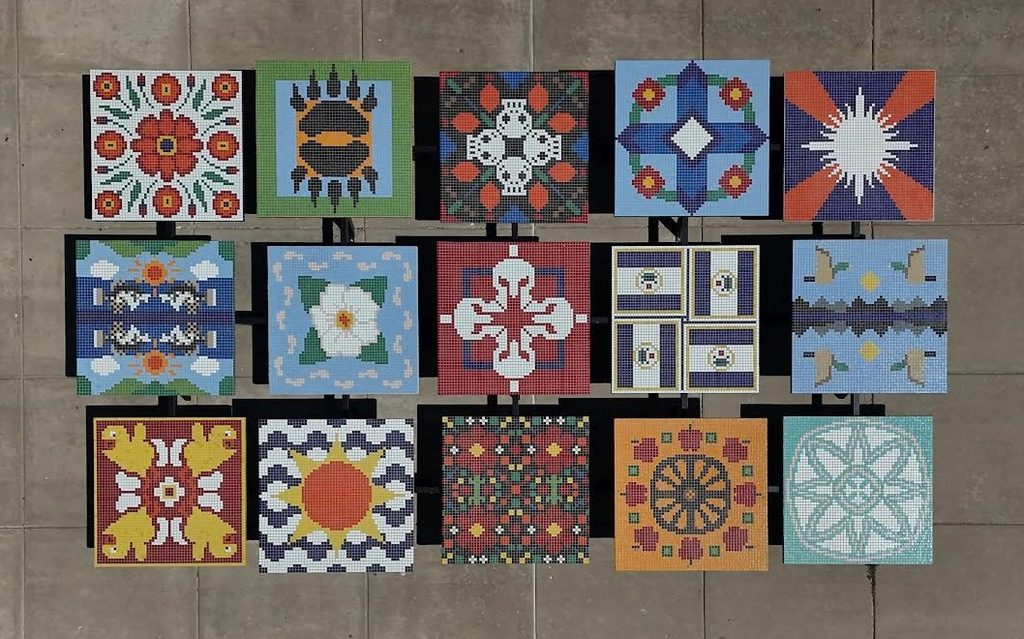
#6-56, The Gathering Grounds, at 17051 E. Hwy 412, Springdale AR is a student-created public art installation at Sonora Middle School in Springdale, Arkansas. Art teacher Jodi Morrison shares the story: Fifteen mosaic tabletops come together to create a shared gathering space for students and community members. To create the designs, students explored the people, places, and experiences that make Springdale unique. Their research included local history, immigrant experiences, cultural heritage, local industries, and natural environments. Students transformed what they discovered into geometric mosaic designs using pattern, symmetry, color, and repetition. Like a quilt assembled from individual pieces, The Gathering Grounds brings fifteen distinct designs together to create a larger work that reflects the diversity and interconnectedness of the Springdale community. The installation celebrates the many stories, experiences, and places that contribute to making Springdale home.
]]>

205 North Vine St.
Paris, AR
#7-01, “Spools & Sewing Machine” is found at 205 North Vine St. in Paris, Arkansas is two foot by two foot. The owners of the block are Dottie & Raymond Neumeier and it’s located on the Quilt Academy that Dottie runs. The block was painted by her husband. The academy is where the Logan County Piece Makers Quilt Guild meets each month. Dottie has four sewing machines set up for anyone wanting to learn to sew to use any time they need. Dottie comes from fifty plus years of sewing and making quilts. She learned to sew as a child from her mother and mother-in-law. Dottie also teaches quilting at Crooked Creek Quilting located in Greenwood, Arkansas. She and her husband both own and have done long arm quilting since 2004. She is very excited to be the Logan County Coordinator for the Arkansas Quilt Trails. Her enthusiasm was evident in the expeditious and organized manner in which she developed a trail for Logan County.

115 W. Short Mtn. St.
Paris, AR
#7-02, Carpenter’s Wheel, is found at 115 W. Short Mtn. Street in Paris. This block is mounted on the front gable of the 100 year old home of Dottie and Raymond Neumeier. This block was chosen to recognize Raymond who is a retired carpenter of fifty plus years. Raymond made, painted, and mounted the block with the help of their son. Raymond is the son of a lifetime carpenter and he retired from Rainwater Lumber Company after thirty years of building trusses and prefab door and window units. He loves and is a collector of antique wood working tools many of which were made in the late 1800’s. Raymond designed and painted several of the blocks on the Logan County Quilt Trail. He helps Dottie quilting quilts on their long arm quilting machine which they have had since 2004.

3714 E. Walnut St.
Paris, AR
#7-03, “Holy Spirit (Dove)” Showering Humanity with his seven gifts which creates a passion (Fire) to know and be with God. The stained-glass window was given to the First Christian Church in Paris by Harvey Johns in memory of his parents, Arch and Lillie Johns in February 2013. First Christian Church was founded November 29, 1885. The whole congregation pitched in to build the wooden frame church. On June 2, 1929 a tornado twisted the church from its foundation. Services were moved to the courthouse. Construction on the current rock Romanesque Revival Style church began in 1930 and was completed in 1935. Construction progressed slowly due to the depression era and the necessity of the congregation to do much of the work. Brother Mason, pastor of the church, was a stonemason so he supervised the construction. On dedication day a big party and picnic was planned then a hail filled storm came up but the church stood strong. It seemed God had his hand on the building and the congregation. For 30 years the ladies of the Church served lunch to the Rotary Club. For the past 12 years the church established a weekly Free Meals Program for anyone in the community in need. It has become a true Ecumenical Program at the First Christian Church at 120 E. Hwy. 22 in Paris. This block was designed by Lee Lane.

3714 E. Walnut St.
Paris, AR
#7-04, French Star with Eiffel Tower, is in recognition of Paris, Arkansas. It was designed by Lee Lane. Paris added a fountain to make sure our Eiffel Tower Park was extra special. R.D. Waddill in 1868 moved into a house in the middle of nowhere in the Arkansas River Valley. Yet in 1871 Logan County was established a county seat, but it needed a name. Local citizens selected “Maryville” in honor of Waddill’s blind daughter. The name was not available, so Waddill selected “Paris”, his favorite city. From 1880’s to 1920’s Paris came into its own. Waddill donated for many of the local churches. The fertile valley with plenty of water and timber guaranteed growth. The Logan County Court House became the center of the square surrounded by retail businesses. Cotton quickly became king. Professionals moved to town. Dr. Mac Smith in 1899, and a brother Dr. Jim Smith, in 1901, moved to Paris and built a hospital in 1913 and expanded it in 1923. Their widespread rural practice was the stuff of legend. Their legacy continued thru three generations of Smith doctors. Today Dr. John C Smith continues to practice in Paris. The Smith Doctors not only provided medical help they also provided much needed financial support to the Coal Mining Industry, which was essential for the growth of Paris and our contributions to WWI and WWII. Today Paris is a wonderful place to raise children with excellent schools, the Career Center operated by Arkansas Tech University-Ozark, churches, banks, hospital, clinics, restaurants, Paris Boys & Girls Club, volunteer organizations, beautiful parks and trails including our entrance to Mt. Magazine State Park as well as the original fertile valley with plenty of water and timber in the Great State of Arkansas. Eiffel Tower Park is at the corner of Express & Walnut Streets in Paris.

3714 E. Walnut St.
Paris, AR
#7-05, Union Star with Paris Eagle was designed by Lee Lane. The forerunner of Paris High School was the Paris Academy created in 1885. The two story brick structure cost $12,000, which was accredited by the University of Arkansas. It held four months of free school and 5 months of student payment of $8/month for room and board. In May 1909 patrons organized the Paris special district and the Academy became the grammar school and a new Paris High School was built and became a member of the Southern Association of Secondary Schools in 1920. In 1925 Arkansas became part of the North Central Association and Paris earned an accreditation of “A” rating. A program of consolidation was begun in 1928 and 1929. The Agriculture Department was added in 1928. The Paris Eagle mascot was established sometime around 1915 for the football team with the royal blue and white colors. A new emphasis on physical education resulted in the construction of a gymnasium in 1938 and the W.S.Morgran football and track & field and stadium was completed in 1947 along with a Cafeteria. In 1949 a Band and Music Building was erected. Today Paris has an Elementary School, Paris Junior High School, and Paris High School. The Tyson Logan County Career Center was established in 2018 to provide an opportunity for students & adults of Logan County to learn trades and skills and to become an integral part of the medical profession. It is located at Paris High School, 2000 E. Wood St. in Paris.

3714 E. Walnut St. (Hwy 22 East)
Paris, AR
#7-06, Sunrise with Subiaco Trojan was designed by Lee Lane. Subiaco Academy is a private, college preparatory, Roman Catholic boarding and day school for boys, which is an apostolate to the Subiaco Abbey, Benedict Order, in Subiaco, Arkansas. The Little Rock-Fort Smith Railroad Company donated the land to the Swiss Benedictine Monks in Indiana in 1878. The monks opened the school in 1887 at St. Benedict’s College. In 1892 the College became a seminary until the school was destroyed by fire in 1901. In 1902 the new stone Subiaco College opened as a six-year program modeled on European lines. In December 1927 the institution was again destroyed by fire. In February 1928 the Subiaco Academy re-opened and has continued to this day with a college prep curriculum and accreditation by the North Central Association in 1968. Subiaco Academy is unique as the only Catholic boarding school in Arkansas. In 1924 Fr. Louis Deuster recruited 20 students to become the first blue and orange Orangemen football team. Fr. Louis also wrote the first fight songs and cheers, all in a single year. In the early 1930’s Coach Reynold Maus adopted the “Trojans” as the mascot and continued to be the Subiaco Academy Trojans’ very successful coach for 30 years. Subiaco Academy is located at 405 N. Subiaco Ave., Subiaco, AR

4780 Hwy 22
Paris, AR
#7-07, Chiming Bell applique block was chosen for the Logan County Quilt Trail because of Robert Cowie’s love and collection of church bells. This is one of three quilt blocks at Cowie’s Wine Cellars & Vineyards. Cowie’s expanding church bell collection is another physical testament to his appreciation of history. There are more than 200 bells on Cowie property. His oldest bell, cast in Germany in 1679, can be found at the entry of St. Anne’s Chapel of the Bells at 101 North Carbon City Rd. Paris AR where Mass is still held occasionally. Another bell, cast in 1691, once hung above a Spanish mission. Other much larger bells can be found hanging at Cowie’s Wine Cellars and Vineyards or on the grounds at 75 North Carbon City Rd., Paris AR. See block #7-08 for more information. One large bell’s story is that it was saved in Germany by a church before Adolf Hitler’s men could melt it down to use in armaments. The piano key sashing border is added because of Mr. Cowie’s love of playing piano and especially organ. This quilt block hangs at the end of the winery warehouse facing Highway 22. Cowie Wine Cellars has pre-owned bells available for purchase. The Bell block was painted by Raymond Neumeier.

2508 W. Walnut
Paris, AR
#7-10, Log Cabin in the Pines, is located at Rainwater Lumber Company, 2508 W. Walnut, Paris, AR. This particular modified log cabin block was chosen to represent the “Pine Trees” logo used by Rainwater. Rainwater Lumber was founded in 1955 by Amos Leo Rainwater, a World War II veteran from Delaware, Arkansas. The family owned business was operated by Mr. Rainwater and his wife, Mozelle, for many years and then passed on to their two sons Gary B. Rainwater and Jimmy L. Rainwater. Mr. & Mrs. Rainwater and their two sons are deceased. Rainwater Lumber is now operated by the third generation, Bruce Rainwater and Eric Rainwater. Stop in for a visit at the Rainwater Lumber and Hardware store. Operating hours are 7:30am-5pm. This block was painted by Raymond Neumeier who spent a 30-year career at Rainwater Lumber Company. According to American Quilter’s Society, Log Cabin quilts first made a wide-spread appearance in the United States in the 1860s during the time of the Civil War. The block name may very well have had a connection to the presidency of Abraham Lincoln. The Log Cabin quilt became wildly popular and was identified with the pioneer spirit and values of America.

17 Rodeo Arena Rd.
Scranton AR
#7-11, Fox Family Windmill, is at 17 Rodeo Arena Rd., Scranton AR. Owner Diane Fox shares, “I fell in love with my first barn quilt while traveling in Northwest Arkansas. I knew then I wanted to make one to go on our red barn. While working full time I didn’t find time to start on one. After retirement that was the first thing on my bucket list. My mother and I loved to make quilts and I know she would have loved to see this painted quilt block in red, white and blue on the old barn.” According to Encyclopedia of Arkansas, James Murphey was the first owner of the land on which the town of Scranton would be built. His deed to the land was registered in 1838. It remained farmland until 1907, when Harmon Remmel led a group of investors to purchase land in Logan County for a city that would be a center of mining operations. They named their city for Scranton, Pennsylvania, which is known for its coal industry. The company Remmel and his partners founded was variously named the Arkansas Anthracite Coal Company and the Scranton Coal Company. The bed of coal they hoped to mine was buried between 700 feet and 1,200 feet underground. Coal-mining shafts in Arkansas were usually no more than 480 feet deep. The company surveyed the land for the city in January 1909, creating 105 blocks and 1,140 lots. The first building completed was a wood structure that served as a combination restaurant, bakery, shoe cobbler shop, and rooming house. Other construction followed, including six general stores, a hotel, a brick factory, a bank, and a jail. A newspaper, the Scranton Independent, was started by J. Higgins. A public school was built in 1912. St. Ignatius Church was established in 1911, and it also operated a school. Many of the residents of the area were Roman Catholic, having come to Arkansas from southern Germany in response to advertisements produced by the railroad industry. The Fort Smith and Subiaco Railroad built a line to Scranton anticipating a boom in coal mining, but the mines did not produce as expected. The coal mines operated at capacity briefly in 1929 but were closed by February 1930. Today the town’s center of activity is Scranton School where about 400 students in K-12 are educated.

3217 Crossroads N Road
Scranton, AR 72863
#7-12 Houser Ohio Star is located at 3217 Crossroads N Road, Scranton AR. Wilma Houser has always loved seeing the many different kinds of quilt patterns. A long time friend of hers that loved making quilts got her interested in doing this project. She gave Wilma the block of wood to get her started off. Wilma already had the red, black, & white oil based paint that she chose for her colors. The Houser Ohio Star hangs proudly on the side of the Houser milk barn which faces the road. The Ohio Star quilt block is a classic and popular design in quilting, known for its geometric simplicity and striking visual appeal. It’s one of the oldest and most recognizable quilt blocks in American quilting history. The Ohio Star block is believed to have originated in the state of Ohio during the 19th century, though it has been used in quilts across the United States. It has been part of both traditional and modern quilt designs, making it a versatile block for quilters of all levels.

4947 Old Military Rd.
Paris AR
#7-13, Farmer’s Toy, is at 4947 Old Military Rd, Paris AR. Tractors are an important part of everyday life at Komp Farms. Komp Farms was established in 1950 by Henry and Mary Ann Komp and passed on to second generation James Albert Komp & his wife, Theresa, who married in 1969. Theresa is an avid quilter who owes her love of quilting to her grandmother Regina Neumeier, and her mother-in-law Mary Ann Komp who named this block “Farmer’s Toy”. When James went out to work each morning she would jokingly ask what toy was he going to play with today. His answer, “my tractor of course !” Komp Farms is currently being operated by 3rd and 4th generation and Theresa hopes to pass the quilting bug to those generations too. Logan County certainly is blessed with talented quilters who are preserving the tradition.

301 West Walnut St.
Paris AR
#7-14, Woven Star. The Paris Area Chamber of Commerce is home of the Woven Star quilt block located at 301 West Walnut Street in beautiful Paris, AR. The woven star was made by Dottie and Raymond Neumeier of Paris. Dottie is a former chamber director that helped locate and design the current chamber office in the late 1980’s. In addition to the chamber office it is home to the TriPeaks Regional Tourism Association and Main Street Paris. The woven star represents how the three organizations are woven into the community of Paris, working side by side to make Paris a destination for not only our locals but visitors from around the world. The PACC, Main Street and TriPeaks are a strong network of community leaders working together to help promote and grow the region while focusing on revitalization and tourism. Paris is proud to be home of Mt Magazine, the highest point of the state and home of Mt Magazine State Park. Visit our website at www.ParisArkansas.com for more information.

25 South Spruce St.
Paris, AR
#7-15, Patriotic Log Cabin Cross is at 25 South Spruce St., Paris AR. Logan County coordinator Dottie Neumeier is proud to present this beautiful block that is mounted on the old Benedictine Sisters’ house at St. Joseph’s Catholic Parish. The sisters’ house was built in 1924 and is where the Benedictine Sisters resided while serving the parish in teaching at the school and serving the parish in many other various ministries. As the nuns grew older and fewer, their service was suspended. This house is currently being used by the parish for meeting, some religious classes and the St. Joseph quilters. The St. Joseph Quilters is headed up by Frances Rhineheart since 1990. The ladies of the parish have hand quilted quilts since nearly the beginning of St. Joseph’s parish. Needless to say they have quilted hundreds and hundreds of quilts. Quilting was originally done in the basement of the old school, then moved to the parish hall, then to the basement of the new school then finally finding a home in the Sisters house when there were no longer enough Benedictine Sisters to serve the surrounding parishes. St. Joseph’s parish started as one of the many German parishes in Logan County, Arkansas in the late 1870’s and 1880’s. Many came to the area because of cheap land and lavish promises of a good life. While not really a part of the “Benedictine Colony” of St. Benedict’s parish in Subiaco and St. Scholastica’s parish at Shoal Creek, St. Joseph’s came because of this movement. In fact, had it not been for the presence of Benedictine monks and nuns in Logan County at this time, it is doubtful if any German Catholics settlers would ever have settled around Paris, at least not in the numbers in which they did. Currently Father Reginald Udouj is serving as the parish priest. He is the grandson of John and Mary Vorster who were known to be parishioners since the early 1900’s. St. Joseph’s Church has at least 175 families registered as parishioners. The present St. Joseph Catholic Church cornerstone was laid in May 1926 after having several other structures in the area. The church was ready for use in early June 1927. The first couple to be married in St. Joseph’s new church was Regina Klein and Paul Neumeier. Paul also helped build the church. This church and location became a dominating landmark for the town of Paris and surrounding area. Many of parishioners and many from the area served our country during War time from World War I, World War II, Korean War, Vietnam War to the Desert Storm War. To those that served these wars and to many other local citizens when returning to the area, seeing the beautiful bell tower of the church as they came towards Paris, they knew they were home. So what better way to say “Thank You” to all those from Logan County who served our Country, than a Patriotic Cross using red, white and blue. This Log Cabin Patriotic Cross was painted by Raymond Neumeier and hung by him and his son Nick. We invite you to come to see our beautiful quilt block and visit our beautiful church in Logan County and now part of the Arkansas Quilt Trails.

23 West Main St.
Paris AR
#7-16, The “Patriotic Blazing Star Eagle” 2’ x2’ quilt board was designed and painted for the Paris Unit of the American Legion Post 121 and DAV Disabled American Veterans, located at 23 West Main Street, Paris, Arkansas. They share a building on the town square in downtown Paris, Arkansas. Several designs were presented and previewed. This design was one they chose. On a background of blue, representing the sky, the Eagle is our national bird. The fierce beauty and proud independence of this great bird aptly symbolizes the strength and freedom of America. The red and white stripes represent our flag where they signify the first colonies. The stars and the tips of the blazing star with the navy background represent the stars on our flag. According to custom and tradition, white signifies purity and innocence; red signifies hardiness and valor; and blue signifies vigilance, perseverance, and justice. The shape of the eight sided Blazing Star was a perfect background on which to portray the Eagle and the stars and stripes. This “Patriotic Blazing Star Eagle” design was painted by Melba Gray and finished by her husband, C. Wayne Gray, who is retired from 34+ years of the Arkansas National Guards. He is currently a member of the Paris American Legion Unit. Melba’s father was a disabled WWII Navy Veteran. Melba’s and Wayne’s interests in quilts go back a long way. When Melba and Wayne married over 50 years ago, she had an over abundant supply of quilts and quilt tops. Both Melba’s and Wayne’s mothers and grandmothers were quilters. They still have two sets of quilting frames and one set of quilting stands that were passed down from Wayne’s mother and grandmother. Melba’s grandmother even hand quilted and sold quilt tops while she was in a nursing home before she passed away. Melba learned to sew at a very young age. Her mother could look at a dress or outfit or quilt design and figure out how to make it without a pattern, and then she would make it. Most of Melba’s clothes were homemade while growing up and some of Wayne’s shirts were handmade, also. Melba grew up around all kinds of expressions of art and design. Happily, their granddaughters are continuing the tradition with interests in sewing and the arts. Currently, Melba is an active member of the Paris Art Center Committee and is an accomplished seamstress and artist specializing in oil painting. Wayne is a talented wood worker and builder of any project that Melba plans including this quilt board. He was on hand to offer constructive criticism throughout the process and then he built the frame and did the finish work after Melba painted it.

480 N. Wilson
Ratcliff AR
#7-19, Lydia’s Ohio Star. Logan County Quilt Trails is happy to have the 19th quilt block, Lydia’s Ohio Star, to go up on a barn at 480 N. Wilson in Ratcliff, AR. Lydia Hughey designed and painted this block. She tells how her grandparents had a home and farm on Mt. Magazine about 17 miles south of Paris, Arkansas. Times were hard back then and you had to provide for your family with what you had. She can remember seeing old quilts made from old feed sacks. Most of the feed sacks had a print or design on them. The Quilts seemed to be faded and very worn. They were made for necessity to keep everyone in the family warm on the cold winter nights. Her grandmother and sisters all quilted. They made a lot of their quilts from old clothing that was too worn out to wear. It was always meaningful to look at the scraps in those quilts and remember the clothing those scraps came from, now most all quilts are made from new bought fabric. Each generation of quilts is unique to the times, but Lydia says she loves the old quilts because of the stories that each little piece of fabric could tell and how the small pieces are the ties that bind a family together. Lydia is retired from Wal-Mart after 24 years as an associate. She and her husband Roger have been married for 45 years and lived in Ratcliff most of that time. They have two children, a son and daughter. Roger currently is the Mayor of Ratcliff. They invite you to visit the Arkansas Quilt Trails especially Logan County Quilt Trail and visit the small town of Ratcliff.

100 North Express
Paris AR
#7-20, Gateway to Mt. Magazine, is at 100 North Expressway, Paris. When Dottie Neumeier, Logan County Coordinator, approached me, Mary Sullivan, about being a part of this Arkansas adventure that would bring one more attraction to not only our downtown but the northside of Logan County, my wheels got to turning. The ideas have been and will be brought to life with the help of Callie Bauer-Smith, Tommy Melton, Valorie Cripps and Jason Cauthron through prepping boards, borrowing projectors and computers, designing patterns, painting, weather sealing, and displaying the quilt squares. The City of Paris employees’ first quilt square titled “Gateway to Mt. Magazine” showcases our beautiful courthouse. The red brick courthouse, Georgian style, has many classical features with the most impressive being the white-columned porticos that stand at three of the four sides and the newly renovated clock tower that is one level high, with clock faces on all four sides. The courtroom takes up the north side of the building, the sole side that does not have an entrance or porticos but sets a beautiful scene for our Christmas tree/light display and Santa visits. The impressive size is the pride of Paris and serves as a backdrop for many of our community events . Located downtown in the heart of our city at 25 West Walnut St., its year around beauty has been captured in paintings, pictures, and quilts.

100 N. Express
Paris AR
#7-21, Coal Mining Heritage, at 100 N. Express, Paris AR, is the second block contributed by City of Paris employees and showcases the era of the coal industry. Coal in our area was known as the “smokeless coal” with a heat-producing quality that burned clear white ash, free of impurities. The first coal mine opened in 1881, at the height of its era in the 1950’s an eight-hour day shift wage of $7.50, at 31 privately owned mines employing about 2,000 miners, made the area an employment opportunity for many families. Business activity flourished in Paris until the demand for coal in northern markets diminished in favor of other fuels. The Paris Miners Museum located at 804 South Elm on scenic Hwy 309/109, captures the booming life and times of the mining era with a life size bronze statue of a miner, with his carbide light, shovel, and lunch bucket at his feet. The surrounding stones hold plaques bearing names of many of those who worked, owned, or operated the mines. The museum was a labor of love that began with Bob Thomas and was completed by local volunteers and the city.

1175 Old Airport Rd.
Paris AR
#7-22 Vintage Bow-Tie is located at 1175 Old Airport Rd, Paris AR. Any “gearhead” or “car guy” will get the connection between the “Bow-Tie” block and the old Chevy “Bow-Tie” appliqued in the center. This block is located on the shop building of Nick Neumeier, a local “dyed in the wool” vintage “bow-tie” fan. The yellow and blue colors are similar to the original Chevy emblem colors. Nick has driven, collected, rebuilt, sold, re-stored old Chevy trucks since his teenage years. So you can see why it is fitting to hang this block on his shop building, that houses his own old ’54 Chevy truck “In the works” stage. After a career in the military, “you guessed it, in the motor, pool”, Nick is currently employed at a local automotive parts store-“can you believe that! In his spare time he hangs out at a local vintage car-hotrod shop where you guessed it –he still works on old Chevys. This block was given to Nick by his parents Dottie and Raymond Neumeier on his 55 birthday (which was also the day he had his first grandchild lil Miss Averi Neumeier. I’m sure she will grow up learning to love old Chevys!) Raymond designed and painted the block. Dottie is the Logan County Quilt Trail Coordinator for the Arkansas Quilt Trails.

1810 East Walnut St.
Paris AR
#7-23, Paris Police Department, at 1810 East Walnut, Paris AR. The City of Paris employees have been a valued partner in expanding the Logan County Quilt Trail. Their third quilt square titled “Paris Police Dept” showcases our men and women in blue here to “Serve & Protect”. The department, since passing the civil defense ordinance in 1957, has seen many changes from the era of a chief and night watchman, jailer & family living on site, dispatchers, and meter maid to a force that consists of the chief, 8 patrol officers, 1 school resource officer (with 2 more coming in the next 2 years), 1 office manager, and 6 dispatchers. And in 2021 we made history with our first female chief, Robin Ellington. In this time of political and racial turmoil we are proud of our force and the time they take to be a part of our community, and we are also proud of the county officers who are always willing to lend a helping hand when needed. We will end with a quote from Paul Harvey’s “The Rest of the Story” A Policeman must be a minister, social worker, a diplomat, a tough guy, a gentleman, and a genius to feed a family on a policeman’s salary. The square is painted on both sides so it doubles as new signage in front of the headquarters.

205 East Main St.
Paris AR
#7-24, Paris Volunteer Fire Dept block is at 205 East Main St., Paris AR. The City of Paris employees’ fourth quilt square titled “Paris Volunteer Fire Department” showcases our firemen that have dedicated days, nights, weekends, and family time to help our citizens in times of crisis. In 2001 they moved to the current fire house which consists of 3 bays, an office, training room, and a de-contamination washroom. Over the years our current and past chiefs, asst. chiefs, captains, members, and city have helped to establish an ISO rating of 4 for our homeowners. Our department has 16 volunteers with 10 doubling as first responders, 3 firetrucks, 1 brush truck, and 1 service van. Their community involvement includes bringing the firetruck(s) and dressed in turnouts for spring & fall town square events, delivering Santa to his hut on the square during the annual Christmas parade, visiting the schools, or lighting up the sky for the Chambers’ 4th of July event, always a big hit with young and old. We will end with a quote from Harold “Pee Wee” Schluterman who retired December 31, 2020 after 52 years and 5 months of volunteer service to our city and fire department. “You’ve got to be and need to be dedicated to be a fireman”.

520 Patterson St.
Paris AR
#7-25, Veterans Park, 520 Patterson St., Paris AR. The City of Paris employees’ fifth quilt square titled “Veterans Park” showcases our veterans, living and deceased, who have served not only to protect our great country but to give us the freedom we have come to enjoy. The square is painted on both sides to double as the city’s new signage at the parks westside entrance. From monuments around our square that honor soldiers from World War 1 & 2, Korean, Vietnam, Desert Storm, Operation Iraqi Freedom 2, to a Veteran’s Affairs office in the courthouse, a DAV office on the square and a Boy Scouts sponsored final resting place for our nations retired colors “May her stars & stripes wave forever”. A hut that is still referred to as American Legion Hut as well as the American Legion baseball ballfield. A monument east of town recognizing our civil war skirmish, known as the battle of Haguewood Prairie. Our FFA kids and sponsors campaigned for Purple Heart recipients to have designated parking on the square, at businesses and parks. And in 2005 the city council renamed Paris City Park to Veteran’s Park. We as a community cannot begin to thank them for all they have and still do for our freedom, so I will leave you with 2018 eight-point Veteran’s Creed in their honor:
- I am an American Veteran.
- I proudly served my country.
- I live the values I learned in the military.
- I continue to serve my community, my country, and my fellow veterans.
- I maintain my physical and mental discipline.
- I continue to lead and improve.
- I make a difference.
- I honor and remember my fallen comrades.

1808 Union Road
Paris AR
#7-27, Eight Point Star, is at 1808 Union Road, Paris AR. Owner Lori Smith shares its story. My first barn quilt is this eight point star. I am appreciative of everyone who shares their work on the quilt trails. Quilts have always been a huge part of my life because of the generations of quilters in my family. I cherish the memories as a kid of tearing the newspaper backing off each block as my grandmother pieced them on her Singer treadle sewing machine. I remember not being able to move in the bed because I was under six quilts in a bedroom where you could see your breath in the frigid air. I remember that toasty warm feeling of love that gave me a sound sleep and a constant smile on my face. Quilts that were made from feed sacks, scraps from my old dresses and my grandmas polyester pants were the best. Quilting was considered a necessary chore along with cooking, working the garden and tending the chickens, the chores that kept your family healthy and happy. The barn is located on Union Road between Subiaco and Paris. It has been in the family since my grandpa purchased the farm in 1955. As a child in the 60’s I have so many memories of the barn and farm. From playing in the hay loft, bottle feeding calves in one of the stalls to digging worms in the barn lot to bait the perch and catfish in the pond. So much fun was had by first cousins who were allowed to be kids and learn what it meant to be family. There were huge outdoor meals under the carport because there wasn’t room in the house for everyone to sit. We chased lightning bugs just after dark and put them in a Mason jar to use as a night light. In 1995 my husband and I were able to purchase the farm from the family and have been able to build our dream home here. Just like the quilts I have inherited over time, the barn continues to provide warmth, love and cherished memories.

406 Taylor St.
Paris AR
#7-28, American Pride, is at 406 Taylor St., Paris, AR. It’s on a fence in the front yard of Mike & Jane Koehler. With an opening in his schedule, Mike designed and built his first quilt square panel deciding on a patriotic theme because he is proud to be an American. He felt that it was important to do something positive to raise spirits a little bit because too many Americans are always griping about problems that we have. He agrees that we are not perfect and counts his blessings, daily, that he is an American with many freedoms that much of the world can only dream about. Mike operates a stained glass studio at this location making panels for churches, businesses, and homes, as well as repairing glass. He welcomes visitors to stop by the studio or visit his website: facebook.com/sunnydaysglassart or sunndydaysglassart.com.

114 W. Short Mountain St
Paris, AR
#7-29 Paris B&B Ohio Star is at 114 W. Short Mountain St, Paris, AR. Paris Bed & Bath is a vacation rental home that was established in 2022 by Kecia Schluterman. The property and business was later purchased by Chris, Andrea, & Kinsley Walker in the summer of 2024. The Walkers have always dreamt of owning a vacation rental home that would contribute to bringing tourism to Paris, which is ‘The Gateway to Mt. Magazine”. The Walkers shut the business side down for a few months to renovate and to put their own spin on the home. The home has many unique features and history to it, including a vintage clawfoot bathtub, glass door knobs, and the original hardwood floors. It also features old parking meters that used to be located on the Paris square. Inside of the home you can find an old bible and an old metal coffee pot that was recovered from the Smith Hospital that was built in 1913. The house is located across the street from Dottie and Raymond Neumeir which used to own a quilting academy in Paris. At the time Dottie was the coordinator for the Logan County Quilt Trail. Chris became very interested in the barn quilt blocks and the meanings behind them and of course Dottie was thrilled to share any and all information about them. The further along things went, Chris decided to step out of his elements and to paint his own quilt block. Raymond has designed and painted several of the quilt blocks in the area and shared many tips and tricks with Chris to help him get started. He even gave Chris the wood panel to paint it on. Chris chose the ‘Ohio Star’ pattern for his quilt block because of its simplicity to coordinate with the cottage style home. The 3ft X 3ft quilt block has various shades of greens and browns to accent the exterior of the house. By the time everything was said and done Dottie decided to pass the torch of the Logan County Quilt Trail coordinator on to Chris which he was very humbled to accept. If you’re ever planning a trip to the area, Paris Bed & Bath would be more than happy to host you! You can find them on Airbnb & VRBO.
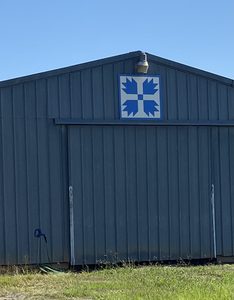
#7-30, Bear Paw is at 1818 N. State Highway 116 in Booneville, AR. Owner Jeanne Andrews chose the Bear Paw pattern for the quilt block that hangs on her barn. She shares its story: Deborah May of Quilt Barn Express painted the metal sign using the same colors that I had used to make the quilt. I made the quilt using that pattern several years ago, and it has remained my favorite. Before making this quilt, I had only made simple pattern ones such as the nine patch. When deciding to make the quilt using this pattern, I was advised by my then 80 year old mother and her quilting friends, who had quilted all their lives, that maybe I needed to try a more simple one, but I was determined this was the one I wanted to make. Needless to say, they were correct. I spent many, many hours sewing the squares and almost as much time taking the seams out and starting over! After about a year I had the quilt top pieced together and ready to be quilted. I thought it turned out beautifully, even though it was not perfect by any means. It certainly would never win a ribbon at the county fair, but I was happy with the results, and the fact that I made it myself made me happy.
Every time I pull into the driveway at the barn and see the quilt square, I smile with good
memories of those lifetime quilters and their thoughts of my making the Bear Paw quilt.
I loved them all!!!
]]>
Welcome to the Pike County Quilt Trail. The volunteer co-coordinators of the trail are Marla Stewart and Jackie Beck. They painted many of the blocks and are grateful for all the other artists and contributors to the trail. Pike County is located in the southwest quarter of the state. Murfreesboro is the county seat and other towns/communities include Antoine, Daisy, Delight, Glenwood, and Kirby. You will see a few blocks that have an Amity, AR address (which is needed to find the location by GPS) but they are actually located in the Kirby community. Pike County has a wealth of natural attractions as noted by Encyclopedia of Arkansas: The area around Narrows Dam is known to be one of the best spots in Arkansas to hunt deer. Turkeys are plentiful, also. In the last few years, a few sightings of black bears have been noted in the area. Below the dam is a Rainbow Trout fish hatchery, which is stocked by the Arkansas Game & Fish from late fall until April. Fly fishing has grown to be a popular sport in this area. Daisy State Park, a popular tourist destination, is on the north shores of the 7,000-acre Lake Greeson, about six miles west of Kirby. The Daisy area is noted as a good fishing area to catch black and white bass, stripers, crappie, catfish, and bluegill. The county has three rivers. The Little Missouri enters at the northwest corner of the county, flows through the rocky Ouachita Mountains. As it travels south, it drops 1,035 feet before it runs into Lake Greeson above Daisy. This makes these upper waters excellent for experienced canoeists. The Caddo River is also a good river for floating and paddling. It flows out of the Ouachita Mountains, provides good rapids to navigate all the way to Glenwood. The Antoine River rises in the northeast part of the county, flows generally southeast past the town of Antoine. It follows the county east border, finally running into the Little Missouri River. All of these rivers are good fishing rivers, with bluegill, trout, catfish, crappie, bass, being just a few. Crater of Diamonds was made a state park in 1972, and 23,000 known diamonds have been found since then. This is the only place in North America where one can search for diamonds and keep one’s findings.

11 Bear Creek Cemetery Rd.
Kirby AR
#8-01, Harvest Star was painted by Jerry Turner of Lodi several years ago. His interest in barn quilts began when he saw some on a photography site that he frequented. After researching barn quilts and traveling to see some in other states, he painted some himself. Jerry has been a carpenter and cabinetmaker in our area for many years. He is a hobbyist extraordinaire, dabbling in many creative ventures. Rhonda Harmon is the proud owner of Harvest Star. Her son, J.C. and wife Sonia, purchased it from Sonia’s Uncle Jerry for a Christmas gift. It hangs on a rustic log building on the property of another son and wife, Blake and Jessica. No information regarding the cabin could be found, but it must have been constructed in the early 1800’s. Rhonda and her husband Carl have three sons, six grandchildren, a great granddaughter and great grandson. They operate the Kirby Kwick Stop, a convenience store/gas station/grill. The Kwick Stop is a favorite place for locals as well as tourists on their way to Lake Greeson which is only a few miles away. “Lake Greeson is a man-made lake originally created as a flood control and hydropower project by the U.S. Army Corps of Engineers between 1947-1950. It is 12 miles long and is surrounded by 15,842 acres of public lands. The wide variety of recreational opportunities available on and near the lake include boating, swimming, hiking, fishing, and camping.” Arkansas.com

100 Dillard Rd.
Glenwood AR
#8-02, Fish on a Dish, at 100 Dillard Rd, Glenwood AR, was painted by Jackie Beck. Take the right turn before the white mailbox even though your GPS may tell you to go straight. Jackie shares the story, “I don’t remember my exact age when I first held a cane fishin’ pole, but my daddy was beside me helping jerk in the bright colored Sun Perch that had bitten the worm on my hook. I guess you could say that I was “hooked” from that day forward. Going fishing was a great treat for us. We did not get to go often, but for many years we would go camping for a week with my grandparents. Then as the years went by, just my dad, mom, sister and I would camp for a week at the lake. Every day we would get in our small red and white aluminum boat and set out with worms, crickets, minnows and a few jigs. My parents had to have the patience of Job to deal with all of the hang ups, losing bait, and mishaps that my sister and I caused! I remember one camping trip particularly well. I must have been eight or nine years old. We got up early one cool morning and set out to see what we could catch. The water was calm and the fog lay like a thick, wet blanket. It wasn’t long before we all started catching crappie as fast as we could throw out the line! Somehow, we had anchored right in the middle of the crappie bed. The memory of sitting in that boat with my family surrounded by fog and fish, cool air and the smells of the lake still bring a smile to my lips and joy in my heart. I treasure the time I spend sharing my love of fishing with my husband, son, daughter, and now my three grandsons. And there is nothing better than frying up a mess of fresh fish to enjoy with family!”

55 Stewart Farm Rd.
Amity, AR
#8-03, Olympic Shooter is located at 55 Stewart Farm Road, Amity AR. Although this is the GPS address, it is actually in the Kirby community. This quilt block in Pike County has special meaning. It was done by county coordinator Marla Stewart for her husband, Randy Stewart. Randy was in the Army, stationed at Fort Benning, Georgia, while he served on the Army shooting team from 1978-86 as the Officer in Charge of the running target team. During that time, Randy won 23 national championships, 30 inter-service championships, and 13 international medals. In 1983, he won a bronze medal at the World Championships, the first American to medal in that event since 1968. At the 1983 Pan American Games, Randy won a team gold medal and an individual silver. He earned a place on the 1980 and 1984 Olympic teams. The US boycotted the 1980 games due to Russia’s invasion of Afghanistan. In 1984, he placed 9th at the Olympic games in Los Angeles. Randy began his shooting career as a student at Henderson State University where he shot on the small-bore rifle team. He is a member of the Reddie Hall of Fame. In more recent years, he became a cattle farmer, high school teacher, and shotgun coach. He also taught concealed handgun classes for over 20 years. In 2007, he entered politics and was elected to the Arkansas State Legislature, winning re-election in 2009 and 2011.

55 Stewart Farm Rd.
Amity AR
#8-04, Hunter’s Star is located at 55 Stewart Farm Road, Amity AR. Marla Stewart chose this pattern for the family’s workshop located in Kirby (Pike County). The quilt is on a 5×5 board. Marla and her husband, Randy, come from hunting families. Their children grew up hunting, and now their two grandsons are excellent hunters. At 12 years of age, Noah has killed 12 deer. Evan, age 9, has killed 5. She chose red, white, and blue because the family is very patriotic. Her father served in WWII; Randy served 28 years in the army, and daughter Sara served six years in the Arkansas National Guard. This was Marla’s first barn quilt; she painted it in June 2018. Unfortunately, the family workshop and the barn quilt perished in a fire in February 2019. She repainted the Hunter’s Star on a 5×5 board in April 2020 and hung it near the Olympic quilt that she painted for her husband. Three cheers for Marla for repainting this one after the fire. We can all appreciate the double effort that went into that, while also developing a quilt trail for Pike County! We think you’ll enjoy seeing the Pike County Quilt Trail and appreciate the community spirit and work that went into developing it.

2552 Hwy 70 W
Amity, AR
#8-05, Mother’s Favorite is located at 2552 Hwy 70 W, Amity, AR. Debi Arivett’s barn quilt is located in Kirby on the barn that her grandparents built around 1954. The pattern is “Mother’s Choice” and was painted by Jerry Turner of Lodi, a neighboring community. This was the first barn quilt that Jerry painted. J.C. and Willie Orrick built the barn by themselves while their daughter, Betty Zane and her husband Edwin were away in Indiana for the tomato harvest. The barn is located on Hwy 27 just north of Kirby. Even in 1954 the highway had a great deal of traffic. According to Betty Zane, the beautiful red barn received considerable attention as people stopped to admire it. The barn has a hay loft, a milking stall, and equipment rooms. Ms. Willie always had a good milk cow. She sold extra milk and often gave it away to families who couldn’t afford to pay for it. She was also well known for her vegetable and fruit gardens. Still today, there is evidence of her green thumb in the plants and shrubs around the house. The quilt block is a fitting tribute to their hard work to provide for their family and other families too. You’ll enjoy seeing the barn this block adorns and know a bit of the history behind it. Debi and her mother have since passed away, but the barn quilt remains to preserve the family story.

400 East Broadway Ste B
Glenwood AR
#8-06, The Arkansas Star is located at 400 E. Broadway, Ste B, Glenwood AR. It was painted by Pike County coordinator Marla Stewart. While searching for new and interesting patterns, she noticed that several states have their own stars. This pattern is what she found as she searched for an Arkansas star. She decided to paint it red, white, and blue to match the colors of the Arkansas state flag which signify that Arkansas is one of the United States having been admitted to the union in 1836. The barn quilt resides in Glenwood, a small and friendly town in southwest Arkansas. Glenwood is nestled in the foothills of the Ouachitas and on the banks of the Caddo River. Timber, farming, and tourism are the principal businesses in the area. Many people who have visited the area on vacation have relocated here permanently. Dr. Terry and Kathy Hutson own the building where the quilt hangs. They purchased the building at 400 E. Broadway in 2003 that had been Wright’s Food Center and Cash Saver as well as the American Legion. Presently, the building houses Family Chiropractic Clinic, Paradise Tanning, and Cole and Kamryn Boutique. The Hutsons and their three children moved to Glenwood in 1998. They have 8 grandchildren who live in various places in the U.S. due to their military service. The patriotism of this incredible family makes the color choices even more relevant. Terry’s dad and Kathy’s dad were in the Navy. Their son and two sons-in-law are or have been in the Air Force. Terry and Kathy feel very blessed to have taken care of their patients for the last 26 years in Glenwood and have enjoyed living near the Caddo River and supporting Glenwood, AR.

413 Bear Creek Rd.
Kirby AR
#8-07, Carolina Lily barn quilt hangs on the front of the home of David and Anne Butcher at 413 Bear Creek Road in Kirby, just up the road from the Bear Creek Campground on Lake Greeson. You’ll likely encounter the family dogs, but their bark is accompanied by a wagging tail. Anne is an avid quilter and is particularly drawn to lily blocks. She says that having something so bright and pretty hanging in such a prominent place just makes her feel good, and it’s her way of letting everyone know how much she loves quilts and quilting. She believes it makes their place look homey and inviting. This barn quilt was painted by Rylee Chambers of Chambers Handmade LLC, at Hope, AR. Lake Greeson is a reservoir on the Little Missouri River, in Pike County, Arkansas. According to Encyclopedia of Arkansas, it was created in 1950 when the U.S. Army Corps of Engineers placed a dam on the Little Missouri River some six miles north of Murfreesboro (Pike County). The lake was created for flood control and hydroelectric power generation. Famous for its scenery and recreation, it is surrounded by 15 parks that offer opportunities for camping, fishing, boating, biking, and swimming and just enjoying nature.

413 Bear Creek Rd.
Kirby AR
#8-08, Mandala at 413 Bear Creek Rd, Kirby AR. The Butchers’ second barn quilt that was painted by Rylee Chambers is on the gable end of their carport that faces Bear Creek Road. So far as Anne knows there isn’t a name for this quilt block but was created from a sketch she made. It’s a little similar to an orange peel or a Joseph’s Coat pattern. The contrast between the colors and the black background are striking. She calls it Mandala. Anne grew up calling Kirby Landing (Marina) her home. It’s about 2 miles down the lake from the place she now calls her own home at 413 Bear Creek Road. She learned to love fabric, sewing and needlework from her grandmother, Edna Crump. At least once a week beginning at about age 8 until she was a teen, she traveled two miles by boat between Kirby Landing and Bear Creek where Grandma Crump lived and often they talked about and worked on sewing and quilting projects. This property with its barn quilts is near the popular, well-traveled Bear Creek cycle trail and just a short, pleasant walk from the Bear Creek Campground. For information on Bear Creek Campground, visit www.arkansas.com/amity/sports-recreation/bear-creek-recreation-area-campground. Lots of things to explore!

310 Palestine Rd.
Amity AR
#8-09, Foshee Family Flock is at 210 Palestine Rd., Amity AR which is in the Kirby community. Foshee Family Flock is a whimsical representation of Mark, Pam and their children Logan and Shelby. The artist, Jackie Beck, shares, “I have been blessed for many years with their friendship. The barn quilt is just a small token of my appreciation of that friendship with all the laughter, tears, and Christian fellowship we have shared rolled into one. I hope Foshee Family Flock brings a smile to your face and joy in your heart as much as the Foshee family has brought to mine.” Pam Foshee shares, “Foshee Farms was established in 1983. We are just one of many chicken and cattle growers in Pike County. We have 8 broiler houses with 25,000 chickens per house. Logan and Shelby began learning about farming while very young. As they grew, we began to give them small jobs and naturally they learned to do more and more. One year we were blessed to have an exchange son from Belgium that learned about the workings of the farm. All three of our children have become responsible young adults from the lessons they learned growing up on the farm.” According to Arkansas Farm Bureau, Arkansas leads the nation in poultry production. The most common poultry in Arkansas are chickens and turkeys. Poultry production accounts for 1 in 4 agricultural jobs in Arkansas. Companies that produce and process chicken in Arkansas employee as many as 37,260 people across the state and generate an additional 70,739 jobs in supplier and ancillary industries. UPDATE: the Foshee family has now retired from broiler production, but they still raise cattle.

Pike County Fairgrounds
510 N First St.
Glenwood AR
#8-10, Pike County 4-H is located at the Pike County Fairgrounds at 510 N. First Street in Glenwood. It’s located on the last building on the right if you are at the fairground entrance. It can be seen from the street. Pike County trail coordinator Marla Stewart painted and donated this barn quilt in honor of Pike County 4-H. It was sealed with a clear coat by Mark Ligon of Mark’s Auto Body in Kirby. Marla painted the barn quilt to honor the members, alumni, staff, and volunteers of the 4-H community. Through 4-H programs, young people learn new skills in many areas of life such as citizenship, leadership, healthy living, agriculture, and STEM. 4-Hers are known “To make the Best Better.” With the help of inspiring and hard-working volunteers, they develop a greater sense of self-confidence and become more responsible as they develop soft skills used for life. The quilt hangs on the Crawford Building at the Pike County fairgrounds in Glenwood. The building is used to house some of the many exhibits at the Pike County Fair, especially the educational booths prepared by 4-H members who share information about their project areas. “Red” Crawford donated some of the land for the fairgrounds thus the name Crawford Building.

329 E. Main St.
Murfreesboro AR
#8-11, The Murfreesboro Diamond hangs in the front window of Ceba Gas, at 329 E Main St, in Murfreesboro. Owners Neil and Lauren Priddy asked Marla Stewart to paint the diamond. Marla grew up in Murfreesboro and wanted to promote the town and the Crater of Diamonds. Diamonds were first discovered in the area in 1906. Individuals as well as commercial mining companies have owned the property. The state purchased the land in 1972 and opened the Crater of Diamonds State Park. The search area is around 37 acres. Hunting for diamonds here is a truly unique experience. The park is the only diamond mine in the world where the public can hunt for diamonds and keep whatever they find. Visitors to the park find over 600 diamonds per year. The barn quilt is 3’ by 3’ and boasts the colors red, white, and blue to represent the company colors of Ceba Gas, Inc. The diamond is superimposed at the center of the quilt. The diamond was cut by Marla’s friend Ryan Brady. He also constructed the frame. Ceba Gas is a three-generation family owned propane business that has enjoyed being part of the Murfreesboro community for over 50 years. It was started by Bobby and Sue Carroll as part of Carroll Building and Appliance in the 60’s. It then transitioned in ‘94 to Ceba Gas, under the ownership of Tom and Margaret Byrd. Recently, Neil and Lauren Priddy purchased the company and plan to continue serving the residential, agricultural, and commercial propane customers of Southwest Arkansas for years to come. Ceba Gas headquarters is located on the Murfreesboro square, which has a rich heritage of its own, and is why the Murfreesboro Diamond was chosen as the design to be displayed.

69 Old Hwy 70 Loop
Glenwood AR
#8-12, Little Farmer Boy & Girl. Owner Sherie Grant writes, “For my first barn quilt I chose the Little Farmer Boy & Girl in celebration of my Grandchildren Ian, Jainie, Nora, Leigha, Amos David, Zeke, Sam, and Hadassah. It was painted in memory of my Great Granny, my Grandmama, and my husband’s Mamaw who all made beautiful quilts that have covered my family for many years. I still remember my Great Granny having a quilting frame in her living room. This barn quilt was also painted in honor of my mother who is an amazing seamstress and who has also made some amazing quilts. The image in the center block is a part of the Grant Family Crest. It consists of a green rock and flame and our family’s motto “Stand Fast.” The flames coming from the green rock represent the warning fires that were set on the mountain to warn against approaching danger. The colors in the borders also match the Grant Plaid. There is a little green heart on the center block in representation of the many foster children who have lived and been loved in the home of my son and daughter in law and also a red heart for the newest foster baby to bless their home during the painting of this quilt.” Thanks to the Grant Family for sharing a bit of their family legacy through this quilt block!

4790 Hwy 301 S
Delight AR
#8-13, Fractured Heart of America. The quilt block is on an old horse barn on Bill and Avonne Petty’s farm in the Delight area of Pike County. Avonne shares the story behind it. This red, white, and blue block depicts the fractured heart of America of 2020. The nation faced many challenges in 2020 and the year will be remembered as the “Year of the Face Mask.” This display is located on the right side of State highway 301, fifteen miles east of the Crater of Diamonds State Park. (2.5 miles past the crossroads of Highway 195 at the Blue Mailbox.) The pandemic of Covid 19 took over the year with millions of people testing positive for the disease and hundreds of thousands dying from it. Families and friends could not socialize together even for funerals of loved ones. Schools were forced to close. The economy was hampered with businesses closing, many to never re-open. Jobs were lost and thousands were on unemployment. There were shortages of many necessary items including food in some places. Looting and destruction in several major cities erupted. Mother Nature challenged the country with floods, tornadoes, and earthquakes across the nation. Hurricanes destroyed property and crops in the South while wildfires burned millions of acres in the West. Being very community spirited, Avonne made and donated hundreds of face masks. She felt this block reflects the turmoil of America during 2020 and the masks worn by everyone. This block is adapted from an Add Fireworks pattern by Denise Russell featured in the July 2020 issue of the American Quilter magazine.

23 Stewart Farm Rd.
Amity AR
#8-15, Welcome Home, was painted by Pike County coordinator Marla Stewart to hang on their new workshop located near their house at 23 Stewart Farm Rd, Amity (actually in Kirby). Marla chose warm fall colors for this quilt because the fall is her favorite time of year. The colors are also incorporated in her house and the workshop. The Stewarts’ home is surrounded by various types of oaks, dogwoods, hickories, and pines. The changing colors of the leaves is a joy to watch from their back porch which overlooks a small creek that eventually empties into nearby Lake Greeson. Fall is a favorite time for many people in Pike County due to the 5th season of the year, deer hunting. In the early fall, deer hunters can be seen bush hogging and planting food plots, trimming limbs near their stands, and getting all their gear ready for deer camp. The word “home” evokes warm feelings for most of us. For Marla, home is a place of refuge where everyone is always welcomed, loved, and accepted. She wants everyone, family, friends, or strangers to feel at home in her house. Randy and Marla have 3 children: their daughter lives across the pasture with her husband and 2 sons, one son lives in Salt Lake City, and another son lives in the Washington D.C. area. Distance prevents the sons from visiting very often, but they are always a welcome sight. Marla enjoys preparing everyone’s favorite foods when they visit. Her mother was a fabulous cook, and she continues that tradition.

71 US-70
Glenwood AR
#8-16, Dush-toh. 71 US-70, Glenwood, AR. On the side of Vik’s Flea Market in Glenwood resides a barn quilt painted directly onto the brick by Jackie Beck and Marla Stewart. The quilt is 4’ by 4’ and is a replica of a dush-toh, a Caddo lady’s hair decoration worn for dances. This piece was shaped like an hour glass and would have had ribbons attached that flowed the entire length of the lady’s heighth. The dush-toh was chosen as the subject of the quilt to honor the influence of the Caddo Indians in southwest Arkansas. In nearby Caddo Gap is a statue erected in 1936 to pay respect to the Caddo Tribe. It is built on an ancient Caddo burial site. The Caddo were farmers, hunters, and craftsmen. The chronicles of Hernando de Soto tell of his team’s entering Caddo country on June 20, 1542. However, de Soto died a month prior to that date. His successor was Luis de Moscosco. Ka-Do-Ha Village is located in Murfreesboro, the county seat. The Caddo are known as mound builders. This is the only open mound in the United States. Visitors can pay a small fee to view the mound, a museum, and gift shop. To learn more about the Caddo Tribe in Arkansas, go to encyclopediaofarkansas.net.

71 US-70
Glenwood AR
#8-17, Diamond in the Rough, at 71 US-70, Glenwood AR, was painted by Jackie Beck and Marla Stewart on the side of Vic’s Flea Market in Glenwood. It measures 4’ by 4’. Due to the high cost of lumber at the time, they chose to paint directly on the brick. Proving to be much more challenging than painting on wood, their efforts also required more time. Vic’s Flea Market has around 100 booths available and contains a wide assortment of antiques, collectibles, and treasures. The building was once the Glenwood High School gymnasium, built in the early 1970’s on land that was previously a dairy farm. In 1995, Glenwood and Amity schools merged to form the Centerpoint School District. The school is now located in the Rosboro community. The quilt block was inspired by the Crater of Diamonds State Park located near Murfreesboro (also in Pike County). This is the only diamond mine in North America that allows you to hunt diamonds and keep whatever you find. According to ArkansasStateParks.com, “more than 33,100 diamonds have been found by park visitors since the Crater of Diamonds became an Arkansas state park in 1972.” Lake Greeson is also in this area. It is a Corps of Engineers man-made lake that spans 12 miles from Murfreesboro to Kirby and Daisy. Opportunities for camping and water sports abound here as well as hunting, fishing, and cycling.

71 US-70
Glenwood AR
#8-18, Life on the Caddo, at 71 US-70, Glenwood AR, measuring 7 ½ feet square was painted by Jackie Beck and Marla Stewart. The quilt was inspired by the town of Glenwood and its people. Glenwood is a small town in Pike County of approximately 2000 people. The town supports many outlying areas for work, school, worship, and shopping. The Caddo River is named for the Caddo Indian Tribe who once inhabited the area. The river has helped to support the timber industry and sawmills since the town was founded in 1908. It is noted for its clear water from cold water springs originating in the Ouachita Mountains. Its cool waters are widely known as a great place for family float trips as well as fishing. Glenwood has numerous cabin rentals on the river and companies that rent canoes, kayaks, rafts, and tubes. There are facilities for camping and RV parking near the river. The town boasts of numerous top quality restaurants, a large grocery store with a wide variety of products, an award winning 18-hole golf course, a hardware store with everything you could possibly need, and many other amenities. The timber industry is still one of the largest professions in the area along with cattle and chicken farming. Even though the area has these tremendous resources and more, we still consider our people to be our greatest resource.

100 Dillard Rd.
Glenwood AR
#8-19, Finch Braid, at 100 Dillard Rd., Glenwood AR is painted on a 3’x3’ plywood board. Jackie Beck shares: it hangs on our metal shop building along with my Fish on a Dish barn quilt. The love of bird watching has been passed down through several generations. My maternal grandmother had a large double window that faced her backyard where we would enjoy watching the many varieties of birds feeding. It was exciting to see how many different species of birds visited her feeders throughout the year. My mother, sister, aunt, as well as my daughter have set up feeding stations where the birds are well fed and loved. I am amazed at my two older grandsons that can name so many of the birds. The boys get as excited about seeing a new bird as the adults! The American Gold Finch was chosen for my barn quilt simply because it is beautiful. The bright yellow, black and a touch of white in the male is so vibrant in the winter months. I am blessed to have an abundance of them in my area for my husband and me to enjoy. My grandmothers taught me the love of sewing. My maternal grandmother was a true seamstress. She not only pieced quilt tops and hand quilted them, but she sewed clothing and did alterations from hemming garments to constructing wedding gowns for the community. My parental grandmother pieced a plethora of quilts by hand with any scraps she could get while sitting in her wooden rocking chair. My sweet mother-in-law inspired me to learn to quilt when I watched her give so much of herself with each quilt she made and in turn, gave away. This particular braid pattern was chosen in honor of a special friend now deceased. I did not start piecing quilts until in my 40’s. Jan Martin guided me through the learning process of quilt piecing. The French Braid Quilt pattern was the first quilt I made where I had to “fussy cut.” Jan was there with her tips and tricks to ensure I had a successful quilt. I will ever be indebted to the women in my life for sharing their passion of sewing, quilting and their knowledge of this art with me.

23 Stewart Farm Rd.
Amity AR
#8-20, Nana’s Retreat, is painted on an old metal sign purchased at Amity Trade Days. It measures 18” by 24” and was painted by Marla Stewart, AKA Nana, for her garden at 23 Stewart Farm Rd in the community of Kirby. This is the fourth barn quilt she has painted for her property. She created the design herself using only triangles and diamonds. After retiring from teaching, Marla became active volunteering for several community organizations. Her husband was diagnosed with FTD, frontotemporal degeneration, a non-curable progressive disease of younger men and women that leads to dementia. For more information on this disease, please visit aftd.org. Realizing that she needed to be at home more to help her husband, Marla decided that she would spend more time gardening. Her garden serves not only to produce nourishing food but also as a place to retreat from the concerns of life. Her garden is a no-till garden that limits digging and hoeing and helps develop a healthier ecosystem. She states, “When I was growing up, my dad planted a huge garden. I couldn’t understand how he could work full-time and put that much work into a garden. Of course, we had a large family and a limited income, so we needed the food. Yet, he seemed to enjoy the garden and even find it relaxing. I’m finally beginning to understand that a garden is not just about work.”

21 Donnie Buck Rd.
Amity AR
#8-21, Tops and Bottoms, is at 21 Donnie Buck Road, Amity, AR. This block is in the Kirby community. It was painted on an old metal sign by Marla Stewart. She gifted Carina Tolleson this barn quilt as a thank you for being her “garden guru”. As most good gardeners do, Carina has shared plants and advice on growing them. She grows most of the family’s vegetables and some fruit as well, starting them indoors with seeds she has harvested through the years. She dehydrates, freezes, and cans much of her bounty for eating during the winter. Carina’s garden is a no-till variety. Gardening without tilling prevents most weeds and is easier on the back. Her chickens enjoy some of the garden’s produce also. Now that Carina is retired from teaching, she hopes to expand her garden space. She also mills various grains to make her own homemade bread. Carina’s husband Bill is an avid fisherman and hunter. Together they offer a wide array of yummy foods for their family of three children, their spouses, and eight grandchildren.

510 N. First St.
Glenwood AR
#8-22, County Fair 1922-2022, is located at the Pike County Fairgrounds, Highway 26 North, Glenwood, Arkansas. The pattern is in honor of the 100 year Celebration of the Pike County Fair. This block hangs on one of the livestock barns at the fairgrounds. This is an orange and yellow nine patch in a purple square with blue corner accents on a red background. The center of the nine patch features the 1922 – 2022 dates. The first fair was held October 4-6, 1922 in Murfreesboro. The event and exhibitions were held in the Courthouse, the School House and the Ball Field. Exhibits took over the courthouse with items shown in every room. The jury box became a plant show, other offices featured handwork covering the 12 foot walls. A Moving Picture Show tent was put up for shows. Visitors were encouraged to camp for the duration of the fair at a wagon yard where wood, water, and feed were easily accessible. The fair was moved to Glenwood in 1951 when H/T. “Red” Crawford donated land for the fairground to be used by the Pike County Fair Association. It has been held at this location ever since with updates and several additional buildings being built. The County Quilt Trail is sponsored by McKinney Tax Service. Marla Stewart and Jackie Beck designed and painted this block which was clear coated by Eric Diggs of Charlie’s Body Shop.

1681 Hwy 70 West
Glenwood AR
#8-23, “Lil Donkey” On the gate entering the hobby farm of Ken and Joy Magwire is where you will find this adorable quilt block, located at 1681 Hwy 70 West in Glenwood. It is just a short-ways up a dirt road off the highway. It is on an old metal sign and was painted by and gifted to the Magwire family by Jackie Beck. Ken and Joy relocated to Glenwood from Alaska and have since created a small hobby farm. Some of the first animals to call their farm home were three miniature donkeys, which they named Blueberry, Koopa (Girlie), and Rosebud. The following spring Ken was pleasantly surprised when he walked out to the pasture and discovered a new baby donkey. They soon named her Poppy. The farm
has continued to grow and has turkeys, chickens, guineas, and beautifully colored pheasants. Oh, and we can’t forget the regal bloodhound that thinks he is guarding the property, Hank.

5625 Hwy 70 W.
Newhope AR
#8-24, Double Cardinal, is at 5625 Highway 70 W., Newhope AR. It hangs on the east side of a farmhouse owned by Rick and Vicki Cornett that houses their antique business, Gammy’s Antiques & More. The home was first registered in Pike County in 1902 and was purchased by the Cornetts in 2011. After extensive renovations, the store opened for business in 2015. The Double Cardinal pattern was chosen after an early snowstorm the first year Gammy’s Antiques & More opened when approximately 100 cardinals appeared in the trees and on the ground just outside the store. What a remarkable and encouraging sight! Deanna Edwards Shuman, owner of Deanna’s Delightful Barn Quilt Designs of Clarkton, North Carolina, painted the 4′ x 4′ barn quilt on aluminum composite using Valspar colors Heirloom Red, Real Red, Hopsack, Sturdy Bronze, Autumn Sky, Putting Green, Four Leaf Clover and Tricorn Black.

2638 AR 27
Kirby AR
#8-25, Patriotic Carpenter Star, at 2638 AR 27, Kirby, Arkansas was purchased by Sandra Garrett purchased at a fundraiser for a local family with two young children who were very ill with conditions that will likely follow them for the rest of their lives. Our small community is known for its generosity and care of our own during times of need. Jerry Turner of Lodi painted the barn quilt and donated it to the fundraiser. The barn quilt is located at Dunlap’s Store on the side facing Hwy 84. Dunlap’s Store is an icon of sorts, the hub of the community for around 90 years. It sits at the 4-way intersection of Highways 27, 70, and 84, a thoroughfare for loggers, truckers, tourists, and locals. Ernie and Fannie Dunlap bought the store in 1939 and worked there long hours for fifty years. It was then purchased by Rodney and Judy Fagan of Murfreesboro. They remodeled it somewhat and ran it for three years. The present owners John and Sandra Garrett purchased it from them in 1992. The store began with groceries, gas, cattle feed and medical supplies, hardware, fabric, and more. Ernie raised cows and pigs that were taken to a slaughterhouse in Little Rock, and the meat was sold in the store. People from far and wide came to purchase his meat. The original store had a walk-in cooler where the meat hung until needed. Locals brought their harvested deer there to chill. People would drop by to see what everyone else had killed and admire any with large or unusual antlers. In recent years, hunters and fishermen often leave their taxidermied birds, deer, and fish to hang in the store. There was also a grease rack and tire repair facilities. The local post office was even housed there for many years. Due to the crossroads and proximity of Lake Greeson, Dunlap’s has developed friendships with many people from all over the world and for several generations. One of the most popular features of the store was, and still is, the hand-dipped ice cream. Working at Dunlap’s can be seen as a rite of passage for local teens. The store has employed many throughout the years. Sandra Garrett says that she worked there off and on from her freshman year at Kirby until she graduated from college. Many stories can be told by locals that involve the store. Some involve the older men who sat for hours each day at what was often called “the liar’s bench” or “the spittin’ bench”. The bench out front has been replaced by booths inside, but people still come and visit. Gone are some of the features such as cattle supplies, the grease rack, and the post office. Yet, you can still find groceries, gas, lake and fishing supplies. The staff will make you a deli sandwich or a pizza. Most importantly, there are still friendly people ready to help you with your needs.

12 Hwy 84 East
Amity AR (Kirby community)
#8-26, Cardinal Love, is located at 12 Hwy 84 East, Amity (actually in Kirby). A very old and large willow oak graciously provides shade and a sanctuary for numerous cardinals in the back yard of Greg and Mechelle Smith. The Smith’s house was built in the 30’s by Mr. Brock, superintendent of Kirby Schools at that time. Pauline and Freeman Dunlap bought the house from the Brocks. After their passing, Greg and Mechelle bought the house from the Dunlap’s daughter Sherry Goodrum in 1991. The Smiths made some extensive renovations to the house where they raised their two children. The house is just across the street from Dunlap’s Store, home of another barn quilt. Mechelle worked at Dunlap’s when she was a teenager. Just outside Mechelle’s cardinal decorated kitchen are several bird feeders and the huge willow oak. She enjoys watching the cardinals while she works in the kitchen. Cardinal Love was painted by Marla Stewart on a piece of an old sign as a gift to Mechelle. She and Marla worked together at Kirby School when Marla was the school nurse there. Mechelle is still teaching there; she will begin her 38th year of teaching this fall.

527 W. Main St.
Murfreesboro AR
#8-27, In God We Trust, hangs on Foshee Equipment Co, 527 W Main St. in Murfreesboro. Jackie Beck and Marla Stewart painted it for the owners Logan and Rachel Foshee. Logan writes: Pike County, Arkansas is a special place. Southern hospitality, beautiful countryside, America’s only diamond mine, and of course…. miles upon miles of farmland. “In God We Trust” is a term that most think of when thinking of printed currency. Although, many times when thinking of this term, farming comes to the forefront of my mind. This area has been rich with farming and ranching for many years, and will continue to for years to come. With row crop farming dwindling down many years ago in this area, it is now heavily occupied with cattle, hay, poultry and some hog farming. Livestock and making a living off of the land is a large part of many peoples’ lives here in Pike County. As with any profession, farming and ranching has its ups and downs. In this profession and culture, there is no other option but to trust in the God that we know has it all together. Sometimes it rains on the hay that was about ready to be baled, and sometimes the rain doesn’t show up in the dusty field. The calf doesn’t always live when the winter wind blows, but now and then you hear of a set of twin calves being born in the field across the way. Farming and ranching has a lot to do with the efforts and stewardship of the land, but some things are out of the farmer’s control. When we find ourselves here, we have to buckle down, grit our teeth, and trust God. The term highlighted on this quilt isn’t just a saying or what we see on our cash, it’s a way of life. We are constantly watching and listening to see what God has in store for our way of life, and I believe that farming and ranching are truly the most timeless professions there are. If folks are going to eat, we have to produce the food to feed the world. The United States of America has a rich history of farming that is not going to die out, and we are here as not only those that are personally involved in it, but also helping the farmer and rancher with the tools to be successful. Here, we choose to live by that term we so often use, “IN GOD WE TRUST.”

306 E. Broadway
Glenwood AR
#8-28, “M Living Color” is located at 306 E Broadway in Glenwood at the office of McKinney Tax Service. Sara McKinney is the owner of the business which she began in 2015. Her services include tax preparation, payroll, notary and other business services. McKinney Tax Service is the sponsor of the Pike County trail and Sara is the daughter of the Pike County trail coordinator, Marla Stewart. Sara designed this block herself and did most of the painting, with a little help from Marla. The M in the center is from her business logo, which was chosen because the center lines form an inverted pink ribbon. Sara was diagnosed with a very aggressive form of breast cancer in the fall of 2012. She underwent a double mastectomy right away, followed by months of chemotherapy and reconstructive surgery. Because she had two young children at the time Sara says, “Dying was never an option”. Thankfully, she remains cancer free today. Ladies, do those self-exams and get your mammograms! Marla says this about Sara, “She is one of the strongest people I know.” Not only has she endured breast cancer and starting her own business from scratch, but her family lost their house to a fire in 2016. A couple of years later, she had a nasty fall which resulted in a broken leg and ankle. After emergency surgery that left her with a rod, many screws, and months of recovery, she is more resilient than ever. Throughout all these trials, she never complained and still maintains a spirit of optimism. When she first started her seasonal business at a rented desk inside a newspaper office, she never expected the outcome. After moving to an 8×10 office inside a resale store, then to a slightly bigger office inside a tanning salon, now she owns her own 1,000 square foot office building that she remodeled and rents an office to a local attorney. Sara now runs a successful full-time business that helps many people with their taxes without having to resort to exorbitant fees from large companies. She also freely giving to others throughout our local communities.

1414 Hwy 27 S.
Murfreesboro AR
#8-29, The Next Generation barn quilt is located at 1414 Highway 27 South, Murfreesboro near Diamond Park Speedway, between Nashville and Murfreesboro. The barn quilt was painted and designed by Traveling Sisters Barn Quilts. This quilt was placed by Pace & Jodi King in honor of Richard “Dick” & Diane Carroll. The Red Topped Barn is a commonly referenced landmark in the area and Jodi took interest in adding the personal touch of a barn quilt. This property wouldn’t have been possible without the generosity and encouragement of the Carroll Family. The Carrolls had owned the property since 1972 before deciding to downsize and sell to the Kings in 2011. Dr. Horace Holt and his wife Elizabeth were the owners before the Carrolls. The King Family currently runs 130 head of crossbred cattle on the property. The Kings can proudly say they gained more than just acreage; they are fortunate to call the Carrolls friends. If ever anything is left out of place or not tended to, Dick is just a phone call away. In this life and industry, finding those willing to invest and mentor the next generation is invaluable!
]]>

104 Main St.
Calico Rock AR
#9-01, Claire’s Garden. The location of this quilt is proof that small places can become hidden treasures. Hidden behind the Marketplace at 104 Main St. in Calico Rock, the garden features native plants and there is a second herb garden just up the stairs. The building behind the quilt was built in 1921 and called the Coal House since it was where folks went to buy coal for their homes. Over the years it may have been part of Perryman’s Hardware, housed the Calico Rock Water Department and, since it was purchased by the Calico Rock Museum, was a Homestead exhibit, a science center and a class room. It is currently called the Easton Center. The quilt design is All Hallows Variation with a twist. Notably, the dominant color in this rendition of the pattern is orange. The Calico Rock School colors are orange and black. The pirate is their mascot. The K-12 school educates about 370 students and has fielded some good basketball teams over the years. Alums include Savannah Skidmore who was Miss Arkansas, then a few years later won Miss Arkansas USA. She finished in the top five at the Miss USA pageant in 2019.

115 Main St.
Calico Rock AR
#9-02, Seminole Star is at 115 Main Street, Calico Rock. Located above the door of a store featuring ice cream, fudge, flavored popcorn and old-fashioned candy, this quilt was painted by Linda Havner. The Encyclopedia of Arkansas provides interesting facts about local Native American history: Many Native American artifacts have been discovered in the area. At the time of the Louisiana Purchase, much of northern Arkansas, including this region, was claimed as hunting ground by the Osage tribe, who lived in southern Missouri. They relinquished their claim to this land in 1808, but ten years later it was made part of a Cherokee reservation. The Cherokee generally lived on the southern part of their reservation in the Arkansas River Valley. However, they invited other tribes to join them on their land, and some Shawnee settlements were established in the Calico Rock (Izard County) area. The area’s first white settlers arrived after a new treaty with the Cherokee ended their reservation in Arkansas in 1828; they had a good relationship with the Shawnee, hunting, farming, and trading together. By 1833, though, the Shawnee had relocated to Texas and to Indian Territory (now Oklahoma). The Benge Trail of Tears passed about three miles east of town. The Flood of 1927 unearthed a Native American burial ground immediately across the river from the business district.

117 Main St.
Calico Rock AR
#9-03, Indian Crossroads, is one of several quilt blocks in Baxter and Izard Counties painted by Linda Havner. Located at 117 Main St., Calico Rock, this block is above the Curious Craftsman shop. The store specializes in art by several local artists including pottery, paintings and many fabric items made by Linda. Items in the shop are all natural for people who like the river, fishing, the woods and nature. Linda’s first store in Topeka, Kansas was a macramé and pottery store named Curious Craftsman and opened in 1976. She has owned other stores in Mountain View, Mountain Home, and Norfork and for a time specialized in quilting. But her stores always focus on good design and creativity. The quilt patterns Linda selects are Indian because her grandmother was full-blooded Cherokee and seemed especially relevant to place in Calico Rock because of the strong area focus on Native American history. The Calico Rock Museum on Main Street provides some interesting background information on Native American history for the interested visitor. Call 870-297-6100 for information regarding museum hours.

692 Hwy 56
Calico Rock AR
#9-04, The Folded Star Bridal Quilt, is patterned after a quilt that was hand-pieced and quilted by Ruth Turner in 1990 using a pattern from Great American Quilts. It won an award for the most unusual quilt in the Humboldt, Tennessee, Quilt Show in 1992 & 1993 and the People’s Choice Award in 1994. The inner points of the star in each of the twenty blocks in the original quilt are not sewn down and each of the four star layers became gradually smaller creating a 3-D effect. Fredericka Silvey Johns shares, “My Aunt Ruth Edna Silvey Turner, my dad T.J. Silvey’s sister who was also my home economics teacher at Bodcaw, Arkansas in the 1960’s, inscribed on the reverse side of every piece of quilting that she did, and they were MANY, the date and any pertinent information. On this quilt she wrote “Given To Fredericka Nell Silvey Johns 2008”. “To Angela Krosp Baker ‘Someday'”. Angela is my second cousin. Other interesting inscriptions were on the articles which she made on the day and following days of September 11, 2001.” The quilt block is on the Trimble House which was moved to its current location on Highway 56 by an initiative meant to preserve a part of the history of Calico Rock and the area. The block is one of two in Izard County painted by Kimberly Brook Williamson. In 1815, beckoned by pure water, abundant game, virgin forests and no mosquitoes, James Finis Trimble and Phebe Walker homesteaded a tract of land 7 miles north of the Calico Rock Bluffs. By 1860 the cabin was no longer standing. Granted 46 acres by President Buchanan, their eldest son marked short-leaf pine trees all the same diameter (then 80 to 90 years old) and neighbors helped him cut the logs to build the cabin as it stands today. Various owners of the cabin over the years were Justices of the Peace, and, at different times, they used the cabin for weddings and for court. Carl Russell donated the cabin, which was on his property, and Rev. Wayne Wood, then pastor of the Calico Rock Cumberland Presbyterian Church, agreed to be director of the project moving it to its current location across the highway from that very church. Because of the damage by termites and moisture to some of the lowest row of logs, the floor is now one log shorter than the original.

55 Jones St.
Calico Rock AR
#9-05, Ozark Crystal Vibes, is located at 55 Jones St., Calico Rock, Arkansas. The Natural State, along with Brazil, is considered by geologists to offer up from the very earth the highest quality natural quartz crystals in the world. This phenomenon has attracted people interested in the energetic and healing aspects of this amazing and beautiful mineral from ancient times to the present. Native People, indigenous to Arkansas, fashioned their tools and weaponry from quartz crystal. In the early 1900s, the quartz crystal’s ability to maintain a steady vibration led to its use in oscillators for computers, clocks, watches, and radios. The 1970s brought the Crystal Singing Bowls to the attention of the world’s sound healers. These crucibles are a by-product of the semiconductor industry where they are used to grow computer microchips. The precise thickness of each bowl’s wall produces a perfect sine wave tone. Our brain waves in alpha state have the same energetic patterns. When the Crystal Bowl is played it creates a state of harmonic vibration that corrects imbalances in the human body, giving a feeling of peace and relaxation. In 2016, Ozark Crystal Vibes was formed in Calico Rock, Arkansas. This group of people use the Crystal Singing Bowls in their soundscapes to produce a healing energetic environment. You can find more about Ozark Crystal Vibes on their Facebook page. The Ozark Crystal Vibes quilt block was painted by Kimberly Brook Williamson in collaboration with Patricia Kilpatrick, a founder of Ozark Crystal Vibes.

225 Kings Crossing
Calico Rock AR
#9-06, Art Quilt is located at 225 Kings Crossing, Calico Rock. Sometimes the GPS directions stop before you get to 225 Kings Crossing, but just keep going to the end of the road. Even though the street is a dead end, there is a circular drive you can use to get closer to the quilt and to turn around. This quilt block design is a nod to one of the new directions in quilting – Art Quilting. It was designed and painted by Barbara Carlson who is an Art Quilter and quilt designer as well as the founder of the Izard County Quilt Trail. She learned to quilt when she and her husband moved to Calico Rock. Barbara is convinced that the vibrant quilting energy in this area of Arkansas inspired her to learn to quilt and still keeps providing inspiration for her new designs. Barbara and her husband have moved out of state to be near their children but she left behind beautiful quilt blocks to mark her time here. Thank you, Barbara, for sharing your time and talent to develop the Izard County Quilt Trail!

91 Quarry Road
Violet Hill AR
#9-07, Crown of Thorns, is located at 91 Quarry Road in Violet Hill. Quarry Road is the first road west of the Violet Hill Cemetery and the barn is about one tenth of a mile off the highway. Do not take the drive towards the house. Stay to the left on the road and drive past the house. The barn is on the right. Pull into the yard in front of the barn. This is also the best place to turn around. My name is Claudia Whitman, I am the farm’s owner and I painted the block. I purchased the farm in September 2015 and spent the next eight months remodeling the house. In May 2016 I retired from my job and sold my farm in Missouri and moved to Arkansas so I could be closer to my two sons and their families. I have always admired barn quilts but never thought about painting one. The barn which was built in 1948 was not painted when I purchased the farm. After having it painted, I decided it really needed a barn quilt. Instead of really looking at patterns I concentrated more on the name of the blocks. I wanted it to mean something special to me. I chose Crown of Thorns because of the connection to Jesus’ Crucifixion. This is the first quilt I have painted but it is not going to be the only one I paint. I am hooked! It is so exciting to see the puzzle go together with each different color you paint.

4081 Hwy 289
Sage AR
#9-08, Faith, Family, Friends, & Farm. The Miller Cattle Ranch, home of Doug & Tammy Miller displays a 4’x4′ barn star quilt painted by Tammy and framed in barnwood by Doug. We named the block Faith, Family, Friends & Farm as it represents what is important to our family. The farm began in 1927 with Doug’s grandfather and grandmother William Edward & Teenie Miller. He ran the Zion General Store and raised a family and Hereford cattle. The farm was then passed down to his son, William Wesley & Verna Mae Miller. The original homes, a family barn & personal heirlooms from Doug & Tammy’s family dating back four generations were used to build and decorate their family heirloom farmhouse in 2016. We were blessed in 2017 to be chosen the Izard County Farm Family of the Year. We are thankful to have all of our family living on the farm – our son Dan & his wife Brooke & their three sons Ty, Orrin & Paden, and our daughter Holly & her husband Lee & their son Emmitt & daughter Raylyn. Grandparents and other family members are an important part of the family as well. As third and fourth generation farmers, Doug and our son, Dan, run a commercial cattle operation with primarily Angus cattle. The farm will be 100 years old in 2027. The Lord has blessed us and in Everything we give thanks!

4710 Mt. Olive Rd.
Melbourne AR
#9-09, The Eight Pointed Star quilt is located on the barn of David and Jennifer Blankenship in the historic town of Mt. Olive, Arkansas. It’s at 4710 Mt. Olive Rd., Melbourne. Mt. Olive was one of the first towns established in Arkansas and was the site of the first Izard County post office and county seat. The Blankenships operate a working farm with a variety of animals, an orchard, bees and a sawmill. Their farm was originally homesteaded by Daniel Jeffery, an ancestor of Jennifer, and is part of the White River basin. Jennifer says she got the quilt idea soon after building their barn after seeing an article about barn quilts in a Country Living magazine. Their friend, Ben Shy, artist and carpenter, helped draw the design which was a challenge since the quilt is painted directly onto the board and batten siding of the front doors of their barn. The star quilt pattern is one of the most common motifs used on quilts and one central star is often called the Star of Bethlehem or Blazing Star. The Blankenships welcome you to their farm and invite you to visit the historic town of Mt. Olive and the White River access, a mile past their driveway. Their driveway is one-half mile long and is located just across from the Mt. Olive Memorial Cemetery.
1056 South Riverview Lane
Mountain View AR
#9-10, McEntire Family Quilt, at 1056 South Riverview Lane, Mountain View AR, gets double billing on the Stone County and Izard County trails. It’s located on the Izard County side of the White River, but it has been around since Stone County began a quilt trail in 2016. Located in a neighborhood near the Sylamore bridge. It was painted by Jay and Margaret McEntire and placed on their home which sits next to the beautiful White River. Easy paved entry and exit from the residence to view it. The two flags represent this family’s U. S. Patriotism and is a tribute through our SAR and DAR memberships and to our family ancestors that served as patriot soldiers in the American Revolution.The trees and paw prints symbolize our commitment to preserving natural places and to protecting the environment. This also includes restoring historic buildings and planting trees and native grasses, on over 400 acres…and counting! (Side note: Jay is the only person in the world that has been given permission by the Brazilian government to pull logs out of the Amazon River and it’s tributaries. We did this for many years. He was a board member of the Rainforest Preservation Association that, to date, has saved over 8 million acres of land. This group was led by Don Davis, a Brazilian missionary for most of his life.)

630 S. AR 9
Melbourne AR
#9-11, The Log Cabin, and #9-12, Dutch Doll, quilt blocks were painted by Candi Cooper (Log Cabin) and her daughter Avery (Dutch Doll). Located at 630 S. AR 9, Melbourne AR. Candi Cooper shares, “The log cabin quilt is the last quilt my granny, Veneda Long, made for me. I can remember being excited because I got to pick the pattern of the quilt as well as the fabric colors. I have other quilts that granny made for me as Christmas gifts but the log cabin is my favorite. Some years her gift at Christmas was a quilt for each family member. I know for both of my grannies and my great-grandma quilting was a necessity, but that wasn’t the case when I was growing up. However, I don’t remember a time when I was at my granny’s house that she didn’t have a quilt frame up in the bedroom, working on a quilt. I treasure the quilts I’ve been given and am thankful for all the time spent on making something that can be passed down and will last for decades. I try to carry on the tradition by making family members t-shirt quilts or denim quilts.”

630 S. AR 9
Melbourne AR
#9-12, Dutch Doll, is the companion block located at 630 S. AR 9, Melbourne AR. It was painted by Avery Cooper and this note was written by Avery’s mother, Candi Cooper: “The Dutch doll quilt was also one that my granny made. It was one that she had made that was extra, tucked in a closet. My mom had made me a Dutch doll quilt when I was a child so she wanted my daughter to have one as well. After granny got sick and went to the nursing home, my mom gave it to me for my daughter. My daughter now has hers on her bed. She loves the fact that her great-grandmother made it, even though she never got to meet her.” The Dutch Doll pattern is also named Sunbonnet Sue and came into popularity in the year 1900 when Bertha Corbett Melcher published a book, “The Sunbonnet Babies,” in which she depicted young girls with their faces hidden by bonnets. In the published applique patterns that followed, Sue is typically shown in profile, wearing a large bonnet and an over-sized pinafore dress, similar to the illustrations in Bertha’s books.

3300 South Bend Dr.
Horseshoe Bend AR
#9-13, The Promise is at 3300 South Bend Drive, Horseshoe Bend AR. This colorful 4 X 4 Starburst pattern quilt block can be found at the entry way to Horseshoe Angus Ranch, 3300 South Bend Drive in Horseshoe Bend in Izard County. Owners are Bill and Cindia Yancey. The block was lovingly painted by their daughter, Jessica Hogue, Independence County Quilt Trail Coordinator. Cindia named the quilt block, The Promise, because it reminds her of the colors in the rainbow and Gods covenant in Genesis 9. 12 And God said, “This is the sign of the covenant that I make between me and you and every living creature that is with you, for all future generations: 13 I have set my bow in the cloud, and it shall be a sign of the covenant between me and the earth. 14 When I bring clouds over the earth and the bow is seen in the clouds, 15 I will remember my covenant that is between me and you and every living creature of all flesh. And the waters shall never again become a flood to destroy all flesh”. HAR is nestled in the bend of the Strawberry River. Bill raises Registered Angus cattle and Cindia owns a jewelry shop located on the property. Cindia’s love of bead weaving colorful jewelry is another inspiration for the quilt block. In the nearby town of Franklin, where Cindia grew up, you can find historical buildings still standing. The old cotton gin on Highway 56 still stands as a monument of Izard County’s industrious past. The existing structure sits on the spot the original Boler Mill and Gin was located. The original gin and mill was erected in 1898 but burned in 1919 before the building that still stands was built. The old Bank of Franklin located on Main Street is still standing as well. The bank was organized in 1904. In 1920, as the bank prospered a new construction was moved across the street. In 1933, President Franklin Roosevelt called for a bank holiday in an effort to stabilize the nation’s economy. The Bank of Franklin is thought to be the only bank in the country that did not obey the Emergency Banking Act passed by Congress on March 9. When national bank examiners arrived in Franklin and commented on the bank being open, cashier Thomas W. Simpson replied that he had not received news of the law. Most historians accept his word, given the facts that Franklin had no telephone service in 1933 and the nearest railroad was fifteen miles away. https://exploreizard.blogspot.com/2010/10/franklin-gin.html

236 Chessmond Ferry Rd.
Calico Rock AR
#9-14, Judy Blue Eyes, is at 236 Chessmond Ferry Road, Calico Rock AR. Our quilt is the result of a rare and unexpected gift of extended time together during the fall of 2020. Emily is a quilter, Paul is handy and our mom Judy is a collector of vintage quilts, so we decided to combine our strengths and create a charming barn quilt based on Judy’s beautiful blue eyes and the song “Suite: Judy Blue Eyes.” We used elements of traditional quilting, including half square triangles and flying geese. The quilt block is located on the Sugg property, which has been part of Calico Rock history for over 100 years. The property where the quilt is located, and the old blue house on the corner are part of the Stoner addition which was an addition to the town of Calico Rock dating to the late 1800’s. Many of the old stone walls characteristic of the addition can be seen on this property and throughout the neighborhood. In the early 1900’s, the Rodman family came to Calico Rock and Mr. Rodman, who became president of the First National Bank of Izard County, built the blue house with white trim just to the east of where the barn quilt is displayed.

218 Chessmond Ferry Rd.
Calico Rock AR
#9-15, Constellations over Calico, is at The Old Rodman House, 218 Chessmond Ferry Rd., Calico Rock, AR. Ozark dwellers will appreciate the elements found in this quilt pattern with its unique combination of water, earth, forest, and sky colors radiating out from a white central square. Anywhere in the Ozarks, travelers can always enjoy inspiring views of mountains, rock bluffs, forests, and rivers. Often overlooked however, are the wonderful dark skies at night, allowing stargazers the opportunity to see many more stars and constellations than are visible from heavily lighted urban areas. Embedded in the night sky sections around the edges are a star and a crescent moon, along with 14 of the 88 constellations of the night sky seen from Calico Rock at different seasons of the year. How many constellations can you identify? The quilt design was inspired in part by the beautiful night skies and since there is a private astronomical observatory on the property, it was a good fit. For more information about the observatory seewww.eridanusobservatory.net. The design of Constellations Over Calico was inspired by traditional elements of quilting. Half square triangles were used at different angles to accomplish the double star block design. The color inspiration of the quilt comes from the river, the brown bluffs, the mixed hardwood and pine forests of the area, and the dark night skies of Calico Rock.

218 Chessmond Ferry Rd.
Calico Rock AR
While you’re there, be sure to see the small quilt block on the front porch, #9-15B, Calico Cat.

105 Peppersauce Alley
Calico Rock, AR
#9-16, Peppersauce Twist, is at 105 Peppersauce Alley, Calico Rock. This quilt is located high on the back of the Calico Rock Museum building. Calico Rock was quite a shopping center in the early 1900s with a sawmill, a cotton gin and a water-powered corn-grinding mill. Farmers would bring produce to Calico Rock and do their shopping there. Often they came from far enough away they would need to camp overnight in the wagon yard, which became known as Peppersauce Alley because of the moonshine whiskey traded there. The area along Peppersauce Alley has recently been renovated and enhanced by the businesses, the museum and the residents who live in some of the buildings. And there are plans to make it a part of the thriving Main Street in Calico Rock. The quilt pattern is named Twisting Star and was painted by Barbara Carlson.

262 Jeffery Lane
Melbounre AR
#9-17, Pinwheel, is at 262 Jeffery Lane, Melbourne AR, more specifically, the Mt. Olive community. The Elijah Jeffery home, constructed prior to the Civil War, was a long-time landmark in the Mt. Olive community on the White River in Izard County. During the Civil War, it was to this home that Elijah’s son, Issac, was brought after being killed by Bushwhackers who raided the town. In later years after construction of the railroad, it became a boarding house for railroad workers, businessmen, and travelers through the town. By the middle of the 20th century, it had become vacant, fell into disrepair, and was eventually demolished in the early 2000’s. The only part remaining was the chimney. The property was purchased by Terry and Susan Smith in 2015 but it wasn’t until the fall of 2020 that positive changes began to occur. After bushhogging the lot, overgrown from the previous summer, interest was taken in the chimney, a fire built, and the crowd that gathered was amazed that the chimney drew as true and straight as it must have when originally constructed. One idea led to another, and over the following 3 years the chimney was repaired, a large surrounding floor poured, and a roof added. Currently, a kitchen/serving area is being completed and the structure has become a center for community gatherings.

Hwy 5 & Hwy 56
Calico Rock AR
#9-18, Calico Star, is located in the town of Calico Rock on the northwest corner of the intersection of Hwy 5 and Hwy 56. It was painted by John Biegel with color selection by Kathy Biegel. The use of calico material goes back centuries and has developed across three continents into the material we know today. Many quilt blocks have been sewn using calico material. When the early quilt making settlers moved into our area of north central Arkansas, they came to admire the multi-colored bluffs along the White River. Naturally they saw the similarity and those bluffs got their name. Or, they may have named them after calico cats but we’re not sure. The idea for adapting this quilt block pattern, Calico Star, to a barn quilt block stems from two associations. The first connection is with Calico Creek which flows through the town of Calico Rock, Arkansas and is across the street from where the barn quilt is located. The second connection is with a musical band called Calico Creek that included our friend Rick along with my wife Kathy and myself. While short-lived (we only played one gig) it involved a lot of fun and so this barn quilt painting is in tribute to that memory.

467 Ruddells Rd.
Mountain View AR
#9-19, Morgan Mountain Retreat, is located at 467 Ruddells Rd., Mountain View, AR. It’s on the Izard County side of the White River near Allison. Owner Carla Morgan shares its story. I am an avid quilter. I love it! When I moved to our quaint little town of Mountain View, Arkansas I was in awe of the beautiful quilt blocks displayed throughout our small business district. I talked my husband Robert into building me one to paint, so that I could feature it on our little barn for our guests to enjoy that stay here at Morgan Mountain Retreat. I do have Arkansas Quilt Trail brochures available in the cabin at Morgan Mountain Retreat for my guests to read about the history of the trail. So many of the ladies that have stayed in our cabin have also shared the same love of quilting, and I thought it would add a little nostalgia to their stay. Many of our guests return and stay with us again and again. I can’t wait for them to drive up and see my block! My block is 39 1/2 X 39 1/2. It is made out of treated plywood and rustic re-purposed wood. I painted it green to match our rental cabin. It is simple, but I like it!

1007 East Main St.
Melbourne AR
#9-20, Log Cabin Spirit, is at 1007 East Main St., Melbourne AR. Is positioned on the south side of the Izard County Library located at 1007 East Main St., Melbourne in Izard County. This very traditional quilt square draws its inspiration from the log cabins that the early pioneers constructed. Much like the various “pieces” were gathered together to create the quilt, the various logs were gathered and fitted together to make the cabin structure. Cabin building was often a neighborhood effort where folks came together in friendship and made a home for their new neighbors. In much this same spirit, the quilt trail coordinators from the Arkansas counties that boast a quilt trail met together for a day of friendship and shared ideas. The barn quilt you now see has had each of the “pieces” painted by a county representative. Pictured with Cathy Biegel.
]]>

5430 Bethesda Rd.
Batesville AR
#10-1, 3-Gen Farmer’s Daughter, is located at 5430 Bethesda Rd., Batesville AR. The farmhouse at Hackberry Farm displays a 4’ x 4’ quilt block called Farmer’s Daughter. It was painted by Jessica Hogue. As a third-generation farmer, Jessica was raised on a registered Angus cattle farm. Her grandfather was an auctioneer, sale barn owner and cattleman who always had a variety of animals at his farm in neighboring Izard County. Jessica is the coordinator of the Independence County Quilt Trail but also took the time to paint a block for her parents’ farm in neighboring Izard County. You’ll see two blocks at Hackberry Farm and will get a sense of this young family’s love of living on a farm. They are happily working together and thriving as they raise a family in this rural setting located in the community of Bethesda. Encyclopedia of Arkansas: Although there were settlers in what became Bethesda (it was originally called Washington) in the early days of statehood, the community was officially established with the opening of a post office in 1888. The name of the community is believed to have been derived from the biblical Bethesda healing pool in Jerusalem, the word meaning “house of grace” or “house of mercy.” Bethesda is located along Highway 106, about three miles south-southeast of Cushman and about eight miles west-northwest of Batesville.

5430 Bethesda Rd.
Batesville AR
#10-2, Hackberry Farm. The barn at Hackberry Farm displays an 8’ x 8’ four patch quilt block called Hackberry Farm that represents the family’s farm life. It was painted by Jessica Hogue. The address is 5430 Bethesda Rd., Batesville AR. The farm structure on which this block hangs is accessed by a separate lane from the highway than the house where #10-1 is located. Located in Cushman, Arkansas, records show the land of Hackberry Farm was granted to Jacob Fulbright in 1906. The Fulbright family constructed the farmhouse in the 1920s. This was a time of prosper for the town of Cushman as mining of manganese ore was completed between 1849-1959. Manganese is used in the production of machinery and the mines supplied manganese used in both world wars. As demand for manganese stopped, the population of Cushman decreased. The Fulbright family moved from the area, but the land remained in the family. In 2018, Adam and Jessica Hogue purchased the home and land from the great grandchildren of Jacob Fulbright. As the farmhouse was in great disrepair, the Hogue’s remodeled and added on to the home, began a small garden, and added a flock of registered Shetland Sheep. The sheep are raised for their wool which is processed by hand on the farm. The four quilt block patches represent the family’s work on the farm: remodeling the farmhouse, bobbins of handspun yarn, garden plants for natural dyeing and Shetland sheep for wool production. You can follow Hackberry Farm on Instagram or Facebook to see pictures and stories of the family’s rural lifestyle and modern spin on the tradition of fiber arts.

155 Hickerson Rd.
Batesville AR
#10-3, Broadwater Farms block, is temporarily unavailable due to needed repairs. Batesville AR. A third-generation family farm is represented by the patchwork quilt block that hangs on the front of the red metal barn at Broadwater Farms. Four quilt blocks titled “Broadwater Farms” are displayed on the family farm in Bethesda. The barn quilt was designed and painted by Laura Keller. In 1965, Dale and Margaret Broadwater (grandparents of Laura) initially purchased the land in Bethesda for laying hen houses, cattle, and hay production. Dale and Margaret also owned a trucking company, Broadwater Trucking, which hauled poultry for many years. They were both an instrumental part of the early booming poultry economy for the Batesville area. Their son, Dennis Broadwater, grew up helping with the farm. He married Tracy and in 1984 they built a house on the land. Dennis and Tracy (Laura’s parents) continue to operate a commercial cattle farm on the land, as well as, harvesting their own hay. Rusty, Laura, Lainey and Rhett Keller moved to the farm in 2012 and help with the day-to-day operations. The poultry aspect has also come full circle with them as they now have Australorp chickens that free range in their back yard. In the summer months, a bountiful garden and canning takes place on the farm with the whole family involved. Broadwater Farms is truly a farm family operation with everyone pitching in to do their part.

65 Lawrence Rd.
Batesville AR
#10-4, Eight Hands Round quilt block is located at 65 Lawrence Rd, Batesville AR, in the Bethesda community. It was painted by the Bethesda Quilting Bee ladies, led by Twyla Wright. The pattern is said to have been named after a square dance song that ended with “Twas from Aunt Dinah’s quilting party, I was seeing Nellie home.” The song was written in the 1850s and is performed even today. We chose this early pattern to show eight women (the 8 different colors) actively quilting. For over 40 years women have gathered in the western room of this building to hand-quilt dozens of beautiful quilts. Various women would bring their quilt tops, their batting, their liners and thread to this “Bethesda Quilting Club” for them to stitch the layers together in various quilting patterns. One of our quilters is now 90 years old and still stitching stitches and finishing the binding. We chose to place a honeybee in the center of this block because many years ago when neighbors gathered to quilt, they also visited, at times chattering until some said they sounded like humming bees. Today, we, like those before us, gather around a quilt in our “quilting bee” and share our day-to-day stories, recount our courtships, laugh our mistakes away, question our choices, and bury again our dead. Here is collective wisdom. Here we are bonded with antiquity, grounded in reality, covered with friendship. Here our spirits and fingers are one. Another reason for the “bee” in our quilt block is because our Bethesda community, dating back at least to the mid-1800s, was for a long time known for its honey. Starting in 1929, Voughn Wilson had a honey business and extracted the honey from its comb and bottled it inside a building that still stands, known as “the honey house.”

475 ONeal Rd.
Batesville AR
#10-5, O’Neal Eight Point Star at 475 Oneal Rd., Batesville was painted by Dena Shipley. The quilt from which this block was patterned was hand quilted in Harmontown, located in the White River bottoms about a mile north of the river. About ten miles west of the county seat of Batesville, Harmontown is about two and a half miles from Bethesda and about three miles from O’Neal. The quilt block is the Eight Point Star pattern and it was hand quilted by 5 Harmon ladies. There is no telling what tales were told while the tedious stiches were being sewn. The barn quilt is hung at the entrance of Harmony Hills Vineyard at 475 O’Neal Road, Batesville, AR which is the physical address, but is in Bethesda, specifically at O’Neal. Harmony Hills Vineyard has several Arkansas native Muscadine grape varieties including the Scuppernong grape. Muscadine grapes get their name from their musky aroma. Muscadines are the oldest grape in America and were cultivated by Native Americans over 400 years ago. All Muscadine grapes make wonderful jelly and are great to eat. Plus, the juice is very healthy for you. Harmony Hills Vineyard is open for picking grapes Monday through Saturday, (Sunday by appointment only), beginning in September each year. Prices vary from year to year depending on the crop. For more information you can message Mary Harmon on Facebook.

495 ONeal Rd.
Batesville AR
#10-6, Dresden Plate at 495 ONeal Rd, Batesville AR was painted by Dena Shipley. This quilt features the Dresden Plate pattern. Dena shares the story behind it: The original quilt was made by my Grandmother, Clarice Harmon, as a gift for my High School Graduation. The quilt block material was made from dresses that my mom had sewn for both of us over the years, (lots of mommy and me dresses). I picked the blue and yellow block to paint for my barn quilt because it was made from the dresses that we wore to my oldest brother’s wedding. I wore the yellow satin dress to be the flower girl for the wedding, and my mom wore the blue satin as the mother of the Groom. If you look closely you can see the little shiny flowers that I tried to replicate on the barn quilt. My brother, Mike Harmon, graduated from Batesville High School on Friday, got married to our next-door neighbor Sue Smith on Saturday, and joined the Air Force and served in Vietnam shortly after. The barn quilt is hung on a 90+ year old barn that is in O’Neal (now ONeal by the United States Post Office). The ONeal Cemetery is all that remains of a once vibrant river and railroad community. Going west on Highway 106 through Bethesda (Independence County), the ONeal Road leads to ONeal, which is about four miles from Bethesda. ONeal is about twelve miles west of Batesville. The barn is on Mary and the late Leon Harmon’s homestead. It still has the original corn crib with the original hand-hewn logs. Old family tools and many memorabilia items are in the barn that is now used as a gathering place and grandkid playhouse. The barn quilt has solar lights on each side that light it up at night. If you would like more information about how the Dresden Plate barn quilt was made please message Dena Shipley. I have step by step pictures and I would love to help you to get your barn quilt up! Let’s continue to preserve our Arkansas quilt history!

475 ONeal Rd.
Batesville AR
#10-7, Patriotic Sunbonnet Sue, is found at 475 ONeal Rd. Batesville AR. It’s actually across the road from this address but you’ll need to park while viewing #10-6 and walk across the street to get a closer look at #10-7. The owner shares, “I chose this quilt block, the Sunbonnet Sue pattern, because my name is Virginia Sue Harmon! The quilt from which it’s patterned was handmade by Clarice Harmon, my husband, Mike Harmon’s grandmother. I lived right across the road from Mike and the barn quilt now hangs on the barn where my father spent many hours putting up hay for our cows and horses. My parents moved to Bethesda, Arkansas when I was thirteen years old. When I was in High School my future husband drove his old Jalopy Model A Ford up and down ONeal road.

One day the car broke down right in the middle of the road at the end of our driveway. My friend and I thought we would fix its owner Mike Harmon up for good. At the top of the hill we put a big warning sign saying, “Caution-wreck ahead”. And we put signs all over that ole’ car. Well, our plan backfired in a way, because before you knew it Mike and I were taking his mom’s laundry to town to the laundry mat and going to the Owl show at the Melba Theater while the clothes dried. We got married just after we graduated from high school and have been married for 52 years. Mike went into the Air Force shortly after we were married. My father, Mark Smith retired from the Air Force and Mike’s father, Leon Harmon retired from the Navy, so we are a military family. The red, white and blue theme of my barn quilt is to honor all those in the past, present, and future who serve and have served to protect our great nation.” This block was painted by Dena Shipley.

380 S. 9th St.
Batesville AR
#10-8, Red Carolina Lily, is at 380 S. 9th St., Batesville AR. This “Carolina Lily” quilt block, designed and created by Professor Dustyn Bork and Lyon College art students, is an artistic representation of the Cook/Morrow quilt, part of the Old Independence Regional Museum’s quilt collection. The original quilt was handcrafted by Pernicia Dodds Cook or her daughter-in-law Ophelia Lamb Cook sometime between 1870 and 1880. V.Y. Cook, son of Pernicia and husband of Ophelia, was a prominent merchant and planter in northeast Arkansas who established the town of Olyphant then later moved to Batesville. The Cook-Morrow home, built in Batesville in 1909, still stands today at 875 East Main Street and is listed on the National Register of Historic Places. The Carolina Lily pattern was popular during the mid-19th century. The leaves are pieced and the stems appliqued. Traditional colors include red, pink or yellow flowers with green foliage. The museum houses a second quilt by Pernicia Dodds Cook from 1860 which features a Rose of Sharon pattern and uses the same blue-green material as the Carolina Lily quilt. The museum’s quilt collection encompasses over 20 recognized patterns from several eras. The quilts are made from a variety of materials, such as cotton, velvet, and synthetic materials, and range in style from plain durable everyday objects to fine works of art. In addition to quilts, the collection also includes quilt tops, wall hangings, coverlets, baby quilts and coverlets, as well as frames and clamps. Located in the foothills of the Ozarks, the Old Independence Regional Museum preserves the history of 1820 Independence County, known today as 12 separate counties: Baxter, Cleburne, Fulton, Independence, Izard, Jackson, Marion, Poinsett, Sharp, Stone, White and Woodruff. The Museum is housed in a converted National Guard armory constructed by the Works Progress Administration in 1936 and is listed on the National Register of Historic Places. Since its opening in 1998, the Museum has educated thousands. Its daily mission is to protect and present the history of these counties. Visitors are welcome at the Museum, located at 380 South Ninth Street in Batesville, AR.

2300 Highland Rd.
Batesville AR
#10-9, Lyon Oak Leaf is on the Lyon College campus at 2300 Highland Road, Batesville AR. Note that this is the main address of Lyon College and will not lead you directly to this block which is on an unmarked street on the campus. The Grigby House log cabin where the block stands is located between the dormitories and the baseball complex toward the back side of the campus. The pattern is an “Oak Leaf” block, and the quilt it came from is in the folk-art collection of Lyon College at the Mabee Simpson Library. It has local significance and based on the appearance and condition is from at least the 1930’s and is likely from the 19th century. The Oak Leaf pattern it is based on was popularized in the mid 1840’s. Students from the Lyon College Art Program under the direction of Professor Dustyn Bork recreated the quilt on a 4 foot by 4-foot panel. It is installed on the beautiful historic Lyon College Campus in Batesville, Arkansas. Lyon College is an independent (private) liberal arts college affiliated with the Presbyterian Church. Founded in 1872, it is the oldest independent college in Arkansas. In 2019, student enrollment was 655. Lyon College has a Scottish Heritage Program that provides scholarships and hosts the Arkansas Scottish Festival every April. The program also started a campus pipe band that includes Lyon College students, faculty, and staff, along with volunteer musicians from Batesville and surrounding areas. The pipe band has performed locally in Arkansas as well as in Scotland. The Grigby House is a log house from 1867 that was moved from Bethesda to the campus. It was restored by the college and dedicated in 1983. It’s used for local history classes, provides a museum and working lab for folklore classes.

890 Bluff View Dr.
Batesville AR
#10-10, The Bird Hunter, is at 890 Bluff View Dr., Batesville AR. It was painted by Rita Rhodes. In the 1960’s when Rita’s husband was a boy, he began hunting with his dad and uncle in southern Arkansas. Wild quail were plentiful back then and getting your limit on each hunting trip was common. Although the Arkansas bobwhite quail population has dwindled over the years, Gary has never lost his passion for bird hunting. He has always owned at least two bird dogs and is partial to English setters and pointers. Their raised tails and white coloring are what make these beautiful dogs his favorite breeds. The colorful stripes on the top and bottom edges of this barn quilt are reminiscent of a favorite family blanket. The vintage Hudson Bay style wool blanket has been in Rita’s family for generations. Rita found a creative way to remember a family heirloom and her husband’s hunting passion in this quilt block rendition.

870 Rounds Rd.
Batesville AR
#10-11, Drunkard’s Path, is mounted on the fence at the start of Wolford Lane. The GPS address that works best is 870 Rounds Road, Batesville. The block is across the street from this address. This quilt block, modeled after a Drunkard’s Path quilt pieced by Myrtle Caldwell Brickell and later quilted by Kay Wolford Longenbach, can be seen on Rounds Road in Batesville. The quilt block was painted by Juli Howard, Kay’s granddaughter and Myrtle’s great-great-great granddaughter. Juli is a sophomore at Lyon College. She is a Lyon Fellows and is majoring in art and business. We appreciate Juli and her fellow art students as contributors to the Independence County Quilt Trail. We salute their creative efforts to beautify the community while preserving history with the stories that accompany their blocks.

202 Vernon Dr.
Batesville AR
#10-12, The Feathered Star, is located at 202 Vernon Drive, Batesville AR. Displayed on the home of Ashley Christensen, the Feathered Star was painted by Tweedle Dee Design Co of Utah. Chosen for its intricate pattern and various colors, it represents Ashley’s love of color. Like her mother and grandmother, Ashley is gifted in pattern, colors and design for various arts such as sewing, quilting, knitting and home decorating. Her grandmother was an avid painter and seamstress, even sewing her own wedding gown. Her mother is a talented quilter and owner of The Quilted Heart in neighboring Izard County. Ashley has pieced and quilted numerous quilts for her family and friends. Her quilts are an important part of continuing our rural heritage and way of life. This story respectfully submitted by Ashley’s friend, Jessica Hogue.

650 Antioch Rd.
Cave City AR
#10-13, Wild Geese, is at 650 Antioch Rd., Cave City AR. Claire Chapman painted the block and shares the story. “I come from a family of quilters, I took a quilting class in college, and made my first quilt right after I got married. I have several quilts that are sentimental to me, gifted from grandmothers, great aunts, and my mother. As I was researching which quilt pattern to replicate and hang on our lean-to, I looked at the quilts I have, and patterns I love, but was indecisive. When the pandemic hit and left me home during a season in which I normally do not get to experience much time outdoors, I started walking our property, several times a day. I noticed that there were a flock of geese that would fly over and then settle in our field by our lean-to. At that moment I knew I needed to go with the “Wild Geese” pattern. If I hadn’t had that time at home in the spring, I would never realize the beauty blooming around me and the wildlife that share our field with us. Now, when I turn to go to 650 Antioch Road, I can remember what it was like to enjoy a slower pace of life when I could soak in God’s creation.” (Claire is a 3rd grade teacher at Sulphur Rock Elementary which is part of the Batesville School District. When’s schools closed due to the pandemic, she was home in the spring and able to appreciate the beauty of her surroundings. Her husband is a professor at Lyon College.)

190 ONeal Rd.
Batesville AR
#10-14, Bicentennial is located at 190 ONeal Rd., Batesville AR. It was created by Kristal Allen and she shares the story: “This quilt was all hand sewn by my grandmother. She did it in 1976 since that was our countries Bicentennial. My mother and I lived with my grandparents and my job to help her was to cut the blocks out. On a lot of the quilts she made, she recycled clothes that I had grown out of or maybe something that was torn that couldn’t be repaired. She would let me help her choose the style that she would sew next, whether it be blocks or butterflies. I looked forward to the days that we would go to the fabric store to look. This is truly a dying art and I wanted to display this 44-year-old quilt, not only to remember my grandma and her love of quilting but to display our good spirit of America!”

760 Reed Wade Rd.
Batesville AR
#10-15, Ohio Star, 760 Reed Wade Road, Batesville AR. (approx. 1 ½ miles east of UACCB) at the residence of Mike and Patty Smith. It is located in the back yard easily accessible from the driveway and carport breezeway. A smaller version is also hanging on the fence next to the carport. Mike shares, I chose this quilt block as a tribute to my grandmother. As a young boy I can remember my grandmother making quilt blocks and sewing them together for hours at a time until she finally had enough blocks to sew together a quilt that she would share with family and friends who were less fortunate to acquire one for their family. I can remember my grandfather setting up the quilting frame in the living room and we would all watch in excitement to see the finished product. I have traveled to other counties and even other states to take photos of awesome barn quilt block hanging on old barns and outbuilding. As a photographer I enjoy taking photos and sharing them with others of these amazing artistic abilities reflected through the barn quilt hangings. So, I thought I would try my hand at creating my own rendition of this Ohio Star Quilt block.

760 Reed Wade Rd.
Batesville AR
#10-16, Country Patriotic Flag. 760 Reed Wade Road, Batesville (approx. 1 ½ miles east of UACCB) at the residence of Mike and Patty Smith. Located on the front of Mike’s woodworking shop next to my house. Easy access driveway in front of the shop and also easy driveway to turn around in front of our house. I chose this from the original quilt block that hangs on the Stone County Veterans Affairs Office on the Stone County courthouse grounds in Mountain View, that honors the many men and women of Stone County who have served in the U. S. military. Since I am from Stone County, I take great pride in sharing my gratitude for the many who gave their lives for our great country. I thought I would share this fitting tribute to my family and friends who served.

788 East Main St.
Batesville AR
#10-17, Four Patch Potpourri, is at 788 East Main St., Batesville, AR. The historic house on which it hangs was built in 1859 and was the home of Governor Eliza Baxter of Batesville for eight years. The family who owned it the longest was the Brewer family, who lived in it for 65 years, thus it was known by many of the older inhabitants of Batesville as the Brewer House. Mrs. Brewer was a seamstress and made costumes for many of the affluent people of this area. An older attorney who lived down the street said Mrs. Brewer made all his costumes and he had to “wade through thread and fabric scraps strewn on the floor throughout the house when he came for fittings.” Current owner Brenda Bolin Sandage shares, “my brothers, Mitchell and Larry Bolin, (building contractors), restored/renovated the house for me in 1986, and I have lived here ever since. The sewing studio on the south side of our lot was built by Mitchell in 2000. I have sewed for the public for over fifty years and by enlisting my husband’s help (he was the cutter) in 2020, we made over 5,000 masks at the beginning of Covid. I have done competitive sewing for many years, participating in Arkansas’ “Sew with Cotton” competition numerous times, having won the Sweepstakes six times over the years. I also participated nationally in the Threads magazine “Inspired by Threads Fashion Challenge” by Taunton Press, winning the Sweepstakes in 2002. I just love to make things, always have, and I am blessed to have a studio dedicated to “making stuff.” I have scratched the surface of just about every craft genre possible from fabric to food to decorating, but my love of fabric remains the strongest. The quilt design, Four Patch Potpourri, used as my inspiration and adapted for this barn quilt, is from my favorite designers, Kim Diehl and Laurie Baker.
]]>

1010 Wolfe Rd.
Redfield AR
#11-1, Welcome Home, is a 2 ft x 2 ft barn quilt mounted on the front of the barn at 1010 Wolfe Road, Redfield Arkansas. The pattern was chosen and painted by Sharon Price as a housewarming gift for Tom Tom and Deborah Hughes when they built their current home in 2018. The barn is actually a corncrib that was built in the mid 1930s by Tony McBurnett with pine timber from the McBurnett homestead. The McBurnetts came from Ireland in the 1800s and homesteaded the land in 1898 after moving from an Arkansas farm four miles east of the current barn site. Tony McBurnett was born on the property in 1903. He grew up and raised his family here. Tom Tom Hughes is the grandson of Tony McBurnett. Redfield, with a population of about 1300, is in northwestern Jefferson County and situated on the Union Pacific Railway. Four properties in Redfield have been added to the National Register of Historic Places: Dollarway Road (1974), West James Street Overpass (1995), Lone Star Baptist Church (2005), and Redfield School Historic District (2014). The latter is the location of Redfield Community Center which encompasses a depression-era school complex at 101 School Street. The M. A. Hardin Elementary School, part of the White Hall School District, is located in Redfield.

1010 Wolfe Rd.
Redfield AR
#11-2, We Love America is an 18” x 18” barn quilt mounted on the front of the barn/corncrib at 1010 Wolfe Road, Redfield AR. The pattern was chosen and painted by Sharon Price for Tom Tom and Deborah Hughes to represent their friendship and mutual love for the USA. The corn crib was built in the mid 1930s and was used for storing corn to feed the hogs on the McBurnett homestead. It was built out of switch ties, creosol cured poles, and pine boards. It has a solid floor that sits on concrete blocks. Some of the blocks came from the old Dollarway Road that was built through Redfield in 1914. The 1 x 4 inch pine boards are placed on 4 x 6 pine wall timbers allowing a 1.5 inch gap that allows air to cure the corn before being hammered in a hammer mill. The barn later stored corn for cattle feed lot operations. The barn is now used by Tom to fabricate horse scales. Tom makes the scales for a Kentucky company that sends a truck out each month to pick up the scales he has made. You’ll see two quilt blocks at this address.

4002 River Rd.
Redfield AR
#11-3, Railroad Crossing, is a 4 ft by 4 ft barn quilt mounted on the front gable of the shop at 4002 River Road, Redfield Arkansas and owned by Jim and Sharon Price. The pattern was chosen and painted by Sharon, who at the time was new to both quilting and barn quilt painting. The design is colorful, but simple and reminds one of the importance of railroads to Jefferson County. Many people in our community made a good living working for the railroad. The Little Rock, Mississippi River, and Texas Railroad built a line from Chicot Point (Chicot County) to Pine Bluff in 1873. Financial problems that year delayed completion of the line to Little Rock for several years, but James Kirkwood Brodie anticipated the completion of the line and invested in land along its route. For $71.28, Brodie bought 163 acres from the State of Arkansas, land that had been seized from the former owners for failure to pay taxes. Brodie also bought half-interest in 120 acres adjacent to his land. In August 1880, Brodie sold a 300-foot right-of-way through his land to the railroad and immediately hired John Martin, the Jefferson County surveyor, to plat a city on his land. The city was named Redfield for John E. Redfield, who was president of the railroad from 1875 to 1881. Redfield had a passenger stop from the founding of the town until about 1950. The train depot was on the southeast side of the track, along what is currently SE Railroad Street. The building was sold and moved about a block toward the east and is now used as the Church of Christ near the corner of Sheridan Road and Brodie.

4002 River Rd.
Redfield AR
#11-4, Three Crosses, is an 18” x 18” barn quilt hanging from the east side of the mailbox at 4002 River Road, Redfield Arkansas. The pattern was chosen and painted by Sharon Price to signify the importance of the Cross in the life of their family. The barn quilt represents faith in our Savior, a huge part of life in this area. Arkansas is part of what is known as the Bible Belt. The three crosses allude to the crucifixion account in the Gospel of Luke. The Roman government crucified Jesus and two unnamed thieves. The central cross is larger because our Savior was crucified there, even though no fault was found in Him. One of the thieves realized that Jesus was the Son of God and repented. Jesus promised that He would see him in paradise the same day. (Luke 23:43) Redfield is home to many churches, providing residents places to worship, fellowship, and serve together throughout the community.

4002 River Rd.
Redfield AR
#11-5, Patriotism, is an 18” x 18” barn quilt hanging from the west side of the mailbox at 4002 River Road, Redfield Arkansas. The pattern was chosen and painted by Sharon Price to display her love of country and all things USA. River Road is heavily travelled as locals and visitors make their way to Tar Camp Park on the Arkansas River. The Corp of Engineer park, before the flood of 2019, was open for camping. Patriotism is a large part of rural life in Arkansas. Each year, the city of Redfield hosts a 4th of July parade. Local families and businesses create floats to display their pride in the community and love for country. Redfield is home to many veterans who have served our country. It is also home to American Legion Post 343. A US Army Installation, the Pine Bluff Arsenal is located northwest of Pine Bluff. Per wikipedia, PBA supplies specialized production, storage, maintenance and distribution of readiness products, and delivers technical services to the Armed Forces and Homeland Security. Pine Bluff Arsenal has a total area of 13,493 acres with 665 buildings, 271 igloos and storage capacity of 2,090,563 sq ft. Pine Bluff Arsenal has more than 5,000 acres of land with the potential to be developed.

4002 River Rd.
Redfield AR
#11-6, Harley Orange, is a 2 ft x 2 ft barn quilt mounted on the front gable of the smaller shop at 4002 River Road, Redfield AR. Visitors will have to approach the family home via the gravel driveway to view this barn quilt. The pattern was chosen and painted by Sharon Price for her husband, Jim Price, whose favorite color is orange. The quilt is monogramed with the initial P for the Price surname. The shop houses the family Harley Davidson motorcycle that is used for transportation and recreation. It was on the trips on this motorcycle that the Prices were introduced to barn quilts and grew to love them. They have ridden through 21 states and the District of Columbia on the motorcycle. Sharon and Jim participated in Rolling Thunder Run for the Wall in 2012 and 2015. The event is in Washington DC on Sunday of Memorial Day Weekend to show continued support for the efforts to find lost service men and women of past conflicts.

2412 Cook Rd.
White Hall AR
#11-7, Sunflower Bouquet, is a 4 ft x 4 ft barn quilt hanging on the barn at 2412 Cook Road, White Hall, AR. The pattern was chosen by Billie Cook, owner of the property, and painted by Sharon Price as a gift to her mother. Quilting has been a big part of Mrs. Cook’s life and she fell in love with the barn quilts during travels across the country. Sunflowers are one of her favorite flowers. The Cook family has lived on this property for about 80 years and the road was named for them since they had lived on the road longer than any other residents. According to the National Sunflower Association, the Sunflower was a common crop among American Indian tribes throughout North America. Evidence suggests that the plant was cultivated by American Indians in present-day Arizona and New Mexico about 3000 BC. Some archaeologists suggest that the sunflower may have been domesticated before corn. A number of variations exist for sunflower quilt patterns. It’s a popular pattern reminiscent of fields of sunflowers in late summer.

2412 Cook Rd.
White Hall AR
#11-8, Windmill, is a 2 ft x 2 ft barn quilt hanging in the gable of the barn at 2412 Cook Road, White Hall, AR. The design was chosen by Billie Cook, owner of the property, and painted by Sharon Price. The barn quilt is a reminder of the many windmills that can be seen in rural areas of Arkansas. According to the U.S. Energy Information Administration, American colonists used windmills to grind grain, to pump water, and to cut wood at sawmills. Homesteaders and ranchers installed thousands of wind pumps as they settled the western United States. In the late 1800s and early 1900s, small wind-electric generators (wind turbines) were also widely used. The number of wind pumps and wind turbines declined as rural electrification programs in the 1930’s extended power lines to most farms and ranches across the country. However, some ranches still use wind pumps to supply water for livestock. Small wind turbines are becoming more common again, mainly to supply electricity in remote and rural areas.

7416 Camden Cutoff
Pine Bluff AR
#11-9, Mariner’s Compass, is a 3 ft x 3 ft barn quilt hanging on the East side of the shop at 7416 Camden Cutoff, Pine Bluff Arkansas. The property is part of Lazy V Farm, owned by James and Barbara Varnell. Barn quilts are clearly visible from the southernmost gate, a red farm gate with a large enough area that visitors can pull in to view the quilts from outside the gate. This design honors the men in their family who travel. Mr. Varnell comes from a long line of railroad engineers and is one himself. Barbara’s brother is currently active military deployed overseas with the U.S. Navy, giving the quilt lots of meaning for the family. Each time they say farewell for a bit, they hope and pray that all roads lead to home. Chinese scientists may have developed navigational compasses as early as the 11th or 12th century. Western Europeans soon followed at the end of the 12th century. In their earliest use, compasses were likely used as backups for when the sun, stars, or other landmarks could not be seen. Mariner’s Compass is the name quilters use to refer to star designs that radiate from the center of a circle as opposed to the star designs that grow from a square. The first known quilt to use this design was made in 1726, in England.

7416 Camden Cutoff
Pine Bluff AR
#11-10, Mimi’s Garden, is a 4 ft x 6 ft barn quilt hanging on the South side of the shop at 7416 Camden Cutoff, Pine Bluff Arkansas. The property is part of Lazy V Farm, owned by James and Barbara Varnell. Drive to the red farm gate for quilt viewing. Ever since the family moved here 13 years ago, the farm has yielded surprises each season. The surprise spider lilies pop up each fall, represented by the outside border of this quilt in deep red. The spiderwort flowers here are the bluest color variation Barbara has ever seen and add contrast to flower beds and fields alike. There’s a spot along Dyson Creek in the middle of their property where spiderworts bloom blue beside red cardinal wildflowers, the moss there is a bright green and the chanterelle mushrooms are the same golden yellow in this quilt each summer. It’s untamed and a favorite spot to sit and watch the natural world. The paint colors were chosen to attempt to replicate that beauty. The four spiderwort quilt blocks flank the dragonfly, honeybee, cardinal and hummingbird blocks and encircle the sunflower in the center. The honeybees and sunflowers were personal additions to the flora and fauna of their place. The McIntire family lived on the property from 1942 until their estate sold to the Varnell family in 2006. They try to honor Mrs. Mac’s legacy by caring for the mature plantings of pecan trees, crepe myrtles, spring bulbs, and wildflowers she left behind and then add to them each year.

7416 Camden Cutoff
Pine Bluff AR
#11-11, Friendship Star, is a 4 ft x 4 ft barn quilt hanging on the south side of the shop at 7416 Camden Cutoff, Pine Bluff AR. The property is part of Lazy V Farm, owned by James and Barbara Varnell. Drive to the red farm gate for quilt viewing. This barn quilt represents one of the family’s favorite pastimes, the simple pleasure of sitting under the stars and visiting with friends around a warm fire. Their circle of friends is small but beloved. The quilt has a border of the flying geese quilt pattern because each evening there is a small flock of Canadian geese that honk and seem to say good night as they pass over the farm to land at the Varnell’s brother and sister-in-law’s pond, just through the woods. You’ll see two quilt blocks at the Varnell’s property and maybe some friends gathering by the fire while stargazing, and if you’re lucky….some Canadian geese flying over. You’ll at least think of these sights and sounds when you see the barn quilt.

2505 Weekly Rd.
Pine Bluff AR
#11-12, Arkansas Star, is a 4 ft x 4 ft barn quilt that hangs on the front porch of the home of Travis and Ashley Thompson at 2505 Weekly Road, Pine Bluff Arkansas. The pattern is a four point Arkansas Star in dark blue, light blue, red, pink, and gray. This barn quilt was a birthday gift from Ashley’s sister and the first barn quilt of four to be hung on the property. Ashley chose to hang the barn quilt on the front porch of their home to bring back a little history of quilt-making. In the 1800’s gatherings were hosted where family and friends would sit around a large frame to sew as a whole to complete a quilt. Just imagine the wonderful times they had as they sat around the quilting frame and talked for hours. Just like in those days, the Arkansas Star barn quilt has brought much joy along with history, art, décor, and conversation to their front porch. The design well represents their home state of Arkansas.

2505 Weekly Rd.
Pine Bluff AR
#11-13, Amish Star, is located at 2505 Weekly Road, Pine Bluff AR. It’s to the right of the driveway when entering the family store. This 4 ft x 4 ft Amish Star is painted in dark and light yellow, dark and light blue, red, and tan. The barn quilt is used to accentuate the entrance of the family farm store and just below the barn quilt is a sign bearing the store name, “Sweet T Market”. Ashley first began dreaming of a family store in 2012 when her family moved to Arkansas from Illinois. Travis Thompson took charge of the family chicken farm allowing Ashley the time to homeschool the children, tend to the garden, and raise goats for fresh milk. Then in the summer of 2020 the Thompson family bought a small barn, completed the inside and filled it with homemade goods. They invite all passersby to stop and visit. The market sells goat milk soap and lotions made with goat milk produced on the farm. The farm website is www.sweetTsoap.com and is open by appointment. Ashley can be contacted by calling or messaging 630-965-3326 or through her facebook page “Sweet T Farm”. Amish quilts came into existence around the 1870s when Amish women made the fabric from hemp, flax or wool which they spun into yarn and then wove into cloth.

2505 Weekly Rd.
Pine Bluff AR
#11-14 – “8 Point Star” is located at 2505 Weekly Road, Pine Bluff, AR. It’s to the right of the driveway when leaving the family store. This 4 ft x 4 ft barn quilt was designed and painted by Ashley’s daughter in orange, yellow, and blue. It helps to mark the entrance to the family store when leaving the farm.
In the 1800’s, quilt-making was more than a hobby, it was a tradition for women and girls to carry on for generations. Just like back then this barn quilt represents family tradition among the Thompson family. Ashley’s grandmother, Charlene Bond born 1932, has been a quilter for over 25 years. She has taught 3 generations how to quilt and doesn’t plan to stop anytime soon. Ashely’s daughter quilted her first quilt at the age of 12 and enjoys creating new quilt designs. The “8 Point Star” barn quilt helps mark the entrance to the family store where handmade quilts are available for purchase.

2505 Weekly Rd.
Pine Bluff AR
#11-15, Welcome to Sweet T Farm, is an 8 ft x 8 ft barn quilt with the family letter in the center. It is located at 2505 Weekly Road to the left of the driveway as one travels toward the farm and serves to welcome all guests to Sweet T Farm. Sweet T Farm is a Tyson chicken farm but they also raise cows, pigs, rabbits, and goats. This barn quilt was designed and painted by Ashley Thompson. She used basic primary colors to draw attention but not overpower the T. The corners have half square triangles that give a traditional quilt feel. The barn quilt was inspired by a trip the Thompson family took to Mountain View. As the family traveled along the windy roads of the mountains they spotted an old barn with a huge beautiful barn quilt displayed on the front door. Ashley remembers the welcoming feeling it brought as they drove through the mountains. Hoping to instill the same feeling to all who visit Sweet T Farm, Ashley designed and painted the “Welcome to Sweet T Farm” barn quilt.

8115 Marilyn Dr.
Pine Bluff AR
#11-16, Miss Patches, is at 8115 Marilyn Drive, Pine Bluff. It was painted by Jackie Beck. Owner Brenda Simmons shares, “Miss Patches is what I call the bird on my quilt block. When I see her from my kitchen window, she makes my day a little brighter. Throughout my married life, I moved many times. I always wanted to have flowers and a place to feed and watch the birds. I now have those things, and as I believed there would be, there is a lot of pleasure in them. When I see a bird on the feeders, or birdbath, that I do not recognize, I grab my handy binoculars and Birds of North America book. If I cannot identify the bird, the next step is to call my sister-in-law. Together we search to identify the new visitor. We enjoy discussing, describing, and searching together to get the identification correct. Miss Patches/ bright colors light up my backyard. I hope she will be with me for a long time. I thank my niece, Jackie Beck, for painting her for me.”

1400 Wilderness Rd.
Redfield AR
#11-17, The Swinging Lazy A, at 1400 Wilderness Road, Redfield, Arkansas is owned by Jason and Shelly Anzaldua. It was designed by a friend of Jason’s for his ranch. The brand for the cattle ranch is in the center. The A is for Anzaldua. When the A is laying on its side it means it’s lazy. The arch above the A is a brand symbol for swinging. The Anzalduas are proud of their friend’s creation and the ranch it represents.

804 Sheridan Rd.
Redfield AR
#11-18, We Love Redfield, is a 4 ft x 4 ft barn quilt located at the Redfield Relyance Bank branch, 804 Sheridan Road, Redfield, AR. The sampler quilt was designed and painted by Sharon Price in appreciation of the bank’s sponsorship of the Jefferson County Quilt Trail. It depicts some of the most iconic features of the town including the James Street Viaduct built in 1924 by the Missouri Pacific Railroad. According to Ardot.gov (HAER No. AR-78) the bridge is a “rare, intact example of an Arkansas timber trestle highway bridge” and the town of Redfield was “brought into existence by the Little Rock, Mississippi & Texas Railway, later a part of the Missouri Pacific System.” The overpass was listed on the National Register of Historic Places in 1995. Redfield was named after the President of the Railway, Jared Redfield. Also featured is the Mammoth Orange, perhaps the most recognizable, uniquely shaped restaurant in Arkansas. Built in 1966, the restaurant is still owned and operated by the grandsons of Ernestine Bradshaw, the original owner. A large part of life in Redfield includes the Corp of Engineer’s Tar Camp Park located on the Arkansas River at 4600 River Road. The park, with 58 campsites and 2 group shelters, provides a boost to the economy of the area and also a spot for residents to camp, fish, and gather. Other blocks of the sampler quilt include the Nine Patch block and the Hourglass block, both done in Relyance Bank colors. The first nine patch quilt was made at the beginning of the 19th century. The block became very popular because it was a simple way to use up fabric scraps. The hourglass block also dates back to the 19th century. Both blocks are still commonly used in quilts today.
]]>

7606 Hwy 186
Altus AR
#12-1, Log Cabin, is at 7606 Hwy 186, Altus AR. Jo Eveld shares: The log cabin pattern was chosen in memory of my German grandmother, Wilhelmina Eveld, who was a very talented quilter. The location was selected because it is on what was part of the Eveld farm, which, like so many in the area, included a bonded winery. Wilhelmina and Will Eveld were childless but adopted three girls and two boys, including my father Joe Eveld, when the Orphan Train came through the area at different times. My dad was five years old when he arrived in 1921, and it was only recently through DNA matches and additional research that we traced his roots to New York and Ireland and found living relatives there. At one time after selling the Eveld farm, my grandmother served as housekeeper and cook for the pastor of St. Mary’s Catholic Church and I can recall visiting her there and seeing a quilting frame set up in the large upstairs room of the rectory where she and the other ladies of the parish held quiltings. My mother, however, was not among them, never having time to learn to quilt, as she was busy caring for our family, which eventually included nine children.

3412 Swiss Family Dr.
Altus AR
#12-2, Windmill, is at 3412 Swiss Family Drive, Altus AR, specifically where Swiss Family Drive and Highway 186 intersect. The story is shared by Jerry Hiegel about this block that was painted by his mother-in-law, Delores Neumeier. Questions would always pop up about the use of a windmill as a sign and logo of Hiegel Lumber Company in Conway. During 1961, I was flying near Greers Ferry Lake and noticed this windmill turning. I lowered altitude and looked it over. The more I saw of it, the more I thought I would like to own it. I made a drawing as to where it was and that weekend, my family and I drove in the car to the area. The owner, Thurman Rhoades, was willing to sell, but when they found out I was in the building materials business, they wanted some material instead of money. We struck a deal whereby I would furnish $250 worth of material, deliver it to them and pick up the windmill. A customer, Jack Ward, was in the welding business in Conway and had a 40 foot trailer truck. I contracted him to deliver the material, bring back the windmill and set it up. Cuerden Sign Co built the “paint bucket” sign and installed it. The blades became rickety one time and fearing one would fly off and hurt someone we replaced them all. Our plumbing department sold concrete septic tanks and had one displayed by the windmill. One passerby saw that and thought we were pumping water out of the tank, and that was not sanitary. He turned us into the Health department. They came to look at it and we all had a big laugh. The windmill is still in use at Hiegel Supply.

3325 Swiss Family Dr.
Altus AR
#12-3, Grandmother’s Fan, is at 3325 Swiss Family Dr., Altus AR. Delores Neumeier shares: We want to dedicate this Grandmother’s Fan quilt to the Franklin Count Grandmothers who have helped us keep the tradition of quilting alive. Just a bit of history on the Grandmother’s Fan quilt. This pattern first appeared in print in a Ladies Art Company catalog in 1897. It entailed beautiful hand work that helped warm the hearts of those lovely women. Prior to that, fans were common motifs in late nineteenth century crazy quilts. By the 1930s, fans were standard favorites for quilt patterns. This barn quilt can be seen at Wiederkehr Village on the Historical log cabin built in 1880 above the Weinkeller Restaurant. Discover the Swiss winemaking heritage of Wiederkehr Wine Cellars. The oldest and largest winery in mid-America, Wiederkehr Wine Cellars is located on the southern slopes of the Ozark Mountains. Here atop St. Mary’s Mountain is where the Wiederkehr family carries on a tradition begun in 1880. Lovingly tended vineyards surround the winery, designed in the Swiss alpine style overlooking the Arkansas River valley. Enjoy your visit!

3413 Swiss Family Dr.
Altus AR
#12-4, Harvest Table, is at 3413 Swiss Family Dr., Altus, AR. Altus, in Franklin County, is the Grape Capital of Arkansas. There are 6 wineries in Altus. They are Wiederkehr, Post, St John, Mt Bethel, Chateaux AuxArc and Dionysus. This is the season of hard work, song and dance. Since the early 1880’s fruit harvest in Franklin County has given way for the hand quilters of St Mary’s to display beautiful quilts. Thanksgiving is when the quilts are shown in all their glory at the dinner hosted by St Mary’s and held in Lawrence Hall. The quilts are auctioned and proceeds go to the Church. According to Altus historians, in the late 1800’s whiskey could be bought for 10¢, you could see a movie, although it was a silent film, for 10¢ admission; there was an ice house in about 1910 where you could buy ice by the pound, but you had to go after it, since ice deliveries didn’t begin until about 1930. There was an electric plant in operation around 1910, the first in any small town in Arkansas. Altus continues to make history today with its vineyards and wineries. Submitted by Delores Neumeier.

5118 St. Mary’s Lane
Altus AR
#12-5, Grandma’s Sewing Machine, is found at 5118 St. Mary’s Lane, Altus AR at St. Mary’s Catholic Church. Parishioner and quilter Lynda Kleck painted the block and added the old-style sewing machine to the traditional spools pattern. Lynda shares, “This little sewing machine reminds me of the machine I learned to sew on. The ones my mother and grandmother had when I was growing up. Over the years I made my own clothes and sewed baby gifts. After retiring and moving to Franklin County, I have learned to make quilt tops. I will always have a soft spot in my heart for the first sewing machine.” The early settlers who founded St. Mary’s were primarily from Germany and Switzerland. Uncertain conditions after the Franco-Prussian War (1870-71) and the Kulterkampf (religious persecution) of Catholics in Europe influenced many Catholics to seek a new home in America. Immigration to Arkansas was fostered by advertising of the state legislature and railroad companies. Coal mining was the primary industry in Altus and the surrounding area, and the railroad brought in immigrants to work in the mines.

309 W. Park
Altus AR
#12-6, Guiding Star, is at 309 W. Park, Altus AR at Owls Roost Cafe. A local donor shares the story behind it. “I lived in Louisville, Kentucky all my life until 2010 when my husband and I moved to Ozark. He has family here. As you can imagine leaving family, friends and home was not easy for me at times. I have made and loved barn quilts for a long time. I am crafty and have several hobbies. I had 5 barn quilts and had my favorite one hung for only 2 weeks when a fire destroyed our home and shop this summer. I was able to save 4 barn quilts one of which hung on the front of our home. It is called Guiding Star and was hung there to guide my traveling husband home. I am donating all five of these (including a newly painted one) to Franklin County Quilt Trail. When our home is rebuilt I will be making more for our home. We want to thank the generous couple (who wish to remain anonymous) for donating five quilt blocks to the Franklin County Quilt Trail. We think they will be enjoyed by lots of people. We look forward to your next creations and wish you the best in rebuilding your home.

207 W. Park
Altus AR
#12-7, Spinner, is at 207 W. Park, Altus AR at the Altus Fitness Center. Today the businesses in Altus are different than those from 100 years ago that included a soft drink factory owned and operated by Mr. Jim Mansfield from about 1910 to around 1920. It was under the name of the College Hill Bottling Company. Although Altus didn’t have a brick factory, it’s been said that a Mr. Buergler made all the bricks used in his house and made part of the brick in the old German American Bank. Altus had a central telephone office. Back in those days, all could listen in on the party line and find out all the gossip in the neighborhood. Aren’t you glad we don’t have those anymore? Times have really changed in the last 100 years. We are very proud of all the talented people who made a very important contribution to early Altus. Some of the early businesses were J.M. McGee General Merchandise, Crawford Bros. Grocery, Altus Steam & Gin, F.M. Hammond Livery Stable and Mike Metz Hardware. We invite quilt trail travelers to visit our current businesses in Altus.

207 W. Park
Altus AR
#12-8, Card, is at 207 W. Park, Altus AR. It’s one of two blocks at Altus Fitness Center that were donated to the trail. The painter combined a few different patterns for this one. The fitness center is a community attraction, providing free access to the facility that includes weights, exercycles, ellipticals, treadmills, ab lounger, inverter, Total Gym, and education about health in a climate-controlled environment.
Weights, exercycles, ellipticals, treadmills, ab lounger, inverter, Total Gym, stereo. The public is encourage to use the free facility as an opportunity to network with other fit-minded people. Altus was incorporated on August 31, 1888. The population at that time was about 500 while it is about 750 today. As Altus approached its Centennial year in 1988, people thought back to how it began and the early settlers that helped to establish business here. S.D. Price was the first mayor. The first house was built by E.J. Nichols in 1875. It was later occupied by D. Fains Drug Store. The same Nichols built the first mill and gin in 1887.

109 W. Park
Altus AR
#12-9, Storm at Sea is at 109 W. Park, Altus AR at the Train Depot. The painter notes that the moody colored variation matches the name, Storm at Sea. With its dark colors it looks like churning muddy water. Old Altus was located about a quarter mile east of where it sits today, and was the terminus for the railroad for about a year. Mr. Nichols laid out Altus and offered the railroad and alternate lot, as well as a depot site 300 feet by 300 feet to move the old town up there. The place is laid out in four streets about the Depot as a square. The town’s name, Altus, was derived from a Latin word meaning high. Its location was the highest point on the LR & FS (Little Rock & Fort Smith) Railroad, which later became the Missouri Pacific Railroad. The Missouri-Pacific Depot at Altus is a historic railroad station on United States Route 64. It is a long rectangular single-story wood frame structure, finished in stucco, with a gable-on-hip roof with broad eaves. It was built in 1920 and served as both a passenger and freight depot. It is representative of the town’s early history as a railroad town.

26 W. Main St.
Altus AR
#12-10, Big Top Sunflower, is at 26 W. Main St., Altus, Arkansas. The painter shares, “This round quilt block is actually a 46” tabletop that looked like it needed a sunflower painted on it. When I finished it looked like a circus big top tent. So I call it Big Top Sunflower. I recently painted it since I joined Franklin County Quilt Trail.” Some historical background on: the town: On July 10, 1922 a disastrous fire swept the business district of Altus, completely burning four stores and damaging five others. The work of rebuilding was slow, not being completed until 1929. On March 18, 1918 a tornado struck the town, demolishing two stores and three residences. The buildings were replaced in the summer of 1918. In 1927-28 a building boom hit Altus. J.B. Jackson, a Chicago millionaire bought seven farms on Pond Creek Mountain north of Altus for the purpose of building summer cabins for his wealthy Chicago friends. A recreation club was formed of Altus citizens, with Jacobson as leader, for the purpose of building a swimming pool, bridle path and landscaping the mountainside. Before the proposed work was completed, the depression of 1929 financially ruined Jacobson and his friends, so the plan was dropped. The town population was 709 people at that time.

1617 Kirk Rd.
Altus AR
#12-11, B Ohio Star, is at 1617 Kirk Road, Altus AR. This beautiful quilt can be seen on a barn on the farm of Robert and MaryAnn Bramlet, south of Altus. The “B” in the center personalizes it for the couple. It was painted by a friend of the owners as Mary Ann’s special gift for her beloved husband, Robert. The couple met, married and found happiness again some years following the extended illnesses and deaths of their respective spouses. The Ohio Star design pays homage to the Ohio Valley roots of both the quilter/painter and the fathers family of the friend by whom it was requested. About the pattern, ourpasttimes.com states that the Ohio Star quilt block pattern, like most traditional patchwork quilt patterns, grew from an undocumented origin and evolved over time to become a standard design today. Ohio Star patterns also have many adaptations, including using a diamond within the center square and infinite color combinations. Some of the earliest Ohio Star quilts created solid stars on light colored backgrounds. We wish the Bramlets many happy years together!

103 W. Main St.
Altus AR
#12-12, Winter Twilight, is at 103 W. Main St. It was painted by Lynda Kleck who shares the story: The Winter Twilight design reminded me of the special times spent with my husband, Mike Kleck. While living in Midland, Texas at the end of the day we would sit outside to reflect on the past, current and future events while watching the stars in the sky. In 2012 we retired to Altus, Arkansas. I remember watching my mother quilt over the years. When I learned St Mary’s Catholic Church in Altus had a quilters group, I decided to join and try something new. The St Mary’s Quilters welcomed me and taught me how to “hand” quilt. After learning how to quilt I ventured into making quilts for my family. As each of my four grandchildren graduate high school they get a quilt to take to college Two graduated and two to go. The St Mary’s Quilters group quilts all year preparing for the quilters annual auction of their quilts at the Church’s annual Thanksgiving dinner. All of the quilts are on display during the meal and then auctioned off. All monies go back to the church. This event is open to the public.

103 W. Main St.
Altus AR
#12-13, Flower Garden, 103 W. Main St., Altus AR. Lynda Evans painted this block and shares the story behind it: This is my all time favorite quilt pattern. It is tedious and labor intensive to make and to quilt. I will probably never make one but I have quilted a couple. The center block is usually yellow representing the sun and often the fourth row is green for a path of grass around the block. I opted to do a different color combination. I am also a Master Gardener so it represents my love of gardening. In 2007 my cousin, Carol Evans, and I took a Master Gardening class in Russellville. The first class was a botany class. The professor lost me within 15 minutes and because some of the other students knew the answers, I thought I am going to flunk out the first day. Luckily as the class went on I realized I did know some of the subject matter and isn’t that what a class is for? To teach us what we don’t know. Part of the program is that we are to do 40 hours of community hours a year to keep our status current. So that year Carol and I worked to start a Master Gardener course for Franklin County. We worked closely with Janet Carson, state director, and had our first program start in the winter of 2008. It has had many people go through it. I am proud to have started it along with Carol. I am the Franklin County coordinator for the Quilt Trail. I have had a tremendous support team to get over 20 quilt blocks finished, stories completed and hung in a month. Are we over-achievers? You bet and proud of it.

9414 W. Crumpler St.
Altus AR
#12-14, Teddy Bear, is at 9414 W. Crumpler St, Altus AR at Granny Jacks Daycare. It’s in honor of the children of Franklin County and those who protect them. Keva Morsund painted the block and explains its significance. This is a simple quilt design similar to one who would be made for a newborn’s nursery. It color scheme was designed to reflect both boys and girls who would likely receive it as an entry gift to childhood to be treasured always. It reflects the hearts and minds of those that it represents, and to the parents and professionals who keep them safe and secure. The first Teddy Bear was named in honor of President Theodore Roosevelt. The story tells that he refused to shoot a bear during a Mississippi hunting trip in1902. The guides clubbed a bear and tied it to a tree. They implored the president to shoot it. Roosevelt, was an avid outdoors man spending much of his time hunting and enjoying the outdoors, refused to kill the animal maintaining that it would be unsportsmanlike. The incident garnered national attention and was shown in a popular cartoon by Clifford Berryman. A shopkeeper in Brooklyn NY named Morris Michtom and his wife Rose made a stuffed fabric bear in honor of the 32nd President displaying it with a sign, “Teddy’s bear.” It attracted a lot of attention. They wrote Roosevelt receiving permission to use his name. The Michtoms used this to operate a successful company manufacturing Teddy Bears along with other children’s playthings. The Teddy Bear received international recognition in 1903 in a German toy fair. This cub was designed by Margarete Steiff who modeled her bears from sketches she had made from the local zoo. This was a mohair bear with jointed limbs. A buyer for a U.S. toy company placed a large order for the bears in 1906. The Teddy Bear name came official that that year and quickly became a beloved toy that drove forth an international teddy bear craze. Other companies soon followed suit. Almost 120 years later the Teddy Bear endures as a symbol for eternal childhood and is often the first toy received in recognition of a child’s birth.

26 W. Main St.
Altus AR
#12-15, Folded Flag, is at 26 W. Main St., Altus AR. It was painted by Jo Eveld. This patriotic quilt block is a tribute to all military veterans, especially those who are listed on the Veterans Memorial in the Altus City Park. Some gave all–all gave some–in service to their country, and their sacrifice will never be forgotten. The National Flag Foundation provides information about the folded flag. If you’ve ever attended a military funeral, perhaps you noticed that the honor guards pay meticulous attention to folding the U.S. flag that once draped the casket. Guards make crisp, precise folds a total of 13 times to complete the ceremony. Much like every other aspect of our nation’s greatest symbol, each of the 13 folds holds a special significance. The first fold of our flag is a symbol of life. The second fold signifies our belief in eternal life. The third fold is made in honor and tribute of the veteran departing our ranks, and who gave a portion of his or her life for the defense of our country to attain peace. The fourth fold exemplifies our weaker nature as citizens trusting in God; it is to Him we turn for His divine guidance. The fifth fold is an acknowledgement to our country, for in the words of Stephen Decatur, “Our country, in dealign with other countries, may she always be right, but it is still our country, right or wrong.” The sixth fold is for where our hearts lie. It is with our heart that we pledge allegiance to the flag of the United States of America, and to the republic for which it stands, one nation under God, indivisible, with liberty and justice for all. The seventh fold is a tribute to our armed forces, for it is through the armed forces that we protect our country and our flag against all enemies. The eighth fold is a tribute to the one who entered into the valley of the shadow of death, that we might see the light of day, and to honor our mother, for whom it flies on Mother’s Day. The ninth fold is an honor to womanhood, for it has been through their faith, love, loyalty, and devotion that the character of men and women who have made this country great have been molded. The 10th fold is a tribute to father, for he, too, has given his sons and daughters for the defense of our country since he or she was first-born. The 11th fold, in the eyes of Hebrew citizens, represents the lower portion of the seal of King David and King Solomon and glorifies, in their eyes, the God of Abraham, Isaac, and Jacob. The 12th fold, in the eyes of a Christian citizen, represents an emblem of eternity and glorifies, in their eyes, God the Father, the Son, and Holy Ghost. The last fold, when the flag is completely folded, the stars are uppermost, reminding us of our national motto, “In God We Trust.”

26 W. Main St.
Altus AR
#12-16, The Hunter’s Star, is at 26 W. Main St., Altus AR. It was painted by Jo Eveld who shares the story: The quilt block is in memory of my brother Johnny, who was an avid hunter throughout his lifetime, until he was sidelined by an illness which eventually claimed his life. The brilliant colors and design of this block are reminiscent of the bright eyes and beautiful smile for which Johnny is remembered, along with his caring and generous soul. Part of Franklin County is in the White Rock Wildlife Management Area. Arkansas Game and Fish Commission provides this information on hunting opportunities within White Rock WMA. The area provides fair to good public hunting and trapping opportunities during most years for squirrels, deer, wild turkeys, black bear and furbearers. Hunters should expect to observe fairly dramatic increases or decreases in squirrel and wild turkey numbers from year to year as well as changes in habitat preference by deer and black bears. Dependence on fickle mast crops for winter food sources often results in cyclic fluctuations in reproduction and survival for some species and shifts in habitat use by others when mast is scarce.

803 N. Roseville
Altus AR
#12-17, Cardinal, is at 803 N. Roseville, Altus AR. Jo Eveld painted it and shares the story: It was an easy choice for me to select a red bird for the barn quilt on my property to represent the St Louis Cardinals baseball team. My parents were avid, lifelong fans of the Cardinals and instilled a love of the team in all nine of their children They even named one if their sons Stanley Frank because of their admiration for Stanley Frank Musial, one of the most famous team members who set many batting records and was such a clean-cut example. Although my Dad died in his 50’s, my mother lived to be almost 100 years old and always rooted for the Cards. Their passion for the team was passed down to the younger generation, some of whom were part of a large family group which traveled to St Louis to cheer them on a couple of years ago.

8643 Cambridge Rd.
Altus AR
#12-18, Daisy, is at 8643 Cambridge Rd., Altus AR. It was painted by Lynda Evans who shares the story behind it: Daisy’s are one of my daughter’s favorite flower. She even carried Gerbera daisies in her wedding bouquet. I made this barn quilt for her because she is bright, witty, smart, kind, generous and a 4-year Stage 4 colon cancer survivor. Like cream she always rises to the top. You go girl!! Lynda Evans is the volunteer coordinator of the Franklin County Quilt Trail and put together a terrific team of contributors who developed their trail in record time. Thanks, Lynda, for your leadership and for this pretty, bright, sweet block in honor of your daughter. From Britannica: Did you know that the name “daisy” comes from the term “day’s eye?” This name is derived from the fact that the head of the common daisy closes at night, and re-opens in the morning. Most people think of daisies as the classic white flower bearing a yellow center and adorned with long delicate petals.

316 W. Park
Altus AR
#12-19, Stars ‘N Stripes, 316 W. Park, Altus, AR. Painter Lynda Evans shares: I wanted to make a patriotic quilt block for my father, Wallace Runningen, my husband, Ken Evans and my son Jason. All were in the service. My father served in the Navy during WWII. He drove PT boats. He had a very dangerous job. On the flip side he was a very good poker player. He usually won and would send his winnings back home to his parents in Minnesota. He was the only son in his family who served. My husband, Ken, was in the Army. He was stationed in the states. He did volunteer to go to Vietnam, but luckily he didn’t have enough time left on his tour. My son, Jason, was also in the Army. Two days after he was in boot camp Kuwait blew up their oil fields, starting the Gulf War. He did go to Germany but did not go to war. This quilt block is for all who have or are serving so we are safe and enjoy freedom. Altus Veterans Memorial at 804 South Elm St., Altus, AR lists the names of Altus area soldiers on a black granite monument.

4133 E. Hwy 64
Ozark AR
#12-20, Bow Tie, is at 4133 E. Hwy 64, Ozark AR. It was painted by Lynda Evans, Xuyen Dangers, and Lynda Kleck. Barn owner Keith English shares the story behind it: The surname “English” is probably a very old English name. All our known English ancestors were recorded as Quakers. The Quaker faith was abandoned by all soon after the Revolutionary War when most of the young men were dismissed from the Quaker Church for taking part in the war. The first known English ancestors must have come from England, and probably lived in the Philadelphia area. Stephen English was born in Harmon County Virginia in 1726. He had two sons Charles and John. Charles Frederick was the father of George Hopkins English, my great, great, great grandfather, who migrated to Franklin County, Arkansas in 1835. He was born in 1795 and later migrated to Cumberland County, Kentucky. He was a farmer. He married Sebba in 1818. George H. and Sebba were the parents of the Franklin County Englishes. Early in 1835, George H. English sold his Cumberland County lands and told his brother James he was moving to the Arkansas Territory. He settled near Cass, Arkansas on the Mulberry River. He lived there until the 1840’s, then settled in the Arkansas River Valley. My great grandfather George English cut wood for the steam boats traveling up and down the river. My grandfather Will English built the barn on which the quilt block is hung. He worked the farm with a few cattle and did whatever it took to make a dollar, from hauling coal with his team of horses to helping construct Highway 64.

4133 E. Hwy 64
Ozark AR
#12-21, Spools, is at 4133 E. Hwy 64, Ozark AR. Painter Lynda Evans shares: My mother in law taught my 2 sisters-in-law and I how to quilt. I have quilted many, many quilts since. I give them away to my children and some family members. They are precious after spending hours on them. Thankfully, my quilting has improved over the years. I have belonged to St Mary’s quilters since 2004 when my husband and I retired to Altus. I join groups that do community work. The quilters auction 10 queen size quilts and 10 baby quilts every Thanksgiving. The profits go back to the church. Spools represents my years of sewing clothes and quilts. My daughter requested that I paint this pattern. I enjoyed doing this block. You’ll see two blocks on this historic barn and #12-20 provides family history on the barn builder.

2410 Villa Dr.
Ozark AR
#12-22, Secret Garden, is at 2410 Villa Dr., Ozark AR. It was painted by Xuyen Dangers who shares the story behind it: There were three main reasons for me to join the Arkansas Quilt Trails project: 1. Why the Secret Garden? I fell in love with the book by Frances Hodgson Burnett and with the film a long time ago, and have introduced it to many people, especially children. Over the years I tried to create a Secret Garden at my home and in the schools where I worked. This included three schools in Laos and one school in Vietnam. Now I am retired and am living in Ozark, Arkansas and I have my Secret Garden here at my home. I encourage children to enjoy and appreciate the deep meaning of the story. 2. Why a robin? It was only when I came to Arkansas that I saw a real robin, one key and meaningful character in the Secret Garden story. The robins are in our backyard gardens, including my own Secret Garden. They are especially prevalent in the spring each year. The robin has become my friend, my favorite friend, as a friend to visiting children. 3. Why do I love quilting so much? I came to America only six years ago (2014) as a retired social worker after working with my husband for 40 years. So I am quite new to Arkansas and to Ozark, where my husband grew up. Being far from my Asian home, I was so sad my first year. Later, in 2015, I was introduced to the Quilting Group at St. Mary’s Catholic Church in Altus. In this quilting group, I have made many new friends in addition to learning how to quilt. The dedication of these ladies who work each week on their quilts to raise funds for charity has inspired me. They are very caring for each other and are especially kind to newcomers like me. Through quilting I began to feel happier living in Ozark, so far from my homeland. The more I quilt, the more I learn how to appreciate the most traditional handicraft of America. With the encouragement of my quilting friends, I have learned about the Arkansas Quilt Trails project. I entered it to tell my story of the Secret Garden and to preserve and promote the prestige of America’s quilting heritage.

2500 North 18th St.
Ozark AR
#12-23,The Overall Boy, is designed by Charlotte Holt for her husband Rev. David Holt, D.V.M. and hangs at Ozark Animal Hospital, 2500 North 18th Street, Ozark, AR 72949 which is also known as Highway 23, home of the scenic “Pig Trail”. The Overall Boy was chosen in memory of David’s father, Rufus A. Holt, Sr. who worked on the farm. He was always wearing Big Smith brand of overalls. Rufus instilled in David a work ethic that was second to none and to be a provider of your family. David married Charlotte Morgan (his high school sweetheart) in 1979. David and Charlotte raised three boys during the college years and finally settled in Ozark, Arkansas. D.J., Daniel, and Denver all graduated from Ozark High School and showed Charolais cattle for a number of years, being involved in the Arkansas Jr. Association and the American International Charolais Association. David graduated high school from Mountainburg, Arkansas in 1978 (which is represented by the “moon over the mountain” due to Mountainburg’s geographical location). David graduated from University of Arkansas in Fayetteville in 1983 where he was a member of the Livestock Judging Team (which is represented by the Horse). David furthered his education at Louisiana State University by receiving a “Doctorate in Veterinary Medicine” in 1987 (represented by the Veterinary Medicine symbol and the Horse). David started working at Ozark Animal Hospital immediately after graduation. He became owner of Ozark Animal Hospital in February 1988 and has continued to serve the areas of Franklin, Crawford, Sebastian, Madison, Logan and Johnson Counties. David became a licensed and ordained Minister of the Freewill Baptist denomination in 2001 after being called of God to proclaim the Gospel (represented by the Holy Bible). Matthew 6:33 is David’s life verse.

103 W. Main St.
Altus AR
#12-24, Gazebo, 103 W. Main St. Altus City Park features a picturesque corner gazebo which is listed on the National Register of Historic Places. The well shed/gazebo originated as a water supply well for the railroad, and according to local tradition, the well was covered over and the gazebo erected about 1920. The gazebo has been used through the years for musical performances, visits from Santa, a wedding proposal, etc. In addition, the entertainment stage in the park is also a gazebo-style, as is one element of the park playground equipment. All three of those structures sport a green roof, thus that color was chosen for this quilt block. Block painted and story submitted by Jo Eveld.

126 W. Main
Altus AR
#12-25, Coalminer, Located 126 W. Main Altus on Heritage Museum East Wall. Board painted by Lynda Kleck Story submitted by Lynda Evans as recounted by Agnes Evans Sax per Arkansas Coal Miners book. Some 65 years ago the Liberty Coal Company was a coal mine operated by Matt Evans and Aaron Page. It was a slope entry mine and was located in Denning ,Arkansas coalfield and used by the Pacific Railroad as their carrier. The one and only time I went into the mine was a Sunday afternoon along with 6 or7 out of town relatives. We walked 1/2 mile into tunnel. It was lighted by a lone light build every 50 feet or so. A very scary experience and I never wanted to go back. Growing up I had 3 brothers that worked the mines. My mother did the preparing for the next days work. As soon as the evening meal was over she made 6 pies. A miners bucket was a cylinder type with a pie pan insert,a pan to hold sandwiches and fresh fruit that sat inside a deeper bucket that held the drinking water for the day. Ice was not readily available but the temperature of the mine kept it cool. Four pies to the miners and two for the next days meal. Five o’clock in the morning our house awakened. A hearty breakfast of ham, eggs, and biscuits started the day. At one time the Liberty Coal Mine employed 57 workers. The office was our home. When I was a small child I can remember riding along with my dad to bill out the cars of coal that he had sold. We had to go to Alix Arkansas Railroad yard. There were 20 sets of tracks north of the depot building. There were many coal cars sitting in the yard. It was a busy place. Matt Evans was my husbands grandfather. The three brothers of Agnes (Babe) were Mathew, William, and Leo that worked the mine.

26 W. Main St.
Altus AR
#12-26, Interlocking Diamonds, 26 W. Main St., Altus. A design incorporating diamonds was chosen for the block to represent the official gem of Arkansas – the diamond having been so designated in 1967. Our state has the distinction of being one of the few places in North America where diamonds are present and is the only place where tourists may hunt for them. People have been searching for diamonds at Crater of Diamonds State Park in Murfreesboro since 1906, and more than 70,000 diamonds have been found in the park. They include the Uncle Sam Diamond weighing 40.23 carats which was found in 1924. Submitted by Jo Eveld.

21 E. Main St.
Altus AR
#12-27, Stars and Stripes Forever. 21 E Main St, Altus on the Post office building. Quilt block painted by Jo Eveld. She shares the story of it’s selection. The female officer in charge of our local post office approved of the quilt blocks we have done in town and throughout the area and eagerly approved my suggestion for one on the post office building so that it would be included on the quilt trail. I wanted to do a patriotic block and decided a flag postage stamp would be the most appropriate design. After a computer search, I came up with a few postage stamp samples to show her and this is the one she liked best. Because of the irregular size of the metal sign material, I added the stenciled “Star’s and Stripes Forever” design below the flag, and chose that as a name of the block.

103 W. Main St.
Altus AR
#12-28, Grapes, 103 W. Main St., Altus. Altus is known as the “Wine Capitol of Arkansas” with most wines being produced by locally grown grapes due to the favorable soil and weather conditions. Rolling vineyards producing various types of grapes can be seen along scenic Highway 186 from Interstate 40 into the city of Altus. In addition to those made into wine and juice by the local wineries, delicious table grapes are available for sale, either already picked or by the “pick-your-own” option. Altus held its first grape festival in 1926 and now celebrates the grapes with a festival the last weekend of July, giving attendees the opportunity to stomp grapes and to sample local wines and juices. The block was painted and story submitted by Jo Eveld.

7418 Pritchard Rd.
Ozark AR
#12-29, Dahlia, 7418 Pritchard Road, Ozark. Owner Vicki Ross shares: I chose the Dahlia pattern in memory of my mother, Lorene Timmerman, who was a quilter with the St. Mary’s Catholic Church quilters group. She pieced and quilted quilts for her six children and ten grandchildren. Some of us were lucky enough to get the Dahlia. My quilt which the block was patterned from is burgundy. I chose the purple and gold color scheme to connect it with the younger generation and their school colors at Ozark. The dahlia symbolizes elegance, inner strength, and dignity which were definite characteristics of our mother. I love items that connect us to our past, and the strength and ingenuity of previous generations. Family traditions among the Timmerman Family carry on today. The 4×4 Dahlia barn quilt is mounted — the beginning of a dream come true—the Gordon and Vicki Ross log home. I hope my Dahlia quilt offers a welcome feeling to all who drive Highway 186, located one mile south of I-40.

724 N. 18th St.
Ozark AR
#12-30, 4-H Forever, 724 N. 18th St., Ozark. The block was painted and stories provided by Whitney Wallace, Ava McCartney and Evannah Green. Whitney shares: 4-H and FFA are two very good programs designed to help youth reach their fullest potential. I’ve been in 4-H for almost 8 years now and have made a lot of good memories and some very good friends. 4H has helped me discover my passion for Agriculture and become more sure of myself. One of my favorite 4H memories was at the fair. I stayed overnight with a few of my friends. We had a really good time and I thought it was neat getting to see the fair at all hours. It is now a yearly practice for us to stay the night. I plan on doing as long as I show. Ava shares: I made this barn quilt for Home Ec because it is super important to our town. I love home economics because it teaches people how to cook, make clothes, can food and so much more. I joined 4-H because of how many options there were to choose from, Home Ec being one of my favorites. It deserves credit for a lot of the skills I have learned over 3 amazing years in 4-H. I truly enjoy cooking, especially with my family. It relieves stress and my hunger. Sewing has also been one of my favorite things to do when I can. I made a dress for drama in my 2nd year. Since then I have grown in skill and made lots of little things like throw pillows for my bed. I learned to make and can jam too. It was really good and a wonderful learning experience. All in all Home Ec truly is amazing and I hope this board is a good rep for it. Evannah made the livestock square and shares: I love the fair because of the animals. My cousin showed his goat once and did really well. My square represents the livestock at the fair. I kind of wish there was a horse but since there’s not I had to make-do with a cow. I named the cow Milk because it looks like milk flowing down its face. The sheep is named Brad because Brad reminds me of Baaa which is the sound that sheep make. The pig is Chris P Bacon and you most likely get why. The chicken is Egg and again you get why. Everyone who helped out with this is really proud of it and we are happy you like it.

103 East Main St.
Altus AR
#12-31, Arkansas Crossroads, at 103 East Main Street, Altus. Jo Eveld shares that this quilt pattern was chosen from one of two designs suggested by the owner of the building, who is an avid and accomplished quilter. “The other, Drunkards’ Path, was actually her favorite, but just to look at it made me a little “tipsy”, so I chose Arkansas Crossroads. This finished block turned out to be one of my favorites.” The owner and her husband came to Arkansas from Oregon and formerly operated the downtown business as an ice cream parlor and gift shop.

105 Main St.
Altus AR
#12-32, Birds in Flight, 105 Main Street, Altus. Painted by Jo Eveld who shares the story. The unusual, unnamed quilt design spoke to me and prompted me to choose the name “Birds in Flight”. The location was selected because the owners have a son in the service academy who has recently been approved for his chosen profession of being a Navy pilot. Like the other Main Street buildings in downtown Altus, this one has seen a variety of businesses over the years, the most recent being an antique shop called “Possums Pouch”, whose owner sold the contents at auction and closed the business to devote her time primarily to photography. As a side note, she had the inspiration for “Bargains Galore on 64”, a 100-mile yard sale, which she continued to coordinate and promote until recent years.

113 East Main St.
Altus AR
#12-33, Our Hearts Will Go On, 113 East Main Street, Altus. Painted by Joe Eveld. The design and its name are symbolic of the love and companionship shared by the owner of the building and her husband who died unexpectedly several years ago, leaving her with cherished memories of their time together. Although the building had seen various uses over the years, it most recently housed The General Store which the couple operated during the years that all of the Main Street buildings featured a variety of tourist-type businesses.

111 East Main St.
Altus AR
#12-34, Drone, 111 East Main Street, Altus. This unlikely pattern was suggested and approved by the owner to represent the drone which is used in her geometrics business. An Altus native, she lives part-time in North Little Rock and part-time on her old homeplace. She purchased this downtown building in 2020 and is in the process of having it renovated for her own use and partially as a rental property. Like the other downtown Altus buildings, hers has had numerous owners over the years and provided various products and services. It was painted by Jo Eveld.

107 Main St.
Altus AR
#12-35, Alligator, 107 Main Street, Altus. By way of explanation of my alligator block, I am simply submitting website information from Alligator Ray’s Cajun Sports Bar: Back around 1997 while traveling through South Louisiana, about 40 miles south of New Orleans, Steve Woodard pulled over to a roadside rest area to ask for directions. When he got back on the highway, he drove another hour or so and realized he was lost. He came upon a man on the side of the road. When he stopped to ask for directions, he noticed the man was skinning an alligator. The man was about 5 feet 3 inches tall with stringy white hair, 6 teeth in his head, and really dark skin. He spoke mostly French with some broken English. The only thing Steve could understand was that the man’s name was Ray. After helping wrestle this gator and dressing it, they put it in the back of Steve’s truck and carried it about 2 miles down to the swamp. There sat Ray’s cabin. It was a small 10 x 10 shack made of earth and wood with stolen road signs for a roof. Ray began to tell Steve he was born in the swamp. He lived with his mother who told him his father was a traveling fisherman from Hot Springs, Arkansas. When he was 6 his momma was eaten by a gator. Ever since, Ray has been hunting those gators. As they talked, Ray began to cut the gator into tender slices. He had an old rock fireplace and a 55-gallon drum over the top that he used to cook his famous alligator pizzas. Steve was intrigued by those alligator pizzas and decided to give it a try on his own. Steve is now cooking up a storm at a place called appropriately, “Alligator Ray’s.” Tragically, on March 3, 2000, old Ray was killed in a brawl with an alligator. Painted by Jo Eveld.

109 Main St.
Altus AR
#12-36, Samuel’s Star, 109 Main Street, Altus. Painted by Jo Eveld who shares….I was immediately captivated by the name of this quilt design, “Samuel’s Star” because it seemed perfect to dedicate to Sam, the overseer of the former “You Never Know” shop building in downtown Altus. “You Never Know” was established by crafts persons and antique lovers Bill and Stefanie Powers and true to its name, “you never knew” what you would find there. The two were active participants in local civic organizations and downtown affairs until his untimely death. His wife continued to operate the shop for a time but eventually gave it up and is also now deceased. In earlier years, the building housed various businesses included Seaman Store where a person could purchase most anything desired from cattle feed to groceries to housewares and clothing.
]]>

11516 AR-43
Maysville AR
#13-1, Rome City Log Cabin, is at 11516 N. AR 43 Hwy, Maysville AR. There is limited or no cell service here, so once you find #13-2 at the Maysville Community Center, proceed south on Hwy 42 past the station on the right. This barn location will be on the left if you are traveling south. Note that Highway 42 is the state boundary in this area with homes on the west side in Oklahoma and homes on the east side in Arkansas. Back in the late 1870’s Richard Keith ran a hardware store in Maysville, in a time that was as wild and wooly as they ever were. He conceived the idea of making his own town south of Maysville, moved his thriving business, built bricks on his own farm and used those bricks to build a beautiful new building for his hardware store. The city he began was called Rome City. After a number of years, he let go of the dream of building his own city and moved his business operations and every hand made brick to a new thriving town that became known as Gravette. He built a substantial city block of buildings including the Buffington Hotel. He still remained in the hardware business until he retired. The log Cabin pattern represents the early days of log cabins and wood structures. This transitions to the heart of the design and the hand made brick that was precious to Richard Keith in the construction of so many historic buildings. The blue shades on the sky side, earth tones on the
ground side and brick in the center.

12015 AR-43
Maysville AR
#13-2, Maysville, is located at 12015 N Hwy 43, Maysville AR. This quilt was designed by a Thaden School student, Hadley Ward. She created a design that incorporated the history of the area and utilized quilt shapes to tie the design together. The main attraction is the tree. In the bottom portion, the roots end in tears to show the hard times that the town of Maysville has gone through such as the trail of tears, the fires, and the Civil War. The top of the tree is to represent how Maysville has grown from the troubles and thrived. I decided to make it an apple tree because I read in a brief history about the town that there once was an apple orchard in the town. The pencils represent the old schoolhouse and the triangular figures bring some geometry into the piece, making it more quilt-like.

25881 Austin Rd.
Gravette AR
#13-3, Ole Bessie, is at 25881 Austin Road, Gravette AR. To get a close look, enter the driveway and go past the feed bins to the large barn where Ole Bessie hangs. Beware of dogs. Best to take your photo from the car. The Jim and Lisa Singleton property is located three miles north of Maysville, Arkansas. 115 acres were purchased in 1999 and soon afterward they built their home and barns. Having an agricultural background, a love for cattle and the land, Jim now produces some of the finest Brangus cattle in the country as well as Bermuda hay that has won national honors and is sought after by many horse owners. The Singletons were honored with the Benton County Farm Family of the Year in 2020 award for their agricultural achievements.

2 Henry Circle
Bella Vista AR
#13-4, Tri-Block. 2 Henry Circle, Bella Vista AR. Quilts are viewable from Pamona Drive. Jim Richardson shares: My barn quilt ambitions result from a remembrance of my mother Rosella’s participation in the Eastern Iowa Heirloom Quilter’s group. Even after her passing on in 2000, she passed on a number of quilt tops to the organization, carrying it forward for others was her way. Correspondence with my siblings indicate the existence of an ongoing “Quilt Factory” from these humble beginnings. Multiple children and grandchildren own her quilts to this day. As a boy, quilting was the least of my ambitions, even today I can barely sew on a button. Regardless, my rural Iowa roots surfaced and I’ve grown to appreciate the vibrant coloring and wide variety of geometric designs depicted on barn quilts. I plan on continuing the endeavor throughout the greater Benton County/Bella Vista area with placements on friends and neighbor’s homes and possibly in public spaces.

16505 Bethel Heights Rd.
Gentry AR
#13-5, Daddy’s Tractor, is at 16505 Bethel Heights Rd., Gentry AR. Note that this block and #13-6 are on gravel roads and are near each other. Owner is Peggy Dillahunty. She shares…The John H. Dillahunty farm was purchased in 1969. It was a working poultry farm until 1989. In the late 70’s, we bought a few bottle calves, and that was the beginning of our dairy which we ran until June 2018. John and his dad, Harlan, built this barn themselves from sawmill lumber and reclaimed sheet metal in 1970. Harlan had worked in the shipyards in WWII, and John learned a lot about carpentry from his dad. The Tractor Quilt Block is in remembrance of John and his love of Ford tractors.

9935 S. Brigance Rd.
Gentry AR
#13-6, Midwest Star is at 9935 S. Brigance Rd., Gentry, AR. Note that this block and #13-5 are on gravel roads and are near each other. Owner Wendy Jackson, who is the agriculture teacher at Gentry High School, shares…This barn became part of our family farm in 1974. Ike stamps had built the barn over 90 years ago. He used the barn as a woodworking shop and made violins in his spare time. In the 50’s and 60’s it was used for a dairy barn by Jake Griggs. After we purchased it as part is our farm, it was used for hay storage for our dairy farm.

1451 It’ll Do Rd.
Pea Ridge AR
#13-7, Stained Glass Flowers, is at Wallflower Farm at 1451 It’ll Do Road, Pea Ridge AR. It’s on the double doors of the barn located to the right of the house. The Battle at Elkhorn/ Battle at Pea Ridge was fought in the early weeks of March when likely there were daffodils and early wildflowers blooming. The ugliness of war may have been softened somewhat by flowers that reminded the soldiers of home, of family, of spring and the promise of peace, one day, ruled by the King of Kings. Our happy yellow barn and farmhouse echo the colors of spring overlaid by the rays of the sun which warm the earth and give life to everything they touch. The sky above with its storm clouds burdened with rain, gentle breezes, foggy mornings and beautiful sunrises and sunsets are like watercolor paintings created by God himself. The clouds that bring rain to wake up the seeds and plants in spring and feed them throughout the year. Rain also fills the rivers and streams that carry life to everything they touch, giving farms the much needed moisture for crops and livestock. Each portion of the quilt represents the miracle of life and the masterful plan of the God that created this beautiful earth and how farmers use those gifts to care for our families and communities. The quilt will be installed on our large metal barn where our animals are cared for and much of the work done on the farm begins.

1350 Stratsman Lane
Rogers AR
#13-9, Carpenter’s Star. Located at 1350 Stratsman Lane, Rogers AR. Owner Judy Bell shares. I am an avid quilter and have always liked this pattern but found it too complicated for me to put in a quilt, so I decided to use it for my barn quilt. The 2 story white barn was built in 1948 by T. W. Cotton who owned the property at that time. Mr. Cotton farmed the 60 acres surrounding the barn. He was assisted in the building project by his sons and several neighbors. The barn was built with a high open roof in the center and 2 sheds on the sides. During construction of the barn, one of the local men fell from the high rafters and was seriously injured. Typical of folks at that time, the neighbors went together to help the man and his family with his medical bills and other needs. The man eventually recovered. In 1955, Ruel Stratsman and his wife Orma moved to Arkansas from Wyoming and purchased the farm. Mrs. Stratsman was a beloved teacher in the Cave Springs School for many years. Mr. Stratsman converted the south shed into a milking parlor. In 1978, Wayne and Judy Bell purchased the farm and have lived there since then.

6251 SW Regional Airport Blvd.
Bentonville AR
#13-10, Double Friendship Star, 6251 SW Regional Airport Blvd., Bentonville AR was painted by Judy Bell. This block was chosen to commemorate the many years of friendship this old barn has witnessed since its’ construction in 1900. Neighbors are now different but deep friendships still remain with some descendants of the families who have lived in this area for some 120+ years. This very unassuming barn, clad in corrugated sheet metal, has seen many changes since it was constructed around 1900 by Bart Douglas. The exact date of construction is unknown, but Bart built the house due west of the barn in 1913 and a concrete floor (which appears to have been added later) has the date 1913 scratched in the surface. Made of heavy oak timbers, the barn has a milking parlor, corn crib, a full loft, and a room which was probably used to house cattle separately. Sometime in its past the entire barn, including the shake roof shingles and all doors, were covered with corrugated metal to protect it from the elements. Its interior remains in pristine condition.

7640 Southwest Regional Blvd.
Bentonville AR
#13-11, Benton County Fair. Located at 7640 Southwest Regional Blvd., Bentonville. The block is large enough to be viewed at a distance from the highway with a place to pull off at the gates. The fairgrounds are typically open on weekdays 9am-4pm and on weekends at times when events are hosted. Usually the east entrance off Barron Road is the gate that will be open. The Benton County Fair was established in 1904 and was held in a few locations including Rogers, but for the majority of the years it was held in Bentonville off the square at S.E. 8th and S. Main Streets. In the mid 2000’s, working collaboratively with the city and Walmart, the fair received 60 acres and the construction of a new facility near the now NWA national airport. We are so grateful to Benton County Quilt Trail Founder Mechel Wall for her leadership and her offer to help us finish our barn quilt block aptly called “County Fair.” Quilt dept. co-superintendent Judy Bell found the pattern. Mechel was inspired by the colors of the ribbons awarded to participants during the Benton County Fair. She brought this festive pattern to life suggesting a carnival feel. The B is for Benton County and Bentonville – a primary location of the historic Benton County Fair, founded in 1904.

6291 SW Anglin Rd.
Bentonville AR
#13-12, Rising Star. 6291 SW Anglin Rd., Bentonville AR. The Rising Star barn quilt block brightens up the hip roof style barn built with oak lumber that was handpicked by owner Bill Anglin in 1957. If barns could talk, it would tell you that it has been a place for milking cows, storing machinery, providing housing for calves and hay storage. Before the introduction of big round hay bales, the barn stored over 8000 square bales during summer harvest. Even in those hot August harvest days, stacking hay in the Anglin Barn was not all bad when you were treated to a late-night supper and homemade ice cream prepared by Bonnah Lyn Anglin. The barn continues to be used by the fourth generation of the Anglin family as part of their Triple A Farms dairy and beef operation. Submitted by Susan Anglin.

1807 SW 2nd St.
Bentonville AR
#13-13, Sunflower, is at Old Applegate on Applegate Trail, a paved bicycle/walking trail west of Hwy 71B and Walton Blvd. Use the address of 1807 SW 2nd Street, Bentonville to find your way there. There is parking at the log structure or pull up the hill to the brown outbuilding. The Sunflower is on the back wall of the outbuilding, facing the bicycle trail. Painted by Mechel Wall, coordinator of the Benton County Quilt Trail, who is the owner of Wall Flower Farms. Helianthus divaricatus, another species known by the common name woodland sunflower, of the Aster (Asteraceae) family, is a deciduous, rhizomatous perennial that occurs in the U.S. from Louisiana to Oklahoma to Wisconsin thence east and south to the borders. In Arkansas, this species is recorded from throughout much of the state except for portions of the Mississippi Alluvial and West Gulf Coastal Plains. Preferred habitat is dry uplands in full to partial sun, such as found in woodlands, glades and prairie borders The hillside and old barn that tops it, was once the home of the historic Applegate Craft Fair. On the back side of the old barn is where this celebration of Sunflowers resides. Surrounded by seasonal sunflowers in their natural habitat and enjoyed by all who walk, jog or ride the Applegate trail, the sunflower design will remind passers by of the beauty of our native sunflower species. You may also want to check out the nearby Museum of Native American History at 202 SW O St., Bentonville.

802 SE C Street
Bentonville AR
#13-15, Historic Fair, is at 802 SE C Street, Bentonville AR at the Thaden School. It’s installed on the white building next to the Louise Thaden home. The school occupies the former location of the Benton County Fairgrounds. The Benton County Fair was established in 1904 and was held in a few locations including Rogers, but for the majority of the years it was held in Bentonville off the square at S.E. 8th and S. Main Streets. In the mid 2000’s, working collaboratively with the city and Walmart, the fair received 60 acres and the construction of a new facility near the now NWA national airport. Plans for the old fairgrounds were unclear for some time, until it was determined to be the site of the Thaden School. In 2020, as part of Benton County’s Barn Quilt Trail, Thaden Student Hadley Ward volunteered to design and paint barn quilts including one that represented the Benton County Fair. It was displayed during the 2020 fair along with several others created by both traditional quilters and enthusiasts. Hadley researched fair history speaking with some long time fair volunteers, and designed a crazy quilt to represent various aspects of the fair event from the carnival to craft exhibitions, and livestock shows. The Historic Fair barn quilt is now displayed at Thaden as part of this community public art project.

28 Harlow Dr.
Bella Vista AR
#13-16, Eunice the Chickadee, is at 28 Harlow Drive, Bella Vista, AR. Owner Dana Hill shares its story. My family is a family of birdwatchers. My Grandfather used to entertain my sister and me with whistles of various songbirds when we were very small. My Grandmother, Eunice, always had bird feeders and was delighted with every bird spotting. She passed down that love to my mother, who then passed it on to me, my sister, and now my niece. We all feed the birds, watch the birds, can name all the birds, and share sightings with each other. One of my grandmother’s favorite birds was the sweet little chickadee. My sister and I gave her a gift one time of chickadee printed curtains for her dining room. I can still hear her laugh and see her smile as she opened the gift. She quickly hung those curtains in her dining room, and they stayed there until she passed away several years later. When my sister painted this lovely quilt block for me, it reminded me of the sweet spirit of my grandmother and how she gave us all a beautiful gift in teaching us to love birds, too. Therefore, the name of the quilt block had to be “Eunice, the chickadee.” The design credit for this block goes to Christine Beals of Haslett, Michigan. You can find her work and place orders at Instagram.com/folkartbychristinebeals

8441 East McNelly Rd.
Bentonville AR
#13-17, Fox Hill Farm Barn quilt block is at 8441 East McNelly Road, Bentonville, AR. Owner Kevin Martin shares its story. As you arrive at Fox Hill Farm Barn, parking and our driveway are conveniently located right in front of the Barn. Look up to the Hay Loft Door Overhang and you’ll spot our quilt block — a vibrant symbol of the foxes that make their home on this land. The barn carries generations of history. Built by McNelly ancestors who settled this valley in the 1800s after traveling from northern Missouri by chuckwagon, the property has remained a cherished part of the landscape ever since. The legacy they began still echoes through the fields and woodlands of McNelly Road. Our over-100-year-old Dairy Barn was constructed from White Oak trees harvested from between this very property and nearby Pea Ridge. Originally a working dairy barn, it still features remnants of its past — including the original pump room, milking troughs, and wooden stanchions. In the 1980s, a new chapter began when the barn received a makeover by the then-owners, who were in the metal building business. They added blue metal siding to the Dairy Barn and red metal to the nearby Stables, preserving its structure while giving it a distinctive, colorful character. Come take in the view, the history, and the quiet presence of the foxes who inspired our quilt block.

2382 Marylane Dr.
Bentonville AR
#13-18, Carolina Lily, is at 2382 Marylane Dr., Bentonville, AR. Owner Carie O’Banion shares its story: I have loved textiles for quite awhile and became a quilter when our first grandchild was born in 2021. A neighbor and fellow quilter found a class in Fayetteville for us where we each made a 2 X 2 barn quilt, but I knew that I wanted a bigger one for the side of our pool house which faces the street. I perused quilt designs for quite a while, looking for one that held some meaning and that would match the exterior of our pool house. I finally settled on the Carolina Lily pattern, which gives a nod to the red flowers (geraniums, not lilies) that I plant every year around our patio. Red has long been my favorite color and I loved this design. I hope it brings joy to those who see it.
]]>

27651 US Highway 65
Western Grove AR
#14-1, Grice’s Star is at 27651 US Highway 65, Western Grove AR. The royal blue and white is a nod to the traditional school colors of Western Grove School. Western Grove is one of three K-12 schools in the Ozark Mountain School District. Grice’s Store is a longtime family business in the area. Owned and managed by Greg Grice, it features full deli, delicious meals, groceries, fuel pumps, and even apparel featuring Buffalo River tees, other local attractions, and Ozark Mountain School Bears regalia. Hot breakfast is available each day until 11am. Grice’s is open seven days a week, rain, snow, or shine and is welcoming to travelers and locals alike. Come take a look at the bright quilt block on the side of our building, then come inside to say hello and get your supplies. This block was painted by two young Latter-day Saint missionaries, Shanaya Deuschle and Ali Nelson, who were serving in Boone and Newton counties in 2020, presented as a gift to the Western Grove community.

6656 NC 4210
Western Grove AR
#14-2, Double Aster, is one of three quilt blocks at 6656 NC 4210, Western Grove. It’s located on Hersey Road which is an access road to the Buffalo River. Look for it in a field on the left before you arrive at the address. If you will call ahead, owners Garland & Peggy Young, will open the gate for you to get a closer look. 870.416.6702. The Youngs moved to Mt. Hersey in 1992, purchasing a house and 23 acres that join the National Park Service. “We truly love where we live, raised our family, enjoyed the activities of walking, hiking, fishing, swimming, canoeing, hunting, back-roading, 4 wheeling, jeeping, etc. that this area has to offer,” said Peggy. The couple has an overnight guest rental house on the property where the quilt blocks are found. They named the property WoodScape. Its proximity to the Buffalo River, the remote location, being close to nature was something they wanted to share.

6656 NC 4210
Western Grove AR
#14-3, Crossed Canoes, is one of three blocks found at 6656 NC 4210, Western Grove. It’s a fitting tribute to the canoeists who float the Buffalo River, just one mile away down Mt. Hersey Rd. The Woodscape nightly cabin rental is one mile from the Mt. Hersey access point. It’s a beautiful drive or walk from the cabin to the river. After entering the National Park Service you will see the mouth of a year-round spring called Mitch Hill Spring which runs beside the road emptying into the Buffalo River. Davis Creek also flows into the Buffalo River at Mt. Hersey on the upper side of the access point. This small creek and spring make for an enjoyable adventure for the entire family. The Gene Rush Wild Life Management Area is across from Mt. Hersey and Arkansas Game & Fish has designated areas close to Mt. Hersey.

6656 NC 4210
Western Grove AR
#14-4, Hen House, completes the trio of quilt blocks at 6656 NC 4210, Western Grove. It’s a fitting tribute to the many early settlers who depended on the Hen House for their eggs and chicken. Today, there’s a resurgence of raising chickens both on farms and in urban places. A bit of history about Mt. Hersey gathered by Peggy Young: In the 1820’s Nancy and Mitchell Hill initiated the settlement of Mt. Hersey. Frank Mays built a small home in a small hamlet of Mt. Hersey near the mouth of Davis Creek. Mt. Hersey was developed in the 1870’s and by the turn of the century, was a thriving community with a school, post office, and five or six homes. The Mays family operated the local store and post office. The Mays family also operated a grist mill, sawmill, and cotton gin. The Mays house was built about 1915, and the associated outbuildings are the only remaining buildings of the Mt. Hersey community. The privy (outhouse) at the Mays House was likely constructed by the WPA during the 1930’s. The barn west of the house was built about 1915.

19252 AR-123
Jasper AR
#14-5, Eight Point Star, is in the community of Piercetown, at the Newton County Baptist Church at 19252 AR-123, Jasper, AR. Stars are probably the most common motif used on quilts. Homesteaders traveling west used the stars for guidance; and they looked upon stars as religious symbols of their faith in God. (NPS) This block was one of the very first painted in Newton County. It was painted by junior high students from Mount Judea School several years ago when beloved volunteer and retired teacher, Sharon Pierce, who passed away in 2020, first started developing a quilt trail for Newton County. Sharon inspired and guided the students to do the first blocks. About the community: Piercetown was named for early settler Joseph Pierce. Arkansas Encyclopedia shares an interesting tidbit about the community: Jay Smith opened the first airports in the area, one at Piercetown in 1946 and the other in Boone County in 1951.

14842 AR-123
Mount Judea AR
#14-6. Student’s Choice, located at 14842 AR-123, Mount Judea, was another early quilt block painted by Mount Judea 7th grade students and re-painted years later to update it. The same students graduated in 2020, so this little class project has been around for awhile. From mtjudea.org, a little information about the town: At 834 feet above sea level, Mt. Judea sits snuggled up against the foot of Kent Mountain at the junction of Arkansas State Highway 123 and State Highway 74, in Newton County, Arkansas. Mt. Judea once was a thriving town that had as many as five stores, a barbershop, blacksmith shop, hotel, doctor’s office, post office, canning factory, sawmill, gristmill, school and a newspaper. Like so many other small towns in this part of Arkansas, many of its inhabitants moved away in order to find work to support their families. Nothing has changed the beauty of the countryside – the craggy bluffs, the beautiful mountains and deep valleys with clear streams of water flowing peacefully through them. Buffalo National River is a scant three miles away.

Mount Judea School, AR-123
Mount Judea AR
#14-7, Crown of Thorns, is on the Mount Judea School campus. If you’ve never traveled there, just put the school name into your GPS, as the only address we can find is simply “AR-123.” The block is viewed from the front parking lot. The school has wonderful community support and educates about 180 K-12 students. The school website provides this historical information about Mount Judea School: Mt. Judea’s first school was opened in either the late 1850’s or early 1860’s. It was discontinued for a time during the Civil War, and then reopened in the late 1860’s. Land for the Mt. Judea School was patented from the federal government by Ephraim Greenhaw on March 7, 1860, and the first trustee was his son, Frank M Greenhaw, who served as trustee for 47 years. The school was originally located close to where the old post office was located. It was originally a log building, but it later had a boxed-in room added to the south end of the building. One of the first known teachers during this time period was E.A. Ruble in 1885. In 1897, a new building was built close to where the current high school is located, and the school was moved to the new location. The building was a 2-room frame building, and the up-stairs was used for lodge meetings. Later, a side room was added. In 1912, the first known administrator, A.B. Arbaugh, served as principal. The rock high school building was started in 1935 and finished in 1936 by the WPA. It was the second WPA project that contained President Franklin D Roosevelt’s initials. The building cost $6,000. The two story building was also torn down at this time, and Mt. Judea began teaching high school courses. The first graduates (twins Nielda and Nelda Kent) occurred in 1937. In the early 1940’s many small schools such as Atkinson, Lick Creek, Log Hall, Mt. Home, Ben’s Branch, Bass, Juanita, Dry Creek, Mt. Hecla, Holt, Happy Home, White House, Mt. Hersey, and Carver were consolidated with Mt. Judea. The current white wooden building consisting of 4 rooms and a basement, which became the first cafeteria, was built in the late 1940’s-early 1950’s. Basketball games had previously been played on a dirt court; however, in 1951-52, land located across Highway 123 was purchased from Loyd Hefley and Grover Greenhaw, and the first gymnasium was built. In 1952-53, with Herbert Edwards as coach, the first games were played in the gym. Mt. Judea hosted the first Newton County Tournament that year. In the early 1960’s, the high school building, as well as a bus garage, was built. Then, in 1968, land was purchased from Loyd and Kenneth Hefley, and a new elementary building was started. Dressing rooms and indoor toilets for the gymnasium were also added in 1968. A new lunchroom was built in 1970, and then in 1977-78, new office space was built and more rooms were made available by connecting the high school building and the rock building. In 1980, the lower elementary building and an addition to the gymnasium for bathrooms, dressing rooms, and a concession stand was built. The new gymnasium complex, complete with cafetorium, agriculture shop/classroom, and bus garage, became part of the school campus in 2001. In 2004-05, the Mt. Judea School District and the Deer School District joined to form the current Deer/Mt. Judea School District.

AR-123
Mt. Judea, AR
#14-8, Sunflower, is located at the Mt. Judea Mercantile on AR-123 in Mt. Judea. The Sunflower block is as welcoming as the proprietor, Shelley Tomlinson. The artist is Pearl Harrison, a local college student. The reason she chose the Sunflower pattern is because every year the Mt. Judea Area Alliance hosts a Sunflower Challenge and provides free seeds to K-12 students from anywhere. The challenge is to grow the biggest sunflower you can. Students deliver the sunflower heads into the mercantile in September for a diameter measurement. Prizes are awarded to the winner. The mercantile season runs April-June and September-Christmas on Saturday, 10am-4pm and Sundays noon-4pm. It’s a fun destination. The building was constructed sometime in the 1920’s. It has served as a general store, P.O., and floral shop & now offers handmade items from around the county! Lots of talented artisans contribute local items to choose from in the historic building. If you’re lucky, you’ll come on a day when Shelly Beth’s Fried Pies concession trailer is set up out front. You’ll be glad you visited this local treasure that more and more people are making the drive to visit.

Mt. Judea Lending Library, AR-123
Mt. Judea AR
#14-9, Ohio Star, is a small block on the Mt. Judea Lending Library on AR-123 in Mt. Judea. The location is catty-corner across the street from the Post Office. Painted by Janet Young, the popular pattern adorns the building which was once the Mt. Judea Post Office. Now it is open daily during daylight hours as a library where people can lend and borrow books and materials. The lending library is a project of the Mt. Judea Area Alliance and local residents. MJAA has been involved in numerous beneficial projects for the town over many years.

403 W. Clark St.
Jasper AR
#14-10, Bear Paw, is found on the Chaney Log Cabin on the grounds of the Bradley House Museum at 403 W. Clark St. in Jasper, AR. The Chaney Log Cabin is a two-story double pen log cabin, built in the 1860’s near Osage on the Butterfield Stage Road. One side of the cabin is open and displaying items that might have been found in a cabin of this age. The other side is currently not open, but plans include placing farming and blacksmith objects inside it. Exhibits include items such as: rope bed, spinning wheel, quilting frame, table. Outdoor exhibits include: Horse drawn road grader, circa 1896; Water well; Herb Garden which was started by the Jasper Master Gardeners; Smoke House and Outdoor Fire Pit. The Bradley House Museum and the grounds including the Chaney Log Cabin are operated by the Newton County Historical Society, a 501(c)(3) organization.

403 W. Clark St.
Jasper AR
#14-11, Arkansas State block, is on the front porch of the Bradley House Museum at 403 W. Clark St., Jasper AR. The Bradley House was once the home of Dr. and Mrs. W.A. Bradley. Dr. Bradley had his office downstairs, and the family lived in the other parts of the house. The museum includes rooms with exhibits: The Doctor’s Office, Front Room, Kitchen, Tool Room, School/Community Room, Natural-Early History Room, Entry, Upstairs Hall, and the Research Room. A variety of information can be found in the research room consisting of past items such as newsletters from Newton County and other neighboring counties, books, photographs, newspapers, school records, county records, and church records. Also a large number of books in the downstairs office. The Newton County Historical Society is a non-profit organization dedicated to the preservation of the historical heritage of Newton County, Arkansas. The Society operates the Bradley House Museum (consisting of the Bradley House and the Chaney Log Cabin). It is located at 403 Clark Street in Jasper, Arkansas. The museum is closed January-February. It is open 10:30-4:30 Wednesday-Friday during mid March-October and on Wednesday only during November and December. During the summer, the museum is also open on the 1st and 3rd Saturdays. Admission is free; however, a $3 donation per person is appreciated.

Bradley Park-Clark Street
Jasper AR
#14-12, Autumn Splendor, is found at the Bradley Park, Jasper AR. It is sponsored by the City of Jasper. Located along the Little Buffalo River at the end of Clark Street, this city owned park has something to offer everyone. The newly completed walking trail follows the Little Buffalo River and leads to especially beautiful places for contemplation, as well as excellent fishing and swimming holes. The bend of the river was frequently used by local churches in early days for baptisms and on special occasions, still is. There’s a rock at river’s edge by a leaning tree where water dripping down the cliff on the other side plays wonderful melodies to anyone quiet enough to listen. The athletic minded enjoy newly constructed tennis and basketball courts. Bradley Park hosts the Jasper Summer Baseball Program, where over 100 local boys and girls ages five to twelve compete on the park’s two newly fenced softball and baseball fields. Vaughn Pavilion, centrally located in the park, covers 10 full size picnic tables. Electricity is available upon request. The full size BBQ pit and buffet table make this the perfect place for reunions. For more information call 446-5217. To plan your trip to Newton County, start here. https://www.theozarkmountains.com/

230 S. Stone St.
Jasper AR
#14-13. Cats and Friends, is at the Newton County Library at 230 S. Stone St., Jasper AR. The block is mounted on the northeast side of the building, to the right of the portico, and faces Highway 7. It can be viewed by pulling into the library’s parking lot. The Cats and Friends block design was selected by library director Kenya Windel and NCL’s Board of Trustees. The Cats and Friends quilt trail block was drawn by Quinnell Land and painted by Debralee Alexander. A mini-quilt wall hanging of the same design, the inspiration for this quilt trail block, was made by local quilter Rose Szabrowicz and donated to the library by long-time Friends of the Library member Betty Stivers. The mini-quilt hangs above the circulation desk just inside the library entrance. NCL chose the Cats and Friends design in honor of our library cat Pepper and our Friends of the Library organization. The Friends of the Library is NCL’s official fundraising and volunteer group. The design also pays homage to our many community friends who use, support, and advocate for NCL and other public libraries. For NCL, the quilt block represents the age-old connection between libraries, readers, and cats and the appreciation we feel toward our community—our friends. Pepper was adopted by NCL in June 2019, after she, her mother, and her litter mates were abandoned near the library. All members of the cat family found homes. Pepper has many friends and admirers who visit her at the library, and she provides both companionship and pest control at NCL. Pepper herself is a reminder that stray and abandoned animals need friends to care and advocate for them, and they need organizations and volunteers to provide low-cost sterilization, veterinary services, and other assistance. Pepper is largely supported by community donations. The Newton County Library has operated at its current location since November 1994, when the county’s garage and shop building was converted into the county’s public library. The Friends of the Library raised the funds and did a good deal of the physical labor required to transform the building from a utilitarian concrete block structure to a charming, cypress-sided public library. The library grounds are also home to the Gould Jones Reservoir, listed on the National Register of Historic Places. The Gould Jones Reservoir is the round building located on the southeast side of the parking lot. Built in 1946, by local builder Gould Jones, the reservoir provided water to a tomato canning factory and was the first public water system to supply the town of Jasper. Visitors are welcome to the Newton County Library!

601 W. Clark St.
Jasper AR
#14-14, Back the Blue in AR is at 601 W. Clark St. Jasper AR. It was chosen to honor local law enforcement officers who put their life on the line each and every day for the citizens of Newton County. In a “Walks through History” tour presented by Arkansas Historic Preservation Program, Rachel Silva shared the following: Newton County was created in 1842 from part of Carroll County. By the early 1840s, Jasper was established as a trading post along the Little Buffalo River, then known as Hudson’s Fork of the Buffalo River. Jasper became the Newton County seat in 1843. The origin of the town’s name is uncertain, but one popular story says that postmaster John M. Ross picked the name after comparing a local rock formation to jasper, one of twelve precious stones referred to in the Book of Revelation. Jasper became a boomtown in the late nineteenth century as a result of the timber industry. Sawmills processed the area’s plentiful oak and cedar trees (used to make stave bolts for barrels as well as pencils) and employed hundreds of men. The Jasper Commercial Historic District is anchored by the WPA-built Newton County Courthouse and features several distinctive rough-cut stone buildings. Because of its location near the Buffalo National River, Jasper’s economy relies heavily on tourism. Outdoor enthusiasts and elk watchers visit the town each year. Interesting facts—Arkansas contributed a stone for the Washington Monument, and it came from near present-day Marble Falls in Newton County. Newton County’s population in 1900 was about 12,500, but it is currently only 8,500. Newton County has never had a mile of railroad track constructed through it, and there are no stoplights in the county either.

100 E. Clark St.
Jasper AR
#14-15, Oak Leaf Cluster, is at the Newton County Senior Activity & Wellness Center at 100 E. Clark St., Jasper AR. The block is on the Highway 7 side of the building. It was painted by Tim McSweeney. The center is part of The Area Agency on Aging of Northwest Arkansas. Hours are 8am-4:30pm, Monday-Friday. A delicious and healthy lunch is provided daily. Group activities and games are available. Check our monthly calendar at https://www.aaanwar.org/locations/detail/1434

421 NC 8500
Deer AR
#14-16, Star Maze, is located at 421 NC 8500, Deer. This property, often referred to as the “Floyd (Froggie) Daniels Place” or “Ertle Glen and Velma’s”, is now owned by Ben and Kim Gear of Kansas City. Kim grew up traveling to Newton County often to visit family, including her grandmothers, Gerene Willis and Pearl Ammons, and numerous aunts, uncles and cousins. Ben and Kim now enjoy it as a place to relax and enjoy the peace and quiet it offers. When Ben and Kim purchased the property in 2012, one of the first big projects they completed was replacing the roof and painting the barn. With a nod to previous owners, Ertle Glen and Velma Casey, Kim painted numbers down the sides of the building. At one time, the Caseys used it as a hog barn, and the numbers (along with small doors underneath) helped to sort pig litters. The Gear’s barn quilt projects grew from the desire to have something to do during the snowy 2021 New Year’s Day weekend, and has kind of taken on a life of its own. Several have been gifted to family, and Ben is always on the lookout for new ideas. The Star Maze, located on the side of the tool shed near the road, was quite a challenge with its “optical illusion” frame, and his choice of the bold black, red, tan and white makes the pattern really stand out. You’ll get a bonus quilt block at this location. The Maple Leaf was their first barn quilt. The pattern was chosen because they have a maple leaf quilt that was made by members of the Wayton community. Kim believes it was a wedding gift for her parents a little over 60 years ago. Since we have an exact duplicate of this pattern already on the Newton County trail, the Gear’s version is our bonus block!

785 NC 8500
Deer AR
#14-17, Dutch Windmill, is at 785 NC 8500, Deer AR. Both of Kim Gear’s grandmothers were talented quilters, and she recalls Gerene, or “Nanny” as her grandchildren (and the Wayton community) called her, having quilt frames attached to the ceiling in a room of her house that could be lowered to work on projects, and raised to be out of the way at other times. Nanny hosted “quiltings” at her house a lot; members of the Wayton community would each piece or applique a block, write their names on them, then the blocks would be assembled and quilted to give as gifts to seniors graduating from Deer High School. Kim and her brothers were also presented with these quilts, and they are treasured still. The Dutch Windmill quilt is located just down the road from Ben and Kim’s place at 785 NC 8500. It’s placed on the north side of the tool shed, and can be seen from the road. This property belongs to Monte and Lisa Willis. Monte is Kim’s brother, and Lisa is the granddaughter of Floyd “Froggie” Daniels, one of the previous owners of the Gear’s property.

#14-18, Fishers Among Men, 504 West Court St., Jasper AR. The Newton County Food Room chose a quilt design with a cross to represent the Christian. More importantly, they chose the fish to reflect the proverb “Give a man a fish, he eats for a day. Teach a man to fish, he never goes hungry.” The Christian Food Room is supported by many of the Newton County area churches. They pray no one goes hungry.

4642 AR 43 Hwy
Ponca AR
#14-19, Wapiti, is located at the Ponca Nature Center at 4642 AR 43 Highway, Ponca, AR. Find two quilt blocks on the restrooms at the picnic area. American Indians called elk “Wapiti,” which means “white rump” in Shawnee. Eastern elk once roamed most of Arkansas. Settlement and exploitation by early immigrants reduced the population, and no reliable records exist of Arkansas elk later than the 1840s. The first elk restoration attempt in Arkansas was in 1933 when the US Forest Service stocked 11 elk in Franklin County. The herd increased to an estimated 200 animals by the mid-1950s, but then disappeared. Illegal hunting, natural mortality and loss of suitable habitat possibly exterminated this herd. The Arkansas Game and Fish Commission began a second restoration effort between 1981 and 1985. The AGFC, in cooperation with citizens of Newton County, stocked 112 elk near the Buffalo National River. This herd has increased to as many as around 700 animals, but typically stays around the 500 animal mark. Arkansas’ elk range consists of over 350,000 acres in the northwestern part of the state. Most elk are in Newton and Searcy counties with a few found in Boone, Carroll, and Madison counties. Arkansas’ first elk hunting season was in 1998. Hunting is by permit only, and is very limited. Elk viewing and hunting are both major draws to this part of the state. Boxley Valley has fantastic elk viewing opportunities, and at a visit to the Ponca Nature Center, the visitor will receive a map and an idea of the best areas to look.

4642 AR 43 Hwy
Ponca AR
#14-20, Walking Bear, is located at the Ponca Nature Center at 4642 AR 43 Highway, Ponca, AR. Find two quilt blocks on the restrooms at the picnic area. Arkansas was once known as the Bear State. However, by the 1930s, black bears were almost hunted completely out of the state. Beginning in 1958, the Arkansas Game and Fish Commission reintroduced 254 black bears into the state, and today, there are over 5,000 bears across Arkansas. This reintroduction effort is recognized as the most successful reintroduction of a large carnivore in history. It was so successful that a hunting season for black bears began in 1980. Arkansas black bears do not truly hibernate, although they go into a deep sleep during part of winter, they can wake up from their sleep if needed. Their diet is made of up to 90% fruits, berries, twigs and grasses. The rest is typically made up of insects. They usually have very little meat in their diet, but are opportunistic if they come across a dead animal. Female black bears usually begin reproducing at age 3-4, and can have cubs until they are around 20 years old. While that gives them 16 years of opportunity to reproduce, they will only have cubs on an every other year cycle.

15774 AR Hwy 16
Deer AR
#14-21, Sassy Acres, is at 15774 AR Hwy 16, Deer, Arkansas. Mary Quincey’s first ever pug was named Sassy and she discovered the meaning of a “heart dog.” Sassy’s personality mirrored Mary’s so that it endeared this pet to Mary forever and making her an obsessed pug “mom.” All her dogs have been pugs since and are such loving companions. Mary is a Quilter, all around crafter and enjoys baking. Unfortunately Sassy did not make it to her Mom’s dream place to live here in Arkansas due to her advanced age. A friend in Limestone Valley made the quilt block for Mary so her home could be dedicated to her first pug “love.” All items made are made with Sassy love.
]]>

505 North Main St.
Cave City, AR
#15-1, The Picnic, was painted by Jessie Stauffer. It’s located at 505 North Main St., in Cave City. Jim and Andrea Smith commissioned Jessie to paint three blocks that hang on his hobby shop in Cave City. Jim has worked for Cave City Water since high school so everyone knows him and counts on him to keep their water service going. Andrea is a native of Wisconsin. She came to Cave City to visit her grandmother as a teenager and met Jim. The rest is history…they’ve been married 35 years.

505 North Main St.
Cave City AR
#15-2, The 3-D Barn Star is at 505 North Main St., Cave City. Jim Smith is a collector of vintage cars including a 1974 Javelin, 1970 C10 Chevy, 1979 Dodge Little Red Express, and a 1964 Falcon. If he’s at his hobby shop when you stop by, he will be glad to show you his collection.

505 North Main St.
Cave City AR
#15-3, Carpenter’s Star, is at 505 North Main St., Cave City. Jim Smith’s hobby shop also includes his large collection of caps. His collection of about 887 caps were all provided free to him. His favorite is the one with Gene’s Auto Sales emblazoned on it. That was his Dad’s business. Jim also has an impressive collection of fishing lures. You’ll also see an old relic, a 1985 painted basketball team roster board for the Cave City Cavemen that includes Jim. As you can tell, Jim is quite a collector!

203 North Main St.
Cave City AR
#15-4, Patriotic Star is at 203 North Main St, Cave City. Owner Jill Carr shares the story: We had restored the barn early in 2016 at my fathers request. It was built circa 1934. After it was painted it was ready for a barn quilt. In the summer of 2017 Terry Ives graced us with this quilt design. Her husband installed it for us. The pattern was chosen for the family members who had served in the armed forces and have lived in this house hence the red white blue colors with Stars and Stripes: Eugene Street-Army; James Street-Navy; Howard Pettersen-Air Force; Patrick Carr-Marines. We are quite proud to be included on Arkansas Quilt Trails!

112 Misty St.
Cave City AR
#15-5, Twisted Plaid, is at 112 Misty St., Cave City. It is one of three blocks providing a nice triptych effect on the building. Owner Judy Huggins shares that she was inspired from some wooden strips she had gotten from an old wooden shutter. She played around with them until she came up with this pattern.

112 Misty St.
Cave City AR
#15-6, Tulip, is at 112 Misty St., Cave City. Judy Huggins found this pattern on Pinterest and loved it. “I started out with the darkest black and as I added small amounts of white, I got my graduated colors. It was a lot of fun to do.”

112 Misty St.
Cave City AR
#15-7, Ohio Star, possibly the most popular quilt block pattern in use today, is the center piece that makes Judy Huggins’ collection of quilt blocks pop! It’s a 4’x4′ block. Located at 112 Misty St., Cave City.

153 Conyers Rd.
Cave City AR
#15-8, Golden Sun, is at 153 Conyers Road, Cave City. Owner Whitney Caraway shares, “When deciding what I wanted as the subject of our barn quilt square, the sunflower was an easy choice. Their bright, joyful appearance is something we can appreciate year round now. After a little research, the sunflower’s meaning ranges from loyalty, longevity, and happiness to symbols of worship in how the flowers are continuously following the sun. This quilt will always mean so much to us as it was my little sister Jessie’s first barn quilt to paint, and the start of her own business that lets one of her many talents be on full display.”

105 Hamlett Springs Rd.
Cave City AR
#15-9, Patriotic Barn Star, is located at 105 Hamlett Springs Rd., Cave City. Commissioned by Steve and Paula Stauffer. Their daughter Jessie painted it. It was one of her first blocks. We love America! Our family built this horse barn together. Right behind the barn is where Hamlett Spring is located. Locals tell us several people in the area stored their food there to keep it cold in days gone by. The spring leads into a beautiful pond before entering the creek. The original owners and builders of our home found lots of arrowheads on the property, indicating Native Americans surely enjoyed this property in the distant past. Photo credit Jack Schmidt.

299 N. Ridge Rd.
Cave City AR
#15-10, For the Love of Melons, is at 299 N. Ridge Rd., Cave City. Owner Angie Patterson tells the story. “Jessie Stauffer was one of my kindergarten students years ago. She had and still has one of the kindest spirits you will ever find. When I found out she was making these barn quilts, I knew I had to have one! We are from Cave City, Arkansas and our town is famous for our watermelons. My family is one of the melon growers in our town and has been for many years. With that being said, I knew our quilt had to have a melon theme. The rest was left up to Jessie. She designed the perfect representation for our town’s and our family’s love of melons. I am so proud of my barn quilt, the meaning behind it, and the fact that sweet Jessie made it for us! We also had her make a smaller one, identical to the larger one, and we display it on our melon stand.” Photo credit Jack Schmidt.

1266 Nelsonville Rd.
Smithville AR
#15-11, Arkansas Traveler, is at 1266 Nelsonville Rd., Smithville AR. Owner Evonne Baxter points out that though the physical address is Smithville, it’s actually located in Calamine. Our rural addresses can sometimes be confusing! This quilt is located on Nelsonville road, a county road which begins off Highway 58 near Poughkeepsie and ends in Calamine off Arkansas Highway 115. The quilt pattern is Arkansas Traveler. It is displayed on the front porch of the Street house at 1266 on the Calamine end of Nelsonville road. The Street house nestled on the banks of Big Creek was built around 1898 by Monroe Street on the original 49 acres homesteaded by his father, Berry Street, in 1859. The farm was handed down through 4 generations of the same family and grew to include several hundred acres. The house and the land on the East Side of Nelsonville Road was purchased by the Baxter Cattle Company in 2019. After making some extensive repairs and improvements, the Baxters listed the house on Airbnb which has been a very successful venture. There’s plenty of room for parking, so the quilt may be easily seen and photographed. Evonne adds, “Hand quilting is one of my favorite hobbies and I love the barn quilts. The art of quilting is deeply rooted throughout Arkansas. I have handmade quilts that have been handed down through at least 3 generations and I’m quite excited about the “Barn quilt trail.” I’m grateful for the opportunity to be a part of it. Thank you for this lovely endeavor. I can hardly wait to make the trip! This block was painted by Jessie Stauffer. Photo credit Jack Schmidt.

Highway 63
Hardy, AR
#15-12, Ohio Star, is three miles east of Hardy on Highway 63. Owner Chad Stark shares the story: The Stark barn was originally built in the 1930’s by Calvin Stark, near the home of Tom & Mary Stark. In the mid-1940’s it was disassembled and moved by Calvin to its second location at the base of Bowman Hill. In the early 1950’s, the state highway department moved the barn for expansion and paving of the new highway. The barn currently sits it its 3rd location. Nearing 100 years old, the barn and land are still owned by the Stark family. The quilt was painted in honor of family members. Photo credit Jack Schmidt.

301 S. Main St.
Cave City AR
#15-13, Sawtooth Star, is at 301 S. Main St., Cave City AR. The Cave City Pharmacy was so thrilled to purchase a quilt block made by our local hometown girl, Jessie Stauffer. The Cave City Pharmacy was established in 1962 and has been serving our small town of Cave City for 60 years. We love our community and supporting other local trades and businesses, so we were thankful to be able to receive a beautiful piece of artwork while also supporting Jessie. We want to add this piece of art to Arkansas Quilt Trails so that Jessie’s work can be admired and appreciated, and so that others can witness what small towns are made of: supporting one another in doing what we love.

1033 N. Main St.
Cave City AR
#15-14, Caveman, is at 1033 N. Main St., Cave City AR. Jessie Stauffer painted it and donated it to the Cave City School’s athletic department to be auctioned off. The Caveman is the school mascot and represents everyone who has come through the school system. It has always been an honor to represent this logo on one of the sports teams. The Charles Landers family generously purchased the block at the auction. The Landers have been great supporters of the school and community for over 45 years. They are active in churches and our annual Watermelon Festival. Alan is the Caveman radio basketball voice.

196 North St.
Cave City AR
#15-15, Cave City Fire Department, is at 196 North St., Cave City AR. Painted by Jessie Stauffer, the quilt block is a tribute to the volunteers and donors, past and present, who have supported the fire department. The fire department covers 90 square miles, providing fire protection to an estimated 5,000 residents. The rescue coverage extends across 300 square miles. In the fall of 1958, after a total loss of a resident’s new home, a group of 32 citizens met and organized a volunteer fire department. There were 16 fire fighters on the first roster. In July 1959, the newly formed group acquired its first fire truck, a 500GPM pumper truck, a 1938 International fire truck purchased in St. Louis. During the winter of 1959, a one-bay station with meeting room was started at E. Center Street. After its completion in January 1960, the volunteers next had to rebuild the pump truck before it could be certified. The first fire for the department was at Ms. Zola Gilbert’s house, next to the fire chief’s home. The house was saved and the entire town was proud of the new fire department. In 1968 a big fire on the south end of Main Street destroyed seven business buildings. It lasted 9.5 hours and and fire engines from Batesville, Newport, and Evening Shade were sent to help fight the blaze. Fortunately a 90,000 gallon water storage tank had been installed a few months earlier, or the entire business district might have been destroyed. During 1970-1975 much needed funding was available through a federal program. In 1974 the city installed a telephone alerting system and the city acquired a 1974 Ford fire engine with a 750GPM front-mount engine. It came with ladders, equipment, and six turnouts. The same year a new bay on the east side of the station was built to house the new truck. Since that time, new trucks and equipment additions were made, a new three-bay station built with sleeping quarters and kitchen, a Ladies Auxiliary formed in 1992 to provide financial support, a new rescue unit, ambulance, and taking the ISO rating to Class 4 in 2004. The department was key in the 2008 tornado disaster recovery in 2008 and subsequently built a Mobile Command Center for Southern Sharp County. In 2012 Norman Sensabaugh was placed in the Arkansas Firefighters Hall of Fame. He was a very big part of the department and an avid training instructor. He served as assistant chief for many years and also as chief. The department added its first full-time firefighter, Justin Wilson, in 2015, and added a brush truck in 2016. The department attained ISO Class 3 status in 2019, the culmination of many years of volunteerism and support since the initial Class 9 rating in 1960. The department currently has 27 firefighters, 4 of which are engineers, 7 are driver/operators, 6 are EMTs, 4 are paramedics, and all 27 are certified Arkansas Firefighters. Kenny Wilson and Ronny Milligan have over 40 years each with the department.

397 Arkansas 230
Cave City AR
#15-16, Cardinals, is at 397 Arkansas 230, Cave City, AR. The Cardinals quilt block can be seen on the east side of the original farm house between two large trees, the perfect place to watch and feed the birds. Owners Kurt and Carol “James” Meskimen share the story. “We commissioned Jessie Stauffer to paint our Cardinals quilt block. My husband and I love feeding and watching all birds, but our favorite are the cardinals. Of course, our favorite baseball team is the St. Louis Cardinals. My husband and I are the third generation to live on the farm purchased by my grandparents, Owen and Nita James in 1943. In 1961 my parents, sister, and I moved to the farm. My dad, Melvin James, being a building contractor remodeled the original farm house and added onto the structure all the while with us living there. The L-shaped porch built by my granddad from limestone rocks he picked up on the farm is still part of our home today. My husband and I moved to the farm in 1981 as newlyweds and raised our two sons on the farm. This farm has been in our family for 78 years and I have lived on the farm all but two years of my life. We hope one day one of our sons will be the fourth generation to live here.

418 Terrie Dr.
Cave City AR
#15-17, Underground Railroad, is located at 418 Terrie Drive, Cave City, AR. Owner Shirley Stuckey commissioned Jessie Stauffer to do the paintings. The Underground Railroad is located on the back of the barn. Out of the way, secret trails were used to guide runaway slaves to freedom to some northern states and Canada. It started around the 1800’s and continued until the Emancipation Proclamation was enforced after the Civil War. One form of a “map” to show the way to go was on quilts. They were hung out on doors or fences displaying a particular design that symbolizes a clue. This block shows four of those blocks: Top left- Basket block. You need to pack food and essentials for the journey. Top right- Flying Geese block. It shows the direction to go. My block shows a northward direction to go. Bottom left- Crossroads block. Rather than a small trail to follow, follow the main road that usually is found in a town or city at this particular junction to the next safe house. Bottom right- Drunkard’s Path block. When you follow the road, walk in a staggered and crooked way to your destination. This makes it difficult to get noticed and caught.

418 Terrie Dr.
Cave City AR
#15-18, Safe House, at 418 Terrie Drive, Cave City is the companion block to #15-17, Underground Railroad. It’s located on the front of the barn and is the traditional Log Cabin pattern. According to stories passed down, a pattern such as this could mark a temporary destination, or a safe house, on the Underground Railroad. There the travelers could refresh in a safe hiding place by resting and eating. They are given new provisions of food for the next safe house destination. Owner Shirley Stuckey adds. “I am certainly proud of these blocks and Jessie’s work and hope you enjoy seeing them.”

45 Copperhead Lane
Cave City AR
#15-19, Summer Days, is at 45 Copperhead Lane, Cave City, AR. Owner Crystal Walling relates the story that prompted its creation. “In the dead of winter, when skies are gray and the air has nothing but a bite to it, my soul longs for the warmth of sunny spring days. Beautiful blooming flowers. New calves, kids, kittens, and puppies on the farm. Butterflies fluttering and songs of birds filling the skies. The smell of honeysuckle on a dirt road. So, on those cold, gray days I am reminded when I look at our beautiful, colorful barn quilt that no matter how long the winter, spring is sure to follow.”

111 Flat Rock Rd.
Cave City AR
#15-20, Grandma Johns’ Quilt, is at 111 Flat Rock Road, Cave City, Arkansas. Owner Cynthia Crafton shares the story behind it. “I wanted to do a barn quilt to honor both of my grandmothers. great grandmother and my husband’s grandmother. Our grandmothers quilted out of necessity but it is now a dying art. My barn quilt is inspired by my grandma Etheleen Johns’ quilt, the Dutch Rose. She and my grandpa, Conway Johns lived on their farm in Evening Shade where they raised six kids. She was a very detailed quilter and would use leftover scraps of material form clothes she had made. Out of the 30 roses on this quilt, only five have used a duplicate scrap of color. Forty-five years ago Grandma finished the quilt top, stitched her name and year, but didn’t finish quilting it. My mom ended up with it and wanted me to have it, but wanted someone to quilt it by hand. Most people now use a machine, but by sheer luck a few years ago, we met a woman who had moved to the area that finished this beautiful quilt by hand. I am proud and honored to have “Grandma Johns’ Quilt” displayed for everyone to see. Thanks so much to Jessie Stauffer, and her mom, Paula Stauffer for making this happen.”

1248 Hwy 167
Cave City AR
#15-21, Farmer’s Star, is at 1248 Highway 167, Cave City, Arkansas. The red barn on which it hangs was built in 1935 by Joe Carter for Mr. Henry Kunkel. The farm and barn were later passed down to Powell Kunkel and then Mr. and Mrs. Pug Kunkel. When one of Mr. Pug’s army buddies came to visit, they painted the barn bright red, which is where it got its name, “The Big Red Barn.” It is said that when the barn was built it only cost about $400 to complete. In 1993 Norman and Gladys Gregson purchased the farm from Pug Kunkel, and continued to keep the tradition of the red paint alive. Norman worked very hard running cattle and maintaining the land to keep the farm in pristine shape, making it and the barn known as one of the prettiest farms in Sharp County. This barn is a very well known landmark to anyone who travels along Highway 167, and even has a road named after it (Red Barn Road). The current owner of the farm, Grady Adams explains, “I had the gracious opportunity to purchase the farm from Mr. and Mrs. Gregson in September 2020. As my luck continued I began dating a young lady who has a love for history and old barns. I was blessed to marry her in May of 2021 at the Red Barn. Amber and I have every intention of preserving this special part of history, starting with a fresh coat of paint in spring of 2022. Our goal is to keep the reputation of the farm as one of the most beautiful and well-kept farms in our area.”

133 S. Main St.
Cave City AR
#15-22, Wildflower & Watermelon, is at the Sharp County Library, located at 133 South Main St., Cave City, AR. Librarian Jill Pettersen Carr shares the story behind it. We chose the Wildflower and Watermelon design for our quilt block to hang in the library to celebrate our city, Cave City. Our town is best known for the watermelons that are grown here for so many years. The library building that houses our quilt has great significance in many ways to our town and our family. The two brothers that founded our town were the Laman brothers. J.A. Laman was my great-grandfather. His homestead was located where the library stands today. Our family stories start in that house. After several generations had good use of that home it was torn down and was used as the location of Street Motor Company from 1950-1970. In 1971 the family made use of this location again when the Bank of Cave City opened its doors of the new bank building on this same spot. When the current Bank of Cave City was erected next door, the old bank stood empty for several years. Thanks to the generous endeavors of the bank, they remodeled the old bank building and it became what is today the Sharp County Library, Cave City Branch. We are delighted to have our beautiful quilt to hang in the window on Main Street for all to enjoy. Thank you to Jessie Stauffer for sharing her art with us.

624 Barbara St.
Cave City AR
#15-23, Folded Flag, is at 624 Barbara St., Cave City, AR. Owner Carl Bailey shares the story of his block. Over the past year I’ve seen many of what I know now to be quilts blocks. When I learned that Cave City’s own Ms. Jessie Stauffer constructed them I knew I had to have one and having seen one I liked there was no question that I had to have one like it! I’m a proud Vietnam Veteran and Patriot and believe in duty, God and country and know there is no other nation like ours. To display this awesome quilt block on my shop and know that it will be viewed by friends, neighbors and others interested in seeing it on the trail is a privilege I’ll be proud to share. I’m retired and found myself bored and needing something to do. I’ve always enjoyed BBQ. My wife and I became judges in the Memphis BBQ Network (MBN) and traveled through the south both judging and eating the finest food that BBQ had to offer. I met what I considered the best Pitmasters in America. I found that if you just asked all the right questions these teams would answer. I listened and learned and put it to work, I knew I wanted to compete as well. Big Slab BBQ was born! We competed in 5-6 contests a year and faired well in some and not so much in others. All in all we held our own and we’re consistently a top 15 team in fields of 30 to 80 team contests. The experience was fantastic, we had a blast and the comradeship built a bond between the team second to none. I now cater BBQ and keep myself busy. It’s true you work harder after retirement than ever before. It’s a labor of love that I enjoy every time I kick the tires and light the fires! So if you’re coming by to check out my beautiful American Flag Quilt and detect the smell of BBQ and smoke and you see me up on the deck, feel free to stop in and say hello!

19 Branch St.
Sidney AR
#15-24, The Lily, is at 19 Branch St., Sidney, AR. Owner Chrysti Turner shares its story. We are the Turners of Sidney, and our little family began in February of 1990. Wendell, Chrysti, Dalton, Labecca, Dawson, and Lilli Kay who passed away in 2012 at age 8. We have lived on this farm since 1992. Wendell is a maintenance supervisor at Peco in Batesville. Chrysti has taught school for 30 years. Dalton and Dawson are both cowboys by trade and run the family farm. Labecca, Dalton’s wife, works in accounting and takes pictures on the side. I wanted a barn quilt to represent our way of life and remember our Lilli Kay. Our artist, Jesse Stauffer, picked the perfect one, a lily!

3901 Hwy 167
Ash Flat AR
#15-25, Carpenter’s Wheel, is at 3901 Highway 167, Ash Flat, AR. Both Gary and Ruth Rogers grew up with quilters in their families. They recently purchased a barn quilt to display in loving memory of Gary’s mother, Mattie Rogers of Ash Flat, and Ruth’s grandmother, Maye Lewis of Lynn. Both were avid quilters all of their lives. Like many local ladies, these two quilted out of necessity at times, but also as a hobby, giving many treasured gifts to family and friends over the years. Our collection of family-made quilts dates back over 100 years, and many are still in use today. The Rogers farm is located three miles south of Ash Flat. Earlier owners of the land were Wes Casey and Vester Herron. As a lifelong resident of Sharp County, Gary purchased the property in 1973. Before then it was used to grow cotton, row crops, and cattle. The quilt pattern is the Carpenter’s Wheel, meant to wish safe travel to all who pass by.

#15-26, Is a triple feature with Picture Frame Variation, Cardinal, and Saw Tooth Star Variation. It’s located at 166 Hiawatha Drive, Cherokee Village, AR. Owner Patty Markley shares the story. There are three barn quilt blocks on the privacy gate at my house. I fell in love with barn quilts on a trip to Western Maryland many years ago while I lived in Alaska. We moved to Washington state and I saw many there also. When we moved here to Arkansas I see them everywhere while exploring my new state. As a quilter I decided that it was time I painted one for myself. We had a very ugly privacy gate when we bought our house and an idea came to me that I could use barn quilt blocks to make it pretty. It worked out that I could fit three panels. The first panel to the left is a picture frame block variation, the middle block is a cardinal block because I had never seen live cardinals before because of living in the northwest and I am just fascinated by them. The block on the right is a sawtooth star block variation. The blocks were all painted by Patty.
]]>

129 Hwy 71 SW Mountainburg AR
#16-1, Rock the Garage, is at 129 Hwy 71 SW in Mountainburg. This location is often a photo shoot stop for travelers. The idea for this mural was discussed and created and painted by some 25, Mountainburg School students from grades 9-12. Their art teacher, Neecole Lewis worked with the students along with local artist, Stacie Buford, and several quilters from the Locke and Mountainburg area in order to understand the concept of a quilt block. The block itself is painted on a 2 X 2 piece of metal attached to a free-standing gas pump that was made by the students in the welding class. The stand that displays the block is a creative wonderful piece of art, a full-size replica of a gas pump. They also cut out the word, “gas” on the top of the pump. The garage is of importance to the town’s history. The former owner had named the facility Osburn’s Garage, around 1960. Built from native stone it is located at the south side of town and the quilt block is located in front of the old garage. The students also created and are continuing to create other murals inside the structure to show the schools mascot, a Dragon, as well as painted willow tree. On each leaf a student’s name has been recorded who worked on the mural. The student’s artwork continues on the back of the building to show even more of the town’s heritage. Blackberries painted represent the native wild berries to the area and are sold at the local farmers markets. The mural represents local, state, national pride, as well as deer, livestock, mountains, flags, dinosaurs and of course the High School mascot, a dragon. The students began work on this project two years ago and as time moves forward new students will be participating in the project.

16621 Old Locke Road
Mountainburg, AR
#16-2, 8-Point Star, is at 16621 Old Locke Road, Mountainburg. Brenda Sanders created the 2′ x 2′ block and shares the story. The quilt from which it was patterned was made by my mother, Frances Allen Provence, and her mother-in-law, (my Granny) Melissa Ruse Provence. They pieced and quilted it in the early to mid-1950’s. At the time Daddy and Mother were living close to Granny on the Provence home place in Bidville in northern Crawford County. There are two things that make this quilt special to me; one is that the two people that I love very much made it, and second is the story behind the yellow fabric that is used to set the starts together. Mother said that she and Granny could not find the right shade of yellow fabric they wanted to use, so they dyed plain fed sack cloth yellow and got just the shade they wanted. Waste not, want not!

16621 Old Locke Road
Mountainburg, AR
#16-3, Garden Star. Brenda Sanders created the 2′ x 2′ block and tells the story: This block is from a quilt I am making. The quilt is a sampler with 111 different six inch blocks. This is one of them named Gardenstar. I am piecing them all by hand, which is something I have not done since making the nine patch when I was little. This block has 67 pieces in it and it was a challenge to get all the seams to match. I especially like the name, since working in my flower garden is one of my favorite things to do.

11815 North Hwy 348
Mountainburg, AR

11815 North Highway 348
Mountainburg, AR
#16-4 and #16-5, Grandma’s Quilt, consists of two 2’x2′ blocks (out of a collection of four) found hanging on the roadside fence at 11815 North Hwy 348, Mountainburg. The blocks were chosen by owner Eloise Jackson who shares the story: These blocks were in a quilt that my Grandma made. She embroidered on the quilt to reflect her name. It also had blocks of circles included in the design of the quilt and blocked with blue fabric. There were two of them made, one for Grandma and the other one Mama’s quilt.

11815 N. Highway 348
Mountainburg, AR
#16-6, Mama’s Quilt, is one of four 2’x2′ blocks at 11815 North Highway 348, Mountainburg. Owner Eloise Jackson shares that the original quilt from which it is taken was designed like Grandma’s quilt because it was also embroidered. However, this quilt was highlighted with pink instead of blue. It was also surrounded by a star pattern instead of a round flower pattern. They wanted matching quilts but wanted different colors.

11815 N. Highway 348
Mountainburg, AR
#16-7, Standing Steps. This red and white block is patterned from the Billy Jackson quilt. It’s a 2’x2′ block at 11815 N. Highway 348, Mountainburg. Eloise Jackson tells the story: My husband Bill Jackson would have been 89 years old as I’m writing this. Many years ago, Aunt Sarah came to visit his mom and dad. Bill’s Grandma had died when his dad was about eight years old. This woman was his grandma’s sister. They lived in Brazil, Arkansas. Aunt Sarah and some relatives got together and made quilts and brought them up to show them. Bill was a small boy then, but he picked out this red and white quilt for himself. When his mother died in 1992, his sister, Veta Mae, said, “Billy do you want your quilt? This is the one you picked out when she brought the quilts up?” So, he took the quilt and I cut and rebound it. He said later, “That women hated me and my brother.” I said, “Probably because you were rowdy little boys!” The quilt is from the pattern of tobacco sacks. I can just imagine the Bugler tobacco, the kind my aunt and uncle rolled to make their own cigarettes. Bill’s parents were Cleveland Jackson and Sarah Taylor Jackson.

521 Highway 71 SW
Mountainburg, AR
#16-8, Erkswine Rock, is at 521 Hwy 71 SW, Mountainburg. Pattie Provence created the 2’x2′ block and shares the story: This is a quilt block made to copy the carvings on a rock to mark the incident and grave of an Englishman by the name of Erkswine. My family and friends, about every week in the winter, made it a goal of ours to find the grave. We talked to a couple of people who had been there, and we figured out the coordinates, and on our second try, we found it. I also found out about the book and articles that tell the story. On one of our trips, I planted daffodils to remember the incident. No one really knows anything about Erkswine and his family never knew what happened to him. We will remember him and honor him by this quilt block called Erkswine Rock. A few men who went hunting down on Hurricane Creek met up with a group of Native Americans that had set-up camp. They were Cherokee and Choctaw that had been bear hunting. Women were also among the hunters. As the hunt was on, dogs tracked and started fighting with the bear. Several were killed as Erkswine called out, “Save the dogs!” When the dust settled, Erskwine was dead but some of the dogs were still alive. The Native Americans buried Erkswine and the rock was carved to mark the incident and grave. For more information, see The Arkansas Historical Quarterly-The Search for the Erkswine Grave by Earl. L. Matthews, 1951 and the Arkansas Gazette-August 19, 1951, crude carving maybe the key, and along with Panning for Nuggets of Old, Crawford County Gen. Soc. Volume 3 No 1 is where research can be found to tell the complete story.
The artist, Patti Provence, was born in Fayetteville and married a man from nearby Locke over 30 years ago. They have two daughters and a son. She was a school teacher at Winslow before she quit to take care of her parents and open her business, Piece of Heaven Quilt Shop, established 2010. She has moved her shop to her home at Locke and is open by appointment. Call 479-462-4328. The shop has 500-600 bolts of fabric to choose from. She conducts classes teaching quilt making and the long arm quilting technique. She loves fabric and found a way to work with fabric to fulfill her dream of working with beautiful colors and designs and working with the public. Patti quilts approximately 300 quilts a year for customers. A small café is adjacent to the building and serves home cooked meals and a variety of other ethnic selections. https://www.facebook.com/pieceofheavenquiltshop.

Blocks #16-9, #16-10, #16-11 are displayed in a lovely setting at the Mountainburg Public Library with Master Gardeners providing the flower bed in front of the triple feature. Please stop in and visit the library to say hello when you come by to see these blocks. The individual photos and stories of these three blocks follows below.

225 Hwy 71 NW
Mountainburg, AR
#16-9, Black & White Enpointe, is on display at the Mountainburg Public Library, 225 Hwy 71 NW, Mountainburg. Elaine Cale created the 2′ x 2′ block and shares her story: My paternal grandmother was a quilter. My dad would ride with her on one of their horses to other homes for quilting. He was 4 years old and when the quilt group met at his house, he would play under the quilt while the ladies worked. I never got to own or even see any of her quilts and realized after I started quilting that I wanted to leave something made by me to my children and grandchildren. Now, as well as my children’s and grands, sisters, brother, nieces and nephew and assorted friends all have quilts made by me with love.

225 Hwy 71 NW
Mountainburg, AR
#16-10, Army Vet, is a 2’x2′ block at the Mountainburg Public Library at 225 Highway 71 NW, Mountainburg. Owner Margie Sizemore shares the story: A local veteran passed away and when his home was cleaned out, a quilt of this pattern was tossed into the trash dumpster. It was retrieved, cleaned up and is now enjoyed by me. It is sad that so much is thrown away that is part of our history. I believe this is possibly a patriotic quilt with reference to the Republican Party.

225 Hwy 71 NW Mountainburg AR
#16-11, Chinese Lantern, is at the Mountainburg Public Library at 225 Hwy 71 NW, Mountainburg, AR. It is painted on a 36″x36″ Board. Originally painted by Mona Reed, it succumbed to weather and was recreated by volunteer Ann Porter according to librarian Julia Watkins. Mona shares the background on the quilt after which it was patterned. My husband’s aunt, Linda Wenger, pieced this Chinese Lantern quilt top. I had quilted it. We entered it into the Crawford County Fair. It won a blue ribbon and also the grand champion ribbon. It took me two spools of black quilting thread to complete the work. We will pass this heirloom down to family members for generations to come.

1408 Pigeon Creek Rd.
Mountainburg, AR
#16-12, Path & Stiles, is a 2’x2′ block at 1408 Pigeon Creek Road, Mountainburg. Katy Black created the block based on a quilt she had made. Path and Stiles is a pattern by Pat Speth. Katy machine pieced a king-sized quilt that was then hand-quilted by the quilting group at Goddard United Methodist Church in Ft. Smith, Arkansas in 2018. The dominant colors are navy blue, cranberry red, old gold and coordinating prints. It hangs on the rail fence behind the propane gas company.

1146 Pleasant Hill Road
Mulberry, AR
#16-13, Double Bit Axle, is a 2’x2’ block at 1146 Pleasant Hill Road, Mulberry. Owner Jerry McKinney tells the story behind it: Bernice Graf McKinney, was born in 1922 in the Pleasant View Community in Franklin County Arkansas and passed away in 2001 in Fort Smith, AR. She was raised on a farm like so many others of that time. She wore dresses made from feed sacks. The feed sacks were made from pretty print material suitable for clothing. She actually was “Rosie The Riveter” during WWII working at a Boeing Plant in Wichita, KS. She drove rivets to attach the metal skin to airplanes while a “bucker” on the other side held a special metal “anvil” to flatten the end of the rivets as she drove them. As long as I can remember she made quilts. She had an old quilting frame she had inherited from her mother. As a child I remember being given a needle with thread and being allowed to quilt also. These quilts were utilitarian and not really made for their beauty. As an adult I once saw an old quilt with a ragged line of big stitches going across it. I knew that either I or one of my siblings had been helping quilt on that quilt. I remember the Dutch Boy and Dutch Girl quilts being made being made for each of her children. After she retired, she began to quilt again in earnest. King size beds had now replaced the old standard size beds and her quilting frames were not big enough to make a king size bed quilt on. So I bought the material and made her a king size quilting frame. It was during this period of her life when she made her most beautiful quilts. No longer just for utilitarian purposes but for beauty also. Some of them containing a hundred thousand stitches or more, I am sure. These quilts are now treasured by her children, grandchildren, and great grandchildren.

5260 Chastain Road
Mulberry, AR
#16-14, Rail Fence, is a 24″x36″ block at 5260 Chastain Road, Mulberry. Owner Rebecca Landes shares the story: My mother-in-law, Ella Aline Green, was born the fourth daughter of O. H. and Bertha Green in the Patmos, Arkansas community. Having courted her for a given time, Wesley Tillman Landes married her in the fall of 1934. Aline was 15 years old with Wesley being 10 years older. Their first move was to live with his family in the Boyd Hill community of Lafayette County, which was a household of about eight mostly men and boys. Schooling for Aline was no long considered to be important, (Why her parents allowed that marriage is something I have never understood.) Wesley, having obtained a teaching certificate was teaching at a small community school. After the school year closed Wesley made the decision to farm cotton on a family-owned acreage deep in the river bottoms of the county, and they moved to a small house located on the property. As it is necessary for farmers to do, he was gone from early morning to late evening leaving Aline (sixteen years old at the time) alone in the very isolated place. She was miles away from family and was scared out of her wits at any little noise she heard. Wesley, as many men did in those days, smoked hand rolled cigarettes. Having little else to occupy her, Aline kept the tobacco sacks. Carefully she ripped out the sewing thread. She washed and dried them. I do not know if the colors were her choice or if they were merely what was on hand. Aline had a treadle sewing machine that she learned to sew on. She pieced the top of the quilt using her salvaged tobacco sacks. While the top was never backed and quilted, it includes 260 tobacco sacks and end up measuring 61 X 82 inches in size. The design which she used is called Rail Fence.

10017 Silver Maple Dr.
Mulberry, AR
#16-15, Sewing Keys & Notes, is a 2’ x 2’ block at 10017 Silver Maple Drive, Mulberry. Owner Linda Dewater shares the story: This block came about from a quilt done using the “Row by Row.” The theme that year was “Sew Musical.” Because I play the piano, what better way to express music on a quilt than to use piano keys and notes and then add a sewing machine. This quilt was made with fabric that had musical notes. I painted the details from the fabric to make this replica block. Linda Dewater established Cozy Quilts & Things in 2003 and begin quilting for other people on the Nolting long arm machine. She quilts approximately 150-200 quilts a year. Later she opened up the fabric store portion, and has approximately 3,000-4,000 bolts of fabric to choose from. She was inspired to open her shop because the local large retailer pulled their fabrics from their stores, and due to the many quilters in the area, she knew they needed to be able to purchase fabric to continue their projects. So, she corralled her husband and their three sons and said, “We are going to build mama a quilt shop. Bring as many of your friends as you can, I can’t pay them anything, but I am a mighty fine cook and will fill your bellies!” Cozy Quilts & Things now offers sewing notions, classes on making quilt tops, offers rental of a long arm machine, as well as, Kimberbell machine embroidery. Accuquilt cutters that have dyes to cut fabric patterns both manual and electric are available for sale to customers. Both Linda and her husband, Vernon, are active in the First Freewill Baptist Church in Mulberry, where she plays the piano and sings. Vernon joins in worship service by playing his guitar. Cozy Quilts & Things can be found on FB or by calling 479-997-8366 (landline) or cell 479-997-5689.

9355 Hill & Dale Dr.
Rudy, AR
#16-16, Missouri Star, is at 9355 Hill & Dale, Rudy, Arkansas. Note that this block is in the Cedarville community and is near the other Cedarville blocks. It’s a 2’ x 2’ block created by Ramona Smallwood. She relates the story behind it: Addie Matilda Dabbs Baggett was born April 26, 1888 in Flower Mound, Texas. She died on April 5th 1970 in Ranger, Texas. This quilt was made in the early forties of corded cotton. They owned a cotton gin in Gunsight Texas. Her family baled cotton for everyone. Her great-great grandfather donated the land for the Gunsight cemetery which is part of the Texas Historical Marker. Josepha Evandiver Baggette was originally from North Carolina and Georgia. Decatur Josephine McCleskey, her mother-in-law, had 12 children and 65 quilts. All the quilts burned in a fire at the home.

9300 Hill & Dale Dr.
Rudy, AR
#16-17, Georgia’s 9-Patch, at 9300 Hill & Dale, Rudy, Arkansas, (Cedarville community) is a 2’ x 2’ block created by Ramona Smallwood who shares the story behind it. Georgia (Baggett) Langford was born in Dermott, Texas on August 22, 1925. She lived in Langford Texas in 1958 and this is the wedding gift she gave to me. She died when she was 93 and was teaching at the time. Nobody could go to Cuba from the United States, so she flew there out of Mexico to deliver bibles and worked in vacation bible schools. When she returned to the US she was questioned as to who told her she could go to Cuba. She did philanthropic work all around the world. She sold her paintings and made money as an artist. One of the things she did was to spray paint cow patties with gold and silver paint, turned them into coffee table ornaments and made them look like roses. People from New York bought them up. She sold hat racks and many other things and then invested the funds into her philanthropic work.

9355 Hill and Dale Dr.
Rudy, AR
#16-18, Lovejoy block at 9355 Hill and Dale Drive, Rudy, Arkansas (Cedarville community) is a 2’ x 2’ block. Creator Ramona Smallwood shares the story behind it. The quilt from which this was patterned was made by Dicey Rosetta Young Lovejoy who was born on July 28th 1877 in Crawford County. She died on August 12, 1961 in Cedarville Ark. The quilt is made from plaid flannel and corduroy from her husband’s clothing scraps and was made in the early 50’s. She was a small petite woman who never learned to drive a car but attended church faithfully. Her husband’s grandmother raised him as his mother died when he was four.

1866 Hwy 162
Cedarville AR
#16-19, Snowball, is at 1866 Hwy 162, Cedarville, Arkansas. The 36″ x 36″ block was created by Roman Smallwood from a quilt made by Lillie Mae Lovejoy Smallwood Hilburn. She was born May 5, 1914, Whitewater Road in Crawford County. She died February 10, 1986 in Van Buren, Arkansas. It was made in the late 40’s in Dumas, Arkansas. They lived in the bayou on the edge of a cotton field. The quilt is made from corded cotton.

8642 Hwy 59 North
Van Buren, AR
#16-20, Spool. This block is located at 8642 Hwy 59 North, Van Buren, Arkansas. It’s a 2’ x 2’ block created by Ramona Smallwood, patterned after a quilt made by Lillie Mae Young Smallwood. She lived in a little house in a community close to Dumas known as Winchester that was surrounded by cotton fields. The quilt was made in the 1930’s-1940’s out of corded cotton. She had five children, one boy and four girls.

303 Highway 162
Cedarville, AR
#16-21, Sunshine Texas Star, is located at 303 Hwy 162, Cedarville, Arkansas. It’s a 2’ x 2’ block created by Kathy Bramlett who shares the story. This quilt was made by my husband’s great grandmother. I just knew her name as Grandma Cooper. She was married a second time after her first husband died. I think she had six children, four sons by her first husband and two girls by the second. The first husbands’ name was Wilkerson. Second husband name was Cooper. One of the Wilkerson’s sons started the Bank of the Ozarks which is still in business today. Anyway, Grandma Cooper came to live with their daughter (my husband’s grandmother) when she could no longer live by herself. We got the quilt from my husband’s mother. Ronnie’s mother, Mildred, used the quilt to cover a piece of plywood she put between the mattress. When Mildred took the quilt out from under the mattress, she did not want it anymore. Ronnie and I gladly said we would take it. I think being placed between the mattress is what saved the colors of the quilt from fading. I have owned the quilt for close to 50 years.

639 Pirates Way
Cedarville, AR
#16-22, Cathedral Window, is located at Old Rock School, 639 Pirates Way, Cedarville, Arkansas. It’s on a 36″ x 36″ board created by Wanda Wait who shares the story: The quilt from which this block was patterned was made by my mother, Juanita Garr. It was made with different pieces of material she had. She worked on this for a long time. It was a labor of love. She gave a different kind of quilt to each of her children and grandchildren. Some history on the Old Rock School in the Natural Dam community is as follows: In 1930 one of President Roosevelts programs known as the Civil Conservation Corp (CCC) built the Old Rock School house which consisted of classrooms. Four rooms were on the east side of the building, one on the north and the auditorium which was used for the lunchroom as well. The bathrooms were over the hill with the boys to the north and the girls to the east outside of the building. Imagine hiking through the snow or rain! Classrooms were for 1st through 12th grade. Years later the following schools were consolidated into the Cedarville School district: Union Town, Cove City, Shamrock, Rena and Natural Dam. Natural Dam had about 100 kids. Natural Dam had four rooms shared by 1st and 2nd grade classes, 3 and 4th grade 5 and 6th then high school. The school house sat empty for years until a number of older citizens pulled together to make repairs inside and then were able to get it listed on the National Registry. Going back to the Old Rock School House are five students who graduated from the Cedarville school. Now, they meet to quilt in the Old Rock School House. Their quilts stories are listed on the trail. Mary Lee Freeman graduated in 1954, Roman Smallwood, Patsy Blaine graduated in 1952 and at the time she graduated there were 14 students all together to graduate. Jenny Martin attended school from the 2nd grade to 1962, and Madline Holland. When Mary Lee Freeman’s relative, Cecil, graduated, there were about 18 in his class. In 1954, school was still being held in Natural Dam. As the school grew in students more classrooms were needed, so the school district purchased wood from five barracks at Fort Chafee in Fort Smith. These barracks were for 7th and 8th grade classes. One barrack was constructed to include nothing but a room full of typewriters, and another for the home economics students to include a kitchen and a room full of sewing machines. The Old Rock School house still serves the community today as the community center where private parties, fund raisers and the quilters keep on quilting and teaching future generations.

3949 Mulberry Hwy 64 W.
Alma AR
#16-23, Expanding Stars, is at 3949 Mulberry Hwy 64 West, Alma, Arkansas. The 4′ x 4′ block was created by Monica Kirksey Freeland who relates the significance of it. This pattern symbolizes the multi-generational ownership of our farm that started with my grandfather, Dr. Odell J. Kirksey. Dr. Kirksey was a physician in Mulberry who delivered 4,700 babies during his tenure. He enjoyed fishing and raising horses and cattle. He loved living on the farm. It was his relaxation. His son Joe Kirksey left medical school to become a farmer, and he poured his heart into the land. I live here now as does my son. With each star our family becomes brighter, our roots grow stronger. The green in the center represents the land all our family and extended family members enjoy.

7516 Georgia Ridge Rd.
Alma, AR
#16-24, Granny Magnolia Olive, is at 7516 Georgia Ridge Road Alma, Arkansas, It’s a 2′ x 2′ block created by Cathy Mason who relates the story behind it. In the early 1800’s, 30 families moved from the State of Georgia and settled on what is now known as one of the first communities in Crawford County, Georgia Ridge.
Mary Elizabeth Rogers was one that moved here from Georgia and the person who homesteaded the land where I live. Her daughter, Magnolia Olive Rogers, married Raymond Edgar Mason, Sr. They opened a community store on the ridge and Ray Sr. would travel by wagon to deliver groceries to the Kibler, Graphic and Dean Springs stores. He would leave a post card and the store owners would mail their list of groceries back to him that were to be delivered the next trip. Magnolia was a school teacher and raised six boys. The oldest, Raymond, Jr. (my father), John Harold, Curtis, Merle, Bob and Dr. Joe. On Saturday nights, neighbors would ride up on their horses or wagons and Granny Magnolia would play the piano while fiddlers and guitars would play on the porch and singers would join. I am very thankful to have been gifted by my Granny the last quilt she ever made, out of polyester nonetheless! While working as county coordinator for the Crawford County quilt trail, I had the pleasure of working with the many quilters across the county. Granny’s quilt had been bound but had no batting. The batting, I purchased from the Cedarville quilters and the Mountainburg quilters quilted and bound the quilt. I intend to join the ladies and hone in my rusty quilting ability and move forward with teaching my grandkids the fiber art of quilt making. This has been a wonderful opportunity for me to give back to the community. I will forever be grateful. The art world is recognizing three kinds of art through this project: (1)The recognition of fiber art when scraps of fabric were sewn together to create beautiful quilts. (2)The blocks painted from a block chosen from the quilt and then replicated onto boards for the visual art, and (3) literary art through the stories that have been told.

49 Rudy Road
Alma, AR
#16-25, Ladybug is at 49 Rudy Road, Alma, Arkansas. The 2’ x 2’ block was created by Linn Smith who relates the story behind it. This block is a result of a friend that is a foster parent sending me a request to build a quilt to send home with the little girl that was in her home for four years. The family nicknamed her “Lady-Bug”. Her favorite color is pink so this is made to honor her and her foster family.

428 US Hwy 64
Alma, AR
#16-26, Hands All Around, is at 428 US Hwy 64, Alma, Arkansas. It’s on a 36″ x 36″ board and was created by Trish Carson who relates the story behind it. Hands All Around is the pattern for this quilt block which can be seen at Alma Farm Supply, 428 US 64, Alma. This pattern was well known in the mid-19th century and possibly referred to a dance jig that was popular during that era. Sometime around or before 1900 this quilt top was pieced by my great-grandmother, Mary Rose Smith, then was placed in a trunk, and was forgotten. I found it years later and my grandmother, quilted it. Mary Rose Smith pieced the quilt and later my grandmother, Zelpha Mae Smith, finished it by quilting the beautiful quilt. My Smith great grandparents, Francis Marion Smith and Mary Rose Smith settled in northern Jackson County at the mouth of the Strawberry River in 1872 to farm. During the 1890s they began running a ferry that would cross the Black River to Lawrence County. Then by shifting a lever the boat would cross the mouth of the Strawberry to Independence County. This became an important route for farmers taking their cotton to gins in the surrounding communities as well as making travel easier between these three counties. Life was hard for farmers during this time period, but through piecing quilt tops my great-grandmother left behind several treasured works of art. The quilt has a variety of similar block with various patterns of red and blue fabric being used. I selected this quilt block to paint because I love the way the vibrant red and blue fabrics complement each other.

14716 Hwy 220
Chester, AR
#16-27, Civil War Quilt, is at 14716 Hwy 220, Chester, Arkansas. It’s painted on a 36′ x 36′ board. It was created by Mary Lee Freeman who shares its background. These are the facts that I know personally about the Civil War quilt upon which my block is based. The quilt was made by my grandmother, Benna McAvoy Woods. I was her oldest grandchild. Grandma was one of 13 children. Our family was a divided family during the Civil War, so the family had both Union and Rebel uniforms. The facts that I know for sure is that my grandmother when she was 16 and three of her sisters took the old uniforms from both sides, cut them up and divided the pieces between the four of them. Each made a quilt by adding other material and of the four quilts, the only one we know of that has survived is ours. Grandmother never used hers and kept it in a cedar chest until she gave it to my mother, B. Arzula Woods Yeats. My mother kept it in a cedar chest until she gave it to the Prairie Grove Museum a few years before her death. It was to come to me but, but she asked me what I thought about giving it to the museum, and we agreed it should belong to the country and because it was so old they could preserve it better than either of us could. A nonverified version of the quilt follows: Because we were a divided family there were of course many opposing opinions. One of the stories, and I cannot verify the truth and find it hard to believe, it was said that when July 4th came around the Civil War was always a festering sore from the two views. Some would even get out their uniforms to show and cause the family relations to again be inflamed. So, the girls decide to take the uniforms and put them in a quilt with both sides represented in it. I have always wanted this tale to be true but do not really believe it because my grandmother was born in the late 1800’s and I would think by that time war memories would have been given up or buried, but I always enjoyed hearing my mother talk about the family oral history.

411 East Front Ave.
Chester AR
#16-28, Blackberry Jelly, is at 411 East Front Avenue, Chester Arkansas. Staci Ravenkamp created the 2′ x 2′ block and shares the story behind it. The black berry has made these Ozark hills and valleys its home before the small community of Chester found a place to settle and grow. We chose the blackberry as it resonates with the heart of resilience that the people of Chester embody. Even though the berry can be difficult to reach for, its sweet fruit is worth the effort. The Chester Hotel echoes the same song throughout history. Withstanding age and time, storms and fires, it has remained a symbol of the community that we hope will continue to give back in abundance just like the blackberry bush. As a community we will celebrate together the hard work of one another and continue to enjoy the sweet things our home propagates so generously.

May the blackberry remind us that the hard work to gather, seek, and find the best fruit is always worth the effort when sharing that sweet jam with those around a table for all to enjoy. The beautiful Chester Inn/Hotel was originally built in 1887 and was established as the Chester Inn. The facility once had 17 rooms upstairs when plumbing and toilets were outside unless they used the chamber pots in the rooms. The remodel began in 2020 and now consists of 11 rooms and five bathrooms upstairs and two bathrooms downstairs. The hotel can now accommodate 22-24 people. There is a beautifully decorated dining hall and the owners are working to finish a restaurant. Originally there was a train depot located across the street where the railroad tracks are still used today for the Van Buren-Springdale based excursion train. The old railroad hotel was located across from the Chester Inn and on the west side of the tracks. A tavern, originally a saloon was connected next door. Inside the Inn was also a post office, restaurant, and a brothel. In the 1920’s-1930’s there was a fully stocked mercantile and the original shelves are sill being used. The Hollywood movie, Frank and Jessie, was filmed inside the Inn and the Biloxi Blues filmed some scenes on the outside. Each room in the new remodel is different in design and each is themed-based relating to the period. The Beard and Lady apothecary gift shop will be open soon. Located inside is also a stage and space available for conferences and live performances. Base room rates start at $100.00 plus tax and fees. Suites start around $200.00/night. Owner Lacy Hendrix grew up just two miles north of Chester in the community of Schaberg that is tucked away on the train line just up the tracks. The community can be reached by walking the tracks. Lacy has future plans to include outdoor activities to take place in and on the beautiful Ozark National Forest Buckhorn trails. The trails are free and open to the public. Opportunities to go bike riding, 4-wheeling, hiking, swimming in Lee Creek across from the tracks is one of the best swimming holes around, and in springtime when the water is up, canoeing is also a fun adventure. The Chester Country Café is within walking distance, and home-cooked food can be enjoyed, especially on Thursday with their fried chicken special. The Chester Inn’s website is found at https://beardandladyinn.com Or call 919-532-9881

1737 Eastgate Estates Rd.
Van Buren, AR
#16-29, Embroidery, is a 2’ x 2’ block at 1737 Eastgate Estates Road, Van Buren, Arkansas. Wanda Wait created the block, and shared, “I love to embroidery, and this is just a hobby of mine that I started doing in the 80’s.” Wanda is a foster grandparent at Tate Elementary four days a week. She attends the First Baptist Church in Alma and works with two year-olds on Sunday and helps with dinners on Wednesday nights. She was born in Fayetteville Arkansas but was raised in Crawford County. Her mother taught Wanda and her sister the art of quilting at age 10 and never removed a stitch when they did their work. She took up embroidery at the age of 16 and continues today as it is easier on her hands due to arthritis. She has been married for 15 years and has both a son and daughter as well as a granddaughter who is a school teacher in Fayetteville, a granddaughter who is a nurse in Tennessee and another grand daughter who is a school teacher in West Memphis. She also creates her own original quilts for the baby quilts that she makes.

18 Lafayette St.
Van Buren, AR
#16-30, Drunkard’s Path, is at 18 Lafayette Street, Van Buren, Arkansas. The 2’ x 2’ block was created by Patsy Blain (Smallwood). She shares the story behind it. Today is my eighty seventh birthday and I am a life-long quilter. People ask me how long I have been quilting and I really don’t know. One of my earliest memories is of my grandmother quilting frames hanging from her ceiling and her sitting there quilting. This “drunkard path” quilt was made for my wedding in the early 50’s. Both my grandmother and mother were avid quilters, so it is a family tradition.

22733 N. Hwy 71
Winslow AR
#16-31, Arrow Star, is located at 22733 N. Highway 71, Winslow, AR on the grounds of the Muxen Building. The building houses Ozark Folkways, a non-profit organization dedicated to preserving, developing, instructing and celebrating the arts, crafts, music and cuisine of the Arkansas Ozark Mountains. We have been doing this work since the 1960’s. Once a year, in October, we host a Fiber Festival honoring the fiber arts – weaving, spinning, knitting, crochet, lacemaking, quilting, and needlework. Our autumn scenery has been declared among the most beautiful sights in the state of Arkansas. Come visit us on Friday through Sunday afternoons! The historic building is listed on the National Register of Historic Places under Criterion B, with local significance in the areas of Art and Education, for its association with Clara Muxen and her impact on the rural community around the town of Winslow and arts and crafts education in the Ozarks. The Muxen Building is also listed on the National Register of Historic Places under Criterion C, in the area of Architecture, with local significance, as an excellent example of a postwar rural Ozark vernacular public building. The block was painted by local artist, Olivia Trimble.

THIS BLOCK IS NO LONGER IN PLACE. STAY TUNED FOR A NEW LOCATION. #16-32, Mary Melinda’s Triangles block, Brenda Sanders created the 2′ x 2′ block and tells the story: The quilt from which this was patterned was made by my Great Grandma, Mary Melinda Burke Allen. She was quite a woman from what I have heard about her. Her mother, (another Mary Melinda) died shortly after she was born, and her father, not able to care for an infant, left her with her maternal grandmother, (yet another Mary Melinda) who raised her. She married my great grandpa, William Allen, an Englishman who had become a Naturalized Citizen of the United States. They lived in a small settlement on Hurricane Creek in northern Crawford County. It is now part of the Ozark National Forest. Great Grandma was a midwife and used herbs to treat people who called on her for help. She rode all over the mountains on a mule delivering babies and doctoring folks. She did all sorts of needlework and this quilt was most likely made in the latter part of the 19th century. I found this quilt when we moved into my maternal grandparents’ (her son Ernest and wife Minnie Self Allen) house in 1999. I was taking a bed apart upstairs, and between the mattress and box spring was what looked to be an old mat. I washed it, thinking I might be able to use it for something. When it came out of the washer, I discovered it was a big sack that this quilt was in. As you can imagine, it was quite a surprise.
]]>

5401 Lake Norrell
Alexander AR
#17-1, Pinwheel, is at 3401 Lake Norrell, Alexander, AR. The quilt block is owned by Sheila Watts. About 15 years ago I traveled through Kentucky and saw black tobacco barns with brightly colored barn quilts. When we built our home in Avilla I wanted to put a barn quilt on our shop. My husband cut the wood and I drew the design and painted. I wanted to use bright colors and make it large. Our quilt is 4 foot x 4 foot. We got to hang it last summer.

9170 Brazil Rd.
Benton,AR
#17-2, Star Valley Farm, is at 9170 Brazil Road, Benton AR. Owner Carrie McWilliams shares the story. The 8’x8′ block hangs on the barn roof. Our farm, located in rural Saline County, has been in the family for over 50 years. My husband has said when he was a boy, the night sky was impressive – “a valley full of stars”. It is that way still, and is the farm’s name – Star Valley Farms. The quilt block depicts both the valley made by the local hills, and the nighttime stars. The farm’s family remaining patriarchs are the three brothers, represented by the three stars. I chose a pattern that illustrates all of this, and will be easily reproduced on my next quilt project.

5172 Salt Creek Rd.
Benton AR
#17-3, Double Wedding Ring, is at 5172 Salt Creek Rd., Benton, AR. Owner Lesa Elrod shares: The double wedding ring pattern dates back in the U.S. to the 1800’s. Mothers and grandmothers would gather to make double wedding ring quilts for wedding gifts since its known that a marriage begun with a double wedding ring quilt on the bed was certainly blessed. I come from a long line of quilters. Even in recent years, my mother and her sisters would gather once a week to quilt. I had to watch out–sometimes I learned more than just quilting. Those memories are priceless. After discovering barn quilts, I knew I had to have one. The double wedding ring quilt pattern has always been a favorite of mine. I actually have a double wedding ring quilt passed down to me that my grandmother made. After 40 years of marriage, I can say that I’ve truly been blessed.

1647 Salem Rd.
Benton AR
#17-4, Salem Camp Meeting, is at 1647 Salem Road, Benton, AR. Visit the century-old arbor and historic site Salem Camp Meeting. A historical marker along Salem Road says in the early days of Saline County’s history, the settlers would gather here after the crops had been “laid by” for rest, relaxation, and to give thanks to the Lord. The early camp meetings were held under brush arbors lighted by pine knots and included daily preaching and singing services. The Salem Camp Meetings were first organized soon after 1830. Annual meetings have been held on this hallowed spot since 1867, with the exception of the COVID crisis in 2020. During its history, many ministers of Methodism have inspired those attending with their great preaching. Historical records indicate three different arbors and four different church structures have been built on these grounds. The first arbor was brush and the first permanent structure was made of logs. The second arbor was also brush and the second church was a frame structure. Sometime about 1909 or 1910 a fire started in the church and spread to the arbor which stood against the church. Both were quickly destroyed. In about 1913 the present arbor, where the quilt block is affixed, was built to replace the one that burned. Lloyd Ulmer stated that his Uncle Levi Ulmer and Noah Couch built it. In 1955 the arbor was moved from alongside the church to its present location. In the early years, camp meetings occurred in the fall after the crops had been harvested. People would travel to the revival from long distances and camp around the arbor. Many of them brought chickens and other animals, and would stay two weeks or so. They slept in tents, in and under wagons, and eventually some built cabins that were called tents. The campers (tenters) held services several times a day. Since many of them lived on farms with few neighbors, camp time was a time to make and renew friendships. Undoubtedly many courtships began at camp meeting. In the early 1900’s, people came via horseback or horse-drawn wagon and some who lived a mile or two away walked to camp meeting. Attendance was reported as being 500-1000 in those days. By the 1950’s about fifty cabins had been built surrounding the campgrounds, with only a couple of these structures remaining. The tradition of the camp meeting under the arbor continues today. Typically, it is held on several consecutive evenings in the summer with guest ministers and live music. Learn more on our website or Facebook by searching Salem Camp Meeting, Benton, Arkansas.

7600 Bauxite Hwy
Bauxite AR
#17-5, We Help Animals, is located at 7600 Bauxite Highway, Bauxite, AR. The Humane Society of Saline County was founded on June 19, 1975, and received it’s charter from the state of Arkansas in August of that year. Since that time, we have received thousands of pets and help get them placed into loving forever homes. We host hundreds of low cost spay/neuter and shot clinics for the public each year to help keep the animals healthy and stop unwanted pets from being born. We chose this quilt block because it represents both cats and dogs, which are the two main animals we take in each year. This quilt block was built by the Salem Superstars 4-H group, was sponsored by the Saline County Quilt Guild, and was designed by Jennifer Susky.

1117 Shadow Lane
Benton AR
#17-6, Sunflower, is at 1117 Shadow Lane, Benton, AR. This quilt block is owned by Lee and Debbie Susky. The block was built to honor the memory of Debbie’s father who was born and raised in Kansas, the Sunflower State. Her father loved working with wood and could always be found working on some project in his shop. He built birdhouses, yard displays and even built a cradle for his grandchildren to sleep in. Debbie loves to quilt and has made many quilts for family and friends. This quilt block was built by Lee, Debbie and Jennifer Susky.

1117 Shadow Lane
Benton AR
#17-7, Drums Across America, is at 1117 Shadow Lane, Benton. This quilt block is owned by Lee and Debbie Susky and was built to honor Lee’s 20 years of service in the United States Air Force. During six of those years, Lee was a percussionist in the 502nd Air Force Band of the Gulf Coast. The U.S. Air Force Band was born out of a nation about to enter the Second World War, The USAF Band started off as just one of 59 “Air Force Bands” activated on October 1, 1941. Between 1941 and 1945, over 1,500 musicians were auditioned and recruited from 32 major symphony orchestras and 38 famous dance bands. The Band’s unsurpassed professionalism, versatility, and location at the Headquarters for the Army Air Forces on Bolling Field in Washington, D.C., quickly earned it the designation as, “The Official Band of the Army Air Forces.” https://www.music.af.mil/Bands/The-United-States-Air-Force-Band/About-Us/History/. The quilt block was built by Lee, Debbie and Jennifer Susky.

5838 Salt Creek Rd.
Benton AR
#17-8, Sue loves Sam, is at 5838 Salt Creek Rd, Benton, AR. Gwen Garland shares the history of the Chapel at Salt Creek, once known as the Mulberry School, the Mulberry Church and now The Chapel at Salt Creek. Originally situated on Steel Bridge Road, this one room schoolhouse was moved to its current location on Salt Creek Road over 100 years ago. The original bricks made in the
county that comprised the old stove heater are still under the building. The cross in front of the building was part of the beams of wood that helped move the original structure to its current location. Many townspeople were educated and attended church and have very fond memories created in this building. Recently renovated, using many local artisans to make stained glass windows, finish hand cut wood floors and covers for the pews, this building is truly a labor of love for the community. The church now stands proudly on the extremely well-traveled Salt Creek Road. It has served as a significant landmark for the community. We believe that featuring a quilt block at this historic site on a building would not only enhance its beauty, but also celebrate its rich history and enduring presence in our community. The placement of the block would be in a place on a building that would be very well seen from Salt Creek Road. The Chapel at Salt Creek is not only a congregational church, but a site where many choose to get married. The church hosts civic events and clubs throughout the community including Girl Scouts, Boy Scouts, Junior Cotillions, and many other organizations. We are thrilled about the opportunity to be part of the Arkansas Quilt Trails and look forward to collaborating with you on this project. This block was built by Lee, Debbie and Jennifer Susky.

7177 Rolling Meadow Loop
Benton AR
#17-9, Stars and Stripes, is at 7177 Rolling Meadow Loop, Benton, AR. Owner Glenna Duggar shares: My quilt block was a gift from my daughter and her husband. They said it was a gift to me from Daddy. They finished what he couldn’t finish. The patriotic colors are in honor of his service to our country and my service to Quilts of Valor. The twelve stars represent our twelve grandchildren and the D stands for the Duggar family name.

7121 Rolling Meadow Loop
Benton AR
#17-10, My Allegiance, is at 7121 Rolling Meadow Loop, Benton, AR. Owner Hardy H. Hester shares the story. “My inspiration comes from my patriotism. I served my country in the U.S. Navy, honoring my God, my country, and protecting our nation. My flag represents freedom and continue prosperity to me. I love my flag.”

201 Hunter’s Run Dr.
Benton AR
#17-11, Beauty in Spring, is at 201 Hunter’s Run Drive, Benton, AR. Owner Heather Truan shares her butterfly quilt story: I received my first homemade quilt from my sister when I was 8 years old. She also made one for my mom, and we still have them today. Mom and I love butterflies, spring, and shades of blue. I’m honoring my sister and my mother with this block. Quilt Block created by Lee, Debbie and Jennifer Susky

1632 Matt Lane
Hensley AR
#17-12, Dennis, Shirley, & Mickey, is at 1632 Matt Lane, Hensley AR. Shirley Miller shares the story. I’ve always loved the Sunbonnet Sue and Overall Sam characters and thought this would be a wonderful theme for my quilt block. Dennis and I also have a black cat with green eyes and wanted him to be in the picture too. We have been married for a long time and have had other farm animals live with us all these years. It will be a joy to both Dennis and I to have this special block hanging on our barn. The block was created by Lee, Debbie, and Jennifer Susky.

7553 Congo Rd.
Benton AR
#17-15, Making Memories, is at 7553 Congo Road, Benton, AR. The block is owned by Ola Bramlett. Ola and a group of her friends attended a class in Rison, AR learning how to paint barn quilt blocks. She said she enjoyed sharing this experience with her friends and this block always brings good memories of that time. Ola has been a member of the Saline County Quilter’s Guild since 2012 and is a long-arm quilter.

8409 Narrows Rd.,
Lonsdale AR
#17-16, Desert Flower, is at 8409 Narrows Rd., Lonsdale, AR. Owner Debbie Payne shares that her block is a variation of a log cabin pattern. Josh Squires, a cabinet maker in Saline County, cut and sanded the pieces for my block. I had to adjust the dimensions from the quilt pattern to get it the size I wanted. He cut them to exact specifications and I painted and glued them together onto the background board. I learned to sew at a very young age. My mother had me making buttonholes at the age of four, probably to keep me busy and out of her way. I was her fifth child, but not her last. It hangs on my quilt studio and fabric shop. Coincidentally, we discovered that the property we built on, was part of my great Uncle Joe Chenault’s home place.

1713 Chitwood St.
Benton AR
#17-17, Mariner’s Compass, is at 1713 Chitwood St., Benton, AR. Owner Amy Solomon shares the story behind her 3’x3′ barn quilt. I’ve been interested in quilt trails for years and have seen them all around Saline County and beyond. Every time I see one, it gives me a thrill and makes me fondly think of old times. On our way to Gulf Shores in 2022, I saw this design, the Mariner’s Compass, on a small-town diner, and I instantly knew I had to have it. The colors, the design, it just spoke to me somehow. I could just imagine an actual mariner using a compass to guide their way, to point their way home. Home! The most sacred place I know and hold in my heart. My home is where the barn quilt is displayed with love and the hope that it’s enjoyed and inspires others.

Benton AR
#17-18, Decoupage Six-Point Star, is at 123 N Market St., Benton, AR. After a Saline County History & Heritage Society program presented by Debbie Susky, Saline County Quilt Trail Coordinator, we decided to design a quilt block of our own. We used a six pointed star pattern based on a family heirloom quilt of member Betty Walker that she brought as a “show and tell” piece for the program- just beautiful! Our block features images from Saline County, including scenes of the river and lakes in blue, forests in green, farmland and fields in gold, Bauxite ore at the star’s tips, black and white photos of the Saline County courthouse, and blue skies of the future! It is a decoupage creation on 2‘ x 2‘ wood board designed by Sara McClain, 2025 SCHHS Board President. Be sure to visit downtown Benton for a look at our quilt block in the window. For more history of SCHHS and Saline County: See website: SCHHS.us

3039 Vincintage Circle,
Alexander AR.
#17-19 Compass Star is at 3039 Vincintage Circle, Alexander AR. Karen Hallquist has been a quilter for over 25 years. Before moving to Arkansas in 2024, we lived and traveled in other parts of the United States. On our travels by motorcycle and vehicles I have been privileged to see many quilt barn squares and decided when we built our barn that I would paint one to be mounted on it. I struggled deciding on the pattern and saw this one I call Compass Star. We lived and cruised on our boat, so it is a compass that guided us on those cruises combined with a star for my love of quilting.
]]>

35 Vaught St.
Caddo Gap, AR
#18-1, Caddo Gap Mercantile, is at 35 Vaught St., Caddo Gap, AR. Owner Lynna McWilliams shares the story behind it. As a child I can remember many times going to visit my grandma and seeing her quilt frame hanging from the ceiling with her latest quilting project. It was usually lowered, so she could work on quilting whenever she had time as she went about her day. As I got older, I can remember helping to raise the quilt frame by wrapping the string or heavy twine of some sort from which it hung from the ceiling. I would wrap it around and around each corner until it was up and out of our way as we visited her home for Sunday dinner. Such a simple thing is now a special memory for me, because I have grown to love quilts and quilting and the story that each quilt shares from the person that makes it. My grandma made quilts for many people in her life, mostly for her children and grandchildren. Quilting was only one of her sewing pursuits, as a young widow, she had to begin to provide for her family at a rather young age after the death of my grandfather. She used her skill of sewing and worked for many years at a pajama factor. Later after her children were grown, I was privileged to be the recipient of two dutch doll quilts that she made that I used as a child and then later when I had my own children, put the same dutch doll quilts on their beds to be loved by them as well. What a special gift she had given to me, that I could share with the great-grandchildren that never met her here on earth. I began sewing myself at around the age of fourteen, my mother along with my grandmother helped me to learn this wonderful skill. To my regret, I didn’t lean much about quilting at the time. Even so, the love of sewing followed me through the years in sewing for my own children. It is only in the last few years that I have begun to learn this wonderful time-honored skill of quilting. My mother began her own journey into the quilting world when I was newly married. Since that time, she has made many quilts for her children and grandchildren. Now, when I have questions about quilting, I can ask her for advice as I begin each new project. The early memories of my grandmother’s sewing and quilting skills and my mother’s encouragement and advice have helped me to travel down the lovely road of sewing and I am so grateful to them for their influence in this area of my life. In trying to come up with a quilt block for our store at Gap Mercantile, we wanted to have a design that would reflect the historical influences of the area. We chose to make the center of our block the Mercantile building. It is a historical marker of the area. Many of the people who enter our doors everyday can attest to this as they have a story to tell about their experiences in this old community building. If only the walls of this building could talk! Oh, the stories they could certainly tell. We also wanted to include the Indian monument that we have here in our small community that was built in 1936, only four years after our Mercantile building was constructed in 1932. To symbolize the Indian monument, we chose to put arrowheads in each corner of our quilt block. We also included pine trees in our block, since they are a symbol of commerce in our area as a natural resource in the state of Arkansas. Not only does it provide income to our communities, but also adds beauty to our surroundings. Next, we chose to include the Swinging Bridge. Although it is no longer usable, you can still see the cables if you cross the bridge of the Caddo River across from the Mercantile. It was used for many years by the local children in order to get to school over the flood waters. To symbolize the bridge, we included brown rectangle blocks, across the top of the quilt block. Lastly, we chose to represent the beautiful Caddo River in our quilt block. People come to our area from all over the country to spend time floating and enjoying God’s handiwork in the Caddo River. The river is represented by the blue rectangle blocks across the bottom of the block. We certainly hope you enjoy seeing our block, but also learn a little of the history of our area. You can also visit our store and walkthrough history where we have quilts for sale as well as fabric. When you visit the Mercantile, you’ll enjoy a trip back through time where we’ll be glad to tell you more about the history of our beautiful area.

17 River St.
Caddo Gap AR
#18-2, Boarding House, is at 17 River St., Caddo Gap, AR. This quilt design is a modified “Log Cabin” quilt pattern with an applique replica of “The River Street Boarding House” in the center. It was designed by LaQuetta Klinge. The unincorporated town of Caddo Gap was developed from the Jim Vaught Plantation in the early 1900’s. Caddo Gap was a timber town and in 1907 the Gurdon and Fort Smith Railroad came to Montgomery County through Caddo Gap. The community added a newspaper, a bank, hotels, a cotton gin, blacksmith shop, a school, churches and a sawmill. The River Street Boarding House/Hotel at 17 River Street was built in 1908 to help accommodate this boom. Today this property is a private residence and has been lovingly restored by the current owners John and LaQuetta Klinge.

16 River St.
Caddo Gap AR
#18-3, Ava’s House, is at 16 River St., Caddo Gap, AR. This quilt block titled “Ava’s House” is in honor of my granddaughter Ava Clair. Ava is an unusual girl for a 17-year-old. She likes antiques, vintage quilts and all things from the 50’s, 60’s, 70’s and 80’s. Ava’s house was built in 1909 by Mrs. Susan Bassinger. The Bassingers were part of the original settlers of Caddo Gap. The small cottage was originally a three-room house and was built at the same time as the River Street Boarding House. The boarding house was owned and built by Mrs. Susan Sherfield. The cottage that sat next to the boarding house, however, was moved across the street and renovated in 2014. It now serves as the guest house of the current residents and owners of the boarding house.

16 River St.
Caddo Gap AR
#18-4, She Shed, is at 16 River St., Caddo Gap, AR. The owner, LaQuetta Klinge, shares the story: Hanging on my “She Shed” is a quilt block of a very old quilt pattern called “Twining Buds” which is an applique quilt, not a pieced quilt. The original of this quilt is very faded and tattered but still so lovely. It is one of my favorites from my quilt collection. This “She Shed” was built as a garage with a horse shed built on the back side probably in the 50’s. I have patched, painted and renovated with almost all used, recycled or gifted materials. I call it my “Little French Cottage”. It has no water or plumbing. But it is the perfect place for all of my thrift store, yard sale, auction, road side pick-up and dumpster dive treasures. It is a place for collecting and repurposing, a project center. It’s a place for daydreaming, reading or even napping. It’s my girl place, my “She Shed.”

4142 Highway 240 W.
Caddo Gap AR
#18-5, Fiddler’s Star, is at 4142 Highway 240 West, Caddo Gap. Fiddles and fiddle music have always been a large part of Bea’s family tradition. When her grandpa moved to what later became Charleston Recreation area, Arkansas, he would sit on the front porch of their cabin and play his fiddle. The acoustics in the “holler” were good enough that his neighbors could hear the music and would often shout out a tune for him to play next. Her Mother, Violet Hemsley, learned to play the fiddle and made her first fiddle when she was 14 years old while living in the Alamo Community deep in the heart of the Ouachita Mountains. She has made at least 70 since that time including the fiddle pictured in the center of this quilt block which she made for Bea on Bea’s 50th birthday. The fiddle features a horsehead on the scroll because Ms. Bea has always loved them. Although Ms. Violet is now known as the Whittling Fiddle Lady of the Ozarks, she was born here in the Ouachita Mountains. Ms. Violet and Ms. Bea were both born in the same cabin in the Alamo Community of Montgomery County. Along with fiddle making, quilting was a favorite and needed pastime for early settlers. They made their own entertainment and sewed many of the items they needed to be cozy in their homes. Once a sheet, shirt, or dress was too worn to use, the good parts of it were recycled into quilts to keep the family warm or other items like potholders and baby doll clothes. Every little piece that could be reused for some other purpose was, or the family did without. The quilts were hand sewn and hand quilted, often filled with either cotton or feathers from their own farm used as batting. A sewing machine was a luxury many of the early settlers of this region could not afford. Ms. Bea is also an avid quilter with approximately 57 quilts made so far. Her favorite quilt block is the lone star block, and her favorite color combination is green and yellow. Her quilt block, called the Fiddler’s Star, combines both of her family traditions with the green and yellow lone star design quilt block featuring a fiddle applique as the centerpiece.

35 Vaught St.
Caddo Gap AR
#18-6, Country Doctor, is at 35 Vaught St., Caddo Gap. This quilt block is displayed on the original building that served as a doctor’s office from 1919 until 1943 on Vaught Street in the town of Caddo Gap, Arkansas. Dr. C.H. Luman used the little two-room office to treat patients. He also made house calls. He did not have a nurse or a receptionist. Ledgers in his handwriting list the date, name of the patient, treatment and the charge. This seems simple compared to the amount of paperwork we fill out in modern times. Traveling to a patient’s home to deliver a baby was a $20.00 fee. Dr. Luman always wrote in his ledger whether the baby was a boy or a girl. There was a $0.35 charge for medicine, a $0.25 charge for medicine for a child, and $0.50 to pull a tooth. One customer paid $3.00 on his bill by taking his team of mules to work on Dr. Luman’s farm for two days. There were no telephones, no computers, and no employees. Just a country doctor serving a rural community for 24 years. The medical symbol is in the center of the quilt block. Blue was chosen for depth and stability. It slows metabolism and produces a calming effect. Red is used because it can increase a person’s heart rate and make them feel energized. Yellow creates a warm and cheerful feeling and promotes muscle energy. Green was chosen because it promotes growth, harmony, and is the most restful color to the human eye. Brown was used in the quilt block because it is reassuring and comforting and stands for stability. The block in the center is white, which represents purity and cleanliness. White generally means all that is good and pure.

48 6th St.
Caddo Gap AR
#18-7, Onward Christian Soldiers, at Caddo Gap Baptist Church, 48 6th St., Caddo Gap, AR.Caddo Gap Baptist Church was established in 1905. Unfortunately, a fire destroyed the original building. The present building was erected in 1926 and continues as a place of worship. This quilt highlights the Christian Cross using the “Cross Roads” quilt pattern. Patchwork borders are anchored by the Christian flag on all four corners. Designed by LaQuetta Klinge, titled “Onward Christian Soldiers” in honor of the 115 years of continuous church service to the Caddo Gap Community.

Caddo HIls & Buttermilk Springs
Caddo Gap AR
#18-8, Caddo Scrappy, is at Bethel Cemetery, which is at Caddo Hills Trail & Buttermilk Springs Road. Owner Dee Card describes her design. To honor the beautiful and practical scrappy quilts hand sewn by women of all social stations along the Caddo River, I have chosen the scrappy pattern as my quilt block. A true Scrappy quilt does not have a formal pattern and no two are identical. In a lot of ways, they are the scrapbook of the lives of the women and, sometimes the men, who made them. They were made from dresses worn to school, the dress they wore when their future husband came courting, the dress shirt their husband wore to their wedding and to church on Sunday. The skirts and shirts their children outgrew or wore out before they left home to start their own families. The baby clothes, the pieces of cloth gifted from visiting relatives. If the harvest had been good, the cloth bought from the local mercantile for clothing that also had any scraps sewn together for the quilt and the clothing itself later also used. Photos were rare and expensive during that time. Most families depended on locks of hair, jewelry and quilts to keep the memory of their loved ones close. It was a time when the ability to hand sew was not only a much needed ability it was an art that the ladies took great pride in. Quilts were hand sewn and hand tied or quilted depending on the makers time and resources. Some were also embroidered adding extra beauty and showing off the maker’s skills. Sewing the scraps together filled long winter hours and kept hands busy when the husbands were away hunting or at war. They were gifted to new brides, comforted babies, children with fever and wives who were now widows. This valley has been inhabited for thousands of years. First by the Native peoples who, in their own way, by stitching new items out of their old leather items practiced this tradition. Then European settlers arrived, also practicing this same skill and tradition. Today the current inhabitants of this Ouachita Mountain valley continue this tradition as a source of pride and heritage. This quilt block is placed at the Bethel Cemetery in Caddo Gap as a reminder that the Native Americans and those who now rest beneath the headstones once filled this valley along the Caddo River with love, laughter and life.

2018 Liberty Rd.
Norman AR
#18-9, Wild Flowers, is at the Holt Home at 2018 Liberty Road, Norman. Note that this location is about eight miles from the highway. This quilt block design was inspired by the wildflowers that grow along Liberty Road near Norman, Arkansas. Take a slow ride or hike down the ten miles of Liberty Road almost any time of the year and you will see wildflowers of all kinds. Early in the Spring before leaves appear on the trees escaped from cultivation a century ago, as well as the native farkleberry and serviceberry. Later the dogwood’s white blooms will sparkle among the early light green leaves. Look along the streams to spot the umbrella magnolia blooms centered in two-foot-long leaves at the end of a 20-foot-tall bare trunk, and keep your eyes peeled for the very rare white violet. Yellow flowers fill the fields with butter cups and dandelion blooms, and all types of sunflowers, including black-eyed susans. Partridge peas appear in wooded areas, and if you are lucky you may discover a yellow violet patch near the creek. Coreopsis and sunflowers carry on the yellow theme in the summer and the stately goldenrod demands attention in the fall. Blue and purple shades are a little harder to spot, but look for morning glory vines, lobelias, larkspur, tiny bluets in early spring, and of course, the violets. Purple ones in shaded moist areas and the blue dogtooth or bird-foot violets along the road shoulders. Trumpet vines produce clusters of four-inch orange flowers in late summer, and look up for their shy cousins, the crossvines, spotted yellow. Orange butterfly bush flowers stand out in a crowd. True red flowers are rarer, but along a little stream you may discover a stem or cardinal flowers, or look up to see native red honeysuckle vine high in the trees. Red clover has taken over some fields. Pink flowers are more common, and you may see large cone flowers or tiny fleabanes or asters, and patches of pink primroses in the spring, as well as a pink morning glory if get up early. Many of the flowers and trees found in Arkansas are not native but are invasive species that have made their homes in our state because of the mild climate. Privet hedge with its clusters of sweet-smelling white flowers has taken over many spots, especially along roads or in other open areas where it finds an opportunity. The white and cream-colored honeysuckle growing wild here is not native, neither is the mimosa tree with its delicate pink blooms. Occasionally you will find a yellow flower on a blooming cactus, another non-native plant that has moved in. These invaders present a problem to look at as we drive by. They provide food and shelter for a wide variety of insects that help to produce our food and fiber. Use of chemicals in farming, lack of places to grow on commercial size farms, and highway roadside maintenance that mows them down before they can produce seed, are all practices that work against wildflower growth. When you see wildflowers as you go down Liberty Road, appreciate their beauty and variety but also think of their unique role to play in the large scheme of the natural world.

236 Hattie St.
Norman AR
#18-10, Star Squared Cardinal is at 236 Hattie St., Norman, AR. The 8’ x 8’ Star Squared quilt block is located adjacent to the Old Norman High School. The building is listed on the National Register of Historic Places. It is owned by a 501c3 organization, Norman Historic Preservation Program, Inc. Built in 1924 by Presbyterians and other citizens of Norman, the 2-story native stone structure, Caddo Valley Academy (CVA), aka Old Norman High School, was the only accredited high school in Montgomery County until 1930. Other schools in the Ouachita Mountains educated through 8th grade. The Presbyterian CVA offered room and board to students at the nearby Hillside Boarding House. Students from other areas chose to attend to get a good education led by excellent teachers from out of state. In 1930 the State of Arkansas was forced to educate students through 12th grade; with the payment of one dollar, the academy became the Norman High School (NHS) with the stipulation that Bible be offered as a subject. The boarding house evolved into Caddo Valley Academy Orphanage (still called CVA). In 1962 CVA closed and the district lost 65 students. Nine years later Norman and Caddo Gap merged, creating Caddo Hills School District. Both schools used the Norman High buildings the next year (1971-72) while the new school was built. The next 30+ years the Norman High structure changed ownership several times, none providing maintenance. When an organization made up of former students finally convinced the then owner to sell, the roof had gaping holes and much of the second floor was unsafe to be in. Alumni were generous with time, muscle, and money as they renovated the building. Today the Old Norman High School serves as a museum and community center, even as renovations continue. The building now is ADA accessible; a sloping auditorium floor and a stage allows for all types of programs and entertainment. The museum rooms include a one-room school, shotgun house furnishings, and lumber/farming displays. Free tours are given from 10-4 on Tuesdays and Fridays. The nine patch Star Squared Block tells the story of two small school districts consolidating. The red and white colors and the cardinal emblem represented the Norman district. The blue and gold were Caddo Gap district’s colors. The color blue also symbolizes the nearby Caddo River, wisdom and freedom. The tiny red heart branches on a white background and the Friendship Star indicate the love the two districts shared even before consolidation – making this transition easy. Beginning in 1964, Caddo Gap students came to the Norman campus to take agriculture and home economics, helping each district stay solvent. Jean Lybrand pieced the block, Tiffany Cox embroidered the cardinal and Mary Beth Lysobey wrote the narrative.

819 Luzerne St.
Mount Ida, AR
#18-11, Four Tulips, is TEMPORARILY UNAVAILABLE DUE TO REPAIRS. IT IS EXPECTED TO BE BACK UP IN TIME FOR THE OCTOBER 2024 SORGHUM FESTIVAL. It’s located at Heritage House Museum Barn at 819 Luzerne St., Mount Ida, AR. Betty Wheelers shares the story: This quilt was made by my great-grandmother, Sarah Standridge Wheeler. She and several of her older daughters made quilts by this pattern at the same time. My grandmother, Ada Wheeler Widener, was one of those daughters. These quilts were made prior to my grandmother’s marriage in 1900. My grandmothers quilt was lost in a house fire in 1925 when my mother, Viola Widener Payte, was 5 years old. Granny Wheeler’s quilt went to her youngest daughter, Rosie Wheeler, at her death. Later she gave Granny’s quilt to my grandmother. My grandmother has been gone for over 40 years and Granny’s quilt has belonged to my youngest aunt, Aunt Alice Widener. Aunt Alice felt it belonged in a museum. So, when she heard we would soon have a museum here; she was pleased to send it home to us. We agreed to see it turned over to Heritage House along with its history. The cloth from which it was pieced came from the carefully saved remnants of cloth used to make the clothing various family members wore. The cotton batting was cotton raised here on the Wheeler Homestead. The seeds would have been picked out by hand and the cotton carefully smoothed out on tightly stretched quilt lining until it was completely covered. Then the top would be carefully placed over the batting and basted into place. A “reach” would be quilted along the edges of the quilt. (A “reach” was the distance one could reach to make the quilting stitches.) The large quilt frames would be hung by cords from the ceiling. When the room was needed for some other activity, the cords would be wrapped around and around the end of the cars until it was above head height. For a quilt with smaller pieces, the cotton would have been carefully carded to comb the fiber smoother and flatter than was possible to do by hand alone. The quilt was donated by Alice Widener and Viola Widener Payte. The history was compiled by Betty Wheeler.

135 S. West St.
Mount Ida AR
#18-12, Ouachita Bear Paw, is at 135 S. West St., Mount Ida, AR. The block is on the side of the art gallery and actually faces S. George Street. The Ouachita Artists named their quilt design “The Ouachita Bear Paw” pattern. Arkansas was initially known as the Bear State, pronounced the “Bar” State. In 1858-1923, pre settlement estimates of up to 50,000 bears roamed the mostly wooded wilderness. In the early part of the last century, bears were hunted out until there were only about 50 left in the state, in the swampy areas of SE Arkansas. New bears were reintroduced in 1958 by the Arkansas Game and Fish Commission. Now their numbers are around 3,000 strong. It is no longer uncommon to find black bears roaming in the Ouachita National Forest lands or anywhere in Montgomery County, leaving their paw prints to show they were there. The strong, vivid colors in the quilt might be found on an artist’s palette and are taken from Ouachita Artists’ logo. These colors are also found in nature all around the county. The dominant blue represents the clear sky reflected in Lake Ouachita and calls to mind the rivers and streams found in abundance. The green is representative of the shortleaf pines native to this area and the many other species of trees in the forest. The bright red, yellow, orange and white accents recall the wide variety of flowering fruit trees and wildflowers that bloom throughout the year, as well as the brilliant color spectrum that appears in the woods during the fall season. Ouachita Artists, founded in 2011, is a group of Montgomery County residents and adjacent counties who have in common the support of local arts and crafts and those who create them. In addition to offering their work for the public’s view, they provide a venue for sales that ordinarily would not be available to individuals. The group conducts numerous educational events throughout the year: classes, workshops, monthly programs, and opportunities for children to be introduced to art and craft basics. Ouachita Artists participates in the community by providing classes to people in the assisted living program, supporting 4-H Clubs, and providing locals with leisure activities. Ouachita Artists has been named a “Friend of 4-H,” and was recognized by the Chamber of Commerce as a winner in their annual awards. Ouachita Artists is a non-profit organization run by volunteers.

1041 Southfork Rd.
Mount Ida AR
#18-13, Pinwheel, hangs on the Gaston barn which will be about 500 feet before arriving at 1041 Southfork Rd., Mount Ida, AR. The pinwheel quilt block tells the story of this farm’s past. The brown spoke of this pinwheel represents the original 80-acre farm ground which was homesteaded in 1860 by Frederick Salyers. The red spoke represents the barn which was added to the property in the early 1900’s. John A. Watkins had purchased the property in the 1890’s and then passed to William Watkins. The loft of the barn was used to store square bales before round bales were popularized. Where the door is located was a feed room which is now used to hold orphaned calves who need extra attention and protection from coyotes. The maize spoke represents the farmhouse, which was built around 1938 by the next owner, Alvie Scott, who had purchased the property in 1931. By this time the property had expanded to 120 acres. The blue spoke represents the Charles Bates family who purchased the property in 1975. His daughter Becky, and husband Ed Gaston, remodeled the farmhouse. Charles retired from farming in the late 1990’s and Becky and Ed purchased his cattle and took over the farm. Becky and Ed still farm and live here today.

8 Hwy 298 East
Story AR
#18-14, “Story” of Tourism, 8 Highway 298 East, Story, AR. It’s at the intersection of Hwy 298 E and Hwy 27. This beautiful block on the side of the Blue Bell Café highlights eight opportunities for tourism near Story, Arkansas. This traditional, rural community was founded prior to the Civil War. Native Americans once survived here by hunting in the area. Story has had several schools, but they are all come and gone. Surrounded by the Ouachita National Forest and with Lake Ouachita just three miles away, the area offers outdoor adventures represented on this quilt block.
Fishing – Lake Ouachita is the largest manmade lake in Arkansas and has excellent bass and crappie fishing, several fishing tournaments have become popular for anglers.
Hunting – Once a survival skill, Story is known as a premiere site for both deer and turkey hunting.
Hiking – One of the longest hiking trails in the US, the Ouachita Trail, has 2 nearby trail heads, 27 North & 298 East. The Blue Bell shuttles hikers all along the trail from Pinnacle to Talihina, Oklahoma. Story is right in the middle of the trail, making it an ideal location for hikers to come off the trail, stay, and enjoy a meal at the Blue Bell Cafe.
Kayaking – Ouachita Kayaking provides guide service kayaking tours on the Ouachita River and Lake Ouachita.
Digging Crystals – The Sweet Surrender Crystal Mine is a fun way to enjoy the area’s unique geology.
Live Jam Sessions – Every Saturday night people enjoy live jam sessions of country, gospel, and bluegrass music, also represented on the quilt block.
Artisanship – Several Story residents are accomplished artisans highlighted at the Ouachita Artists Gallery in Mount Ida. A local potter sells her wares in the Blue Bell store and welcomes visitors to her pottery shop right here in Story.
Lodging – Story has become a growing tourist attraction with several properties for rent, as well as lodging available at the Fishing Village, RV sites, and campgrounds.
If you’re looking to get away from it all, Story is an ideal location for outdoor adventures without the distractions of modern life.

635 Whitetown Rd.
Oden AR
#18-15, Swoon, is on the Breitenbach Root Cellar at 635 Whitetown Rd., Oden, AR. It is easiest seen by driving just past the house. This Swoon block was made by Cathy and Dave Breitenbach from old barn wood found in the barn, and wood scraps left from remodeling the farmhouse home. It now hangs on the Root Cellar that was built in 1916. The back side of this building was a large vegetable garden with a grapevine trellis kept years ago. A huge Pecan tree stands in the background. The previous owner, Mrs. Polly Williams was also a quilter. Her old frame is still stored in the rafters in the topside of the Root Cellar. We keep a much smaller vegetable garden since moving here in 2015. The old dairy barn, well, and smoke house still stand on the property which is surrounded by farmland with grazing cattle. Cathy has enjoyed making quilts for over 30 years. Most of her quilts go to family members and friends, though she does have quite a few in her personal collection. The Swoon is one of Cathy’s favorite quilts as it has several variations. Of course, just changing up the fabrics makes a dramatic difference. There is room for parking in the driveway. The Root Cellar is on the right side and visitors are welcome to walk around the yard.

4562 Highway 88
Pine Ridge AR
#18-16, Log Cabin Windows, is at Lum and Abner Store, at
4562 Highway 88, Pine Ridge, AR. Visit the “Log Cabin Windows” at the Jot-Em-Down Store and Museum located on the corner of “Hole in the Ground Road” and Arkansas Hwy 88, twenty miles west of Mena and 20 miles east of Mt. Ida. The block was constructed using picture frames attached to the wooden background. The frame shapes indicate the fireplace below, just as they do with quilt fabric. Log cabin blocks have been iconic for many years, but picture frames make this one unique. Every picture frame is part of the cabin, including the windows. Today’s Pine Ridge quilting bee continues to make quilts in 2021. In the 1800s, many settlers chose home sites and built their real log cabins. I picture families working on their land all day, and at sunset, gazing through a window to plan their future. The land around Pine Ridge today is still heavily wooded. As the community grew, families rode their farm wagons down Hole in the Ground Road, crossing a high mountain creek that had come up out of a hole in the ground. New stores were ‘board and batten,’ not log cabins, and were near the dirt highway. Dick Huddleston’s store had been built in 1909, A.A. McKinzies’ store in 1904, and a new post office in 1902. The farmers’ own goods were bartered for goods they needed. Women used their extra eggs, worth one penny, to buy 2 ½ penny stamps to send letters to family and friends back home. The men carried whatever they had, or their own time, to get whatever they needed. For any of the store owners to purchase new goods, they had to take their farm wagons over the ‘Seven Devils’ (steep hills) on the way to Mena, AR. It took two teams and wagons to re-cross the hills after the wagons had been filled. The Goff warehouse was the most used. In the 1905’s and 20’s Chester (Lum) Lauck and Norris (Tuffy) Goff became the class-clowns in Mena schools and anywhere they were invited. The teachers knew to not turn their backs and the preachers knew they would hear a new version of their sermon on the street corner. They spent more time swapping gossip with storekeepers than taking orders for their fathers. However, they graduated from college and expected to work in Mena. The first real radio program was in Hot Spring, AR for a charity statewide talent event. By 1930, they had become radio professionals in Chicago, IL. The Hot Springs KTHS radio station had taken Chet and Tuffy to Chicago where they immediately, after a brief audition, hired to be a summer substitute. By the end of the summer, Lum and Abner had more listeners than the original program. They had picked the names of Lum Eddards and Abner Peabody for their own characters, and any other characters were based on people in the nearby Montgomery County communities. Chet (Lum) was Grand-pappy Spears and Cedric Wehunt. Tuff (Abner) was Squire Skimp, Mousey Grey, Dick Huddleston and others. Dick was a good businessman and promoted Lum and Abner as they promoted him and Pine Ridge. The very entertaining radio programs relieved much stress during the Dust Bowl, Great Depression and WWII. The government asked that every radio broadcast include short announcements about the war efforts. Lum and Abner spend the entire programs, not just a few seconds, creating a Pine Ridge version. Every broadcast was delivered live and Chet and Tuffy had to remember several character voices. When they got confused, they just kept on talking. Distant “Lum and Abner” fans often drove all the way to Pine Ridge only to find what was still called Waters. Henry M. Waters had obtained a post office license in 1886 but didn’t stay long. The community building near his home was a church on Sunday and a one room schoolhouse during the weekdays. The cemetery was on the same grounds as the church/school and the first burial was a child in 1886. When she was ill, she had asked that the cemetery be placed near the school. More that 500 graves are well kept today. School lasted only a few months a year because children were needed for farming every season and helping with babies any time. After the McKinzie store closed in 1942 and Dick Huddleston died in 1963, the buildings were sold and became the “Lum and Abner Jot’em down Store’ and the “Lum and Abner Museum’ in 1970. Chet Lauck aided in the development of the museum which has held thousands of artifacts over the last 50 years, including everything from log cabin tools to Hollywood movies. We provide museum tours indoors and out. The gift shop handles many souvenirs and collectables reminiscent of earlier times. Lum and Abner put both Mena and Pine Ridge on the map.

15 Vault St.
Caddo Gap AR
#18-17, is located at 15 Vault St., Caddo Gap, AR on the Old Caddo Gap Bank. This quilt, “Mama’s Flower Garden,” is made and displayed in honor of my mother, Marcella Rutherford. The quilt is patterned after the very old quilt pattern, “Grandmother’s Flower Garden.” It is colored in shades of pink to reflect my mom’s love of any and all things pink; including home interiors, clothing, flowers, and quilts. Mom developed a love of quilts as a young girl and carried that passion throughout her life. As an avid quilt collector and antique dealer, she bought and sold thousands of quilts and antiques through her many successful business ventures which included Marcella’s Antiques, Blizzard of Quilts, a quilt show vendor at the Houston Texas Quilt Show, Rutherford Auction Barn, and in later years as an eBay seller known as “Textile Annie,” selling over 10,000 quilts! After her final retirement, she returned to Montgomery County where she had grown up. As her final endeavor, she bought and restored the old rock bank building in Caddo Gap. Mother turned the old bank building into her personal residence and enjoyed living here until her passing in 2020. The Caddo Gap Bank was originally built in the early 1900’s but unfortunately was destroyed by a fire. The bank was rebuilt with stone in 1929.

1090 HIghway 88 W.
Oden AR
#18-18, Double T, is at 1090 Highway 88 West, Oden, AR. It was created by Dave & Cathy Breitenbach of Oden for Big T’s General Store. The Double T quilt block can be found hanging on the front porch of the old stone Oden Bank building at Big T’s General Store. Big T’s is locally owned and operated by Tommy Beshears. This 48 inch quilt square is made from old barn wood boards cut into 24 triangles and 4 squares making up the four T’s. These wood blocks are attached to a plywood backboard with a barn wood frame added for extra durability. The T blocks are painted orange and black to incorporate the strong community ties to the Oden School Timberwolves. The community of Oden dates back to 1849. In the early 20th Century, Oden was a thriving town with a hotel, a bank, several merchant stores, and a service station. The old Oden Bank, now connected to Big T’s still stands from that time period and now displays the Double T Quilt Block. Please come by and visit. You will find friendly folks, many who will tell you a thing or two about our community. Big T’s has a variety of general merchandise and great tasting BBQ. It’s the place to be on a warm weather day for a soft serve ice cream cone!

235 Twin Bridges Rd.
Glenwood AR
#18-19, My Heart Strings, is at 235 Twin Bridges Rd., Glenwood, AR. Owner Melody Jones shares the story. “My quilt block represents all the things that I love and hold dear to my heart. The blue star represents the Dallas Cowboys, the number was my favorite player’s. Some people might find this silly but watching them play was something that my dad and I did together since I was 8 years old. I was born and raised in Texas. My late grandmother and mother loved redbirds. The larger red hearts have the initials of my two daughters. The smaller hearts have the initials of my grandchildren. The blank heart is for the grand that will be here this summer.”

1905 Hwy 70 E.
Glenwood AR
#18-20, The Old Bright Barn, at 1905 Highway 70 E., Glenwood, is in the Caney Township of Montgomery County, in the Mt Tabor community. Our great grandfather, James Dozier (J.D.) Bright, bought the log barn in Hot Springs County in 1944. He marked each log as he took it down so that he could rebuild it to its original state. He was a little man with a little barn, although he may have been short in stature; he sure made up for it in heart. When he bought the property, it was 30 acres but later he donated a small portion of it to the Mt Tabor Cemetery that’s referred to as the old part of the cemetery and is where our grandparents are laid to rest. J.D. was a carpenter and beekeeper by trade. They raised what they ate from cattle to carrots. He also built their new home for our great grandmother, Carrie Elmira Buck Bright. Originally there was an old house on the site that was used for many years but in the early 1960’s the house was torn down. Our great grandparents were both caring, gentle people who adored their family. The quilt block is called a “Double Wedding Ring” and is “double” special because our great grandmother Carrie Bright pieced the quilt top in 1945 and her only daughter, our granny, Della Bright Jester quilted it in 1987. Della and her husband Samuel Jester inherited the property and raised their four daughters there. The Jesters definitely left their mark on this community and our hearts and the place is still known as “Samuel and Della’s place” today. Granny Jester (Della) was taught to quilt by her mother as a child. Della didn’t have a lazy bone in her body and was an immaculate housekeeper and kept both her home and table “company ready” because you never knew who would be stopping in to see grandpa. She was full of life and loved to make a big garden. She did her own tilling, planting, and weeding. She took pride in keeping her garden pristine until she passed away in 1990. Grandpa Jester (Samuel) bought, sold, and hauled timber for a living and was a “horse and gun trader” as a hobby. People came from all over to make a deal with him. We always knew not to get very attached to an animal because it might belong to someone else the next day. They, like our great grandparents, are buried in the family plot in the old part of Mt Tabor Cemetery. They are still missed, loved, and talked about today. When Della passed away her third daughter, Linda Jester, bought her two sister’s portions. Linda is very involved in our community. It’s been a running joke that she’s the “mayor” but in reality, she is our districts Justice of the Peace and she serves us well. There have been seven generations descending from the Brights on Della’s direct line of the family thus far. We are very proud to call this beautiful place home. There have been many wonderful memories made and shared here and it will be an honor for it to remain in our family for generations to come.

14020 Brushy Rd.
Oden AR
#18-21, Fellowship Star, is at 1402 Brushy Road, Oden, AR. It was created by Dave and Cathy Breitenbach of Oden for Brushy Creek Missionary Baptist Church. The 40 inch block can be found hanging on the Fellowship Hall. The location is 2.8 miles north of Highway 88 in Oden. Brushy Creek Missionary Baptist Church was organized May 24, 1873. There have been three church buildings at this location. The present building was built in 1940. The cemetery beside the church dates back to 1880. The adjacent Fellowship Hall is a recent addition built in 2019. Church members and visitors can frequently be found sharing a Sunday meal and fellowship after services in the Fellowship Hall. All are welcome to visit out little church. Service on Sunday begins at 11am with Pastor Tommy Beshears.
]]>

120 Shields
Holiday Island AR
#19-1, Holiday Island, is at 120 Shields, Holiday Island, AR. The Holiday Island barn was built in 1938 by Richard Shields, a Kansas City oilman, and used for Tennessee Walking horses. Although it was sold several times it continued as a horse barn until 1974 when it was converted to a steak house with live music, such as Hank Thompson. It was sold and reopened as a restaurant until 1994. It then was operated by Holiday island for various social functions. in 2008, with a contribution from the Wisconsin Club, Friends of the Barn was established to help preserve and restore it. The historic barn at Holiday Island has hosted many functions from weddings, family reunions, and birthday parties to activities sponsored by the HI Recreation Center like line dancing and yoga. Club and organization events use The Barn several times a year. The Barn is available to rent for any occasion whether you are a property owner or not. Information can be found on our website at holidayisland.us or by calling the Rec center at 479-253-9890. The artist, Denise Marta-Burch, incorporated the Arkansas star quilt pattern on the corners of the horse. Denise currently lives at Holiday Island. She is a San Francisco native and a graduate of Academy of Art in San Francisco and the Art institute of California. Denise can be reached at www.RidgelineArts.com.

3321 AR-221
Berryville AR
#19-2, Sunbonnet Sue, is at 3321 AR-221, Berryville, AR. Miss Sunbonnet Sue began showing up in the 1900’s after the publication of Sunbonnet Sue primers in the early 20th century. Bertha Corbet and Eulalie Osgood Grover teamed up to teach children to read with illustrated anecdotes about Sunbonnet Sue, Fisherman Fred, and Suspender Sam. Teachers fell in love with these stories. Over 100 years later and the characters are still popular in quilts. This block is in honor of the Biggerstaff family who arrived in Carroll County in the early 1880’s. It was sponsored by Julie Dotson-Clark, a granddaughter of that family. It was painted by Gloria Stevens and Starlene Lee. The property is owned by Joe Pat and Angela Youngblood.

7621 AR-221
Berryville AR
#19-3, Suspender Sam, is at 7621 AR-221, Berryville. The companion design to Sunbonnet Sue, the pair became popular in the early 1900’s. This quilt block is in memory of Junior Dotson, a hard-working man and a great family man. Junior was born October 13, 1943 and died February 10, 2021. The block is sponsored by his daughter Julie Dotson-Clark and was painted by Starlene Lee and Gloria Stevens. The property is owned by Randall and Vickie Smith.

312 E. Main St.
Green Forest AR
#19-4, Broken Dishes, is at 312 E. Main St., Green Forest, AR. The block is found at Edna’s Cafe. Broken dishes is a simple pattern consisting of triangles arranged in a four-patch square. The squares are turned at different angles to give the broken dish effect. It is a popular pattern with examples dating back to the 1790’s and is one of the most common and earliest recorded design in quilt history. This quilt was also used in the underground railroad. It meant that at some point, broken crockery would point the way. The pattern has several different names: Old Tippecanoe, Hour Glass, Whirling Blade, Bow Tie, and Yankee Puzzle. The block is in honor of Donna Lee, born July 7, 1937 and died July 2, 2010. It was painted by Starlene Lee and donated by Chris and Starlene Lee.

3240 CR 504
Berryville AR
#19-5, Catch Me If You Can, is at 3240 County Road 504, Berryville, AR. It’s 160 years after the Civil War and we still delight in hearing stories of the war and the freedom of the slaves. This lively quilt is in honor of that time and of the men who came back to Carroll County after serving in the war. This quilt block is in memory of the men and their families and the place they chose to settle. The quilt was painted by Karen Johnson and sponsored by Steve and Karen Johnson. Back in 1919, M.D. Anglin talked to the old-timers and wrote their story of how Pension Mountain got its name. It was published in the White River Historical Quarterly, Vol. 36, No. 3, Winter 1997. “…but the Rebels finally found a solution to this matter, and their being greater in numbers, made life so miserable for the Yankees that they all moved out south of town to a mountain now called Pension Mountain. The name was taken from the fact that all the old Yankee veterans that lived there drew a federal pension, and a pretty good wad for those times. Also, some of their descendants still live there. The Rebel[s] got a pension from the State of Arkansas, but not much. Pension Mountain is located about four miles south of Berryville. An early topography map lists the mountain as being about 2 or 3 miles wide at the top and about 6 or 8 miles in length, extending from Trigger Gap eastward to Brushy. It’s approximately 1565 feet above sea level.” The block is called “Catch Me If You Can” which was a Civil War era pattern. This pattern can be found in Barbara Brackman’s Civil War Sampler: 50 Quilt Blocks with Stories from History. This lively block is stitched of only one triangular pattern piece and captures the cleverness of the pattern colors.

2718 AR-21 South
Berryville AR
#19-6, Farmers Daughter, is at 2718 AR-21 South, Berryville, Arkansas. The Farmers Community is located south of Berryville, on Highway 21 near Osage Greek and the historic “Glenn or “Cove” community. The Farmer’s Daughter quilt block is in honor of this community. It is made up of simple squares and triangles typically made up of three- colors. It is also known as the Corner Post, Flying birds, Miller’s Daughter, and the Rolling Star. This block was printed in the Kansas City Star in 1932. This quilt block is in honor of Laverta Allred Colvin who taught school at the Farmers community. The property is owned by the Colvin Family. The block was painted by her granddaughter Jennifer Colvin Robertson.

216 W. Madison Ave.
Berryville AR
#19-7, God Bless America, is at 216 W. Madison Ave., Berryville. Owner Andrea Collins relates the story. This quilt is in memory of my parents, Dwight Landes and Mary Castillo. My father served his country in the U.S. Marines, during the Korean War, from 1951 to 1954. He passed away December 10, 2014. My mother passed away July 4, 2014. In 2018, I started quilting and made my first quilt in memory of my mom and have been quilting since. My husband, Kenneth Collins, proudly served his country in the U.S. Army, during the Vietnam War, from 1966-1969. I honor him with this quilt flag. This quilt was painted by Andrea Collins. You can see this block behind the Berryville Square in the Pioneer Park hanging on the Little Jail. It faces Tabor Street.

112 CR 461
Berryville AR
#19-8, Railroad Crossing, is at 112 CR 461, Berryville. The town of Urbanette was founded in 1902, the historic settlement of the Stanley family. The town was a combination of the names of two business men from Texas, Urban and Benett. The men built a store, hotel, livery stables, and a restaurant to serve the local passengers ,wheat farmers, cattlemen and railroad workers. The town was sometimes referred to as “Hump.” The name of this quilt block is “Railroad Crossing”. It represents the railroad that came through Urbanette. It is sponsored by The Carroll County Historical and Genealogical Society and was painted by Starlene Lee. The property is owned by Ronald Summers and the block is in loving memory of Kathy Summers who was born Jan 30, 1950 and died Jan 31, 2007.

14643 AR-21
Oak Grove AR
#19-10, Crossroads, is at 14643 AR-21, Oak Grove, AR. Blue Eye is an incorporated town in Carroll County Arkansas. This border town was originally known as “Butler’s Barrens” for its level, bushy topography. The area was nearly deserted during the Civil War, due to constant border conflicts and Bushwackers. Elbert N. Butler was the first postmaster of Blue Eye. The crossroads quilt pattern is part of the underground railroad, it directed escaping slaves to travel to Cleveland, Ohio the major crossroad to Canada. One of our first settlers was a Jones. This family still lives in this area and in 1998 the family built this building. The Crossroad Quilt pattern was picked out for the “Jones Corner” area. The property is owned by Dean & Jane Jones and the block is sponsored by Dena Myers. It was painted by Starlene Lee.

1367 CR 447
Berryville AR
#19-11, Arrow Point, is at 1367 County Road 447, Berryville, AR. This is a traditional quilt block that displays the same strength and character that the pioneers possessed in the development of this grand country. When we started clearing this land for our farm house, we stumbled across many different types of flint rock and other rock formations that would have been used by a Native American tribe. Many pieces were broken but you could see the wear on them as they had been used. Scrapers, arrow points, pestle, and others. We believe that at some point in time this property was inhabited by a Native American tribe. Arrowheads are among the most easily recognized type of artifact found in the world. Untold generations of children poking around in parks or farm fields or creek beds have discovered these rocks that have clearly been shaped by humans into pointed working tools. The reason there are so many projectile points to be found, even after centuries of determined collecting, is that the technology is a very old one: people have been making points to hunt animals for over 200,000 years. Indian camps were not placed randomly in a landscape. There were long-term occupations where people lived year-round, short term hunting camps, overnight camps spaced along a trail for travel, and gigantic camps where many tribes met once a year for trade and socializing. Each one of these camps could produce a range of artifacts that help identify the type of camp. Some campsites were so advantageous that they were occupied continuously for 10,000 years. We would bring out our oldest grandsons and they would go exploring to find these artifacts. They wrote at least three books about their adventures here on this property. The books were called “The Two Little Boys.” These were published and given out to family members. They helped build this farm. The block is dedicated to Lucas Swan and Draven Swan. The area where our house is would have been a good strategic location for a camp due to being able to watch the low land. It would also have been a good stronghold due to the “top of the mountain” location. As we have continued to clear our land to put in fences and barns (with the help of our son and his wife, Jake and Chio White, and our son and his family Dustin, Megan, Lily, Mayson and Elliana Lawrence; our grandsons Lucas and Draven Swan and the help of our neighbors Aubrey, Nicole, Tommy and Rayden Peden), we continue to find these types of artifacts. Therefore, when we decided to name our farm, we chose Arrow Point Farm, LLC.

1367 CR-447
Berryville AR
#19-12, Cardinal, is at 1367 County Road 447, Berryville, AR. It is owned by Dan and Carola White. Berryville, AR. Cardinals are beautiful birds, beloved by birders and non-birders alike. However, they are more than just familiar and easily identified guests at your feeders and backyard baths. Northern cardinals are associated with a great deal of folklore, legends, and spiritual beliefs in many different culture. Coloration is not all that makes cardinals a key figure in different spiritual beliefs. It is common folklore that a visit from a cardinal represents a sign from a loved one who has passed. While this belief cannot be traced to a single origin, birds have often symbolized heavenly visitors, messengers to the gods, or even the gods themselves in feathered form. This belief has been part of ancient Egyptian, Celtic, Maori, Irish, and Hindu spiritualism, as well as the lore and legends of many Native American tribes. According to Native American culture and legends, the red cardinal has very strong ties to native ancestors and are known as the messengers of the spirits. In Native American folklore, cardinals represent loving relationships, courtship, friendship, loyalty, and devotion. Cardinals are most commonly associated with their bright red plumage and mohawk like head. This bright red coat is the first thing that people notice about the bird, giving an impression of importance and strength. This block is in remembrance of our loved ones who have gone home. Lucas Daniel White, son of Dan and Carola White B:10/24, D:10/24. John Carl Thompson, Dr. Don White, Dolores Cash White, John Elroy Mulkey, Iva Eunice Wolfe Mulkey, Opal May Hulseman, Naomi Cash Dellinger, Hank and Opal Hulseman, Siblings of John Carl Thompson, Carlos Ray Mulkey, Glen Doyle Mulkey, David Schoen, Vern and Venna Thompson, Sherman Dellinger, Roy Cash, Logan Jordan, Siblings and Brothers and Sister of John S Mulkey and Grace Parvin, Siblings and Brothers and Sisters of Benjamin F Wolfe and Talitha Graham Wolfe. And many loved ones and friends. “Cardinals are birds that mate for life and their relationship has often been a metaphor for the unconditional love that we are all searching for in a partnership. This goes beyond the love of a relationship and stretches to include the unconditional love of the universe and the Divine connection that we all have. Just as cardinals are devoted to their mate, they also show up to you again and again to teach you this power of love and devotion, and to let you know that you are not alone. This can be a deeply comforting message to those who have experienced trauma in their past, a deep rejection, or are processing grief after a separation.”

CR-523 & CR-501
Berryville AR
#19-13, Castle Wall, is at the intersection of CR-523 & CR-501, Berryville, Ark. You can see this beautiful quilt block hanging at the Historic Johnson Springs. It’s at a hiking trailhead. The block was made by Karen Johnson. After several drought years that stressed the existing water system of wells and local springs, the city of Berryville acquired the 387 acres on Pension Mountain, five miles south of the city. When purchased in February of 1933 this property surrounded the historic Johnson Spring and functions as a ‘spring preserve.’ Today this tract of land includes the Johnson Spring, the Pension Mountain Cemetery and the Pension Mountain Trails. As the Johnson Spring was 176 feet higher than the top of the city’s downtown water tower, engineers developed a plan to create a gravity fed water system, ultimately the largest such system in the mid-west. In the midst of America’s great depression, in January 1934, Mr.Jim Hyde was hired by the city’s water commissioners with funding received from the Reconstruction Finance Corporation (RFC). Mr. Hyde coordinated the local labor and resources to lay water pipe from the Johnson Spring location to the Berryville Town Square water tower (approximately 6 miles). On Saturday, June 9, 1934 at 2:22 p.m. water was added to the main and overtopped the tower tank. At that time “C.C.Whiteley, the Mayor, caused the fire alarm to sound”. Repeated measurements of the spring flow fixed it’s supply at a minimum of 60 gallons per minute and this new source was promoted as a ‘soft-water’… “not chemically treated in any way whatsoever.” So great was the enthusiasm for the Johnson Spring, they put out publicity in Berryville and surrounding towns that the new water supply had curative agencies and would help ailments of the kidneys, bladder, stomach and intestinal tract. Some went as far as to hint that the “fountain of youth “ which Ponce de Leon searched for and didn’t find…. might be the Johnson Springs. Over time, with periodic shortages of water, and an increasing need, Berryville developed several additional water sources, including Bunch Springs and the Kings River. Today, the Berryville municipal water system is treated surface water from Carroll and Boone Water District whose source is Beaver Lake.

702 W. Trimble
Berryville AR
#19-14, The Pin, is at 702 W. Trimble, Berryville, Ark. Bowling is a target sport and recreational activity in which a player rolls a ball toward pins . In 1930 a British Anthropologist Sir Flinder Petrie discovered a collection of objects in a child’s grave in Egypt that appeared to him to be used for a crude form of bowling. If he is correct, then bowling traces back as far as 3200 BC. In the 15th -17th centuries lawn bowling spread from Germany into Austria, Switzerland, and the low countries. Balls were made using the husk of grains in material such as leather and bound with string. On January 1840, Knickerbocker Alleys in New York City opened, becoming the first indoor bowling alley. In 1875 ,The National Bowling Association (NBA) was founded by 27 local clubs in New York City to standardize rules for ten -pin and setting the ball size and the distance between the foul line and the pins, but failing to agree on other rules. It was superseded in 1895 by the American Bowling Congress. This quilt is in honor of a very old sport and can be seen on the building of the “The Pin” in Berryville at 702 W. Trimble Ave. It was sponsored by the owner Rusty Dycus and was painted and designed by Starlene Lee & Gloria Stevens. Come by and play one of the oldest target sports games in history.

14493 US 62 E.
Alpena AR
#19-15, Bowtie, is at 14493 US 62 E. Alpena, Ark. The town of Alpena is located in both Boone and Carroll counties. Alpena Pass was founded in 1908 on top of a graveyard, shortly after the Missouri and North Arkansas Railroad was built through Boone County. In the 1950’s the pass was dropped from the name. At the time of the town’s founding, the town of Carrollton was in decline. Many of the buildings from Carrollton were disassembled and reassembled at Alpena Pass. Alpena’s population was 392 in 2010 . The Bowtie quilt is one of the signals from the underground railroad. It told slaves to dress in better clothing and disguises so they would not stand out. This Bowtie is sponsored by Dena Myers. The quilt block was painted by Starlene Lee. The property is owned by Mike A. Forney and Alpena Monument Works.

403 Public Square
Berryville AR
#19-16, Courthouse, is at 403 Public Square, Berryville, Ark. The Carroll County Courthouse, Eastern Districts, is one of two county seats serving Carroll County. The historic courthouse on the Public Square in the center of Berryville was built in 1880 and repeatedly enlarged to a three-story structure. It now houses the Heritage Museum and the Carroll County Historical Society. It was listed on the National Register in 1976. The block is owned by Carroll County and is sponsored by the Historical Society. It was hand painted by Starlene Lee.

299 N. Main St.
Eureka Springs AR
#19-17, Railroad Crossing II is at 299 N. Main Street, Eureka Springs, Arkansas. This pattern has a long and storied history. According to Barbara Brackham of Civil War Quilts, the name comes as a reference to the first battle of the Civil War, during which Confederate soldiers destroyed the railroad tracks at Manassas Junction in Virginia in an attempt to sabotage the Union Army. During the early summer of 1861,Confederate recruits gathered in Prince William County Virginia, at the crossing of two railroads, the Manassas Gap and the Orange at Alexandria. By July, 20,000 Southerners were waiting for the first great battle of the Civil War as 35,000 troops in the Union Army left Washington City to march to Richmond, the Confederate capital. Union General Irvin McDowell’s first goal was to capture the railroad crossing that led to Richmond. Excited Washingtonians followed the federal army, carrying picnic baskets for a summer outing while they watched Union Troops vanquish the Rebels and put a short end to the war. On July 18th they met General Pierre Beauregard’s army at a creek named Bull Run about 25 miles from Washington. Over the next few days rebel troops ,backed up by 10,000 reinforcements held their ground. The novice Federal soldiers fled in chaos, running panicked spectators off the roads back to the Union capital. Over 400 Union troops were killed and nearly that many Confederates. With this the North and the South were jolted into realization that this was not a 30-day war. This Quilt Block Railroad Crossing II commemorates the first battle called by the Confederacy. You can see this quilt in Eureka Springs at the Music park near the train depot. The Eureka Springs & North Arkansas Railway is a for-profit passenger tourist railway established by the late Robert Dortch Jr. and wife Jane in 1981. It operates along a 2.5-mile ride. This quilt block is sponsored by a resident of Eureka Springs and was painted by Starlene Lee.

65 Stadium Rd.
Eureka Springs AR
#19-18, Osage Women, is at 65 Stadium Road, Eureka Springs, Ark. “Oh-sa-je Wako.” This Quilt is in honor of the Osage Indians in Carroll County .The Osage Indians had lands in Arkansas and Missouri. The land was taken from them by the U.S. government in 1808 and 1818, and in 1825 an Osage Reservation was established in Southeastern Kansas. Carroll County had several places that the Osage settled. One area was in Eureka Springs on the White River. The Osage called themselves (Oh-sa-je) the “Little ones” and Ni-u-kon`-ska” or Children of the Middle Waters”–Wako means women. Quilting was introduced to Native Americans by missionaries ,who thought to “civilize” the Natives by teaching them traditional homemaking skills. The Natives incorporated their own designs, trying to keep alive their heritage. This quilt was sponsored by Butch Berry. It was painted by Starlene Lee and the building on which it hangs is a part of Eureka Springs history. The building, constructed in 1945, is known as the “Old Sale Barn.” The Barn is now an antique store operated by Jay and Nancy Bullock.

374 Dairy Hollow Rd.
Eureka Springs AR
#19-19, Canoe, is at 374 Dairy Hollow Rd., Eureka Springs, Arkansas. The Canoe quilt block represents one of the underground railroad signals. It told runaway slaves to look for canoes to help them cross rivers and waterways. This quilt is sponsored by S. Williams and was painted by Starlene Myers Lee. The property is owned by Clear Springs School. The school was founded by Will and Laurie Fulton and Molly Fulton Seeligson. The school was founded in 1974. The schools began in a one room building over the years and has been moved to four different spaces including the historic “Old Red Brick School” (later destroyed by fire in 1990). With its growth the school acquired 16 wooded acres and now it has buildings with classrooms and administrative offices near the “Dairy Hallows.” The Dairy Hallows is a Writers Colony of all genres, including culinary, composers, and artists without discriminations. The Dairy Hollow is located in historic arts village Eureka Springs, Arkansas in the Northwest corner of the Ozark Mountains. Find out more by looking at the CALS encyclopedia of Arkansas.

28 Flint St.
Eureka Springs AR
#19-20, Fellowship, is found at 28 Flint St., Eureka Springs. The Little Chapel, built in 1880, was a house of worship for many years. Later on, the building adjacent to the stagecoach shop was a feed store and then a grocery store. Since 1991, Flint Street Fellowship has served the needs of Eureka Springs and Carroll County residents west of the Kings River. A 501 (c) nonprofit charitable organization, services have expanded across the years to meet the needs of the community. Flint Street Fellowship is entirely volunteer based. It serves as a food pantry, provides clothing, Back our Kids program, and the Pat Kasner Angel Assistance Fund. Sometimes Thanksgiving and Christmas Dinners are held at ECHO. Flint Street Fellowship was founded as a faith-based ministry and that mission continues to this day. Our organization is supported through local churches, businesses, grants, fundraisers, and individuals who believe in serving the needs of others. The barn quilt was designed, painted, and constructed by Sharon and Miles Shultz, Nancy Bennett, and Robin Makidon.

4127 E. Van Buren
Eureka Springs AR
#19-21, Tree of Life, is at 4127 E. Van Buren, Eureka Springs. Eureka Springs was founded in 1879 when people flocked there for the healing springs of the area. The earliest dated tombstone in the cemetery is July 14, 1880. More than likely there were burials prior to that date as there are hundreds of unmarked graves throughout the cemetery. It was established in 1889 when the Independent Order of Odd Fellows, a benevolent organization, bought 46.5 acres for the cemetery. Families of those buried here, still come to visit the resting place of their ancestors. The Eureka Springs City Cemetery was placed on the National Register of Historic Places in May 2018 under the National Park Service. Gloria Stevens chose the Tree of Life to represent the Eureka Springs Cemetery. The leaves are represented as hearts. “Even though our loved ones have passed through the gates of death, our hearts are forever entwined.” This quilt block is designed and sponsored by Gloria Stevens. It was painted by Chris and Starlene Lee and Gloria Stevens.

216 W. Madison St.
Berryville AR
#19-22, Log Cabin, is at 216 W. Madison Street in Berryville, AR. The Log Cabin quilt is one of the oldest types of patchwork. It originated in the mid-1800’s and was frequently made from scraps. The first square piece is traditionally red signifying the fireplace or chimney of the cabin. The “fabric logs”are cut from the half-light and half-dark fabric. The light fabric represents the glow from the fireplace and the dark from the shadows. Depending on the arrangement of the blocks, it may be called “Straight Furrows” as it looks like crop rows. You can see this quilt block at the Pioneer Park behind the Berryville Square. It hangs on the little log cabin belonging to the Carroll County Historical Society. This cabin belonged to the Montgomery Newberry family and was built before the Civil War, and was located in the Hopewell community in Newton County. It was moved to Berryville and reconstructed in 1978. This quilt was painted by Starlene Lee.

492 County Rd. 638
Green Forest AR
#19-23, The Ellis Quilt, is at 492 County Rd 638, Green Forest, AR. It hangs on Joe Hale’s barn. This barn quilt is based on a coverlet made by Nancy Jane Hilton Ellis (b.1846-d.1925) She raised the sheep, sheared the sheep, and she carded the wool and spun the thread. This coverlet quilt has a geographic pattern and uses an overshot design. What is an overshot design? Overshot is a weave structure consisting of two types of weft and floats to create a pattern. Nancy’s daughter-in-law Mena Mae Hilton-Ellis, helped her to make the coverlet /quilt. It was done about 1909, around the time that Joe Hale’s mother was born. Joe Hale is the owner of the antique quilt. Years later Joe’s grandmother, Mena gave the quilt to her other grandson, Jerry Aday, to use as a saddle blanket. Mena said “you never use anything new, if you can use something not utilized, to make a new use.” Years later when Jerry Aday was moving and found his old saddle blanket and gave it to his Uncle Joe Hale who is the collector of his family. The quilt design is just a small piece of the original coverlet design. One of Joe’s family, Cathy Valdez helped Joe paint and design the quilt hanging on Joe and Sonja Hale’s Barn.

This barn is over 100 years old and located on the old Allen Holler place in Carroll County. Joe and Sonja bought it in the winter of 1959-60. It is a 281 acre farm with a 2-story house, built in 1919-1920 by Luther Shipman, with two barns on either side of the house. The farm had a smokehouse cellar, hen house, and brooder house. The 2-story house needed remodeling as no one had lived there in a long time. Mr. Shipman borrowed $500 from Joe’s grandfather, Jim Hale, to build this house. The carpenters that built the house said Mr. Shipman would work all week on the house and go home on the weekends. Some people would say that the barn, with the quilt on it was built before the house. The barn faces east and had a center hallway with two big sliding doors on the front and back sides. On the north side of the hall was a stairway to the loft and a corn crib ,and a harness room. On the south side were horse stalls and stanchions for milking the cows. On some of these boards were found poems from the Shipman daughters. Wish we had the poems today. On the south side was a shed added to the barn for calves. Another barn was built on the south side when the Anderson family owned the farm. You can still see this farm house and the huge barn today as a part of Carroll County’s history. This quilt was painted by Cathy Valdez and designed by Joe Hale and his great grandmother, Nancy Jane.

412 CR 917
Alpena AR
#19-24, Wagon Wheel is at 412 CR 917, Alpena, Arkansas. It’s located in the community of Carrollton which was once a thriving community with a population near the 10,000 mark in the 1850’s with a historically significant past. The Wagon Wheel quilt block represents families from Carroll County who were heading to greener pastures. The wagon wheel represents the wagons, the yellow leaves are the families, and the little red leaves represent the children from the train that were returned to Carroll County in 1859. The Mountain Meadows descendants wanted to place a quilt on the Arkansas Quilt Trail to tell the story of the Mountain Meadows Massacre of 1857. This quilt block represents 40+ families, from Northwestern Arkansas who left from Beller Springs, just South of Harrison, Arkansas in April of 1857. On their journey to a better life in California, they journeyed through Carrollton (then the county seat). In September of that year, they were camped in a beautiful valley called Mountain Meadows, located in Southwestern Utah where they were attacked by Paiute Indians and Mormons . At least 120 men, women and children were murdered. Seventeen of the smallest children were returned by the U.S Army in 1859. The Army was sent to retrieve them from the Mormon homes they were living in and returned them to their families in Carroll County. The surviving children were brought back to Carrollton where the Carroll County Courthouse was located, just a few yards east of this quilt block. The massacre/burial site in Utah is now a National Historical Monument. See mmmd1857.org for more information on this tragic history. This quilt was designed and painted by Starlene Lee and Patty Norris. Patty is a direct descendant of the Fancher family who were part of the wagon train.

403 Public Square
Berryville AR
#19-25, Trio, is at 403 Public Square, Berryville AR. The trio of quilt blocks hangs at the back of the Heritage Museum which is housed in the old 1880 court house. Be sure to visit the museum and enjoy the exhibits including antiques, old documents, etc. on all three floors of the old structure.
Honeybee’s and Hives is salute to our honeybees (tribe Apini) and their production of one of nature’s best sweets. Honey collection is an ancient activity, long preceding the bee’s domestication. The first written word on beekeeping was in ancient Egypt.
Tumbling Blocks. The tumbling block quilt pattern is a unique 3D design that one wouldn’t think would have been popular in the 19th century, but it was. We can’t say for sure when this design was created, but we know it was introduced as early as 1851, and was in the Godey’s Lady’s book. Sometimes it was referred to as “cube work.” Before people used this design for a quilt, it was prominent in tile work and mosaics dating back to ancient Greece. The tumbling block was also used in the underground railroad. The underground railroad was a resistance effort in the 1800’s to help enslaved African Americans who wanted their freedom. People in the resistance hung quilts on fences or clothes lines, so that people trying to escape would know what to look for. They looked at the patterns. The tumbling block means ”Pack your bag and get ready to move.”
Hens and Roosters. We love our chickens and roosters. They provide us humans with companionship, food and fiber in the form of eggs, meat and feathers. Many people love to raise and show chicken and roosters at county fairs and other special shows. Others just love to raise them for pets in their backyards and for the fresh eggs that they get every day. The three quilt blocks were painted by Starlene Lee.

1148 CR 822
Green Forest AR
#19-26, Honor quilt block is at the property of Charles Bell at 1148 CR 822, Green Forest. The Pinwheel Star quilt block pattern is the center of this block. The Pinwheel Star became popular in the early 1800’s. It’s pattern reflecting the east to west path of the sun across the sky. It is thought it was designed in commemoration of when men where away (across the sky) fighting the war. It is framed by four sawtooth stars and painted in patriotic colors of red, white, and shades of blue in honor of the family’s military service including:
Private George W. Bell who served in the Civil War in Company E, 120th Illinois Infantry from August 16, 1862 to September 10, 1865. After serving he returned to Arkansas to own and operate a small supply store in Metalton and Bell Freight Lines, which carried goods from St. Louis and back to Arkansas by horse drawn iron wheeled Springfield wagons. He is buried at Yocum Cemetery on CR 625.
Senior Master Sergeant Lenard Charles Bell who served in the Air Force from December 2, 1960 to June 30, 1981. His overseas tours included Thailand, where he was awarded a Bronze Star for his work in Laos, and also served a tour in Korea. After retiring to the family farm in Carroll County, he worked at the Berryville Post Office from July 1982 to July 2002 and has been farming at the present property since 1989.
Senior Master Sergeant Lenard Keith Bell also served in the Air Force from October 7, 1984 to March 31, 2011. His overseas service included two tours in Germany, two tours in Turkey, and in the United Arab Emirates. Keith retired to Oklahoma City and continues to work in the Civil Service at Tinker AFB.
Machinist Mate 2nd Class Jerad James Tittel served from October 7 1990 to August 29, 1997 in the Navy on the USS Sacramento. His overseas service included the Persian Gulf. After fulfilling his duty out of Bremerton, Washington, he settled near Patton, Missouri and works at T.G., a Toyota subsidiary.
Staff Sergeant Lina Beulah Bell served in the Air Force from May 3, 2016 to May 2, 2022. Her overseas tours included Crete and Germany. Lina is presently in the Civil Service working at Eglin AFB, Florida.
]]>

7605 Market Street
Dover AR
#20-1, My American Dream, is located at 7605 Market Street, Dover, AR at the Hartzell Homestead. Owner Sharla Hartzell writes: While enjoying road trips all over the United States, my eyes always scanned the scenery for quilt blocks painted on the sides of old barns. It was like a treasure hunt! Although I have never successfully quilted an heirloom quilt with needle and thread, painting barn quilt blocks makes my heart equally happy! When my lifelong love for crafting and the dream of having my own craft based business one day became a reality, I knew barn quilt squares would hang from my walls! Inside and outside, colorful quilt blocks adorn The Hartzell Homestead, Mercantile & Creative Studio. I also share my love for painted quilt blocks with others by teaching Barn Quilt Square painting workshops in our shop. Quilts have such a rich and deep rooted history in our lives, whether they were made from sack cloth, family member’s worn out clothing or fine linens bought from the bolt, many of us keep treasured quilts from our ancestors as prize possessions. Seeing the patterns come to life with color, whether in fabric or wood, is simply joyous! Learning the history and hearing the stories that come with each is truly priceless. ‘My American Dream’ is a 30” red, white, and blue variation of the LeMoyne Star. This patriotic barn quilt block hangs on the south side of The Hartzell Homestead Mercantile & Creative Studio. This barn quilt block represents my dream in pursuing my own craft based business.

7605 Market Street
Dover AR
#20-2, The Golden Sun is a companion block at 7605 Market Street, Dover, AR. It’s a 30” Double Aster barn quilt block
painted as a happy sunflower in green and gold. This bright quilt block adorns The Hartzell Homestead Mercantile & Creative Studio as a creative tribute to our neighboring college, Arkansas Tech University. A bit of history about the college from Wikipedia: The Second District Agricultural School was created by Act 100 of 1909 of the Arkansas General Assembly. It was decided on February 10, 1910, to found the school in Russellville. On October 26, 1910, the first classes were held in Russellville. The original purpose of the school was to offer classes leading to a high school degree. Later on, the school took on the first two years of college instruction, and the school’s name was changed to Arkansas Polytechnic College by the General Assembly in 1925 to reflect this change in purpose. At this time, the course work leading to a high school diploma was phased out and in 1931, Tech formally only offered courses leading to a college degree. The school took on its current name of Arkansas Tech University on July 9, 1976. Today it has about 12,000 students, making it the 3rd largest institution of higher learning in Arkansas. Its men’s sports teams are known as the Wonder Boys and the women’s teams are the Golden Suns.

444 Maple St.
Hector AR
#20-3, Bohanan Field is located at 444 Maple St. in Hector Arkansas. It’s a four patch Maple Leaf Block. Created and painted by Deanna Bohanan to pay tribute to her husband Jason’s family. The block hangs on what was the home of Monroe and Lillie Bohanan which was purchased in 1947. The center of the block represents the original Bohanan homestead which is still standing at Bohanan Field north of Hector, which was purchased in 1888. Both properties remain in the family.

8904 Market St.
Dover AR
#20-4, Gateway to the Ozarks is at 8904 Market St., Dover, AR. Jaylinn Williams designed and painted this custom piece for the Dover City Hall building in Dover, AR. Her inspiration came from the area’s beautiful scenery, being surrounded by the mountains and water. As Scenic 7 leaves Dover and leads drivers into the mountains, Dover has become known as the Gateway to the Ozarks and thus became the title of this beautiful quilt square.

395 Lake Front Dr.
Russellville AR
#20-5, Gold Star, is at the River Valley Veterans Memorial Park pavilion at 395 Lake Front Drive, Russellville, AR. The Gold Star Lapel Button was designed and created in 1947 and is awarded to surviving family members of service members who have been killed in combat from World War I to the present day. It consists of a gold star on a purple circular background, bordered in gold and surrounded by gold laurel leaves. The reverse of the pin has the inscription: “United States of America, Act of Congress, 1 August 1947”. The Gold Star quilt block on the Veterans Memorial Park pavilion was created by local stained glass artisan Robert “Bob” Griffin and it measures 3’ x 3’. Bob dedicated it to his uncle James Harmon who was killed in action on Okinawa, Japan, and his wife’s uncle Jack Hilton, who was killed in action on the island of Iwo Jima, Japan. Both of their deaths occurred in 1945.

80 Library Rd.
Dover AR
#20-6, Ozark Tales, is located at the Dover Public Library at 80 Library Road, Dover, AR. It was designed and painted by Lydia Gunter who is Branch Manager of the library. The block is a tribute to local and Arkansas authors who have had books published. Lydia methodically contacted the 28 authors whose books are featured to get their written permission to be included, then carefully painted their book titles and names onto the block. Lydia invites the quilt trail traveler to visit the library and even see some of the books that are in the quilt block. The Dover Public Library began in the 1950’s as a stack of books in a front display window at L.J. Churchill’s General Mercantile Store. These books came from the Russellville Library and Dover patron’s could borrow from the display and return the books to the window. The titles were changed periodically. In 1974 a dual-purpose building was built for the Dover City Hall and the Dover Library. The library was housed in less than 800 square feet of floor space. The citizen’s of Dover saw the need for a larger Library and kicked off a fund drive on Aug. 1, 1987. The residents of Dover and the surrounding areas raised $50,000 to build a new 2,400 square-foot library, and the land was donated by A.G. and Bettye Barton. Area businesses donated building materials, and about 60 people donated labor, all the bricks for the building were bought by the area school children. On December 11, 1988 the Dover Public Library opened at the present site, and the street was officially named Library Road.

916 S. Arkansas Ave.
Russellville AR
#20-7, Deep Connection, is at 916 S. Arkansas Avenue, Russellville, AR. It’s displayed in the store window at K’s Junktique. Owner Kristin Keaster writes this: Our quilt square is rich with meaning and history. The Keaster’s have deep roots in Alaska and we chose teal and pink as our signature colors when we opened our store because of the Aurora Borealis we remember as children. So, naturally our quilt square mirrors this theme with stitching allowing for the appearance of arrows pointing towards the center. We believe the center of our lives to be, first and foremost, God and then family.

50 Price Blvd.
London AR
#20-8, Nautical Star, is at 50 Price Boulevard, London, AR. Owner Sindy Lou Devereux shares the story behind it: Nautical Star is the perfect block for my family. My father, husband and son are all Mariners. I am a fifth generation quilter, and stars are my favorite. They are symbolic of divine guidance and protection. I am proud to display my Nautical Star on my home.

2440 W. Gum Log Rd.
Russellville AR
#20-9, Star of Honor, is located at 2440 W. Gum Log Road, Russellville, AR. Owner Becky Childres writes this: I call this barn quilt ” Star of Honor”. It is 24″x24″ made with MDO plywood. My daughter and I toured the Barn Quilt Trail in Kansas in 2016. We were lucky enough to find a class in Kansas that was making barn quilts. I chose the pattern and colors to honor my father and father-in-law and many other family members who fought in World War II. The love and respect for our country and military is very important to me.

35 Lone Oak Lane
Russellville AR
# 20-10, God Bless America, is located in the community of Moreland at 35 Lone Oak Lane, Russellville. Owner Kim Vallee writes “ God Bless America! I chose the Patriotic Flag block pattern because I am very thankful for the freedom it represents. This is special to me because it was painted by my niece who shares a great love for our country as well. We have many family members and friends , who have served in the military and we are very proud of them and thankful for their sacrifice and service. We give honor to the many others who have served and are currently serving our great country.

109 Warehouse Row
Russellville AR
#20-11, Pollinators, is located at 109 Warehouse Row, Russellville, AR and is visible from Arkansas Highway 64. John and Corinne Smith own and operate Central Beekeepers Supply, LLC in Russellville where they sell beekeeping supplies and tools, protective clothing, honey, beeswax and accessories. They have a passion for beekeeping that reaches back generations. Corinne grew up in North Carolina surrounded by barn quilts, including one that adorned her grandmother’s business. So when Gracie Gibson, 4-year employee of Central Beekeepers Supply, approached her about having a barn quilt on their business, she excitedly agreed. Gracie and her mom, Sharla Hartzell of The Hartzell Homestead and co-coordinator for the Pope County Quilt Trail, quickly got to work on designing and creating the 4 ft. square, Pollinators Barn Quilt, that now adorns Central Beekeepers Supply.

1903 S. Arkansas
Russellville AR
#20-12, Cruisin’ Through the Valley, is located at 1903 South Arkansas, Russellville, AR and is visible from Arkansas Highway 7. It’s at Sorrells Body Shop. Founded in 1971, Sorrells Body Shop has been a well established business in Russellville, AR for over 50 years. Sorrells believes the key to success for any business starts with being an integral and active part of your community. When presented with the opportunity to be a rather unique business included in the Pope County Quilt Trail, Sorrells excitedly accepted! The custom designed quilt block features a truck and area landscape. Cruisin’ Through the Valley is located on the south side of the main building and was created by local artist and Dover High School EAST student, Kaylee May.

109 Warehouse Rd.
Russellville AR
#20-13, Grandmother’s Basket, is at 109 Warehouse Row, Russellville, AR and is visible from Highway 64. John and Corinne Smith own and operate Central Beekeepers Supply, LLC in Russellville where they sell beekeeping supplies and tools, protective clothing, honey, beeswax and accessories. Corinne grew up in North Carolina surrounded by barn quilts, including a large basket design that adorned her grandmother’s business. Corinne is a basket maker as was her grandmother. She enjoys teaching basket weaving workshops and also offers basket making kits at Central Beekeepers Supply, LLC. Gracie Gibson, 4-year employee of Central Beekeepers Supply, and her mom, Sharla Hartzell of The Hartzell Homestead and co-coordinator for the Pope County Quilt Trail, surprised Corinne with this basket of tulips. The 4’-square, Grandmother’s Basket, now adorns Central Beekeepers Supply as a reminder of the craft that expands across generations.

2nd St. & E. Ash St.
Pottsville AR
#20-14, Pottsville’s Wagon Wheel, is at the corner of 2nd Street and E. Ash Street in Pottsville. Mayor Randy Tankersley shares its story. The west may have been explored and mapped by men on horseback, but it was settled by the families who traveled on wagon wheels. This area of Arkansas, once known as Galla Creek, has a special relationship with the wagon wheel. It was the wagon wheel that carried Kirkbride Potts, his family, and their possessions to Arkansas. He built his home near the old military road and listened to travelers speak about the new land and the gold being found in California. In 1858, the old military road became part of the Butterfield Overland Mail Route, a gateway to the west. Wagon wheels brought mail and news on a regular schedule. They helped keep a growing republic connected over the long distance and they went right through Galla Creek that became Pottsville in 1897. Our wagon wheel-style quilt is displayed across the street from the Potts Inn Museum. The Potts Inn is one of the few original Butterfield Overland Mail Route stations left standing today. The Butterfield Wagon Wheel quilt block was designed and created in cooperation with community members and the Pottsville High School EAST program.

7605 Market St.
Dover AR
#20-15, Welcome Home, is at 7605 Market Street, Dover, Arkansas. Owner Sharla Hartzell shares its story. Our log cabin quilt block represents our love for quilting, its history and tradition. We recently moved and expanded our small family business into a beautiful log cabin located on Highway 7
between Russellville and Dover, reopening as The Hartzell Homestead Creative Mercantile and Quilt Shop in January of 2024. To commemorate this move and new location, we created a
4’x4’ log cabin barn quilt with a center block featuring our new business logo. The quilt block is a mixed media project with the logs of the quilt being decoupaged onto the wood backing
using a variety of Lori Holt fabrics! We thought this would be a fun way to incorporate our love for fabrics, color and prints! We chose to name our quilt block Welcome Home as we are honored and excited to be bringing our small business into our hometown. The quilt block hangs on our front porch at Hartzell Homestead at 7605 Market Street, Dover, AR where you’ll find two more quilt blocks, #20-1 and #20-2.

857 SR 164 N
Hector AR
#20-16 You Belong Here, is located at 857 SR 164N, Hector, AR. The block is located at Camp Caudle. During the Great Depression in America, many workers were affected by the crash in the stock market .jobs were hard to come by, and to make it worse, there was a terrible heat wave across the country that destroyed thousands of small farms. Not only were big cities hit hard by these hard times, but small towns, like Scottsville, Arkansas felt the pain as well. A man named John lived his life devoted to preaching in this small hometown. John loved to preach and teach others how to live lives devoted to God. It was his passion. He loved to tell the people that Jesus was the light of the world, and that they should continue to hold our lives up to what Jesus was. Now, during the Depression, John became downright sad to see his fellow brothers and sisters in the church struggling to make ends meet. Even though the economy was down, the church continued to give a portion of their money to support John in his job as their preacher. They longed to know the right thing to do from God’s word. His little church near the Illinois Bayou kept shrinking in number, however, because as the stock market went down, many people in the area just up and left. One Sunday, after a long prayer session on the rock bluff overlooking the creek, God gave John a new mission. John decided to no longer take his salary from his little church and take a job with the Works Progress Administration. The W.P.A. was a government program that gave men much-needed jobs building all sorts of projects all around the United States. The men from his area were hired to build a new Boy Scout camp near Scottsville called Camp Caudle. They worked from sun-up to sun-down building the rock cabins, doing all the work by hand! The preaching never stopped for John, as he continued to offer words of encouragement to the workers and became known as someone they could trust. They were always impressed with how John could be content no matter how hot and difficult the work was. When he spoke to the workers, he would turn the pages of his old Bible to the book of Matthew and read the parable of the sower, and the parable of the weeds. He preached about the need to plant on fertile soil which is what he was actively doing. He made the stories relate to them in ways they didn’t know they could. The cabins at Camp Caudle went up swiftly, and were a lesson themselves. John explained that the key to life could be found in God’s word. It is the firm foundation that is necessary not only in construction, but also in life. Because of their solid foundations, those old rock cabins still stand at Camp Caudle, only now the camp has been repurposed to be a Christian youth camp, where the word of God is taught to hundreds of kids every year. Don’t you know John would be proud!

9817 W. Camp St.
Dover AR
#20-17, GrannyLi’s, is located at 9817 W. Camp St., Dover,AR. It’s placed on the store front of GrannyLi’s Resale Boutique in the heart of Dover, Arkansas. The location has been many things throughout the years, a post office, a doctors office, and other flea markets. I have a deep love for community and have already had a great response to having the barn quilt displayed out front along with having the Arkansas Quilt Trail brochure on my store counter. GrannyLi’s has so much meaning. My love for thrifting, repurposing, and reusing has grown throughout my life. From a child I was taught to not waste, and appreciate what you have. I love to take something old or forgotten and make it new again, let it shine a little longer. I hope when you enter the store you feel welcomed, and leave having enjoyed shopping with us. It’s a joy to see people excited about their finds or maybe come across something that takes them back in time. I love to hear the stories that come with the treasures they are seeking to find. We welcome you to visit the store and see our quilt block. The block is owned by Lisa & Scotty White.

11600 SR 27
Hector AR
#20-18, Hector Wildcat quilt block is located at 11600 SR 27 in Hector, Arkansas. The creator and painter, Carolyn Stockley, is an artist and former art teacher of Hector High School. Wildcats can commonly be seen in the surrounding area and is the mascot of the school. The Hector Branch Library opened for business in October 1996. The library was the result of a small rural community’s vision. To fulfill this vision of a library for our community, it was built over a period of several years by donated labor, materials, and a $10,000 donation from the Quorum Court of Pope County. We serve a wide range of patrons with eclectic tastes. In 1999, to further serve our patrons, public access computers were added by a grant from the Gates Foundation. An extensive DVD collection is available for checkout as well as several thousand books and printed materials.
]]>

186 Little River 40
Ashdown AR
#21-1, Gemini, is a double feature on a log home, is at 186 Little River 40, Ashdown, Arkansas. The Gemini blocks are handcrafted from cedar and pine by home owner Amy Lovell. For an added bonus drive by at night and see the twin wooden stars illuminated on this rustic log cabin.

2283 Buck Wright Rd.
Ashdown AR
#21-2, Spinning Star, is located at 2283 Buck Wright Road, Ashdown at the home of Robert and Linda Bradley. Linda says, “Star quilts have always been a favorite of mine. When I first started quilting, I tended to make star quilt blocks. So, when I decided that I wanted to make a barn quilt, I naturally chose a star block. My first barn quilt was the Missouri Star. I didn’t have any experience making a barn quilt and I used the wrong paint and didn’t properly seal the edges of the wood, so unfortunately, that barn quilt showed lots of wear and tear after a few years. After researching and looking at lots of barn quilts and how they are made, I decided to try again. This barn quilt is 4’ by 4’ and hangs on our shed since we don’t have a barn. Quilt blocks can have many names and this one I made has been called a Pinwheel Star, a Spinning Star and a Double Aster. My love of barn quilts began when my husband and I were on several motorcycle trips and I noticed them as we traveled on country roads throughout the United States. Many members of my family were avid quilters, including several aunts and my mother-in-law. I am a life-long sewer and I have been making quilts for 30 years, along with clothes for myself and my daughters and granddaughters for many years before I started quilting. Below are two new blocks added to the same address. Please also take a look at #21-2B, Missouri Star, and #21-2C, the Cardinal. The Bradleys added the Cardinal because of the many birds around their home and the Missouri Star because it’s a favorite quilt pattern of Linda’s.

2283 Buck Wright Rd.
Ashdown AR

2283 Buck Wright Rd.
Ashdown AR

349 North 3rd St.
Ashdown AR
#21-3, L R.C. Stars, is at 349 North 3rd Street, Ashdown. The artist, Deanna Sivley, says, “This quilt block came about because I enjoy seeing something unexpected. The name L. R. C. Stars came about because I have placed it on the front of the Little River County Election Center. Because of election I wanted red, white and blue, but did not want it to stand for a particular political party. I hope others will enjoy barn quilt squares as I do.”

5 E. Main St.
Ashdown AR
#21-4, North Star, is located at 5 E. Main St., Ashdown, is in the window of the Two Rivers Museum. The block can be seen from Highway 71. The Two Rivers Museum is located in the Bishop building in the Ashdown Commercial Historic District. The building is a renovated hundred-year-old storefront that was once a pharmacy and, more recently, an antique store. The Bishop building, built in 1908, is a two-story brick structure with a flat roof and a parapet. The structure was part of the American movement commercial style. A cornerstone is on the east façade. While the building has had multiple owners, it has maintained its original brickwork and frame. On May 20, 2008, the building was added to the National Register of Historic Places as a part of the Ashdown Commercial Historic District. Encyclopedia of Arkansas.

102 Peacock Dr.
Ashdown AR
#21-5, Sutton Square, is located at 102 Peacock Drive, Ashdown. The “Sutton Square” hangs proudly above the door of the Sutton’s barn, and helps bring the country into the “Town and Country” neighborhood. Formerly an eyesore of the neighborhood, the barn was refurbished in 2019 to match the new home of Mayor James and Bonnie Sutton.

122 Little River 11
Ashdown AR
#21-6, Dee’s Star, is located at 122 Little River 11 in Ashdown. The artist, Deanna Sivley says, “I had painted Dee’s Star before I knew anything about the Quilt Trail. I had seen several blocks when driving around. I painted because I would like for Little River County to be included in the Arkansas Quilt Trail. They remind me of country and that’s me through and through. I hope everyone enjoys them as much as I do.

521 Tracy Lawrence Ave.
Foreman AR
#21-10, Central Perk, is located at 521 Tracy Lawrence Ave, Foreman. Owner Jeanie says, “This quilt block hangs on my coffee shop, a family owned and operated business since 2013. My husband drove by this old, abandoned gas station every day going to work. He considered it an eyesore that needed to be torn down, but over time fell in love with the architecture of the old Mobil Gas Station. He came home and told me he wanted to buy it, not sure what we would do with it, but feeling compelled to do something. Over a period of time, haggling with the owner, we purchased it. We rented it out as a mechanic shop for a short time, but ended up deciding to renovate it and put in a coffee shop. My husband had the vision and put in the hard work to make it what you see today. Then he handed me the keys and our daughters and I started the coffee shop. It has become a staple in our little town, and we love meeting all the people who come through the doors.

1011 High St.
Winthrop AR
#21-11, Momma’s Flower Garden, is located at 1011 High Street, Winthrop, Arkansas. The artist, Karen Owens says, “In the Spring of 2010, my mother took on the task of making quilts for all of her children, grandchildren and great grandchildren. That first year she made four quilts, one for each of her children, three girls and a boy, and gave them as Christmas gifts. These were truly a gift beyond measure!! The next year, 2011, she took on the task of making quilts for her ten grandchildren, again giving them as Christmas gifts. Then in 2012 it was a total of thirteen quilts for her great grandchildren. Then as new babies were born, she would make a quilt and give it at Christmas. She made a quilt for her newest great grandchild born in the late summer of 2021. By Christmas of 2021 it was a total of thirty quilts that my mother has loving made and given to her family. Mother is no longer able to as much of the work herself, due to diabetic neurotrophy, but between her design, my sewing help, and a friend that helps quilt, she still gives this truly precious and timeless gift of love. In the Fall of 2016, I was trying to think of a meaningful gift to give my mother for Christmas. That’s when the inspiration to do a barn quilt was born. I used the pattern of Grandmother’s Flower Garden since to me it represented the love a person shows for their family. The beautiful fabrics intertwined like the branches of a family tree. There are three hummingbirds and then a quilter’s sewing label which in total represents her four children. My mother proudly displays her barn quilt block on her front porch so that she, along with everyone else, can enjoy it. LOL, I thought she would hang it on the side of the old smokehouse. It is a 4ft x 4ft wooden barn quilt. I proudly call this barn quilt “Momma’s Flower Garden”.

720 High Street
Winthrop AR
#21-12, Unlock Your Imagination, is located on the Winthrop Public Library, 720 High Street, Winthrop. Here is the story about “Unlock Your Imagination.” When you walk through the door at a library, you can smell the old and new books, feel the peace of silence and think of all the places the books can carry you to. For the adults, it can be a far-off romance getaway to a beach or horseback riding adventure at a ranch. Help unlock the mystery in a thriller or mystery book, the story will take a roller coaster ride, up and down, around a curve and when you think you have figured it out, a twist is thrown in there. Pick up a western book, go back in time to a gunfight on a dust street in front of a saloon. Go on a ride through the mountains on an adventure with a game warden or get into a buggy and take a ride with the Amish. For the children and young adults, oh, the stories that awaits you. Take a journey with Harry Potter and magic places, find out what happens next for the kids in Boxcar Children Books, let your imagination go as you read the Wimpy Kid Books, or a Disney Book about princesses, Jungles and many more. There are so many books to read, and very cool places to explore in books. As you pick out a book, or two, you can get a snack, curl up in a cozy chair, turn on a lamp and start reading until you get lost in the book. For me, I love to read. Through books I have traveled around the world, helped solve mysteries, I have laughed and cried. Books are magical. On this quilt block, you will see five authors names that live here in our town and a few miles from town: Mary May (aka MaryBeth Heath), Kacy Hart (Shelli Delayne), Amanda Heath, John Frady and Duane Ivey. Also, you will see a little camper, his name is Trip. I started this camper project that people could check out Trip and take him on vacation with them, then send me pictures and tell me all about their adventure. It’s been a fun activity. Everyone loves Trip.

515 South St.
Winthrop AR
#21-13, Honored Heritage, is located at 515 South Street, Winthrop. The owners have lived many years in Winthrop, Arkansas. The Mrs. is 16% Cherokee Indian and wanted their quilt block to reflect her Indian heritage. Their home is near the “Trail of Tears” in Southwest, AR. While they were creating their garden, they found artifacts of Indian marbles and arrowheads.

1589 Hwy 32 West
Ashdown AR
#21-14, P Bar Ranch, located at 1589 Hwy 32 West, Ashdown, AR, was established in the early 1940’s by William (Bill) Joseph Pullen Sr. Three sons carried on the legacy, Charles, Wayne and Bill Joe. Keith Pullen, son of Bill Joe, carries on the operation of row crop and cattle land.

820 Broad St.
Winthrop AR
#21-15, The Power of God, is located at the Winthrop Baptist Church, 820 Broad Street, Winthrop, AR. The Pastor, Audie Dawson, says “For the preaching of the cross is to them that perish foolishness; but unto us which are saved it is the power of God.” (1 Cor 1:18, KJV)

1620 Buck Wright Rd.
Ashdown AR
#21-16, Panther Pride, is at 1620 Buck Wright Road in Ashdown, AR. It’s owned by Wynell Choate, a 1959 graduate of Ashdown High School. The name is Panther Pride as it represents the mascot and its colors of Ashdown High School that are purple and gold. It also represents the pride and spirit exhibited by the students in various school activities. It could be a pep rally, basketball game, football game, baseball game, or any of the other activities. Parades use a lot of purple and gold in the floats. There are two high schools in Little River County— one in Ashdown (the Panthers) and one in Foreman (the Gators). A new high school was recently built for Foreman High School and the Gators are very proud of their new facility.

1620 Buck Wright Rd.
Ashdown AR
#21-17, Gator Swamp, is located at 1620 Buck Wright Road in Ashdown, AR and is owned by Wynell Choate, a 1959 graduate of Ashdown High School. The name is The GATOR SWAMP as it represents the mascot and its colors of Foreman High School that are maroon and white. It also represents the pride and spirit exhibited by the students in various school activities. It could be a pep rally, basketball game, football game, baseball game, or any of the other activities. Parades use a lot of maroon and white in the floats. There are two high schools in Little River County— one in Ashdown (the Panthers) and one in Foreman (the Gators). A new high school was recently built for Foreman High School and the Gators are very proud of their new facility.

120 Schuman St.
Foreman AR
#21-18, Foreman Fall Harvest quilt block, is located at 120 Schuman St., Foreman, AR. The block kicked off Forman’s first annual Rocky Comfort Pecan Festival. It’s held the 3rd Saturday in October. The festival is coordinated by the Foreman Community Foundation Committee whose mission is: “To Improve the quality of life for the residents of Foreman through community enrichment, revitalizing downtown and rural development projects.” Everyone is invited to attend the Rocky Comfort Pecan Festival to participate in events and see the quilt block and to come any time to see the improvements to downtown.

480 North 4th St.
Ashdown AR
#21-19, Davis Dawgs, can be found at 480 North 4th Street, Ashdown at the home of David and Linda Davis. Davis Dawgs represents a family divided over the love of their favored universities, Mississippi State and Louisiana Tech, but united in a common mascot, a bulldog. The Bulldog in the center represents the mascots of both universities, Dak and Tech 22. The four corners of the quilt feature the nine-patch pattern painted in the colors of each school. For an added touch, the logos of Mississippi State and Louisiana Tech were placed to the left and right of the Bulldog. The square wouldn’t be complete without the favorite chant “Go Bulldogs!!!” It is always a great day to be a Bulldog!!!

608 S. Bell St.
Foreman AR
#21-20, The Hunt is On, is located at 608 S. Bell Street, Foreman, AR. The block owner, Tami Stewart, says, “Someone painted an old circle saw for my husband, who has been a saw filer for over 30 years. He loves to hunt.” Encyclopedia of Arkansas states, “In the twenty-first century, Foreman advertises itself as a haven for hunting and fishing, as well as for shopping in an old-fashioned downtown. The 1902 jail is now a city museum and is one of four buildings in the city listed on the National Register of Historic Places. The Episcopal church, built in 1898, is also on the National Register. The city has several churches, a forty-acre park, and a community center. Country singer Tracy Lawrence holds an annual concert in Foreman, where he was raised, to benefit a foundation that funds education for children from Foreman and the surrounding area.”

Ashdown AR
#21-21, Blooming at the Mercantile, is nestled in the heart of Little River County at 10 South Constitution, Ashdown, AR 71822. Owned and operated by the creative duo, Krystle Sivley and Courtney Pullen our shop is all about beauty, community, and Southern charm. We’re thrilled to share that The Blooming Mercantile Florist and Gifts is now officially part of the Arkansas Quilt Trails. Our stunning barn quilt, proudly displayed at our storefront, was lovingly hand-painted by Deanna Ward Sivley. Every color and pattern was chosen to reflect the spirit of our floral and gift shop — vibrant, welcoming, and full of life. Whether you’re looking for breathtaking floral arrangements or unique gifts for any occasion, we’re here to help you find something truly special. Being a part of the Arkansas Quilt Trails is such an honor, and we invite you to stop by, snap a photo, and experience a little local magic. Keep an eye out for our special barn quilt — it’s a symbol of creativity, community, and everything we love about Ashdown!

734 Little River 29
Ashdown, AR
#21-22, Patriot, is at 734 Little River 29, Ashdown, Arkansas. Owner Richard Oglesby shares that this quilt was given to him for Christmas by family. “I’m proud to display it and welcome everyone to come by to see it.” The town of Ashdown is a welcoming place. A beautiful train mural is painted on the old brick exterior of the Two Rivers Museum. The kids have parks to play summer sports and a splAshdown water splashpad to enjoy. Their local event calendar has some interesting things to do. Learn more at https://www.ashdownarkansas.org/

445 LR 21
Ashdown AR
#21-23, Judy’s Pride, is located at 445 LR 21, Ashdown, Arkansas. It was made by owner Judy Grimes’ son for Christmas in 2022. The block is artistically and intricately ‘pieced’ of cedar pickets. Judy’s quilt hangs on her privacy fence for everyone to see. She says there will be more to come in the future. The block, constructed of cedar pickets, is a fitting nod to the dominant economy of Ashdown, a center for fluff pulp production. The town is also known for Millwood Lake and Millwood State Park, which are popular destinations for fishing, camping, and birding. It is also home to the Little River County Courthouse, a historic Neo-Georgian building listed on the National Register of Historic Places.

360 Keller St.
Ashdown AR
#21-24, Jamboree, is at 360 Keller Street, Ashdown, AR. In an effort to improve the downtown area for upcoming festivals and help draw positive attention to Keller Street, the Ashdown Community Foundation commissioned the painting of the facade on the front of the old theater. A much needed upgrade to the vacant building, adding new life to a once very lively building might just be what we need to spark a new idea. If you drive down Keller Street, it can’t be missed. The block measures 26 ft. by 8 ft.!

#21-25, The Red, White & Blue, is at 119 Grand St., Ogden AR. Owner Gail Moore shares, “With this quilt block we are wishing our country Happy 250th birthday!” This barn quilt is made of wood pieces and painted red, white, and blue. It is one of two blocks at this location. The two blocks can be viewed from the road when driving by.

#21-26, Celebrating Arkansas, is at 119 Grand St., Ogden AR. This barn quilt is pieced together from wood and painted the colors and likeness of the Arkansas flag. It’s placed where anyone passing by can see it from the road and enjoy. It’s one of two barn quilts at this location.

#21-27, The Whistle Stop, is at 180 E. Whitaker St., Ashdown, AR. Stop by our Little River Chamber office and see our new barn quilt chamber sign. Our office building was previously the old train depot. In the history of Ashdown, it was the hub of activity. Our new barn quilt is a 3’x3′ double sided painted wooden sign and hangs on the front side of the building to welcome our visitors. The Whistle Stop awaits your arrival!
]]>
The county lies entirely within the Ozark Mountains. Isolated peaks of the Boston Mountain range are found in the south, including Boat Mountain, Pilot’s Knob, and Gaither Mountain
As of the latest census (2020), there are 37,373 residing in the county. The county spans 602 square miles and borders Missouri to the north.
Portions of Bull Shoals Lake and Table Rock Lake lie in the northeast and northwest corners, respectively. The county has 2 cities and 9 towns, along with 26 unincorporated communities and townships.
Boone County has a fascinating history to explore from being the birthplace of American paleontology to once having the largest distillery in the state.
Native Americans forced into Indian Territory along the Trail of Tears, crossed over the area that is now Boone county. A post office was established in 1836 at Crooked Creek, a town that would become Harrison, which is now the county seat.
The Boone County Quilt Trail was developed by Connie Rogers and Cindy Lou Henley. This dynamic duo was able to pull it all together with several months of hard work in 2023 from finding existing quilt blocks to getting new ones painted. The trail was launched December 8, 2023.

Explore Harrison is the sponsor of the Boone County Quilt Trail and to show their support of the trail, the Explore Harrison Balloon block is proudly displayed on the Explore Harrison building, located at 200 W Stephenson Ave, in Harrison. The Explore Harrison office hosts the Arkansas Hot Air Balloon State Championships every September. This event features balloons and spectators from all around the world. Established in 1996, the event has grown to include helicopters, kites, skydiving and more! The focal point of the block is the “Miss Arkansas” balloon piloted by Mike Mills and Austin Albers, owners of Buffalo Outdoor Center located just south of Harrison in Ponca. The fall season in the Ozarks is a wonderful time to visit and the Arkansas Hot Air Balloon State Championship is the perfect event to come to Harrison for some outdoor fun. Eat, Play, and Stay in Harrison, Arkansas!
Cindy Lou created a map that will help you plan your trip to see the trail in an efficient way. https://tinyurl.com/Boone-County-Quilt-Trail-Map
If you prefer a QR code.:


525 N. Cherry St.
Harrison AR
#22-02, The One Lost Sheep quilt block is located at 525 N. Cherry, Harrison. It was painted by Connie Rogers. So He spoke this parable to them, saying: “What man of you, having a hundred sheep, if he loses one of them, does not leave the ninety-nine in the wilderness, and go after the one which is lost until he finds it? And when he has found it, he lays it on his shoulders, rejoicing. And when he comes home, he calls together his friends and neighbors, saying to them, ‘Rejoice with me, for I have found my sheep which was lost!’ I say to you that likewise there will be more joy in heaven over one sinner who repents than over ninety-nine just persons who need no repentance. Just as a shepherd searches for a valuable lost sheep, so God seeks for us.

412 W. Bower St.
Harrison AR
#22-03, Mariners Star, is located on the north side of the house at 412 W Bower St. in Harrison. It was painted by Connie Rogers. The mariners star is just one of the most popular quilt blocks because of its symmetrical beauty it also represents the compass which has long been one of the most important navigational instruments to mariners. The invention of the compass made it possible to determine a heading when the sky was overcast or foggy, when landmarks were not visible. This enabled mariners to navigate safely far from land, increasing sea trade, and contributing to the Age of Discovery. This block hangs on our short-term rental, which we offer as a safe harbor for travelers in need of a temporary home away from home.

605 W. Central
Harrison AR
#22-04, Mountain Meadows quilt block is located at 605 W Central, on the side of the Boone County Heritage Museum’s Forest Building on the S. Maple St. side. The Boone County Heritage Museum‘s Forest Building houses artifacts and information about the Mountain Meadows Massacre. This terrible part of our area’s history ended on September 11, 1857 in Mountain Meadows, Utah. A wagon train of families traveling to California was attacked in a siege that lasted for five days. 120 men, women, and children were killed; seventeen children under the age of six were spared. The quilt patch has a wedding ring pattern to represent the unbroken and interlocking circle of a wedding ring and the family circle. The three rings stand for the three organizational descendant groups and the acronym of MMM. The first circle is for the 120 victims. The cross is the most common grave marker, representing Heaven, and was used because the attack was triggered by religious factions. Gold and purple colors were chosen because wedding rings are often gold, like the streets of Heaven, it will never tarnish like the family’s spirits. Purple is the color of honor, dignity, and ambition. The second ring has a lamb in the center to represent the seventeen innocent children that were spared. The colors of pink and blue are for girls and boys. The third ring is for the descendants. The dove is for peace and the branch can be a branch from a family tree and an olive branch of peace and reconciliation. The colors in the third ring are a combination of the other two rings, bringing all three groups back together. The green background is for a green meadow and the tan lines are wagon tracks that abruptly end because of the sudden halt of their fateful journey. The corners have the four colors again with a green Utah shape in the middle of each.

124 S. Cherry St.
Harrison AR
#22-05, Boone County quilt block is at the front of the building of the BOONE COUNTY HERITAGE MUSEUM, located at 124 S. Cherry St, in Harrison. The Boone County Heritage Museum has the honor of housing artifacts, records, and memories that showcase the rich heritage of Boone County. Located in the county seat of Harrison, the museum is nestled in a corner of the picturesque historic downtown area. The quilt block for the museum represents the many amazing aspects that make up Boone County. A prominent ”X” pattern is centered to represent a railroad crossing sign. There is a railroad track on either side of the patch. Boone County was made by taking a piece of two counties, one piece from its right border and one piece from the left border, and joining them to make the one county. The tracks also represent Missouri and North Arkansas which is the railroad line that was one of the main industries for local folks and a quick way to travel here. 1869 is placed in the middle because that was when Boone County became official. The bear claw pattern around the 1869 represents the natural beauty and abundant wildlife that has made Boone County a tourist destination and an exciting place to live. The colors of red, white and blue on the patch are shared with the United States and Arkansas State flags as we are a part of the bigger picture. There are squares with blue and gray touching back to back that reflect the civil war; the historical fact that this area saw small skirmishes with great loss and that families had both Union and Confederate representation.

202 S. Spring St.
Harrison AR
#22-06, The Burlsworth Block is located on the Brandon Burlsworth Youth Center sign facing 202 S Spring Street, Harrison. How many people do you know whose life story has been chronicled in a book and has also been the subject of a feature film? Brandon Burlsworth’s journey began right here in Harrison, Arkansas. When former Harrison Goblin, Brandon Burlsworth, arrived on the University of Arkansas campus in 1994, he had no money, no famous last name, and absolutely no Division 1 scholarship offers. Through his unbelievable work ethic and ceaseless determination, Brandon not only earned a scholarship, but became team captain, All-SEC 1997-1998, First Team All-SEC 1998, Football News First Team All-American in 1998, and the first All-American from the University of Arkansas in a decade. His success was not limited to the gridiron. He was also named to the All-SEC Academic Honor Roll every year from 1995-1998, he was also the first football player in the entire history of his university to earn a Masters degree “before” playing his last game. Brandon was selected by the Indianapolis Colts as the 63rd overall pick in the 1999 NFL draft. After minicamp, he was projected by his coaches to start as a rookie. Unfortunately, Brandon was tragically killed in a head-on automobile collision just eleven days after the draft. In 1999, the University of Arkansas created a scholarship endowment in Brandon’s name. Eighteen $5,000 academic scholarships, and one $10,000 Walk-On athletic scholarship are given out each year. The Brandon Burlsworth Foundation is also engaged in various charitable endeavors including the provision of free eye-care to thousands of underprivileged children. In 2010, the Burlsworth Trophy was created to honor the achievements and successes of the Walk-On athlete. It is presented annually to the Most Outstanding player who began his career as a Walk-On. This block was sponsored by Explore Harrison, designed by Connie Rogers, created by Kastle Graphics, LLC in Harrison, AR.

624 State Hwy 123
Harrison AR
#22-07, Jeepin’ for CASA – TEMPORARILY UNAVAILABLE PENDING RELOCATION. CASA of North Arkansas begins their annual “Jeepin’ for CASA” event from the South Campus of North Arkansas College (NAC) every April. Visit the CASA website below for more information. CASA recruits, trains and supports a diverse network of advocates who volunteer their time to ensure abused and neglected children find safe, permanent and loving homes. When a child, by no fault of their own, finds themselves in the judicial system they are often assigned a CASA volunteer. It’s that CASA volunteer who becomes a voice for that child. Volunteer – Donate – Get involved! www.casaofna.org 870-204-5489 Email: Info@casaofna.org Special thanks to North Arkansas College for allowing us to place our “Jeepin’ for CASA” quilt block on their South Campus.

1787 Dees Cemetery Rd.
Bellefonte AR
#22-08, Garland’s Quilts are located at 1787 Dees Cemetery Road, Bellefonte. They were created by his daughter-in-law, Dana Johnson Brasel. Directions: US-412E/US-62/US- 65 S, turn Left at Stop light onto US-412E/US-62E (toward Yellville/Mountain Home), 1.7 miles turn L onto Keeter Loop, within 200 ft. turn left onto Brack Kimes Road E, after 0.3 miles turn right onto Dees Cemetery Road, after 0.2 miles you can find 1787 Dees Cemetery Road, at the corner of Keeter Loop.

1787 Dees Cemetery Rd.
Bellefonte AR
Garland’s Cardinal is located on the garage facing Dees Cemetery Road, the second quilt, Katherine’s Quilt, is located around the corner to the right on Keeter Loop (before you head up the hill to #22-09). Garland’s barn quilts are in memory of Katherine. Garland and Katherine Brasel were married for over 55 years before breast cancer took her from the love of her life. They were always together and Garland misses her dearly. The colorful barn quilt made with Katherine’s favorite colors was hung on the old smokehouse that overlooks the memory garden he built shortly after she passed and planted Katherine’s favorite flowers that he watches bloom every season. The barn quilt on the garage depicting intertwined cardinals represents Garland and Katherine’s everlasting love for each other and is always a reminder to garland that Katherine is always close by.

2288 Keeter Loop
Harrison AR
#22-09, Brasel’s Beauties, are located on the walls of two barns on either side of the Brasel home, at 2288 Keeter Loop, Harrison. With a total of 16 quilt blocks, this is a destination it itself! Directions: US-412E/US-62/US- 65 S, turn Left at Stop light onto US-412E/US-62E (toward Yellville/Mountain Home), 1.7 miles turn L onto Keeter Loop, within 200 ft. turn left onto Brack Kimes Road E, after 0.3 miles turn right onto Dees Cemetery Road, after 0.2 miles onto Keeter Loop (at this corner you will see #22-07 “Garland’s Quilts”), continue up the hill and you will see the first red barn to the left.

For extra scenery continue along Keeter Loop all the way back to US-412 E/US-62E. Owner Dana Brasel relates: During COVID and wanting something to pass the time, I came across barn quilts and loved their history. Barn quilts reminded me of the special times I had when I was younger and visiting my granny, who would hand stitch quilts together with whatever fabric pieces she had on hand and would make something beautiful.

Searching the old barn and basement, much like my granny, I found old boards and paint for my first barn quilt, and when completed was hung on our rustic barn. I have painted numerous barn quilts since then and hopefully the quilts and the stories they tell will be enjoyed by others as much as painting them has brought me joy!

4927 Union Rd.
Harrison AR
#22-10, Ozarks Home, is a two-sided quilt block, located in the front yard of 4927 Union Road, Harrison. Directions: From Hwy 206 E, turn onto Union Road (north), go approximately ½ mile to 4927 Union Road (right on the first corner). Owner Cindy Lou Henley shares its story: We live in such a beautiful county in Arkansas, that I wanted to design quilt blocks that depicted our Ozarks Mountain area. This double-sided block is in an applique style. Ozarks Home #1 shows the landscape highlights of our area in the Ozarks. I have always loved the look of layered mountains and we have a view of them from our home, so I have included those in my quilt block. We are honored to have the Buffalo National River close by for scenery, floating, fishing and camping. This area is close to hundreds of waterfalls, including Hemmed-In-Hollow, the tallest waterfall between the Appalachian and Rocky Mountain ranges, and so many more. The Ozarks are filled with hiking trails and beautiful scenery, like Whitaker Point, Ozark Hiking Trail, Buffalo River Trail and more around every corner and hollow.

Ozarks Home #2 depicts the hidden areas and old homesteads around the area. Wandering down a backroad, you may find an abandoned home or the remnants of an old place: hidden in the woods, next to a stream, along an old rock wall, down a tree lined path. Some you can only find in the spring when the old-fashioned blooming flowers and bushes show where they used to be. Some of the stories of these places are known to the neighbors and some are lost to time or recorded in books of the area. This area has a rich history of people who have settled here, raised their families and passed down quilts they have sown with hard-working hands. I want to inspire everyone to get out and enjoy our Ozarks region and drive the Boone County Quilt Trail, see the countryside and be inspired by the beauty.

7380 Whispering Pine Rd.
Harrison AR
#22-11, Soil of my Soul quilt blocks are located at 7380 Whispering Pine Road, Harrison. From Highway 206, turn onto Whispering Pine Road, follow it 1.2 miles. Follow the sharp turn (do not continue straight onto Estes Dr.) .2 miles further will be 7380 on the right. The blocks were created by Dan and Kathy Morrison. He shares its story: Kathy and I were married in Bella Vista, AR in May 1996 and 2 weeks later we moved out west to Montana for my job at Yellowstone Park. We were there for 6 1/2 wonderful years. Then 2 1/2 years we moved for the National Wildlife Service on the coast of Texas. Next we moved to Custer in the Black Hills of South Dakota to work at Jewel Cave. While we were there, Kathy worked at Crazy Horse Memorial. We were there from 2005 till 2011. During that time we met many friends, one of them being Sara, who introduced us to the idea of barn quilts. Sara now has a group of friends there that make and encourage the display of them throughout that area. We retired in 2011 and moved to upper Maine to be close to grandkids and later we moved to Massachusetts near Brimfield, known as the antique place. We finally decided to move back to Arkansas, the Soil of my Soul.

Kathy remembered how much we liked the idea of barn quilts and we made our first one in 2019. Being a Vietnam veteran, we fly a US flag, so we decided to make a small flag inspired, two-sided quilt block for our mailbox.

Kathy is the creative idea person, and I make it happen. We have another quilt block hung on our outbuilding; we painted this one on some old fence wood. We work well together and are so excited to be part of the quilt trail. We hope to gradually add more.

7580 Whispering Pine Rd.
Harrison AR
#22-12, Hen and Chicks quilt block is located at 7580 Whispering Pine Rd. It was created by Mitzy Cox’s husband. You will see the quilt block on the garage building on the right. My husband and I love our beautiful state of Arkansas, especially the Harrison area. In our travels of Northern Arkansas and into Missouri over the last few years we started noticing these beautiful painted wooden barn squares. At the time we didn’t realize they were replicas of old quilt squares. My husband loves working with wood and with a little encouragement from me I got my first wooden quilt square. It is called “Hen and Chicks”. I enjoy driving down our dirt road to have this beautiful art greet me each time.

7214 Prairie View Rd.
Harrison AR
#22-13, Sunburst quilt block is located at 7214 Prairie View Road, Harrison. From Highway 206 turn ono Prairie View Rd. Drive .5 miles. The quilt block is located on the fence, next to the mailbox for 7214. This quilt block was created by Patsy Hipp. Patsy loved quilt blocks. So, naturally, she joined her church’s quilting group, thinking that could be her new hobby. Later she decided quilting was not her cup of tea so she decided to try painting one and a new hobby began. She paints them for herself. She paints them by commission. She has also sold them in a local retail setting. Patsy continues her love for quilt blocks which she enjoys displaying at her home. Her quilt blocks are sprinkled across Boone county and beyond. Patsy and Gary Hipp are life-long residents of Boone County. They have called this place home for 30 years.

174 Harness Rd W.
Harrison AR
#22-14, Pinwheel In The Sun quilt block is located at 174 Harness Road W, Harrison. It is located on the garden fence. It was created by Patsy Hipp. Directions: From Harrison, drive Hwy 7 S for 1.5 miles, turn right onto Harness Road W. 174 Harness Road W is the 7th house on the right. The quilt block is on the garden fence past the house. I picked this quilt pattern because I was drawn to the colors and design. My family moved here in December 1972. When we told people where we lived, they would often ask if that was near the old Baines School House site. We soon found out that, indeed we did live within view of that site. You can still see the rocks that surround the old well at the school house. It’s on the southwest corner of Hwy. 7 and Harness Rd. George Washington Baines was born December 29, 1809 in Chowan county in North Carolina. The school was named after him. He was licensed to preach in the Baptist church before he and his family moved to Carroll County Arkansas. This area later became part of Boone County. He started three churches in the area and also taught school. He was elected to the Arkansas General Assembly in 1842. He and his family later moved to Texas where he was president of Baylor University for a time and died in 1882. His great-grandson was Lyndon Baines Johnson who became our nation’s 36th president.

3722A Hwy 7 S.
Harrison AR
#22-15, Carpenter’s Wheel is located on an old barn 3722A Hwy 7 S., Harrison, in the pasture on the west side of the highway. It was created by Joyce Holt. Directions: Hwy 7 S, 3 miles from Brandon Burlsworth Youth Center in Harrison. Look to the right, the barn is right after a two-story white house (3722 Hwy 7 S). This barn quilt was designed and painted by Joyce Conner Holt. It’s displayed on the barn situated on the family’s farm. The barn was built in the 1940’s by J.B. Holt, who was a long-time Boone County Deputy Sheriff. He was the grandfather to Doug Holt, the painter’s husband. The block design was inspired by a hand-made quilt, given to Joyce by her grandmother. Joyce proudly continues the family quilting tradition to this day.

3937 Hwy 43
Harrison AR
#22-16, Sunflower quilt block is located at 3937 Hwy 43, Harrison. It was created by Susan Stills. Directions: From Brandon Burlsworth Youth Center in Harrison, drive 0.8 mile and drive straight onto AR-43 S/Wilson Avenue. Continue on AR-43 for 2.9 miles. 3937 AR-43 S is on the right, you will see a Kozy Korner sign and Sasquatch next to the driveway. The quilt block is located on the peak of the garage. Susan shares: I was inspired to create this quilt block because of my love of quilts. I have always loved sunflowers because they are sunny and bright. When the war broke out between Russia and Ukraine, I knew I had to paint this pattern featuring a sunflower, because of its significance to the Ukrainian people. The sunflower is the national flower of Ukraine. They prominently display them in festive celebrations, as decorations in their apparel, wreaths and headdresses. After the Chernobyl nuclear power plant accident in 1986, they planted sunflowers in that devastated area. Ukrainians view the vibrant flower as a symbol of peace and resilience. I imagine the symbol has never been closer to their hearts in this current time of war. This quilt block hangs here today, in support of them.

8757 Hwy 43 S.
Harrison AR
#22-17, Amish Star quilt block is located at 4R Farms, 8757 Hwy 43 S, Harrison, AR (toward Compton). It is located on the red milk barn across the pasture from the driveway. It was created by JoAnne Rowland. Directions: Follow Hwy 43 S (5.1 miles from #22-16 3937 AR-43), up Gaither Mountain (be sure to stop at the lookout at the top to see a beautiful view of the valley), continue to 8757 Hwy 43 S, 4 R Farms, on the right. JoAnne shares: The Amish Star block on our milk barn represents a family that is rich in agricultural history. The farm where our block is located was purchased in the mid-1950s by JoAnne’s maternal grandparents. They packed their belongings and three small children and moved from Michigan to start a dairy farm in Arkansas. The farm was nothing more than a few leftover fruit trees from the previous owner and a two-room concrete building. Lots of hard work went into clearing the land, building the barns, the silo, and a house. All the work was done by my grandfather. They operated a Grade A dairy and milked registered Holstein cows. I spent many hours working alongside my grandfather on the dairy, as well as later when he kept beef cattle and grew hay and silage. My grandparents and I did a lot of talking about how I would buy the farm someday. Little did I know that I really would end up marrying someone who loved to farm as much as me. Fast forward to 2001. My husband and I bought the farm and moved my grandparents to a little house on a hill that overlooked the farm. I left my teaching job and got to live my dream of being a farmer. Along with our two children, we milked our own herd of registered Holsteins for 15 years until we were the only dairy left in Boone County. The high cost of transporting milk to the processing plant helped us to decide to switch to beef. Now we raise red angus and black angus cattle and katahdin sheep. Quarter horses and barnyard chickens keep us busy too. My grandparents were recognized as the Boone County Farm Family of the year in 1965 and the Senior Farmer award in the early 2000s. My family and I were awarded the Boone County Farm Family of the Year award in 2014. It is an extra-special honor to us since we won the same award 49 years after my grandparents. We worked the same farm and were doing the same type of farming as they did when they won the award. The unique thing about the building where I have my block hanging is that it used to be where our large milk tank was housed and used. Anyone who knows anything about dairying knows that a lot of time is spent in the dairy barn. I have converted the tank room into a classroom where I teach sewing and quilting classes. I love the opportunity to share my farm with others through sewing.

9167 Hwy 43 S.
Harrison AR
#22-18, Eight Pointed J Star quilt block is located on an old barn at 9167 Hwy 43 S., Harrison. The quilt block was created by Paulette Jech. Directions: Follow Hwy 43 S (2 miles from #22-17 8757 AR-43 S) on the left side of the highway. The Eight Pointed J Star hangs on an old barn at 9167 Hwy. 43 South, Harrison, AR on the property of Jeff & Paulette Jech. Paulette painted the 3’x3’ quilt block on plywood that Jeff cut. She also painted a mandala on the north side of the barn to add to its charm. The mandala is best seen by stopping by the gate.

The quilt block is on the front of the barn so continue a bit down the highway to see it. When the Jechs purchased the property which is about 3 miles from their house, the barn was in very sad shape. Paulette thought the quilt block would help the old barn look happier. They have made many repairs on the old barn and are not done yet. Nothing on the barn is level, square, or perfect, but they love it anyway. No one seems to know when the barn was built, but the “old timers” said it’s always been there. Whoever built it had used rough oak boards and other materials as it was patched over the years. Paulette thought the name, The Patchwork Barn, would fit it very well. Quilts have been part of their families for generations. Most quilts were made out of necessity using any scraps of any cloth available. You could often look at a quilt and find scraps of a dress you once wore. Paulette’s Grandma Keeton taught her how to hand piece quilt blocks when she was 11. Later her grandma taught her how to hand quilt on frames which were hung from the living room ceiling. When they finished quilting for the day, the frames were rolled then pulled by ropes back up to the ceiling out of the way. I think Grandma Keeton would really get a kick out of seeing quilt blocks on barns nowadays!

4897 Hwy 392 W.
Harrison AR
#22-19, Three Angel’s Message quilt block is located on a building behind the Seventh Day Adventist Church, at 4897 Hwy 392 W., Harrison. Designed and painted by Connie Rogers, Ruthie Hintz and Wei Chung. The mission of the Seventh-Day Adventist church is to make disciples of Jesus Christ, who live as His loving witnesses and proclaim to all people the everlasting gospel of the Three Angels’ Messages, in preparation for His soon return. (Matthew 28:18-20, Acts 1:8, Revelation 14:6-12) The Seventh-Day Adventist church was organized in 1863. It has 21.9 million members in 212 of the 235 countries recognized by the United Nations. Locally, the first church in Harrison was established in 1888. In 1978 the current property was purchased and the church was built soon after. The school began in September of 1973. Adventists have the second largest parochial school system in the world, with more than 7,500 schools in nearly 150 countries, serving 1.5 million students.

4897 Hwy 392 W.
Harrison AR
#22-20, Jesus and Academics quilt block is located on the School building of the Seventh-Day Adventist Church, 4897 Hwy 392 W, Harrison. Designed by Tim & Teresa Smith. Painted by Tammi Bulla…with a little help from the students! Jesus and Academics represents the mission of the school to provide a Christian education to students in grades K-8. The dove symbolizes the Holy Spirit who helps us on our journey with Christ Jesus. Two hearts entwined show Jesus’ love connecting us to Him. Red reminds us that one drop of His blood can save us. White represents the purity of each person’s heart who accepts Jesus as their Savior. Yellow glows with life from the Son of God. Green symbolizes resurrection and a new life in Jesus Christ. Purple tells of Christ’s royalty and status as our High Priest. Turquoise represents sanctification and the healing of the nations.

10872 Hwy 392 W.
Harrison AR
22-21, Mariners Compass quilt block is located on the front porch of the Country Corner Quilt Shop, 10872 Highway 392 W, Harrison AR. One of the Trail’s treasured gems can be found at the Country Corner Quilt Shop, located at 10872 Highway 392 W, Harrison, AR 72601. Larry and Alma Collins first built a small one room shop in 1986 to sell finished quilts at this historic crossroads. The site has a long history, at one time being a stagecoach stop, a motel, and a rabbit farm. The train once ran directly behind the shop to the Batavia tomato canneries. Joyce Miller, bought the shop from her parents in 1998, and has expanded its services to include computerized quilting, quilting machine sales and services, and a broad range of fabric and sewing notions. And of course, we still sell finished quilts to the public. Country Corner Quilt Shop has been privileged to have a diverse group of talented individuals on its staff over the years. Our 37 years of business would not have been possible without our outstanding staff and our wonderful customers from all over the United States. Our quilt block, “Mariners Compass” illustrates their passion and creativity. Mounted on the left side of the building facing the parking area it directs our visitors. Created by a talented local artist, the barn quilt tells a story of craftsmanship passed down through generations and the enduring spirit of the Ozarks. As you stand before this vibrant piece of art, take a moment to connect with the hands and hearts that crafted it. Four generations of the family that built and still owns this business have quilted here.

122 E. Main St.
Alpena AR
#22-22, Stihl Running is located on the upper peak of the Alpena Chainsaw Art business, at 122 E. Main Street in Alpena. Alpena Pass was founded in 1908 on top of a graveyard, shortly after the Missouri and North Arkansas Railroad was built through Boone County. The cemetery was relocated and buildings were moved from Carrollton, a nearby town in decline, that was the county seat at that time. This building has housed a vast array of businesses including an auto part maker shop, a gas station, an auto repair shop, a restaurant and presently a chainsaw carving business.

6445 Doolittle Dr.
Omaha AR
#22-23, Star is TEMPORARILY UNAVAILABLE DUE TO REPAIRS located at 6445 Doolittle Drive, Omaha. Directions: From Harrison – U.S. Hwy 65 N from the Arkansas Visitor Center for 9 miles, turn L onto Burlington Loop, and then Right onto first road, Doolittle Drive. The quilt block will be at the 2nd house on the left. Pat Williamson shares: I so enjoyed doing this Star block. It reminds me of my great grandmother, Opal Beeler, who loved quilting, and my grandmother, Nola Roberts. My grandmother, Nola, loved doing the different star quilts. She sewed them together with her singer treadle machines and hand quilted them in frames she hung from the ceiling in the living room. I was so blessed to still have a quilt from both of them.

1131 Mallard Dr.
Diamond City AR
#22-24, Woven Ribbon/Woven Star quilt block is located on the garage wall of 1131 Mallard Drive, Diamond City. Directions: In Diamond City, from AR-7 N, turn left onto Barr St, then turn right onto Mallard Drive. 1131 Mallard Drive will be on the right. Diamond City and Bull Shoals Lake have been dear to our hearts since 1970. We truly love the area and are so pleased to be able to have a home in Diamond City. I’ve always wanted a barn quilt – but have no barn. So, one day I told my husband that I thought we could put one on the garage and enjoy it. So, for Christmas in 2005 I asked him for marine grade plywood so that I could make my wish come true. I chose this very simple pattern, Woven Ribbon or Woven Star, and enjoyed painting it. Every time that we pull into the driveway it makes me smile. I hope it makes you smile, as well. I am excited to be part of the Boone County Quilt Trail!

6619 White Fence Dr.
Bergman AR
#22-25, 4 Red Barn Quilts are located at 6619 White Fence Drive in Bergman. Directions — From Hwy #7 North in Bergman, turn onto Zinc Rd. at the Dollar Store. It’s 8/10 mile to White Fence Drive. Red Barn is on the left. There is a parking spot behind the mail boxes. While traveling throughout the country, I have loved seeing barn quilts and paintings displayed on barns and buildings. Each trip to Kansas to visit family, I notice more and more barn quilts from the road and on buildings in small towns. Our big red barn seemed so empty, so we began to make a few to decorate it. The 4 Quilt Blocks are:
- Our Flag – Built by John Rego. Each star was individually cut and mounted on the blue background. It was painted by Betty Rego and first displayed in 2019.
- Star with “R” Initial for Rego.
- Ohio Rose – We met and were married in Ohio. The flowers and leaves were cut out individually by John Rego and mounted on the background.
- God and Country – Symbolizing our country’s Christian heritage. To God be the Glory. Bless the USA. Painted by Betty.

3625 Carole Lane
Harrison AR
#22-26, Two Trees Queen Bee, can be found amongst the honey bee hives in the front yard apiary of Clint and Leslie Nichols residence (Two Trees Farm) located at 3625 Carole Lane in Harrison AR, just 4 miles from North Arkansas College South campus, as the crow flies! NOTE: Please do NOT exit your vehicle; there are active bees on the property.
DIRECTIONS: Heading S on Union Road from Harrison, turn right onto Carole Lane. Heading N on Union Road from Hwy 206, turn left onto Carole Lane. 3625 Carole Lane is the first house on the left side of the road.
This quilt block represents one of the most important, and efficient pollinators on Earth – the Honey Bee (Apis Mellifera). The bee in focus is the colony’s QUEEN. She is depicted here with an abdomen slightly longer than that of her daughters, the worker bees. My name is Leslie Nichols, the quilt’s creator, and hobbyist beekeeper. In 2014, I had seen a PBS Television vignette on backyard beekeeping. It seemed easy enough and like a good way to help support our EcoSystem. I started with two nucleus colonies of honey bees the following spring. Yes! Bee stings are part of the beekeeping gig! But a decade later I maintain around 20 colonies of honey bees. Most people will ask me about honey, and who doesn’t love honey! The quilt brings attention to the red, yellow and orange pollen in the hexagon cells. While worker bees forage blooms to collect pollen and nectar; they do not see the color red. The red pollen seen throughout the quilt is collected from Purple Deadnettle in the early spring. Honey bees alone pollinate 80 percent of all flowering plants, including more than 130 types of fruits and vegetables (www.farmers.gov 2020). The Skep, or beehive, on the quilt’s lower right corner was used for centuries to ‘keep’ honey bees. Skeps were typically made of straw, dried grass, and even cane. However, they were fragile and didn’t hold up well in the weather. The hives I use in my apiary are Langstroth hives which are made of pine; and with a good coat of paint, will last for years. And finally, in the lower left hand corner of the quilt, are two trees. Clint and I live on 24 acres located in the Krooked Kreek Valley of Boone County. Several years ago we built our home near those two trees located in the backyard pasture. With a panoramic south facing view we can clearly see Gaither Mountain, and the mountains beyond. It is our greatest hope that this quilt will help bring attention to one of our most important pollinators – The Honey Bee.

2729 Hwy 206 E.
Harrison AR
#22-27, River Life, block is located on the shop building at 2729 Hwy 206 E. Harrison AR. NOTE: At the request of the owner, it is permissible to turn around in the driveway but please DO NOT exit your vehicle when viewing this barn quilt. Mike McCutcheon, the owner, was raised on the Buffalo River. In the 1960’s, he remembers many times when he and his sister Patsy, and their parents, would load up and float the Buffalo. He has maintained a lifelong love of the river and vows to spend 100 miles on the river every year. The Buffalo River became the first national river in the United States on March 1, 1972. The Buffalo River is a free-flowing river, fed by tributaries and springs and beautiful spill-offs cascading down limestone bluffs throughout the mountainous region. The 150 mile long river runs through Newton, Searcy, Marion and Baxter counties. It originates in the Boston Mountains, flowing generally from east to west and eventually into the White River. The river has a healthy eco-system with a vast array of wildlife, fish and vegetation. Jimmy Driftwood, native son and songwriter said the Buffalo River was, “Arkansas’s gift to the nation, America’s gift to the world.” Notably, In his early life, Jimmy Driftwood taught school in Snowball, AR and Mike McCutcheon’s father was one of his students. Whether or not to dam the river has been a hotly debated issue with passionate people on both sides. On one side, those interested in the hydroelectric potential of the river and on the other side, those vehemently opposed. In the face of great local opposition, the group proposing redesignation backed off its plans. Arkansas Farm Bureau announced on December 1, 2023 the official adoption of a policy opposing any potential redesignation. The Buffalo River is one of the leading tourist destinations in Arkansas. Official park visitors average over 800,000 per year. Source: encyclopediaofarkansas.net. The barn quilt was designed and painted by the owner’s sister, Patsy Hipp.

135 Hwy 14 N.
Lead Hill AR
#22-28, Arkansas Travelers, is located at the Heavenly Beauty Salon, 135 Hwy 14 N, Lead Hill, AR. LET’S PLAY BALL! The All-American past-time especially for the small town of Lead Hill, AR with a school district full of team spirit. As far as I have been able to obtain past history, the local gentlemen played ball for the Jaycees in Harrison AR. In 1953-1954. In 1961, John Clary of Lead Hill was awarded the “All-American League Player “ for the National Baseball Congress. Here’s some background on the home team’s winning years. Lead Hill is a small town in northern Arkansas with a rich history, including some links to baseball. According to the web search results, here are some facts about Lead Hill and its baseball history: Originally a mining town, Lead Hill was named after the lead deposits found in the area. The town was relocated due to the creation of Bull Shoals Lake in the 1950’s. Lead Hill has a high school baseball team, the Lead Hill Tigers, who compete in the Arkansas Activities Association (AAA) 1A classification 2. The team colors are red and white and their mascot is, of course, a tiger. Lead Hill has hosted several summer baseball leagues over the years, such as the Lead Hill Summer Baseball League, the Lead Hill Babe Ruth League, and the Lead Hill American Legion League. These leagues were open to players of various ages and skill levels and provided an opportunity for the community to enjoy the sport of baseball. Lead Hill has also produced some notable baseball players, such as Jim Golden, who was born in Lead Hill in 1936 and played as a pitcher for the Los Angeles Dodgers and the Houston Colt .45s in the 1960s. Another famous player from Lead Hill is John Mayberry Jr., who was born in 1983 and played as an outfielder for several MLB teams, including the Philadelphia Phillies, the Toronto Blue Jays, and the New York Mets. Coach Heath Richardson coached for many years including several teams that advanced to state tournaments and in 1999 finished state runner up. During the years of 1990-2010 the team had 15 years of district championships and also trips to the state tournaments. In 2016 the Lead Hill summer league was awarded the John Paul Hammerschmidt award. Our grandson, who visited during the summer, pitched the winning game. This was my inspiration to join the Arkansas Quilt Trail and give recognition to the coaches and team players dedicating their summer to “play ball”. My husband and I are thankful to Lead Hill School for giving our grandson the opportunity and experience of playing ball, which taught him the art of teamwork and pride of sportsmanship. The Block Board “Arkansas Travelers” is a small tribute for all to see the joy, teamwork and pride in the small town of Lead Hill, Arkansas. “ GO LEAD HILL TIGERS!! I am also a proud quilter and a member of Stitch n Time Quilt Guild of Lead Hill/Diamond City. Anne Fournier.

8756 Hwy 43 S.
Harrison AR
#22-29, Stairway to Heaven, is located at 8756 Hwy 43 S., Harrison AR. Owner Anne Brisco shares the story. As I prepared for retirement from Arkansas Health Department, I knew I had to do something to stay busy. I have sewn for many years but in this stage of my life, I decided I wanted to make quilts. I joined the Quilt of the Month Club at Country Corner Quilt Shop. I enjoy browsing quilt designs on TV and in printed publications. I discovered that I prefer quilts with simple patterns rather than those with more intricate patterns. I have a long arm quilting machine which allows me to not only piece the quilts but complete the entire quilting process from start to finish. When I give someone a quilt, I ask them to use the quilt instead of storing it away. I chose this block to represent my quilting journey. I am active in the Extension Home Makers Club, and I especially enjoy the gatherings focused on quilting. Now each day I’m climbing that stairway to heaven.

491 Union Rd.
Harrison AR
#22-30, Momma’s Hands, is at 491 Union Rd., Harrison AR. Alisa Morris owns this quilt block. Momma’s Hands represents a quilt made by her mother, Audrey Hensley, of Harrison. The quilt was given to her six years ago. Alisa chose this design for her mother to make the quilt because she loved the colors and the flowers. This pattern is commonly called “Tulips in a Vase” and its origin can be traced back to the 17th century, when the Netherlands popularized tulips around the world. Tulips were a popular motif for quilt makers of all ethnicities, and many variations of the tulip design were used in appliqued quilts in the 19th century. This block was painted by Joyce Bryant of Arkansas.

8999 Hwy 7 S.
Harrison AR
#22-31, The Quilted Cow, is located at 8999 Hwy 7 S, Harrison AR at the Daisy Queen. The restaurant has been serving our guests since 1969. We are a family friendly dining restaurant with homemade daily specials as well as your traditional diner foods. Daisy Queen was just named in the “ TOP 10 Burgers” by the Arkansas Beef Counsel. We are motorcycle friendly. We have shakes, malts, sundaes, ice cream cones, banana splits and a variety of homemade desserts such as chocolate and coconut pies, cakes and cobblers. This block was designed by Susie Jackson, owner of the Quilted Cow – Gulf Shores Alabama. Susie is originally from the Ozarks and is now pursuing her lifelong dream by providing quilters everything they need to keep the art of quilting alive for generations to come! Check out her Facebook page “The Quilted Cow Gulf Shores” You can also come inside the Daisy Queen and ask her niece, Kayla, for one of her business cards. Have a homemade meal or slice of pie while you’re there! Also check out our Facebook page “Daisy Queen – 7 South” to view our full menu. Hope to see y’all soon!

7885 Hilltop Rd.,
Harrison AR
#22-32, Bear Paw, is at 7885 Hilltop Road, Harrison on Gaither Mountain. Head south on Hwy. 43 S from Harrison, approximately 11 miles. Turn right onto Hilltop Road, and you’ll see the Hilltop Community Building on the left. The quilt block is located on the historical structure that was once called The Mission School Church. Over the years it has been used as a Grange Hall, by various churches, and 4-H Clubs. It was built in 1916. Today this charming old building serves as the Hilltop Community Building. It continues to be used for a variety of community activities. The Hilltop Ladies Auxiliary meet here weekly to create their beautiful hand quilted quilts which will be auctioned off each fall to raise money for the Hilltop Volunteer Fire Dept. The Hilltop Ladies Auxiliary have been making quilts since 1995. They chose the Bear Paw pattern and colors for the quilt block. The block was painted by Paulette Jech and her husband, Jeff assisted by cutting the 4’ x 4’ block and frame. Paulette & Jeff also created the hand painted sign for the community building.

218 W. Stephenson
Harrison AR
#22-33, Piece of Cake, is located at 218 W Stephenson, Harrison AR at The Cake Shop. It is owned by Robin Reeves. Who doesn’t want a piece of cake? The artists at The Cake Shop bake and create beautiful custom cakes, cookies, gourmet cookies, sandwich cookies, pies, cake balls and more. Call ahead for a custom order or walk right in to choose a tasty treat from our case! We’d love to serve you!

3220 Hwy 62/65 N.
Harrison AR
#22-34, Trailside, is at 3220 Hwy 62/65 N., Harrison AR at Lovejoy’s Collectibles. The owners are Keith and Kristie Lovejoy. This block is owned by Kristie & Keith Lovejoy. Kristie was inspired by the beauty of this block design. She is a quilter herself. From her childhood, she cut out material for her granny, Dorothy Bennett, who was also a quilt-maker. Kristie is a native Arkansan and Keith is originally from Lisbon, Ohio (notably about 100 miles from the very first quilt block which was located in Oberlin OH. About their business, Lovejoy’s Collectibles, Kristie and Keith both had 9-5 jobs and aspired to do something different. They had experience with booth rental businesses through Keith’s parents and seized upon this opportunity in 2012. The Lovejoy’s have a large space (aprox 13,000 ft) with an excellent layout. The creative displays enhance the shopping experience. You’ll find an extensive array of antiques, vintage and collectible items, offered by approximately 40 vendors, each of which bring their own personalized flair. Kristie says the customers are their favorite part of the business. Come with some time to browse and enjoy!

216 W. Stephenson
Harrison AR
#22-35, Cross and Crowns, is at 216 W Stephenson, Harrison AR. The owner is Tania Copeland. It’s located at the Missing Piece Boutique where it is our mission to encourage and empower all women to feel beautiful in their own skin. To support, encourage and uplift all women. Knowing that women have a lot on their plate already, we strive to take some of the stress out of their shopping experience by offering the Boutique experience, WITHOUT the Boutique price. It is also our mission to give back to our community more than we take away from it. To always be willing to lend a hand up to anyone in need and to always make time for conversation and remember that without the community there would be no Missing Piece Boutique. We hope that we can inspire others to straighten each other’s crowns without letting anyone else know they needed straightening. There is so much negativity in the world and we can all use a little help sometimes. I hope you all have a wonderful day and an even better tomorrow. In a world where you can be anything, be nice to each other. It’s not hard. We can do it! missingpieceboutique.com

12047 Hwy 43 South
Harrison AR
#22-36, J Star II, is at 12047 Hwy 43 South, Harrison, AR. The J Star II quilt block is located on a metal shop building at 12047 Hwy. 43 South, Harrison. Directions: Follow Hwy. 43 South up on Gaither Mountain (approx. 3 miles south of quilt block #22-18). The J Star II was painted by Paulette Jech and the woodwork was done by her husband, Jeff. The quilt block is seen best by driving past their mailbox and looking to the left through an opening in the trees. The Jechs also have property about 3 miles north of their home which has a very similar quilt block #22-18. Paulette painted them nearly alike so that people might know that both properties are theirs although they are not physically connected. Paulette has also painted a floral mural on the back (north side) of a small shed next to their home. She hopes that it might bring a smile to someone’s face as they drive by. It can be viewed by pulling into Pete Sims Lane (which also serves as the driveway to the Hilltop Community Bible Church). This is across the highway from the Jechs.


407 Hwy 62
Alpena AR
#22-37, Spotted Pride is at 407 Hwy 62, Alpena AR. This block represents Alpena School District of Alpena, Arkansas. Their colors are maroon, white and black. The Alpena Leopard Art Quilt Square features black leopard spots on a white background surrounded by a maroon border. This block was designed and painted by the students.
The Alpena Leopard mascot is a beautiful animal with fur color varying in individual animals from pale yellow ochre to dark golden with dark spot rosettes.
The leopard is featured in art and mythology, and is considered by many cultures to be a symbol or motif of royalty and leadership. As the mascot of Alpena, the Alpena Leopard symbolizes a seeker of knowledge and truth.

#22-38, Hole in the Barn Door, is at 410 West Central Avenue, Harrison AR on The Down on the Farm Quilt Shop which opened on June 5, 2025. They had only been open for a matter of weeks when they realized they already were in need of more space! The space next door was available and they immediately doubled their space. The owner, JoAnne Rowland is passionate about quilting and has been in the business for 19 years. This quaint little shop features fabric by the bolt, precuts and a nice selection of notions. They offer a variety of classes also. Their quilt block, “Hole In The Barn Door” was painted by Paulette Jech, a current member herself of the Boone County Quilt Trail.

#22-39, Refuge Haven, is at 3716 Sansing Hollow Rd., Harrison AR. The meeting of sun, land, sky and water to create a Refuge from the world. A Haven of peace, healing and joy. A home dedicated in great gratitude and love for the Savior Jesus Christ. In the fall of 2023 we bought our home here in Harrison after seeing it on the internet, but not actually in person. We did a delayed possession but two weeks before we arrived there was an upstairs water leak in one of the bathrooms that did major damage to the home. When we arrived we lived in one small bedroom and were still able to use the kitchen and one bathroom. Over the next six months we worked hard and with the help of great local talent and friends the whole home underwent repairs, remodel and renovation. We finished our home about the beginning of March 2024 and had it but a short time when on the 29th of March our home burned down. We never knew exactly what caused the fire, but it was a nightmare we could have never imagined. Over the next year we worked on the gardens and dealt with the demolition of the remainder of our home and the construction of our new home. It has been at times a very difficult journey but we have continually felt blessed in the miracles we have experienced. We are grateful for the creek that flows by, the sunset that glows, the butterflies that land, flowers that bloom, friends that encourage, love and support.
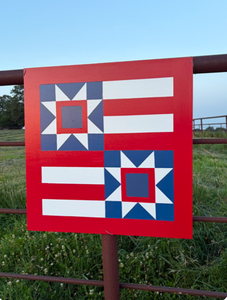
#22-40, Stars and Stripes Over Marshall Prairie, is located at 4699 Bald Knob Cemetery Road, Everton. It was painted by Carla Vaught/Traveling Sisters Barn Quilts. We chose the pattern to honor the 250th birthday of America. The quilt block faces Boat Mountain over-looking Marshall Prairie. Connell J. Brown described it best in his book, Hard Times in God’s Country…..”There is an area bounded on the west by Boat Mountain on the north by Crooked Creek on the east by White River and on the south by the Buffalo River that I like to call God’s Country. It is an area of the Ozarks within less than fifty miles of the community of Everton, where I grew up. I choose to refer to this as God’s Country because it must have been a veritable Garden of Eden to the hunter/gatherer people who first visited and then made it their temporary home.” If you are blessed to catch the sun setting over Boat Mountain, you will have a hard time disagreeing with him.
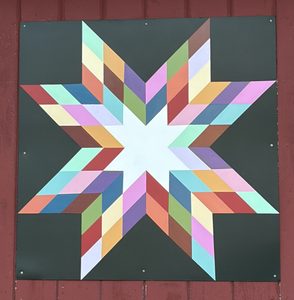
#22-41, Clear Creek Lone Star, is located on the banks of Clear Creek at 4451 Hwy. 206 East, Everton, AR. It was painted by Carla Vaught/Traveling Sisters Barn Quilts. I chose the pattern because I liked the many colors used in the patchwork star pattern. “Clear Creek Lone Star” is the perfect name for the barn quilt.
]]>
First Electric Cooperative is the sponsor of the White County Quilt Trail. The cooperative serves portions of 18 counties in central and southeast Arkansas with offices in Bryant, Heber Springs, Jacksonville, Perryville and Stuttgart. Thanks for the support, First Electric!


101 Beverly Rd.
Mount Vernon AR
#23-1, American Annie, is located at 101 Beverly Road, Mount Vernon, AR on the mailbox.. Owner Christie Davis shares: In November 2023 I became the White County Barn Quilt Trail Coordinator. I had the Cleburne County Coordinator to teach a class for me at our store we had at the time. Because I was then the White County Coordinator, we thought it best for me to take the class as well. We chose Annie’s Choice pattern because our first granddaughter and my mother-in-law’s name is Annie and wanted to represent America, so we used red, white, and blue paint. There is a lot of military servers in my family, and this honors them. That is how we came up with the name American Annie. We first saw barn quilts when we made our trip to Kentucky a few years ago. And then coming back home we saw them in Tennessee. I was intrigued by them. I wanted one for myself. I had thought it should be simple enough to draw it out on a board and paint it. But there is way more to it than that. My Barn Quilt is not without its mistakes for sure. Someone with ADHD has a hard time focusing on the picture if there is a lot going on around them and that is me, lol. It just adds character. I love quilting and all my grandmothers quilted along with my mother-in-law. They taught me what I do know about quilting. My dad even knew how to quilt. He made a Double Wedding Ring.

331 Valley View Rd.
Rose Bud AR
#23-2, Annie’s Choice is located at 331 Valley View Road, Rose Bud, AR 72137. To see this one, you need to pull into the circle driveway in front of the house. It is by the door on the front of the long brown barn to the right of the house. It is 12”x12”. Juanita Daniels loves to do crafts. When Rolling Meadows Nursery and Garden Center, LLC decided to host a barn quilt class she decided to come to the class. This is her first barn quilt, and this is how she became interested in them. Her grandmother was a quilter and she herself is a hobbyist seamstress for family and friends.

331 Valley View Rd.
Rose Bud AR
#23-3, Daniels’ Hummingbird, is also located at 331 Valley View Rd. Rose Bud, AR. To get to it you should pull into the circle and drive in front of the house. It is located on the right side of the front door of house. Juanita had so much fun painting her first barn quilt that she decided to do another one. While looking in the Arkansas Barn Quilt Trail brochure she saw this pattern (Van Buren County) and decided she loved it. She loves hummingbirds and when she and her husband moved to this location she started to have dozens of hummingbirds every year. She enjoyed making this one and she is going to make another one soon. The story behind the next one will be very special to her. So, keep a look out for her next block.

165 R.G. Davis Rd.
Romance AR
#23-4, Carpenters Wheel, is located at 165 R. G. Davis Rd, Romance, AR 72136 on the side of the metal barn setting back off the road but before you get to the driveway. I have always loved quilts and quilt patterns. Both of my grandmothers were quilters and some of my early memories are of playing under the quilt frame that hung from the ceiling in each of their homes. My maternal grandmother was an applique quilter. I have a beautiful Dutch Doll quilt that she made for me when I graduated from high school. My paternal grandmother was a piece quilter. Bow Tie became one of her favorite patterns and I have a Double Wedding Ring quilt that she and my great-aunt made for me. My first quilt, a four-patch pattern, was sewn by my fingers when I was 8 or 9. My grandmother then reinforced it and quilted it for me. My husband’s grandmother was also a quilter and I have a beautiful Log Cabin quilt that she made for us. It was my favorite pattern for many years. But now, I love my Carpenters Wheel. It was painted for me by my daughter for Christmas 2022, using my favorite colors. She chose this pattern because my husband has been doing carpentry work for 40+ years as his grandfather did before him. The wooden frame, is made from barn wood, recovered from a 100+ year old barn that stood on my husband’s family land in Birta, in Yell County Arkansas. I first became aware of quilt trails on a trip we took through Kentucky several years ago. We got on a trail by accident and were amazed at the old barns and beautiful quilt patterns on display. I have wanted a quilt block to display ever since that trip. I hope that people will enjoy my quilt block as much as I have enjoyed seeing others and I am very excited to now be a part of one of the trails.

4422 West Hwy 36
Searcy AR
#23-5, Home Star, is located at 4422 West Highway 36, Searcy, Arkansas 72143. Mrs. Reva Townsend’s barn quilt started out as a traditional Ohio Star, but she made it her own by adding extra to it and named it Home Star. It is on the East side of the outbuilding farthest from her home. Reva and her husband, Mr. Dewey Townsend moved into their home in 2014. They inherited the land from Dewey’s parents after they passed. His parents bought the land around 1956. Mr. Dewey’s mom, Mrs. Eloise Townsend was a quilt maker. Reva wanted to do a barn quilt in her honor so, Mr. Dewey drew it out for her. Then she painted it. Reva also had other quilters in the family as well.

372 Graham Rd.
Rose Bud AR
#23-6, John Deere Green, is located at 372 Graham Rd. Rose Bud, AR. It is on the garage attached to the house. You can see it as soon as you turn onto Graham Rd. on the right. Marilyn Townsend and her husband like John Deere Tractors. Marilyn became intrigued by the barn quilts that she saw in other places and wanted one. Her daughter in-law was trying to figure out what to get her for Christmas so when she found out she wanted a barn quilt she got her one along with her daughter as well. Mrs. Townsend’s granddaughter has tractors as well but hers is red. Mrs. Townsend now has one with the John Deere Colors and her daughter one with the colors of her tractors. They decided where it needed to go and her son installed it.

2359 Hwy 5
El Paso AR
#23-7, The Jones Star, is located at 2359 Highway 5, El Paso, Arkansas. It is on the south side of the building near the highway. Mrs. Marisue first got interested in barn quilts on a trip she had taken through Tennessee. Then she saw the trail in Stone County and decided she wanted one. She looked through different patterns and found the one she wanted and had someone paint it for her. She decided she wanted it to be patriotic. The barn quilt reminded her of her mother Mrs. Chloe, who had made lots of quilts to keep her family warm. Mrs. Marisue still had many of her mother’s quilts. She kept one and gave the others to her grandchildren so they would have something of hers.

291 Turner Rd.
Rose Bud AR
#23-8, Kaylor’s Navy Star, is located at 291 Turner Rd. Rose Bud, AR 72137. Just above the Barn Quilt is a plaque that honors the Navy Men. Kaylor’s Navy Star is done in the Navy colors to honor all the Navy men in the family. Rena Kaylor’s husband, Mike Kaylor, is retired from the Navy. Same with her dad and her 2 brothers. She and her husband live on the home place that has been own by the family for years. She became interested in Barn Quilts and decided when her friend started making them, to have her to paint her one. She wanted something that says home but also honors the Navy men in the family.

167 Ki Ke Acres Rd.
Searcy AR
#23-9, LeMoyne Star, is located at 167 Ki Ke Acres Rd. Searcy, AR. It is on the right side of the road on the front of her house. Mrs. Debbie Likert and her husband have done a lot of traveling in their time and some of the traveling was on a motorcycle. Amongst those travels she has come across many barn quilts. Because she is a quilter herself, she became intrigued. She loved to collect old sewing machines. At one time she had about 50 but now only about 10. She got tired of trying to find someone to quilt her tops for her that she went out and bought a longarm. She loves to quilt and give them as gifts to friends and family. They decided to remodel the bathroom and in order to do what they wanted they had to remove the window. She needed something to cover the window, so she decided to paint her a barn quilt. She had to stretch the pattern to make it fit the window but. It worked great.

186 Honey Hill Loop
Searcy AR
#23-10, Peggy’s Barn Quilts, are located at 186 Honey Hill Loop, Searcy, Arkansas. She has two on her mailbox, some on the porch, some on her garden shed in the corner of her yard, and she has several inside the house. The one on the porch is a porch leaner sign which is changed out with the seasons. The ones on the mailbox and garden shed stay year-round. They are mostly one-by-one. As soon as you come around the curve before her house you will spot the mailbox with the barn quilts on the left and her house is on the right. You can then see the porch leaner and then on the left side of the house in front corner of yard is the garden shed, which there is one on side and some on the back. Peggy loves to sew clothing and take old dolls and repair them and their clothes. She also loves to paint. She is not a quilter though. She grew up in Northern Indiana near Amish Communities and she loved the quilts and things that they made. Barn quilts are her way of making quilts. She makes them as a hobby for herself, family, friends and even fundraisers. Her husband has even dabbled a bit with the painting barn quilts.

11 Country Club Cir.
Searcy AR
#23-11, Ohio Star, is located at 11 Country Club Circle, Searcy, Arkansas, next to the garage. When you turn onto Country Club Circle, Marka’s house is on the right-hand side, and you should see the barn quilt as you come to it. Marka Bennett was raised on a farm in Texas. Her grandmother and her mother were quilters. She has always loved antique and rustic things. Inside her home is all decorated with rustic décor. She has lots of quilts that were made by her grandmother and mother among others. While visiting some friends in Ohio she came across the barn quilts on the barns. She became intrigued by them. She came home and did research on barn quilts and decided she wanted one even though she did not have a barn and she wanted to show people you could have one in town as well. She chose the Ohio Star because she has always loved the simplicity of it.

104 W. Main St.
Letona AR
#23-12. Lilly, is located at 104 W. Main, Letona, AR. The owner is Donna Waller. You can find it on the west side of the house by turning down Hotel Street. Letona is a small White County community about 10 miles north of Searcy on Hwy 310. It was the first White County community to rise to prosperity as a stop on the Missouri and North Arkansas Railroad. It became the center of the timber industry and agriculture. John and Nancy Magness, the first white settlers in White County, settled in this area in the early 1800’s. In 1815, this area was named Letona. It remained undeveloped until around the beginning of the twentieth century. The Doniphan Lumber Company built a Lumber mill in the area. That is when Letona began to come alive. In 1900, the building that Donna calls home, then was built by J A West as a general mercantile and post office. The post office was first named after the first postmaster, Asa Cox. But, around 1908 when the Railroad was built through the community the post office was renamed to Letona. In 1910, there was a hotel built which still stands today behind Donna’s home. At some point the original owner sold to Mr. and Mrs. Horne. Donna worked for the post office for about seven or eight years. After the post office was moved to a different location, Mrs. Horne decided to sell the building. She knew Donna’s mom well, so she asked if she wanted to buy it. Donna and her mom decided to go in together and buy it. Donna’s mom opened up a beauty store in one side and Donna opened up a ceramic store on the other side. Her mom held ceramic and painting classes in the back. It was after her mom’s death that she became sole owner of the building. It sat there for a while. She decided she wanted to sell but for some reason or other she was not able to sell. She then decided to live in it so, she spoke with her cousin who is a contractor about remodeling it into an apartment. He said he could do it so, she sold some land to pay for the remodel. By looking at it today you wouldn’t know there used to be big store front windows in front . She kept the wooden planks in the ceiling. It looks amazing. There is a lot of history in this home. Donna chose this barn quilt because she thought it was bear paws and she loves bear paws. Unfortunately it turns out it is not, but she still loves the barn quilt anyway.

436 Hubert Williams Rd.
Judsonia AR
#23-13, A Sister’s Love is located at 436 Hubert Williams Rd. Judsonia, Arkansas. It is on the front of Rhonda’s Hair Shop, on her covered porch. You will have to pull into the drive to see it. Sisterly love, “The bond between sisters is an emotional lifeline, weaving hearts together in a tapestry of love.” This quilt block was painted for Rhonda by her sister, Reva, for a Christmas Gift a few years back. Their grandmother was a quilter and she still has some that she had quilted. Her sister has one on this trail which is #23-5, “The Home Star”. Reva wanted her sister to have one too, so she painted her one as well.

940 Clay Rd.
Pangburn AR
#23-14, Sunbeam Crossroads is at 940 Clay Rd., Pangburn AR at “That Lucky Stitches.” Jessica Colleen Goodwin is a quilter of over twenty years, starting on a 1935 Singer Pedal sewing machine purchased at an auction for forty dollars. She’s been married for twenty-three years to longtime love Sampson Goodwin. He has believed in her dream of “That Lucky Stitches” so much so that he has built the little shop on the back country road. Nestled in the small town of Pangburn, Arkansas is “That Lucky Stitches” quilt shop. Although the name suggests luck, the couple knows that it’s first God, demanding work, and a lot of prayers that makes “That Lucky Stitches” possible. Sunbeam crossroads quilt block represents all the choices along the journey of 23 years of marriage. For this reason, “That Lucky Stiches” owner chose this pattern to be on the quilt trail. Life will lead to numerous decisions that will lead onto more. Sometimes you come to a Sunbeam crossroads and it’s difficult to make just the right choice. Choosing to purchase that 1935 Singer Pedal sewing machine was a part of “That Lucky Stitches.” Sunbeam Crossroads. Choosing to quilt at seventeen when nobody else thought it was cool. Jessica chose the Sunbeam Crossroad block from “The Quilters Album of Patchwork Patterns,” by Jinny Beyer. Sunbeam Crossroad, Nancy Cabot, Chicago Tribune, Dec. 25, 1935. “One of the oldest of middle western patterns is this delightful little pieced block with such a cheerful name. Sunbeam Crossroads first was made in Ohio about 1854.”

1991 Hwy 64 West
El Paso AR
#23-15, Diamond Dimensions, is at 1991 Hwy 64 West., El Paso, AR on Judy and Tom Riley’s red barn. The quilt can be observed by way of the highway, or by one of two drives entering the property. Visitors looking at the barn quilt should pull into the westmost drive. Places to turn around are available. The property was owned by the McCorkle family for generations and is now an Airbnb. The current owners, who live next door, purchased the property in 2023 and wanted to keep the traditions established by the original owners. Danny McCorkle was known as “The Trunk Man.” He refinished the exteriors and his wife Lynne restored the interiors. They sold the refurbished trunks at various antique stores in the area. Five of his restored trunks are used as décor in the house, known as “The Farmhouse” on Airbnb. The McCorkles also raised sweet corn and sold on a U-Pick basis, calling their farm “Easy Pickins.” The current owners, both retired from the Cooperative Extension Service, purchased the barn quilt through a live auction raising funds for the Vines Center, the Arkansas 4-H Center, west of Little Rock. The artist is a fellow retired county Extension agent, Carla Vaught. The quilts are marketed through “Traveling Sister’s Barn Quilts.” She and her business partner Teresa Griffin, have painted over 25 quilts. Some have been sold, some donated and some created specifically for others.

Romance AR
#23-16, Sunflower with Bumblebees, is located at 1520 Hwy 5, Romance, Arkansas 72136. It is owned by Mr. and Mrs. Larry Cole. The Cole’s first saw barn quilts in Kentucky during their travels, which piqued their interest. Mr. Cole decided he wanted one for his place. After some much research he found someone that painted barn quilts. Mr. Cole chose this pattern because it reminded him of the massive fields of sunflowers in South Dakota where he is from.
]]>

The South Sebastian County Historical Society is the sponsor of the Sebastian County Quilt Trail. The Society was organized on February 24, 1963. The Society was established for the purposes of the preservation and marking of local landmarks, the compilation and preservation of a record of local and area events of historical significance, the creation and maintenance of a museum to house and exhibit artifacts and the publication of an annual historical periodical. With over two hundred fifty members, the Society continues to hold true to its founding principals. With an all-volunteer staff, the Society operates the Old Jail Museum, the 1848 Vinyard Cabin, the Ole Barn, the Redwine Pioneer Schoolhouse, and the Coal Miner’s Memorial; presents a variety of entertaining and educational community events; offers educational opportunities for students and teachers and conducts monthly meetings featuring accomplished speakers on topics of local and area interest.
We think you will enjoy learning more about Sebastian County and its history as you travel the Sebastian County Quilt Trail, established July 2024.

3701 Watson Rd. Greenwood AR
#24-1, Patriotic Pride, is located at 3701 Watson Road, Greenwood. This barn quilt is owned and painted by Jennifer Cook. It is a vibrant barn quilt that captures the spirit of American patriotism through its bold and striking design. The quilt features a harmonious blend of red, white, and blue hues, symbolizing the enduring values of liberty, justice, and unity. With stars and stripes meticulously crafted into the pattern, this piece stands as a tribute to the nation’s heritage and the brave individuals who have contributed to its freedom. “Patriotic Pride” evokes a sense of national pride and community spirit, celebrating the essence of the American experience.

9610 E. Hwy 10
Greenwood AR
#24-2, Sunflower, is located at 9610 E. Hwy 10, Greenwood. This barn quilt is owned and painted by Judy Dedmon. It is a radiant barn quilt that embodies the warmth and vitality of its namesake flower. The quilt features vibrant yellow and orange petals radiating from a rich, brown and green center, capturing the essence of summer’s golden fields and the simple beauty of rural life. The intricate design and vivid colors bring a sense of joy and positivity, reminiscent of sunlit days and the resilient spirit of the countryside. “Sunflower” serves as a cheerful reminder of nature’s splendor and the enduring charm of agrarian landscapes.

9610 E. Hwy 10
Greenwood AR
#24-3, Lemoyne Star, is located at 9610 E. Hwy 10, Greenwood. This barn quilt is owned by Judy Dedmon and was purchased from a vendor during the Airing of the Quilts event held in Greenwood annually. Judy has always had a love for barn quilts and wanted one (or two) for her barn shed. It is a stunning tribute to American heritage and craftsmanship. This intricate design features eight-pointed stars, skillfully arranged to create a captivating visual effect. The patriotic color palette enhances the quilt’s appeal, symbolizing unity, pride, and the enduring spirit of the nation. The “Red, White, & Blue” Lemoyne Star stands as a vibrant testament to traditional quilting artistry and national pride.

323 W. Dogwood St.
Greenwood AR
#24-4, Tulip Garden, is located at 323 W. Dogwood St, Greenwood. Owned and painted by Krissy Barnes this block is a graceful barn quilt that captures the elegance and renewal associated with this beloved spring flower. The barn quilt showcases a delicate arrangement of tulip blooms in shades of pink, yellow, purple, and teal set against a fresh sky blue backdrop. This design symbolizes the arrival of spring and the promise of new beginnings, infusing any space with a sense of hope and rejuvenation. “Tulip” brings the timeless beauty of blooming gardens to life, celebrating the gentle charm and enduring appeal of nature’s rebirth.

323 W. Dogwood St.
Greenwood AR
#24-5, Pinwheel Star, is located at 323 W. Dogwood St, Greenwood. Owned and painted by Krissy Barnes, this block beautifully marries the timeless charm of classic star quilt block designs with the dynamic motion created by pinwheel motifs. The pinwheel effect within each star block not only adds a playful and whimsical touch to the quilt but also opens up a myriad of creative possibilities. These quilts often evoke a sense of nostalgia and craftsmanship, celebrating the artistry of traditional quilting techniques while offering endless variations in color, pattern placement, and scale. Each pinwheel within the star design seems to spin with energy, making the quilt visually captivating and engaging, reflecting the joy and creativity inherent in quilting as an art form.

#24-6, Carpenter’s Star barn quilt is coming soon to the trail. It is owned by Brenda Gigliello and was a surprise gift from Brenda’s stepson, gifted in 2023 upon her return from quilt camp. The quilt block is made of small blocks of wood assembled together like a puzzle. It showcases the intricate craftsmanship and symmetry characteristic of traditional quilting patterns. The design features a bold starburst pattern, meticulously arranged with a harmonious blend of contrasting colors that create a sense of depth and dimension. This quilt pays homage to the skill and precision of artisans, symbolizing strength, resilience, and the beauty of handmade artistry. “Carpenter’s Star” stands as a testament to the enduring legacy of quilt-making and the timeless appeal of geometric elegance.

3715 E. Clarks Chapel Rd. Huntington AR
#24-7, Ohio Star Variation barn quilt block is located at 3715 E. Clarks Chapel Rd, Huntington. Kay Voss opened Mama’s Log House quilt shop in 1982 in a historic log house built almost 200 years ago. The log house differs from a log cabin because it is constructed with squared off, hand hewn timber, in this case mature oak trees. Built by a doctor on its current site in the early 1800s the log house reflects one of the construction techniques of the early settlers to the newly opened Louisiana Purchase territory. This historic log house is believed to be one of the oldest structures in Arkansas, and has been in Kay’s family since the 1940s. The expanded quilt shop now occupies a large, new building adjacent to the log house and an education building, The Academy, across the street. With more than three decades of experience, Mama’s Log House quilt shop is known as an established, reliable and fun source for quilters whether visiting the shop in person or visiting online.

307 E. Town Square
Greenwood AR
#24-8 The Ohio Star barn quilt block is located at 307 E. Town Square, Greenwood and is one of three barn quilts that decorate the east side of the 1940’s Ole Barn. Once located on Greenwood’s North Main Street, in its current location the barn now houses farm implements and tools from the 1850s-1920s. It is a favorite exhibit of area school children. The barn quilts were painted by South Sebastian County Historical Society and Belle Point Quilt Guild members Kay Voss and Ann Akins. They were donated to the South Sebastian County Historical Society in approximately 2016. Kay and Ann are instrumental in the organization of the Airing of the Quilts, an annual benefit for the Historical Society. For more information regarding the Historical Society visit https://www.greenwoodmuseumonline.com/.

307 E. Town Square
Greenwood AR
#24-9, Twin Sisters barn quilt block is located at 307 E. Town Square, Greenwood and is one of three barn quilts that decorated the east side of the 1940s Ole Barn. Adjacent to the Ole Barn is the Vineyard Cabin, situated at the Old Jail Museum’s property. The cabin was built in circa 1848 by William Blaylock, one of the earliest settlers in the area, near the intersection of present-day highways 71 and 10. Mr. Blaylock lived and taught school in the cabin. Blaylock and his wife Rachel raised their children there as well. In 1903, the WIlliam and Mattie Vineyard family moved into the cabin, renting it until 1905 when they purchased it. Post World War II, the Vineyard family added many changes and improvements to this real estate, including additional rooms, hardwood floors, plumbing and electricity. Two Vineyard daughters, Mittie and Lela, inherited the property and became its loving caretakers after their parents’ death. They planted lush flowers and bountiful gardens. In the spring as you drive down Highway 10 west of Greenwood, the wisteria they planted can be seen spilling over the embankments. They were also enthusiastic quilters. Some of their quilts are aired in the cabin and on the cabin porch during the Airing of the Quilts. This property was passed on to the granddaughters of the Vineyard, Suzanne Francis and Sandra Blackstock who subsequently donated it to the South Sebastian County Historical Society. Restoration of the cabin was made possible by Suzanne, Sandra and their mother, Reba Vineyard Shaw, along with many people and companies across the United States. William Vineyard, another descendant, provided for the maintenance of the cabin through a fund he established. The Vineyard Cabin is essential in presenting the early life of the South Sebastian County HIstorical Society. People from all ages come to visit this building each year. For more information visit: https://bit.ly/VineyardCabin

307 E. Town Square
Greenwood AR
#24-10, Hands All Around barn quilt block is located at 307 E. Town Square, Greenwood and is one of three barn quilts that decorated the east side of the 1940s Ole Barn. Near the Ole Barn is the Redwine Pioneer Schoolhouse. This one-room school house is a replica of a turn of the century schoolhouse. It is furnished with original items used by early teachers L.M. and Delma Redwine. Originally located north of Greenwood on the Redwine Farm it was relocated to its current location when donated by Delmas Joyce Woosley (the Redwines’ daughter). Nearby is the Old Jail Museum, the Greenwood Clock Tower, and Coal Miners Memorial. For more information on the schoolhouse visit https://bit.ly/RedwineSchool. More information on Greenwood, the Clock Tower, and Coal Miners Memorial can be found by visiting https://bit.ly/HistoryOfGreenwood and https://www.greenwoodar.org/Visitors/Greenwood-History.

1736 W. Center St.
Greenwood AR
#24-11, Crooked Creek barn quilt block, located at 1736 W. Center St, Greenwood, is one of the five distinctive blocks displayed at the Crooked Creek Quilt Shop. Owned by Margie Love and Marcella Pickett, the shop is a hub of expertise, specializing in long-arm quilting and the intricate art of trapunto. Combined, Margie and Marcella bring over 45 years of quilting experience to the table, making their shop a cornerstone of the local quilting community. Keith Pickett, Marcella’s husband, crafted these five quilt blocks post-retirement as a meaningful and creative pursuit. The Crooked Creek Barn Quilt Block, a unique variation of the traditional Irish Chain pattern, showcases the blend of artistry and skill that characterizes the work done at the shop. Each block not only enhances the shop’s exterior but also tells a story of craftsmanship, dedication, and the therapeutic nature of quilting.

1736 W. Center St.
Greenwood AR
#24-12, Patriotic Flag is located at 1736 W. Center St, Greenwood, and is one of five quilt blocks displayed at the Crooked Creek Quilt Shop. This particular quilt block holds deep sentimental value as it commemorates all the men and women who have served in the armed forces. Crafted by Keith Pickett, husband of Marcella Pickett, the shop’s owner, this block stands as a heartfelt tribute from a family with a personal connection to military service. Keith Pickett, a US Army veteran, poured his own experiences and respect for his fellow servicemen and women into the creation of this block. The Patriotic Flag not only serves as a beautiful piece of art but also as a powerful symbol of gratitude and remembrance, resonating with the community and honoring the sacrifices made for our country.

Greenwood AR
#24-13, Mariner’s Compass Variation, is located at 1736 W. Center St, Greenwood and is one of five blocks located at the Crooked Creek Quilt Shop. The Mariner’s Compass quilt block is a stunning and intricate design that showcases the quilter’s precision and skill. Known for its striking geometric pattern resembling a nautical compass, this block is both visually captivating and symbolically rich, often evoking themes of navigation and exploration. The radiating points of the compass create a sense of movement and direction, making each quilt a unique masterpiece. Its complexity and elegance make the Mariner’s Compass a beloved choice for those looking to challenge their quilting abilities and create a timeless piece of art.

1736 W. Center St.
Greenwood AR
#24-14, Ohio Star Variation. This block is located at 1736 W. Center St, Greenwood and is one of five blocks located at the Crooked Creek Quilt Shop. This Ohio Star quilt block with a pinwheel center is a delightful fusion of traditional and dynamic design elements. The classic Ohio Star, known for its eight-pointed star pattern, gains a lively twist with the addition of a pinwheel at its center. This combination adds a sense of movement and playful energy to the timeless symmetry of the Ohio Star. The pinwheel center creates a focal point that draws the eye, making each block an engaging and visually intriguing component of the quilt. This variation offers quilters the opportunity to explore vibrant color combinations and creative fabric choices, resulting in a quilt that is both traditional and refreshingly unique.

1736 W. Center St.
Greenwood AR
#24-15, Patriotic Star, is located at 1736 W. Center St, Greenwood and is one of five blocks located at the Crooked Creek Quilt Shop. The Patriotic Star block is a striking emblem of national pride and traditional craftsmanship. Featuring a star motif adorned with red, white, and blue colors, this quilt block serves as a vibrant tribute to American heritage. It symbolizes community spirit and respect for those who have served the country. The bold geometric design and patriotic hues make the Patriotic Star block a visually captivating piece that celebrates both the art of quilting and the values of patriotism and unity.

4900 Lone Star Way
Greenwood AR
#24-16, Lemoyne Star Flower is one of three blocks located at 4900 Lone Star Way, Greenwood. Owned and painted by Judy Cormick, the LeMoyne Star barn quilt celebrates craftsmanship, heritage, and country charm. Its bold starburst design creates a striking focal point while honoring the artistry of handmade quilts.

4900 Lone Star Way
Greenwood AR
#24-17, Americana is located at 4900 Lone Star Way, Greenwood. It is one of three blocks located at the Cormack Valley Farms and is owned and painted by Judy Cormack. This Americana barn quilt blends the timeless beauty of traditional quilting with the enduring spirit of the American flag. Featuring bold stars, flowing stripes, and a central LeMoyne Star, the design symbolizes unity, freedom, and the strength of rural heritage. Framed in rustic wood, this piece honors both patriotic pride and the artistry of handcrafted barn quilts.

Greenwood AR
#24-18, Cormack Valley Farms block is located at 4900 Lone Star Way, Greenwood. It is one of three blocks located at Cormack Valley Farms. It is owned and painted by Judy Cormack. This barn quilt reflects the warmth of family, tradition, and rural craftsmanship. The geometric star-inspired design combines rich earth tones with vibrant accents, symbolizing growth, harvest, and the enduring connection between farm, family, and community. Personalized with the family initial at its center, this quilt block serves as a lasting tribute to heritage and home.

2011 West Main
Lavaca AR
#24-19, Stars and Stripes Forever is located at 2011 West Main, Lavaca. Owned and painted by Patty Dikeman, this block features the patriotic colors of red, white, and blue. Patty is a founding member of the River Valley Stars Quilts of Valor Group. Quilts of Valor honor veterans and service members by covering them in handmade quilts meant to provide comfort, healing, and appreciation for their sacrifice and service to our country. This barn quilt serves as a tribute to the spirit of patriotism, service, and the long-standing tradition of quilting as a way to offer warmth, love, and honor to others. For more information about the QOV contact rivervalleystarsqov@gmail.com.

5022 Sturgeon Rd.
Greenwood AR
#24-20. Gathering Barn block is located at 5022 Sturgeon Road, Greenwood. Owned and painted by JoElla Skaggs, this block hangs on the Fieldstone, A Gathering Barn stands as a picturesque event venue, offering a perfect blend of rustic charm and modern amenities. Surrounded by serene countryside views, this enchanting space sets the stage for unforgettable gatherings and celebrations. Fieldstone provided a unique backdrop for weddings, corporate events, and special occasions.
]]>