Note: With the biggest cast in television it can be hard to keep all the names and faces straight. Thus the first mention of each character contains a link to a picture of them which will open in a new tab.
Starks and their Honor
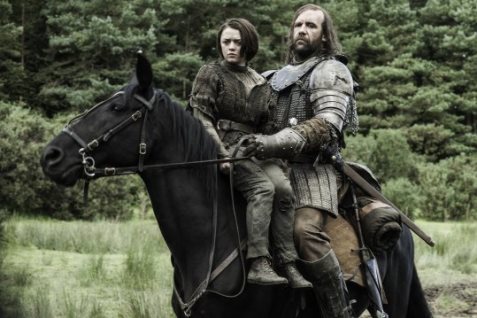
Don’t worry folks, I’ll get to the scene you want to talk about in a moment. I’m starting with Arya and the Hound a) to avoid spoilers prior to the jump and b) because within their scenes is a small nugget which represents the episode’s overarching theme: the family Stark and their unending honor. The dog and the wolf girl come upon a man trying to fix a broken wagon. He’s got to get to the Twins to deliver a load of salt pork, you see. The Hound intends to rob him, knocking his lights out before drawing a knife. Arya pleads with him not to kill the man. It’s wrong of course, and it will be plenty easy to rob him without slitting his throat. The Hound tells Arya that she’s very kind, and that it’s going to get her killed one day.
This, in a nutshell, is who the Starks are. They’re a kind and loving family who gives everyone the benefit of the doubt. They run into situations like this one, in a which a person who should be allowed to live is staring death in the eye, and they save him, even when simply killing them and being done with it would be far safer in the long run. In the case of the man and his wagon, nothing comes of it. But in that of the wedding I’ll discuss in a moment, well, you know.
The Lannisters Send Their Regards
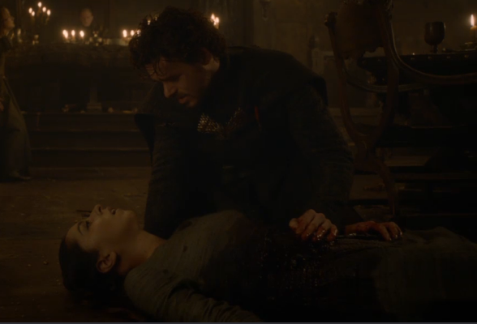
Well, I warned you, didn’t I? Episode nine is when shit goes down. Robb Stark died for the same reason his father did in the ninth episode of season one: honor. It was honor that killed Ned Stark. He refused to play the game of thrones, he took people at their word, lying and scheming hardly occurred to him, so it hardly occurred to him that lying and scheming would occur to others. In short, the very traits that made him admirable and drew us to him as a character were the cause of his demise. Of course, Robb shared many of these traits, it wasn’t simply that he was Ned’s son which endeared him to us. But Robb was more aware of the lying and machinations that come with being a high lord than his father was. After all, he learned the lesson that honor doesn’t result in victory in this series at the same moment we did: when Ilyn Payne sliced his father’s head off.
A different kind of honor led to Robb’s conundrums. He executed Rickard Karstark because the man killed two children who were under his protection, even if they were Lannisters. He married Talisa both because he loved her and because he had taken her virginity. It was the honorable thing to do. But even with all that, if every man in Westeros was as honorable and forgiving as he, there would have been no issue. Unfortunately, as we all know, that is not the world he lived in.
Robb died because he made the same mistake Catelyn did when she freed Jaime in the hopes that he, or more likely Tyrion, would honor their agreement and return her daughters to her. Each hoped that others would follow the same code that the Stark family does, that they would do the right thing, even if it was not the thing from which they stood to benefit from most. Roose Bolton got in the way of Catelyn’s idealistic plan to have her daughters returned to her, and it’s the reason she’s watches her son die in front of her with a blade at her throat.
Obviously, men like Bolton, Walder Frey, and Tywin Lannister follow no such code. It wasn’t just the hopeful code of honor followed by the Starks that they broke in planning and executing the Red Wedding. They also broke “guest right,” the ancient and sacred code of hospitality followed by the lords of ladies of Westeros, well, followed when it suits them. In short, when you offer someone your hospitality, when they sit at your table and eat your bread and salt, they are under your protection. No harm may come to them as long as they are beneath your roof. Lord Walder, of course, performs the ritual when Robb first arrives knowing full well he intends to break his oath, and break it hard.
Stark and Snow
Farther north, the concepts of the Stark code of honor and just how unsuited it is to reality are further cemented in our minds. Yet another sad result of Stark honor is the way the family is so split up and spread across the continent. Robb entrusted his “brother” Theon Greyjoy to bring his father Balon over to Robb’s cause, never considering that the Greyjoys might not go along with the plan just because it’s right and true and honorable and puppy dogs and rainbows. Winterfell has been burned to the ground while Bran and Rickon are on the run and believed dead.
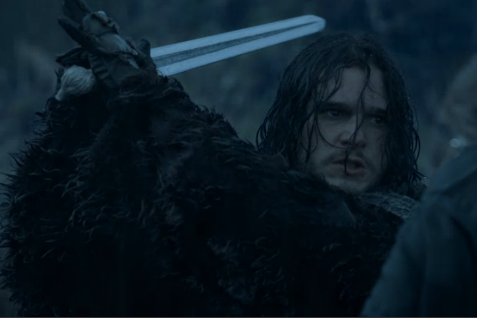
As if the picture wasn’t clearer enough already: playing by the rules is more trouble than it’s worth, and the faster the remaining Starks adapt to that fact, the more likely they are to survive. We see this in the (near) meeting of Bran, Jon, and their respective companies. Jon finds himself in a situation much like Arya did. He is asked by his wildling companions to kill an innocent man, a friend of the Watch even. Of course, Jon’s under cover with the wildlings, and while Ygritte knows that he’s still loyal to the Watch, she’s willing to keep his secret. Orell is not so kind, having been suspicious of Jon’s intentions all along (and wanting to bang his girlfriend), he insists that Jon kill the man to prove his loyalty. As I mentioned earlier, the easy thing to do, the safe thing to do, is to kill the man and be done with it, to maintain his cover, live to fight another day, and get his vengeance when he’s not so heavily outnumbered. But Jon’s got the same sense of his honor that his brother did, and rather than kill the man he lashes out against the wildlings. Again, the fact that Jon would do this is the very thing that makes us root for him. But it also makes him, well, kind of an idiot. Jon only escapes because Bran takes control of his direwolf, Summer, and comes to his rescue. What’s more, earlier on, Bran is able to keep he and his friends hidden by warging into the anxious and shouting Hodor, an ethically sketchy move at best, and controlling is mind to make him calm. Ned Stark has four children still living. One of them, Bran, is starting to figure out that following the rules can lead to swift and certain death. We can only hope the rest of the family will follow his lead.
Check out the preview for next week’s episode below and follow the writer on Twitter @NateKreichman.
]]>Note: With the biggest cast in television it can be hard to keep all the names and faces straight. Thus the first mention of each character contains a link to a picture of them which will open in a new tab.
As I’ve often discussed in the past, I generally try to find unifying theme in each episode of Game of Thrones and base my blog around it. Sometimes it’s hard, and takes a lot of pondering to find. Sometimes, as in “Dark Wings Dark Words,” there isn’t one to be found, as the episode is linked by graceful editing rather than a theme. Other times, as in “The Climb” or “Second Sons,” the writers are kind enough to put the theme right there in the title (although this week didn’t offer a Littlefinger soliloquy to put it in neon lights).
A lot of “Second Sons” is about, well, second sons. We’ve got the literal second-born male children, like Stannis and the Hound, as well as “second-class” sons like Gendry, due to being a bastard. Not to mention Tyrion, who fits into both categories. And how could we forget ol’ Samwell Tarly, a de-facto second son. Recall that Sam’s father stripped him of his birthright (in favor of his actual second son) and relegated him to the Night’s Watch despite his being the eldest.
My Sword is Yours, My Life is Yours, My Heart is Yours
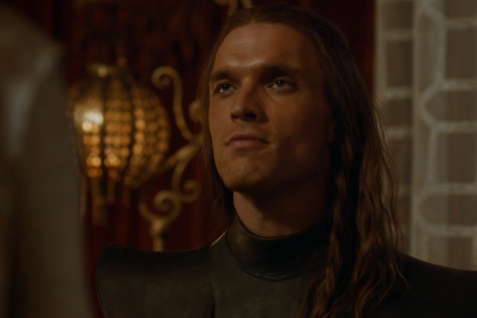
Let’s start with a different, but still literal, kind of Second Sons: the band of sellswords now headed by one Daario Naharis (and thus capitalized). I say now headed because it’s in this very episode that Daario, a mere Liutenant rebelled against the captains of the Second Sons so that he could pledge his sword (and those of the Second Sons), life, and heart to Daenerys (which is especially considering they’re the exact words Jorah Mormont would have liked to have used if not for Westerosi customs and the fact that he doesn’t look quite like the dude in the picture above). Now all that stands between her and the conquest of Yunkai are those big brick walls.
Another, well I wouldn’t call it a theme, but another recurring idea in this episode was the mixture and juxtaposition of the kind, sweet, sugar, spice and everything nice moments with the brutal mean and menacing ones. I say moments here, because that’s how it played out in the majority of the episode. In Daenerys’ case however, it’s her character that’s transitioning from her acting like a “young girl unwise in the ways of war” to swiftly telling Ser Barristan to kill “that one first” (referring to the particularly rude captain of the Second Sons). In the episode, moments of sweetness and sadness are juxtaposed, but this week and in the series and general, it is Dany’s character which defines that juxtaposition. A more dangerous charmer there never was. You know, when she’s not screaming about taking back what is hers with fire and blood. She hasn’t done much of that this year, thank the seven (although in fairness the writers had to scramble about to give Daenerys a semi-interesting storyline last season, since the books don’t really offer one).
The Hound and the Wolf Girl/King’s Blood
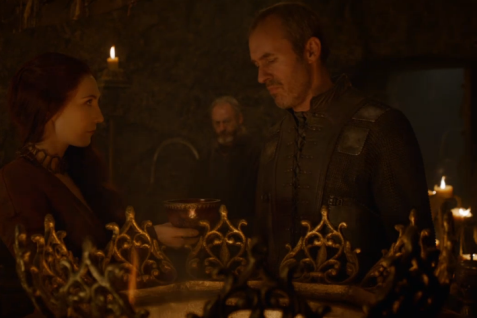
I’m combining the highly removed storylines of Arya Stark and the Hound along with Stannis, Gendry, and Melisandre into one section because of they’re contrasting takes on the aforementioned juxtaposition of kindness and brutality. When the Hound snatched Arya up after she ran away from the Brotherhood, she (and many viewers) thought it was just about the worst thing that could have happened. I mean, he’s among the names in her “prayer,” you know, repeating all the names of the people who have wronged her and she intends to kill. No way she’ll ever get back to her family now, right? Arya even goes so far as to raise a boulder above Sandor’s head while he (ostensibly) sleeps. He’s awake though, and offers her a gamble: throw the rock and try to kill him, with the full understanding that if he does survive, he’ll catch her and break both her hands. Things are not looking good. As they ride, Sandor tries to explain that his finding her was actually good luck, as there are people far worse than him out there. She retorts that there’s no one worse than him, and he quips back that she’s never met his brother (which plays back into the second sons theme). Yep, things sure do look bad for Arya. When they reach a river, she asks if it’s the Blackwater, as she’s under the impression that he’s taking her back to King’s Landing and captivity. The Hound laughs and tells her the river is the Red Fork, and that he intends to take her to the Twins, where her brother and mother are headed, so he ransom her. In this case, a story that began menacing turns out well. There appears to be a glimmer of hope that Arya will finally get back to her family.
Arya’s old pal Gendry, however, finds himself on exactly the opposite side of the sweet and sour juxtaposition. Thing’s are looking good, a bastard boy been’s brought to the castle of his wealthy and powerful uncle, placed in a chamber containing more wealth than he’s ever seen, and better food and wine than he could even imagine. He doesn’t know what the plan is, but he’s waiting for the other shoe to drop. The uncles of bastard boys don’t send their red priestesses into the middle of nowhere to find them so they can be pampered and given all the love and affection they never got growing up. Gendry remains suspicious, and rightfully so, until Melisandre is able to get him to relax using her feminine, ahem, charm. She sticks leeches on him to draw out his blood (one of which goes on a particularly painful and entirely unnecessary male organ), king’s blood. Of course, we knew that was coming after hearing Melisandre tell Stannis that she’s “slaughtered many sheep and none of them ever saw the knife.” The reason for all this, she claims, is that the recently freed Ser Davos remains a non-believer, and requires a demonstration of both her power and that of king’s blood. So Stannis drops each of the blood-filled leeches into a pit of fire while reciting the names of the usurper kings: Robb Stark, Balon Greyjoy, and Joffrey Baratheon.
My Small Short Lannister Wedding
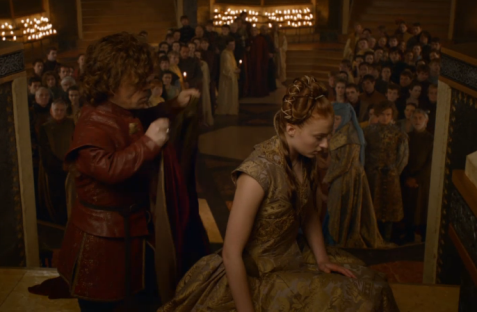
Meanwhile, there’s a wedding going on in King’s Landing. It’s the special day Sansa Stark has always dreamed of, only not at all. When Tyrion first comes to greet her she actually smiles and seems quite receptive, as if she’s taken Margaery’s advice to heart. But as the day wears on her true feelings show more and more. Things are just as rough for our favorite second son, Tyrion, who’s uncomfortable with the whole notion of wedding a girl who hates him, a girl who’s far too young for him, and the girl for whom the woman he’s truly in love with serves as a chambermaid.
Yes indeed, there are no shortage of awkward moments in King’s Landing this week. Whether it’s Tyrion’s interactions with his wife and lover, Joffrey telling Sansa he’s going to sneak into her bedchambers and rape her that evening, oh, and let’s not forget this classic line from the Cersei Lannister school of charm: “No one cares what your father once told you.” She says that to her own future husband, Ser Loras. But the night’s most entertaining interactions come from the awkward exchanges between the groom and his “proud father,” Tywin. Peter Dinklage plays one hell of a drunk. But still, the award for the best, and tensest moment of the episode goes to Tyrion after Joffrey tries to initiate the traditional bedding ceremony, in which the men in attendance strip the clothes off the bride and the women do the same to the groom. Tyrion has endured enough humiliation for one day, and declares that there will be no bedding, despite Joffrey’s angrily huffing that there will be if he commands it because he is the king, yadda yadda yadda. That’s when Tyrion pulls out a dagger and sticks it into the wooden table point first, telling Joffrey that if he continues he’ll be bedding his own wife with a “wooden cock” when his own day of matrimony arrives. Tywin is able to diffuse the situation by pointing out how drunk his son is, and Tyrion, quickly realizing his mistake (if not feeling guilty for it) attempts to play it off as a joke. Intra-Lannister relations in King’s Landing are already quite malicious, and it’s not as if Tyrion and Joffrey were pals prior to the wedding. We’ll have to wait and see if Tyrion’s threat comes back to haunt him.
A Few More Things:
-I didn’t get a chance to talk about Sam’s story in any depth. The long and short of it is that he finally discovers why some unknown man of the Night’s Watch left a cache of obsidian (or dragon glass) weapons at the Fist of the First Men: It’s the White Walker’s Kryptonite. It takes a trial by fire (or rather, ice) to figure that one out, Sam stabs the Other because it’s the only move he’s got. Lucky for him it paid off. Now we’ll just have to see if the rest of the Crows believe him, and what they have to say about the woman he’s got in tow.
-All you non-readers might be interested to know that in the books, Daario dyes both his hair and three-pronged beard blue. You can see why that wouldn’t work onscreen.
-That’s all for episode eight, so hold onto your hats, boys and girls. If you’ve been paying attention to the last two seasons, you know episode nine is when Shit. Goes. Down.
Check out the preview for next week’s episode below and follow the writer on Twitter @NateKreichman.
]]>SPOILER WARNING: Whether you’ve read all five books or only watch the series this post is for you. I have read the books (multiple times) but I will not go beyond the scope of the TV series (save a wink or a nod every now and then that only my fellow readers will catch on to). All events that have occurred in the TV show up to and including yesterday’s episode are fair game. You’ve been warned.
Note: With the biggest cast in television it can be hard to keep all the names and faces straight. Thus the first mention of each character contains a link to a picture of them which will open in a new tab.
Dracarys
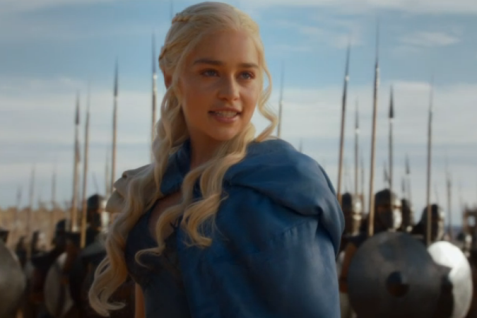
We only saw Dany for a short time in “And Now His Watch His Ended,” but what a time it was. She hands the slave master Kraznys the chain holding Drogon, the largest and most fearsome of her dragons. He in turn hands her the whip which symbolizes control of the thousands and thousands of Unsullied before her. Once the whip is in her hand, the Unsullied immediately follow her various simple orders: march forward, stop. Kraznys finds himself in much the opposite scenario, though he holds Drogon’s chain, he does not hold Drogon. He complains to Dany in High Valyrian, who turns to tell him “A dragon is not a slave,” revealing in one line both facets of Dany’s deception: First, she’s understood Kraznys all along. The Targaryens are of the blood of Old Valyria, and Valyrian is her mother tongue. Second, she agreed to hand Drogon over knowing full well he would never submit to another master. Unlike slaves, bond and ownership can not be transferred with a chain or whip. She then commands the Unsullied to “slay the masters, slay the soldiers, slay every man who holds a whip, but harm no child. Strike the chains off every slave you see!” Finally realizing his blunder, Kraznys attempts to regain control of the Unsullied, commanding them to kill her, but they belong to Dany now. Once again, she turns to say that word of great destruction, “Dracarys.” Boom. Roasted. Thus were the slaves of Astapor freed and the city burned, with Dany losing nothing and gaining an army in the process. Perhaps she’s finally on her way to Westeros?
In the books, this was one of those moments you stood up, paced around, puffed out your chest, and pumped your fists, and it translated in the show. In the books especially, it felt like the first time Dany had done anything, let alone anything awesome, in forever. The writers did what they could to inject some life into her season two storyline, but it still often felt like a distraction, time wasted in Qarth that could’ve been spent in Westeros. So seeing Dany say dracarys and the chaos that followed had much the same effect.
Furthermore, the scene symbolized both of the episode’s major themes. The first being rising up against one’s oppressors (at times a variation of the hunter becoming the hunted), and the second being the dangers of underestimating and/or misreading people. In this case at least I don’t think either requires much explanation (which is why I chose to begin with it). In the former case, slaves kill their masters. Done. In the latter, Kraznys thought he was conman when in fact he was the victim. That’s got to, ahem, burn.
Mutiny in the Watch
The aforementioned themes of “And Now His Watch Has Ended” were prevalent in the Night’s Watch storyline as well. It begins with a funeral for a brother named Bannen (no picture as we never actually met him in the show). Remember the words of the oath of Night’s Watch, “It shall not end until my death.” Thus the eulogy for Bannen, and all brothers of the Watch, conclude with “And now his watch is ended.” At first glance, this is the source of the episode’s title, but only at first glance.
The grumbling begins during the funeral, after Grenn notes he “didn’t think a broken foot could kill a man.” Rast replies that “It wasn’t his foot that killed him. That bastard Craster starved him to death.” Later on, Craster and Mormont argue about when the men of the Watch should leave for the Wall. But things don’t get truly ugly until Rast’s words are echoed in Craster’s hearing. Mormont orders the brother who spoke them to go outside, as he is prone to do when brothers say things to provoke their host. But the man refuses, saying it’s cold out. Hell breaks loose when Rast calls Craster a stingy bastard, Craster reaches for an axe, and the man who’d ignored Mormont’s orders earlier charges at and slays the wildling. He then grabs one of the women and holds a knife to her throat, and when Mormont tries to intervene, Rast stabs him in the back (props to Mormont for coming this close to choking him to death after sustaining that kind of wound). Sam flees the chaos, grabbing a sword and taking off for the wilderness with Gilly.
First things first, the episode’s title refers to the end of both Commander Mormont’s watch, though he will get no funeral at which men say the words, as well as the mutineers, who are on their own now—returning to Castle Black would mean certain death. As for the themes, they’re quite prevalent if not as clear cut. It would be unfair to call Mormont an oppressor, but he was the man in charge, and his downfall stemmed from inability to recognize just how deep the fractures in the Watch’s morale went. The fact that he actually had to stand up to try and force Rast out of the keep speaks volumes. At Castle Black, under normal circumstances, the word of any superior is law, and that goes double for the Lord Commander. At Castle Black, Mormont wouldn’t have needed to tell Rast to leave the room, he would merely have to glare at him. There can be no doubt Mormont was aware of the discontent among his men. There can be no doubt he himself was discontent, as exhibited by his argument with Craster. But he completely underestimated just how far that discontent would make them go, and it cost him his life.
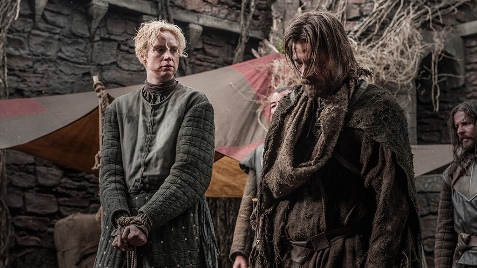
Jaime Lannister: Hero, Savior, Sympathetic Character?
Jaime Lannister isn’t nearly as innocent as Mormont, nor has he personally oppressed his captives. It would be more accurate to call his current predicament an example of how the mighty have fallen (and his enemies rising). But while Tywin rests at the helm of the enemy war effort, Jaime is, or rather was, its greatest symbol due to his skills as a warrior. In this regard he does work as an illustration of the hunter becoming the hunted. He’s able to swipe a sword and attempts to fight himself free, and he makes a fairly good go of it considering how outnumbered he is, that he’s out of shape due to being imprisoned for over a year, and most importantly that he’s fighting with his left hand. Locke and his band would all be crow food if Jaime still had his sword hand.
There’s the weak overcoming the mighty, and then there’s what’s happening to Jaime. It’s a line you simply don’t cross. Forcing him to wear his hand around his neck, laughing when he falls off his horse into the mud, tricking him into drinking horse piss—Locke is one cruel dude. It’s important to consider that Locke is in the service of Roose Bolton. What do we know about him? Not much, although one exchange he had with Robb last season spoke volumes about his character:
Bolton: In my family we say, “a naked man has few secrets. A flayed man none.”
Robb: My father outlawed flaying in the North.
Bolton: We’re not in the North.
Robb Stark: We’re not torturing them!
Roose Bolton: The high road’s very pretty, but you’ll have a hard time marching your army down it.
Bolton’s not exactly known for his kindness either, and Lockey see as Roosey do. But that’s not the impression we get when Jaime arrives at Harrenhal in “Kissed by Fire.” Locke throws Jaime down at his master’s feet and then kicks him into the mud. Bolton is not amused, quickly telling Locke to pick him up. He then notes that Jaime’s lost a hand, but Locke replies “No my lord, he has it here,” pointing to it hanging around his neck. Bolton swipes it off and tells Locke to take it away, the man smiles and says “We’ll send it to his father,” to which Bolton replies “You’ll hold your tongue unless you want to lose it.” Bolton then commands that Brienne be cut free. He even offers his apologies and tells her she’ll be under his protection now. None of this behavior seems to fit with what we’ve seen of Bolton or his general reputation. There are only two possible explanations here: The first is that Bolton is an an honorable man who has cultivated a reputation for cruelty to put fear into others and gain power, which, as we know is “a trick, a shadow on the wall” (although that wouldn’t explain the look of genuine surprise on Locke’s face when Bolton tells him to hold his tongue). The second is that Bolton’s reputation is well-earned, but he believes holding back is the smart move in the game of thrones. Smart money goes on the second answer, as when Jaime finally speaks up to ask for news of King’s Landing, Bolton details Stannis’s siege, ending with “And your sister… How can I put this? Your sister… is alive and well. Your father’s forces prevailed.” Even if Bolton believes he can benefit from treating Jaime with some semblance of kindness, he still can’t hold back from torturing him with those pauses in his speech, which no doubt lasted years from Jaime’s perspective.
In other news, these two episodes brought an enormous amount of character development for Jaime and Brienne. As the odds against them grow larger, they grow closer and closer. Brienne tells Jaime she knows he saved her from being raped by telling Locke she’s from Tarth, the “Sapphire Isle,” and he’ll be well rewarded if she’s returned unharmed (and “her honor remains unbesmirched”). So what, you say, he said a few words to prevent a woman from being raped, should we give him a trophy? No, you shouldn’t, but it’s important to note that, as Brienne reveals later, Tarth earned its nickname due to the blue of its waters, not because it’s full of sapphires. Locke and his men were uninformed enough to think the former, but Jaime received a grand education due to his status. It’s not an action that deserves a trophy, but it’s also not an action season one Jaime would have even bothered with. That Jaime Lannister would literally rather save his breath than save a “wench” from being raped.
But wait, there’s more! Jaime Lannister is known as Kingslayer and oathbreaker, he’s reviled throughout the Seven Kingdoms, men with a fraction of the honor of Ned Stark looked down their noses at him. We’ve heard him attempt to justify his actions in the past with lines like, “So many vows. They make you swear and swear. Defend the King, obey the King, obey your father, protect the innocent, defend the weak. But what if your father despises the King? What if the King massacres the innocent? It’s too much. No matter what you do, you’re forsaking one vow or another.” It all seemed like posturing and rationalization, whatever helped him sleep at night. Until the illustrious bath scene, when we finally hear the truth in a truly amazing scene between Nickolaj Coster-Waldau and Gwendoline Christie. Nothing I can say will do it justice, it speaks for itself, so I transcribed it for you. They say there’s no such thing as an incorrect opinion, but if your opinion of Jaime Lannister didn’t change after this episode, well, your opinion’s wrong. Congratulations, you’re the first person in the history of the world to have an incorrect opinion. You’re like the Neil Armstrong of sucking.
J: There it is. There’s the look. I’ve seen on face after face after seventeen years. You all despise me. Kingslayer. Oathbreaker. A man without honor. You’ve heard of wildfire?
B: Of course.
J: The Mad King was obsessed with it. He loved to watch people burn, the way their skin blackened and blistered and melted off their bones. He burned lords he didn’t like. He burned Hands who disobeyed him. He burned anyone who was against him. Before long half the country was against him. Aerys saw traitors everywhere. So he had his pyromancers place caches of wildfire all over the city. Beneath the Sept of Baelor and the slums of Flea bottom. Under houses, stables, taverns. Even beneath the Red Keep itself. Finally, the day of reckoning came. Robert Baratheon marched on the capital after his victory at the Trident. But my father arrived first, with the whole Lannister army at his back, promising to defend the city against the rebels. I knew my father than that. He’s never been one to pick the losing side. I told the Mad King as much. I urged him to surrender peacefully. But the king didn’t listen to me. He didn’t listen to Varys who tried to warn him. But he did listen to Grand Maester Pycelle, that grey sunken cunt. “You can trust the Lannisters,” he said. “The Lannisters have always been true friends of the crown.” So we opened the gates and my father sacked the city. Once again, I came to the king, begging him to surrender. He told me to…bring him my father’s head. Then he…turned to his pyromancer. “Burn them all,” he said. “Burn them in their homes. Burn them in their beds. Tell me, if your precious Renly commanded you to kill your own father and stand by while thousands of men, women, and children burned alive would you have done it? Would you have kept your oath then? First, I killed the pyromancer. And then when the king turned to flee I drove my sword into his back. “Burn them all,” he kept saying. “Burn them all.” I don’t think he expected to die. He…he meant to burn with rest of us and rise again, reborn as a dragon to turn his enemies to ash. I slit his throat to make sure that didn’t happen. That’s where Ned Stark found me.
B: If this is true, why didn’t you tell anyone? Why didn’t you tell Lord Stark?
Stark? You think the honorable Ned Stark wanted to hear my side. He judged me guilty the moment he set eyes on me. By what right does the wolf judge the lion? By what right?
B: Help, help! The Kingslayer!
J: Jaime. My name is Jaime.
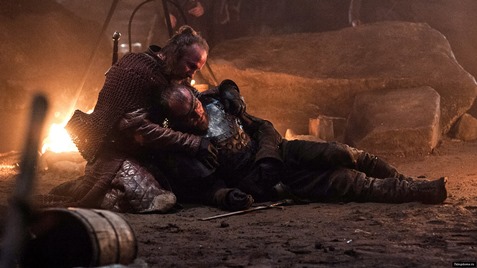
The Hound vs. The Lightning Lord
Now back to your regularly-scheduled discussion of themes. There’s no better example of the hunter becoming the hunted in these episodes than the Hound getting hounded for his past crimes by Beric Dondarrion and the Brotherhood without Banners. Alright, there’s one, the literal one, but we’ll get to that later. But there’s no better example of the downtrodden rising up against their oppressors than the Brotherhood without Banners and all that they stand for. Well, yes there is. The literal slavery of the Unsullied clearly fits better than the figurative slavery the smallfolk of Westeros live under. Anyway, the vicious Sandor, who we’ve seen kill many a man is charged with the crime of murder, but since no one can prove his guilt or innocence, he will fight Dondarrion to the death in a trial by combat to “prove his guilt or innocence.”
For those that don’t recall, in season one, Lord Beric (played by a different actor) was called upon by Ned Stark to bring the king’s justice to the “false knight” Gregor Clegane, who was sacking the Riverlands on the orders of Tywin Lannister. My how the tables have turned since then. With Ned and Robert dead, Joffrey on the Iron Throne and Tywin Lannister ruling the Seven Kingdoms behind the scenes, Gregor Clegane is now an honorable knight fighting for the good of the realm. Beric and the Brotherhood, however, have gone from king’s men to outlaws, but they continue to fight. The Hound points out that they’re fighting for ghosts, which Beric wears as a badge of honor. “That’s what we are, ghosts, waiting for you in the dark. You can’t see us, but we see you. No matter whose cloak you wear—Lannister, Stark, Baratheon—you prey on the weak, the Brotherhood without Banners will hunt you down.” In short, Beric the Brotherhood fights for the smallfolk against the oppression of the ruling class, and as a result, some of those same smallfolk have joined their ranks. Lord Beric and his band are some of the few truly egalitarian characters in the series. Sure Dany is slavery’s greatest enemy, but she still means to fight a war and install herself as queen, not hold free elections.
So in one of the best fight scenes in book or show, the Hound faces off against Dondarion and his flaming sword at the beginning of “Kissed by Fire.” It’s a close fight, but Sandor brute strength wins it as a downward thrust cuts right through Donadarrion’s sword, breaking it, and continues down through the Lightning Lord’s torso. It seems like a swift end given how much time was spent on the character’s backstory, and how intent Thoros and the others were on bringing Arya to see him. This time, the audience joins the Hound in underestimating Beric. As the Hound walks away Arya screams, “Burn in hell,” only for Dondarrion to miraculously reply, “He will, but not today.”
Which brings us to another major facet of Beric’s character, he’s found religion. Thoros of Myr is a Red Priest devoted to the Lord of Light (just as Melisandre is), and Beric, along with all his followers have converted to Thoros’s religion. For the most part, magic and the supernatural are more talked about than they are present in the world of Game of Thrones, but can be no doubt they’re there, what with the dragons, White Walkers, Melisandre seeing the future and surviving poisoned wine. Thoros brings Beric back to life after the Hound kills him. It’s the sixth time he’s died, and he’s got the scars to prove it. I’m willing to bet even the most steadfast atheists would convert to a religion if one of its priests brought them back to life six times. There’s a but to all this not being able to die business, however, there’s always a but. Beric’s been revived from death six times, but he’s not the same when he comes back, plus it’s getting harder and harder for Thoros to do. As Beric puts it, “Every time I come back, I’m a bit less. Pieces of you get chipped away.”
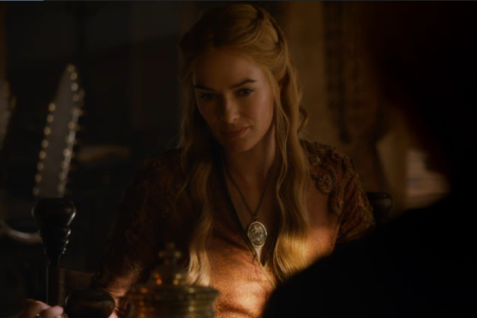
The Comedy Central Roast of Cersei Lannister
The hunter becoming the hunted theme appears in a far more figurative manner in the case of Cersei Lannister. She has a meeting with Tywin in which she demands more responsibility and power, complaining that she’s constantly overlooked because of her gender, or so she believes. She asks, “Did it ever occur to you that I might be the one who deserved your confidence of your trust? Not your sons, not Jaime and Tyrion but me. Years and years of lectures on family and legacy, the same lecture really, with tiny, tedious variations. Did it ever occur to you that your daughter might be the only one listening to them, living by them, that she might have the most to contribute to your legacy, that you love so much more than your actual children?” Tywin, in the most awesomely condescending manner possible, responds, “Alright, contribute.” Cersei goes on to gripe that the Tyrells are a problem, despite the fact that they helped defeat Stannis and saved Cersei’s life and the lives of all her children, because “Margaery has her claws in Joffrey. She knows how to manipulate him.”
That’s when Tywin breaks out the big guns. “Good,” he replies, “I wish you knew how to manipulate him.” That’s fucking boom number one. Then comes “I don’t distrust you because you’re a woman, I distrust because you’re not as smart as you think you are.” That counts as fucking booms number two and three. Why? Because that’s the exact same insult Cersei used against Tyrion back in the season premier. Tywin goes on to say, “You’ve allowed that boy to ride roughshod over you and everyone else in this city,” which we’ll call fucking boom number four. This is everything I’m sure most every viewer has wanted to scream at Cersei every time she acts like the sharpest tool in the shed or claims her gender, not her incompetence, is the only reason she hasn’t been given more power. Let’s also note that the underestimation theme is subverted in this scene. First in Cersei’s enormous overestimation of her abilities and Tywin’s frank explanation of how those “abilities” appear in reality.
Cersei’s roasting (or being hunted) continues in “Kissed by Fire.” She takes absolute delight in watching as Tywin informs Tyrion he is to wed Sansa Stark to prevent the Tyrell plot of wedding her to Ser Loras, and grant them the key to the North. Of course, she’s not excited about her brother’s engagement as a normal sister would be, she’s simply there to see Tyrion squirm and enjoy his discomfort and futile counterarguments. Or so she thinks. Just when she reaches the peak of her ecstatic enjoyment of her brother’s torment, Tywin turns to reveal she too will be wed, and to none other than Ser Loras Tyrell. It’s a table turning on a number of levels. There’s the obvious: the very thing she enjoys watching her brother suffer through happens to her as well. But there’s also the way Tywin is using her own words against her. She said herself that the Tyrells are a problem, and wedding her to one will solve it. Like Tyrion, she hopelessly tries to talk her way out of it, but this is Tywin Lannister she’s arguing with. There is no victory to be had.
A Few More Things:
There were quire a few more fantastic plotlines in these two episodes, but I’m nearing four thousand words here, so I’ll attempt to relate them to the aforementioned themes in a single paragraph. The ever-scheming Littlefinger is out-schemed when it’s revealed Ros is playing informant for Varys—which is also an example of a character underestimating another. We also get a Varyzation of the hunter becoming the hunted as Varys has the sorcerer who removed his testicles in a box. Tyrion can only hope to be as successful as Varys in seeking justice for the attempt on his life by a member of the Kingsguard—likely ordered by his sweet sister Cersei. Sansa tries to rebel against her oppresors by seeking to escape King’s Landing either secretly with the Littlefinger’s help or through the Tyrell plot to marry Loras. Finally, Theon, who unsuccessfully hunted the younger Stark boys (but settled for slaying a couple of orphans) literally plays out the most dangerous game when he escapes captivity with the help of a character whose name remains unknown only to end up right back where he started. Speaking of that unnamed character, he claims to be a commoner, yet he clearly refers to Theon as “my lord,” not “m’lord.” Let’s not forget Arya and Tywin’s conversation from last season.
Again, apologies for the lateness. I’ll be back tomorrow with a review of tonight’s episode.
]]>Note: With the biggest cast in television it can be hard to keep all the names and faces straight. Thus the first mention of each character contains a link to a picture of them which will open in a new tab.
After the season premiere, “Valar Dohaeris,” got us caught up with all our favorite characters, this week’s episode was devoted to table-setting. Or, well, it would’ve been if this was any other show. Instead, “Dark Wings, Dark Words” began placing all those narrative dominoes for the characters lucky enough to appear in both episodes while embarking on the same “hey, remember these guys?” quest for Arya, Bran, and the rest of the folks we’d yet to see.
As we all know by now, Game of Thrones has a sprawling world and the biggest cast on TV, but despite it being nigh impossible, the writers are generally able to link all those storylines with a shared episodic theme. In the case of “Valar Dohaeris,” which is high valyrian for “all men must serve,” that theme was the idea of servitude. We got no such link this week, but that doesn’t mean the writers couldn’t find a way to bounce gracefully between all those separate characters and locations. It wasn’t so fancy as a shared theme, however. Instead, the characters in one scene would mention somebody’s name, and then we’d be whisked away thousands of miles to see what they’re up to. One scene for instance was centered around Robb and Catelyn, but when they brought up Theon Greyjoy, suddenly we’re in some dungeon watching the dude get tortured. The same concept was utilized throughout the episode, and while it’s less seamless than a fancy thematic connection, it got the job done.
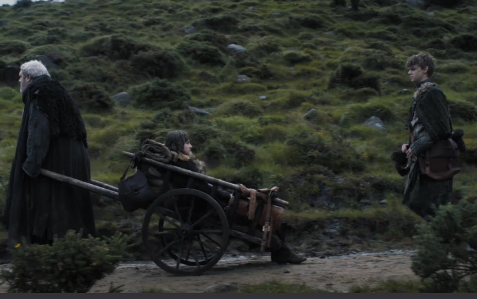
Bran Makes a Friend (or Two)
Things begin inside Bran’s head. The Three-Eyed Raven (or Crow for my fellow book readers, yeah, I don’t know why they changed that either) has shown up in his dreams again. He attempts to shoot it with an arrow, complete with the same encouragement he got from Jon, Robb, and his father while practicing marksmanship way back in the pilot. Bran misses, and a new character shows up to tell him he can’t killed the Crow—er, Raven—because “the Raven is you.” We later discover the new guy is Jojen Reed, son of Howland, one of his brother’s bannermen and his father’s oldest friends (Howland even saved Ned’s life during the Rebellion). Jojen, it seems, knows a thing or two about Bran’s premonitory and wolf-inhabiting dreams. He experiences the former himself and knows enough about the latter that he can help Bran take control of his skinchanging abilities. Sounds like a pretty good friend to have if you ask me.
Meanwhile, Jojen’s sister, Meera, and Osha have an unexpected bonding of the warrior women moment. Osha mocks Jojen for needing his sister to protect and do the fighting for him, to which Meera responds, “Some people will always need help. That doesn’t mean they’re not worth helping.” As with so many lines on this show, this one has a double meaning: Meera’s talking about her brother, but she’s also referring to Bran, who they’ve come so far to help. Osha, of course, has already been helping Bran despite the fact that he’ll “always need help” because she’s recognized how special he is.
The Buddy Comedy Continues
I often joked last year that the Jaime and Brienne storyline was reminiscent of a buddy comedy. Just imagine this in a movie trailer voice: When two polar opposites are shackled together—literally—and forced to go on a road trip, anything can happen (insert funny clip), but laughs are certain. Prince Charming and the warrior woman you wouldn’t want to dance with (clip of sword fight, indicating double meaning of dance) are sure to give each other a hard time. But when greater obstacles emerge, will learning about each other lead to learning about themselves? Can the two discover how to play nice, or will their refusal to work together drown them both? Jaime Lannister and Brienne of Tarth star in “The Bear and the Maiden Fair.” Rated R. In theaters four-seven-thirteen.
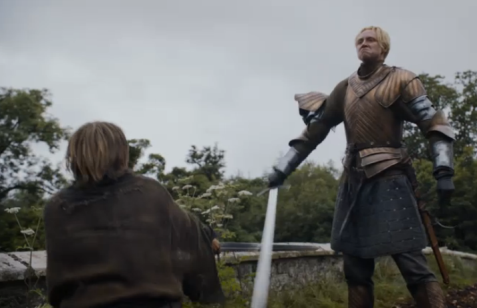
The Jaime and Brienne scenes don’t offer the same opportunity for exposition and fresh perspectives that their book counterparts do, but that’s a given. The medium makes it tons more difficult and time-consuming, but the writers, directors, and actors have done a fantastic job of letting us inside these character’s heads without actually letting us inside their heads. The way Nikolaj Coster-Waldau (Jaime) delivers a line like “I don’t blame him, and I don’t blame you either. We don’t get to choose who we love,” really underscores the depth of his love for Cersei, just as Brienne’s reaction to his earlier crack about Renly’s homosexuality shows us the way she felt about her king. Likewise, when Jaime yanks one of Brienne’s swords away, his smile and body language say it all. He moves about and casually swings the sword like it’s a part of his arm. It’s been ages since he held a sword, meaning it’s been ages since he felt whole.
It’s exactly this kind of character defining moment that gets them in trouble with those Bolton men. Jaime’s impudence in starting a fight certainly made it easier to find them. But they’re truly caught because after coming across a seemingly-innocent fellow traveler, the ultra-honorable Brienne assumed he was just that, innocent, and let him walk. Jaime, on the other hand, is looking out for number one. He insists the man recognized him and argues that they should kill him either way just to be safe. In the end, it’s Brienne’s honor that gets them a ticket to see Roose Bolton at Harrenhal.
Sansa’s Date with the Tyrells
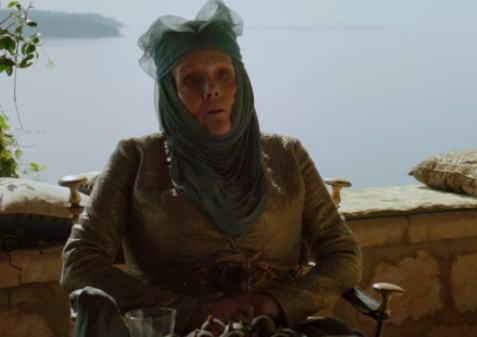
Meanwhile in King’s Landing, Sansa is invited to dine with Margaery Tyrell, the queen to be, and her grandmother Olenna Tyrell, also known as the “Queen of Thorns.” The date isn’t just about lemon cakes and compliments, however. With Margaery now betrothed to Joffrey, the Tyrells want to know what the king is like, and who better to ask but his former beau? At first, Sansa believes she’s being set up, having learned that the king (and Queen Regent) have ears everywhere the hard way. But this is no trick. Margaery is far more in tune with political realities and the ways of the world than Sansa was when she first arrived at court, no doubt thanks to her prickly grandmother being unafraid to call bullshit—on anyone or anything. The Tyrells have heard some nasty rumors about Joff, and they want to know if there’s any truth behind them.
It takes a bit of prodding, but they finally get Sansa to speak. “He’s a monster,” she says. But that won’t affect their course of action. Margaery will marry Joffrey (her father, or the “Lord Oaf of Highgarden” as his mother calls him) regardless, she simply wants to do so with her eyes open. We’ve known from the very beginning that Marge is a player, not a pawn, and the way she “seduces” Joffrey by feigning interest in his phallic crossbow makes that clear (if a sword is an extension of Jaime’s arm, than that crossbow is an extension of Joff’s dick). Even more impressive, however, is the effect Margaery seems to be having on Joffrey even when she’s not around. King Douche has made it increasingly clear that his mother, Cersei, is no longer the number one queen on the charts or in his heart. That probably won’t make her any more of a jealous, controlling psycho.
Arya Stark and the Brotherhood without Banners, with Special Guest The Hound
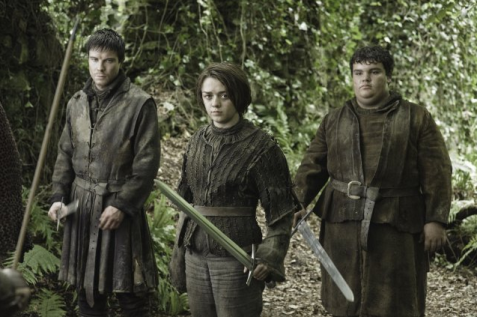
When the camera finds its way to Arya for the first time this season, she, Gendry, and Hot Pie are trying to find her grandfather’s castle, Riverrun, and hoping her brother and mother are inside its walls. As they wander about the Riverlands, they discuss their most recent fun-filled activity: the escape from Harrenhal with the help of Jaqen H’ghar. In a fantastic bit of Lampshade Hanging, Gendry wants an explanation for something many of us have been wondering ourselves: “He offered to kill any three people you wanted. Dead. All you had to do was give him the names. Anyone. You could have picked King Joffrey. You could have picked Tywin Lannister… You could have ended the war.” Arya tells him to shut up about it because they got out of Harrenhal and that’s all that matters. For Gendry, myself, and the rest of the fans who are wondering why Arya didn’t just say “Joffrey Baratheon,” my explanation may not be entirely satisfying. But it’s correct from a narrative standpoint.
Badass though she might be, Arya is still a child. It may be harder for her to understand big-picture stuff like ending the war with a whisper when the people around her are being tortured and dying. Her first selection was the Tickler for two reasons: First, she hadn’t seen Jaqen deliver yet. In that position, offering the Tickler is a win-win (or more accurately a win-draw). If Jaqen does follow through, the man directly responsible for the captives’ lives being a living hell will be no more. If he’s bullshitting her, then things stay exactly as they are. OK, so once she knows Jaqen’s legit, why doesn’t she give up Tywin? Recall the situation at Harrenhal before Tywin arrived: the torture, execution, incarceration, and so on. Tywin arrives and takes the prisoners out of a cage and puts them to work. Gendry is back to banging an anvil, Hot Pie is back to baking hot pies, and Arya recieves a pretty comfy position as his personal cupbearer. She may have feared that Tywin’s death would have meant a return to the way things were. Furthermore, she formed an odd kind of father-daughter bond with the man over the course of the season. So she waits, and uses the second kill to save her own skin when Amory Lorch discovers she’s stolen a message from Tywin’s chambers. By the time she puts it together that killing Tywin kills the Lannister war effort, it’s too late. So she uses Jaqen’s rules against him so that he’ll help them escape. Now, back to season three.
So Arya and company cross paths with Thoros of Myr and the rest of his cohorts in the Brotherhoood without Banners. Although Thoros claims that while “The Lords of Westeros want to burn the countryside. We’re trying to save it,” it’s not immediately clear if he’s telling the truth or if the trio are being kidnapped by your standard gang of outlaws. I don’t want to reveal too much, we’ll doubtlessly get a lot more information on the Brotherhood in the coming weeks, but I think it’s clear by episode’s ends that Thoros’ boast is closer to the truth than the outlaw argument (but as always there are no blacks and whites in Game of Thrones, only shades of grey). The Brotherhood has captured Sandor Clegane, the Hound, and he’s the one that reveals Arya’s identity. Even if the Brotherhood are closer to “good guys” than “bad guys,” they still need to seize an opportunity when it comes to them, and ransoming a daughter of one of the most powerful houses in the kingdoms is a hell of an opportunity. It’s a bold strategy, Cotton, let’s see if it works out for ’em.
A Few More Things:
Here’s a quick rundown of the scenes/characters we didn’t get to cover:
1) Robb heads for Riverrun to attend his maternal grandfather’s funeral while Roose Bolton is left to garrison Harrenhal. He and Catelyn receive some bad news: Theon and the Ironmen (ostensibly) razed Winterfell and murdered Bran and Rickon before bolting back to the Iron Islands. But wait, that doesn’t fit with what we saw happen in last season’s finale, nor with Theon being tortured. What’s really going on?
-Catelyn discusses a young Jon Snow in a fantastic monologue. Or rather, it would’ve been fantastic if it gelled at all with what we know of her character thus far. A great actress puts on a great show, but that seems to be all it has to offer. I get that there are a lot of characters and not enough monologues to go around. But despite being well-written and well-acted, the inconsistency makes it seem like a self-indulgent waste of screentime.
2) One of the men present for said torture tells claims he was sent by Theon’s sister, Yara. Can he be trusted? Is he friend or foe?
3) Shae warns Sansa about Littlefinger, and later converses with Tyrion about protecting her. At least one person in this list is smart enough to realize that people and things may not always be as they seem.
4) King Joffrey Baratheon, first of his name, or your weekly proof that “there’s no cure for being a cunt.”
5) Jon Snow and Mance Rayder have a little chat about how he got so many diverse tribes to follow him south. It’s simple really, they’ll die if they don’t.
6) Meanwhile, Sam is exhausted as the remaining members of the Watch begin the trudge back to the Wall. He takes a break, seeing more benefit in dying than taking another step. But he’s able to get moving with some help from his friends, along with a direct order from the Old Bear, “I command you not to die.” Does the Watch need every last man, or does Mormont have big plans for young Mr. Tarly?
And some random musings:
-In general, Nikolaj Coster-Waldau has put on a fantastic English accent throughout the series. You might never have guessed he was Danish… until this week. A few of his early lines this week were just… off. His Scandinavian roots managed to seep through a bit.
-Holy puberty, Branman
-For those who don’t know, the episode’s title, “Dark Wings, Dark Words” refers to a common saying in the show’s universe. Messages are carried to far away castles by raven in Westeros. The idea behind the phrase is that more often than not, the birds (and their dark wings) bring bad news (dark words).
Check out the preview for next week’s episode below and follow the writer on Twitter @NateKreichman.
]]>
Winterfell
I for one am not a big fan of drawn out cliffhangers, as such the showrunners handled “the sea coming to Winterfell” very well. As was the case with Renly‘s death they gave us the aftermath right at the beginning of the episode, and what an aftermath it was. To quote Ser Rodrik, “Gods help you Theon [punkass] Greyjoy, now you are truly lost.”
There are no heroes or villains in Game of Thrones, no black and white, only shades of grey. You’ve got to give Alfie Allen credit for the way he’s playing Theon, you can see how unsure he is with every double take, quiver in his voice and tear in his eye. It really sets him apart from someone like Lord Tywin, who is so confident in everything he does.
The whole scene, especially Ser Rodrik’s death, was perfectly executed, pun intended. It really showed just how fiercely loyal the people of the North are to the Starks. The man who calls Theon a “steaming sack of shit” insists he serves the Starks, and right before Ser Rodrik is killed he tells Bran, “Hush now child, I’m off to see your father,” which is enough for him. After he says it he puts his head down and grits his teeth, completely ready to die. It takes Theon more than a couple swings to take Rodrik’s head, another impressive symbolic contrast between he and Ned Stark.

Beyond the Wall
Jon has lost his brothers of the Nights Watch and now has only the wildling woman Ygritte, who he could not bring himself to kill, to keep him company. There was a great parallel between Ygritte’s rubbing up against Jon and Osha seducing Theon. Each used their feminine wiles to get what they needed, Ygritte needed to stay alive (and perhaps convince Jon the free folk aren’t so bad) and Osha needed to escape Winterfell and protect the Stark children. In short, wildling chicks do what they gotta do.

Harrenhal
The interactions between Arya and Lord Tywin were not in the books, but after seeing the two characters’ (and actors’) chemistry, maybe they should have been. When Tywin jokingly tells Arya she should devise their next battle plan, she gets this little smirk on her face that fades into a look of pure terror the moment it’s announced Littlefinger has arrived. Just another brilliant moment for Maisie Williams, who continues to impress. I’m certain Littlefinger recognized Arya. Always a step ahead of everyone else, he’ll save that little tidbit until it’s most valuable. You know: buy low, sell high.
They’ve actually managed to humanize the cold, calculating Tywin, who’s seemingly the only Lannister save Tyrion who knows what the hell he’s doing. His discussion of teaching Jaime to read was fantastic. It goes to show that Tywin is just another man who loves his family; he’s doing what he can to protect them in the only way he knows how.

King’s Landing
While we’re on the subject of incompetent Lannisters, Cersei was her usual bitchy self. She threatened Tyrion for sending Myrcella away, saying, “I want you to know what it’s like to love someone, to truly love someone, before I take her away from you.” All this despite the fact that the princess will be far safer in Dorne than the capital. Sansa’s dilemma showed the dangers of being a noble woman while the common people are starving firsthand. If a bunch of unarmed small folk can wreak such havoc during a riot (they ripped the High Septon limb from limb), imagine what it’d be like with an enemy army knocking on the gates. But then Cersei’s not really one for rationality.
Speaking of the riot, it was another perfectly executed scene. The Hound rescuing Sansa was another great display of the shades of grey. This is the same man who murdered Mycah, the butcher’s boy, in cold blood. But he’s taken a liking to Sansa and was not about to sit idly by as she was raped.
Best of all, Joffrey’s actions in the aftermath of the riot gave Tyrion another opportunity to put that little shit in his place with a number of fantastic lines, and, of course, another slap. After all who doesn’t love to see ol’ King Fuckwad get his bell rung? First, Tyrion said, “We’ve had vicious kings and we’ve had idiot kings, but I don’t know if we’ve ever been cursed with a vicious idiot one.” Then, when Joff insists his uncle can’t talk to him that way, Tyrion slaps him and follows it with, “And now I’ve struck a king, did my hand fall from my wrist?” Finally, when Joff declares he doesn’t care what happens to Sansa, the Imp says, “If she dies you’ll never get your uncle Jaime back. You owe him quite a bit you know.” Of course, Jaime killed the Mad King, which led to Joffrey’s rule, not to mention that “uncle Jaime” is actually Joffrey’s father.

Qarth
I for one loved the way the Spice King tore into Daenerys. Her sense of entitlement has reminded me more and more of her brother Viserys than the supposedly great leader she believes herself to be. When she claims she’ll “retake the Iron Throne,” the Spice King interrupts her, saying, “Retake? Did you once sit on the Iron Throne?” Boom. Headshot. Let’s be honest here, what has Daenerys actually done other than (arguably) getting lucky with the whole mother of dragons thing? I swear every time she says, “I am Daenerys Stormborn and I will take what is mine with fire and blood,” I lose 50 percent more interest.
As for the whole dragon napping, that’s another huge deviation from the books. Like many of the changes, I thought it was both necessary and clever. Frankly, Dany’s plot line in A Clash of Kings is pretty boring, so I’ve got no problems with the showrunners trying to spice things up by throwing readers a curveball. Now, since the event didn’t happen in the books, I can’t be sure who stole the dragons or why. However, I suspect it’s to motivate her to go a certain special someplace, where the only interesting thing to happen to her in the entire book occurs. The rest of her plot line might be shit, but that scene is going to be awesome.
]]>