My main approach is a twist on the ABC philosophy espoused by Alec Baldwin in his famous monologue in the movie Glengarry Glen Ross. I believe it’s imperative to Always Be Curating, in a variety of forms. Curate the best network (in the form of connections and follows), curate the best content (to keep a steady flow of information about the latest technology and innovation being adopted and implemented) and curate the best tools to leverage your network and deliver the content in the most efficient fashion.
Characterizing the process of consuming content in today’s world as drinking from the fire hose is far from being hyperbolic. In fact, there’s such a deluge of content being published and information being directed at us that we’re all suffering from a condition commonly referred to as “infobesity.” It’s critical to find a method to ensure you’re receiving a steady diet of the most useful content or you’ll quickly be overwhelmed.
My recipe for achieving a healthy content diet calls for a multi-prong approach.
- I rely heavily on newsletters (like Chris Penn’s and Scott Monty’s), leveraging the diligent efforts of trusted colleagues in the digital marketing space to comb through materials and surface the best and most relevant reads each week. I also find it useful to receive digests of articles from across the web covering topics within my trade, such as the one from Social Media Today. As someone who’s been working in the field of Influencer Marketing for the past five years, I also subscribe to an industry specific newsletter: Influence Weekly. To learn about new product innovation and online tools, I subscribe to the Product Hunt Daily, which offers a daily digest showing the new entries on Product Hunt receiving the most attention from users.
- I have a roster of blogs to which I subscribe directly. Those subscriptions are managed using Feedly, which enables to cleanly filter unread posts and track my progress. Two examples of blogs that I’m regularly reading are Mark Schaefer’s {Grow} Blog (an excellent source for insights and analysis on trends within marketing) and Buffer’s Social Blog (a great resource for tactical advice derived from practical experience and research within social media marketing).
- In addition to Feedly, as mentioned above, there are a host of other tools and apps that I employ to help filter the noise. That said, Nuzzel is far and away my favorite and the one I find to be most invaluable. Nuzzel surfaces the content that resonated most with the network I’ve curated on various platforms. Obviously that means the relevance and quality of the content triggering alerts from Nuzzel is dictated largely by the network you’ve built on connected platforms. However, provided you’ve done your job with respect to curating your network, Nuzzel does an incredible job of delivering a personalized version of the top news being shared. You can even leverage Nuzzel to create and send your own newsletter in turnkey fashion. Want to level up on receiving emails and/or push notifications from Nuzzel? Take advantage of the Slack integration to receive alerts in a dedicated Slack channel and share access with your colleagues to keep your team informed as well. Nuzzel Media Intelligence (a product soon to spun off independently after Nuzzel’s recent acquisition) is also a valuable paid product I’ve utilized at times. I liken it to a curated version of Google Alerts, with powerful topic and keyword filters.
- In much the same fashion that I supplement the posts I’m learning about via newsletters and/or digests with direct access to the RSS feeds of certain blogs, there are some Twitter feeds that are worth directly monitoring, above and beyond any Nuzzel alerts. As the person whose been called upon to stay abreast of any social platform changes, API updates, feature launches, etc. to ensure my company reacts and adapts accordingly, my go-to Twitter follow for this type of news is Matt Navarra. Matt is always in the know regarding the latest platform updates and often receives tips about new features and beta testing from fellow users. Atlantic reporter Taylor Lorenz has become a must-follow as well, delivering top-notch reporting on current internet trends, in particular developments within social media and influencer marketing. Kerry Flynn of Digiday also does an excellent job covering the business of social media. Lastly, TechCrunch’s Josh Constine is a consistent source of timely and informative updates not only about social media, but technology in general.
Finally, I curate a network of trusted colleagues and friends who I can go to for opinions on new technologies and platforms if they’ve made use of them or with whom I can test them. I also seek out forums for likeminded professionals in similar fields and roles. I belong to a number of “mastermind” style Facebook groups, including one for social business professionals, hosted by Matt Navarra, who I mentioned above.
Of course, an essential ingredient to all of this is having a relatively insatiable intellectual curiosity and a willingness to tinker, test and explore. In fact, I could easily write an entire post about ABC, replacing curating with curious, and about how important it is to emphasize intellectual curiosity in the hiring process, but that’s a story for another time.
Now that I’ve shared my “ABC” approach to staying up-to-date on new technology and innovation in my field, what are some of the tools or tactics you employ to stay informed in your industry? I’d love to hear any recommendations you have to add to or optimize what I’ve outlined above. Let me know in the comments below or tweet them to me at @CutlerDave. Thanks for reading!
*This post originally appeared on LinkedIn here: https://www.linkedin.com/pulse/always-curating-dave-cutler/

The wildly popular Serial podcast has a lone sponsor, MailChimp, an email marketing service provider. Quartz declared this sponsorship the “year’s biggest marketing win” (AdAge also deemed it a “big win”). Every episode opens with a 20-second ad for the company (listen below or here):
The mispronunciation of the company name as “MailKimp” spawned a popular meme and widespread use of the hashtag #MailKimp when tweeting about Serial. The marketers at MailChimp were savvy enough to buy the domain Mailkimp.com and have it redirect to their website.
Sponsorship of the podcast turned out to be a worthwhile advertising spend for MailChimp that undoubtedly drove a lot of awareness for the company, right? Absolutely, but here’s where MailChimp marketers fell short in their efforts to capitalize on their sponsorship of the breakout hit of 2014 and popularity of #MailKimp:
Kudos to @MailChimp for grabbing http://t.co/BpOPH6hHg0, but not a single tweet today or ads on #mailkimp for @serial finale? #MissedOpp
— Dave Cutler (@CutlerDave) December 19, 2014
The 12/18 season finale of Serial (inarguably the most heavily anticipated podcast episode of all-time) triggered thousands of tweets using #MailKimp, driving millions of impressions. The number of tweets from @MailChimp, leveraging the hashtag and engaging people in conversation? A whopping ZERO. In fact, the account’s only tweets on the day the finale launched were responses to Twitter users with MailChimp support issues. If nothing else, it was an opportunity to showcase the brand’s personality and willingness to poke fun at itself (seemingly a no-brainer for a company with a monkey as its logo).
Better yet, the team at @MailChimp should have seized the real-time marketing opportunity by running Twitter ads sponsoring the hashtag #MailKimp. A good example of this was Chevy’s sponsorship of #TechnologyAndStuff after a snafu by one of their execs during a World Series post-game presentation.
The marketers at MailChimp had a rare opportunity resulting from a confluence of events, a perfect storm of sorts, affording them the opportunity to shoot fish in a barrell and they appear to have left their bullets at home. Overall, a big marketing win for them, but from a social media marketing standpoint, a huge #MissedOpportunity.
(Disclosure: This post was originally published on LinkedIn here: http://linkd.in/1xYbS8U)
]]>
Playing around w/@RefreshApp. Useful concept. Scrapes social web to deliver insights on people prior to meetings http://t.co/j9g4tsAWg9
— Dave Cutler (@CutlerDave) August 1, 2013
One of the things I like most about the app (also now available in web version) is that I can “set it and forget it.” I configured the settings initially and now automatically get a push notification prior to meetings letting me know that a new dossier is available.
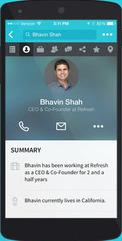
I recently interviewed Refresh’s Co-Founder & CEO, Bhavin Shah, via Skype for the latest installment of my Sitdowns With Startups series. Watch the video below to see a recording of our conversation. The backstory behind the creation of the app is one of more interesting ones I’ve ever heard.
Can’t see the video above? Click here to watch it.
To read and/or watch more from this series, please visit http://SitdownsWithStartups.com.
]]>I sat down with Vsnap’s Community Manager, Trish Fontanilla, for a chat to learn more. We discussed Vsnap’s history, some of the applications of the platform and their Vthankyou program from last fall that garnered a lot of support from local social media celebs. You can hear about that and more in the following video from our conversation:
If you can’t see the video above, please click here to watch it.
As Trish alluded to in the video, the Vsnap team is walking the walk by creating original vsnaps for each new follower they gain on Twitter. See for yourself here. To read more about Vsnap, you can check out the Boston Globe’s “Start-up aims to be the Twitter of video.”
To read and/or watch more from this series, please visit http://SitdownsWithStartups.com.
]]>I recently sat down for a chat with Founder Brad Noble to hear more about PostPost. In the following video, he talks about PostPost’s origins, some of the ways in which it’s useful and a fun tip for generating interesting search results:
If you can’t see the video above, please click here to watch it.
I used PostPost a number of times as a job seeker when sending e-mails to prospective employers in which I wanted to illustrate the regularity with which I was discussing their brand or industry on Twitter. I wanted to do so in a manner that didn’t require them to scan through over 1,000 tweets or simply take my word for it. I used a PostPost search of a keyword and narrowed the results to show only my own Tweets. For example, if I were to contact Dunkin Donuts, I would search “Dunkin” (which would appear quite often as I am a big fan of both their coffee and their brand). I could then send a link to an easily viewable list of each Dunkin reference I have made on Twitter.
For more on PostPost, you can read ReadWriteWeb’s recent PostPost Fixes Twitter’s Sucky Search piece. David Carr, a columnist for the New York Times, also had the following to say about PostPost in a recent interview with TheVerge.com:
“In the past week I have been looking at something called PostPost, which data-mines the people you follow to see what are the most persistent topics. That I’m interested in, because I’ve already picked those guys to iterate the web for me. I don’t like keeping an eye on Twitter all the time, so I like that PostPost can pull down what the people I follow have been discussing.”
To read and/or watch more from this series, please visit http://SitdownsWithStartups.com
]]>I sat down with CEO Steffan Berelowitz to talk about Bluetrain Mobile’s history, their Mobile Grader tool, his opinions on the mistakes currently being made with mobile sites and much more. The following video shows our conversation:
If you can’t see the video above, please click here to watch it.
I also chatted with Bluetrain Mobile’s VP of Marketing, Andy Komack who shared some helpful tips regarding what to keep under consideration when building a mobile website. He also offered an incredibly useful suggestion for how to leverage data from Google Analytics to inform decisions surrounding a mobile website’s content.
If you can’t see the video above, please click here to watch it.
To read and/or watch more from this series, please visit http://SitdownsWithStartups.com
]]>I sat down with Co-Founder Sheri Gurock for a chat recently. The following is a video of our conversation, in which she shares a bit of the Magic Beans history with me and provides some details about the creation of their app and the evolution of their use of social media.
If you can’t see the video above, click here to watch it.
I thought she made a very interesting point about the use of a mobile app for in-store payment enabling a business to re-focus their workforce and provide an even greater customer experience, whereas self-checkout has conventionally been thought of as a replacement for employees. I’ve always appreciated the customer-centric approach that Magic Beans takes and have documented some of their efforts to solicit customer feedback (see the tweet below).
https://twitter.com/#!/CutlerDave/status/136126549199044608
To read a Boston Globe review of the Magic Beans app (from when it first launched in 2010) by Scott Kirsner, you can click here.
Do you interact with a local business that you think does an excellent job with their social and digital efforts? I’d love to hear about it. Please share me with me below in the comments. Thanks!
]]>Can’t see the video above? You can click here to watch it.
At the time Aaron wrote , he was VP of Social Media at Mzinga here in Boston. He has since moved to Austin, where he’s currently the Head of Location Based Marketing at WCG. He is also the Co-Author of Location-Based Marketing for Dummies. If you’re interested in reading more from him, you can find his blog here. A lot of what Aaron had to say in 2008 resonated strongly with me as I read it a few weeks ago. Although he approaches things from the opposite side of the coin as a hiring manager, we seemed to share some of the same opinions about a traditional resume’s inability to provide a holistic view of a candidate in the way that blogs and social media profiles can. As Aaron told the Boston Globe at the time, by vetting prospective employees through these channels, “I can see how good a writer you are, I can see your network. It gives a much fuller, richer picture of who someone is.” That was the rationale behind me creating http://HireDaveCutler.com, my app and blogging more here, as I wrote about in my post Job Searching; Socially in January.
Have any experience using social media in the hiring process or as a job seeker? I’d be interested in hearing about it. Please share with me in the comments below. Thanks!
]]>I recently sat down for a chat with Glenn Gaudet, President & Founder of GaggleAMP, to learn a little bit more about the company’s history, who they are and what they do. The following video is a sampling of our conversation.
If you can’t see the video above, please click here to watch it.
You can read a review of GaggleAMP by prominent social media speaker, educator and consultant Jason Falls on his Social Media Explorer site here. The company was also featured in this Boston Business Journal piece in December.
To read and/or watch more from this series, please visit http://SitdownsWithStartups.com