That change creates a new opportunity for website owners and SEO professionals.
Traditional SEO is still important, but businesses now have another goal: become visible when people ask AI systems questions related to their products, services, brand, or expertise
This is where AI SEO comes in.
AI SEO combines established search-engine optimization practices with strategies designed to make content easier for AI-powered search and answer systems to understand, retrieve, evaluate, and potentially cite
Let’s explore how it works and what website owners should focus on in 2027.
The Ultimate AI SEO Guide to Winning AI Search
What Is AI SEO?
AI SEO is the practice of optimising a website and its content so both traditional search engines and AI-powered search experiences can discover and understand it.
Traditional SEO generally focuses on improving visibility in search engines such as Google and Bing. AI SEO goes one step further by considering how AI systems process information and generate answers.
For example, imagine someone asks:
Important AI SEO fundamentals include:
• High-quality original content
• Clear website structure
• Helpful answers to specific questions
• Strong topical coverage
• Author and business credibility
• Accurate information
• Relevant internal links
• Structured data where appropriate
• Crawlable and indexable pages
• Reliable external references
• Consistent brand information
AI SEO does not mean abandoning traditional SEO. In most cases, the two approaches work together.
What Is AI Search Optimization?
AI search optimization means creating and structuring information so that AI-powered search systems can efficiently understand the subject, identify useful passages, and determine whether your content is relevant to a user’s question.
Consider a page about technical SEO.
A weak page might repeatedly use the phrase “technical SEO” without answering important questions.
A stronger page could explain:
- What technical SEO means
- Why it matters
- How crawling works
- How indexing works
- How to identify technical problems
- How to fix common errors
- Which tools can help
Examples for beginners
The second page gives an AI system considerably more context.
AI search optimization therefore focuses heavily on clarity, completeness, context, entities, evidence, and usefulness.
What Is Generative Engine Optimization (GEO)?
Generative Engine Optimization (GEO) refers to optimizing content for generative AI search experiences.
Generative search systems can synthesize information from multiple sources and produce a conversational response rather than simply returning ten blue links.
GEO therefore concentrates on making your information:
- Relevant
- Clear
- Factly accurate
- Easy to extract
- Well structured
- Supported by evidence
- Connected to recognizable entities
- Useful for the intended question
For example, suppose you publish an article called:
Best Free SEO Tools for Beginners.
Instead of creating a thin list of tools, you could explain what each tool does, who should use it, its key limitations, pricing, and practical examples.
That gives both human readers and information-retrieval systems more useful context.
However, GEO should not be treated as a secret formula for forcing an AI platform to mention your website. AI-generated answers depend on many factors, and there is no universal method that guarantees inclusion.
Top of Form
What Is Answer Engine Optimization (AEO)?
Answer Engine Optimization (AEO) focuses on making content suitable for systems that provide direct answers to user questions.
The idea is simple:
Instead of optimizing only for a broad keyword such as:
Technical SEO
You also create useful answers for questions such as:
- What is technical SEO?
- Why is technical SEO important?
- How do I perform a technical SEO audit?
- What are the most common technical SEO problems?
- How do I fix crawl errors?
AEO works especially well with question-based content.
A useful page should answer the question directly before expanding into supporting details.
For example:
What is a 301 redirect?
A 301 redirect is a permanent server-side redirect that tells browsers and search engines that a URL has moved to another location.
Then you can explain when to use one, how to implement it, common mistakes, and examples.
This structure helps readers quickly find the answer while providing additional context.
GEO vs SEO: What’s the Difference?
SEO and GEO overlap, but they are not identical.
SEO primarily aims to improve visibility in conventional search engines.
GEO focuses more specifically on visibility within generative search experiences.
| SEO | GEO |
| Focuses on search visibility | Focuses on generative search visibility |
| Rankings are important | Mentions, citations and inclusion can matter |
| Keywords remain useful | Context and entities become especially important |
| Links are important | Evidence and source credibility are important |
| Search snippets matter | AI-generated answers matter |
| Technical SEO is essential | Technical accessibility remains important |
The important point is that GEO doesn’t replace SEO.
A technically poor website is unlikely to become a strong information source simply because it has optimized its content for AI.
Think of SEO as the foundation and GEO as an additional layer.
AEO vs GEO: Which One Should You Use?
AEO and GEO are closely related.
AEO generally focuses on providing strong answers to questions, while GEO is broader and concentrates on visibility within generative search experiences.
For most websites, choosing only one is unnecessary.
Use AEO when your audience frequently asks specific questions.
Use GEO when you’re trying to improve your visibility across generative AI search experiences.
Use both when possible.
For example, an SEO website could create:
AEO-focused content:
What is canonical SEO?
What is a robots.txt file?
How does schema markup work?
And combine it with broader GEO practices:
Build topical authority
Demonstrate expertise
Cite reliable sources
Maintain accurate business information
Create original research
Develop strong entity associations
The best strategy is therefore not “AEO or GEO.”
It is helpful content + technical SEO + strong authority + answer-focused optimization.
LLM SEO: Complete Beginner’s Guide
LLM SEO refers to optimizing information so that large language model-powered search and discovery systems can better understand your website, brand, products, services, and expertise.
LLMs work with language and context rather than simply matching an exact keyword.
That means writing naturally becomes even more important.
Instead of producing a paragraph such as:
Best SEO tools best SEO tools free SEO tools SEO tools for beginners…
Write naturally:
Beginners can start with free tools such as Google Search Console and Google Analytics before moving to specialist SEO platforms.
Then explain the recommendation.
For LLM-oriented content, concentrate on:
1. Clear terminology
2. Strong topical context
3. Accurate facts
4. Useful examples
5. Original insights
6. Logical page structure
7. Author expertise
8. Reliable citations
9. Consistent entities
10. Regular updates
Do not attempt to manipulate language models by stuffing keywords or repeatedly mentioning your brand.
Useful information is the stronger long-term strategy.
How to Optimize Your Website for ChatGPT
There is no guaranteed technique that makes ChatGPT rank or recommend a particular website.
However, you can improve the likelihood that your website is discoverable and useful by following solid SEO principles.
Start with technical accessibility.
Make sure important pages can be crawled and indexed. Avoid accidentally blocking valuable content with robots.txt, noindex directives, authentication requirements, or broken internal links.
Then improve your content.
Each important page should have:
A clear title
- A descriptive introduction
- Logical headings
- Direct answers
- Supporting evidence
- Relevant examples
- Internal links
- Appropriate external references
- A clear author or organization
- Also build recognizable expertise.
If your website publishes SEO content, don’t randomly jump between unrelated subjects. Develop comprehensive coverage around SEO, technical SEO, AI search, link building, content optimization, and related topics.
Topical consistency helps both users and search systems understand your site’s purpose.
How to Get Your Website Mentioned by ChatGPT
There is no guaranteed way to force ChatGPT to mention a website.
Instead, focus on becoming a source worth mentioning.
Create information that is genuinely useful and difficult to replace.
Examples include:
- Original research
- Industry statistics
- Detailed tutorials
- Unique case studies
- Expert interviews
- Original datasets
- Practical experiments
- Comprehensive comparisons
For example, rather than publishing another generic article titled:
What Is SEO?
You could publish:
SEO Crawlability Study: What We Found After Auditing 500 Websites
Original research gives your website something distinctive.
Also ensure that important facts are supported by reliable sources.
When other websites reference your research, your brand can gradually become associated with that subject.
Think authority first, AI mention second.
How to Rank in ChatGPT
The phrase “rank in ChatGPT” can be misleading because ChatGPT isn’t simply another traditional search engine with one universal ranking position.
Depending on the product, query, and available search functionality, AI systems may retrieve information from external sources and synthesize responses.
Therefore, don’t obsess over a fictional “position #1 in ChatGPT.”
Instead, measure broader AI visibility.
Track questions such as:
- Does the AI recognize my brand?
- Is my company described accurately?
- Are my products understood correctly?
- Are my pages being discovered?
- Are competitors mentioned more frequently?
- Does my original research appear in answers?
- Are important facts about my business consistent online?
This gives you a much more meaningful AI-search strategy.
How to Rank in Google AI Overviews
Google AI Overviews are part of Google’s search experience and can provide AI-generated summaries for certain searches.
There is no separate magic ranking system that allows you to guarantee an AI Overview citation.
Google’s existing search fundamentals remain important.
Focus on:
- Helpful content
- Search intent
- Technical accessibility
- Strong page experience
- Clear site architecture
- Relevant internal linking
- Original information
- Demonstrated expertise
- Reliable sources
- Accurate information
For question-based topics, provide a concise answer early on the page and then expand with supporting details.
For example:
How long does SEO take?
Start with a direct explanation, and then discuss the factors that influence the timeline.
This helps both users and search systems understand the page immediately.
How to Improve AI Search Visibility
AI visibility is broader than rankings.
It asks whether your brand or website appears within AI-powered discovery experiences.
You can improve your visibility by building a recognizable digital footprint.
1. Build topical authority: Cover your subject comprehensively instead of publishing random articles.
2. Publish original information: Original research, data, experiments, and case studies are particularly valuable.
3. Strengthen your brand: Make your website’s organization, authors, products, and services easy to understand.
4. Maintain consistent information: Your business name, description, services, author information, and other important facts should not contradict each other across the web.
5. Earn legitimate mentions: Relevant editorial mentions and links can help establish authority.
6. Keep content updated: Remove outdated claims and update statistics, screenshots, tools, and recommendations.
7. Improve technical SEO: AI visibility cannot compensate for serious crawling, indexing, or accessibility problems
Best AI Visibility Tools
AI visibility tools can help marketers monitor how brands appear in AI search experiences.
Depending on the platform, tools may track:
- Brand mentions
- Competitor mentions
- AI citations
- Query visibility
- Sentiment
- Source frequency
- AI-generated responses
Examples of tools in this emerging category include platforms such as Semrush, Ahrefs, Profound, Otterly.AI, and similar AI-search monitoring products.
However, don’t choose a tool simply because it claims to provide an “AI ranking score.”
Before paying, check:
- Which AI platforms it monitors
- Which queries it tracks
- How often data is updated
- Whether citations are reported
- Whether competitor comparisons are available
- Whether historical data is available
- Whether the data is transparent
The AI-search measurement market is still developing, so methodology matters.
Best AEO Tools
AEO doesn’t require expensive software.
You can begin with tools that help you understand search questions and content performance.
Useful options include:
- Google Search Console
- Google Trends
- Google Keyword Planner
- Bing Webmaster Tools
- SEO crawling tools
- Keyword research platforms
- Content analysis tools
- Structured-data testing tools
The most valuable “AEO tool” is often your own search-result research.
Look at the questions users ask and determine whether your content provides a clearer answer than competing pages.
Best GEO Tools
GEO tools generally fall into several categories.
Keyword research tools
These help identify topics and questions.
AI visibility platforms
These monitor how brands appear in AI-generated answers.
- SEO platforms
Tools such as Ahrefs and Semrush can help analyze keywords, competitors, backlinks, and organic visibility.
- Technical SEO crawlers
These identify problems that could prevent search engines from properly accessing your content.
- Analytics platforms
Google Search Console and analytics tools help you understand which pages attract search traffic and where improvement is needed.
The important lesson is simple:
Tools should support your strategy, not replace it.
A website with excellent software but poor content will still struggle.
How to Track Brand Mentions in AI
AI visibility measurement should start with a fixed list of important questions.
For example, if you operate an SEO website, track questions such as:
- What are the best SEO blogs for beginners?
- What are the best free SEO tools?
- How can beginners learn technical SEO?
- What is the best SEO checklist?
- Which websites provide free SEO tutorials?
Run the same questions periodically across relevant AI-search systems.
Record:
Whether your brand appears
- How often it appears
- Which page is cited
- Which competitors appear
- What description the AI gives
- Whether the information is accurate
Over time, you can identify patterns.
You may discover that your brand is frequently associated with technical SEO but rarely with link building.
That information can guide your content strategy.
AI SEO vs Traditional SEO
Traditional SEO is not disappearing.
In fact, many AI-search optimization techniques depend on good traditional SEO.
| Traditional SEO | AI SEO |
| Keyword research | Topic and entity research |
| Search rankings | AI visibility and citations |
| Search snippets | AI-generated answers |
| Backlinks | Authority and source references |
| Search intent | Question/context understanding |
| Technical SEO | Technical accessibility |
| Content optimization | Content clarity and extractability |
The biggest mistake is treating AI SEO as a replacement for everything that came before it.
Instead, think of it as an evolution.
Good SEO gets your content discovered.
Good content gives systems something useful to understand.
Strong authority gives them reasons to trust it.
AI SEO Checklist for 2027
Use this checklist when optimizing a website for AI search.
- Technical SEO
- Important pages are crawlable
- Important pages are indexable
- No accidental noindex directives
- XML sitemap works correctly
- Internal links are logical
- Broken links are fixed
- Website loads efficiently
- Mobile experience is good
- HTTPS works correctly
- Content
- Content satisfies search intent
- Questions receive direct answers
- Articles contain useful examples
- Claims are accurate
- Important statistics have sources
- Content is original
- Articles are regularly reviewed
- Thin pages are improved or removed
- AI Search
- Important entities are clearly defined
- Brand information is consistent
- Author information is clear
- Topic coverage is comprehensive
- Original research is published
- AI visibility is monitored
- Competitors are analyzed
- Trust
- Author expertise is demonstrated
- About page is available
- Contact information is clear
- Sources are credible
- Commercial claims are transparent
AI SEO Tools for Beginners
You don’t need a huge software budget to begin learning AI SEO.
A beginner can build a strong foundation using free or inexpensive resources.
Google Search Console
- Use it to understand:
- Search queries
- Impressions
- Clicks
- Average position
- Indexed pages
- Search performance
Google Trends
- Use it to identify growing topics and compare search interest.
Google Keyword Planner
- Useful for discovering keyword ideas and understanding search demand.
Bing Webmaster Tools
- Provides additional search performance and technical information.
PageSpeed Insights
- Useful for evaluating page performance and user experience.
Structured Data Testing
- Structured data can help search engines understand certain types of content when implemented correctly.
Start with these fundamentals before buying a large collection of AI SEO tools.
AI SEO Case Study: From Google to AI Citations
Let’s imagine a scenario.
One website decided to publish 100 SEO guides. Most of them have generic keywords and contain some repetitive information that can be found elsewhere on the web. The website attracts a small amount of traffic and has low authority.
Now let’s imagine that one website decided to change its approach. It picked one core topic (beginner SEO education), and created a set of materials focused around it:
• SEO roadmap
• Technical SEO guides
• Unique experiments
• Free tool comparisons
• Case studies
• SEO checklists for beginners
• Data-driven articles
• SEO guides with in-depth explanations
It optimized the internal linking architecture, ensuring that similar topics are interlinked and updated older posts. Over time, the website grew in topical authority around beginner-level SEO education.
One of the studies that the website published outlined a common technical SEO issue affecting a lot of small websites. Now other websites refer to this study, increasing the link equity of the original post.
Finally, when someone asks an AI assistant about technical SEO issues, there is an increased likelihood that the AI will recommend this website due to its topical authority and quality of information.
And now let’s discuss the actual point.
The example above shows why simply creating 100 articles will not get your website cited by AI assistants.
The main reason is that unique expertise, combined with the creation of information that is easy to digest (for both humans and machines), along with building authority around a particular topic, allows building a greater chance of being found by both search engines and AI.
Final Notes: The Future of AI SEO in 2027
The entire point of this article is that AI SEO should not be seen as a set of tactics to manipulate ChatGPT, Google Overviews, or other AI-driven discovery features. The sustainable approach to AI SEO in 2027 will continue to focus on creating information and publishing fresh content on your website that people need, structuring it in a way that computers can easily digest, proving that the information is trustworthy, and building topical authority.
Traditional SEO will always be important. Technical SEO will continue to be a factor. Backlinks will continue to be a major ranking signal. Search intent will continue to be vital.
But the increased reliance on AI-driven discovery means that we have to think about SEO in a new way. In 2027, the best SEOs will focus on visibility in both search engines and AI assistants. We need to think about topics, entities, citations, topical authority, original research, and brand mentions in the same breath as traditional link building or on-page optimization.
Simply put – quantity will no longer equal quality in the eyes of AI-driven discoverability tools.
]]>- Onpage SEO controls all optimization elements you can directly modify on your website, including content, HTML tags, and page structure
- Search intent alignment now outranks traditional keyword density as the primary ranking factor in 2026
- Core Web Vitals targets are standardized: LCP under 2.5 seconds, FID under 100ms, CLS below 0.1
- Mobile-first optimization is mandatory, with Google prioritizing responsive design and mobile user experience
- Topical completeness beats thin content—comprehensive coverage of related subtopics significantly improves rankings
- Title tags, H1 headings, and meta descriptions remain foundational elements that directly impact click-through rates
- Internal linking and clean URL structure strengthen topical relationships and distribute page authority
- Featured snippet optimization captures “Position 0” through structured content with question headings and direct answers
- Image optimization requires both descriptive file names and contextual alt text for accessibility and search visibility
- Long-tail keywords with specific intent phrases drive higher conversion rates than broad, high-volume terms
Quick Answer
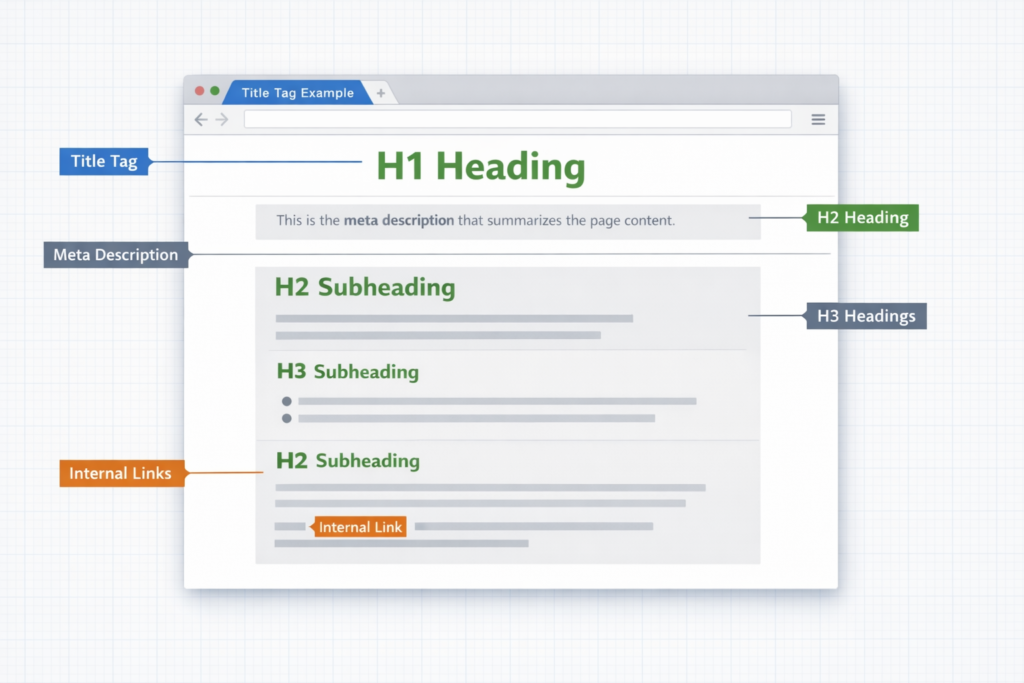
Onpage SEO refers to all optimization techniques you apply directly to your website pages to improve search engine rankings and user experience. This includes optimizing content quality and structure, HTML elements like title tags and meta descriptions, heading hierarchy, images, internal links, URL structure, and page speed. Unlike off-page SEO (which focuses on backlinks and external signals), onpage optimization gives you complete control over ranking factors that search engines use to evaluate your content’s relevance and quality.
What Is OnPage SEO and Why Does It Matter?
Onpage SEO encompasses every optimization element you can control directly on your website to improve search rankings and user experience. This includes content quality, keyword placement, HTML tags, page structure, images, internal links, and technical performance factors.
The distinction between onpage and off-page SEO is straightforward: onpage optimization happens on your website, while off-page SEO involves external signals like backlinks and brand mentions. You have direct control over onpage elements, making them the foundation of any successful SEO strategy.
Why onpage SEO matters in 2026:
- Direct ranking impact: Search engines evaluate onpage signals to determine relevance, quality, and user experience
- User experience foundation: Optimized pages load faster, display correctly on mobile devices, and provide clear navigation
- Conversion optimization: Well-structured content with clear calls-to-action converts visitors more effectively
- AI search visibility: Properly structured content appears in AI-generated summaries and featured snippets
- Complete control: Unlike backlinks, you can implement onpage changes immediately without relying on external websites
According to recent industry analysis, search intent alignment has become the most important onpage SEO factor, surpassing traditional keyword optimization.[1] Pages that directly fulfill user needs and answer specific queries outperform those simply optimized for keyword density.
Common mistake: Focusing exclusively on keywords while ignoring user intent. A page targeting “water heater repair” should include troubleshooting steps, safety precautions, and guidance on when to call a professional—not just keyword variations.
How Does OnPage SEO Differ from Technical SEO and Off-Page SEO?
Onpage SEO focuses on content and HTML optimization, technical SEO handles site infrastructure, and off-page SEO builds external authority. While these categories overlap, understanding the distinctions helps you allocate resources effectively.
OnPage SEO elements:
- Content quality, depth, and relevance
- Title tags, meta descriptions, and heading structure
- Keyword placement and semantic variations
- Image optimization with alt text
- Internal linking with descriptive anchors
- URL structure and readability
Technical SEO elements:
- Site speed and Core Web Vitals
- Mobile responsiveness and viewport configuration
- XML sitemaps and robots.txt files
- Structured data and schema markup
- HTTPS security and SSL certificates
- Crawlability and indexation management
Off-Page SEO elements:
- Backlink acquisition and quality
- Brand mentions and citations
- Social signals and engagement
- Domain authority building
- Online reputation management
For a comprehensive understanding of technical optimization, review our guide on technical SEO. To build external authority, explore our off-page SEO checklist.
Decision rule: Start with onpage optimization if you have a new site or poor content quality. Move to technical SEO if your site loads slowly or has indexation issues. Focus on off-page SEO once your onpage foundation is solid and you need authority signals to compete for competitive keywords.
What Are the Essential OnPage SEO Elements to Optimize?
The core onpage SEO elements include title tags, meta descriptions, heading hierarchy, content quality, URL structure, image optimization, and internal linking. Each element serves a specific purpose in communicating relevance to search engines and improving user experience.
Title Tags
Title tags appear in browser tabs and search results as the clickable headline. They should include your primary keyword near the beginning and accurately describe page content within 50-60 characters.
Best practices:
- Place primary keyword within the first 5 words
- Keep total length under 60 characters to prevent truncation
- Make each title unique across your site
- Include modifiers like “2026,” “guide,” or “how to” for long-tail targeting
- Match user intent—informational queries need different titles than transactional ones
Example: Instead of “SEO Tips | Marketing Blog,” use “OnPage SEO Guide: 12 Optimization Techniques for 2026”
Meta Descriptions
Meta descriptions don’t directly impact rankings but significantly influence click-through rates from search results. Write compelling 150-160 character summaries that include your target keyword and a clear value proposition.
Effective meta description formula:
- Start with the primary benefit or answer
- Include the target keyword naturally
- Add a specific detail or number
- End with a call-to-action or compelling reason to click
Heading Hierarchy (H1-H6)
Proper heading structure helps search engines understand content organization and improves accessibility. Use one H1 per page (matching your title tag), then H2s for main sections and H3s for subsections.
Heading structure rules:
- One H1 per page containing the primary keyword
- H2s for major topic sections (include semantic variations)
- H3s for subtopics under each H2
- Never skip heading levels (don’t jump from H2 to H4)
- Keep headings descriptive and scannable
Structured heading hierarchy improves extraction for featured snippets and AI-generated summaries.[1]
Content Quality and Depth
Content should comprehensively cover the topic while directly addressing user intent. Pages with topical completeness significantly outperform thin content in 2026.[2]
Content optimization checklist:
- Answer the primary query in the first paragraph
- Cover related subtopics and common questions
- Use short paragraphs (2-4 sentences) for readability
- Include examples, data, or case studies where relevant
- Target 1,500+ words for competitive topics (adjust based on intent)
- Update content regularly to maintain freshness
Choose comprehensive coverage if: You’re targeting competitive keywords or informational queries where users need complete answers.
Choose concise content if: You’re targeting quick-answer queries or transactional intent where users want specific information fast.
URL Structure
Clean, descriptive URLs reinforce relevance and improve click-through rates by previewing content. Include your primary keyword early in the URL while avoiding keyword stuffing.[4]
URL optimization rules:
- Use hyphens to separate words (not underscores)
- Keep URLs short and readable
- Include primary keyword near the domain
- Avoid unnecessary parameters and session IDs
- Use lowercase letters consistently
Good example: yoursite.com/onpage-seo-guide
Bad example: yoursite.com/page?id=12345&session=abc
For more detailed guidance, see our on-page SEO optimization resource.
Image Optimization
Optimized images improve page speed, accessibility, and search visibility. Use descriptive file names and meaningful alt text that matches image context.[1]
Image optimization steps:
- Compress images before uploading (aim for under 100KB for most images)
- Use descriptive file names: onpage-seo-checklist.jpg instead of IMG_1234.jpg
- Write alt text that describes image content and context
- Choose appropriate formats: WebP for photos, SVG for logos and icons
- Implement lazy loading for images below the fold
Alt text example: For an image showing a website analytics dashboard, use “Google Analytics dashboard displaying organic traffic growth” rather than “dashboard” or keyword-stuffed text.
Internal Linking
Strategic internal linking distributes page authority and reinforces topical relationships across your site. Use descriptive anchor text that previews the destination page content.[1]
Internal linking strategy:
- Link from high-authority pages to important target pages
- Use varied, descriptive anchor text (avoid “click here”)
- Link to related content that adds value for readers
- Maintain a reasonable link density (2-5 internal links per 500 words)
- Create topic clusters linking related content bidirectionally
How Do Core Web Vitals Impact OnPage SEO Performance?
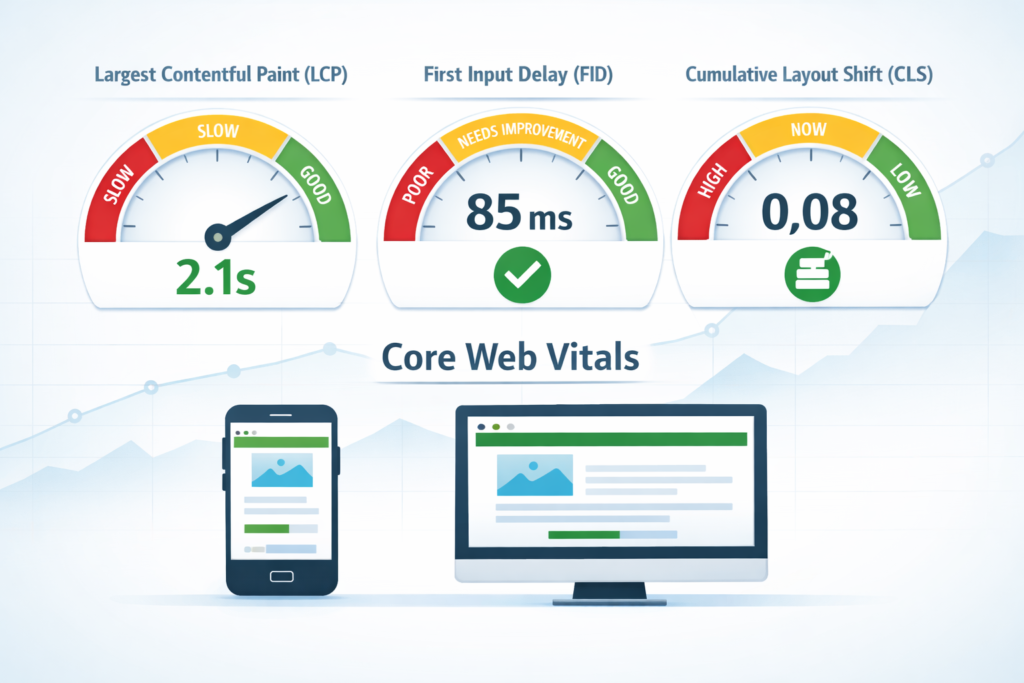
Core Web Vitals measure page loading performance, interactivity, and visual stability—three factors that directly impact both user experience and search rankings. Google has standardized performance targets that pages should meet to maintain competitive rankings.
The three Core Web Vitals metrics:
| Metric | What It Measures | Target | Impact |
| Largest Contentful Paint (LCP) | Loading speed of main content | Under 2.5 seconds | How quickly users see primary content |
| First Input Delay (FID) | Responsiveness to user interaction | Under 100 milliseconds | How quickly page responds to clicks/taps |
| Cumulative Layout Shift (CLS) | Visual stability during loading | Below 0.1 | Whether elements shift unexpectedly |
These metrics directly influence ranking performance and user engagement signals. Faster loading speeds reduce bounce rates and improve the likelihood of appearing in AI-generated search results.
How to improve each metric:
For better LCP:
- Optimize and compress images
- Implement lazy loading for below-fold content
- Use a content delivery network (CDN)
- Minimize render-blocking JavaScript and CSS
- Upgrade hosting if server response time exceeds 600ms
For better FID:
- Reduce JavaScript execution time
- Break up long tasks into smaller chunks
- Use web workers for heavy computations
- Implement code splitting to load only necessary scripts
- Remove unused third-party scripts
For better CLS:
- Set explicit width and height attributes on images and videos
- Reserve space for ad slots before they load
- Avoid inserting content above existing content
- Use transform animations instead of property animations
- Preload fonts to prevent layout shifts
Edge case: E-commerce sites with dynamic pricing or inventory updates may struggle with CLS. Solution: Reserve fixed space for dynamic elements and use smooth transitions when content changes.
What Role Does Mobile Optimization Play in OnPage SEO?
Mobile-first optimization is now mandatory, with Google’s algorithm prioritizing mobile responsiveness, readable font sizes, and appropriate spacing as core ranking factors. The majority of searches occur on mobile devices, making mobile experience a primary ranking determinant.
Essential mobile optimization requirements:
Responsive design:
- Content adapts to screen size automatically
- Navigation works with touch gestures
- Buttons and links are large enough for finger taps (minimum 48×48 pixels)
- No horizontal scrolling required
Readable typography:
- Base font size of at least 16px
- Line height of 1.5 or greater for body text
- Sufficient color contrast (minimum 4.5:1 ratio)
- Short line lengths (50-75 characters per line)
Touch-friendly interface:
- Adequate spacing between clickable elements
- Sticky navigation that doesn’t obscure content
- Forms optimized for mobile input
- Fast-loading pages (target under 3 seconds)
Performance considerations:
- Minimize redirects that slow mobile loading
- Optimize images for mobile screens
- Reduce server response time
- Eliminate render-blocking resources
Testing approach: Use Google’s Mobile-Friendly Test tool and Chrome DevTools device emulation to verify mobile experience. Test on actual devices when possible, as emulators don’t always reveal real-world issues.
Common mistake: Hiding content on mobile that’s visible on desktop. Google may devalue content not shown to mobile users, even if it exists in the HTML.
How Should You Optimize Content for Search Intent?
Search intent alignment has become the primary ranking factor in 2026, surpassing traditional keyword optimization. Pages that directly fulfill user needs and answer specific queries outperform those simply optimized for keyword density.
The four types of search intent:
Informational intent (seeking knowledge):
- Answer the question directly in the first paragraph
- Provide comprehensive coverage of the topic
- Use clear headings that match common questions
- Include examples and explanations
- Target question keywords: “what is,” “how to,” “why does”
Navigational intent (finding a specific site):
- Ensure brand name appears in title and H1
- Make contact information and key pages easily accessible
- Optimize for branded keywords
- Include clear site navigation
Transactional intent (ready to buy):
- Highlight product benefits and features
- Include clear pricing and calls-to-action
- Show trust signals (reviews, guarantees, security badges)
- Optimize for “buy,” “discount,” “deal,” “free shipping” keywords
- Make checkout process visible and simple
Commercial investigation (comparing options):
- Provide detailed comparisons and reviews
- Include pros/cons lists
- Show specifications and feature tables
- Target “best,” “top,” “review,” “vs” keywords
- Include expert recommendations
How to identify intent for your target keyword:
- Search the keyword in Google
- Analyze the top 10 results—what format dominates? (guides, product pages, comparisons, definitions)
- Note common elements: word count, media types, content structure
- Match your content format to the dominant intent
Decision rule: If top results are all 2,000+ word guides, don’t create a 500-word overview. If they’re all product comparison tables, don’t write a theoretical essay. Match the format users expect.
Use Google Search Console to find pages with steady impressions but falling click-through rates—these are prime candidates for intent realignment.
How Do You Optimize for Featured Snippets and Position Zero?
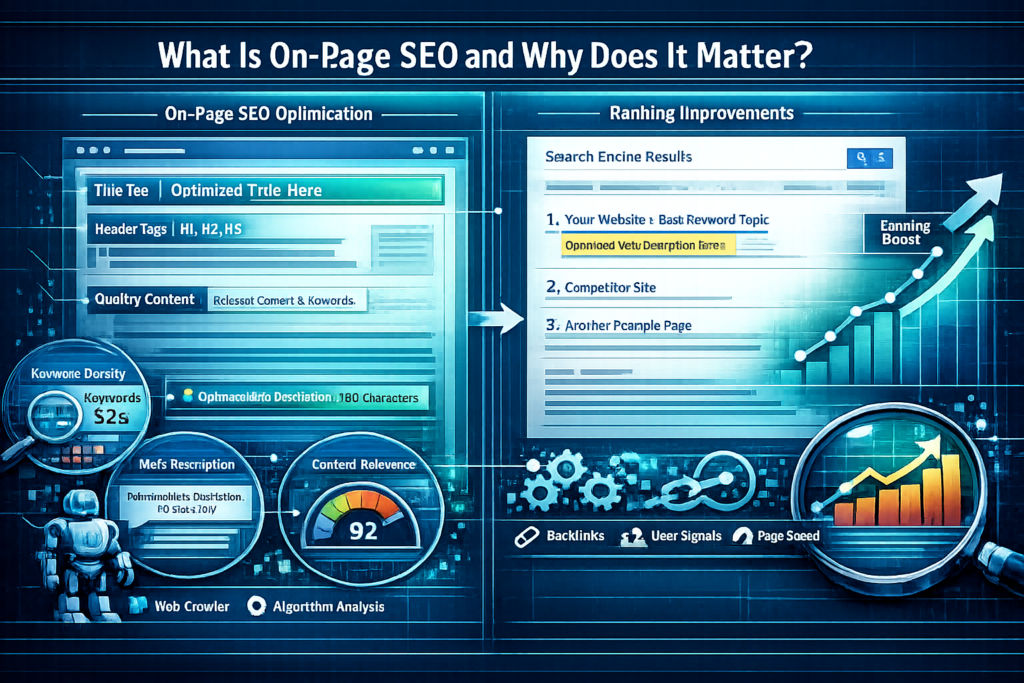
Featured snippets appear above traditional search results in “Position 0,” capturing significant visibility and click-through rates. Structuring content with question headings followed by concise direct answers increases snippet eligibility.
Featured snippet formats:
Paragraph snippets (most common):
- Answer the question in 40-60 words immediately after the heading
- Use clear, definitive language
- Include the question keyword in the answer
- Follow with supporting details
List snippets:
- Use numbered lists for steps or rankings
- Use bulleted lists for non-sequential items
- Keep list items concise (under 10 words when possible)
- Include 5-8 items for optimal snippet length
Table snippets:
- Present comparison data in HTML tables
- Use clear column headers
- Keep tables simple (3-5 columns maximum)
- Include relevant data points users compare
Optimization strategy:
- Identify snippet opportunities: Search your target keywords and note which trigger snippets
- Structure content with question headings: Use H2s that match common queries
- Provide direct answers: Write 2-3 sentence answers immediately after question headings
- Format for extraction: Use lists, tables, and clear paragraph breaks
- Monitor and refine: Track snippet ownership in Google Search Console
Example structure for snippet optimization:
## What Is OnPage SEO?
OnPage SEO refers to all optimization techniques you apply
directly to your website pages to improve search rankings.
This includes content quality, HTML tags, page structure,
images, and internal links.
[Supporting details follow…]
Edge case: Sometimes Google pulls snippets from mid-page content rather than the introduction. Solution: Create multiple snippet-optimized sections throughout your content, each targeting a specific question variation.
What Are the Best Practices for Keyword Placement in 2026?
Keyword placement has evolved from density-focused tactics to natural integration that supports readability and intent. Modern onpage SEO prioritizes semantic variations and topical relevance over exact-match repetition.
Strategic keyword placement locations:
High-priority locations:
- Title tag (within first 5 words)
- H1 heading (exact or close variation)
- First paragraph (within first 100 words)
- At least one H2 heading
- Meta description
- URL slug
- Image alt text (where contextually appropriate)
Supporting locations:
- H3 subheadings (semantic variations)
- Throughout body content (natural integration)
- Conclusion section
- Internal link anchor text
Keyword density guidelines:
- Target 1-2% density for primary keyword
- Focus on natural language over exact repetition
- Use semantic variations and related terms
- Avoid keyword stuffing in any single paragraph
Long-tail keyword strategy:
Rather than targeting broad terms like “plumber,” focus on specific intent phrases like “affordable plumber in Idaho Falls” that indicate stronger conversion likelihood.[2] Long-tail keywords typically have:
- Lower search volume but higher conversion rates
- Less competition and faster ranking potential
- More specific user intent
- Better alignment with voice search queries
Semantic keyword integration:
Include related terms and concepts that support topical authority:
- Synonyms and variations
- Related subtopics
- Common questions
- Industry terminology
- Use cases and applications
Example for “onpage SEO”:
- Primary: onpage SEO, on-page SEO
- Semantic: page optimization, content optimization, SEO best practices
- Related: meta tags, title optimization, heading structure
- Questions: how to optimize pages, what is onpage SEO, onpage vs offpage
Common mistake: Forcing keywords into every heading and paragraph. This creates awkward reading and may trigger over-optimization penalties. Write for humans first, then verify keyword presence.
For additional tools to help with keyword research and placement, check out our guide to best on-page SEO tools.
How Do Internal Links Strengthen OnPage SEO?
Internal linking distributes page authority, establishes topical relationships, and helps search engines discover and understand your content hierarchy. Strategic internal links improve both SEO performance and user navigation.
Internal linking benefits:
For search engines:
- Helps crawlers discover new and updated pages
- Distributes PageRank throughout your site
- Establishes topical relationships and content clusters
- Signals important pages through link frequency
- Provides context through anchor text
For users:
- Enables easy navigation between related content
- Reduces bounce rate by offering relevant next steps
- Increases time on site and pages per session
- Improves content discoverability
Internal linking strategy:
1. Create topic clusters:
- Identify pillar content (comprehensive guides on broad topics)
- Create cluster content (detailed posts on specific subtopics)
- Link cluster content to the pillar page
- Link the pillar page to all related cluster content
2. Use descriptive anchor text:
- Describe the destination page content
- Include relevant keywords naturally
- Vary anchor text for the same destination
- Avoid generic phrases like “click here” or “read more”
Good anchor text: “Learn how to build quality backlinks for better rankings”
Bad anchor text: “Click here for more information”
3. Link from high-authority pages:
- Identify your strongest pages (check in Google Analytics or Search Console)
- Add contextual links from these pages to important target pages
- This passes authority and helps target pages rank better
4. Maintain reasonable link density:
- Include 2-5 internal links per 500 words
- Don’t force links where they don’t add value
- Ensure links are contextually relevant
- Avoid linking to the same page multiple times from one article
5. Monitor and fix broken links:
- Use tools like Screaming Frog to identify broken internal links
- Update or remove broken links promptly
- Implement 301 redirects when moving or deleting pages
Edge case: Orphan pages (pages with no internal links pointing to them) may not get crawled or indexed. Solution: Ensure every important page has at least 2-3 internal links from related content.
To understand how internal linking complements external link building, review our article on monitoring backlinks.
What Common OnPage SEO Mistakes Should You Avoid?
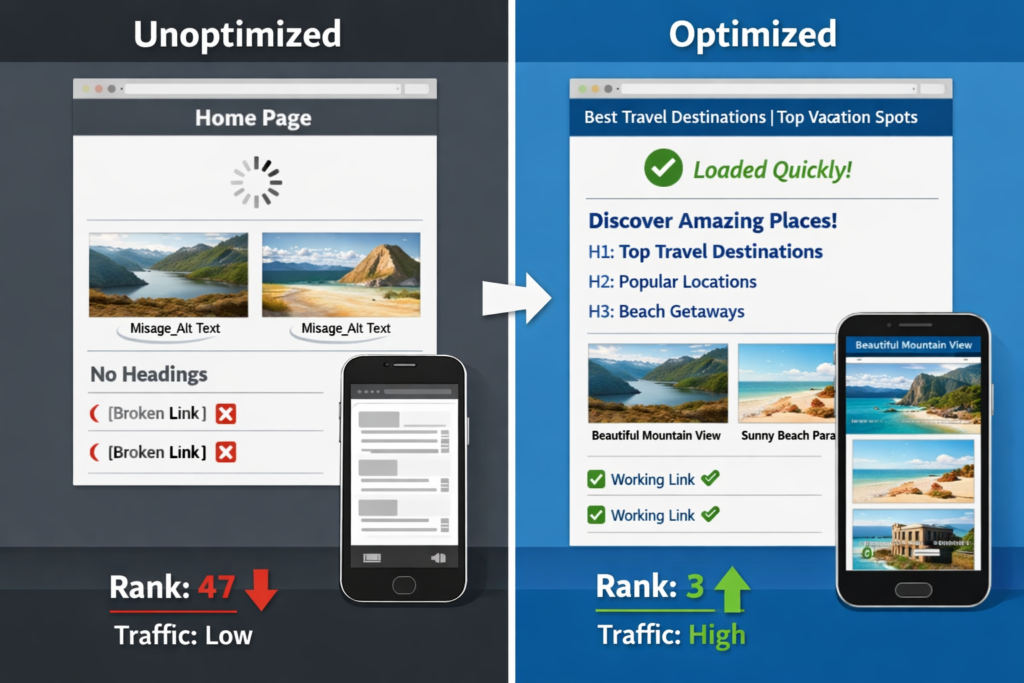
Even experienced marketers make onpage SEO mistakes that limit ranking potential. Understanding common pitfalls helps you avoid them and maintain optimization quality.
Critical mistakes to avoid:
1. Ignoring search intent:
- Creating content that doesn’t match what users actually want
- Targeting informational keywords with product pages
- Providing shallow answers to complex questions
- Fix: Analyze top-ranking pages for your target keyword and match their format and depth
2. Duplicate or thin content:
- Publishing multiple pages targeting the same keyword
- Creating pages with under 300 words on competitive topics
- Copying content from other sources
- Fix: Consolidate duplicate pages, expand thin content, or remove low-value pages
3. Poor mobile experience:
- Small, unreadable text on mobile devices
- Buttons too close together for touch interaction
- Slow mobile page speed
- Fix: Use responsive design, test on actual devices, optimize images for mobile
4. Missing or duplicate title tags and meta descriptions:
- Using the same title across multiple pages
- Leaving meta descriptions blank (Google generates them automatically)
- Exceeding character limits causing truncation
- Fix: Create unique, descriptive titles and meta descriptions for every page
5. Broken internal links:
- Links pointing to deleted or moved pages
- Incorrect URL formatting
- Links to redirected pages
- Fix: Regularly audit internal links and update or remove broken ones
6. Over-optimization:
- Keyword stuffing in content, titles, or alt text
- Unnatural keyword placement that disrupts readability
- Excessive exact-match anchor text in internal links
- Fix: Write naturally for humans, then verify keyword presence—not the reverse
7. Neglecting image optimization:
- Using generic file names like “IMG_1234.jpg”
- Missing alt text on important images
- Uploading massive uncompressed images
- Fix: Rename files descriptively, write contextual alt text, compress before uploading
8. Ignoring heading hierarchy:
- Using multiple H1s per page
- Skipping heading levels (H2 to H4)
- Using headings for styling instead of structure
- Fix: Use one H1, follow sequential hierarchy, ensure headings reflect content structure
9. Slow page speed:
- Large unoptimized images
- Excessive JavaScript and third-party scripts
- Poor hosting performance
- Fix: Compress images, minimize scripts, use caching, upgrade hosting if needed
10. No internal linking strategy:
- Orphan pages with no internal links
- Random, non-strategic link placement
- Generic anchor text
- Fix: Create topic clusters, link related content, use descriptive internal linking anchors
Decision rule: If you’re unsure whether a change helps users or just search engines, prioritize user experience. Google’s algorithm increasingly rewards pages that genuinely serve user needs.
How Do You Measure OnPage SEO Success?
Measuring onpage SEO performance requires tracking both ranking improvements and user engagement signals. Combine quantitative metrics with qualitative analysis for complete visibility.
Key metrics to track:
Ranking metrics:
- Keyword rankings: Track position changes for target keywords
- Featured snippet ownership: Monitor Position 0 captures
- Search visibility: Overall visibility across all ranking keywords
- Click-through rate (CTR): Percentage of impressions that result in clicks
Traffic metrics:
- Organic sessions: Total visits from search engines
- Landing page performance: Which pages attract the most organic traffic
- New vs. returning visitors: Growth in new user acquisition
- Traffic by device: Mobile vs. desktop distribution
Engagement metrics:
- Bounce rate: Percentage of single-page sessions
- Time on page: Average duration visitors spend on each page
- Pages per session: How many pages users view per visit
- Scroll depth: How far down the page users scroll
Conversion metrics:
- Goal completions: Newsletter signups, form submissions, downloads
- E-commerce conversions: Sales attributed to organic traffic
- Assisted conversions: Organic touchpoints in conversion paths
Technical metrics:
- Core Web Vitals: LCP, FID, CLS scores
- Page speed: Load time on mobile and desktop
- Mobile usability: Issues detected in Google Search Console
- Indexation status: Pages indexed vs. submitted
Tools for measurement:
Google Search Console:
- Tracks impressions, clicks, CTR, and average position
- Identifies indexation issues and mobile usability problems
- Shows which queries trigger your pages
- Monitors Core Web Vitals performance
Google Analytics:
- Measures traffic, engagement, and conversion metrics
- Shows user behavior flow through your site
- Tracks landing page performance
- Segments organic traffic from other sources
Third-party SEO tools:
- Ahrefs, SEMrush, or Moz for rank tracking
- Screaming Frog for technical audits
- PageSpeed Insights for performance analysis
- Hotjar or Microsoft Clarity for user behavior analysis
Measurement timeline:
- Daily: Monitor critical pages and high-priority keywords
- Weekly: Review traffic trends and engagement metrics
- Monthly: Analyze ranking changes and identify optimization opportunities
- Quarterly: Conduct comprehensive audits and strategy reviews
What success looks like:
- Steady increase in organic traffic over 3-6 months
- Improved rankings for target keywords
- Higher CTR from search results
- Better engagement metrics (lower bounce rate, higher time on page)
- Increased conversions from organic traffic
Edge case: Rankings may fluctuate during Google algorithm updates. Don’t panic over short-term changes—focus on long-term trends and user engagement signals.
FAQ
What is the difference between onpage and offpage SEO?
Onpage SEO includes all optimization elements you control directly on your website, such as content quality, title tags, headings, images, and internal links. Offpage SEO involves external signals like backlinks, brand mentions, and social engagement that you don’t directly control. Learn more about off-page SEO strategies.
How long does it take to see results from onpage SEO?
Most sites see initial ranking improvements within 4-8 weeks after implementing onpage optimizations, with more substantial results appearing in 3-6 months. Timeframe depends on competition level, site authority, content quality, and technical health. New sites or highly competitive keywords may take longer.
What are the most important onpage SEO ranking factors in 2026?
Search intent alignment, content quality and depth, Core Web Vitals performance, mobile optimization, and topical completeness are the top ranking factors. Title tags, heading structure, and internal linking remain foundational elements that support these primary factors.
How many keywords should I target per page?
Focus on one primary keyword per page, plus 2-4 related semantic variations. Trying to target too many unrelated keywords dilutes topical focus and confuses search engines about page purpose. Create separate pages for distinct topics.
Should I use exact-match keywords or variations?
Use both. Include your exact primary keyword in high-priority locations (title, H1, first paragraph), then use natural variations and related terms throughout the content. Modern search algorithms understand semantic relationships and context.
How often should I update existing content for SEO?
Review and update important pages every 6-12 months, or sooner if information becomes outdated. Add new sections covering emerging subtopics, refresh statistics and examples, improve content depth, and update publication dates to signal freshness.
What is the ideal content length for SEO?
Content length should match search intent and topic complexity. Comprehensive guides on competitive topics often need 1,500-3,000 words, while quick-answer queries may rank well with 500-800 words. Analyze top-ranking competitors to gauge appropriate depth.
Do meta descriptions affect rankings?
Meta descriptions don’t directly impact rankings but significantly influence click-through rates from search results. Higher CTR sends positive engagement signals that can indirectly support rankings. Always write compelling, keyword-rich meta descriptions.
How do I optimize images for SEO?
Use descriptive file names before uploading, write contextual alt text that describes image content, compress images to reduce file size, choose appropriate formats (WebP for photos, SVG for graphics), and implement lazy loading for below-fold images.
What is keyword cannibalization and how do I fix it?
Keyword cannibalization occurs when multiple pages on your site target the same keyword, causing them to compete against each other in search results. Fix it by consolidating similar pages, differentiating content focus, or using canonical tags to specify the preferred version.
Should I use H1 tags for styling or structure?
Always use H1 tags for structural hierarchy, not visual styling. Use one H1 per page containing your primary keyword, then use CSS to control appearance. Search engines rely on heading tags to understand content structure and importance.
How do I optimize for voice search?
Target long-tail conversational keywords, answer questions directly in the first paragraph, use natural language that matches how people speak, optimize for featured snippets, and ensure fast mobile page speed. Voice search results often come from Position 0.
Conclusion
Onpage SEO remains the foundation of search visibility in 2026, giving you direct control over the factors that determine how search engines evaluate and rank your content. Success requires balancing traditional optimization elements—title tags, headings, keyword placement—with modern priorities like search intent alignment, topical completeness, and Core Web Vitals performance.
The most significant shift in recent years is the primacy of user experience and intent satisfaction over keyword density. Pages that comprehensively answer user questions, load quickly on mobile devices, and provide clear navigation consistently outperform those optimized solely for search engine algorithms.
Actionable next steps:
- Audit your current onpage optimization: Use Google Search Console to identify pages with high impressions but low CTR—these are prime candidates for title and meta description improvements
- Prioritize mobile experience: Test your most important pages on actual mobile devices and address any usability issues
- Improve Core Web Vitals: Run PageSpeed Insights on key landing pages and implement recommended performance fixes
- Align content with search intent: Analyze top-ranking competitors for your target keywords and ensure your content matches the format and depth users expect
- Build topic clusters: Create comprehensive pillar content on your main topics and link related subtopic pages bidirectionally
- Implement structured data: Add schema markup to help search engines understand your content and increase featured snippet eligibility
- Monitor and iterate: Track rankings, traffic, and engagement metrics monthly, then refine your approach based on performance data
Remember that onpage SEO is not a one-time task but an ongoing process. Search algorithms evolve, user expectations change, and competitors improve their content. Regular audits and updates keep your pages competitive and ensure you maintain the rankings you’ve earned.
Start with your highest-traffic pages and most important conversion paths. Optimize these first for maximum impact, then systematically work through the rest of your site. Small improvements across multiple onpage elements compound into significant ranking and traffic gains over time.
For additional resources on optimizing your website, explore our guides on on-page SEO and discover the best on-page SEO tools to streamline your optimization workflow.
]]>Web content writing for seo is the art of making online content material that both human beings and search engines like google and yahoo love. inside the past, seo turned into in the main about including keywords and links, however these days it’s far greater approximately information what readers want and giving it to them in a clear manner. top content material enables web sites rank better in search outcomes, keeps traffic engaged, and encourages them to take action, like subscribing, shopping for, or sharing.
The primary issue to recognize is that not all content material is equal. a few articles may additionally appearance long or complete of keywords however fail to rank because they don’t fit the person’s reason. humans attempting to find solutions want clear, beneficial, and well-dependent content material. net content writing for search engine optimization is designed to remedy that trouble by way of combining keyword approach with readable, treasured statistics.
Another important factor is trust. engines like google like Google evaluate whether or not your content is trustworthy. They look at factors such as how long visitors stay on the page whether or not other web sites link content material, and in case your website online has authoritative facts. Writing accurate, and content builds consider with each readers and search engines like google.
Eventually, web content writing seo material is not only for blogs. It applies product pages, provider pages,, and even enterprise web sites. Any content material that represents your business online can be optimized rank higher and produce extra. knowledge your target market, knowing what they want, and supplying it absolutely is the important thing .
How to Research and Plan Web Content Writing for SEO
Studies are the inspiration of effective net content material writing for search engine optimization. without understanding what users are attempting to find, your content may additionally in no way reach the right audience. begin with key-word studies to find the phrases and phrases people kind into engines like google. consciousness on key phrases that fit your subject matter and your audience’s reason. for instance, if you sell merchandise, your audience may search for “high-quality sustainable domestic products” or cleansing components.”
subsequent, examine what your competition are doing. study the pinnacle-ranking pages to your target keywords. analyze their shape, the kind of content they provide, and the way they solution questions. this can assist you identify gaps in which you may create better, more specific, or more readable content material.
Planning your content material also includes organizing your ideas. Create an outline with headings and key points. decide what each paragraph will cover and in which to region essential key phrases certainly. don’t forget, you are writing for human beings first. key phrases assist search engines like google recognize your content, but the most important purpose is to help your readers.
Keyword Research Comparison
In the end, recollect the layout of your content. a few subjects paintings higher as courses, a few as lists, and others as step-by means of-step tutorials. adding visuals like snap shots, tables, or charts could make records easier to apprehend and greater attractive. for instance, a comparison desk can in reality show variations between tools, merchandise, or methods.
| Keyword Tool | Difficulty Score | Search Volume | Best Use Case |
| Google Keyword Planner | Low | High | Finding general keywords |
| Ahrefs | Medium | Medium | Competitor analysis |
| SEMrush | Medium | High | Keyword trends and gaps |
| Ubersuggest | Low | Low-Medium | Quick suggestions for beginners |
| Moz Keyword Explorer | Medium | Medium | Long-tail keyword research |
Note: The keyword must be relevant to your content, and it should reflect your topic and be relevant to your industry.
Best Practices for Writing SEO Web Content
As soon as studies is whole, it’s time to start writing. web content writing for search engine optimization ought to continually awareness on readability and usefulness. start with a robust advent that explains what the reader will study. Use brief sentences and simple phrases so every person can understand. destroy your content into small paragraphs to make it simpler to read.
Formatting is likewise crucial. Headings help readers test the page and permit serps understand your content structure. Use bullet points, numbered lists, and tables in which suitable. for example, a tick list table can summarize essential steps, assisting readers speedy apprehend the content.
even as writing, location key phrases naturally. Overusing them could make your content difficult to examine and may hurt your search engine optimization. awareness on consisting of your number one key-word as soon as within the introduction, some times within the frame, and in the conclusion if it suits. Secondary keywords or associated terms can seem in subpoints or examples.
| Formatting Element | Recommended Use |
| Headings (H2, H3) | Use to organize content clearly |
| Short Paragraphs | 2-4 sentences each for readability |
| Bullet/Numbered Lists | Highlight key points |
| Bold/Italic Highlights | Emphasize important terms |
| Tables/Charts | Present comparisons and data clearly |
| Images/ | Support explanations visually |
Formatting Checklist
It’s additionally important to avoid not unusual errors. Don’t write content material this is too brief, regular, or copied from different sites. keep away from key-word stuffing, beside the point links, and poor formatting. as an alternative, make certain every paragraph provides price, answers questions, and encourages readers to take the next step.
Common Mistakes vs Fixes
| Mistake | How to Fix |
| Keyword stuffing | Use keywords naturally, focus on value |
| Thin or generic content | Expand with examples, tips, and details |
| Poor formatting | Use headings, bullets, tables, visuals |
| Ignoring user intent | Align content with search questions |
| Not updating content regularly | Refresh and optimize content periodically |
Tools, Templates, and Examples for SEO Writing
Many Tools can make internet content writing for search engine optimization simpler and extra powerful. Keyword research structures like Google key-word Planner, Ahrefs, SEMrush, and Moz help you find the right subjects. content material optimization tools, inclusive of Surfer seo or Clearscope, can display if your article covers vital subtopics and key phrases. Writing assistants like Grammarly or Hemingway Editor improve clarity and fashion.
Templates also are useful. as an example, a widespread weblog template can include:
Introduction that hooks the reader
Key points with bullet lists or subheadings
Examples or case studies
Conclusion with name-to-action
Top Tools for SEO Writing
Examples assist writers recognize what works. A product contrast page might have a desk displaying special product features, fees, and rankings. an instructional article may also consist of step-by means of-step commands with snap shots for every step. the usage of these formats continually improves user experience and allows search engines like google understand your content as structured and valuable.
| Tool | Purpose | Price Range |
| Ahrefs | Keyword and competitor analysis | $99-$399/month |
| SEMrush | Keyword trends, site audits | $119-$449/month |
| Surfer SEO | Content optimization and structure | $59-$199/month |
| Grammarly | Grammar and clarity check | Free/$12/month |
| Hemingway Editor | Readability improvements | $19.99 one-time |
Internet content writing for search engine optimization additionally blessings from seeing examples of excessive-ranking pages. study top-performing content in your niche and notice how they organize data, use headings, and encompass tables, pix, or lists. This technique facilitates you create content material that competes efficiently and offers real cost to readers.
Here are the Best Technical SEO Tools for Your Business
Measuring Performance and Improving ROI
Writing content material is not the ultimate step. tracking how your content material plays is critical for improving outcomes. Key metrics encompass website visitors, jump rate, average time on web page, click-through price (CTR), and conversion rate. analyzing these metrics indicates which articles have customer interaction and which need updates.
Updating content is equally essential. search engine optimization tendencies trade, new competition emerge, and person expectancies evolve. regularly evaluate articles to add new records, update links, and optimize keywords. This prevents content decay and continues your website competitive in search scores.
It’s also helpful to calculate ROI. examine the value of writing content—whether in-house or freelance—with the traffic, leads, and sales it generates. some content may also take time to show effects, however long-term advantages encompass constant natural visitors and authority to your area of interest.
Content Performance Metrics
| Metric | Purpose | How to Track |
| Website Traffic | Measures number of visitors | Google Analytics |
| Bounce Rate | Indicates engagement | Google Analytics |
| Average Time on Page | Shows if users read content | Google Analytics |
| Click-Through Rate (CTR) | Measures effectiveness of titles and meta | Google Search Console |
| Conversion Rate | Tracks user actions like sign-ups or purchases | Google Analytics / CRM tools |
Sooner or later, enhancing ROI also entails getting to know from results. be aware which subjects appeal to the most traffic, which pages lead to conversions, and which formats perform nice. This comments helps you refine destiny net content writing for seo, making each new article extra powerful than the last.
Frequently Asked Questions
What is web content writing for seo?
Internet content writing for search engine optimization is the procedure of making internet site content that facilitates pages rank higher on search engines like google and yahoo while nonetheless being clean and beneficial for readers. It combines key-word research, clean writing, and clever formatting so each human beings and search engines recognize the content material.
How is web content writing for seo different from normal content writing?
regular content writing focuses particularly on informing or enjoyable readers. net content writing for seo additionally makes a speciality of seek intent, keyword placement, internal linking, and web page structure. The intention isn’t always simply to write properly, but to assist the web page rank and produce organic traffic.
How many times should I use my focus keyword?
there may be no fixed quantity. Your awareness key-word need to appear naturally within the introduction, a few times inside the frame, and in all likelihood within the end. avoid repeating it an excessive amount of. If it sounds pressured, it’s miles an excessive amount of. constantly prioritize readability over keyword density.
How long should SEO web content be?
The appropriate length relies upon on the topic and opposition. In aggressive niches, long-form content material frequently performs better because it covers topics intensive. however, great subjects greater than word matter. A clean, useful 1,200-phrase article can carry out better than a weak 3,000-word article.
How long does it take for SEO content to rank?
Search engine optimization content generally takes a few weeks to several months to rank. It depends on competition, internet site authority, backlinks, and how nicely the content material matches search cause. New websites might also take longer compared to installed ones.
Can beginners do web content writing for seo?
yes, novices can examine it. begin with primary keyword studies, write sincerely, and follow easy formatting rules. Use Tool to manual you, however recognition on helping readers first. With practice and everyday updates, abilities enhance through the years.
Is AI-generated content good for SEO?
AI can help with outlines and ideas, however content material still needs human modifying. search engines like google decide on helpful, authentic, and experience-primarily based writing. If AI content is conventional or repetitive, it is able to not rank nicely. Human overview is very critical.
How often should I update my SEO content?
Review critical pages each 3 to six months. update facts, improve examples, add new insights, and refresh keywords if wanted. regular updates assist maintain ratings and save you content from becoming previous.
What tools are best for web content writing for seo?
famous Tool include keyword research systems, content material optimization tools, grammar checkers, and analytics systems. equipment assist guide strategy, but they do not replace correct writing and knowledge your target market.
Does web content writing for seo guarantee traffic?
No approach can guarantee site visitors. however, nicely-deliberate and properly-written seo content material substantially increases the chances of rating and attracting constant organic traffic through the years.
]]>“Google Business Profile: Complete Local Growth & Optimization
Google business Profile is a unfastened device that facilitates enhance your business local Google visibility by permitting your agency to appear in Google seek and Google Maps. Many humans still discuss with it as Google My commercial enterprise, but the platform has advanced appreciably. these days, it stays one of the most powerful resources for local advertising and marketing. whilst a person searches for phrases like “dentist near me” or “fine pizza on the town,” Google regularly presentations a map offering 3 highlighted companies at the top — called the neighborhood three-percent. if your business seems there, you may generate more calls, internet site visits, and foot site visitors.
neighborhood seek is robust as it suggests excessive rationale. whilst human beings look for a carrier near them, they commonly want to behave fast. they’ll call within minutes. they will visit the identical day. that is why ranking on Google Maps is not just about traffic. it’s far about real clients. Many small corporations grow without walking commercials truely because their Business local google Profile is absolutely optimized.
Your listing appears in different locations. it can display in Google seek results, interior Google Maps, and inside the knowledge panel on the right aspect of desktop seek. On mobile, it regularly takes up maximum of the screen. meaning your photos, reviews, smartphone number, and guidelines are visible before your website. in lots of instances, customers never visit the internet site at all. They name without delay from the profile.
Google makes use of three foremost elements to rank neighborhood agencies: relevance, distance, and prominence. Relevance manner how well your profile suits what a person is looking for. Distance way how close your enterprise is to the searcher. Prominence manner how depended on your enterprise is on line. reviews, inbound links, mentions, and interest all play a function. expertise those ranking factors is step one towards improving your nearby search engine optimization.
Below is a simple table explaining where your business listing can appear and why each location matters.
| Placement Location | Where It Shows | Why It Matters |
| Google Search | Top of search results | High visibility and fast calls |
| Google Maps | Map results | Strong for direction-based searches |
| Local 3-Pack | Top 3 map listings | Highest click and call rate |
| Knowledge Panel | Right side desktop | Builds trust and authority |
Here is another table that explains local ranking factors in simple terms.
| Ranking Factor | What It Means | How to Improve It |
| Relevance | Matches search keywords | Choose correct categories and services |
| Distance | Near the searcher | Keep accurate address or service area |
| Prominence | Online trust signals | Get reviews and local backlinks |
Now that you understand why business local google Profile matters
How to Set Up and Optimize Your Business Local Google Profile for Higher Rankings
putting in your Google business Profile the proper way makes a massive difference. First, claim or create your list thru your Google account. make certain your commercial enterprise call is correct and suits your actual-international signage. Do no longer upload more key phrases to your business call. Google may additionally suspend your profile if you try and stuff key phrases into it.
subsequent, choose the proper primary class. that is very vital. Your number one category tells Google what your enterprise in particular does. for example, a dental hospital must choose “Dentist” in place of “health facility.” After that, add secondary categories that match your services. add all services really with easy descriptions. This facilitates Google healthy your profile with search phrases.
images are effective. companies with actual images get more clicks and calls. add clean pictures of your storefront, group, indoors, products, and earlier than-and-after consequences if allowed. avoid inventory pics. real photographs build trust. additionally, ask satisfied customers to depart reviews. ship them an instantaneous evaluate hyperlink. respond to each overview with politeness. Even short replies display which you care.
Posting updates also allows. share offers, occasions, new products, or beneficial tips. This continues your profile energetic. An lively profile sends wonderful indicators to Google. beneath is a tick list to hold your optimization clean and easy.
| Optimization Task | Why It Matters |
| Verify listing | Required to appear publicly |
| Choose correct category | Improves keyword match |
| Add full services | Expands search visibility |
| Upload real photos | Increases trust and clicks |
| Collect reviews | Boosts ranking and reputation |
| Post weekly updates | Shows business activity |
Here are common mistakes to avoid.
| Mistake | Possible Result |
| Keyword stuffing name | Suspension risk |
| Ignoring reviews | Lower trust |
| Wrong primary category | Poor rankings |
| No photos | Low engagement |
Advanced Google Maps SEO Strategies to Rank in the Local 3-Pack
once your profile is whole, you can awareness on stronger ranking techniques. One key component is evaluation pace. this indicates getting critiques regularly in preference to all of sudden. if you receive steady opinions each month, it indicates real customer pastime. also, wonderful key phrases internal critiques can assist Google recognize your offerings higher.
every other important element is local authority. This includes neighborhood back-links and mentions of your business name, cope with, and call range on relied on web sites. those are referred to as citations. ensure your commercial enterprise information are steady everywhere. Even small variations in phone numbers or spelling can confuse engines like google.
behavior alerts additionally depend. while people click your list, name you, ask for instructions, or stay on your profile, Google sees this as engagement. high engagement often improves ratings through the years. encourage customers to have interaction together with your profile via adding clear facts and strong pix.
if you serve customers at their area, installation your carrier location efficaciously. provider-region corporations need to disguise their bodily cope with in the event that they do no longer serve customers at that vicinity. physical organizations have to maintain their deal with seen. below is a comparison desk.
| Business Type | Address Visible | Ranking Focus |
| Physical Store | Yes | Proximity and reviews |
| Service Area Business | No | Service area relevance and authority |
Here is a priority matrix for ranking signals.
| Signal Type | Priority Level |
| Reviews | High |
| Category Accuracy | High |
| Local Citations | Medium |
| Posts Activity | Medium |
| Photos | Medium |
| Website SEO | High |
Now let us look at the cost and return on investment of using Google Business Profile.
Google Business Profile Pricing, Costs, and ROI Breakdown
Google enterprise Profile is unfastened to create and use. You do now not pay Google to appear in local results. but, there are hidden prices. Time is one fee. handling evaluations, uploading snap shots, and posting updates requires attempt. a few groups rent companies to handle this work.
if you manipulate it yourself, your cost is in general time. in case you rent an company, prices can range. Small neighborhood seo agencies can also fee month-to-month charges. some additionally charge setup fees. tools for monitoring scores or managing evaluations can also add extra fee.
Below is a simple cost breakdown.
| Option | Estimated Cost | Who It Suits |
| DIY Management | Free (time cost) | Small businesses with time |
| SEO Tools | Monthly fee | Growing businesses |
| Agency Management | Monthly service fee | Competitive industries |
Compared to paid ads, Google Business Profile can provide long-term value. Ads stop when you stop paying. Organic local rankings can continue bringing leads for months or years if managed properly. Here is a comparison.
| Marketing Method | Ongoing Cost | Long-Term Value |
| Google Ads | High | Stops when budget ends |
| Google Business Profile | Low | Compounds over time |
Common Problems, Suspensions, and FAQs About Google Business Profile
Many organizations face troubles like suspension or verification delays. A listing may be suspended if Google thinks the facts is deceptive or violates guidelines. common causes encompass keyword stuffing, fake addresses, replica listings, and surprising adjustments to commercial enterprise information.
in case your list isn’t displaying, it may nevertheless be beneath overview. it can additionally be filtered because of strong opposition. usually observe Google suggestions and keep away from shortcuts. If suspended, you can publish a reinstatement request with proof of your business.
fake critiques are some other assignment. in case you obtain a fake evaluation, report it thru your dashboard. offer evidence if feasible. usually reply lightly and professionally, although the assessment is negative. professional responses construct believe.
Below is a table of common issues and solutions.
| Problem | Possible Cause | Fix |
| Listing suspended | Policy violation | Submit reinstatement request |
| Not ranking | Weak profile signals | Improve reviews and citations |
| Not verified | Pending review | Complete verification steps |
| Fake reviews | Spam activity | Report to Google |
Here are quick answers to common questions.
| Question | Short Answer |
| How long to rank? | Usually weeks to months |
| Can I rank without reviews? | Possible but harder |
| Do posts help ranking? | Yes, indirectly |
| Can I have multiple listings? | Only if legitimate locations |
————————————-
Google Business Profile for Local Businesses: Complete Growth & Optimization Guide
“Google Business Profile: Complete Local Growth & Optimization
Google business Profile is a free tool device that we could neighborhood groups show up on Google search and Google Maps. Many human beings nonetheless name it Google My enterprise, but the platform has developed. nowadays, it is one of the most powerful tools for local visibility. when a person searches “dentist close to me” or “first-class pizza in town,” Google frequently indicates a map with three businesses on the pinnacle. that is called the local three-p.c.. if your enterprise appears there, you get more calls, website visits, and stroll-ins.
neighborhood seek is robust as it suggests excessive rationale. whilst human beings look for a carrier near them, they commonly want to behave fast. they’ll call within minutes. they will visit the identical day. that is why ranking on Google Maps is not just about traffic. it’s far about real clients. Many small corporations grow without walking commercials truely because their Google business Profile is absolutely optimized.
Your listing appears in different locations. it can display in Google seek results, interior Google Maps, and inside the knowledge panel on the right aspect of desktop seek. On mobile, it regularly takes up maximum of the screen. meaning your photos, reviews, smartphone number, and guidelines are visible before your website. in lots of instances, customers never visit the internet site at all. They name without delay from the profile.
Google makes use of three foremost elements to rank neighborhood agencies: relevance, distance, and prominence. Relevance manner how well your profile suits what a person is looking for. Distance way how close your enterprise is to the searcher. Prominence manner how depended on your enterprise is on line. reviews, inbound links, mentions, and interest all play a function. expertise those ranking factors is step one towards improving your nearby search engine optimization.
Below is a simple table explaining where your business listing can appear and why each location matters.
| Placement Location | Where It Shows | Why It Matters |
| Google Search | Top of search results | High visibility and fast calls |
| Google Maps | Map results | Strong for direction-based searches |
| Local 3-Pack | Top 3 map listings | Highest click and call rate |
| Knowledge Panel | Right side desktop | Builds trust and authority |
Here is another table that explains local ranking factors in simple terms.
| Ranking Factor | What It Means | How to Improve It |
| Relevance | Matches search keywords | Choose correct categories and services |
| Distance | Near the searcher | Keep accurate address or service area |
| Prominence | Online trust signals | Get reviews and local backlinks |
Now that you understand why Google Business Profile matters
How to Set Up and Optimize Your Google Business Profile for Higher Rankings
putting in your Google business Profile the proper way makes a massive difference. First, claim or create your list thru your Google account. make certain your commercial enterprise call is correct and suits your actual-international signage. Do no longer upload more key phrases to your business call. Google may additionally suspend your profile if you try and stuff key phrases into it.
subsequent, choose the proper primary class. that is very vital. Your number one category tells Google what your enterprise in particular does. for example, a dental hospital must choose “Dentist” in place of “health facility.” After that, add secondary categories that match your services. add all services really with easy descriptions. This facilitates Google healthy your profile with search phrases.
images are effective. companies with actual images get more clicks and calls. add clean pictures of your storefront, group, indoors, products, and earlier than-and-after consequences if allowed. avoid inventory pics. real photographs build trust. additionally, ask satisfied customers to depart reviews. ship them an instantaneous evaluate hyperlink. respond to each overview with politeness. Even short replies display which you care.
Posting updates also allows. share offers, occasions, new products, or beneficial tips. This continues your profile energetic. An lively profile sends wonderful indicators to Google. beneath is a tick list to hold your optimization clean and easy.
| Optimization Task | Why It Matters |
| Verify listing | Required to appear publicly |
| Choose correct category | Improves keyword match |
| Add full services | Expands search visibility |
| Upload real photos | Increases trust and clicks |
| Collect reviews | Boosts ranking and reputation |
| Post weekly updates | Shows business activity |
Here are common mistakes to avoid.
| Mistake | Possible Result |
| Keyword stuffing name | Suspension risk |
| Ignoring reviews | Lower trust |
| Wrong primary category | Poor rankings |
| No photos | Low engagement |
Advanced Google Maps SEO Strategies to Rank in the Local 3-Pack
once your profile is whole, you can awareness on stronger ranking techniques. One key component is evaluation pace. this indicates getting critiques regularly in preference to all of sudden. if you receive steady opinions each month, it indicates real customer pastime. also, wonderful key phrases internal critiques can assist Google recognize your offerings higher.
every other important element is local authority. This includes neighborhood back-links and mentions of your business name, cope with, and call range on relied on web sites. those are referred to as citations. ensure your commercial enterprise information are steady everywhere. Even small variations in phone numbers or spelling can confuse engines like google.
behavior alerts additionally depend. while people click your list, name you, ask for instructions, or stay on your profile, Google sees this as engagement. high engagement often improves ratings through the years. encourage customers to have interaction together with your profile via adding clear facts and strong pix.
if you serve customers at their area, installation your carrier location efficaciously. provider-region corporations need to disguise their bodily cope with in the event that they do no longer serve customers at that vicinity. physical organizations have to maintain their deal with seen. below is a comparison desk.
| Business Type | Address Visible | Ranking Focus |
| Physical Store | Yes | Proximity and reviews |
| Service Area Business | No | Service area relevance and authority |
Here is a priority matrix for ranking signals.
| Signal Type | Priority Level |
| Reviews | High |
| Category Accuracy | High |
| Local Citations | Medium |
| Posts Activity | Medium |
| Photos | Medium |
| Website SEO | High |
Now let us look at the cost and return on investment of using Google Business Profile.
Google Business Profile Pricing, Costs, and ROI Breakdown
Google enterprise Profile is unfastened to create and use. You do now not pay Google to appear in local results. but, there are hidden prices. Time is one fee. handling evaluations, uploading snap shots, and posting updates requires attempt. a few groups rent companies to handle this work.
if you manipulate it yourself, your cost is in general time. in case you rent an company, prices can range. Small neighborhood seo agencies can also fee month-to-month charges. some additionally charge setup fees. tools for monitoring scores or managing evaluations can also add extra fee.
Below is a simple cost breakdown.
| Option | Estimated Cost | Who It Suits |
| DIY Management | Free (time cost) | Small businesses with time |
| SEO Tools | Monthly fee | Growing businesses |
| Agency Management | Monthly service fee | Competitive industries |
Compared to paid ads, Google Business Profile can provide long-term value. Ads stop when you stop paying. Organic local rankings can continue bringing leads for months or years if managed properly. Here is a comparison.
| Marketing Method | Ongoing Cost | Long-Term Value |
| Google Ads | High | Stops when budget ends |
| Google Business Profile | Low | Compounds over time |
Common Problems, Suspensions, and FAQs About Google Business Profile
Many organizations face troubles like suspension or verification delays. A listing may be suspended if Google thinks the facts is deceptive or violates guidelines. common causes encompass keyword stuffing, fake addresses, replica listings, and surprising adjustments to commercial enterprise information.
in case your list isn’t displaying, it may nevertheless be beneath overview. it can additionally be filtered because of strong opposition. usually observe Google suggestions and keep away from shortcuts. If suspended, you can publish a reinstatement request with proof of your business.
fake critiques are some other assignment. in case you obtain a fake evaluation, report it thru your dashboard. offer evidence if feasible. usually reply lightly and professionally, although the assessment is negative. professional responses construct believe.
Below is a table of common issues and solutions.
| Problem | Possible Cause | Fix |
| Listing suspended | Policy violation | Submit reinstatement request |
| Not ranking | Weak profile signals | Improve reviews and citations |
| Not verified | Pending review | Complete verification steps |
| Fake reviews | Spam activity | Report to Google |
Here are quick answers to common questions.
| Question | Short Answer |
| How long to rank? | Usually weeks to months |
| Can I rank without reviews? | Possible but harder |
| Do posts help ranking? | Yes, indirectly |
| Can I have multiple listings? | Only if legitimate locations |
On-Page SEO for Ecommerce in 2026: The Complete Optimization Framework
On-web page seo for ecommerce means enhancing the entirety in your product and class pages so that they rank higher in search engines like google and yahoo and convert site visitors into consumers. It isn’t pretty much including key phrases. it’s miles about matching search motive, improving user revel in, and sending robust nice indicators to engines like google. In 2026, search engines like google are smarter. They recognize context, person conduct, and agree with signals better than ever. which means your pages need to be beneficial, clean, and structured properly.
Ecommerce web sites are one-of-a-kind from blogs or provider websites. Online stores frequently have hundreds or hundreds of products. Many merchandise appears similar. Filters can create reproduction URLs. Product descriptions may come from manufacturers. All of this creates ranking challenges. On-web page search engine optimization facilitates manage those issues by organizing content actually and sending the right indicators.
another key element is consumer rationale. while a person searches “buy walking shoes online,” they may be equipped to purchase. when they seek “exceptional running footwear for flat feet,” they may be comparing options. Your class pages commonly target broader terms, while product pages goal particular customer key phrases. understanding this distinction may be very essential. in case you mix reason, your pages might not rank well.
conduct also subjects in 2026. search engines look at how users have interaction along with your pages. If visitors depart quickly, do not scroll, or do no longer click, it could sign terrible first-rate. that is why strong layout, useful content, clear pricing, believe badges, and speedy loading pace are part of on-page search engine optimization. It isn’t always handiest approximately rankings. it’s far about giving traffic confidence to shop for.
| Ranking Area | Why It Matters | Ecommerce-Specific Focus |
| Title Tags | Helps search engines understand the page | Must include product or category keyword |
| Content Depth | Improves relevance | Unique descriptions, not copied text |
| Internal Links | Guides search engines | Link from categories to products |
| Structured Data | Enables rich results | Product, price, review schema |
| User Experience | Impacts engagement | Fast speed, mobile friendly |
| Trust Signals | Builds credibility | Reviews, shipping info, returns |
How to Optimize Category and Product Pages for Maximum Rankings
category and product pages are the coronary heart of ecommerce search engine optimization. If those pages are vulnerable, your store will warfare to rank. step one is keyword mapping. each class page should goal one major key-word and a few related terms. Product pages should cognizance on specific product names and shopping for terms.
Your name tag need to be clean and simple. include the primary key-word near the start. as an example, in place of writing “Welcome to Our save – going for walks collection,” write “men’s walking shoes – lightweight & long lasting.” This tells each users and serps what the web page is about. Meta descriptions must encourage clicks by using citing benefits like free transport or easy returns.
content material on category pages need to now not be most effective product listings. add a quick creation on the top explaining what clients will locate. upload beneficial facts at the bottom including buying guidelines, sizing help, or comparisons. This makes the page extra useful and improves ratings.
Product pages need precise descriptions. avoid copying manufacturer text. provide an explanation for features in simple phrases. attention on benefits. as opposed to saying “Made with advanced foam cushioning,” say “This shoe reduces foot pain at some stage in long runs.” upload bullet points to make reading less complicated. consist of clean snap shots, alt text, and consumer evaluations.
believe factors are also vital. show rankings, go back coverage, secure fee badges, and transport details. these enhance conversions and assist engines like google see that your store is real and reliable.
Here is a comparison table to help you understand the difference:
| Element | Category Page | Product Page |
| Main Goal | Rank for broad terms | Rank for specific product |
| Content Type | Overview + product list | Detailed product info |
| Keyword Focus | “Running Shoes” | “Nike Air Zoom Pegasus 40” |
| Internal Links | Link to products | Link back to category |
| Schema | ItemList | Product schema |
Here is a simple product page SEO checklist:
| Task | Done? |
| Unique product title | □ |
| Keyword in URL | □ |
| Clear product description | □ |
| Bullet point features | □ |
| High-quality images with alt text | □ |
| Customer reviews | □ |
| Structured data added | □ |
Internal Linking, Site Architecture and Faceted Navigation Strategy
internal linking facilitates search engines like google apprehend which pages are critical. In ecommerce stores, this is critical. You should shape your internet site like a pyramid. The homepage hyperlinks to principal classes. classes link to subcategories and merchandise. merchandise link again to classes the use of breadcrumbs.
Breadcrumbs are small navigation links at the pinnacle of pages. They show the route like domestic > going for walks footwear > men’s jogging footwear. They help users navigate and help search engines like google and yahoo understand shape.
Faceted navigation is any other mission. Filters like length, coloration, and charge can create many URLs. If now not managed well, this reasons duplicate content issues. Use canonical tags to point filtered pages back to the main class page. Block unnecessary clear out URLs from being listed.
Pagination also needs attention. in case your class has many products, split them into pages. make certain pagination links are crawlable. Do not conceal them with scripts that engines like google can’t study.
Out-of-stock products want cautious dealing with. If a product will go back quickly, keep the page live and propose similar merchandise. If it’s miles permanently discontinued, redirect it to a relevant category.
Here is a control table for filter and navigation issues:
| Issue | Risk | Recommended Fix |
| Multiple filter URLs | Duplicate content | Use canonical tags |
| Deep product pages | Poor crawling | Keep within 3 clicks |
| No breadcrumbs | Weak structure | Add breadcrumb markup |
| Broken links | Lost ranking | Regular link audits |
Technical On-Page Signals That Impact Ecommerce Rankings
Technical elements for your web page immediately affect ratings. middle net Vitals measure loading velocity, visible stability, and interactivity. gradual web sites frustrate customers and reduce conversions. Compress pictures, use rapid website hosting, and reduce pointless scripts.
mobile optimization is very crucial. most customers use phones. Buttons have to be clean to tap. textual content must be readable with out zooming. Checkout paperwork need to be simple.
dependent information helps search engines like google show wealthy consequences like superstar rankings and fee in search listings. This improves click on-thru charges. upload Product schema, evaluation schema, and provide schema on your product pages.
Here is a simple structured data table:
| Schema Type | Purpose | Benefit |
| Product | Defines product info | Shows product details |
| Review | Displays ratings | Increases trust |
| Offer | Shows price & stock | Improves CTR |
| Breadcrumb | Shows page path | Better navigation display |
E-E-A-T also matters. Show your business address, contact details, customer service info, and clear policies. Add real reviews. Real photos also help build trust.
Common On-Page SEO Mistakes and How to Scale in 2026
One common mistake is the use of copied manufacturer descriptions. This creates reproduction content. usually rewrite descriptions in your very own phrases. another mistake is leaving category pages empty with simplest product grids. add useful textual content and steering.
Over-optimization is likewise risky. Do now not repeat the identical keyword too typically. Write evidently. search engines like google and yahoo apprehend synonyms.
Many shops ignore inner linking. They rely simplest on menus. upload contextual links inside content. hyperlink associated merchandise collectively.
Scaling is crucial for huge shops. Use templates for titles and meta descriptions however personalize them cautiously. while adding new merchandise, follow a steady checklist.
Here is a common mistakes table:
| Mistake | Why It Hurts | Fix |
| Copied descriptions | Duplicate content | Write unique content |
| No category text | Low relevance | Add helpful intro |
| Slow pages | High bounce rate | Optimize speed |
| Poor mobile layout | Low engagement | Improve mobile UX |
| Ignoring schema | Missed rich results | Add structured data |
when scaling from a hundred to 10,000 products, automation allows. however review excessive-priority pages manually. consciousness on high-quality-selling products first. song performance regularly.
On-page search engine optimization for ecommerce is not a one-time mission. It calls for checking out, updating, and improving. engines like google exchange. user conduct adjustments
frequently asked questions on On-page search engine optimization for Ecommerce
1. How lengthy does on-page search engine optimization take to reveal outcomes for an ecommerce shop?
On-web page seo normally takes between 4 to twelve weeks to show clear improvements. Small stores with low opposition can also see faster outcomes. big stores with many products may take longer. ratings enhance steadily as engines like google crawl and re-examine your pages. Consistency may be very crucial.
2. Why are my product pages not ranking on Google?
not unusual motives consist of thin content, copied producer descriptions, susceptible internal linking, or negative search purpose targeting. once in a while category pages rank in preference to product pages because they higher match huge search queries. make sure each product web page goals a particular shopping for key-word and has precise, useful content.
3. need to I delete out-of-stock product pages?
No, now not continually. If the product will return soon, keep the page stay and show related products. If the item is completely discontinued, redirect it to a similar product or relevant class. Deleting pages with out redirects can reason site visitors loss.
4. Is blogging necessary for ecommerce on-page seo?
blogging isn’t required, but it helps. weblog content can goal informational keywords and link to category or product pages. This strengthens inner linking and builds authority. but, your product and class pages ought to constantly be the pinnacle precedence.
5. Can AI-generated product descriptions hurt ratings?
sure, if they’re commonplace or copied throughout many pages. search engines pick helpful, unique content material written for users. in case you use AI tools, usually edit the textual content to feature actual info, blessings, and emblem voice. Make it specific and useful.
6. what’s an appropriate word matter for a product page?
there’s no actual number. most optimized product pages variety among three hundred and 800 words. The key’s first-class, not length. give an explanation for features, blessings, usage, size information, and solution not unusual questions genuinely.
7. How important are opinions for on-page search engine optimization?
evaluations are very vital. They add sparkling content, boom consider, and improve click on-through charges whilst based information is used. Pages with real customer reviews regularly perform better in seek effects.
8. need to category pages have content on the top or bottom?
A short introduction at the pinnacle enables customers understand the web page quick. Longer useful content material may be positioned at the lowest so it does not interrupt shopping. The purpose is to balance search engine optimization with user revel in.
9. Does web page velocity truly have an effect on ecommerce ratings?
sure. slow pages increase leap price and decrease conversions. page velocity is a part of Google’s rating indicators. Optimize pix, use excellent website hosting, and take away unnecessary scripts to improve overall performance.
10. How often have to I replace my ecommerce pages?
overview your top pages every three to six months. update descriptions, enhance inner hyperlinks, refresh photos, and upload new reviews. ordinary updates display search engines that your shop is active and maintained.
Technical search engine optimization is the backbone of internet site overall performance. Even splendid content material cannot rank nicely if serps battle to move slowly, index, or apprehend your web site. That’s wherein technical search engine optimization equipment turn out to be essential. these equipment help you hit upon errors, enhance pace, repair structure problems, and hold average search engine optimization fitness.
whether or not you run a small enterprise internet site, an eCommerce save, or a big agency platform, the usage of the proper equipment can save hours of guide paintings and save you steeply-priced mistakes.
let’s discover five of the most dependable technical search engine optimization equipment used by specialists worldwide.
Why Technical seo equipment count number
Technical search engine optimization includes many hidden elements which might be difficult to music manually:
• damaged links
• crawl mistakes
• sluggish page pace
• replica content material
• Indexing issues
• mobile usability problems
without gear, identifying those troubles is time-consuming and frequently misguided. Technical seo equipment automate the system and provide clean reports.
correct tools assist businesses:
 improve ratings
enhance person revel in
save you traffic loss
come across troubles early Optimize website structure
1. Screaming Frog seo Spider
Screaming Frog is one of the maximum famous technical seo crawlers. It scans your website like a search engine and indicates particular technical records.
Key strengths:
• reveals broken links
• Detects duplicate content
• Audits meta tags
• Identifies redirect troubles
• Analyzes website structure
This tool is mainly useful for deep internet site audits. it really works nicely for both small and huge web sites.
pleasant for:
search engine optimization experts
businesses
developers
large web sites
Screaming Frog
Pros:
• Deep technical crawl insurance
• reveals broken links, duplicate content material, and redirect troubles
• splendid for sites of all sizes
• frequent updates
Cons:
• desktop app handiest (no cloud)
• UI no longer intuitive for novices
• No automated scheduling in unfastened model
assessment/believe context:users on G2 and Capterra praise Screaming Frog for its accuracy and versatility, mainly amongst search engine optimization specialists. It’s frequently considered the gold fashionable for web site-degree crawling.
2. Sitebulb
Sitebulb is understood for its visual reports and easy-to-apprehend audits. it is designed for customers who want clean insights without overwhelming information.
Key strengths:
• visual crawl maps
• web page fitness scoring
• internal linking analysis
• established records tests
• mobile seo audits
Its reviews are purchaser-pleasant and tremendous for shows.
best for:
agencies
experts
beginners in technical search engine optimization
Pros:
• visible dashboards and clear reasons
• clean, client-friendly reviews
• precise for non-technical customers
• beneficial inner linking insights
Cons:
• computing device installation only
• slightly slower on huge websites
• document exports are occasionally limited in lower plans
review/agree with context:Sitebulb gets sturdy feedback for document readability and ease of use. Many reviewers mention it’s best for specialists and agencies who need to give an explanation for technical problems to clients.
3. Ahrefs
Ahrefs is widely recognized for backlink evaluation, however it additionally gives strong technical seo features through its website online Audit tool.
Key strengths:
• move slowly errors detection
• overall performance problems
• HTML tag troubles
• inner hyperlink possibilities
• seo fitness score
It combines technical search engine optimization with key-word and competitor data.
fine for:
groups wanting complete search engine optimization evaluation
competitive industries
Pros:
• Integrates deep one way link information with technical reports
• first rate ancient trend monitoring
• huge global database
• robust website audit platform
Cons:
• better rate point
• no longer in basic terms built for technical search engine optimization first
• mastering curve for novices
review/accept as true with context:Ahrefs earns always excessive scores for ordinary seo gear. customers fee the blend of back-link, keyword, and technical insights, although some word the fee is a barrier for smaller teams.
4. SEMrush
SEMrush is an all-in-one search engine optimization platform that includes effective technical auditing tools.
Key strengths:
• site health monitoring
• Crawlability analysis
• HTTPS implementation assessments
• core internet Vitals tracking
• Log record analysis
It additionally presents alerts for new troubles.
best for:
developing corporations
advertising and marketing groups
companies
Pros:
• exceedingly comprehensive seo suite
• Technical audit + keyword tracking + competitor tools
• signals and maintenance tracking
• commercial enterprise-degree analytics
Cons:
• maximum luxurious on this list
• Technical audit now not as deep as devoted crawlers
• Overwhelming for easy needs
assessment/consider context:
SEMrush is extensively reviewed throughout more than one web sites. users praise its breadth of tools, but occasionally point out that smaller groups don’t use all functions — particularly in the event that they only need technical search engine optimization.
5. Google Search Console
Google search Console is a loose tool at once from Google. It affords crucial technical insights from the hunt engine’s attitude.
Key strengths:
• Indexing status
• crawl mistakes
• mobile usability
• page revel in alerts
• search overall performance information
This device is obligatory for every internet site owner.
nice for:
All corporations
search engine optimization tracking
mistakes detection
Pros:
• reputable Google statistics for indexing and errors
• mobile usability reports
• seek performance insights
• absolutely free
Cons:
• now not a full crawler or auditor
• restricted historic statistics
• No oneway link reports
evaluation/consider context:
because this is an respectable Google tool, experts universally propose it. It’s now not scored on Trustpilot, but it’s noted in almost every credible search engine optimization aid and industry manual.
Quick Comparison of Technical SEO Tools
| Tool | Best Feature | Ideal User | Cost Level |
| Screaming Frog | Deep technical crawl | SEO experts & agencies | Medium |
| Sitebulb | Visual SEO reports | Consultants & agencies | Medium |
| Ahrefs | Combined SEO intelligence | Competitive businesses | High |
| SEMrush | Full SEO suite & monitoring | Marketing teams | High |
| Google Search Console | Direct Google data | Every website owner | Free |
How to Choose the Right Tool
choosing the pleasant technical search engine optimization tool relies upon to your desires:
For deep audits:
Screaming Frog or Sitebulb
For full seo method:
Ahrefs or SEMrush
For important monitoring (loose):
Google seek Console
Many companies use multiple equipment collectively. for instance:
• Screaming Frog for audits
• SEMrush for monitoring
• seek Console for indexing
1. discover Your primary goal
earlier than selecting a tool, ask your self:
Are you auditing your website for issues?
Do you need a complete seo approach with competitor analysis?
Do you just need basic monitoring of performance and indexing?
2. Tools for Deep Website Audits
Screaming Frog – high-quality for crawling your site to locate damaged links, reproduction content material, or missing metadata.
Sitebulb – offers visual reports and specified audit insights, specifically for complicated web sites.
Use those in case your recognition is on fixing structural and technical search engine optimization issues.
3. Tools for Full SEO Strategy
Ahrefs – super for backlink evaluation, key-word studies, and competitor insights.
SEMrush – Covers key-word monitoring, website online audits, and aggressive studies all in one platform.
these are perfect if you need a broader approach beyond technical seo.
4. Essential Free Monitoring
Google seek Console – Tracks how Google indexes your site, indicates search queries, and indicators you to errors.
that is a need to-have for ongoing site fitness, even in case you use paid equipment.
5. Combining Tools
Many businesses use a aggregate for maximum effectiveness:
Screaming Frog – special audits to fix technical issues
SEMrush – display ratings, traffic, and competition
Google search Console – confirm indexing and performance
the use of multiple equipment ensures you cowl audits, method, and monitoring without lacking gaps.
Common Mistakes Businesses Make
1. Ignoring crawl errors
tools like Screaming Frog or search Console will flag broken hyperlinks or pages Google can’t reach.
Mistake: Seeing the mistakes however now not fixing them.
impact: search engines like google can also battle to index your web page, hurting rankings.
2. running Audits with out performing
seo audits identify troubles — missing tags, duplicate content material, slow pages.
Mistake: amassing reviews however leaving troubles unresolved.
impact: Your web site may additionally nevertheless lose traffic notwithstanding knowing the troubles.
3. Focusing most effective on backlinks
one way links are essential, but technical seo and content nice remember too.
Mistake: Spending all attempt on hyperlink-constructing and ignoring website online structure, speed, or usability.
impact: ratings might also plateau or drop notwithstanding many backlinks.
4. Forgetting mobile overall performance
Google uses mobile-first indexing — your mobile website is what counts maximum.
Mistake: Optimizing best the computing device site.
effect: negative cell revel in can decrease ratings and growth leap quotes.
5. Overlooking page velocity
sluggish-loading pages frustrate customers and harm search engine optimization.
Mistake: specializing in search engine optimization metrics without checking center internet Vitals or loading times.
effect: decrease rankings and fewer conversions.
Key Takeaway
equipment give records, however motion creates outcomes.
Audits, tracking, and reviews are only beneficial in case you prioritize fixing problems and improving the person experience.
Tool-by-Tool Pros and Cons
| Technical SEO Tool | Pros | Cons | Typical Trust/Review Signals |
| Screaming Frog | Deep crawl data, highly customizable | Interface can be complex for beginners | G2/Capterra ratings generally high; strong power-user reviews |
| Sitebulb | Visual reports, beginner-friendly | Local install (not cloud), can be slower | Well-rated for clarity and reporting visuals |
| Ahrefs | Combines technical with keyword/backlink insights | Higher cost, steeper learning curve | Strong user ratings for data quality |
| SEMrush | All-in-one SEO with technical insights | Expensive for small businesses | Highly reviewed for breadth of features |
| Google Search Console | Free, direct from Google | Limited automation and complexity | Always recommended by search experts |
| Tool | Trustpilot Score (if available) | Other Review Source Signals |
| Screaming Frog | No official Trustpilot page | High G2/Capterra ratings; expert praise |
| Sitebulb | No official Trustpilot page | Highly rated for usability and reporting |
| Ahrefs | Limited Trustpilot presence | Very high reviews on G2 and SEO forums |
| SEMrush | Some Trustpilot reviews (mixed to positive) | Strong overall industry reputation |
| Google Search Console | Not on Trustpilot | Recommended by Google’s own documentation |
note: Trustpilot rankings may be encouraged through customer support or pricing lawsuits in place of technical performance by myself. seo gear are better evaluated via specialized evaluation systems wherein users fee accuracy, capabilities, and performance.
| Tool | Overall Score | Pricing | General SEO Features | Advanced SEO Features | Support | Expert Score | ||
| Screaming Frog | 4.5/5 | 4/5 | 4.5/5 | 4.8/5 | 4/5 | 4.6/5 | ||
| Sitebulb | 4.4/5 | 3.5/5 | 4/5 | 4.2/5 | 4/5 | 4.4/5 | ||
| Ahrefs | 4.6/5 | 4/5 | 4.5/5 | 4.4/5 | 4.2/5 | 4.7/5 | ||
| SEMrush | 4.5/5 | 4/5 | 4.4/5 | 4.3/5 | 4/5 | 4.6/5 | ||
| Google Search Console | 4.7/5 | 5/5 | 4.5/5 | 4/5 | 4.5/5 | 4.7/5 |
Frequently Asked Questions
what is the quality average technical search engine optimization device?
Trustpilot and Review Summary
no longer all search engine optimization software program companies hold an reputable Trustpilot presence, and when they do, the scores don’t continually mirror technical seo excellent — so enterprise evaluate platforms like G2, Capterra, and software review web sites are regularly higher signs for seo tools.
while no unmarried tool is ideal for all wishes, Google search Console is critical for every website. For deep technical audits, Screaming Frog or Sitebulb are rather recommended, whilst Ahrefs and SEMrush offer broader seo statistics past technical evaluation.
Do I want more than one seo device?
yes — the usage of a combination often delivers the satisfactory consequences. for instance, use Google seek Console for indexing information, Screaming Frog for deep crawls, and SEMrush or Ahrefs for ongoing monitoring and keyword insights.
Are free gear properly sufficient for technical search engine optimization?
unfastened gear like Google search Console are foundational, however they don’t replace superior paid gear that automate auditing, document historical trends, or track huge websites effectively.
Can those equipment help with site speed troubles?
sure, most technical equipment flag performance troubles like sluggish pages or middle web Vitals issues, although deeper optimization may additionally require performance testing gear like PageSpeed Insights or GTmetrix.
How regularly must I run technical seo audits?
month-to-month is a good baseline for most companies. excessive-visitors websites or fast-converting web sites ought to audit more frequently.
]]>In easy phrases, you’re the usage of a person else’s software even as displaying it as your personal branded answer. This enables agencies deliver professional seo offerings with out spending years constructing complex equipment. creating seo software requires developers, records structures, maintenance, and large budgets. White label equipment put off this heavy burden.
These tools generally offer capabilities like key-word tracking, website audits, one-way link evaluation, seo reports, and consumer dashboards. in place of managing many exclusive equipment, businesses can paintings inside one branded device. This makes daily paintings easier and smoother.
White label seo equipment work the usage of two predominant layers. the first layer is the purposeful layer, which handles the information, calculations, crawling, and evaluation. The second one layer is the branding layer, in which organizations practice their emblem, area call, shades, and style. This allows complete customization with out changing the center technology.
Read: SEO Tools Seoview.io: Honest Reviews with Pros and Cons
How Do White Label SEO Tools Work? A Beginner’s Guide
Many human beings confuse white-label equipment with reseller or associate programs. The distinction is vital:
| Model | Branding Control | Client Experience | Main Purpose |
| White Label | Full branding | Appears as your tool | Offer services under your brand |
| Reseller | Limited branding | Vendor often visible | Sell tool access |
| Affiliate | No branding | Vendor fully visible | Earn referral commission |
White label equipment give corporations more authority. customers feel they’re working with a corporation that owns sturdy systems. This improves believe and enables agencies rate higher costs.
White label seo equipment are extensively used by:
• seo businesses
• advertising and marketing groups
• Freelancers
• specialists
• SaaS companies
• web hosting agencies
In place of building technology, corporations’ awareness of approach, boom, and purchaser relationships.
Key capabilities to search for in White Label SEO Tools
Not all white label seo Tool are the identical. some awareness only on reviews, at the same time as others offer complete seo evaluation structures. selecting the proper capabilities can strongly affect your workflow and client satisfaction.
Branding and customization functions are the most fundamental requirement. a good tool ought to can help you add your emblem, alternate colorations, use your area, and customise emails. without those alternatives, the platform may nonetheless feel like a 3rd-celebration gadget.
Reporting functions also are important. clients assume clean, smooth-to-examine reviews. sturdy white label Tool offer computerized reports, scheduled emails, and dashboard access. reviews should genuinely display progress, ratings, traffic adjustments, and seo health.
Search engine optimization capability intensity matters for actual service delivery. The tool need to include middle seo functions:
• Rank tracking
• website audits
• keyword research
• one way link analysis
• Competitor insights
Automation capabilities help agencies shop time. as opposed to running manual exams, the device plays scans, updates facts, and sends alerts automatically.
Consumer management tools are essential for growing organizations. these functions allow you to control more than one customers inner one dashboard. you could manipulate access stages, permissions, and facts visibility.
API and integrations provide long-term flexibility. corporations regularly join search engine optimization tools with CRM structures, analytics dashboards, and internal reporting tools.
A useful feature evaluation guide:
| Feature | Why It Matters | Impact on Agencies |
| Branding | Builds authority | Improves trust & retention |
| Reporting | Shows value | Reduces client confusion |
| Rank Tracking | Tracks progress | Supports SEO decisions |
| Site Audits | Finds issues | Improves performance |
| Automation | Saves time | Increases efficiency |
| Client Management | Scales easily | Supports growth |
| API Access | Custom workflows | Enhances flexibility |
Benefits & actual-world Use instances
White label search engine optimization tools offer many benefits that directly affect organization boom. the most important advantage is pace. agencies can release services quick without long development cycles.
Price and financial savings are every other major gain. constructing seo software program calls for large budgets. groups should pay developers, keep servers, replace structures, and manage facts accuracy. White label equipment eliminate these costs.
emblem authority improves naturally. clients sense extra confident once they see a branded dashboard rather than well-known 1/3-celebration Tool. This creates a expert picture.
Scalability turns into less difficult. companies can manage many customers without increasing technical workload. The software program company handles infrastructure, updates, and upkeep.
White label tools also improve patron retention. Branded dashboards and reviews make businesses appear more set up. clients are much less probable to compare charges with competitors.
Common real-world applications:
| Business Type | Why White Label Works | Primary Benefit |
| Startup Agencies | Low initial cost | Fast service launch |
| Freelancers | Professional branding | Higher perceived value |
| Growing Agencies | Multi-client management | Easy scaling |
| SaaS Providers | Add SEO services | Revenue expansion |
| Consultants | Client dashboards | Stronger authority |
White label SEO tools help smaller teams compete with larger companies. Instead of investing in software, businesses invest in marketing, sales, and strategy.
Pricing, ROI & not unusual Comparisons
Pricing models for white label seo equipment range widely. some systems charge constant month-to-month expenses, whilst others use utilization-primarily based pricing. expertise value structure is critical for lengthy-time period making plans.
Subscription pricing is the maximum not unusual version. companies pay a monthly rate based on features, limits, or quantity of customers. higher-tier plans commonly offer deeper records get admission to and more customization.
Best For Tools Starting Price
| Tool | Best For | Key White Label Feature | Starting Price |
| SE Ranking | Full SEO suite | Branded dashboards, custom domain | Medium–High |
| Sitechecker | Budget-friendly | Branded PDF reports | Lower–Medium |
| Search Atlas | All-in-one | White label on Pro plan | Medium |
| LLM Pulse | AI visibility | Citation tracking & AI insights | Variable |
| Peekaboo | AI-first agencies | White label on all plans | Lower |
Usage-primarily based pricing prices depend on elements like tracked key phrases, range of audits, or API calls. This model may also healthy groups with variable workloads.
Hidden costs are frequently omitted. organizations might also face greater charges for:
• extra key phrases
• more reviews
• API utilization
• records limits
go back on investment (ROI) relies upon on how businesses use the tool. White label platforms are not prices — they may be boom property.
Cost comparison example:
| Cost Factor | White Label Tools | Custom Software |
| Development | Very low | Extremely high |
| Maintenance | Included | Continuous expense |
| Updates | Included | Requires team |
| Time to Launch | Immediate | Months or years |
| Scalability | Built-in | Complex |
White label SEO tools vs building your own system:
White label tools provide speed, reliability, and cost efficiency. Custom software offers full control but carries high risks and long timelines. Most agencies prefer white label solutions unless they operate at very large scale.
For example, if a tool costs $200 per month but saves your team 10 hours of manual work, provides branded reports, and helps you retain clients longer — it may be worth the investment.
In short, pricing for white label SEO tools is not just about finding the cheapest option. It’s about choosing a platform that aligns with your business goals, helps you deliver results, and supports growth. Always review pricing carefully, check for hidden costs, and plan your budget around actual usage and needs.
Final Thoughts: Choosing the Right White Label SEO Tool
White label seo tools are powerful growth Tool for groups, freelancers, and consultants. They do away with technical barriers and allow groups to focus on strategy and clients. in place of spending large budgets on development, corporations invest in marketing and provider high-quality.
deciding on the proper device relies upon on your enterprise desires. Small organizations may pick simple reporting and rank monitoring tools. developing companies frequently need automation, deeper search engine optimization analysis, and customer management structures.
an excellent white label seo tool must feel like an extension of your logo. smooth layout, smooth reviews, and robust functionality are key. The platform have to assist you deliver value, no longer create complexity.
The market for white label search engine optimization equipment maintains to grow because organizations want pace, efficiency, and scalability. businesses that undertake the proper Tool often enjoy smoother operations and more potent customer relationships.
Frequently Asked Questions About White Label SEO Tools
What is the principle motive of white label seo equipment?
White label search engine optimization tools permit agencies to provide seo offerings the usage of their personal emblem without building software.
Are white label seo equipment really worth it for small corporations?
yes. They lessen price, keep time, and help small companies look extra professional.
Can customers see the authentic software issuer?
In maximum instances, no. right white label tools completely masks the vendor.
How much do white label search engine optimization Tool cost?
Charges range from low month-to-month expenses to higher corporation plans relying on functions.
Do white label search engine optimization tools enhance customer retention?
sure. Branded dashboards and reviews growth trust and perceived authority.
Are white label search engine optimization equipment accurate?
Accuracy relies upon on the company. platforms maintain excessive information pleasant.
Can freelancers use white label search engine optimization Tool?
sure. Freelancers often use them to seem as complete-provider corporations.
What features remember maximum in white label seo Tool?
Branding, reporting, rank monitoring, automation, and patron control are most important.
Are there dangers with white label search engine optimization platforms?
risks particularly involve selecting poor-excellent companies or equipment with weak statistics accuracy.
How do white label search engine optimization Tool assist company growth?
They enable faster scaling, more effective branding, and improved workflow performance.
Building an in-house SEO team costs more than outsourcing SEO services through white labeling.
]]>Knowing How Important it is to look at Backlinks
SEO benefits a lot from backlinks from well-known websites outside of your own. They are also very useful to search engines when they decide where to rank your site. You need them for any serious SEO strategy, and here’s why:- Search engines care deeply about providing users with the most accurate and trustworthy information.
- This gives you trust and power.
- Google Search knows your site is safe when high-authority sites link to it.
- This is beneficial for links pointing to your site.
- This can help your Page Authority (PA) and Domain Authority (DA), which can help you get better rankings.
Why You Should Look at Your Competitors’ Backlinks
The main reason to look into your competitors’ backlinks is to boost your SEO and make it easier for search engines to find your site. But this way of doing things has a lot of other benefits that could help you make your strategy even better:- Finding good, reliable sites for link development can take a long time, slowing you down. A competitor backlink analysis makes this process easier by quickly offering you useful ways to connect.
- You can see how well your website is performing by comparing it to your competitors’. This helps you set realistic goals you can achieve, which will improve your overall rating and search engine optimization.
- You can learn from your competitors’ mistakes and improve by examining how they handle their backlinks. Adding new ideas and ways of doing things to your own work can improve your overall SEO strategy.
- The SEO on your website works better or worse depending on how well your competitors are doing. You may change your plan and stay ahead of the game, even if they work harder to get links, by watching how they do it.
A Step-by-Step Strategy to Analyzing Your SEO Competitors backlinks
SEO competitor backlinks research can seem hard at first, but it’s really not. It’s easy to find out how your competitors are getting backlinks and use that information to boost your own rankings if you have the correct SEO tools, data, and a clear approach. To help you, here are four simple steps:Step one: Find out Who Your Competitors are
The first and most important stage in any SEO competitor analysis is identifying your rivals. If a business is ready to pay to be seen in the same online space as you, like by bidding on the same search phrases, they are a direct competitor. It’s crucial to carefully review the content they’re creating and the exact keywords they’re aiming to rank for in both organic and paid search. This lets you see their plan clearly. You may also check your competitors’ websites to see who consistently ranks first for keywords important to your business. If you keep seeing the same businesses in search results, they are probably your main competitors, even if they aren’t direct competitors. We can see how these “usual suspects” manufacture products and how well they meet the searcher’s needs by looking at them. They keep getting high rankings, which shows that they are generating content that is useful and relevant to the same individuals as you. Backlinks are an important part of the SEO strategy for 90% of Fortune 500 companies. Being different is vital, but don’t forget what works for other people. You should definitely use the same keywords as your primary competitors if they are getting people to connect with and notice your content. You shouldn’t just imitate what they do. Instead, figure out which themes and topics work for them, then create something even better and more beneficial for your own business. The first thing you need to do to look at your competitors is find out who they are. This strategy is quick and easy when you use tools like Backlink Watch and SEMrush. Just type in the URL of your website into RivalFlow AI, and it will show you right away which keywords are beating you and which competitors are taking your position in search results. But that’s not all. You can make a thorough plan to help you win the tournament by clicking on any insight. You will have an edge over them and save time. Semrush provides detailed information. Enter your domain into the Backlink Analytics tool. It shows a list of competitors by relevance. It also reveals how competitive a site is. You can see how many sites link to it. It shows the total number of backlinks. This helps identify stronger competitors. You can then adjust your backlink strategy. You may use these SEO tools to find your competitors, then review their backlink profiles to see how they operate. This first step is really important for learning how to improve your own SEO.Step Two: Find out Free Competitor Backlink Analysis Tools
If you’re on a budget, try Ahrefs’ Free Backlink Checker. Enter your competitor’s URL. It shows their best backlinks. It lacks the features of the paid plan. But you can still check backlinks for free.- The Free Backlink Checker from Ahrefs
- Moz Link Explorer (No Cost)
- A site’s Domain Authority (DA) score tells you how well it will show up in search results.
- The number of sites that link to your competitor’s site.
- The pages on your competitor’s site that get the most traffic.
- Ubersuggest’s Backlink Tool
- Profiler for OpenLink
- Total Backlinks and Referring Domains: This can help you figure out how many links they are making and how different they are.
- Types of Backlinks: You can see a list of links split into follow and nofollow links, links on different platforms (like blogs and forums), and even what the links mean.
- Link Details: Find out more about each backlink, like the anchor text, type (picture or anchor link), and the quality of the page and domain that linked to it.
Step Three: Look at the Backlinks of Your Competitors
The next important step is to conduct a full backlink analysis of your competitor’s backlinks to identify opportunities you can take advantage of. This is where you learn which referring domains are most important to your competition and where you need to fill the gaps. Look for patterns in the backlink profiles. Check competitor backlink profiles to spot patterns. See if they get links from news sites, blogs, or forums. Watch the anchor text for specific terms or brand names. Find their successful link-building tactics. Use these strategies to improve your own. Put quality over quantity. Study competitor backlinks. Quality matters most. Seek links from trusted sites. Use Ahrefs or Majestic. Check Domain Authority. Review Spam Score. Target relevant high-traffic sites. Compare your link profile with competitors using Semrush’s Backlink Gap. Use tools like Ahrefs and Majestic. Track links and spot valuable opportunities.- “Best” Opportunities: These are sites that link to your competitors. They are highly crucial. Focus your outreach efforts on these referring domains.
- Weak/Strong: Know which links matter most. See their relative strength. Focus your effort there.
- Shared/Unique: Find links common to all rivals. See links exclusive to you. Identify unique and shared opportunities.
Step Four: Figure out how to get Backlinks
The study of your backlinks that you just did is the basis for your backlink strategy. It’s not enough to merely copy what other people do anymore. You need to use what you’ve learned from looking at your SEO competitor’s backlinks to develop smart backlinks that will help you get ahead of them. Pay attention to the really important backlinks. Begin with the “best” links you found, which are the most useful ones. These domains have a lot of power and link to multiple rivals, yet they aren’t in your backlink profile. They are great targets because they have already shown that they desire to link to sites in your niche. When you reach out, make sure to write a personalised pitch that clearly defines what sets your content or product apart from others. Use the Relationships You Already Have Keep in mind how strong your current relationships are. Check out the backlinks you share with your competitors and see if you can strengthen those relationships. If a blogger or editor has already linked to one of your posts, they will probably connect to another one of your fantastic articles in a future post if you make a solid offer. Write things that other people will want to link to You need to create content people actually want to link to if you want to get good backlinks. This is one of the most important things to remember when building links. Be careful to do important things like:- Original Data & Research: Studies, data, or reports that are one of a kind and that other people will want to use as a source.
- Actionable Guides: Full, step-by-step “how-to” articles that show you how to fix a certain problem.
- Visual material includes things like charts and infographics that are easy to read and share.
The Long-Term Benefits of Checking Out Your SEO Competitors Backlinks
Backlinks are a very important part of modern SEO (search engine optimization). They are very important to search engines like Google when they decide how to rank pages. Google considers a website trustworthy, useful, and valuable if it receives high-quality backlinks from trusted sources. This directly leads to better search results and more visitors to your site. Since 60% of the pages in the top 10 Google results are more than three years old, you might want to focus on long-tail keyword variations to get faster results. Backlinks are like “votes” that show how valuable one website is to another. But not all of these votes are the same. The “vote” means more the more essential and useful the website it links to is. Andy Hill, the Managing Director of Distribute Digital, says that one important thing to remember about SEO competitor backlinks is that even if your content is just as good as a competitor’s, they will probably receive better keyword rankings if they get high-quality backlinks faster. You can’t change search algorithms directly, but the best way to keep things fair is to monitor your competitors’ backlink profiles. This kind of analysis can teach us a lot about:- Where Your Domain is Strong: Find existing high-value backlinks. Identify successful link-building campaigns.
- Finding the holes in your strategy: Find your weak authority links. Compare them to competitors. See where they outperform you.
- High-Impact Opportunities: This reveals the most effective link-building actions. It boosts your keyword rankings. It improves your entire content strategy.
Final Thoughts
Analyze your SEO competitor backlinks. Improve your SEO by learning from their profiles. Identify valuable link prospects. Create a clear plan to target them. SEO is not a one-time effort. To stay on top, monitor your competition. Update your content. Improve your strategy. Stay focused. Keep innovating. Trust that your hard work will pay off. You can execute and start using the above tips for competitor backlink analysis.FAQs
How to analyze SEO Competitor Backlinks? Use tools like Ahrefs, SEMrush, or Majestic to identify where your competitors’ links are coming from, so you can review their backlinks. Don’t just look at the number of backlinks; focus on high-quality links from trusted domains. Look for patterns in how they link to things and try to link to similar sources. How to Conduct an SEO Competitor analysis? Use tools like SEMrush or Google Search to find the top competitors in search results. Look at their keyword rankings, backlink profiles, and content strategies to see where you can improve. Use this information to refine your SEO strategy and fill any gaps. What are the 4 P’s of Competitive Analysis? The 4 P’s are Place, Price, Product, and Promotion. They help you compare your competitors based on their products, prices, distribution channels, and marketing strategies. By looking at these things, you can learn about their strengths and weaknesses. How to Perform Backlink Analysis? Use Ahrefs or SEMrush. Get competitor backlink lists. Check their Domain Authority. Note their relevance. Review anchor text. Find your link gaps. Target these missed opportunities. ]]>Track and Grow: How do I Find Inbound Links to my Website
SEO Backlinks, also called inbound or external links, remain one of the most important factors affecting how well a website ranks in search engines. A backlink is a link on another website that takes a person to your own site. It can be on a URL, an image, or a video. Your backlink profile comprises all mentions of you on the web. These links are like “votes of confidence” from other websites. They tell search engines like Google that your information is useful and reliable. Your site will rank higher in search results and attract more organic visitors if you have many high-quality backlinks. Link building is an important part of any effective SEO plan because backlinks are crucial for driving traffic and improving search rankings. To really make the most of this powerful part of SEO, you need effective link-building tactics to identify and get fresh inbound connections. Read Also: Spy on Backlinks Like a Boss – Backlink Watch!Why is it important to look for and keep an eye on inbound links?
Monitor your backlinks closely. Their quantity and quality matter. They directly impact your search rankings. They affect your Domain Authority. When high-quality, authoritative domains link to your site, it makes search engines view your site more favorably. These high-quality referring domains can significantly increase your traffic and help you rank higher in search results. On the other hand, links from low-quality or spammy websites can hurt your site. Google’s rigorous quality guidelines strongly discourage these kinds of links, which might hurt your search rankings or even get your site banned. Google has been working on its algorithm to make these bad links less important, and a big upgrade came out in December 2022. Google made it clear that websites that used unethical link-building methods, such as buying links, would see their ranking criteria worsen. So, it’s important to check in frequently. To keep your profile healthy, protect your Domain Authority, and get the most organic views, you need to know which linking domains are providing you with referring links. You might be wondering, “How do I check and analyses all these important links to my site?” The answer is to use the correct tools and keep an eye on them often. Read Also: How do You Monitoring Backlinks on Your Website to Feel SafeHow can I find links pointing to my website?
Pursue high-quality backlinks constantly. This activity is called link building. It increases your site’s visibility. It improves your search rankings. Find fresh inbound connections. Monitor your link profile.How Strong Content Marketing Can Be
Exceptional content marketing is the best strategy for naturally building backlinks. If you consistently create content that is valuable, authoritative, and interesting, other websites will link to it as a resource. This is often the best way to get high-quality inbound links and more organic traffic over time.Use SEO tools to find new things.
You need specialized tools to review your current profile and identify new opportunities. You may use SEO suites to:- Find out who is linked to you right now.
- Look at your competitors’ backlink profiles to find out where they are obtaining their links from.
- Use different link-building tactics to find ways to get new backlinks.
Guest Posting & Contributor Options
Writing a guest post on a well-known site in your field is a classic way to build links. You usually get to include one or two links back to your site in exchange for the content. This not only gets you more backlinks but also puts your brand in front of new people, which means more traffic. Read Also: 350+ Free Guest Posting Sites List [Updated and Verified in 2025]Find and fix links that don’t work on other sites.
When prominent websites have broken pages, it’s a great chance. With the right tools, you can find external websites that link to a page that no longer exists (a 404 error). You can then contact the site owner and recommend that they replace the broken page link with a link to similar, useful information on your own site. This is a good approach to get a lot of high-quality links back to your site.Keep an eye on mentions and turn them into backlinks.
Many sites could talk about your brand, product, or service without linking to your site. You can keep track of these remarks that don’t have web links using monitoring tools. A brief email to the site owner requesting that they add a clickable inbound link will immediately add to your backlink profile and help you move up in the rankings. If you use these link-building tactics all the time, you may actively enhance your SEO, get powerful ranking factors, and get a lot more organic traffic and better search ranks.Free Backlink Profile Checkers
Google Search Console is a wonderful place to start if you want to monitor your backlink profile for free. It gives you a close look at the links to your site, which can help you identify problems and ways to improve. Backlink Watch is another great application that lets you analyse backlinks for free. It has a simple user interface. It’s a terrific way to quickly check the health of your backlinks. SEO SpyGlass is a good choice for a more in-depth examination, as it offers a limited number of free reports each month. Another tool to consider is Moz Link Explorer, which can provide useful insights into your link profile. These free backlink checkers help you keep your SEO skills sharp by monitoring your inbound links and ensuring your website has a healthy backlink profile.1. Backlink Watch
Backlink Watch may take a while for your backlinks to show up because this tool is free. You can only see the first 1,000 backlinks with this method. If you have more, you’ll need to find another way to see them. You can’t view the tabs until the backlink search is complete. The first reports, on the other hand, include useful information such as the URL of the page linking to your site, the anchor text used, and metrics like PageRank and OBL (outbound links).2. SEO SpyGlass
After you join for free, enter your domain URL in the search box and click “Check backlinks”. When the search is done, you’ll see a summary screen. Now, click on “Backlinks”. The columns display the URL of each website linking to your site, the domain authority of those pages, the anchor text used, whether each link is classified as “dofollow” or “nofollow,” and the date when each link was first discovered. You can pay for more analytics if you want, but this basic information gives you a solid idea of your backlink profile.3. Google Search Console
The “External links” column shows you things like which pages on your site have the most backlinks, which websites are linked to each page, and what anchor text those sites are using. You can see the following by clicking on a link in the “Top linked pages” section:- The total number of links that go to that page
- The number of different sites that link to the page
- A list of domains that point to the page
Paid Backlink Profile Checkers
Cognitive SEO is a paid tool that provides a lot of information about your backlink profile, including the quality of your links, how your anchor text is distributed, and how your competitors are doing. Ahrefs is another top choice because it has a large database of backlinks and provides extensive link analysis. It helps you find high-quality backlinks and explore ways to build links, keeping your SEO work ahead of the game. Open Site Explorer, which is now part of Moz Analytics, is a reliable tool for checking backlinks. It provides information such as Domain Authority and Page Authority. Majestic SEO is different from other tools because it offers its own link metrics, such as Trust Flow and Citation Flow, that provide a new way to assess the quality of backlinks. BuzzSumo, SEMrush, and Muck Rack are other tools that can help you improve your site’s SEO performance by providing useful information on backlinks.1. Cognitive SEO
Cognitive SEO has many indicators, and it’s especially helpful for sites that have been hit with a Google penalty. It lets you distinguish between good and poor links and helps you keep track of which links you’ve addressed or disavowed. When you put your URL into the link explorer and click “search”, you will obtain a full report of all the backlinks you need to keep an eye on. The report also includes a profile authority metric that shows how many of your backlinks are good, average, or bad. You can see only the external backlinks pointing to your site by clicking on the “Referring Domains” tab.2. Ahrefs
You have to pay for Ahrefs’ backlink checker, but you can try it out for free first. You may start keeping track of your backlinks by signing up for a free account, entering your domain, and clicking “search”. There are many metrics and options to choose from, but for a strong backlink profile, you should focus on referring domains. Ahrefs provides a lot of useful indicators, such as domain rank, Alexa rank, the number of backlinks, and the domains of those backlinks.3. Moz Analytics
When you type in your domain and hit search, you’ll get important information like your site’s Domain Authority (DA), the total number of linked domains, and the total number of inbound links. You can filter this screen by several things, such as inbound links, linking domains, anchor text, and top pages. If you choose “Limit Results to one link per domain”, you’ll be able to see more clearly where your inbound links are coming from without having to look through many links from the same domain. Internal links on your website are vital for making sure your site is relevant, but they don’t show you what kinds of links other sites are sending to your site. The Moz Link Explorer report has columns for the URL of the linked websites, the anchor text, the Moz page authority, and the domain authority.4. Majestic SEO
If you type your URL into Majestic’s home page, you’ll get a free “trial” of their backlink checker. The free report has important information, including the overall number of backlinks, referring domains, referring IPs, and subnets. The backlink report provides more details on the types of links your site has, such as direct and nofollow links. Majestic also has a Trust Flow metric that shows how trustworthy your site is in different areas. You can create bespoke reports based on your backlink profile and choose the metrics you want to examine in more detail.5. Ubersuggest
First, go to Ubersuggest and type a domain or keyword into the search box. Click “Search” after choosing your language and country combination. At this point, you don’t need to be signed in. I used the English/United States setting to look up “office decor,” for example. When the results page loads, a pop-up will display that says you can get more benefits by making a free account, such as:- More keyword ideas
- Tracking your rank every day
- Personalised SEO tips
6. BuzzSumo
BuzzSumo lets you check backlinks for free, but you can’t see everything. You can gain unlimited access to both backlink statistics and social shares for those links by paying for a membership. In short, the free solution should work perfectly if all you need is a list of your backlinks. But if you want to keep an eye on your backlink profile over time or get back on track after a Google penalty, a subscription membership is the way to go.7. Semrush
We use SEMrush in-house at DTC and adore how useful it is for many different departments. SEMrush includes everything we need for keyword research, keyword analysis, and finding backlinks. The “Backlink Analytics” section is very helpful for tracking backlinks. You may review your backlinks and compare them to those of other campaigns targeting the same audience. This tool has aided our digital PR work and ensured that our campaigns are fully optimised and ready for the world to see, one search at a time.8. Muckrack
Muck Rack is primarily a database and outreach tool for journalists, but it has recently added backlink tracking to its suite of PR tools. Its best feature is that it does everything in one place. You can make press lists, send pitches and follow-up emails, and now you can keep an eye on both mention alerts and backlinks. To find backlinks, just click “search,” narrow the search to articles, and write a link: [put a campaign link here]. Muckrack will provide you with the results that matter, including which journalists and websites have linked to your article. It will also show the original article among the syndicated ones by including “original” in the description. It’s crucial to keep an eye on syndicated links because they have a little bit different link equity than developed links.How to Tell the Difference Between Dofollow and Nofollow Links
The real property of a backlink tells a search engine how to treat it. Dofollow links are links that pass “link equity” or SEO value. Links that don’t pass this value are called ‘nofollow’ links, and it’s important to know which ones they are for good SEO analysis.How to See the Attribute of a Single Link
You can look at the webpage’s source code to see if a single link is nofollow:- Put your mouse over the link in question.
- Right-click and choose “Inspect”. The actual menu item may differ across browsers.
- Check out the HTML code for the link. If you notice rel=”nofollow,” the link is a nofollow and does not help the linked page’s ranking.
Analyzing Link Attributes at Scale
Specialised tools like Semrush’s Backlink Analytics are quite useful for getting a full picture of the Nofollow and Dofollow distribution on your site or a competitor’s domain. These SEO tools provide you with a detailed look at all the link qualities that point to a domain. This will help you determine how much your link profile is really worth. You can use filters to find specific link categories. For instance, you can look for active links that have the rel=”sponsored” property.What Nofollow, Sponsored, and UGC mean
It’s vital to know that Google sees some attributes as not passing equity, which means they work as nofollow links:- rel=”nofollow”: The first attribute that tells a site owner that they don’t vouch for the linked page.
- rel=”sponsored”: This is only for links that have been paid for, like those in sponsored articles or paid digital PR efforts. These links don’t pass link equity; therefore, they are great for checking out how a competitor is establishing bought links.
- rel=”ugc”: Used for links in user-generated content, like comments or posts on a forum.
How to Check the Quality of Your Backlinks
When Google evaluates the quality of your referring links, it uses several key indicators to determine how much SEO value they add to your site. To raise your Domain Authority and Domain Rating, you need a strong backlink profile based on these variables. Here are the most important things Google looks at when judging the quality of a backlink:|
Factor of Quality |
What it Means |
| Link Equity (PageRank) | This basic Google metric looks at the link’s total worth by looking at how many and how effective links point to the referring domains themselves. |
| Importance (Relevance) | The source of the link should be related to the topic. The more closely connected the content of the connecting site, page, or even paragraph is to your site’s content, the more useful the connection is. |
| Placement of the Editorial | Links that are organically positioned in the main body of the material are of more value than links that are placed in less visible regions like sidebars, footers, or navigation menus. |
| Text for the Anchor | The text that is displayed and clickable must be natural and descriptive. Links that use generic or keyword-stuffed language are generally seen as manipulative and lose value. |
| Dofollow and Indexable | Google must be able to see and index the link. The link must be a “dofollow” link (or doesn’t have a “nofollow,” “sponsored,” or “ugc” tag), as this ensures that it passes link equity. |
| Traffic and Visibility | A good link is one that real people can see and that could bring in referral traffic and help others learn about your brand. |
| Signal E-E-A-T | The link should boost your site’s Experience, Expertise, Authoritativeness, and Trustworthiness. Links from well-known referring domains in your field are a big part of this. |
| Health of the Overall Link Profile | Google looks at the overall pattern of all the links that point to it. It’s better to have a steady, natural rise of high-quality links than to have sudden, big jumps in low-quality or spammy connections. |
Start Checking for Inbound Links
Regular backlink checks are essential. Neglect risks Google penalties. Spammy links can harm your ranking. They erase your hard work. Prioritize your backlinks report. This saves time and money. Use Ahrefs or Moz Link Explorer. Conduct regular checks. Understand your backlink profile health. A healthy backlink profile builds trust. It improves your search ranking. Start monitoring your backlinks now. Protect your business growth.FAQs: How do I Find Inbound Links to my Website
- How to check inbound links on a website?
- How can I find backlinks to my website?
- How do I find links to my website?
- How to find website internal links?
- Why is it important to find and monitor inbound links?
- What are inbound links?
- What are inbound links, and why are they important?
- Why is monitoring inbound links essential for SEO?
BlackHatWorld (BHW) is an online forum where you can talk about and share tips on black-hat SEO and other digital marketing tricks and techniques. BlackHatWorld is a platform where members can discuss a wide range of topics, including SEO, SEO Backlinks, social media marketing, app development, cryptocurrency, graphic design, copywriting, and more. If you are looking for BlackHatWorld alternatives, there are other marketing and SEO forums like WarriorForum.com, SEOBlackHat.com, and BlackHatTeam.com. For more professional SEO tools, instead of forums, websites like Ahrefs.com and Semrush.com are also good options for you. The right choice also depends on whether people want a community to analyze their marketing.
BlackHatWorld is most popular because it brings together beginners, digital marketers, and entrepreneurs who want to learn and share ideas. Topics include affiliate marketing, SEO, social media promotion, and online business strategies. People use it to ask questions, learn new tips, and stay up to date on the latest marketing trends.
Read Also: Top 10 Best Free AI Image Generator for Beginners
What is BlackHatWorld Used for?
BlackHatWorld is a marketplace where members can buy and sell digital services, primarily SEO services. Many members offer things like link building by posting links on blogs and forums posting. Most users speak English, and to share services or download files, members often need to pay a small fee. Blackhatworld.com (for comparison)
- Global Rank:24,590
- Country Rank: 15,664
- Total Visit: 2.25M
- Bounce rate:45.87%
- Pages per visit: 5.5
- Authority Score: 53
- Total traffic: 95.6 k
- Traffic Value: $95.2k
- Domain Rating (DR): 76
- Avg. Visit Duration: 4 minutes 6 seconds (00:04:06)
Read Also: How to Use Chat GPT in Effective Way (ACTIONABLE METHOD)
Top 15 BlackHatWorld.com Alternatives and Competitors
-
Dicloak.com
Dicloak.com is a BlackHatWorld Alternative Dicloak.com has emerged as a new blackhatworld alternative that focuses on SEO, social media growth, affiliate marketing, digital tools, and online money-making methods. Hackers, marketers, and entrepreneurs can share their resources, case studies, and strategies while networking with other industries. It provides you with a fresher space to learn and exchange ideas. Dicloak covering link building, keyword research, and SEO, discussing affiliate marketing offers, and CPA. It gives you tips on social media automation and network collaboration with digital marketers.
- Global Rank:55,390
- Country Rank: 11,399
- Total Visit: 861.4k
- Bounce rate:73.757%
- Pages per visit: 1.7
- Authority Score: 41
-
Followeran.com
Followeran.com is a BlackHatWorld Alternative Followeran.com offers social media growth services, including likes, followers, and engagement across platforms like YouTube, Threads, and Instagram. Some users want to skip building an online presence, and this site serves as a BlackHatWorld alternative.
The key difference with BlackHatWorld BlackHatWorld is primarily a community and forum where marketers and entrepreneurs exchange ideas on automation, affiliate marketing, SEO, and digital growth, serving as a knowledge-sharing hub. On the other hand, Followeran.com is not a forum; it is a service provider that charges for social media boosting. This platform offers instant social media growth services and generates traffic quickly. The site offers an engagement package and paid followers who want quick results on top social media platforms.
- Global Rank:29,805
- Country Rank: 7,218
- Total Visit: 1.8M
- Bounce rate:51.23%
- Pages per visit: 2.8
- Authority Score: 41
-
Warriorforum.com
Warrior is considering the closest and strongest BlackHatWorld alternative for finding marketing solutions and networking. This is a long-standing marketing community where digital marketers and entrepreneurs exchange ideas, strategies, and services such as affiliate marketing, paid ads, PPC, and SEO.
- Traffic: 43.7k
- Traffic value: $75.6k
- Domain Rating: 76
- Total Visits: 3.93 k
- Pages: 12k
-
Backlinko.com
Backlinko.com stands out as a top BlackHatWorld alternative for users looking for white-hat, structured SEO guidance rather than risky shortcuts. It provides high-quality educational resources for online marketers seeking actionable SEO insights. Backlinko is an excellent BlackHatWorld alternative that turns to BlackHatWorld for proven SEO guidelines and strategies.
Backlinko.com offers comprehensive resources for SEO enthusiasts and digital marketers seeking to enhance their website’s authority and visibility. It offers users actionable pro tips, proven strategies, and a focus on the importance of backlinks for SEO, helping your website rank on Google. With its unique wealth of high-quality content, the user-friendly layout allows your business to effectively optimize online presence, improve overall website performance, and drive more organic traffic. Whether you are a beginner or a highly professional, Backlink is your ultimate destination to sharpen your SEO skills and expertise.
- Traffic: 1M
- Traffic value: $1.7M
- Domain Rating: 90
- Pages: 576
-
Ahrefs.com
Ahref.com is the most powerful SEO tool, helping users gather in-depth data on keywords, backlinks, and competitors. Ahrefs stands out as a professional alternative to BlackHatWorld. This is a unique all-in-one SEO toolset that provides many metrics of your website, like rank tracking, content audit, backlink analysis, and more. With one of the largest keyword indexes and backlink databases, Ahrefs offers users real-time SEO metrics. It emphasizes white hat SEO strategies, making it a trustworthy resource compared to BlackHatWorld’s black hat risky methods. Ahrefs provides educational resources, such as blogs, and delivers YouTube channel SEO training using live data from its tools. It is mainly for professional users who serve agencies, marketers, and sustainable growth, while BHW attracts experimenters and beginners
- Traffic: 5.7 M
- Traffic value: $4.4M
- Domain Rating: 91
- Pages: 9.6K
-
Moz.com
Moz.com is a reliable SEO insights tool suite with official support, offering a structured, professional strategy and consistent updates. This tool serves serious practitioners who value trust, clarity, and effectiveness. Moz offers users beginner-friendly guides, trusted software, a massive backlink database, and a domain authority metric. Moz.com is a reputable SEO platform that covers keyword research, content optimization, link analysis, and builds ethical white hat SEO practices. This is a trustworthy, consistent, user-friendly platform ideal for every business, reliable for SEO data and scalable. As of July 2025, Moz holds 18 million backlinks, 173k+ referring domains, and generates sustainable organic traffic valued at approximately $2.57 million per month.
- Traffic: 1.1M
- Traffic value: $2.2M
- Domain Rating:91
- Pages: 10.5K
-
Semrush.com
SEMrush.com is the best all-in-one digital marketing tool, standing out as a leading alternative to BlackHatWorld. It provides its users with digital marketing tools, data-driven SEO, content, PPC, and social media strategies. SEMrush offers optimization features, analytics, and competitor insight to help marketers achieve goals and stay ahead in the digital space.
SEMrush provides its users with backlink analysis, keyword research, website audit, ads, and content. It is a trusted tool for professional digital marketers seeking legitimate white-hat digital marketing solutions for serious marketers. While BlackHatWorld only focuses on black hat tactics in its community.
- Traffic: 7.6M
- Traffic value: $4.8M
- Domain Rating:91
- Pages: 47.9K
-
social-rise.com
Social Rise is interested in social media growth services to grow likes, followers, and engagement in popular social media platforms. This tool automates promotional content across multiple platforms, such as Twitter and Reddit, without requiring manual effort. It provides its users with performance tracking that helps refine their work. It organizes media videos and images into content folders, tracks usage history, and reduces promotional and repetitive content, featuring “Fresh Links” to prevent repetition. It also helps their users find the right flair rules, subreddits, time slots, etc, for their promotional content.
- Traffic: 157.5K
- Traffic value: $43.8K
- Domain Rating:49
- Pages: 111
-
Onlyfans.com
OnlyFans.com is not a marketing forum where users can directly monetize their content instead of using third-party methods. It offers you the opportunity to build direct relationships, generate income, and build audience relationships through subscriptions. OnlyFans.com built monetization, pay-per-view, tips, and subscription, having direct audience access, no need for promotion. You can manage your own brand and sales, and it is also popular for adult and niche creators.
- Traffic: 41.9M
- Traffic value: $7M
- Domain Rating:90
- Pages: 9.5K
-
Quora.com
Quora is a knowledge-sharing site where you can learn from experts in different fields. It has hundreds of millions of monthly users, who ask and answer questions on many topics and establish authority by providing valuable answers. This platform has the potential to reach a large audience who are actively seeking information. If you can consistently answer the relevant questions that build expertise and credibility in a niche. When you give informative answers, they will appear in search results and attract organic traffic.
- Traffic: 147.1M
- Traffic value: $40.7M
- Domain Rating:92
- Pages: 14M
-
Textverified.com
Textverified.com provides users with temporary phone numbers for SMS verification. It is highly useful for SEO professionals, affiliate managers, and marketers who need to create multiple accounts safely. This platform helps its users protect their privacy by allowing them to sign up for different accounts without using their real phone numbers. Textverified.com is fast, useful, and easy for users who want to stay unidentified and keep their personal information more secure. It is a practical tool that makes direct solutions for digital marketers.
- Traffic: 88.8K
- Traffic value:$57.5K
- Domain Rating:40
- Pages: 155
-
Vocal.media
Vocal.media is a unique platform for bloggers, storytellers, and writers to publish their content and earn from tips and reads. It helps creators share their multimedia content and stories on different topics and connect with readers. This platform gives users a space to express creative ideas and explore diverse themes, and to grow their skills and develop a voice while showcasing their work portfolio. Vocal media has decent traffic of around 2.5 million per month and high domain and page authority. It maintains policies about content, complies with standards, avoids blackhat practices, implements AI detection, and rejects your content. Your content easily indexes search engines, and you can get dofollow backlinks.
- Traffic: 2.5M
- Traffic value:$707.7K
- Domain Rating:81
- Pages: 288.3K
-
Tiktok.com
TikTok.com offers its users viral marketing and massive organic reach without traditional SEO. It leverages a vast audience for content, short video monetization, affiliate promotions, and brand building. TikTok provides people with a direct platform for brand visibility, influencer marketing, and traffic generation, making it a practical competitor for digital marketers.
- Traffic: 334.2M
- Traffic value: $57.1M
- Domain Rating:96
- Pages: 43.8M
-
JustAnotherpanel.com
JustAnotherpanel.com provides users with instant, affordable direct SMM services for social media growth, including views, likes, and followers. It offers a ready-to-use, user-friendly panel with a simple dashboard for professionals and beginners alike. It provides a wide range of services and supports multiple platforms like Facebook, YouTube, TikTok, Instagram, and more. This site has an automated system that you can use anytime for global users.
- Traffic: 22.2K
- Traffic value:$9.4K
- Domain Rating:63
- Pages: 38
15.Linktr.ee
Linktr.ee helps digital marketers manage multiple links in one place for their audience, boosting real traffic and conversions. In June 2025, join 70M+ creators and share, sell, and curate everything online. You can share multiple links on social media and websites. products with a single URL. It has a user-friendly, easy setup and customization for all users. It can boost direct traffic and conversions across platforms, including Instagram, TikTok, YouTube, and more, with bio link limits. You will get customized options for branding, styles, and themes to match your identity. Use analytics to track audience engagement and clicks.
- Traffic: 206.2M
- Traffic Value: $2.6 million
- Global Rating: 253
- Domain Rating:93
- Total Visits: 256 M
- Bounce Rate: 70.29%
- Pages per Visit: 1.83
- Avg Visit Duration:1.23
Read Also: How to use SEO Services Goosuggest to Improve SEO Ranking?
]]>