The post Bruce Cockburn: The Blood of Others Review appeared first on Blues Rock Review.
]]>The album’s title was taken from a novel written by French author Simone de Beauvoir during the Nazi occupation of France during WWII. Bruce felt that borrowing the book’s title for his album made sense to him: “it seems perfect for an album of songs I didn’t write.” At 81 years of age, he felt that interpreting the songs that influenced him would be an important addition to his musical legacy. The album was produced by Colin Linden, who has collaborated with Cockburn for decades, and released through Sunset Boulevard Records.
The first cut is “I Wish I Was in Heaven Sitting Down,” a gospel blues song originally recorded by Rev. Robert Wilkins, who learned the song in 1911 when he was just 9 years old. Cockburn first heard the song in the 1970s on a compilation album that Wilkins recorded in 1965 during the 1960s folk revival, when he was rediscovered. “As Time Goes By” was written by Herman Hupfeld in 1931 and recorded by Rudy Vallee. The song was sung by Dooley Wilson in the 1942 film Casablanca and reached #2 on the Billboard chart. Cockburn’s version is accompanied by sparse acoustic guitar work rather than piano or a big band.
“Buddy Bolden’s Blues” was written by Jelly Roll Morton about the pioneer of New Orleans ragtime jazz. It’s a bright, happy tune that has Cockburn’s fingers dancing on the strings. “You Belong to Me” was a childhood memory for Bruce that he first heard in the early 1950s. The tune was a popular ballad that became a radio hit and was beautifully sung by Jo Stafford. Classic lyrics like “See the pyramids along the Nile” grab you with his raspy interpretation and multiple-guitar accompaniment. “That’s All Right” was originally written and recorded by Arthur “Big Boy” Crudup in 1946. Elvis Presley made the song famous when he recorded and released his version in 1954 as his debut commercial single. Scotty Moore’s guitar work on the recording prompted Bruce to use his resonator guitar to help drive the track.
“Four Strong Winds” was a folk song written by Ian Tyson in 1961 and recorded with his wife, Sylvia. Bruce played at Le Hibou, the same coffeehouse in Ottawa where the duo performed and where he first heard the song. His reflective version explores the geography of Canada with an updated tempo. “God Bless the Child” is a song written by Billie Holiday and her writing partner, Arthur Herzog, that was recorded and released on Okeh Records in 1942. The song was precipitated by an argument that Holiday had with her mother over money. Cockburn first heard a jazz version of the song by Harry Belafonte on a bootleg album he purchased in the early 1960s and was later impressed by Holiday’s original version.
“Mama may have, papa may have
But God bless the child that’s got his own”
“Louis Collins” is a ballad about a murder by Mississippi John Hurt and is one of his most iconic songs. Bruce first heard the song in 1963 while listening to music at a friend’s house. He was impressed “by the sweetness, the idiosyncratic phrasing and the way he put voice and finger-picked guitar together.” “Yellow Dog Blues” was written by W.C. Handy in 1914 while he was living in Clarksdale, Mississippi, and was later recorded by Bessie Smith. Cockburn heard Smith’s recording around 1962 and immediately “fell in love with the lyrics.”
“Yes, see him here and he was on the hog
I said easy riders gotta stay away”
“Fare Thee Well” was recorded and released by American folk singer Fred Neil on his eponymous album in 1966. It’s an adaptation of a traditional American folk song called “Dink’s Song” and was first recorded by John Lomax. Bruce enjoyed Neil’s version and even “got to perform it with the McGarrigle sisters at Pete Seeger’s ninetieth birthday event in NYC.”
“I’ll Be Seeing You” was popularized by Bing Crosby and was used in a Broadway show and a movie that shared its title and included the song on the soundtrack. Bruce had heard it as a child, but it impacted him in the 1990s when he applied it to what he called “The aftermath of a brief but heart-opening relationship.”
“Laplegged Drunk Again” was written and recorded by Lonnie Johnson in 1938. Cockburn first heard the song when he purchased it on a 45 rpm record at a record store while in Europe in 1964. In 1969, he got to see Lonnie Johnson at a supper club in Ottawa, but Johnson declined to play the song because he said it wasn’t appropriate for the venue.
“Love will make a many man drink and gamble
Stay out all night long
Love will take you into many places, sometimes where you don’t belong”
“One for My Baby” was written in 1943 by Johnny Mercer and Harold Arlen and originally sung by Fred Astaire in a film, but Bruce’s favorite rendition is Frank Sinatra’s 1958 recording. Bruce’s jazzy guitar licks sandwich his laid-back vocal delivery as he declares, “One for my baby and one more for the road.”
Anyone familiar with Bruce Cockburn’s early discography knows that he often included songs with French lyrics, honoring Canada’s French legacy. Such is the case with “Les Feuilles Mortes,” translated as “The Dead Leaves,” which combines Joseph Kosma’s music and Jacques Prévert’s poetry.
The final cut on The Blood of Others is “Peace in the Valley,” a gospel tune written by gospel legend Thomas A. Dorsey (Georgia Tom in his unsaved days) for Mahalia Jackson. It was another song that Lonnie Johnson recorded and that Cockburn first heard on the 45 rpm record he purchased in 1964.
The Blood of Others is reminiscent of Bruce Cockburn’s acoustic folk period during the 1970s. It’s the music that was personal to him during his formative years and helped define who he would become musically. Colin Linden provided amazing production that allowed every nuanced guitar phrase and weathered vocal inflection to breathe. At 81 years of age, Cockburn could retire from performing and touring, but somehow he continues to deliver both in person and on this heartfelt addition to his amazing discography.
The Review: 9/10
Can’t Miss Tracks
– You Belong To Me
– Four Strong Winds
– Louis Collins
– Yellow Dog Blues
– Laplegged Drunk Again
The Big Hit
– Laplegged Drunk Again
The post Bruce Cockburn: The Blood of Others Review appeared first on Blues Rock Review.
]]>The post Blues Rock Weekly – October 23, 2026 appeared first on Blues Rock Review.
]]>The post Blues Rock Weekly – October 23, 2026 appeared first on Blues Rock Review.
]]>The post Cam Cole — Lost In Creation: Bigger, Stranger and Still Built to Stomp appeared first on Blues Rock Review.
]]>Lost In Creation arrives at the point where that description is no longer enough. The blues is still underneath everything, but the fourth Cam Cole album opens more doors: grunge, alternative rock, psychedelia, folk, stoner-rock weight, studio atmosphere and moments of real vulnerability all move through the frame. The important part is that the expansion does not make Cole sound polite. The distortion still bites, the rhythms still lurch, and the record is at its best when the music feels a little dangerous and a little strange.
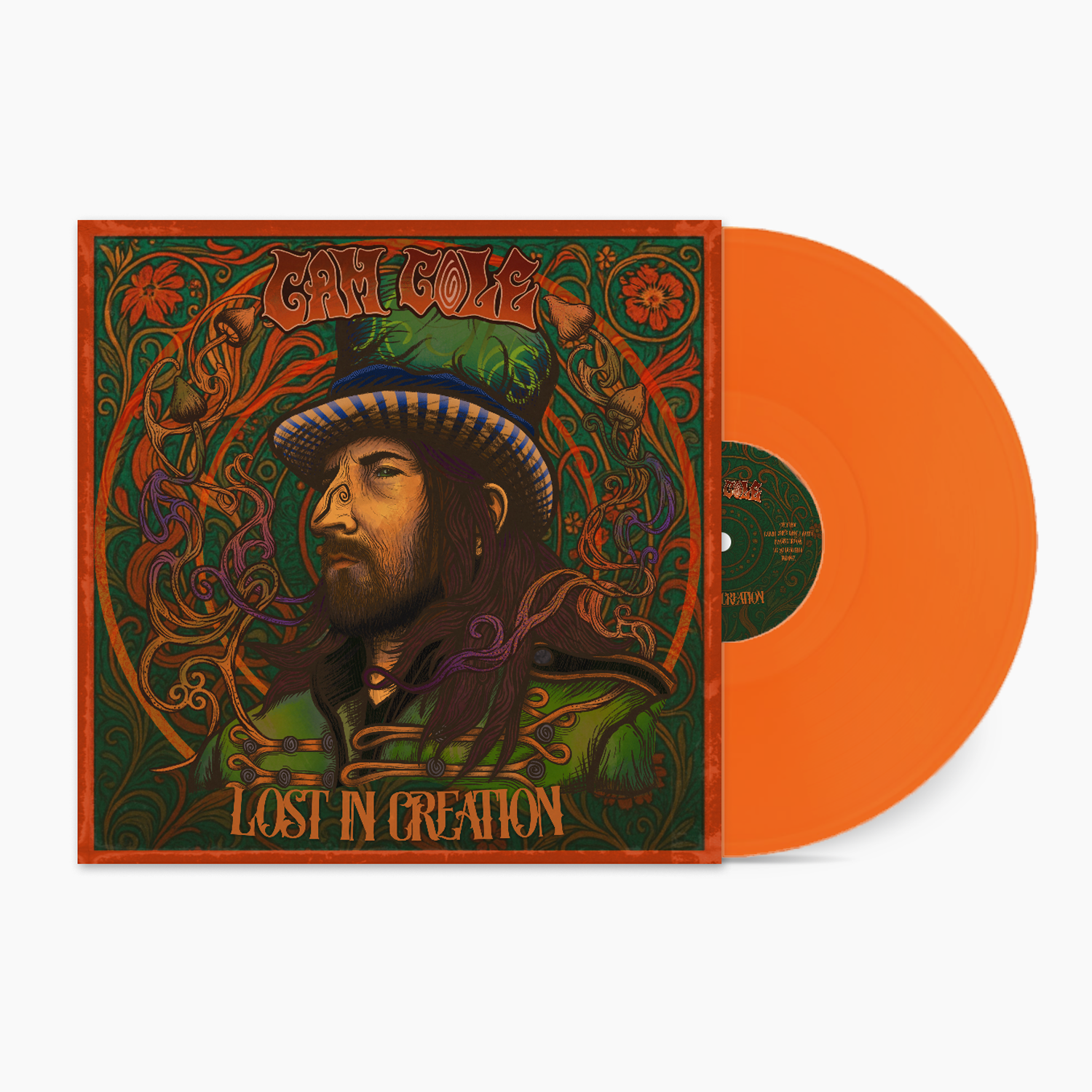
Lost In Creation album artwork supplied with the press materials.
The Wall Gets Wider
Cole says the change was deliberate. His first three albums were largely built around capturing the thing people had already responded to on the street: one person playing everything at once, with only subtle overdubs used when necessary to make a guitar sound thicker rather than to create an obvious second part.
| “It’s the fourth album now. I could either keep doing what I’ve always been doing, or I could paint with it a little more and express myself in a way people haven’t really heard before.” — Cam Cole |
That word — paint — gets close to what Lost In Creation does differently. Cole still records the core guitar and drums live, usually choosing the second or third take when the feeling is right. But now he is willing to build around that foundation with additional guitars and sounds. The raw performance remains the cornerstone; the studio becomes another instrument instead of merely a place to document the show.
That also means being willing to throw the foundation away when it does not feel right. “Get Up Ya Honky Tonk” became the problem child of this album. Cole went back to it, remixed it several times and kept hearing something he did not trust. Now he can listen and hear nothing wrong with it. At the time, however, it was the one song that refused to arrive easily.
A Record That Keeps Changing Shape
The opening run makes the new range obvious. “Fee Fi Foe” comes in dark and dirty, with grungy slide guitar, heavy distortion and a vocal treatment that sounds pushed through an old PA. There is some Jack White abrasion in the attack, but the stranger rhythmic personality keeps it from feeling like imitation. It is blues-rock dragged through fuzz, grime and a modern alternative-rock filter.
“Rabbit (She’s What I Want)” leans further into alternative rock. There are flashes of Nirvana and Corrosion of Conformity in the weight and texture, but the heaviness does not bury the emotional center. There is real longing in it — not just a lyric about wanting someone, but the sound of wanting someone. “Chasing Dreams” changes the temperature again with a catchier, more immediate pulse. It is one of the album’s most accessible tracks, proof that Cole can make the sound easier to enter without sanding off his personality.
“Ur So Beautiful” is one of the record’s most revealing turns. On first listen it carries the dark acoustic weight of the 1990s unplugged era — Alice in Chains and Stone Temple Pilots are fair touchstones — but Cole confirmed that the grunge intention is absolutely there. Delta blues may be the foundation of his music, he says, but grunge, psychedelia and a little Josh Homme-style desert rock are major parts of his vocabulary too.
| “Grunge is a humongous genre for me… I especially like mixing the blues with the grunge.” — Cam Cole |
The song came from a more personal place than its darkness might suggest. Cole wrote it while caught in the honeymoon-stage infatuation of a relationship that ultimately did not last. He walked into the studio with the feeling already present, turned it into a song and, with Valentine’s Day approaching, sent it to her. His summary of the result is considerably less poetic: “That got me in there.”
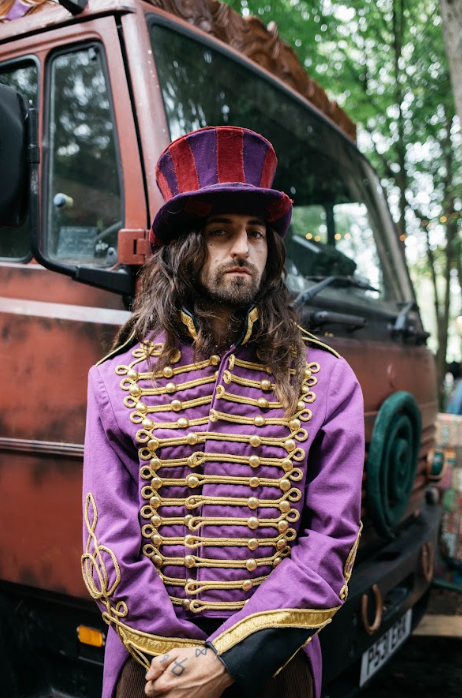
Cam Cole. Official press image. Photo: Tomm Morton.
The middle of Lost In Creation gets rougher and more playful. “Tailgate” piles on distortion and gives Cole’s vocal a near-spoken, almost rap-like cadence. “Feeling Me Now” seems to drag itself into motion before snapping into a faster, heavier groove, with rhythm doing as much work as the riff. Cole says the song also represents another small technical breakthrough in his foot-drum playing: a four-to-the-floor feel and double tambourines he had not previously been able to execute the way he wanted.
Then comes “Get Up Ya Honky Tonk,” the track that best explains what happens when Cole lets the weirdness stay weird. To these ears, it sounds like blues wandered into a Primus rehearsal: crooked, funky, stomping and playful, with raw guitar and a distorted radio-like vocal cutting across the groove. Cole laughed at the comparison because other people have told him something similar — and because he has barely listened to Primus. He knows a little of the band, but not enough to have consciously borrowed anything. That makes the rhythmic resemblance more interesting, not less.
| The record works best when Cole lets the weirdness stay weird. |
Mississippi, Slide Guitar and “Shroom Swamps”
Cole’s American mileage matters here, but not as a convenient explanation for the whole record. In the interview, he connected Mississippi most directly to the way he heard new possibilities in slide guitar and to the value of looseness — influences that became especially concrete in one instrumental.
He has long felt that slide guitar can do more than remain inside familiar blues structures. In Mississippi he became interested in bridging the recognizable architecture of 12-bar blues with different scales and chordal movement. Then a particularly strange day in the cypress swamps turned that theory into a song.
At an earlier show, a fan had given Cole psychedelic mushrooms. He forgot them in a pair of jeans. Later, during time off in Mississippi, he found them again while wearing those trousers and visiting the swamps. He ate them, discovered they were much stronger than expected, became increasingly aware of the possibility of alligators and retreated to the pickup truck with a camper body he was renting. There, guitar in hand, the musical idea clicked.
| “It is exactly what it says on the tin. It was a psychedelic adventure in the swamps of Mississippi, and it was a sound I was looking for.” — Cam Cole on “Shroom Swamps” |
Cole put down his phone and recorded what he was playing. That sketch became “Shroom Swamps,” later expanded with drums. It happened during the same stretch in the States when he interviewed Bobby Rush. The instrumental is one of the album’s most vivid pieces: creepy Delta-flavored slide, psychedelic atmosphere and the feeling of walking through mud with every step resisting the next one. On the record it sits immediately before the title track, functioning like a murky passageway into the final statement.
The trip also sharpened another lesson. Around Bobby Rush and R.L. Boyce, Cole heard musicians who were not obsessed with perfect edges. He was struck by Boyce’s willingness to let the playing get messy if the vibe was right. The takeaway was not to become careless; it was to understand that precision is not the only kind of control. “If you can save it in time, it sounds in,” he said. That looseness is now part of what he wants to carry forward.
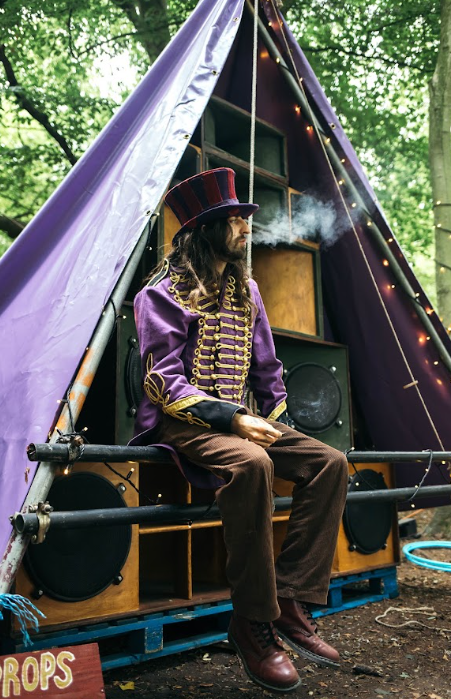
Cam Cole. Official press image. Photo: Tomm Morton.
The Work Is Part of the Show
Cole never planned to become a one-man band. The songs and the imaginary band in his head came first. After being repeatedly let down by drummers, he moved from a stomp box to adding a tambourine, then tried using both feet at once. Eventually he found the Farmer FootDrum and began the long process of teaching his body to do what his arrangements required.
The setup is now customized, partly because Cole hits it hard enough to break things. Pete, the builder, has helped modify the levers so they return properly, though Cole says he can still “break the bastard” and values having a tech nearby when that happens. Each record tends to bring a new beat or another piece of coordination he did not have before.
That difficulty is not something Cole wants to hide with electronics. He has considered simplifying his street and live setup into a smaller digital system, but he thinks doing so would remove one of the reasons people stop. He spent roughly seven years busking before the final three years became genuinely profitable. The difference, as he sees it, was not convenience. It was finally building a show where a passerby could look at the physical effort and immediately understand that what they were seeing was hard.
| “People on the street don’t give you any time unless you’re giving them something. You’ve got to hypnotize them.” — Cam Cole |
When that happens, the reaction still matters to him. Asked what it feels like to see someone in a crowd become completely absorbed, Cole answered without hesitation: he loves stopping people. “That’s what I live for.”
Away from the road, he is already writing again, working out the show for an upcoming February tour and continuing his “Sounds From The Van” videos. His restlessness reaches outside blues-rock too: he keeps an electronic dance-music project as another outlet for ideas that do not belong inside the Cam Cole sound. He talks about songwriting as capturing lightning in a bottle, and about the stage as something that can always be pushed further — even down to visual devices such as the large spiral wheel he uses behind him. The one-man-band concept may be expanding, but the instinct to make people stop and look remains intact.
Vulnerability, One Takes and the Rooms That Matter
The final three tracks deepen the record rather than simply making it louder. “You Shall Be Saved” begins stripped down and vulnerable, then widens without losing the exposed quality at its center. Cole wrote it in the same general batch as Unleash, but it was too singer-songwriter-oriented to belong comfortably on that heavier album. Lost In Creation gave it a better home.
The song dates to the pandemic period and the collective feeling of watching livelihoods, small businesses and ordinary stability disappear. Its message is not that music magically fixes any of that. It is that if some part of you can still sway to the rhythm, there is at least something to hold onto. Cole admits he may have been trying to pick himself up as much as anyone else.
The performance has another layer of significance: the main vocal, guitar and drums were captured together in one take, with only a few backing vocals added later. That raw ending, where the vocal seems to lose itself inside the song, is not studio theater. It is the core performance itself.
“You Shall Be Saved” was recorded at Rockfield in Wales, where Cole also recorded Unleash. He points to the studio’s history with artists including Queen and Oasis, but what he values most is the ability to live there for a stretch, wake up and immediately work rather than carry the outside world into the room. Most of Lost In Creation, however, was recorded at Dean Street Studios in London, with Markus Stretz producing and mixing, and Sean Magee mastering at Abbey Road.
| “You only get to do this once with these songs. I could record them all at home on my laptop and a microphone, but there is a fucking difference.” — Cam Cole |
For Cole and Stretz, that difference is the room. They are self-described music nerds who care about how drums, guitars and voices react to a physical space. Dean Street and Abbey Road are not status symbols in that telling; they are tools. Cole points out that sometimes the magic space is not even a studio — it can be a corridor, a staircase or any place where the sound suddenly becomes bigger than the walls around it. He cites the famous stairwell sound behind John Bonham’s drums on Led Zeppelin’s “When the Levee Breaks” as the kind of accidental acoustic discovery musicians spend their lives chasing.
Getting Lost Without Losing the Stomp
“Shroom Swamps” needs no lyric at all. The title track that follows it does. “Lost In Creation” turns the album’s outward experimentation inward: darker, more reflective and lyrically direct, it sounds like an artist confronting the quantity of ideas in front of him and the difficulty of knowing which direction deserves to survive.
That is also why the album’s breadth works more often than it does not. What could look like genre-hopping across ten songs gradually starts to feel like the point. Cole is allowing himself to chase sounds until they tell him where they belong. The one-man wall of sound has become a room with more doors in it.
The record is not flawless. Its breadth can occasionally feel restless, and the distorted vocal treatment appears often enough that what begins as a striking texture can become expected. “Chasing Dreams” is immediately likable but less idiosyncratic than the album’s strangest material. Those are modest trade-offs for a record that is clearly trying to grow instead of simply repeating a successful formula.
The standouts are “Get Up Ya Honky Tonk,” “You Shall Be Saved,” and “Lost In Creation,” with “Shroom Swamps” functioning as the odd instrumental detour that gives the album a world of its own. More importantly, Lost In Creation answers the question hanging over the project: Cam Cole can expand the palette without losing the stomp. The blues is still underneath everything, but it is no longer a fence.
At the end of the interview, Cole resisted telling listeners exactly what they should understand about him when the album ends. That, he said, belongs to them. What he hopes they hear is the journey — the different flavors, the things he is pulling in, and the work of creating each song on its own terms.
| “I hope they understand the musical journey I went on to make the album… Anything else they take from it is a bonus. That part is up to the individual.” — Cam Cole |
That is probably the right final word. Lost In Creation is not a clean arrival at a new identity. It is the sound of an artist discovering how much more the identity he already built can hold. Getting lost, this record argues, is not the same as being defeated.
And Cole does not sound finished with the journey. As the conversation ended, he said he expects to return to the United States soon. For a musician whose career began by forcing strangers to stop, the next chapter may be less about proving how much noise one man can make and more about seeing how far that noise can travel.
The post Cam Cole — Lost In Creation: Bigger, Stranger and Still Built to Stomp appeared first on Blues Rock Review.
]]>The post Joanne Shaw Taylor releases “Never Gonna Please ‘Em All” appeared first on Blues Rock Review.
]]>The song addresses the pressure to meet other people’s expectations and the realization that trying to please everyone can come at the expense of being yourself.
“Never Gonna Please ‘Em All” particularly focuses on the expectations placed on women, including being told to smile, speak less and make themselves more agreeable. Taylor pushes back against those demands, emphasizing the importance of individuality and self-acceptance.
The song also reflects Taylor’s experiences as a songwriter, particularly her ability to turn personal struggles into music. The lyric “I turned my heartbreak / Into a work of art” highlights that connection, while the repeated refrain “Ain’t never gonna please ’em all” reinforces the song’s message.
The single appears on Taylor’s 10-track album, The Trouble With Love, produced by longtime collaborator Kevin Shirley. The record explores relationships, heartbreak, friendship and personal growth through a combination of blues, rock, soul and Americana.
The album includes two notable collaborations. Joe Bonamassa appears on the title track, “The Trouble With Love,” which examines the highs and lows of romantic relationships. Guitarist Orianthi joins Taylor on “What Good Is My Love?,” a song about loving someone who cannot return those feelings.
Other songs include “Hell Or High Water,” which focuses on perseverance, and a cover of Celeste’s “This Is Who I Am.” “You And Me (Rachel’s Song)” was written as a tribute to Taylor’s best friend and explores the importance of lasting friendships.
Taylor will support the album with a fall U.S. tour beginning October 28 in Albuquerque, New Mexico. Canadian blues-rock band Bywater Call will open the initial dates, with Robert Jon & The Wreck joining for additional shows.
The tour concludes November 21 at the Golden State Theatre in Monterey, California.
Joanne Shaw Taylor 2026 U.S. Tour Dates
October 28 – Albuquerque, NM – KiMo Theatre *
October 29 – Flagstaff, AZ – Orpheum Theater *
October 30 – Phoenix, AZ – Celebrity Theatre *
November 1 – Tucson, AZ – Rialto Theatre *
November 3 – Grand Junction, CO – Mesa Theater *
November 5 – Colorado Springs, CO – Phil Long Music Hall *
November 6 – Fort Collins, CO – Aggie Theater*
November 7 – Boulder, CO – Boulder Theater *
November 9 – Salt Lake City, UT – The State Room **
November 10 – Boise, ID – The Egyptian Theatre **
November 12 – Spokane, WA – Knitting Factory **
November 13 – Tacoma, WA – Rialto Theater **
November 15 – Portland, OR – Aladdin Theater **
November 17 – Grass Valley, CA – The Center for the Arts **
November 19 – Napa, CA – Uptown Theatre Napa **
November 20 – Bakersfield, CA – World Records **
November 21 – Monterey, CA – Golden State Theatre **
* With Bywater Call
** With Robert Jon & The Wrec
Joanne Shaw Taylor 2027 UK Tour Dates
May 2 – Harpenden, UK – The Eric Morecambe Centre
May 3 – Leeds, UK – City Varieties Music Hall
May 4 – Whitley Bay, UK – Playhouse
May 6 – London, UK – Cadogan Hall
May 7 – Bury St Edmunds, UK – The Apex
May 8 – Manchester, UK – Royal Northern College of Music
May 9 – Birmingham, UK – Town Hall
May 11 – Glasgow, UK – St Luke’s
The post Joanne Shaw Taylor releases “Never Gonna Please ‘Em All” appeared first on Blues Rock Review.
]]>The post The Commoners unveil “Lost in the Highlights,” mixed by Kevin Shirley appeared first on Blues Rock Review.
]]>The track was mixed by Kevin Shirley, whose credits include The Black Crowes, Joe Bonamassa, and Joanne Shaw Taylor. It follows the band’s previous singles “Just Watch Me” and “Runnin’ Blind.”
“’Lost in the Highlights’ captures the battle to stay grounded when life’s noise and momentum are racing ahead faster than you can process,” says The Commoners frontman Chris Medhurst. “When you’re constantly on the road, charging towards the next milestone, it’s easy to be swept up in the rush, the gloss and the excitement—and lose sight of what keeps you anchored. We wanted the music to cut through that haze, pull us back into focus and help us find solid ground again. It’s an honest snapshot of exactly where we are as a band right now.”
“We wanted to write a song that carries a lot of swagger and rock and roll grit,” continues Medhurst. “Lyrically it confronts that uneasy feeling of moving forward when you can’t see what is right in front of you. It sets a bold statement for the upcoming third studio album.”
The new single features the band’s Southern rock influences, combining dual guitars, Hammond organ, and a driving rhythm section.
“Reconnecting with Kevin Shirley on the mix for this track was amazing,” says The Commoners lead guitarist, Ross Hayes Citrullo. “Kevin’s mixes have this incredible ability to convey the raw energy of a live band while giving it that massive, larger-than-life rock and roll production.”
“He understands the heart of Southern Rock and knows exactly how to make two guitars, a Hammond organ, a heavy rhythm section, and soaring vocals hit you right in the chest. Having his ears on ‘Lost in the Highlights’ took the song to a whole new level.”
The Commoners have also released an official music video for “Lost in the Highlights.”
The band will return to the UK on November 12 for a 12-date tour featuring special guest Spencer Mackenzie.
The post The Commoners unveil “Lost in the Highlights,” mixed by Kevin Shirley appeared first on Blues Rock Review.
]]>The post Robert Cray announces first new album in seven years appeared first on Blues Rock Review.
]]>Produced by longtime collaborator Steve Jordan and recorded at FAME Studios in Muscle Shoals, Alabama, the album finds Cray addressing America’s racial history, political divisions and the country’s future through his signature blend of blues, soul and R&B.
“1965, when voting rights for Black people were enacted, wasn’t that long ago,” says Cray. “I turned 12 that year, and my parents were finally able to vote. I’m not the first to write these types of songs. But I know why they are written — it’s just too bad that we have to.”
The album’s new single, “Push Through,” addresses the current political climate and calls for Americans to defend voting rights and the progress made during the civil rights movement.
“We have the right to choose what we demand. Just get out the vote and on the streets and stand,” Cray sings on the track.
The recording sessions in Muscle Shoals also held personal significance for Cray. At age seven, he and his siblings spent several months living with their grandmother in Alabama before joining their father, who was stationed in Germany. During that time, Cray experienced segregation firsthand, including separate schools and drinking fountains.
Returning to Alabama decades later provided an opportunity to reflect on those experiences and their connections to the country’s current political divisions.
All Over Again reunites Cray with Jordan, whose musical relationship dates back to 1986. The two musicians were recruited by Keith Richards to perform with Chuck Berry for the concert film Hail! Hail! Rock ‘n’ Roll.
Several songs on the album address personal and political subjects. “With Everyone” pays tribute to Cray’s mother, Maggie Cray, who died in 2020, while also examining the country’s political climate. “Long Way Home” explores the consequences of dishonesty and division, while “Tacky Wack” offers criticism of the current presidential administration.
The album also features Cray’s interpretations of three classic R&B recordings: Wilson Pickett’s “For Better Or Worse,” Bobby Womack’s “I’m In Love” and Jimmy Hughes’ “Neighbor, Neighbor.”
The closing track, “Soul Shot,” celebrates the musicians and recordings that established Muscle Shoals as an important center of American soul music. The song was co-written by Cray, Jordan, pianist Clayton Ivey and organist Spooner Oldham.
Throughout his career, Cray has worked with numerous blues and rock legends, including B.B. King, Buddy Guy, John Lee Hooker, Albert Collins, Eric Clapton, Chuck Berry and The Rolling Stones. His recordings have earned multiple Grammy Awards and helped establish him as one of the leading figures in contemporary blues.
With All Over Again, Cray continues to use his music to address social issues while drawing on the blues and soul traditions that have shaped his career.
“We move forward,” Cray says. “We don’t move back.”
The post Robert Cray announces first new album in seven years appeared first on Blues Rock Review.
]]>The post 10 Must Hear Blues Rock Collaborations appeared first on Blues Rock Review.
]]>B.B. King & Eric Clapton – “Riding With the King”
A B.B. King and Eric Clapton classic. As a youngster just discovering blues, this was my absolute go-to. Incredible guitar playing, outstanding vocal performances packed with feel, and irresistible groove throughout the track. Essential track, as well as the album as a whole.
Koko Taylor & Buddy Guy – “Born Under a Bad Sign”
The Queen of the Blues herself – Koko Taylor teams up with the legendary Buddy Guy to add grit to this Albert King classic. Delivered with unmatched emotion and attitude, this 1993 version can’t be missed.
Albert King & Stevie Ray Vaughan – “Don’t Lie To Me”
Taken from their 1983 televised live recording In Session, this performance is truly electric, showcasing two completely mind-blowing guitar gods having fun. Throughout the entire session there’s almost a master – disciple dynamic between the two, which is funny in hindsight considering how massive a name SRV is, and how big a legacy he’s left behind.
Buddy Guy & Junior Wells – “Messin’ With the Kid”
Buddy Guy and Junior Wells join forces on “Messin’ With the Kid”. Widely known as an upbeat Chicago Blues standard, this version is slightly more laid back but not any less funky. Amazing brass parts powering the already groovy rhythm section. Junior on the vocals, and Buddy delivering his signature-style solo. Tasty!
Howlin’ Wolf, Eric Clapton, Steve Winwood, Charlie Watts & Bill
Wyman – “Highway 49”
Picked out from The London Howlin’ Wolf Sessions, a killer slide riff kick-starts this blues shuffle performed by an all-star lineup. Energy simply bursts out of this one, with Howlin’ Wolf’s unique vocals sending chills down your spine. A true clash of blues and rock legends.
John Lee Hooker & Bonnie Raitt – “I’m In the Mood”
John Lee Hooker’s dirty guitar playing and soulful vocals are complemented so nicely by Bonnie Raitt’s spicy ad-libs on this track. The recording session for this was apparently so electric that Bonnie recalls needing a moment to compose herself afterward. That genuine emotion truly shines through the record itself.
Muddy Waters & The Rolling Stones – “Hoochie Coochie Man” (Live)
One of the most recognisable blues tunes of all time. Rock n’ roll bad boys, The Rolling Stones have always worn their influences on their sleeves, and Muddy Waters is the absolute top of that list. Recorded on a whim in Chicago in 1981, a truly memorable live performance
The Marcus King Band & Warren Haynes – “Virginia”
Oh what a tune! This track is what got me obsessed with Marcus King. Incredible guitar playing, even better vocal performance, all spiced up by Warren Haynes’ southern swagger and otherworldly guitar playing. Rich guitar tones, conversational solos, the band pumping the energy. Just incredible!
Taj Mahal & Keb’ Mo’ – “Don’t Leave Me Here”
A groovy track packing tonnes of soul picked straight off a 2017 collab album titled TajMo. Tight production, two great blues vocals, a luxurious brass section, fiery harmonica solos, delicious guitar licks, a true masterclass by these two blues heavyweights.
Albert Collins, Robert Cray & Johnny Copeland – “T-Bone Shuffle”
Guitar mastery overload in this blues standard recorded in 1985 by a truly impressive line-up. A relentless shuffle, and three blues guitar giants having the time of their lives trying to challenge each other.
Different styles, different eras, different tempos, but all 10 are absolute blues masterpieces. Did I miss anything blatantly obvious? Any hidden gems you love? Let me know in the comments below.
The post 10 Must Hear Blues Rock Collaborations appeared first on Blues Rock Review.
]]>The post Sari Schorr: Running Wild Review appeared first on Blues Rock Review.
]]>“Mr. In the Middle” opens the album with a punch. A roaring guitar riff, fast tempo, and powerful vocals delivered with attitude. The chorus brings that late 80s / early 90s high-octane hard rock vibe. The title track is somewhat mellower and slower, led by the crisp-sounding acoustic guitar. “Running Wild” brings more expressive singing by Sari, showcasing her full vocal range and different styles that have influenced her. The groove in “Monday Morning” is infectuous. Drawing inspiration from the classic rock n’ roll sound of The Rolling Stones, there’s also something quite gospely about the vocal arrangement in this feel-good tune.
What follows is a folky ballad, “Man On Fire,” with soulful vocal delivery, beautiful clean guitar parts, haunting backing vocals, and subtle brushes on the snare drum playing to the rhythm of a slow-moving train. This then gives way to another hard-hitting upbeat rock tune titled “Cool Hand Rider”. “Elevate” is your classic sunny day laid-back blues rock track, with Sari adding a bit more grit to her voice. The mood suddenly shifts with a Pink Floydesque slow number titled “Call It Freedom”. The guitar tone is otherworldly in this song and so is Sari Schorr’s singing – absolutely mind-blowing. Southern Rock style riff starts “Better Day”, a mean tune shifting to a half-time beat in the verses to add weight before pumping all the energy into the choruses. Heavy-treading shuffle drives “Afterglow”, a rock tune sprinkled with some psychedelia. The closing number of the album is a slow-burner “Finding My Way”, carrying the torch of hope.
Speaking about the new album Sari said: “I’ve reached a deeper understanding of who I am as an artist. I’m still searching and learning, but I trust my instincts more and follow each song to its emotional truth. These songs explore defiance, self-discovery, resilience and transformation. I hope they lift people above the weight of everyday life and remind them that brighter days are possible.”
Running Wild is a cohesive journey through different styles, moods, and rhythms. The production quality and songwriting are at the highest level throughout the record, and Sari delivers a true vocal masterclass. Great listen!
The Review: 8/10
Can’t Miss Tracks
– Monday Morning
– Elevate
– Call It Freedom
The Big Hit
– Monday Morning
The post Sari Schorr: Running Wild Review appeared first on Blues Rock Review.
]]>The post Blues Rock legend’s guitar sells for $550,000 at auction appeared first on Blues Rock Review.
]]>The guitar, which Mack played throughout his influential career, was sold alongside his 1962 Magnatone Custom 440 amplifier during Heritage’s October 15 Vintage Guitars and Musical Instruments auction. The lot also included Mack’s recognizable stage strap.
Mack’s Flying V became one of the most recognizable instruments in blues rock history. The guitarist used “Number 7” throughout decades of recordings, live performances, and international tours, helping establish his distinctive sound that combined blues, rock, country, and soul.
A pioneer of blues rock guitar, Mack helped shape the direction of electric guitar playing in the 1960s. His instrumental hits “Memphis” and “Wham!” showcased his aggressive picking style and influenced generations of guitarists who followed.
The Flying V was closely associated with Mack throughout his career, appearing on album covers and becoming a familiar sight during his live performances.
The Flying V was one of the auction’s biggest sales, second only to a 1959 Gibson Les Paul Standard Sunburst that fetched $781,250. The Les Paul established a world auction record for a vintage guitar without celebrity provenance, surpassing the previous record of $611,000.
“To offer both this Les Paul and Lonnie Mack’s ‘Number 7’ in the same auction was extraordinary,” said Aaron Piscopo, Director of Vintage Guitars & Musical Instruments at Heritage Auctions. “One is a remarkably preserved example of Gibson’s Golden Era craftsmanship; the other helped shape the sound of modern electric guitar. Together, their results demonstrate the depth of collecting interest in great instruments and the musical history they carry.”
In total, the auction generated $2.15 million across 201 lots and attracted 848 international bidders.
Mack, who died in 2016 at the age of 74, remains an influential figure in the development of blues rock guitar. His combination of blues phrasing, rock and roll energy, and country-influenced picking helped establish a style that would influence generations of guitarists.
The $550,000 sale ensures that one of the most recognizable guitars in blues rock history remains a highly valued piece of music history.

The post Blues Rock legend’s guitar sells for $550,000 at auction appeared first on Blues Rock Review.
]]>The post Joanne Shaw Taylor: The Trouble With Love Review appeared first on Blues Rock Review.
]]>Taylor also has a brand-new album, The Trouble With Love, dropping on October 23. For those unfamiliar (if that is even possible) with Joanne Shaw Taylor, let’s explore a little background about how she ascended to her current notoriety.
Born in Wednesbury, England (in the West Midlands area known as the “Black Country”), she grew up in a family that was musically influenced by a guitar- and harmonica-playing father who enjoyed the blues and a mother who enjoyed Motown and soul music. She spent time listening to her parents’ record collection as a youngster and played classical guitar while in school.
At the age of sixteen, she was discovered by Dave Stewart (Eurythmics). In 2009, Taylor’s first official album, White Sugar, was released, and since then, she has released ten more (including this new release), a couple of live projects, and a string of singles and EPs.
She is a multi-award-winning blues artist who has worked with artists such as Kenny Wayne Shepherd, Joe Bonamassa, Dave Stewart, Josh Smith, and others. Joanne Shaw Taylor continues to explore new territory in the blues music world, especially with this brand-new album release.
The Trouble With Love kicks off with the attention-grabbing title track, “The Trouble With Love,” which features Joanne Shaw Taylor’s close friend, Joe Bonamassa. What a great opening this tune is because it showcases some masterful guitar playing and Taylor’s sometimes-overlooked, outstanding vocal ability.
This song addresses the sad facts of failing love and how it is sometimes harder to stay than it is to leave. “And I wish I hadn’t had it, ’cause I can’t quit this habit. That’s the trouble with love.” This great piece has also been released as a video that you can find on YouTube.
The second track of this ten-song recording is “Hell Or High Water,” and it’s a great one. Do you love those gospel blues sounds? Well, it’s working here in a huge way! I love Taylor’s soulful guitar solo in this number.
She sings, “I feel no sorrow, I feel no shame. I’ve walked through fire and back again.” Taylor continues with, “Now I’m on my knees begging; Lord don’t let me falter; come hell or high water.”
The voices at the very end are such a nice touch to this well-done song that you’ll want to make sure to check out.
“What Good Is My Love” is an upbeat, happy song with negative, depressing subject matter. “No I don’t care, that you changed your mind. Baby that’s what lovers do all the time. But maybe next around, you could save somebody the fall. For now I’ll take the hit, and just call this another close call.”
She continues with, “What good is my love; what good is my love? If I’m not the one you’re thinking of?”
More great guitar work can be found on this track as Taylor sings about bad relationships that most of us can, unfortunately, relate to.
Track eight of The Trouble With Love is “Never Gonna Please ‘Em All,” and I’m just about betting that she might be referring to fans and critics of her music in this one. The opening guitar lead is “gonna” make you nod your head in rhythm. “Betcha”!
Taylor sings, “Played it safe and I played it sweet. Even sugar burns, left under the heat. Ain’t never gonna please them all.”
This is a real shake-the-walls rocker that might get you up and dancing a little “boogity, boogity, boo” around the room, especially if you crank up that volume dial.
The bottom line is that Joanne Shaw Taylor is, as Joe Bonamassa has been quoted as saying, “the total package.” I don’t disagree.
Joanne Shaw Taylor has been quoted as saying this about herself: “I’ll always be a blues guitarist at heart.” She has consistently stayed true to that quote, mixing in brief diversions to keep her music interesting to her listeners, as well as herself.
But make no mistake, she is a “true” blues artist, as bluesy as they come.
You can catch her on tour during October and November. Just check her schedule through her social media. You can also check out lots of her prior work on YouTube. Joanne Shaw Taylor just keeps getting better and better.
Grab a copy of The Trouble With Love. You will not be sorry.
The Review: 9.5/10
Can’t Miss Tracks
– The Trouble With Love
– Hell Or High Water
– This Is Who I Am
– Never Gonna Please ‘Em All
The Big Hit
– Hell Or High Water
The post Joanne Shaw Taylor: The Trouble With Love Review appeared first on Blues Rock Review.
]]>