The Thai Chief of immigration has stated that, since Bahrain has issued an arrest warrant, it is now up to the Thai court to decide on the case because there is no bilateral extradition treaty.
AlAraibi was prevented from seeing his lawyer today at Suan Phlu (Bangkok) Immigration Detention Center, despite the lawyer making verbal and written requests.
On 4 December 2018, AlAraibi told the Bahrain Institute for Rights and Democracy (BIRD) that the Thai immigration authorities promised he would be able to fly back to Melbourne, Australia, since the INTERPOL “Red Notice” had been lifted, though they added that due to Thailand’s National Day on 5 December, the procedure might be delayed.
It is still unclear why AlAraibi was told he could make his way back to Australia and how the political circumstances have changed since.
AlAraibi told BIRD: “This might be my last message. I still don’t know whether I will be deported to Bahrain tomorrow. I appeal to the United Nations, individual states, FIFA, footballers, and all people, as my fate is now in danger and my future will soon be over. If I am deported to Bahrain, don’t forget me, and if once I’m there you hear me saying things, don’t believe me. I know what will happen to me and I know I will be tortured to confess things that I have never done. Please continue your fight to save me.”
Commenting, Sayed Ahmed Alwadaei, the Director of Advocacy at BIRD said: “If Hakeem is extradited to Bahrain the Thai government will breach international law and cross a red line which will prompt the international community to act. During Thailand’s National Day we all witnessed how Bahrain’s Prime Minister hailed the strong ties between the two countries. This is a toxic relationship that could destroy the life of a 25 year old, whose only crime has been to tell the truth about his government’s ruthless torture.
After the brutal murder of Jamal Khashoggi, the world should not underestimate how far the Gulf States will go to repress dissent.”
AlAraibi has been very critical of the current president of the Asian Football Confederation, Sheikh Salman Alkhalifa, especially during his candidacy for FIFA presidency in 2016. Hakeem conducted interviews with media outlets, including the New York Times, the Guardian and ITV, and discussed details of the torture he suffered in 2012 while in the custody of Bahraini law enforcement.
On 4 December, BIRD wrote to Gianni Infantino, FIFA President urging him to take a strong public stance on AlAraibi’s case. Despite the urgency of the matter and the imminent risk AlAraibi is facing, FIFA has completely failed to respond or to help the player in any way. FIFA has not sought information about his case, and whether FIFA Vice President Sheikh Salman has pressured the body to ignore its own human rights policies that include protections for human rights defenders and whistleblowers.
FIFA launched a complaints mechanism for human rights defenders in May 2018: https://www.fifa.com/governance/news/y=2018/m=5/news=fifa-launches-complaints-mechanism-for-human-rights-defenders-and-journalists.html
If returned to Bahrain, AlAraibi faces a real risk of imprisonment and torture. Extraditing registered refugees and returning them to territories where they would face a real risk of persecution, torture, or other ill-treatment violates Thailand’s obligations under international law, including the UN Convention Against Torture.
Timeline:
27 November 2018 – AlAraibi was detained at Bangkok Suvarnabhumi Airport (BKK) under Interpol’s “Red Notice”, issued upon Bahrain’s request due to his criminal conviction in 2014. The “Red Notice” was lifted on 4 December.
30 November 2018 – Australian Foreign Minister, Marise Payne said: “He’s not an Australian citizen…and he’s also travelling on U.N. papers. So we have raised that matter. Our post in Thailand is aware of it and is following up on that.”
1 December 2018 – Alaraibi was told by the immigration authorities that he would be able to fly back to Melbourne. A few hours before his scheduled departure, however, AlAraibi was taken to Suan Phlu (Bangkok) Immigration Detention Center and was not provided access to legal representation. On the same day, the Bahraini Embassy in Thailand issued statements on Twitter stating that they are “following up with the relevant security authorities” and that “the suspect is wanted for security cases”.
3 December 2018 – A Thai court approved a temporary remand to detain AlAraibi for 12 days in Bangkok. Thai Immigration also informed the court that they oppose bail application for AlAraibi.
Background:
In November 2012, AlAraibi was arrested and tortured by the Bahraini authorities, allegedly due to the political activities of his brother. He has since spoken publicly about his torture. “They blindfolded me,” he said. “They held me really tight, and one started to beat my legs really hard, saying: ‘You will not play soccer again. We will destroy your future.’ ”
In January 2014, Bahraini authorities sentenced AlAraibi to 10 years imprisonment in absentia on the charge of vandalising a police station, which he strongly deny.
AlAraibi fled to Australia in May 2014, where he was granted refugee status in November 2017. This visa allows AlAraibi to remain in Australia indefinitely and to travel to and from Australia, so long as he does not travel to Bahrain, the country from which he has sought protection.
AlAraibi has been very critical of the current president of the Asian Football Confederation, Sheikh Salman Alkhalifa, especially during his candidacy for FIFA presidency in 2016. AlAraibi conducted interviews with media outlets, including the New York Times, the Guardian and ITV, and discussed details of the torture he suffered in 2012 while in the custody of Bahraini law enforcement.
Alaraibi is a football player for Pascoe Vale FC in Melbourne.
]]>Returning registered refugees to territories where they would face a real risk of persecution, torture, or other ill-treatment violates Thailand’s obligations under international law.
AlAraibi was taken from the Suan Phlu (Bangkok) Immigration Detention Center to court without being informed and was not provided access to legal representation. As he attended court, his wife, Naqaa Sateeh, remained in the detention centre under great emotional distress as she was told by the immigration authorities that her husband would not return.
The first Remand period will end on 14 December 2018. AlAraibi’s temporary remand can be renewed upon court approval while Thai authorities determine his fate. Thai Immigration also informed the court that they oppose bail application for AlAraibi.
Commenting, the Director of the Bahrain Institute for Rights and Democracy (BIRD), Sayed Ahmed Alwadaei, said: “This is not the first time that the Thai authorities are deliberating the extradition of a Bahraini national facing great risk of torture. They have done it before, but to do it again with Hakeem, who is a recognised refugee, would set a new low and would taint Thailand’s reputation. Hakeem’s deportation would violate Thailand’s obligations under international law.”
Timeline
On 27 November 2018, AlAraibi and his wife travelled from Melbourne for a holiday. Upon their arrival at Bangkok Suvarnabhumi Airport (BKK), he was detained under a “Red Notice”, issued upon Bahrain’s request due to his criminal conviction in 2014.
On 30 November 2018, Australian Foreign Minister, Marise Payne said: “He’s not an Australian citizen…and he’s also traveling on U.N. papers. So we have raised that matter. Our post in Thailand is aware of it and is following up on that.”
Alaraibi was told by the immigration authorities that he would be able to fly back to Melbourne on 1 December 2018. A few hours before his scheduled departure, however, AlAraibi was taken to Suan Phlu (Bangkok) Immigration Detention Center where he still remains at risk of extradition.
On 1 December 2018, the Bahraini Embassy in Thailand issued statements on Twitter stating that they are “following up with the relevant security authorities” and that “the suspect is wanted for security cases”.
If AlAraibi is returned to Bahrain, his safety is highly likely to be jeopardised. In a similar case, Ali Haroon was extradited by the Thai authorities in 2014 on the basis of an Interpol arrest warrant issued at the request of Bahrain. At the time of the arrest, Haroon possessed a valid visa, according to UNHCR. Haroon’s family reported that he was severely beaten and forced onto a flight to Bahrain, and required hospitalisation upon his arrival in Bahrain.
The issuance of the Red Notice violates the formal policy of the Interpol Executive, which states that the processing of red notices “will not be allowed if… the status of refugee or asylum-seeker has been confirmed”.
Background Information
In November 2012, AlAraibi was arrested and tortured by the Bahraini authorities, allegedly due to the political activities of his brother. He has since spoken publicly about his torture. “They blindfolded me,” he said. “They held me really tight, and one started to beat my legs really hard, saying: ‘You will not play soccer again. We will destroy your future.’ ”
In January 2014, Bahraini authorities sentenced AlAraibi to 10 years imprisonment in absentia on the charge of vandalising a police station, which he strongly denied.
AlAraibi fled to Australia in May 2014, where he was granted refugee status in November 2017. This visa allows AlAraibi to remain in Australia indefinitely and to travel to and from Australia, so long as he does not travel to Bahrain, the country from which he has sought protection.
AlAraibi has been very critical of the current president of the Asian Football Confederation, Sheikh Salman Alkhalifa, especially during his candidacy for FIFA presidency in 2016. AlAraibi conducted interviews with media outlets, including the New York Times, the Guardian and ITV, and discussed details of the torture he suffered in 2012 while in the custody of Bahraini law enforcement.
Alaraibi is a football player for Pascoe Vale FC in Melbourne.
]]>
Six experts from the United Nations Office of the High Commissioner for Human Rights (OHCHR) released a document expressing “grave concern” to the Bahraini government at the allegations of arbitrary arrest and detention of three relatives of Sayed Ahmed AlWadaei, as well as death threats and treatment amounting to torture.
Security officers arrested AlWadaei’s brother-in-law Sayed Nazar AlWadaei, mother-in-law Hajar Mansoor Hasan, and maternal cousin Mahmood Marzooq Mansoor in March 2017. They were reportedly targeted in relation to Sayed Ahmed AlWadaei’s human rights work. After days of detention without official charge, the three individuals were presented with terrorism charges, based largely on coerced confessions and “confidential sources”.
Security officials interrogated Hajar Mansoor, 49, for three periods each lasting around 11 hours between 5 and 7 March. Officers allegedly forced her to stand for extended periods and humiliated her with abusive language. They also allegedly threatened to cancel the family’s commercial licenses, suspend her husband’s pension payments and arrest her daughter, son-in-law and youngest son.
Officials questioned Hajar Mansoor about who had contacted the US Embassy when security forces at Bahrain Airport detained her daughter (Sayed Ahmed AlWadaei’s wife) and infant grandson, a US citizen in October 2016. The UN experts pointed to this earlier detention as another alleged targeting of Sayed Ahmed AlWadaei’s family members in retaliation for his human rights activities.
Hajar Mansoor’s alleged ill-treatment during the interrogation led her to collapse and faint, sustaining injuries to her hand and shoulder that required hospital treatment. Authorities have not allowed her to see family since her detention, and refused her the medication she needs for several health conditions.
Sayed Nazar, 18, was allegedly arrested without a warrant on 2 March, then detained for six days without official charge. He was reportedly subjected to ill-treatment, beaten and deprived of sleep for two days of interrogations.
Officials threatened Sayed Nazar that they would continue “to take revenge on him” for AlWadaei’s human rights work, and tortured him into implicating family members in “wrongdoing”. The eighteen year old was reportedly told he would be killed if he did not sign the presented written confession and if he did not confirm this at the Public Prosecution office.
Mahmood Marzooq, 29, was also allegedly arrested without a warrant on 2 March and held for six days without official charge. During his interrogation he was allegedly threatened, ill-treated and coerced to sign a false confession. No lawyer was present.
On 8 March all three individuals were presented with terrorism-related charges. The evidence is allegedly limited to “confidential sources”, their coerced confessions, and fake explosives that authorities claim to have found. All three deny the charges.
Sayed Ahmed AlWadaei is Director of Advocacy at the Bahrain Institute for Rights and Democracy (BIRD). He is a noted human rights advocate and the UN communication expresses “concern” that the arrests may have occurred “at least in part, in reprisal for [Sayed Ahmed AlWadaei’s] cooperation with the human rights mechanisms of the United Nations, in particular his attendance to the 34th session of the Human Rights Council”, which coincided with the arrests.
The UN experts expressed “grave concern” that the actions were intended to “intimidate and impair the human rights activities” of Sayed Ahmed AlWadaei. They also note “significant grounds” to assume the three individuals may be subjected to further ill-treatment while in detention.
Sayed Ahmed AlWadaei commented, “The Bahraini authorities have miserably failed to justify the ongoing arbitrary imprisonment and torture of my family members. UN member states, in particular the UK and the US as close allies of Bahrain, should take the concerns raised by six UN experts into account and put pressure on Bahrain to immediately release them.”
The Bahraini government’s response outright ignored several explicit requests for more information. The response also failed to fully address many concerns noted by the UN group, and completely denies the allegations of torture, refusals to provide medical care, and denial of contact with family and lawyers.
Editor’s Note
The six UN OHCHR experts are as follows:
José Guevara, Vice Chair of the Working Group on Arbitrary Detention
Agnes Callamard, Special Rapporteur on extrajudicial, summary or arbitrary executions
David Kaye, Special Rapporteur on the promotion and protection of the right to freedom of opinion and expression
Maina Kiai, Special Rapporteur on the rights to freedom of peaceful assembly and of association
Michel Forst, Special Rapporteur on the situation of human rights defenders
Nils Melzer, Special Rapporteur on torture and other cruel, inhuman or degrading treatment or punishment
UN communication sent on 27 March 17
https://spcommreports.ohchr.org/TMResultsBase/DownLoadPublicCommunicationFile?gId=23029
Bahrain response on 24 Apr 2017
https://spcommreports.ohchr.org/TMResultsBase/DownLoadFile?gId=53559
]]>
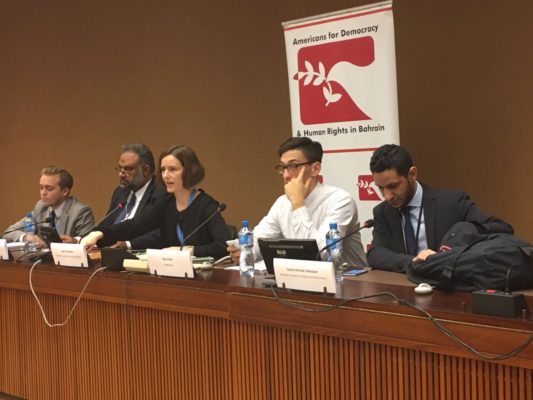
Julie Gromellon of the Bahrain Center for Human Rights (BCHR) started off the panel mentioning this is one more Council session where the HRC has not taken action despite deteriorating human rights abuses in Bahrain, including reprisals against human rights defenders, executions, and the continuing deterioration of the broader human rights environment in the country.

Sam Jones, Researcher at Americans for Democracy & Human Rights in Bahrain (ADHRB) followed Julie and framed the debate. He remarked about Bahrain’s engagement with the Universal Periodic Review (UPR) process during its second cycle review in 2012, noting that Bahrain engaged with the UPR mechanism one year after the government suppressed the popular pro-democracy movement. During that cycle, the international community made 176 recommendations, of which the government accepted 158. In the aftermath of the government’s violent response to the peaceful protests, the government also accepted the 26 recommendations made by an international panel of human rights experts, the Bahrain Independent Commission of Inquiry. As Sam noted, despite this ostensible engagement with the international community, “ADHRB is forced to conclude that the government has is either unable or unwilling to engage in reform.” The Bahraini government has failed to fully implement any of its 176 recommendations and has only made progress on two of the recommendations. It has technically implemented 23, but demonstrated its unwillingness to reform by actively contravening recommendations to curb torture and arbitrary detention or to protect free expression, free assembly, and detention.
Some issue areas that had seen limited success have since been downgraded by ADHRB, including women’s rights. Since 2012, the government has expanded its legal framework to restrict civil society and taken steps to harass and dissolve civil society organizations. Recently, it has dissolved the al-Wefaq Islamic Society and now it targeting Waad, a secular, leftist organization. These actions have heralded a “disturbing backward trend in its overall human rights environment” as the government “harasses scores of activists and journalists.” According to Sam, “In just two months since we sent this report for printing: not only have the authorities targeted Waad but they have executed of 3 victims of torture after unfair trials based on coerced confessions,” and empowered the NSA to prosecute activists. Sam finished his remarks by re-emphasizing past recommendations that should be implemented, noting that recommendations should be specific and time bound and should including reporting procedures. “Bahrain is at a crucial juncture” and the UPR is one of the few mechanisms for serious human rights reform.

Ebrahim Demestani, the Vice-President of the Bahrain Nursing Association followed Sam’s remarks and spoke about medical impartiality, access to medicine, and the recent militarization of hospitals and medical services. He spoke about his experience in 2011 as one of the medics targeted by the government for treating injured protesters and noted how the government arrested the medics and subjected them to different types of torture. Recently, the situation has become worse as the government has militarized the medical services, beginning with taking over the only civilian hospital in the country. “The government replaced civilian management with military management and targeted the nurses and paramedics.” Ebrahim also stated that he was one of several doctors, including Dr. Ali al-Ekri to be tried and sentenced in a military court. Furthermore, after a government edict, hospitals cannot treat protesters immediately, but must first wait for the approval of the Ministry of Interior. The government also transferred the oversight of ambulances from the Ministry of Health to the Ministry of Interior. “This led to the case of a protester who was hit in the head with a bullet, but who was scared to receive medical attention because of the fear of torture that he became effectively braindead while waiting for attention.”
Ebrahim also talked about the dismissal of medics from their jobs who participated in 2011 protests. “Thanks to Canada who recommended reinstating dismissed employees, some were reinstated. But we are hoping in the coming UPR to receive more and more specific recommendations regarding dismissed employees.” While the ILO and Ministry of Labor have an agreement to reinstate dismissed employees, many have not been given back their jobs. He closed his remarks by speaking about the human rights environment in Bahrain, saying, “Things have gotten worse and we heard two days ago that government is trying to dissolve Waad society. We want the international community to support us so we can continue to advocate for human rights and freedom and to do this, we need the help of the human rights community.”

Ben Pitler from Reprieve followed Ebrahim and spoke about executions and the death penalty and about the United Kingdom’s role in whitewashing the human rights abuses perpetrated by the Bahraini government. Over the past five years, the UK Foreign and Commonwealth Office (FCO) has spent millions of pounds to improve Bahrain’s human rights standards, particularly the Ombudsman, National Institute for Human Rights, and the Special Investigation Unit. The UK argues that these bodies are progressing and getting better and working to improve the situation of human rights in Bahrain, but this is untrue. “I want to push back against the myth that there is legitimate human rights reform in Bahrain.” This reform program serves the “Bahraini government to white wash” human rights abuses. Since the UK’s involvement, Bahrain’s human rights situation has not gotten better. Rather, its record remains extremely poor.
Despite their mandate and the outcry over Ali al-Singace, Ali Mushaima, Abbas al-Samea, Mohammed Ramadan, and Husain Ali Moosa over their torture and coerced confessions, “These reform bodies have flatly refused to investigate allegations of torture.” According to Ben, “This is not an issue of these bodies needing more time to develop. Rather, these institutions are responsible for illegal conduct that has made them complicit in the abuses.” Continued UK endorsement of these institutions thus serves to deflect international scrutiny of Bahrain’s human rights record at a time when this scrutiny is needed, as country’s see the UK is working with them and thing to hold off their criticism.
International mechanisms operate as a means to challenge Bahrain and the UK over these institutions and consistent allegations of torture. If Bahrain wants to prove these are legitimate reform efforts and not an elaborate white washing exercise, it needs to ratify the Optional Protocol to the Convention Against Torture and allow the Special Rapporteur on torture to visit the country. These are basic anti-torture steps. If there is political will to end torture these are easy steps.
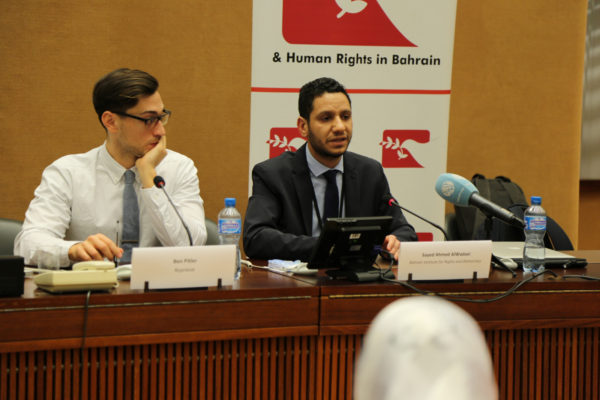
Sayed Ahmed from the Bahrain Institute for Rights and Democracy closed the panel and discussed his experience as a protester and victim of reprisals for his engagement at the United Nations Human Rights Council. In many ways, the pro-democracy uprising in Bahrain was the most inconvenient protest in the Arab world as so many countries have interests in the country. In suppressing the protests, the government used military courts whose staff members enjoy humiliating defendants. After being detained for his engagement with the protests, security forces detained Sayed and assaulted him, sentencing him to one year in prison. After he was released, he fled to the UK for asylum. In 2015, Sayed took advocacy trip in Europe with Nabeel Rajab. They told the world what it means to be a human rights defender in prison and Sayed highlighted Nabeel’s case, “There is no clearer case for human rights defenders being imprisoned as a voice for the voiceless than Nabeel Rajab” and he is no in prison for interviews and tweets.
On 31 January 2015, Sayed found out that the Bahrain News Agency had listed him along with 72 other individuals as denaturalized persons. He thought there must be an international outcry over this, but there was no serious consequence. In to the mass denaturalizations, Bahrain has committed a number of acts that some would consider red lines, such as empowering military courts to convict terrorists and putting Bahrain is now a defacto state of martial law. “No one from the state has taken responsibility for the death of Mohammed Hamdan and the same state bodies are responsible for murdering Kareem Fakhrawi.” The only difference between now and 2011 is that in 2011 governments condemned the issues in 2011. Now, the UK supports Bahrain, “putting its faith in the abusers.”
Recently, Sayed took part in a protest against King Hamad when he visited Theresa May during which he was detained for a few minutes. On that same day, his wife and infant son were about to leave Bahrain to go reside in the UK, security forces beat, mistreated, and detained his wife for 7 hours, telling her they would take reprisals against Sayed for his activism. Last week, his mother-in-law and brother-in-law were detained and his brother-in-law was tortured and forced to confess against Sayed. Security forces told his brother-in-law they would take revenge against him for coming to the Human Rights Council. Sayed said, “Before it was me paying the price, but now it is my family that is paying the price.” But the international community has “failed to at least put Bahrain under scrutiny. To do a joint statement that would at least put something on the record. If this is the case, then why are we even here, that is the question I have for all states here.”
]]>

7 October 2016 – ARTICLE 19 and the Bahrain Institute for Rights and Democracy (BIRD) welcome the opportunity to contribute to the third cycle of the Universal Periodic Review (UPR) of Bahrain. This submission focuses on compliance with international human rights obligations with respect to freedom of expression, freedom of assembly and freedom of association.
The submission addresses:
- Legal framework for freedom of expression;
- Restrictions on media;
- Restrictions on freedom of assembly;
- Restrictions on freedom of association and the right to participate in public and political life;
- Harassment of Human Rights Defenders (HRDs), journalists, and political opposition.
During the second UPR cycle, Bahrain supported over 30 recommendations relating to the protection of the rights to freedom of expression, association and assembly.
Little progress has been made in the implementation of these recommendations, and the situation has further deteriorated. A ban on protest has been in place in the capital Manama since 2013 and there has been a renewed campaign of repression and harassment against critical voices since June 2016 which significantly undermines the enjoyment of civil and political rights in the country.
Despite stating in its midterm report that Bahrain is “keen on cooperating with Special Procedures mandate holders”, none have been allowed to enter the country since 2006. Seven procedures, on torture, expression, assembly and association, human rights defenders, extreme poverty, migrants, and arbitrary detention, have outstanding visit requests since 2011.
The right to freedom of expression is guaranteed under Article 23 of Bahrain’s Constitution (2002). However, it contains overly broad restrictions that do not correspond with the exhaustive list of legitimate aims outlined in Article 19(3) of the ICCPR, stating that “everyone has the right to express his opinion… provided that the fundamental beliefs of Islamic doctrine are not infringed, the unity of the people is not prejudiced, and discord or sectarianism is not aroused.” The constitutional framework therefore illegitimately permits laws that grant excessive discretion to the authorities to suppress expression.
In its 2014 mid-term report, Bahrain stated that it had introduced a number of legislative reforms in order to ensure “that any restrictions on civil and political rights are necessary, minimal and comply with ICCPR standards.” However, rather than undertaking comprehensive reforms to ensure the compliance with the ICCPR, only minor amendments were made to Articles in the Penal Code related to broadcasting false news and publishing false documents (Articles 168-9). Despite commitments during the last UPR to reform, problematic laws remain in force and have been amended since to increase restrictions.
ARTICLE 19 and BIRD recommend:
- Comprehensive, transparent and time bound review to reform all legislation affecting the right to freedom of expression, with the full and effective participation of all stakeholders including civil society, in order to bring laws into compliance with the ICCPR.
- Accept all outstanding visit requests of special procedures, and to cooperate fully with special procedures to ensure the visits take place.
During the debate, speakers raised their concerns about violations of human rights around the world and encouraged the council to address all these situations.
In his opening statement of the 33rd Human Rights Council, UN High Commissioner Prince Zeid Ra’ad Al Hussein, expressed his concerns on the “arrests of human rights defenders and political activists”. He referenced Bahrain directly as he identified the use of legislation that enables revocation of citizenship. He recommended the authorities of Bahrain to engage “more productively” with his Office.
The High Commissioner’s statement set the tone for the rest of the days oral statements, with numerous Ambassadors and NGOs giving reference to the tense political situation in Bahrain. Furthermore, many nations which did not mention Bahrain directly went on to express their concerns about issues prevalent in Bahrain, such as arbitrary detention, torture and treatment of human rights defenders.
Denmark:
Denmark reiterates our call for the release of all arbitrarily detained persons in Bahrain, including the Danish-Bahraini citizen Mr. Abdulhadi Al-Khawaja; a victim of torture who needs treatment and rehabilitation.
France:
In Russia, we are concerned about growing restrictions on the exercise of freedoms of expression, assembly and association. Human rights defenders, journalists and other independent voices are facing repression and continuous harassment. France is particularly concerned about the implementation of the law on “foreign agents”. France is also concerned about the deteriorating situation in Azerbaijan and Bahrain.
Switzerland:
Switzerland is equally concerned by the repression against opposition movements and civil society in Bahrain. The dissolution of Al-Wefaq, the revocation of citizenship of many opposition leaders, the travel bans ordered against human rights defenders by judicial courts and the lengthening of the prison sentence against Secretary General of Al-Wefaq add to the already tense situation in Bahrain. Switzerland calls on this government to respect its international obligations, notably the right to freedom of expression, association and assembly. Thank you.
Czech Republic:
We regret that the Bahraini authorities deprive individuals of their nationality and continue the systematic harassment of the prominent human rights defenders such as Sheikh Maytham Al-Salman or religious leader and politician Ayatollah Sheikh Isa Qassim.
Ireland:
Last June this Council sent a strong message of support to civil society. Our continued action in support of the role of civil society organisations is essential given the increased efforts to undermine and intimidate them and to exclude them from UN discussions. Ireland is particularly concerned about restrictions on freedom of expression, assembly and association, aimed at silencing the voice of civil society and human rights defenders in countries including Sudan, China and Bahrain
Norway:
Norway remains concerned by the shrinking space for Human Rights Defenders, civil society and freedom of expression more broadly in several countries in all regions of the world.
Finally, we also remain concerned about the pressure on human rights defenders and the lack of freedom of expression in countries around the Gulf. (No explicit mention of Bahrain)
Amnesty International:
Amnesty International is deeply concerned by Bahrain’s ongoing and intensified crackdown on the enjoyment of the rights to freedom of expression, peaceful assembly, association and movement. We urge Bahrain to take concrete and practical steps to address these human rights concerns, including by releasing all prisoners of conscience, lifting the ban on peaceful protests in Manama, ensuring accountability for past human rights violations, putting an end to the practice of arbitrarily revoking citizenships and forced expulsion, lifting travel bans on human rights defenders, and guaranteeing the right to a fair trial.
Several UN Special Procedures have requested to visit Bahrain and we urge the authorities to facilitate these visits without delay, including those requested by the Special Rapporteur on torture in 2011, the Special Rapporteur on freedom of expression in 2014, and the Special Rapporteur on freedom of peaceful assembly and of association in 2011.
We call on Bahrain and other Member States to use the occasion of Bahrain’s third UPR in May 2017 to address key human rights concerns in the country and to ensure effective implementation of the UPR recommendations to strengthen the protection of human rights domestically.
BIRD, BCHR, ADHRB, Al-Salam (1):,
Joint statement issued at HRC33 by four NGOs. Called to attention the repression of Civil Society, political opposition and Shia community. Particular reference given to Nabeel Rajab, Sheikh Isa Qassim and Al-Wefaq. Calls on HRC to elevate concerns in order to prompt establishment of Special Rapporteur on Bahrain.
Link to full statement: http://www.adhrb.org/2016/09/hrc33-adhrb-calls-council-establish-special-rapporteur-bahrain/
BIRD, ADHRB, BCHR, GCHR(2):
Joint statement issued at HRC33 by four NGOs. Calls attention to continued systemic abuse of human rights, particularly concerning prisoners of conscience and human rights defenders. Identifies institutionalisation of abuse since 2011 through arbitrary detention and torture as seen by almost 4000 political prisoners and maintained detention of majority of Bahrain 13, including Abdulhadi Al-Khawaja. Asks council to pass resolution in order to release all arbitrary prisoners of conscience:
Full statement available here: https://twitter.com/ADHRB/status/777859375570493440
]]>
Michael Payne, Americans for Democracy & Human Rights in Bahrain’s International Advocacy Officer introduced the panel and observed that many familiar faces from Bahraini civil society were missing due to blanket travel bans that had been imposed by the government since last session of the HRC, preventing Bahrain’s grassroots civil society from engaging with the United Nations and its Member States. Welcoming the UN High Commissioner’s comments on the concerning situation in Bahrain yesterday, he presented ADHRB, BIRD and BCHR’s new report “Collective Efforts”, which assesses international statements made by several actors over past years to raise attention to the concerning human rights situation in Bahrain. He summarized the findings of the report. He concluded that while statements by the international community had helped to constrain the Government of Bahrain, there was a clear lack of progress and political will to protect human rights and fundamental freedoms, which demands a much stronger international response towards Bahrain.
Sayed Yousif al-Muhafdha, Vice-President of the Bahrain Center for Human Rights (BCHR) spoke of the past few months and the steep intensification of human rights violations in Bahrain, particularly, the re-arrest of BCHR President Nabeel Rajab. He also highlighted that none of his staff from the ground had been able to travel to Geneva. Sayed Yousif, who has been in exile in Germany since 2012, also explained that sectarian discrimination against Bahrain’s majority Shia community continues to represent a key dimension of the situation in Bahrain. He recalled how in just the past months, Bahrain revoked the citizenship of the leading Shia religious cleric Sheikh Isa Qassim, whose trial had since begun in July 2016. He also pointed to the dissolution of Bahrain’s largest political society Al-Wefaq. In light of recent events, al-Muhafdha concluded with determination: “We are at the human rights council to assure a resolution that establishes an independent monitoring mission in Bahrain.”

Ariel Plotkin, Campaigner on Bahrain at Amnesty International stated, that Amnesty was also deeply alarmed by the situation in Bahrain. Similarly, she recognized the escalation in past months of violations to freedom of expression, association and assembly. She highlighted that this recent repression in Bahrain had also been unprecedented. Elaborating on the recent highlights such as the extension of Al-Wefaq’s General Secretary Sheikh Ali Salman’s sentence from 4 to 9 years, the revocation of Sheikh Isa Qassim’s citizenship, and the subsequent arrest of peaceful protesters who staged a sit-in outside Sheikh Qassim’s home in the village of Duraz to protest his denaturalization; Ariel expressed her serious concern over what future measures could be taken by the Kingdom of Bahrain. “The once thriving and courageous civil society in Bahrain is at risk of disappearing,” said Ariel. She concluded by calling on Bahrain to annul the dissolution of Al-Wefaq, to re-instate the citizenship of those whose nationality was arbitrarily revoked, to release all prisoners of conscience, to end all forms of repression and finally, to comply with all of its human rights obligations.

Dr. Dwight Bashir, Co-Director of the US Commission on International and Religious Freedom introduced himself as a regular visitor to Bahrain. He said he had been travelling to the country every year since 2009. Having recently returned from Bahrain, he provided a fresh assessment of the situation, citing in particular, the “systematic discrimination” faced by the majority Shia religious group in the country. He recalled that in some of his meetings with the Bahraini government, a common explanation for many of the extreme measures taken was the role of Iran and the concern over foreign agents. He stressed that “nothing had been produced” to justify these claims by the Government. He also highlighted that laws were being applied on this basis, but that these allegations were “not only inaccurate, but outright false.” He further expressed concern that the shutdown of opposition group Al-Wefaq, left nothing open for discussion. Citing his experience, he said what he observed in Bahrain was a polarization of extremes, both on the side of the majority Shia population and the minority Sunni population. This left people only to align with the government, or against the government. He emphasized the importance of religious freedom as a public and private human right that when violated, could have devastating consequences, consequences with which the international community is all too familiar. “When you go to the heart of someone’s faith and their personal belief – this becomes a huge concern,” he said. He also marked that while the Government of Bahrain had rebuilt 27 of the 30 Shia religious sites it had demolished in 2011, their position on some key sites was that they would facilitate the legal paperwork and that this was enough. In addition to their other attacks on the Shia, however, they showed little will to diffuse sectarian tensions. Ending on the point of Sheikh Isa Qassim’s potential upcoming conviction, he stressed that if convicted, Sheikh Isa Qassim’s conviction would be seen as a direct attack on the Shia population, leaving open all possibility for extremism to grow in appeal.
Laila Matar, Human Rights Watch UN advocate, thanked her fellow panellists for painting an “accurately grim” picture of the situation in Bahrain. She recalled that a big group of states had come together in Geneva one year ago (in September 2015) to express concern over the situation, but that the lack of collective action since, from a body that was mandated to address such issues, was unacceptable. She highlighted the extreme level of reprisals that had occurred since the last session of the Human Rights Council and expressed that these actions seemed to suggest that Bahrain felt emboldened by the silence of the international community. She also highlighted that while the international community seemed silenced, the deterioration in Bahrain had not been ignored by the experts of the Human Rights Council, as seen by the many communications of the Special Procedures, the report of the Secretary General and the concern expressed by the High Commissioner. She spoke clearly to Bahrain and the international community, pronouncing that “repression and support for repression is not a long-term strategy for stability.” This became a serious concern once Bahrain closed any political outlet for the frustration of people on the ground.
Upon conclusion of the panellist’s comments, moderator Michael Payne asked Ariel Plotkin whether Bahrain, once recognized as an example of civil society activism in the region, was still representative of this. Plotkin replied that while the restrictions on civil society were challenging and had resulted in a closing of civil society space inside Bahrain, she still felt that Bahrain was a good example because she had seen how voices that had been smashed and particularly, voices of Human Rights Defenders who had been exiled, have only become louder outside of Bahrain. She described that it was fascinating how they have adapted to the circumstances and thus could still be looked to as an example of activism for the region.
Michael also asked Bashir about how the polarization of extremes in the country could be reversed. Bashir responded that the international community had to encourage greater efforts by Bahrain to draw back its repression. He said that there needed to be a genuine will from Member States to look at the early warnings and react. Laila also added that a political impasse had been reached in Bahrain, thus the opposition did not have any more confidence in any government-led political processes. She commented that there was, now, more than ever, a need to provide incentives and costs for Bahrain to take clear and strong measures to rebuild this confidence, and that this push in the right direction could only be directed by the international community.
Ahmed Ali, Legal Officer, BIRD raised a question to Ariel Plotkin about UK assistance in Bahrain and Amnesty International’s assessment of this program and its effectiveness. Ariel elaborated on some of the UK assistance programs and added that given the recent turn of events, these programs did not really seem to be having their desired effect.
Husain Abdulla, Executive Director, ADHRB, mentioned reports that torture in Bahrain was no longer an issue in the country’s prisons, he asked Sayed Yousif al-Muhafdha whether these reports were accurate. Sayed Yousif disagreed and cited a number of examples. He noted in particular that the Special Investigations Unit (SIU) mandated to hold the perpetrators of torture accountable, had been totally ineffective and were not transferring any of the complaints they had received to the courts. Thus, he concluded that there was still a strong “culture of impunity” in Bahrain.
An audience member from a youth organization also posed a question to the panel, citing a case that he had read about and asking the panel how many children and youth were being held in Bahrain’s prisons. Sayed Yousif opened that over 120 children and youth had been subjected to imprisonment since January 2016.
Finally, Erin Sigmon, from Americans for Democracy & Human Rights in Bahrain asked what more could be done by civil society to pressure greater action by Member states. Laila Matar frustratedly concluded that unfortunately it came down to political will of Member States. However, she encouraged civil society to call into question the silence on Bahrain and continue to demand the Council to be non-selective and address country situations based on solid criteria.
This event was organized by Americans for Democracy & Human Rights in Bahrain (ADHRB), the Bahrain Center for Human Rights, and the Bahrain Institute for Rights and Democracy (BIRD).
This event was also sponsored by Amnesty International, FIDH’s Observatory for the Protection of Human Rights Defenders, Human Rights Watch, and Reporters Without Borders.
]]>Please continue reading for full remarks below.

Mr. Chair-Rapporteur,
Alsalam Foundation, together with Americans for Democracy & Human Rights in Bahrain, the Bahrain Center for Human Rights and the Bahrain Institute for Rights and Democracy would like to raise our concern over the remarkably high number of arbitrarily detained prisoners in Bahrain. The Working Group on Arbitrary Detention’s has regularly raised its concern regarding the systematic use of arbitrary detention in Bahrain, in particular noting cases of prominent political and civil society figures.
For example, Hassan Mushaima, Secretary General of the Haq Movement for Democracy has been the subject of multiple urgent communications by the Working Group since his arbitrary detention began in March 2011, yet the Bahraini government continues his arbitrary life sentence to this day.
Likewise, Bahraini authorities also continue to arbitrarily detain Dr. Abduljalil al-Singace, one of Bahrain’s leading human rights and democracy leaders, and a colleague of Mushaima. Five years into his detention Dr. al-Singace’s health is in poor condition.
Finally, on 13 June 2016, Nabeel Rajab, was again arrested for his work as a human rights defender. Nabeel has been the subject of a number of Working Group decisions, including a similar instance in 2013, in which the Working Group concluded his detention to be arbitrary and in violation of articles 19, 20 and 21 of the Universal Declaration on Human Rights.
These cases are but some of the nearly 4,000 cases of the widespread and systematic arbitrary detention ongoing in Bahrain. Mr. Chair-Rapporteur, in instances such as this in Bahrain, what recommendations does your mandate have toward dismantling and reversing such an institutionalized system of abuse?
Thank you.
]]>High Commissioner Prince Zeid bin Ra’ad Al-Hussain stated: At least 250 people in Bahrain have reportedly been stripped of their citizenship by the Government because of their alleged disloyalty to the interests of the Kingdom. In addition to these severe restrictions on freedom of expression, which contravene Bahrain’s international human rights obligations, an indefinite ban on gatherings in the capital has been in place since 2013. Dozens of people – including minors – have been prosecuted for participating in protests. Repression will not eliminate people’s grievances; it will increase them.
We welcome the High Commissioner’s strong words, which come on the same day that Nabeel Rajab, President of the Bahrain Center for Human Rights, is unfairly arrested. Last week, human rights defender Zainab Al-Khawaja went into exile, leaving Bahrain for Denmark, after she received threats of rearrest and indefinite detention, following her release from prison at the end of May.
Human rights activists have also been blocked from travelling to Geneva. Five activists who tried to board a flight to Geneva this week were denied entry, and told that they had travel bans, placed into effect from 10 June. They are the largest group of people Bahrain has placed under travel ban at a single time. This is a clear restriction of civil society’s free movement, to prevent them from speaking at the UN Human Rights Council.
Reflecting the absence of political will for effective human rights reform, Bahrain Foreign Minister Khalid Al Khalifa responded to the High Commissioner’s statements with complete disregard: “We will not delay our journey and the policy of our reformist King. We will not allow the undermining of our security and stability and will not waste our time listening to the words of the High Commissioner who is powerless.”
The High Commissioner’s strong criticism follows up on his statement in March 2016’s 31st Session of the UN Human Rights Council, when he called for “profound reform” in the country. We, the undersigned, welcome the UN High Commissioner’s public criticism of Bahrain’s worsening human rights record.
Signed,
Bahrain Institute for Rights and Democracy (BIRD)
Americans for Democracy & Human Rights in Bahrain (ADHRB)
Bahrain Center for Human Rights (BCHR)
Justice Human Rights Organization (JHRO)
European Centre for Democracy and Human Rights (ECDHR)
]]>
13 June 2016 – Bahrain security forces arrested leading human rights defender Nabeel Rajab, President of the Bahrain Center for Human Rights (BCHR), Founding Director of the Gulf Centre for Human Rights (GCHR) and Deputy Secretary General of FIDH, early this morning. The arrest comes on the first day of the United Nations Human Rights Council (UNHRC)’s 32nd Session. We, the undersigned NGOs, condemn the arrest of Nabeel Rajab and stress that all human rights defenders must have the freedom to operate in their country.
At approximately 5:00 AM (GMT+3) in Bahrain, police, led by the Cybercrime Unit, surrounded Rajab’s home in Bani Jamra, in the north west of Bahrain. At 6:12 AM, Rajab’s son Adam tweeted: “Police entered the house and arrested my father Nabeel Rajab.” The authorities’ reason of arrest is not yet known, and it is unknown if new charges have been brought against him. In 2015, police brought two charges against Rajab, together carrying up to thirteen years prison term, both in relation to statements he made on twitter. Rajab was not prosecuted on these charges, nor were they dropped. It is possible that he has been arrested on these old charges.
The arrest comes on the first day of the UNHRC’s 32nd Session. In his opening comments, the UN High Commissioner on Human Rights criticised recent rights violations in Bahrain and warned: “Repression will not eliminate people’s grievances; it will increase them.“
Last week, under extensive pressure from the government, human rights defender Zainab Al-Khawaja, left Bahrain to begin her effective exile in Denmark. She left Bahrain after the Danish consulate in Bahrain communicated to her threats from a government official that she would be re-arrested and detained indefinitely if she remained. Zainab Al-Khawaja is the daughter of Abdulhadi Al-Khawaja, co-founder of BCHR and the Gulf Centre for Human Rights (GCHR) and a torture survivor who has been serving a life sentence since 2011, when he was tried by a military court on alleged “attempted overthrow of the regime.” Zainab Al-Khawaja, who began serving a 37-month prison term in March 2016, was released from prison on “humanitarian grounds” on 31 May, a day after political opposition leader Ali Salman had his sentence increased to 9 years in prison.
The arrest of Nabeel Rajab and exiling of Zainab Al-Khawaja marks an effective silencing of Bahrain’s human rights defenders. Yesterday, in a clear act of reprisal, Bahrain prevented six human rights activists, from boarding their flights to Geneva to participate in the 32nd session of the UNHRC. These activists were informed at the airport that a travel ban was now imposed on them. We condemn in the strongest terms the government of Bahrain’s silencing of civil society and restrictions on their freedom of expression, association, assembly and movement, which sends signals that human rights violations will continue systematically.
Rajab has been prosecuted multiple times since the 2011 Arab Spring. Rajab was arrested repeatedly in 2012, and served two years in prison between 2012 and 2014 on charges of organising unauthorised protests. Following his release in 2014, Rajab conducted an advocacy tour of Europe. In September of that year he visited the UNHRC in Geneva, the European Parliament in Brussels, and European capitals. On his return to Bahrain in October 2014 following his participation in the 27th Session of the UNHRC, police arrested Rajab and charged him with insulting the army in a tweet. He received a six-month sentence and a travel ban. He was released on bail during the appeal of the sentence.
In April 2015, police detained Rajab and charged him with insulting the Central Jau Prison administration and undermining the war in Yemen, after he spoke out against widespread torture occurring in prison and criticised the humanitarian costs of the war. Rajab was held in police custody until June 2015, when he received a royal pardon during Ramadan for his six-month sentence. However, his travel ban remained in place, and his charges were not dropped. The threat of prosecution on these charges has significantly hampered Rajab’s ability to work.
The first charge of allegedly “insulting a statutory body” comes under article 216 of Bahrain’s Penal Code, based on his social media comments about allegations of severe and systematic ill-treatment and torture of detainees in Jau Prison in March 2015. The second charge accuses him of “disseminating false rumours in times of war,” under article 133 of the Penal Code, based on social media posts criticising Saudi-led coalition air strikes in Yemen. Violations of articles 133 and 216 carry maximum sentences of 10 and three years in prison, respectively. Neither of the alleged acts upon which these charges are based were in any way recognisable criminal offences under international human rights law, and both involved the peaceful exercise of internationally protected rights to freedom of expression and to promote and protect human rights.
Rajab’s repeated arrests contravene his rights to freedom of expression and association, as protected by articles 19 and 22 of the International Protocol on Civil and Political Rights, which Bahrain acceded to in 2006.
We, the undersigned, call on the government of Bahrain to:
- Immediately release Nabeel Rajab from police custody, drop all outstanding charges and lift his travel ban.
- Allow all human rights defenders, including Zainab Al-Khawaja, Nabeel Rajab and Abdulhadi Al-Khawaja, to live and work in their country without unjust restrictions on their rights to free assembly, association, expression and movement.
- Release all prisoners of conscience and political prisoners.
- Invite, and allow entrance to Bahrain, the UN Special Rapporteur on freedom of opinion and expression.
- Repeal all legal restrictions on civil society.
We call on the UN Office of the High Commissioner for Human Rights to:
- Condemn Bahrain’s violation of the freedom of movement of its civil society, who were prevented from travelling to the UN Human Rights Council Session in Geneva this week.
- Cease all ongoing technical cooperation programs with Bahrain until such time as proper protection for civil society participants can be effectively guaranteed.
We call on members states of the UN Human Rights Council to:
- Raise concerns of Bahrain’s violations of the rights of civil society in your individual Item 4 statements.
- Continue technical cooperation with the government of Bahrain only when substantive conditions are met.
We call on the United Kingdom and United States to:
- Immediately call for the unconditional release of Nabeel Rajab and an end to restrictions on civil society.
- Suspend technical assistance programs until legal restrictions on civil society are repealed.
- Suspend all arms sales to Bahrain.
Signed,
Bahrain Institute for Rights and Democracy (BIRD)
Bahrain Center for Human Rights (BCHR)
Americans for Democracy & Human Rights in Bahrain (ADHRB)
European Centre for Democracy and Human Rights (ECDHR)
Gulf Centre for Human Rights (GCHR)
Justice Human Rights Organisation (JHRO)
]]>