By the numbers (as provided by the organizers) —
— 2,000+ Delegates
— 1,000+ International Delegates
— 400+ Students and and Young Innovators
— 97 Nationalities represented
— Transformative announcements, engaging conversations, inspiring startup pitches
The delegates included several heads of state and a significant presence at the Ministerial level.
Declaration.
The Africa Delegation on Artificial Intelligence is the key official, government level outcome of the Summit.
Many have commented on the Summit, some wildly enthusiastic and others more critical. On the enthusiastic side, I heard excitement about the scope of local entrepreneurs and practitioners, the explicit calls for the Africa region to take care of itself and not wait for others to “assist” to a sense of the Summit as a foundation for important future action. On the critical side I heard concerns that the amount of Western funding influencing direction, and concerns that building infrastructure like data centers gets attention relative to building other parts of the AI “stack.” I’m going to leave a evaluation of the full Summit to those with far better context and understanding of the region. For my part, I’ll focus on on the side events.
I was very heartened to see the diversity of side events that occurred during and around the Summit. I’ve found these side events can make or break an event, quite separate from the official content. The scope and diversity of side events gives a picture of how many groups feel the event touches on important topics and brings together interesting people. I attended a couple of side events myself, and learned of multiple other side events as I talked to people during the Summit. One such event was all day, bringing together policy professionals and ministerial staff. Another brought together AI practitioners from around the Continent who rarely if ever get together for in person community building. This struck me as very powerful, perhaps because I have such vivid memories of the first time the Firefox community got together. This was after we shipped Firefox 1.0, so after we had worked remotely for years to build a browser. That era was before video calls, and so we often knew each other through written materials only. Getting together physically made a dramatic mental difference and made us much more productive for a good long while. The organizer of this gathering at the Summit was practically buzzing with excitement at the chance to finally bring this community together.
I did participate in an evening panel for a research colloquium where the working energy was so loud it almost overpowered the microphones of the panelists. I also participated in a quiet breakfast side event that brought together practitioners and policy wonks for a reasonably frank discussion on what’s working and what challenges need attention. On the official side, I was part of a panel on Innovating for a Healthier Future. My main comments were focused on the themes of “open must win” and the “ethos of open.” (These are in minutes 33 to 38.)
I see the inclusion of side events as a big success. In particular, having AI practitioners, entrepreneurs, professors mixing with each other as well as policy makers and government officials. Building new things is what drives change. Policy can help or harm this effort dramatically.
I’m very eager to see the results over time.
Open source has become mainstream as a part of the software development process. We can rightly say that the open source movement “won.” However, this isn’t enough for the future.
The open source movement was about more than convenience and avoiding payment. For many of us, open source was both a tool and an end in itself. Open source software allows people to participate in creating the software that has such great impact on our lives. The “right to fork” allows participants to try to correct wrongs in the system; it provides a mechanism for alternatives to emerge. This isn’t a perfect system of course, and we’ve seen how businesses can wrap open source and the right to fork with other systems that diminish the impact of this right. So the past is not “The Perfect Era” that we should aim to replicate. The history of open source gives us valuable learning into what works and what doesn’t so we can iterate towards what we need in this era.
The practical utility of open source software has become mainstream. The time is ripe to reinforce the deeper ethos of participation, opportunity, security and choice that drove the open source movement.
I’m looking for a good conversation about these topics. If you know of a venue where such conversations are happening in a thoughtful, respectful way please do let me know.
]]>I’m scheduled to be the main guest at the Fireside Chat on April 1. I’ll also be participating in the panel “Innovating for a Healthier Future.” This panel topic combines open source and health with new AI developments. I’ve been working with OpenMRS (as a board member) on open source electronic medical records for better outcomes for some years. I’m eager to dive into the impacts of AI on this work with the broad set of experts at the Summit.
After the Summit, I’ll spend a few days in Nairobi. I’ll say more about the Summit shortly.
]]>I’ve been thinking a lot about how we need to shape our collective understanding of the ethos of open source, and how to use business as a tool to promote mission-based work.
Here are a few areas where ideas are percolating and I expect to write more soon:
What does the evolution of open source from “radical” niche developers into the consumer mainstream teach us?
It’s clear that “open must win” in the AI realm so that public benefit is magnified. This is a huge topic, from definitions to community building to integrating open projects into robust products.
How does one use business as a tool to promote a mission, or to support a mission based organization?
This is a space I’ve been living in for 25 years and is more important than ever. I’ve lived through the changes different styles of leadership and different priorities can make. I’ve experienced how the logic of business is very strong, while unconventional thinking is — well — unconventional, and harder to institutionalize. I’ve experienced, and in some cases led, some big wins here and some big misses as well. I have a lot of ideas about how to do this in the current environment. I’m not alone in this, there’s a growing community of people thinking about these areas with whom I’m eager to connect.
Time of Disruption
So much is changing now. It’s a time of disruption at the individual, national and global levels. This means new ways of creating and organizing activities and developing new institutions is necessary. We need the positive forces of building and doing to be a part of the coming new order.
These topics are just a starting point. I want to get involved with people doing related activities, building, supporting, funding new technology and new systems. If you are deep in one of these areas, please do ping me.
]]>I’ll share more details on my next steps soon. Today I want to focus on how I’ll be approaching this mission outside of Mozilla.
Mozilla’s upcoming era will have a focus on managing its portfolio of organizations, and the work described in Mozilla’s recent blog post. My personal approach going forward will be quite different. I’m aiming for new incarnations of the heart and spirit that built the open source movement and created Mozilla.
As Mozilla has grown I’ve experienced the opportunities and challenges in operating a $1 billion+ organization that is also a global technology platform and the flag-bearer for so many aspirations for a better internet. It’s a wildly valuable experience, and quite rare in the “open must win” world. I increasingly feel the pull to connect these experiences to new grassroots entrepreneurs, builders and movements. If I had had access to this experience when we were starting Mozilla it would have been a huge asset.
I have another creative burst or two in me waiting for the right opportunity. I know that the ethos of “open” and the principles of the Mozilla Manifesto are each increasingly important in the world today. There are only a handful of people who have lived through the explosion of “open” into the mainstream, who have developed that into a successful consumer product based on values, and then led an organization and a community through global scale and impact. I am one of this very small group and I feel compelled to use this experience to support others working in related fields. I want to find other people who are building things because those things need to exist in the world first, and then figure out how to generate revenue and build sustainability. I’m looking to immerse myself in opportunities that generate true creativity and breathe life into something new.
I’m learning exciting things these days. It has become even clearer to me that both “open must win” and the passion that has driven my leadership of Mozilla remain a clarion call for me. I will continue to explore my contribution to these areas in the next phase of my work through a broad range of contexts. In addition, the ability to represent this perspective in the public discourse is an honor and a responsibility to which I remain committed.
By “building a better world through how we build technology” I mean:
Offering more opportunities to more people to participate in creating our world, independent of educational pedigree or job title.
Internalizing “open” and open source as both a means and an end in itself.
Using open source to offer a “trust but verify” approach to how our technology operates and how it impacts individual sovereignty and our society.
Using private initiative to build public good – building business as a tool for public benefit.
Deepening transparency and individual agency.
Creating technology through combined efforts and shared assets.
I think of this approach as advocacy through building technology, using an “architecture of participation.” Many of us think of it as the ethos of open source. The possibility of this approach is hard to internalize until one experiences this directly, and is wildly powerful once one has. It’s the power that made Mozilla successful. Personally, it’s the power that kept me going whenever the work was really hard. And it’s the power that drives me to want to continue building and working on the “open must win” ethos.
The inspiration and impact of Mozilla are beyond anything I could have imagined. Words cannot express my gratitude to every one of you who chooses Mozilla, supports Mozilla, volunteers, chooses open, works for the public benefit, and resonates to the ideals we captured in the Mozilla Manifesto. I’m humbled by each of you who has chosen me as your leader, allows me to represent you in the world, and gives me the support to bring the best of our shared work into the world. This is a level of trust and commitment that I am proud and honored to have earned. It’s my deep hope to build on that in ways that reflect the core principles that have brought us together.
You can reach me on Mastodon or BlueSky or Linkedin or here at hello@mitchellbaker.net where I’ll provide updates. Mozilla email should forward to me for the next few months. Those of you who know me well enough to have my personal contact info, or to know someone who does, please do feel free to contact me. I may be slow to respond, but I’m driven by community and inspired by Mozillians, so don’t be shy!
I’ll share more details on my next steps soon. Today I want to focus on how I’ll be approaching this mission outside of Mozilla.
Mozilla’s upcoming era will have a focus on managing its portfolio of organizations, and the work described in Mozilla’s recent blog post. My personal approach going forward will be quite different. I’m aiming for new incarnations of the heart and spirit that built the open source movement and created Mozilla.
As Mozilla has grown I’ve experienced the opportunities and challenges in operating a $1 billion+ organization that is also a global technology platform and the flag-bearer for so many aspirations for a better internet. It’s a wildly valuable experience, and quite rare in the “open must win” world. I increasingly feel the pull to connect these experiences to new grassroots entrepreneurs, builders and movements. If I had had access to this experience when we were starting Mozilla it would have been a huge asset.
I have another creative burst or two in me waiting for the right opportunity. I know that the ethos of “open” and the principles of the Mozilla Manifesto are each increasingly important in the world today. There are only a handful of people who have lived through the explosion of “open” into the mainstream, who have developed that into a successful consumer product based on values, and then led an organization and a community through global scale and impact. I am one of this very small group and I feel compelled to use this experience to support others working in related fields. I want to find other people who are building things because those things need to exist in the world first, and then figure out how to generate revenue and build sustainability. I’m looking to immerse myself in opportunities that generate true creativity and breathe life into something new.
I’m learning exciting things these days. It has become even clearer to me that both “open must win” and the passion that has driven my leadership of Mozilla remain a clarion call for me. I will continue to explore my contribution to these areas in the next phase of my work through a broad range of contexts. In addition, the ability to represent this perspective in the public discourse is an honor and a responsibility to which I remain committed.
By “building a better world through how we build technology” I mean:
Offering more opportunities to more people to participate in creating our world, independent of educational pedigree or job title.
Internalizing “open” and open source as both a means and an end in itself.
Using open source to offer a “trust but verify” approach to how our technology operates and how it impacts individual sovereignty and our society.
Using private initiative to build public good – building business as a tool for public benefit.
Deepening transparency and individual agency.
Creating technology through combined efforts and shared assets.
I think of this approach as advocacy through building technology, using an “architecture of participation.” Many of us think of it as the ethos of open source. The possibility of this approach is hard to internalize until one experiences this directly, and is wildly powerful once one has. It’s the power that made Mozilla successful. Personally, it’s the power that kept me going whenever the work was really hard. And it’s the power that drives me to want to continue building and working on the “open must win” ethos.
The inspiration and impact of Mozilla are beyond anything I could have imagined. Words cannot express my gratitude to every one of you who chooses Mozilla, supports Mozilla, volunteers, chooses open, works for the public benefit, and resonates to the ideals we captured in the Mozilla Manifesto. I’m humbled by each of you who has chosen me as your leader, allows me to represent you in the world, and gives me the support to bring the best of our shared work into the world. This is a level of trust and commitment that I am proud and honored to have earned. It’s my deep hope to build on that in ways that reflect the core principles that have brought us together.
You can reach me on Mastodon or BlueSky or Linkedin or here at hello@mitchellbaker.net where I’ll provide updates. Mozilla email should forward to me for the next few months. Those of you who know me well enough to have my personal contact info, or to know someone who does, please do feel free to contact me. I may be slow to respond, but I’m driven by community and inspired by Mozillians, so don’t be shy!
]]>This year, “three thirty-one” is especially meaningful: It’s Mozilla’s 25 year anniversary.
A lot has changed since 1998. Mozilla is no longer just a bold idea. We’re a family of organizations — a nonprofit, a public benefit-corporation, and others — that builds products, fuels movements, and invests in responsible tech.
And we’re no longer a small group of engineers in Netscape’s Mountain View office. We’re technologists, researchers, and activists located around the globe — not to mention tens of thousands of volunteers.
But if a Mozillian from 1998 stepped into a Mozilla office (or joined a Mozilla video call) in 2023, I think they’d quickly feel something recognizable. A familiar spirit, and a familiar set of values.
When Mozilla open-sourced our browser code 25 years ago, the reason was the public interest: We wanted to spark more innovation, more competition, and more choice online. Technology in the public interest has been our manifesto ever since — whether releasing Firefox 1.0 in 2004, or launching Mozilla.ai earlier this year.
Right now, technology in the public interest seems more important than ever before. The internet today is deeply entwined with our personal lives, our professional lives, and society at large. The internet today is also flawed. Centralized control reduces choice and competition. A focus on “engagement” magnifies outrage, and bad actors are thriving.
Right now — and over the next 25 years — Mozilla can do something about this.
Mozilla’s mission and principles are evergreen, and we will continue to evolve to meet the needs and challenges of the modern internet. How people use the internet will change over time, but the need for innovative products that give individuals agency and choice on the internet is a constant. Firefox has evolved from a faithful and efficient render of web pages on PCs to a cross-platform agent that acts on behalf of the individual, protecting them from bad actors and surveillance capitalists as they navigate the web. Mozilla has introduced new products, such as Firefox Relay and Mozilla VPN, to keep people’s identity protected and activity private as they use the internet. Mozilla is contributing to healthy public discourse, with Pocket enabling discovery of amazing content and the mozilla.social Mastodon instance supporting decentralized, community-driven social media.
We’re constantly exploring ways to apply new technologies so that people feel the benefits in their everyday lives, as well as inspire others to responsibly innovate on behalf of humanity. As AI emerges as a core building block for the future of computing, we’ll turn our attention in that direction and ask: How can we make products and technologies like machine learning work in the public interest? We’ve already started this work via Mozilla.ai, a new Mozilla organization focusing on a trustworthy, independent, and open-source AI ecosystem. And via the Responsible AI Challenge, where we’re convening (and funding) bright people and ambitious projects building trustworthy AI.
And we will continue to champion public policy that keeps the internet healthy. There is proposed legislation around the world that seeks to maintain the internet in the public interest: the Platform Accountability and Transparency Act (PATA) in the U.S., the Digital Services Act (DSA) in the EU. Mozilla has helped shape these laws, and we will continue to follow along closely with their implementation and enforcement.
On this “three thirty-one,” I’m realistic about the challenges facing the internet. But I’m also optimistic about Mozilla’s potential to address them. And I’m looking forward to another 25 years of not just product, but also advocacy, philanthropy, and policy in service of a better internet.
]]>With all of this in mind, we are seeking three new members for the Mozilla Foundation Board of Directors. These Board members will help grow the scope and impact of the Mozilla Project overall, working closely with the Boards of the Mozilla Corporation, Mozilla.ai and Mozilla Ventures. At least one of the new Board members will play a central role in guiding the work of the Foundation’s charitable programs, which focuses on movement building and trustworthy AI.
What is the role of a Mozilla board member?
I’ve written in the past about the role of the Board of Directors at Mozilla.
At Mozilla, our board members join more than just a board, they join the greater team and the whole movement for internet health. We invite our board members to build relationships with management, employees and volunteers. The conventional thinking is that these types of relationships make it hard for executives to do their jobs. We feel differently. We work openly and transparently, and want Board members to be part of the team and part of the community.
It’s worth noting that Mozilla is an unusual organization. As I wrote in our most recent annual report:
Mozilla is a rare organization. We’re activists for a better internet, one where individuals and societies benefit more from the effects of technology, and where competition brings consumers choices beyond a small handful of integrated technology giants.
We’re activists who champion change by building alternatives. We build products and compete in the consumer marketplace. We combine this with advocacy, policy, and philanthropic programs connecting to others to create change. This combination is rare.
It’s important that our Board members understand all this, including why we build consumer products and why we have a portfolio of organizations playing different roles. It is equally important that the Boards of our commercial subsidiaries understand why we run charitable programs within Mozilla Foundation that complement the work we do to develop products and invest in responsible tech companies.
What are we looking for?
At the highest level, we are seeking people who can help our global organization grow and succeed — and who ensure that we advance the work of the Mozilla Manifesto over the long run. Here is the full job description: https://mzl.la/MofoBoardJD2023
There are a variety of qualities that we seek in all Board members, including a cultural sense of Mozilla and a commitment to an open, transparent, community driven approach. We are also focused on ensuring the diversity of the Board, and fostering global perspectives.
As we recruit, we typically look to add specific skills or domain expertise to the Board. Current examples of areas where we’d like to add expertise include:
- Mission-based business — experience creating, running or overseeing organizations that combine public benefit and commercial activities towards a mission.
- Global, public interest advocacy – experience leading successful, large-scale public interest advocacy organizations with online mobilization and shaping public discourse on key issues at the core.
- Effective ‘portfolio’ organizations – experience running or overseeing organizations that include a number of divisions, companies or non-profits under one umbrella, with an eye to helping the portfolio add up to more than the sum of its parts.
Finding the right people who match these criteria and who have the skills we need takes time. Board candidates will meet the existing board members, members of the management team, individual contributors and volunteers. We see this as a good way to get to know how someone thinks and works within the framework of the Mozilla mission. It also helps us feel comfortable including someone at this senior level of stewardship.
We want your suggestions
We are hoping to add three new members to the Mozilla Foundation Board of Directors over the next 18 months. If you have candidates that you believe would be good board members, send them to msurman@mozillafoundation.org. We will use real discretion with the names you send us.
]]>As we grow our ambitions for this work, we are seeking new members for the Mozilla Foundation Board of Directors. The Foundation’s programs focus on the movement building side of our work and complement the products and technology developed by Mozilla Corporation.
What is the role of a Mozilla board member?
I’ve written in the past about the role of the Board of Directors at Mozilla.
At Mozilla, our board members join more than just a board, they join the greater team and the whole movement for internet health. We invite our board members to build relationships with management, employees and volunteers. The conventional thinking is that these types of relationships make it hard for the Executive Director to do his or her job. I wrote in my previous post that “We feel differently”. This is still true today. We have open flows of information in multiple channels. Part of building the world we want is to have built transparency and shared understandings.
It’s worth noting that Mozilla is an unusual organization. We’re a technology powerhouse with broad internet openness and empowerment at its core. We feel like a product organization to those from the nonprofit world; we feel like a non-profit organization to those from the technology industry.
It’s important that our board members understand the full breadth of Mozilla’s mission. It’s important that Mozilla Foundation Board members understand why we build consumer products, why it happens in the subsidiary and why they cannot micro-manage this work. It is equally important that Mozilla Corporation Board members understand why we engage in the open internet activities of the Mozilla Foundation and why we seek to develop complementary programs and shared goals.
What are we looking for?
Last time we opened our call for board members, we created a visual role description. Below is an updated version reflecting the current needs for our Mozilla Foundation Board.
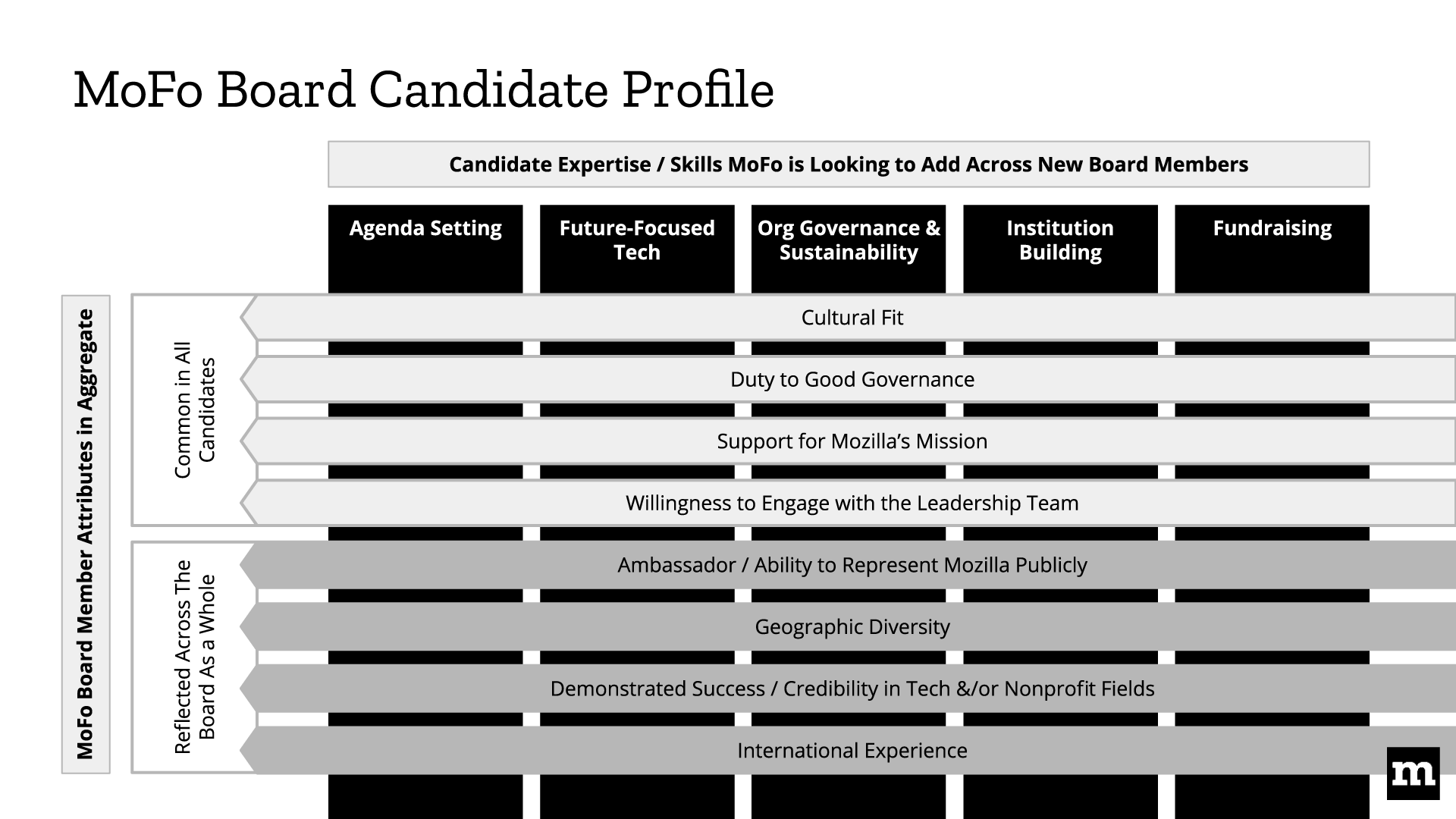
Here is the full job description: https://mzl.la/MoFoBoardJD
Here is a short explanation of how to read this visual:
- In the vertical columns, we have the particular skills and expertise that we are looking for right now. We expect new board members to have at least one of these skills.
- The horizontal lines speaks to things that every board member should have. For instance, to be a board member, you should have to have some cultural sense of Mozilla. They are a set of things that are important for every candidate. In addition, there is a set of things that are important for the board as a whole. For instance, international experience. The board makeup overall should cover these areas.
- The horizontal lines will not change too much over time, whereas the vertical lines will change, depending on who joins the Board and who leaves.
Finding the right people who match these criteria and who have the skills we need takes time. We hope to have extensive discussions with a wide range of people. Board candidates will meet the existing board members, members of the management team, individual contributors and volunteers. We see this as a good way to get to know how someone thinks and works within the framework of the Mozilla mission. It also helps us feel comfortable including someone at this senior level of stewardship.
We want your suggestions
We are hoping to add three new members to the Mozilla Foundation Board of Directors over the next 18 months. If you have candidates that you believe would be good board members, send them to msurman@mozillafoundation.org. We will use real discretion with the names you send us.
]]>When Gerv arrived a few things about him jumped out immediately. The first was a swollen, shiny, bright pink scar on the side of his neck. He quickly volunteered that the scar was from a set of surgeries for his recently discovered cancer. At the time Gerv was 20 or so, and had less than a 50% chance of reaching 35. He was remarkably upbeat.
The second thing that immediately became clear was Gerv’s faith, which was the bedrock of his response to his cancer. As a result the scar was a visual marker that led straight to a discussion of faith. This was the organizing principle of Gerv’s life, and nearly everything he did followed from his interpretation of how he should express his faith.
Eventually Gerv felt called to live his faith by publicly judging others in politely stated but damning terms. His contributions to expanding the Mozilla community would eventually become shadowed by behaviors that made it more difficult for people to participate. But in 2001 all of this was far in the future.
Gerv was a wildly active and effective contributor almost from the moment he chose Mozilla as his university-era open source project. He started as a volunteer in January 2000, doing QA for early Gecko builds in return for plushies, including an early program called the Gecko BugAThon. (With gratitude to the Internet Archive for its work archiving digital history and making it publicly available.)
Gerv had many roles over the years, from volunteer to mostly-volunteer to part-time, to full-time, and back again. When he went back to student life to attend Bible College, he worked a few hours a week, and many more during breaks. In 2009 or so, he became a full time employee and remained one until early 2018 when it became clear his cancer was entering a new and final stage.
Gerv’s work varied over the years. After his start in QA, Gerv did trademark work, a ton of FLOSS licensing work, supported Thunderbird, supported Bugzilla, Certificate Authority work, policy work and set up the MOSS grant program, to name a few areas. Gerv had a remarkable ability to get things done. In the early years, Gerv was also an active ambassador for Mozilla, and many Mozillians found their way into the project during this period because of Gerv.
Gerv’s work life was interspersed with a series of surgeries and radiation as new tumors appeared. Gerv would methodically inform everyone he would be away for a few weeks, and we would know he had some sort of major treatment coming up.
Gerv’s default approach was to see things in binary terms — yes or no, black or white, on or off, one or zero. Over the years I worked with him to moderate this trait so that he could better appreciate nuance and the many “gray” areas on complex topics. Gerv challenged me, infuriated me, impressed me, enraged me, surprised me. He developed a greater ability to work with ambiguity, which impressed me.
Gerv’s faith did not have ambiguity at least none that I ever saw. Gerv was crisp. He had very precise views about marriage, sex, gender and related topics. He was adamant that his interpretation was correct, and that his interpretation should be encoded into law. These views made their way into the Mozilla environment. They have been traumatic and damaging, both to individuals and to Mozilla overall.
The last time I saw Gerv was at FOSDEM, Feb 3 and 4. I had seen Gerv only a few months before in December and I was shocked at the change in those few months. Gerv must have been feeling quite poorly, since his announcement about preparing for the end was made on Feb 16. In many ways, FOSDEM is a fitting final event for Gerv — free software, in the heart of Europe, where impassioned volunteer communities build FLOSS projects together.
To memorialize Gerv’s passing, it is fitting that we remember all of Gerv — the full person, good and bad, the damage and trauma he caused, as well as his many positive contributions. Any other view is sentimental. We should be clear-eyed, acknowledge the problems, and appreciate the positive contributions. Gerv came to Mozilla long before we were successful or had much to offer besides our goals and our open source foundations. As Gerv put it, he’s gone home now, leaving untold memories around the FLOSS world.
]]>I took this opportunity because we are at a pivotal point in the debate between the FCC, companies, and users over the FCC’s proposal to roll back protections for net neutrality. Net neutrality is a key part of ensuring freedom of choice to access content and services for consumers.
Earlier this week Mozilla’s Heather West wrote a letter to FCC Chairman Ajit Pai highlighting how net neutrality has fueled innovation in Silicon Valley and can do so still across the United States.
The FCC claims these protections hamper investment and are bad for business. And they may vote to end them as early as October. Chairman Pai calls his rule rollback “restoring internet freedom” but that’s really the freedom of the 1% to make decisions that limit the rest of the population.
At Mozilla we believe the current rules provide vital protections to ensure that ISPs don’t act as gatekeepers for online content and services. Millions of people commented on the FCC docket, including those who commented through Mozilla’s portal that removing these core protections will hurt consumers and small businesses alike.
Mozilla is also very much focused on the issues preventing people coming online beyond the United States. Before addressing the situation in the U.S., journalist Rob Pegoraro asked me what we discovered in the research we recently funded in seven other countries into the impact of zero rating on Internet use:
(Video courtesy: GSMA)
If you happen to be in San Francisco on Monday 18th September please consider joining Mozilla and the Internet Archive for a special night: The Battle to Save Net Neutrality. Tickets are available here.
You’ll be able to watch a discussion featuring former FCC Chairman Tom Wheeler; Representative Ro Khanna; Mozilla Chief Legal and Business Officer Denelle Dixon; Amy Aniobi, Supervising Producer, Insecure (HBO); Luisa Leschin, Co-Executive Producer/Head Writer, Just Add Magic (Amazon); Malkia Cyril, Executive Director of the Center for Media Justice; and Dane Jasper, CEO and Co-Founder of Sonic. The panel will be moderated by Gigi Sohn, Mozilla Tech Policy Fellow and former Counselor to Chairman Wheeler. It will discuss how net neutrality promotes democratic values, social justice and economic opportunity, what the current threats are, and what the public can do to preserve it.
]]>