Advertise with Googlier.com Abundant Solutions https://abundant-solutions.biz/ Clarity. Confidence. Growth. Tue, 26 May 2026 08:10:03 +0000 en-GB hourly 1 https://wordpress.org/?v=6.8.11 https://abundant-solutions.biz/wp-content/uploads/2025/10/Abundant-Solutions-FAVICON.svg Abundant Solutions https://abundant-solutions.biz/ 32 32 Can You Change Company Culture? https://abundant-solutions.biz/can-you-change-company-culture/ Wed, 29 Apr 2026 09:13:13 +0000 https://abundant-solutions.biz/?p=10314 The post Can You Change Company Culture? appeared first on Abundant Solutions.

]]>

Yes.

But not with a memo, a new slogan or a well-intentioned away day.

Culture does not change because a new value is announced or a leadership away day is scheduled. It changes when behaviour changes, and behaviour changes when structure, standards and leadership alignment shift in a sustained way.

The desire to improve culture is common. The discipline to change it is less so.

Start With Leadership Behaviour

Culture cascades.

If leaders model clarity, accountability and consistency, those behaviours spread. If leaders avoid difficult conversations, tolerate ambiguity or shift priorities weekly, that spreads too.

Changing culture begins with an honest assessment of leadership behaviour. Not intention, but observable behaviour. Are expectations explicit? Are standards reinforced consistently? Are underperformance and misalignment addressed promptly, or quietly tolerated?

Culture follows what leaders repeatedly do, not what they occasionally say.

Clarify What Must Change

Vague ambition does not produce a cultural shift.

Statements like “we need better communication” or “we need more ownership” sound sensible but lack precision. What does better communication mean in practice? Faster responses? Clearer agendas? Documented decisions? What does ownership look like in project delivery or client relationships?

Changing culture requires translating frustration into specific behavioural shifts. Identify what must stop, what must start and what must strengthen.

Without specificity, culture remains abstract.

Align Structure With Expectations

Culture cannot change if the operating structure reinforces old behaviour.

If decision rights are unclear, accountability will remain blurred. If priorities change weekly, teams will remain reactive. If performance conversations are avoided, standards will drift.

To change culture, adjust the system itself: how meetings are run, how priorities are set, how performance is reviewed and how issues are escalated and resolved.

Small structural changes, applied consistently, reshape behaviour over time.

Reinforce Relentlessly

Early progress is fragile.

When a new standard is introduced, it must be reinforced calmly and repeatedly. Leaders must follow up. Expectations must be visible. Consequences, positive and negative, must be consistent.

Cultural change rarely happens through a single initiative. It happens through repetition.

Repetition builds predictability, predictability builds trust, and trust builds momentum.

Expect Discomfort

Changing culture often exposes misalignment.

Some individuals will thrive under clearer standards. Others may struggle. Cultural shift can feel destabilising in the short term because it replaces familiarity with accountability.

That discomfort is not a sign of failure. It is often a sign that clarity is increasing.

Common Mistakes When Trying to Change Culture

Most cultural change efforts fail for predictable reasons.

Leaders announce new expectations but leave the old structures untouched. They talk about accountability but avoid the first difficult conversation that would test the new standard. They introduce new values yet continue rewarding the same behaviours that created the original frustration.

Another common mistake is attempting to change everything at once. Culture shifts more reliably when a small number of critical behaviours are identified and reinforced consistently. Trying to overhaul language, process, structure and performance management simultaneously often creates fatigue rather than focus.

Finally, many organisations underestimate the time required. Early enthusiasm fades when immediate results fail to materialise. Cultural change is cumulative. It compounds through consistent reinforcement rather than dramatic intervention.

A Practical Perspective

If your organisation feels reactive, inconsistent or overly dependent on senior leaders, culture can change. But it will not change through aspiration alone.

It will change when leadership behaviour aligns with stated standards, when structure reinforces those standards and when accountability becomes consistent rather than selective.

Culture is not fixed. It is designed, reinforced and adjusted through daily leadership choices. The real question is not whether culture can change, but whether you are willing to change the system that created it.

Working With Us

If any part of this series resonates, the starting point is not a workshop. It is clarity.

At Abundant Solutions, we work with leadership teams to align strategy, structure and behaviour so culture supports performance rather than slowing it down. That may mean defining your Abundant Growth Strategy more clearly, tightening decision rights, strengthening accountability or redesigning how priorities are set and reviewed.

We do not offer motivational language. We work on the system.

If you value a structured conversation about where friction exists in your organisation and what would realistically shift it, get in touch. One focused discussion can often surface the real leverage points.

The post Can You Change Company Culture? appeared first on Abundant Solutions.

]]>
Defining Your Company Culture https://abundant-solutions.biz/defining-your-company-culture/ Wed, 29 Apr 2026 09:12:52 +0000 https://abundant-solutions.biz/?p=10309 The post Defining Your Company Culture appeared first on Abundant Solutions.

]]>

If culture exists whether you design it or not, the real question is this.

Are you shaping it deliberately?

Or are you living with whatever has evolved over time?

Every organisation has a culture. It forms through repeated behaviour, leadership responses and the standards that are tolerated or reinforced. But high-performing organisations do not leave culture to chance. They define it clearly and align it structurally.

Defining culture is not about writing inspiring words.

It is about making decisions.

Start With Strategic Clarity

Culture cannot be separated from strategy.

If strategy sets direction, culture determines how that direction is pursued day to day.

Before defining values, leaders must be clear about:

The outcomes the business is committed to achieving. The standards required to achieve them. The type of environment that will support sustainable performance.

Without that clarity, values become generic. They sound right but lack consequence. With it, they become operational, shaping how priorities are set, how trade-offs are handled and how performance is evaluated. Clarity at the strategic level prevents culture from becoming a collection of well-meaning statements disconnected from the business’s commercial reality.

Move From Words to Behaviour

Most businesses can list five or six values.

Fewer can describe the behaviours those values require.

If accountability is a value, what does that look like in meetings? In project delivery? In client communication? If collaboration matters, how are disagreements handled? If excellence is important, how is underperformance addressed?

Culture becomes real when values are translated into observable behaviour. Behaviour can be described. Behaviour can be reinforced. Behaviour can be measured indirectly through outcomes.

This is where many organisations stop short. They define values but do not define the standard of behaviour expected alongside them.

Clarify Roles and Decision Rights

Culture strengthens when people know where they stand.

Ambiguity weakens it.

Clear roles, defined responsibilities, and explicit decision rights reduce friction and build confidence. When ownership is visible, accountability increases naturally. When authority is blurred, leaders become bottlenecks and teams hesitate.

Defining culture, therefore, includes defining the structure of how decisions are made, how priorities are set, and how issues are escalated. How performance is reviewed.

Structure reinforces behaviour.

Align Leadership First

Culture cascades.

It does not start with policy. It starts with leadership behaviour.

If leaders say collaboration matters but operate in silos, the culture will follow the behaviour, not the words. If leaders speak about accountability but avoid difficult conversations, the standard drops quietly.

Defining culture requires leadership alignment on the behaviours they are willing to model consistently.

That conversation is often more important than the wording of any value statement.

Make It Visible and Repetitive

Once defined, culture must be reinforced.

In hiring decisions. In performance reviews. In promotions. In the way meetings are run.

Repetition builds clarity. Clarity builds consistency. Consistency builds trust.

Over time, that trust becomes momentum.

A Practical Reflection

If someone new joined your organisation tomorrow, what would they observe in their first two weeks?

Would they see clear priorities? Would they see decisions made confidently? Would they see constructive challenge handled well?

Or would they see ambiguity, inconsistency and reactive leadership?

Defining culture is not about aspiration. It is about aligning what you say matters with what your organisation consistently does.

When culture is defined deliberately, it supports strategy rather than undermining it. It accelerates execution rather than slowing it. And it reduces the need for constant leadership team intervention.

Left undefined, culture drifts. Standards blur, accountability softens, and leaders spend more time correcting issues that should never have escalated.

Defined clearly and reinforced consistently, culture becomes an advantage. It supports strategy, strengthens execution and allows leaders to focus on growth rather than constant correction.

Culture will form either way.

The question is whether it forms by default or by design.

The post Defining Your Company Culture appeared first on Abundant Solutions.

]]>
Why Company Culture Quietly Drives Results https://abundant-solutions.biz/why-company-culture-quietly-drives-results/ Wed, 29 Apr 2026 09:12:25 +0000 https://abundant-solutions.biz/?p=10305 The post Why Company Culture Quietly Drives Results appeared first on Abundant Solutions.

]]>

Culture is not a soft issue that sits alongside the real work of the business. It shows up directly in profit, pace and performance. It is not the only factor that drives results. Still, it quietly shapes how effectively every other factor performs by influencing how quickly decisions are made, how confidently teams act and how consistently clients are served.

If culture is the organisation’s social operating system, then results are heavily influenced by how well that system runs. Strategy sets direction, and capability provides capacity, but culture determines how effectively both are translated into consistent action.

Culture Drives Speed

In healthy cultures, decisions move because priorities are clear, accountability is understood, and meetings create momentum rather than delay. In weaker cultures, decisions stall, conversations repeat, and issues resurface, forcing leaders to step back in and make up for it. The business becomes dependent rather than empowered. Speed is rarely a capability problem; it is usually a clarity problem. When direction is stable and roles are defined, decision-making accelerates naturally. When they are not, friction increases quietly and consistently. In practical terms, this often shows up in small but telling ways: projects that pause because no one is certain who has final authority, meetings that end without clear next steps, or leaders who feel they must stay closely involved in every decision to maintain momentum. Over time, that drag compounds. What could have been resolved in a day takes a week, and what could have been delegated returns to the leadership team. Strong culture removes that drag by making ownership visible and expectations explicit.

Culture Drives Retention and Engagement

People rarely leave companies only because of pay; more often, they leave because of confusion, inconsistency, and environments where expectations shift weekly or standards remain unclear. Research consistently supports this: employees who feel connected to their culture are far less likely to look elsewhere, and engagement rises when people understand what matters, how success is measured and where they stand. Culture directly influences psychological safety, trust in leadership, ownership of outcomes and the willingness to challenge and improve. When those conditions are strong, performance follows; when they are weak, even talented people disengage.

Culture Shows Up in Client Experience

Clients rarely see your strategy documents; they experience your culture. They notice whether communication is clear, whether follow-through is consistent and whether ownership is obvious or blurred. If internal alignment is weak, clients feel it quickly. Deadlines slip, messages conflict and standards vary. What feels like a service issue is often a culture issue.

Culture and Financial Performance

High-performing cultures tend to outperform over time, and organisations recognised for strong workplace cultures have consistently exceeded market averages. This is not because of surface-level perks; it is because of clarity, alignment and disciplined execution. Culture reduces internal friction, and when friction is reduced, focus increases, execution improves, and financial performance follows. The link is strong, even though culture is only one part of the wider performance equation.

A Leadership Reality

Many leaders try to improve results by adding activity: more marketing, more meetings, more reporting. But when the underlying culture is misaligned, additional activity simply amplifies the noise. Improving culture is not about motivational language; it is about structural clarity through clear direction, defined roles, stable priorities and explicit accountability. When those elements are in place, culture strengthens, and results follow. If performance feels harder than it should, if retention feels fragile or if client delivery feels inconsistent, culture is usually involved. And like any operating system, it can be redesigned deliberately, calmly and structurally.

The post Why Company Culture Quietly Drives Results appeared first on Abundant Solutions.

]]>
What Is Company Culture, Really? https://abundant-solutions.biz/what-is-company-culture-really/ Wed, 29 Apr 2026 09:11:04 +0000 https://abundant-solutions.biz/?p=10290 The post What Is Company Culture, Really? appeared first on Abundant Solutions.

]]>

Company culture is not your values on the wall.

It is not the mission statement on your website.
It is not the away day you held last year.
And it is not whether people describe the office as friendly.

Culture is what happens when you are not in the room. Some describe it as an organisation’s social operating system, the invisible set of expectations and behaviours that determine how work really gets done.

It is how decisions get made, how pressure is handled, how conflict is resolved and what gets tolerated and what gets challenged.

Many leaders think they have a culture problem, when in my experience, they usually have a clarity problem.

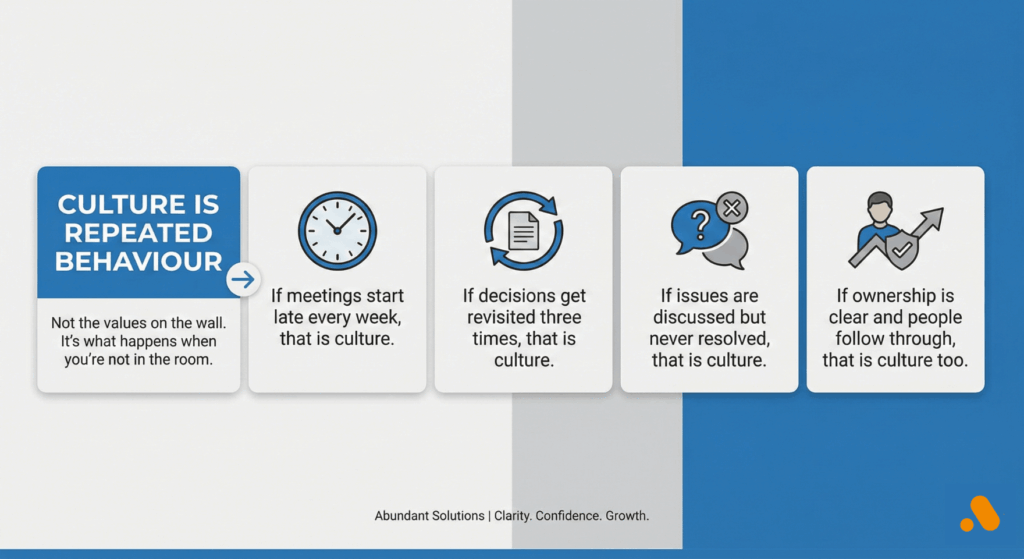
Culture Is Repeated Behaviour

What is Company Culture

Strip it back, and culture is repeated behaviour.

If meetings start late every week, that is culture.
If decisions get revisited three times, that is culture.
If issues are discussed but never resolved, that is culture.
If ownership is clear and people follow through, that is culture too.

Culture is not what you say you value; it is what your business consistently does, and that behaviour is shaped by structure. In growing businesses, behaviour rarely drifts because people lack capability; it drifts because expectations are unclear or inconsistently reinforced. When leaders are explicit about standards and consistent in follow-through, behaviour stabilises. When they are vague or reactive, behaviour fragments. Over time, that fragmentation shows up as tension, delay and duplicated effort.

Culture Is Created by What Leaders Tolerate

This statement is the uncomfortable truth: whatever you tolerate becomes normal. If low standards are accepted or ignored, they spread; if accountability is optional, it becomes rare; and if strong performance is recognised and reinforced, it multiplies. Leaders shape culture far less through speeches and far more through their response to everyday situations. What you allow, what you question and what you follow up on sends a clear signal about what truly matters. Over time, those small moments compound and quietly define how the organisation behaves.

Culture Is a System, Not a Feeling

When culture feels off, leaders often focus on morale.

But culture is not primarily emotional. It is structural.

It is influenced by:

  • Clear direction
  • Defined roles
  • Stable priorities
  • Decision-making rhythm
  • How problems are solved

If direction shifts weekly, culture becomes reactive; when roles overlap, friction increases; and when recurring issues are never properly addressed, frustration builds. That is not a personality issue; it is a design issue. Culture is the output of how the business is built to operate.

In practical terms, culture often reveals itself in small operational moments. Who prepares properly for meetings? Who owns the next step without being chased? How quickly are decisions escalated when something is unclear? These everyday habits tell you far more about culture than any value statement. When those habits are aligned, performance improves almost quietly; when they are misaligned, leaders find themselves compensating constantly.

A Simple Reflection

If you stepped away from your business for a week, what would continue?

Would decisions still be made confidently?
Would meetings still create momentum?
Would accountability still hold?

The honest answer to those questions is your culture, not the words, not the intent, but the behaviour.

And here is the commercial reality.

Culture drives speed, performance, retention and client experience. It affects how quickly opportunities are acted upon, how confidently teams make decisions and how consistently clients are served. A strong culture reduces friction within the business, allowing more energy to be directed outward toward growth.

When culture is unclear, everything feels harder than it should, whereas when culture is aligned, the business moves with less friction. If you are noticing tension, recurring issues, or slow decision-making, it may not be a people problem but a clarity and structure problem, and that is fixable.

The post What Is Company Culture, Really? appeared first on Abundant Solutions.

]]>
Automation and Technology with Purpose https://abundant-solutions.biz/automation-and-technology-with-purpose/ Wed, 05 Nov 2025 09:14:14 +0000 https://abundant-solutions.biz/?p=10035 Simplify. Connect. Work smarter. Technology should help your business run better. But if you’re constantly jumping between tools, fixing workarounds or chasing missing info, it’s easy to wonder — is all this tech actually helping? For many growing businesses, the answer is… not really. It’s not that the tools are wrong. It’s that they’ve been...

The post Automation and Technology with Purpose appeared first on Abundant Solutions.

]]>
Simplify. Connect. Work smarter.

Technology should help your business run better.

But if you’re constantly jumping between tools, fixing workarounds or chasing missing info, it’s easy to wonder — is all this tech actually helping?

For many growing businesses, the answer is… not really.

It’s not that the tools are wrong. It’s that they’ve been added reactively — one to fix sales, one to track customers, another to manage tasks — without ever stepping back to ask: does this all work together?

When the Tools Start Running the Team

Most businesses don’t set out to build a tangled tech stack.

They add tools to solve specific problems. A CRM to track leads. A scheduling platform to keep projects on track. A dashboard to give visibility.

Each tool has a purpose.

But over time, the tools pile up.

They stop talking to each other. The same info is entered three times. Teams follow different processes depending on which system they trust.

And before you know it, your tech is driving your team instead of supporting them.

The irony?

You’ve got more software than ever — but less clarity, less time and more frustration.

Technology Should Create Space, Not Stress

Good tech doesn’t take over. It blends in.

It simplifies how you work. It reduces manual effort.

It helps people focus on what really matters — not navigating clunky systems or firefighting gaps.

When automation and systems are designed with the right purpose, they create clarity.
They make it easier to scale.

They give your team confidence to make decisions because they know where to find what they need.

It’s not about having the flashiest platforms.

It’s about having the right ones — set up in a way that actually supports the way your business runs.

Five Practical Steps to Make Tech Work for You

Here’s where we start when helping clients get back in control:

1. Start with the problem, not the platform

What’s slowing things down? Where are the gaps?

Don’t choose tools based on hype. Choose based on need.

2. Simplify before you automate

Messy processes don’t get better with automation — they just get faster at going wrong.

Fix the flow first, then automate.

3. Choose tools that connect

Integration matters. If your systems can’t talk to each other, you’ll always be patching holes.

4. Think about the user

If your team hates using it, they’ll find ways around it.

The best system is the one people actually use with ease.

5. Review regularly

Your business evolves. So should your tools.

What worked a year ago might now be slowing you down.

When It All Starts to Click

You’ll notice it quickly.

Projects move faster. Communication improves.

The handovers feel smoother. The team is less stressed.

You’re not chasing spreadsheets or guessing what’s up next.

You’re in control.

And that gives you the headspace to focus on the bigger picture.

Ready to Get Your Systems Working Smarter?

At Abundant Solutions, we help small and growing businesses simplify their operations and build tech that fits.

No jargon. No overengineering. Just smarter systems that create space, not stress.

From process mapping to CRM design, we bring the clarity and hands-on support to make your tools work for you — not the other way around.

The post Automation and Technology with Purpose appeared first on Abundant Solutions.

]]>
Smart Segmentation: Reaching the Right People, the Right Way https://abundant-solutions.biz/smart-segmentation-reaching-the-right-people-the-right-way/ Mon, 03 Nov 2025 08:17:18 +0000 https://abundant-solutions.biz/?p=10015 You have built a database of contacts, leads and clients. That is a powerful start. But a list on its own doesn’t drive growth. Connection does. In a world full of noise, audiences expect relevance. They want to feel that you understand who they are, what they care about and why your message matters to...

The post Smart Segmentation: Reaching the Right People, the Right Way appeared first on Abundant Solutions.

]]>
You have built a database of contacts, leads and clients. That is a powerful start.

But a list on its own doesn’t drive growth. Connection does.

In a world full of noise, audiences expect relevance. They want to feel that you understand who they are, what they care about and why your message matters to them.

That level of connection starts with segmentation.

What Segmentation Really Means in 2025

Segmentation is not just splitting your contacts into lists. It is using insight to communicate with intent. Your audience moves between email, social media, websites and ads every day. When you align your message across these channels, each interaction feels consistent and personal.

Modern segmentation uses data to serve the right message at the right time, across the platforms your audience actually uses. It means recognising who is new, who is loyal, who is drifting away and what each group needs to hear next.

Why Blanket Marketing No Longer Works

There was a time when sending one big campaign to everyone worked. Those days are over.

Customers now expect relevance and permission. They want communication that respects their time and their privacy.

Generic content feels lazy. Personalisation shows care.

When people receive messages that match their interests or behaviour, they are more likely to open, click and trust your brand.

You wouldn’t invite everyone you know to the same dinner party and serve them all the same meal. Some are vegetarian, some need gluten-free, and others have their own preferences. Segmentation works the same way. It is about knowing who is at the table and serving what makes sense for them.

Data with Purpose

Your CRM, website analytics and social insights are full of information about how people interact with your business.

The key is not always collecting more data, but using it with purpose.

Look at what each contact engages with and where they spend their attention.

If someone regularly watches your videos, prioritise video content in their nurture flow.

If another client has purchased recently, offer them value before another sale.

And if someone has been quiet for months, give them a reason to re-engage or clean the list entirely.

Good segmentation is a balance of empathy and evidence. It is not about automation replacing intuition, it is about technology supporting smarter decisions.

The Human Side of Segmentation

AI tools can help identify patterns, but the best marketing still starts with understanding people.

Behind every click is a person with specific needs and motivations.

Segmentation gives you the space to listen, respond and earn attention instead of demanding it.

When your marketing respects where someone is in their journey, it builds trust.

And trust is what turns communication into conversion.

How to Take Segmentation Further

You already know who your leads, clients and lapsed customers are – that is the foundation. But smart segmentation goes a step further. It helps you understand why each group behaves the way they do, and what they need from you next.

Once you have your core categories in place, start layering context.

  1. Segment by product or service interest
    Look at what people have interacted with or purchased. If you know which services matter most to them, you can tailor messages that feel relevant instead of random. 
  2. Segment by engagement
    Identify who is actively opening, clicking and responding – and who is not. It shows where your message is landing and where it is missing the mark. 
  3. Segment by stage in the journey
    Leads need reassurance. Existing clients need value. Lapsed contacts need a reason to re-engage. When your communication matches their mindset, it feels considered, not automated. 
  4. Segment by potential
    Spot your loyal customers and high-value prospects. These are the people who already trust you and who are most likely to buy again or refer others. 

Smart segmentation is about reading the signals, not relying on guesswork.

It helps you reach the right people, with the right message, at the right time –  and that is where genuine connection starts.

What Happens When You Get It Right

When you get segmentation right, your marketing feels natural. 

You know who you are talking to and what they need to hear. Your messages land, your database responds and your results grow.

The post Smart Segmentation: Reaching the Right People, the Right Way appeared first on Abundant Solutions.

]]>
Leadership and Team Alignment: How to Bring Everyone Back on the Same Page https://abundant-solutions.biz/leadership-and-team-alignment-how-to-bring-everyone-back-on-the-same-page/ Sat, 01 Nov 2025 09:06:39 +0000 https://abundant-solutions.biz/?p=10032 As your business grows, things naturally get more complex. More people join. New systems creep in. The day-to-day starts to shift away from what it used to be. And suddenly, the tight-knit team that once moved as one starts to feel… out of sync. It’s rarely dramatic. But it’s there. Decisions take longer. Priorities blur....

The post Leadership and Team Alignment: How to Bring Everyone Back on the Same Page appeared first on Abundant Solutions.

]]>
As your business grows, things naturally get more complex. More people join. New systems creep in. The day-to-day starts to shift away from what it used to be. And suddenly, the tight-knit team that once moved as one starts to feel… out of sync.

It’s rarely dramatic. But it’s there.

Decisions take longer. Priorities blur. Messages get muddled. You spot teams pulling in slightly different directions, even though everyone’s still working hard and doing their best.

This isn’t about a lack of effort. It’s about a loss of alignment.

Why Alignment Slips (and Why It Matters)

Early on, alignment happens naturally. Everyone’s in the same room, solving the same problems. But as you grow, distance creeps in. Layers appear. Communication changes. The connection between the leadership vision and what’s actually happening on the ground starts to fade.

People fill in the blanks in different ways. Leaders think the strategy is clear. Teams think they’re doing what’s expected. But without shared clarity, effort gets scattered.

Alignment is what turns busy people into a united team. It’s the secret to better decisions, easier collaboration, and a culture that actually works.

How to Bring Your Team Back Together

Here are five simple ways to rebuild alignment. No jargon. No fluff. Just things that work.

1. Revisit Your ‘Why’

Remind people where you’re heading and why it matters. Don’t just write it on a wall. Make it part of your regular conversations. Link choices and plans back to the vision so it stays alive and relevant.

2. Get Clear on Roles

Confusion kills confidence. Make sure everyone knows what their role really means. What they’re responsible for. How success is measured. Where the boundaries are.

3. Talk. For Real.

Create space for open conversations between leaders and teams. Drop the corporate speak. Ask what’s working and what’s not. Listen like you mean it.

4. Lead the Way

People watch what leaders do more than what they say. If your leadership team isn’t aligned, no one else will be. Show up consistently. Model the values. Back each other publicly.

5. Make Progress Visible

When teams can see how their work contributes to the bigger picture, motivation grows. Use simple tools like a shared dashboard or a regular check-in to track progress together.

What Happens When It Works

When alignment is strong, everything feels easier. Meetings are shorter. Goals are clearer. Energy goes in one direction: forward.

People feel part of something that matters. They take ownership. They care more. And your culture starts to reflect the business you’re trying to build.

Need Help Getting Back on the Same Page?

At Abundant Solutions, we help leaders reconnect their teams around a shared direction. From vision and values to communication rhythms and operational clarity, we bring people, strategy and culture together so the whole business moves with purpose.

If things feel disjointed, we’re here to help you realign, rebuild trust and regain momentum.

The post Leadership and Team Alignment: How to Bring Everyone Back on the Same Page appeared first on Abundant Solutions.

]]>
Resilience in Uncertain Times: Building Strength When Things Keep Changing https://abundant-solutions.biz/resilience-in-uncertain-times-building-strength-when-things-keep-changing/ Fri, 31 Oct 2025 14:45:17 +0000 https://abundant-solutions.biz/?p=10076 Every business goes through patches where things feel unpredictable. Markets shift. Costs rise. Clients change direction. What worked yesterday suddenly stops working today. In moments like these, the goal is not to eliminate uncertainty. It is to build the strength to move through it. Resilience is not just about surviving tough times. It is about...

The post Resilience in Uncertain Times: Building Strength When Things Keep Changing appeared first on Abundant Solutions.

]]>
Every business goes through patches where things feel unpredictable.
Markets shift. Costs rise. Clients change direction.
What worked yesterday suddenly stops working today.

In moments like these, the goal is not to eliminate uncertainty. It is to build the strength to move through it.
Resilience is not just about surviving tough times.
It is about using them to become stronger, clearer, and more capable of what comes next.

Why Resilience Matters More Than Ever

Change is no longer an occasional event. It is constant.
Economic conditions fluctuate, new technologies disrupt routines, and customer expectations continue to evolve. Businesses that can adapt quickly without losing focus are the ones that stay ahead.

Resilient companies do not avoid challenges — they respond well to them.
They anticipate problems, stay grounded under pressure, and recover faster.
Resilience creates confidence. When your team knows it can handle disruption, you make better decisions and keep moving, even in uncertainty.

Let’s Clear Up the Myths

Resilience gets talked about a lot, but it is often misunderstood.

It is not about pushing through with a smile or simply working harder.
It is not about gritting your teeth and toughing it out alone.
And it is definitely not about pretending everything is fine when it is not.

True resilience is built on three things:

  • Strong systems that hold up under pressure
  • Leadership that balances clarity and empathy
  • A culture that supports energy, learning, and adaptability

This is not just about bouncing back. It is about building forward.

Five Ways to Build Business Resilience

Here’s how we help our clients build resilience into the way they lead and grow:

1. Create Clarity in Chaos

When the future feels messy, people look for something solid.
Be clear about what is changing — and what is not.
Transparency brings calm. It helps your team focus and adapt, even in uncertainty.

2. Strengthen Your Core Systems

Your processes, communication habits, and decision-making frameworks form the backbone of your business.
Review and refine them regularly so they do not break when things get tough.

3. Stay Close to Your Clients and Team

Resilience is relational.
In challenging times, connection builds trust.
Talk more, not less. Ask questions. Listen. Make decisions informed by real conversations, not assumptions.

4. Manage Energy, Not Just Time

Your team is not a machine.
High performance depends on rest and recovery.
Build a culture where wellbeing is protected, not sacrificed. It is easier to stay steady when people are not burning out.

5. Learn and Adapt Continuously

Every challenge teaches you something.
After the dust settles, take time to reflect. What worked? What did not? What would you do differently?
Build those lessons into your next move so your business grows stronger, not just older.

The Outcome

Resilience gives your business flexibility, stability and confidence.
You can face change without losing momentum.
You can handle pressure without draining your people.
You turn setbacks into stepping stones — and disruption into opportunity.

When resilience is part of your culture, your team feels supported, your systems stay strong, and your leadership has space to breathe and think clearly.

At Abundant Solutions, we help founders and leadership teams build resilience into the foundations of their business — not as a buzzword, but as a way of working.
Through strategy, systems and culture, we help you lead with calm, clarity and confidence, no matter what the world throws at you.

The post Resilience in Uncertain Times: Building Strength When Things Keep Changing appeared first on Abundant Solutions.

]]>
Culture as a Competitive Advantage: The Secret Behind High-Performing Teams https://abundant-solutions.biz/culture-as-a-competitive-advantage-the-secret-behind-high-performing-teams/ Sun, 26 Oct 2025 14:17:28 +0000 https://abundant-solutions.biz/?p=10064 How You Work Together Matters More Than Ever Every business has a culture. The only question is whether it’s working for you or against you. Culture is not what’s written on the wall or buried in your employee handbook. It’s how people behave when no one is watching. It’s how your team communicates, makes decisions,...

The post Culture as a Competitive Advantage: The Secret Behind High-Performing Teams appeared first on Abundant Solutions.

]]>
How You Work Together Matters More Than Ever

Every business has a culture. The only question is whether it’s working for you or against you.

Culture is not what’s written on the wall or buried in your employee handbook. It’s how people behave when no one is watching. It’s how your team communicates, makes decisions, solves problems and responds under pressure. And when it’s working well, culture can be one of your biggest competitive advantages.

In a world where products and services are easily replicated, your culture is what sets you apart. It shapes how your people feel about working for you, how clients experience your service, and how well your business handles growth and change.

When Culture Slips, So Does Performance

Culture issues rarely show up all at once. They build quietly.

You might notice small signs: conversations become less open, teams stop sharing information, people begin working in silos. Decisions slow down, and talented team members start to disengage or leave, even though on paper, everything looks fine.

This isn’t just a people issue. It’s a performance issue. Misalignment drains energy, creates friction and undermines momentum. When people don’t trust the process or each other, progress stalls.

Culture Happens, With or Without You

Left unchecked, culture forms on its own. People develop their own ways of doing things, their own norms, their own language. That can work, but only if those behaviours are taking the business in the right direction.

The most effective organisations shape their culture with intent. They define what good looks like, model it from the top, and reinforce it through hiring, communication, recognition and systems. It’s not about writing values on the wall. It’s about living them in the day-to-day.

How to Build Culture on Purpose

We often help clients start by getting clear on what matters most. What behaviours do you want to see more of? What kind of culture will support your growth? Once that’s defined, the next step is to embed it in leadership, in team habits and in everyday decisions.

Here’s how we approach it:

  • Define what great looks like – Be specific. What do your values mean in practice? What does it look like when someone lives them well?
  • Model it from the top – Culture is shaped by what leaders do. If the leadership team is misaligned or inconsistent, the rest of the organisation will be too.
  • Hire and develop for fit – Technical skills matter, but mindset and attitude matter more. Build a team that strengthens the culture, not just fills a seat.
  • Keep the conversation going – Create space for honest dialogue. Check in regularly. Make culture part of everyday conversations, not just annual reviews.
  • Stay steady through change – Pressure, growth and transition will all test your culture. That’s when it matters most to stay grounded in your core values.

The Difference You’ll Feel

When culture is strong, everything feels more connected. Your team works better together. Accountability improves. Energy builds. People know what’s expected and how to make a difference, and that shows in both performance and morale.

Clients feel it too. There’s a consistency in experience that builds trust. Culture becomes part of your brand and a reason people choose to stay, buy and refer.

Let’s Strengthen What’s Underneath Your Strategy

At Abundant Solutions, we help businesses build strong cultural foundations that support real, sustainable growth. Whether you’re redefining your values, aligning your leadership, or creating systems that reinforce the behaviours you want to see, we bring the clarity and support to help culture work for you, not against you.

Because when culture clicks, performance follows.

The post Culture as a Competitive Advantage: The Secret Behind High-Performing Teams appeared first on Abundant Solutions.

]]>
Clarity Before Growth: The Foundation of Every Strong Business https://abundant-solutions.biz/clarity-before-growth-the-foundation-of-every-strong-business/ Fri, 24 Oct 2025 14:23:44 +0000 https://abundant-solutions.biz/?p=10067 The Focus Shift That Changes Everything Growth is exciting. New clients, bigger goals, fresh momentum. But if you’ve ever scaled a business, you’ll know it can also feel messy. You hire more people. Add more services. Say yes to more opportunities. And before long, the business that once felt simple starts to feel chaotic. You...

The post Clarity Before Growth: The Foundation of Every Strong Business appeared first on Abundant Solutions.

]]>
The Focus Shift That Changes Everything

Growth is exciting.
New clients, bigger goals, fresh momentum.
But if you’ve ever scaled a business, you’ll know it can also feel messy.

You hire more people.
Add more services.
Say yes to more opportunities.

And before long, the business that once felt simple starts to feel chaotic.

You are busier than ever, but it is harder to see where it is all going.

Why So Many Growing Businesses Get Stuck

It is not that you have lost ambition. You have just lost clarity.

The more you grow, the more moving parts appear.

  • Different departments set their own priorities.
  • Strategy becomes a document that lives in a folder instead of in the team’s heads.
  • Projects pile up, meetings multiply, and everyone is working hard but not necessarily together.

This is not failure. It is a signal. You have outgrown the old way of working. And that’s the moment where clarity becomes critical.

So What Does Clarity Really Look Like?

Clarity is knowing exactly what you are building, why it matters, and what needs to happen next.  It is when everyone on the team understands the direction, their role in it, and how to make progress.

Here’s how we help clients find it:

1. Define the Growth You Want

Growth does not always mean more.
Sometimes it means better.
That might be more profitable clients, a tighter niche, or a stronger internal culture.
Be clear about what growth looks like before you chase it.

2. Revisit Your Vision and Values

Dust off the vision.
Re-articulate what success looks like in the next three to five years.
Make sure your leadership team is genuinely aligned around it.

3. Build a Shared Plan

People can’t deliver on what they can’t see.
Break big goals into clear priorities.
Assign ownership.
Show your team how their work connects to the bigger picture.

4. Do Less, Better

Clarity comes from focus.
Not everything matters equally.
Cut the noise.
Work on the three to five initiatives that will make the biggest difference right now.

5. Communicate Like It Matters

One meeting is not enough.
Reinforce clarity every week.
Use short huddles, regular check-ins and simple dashboards to keep the team aligned.

When Clarity Leads, Growth Follows

Suddenly, decisions come faster.
Priorities are understood.
Everyone knows what matters and what can wait.

Marketing matches operations.
Meetings are shorter and sharper.
And your team shows up with more confidence and more energy.

Clarity is not about slowing down.
It is about moving forward with purpose.

Need More Focus in Your Growth?

At Abundant Solutions, we help business leaders create practical clarity, build real alignment, and get their teams working in the same direction.

If your business is feeling pulled in too many directions, we can help you clear the fog and focus on what will truly move you forward.

The post Clarity Before Growth: The Foundation of Every Strong Business appeared first on Abundant Solutions.

]]>