Upon completion you will be responsible for watering the tree after it’s planted and the tree will not be replaced if it dies due to lack of care or vandalism.
Here are the following conditions:
- Spacing: Trees shall be spaced approximately 50 feet apart.
- Minimum Clearence:
- 50 feet from the beginning of the curb radius on the approach to an intersection.
- 15 feet from the beginning of the curb radius on the exit side.
- 20 feet from light standards
- 10 feet from fire hydrants and driveways
- 5 feet from house walks and utility meters
- 3 foot parkway width
- Planting area free of utility or sprinkler lines
- Trees will be planted based on funding availability.

A parkway tree is a tree that is typically planted by Public Works or a developer who built the home or building, adjacent to the edge of roadway within the County’s right of way. Los Angeles County cares for and maintains over 170,000 parkway trees located throughout the County’s unincorporated area along more than 3,200 miles of roadways.
Los Angeles County strives to create a thriving, sustainable urban forest that safely enhances the health and well-being of its communities. Parkway trees are an essential element of healthy, livable neighborhoods and are a significant part of the County’s urban forest. The benefits of having a tree on your street are:
- Cooler Streets
- Cleaner Air
- Less Noise Pollution
- Save Energy
- Reduced Health Risks
Go to the Los Angeles County Public Works Page for more information!


Water and Food
Start by packing enough water and non-perishable food to last each family member for at least three days. The general rule is one gallon of water per person per day for drinking and sanitation. Include items like canned goods, energy bars, and dried fruits, and remember a manual can opener.
First Aid Supplies
A well-stocked first aid kit is crucial. It should include bandages, antiseptic wipes, adhesive tape, scissors, tweezers, pain relievers, and any necessary prescription medications. Don’t forget personal hygiene items like hand sanitizer, wet wipes, and face masks.
Tools and Equipment
Include essential tools like a flashlight with extra batteries, a multi-tool or wrench for turning off utilities, a whistle to signal for help, and a battery-powered or hand-crank radio to stay informed about emergency updates. Also, pack sturdy gloves, duct tape, and a basic toolkit for minor repairs.
Clothing and Bedding
Pack a change of clothes for each family member, including sturdy shoes, and a blanket or sleeping bag. Thermal blankets are compact and can provide warmth in emergencies.
Important Documents & Cash
Store copies of important documents like IDs, insurance policies, and medical records in a waterproof container. Also, keep some cash on hand, as ATMs may be inaccessible after an earthquake.
Personal Items
Tailor the kit to your family’s specific needs. Include baby supplies, pet food, and comfort items like toys or books for children.
Communication Plan
Include a list of emergency contacts and a family communication plan. Ensure everyone knows where the kit is stored and how to use its contents.
Regularly check and update your kit, replacing expired items and adjusting it as your family’s needs change. Being prepared can make all the difference in the aftermath of an earthquake.
For a list of pre-made kits to purchase visit this KTLA story for more.
]]>From world-class art collections to immersive historical experiences, Pasadena’s museums offer a wealth of cultural treasures waiting to be discovered.

Norton Simon Museum at 411 W Colorado Blvd, Pasadena
Norton Simon Museum
Nestled in the heart of Pasadena, the Norton Simon Museum boasts an impressive collection spanning centuries of art history. From Renaissance masterpieces to contemporary works, visitors can explore an array of paintings, sculptures, and decorative arts. Highlights include pieces by renowned artists such as Rembrandt, Picasso, and Van Gogh. The museum’s tranquil sculpture garden provides a serene oasis for contemplation amidst lush greenery and tranquil ponds.
The Gamble House
Step back in time with a visit to the Gamble House, a true architectural gem showcasing the craftsmanship of renowned architects Charles and Henry Greene. This iconic Arts and Crafts masterpiece offers guided tours that delve into the intricate details of its design, from its exquisite woodwork to its stained glass windows. As you wander through the rooms, you’ll gain insight into the life and legacy of the Gamble family, who once called this historic residence home.
Pasadena Museum of History
Immerse yourself in Pasadena’s rich heritage at the Pasadena Museum of History, where exhibits chronicle the city’s evolution from a humble settlement to a thriving metropolis. From Native American artifacts to vintage photographs, the museum offers a comprehensive overview of Pasadena’s past, highlighting key moments in its cultural, social, and architectural history. Don’t miss the Fenyes Mansion, an elegant Beaux-Arts residence that serves as the museum’s centerpiece.
Pacific Asia Museum
For a glimpse into the art and culture of Asia, head to the Pacific Asia Museum, where a diverse collection of artworks awaits. From Chinese ceramics to Japanese prints, the museum showcases the beauty and diversity of Asian artistic traditions. Visitors can explore rotating exhibitions that explore a wide range of themes, from ancient rituals to contemporary innovations, providing a deeper understanding of the interconnectedness of the vast and different Asian cultures.
https://pacificasiamuseum.usc.edu/
Pasadena Museum of California Art (PMCA)
Dedicated to showcasing the diverse artistic landscape of California, the PMCA features a dynamic range of exhibitions highlighting the work of both established and emerging artists. From contemporary paintings to experimental installations, the museum offers a fresh perspective on the state’s vibrant art scene. With its commitment to fostering creativity and innovation, the PMCA serves as a vital hub for artistic exploration and cultural dialogue.
CLOSED
The Huntington Library, Art Museum, and Botanical Gardens
While technically located in nearby San Marino, The Huntington is a must-visit destination for anyone exploring Pasadena’s cultural offerings. This sprawling estate encompasses a world-class library, art museum, and botanical gardens, making it a paradise for art and nature lovers alike. From rare manuscripts to stunning botanical displays, The Huntington offers endless opportunities for discovery and inspiration amidst its picturesque surroundings.
Kidspace Children’s Museum
For families with young children, Kidspace Children’s Museum provides a hands-on learning experience that’s both educational and entertaining. Interactive exhibits encourage exploration and creativity, allowing kids to engage with concepts in science, art, and nature in a fun and engaging way. From climbing structures to water play areas, there’s no shortage of activities to keep little ones entertained for hours on end.
]]>
A female Aedes aegypti mosquito sucking blood from a human (James Gathany/ CDC, via AP)
Effective mosquito prevention is essential to protect public health and maintain comfort. Here are key strategies to mitigate mosquito infestations:
Eliminate Standing Water
Mosquitoes breed in stagnant standing water, so it’s crucial to remove any potential breeding sites around your home:
Inspect and Drain: Regularly check and empty items that can collect water, such as flower pots, birdbaths, pet bowls, toys, tires and clogged gutters.
Maintain Pools and Ponds: Ensure swimming pools are properly chlorinated and clean. Aerate ornamental ponds to keep water moving and less attractive to mosquitoes.
Use Mosquito-Repellent Products
Personal protection is a key defense against mosquito bites:
Repellents: Apply EPA-approved mosquito repellents containing DEET (safe for children over 2 months old), picaridin, or oil of lemon eucalyptus when outdoors.
Clothing: Wear long sleeves, long pants, and socks to minimize exposed skin. Consider treating clothes with permethrin for added protection.
Mosquito-Proof Your Home
Keeping mosquitoes out of living spaces reduces the risk of bites indoors:
Screens: Install or repair window and door screens to prevent mosquitoes from entering the house.
Doors: Keep doors closed, especially during dusk and dawn when mosquitoes are most active.
Fans: increasing airflow in your immediate vicinity can help deter mosquitoes. Although the pests can fly fairly well, their wings aren’t strong enough to counteract the air speed of a fan set at sufficient level.
Community and Professional Measures
Collective efforts and professional interventions can significantly reduce mosquito populations:
Public Awareness: Participate in community clean-up efforts and spread awareness about the importance of mosquito prevention.
Vector Control: Support local mosquito control programs that conduct surveillance and apply larvicides or adulticides as needed.
Natural Predators and Biological Controls
Encouraging natural predators can help keep mosquito populations in check:
Fish: Introduce mosquito-eating fish, like Gambusia, into ornamental ponds.
Birds and Bats: Foster habitats for birds and bats that feed on mosquitoes by installing bat houses and bird feeders.
Community cooperation and consistent efforts are key to reducing the risk of mosquito-borne diseases and enhancing the quality of life in our neighborhood. By adopting these proactive measures, we can enjoy a more comfortable and mosquito-free summer.
]]>
Alhambra Farmer’s Market (from Yelp)
Flea Markets
Rose Bowl Flea Market
1001 Rose Bowl Dr, Pasadena
This legendary flea market is held on the second Sunday of every month and features over 2,500 vendors offering antiques, vintage clothing, local art, and specialty products.
Pasadena City College Flea Market
1v570 E Colorado Blvd, Pasadena
Monthly flea market boasts 500+ vendors selling a range of antiques, clothing, wares & street fare.
Old Town Flea Market
106 E Colorado Blvd, Pasadena
This flea market offers a variety of items and is located in Old Town Pasadena and is held every second Saturday of the month.
Farmers’ Markets
Pasadena Certified Farmers’ Market at Villa Parke
363 E Villa St, Pasadena
This market features local fruits, vegetables, and farm products, as well as other vendors offering jams, jellies, fish, and more. It is open on Tuesdays.
Pasadena Victory Park Farmer’s Market
2925 E Sierra Madre Blvd, Pasadena
This market is held at Victory Park on Saturdays and features a variety of vendors offering fresh local produce and other farm products.
South Pasadena Farmer’s Market
920 Meridian Ave, South Pasadena
This market is nearby and offers a wide selection of fresh produce and other goods.
Alhambra Farmer’s Market
100 S 2nd St, Alhambra
Find a wide assortment of affordably priced fruits, vegetables, honey, herbs, bread and more from local growers and vendors every Sunday from 8:30 am to 1 pm
La Cañada Flintridge Farmer’s Market
1300 Foothill Blvd, La Cañada Flintridge
Just a quick drive north of Chapman Woods, this market offers a variety of fresh produce.
Coming Soon San Gabriel Farmers Market
Park & Ride Lot 257 S Mission Dr., San Gabriel
Fresh produce, artisan foods, crafts and more! Every Saturday 8:30 a.m.-1:30 p.m. Follow @sangabrielcity on Instagram for updates.
]]>
Local community cat spotted in the neighborhood recently with three kittens.
Trap-Neuter-Return (TNR)
TNR is a widely recommended approach to managing community cat populations. This involves trapping the cats, having them spayed or neutered, vaccinated, and then returning them to their original location. TNR has been shown to be an effective and humane method for stabilizing and reducing community cat populations.
Feeding and Care
When feeding community cats, it’s important to remove any uneaten food within 30 minutes to prevent attracting insects and wildlife. Providing fresh water, keeping feeding areas clean, and creating litter areas are also essential.
Shelters and Healthcare
Community cats need safe shelters, especially during extreme weather. It’s important to provide warm, dry places for them to stay that are away from populated areas. Additionally, having a plan in place to provide immediate care for any ill or injured cats that are trapped is crucial.
Community Relations
Listening to neighbors’ concerns and addressing them is an important part of managing community cat colonies. By educating neighbors about TNR and the benefits of spaying/neutering, it’s possible to work together to resolve issues and improve the well-being of the cats and the community.
Professional Assistance
In some cases, professional assistance from organizations like Pasadena Humnane can provide guidance, resources, and support for dealing with community cat colonies.
For more information go to the Pasadena Humane page on community cats.
]]>Long-time residents are very familiar with our coyotes living among us, and we all try to keep a watchful eye on our pets (and little kids!) when we’re out and about in the neighborhood. Pasadena City Councilmember Tyron Hampton was quoted as recently as April 2023, saying, “The coyote population in our city has just exploded. They are no longer afraid of humans.“
We should all be aware of coyotes’ fearlessness, be prepared when out on our walks, and make sure our homes and yards are set up to deter the wildlife. So, what can you do to stay safe? Here are some tips from the Pasadena Humane Society:
Coyotes venture out in search of food. Coyotes are very well adapted to living in cities and may be active at any time of day, although are most commonly seen at dawn and dusk. Their diet consists of rabbits and rodents, carrion, birds and deer, supplemented with berries and other plant materials. If allowed, they will also prey on domestic pets such as cats and any pet food that is left outside.

If you encounter a coyote on a walk
- BE LARGE & LOUD – yell, stomp your feet, & wave your arms
- DO NOT turn your back or run away from a coyote
- Use noisemakers (whistle, bells, airhorns, can filled with coins, pots & pans etc.)
- Use projectiles (sticks, small rocks, tennis balls, etc.)
- Other repellents (pepper spray, spray bottle or squirt gun with vinegar water mixture, hoses, etc.)
- Keep your pets on a leash and close to you
- Be aware of your surroundings
Coyotes and food
- Keep your cats inside and supervise small dogs outdoors
- Remove any outdoor pet food
- Remove any bird feeders you have set out
- Pick up fruit as soon as it falls to the ground
- Keep barbecue grills clean
- Eliminate access to water on your property, like standing water or bird baths
Securing your property from coyotes
- Wildlife-proof garbage in sturdy containers with tight fitting lids
- Keep trash in a secure location and only take out trash the morning pick up is scheduled
- Keep compost in secure containers
- Secure your garage and don’t leave the door open
- Cover your garden with chicken wire
- Trim overgrown landscaping and clear brush, trim hedges 6”-12” off the ground
- Close off crawl spaces under decks and around buildings
- Invest in motion detecting lights that make sound when activated, motion sensing water sprayers, or roll bar fencing also referred to as “coyote rollers”
More from Pasadena Humane Society
- If you believe you have found sick or injured wildlife, please call or text the wildlife helpline at 626.344.1129 (text is preferred) between the hours of 9am-5pm. Please note, this is not an emergency service and we will return your message as soon as we are able. General inquiries about wildlife can be sent to wildlife@pasadenahumane.org.
- We will visit your neighborhood association or community group to provide a wildlife presentation or interactive coyote safety workshop. For more information, contact 626.792.7151 ext. 114 or outreach@pasadenahumane.org.
- Visit our wildlife page at pasadenahumane.org/wildlife for more tips about peaceful coexistence with other native wildlife.
Be sure to alert others of coyote sightings when out on a walk, and be sure to pass along these tips to everyone in Chapman Woods. Coyotes have been spotted everywhere along the road, to people’s yards, as well as the public land around Eaton Wash. We all have to coexist with coyotes, and as a group our hazing efforts can teach them to be wary of us.
More Resources
Awareness is a great first step in keeping our community safe from coyotes.


Coyote Complaints in Pasadena – KCAL 9
A smaller, children’s book library has been added to the Little Free Library at Grayburn and Lotus.
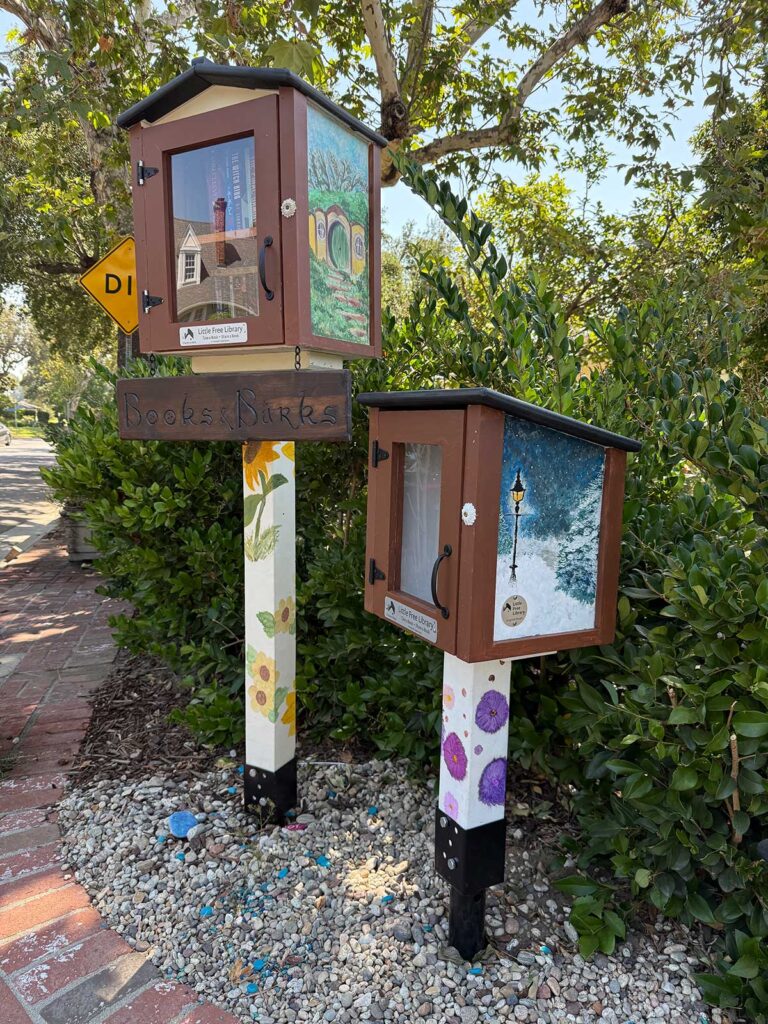
3500 Block Grayburn Rd.
A newly decorated library with a supplemental children’s box.
UPDATE April 10, 2024:
A third Little Free Library has been added to the Chapman Woods neighborhood, on the 3400 block of Grayburn Road.

3400 Block Grayburn Rd
A new library popped up on Grayburn Road this spring and could use more books!
As an avid reader, I wanted to take a moment to recognize that we have two excellent Little Free Libraries in our neighborhood. Over 30 million adults in the United States read at a third grade level, so encouraging literacy is a necessary and worthwhile neighborhood pursuit.
Little Free Libraries work on the honor system and anyone can contribute books as well as borrow anything they like from the little library. There’s no time limit on borrowing, and everyone is encouraged to swap out a book to replace the one they borrowed, ensuring the library is always full for the whole community.

3600 Block Yorkshire Rd
A cute little library with real shingles and a full set of books!
How did Little Free Libraries start?
In 2009, Todd Bol of Hudson, Wisconsin, built a model of a one room schoolhouse. It was a tribute to his mother; she was a teacher who loved to read. He filled it with books and put it on a post in his front yard. His neighbors and friends loved it, so he built several more and gave them away.
By 2020 more than 100,000 Little Free Library book-sharing boxes have been installed worldwide. Read the full history here.
“I really believe in a Little Free Library on every block and a book in every hand. I believe people can fix their neighborhoods, fix their communities, develop systems of sharing, learn from each other, and see that they have a better place on this planet to live.”
–Todd Boll, creator of Little Free Libraries, who sadly passed away in October 2018 of complications from pancreatic cancer
How do I support Little Libraries?
Little Libraries depend on community support, so remember to grab a book (or three) that you want to share with the community and drop it off on an early morning walk. You can donate books you’ve read but haven’t touched in years, gifted books you’ve never finished, or old children’s books your kids are too old for. Or buy a box of books from a rummage or library sale to add to the variety.
Not only are Little Libraries a great way to reuse books and save on paper waste (good for the environment!), but also a great way to find books and save money. They can also help your kids discover and enjoy books they may not have come across on their own, and encourages sharing in the process.
Let us know if any more Little Libraries pop up in the neighborhood and happy reading!
]]>As the weather warms up the kids want to be outside, and there are some great areas for them to expend their energy better than the front yard. Pasadena has many amazing parks with different playground equipment, as well some other fun alternatives to keep them occupied. Want to add a spot we missed to the list? Send a note to editor@chapmanwoods.net and let us know!
Eaton Blanche Park

This is one of the most well-kept parks in the area, and is probably the closest park to Chapman Woods. It has nice playground equipment, picnic tables, and a large field for sporting events. Open 6 a.m. to 10 p.m. at 3100 E Del Mar Blvd, Pasadena, CA 91107.
Grant Park

This 2.7-acre neighborhood park offers sport courts & fields, a picnic shelter & play equipment. It’s just a short drive from Chapman Woods at 232 S Michigan Ave, Pasadena, CA 91106. And Ginger Corner Market is conveniently located across the street so you can grab snacks or a sandwich from their deli.
Santa Anita Mall

The Santa Anita Mall has TWO excellent play areas, one indoors for the rare Southern California rainy days, and one outdoor playground on the second floor. The indoor area is great for toddlers. 400 Baldwin Ave, Arcadia, CA 91007
Michillinda Park

Also a hop, skip and a jump from Chapman woods, Michillinda Park is an excellent spot for a variety of playground equipment. A little bit noisy off of Huntington, but an excellent spot early in the morning, and has great little picnic areas for birthday parties. 3800 S Michillinda Dr, Pasadena, CA 91107. Closes at 8 p.m.
Lacy Park

The park features lush vegetation, open grass space, a rose garden, walking loops, tennis courts, and many other amenities and playground areas. Non residents have to pay a $5 entry fee on the weekends, but well worth it, such a beautiful park! Closes at 8 p.m. 1485 Virginia Rd, San Marino, CA 91108.
Caltech Campus

I know this is sort of random in the list of parks, but hear me out. Caltech has a beautiful campus with all sorts of beautiful water features (like the turtle garden) and pathways. This campus is perfect for an early morning stroll with your kids and they can bring a scooter or bicycle without worrying about traffic. Usually plenty of parking on California or Hill. 1200 E. California Blvd, Pasadena, CA 91125.
Playhouse Village Park

An excellent little playground near Old Town at 701 Union St, Pasadena, CA 91101. It’s small but has some nice playground equipment, a ramp for scooters and a sandbox area. Clean restrooms nearby and canopies for shade make this a great pit stop on the way to Target or Vroman’s Book Store.
Victory Park

North of the 210, this park has a playground, community baseball, softball & soccer fields with mountain views, plus an indoor gym & rec center. This is the park where the Rose Parade ends and you can see a whole bunch of floats! 2641, 2575 Paloma St, Pasadena, CA 91107 and closes at 6 p.m.
Huntington Library Children’s Garden

For $25 adult general admission (or free with membership) you can bring your kids to the wonderful Huntington Library Children’s Garden. A ton of fun little water features to help beat the heat, we recommend swim gear and Crocs! Open 10 a.m. to 5 p.m., closed on Tuesdays. 1151 Oxford Road, San Marino, CA 91108.
]]>Alfred Beck Chapman in 1879 bought about 1,600 acres of the Rancho Santa Anita from Duarte Road to the foothills, eventually harvesting fruit from nearly 10,000 citrus trees. His ranch included the present Chapman Woods as well as the Hastings Ranch area.

Chapman married Mary Scott, the daughter of Los Angeles attorney Jonathan R. Scott, with whom he studied law. In 1861 he set up a partnership with Cameron E. Thom.
In 1863 Chapman became city attorney of Los Angeles, replacing Myer J. Newmark, who resigned, and in 1868 he was elected district attorney of Los Angeles County. He went into partnership with a boyhood friend, Andrew Glassell, when the latter arrived in Los Angeles in 1866. Colonel George H. Smith, a former Confederate Army officer and brother-in-law of Glassell, joined the firm in 1870. Their law practice was confined chiefly to real estate transactions, and they made their fortunes by handling the large partition suits. Chapman was the businessman of the firm. He took his compensation in land, and nearly every final decree in partition would find that Glassell & Chapman had acquired more property.
Chapman and Glassell are best known in Orange County for being founders of Orange, California. The firm represented the Yorba and Peralta families in the partitioning of Rancho Santiago de Santa Ana in 1867, and had received for a portion of their fees certain large parcels of land in the partition. He joined with one of his partners, Andrew Glassell, to develop a new community, Richland (which would eventually be named Orange). They hired the land surveyor, Frank Lecouvrier of Los Angeles, to map this tract, which they called Richland Farm District. ‘Richland’ was originally the name of the Virginia plantation owned by the father of Andrew Glassell in the 1830s.
A large transaction by Chapman and Glassell was the legal suit known as “The Great Partition of 1871”, brought against the Verdugo Rancho San Rafael properties on the Los Angeles River and in the Verdugo Mountains. The legal fees were again paid in substantial land transfers. He at one time also owned “practically all the land” where Glendale, California, and the suburb of Tropico were established.[9]
Chapman continued to practice law until 1880. After retirement, he devoted full-time to managing his 700-acre rancho in the upper San Gabriel Valley, a portion of the Rancho Santa Anita grant, and became involved in citrus production.
The neighborhood of Chapman Woods in Pasadena, the site of Chapman’s rancho in the San Gabriel Valley, is named after Alfred Chapman.
From Wikipedia
