The report’s key findings include that:
- In the last decade death sentences in Bahrain have risen by over 600%, with 51 people being sentenced to death since the Arab Spring protests, compared with 7 death sentences in the decade before the Arab Spring.
- In 2019 the rate of executions in Bahrain was almost two-thirds of the per capita rate of executions in Iran, one of the world’s top executioners.
The report also shows that the use of torture is “endemic” in Bahrain, particularly in ‘terrorism-related’ death penalty cases. Its findings include that:
- 83% of the men executed in Bahrain since 2011 were convicted of terrorism charges and 100% of these individuals alleged torture.
- 26 men currently facing imminent execution are on death row as a result of unsafe capital convictions and death sentences. 11 of them allege torture and court documents demonstrate that this includes individuals whose convictions were based on false torture ‘confessions’. All 11 cases are connected to political opposition.
- Torture investigations which meet minimum standards have not been carried out in any of these cases.
Many of those convicted of ‘terrorism-related’ offences had attended pro-democracy protests, with overly broad definitions of terrorism in the Terrorism Act being used to detain protesters and opposition leaders.
Indeed, the report’s publication today (13 July) marks the one year anniversary of the of the Bahraini Court of Cassation’s decision to uphold Hussain Moosa and Mohammed Ramadhan death sentences, who were tortured and convicted on the basis of a ‘confession’ obtained through torture following their attendance at peaceful, pro-democracy protests. They face imminent execution by firing squad and their family and international observers may not even be notified in advance.
Mohammed has described being blindfolded, stripped, and beaten with iron rods. Hussain has described being beaten with shoes and batons, being sexually assaulted and threatened with rape, and deprived of food and water, while interrogators repeatedly ordered him to confess to killing a police officer. Hussain ‘confessed’ in order to end this torture and recanted in court.
Download the Report or Read it Online
Sayed Ahmed Alwadaei, Director of the Bahrain Institute for Rights and Democracy, commenting on the launch of the report, said: “Sentencing torture survivors to death for their opposition to the government is a heinous act of revenge by Bahrain’s regime. For those facing imminent execution, the uncertainty of knowing they could be executed at any time is causing an unspeakable strain on their lives and those of their families. Having trained institutions which facilitated death sentences against political prisoners like Mohammed and Husain, the British government has a moral obligation to speak out against this injustice before it is too late.”
]]>
The report, entitled “The Cost of Repression,” published by the All-Party Parliamentary Group (APPG) on Democracy and Human Rights in the Gulf and drafted by secretariat Josie Thum of the Bahrain Institute for Rights and Democracy (BIRD), is the first in-depth investigation into the UK government’s support for the six states that make up the GCC: Saudi Arabia, Bahrain, the United Arab Emirates, Qatar, Kuwait and Oman. The investigation focuses on payments made to GCC states made through the Integrated Activity Fund (IAF), which operated between 2016 and 2020, and its successor, the Gulf Strategy Fund (GSF). The total cost to the taxpayer has reached £53.4million between 2016 and 2020, according to government figures.
The report reveals that payments from both funds have been found to benefit institutions in Bahrain and Saudi Arabia that “continue to be implicated in serious human rights and international law violations”, adding that the government’s mandatory human rights impact assessments are “flawed, improperly applied and entirely absent in some cases.” MPs are concerned that the government is “at risk of complicity” in abuses and will abandon its human rights standards as Boris Johnson seeks to secure free trade agreements with GCC states post-Brexit.
Both the IAF and GSF have long faced criticism from MPs and rights groups. In the report, MPs allege the funds lack transparency and accountability and accuse the government of being “misleading and deceptive” and making “false” statements about the way the funds have been used. Internal government documents obtained via the Freedom of Information Act and featured in the report reveal that as early as August 2019 the government recognised the need to “strengthen the transparency, accountability and governance” of the IAF and recommended “a root and branch overhaul.” However, there is little to suggest that the GSF will be more transparent than its predecessor, with the government continuing to withhold key information about the fund’s beneficiaries.
Concerns have also been raised over the government’s announcement at the end of June that GSF funds have been earmarked to establish a regional “cyber ambassador” to provide “opportunities for UK companies to export cyber security products and services.” The government received heavy criticism last year when rights groups revealed that the UK had sold £75million of spyware, wiretaps and other telecommunications interception equipment to repressive states, including Bahrain, amid evidence of the widespread use of surveillance technology by Gulf states to spy on dissidents, including the murdered Saudi journalist Jamal Khashoggi.
Andy Slaughter, Labour MP for Hammersmith and APPG Vice-Chair, commented: “Millions of pounds are being taken from the British taxpayer and spent secretively in Gulf states, some of the richest nations on earth. Despite a severe deterioration in human rights in states like Bahrain and Saudi Arabia, the government continues to ignore warnings from parliament, human rights groups and their own evaluations and throw millions of pounds of public funds at institutions consistently implicated in human rights violations. This funding should be halted pending an immediate investigation.”
Josie Thum, Secretariat of the APPG and Research and Policy Associate at the Bahrain Institute for Rights & Democracy (BIRD), commented: “Despite pouring millions of pounds into Gulf states over the last five years, this report shows that UK-backed institutions continue to be implicated in appalling human rights violations, including alleged war crimes, executions and the torture of children. As they seek to deepen trade ties with the Gulf, the government must start putting people above profits and come clean with the public about how their money is being spent in the region.”
]]>
In May 2015, Human Rights Watch urged Bahraini authorities to order an independent investigation into allegations that security forces used excessive force stating that those involved should be held to account. In June 2015, BIRD, Americans for Democracy and Human Rights in Bahrain (ADHRB) and the Bahrain Centre for Human Rights published a report, Inside Jau: Government Brutality in Bahrain’s Central Prison, exposing the Bahraini government’s response to the prison riot at Jau Prison in March 2015.
Although “these memories are painful” for Ali, he writes that it is “necessary to recall them to bring justice to the torture victims.” To quell unrest in Jau prison on March 10 2015, Ali says that prison authorities used methods far beyond what was necessary befitting the circumstances, using tear gas and rubber bullets, as well as expanding bullets that are illegal under the Hague Convention. Ali also remembers how prisoners were beaten and tortured with wooden boards, electrical wires and pipes.

Accused of incitement, Ali and over 100 others were placed in solitary confinement, where they experienced severe forms of physical and psychological torture for 90 days. This included sleep deprivation, forced standing for long hours, being deprived from using toilets, and being made to listen to the screams of prisoners being tortured day and night.
While prison authorities enjoy impunity for their abusive actions, 60 prisoners were sentenced to an additional ten years in prison and issued a fine of half a million dinars.
Ali, who has been in prison since 2013 and is serving a 10 year sentence, says he has lodged multiple complaints to Bahraini oversight bodies, but that they are “still yet to take action”. He further accuses the Bahrain Ministry of Interior and prison administration of using the 2017 escape of several prisoners to justify the use of abusive and torturous methods used against prisoners.
The letter ends with Ali claiming that the “UK government’s partnership with Bahrain makes them complicit in the violation of political prisoner’s rights”.
Read the full letter below
Today, the 10th of March, marks the 5th anniversary of the mass abuse that occured in Jau Prison. Jau is Bahrain’s largest prison, overflowing with activists and political prisoners stemming from the political crisis that began in February 2011. These memories are painful, but it is necessary to recall them in order to bring justice to the victims of torture.
In most prisons around the world, it is standard practice in the event of a rebellion to take necessary measures to control the situation. In these circumstances, the prison may use these powers until the situation is controlled, after which the prison must return to its normal state. However, for an extended three month period, from the 10 March to 1 July 2015, we suffered greatly in the prison from collective punishment in a flagrant violation of human rights principles.
The prison administration has used foreign forces in the prison, including the Jordanian Gendarmerie Forces, who were present from 2014 to 2017 as part of a training agreement.
The first day of the abuse was extremely terrifying. Excessive force was used against unarmed prisoners resulting in severe injuries. This included the use of tear gas and rubber bullets as well as expanding bullets, which are illegal under international law. In addition, we were beaten and tortured with batons, wooden boards, electrical wires, and pipes. The prison administration also ordered all prisoners to be removed to the prison yards, exposing them to the harsh climatic conditions for a long period of time.
In addition, more than 110 prisoners including myself were isolated in a new building for incitement. The collective punishment inside lasted for about ninety days, in which the most horrific and systematic forms of torture were practiced against us including:
- Physical torture, inflicted collectively on all of the prisoners, followed by random selction of prisoners for further torture in the form of kicking and beating with batons; and
- Psychological torture and humiliation including insults, forcing prisoners to imitate animals, head shaving, sleep deprivation, denial of bathing, forced standing for long hours, dousing them with cold water, forcing prisoners to defecate and urinate in their clothes, and listening to the screams of prisoners being tortured day and night.
The ridiculous thing about all of this, is that the Public Prosecution and the Prison Administration launched an investigation where nearly 50 prisoners were tortured into providing confessions, yet to this day, they enjoy impunity. This ended with the criminalisation of 60 prisoners, who were sentenced to an additional 10 years and issued a fine of half a million dinars.
I am one of the political prisoners in Jau who has been in prison since 2013. I witnessed these events in the second year of my 10 year sentence. During my time in prison, I have been subjected to the most horrific types of physical and psychological torture because of my activism to call for an end to the use of torture and the improvement of services and provision of health care in the prison. My activism led to officers and guards taking me from my cell on several occasions and assaulting me by all means and methods. I have filed several complaints with the institutions responsible for investigating torture, who have still yet to take action.
To this day, the Ministry of the Interior and Prison administration continues to use the escape of several prisoners in 2017 to justify the use of these methods. The prison administration has since continued to use collective punishment and physical and psychological torture methods in violation of international covenants and charters.
In light of the events mentioned, I am calling upon the UK Foreign Office to respond to my questions. What is the purpose of continuing the British training program with the Bahraini government, benefitting the Jau Prison Administration, the Ombudsman’s Office, the Special Investigations Unit and the Public Prosecution without changing the behavior of these institutions? Thus, UK government’s partnership with Bahrain makes them complicit in the violation of political prisoner’s rights.
Ali AlHajee, Jau Prison
10 March 2020
]]>The report points to the Bahrain’s government’s violent crackdown on its citizens as evidence of an unrelenting campaign against all forms of dissent. All opposition parties and independent media remain dissolved, while protests continue to be brutally crushed, critical voices targeted and online criticism policed through obtrusive cybercrime legislation. Over 300 people were convicted in mass trials during 2019, while the judiciary continued to rely on confessions rather than physical evidence, encouraging the persistence of torture in Bahraini detention centres.
Deteriorating Prison Conditions
The report also sheds light on the deterioration of prison conditions in Bahrain throughout 2019, with inmates describing a range of abuses including religious discrimination, torture and unsanitary conditions, amongst other issues. These issues compelled over 600 prisoners to launch a hunger strike in August 2019 to demand their basic rights be respected.
Bahrain was also widely condemned for its consistently failing to provide inmates with an adequate standard of medical care, with Joe Stork from Human Rights Watch describing the practice as “outrageous”. Aging opposition leaders including Hassan Mushaima and academic Dr Abdujalil al-Singace complain that they are systematically subjected to medical negligence due to their political status. Similarly, Hajer Mansoor, who remains arbitrarily detained in reprisal for the activism of her son-in-law, BIRD Director of Advocacy Sayed Ahmed Alwadaei, has regularly reported medical negligence at Isa Town Female Detention Centre, alongside targeted discrimination by prison authorities.
Continued British Support, Despite Abuses
BIRD found that the government of the United Kingdom has consistently failed to acknowledge or act upon international warnings about human rights violations in Bahrain, while maintaining technical and financial support to institutions known to be ineffective or abusive. Funding for the UK government’s so-called “technical assistance” to Bahrain continues to be channeled through the highly secretive Integrated Activity Fund, precluding adequate scrutiny of Britain’s relationship with Bahrain.
The report also highlights a number of government scandals, including the $5 billion Petrofac lobbying scandal, the storming of the Bahraini embassy in London by police in mid-summer and the ongoing torture debacles at the University of Huddersfield. In a unique move, the report tracks official and unofficial visits by British ministers, diplomats and members of the armed forces to their Bahraini counterparts, to illustrate the intimate links between powerful British institutions and Bahrain’s ruling elite.
Sportswashing Emerges as Key Regime PR strategy
Throughout 2019, BIRD’s campaigning and advocacy focused heavily on exposing Bahrain’s attempts to normalise its position in the global economy through investment in sporting and cultural events. A chapter in the report tracks the tangled web of economic interests tying Bahrain’s ruling elites to a wide portfolio of sporting ventures, including motorsport, athletics, cycling and combat sports, which have proven to be both effective PR and highly lucrative.
As “sportswashing” has become increasingly central to Bahrain’s international relations strategy, the government has aggressively targeted any of its citizens who undermines the image of prosperity and normalcy that they have tried to project. In 2019, BIRD successfully exposed Bahrain’s targeting of those who criticise the government’s cynical exploitation of professional sport, with significant campaigns contributing to the release of refugee footballer Hakeem AlAraibi and activist Najah Yusuf and professional footballer Hakeem AlAraibi.
Sayed Ahmed Alwadaei, Director of Advocacy at The Bahrain Institute for Rights and Democracy (BIRD) commented: “The situation in Bahrain continued to deteriorate in 2019 and sadly there is little sign that it will improve as we enter a new decade. Bahrain’s regime has been emboldened by the apparently unconditional support of their British allies and as we enter the post-Brexit era, the UK’s propensity to put trade above human rights seems likely to increase.”
Read the full report here
]]>Two detained human rights defenders, as well as the family members of four detained opposition activists, told Human Rights Watch and BIRD that prison authorities are arbitrarily denying the prisoners urgent medical care, refusing to refer them to specialists, failing to disclose medical examination results, and withholding medication as a form of punishment. All six detainees are serving prison terms in connection with their prominent roles in opposition and pro-democracy protests in 2011 onward.
“It is outrageous that Bahraini authorities are denying detainees medical care that they urgently need, in some cases putting their lives in danger,” said Joe Stork, deputy Middle East director at Human Rights Watch. “Many of these people should not have been imprisoned in the first place, and arbitrary denial of medical care may amount to extrajudicial punishment.”
Denying a prisoner needed medical care violates the United Nations Standard Minimum Rules for the Treatment of Prisoners, known as the Mandela Rules.
The health of Abduljalil al-Singace, 57, has deteriorated significantly in detention, his family said. Al-Singace, an academic who was a spokesman for Al Haq, an unlicensed opposition group, is serving a life sentence for his prominent role in the 2011 protests. Al-Singace, who suffered polio as a child and needs to be able to hold crutches to walk, has been experiencing severe chest pain, numbness in his fingers, and shaking in his left hand since August 22, 2019.
Al-Singace’s daughter said that he saw the prison doctor on August 28, for the first time since 2017. Earlier requests for medical attention for neck and back pain that his family said resulted from torture had been denied. Nor did prison officials authorize the white blood cell checkups he needs due to complications arising from a prolonged hunger strike in 2015.
The prison doctor recommended on August 28 that he should see a heart specialist in the Bahrain Defense Forces (BDF) Hospital. On the day of the appointment, prison authorities told al-Singace that they would not take him there as he had refused to put on the prison uniform or wear shackles, his family said.
Hassan Mushaima, 71, the head of Al Haq, was sentenced to life in prison for his peaceful opposition activity. Mushaima is recovering from lymphoma and requires screening tests every six months. Mushaima’s son said that the last screening occurred in August 2018, following the son’s 46-day hunger strike in London. Mushaima did not receive the results until April 2019. Prison authorities promised to conduct another screening in August, Mushaima’s family said, but had not as of October 2.
Mushaima’s son said that authorities routinely denied Mushaima specialized medical care for his chronic illnesses, which include diabetes, high blood pressure, and gout. Prison authorities insist on shackling Mushaima during transfers to hospital appointments, but he has refused to go under these circumstances, considering it humiliating and unnecessary, his son said.
Under the Mandela Rules, prisoners who require specialist treatment should be transferred to specialized institutions or to civil hospitals. Since 10 prisoners escaped from Jaw Prison on January 1, 2017, authorities have shackled all prisoners whenever they leave their cells. International human rights mechanisms have said that the use of restraints on elderly or infirm prisoners who do not pose an escape risk can constitute ill-treatment. Rule 47 of the Mandela Rules states that restraints should only be used to prevent escape or to prevent prisoners from injuring themselves or others.
Naji Fateel, 45, and Ali Hajee, 36, who are also serving long sentences due to peaceful opposition activities, also reported consistent denials of medical care. Fateel suffers from spinal and other injuries that he said resulted from torture in detention, as well as high cholesterol. He told Human Rights Watch that prison authorities do not provide him with required medications, and several times canceled scheduled operations for injuries to his arm and leg. Hajee said prison authorities have denied him permission for a necessary surgery to his lower jaw as well as dental implants.
The Bahrain Independent Commission of Inquiry (BICI), set up by King Hamad to investigate the government’s response to the demonstrations in February and March 2011, concluded that approximately 300 people had been convicted by military courts solely for exercising their right to freedom of expression and assembly. The commission said the authorities should “commute the sentences of all persons charged with offenses involving political expression, not consisting of advocacy of violence.”
Jaw Prison authorities have also denied medical care to prisoners convicted of violent political crimes. Elyas al-Mulla, 28, has stage three colon cancer. His mother told Human Rights Watch that he is suffering from colon pain, pain under his ribs, nausea, and fatigue. Al-Mulla was transferred to a hospital briefly at the end of August for tests, but his mother said she was not informed of his condition and prison authorities have not given him the test results. She said that after chemotherapy sessions prison authorities did not always provide him with the necessary immunity medication, nor did they perform tests requested by al-Mulla’s radiologist. Al-Mulla’s mother said that every time he was transferred to and from a hospital, including after his chemotherapy sessions, authorities shackled him, often causing him severe pain and bleeding.
A family member of Ahmad al-Arab, 27, told Human Rights Watch and BIRD that al-Arab has not been permitted to visit a doctor or receive medication since he tried to escape from prison in 2017. The family member said that al-Arab suffers from severe pain in his leg and his back, as well as several broken teeth, which they alleged were the result of torture.
On August 15, more than 600 prisoners in the Jaw Prison and Dry Dock Detention Center began a hunger strike to protest prison conditions, including denial of medical care.
The people who spoke with Human Rights Watch and BIRD said they had not recently filed complaints with Bahrain’s oversight agencies, including the National Institution for Human Rights and the Ministry of Interior Ombudsman, saying they did not trust them or have confidence that they would help.
Human Rights Watch has found that both of these bodies have repeatedly failed to investigate credible allegations of prison abuse or to hold officials accountable. The UN Committee against Torture has raised concerns that these bodies were neither independent nor effective.
“Bahrain’s oversight bodies should uphold their mandates and investigate these serious allegations of medical negligence,” said Sayed Ahmed Alwadaei, advocacy director at BIRD. “Without effective and independent oversight institutions promoting accountability for human rights violations, prisoners remain at risk of reprisals while perpetrators continue to act with impunity.”
]]>
The 135-page report, Breaking the Silence: Bahraini Women Political Prisoners Expose Systemic Abuses, reveals a sinister increase in the political targeting of female activists and human rights defenders since 2017 as part of a wider crackdown on free speech and peaceful opposition, which coincided with the reinstatement of the National Security Agency (NSA)’s arrest powers in January 2017. Between April and May 2017, two of the women featured in this report suffered the most severe abuse at the hand of NSA officers, including allegations of torture, sexual assault and rape.
Since early 2017, BIRD and ADHRB have been conducting interviews with nine women or their relatives. These women have been targeted for their political views or those of their family members. BIRD and ADHRB have also interviewed their lawyers and, when available, have analysed their legal documents. Seven experts from organisations including Amnesty International, Human Rights Watch and the World Organisation Against Torture, have provided commentary throughout the report.
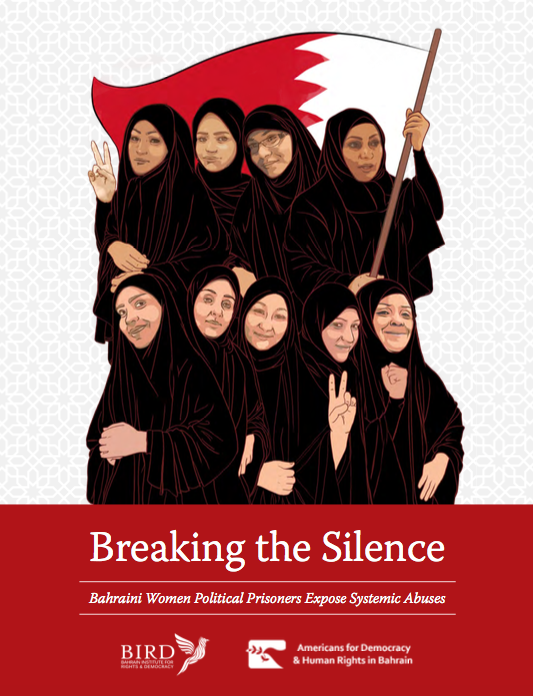
Key Findings
- The women said that, following unlawful arrests – including three cases of enforced disappearance – they endured coercive interrogations without legal representation. These were conducted at the Criminal Investigation Directorate (CID) or the National Security Agency – Bahrain’s Intelligence agency, which have been the subject of many controversial allegations regarding the use of physical and sexual abuse during interrogations. Coerced confessions were used to convict at least six of the women in sham trials.
- While all the women said that throughout the process officials threatened them with rape or death and that of their families, half of them said they were physicially assaulted with beatings, kicks and punches. Other forms of ill-treatment reported include prolonged solitary confinement, forced standing, and being held in cold or dark rooms in painful positions for several hours. “The torture started from the first moment in the car by masked, armed, civilian-clothed men.” said Medina Ali, one of the women, “ I was blindfolded and tortured with violent beatings aimed at the face and hitting my head against the wall violently”.
- The two women interrogated by the National Security Agency – Ebtisam AlSaegh and Najah Yusuf, a former political prisoner convicted in relation to Formula One’s Grand Prix – said they were sexually assaulted during their interrogation at the Muharraq Security Complex after refusing to work as informants. The Director of the Muharraq Security Complex was a beneficiary of a £16,000 UK taxpayer-funded training in 2015. Ebtisam AlSaegh said that her interrogation boasted of his reputation for inflicting torture and pain on detainees, stating: “The interrogator said: ‘I am called the Torturer, my hobby is torture, my profession is to torture. I have the art of torture’.”
- Two of the women, Ameera AlQashami and Faten Naser, were convicted in the same mass-trial as torture victims Ali-AlArab and Ahmed Al-Malali, who were recently executed in what the UN called “extrajudicial killings.” While in August 2019 the two were released for manual labour under alternative sentencing, two other eligible women – including Hajer Mansoor who was declared to be arbitrarily detained by the UN – were denied non-custodial sentences. The UK government spent over £14k to invite delegations from Bahrain’s Ministry of Interior and Ministry of Justice to discuss the scope and implementation of the new law as part of its technical assistance. Bahrain’s leading human rights defender Nabeel Rajab, who was declared unlawfully detained by the UN, was also denied a non-custodial sentence last May.
- The nine women denounced appalling prison conditions, including deliberate denial of medical care, restrictions on family visits and time outside the cell, threats and “humiliating” searches. The women have identified the head of the prison – Lieutenant Colonel Mariam Albardoli – as a principle perpetrator of arbitrary and abusive practices, and as having enacted physical assault against Medina Ali and Hajer Mansoor.
- Meanwhile, local human rights oversight institutions, which are beneficiaries of training funded by the UK government, have failed to adequately investigate allegations of abuse while remaining tightly linked to the Bahraini government. BIRD and ADHRB have reviewed complaints submitted to oversight bodies by six women and their families since 2017 and found that each one of them have, to date, have been improperly addressed. By failing to respond to complaints in a timely manner, conducting inadequate investigations and breaking their confidentiality policies, oversight institutions have contributed to the whitewashing of human rights violations and a climate of impunity in the country.
- Finally, the report exposes the complicity of the UK and the US governments, which continue to supply arms, training and political support to the Bahraini regime in flagrant disregard of international human rights concerns. While the US Department of State has to some extent commented on torture allegations and “unlawful killings” in Bahrain, the UK has failed to address in any public way the abuses perpetrated against the women of this report and other political prisoners raised by Parliamentarians. Instead, they rely on the assurances of the Bahraini Embassy in London.
- The Bahraini Embassy to the UK typically issues statements misrepresenting facts, dismissing torture and ill-treatment allegations levelled against the Bahraini authorities and revealing information before the appropriate authorities in Bahrain. They have also disclosed to a British MP the outcome of one of the women’s conviction a week before it took place and coordinated with domestic oversight bodies in Bahrain to divulge private information on social media without prior consent. Recently, they have been accused of assaulting a Bahraini activist.
BIRD and ADHRB recommend that Bahrain should allow access to the Special Rapporteur on torture as well as the Special Rapporteur on violence against women and the Working Group on Arbitrary Detention. BIRD and ADHRB also recommend that Bahrain conduct a “timely, transparent and thorough investigation into allegations of arbitrary arrests, coercive interrogation tactics and physical and sexual assault, ensuring that all responsible officers are held accountable.”
Quotes:
- Former political prisoner Najah Yusuf said: “This report is crucial to political prisoners and to others who have suffered through the horrendous human rights violations that I and the other women in this report were subjected to. We are breaking the silence and speaking out about these violations so that these abuses won’t occur to anyone else, especially in circumstances where the perpetrators feel they can act with impunity. Despite everything that happened to me, I am one of the few lucky ones – I was pardoned and released. However, thousands of other political prisoners and women still remain imprisoned in appalling conditions. While we have broken the silence, we need the international community to listen and to act!”
- Commenting, Lucilla Berwick, Research and Advocacy Associate at BIRD said: “The nine women featured in this report have shed vital light on the systematic and largely unreported abuse faced by female political prisoners in Bahrain. The physical, sexual and psychological violence they have been subjected to epitomise a flawed system which these women have bravely challenged by speaking out. While many of these women still languish behind bars with limited access to their most basic rights, the UK and US continue to profit from their lucrative relationships with Bahraini, funding training to oversight bodies which facilitate a culture of impunity among state officials that further encourages repression .”
- “The experiences that these women have described exhibit a complete and total disregard for international human rights law,” says Bridget Quitter, Legal Officer at ADHRB. “At every juncture – arrest, interrogation, trial, and imprisonment – the Bahraini authorities have flouted both Bahraini domestic provisions, as well as their international obligations under treaty law. The commonalities in these cases are so similar that they have uncovered what is a widespread and systematic miscarriage of justice.”
Read the Report: Breaking the Silence: Bahraini Women Political Prisoners Expose Systemic Abuses pdf.
]]>Torture and Unfair Trials
The 2018 report neglects to document the numerous allegations of torture, ill-treatment and abuse of individuals who dissent against the Bahraini government; an issue which the US State Department acknowledged had “continued during the year” in their respective report on Bahrain. Widespread reports of unfair trials and due process violations stemming from a corrupt criminal justice system were also included in the US report, but were omitted from the UK equivalent.
Death Penalty and Citizenship Revocation
The FCO also glosses over issues such as the rise in death penalty sentences and citizenship revocation, which have gained significant international criticism. In 2018 alone, 304 individuals were arbitrarily stripped of their citizenship by either civil or military courts – the highest number since this practice was introduced in 2012 to silence political dissent. That same year, 12 individuals were sentenced to death with the UN expressing serious concerns that that capital punishment cases in Bahrain involve “allegations that confessions […] were obtained under torture and used as evidence in court, thus forming the basis for conviction […]” in December 2018.
Freedom of Expression and Human Rights Defenders
Criticism of the country’s crackdown on freedom of expression and reprisals against activists and human rights defenders in 2018 is also scarce. The clampdown on freedom of expression is only referenced in relation to the 5-year sentence handed down in February 2018 on the country’s leading human rights defender, Nabeel Rajab. However, the report fails to acknowledge the severity of the situation. Despite his conviction stemmed from his peaceful twitter activity, with the UN Working Group on Arbitrary Detention (WGAD) declaring him “arbitrarily detained” in August 2018, the FCO failed to call for his release.
The UN WGAD also found the targeting of London-based human rights defender Sayed Ahmed Alwadaei and his relatives to be unlawful and in reprisal to Mr Alwadaei’s human rights activity. The FCO, however, is yet to acknowledge the reprisals and missed the opportunity to do so in their report by neglecting to mention the case entirely.
The WGAD further raised concerns that in Bahrain, the “widespread or systematic imprisonment…in violation of the rules of international law may constitute crimes against humanity”. Similar concerns were echoed in a resolution adopted by the EU parliament in June 2018, which condemned the “increased crackdown on human rights defenders” by imposing “prison sentences, exile, travel bans, revocation of citizenships or severe threats and intimidation”. In its 2018 report, Human Rights Watch stated that “civilian and military courts continue to convict and imprison peaceful dissenters, including prominent human rights defenders and opposition leaders, under the guise of national security”.
Treatment of Political Prisoners
Despite substantial reports of punitive measures, threats and physical assault being brought to the attention of the UK government, the report omitted to comment on the deterioration of prison conditions in the country. In July 2018, the UN Human Rights Committee expressed concerns for the “inhuman prison conditions, including serious overcrowding, unsanitary conditions, inadequate access to drinking water and unhygienic toilet facilities, particularly in the Jau prison”. In September 2018, Amnesty international discussed the “disruptions, delays and needless, petty cruelty” as well as the general negligence of healthcare in Jau prison and Isa Town Prison, the country’s only female detention centre. Political prisoners Hassan Mushaima, Hajer Mansoor and Ali Al-Hajee, for example, are just a few individuals who were denied adequate medical care for a series of urgent medical issues.
Impunity and Oversight Bodies
The impunity with which public bodies and individuals act is also underplayed. The report comments on oversight mechanisms in Bahrain, which, according to the FCO, “have already had a positive effect”. The FCO supports these bodies – the report elaborates – and has helped them develop “effective mechanisms to hold state institutions, including the police, the security service and the prison service, to account.”
These bodies, however, have been criticised extensively, most notably by the UN Committee Against Torture which condemned the use of “widespread” torture in Bahrain while labelling the oversight bodies as being neither “effective” nor “independent”. With regards to the Ministry of Interior Ombudsman, specifically, Amnesty International highlighted in a report published in September 2018 that victims or their families had filed complaints with “no result” and that in cases where action had been taken by the Ombudsman, “its follow-up has been ineffective”.
Following the physical assault led by prison officers against female political prisoners Hajer Mansoor and Medina Ali, for example, the National Institute for Human Rights issued a statement denying the allegations of mistreatment. Their conclusion fell in line with the position of Bahrain’s Ministry of Interior (MOI), who claimed that the bruises suffered by Hajer were self-inflicted.
Despite the concerns of the international community, including the UN, the report states that “the UK will continue to support Bahraini-led reform in 2019 by providing a range of technical expertise to promote the rule of law and further develop the work of Bahrain’s human rights oversight bodies.”
Endorsement of Widely-Criticised Electoral Process
With regards to the parliamentary elections held in November 2018, the report welcomes Bahrain’s “commitment to the democratic process” and highlights a statement issued by former FCO MENA Minister Alistair Burt welcoming the “successful conclusion” of the elections. These elections, however, were condemned by international legislative bodies extensively. The UK Parliament, US Congress, EU Parliament, Irish and Italian Parliaments have all thrown into question their legitimacy. In May 2018, this same Council of Representatives – for which Bahrain held the November election – passed an amendment to the Law on the Exercise of Political Rights. The legislation barred anyone who belongs to major political parties and those who have spent more than six months in prison from running for elected office.
The Bahraini government has in fact dissolved all political opposition parties, including Al-Wefaq National Islamic Society in 2016 and the secular-left National Democratic Action Society (Wa’ad) in 2017. In addition, no independent electoral commission currently exists, while international media and human rights bodies, including the UN, have been barred from entering the country, therefore no impartial body is capable of monitoring the elections.
]]>Prior to the compilation of the FAC report, the Bahrain Institute for Rights and Democracy (BIRD) made its own submission to the FAC, analysing the human rights work conducted by the FCO with regard to the Kingdom of Bahrain, as a component of the UK’s strategic agenda within the Gulf. In particular, BIRD’s submission sought to provide a factually thorough analysis of the ways in which the alliance between the UK and Bahrain has contributed to the regression of the protection of human rights and civil liberties in Bahrain.
The information BIRD provided to the Committee was then used as part of their final report. Paragraph 35 of the FAC report, in particular, states:
‘Written evidence also expressed concern about continued FCO assistance to Bahrain on human rights and the rule of law. Since 2012, the FCO has provided more than £5 million of funding for technical assistance to train Bahraini police and prison guards on human rights and investigate allegations of torture. This includes £400,000 for a public order project, despite crackdowns on public protest in Manama. Very few details of the spending, which is funded predominantly through the CSSF, have been made public. The Bahrain Institute for Rights and Democracy states that the FCO is “denying the severe violations perpetrated by the Bahraini government; as well as the failures of UK funded oversight bodies”. Since the commencement of the UK support programme, capital punishment has resumed, with 14 individuals sentenced to death in 2017. The FCO has assessed the situation in Bahrain as a “mixed picture”. Murray Hunt suggested that rule of law programmes should have clear performance markers: “We need to have agreed mechanisms in advance for scrutinising rule of law performance on the basis of agreed values that are spelled out in detail.’
In relation to the negative human rights impact of the technical assistance programme to Bahrain, paragraph 36 continues:
‘The FCO should outline clear mechanisms for measuring progress in its rule of law and democracy programmes. Whilst the door to negotiation with states must always be kept open, the FCO should respond firmly to countries that fail to make sufficient progress in these areas in order to underline the importance of international standards and rules on human rights. States that fail to make progress, or that regress, should be subject to repercussions, including the suspension of support. For the most extreme cases, such as the ongoing serious and systematic abuse of the Rohingya from Rakhine province by the Burmese government, the FCO should create a measured and graduated set of responses to human rights catastrophes. The FCO should review the current situation in Bahrain and Myanmar/Burma and report its findings to us to further consider whether funding should continue to either country.’
The report further states that ‘some evidence accused the UK of shielding allies such as Saudi Arabia and Bahrain’ from criticism before the UN.
Finally, the Committee concludes at paragraph 26 that: ‘The FCO should be clearer about how all such funding is allocated and used and what it achieves, and should inform us in its response to this report how it plans to increase transparency in this respect’.
]]>-
£5 million in UK assistance to Bahrain since 2012
-
Drastic decline in human rights during that time
-
Executions resumed
-
Death row tripled
-
Peaceful protesters abducted, tortured and sentenced to death
The Foreign Office has spent over spent over £5 million since 2012 on a programme of security and justice assistance to Bahrain. In that time, executions have resumed, the number of men on death row has tripled, and peaceful protesters have been abducted, tortured into false confessions and sentenced to death in sham trials.
British complicity in this repression includes training guards at a prison where inmates are regularly tortured, training an ombudsman who repeatedly misled foreign governments about whether complaints about torture had been made, and training an inspector of prisons who ignored credible allegations of torture.
There are currently twenty-three men sentenced to death in Bahrain, including four who have exhausted their appeals and could be executed at any time.
“A Global Britain should be proudly promoting human rights and the rule of law, not undermining them in secret. Despite having direct evidence that British-funded training may have contributed to torture and the death penalty in Bahrain, ministers are continuing their funding to that country’s oppressive Government. The only way for the public to be confident their money is not leading to abuses abroad is for the Government to publish a full and transparent account of projects we are funding, and the human rights risk assessments for each.”
Maya Foa, Director of Reprieve
Most of the British funding for this training came from the controversial Conflict, Stability and Security Fund. The UK has recently renewed its financial contributions to Bahrain, from two new pots of taxpayer money subject to even less oversight: the Global Britain Fund and the Integrated Activity Fund.
“British funding has been provided in complete secrecy, without parliamentary scrutiny, enabling Bahrain’s regime to whitewash its repressive institutions with impunity. Bahrain has been emboldened and is now sentencing more people to death than at any time in its modern history. It is critical that the UK and Northern Irish governments stop providing cosmetic assistance that achieves nothing beyond deflecting crucial international scrutiny from Bahrain’s abysmal–and worsening–human rights record.”
Sayed Ahmed Alwadaei, the director of advocacy at BIRD
LAUNCHED TODAY – a new report by Reprieve and Bahrain Institute for Rights and Democracy (BIRD) exposing, for the first time, the full involvement of UK-funded and trained institutions in torture and the death penalty in Bahrain.
Read the report: Training Torturers: The UK’s Role in Bahrain’s Brutal Crackdown on Dissent
]]>
We also emphasised that many allegations of torture are received from human rights defenders and journalists in Bahrain, who are routinely imprisoned as a form of retribution for their work. Specifically, we provided evidence of the intimidation activists such as Nabeel Rajab, the President of the Bahrain Centre for Human Rights, have faced since 2011. In its concluding observations on Bahrain, CAT called for Rajab’s immediate release.
]]>