Advertise with Googlier.com Blumberg Capital https://blumbergcapital.com/ Thu, 22 Oct 2026 20:00:44 +0000 en-US hourly 1 https://wordpress.org/?v=7.1.3 https://blumbergcapital.com/wp-content/uploads/2020/04/cropped-favicon-66x66.png Blumberg Capital https://blumbergcapital.com/ 32 32 From Seed to Salesforce: Celebrating Braze’s Next Chapter https://blumbergcapital.com/news-insights/from-seed-to-salesforce-celebrating-brazes-next-chapter/ Tue, 20 Oct 2026 16:23:16 +0000 https://blumbergcapital.com/?p=29775 Blumberg Capital congratulates Braze on its $5.66 billion acquisition agreement with Salesforce Key Takeaways Blumberg Capital led Braze’s first institutional seed round in 2011. Braze grew from a mobile-first startup into a global customer engagement platform. The proposed $5.66 billion Salesforce acquisition represents a major milestone in Braze’s growth. Braze’s evolution reflects the role of…

The post From Seed to Salesforce: Celebrating Braze’s Next Chapter appeared first on Blumberg Capital.

]]>
Blumberg Capital congratulates Braze on its $5.66 billion acquisition agreement with Salesforce

Key Takeaways

  • Blumberg Capital led Braze’s first institutional seed round in 2011.

  • Braze grew from a mobile-first startup into a global customer engagement platform.

  • The proposed $5.66 billion Salesforce acquisition represents a major milestone in Braze’s growth.

  • Braze’s evolution reflects the role of innovation, customer engagement, and AI in building technology companies.


By Bruce Taragin, managing director, Blumberg Capital

Today marks another milestone for Braze (NASDAQ: BRZE), which announced that it has entered into a definitive agreement to be acquired by Salesforce (NYSE: CRM) in a transaction valued at approximately $5.66 billion.

As Braze’s first institutional investor and a longtime board member, Blumberg Capital is proud to celebrate this milestone with co-founders Bill Magnuson, Jon Hyman and Mark Ghermezian, and the Braze team. From its earliest days as a mobile-first startup to its 2021 IPO and now this next chapter with Salesforce, Braze’s journey reflects the power of visionary founders, technological innovation and a relentless focus on customers.

A Vision That Started in 2011 with Braze’s Funding

Blumberg Capital led Braze’s first institutional Seed round in 2011, when mobile technology was fundamentally changing how consumers interacted with brands.

The founders recognized early that mobile technology and behavioral data would transform customer engagement, enabling brands to build more meaningful, personalized relationships with consumers.

What began as a bold vision became a category-defining business. Today, Braze serves more than 2,700 brands worldwide, helping marketers connect with customers across channels and in real time.

Building for What’s Next: AI-Powered Customer Engagement

Braze’s evolution illustrates the importance of anticipating major technology shifts.

The company recognized early that mobile would transform customer relationships. It subsequently helped brands embrace first-party data and coordinated engagement across digital channels. Today, AI represents the next major transformation, enabling businesses to move beyond traditional segmentation and campaigns toward intelligent, adaptive customer engagement.

Through BrazeAI, the company is helping marketers combine creativity, customer data and AI-powered decisioning to deliver more personalized experiences at scale.

The proposed combination with Salesforce represents an opportunity to accelerate that vision, bringing Braze’s real-time engagement capabilities together with Salesforce’s global reach, customer data and AI ecosystem.

Braze’s journey demonstrates how companies that continually innovate and adapt to transformative technology shifts can create enduring value.

Congratulations to Team Braze

It’s been a pleasure partnering with the Braze team, Bill, Job, Mark, Myles Kleeger, among many other talented employees, leaders and partners who have contributed to Braze’s success over the past 15 years.

We are proud to have been part of your journey and look forward to what comes next.

Read the official announcement.

The post From Seed to Salesforce: Celebrating Braze’s Next Chapter appeared first on Blumberg Capital.

]]>
David Blumberg on why Miami’s tech moment is still gaining ground https://blumbergcapital.com/news-insights/david-blumberg-miami-tech-ai/ Tue, 13 Oct 2026 22:18:57 +0000 https://blumbergcapital.com/?p=29769 Key takeaways Florida’s growing base of founders, investors, family offices, and companies is strengthening Miami’s role in the tech ecosystem. Miami can offer startups opportunities to build relationships with customers and institutions in a less-established tech market. AI is helping companies increase productivity and scale operations without proportionally increasing headcount. Blumberg Capital uses AI across…

The post David Blumberg on why Miami’s tech moment is still gaining ground appeared first on Blumberg Capital.

]]>
Key takeaways
  • Florida’s growing base of founders, investors, family offices, and companies is strengthening Miami’s role in the tech ecosystem.
  • Miami can offer startups opportunities to build relationships with customers and institutions in a less-established tech market.
  • AI is helping companies increase productivity and scale operations without proportionally increasing headcount.
  • Blumberg Capital uses AI across deal sourcing, company screening, investment analysis, and reporting.
  • AI adoption also requires attention to security risks and the potential for errors.


Originally posted on Refresh Miami.

David Blumberg has been investing in technology companies since long before Miami became a serious stop on the venture capital map.

As founder and managing partner of Blumberg Capital, which he established in 1991, Blumberg has watched several major technology cycles play out. Today, much of his attention is focused on artificial intelligence and the changes it could bring to companies, investors and the broader economy.

Miami has a role in that story, he argues. Blumberg sees Florida attracting more capital, founders and companies, while giving startups in some sectors an opening to build relationships and gain customers in ways that can be harder in more established tech centers. He is especially interested in what happens as AI makes smaller teams capable of building much larger businesses.

On the sidelines of SuperReturn in Los Angeles, Refresh Miami caught up with Blumberg to discuss the state of Miami tech, how AI is changing venture capital, what he is seeing from LPs and what founders and investors should keep in mind as they consider the opportunities ahead.

This interview has been condensed and edited for clarity.

Refresh Miami: How do you see Miami’s place in the tech ecosystem right now?

I think you have to look at Miami in the context of Florida more broadly. State policy matters because that is where a lot of the tax and regulatory environment is set. Florida has attracted a lot of people, wealth and businesses, and with that come new jobs, new industries and new companies.

You’re seeing more LPs move to Florida, especially family offices, and you’re seeing major companies establish a bigger presence here. It has become particularly strong in financial services.

The talent base is growing as well. Florida may not yet have the depth of engineers that some other markets have, but the technical universities are producing more talent, and people are increasingly willing to relocate here. The old idea was that you moved to Florida to retire. That’s no longer the case. Many people are coming here to work and to build.

What advantages can Miami offer founders compared with established tech hubs?

We’ve had several entrepreneurs from Israel move here, and one thing they found was that they could get access to leading doctors and researchers at the University of Miami and get new technologies into hospitals.

If you’re in Palo Alto, everyone is trying to get into Stanford. There’s tremendous competition for attention. Here, because the ecosystem is still developing, there can be more opportunity to get that time with people and institutions.

That can be very valuable for a startup. You need customers, partners and people who are willing to try something new. Sometimes being in a market that is still growing gives you an advantage.

What does a Florida-born startup look like in practice? 

One example from our portfolio is Flex Moving and Storage. It started in Miami and built a native AI platform around moving and storage.

The company manages a fleet of roughly 1,700 trailers, while people with pickup trucks can take jobs through its marketplace. The technology handles a lot of the routing and coordination that would traditionally require much more infrastructure and staff.

It started in Miami in year one, expanded across Florida, then moved into Texas, and now it’s spreading across the country. I think we’re going to see more companies follow that kind of path: start here, prove the model, and then expand nationally.

Miami played a good role in allowing the company to get started. And increasingly, we find employees want to move here too.

How significant is AI for the current generation of entrepreneurs?

I think we are still in the early innings of a very large technological and economic shift. What excites me most is the productivity improvement.

Across companies we invest in or evaluate, we’re seeing cases where AI can create three times, 20 times or even greater productivity improvements for certain tasks. That changes the economics of building a company.

Take Angle Health, where we were early investors. It built a technology-driven health insurance business and now has around 100 employees while handling more than $1 billion in premiums. A traditional health insurer at that scale might require significantly more people.

AI can handle processing, scheduling and a lot of the repetitive back-office work. That means companies can grow revenue without necessarily growing their cost base at the same rate. Ultimately, that can mean lower costs and better service for customers.

There are risks. AI can make mistakes, and there are security concerns. But every major technology comes with trade-offs. The goal should be to manage those risks while continuing to develop the technology.

How is AI changing the way Blumberg Capital operates?

We’re using AI everywhere we can. One area is deal flow. We can track people across the ecosystem: where they work, what they’ve produced, what they’ve published and what kind of technical background they have. That allows us to identify interesting people and reach out proactively before they necessarily come to us.

Then there’s filtering. We receive roughly 2,000 to 3,000 business plans a year and invest in about 10 companies. AI can help us quickly identify companies that simply aren’t a fit. Maybe they’re consumer businesses and we focus on B2B, or they’re outside the markets where we invest.

We also use it when preparing investment memos, summarizing companies, examining risks and looking at different potential outcomes.

And we’re using more AI in quarterly reporting. A lot of the work involved in moving numbers between formats or processing information is time that people could spend doing something more valuable.

Read more on Refresh Miami

The post David Blumberg on why Miami’s tech moment is still gaining ground appeared first on Blumberg Capital.

]]>
Why We Invested in Snorkel AI: $350M Series E at a $3.5B Valuation https://blumbergcapital.com/news-insights/why-we-invested-in-snorkel-ai-350m-series-e/ Thu, 08 Oct 2026 16:28:13 +0000 https://blumbergcapital.com/?p=29751 Snorkel AI is building the agentic data factory for the increasingly sophisticated data and environments behind frontier AI. By Jimmy Zhu and Jared Katzen AI models are becoming more capable and the data required to train, evaluate and improve them is becoming more sophisticated. As AI systems move beyond generating answers to reasoning and taking…

The post Why We Invested in Snorkel AI: $350M Series E at a $3.5B Valuation appeared first on Blumberg Capital.

]]>
Snorkel AI is building the agentic data factory for the increasingly sophisticated data and environments behind frontier AI.

By Jimmy Zhu and Jared Katzen

AI models are becoming more capable and the data required to train, evaluate and improve them is becoming more sophisticated. As AI systems move beyond generating answers to reasoning and taking action, developers increasingly need expert data, realistic environments and rigorous evaluations to test performance and identify where systems still fall short.

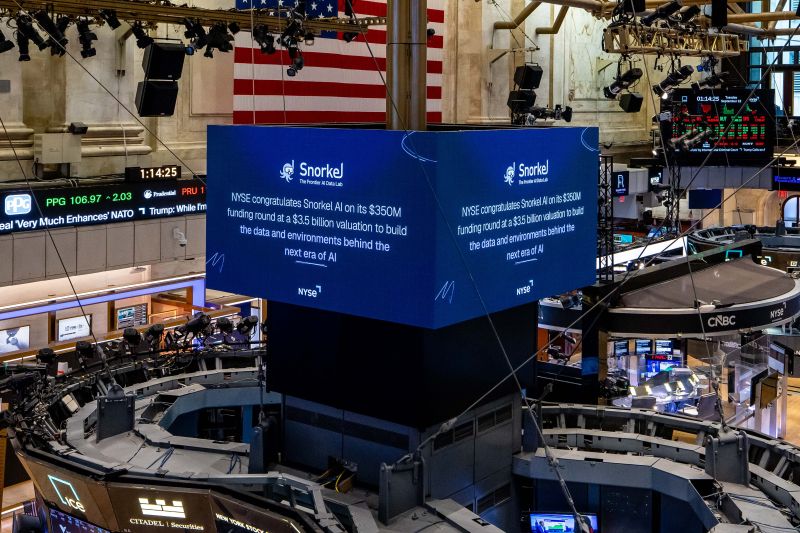
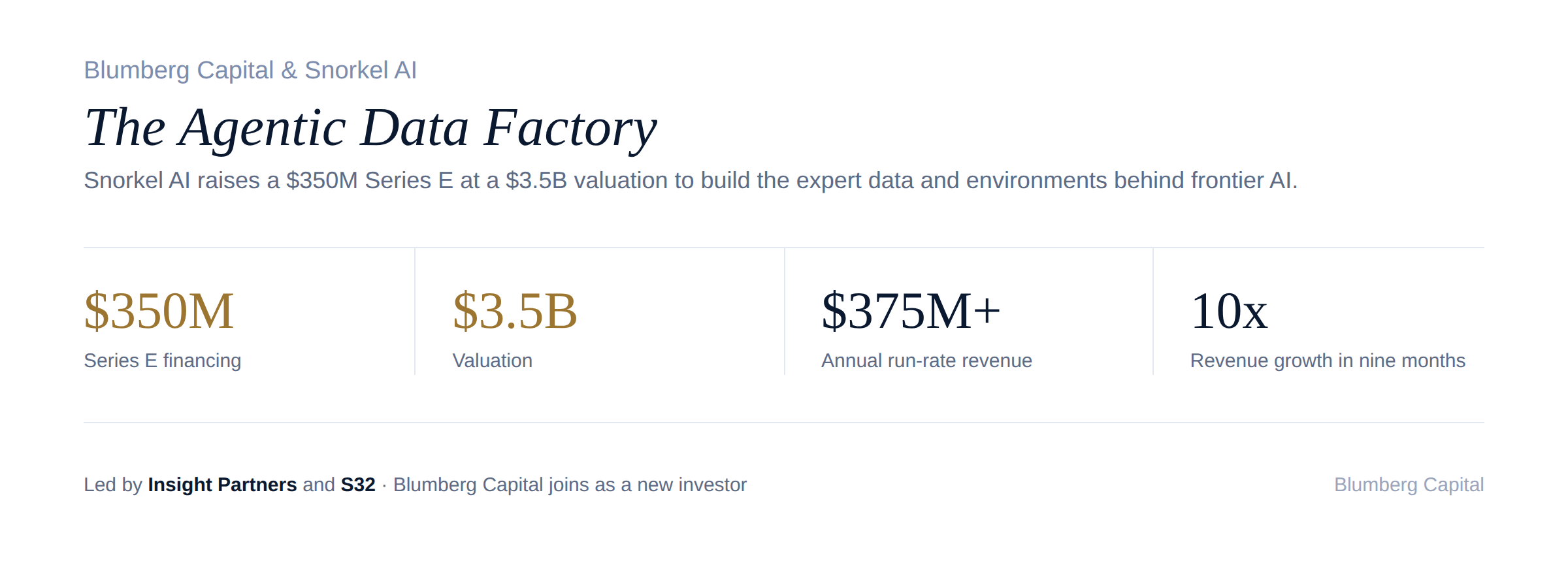
That shift is central to our investment in Snorkel AI, the frontier AI data lab that Blumberg Capital is investing in as part of its $350M Series E at a $3.5B valuation. The round was led by Insight Partners and S32. Blumberg Capital joins new investors March Capital, Allegis Capital, Frontline, Standard, One Prime Capital, Third Point Ventures and D.E. Shaw Ventures, alongside existing investors including Addition, Greylock, Lightspeed, GV, Factory, BlackRock, Prosperity7, Walden Catalyst and Wells Fargo.

The financing follows a period of rapid growth for Snorkel. The company has surpassed $375M in annual run-rate recurring revenue, up more than 10x in nine months. Snorkel launched its expert Data-as-a-Service offering in September 2025 and now works with leading AI labs and enterprises on the data behind frontier model evaluation and training.

The opportunity looks very different today than it did during the earlier stages of machine learning. Snorkel describes that earlier period as “Data 1.0,” when data development largely meant labeling relatively simple tasks at scale. Today’s frontier and agentic AI systems require expert agentic tasks, environments and rubrics that can take highly qualified people hours or even days to construct. Designing them well is increasingly research work, where quality and complexity determine value.

As models become more capable, differentiation increasingly shifts to the specialized, high-difficulty data needed to improve performance on problems where a merely plausible answer is not enough. The challenge is no longer simply sourcing more data. It is determining what data a model needs, developing the expert workflows to produce it and evaluating whether it actually improves performance.

Frontier and agentic AI are changing what is required of the data behind them. Snorkel has spent years developing the research and technology to build expert data and environments for increasingly complex AI systems. Snorkel calls this shift Data 2.0, and its agentic data factory is designed around it. The company combines human expertise with research and technology to develop the data and environments used to evaluate and improve advanced AI systems.

Our conviction starts with the team.

Co-founder and CEO Alex Ratner and co-founder Chris Ré built Snorkel out of the Stanford AI Lab, where their work on weak supervision and data-centric AI helped pioneer the field. That research foundation continues today, with more than 250 peer-reviewed papers cited more than 25,000 times.

What differentiated Snorkel for us was the depth of the team’s work in data development and how relevant that work has become to the problems AI developers are confronting today. The team has deep technical credibility and is applying that expertise to a clear and growing commercial need.

A growing market for more complex AI data

We have seen enterprise AI adoption move beyond simply purchasing subscriptions to standard AI services. More sophisticated organizations are increasingly looking at how they can customize AI for their own workflows, performance requirements, costs and data environments. That evolution increases the need for specialized data and evaluation.

As AI moves into more specialized and demanding applications, training and evaluation increasingly require domain expertise and environments that reflect the complexity of real-world work. This creates opportunities beyond frontier AI labs and into industries where accuracy and specialized knowledge matter.

Snorkel is already extending its capabilities into longer-running, complex work in areas including healthcare, law and software engineering. With the new funding, the company plans to expand the capacity of its agentic data factory, accelerate investment in vertical and enterprise AI, extend its research and technology into new domains and modalities, and deepen its investment in open research, including its Open Benchmarks Grants initiative.

We believe Snorkel is well positioned as specialized data and evaluation become increasingly important to both frontier and enterprise AI. Its combination of deep research, technology and expert human knowledge is difficult to replicate and increasingly relevant as AI systems take on more complex work.

Congratulations to Alex, Chris and the entire Snorkel team. We look forward to partnering with them as they continue to build the data and environments behind frontier and agentic AI.

Hear directly from Alex in his interview with TBPN.


The post Why We Invested in Snorkel AI: $350M Series E at a $3.5B Valuation appeared first on Blumberg Capital.

]]>
Snorkel AI Raises $350M to Scale the Data Factory for Frontier AI https://blumbergcapital.com/news-insights/blumberg-capital-invests-in-snorkel-ai/ Wed, 23 Sep 2026 00:43:24 +0000 https://blumbergcapital.com/?p=29746 Snorkel AI, the frontier AI data lab, today announced it raised $350 million at a valuation of $3.5B in a round co-led by Insight Partners and S32, with significant participation from existing investor Addition. The round included new investors March Capital, Blumberg Capital, Allegis Capital, Frontline, Standard, and Third Point Ventures, along with existing investors…

The post Snorkel AI Raises $350M to Scale the Data Factory for Frontier AI appeared first on Blumberg Capital.

]]>
Snorkel AI, the frontier AI data lab, today announced it raised $350 million at a valuation of $3.5B in a round co-led by Insight Partners and S32, with significant participation from existing investor Addition. The round included new investors March Capital, Blumberg Capital, Allegis Capital, Frontline, Standard, and Third Point Ventures, along with existing investors Greylock, Lightspeed, GV, Factory, Prosperity7, Walden Catalyst, and Wells Fargo. The investment will expand Snorkel’s agentic data factory, which supplies the data and environments behind the world’s most advanced AI lab systems.

The raise comes amid a fundamental phase shift in AI data. Building AI in the Data 1.0 era meant simple labeling tasks, a volume problem solved with headcount. Today’s frontier and agentic systems demand Data 2.0: expert agentic tasks, environments, and rubrics that take even the most qualified humans hours or days to construct. Designing them well is research work, where quality and complexity determine value.

Meeting that bar requires a wholly new paradigm for data development, which is partly why Snorkel has grown rapidly since launching its expert Data-as-a-Service offering in September 2025. The company works with leading AI labs and enterprises on the data behind frontier model evaluation and training. The work is a natural outgrowth of Snorkel’s roots: the company grew out of the Stanford AI Lab nearly a decade ago with a founding team that pioneered the field of data-centric AI and continues to contribute science on data at the jagged frontier of AI development. That body of work spans 250+ peer-reviewed papers cited more than 25,000 times.

“The teams pushing the frontier want a research data partner who pioneers the science of data development,” said Alex Ratner, co-founder and CEO of Snorkel AI. “That’s what Snorkel was built to be: the frontier lab for agentic data, combining human excellence with over a decade of research and technology.”

“Snorkel’s research-grade approach to AI data, environments, and measurement is becoming an increasingly important ingredient in building capable and reliable AI systems – and their demonstrated growth at scale reflects that,” said Lonne Jaffe, Managing Director at Insight Partners. “We’re excited to back Alex and the team as they continue to bring their frontier AI data factory capabilities to longer-running, complex work in high value industries like healthcare, law, and software engineering.”

“Snorkel’s expert-agentic environments create a unique flywheel between human expertise and AI, delivering data at the speed and quality that enables a new era of efficiency and accuracy for model development,” said Andy Harrison, CEO and General Partner of S32. “Working with Snorkel ensures the highest frontier model success rate and creates a true partnership between model developer and data provider.”

Snorkel plans to use the funding to grow the capacity of its agentic data factory to meet demand, accelerate investment in vertical and enterprise AI, and extend its core research and technology into new domains and modalities. The company will also deepen its investment in open research, building on programs like its Open Benchmarks Grants initiative.

About Snorkel AI

Snorkel AI is the frontier AI data lab, helping teams build the data and environments behind high-performing frontier and agentic AI. We combine technology with research-driven AI data development to create datasets, benchmarks, evals, and custom solutions for real-world AI systems. Founded out of the Stanford AI Lab in 2019, Snorkel works with leading AI labs and enterprises to move from better data to better outcomes.

The post Snorkel AI Raises $350M to Scale the Data Factory for Frontier AI appeared first on Blumberg Capital.

]]>
Why We Continue to Back Angle: Angle Health Raises $600M at a $2.7B Valuation https://blumbergcapital.com/news-insights/investing-in-angle-health-series-c/ Mon, 21 Sep 2026 21:23:33 +0000 https://blumbergcapital.com/?p=29734 By Bruce Taragin, managing director, and Jared Katzen, vice president Angle Health, the first AI-native healthcare benefits platform, today announced a $600M equity financing—a $200M Series C plus a $400M tender offer—at a $2.7B valuation, in a round led by Vitruvian Partners with participation from new investor Town Hall Ventures and existing investors Blumberg Capital,…

The post Why We Continue to Back Angle: Angle Health Raises $600M at a $2.7B Valuation appeared first on Blumberg Capital.

]]>
By Bruce Taragin, managing director, and Jared Katzen, vice president

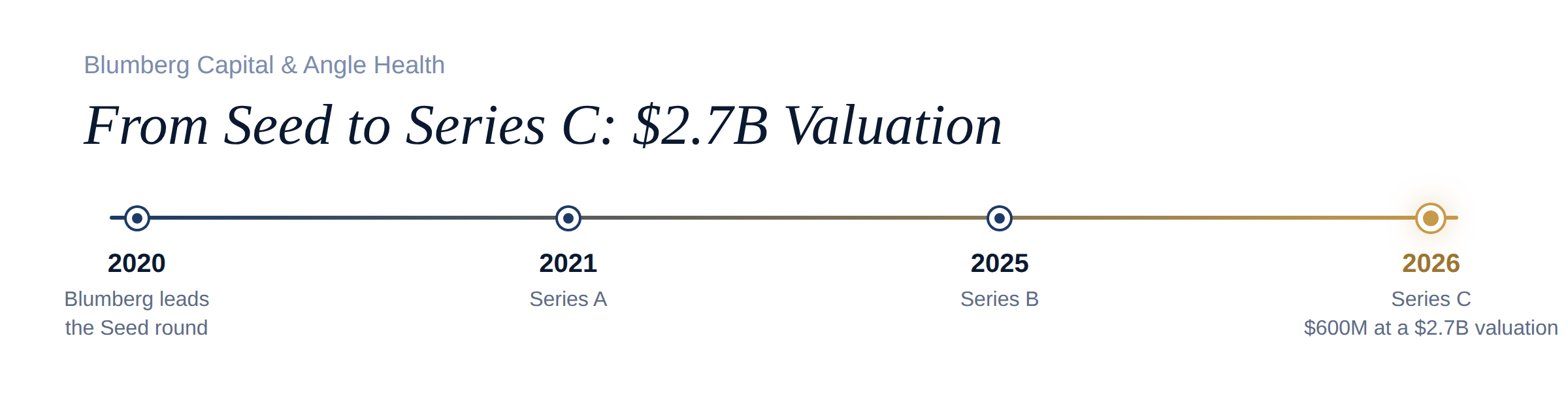
Angle Health, the first AI-native healthcare benefits platform, today announced a $600M equity financing—a $200M Series C plus a $400M tender offer—at a $2.7B valuation, in a round led by Vitruvian Partners with participation from new investor Town Hall Ventures and existing investors Blumberg Capital, Portage, PruVen Capital and Y Combinator. 

Blumberg Capital led Angle’s Seed round in 2020 and has returned for every round since—Series A, last December’s $134 million Series B, and now Series C. It’s been a pleasure to watch co-founders Ty Wang and Anirban Gangopadhyay and the Angle team build steadily toward this point. 

What stood out early was not only Ty and Anirban’s ability as founders, but how personal the mission was to them: creating greater transparency and better pricing for employees while improving health outcomes. Over the course of our partnership, they have also proven to be thoughtful communicators and even better listeners. Those qualities have remained consistent as they’ve scaled Angle, and we believe they are still early in their mission to make healthcare more affordable while improving outcomes.


Why now

Employers are facing the largest increase in health insurance costs in two decades and small and midsize businesses are absorbing the worst of it, stuck choosing between limited, confusing, and costly plans for their employees, a dynamic that touches nearly every American family given that small businesses employ half the country’s workforce and have long been an afterthought for an insurance industry built around large-group underwriting.

Angle built its AI-native platform specifically for this gap, and the Benefit Builder platform is a good example of what that looks like in practice: brokers can generate firm, underwritten quotes in minutes instead of weeks, customize plans in real time, and pull from the industry’s first Health Scorecard, bringing a level of transparency to small-group underwriting that legacy carriers simply don’t offer.

The numbers behind the round

Angle enters this next phase from a position of exceptional strength. The Angle Health team has consistently met and exceeded their forecasts nearly every quarter since we invested. Over the past year, the company has achieved 120% year-over-year growth since its previous financing, delivered four consecutive quarters of profitability across both EBITDA and GAAP net income, expanded to support over 5,000 employers in 47 states, and reached nearly $1 billion in annualized premium-equivalents. Crucially, Angle’s median renewal rate increases have averaged just 5–7%, significantly outperforming the broader 18% SMB median, which continues to serve as a key driver of strong client retention.

We are thrilled to continue backing Angle in this exciting next chapter. Ty, Anirban, Andy, and the entire Angle team are demonstrating firsthand that an exceptional healthcare experience and cost-efficiency can go hand in hand. By leveraging technology and AI, they are delivering a truly transformational experience for workers at companies of all sizes across the country.

The post Why We Continue to Back Angle: Angle Health Raises $600M at a $2.7B Valuation appeared first on Blumberg Capital.

]]>
The Wall Street Journal: AI Startup Angle Health Lands $600 Million for $2.7 Billion Valuation https://blumbergcapital.com/news-insights/ai-startup-angle-health-lands-600-million/ Fri, 18 Sep 2026 17:30:16 +0000 https://blumbergcapital.com/?p=29731 Originally posted in The Wall Street Journal.  Founded by two ex-Palantir engineers, the startup aims to bring AI-platform power to small-business healthcare benefits By Maria Armental European midmarket firm Vitruvian Partners is leading a $600 million investment in Angle Health, an AI-based health-tech startup founded by two former Palantir Technologies engineers to expedite healthcare benefits for small…

The post The Wall Street Journal: AI Startup Angle Health Lands $600 Million for $2.7 Billion Valuation appeared first on Blumberg Capital.

]]>
Originally posted in The Wall Street Journal. 

Founded by two ex-Palantir engineers, the startup aims to bring AI-platform power to small-business healthcare benefits

European midmarket firm Vitruvian Partners is leading a $600 million investment in Angle Health, an AI-based health-tech startup founded by two former Palantir Technologies engineers to expedite healthcare benefits for small businesses.

Expected to close later this month, the deal values Angle Health at $2.7 billion, more than doubling the startup’s December valuation, when fintech investor Portage Ventures led a $134 million investment in the company.

Other backers of the latest transaction include new investor Town Hall Ventures—a healthcare firm co-founded by Andy Slavitt, who held health policy roles in the Biden and Obama administrations—and existing investors Blumberg Capital, Portage, PruVen Capital and Y Combinator. The investment includes a $200 million equity investment in Angle Health and a $400 million secondary transaction at a $2.5 billion valuation that provides substantial liquidity to the startup’s early backers.

Chief Executive Ty Wang and Chief Technology Officer Anirban Gangopadhyay founded Angle Health in 2019 to address what they saw as the biggest problem in the American healthcare system: the lack of access to healthcare options that employees at small businesses face compared with their peers at larger organizations or highflying tech companies.

The two met as high-school students while participating in the U.S. government’s Stokes Educational Scholarship program, which provides college funding and work experience to students who want to build careers in national security. They later worked together at Palantir.

San Francisco-based Angle Health aims to multiply healthcare offerings for small businesses by helping them find lower-cost care options, such as at-home infusions and free-standing imaging centers, for example—rather than hospital-based services—as well as international prescription sourcing. The company’s AI-powered platform, much like a traffic cop or an orchestra conductor, synchronizes the coverage by steering small businesses to the most appropriate offering or location at the right time.

“We did not set out to build another health insurance company,” Wang said. “What we set out to do was really rebuild the building blocks and the infrastructure so that people can actually access the care that they need, when they need it, and in a way that stops this kind of death spiral of cost within our healthcare system.”

It’s the smaller businesses that historically have seen the highest cost increases while also having the fewest healthcare options, said Jeremy Gelber, the Vitruvian partner who led the firm’s investment. Angle Health gives those smaller employers choices, allowing them to customize benefit packages, he said. “Because of AI, they’re able to manage thousands of different designs,” he added.

U.S. employers face a projected 11.1% increase in healthcare costs in 2027, the steepest projected single-year rise in more than two decades, according to consulting firm WTW. But the median premium increases among Angle Health’s renewing customers range from just 5% to 7%, Wang said, a span he expects to hold in 2027.

That cost control, Gelber said, shows how Angle Health’s AI-driven underwriting works: It’s not just that Angle Health can offer attractive rates to lure in new business, but that when renewal time comes, it’s able to show that the numbers held and it managed expenses to curb cost increases, he said.

The company started doing business in 2021 and is already profitable on a net-income basis, with revenue and employer customer count in the most recent year more than doubling on a year-over-year basis. It oversees nearly $1 billion of annual premium equivalents, a common measure of healthcare spending, for more than 5,000 small businesses, from restaurants and coffee shops to construction companies and car shops. Some of those businesses have as few as two employees, Wang and Gangopadhyay said.

Anirban Gangopadhyay, co-founder and chief technology officer at Angle Health. Photo: Danny Gabriel

Angle Health wasn’t looking to raise money, as it had little debt and was already growing at a healthy pace, Wang said. But Vitruvian proved a good fit for the company’s growth plans.

An investor behind such companies as virtual physical-therapy company Hinge Health, Vitruvian has a proven record of growing companies that combine healthcare, tech and finance—areas Angle Health is focusing on, Wang and Gangopadhyay said.

Gangopadhyay said Angle Health continues to expand beyond health plans and benefits administration.

“The vision for Angle was, and still is, how do we revolutionize that end-to-end healthcare experience, not just the benefits side, but the healthcare economics, the access and ultimately the underlying health of a member?” he said.

The post The Wall Street Journal: AI Startup Angle Health Lands $600 Million for $2.7 Billion Valuation appeared first on Blumberg Capital.

]]>
Beyond Startup Nation: Building Israel’s Next Technology Advantage https://blumbergcapital.com/news-insights/building-israels-next-technology-advantage/ Tue, 15 Sep 2026 20:50:38 +0000 https://blumbergcapital.com/?p=29725 Israel has built one of the world’s most dynamic technology ecosystems by turning constraints into advantages. But as AI reshapes both business and geopolitics, the ingredients that powered Israel’s rise over the past several decades may no longer be sufficient on their own. In a recent conversation on MIND Israel’s Techtonic Shift podcast, Yodfat Harel…

The post Beyond Startup Nation: Building Israel’s Next Technology Advantage appeared first on Blumberg Capital.

]]>
Israel has built one of the world’s most dynamic technology ecosystems by turning constraints into advantages. But as AI reshapes both business and geopolitics, the ingredients that powered Israel’s rise over the past several decades may no longer be sufficient on their own.

In a recent conversation on MIND Israel’s Techtonic Shift podcast, Yodfat Harel Buchris, managing director at Blumberg Capital, discussed how Israel can build on its strengths in cybersecurity, entrepreneurship and technical talent to compete in the next era of technology.


Here are several key themes from the conversation.

Technology is becoming a strategic asset

Technology has traditionally been viewed as an engine of economic growth. Yodfat argues that it increasingly needs to be viewed through a broader lens, as a source of national resilience, security and geopolitical influence.

Israel offers a particularly clear example. Its technology ecosystem and venture capital industry have contributed not only to economic growth, but also to the development of defense capabilities that have helped the country continue operating through periods of conflict.

As competition over AI, semiconductors, critical materials and computing infrastructure intensifies, technological capabilities are increasingly intertwined with countries’ strategic positions.

Talent remains Israel’s advantage, but talent alone is no longer enough

Israel’s technical talent has long been one of its greatest competitive advantages. Its cybersecurity ecosystem demonstrates what can happen when government, the military, academia, entrepreneurs and private capital reinforce one another.

AI and deep tech, however, require a broader ecosystem. Yodfat points to computing infrastructure, energy, academic research and significantly greater amounts of capital as increasingly important components of technological leadership.

For Israel, the challenge is not simply producing talented engineers and entrepreneurs. It is creating the environment that allows those people to build ambitious companies in Israel and compete globally.

AI and cybersecurity could be a natural intersection for Israel

Israel does not need to replicate the United States or China to play a significant role in AI.

Yodfat sees an opportunity to combine Israel’s established cybersecurity expertise with AI. Cyber offers a useful precedent: Israel developed a deep ecosystem of technical talent, entrepreneurs, investors and global customers that ultimately produced companies with international reach. She argues that Israel can build on that foundation as AI becomes embedded throughout the technology stack.

The cloud era provides another useful model. Israel did not produce the world’s dominant cloud platforms, but Israeli companies became important players in the cybersecurity, development tools and software layers built on top of that infrastructure. Yodfat sees a similar opportunity emerging around AI, particularly in the technology and application layers above foundational infrastructure.

In AI, speed matters

The pace of AI also changes what companies need from investors.

Yodfat argues that investors can play an important role in opening doors to international customers and markets quickly. In a market moving this fast, getting a product into customers’ hands is only the beginning. The greater opportunity is converting early adoption into sustained usage and market share.

For Israeli startups in particular, this reinforces the importance of networks outside Israel. Developing technology and financing companies domestically must be matched by trusted relationships with customers, partners and investors in markets such as the United States and Europe.

Israeli technology has continued to attract global confidence

One of Yodfat’s more notable observations is what has happened during the past several years of conflict.

Despite the war and broader geopolitical pressures, she points to continued investment and major technology exits as evidence that international business interest in Israeli innovation has persisted. She also describes positive feedback from customers and co-investors around Israeli portfolio companies’ ability to continue delivering during difficult circumstances.

That resilience matters because the next era of technology will depend increasingly on trust. Countries, companies and investors will need confidence not only in the quality of a technology, but also in the ecosystems and relationships behind it.

Thinking bigger about Israel’s technology ecosystem

Perhaps the broader message from the conversation is that Israel cannot rely solely on the formula that made it the Startup Nation.

Yodfat calls for greater ambition around AI, hardware, advanced manufacturing, critical materials and other infrastructure-intensive technologies. That requires coordination among entrepreneurs, private capital, academia and government, with each playing a different role.

Her argument ultimately comes back to people. When asked about the source of Israeli innovation, she points to a culture of looking beyond the country’s size and believing it can compete with the best. Israel demonstrated that potential in cybersecurity and other technologies. The question now is how to translate it into the AI era.

The opportunity is not simply for Israel to produce more startups. It is to build the talent, infrastructure, capital and global relationships that can make Israeli technology an increasingly important part of the next generation of AI and critical technologies.

The post Beyond Startup Nation: Building Israel’s Next Technology Advantage appeared first on Blumberg Capital.

]]>
From Series A to Celebrating BioCatch’s Next Chapter with Visa https://blumbergcapital.com/news-insights/biocatch-series-a-to-visa/ Tue, 04 Aug 2026 21:14:19 +0000 https://blumbergcapital.com/?p=29706 By Bruce Taragin and Yodfat Harel Buchris Today’s announcement that Visa intends to acquire BioCatch for approximately $2.6 billion marks an important milestone for a company we have had the privilege of supporting since its earliest days. BioCatch has built a behavioral intelligence platform that helps financial institutions detect fraud in real time, protecting 1.8…

The post From Series A to Celebrating BioCatch’s Next Chapter with Visa appeared first on Blumberg Capital.

]]>
By Bruce Taragin and Yodfat Harel Buchris

Today’s announcement that Visa intends to acquire BioCatch for approximately $2.6 billion marks an important milestone for a company we have had the privilege of supporting since its earliest days. BioCatch has built a behavioral intelligence platform that helps financial institutions detect fraud in real time, protecting 1.8 billion devices and 760 million users globally. At the end of 2025, the company surpassed $185 million in annual recurring revenue.

For us, this announcement represents more than a successful outcome. It is a reminder that enduring companies are built through visionary founders, sustained execution, and long term partnerships.

Backing BioCatch From the Beginning

Blumberg Capital led BioCatch’s Series A because we believed financial fraud would become one of the defining challenges of the digital economy. As financial services became increasingly digital, we saw the need for a new approach to fraud prevention, one that combined cybersecurity, fintech, behavioral intelligence, and AI to help stop attacks before they could impact consumers and businesses.

BioCatch also reflects our long-time commitment to partnering early with exceptional Israeli founders building global technology companies. For three decades, Israel has been one of our core investment markets. We partner with entrepreneurs who combine deep technical expertise with the ambition to build global companies. BioCatch is a powerful example of the innovation emerging from Israel and why we remain committed to investing in its startup ecosystem.

Over the years, our partnership with BioCatch extended well beyond capital. We had the privilege of serving on the board, while our broader Blumberg Capital team worked alongside the BioCatch team, including leaders such as Gadi Mazor, Avi Turgeman and Howard Edelstein, to support customer introductions, strategic partnerships, recruiting, fundraising, and business development. Building a company of this scale requires an entire ecosystem of founders, employees, customers, investors, and partners working together over many years.

Why Behavioral Intelligence Matters More Than Ever

Today, BioCatch helps financial institutions combat account takeovers, scams, money mule activity, and application fraud using behavioral intelligence and AI. Visa’s acquisition underscores the growing importance of these capabilities as fraud becomes increasingly sophisticated. Visa has invested more than $13 billion in fraud technology and infrastructure over the past five years, and BioCatch’s technology is expected to strengthen its ability to help financial institutions stop fraud before it reaches the point of payment.

BioCatch reinforces several principles that have guided our investment strategy for decades:

  • Invest in exceptional founders early, particularly entrepreneurs building globally significant companies from leading innovation ecosystems, including Israel.
  • Invest at the intersection of major technology shifts, where cybersecurity, fintech, and AI create opportunities to solve mission critical problems.
  • Partner with founders for the long term, contributing capital, strategic guidance, customer introductions, and relationships that help companies scale.

Looking Ahead

Congratulations to the BioCatch team on this significant milestone. We are grateful to our fellow investors and shareholders who have supported the company over the years.

We are proud to have been part of BioCatch’s story from the beginning and look forward to seeing its technology protect even more businesses and consumers around the world as part of Visa.

The post From Series A to Celebrating BioCatch’s Next Chapter with Visa appeared first on Blumberg Capital.

]]>
Visa to Buy Fraud Defense Platform BioCatch in $2.4 Billion Deal https://blumbergcapital.com/news-insights/visa-biocatch-ai-fraud-detection/ Mon, 03 Aug 2026 17:22:14 +0000 https://blumbergcapital.com/?p=29703 Originally posted in The Wall Street Journal. Blumberg Capital led BioCatch’s Series A round and participated in follow on rounds until exit.  Key Takeaways Visa is acquiring BioCatch for $2.4 billion. The acquisition expands Visa’s AI-powered fraud prevention capabilities and reflects continued investment in payment security. BioCatch specializes in behavioral biometrics. Its platform uses artificial…

The post Visa to Buy Fraud Defense Platform BioCatch in $2.4 Billion Deal appeared first on Blumberg Capital.

]]>
Originally posted in The Wall Street Journal. Blumberg Capital led BioCatch’s Series A round and participated in follow on rounds until exit. 

Key Takeaways

  • Visa is acquiring BioCatch for $2.4 billion. The acquisition expands Visa’s AI-powered fraud prevention capabilities and reflects continued investment in payment security.
  • BioCatch specializes in behavioral biometrics. Its platform uses artificial intelligence to distinguish legitimate users from attackers in real time across billions of devices.
  • AI is becoming central to fraud prevention. Visa continues to invest heavily in AI-driven security technologies to identify vulnerabilities and stop fraud before payments occur.
  • The deal reflects broader demand for AI security solutions. As digital payments grow, behavioral analytics and AI-powered fraud detection are becoming increasingly important across financial services.

BioCatch uses artificial intelligence to detect fraud and distinguish legitimate users from attackers.

Visa is acquiring BioCatch, a fraud-reduction platform, for $2.4 billion in cash. 

Visa is buying the Israeli company from funds advised by Permira, as well as other shareholders, the company said Monday. 

BioCatch uses artificial intelligence to detect fraud and distinguish legitimate users from attackers in real time. The company protects 1.8 billion devices and 760 million users globally. 

At the end of 2025, BioCatch exceeded $185 million in annual recurring revenue. 

Permira first invested in BioCatch in April 2023 and took a majority stake the following year. In May 2024, Permira said its stake acquisition gave BioCatch an enterprise valuation of $1.3 billion. 

Visa has been increasing its use of AI to fight fraud through its Visa Vulnerability Agentic Harness platform, a tool designed to help clients identify and fix vulnerabilities to fraud. Visa has spent $13 billion in fraud technology and infrastructure over the past five years. 

“BioCatch will help our clients stop fraud before it reaches the point of payment,” said Andrew Torre, Visa’s president of value-added services. 

The deal is expected to close by the end of Visa’s fiscal second quarter of 2027.

The post Visa to Buy Fraud Defense Platform BioCatch in $2.4 Billion Deal appeared first on Blumberg Capital.

]]>
Where Is the Long-Term Value in Your AI Startup? https://blumbergcapital.com/news-insights/where-is-the-long-term-value-in-your-ai-startup/ Mon, 27 Jul 2026 15:54:52 +0000 https://blumbergcapital.com/?p=29697 By Roy Lowrance, AI advisor at Blumberg Capital As part of my advisor work for Blumberg Capital, I review business plans from AI-native startups. These are often based on a variant of this idea: find a business process that can be made more effective or efficient by automating the processing of information in complex documents,…

The post Where Is the Long-Term Value in Your AI Startup? appeared first on Blumberg Capital.

]]>
By Roy Lowrance, AI advisor at Blumberg Capital

As part of my advisor work for Blumberg Capital, I review business plans from AI-native startups. These are often based on a variant of this idea: find a business process that can be made more effective or efficient by automating the processing of information in complex documents, then create an automation platform that improves outcomes. Many of these businesses can be separated into two businesses: one that parses the required information out of the documents and puts it into a usable form, and another that uses that information as part of a workflow-support application. Understanding where long-term value is created can help founders make better products, partnerships, and fundraising decisions.

Consider a representative example. The X company proposed to parse emails received and sent from attorneys. They will identify the matters discussed in the emails and pull out relevant information such as open tasks. That information is passed to a workflow system. Initially, the system provides summaries of actionable work items to the attorneys. Later, it can propose actions and documents that the attorneys can approve. This example can be generalized to include any type of worker that processes documents.

Capability #1: Information Extraction

Notice that there are two difficult-to-build technical capabilities required for the startup to succeed. First is parsing the documents to extract relevant information. That requires understanding the domain. In the example, it is legal work, but we see many other domains. It also requires extracting relevant information from documents. This is relatively straightforward with emails, more difficult with PDFs, and perhaps hard enough to require deep learning with image and audio files. It also involves creating an ontology for holding the relevant data and populating instances from the documents. This capability is one that our firm X would consider purchasing or renting, if it were available.

Founder takeaway: Ask yourself whether document understanding is your long-term competitive advantage, or whether it will eventually become infrastructure that your company builds upon.

In X’s domain, legal work, there are many firms needing this capability, and eventually a company–say LegalDocumentParser (LDP)–will be built to parse all the relevant documents–not just emails, but contracts, court proceedings, and so forth. X will want to buy from LDP if it covers more document types of relevance to X’s supported workflow or if LDP’s parsing is much more accurate. Both of these conditions are likely eventually if X’s domain is large enough. If X’s domain is sufficiently large, the LLM providers will make this capability available.

Strategic question: Which capabilities should founders own, and which are likely to become platform services over time?

Capability #2: Workflow Automation

The second capability is building the workflow engine. That requires understanding how people currently do the work and their willingness and ability to adapt to new workflows. For example, in the X example, attorney’s will probably accept lists of prospective actions for them to consider, but whether they will accept having those proposed actions loaded into a work-tracking system is much less certain. Possibly they will accept reviewing work products developed by AI agents–that is a growing trend–but perhaps in the longer term, if creating work products shifts entirely to AI, employers may conclude that it deskills the workforce and adjust accordingly.

Founders are presently seeing two sources of value when startups formulate their business plans. The two parts of the business are bundled together. However, over the medium to long term, these capabilities may evolve into two distinct businesses with different sources of value and competitive advantage.

Founders can consider two development scenarios for companies like X. In one scenario, X purchases the parsing and knowledge extraction tool, so that X’s value depends upon delivering superior workflows. In another scenario, X splits its business into two parts: one for each capability, seeking to create value through two sets of IP and related competitive moats.

Questions for Founders

  • Where does your long-term competitive advanage reside: information extraction, workflow automation, or both?
  • If foundation models continue to improve, which layer of your business becomes more valuable?
  • Which capabilities should you own, and which are likely to become infrastructure?
  • How would your product strategy change if best-in-class document understanding become widely available?

Read this post and more from Roy on his blog

The post Where Is the Long-Term Value in Your AI Startup? appeared first on Blumberg Capital.

]]>