On March 17, 2020, Bahrain completed the release of 1,486 prisoners, 901 of whom received royal pardons on “humanitarian grounds.” The remaining 585 were given non-custodial sentences. While this is a positive step, the releases so far have excluded opposition leaders, activists, journalists and human rights defenders – many of whom are older and/or suffer from underlying medical conditions. Such prisoners are at high risk of serious illness if they contract COVID-19, and thus ought to be prioritized for release.
“Bahrain’s significant release of prisoners is certainly a welcome relief as concerns around the spread of COVID-19 continue to rise. Authorities must now speedily release those who never should have been in jail in the first place, namely all prisoners of conscience who remain detained solely for exercising their right to peaceful expression”, said Lynn Maalouf, Amnesty International’s Middle East Director of Research. “We also urge the authorities to step up measures to ensure full respect for the human rights of all those deprived of their liberty.”
Opposition leaders imprisoned for their roles in the 2011 protest movement remain behind bars. These include Hassan Mushaima, the head of the unlicensed opposition group Al-Haq; Abdulwahab Hussain, an opposition leader; Abdulhadi Al Khawaja, a prominent human rights defender; and Dr Abdel-Jalil al-Singace, the spokesman for Al-Haq.;
Other prominent opposition figures, including Sheikh Ali Salman, secretary general of the dissolved Al-Wefaq National Islamic Society (Al-Wefaq), also remain imprisoned. Sayed Nizar Alwadaei, who was deemed arbitrarily detained by the United Nations in “reprisal” for the activism of his brother-in-law, the exiled activist Sayed Ahmed Alwadaei; and human rights defenders Nabeel Rajab and Naji Fateel, have not been released either. Amnesty International considers them to be prisoners of conscience who should be released immediately and unconditionally.
The Bahrain Center for Human Rights has documented that a total of 394 detainees of the 1,486 released were imprisoned on political charges. According to Salam for Democracy and Human Rights, another Bahraini nongovernmental group, 57 of the 901 prisoners who received a royal pardon were imprisoned for their political activities, while the rest were given non-custodial sentences. Since the Bahraini government has not made available any information on the charges for which those ordered released had been convicted the exact figures cannot be verified. However, it is clear that people imprisoned for nonviolent political activity are in the minority of those released.
Scores of prisoners convicted following unfair trials under Bahrain’s overly broad counter-terrorism law have been overlooked and denied early release or alternative penalties, even though other inmates serving considerably longer sentences were freed. This includes Zakiya Al Barboori and Ali Al Hajee, according to the Bahrain Institute for Rights and Democracy.
Conditions in Bahrain’s overcrowded prisons compound the risk of COVID-19 spreading. The lack of adequate sanitation led to a scabies outbreak in Jau Prison – Bahrain’s largest prison – and Dry Dock Detention Center in December 2019 and January 2020. Almost half of the Dry Dock Detention Center’s prison population was infected. In 2016 a governmental Prisoners and Detainees Rights Commission found buildings at Jau Prison to suffer from “bad hygiene,” “insect infestation” and “broken toilets.”
Furthermore, Amnesty International, Human Rights Watch, and the United Nations have expressed their concern over the authorities’ persistent failure to provide adequate medical care in Bahrain’s prisons. This has endangered the health of some unjustly imprisoned persons with chronic medical conditions, such as Hassan Mushaima and Dr Abdel-Jalil al-Singace, who may now be at heightened risk of contracting COVID-19.
Hassan Mushaima, 72, has diabetes, gout, heart and prostate problems, and is also in remission for cancer. Prison authorities have routinely failed to take him to appointments due to his refusal to submit to wearing humiliating shackles during transfers to his appointments. International human rights mechanisms have said that the use of restraints on elderly or infirm prisoners who do not pose an escape risk can constitute ill-treatment.
Dr Abdel-Jalil al-Singace, 57, has post-polio syndrome and uses a wheelchair. Prison authorities have also refused to transport him to his medical appointments due to his refusal to wear shackles.
“As the world faces the unprecedented COVID-19 crisis, it is more important than ever that the international community work together to contain its spread and ensure that the health and rights of the vulnerable are protected,” said Husain Abdullah, Executive Director at ADHRB. “Bahrain’s allies, in particular the UK and US, should explicitly call on Bahrain to secure the release of all those solely imprisoned for their peaceful opposition to the government.”
States have an obligation to ensure medical care for all those in their custody at least equivalent to that available to the general population and must not deny or limit detainees equal access to preventive, curative or palliative health care. Given that conditions in detention centers pose a heightened public health risk to the spread of COVID-19, and the persistent failure to provide an adequate level of care to those in their custody, there are grave concerns about whether prison authorities could effectively control the spread of COVID-19 and care for prisoners if there is an outbreak inside Bahrain’s prisons.
The Bahraini authorities should seize the opportunity to immediately and unconditionally release everyone imprisoned solely for peacefully exercising their rights to free expression, including Hassan Mushaima, Dr Abdel-Jalil al-Singace, Abdulahdi Al-Khawaja, Abdulwahab Hussain, Nabeel Rajab, Naji Fateel, and Sheikh Ali Salman. The convictions of those imprisoned following unfair trials – including Sayed Nizar Alwadaei – should be quashed, or at the very least they should be released pending fair re-trial.
The risks posed by the COVID-19 pandemic to those in detention should be a strong factor weighing toward the reduction of the prison population through the release of pre-trial detainees, particularly given the poor, unsanitary conditions in Bahrain’s prisons and the inadequate provision of medical care. In addition, prisoners who are especially vulnerable to COVID-19, such as those with underlying medical conditions and the elderly, should be considered for early release, parole, or alternative non-custodial measures as a means to further reduce the prison population and prevent the spread of COVID-19.
In any event, the authorities should ensure that anyone who remains in custody has access to disease prevention and treatment services, including ensuring physical distancing of prisoners at all times, including in housing and eating and social areas. Prison authorities should screen all guards to prevent the introduction of COVID-19 into prisons and provide appropriate information on hygiene and supplies and ensure that all areas accessible to prisoners, prison staff, and visitors are disinfected regularly. They should develop plans for housing people exposed to or infected with the virus in quarantine or isolation and ensure that necessary medical care is available.
“Bahrain’s first wave of prison releases was positive, but insufficient,” said Joe Stork, Deputy Middle East Director at Human Rights Watch. “The authorities should further reduce the prison population by releasing those who are imprisoned solely for their political beliefs or for exercising their right to free speech and peaceful assembly. Meanwhile, the authorities should ramp up efforts to ensure that the remaining prison population has access to the medical care, is protected from transmission and is provided the information that they need to combat the COVID-19 pandemic.”
“With Coronavirus presenting an unprecedented threat to life, it is vital that Bahrain’s political prisoners are released. Since 2011, the government has pursued a campaign of revenge against opposition leaders and rights activists for calling for democratic reforms; it is time for them to rise above petty politics to protect the life of all their citizens.” said Sayed Ahmed Alwadaei, Director of Advocacy at BIRD.
Signed by:
Americans for Democracy & Human Rights in Bahrain (ADHRB)
Amnesty International
ARTICLE 19
Bahrain Centre for Human Rights (BCHR)
Bahrain Institute for Rights and Democracy (BIRD)
CIVICUS: World Alliance for Citizen Participation
Committee to Protect Journalists (CPJ)
English PEN
European Centre for Democracy and Human Rights (ECDHR)
Global Legal Action Network (GLAN)
Gulf Centre for Human Rights (GC4HR)
Human Rights First (HRF)
Human Rights Watch (HRW)
IFEX
Index on Censorship
International Service For Human Rights (ISHR)
World Organisation Against Torture (OMCT)
PEN America
PEN International
REDRESS
Reprieve
Download a PDF of the statement here: Free Imprisoned Rights Defenders and Activists
]]>Hajer, 51, was convicted on 30 October 2017 alongside her son, Sayed Nizar Alwadaei, and nephew, Mahmood Marzooq Mansoor, on fabricated charges of planting a fake bomb. While Mahmood is due to be released in a month’s time, Sayed Nizar, who was just 18 when he was arrested, faces a total sentence of 11 years. The UN Working Group on Arbitrary Detention has deemed all three arbitrarily detained in “reprisal” for Sayed Ahmed’s activism in the UK.
No words can express this feeling.
My mother in law Hajer Mansoor is finally free after 3 years in jail for my activism.
Throughout her ordeal, Hajer has held her head high in the face of injustice. An inspiration to me & to many, many people in #Bahrain and beyond. #HajerFree pic.twitter.com/UINexrmEc5
— Sayed Ahmed AlWadaei (@SAlwadaei) March 5, 2020
The campaign for Hajer’s release has been among the most prominent in Bahrain’s recent political history. In April 2019, 54 MPs, lawyers and prominent human rights groups published an open letter in The Guardian calling for Hajer’s release, while over 80 MPs have signed an Early Day Motion criticising her imprisonment.
Last November, 52 members of the European Parliament condemned Hajer’s “cruel and inhumane treatment” in prison, while the U.S. State Department previously raised “major concern” that Hajer and her family members’ “confessions were obtained under duress”.
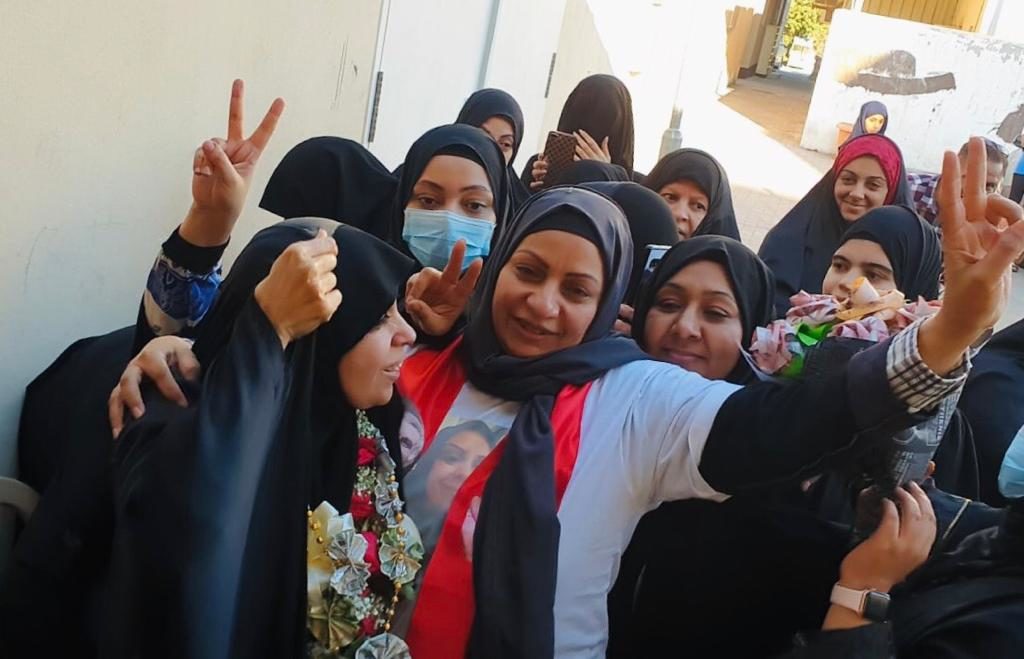
During her imprisonment at Isa Town Female Detention Centre, Hajer consistently provoked the ire of prison authorities by exposing human rights abuses, including religious discrimination and medical negligence. She has been persistently targeted for speaking out from prison and last November eight UN experts expressed “grave concern” that her conditions of detention “may amount to torture”.
Following Hajer’s release, only one female political prisoner remains incarcerated in Bahrain. Zakeya Al Barboori, 31, is serving a five year sentence after being convicted in 2018 in an unfair trial under Bahrain’s overly broad counter-terrorism law. She was also stripped of her citizenship, although this was reinstated last year.
Sayed Ahmed Alwadaei, Director of Advocacy at BIRD, commented: “Hajer’s release is undoubtedly a joyous moment for my family. Throughout her imprisonment, Hajer has remained unbowed and I have been personally inspired by her bravery in the face of persistent discrimination by a spiteful prison administration. However, while we are all relieved that Hajer is finally coming home, her son and nephew continue to be arbitrarily detained in reprisal for my activism in the UK. It is time for the government to end this petty vendetta and release my family members.”
Amnesty International commented: “Hajer Mansoor was imprisoned for three years on patently absurd charges based solely on her family relationship with Sayed Ahmed al-Wadaei, a human rights activist who now lives in the United Kingdom. As such, Amnesty considers her a prisoner of conscience for as long as she remains locked in a Bahraini prison cell. She should never have spent a single day in detention, as her trial was from start to finish an act of reprisal intended to harm a critic of the Bahraini government who had escaped beyond their reach. While we welcome the news of her impending release, Hajer’s jailing is unfortunately only one of a number of similar cases in which Bahraini families have been targeted for reprisals because of who they are related to. Indeed, two more of Sayed Ahmed’s own family members still remain behind bars.”
Aya Majzoub, Bahrain Researcher at Human Rights Watch, commented: “The release of Hajer Mansoor is a bittersweet moment for her and her family, who are celebrating her freedom while lamenting the needless suffering that her imprisonment caused and remembering the two other family members who remain unjustly imprisoned. The Bahraini authorities robbed her of the three years that she spent in prison and subjected her to degrading treatment solely because she was the relative of Sayed Ahmed Alwadaei, a prominent and outspoken activist. Unfortunately, this case is neither isolated nor uncommon in Bahrain, where the government subjects dissidents and human rights defenders to harassment, intimidation, and trumped up criminal charges.”
Husain Abdulla, Executive Director at Americans for Democracy & Human Rights, commented: “The judicial harassment of Sayed’s family sadly reflects wider patterns of repression against activists and their relatives in Bahrain, which have only intensified since the election of President Trump. Until Bahrain’s allies withdraw the carte blanche they have given the Bahraini government to crush all opposition without consequence, the persecution of dissenting voices is likely to continue.”
Background: Arrest, Torture, Trial and Detention
Hajer was detained on 5 March 2017, just days after Sayed Ahmed participated in the UN Human Rights Council in Geneva. During interrogation, Hajer was questioned repeatedly about her son-in-law’s activities, subject to threats against family members and forced to stand for ten hours until she collapsed and had to be rushed to hospital.
As a result of her ill treatment, Hajer confessed to charges of planting a “fake bomb”, a confession which she later retracted. Nonetheless, Hajer was convicted on 30 October 2017 alongside her son, Sayed Nizar Alwadaei, and nephew, Mahmood Marzooq Mansoor, based solely on “confidential sources” and her coerced confession, in the absence of any physical or forensic evidence. In an embarrassing diplomatic blunder, the Bahrain Embassy in London informed then-Foreign Secretary Boris Johnson of Hajer’s conviction by an “independent Bahraini court” a week before their actual conviction.
After arriving at Isa Town Female Detention Centre, Hajer was persistently targeted for her political status and punished for speaking out about her mistreatment. In September 2018, days after her case was raised in the Parliament, Hajer was assaulted by the head of the prison, Lieutenant Colonel Mariam Albardoli.
After the assault, Hajer was subject to a range of punitive measures including solitary confinement, religious discrimination, medical neglect and obstruction of family visits. Between September 2018 and July 2019, Hajer was granted a solitary family visit after substantial international pressure.
Hajer’s nephew, Mahmood, is also due to be released imminently. However, Sayed Nizar, who was just 18 when he was arrested and severely tortured, had additional charges brought against him in prison, bringing his total sentence up to 11 years in prison. All three were deemed to be arbitrarily detained by UN WGAD.
]]>The report points to the Bahrain’s government’s violent crackdown on its citizens as evidence of an unrelenting campaign against all forms of dissent. All opposition parties and independent media remain dissolved, while protests continue to be brutally crushed, critical voices targeted and online criticism policed through obtrusive cybercrime legislation. Over 300 people were convicted in mass trials during 2019, while the judiciary continued to rely on confessions rather than physical evidence, encouraging the persistence of torture in Bahraini detention centres.
Deteriorating Prison Conditions
The report also sheds light on the deterioration of prison conditions in Bahrain throughout 2019, with inmates describing a range of abuses including religious discrimination, torture and unsanitary conditions, amongst other issues. These issues compelled over 600 prisoners to launch a hunger strike in August 2019 to demand their basic rights be respected.
Bahrain was also widely condemned for its consistently failing to provide inmates with an adequate standard of medical care, with Joe Stork from Human Rights Watch describing the practice as “outrageous”. Aging opposition leaders including Hassan Mushaima and academic Dr Abdujalil al-Singace complain that they are systematically subjected to medical negligence due to their political status. Similarly, Hajer Mansoor, who remains arbitrarily detained in reprisal for the activism of her son-in-law, BIRD Director of Advocacy Sayed Ahmed Alwadaei, has regularly reported medical negligence at Isa Town Female Detention Centre, alongside targeted discrimination by prison authorities.
Continued British Support, Despite Abuses
BIRD found that the government of the United Kingdom has consistently failed to acknowledge or act upon international warnings about human rights violations in Bahrain, while maintaining technical and financial support to institutions known to be ineffective or abusive. Funding for the UK government’s so-called “technical assistance” to Bahrain continues to be channeled through the highly secretive Integrated Activity Fund, precluding adequate scrutiny of Britain’s relationship with Bahrain.
The report also highlights a number of government scandals, including the $5 billion Petrofac lobbying scandal, the storming of the Bahraini embassy in London by police in mid-summer and the ongoing torture debacles at the University of Huddersfield. In a unique move, the report tracks official and unofficial visits by British ministers, diplomats and members of the armed forces to their Bahraini counterparts, to illustrate the intimate links between powerful British institutions and Bahrain’s ruling elite.
Sportswashing Emerges as Key Regime PR strategy
Throughout 2019, BIRD’s campaigning and advocacy focused heavily on exposing Bahrain’s attempts to normalise its position in the global economy through investment in sporting and cultural events. A chapter in the report tracks the tangled web of economic interests tying Bahrain’s ruling elites to a wide portfolio of sporting ventures, including motorsport, athletics, cycling and combat sports, which have proven to be both effective PR and highly lucrative.
As “sportswashing” has become increasingly central to Bahrain’s international relations strategy, the government has aggressively targeted any of its citizens who undermines the image of prosperity and normalcy that they have tried to project. In 2019, BIRD successfully exposed Bahrain’s targeting of those who criticise the government’s cynical exploitation of professional sport, with significant campaigns contributing to the release of refugee footballer Hakeem AlAraibi and activist Najah Yusuf and professional footballer Hakeem AlAraibi.
Sayed Ahmed Alwadaei, Director of Advocacy at The Bahrain Institute for Rights and Democracy (BIRD) commented: “The situation in Bahrain continued to deteriorate in 2019 and sadly there is little sign that it will improve as we enter a new decade. Bahrain’s regime has been emboldened by the apparently unconditional support of their British allies and as we enter the post-Brexit era, the UK’s propensity to put trade above human rights seems likely to increase.”
Read the full report here
]]>Isa Town Female Detention Centre
The experts’ revelations were revealed yesterday by The Independent, in Medina’s first interview since she was released last month under alternative sentencing legislation having served over two years at Bahrain’s Isa Town Female Detention Centre. However, the Special Rapporteurs demanded to know why both Hajer and Nabeel’s applications for alternative sentencing have been rejected, despite their eligibility.
According to the Special Rapporteurs, staff at Isa Town committed a range of abuses against Medina and Hajer during their imprisonment, including assaulting both women after their cases were discussed in the UK Parliament in September 2018.
Other abuses reported include the prison’s repeated failure to schedule appointments with specialist doctors or provide the results of medical examinations, installing a glass barrier during family visits preventing physical contact between the women and their children, as well as religious discrimination and other forms of harrassment.
The experts also accused the National Institute for Human Rights (NIHR), a human rights oversight body that has received training funded by the UK-taxpayer, of attempting to defame rights groups, including BIRD, for raising human rights concerns at the UN Human Rights Council. The NIHR’s vice-president allegedly threatened Medina that she would be returned to prison if she spoke to “anyone from abroad” about her experience in prison after her release.
When approached for comment by journalists, a spokesperson for the Bahrain Embassy in London asserted that Hajer and Medina’s allegations are “without substance,” adding that it is wrong to “characterise the Kingdom of Bahrain as ‘repressive’ or to claim that it practises or tolerates the mistreatment or torture of those in custody. In reality, no person is detained or prosecuted in the Kingdom of Bahrain for peaceful freedom of expression, nor for legitimate peaceful activism.”
However, while the Bahraini government has claimed that the prisoners are allowed out of their cells for eight hours a day, the NIHR has conceded that female prisoners are permitted only two hours a day outside of their cells.
Jau Prison
The letter also highlighted the ongoing abuse of Nabeel Rajab, Bahrain’s most prominent human rights defender, at the notorious Jau Prison. Nabeel has reportedly been arbitrarily “isolated from other prisoners from the same category as him”, with prison authorities housing him instead in a cell with nine inmates “convicted of prostitution crimes, most of them foreign nationals.”
Nabeel’s health has deteriorated considerably in prison and he is often forced to wait months for consultations with specialist doctors for the range of illnesses he now suffers from, including breathing difficulties, arrhythmia, prediabetes, chronic dermatological diseases, hypertension and hypothyroidism.
The Special Rapporteurs concluded by urging the government to intervene to “halt the alleged violations and prevent their re-occurrence.”
Husain Abdulla, Executive Director at Americans for Democracy & Human Rights in Bahrain (ADHRB) commented:
“The revelations contained in this letter from 8 UN experts should be an alarm bell to all international governments that claim to defend democracy and human rights, particularly those in Washington and London. Hajer and Nabeel continue to languish in arbitrary detention, subject to treatment which may amount to torture.”
Sayed Ahmed Alwadaei, Director of Advocacy at The Bahrain Institute for Rights and Democracy (BIRD) commented:
“The UN’s recognition that my mother-in-law Hajer, Nabeel and Medina have been appallingly mistreated is a message to the Bahraini regime that their abuses will not pass unchallenged. The UK must now be asked whether they have played a role in covering-up abuses in Bahrain and whether taxpayer-funded training is contributing to the suffering of political detainees.”
Read the full UN experts letter.
Read ‘This isn’t humanity’: Inside the Bahraini women’s prison overseen by officials trained with UK money’ – The Independent.
Photo of Nabeel Rajab from Conor McCabe via Flickr
]]>While the government did not disclose the names of inmates to be released, a number of political prisoners have already returned home. There were jubilant scenes as Medina Ali was released yesterday, greeted by family members and human rights activist Ebtisam Al Saegh. Three sisters from Diraz convicted in political cases, Iman, Amal and Fatima Ali, were also freed.
Political Prisoner Medina Ali was released under alternative sentencing in #Bahrain today after a royal decree.
Medina was arrested in 2017 and unlawfully sentenced to 3 years imprisonment.
The below video footage shows her joyous return home. pic.twitter.com/DfSktmJPYn
— BIRD (@BirdBahrain_) December 16, 2019
There are now only 2 female political detainees left imprisoned in Bahrain; Zakeya Al Barboori and Hajer Mansoor, whose sentence the UN Working Group on Arbitrary Detention has deemed to be an act of “reprisal” for the activism of her son-in-law, BIRD’s Director of Advocacy Sayed Ahmed Alwadaei.
3 sisters – Iman, Amal and Fatima Ali – all imprisoned on political charges, have been been released on alternative sentencing today under a royal decree.
There are now only 2 female political detainees imprisoned in #Bahrain – Zakeya Al Barboori & Hajer Mansoor. pic.twitter.com/UICbPy8SCw
— BIRD (@BirdBahrain_) December 16, 2019
Despite having under three months of her unlawful sentence left to serve and fulfilling the criteria for a non-custodial sentence, Hajer Mansoor was not pardoned or granted early release. Her requests for alternative sentencing have also been repeatedly rejected without cause, suggesting the government’s decision to be punitive. Other high-profile political prisoners, including Bahrain’s preeminent human rights defender Nabeel Rajab, will also remain in jail, despite eligibility for alternative sentencing, as will opposition leaders Hasan Mushaima, Dr Abduljalil Al Singace and Abdulhadi Al Khawaja.
Sayed Ahmed Alwadaei, Director of Advocacy at BIRD, commented: “It is heartbreaking to see my mother-in-law singled out in a blatant act of revenge for my activism. Despite her eligibility for early release, Bahrain has consistently rejected her requests, demonstrating their continued intolerance for any form of criticism or dissent. Bahrain retains the highest prison population rate in the Arab world, demonstrating that today’s releases are largely symbolic. Without the release of Bahrain’s prominent human rights defenders and opposition figures, the political crisis in the country will remain unresolved.
]]>#Bahrain: OUT NOW! 52 MEPs sign letter on denial of medical treatment to #politicalprisoners Thank you to @MartinChelt for leading this initiative and all who signed! #HumanRights
More details below: https://t.co/oB0KI6eWeJ— ECDHR (@ECDHRbxl) November 21, 2019
MEPs from all political groups signed the letter, which deplores “medical negligence, delays and arbitrary exercise of authority” in two Bahraini detention centres. They went on to urge the “Delegation of the EU in Riyadh to use its private and public channels” to ensure the individuals mentioned in the letter are granted medical care and that “their fundamental rights are respected, while working to secure their release.”
MEPs raised particular concerns about 71 year old political leader Hassan Mushaima and the academic and opposition figure Dr Abduljalil Al-Singace, who are both serving life sentences for “their peaceful role in the 2011 pro-democracy movement”. Last month, Human Rights Watch and the Bahrain Institute for Rights and Democracy condemned the “degrading treatment of opposition activists,” while earlier this week, four UN experts highlighted a further ten individuals reportedly facing medical neglect at Jau Prison.
Mr Mushaima, a prominent political leader, suffers from a range of serious health problems including diabetes, gout, heart and prostate problems, numbness and is in remission from lymphoma cancer, requiring PET scans every six months. Mr Mushaima complains that prison authorities routinely fail to take him to appointments due to his refusal to submit to humiliating shackles. Dr Abduljalil Al Singace, engineering professor and renowned human rights activist, suffers from post-polio syndrome and depends on a wheelchair. He has also been prevented from attending appointments by the imposition of shackles.
When imposed on inmates who do not pose an escape or security risk, these restrictions violate the United Nations Standard Minimum Rules for the Treatment of Prisoners (the Mandela Rules).
MEPs also highlighted abuses in Isa Town Female Detention Centre, Bahrain’s only women’s prison. In particular, they noted that political prisoners Hajer Mansoor and Medina Ali “appear to be deliberately targeted by punitive restrictions.” The two women report a plethora of abuses by prison authorities, ranging from medical negligence and religious discrimination to physical assault.
They also complain that the prison has imposed a barrier in the visitation room that prevents any open contact with family members, in contravention of Rule 23 of the UN Rules for the Treatment of Women Prisoners (Bangkok Rules) which emphasises that disciplinary sanctions “shall not include a prohibition of family contact, especially with children.”
The letter noted that “the pattern of denial of medical care and religious discrimination” is common across Bahraini prisons, noting the wave of hunger strikes by prisoners since August 2019, when 600 prisoners refused food at Dry Dock Pre-Trial Detention Centre and Jau Prison. One inmate, Ali Al Hajee, continued his protest for 75 days, until prison authorities promised he would be granted unobstructed family visits and that his treatment would resume.
The letter concluded with a number of requests for the Delegation of the EU in Riyadh to pursue with the Bahraini authorities on behalf of the individuals featured in the letter. These included ensuring Mr Mushaima and Mr Al Singace are taken to their appointments without shackles; ensuring Ms Mansoor and Ms Ali are granted family visits without the barrier and that reprisals against them end; and putting pressure on Bahraini authorities to hold officers responsible for torture to account.
Sayed Ahmed Alwadaei, Director of Advocacy at BIRD, commented: “This recognition from MEPs is an important step to securing the rights of vulnerable inmates, many of whom are incarcerated on politicised charges and should not be imprisoned in the first place. It also sends an important message to victims of abuse that they are not suffering alone and have wide international support for their struggle.”
The European Centre for Democracy and Human Rights (ECDHR) commented: “ECDHR welcomes this initiative by the Members of the European Parliament, and calls on the European Union to act on this sign of concern by these elected officials.”
Read the full letter here.
]]>
The report found Ms Yusuf’s detention to be arbitrary and called for the government of Bahrain to immediately “accord her an enforceable right to compensation and other reparations” and to ensure a “full and independent investigation” into the circumstances of her imprisonment. Ms Yusuf alleges she was tortured and sexually abused by officers from Bahrain’s National Security Agency in 2017, after she posted criticism of Formula One’s Bahrain Grand Prix on Facebook.
The letter represents yet another U-turn from Formula One in their attitude to Ms Yusuf’s case. In 2018 they expressed concern for Ms Yusuf after being provided with her court judgement which explicitly referenced her opposition to the race. However, within months they had reverted to accepting assurances from the government of Bahrain that her imprisonment was unrelated to their business.
Lord Scriven commented “While I note their acknowledgement of the UN’s ruling on Najah’s case, I remain disappointed that Sacha Woodward-Hill and Formula One Management still do not take any responsibility.
If F1 is genuinely concerned with the UN decision and intend to raise their concerns with Bahrain, they must do so publicly while being transparent about the actions they expect from the Bahraini Government and the time scale they expect them to act within.
If Bahrain’s response is unsatisfactory, F1 must publicly commit to not racing in the country. The UN and other human rights organisations have already established the link between the Grand Prix and the human rights abuses suffered by Najah; F1 can no longer simply wait and watch from the stands.”
Sayed Ahmed Alwadaei, Director of Advocacy at BIRD, commented “As if spending over two years arbitrarily imprisoned was not enough, upon Najah’s release she has faced the further insult of being dismissed from her job. To this day, she has received no redress and there is no indication that Bahrain intends to hold her abusers to account.
While Formula One have rightly raised the recent UN ruling with the Bahraini government, they need to make it clear that a failure to act on the ruling’s recommendations will have consequences to their tangible business relationship. A failure to do so will only assure Bahrain that F1 will continue to sportswash their abuses and encourage the increasingly arrogant regime in their brazen attacks on freedom of expression.”
]]>The event included a panel of experts who discussed the brutal crackdown on political opposition, human rights defenders and journalists, that Bahrain has faced since 2011. Hannah Philips from AOHR moderated the event and opened the discussion. She first focused on the suppression of freedom of speech and association and the deliberate denial of medical care and religious freedoms in Bahrain’s prisons. She went on to highlight Bahrain’s prison rate – the highest per capita in the Arab World, before introducing the panelists.
Lucilla Berwick, Research and Advocacy Associate at BIRD, discussed the findings of BIRD’s recent joint report with Americans for Democracy and Human Rights in Bahrain on the abuses female activists and human rights defenders have faced since 2017 in the country, a pattern never documented at length before.
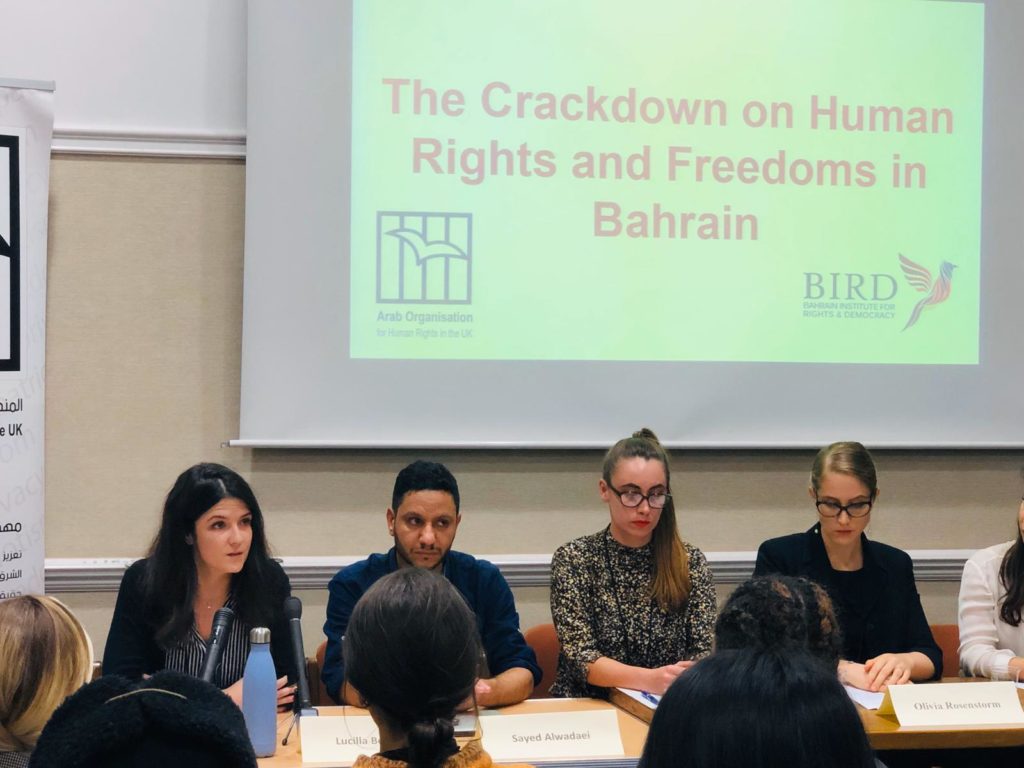
Her remarks focused on multiple violations and abuses experienced by the nine women featured in the report, from the moment of their arrest, through their interrogation, trial and detention. These include physical, psychological and seuxal torture, denial of legal representation and inhumane prison conditions. Lucilla went on to describe the detrimental impacts of UK foreign policy, including training to police and security forces, which has “in some circumstances contributed to human rights abuses in Bahrain.”
In particular, she focused on the £6.5 million of technical assistance spent by the Foreign Office since 2012 to train oversight institutions which have been internationally criticised for their lack of independence. While the Foreign Office boasts about the success of these bodies, many victims tell another story. Investigations have routinely found no fault in the actions of state officials, often justifying abuses entirely. Yet, Lucilla said, “these are the very organisations that the Foreign Office continues to tell torture victims to refer their complaints to.”
Bahar Saba, Middle East and North Africa Caseworker at Reprieve, discussed the dramatic increase in executions in Bahrain, which resumed in 2017 after a seven-year moratorium. “Bahraini courts continue to sentence individuals to death in proceedings that fall far short of international standards,” she asserted.
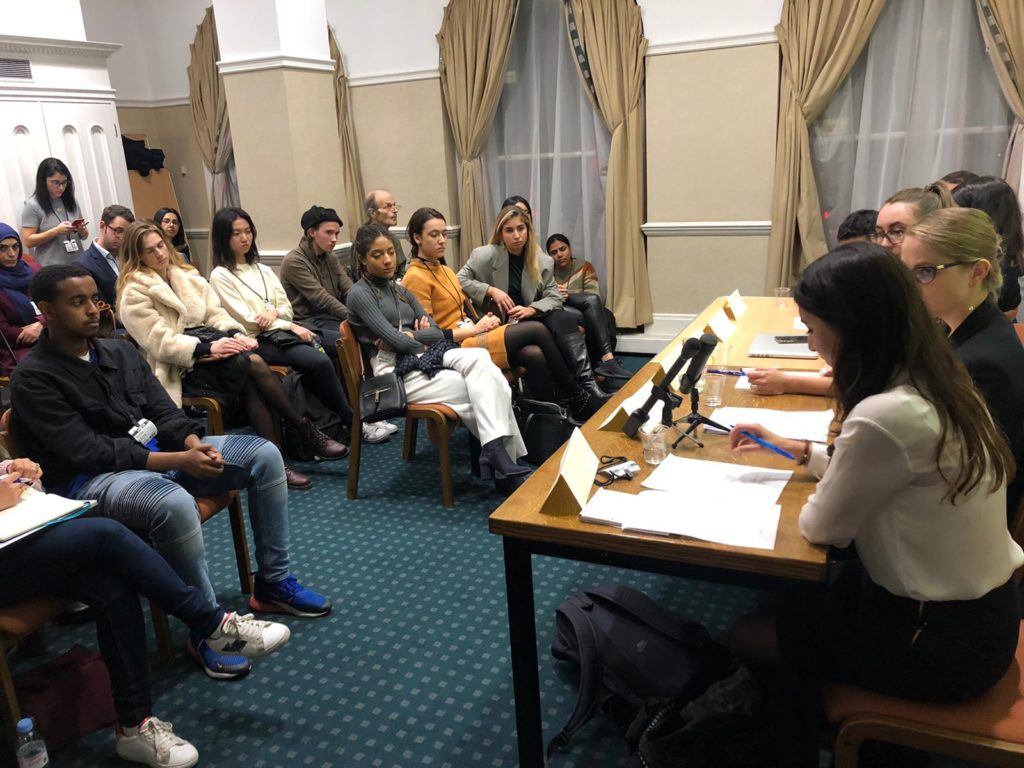
Bahar discussed the concerning cases of death row inmates Maher Al-Khabbaz, Mohammed Ramadan and Hussein Moosa, focusing on the torture they were subjected to to estract confessions. Not only does the death penalty itself conflict the International Covenant for Civil and Political Rights (ICCPR), of which Bahrain is a signatory, but those sentenced to death regularly report due process violations and torture. “Despite its international obligations, Bahrain’s use of the death penalty continues to infringe on the right to life” she emphasised.
Bahar concluded by discussing how the number of individuals on death row has tripled despite the UK’s technical assistance programme. She particularly criticised the Ministry of Interior Ombudsman and the Special Investigations Unit, two beneficiaries of the programme, who she asserted have continued to cover up cases of torture, allowing individuals to be sentenced to death on the basis of forced confessions. Bahar called for greater transparency and more robust investigations.
The third speaker, Bahraini activist Ali Mushaima, spoke about his experience in Bahrain’s prisons and imprisoned father, 71-year-old opposition leader Hassan Mushaima, who continues to be denied medical care while serving an unlawful life sentence at Jau prison. “I myself, was in prison three times. The first time was when I was only 15 years old. I remember all the details… how they tortured me, the dates, and the cell I stayed in” Ali recounted.
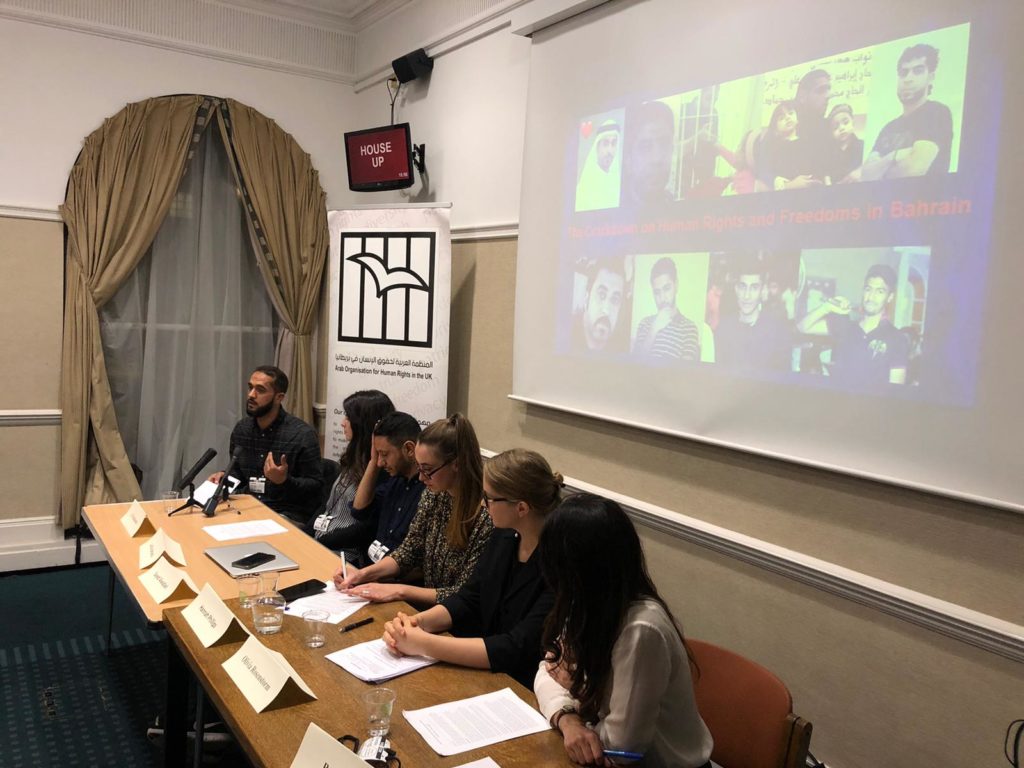
Hassan Mushaima is recovering from lymphoma and suffers from multiple health conditions including diabetes, gout and high blood pressure. However, prison authorities have routinely failed to provide him with specialist care. “In order to get medical treatment, you have to agree to be humiliated” Ali said, referring to the shackles the administration imposes on political prisoners which violate the Mandela Rules on the treatment of prisoners.
In August 2018, Ali spent 63 days protesting outside the Bahraini embassy in London to demand Bahrain provide him with medical care. For 46 of those days he was on hunger strike. “You can imagine the severity of the situation if someone has to sleep on the street in London to demand medical attention for their father in Bahrain.” Ali also drew attention to the wave of hunger strikes in Bahraini prisons since August, including dozens currently refusing food in Jau Prison.
Olivia Rosenstrom, a barrister at Temple Garden Chambers, discussed the types of violations the Bahraini government is implicated in and the legal remedies that can be taken in order to stop them.
She emphasised Bahrain’s failure to fulfil its international obligations. The detention and harassment of photographers, journalists and activists, and the general crackdown on freedom of expression violates several treaties, including the ICCPR. She also condemend the continued use of coerced confessions in Bahraini courts, which violates the Convention Against Torture and Other Cruel, Inhuman or Degrading Treatment or Punishment (CAT), to which Bahrain is party. Olivia also mentioned some of the consequences of citizenship revocation, including barriers to free movement and access to education, employment and medical care.
Olivia went on to assert the necessity of human rights conditions on trade and security agreements. Unfortunately, the UK and EU appear to be taking a “pragmatic and commercial” approach to their relationship with Bahrain, prioritising strategic aims over. Olivia concluded by providing some concrete solutions; 1) to push for a UN General Assembly inquiry into the human rights abuses in Bahrain; 2) to apply economic pressure and sanctions from the EU, UK and other countries and 3) refer human rights abusers to the International Criminal Court and impose sanctions to offenders travelling to the UK.
The final speaker, BIRD’s Director of Advocacy Sayed Ahmed Alwadaei, opened his remarks by playing a tearful message from his mother-in-law Hajer Mansoor, who complained about the poor and cruel conditions in the Isa Town Prison, where she is currently imprisoned in reprisal for Sayed’s work. The call reveals “the level of pain caused by the abuses taking place in prison” Sayed said.
Sayed went on to recount a phone call from Jau prison he received in July this year, which made him realise that two torture victims, Ali AlArab and Ahmed Almalali, would be executed within hours. “This is what I call the feeling of helplessness, and there’s nothing worse than helplessness.” Commenting on the failure of international condemnation to halt the executions, he emphasised the need for concrete action by states, rather than mere statements of concern.
He concluded by discussing the case of Moosa Mohammad, a Bahraini activist who climbed onto the rooftop of Bahrain’s London embassy to protest the executions. Moosa was brutally beaten by embassy staff members and police were forced to storm the building. He complained that Bahrain has faced “zero consequences” and criticised the UK government’s failure to respond. If Bahrain are emboldened to attack protesters in front of British police without consequence, imagine what they can do in Bahrain, when no one is watching, Sayed asked. He concluded by stressing the importance of parliament holding the UK government to account. “We do have a say,” he said, “and with everyone’s support, hopefully we can get there.”
The discussion was followed by a question and answer session, in which panelists reflected on the failures of governments and the international community to end abuses in Bahrain and hold the perpetrators to account. Solidarity was shown with Bahrainis from an audience member from repressive Eritrea, who shared her country’s experience with international human rights mechanisms and their limitations.
]]>In an open letter to Sacha Woodward-Hill, Formula One’s Chief Counsel, published this morning, the Lib Dem peer also urged the racing giant to ensure Ms Yusuf is compensated for the two and a half years she spent in prison, during which time she was tortured and sexually assaulted by Bahraini security officers.
Horrified to hear that, torture victim & @F1 critic Najah Yusuf was fired following her release after 2.5 years in prison in #Bahrain. UN #WGAD ruling declared her imprisonment arbitrary and unlawful – I’ve written to @F1 to urge them to ensure she is compensated adequately pic.twitter.com/PdUNSdfaGF
— Paul Scriven?️ (@Paulscriven) October 9, 2019
The UN WGAD found that Ms Yusuf was “brutalised” and “deprived of her liberty for her exercise of the right to freedom of opinion and expression” and that “no trial of Ms Yusuf should have taken place.” Lord Scriven criticised Woodward-Hill for consistently relying on “assurances from the Bahraini government” to justify the companies “inaction”, advising that the WGAD decision rendered the government line demonstrably false.
The letter also warned that Formula One bears a responsibility for the abuses experienced by Ms Yusuf, including her recent dismissal. Citing the WGAD ruling that Ms Yusuf be accorded “an enforceable right to compensation,” Lord Scriven encouraged Woodward-Hill to make “public representations to the Bahraini government” to ensure that Ms Yusuf’s work is reinstated and she is afforded “satisfactory redress” for her “years of arbitrary detention in connection with Formula One.”
Furthermore, noting Ms Yusuf’s case to be only one of several over the past six years where “the WGAD has found the government to be in violation of its human rights obligations,” Lord Scriven called on Formula One to “seriously review” their relationship with Bahrain’s government and take “immediate action” to prevent their business in the country “encouraging further violence and repression” in Bahrain.
Ms Yusuf’s case featured prominently in Breaking the Silence, a recent joint-report by the Bahrain Institute for Rights and Democracy (BIRD) and Americans for Democracy and Human Rights in Bahrain (ADHRB) documenting patterns of abuse against female political prisoners in Bahrain.
Sayed Ahmed Alwadaei, Director of Advocacy at BIRD, commented: “The UN ruling clearly demonstrates that Najah’s criticism of the Bahrain Grand Prix directly led to her arrest, abuse and imprisonment and means that Formula One can no longer rely on the Bahraini government’s baseless assurances to avoid responsibility. I hope they will now use their influence to pressure their abusive partner to restore Najah’s employment and compensate her for her unlawful imprisonment. A failure to do so means further complicity in the abuses of the Bahraini regime.”
]]>
The Bahrain Institute for Rights and Democracy (BIRD) and Americans for Democracy & Human Rights in Bahrain (ADHRB) welcome the Opinion of the Working Group and echo its calls for just compensation to Najah.
In its Opinion, the WGAD found Najah’s detention to be arbitrary under Category I (lacking a legal basis justifying the deprivation of liberty), Category II (in violation of the right to freedom of expression), and Category III (due to the unfair nature of her trial). The WGAD particularly emphasised “that no trial of Ms. Yusuf should have taken place” and called on Bahrain to “accord her an enforceable right to compensation and other reparations.”
In April 2017, Najah was summoned to the Muharraq Security Complex by the National Security Agency (NSA) and subjected to multiple interrogations over a five-day period. During this time, officers subjected Najah to physical and sexual assault, prevented her from meeting with legal counsel, and eventually forced her to sign a confession. On 25 June 2018, Bahrain’s Fourth Criminal Court sentenced Najah to three years’ imprisonment on the basis of this confession and a series of social media posts, including one that called for Formula One to cease racing activity in Bahrain, which she and others claim is “sportswashing” human rights violations. Her allegations of abuse were never investigated.
In November 2018, Formula One expressed “concern” for being mentioned in Najah’s court ruling as one of the reasons for her conviction, but later retracted their statement, citing assurances from the Bahraini government.
On 10 August 2019, Najah was pardoned and released with 104 other individuals, as part of a royal practice to mark Eid AlAdha.
Summary of WGAD findings
In rendering its opinion, the WGAD made the following statements:*
“ The source submits, and the Government has not contested, that Ms. Yusuf endured daily interrogation and torture – including beatings, rape, sexual assault, and threats of her son being killed – by agents of the National Security Agency, without legal representation and in spite of her protests, for five days between 23 and 27 April 2017.
“ The Working Group considers that, as the National Security Agency agents searched her social network accounts without a warrant and brutalized her during the interrogation sessions, she was placed outside the protection of the law . . . The Working Group further expresses its grave concern at the lack of judicial authorization or safeguards, which enabled Ms. Yusuf’s mistreatment during interrogations.”
“. . . The Working Group notes that such evidence should not have been used against Ms. Yusuf… because it was obtained without a search warrant and resulted in some charges being brought against her.”
“. . . the Working Group considers that she has been deprived of her liberty for her exercise of the right to freedom of opinion and expression as there is no legitimate aim or objective in a free and democratic society for her deprivation of liberty.”
“Given its finding that Ms. Yusuf’s deprivation of liberty is arbitrary under category II, the Working Group wishes to emphasize that no trial of Ms. Yusuf should have taken place.”
“The Working Group cannot fail to express its gravest concern at the allegations of torture and ill-treatment described above, for the purpose of extracting her confession…”
“. . . The Working Group recalls that, under certain circumstances, widespread or systematic imprisonment or other severe deprivation of liberty in violation of the rules of international law may constitute crimes against humanity.”
“ The Working Group considers that . . . the appropriate remedy would be to. . .accord her an enforceable right to compensation and other reparations, in accordance with international law. “
* emphasis added
Quotes
Commenting on the decision, Najah Yusuf said: “I am glad to see that the UN has acknowledged my suffering and recognised the injustice of my imprisonment. However, there are still many political prisoners in Bahrain who have endured similar mistreatment, including my former cell mates Hajer and Medina. What happened to me is unfortunately just one case among many, and these other cases cannot not be forgotten. The international community must call on the Government of Bahrain to end its systematic abuse against its own citizens.”
Commenting on the decision, Sayed Ahmed Alwadaei, Director of Advocacy at BIRD said: “For too long, Formula One have relied on Bahrain’s false assurances to distance themselves from Najah’s ordeal. With today’s decision from the UN, Formula One can no longer shirk responsibility and must now ensure that Najah receives the compensation she deserves. Their race in Bahrain continues to legitimise a regime which persecutes all dissenting voices and they should provide assurances that what happened to Najah will never be repeated. If they are unable to guarantee the safety of peaceful protestors, they must consider cancelling the race; a failure to do so means further complicity in Bahrain’s repression.”
“Najah’s case is exemplary of the way that Bahrain treats anyone who dares to speak out about injustice or rights violations in Bahrain,” says Husain Abdulla, Executive Director of ADHRB. “There are thousands of other prisoners in Bahrain who are languishing in cells for no reason other than having the audacity to call for reform. This is something that the international community needs to remember – particularly as Bahrain currently enjoys a seat on the Human Rights Council.”
Notes for Editors:
Read the Full decision here: https://www.ohchr.org/Documents/Issues/Detention/Opinions/Session84/A_HRC_WGAD_2019_31.pdf
]]>