The post Hobbs says she’s governor regardless of where she goes, Yee disagrees first appeared on Arizona Capitol Times.
]]>Get 24/7 political news coverage and access to events honoring top political professionals
The post Hobbs says she’s governor regardless of where she goes, Yee disagrees first appeared on Arizona Capitol Times.
]]>The post Yee refuses to recognize Hobbs’ ‘executive deputy directors’ first appeared on Arizona Capitol Times.
]]>Update: Adds comment from State Treasurer Kimberly Yee saying she won’t use her power as acting governor to circumvent or countermand actions taken by Gov. Katie Hobbs.
The top elected Republican in Arizona is refusing to recognize the “executive deputy directors” named by Democratic Gov. Katie Hobbs.
State Treasurer Kimberly Yee said she did not allow those tapped by the governor as heads of two state agencies to sit at a meeting this week of the State Board of Investment. That panel reviews the $30 billion in investments of the treasurer and actually serves as trustee for certain funds.
It also, by law, includes the director of the Department of Administration and the Department of Insurance and Financial Institutions.
Only thing is, there are no “directors,” at least not officially.
That’s because Hobbs, upset with the failure of the Senate to act on their nominations, not only withdrew them from consideration but removed them as interim directors. She then had them reinstalled through a procedural maneuver as each agency’s “executive deputy director.”
That, said Yee, herself a former state senator, is illegal. And she won’t accept those named deputies to be voting members of the panel.
“I believe she is thumbing her nose at the law,” the treasurer said of the governor. Yee said Hobbs should understand that, with the two having served in the Senate at the same time.
“We expect Treasurer Yee to stop playing political games,” responded Christian Slater, the governor’s press aide. He contends the law allows these deputies to serve as designees, saying the treasurer should “seat the duly authorized board members and ensure government keeps working on behalf of Arizonans.”
But Yee, who had made a short-lived bid for governor in 2021 before withdrawing from the GOP primary and deciding instead to seek reelection for her own office, said the issue goes beyond the members of the investment board. She said if there are not Senate-confirmed people heading agencies “then we really do have some rogue people sitting in top positions, making executive decisions, and who are not elected, for a very long time.”
It turns out, though, that the tactic is not new.
It happened to the Democrats who controlled the Senate in 1991 after they refused to confirm the choice of Republican Gov. Fife Symington to head the Department of Administration. He turned around and named that person as the agency’s deputy and left the top slot vacant.
But Senate President Warren Petersen said that was different because the majority Democrats chose not to fight the move. That, however, isn’t the case here where the Gilbert Republican has threatened legal action.
And there’s another complicating factor.
The Arizona Constitution spells out that in the governor’s “absence from the state,” the next in line automatically assumes the powers and duties of the office.
Hobbs has been out of state since Sunday and was not set to return until Thursday morning.
Secretary of State Adrian Fontes was scheduled to leave Wednesday night. And Attorney General Kris Mayes also is gone.
Strictly speaking, that has left Yee in charge.
But no acting governor in decades, however, has actually attempted to circumvent or countermand actions taken by the elected governor. And Yee said she would not use that power to fill what she said are the 13 vacancies or call the Legislature into special session.
More immediate is the spat over the Board of Investment.
The five-member panel was able to meet earlier this week, with Yee and two of her appointees present. But that leaves the board without a working majority if any of them are absent for their monthly meetings. And it also means that the governor’s appointees are effectively locked out of any decisions made.
Yee’s move also changes the legal landscape for the whole dispute.
Hobbs’ actions in naming “deputy executive directors” — a position that doesn’t even actually exist in state law — puts the Legislature in the position of having to file suit if it wants to have the moves declared illegal. In the interim, though, her appointments remain.
Now, however, the tables are turned: If Hobbs wants the heads of the two agencies to serve on the Board of Investment, she would have to get a legal ruling to overturn Yee’s decision to exclude them.
What’s behind all this is the refusal of the Senate to consider 13 of the governor’s nominees.
In some cases, the Committee on Director Nominations recommended that they not be confirmed, leaving them in a kind of political and legal limbo, able to continue serving as “interim directors” for up to a year. At that point, Hobbs would have to submit a new nomination.
In other cases, the panel headed by Rep. Jake Hoffman, R-Queen Creek, has yet to schedule hearings months after the governor submitted the names for consideration.
So, Hobbs withdrew the names of the 13 pending nominations. That, in turn, meant they were no longer interim directors.
Instead, she tapped Ben Henderson, the interim director of the Department of Administration, to be the interim director of other agencies — one at a time — which Hobbs said allowed him to name deputy directors of each of those agencies. And with no directors above them, that made what Hobbs is calling the “executive deputy directors” the de facto heads of each of those agencies.
Slater said Arizona law allows those deputies to serve, without reservation, in the absence of a director, confirmed or interim. And he said it gives them the same powers and, in this case, allows Elizabeth Thorson, her choice for Department of Administration, to serve as its deputy director and Barbara Richardson to head the Department of Insurance and Financial Institutions — the two posts that Yee contends are not filled.
The treasurer, however, isn’t buying it.
“We received legal counsel that this is an area that would not be abiding by the law which requires the director of an agency to sit as members of the board legally,” she said.
Yee said, the withdrawal by Hobbs of her interim directors means these two agencies — if not the others which are not of her direct concern — don’t have someone who qualifies to sit on the board.
Nor does she believe that a deputy director can serve in their stead.
“They may have a designated member, written to us, of who that appointment would be,” Yee said. She said that’s how it’s occurred in the past, with the director of the Department of Administration sending a staff member.
“In this case, there was no director, legally, to appoint this designee,” Yee said.
It would have been different, she said, if Hobbs had left Thorson in place as interim director. Yee said she would have been allowed to be on the board — or send a designee — at least for the one year in which Arizona law allows someone to serve as an interim director.
Ditto Richardson, Yee said. And she called the legality of the governor’s action of naming Henderson the interim director of all agencies questionable at best.
“It’s a murky area,” Yee said.
Beyond her own issues, the treasurer said Hobbs runs the risk that any future action of any of the affected agencies that require the approval of a director will be called into legal question and could be overturned.
And what of what Symington did?
“I never said it was OK when Fife did it,” Yee said.
In that case, Symington could not get the full Senate to confirm Jerry Tobin to head the Department of Administration despite his getting a unanimous recommendation for approval from the Senate Committee on Government and Public Safety. The Senate Democrats wanted to hold his appointment for another year as insurance the governor would not veto some of their bills and budget line items.
But Petersen noted that Democrats did not make a legal issue of it, allowing Tobin to serve as deputy director with a promise by the governor to search for a new head for the agency. That would have allowed Symington to renominate him the following legislative session.
That never happened. Tobin continued to serve as the top officer until he resigned in early 1992 after it appeared clear the Senate would not bless him for the permanent top spot.
The post Yee refuses to recognize Hobbs’ ‘executive deputy directors’ first appeared on Arizona Capitol Times.
]]>The post Senate panel rejects former lawmaker over incendiary politics first appeared on Arizona Capitol Times.
]]>A Senate committee voted Wednesday, as expected, to recommend the rejection of a former Democratic lawmaker to lead a state agency, citing his past political comments.
Former Senator Martín Quezada was appointed by Gov. Katie Hobbs to serve as director of the Arizona Registrar of Contractors, a small state agency tasked with licensing and regulating Arizona contractors who supervise construction projects. Quezada has served as the interim director for 114 days.
The committee voted against Quezada 3-2 on party lines. Republicans put out a press release on the hearing shortly after calling Quezada an “unqualified extremist” with a “racist past.”

Although this agency is not fraught with politics Quezada was one of the Legislature’s most vocal left-wing members over the past several years, both on social media and the floor.
In the course of the hearing, committee members raised political topics such as transgender people in sports, face masks during Covid, white nationalism, racism and sexism in hiring, mass shootings, antisemitism, border security, ESG, Empowerment Scholarship Accounts, Critical Race Theory and Israeli-Palestinian relations.
Creosote lobbyist Gaelle Esposito said last week that she’s never heard that the Registrar of Contractors job is political, but she expected the committee’s chairman, Sen. Jake Hoffman, R-Queen Creek, would make it that way.
“He’s going to bring up anything and everything he can even if it has nothing to do with what the Registrar of Contractors does because A) no one knows and B) conservative media certainly doesn’t care,” she said at the time.
Most of the political questions on Wednesday didn’t come from Hoffman but from Republican Senators T.J. Shope, R-Coolidge, and Sine Kerr, R-Buckeye, both of whom served in the Senate with Quezada last year.
Quezada, and committee Democrats Sen. Lela Alston, D-Phoenix, and Sen. Eva Burch, D-Mesa, tried to steer the conversation away from “hot button” political topics (as Burch put it), but to no avail.
Quezada had to contend mainly with charges of antisemitism, something state Treasurer Kimberly Yee labeled him with during their race for the same office in 2022.
Quezada has made several statements supporting Palestine and opposing Israel, which most Republicans and some Democrats do not agree with.
Former Republican and Jewish lawmaker Adam Kwasman spoke strongly against Quezada as a nominee for this reason. Kwasman said that historically people exercised antisemitism on the basis of religion, then on ethnicity, and now on nationality – like Israel.
“Martín Quezada has been infected by this in my humble opinion,” Kwasman said. He said he knows directing the Registrar of Contractors has nothing to do with Israel, but it does, he argued, reflect the values of Arizona.
Shope said the Israel Heritage Foundation called on the government to end Quezada’s contract.
Quezada repeatedly denied the accusations of antisemitism as he has in the past, calling it “abhorrent.”
Other people during public comment time spoke in support of Quezada, including the president of the Associated Minority Contractors of Arizona and the executive director of the American Subcontractors Association of Arizona.
Quezada’s voting history came up several times, especially pertaining to last year’s Senate Judiciary Committee where Quezada voted “no” on every appointee in the name of wanting more diversity, but also voted against candidates of color, women and Jewish people. The committee at the time approved all candidates and Quezada was the only “no” vote.
“You have an incredible background, and you are probably more qualified than anybody,” he told Pima County Commission on Trial Court Appointments candidate Nicole Barraza. “With that excitement and my thanks for your willingness to serve in this role I respectfully have to vote no.” Barraza is a Hispanic woman and asked Quezada after the hearing about why he voted against her. Quezada said he voted against two people of color because the committee wouldn’t approve them with intention. “It comes back to what I believe our role as a committee, of the Senate Judiciary Committee is, and we need to be intentional about this. I shouldn’t rubber stamp a person of color just because they’re a person of color either,” Quezada said at the time.
Quezada referred to Constitutional Provision Article 6, Section 36 which states; “The makeup of the committee shall, to the extent feasible, reflect the diversity of the population of the state.”
“I expect a higher standard from all of our senators here and when we are looking at appointments, when we are looking at – whether it’s boards, commissions, whatever, I expect them to not be discriminatory. I expect them to pick the best candidate for it,” former Senate President Karen Fann said at the time.
Quezada cited that provision again on Wednesday and maintained that he wants to see more diversity, but also said he thinks it’s inappropriate to make hiring or firing decisions based on race or ethnicity. Hoffman accused him of making a “180” turn with his opinions.
Kerr said in committee and in the press release later that Quezada once said it’s not his responsibility to do what he promises on the campaign trail. She asked how she could take him at his word. Quezada said he didn’t remember the comment or the context.
The comment was made on June 22, 2022 to explain Quezada’s “no” vote on the main budget bill last session.
“I don’t believe that it is our responsibility to do what we promised on the campaign trail; our responsibility is to do what is best for the people of Arizona and sometimes that is a bipartisan effort and sometimes it’s not,” he said. He continued to vote against the budget in protest of the Legislature not addressing a school spending cap.
As of the afternoon of June 1, Senate Democrats didn’t issue a statement, but Senate Democrat Communications Director Calli Jones said in a text, “It’s ironic that a man permanently banned from Facebook and Twitter for misconduct and running a troll farm, consistently tries throwing social media comments in the face of qualified and dedicated public servants.” She was referring to Hoffman.
Going forward, Quezada said he doesn’t know who might be picked for director or what his next steps will be.
The post Senate panel rejects former lawmaker over incendiary politics first appeared on Arizona Capitol Times.
]]>The post Fontes at inauguration calls for prosecution of those who harass election workers first appeared on Arizona Capitol Times.
]]>
Arizona’s new secretary of state called for the prosecution of people who harass those involved in running elections.
In his inaugural address Thursday, Adrian Fontes spoke of the lessons he learned as a boy in Nogales about honor. He said that carried him through his time in the Marine Corps and later to become Maricopa County Recorder.
And when he was defeated two years ago by Stephen Richer, Democrat Fontes said it was a “solemn but honorable duty” to hand the office over to him, “peacefully and without complaint.”
“He and (Maricopa County) Supervisor Bill Gates, like so many around the nation, are now fulfilling their duties under the disgraceful and anti-American circumstances involving harassment and threats to their lives,” Fontes said.
“This domestic terrorism is anathema to the constitutional order and must be prosecuted to the fullest extent of the law,” he said. “Elected officials who do their work nobly, in the face of these threats, should be commended, properly compensated, and supported robustly in the work they do on behalf of the democracy that upholds this great republic.”
Fontes, who is now the state’s chief elections officer, said he wants to do more than make the process more efficient.
“I will use this office to educate the public about the work election officials do and promote the integrity and safety of these individuals,” he said.

Fontes also spoke about his agency’s role in the state’s archives and libraries as not only repositories of state history but the accumulation of knowledge.
“We need to make them accessible, usable and attractive, because wisdom and experience and knowledge they contain can illuminate the road we take.
Fontes also vowed to increase the speed at which his office provides business services. These range from registering trade name and keeping track of companies that do telephone sales to regulating notaries public.
Democrat Kris Mayes, the newly inaugurated state attorney general, laid out a series of promises for how her office will operate.
“I will fight to protect our most vulnerable residents,” she said Thursday. “I will fight to protect our most precious natural resources like water.”

And Mayes specifically vowed to fight to “protect our bodily autonomy,” a reference to her campaign promise not to enforce abortion restrictions.
While the state Court of Appeals has said a territorial-era law virtually outlawing the practice cannot be enforced, that still leaves the state with a ban at 15 weeks, with no exceptions for rape or incest. That is a far shorter period than what existed before the U.S. Supreme Court overturned Roe v. Wade and its constitutional right to abortion up to the point of fetal viability.
Mayes contends that right remains in Arizona, legislative action notwithstanding, based on the fact there is a specific right of privacy in the state constitution.
“I am committed to following through with everything I said on the campaign trail,” she said. And Mayes said that includes tackling the fentanyl crisis to prosecuting elder abuse and consumer fraud, as well as protecting natural resources like water.
“I will fight to protect your families like I would fight to protect my own,” the new attorney general said.
She also vowed to work to secure the ports of entry at the border but made no mention of the state or her office having a role in curbing the flow of migrants or drugs brought in by smugglers through the spaces in between.
State Treasurer Kimberly Yee, the only incumbent statewide office holder to gain reelection in 2022, boasted of the accomplishments of her office in the past four years, doubling state assets to $30.9 billion and having earnings of $2.3 billion. That produces material results, with K-12 education receiving $400 million this year from investments made from the proceeds of the state land endowment.
But Republican Yee took most of the time she was allotted at Thursday’s inaugural to talk about her family’s “story of the American dream.”
It started with her grandparents immigrating from China and, in the 1930s, deciding to settle in Arizona and open one of the first grocery stores in South Phoenix.
“All of the children, including my mother, worked in the store stocking the shelves, taking inventory and even running the cash register,” Yee said.
Her paternal grandfather, she said, owned and operated a laundry business in Pittsburgh, Pa. And during World War II, Yee said, he worked a full day at that business while also having a night shift as a welder building ships for the U.S. Navy.
And she told the story of her father, at age 9, working at the laundry and asking, “What if I don’t want to do this anymore?” Yee said her grandfather responded that he did not have to because they lived in the United States, “this Golden Mountain where you can be anything you want to be in this great country.”
“These values helped pave the way to allow me to become the first Chinese American Republican woman elected to a major statewide office in United States history,” she said.
Tom Horne, the superintendent of public instruction, vowed Thursday to increase academic results at Arizona schools. And he said that will show up through improved test scores.
But Horne said getting there will require a focus on ensuring that students are being taught the things that are in the existing state standards of what children are expected to know.
“Our tests will be solely on materials that the schools have been told need to be taught,” he said. “That makes it fair to test for those standards.”
Horne said this means more than “teaching to the test.”
“The reading test asks students to read a passage and show in answering questions whether they have understood it,” he said. “The only way to teach to that test is have students do a lot of reading.”
Ditto, Horne said, of the math test which asks students to solve problems.
“The only way to teach to that test is to teach the required math and practice problem-solving,” he said.
“These are reasonable requirements.”
Horne also wants a return to what he called “traditional discipline in our schools.”
“When a student misbehaves and there is no consequence, other students learn that they can also misbehave,” he said. “The situation gets out of hand, and teachers understandably don’t want to teach under these conditions.”
He promised to have a “discipline initiative” to help schools do better and “hold them accountable for orderly classrooms.”
Horne, a Republican who was state schools chief from 2003 to 2011, said while he and the new governor are of different parties “we have the same imperative: to improve education in our state.”
The post Fontes at inauguration calls for prosecution of those who harass election workers first appeared on Arizona Capitol Times.
]]>The post Politics aside, treasurer’s race gets political first appeared on Arizona Capitol Times.
]]>
Candidates for what has historically been the least political state office traded claims the other is too political.
The October 3 debate on Arizona PBS centered on each candidate attacking the other over being too political, though both candidates are politicians who have served in the state Legislature.
Incumbent Treasurer Kimberley Yee accused Democrat nominee Sen. Martín Quezada of Glendale, of wanting to make decisions based on his personal politics, especially to “save the planet” and called him a “radical progressive.”
Quezada is an attorney and business owner who favors considering environmental, social and governance (ESG) practices in investments. ESGs are socially conscious standards used to screen potential investments and something that Republicans – including Yee – rally against. Yee supported anti-ESG language added to the state’s investment policy statement earlier this year.

“Since I took office in January of 2019, I have fought back against ESG policies imposed across the country. I have never mixed politics with the taxpayer’s money, and our revised Investment Policy Statement ensures our office will prioritize safe investing over politically motivated agendas,” Yee said at the time.
Quezada argued on PBS that it’s political and narrow-minded not to consider ESG practices when making financial decisions.
The treasurer is the highest-ranking government banker in the state and is responsible for managing taxpayer dollars in a responsible manner. For that reason, treasurers historically take a toned-down approach to campaigning.
The Treasurer’s Office generally operates somewhat quietly in the world of politics and is rarely the center of tabloid attention and scandal.
Alan Maguire, economist and former chief deputy in the Office of the State Treasurer, said, “If the State Treasurer’s Office had a motto, in my opinion, that should be; boring but safe. Isn’t that what you want your money to be? Boring but safe.”
The treasurer is elected rather than appointed by the governor as a kind of check on the executive branch and its spending. The treasurer reviews the spending of the executive branch, and the treasurer’s investments are reviewed in turn by a board of investment.
“The treasurer is technically independent of the governor,” Maguire said. “Whereas the Department of Administration or some other department is subordinate to the governor. That concept of separation of powers is still a good idea. … We’ve been lucky in Arizona with just one or two exceptions. Over the years, all of our treasurers have really viewed the job as a job, not a political grandstanding opportunity.”

Almost every state has a treasurer, but some states and territories make the position less political by having it position appointed, including Georgia, Hawaii, and Puerto Rico. Other states; including Maine, Maryland and Tennessee have their treasurers appointed by the Legislature.
During the PBS debate, the candidates also butted heads over Israel, which Yee and most Republicans support politically, but Democrats do less often.
On behalf of Rep. Athena Salman, D-Tempe, Quezada organized a screening of the documentary film “Boycott” in one of the Capitol buildings on September 22. The film chronicles the stories of three Americans protesting state laws banning boycotts of Israel.
These laws were pushed by the American Legislative Exchange Council in several states, including Arizona. ALEC labels itself as bipartisan but is run by Republicans.
Yee, who has divested state funds from companies boycotting Israel, argued the film is antisemitic because Israel is a Jewish country and Quezada is antisemitic by extension.
“It’s very clear that you do not support the people of Israel, and that is antisemitic,” Yee said in the debate.
Quezada strongly denied the accusation and told the audience that Yee is only pretending to care about antisemitism, because she failed to call out other Republicans like Republican attorney general candidate Abe Hamadeh for making antisemitic comments. Moderator Ted Simons asked Yee whether investing in Israeli companies because she supports Israeli politics is an example of politicization of the office. She said no, but also said; “I have increased our investments in Israel bonds because I support Israel.”
The controversial film screening at the capitol divided Democrats, and led to protests by Rep. Alma Hernandez, D-Tucson, Rep. Daniel Hernandez, D-Tucson, Rep. Robert Meza, D-Phoenix, and Rep. Morgan Abraham, D-Tucson. Quezada said that he is interested in the “legal complexities” of the issue and, as a lawmaker, he is interested in hearing both sides of the debate.
Quezada said that it is an inappropriate way to invest public money.
He also accused Yee of using the office as a steppingstone to higher office. Several state treasurers have gone on to run for higher office, including current Gov. Doug Ducey. Yee initially filed to run for governor this year but changed her mind and decided to try to keep her position.
Maguire said that’s not necessarily wrong and is something politicians do at all levels.
“It isn’t the ambition that makes a difference. It’s the performance in office.”
Finally, Quezada told Yee she is putting taxpayer money at risk by not making a wide enough range of investments.
Most of the state’s finances come from taxes, but the treasurer can help turn a profit too.
“You could put it in a mattress so to speak, it would be perfectly safe. But you can take infinitesimally more risk than that and earn some rate of return and help out just a little bit,” Maguire said.
The treasurer can’t gamble too extravagantly with state money because the office is restricted by state statutes and subject to heavy scrutiny including yearly audits. “They’re not really in the business of making money. They’re in the business of safeguarding the state’s cash,” Maguire said.
As of this week, Quezada and Yee raised about the same amount of money in their campaigns, but Yee is currently polling far ahead.
The post Politics aside, treasurer’s race gets political first appeared on Arizona Capitol Times.
]]>The post At Democrats’ rally, candidates focus on Republican opponents first appeared on Arizona Capitol Times.
]]>
“My opponent… is an extreme Trump supporter,” the Democratic candidate said. “She is someone who denies the legitimacy of our elections. She is one that supports the defunding of our public schools. She is one who will deny necessary and life-changing health care. That’s who I’m running up against.”
It could’ve been a stump speech by Democratic gubernatorial candidate and Secretary of State Katie Hobbs, railing against her Republican opponent Kari Lake, who claims that Donald Trump won the 2020 election and even alleged that this year’s primary election was marred by fraud.
Swap the gender and it might’ve been Kris Mayes, the Democratic candidate for attorney general, speaking about Abe Hamadeh, the GOP candidate for AG, who has cited the conspiracy film 2000 Mules as evidence of widespread election fraud and said he wouldn’t have certified Arizona’s 2020 election.
But on Saturday afternoon, the comments came from Sen. Martin Quezada, D-Glendale, the Democratic candidate for treasurer, speaking about his general election opponent, incumbent Republican Treasurer Kimberly Yee.
He was speaking at an event billed as a “unity rally” for Arizona Democrats that featured statewide candidates from up and down the ticket: Hobbs, Mayes, Quezada, Secretary of State candidate Adrian Fontes, Superintendent of Public Instruction Kathy Hoffman, who’s running for reelection, as well as incumbent Corporation Commissioner Sandra Kennedy, and Lauren Kuby, who’s running for another open seat on the corporation commission.
The rally drew a few hundred supporters to the Phoenix Carpenters’ Union Hall on McDowell Road in West Phoenix, and it offered a preview of the Democrats’ campaign strategy for this year’s general election.
“We are unified in our commitment to build a better, more inclusive Arizona,” said Sen. Raquel Terán, D-Phoenix, the chair of the Arizona Democratic Party. “The GOP is anything but unified. They are busy trying to make sure that people believe their crazy and wild conspiracy theories and they are basing their campaign on hate and division.”
That was the unifying thread that connected the Democratic candidates for different offices: a call to consider the “extremism” of their Republican opponents.
“Good afternoon, Arizona Democrats, and anyone else who wants to join team sanity,” Hobbs said in her opening. She quickly made it clear she thinks Lake is playing for a different team, describing her as the “Trump-endorsed, election-denying, conspiracy-loving GOP nominee.”
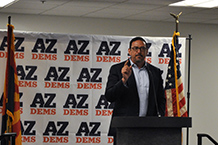
Fontes hit similar notes in his criticism of GOP Secretary of State nominee Rep. Mark Finchem, R-Oro Valley. “If my opponent wins this office, he will destroy the sanctity of our elections,” Fontes said. “Ours… is not just a campaign about partisan politics. Ours is a campaign about American democracy against totalitarianism.”
Mayes, too, offered a grim assessment of the competition. “We have phenomenal candidates, and the Republicans nominated crazy,” she said. “My opponent, he wants to be the lawyer for Donald Trump. I want to be the lawyer for the people of Arizona,” she added later.
In contrast to the regular invocations of Donald Trump, Democratic President Joe Biden’s name was largely absent from the speeches. Kuby used the president’s name, but only to make a point about GOP election deniers.
“We have two extreme Republican opponents,” Kuby said of the GOP corporation commission candidates. “They’re running to be in a quasi-judicial role where they have to weigh evidence and take testimony, yet they deny the evidence that Joe Biden is president.”
Kennedy, the other corporation commission candidate, and Hoffman were the only candidates who didn’t explicitly talk about their races’ connection to larger questions in national politics.
Still, Hoffman talked about some of the hot-button issues at play in her campaign. Republicans have called her a “groomer” over her support for LGBTQ students, she said, then noted that the campaign staff of her opponent, former Attorney General Tom Horne, includes David Stringer, a former legislator who resigned in 2019 after decades-old charges that he paid minors for sex resurfaced.
The event largely went off as planned, with a succession of speakers and a friendly crowd, many sporting shirts for different candidates and causes, punctuating the speeches with applause.
But during Hobbs’ speech – the last of the afternoon – a protestor interrupted, shouting from the front row: “What about discriminating against Black people?”
That was a reference to a lawsuit brought by Talonya Adams, a Black woman who claimed she suffered discrimination, and later retaliation, after she complained about being paid less than other colleagues in the Senate while Hobbs was the leader in the minority chamber. A jury agreed and awarded Adams millions in damages.
The heckler was Drew Hernandez, who works for the conservative group Turning Point USA, and he posted a video of the interaction on Twitter after being forcefully escorted out of the room.
At the Carpenters’ hall, Hernandez was quickly drowned out by the crowd, chanting: “Katie! Katie! Katie!” Hobbs didn’t reply or acknowledge Hernandez.
The post At Democrats’ rally, candidates focus on Republican opponents first appeared on Arizona Capitol Times.
]]>The post Three Republicans face off in primary for treasurer first appeared on Arizona Capitol Times.
]]>
Three Republicans who oppose tying environmental standards to investments in businesses are competing against each other in the primary election for state treasurer next week.
The winner of the GOP primary August 2 will face Democratic State Sen. Martín J. Quezada in the general election in November.
GOP incumbent Kimberly Yee is regarded as a favorite to retain her role. She served in the Arizona House of Representatives from 2011-2013, the Arizona Senate from 2013 to 2019, and was Senate majority leader from 2017-2019. Yee is also the first Asian American woman to win statewide office in Arizona.

The incumbent was elected treasurer in 2019. Yee announced her intention to run for governor last year but dropped out of the race in January after struggling to gain traction in a crowded GOP field. Now that she has re-entered the race for her current seat, Yee said that she aims to improve upon the accomplishments of her first term – including an increase of the state’s assets under her management from $15.4 billion to $29.9 billion as of May 31.
She used her office to create a Financial Literacy Task Force, which invites members from financial institutions across the state to promote new policies which they believe will benefit financial literacy in Arizona. In 2019, Yee also supported a bill that now requires school districts to teach one semester of financial education to students before they graduate high school.
If re-elected, Yee said that her primary focus would be to expand upon the Task Force and fight back against the Biden administration’s policy of encouraging financial institutions not to finance companies in coal, gas or oil that do not meet their environmental standards.
“What’s happening there is we are seeing that the lack of alternatives in the energy space is creating higher prices that consumers see every day in Arizona at the pump. And that is clearly affecting everyday Arizonans,” Yee said. “And so, we are asking them simply to push back against what I feel is an overreach of federal policy upon our state.”
Competing with Yee for the Republican nomination is Rep. Jeff Weninger – who has served in the Arizona House of Representatives since 2015. He previously served on the Chandler City Council from 2007-2015 and owns a small chain of Arizona restaurants called Dilly’s Deli.

He touts his record of having shared the highest percentage of bills successfully signed into law this past session with just one other House Republican – a mark of 80%. If elected, Weninger said he would sometimes use his governing experience and connections to lobby for policies that would allow for the two to work in lockstep. He also mentioned that he will honor legislative decisions with which he doesn’t agree.
“There are certain issues that are going to come up. And they go through the legislative process, which is another reason I’ve said that a treasurer should be involved in the Legislature and talking occasionally,” Weninger said. “But these are things that affect that Treasurer’s Office directly so of course you should be involved. There are certain policies that I think it is appropriate to take a policy stance.”
Similar to Yee, Weninger opposes the idea that environmental standards should be taken into account when determining whether to invest in a company. He criticized the merit of “ESG” scores, which are the measures of a company’s exposure to long-term environmental, social and governance risks. The lawmaker described these scores as “arbitrary” and “akin to the green, new deal”.
Weninger indicated that, although he would generally not consider a company’s political behavior when deciding whether to invest, there are some stances that he couldn’t accept. This past session, Weninger supported a bill that mandated that the state end investments that boycott Israel. He also indicated his intention to terminate a contract with Bank of America because of a 2018 decision where the bank said it wouldn’t loan money to companies that produce military-style weapons for civilians.
“Essentially, by virtue of giving liquidity and money and allowing them to profit off of the same Arizona taxpayers, is also contributing to more money diminishing their own Second Amendment rights,” Weninger said.
Rounding out the GOP field is Bob Lettieri, an accountant and career financial executive who served as a CFO for multiple Arizona companies for over 20 years and served twice as treasurer of the Arizona Republican Party in 2017 and 2019. Lettieri has publicly stated he is not convinced that President Biden’s 2020 victory in Arizona was legitimate and is skeptical that Arizona’s midterm elections will be free and fair.

While Lettieri agrees that environmental standards shouldn’t factor into investment decisions, he doesn’t believe that political behavior should either. He pushed back on Weninger’s stance that Arizona shouldn’t invest in companies that boycott Israel. And Weninger promised that, if elected, he would focus on pursuing investments that pay high dividends.
Lettieri also criticized Yee for taking credit for growth in funds for which he said she is not wholly responsible. While the current treasurer prefers to delegate tasks to those in her administration, Lettieri said that he believes the office of the treasurer is the office of a technocrat, and not that of a lobbyist, policymaker or administrator.
“Just based on the amount of time I’ve spent reviewing the revised statutes, the centerpiece is investing the money that comes into the treasury. It just circles that point over and over again,” Lettieri said. “It does give you some guidelines. Guidelines for investing. Guidelines for institutions that you work with. So, the centerpiece is investing and safeguarding the securities (of those investments).”
Whichever Republican advances from the primary will face four-term Democratic State Sen. Martín J. Quezada in November. Quezada has a background as an attorney and owns a law firm in Phoenix. He also served in the Arizona House of Representatives from 2012-2015 after being appointed by the Maricopa County Board of Supervisors.
Quezada said that he believes his lack of competition for the Democratic primary is a vote of confidence on behalf of his party.
“It looked like some other people might have been interested in running, but they kind of backed off once they saw that I was running,” he said.
While the legislator admitted that he would sometimes lobby for policies if elected, he defined the primary responsibilities of the treasurer in three categories: working as the state’s chief banker, chief investment officer and chief financial officer. Quezada claimed that CFO is where the office has been lacking the most because previous treasurers haven’t advocated for good use of taxpayer money and policy proposals that are going to improve the state’s financial stability and economy.

Quezada said that he would rectify this by keeping politics out of any financial decisions that he makes. Contrary to his Republican opponents, he acknowledged ESGs as legitimate measures but reaffirmed that protecting the state’s economy was his foremost priority. He also cited repercussions from Covid, as well as oil and gas companies and energy sanctions from the Russian invasion of Ukraine as the primary causes of today’s inflation crises.
“The treasurer should be educating the public as part of its financial literacy efforts about those policy issues,” Quezada said. “About the impact of a pandemic, on our economy, about the impact of what’s happening in Ukraine, and about the impact of executive oil companies, profit margins and how that is having an impact on gas prices.”
The post Three Republicans face off in primary for treasurer first appeared on Arizona Capitol Times.
]]>The post Sen. Kimberly Yee’s primary competition eliminated first appeared on Arizona Capitol Times.
]]>
A court ruling has cleared the District 20 GOP primary for Sen. Kimberly Yee, R-Phoenix.
State senate candidate Justin Henry was barred from the primary Thursday after a judge ruled he came up one signature shy of collecting enough nominating petitions to place his name on the ballot.
Maricopa Superior Court Judge Dean Fink confirmed a finding by the county recorder’s office that 128 of Henry’s 551 signatures were invalid. And based on evidence presented by the legal challenge to Henry’s campaign, the judge threw out another six signatures – just enough to place Henry one signature short of the 418 minimum signatures required.
During a roughly four hour hearing on Wednesday afternoon, Mike Liburdi, an attorney for the challenger Kevin Halden, presented evidence that some of those six signatures were duplicates – voters who’d already signed Yee’s own petition – while others were signed by voters not registered in LD20. Other signatures did not match those on file with the county recorder’s office.
Liburdi has also worked for Yee, who sought to protect herself from a recall effort filed and withdrawn earlier this year in response to her objection to legislation that could have helped fund a study of medical marijuana’s benefits for veterans with Post-Traumatic Stress Disorder.
The post Sen. Kimberly Yee’s primary competition eliminated first appeared on Arizona Capitol Times.
]]>The post Senator Yee: Personal finance instruction will lead to better choices first appeared on Arizona Capitol Times.
]]>
When Mitch Ruttenberg teaches economics at Trevor G. Browne High School, he ends each semester with lessons on credit cards, taxes, budgeting and other aspects of personal finance.
“It’s last thing they get from me because I know that’s what they need the most,” he said.
Because his and other economics classes in the Phoenix Union High School District provide that instruction, Ruttenberg said a new state law requiring academic standards in social studies to include personal finance won’t change much.
While the law prescribes teaching subjects like spending, saving, investments and credit, school districts have flexibility when developing their lessons.
State Sen. Kimberly Yee, R-Phoenix, the law’s author, said many districts are well-prepared to comply.
“Many of them already told us that the skill sets are already there, they just need to open up the curriculum a little bit more,” she said.
Personal finance lessons are important for children, Yee said.
“As we grow into adulthood, these are the same skills that we have to have in our own households,” she said, “so the earlier we teach these simple, basic skills, I think the better off society will be.”
Chris Kotterman, the Arizona Department of Education’s deputy associate superintendent of policy development and government relations, said financial literacy is already included in the Arizona’s social studies standards.
The new law, he said, re-emphasizes that districts should focus on financial literacy.
“Anytime the Legislature sort of passes a bill that typically calls something out, it sort of drops a marker for school districts and charters that, ‘Hey, you need to pay attention to this,’” Kotterman said.
He said the Department of Education isn’t tasked with enforcing the law but it will provide resources, such as suggestions of nonprofit groups that specialize in personal finance instruction.
Yee said making personal finance instruction part of state law prevents it from being dropped should state education standards change.
“We placed it in the law so that it will forever be there,” she said.
Julie Landers, a math teacher at Mesa High School, part of Mesa Public Schools, said it’s a good idea to let school districts determine specific lessons.
“Depending on where you are, you want to be able to tailor it to the groups of kids you have,” she said.
The district has personal finance math classes, but students fulfill the financial literacy requirement through economics classes, Landers said.
JoDee Pennock, a business teacher at Liberty High School in Peoria, said business teachers in the Peoria Unified School District are fighting to have the personal finance requirement included in their classes because they cover the required topics.
“I think a business teacher is going to hit the more financial part of it where often times an economics class is being taught by a history teacher, which takes a more historical role,” Pennock said.
Even though the school districts are responsible for the curriculum, Yee has things she’d like to see taught.
“We certainly encourage the basic skills of managing your money, understanding debt, understanding how to hold a credit card, managing your checkbook, little basic skills,” she said.
Michael Cummiskey, a chartered financial consultant in Paradise Valley, said new law is good but that parents are the most important personal finance teachers. That can start with educating children about the family budget.
“Let them get involved in what things cost because a lot of times kids don’t even understand what the real costs are,” he said.
Required instruction:
1. Explanations on how education, career choices and family obligations affect future income.
2. Analyses of how advertising influences consumer choices.
3. Determining short-term and long-term financial goals and plans, including income, spending, saving and investing.
4. Comparing the advantages and disadvantages of using various forms of credit and the factors determining credit history.
5. Explanations of the risk, return and liquidity of short-term and long-term saving and investment choices.
6. Identification of investment options available to individuals and households.
The post Senator Yee: Personal finance instruction will lead to better choices first appeared on Arizona Capitol Times.
]]>The post State lawmakers push for laws against bullying in schools first appeared on Arizona Capitol Times.
]]>
A state lawmaker is pushing for a law requiring school employees to report and document bullying.
HB 2415, sponsored by Rep. Kimberly Yee, R-Phoenix, calls for disciplinary action against school employees, from administrators to teachers and janitors, who fail to file detailed reports about bullying.
“It puts a new accountability on schools,” Yee said.
It’s one of two legislative efforts to address bullying. A Democratic representative and senator have introduced identical measures dealing with cyber-bullying and bullying related to bias.
Yee said the issue of school bullying was brought to her attention by a constituent whose child, a high school student, was assaulted on the first day of school.
“The assault was done by a student already on probation,” Yee said in a phone interview. “He was wearing a tracking device.”
She said the victim suffered “brutish” facial lacerations and blacked out during the attack, yet the school failed to contact police or emergency medical services.
Her bill would require schools to contact emergency services including police and paramedics when appropriate.
“I strongly believe we must make our schools a safe place to learn and that students should not feel threatened by other students,” Yee said.
Jennifer Loredo, an organizational consultant of governmental affairs with the Arizona Education Association, said her organization wholeheartedly supports the concept, though it has no formal position for now.
“We want children to be able to feel safe in school,” she said.
Meanwhile, Rep. Katie Hobbs, D-Phoenix, and Senate Minority Leader David Schapira, D-Tempe, have introduced HB 2580 and SB 1549, dubbed the Arizona Safety Schools Act, which would require schools to address cyber-bullying and bias-motivated bullying.
“There’s a lot [of bullying] that goes on electronically with Facebook, MySpace, texting [and] using phones in other ways,” Hobbs said.
Sam Castañeda Holdren, spokesman for Equality Arizona, a civil rights organization representing the lesbian, gay, bisexual and transgender community, said his organization worked with the lawmakers to create comprehensive bill dealing with all aspects of bullying. He said he’d like to see Yee’s measure include a provision against bullying based on bias.
The post State lawmakers push for laws against bullying in schools first appeared on Arizona Capitol Times.
]]>