The post The Alliance for Health Policy Releases New Reports and Policymaker Resource to Guide Education on Fraud, Waste, and Abuse appeared first on Alliance for Health Policy.
]]>October 26, 2026
The Alliance for Health Policy Releases New Reports and Policymaker Resource to Guide Education on Fraud, Waste, and Abuse
– Insights report draws on expert interviews to shed light on the trends, structures, and fundamental questions shaping fraud, waste, and abuse policy
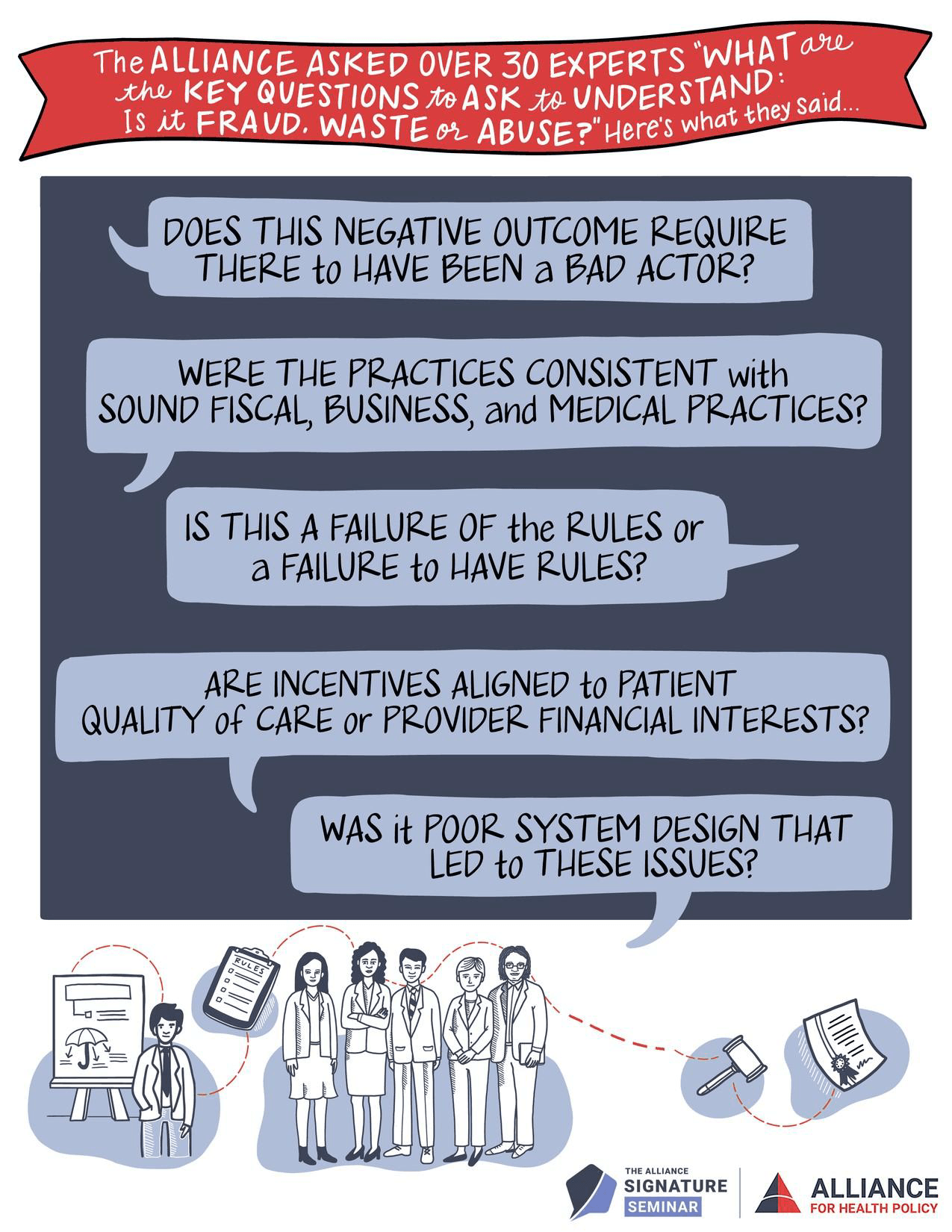
– Seminar report reflects recommendations from more than 50 thought leaders and introduces a question-based educational resource to help policymakers ask, “Is it fraud, waste, or abuse?”
Washington, D.C. — The Alliance for Health Policy today released two companion reports from its 2026 Signature Seminar on Fraud, Waste, and Abuse Policy, a topic drawing renewed attention in U.S. health policy and one that remains inconsistently understood across the policy community. The reports reflect outputs from a two-part program that combined in-depth stakeholder listening with expert-led workshops.
The reports include:
- Insights Report: Draws on 20 in-depth interviews with experts representing a broad range of perspectives, including providers, payers, researchers, policy experts, state Medicaid officials, enforcement and oversight professionals, employers, and patient communities. This report uses a systems-thinking “iceberg” framework to show how the issues most visible in policy debates are shaped by deeper trends, structural dynamics, and foundational questions across the health system.
- Seminar Report: A summary of findings and recommendations from two workshops held in August and September 2026 convening more than 50 health policy experts and stakeholders to discuss critical issues and knowledge gaps in fraud, waste, and abuse policy. The report includes a new educational resource for policymakers.
“Fraud, waste, and abuse is often discussed as a single problem, but the experts we heard from were clear that it is really several, each with its own causes, evidence, and responses,” said Claire Sheahan, M.Sc., President and CEO of the Alliance for Health Policy. “Perspectives differed on the greatest risks and how to balance program integrity with access to care and administrative burden. But there was broad agreement on where education is needed: understanding that intent is what separates fraud from waste, abuse, and simple error, and giving policymakers a shared vocabulary and a clear view of the safeguards already in place. Experts also highlighted opportunities to overcome barriers to better coordination. By starting with deep listening and then convening experts across sectors, these reports help the Alliance offer a more complete picture of the issue than any single stakeholder point of view could provide.”
The Insights Report draws on in-depth interviews conducted from May through July 2026. At the tip of the iceberg, interviewees noted that the areas currently garnering the most attention were high-visibility fraud cases, vocabulary conflation, Medicaid program integrity following recent federal legislation, the current enforcement moment, and scrutiny of the Medicare Advantage business model. In the remaining categories, they noted that the areas of the greatest attention were not always aligned with those of the highest impact, and shared insights on the trends, structures, and fundamental questions that were most important. These insights helped shape the focus of the Seminar workshops.
The Seminar Report, which summarizes the two facilitated workshops, focuses on clarifying what policymakers most need to understand about fraud, waste, and abuse policy. In the first workshop, participants co-designed a congressional curriculum, defining learning outcomes, foundational to advanced content, case studies, and resources. In the second workshop, participants imagined what success would look like in 2036 if policymakers consistently understood the difference between fraud, waste, and abuse, then worked through case studies based on real-life scenarios to identify the questions experts ask before reaching a conclusion.
One key output from the second workshop is a new educational resource built around key questions policymakers can ask to think through whether a situation is likely fraud, waste, abuse, or none of these.
Together, the reports conclude the “Incubate” phase of the Alliance’s two-part program lifecycle. During this phase, the Alliance draws on structured listening with its network of health policy experts. The findings from the 2026 Signature Seminar on Fraud, Waste, and Abuse Policy will directly inform the Alliance’s future nonpartisan educational offerings for congressional staff and the broader health policy community (the “Educate” phase).
The Signature Seminar program was sponsored by AHIP and Cotiviti, whose support made this effort possible. This program lays the groundwork for the Alliance’s educational work on this topic.
The Alliance now seeks partners to continue developing timely, expert-driven educational programming on fraud, waste, and abuse policy for policymakers and the broader health policy community, building on the insights and recommendations surfaced through this Signature Seminar. Connect with us about partnering on or sponsoring future educational programming on this topic.

Download the Educational Resource for Policymakers:
About the Alliance for Health Policy
The Alliance for Health Policy is a nonpartisan, nonprofit organization dedicated to helping policymakers and the public better understand health policy, the root of the nation’s health care issues, and the trade-offs posed by various proposals for change. We believe a better health care system begins with a balanced exchange of evidence, experience, and multiple perspectives.
For press inquiries, please contact:
Carolyn Sobczyk
Communications Consultant
csobczyk@allhealthpolicy.org
For sponsorship inquiries, please contact:
Kelly Appenzeller
Director of Production and Development
kappenzeller@allhealthpolicy.org
The post The Alliance for Health Policy Releases New Reports and Policymaker Resource to Guide Education on Fraud, Waste, and Abuse appeared first on Alliance for Health Policy.
]]>The post The Alliance for Health Policy Announces Board of Directors Leadership Transition and New Appointments for 2027 appeared first on Alliance for Health Policy.
]]>October 16, 2026
The Alliance for Health Policy Announces Board of Directors Leadership Transition and New Appointments for 2027
– Park to become board chair; Khosla, Long, and Ryu appointed to board
Washington, D.C. — The Alliance for Health Policy today announced updates to its Board of Directors, including a new board chair, vice chair and treasurer, along with the appointment of three new board members, and the conclusion of service for two longtime board members.
Effective January 1, 2027, Mike Park, J.D., MPH will assume the role of board chair, succeeding Elizabeth Hall, who is concluding her board term after nearly a decade of service, including her tenure as chair. Lisa Chimento, MBA will become vice chair and secretary, and Susan Turney, M.D., M.S., FACP, FACMPE will become treasurer.
The Alliance expresses its gratitude to outgoing board members Vicky Gregg and M. Roy Wilson, M.D., M.S., who are concluding their service on the Board of Directors.
“The Alliance Board has successfully helped the organization navigate major transformation over the past several years, strengthening our commitment to mission while overhauling our programming to meet the needs of today’s policy community. Liz Hall has been our mission-centered North Star through that transition,” said Claire Sheahan, M.Sc., President and CEO of the Alliance for Health Policy. “Mike Park has been a steady, committed leader on our Board over the past three years, a familiar face in our programs, and a respected policy leader with our community. We are so grateful to be able to welcome him as Chair. At the same time, we are thrilled to welcome Jay Khosla, Ryan Long, and Dr. Jaewon Ryu to our Board. Together, they bring distinct and complementary experience shaping health policy, whether by leading health systems, leading the development of major legislation on Capitol Hill, or serving in leadership in a large private payor organization.”
Mike Park, J.D., MPH is a health care partner at Alston & Bird, where he leads work on Medicare payment policy, health information technology, and program integrity issues. He previously served as health policy counsel to Sen. Chuck Grassley (R-Iowa) during Sen. Grassley’s tenure as chair of the Senate Finance Committee, and has held roles at HHS, CMS, and the Center for Studying Health System Change. Park has served on the Alliance Board since 2022, most recently as vice chair.
“I’m honored to step into this role and grateful to Liz Hall, whose leadership has put the Alliance on such strong footing,” said incoming Alliance Board Chair Park. “When I joined the Senate Finance Committee staff in 2006, I learned that what makes the biggest difference in health policy is having the understanding of complex policy, a working knowledge of how policy is crafted and implemented in practice, and being connected to leaders in the field. I’m proud to take that philosophy to my role as board-chair of the Alliance, a trusted resource for staff and the broader policy community.”
“Serving on this Board since 2017, and leading it these past two years, has been one of the great privileges of my career,” said outgoing Alliance Board Chair Hall. “The Alliance helped shape me as a Senate staffer, and I have been proud to watch it do the same for a new generation of policymakers and staff. I look forward to staying engaged through the Emeritus Council as Mike leads the Board into its next chapter.”
The Alliance is also pleased to welcome three new members to its Board of Directors:
Jay Khosla, J.D., MHA is chief government affairs officer at Humana, where he leads the company’s enterprise policy and advocacy strategy at the federal, state, and local levels. He brings more than two decades of experience on Capitol Hill working on tax, trade, financial services, and health care policy, most recently in the office of Senate Majority Leader Mitch McConnell (R-Ky.). Before that, he served as majority staff director of the Senate Finance Committee, where he previously held roles as policy director and chief health counsel. Earlier in his career, Khosla held senior policy roles with former Senate Majority Leader Bill Frist (R-Tenn.), the Senate Budget Committee, and Sen. Orrin Hatch (R-Utah), and served as a senior policy advisor on Sen. John McCain’s 2008 presidential campaign. He is a life member at the Council on Foreign Relations and also sits on the board of the Winston Health Policy Fellowship. Khosla earned his bachelor’s degree and master’s degree in health administration from Virginia Commonwealth University and his law degree from the University of Richmond.
Ryan Long, J.D. is director of congressional relations and a senior research fellow at Paragon Health Institute, where he leads the organization’s engagement with Congress and its Congressional Health Policy Education Program. He is also a nonresident senior scholar at the USC Schaeffer Institute and brings more than 25 years of experience on Capitol Hill and in health policy. Long most recently served as senior policy advisor and counsel to Rep. Kevin McCarthy (R-Calif.) during his tenure as House minority leader and Speaker of the House. Before that, he served as deputy staff director and then staff director of the House Energy and Commerce Committee under Rep. Greg Walden (R-Ore.). Long joined the committee staff in 2004 and served as its chief health counsel from 2006 to 2013. He began his career working for Reps. Charlie Norwood (R-Ga.) and Joe Barton (R-Texas). Long earned his bachelor’s degree from the University of North Carolina at Chapel Hill and his law degree from the Columbus School of Law at The Catholic University of America.
Jaewon Ryu, M.D., J.D. most recently served as CEO of Risant Health, a nonprofit organization formed by Kaiser Permanente to expand the adoption of value-based care, since 2024. Before that, he served as president and CEO of Geisinger, an integrated health system based in Pennsylvania, from 2019 to 2024. Earlier in his career, Ryu held leadership roles at Humana and the University of Illinois Hospital & Health Sciences System, and served in government as a White House Fellow at the U.S. Department of Veterans Affairs and as an adviser to the Centers for Medicare & Medicaid Services. He has also served on the Medicare Payment Advisory Commission and on the boards of the National Committee for Quality Assurance and The Commonwealth Fund. Ryu earned his bachelor’s degree from Yale University and his medical degree and law degree from the University of Chicago. Ryu joined the Alliance Board in August 2026 to fill an interim opening, and the Alliance is pleased to formally welcome him to the Board alongside Khosla and Long.
View the Alliance’s Board of Directors and Emeritus Council here.
About the Alliance for Health Policy
The Alliance for Health Policy is a nonpartisan, nonprofit organization dedicated to advancing the understanding of health policy issues. Through educational events and resources, the Alliance informs policymakers, the media, and the public about health policy issues and promotes evidence-based solutions.
For media inquiries related to this announcement, please contact Carolyn Sobczyk at csobczyk@allhealthpolicy.org.
The post The Alliance for Health Policy Announces Board of Directors Leadership Transition and New Appointments for 2027 appeared first on Alliance for Health Policy.
]]>The post Letter from the CEO: Building Trust in a “Trust Recession” with the BLC Fellowship appeared first on Alliance for Health Policy.
]]>
Hi friends,
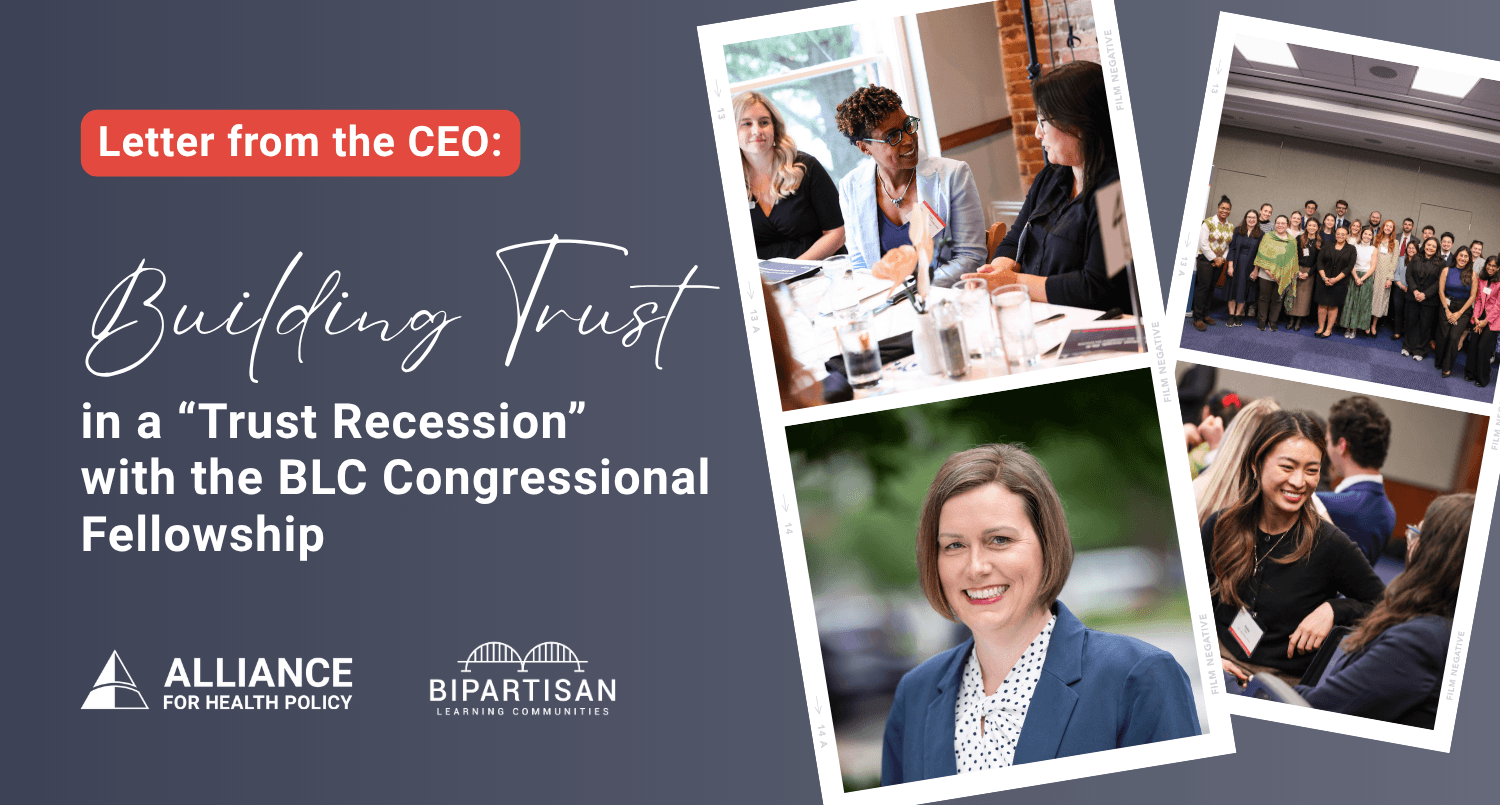
We're already at the halfway point of the 2026 Bipartisan Learning Communities (BLC) Congressional Fellowship, if you can believe it. Since our last program update in May, the fellows have kept up a steady pace of learning and community-building.
One thing I’ve noticed is that our classes have different personalities. The first class was populated by a group that was open to new experiences. They were our pioneers. This year, we’re seeing a class of fellows who joined a proven program who are making the most of their time: showing up ready to ask questions and take notes, and leveraging every chance to learn and grow in their careers on the Hill.
We’ve witnessed that in the ways the fellows are molding this fellowship into something completely their own. In addition to learning from our experts and events, they’ve built on last year’s fellowship strides in working together. They’ve turned to each other as resources that they can call first when seeking a second point of view on an issue or a piece of legislation, thereby strengthening their peer network across the aisle, across chambers, and across delegations.
"I've made connections I wouldn't otherwise have made if the Alliance fellowship hadn't set the table. I'm grabbing coffee with my fellow cohort members outside of our regular sessions, and they're sending me opportunities happening in their own offices."
– Jerdashia Scott, Legislative Correspondent, Office of Rep. Jim Clyburn (D-S.C.)
The beauty of it is that that’s the fellowship working exactly as intended. Back when we partnered with RWJF in 2024 to make this investment, we set out to offer more than greater health policy knowledge or professional development. We’re handing these fellows a much longer-term opportunity: the connections and relationships that will launch them into creating a community of next-generation leaders in health policy.
Hear from the Fellows themselves through interviews with these impressive rising stars about their experience building relationships across the aisle, learning from the experts who shaped landmark health policy, and staying connected to a growing alumni community.
The most exciting development on my radar is what’s next: as each class finishes successful years of the Alliance Fellowship, the ranks of our alumni grow. In November, we will have more than 50 alumni, and the Alliance team is developing and seeking sponsors for new kinds of programming to ensure that this group’s learning together continues. We are exploring programs that build on some of those the alumni found most useful and compelling in their fellowship years, including leveraging real-world examples, workshopping, and experiential learning.
If your organization is interested in supporting continuing education for BLC alumni, we'd love to talk. Connect with us.
In large part, this fellowship program’s impact has to do with the high level of trust the fellows and their offices have in the Alliance to deliver expert-led, nonpartisan, stakeholder-neutral education that helps them do their job more effectively.
During our midpoint evaluation, we asked our fellows who they trust most for information. They ranked the Alliance ahead of federal agencies, industry, and media. As someone who has studied media and public opinion for years, I find the eroding levels of trust in media and industry disheartening, but not surprising, as so many academic voices have documented the current landscape as a “trust recession.” What we find is that legislative staffers have precious few resources they feel they can rely on.
We also see that the Alliance’s educational efforts are filling a GIANT gap, and holding fast to trust while it ebbs in other institutions. There are three reasons I see that fuel that trust and set the Alliance apart:
First, the Alliance’s matchless 30-year track record of educating policymakers; the historic investment in the BLC Fellowship for the professional development of these congressional staffers; and the careful two-phased, stakeholder-informed approach to our educational programming.
"I've appreciated the candid conversations we had with experts. It was refreshing to hear them cut through the political noise and share both their honest insights into crafting landmark health legislation and tips for staffers to navigate the complexities of health policy with confidence."
– Kaitlyn Mullen, Legislative Assistant, Office of Rep. Julia Letlow (R-La.)
Of course, none of this happens without RWJF's partnership. A big thank you for their continued support and commitment. A philanthropic partner that recognizes the importance of building competency, confidence, and collaboration in our next generation of leaders is rare to come by, and we are so grateful for their vision.
Scroll on for a full recap of what's happened since our last update.
Claire Sheahan
President and CEO
Alliance for Health Policy
Recent Updates:

In May, BLC alumna Abigail Chance, a staffer with the House on Ways and Means Committee, participated in the Alliance’s thought leader workshop as part of the 2026 Signature Series on Health Care Payment. Findings from this exercise were published in the Series Report.

Fellows participated in Expert Office Hours with the leaders who wrote the Affordable Care Act, the Medicare Modernization Act, and the Inflation Reduction Act — a rare chance for fellows to hear the history straight from the people who lived it.

Fellows connected with senior Alliance leaders and Board and Emeritus Council members over small-group table conversations for the first Dinner & Dialogue event of the year.
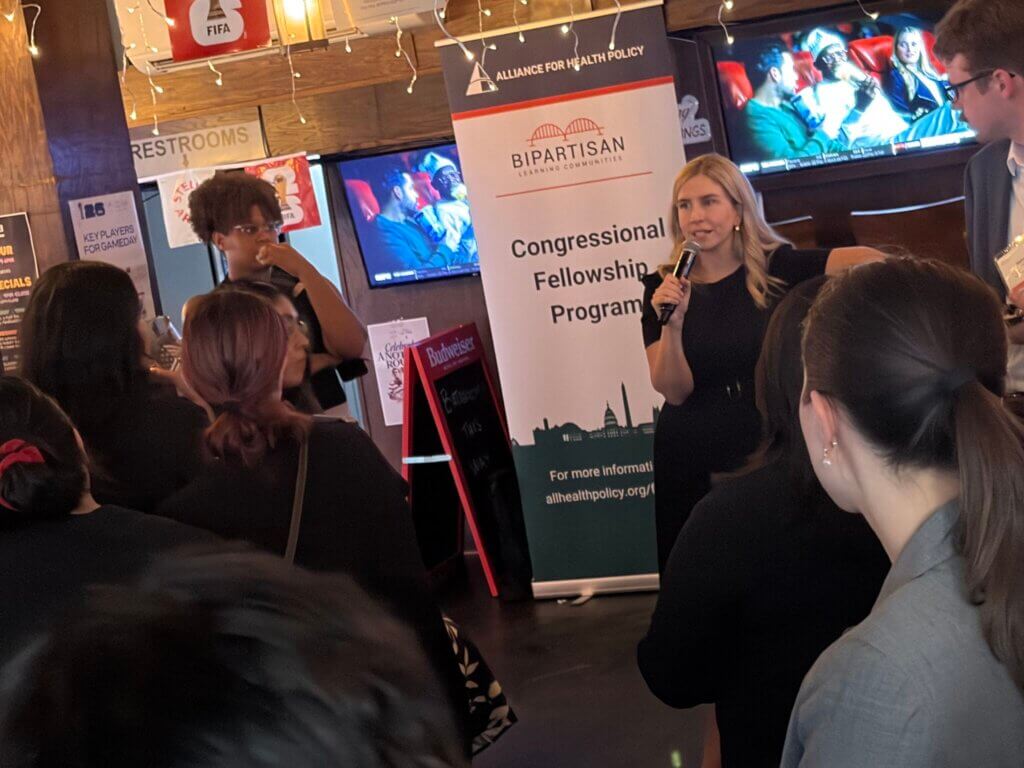
This year's Fellow cohort and 2025 alumni mixed it up together for the first time during a joint happy hour, marking a major milestone for our growing fellowship community!

At our second Dinner & Dialogue event, Fellows were joined by 2025 alumni and senior health policy leaders for candid, off-the-record conversations on health policy leadership.
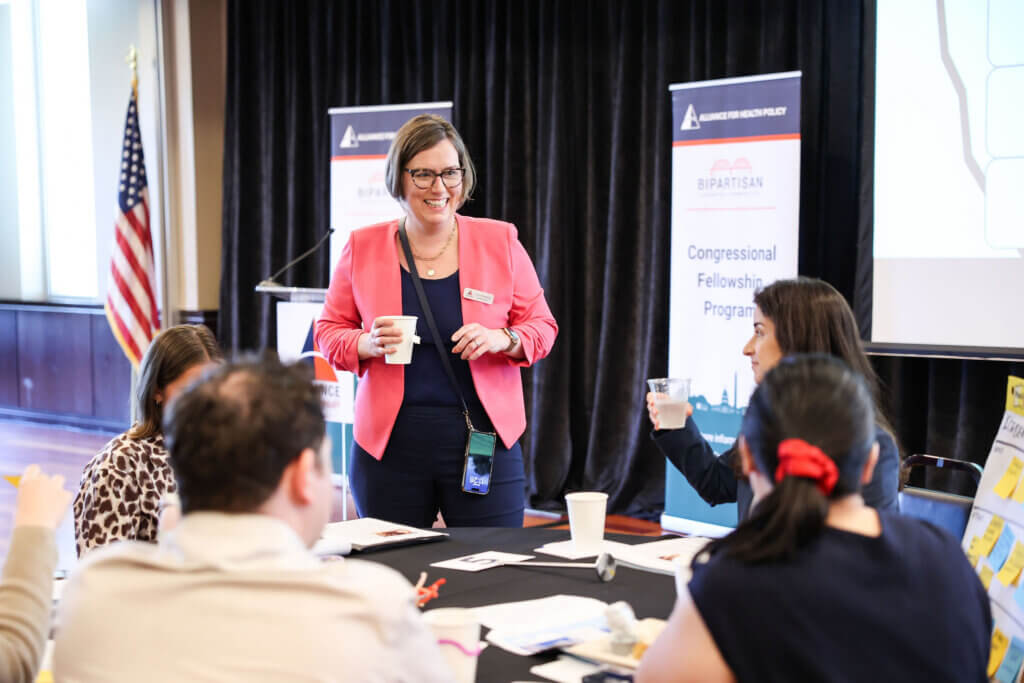
In August, Fellows participated in a day-long workshop that allowed them to explore the frameworks leaders use to navigate complexity and approach challenges they encounter on the Hill.
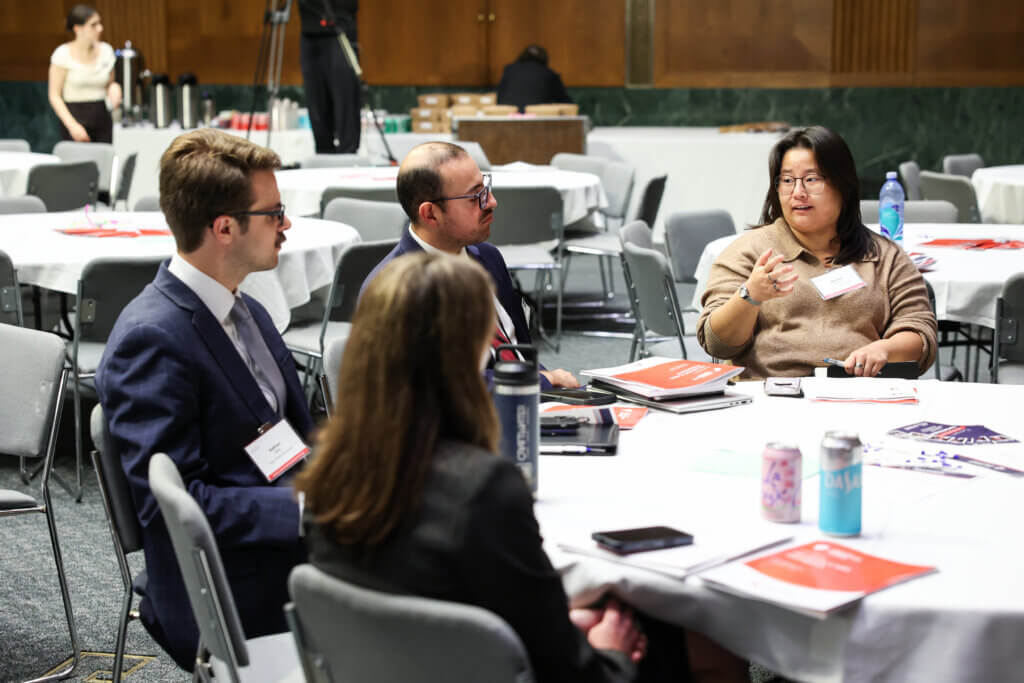
Before doors opened for the Alliance’s congressional briefing on MACRA, Fellows and alumni were invited to an exclusive conversation with the briefing’s featured experts, including policy leaders who negotiated the landmark legislation firsthand.
In Case You Missed It:
Meet the 2026 Fellow Class
Find out more about the current cohort of 30 congressional fellows.
2025 BLC Recap Video
Get a behind-the-scenes look at the 2025 BLC Fellowship experience.
2025 BLC Impact Report
Discover top-line findings from the 2025 BLC Fellowship year.
Sign up for our email list to stay informed of future BLC fellowship updates.
The post Letter from the CEO: Building Trust in a “Trust Recession” with the BLC Fellowship appeared first on Alliance for Health Policy.
]]>The post The Alliance for Health Policy Releases Final Report from 2026 Signature Series on Health Care Payment appeared first on Alliance for Health Policy.
]]>September 2, 2026
The Alliance for Health Policy Releases Final Report from 2026 Signature Series on Health Care Payment
– Report synthesizes a yearlong, nonpartisan exploration of how health care payment works today and where policy could go next
– A companion educational resource maps twelve payment policies based on impact and feasibility
Washington, D.C. — The Alliance for Health Policy today released its final report from the 2026 Signature Series on Health Care Payment, concluding a yearlong, nonpartisan exploration of how health care is financed and paid for today, and what payment policy could look like in the future. The report synthesizes learnings from a listening tour, thought leader workshop, spotlight webinar, and public summit, which culminated in a congressional briefing yesterday on Capitol Hill.
“Health care payment shapes nearly every part of the health care system, yet it remains one of the least understood areas of health policy,” said Claire Sheahan, M.Sc., President and CEO of the Alliance for Health Policy. “This report captures a year of listening to experts across the health care ecosystem and translating what we heard into education for the policymakers and staff who work on these issues every day. Throughout the Series, we looked at the issue in the domains our experts identified as most important: overall insurance strategies, hospital payment, physician payment, and drug/device payment."
"With recent interest on the Hill focused on physician payment, the time was right for a congressional briefing on MACRA," said Sheahan. "We know that historical perspective and context is key to understanding for our audience, and this final event of the Series offered a refresher that allowed us to ground that education in a real example of how payment policy has been made, and remade, over time.”
The report built off findings from the Alliance's Health Care Payment Insights Report, published in February 2026, based on in-depth interviews with experts across the health policy community. Using a systems thinking “iceberg model,” the Insights Report distinguished between the most visible payment debates, such as affordability, Medicare Advantage payment, and prescription drug pricing, and the deeper patterns, structures, and foundational questions that shape payment policy over time. Based on those insights, the Series organized its education around four structural areas: hospital payment, physician payment, drug payment, and system and insurance design.
The Insights Report also informed a Thought Leader Workshop convening more than fifty experts from across the health policy landscape. The workshop exercise included developing draft recommendations for a future congressional curriculum on health care payment, pairing policymakers' immediate priorities with the foundational knowledge needed to assess payment proposals and their broader effects. Workshop participants also contributed to shaping the structure, tone, and content of the Alliance’s 2026 Summit on Health Care Payment in Washington, D.C.
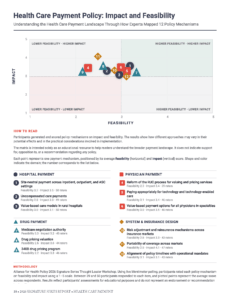
As part of the Thought Leader Workshop, participants also mapped twelve payment-related policies and mechanisms along two dimensions: potential impact, meaning the extent to which a topic could affect cost, access, quality, or the structure of the payment system; and feasibility, meaning how politically, administratively, and operationally achievable related changes may be under current conditions. The resulting matrix is available as a standalone resource, helping policymakers see how experts ranked different payment policies in terms of impact and feasibility.
“We now have a year's worth of insight on what is most important to understand about how health care payment actually works,” said Sheahan. “Thanks to the input from our Congressional Fellows and the experts who joined us at every stage of the listening process, this Series reflects the collected wisdom of policymakers and stakeholders across the health care system. It will be excellent fuel for our future programming on these topics. We are grateful to our sponsors and partners for making that work possible, and we are currently seeking additional partners to help carry these insights forward into future educational programming.”
Looking ahead, the Alliance will turn its attention to the 2027 Signature Series, which will explore the topic of health care affordability. Sponsorship opportunities are available for organizations interested in supporting the Alliance's next year of nonpartisan health policy education.
Resources:
- Download the 2026 Signature Series final report
- Download the impact-feasibility matrix educational resource
- Connect with us about the 2027 Signature Series on affordability
- Learn more about partnering or sponsoring future health care payment education

View the impact-feasibility matrix:
About the Alliance for Health Policy
The Alliance for Health Policy is a nonpartisan, nonprofit organization dedicated to helping policymakers and the public better understand health policy, the root of the nation’s health care issues, and the trade-offs posed by various proposals for change. We believe a better health care system begins with a balanced exchange of evidence, experience, and multiple perspectives.
For press inquiries, please contact:
Carolyn Sobczyk
Communications Consultant
csobczyk@allhealthpolicy.org
For sponsorship inquiries, please contact:
Kelly J. Appenzeller
Director of Production and Development
kappenzeller@allhealthpolicy.org
The post The Alliance for Health Policy Releases Final Report from 2026 Signature Series on Health Care Payment appeared first on Alliance for Health Policy.
]]>The post The Alliance for Health Policy Announces 2027 Signature Series on “Affordability” appeared first on Alliance for Health Policy.
]]>July 28, 2026
The Alliance for Health Policy Announces 2027 Signature Series on “Affordability”
– Announcement comes on the heels of the Alliance's July 22 Summit on health care payment
– New series will bring patients, providers, payers, employers, and policymakers into conversation about the cost of care
Washington, D.C. — Fresh off its public summit on health care payment, the Alliance for Health Policy will turn its attention to a topic that touches nearly every American. The organization unveiled “Affordability” as the theme of its 2027 Signature Series.
When it comes to affordability, the concern is both widespread and bipartisan. A recent KFF tracking poll revealed health care costs ranked as the top of the public’s economic worries. Democrats, Republicans, and independents alike are “very worried,” indicating that cost concerns are the result of mounting strain on Americans rather than tied to any single party or moment.
During the 2027 Series, the Alliance will examine what it actually costs to get and stay well in the U.S., from premiums and deductibles to prescription drug prices and the price tags attached to hospital and physician care, and connect those costs back to the policies and system dynamics that produce them.
“We know from polling that when people talk about affordability, they are talking about health care. For our community, the question of ‘how does health care policy address affordability’ is central,” said Claire Sheahan, M.Sc., President and CEO of the Alliance for Health Policy. “This past year during our Signature Series on health care payment policy, we spent a lot of time talking about how care gets paid for. Affordability is really the next part of that story: what happens to patients and families once the payment decisions have been made. It’s the rare topic where patients, employers, providers, and payers are all faced with challenges for their own reasons, and that gives us a real opportunity to get people talking to each other instead of past each other.”
Before landing on the topic of affordability, the Alliance consulted with the diverse group of stakeholders that makes up its community – policymakers, academics, industry leaders, and Alliance board members – about where to focus next. This topic was widely hailed as the most important policy issue to better understand in the coming year.
Programming for the year will roll out in the regular Alliance series cadence: first listening to the experts by gathering insights, through in-depth interviews and a thought leader workshop featuring a broad range of expertise, lived experience, and ideological perspectives. From there, the Alliance will turn those findings into public-facing education, in the form of a spotlight webinar, public summit, and congressional briefing, each building upon the last.
Affordability is already discussed widely in policy circles, but usually from the vantage point of a single stakeholder. The Alliance intends to add to the dialogue by convening the full spectrum of payers, providers, industry, patients, and federal and state policymakers, so that the resulting education reflects more than one side.
The Alliance has spent more than three decades building a reputation as a trusted place where people across the political spectrum can learn about health policy without being sold a solution. The annual Signature Series is the clearest expression of that work and reflects both parts of the Alliance’s unique Incubate-to-Educate programming model. The Series features a single topic to follow closely for a full year, examined from varied and diverse angles and packaged into education that leaves policymakers with knowledge of the trade-offs rather than just talking points.
Organizations interested in supporting the 2027 Signature Series on Affordability can now sign on as sponsors. Sponsors help make this programming available to policymakers and staff at no cost, and in exchange gain early visibility into the Alliance’s research and a seat at the table as the year’s programming takes shape. Organizations can express interest by completing the form here.
About the Alliance for Health Policy
The Alliance for Health Policy is a nonpartisan, nonprofit organization dedicated to helping policymakers and the public better understand health policy, the root of the nation’s health care issues, and the trade-offs posed by various proposals for change. We believe a better health care system begins with a balanced exchange of evidence, experience, and multiple perspectives.
For press inquiries, please contact:
Carolyn Sobczyk
Communications Consultant
csobczyk@allhealthpolicy.org
For sponsorship inquiries, please contact:
Kelly J. Appenzeller
Director of Production and Development
kappenzeller@allhealthpolicy.org
The post The Alliance for Health Policy Announces 2027 Signature Series on “Affordability” appeared first on Alliance for Health Policy.
]]>The post Letter from the CEO: An Early Update on the 2026 BLC Fellowship appeared first on Alliance for Health Policy.
]]>
Hi friends,
2026 has been moving fast, and you may not realize that the Alliance has already kicked off our second year of the Bipartisan Learning Communities (BLC) Congressional Fellowship. In the meantime, in the spirit of the Alliance’s commitment to shared learning, I’m sharing some top-line findings from our inaugural year.
First: we overachieved against our set objectives. By a lot. Fellows from the inaugural year reported gains in confidence, day-to-day application of skills on the Hill, and their ability to engage more effectively in policy discussions – all at 95% or higher.
Just as important, these findings are already shaping how we’ve strengthened the program for year two. They also reinforce something many of you have voiced to us: there is a real appetite on the Hill for structured, nonpartisan learning opportunities to close educational gaps on health policy.
That’s exactly what we’re building with this one-of-a-kind fellowship program. It’s an opportunity for staff to deepen their policy knowledge, learn to navigate complex legislative dynamics, and strengthen their relationships across the aisle. A bullseye for our mission to demystify complex policy topics, especially for Congressional staff.

All our programs derive their quality from our community, so thank you for being part of this success. We plan to build on the momentum of this energizing program. The fellowship is annual, but the community of learners we are building will last long beyond that. We’re excited to see what’s ahead!
Sincerely,
Claire Sheahan
President and CEO
Alliance for Health Policy
Recent Updates:

We published an article co-authored by two Alliance board members Liz Fowler and Mike Park on what it takes to prepare the next generation of health policy leaders in Congress.

Fellows kicked off this year's program with an orientation event featuring a federal budget panel and Q&A with leading experts Liz Wroe and Kim Trzeciak.

Two BLC alumni, Ally Crha and Claire Bienvenu, joined a fireside chat during the 2026 Health Policy Academy to share candid insights on navigating today’s policy environment as rising staffers.

Fellows participated in webinars on the Congressional Budget Office and navigating committees, with practical guidance from experienced policy leaders.
Sign up to stay informed of future BLC fellowship updates.
The post Letter from the CEO: An Early Update on the 2026 BLC Fellowship appeared first on Alliance for Health Policy.
]]>The post The Alliance for Health Policy Announces 2026 Class of Bipartisan Learning Communities Congressional Fellows appeared first on Alliance for Health Policy.
]]>March 17, 2026
The Alliance for Health Policy Announces 2026 Class of Bipartisan Learning Communities Congressional Fellows
– Second cohort builds on successful inaugural year, expands a growing community of emerging health policy leaders
Washington, D.C. — The Alliance for Health Policy today announced the 2026 class of Bipartisan Learning Communities (BLC) Congressional Fellows, a bipartisan cohort of 30 congressional staff selected to participate in the Alliance’s second annual leadership and professional development program.
Now entering its second year, the BLC Congressional Fellowship builds on the success of the inaugural year by delivering on the strong demand for sustained, cohort-based learning designed specifically for the real-world needs of congressional staff.
Fellows participate in expert-led sessions, skill-building workshops, and peer learning experiences that deepen their health policy understanding while fostering constructive relationships across chambers, offices, and perspectives. The program stands out among others for its ability to connect fellows with the unparalleled Alliance network of bipartisan health policy professionals, drawn from its thirty-year history of supporting learning and growth.
“Our first year’s fellowship confirmed that listening first – to potential fellows, their managers, and experts in adult education and health policy – before launching educational efforts, is the key to success,” said Claire Sheahan, M.Sc., president and CEO of the Alliance for Health Policy. “This second class takes that principle even further. This year’s fellows will join an even stronger program, because it incorporates inputs and learnings from year one. Our aim is not only to transfer knowledge, but to help fellows build their skills, networks, and confidence to be health policy leaders.”
"This year’s fellows will join an even stronger program, because it incorporates inputs and learnings from year one. Our aim is not only to transfer knowledge, but to help fellows build their skills, networks, and confidence to be health policy leaders."
Claire Sheahan, M.Sc., President and CEO, The Alliance for Health Policy
The 2026 fellow class reflects Alliance values of bipartisanship and collaboration. The cohort includes 30 congressional staff, evenly split between Democratic and Republican offices, including aspiring health policy leaders in both the House and Senate. Together, they represent a broad cross-section of congressional offices and roles committed to investing in staff development and policy expertise.
2026 BLC Congressional Fellowship Class
Priya Amilineni | Legislative Assistant, Representative Mark Takano, CA-39 (D)
Mariah Baker, MPH | Senior Policy Adviser, Representative Suzan DelBene, WA-01 (D)
Elizabeth Beltran | Senior Policy Adviser, Representative Troy Carter, LA-02 (D)
Elizabeth Blakely | Legislative Correspondent, Representative Carol Miller, WV-01 (R)
Christopher Brown | Assistant Policy Advisor, Senator Dan Sullivan, AK (R)
Julia Brunner | Health Legislative Assistant, Representative Brad Schneider, IL-10 (D)
Justin Camp | Legislative Assistant, Representative Bob Onder, MO-03 (R)
Sebastian Cardona-Negron, MPH | Legislative Aide, Senator Chris Murphy, CT (D)
Robert Clawes | Legislative Correspondent, Senator Jim Banks, IN (R)
Ryan Dalbec | Senior Policy Adviser, Representative Mike Carey, OH-15 (R)
Rebecca (Becca) Damante | Health and Education Policy Adviser, Senator Jeff Merkley, OR (D)
Imani Featherson, MPH | Legislative Aide, Senator John Fetterman, PA (D)
Carter Forinash | Legislative Assistant, Representative Don Beyer, VA-08 (D)
Isrrael Garcia, MPH | Senior Legislative Assistant, Representative Pete Aguilar, CA-33 (D)
Kei Helm, MPP | Legislative Assistant, Senator Ed Markey, MA (D)
Cassidy Hobbs, MPH | Policy Adviser, Senator Lisa Murkowski, AK (R)
Allyson Horstman, MSPH | Health Policy Adviser, Senate Finance Committee (D)
Rachel Hudson | Legislative Correspondent, Senator Deb Fischer, NE (R)
Charlene Kuo, MPH, Ph.D. | Policy Advisor, Senate Special Committee on Aging (D)
Tre Lind | Senior Legislative Assistant, Representative Rick Allen, GA-12 (R)
Matthew May | Legislative Assistant, Senator Steve Daines, MT (R)
Nathan May, MPH | Legislative Correspondent, Representative French Hill, AR-02 (R)
Kaitlyn Mullen | Legislative Assistant, Representative Julia Letlow, LA-05 (R)
Marshall Overcash | Legislative Correspondent, Senator Thom Tillis, NC (R)
Michelle Paucar, MPH | Health Policy Adviser, Representative Jan Schakowsky, IL-09 (D)
Sydney Powers | Senior Legislative Assistant, Representative Dusty Johnson, SD-At Large (R)
Jade Rowland | Health Policy Adviser, Senator Mazie Hirono, HI (D)
Jane Scarborough | Legislative Assistant, Representative Michael Baumgartner, WA-05 (R)
Jerdashia Scott | Legislative Correspondent, Representative Jim Clyburn, SC-06 (D)
Haley Tran | Legislative Aide, Representative Zach Nunn, IA-03 (R)
The BLC Congressional Fellowship reflects the Alliance’s broader mission to deliver nonpartisan, expert-led education that equips policymakers and their staff to better understand complex health policy challenges and trade-offs. Fellows are encouraged to share their participation with their professional networks and engage with the broader Alliance community throughout the year. This year also marks the first year of Alliance programming for 2025 Fellow Alumni. The first class of BLC Fellows will continue to benefit from opportunities to learn with the fellows and on their own.
“One of the most encouraging parts of working with newer professionals on the Hill is seeing how much leadership potential is already there. What many of them need is simply the space and support to develop it,” said Mike Park, J.D., MPH, Alliance board member and former health policy counsel to Sen. Charles Grassley during his tenure as chairman and ranking member of the Senate Finance Committee. “Programs like the Bipartisan Learning Communities Fellowship give congressional staff the opportunity to step back from the daily pace and distractions of the Hill, learn from experienced policy leaders who have lived it, and build relationships across offices and parties. Those experiences help shape the kind of thoughtful, collaborative leadership needed for effective health policy.”
Over the course of the program, fellows will engage with senior health policy experts, veteran Hill leaders, and Alliance staff through a structured curriculum designed to strengthen their policy fluency, legislative skills, and professional networks. The Fellowship’s end is marked with a celebration of those who complete the requirements.
For more information about the Alliance’s BLC Congressional Fellowship or to sign up for program updates, visit allhealthpolicy.org/fellowship. This program is made possible by generous support from the Robert Wood Johnson Foundation.
About the Bipartisan Learning Communities (BLC) Congressional Fellowship
The BLC Congressional Fellowship is a first-of-its-kind, nonpartisan leadership and professional development program offered by the Alliance for Health Policy for early- to mid-career congressional staff. Developed in collaboration with senior Hill leaders and national education experts, the 10-month fellowship equips participants with foundational health policy knowledge, Hill-relevant skills, and a stronger understanding of the legislative process.
About the Alliance for Health Policy
The Alliance for Health Policy is a nonpartisan, nonprofit organization dedicated to advancing the understanding of health policy issues. Through educational events and resources, the Alliance informs policymakers, the media, and the public about health policy issues and promotes evidence-based solutions.
For media inquiries related to this announcement, please contact Carolyn Sobczyk at csobczyk@allhealthpolicy.org.
The post The Alliance for Health Policy Announces 2026 Class of Bipartisan Learning Communities Congressional Fellows appeared first on Alliance for Health Policy.
]]>The post The Alliance for Health Policy Announces 2026 Board of Directors Updates and Launch of Emeritus Council appeared first on Alliance for Health Policy.
]]>March 16, 2026
The Alliance for Health Policy Announces 2026 Board of Directors Updates and Launch of Emeritus Council
– Fowler appointed to board; Former board leaders to serve on newly formed Emeritus Council
Washington, D.C. — The Alliance for Health Policy today announced updates to its Board of Directors for 2026, including the appointment of a new board member and the launch of a new Emeritus Council designed to deepen engagement with former board members and trusted experts in the Alliance community.
The Alliance is pleased to welcome Liz Fowler, Ph.D., J.D., as a newly appointed member of the Board of Directors. Dr. Fowler brings more than 25 years of experience across federal health policy, health services research, and health care innovation, with leadership roles spanning government, philanthropy, academia, and the private sector.
“I have long admired the Alliance for Health Policy’s commitment to nonpartisan education and its ability to convene thoughtful, informed dialogue," said incoming Alliance board member Dr. Fowler. "At a time when health policy is increasingly complex and divided, the Alliance plays a vital role in helping policymakers learn about important policy issues from multiple perspectives. I’m honored to support that mission as a board member.”
Most recently, Dr. Fowler served as Deputy Administrator and Director of the Innovation Center at the Centers for Medicare & Medicaid Services, where she led the development and testing of value-based payment and care delivery models in Medicare and Medicaid. She previously served as Executive Vice President of Programs at The Commonwealth Fund and as Vice President for Global Health Policy at Johnson & Johnson. Earlier in her career, she played a central role in drafting and implementing landmark federal health legislation, including the Affordable Care Act and the Medicare Prescription Drug, Improvement and Modernization Act, during her service at the White House National Economic Council and the Senate Finance Committee. Dr. Fowler currently serves as a Distinguished Scholar at the Johns Hopkins Bloomberg School of Public Health and the Carey Business School and was elected to the National Academy of Medicine in 2022.
“Liz exemplifies so many Alliance values: her reputation as a policy giant is paired with a near ego-less presence and a deep commitment to educating the next generation of health policy leaders. She is a long-time member of our Alliance community and a familiar face on our expert panels, and we are delighted she has agreed to join our Board,” said Claire Sheahan, M.Sc., president and CEO of the Alliance for Health Policy. “Coupled with the launch of our Emeritus Council, these changes show that while we are adding new, timely programs to the Alliance portfolio, we are rooted in our historic mission and our incredible community.”
The newly formed Emeritus Council was created to formally recognize and continue engaging board members who have served in earlier years and made lasting contributions to the organization and its educational mission. Members of the Emeritus Council will serve as trusted advisors and ambassadors, strengthening the Alliance’s connection to its broader expert community.
The first members of the Emeritus Council include:
- Tanisha Carino, Ph.D.
- Sarah Dash, MPH
- Dan Mendelson, MPP
- Meg Murray, MPA
- Fran Parker
- Thomas Scully, J.D.
- Reed Tuckson, M.D.
The Alliance expresses its gratitude to Adaeze Enekwechi, Ph.D., MPP, who concluded her service on the Board of Directors in 2025. Dr. Enekwechi’s leadership, insight, and commitment to the Alliance’s nonpartisan mission have been instrumental during a period of organizational growth and program expansion, including the launch of our first-ever Congressional Fellowship.
View the Alliance’s Board of Directors and Emeritus Council here.
About the Alliance for Health Policy
The Alliance for Health Policy is a nonpartisan, nonprofit organization dedicated to advancing the understanding of health policy issues. Through educational events and resources, the Alliance informs policymakers, the media, and the public about health policy issues and promotes evidence-based solutions.
For media inquiries related to this announcement, please contact Carolyn Sobczyk at csobczyk@allhealthpolicy.org.
The post The Alliance for Health Policy Announces 2026 Board of Directors Updates and Launch of Emeritus Council appeared first on Alliance for Health Policy.
]]>The post The Alliance for Health Policy Releases New Insights Report on Health Care Payment Ahead of 2026 Signature Series appeared first on Alliance for Health Policy.
]]>February 4, 2026
The Alliance for Health Policy Releases New Insights Report on Health Care Payment Ahead of 2026 Signature Series
– Report informed by in-depth interviews with experts across the health ecosystem will shape the Alliance’s 2026 Signature Series on health care payment
Washington, D.C. — The Alliance for Health Policy today released a new insights report examining the current health care payment policy landscape, informed by in-depth interviews with experts representing a wide range of perspectives, including economists, government leaders, health system leaders, health care providers, payers, policy analysts, and others. The report serves as the foundation of the Alliance’s 2026 Signature Series, which will focus on health care payment, one of the most complex, consequential, and least understood areas of U.S. health policy.
“Health care payment drives decisions that shape nearly every health care interaction,” said Claire Sheahan, M.Sc., President and CEO of the Alliance for Health Policy. “It’s also one of the most difficult topics to engage with, given the diverse range of programs, technical requirements, payers, and various state and federal actors involved. Through the Signature Series, we aim to identify emerging issues, multi-year themes, and foundational systems and issues to make learning about payment policy more accessible. This report reflects how the experts who work most closely with payment policy see today’s challenges, and where education could help policymakers navigate what comes next.”
To inform the report, which kicks off the Alliance’s annual Signature Series, a multi-event series of collaborative and educational events on a single topic, the Alliance conducted a series of in-depth interviews with experts from across the health policy community. Interviewees were selected to reflect bipartisan, multi-stakeholder perspectives and included leaders from government, nonprofit organizations, academia, and the private sector. Conversations explored which payment issues dominate current debates, what trends are shaping the system beneath the surface, and how foundational payment structures influence outcomes over time, often in unintended ways. The report was sponsored by the American Medical Association.
“While payment policy is undeniably complex, that complexity cannot be an excuse for inaction,” said John Whyte, M.D., MPH, CEO of the American Medical Association. “This report thoughtfully steps back from day-to-day policy debates to examine the underlying structures and incentives that shape physicians’ ability to deliver care. We are pleased to join the Alliance in fostering a deeper, more informed dialogue about how payment reform can better support high-quality, sustainable care.”
The insights report uses a systems thinking “iceberg” framework to distinguish between highly visible policy flashpoints (such as affordability, Medicare Advantage payment, prescription drug pricing, Medicaid and Affordable Care Act subsidies, and pharmacy benefit management) and the deeper trends and structures that shape payment policy regardless of near-term political cycles.
Beyond these themes, interviewees surfaced fundamental questions across payment debates: What does success in health care payment look like? How should policymakers balance incremental versus transformational change? How can payment policy better center patients, workers, employers, and taxpayers? And how might emerging tools, including artificial intelligence, reshape payment systems for better, or worse?
These insights will directly inform the design of the Alliance’s 2026 Signature Series on Health Care Payment, which will include a thought leader workshop, a public summit, and a congressional briefing.
The Signature Series reflects both aspects of the Alliance’s two-step “Incubate to Educate” program model. The “Incubate” phase focuses on expert listening, insight development, and curriculum development, while the “Educate” phase translates those findings into accessible, nonpartisan educational programming for congressional staff and the broader health policy community.
The Alliance now seeks partners to support and engage in the 2026 Signature Series and the development of timely, expert-informed education on health care payment. Connect with us about partnering or sponsoring future educational programming in this area.

About the Alliance for Health Policy
The Alliance for Health Policy is a nonpartisan, nonprofit organization dedicated to helping policymakers and the public better understand health policy, the root of the nation’s health care issues, and the trade-offs posed by various proposals for change. We believe a better health care system begins with a balanced exchange of evidence, experience, and multiple perspectives.
For press inquiries, please contact:
Carolyn Sobczyk
Communications Consultant
csobczyk@allhealthpolicy.org
For sponsorship inquiries, please contact:
Kelly Appenzeller
Director of Production and Development
kappenzeller@allhealthpolicy.org
The post The Alliance for Health Policy Releases New Insights Report on Health Care Payment Ahead of 2026 Signature Series appeared first on Alliance for Health Policy.
]]>The post The Alliance for Health Policy Releases New Reports to Guide Policymaker Education on Cell and Gene Therapy appeared first on Alliance for Health Policy.
]]>February 3, 2026
The Alliance for Health Policy Releases New Reports to Guide Policymaker Education on Cell and Gene Therapy
– Insights report captures diverse perspectives from experts and stakeholders to inform expert workshopping and educational design
– Seminar report reflects recommendations from nearly 45 experts and stakeholders identifying priority education gaps for policymakers
Washington, D.C. — The Alliance for Health Policy today released two companion reports from its recent Signature Seminar on Cell and Gene Therapy, a rapidly evolving area of health policy with significant implications for patients, payers, providers, and policymakers. The reports reflect outputs from a two-part program that combined in-depth stakeholder listening with expert-led workshops held in December 2025.
The reports include:
- Insights Report: Informed by in-depth interviews including 17 scientific, market, regulatory, legislative, reimbursement, patient advocate, and policy perspectives, conducted to surface key challenges, opportunities, and emerging questions shaping cell and gene therapy policy. The themes surfaced also informed the design of the Signature Seminar workshops. Alliance Insights Reports use the “Iceberg Model” to analyze areas that are immediately visible, those that represent multi-year trends, systems-level issues, and fundamental questions.
- Seminar Report: A step-by-step review of two expert workshops convening approximately 45 thought leaders from across the health policy ecosystem to identify educational priorities and specific recommendations for future policymaker education, along with a co-created timeline showing the progress of cell therapy, gene therapy, and relevant policy.
“One area where experts were in universal agreement is that cell and gene therapies hold transformative potential. At the same time, our insights report shows widespread agreement that existing policy systems for approval, payment, and monitoring did not foresee these products,” said Claire Sheahan, M.Sc., President and CEO of the Alliance for Health Policy. “Across stakeholders, we heard that current systems are better optimized for ameliorative, large-population therapies where costs are spread over time, and are poorly equipped to handle some of the curative and near-curative therapies, where populations are often smaller and costs are mostly upfront. By starting with deep listening and then convening experts across sectors, these reports help the Alliance provide a more holistic view of the challenges facing policymakers, rather than reflecting a single stakeholder point of view.”
The Insights Report draws on in-depth interviews with stakeholders representing medical research and development, policy, patient advocate, market and government perspectives. Interviewees highlighted the tension between scientific innovation and system readiness, underscoring issues such as affordability and sustainability, novel evidentiary standards, manufacturing and delivery constraints, and the challenge of aligning payment and coverage approaches with one-time or curative therapies. These insights helped shape the focus and structure of the December workshops, ensuring discussions reflected real-world, in-depth complexity instead of just isolated “hot topics.”
The Seminar Report summarizes findings from the two facilitated workshops that brought together experts from across the cell and gene therapy landscape. Participants worked collaboratively to articulate what policymakers most need to understand about this evolving field, including the scientific and regulatory foundations of cell and gene therapies, international market dynamics, changing roles of patients, manufacturers, and providers, patient access considerations, and long-term system needs. Workshop outputs emphasized the importance of historical context, plain language, and highlighting individual impact to help congressional staff navigate policymaking with greater confidence.
Together, the reports represent the “Incubate” phase of the Alliance’s two-step “Incubate to Educate” program lifecycle. During this phase, the Alliance activates its structured listening with its unparalleled network of domestic health policy experts. Through interviews and workshops, the Alliance is able to raise these important voices by publishing their insights and recommendations on policy topics of import, identifying educational gaps, and producing resources that inform future programming. The findings from the Signature Seminar on Cell and Gene Therapy will directly inform the Alliance’s next phase of educational offerings for congressional staff and the broader health policy community (the “Educate” phase).
The Alliance now seeks partners to continue developing timely, expert-driven educational programming on cell and gene therapy, building on the insights and recommendations surfaced through this Signature Seminar. Connect with us about partnering or sponsoring future educational programming.


About the Alliance for Health Policy
The Alliance for Health Policy is a nonpartisan, nonprofit organization dedicated to helping policymakers and the public better understand health policy, the root of the nation’s health care issues, and the trade-offs posed by various proposals for change. We believe a better health care system begins with a balanced exchange of evidence, experience, and multiple perspectives.
For press inquiries, please contact:
Carolyn Sobczyk
Communications Consultant
csobczyk@allhealthpolicy.org
For sponsorship inquiries, please contact:
Kelly Appenzeller
Director of Production and Development
kappenzeller@allhealthpolicy.org
The post The Alliance for Health Policy Releases New Reports to Guide Policymaker Education on Cell and Gene Therapy appeared first on Alliance for Health Policy.
]]>