The post Toronto’s East End Is Changing: Your 2026 Guide to the Ontario Line, East Harbour & Waterfront Transformation appeared first on Danielle in the City.
]]>Fall 2026 Update | Riverdale, Riverside & Leslieville
From new subway stations and a major transit hub to a revitalized waterfront, Toronto’s east end is undergoing one of its most significant transformations in generations. Here’s what’s happening, what it’s costing, and what it could mean for the neighbourhoods we call home.
If you’ve spent any time along Queen Street East, Gerrard or Pape lately, you’ve seen the construction. Railway bridges are being rebuilt, roads are being narrowed, and familiar corners of our neighbourhoods are becoming construction sites.
But there’s a much bigger story unfolding.
Over the next decade, Riverdale, Riverside and Leslieville will become part of an entirely different transit network, with new connections to downtown, the waterfront and the rest of Toronto.
At the same time, the eastern waterfront is being transformed from former industrial lands into parks, residential communities and employment districts.
For those of us who live and work in the east end, it’s worth understanding exactly what’s coming.
1. The Ontario Line: Where Things Stand in 2026
The Ontario Line is a 15.6-kilometre subway connecting Exhibition Place to Don Mills Road and Eglinton Avenue East, with 15 stations along the route.
Unlike the existing subway network, which requires many east-end residents to travel north to Line 2 before heading downtown, the Ontario Line will provide a more direct connection across the city.
For our neighbourhoods, the most relevant stations include:
- Leslieville Station: At Queen Street East and the railway corridor, serving Leslieville and Riverside.
- Gerrard Station: Near Gerrard Street East and Carlaw Avenue, providing access to South Riverdale.
- Pape Station: Connecting the Ontario Line to the existing Line 2 subway.
- Cosburn Station: Bringing rapid transit to another section of Pape Avenue.
- East Harbour Station: Connecting the Ontario Line with GO Transit at a major new interchange.
These stations could fundamentally change how residents move around the city.
Metrolinx projects that approximately 9,500 people will live within walking distance of Leslieville Station, with approximately 4,000 passengers using the station during the busiest hour by 2041.
And construction is no longer preliminary.
By fall 2026, crews are working on piling, structural supports, railway corridor infrastructure and station construction. Work is also progressing on the underground section beneath Pape Avenue.
The foundations of this new transit network are quite literally being built around us.
2. What’s Happening Along Queen, Gerrard and Pape?
The construction is taking place in stages, and each neighbourhood is experiencing it differently.
Leslieville and Queen Street East
The railway corridor near Queen and De Grassi is undergoing substantial work to accommodate the new station and Ontario Line infrastructure.
Station foundation work and support columns are progressing, while pedestrian and traffic changes are expected to remain part of daily life for several years.
Some approved lane and sidewalk restrictions extend into 2028, with additional temporary work planned for 2029.
Gerrard and Carlaw
At Gerrard, crews are preparing the transition between the above-ground railway alignment and the underground tunnel beneath Pape Avenue.
This includes structural work, noise barriers and changes around the railway corridor.
Pape Avenue
The northern portion of the east-end project involves approximately three kilometres of twin tunnels, connecting the Gerrard portal with the Don Valley area.
The work includes two underground stations at Pape and Cosburn, as well as a new interchange with Line 2.
These are major engineering projects, not simply station renovations.
The short-term reality is construction noise, detours, reduced road capacity and inconvenience for residents and businesses.
The long-term objective is a much more connected east end.
3. East Harbour: The Project That Could Change Everything
While the Ontario Line is receiving much of the attention, East Harbour deserves just as much discussion.
Located south of Eastern Avenue near the Don River, the former industrial district is being planned as a major mixed-use employment and residential area.
At its centre will be the East Harbour Transit Hub.
The station will connect GO Transit services with the Ontario Line, creating a significant interchange outside Union Station.
For Leslieville and Riverdale residents, that means improved access to regional rail and destinations beyond the downtown core.
Construction is already advancing.
In 2026, crews have been building the main station structure, pouring concrete columns, installing platform canopies and preparing rail infrastructure.
The surrounding district is expected to evolve over many years, with future commercial, residential and public spaces.
What’s especially interesting is how this changes the geography of the east end.
For decades, the railway corridor and industrial lands around Eastern Avenue have created a physical separation between established residential streets and the waterfront.
East Harbour, together with new transit and planned street connections, could begin to change that relationship.
4. Waterfront Toronto: The Transformation Beyond the Subway
The Ontario Line is only one part of the story.
Waterfront Toronto has been working on an equally ambitious transformation of the Port Lands and the mouth of the Don River.
One of the most significant accomplishments has been the creation of a new naturalized river valley.
The $1.4-billion Port Lands Flood Protection project has reshaped the river’s outlet, created new public spaces and enabled future development on lands previously vulnerable to flooding.
In July 2026, another 10 acres of Biidaasige Park opened, bringing the total parkland opened in 2025 and 2026 to approximately 60 acres.
The park includes waterfront promenades, paddling opportunities, trails, public art and places to gather.
For east-end families, this is particularly exciting.
What was once largely inaccessible industrial waterfront is becoming a destination for walking, cycling and recreation.
And the transformation isn’t finished.
Ookwemin Minising, formerly known as Villiers Island, is envisioned as a new mixed-use community that could eventually accommodate approximately 21,000 residents over the next 25 years.
The area is being planned with housing, employment, parks and public infrastructure.
It’s a remarkable change to a part of Toronto that has historically been disconnected from the residential neighbourhoods immediately north of it.
5. The Missing Piece: Broadview and Eastern Flood Protection
One of the least discussed but most important projects is taking place near Broadview and Eastern Avenue.
Waterfront Toronto is constructing additional flood protection infrastructure to address remaining flood risks east of the Don River.
This work involves excavation, utility relocation, road changes and new protective landforms.
Why does it matter?
Because flood protection is essential to unlocking the future development of East Harbour and supporting other infrastructure improvements.
It also helps enable the proposed extension of Broadview Avenue southward.
This is a good example of how interconnected these projects really are.
The subway, new roads, flood protection and redevelopment plans cannot be considered independently.
One project often creates the conditions necessary for the next.
6. How Much Is All of This Costing?
The numbers are substantial, and they’ve changed considerably since the Ontario Line was first announced.
In 2019, the subway was initially presented with an estimated cost of approximately $10.9 billion.
By 2022, estimates had increased to nearly $20 billion.
In August 2026, CityNews reported that the latest projected cost had reached approximately $34 billion, although Metrolinx had not finalized all contract pricing.
One of the latest contracts, awarded in August, was a $4.32-billion agreement for the Pape tunnel and underground stations.
It’s important to understand that publicly reported project totals can include different combinations of construction, financing, property acquisition, operations and maintenance.
Separately, the Port Lands Flood Protection project represents a $1.4-billion investment by the three levels of government.
Waterfront Toronto’s 2026–27 business plan also outlines approximately $284.8 million in planned capital investment across projects including Quayside, flood protection, parks and waterfront infrastructure.
These are enormous public investments, with long-term consequences for how Toronto grows.
7. When Will Construction Actually Finish?
This is probably the question I hear most often.
The Ontario Line was originally expected to open in 2027. That timeline has changed.
As of 2026, Metrolinx is targeting the early 2030s, but has not committed to a firm opening date.
While 2031 has frequently been referenced, it’s important not to treat that year as guaranteed.
Major civil construction must be completed before systems installation, testing, safety certification and passenger service can begin.
For residents living close to the construction corridor, disruptions will vary by location and stage of work.
The waterfront transformation is on an entirely different timeline.
Some parks are already open, while new neighbourhoods, roads and major developments will continue to take shape over the next decade and beyond.
In other words, there isn’t one finish line.
This is a series of connected projects that will gradually reshape the east end.
8. What Does This Mean for Riverdale and Leslieville Real Estate?
As a Realtor who works extensively in the east end, I’m particularly interested in how these projects could change the way buyers evaluate our neighbourhoods.
Riverdale and Leslieville have always offered something that’s difficult to replicate: established residential streets, mature trees, independent businesses, neighbourhood parks and a strong sense of community.
What they haven’t always offered is direct rapid-transit access to every part of the city.
The Ontario Line changes that equation.
Homes within walking distance of the new stations could become more appealing to buyers who prioritize transit connectivity.
East Harbour could also introduce new employment opportunities nearby, while the waterfront transformation will provide additional recreational amenities.
But I wouldn’t assume every property will benefit equally.
Homes immediately adjacent to elevated tracks, stations or major construction corridors may face different considerations around noise, privacy and traffic.
New housing supply could also change the competitive landscape for existing properties.
The long-term effects on property values will depend on the individual location, housing type, market conditions and how successfully these projects are delivered.
What seems clear is that buyers will eventually be evaluating the east end against a very different transportation and amenity map.
9. The Next Chapter for Toronto’s East End
It’s easy to become frustrated by construction when you’re navigating another road closure or listening to another morning of drilling.
And those frustrations are legitimate, particularly for residents and independent businesses dealing with years of disruption.
But it’s also worth looking beyond the construction fencing.
We’re watching a new subway take shape, a major regional transit hub emerge, a river return to a more natural course, and former industrial lands become public parks and future communities.
The neighbourhoods themselves will continue to evolve.
My hope is that we can accommodate this growth while preserving the qualities that make Riverdale and Leslieville so special in the first place.
The tree-lined streets, independent businesses, beautiful older homes and genuine neighbourhood character are not things we should take for granted.
The next decade will be an important one for Toronto’s east end.
And I’ll be following the changes closely.
Danielle in the City
Local perspective on Toronto real estate, neighbourhoods and the places we call home.
The post Toronto’s East End Is Changing: Your 2026 Guide to the Ontario Line, East Harbour & Waterfront Transformation appeared first on Danielle in the City.
]]>The post What I’ve Learned About Design and Home Value After 20 Years in the Industry appeared first on Danielle in the City.
]]>This makes your home not only one of the biggest investments, but also one of the most interesting. Yes, your home is a financial asset, but it’s also the place you raise your kids, the place where you can express yourself and curate a lifestyle and aesthetic to be proud of.
Which is why every decision you make about your home must be considered and well-thought-out. In over 20 years in real estate, design, and building, I’ve been there, done that with so many trends and markets. And with each new cycle, I’m taking notes and applying them so future generations can make the best decisions.
So here’s what I’ve learned over the past 20 years about design and home value.
First, My Credentials
You might wonder why I’m so uniquely qualified to speak about this. Well…
It all started at the tender age of 8 when my mom was in charge of colour charts on the new home sites that my dad worked on. My parents both loved real estate, and as an only child I was brought along for the ride. I grew up in a home where we were constantly changing floors, wallpapers and cabinets to suit the current design aesthetic – it was hard NOT to pay attention.
My university degree in multimedia and postgraduate diploma in advertising and marketing helped me hone my design skills and to understand how people perceive beauty. I’ve always been interested in improving the space I’m in to induce feelings of calm and sophistication.
Travelling the world through my 20s and 30s helped me absorb influential styles and functions from a variety of cultural backgrounds – I pull them out for inspiration when needed.
For the past 8 years, I have been taking the lead on renovation projects for clients who need to both sell and purchase. Coming up with ideas, taking them to finishing warehouses, doing digital mockups, and connecting them to the best trades has been a rewarding part of my profession.
Even beyond my professional expertise, I’ve renovated and sold homes in the past. Check out my renovation story (complete with before & after photos!)
Perceived Value Vs. Real Value
How much do you think a colour-drenched room vs. a white room will fetch you in a 2026 Toronto home sale? The answer is thousands.
Real value is in the shape, the condition, the location and the size, but aesthetics can be put in the “perceived” folder.
When I visit a home for the first time, I assess what it needs for a sale to be successful. Do I need to create a missing ambience, should I paint the cabinets or change the hardware? Renovating for sale and then staging the property to an appropriate taste is standard for me. I renovate over 50% of the homes I sell before listing and it’s obvious what kind if impact that has on the prospective buyers’s eyes.
On the flip side; when helping buyers decide on a house I help them look past paint, ugly countertops and awkward styling – I should them what the home COULD look like with my help post-sale.
Love It, or List It In Real Life
An interesting premise for a show because it so closely aligns with a real dilemma homeowners have. Should you renovate your home before selling? Sure, there’s always a risk that you go through with a reno only to decide that you actually have fallen back in love with your house. But for most people, the renovation is just a symptom of wanting to truly maximize your sale.
Every Realtor and their brother will have a laundry list of “renovations that have the best ROI when selling a home.” But it’s not just about throwing money at a new kitchen and hoping it results in a higher offer when you sell.
There’s nuance and strategy that takes time to understand.
It’s quite obvious when a home needs a new kitchen or bathroom, but what about the other less-obvious things? In Toronto, we find small closets in older homes that can be doubled in size if we take from the adjoining wall and add. We can install IKEA wardrobes and do custom filler pieces to make it look fully bespoke.
Sometimes a kitchen has a great shape but a terrible colour and dated hardware… with a few thousand dollars I can make it look brand new.
Your powder room: let’s wallpaper it and grab a new vanity – we can always have the vanity sprayed a funky colour to look custom. There are dozens of different ways to improve without dumping too much money in before the home sells.
Speaking of breaking the bank: for qualified sellers, I have a 25k interest-free loan program to help those who need it. I would rather have some skin in the game and increase the chances of a successful sale than tell you that everything looks fine (even when it doesn’t).
For more insights on the best renovations when selling your home, check out these posts next:
- Should I Paint My Home Before Listing it For Sale?
- What Value Do Kitchen Renovations Bring to My Home Sale?
It’s Also All About the Execution
Telling someone to do something is a lot different than stepping up and getting it done. Sure, you can tell a homeowner that shaker cabinets would look great in their kitchen, but that update is really only going to add value if it’s well-executed.
For me, DIY means “don’t initiate yourself”. I have yet to see a homeowner (that isn’t already the specialized trade) complete a home reno task better than one of my professionals.
When we are creating a plan for your renovation, the trades and their time commitments are a major factor.
Here’s a recent situation I was called upon to do.
A woman who lives by Monarch Park called me to come take a look at her place. She wants to change things to taste while maximizing sale potential in the next 3-5 years.
While viewing the home, I saw numerous ways to create additional space in the home. I found techniques to make the home more interesting and suggested changing small things she did not think were affecting the overall appearance.
We made a list of things to be done, and I roughly priced them out. I understood that her 100k budget would need to account for some bigger items.
The next thing on my list is to contact the right tradesmen and general contractor to oversee some of the bigger items.
I can take care of the flooring guys and the tiler; I can have my handymen change lights and put together built-in wardrobes. We can do this without the expense of a GC billing us for overseeing.
When homeowners find out how much they can save if they use me to coordinate, they aren’t reluctant to move forward with my suggestions.
Executing a successful renovation starts with planning, planning, and more planning. Check out my 6-part renovation guide for everything you need to plan a flawless home reno.
Trendy Vs. Timeless: Which Is Better?
Like all things in life, there is no completely right or wrong answer. The truth usually ends up being somewhere in the middle. Combining timeless updates with touches of trendy decor is usually a winning combination.
But it’s also a fine line to walk unless you’re someone with your finger on the pulse of design and decor.
Guess what people love? Millwork.. And there isn’t nearly enough of it in today’s design. Stylish storage never gets old ( and when it does, it gets even more love).
Guess what people hate but can’t quite determine what it is they are hating.. Lighting. Overuse of high lumens or too many pot lights can leave people feeling drained without knowing why.
Keeping a pulse on current design is one thing, but understanding the psychology of enjoyable living is another.
We can easily use the right colour palettes, stone types and hardware choices, but making a space feel welcoming and warm is what makes for a lifetime of enjoyment.
What Do Home Buyers Want?
Working with a real estate agent who works with buyers and sellers is an amazing advantage because you’re getting a wide breadth of expertise and a direct line of communication to home buyers in general.
While the details might change from year to year, there are a few things buyers consistently look for in a home.
- Sizeable kitchens
- Stylish/spa like bathrooms
- Adequately sized primary bedrooms
- Well-designed storage spaces
- Appropriate lighting
- Full-height basements
- Backyard privacy
On another level, in 2026, I’ve noticed a few trends in what homebuyers love and what they’re leaving behind.
- Stone Fireplace mantels
- Built in bookshelves/Millwork
- Counter-to-backsplash stone work
- Standalone tubs
- Colour-drenched rooms
- Low lighting
- Composite decks and artificial grass
Learn more about buyer-approved home styles and features with these posts next:
- What to Know About Victorian Homes in Toronto
- Block Vs. Poured Concrete: Which is the Better Home Foundation?
One Thing Will Never Go Out of Style
Of course, the saying in real estate is ‘location, location, location,’ but if I had to pick the second most ubiquitous thing homebuyers look for, it’s space. They really can’t get enough of it. Just look at a couple of the most interesting and unique building trends we’ve seen pop up in Toronto over the past decade: garden suites and iceberg homes.
Garden suites, in allowable spaces, are an incredible way to enhance your property. Whether you’re using it for a home gym, an office or a full ancillary suite for a family member, it’s something you won’t regret doing. I’m building one for my mom at the moment, and it has come with some interesting views from neighbours. Doing things correctly and courteously will help with future interactions when walking your dog!
An iceberg home is a tackle only made for those with large appetites for risk and reward. Iceberg homes are those that have a sizeable part of the underground excavated and added to the below-grade floor area. This, for now, doesn’t have a ton of building code legislation behind it, but I’m assuming it will be more regulated with more research and time.
Creating more space in your home is a great idea. In fact, I’m currently in the process of building a garden suite for my mom.
More Resources For Renovators
If you’re renovating your home to sell it, you obviously want to get the best return on your investment. At the end of the day, you want to increase the value of your home without overspending on the updates.
Anyone who has undertaken a renovation project knows how quickly things can get out of control, which is why it’s important to be aware of all the resources and perks you can.
Whether it’s Toronto renovation rebate programs or an interest-free loan from your favourite Toronto real estate agent, any little bit helps to ensure you’re really maximizing things.
Like I’ve always said, “working with me will save you time and money,” and this applies when we’re talking renovations as well. My connections to trade pricing for materials, furniture, and trades are something you couldn’t secure on your own. I have a passion for helping you achieve your renovation goals and will pull whatever favours I need to get it done.
See my work in action; read this case study about how I helped a client add over $85k in market value through renovations.
The First Step – Call a Pro
If you’re interested in renovating your home to sell it, don’t start knocking down walls and painting vanities without chatting with an experienced Toronto real estate agent first. While you may only undertake a home renovation once or twice in your lifetime, I do it almost every day, and I can apply 20+ years of learning to your home sale.
You can get in touch with me by booking an appointment, requesting a home evaluation, or, if you’re looking for immediate assistance, you can text me or call me directly.
The post What I’ve Learned About Design and Home Value After 20 Years in the Industry appeared first on Danielle in the City.
]]>The post Why Buy Your Next Toronto Home with Danielle in the City Real Estate appeared first on Danielle in the City.
]]>What I’m getting at is that a house and a home are very different. And for most buyers in Toronto, they are looking for the latter. It’s one thing to fall in love with wide-plank hardwood flooring and a chef’s kitchen; it’s another thing to truly picture your family living in a space for years to come.
As a top Toronto real estate agent for over 17 years, I’ve helped countless families find their happy places. And 9 times out of 10, the reasons a family chooses a home are based, at least in some part, on factors outside of the floor plan. It’s why my business model is more like a lifestyle real estate service.
With over 70,000 real estate agents in the GTA (yes, you read that right), you have a lot of choice when it comes to hiring an agent to help you buy a home. But in this post, I’m going to share exactly why I’m the right person for the job.
My Credentials
When I started selling properties in 2009, I never thought I’d be able to help so many people find places they loved and identified with. Rising quickly in the real estate ranks, I began helping 20+ buyers a year within a few years of getting my licence. I’ve been blessed to have a trusted network that feels confident in referring me to those they love. My team and I help over 50 buyers a year, and we aren’t stopping anytime soon. In 2019 and 2020, I felt honoured to be awarded Royal LePage’s Top 35 Under 35 designation for my efforts in this industry.
All of this matters when it comes to finding a home in an uber-competitive real estate market like Toronto. Working with an agent who isn’t experienced, isn’t active in the market, or doesn’t have the right connections could leave you alone on the house hunt for much longer than you want.
The truth is that top agents are simply built differently. To see what I mean, check out my blog What Makes the Top Real Estate Agents in Toronto So Successful
A Collaborative Approach
No one knows your family as well as you do. But as your real estate agent, my job is to know you almost as well. Many of my clients are top-performing professionals in their field. They have little time to sift through generic listing email roundups or to drive around town trolling for Open Houses. That’s where I come in.
By getting to know you and your family on a deeper level, I curate your experience to maximize your time. If you’re looking for a beautiful detached home in a prestigious, quiet neighbourhood close to the best schools, I won’t show you luxurious downtown penthouses unless you’re into it, of course!
Often, when a client comes to me with their specific needs, my first instinct is to call the agents I know in the areas of interest. I’ll call and ask for off-market listings (because there are tons of properties changing hands without going to the open market). Knowing the downtown agents is imperative in building relationships that will ensure you are the first they notify if something of interest comes their way.
Not only am I working every angle to find the home of your dreams, but I’m also finding homes you might not think you like… but then discover it’s perfect for you with the right renovation. I specialize in renovations and costing out what you need to make it “perfect for you.” I will create mock-ups and design charts for those serious about a certain property.
My extensive list of suppliers, tradesmen, etc. helps you love the look of your new home for a price you couldn’t achieve alone. My services for renovation advice and guidance are always complimentary and encouraged – I’m invested in your happiness.
You Benefit Directly From My Market Obsession
Have you ever met someone who is so obsessed with something that they will find any excuse to talk about it? Like a friend who just returned from a trip to Japan, all they seem to want to talk about is their experience and how, “Things are just different over there,” despite how many times you roll your eyes.
Well, I have a confession. That person is me. Only instead of comparing authentic wasabi to the fake stuff we have in North America, my obsession is real estate. However, in this case, it’s something that can be used in your favour.
Do you wake up every morning at 2:30 am to check the new listings that came out? No? Well, I do! My brain naturally wakes me at this time to do a little check before the rest of the world opens their eyes and starts making appointments. Reading the national and local newspapers, being tightly connected to Royal LePage’s management, including Phil Sopher, gives me a leg up when being able to properly predicting and communicating our constantly changing market.
My network of business professionals, people in policy, economics and law, is a valuable resource in understanding macro-trends to help us make smart choices. My relationships with Mortgage/Insurance and legal professionals help us with executing seamlessly when transactions present themselves.
Read my annual real estate market prediction post for an insider look at how I think this year will play out.
I Have an Eye For Construction and Design
As I mentioned before, I have a background in construction and design. Growing up, my father built custom homes, and my mom did the colour charts for buyers. I grew up in a house where the hardwood was changed 3 times in 18 years, and the wallpaper changed yearly.
I learnt very early the value of a quality build and how to identify a cheap one. Being Italian, the level of standard for finishes and design was high, and I built a life with that as the standard. I help my clients see the potential of what “could be” and align them with the right professionals to make it happen.
Over the past 6 years, my husband and I have been working together to build homes for ourselves and clients who need help – we have prided ourselves on being current in design and conscientious about costs.
Whether you’re looking for an authentic Victorian Home or you’re wondering if the property you’re considering is a good candidate for a garden suite, I can absolutely advise. I can even help when purchasing a property you intend to renovate. Having undertaken numerous renovations both for myself and my clients, I’ve been there, done that and can help you avoid the pitfalls that can occur when buying a home you intend to renovate. (In fact, I’ve covered it pretty extensively in my 6-part Home Renovation Guide.)
For more on home maintenance, construction, and renovations, check out these posts next:
- Block Foundation Vs. Poured Concrete: What is the Best Type of Home Foundation?
- Home Maintenance Tips: Common Plumbing Mistakes
- Toronto’s Renovation Rebate Programs
I Keep it Local
Toronto is the fourth largest city in North America. Anyone who tells you they are local experts of every nook and cranny in the GTA is probably sorely mistaken and forgetting a few (dozen). The real skill when navigating Toronto’s best neighbourhoods is not being able to rattle off 100 names and streets (even if those names and streets do come with a super fascinating history).
It’s more about understanding how you fit into these neighbourhoods. It all comes back to my deep understanding of you and your family.
My mom’s side of the family all lived in North York along Avenue Road when I was growing up. On Saturdays, my cousins and I would walk to the candy shop at the corner of Avenue and Dunblaine to get candy; on Sundays we were at Grief’s Bags to get a couple dozen. Taking the streetcar with my babcia to play bingo or heading to a Jays game was a regular activity. Although I lived in Pickering, my heart was always in the city.
Seeing how enriched my cousins’ lives were because of the access to programming and opportunities excited me about raising my own children in the city. Using public transportation made them confident and independent – my two greatest hopes for my own babes.
When I help a family find the best neighbourhood for their situation, I ask questions about values
- What’s more important: having a big house or being close to amenities?
- Private or public schools?
- How much culture do you want in your daily lives?
- Will you rely on public transportation?
- How important is access to the airport or major highways?
- How connected to nature do you want to be?
Everyone’s got a different recipe for the right environment – it’s up to me to make the dish.
Explore more neighbourhoods in Toronto with these posts next:
- Best Neighbourhoods in Toronto For Families
- Toronto’s Most Prestigious Neighbourhoods
- Best Toronto Neighbourhoods for Young Professionals
- The Urban Advantage: Why City Living Builds Resilient and Adaptable Kids in Toronto
I Can Help You See the Big Picture
A beautiful life for your family starts with a great home. There’s no doubt that your house is the foundation. It’s your respite from the world, your chance to express yourself, your abode to share with friends and family, making memories that will last a lifetime.
But beyond the aspirational homeownership ideals, your property serves as the home base for all of your other activities. Which is where my experience comes in handy again. Whether you’re looking for Toronto’s best private schools, most exclusive clubs, or even a solid reco for a housekeeper or a nanny in the city, I have you covered.
Now finding housing is one thing – designing your new life is another.
Take Reid and Marko; they came in from Vancouver for work and wanted a neighbourhood where they would thrive with their brand-new baby Caia. The neighbourhood needed to be affluent and gay-friendly, but they also wanted connections to a night nanny for Caia and proximity to a good Montessori school for when she turned 2. They needed a neighbourhood that was still fun and cool, but it also had to be child-friendly without being suburban. They ultimately ended up in High Park, and Maria Nanny was at their place for a night shift on day two.
Take Trish and Dave, old clients of mine. We sold their Kingsway home in 2018 to move to NOTL and now wanted to purchase a city place for when Dave had to do business in the city, and Trish wanted to go to a play. I found them an amazing place on the waterfront (with a view) and a trusted dog-sitter for nights when they would be out late. I arranged for
Growing Your Generational Wealth is My Ultimate End Goal
There are two sides to real estate. The emotional side with the warm fuzzy feelings and the analytical side where the bottom line matters most. The trick is finding a home that satisfies both your head and your heart in equal measure. Not only am I passionate about this facet of real estate, I actually specialize in it.
Real estate is a long game, and the end goal for my clients is usually leveraging their portfolios to fund retirement or to pass down to their children.
If you’ve been lucky enough to keep your first condo or home and purchase a second to live in, you’re already on top. For many people, buying a family home is the only purchase they’re focused on, and that’s perfectly fine. They’ll pay off the mortgage as quickly as they can and live debt-free and mentally free for the rest of their days.
The other group wants to build a bigger life with more opportunities later on. They want to pass on properties or investments to build a legacy. I put these families on a trajectory early on. After they have their family home, we work on acquiring cash-neutral condos or multiplexes for a long hold. Putting properties in older children’s names and watching the equity grow and cash flow gives their offspring an opportunity to live life without the looming “how will I ever afford a home” sentiment. The truth is real. It’s hard to buy your first place. Most of my younger clients are getting sizable monetary gifts from family members – that’s the norm.
Younger clients with one place with gifted money often go on to acquire a second with their own after years of equity creation and higher income.
Real estate investing comes in many forms and at many different stages in life – it’s my job to know when the time is right.
If you’re planning to use today’s real estate investments to help your children in the future, here are a few more posts you might find interesting:
- First-Time Homeowners and the Bank of Mom and Dad
- What is Gifted Equity: Everything You Need to Know
When You Buy a Home with Danielle in the City, You Get Much More than a House
As your real estate agent, my job is to connect you with a home that will serve as your family’s home base for years to come. At the same time, I’ll help you curate a meaningful life in Toronto and future-proof your strategy to grow your generational wealth. If you’re ready to find a home you love in a neighbourhood that checks all the boxes for your family, get in touch with me today.
Learn more about our bespoke buying services and book a buyer’s consultation, or give me a call or shoot me a text to get in touch!
The post Why Buy Your Next Toronto Home with Danielle in the City Real Estate appeared first on Danielle in the City.
]]>The post Why I’m Letting My Kids Walk to School Alone This Year appeared first on Danielle in the City.
]]>My children are in Grade 2 and Senior Kindergarten, and our particular route is unusually straightforward. They only have to cross one small, interior, one-way street. There are no major intersections, busy arterial roads or complicated traffic signals to navigate. They know the neighbourhood, they know the route, and they will be walking together.
Is There a Legal Age in Ontario?
Ontario does not have a specific minimum age at which a child is legally permitted to walk to school alone. The idea that children must be 10 or 12 is a common misconception, but neither age is written into provincial law.
Ontario’s Child, Youth and Family Services Act says that a person responsible for a child younger than 16 must make provisions for supervision and care that are “reasonable in the circumstances.” That does not mean every child under 16 must remain within sight of an adult. It means parents are expected to consider their child’s maturity, the distance and difficulty of the route, traffic conditions, the time of day and the availability of help nearby.
Children’s Aid societies can publish more conservative recommendations. Durham Children’s Aid, for example, recommends that children nine and younger not be left unsupervised. However, those guidelines primarily address leaving children home alone and are not a law establishing an age for walking to school.
School procedures must also be considered. The TDSB requires schools to have safe-arrival and safe-departure systems, but it does not establish one board-wide minimum age for independent walking. Individual schools may require written permission before allowing younger students to leave without an adult, particularly those in Kindergarten and the primary grades.
Related Reading: Where to Find the Best Private Schools in Toronto
Age Matters, but the Route Matters Too
Pedestrian-safety guidance frequently identifies approximately age 10 as the point when many children develop a more reliable ability to judge vehicle speed and safe gaps in traffic. That is a general developmental guideline, however, not a universal rule. A mature eight-year-old walking four familiar blocks on quiet residential streets faces a very different situation from a ten-year-old crossing a six-lane road.
Canadian research on independent mobility has generally focused on children between eight and thirteen. A Toronto study involving children aged nine to thirteen found that independent travel was more common among older children, children living within one kilometre of school and families who had intentionally chosen walkable neighbourhoods.
Toronto also has more than 900 trained school crossing guards, along with sidewalks, local businesses, neighbours and other families travelling during school hours. At the same time, city children must learn to watch for turning vehicles, bicycles, driveways, construction and drivers who do not obey the rules. Living in a walkable neighbourhood does not eliminate risk, but it allows children to develop city awareness gradually.
Why I’m Choosing Independence
The Canadian Paediatric Society supports providing children with meaningful, manageable opportunities for independence and risk assessment. Independent mobility and outdoor activity are associated with more physical activity, less sedentary time, stronger problem-solving skills and greater confidence.
Our generation of parents has often tried to eliminate every possible risk from childhood. In doing that, we can unintentionally remove opportunities for children to develop judgment. Independence is not something that suddenly appears at 12 or 13. Children build it by completing small, age-appropriate tasks while the stakes remain manageable.
For our family, this is one of those steps. My children have repeatedly walked the route with me, know exactly where they are going and understand that they cannot change the route or take shortcuts. They know where to go for help, what to do if something feels wrong and that they must return home or to school if an unexpected obstacle prevents them from continuing.
They will cross only at the agreed location, look for vehicles even when they believe they have the right of way and walk without headphones or a device in their hands. Distracted child pedestrians can be up to 30 per cent more likely to be struck or nearly struck by a vehicle, so paying attention matters more to me than giving them a screen to carry.
Raising a family in Toronto is a wonderful and challenging experience, but I strongly believe that city living builds resilient and adaptable kids in Toronto.
Free-Range Parenting Is Not Careless Parenting
I understand that some people will think Senior Kindergarten and Grade 2 are young. If our children had to cross the Danforth, navigate several busy intersections or walk a long distance, I would make a different decision. Free-range parenting does not mean applying the same freedom to every child or every environment.
It means assessing the actual child and the actual risk rather than making decisions entirely from fear or social pressure. My children have one small, interior, one-way street to cross, they know the neighbourhood, and they will be together. I believe they are capable of handling that responsibility.
There will always be some risk in allowing children to do things independently, just as there are costs to never allowing them to try. My goal is not to make their childhood completely risk-free. It is to give them the skills, confidence and practical experience they need to become capable people—and this short walk to school feels like an appropriate place to begin.
The post Why I’m Letting My Kids Walk to School Alone This Year appeared first on Danielle in the City.
]]>The post Why I Want to Build a Garden Suite for My Mom — And Why Ontario Should Be Helping More Families Do the Same appeared first on Danielle in the City.
]]>Ontario has temporarily enhanced its HST rebate for qualifying new housing, potentially allowing homeowners to recover up to $80,000 of the provincial portion of HST. And under the right circumstances, that can potentially include a newly constructed garden suite or secondary residence.
For us, this isn’t theoretical.
We’re already building a garden suite in our Toronto backyard for my mom.
Our foundation is complete, and we deliberately began construction after April 1, 2026, in part so our project could potentially qualify for Ontario’s enhanced HST rebate, subject to meeting all of the eligibility requirements.
As a Toronto Realtor, I find the financial side of garden suites fascinating. We spend hundreds of thousands of dollars renovating existing Toronto houses to create more space and increase their value. A garden suite does something different: It creates another home on land you already own.
And right now, Ontario is offering a potentially significant tax incentive to encourage qualifying homeowners to do it.
What Is the New Ontario Garden Suite HST Rebate?
First, there isn’t technically a program called the “Ontario Garden Suite Rebate.”
What Ontario has introduced is an enhanced version of its New Housing Rebate and New Residential Rental Property Rebate.
However, qualifying newly constructed secondary housing — potentially including a garden suite — can fall within these programs.
Previously, Ontario’s provincial New Housing Rebate generally refunded 75% of the provincial portion of HST, up to a maximum of $24,000.
Under Ontario’s temporary enhanced program, qualifying new housing can receive a rebate of up to $80,000 of the Ontario portion of HST.
For qualifying homes valued at $1 million or less, the enhanced rebate can effectively refund the entire 8% Ontario portion of HST, up to the $80,000 maximum. Different calculations and thresholds apply to higher-value properties.
That’s a significant incentive for anyone currently calculating the cost of building a garden suite in Ontario.
What Are the Dates for Ontario’s $80,000 HST Rebate?
This is extremely important.
For qualifying owner-built housing, construction generally needs to begin between April 1, 2026 and March 31, 2027, and the home must be substantially completed before 2030.
That’s one of the reasons our timing mattered.
We began construction on our Toronto garden suite after April 1, 2026, and our foundation is now complete.
If you’re considering building a garden suite, laneway suite or other qualifying secondary residence, I would be investigating the program now rather than assuming this incentive will be around indefinitely.
Can a Toronto Garden Suite Qualify for the $80,000 HST Rebate?
Potentially, yes.
CRA guidance says an individual who builds — or hires someone to build — a qualifying residential complex on land they own or lease can potentially qualify for the enhanced rebate if the applicable requirements are satisfied.
For the owner-built New Housing Rebate, the qualifying home generally needs to become the primary place of residence of the individual or a relation of that individual.
That’s particularly relevant to us because we’re building ours for my mom.
But homeowners need to understand that this is not an automatic $80,000 garden suite grant.
The rebate depends on factors including the HST actually paid, value of the qualifying home, ownership, occupancy, timing of construction and whether the project satisfies the applicable CRA requirements.
Before you build a financial plan around receiving $80,000, speak to an accountant or HST specialist who understands new-home rebates.
Do Garden Suites Add Value to Toronto Homes?
As a Realtor, this is one of the questions I find most interesting.
Does building a garden suite increase your property value?
I think the better question is:
How much additional utility are you creating on the property?
You’re potentially taking a property containing one residence and creating a property containing two independent residences.
That second home could provide rental income.
It could house an aging parent.
It could eventually house an adult child.
It could become a home office or flexible family space, subject to applicable rules.
And when you eventually sell, another buyer may place considerable value on having an existing legal secondary dwelling.
That doesn’t mean spending $300,000 on a garden suite automatically increases your Toronto home’s value by $300,000.
Real estate isn’t that simple.
But when evaluating the return on investment of a garden suite, I think homeowners should consider much more than immediate resale value.
You’re creating an asset with multiple potential uses over several decades.
Have you ever heard of an Iceberg home?
Toronto Needs More Housing Options for Seniors
There’s another reason I’m excited about garden suites in Toronto.
Not everyone has an aging parent who needs somewhere to live.
But there are plenty of older people who want something smaller.
A senior may own a large Toronto house that no longer makes sense.
The kids are gone.
There are bedrooms they don’t use.
There are stairs.
There’s snow to shovel, a garden to maintain and an expensive house to repair.
Maybe they’re ready to sell.
But why should their only choices be a condominium or retirement residence?
Imagine instead renting a beautifully designed 600- or 700-square-foot Toronto garden suite in the same neighbourhood they’ve lived in for decades.
They keep their independence.
They have their own front door.
Maybe they still have a little garden.
They remain close to their favourite coffee shop, pharmacy, library, friends and community.
But there’s a younger family living 30 feet away.
They’re not caregivers.
They’re neighbours.
If the walkway is icy, someone notices.
If a heavy package arrives, someone can help.
If the blinds haven’t opened in two days, somebody might knock.
That kind of proximity has enormous social value.
Multigenerational Living Is Growing in Toronto
Canada is already moving toward more multigenerational housing.
Statistics Canada found that 2.4 million Canadians lived in multigenerational households in 2021, representing 6.5% of people living in private households.
The number of multigenerational households increased 21.2% between 2011 and 2021, considerably faster than household growth overall.
More than half of Canadians living in multigenerational households were in Ontario, while 11.6% of people in the Toronto metropolitan area lived in multigenerational households.
Younger adults are also staying home longer.
Statistics Canada found that the percentage of Canadians aged 25 to 29 living with their parents increased from 15.7% in 1991 to 31.1% in 2021.
In Toronto, it reached an extraordinary 48.6%.
Our families have changed.
Our housing needs to change with them.
The Aging Population Makes Garden Suites Even More Important
Canada is getting older quickly.
Statistics Canada counted approximately 7 million Canadians aged 65 and older in 2021, an increase of 18.3% in only five years.
The population aged 85 and older is expected to grow particularly quickly. Statistics Canada projects that Canada’s 85+ population could reach approximately 2.2 million by 2043.
We need more housing options between:
“Live alone in a large detached house forever”
and
“Move into a retirement residence.”
A small independent house located 30 feet from another household seems like a pretty compelling third option.
Housing Is Too Expensive to Waste Land
Ontario households spent an average of $29,312 on shelter in 2023, according to Statistics Canada — the highest average shelter spending among the provinces.
Shelter represented 35.8% of household consumption in Ontario, while average shelter spending increased 21.6% between 2021 and 2023.
Meanwhile, Toronto has thousands of residential properties sitting on incredibly valuable urban land.
We don’t necessarily need another piece of land to create every new home.
Sometimes we can simply use the land we already own more intelligently.
The Value of a Garden Suite Isn’t Just Financial
When people ask me about the value of building a garden suite in Toronto, they usually want a number.
What’s the construction cost?
What’s the rental income?
How much does it increase my property value?
What’s my return on investment?
Those are important questions.
And Ontario’s potential $80,000 enhanced HST rebate certainly makes the financial equation more interesting.
It’s one reason we deliberately began construction after April 1, 2026.
But there’s another return that’s much harder to calculate.
My children get their grandmother in their backyard.
My mom gets independence.
I get peace of mind knowing she’s close.
Our property gets another dwelling that could potentially serve our family or generate income for decades.
And Toronto gets another home without demolishing the one that’s already here.
Should You Build a Garden Suite in Toronto in 2026?
Not every Toronto property is suitable for a garden suite.
There are zoning requirements, setbacks, trees, access, servicing, building permits, construction costs and financing to consider.
And I can’t stress this enough:
The Ontario enhanced HST rebate is not an automatic $80,000 payment for building a garden suite.
Eligibility depends on the specific property, construction, ownership, occupancy, HST paid and other CRA requirements.
But if you’ve already been considering a garden suite in Toronto, I think 2026 is a very interesting year to seriously run the numbers.
The enhanced rebate is temporary.
For qualifying owner-built housing, construction generally needs to begin between April 1, 2026 and March 31, 2027, with substantial completion before 2030.
We’re already in.
Our foundation is complete.
And while I’m very interested to see what having a garden suite ultimately does for the functionality and value of our Toronto property, I’m much more excited to see my mom living there.
Do you have questions about buying a home with a garden suite or even building a garden suite? Get in touch with me today. Call me or text me; I’m always happy to chat!
The post Why I Want to Build a Garden Suite for My Mom — And Why Ontario Should Be Helping More Families Do the Same appeared first on Danielle in the City.
]]>The post Reasons to Sell Your Next Toronto Home with Danielle in the City Real Estate appeared first on Danielle in the City.
]]>In January 2019, I found out I was pregnant with our first child – JUST after I had settled into my newly renovated home in Parkdale. My boyfriend at the time had purchased a triplex in Riverdale & with the news, we decided to convert it to a single-family home. I loved Parkdale, but the thought of pushing a stroller around Queen and Landsdown gave me pause. We were DEFINITELY moving.
When my dad died in 2022, my husband (yay, we got married by then & had two kids!), my mom was left alone. As an only child, I felt a sense of duty to care for her forever… so we began scouting for our big house that would fit my growing family and mom! We sold our Riverdale home & found the next one in late 2023. We are still currently working on the project, and Mom is scheduled to move in later this year! I love multigenerational living.
Whatever the reason, when you decide to sell your home, you are setting into motion a series of exciting and, let’s be real here, stressful events. It’s easy to get overwhelmed at the idea of selling your home. All of a sudden, your to-do list went from zero to sixty in the blink of an eye.
When you have things like piano lessons, soccer practice, volunteer obligations, and that seemingly elusive work-life balance, the idea of adding a home sale to the pile can feel insurmountable.
That is, until you tag in the right real estate agent to help.
In my 17+ years in Toronto real estate, I’ve helped my clients navigate every situation under the sun. But that’s not the only reason why you should trust me with your next home sale.
If you’re looking for a top Toronto real estate agent to truly maximize the sale of your home, keep on reading. Here are the reasons to sell your next Toronto home with Danielle in the City.
I’ve Seen it All
I started this career in 2009 – the tail end of the 2008 US Financial crisis – I walked into a dead party, I was 23 years old, and no one wanted to talk about real estate ( especially not with someone so young). But I knew there would be an upside, and learning about the ugly side of real estate gave me great perspective. In 2017, we saw yet another fallout – clients were struggling to sell from May 2017 to 2019. But we walked them through the fire and they eventually found stable ground.
Like with all downward markets, sellers suffer the most. The race to the bottom is not a contest I like participating in. So instead of focusing on the lowest price strategy I focus on added value. These past 2 years have been very difficult for many neighbourhoods but we’ve been able to counteract that with our ability to renovate.
Example 1: From a Full Year on the Market to Sold in Two Weeks
Take a property we sold on Auburn this year. It was on the market for a full year in 2025, and it didn’t sell. I came in in early 2026 and told the seller that we were going to need to renovate if it ever wanted to change hands. I took a look at its shortcomings and decided to tackle them. There was no sizable Primary bedroom closet (so I added a large Pax). The kitchen looked dated, so I painted the cabinets, changed the counters and the faucet. The Bathroom looked sad, so I installed a new vanity, changed the floor tiles and got a new mirror and light. These weren’t HUGE changes, but they were enough to make the home look fresh, and it worked. After 2 weeks on the market, the home sold for a price the seller was happy with.
Example 2: Putting My Industry Hookups to Good Use
Back in 2018, my friend’s mother called me in a panic – she had begun a large renovation, and she couldn’t afford to finish it. This woman was destitute, and she needed my help both emotionally and financially. I was able to work with her lawyer in lending her the necessary funds to complete the project and called in a few favours to make it less expensive. The property was finished and then was sold a month later. My older client got to move on to her new life, and I felt satisfied knowing I played a part in that process.
Over the years, many simple issues have arisen during the selling process. Being reactive (when we weren’t proactive enough) has been key to getting our sale across the finish line. A bedroom in a house off the Danforth was feeling “small” to buyers, so we changed the bed size. A home in Roncesvalles didn’t have parking – so we canvased the neighbourhood to find permanent parking with a local resident.
Speaking of the market, I have a knack for timing and identifying trends and patterns long before the news catches up, giving you an advantage when it comes to positioning your home for a fast and profitable sale. For more on what you can expect in the market this year, check out my annual market predictions.
I Know What You Need
As a homegrown Torontonian, I have watched the city change dramatically over the decades. That whole “you have to know where you come from to know where you’re going” adage applies here. I have a knack for understanding what the “Good Toronto Vibes” are. I know how to build a beautiful life in many neighbourhoods based on commercial and retail amenities, great schools, compatible demographics, access to private services, and the inside scoop on off-market homes for sale. I can convey this to potential buyers effectively.
Learning about construction and real estate from a very early age (my parents were in the sales and building industry) has helped me have an edge over agents my age who got into the business later or who come from a very different career background. I’m able to identify construction needs, have the trades and services to enhance properties and am able to “talk build and design” with confidence through my marketing and promotion of properties.
Now, as a mother of children in both private and public schools, I have a comprehensive knowledge of the best streams, where children belong, how to and who to talk to and why. Making sure a family is set up for success based on the neighbourhood they choose helps me sell properties faster.
My experiences make me an asset for any type of home seller, but these unique insights make me even more valuable to sellers with very specific niche needs. It’s one of the reasons why I’m one of the top real estate agents in Toronto for medical professionals.
Looking for more than just home-selling advice? Check out these posts next to curate your Toronto lifestyle:
- Toronto’s Top Private Clubs
- Hiring a Housekeeper or Nanny in Toronto
- Where to Find the Best Private Schools in Toronto
I’m Your Neighbour
Every real estate agent worth their salt will tell you to work with someone local when selling your home. There’s no way to truly know what’s going on in Toronto’s micro-markets without actually having boots on the ground.
When I walk into an open house in the East End of downtown and don’t recognize the agent, I know they could be in for potential trouble. The agent network in the affluent areas is small (like really, really small), and we chat daily about upcoming listings off-market. We wave to each other when we pass on Logan Ave before submitting an offer on their place that evening. Having relationships with other agents is KEY to successful transactions. If you want a smooth negotiation, you’re going to need to know the personality and style of the person you’re going head-to-head with (plus they might owe you a favour ;))
If you’re selling to buy somewhere else in the city, check out my post about Toronto’s Most Prestigious Neighbourhoods.
I’m a Renovation and Home Prep Expert.
My father was a residential builder, and I was a curious only child. I’ve been walking through construction sites for 30+ years and have a strong working knowledge of what quality looks like. In an instant, I can get a “feel” for a home that’s been constructed well before even seeing the systems that keep it working. In 100+ year old homes, it’s essential to understand components of yesterday as well as today. Why is radiant heating a positive for some families? What’s the best type of home foundation? How much does a mountable AC wall unit cost, and when can I get Vlad to install it? Do I need permission from the neighbours to touch the party wall for excavation in a semi? How long is the “fast track” for building applications? What does the committee of adjustments hearing date look like? What will it cost me to apply? There are so many components of construction and homes – and I know them all
Aside from suggesting major renovations for sellers to maximize value. I have a “facelift” approach for all of my houses going to market.
First off, I like to get a home inspection to identify major issues beforehand. We can repair or remedy them before potential buyers see them as a deterrent.
After repairing the structural or systematic components, we assess the aesthetic. What was attractive 5 years ago isn’t today. Staying on top of design trends is essential for top-earning sales. Some of the regular renovations I suggest are
- Cabinet painting
- Hardware changes
- Appliance upgrades
- Wall painting
- Mirror and light swap-outs
- Decluttering
- Vanity swap-outs
- Landscaping (usually adding more plants than you think is necessary)
For older homes, we often replace or refinish floors, take down walls to open up rooms, or do a deeper landscaping.
All of these changes make a HUGE difference when prospective buyers come through. No lightbulb burnt out, no tarnished knobs.
When it comes to home renos, there are a few common questions I get asked time and time again. Get answers to these questions with these posts next:
- Should I Paint My Home Before Listing it For Sale?
- Should I Renovate Before Selling?
- How to Prepare Your Home For Sale
I Have Pricing Down to an Art and a Science
Of course, there is a science to pricing your home for sale. Looking at data is the starting point for any successful pricing strategy. But more than that, it’s a true art form. So much rides on getting the pricing right from the get-go; it takes more than just the ability to look up some comps and pick a number.
This is particularly true in Toronto’s luxury or unique home market.
When pricing a multi-million dollar property for sale in Toronto, I focus less on “finding market value” and more on engineering buyer psychology.
Smart investors are looking at protecting against downsizing risk ( is something negative happening in the home’s vicinity?). When pricing something in the 3M+ range, buyers are looking for a story, a lifestyle and not just “a valuable dwelling”. They want the status symbol that goes along with the purchase. Buyers aren’t necessarily fixated on the number of bedrooms or square footage but on the architectural integrity, flow and finish level.
Additionally, luxury buyers in Toronto are sophisticated and sensitive to time on the market. Good properties sell fast, even at the 4m mark, so pricing it correctly the first time is essential. If you price wrong (too high), you’ll make less than you did if you had priced it the first time correctly. Simply put, overpricing a property destroys the urgency to see it and offer on it.
[Discuss your approach to pricing and touch on some of the things you wish to mention in the Pricing Multi-Million Dollar Homes For Sale in Toronto: Why You Need to Get it Right the First Time post and the Appraisal Vs. Market Value in Luxury Homes – when they are done, we will link them here]
A good pricing strategy is the foundation of a successful sale. See what I’m talking about by reading our recent client reviews and testimonials.
When I Say, ‘Full Service,’ I Mean It
‘Full-service’ has become an adjective almost every agent in the GTA uses to describe what they do. But the fact is that, while many say they are full-service, there are a lot fewer who actually put their money where their mouth is.
The top real estate agents in Toronto are simply built differently. And what we do to ensure a smooth and effortless experience is a lot different than what other agents do. Not all Toronto real estate agents are created equal.
When I say Full service, I mean – your hands are off the project. Saying “hand me the keys” and “I’ll call you when it’s ready” are sentences that allow me to do my job at its highest level without unnecessary interference. A complete package with my team includes the coordination and oversight of trades and renovations, architectural digest-worthy media content creation, Multi-channel marketing, comprehensive analysis and formatted feedback. Simple things like turning on and off the lights at the beginning and end of the day. Cutting the lawn for you when you’re not living in the home. Presenting fresh flowers each week to make showings more enjoyable, adjusting the climate inside, and being present for showings if you request it. Whatever makes you feel like you are getting a 4 Seasons style service is what we aim to do.
In the past, we have done some pretty impressive things for our selling clients. On Multiple occasions, we have sent clients to our home in Florida for the week the house was on the market, or paid for an Airbnb so they wouldn’t be disturbed. Renting a storage locker and organizing movers for decluttering is part of our standard process, too.
Also, something important to note. I love children, and I aim to make sure their lives are as uninterrupted as possible during the selling process – and I always have snacks in my purse.
I Have Your Back Until the Very End
Once your place is sold, I’m there until the closing and beyond. My full-time assistant Paige will act as your liaison between lawyers, lenders, insurance providers, and contractors. We arrange for move-out cleaners, moving companies and anything else you could possibly need. For me, Real estate is a vocation and passion. Creating a smooth transition out of your home brings me great satisfaction.
Ready to Sell?
Whether you’re in the early stages of thinking about selling or you’re ready to get started right now, I’d love to chat more about your plans and goals and how I can help make them a reality.
You can get in touch with me by booking an appointment, requesting a home evaluation, or if you’re looking for immediate assistance, you can text me or email me directly.
The post Reasons to Sell Your Next Toronto Home with Danielle in the City Real Estate appeared first on Danielle in the City.
]]>The post What is Danielle In The City? A Lifestyle Real Estate Service appeared first on Danielle in the City.
]]>This guy never gave me the attention I craved, so it was a giant pleasure to share with him my vision come to life. And to say “No thank you.”
“Danielle in the City is a lifestyle Real Estate service.” It begins with getting to know the person, going out for dinners, attending events, and becoming more than just a business transaction. Our team accurately assesses the type of client we are being referred, and we design a lifestyle situation for their habitation.
We fully equip our clients (and even those just looking to get a head start on re-modelling their lives) with the right recommendations for whatever their perfect downtown life looks like. Our personal connections with business owners, artists, restaurateurs, health professionals, etc allows for us to place a client into a home in a neighbourhood where they can thrive with our assistance.
Let’s get an example going.
Danielle in the City Client Case Study
Client: Mandy from Barrie, single, 32, with a dog, professional working in finance, with a love for health and wellness.
Needs: A big enough space for the dog and an area with a dog park. Wants to meet single athletic men who are like-minded. Needs all new connections for everything.
What we do: We put her in an area that suits her demographic, need for outdoor space and social interaction.
Who and what we would introduce her to: All The BEST in the business, of course.
1. dog walker
2. small gym with like-minded people
3. Business networking groups
4. doctors, dentists, hair stylists, all health & Beauty professionals she currently uses
5. Women’s groups, other women of interest, and dating consultants.
Becoming part of the Danielle in the City Family means that you’re going to be invited to attend our social and charity events. It means that we are connecting you to people that can help you go farther, who can help you get closer to your dream job, dream partner and most importantly, dream home.
We would LOVE for you to become part of the FAM,
Danielle xx
The post What is Danielle In The City? A Lifestyle Real Estate Service appeared first on Danielle in the City.
]]>The post Best Toronto Neighbourhoods for Young Professionals appeared first on Danielle in the City.
]]>On the other hand, families with children will prefer somewhere Uptown or East End, and quieter.
And then there are the young professionals of Toronto. Now that they’ve finished school and are starting their careers, they have a bit of money to spend. They want to have more fun before settling down and starting a family of their own.
It’s a great time in their lives, and the neighbourhood in which they live should reflect this.
The cornerstones of a great neighbourhood for young professionals are easy access to public transportation to get to and from work, an abundance of nightlife options, and lots of things to see and do. With this being said, here are my top Toronto neighbourhood picks for young professionals to live their best lives in the six.

West Queen West
West Queen West is one of the places to be as a young urban professional living in Toronto. Stretching along Queen St west of Bathurst and east of Dufferin, this neighbourhood is home to an eclectic mix of hip cafes, restaurants, and locally owned stores.
West Queen West is home to the young, artsy type (aka hipsters, whether they admit it or not) and many young professionals. And it’s easy to see why! This area is packed with tons of trendy streets, a lively nightlife, great things to see and do, and cool architecture. Once voted by Vogue as one of the coolest neighbourhoods in the world, it’s a great place to live and is definitely one of Toronto’s hot spots.
Learn more about Toronto’s best neighbourhoods with these posts next:
- 10 Reasons Why Parkdale will Never Gentrify
- Is Cabbagetown a Good Place to Live?
- 5 Things You Didn’t Know about Toronto’s Historical Street Names

Dundas West
Also known as The Junction, Dundas West offers some of the best rental prices in downtown Toronto. Located where Dundas curves up and meets Keele, this neighbourhood stretches east and west along Dundas West.
Dundas West offers everything that a young professional working in Toronto would need– easy access to the TTC as well as tons of things to do and see within the neighbourhood. You’ll find lots of indie stores and restaurants that line the streets, as well as cool, interesting architecture.
The best thing about Dundas West is that it’s just far enough away from the downtown core that you won’t need to worry about the weekend crowd that floods the neighbourhood, which makes it perfect for those who have kids. This makes for a more relaxed neighbourhood when compared to other areas of Toronto, such as King and Queen West.
Read more about Dundas West and why I think it’s one of Toronto’s most overlooked neighbourhoods!
King West
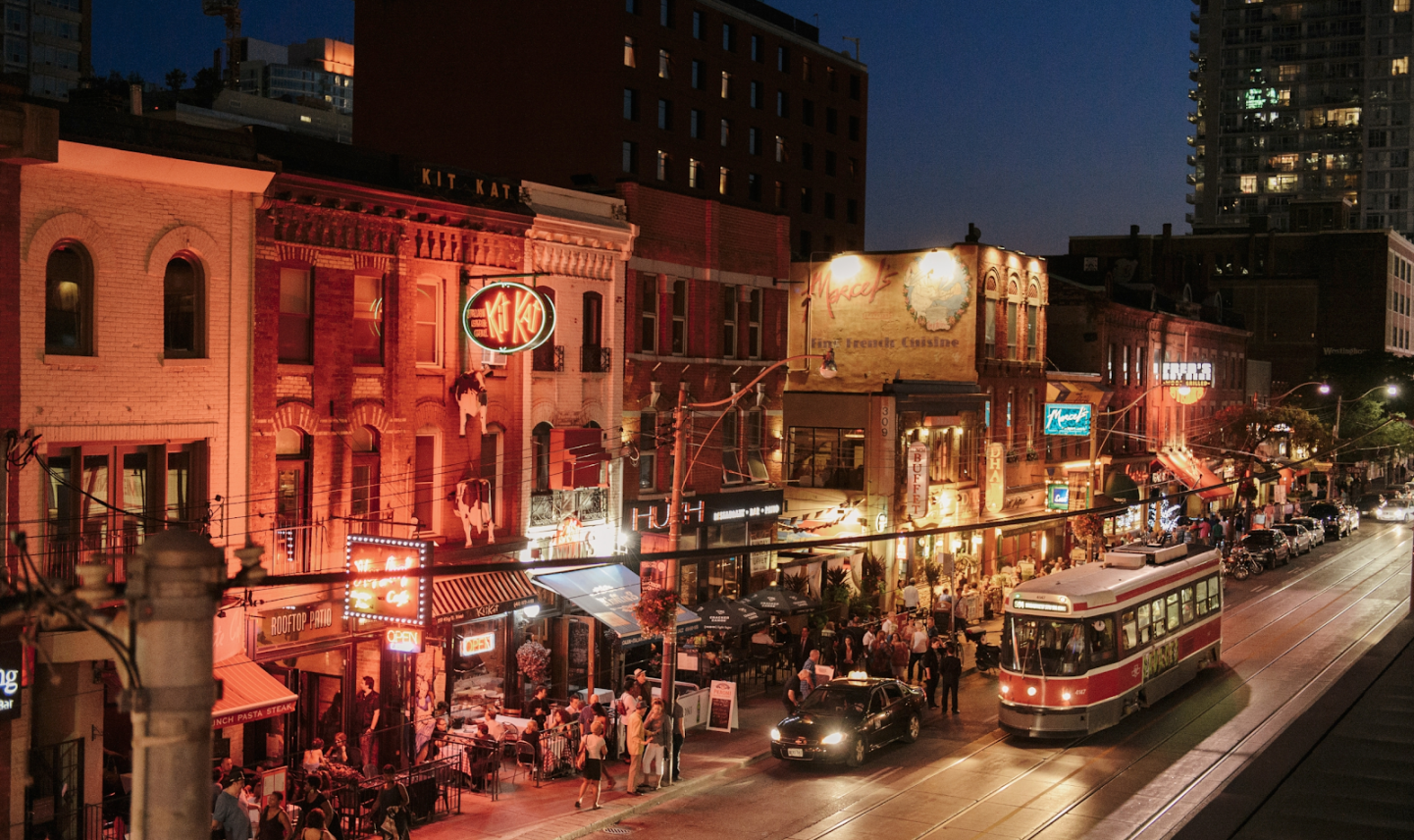
King West, also known as Toronto’s Entertainment District, is another area of the city that continues to expand year after year with condo developments left and right. Bounded loosely by Spadina in the east and Bathurst on the west, it continues to extend north towards Queen and south down to Front.
This area of King Street is home to many of Toronto’s trendiest bars, clubs, and restaurants and is thriving on evenings and weekends. As you’re walking down the streets at night, you can hear the pounding music pouring out to the streets where tons of people are lined up to gain entry to the most exclusive bars and clubs.
At the same time, King West is located right next door to Toronto’s financial district, and it’s pretty apparent that this neighbourhood is full of people who definitely have their life together. With this being said, it blends just north and west enough to absorb some of the west side cool.
King West combines some of Toronto’s oldest historical buildings with low to medium-rise condos and converted factory lofts to make, essentially, a perfect neighbourhood. It does, however, carry a hefty price tag, which can be pricey if you’re moving into the city for the first time.
There you have it– my top 3 Toronto neighbourhood picks for young professionals!
When you’re ready to make the move to one of the best cities in North America, feel free to reach out by calling or texting me so I can help you find your new forever home!
The post Best Toronto Neighbourhoods for Young Professionals appeared first on Danielle in the City.
]]>The post What Is Change In Use in Real Estate? appeared first on Danielle in the City.
]]>Whatever it is, if it’s a move that you profit from — there’s been a change in use on the property that needs to be reported on your taxes. Many homeowners aren’t even aware of this little caveat, which is why they may get caught with an unexpected surprise down the road.
But to help you navigate this, here’s everything you need to know about change in use terms and what you have to do if you convert your personal home into an income-generating one.
Decoding Change In Use
As we mentioned earlier, a change in use is when you change your property from a primary residence to a rental or business unit or vice versa. In other words, it goes from personal-use to income-producing, and this change is known as a “change in use” on the property. When this happens, the person who owns the property is deemed to sell and then re-purchase the property based on a Fair Market Value. When this is done, homeowners are required to report the resulting capital gain or loss in the year in which that change in use occurs.
It’s important to note that if the property was your primary residence prior to you changing its use, you do not have to pay tax on any gain related to the years that you lived there. You only have to report the gains you received during the period that it was income-producing.
Now, why is this all important to know?
Many homeowners aren’t aware of the tax implications associated with this change, but they definitely need to be mindful of it. Those who fail to claim it are subject to a higher tax bill and may be subject to penalties (and no one wants that!).
Learn more about the financial side of income-generating real estate with these posts next:
- Calculating Taxes When Selling an Income Property (Without Losing Your Mind)
- What is the Toronto Vacant Home Tax?
- How to Gain Wealth from the BRRRR Method in Real Estate
To help you navigate these waters a little easier, let’s break down the various change in use scenarios and what you need to do:
From Personal-Use To Income-Producing
In this situation, the change in use implies that you’re taking your personal home (principal residence) and transforming it entirely into an income-producing one, either it’s by establishing your own personal business within the space or turning it into a rental property.
When this happens, homeowners can make a special election that allows them to keep their principal residence without marking it as a business property. If your election is approved, you don’t have to report any capital gain when you change its use; however, you will need to report any rental or business income that you earn in your next income statement, and you cannot claim Capital Cost Allowance (CCA) on the property.
If you’re interested in claiming this election, you’ll have to attach a signed letter by you that describes the property and that you want to enforce an election under subsection 45(2) of the Income Tax Act. Once that’s done, you submit it along with your income tax and benefit return of the year the change in use occurred. This election can last up to four years, even if you don’t use it as your primary residence. The main caveat being that you can’t assign any other property as your primary residence. After that four year period is up, that election can be extended indefinitely if the homeowner fits certain criteria.
It’s important to note that once these elections are made, there’s no immediate impact on your income tax situation once you’re back home. But if you decide to change the use of the property again without following it up with another election, any gains made from selling the property may be taxed. So always be sure to look into it beforehand and do the necessary paperwork if needed.
Learn more about the ins and outs of real estate investing by reading: Can You Use Rental Income to Qualify for a Mortgage in Ontario?
From Personal-Use To Partial-Income Producing
If you’re thinking of turning only part of your home into an income-producing property, there are things you need to consider for that as well. You are not considered under change in use if you meet the following conditions:
- The business portion of your property is relatively smaller than the rest of your property that you’re using for personal use
- You do not deduct Capital Cost Allowance (CCA) on the part of your home you’re using to conduct your business
- You did not conduct structural changes to the property to make it more suitable for an income-producing property
If the homeowner doesn’t meet these conditions, they’ll have to deem disposition of the portion of the home that had a change in use, then reacquire that portion of property right afterwards. As we mentioned earlier, the disposition (or selling of the property) and reacquisition are determined by the Fair Market Value at the time this is being done.
If you plan on selling the space, there are certain things you need to keep in mind as well. You need to split the selling price between the primary residence and the income-producing space, as well as report any capital gains on the part of the home that you used for business. This part may require additional paperwork on your end, as you may want to apply a principal designation for the areas of the home where no change in use occurred. This ensures that there’s a principal residence exemption, as you only have to report capital gains on the portion of the home you used for business.
Selling a home soon? Check out these posts next:
- Should I Paint My Home Before Listing it For Sale
- How to Prepare Your Home For Sale
- Should I Renovate My Home Before Selling It?
Who You Can Go To For Help
If you’re thinking about changing the use of your home or are in the process of doing so, the best place to go for help is your tax accountant, who will help you make you file all the appropriate paperwork. If you’re currently on the hunt for a new home, the next best person to consult about a change in use is your realtor! Generally, when you’re looking for a new home, you have an idea of what you’d like to do with your future space. Even if you’re thinking about the possibility of converting part of your new home into a rental or income-producing unit at some point during your residence there, it’s worth consulting with your realtor, who can walk you through some of the steps mentioned above!
Do you have questions about generating wealth through real estate? I’d love to chat! Give me a call or send me a text to get in touch.
The post What Is Change In Use in Real Estate? appeared first on Danielle in the City.
]]>The post Maximize Your Homes Value With a $25,000 Interest Free Loan appeared first on Danielle in the City.
]]>I’ve really been looking forward to sharing this blog. It shows my clients and potential clients the dedication that I have as a Toronto real estate agent. Over the years, I have assisted several buyers in prepping their homes to hit the market. From minor repairs to staging, our goal is to maximize the value of your home in the selling process. Some clients have a budget that allows them to make upgrades, and others wish they had a budget to increase their return on investment. Here is your chance. I am offering a $25,000 INTEREST FREE construction loan to my seller clients.
Why would I do this, you might ask? Throughout my years of experience selling homes, I’ve seen the value that can come out of minor home updates/repairs. My goal has always been to put my clients’ needs first, and this interest-free loan will give my sellers the financial flexibility needed to maximize home value.
The details of the loan are fairly straightforward:
- The loan must be used for home updates or repairs.
- The loan will be provided for the duration of the renovation and will be repaid when the sale of the home is completed.
- The homeowner will sign an exclusive listing agreement.
- The homeowner will provide an up-to-date credit check.
- If the homeowner decides not to sell, the loan will be paid back immediately or through monthly payments plus interest.
Learn more about how strategic updates can improve your home’s value with these posts next:
- What Value Can Kitchen and Other Home Renovations Bring when Selling My Home
- Should I Renovate Before Selling My House?
- Should I Paint My Home Before I List it For Sale
The process is incredibly simple! To apply for your $25,000 Interest Free Loan, fill out the form to your right, and I will be in touch to further discuss your application. I will come for a walk through your home, and we can discuss the best way to use the $25,000 to increase the value of your home. Here is a list of the types of upgrades that will bring in the most value to the sale of your home:
- Bathroom updates
- Kitchen updates
- Floors
- Windows
- Home office
- Interior Painting
- Lighting
- Exterior Painting
- Landscaping
- Outdoor seating area
Please feel free to give me a call or text me to discuss the details of this loan, schedule a home evaluation or even to just chat about real estate. Can’t wait to hear from you.
The post Maximize Your Homes Value With a $25,000 Interest Free Loan appeared first on Danielle in the City.
]]>