I taught organic chemistry at Reed for 32 years (1989-2021) and at Pomona College for 4 years before that. Chem 201 was always a ‘big lift’ for me each year and I know that I demanded an equally big effort, if not more so, from the huge number of students who took the class. It was stressful and demanding for everyone involved. Even so, organic chemistry or ‘o chem’, (or ‘orgo’, if you insist) has been my favorite area of chemistry ever since my sophomore year of college (1972-73) and I have always looked forward to the opportunity to introduce a new crop of students to something that I had devoted so much of myself to. Thank you, students!!! You gave me everything you could and no o chem prof could have ever found a better set of comrades.
I also want to send a big “Thank You” to my colleagues in the Reed chemistry department who supported me in ways large and small, and to my colleagues in the IT/AV departments who supported our web sites and computer+projection systems over the years. I asked for a lot from all of you and you delivered. <3
Finally, I owe a very special “Thank You” to Tony Moreno, Digital Project Manager. This version (and many previous versions) of the Chem 201 and Chem 201-202 web sites would never have existed without Tony’s contributions. Tony, I see your creativity and thoughtfulness everywhere I look. =)
]]>I’ll give you the gory details about quiz #3 in a moment, but I want to say this: students’ first encounter with the acid-base equilibria and chemical reactions (usually nucleophilic substitution reactions) of organic chemistry has been problematic for as long as I have been teaching organic chemistry (over 30 years). I would like to think that there is a better way to teach this material, but I haven’t found it yet. Still, there are some silver linings in all this. Read on.
This story contains several parts. To begin, I will define three scoring ranges, and then I will tell you how many students earned scores in each range on each quiz. That way you will be able to see the trends in class quiz scores and compare them to your own. Then I will report on 2018 scores so that you can see how the scores might evolve as the semester goes along. And, finally, I will offer some advice.
Scoring Ranges
- 0-60% Numerically, this is a very large range, but most of the range is meaningless because students very rarely score below 30%. What is true about the entire range, though, is that all of the scores below 60% are not satisfactory.
- 60-80% This range spans the marginally satisfactory to the very strong, but consistent scores anywhere in this range (assuming all goes well in lab and with homework) will earn students satisfactory grades so I have no special worries about scores in this range.
- 80-100% A very high level of success.
So what happened on quizzes 1-3? Here are the percentages of students who earned scores in each category.
In-class quizzes
- 0-60% In-class 23% (Q#1) -> 18% (Q#2) -> 58% (Q#3)
- 60-80% In-class 40% (Q#1) -> 47% (Q#2) -> 28% (Q#3)
- 80-100% In-class 37% (Q#1) -> 35% (Q#2) -> 14% (Q#3)
The numbers speak for themselves. The percentage of students earning less than 60% on in-class quiz #3 more than tripled from quiz #2. And nearly every person in the class, regardless of their actual scores, saw some kind of drop in their quiz scores (only 2 people out of 64 scored higher on quiz #3 than they had on quizzes #1 and #2).
Take-home quizzes
- 0-60% Take-home 5% (#1) -> 12% (#2) -> 13% (#3)
- 60-80% Take-home 24% (#1) -> 22% (#2) -> 36% (#3)
- 80-100% Take-home 71% (#1) -> 66% (#2) -> 52% (#3)
Interestingly, the entire class took take-home quiz #3 (64 students) which was not the case with earlier take-homes (56 students #1, 58 students #2). Probably this fact alone tells you how much harder quiz #3 felt to everyone. The median score on take-home #3 was a few percentage points lower than on previous quizzes, but the take-home had the desired effect: even though only 42% of students earned satisfactory scores in-class, 88% did so on the take-home.
Last year (2018)
- 0-60% In-class 23% (#1) -> 14% (#2) -> 55% (#3) -> 45% (#4) -> 32% (#5)
- 60-80% In-class 30% (#1) -> 26% (#2) -> 33% (#3) -> 41% (#4) -> 41% (#5)
- 80-100% In-class 47% (#1) -> 59% (#2) -> 12% (#3) -> 14% (#4) -> 27% (#5)
I don’t want to dwell on these data because each year is assigned different quizzes, but even with that excuse, you can see that last year’s class encountered the same shock on quiz #3. You can also see the “shock” was followed by steady increases in the percentage earning a satisfactory grade: 45% (#3) -> 55% (#4) -> 68% (#5). (And while I haven’t displayed the data, the take-home scores on quizzes were always much higher than the in-class scores.)
Advice
Don’t give up. Unless you really, really, really want to.
While a couple of students inevitably decide that their academic path through Reed lies in a much different direction than organic chemistry (and whatever goes with it), the vast majority of Chem 201 students keep working at organic chemistry. And nearly all of them find ways to become successful. Still, it is hard work. You need to find time in your busy schedule. You need to learn to focus on unfamiliar (and maybe not-so-appealing?) material to a greater degree than you have so far. It may feel uncomfortable at first, but you will get used to it.
Finally, you need to find and use resources that can help you learn and retain the material. What are these resources? Me. Tutors. Practice activities: book problems, making drawings, writing-speaking-reading, using concepts. Your classmates. YOU.
Make a commitment to helping yourself and to helping others as well. If you aren’t ready to explain something to your classmate, ask them for help answering your questions (and really listen when they try to do it). Whichever way things flow, your engagement with others in study will not only encourage them, it will encourage you as well. Trust me.
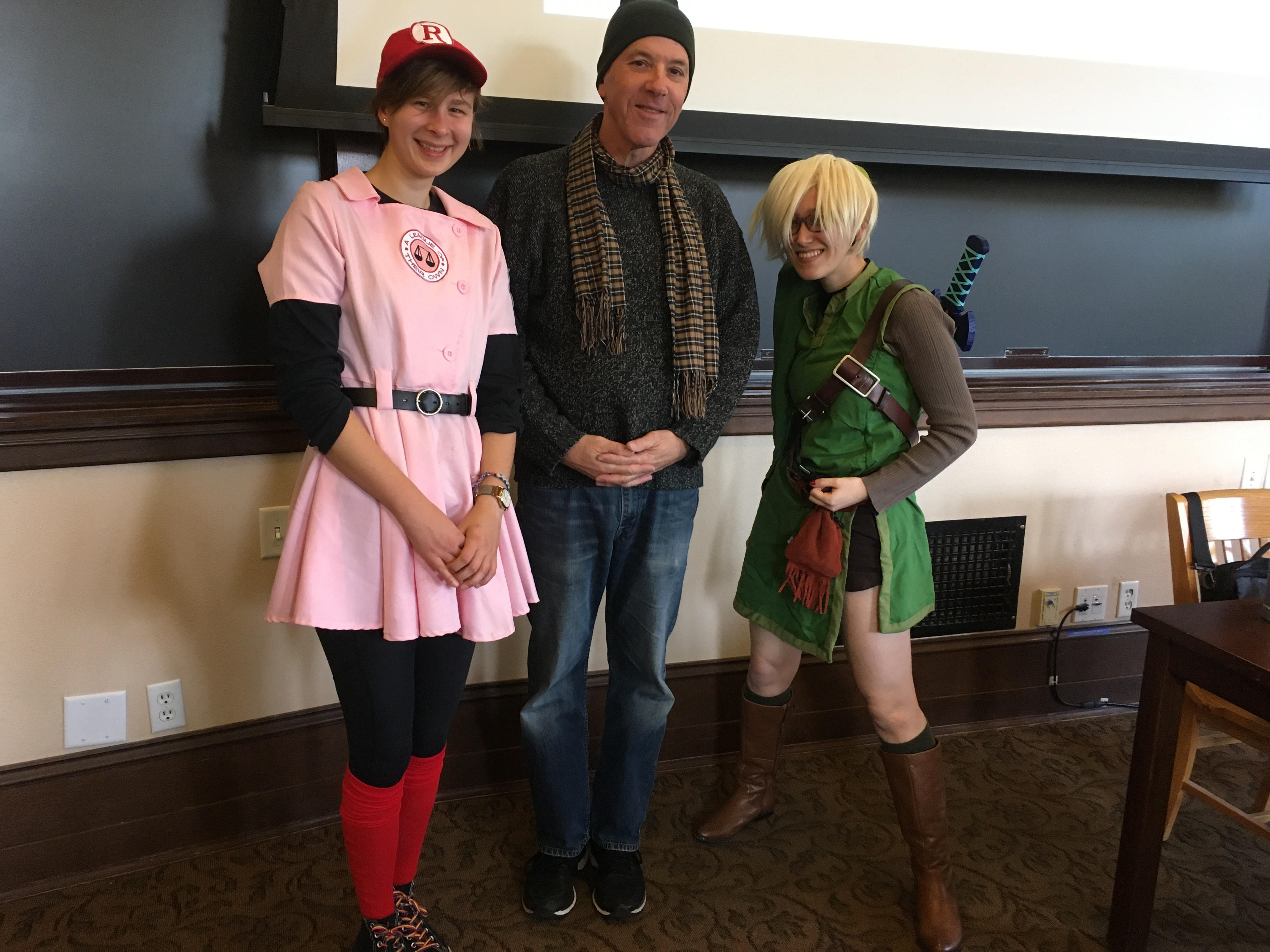
]]>Halloween was celebrated up and down Eliot Hall yesterday. Nearly everyone in class found their way over to the President’s Office to grab treats (mostly cookies, but also yummy hot cider, and more). And, 6 or 7 Chem 201 students showed up for the morning class already decked out in costumes. I coaxed Victoria “League of Her Own” Miller and Ana “Link” Jed into taking a picture with me. Thank you for playing along.
But let me cut straight to the surprising content, this story is not about using a smartphone instead of doing something else, it is about being near your phone while doing something else. The reporter, Shankar Vedantam, describes work done by a team of Harvard psychologists (their names are in the transcript – look them up):
Vedantam: They had volunteers come in to take cognitive tests, but there was a catch. Some volunteers were told to leave their smartphones in another room. Some were told to leave the phones in a bag or a pocket. And others were told to leave their phones on the desk next to them as they took the test. Now, all the phones were on silent. But big differences emerged between the volunteers as they took the test, especially when it came to understanding and solving novel problems.
And then one of the psychologists (Ward) delivers the punchline:
]]>Ward: What we found is that people did better on these tasks the farther their phones were from them. So those who had their phones in another room did significantly better than those who had their phones on the desk right in front of them. And then those who had their phones in their pockets or their bags were sort of in the middle, between those two groups.
If you are currently in a financial bind and feel unable to make, or even uncomfortable making, all of your purchases for Chem 201 and your other courses, Reed College is prepared to help you through this! The following instructions were provided by the offices of Student Life and Financial Aid this week, and they are standing by.
Please don’t hesitate to get the assistance we can offer. Remember that clicker usage is totaled up every day of class and two days have slipped past already. Likewise, a few days have already elapsed on the Sapling homework clock for Day 1. But clickers and Sapling need to be purchased, so don’t let a temporary financial problem derail your academic work. Here’s what you do:
First step, contact Sandy in Financial Aid. Sandy is the Director of Financial Aid and has considerable experience rendering assistance to students who are concerned about paying for textbooks and course materials. The financial binds that she routinely deals with include such things as a student who did not accept their full financial aid package, errors with aid dispursement, a student who is struggling to find work-study opportunities, and students whose financial situation has changed and they haven’t had a chance to notify Financial Aid. Sandy cannot solve every problem, but if she runs out of tools, she can refer you to other appropriate financial resources. So start with Sandy in Financial Aid.
Another thing to do: work with the Reed Bookstore. The Bookstore allows students to set up a payment plan for textbooks over the course of the semester so students can pay off books and course materials in smaller amounts over time (that’s instead of making one lump sum payment for everything on day one of classes). If you think that could help ease your current bind, please contact Jill Charvat in the Bookstore to set up a payment plan (Jill is the Accounting Supervisor).
And, as a last word, let me add that not all problems are financial. If you need assistance, or have concerns about another student who might, please contact the Care Team (careteam@reed.edu, 503-777-7521, or drop by Eliot Hall 218 between 9-5 pm, M-F).
]]>Reed’s first week of classes is short because Monday is Labor Day. This means that two Chem 201 sessions, the Monday afternoon lecture and the Monday evening lab lecture, cannot meet. And because the course schedule ties the Monday and Tuesday lectures together, the Tuesday, Sept. 3, morning lecture is cancelled too. Our first days (Day 1) of lecture will be Wednesday, Sept. 4, and Thursday, Sept. 5. Your attendance at your scheduled lecture section on Day 1 is absolutely required.
The Labor Day holiday does not impact the lab schedule. Our first (Week 1) lab sessions will meet Tuesday-Friday, Sept. 3-6. Check the schedule for your lab day (Tu/W sections meet 1:10-5 pm, Th/F sections meet 12:30-4:20 pm) and show up in Rm. 209 at the scheduled time or maybe a few minutes earlier.
What will you be doing in lecture and lab? What do you need to do before class and lab so that you are prepared? These are excellent questions and the following instructions will guide you. Note: the following instructions have already been sent to all registered 201 students by email. Read, review, act as your situation requires.
Email #1, sent to all 201 students on Aug. 31, 11:07 pm
Greetings,
And welcome back to Reed and to organic chemistry (Chem 201). We will be
sending you 4 emails this holiday weekend and we would like you to read all of them before
Tuesday. These emails will tell you just about everything you need to know
so that you can be ready for lab this week (meets Tu-F) and lecture.
4 emails may sound like a lot of information (it is) so let us break
it down a bit. The emails that follow this one (emails #2-#4) will be
sent out as soon as we can put them together. They will focus on
preparation for lecture: syllabus, teaching methods & expectations,
clickers, and
Sapling homework. Highlights from these yet-to-be-written emails:
- The Tues, Sept 3, 10:30 AM class is canceled. We will
begin classroom sessions on Wed, Sept 4, 2:40 PM and this will be
followed by Thurs, Sept 5, 10:30 AM. Please attend only the section that
you are registered for.
- Please bring clickers to all lectures beginning on Day 1 (Wed/Thur). Clickers are not needed in lab or lab lecture. Clickers need to be registered online (this involves a subscription purchase as well) before they can be used in class so please take care of this (covered in next email) before Day 1.
- Registering for Sapling online homework is the least pressing matter of all (we haven’t even had a class yet), but you should take care of signing up for a Sapling account before Friday, Sept 6.
This email (#1) focuses on the Chem 201 lab. Lab will meet every day this week, Tu-F, so read carefully.
Lab lectures
- in
general, you are expected to attend all lab lectures (M 6:10-7 PM,
Psych 105). Some of each lab lecture will discuss procedural details for
the upcoming week so bring note-taking materials.
- Lab lecture is cancelled for Monday, Sept 2 (Labor Day)
- read the following sections of the lab manual in their entirety: Welcome (don’t skip Getting Started – Week #1), Policies (read all pages – most of them are short; Preparing for Lab (including Before week #1) and Notebooks are must-reads)
Lab sessions
For the first lab,
come directly to the o chem lab, Rm. 209, on your lab day (attend the
section you registered for). Starting times are 1:10 PM Tu/W and 12:30 PM Th/F. Expect to put in a full
afternoon so maybe equip yourself with a snack to get you through a long
lab session.
- dress appropriately for lab – you will not be performing
any experiments, but you will be in the lab checking apparatus,
receiving safety instructions, participating in fire extinguisher
training, and also preparing your notebook for the first experiment
- bring your lab notebook (see Notebooks must-read instruction above), a waterproof pen, whatever you need to read with (glasses, contact lens are both acceptable during week #1)
- read and follow all of the instructions (if you haven’t done so already) in Preparing for Lab: Before week #1 (this includes reading the Chem 201/2-relevant portions of the Chemistry Safety Manual before your LAB day)
Whew! That should cover things for lab this week. If you have questions, don’t hesitate to contact us. Thank you for taking the time to read this email and to start work.
Now on to email #2…
Alan Shusterman and Alicia McGhee
Chem 201 instructional staff
Email #2, sent to all 201 students on Sept. 2, 8:00 am
#2 Prepare for the first lecture (W 2:30, Th 10:30, E314). Note: the lecture on Tu, Sept 3 has been cancelled.
- buy required materials (textbook, clicker)
- bring your clicker (see email #3)
- bring note-taking/writing materials.
- Notebook. Leave your laptop at home. Organic chemistry involves lots of chemical formulas and you cannot draw these quickly enough on a computer to keep up.
- Erasable writing implement. Pencil is best. Erasable pens (if you can find one) are good too. Active learning involves problem-solving, that is, proposing answers to questions. If you don’t like your answer, you want to erase it (not scratch it out) and write something better in its place.
- read these web pages/documents:
- About our classroom describes the active learning POGIL (process-oriented guided inquiry learning) method that we will be using whenever I am not lecturing (there will be more POGIL than lecture). The presentation is very general, but please read the entire web page (note: the links on this web page are entirely optional reading; follow them only if you have the time and interest)
- Class Format: Team Learning + Learning Activities is a document that tells you about how the Chem 201 classroom will actually work. It describes the team learning approach we will follow and the documents (learning activities) that I have written for your team to work on. I will go over this material quickly on Day 1 so it really helps if you have already read the entire document ahead of class.
Email #3, sent to all 201 students on Sept. 2, 10:48 am
(Reading note: This is email #3 in the Day 0 series. Email #1 was sent to you on 8/31 and described our lab meetings for this week and lab policies. Email #2 regarding our syllabus and classroom operations was sent earlier this morning. Please look for these emails and read them first.)
The new business in this email concerns electronic polling devices or “clickers”. I expect you to bring a clicker to every lecture this semester. They are not needed for lab or lab lecture.
The accuracy of your clicker responses will not be graded, but your participation (the number of responses you provide) will have impact your grade (in a relatively small way). I rely on clickers to give me accurate, real-time ideas about how a class thinks about the material we are covering. I do not look at individual answers. So please provide the best quality answers that you can manage for each question. Right or wrong, your best guess is useful to me. After I count the first round of clicks, I will often give the class a chance to discuss answers and click again. More info about grades and clickers can be found here.
QT2 devices only. Chem 201/202 will use the Turning Technology QT2 clickers. These devices have a complete A-Z, 0-9 keypad and LCD display, and they are powered by 2 easily replaceable AAA batteries. If you have some other kind of clicker, or used a mobile device in place of clicker last year in Chem 101/102, you will need to purchase a new QT2 clicker from the Reed College bookstore. You will also need to purchase a one-year subscription and create a student account at the Turning Technologies web site in order to use your clicker (and receive course credit for your clicks).
Cost. A new QT2 clicker + 1-year subscription costs $58 at the bookstore. If you already have a QT2, you can just purchase a 1-year subscription for $25.99. (Note: these are 2018 prices and they may have changed.)
Clicker Returns. If you decide at any time that you no longer need your clicker, you can return yours to the Reed bookstore for some kind of refund. In the past, the bookstore has told me that students “have the first 2 weeks of classes to return the clickers with the receipt for a full refund. The only difference is the subscription code scratch-off must be fully intact. If it has been scratched off we are unable to refund it. After the first 2 weeks it is a 60% refund through November.”
Mobile device app subscription warning: Chem 101/2 students who used their mobile devices as clickers had to download a Turning Technologies app and were able to buy a subscription through the app. This will NOT work for the QT2 clicker. See the instructions provided by the bookstore or the instructions in the attached file.
Where to go next. After you obtain a clicker, open the attached file and set up your student account and start your subscription. It is not enough to just bring a clicker to class. You need an account and a subscription. Otherwise, I won’t be able to give you credit for your responses.
If you are hesitating because you are wavering in your commitment to Chem 201 and the cost of the clicker/subscription are high, that is fine. Hesitate. My grading policy forgives 20% of your clicker responses, that is, you only need to respond to 80% of my clicker questions over the course of the semester to earn full clicker credit. You can hold off on clicking for a few days and suffer no penalties at all.
Clicker advice:
1. Most lectures will pose a clicker question within the first few minutes of class. When you arrive at class, get your device out! Don’t drop it into the bottom of your backpack under your laptop, lunch, raincoat, where it can’t be reached.
2. How you solve an organic chemistry problem matters, even clicker problems. I will be singing the following song all semester long: Organic chemistry is learned and practiced through your fingers, that is, you need to draw structural formulas before you give an answer. The alternative, constructing formulas in your head, is not nearly as effective, and often doesn’t work at all. My recommendation is this: Have your pencil or pen handy when faced with a clicker question. Before you click in your answer, draw the answer(s) you are considering, and look at them. Don’t just stare at the screen and click.
On to email #4…
Alan
PS Reminders: Prices and technologies are constantly shifting. The information I have provided here may be out of date. Please let me know if you encounter errors in either prices or set-up instructions, and I will post corrections online. Thank you.
Email #4, sent to all 201 students on Sept. 2, 4:55 pm
Sapling provides homework problems that are tailored to specific course topics so you will be seeing assignments for each day that match the topics covered on that day.
Please go to Sapling Learning on the Chem 201 web site to learn about:
- why the study of organic chemistry is unusually, and also not so unusually, challenging
- how Sapling online homework assists the study of organic chemistry
- how to register and enroll in the Sapling system
- tips for getting the most out of Sapling homework
The homework assignment schedule has not been posted yet, but you will be able to find it on the Homework page next week (I will announce this by email).
How homework is used to calculate your course grade is described in the FAQ page.
A perfectly reasonable question, and one that deserves an instructive response. But I hesitate to answer. Why? First, I think it is important to know that, practically speaking, there is enough time to work on your fall semester courses during the fall. You shouldn’t feel compelled to make your academic year longer than it already is. Second, I’m worried about fueling student anxiety. Whether your goal is to earn an A or to simply pass the course, you can do this without summer study. I am not trying to make a philosophical point, but just reporting on what I have seen. Hardly any students study for organic chemistry before the semester begins and they do just fine.
Now that my cards are on the table, and you understand that summer study is completely optional, I will freely admit that there are many sound reasons for delving into a subject before you study it formally. I have even done it myself on occasion. So, with all that in mind, here are three suggestions for those who are interested in serious preparation.
#1. Review key topics from Chem 101/102. Chem 201 leans heavily on a number of topics that are developed in the 100-level courses. A logical way to prepare for 201 is to make sure your 101/102 foundation is strong. This approach also has the advantage of practicality. You probably still have your 101/102 course materials, so you can more easily dig them up for review and practice. Here’s a list of 101/102 topics that I think are especially important for creating a strong foundation for Chem 201/202.
#2. Learn/Practice study skills. Many successful 201/202 students have told me that they became successful only after they adopted new ways of studying. That makes perfect sense to me. It isn’t enough to be “academically gifted” or “hard-working” or “attend all classes and take good notes” (although all of these things help). Chem 201/202 ask you to master concepts and skills that don’t appear much, if at all, in Chem 101/102, and achieving these goals usually means cultivating one or more additional (and possibly new) skills and habits. Take a look at this list (under construction) of “new” study skills and consider whether some summer practice might be helpful. Planting the seeds of even one new skill could be helpful. (Bonus: you will probably learn a little organic chemistry along the way.)
#3. Study organic chemistry. Here’s the “obvious” suggestion, study organic chemistry with some kind of organic chemistry textbook before the semester starts. There is nothing particularly remarkable about this except that your book will be your sole guide. You don’t have to complete any particular list of topics. You can skip around, sample a little of this and a little of that if you like. Here is a list of books that have something to offer.
There is also the question of how to study when you work with a book. #2. Learn/Practice study skills contains some important tips, but if you’ve gotten this far, you’ve already decided your skills are fine. So let’s put aside the notion that you want to touch lightly on this or that, and you really want to “go for it”. In that case, you need to do 3 things: read in an organized fashion, learn to draw (correctly, clearly, quickly) chemical structural formulas, energy diagrams, reactions and reaction mechanisms, and finally memorize what you are learning. For more on read-draw-memorize, see these tips (under construction).
]]>- how molecules are held together (101/102 – atomic structure, electrons, bonds, orbitals)
- how to draw and interpret electron patterns (101/102 – Lewis structures, resonance structures, orbitals)
- how to connect molecular structure to other molecular properties (101/102 – charge distribution, dipole moment, intermolecular forces, molecular energy)
- chemical reactions, beginning with acid-base equilibria (101/102 – pH, pKa, acid/base strength, Keq, reaction thermodynamics (ΔG, ΔH, ΔS))
- chemical reaction kinetics (101/102 – reaction rates, activation energies (Ea, ΔH‡), rate constants (k)).
All of these topics should look at least a little familiar, but how well will you recall and (even more important) be able to use them next fall? One simple way to make sure you get off to a good start in Chem 201 is to review these key topics from 101/102.
Here is a detailed list of topics that you can use to guide your 101/102 review. It includes a large number of pointers regarding key facts, skills, and explanations. To put it another way, it’s a long list so don’t let it overwhelm. Pick-and-choose a few topics for summer study, and we will get the rest of it in 201. (Note: my other two summer review suggestions also cover some of the material on this list.)
(added 8 Aug, 2019) An alternative to my detailed list exists and that is to dive into a smallish (250 page) book, “Preparation for Organic Chemistry” by I. David Reingold. The book is available in paperback and also in a $9.99 Kindle-friendly version. The author describes the book in this way, “Reviews material from general chemistry that is relevant to organic, set in an organic context”. I haven’t seen more of the book than the Table of Contents, but even that limited topic list overlaps well with the topic list that I give you below.
Chem 101/102 Topics that Apply to Organic Chemistry
Lewis Structures
- Drawing
- Know the Chem 201 Atoms of Interest (201 AoI): C/Si, N/P, O/S, F/Cl/Br/I, H/Li/Na/K, Mg, B/Al
- Know where the 201 AoI appear on the Periodic Table and know how many valence electrons are held by each type of atom
- Know what symbols to use for atoms, bonds, nonbonding electrons, formal charges
- Know the rules for constructing plausible Lewis structures (“plausible” means the electron pattern in the Lewis structure is a plausible guide to the electron distribution in the molecule). The three most important rules are:
- covalent bond = 2 shared electrons
- Lewis octet = ideal electron pattern for each atom
- formal charge computation
- Interpretation
- Identify bond orders (single, double, triple)
- Identify polar bonds (between atoms of different electronegativity)
- Know relative atom electronegativities
- Rank bonds from least to more polar
- Identify non-zero formal charges (are they plausible?)
- Identify atoms that might be associated with strong intermolecular forces
- Characterize molecule’s energy as “low” (chemically stable) or “high” (chemically unstable)
Molecular Geometry
- Bond distances
- Know relative atom sizes for 201 AoI
- Predict effect of atom size and bond order (from Lewis structure) on relative bond distances
- Bond angles
- Know VSEPR (= electron domain theory) for predicting bond angles around a central atom based on its Lewis structure
- Know standard angles
- Know how electron pair type (electron domain size) might perturb angles (= deviate from standard values)
- Know atom geometry labels: linear, bent, trigonal, tetrahedral, pyramidal, trigonal bipyramidal, square planar, octahedral
- Know VSEPR (= electron domain theory) for predicting bond angles around a central atom based on its Lewis structure
- 3-D Molecular models
- Build (plastic, computer) models that accurately reflect VSEPR predictions
- Interpret (plastic, computer) models
- Label atom geometry (linear, bent, etc.)
- Infer steric number (or number of electron domains) that supports the model’s depiction of atom geometry
Resonance Structures (= resonance contributors = resonance forms)
- Drawing
- Use double-headed arrows to “connect” resonance structures
- Use partial bonds & partial charges to show electron distribution in resonance hybrid
- Push electrons (draw curved arrows) to show how one resonance structure turns into another
- Interpretation
- Identify (and rank) “major” and “minor” resonance contributors
- Construct resonance hybrid that reflects rankings of resonance contributors
- Predict molecular geometry (adjustments to bond distances, bond angles, and atom geometries required by resonance)
- Predict effect of resonance on intermolecular forces (assess location and size of partial charges)
- Predict effect of resonance on molecular energy (assess degree of resonance stabilization; small? large?)
Quantum Mechanical Models of Electronic Structure
- Electrostatic Potential Maps
- Identify atoms (and regions near atoms) that are relatively electron-rich (carry a partial negative charge)
- Identify atoms (and regions near atoms) that are relatively electron-poor (carry a partial positive charge)
- Compare the polarity of two molecules
- Compare the degree of charge delocalization (requires resonance) in two molecules
- Use location and degree of charge build-up to predict possible intermolecular forces
- Use location and degree of charge build-up to predict molecular energy
- Hybrid Orbitals
- Assign atom’s hybridization based on Lewis (or resonance) structure
- Identify hybrid orbital (or atomic orbital) that contains nonbonding electrons (lone pairs)
- Identify hybrid orbital (or atomic orbital) that contains electrons that participate in a specific covalent bond (sigma & pi bonds are treated differently!)
- Use orbital type (atomic: 1s, 2s, 3s, … 2p, 3p, …) (hybrid: sp, sp2, sp3) to identify electrons that are held more tightly/loosely
- Molecular Orbitals (MO)
- Drawing – for any covalent bond in a molecule, construct an orbital mixing diagram
- Identify the 2 orbitals (one from each atom) that overlap and share electrons
- Draw orbital mixing diagram that shows energy levels of the 2 orbitals that combine, and the 2 MO (bonding, antibonding) that are created by this combining
- Label all 4 orbitals (atomic “cartoons” of the overlapping orbitals, and “cartoons” of the MO that can be made by combining these orbitals (one MO is bonding, the other is antibonding)
- Draw orbital labels next to each energy level identifying orbital type (see 4.B.iv) (for MO identify as 1) bonding/BMO or antibonding ABMO, and identify as “sigma” or “pi”)
- Draw electrons that
- Know how relative magnitude of overlap between two orbitals affects energy gap between bonding and antibonding MO, and bond strength (sigma overlap/gap/strength > pi overlap/gap/strength)
- Draw an orbital mixing diagram that shows 1) the relative energies of the 2 uncombined and the 2 molecular orbitals, and 2) the electrons that are assigned to each of these orbitals
- Predict the overall bond order between two atoms by considering the number of electrons assigned to all anti/bonding orbitals involving both atoms
- Predict the effect of MO occupancy (the number of electrons in each MO) on molecular energy
- Drawing – for any covalent bond in a molecule, construct an orbital mixing diagram
Intermolecular Forces
- Identify & characterize possible forces
- Electrostatic forces
- Can be attractive or repulsive
- Involves atoms carrying full or partial charges
- Hydrogen bonds (attractive, one atom is positively charged H)
- London dispersion forces (= van der Waals forces)
- Can be attractive or repulsive
- Involves “touching” or “overlapping” atoms
- Electrostatic forces
- Express effect of forces on molecular energy
- Attractive forces lower molecular energy (stabilize molecules)
- Repulsive forces raise molecular energy (destabilize molecules)
Structure-Energy Correlations
- Attraction = stabilization = low energy
- Repulsion = destabilization = high energy
- Stabilizing factors (partial list)
- Sharing electrons (strong covalent bonds)
- Charges supported by atom electronegativities (surplus electrons located on MORE electronegative atoms; surplus positive charges located on LESS electronegative atoms)
- Resonance
- Surplus electrons located on more electronegative atoms (related: Surplus positive charges located on less electronegative atoms)
- Attractive intermolecular forces (may involve interactions with solvent molecules or ions of opposite charge)
- Destabilizing factors
- Ineffective or insufficient electron sharing (weak covalent bonds, atoms without octets)
- Charges NOT supported by atom electronegativities (surplus electrons located on LESS electronegative atoms; surplus positive charges located on MORE electronegative atoms)
- Repulsive intermolecular forces
Chemical Equilibria & Concentration
- Mass-Action Law (equation connecting Keq to reactant/product concentrations)
- Thermodynamics (equation connecting Keq to ΔG) (equation connecting ΔG to ΔH and ΔS)
- Predicting how molecular structure affects molecular energy (see above) and Keq (reaction favorability)
- Le Chatelier’s Principle (effect of experimental conditions on equilibrium concentrations)
- Acid-Base equilibria
- Convert [H3O+] to pH and to [HO-]
- Ka and pKa
- relationship between Ka and pKa
- relationship between Ka and acid strength
- Henderson-Hasselbach equation (connects Ka and [H3O+])
Chemical Reaction Rates (Kinetics)
- Rate Laws (equations connecting reaction rate – d[Product]/dt – to reactant concentrations)
- Rate Constants (proportionality constant ‘k’ that appears in rate law) Note: chemists use both of the following equations, but only review what is familiar to you from 101/102
- Arrhenius equation ? (equation connecting k to energy barrier, Ea)
- Transition state equation ? (equation connecting k to ΔG‡)
- Reaction Mechanisms
- Reaction intermediates
- electron-pushing (drawing curved arrows to show how electron patterns & molecular geometries change during a chemical reaction)
- Transition states
- Reaction intermediates
- Energy changes & Reaction (or Potential) Energy Diagram
- Interpretation
- Identify energy minima & maxima
- Identify reaction barriers
- Identify reaction energies (overall, step-by-step)
- Label reactant, product, intermediate(s), transition state(s)
- Prediction
- Is reaction (overall, step-by-step) favorable or unfavorable?
- Given diagrams for two competing (and possibly hypothetical reactions),
- Which reaction is more (less) favorable?
- Which reaction is faster (slower)?
- Interpretation
When you think about this degree of standardization, you might guess that just about any college-level material you study will be helpful and you would be exactly right, but as I suggest below, a textbook might not be the best choice for summer work. Instead, I suggest that you find one of the “supplement” style books that I list and work with it instead. Notice that I say, “work,” and not “read.” That’s because all of the supplements are workbooks where you read a little and then do some problems. I think the following two paragraphs (quoted from To the Student in Pushing Electrons) says it best,
“I have only three instructions. First, supply an answer wherever a line appears under a blank space. The correct answer might be a word, a number, a structure, or some arrows. Second, don’t look up the correct answers until you have made a serious try at doing it yourself. Third if you plan to just look up the right answers and transcribe them, return the book and get your money back.
The program uses two effective learning devices: active involvement and repetition. You will participate actively in the learning process. Because so much of the academic experience consists of receiving information, it should be refreshing to work through a program using your own wits. You will see an example of an operation and then carry it out several times as the supporting material is gradually removed. The approach is methodical. Some of you will find that you can accelerate your trip through certain sections. But the program has been written in the hope that none of you will ever feel abandoned. Expect to spend a total of 10 to 14 hours to complete the program.”
4 Books To Consider:
- Organic Chemistry, 2e by T. Sorrell.
- Upsides: This is the Chem 201/2 textbook. It is inexpensive and nearly every chapter offers a few pages of biochemical applications. Cool! Another plus: all of the assigned readings (in sequence) are available on the Chem 201 Classes page. Reading the book is good practice for the reading/study you will have to do in the fall, and the book is loaded with practice problems, summary tables, and other helpful features.
- Downsides: The answers to the book’s problems are located in a separate book call the Solutions manual. Both the textbook and solutions manual are huge. Nice adornments for your dorm room, perhaps, but inconvenient to take to a coffee shop or the beach. Also, like all textbooks, this one contains a large number of details and asides that, while essential in the fall, are distractions in the summer.
- Bottom-line: Getting familiar with your textbook can only help, but this may be biting off too much for a summer task. One of the following “supplement” books might be a better summer companion.
- Organic Chemistry I as a Second Language (also listed as Second Language: Organic Chemistry I) by David R. Klein. This can be used for summer prep and also as a supplement throughout the fall.
- Upsides: Paperback (just under 400 pages) with answers in the book. The book is written in an informal style that makes it feel like light reading (to a point). The topics covered by volume I parallel those in Chem 201 fairly closely.
- Downsides: Obviously, a short book skips material that we will cover in 201. And, while you should learn the author’s explanations/approaches/tricks, you must also be prepared to revise your thinking/drawing habits in the fall because I will provide my own views and instructions.
- Bottom-line: This is probably the most comprehensive summer prep book that I can recommend. All editions, new or used, should be fine. Work with Volume I. You do not need Volume II.
- Pushing Electrons: A Guide for Students of Organic Chemistry, 2e by Daniel P. Weeks. (This is the book that I quoted from above.)
- Upsides: Paperback with answers in the book. Much, much shorter than “Second Language” (about 160 pages). Very manageable time investment. (“Expect to spend a total of 10 to 14 hours to complete the program.”)
- Downside: The book’s brevity is its chief asset and liability. It consists of only three sections: Lewis Structures, Resonance Structures, Mechanisms. And you will no doubt need to adjust some of your thinking/drawing habits in the fall.
- Bottom-line: If you are unsure of how much time you have for your summer prep project, this might be the best way to go. It is the shortest book of all, it reviews at least two key topics from 101/102, and it gets you doing (some of the) things that organic chemists do. Both editions should be fine.
- Arrow Pushing Organic Chemistry: An EASY Approach to UNDERSTANDING Reaction Mechanisms by Daniel E. Levy. Note: the italics in the title were supplied by the author, not me.
- Upsides: Paperback (just under 300 pages) with answers in the book. Significantly shorter than the “Second Language” book, but covers many more topics than the “Pushing Electrons” book. For example, this book contains the occasional drawing of orbitals, whereas “Pushing Electrons” does not.
- Downsides: The writing here is much more formal than what you will find in “Second Language”. And, as with the other supplements, you will need to revise some of your thinking/drawing habits in the fall.
- Bottom-line: Don’t be fooled by the similarity in titles for #3 and #4, “Pushing Electrons” vs. “Arrow Pushing”. These books are quite different.
- (added 8 Aug 2019) Preparation for Organic Chemistry by I. David Reingold.
- Upsides: Kindle-friendly ($9.99). Manageable content that is explicitly designed for the summer before taking organic. Just 9 chapters (250 pages text + problems).
- Downsides: This book is more of a voyage into the sections of general chemistry that are relevant to organic chemistry, rather than a voyage into organic itself. This is supported by the book’s Table of Contents (the only part I have seen) which looks a lot like my list of important Chem 101/102 topics. See Suggestion #1 – Review key topics from Chem 101/102.
- Bottom-line: If you are looking for a deep dive into, or just more exposure to, the “new” topics that organic chemistry will introduce, then this isn’t your book because it will cover only the first couple weeks of Chem 201. On the other hand, it could be just the summer preparation you need?
Decisions, decisions. If you have access to only one book (even the textbook), use what you have. If you have access to 2 or 3 supplements, then here’s a way to decide. First, think about time. If you are looking for a small time commitment, choose “Pushing Electrons”. Second, if you are ready to commit to a more substantial summer prep, consider writing style. Read 3-4 pages of “Second Language” and “Arrow Pushing”. Which style meets your needs? Go with that book!
]]>
- The Chairs app. $0.99 in the Apple Store. The app’s tutorial offers a compact onscreen lecture on cyclohexane ring flips, up-and-down relationships, axial-and-equatorial positions, and how all these are affected by a ring flip. Then you get to play the game! The game (which I demonstrated in class) consists of two drawings, one is a substituted cyclohexane, and the other is an unsubstituted flipped ring. Your job is to draw the missing substituents in the flipped ring as fast and as accurately as you can. It’s a good exercise in mental processing and it keeps you moving by gradually raising the difficulty of the problem. Best of all, you can probably master the game after 10-20 minutes of play and throw the app away.
- The Ring Flip Cyclohexane video by Fun Man Fung* (Singapore, o chem is everywhere!) gives an exceptionally clear description of chair cyclohexane and demonstration of how to “flip” the ring using a molecular model. Hint: build a cyclohexane model before you watch the video and use your model to imitate everything in the video. Cost: 4 minutes of your time. This is definitely worth checking out if you have questions in this area.
*Dr. (?) Fung has produced a number of chemistry web videos. I have only listened to one more, Meditation in Chemistry, and I just wish it were longer than 96 seconds. What beautiful music!
]]>