The post Faithful and political elite praise the selection of the 1st American pope first appeared on Arizona Capitol Times.
]]>Key points:
-
Cardinal Robert Francis Prevost, a Chicago native, was elected pope the second day of balloting
-
Pope Leo’s rise through the Catholic Church spans three continents, with deep ties to Peru and the Vatican
-
Leaders across the U.S. celebrate his election as a moment of national pride and spiritual renewal
American-born Cardinal Robert Francis Prevost made history Thursday.
Prevost, who grew up in the south Chicago suburbs and steadily rose through the ranks of the Catholic Church on three continents, became the first American to be elected pontiff.
He took the name Pope Leo XIV after the 133 College of Cardinals members elected him, on the second day of balloting at the Sistine Chapel, to succeed Pope Francis, who died the day after Easter.
>> Don’t miss a thing. Download the State Affairs mobile app on your iPhone or Android.
Pope Leo, 69, becomes just the 48th pope (out of 266) who is not Italian, the first pope from America and only the second from the Western Hemisphere following Pope Francis, who was from Argentina.
According to the National Catholic Reporter, “By selecting an American, the cardinals have defied conventional wisdom that a man from the United States would never ascend the throne of St. Peter as long as the U.S. was a superpower.”
Joe Donnelly, the former Indiana senator who served as U.S. ambassador to the Vatican from 2022 to 2024, told State Affairs Thursday evening that Pope Leo presented a broader platform to gain the support of his brother cardinals.
“I knew that Cardinal Prevost was a top contender,” said Donnelly. “That was primarily because when you look at the qualities they were looking for in the next pope, they were looking for someone who has the backbone of steel to stand up to anybody, no matter what country you’re from, no matter what you believe. That they can go toe-to-toe with anybody. He has that. He has that spine of steel, he is smart as the day is long. And is also humble. He has amazingly good qualities to deal with the world on behalf of the church.
“Second,” Donnelly continued, “on doctrine, on matters of can you do this? Can you do that? He is neither conservative nor liberal. So both camps, while he was not their ideal, he was one that worked for both camps, while so many others worked for one camp but not the other.
“And then the third, he used to lead the Augustinian sector, has incredible business skills and would run the physical operation of The Vatican very well,” Donnelly explained. “He kind of combined all those things. His big challenge was he was an American.”
The faithful and political elite from around the U.S. on Thursday praised the appointment.
President Donald Trump wrote on social media: “It is such an honor to realize that he is the first American Pope. What excitement, and what a Great Honor for our Country.”
Illinois Gov. JB Pritzker called it a “historic moment” in a written statement: “Hailing from Chicago, Pope Leo XIV ushers in a new chapter that I join those in our state welcoming in a time when we need compassion, unity, and peace.”
Marcelo Suárez-Orozco, chancellor of the University of Massachusetts Boston, told State Affairs that the new pope “has been very forceful in speaking on the matter of building climate resilience,” a stance Suárez-Orozco expects will continue.
The university chancellor added that, as an Argentinian-American himself, he is excited to have another “double American” as pope.
“Let’s baptize him as double American, because he’s American by birth, but he chose to become a Peruvian citizen. So he’s doubly American,” Suárez-Orozco said. “I’m doubly American — I’m Argentinian, but I became American by choice. So when I saw that he had been chosen as the Holy Father, I said, ‘We have a double American pope.’”
Suárez-Orozco added, “I think this bodes very well for us, the Hispanics in the United States and for Americans more generally.”
Here’s what others from around the nation said:
- Ohio Gov. Mike DeWine: “Fran and I are joyous upon the selection today of our new Pope — Pope Leo the XIV. As a member of the Augustinian order, he has lived a life of service, building communities through the commandment of loving our neighbors. Through his work as a teacher and missionary, he has been committed to spreading the Gospel by helping the poor, migrants, and the least among us. His background as a parish priest and as a missionary tells us that he will be a Pope who will work hard to stay in touch with people of all backgrounds around the world.”
- Louisiana Gov. Jeff Landry posted on X: “Congratulations to Pope Leo XIV, our first American Pope. I join Catholics around the world in praying for him as he embarks on this remarkable journey to lead the Church.”
- U.S. Sen. Rev. Raphael Warnock, D-Ga., posted on X: “I would like to extend my heartfelt congratulations to Pope Leo XIV. I’m praying for him as he assumes this position of spiritual leadership. May God grant him the compassion and courage needed to lead during these difficult times.”
- U.S. Rep. Marcy Kaptur, D-Ohio: “As a lifelong Catholic and proud Great Laker, I am deeply moved to witness the astounding selection of Pope Leo XIV from Chicago’s South Side. … His faith, humility, working class spirit, and heartland values will inspire countless millions. This is a true moment of grace for our nation, our Great Lakes region, and the world. May the Saints be praised.”
- California Gov. Gavin Newsom: “… In his first address, he reminded us that God loves each and every person. We trust that he will shepherd us through the best of the Church’s teachings: to respect human dignity, care for the poor, and wish for the common good of us all. … In a fractured world, we pray his voice becomes a bridge — between faiths, nations, and beliefs — and a force for peace rooted in our shared humanity.”
- Former President Barack Obama posted on X: “Michelle and I send our congratulations to a fellow Chicagoan, His Holiness Pope Leo XIV. This is a historic day for the United States, and we will pray for him as he begins the sacred work of leading the Catholic Church and setting an example for so many, regardless of faith.”
- Archbishop Edward J. Weisenburger of the Archdiocese of Detroit: “It is with deep joy and gratitude to God that I join the faithful around the world in celebrating the election of our new Holy Father, Pope Leo XIV. … Pope Leo XIV’s election leaves me exceptionally joyful, and I must humbly acknowledge that I did not anticipate a United States citizen would be elected Pope. His lifetime of ministry includes many years of ministry as a bishop in Peru, giving him a thorough understanding of South America. Moreover, his close association with Pope Francis, history of charitable efforts for the poor and marginalized, extensive prior experience in the Vatican, and personal humility are all qualities that perhaps focused the light of Christ upon him for his brother Cardinals to see.”
- Archbishop Shawn McKnight of Kansas City, Kansas, told the National Catholic Reporter that he was “floored, stunned and full of hope” for Prevost’s election as pope.
State Affairs reporter Sam Drysdale contributed to this report. This story has been updated with new quotes from Joe Donnelly, who served as U.S. ambassador to the Vatican from 2022 to 2024.
Brian A. Howey is a senior writer and columnist for Howey Politics Indiana/State Affairs. Follow him on X @hwypol and Blue Sky @hwypol.bsky.social.
The post Faithful and political elite praise the selection of the 1st American pope first appeared on Arizona Capitol Times.
]]>The post Church, state meet when pope addresses Congress, to dismay of some first appeared on Arizona Capitol Times.
]]>
“The pope seems like a nice guy,” said Spanton, 73. “But I see no place for religion in government.”
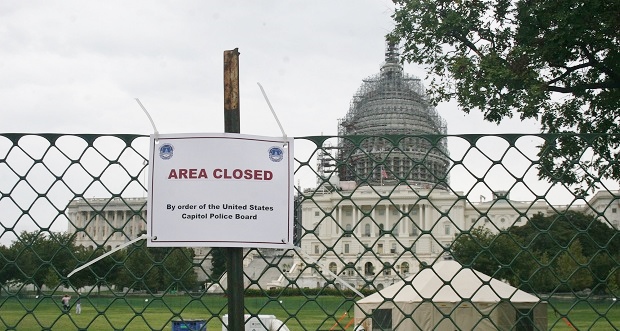
But that’s exactly where the pope will be this week, when President Barack Obama hosts him at the White House on Wednesday and Congress sits in a joint session Thursday to hear from the pontiff, the first time a pope will officially address the body.
While that’s raised hackles about the separation of church and state for people like Spanton, other Arizona residents who responded to a Public Insight Network query for Cronkite News said they see no problem with the pope’s visit.
“Freedom of faith is intertwined with freedom of expression,” said Jon Altman, a Phoenix resident. Besides, he said, when the pope does speak no one will be forcing Congress members to tune in.
“It’s up to people to choose whether or not to listen, same as when anyone is talking,” said Altman, 60.
At least one Arizona lawmaker has already decided that he will not be listening to the pope. Rep. Paul Gosar, R-Prescott, announced last week that he would not attend the address, which will reportedly include statements on climate change and other policy positions the congressman does not agree with.
It was a tough decision for Gosar, one of five Catholics in the state’s 11-member congressional delegation, according to the Pew Center on Religion and Public Life. The others are Reps. Anne Kirkpatrick, D-Flagstaff; David Schweikert, R-Fountain Hills; Raul Grijalva, D-Tucson; and Ruben Gallego, D-Phoenix.WASHINGTON – Gilbert resident Simon Spanton doesn’t have anything against Pope Francis. It’s the combination of Pope Francis and Congress he has a problem with.
“The pope seems like a nice guy,” said Spanton, 73. “But I see no place for religion in government.”
But that’s exactly where the pope will be this week, when President Barack Obama hosts him at the White House on Wednesday and Congress sits in a joint session Thursday to hear from the pontiff, the first time a pope will officially address the body.
While that’s raised hackles about the separation of church and state for people like Spanton, other Arizona residents who responded to a Public Insight Network query for Cronkite News said they see no problem with the pope’s visit.
“Freedom of faith is intertwined with freedom of expression,” said Jon Altman, a Phoenix resident. Besides, he said, when the pope does speak no one will be forcing Congress members to tune in.
“It’s up to people to choose whether or not to listen, same as when anyone is talking,” said Altman, 60.
At least one Arizona lawmaker has already decided that he will not be listening to the pope. Rep. Paul Gosar, R-Prescott, announced last week that he would not attend the address, which will reportedly include statements on climate change and other policy positions the congressman does not agree with.
That report said Catholics make up 30 percent of the current Congress, with 26 senators and 138 House members, with the total almost evenly divided between Democrats and Republicans.
Christopher Hale, executive director of Catholics in Alliance for the Common Good, said Pope Francis – who is also the leader of Vatican City – “will address Congress not as the leader of the Catholic Church, but as a head of state.”
For Kingman resident Donna Crouse, 56, it is the pope’s duty as a head of state to visit Congress, and lawmakers there had complete authority to extend the invitation for him to speak.
“He is really the only person who can speak for the Catholic Church in this country,” said Crouse, who also responded to the PIN query.
Nick Fish, the national program director for American Atheists, conceded that Pope Francis’ address to congress “is not in and of itself a violation of church and state, or even unconstitutional.” But that doesn’t mean his organization is happy about the pope’s trip to the Capitol.
“We’re very concerned about the fact that Congress takes the pope’s guidance when it suits their needs,” Fish said.
But he said he expects little long-term change to come from the pope’s visit to the U.S., which will also include stops in New York and Philadelphia later this week.
“All he’s doing is repackaging and rebranding that same old Catholic dogma,” Fish said.
But Pope Francis has staked out new ground on church doctrine over homosexuality and divorce in public statements, and had taken stances on climate change and immigration that many in Congress – like Gosar – disagree with.
Lawmakers are not the only Catholics who disagree with this particular pope.
“This is the most radical and divisive pope in my lifetime,” Arizona resident Rick Mansfield, 64, said in response to the PIN query. “He is an ideologue representing a very small portion of the Catholic community.”
Mansfield said that inviting any religious leader to address Congress puts the body “on a very slippery slope.”
But Hale said the pope’s visit offers a particular challenge to Catholics in Congress for just that reason that many do not always see eye to eye with the leader of their church.
“The pope’s role is to challenge them,” Hale said. “A good priest challenges every member of his flock.”
That’s what Spanton said he’s afraid of.
“Popes aren’t elected by citizens,” he said. “They’re spokesmen for one viewpoint.”
The post Church, state meet when pope addresses Congress, to dismay of some first appeared on Arizona Capitol Times.
]]>The post The ‘Ancient and Honorable Pueblo’ first appeared on Arizona Capitol Times.
]]>
The Big Apple. The Windy City. The Old Pueblo. Each name says that city is one of a kind. Ever wonder how Tucson came to be called the Old Pueblo? It’s hard to tell how nicknames get started, but like the town itself, it goes back a ways.
Founded in 1775 on top of a prehistoric Hohokam village, Tucson was first called the Presidio San Agustín del Tucson. Taken from the Latin word praesidium, these outposts were first established on the hostile frontiers of the Roman Empire in the first century A.D. They were not just garrisons or forts, but self-contained villages where families and other civilians, as well as the soldiers, lived inside a protective wall.
At first the term pueblo, or pueblito, referred to the Pima Indian village at the base of “A” Mountain several miles to the southwest, not to the presidio where the Pima County courthouse and the Tucson Museum of Art are now. A century later, the name moved from the Indian village across the Santa Cruz River to downtown Tucson.
Ironically, it was not the Spanish-speaking residents who came up with the name, but Anglos trying to bring in business. When the railroad first came to town on March 20, 1880, Mayor R. N. “Bob” Leatherwood was so proud of the accomplishment that he sent telegrams to the mayors of Los Angeles, San Francisco, the president of the United States and even the Pope. In his telegram to the Pope, Leatherwood said:
“The Mayor of Tucson begs the honor of reminding Your Holiness that this ancient and honorable pueblo was founded by the Spaniards under the sanction of the church more than three centuries ago, and to inform Your Holiness that a railroad from San Francisco, California, now connects us with the Christian World.”
Legend has it that somewhere down the line a smart-aleck telegraph operator tapped out this reply:
“His Holiness, the Pope, acknowledges with appreciation receipt of your telegram informing him that the ancient city of Tucson at last has been connected by rail with the outside world and sends his benediction but, for his own satisfaction would ask, ‘where in Hell is Tucson?’”
This might be a fable, but we Tucsonans love a good joke on ourselves, so we keep it alive. Notice that Leatherwood said “ancient and honorable pueblo”? Reporters liked Tucson’s catchy new nickname, but after a while it began appearing in the newspapers as the “A. and H. Pueblo,” perhaps to save space. There is no telling when A. and H. evolved into the Old Pueblo, but we do know why it caught on.
In the late 1870s, Santa Fe Railway was in financial trouble. Looking around for a way to increase revenue, they focused the new tourism fad created by the Gilded Age barons of industry. The Santa Fe lured them away from grand tours of Europe and the Holy Land with promises of exotic getaways to romantic places with catchy phrases like “Land of Enchantment” and “Indian Detours.” About 40 years later, Tucsonan businessmen borrowed that Southwest imagery to boost Tucson’s tourist economy.
In the 1920s, the Tucson Sunshine Climate Club was formed to bring tourists, snowbirds, health seekers, and retirees to Tucson. They peppered their ads with the phrase Old Pueblo to brand the location with its exotic Spanish-Indian past. The nickname caught on, and every time it is repeated it reminds people that after 4,000 years of habitation (235 years by European descendents), the Old Pueblo is indeed a most ancient and honorable city.
— Jim Turner. Photo courtesy of author. Arizona historian Jim Turner is available for history presentations through the Arizona Humanities Council “Roads Scholar” program atwww.azhumanities.org/speakers2.php. You can see previews of his pictorial history book, Arizona: Celebration of the Grand Canyon State, on his we site, www.jimturnerhistorian.org
The post The ‘Ancient and Honorable Pueblo’ first appeared on Arizona Capitol Times.
]]>That aging is especially pronounced in rural areas. Of the four counties that already had more than one out of five residents age 65 or older in 2009, according to the U.S. Census Bureau, all are in rural areas: La Paz, 32.1 percent; Yavapai, 23.8 percent; and Gila and Mohave, 22.4 percent.
As this shift occurs, experts and advocates warn that rural areas in particular will lack the doctors, care homes, transportation and other services needed by an older population.
The post As Arizona ages, rural elderly face lack of access to medical care, services first appeared on Arizona Capitol Times.
]]>
A day later, with the finger swollen and throbbing, and she knew she needed medical care.
But there was a problem: It was Thursday, and the only medical clinic in this former copper mining community east of the Valley was only open Mondays, Tuesdays, Wednesdays and Fridays.
A friend drove her to a hospital in Gilbert, about 50 miles away. Diagnosed with a infection, she was transferred to a Phoenix hospital for surgery. Despite six operations, she lost the finger.
That was only the start of her problems.
When she was released from the hospital, she was still recovering and taking strong painkillers. In her mid-60s, widowed and without family in town, she lacked someone to help her with basic tasks such as housekeeping, not to mention driving to medical appointments in the Valley.
“I didn’t have anyone to help me,” Pope said.
Finally, she told her story to a waitress, who volunteered her daughter to provide rides and look after Pope’s house.
“I don’t know what I would have done if it hadn’t been for her,” Pope said.
Arizona is growing older. An estimated 13 percent of Arizonans were age 65 or older in 2009. That percentage is expected to almost double by 2020, according to the Arizona Department of Economic Security’s State Plan on Aging.
That aging is especially pronounced in rural areas. Of the four counties that already had more than one out of five residents age 65 or older in 2009, according to the U.S. Census Bureau, all are in rural areas: La Paz, 32.1 percent; Yavapai, 23.8 percent; and Gila and Mohave, 22.4 percent.
As this shift occurs, experts and advocates warn that rural areas in particular will lack the doctors, care homes, transportation and other services needed by an older population.
Of these, medical care is of particular concern to Len Kirschner, president of the Arizona chapter of the American Association of Retired Persons.
“I describe our current health care system as chaotic, costly, confusing, inefficient, inequitable, and occasionally superb,” he said. “That’s not what people need.”
‘Dollars are short’
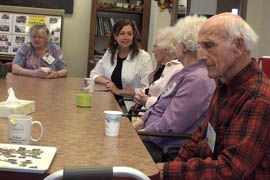
It’s lunchtime at the Superior Senior Citizens Center, and Barbara Pope is among a dozen or so residents gathered to chat and eat.
For Pope, the center provides a healthy meal and provides the companionship many elderly residents need.
“It gets us out and makes you feel like you’re alive,” she said. “If the center wasn’t here, there would be a lot of people in trouble.”
The center, which is open Monday through Friday, also sets up bingo tournaments and on rare occasions plans out-of-town group trips. Rebecca Brothers, the director, uses a van to take seniors who can’t drive themselves to the center or town’s medical clinic. The other two employees work in the kitchen.
Seniors pay a modest amount for lunches, but other services are free. The center relies almost exclusively on grants.
Brothers said the seniors here need much more, including transportation to medical appointments in the Valley or in Globe, about 25 miles to the east. But that’s impossible.
“We don’t have the manpower or the budget,” she said.
Those age 65 and older make up about 20 percent of Superior’s 3,500 residents, according to the Census Bureau. Yet outside of the senior center services for older residents are scarce.
The only medical clinic is staffed by a physician’s assistant, not a licensed doctor. There is no pharmacy, no chiropractor.
Volunteers are difficult to come by in Superior, Brothers said, and the town government hasn’t stepped in to offer help.
“Unfortunately, our seniors end up suffering because of it,” she said.
Mayor Michael Hing said local leaders lack the resources to offer more help.
“We’re shaking like everybody else right now because of the economics,” he said. “Dollars are short, but we are trying to hold it together.”
Melanie Starns, assistant director for the Arizona Department of Economic Security’s Aging and Adult Services Division, said that while not all rural communities face the same challenges there are clear trends when it comes to availability of care.
“There is an absence of service providers, and there is also an absence of trained qualified workforce to do the job,” she said.
According to the Department of Economic Security’s State Plan on Aging for 2011-2014, the elderly population is increasing while resources are decreasing. Cuts to community-based services and programs helping seniors remain in their homes could force more people into institutional care, the report said.
Jim Dickson, president of the Arizona Rural Health Association, said the distribution of services and providers serving the elderly is a statewide issue.
“Most areas of Arizona are in this category, with the exception of the urban areas,” he said.
Elisa Davis, director of the Western Arizona Council of Governments’ Area Agency on Aging, said the more remote a community the more difficult it is to provide services because there are smaller budgets and fewer seniors to serve.
“It is more expensive to provide services for rural communities,” she said.
Communication gap
In Sedona, Sunrise Center for Adults provides seniors with healthy meals, nursing care and activities Monday through Friday. Those who come here are paying customers.
On a recent weekday, a social worker has a small group drawing their childhood classrooms, an activity that stimulates memories and mental health. A jewelry-making class is scheduled for later in the day.
Linda Yee, a retired registered nurse, founded this business four years ago after moving from California to take care of her elderly mother. She was surprised to find so few services for older residents in the Verde Valley.
“They need to have someone to take care of them, and they might not want to go to a nursing home. They may not want to have somebody in their home 24 hours on the clock to take care of them,” Yee said. “This gives them another option.”
But making such an operation work can be a struggle in a rural community because there isn’t as large a customer base as in a metropolitan area, she said, adding that similar businesses in Cottonwood and Flagstaff have failed due to a lack of business.
Yee’s center supplements its revenue through fundraisers such as selling tickets to an “American Idol”-style singing competition.
“It’s very expensive to open up a business, hire registered nurses, hire social workers, hire an office manager, hire caregivers and keep it running on what people can pay us,” she said.
Another challenge, Yee said, is that many elderly people in rural areas simply don’t know that such services exist.
Ramsey Alwin, director of the Economic Security Initiative at the National Council on Aging, noted that many rural areas lack broadband Internet access. And even in areas with broadband, she said, seniors can find it overwhelming to search for services in their areas.
“It’s challenging to get the latest and greatest information to those that need it more,” Alwin said.
In Superior, Mayor Hing said that seniors can get information at the senior center, but those who don’t go there are at a disadvantage. Beyond being able to work televisions and radios, he said, many elderly people in his community aren’t savvy when it comes to technology.
“The elderly are not educated in that area,” Hing said.
Barbara Pope said she felt cut off after returning to her Superior home after her surgeries. Her greatest difficulties: locating services that allow her to get to medical appointments and obtain medication.
“It’s almost like it’s a secret,” she said. “It’s out there, but they don’t really want you to know.”
Getting there’
Since she suffered a heart attack in 1999, Irene Ruiz has had to make frequent trips from Superior, her home for more than a half century, to the Valley for medical appointments. Today, 87 years old and not comfortable driving long distances, arranging those trips is a challenge.
When family members can’t drive her, she calls the Pinal County Department of Public Health’s On-the-Go Express service for the hour-long trip to Mesa. But limited availability forces her to schedule appointments only on certain days during the week and at times that get her back to Superior by noon.
“Nobody lives with me,” she said. “I live alone and I don’t depend on a lot.”
Elisa Davis of the Western Arizona Council of Governments’ Area Agency on Aging said seniors in rural areas often have to travel for medical care not offered in their communities, such as seeing specialists or chiropractors.
“There are a lot of areas that don’t have a lot of specialties that an urban area would have,” she said.
Meanwhile, according to the state Department of Economic Security report, transportation services such as those available to seniors in Superior are almost nonexistent in rural areas.
Melanie Starns with the DES Aging and Adult Services Division said it’s costlier to give rides in rural areas because providers have to drive long distances in order to serve just a few people as opposed to an urban area with a large clientele.
“That geographic distance affects the cost and availability,” she said.
Paula Kneisl, a board member for Aging Services of Arizona, a nonprofit group made up of industries serving the elderly, said seniors in remote communities suffer because of it.
“They can only get to the doctor infrequently, or at a particular time that may not work out with them,” she said.
Doctor shortage
Nearly one out of three Prescott residents is age 65 or older, according to the Census Bureau. But there aren’t as many doctors to serve them as there otherwise would be because of the way they pay for care, said William Thrift, a family practice doctor there.
Medicare, the federal government’s health plan for the elderly, doesn’t pay enough to make it worthwhile, he said.
“The amount that doctors get is less and less,” Thrift said.
A 2008 report by the Medicare Payment Advisory Commission, which advises Congress, said physicians get 20 percent less from Medicare patients than from patients with private insurance.
“It’s harder to get doctors, and many doctors are no longer taking Medicare patients,” said Paula Kneisl with Aging Services of Arizona.
In Superior, Mayor Hing said doctors don’t want to practice in a place that has so many residents on Medicare.
“They have to make a buck, so they’re not going to put somebody here if they’re not going to get that return,” he said.
That’s just one of the reasons for a doctor shortage in rural areas, and that shortage is a problem transcending age. But it affects the elderly disproportionately.
According to National Rural Health Association, rural areas have higher rates of chronic diseases, including heart disease and cancer, party because of a population that is older, poorer and less educated.
Len Kirschner, president of Arizona AARP, said the problem stems from medical students who, facing large loans and financial incentives, are driven to pursue specialties rather than general medicine.
“And if you’re into specialty, you don’t go to rural areas,” he said.
Responding
Melanie Starns with the DES Aging and Adult Services Division said that despite its challenges Arizona is ahead of many states in addressing its the needs of its growing elderly population.
For example, she said, the Aging 2020 initiative launched by former Gov. Janet Napolitano’s brought together state agencies, tribal governments and community partners to discuss pressing issues.
One change that stemmed from that effort has the Arizona Department of Public Safety training cadets to better recognize elderly drivers in need of assistance. More than 30 states have followed suit, she said.
Arizona started the Mature Workforce Initiative, providing opportunities for older people to work and remain self-sufficient.
“We need to make sure there is a level playing field,” she said.
Meanwhile, the state is looking to update the services it provides for a new generation of seniors, the Baby Boomers. Old-fashioned senior centers will be revamped to include fitness equipment, dance classes and even computers. The use of telemedicine, the opportunity to use video and Web-based technology to provide medical care for people in rural areas remotely, is also something the state is looking to incorporate.
“I think we’re headed on the right tracks,” Starns said. “I think we have a long way to go, and by 2020 we will have made significant strides towards modernizing the different needs the Boomers have compared to the current population.”
It took Barbara Pope five months to recover from her surgeries. She can use her hand, minus the middle finger, but not fully.
“There are a lot of things I can’t do that I used to do,” Pope said.
After her experiences, she hopes Arizona will improve services available to the elderly in rural communities.
“Yeah, we’re old, but we still want the quality of life that we can have,” Pope said.
The post As Arizona ages, rural elderly face lack of access to medical care, services first appeared on Arizona Capitol Times.
]]>