
This research project on the use and place of family mediation across Member States follows the request of the European Parliament Coordinator on Children’s Rights (the EP Coordinator), the European Parliament’s (EP) Committee on Legal Affairs (JURI), to commission a research project on the above topic with a view to provide authoritative and timely information to its Members.
This study would aim at mapping access to mediation across Member States and highlight differences and similarities in the provision of mediation in family disputes involving children, such as custody, visiting rights, contacts and maintenance. It would also aim to identify best practices in establishing high-quality mediation services for families and to examine existing requirements for family mediators in each jurisdiction.
O’Shea and Conneely have previously carried out research in the Irish District Court observing family law cases, analysed by Dempsey, with findings published between 2019 and 2024 in the Irish Journal of Family Law. In 2020 Conneely & O’Shea were commissioned to write the chapter on family mediation in Ireland for Bloomsbury Professional’s UK & Ireland book, ‘Family Mediation Contemporary Issues’. Between 2022 and 2023 Dr O’Shea and Dr Conneely carried out research into sentencing in domestic violence cases for the Judicial Council’s Sentencing Information and Guidelines Committee, and in 2024 ‘Family Mediation: The International Context’ by Conneely and O’Shea was published in the Journal of the American Academy of Matrimonial Lawyers Vol 36.
O’Shea and Dempsey have recently completed work on an International Code of Practice for Family Mediators which will be launched in September as part of the work of the International Family Mediation Project.
In welcoming the opportunity to carry out this research Dr O’Shea said,
]]>“this study will look at the state of play in relation to family mediation and its inter-section with legal systems across the Member States and we will have an in-depth look at 5 Member States, including Ireland; it is a fantastic opportunity to scope out what is happening for families across the EU post the break-down of relationships, and in particular where family mediation fits.”
See article here . As Roisin illustrates in her op-ed:
“Ireland boldly stepped into the new frontier of 21st century dispute resolution with the enactment of the Mediation Act 2017, leading the way on the world stage with a statutory framework for the service of mediation. This progressive act promotes the early use of mediation to resolve all civil disputes, and even where litigation has already started the act enables the parties to step away from the courts to try mediation, right up until a final determination is made by a judge”
The conference and article noted the importance of the recent High Court case ruled by Justice Twomey ( V Media Doo & Anor v Techads Media Limited [2025] IEHC 430).
“This case sets an important benchmark for any court hearing any civil dispute, (including separations or divorce), that a hearing should only commence where the judge is satisfied the plaintiffs have been comprehensively advised on mediating rather than litigating their dispute.
The judge noted the importance the act places on plaintiffs being advised on the benefits of mediation, “…before the client ends up on what might be termed the merry-go-round of litigation — one that is all too easy to get on, but can be difficult to get off.”
The conference idea was originated with ARC Founder Shane Dempsey, Deputy Chair of the IPMO. Shane and Roisin founded the IPMO in 2021 with like-minded colleagues and mediators who wanted to promote the professionalisation of mediation in Ireland.
Since then the organisation has gone from strength to strength with over 100 mediator members and a more than 20 student members.
]]>
Suzanne Parker and Dr Roisin O’Shea
Dr. Roisin O’Shea, Partner in Arc Mediation, was interviewed by Waterford-based solicitor Suzanne Parker, for her “Legally Speaking” Podcast on WLR FM.
The Podcast’s aim is to provide “no jargon, no confusion” advice on legal matters to listeners.
The interview with Roisin was primarily about using mediation for a legal separation or divorce. Roisin also gave an insight into the work of Arc Mediation since Roisin and Shane Dempsey founded the business in 2010.
It was a great opportunity to explain all things mediation for WLR’s listeners.
25 Mins running time
]]>I’m wary of how prevalent the word “toxic” has become in discourse because it can shut down curiosity about why people behave the way they do. Yet the phrase “toxic positivity” usefully names a pattern: insisting on upbeat thinking while avoiding or dismissing real distress. That avoidance may come from kindness or discomfort, but its effect is the same; it silences emotions that contain information about harm, boundaries, and necessary change.
Why this matters in coaching. Good coaching is not cheerleading. When coaches rush clients from grief, anger, or disappointment straight to “what’s next,” they risk penalising legitimate feelings and missing signals that point to structural problems or behaviour change the client needs to make. Authentic coaching sits with difficulty first, then helps translate it into action.
Why this matters in mediation. Mediators can fall into the same trap. Pushing parties to “stay positive” or to “move on” can produce superficial settlements that paper over unresolved grievances. Unprocessed anger or grief often resurfaces as non?compliance, resentment, or renewed conflict; exactly what durable dispute resolution seeks to avoid!
Skilled mediation validates emotion, then uses facts and structured problem?solving to build agreements that last. Durable agreements do not arise from ignoring the emotions of the parties.
The harm of enforced optimism. Emotional suppression doesn’t erase problems; it can magnify shame, anxiety, and mistrust, and it undermines people’s epistemic agency; their ability to trust their own perceptions. That’s why we should treat negative emotions as data, not defects.
A better approach
- Validate before reframing. Name the pain; acknowledge its legitimacy.
- Use healthy optimism. Ground hope in reality: “This is hard, and we can work toward a solution.”
- Pivot to facts and structure. When emotions block progress, shift to observable evidence and stepwise problem?solving.
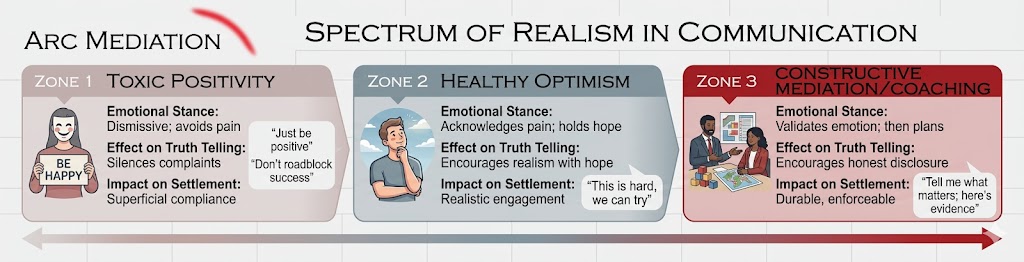
Toxic Positivity vs Health Optimism
Bottom line: Positivity is a tool, not a mandate. Use it after you’ve listened, especially in coaching and mediation, where unprocessed negative emotions are often the clearest guide to what must change.
]]>The IPMO‘s In Conversation With series has featured discussions with mediators from around the world who have influenced our professional practice.
It was an absolute pleasure to speak to Ken Cloke back in March 2026 about “The Magic in Mediation”, informed by his 2023 book of the same name; a magnum opus of metaphor and meaning, mining a rich vein of inspiration from other disciplines including philosophy, mathematics & science.
Ken’s books have helped me reflect-upon, broaden & refine my professional practice since I first started about 16 years ago. My IPMO mentees and family mediation trainees will recall me advocating that they “really must read Mediating Dangerously” as one of the foundational books for mediators, along with Moore’s The Mediation Process.
The interview is available on YouTube

The interview was a pleasure to host and I hope I did it justice. Further details on the IPMO website here
]]>I read reading an article by Dispute Resolution expert and researcher Inès Khalifa about Trauma Informed Mediation & the Psychological Aftermath.
The discussion surrounding the article was fascinating and prompted me to reflection on how my attitude to trauma in mediation has shifted over the years; as I get older, more battered, more experienced & hopefully wise and more informed.
In mediation, we increasingly encounter clients whose relationship breakdown is intertwined with trauma; sometimes arising from relationship breakdown itself, but often rooted in profound losses such as the death of a child, a serious injury, unresolved impact from childhood abuse, or other life?altering events. Trauma shapes how people communicate, how they perceive threat, and how they make decisions. For this reason, trauma-informed practice is not an optional enhancement to mediation; it is essential.
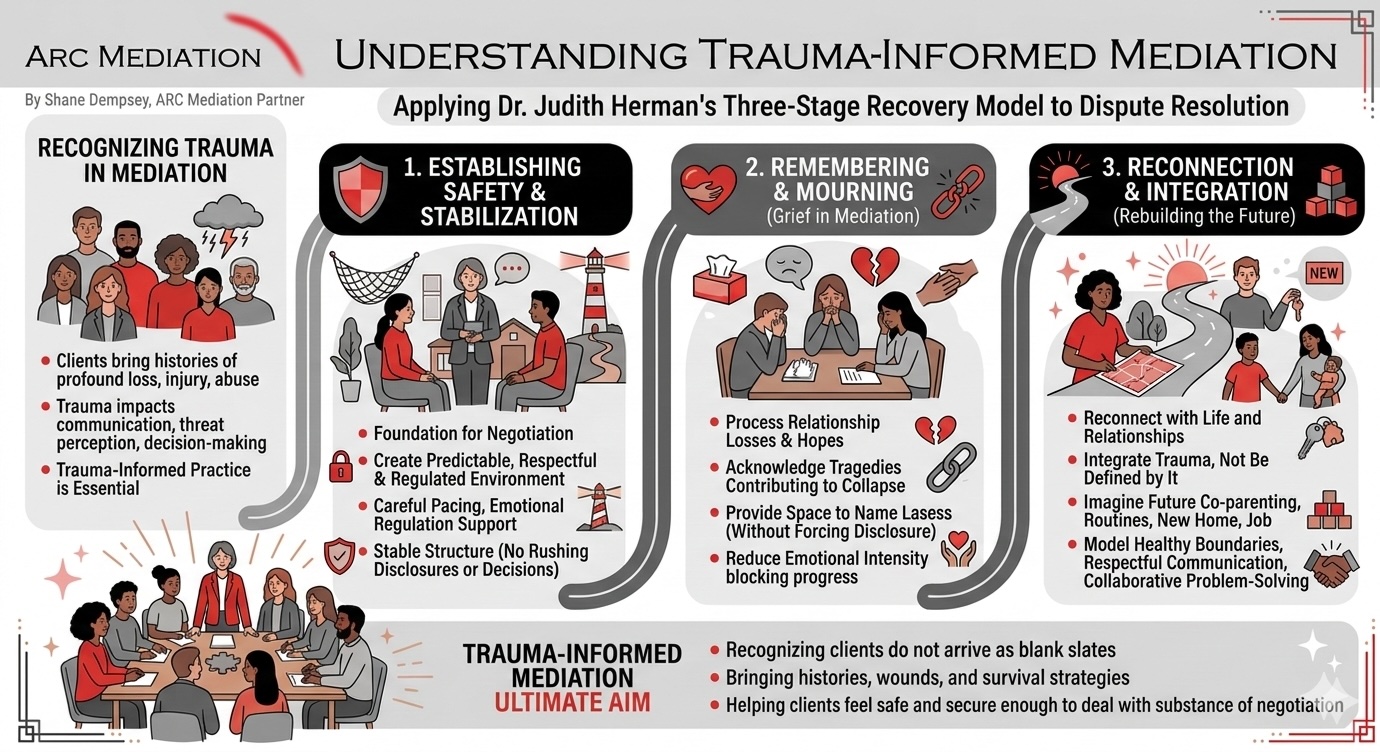
In our work, we’ve drawn inspiration from Dr Judith Herman’s three?stage recovery model, which offers a humane and structured way of understanding the client’s journey through trauma.
The stages are Safety and Stabilisation, Remembrance and Mourning, and Reconnection and Integration
1. Establishing Safety
Before meaningful negotiation can occur, clients must be helped feel physically & emotionally safe. Herman emphasises that safety is the foundation for all subsequent work, and this is true in mediation. Creating a predictable, respectful & regulated environment allows clients to participate without becoming overwhelmed or re?traumatised. This may involve pacing the process carefully, supporting emotional regulation, and ensuring that clients feel supported by a stable structure rather than pushed into disclosure or decision?making before they are ready.
2. Remembering and Mourning
Relationship breakdown often brings layers of grief. Grief for the relationship, for lost hopes, and sometimes for traumatic events that contributed to its collapse. Herman describes this stage as a period of reconstruction and mourning, where clients make sense of what has happened and acknowledge the losses they carry. In mediation, we witness how unprocessed grief can fuel conflict or silence. Providing space for clients to name these losses, without rushing them or forcing disclosure, can help reduce the emotional intensity that otherwise blocks progress.
3. Reconnection and Integration
The final stage involves helping clients reconnect with their lives and relationships in a way that integrates their trauma rather than being defined by it. In mediation, this often means supporting clients to imagine a future beyond the crisis; co?parenting arrangements, new routines, new accommodation & employment, or simply a way of interacting that feels safe and sustainable.
Herman notes that this stage is about rebuilding trust, autonomy, and a sense of self that is not dominated by trauma. Mediation can play a powerful role here by modelling healthy boundaries, respectful communication, and collaborative problem-solving.
Trauma-informed mediation is ultimately about recognising that people do not arrive at the table as blank slates. They bring histories, wounds, and survival strategies. It’s all about helping clients to feel safe & secure enough to deal with the substance of negotiation.
Over the last few years, I’ve found myself reflecting on the Japanese aesthetic of wabi?sabi; the appreciation of imperfection, impermanence, and the beauty that emerges from life’s inevitable struggles.
It has reshaped how I understand conflict, and support clients in mediation. We often meet individuals at moments when their inner & outer worlds feel fractured. People arrive carrying hurt, fear, anger, shame, or exhaustion. Yet beneath all of that, I’ve come to believe something quietly hopeful.
Each person still has a kind, creative, curious, courageous, clear, compassionate, and connected inner self; even if it feels distant or obscured by the heat haze of conflict.
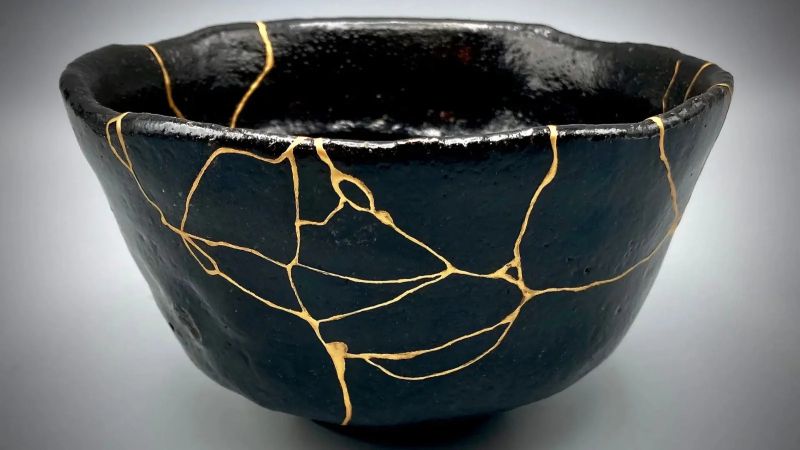
Kintsugi-repaired Bowl
This resonates deeply with the Internal Family Systems (IFS) idea of the Self. Not a perfected version of us, but a steady, grounded centre that remains intact despite turmoil. Conflict doesn’t erase it; it only makes it harder to access.
This is where wabi-sabi offers a powerful lens. Instead of seeing conflict as a failure, we can see it as part of the human condition, which is messy & painful, yet full of possibility. Instead of expecting people to be polished or “fixed,” we can honour the cracks, the uncertainty, and the courage it takes simply to show up when life feels overwhelming.
Which brings me to Kintsugi. Kintsugi is the Japanese art of repairing broken pottery with gold, honouring the cracks as part of the object’s history rather than flaws to be hidden.
Mediation, at its best, becomes a kind of kintsugi: the careful, respectful repair of what has been damaged in relationships, communication, and outlook. Not a return to how things were, but the creation of something new, something strengthened by honesty, and the gold of hard-won insight.
In Family Mediation, our work is often supported by therapists walking alongside one or both parties, helping them reconnect with their inner resources so they can effectively self-determine outcomes. We create a space where people can rediscover their capacity for clarity and compassion, even in the midst of conflict.
Wabi-sabi acknowledges the goal isn’t perfection. It’s the quiet beauty of people finding their way back to themselves & their communities.
]]>
I was reading an article on Mediate.com which highlighted something we’ve noted for several years. Neurodiversity isn’t an exception in mediation; it’s part of the normal variation of human experience. With an estimated one in seven people being neurodivergent, mediators are called to understand how differences in communication, sensory processing, emotional regulation, and information processing can shape the mediation room.
The article emphasises that neurodivergent clients may communicate differently, process information at a different pace, experience sensory environments more intensely, or respond to stress in ways that don’t align with neurotypical expectations. It also stresses the value that neurodivergent perspectives bring, from pattern recognition to creative problem?solving, and encourages mediators to adopt flexible, respectful, and inclusive appro aches.
At ARC, this has been central to our work for 15 years. Across hundreds of family, workplace, and commercial mediations, we have supported clients from diverse professional, cultural, and neurological backgrounds; including clients who are self?diagnosed or formally assessed as autistic, dyslexic, or ADHD.
Our approach is shaped by both professional experience and our own lived understanding of neurodiversity. To create a genuinely neuro?inclusive mediation process, we:
- Use clear, structured communication, written and verbal, and signpost legal or financial issues so clients can seek and understand independent advice.
Provide regular summaries and clear agendas, helping clients track progress and stay oriented throughout the process. - Maintain a calm, low?sensory mediation environment, with quiet space, soft lighting, filtered air, and sound?proofing to reduce overwhelm.
- Acknowledge different emotional processing styles in a kind, non?pathologising way, encouraging breaks when discussions become emotionally saturated.
- Adapt communication formats , face?to?face, phone, or text?based, based on each client’s preference and processing strengths.
- Check in frequently to ensure clients remain engaged, informed, and supported by their advisors, fostering a collaborative and learning?focused atmosphere.
- Plan the mediation process around each party’s capacity, pacing meetings and background work to avoid overload, and encouraging therapeutic support where helpful. We aim for an atmosphere that is relaxed, respectful, and free from unnecessary formality so clients, neurodivergent or neurotypical, feel at ease.
As the article suggests, embracing neurodiversity enriches the mediation process. It leads to clearer communication, more thoughtful pacing, and ultimately better outcomes for everyone involved.
]]>
ARC Mediation welcomes the launch of the Child Maintenance Guidelines by Minister Jim O’Callaghan today at the Family Justice Development Forum hosted by the Minister in Dublin. The guidelines emerged as a recommendation of the Dept of Social Protection Child Maintenance Group, which ARC founder Dr. Roisin O’Shea served on, and co-founder Shane Dempsey made several submissions to.
ARC’s Partners have had a keen interest in the development of such guidelines since they visited the Canadian Family Court and Court-annexed Mediation service in 2010, and discovered the work of Professor Carol Rogerson of UoT on Child Maintenance Guidelines. ARC had only been formed a few months prior but we had big ambitions both as mediators and to lobby for change in family law in Ireland.
Attending at the Forum, Dr O’Shea congratulated the Minister and his Department on launching the much needed child maintenance guidelines;
“Our courts currently operate without any system of guidelines in the determination of child maintenance, dealing with each matter on a case by case basis. It would be of significant assistance to parents and the courts to have a clear indication of the amount of child maintenance payable. The case is well made internationally in terms of diverting people away from the courts to agree on their own family based arrangement with the assistance of mediators, without State intervention, or where private agreements cannot be reached child maintenance guidelines can be administered by the courts which will bring consistency of outcome and certainty to those who need child maintenance and those who pay child maintenance.
In 2019 my colleague Shane Dempsey and I were invited to meet with then Minister Regina Doherty to discuss a submission Shane drafted about establishing child maintenance guidelines in Ireland, providing an analysis of the operation of such guidelines in Canada. The Minister subsequently appointed me to the Child Maintenance Group 2020-2022 chaired by Judge Catherine Murphy, and in the final Report from that Group a majority recommended that a formula to calculate child maintenance be developed.”
In launching the Child Maintenance Guidelines today the Minister is also furthering a recommendation of the Joint Oireachtas Committee on Justice & Equality 2019; that parties should be advised that from the outset that they would try and reach their own agreement and not persist with the adversarial process to avoid exposure to stress, cost, lost time and risk. The Minister emphasised the importance of promoting the use of mediation and noted that this is a guiding principle of the Family Courts Act 2024.
Without maintenance guidelines the outcome in Court is uncertain and therefore may be worth pursuing where a litigant believes a Court would order more or a litigant believes the Court would order less. With child maintenance guidelines we are likely to follow the significant progress made in Northern Ireland where the operation of a child support maintenance framework, including a calculator, has deterred litigation, such that child maintenance is rarely litigated.
Dr O’Shea added:
“With the assistance of mediators, parents can now use the Child Maintenance Guidelines released today and the soon to be released On-line Child Maintenance Calculator to reach private agreement. This is a game changer for families in Ireland and the members of the IPMO look forward to assisting families to quickly reach financial arrangements in relation to their children.”

Photo L to R: Minister for Justice, Home Affairs and Migration, Jim O’Callaghan T.D and Dr Róisín O’Shea Chair of the IPMO
]]>