The addition of the fare gate meant the addition of a barrier, where one did not exist previously. For some, tapping a card is difficult; for others, impossible. For me, some times it takes two or three taps for the gate to open.
After much discussion, research, head scratching and further discussions, a solution has been found: a Radio Frequency ID (RFID) card that opens the gate when the passenger nears. Brilliant! Apparently the first in the world.
I’m assuming RFID card also has the capacity to pay the fare; I’m not looking for a free ride.
Brilliant solution. However, the current implementation sucks.
People requiring this solution to the barrier need to apply for a RFID card. This means completing a form – name, birthdate, contact info, disability, reason why unable to open gate – requiring a medical practioner’s signature. A signature that often comes with a fee.
This means TransLink has this personal information about one segment of its customers that is not required from other passengers. Another tiny piece of me to sit in some file, some database, somewhere.
The application process also involves an assessment by a TransLink-appointed healthcare professional at a SkyTrain station. I’m guessing to determine whether or not the applicant is able to tap. I’d hope I was having a snazzy day, otherwise I probably will not be eligible for this futuristic card.
Imagine if the same implementation was used for elevators – the solution for those unable to use stairs; that people requiring the elevator needed to apply and provide medical documentation.
Imagine how fewer people would be using the elevators; only people needing the elevators would be the ones using them.
Imagine the less wear and tear; the savings in elevator maintenance and repair.
Imagine the public outcry!
Imagine if all fare cards were RF enabled. That would be universal design.
http://www.cbc.ca/news/canada/british-columbia/translink-disabled-system-1.4500478
If you enjoyed this post, consider buying me a chai tea latte. Thanks kindly.
Yes, that is Montel Williams! At the HealthTech Innovation Hub in Surrey.
Please forgive the quality of the photo. The story behind the photo is of much more significance.
I will attempt to explain the circuitous journey that brought me to this point.
A few months ago, Dad strongly recommended that I read Norman Doidge’s books The Brain That Changes Itself and The Brain’s Way of Healing – both of which explore the field of neuroplasticity. I had heard of neuroplasticity and the possibility of reprogramming one’s brain through Riley Dayne’s The Abundance Factor movie and program and, although intrigued, I had yet to explore deeper. It just hadn’t yet become a priority.
However, with Dad’s continued talk about the topic and fall weather upon us, I borrowed Doidge’s second book from the library – thinking that starting with his most current book made the most sense – and curled up in bed and started reading. It isn’t the easiest book to read, perhaps because I am not the fastest and most avid reader; I ended up renewing the book three times.
But, fascinating!
How scientists, researchers and forward-thinking medical professionals are using light, sound, electrical stimulation, constraint-induced movement therapy and the like to treat conditions that, until now, were thought to be unchangeable; conditions like traumatic brain injuries, Parkinson’s, autism, dyslexia, cerebral palsy and such.
As a child I endured years of physio, occupational and speech therapy and several torturous orthopedic surgeries. All were to treat the effects of cerebral palsy, but no one ever treated my “damaged” brain, the root cause of my disability. I received nothing like treatments discussed in this book.
The chapter about the PoNS (Portable Neuromodulation Stimulator) – a device used to non-invasively stimulate the nerves in the tongue, two inches from the basal ganglia in the brain — completely enthralled me. I consulted with Google and kept digging. This is when the journey began getting exciting.
I discovered that former TV host Montel Williams, who was diagnosed with multiple sclerosis in 2000, began seeking out options when his symptoms started progressing in 2007. According to the CTV news story, he came across the tongue device being tested in a research lab at the University of Wisconsin-Madison.
Montel was so impressed with the results he experienced using the device that he co-founded Helius Medical Technologies to “partner with top organizations to pioneer unique, noninvasive platform technologies that support neurological wellness.” (This might be an oversimplification of the details. I’m still reading! More background is available on the Helius website.)
With some more digging, I also discovered that Helius had conducted a pilot study using the PoNS device on children with cerebral palsy in Russia. The results sound promising, although I have yet to find a copy of the study translated into English. However I did find this video from the 2015 Russian Pilot Study:
I know not to believe everything I see on the internet and to question all; however, watching this video made me want to know even more. Perhaps there is something here that is legit. Perhaps permanent brain damage need not be permanent or, perhaps, not as severe.
Coincidentally (or not), in mid-November, as I was beginning to wonder if there were any local resources related to neuroplasticity and where I might start looking, co-chair of Surrey’s Measured Up Committee Marco Pasqua emailed committee members with the link to West Coast Centre for Learning (WCCL) as a interesting new resource in the community. Likely because I was avoiding a boring task or some other reason for procrastinating, I spent some time poking around the site and I was intrigued. Without overthinking it, I emailed them for more information.
After several emails back and forth with Lynda Brind Dickson, the Coordinator of Community Learning Partnerships about what WCCL does, about my interest in neuroplasticity and such, we scheduled a time to meet. Heavy rains were forecasted; we postponed our meeting.
Meanwhile, I kept poking around. WCCL is located at HealthTech Innovation Hub, which is in a new building across from the Surrey Memorial Hospital – all of which are located along the City of Surrey’s Innovation Boulevard. From what I understand (at the moment), HealthTech is an incubator for brain health technologies; WCCL is one of the several businesses developing software, applications and devices in the space. It is all very exciting and somewhat futuristic-sounding.
Lynda and I rescheduled; a major snowfall was forecasted. We postponed, all the while continuing to chat via good ol’ email.
I kept reading Doidge’s The Brain’s Way of Healing and poking around online, connecting the dots.
Then, bingo!
I found a local announcement seeking individuals with traumatic brain injuries (TBIs) for a clinical trial of the PoNS device. Helius Medical Technologies had received from the military to conduct a proper, double-blinded clinical trial of the PoNS. AND…HealthTech Connex was one of the four test sites!
The device that I had read about in Doidge’s book, that Montel Williams had tried at the U of Wisconsin and, subsequently, co-founded Helius, that had been piloted with Russian kids with cerebral palsy was now in clinical trials a mere five blocks from where I am writing this.
Christmas came and went, snow fell and melted, fell and melted. Lynda and I scheduled to meet on February 10th because, surely, by then the snow would be gone for good. We were wrong. More than a foot of snow over the prior weekend, which is really unusual in Surrey in early February. I knew I would be snowed in yet again for, at least, another week. However, I was determined I would make our meeting this time, even if I had to take a taxi.
While I waited for the snow to melt, Lynda connected with a few more people that I should meet with – or, at least, be introduced to – while at HealthTech on Friday. One such connection was sure to be Pauline Martin at NeuroMotion Physio, which provides the physio component of the PoNS clinical trial at the Surrey test site. Pauline and I went to high school together.
AND…Montel Williams was going to cut the ribbon on the neuroscience wing on Friday! I had to be there.
Friday morning I checked my email as I was getting ready and…Lynda was stranded in Merritt (in the interior of British Columbia) because the Coquihalla Highway (and every other highway into the Greater Vancouver area) were closed due to treacherous weather conditions. Seriously?!
After a flurry of emails, it was deemed that I should still go, and connect with Pauline and a Mike about a brain scanning device. And see what happens after that. My husband called a taxi for me; it was nice to escape house arrest for a while.
I met up with Pauline, who kindly gave me a brief tour of the shiny new space. Then I met with Mike and one of his colleagues to demo their brain scanning device, which, unfortunately, the sensors didn’t work through all of my hair – an issue that will surely be addressed in prototype tweaks. The end goal is to have a device that general practitioners – or, even, individuals themselves – can use to check their general brain health, much like monitoring blood pressure to check their heart health. I can see it becoming a craze similar to the FitBit. The more sophisticated professional device will be used to assess concussions and such; for example, to determine when a hockey player is well enough to return to the ice.
Going with the flow of the day, I enjoyed a nice lunch with people whose most names I do not remember. (Obviously I need to work on my memory skills!) Although I was not officially introduced to Montel Williams, I did sit at the same long boardroom table (in an impressive space) for lunch. I did chat with Dr. Ryan D’Arcy – a co-founder and senior scientist/entrepreneur for Health Tech Connex Inc., full Professor at Simon Fraser University, and a few other hats. Thank goodness for my iPad and Proloquo4Text.
Through our conversation, I learned that the latest version of the Magnetoencepalography (MEG) – initially developed by Hal Weinberg – was now located at Surrey Memorial Hospital. I had taken a psyc course with Professor Weinberg years ago at SFU. Can this day have any more “connect the dots” moments?!
I didn’t get to stay for the ribbon cutting as a taxi was called for me soon after lunch. I went with the flow. I did, however, leave an autographed copy of my book I’ll Do It Myself for Montel.
Results from the clinical trial with subjects with mild to moderate TBIs will be known in three months. Two other conditions – and very possible a third in a year – are slated for clinical trials using the PoNS. I am hesitant to name the three conditions at this point because I don’t know if it is public knowledge, yet. (Everything else shared here is available online.) It is suffice to say that I am extremely excited, both for myself and many of my friends and colleagues.
 As I mentioned in an email to Lynda, I am not looking for a miraculous cure, to be walking straight and talking clearly. But, what if some improved functioning is possible? What if more controlled movement is possible? What if I could deliver a speech, using my iPad, without being so tense and jerky on stage? What if I could get through an average day without being totally exhausted?
What if…?
]]>
Yes, that is Montel Williams! At the HealthTech Innovation Hub in Surrey.
Please forgive the quality of the photo. The story behind the photo is of much more significance.
I will attempt to explain the circuitous journey that brought me to this point.
A few months ago, Dad strongly recommended that I read Norman Doidge’s books The Brain That Changes Itself and The Brain’s Way of Healing – both of which explore the field of neuroplasticity. I had heard of neuroplasticity and the possibility of reprogramming one’s brain through Riley Dayne’s The Abundance Factor movie and program and, although intrigued, I had yet to explore deeper. It just hadn’t yet become a priority.
However, with Dad’s continued talk about the topic and fall weather upon us, I borrowed Doidge’s second book from the library – thinking that starting with his most current book made the most sense – and curled up in bed and started reading. It isn’t the easiest book to read, perhaps because I am not the fastest and most avid reader; I ended up renewing the book three times.
But, fascinating!
How scientists, researchers and forward-thinking medical professionals are using light, sound, electrical stimulation, constraint-induced movement therapy and the like to treat conditions that, until now, were thought to be unchangeable; conditions like traumatic brain injuries, Parkinson’s, autism, dyslexia, cerebral palsy and such.
As a child I endured years of physio, occupational and speech therapy and several torturous orthopedic surgeries. All were to treat the effects of cerebral palsy, but no one ever treated my “damaged” brain, the root cause of my disability. I received nothing like treatments discussed in this book.
The chapter about the PoNS (Portable Neuromodulation Stimulator) – a device used to non-invasively stimulate the nerves in the tongue, two inches from the basal ganglia in the brain — completely enthralled me. I consulted with Google and kept digging. This is when the journey began getting exciting.
I discovered that former TV host Montel Williams, who was diagnosed with multiple sclerosis in 2000, began seeking out options when his symptoms started progressing in 2007. According to the CTV news story, he came across the tongue device being tested in a research lab at the University of Wisconsin-Madison.
Montel was so impressed with the results he experienced using the device that he co-founded Helius Medical Technologies to “partner with top organizations to pioneer unique, noninvasive platform technologies that support neurological wellness.” (This might be an oversimplification of the details. I’m still reading! More background is available on the Helius website.)
With some more digging, I also discovered that Helius had conducted a pilot study using the PoNS device on children with cerebral palsy in Russia. The results sound promising, although I have yet to find a copy of the study translated into English. However I did find this video from the 2015 Russian Pilot Study:
I know not to believe everything I see on the internet and to question all; however, watching this video made me want to know even more. Perhaps there is something here that is legit. Perhaps permanent brain damage need not be permanent or, perhaps, not as severe.
Coincidentally (or not), in mid-November, as I was beginning to wonder if there were any local resources related to neuroplasticity and where I might start looking, co-chair of Surrey’s Measured Up Committee Marco Pasqua emailed committee members with the link to West Coast Centre for Learning (WCCL) as a interesting new resource in the community. Likely because I was avoiding a boring task or some other reason for procrastinating, I spent some time poking around the site and I was intrigued. Without overthinking it, I emailed them for more information.
After several emails back and forth with Lynda Brind Dickson, the Coordinator of Community Learning Partnerships about what WCCL does, about my interest in neuroplasticity and such, we scheduled a time to meet. Heavy rains were forecasted; we postponed our meeting.
Meanwhile, I kept poking around. WCCL is located at HealthTech Innovation Hub, which is in a new building across from the Surrey Memorial Hospital – all of which are located along the City of Surrey’s Innovation Boulevard. From what I understand (at the moment), HealthTech is an incubator for brain health technologies; WCCL is one of the several businesses developing software, applications and devices in the space. It is all very exciting and somewhat futuristic-sounding.
Lynda and I rescheduled; a major snowfall was forecasted. We postponed, all the while continuing to chat via good ol’ email.
I kept reading Doidge’s The Brain’s Way of Healing and poking around online, connecting the dots.
Then, bingo!
I found a local announcement seeking individuals with traumatic brain injuries (TBIs) for a clinical trial of the PoNS device. Helius Medical Technologies had received from the military to conduct a proper, double-blinded clinical trial of the PoNS. AND…HealthTech Connex was one of the four test sites!
The device that I had read about in Doidge’s book, that Montel Williams had tried at the U of Wisconsin and, subsequently, co-founded Helius, that had been piloted with Russian kids with cerebral palsy was now in clinical trials a mere five blocks from where I am writing this.
Christmas came and went, snow fell and melted, fell and melted. Lynda and I scheduled to meet on February 10th because, surely, by then the snow would be gone for good. We were wrong. More than a foot of snow over the prior weekend, which is really unusual in Surrey in early February. I knew I would be snowed in yet again for, at least, another week. However, I was determined I would make our meeting this time, even if I had to take a taxi.
While I waited for the snow to melt, Lynda connected with a few more people that I should meet with – or, at least, be introduced to – while at HealthTech on Friday. One such connection was sure to be Pauline Martin at NeuroMotion Physio, which provides the physio component of the PoNS clinical trial at the Surrey test site. Pauline and I went to high school together.
AND…Montel Williams was going to cut the ribbon on the neuroscience wing on Friday! I had to be there.
Friday morning I checked my email as I was getting ready and…Lynda was stranded in Merritt (in the interior of British Columbia) because the Coquihalla Highway (and every other highway into the Greater Vancouver area) were closed due to treacherous weather conditions. Seriously?!
After a flurry of emails, it was deemed that I should still go, and connect with Pauline and a Mike about a brain scanning device. And see what happens after that. My husband called a taxi for me; it was nice to escape house arrest for a while.
I met up with Pauline, who kindly gave me a brief tour of the shiny new space. Then I met with Mike and one of his colleagues to demo their brain scanning device, which, unfortunately, the sensors didn’t work through all of my hair – an issue that will surely be addressed in prototype tweaks. The end goal is to have a device that general practitioners – or, even, individuals themselves – can use to check their general brain health, much like monitoring blood pressure to check their heart health. I can see it becoming a craze similar to the FitBit. The more sophisticated professional device will be used to assess concussions and such; for example, to determine when a hockey player is well enough to return to the ice.
Going with the flow of the day, I enjoyed a nice lunch with people whose most names I do not remember. (Obviously I need to work on my memory skills!) Although I was not officially introduced to Montel Williams, I did sit at the same long boardroom table (in an impressive space) for lunch. I did chat with Dr. Ryan D’Arcy – a co-founder and senior scientist/entrepreneur for Health Tech Connex Inc., full Professor at Simon Fraser University, and a few other hats. Thank goodness for my iPad and Proloquo4Text.
Through our conversation, I learned that the latest version of the Magnetoencepalography (MEG) – initially developed by Hal Weinberg – was now located at Surrey Memorial Hospital. I had taken a psyc course with Professor Weinberg years ago at SFU. Can this day have any more “connect the dots” moments?!
I didn’t get to stay for the ribbon cutting as a taxi was called for me soon after lunch. I went with the flow. I did, however, leave an autographed copy of my book I’ll Do It Myself for Montel.
Results from the clinical trial with subjects with mild to moderate TBIs will be known in three months. Two other conditions – and very possible a third in a year – are slated for clinical trials using the PoNS. I am hesitant to name the three conditions at this point because I don’t know if it is public knowledge, yet. (Everything else shared here is available online.) It is suffice to say that I am extremely excited, both for myself and many of my friends and colleagues.
As I mentioned in an email to Lynda, I am not looking for a miraculous cure, to be walking straight and talking clearly. But, what if some improved functioning is possible? What if more controlled movement is possible? What if I could deliver a speech, using my iPad, without being so tense and jerky on stage? What if I could get through an average day without being totally exhausted?
What if…?
To keep up with my adventures, musings and insights, sign up to receive my future posts via email.
If you enjoyed this post, consider buying me a chai tea latte. Thanks kindly.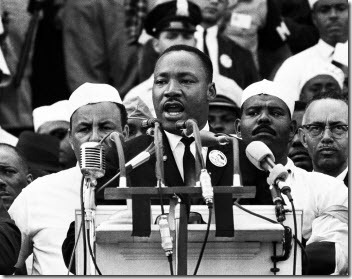
Fifty-four years ago, in a time marked by with civil unrest, hatred and violence, Reverend Dr. Martin Luther King Jr stood on the steps of Lincoln Memorial in Washington, D.C., in front of 250,000 people, and passionately declared:
I have a dream.
He did not declare, “I have a vision.”
Nor, “I have a strategy.”
Nor, a 13-point plan.
Nor, one word for the year as is common in this time of short attention spans and instant gratification.
No.
Martin Luther King Jr boldly declared he had a dream. A dream that became part of his legacy.
At a time eerily similar to today, he started with a dream. Not a luxury nor a nicety, but a necessity – to guide him and his supporters and followers in the work to come.
What is your dream? The dream that will, one day, become your legacy.
]]>
Fifty-four years ago, in a time marked by with civil unrest, hatred and violence, Reverend Dr. Martin Luther King Jr stood on the steps of Lincoln Memorial in Washington, D.C., in front of 250,000 people, and passionately declared:
I have a dream.
He did not declare, “I have a vision.”
Nor, “I have a strategy.”
Nor, a 13-point plan.
Nor, one word for the year as is common in this time of short attention spans and instant gratification.
No.
Martin Luther King Jr boldly declared he had a dream. A dream that became part of his legacy.
At a time eerily similar to today, he started with a dream. Not a luxury nor a nicety, but a necessity – to guide him and his supporters and followers in the work to come.
What is your dream? The dream that will, one day, become your legacy.
To keep up with my adventures, musings and insights, sign up to receive my future posts via email.
If you enjoyed this post, consider buying me a chai tea latte. Thanks kindly.Rather, embrace your audacious, true dream that will guide your journey of Life for the next five years, the next decade or the next quarter century.
Why a Dream?
For thousands of years, humans have relied on the North Star to guide their journeys. Travelers may take side trips or detours, often experiencing unplanned adventures along the way, but that bright light shining from the heavens above always brings them back on course.
Our aspirations, our dreams, are our North Star, guiding us through our lives. Although we may waver or stray, achieve other exciting goals, trek on an adventure or two – or even a misadventure – our dream is always present and guides our life’s course, if we are willing to listen, pay attention and follow.
Without a dream, we meander and drift through life without a direction. Our dream – like the North Star to the travelers of yesteryear – is not a luxury, but rather a necessity.
What, Actually, is a Dream?
With so many aspirations, goals and even fantasies swirling around in our heads, how do we know which dream is our true North Star?
In my signature talk “Finding Your True Dream, The North Star for Your Life,” I explain in great detail the five elements that make up a dream.
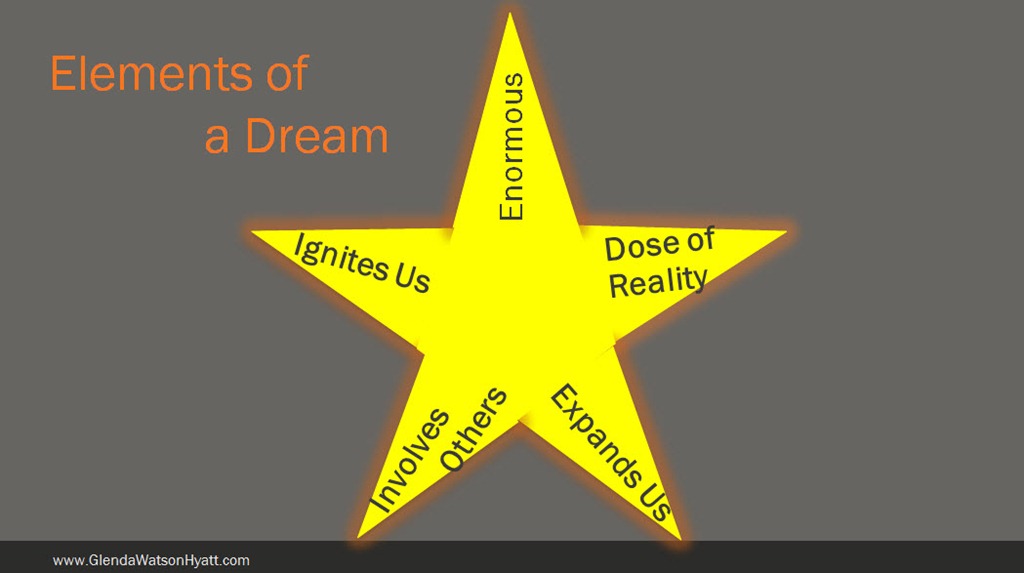
(Click on image to enlarge)
Briefly, a dream:
- must be enormous, bold, audacious – keeping in mind that size is relative, what might be audacious for someone might not be so for someone else;
- contains a minuscule dose of reality – which differentiates a dream from a fantasy, however, on occasion, what is not reality or not possible today might become reality tomorrow thanks to a new technology, discovery, skill or opportunity – making a dream now possible to achieve;
- presses us to grow and expand way beyond our comfort zones;
- demands other individuals be involved – if one person can accomplish a dream alone, then it is not bold and audacious enough;
- ignites a spark, a passion within us - like a shining star. We smile and our eyes twinkle when we talk about our dreams.
My dream is to become a well-paid, internationally-known, motivational speaker. Although this journey has only just begun, it has already taken me to amazing places and I am looking forward to experiencing where all my North Star guides me.
What is your true dream, your North Star?
I'd love to hear all about it!
]]>Rather, embrace your audacious, true dream that will guide your journey of Life for the next five years, the next decade or the next quarter century.
Why a Dream?
For thousands of years, humans have relied on the North Star to guide their journeys. Travelers may take side trips or detours, often experiencing unplanned adventures along the way, but that bright light shining from the heavens above always brings them back on course.
Our aspirations, our dreams, are our North Star, guiding us through our lives. Although we may waver or stray, achieve other exciting goals, trek on an adventure or two – or even a misadventure – our dream is always present and guides our life’s course, if we are willing to listen, pay attention and follow.
Without a dream, we meander and drift through life without a direction. Our dream – like the North Star to the travelers of yesteryear – is not a luxury, but rather a necessity.
What, Actually, is a Dream?
With so many aspirations, goals and even fantasies swirling around in our heads, how do we know which dream is our true North Star?
In my signature talk “Finding Your True Dream, The North Star for Your Life,” I explain in great detail the five elements that make up a dream.
(Click on image to enlarge)
Briefly, a dream:
- must be enormous, bold, audacious – keeping in mind that size is relative, what might be audacious for someone might not be so for someone else;
- contains a minuscule dose of reality – which differentiates a dream from a fantasy, however, on occasion, what is not reality or not possible today might become reality tomorrow thanks to a new technology, discovery, skill or opportunity – making a dream now possible to achieve;
- presses us to grow and expand way beyond our comfort zones;
- demands other individuals be involved – if one person can accomplish a dream alone, then it is not bold and audacious enough;
- ignites a spark, a passion within us – like a shining star. We smile and our eyes twinkle when we talk about our dreams.
My dream is to become a well-paid, internationally-known, motivational speaker. Although this journey has only just begun, it has already taken me to amazing places and I am looking forward to experiencing where all my North Star guides me.
What is your true dream, your North Star?
I’d love to hear all about it!
To keep up with my adventures, musings and insights, sign up to receive my future posts via email.
If you enjoyed this post, consider buying me a chai tea latte. Thanks kindly. Dear Santa,
2016 has been a very strange years; one of those “best of times, worst of times” scenarios.
I am saddened by the unrest, hate and destruction that has gripped seemingly much of the world this year. Events and actions that are beyond comprehension.
2016 was also a year of much loss, both of distant celebrities and dear loved ones. Many tears fell this year.
On the bright and personal side, I had an amazing year! Less than three short years after receiving a communication app that truly fits my needs, I won the ISAAC 2016 Consumer Lecture Award with my lecture “Finding Your True Dream, The North Star for Your Life's Journey“. That lecture has since become my signature talk because it is so me! I am looking forward to sharing it with many people in the coming year.
Santa, I would like to ask for a magical soothing balm that will ease fears, alleviate hate and heal broken hearts. I would love to give such a gift to countless friends and loved ones; surely, your elves can figure out the recipe. And, several paying speaking gigs, too, would be awesome!
Wishing you and your reindeers safe travels.
Merry Christmas and Happy Hanukkah.
With love from,
Glenda
Dear Santa,
2016 has been a very strange years; one of those “best of times, worst of times” scenarios.
I am saddened by the unrest, hate and destruction that has gripped seemingly much of the world this year. Events and actions that are beyond comprehension.
2016 was also a year of much loss, both of distant celebrities and dear loved ones. Many tears fell this year.
On the bright and personal side, I had an amazing year! Less than three short years after receiving a communication app that truly fits my needs, I won the ISAAC 2016 Consumer Lecture Award with my lecture “Finding Your True Dream, The North Star for Your Life’s Journey“. That lecture has since become my signature talk because it is so me! I am looking forward to sharing it with many people in the coming year.
Santa, I would like to ask for a magical soothing balm that will ease fears, alleviate hate and heal broken hearts. I would love to give such a gift to countless friends and loved ones; surely, your elves can figure out the recipe. And, several paying speaking gigs, too, would be awesome!
Wishing you and your reindeers safe travels.
Merry Christmas and Happy Hanukkah.
With love from,
Glenda
 [caption id="attachment_2332" align="alignleft" width="350" caption="(Photo credit: @AccessibleGC)"]
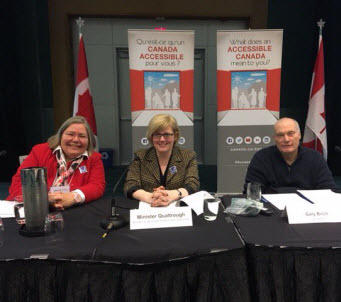
Minister for Sports and Persons with Disabilities Carla Qualtrough and her team are holding public consultations around the country and gathering thoughts, perspectives and suggestions for the forthcoming Canadians with Disabilities Act, for an #AccessibleCanada for all.
Last Saturday, a public consultation session was held in Vancouver, British Columbia. I had the opportunity to share the assumptions, misperceptions and barriers that I face living with a speech disability. Click to listen to my words.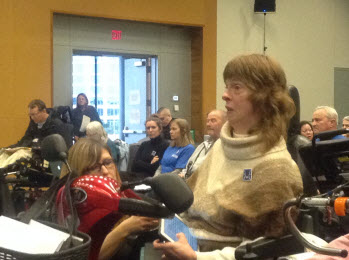
To keep up with my adventures, musings and insights, sign up to receive my future posts via email.
]]>(Photo credit: @AccessibleGC)
Minister for Sports and Persons with Disabilities Carla Qualtrough and her team are holding public consultations around the country and gathering thoughts, perspectives and suggestions for the forthcoming Canadians with Disabilities Act, for an #AccessibleCanada for all.
Last Saturday, a public consultation session was held in Vancouver, British Columbia. I had the opportunity to share the assumptions, misperceptions and barriers that I face living with a speech disability. Click to listen to my words.
(The transcript is below. Please ignore the extra commas; they help to make a synthesized voice sound a teeny more expressive.)
Good afternoon! I am Glenda Watson Hyatt, a self advocate, an author, and a motivational speaker.
I have both a physical, and a speech disability. Of the two, living with a communication disability, is the most frustrating and isolating. Simple tasks like inquiring about a government service, calling for a taxi cab, or even ordering a chai tea latte, can be an exasperating ordeal.
Like other Canadians living with speech and language disabilities, I am often assumed to be cognitively impaired, or deaf, in which case, gesturing ensues, an impromptu game of charades. Friends with communication disabilities, have been assumed drunk, and the police or paramedics needlessly called.
Our methods of communicating are often denied. For example, on one trip to the emergency room, my husband, who also uses a wheelchair for mobility, was told to wait in the waiting room, because there was not enough space for both of our chairs. We attempted to explain that, I needed him for assistance with communication, yet he was still told to leave. Imagine a person who is deaf being denied a sign language interpreter. The situation is similar, yet my need for assistance with communication, is typically not recognized. My communication access requirement is not protected.
Other medical doctors have refused to speak directly with me. They do not seem to understand that, even though they do not understand my speech, I can hear them and understand them.
When medical professionals do not understand, do not respect, that hearing and cognition, are not necessarily impacted, by communication disabilities, then there is little chance, the general public will understand, and respect this, without an ongoing, widespread, information and awareness campaign.
This lack of understanding, of my actual disability, makes complex endeavours, like finding meaning employment, extremely difficult, if not impossible.
I am struggling to get by on social assistance, not because I lack education, skills, talents, motivation, or technology to accommodate my disability. I am struggling on social assistance, because I could not find an employer, who saw beyond the assumptions, and misperceptions, of my disability.
Even within the disability community, people with communication disabilities, are routinely overlooked and excluded. The non partisan, Barrier Free Canada, a major driving force for the Canadians with Disabilities Act, states in its principles that, “The Canadians with Disabilities Act should apply to all persons with disabilities whether they have a physical, mental, sensory, learning and, or intellectual disability, or mental health condition.” Canadians with communication disabilities, are not mentioned.
What would it take to fix these barriers?
Begin by following, Barrier Free British Columbia’s lead, which includes in its principles, “The Act will apply to all persons with disabilities whether their disability is considered physical, sensory, cognitive, communication, or mental health related.”
Canadians with speech and language disabilities, need to be recognized, to be heard, to be included. We may not be the most vocal group, but we still need to be at the table, to be involved, and to be contributing. We need to have, our communication access requirements, acknowledged, and protected.
Thank you!
To keep up with my adventures, musings and insights, sign up to receive my future posts via email.
If you enjoyed this post, consider buying me a chai tea latte. Thanks kindly.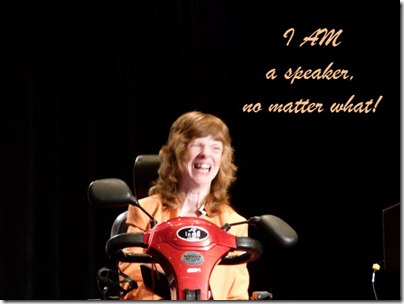
Back in high school, public speaking was definitely not on my list of top career choices. It ranked way down near the bottom with neurosurgery. Likewise, my top career options were also rather limited.
As you may know, I have cerebral palsy, which, for the most part, affects my balance, muscle coordination and speech. Back when I was searching for employment opportunities, entry level office positions – my only glimmer of possibility - required a minimum typing speed and the ability to answer the telephone. However, my left thumb - the only digit I can use for typing - did not meet expectations, and my unique Glenda-ish did not make the phone my best friend. I was disqualified from most positions before the conversation even got to my abilities, talents and interests.
I persevered and some time after completing my Bachelor of Arts degree from Simon Fraser University, I did land a part-time job at my alma mater, making the existing career mentor program accessible to students and alum with disabilities; a job I loved. When the project funding ended, so did my job.
After much searching, I could not find another employer willing to give me an opportunity to prove what I was capable of offering as an employee. Self-employment was my only option.
I competently completed any work opportunity that came my way: writing a literature review for a homelessness project, editing sermons for a pastor’s book, writing articles for various websites, maintaining a website for a non-profit arts organization. To me, those were survival jobs – equivalent to pumping gas and waiting tables – they put some food on the table, but not much more.
Gradually I built a solid reputation as a web accessibility consultant; making websites accessible to people with all kinds of disabilities. Web accessibility was an understandable career path for me and there is still much left to be done in the field but, after fourteen years, I felt so burnt out that if I had to explain the need for text descriptions of images one more time, I would stab my eyes out with a yellow HB pencil.
Advances in technology – namely, the iPad and the text-to-speech app Proloquo4Text – have enabled me to take my career in a bold new direction; one that was impossible, inconceivable back in high school. That of being a well-paid, internationally-known motivational speaker to inspire people who are silently screaming “There's more to me!” and, yet, they are standing in their own way from moving forward.
In August, I traveled to Toronto for the honour and privilege of delivering the ISAAC 2016 Consumer Lecture as a plenary session at the International Society for Augmentative and Alternative Communication (ISAAC) Conference. I delivered Finding Your True Dream, The North Star for Your Life's Journey – which has since become my signature talk - to approximately 600-800 people.
Here is a brief clip:
Being up there on the stage, sharing my story and the five elements of a dream, felt so right. This is what I am meant to do, where I am meant to be, at this point in my life. It is a destiny I fully accept and embrace, and an irony I savour as absolutely delicious.
Sometimes finding employment means daring to follow a dream, no matter what!
For more information about my signature talk Finding Your True Dream, The North Star for Your Life's Journey, please download my speaker onesheet. Feel free to share with anyone you know who is looking for speakers for conferences or events. Thanks kindly.
]]>
Back in high school, public speaking was definitely not on my list of top career choices. It ranked way down near the bottom with neurosurgery. Likewise, my top career options were also rather limited.
As you may know, I have cerebral palsy, which, for the most part, affects my balance, muscle coordination and speech. Back when I was searching for employment opportunities, entry level office positions – my only glimmer of possibility – required a minimum typing speed and the ability to answer the telephone. However, my left thumb – the only digit I can use for typing – did not meet expectations, and my unique Glenda-ish did not make the phone my best friend. I was disqualified from most positions before the conversation even got to my abilities, talents and interests.
I persevered and some time after completing my Bachelor of Arts degree from Simon Fraser University, I did land a part-time job at my alma mater, making the existing career mentor program accessible to students and alum with disabilities; a job I loved. When the project funding ended, so did my job.
After much searching, I could not find another employer willing to give me an opportunity to prove what I was capable of offering as an employee. Self-employment was my only option.
I competently completed any work opportunity that came my way: writing a literature review for a homelessness project, editing sermons for a pastor’s book, writing articles for various websites, maintaining a website for a non-profit arts organization. To me, those were survival jobs – equivalent to pumping gas and waiting tables – they put some food on the table, but not much more.
Gradually I built a solid reputation as a web accessibility consultant; making websites accessible to people with all kinds of disabilities. Web accessibility was an understandable career path for me and there is still much left to be done in the field but, after fourteen years, I felt so burnt out that if I had to explain the need for text descriptions of images one more time, I would stab my eyes out with a yellow HB pencil.
Advances in technology – namely, the iPad and the text-to-speech app Proloquo4Text – have enabled me to take my career in a bold new direction; one that was impossible, inconceivable back in high school. That of being a well-paid, internationally-known motivational speaker to inspire people who are silently screaming “There’s more to me!” and, yet, they are standing in their own way from moving forward.
In August, I traveled to Toronto for the honour and privilege of delivering the ISAAC 2016 Consumer Lecture as a plenary session at the International Society for Augmentative and Alternative Communication (ISAAC) Conference. I delivered Finding Your True Dream, The North Star for Your Life’s Journey – which has since become my signature talk – to approximately 600-800 people.
Here is a brief clip:
Being up there on the stage, sharing my story and the five elements of a dream, felt so right. This is what I am meant to do, where I am meant to be, at this point in my life. It is a destiny I fully accept and embrace, and an irony I savour as absolutely delicious.
Sometimes finding employment means daring to follow a dream, no matter what!
For more information about my signature talk Finding Your True Dream, The North Star for Your Life’s Journey, please download my speaker onesheet. Feel free to share with anyone you know who is looking for speakers for conferences or events. Thanks kindly.
If you enjoyed this post, consider buying me a chai tea latte. Thanks kindly.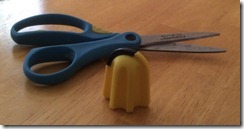 More often than not, using scissors when left-handed is frustrating. The scissors tend to fold paper, rather than cut it. Add in limited hand function due to cerebral palsy and some tasks, like opening a plastic package, leaves me screwed.
Enter the Nimble – a cutting tool that slips over the fingertip.
When I was given the opportunity to try one, I said, “Yes, please!” (In the spirit of full disclosure, this is, in essence, a sponsored review, in that I did received one Nimble for free.)
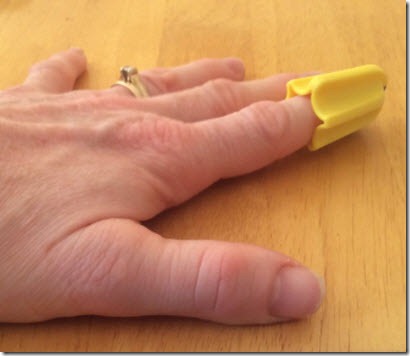
Right out of the envelope, I was able to use the small gadget to open the enclosed packages of the sweets.
Since then I have been using the “1 finger cutting tool” to open packets in the kitchen every day. And I am constantly finding new uses for it.
The actual cutting bit is like the very tip of a cat claw. Because it is so small, there is no (or, a minuscule) chance of cutting myself. Yet, it will cut what I need cutting: paper, plastic, cellophane, foil, tape, and such.
I am looking forward to packing the Nimble in my bag when I head off to Toronto this summer. Scissors aren’t permitted through airport security, but this small cutting tool will likely get through without a second glance. Opening the hotel’s tiny soap bars will no longer be a hassle!
The creator Simon Lyons and his company VERSION 22 are running a Kickstarter campaign to raise funds to get the Nimble into production. If you feel so inclined, please check out the Nimble’s Kickstarter campaign.
I am eager to having Nmbles in several places throughout my home so that one is always handy when I need it!
If you enjoyed this post, consider buying me a chai tea latte. Thanks kindly. With headaches so painful I felt like I would puke, an optometrist appointment was reluctantly made.
Reluctantly because my last appointment three years ago left me feeling devalued and depleted, and took all of my inner strength not to burst into tears.
This feeling had nothing to do with the condition of my eyes, but, rather, the ill-prepared, unenlightened way the optometrist communicated with me and my jerky, constantly moving, speech impaired body.
After that disastrous appointment, I wrote an letter to the optometrist and hand delivered it to the office. Even though I requested that the letter be placed in my file for next time, in preparation for this latest appointment I printed a copy to give to the next optometrist.
I was somewhat hesitant to hand the letter to the new-to-me optometrist because I didn't want to assume he was as unenlightened as the previous doctor. I then realized the exam would have more of a chance of going smoothly if I gave him a fair chance to succeed. I handed him the letter.
Autobiography: amzn.to/U6N5uW
Blog: www.doitmyselfblog.com
LinkedIn: www.linkedin.com/in/glendawatsonhyatt
Twitter: @GlendaWH
October 19, 2012
Dear Optometrist:
After my eye exam on Monday, October 15th, I left the office feeling devalued and depleted. I am hoping by sharing the following information, the next exam will go smoother for both of us.
As you might know, I have athetoid cerebral palsy. For me, this means I lack muscle control and coordination. My physical movements are jerky and involuntary; one body part or another is in constant motion. My speech is also significantly impaired, yet can be understood by individuals who take the time to listen.
However, my hearing, understanding and cognition are not affected. There is no need to speak loudly, to repeat yourself or to use simple vocabulary for me to comprehend.
Next time I will grab my iPad from my scooter basket before my scooter is moved out of the way so that I have a more effective means of communication at hand.
My head control is tenuous at times. When conducting the eye pressure test and other such tests during which my head must remain still in a certain position, it might be helpful to have someone hold my head steady.
My eyes closing when something is approaching is a strong, uncontrollable reflex. Repeatedly stating that I need to open my eyes for the eye drops is not productive. Perhaps another method can be found to achieve the same result.
Please keep this letter in my file so that it will be handy for my next appointment.
Perhaps in that time you could consult with colleagues and other optometrists for further suggestions on how to best serve patients with cerebral palsy and other neurological disorders.
Working together will ensure successful care for my vision.
Respectfully,
Glenda Watson Hyatt
The optometrist read the letter, thanked me for the information and proceeded with examining my eyes. He was extremely patient when my head twitched like a bobblehead that had just downed a few cups of espresso.
However, perhaps “…my hearing, understanding and cognition are not affected” was not written clearly enough in the letter as he made a great effort to gesture while he was talking. He went as far as to write “2012” on a small Post-It note when he asked if my last glasses were in 2012.
In Don Miguel Ruiz's The Four Agreements, the third agreement is: "Don't make assumptions."
Don’t assume that I do not hear or do not understand because my speech is unclear or because I may communicate in another manner.
Making that assumption really does say more about you than it says about me. And, honestly, it does not portray you in your best light.
Asking me, ”Can you hear and understand me okay? Is there anything else I need to do when communicating with you?” would portray you in a much more enlightened light.
On the bright side, this optometrist would make a fantastic partner while playing Charades.
To keep up with my adventures, musings and insights, be sure to subscribe to DoItMyselfBlog.com.
]]>With headaches so painful I felt like I would puke, an optometrist appointment was reluctantly made.
Reluctantly because my last appointment three years ago left me feeling devalued and depleted, and took all of my inner strength not to burst into tears.
This feeling had nothing to do with the condition of my eyes, but, rather, the ill-prepared, unenlightened way the optometrist communicated with me and my jerky, constantly moving, speech impaired body.
After that disastrous appointment, I wrote an letter to the optometrist and hand delivered it to the office. Even though I requested that the letter be placed in my file for next time, in preparation for this latest appointment I printed a copy to give to the next optometrist.
I was somewhat hesitant to hand the letter to the new-to-me optometrist because I didn’t want to assume he was as unenlightened as the previous doctor. I then realized the exam would have more of a chance of going smoothly if I gave him a fair chance to succeed. I handed him the letter.
Autobiography: amzn.to/U6N5uW
Blog: www.doitmyselfblog.com
LinkedIn: www.linkedin.com/in/glendawatsonhyatt
Twitter: @GlendaWH
October 19, 2012
Dear Optometrist:
After my eye exam on Monday, October 15th, I left the office feeling devalued and depleted. I am hoping by sharing the following information, the next exam will go smoother for both of us.
As you might know, I have athetoid cerebral palsy. For me, this means I lack muscle control and coordination. My physical movements are jerky and involuntary; one body part or another is in constant motion. My speech is also significantly impaired, yet can be understood by individuals who take the time to listen.
However, my hearing, understanding and cognition are not affected. There is no need to speak loudly, to repeat yourself or to use simple vocabulary for me to comprehend.
Next time I will grab my iPad from my scooter basket before my scooter is moved out of the way so that I have a more effective means of communication at hand.
My head control is tenuous at times. When conducting the eye pressure test and other such tests during which my head must remain still in a certain position, it might be helpful to have someone hold my head steady.
My eyes closing when something is approaching is a strong, uncontrollable reflex. Repeatedly stating that I need to open my eyes for the eye drops is not productive. Perhaps another method can be found to achieve the same result.
Please keep this letter in my file so that it will be handy for my next appointment.
Perhaps in that time you could consult with colleagues and other optometrists for further suggestions on how to best serve patients with cerebral palsy and other neurological disorders.
Working together will ensure successful care for my vision.
Respectfully,
Glenda Watson Hyatt
The optometrist read the letter, thanked me for the information and proceeded with examining my eyes. He was extremely patient when my head twitched like a bobblehead that had just downed a few cups of espresso.
However, perhaps “…my hearing, understanding and cognition are not affected” was not written clearly enough in the letter as he made a great effort to gesture while he was talking. He went as far as to write “2012” on a small Post-It note when he asked if my last glasses were in 2012.
In Don Miguel Ruiz’s The Four Agreements, the third agreement is: "Don’t make assumptions."
Don’t assume that I do not hear or do not understand because my speech is unclear or because I may communicate in another manner.
Making that assumption really does say more about you than it says about me. And, honestly, it does not portray you in your best light.
Asking me, ”Can you hear and understand me okay? Is there anything else I need to do when communicating with you?” would portray you in a much more enlightened light.
On the bright side, this optometrist would make a fantastic partner while playing Charades.
To keep up with my adventures, musings and insights, be sure to subscribe to DoItMyselfBlog.com.
If you enjoyed this post, consider buying me a chai tea latte. Thanks kindly. Dear Santa,
Gifts are wrapped. Christmas dinner for two, hopefully three, is planned. Stockings are hung. All that is left to do before I crawl into bed for a not-long-enough winter’s nap is to write to you.
Except for a few bumps along the road, I have had a relatively good year. I am feeling blessed and content. There is nothing specific I would like to ask for.
The one gift that I would like to ask for is that my family and friends, near and far, receive the one thing that they truly need at this point in their life’s journey.
Wishing you and the reindeer a safe trip. Merry Christmas!
With love from,
Glenda
Dear Santa,
Gifts are wrapped. Christmas dinner for two, hopefully three, is planned. Stockings are hung. All that is left to do before I crawl into bed for a not-long-enough winter’s nap is to write to you.
Except for a few bumps along the road, I have had a relatively good year. I am feeling blessed and content. There is nothing specific I would like to ask for.
The one gift that I would like to ask for is that my family and friends, near and far, receive the one thing that they truly need at this point in their life’s journey.
Wishing you and the reindeer a safe trip. Merry Christmas!
With love from,
Glenda