The post Malaysia’s Healthcare Is Unsustainable. Drastic Reform Is Inevitable first appeared on Anas Alam Faizli.
]]>In 2023, Malaysia’s total health expenditure reached RM84.2 billion, equivalent to 4.6 percent of GDP. Public sources accounted for 55.7 percent while private spending made up 44.3 percent. Most concerning is that out of pocket payments accounted for approximately 36 percent of total health expenditure.
The World Health Organization considers systems where out of pocket spending exceeds 20 percent to be at risk of financial hardship. Malaysia is almost double that threshold.
This is not merely a statistic. It is a warning.
At the same time, demand is rising rapidly. Malaysia is projected to become an aged nation by 2030. The proportion of the population aged 65 and above is expected to rise from around 8 percent today to more than 15 percent by 2040.
Non communicable diseases already account for more than 70 percent of deaths. Adult diabetes prevalence is close to 18 percent. Hypertension affects roughly 30 percent of adults. More than half of Malaysians are overweight or obese.
These are not short term pressures. They are long term cost drivers that will compound over decades.
Yet Malaysia’s healthcare financing model has remained largely unchanged.
Malaysia has been discussing financing reform, including National Health Insurance, since at least 2008. The 1Care proposal more than a decade ago attempted to introduce structured financing and risk pooling. Since then, multiple studies and consultations have been undertaken, including input from global institutions. Most recently, the Health White Paper acknowledged that financing reform is essential to ensure long term sustainability.
Seventeen years of analysis.
Very limited execution.
The issue is not a lack of understanding. The issue is alignment.
Meanwhile, the strain on the public healthcare system continues to intensify.
Public hospitals in major centres frequently operate above 90 percent bed occupancy, well beyond the level considered optimal for system resilience. Waiting times for specialist care can stretch for months. In some cases, elective procedures take significantly longer. Waiting period for bypass can be more than 13 months.
The contract doctor issue has affected more than twenty thousand medical officers over recent years, contributing to uncertainty in career progression and morale. Migration to private practice and neighbouring countries continues.
This is not a failure of our healthcare professionals.
It is a system operating beyond its intended capacity.
Malaysia’s healthcare system today resembles a structure under constant pressure. It continues to function, but the margin for error is narrowing.
What is often overlooked is that Malaysia has already demonstrated the ability to operate a more integrated model.
We did it before!
Between 2021 and 2022, I had the opportunity to be involved in this effort as the country administered more than 70 million COVID 19 vaccine doses. Over 50 million were delivered under the national immunisation programme, with more than half executed through coordinated public private partnerships supported by centralised purchasing and digital systems.
For a brief period, Malaysia functioned as a unified healthcare system. It is clear that Malaysia already possesses the capability to execute such a model at scale.
Public and private providers were mobilised at scale. Digital platforms coordinated scheduling and certification across more than 30 million users, including migrants. Claims and payments were standardised. Capacity was deployed where it was needed most.
This was not incremental improvement.
It was system level execution.
It proved something fundamental.
Fragmentation is not inevitable. It is a choice.
The tragedy is not that Malaysia lacks capability. The tragedy is that we have not institutionalised what we have already demonstrated.
At the heart of this discussion is a concept that remains underutilised.
Strategic purchasing.
In many systems, healthcare financing is either input based or reactive. Budgets are allocated based on historical spending. Costs are reimbursed after services are delivered. This often leads to inefficiency and rising expenditure without corresponding outcomes.
Strategic purchasing changes that dynamic.
A central entity actively contracts providers, negotiates prices, defines benefit packages and links payments to performance. International evidence from organisations such as the World Health Organization (WHO) and the Organisation for Economic Co-operation and Development (OECD) shows that systems with stronger purchasing power achieve better cost control and lower price variation, particularly in pharmaceuticals and hospital services.
In simple terms, those who control the wallet shape the system.
Malaysia has already built elements of this architecture.
Entities such as ProtectHealth Corporation were established to function as strategic purchasers, managing programmes such as PeKa B40 and parts of SPIKPA. These initiatives introduced targeted coverage, risk pooling and centralised purchasing mechanisms.
SPIKPA, the mandatory insurance scheme for foreign workers, covers an estimated two to three million individuals. With premiums of approximately RM120 per worker annually, it generates a pool of around RM300 million each year. While modest in the context of total health expenditure, it represents a structured financing base that can be integrated into a broader national system.
These are not abstract ideas.
They are existing building blocks.
The question is whether Malaysia is prepared to scale them.
International experience provides perspective.
Thailand’s Universal Coverage Scheme has achieved near universal coverage with out of pocket spending reduced to below 12 percent.
Indonesia’s national health insurance system covers more than 90 percent of its population, with out of pocket spending around 28 percent.
South Korea operates a unified national insurance system funded largely through payroll contributions, with health expenditure around 8.4 percent of GDP and comprehensive coverage for both inpatient and outpatient care.
The United Kingdom’s National Health Service, funded through taxation, spends approximately 10.8 percent of GDP while maintaining low financial barriers to care.
Malaysia sits in between.
We spend 4.6 percent of GDP. Out of pocket spending remains high. Risk pooling is fragmented.
If current trends continue, the financial implications are clear.
If healthcare expenditure rises from 4.6 percent to 6 percent of GDP over the next decade, this would translate into an additional RM25 billion to RM30 billion in annual healthcare spending.
Without reform, this burden will either fall on government finances or on households.
Neither is sustainable.
The way forward does not require choosing between extremes.
A hybrid model offers a pragmatic path.
Recent developments such as the proposed Malaysia Health Insurance or Takaful base plan signal that reform is beginning to take shape. The intent to expand coverage through a structured baseline product is a step in the right direction, particularly in improving access and affordability for segments that remain underinsured.
However, insurance products alone cannot resolve the structural imbalance in Malaysia’s healthcare system. Without a unified financing backbone and stronger risk pooling, fragmented insurance expansion risks adding complexity rather than solving it.
For MHIT to succeed, it must be integrated into a broader national framework anchored by strategic purchasing, pooled financing, and clear governance. Otherwise, it risks becoming another layer in an already fragmented system. MHIT is a step forward but it is not yet a system. Insurance expansion without purchasing reform risks driving utilisation without controlling cost.
A National Health Insurance layer can provide baseline protection and pooled financing, complemented by voluntary insurance for those seeking additional coverage. If political conditions do not yet allow full implementation, Malaysia can begin with a structured expansion of voluntary insurance while building toward a broader pooled system.
Execution must be deliberate.
First, consolidate purchasing authority under a central entity with clear governance.
Second, integrate existing schemes such as SPIKPA into a unified risk pool.
Third, define a basic benefit package supported by a mix of public funding and phased contributions.
Fourth, strengthen digital infrastructure to enable real time claims management and system oversight.
Fifth, ensure leadership is technocratic, accountable and insulated from short term cycles.
Malaysia has already shown what it can do under pressure.
When faced with crisis, the system aligned. Public and private sectors worked together. Execution was decisive. The challenge now is not capability. It is continuity.
Healthcare reform will not get easier with time. Every year of delay increases fiscal pressure, widens inequality and deepens workforce strain.
The question is no longer whether Malaysia can afford to reform its healthcare financing system. The question is whether Malaysia can afford not to.
Seventeen years of discussion is enough. We already know what needs to be done. The only question that remains is whether we will act before the system forces us to.

The post Malaysia’s Healthcare Is Unsustainable. Drastic Reform Is Inevitable first appeared on Anas Alam Faizli.
]]>The post Are Malaysia’s GLCs Built to Compete or to Support? first appeared on Anas Alam Faizli.
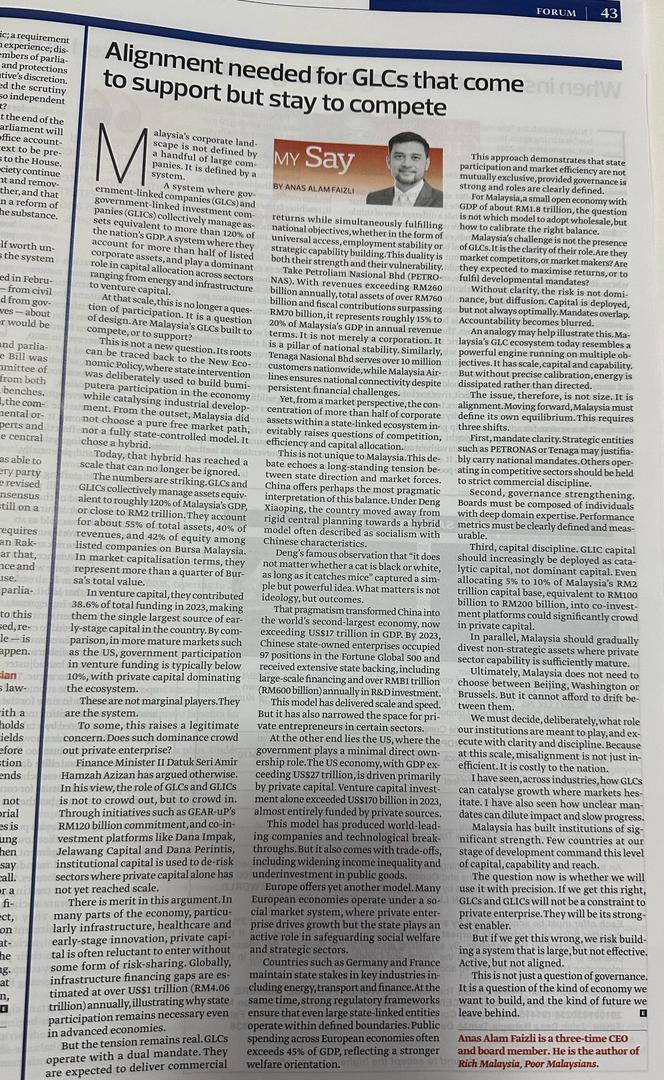
]]>A system where government linked companies and government linked investment institutions collectively manage assets equivalent to more than 120% of the nation’s GDP. A system where they account for more than half of listed corporate assets, and play a dominant role in capital allocation across sectors ranging from energy to infrastructure to venture capital.
At that scale, this is no longer a question of participation.
It is a question of design.
Are Malaysia’s GLCs built to compete, or to support?
This is not a new question. Its roots can be traced back to the New Economic Policy, where state intervention was deliberately used to build Bumiputera participation in the economy while catalysing industrial development. From the outset, Malaysia did not choose a pure free market path, nor a fully state controlled model. It chose a hybrid.
Today, that hybrid has reached a scale that can no longer be ignored.
The numbers are striking. Government linked companies and government linked investment companies collectively manage assets equivalent to roughly 120% of Malaysia’s GDP, or close to RM2 trillion. They account for about 55% of total assets, 40% of revenues, and 42% of equity among listed companies on Bursa Malaysia. In market capitalisation terms, they represent more than a quarter of Bursa Malaysia’s total value.
In venture capital, they contributed 38.6% of total funding in 2023, making them the single largest source of early stage capital in the country. By comparison, in more mature markets such as the United States, government participation in venture funding is typically below 10%, with private capital dominating the ecosystem.
These are not marginal players.
They are the system.
To some, this raises a legitimate concern. Does such dominance crowd out private enterprise?
Finance Minister II Amir Hamzah Azizan has argued otherwise. In his view, the role of GLCs and GLICs is not to crowd out, but to crowd in. Through initiatives such as GEAR-uP’s RM120 billion commitment, and co investment platforms like Dana Impak, Jelawang Capital and Dana Perintis, institutional capital is used to de risk sectors where private capital alone has not yet reached scale.
There is merit in this argument.
In many parts of the economy, particularly infrastructure, healthcare and early stage innovation, private capital is often reluctant to enter without some form of risk sharing. Globally, infrastructure financing gaps are estimated at over USD1 trillion annually, illustrating why state participation remains necessary even in advanced economies.
But the tension remains real.
GLCs operate with a dual mandate. They are expected to deliver commercial returns while simultaneously fulfilling national objectives, whether in the form of universal access, employment stability, or strategic capability building.
This duality is both their strength and their vulnerability.
Take Petronas. With revenues exceeding RM260 billion annually, total assets of over RM760 billion, and fiscal contributions surpassing RM70 billion, it represents roughly 15% to 20% of Malaysia’s GDP in annual revenue terms. It is not merely a corporation. It is a pillar of national stability. Similarly, Tenaga Nasional serves over 10 million customers nationwide, while Malaysia Airlines ensures national connectivity despite persistent financial challenges.
Yet from a market perspective, the concentration of more than half of corporate assets within a state linked ecosystem inevitably raises questions of competition, efficiency and capital allocation.
This is not unique to Malaysia.
This debate echoes a long-standing tension between state direction and market forces. China offers perhaps the most pragmatic interpretation of this balance. Under Deng Xiaoping, the country moved away from rigid central planning toward a hybrid model often described as socialism with Chinese characteristics.
Deng’s famous observation that “it does not matter whether a cat is black or white, as long as it catches mice” captured a simple but powerful idea. What matters is not ideology, but outcomes.
That pragmatism transformed China into the world’s second largest economy, now exceeding USD17 trillion in GDP. By 2023, Chinese state-owned enterprises occupied 97 positions in the Fortune Global 500 and received extensive state backing, including large scale financing and over RMB1 trillion annually in R&D investment.
This model has delivered scale and speed.
But it has also narrowed the space for private entrepreneurs in certain sectors.
At the other end lies the United States, where the government plays a minimal direct ownership role. The US economy, with GDP exceeding USD27 trillion, is driven primarily by private capital. Venture capital investment alone exceeded USD170 billion in 2023, almost entirely funded by private sources.
This model has produced world leading companies and technological breakthroughs.
But it also comes with trade-offs, including widening income inequality and underinvestment in public goods.
Europe offers yet another model. Many European economies operate under a social market system, where private enterprise drives growth but the state plays an active role in safeguarding social welfare and strategic sectors.
Countries such as Germany and France maintain state stakes in key industries including energy, transportation and finance. At the same time, strong regulatory frameworks ensure that even large state linked entities operate within defined boundaries. Public spending across European economies often exceeds 45% of GDP, reflecting a stronger welfare orientation.
This approach demonstrates that state participation and market efficiency are not mutually exclusive, provided governance is strong and roles are clearly defined.
For Malaysia, a small open economy with GDP of approximately RM1.8 trillion, the question is not which model to adopt wholesale, but how to calibrate the right balance.
Malaysia’s challenge is not the presence of GLCs.
It is the clarity of their role.
Are they market competitors, or market makers?
Are they expected to maximise returns, or to fulfil developmental mandates?
Without clarity, the risk is not dominance, but diffusion. Capital is deployed, but not always optimally. Mandates overlap. Accountability becomes blurred.
An analogy may help illustrate this.
Malaysia’s GLC ecosystem today resembles a powerful engine running on multiple objectives. It has scale, capital and capability. But without precise calibration, energy is dissipated rather than directed.
The issue, therefore, is not size.
It is alignment.
Moving forward, Malaysia must define its own equilibrium.
This requires three shifts.
First, mandate clarity. Strategic entities such as Petronas or Tenaga Nasional may justifiably carry national mandates. Others operating in competitive sectors should be held to strict commercial discipline.
Second, governance strengthening. Boards must be composed of individuals with deep domain expertise. Performance metrics must be clearly defined and measurable.
Third, capital discipline. GLIC capital should increasingly be deployed as catalytic capital, not dominant capital. Even allocating 5% to 10% of Malaysia’s RM2 trillion capital base, equivalent to RM100 billion to RM200 billion, into co investment platforms could significantly crowd in private capital.
In parallel, Malaysia should gradually divest non strategic assets where private sector capability is sufficiently mature.
Ultimately, Malaysia does not need to choose between Beijing, Washington or Brussels.
But it cannot afford to drift between them.
We must decide, deliberately, what role our institutions are meant to play, and execute with clarity and discipline. Because at this scale, misalignment is not just inefficient. It is costly to the nation.
I have seen, across industries, how GLCs can catalyse growth where markets hesitate. I have also seen how unclear mandates can dilute impact and slow progress.
Malaysia has built institutions of significant strength. Few countries at our stage of development command this level of capital, capability and reach.
The question now is whether we will use it with precision.
If we get this right, GLCs and GLICs will not be a constraint to private enterprise. They will be its strongest enabler.
But if we get this wrong, we risk building a system that is large, but not effective. Active, but not aligned.
This is not just a question of governance.
It is a question of the kind of economy we want to build, and the kind of future we leave behind.
The post Are Malaysia’s GLCs Built to Compete or to Support? first appeared on Anas Alam Faizli.
]]>The post Who Actually Governs Malaysia? A System Without Alignment first appeared on Anas Alam Faizli.
]]>Malaysia is not short of plans. Nor is it short of capital.
Malaysia’s major institutional funds collectively manage close to RM2 trillion, a figure broadly comparable to the size of the economy itself. Yet national investment in research and development remains at approximately 1% of GDP, far below leading economies such as South Korea, which consistently invests between 4% to 5%.
This gap is not one of resources. It is one of alignment.
Over the past decade, Malaysia has introduced multiple national strategies across industry, healthcare and energy transition, each designed to position the country for its next phase of growth. Its corporate sector remains regionally competitive, with the electrical and electronics sector contributing over 40% of exports, exceeding RM570 billion annually. The digital economy contributes more than 23% of GDP.
On paper, the ingredients are in place.
Yet outcomes often fall short of potential.
Industrial upgrading progresses, but not at the pace required. Innovation exists, but rarely scales into global leadership. Strategic sectors emerge, but seldom with the coherence or speed seen in more competitive economies.
This raises a question that is seldom asked directly.
Who actually governs Malaysia, not in theory, but in execution?
Having worked across healthcare, pharmaceuticals, energy and regulated industries, I have often observed that outcomes are rarely determined by any single institution, but by how well they move together.
Malaysia operates less like a single coordinated system and more like a federation of capable actors, each with its own mandate, authority and priorities. Ministries design policies. Government-linked companies execute strategies. Institutional funds allocate capital. Regulators shape markets. State governments control land and approvals.
Each performs its role.
But they do not always move in the same direction.
This misalignment is not abstract. It is visible in sectors that matter.
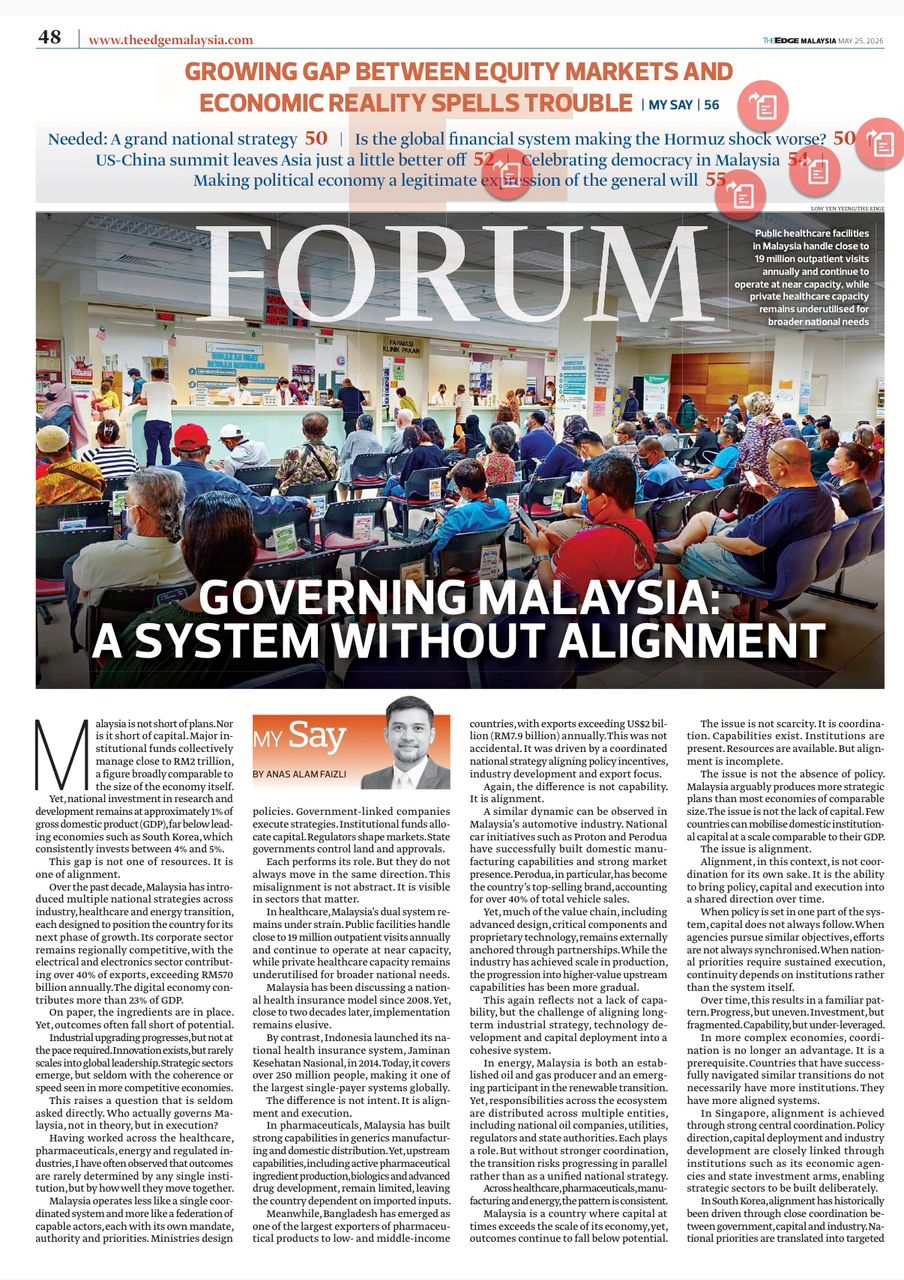
In healthcare, Malaysia’s dual system remains under strain. Public facilities handle close to 19 million outpatient visits annually and continue to operate at near capacity, while private healthcare capacity remains underutilised for broader national needs.
Malaysia has been discussing a national health insurance model since as early as 2008. Yet close to two decades later, implementation remains elusive.
By contrast, Indonesia launched its national health insurance system, Jaminan Kesehatan Nasional, in 2014. Today, it covers over 250 million people, making it one of the largest single-payer systems globally.
The difference is not intent.
It is alignment and execution.
In pharmaceuticals, Malaysia has built strong capabilities in generics manufacturing and domestic distribution. Yet upstream capabilities, including active pharmaceutical ingredient production, biologics and advanced drug development, remain limited, leaving the country dependent on imported inputs.
Meanwhile, Bangladesh has emerged as one of the largest exporters of pharmaceutical products to low- and middle-income countries, with exports exceeding USD 2 billion annually. This was not accidental. It was driven by a coordinated national strategy aligning policy incentives, industry development and export focus.
Again, the difference is not capability.
It is alignment.
A similar dynamic can be observed in Malaysia’s automotive industry. National car initiatives such as Proton and Perodua have successfully built domestic manufacturing capabilities and strong market presence. Perodua, in particular, has become the country’s top-selling brand, accounting for over 40% of total vehicle sales.
Yet much of the value chain, including advanced design, critical components and proprietary technology, remains externally anchored through partnerships. While the industry has achieved scale in production, the progression into higher-value upstream capabilities has been more gradual.
This again reflects not a lack of capability, but the challenge of aligning long-term industrial strategy, technology development and capital deployment into a cohesive system.
In energy, Malaysia is both an established oil and gas producer and an emerging participant in the renewable transition. Yet responsibilities across the ecosystem are distributed across multiple entities, including national oil companies, utilities, regulators and state authorities.
Each plays a role. But without stronger coordination, the transition risks progressing in parallel rather than as a unified national strategy.
Across healthcare, pharmaceuticals, manufacturing and energy, the pattern is consistent.
Malaysia is a country where capital at times exceeds the scale of its economy, yet outcomes continue to fall below potential.
The issue is not scarcity.
It is coordination.
Capabilities exist. Institutions are present. Resources are available.
But alignment is incomplete.
The issue is not the absence of policy. Malaysia arguably produces more strategic plans than most economies of comparable size. The issue is not the lack of capital. Few countries can mobilise domestic institutional capital at a scale comparable to their GDP.
The issue is alignment.
Alignment, in this context, is not coordination for its own sake. It is the ability to bring policy, capital and execution into a shared direction over time.
When policy is set in one part of the system, capital does not always follow. When agencies pursue similar objectives, efforts are not always synchronised. When national priorities require sustained execution, continuity depends on institutions rather than the system itself.
Over time, this results in a familiar pattern.
Progress, but uneven.
Investment, but fragmented.
Capability, but under-leveraged.
In more complex economies, coordination is no longer an advantage.
It is a prerequisite.
Countries that have successfully navigated similar transitions do not necessarily have more institutions. They have more aligned systems.
In Singapore, alignment is achieved through strong central coordination. Policy direction, capital deployment and industry development are closely linked through institutions such as its economic agencies and state investment arms, enabling strategic sectors to be built deliberately.
In South Korea, alignment has historically been driven through close coordination between government, capital and industry. National priorities are translated into targeted investments, supported by sustained R&D spending exceeding 4% of GDP, enabling the country to move decisively into high-value sectors such as semiconductors and advanced manufacturing.
Indonesia offers a different lesson by alignment through execution. Despite its scale and complexity, it aligned policy, financing and delivery to roll out national healthcare to over 250 million people, and more recently coordinated industrial policy and investment to position itself in the electric vehicle and battery value chain.
These countries differ in structure.
But they share one characteristic.
They align policy, capital and execution within a coherent system.
Malaysia, by contrast, has built strong components of a system, but has yet to fully align them.
This distinction is subtle, but critical.
It suggests that Malaysia’s next phase of development will depend less on creating new institutions, and more on strengthening the connections between existing ones.
What then might alignment look like in practice?
One starting point is capital.
Malaysia’s institutional funds manage close to RM2 trillion. If even 5% to 10% of this were deliberately aligned toward strategic sectors such as healthcare reform, upstream pharmaceuticals or energy transition, it would represent tens of billions of ringgit in patient capital.
At that scale, coordination becomes transformative.
The question is where such coordination resides.
It is unlikely to sit within any single ministry or institution. Alignment requires a vantage point that cuts across mandates, bringing together policy, capital and execution.
Malaysia has demonstrated this capability before. With clear targets, structured oversight and consistent leadership, complex national initiatives have been delivered successfully.
The challenge is not whether Malaysia can align.
It is whether it does so consistently.
Malaysia is not lacking in capability. It is not lacking in capital. It is not lacking in ambition.
But when a system managing resources equivalent to its entire economy is not fully aligned, the outcome is not failure.
It is underperformance.
And so the question remains.
Not whether Malaysia is governed, but whether it is governed as a system.
*This article first appeared on The Edge 25 May 2026
The post Who Actually Governs Malaysia? A System Without Alignment first appeared on Anas Alam Faizli.
]]>The post Malaysia Yang Layu: Ke Mana Halatuju Kita? Senarai Hasrat Demi Pembetulan Asas first appeared on Anas Alam Faizli.
]]>Di sini sahajalah anda akan dapat menemui sebahagian besar penduduknya berakar umbi daripada dua tamadun tertua dunia; India dan China. Bangsa Melayu pula berkongsi banyak nilai budaya serupa dengan Indonesia, negara paling ramai penganut Islam di dunia. Islam sebagai agama membuka pintu kepada dunia Islam. Sementara sistem legasi British membuka pintu dunia Barat. Bak sesumpah kita boleh menerobos masuk ke dalam hampir semua negara di dunia!
Paling menarik, satu kajian yang dilakukan Facebook mendedahkan yang Malaysia ialah negara paling ramah bersosial dalam dunia siber dalam konteks penggunanya mempunyai jumlah kawan teramai di dunia.
Malaysia juga ialah sebuah negara Kepelbagaian. Kita satu-satunya negara dunia yang miliki gabungan pelbagai kaum, pelbagai bahasa, pelbagai agama, pelbagai budaya, pelbagai persatuan sukan berasaskan kaum, pelbagai dewan perniagan dan kewangan, dan pelbagai parti berasaskan kaum, pelbagai juadah, pelbagai kerajaan (1 kerajaan persekutuan dan 13 kerajaan negeri) dan pelbagai raja (daripada 35 monarki dunia, 9 memerintah di Malaysia)!
Sekiranya bukti di atas tidak mencukupi, lihat hujah berikutnya.
Kita satu-satunya negara di dunia ini yang bersumpah mampu untuk melindungi Allah, dengan menghalang orang lain daripada menggunakan kalimah tersebut dan didakwa telah mengharamkan “Hotdogs” dan “Rootbeer” kerana terjemahan literal perkataan itu.
Malaysia memiliki hutan hujan tropika tertua, yang dikatakan berusia 130 juta tahun, lebih tua dari Amazon dan Lembah Congo. Hutan hujan tropika kita kediaman kepada 14,500 spesis tumbuh-tumbuhan berbunga dan pokok, dengan lebih daripada 200 spesis mamalia, 600 burung, 140 ular dan 60 jenis cicak.
Dan kita juga mempunyai ular tedung selar terpanjang di dunia berukuran 5.71 meter, yang ditemui di Port Dickson pada 1937.
Malaysia juga mempunyai bulatan jalanraya terbesar di dunia di Putrajaya berukuran 3.5 kilometer diameternya, tanpa disangkal kita juga memiliki ‘spin terbesar di dunia’.
Ya, Malaysia sangat unik. Bukan sekadar “truly Asia tetapi truly World!” Boleh lawan ke?
Itu tidak disebut lagi tentang kepelbagaian juadah fusion makanan, dari Timur ke Barat di negara ini. Makanan apakah yang tidak boleh anda temui di sini?
Dirahmati dengan pelbagai hasil mahsul tidak ternilai, daripada timah sehinggalah getah, kelapa sawit, kayu-kayan, bauksit, dan petroleum sebagai sumber paling berharga, Malaysia negara yang kaya. Jadi berdasarkan semua keunikan ini, kita mempunyai ramuan mencukupi untuk menjadi dan bersubur menjadi “syurga dunia”, persoalannya di manakah kita berada sekarang?
Negara Kepelbagaian Datang Bersama Kepelbagaian Masalah
Sangat mengejutkan bagaimana sebuah negara kecil berpenduduk hanya 31.8 juta ini berjaya memegang pelbagai gelaran yang tidak enak didengar seperti negara dengan jurang terbesar kaya dan miskin rantau ini, penggunaan tenaga paling tidak cekap adalah antara gelaran yang diraih kita termasuklah negara yang mencetuskan skandal kewangan terbesar dunia, 1MDB.
Sebelum 1MDB, kita diheret pelbagai skandal seperti Bank Bumiputera, Perwaja, Metramac, Malaysia Airlines, Bank Islam, Transmile, Megan Media, Scan Associates dan pengeluran “laporan merah” audit jabatan kerajaan seperti dilaporkan Jabatan Audit Negara setiap tahun. Semua skandal ini menggambarkan kenyataan yang tidak tersangkal lagi- Korupsi yang membarah sedalamnya!
Kita terperangkap dalam ekonomi lompong, dengan kebergantungan melampau kepada pekerja asing dan majoriti penduduk Malaysia berpendapatan rendah tertekan dengan peningkatan kos sara hidup. Di tambah pula dengan majoriti rakyat Malaysia hanya punyai simpanan tidak lebih daripada sebulan sekiranya mereka kehilangan pekerjaan.
Krisis pencen yang serius menghimpit rakyat apabila dua pertiga pekerja berusia 54 tahun mempunyai kurang daripada RM50,000 dalam akaun KWSP mereka.
Kita dianggap mempunyai kemudahan dunia kelas pertama tetapi sedihnya memiliki budaya dan mentaliti dunia kelas ketiga. Kita terletak di tangga dua pertiga paling bawah pencapaian pendidikan dalam ukuran antarabangsa, pemandu kita “gila di jalan” serta pembuli jalan raya dan mat rempit, kita juga berada di tangga 20 seluruh dunia dalam jumlah kemalangan jalan raya maut per kapita, di samping berdepan dengan gejala vandalisma kota, mempunyai pemandu teksi yang buruk sikapnya dan tanggapan meluas tentang Kuala Lumpur yang didakwa antara bandar paling biadap di dunia.
Alam sekitar kita pula sedang menangis disakiti, bandar kita dilanda banjir kilat (perancangan bandar yang lemah dengan pengurusan kemudahan yang pincang), banjir besar melanda Pantai Timur saban tahun, pengurusan lemah simpanan dan bekalan sistem air kita, pengurusan sisa pepejal yang lemah, serta kewujudan berleluasa tapak pengurusan sampah haram dan “pembalakan haram” di hutan dan gunung ganang kita, termasuklah di kawasan simpanan tadahan air.
Rakyat Malaysia juga terkenal dengan betapa mudahnya tertipu dengan skim penipuan yang menawarkan faedah dan pulangan wang mudah, pantas dan banyak! Terdapat ekonomi haram yang besar dan meluas yang wujud, meliputi perjudian haram, dadah dan bahan seludupan lain, DVD cetak rompak dan pengklonan kad kredit. Terdapat juga “situasi yang tidak diperlukan (dan tidak dihendaki)” dalam perbadanan serta inovasi rakyat Malaysia, yang secara sinis dilabel sebagai “Malaysia Boleh”.
Paling menyedihkan ialah hampir setiap sudut jalan raya dan tiang lampu isyarat, pasti ada sekurang-kurangnya dua iklan tertampal, samada nombor telefon Ah Long atau nombor rumah urut dan wanita escort!
Arena politik pula sangat tegang sehinggakan tidak ada masa untuk menggubal dasar kerana tenaga dihabiskan menyerang satu sama lain tanpa henti. Politik kebencian dan polirisasi kaum menjadi isu utama sejak dua dekad lepas. Hak asasi manusia, kewujudan undang-undang yang boleh dipertikaikan, pendakwaan bermotifkan politik antara isu yang mencengkam negara. Dan nampaknya kebebasan institusi penghakiman telah hilang kredibitinya.
Hasilnya, kita berada di tangga 66 daripada 73 negara dalam Indeks Integriti Pilihanraya dan tangga 146 daripada 180 negara dalam Indeks Kebebasan Media Dunia.
Jadi, adakah kita sudah hancur berkecai? Adakah semuanya sudah tidak dapat diselamatkan? Mungkin. Tetapi, masih ada jalan keluar!
Kemustahilan yang Tidak Berkesudahan
Sekiranya sejarah ada mengajar sesuatu, pengajaran itu ialah tiada apapun yang mustahil. Sepanjang kewujudan manusia, kita sentiasa dikejutkan dengan kejayaan negara-negara yang sebelum itu dianggap tidak penting. Orang Mongolia yang buta huruf, di bawah pimpinan Genghis Khan, berjaya menawan dua pertiga dunia tanpa berjaya disekat.
Orang Arab hanyalah nomad tak ubah seperti hamba di mata orang Roman dan Persia.
Orang Jepun yang sebelum Revolusi Meiji hanyalah golongan petani pemalas yang asyik mabuk. Orang Vietnam yang berjuang habis-habisan dan mengusir tentera Perancis dan Amerika dari negara mereka dan memenangi kebebasan mereka.
Tidak ada yang mustahil walaupun situasi semasa tidak menjanjikan harapan lagi. Ingatlah bahawa sang matahari hanya akan muncul selepas kegelapan malam berlalu.
Begitu jugalah Malaysia. Kita sudah tersasar jauh, jadi adakah kita sudah mengambil iktibar daripada kegelapan dan kesengsaran yang kita boleh jadikan inspirasi untuk bangkit kembali?
Wujud keperluan mendesak untuk kembali menyusun hala tuju supaya kita boleh berada di landasan yang tepat demi negara dan Rakyat.
Masih ada jalan keluar daripada semua belenggu masalah negara ini. Kita perlu mengakui yang wujudnya masalah kritikal yang mencengkam negara tercinta. Kejujuran dan keikhlasan perlu dikembalikan dalam semua urusan negara ini.
Inilah masanya untuk setiap rakyat Malaysia untuk terus percaya dan menyumbang bakti mencapai matlamat yang ditetapkan. Satu suara mungkin tiada kesan, sepuluh suara mungkin hasilkan getaran kecil, tetapi ribuan suara boleh seperti halilintar yang mengegar dunia, paling tidakpun boleh menggegarkan Putrajaya.
Senarai Hasrat Untuk Malaysia Yang Kuat dan Gemilang
Atas tujuan murni ini, berikut senarai hasrat saya untuk Malaysia:
Disebabkan terlalu banyak yang perlu dilakukan, permulaan yang baik ialah dengan penubuhan Majlis Konsultasi Negara 2 untuk kembali merangka dasar asas perubahan sosial dan ekonomi pada tahap paling dasar. Gabungan intelek terbaik seluruh negara diperlukan untuk menawarkan langkah dan strategi realistic dan boleh dilakukan bagi perubahan semula hala tuju negara.
Sumber semulajadi dan alam sekitar Malaysia ada hadnya serta sangat bernilai. Pengurusan sumber yang lebih baik diperlukan, di mana semua hasil dan faedah dikongsi bersama oleh Rakyat. Pertelingkahan royalti minyak antara Kerajaan Persekutuan dan Negeri perlu diselesaikan sebaik mungkin demi manfaat terbaik Rakyat.
Pembetulan asas ekonomi perlu dilakukan segera untuk kebaikan semua dan membetulkan cara kerja kita. Kita perlu berubah daripada kapitalis sewaan (rentier capitalism) kepada kapitalis industri teknologi. Yang paling baik ialah dengan mengambil teladan daripada amalan terbaik pasaran sosial Eropah dan kapitalis negara China yang bersesuaian dengan Malaysia.
Dasar perlu mengutamakan Rakyat, dengan mengagungkan prinsip keadilan sosial, meletakkan pembentukan dan penyerakan kekayaan yang seimbang dalam usaha pembangunan ekonomi, serta pada masa yang sama menyediakan persekitaran mapan untuk badan korporat berkembang pesat.
Usahawan dengan nilai tambah dan bukan hanya kapatalis semata adalah kunci kepada kejayaan yang kita mahukan.
Kita perlu mengisytiharkan “Perang” kepada jurang kekayaan dan pendapatan yang tanpa henti membuka kitaran ganas tanpa titik akhir yang menghancurkan masyarakat.
Sekolah rendah berasrama penuh, perumahan mampu milik, keusahawaan sosial dan rakyat, perlu diwujudkan dan digalakkan di semua tempat yang memerlukannya.
Sektor utama ‘lestari’ yang cekap iaitu tenaga, pengangkutan, pembinaan, air dan pengurusan sisa perlu diutamakan demi manfaat ekonomi dan alam sekitar.
Semua rakyat Malaysia memerlukan dan berhak menjalani kehidupan baik dan seimbang yang boleh ditawarkan oleh pekerjaan yang menawarkan gaji mencukupi. Rakyat sepatutnya tidak perlu buat dua kerja untuk menjadikan kehidupan mereka kondusif dan bahagia. Pengejaran ekonomi yang tidak berkesudahan serta tidak adil pada masa kini telah menghukum rakyat Malaysia dan kita menggantikan belas ihsan dengan sikap tidak endah.
Unit keluarga yang berfungsi membenarkan ibubapa memainkan peranan yang proaktif dalam pendidikan dan proses membesarkan anak-anak mereka untuk menerapkan “Nilai Asia” sejati yang banyak kali kita ungkapkan tetapi jarang laksanakan.
Pemerkasaan wanita akan menghaluskan halangan kepada potensi ekonomi serta menawarkan manfaat sosial dan ekonomi yang lebih bersepadu.
Pendidikan ialah pintu penyelesaian kepada hampir semua kesengsaraan sosial dan ekonomi Malaysia. Pendidikan perlulah inklusif dan menyuburkan moral, pemikiran kritikal, kemanusiaan, kerendahan diri, toleransi agama, kemajuan dan inovasi teknologi kepada semua rakyat Malaysia.
Penilaian semula falsafah pendidikan negara perlu dilakukan dan digantikan dengan Pedagogi Cinta.
Kita perlu menyemai budaya membaca, pemikiran kritikal dan menyuburkan persekitaran perdebatan intelektual. Kita perlu meraikan pemikir dan ahli falsafah, serta menyediakan persekitaran kondusif untuk wacana awam. Para intelektual perlu diberi mandat untuk menggerakkan dan menghidupkan ruang fikir awam bagi menerangi hala tuju semua.
Penjagaan kesihatan perlu mampu milik dan boleh diperolehi oleh semua kelompok masyarakat. Kita perlukan lebih banyak hospital dan hospital latihan, serta klinik yang serba lengkap untuk memberi perkhidmatan kepada mereka yang sakit dan memerlukan di mana sahaja mereka tinggal. Satu lagi perkara yang sangat diperlukan dalam perkhidmatan asas rakyat ialah perkhidmatan awam yang menyeluruh.
Pendidikan dan penjagaan kesihatan, adalah dua hak asas dan paling berharga rakyat Malaysia, dan tidak sewajarnya menjadi permainan politikus.
Kesukarelawan, NGO aktivis sosial dan “pihak ketiga” perlu digalakkan dan diperkasakan bagi memperkukuhkan demokrasi dan semangat “keadilan untuk semua” di negara ini.
Tadbir urus yang baik, integriti, kebebasan maklumat untuk media dan perlindungan pemberi maklumat perlu diperkasakan bagi membolehkan kejayaan perjuangan menentang korupsi, dengan matlamat utamanya ialah menyediakan mekanisma “pemeriksa dan penyeimbang” dalam prinsip pemisahan kuasa.
Undang-undang Perlembangan perlu memerintah secara mutlak dan dilaksanakan secara adil, dan bukannya disalahgunakan bagi manfaat kroni tersembunyi diktator moden. Kita perlukan “Pemerintahan undang-undang” dan bukannya pemerintahan Mafia. Demokrasi perlulah bersifat aktif dan inklusif untuk semua rakyat sertai, dan bukannya hanya berlaku setiap 5 tahun sekali ketika mengundi.
Hentikan politik perkauman dan kebencian. Keharmonian kaum perlu disemai dan disuburkan sejak dari rumah dan sekolah pada usia muda, malah sebelum mula persekolahan lagi. Bukankah kita lahir tanpa kenal beza warna kulit?
Malaysia Boleh!
Senarai hasrat untuk Malaysia ini terdiri daripada semua cadangan yang saya pernah tulis, sampaikan dan perjuangkan selama ini.
Misi saya ialah untuk memberi tekanan, dengan cara membentuk kesedaran awam dan kembali semula ke jalan yang benar. Tiada apa yang mustahil, yang tidak boleh kita depani dan atasi selaku rakyat Malaysia bagi memastikan semua rakyat negara ini terjaga.
Malaysia sebuah negara unik dengan gabungan ramuan dan bahan terbaik yang didambakan mana-mana negara. Mari kita gembeling kekuatan daripada keunikan dan kepelbagaian ini dan membentuknya menjadi pasak kekuatan untuk bergerak maju ke hadapan, dan bukannya kelemahan yang mematahkan, mempercayai Tiada Yang Mustahil, Tiada Batasan dan menjadi sebaik mungkin.
Sepenuh jiwa raga, sejujurnya saya laungkan, Malaysia Boleh! Marilah kita bersama-sama dalam perjalanan ini, kerana kebersamaan ini memungkinkan semuanya!
The post Malaysia Yang Layu: Ke Mana Halatuju Kita? Senarai Hasrat Demi Pembetulan Asas first appeared on Anas Alam Faizli.
]]>The post Whither Malaysia: Where do We Go from Here? A Wish-list for Fundamental Correction first appeared on Anas Alam Faizli.
]]>Only here can you find a significant portion of the population that has roots from two of the world’s oldest civilisations; India and China. The Malays share similar cultural values with Indonesia, the world’s most populous Muslim country. Islam as a religion gives us access to the Muslim world. The inherited British system meanwhile gives us access to the Western world as well. We are like chameleons, and we can infiltrate and be at home in almost every nation on Earth!
Interestingly, a survey by Facebook found that Malaysia is the most cyber sociable country with the most Facebook friends.
Malaysia is also a country of Multiples. We are the only country on Earth that is multi-racial, multi-lingual, multi-religious, multi-cultural, multi race-based sports associations, chambers of commerce & industry, and political parties, multi-national cuisines, multi-government (1 federal and 13 state governments), and multi-monarchies (9 kings from the world’s total 35 monarchs)!
If the above is not enough, let me reinforce my case with the following arguments:
We are the only nation on the planet that has vowed to protect Allah, and ban others from using that name; and have allegedly labeled Hotdogs and Rootbeer as Haram due to literal reasons.
We house the oldest tropical rainforest, said to be over 130 million years old, older than the Amazon and Congo Basins, home to 14,500 species of flowering plants and trees, with more than 200 species of mammals, 600 species of birds, 140 species of snakes and 60 species of lizards.
And we had the longest King Cobra in the world, measuring in at 5.71 metres, that was found in Port Dickson in 1937.
We also have the biggest roundabout in the world in Putrajaya measuring at 3.5 kilometres in circumference; arguably we also have the “biggest spin in the world” too.
Yes, Malaysia is unique. Not just truly Asia, but truly The World! Can you beat that?
Not to mention our eclectic and exhaustive list of cuisines which spans a line from the East to the West. What dishes can’t you find here?
Blessed with abundant natural resources and harvests, from tin to rubber, palm oil, timber, bauxite, and of course with petroleum being the most precious now. Malaysia is a rich country. So based on our uniqueness, we have all the essential ingredients to thrive and flourish as “a paradise on earth”, but have we done so?
The Land of Multiples comes with Multiple Problems
It is shocking how this small country of 31.8 million people managed to shockingly earn the most unwelcome title of the region’s most unequal nation, most in-efficient energy user, among its many other titles including being the home to the world’s largest financial scandal, 1MDB.
Prior to 1MDB, we have had a litany of scandals from Bank Bumiputera, Perwaja, Metramac, Malaysia Airlines, Bank Islam, Transmile, Megan Media, Scan Associates, and a yearly recurrence of repeated “red reports” on audits of government agencies from the Auditor General’s office. All of these scandals point to one indisputable conclusion – Rampant corruption!
We are trapped in a hollow economy, with over reliance on foreign workers, with the majority of our population earning low income and facing distressing rise in the cost of living. Moreover, the majority of Malaysians do not have savings adequate to survive more than one month if they lose their job.
A serious pensions crisis is looming where two-thirds of 54-year-olds having less than RM50,000 in their EPF accounts.
We are perceived to have 1st World infrastructure but sadly demonstrate a 3rd World culture or attitude. We score bottom third on international education rankings, many of our drivers are insane with road thugs and mat rempits, we are number 20 in the world in terms of fatalities from road accident per capita, besides facing severe vandalism in our cities, having unprofessional and unethical taxi drivers and widespread claims that Kuala Lumpur is one of, if not the rudest city on Earth.
Environmentally, mother nature is crying; we have flash floods (poor town planning coupled with inadequate facilities management) in our cities, massive flooding on the East Coast, poor management of our water resources and supply, poor waste management, and rampant illegal dump-sites plus “illegal logging” of our forests and mountains, even in water catchment areas.
Malaysians are also famous for how gullible we can be when it comes to popular get-rich-quick money making schemes! There is a massive, parallel underground economy, covering illegal gambling, drug and other commodity smuggling, pirate DVDs, and credit card cloning. These are also “unwarranted (and unwanted) awards” of Malaysian innovation and enterprise, often derided sarcastically as “Malaysia Boleh”.
The saddest part is, on almost every street and traffic lights pole, without fail, there will be two types of glaring advertisements, either the telephone numbers of Ah Longs (illegal money lenders) or the number for Massage and Escorts services!
Politics is so intense that there is no time to formulate policies, but energy is wasted to tirelessly attack one another. Politics of hate and racial polarisation have been in the forefront over the past two decades. Human rights, questionable discretionary laws, politically motivated and selective persecutions are also issues plaguing the country. Judicial independence appears to have lost credibility.
As a result we scored 66th of 73 countries on Electoral Integrity and 146th of 180 on World Press Freedom Indices.
So, are we doomed “to rot in purgatory”? Are we heading south? Potentially, but, there is a way out, if only we want to take it!
Endless Impossibilities
If there is one thing that history has thought us, it is that there are endless impossibilities. Throughout human existence, we have been continuously surprised by the successes of nations deemed to be insignificant; for example, The illiterate Mongolians, under Genghis Khan, went on to conquer two-thirds of the then known world, coming from out of no-where.
The Arabs were nomads, rated no higher than slaves in the eyes of the Romans and Persians.
The Japanese used to be lazy drunken farmers before the Meiji revolution. The Vietnamese fought their way and kicked out the French and the Americans from their land and won their Freedom.
Nothing is impossible, no matter how hopeless the situation seems. Always remember that the sun only comes out after the darkest point of the night.
The same goes for Malaysia. We have already steered off course and gone astray, so have we reached the depths of darkness and despair from which we can aspire to rise again?
There is a dire need to re-calibrate our way forward so as to head back to the right path for the good of the nation and Rakyat.
There is a way out of this state of affairs. We must now admit and acknowledge that critical problems plague our beloved nation. Honesty and Sincerity must return to our land.
This calls for every Malaysian to have faith and contribute their share towards this aim. One voice might be insignificant, ten might make a blink, but thousands and millions together can cause thunder and shake the Earth, or at least Putrajaya.
Wish-list for A Strong and Vibrant Malaysia
So here is my wish-list for Malaysia:
As there is so much to be done, an apt start would be convening a National Consultative Council Part 2 for a “back to the drawing board” social and economic re-engineering. This needs an amalgamation of the best minds across the nation to provide realistic and feasible strategies to chart the way forward for national recalibration.
Malaysia’s natural resources are finite and the environment is precious. An improved resource management structure, where these resources are used optimally to be shared and tasted equally by its Rakyat is required. The oil royalty conundrum by the Federal Government and States involved must be resolved amicably for the best of the Rakyat.
Fundamental economic corrections must be made to correct the way we do things. We must evolve from rentier capitalism to techno industrial capitalism. Ideally, we must adapt the best practices from the social market of Europe and the state capitalism of China that are relevant to Malaysia.
Policies must be Rakyat centric, with social justice at its heart, placing decent wealth creation and equitable distribution at the core of its economic deliberations, while providing sustainable environment for corporations to thrive.
Entrepreneurs who can add value, and not mere venture capitalists, are key to our desired success.
We must declare “war” on income and wealth inequality, which creates a never ending vicious cycle that is detrimental to any society.
Primary boarding schools, affordable housing, people and social enterprises, must be developed and encouraged to be in place wherever they are needed.
Efficient and ‘green’ key sectors namely energy, transportation, construction, water and waste management must be prioritized for their economic and environmental advantages.
Every Malaysian needs and deserves a good balanced life that can be provided by a decent and fair-paying job. The Rakyat should not need to have two jobs to live a reasonably conducive and happy life. Relentless, and perhaps unjust economic pursuits have punished the bulk of Malaysians and we have replaced our empathy with apathy.
Functioning family units allow parents to play proactive roles in child upbringing and education and to instil the true “Asian Values” that we so often pronounce, but hardly prioritize in practice.
Women’s empowerment alleviates current burdens on potential economic contributors and offer cohesive social and economic benefits.
Education is paramount as the overarching solution to the majority of the Malaysia’s social and economic ills. Education must be inclusive, and impart moral fibre, critical thinking, humanity, humility, religious tolerance, innovation and creative technological advancement for Malaysians.
A revisit of our national education philosophy must take place and be replaced with the Love Pedagogy.
We need to inculcate a reading culture, critical thinking and prosper our intellectual debating environment. We must celebrate thinkers and philosophers, and provide a conducive environment for public discourse. Intellectuals must be given the mandate to carry the torch and light our candles to see the way forward.
Healthcare must be made affordable and readily available to all segments of the Rakyat. We need more hospitals and training hospitals, and well equipped clinics to serve the sick and needy wherever they reside. A holistic public transportation is another severely needed amenity for the Rakyat.
Education and healthcare are indeed too precious and inalienable rights for all Malaysians, and should not be pawns for the politicians to kick around.
Volunteerism, the social activist NGOs, and the “third sector” must be encouraged and enhanced to strengthen democracy and “justice for all” in the country.
Good governance, integrity, freedom of access to information for the media and whistle-blower protection must be truly practiced to enable a successful fight against corruption, aimed at its core and as a check and balance to the principle of separation of power.
The Constitutional Law must reign supreme and needs to be applied justly, and not be abused for the benefit of the subservient cronies of modern dictators. We need “Rule of law” not rule by the Mafia. Democracy must be seen to be alive and be inclusive for every Malaysian’s participation, and not just a case of going to the polls every 5 years.
Let’s put an end to politics of race and hate. Racial harmony must be inculcated and nurtured from home and school at a young age, even before their pre-school years. After all, aren’t we born skin-colour blind?
Malaysia Boleh!
My wish list for Malaysia is composed of all the proposals that I’ve written, articulated and fought for before.
My mission here is to bring pressure, by means of creating public awareness for a re-navigation to the right path. There are no ‘impossibilities’ that we Malaysians cannot face and overcome and to ensure that everyone in the country counts.
We are a unique nation with the best mixture and ingredients that any nation can ask for. All we need is the intellectual clarity and the will. Let us draw from the power of our uniqueness and diversity and mould them as a pillar of strength to move forward, and never as a crippling weakness, to achieve the Endless Impossibilities and be the best that we can be.
With all my heart, I sincerely echo, Malaysia Boleh! Let’s walk this path together, because together we can!
The post Whither Malaysia: Where do We Go from Here? A Wish-list for Fundamental Correction first appeared on Anas Alam Faizli.
]]>The post Information Freedom, the Fourth and Fifth Estate: Hail the Media and the Whistleblowers first appeared on Anas Alam Faizli.
]]>What the Prime Minister said is perfectly accurate and must be applauded. While the context might have been with regards to giving the lead to the private sector or receiving criticism from the general public, his statement will be meaningful only if public participation is included in the Government’s operations and policies.
This can only be achieved if the public is given access to government documents; in order to pave the way or provide constructive criticism. There are two ways to do this effectively; periodical release of data for the general public to consume, analyse, and scrutinise and secondly, the granting of rights for the public to request government documents and information.
Entering into a new era where the public is empowered to know best, several reforms are inevitable. First, Malaysians must be accorded with the rights to freedom of information. Secondly, the rights to expression and speech. Thirdly, we need to strengthen the Separation of Powers Principle currently with the three estates, as enshrined under Article 127 of the Federal Constitution – the executive, legislature and judiciary. The Media to be liberated as a watchdog known as the Fourth Estate and the Whistleblowers exposing inside corruption as the Fifth Estate.
Freedom of Information
In Malaysia, we are not constitutionally guaranteed the freedom of information, nor is there any Act that legally provides this basic human right; except in the State of Selangor through the Freedom of Information Enactment (Selangor) Act 2010 and Penang through the Freedom of Information Act 2011. These Acts allow the public to access state documents except information classified under the Federal’s Official Secrets Act (OSA).
Article 19 of the Universal Declaration of Human Rights (UDHR) which Malaysia has ratified states, “Everyone has the right to freedom of opinion and expression; this right includes freedom to hold opinions without interference and to seek, receive, and impart information and ideas through any media and regardless of frontiers.” The same right must be provided to all Malaysian citizens.
By providing information, the public can participate and ensure that the government is doing its best. The availability / accessibility of information on government activities and operations will significantly reduce opportunities for corruption and the abuse of power. The transparency would hold public servants and the executives accountable. Furthermore, this would increase public confidence in the government.
More than 95 countries around the world including China, India, Zimbabwe, and Thailand have implemented some form of such legislation in this regard, and other countries are working towards introducing such laws. In the United Kingdom, the Freedom of Information Act 2000 introduces the right to know and request for any information by government bodies, with few exceptions.
Surprisingly, China too in 2007 declared the Open Government Information regulation which laid frameworks for Freedom of Information within its sovereignty. Closer to home, Thailand’s The Official Information Act of 1997 grants citizens the right to access public information which applies to all government offices and agencies. Indonesia in 2010 adopted the Freedom of Public Information Act. These legislative efforts by various nations have reportedly brought to light a multitude of corruption scandals.
Freedom of Expression and the Fourth Estate (Media)
In Malaysia, every citizen is guaranteed the right to freedom of speech, freedom of assembly and freedom of association by Article 10 of the Federal Constitution. There are however concerns that highly discretionary laws like the Sedition Act 1948, the Peaceful Assembly Act 2012, Security Offences (Special Measures) Act (SOSMA) 2012, and now the newly introduced Prevention of Terrorism Act (POTA) 2015 are restricting or conflicting with the above constitutional rights.
In our current state, can our media be recognised as the fourth estate? Let us take a look at the current state of affairs for the Malaysian Media; according to a report by The Reporters Without Borders on the World Press Freedom Index, Malaysia ranks at number 146 of a total of 180 ranked countries. Let’s visit prominently featured Acts that regulate the media and whistleblowers.
The Printing Presses and Publications Act 1984 (PPPA) Amendment 1987
The PPPA is the governing act for the control of printing, importation, production, reproduction, publication and distribution of publications in Malaysia. This act grants the power to control all licenses for printing presses on yearly renewal by the Home Affairs Minister. In short, it is a criminal offense to possess or use a printing press without a valid license granted by the ministry.
Proponents defend this law on the basis that it is used to ensure news is genuine, to regulate the printing presses, and to ensure there that are proper legal guidelines governing reporters. Opponents, on the other hand, argue that PPPA is an attack on freedom of speech and is actually used to restrict political discourse, silencing political opponents, and indirectly ensuring that news delivered to the public conveniently falls within the Government’s appetite. Additionally, an amendment in 1987 provided a clause that the Court cannot question actions by the Home Affairs Minister and in section 7(1) of the PPPA the Home Affairs Minister has the power to ban the publication of any book. This intensifies the argument that the Act is indeed a means to provide the Government with total power and control over printing presses.
The call and demand of the day are for the PPPA to be repealed, and that newspapers should be free to publish without a license. There are enough civil protections and laws in place such as the Communications and Multimedia Act 1998 and also the Defamation Act 1957 which can be used to regulate newspapers that publish false news. There are two types of defamation in Malaysia: libel and slander which can be used either by the government or an individual. However, the Defamation Act must ensure that no public officials can benefit from special protection under the law and no government agencies should be able to bring defamation suits.
The Official Secrets Act 1972 (OSA) Amendment 1986
This Act provides the government the capacity to render any documents a State ‘Secret’ if they are deemed to threaten national interest. Conceivably, national security documents that are of military nature, sensitive diplomatic relationships, and intelligence-related should reasonably be classified as ‘Secret’. However, the amendment in 1986 has given unlimited power to all the Ministers to classify any document under the sky as Confidential. Any leak can be treated as a criminal offense and perpetrators can be deemed as an enemy of state with a mandatory jail term.
On top of these two Acts, there is also The Broadcasting Act 1988 which allows the Information Minister to decide who can own broadcasting stations, naturally allowing the industry to be monopolized by a few key players subsequently stunting media’s independence.
Crackdowns and the Gerakan Media Marah (GERAMM)
Throughout the years, there have been various crackdowns on media and publishing activities including arrests, threats of license suspension for the media, and banning of books. GERAMM, a loose coalition of journalists, media representatives, and activists, was founded on 20 December 2013 as a reaction to the government’s decision to suspend the license of a weekly magazine called ‘The Heat’. This move is widely seen as an obstruction to media freedom. Subsequently, The Edge Weekly and The Edge Financial Daily was also suspended for three months for a report on the 1Malaysia Development Berhad (1MDB) scandal.
In essence, GERAMM, the Institute of Journalists Malaysia (IoJ), Centre For Independent Journalism (CIJ) and other civil society organisations are fighting for freedom of the press, the abolishment of publishing permits, the abolishment of the Printing Presses and Publications Act (PPPA) 1984, and to uphold the spirit of freedom, fairness, and human rights for media.
The Fifth Estate: The WhistleBlowers
There must be a level of confidentiality in the Government’s dealings especially when sensitive matters are involved. However, there is a grey area between secrecy and transparency. In scenarios where mediums and means to make Government or organisations accountable are lacking, whistleblowers are the perfect alternative source that can bring to light useful and relevant information.
For Whistleblowers to come forward there must be a strong form of protection to allow them to be able to report any misconducts, in turn allowing for a more accountable Government. Protect a man and he will tell you everything.
The existing Whistleblower’s Protection Act 2010 (WPA) does not provide adequate protection. The protection lapses if the whistleblower communicates to any party other than a government agency and this protection can be revoked if the enforcement agency is of the opinion that the report “principally involves questioning the merits of government policy, including public body”.
Quite a dead end. In essence, if you disclose information instead of reporting a crime, you are technically a whistleblower but will bear the risk of committing a crime should the authorities not be in your favour. If you report it, you are not a whistleblower and is committing a crime.
Magna Est Veritas Prae Velabit – the Truth is Mighty and Will Always Prevail
In early April of 2016, the International Consortium of Journalists leaked 2.6 terabytes of data from the Mossack Fonseca law firm in Panama and linked 140 world leaders to secret offshore accounts in 21 different tax havens. As a result of the leak and the subsequent backlash from the public, Iceland’s Prime Minister, Sigmundur Davíð Gunnlaugsson and Spain’s acting Industry Minister, Jose Manuel Soria; have resigned from office. They had both been linked to offshore companies. Many senior figures in government positions worldwide have subsequently been investigated and questioned.
There have been many other instances around the world where the fourth and the fifth estate play a pivotal role in bringing corruptors to justice; such as the Watergate Scandal, the Pentagon Papers, WikiLeaks, and others. Where government is allowed to operate in secret; abuse and corruption will breed and prosper without fear. The truth will make you mad, miserable but in the end, set you free.
The Road to Good Governance and Accountability
The time has come for the Federal government to adopt a Freedom of Information Act. A Whistleblowers’ Protection Act that encompasses more than just the government and its agencies must be empowered to protect those who disclose information so as to expose malpractice and matters of similar concern.
The Official Secrets Act should be restricted for use on materials that are in connection with and/ or gravely endangers our national security, defense, and foreign relations. A bi-partisan select committee must be set up in Parliament to review the sensitivity of these documents.
Critically, if there is a public interest in disclosure, there must be a provision that allows for the document’s classified status to be challenged. A time limit must also be imposed reasonably on OSA documents which will be declassified upon expiry.
The Sedition Act 1948 inherited from the former colonial British government must be repealed to allow for greater freedom of expression and reasonable, constructive critique of our national policy. The Printing Presses and Publications Act (PPPA) should only require media outlets to register with the Information Ministry without printing licenses and annual publishing permit requirements.
The Swedish government has granted its citizen the freedom of information rights as early as 1766. We need to catch-up our missed train of 250 years. Embrace the 21st century by enabling our citizens with basic human rights to freedom of information, speech, and expression, and empowering our media and the whistleblowers as check and balance to the Government.
We are presently fighting corruption only on the surface, fighting intermittent fire without any ray of light at the end of the tunnel sentenced to fail. Implementing the above proposals can rescind even the most repressive and corrupt of regimes; extinguishing it directly at its source.
*A version of this article first appeared on Astro Awani
The post Information Freedom, the Fourth and Fifth Estate: Hail the Media and the Whistleblowers first appeared on Anas Alam Faizli.
]]>The post Satu Ukuran Sistem Penjagaan Kesihatan Malaysia: Adakah Kita Bakal Gagal? first appeared on Anas Alam Faizli.
]]>Ironinya, Amerika mempunyai sistem penjagaan kesihatan swasta terbesar di dunia dan membelanjakan lebih banyak berbanding mana-mana negara untuk sistem penjagaan kesihatan swasta dan juga awam yang mencecah ASD 2.8 trillion. Jumlah perbelanjaan ini untuk setahun lebih besar berbanding nilai ekonomi United Kingdom yang berjumlah ASD 2.6 trillion atau ekonomi Perancis yang berjumlah ASD 2.7 trillion. Sekiranya tiada perubahan yang dilakukan kepada sistem penjagaan kesihatan negara ini, kita mungkin akan menjadi seperti Amerika. Jadi, bagaimanakah prestasi Malaysia sebenarnya?
Penduduk Berusia dan Mengukur Prestasi Penjagaan Kesihatan
Menjelang 2030, penduduk Malaysia akan menua seperti Jepun. Asia dan Malaysia, khususnya, ialah salah satu kelompok penduduk paling pantas berusia di dunia. Menurut Asia Pasific Risk Center (APRC) yang berpengkalan di Singapura, situasi penuaan rantau ini akan mengakibatkan kos penjagaan kesihatan sebanyak $20 trilion pada 2030. Malaysia hanya memerlukan 23 tahun untuk menggandakan daripada 7% pada tahun 2020 kepada 14% pada tahun 2043. Proses penuaan ini mengambil Eropah masa selama 100 tahun.
Jepun membelanjakan 8% KDNKnya untuk penjagaan kesihatan; di mana 80% daripada perbelanjaan ini dibiayai oleh kerajaan, sedangkan Malaysia ketinggalan di belakang dengan hanya 4.4% KDNK diperuntukkan untuk penjagaan kesihatan dan hanya 52.4% dibiayai kerajaan. Jumlah keseluruhan perbelanjaan penjagaan kesihatan awam dan swasta ialah RM50.3 bilion; di mana 93% dibelanjakan untuk kos Operasi dan hanya 7% diperuntukkan untuk Pembangunan.
Peratusan KDNK yang dibelanjakan untuk penjagaan kesihatan meletakkan Malaysia pada kedudukan 156 dunia. Majoriti rakyat Malaysia menggunakan kemudahan penjagaan kesihatan awam. 75% rakyat Malaysia menggunakan sistem rawatan hospital dan 90% rakyat Malaysia menggunakan sistem pesakit luar penjagaan kesihatan awam. Walaupun begitu, kerajaan hanya membelanjakan 52.4% untuk penjagaan kesihatan. Ini membuktikan dua perkara; kos yang lebih tinggi untuk kemudahan swasta dan keupayaan majoriti rakyat untuk menggunakan sistem penjagaan kesihatan swasta.
Cubaan untuk merumuskan sistem penjagaan kesihatan dalam hanya sebuah rencana bukan satu kerja mudah. Sistem penjagaan kesihatan adalah rumit, kerana ia mempunyai pelbagai indikator yang perlu diukur dengan tahap prestasi yang berbeza. Ini termasuklah pesakit, doktor, pembekal perubatan, rangkaian niaga, serta agensi yang menyeliakan aktiviti penjagaan kesihatan, termasuk pihak kerajaan.
Bagaimana kita mahu mengukur penjagaan kesihatan sebuah negara? Sebuah sistem pengukuran prestasi penjagaan kesihatan yang berkesan sangat penting dalam memastikan kita tidak mengikut jejak langkah Amerika. Sebuah pelan pemantauan yang secara berterusan boleh memastikan peningkatan kualiti, keberkesanan, kebertanggungjawaban dan paling mustahak kemampuan. Pengukuran ini juga perlu meliputi keseluruhan aspek penjagaan kesihatan termasuklah kepuasan pesakit, kecekapan pengamal perubatan, utilisati perubatan, kualiti klinikal, peralatan, teknologi dan prestasi kewangan.
Bagaimana kita mengukur prestasi? Sekiranya kemampuan menanggung kos kesihatan menjadi ukuran, kos melahirkan bayi di hospital di UK dan Australia dengan tempoh tinggal di hospital selama 2.6 hari ialah pada kadar median sebulan gaji berbanding median gaji 3 bulan di Malaysia. Kos melahirkan anak sengaja dipilih sebagai contoh kerana kehamilan dan kelahiran merupakan sebab nombor satu kemasukan ke hospital iaitu 19.9% untuk hospital awam dan swasta (Kementerian Kesihatan, 2016).
Statistik penjagaan kesihatan terpilih dibawah boleh menjadi ukuran bagi mengukur kedudukan Malaysia.
Statistik Penjagaan Kesihatan Terpilih

Sumber: Statistik Kesihatan Dunia, 2016
Keuntungan, Subsidi atau Tanggungjawab Kerajaan
Wujud debat berterusan samada penjagaan kesihatan ialah tanggungjawab individu atau kerajaan. Mudah untuk menuduh individu tidak mengambil berat akan kesihatan mereka sedangkan kerajaan sudah sedaya upaya melakukan yang terbaik dalam memastikan perkhidmatan pada tahap terbaik. Bagaimanapun, seseorang yang mempunyai kesedaran penjagaan kesihatan yang tinggi tidak akan mampu melakukan apa-apa sekiranya persekitaran kesihatan awam yang disediakan tidak mempunyai piawaian kualiti yang baik. Kerajaan mempunyai tanggungjawab untuk memastikan kualiti terbaik bekalan air bersih, program imunisasi yang menyeluruh, makanan sihat dan penginapan mampu milik, dan pelbagai lagi isu alam sekitar dan persekitaran kita.
Satu lagi perbincangan yang wujud ialah samada perbelanjaan kerajaan terhadap penjagaan kesihatan ialah satu bentuk subsidi atau hanya sekadar pelepasan tanggungjawab kerajaan. Sekiranya kita bersetuju yang ia merupakan salah satu tanggungjawab utama kerajaan, kita perlu mula menggunakan terma yang tepat untuk melabel perbelanjaan penjagaan kesihatan.
Saya merasakan ianya tidak bertanggungjawab apabila dalam Makmal Rasionalisasi Subsidi PEMANDU, penjagaan kesihatan diletakkan sebagai salah satu perkara dalam program rasionalisasi subsidi. Identifikasi sebegitu akan menjadikan tanggapan bahawa penjagaan kesihatan ialah satu bentuk subsidi dan bukannya pelaburan atau tanggungjawab kerajaan. Ini pastinya akan memberi kesan tidak baik kepada penjagaan kesihatan.
Jika kita bersetuju yang penjagaan kesihatan ialah tanggungjawab kerajaan, kita perlu mula bertindak ke atas isu-isu lain yang berkaitan seperti penswastaan, kos ubat-ubatan dan perkhidmatan, modal insan dan fasiliti, pentadbiran pihak ketiga dan juga meneroka model lain yang terbukti berjaya dilaksanakan di negara lain dan akhirnya mengenal pasti langkah tepat yang boleh dicontohi dan diteladani.
Penswastaan Penjagaan Kesihatan dan Keuntungan Hospital Swasta dan GLC
Pada tahun 1983 di bawah pentadbiran Dr Mahathir Mohamad, kerajaan Malaysia melancarkan dasar penswastaan yang membolehkan pihak swasta memainkan peranan lebih besar dengan mengambil alih tanggungjawab kerajaan dalam pelbagai bidang termasuklah penjagaan kesihatan dan pendidikan. Sejak itu kos penjagaan kesihatan meningkat mendadak. Hospital swasta yang secara tradisional dahulunya diuruskan organisasi bukan kerajaan dan badan keagamaan semakin diambil alih oleh pengurusan hospital swasta yang berorientasikan keuntungan. Idea dalam pelaksanaan ini mudah, golongan kaya berkemampuan mendapatkan rawatan di hospital swasta dan ini akan mengurangkan beban di hospital kerajaan yang seterusnya mampu memberikan perkhidmatan yang lebih baik kepada pesakit kurang berkemampuan.
Bukan itu sahaja, pada tahun 1993 perkhidmatan farmaseutikal di bawah Kementerian Kesihatan juga telah diswastakan. Malah, Renong pernah diberikan kontrak jangka panjang ekslusif untuk membekalkan ubat-ubatan sehingga menyebabkan peruntukan pembekalan kerajaan meningkat dua kali ganda untuk tahun berikutnya. Tetapi penswastaan masih diteruskan, dengan perkhidmatan sokongan lain seperti dobi dan linen, pengurusan sisa klinikal, pembersihan, perkhidmatan kejuruteraan dan penyelengaraan turut diswastakan tiga tahun kemudian pada tahun 1996. Dalam masa setahun sahaja, kos perkhidmatan ini meningkat kepada RM 450 juta daripada RM140 juta.
Kesan daripada penswastaan, doktor berpengalaman dan berkelulusan tinggi turut berpindah ke sektor swasta. Dalam masa dua puluh tahun sahaja, sektor penswastaan memiliki dua pertiga keseluruhan pakar perubatan dan pembedahan. Masalah sumber manusia berlaku. Akhirnya masa menunggu dan kualiti perkhidmatan di hospital kerajaan berdepan masalah besar. Terdapat juga yang mengalami tragedi apabila pesakit lambat didiagnosis atau lewat menerima rawatan menyebabkan kematian.
Seperti yang digambarkan sebelum ini, kos penjagaan kesihatan di hospital swasta sangat tinggi. Misalnya, kos bersalin Kelas 1 di hospital awam hanyalah RM800 berbanding kos rawatan sama di hospital swasta yang puratanya mencecah RM3500-RM6000. Baru-baru ini, kos ubat-ubatan juga meningkat mendadak kerana pelaksanaan GST. Dalam sektor swasta, kos GST dipindahkan kepada pesakit kerana ianya tidak diserap oleh institusi perubatan swasta.
Kita perlu mengenal pasti kos sebenar penjagaan kesihatan. Mengapa perlunya Permit Kelulusan untuk ubat-ubatan? Mengaut keuntungan melampau tidak boleh dibenarkan terutama sekali untuk konglomerat gergasi Syarikat Berkaitan Kerajaan (GLC) seperti Sime Darby, Pantai, Khazanah, KPJ Healthcare Berhad dan lain-lain yang memegang lebih 40% jumlah katil di hospital swasta.
Kesan penswastaan kepada sektor penjagaan kesihatan yang berlaku mendesak wujudnya penilaian semula dasar penswastaan. Kerajaan memakai tiga topi, sebagai pembekal penjagaan kesihatan awam, sebagai penggubal dasar, serta pelabur untuk mengaut keuntungan penjagaan kesihatan yang nyata mempunyai kepentingan yang bertentangan.
Permintaan dan Pembekalan Insuran serta Perbelanjaan Pentadbiran Pihak Ketiga
Mandat penswastaan penjagaan kesihatan ialah untuk memindahkan beban penjagaan kesihatan kepada pihak swasta. Pada masa yang sama sebuah model kewangan perlu dirangka bagi menangung kos dan industri insuran telah menjalankan peranan mereka dengan baik setakat ini. Dianggarkan kos untuk menginsurankan semua rakyat Malaysia pada kadar minimum premium bagi menaggung kos rawatan di hospital ialah RM30 bilion setiap tahun.
Sejak beberapa tahun kebelakangan ini, jumlah pemegang polisi insuran telah meningkat dan lebih banyak hospital swasta ditubuhkan. Dengan pembentukan permintaan dan bekalan ini, secara logiknya kos penjagaan kesihatan sewajarnya menurun. Bagaimanapun, ini tidak berlaku. Kalau dahulu, peningkatan mendadak kos perkhidmatan penjagaan kesihatan dan harga ubat-ubatan boleh diperhatikan dengan jelas. Tetapi kini permintaan baru terbentuk. Penyiasatan berlebihan, rawatan berlebihan, dan dalam sesetengah kes; penyiasatan klinikal yang tidak diperlukan dilakukan di hospital swasta. Amalan ini menyebabkan lambakan bekalan naik mendadak.
Wujud juga keperluan untuk menilai kembali bayaran tinggi yang dikenakan oleh pakar-pakar kita. Secara purata daripada bil rawatan hospital standard, nisbah antara bayaran kepada hospital termasuk kos perubatan, peralatan, alatan pakai buang dan penjagaan jururawat hanyalah pada nisbah 60%, selebihnya ialah bayaran kepada doctor pakar. Bayaran kepada mereka mengikut peraturan dalam Jadual Bayaran Ke-13 perlu dinilai kembali secepat mungkin.
Seperti industri lain, kos penjagaan kesihatan juga tinggi kerana kewujudan orang tengah yang sebenarnya tidak perlu, dikenali sebagai Third Party Administrator (TPA) atau dikenali juga sebagai Managed Care Organisation (MCO). Tugas mereka ialah menawarkan pentadbiran luaran antara pembekal perubatan, syarikat dan syarikat insuran. Mereka membantu dalam proses tuntutan, polisi korporat dan peruncitan dan kemudahan kewangan. Pendapatan terbesar mereka wujud dalam bentuk upah atau komisten ke atas premium, yang dipiawaikan oleh Insurance Regulatory Development Authority (IRDA). Kebanyakan rakyat tidak menyedari bayaran premium tambahan yang dikenakan oleh syarikat insuran untuk perkhidmatan TPA.
Regulasi boleh dikuatkuasakan dengan meminda dan memasukkan peruntukan tambahan ke dalam akta sedia ada seperti Akta Perkhidmatan dan Kemudahan Penjagaan Kesihatan Swasta 1998 (PHFSA). Terdapat sekurang-kurangnya 30 TPA/MCO bergiat aktif dalam negara buat masa kini.
Sumber Manusia dan Kemudahan Penjagaan Kesihatan Malaysia
Menurut Kementerian Kesihatan (2016), kita mempunyai seramai 46,491 doktor di hospital awam dan swasta; yang memberikan kita nisbah kepada populasi sebanyak 1:656, doctor gigi pada nisbah 1:4,775, ahli farmasi pada nisbah 1:2,900, nisbah pakar optik ialah 1:2,900 dan pakar mata dengan nisbah 1:19,053. Rancangan Malaysia Ke-11 (2016-2020) menetapkan nisbah 1:400 yang bermakna sasaran seramai 75,000 doktor menjelang 2020. Adakah kita mempunyai hospital latihan yang mencukupi dan bekalan pelajar perubatan yang mencukupi bagi mencapai matlamat itu? Ini bermakna 28,905 doktor baru diperlukan dalam masa 4 tahun.
Bagaimanapun Kementerian Kesihatan berkata yang mereka tidak mempunyai kemudahan mencukupi bagi menyerap graduan baru bagi latihan amali dan housemanship. Kerana itu, pengambilan pelajar perubatan baru terpaksa dibekukan. Ini secara tidak langsung bermaksud kita tidak mempunyai hospital yang mencukupi.
Ketika ini terdapat 143 hospital awam dengan 41,389 katil dan 183 hospital swasta dengan 12,963 katil. Oleh kerana 75% penduduk Malaysia memilih hospital awam, ini bermakna sebuah hospital awam perlu memberikan perkhidmatan kepada 157,342 rakyat Malaysia sementara sebuah hospital swasta perlu memberikan perkhidmatan kepada 40,983 rakyat Malaysia.
Kini hanya terdapat 44 hospital latihan. Kekurangan hospital latihan diterjemahkan dalam masa tambahan yang perlu dilalui oleh graduan perubatan sebelum mereka boleh ditempatkan. Pegawai perubatan sedia ada yang terbeban dengan beban kerja berlebihan juga tidak mampu memberikan latihan terbaik kepada graduan baru perubatan.
Tetapi ada jalan keluar. Kita boleh membina lebih banyak hospital latihan, serta kita juga perlu menilai kembali peraturan sedia ada dan membenarkan graduan perubatan untuk menjalani latihan housemanship di luar negara di universiti-universiti yang menerima kelulusan untuk berbuat demikian oleh Kementerian Pendidikan. Klinik di luar bandar juga boleh dinaik taraf untuk menjadi hospital mini yang lengkap dengan doktor berkelayakan. Ini akan meningkatkan penempatan untuk doktor pelatih dan pegawai perubatan.
Saya sentiasa menyokong gaji minimum dan pendapatan yang lebih banyak kepada tenaga kerja. Walaupun jumlah keuntungan dalam sektor penjagaan kesihatan besar, wang yang diperuntukan untuk gaji para doktor hospital awam kita hanyalah sebahagian kecil. Peratusan EBITDA/Perolehan sektor swasta penjagaan kesihatan Malaysia dianggarkan dalam 35% sedangkan Gaji/Perolehan ialah pada kadar 20%/. Sekiranya kita membandingkan kadar ini dengan negara maju lain, misalnya di Australia yang berada pada kadar 12% EBITDA/ Perolehan dan 45% Gaji/Perolehan.
Akta Penjagaan Mampu Milik dan Hospital Tidak Berorientasikan Keuntungan
Kerajaan Korea Selatan bertindak bijak apabila mereka memilih untuk mempromosikan dasar pencengahan lebih baik berbanding pemulihan. Dalam jangka masa panjang, langkah ini terbukti menjadi penyelesaian yang mengurangkan kos. Kerajaan Korea Selatan akan menyerap keseluruhan kos perubatan untuk rakyatnya dengan syarat mereka melakukan pemeriksaan perubatan setiap tahun tanpa gagal.
Terdapat juga beberapa pilihan lain yang boleh diteroka seperti penubuhan hospital sosial, di mana badan bukan kerajaan menguruskan hospital dalam bangunan yang diberikan kerajaan. Akta baru juga boleh dirangka yang boleh dikenali sebagai “Akta Penjagaan Mampu Milik” yang mewajibkan kerajaan untuk menyediakan penjagaan kesihatan mampu milik. Tindakan untuk mensesuaikan kos insuran premium kepada pendapatan juga boleh diperkenalkan bagi memastikan semua rakyat Malaysia mampu memilikinya.
Muhammadiyah yang merupakan organisasi reformasi di Indonesia menjalankan aktiviti yang menumpukan kepada bidang agama dan pendidikan. Beberapa sekolahnya juga dibuka kepada orang bukan Islam. Ketika ini terdapat 5,754 sekolah di bawah pengurusan Muhammadiyah. Usaha terbaru mereka ialah menguruskan klinik dan hospital perubatan yang tidak berorientasikan keuntungan. Ketika ini, mereka memiliki ratusan klinik dan hospital perubatan di Indonesia.
Memandangkan 19.9% kes rawatan hospital berkaitan dengan kehamilan, kita boleh bermula dengan mewujudkan rangkaian Hospital Materniti dan Kanak-Kanak pada harga mampu milik. Hospital ini akan memberikan perkhidmatan berkaitan dengan capaian yang lebih luas. Kita boleh mewujudkan rangkaian hospital ini di lot-lot kedai. Hospital ini perlu dioperasikan oleh badan bukan beroerientasikan keuntungan atau koperasi.
Karnataka, sebuah negeri di selatan India menjadi pemacu penjagaan kesihatan mampu milik apabila memperkenalkan Skim Kesihatan Yeshasvini, sebuah skim untuk penduduk luar bandar menggunakan penjagaan kesihatan berkualiti dengan harga hanya RM 0.30 (5 Rupees) setiap bulan. Skim ini memberikan perundingan pesakit luar percuma dan lebih 1,700 jenis pembedahan yang semuanya percuma! Dalam masa tujuh bulan selepas dilancarkan, lebih 5,000 orang petani menjalani pelbagai jenis pembedahan dan 23,500 petani menerima perundingan perubatan sebagai pesakit luar.
Penjagaan Kesihatan ialah Tanggungjawab Bersama
Menurut Laporan Isi Rumah Negeri II yang dikeluarkan pada Ogos 2016 oleh Khazanah Research Institute (KRI), kebanyakan isi rumah terutama di kawasan bandar tidak mampu untuk menanggung diet yang mencukupi nutrisi selepas mengambil kira perbelanjaan lain yang perlu dikeluarkan. Ini secara langsung memberikan kesan kepada situasi kesihatan mereka. Ini merupakan cerminan yang banyak perkara yang secara tidak langsung memberi kesan kepada penjagaan kesihatan. Maka, penjagaan kesihatan bukanlah tanggungjawab mutlak Kementerian Kesihatan, tetapi tanggungjawab bersama setiap rakyat Malaysia.
Kutipan kolekti cukai persendirian, cukai hartanah, cukai barangan dan perkhidmatan, cukai jalan dan pelbagai dana yang dikutip daripada masyarakat, perlu diterjemahkan kepada manfaat rakyat. Wang yang dikutip oleh kerajaan perlu dipindahkan kembali kepada dua tanggungjawab utama kerajaan- kesihatan dan pendidikan. Bajet perlu diperuntukkan kepada aktiviti dan program perubatan. Ini akhirnya akan membawa banyak faedah kepada kerajaan, memastikan tenaga kerja yang berterusan sihat dan produktif, yang akhirnya menyumbang kepada ekonomi negara.
Di masa depan, bayaran kepada doktor tidak sewajarnya berasaskan kepada perkhidmatan yang diberikan, seterusnya akan mengelakkan penyiasatan dan rawatan tidak diperlukan. Ketidaksamarataan pendapatan antara kakitangan sektor penjagaan kesihatan awam dan swasta perlu dirapatkan. Sangat mustahak untuk negara melabur lebih dalam kemudahan kesihatan awam dengan menggandakan jumlah pegawai perubatan kita, hospital dan hospital latihan dalam jangka masa sepuluh tahun akan datang. Penswastaan perlu dinilai semula, insuran penjagaan kesihatan kebangsaan untuk golongan miskin perlu ditubuhkan, penilaian pengurangan kos untuk rangkaian penjagaan kesihatan menyeluruh, pembentukan hospital tidak berorientasikan keuntungan, sistem penilaian prestatsi penjagaan kesihatan kebangsaan dan lebih banyak program kesedaran kesihatan perlu diperkenalkan.
Saya sentiasa menyokong sepenuhnya bahawa kerajaan bertanggungjawab menyediakan penjagaan kesihatan dan pendidikan yang mencukupi kerana kedua-duanya ialah hak asasi paling asas yang diperlukan untuk membentuk dan memajukan sebuah negara. Masyarakat yang sihat dan berpendidikan ialah tulang belakang mana-mana negara maju. Keduanya merupakan pelaburan penting yang perlu dilakukan kerajaan. Penilaian kembali yang lebih menyeluruh untuk sistem dan industri penjagaan kesihatan, dan pengukuran prestasi penjagaan kesihatan ialah sangat mustahak dan penting demi masa depan kita. Asasnya, sesuatu perlu dilakukan secepat mungkin. Marilah bersama-sama bertindak dengan segera atau sistem penjagaan kesihatan Malaysia akan gagal.
The post Satu Ukuran Sistem Penjagaan Kesihatan Malaysia: Adakah Kita Bakal Gagal? first appeared on Anas Alam Faizli.
]]>The post A Barometer on Malaysia’s HealthCare System: Are We Doomed to Fail? first appeared on Anas Alam Faizli.
]]>Healthcare in America is failing, although ironically it has the largest private healthcare system in the world and spends more than any country on private and public healthcare, amounting to USD 2.8 trillion. Its annual healthcare spending is larger than the whole economy of the United Kingdom at USD 2-6 trillion or France at USD 2.7 trillion. If there are no changes in the way we do things, Malaysia could become another America. So, how are we faring?
Ageing Population and Measuring Healthcare Performance
By the year 2030, Malaysia’s population will be as old as ageing Japan. Asia and Malaysia, specifically, have one of the fastest ageing populations in the world. According to the Singapore-based Asia Pacific Risk Center (APRC), the swelling ranks of the elderly will cost the region $20 trillion in healthcare by 2030. Malaysia will take only 23 years to double from 7% in 2020 to 14% in 2043. This ageing process took Europe 100 years.
Japan spends 8% of its Gross Domestic Product (GDP) on healthcare and 80% of the expenditure is government-funded, while Malaysia spends 4.4% and 52.4% respectively. The total expenditure on healthcare, both public and private, stands at RM50.3 billion, where operational costs take 93% of the pie and development only 7%.
The GDP percentage spent on healthcare ranks Malaysia at number 156 in the world. Majority Malaysians go to public healthcare facilities. 75% of Malaysians seek in-patient treatment and 90% of Malaysians seek out-patient treatment at public facilities. Despite that, the government spends only 52.4% for total healthcare expenses. This indicates two things; the far higher cost of private facilities and the affordability for the public majority to go for private healthcare.
Trying to summarise healthcare in one article is a mammoth task. The healthcare system is very complex, with many indicators and different expectations. This includes patients, doctors, other healthcare providers, the supply chain, and also government and other healthcare regulators.
How do we measure the healthcare of a nation? A performance measurement is required. A monitoring plan that can ensure continuous improvement in quality, effectiveness, accountability and, most importantly, affordability. The measure must also cover holistic aspects of healthcare from patient satisfaction, efficiencies of healthcare professionals, utilisation, clinical quality, equipment, technology and financial performance.
How do we measure performance? Using affordability is a measure, the cost of birthing in hospital with a 2.6 days stay in the United Kingdom and Australia amounts to one month’s median wage versus three months’ median wage in Malaysia. The cost of birthing is intentionally chosen, as pregnancy and childbirth are the main cause for hospitalisation at 19.9% for both public and private hospitals. (Ministry of Health, 2016)
Some selected healthcare statistics below indicate where Malaysia stands.
Selected Healthcare Measurement Statistics
 Source: World Health Statistics, 2016
Profit, Subsidy or a Government’s Responsibility
There is an ongoing debate whether healthcare is a personal responsibility or a government’s responsibility. In fact, it is a joint responsibility. The individual is responsible for choosing a healthy lifestyle, and the government is responsible for ensuring a healthy environment, including housing and a safe water supply, providing equitable, affordable, good quality healthcare, including an effective immunisation programme, and addressing the social determinants of health, such as poverty and unemployment.
The rising cost of healthcare has shown that the government has a major responsibility and duty to provide the facilities and personnel for a high standard of healthcare and to meet the cost of healthcare through an equitable health insurance scheme. The recurring question is whether healthcare expenditure by the government is a form of subsidy or does it represent one of its unavoidable responsibilities?
I find it irresponsible that, in PEMANDU’s Subsidy Rationalisation Labs, healthcare is identified as an item to be rationalised under the subsidy programme. Such a policy attitude does not recognise healthcare as an investment. This will have an unhealthy impact on healthcare.
By agreeing that healthcare is a government responsibility, we need to begin addressing issues related to the privatisation of healthcare, the high cost of pharmaceutical drugs and medical services, the development of healthcare personnel, healthcare facilities, and third party administrators. Malaysia also needs to explore and learn from other successful models adopted by other countries.
Privatisation of Healthcare, Profiteering Private Hospitals and Government Linked Companies
In 1983, the Malaysian government under then Prime Minister Dr Mahathir Mohamad introduced privatisation policies which allowed the private sector to play a greater role by taking away some of the government’s responsibilities in both healthcare and education. Since then, healthcare costs have risen considerably. Private hospitals that were run by non-profit organisations and religious organisations are now increasingly run as profit- motivated private hospitals. The flawed reasoning was simple. As the rich could afford private hospitals, this would reduce demands on government hospitals and make available better services for the poor.
Privatisation did not stop there. In 1993, the pharmaceutical services under the Ministry of Health were privatised. For example, Renong company was awarded an exclusive long-term contract for providing medicines and medical supplies, which subsequently doubled government expenditure for such purchases. Instead of discontinuing privatisation, the Ministry of Health extended the privatisation of other support services such as laundry and linen, clinical waste management, cleaning services, facility engineering and maintenance in 1996, three years later. Within a year, the cost of these services tripled from RM140 million to RM450 million.
As a result of privatisation, highly qualified and experienced doctors flocked to the private sector. Within twenty years, two-thirds of the total number of specialists and consultants resigned from government hospitals to enter the private sector. This brain drain inevitably increased the waiting times of patients in government hospitals and led to a deterioration in the quality of patient care, which sometimes resulted in delays in diagnosis and treatment and inevitably in deaths.
As reflected earlier, the cost of healthcare in private hospitals is very high. For example, maternity charges for Class 1 patients in a public hospital amount to RM800. This is a fraction of the cost in the private sector which averages around RM3,500-RM6,000. The cost of medicines has also recently risen sharply since the implementation of the General Services Tax (GST), particularly in private hospitals where the cost of GST is not absorbed.
We need to determine the real cost of healthcare. Why are there Approved Permits for medicines? Profiteering must not be allowed, especially by the large health conglomerates and Government Linked Companies (GLC) such as Sime Darby, Pantai, Khazanah, KPJ Healthcare Berhad and others which account for more than 40% of private hospital beds.
The unhappy consequences of privatisation in the healthcare sector call for an urgent review of the government’s policy of privatisation. There is an unavoidable conflict of interest when the government, in effect, is wearing three hats – as a public healthcare provider, as a regulator, and as an investor in a profiteering healthcare sector.
Insurance Supply over Demand and the Third Party Administrators’ Expenses
The mandate in privatising healthcare claims that it will shift the burden of healthcare to the private sector. At the same time, a financial model needs to be established to bear the cost, and the insurance industry has done well to achieve this. It is estimated that the total cost that would insure every Malaysian would be around RM30 billion per year with a minimum premium that will cover the cost of hospitalisation.
Over the years, the number of insurance policy holders has increased and more private hospitals have been built. With the creation of such supply versus demand, the cost of healthcare should have been reduced. However, this has not been the case. Recent years have seen a sharp rise in the cost of healthcare services and medicines. New artificial demands have been created. For instance, patients in private hospitals are often over-investigated and over-treated.
There is also a need to review the high fees charged by specialists. On average, in a standard hospitalisation bill, hospital fees, including the cost of medical equipment, disposables and nursing, come to 60% of the total bill, while specialist fees amount to 40%. These fees are governed by the 13th Fee Schedule which should be reviewed.
Like any other industry, the cost of healthcare has been increasing unnecessarily because of the activities of the so-called ‘middle-man,’ also known as Third Party Administrators (TPA) or Managed Care Organisations (MCO). They provide interface administration between medical providers, corporations and insurance companies and assist in processing claims and administering corporate and retail policies and financial procedures. They charge fees or commissions which are standardised by the Insurance Regulatory Development Authority (IRDA). Most Malaysians are unaware of the extra premium charged by insurance companies for TPA services.
Regulations can be enforced by amending and including such provisions in existing Acts, such as the Private Healthcare Facilities and Services Act 1998 (PHFSA). There are at least 30 TPAs/MCOs currently operating in Malaysia.
Malaysia’s Healthcare Human Resources and Facilities
According to the Ministry of Health (2016), Malaysia has 46,491 doctors working in both public and private hospitals – a ratio of 1:656. The ratio for dentists is 1:4,775, pharmacists 1:2,900, opticians 1:9,578, and optometrists 1:19,053. The Eleventh Malaysia Plan (2016-2020) calls for a doctor ratio of 1:400, which translates to a target of 75,000 doctors by 2020. The question is whether there are enough training hospitals and future graduate doctors to achieve such goals. This translates to 28,509 newly qualified doctors within the next four years.
The Ministry of Health, however, is saying that the infrastructure needed for completing internship or housemanship training is inadequate and that new medical schools are being frozen, as a remedy. In other words, there is a shortage of hospitals and training posts.
At the moment, there are 143 public hospitals with 41,389 beds and 183 private hospitals with 12,963 beds. As 75% of the population use public hospitals, one public hospital would need to serve 157,342 Malaysians, while one private hospital would need to serve 40,983 Malaysians.
There are now only 44 training hospitals. This lack of training hospitals is a real problem and has led to the enforcement of an additional year of training for interns before they can be registered professionally. The other problem is that the heavy workload of doctors is having an impact on the quality of training of interns.
There could be a way out. More training hospitals should be built and training regulations can be revisited to allow interns to seek training overseas in training posts certified by the Ministry of Higher Education. Another possible solution could be the upgrading of rural clinics into mini hospitals with qualified doctors. All these measures could help to increase the placement of trainees and doctors, but they are far from ideal.
I have always advocated a minimum wage and a bigger pie for the general workforce. Despite the size of profit generated in healthcare, the salaries of doctors in the public sector have always remained proportionately small. The Earnings before Interest, Tax, Depreciation and Amortization (EBITDA) over Revenue percentage for Malaysia’s private healthcare sector is approximately 35%, while its Wages/Revenue stands at 20%. By comparison, the benchmark in Australia, a developed country, stands at approximately 12% EBITDA/Revenue and at 45% Wages/Revenue.
Affordable Care Act and Non-Profit Hospitals
The government of South Korea has found that promoting preventive medicine is cost-effective. This has been achieved by bearing all medical costs for its citizens, as long as they undergo annual medical examinations without fail.
There are also other options that can be explored, such as social hospitals where non-profits run hospitals in government-provided buildings. New legislation can also be drafted and can be literally labelled as the “Affordable Care Act,” which will obligate the government to provide affordable healthcare. A measure to correlate insurance premium costs to income can also be introduced to ensure that every Malaysian citizen will find such health insurance affordable.
Indonesia has a Muslim reformist organisation, Muhammadiyah, which is active mainly in matters of religion and education. Some of its 5,754 schools are open to non-Muslims and its latest venture is in running non-profit medical clinics and hospitals. Today, it owns several hundred clinics and hospitals in Indonesia.
Since 19.9% of hospital admissions in Malaysia are related to pregnancy, it would be feasible to start off with the establishment of a chain of maternity and paediatric hospitals, easily accessible and affordably priced, with no frills. A chain of such hospitals in shoplots is envisaged, operated by non-profit organisations or cooperatives.
Kamataka, a state in the southwestern region of India, has led the way in introducing the Yeshasvini Health Scheme for the rural masses, providing access to quality healthcare at only 5 Rupees (RM0.30) per month. The scheme provides for free outpatient consultation and 1,700 different types of operations entirely free of cost to the patient! Within seven months of its launch, more than 5,000 farmers had various types of operations and 23,500 farmers had outpatient medical consultations.
Healthcare is a Collective Obligation
According to the ‘State of Households II Report’ by Khazanah Research Institute (KRI), a nutritionally adequate diet is beyond the reach of many Malaysians, particularly in urban areas, taking other living expenses into account. Such economic straits are bound to affect the state of healthcare, which must not be the sole responsibility of the government but the collective responsibility of every Malaysian.
The collective payment of income taxes, real property gains taxes, goods and services taxes, road taxes and others must be for the benefit of the people. Taxes collected by the government must be used for two primary social obligations – health and education. The allocation of funds for health and education will eventually bring many benefits for both the government and the people by ensuring a healthy, educated and productive population who will contribute to the nation’s economy and wellbeing.
Looking ahead, the remuneration of doctors should not be based on a fee-for-service, as it is known to encourage over-investigation and over-treatment. Income disparity between the public and private health sectors must be narrowed. The doubling of investment in the public health sector, in terms of facilities and personnel, must be accomplished in the next decade. Privatisation of healthcare must be reviewed and reduced. Universal national health insurance must be introduced and the whole philosophy of healthcare rewritten, so that healthcare becomes a non-profit social enterprise that is ingrained as a common social responsibility.
I have always been a strong proponent that the government has a responsibility and a duty to provide adequate healthcare and education, as both are basic fundamental rights necessary for an advanced society. A healthy and educated society is the backbone of any successful and enlightened country. Both are important investments to be made by any government. A completely holistic revisit of the healthcare system and a measurement of healthcare performance are pivotal and essential for our future. It is something that needs our urgent attention and commitment. Let us get our act together or we will be doomed to fail.
The post A Barometer on Malaysia’s HealthCare System: Are We Doomed to Fail? first appeared on Anas Alam Faizli.
]]>The post Falasi Realiti Ekonomi Malaysia dan Pekerja Asing first appeared on Anas Alam Faizli.
]]>Mengapakah petani dan nelayan kita- golongan penting yang membekalkan sumber makanan di Malaysia, elemen paling penting dalam survival manusia – kebanyakkannya hidup dalam kemiskinan sedangkan rakan sekerja mereka di Eropah meraih pendapatan yang baik serta dapat menikmati kehidupan selesa? Terdapat satu pepatah Poland yang meluahkan hal ini: “Sekiranya petani hidup miskin maka miskinlah seluruh negara.”
Mengapakah mereka yang membekalkan barangan dan perkhidmatan tidak penting untuk survival kehidupan seperti kosmetik, barangan kemas, automotif dan lain-lain sangat kaya? Nasib sama dikongsi penoreh getah Malaysia yang kini bergantung dengan pendapatan kurang daripada RM500 sebulan walaupun hakikatnya industri getah adalah antara industri utama Malaysia.
Ketetapan ekonomi yang tidak adil ini antaranya disebabkan oleh monopoli orang tengah dalam rangkaian pembekal. Kita sewajarnya tidak boleh menerima dan berterusan menjustifikasikan pecahan ekonomi yang ketara sebagai satu norma yang diterima. Realiti ini sepatutnya tidak berlaku. Ianya boleh diubah sekiranya kita berikrar melakukan perubahan kepada perkara yang paling asas.
Jadi di mana kita patut bermula? Situasi yang paling baik ialah perubahan dasar pekerja asing dan bagaimana ia memberi kesan kepada 90% pekerja Malaysia.
Golongan Rentan dan Terpinggir Malaysia
Menurut Laporan Kajian Tenaga Buruh Malaysia 2014, dianggarkan terdapat sejuta rakyat Malaysia yang sedang bekerja di sektor tidak mahir yang terdiri daripada pencuci, pembantu, buruh, pekerja perkhidmatan dan pengutip sampah yang sedang bersaing secara langsung dengan hampir 800,000 pekerja asing sah yang bekerja dalam bidang yang sama. Terdapat juga hampir 300,000 pekerja asing di perkhidmatan dan jualan serta operator mesin dan wujud 213,000 pekerja asing yang berkhidmat dalam industri pembuatan dan industri berkaitan.
Bagaimanapun, angka ini hanyalah merujuk pekerja asing sah yang berdaftar. Menurut Menteri Sumber Manusia Datuk Seri Richard Riot, dianggarkan 6.7 juta pekerja asing (2.1 juta pekerja sah dan 4.6 juta pekerja tidak sah) bekerja dalam pelbagai sektor di Malaysia.
Bagaimana pula dengan pekerja tempatan kita? Ketika ini terdapat 11.8 juta pekerja tempatan di mana 3.3 juta sedang berkhidmat sebagai juruteknik, kerjaya berkaitan profesional, profesional dan pengurus yang memerlukan kelulusan melebihi SPM dan 8.4 juta pekerja lagi sedang berkhidmat dalam perkhidmatan yang tidak memerlukan kelulusan melebihi SPM.
Sangat tidak bertanggungjawab membiarkan 8.4 juta rakyat Malaysia yang paling rentan dan terpinggir ini bersaing secara langsung dengan 6.7 juta pekerja asing terdesak yang asalnya dari negara yang lebih miskin. Pekerja asing akan lebih berdaya saing untuk mendapat pekerjaan berbanding pekerja tempatan.
Gaji Pekerja Asing – Kehilangan Modal Negara
Menurut Nation Master- sebuah pusat rujukan internet untuk data antarabangsa, Malaysia berada di kedudukan nombor 12 di dunia apabila jumlah wang yang dibayar kepada pekerja asing diambil kira iaitu USD 6.53 bilion setahun. Secara puratanya jumlah wang yang dihantar pulang pekerja asing ke negara asal mereka ialah sekitar 40-50% daripada jumlah gaji mereka, menjadikan jumlah keseluruhan gaji yang dibayar kepada mereka ialah USD 13 billion.
Untuk setiap ringgit dalam KDNK/kapita Malaysia, 2.1% diberikan kepada pekerja asing. Dalam hal ini, kita berada di kedudukan nombor 7 dunia di belakang Switzerland, Saudi, Kuwait, Oman, Lebanon dan Luxembourgh. Negara-negara yang statusnya berbeza dengan kita. Ini pada 2009.
Kita pastinya menjangkakan usaha telahpun diambil untuk mengurangkang saiz pengaliran modal keluar ini. Malangnya, tujuh tahun selepas data itu dikeluarkan, Timbalan Menteri Kewangan, Johari Abdul Ghani dalam sesi Parlimen memaklumkan yang untuk tahun 2015 sahaja, sebanyak RM34.8 billion telah dibawa keluar oleh pekerja asing. Jumlah keseluruhan gaji boleh mencecah sehingga RM70 billion.
Bagi mendapatkan idea jumlah wang tersebut, bayangkan yang jumlah tersebut mampu membiayai pinjaman pendidikan PTPTN selama empat belas tahun atau memberikan pendidikan tinggi percuma selama empat belas tahun kepada peminjam. Ia juga hampir dua kali ganda bersamaan dengan jumlah hutang 1MDB sebanyak RM41 billion – dan jumlah ini hanya untuk tahun 2015 sahaja!
Persekutuan Majikan Malaysia (MEF) telah turut membangkitkan isu pengaliran kapital ke negara asal pekerja asing ini sebagai satu kerugian kepada ekonomi negara. Bayangkan sekiranya wang tersebut beredar dalam kalangan pekerja tempatan dan dibelanjakan dalam pasaran tempatan.
Hakikat yang paling pahit yang perlu ditelan kini ialah kebergantungan berterusan kepada pekerja asing menidakkan upah pekerja tempatan dan mengurangkan insentif untuk perniagaan untuk menjadi lebih inovatif dan produktif.
Kita perlu menyedari ke mana mahunya hala arah tuju kita dan mengambil pendirian. Adakah ini realiti yang kita rela dan sedia terima?
Mitos Tenaga Buruh Tempatan
Penyokong persekitaran industri sedia ada pantas berhujah yang tenaga buruh Malaysia ialah kelompok pemalas dan wujud logik kewangan bagi menggaji pekerja asing, dan ini juga disokong dalam konteks produktiviti. Ini satu realiti ciptaan yang khilaf dan palsu.
Adakah benar atau cumalah persepsi yang tidak tepat yang dicipta bertahun lamanya, dipandu oleh keuntungan perusahaan? Apakah sebenarnya yang dimaksudkan sebagai malas dan dengan apakah ia dibandingkan secara relatif? Adakah perbandingan ini adil? Atau yang lebih tepat sebenarnya ialah tenaga buruh asing lebih murah dan mempunyai jangkaan yang rendah tentang persekitaraan pekerjaan mereka menyebabkan tarikan untuk mengupah mereka lebih tinggi?
Mari kita uji realiti ini. Terdapat 200,000 rakyat Malaysia yang berulang alik setiap hari antara Johor Bahru dan Singapura. Mereka keluar rumah seawal jam 5 pagi dan hanya pulang lewat malam. Kebanyakkan mereka bekerja dalam sektor pembuataan dan perkhidmatan. Pada masa yang sama, 300,000 pekerja asing bekerja di sektor yang sama di Johor Bahru!
Bagaimana pula dengan pekerja di pengkalan minyak pesisir pantai dan darat yang bekerja 10 jam sehari di bawah bahang matahari? Bolehkah kita menggelarkan petani di Cameron Highlands yang memulakan kerja seawal jam 4 pagi setiap hari sebagai pemalas? Bagaimana pula dengan kelasi yang belayar di laut berbulan lamanya yang sanggup meninggalkan keluarga mereka?
Kerajaan Pulau Pinang melakukan usaha yang baik apabila menawarkan 2,500 jawatan pengutip sampah kepada rakyat Malaysia dengan gaji sebanyak RM1,300 sebulan. Mereka telah menerima 25,000 permohonan. Pendek kata, mitos rakyat Malaysia tidak mahu bekerja dalam sektor 3D- kotor, sukar dan merbahaya- adalah palsu.
Masalah sebenar negara ini bukanlah rakyat Malaysia pemalas dan tidak mahu berkerja dalam sektor 3D. Hakikat sebenar ialah mereka tidak tertarik melakukan kerja-kerja itu kerana bayaran rendah dan struktur gaji minima tidak membenarkan mereka menikmati kehidupan yang baik.
Bergerak kehadapan
Dasar kerajaan yang tegas dan kepimpinan boleh memandu dan membentuk masa depan Malaysia. Apa yang dilakukan sekarang akan memberi kesan kepada masa depan kita. Marilah bersama melakar realiti ekonomi yang baru.
BLINDSPOT sebelum ini telah mengusulkan kepada kerajaan supaya menetapkan gaji minima RM1,500 pada 2016 dan RM1,850 pada 2020 bagi mencapai nisbah 40:60 untuk gaji dan keuntungan perniagaan seperti mana yang dicadangkan oleh Menteri Dato’ Sri Abdul Wahid Omar. BLINDSPOT juga mencadangkan had dikenakan ke atas pengambilan pekerja asing dalam sektor tertentu. Kerajaan boleh membenarkan 100% untuk sektor pembantu rumah. Bagaimanapun, sewajarnya pekerja asing tidak dibenarkan dalam sektor perkhidmatan dan pembuatan, tetapkan had maksimum 30% untuk pembinaan dan 50% untuk industri perladangan/agro.
Cadangan ini bagi memastikan gaji pekerja tempatan terus meningkat dan pada masa yang sama pergantungan kepada pekerja asing, serta kehilangan kapital dan lain-lain masalah kebejatan sosial yang wujud ketika ini disebabkan oleh pekerja asing dapat dikurangkan. Kembalikan semula zaman “minah karen atau mat kilang”. Tidak boleh diterima yang rakyat Malaysia tidak boleh melakukan kerja juruwang, pelayan dan jawatan lain dalam industri perkhidmatan yang sekarang dilakukan pekerja asing. Masanya telah tiba untuk melakukan perubahan asas fungsi ekonomi di Malaysia dan kita perlu melakukannya segera.
Perusahaan di Malaysia mampu membayar upah yang lebih tinggi kepada pekerja mereka. Gorss National Income (GNI) negara menunjukkan nisbah semasa gaji kepada keuntungan perusahaan ialah 30:70. Jauh ketinggalan berbanding negara maju yang mempunyai nisbah 40:60. Kos mungkin meningkat tetapi dalam jangka masa yang panjang kita boleh membina asas ekonomi yang lebih kukuh dan mampu bersaing dalam aspek kualiti. Tambahan pula, pemindahan modal akan berkurangan.
Selain itu, ketika ini produktiviti untuk sektor pembuatan misalnya ialah 45% melebihi paras gaji, maksudnya pekerja Malaysia menerima gaji yang kurang. Bayangkan dibayar 55 ringgit sehari, sedangkan anda sepatutnya menerima upah 100 ringgit sehari.
Sekiranya kita membenarkan kepincangan situasi ini berterusan, akan muncul kesan negatif berpanjangan kepada negara. Lebih banyak pekerjaan akan diambil oleh tenaga kerja asing dan gaji pekerja tempatan kekal tidak berganjak.
Ubah Fundamental Ekonomi Negara
Bagaimanakah keadaan Malaysia dalam masa 10 tahun akan datang yang ingin kita saksiakan? Adakah kita mahukan persekitaran ekonomi di negara-negara Arab di mana pekerja asing melakukan hampir semua kerja? Atau kita mahukan persekitaran seperti Australia/ Korea Selatan di mana pekerja tempatan melakukan kerja buruh kasar sehinggalah kepada kerja profesional walaupun hakikatnya majoriti mereka mempunyai kelulusan pendidikan tinggi?
Bolehkah kita bayangkan tenaga buruh tempatan yang lebih teguh di mana pekerja-pekerja berkemahiran dan profesional meraih pendapatan yang cukup bagi membolehkan mereka hidup selesa? Atau keadaan yang lebih buruk berasaskan persekitaran semasa di mana tenaga kerja tempatan tidak mempunyai kerja dan majoriti rakyat pekerja berpendapatan rendah?
Salurkan lebih gaji kepada rakyat Malaysia. Ini akan mencetuskan kitaran ekonomi yang lebih baik kerana kuasa membeli akan meningkat, yang akan meningkatkan keuntungan perusahaan dan kutipan cukai kerajaan. Apabila kerajaan boleh mengutip lebih banyak cukai, mereka boleh membelanjakan peruntukan yang lebih banyak untuk pembangunan modal insan dan akhirnya, ekonomi akan terus berkembang. Satu kitaran ekonomi yang memberi keuntungan buat semua!
Semua perkara di atas mungkin nampak sukar untuk digapai tetapi perubahan secara gradual dengan perancangan yang baik boleh menjadikan ia satu kenyataan. Kita perlukan penguatkuasaan, kepimpinan dan dasar yang lebih kukuh. Negara dibina oleh peluh dan air mata pekerja negara, sudah sampai masanya untuk menghargai sumbangan mereka. Kerajaan perlu secara aktif melibatkan diri dengan perusahaan dan kesatuan sekerja untuk menilai kembali dasar pekerja asing dan memberikan penyelesaian terbaik.
Marilah sama-sama berharap apabila tibanya sambutan Hari Buruh tahun depan, slogan yang berkumandang ialah Hari Selamatkan Pekerja! Selamatkan pekerja negara, kita selamatkan Malaysia.
The post Falasi Realiti Ekonomi Malaysia dan Pekerja Asing first appeared on Anas Alam Faizli.
]]>The post The Fallacy of Malaysia’s Economic Realities and the Foreign Workers first appeared on Anas Alam Faizli.
]]>Why is it that our local farmers and fishermen – providers of food that is essential to our survival – mostly live in poverty while their counterparts in Europe earn a decent wage and live a better life? There’s a Polish proverb that expresses this: “If the farmer is poor then so is the whole country.”
So, why is that the providers of non-essential goods and services such as cosmetics, jewellery, automotibiles and so on, are super rich? Things are equally bad for our rubber tappers, some of whom survive on less than RM500 a month, even though rubber is one of Malaysia’s prime industries.
This unjust economic setup is mainly due to the middleman’s monopoly of the supply chain. We cannot accept and continue to justify the stark economic divide as the norm. These realities should not be the case. It is something that can be changed if we pledge to make fundamental changes.
So where do we start? A good place would be on the policy on foreign workers and how it affect 90% of Malaysian workers.
Malaysia’s most vulnerable group
According to the Labour Force Survey Report, Malaysia, 2014, an approximately one million Malaysians work in elementary occupations as cleaners, helpers, labourers, service workers and refuse workers – competing directly with close to 800,000 legal foreign workers with the same job scope. There are also 300,000 foreign workers in service and sales, and who work as machine operators. Another 213,000 foreign workers in craft and related trade.
However, note that these numbers only refer to the legal, registered foreign workers. According to Human Resources Minister Datuk Seri Richard Riot, there are an estimated 6.7 million foreign workers (2.1 million legal plus 4.6 million illegals) in all sectors of the country.
What about our local workers? At the moment there are 11.8 million of them, 3.3 million of whom are in professional trades – as technicians, associate professionals, professionals and managers – that require more than Sijil Pelajaran Malaysia (SPM) qualification. That leaves 8.4 million workers in trades that require only SPM and below.
It is irresponsible to let 8.4 million most vulnerable Malaysians compete directly with more than 6.7 million desperate foreign workers from poorer countries. Foreign workers have more to lose, and everything to gain, compared to our local workers if they are unable to secure a job.
Salaries paid to foreign workers – Capital repatriation
According to Nation Master (2009) – the internet’s one stop centre for international statistics – Malaysia ranks No 12 in the world in the amount paid to foreign workers – USD 6.53 billion a year. On average the amount of money foreign workers sent home is around 40-50%, which makes the total salaries paid to them is approximately USD13 billion.
For every dollar in Malaysia’s GDP/capita, 2.1% goes to foreign workers. Here, we rank No 7 in the world behind Switzerland, Saudi, Kuwait, Oman, Lebanon and Luxembourg which we are in a different league. This was in 2009.
We would expect measures had been implemented to reduce the size of our capital repatriation. Unfortunately, seven years later, the Deputy Finance Minister, Johari Abdul Ghani in a Parliamentary sitting informed that for the year 2015 alone, a total of RM34.8 billion was repatriated by the foreign workers. Total salaries paid would be close to RM70 billion.
For an idea of how big that sum is, the amount would be sufficient to pay up to fourteen years’ worth of PTPTN loan disbursement or provide fourteen years Free Higher Education to the borrowers. It is also close to twice the amount of the 1MDB loan episode of RM41 billion – that is just for 2015 alone!
The Malaysian Employer’s Federation (MEF) has highlighted that the capital repatriated back to the foreign workers’ country of origin is a loss of economic gain to the country. Imagine if the money is being circulated in our local workers’ pockets and circulating here instead.
The hard fact is that the continuous reliance on foreign workers depresses local wages and reduces the incentives for businesses to become more innovative and productive.
We need to know where we want to go from here. Is this a reality we are willing to accept?
Myth of the local workforce
Defenders of the current business climate would be quick to argue that Malaysian local workforce are lazy and it makes financial sense to the bottom line to hire foreign workers, in terms of productivity. This is a false and misconstrued reality.
Is this true or is it a misleading perception built for years, driven by the profit motive? What does lazy mean and how do we gauge it? Are we comparing apples with apples? Is it acceptable to say that foreign workers are cheaper and have lower expectation on working condition and this make them more attractive for hire?
Let us test this reality. There are 200,000 Malaysians who commute daily between Johor Baru and Singapore. They leave home as early as 5.00 am and only to come back at night. They work mostly in the manufacturing and service sectors. At the same time, 300,000 foreign workers work in Johor Baru, surprisingly in the same sectors!
What about the onshore and offshore local welder, fitters, riggers and helpers who work 10 hours a day under the hot sun? Can we call the Cameron Highlands farmers who start their day as early as 4.00 am lazy? What about our sailors that sail the seas for months without seeing their families?
The Penang government did great job by offering 2,500 positions just for Malaysians (to collect refuse) with a monthly wage of RM1300. They received 25,000 applications, which debunked the perception that Malaysians are unable to work in 3D – dirty, difficult and dangerous jobs.
The real problem here is not that Malaysians are lazy and will not tolerate 3D jobs. Rather, the problem is they are demotivated because of the low pay and the minimum wage structure, which does not allow them to afford a decent standard of living.
Strong Government Policies – A Game Changer
Strong government policies and leadership can navigate and shape where Malaysia would be in the years ahead. What is set in place now will affect our future. Let us draw up a new economic reality.
Economic think tank BLINDSPOT had previously proposed for the government to set a minimum wage of RM1,500 for 2016 and raise this to RM1,850 by 2020 to achieve the 40:60 ratio for wages to business profits as proposed by Minister Dato’ Sri Abdul Wahid Omar. BLINDSPOT also proposed to limit the use of foreign workers in certain industries. Government may allow 100% foreign workers for genuine domestic maids. However, there should be zero foreign workers in the service and manufacturing, a maximum of 30% in construction and 50% in the agro based/ plantation industry.
These proposals are to ensure that the salaries of locals are increased while dependencies on foreign workers is gradually decreased, together with capital repatriation and other social woes associated with it. Bring back the days of “minah karen or mat kilang”, when it was acceptable for Malaysians to be cashiers and waiters, and let locals fill these services jobs now being done by foreign workers. The time has come to make a fundamental change as to how economy works in Malaysia and we must do it now.
Malaysian corporations can afford to pay their workers more. The national gross national income (GNI) indicates a 30:70 ratio for wages to business profits. This is far behind more developed economies’ at 60:40 ratio. The cost might increase but in the long run, we will be building a stronger economic foundation and will be able to compete on quality. Plus, capital repatriation will be reduced.
At the moment, productivity in manufacturing, for example, is 45% above salaries, which means our workers are significantly underpaid. Imagine being paid RM55 a day, when you should be making RM100!
If we allow this discrepancy to continue, there will be negative, long-term repercussions for the country. More jobs will be taken over by the foreigners and the salaries of locals will remain stagnant.
Change Malaysia’s Economy Fundamentally
Where do we want to see Malaysia in the next 10 years? Do we want an economic setup like in the Arab countries, where the foreign workers do most of the work? Or do we want to be like Australia / South Korea, where the locals do everything, from strenuous physical labour to professional services despite the fact that most of them have tertiary education?
Can we dream of a strong local workforce where both our skilled and professional workers are locals who earn high wages that are sufficient for them to live comfortably? Or a see a worsening of the current situation with many locals unable to find jobs and the majority of them earning low incomes?
Put more money into Malaysian pockets. This will spark a virtuous economic cycle as buying power will increase, which will in turn increase business profits and tax collection. When the government collects more taxes, it can spend more on human capital and, in the end, the economy will grow further. Virtuous economic cycle!
This might seem difficult to achieve but with the right planning, we can make this happen together. It is all about enforcement, leadership and strong policies. The nation was built on the sweat and tears of our workers, and it is time we acknowledged their contributions. The government needs to engage actively with corporations and unions to reconsider its policy on foreign workers policies and come up with the best solution.
Let’s hope that when we celebrate Labour Day next year, the slogan that we hear will be “Save Worker’s Day!” Save our workers and we save Malaysia.
*A version of this article first appeared in The Edge on the 14th May 2016
The post The Fallacy of Malaysia’s Economic Realities and the Foreign Workers first appeared on Anas Alam Faizli.
]]>The post My Oil and Gas Adventure – Resource Magazine first appeared on Anas Alam Faizli.
]]>


My Oil and Gas Adventure
Hard work and skills are crucial to a career from the first interview through to senior management. But a passion for people at work and in our society puts magic into one’s life.
By Anas Alam Faizli
I still remember getting the shock of my life when I arrived at Asia’s southernmost tip, or as some will argue, second southernmost tip. The place looked barren and when I saw a bauxite site, it struck me that this was exactly what I learnt back in geography class – there’s plenty of bauxite in Teluk Ramunia but it is still nothing compared to what we are seeing now in Kuantan!
I had no idea what I was going into. A quick Altavista (there was no Google back then) search had given me just the information that the company is in the business of jacket fabrication. Jacket fabrication? I was pretty sure the company wasn’t doing a clothing line.
At the time, I was in my final semester at Universiti Teknologi Malaysia for my Bachelor’s degree. At the beginning of that semester, I had started looking for a job. I started early because I was worried I would be unemployed after graduation. During semester breaks and sometimes even when uni was in session, I worked part time with various employers hoping to lessen the burden on my parents. Being the eldest of 10 children, that would be the least I could do.
The interview went well and I got the job as a management trainee with Sime Sembcorp Engineering, a leading fabricator of offshore platforms.
Taking the job shocked many of my friends considering I did my internship with IBM and everybody thought I was going to be a computer whiz. At 19, I participated in an open source exhibition and hung out with IT savvy professionals. No one expected me to be in Oil and Gas. I guess I didn’t want to end up servicing computers and wanted to be in a more niche industry.
So after my final exam, I started my first job in the Oil and Gas industry. I spent two long years on an extremely steep learning curve in various disciplines from engineering, planning, safety, heavy lifting, construction and most importantly, project management.
I would say that one of the most challenging tasks of the job was supervising colleagues who had more than 15 years of experience in the field. I was fresh out of college and it was probably the first time I saw the worth of a degree. Suffice to say, I was not the most popular bloke in Teluk Rumania.
There were monthly expeditions to Batam, Indonesia to expedite delivery of plates and tubular; and a trip to Germany, Amsterdam and France to expedite structural steel and electrical cables for a project we were tasked with.
I was also fortunate to be entrusted by my colleagues as a tuition teacher to their little ones – teaching Maths, Science and English in the small village of Teluk Ramunia after office hours.
Time flies. On 10 August 2004, I saw the biggest pair of dark brown eyes looking back at me. I smiled as I recited the Azan in my daughter’s ears. An hour later, Petronas Carigali called me for an interview.
I was met with a killer question during the interview: “You don’t have six years of experience and you’re not an engineer. You don’t qualify. Did you falsify your resume?”
I was about to walk out. Apparently the manpower agency included all my experience even after SPM when I was writing a weekly column for the Malay Mail and doing the website for Hijau Inovasi. They even listed out all my part-time jobs in university.
Nonetheless, I wanted to prove my worth and assail all doubts. I got the job as a Senior Project Controller through contractual employment. Immediately after singing Leaving On A Jet Plane on my HSE day, I was hitting the road again. Thank you, Sime Sembcorp. PETRONAS here I come!
The rest is history. I now belong in oil and gas.
I spent two years with Carigali doing Conceptual and Front End Engineering Design including Fabrication for the Abu Cluster project before joining Talisman Malaysia. Talisman made me an offer I couldn’t refuse. An overseas assignment – a whole new world of experience.
I picked up Vietnamese, learnt real people management skills and did my best for two years in Vung Tau, Vietnam. The Vietnamese are different – they have strong character and don’t easily admit their weaknesses.
After completing my stint in Vietnam, I spent another two years working offshore for Installation, Hook-Up and Commissioning in Malaysia-Vietnam borders.
The years offshore were tough – I worked hard in the day and studied at night for my Master’s degree in project management.
Back to shore, I was sent to Kemaman as Talisman’s sole company representative to oversee three fabrication yards, one in KSB, one in Teluk Kemang and the third, a yard belonging to EPIC. Here, I strengthened my management and supervision skills. I believe in building a strong relationship with the team. Team building is crucial in executing any plan.
By New Year’s Eve in 2011, I was finally called back to the KL office for project development coordination work.
Now, it is interaction between the sub-surface, drilling and the operations and intensive meets with the senior management and also the Calgary office. I have now completed my upstream oil and gas cycle, covering all its phases.
Four years in opportunity evaluation, project planning and development activities while completing my doctorate part-time. A doctorate in business administration would be crucial to enter the corporate world. I needed a formal education to force myself to learn business and economy.
The years as a tuition teacher providing free education in Teluk Ramunia led me to lead an education volunteer organisation called Teach For The Needs (TFTN) in 2013. At its peak, there were 1,500 volunteers serving 20 orphanages. My corporate experience was fully utilised to help structure the organisation and its day to day operations. The leadership baton has been handed to younger leaders and it is now a well-known name in the civil society organisations.
Together with other concerned citizens, I had also co-founded an economic think tank called BLINDSPOT. One can say the term signifies the many things we missed in the quest for economic success. We raised issues of Inequality and how we can improve to reduce the gap for a better Malaysia.
Despite my punishing work schedule, I had wanted to write my thoughts on Malaysia and this I did through my book Rich Malaysia, Poor Malaysians published by Gerakbudaya in 2014.
I spent 10 good years – mostly under the blazing sun, and then some, with Talisman.
Now, I’m with Eversendai in a senior management role in charge of Business Development and Special Projects including an Oil and Gas setup. Eversendai is a true Malaysian success story. The founder is a living inspiration.
Here, a new world awaits, where the organisation is a world leading heavy steel specialist and is in the construction of high-rise buildings, infrastructure and power plants. The PETRONAS Twin Towers and the Burj Khalifa are among its list of accomplishments.
It feels like a long, tumultuous and fruitful journey. I am fortunate to have made it this far and I hope to carve out more illustrious years ahead. Yet, despite all the “achievements”, I strongly believe that you have to give back to society and that one can contribute in many ways.
Recently, the Malaysian Government through the Ministry of Human Resource appointed me as an Oil and Gas Industry Expert. I hope to contribute so much more to, and through, the industry.
–––––––––––––––––––––––––––––––––––––––––––––––––––––––––––––––––––––––––––––––––––––––––––––
Anas Alam Faizli, 35, is a General Manager at Eversendai Corporation Berhad. When he’s not working, he spends his time with his adorable and beautiful daughter.
The post My Oil and Gas Adventure – Resource Magazine first appeared on Anas Alam Faizli.
]]>The post Ekonomi Lompong Malaysia dan Falasi Asas Impian Negara Berpendapatan Tinggi first appeared on Anas Alam Faizli.
]]>Bahasa mudah, asas ekonomi Malaysia lompong dan bermasalah.
Malaysia mengimport komponen-komponen yang murah dari Negara China, memasangnya sebagai produk siap di dalam negara dan mengeksport sebagai barangan untuk dijual.
Malangnya, produk akhir yang dieksport kebanyakan adalah jenis Barangan Pembuatan Asli (OEM); dihasilkan menggunakan tenaga buruh murah bagi syarikat asing. Jarang sekali kita mengeluarkan produk sendiri atau mengeksport jenama negara ini. Hasilnya, nilai tambah dalam rangkaian pengeluaran barangan E&E dianggarkan sekitar hanya 15 peratus.
Konsep yang sama dilakukan buat industri tekstil Malaysia, yang tidak ubah seperti kedai jahitan murah untuk syarikat asing.
Tarikan syarikat asing untuk meletakkan proses pembuatan E&E di Malaysia adalah untuk mendapat tenaga buruh yang murah, subsidi tenaga, cukai yang rendah; dan sebuah syurga perlaksanaan pindahan harga bagi mengelakkan cukai.
Sungguhpun begitu, Malaysia sudah tidak mempunyai tarikan sekuat dahulu. Konsep pemasangan semata-mata tidak akan memihak kepada kita sekiranya kita tidak mempunyai teknologi baru yang semakin hari semakin canggih serta pula ancaman kuasa ekonomi baru membangun yang lain yang mampu menawarkan proses pengeluaran yang lebih berdaya saing.
Tambahan pula, TPP melalui Peraturan Asal-Usul (Rules of Origin) akan menganggu hegemoni ini. Persekitaran selepas TPPA dilancarkan akan menyaksikan kita mengimport dari negara TPP untuk menikmati pengurangan tariff (tidak lagi mengimport dari China) – tetapi ini soal lain yang akan dibincangkan pada waktu yang lain.
Malah, baki pelaburan asing Malaysia turun mencecah tahap negatif pertama kalinya pada 2009 sehingga hari ini. Maknanya, Malaysia lebih melabur di luar negara berbanding pelaburan luar yang masuk ke Malaysia. Penyokong TPPA mungkin akan mengambil kesempatan ini untuk mempromosikan klausa Pertelingkahan Pelabur Antara Negeri (ISDS) di bawah TPPA yang mengatakan semakin banyak kita melabur di luar negara semakin kita memerlukan perlindungan.
Bagaimanapun, hujah sebegitu tiada maknanya kerana pada hakikatnya- pelaburan Malaysia di luar negara dalam perniagaan kecil sahaja dan majoritinya adalah dalam pelaburan hartanah. MARA?
Jadi mengapa asas ekonomi Malaysia lompong dan bermasalah?
Mengapakah proses pemasangan semata-mata tidak akan berfaedah untuk jangka masa panjang? Saya akan jelaskan menggunakan iPhone. Tahukah anda berapa banyak wang yang diperolehi untuk setiap negara bagi setiap jualan sebuah iPhone?
iPhone ialah produk Amerika yang dipasang di China. Kita akan membayangkan majoriti keuntungan akan diperolehi oleh negara China dan Amerika. Kita juga mungkin terfikir yang Malaysia memperolehi keuntungan besar dengan pemasangan pelbagai produk E&E.
Andaian sebegitu adalah salah.
Wang daripada setiap jualan iPhone (sumber: WSJ) diperolehi negara-negara berikut- 34% Jepun, 17% Jerman, 13% Korea Selatan, 6% Amerika Syarikat dan hanya 3.6% China.
Mengapakah? Kos dan keuntungan yang tinggi untuk dibayar adalah kepada syarikat teknologi dan komponen mahal yang diimport dari Jepun, Jerman dan Korea Selatan yang digunakan untuk membuat iPhone. Proses pemasangan adalah murah dan tidak banyak menyumbang kepada nilai tambah.
Maka, untuk bersaing Malaysia perlu fokus dan berteruskan meningkat baik teknologi dan pengetahuan kita dalam usaha untuk terus bersaing dalam dunia yang berkembang dengan pantas ini.
Masalahnya sekarang, Malaysia terperangkap di tengah-tengah. Malaysia tidak lagi murah dan Malaysia juga tidak cukup maju. Malaysia tidak mampu bersaing dengan Vietnam dan Indonesia dalam soal kos, dan Singapura dalam soal teknologi.
Negara Berpendapatan Tinggi? Permainan Angka Purata yang Tidak Bermakna
Pada 2010, Program Transformasi Ekonomi (ETP) dilancarkan sebagai sebahagian daripada cita-cita melepaskan Malaysia daripada perangkap Negara Berpendapatan Sederhana Tinggi yang kita duduki sejak 1996. Matlamatnya ialah untuk merancakkan dan meransang pertumbuhan negara bagi mencapai status Negara Berpendapatan Tinggi menjelang 2020 melalui sasaran Pendapatan Kasar Negara (GNI) per kapita USD$15,000.
Dua tahun kemudian, PEMANDU mengumumkan kadar pertumbuhan tinggi pada 2012, membuktikan mereka berada dalam landasan yang tepat.
Tetapi di sinilah wujud kelompongan dan falasi yang besar, Ringgit berbanding USD ketika pengumuman ETP ialah pada kadar purata RM3.52/dolar sementara pada 2012 ia pada kadar RM3.10/dolar. Bukan pertumbuhan yang tinggi tetapi kadar FOREX yang meningkatkan nombor GNI negara.
Seperti pisau bermata dua, FOREX kembali menghantui PEMANDU kerana FOREX kini sekitar RM4.30/dolar. Berdasarkan keadaan semasa, untuk mencapai USD15,000 (RM64,500) menjelang 2020, mengambil kira GNI/kapita ialah ~RM35,000 pada 2014 Malaysia memerlukan 10.7% pertumbuhan GNI tahunan setiap tahun sehingga 2020.
Misi Mustahil! Negara Berpendapatan Tinggi tidak lagi mampu dicapai. Terbaik yang pernah dicapai Malaysia ialah purata pertumbuhan tahunan sebanyak 9% antara 1988 dan 1997 sebelum Krisis Kewangan Asia.
Walaubagaimanapun, GNI per kapita hanyalah permainan angka purata. Ia tidak memberi apa-apa makna yang bererti kepada rakyat Malaysia yang kini berdepan kesukaran peningkatan kos kehidupan. Ia juga tiada makna apabila negara masih dicengkam kesenjangan agihan kekayaan antara tertinggi di rantau ini.
Untuk penjelasan lanjut, mari buat pengiraan matematik mudah:
GNI per kapita Malaysia (2014): ~RM35,000/kapita/tahun
Purata penghuni per isi rumah: 4.2
Maka,
GNI/isi rumah/ tahun: RM147,000
GNI/isi rumah/ bulan: RM12,250
Angka ini berat sebelah dan tiada makna.
Puratanya, setiap isi rumah memperolehi RM12,250 setiap bulan. Bagaimanapun, memandangkan kita mempunyai kesenjangan yang lebar antara kaya dan miskin majoriti rakyat sangat jauh pendapatannya daripada purata ini. 75% isi rumah kita memperolehi kurang daripada RM5,000 setiap bulan.
Sarawak contoh tepat mengapa status negara berpendapatan tinggi tiada ertinya. Pada tahun 2008, Sarawak telah melepasi kriteria yang ditetapkan World Bank dan boleh dikategorikan negeri berpendapatan tinggi tetapi lihat sahaja keadaan rakyat Sarawak. Status negeri berpendapatan tinggi tiada ertinya.
Ekonomi/Pembangunan dipimpin Eksport tidak lagi berdaya maju
Pada 2010, Persatuan Bangsa-Bangsa Bersatu melalui persidangan PBB mengenai perdagangan dan pembangunan (UNCTAD) menggesa penilaian kembali model pembangunan ekonomi dipimpin eksport yang digunakan oleh negara membangun. UNCTAD berpendapat bahawa gaji tinggi dan permintaan tempatan yang kuat merupakan bahan sebenar yang diperlukan untuk pertumbuhan mapan.
Tiga tahun selepas itu, UNCTAD sekali lagi menegaskan supaya pembuat dasar menilai kembali strategi pembangunan yang terlalu banyak berpimpinkan eksport. UNCTAD juga berkata bahawa strategi pembangunan perlu lebih menekankan peranan gaji dan sektor awam dalam proses pembangunan. Pembangunan dipacu eksport tidak lagi berdaya saing, dan ekonomi akan mempunyai prestasi yang lebih baik dengan strategi yang lebih seimbang.
Apakah maksud ekonomi/pembangunan dipacu eksport? Ia bermaksud eksport dijadikan keutamaan nombor satu negara dan semua strategi ekonomi dirancang berlandaskan strategi ini.
Pendidikan, Inovasi, Kajian dan Pembangunan sebagai Jalan Keluar
Menurut UNESCO, jumlah pengkaji di Malaysia untuk 1 juta penduduk hanyalah seramai 385 orang berbanding 5,416 di Jepun, 5,300 di Denmark, 4,721 di Amerika Syarikat, 4,231 di Korea Selatan malah di Afrika Selatan pun jumlahnya ialah 384. Malah, pemegang PhD di Malaysia hanya sekadar melepasi 15,000 daripada 30 juta penduduk negara.
Kajian yang dikeluarkan Global Entrepreneurship Monitor (GEM) pula meletakkan status Malaysia sebagai ekonomi yang dipacu keberkesanan, dan bukanlah ekonomi yang dipacu inovasi. Malaysia memberikan fokus kepada penambahbaikan proses sedia ada, tetapi tidak menghasilkan inovasi perkara baru yang mampu meraih lebih banyak wang dan tambah nilai.
Memberikan fokus kepada inovasi perkara baru sangat penting kini berbanding dahulu untuk Malaysia, kerana Malaysia tidak lagi mampu menawarkan tenaga buruh murah, tanah dan kilang untuk menghasilkan produk massa yang berdaya saing.
Malaysia terperangkap di tengah-tengah, dan peluang pendidikan ialah faktor penyumbang terbesar. Robert Reich, bekas setiausaha buruh Amerika Syarikat dan Profesor di UC Berkeley, mengeluarkan hujah yang sesuai untuk persekitaran Malaysia.
Untuk menarik pekerjaan dan modal, negara berdepan dua pilihan; pertama dengan membina “gudang ekonomi” yang rendah cukai dan rendah-buruh untuk berdaya saing dengan kos rendah, keduanya untuk bersaing dalam soal kualiti, dengan meningkatkan cukai dan peraturan untuk pelaburan sumber manusia bagi tenaga kerja tinggi produktiviti dan teknologi.
Di Malaysia, perkembangan gaji meningkat selari dengan pertumbuhan produktiviti sehingga lewat 1990an. Sejak 1996, kita sudah berada dalam “perangkap pendapatan pertengahan”, terperangkap dalam definisi pendapatan pertengahan tinggi World Bank, tidak pendapatan tinggi mahupun rendah. Malah, sejak 10 tahun yang lepas pertumbuhan sebenar gaji berkadar negatif.
77% tenaga kerja Malaysia dengan kelulusan SPM dan ke bawah mewujudkan halangan berstruktur untuk kita masuk ke dalam kumpulan pendapatan tinggi. Sebahagian besar tenaga kerja tidak berkemahiran dan tidak mampu menggerakkan perkhidmatan perburuhan mereka ke atas rantaian nilai yang menawarkan gaji lebih tinggi.
Malaysia memerlukan lebih ramai profesional terlatih dan pereka cipta, dan kita boleh memperolehinya daripada bakat yang tidak melanjutkan pelajaran di peringkat tinggi. Selaku negara membangun, Malaysia sedang berdepan halangan terakhir yang paling sukar bagi mencapai kesejahteraan; iaitu masyarakat berasaskan pengetahuan, dipacu para pemikir dan intelektual.
Ekonomi dan pembangunan dipimpin eksport terbukti tidak lagi berkesan. Malaysia memerlukan dasar dan pendekatan ekonomi yang betul untuk menyelesaikan masalah dan isu asas ekonomi. Malaysia juga perlu bersegera mengurangkan jumlah pekerja asing melalui perlaksanaan had dan kuota setiap industri.
Malaysia perlu bergerak ke hadapan dengan membekalkan peluang pekerjaan yang lebih baik, gaji dan upah yang sesuai serta persekitaran untuk menggalakkan inovasi dan keusahawanan dalam produk dan perniagaan bernilai tinggi kepada rakyatnya. Malaysia perlu mula membina peralatan mesin dan peralatan sendiri.
Jangan terus terperangkap dalam falasi negara berpendapatan tinggi yang tidak mempunyai erti kepada rakyat terbanyak Malaysia. Mari mula berfikir bagaimana negara ini boleh membekalkan peluang, capaian dan ganjaran- seimbang kepada semua warganya. Pembetulan asas ekonomi Malaysia perlu dilaksanakan sesegera mungkin.
The post Ekonomi Lompong Malaysia dan Falasi Asas Impian Negara Berpendapatan Tinggi first appeared on Anas Alam Faizli.
]]>The post Malaysia’s Hollow Economy and the Fundamental Flaws of a High Income Nation Ambition first appeared on Anas Alam Faizli.
]]>Well, simply put, our economy is kind of hollow.
We import cheap components from China, assemble it locally and export the finished products.
Sadly, the finished products that we export are mostly of the Original Equipment Manufacturer (OEMs) type; assembled using cheap labour for foreign companies. We hardly manufacture nor do we export our own brands. As a result, on average, the value-added in the E&E products’ production chain is approximately only 15 percent.
We do the same for our textiles, as sweat shops for foreign companies.
The attraction for foreign companies to locate their E&E manufacturing in Malaysia is largely to benefit from cheap labour, cheap subsidised energy, tax holidays; and as a haven to carry out transfer pricing for the purposes of tax evasions.
However, we are not as attractive as we once used to be. This concept of mere assembling will not work in our favour for long if we do not keep up with technology as other emerging economies offer more competitive production lines.
Additionally, TPP via the Rules of Origin will upset this hegemony. A post TPPA formalization would see us importing from TPP countries to enjoy the reduction in tariff (no longer importing from China ) – but that is a story for another day.
Furthermore, since 2009 our nett foreign direct investment has been downright negative until today. Meaning, we invested more in total overseas versus investment coming into Malaysia. TPPA proponents might take a shot here to promote the Investor State to State Dispute (ISDS) clause under TPPA saying that as we invest more overseas we would require the protection.
However, such arguments fall flat in the face of the facts – we are not investing overseas in expanding our businesses but more in acquiring properties. Think MARA!
So why is this hollow economy unhealthy?
Why is mere assembling not going to work for the long term? I am going to explain using the case of iPhones. How much money goes to respective countries for every sale of an iPhone?
iPhone is an American product which is assembled in China. One would take a guess that a sizable chunk of profits will go to China and America. One might also think that Malaysia is making huge profits by assembling numerous E&E products.
Well, such assumptions are wrong.
The money from an iPhone sale (source: WSJ) goes to the following countries – 34% to Japan, 17% to Germany, 13% to South Korea, 6% to United States and only 3.6% goes to China.
Why is that so? Because the money will go to paying the high spec and high tech components which are imported from Japan, Germany and South Korea to make up the iPhone. Assembly line is cheap and does not contribute much added value.
Thus, in order to compete we need to continuously upgrade our technology and knowledge in order to survive in this fast paced world.
Instead, we are currently trapped in the middle – we are neither here nor there. We are not cheap and we are not sophisticated enough. We are not able to compete with Vietnam or Indonesia in term of cost, and Singapore in term of technology.
High Income Nation? A Meaningless Number Game of Average
Back in 2010, the Economic Transformation Programme (ETP) was launched as part of achieving this ambition of elevating Malaysia from the crutch of the Middle Income Nation trap which we have been party of since 1996. The goal is to spur the country’s growth to achieve the High Income Nation status by 2020 through targeting GNI per capita of US$15,000.
Two years later, indeed, PEMANDU did announce a huge growth rate in 2012, showing how they’re on-track.
But there is a major flaw here, Ringgit to USD at the time of ETP’s announcement was at an average of RM3.52/dollar whilst in 2012 it was averaging at RM3.10/dollar. There was a FOREX gain here.
However, it is a double-edged sword, the same FOREX will come to haunt PEMANDU as the FOREX is currently hovering at RM4.30/dollar. Looking at the current condition, in order to achieve US$15,000 (RM64,500) by 2020, considering that our GNI/capita is ~RM35,000 in 2014 we need 10.7% yearly GNI growth consistently every year until 2020. That’s Mission Impossible. High Income Nation is no longer achievable. We are out of luck. The best we did was when we averaged a 9% yearly growth between 1988 to 1997 prior to the Asian Financial Crisis.
Regardless, the GNI per capita is just a number game of average. It doesn’t mean anything to the ordinary Malaysian now facing difficulties embracing the fast paced increase in the cost of living. It doesn’t mean anything to a country plagued with one of the highest inequality in the region.
To explain further, let’s do a simple mathematic calculation:
Our GNI per capita (2014): ~ RM 35,000/capita/year
Average person per Household: 4.2
Therefore,
GNI/ household / year: RM 147,000
GNI/ household / month: RM 12,250
These numbers are so lopsided and don’t mean much.
By average, every household is earning RM12,250 a month. However, since we have a wide disparity between the rich and poor the majority of our population is very far from this average. 75% of our household are earning below RM5,000 a month.
Sarawak is a clear example how a high income nation doesn’t mean anything. Sarawak in 2008 crossed World Bank’s threshold of a high income state by definition but look at the situation of the people in Sarawak. There is no real meaning to the fixation of achieving a high income nation status.
Export led-based Economy/ Development is No Longer Viable
Back in 2010, The United Nations via UN conference on trade and development (UNCTAD) called for a re-think of the export-led growth economic model foisted onto developing countries in recent decades. UNCTAD said that higher wages and stronger domestic demand were the necessary ingredients for sustained growth.
Three years after that, UNCTAD again reiterated that policy makers will need to reconsider development strategies that have been overly dependent on exports. UNCTAD also said that development strategies should place a greater emphasis on the role of wages and the public sector in the development process. Export-led development is no longer viable, economies will perform better with more balanced strategies.
What does an export led-based economy/development mean anyway? It means that export is our number one priority and we strategise everything economically according to this strategy.
Education, Innovation, Research and Development as a Way Out
According to UNESCO, the number of researchers in Malaysia for each 1 million population is only 365 behind Japan’s 5,416, Denmark’s 5,300, the United States 4,721, South Korea’s 4,231 and even South Africa at 384. Our PhD holders slightly passed the 15,000 marks from our 30 million population.
A study released by the Global Entrepreneurship Monitor (GEM) categorizes Malaysia as an efficiency-driven economy, behind innovation-driven economies. We focus on improving existing processes, but we are not out there inventing new things where the big money is.
Focusing on the latter is extremely important now more than ever for Malaysia, because we can no longer offer very cheap labour, land and factories to produce mass generic products competitively.
Malaysia is neither here nor there, and education opportunity is a major contributing factor. Robert Reich, former U.S. secretary of labour and professor at UC Berkeley, made a compelling argument that is very applicable to Malaysia.
To attract jobs and capital, nations and states face two choices; one is to build a low-tax but low-wage “warehouse economy” competing on price, another is to compete on quality, by increasing taxes and regulation to invest in human capital for a highly productive workforce.
In Malaysia, wage growth caught up with productivity growth only up until the late 1990’s. Since 1996, we have been living in the “middle income trap”, stunted at the World Bank’s definition of upper middle income; neither high nor low income. In fact, for the past 10 years real wage growth has been negative.
Having 77% of the Malaysian workforce with only SPM and below qualification is a structural barrier to us crossing over to the higher income group. The labour force is largely unskilled and unable to move their labour services up the value chain where higher salaries are paid.
We are in dire need for more trained professionals and innovators, and we could have harvested them from talents that did not pursue tertiary education due to the lack of opportunities. As a developing nation, Malaysia is approaching the last but toughest hurdle in achieving wealth and prosperity; that is a knowledge-based society, driven by intellectuals and thinkers.
Trickle down economy and an export-led based growth or development have been proven not to work. We need the right economic policy and approach to solve fundamental economic problems and issues. We also need to strictly reduce the number of foreign workers through industry limits and quota and we need to start now.
The only forward is for Malaysia to provide to its citizens with good job opportunities, decent wages and salaries and also an ecosystem that promotes innovation and entrepreneurship in high value products and businesses. We need to start building machine tools and our own equipment.
Let’s not get stuck with the myth of a high income nation status that doesn’t mean much to ordinary Malaysians. Let’s start thinking how the country can provide opportunities, access and rewards – equally to all its citizenry. A fundamental correction is severely required.
*A version of this article first appeared in The Edge on 16th January 2016
The post Malaysia’s Hollow Economy and the Fundamental Flaws of a High Income Nation Ambition first appeared on Anas Alam Faizli.
]]>The post Speech of Graduate Representative at OUM 17th Convocation first appeared on Anas Alam Faizli.
]]>Anas Alam Faizli
Doctor of Business Administration (DBA)
SESSION 1
Dewan Merdeka, PWTC, Kuala Lumpur
12 September 2015 (Saturday) at 8.30 am
Bismillahirrahmanirrahim.
Honourable Pro Chancellor Yang Berbahagia Tan Sri Azman Hashim
President/Vice-Chancellor Yang Berbahagia Professor Emeritus Tan Sri Anuwar Ali and wife, Yang Berbahagia Puan Sri Eveline Anuwar
Members of the University Board of Directors and Senate
Esteemed Dignitaries
Members of the OUM Community, Beloved Academics
Distinguished Guests, Graduates, Ladies and Gentlemen
Assalamualaikum warahmatullahi wabakaratuh.
Good morning, and the highest salutations and congratulations to fellow graduates.
1. I would like to begin my speech by thanking Allah SWT as it is through His grace and mercy that we are present here today. Thank you to the OUM family for making this convocation possible.
2. Today marks my second time graduating in the first batch of a postgraduate programme at OUM. The first was the Master of Project Management and the second is the Doctor of Business Administration. Being a part of two different pioneering batches, I have had first-hand experience of how OUM develops and executes programmes tailored to the needs of professionals, academics and the industry. So rewarding was my experience the first time that upon deciding to pursue my doctorate, the choice of institution was obvious. I stand here today, alongside all of you, as testimony to the academic excellence of OUM.
3. When I began my doctorate here, I had very basic and limited exposure to business and economics. I was hungry for business-related knowledge and experience. Over the years, I have grown with the University and have been blessed with many interesting opportunities. I have authored a book, spoken at talks and seminars held by various universities and forums, and even set up an economic think tank.
4. I would say that it is my academic experience which fuelled my desire to pay it forward. It led me to volunteer with Teach for the Needs, a group which provides free tuition for the underprivileged. Looking back, I feel it has been a transformative and fulfilling journey.
5. I believe education is the single most important solution to many of the world’s current economic and social woes. Prophet Muhammad (pbuh) was reported to have said that seeking knowledge is an obligation upon every Muslim. I am sure such wisdom is shared by people of other faiths as well.
6. Higher education is an impetus for establishing a civic-minded society. As a nation, we are currently at a crossroads. Our tertiary education penetration levels are still lacking compared to that of developed nations. Moving forward, the only way to achieve developed nation status is by becoming a knowledge-based society and economy. It would be fatal for the nation to overlook the urgency of this condition.
7. Prof Dr Haji Abdul Malik Karim Amrullah, also known as HAMKA, repeatedly wrote in his literary works that life is a struggle. Life is a fight. We cannot choose the challenges and obstacles that we will face in life. However, we can choose what to equip ourselves with, to help us in facing life’s challenges and struggles. Fellow graduates here, including me, have chosen to equip ourselves with an education from OUM and we are proud of our choice.
8. OUM as a university plays a very critical role in promoting continuous learning. Now, everyone can learn regardless of their background and socio-economic status. Its concept of open education is a significant breakthrough in education and must be supported by each one of us who has tasted its success.
9. On the personal side, I am blessed to have the support of my family, and my daughter – my one true inspiration. Allow me to share with you the three guiding principles that my grandfather left me with before he passed away. Firstly, seeking knowledge through education is paramount; secondly, evade hostility with one another and; thirdly, be beneficial to those around you. I believe these three principles inspire you too.
Fellow Graduates,
10. We have now earned ourselves a scroll, a piece of paper which will amount to nothing if the experiences garnered along the way are not used for the benefit of society. Embrace and own our achievements. Every one of us here is an intellectual and an agent of change. We are duty bound to provide light and guidance to others where possible. Every one of us needs to rise to the occasion and shoulder this responsibility.
11. If there was one message I would like you to take away from today’s speech, it is – Be the candles that light the way for society. Be a leader for your family, your community, in the workplace and outside. Make your voice heard.
12. Before I end my speech, I wish to thank the University’s Management and particularly, Prof Dr Wardah Mohamad, the Dean of OUM Business School. Special thanks to Yang Berbahagia Prof Emeritus Tan Sri Anuwar, who in my first semester personally penned an appeal note to the Ministry of Higher Education and assisted me in securing my Industrial PhD scholarship. We are fortunate to have such a caring Vice- Chancellor. I thank you, Sir.
13. Finally, on behalf of my fellow graduates, I would like to thank OUM from the bottom of our hearts.
Wabillahhi taufik walhidayah, wassalamu alaikum warahmatullahi wabarakatuh.
*Speech was delivered as a graduate representative representing 7,506 graduates at the 17th OUM Convocation
The post Speech of Graduate Representative at OUM 17th Convocation first appeared on Anas Alam Faizli.
]]>The post Speech by YBM Tengku Razaleigh Hamzah launching the book “Rich Malaysia, Poor Malaysians” & “Malaysia Kaya Rakyat Miskin” first appeared on Anas Alam Faizli.
]]>2. He deserves our respect given that Malaysians are notoriously apathetic to reading, let alone writing. I respectfully submit that we do not write enough, both fiction and otherwise in comparison to, say, our sprawling archipelagic neighbour to the south. It is in this context that our author deserves our commendation – my commendation in particular – for a task well done, even though the themes are serious and difficult. Well done, Anas.
3. Having skimmed through the book, I must admit that I have more than just a passing interest in it; and at least for two reasons. I am always interested in writings on the subject of energy, be they articles for lay reading or academic treatises. I feel especially close when oil and petroleum are discussed. This is because of my task previously to see through the legislation of the Petroleum Development Act, 1974 [PDA]; the negotiation of the Production Sharing Contracts with oil majors whose roles were redefined as contractors to the national oil company in the post-PDA era; and, establishing and developing Petronas into a professionally reputable and internationally respectable national oil company.
4. Secondly, having been schooled in economics, I follow its development keenly, both at the national and international levels. This is strengthened further by my having once been the Minister of Finance charged with the financial and economic management of the country. And of course, given the collective responsibility of the Cabinet, national policies on such subjects as education interest me greatly.
5. Let us reflect, for a moment, upon the situation regarding the supply and consumption of petroleum in the country and the downstream role of Petronas in the retailing of this essential and strategic product. Given our continuous inability to guide the country out of the middle income trap into the high income bracket, we have been using, for long spells, petroleum subsidization to solve the problem of its affordability by ordinary people in the lower strata of the economic chain. While the subsidising of consumer goods is not the most efficient of ways in managing the high cost of living, it is fairly understandable if the government extends a helping hand to the small man in that manner. What is sinful and cannot be forgiven is the ease with which the power that be had been dishing out subsidies to such entities as the national power supplier, the independent power producers and some other non-power outfits. As has been pointed out by Anas, since 1997 this subsidy has amounted to RM136.5 billion. The sad part is that while these power producers continue to enjoy subsidised fuel price, petroleum subsidy to the consumers – which purportedly cost the government RM14 billion in 2011 – was partly discontinued recently.
6. It is glaringly obvious that the government has been treating Petronas as a cash cow. Anas continues to point out that over 37 years from 1974 – 2011, the government had been paid some RM529 billion in dividends, taxes, petroleum proceeds and export duties from the national oil company. The reliance on Petronas to help outfits with strong linkages to the government out of financial trouble has been going on from as far back as 1985. In that year it rescued Bank Bumiputera with a RM2.5 billion bailout and again in 1991 when it coughed up another RM1 billion. In 1997, Petronas had to rescue the financially ailing Konsortium Perkapalan Berhad for RM2 billion. The national oil company was also made to underwrite the construction of the Twin Towers in the heart of the KL golden triangle for RM6 billion and the building of the extravagant Putrajaya for RM22 billion. In all, more than a half trillion ringgit have been spent. This amount could have been used more productively to fund a national pension programme for Malaysians as has been done by a certain Scandinavian country.
7. This extravagance that had been forced on to Petronas has also deprived the company from the much needed cash build-up for reinvestment which would ensure its business sustainability. Given the finite nature of hydrocarbon as a resource, it is important for Petronas to look further afield at investments in businesses outside of oil and gas. Looked at from this perspective, it is all the more critical for the corporation to have a strong cash reserve for reinvestment purposes. It was this need for prudence that had led Tun Razak, the Prime Minister of the day, to impress upon me the need to ensure that Petronas would enjoy parity with such multinational companies as the once much touted seven sisters, two of which ultimately became its contractors. Today Petronas is at par with the oil majors and it is ranked as one of Fortune 500’s largest and most profitable oil and gas companies. But sadly, it is being abused and treated as the piggy bank whenever the government needs cash in a hurry.
8. Ladies and gentlemen, why is this so? Why is there a discrepancy between what was visualised by the founding fathers of Petronas and what it has turned out to be 40 years on; that is, as a banker of sorts to the government. The truth is that there had been consistent political interference and this had affected Petronas, even though it is a professionally well run corporation. There is a blurring of lines demarcating the party in power and government, and by extension, the party supremo and the head of government. Cynics would contend that it was done on purpose to facilitate the development of politics of patronage. This, in turn, led to the growth of crony capitalism.
9. This state of affairs is brought about by the collusion of politicians, who habitually line their pockets, and business people, who have come to be known as cronies, who are not competitive without favours. It is this cosy relationship and unholy alliance that has brought into focus the activity described by economists as rent-seeking. It is, if you will, an easy way of making money that is made possible by political connections, without having to take part in healthy, and fair open competitions. Sometimes money is made through outright corruption, poor regulation and the transfer of public assets, through privatisation exercises, at bargain prices.
10. Making fortunes in this manner seems to be fashionable now that the power-that-be has found it most profitable to issue licences, permits and contracts to their cronies. Rent-seekers have never had it so good since the mid 1980s. For instance, soaring property prices have brought fabulous riches to developers who could rely on swift approvals for projects. Some privatisation exercise have afforded opportunities for businessmen to latch on to monopolies or acquire assets cheaply. The link between politics and wealth is quite plain for us to see. For instance, many from the rank of the wealthy are members or strong supporters of the political party forming the government of the day. For the man in the street, the wish is for rent-seeking practice to be stopped as it would lead to cartels and monopolies. Rent-seeking also takes the easy and lazy way in the conduct of business where the tendency is to grab a bigger slice of the pie rather than making that pie bigger. The customer suffers in the end.
11. The entrenchment of rent-seeking and patronage system into the fabric of Malaysian life begs the question – how did this come to pass? Much as this sounds like a blame game and much as this is distasteful to swallow, the answer lies in the New Economic Policy; or rather, the NEP that had gone wrong in its implementation. Please make no mistake about the NEP; the philosophy and thought underpinning this piece of social engineering programme is just and noble. However, its implementation went haywire and wrong because of the practice of patronage that had led, in the first place, to cronyism and rent-seeking that we had just spoken about. As a result, goals set out by the policy were not met in the specified timeframe. In an effort to remedy the situation, a so-called trickle-down plan was put in train. The plan was badly thought through and represented more of a knee-jerk reaction in the desperate bid to show that the NEP was not a failure.
12. In essence, the plan called for the empowerment and enrichment of a select few who would be supported to achieve success as entrepreneurs and asset owners. The plan was supposed to have created a multiplier effect that would trickle down to benefit the community financially. The plan failed. In the words of Anas “the trickle-down effect did not and does not work … In fact, it has perpetuated high inequality amongst Malaysians.” To my mind, the plan helped to create a fertile breeding ground for patronage which had led to cronyism and rent-seeking practice stated earlier. Worse, it created ethnic rivalry which is clearly manifested in the presence of parallel economic and social systems in our midst. Observe, for instance, different ethnic groups competing in the business of providing post-secondary education. The same could be said regarding the ownership of financial institutions or commercial establishments, the latter being physically represented by the mushrooming of oversized and oversupplied shopping centres.
13. This inter-ethnic dichotomy is no more than a duplication of effort which result in the inefficient application of resources. It is worsened by the economic disparity that continues to be persistently reflected along racial line, notwithstanding the efforts made to blur and wipe it out. As explained by Anas, the bottom 40 per cent of Malaysia in economic terms is still made up of bumiputera households. Transpose this against the notion that about 90 per cent of their incomes are made up of wages and salaries which are hardly commensurate with the relatively more rapid increases in living costs, this problem takes on a much darker hue. As an illustration of how low Malaysian income generally is, it is worthwhile noting that the EPF had been known to report that about 79 per cent of its contributors earn RM3,000 or less a month. This reality becomes more significant when we realise that disposable income contributes much to purchasing power, especially among the relatively poor as opposed to the wealthy where purchasing power is additionally sourced from assets other than salaries and wages. A report on the national human development goes further to say that the “Chinese has a higher purchasing power compared to other ethnic groups…” More problematic and easily a potential source of politico-economic problem is the assertion by the report that there is “homogeneity in the purchasing power gap.” It asserts that the super-rich, regardless of ethnicity, has about 18 to 20 times more purchasing power.
14. Purchasing power has a graver ramification from the standpoint of economic wellbeing. This has to do with the reality that a person who enjoys a high income is not necessarily guaranteed a better quality of life. Neither does the effort to improve the quality of life through high income mean much if the cost of living rises rampantly. Again, an observation by Anas is very illuminating here. He contends that a graduate who entered the job market for the first time, say, in 1978 on a monthly salary of RM1,000 could afford a lower-end car of RM12,400 or 12 months’ salary and take out a mortgage, perhaps, on a RM62,000 house in a fairly upscale Kuala Lumpur suburb. Today, a fresh entrant into the labour market on a monthly salary of RM2,500, which is two and half times higher than his earlier counterpart, would find a roughly similar car costing him RM178,000, roughly 71 months of his salary. A house outside the Greater Kelang Valley area, in Nilai for example, would set him back by RM350,000. This situation could get worse in all probability.
15. Ladies and gentlemen, the challenge before us is to mitigate the socio-political issues and problems to a minimum. This will ensure that they do not become a part of our political culture and, by extension, our way of life. We must have the will to stop patronage and cronyism. In this way rent-seekers would be cut off. But herein lies the problem. Political leaders are loath to upsetting the apple cart and disturb their cosy symbiosis with rent-seeking cronies. More often than not, these are the people whom they rely upon for political funds in their effort to continue to latch on to power.
16. What then could be done given this near-checkmate type of a situation? I say pressure must be brought to bear and it must be made known that we will not tolerate any more politics that is less than ethical. We must clearly and loudly make it known that politics must be practised with a high level of integrity. No, politics is not dirty but its practitioners, more often than not, are. In the longer run and in order to ensure that ethical politics of impeccable integrity is practised, we must overhaul our education system. We need to shift our education paradigm from a system that emphasises regurgitating what is learnt by rote to amass distinctions to one that puts a premium on logical and critical thinking in which source as well as general reading is a major activity in providing the primary material. We must revisit our educational philosophy in order that we may give equal importance to classroom and off-classroom activities in educating the young Malaysian into a potential leader material for the public or private domains. Of course, this is a huge and important subject that needs proper addressing at, perhaps, another forum.
17. Ladies and gentlemen, in the last several minutes I have shared with you my thoughts on the subjects addressed by Anas in his book. I hope it has generated enough interest to trigger off your critical thoughts on the subjects or other related subjects. In the process it is hoped that some of you will go a step further to put pen to paper as Anas had done. On that note, I take this opportunity to congratulate the author for making the book available to the public which I have much pleasure in introducing. Thank you and I wish you a pleasant day ahead.
The post Speech by YBM Tengku Razaleigh Hamzah launching the book “Rich Malaysia, Poor Malaysians” & “Malaysia Kaya Rakyat Miskin” first appeared on Anas Alam Faizli.
]]>