Controversy in art is not a new phenomenon; it has been around since the Renaissance. This article examines some of the issues that artists have disagreed and argued about over the past 550 years, and hopefully, will explain some interesting things about art. Many of the examples are from the collection of the Art Gallery of New South Wales (AGNSW), where I worked for over 30 years.

Take a look at the painting Spring Frost by the Australian artist Elioth Gruner (Figure 1). This is probably the most popular artwork in the AGNSW collection, according to frequent visitors. Why? Well, it shows a clever illusion of real vision; it communicates the feeling and memory of frost, the colours are harmonious, and it has a well-ordered composition. In short, it is beautiful and not difficult to understand.
But, every positive comment can have a negative counterpoint. Imagine that you are an art critic and you want to criticize this painting, perhaps to show that you have a less naive appreciation of art than “ordinary” people.
Someone might say: “The painting shows a clever illusion of real vision.” However, to this one might reply: “It is just a trick; the artist is a slave to the principles of perspective.”
“It reminds me of the feeling of frost.” Or… “It is sentimental.”
“The colours are harmonious and it has a well-ordered composition.” Or… “It’s not provocative enough, even boring.”
Interestingly, our reactions to art reveal things about ourselves, especially our expectations.
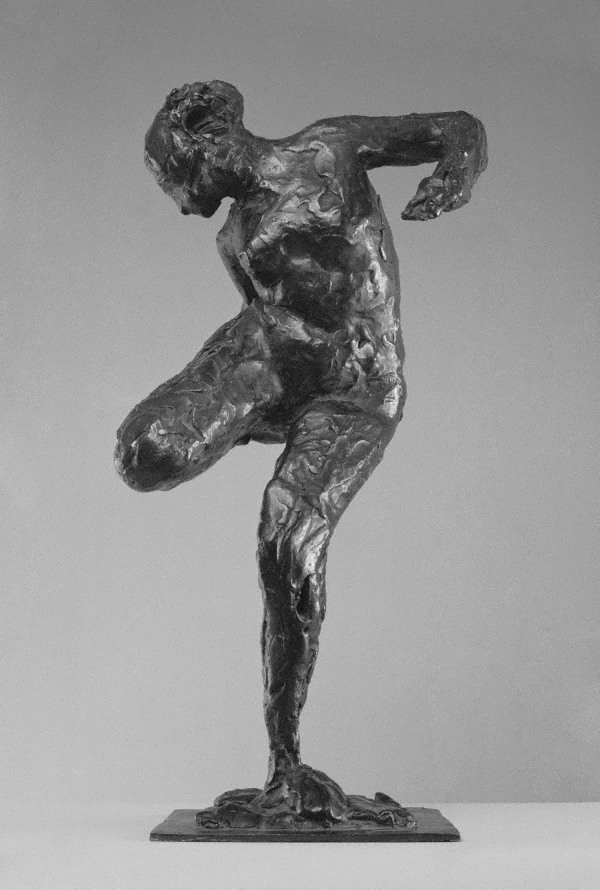
Look at the sculpture made by the famous impressionist painter, Edgar Degas (Figure 2). What criticisms might one make?
Perhaps, “It’s too ordinary.” In that case, the expectation would be: “Art should be more interesting than everyday life.”
Perhaps, “It’s too rough.” The expectation would be: “Art should be refined.”
(Interestingly, people tend to accept roughness in paintings more than in sculptures.)
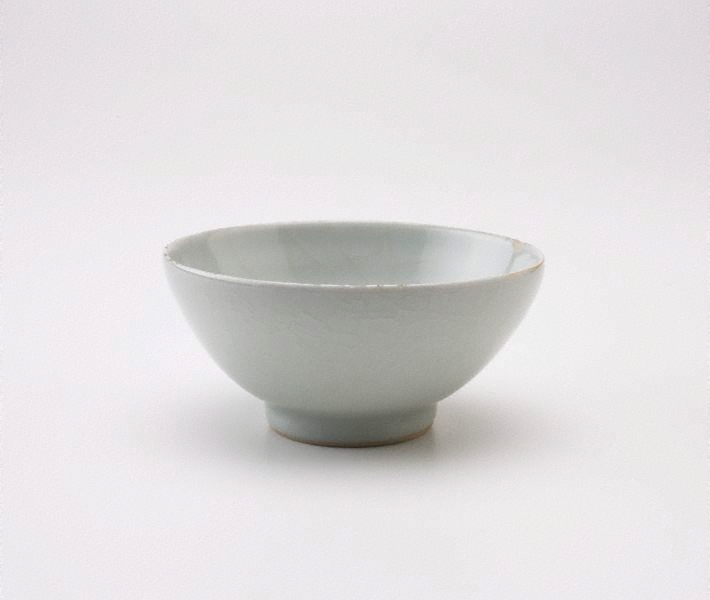
Look at Ivan McMeekin’s ceramic (Figure 3). No one would have a problem with it as a useful object, and many would even describe it as “beautiful,” but is it “art”? (Well, it’s in the AGNSW collection, so it should be, right?)
So, one objection might be: “It’s not art, it’s craft.” And the expectation would be: “Original art (created as a new form) is better than craft (recreated from an existing form).” Furthermore, “Art should be for looking at, not for using.”
Let’s go back to the painting we started with (Figure 1). This now seems very “traditional”, doesn’t it? But it would have been unacceptable to some at some point. For example, imagine it being viewed by the painter of The Widower, the Victorian English artist, Luke Fildes (Figure 4).
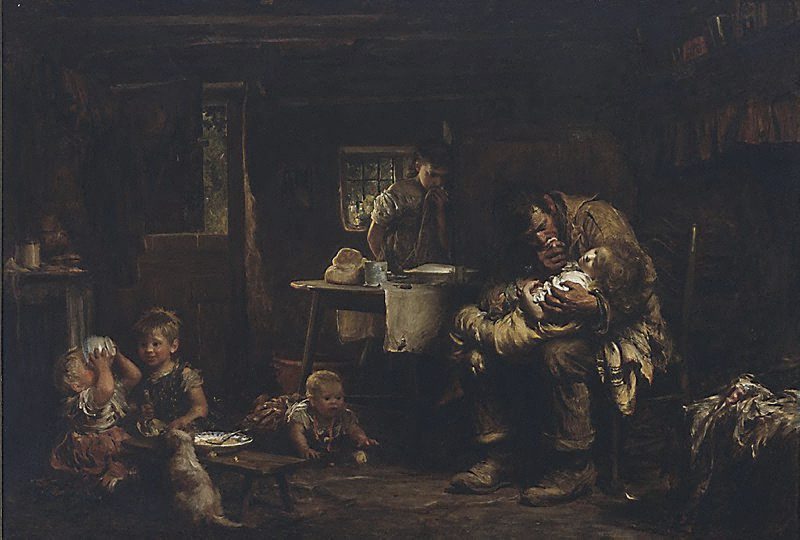
What would Fildes say? Perhaps, “It’s not edifying; it won’t make anyone better, morally. It’s just a picture of some cows.” Now imagine that Spring Frost was being viewed by the painter of a still life in Figure 5, the 17th-century Dutch painter Laurens Craen.
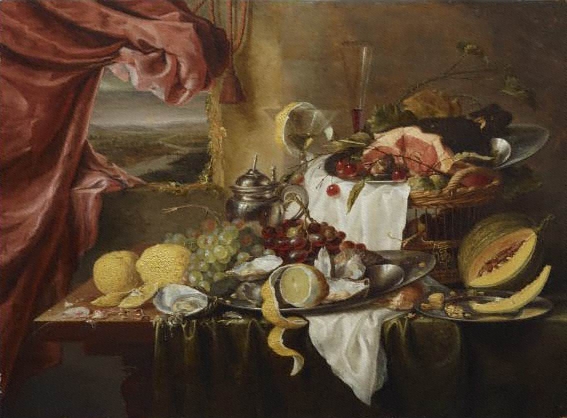
His complaint about Elioth Gruner’s painting would probably be more about technique than subject matter: “The brushstrokes are too obvious; there’s not enough detail.”
So, arguments about art are not just between artists and critics (or between artists and the public) but also between artists and artists.
Battles in art throughout history
Since the Renaissance, there have been battles between artists about what good art means. They are about the subjects of art, and how art treats them.
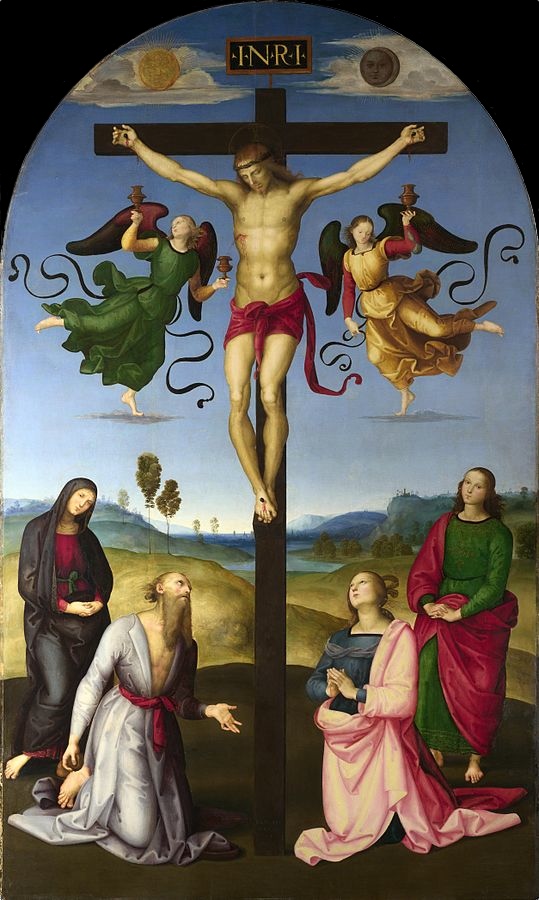
Look at the painting in Figure 6, by the famous Italian Renaissance artist, Raphael. How is the crucifixion of Jesus treated? As a perfect, peaceful event, despite the theme of death and sacrifice. For example, look at the symmetry, the repetition of curves and semicircles, and how the two angels collect Jesus’ blood in cups.
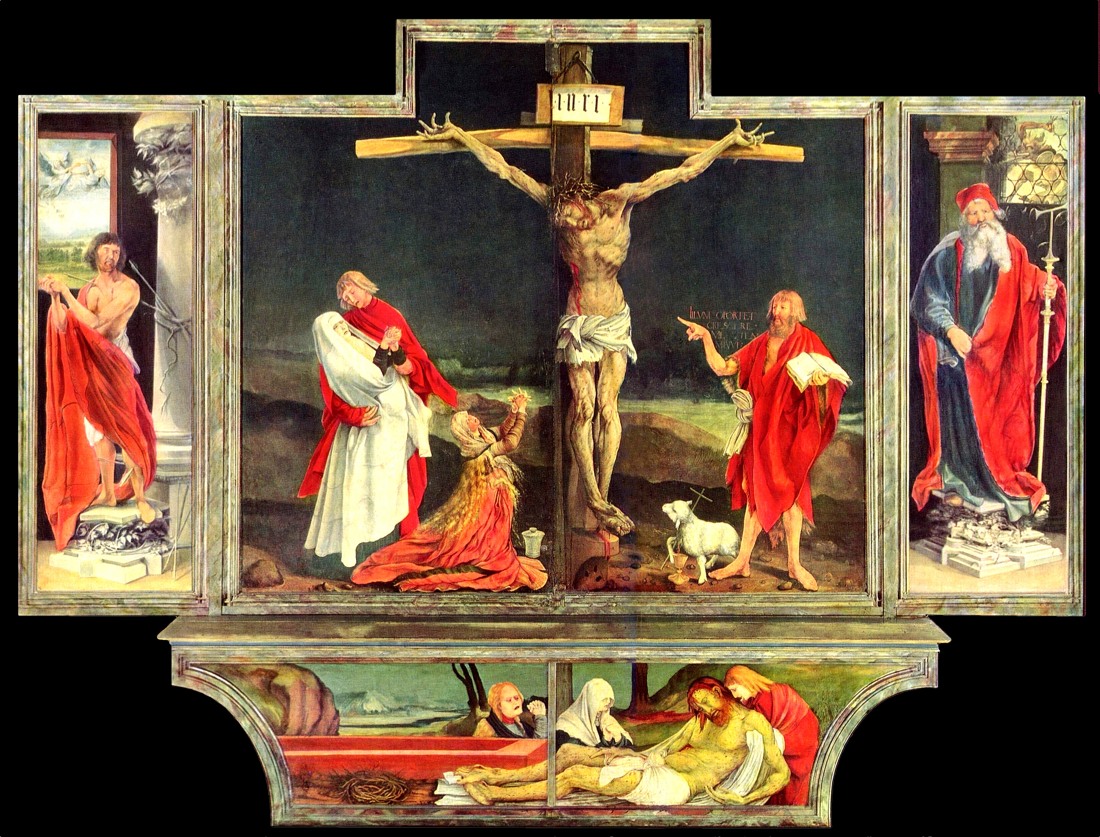
Now, look at the altarpiece painting in Figure 7. It has the same subject as Raphael’s, and was painted at about the same time (but in Germany). How is the subject treated there? As a tragic, imperfect event. Jesus’ body even shows symptoms of the plague, which would make it more relatable to contemporary viewers.
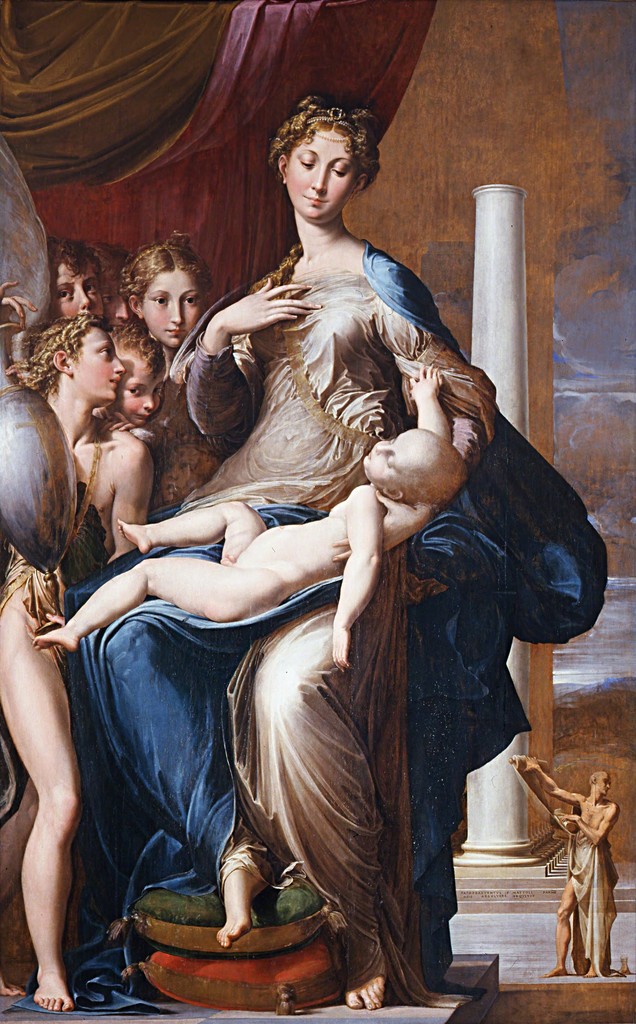
Back to Italy, but a little later: look at the painting in Figure 8. The subject is not the crucifixion, but Jesus as a baby, and his mother. The subject is treated in a very strange way. The composition is unbalanced and the figures are distorted. The style of art was once known as the “Late Renaissance,” but is now called “Mannerism.” Artists of the time felt that the work of High Renaissance artists – mainly Leonardo, Raphael, Michelangelo and Botticelli – was as perfect as art could be. So, since it was impossible to get “more perfect”, they wanted art to at least be more interesting.
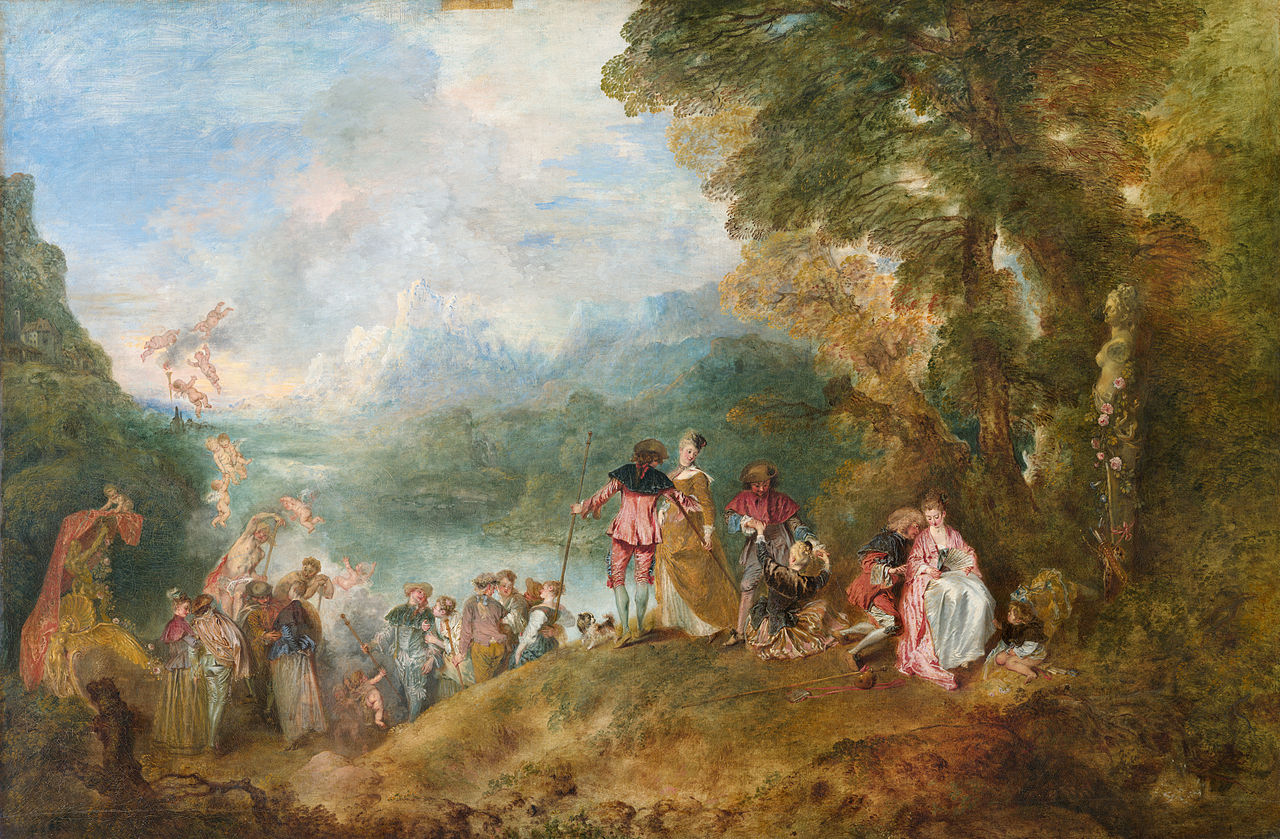
Now we move on to early 18th-century France and the work of Antoine Watteau (Figure 9). The subject is an imaginary event: wealthy people are preparing to go to the island of Cythera (where the goddess Venus was supposedly born). The purpose of art for Watteau was to be like a comfortable couch, so he created a picture that was sweet and light.
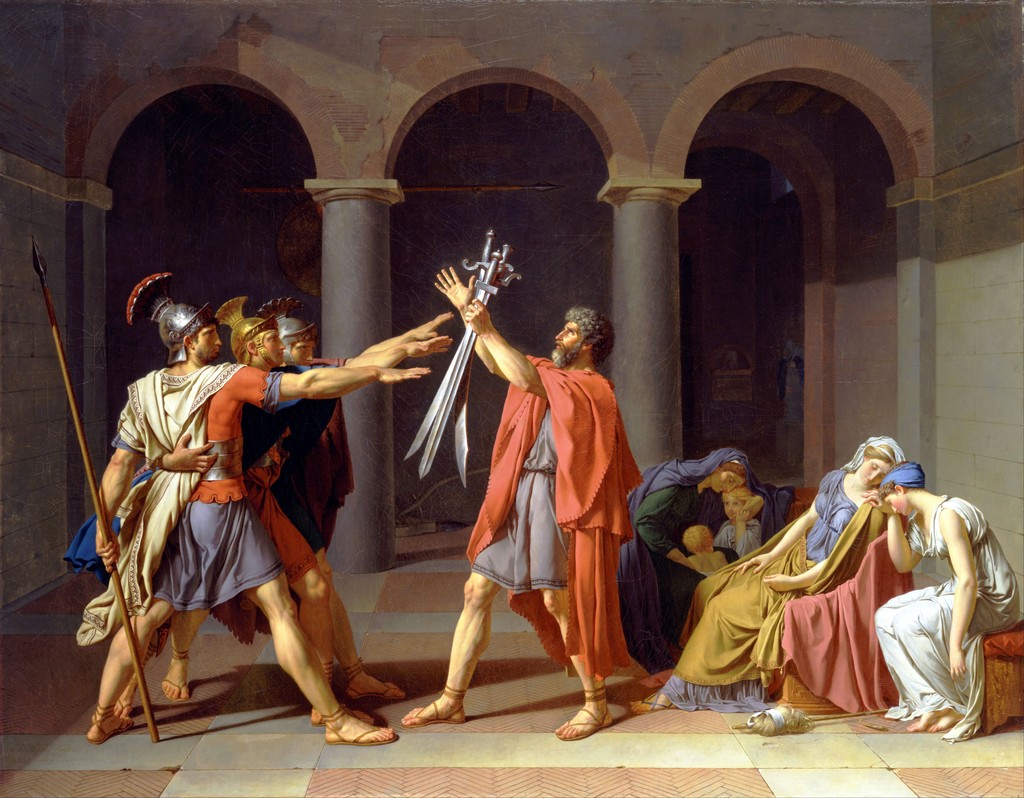
Image 10 shows a painting by the late 18th-century Frenchman, Jacques-Louis David. Three brothers from a Roman family, the Horatii, agreed to end the war by fighting three brothers from the enemy family. The three brothers are willing to sacrifice their lives for the good of Rome. The purpose of art for David was to inspire, and motivate the viewer to perform heroic actions, so he created an image that was heroic, solemn, and “heavy”.
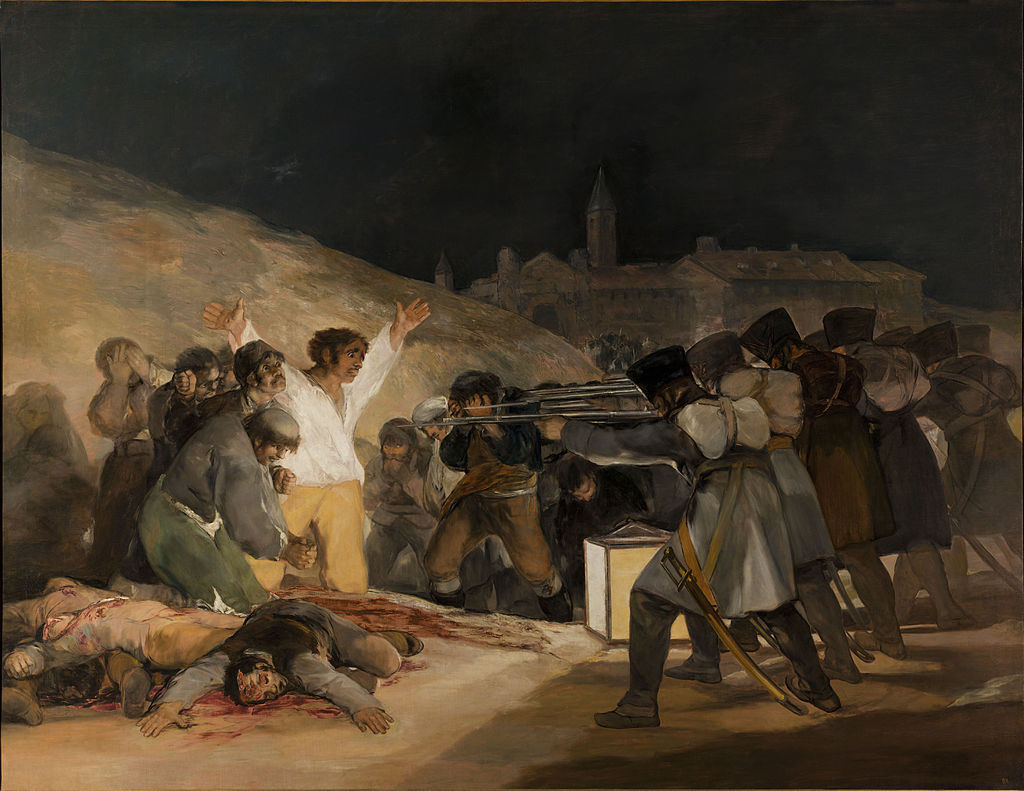
Another painting with the theme of war can be seen in Figure 11. The artist Goya commemorated the Spanish resistance to Napoleon’s armies during the occupation of Madrid. According to him, war is a meaningless, not heroic thing. It is certainly not glorious.
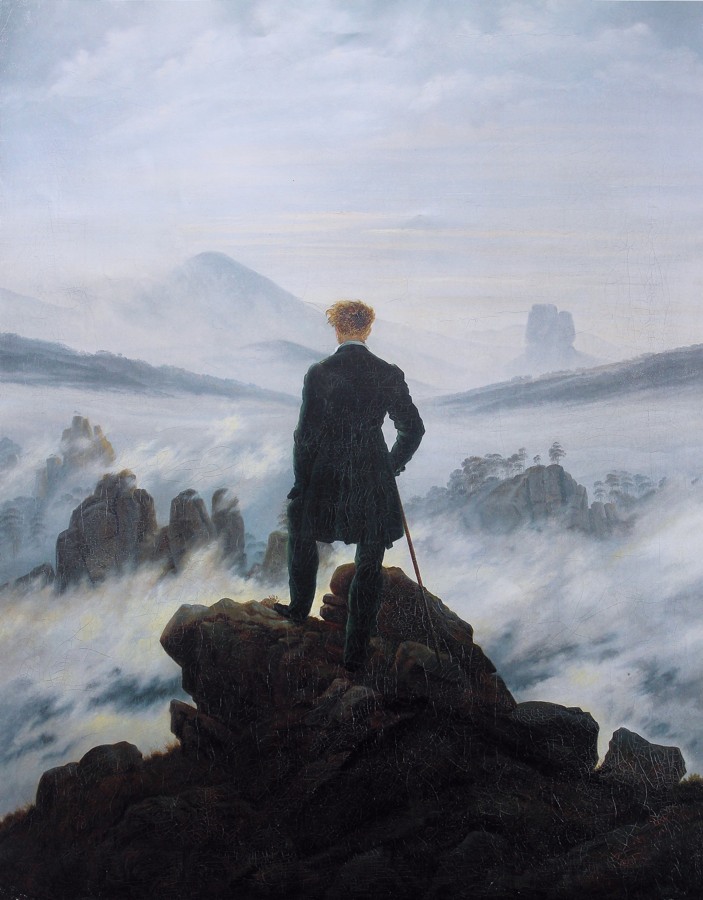
The German romantic artist, Caspar David Friedrich, painted the scene in Figure 12, which glorifies the majesty of nature. The purpose of this art was, as for David, to inspire, however, not to military or political action, but to inspire wonder, or even a solemn fear.
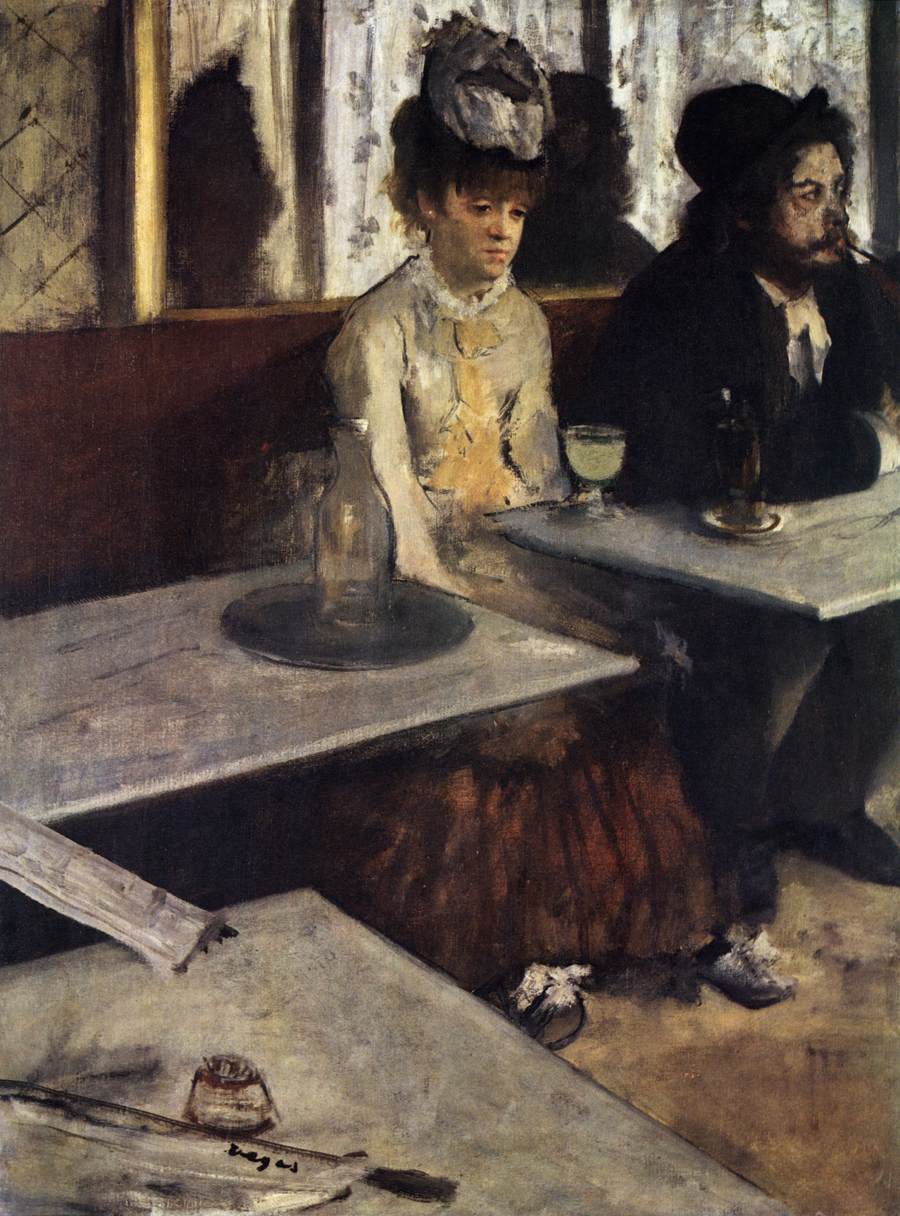
In Figure 13 you will see an early description of modern life. Edgar Degas, the painter (and sculptor) known for his depictions of ballerinas, presents us with an absinthe drinker and her companion. The subject is the tedium of modern, everyday life. Notice how Degas makes it seem like he has captured this scene by chance, as if with a modern camera. Yet the composition – with its zigzag, slanted lines – is very clever, and not at all accidental.
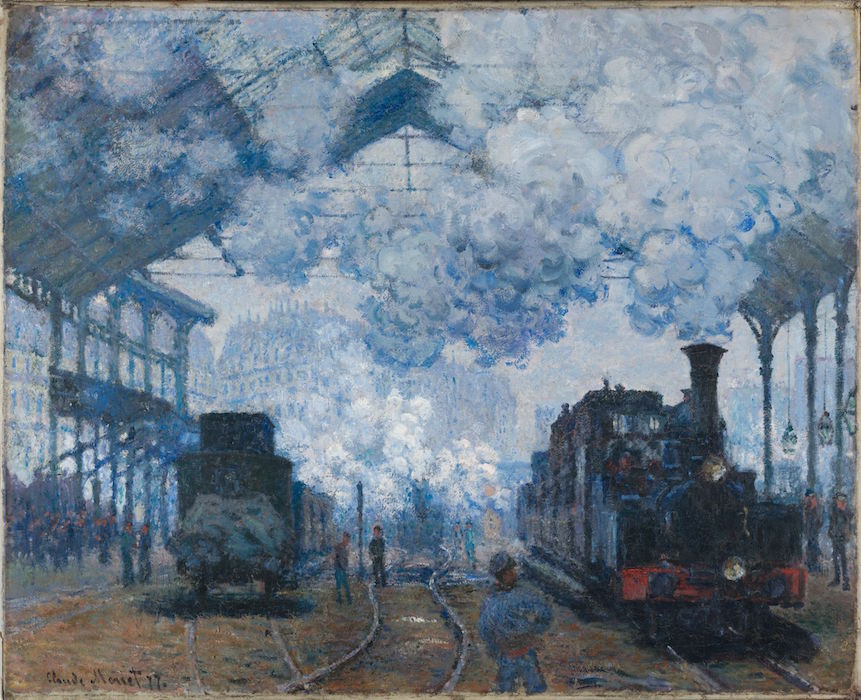
Modern life was also depicted by Claude Monet, in Gare Saint-Lazare (Figure 14). However, in this case, the big, hissing, powerful locomotives, and the clouds of steam, are symbols of an exciting, new world.
We have seen several examples in which artists show different answers to the questions, “What is art for?” and “What does good art mean?” Here are a few more:
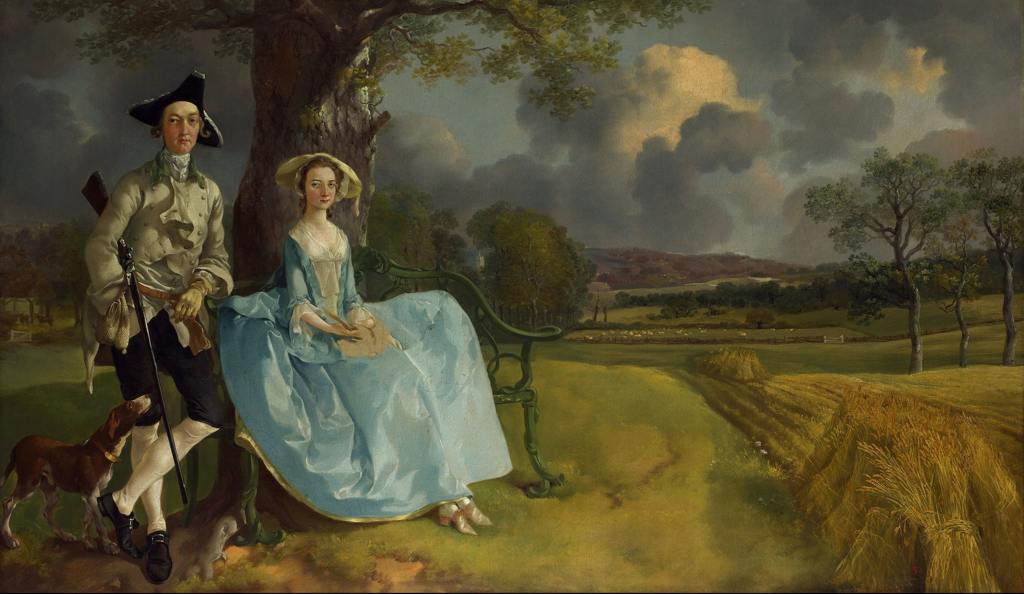
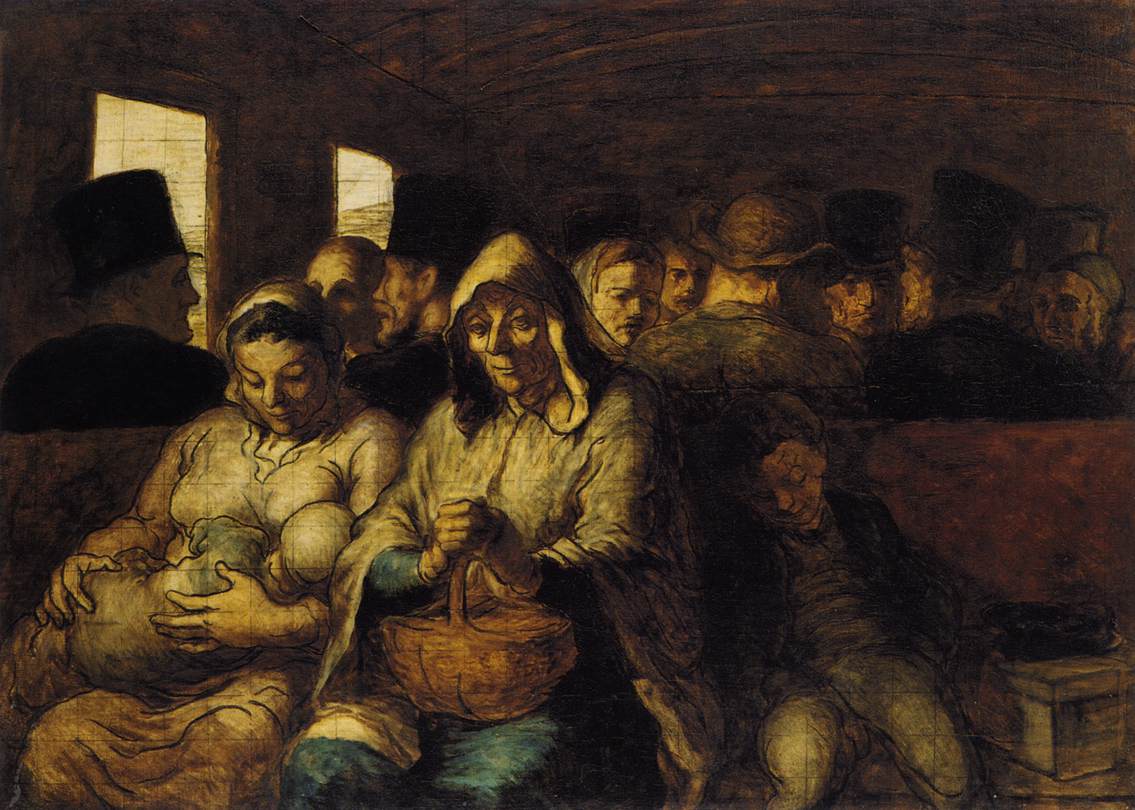
Image 15: Should art be for, and about, the rich or the poor?
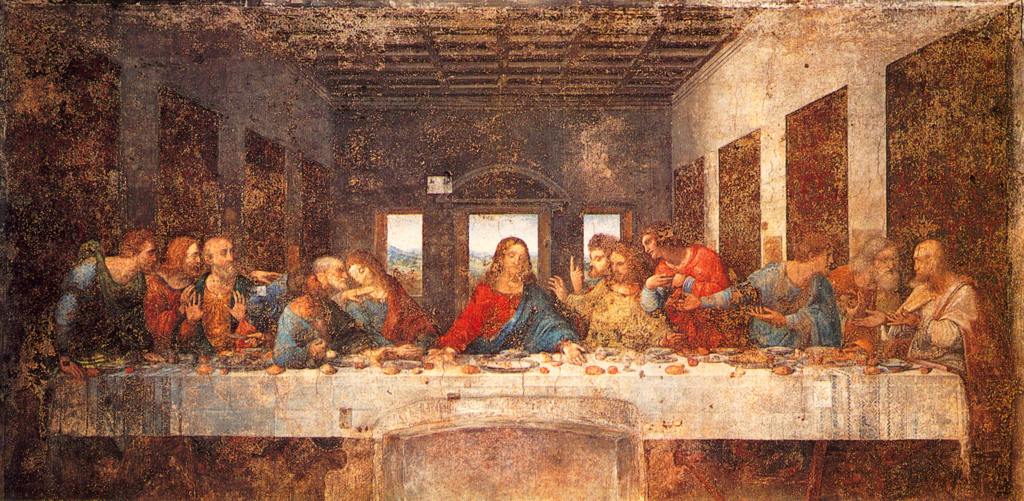
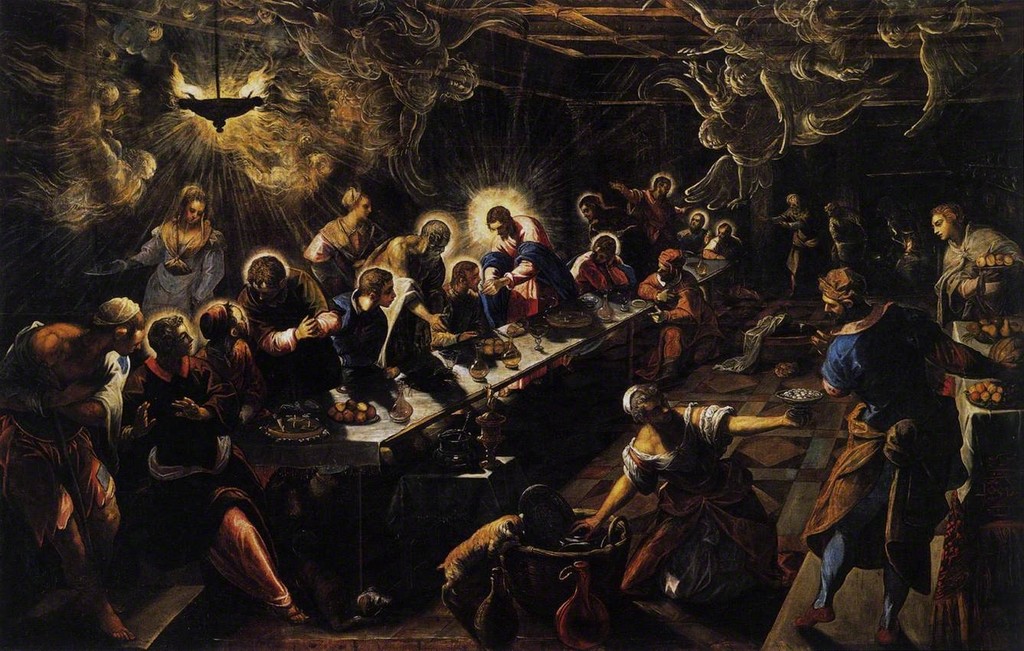
Image 16: Should composition be calm or dynamic?
Another area of argument is the relationship between the artist and the creation of their work.
The supposed way for a painter to work is on a vertical, flat, stretched rectangular surface (an easel), looking at the subject, painting with a brush and artist’s oil paint on a palette.
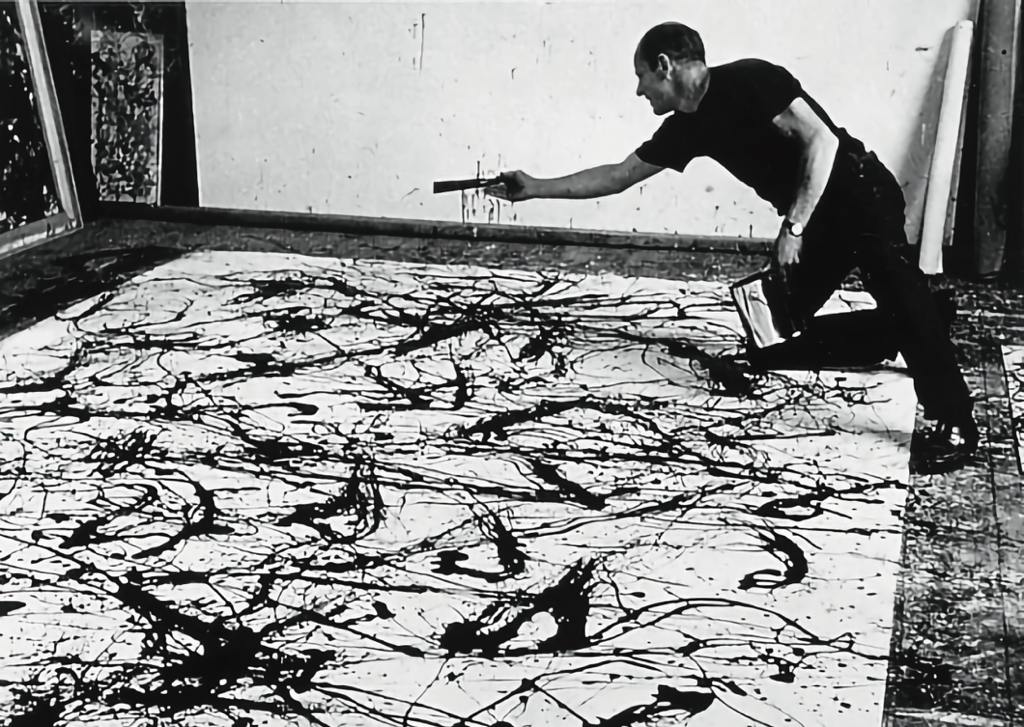
However, look at how the American artist, Jackson Pollock, painted (Figure 17): over a horizontal, unstretched surface, he applied the paint by pouring, dripping, tapping. He was “in” the painting, and did not look anywhere else. In fact, the process of creation was the subject of the painting.
Hans Hoffman, an older artist and mentor of Pollock, once visited Pollock in his studio. He said to the younger artist: “Jackson, you are not drawing from nature. It is not good; you will repeat yourself.” Pollock’s response was: “I am nature!”
A supposed way for a sculptor to work is to carve solid material (stone or wood), acknowledging gravity. So, sculptures are most often more or less solid, sitting on a plinth, on a base (which separates the artwork from the floor and, therefore, the “real” world).
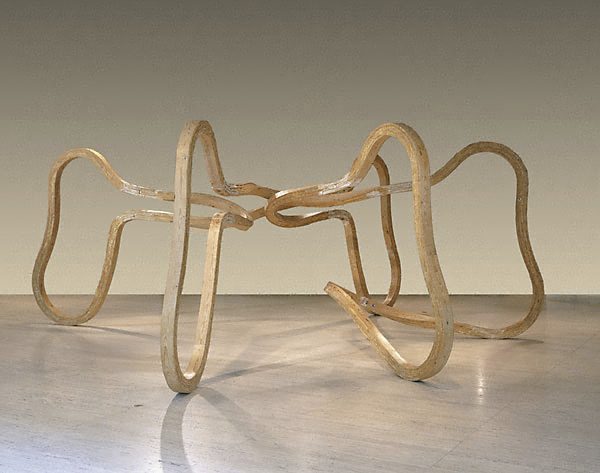
However, the sculpture in Figure 18 is open (you can walk through it). It sits directly on the floor, and it is constructed of laminated wood, which has created a rough surface, because the glue is still visible. However, the sculpture is still an object sitting on a horizontal surface (the floor).
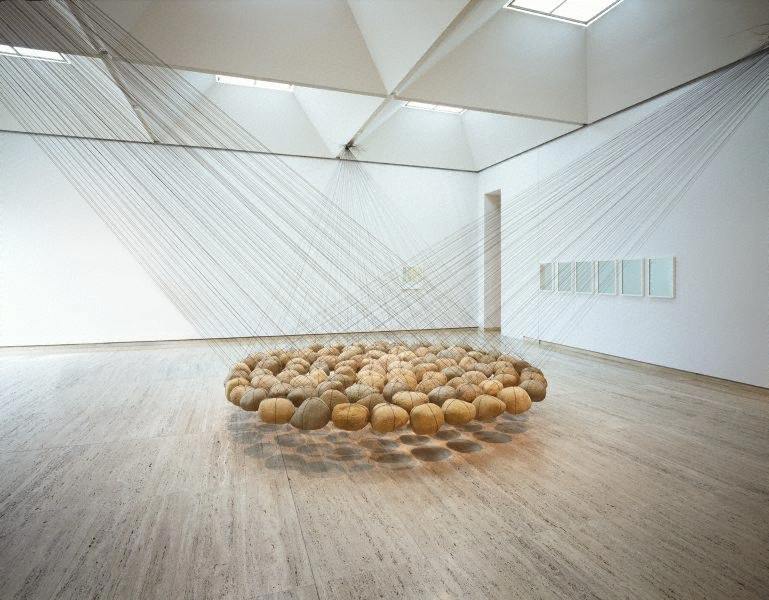
On the other hand, the sculpture in Figure 19 (perhaps the AGNSW’s most popular contemporary work) seems to defy gravity. It is no longer an object sitting, or lying, on the floor, but hanging from the walls.

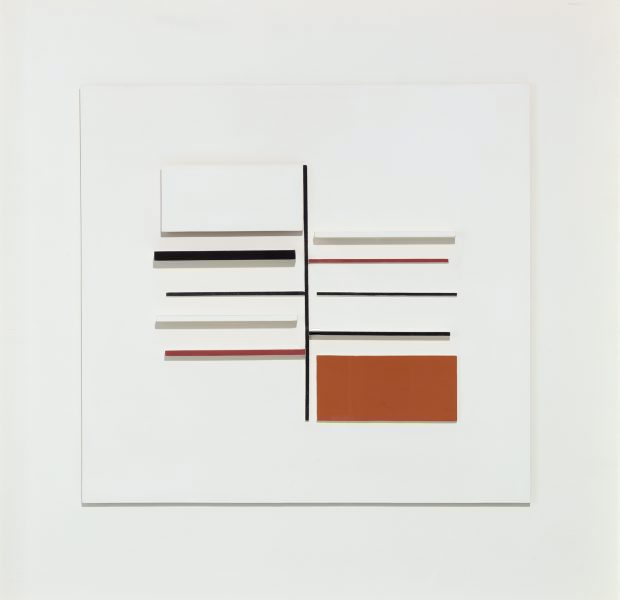
Artistic argumenting can be compared to a boxing match. Imagine that the paintings in Figures 20 and 21 are boxers fighting each other. I will be the announcer:
“Ladies and gentlemen! From your state art gallery, we present to you the main battle for today, between Sir Ed Poynter and Vic Pasmore. We are at the frame-side, and let me introduce you to the two painters: [Figure 20] Sir Edward Poynter, wearing multi-coloured shorts, and his opponent, [Figure 21] wearing brown and white shorts, Victor Pasmore.
[20] Sir Edward has been practising art for many years, but his training at the prestigious British Academy, and his fine technique, have maintained his popularity. [21] Victor Pasmore is a more recent addition to the art gallery, but he has attracted quite an appreciative audience among lovers of abstract art.
The referee is now speaking to each painter: he checks the palettes for their whites, and warns against scumbling under the glazes. They now return to their easels… and wait for the bell. [DING!]
[21] The smallness of Pasmore’s painting allows him to work quickly from his corner, [20] but Poynter counters with his wider range of colour – look at those reds and golds, and reds and golds. Those are certainly rapid changes of colour!
[21] But Pasmore’s simple construction, with hardly any colour change, makes Poynter’s style seem heavy and laboured.
[20] Now Poynter hits hard with his patterns and textures: look at the marble and the parallel grooves on the columns!
[21] Pasmore counters with his strong, sharp rectangles. He hardly seems to be moving at all!
Well, two can play at that game: [20] Poynter creates cleverly hidden rectangles in the background. He zigzags all over the canvas, using much more space than Pasmore.
[21] But Pasmore works well in a small area: he just gently presses forward; he hardly seems to be affected by Poynter’s attack.
[20] But now Poynter is bringing his subject matter into play: There’s a tremendous surge of religious feeling as he quotes from the Bible and – despite this matter of religion – there’s more than a little sex appeal for the audience: arm, leg, head, breast! What a spectacle! How can Pasmore overcome this?
[21] Well, Pasmore fights back with smooth surfaces and simple geometry. There is a sense that something very important is happening here; he’s directly invoking the scientific and mathematical fashion of the 1950s. What an attack on shallow storytelling! He’s completely ignoring the world!
Pasmore inserts straight lines. [20] Poynter counters with straight lines. [21] Brightness from Pynter, [20] deep shadows from Poynter. [21] Small, rectangular blocks from Pasmore, [20] the deep illusion of space from Poynter.
[21] But what’s Pasmore doing now? What an unusual tactic! He’s just standing there, lecturing Poynter on composition and geometry! What courage! What endurance! [20] Well, Poynter won’t let him get away with that! He’s lecturing Pasmore on drawing the human body, and anatomy. There’s hardly a muscle out of place, even in the most difficult poses.
Oh! Now there’s a strong movement to the right from Poynter, [21] countered by a balanced arrangement from Pasmore! Both these artists know what makes a good painting, but such a difference in style… [DING! DING!] and there goes the bell for the end of round one.”
Summary
Our reactions to art reveal things about ourselves, especially our expectations.
A good way to better appreciate art is to imagine that the artists of artworks you are looking at are talking to each other about art: Will they agree or not?
Another good way to appreciate art is to find an artwork that you don’t like: imagine that you are a new employee at a commercial gallery; someone walks into the gallery – try to sell that artwork!
]]>- Right-click the image file and select “Properties”
- Click the “Details” tab
- Look for the “Image” section
Mac
- Select the image file and press Command + “I” or Control-click (or right-click) and select “Get Info”
- Look for “Dimensions” under the “More Info” section
iPhone or iPad
- Open the Photos app and select the image
- Tap the “Share” icon in the bottom-left corner
- Swipe left on the bottom row and select “Show Image Information”
Android
- Open the Gallery app and select the image
- Tap the “Details” or “Info” icon (usually an “i” or a circle with an “i”)
You experience free will all the time. For example, when you decided to read this article instead of doing something else. Free will is your ability to decide for yourself what you will do. It means that the future is an open arena that you can shape with your actions. It is the core of human relationships; it means that you are responsible for your actions, which is the basis of our moral and legal systems. But is free will actually possible?
Two main philosophical sides fight over this. One side claims that the concept of free will is fundamentally incompatible with the principles of the universe:
“You have no free will”
Whatever “you” are somehow consists of a physical brain and body. And those are made of cells, which are made of proteins, which are made of molecules, which are made of atoms, and so on.
So basically, you are a specific, dynamic arrangement of particles. Particles have no will, no motivation, no freedom; they blindly follow the principles of physics. And we don’t know why, but most principles of physics are deterministic. This means that things happen this way because of the things that happened before.
If you’re playing pool and hit a ball at a specific speed and angle, the principles of physics will determine exactly how all the balls on the table will behave later: their speeds, bounce directions, everything. These principles completely decide the behaviour of all the balls on the table. At the microscopic level, things work very much like this, but without players. Actions and reactions affect all particles in the universe, creating a chain of causal effects that stretches through time, from the past to the future. Things happen by making other things happen.
Now imagine if, right after the Big Bang, a super-intelligent supercomputer looked at every single particle in the universe and wrote down all their properties. Only using the deterministic principles of physics, could theoretically predict what all existing particles will do until the end of time.
But if you are made of particles, and it is technically possible to calculate what particles will do forever, you have never decided anything. Your past, present and future were already predetermined at the Big Bang. That would mean that there is some kind of fate and you don’t get to decide anything.
You may feel like you’re making decisions, but you’re actually acting on autopilot. The movements of the particles that make up your brain cells, which made you read this article, were decided 14 billion years ago. You are only there when it happens. You just watch how the “universe” inside you unfolds in real time.
But that can’t be true because of quantum physics, can it? Quantum processes are intrinsically random, not deterministic, and cannot be predicted with certainty. On the quantum pool table, balls can go randomly left or up or anywhere. Their behaviour is not fixed by what happened before, but is randomly “decided” in real time.
But for the believers in “no free will”, this does not affect their argument. They think that because quantum processes are random, they don’t allow you to make any decisions. Because, if there is randomness to the things that essentially make up your brain and body, those random processes make the decisions for you. How?
Let’s say an electron can randomly go right or left. If it goes to the left, it triggers electrical currents between your neurons that create a neuronal process that triggers a long chain of actions that lead you to read this article. Or it goes right and makes you clean your room. Just because the chain is extremely complex, doesn’t mean you have any control over it.
So maybe your fate wasn’t decided at the Big Bang, but it is decided in this moment. The important thing is that it is not decided by you. You have no influence on this; you have no free will.
Oh! That’s unfortunate because the argument basically seems to make sense. But “No!” cries the free-will side, “That’s a really bad way to think about the universe.”
“You do have free will”
We know that we can reduce everything that exists to its basic particles and the principles that govern them. Although this makes physics seem like the only scientific discipline that actually matters, there is a problem: You cannot explain everything in the universe only in terms of particles.
One main fact about reality that we can’t explain just by looking at electrons and quantum stuff is something I call emergence. Emergence is when many small things together create new fundamental characteristics that did not exist before.
A drop of water is only H2O molecules (approx. 1.67 × 10²¹ of them). If you get water on your clothing, it gets wet. But what actually is moisture? H2O molecules are not wet. But your clothes are definitely wet now. Many small things together have created something new that does not exist at the level of the individual molecules.
Emergence occurs at all levels of reality, and reality appears to be organised in layers: atoms, molecules, cells, tissues, organs, you, society. Put many things together in one layer and they will create the next layer. Each time they do this, completely new features emerge.
One atom cannot handle information, but many of them together can form a DNA molecule. Molecules are not alive, but many of them can form a cell, and cells are alive. With each leap up the ladder of complexity, the principles of what is possible change. Entirely new things emerge that are much more than the sum of their parts. And this is where the reductionist view of the universe breaks down.
The layers of reality need each other to make sense. You can explain living things in terms of cells, cells in terms of molecules and molecules in terms of atoms. But due to emergence, one cannot start with quantum particles and reconstruct the universe. You cannot explain galaxies or human psychology with quantum physics.
That’s not the whole point. Reality is not only structured in layers but for some reason, the layers are also largely independent of each other. Things existing within the same layer can influence each other and possibly one layer above or below. But often they do not affect things much higher or lower. To find out how organs work, you don’t need quarks. To understand politics, you don’t need to know about cells. If you want to explain things that happen in one layer, you can only do that by staying close to that layer.
“No!” cries the non-free-will side, “You can’t just use magic to explain free will!”
But the emergent argument does not invoke magic. It just says that thinking about free will in terms of determinism and fundamental principles is a dead end, a sort of category error. It is part of a reductionist school of thinking about the universe that has very successfully dominated science for a long time, but that is being challenged by emergence.
So perhaps trying to understand free will by looking at fundamental particles, deterministic principles and quantum physics misses the point. What we should be asking is, “Which layer of reality is relevant to free will?”
Well, just as no individual molecule creates moisture, no cell in your brain wants to read an article. But one layer higher, your brain, made of 80 billion interconnected neurons, does that. On that layer appear all the things related to you: your consciousness, personality, feelings, your fears and dreams. This is where you emerge. You don’t know why or how, but you know that you are indeed here, right now. How all the things going on in your brain interplay to make you that way is a completely different matter. But on that layer of reality, you are part of the decision-making process. You are shaped by your decisions and your decisions are shaped by you. You have a right to decide on that layer of reality.
You don‘t just watch how the “universe” develops inside you – you actually participate in it. And you are free to do whatever you see fit. At least that’s how some on the free will side think about it.
Conclusion and opinion
So who is right? Is there free will? I’m not sure. But think about it: If you believed that free will does not exist, that it is only an illusion, where would that belief come from? Would it just be the result of countless actions and reactions of particles and random quantum stuff? If so, what connection would there be between those and “the truth”? You can’t prove that proofs doesn’t exist, or don’t matter at all. It would be like removing the ground on which you stand.
However, even if we don’t have free will, it’s not clear what that changes for practical purposes. You and we, we humans, on a purely subjective basis, feel that we do have free will and that our decisions are our doing. Although we’re not sure either way, if you feel like you’re making decisions, what does it matter if a super-intelligent supercomputer could have calculated the future at the time of the Big Bang? Or if quantum stuff randomly pushes your cells one way or the other? Free will that seems free is good enough for us.
Anyway, now you can decide what to do now. Maybe do some work? Or read another article? It’s your decision. Probably.
The Esperanto version of this article originally appeared in Esperanto sub la Suda Kruco (no. 155, September 2024), the journal of the Australian Esperanto Association. It is based on a video by Kurzgesagt, Do You Have a Free Will? (youtu.be/UebSfjmQNvs)
Photo by Vladislav Babienko on Unsplash (detail)
]]>
An English translation of a post (in Esperanto) by Robert Nielsen, in his blog Teo kaj Libroj, 30 October 2023
Every Esperantist has already heard the usual speeches about peace many times during Esperanto congresses. They are so vague and banal that they really mean nothing. “Peace is good, death is bad,” the speaker bravely says while the spectators clap their hands emotionlessly and look at their smartphones. But what to do when peace is no longer just a slogan?
All my life, I have been a strong supporter of Palestine. As a teenager I stood in the street and asked passers-by to sign petitions for Palestine, and I even gave a lecture to my classmates at school about the cruelty of the occupation. It is said that Ireland is one of the strongest supporters of Palestine in Europe, because the history of Ireland is also a story of occupation and oppression. In Northern Ireland, the Irish Catholics are often seen flying the Palestinian flag, while the British Protestants fly the Israeli flag.
But the Hamas attacks on 7 October shocked and disgusted me. Soldiers attacked Israeli cities and killed every person they found. They killed about 1,400 people and kidnapped more than 200 others. The victims were mainly innocent civilians, including hundreds of people enjoying a music festival. Children, even babies, were found among the corpses. That’s not war, that’s slaughter. It is said to be the bloodiest day for Jews since the Holocaust.
I’ve seen a lot of people online trying to defend the attack. They say that Palestinians have the right to fight for freedom and resist the occupation. But how will the killing of people at a music festival liberate Palestine? Explain to me how killing children is “resistance”? The bloodthirsty sword will not bring freedom, but suffering – for all.
If you really support Palestine, you must condemn Hamas. The massacres do not help Palestine, in fact it pushes back the possibility of an independent Palestinian state for at least one generation. No Israeli government will be able to negotiate and compromise with Hamas after the attack, and because of this real peace will not be possible for decades. Hamas knew that the massacres would provoke a very strong reaction from Israel; they knew that because of the attack, thousands of innocent Palestinians would die. But they still did it. The lives of civilians are pawns in their chess game.
Israel responded as it always responds, with heavy bombing of Gaza. Eight thousand people have already died, but that is growing every day and by the time you read this article, it will surely be higher. It is not possible to accurately bomb a city as dense as Gaza, so the result is thousands of innocent victims, including three thousand children. Israel cut off electricity, blocked the entry of necessities and ordered one million people to flee their homes, which of course, is not possible. The goal is revenge and the people will suffer.
I have watched many demonstrations around the world to sympathise with Israel or Palestine, but I have seen hardly any who sympathised with either side. For many people, there is space in the heart only for “my side”. I see many people who cry for Palestinian victims but are silent about the Israeli ones. There are people who spread information about the dead – but only from one community. If someone dies, the first question is “Were they an Israeli or a Palestinian?” because if they are from the right community, people will shout loudly about injustice, but if they come from the other community, they are silent.
A few days ago, a bomb exploded and killed nearly 500 people outside a hospital. Social networking sites were filled with people screaming about Israel’s cruelty. But when new information emerged that suggested that perhaps the bomb actually came from Palestinian militants, the anger disappeared. The people who shouted about war crimes changed the conversation to other topics. They did not pause and ask if perhaps they should have the same anger towards all the killers of civilians. For some, the war is between good guys and bad guys, and any facts that contradict that view are lies or propaganda.
This is the evil of war: you no longer care about the truth; only your side matters. Good-hearted people sincerely sympathise with the victims who have the right nationality, but the sympathy disappears for victims with the wrong nationality. Don’t Jews bleed just like Muslims? Don’t the Palestinian parents cry for their children as well as Israeli parents? Is it not possible to cry for all the victims, regardless of their community?
So what are pacifists to do? Will Esperantists stand for peace, or is the hatred too deep that even a common language would not help? The Esperanto League in Israel is silent, and there is no active Esperantist group in Palestine or any other Arab country. UEA, TEJO and ILEI made a joint statement, but it doesn’t actually say anything. It avoids talking about deaths, war crimes, massacres, blockades, protection of civilians – in fact it did not even say the names of the countries where the war is taking place. It seems that the topic was too controversial to say anything, so instead nothing was said.
But the war shows how important peace is, and that it is more than a beautiful word. Yesterday’s massacres bring tomorrow’s massacres. The killing of Israeli civilians has not freed Palestinians; in fact it only increases their suffering. Killing thousands of Palestinians will not make Israel safer; it will only raise a new generation of warriors dedicated to revenge. It seems that Israel is now preparing to invade Gaza, which will not solve the conflict but will only increase victims, hatred and sow the roots of new wars.
So, I don’t wave the flag of Israel or Palestine – I don’t want justice only for one community. Even if it is a cliché, I am an Esperantist who waves the flag of peace.
]]>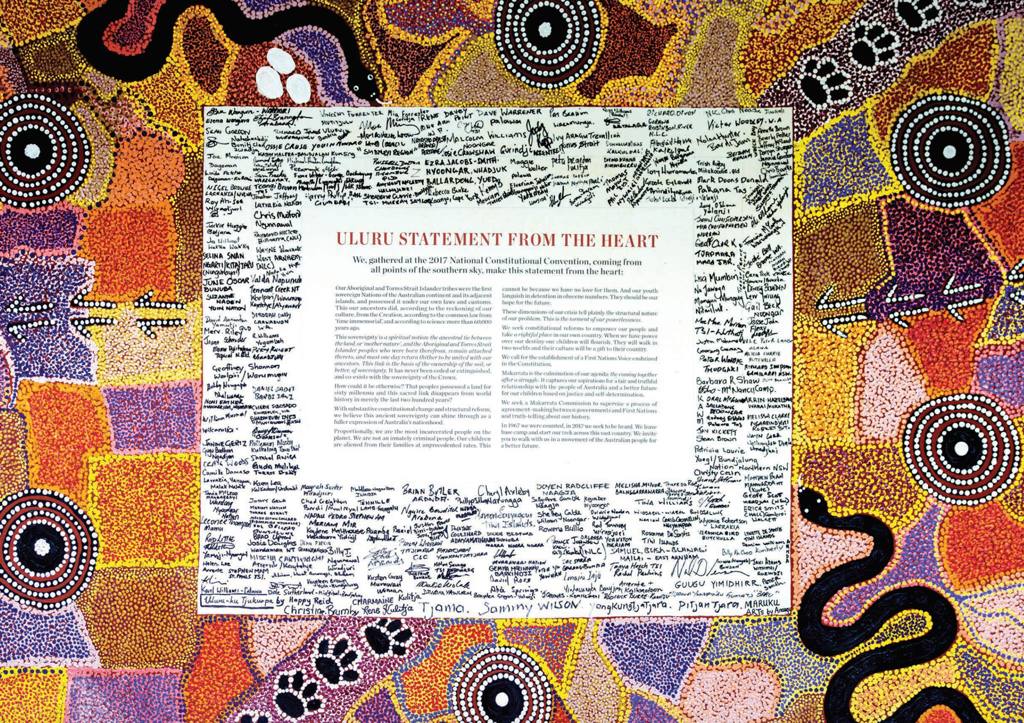
I strongly believe that it will be good if the Australian Constitution is changed to recognise Aboriginals and Torres Strait Islanders as the original inhabitants and owners of the country, and to establish a permanent Aboriginal Voice (to the parliament and government).
The no-campaigners are not a unified group. On one side are those who believe (or want others to believe) that a constitutionally protected Indigenous Voice would give Indigenous people too much power, that it would cause legal chaos. (And yes, unfortunately, there is a small part of that side that is racist.) On the other side are those who claim that such a Voice would do nothing, that it would be like a toothless tiger. Sometimes one side borrows an argument from the other, for example, that the Voice would be another layer of bureaucracy, advice from the “Canberra elite”, although this is the exact opposite of the idea behind the Voice.
The memorable catchphrase of the no-campaigners is “Don’t know? Vote no”. Apart from the fact that the obvious answer to ignorance is to find out, the basis of that argument is that the Labor government (as the main proponent of the yes vote) is not giving enough detail about how the Voice would work. However, this lack of detail is an essential part of the proposal. The Australian Constitution gives only general principles of governance. The details are worked out by the parliament. So, even if the Labor Party described details about, for example, how many people would be in the Voice, how they would be elected, etc., the parliament (and future parliaments) would decide on those details. In other words, some current description might, or might not, be the reality. I would be very surprised if the Coalition of Liberal and National Parties did not know this.
That idea (having a constitutionally protected Indigenous Voice) is not new. Several other countries (including, for example, Finland) have had such a system for many years. And their systems of governance did not fall into chaos. Those voices from other countries work more or less in the same way as the current proposed scheme: the group makes requests and suggestions to the country’s parliament, and that parliament either accepts or rejects – or partially accepts – the recommendations. The sky didn’t fall.
Maybe an Indigenous Voice won’t improve the lives of Indigenous people much, or quickly (to “close the gap”), but it would be a good start. So…
Vote “Yes”!
]]>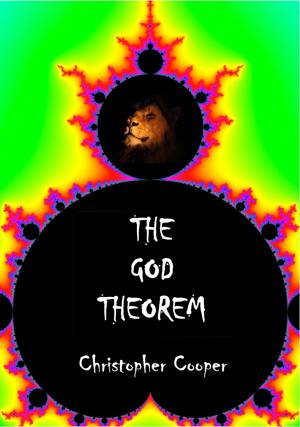 My oldest brother Christopher recently wrote a book, The God Theorem: God seen through the eyes of a mathematician, in which he explains his worldview and spiritual faith, and discusses some tricky questions about life, philosophy and morality. Because he is a mathematician, his approach is through a system of logic. And a fundamental concept of logic and mathematics is that of axioms. An axiom is a statement that cannot be proved, but is considered true, to serve as a premise or starting point for further reasoning and proof. Many are seen as self-evident (e.g., “If a = b and b = c then a = c”) but do not have to be.
The following text is an edited version of chapter 3: “My Faith”.
I searched in my mind, perhaps even in my heart, for the fundamental axioms on which I base my worldview. Here they are:
Axiom 1: I exist.
“Cogito ergo sum – I think, therefore I am,” wrote René Descartes. The arms and legs that I see, and that I feel when they are touched, may not really exist. I could be completely “mind”. But it is clear that I exist.
Axiom 2: The external world exists.
Is it possible that the external world is just an illusion? People hear voices that do not exist, and they see visions. The phenomenon of phantom limbs after amputation is well known. In dreams, I see and hear things that do not exist. I once had a dream in which I woke up and thought, with some peace of mind, “Thank God it was just a dream.” Then, a little later, I really woke up – a dream within dream! What if what I now call “real life” is just a dream? Maybe when I die, I will really wake up permanently. However, life makes more sense if I accept that the external world actually exists.
Axiom 3: You exist.
No, this is not just a consequence of axiom 2. I can see and hear you, and maybe even touch you. According to axiom 2, I agree that your body exists. But you are not your body. Maybe I’m the only person who has consciousness. Maybe the rest of you are just robots.
There is a claim, often made by people who are supposed to have some knowledge of the brain, that any computer device with more than a little complexity is automatically conscious. But how can one decide the truth of such a claim? I can’t even prove that you are conscious! So I have to agree with it as an axiom.
Axiom 4: Memory is continuous.
We are what we remember. Imagine if, during the night, someone deleted my memories and replaced them with someone else’s. I would become that person. I would look at my face in the mirror and assume that someone had performed plastic surgery on me while I was sleeping. Who would I really be: the person whose memory sits in my brain, or the one in whose brain those memories now reside, and in whose body my brain sits?
Like most of you, I think my memories are pretty accurate. I can accept a few occasions when I have misunderstood certain things, but I am the one I remember being.
Axiom 5: Logic is valid.
I accept standard logic, according to which things are either TRUE or FALSE, logic with ‘AND’, ‘OR’, ‘IF’, ‘THEN’, and ‘NO’. At least I accept it, as long as I don’t try to use self-referential statements like “THIS SENTENCE IS FALSE.”
Some logicians have challenged this standard logic and come up with alternative versions. But I have noticed that when they write about their alternative logics, and in their ordinary life, they follow standard logic.
Most people accept standard logic subconsciously. They say, “You definitely didn’t leave the key on the table because it’s not there now,” but they don’t realise that they used the form of reasoning known as “proof by contradiction”.
Axiom 6: There is something beyond the material universe.
Here you may begin to disagree with me. Like all of the above axioms, I can’t prove it. That’s why I call it an axiom. Materialists deny this axiom. They argue that all thought is only a product of biochemical processes in the brain. “Love” is just the biological duty to reproduce that drives evolution. And so on.
I certainly accept a lot of what they say. The duty to reproduce is certainly an important factor in falling in love. Whether it still explains the self-dedication of married couples in their old age, I’m not so sure.
The problem with the doctrine of the materialist is the realisation that their credible arguments are only products of biochemical processes occurring in their brains. Maybe they are materialists just because of their genetics?
Axiom 7: We all have free will.
I meant to say, “I have free will,” but following axiom 3, I am willing to make it more general. I am the centre of the universe, but so are you.
I am the first to acknowledge that this free will has its limits. I am not completely free, and neither are you. External circumstances place limits on those we may choose to do.
So, with those qualifications, I believe this axiom. That puts a lot of responsibility on me. Will I make the right choices? I need to be able to anticipate the consequences of my choices. It would be so much easier if one were not responsible for one’s actions. If I were to commit a crime – well, I was programmed to do that. My moral would be very simple – just take care of myself, because my choice to do so must be pre-determined.
Axiom 8: God exists.
The “something” that created the universe is somehow a being, a person, capable of loving his beings and interacting with them. That is the biggest leap of faith of all. Like all the previous beliefs, I cannot prove it. But neither can it be denied. It is an axiom.
I can only say that belief in a personal God is the foundation of a worldview that makes sense to me. That is why we accept an axiom. It helps us make sense of things. Of course, we would not accept any belief that we can disprove, just because it helps us to make sense of the world. But if it is something indecisive – when we have to choose between two alternatives that we cannot prove – then the more convenient one is the one we choose. That’s what we do in mathematics, why not in life?
Ancient people always believed in some god or gods to explain things they did not understand, such as lightning. But now that science can explain such things, we can do without such gods as an explanation. But as the extent of the inexplicable has diminished, it is tempting to believe that one day it will disappear altogether and that science will explain everything.
That rational thinking can explain the outside world is not surprising. It is not surprising that rational thinking can explain much of our inner lives. That rational thinking can explain the deepest mysteries of rational thinking itself seems to be too much of a circular argument for me to accept. Anyone educated in the mathematical world knows that self-reference leads to problems.
So that’s my choice. You have the right to reject this axiom if it helps you to understand the world. Belief in God has nothing to do with intellectual ability. There were great thinkers who were atheists. But there were also many great thinkers who believed in God.
I am sorry to say that the quality of atheists has deteriorated in recent decades. Great thinkers, such as Friedrich Nietzsche and Bertrand Russell, could make great arguments in support of atheism. Yet many of today’s atheists have used the tactics of contemporary politicians: throwing mud and using slogans.
Axiom 9: Christianity provides a reliable framework by which to know God.
Why not Judaism or Islam? Why not Buddhism? I guess the main reason is that I grew up in a Christian environment. Christianity proved to be a very satisfying theism for me, so there seemed to be no reason to go anywhere else.
I reject the idea of doing a study of all the world’s major religions to find the best one. I did not follow that principle when I chose a wife. I love her so much and she is everything I would want in a wife. However, prudence suggests that somewhere I might find a wife a little more suitable for me. But life is short. The man who spends his whole life dating to find the right wife will be left alone for the rest of his life.
If I were to find myself growing out of Christianity, I would certainly go elsewhere. However, I grew up in Christianity and, as time went on, it became a more satisfying environment for all my spiritual needs. If I had been born into a Jewish or Muslim family, I might have stayed in one of those beliefs.
This does not mean that all religions are equal. As a Christian, I believe that through Christ I get a clearer picture of God than if I were Jewish or Muslim. But maybe if I were one of those people, I might as well think the same about those religions.
What about the one true religion? They are all more or less true. They really don’t contradict each other on any of the fundamentals. All three “religions of the Book” (Judaism, Christianity, and Islam) promote love of one’s neighbour, and most practitioners of all three religions seem to be seriously trying to lead a good life. I accept people from all three as fellow travellers. It’s just a personal choice for me to stay with Christianity.
To download this book, and others by Christopher Cooper, go to coopersbooks.net.
]]>[You can also see the Esperanto version of the text.]
My item is this T-shirt, with the words “weird church, Cumberland BC” on the front, and “Spiritual growth for weird folk” on the back. (I would translate these into Esperanto as “kurioza eklezio, Cumberland, Brita Kolumbio” kaj “Spirita kresko por kuriozuloj”.)
Some of you already know that my two daughters, and a granddaughter, live in Canada, in a small town on Vancouver Island. My wife, Wanda, and I have visited them often (but of course not since the beginning of the pandemic). Each visit, we regularly went to worship services at a nearby church, Cumberland United Church. However, in 2017, due to insufficient numbers, the worship services ended, and the church closed.
At the beginning of 2021, we saw on Facebook that another small congregation had started using the same church building but, due to COVID-19, all of its worship services were taking place via Zoom. The name of the group was – yes – Weird Church. However, it has no weird beliefs. In fact, it has a minister, a woman, who was ordained in the United Church of Canada. It is completely inclusive: Everyone is welcome, whether a believer or not, regardless of age, gender, sexual orientation, race or anything at all.
So, one Monday in January last year, at 11am, we attended our first Weird Church service, which took place on Sunday at 4pm in Cumberland, Canada. And basically, we have participated every week since then. We feel that this is really our church – we are members, even though we live thousands of kilometres away!
(Those who attended the “alternative church service” on Sunday may be interested to know that I based much of it on my experiences at Weird Church.)
In May, Weird Church produced special T-shirts, and our daughters decided to send two T-shirts as birthday presents. I was really happy when it was warm enough for me to wear mine.
When we announced that we would be travelling to Canada in June this year (if the pandemic makes it possible) the other members got very excited. So now, we have another reason to look forward to our next visit. And we will definitely wear our T-shirts there.
]]>- The vaccine mandate is discriminatory, a kind of medical apartheid
- The vaccines are unsafe, or at least insufficiently tested
- The TGA (Therapeutic Goods Administration) is secretly controlled by “Big Pharma”.
But before I answer those arguments, I want to give a personal response.
Even I was initially slightly hesitant about AstraZeneca, the only vaccine available for me at the time, because of reports of blood clots as a side-effect. However, I then found out what independent, trusted experts in epidemiology and immunology had to say. The overwhelming consensus was that the risk of serious adverse side-effects from AstraZeneca was much smaller (by an enormous factor) than the risk of contracting COVID-19 and becoming seriously ill.
(Incidentally, humans are not good at acting on relative probabilities by instinct, which is why there is a gambling industry and why superstition exists, so we need to be clear-headed about it.)
So, I decided to get AstraZeneca, out of love:
- for those I love (my wife, my children, my grandchildren, my siblings and my close friends)
- for myself
- for my community and, beyond that, for humanity.
Now it’s time to address those three arguments against the vaccine mandate:
1. (“The vaccine mandate is discriminatory.”)
This is a false equivalence. Discrimination (racial, gender, age, sexual orientation, etc.) is based on things out of one’s control. What is commonly called the “vaccine mandate” is just a condition: You can’t do A unless you have B. For example:
You can’t drive a car unless you pass a driver’s test and pay for a licence.
You can’t work with people with disabilities unless you have a current hepatitis vaccination.
2. (“The vaccines are unsafe, or at least insufficiently tested.”)
It is true that anti-COVID-19 vaccines have been developed faster than any other vaccines. However, these vaccines have been taken over 3.7 billion times worldwide. This is the largest medical trial in history.
3. (“The TGA is secretly controlled by ‘Big Pharma’”.)
There is really no such thing as “Big Pharma”. In fact, as Dr David Grimes, from Oxford University, has shown, most conspiracies are mathematically non-viable. For example, if there were a “Big Pharma” conspiracy to hide a cure for cancer, it would be exposed after approximately 3.2 years, due to the sheer number of people required to keep it secret (www.bbc.com/news/science-environment-35411684).
If a refusal to be vaccinated affected only the person not being vaccinated, that would be fine. But most of us live in society and have a network of family and friends. If I refused to be vaccinated (for no valid medical reason), I would put others at risk. If, as a consequence, I became sick from COVID-19, or perhaps died, this would have a terrible effect on those I love.
So, in conclusion, to be vaccinated is an act of love.
[Photo by Mika Baumeister on Unsplash]
]]>I will use the method Reductio ad absurdum (“reduction to the absurd”): I will assume the opposite of what I am trying to prove. If this leads to an absurd outcome, I will be able to conclude that the original assumption was false.
1. Assumption: I am merely an organised collection of material “stuff” (atoms, molecules, cells, etc).
2. Therefore, what I call “my thoughts” are merely sequences of electrochemical changes in my brain.
3. All beliefs are thoughts.
4. Therefore, a belief is a sequence of electrochemical changes in the brain.
5. These electrochemical changes are caused by external events in the past (plus a certain amount of quantum randomness).
6. Therefore, my beliefs (including my original assumption) are not connected to the actual truth about the universe.
7. This is absurd. [As CS Lewis wrote: “You cannot have a proof that no proofs matter.”]
8. Therefore, there is something more to “me” than my physical body, which one may identify as “the soul”.
Many people argue with statistics on the number of scientific papers on both sides. Of course, the qualifications and reputation of each scientist who presents evidence – and draws conclusions from that evidence – are extremely important in deciding how much attention he or she deserves. But even those are hard to determine. Usually one mainly considers their fame (e.g. David Suzuki or Tim Flannery). Furthermore, one’s opinion is often largely decided before any evidence or argument is examined, based on broader political and ideological beliefs.
So, is the solution for all of us to take university courses in climatology and not decide until we attain at least a doctoral level and are able to examine and understand the evidence by ourselves? Or, should we use basic critical reasoning skills, and any information and insights now available to us?
We must first describe the issue clearly and precisely. The question is not “Is the Earth’s climate really changing?” but “Does human activity make a noticeable and negative impact on the Earth’s climate?” If the climate were actually changing but it was just part of a great natural cycle, although it would be unfortunate, it wouldn’t be necessary to change our behaviour with regard to carbon emissions.
Pascal’s wager
Blaise Pascal, an 18th-century French philosopher, made an interesting contribution to the philosophical debate at that time about the existence of God. He looked, not the proofs, but at the consequences of believing, or not believing. Pascal presented four possibilities, based on whether or not God exists and whether or not one believes in God: If God existed but one did not believe, one would be punished with eternal damnation. If God existed and one did believe, one would be rewarded with eternal life in heaven. If one were to believe in “God” but no such being actually existed, one’s piety would be “wasted”, but on the other hand, there would be neither reward nor damnation after death. Finally, if one were an atheist and it turned out that one was right (ie, there is no God), one would simply have lived for oneself and death would be final, as expected.
So, along the same lines, let’s suppose that the truth of climate change could not be decided. This gives us the following four possibilities:
| Action | A. If human activity causes climate change | B. If human activity doesn’t cause climate change |
| 1. Do nothing | • Global disaster | • No change |
| 2. Do something (reduce CO2 emissions, etc.) |
• (Hopefully) disaster averted, or reduced | • Pollution reduced • Some unnecessary spending • Some unnecessary fear |
Incidentally, one big problem with Pascal’s original wager is that saying, “I now believe in God,” is not the same as a true belief in God. (One would assume that God would know the difference between the two!) However, no similar problem exists if the same general principle is applied to the issue of climate change.
So, even if one assumed that climatologists were more or less equally divided in their views, even if one assumed that the evidence were truly inconclusive (not just normal, scientific uncertainty), then the relative consequences would be massively unequal. The two negatives, indicated in cells A1 and B2 above, are: catastrophic on the one hand, and merely uncomfortable and inconvenient on the other. In my opinion, the choice is clear.
(Note: This is based on a post in my abandoned, but still live, blog, Some thoughts about…, from 2009. However, I believe it is as relevant as ever. Probably more so.)
]]>