The post Join me at Agile Prague Conference Sep 21-22, 2026 first appeared on Agile and Scrum Blog.
]]> We organize the Agile Prague conference for 14 years already and every year it’s a special opportunity to bring together an amazing community of agile practitioners, coaches, leaders, and change-makers from around the world. It’s not just about listening to talks. It’s about sharing experiences, challenging our thinking, meeting great people, and taking home ideas that can make a real difference.
We’ve put together a great lineup of speakers who will share real experiences, practical ideas, and different perspectives on agility, leadership, teams, and organizations. It’s a place to learn, challenge your thinking, and have meaningful conversations with people who care about making things work better.
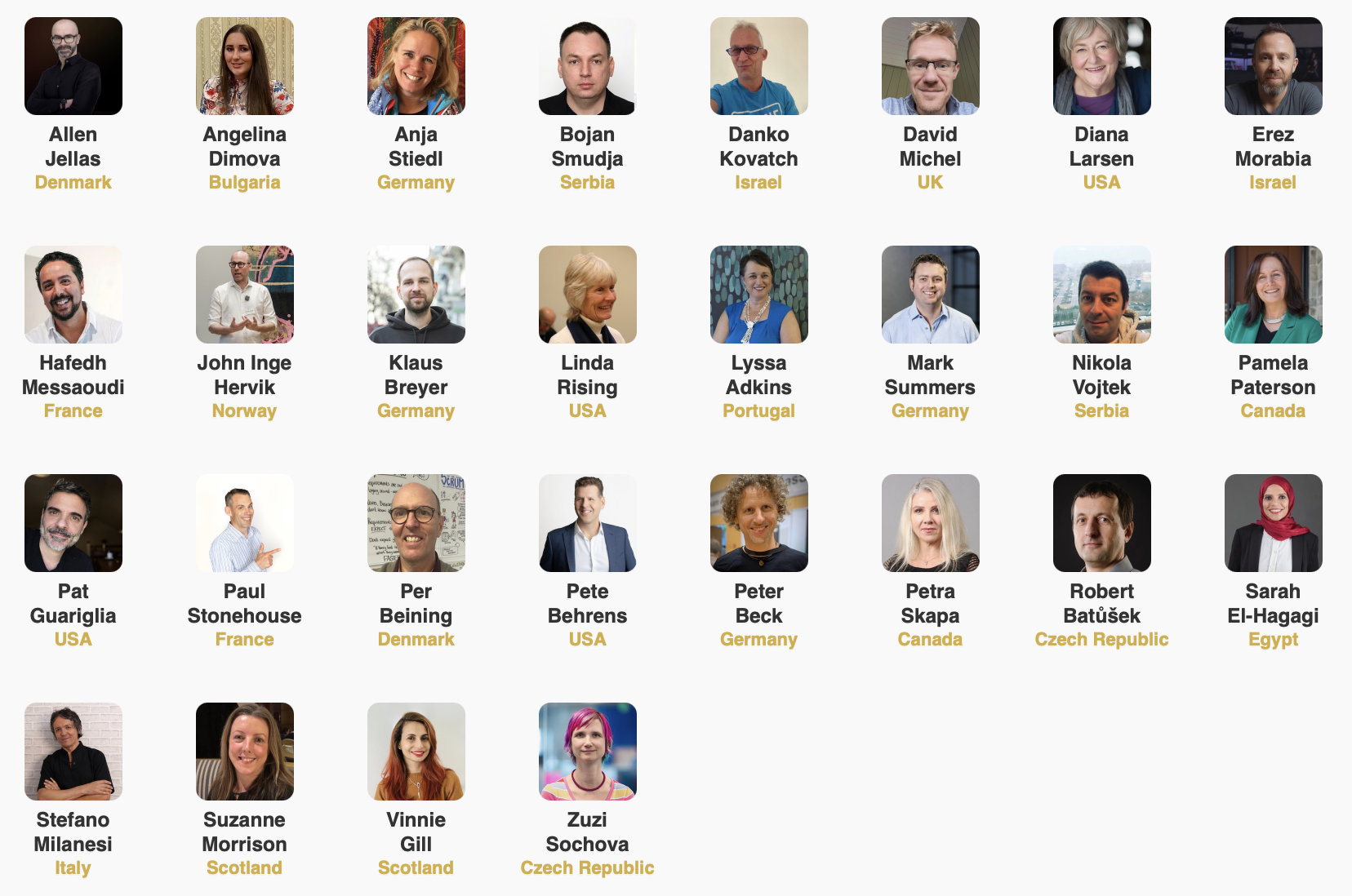
This year we have five keynotes:
- Alex Sloley: 𝗔𝗴𝗶𝗹𝗲 𝗜𝘀 𝗗𝗲𝗮𝗱

- Evan Leybourn: Friction to Flow
- Per Beining: Survive, thrive and drive — is your world in flux too?
- Alexey Krivitsky: You say you’ve got an AI SDLC. So which one?
- Sally Sloley: Stopping the madness: Why you should De-SAFe’ify
Before the lunch each day you’ll have an opportunity to propose discussions on any topic that interests you during the OpenSpace Market and invite everyone at the conference to join you in the discussion during our long lunch breaks. During the breaks and lunches, we provide free coaching by experiences coaches at the Coaches Clinic. During afternoons you have an option to choose talk or interactive workshop.See more at our online program – http://agileprague.com/AP.
Come and join us in Prague — I’d be happy to see you there!
 Conference: Sep 21–22, 2026
 Learn more: https://agileprague.com
The post Join me at Agile Prague Conference Sep 21-22, 2026 first appeared on Agile and Scrum Blog.
]]>The post Simplicity is the Key to the Success first appeared on Agile and Scrum Blog.
]]>And that’s where organizational agility came into a picture and try to simplify that back to a very lean and flexible minimum. It’s similarly painful as if you’re trying to lose a weight you’ve been gaining for past decades. You don’t have the right habits. You’re eating too much. You don’t eat healthy food. You’re an exercise. Now how many times you started as a New Year’s goal all over again. I’m going to lose my weight. Sounds familiar?
Organizations are like this mid age, old man or woman. They know it’s not working. They’re trying to change. But it’s super hard for them. They have the history of bad habits hardcoded in their DNA. So how can we help them? For some there is no light that will never change. It’s similar to people – they can be ill or die early. An organizational environment we call it losing their market position and share or eventually bankrupting. For the others, the trick is in creating a sense of urgency. Which is important not just for the top management, but everybody in the company. It’s so important that we go exercise every day. Change our practices change our habits. Change our daily routines. We can take an inspiration from the Japanese culture and make Kaizen (改善) – continuous improvement through small, consistent, incremental changes made daily by everyone – part of our daily life. It will be painful, no question about that. But I believe it will pay back. The world is not going to change back. We have to change.
The post Simplicity is the Key to the Success first appeared on Agile and Scrum Blog.
]]>The post Why organizations are failing to be successful with Agile and AI first appeared on Agile and Scrum Blog.
]]>But in nowadays complex environment enhanced by AI, which can help you to create output super fast, it’s not about quicker delivery. You can have as many output as you want in almost no time. Delivery is not a bottleneck anymore. More than ever organizations need to change and adapt their structure to be more outcome oriented. They need to shift from just ‘doing’ the work with limited skills available and limited work mandate to ‘driving’ where you expand the skills and work mandate to be really end to end expanding and whole solution outcome oriented.
More than ever organizations need to reconnect to the purpose, to the impact they want to create in the world and re-focus from delivering more functionality to strategic thinking. To defining business oriented goals and measure if the functionality we are delivering is leading there. They need to shift from metrics focused on output like a velocity and burn-up charts to outcome oriented metrics like OKRs where you have a clearly defined business objective you need to achieve and set of key results with baselines, which can give you a sense if you’re moving towards achieving your goal or just making people busy delivering crap.
Scrum is designed that way. It never contained any estimation techniques. It never had a velocity in the framework, instead it was for defining clear outcome to be achieved every sprint – sprint goal, and clear measurable business outcomes to be achieved in several sprint timeframe – product goals.
So if you want to become ready for nowadays quick and dynamic world, if you really want to become ready for any AI and don’t just spend more money on delivering stuff that no one needs, you need to transform your organization first. You need to change your company culture. You need to change the people mindset. You need to become Agile/adaptive first, shift from output-oriented thinking to business outcome focus. It’s not a simple change. It never had been, but it’s highly rewarding. If you need some help, send us a message. For past twenty years, I’ve been helping organizations to be successful in nowadays world. There is no question if organizations need to change. The time is now.
The post Why organizations are failing to be successful with Agile and AI first appeared on Agile and Scrum Blog.
]]>The post Join Agile Prague Conference first appeared on Agile and Scrum Blog.
]]>This year’s Agile Prague Conference takes place on 21–22 September 2026, and you don’t want to miss it.
I started Agile Prague because I wanted to bring inspiring, thought-provoking people to my hometown. As someone who helps organizations succeed through agility, curating great speakers from top conferences around the world is my way of spreading the message and bringing fresh, innovative ideas to our community. I truly believe that change starts with connection and conversation.
Agile Prague isn’t your typical “sit-all-day-in-the-dark-room” kind of conference. It’s a vibrant gathering of agile minds from all over the world. From inspiring keynotes to hands-on practical sessions, the program is packed with real stories, real people, and real change. Want a taste? Check out the 2026 lineup at agileprague.com – it’s shaping up beautifully.
But what truly sets Agile Prague apart is the format. It’s not just talks. We’ve got:
- Open Space – where you shape the agenda. Bring your burning questions, your stories, or just curiosity and suggest a topic.
- Coaches Clinic – get one-on-one time with experienced agile coaches for advice, mentoring, coaching or just a friendly reality check.
Whether you’re a Scrum Master, Product Owner, Leader, or just curious about better ways of working, you’ll find your people here. And you’ll leave not just with new ideas, but new friends too.
Bonus: A Deep-Dive Workshop Right After the Conference!
Make the most of your Agile Prague experience and join one of our deep-dive workshops right after the main event:
- ICAgile Agile Coaching Certification (ICP-ACC) with John Barratt – Deepen your coaching skills and earn a globally recognized certification in agile coaching.
So come and join us in Prague this September – let’s talk agility, breathe fresh ideas, and build something awesome together.
See you there?
The post Join Agile Prague Conference first appeared on Agile and Scrum Blog.
]]>The post Typical Mistake of Product Owners first appeared on Agile and Scrum Blog.
]]>So, what’s the solution to this problem? I think the solution is surprisingly simple, but we need to fundamentally change how we organize our business and how we prioritize. We need to look at things in more strategic way. We need to embrace the business agility and start welcoming changes already at the very beginning. The backlog was never meant to be fixed to-do list. Quite the opposite. It was meant to be dynamic and changeable. It was not meant to be full of requirements describing all the possibility details which must be delivered. Instead, the backlog supposed to be a collection of business cases, of small little hypothesis we phrased together to describe the needs of our customers, the pains of the business. And that’s very different from what you usually see in organizations.
So how can a backlog item look like?
Requirement
A detailed description of a functionality to be delivered. Very traditional, works for stable, known environments with no surprises. Usually large but can be split into smaller pieces.
The system shall provide users with an AI-based assistant that analyzes their transaction history and generates personalized financial tips. The assistant must support natural language queries and return responses in under 2 seconds.
The system shall allow users to set monthly spending limits for expense categories (e.g., dining, groceries, entertainment) and shall notify users via in-app alert when 80% of the limit is reached.
User story
If written correctly, it’s a frame for conversation with our users to describe a business case. It’s customer centric, value driven. It’s a good start to address customer’s needs. As a [persona] I want [what] So that [need].
As a Jenny (single mother, budget-conscious),
I want to have control over my monthly spending
so that I can keep my finances safe.
Story map
Like user story, but covering larger functionality, bringing the whole context of the user’s need. Is more consistent and coherent, balancing the customer perspective and the value.
Story: Jenny needs to Improve financial health
Map: Steps/Options/Journey:
| Connect Accounts | Visualize Expenses | Recommend | Track Progress |
|---|---|---|---|
| Bank API | Automatic Categories | Tailored Tips | Progress Bar |
| CSV | Charts | Rules-based Suggestions | Gamification |
| QR Code | Manual Tags | Benchmark Suggestion | Predictive Trends |
| Compare History | Savings Plans | Email Reports | |
| Weekly Trends |
Impact map
A mind map describing hypothesis in visual form. It’s created around well-defined business product goals to maximize the value towards the goal. It helps you to be very strategic. Business Goal (SMART) → Actor (Who can influence the outcome?) → Impact (How shall the actors behavior change?) → Scope (What can we do to support that change?).
Goal: Help people make better financial decisions: (15% increase in savings or a 20% reduction in non-essential spending)
Actor: Young professionals
Impact: Limit ad-hoc spending
Scope: AI assistant that offers spending alerts and budget tips
Hypothesis
Optimizes for testing assumptions and learning from them. It’s highly adaptive, emphasizing adaptability, and regular feedback. We believe [Functionality] Will result [Outcome] We will have confidence to proceed [Measures].
We believe that providing users with personalized, AI-driven financial insights based on their real-time spending behavior
Will result in a 15% increase in savings or a 20% reduction in non-essential expenses
We will have confidence to proceed if at least 60% of engaged users show measurable improvement in their financial behavior and report feeling more in control of their finances through in-app surveys or usage metrics.
And there is more. However, the more venerable, unpredictable, complex and ambiguous your environment is, the more you need to leverage the flexible and business-oriented techniques further down on my list. Requirements are not successful in unpredictable world. Organizations need more business agility, so forget requirements and try some story mapping, impact mapping, or hypothesis. Business agility is not an option anymore. It’s a necessity.
The post Typical Mistake of Product Owners first appeared on Agile and Scrum Blog.
]]>The post Top 10 Agile conferences to attend in 2026 first appeared on Agile and Scrum Blog.
]]>- AgilePrague Conference is one of the best conferences in Europe. In two days, it creates unique collaborative space. You can expect short talks, afternoon workshops, and inspirational keynotes. Plus, Prague is a great city to visit so you can come early and enjoy the weekend in Prague. Join Agile Prague on Sep 21-22, 2026, Prague, Czech Republic.
- Regional Scrum Gathering Tokyo is organized by an enthusiastic agile community in Japan. The purpose is to provide a “Ba” (place) where practitioners share ideas among Scrum practitioners having a great diversity. Regional Gatherings provides a unique experience and even if you don’t speak Japanese, there are some talks in English and other translated. Join me and the local community on January 7-9, 2026.
- XP Days Benelux is a conference with parallel workshops for experienced audience. This year it’s going to be in Belgium on Nov 26-27, 2026.
- Agile Coach Camp Cologne, Germany, Apr 30-May 2, 2026, is a global gathering, it is an open space event over 3 days of creativity, inspiration and co-working on new work-related topics.
- AgileDC is a one-day conference with a motto: Of the People, By the People, and For the People. Organized by local community and it has a great atmosphere. Washington DC metro area, Oct 26, 2026.
- AgileByExample, Warsaw, Poland, Oct 12-14, 2026, brings three days of intensive, example-driven content featuring global experts and deep dives into strategic agile governance and data-powered decision-making. This is where cutting-edge agile meets real-world application.
- Scan Agile is one of my favorite conferences. It’s where the future of Agile takes shape. This year is planned for March 17-18, 2026, in Helsinki, Finland.
- Agile Testing Days are almost a festival not a traditional conference. The full week of tutorials, talks, workshops, and networking events is just awesome. Join Testing Days even if you are not a tester. It’s in Potsdam, Germany on Nov 16-19, 2026.
- LeSS Conference is from practitioners for practitioners. Since 2016, LeSS Conferences is where LeSS practitioners share their LeSS experience and learn from new experiments. Book your time for October 8-9, 2026, Tokyo, Japan.
- Global Agility + Innovation Summit, Washington DC metro area, May 13, 2026, explores the Age of AI, focusing on building AI-powered products to leading in AI-powered environments.
The selection is based on my personal preference and experiences from those events.
Other conferences to consider this year
There are many great events that didn’t make it to this list, so please share your suggestions with us and we add them to the following list.
- Agile on the Beach is great event to attend and explore the summer in Cornwall, UK on July 2 – 3, 2026.
- Org Topologies Summit is a single track conference. Expect a curated mix of focused talks, hands-on workshops, engaging simulations, guided group discussions, and practical problem-solving. Mark your calendar for Oct 16, Amsterdam, Netherlands.
- Additional events: https://agilegatherings.com/
The post Top 10 Agile conferences to attend in 2026 first appeared on Agile and Scrum Blog.
]]>The post The State of Agility first appeared on Agile and Scrum Blog.
]]>The data clearly shows that investing in business agility is not only a cultural or operational choice—but a direct driver of measurable business results.
The top challenges to business agility are not about processes or frameworks—they are deeply cultural and systemic. The highest negative impact comes from outdated leadership capabilities, fixed mindsets, and a lack of clear transformation direction, often compounded by transformations that are too limited in scope to create real change. At a moderate level, organizations struggle with resistance to change, unsuitable ways of working, misalignment across leaders and business areas, low decision autonomy, and talent or skill gaps, all intensified by ongoing market disruption. Lower-impact issues, such as poor prioritization and excess WIP, are typically symptoms of these deeper systemic problems rather than root causes.
It’s never too late to start taking Business Agility as a strategic capability. To tackle some weak areas, join our agile leadership program and get my book Agile Leader: Leveraging the Power of Influence.
The post The State of Agility first appeared on Agile and Scrum Blog.
]]>The post The Difference Between a Team and a Group of Individuals first appeared on Agile and Scrum Blog.
]]>On the other hand, a team is a cohesive unit that works together towards a common goal. Teams share knowledge, support each other, and work collaboratively to achieve something greater than the sum of their individual efforts. Team members hold each other accountable, leverage each other’s strengths, and have a collective sense of responsibility.
Teams outperform groups of individuals for several reasons:
Collaboration over competition – Teams thrive on sharing ideas and solving problems together, leading to innovative solutions.
Accountability – Team members depend on each other, which encourages mutual accountability and a stronger commitment to success.
Synergy – Teams combine diverse skills, experiences, and perspectives to tackle challenges more effectively than individuals could on their own.
Teams are essential for fast decision-making, continuous improvement, and delivering high-quality outcomes.
So, let’s have a look. Are you a team or a group of individuals?
Answer the following questions on a scale of 1 to 5 (1 = Not at all, 5 = Always):
-
- Do team members actively collaborate and share ideas?
- Are individual contributions aligned towards a common goal?
- Is there accountability among team members for the success of the team?
- Does the group leverage the diversity of skills within the team?
Scoring:
-
- 16–20: You have a strong team! Collaboration, accountability, and shared goals are in place.
- 11–15: Your group is on the right track but could benefit from more intentional collaboration and alignment.
- 4–10: You have a group of individuals who may need guidance in forming a more cohesive team.
Fostering teamwork is the key to greater efficiency and success. A true team doesn’t just work together; they grow together.
The post The Difference Between a Team and a Group of Individuals first appeared on Agile and Scrum Blog.
]]>The post Agile Teams, Conflicts, and TKI first appeared on Agile and Scrum Blog.
]]>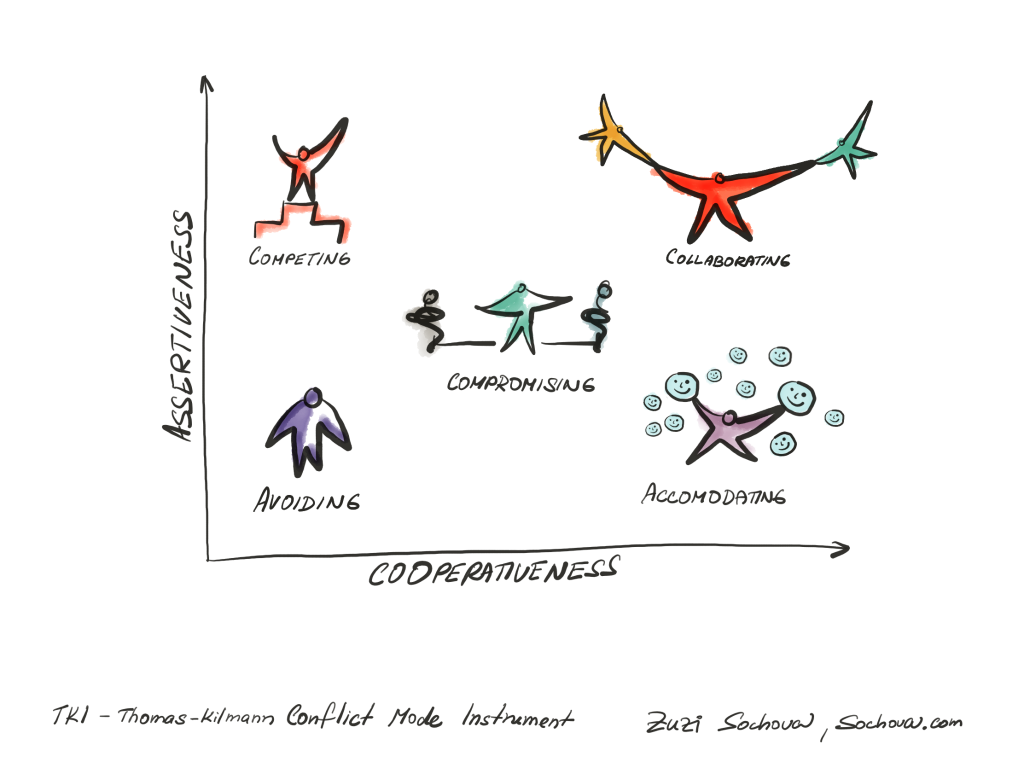
Competing
The Competing mode is in the assertive and uncooperative quadrant. Sometimes, making important decisions without the team’s agreement can damage trust and cause problems. For instance, a Product Owner makes sudden changes without talking to the team, which leads to anger and quality issues. Or a team member pushes their ideas without listening to others, which breaks up the work and creates tension. On the other hand, it’s okay to make quick decisions when you really need to. For example, a Scrum Master can quickly stop a discussion to make sure the team meets a goal, or a developer can say that security is important, even if others are more focused on velocity.
Collaborating
The Collaborating mode is in the assertive and cooperative quadrant. Sometimes, trying to get everyone to agree can slow things down and make teams less efficient. For instance, if you spend too much time brainstorming and trying to please everyone, it can delay decisions and cause a condition called “analysis paralysis.” Or, if you try to include everyone’s opinions, it can expand the scope of the project beyond what’s actually needed. On the other hand, this mode is great for bringing together different perspectives and building consensus when a team works together to make sure technical decisions align with business goals. This can improve product delivery and customer satisfaction, or when developers and the Product Owner collaborate to make sure user stories are clear and prioritized correctly.
Compromising
The Compromising mode is intermediate in both the assertiveness and cooperativeness quadrants. Sometimes, accepting partial solutions can lead to missed opportunities for achieving the best results. For instance, when the team agrees on a solution that partially satisfies everyone but fails to fully meet important technical or business needs, or when sacrificing test coverage to meet a sprint goal, causing later rework and technical debt. On the other hand, it can be useful for achieving temporary settlements like negotiating a minimal viable feature set with stakeholders to meet release deadlines or splitting time between refactoring and delivering new features to balance technical health and value delivery.
Avoiding
The Avoiding mode is in the unassertive and uncooperative quadrant. Sometimes, ignoring recurring problems can make things worse, and it can hurt how well the team works together. For instance, if the team keeps ignoring the same issues, it can lead to technical debt or if a Scrum Master avoids dealing with conflicts, the team can keep getting stuck. But there are times when it’s okay to ignore small problems or when others on the team are better suited to handle certain conflicts. For example, if there’s a non-essential process debate that can wait until the retrospective, or if a developer with deep expertise can handle a minor technical disagreement without involving the whole team.
Accommodating
Finally the Accommodating mode is in the unassertive and cooperative quadrant. Sometimes, trying to please everyone too much can lead to forgetting about important things like technical and delivery needs. For instance, if a developer keeps agreeing to impossible deadlines to keep everyone happy, it can cause burnout, or the team always puts stakeholder demands first, even if it means ignoring technical debt. On the other hand, sometimes it’s good to keep harmony and relationships in the first place. For example, agreeing to small feature requests to build goodwill with stakeholders or when a senior developer lets a junior team member lead a task to gain experience.
Agile teams are all about teamwork, and it’s important for everyone to know how they usually deal with conflicts and how leaning towards different modes can change the team dynamics. For example, if you have a ScrumMaster who is very strong on Avoiding and Accommodating, they might ignore team issues, fail to remove impediments, and compromising agile principles to keep everyone happy for a while. In a nutshell, they’re not really helping teams and organizations change. Great ScrumMasters need to have a balanced profile with high Collaborating to integrate team insights and fostering consensus, and moderate Competing and Compromising to protect the team, keep agile principles, and navigate trade-offs effectively.
In real life, people have a mix of tendencies. For example, imagine you have a Product Owner who is very strong on Collaborating and Accommodating. He will cooperate well with the customers and build great relationships which is awesome but at the same time, they try to make everyone happy and can’t set a clear direction or make a decision when needed.
So how to start? Encourage team members to take the TKI assessment to gain insights into their default conflict styles. Understanding one’s natural tendencies can help individuals consciously choose the most effective approach in various situations.
After that, I usually run a workshop to discuss the five conflict-handling modes and explore scenarios where each mode might be most effective. Using role-playing helps team members practice switching modes and understand the perspectives of others.
Great Scrum Masters are a great help. They are good at recognizing conflict modes and are able to help teams find the most constructive way to deal with conflicts. They coach individuals to reflect on their tendencies and help them to create a better balance. They’re the ones who make sure everyone feels safe to share their thoughts, and they step in when things start to get too heated.
The post Agile Teams, Conflicts, and TKI first appeared on Agile and Scrum Blog.
]]>The post Why You Shouldn’t Miss Agile Prague Conference 2025 first appeared on Agile and Scrum Blog.
]]>If you share that passion—for Agile, for leading meaningful change, or for staying ahead in how we work and collaborate—then Agile Prague Conference 2025 is the place for you this September. Join us and be part of something truly inspiring.
Here’s why this event stands out—and why you should join us in Prague on September 15–16, 2025.
 A Truly Global Agile Gathering
Agile Prague brings together a multinational audience of practitioners, leaders, coaches, and innovators. All sessions are in English, welcoming participants from across Europe, North America, Asia, and beyond. It’s your chance to connect with global peers, share experiences, and build long-lasting professional relationships.
 World-Class Speaker Lineup
This year’s program features inspiring keynotes and talks from some of the most respected voices in the Agile space:
-
Diana Larsen – Thought leader in Agile retrospectives and organizational change
-
Lyssa Adkins – Renowned Agile Coach and author
-
Linda Rising – Agile pioneer and expert in group dynamics
-
Pete Behrens, Danko Kovatch, Pamela Paterson, Pat Guariglia, Petra Skapa, Erez Morabia – And many more!
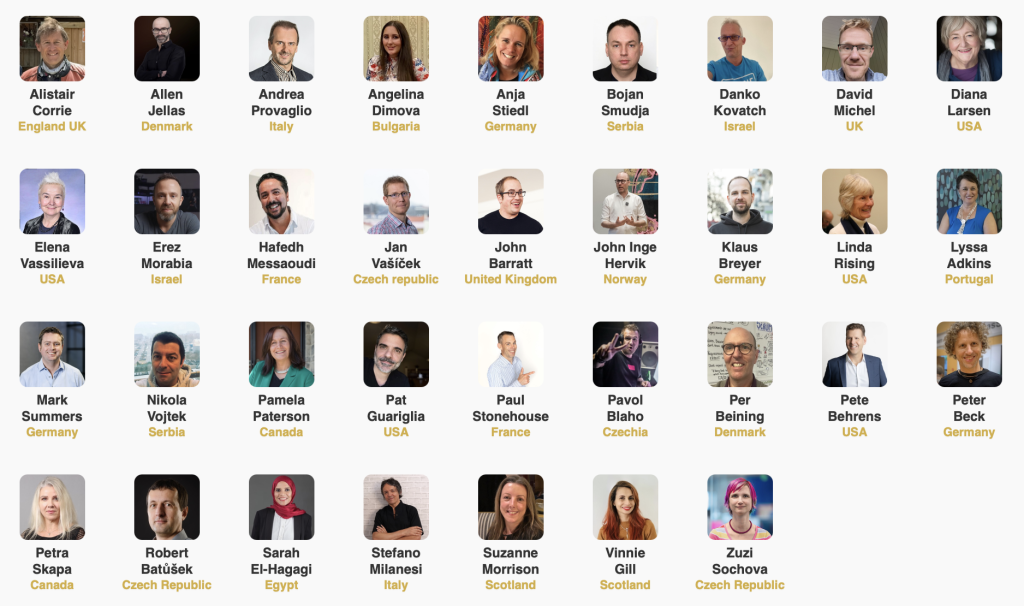
The diversity of perspectives—from leadership and coaching to engineering culture, agility in organizations, and psychological safety—makes this conference incredibly rich in learning.
 Deep Learning & Practical Takeaways
Whether you’re a Scrum Master, Agile Coach, Product Owner, or team lead, the sessions are designed to deliver practical insights you can apply immediately. Real-world case studies, expert advice, and engaging formats like workshops and open spaces ensure you don’t just sit and listen—you learn by doing.
 The Magic of Prague
What better place to attend a conference than Prague—a city of historic charm, vibrant culture, and stunning architecture? Agile Prague gives you the perfect excuse to combine professional growth with sightseeing and inspiration. Take a walk through Old Town, cruise the Vltava River, and enjoy world-class cuisine between conference days.

 Early Bird Registration Now Open
The Early Bird tickets are available for a limited time, offering great value for an unforgettable Agile experience. And if you’re looking to go even deeper, you can combine the conference with hands-on workshops right after the event—led by global experts like Jurgen De Smet and John Barratt on Sep 17-18.
 Don’t Wait – Join Us in Prague!
Agile Prague Conference 2025 is not just another Agile event. It’s a chance to elevate your practice, grow your influence, and connect with a truly global community.
Secure your Early Bird spot now
See you in Prague!
The post Why You Shouldn’t Miss Agile Prague Conference 2025 first appeared on Agile and Scrum Blog.
]]>