

Every week, the Financial Post breaks down the most interesting developments in the week’s world of investing, from top performers to surprising analyst calls and stocks to have on your radar.
Which stocks and sectors could win from expanded trade, what tax-loss selling candidates could also be buys and more from The Week in Stocks.
Stock of the week: Algoma Steel Group Inc.
Shares of Algoma Steel Group Inc. (ASTL:TSX) rose 15 per cent on the S&P/TSX composite index after Prime Minister Mark Carney and Ontario Premier Doug Ford announced $5 billion in support for Canada’s beleaguered steel industry , which has been hit with 50 per cent tariffs by the United States. Stifel analyst Ian Gillies said in a note on Oct. 21 that the Sault Ste. Marie-based company in Northern Ontario could be a “key beneficiary” of the fund — some of which had previously been announced — to build a proposed beam mill. The analyst has a buy rating on Algoma and a price target of $11.50 per share. Shares closed Friday at $6.63. “Canada is a significant importer of beam products,” Gillies said, adding that both Ontario and Ottawa had previously indicated interest in helping the company build such a facility as the two governments look to reduce the flow of foreign steel imports into the country. Grants from the fund would benefit the company and the shares the most, Gillies said, since Algoma is already carrying $920 million in debt. Shares of Algoma have a 12-month price target of $7.63 based on the calls of four analysts, according to Bloomberg.
Keeping score
These are the stocks and sectors that could win from expanded trade, says Rosenberg
David Rosenberg of Rosenberg Research & Associates said in a report on Oct. 19 that that the move to expand Canada’s trade footprint is moving from rhetoric to reality, with exports to countries other than the United States up 30 per cent year over year. The federal government is looking to double exports to other countries by 2036 and Rosenberg identified some potential TSX sector and stock winners as Canada branches out. One of his top sector picks is aerospace and defence , with the TSX aerospace and defence index already up 104 per cent since January 2025. Exports to the U.S. are up three per cent but have risen 20 per cent to the rest of the world. “With global defence spending likely to remain elevated, we see this as one of the more durable secular growth themes in the Canadian market,” Rosenberg said. He also likes the prospects for Canadian banks and their international franchises. For example, Bank of Nova Scotia (BNS:TSX) has the strongest exposure to Latin America and meaningful exposure to Europe, while Royal Bank of Canada (RY:TSX) has the “broadest European platform of all” and Bank of Montreal (BMO:TSX) has “significant European capital markets franchise.” He also suggested railways and pipelines as another way to play the export card through Global X Equal Weight Canadian Pipelines Index ETF (PPLN ETF:TSX). It has a dividend yield of approximately 4.5 per cent. “The combination of dependable income, relatively low beta (volatility), and long-term exposure to Canada’s changing export infrastructure makes the sector a valuable source of diversification,” Rosenberg said.

Why these CIBC tax-loss selling candidates could also be buys
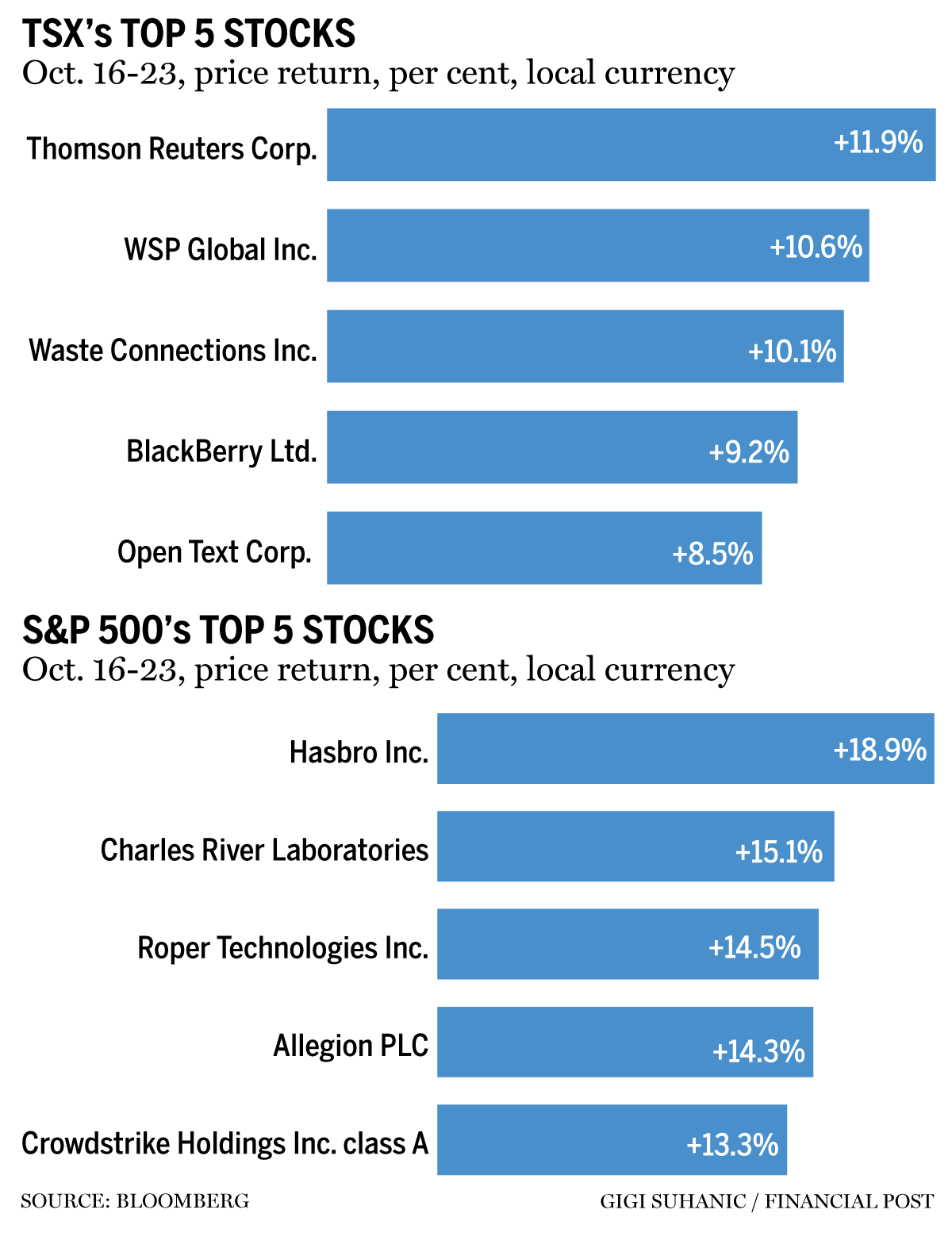
Mid-October is the time when investors start to pick through their portfolio for tax-loss selling candidates. In the search for shares to sell, “the same process can create opportunity” for buyers, Sid Mokhtari, an analyst at CIBC Capital Markets, said in a report on Oct. 16. Candidates for tax-loss selling can rebound, especially if the company fundamentals are sound and this is an opportunity “for bargain hunters looking for temporarily oversold and mispriced TSX names,” Mokhtari said. CIBC built a list of tax-loss names to sell and potentially repurchase. Among the criteria: shares must have already fallen at least 20 per cent as of the beginning of the tax loss selling period and have recorded an average loss of 1.3 per cent from mid-October to mid-December. Ten of 36 names that fit that bill come from the TSX 60 large cap index and include Telus Inc. (T:TSX), Rogers Communications Inc. (RCI/B:TSX), BCE Inc. (BCE:TSX), Gildan Activewear Inc. (GIL:TSX), Brookfield Corp. (BN:TSX), Intact Financial Corp. (FC:TSX), WSP Global Inc. (WSP:TSX), CAE Inc. (CAE:TSX), Kinross Gold Corp. (K:TSX) and First Quantum Minerals Ltd. (FM:TSX). On the small-cap side, some tax-loss and repurchase names included Cogeco Inc. (CGO:TSX), Pizza Pizza Royalty Corp. (PZA:TSX), MTY Food Group Inc. (MTY:TSX) and Boston Pizza Royalties (BPF/U:TSX). CIBC said it has previously tracked, on average, a 4.15 per cent return when tax-loss candidates are repurchased.
Price target hikes, holds and starts
- TD Cowen analyst Tim James hiked his price target for Mullen Group Ltd. (MLT:TSX) to $36 from $32 on better than expected third quarter earnings. Shares closed Friday at $28.76.
- ATB Cormark Capital Markets analyst Kalvin Baim started coverage of Parex Resources Inc. (PXT:TSX) with a price target of $35 after a pair of deals made it the largest independent oil producer in Colombia. Shares closed Friday at $30.13.
- TD Cowen analyst R. Scott Siefers has a buy rating on Citigroup Inc. (CI:NYSE) and a price target of US$140 after the company said China granted regulatory approval for the banking giant to establish a wholly-owned securities venture in China. Shares closed Friday at US$120.62.
- UBS Global Research analyst Jospeh Spak hiked his price target for Tesla Inc. (TSLA:Nasdaq) to US$425 from US$391 on the belief shares will “mostly trade with evolving views and sentiment on a potential combination with SpaceX.” Shares closed Friday at US$372.22.
- BMO Capital Markets analyst Jeremy McRea hiked his price target for Spartan Delta Corp. (SDE:TSX) to $18 from $16 on the belief that the market “may still be underappreciating” the scale of the company’s inventory, well economics and infrastructure ownership. Shares closed Friday at $14.87.
- National Bank of Canada analyst Baltej Sidhu maintained his outperform rating and $20 price target for Polaris Renewable Energy Inc. (PIF:TSX) ahead of third quarter earnings. Shares closed Friday at $13.90.
- CIBC Capital Markets analyst Tal Woolley started coverage of Loblaw Cos. Ltd. (L:TSX) with a price target of $81 on the belief that the grocery giant is “on the best competitive footing in its history.” Shares closed Friday at $68.67.
Every week, the Financial Post breaks down the most interesting developments in the week’s world of investing, from top performers to surprising analyst calls and stocks to have on your radar.
Are you an investor looking for stock ideas and market insight? Sign up for the weekly FP Investor Newsletter here to get the best of the Financial Post’s investing news, analysis and expert commentary straight to your inbox.
• Email: gmvsuhanic@postmedia.com
]]>Which stocks are CIBC’s top picks to navigate volatile gold and silver prices, what are TD’s energy infrastructure picks and more from The Week in Stocks.
Stock of the week: Fairfax Financial Holdings Ltd.
Fairfax Financial Holdings Ltd. (FFH:TSX) finished this week among the TSX’s top 10 gainers, up nearly eight per cent after the Toronto-based company led by Canadian billionaire Prem Watsa announced a deal for a controlling stake in India -based IDBI Bank Ltd. “The investment is a long-term play on the high-growth potential of India and its banking industry,” Phil Hardie, an analyst at Scotia Capital Markets said in a note on Oct. 15. He has a 12-month price target on Fairfax of $2,950. RBC Capital Markets analyst Bart Dziarski cut his price target to $3,170.85 from $3,260.11 on the news while BMO Capital Markets analyst Tom MacKinnon hiked his price target to $2,700 from $2,500 on the India deal plus Fairfax’s participation in Loblaw Cos. Ltd.’s purchase of U.K. pharmacy chain Boots . Fairfax shares closed Friday at $2,403.11. Scotia’s Hardie said there was concern the IDBI deal would muddle Fairfax’s efforts to be viewed more as an insurance company than an investment conglomerate. But since the announcement, management clarified its plans to expand its offerings with a growing Indian insurance company and an established provider of investment banking and wealth management services, he said. The deal has been approved by the government of India, but still requires other approvals. It is expected to close in the first quarter of 2027 or sooner, Hardie said. Shares of Fairfax have a price target of $2,910.12 based on the calls of seven analysts, according to Bloomberg.
Keeping score
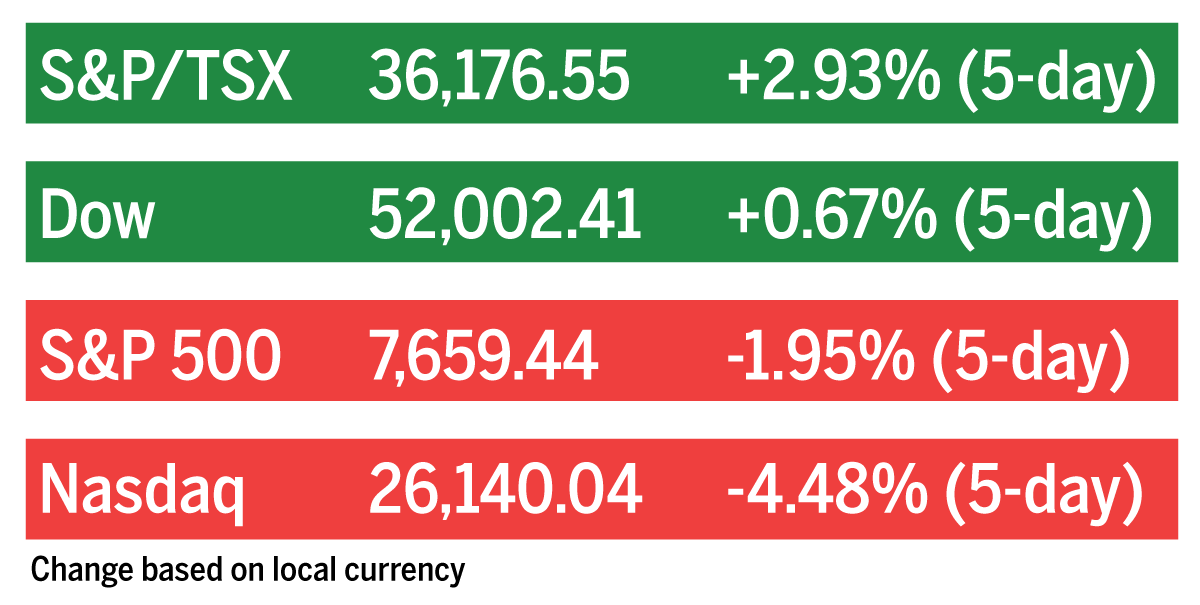
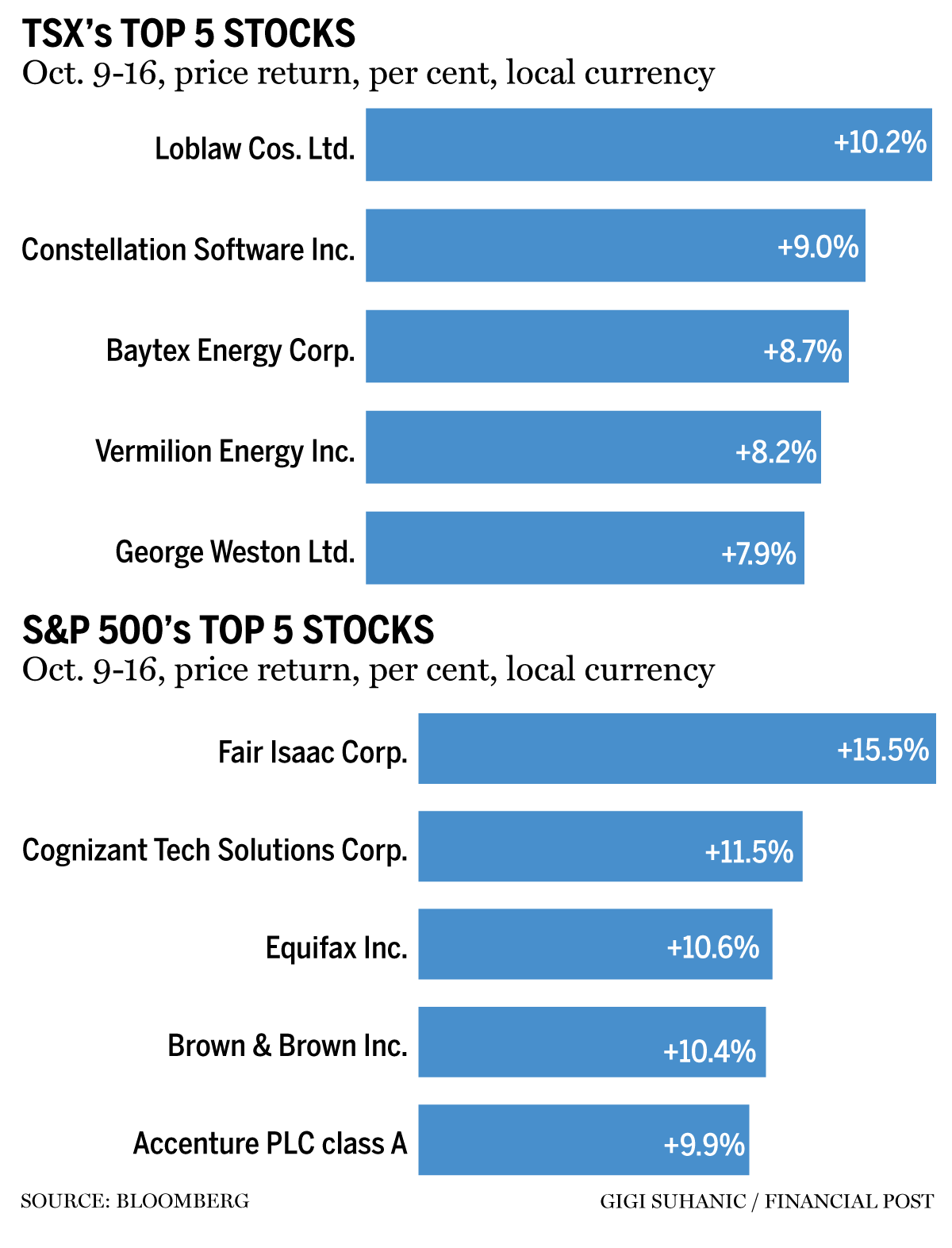
TD’s energy infrastructure picks as earnings loom
Energy earnings season is nearing and TD Cowen analysts said in a note on Oct. 16 that they favour TC Energy Corp. (TRP:TSX) in the infrastructure sector as they expect the pipeline giant to make project announcements including on the Canadian NGTL system, and the Crossroads and other U.S. natural gas projects. TD Cowen analyst Aaron MacNeil hiked his price target slightly for TC Energy to $103 from $102, saying investors should focus more on the updates for 2027 and possible final investment decisions rather than earnings, which will be released on Oct. 30. Shares closed Friday at $87.13 and are up 15.3 per cent year to date. Shares got a boost when the company announced a deal on Oct. 13 with five Indigenous groups to sell them a share of the company’s stake in the Coastal GasLinkpipeline , which feeds the LNG Canada terminal on the B.C. coast. Still, risks lurk for the energy infrastructure sector including higher interest rates , which make debt-funded projects more expensive. Infrastructure stocks typically perform poorly as rates rise, MacNeil said. TD also hiked its price targets for Keyera Corp. (KEY:TSX) ($70 from $67), Pembina Pipeline Corp. (PPL:TSX) ($79 from $77), Gibson Energy Inc. (GEI:TSX) ($36 from $35) and Enbridge Inc. (ENB:TSX) ($83 from $81). Analysts cut the target for South Bow Corp. (OSOBO:TSX) to $52 from $53.
CIBC’s top stock picks to navigate volatile gold and silver prices
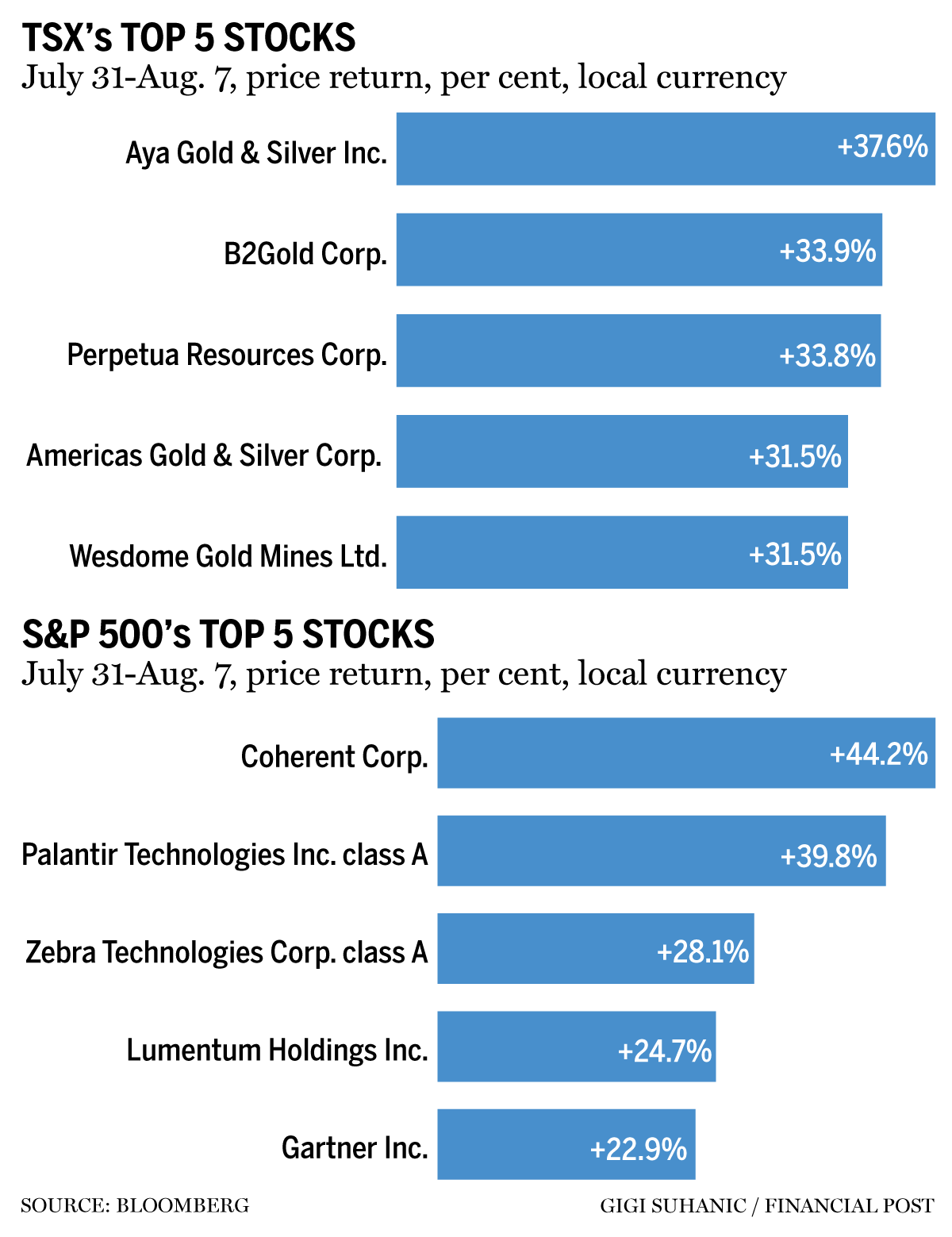
Gold and silver prices fell 5.4 per cent and 14.1 per cent in the third quarter, presenting a challenge for precious metals miners, CIBC Capital Markets said in a report on Oct. 15. “We expect softer production and higher costs for many,” Anita Soni, an analyst at CIBC said. It cut its price forecasts for the two metals, but also offered up its top picks for investors who want exposure to the sector but are risk averse. Among those names are Agnico Eagle Mines Ltd. (AEM:TSX). Its price target was cut to $339 from $298. Shares closed Friday at $267.50. Newmont Corp.’s (NEM:NYSE) price target was cut to US$154 from US$170. Shares closed Friday at US$118.60. Other names on the risk-averse roster included Wheaton Precious Metals Corp. (WPM:TSX), Pan American Silver Corp. (PAAS:TSX), Franco-Nevada Corp. (FNV:TSX) and Snowline Gold Corp. (SGD:TSX). CIBC analysts said they favour Kinross Gold Corp. (K:TSX), IAMGOLD Corp. (IMG:TSX), B2Gold Corp. (BTO:TSX), Alamos Gold Inc. (AGI:TSX), Orezone Gold Corp. (ORE:TSX) and Discovery Mining Ltd. (DSV:TSX) for those looking for more leverage. Other gold names not in the top picks list that saw their price targets increase were Allied Gold Corp. (AAUC), going to $40 from $39, and Aya Gold & Silver Inc. (AYA:TSX), rising to $55 from $48. Shares closed Friday at $29.65 and $37.64, respectively.

TD Cowen’s case for Coca-Cola
Shares of Coca-Cola Co. (KO:NYSE) are up nine per cent so far in October and TD Cowen analyst Robert Moskow is forecasting more potential upside after Yum! Brands Inc.’s (YUM:NYSE) U.S. restaurant chain KFC said it was switching to Coca-Cola from PepsiCo. Inc. (PEP:NYSE) as its drinks supplier starting in January 2027. Moskow maintained his price target of US$100 for Coke. Shares closed Friday at US$93.90. The Coke-KFC deal is “more symbolic than quantitative,” Moskow said in a note on Oct. 16, though he estimated that it will still add 20 basis points to total revenue when the contract starts. Coke gained 70 basis points in the pop market over the past two years compared with a loss of 150 basis points for Pepsi, Moskow said.
Price target hikes, cuts and starts
- BMO Capital Markets analyst John Gibson hiked his price target for Enerflex Ltd. (EFX:TSX) to $50 from $48 on its latest data centre win. Shares closed Friday at $35.23.
- CIBC Capital Markets analyst Mark Jarvi initiated coverage of a few U.S. energy companies including NRG Energy Ltd. (NRG:NYSE) and Vistra Corp. (VST:NYSE) on high free cash flow yield in the former’s case and “solid upside to tightening U.S. power fundamentals” in the latter’s. Price targets are US$173 and US$201, respectively. Shares closed Friday at US$103.75 and US$152.02.
- BMO Capital Markets analyst Brian J. Pitz cut his price target for Netflix Inc. (NFLX:Nasdaq) to US$125 from US$135 as investors remain pessimistic about growth in its U.S. and Canadian markets. Shares closed Friday at US$70.53.
- Stifel analyst Justin Keywood hiked his price target for Knight Therapeutics Inc. (GUD:TSX) to $12.25 from $11.00 on his belief there exists as much as 500 basis points of pent-up margin expansion, just not until 2029. Shares closed Friday at $11.04.
- Raymond James analyst Christian Reiter started coverage of Atlas Salt Inc. (SALT:TSXV) with a price target of $4.00 and an outperform rating on “key development milestones falling into place” for its Great Atlantic mine. Shares closed Friday at $1.45.
Every week, the Financial Post breaks down the most interesting developments in the week’s world of investing, from top performers to surprising analyst calls and stocks to have on your radar.
Are you an investor looking for stock ideas and market insight? Sign up for the weekly FP Investor Newsletter here to get the best of the Financial Post’s investing news, analysis and expert commentary straight to your inbox.
• Email: gmvsuhanic@postmedia.com
]]>Which stocks National Bank added to its dividend all-stars portfolio, why David Rosenberg sees the market “flashing a warning” and more from The Week in Stocks.
Stock of the week: Atco Ltd.
Shares of Atco Ltd. (ACO/X:TSX) jumped 10 per cent this week before paring some of those gains after it announced Oct. 5 that it was selling its Canadian Utilities Inc. subsidiary to Emera Inc. (EMA:TSX) for $14.3 billion. National Bank of Canada Capital Markets analyst Patrick Kenny hiked his price target for the shares of what he dubbed the “new Atco” to $93 from $79, saying the company will have $700 million at hand including an injection from Emera, plus $250 million in Emera shares as part of the deal. Atco shares closed Friday at $79.76. The focus for “new Atco,” will be to speed up growth in its core housing, defence and industrial services businesses, Kenny said in a note on Oct. 7. Other analysts hiked their price targets. RBC Capital Markets analyst Maurice Choy raised his to $94 from $80, while TD Cowen’s John Mould lifted his to $98 from $76. The Emera deal is expected to close in the third to fourth quarter of 2027. Atco has a 12-month price target of $91.33 based on the calls of six analysts, according to Bloomberg.
Keeping score


Dividend all-stars from National Bank Capital Markets
National Bank of Canada Capital Markets just updated its portfolio of dividend all-stars for the second half, which carries an average yield of 4.9 per cent, compared with the yield on the 10-year Government of Canada bond of approximately four per cent. The portfolio also beat the S&P/TSX composite index in the first half of the year, gaining 10.8 per cent versus 7.2 per cent. “Against a backdrop of continued trade uncertainty and increased market volatility, dividend stocks remain attractive for investors seeking stable and elevated income,” National Bank said in a report on Oct. 8. Here’s a look at the names that were added: Brookfield Asset Management Ltd. (BAM:TSX) made the cut on an earnings growth outlook in the high teens and a dividend yield of 4.5 per cent, which, since 2022, is up approximately 57 per cent. It has a price target of $70. Shares closed Friday at $65.52. MCAN Mortgage Corp. (MKP:TSX) offers “better positioning in an adverse credit scenario.” It has a yield of five per cent and a target price of $27. Shares closed Friday at $20.89. Open Text Corp. (OTEX:TSX) has a long track record of dividend increases since fiscal year 2013. The company has a dividend yield of 4.8 per cent and National expects it to sustain that. It has a price target of $47. Shares closed Friday at $33.82.
Market is ‘flashing a warning,’ says David Rosenberg
The S&P 500 index has breadth issues and that is a warning sign for investors, David Rosenberg , founder of Rosenberg Research & Associates Inc. said in a note on Oct. 8. The S&P 500 hit a new high this week, but several important metrics have deteriorated between then and the last time the index peaked on Aug. 13, Rosenberg said. For example, nearly 75 per cent of industry groups have declined, the equal-weight index is down five per cent bank and real estate subsectors have lost more than 10 per cent. Since August, few stocks are trading above their 200-day moving average, a move that is considered a bearish signal. “Market breadth tends to lead prices, and right now it is flashing a warning,” Rosenberg said.
Defence Investment Agency a ‘driver’ for these shares, says CIBC
The federal government this week announced it was establishing the Defence Investment Agency (DIA) as a Crown corporation with its own associate minister and a board of directors. The DIA will have the ability the undertake production, procurement and investment for Canada’s national defence. “We continue to view the initiative as a key driver for our defence-exposed names,” including Bombardier Inc. (BBD/B:TSX), CAE Inc. (CAE:TSX), Chorus Aviation Inc. (CHR:TSX) and Exchange Income Corp. (EIF:TSX), Krista Friesen, an analyst at CIBC Capital Markets, said in a note on Oct. 6. Friesen has a price target on Bombardier of $365. Shares closed Friday at $297.59 and have been on a downswing since late July. The analyst has price targets of $47 and $33, respectively, for CAE and Chorus. They closed Friday at $33.86 and $28.66. Her price target for Exchange Income is $151. It closed Friday at $116.37.
What Cenovus deal for Athabasca means for the shares
Cenovus Energy Inc. (CVE:TSX), announced a deal for Athabasca Oil Corp. (ATH:TSX) for $5.7 billion this week. Initially, investors pushed shares down following the announcement, but they since regained those losses, with Raymond James analyst Micheal Barth saying the proposed purchase is a “better use of capital than (share) buybacks” in a note on Oct. 6. Barth hiked his price target for Cenovus to $53 from $51. Shares closed Friday at $44.75. “All told, we like the deal,” as it still leaves plenty of free cash flow to reduce debt and return cash to shareholders, he said. As well, there is a “clear path to tripling production by 2032.” National Bank of Canada analyst Travis Wood cut his price target for Cenovus to $57 from $60 but maintained his outperform rating on the deal. Cenovus has a price target of $50.87 based on the calls of 19 analysts, according to Bloomberg.
Price target hikes, cuts, holds and starts
- RBC Capital Markets analyst Harrison Reynolds maintained his price target for DPM Metals Inc. (DPM:TSX) of $65 after it released third quarter production results that indicated the company will hit the high end of guidance. Shares closed Friday at $59.41.
- Raymond James analyst Brad Sturges increased his price target for Flagship Communities REIT (MHC/U:TSX) to $25.25 from $25 on improving occupancy rates and an increase in average long-term lot rentals. Shares closed Friday at $21.15.
- TD Cowen analyst Derek Lessard reduced his price target for Boyd Group Inc. (BYD:TSX) to $175 from $200 but nonetheless named the company a top pick. “We see a rare opportunity to own a high quality compounder before the market recognizes the opportunity,” he said in a note on Oct. 8. Shares closed Friday at $111.32.
- RBC Capital Markets analyst Nelson Ng maintained his price target of $20 for Chemtrade Logistics Income Fund (CHE/U:TSX) after the company said it would convert from an income trust to a corporate structure, which Ng said should expose it to more investors. Shares closed Friday at $14.68.
- TD Cowen analyst Derick Ma initiated coverage of Versamet Royalties Corp. (VMET:TSX) with a price target of $21. Shares closed Friday at $14.68.
Every week, the Financial Post breaks down the most interesting developments in the week’s world of investing, from top performers to surprising analyst calls and stocks to have on your radar.
Are you an investor looking for stock ideas and market insight? Sign up for the weekly FP Investor Newsletter here to get the best of the Financial Post’s investing news, analysis and expert commentary straight to your inbox.
• Email: gmvsuhanic@postmedia.com
]]>Which stocks could be winners from LNG Canada’s green-lit expansion, what companies made RBC’s Top 30 list for the fourth quarter and more from The Week in Stocks.
Stock of the week: First Quantum Minerals Ltd.
Shares of First Quantum Minerals Ltd. (FM:TSX) whipsawed this week, falling 31 per cent on Wednesday before recovering to close 15 per cent in the red on news of a Panamanian commission’s recommendations regarding the company’s giant copper mine in the country, Cobre Panama. Investors latched onto references to an “orderly closure” but several analysts said the focus should be more on the recommendation that the company reopen Cobre Panama under a framework that would self-finance the site’s future closure and rehabilitation. Shares have since regained just over three per cent as of Sept. 30, with many analysts reiterating their 12-month price targets for First Quantum shares on the belief that the findings were not as damaging to the company as initially believed. “We continue to think a reasonable deal can be reached that benefits both Panama and First Quantum, although uncertainty remains around a number of variables including ownership, taxes, royalties and the closure plan and timing,” Sam Crittenden, an analyst at RBC Capital Markets, said in a note on Sept. 30. Crittenden has a price target of $52 and an outperform/speculative risk rating on the stock. Shares closed Friday at $39.35. TD Cowen analyst Craig Hutchison joined other analysts this week in saying the key recommendation is a negotiated restart for the giant copper mine. Hutchison maintained his price target of $47. First Quantum has a price target of $48.96 based on the calls of 24 analysts, according to Bloomberg.
Keeping score


Possible winners from LNG Canada expansion

It was a big week for the energy sector after LNG Canada , a consortium of global energy companies, green lit phase 2 of the west coast facility that ships fuel to Asia. The decision “represents a significant milestone for the Canadian natural gas sector, and signals growing confidence in Canada’s energy investment environment,” Scotia Capital Markets analysts led by Robert Hope said in a note on Sept. 29. The team highlighted several companies that it said could benefit from the shift in sentiment. “Key beneficiaries” included Advantage Energy Ltd. (AAV:TSX), Birchcliff Energy Ltd., (BIR:TSX), Peyto Exploration and Development Corp. (PEY:TSX) and Paramount Resources Ltd. (POU:TSX). In tandem with the LNG Canada announcement, the expansion of the Coastal GasLink pipeline , which supplies LNG Canada, was given the go-ahead. “We believe the expansion phase can generate meaningfully stronger returns than the initial build, which was materially impacted by cost overruns,” the Scotia team said, which potentially supports shares of TC Energy Corp. (TRP:TSX). TC Energy owns a 35 per cent stake in Coastal GasLink. Hope and his team also predict rising gas production will spill over into areas such as transportation and storage, extraction and fractionation. “As a result, we view continued LNG development as a positive catalyst for AltaGas Ltd. (ALA:TSX), Keyera Corp. (KEY:TSX), and Pembina Pipeline Corp. (PPL:TSX) given their extensive natural gas and natural gas liquids infrastructure footprints,” they said.
Pacific Link oil pipeline still has ways to go but these stocks could benefit, analysts say
Though the proposed oil pipeline from Alberta to the West Coast — now called Pacific Link — still faces hurdles despite its designation as a project of national interest, according to CIBC Capital Markets analysts, companies associated with it may benefit, they said in a note on Oct. 1. As a project of national interest, the pipeline is now on an accelerated regulatory track moving it closer to construction. Among the next set of hurdles are the requirement for Indigenous consultation and “we continue to view successful Indigenous participation and economic partnership as essential for project advancement and one of the largest sources of schedule uncertainty,” Robert Catelliler, a CIBC analyst, said. Other hurdles include the economics of the pipeline and costs associated with the Pathways carbon capture and storage requirements. Inflation and rising interest rates could also balloon the overall cost of the project, estimated at $35 billion to $45 billion, by another $5.5 billion to $6.5 billion based on rates of 6.5 per cent, CIBC said. Pembina Pipeline Corp. (PPL:TSX) has the most direct exposure to the project with a 10 per cent interest, though that remains subject to a final investment decision. More broadly, CIBC said Keyera and AltaGas are best positioned to benefit from increased oilsands production, while Gibson Energy Inc. (GEI:TSX) could win on infrastructure growth. Other names that should experience an “indirect tailwind” include TC Energy and Rockpoint Gas Storage Inc. (RGSI:TSX), John Mould, a TD Cowen analyst, said in a note on Oct. 1. On the negative side, the project could compete with Enbridge Inc. (ENB:TSX) and South Bow Corp. (SOBO:TSX) projects, although Mould said he thinks that theme is “overblown.”
RBC’s Top 30 list gains some names, loses others, for the last quarter of 2026
RBC Capital Markets has updated it Top 30 list of best ideas, as markets head into the final stretch of 2026. For the fourth quarter, RBC analysts dropped names including Airbnb Inc. (ABNB:Nasdaq), beverage giant Diageo PLC (DGE:LN) and pharmaceutical company Merck & Co. Inc. (MRK:NYSE), though they maintained outperform ratings for companies, except Merck. New names on the list included Alphabet Inc. (GOOG:Nasdaq), American Healthcare REIT Inc., (AHR:TSX), Eli Lilly & Co. (LLY:TSX), MSCI Inc. (MSCI:Nasdaq) and Siemens Energy AG (ENR:GR). There were some Canadian names among the keepers including AltaGas Ltd. (ALA:TSX), Apotex Health Corp. (APTX:TSX), Canadian National Railway Co. (CNR:TSX), Constellation Software Inc. (CSU:TSX) and Loblaw Cos. Ltd. (L:TSX). Third-quarter performance for the top 30 list was muted, posting a return of 1.1 per cent in local currency compared with 2.2 per cent for the S&P 500 index and 0.4 per cent for the S&P/TSX composite index . Since inception, the list is up 13.5 per cent annualized versus 15.3 per cent for the S&P 500 and 14.7 per cent for the TSX.
Price target hikes and starts
- Scotia Capital Markets analyst Kevin Fisk hiked his price target for Ovintiv Inc. (OVV:NYSE) to US$75 from US$70 ($106.79 from $99.39 for OVV:TSX) with the oil company ranking as a top pick. Shares closed Friday at US$60.34.
- RBC Capital Markets analyst Andrew Wong initiated coverage of IsoEnergy Ltd. (ISO):TSX) with a rating outperform-speculative risk and a price target of $25 on the uranium company’s varied exposure to a tightening market. Shares closed Friday at $13.15.
- Raymond James analyst Michael Barth hiked his price target for Enerflex Ltd. (EFX:TSX) to $49 from $48 after it announced a 450 megawatt power project. Shares closed Friday at $35.02.
- Scotia Capital Markets initiated coverage on Tamarack Valley Energy Ltd. (TVE:TSX) with a price target of $17 on expected significant growth in production and free cash flow. Shares closed Friday at $13.38.
Every week, the Financial Post breaks down the most interesting developments in the week’s world of investing, from top performers to surprising analyst calls and stocks to have on your radar.
Are you an investor looking for stock ideas and market insight? Sign up for the weekly FP Investor Newsletter here to get the best of the Financial Post’s investing news, analysis and expert commentary straight to your inbox.
• Email: gmvsuhanic@postmedia.com
]]>How bond yields are hitting utility stocks, why this REIT suspended its cash distribution and more from The Week in Stocks.
Stock of the week: Meta Platforms Inc.
Meta Platforms Inc. (META:Nasdaq) was on its way to joining the US$2 trillion market capitalization club on Friday, with shares jumping this week nearly 13 per cent as it continued to build on gains from the Sept. 8 release of its artificial intelligence agent Muse. TD Cowen analyst John Blackledge hiked his price target to US$865 from US$750 following an event Wednesday during which Meta unveiled several new devices, all of which are linked to Muse. Shares closed Friday at US$751.66. Since its release, Muse has leapt to the top of Apple Inc.’s app store rankings, Blackledge said. However, the company faces some obstacles. On Friday, shares pulled back after a New Mexico court ruled Meta violated state laws in connection with the use of Facebook user data in the Cambridge Analytica scandal of the 2010s, Bloomberg said. Meta has a 12-month price target of US$787.68 based on the calls of 62 analysts, according to Bloomberg.
Keeping score

How Shopify is looking to ride the Muse wave
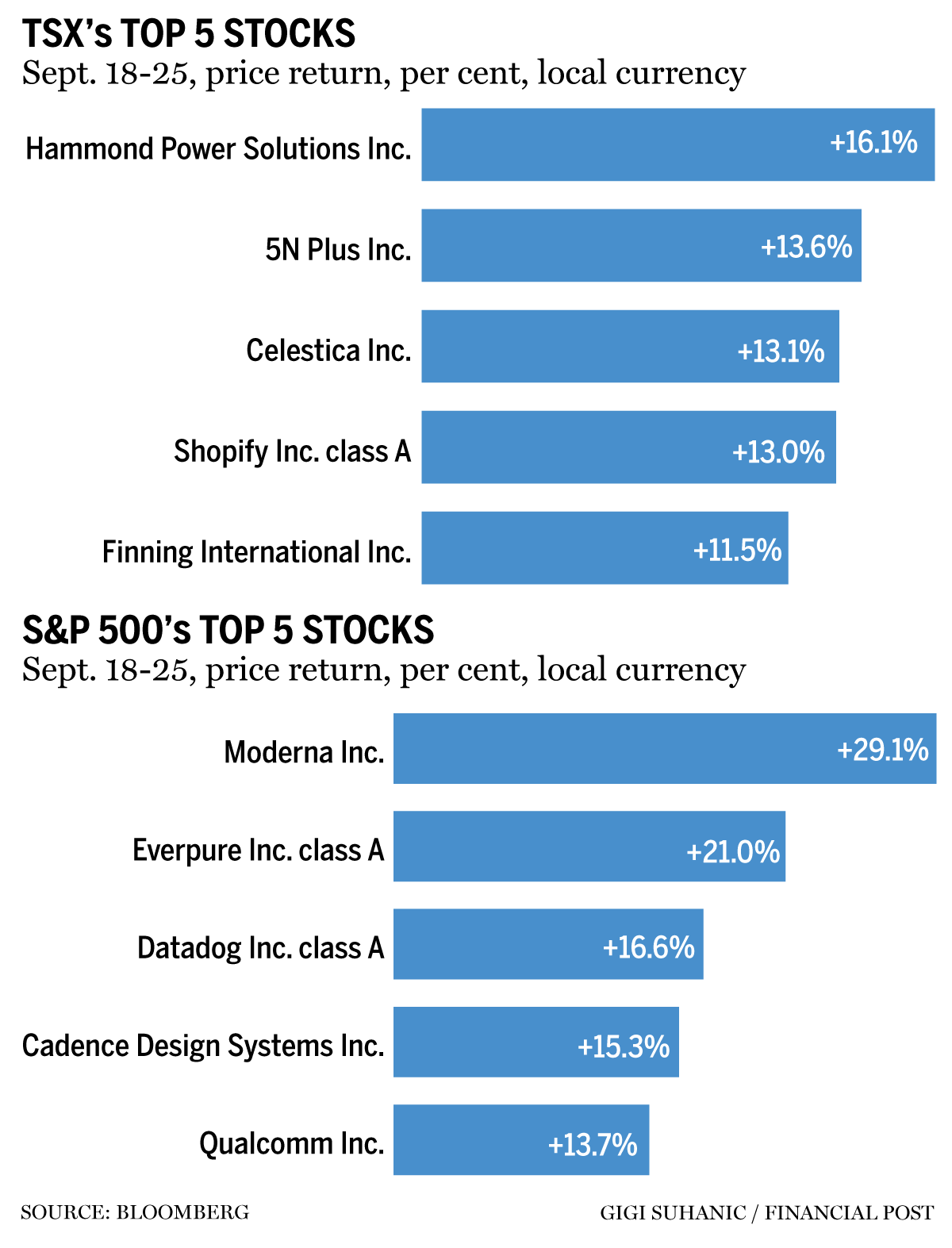
Shares of Shopify Inc. (SHOP:TSX) rose 13 per cent this week on the S&P/TSX Composite, finishing among the top gainers as chief executive Tobias Lutke announced a partnership with Meta’s Muse AI agent. “By opening the door to Muse, we believe SHOP is positioning itself as a key checkout rail for agent-initiated purchases across its merchant base,” J. Parker Lane, Stifel U.S. Equity Research managing director, said in a note on Sept. 22. Stifel has a price target of $253.27. Shares closed Friday at $201.20.
Utility stocks face bond yield headwinds, says CIBC
Longer-term bond yields in the United States and Canada have hit multi-decade highs, resulting in higher potential borrowing costs and headwinds for utility stocks, said CIBC Capital Markets analysts in a note on Sept. 21. “The U.S. 10-year yield has continued to rise, which has historically been one of the strongest indicators of utility relative underperformance,” analysts led by Mark Javi said in the note. From last July, the S&P/TSX utilities sub index is down just over 11 per cent. In addition, rising oil prices are likely drawing investors to the energy sector and away from defensive sectors such as utilities, CIBC said. “We may not see a reversal in performance until one or more of these signals reverses,” the analysts said. Given the headwinds, CIBC has cut its price targets for all the Canadian utilities it covers, though it said that some companies are more exposed to the rising cost of debt than others. It tapped Emera Inc. (EMA:TSX) to take the biggest hit from higher bond yields, given the nature of its debt, and cut its price target to $72 from $76. Shares closed Friday at $67.48. In a higher rate environment, CIBC also sees potential for “modest” earnings per share gains for Atco Ltd. (ACO/X:TSX), Hydro One Ltd. (H:TSX) and Canadian Utilities Ltd. (CU:TSX) from regulated rate resets in Alberta and Ontario. Despite the pullback, Canadian utilities still trade at a strong premium versus the S&P/TSX composite of plus-27 per cent,” CIBC said.
Slate Grocery REIT suspends cash distribution
Shares of Slate Grocery REIT (SGR/U:TSX) tumbled nearly 35 per cent this week after management said it was suspending its cash distribution in an “unexpected turn,” TD Cowen analyst Sam Damiani said in a note on Sept. 24. The REIT had been yielding eight per cent as of the close on Sept. 23, TD said. “In our view, the announcement is likely a response to the recent increase in the (government bond) yield curve,” given that 66 per cent of the REIT’s debt is maturing through 2028, Damiani said. CIBC estimated that refinancing debt at higher rates could cost the company an additional $14 million between 2026 and 2028. Slate is currently undergoing a strategic review that includes seeking out interest in a potential sale. Damiani has a price target of $12 on the shares. ATB Cormark Capital Markets analyst Sairam Srinivas called the distribution elimination “significant and negative” and cut his price target to $8 from $13. Shares closed Friday at $10.75.
Price target hikes, cuts and holds
- TD Cowen analyst Craig Hutchison maintained his price target for Trilogy Metals Inc. (TMQ:TSX) of $8 on a “de-risking milestone” for its “flagship” Arctic project. Shares closed Friday at $4.54.
- RBC Capital Markets analyst Harrison Reynolds maintained his price target for Artemis Gold Inc. (ARTG:TSX) of $60 following the announcement of the purchase of Vista Gold Corp. (TSX: VGZ). Shares closed Friday at $40.20.
- UBS Global Research analyst Dennis Geiger cut his price target for McDonald’s Corp. (MCD:NYSE) to US$320 from US$340, saying that management’s plan to boost U.S. sales make the “risk/reward” attractive despite investor concerns about “pressured sales trends.” Shares closed Friday at US$236.50.
- Raymond James analyst Frederic Bastien hiked his price target for Bird Construction Inc. (BDT:TSX) to $90 from $75 to catch up to “strong” second quarter results and an expected “catalyst-rich end to the year.” Shares closed Friday at $79.20.
- TD Cowen resumed coverage of Primaris REIT (PMZ/U:TSX) with analyst Sam Damiani assigning a buy rating and a $25 price target. Shares closed Friday at $21.73.
- Raymond James analyst Brian MacArthur hiked his price target for Elemental Royalty Corp. (ELE:TSX) to $35 from $33 on a deal to purchase a portfolio of precious metal assets. Shares closed Friday at $29.35.
- RBC Capital Markets analyst Michael Harvey initiated coverage of Spartan Delta Corp. (SDE:TSX) with an outperform rating and a $17 price target, citing its position in the West Shale Duvernay deposit and “seasoned” management. Shares closed Friday at $12.90.
Every week, the Financial Post breaks down the most interesting developments in the week’s world of investing, from top performers to surprising analyst calls and stocks to have on your radar.
Are you an investor looking for stock ideas and market insight? Sign up for the weekly FP Investor Newsletter here to get the best of the Financial Post’s investing news, analysis and expert commentary straight to your inbox.
• Email: gmvsuhanic@postmedia.com
]]>How David Rosenberg is reducing stock market risk, which sector’s shares could take a hit from rate hikes and more from The Week in Stocks.
Stock of the week: BlackBerry Ltd.
BlackBerry Ltd. closed out the week among the top 10 gainers on the S&P/TSX composite index, rising 5.2 per cent. CIBC Capital Markets analyst Todd Coupland said in a note on Sept. 10 that he expects the company to report a “clean” quarter when it reports earnings on Sept. 24. Coupland is also calling for the company to upgrade its guidance on its QNX software division and Secure Communications services division. Coupland has a price target on the shares of $17.96. Shares closed Friday at $11.16. “Expectations remain achievable, the catalyst pipeline is strengthening and continued execution should drive a QNX-led re-rating. We would own BB” into the release of earnings, Coupland said. BlackBerry has a 12-month price target of $14.00 based the calls of seven analysts, according to Bloomberg.
Keeping score
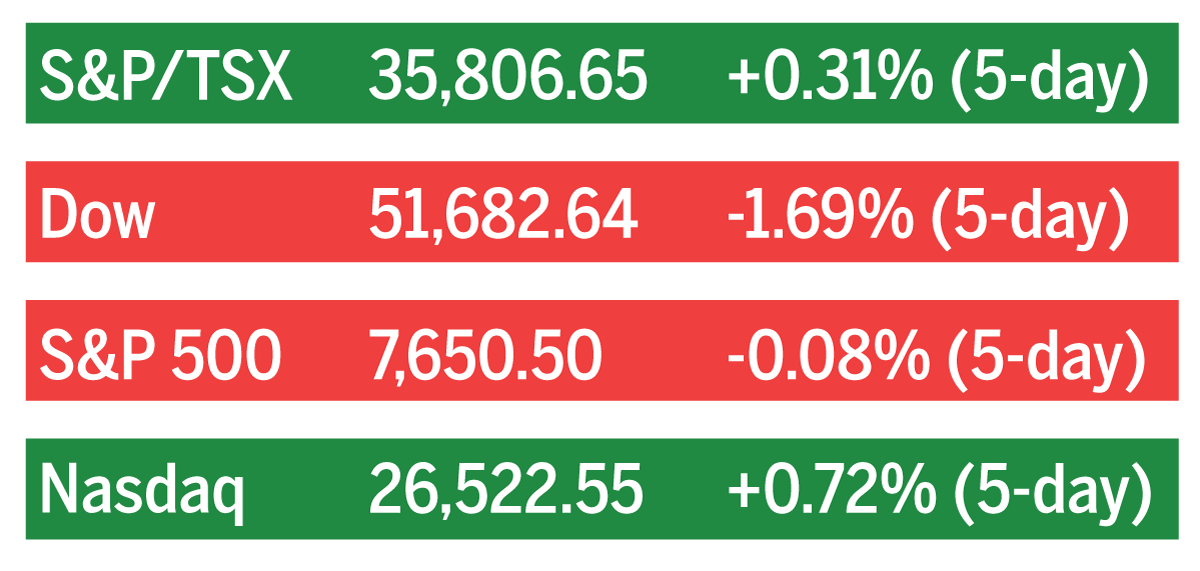

Why David Rosenberg is building a ‘cash buffer’
It’s time to reduce stock market risk and build a “cash buffer,” said David Rosenberg , president of Rosenberg Research & Associates Inc., in a note on Sept. 14. “The macro and policy backdrop is becoming less supportive for risk assets,” Rosenberg said, citing several challenges including signals from the bond market that are flashing overinvestment in artificial intelligence. Tightening financial conditions and oil prices are also standing in the way of “real growth prospects.” Further, “U.S. fiscal supports are increasingly in the rear-view mirror,” and the Nov. 3 U.S. midterm election is likely to result in “fiscal gridlock,” he said. Given all this, Rosenberg said he is dropping gold miners via the VanEck Gold Miners ETF (GDX) — a source of volatility — but hanging onto gold in the form of bullion. He is also exiting the Global X Uranium ETF (URA). “This year’s performance has been more volatile, while some of the return-generating trends that supported the theme last year have faded,” he said. Lastly, he is dropping the iShares MSCI India ETF because of geopolitical risks and rising interest rates . Rosenberg said he still likes Asia for investments but focused away from artificial intelligence and Japan . He still likes two-year and 10-year Treasuries. “Bonds have been beaten up badly via ever-rising risk premia and inflation uncertainty, but the yield cushion is appealing at this point, especially relative to the S&P 500 equity and dividend yields,” he said.

Who could win from Ottawa’s expanded tax write-off
The federal government announced during the Canada Investment Summit this week that a tax write-off program — the productivity mega deduction (PMD) — would be extended to capital investments in oil and gas pipelines, mining property, fibre-optic cable, software, research and development, computer equipment, aircraft and vehicles, patents, rail track, bridges and roads. The program allows for the deduction of 100 per cent of the depreciation of capital assets in the first year of operation on a greater percentage of assets. Analysts at TD Cowen think the tax program can benefit several sectors and companies. “We believe the broad nature of the PMD should support commercial and wholesale loan growth among banks,” analysts led by Mario Mendonca said in the note on Sept. 15. In another TD Cowen note on Sept. 17, energy analysts said the PMD expansion could help push projects such as LNG Canada phase 2, Ksi Lisims LNG, TMX optimization and the West Coast oil pipeline across the finish line. The Immediate expensing component allowed by the tax write-off could boost the economics of gas-fired power projects for Capital Power Corp. (CPX:TSX) and TransAlta Corp. (TA:TSX), Brookfield Renewable Partners (BEP:NYSE) and Northland Power Inc. (NPI:TSX), TD analysts said. Other companies that could benefit from the new tax policy include Finning International Inc. (FTT:TSX) and Toromont Industries Ltd. (TIH:TSX) — both Caterpillar dealers in Canada — and Wajax Inc. (WJX:TSX), which distributes Hitachi equipment, though analysts noted much of the upside from the “build Canada” push is already baked into the shares.
Could Canadian bank shares take a hit from rate hikes?
In the last seven cycles of interest rate hikes , the shares of Canada’s big banks have been losers, CIBC Capital Markets analysts led by Paul Holden, said in a note on Sept. 16, citing an average decline of 23 per cent. The U.S. Federal Reserve hiked the interest rate 25 basis points on Wednesday with one more increase expected this year. Looking at the Bank of Canada , markets are calling for two hikes this year and several more in 2027. “We have not fully embraced the same view as the rate market in terms of the magnitude of further rate hikes and hence are not hitting a panic button for the banks,” Holden said in the note. However, the CIBC team is recommending cutting risk just to be “prudent.”
Price target hikes and holds
- TD Cowen analyst Vince Valentini hiked his price target for shares of BCE Inc. (BCE:TSX) to $40 from $37 after the telco announced it was expanding data centre capacity at its Saskatchewan campus. Shares closed Friday at $30.90.
- UBS Investment Bank analyst Michael Lasser reiterated his buy rating for Costco Wholesale Corp. (COST:Nasdaq) and his price target of US$1,275 on the company continuing “to outperform most of retail” despite concerns about slowing membership growth, increased price competition and decelerating comparable store sales. Shares closed Friday at US$895.331.
- TD Cowen analyst John Mould has a buy rating on Capital Power Corp. (CPX:TSX) and maintained his $80 price target after shares pulled back 22 per cent starting in July “offering an attractive entry point.” Shares closed Friday at $61.38.
- BMO Capital Markets analyst Tamy Chen maintained her price target of $215 for Dollarama Inc. (DOL:TSX) despite shares being caught up in a sell-off of high-value consumer stocks. “We do not see a reason for the stock weakness from company fundamentals,” she said. Shares closed Friday at $174.18.
- CIBC Capital Markets anlayst Robert Catellier hiked his price target for Enbridge Inc. (ENB:TSX) to $79 from $78 after it purchased Tallgrass Energy’s crude oil transportation business. Shares closed Friday at $68.14.
Every week, the Financial Post breaks down the most interesting developments in the week’s world of investing, from top performers to surprising analyst calls and stocks to have on your radar.
Are you an investor looking for stock ideas and market insight? Sign up for the weekly FP Investor Newsletter here to get the best of the Financial Post’s investing news, analysis and expert commentary straight to your inbox.
• Email: gmvsuhanic@postmedia.com
]]>TD Cowen’s three ‘best ideas’ for Canada, why Group Dynamite’s outlook may not calm investors’ macro fears and more from The Week in Stocks.
Stock of the week: Volatus Aerospace Inc.
Shares of Volatus Aerospace Inc. (FLT:TSX) have climbed and descended this year, rising as high as 89 cents and as low as 46 cents. They got a 26 per cent boost this week after the company won its first order from the Canadian Defence Drone Initiative. The order is for 100 systems worth up to $500,000. The Canadian Armed Forces (CAF) holds options for 4,900 more, which would be worth up to $24.5 million. Stifel Canada analyst Greg MacDonald maintained his 12-month price target of $1 and shares closed Friday at $0.63, which would be a potential upside of about 59 per cent on his target. MacDonald said he thinks the CAF is using the small, initial order to test how operational Volatus’s systems are before pulling the trigger on a larger contract in 2027. “We think Volatus clears that gate on technology and, more importantly, manufacturing capability since fast, mass drone production is what the government needs most,” MacDonald said. Volatus has a 12-month price target of 95 cents based on the calls of five analysts, according to Bloomberg.
Keeping score


Three ‘best ideas’ for Canada from TD Cowen
TD Cowen analysts said in a recent note that these “best” stock ideas for Canada will give investors exposure to defensive, growth and undervalued names. Here is a look at the companies and their theses. TheNorth West Co. Inc. (NWC:TSX) : “We believe the base business alone is undervalued, presenting an attractive opportunity to build a position ahead of re-rating,” Cheryl Zhang said in a note on Sept. 11, arguing that the northern Canada retail chain benefits from its remote location, its food business and a potential boost from infrastructure investment in the country’s upper reaches. Zhang said the shares should also benefit from First Nations Child and Family Services settlement payments from the federal government though she added that only accounts for $4 of her $63 price target. Shares closed Friday at $51.67. Whitecap Resources Inc. (WCP:TSX): “We believe there is underappreciated upside to WCP,” analyst Aaron Bilkoski said in a note, hiking his price target to $21 from $18, adding that the company has a track record of earnings beats and raises. However, an investor debate persists that Whitecap is too conservative in its estimates, he said. Shares closed Friday at $18.50. Chartwell Retirement Residences (CSH/U:TSX): Shares pulled back about 13 per cent during the summer with investors worried about a metric that measures net operating income for the same properties. Chartwell is trading at a 46 per cent discount to peers and that offers investors an opportunity to jump in, analyst Jonathan Kelcher said in a note, adding that the backdrop for the retirement sector is on Chartwell’s side including a three year gap before any new supply becomes available and an approximately four per cent a year increase in the number of people aged 80 and up. Kelcher has a price target of $27. Shares closed Friday at $20.13.
Groupe Dynamite outlook rises but investors fear macro backdrop
Shares of Canadian retailer Groupe Dynamite Inc. (GRGD:TSX) suffered a 35 per cent hit in June after a first-quarter earnings miss, but following its latest earnings beat this week, some analysts have revised their outlook for the shares. UBS Global Research’s Mauricio Serna lifted his target on Sept. 11 to $112 from $108 — the highest among the 14 analysts who cover the stock, based on Bloomberg data. Shares closed Friday at $55.04. “We believe GRGD is an attractive growth stock,” Serna said in a note on Sept. 11, calling the company’s Garage brand “key growth engine.” The Montreal company is forecasting year-end growth to increase by 25 per cent to 27 per cent, up from 22 per cent to 25 per cent, after it reported earnings that topped second quarter estimates on earning per share (EPS) while revenue increased by 30 per cent from a year ago. The risk/return tradeoff looks positive, TD Cowen analyst Brian Morrison said in a Sept. 11 note. Still, shares are down just over 40 per cent from their all-time closing high in April of $97.45. “Investors’ focus seems overwhelmed by the broader macro backdrop/rising U.S. yields and potential future impact on consumer resiliency,” Morrison said. Despite that, he argued the company has strong free cash flow, “a runway for U.S. expansion” and an active share buyback program on its side. Morrison has a buy rating on the shares, but lowered his price target to $80 from $85. Group Dynamite has a 12-month price target of $90.23 based on the calls of 13 analysts, according to Bloomberg.
Price target hikes and holds
- CIBC Capital Markets analyst Cosmos Chiu hiked his price target for DPM Metals Inc. (DPM:TSX) to $72 from $64 on better-than-expected drilling results at its gold, copper, silver project. Shares closed Friday at $60.37.
- ATB Cormark Capital Markets analyst Patrick O’Rourke hiked his price target for Tamarack Valley Energy Ltd. (TVE:TSX) to $16.50 from $15 after it announced a merger with Headwater Exploration. Shares closed Friday at $13.29.
- Raymond James analyst Craig Stanley hiked his price target for Aya Gold & Silver Inc. (AYA:TSX) to $45 from $32 on an updated preliminary economic assessment. Shares closed Friday at $38.78.
- TD Cowen analyst John Blackledge maintained his buy rating and target price for Meta Platforms Inc. (META:TSX) of US$750 after the company launched Muse, an artificial intelligence agent with free and paid tiers. Shares closed Friday at US$648.03.
- UBS Global Research analyst Mauricio Serna maintained his price target for Aritizia Inc. (ATZ:TSX) of $216 calling the retailer an “EPS compounder and a growth stock.” Shares closed Friday at $122.82.
- National Bank of Canada Capital Markets analyst Andrew Dusome hiked his price target for Talon Metals Corp. (TLO:TSX) to $13.00 from $8 after it announced better-than-expected drill results at its Minnesota Tamarack property. Share closed Friday at $10.40.
- BMO Capital Markets analyst Keith Bachman cut his price target for Oracle Corp. (ORCL:Nasdaq) to US$195 from US$220 but maintained his outperform rating on a “solid” quarter that nonetheless featured another round of shrinking gross margins. Shares closed Friday at US$150.28.
Every week, the Financial Post breaks down the most interesting developments in the week’s world of investing, from top performers to surprising analyst calls and stocks to have on your radar.
Are you an investor looking for stock ideas and market insight? Sign up for the weekly FP Investor Newsletter here to get the best of the Financial Post’s investing news, analysis and expert commentary straight to your inbox.
• Email: gmvsuhanic@postmedia.com
]]>What National Bank sees as strengths and vulnerabilities for the TSX, which stocks RBC added to its market-weighted portfolio of best ideas and more from The Week in Stocks.
Stock of the week: BRP Inc.
Shares of BRP Inc. (DOO:TSX) were among the top gainers on the S&P/TSX composite index , up nine per cent after the Sea-Doo and Ski-Doo maker reported earnings that beat estimates on a smaller than expected loss per share. This was primarily due to strong sales of its utility off-road vehicle (ORV). The Valcourt, Que. company also updated guidance for 2027 on a smaller than expected hit from changes to Section 232 U.S. tariffs on steel, aluminum and copper. The company said it has introduced new models, which are not subject to the tariffs, while all-terrain vehicle tariffs have dropped to 15 per cent from 25 per cent. BMO Capital Markets analyst Tristan Thomas-Martin hiked his price target for BRP to $110 from $100 and said in a note on Sept. 4 that the latest quarter “encapsulates the BRP story for us – Utility ORV share capture plus a strong lineup of upcoming new products which have been well received by dealers.” Shares closed Friday at $93.06. RBC Capital Markets analysts Sabahat Khan had the highest price target among analysts on Bloomberg at $113 which he set at the end of May and maintained on Sept. 4 implying a potential 21 per cent gain from Friday’s close. Stifel Global Research analyst Martin Landry hiked his price target for BRP to $90 from $85 on Sept. 3 with a hold rating but said in a note he believes that BRP’s “valuation is full.” BRP has a 12-month price target of $101.40 based on the calls of 14 analysts, according to Bloomberg.
Keeping score


TSX strengths and vulnerabilities, per National Bank
The TSX, which reached a fresh record in August, sports less exposure to artificial intelligence than the U.S. S&P 500 index and, as a consequence, less “vulnerability” to climbing bond yields, said National Bank of Canada in its September report on stock markets. AI companies have been issuing mountains of debt, which are vulnerable to rising yields that increase borrowing costs. However, the report authors, Stéfane Marion, Matthieu Arseneau and Alexandra Ducharme, said that de-escalation on the trade front is key to the TSX — up 28.7 per cent this year — continuing to perform. National Bank reviewed its asset mix, maintaining its Canadian equity allocation at 21 per cent, just above the benchmark of 20 per cent. It set U.S. equities at 20 per cent, foreign equities and emerging market equities at three per cent each (just below the five per cent benchmark), fixed income at 48 per cent and cash at five per cent. National is also maintaining above benchmark holdings in energy, industrials and materials “to benefit from Ottawa’s renewed focus on resource development and reindustrialization,” the authors said. Energy accounts for a 16.6 per cent weighting in the equity portion, with most of that directed at oil, gas and consumable fuels. In industrials, nearly five per cent is weighted toward transportation with the rest split between commercial and professional services and capital goods, while much of materials is allocated to gold.
What RBC added to its market-weighted portfolio of best ideas
RBC Capital Markets reviewed its market-weighted portfolio of best ideas and made a few changes to the model, which holds 52 names traded on the TSX. RBC added four new names: Canadian Natural Resources Ltd. (CNQ:TSX), Nutrien Ltd. (NTR:TSX), Ovintiv Inc. (OVV:TSX) and Whitecap Resources Inc. (WCP:TSX). On Canadian Natural : “We view CNQ as the benchmark amongst producers in Canada,” RBC analyst Greg Pardy said in the report. The company currently returns 75 per cent of free cash flow to investors and Pardy expects that to increase to 100 per cent in early 2027. RBC has a price target of $79. Shares closed Friday at $69.78. On Nutrien : “Valuation appears attractive at current levels given solid cash generation outlook,” RBC analyst Andrew Wong said. He has a price target of $118.44. Shares closed Friday at $110.10. On Ovintiv : “Ovintiv has delivered impressive operational/financial performance over a series of quarters, yet its relative valuation has yet to reflect that,” Pardy said. He likes that Ovintiv has focused its portfolio around the Montney and Permian basins and said that strong performance coupled with an updated shareholder return model should “close the valuation gap.” Pardy has a price target on Ovintiv of $117.62. Shares closed Friday at $89.57. On Whitecap Resources : “Whitecap offers … a track record of improving well results, cost reductions, and consistent outperformance against guidance,” RBC analyst Michael Harvey said, adding he thinks Whitecap is positioned for acquisitions and further share buybacks. Harvey has a price target of $20. Shares closed Friday at $17.98. Other changes to the portfolio included weighting increases to Barrick Mining Corp. (ABX:TSX), Franco-Nevada Corp. (FNV:TSX), Weightings were decreased for Alamos Gold Inc. (AGI:TSX), BCE Inc. (BCE:TSX) and Enbridge Inc. (ENB:TSX). Cascades Inc.(CAS:TSX) was dropped after shares gained 50 per cent over three months. RBC’s market-weighted portfolio returned 4.3 per cent over the past three months against 4.9 per cent for the TSX.

Price target hikes, holds and cuts
- Scotia Capital Markets analyst Mike Rizvanovic cut his price target for EQB Inc. (EQB:TSX) to $135 from $141 on a “messy” third quarter that included higher than expected provisions for credit losses. Shares closed Friday at $132.92.
- Stifel Canada analyst Cole McGill maintained his price target of $8.50 with a buy rating for Mining Americas Inc. (MAI:TSX) after it received “key” federal approvals for its gold project Cerro do Oro in Mexico. Shares closed Friday at $6.53.
- UBS Global Research analyst Jay Sole cut his price target for Lululemon Athletica Inc. (LULU:Nasdaq) to US$106 from US$120 and said a pullback in the shares following a “disapppointing” second quarter was no reason to buy. Shares closed Friday at US$100.61.
- CIBC Capital Markets analyst Kevin Chiang hiked his price target for GFL Environmental Inc. (GFL:TSX) to $82 from $76 on media reports the efforts to sell the company have advanced. Shares closed Friday at $60.45.
Every week, the Financial Post breaks down the most interesting developments in the week’s world of investing, from top performers to surprising analyst calls and stocks to have on your radar.
Are you an investor looking for stock ideas and market insight? Sign up for the weekly FP Investor Newsletter here to get the best of the Financial Post’s investing news, analysis and expert commentary straight to your inbox.
• Email: gmvsuhanic@postmedia.com
]]>What David Rosenberg is eyeing in Europe, why analysts hiked their price targets for the Big Banks and more from The Week in Stocks.
Stock of the week: Air Canada
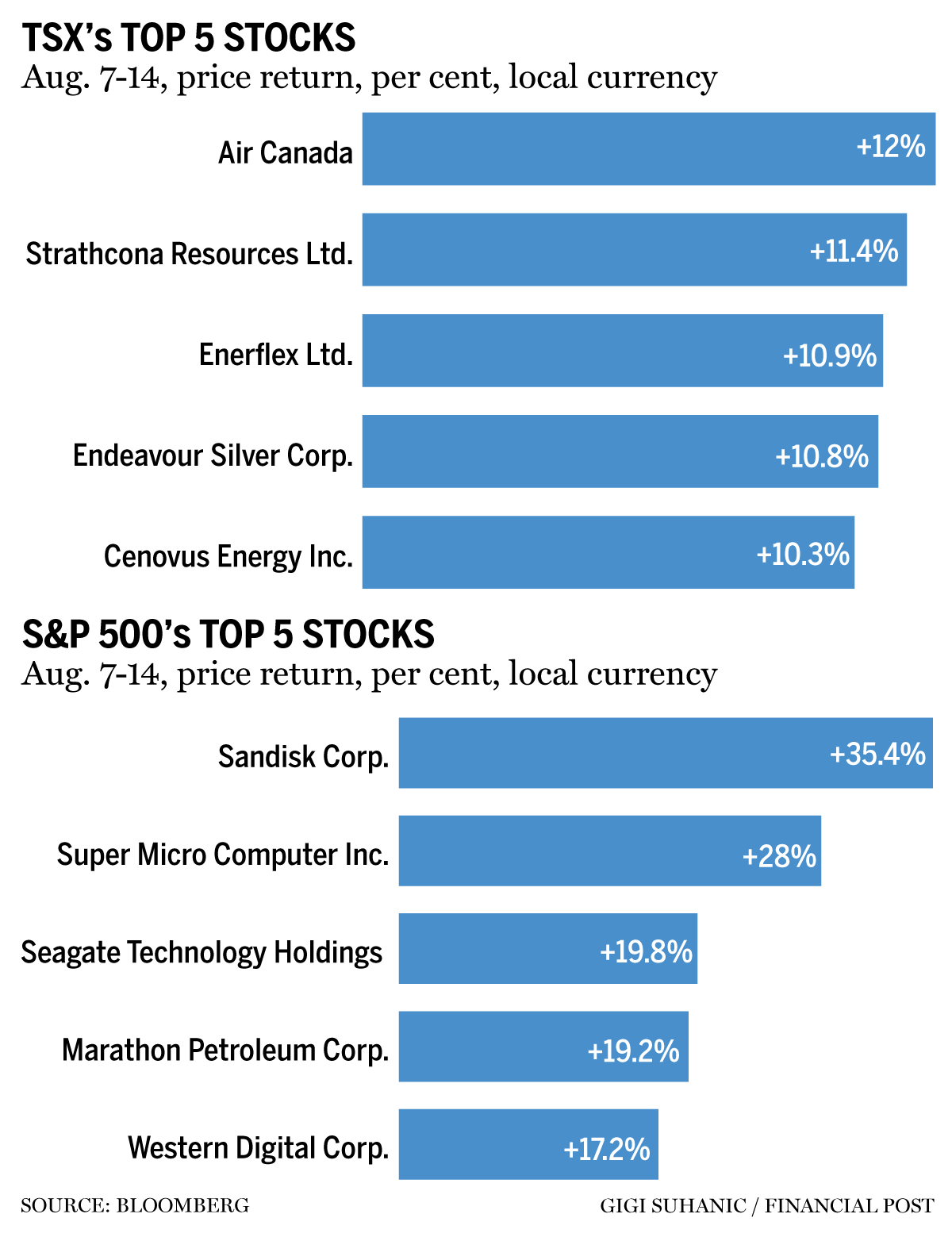
Shares of Air Canada soared nearly 15 per cent earlier in the week, finishing as the top gainer on the S&P/TSX composite index after the carrier agreed to sell a 25 per cent stake in its Aeroplan loyalty program for $2.5 billion to a consortium of investors including Blackstone Inc. , Caisse de depot et placement du Quebec , PSP Investments and British Columbia Investment Management Corp. ATB Cormark Capital Markets analyst Chris Murray called the deal a “positive surprise,” adding it increased ATB Cormark’s “conviction that (Air Canada) remains undervalued.” Murray hiked his price target for the airline to $45 from $32 — the highest call on the Street — on the thesis that the Aeroplan sale will allow Air Canada to speed up debt repayment and buybacks. Shares closed Friday at $29.64. BMO Capital Markets analyst Fadi Chamoun maintained an outperform rating on Air Canada and held his price target at $37, saying in a note that where the shares go next depends on management’s “ability to successfully execute its fleet expansion strategy and deliver against its longer-term earnings and cash flow objectives.” Air Canada’s 12-month price target is $33.69 based on the calls of 13 analysts, according to Bloomberg.
Keeping score
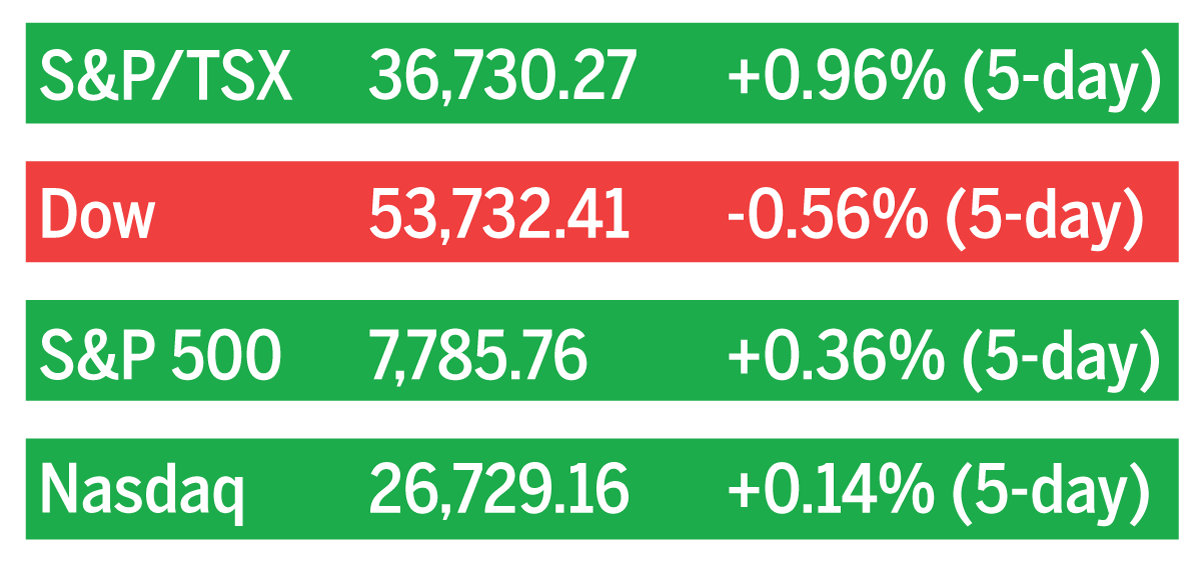
Rosenberg eyes European utilities and industrials despite geopolitical shifts
David Rosenberg, president of Rosenberg Research & Associates Inc., has his eye on European industrials as he looks to rebalance his investment model for the continent. “European companies have reported solid profit growth,” Rosenberg said in a report on Aug. 13, adding this results in an upgrade to growth expectations for the Stoxx Europe 600 index for 2026. For the fiscal year, analysts are calling for 10 to 12 per cent profit growth in Europe. “The resilience of corporate profits amid all the geopolitical shifts and policy volatility is a remarkable characteristic of the current market cycle, in which each short-lived correction has become an opportunity to buy the dip and carry stock indexes to new highs,” Rosenberg said. European stocks also offer an added advantage of diversification away from artificial intelligence and the risks that have dogged that trade on U.S. markets and in Asia. The model continues to favour utilities. Industrials were added to the buy list, joining long/buy ratings for electrical equipment and tech-related exposure. Insurance, software, oil and gas and personal and household goods landed on the short side of the model’s ledger. Long additions include the MSCI EUR Info Tech index (MXEUOIT), STXE 600 Industrial Goods and Services (SXNP), MSCI Europe Electrical Equipment (MXEUOEL), STXE 600 Utilities (SX6P), STXE 600 Technology (SX8P) and STXE 600 Food & Beverage (SX3P).
Raymond James analysts hike price targets for Canada’s Big Banks
The S&P/TSX composite index is up nearly 16 per cent year to date and Canadian financials have played their part, gaining nearly 25 per cent during that period as five of the six Big Banks placed among the top 10 gainers year to date in the S&P/TSX financials index. In anticipation of earnings from Canada’s Big Six , which start third quarter reporting the week of Aug. 24, Raymond James analysts led by Stephen Boland have updated their estimates. At the same time, they’ll be looking for commentary from executives on plans to put to work excess capital of approximately $74 billion, Canadian retail credit trends and the outlook for Canadian commercial loan growth. Bank of Montreal (BMO:TSX) is the analysts’ top pick for its greater exposure to commercial lending and Raymond James raised the target price to $268 from $233.50. Shares closed Friday at $257.88. They also hiked their price target for Toronto-Dominion Bank (TD:TSX) to $180 from $155, calling for spending on anti-money laundering provisions to slow in the second half of the year and for TD’s U.S. banking division to report consecutive loan growth for the first time since the first quarter of 2025. Shares closed Friday at $172.61. Bank of Nova Scotia (BNS:TSX) looks like good value to Raymond James given its shares continue to trade at a discount to peers, they said. The team hiked its price target to $137 from $121. Shares closed Friday at $126.98. They also hiked price targets for: Royal Bank of Canada (RY:TSX) to $306 from $270.50 and shares closed Friday at $300.70; Canadian Imperial Bank of Commerce (CM:TSX) to $173.50 from $155.50 and shares closed Friday at $X171.76; National Bank of Canada (NA:TSX) to $226.50 from $203 and shares closed Friday at $231.29.
Price target hikes
- TD Cowen analyst Sean Stueart hiked his 12-month price target for CCL Industries Inc. (CCL/B:TSX) to $115 from $110 after second quarter EBITDA came in 100 basis points above the five-year average. Shares closed Friday at $96.50.
- BMO Capital Markets analyst John Gibson hiked his price target for Bird Construction Inc. (BDT:TSX) to $85 from $75 after revenue jumped 23 per cent in the second quarter, rising to over $1 billion for the first time in the company’s history. Shares closed Friday at $73.14.
- Raymond James analyst Michael Freeman hiked his price target for HLS Therapeutics Inc. (HLS:TSX) to $8 from $7 on the belief that the company has transitioned from a turnaround story to a “compelling growth and cash generation story.” Shares closed Friday at $3.90.
- TD Cowen analyst Tim James hiked his price target for Cargojet Inc. (CJT:TSX) to $127 from $118 on higher than forecast free cash flow and lower than expected net debt. Shares closed Friday at $89.26.
- National Bank of Canada analyst Dan Payne hiked his price target for Tidewater Renewables Ltd. (LCFS:TSX) to $22.75 from $13.25 after the energy and infrastructure company “crushed” earning with revenue and EBITDA coming in well ahead of expectations. Shares closed Friday at $20.69.
- CIBC Capital Markets analyst Ty Collin hiked his price target for Linamar Corp. (LNR:TSX) to $120 from $115 as he rolled “modestly” increased forecasts into 2027. Shares closed Friday at $105.87.
- Scotia Capital Markets analyst Mike Rizvanovic hiked his price target for Sagicor Financial Co. Ltd. (SFC:TSX) to $13 from $12 on a “good overall quarter” for the lifeco. Shares closed Friday at $8.63.
The Week in Stocks is taking a short summer break and will be back Fri. Sept. 4.
• Email: gmvsuhanic@postmedia.com
]]>Where analysts see share prices going after selected energy earnings, why one analyst sees value in buying gold again and more from The Week in Stocks.
Stock of the week: Shopify Inc.
Shopify Inc. (SHOP:TSX) appeared to counteract fears that artificial intelligence poses a threat to the e-commerce service provider as its shares soared 28 per cent this week — a top 15 finish on the S&P/TSX Composite index — on “a clean Q2 beat,” TD Cowen analyst Todd Coupland said in a note on Aug. 5. “We would buy SHOP for durable profitable growth and agentic commerce optionality,” Coupland said. Revenue, gross merchandise value (which measures the total value of goods sold) free cash flow and gross profit each rose by more than 30 per cent in the second quarter compared with the same period a year ago, with the trend expected to continue into the next quarter, Coupland said. He hiked his price target to $308 from $262. Shares closed Friday at $211.10. AI fears started to hound the stock earlier in the year, driving shares down as much as 44 per cent from early January to mid-May before they started to climb back up again as investors rethought concerns that AI would supply businesses with the tools needed to bypass Shopify. For J. Parker Lane, Stifel U.S. Equity Research managing director, Shopify earnings “validated two key pillars of our investment case,” including its pre-eminence in market share gains, which continue to outrun growth in the broader e-commerce sector, and its use of AI to build on its sector leadership. Lane hiked his price target for to $252 from $212. The 12-month price target for Shopify is $235.48 based on the calls of 50 analysts, according to Bloomberg.
Keeping score
Energy earnings give analysts fodder for share price target updates
From oilsands giant Suncor Energy Corp. (SU:TSX) to pipeline operator South Bow Corp. (SOBO:TSX), plenty of Canadian energy companies reported earnings this week that moved the dial on price targets as they benefited from higher oil prices . Here’s a look at some analysts’ takes on where shares could be headed. RBC Capital Markets analyst Maurice Choy hiked his price target for Keyera Corp. (KEY:TSX) to $66 from $62 as the company said it expects projects to perform better than previously suggested by guidance. Shares closed Friday at $57.11. (RBC is acting as a financial adviser to Keyera on an acquisition deal.) Chris MacCulloch at Scotia Capital Inc. hiked his price target for Canadian Natural Resources Ltd. (CNQ:TSX) to $73 from $71 on the belief that CNQ is among the best placed companies in the oilpatch to benefit from an improved climate in the Canadian energy sector. Shares closed Friday at $63.45. Suncor continues to number among RBC Capital Markets’s top global energy ideas for 2026, analyst Greg Pardy said in a note on Aug. 6, despite the company reporting mixed results for the second quarter that pushed shares down 10 per cent this week. Pardy reiterated his outperform rating and price target of $100 based on several metrics including “cash flow generation, an underleveraged balance sheet, attractive shareholder returns.” Shares closed Friday at $83.86 . South Bow reported a positive revision to earnings for the year, Raymond James analyst Michael Barth said in a note on Aug. 6, adding he believes that positive final investment decisions for several projects not yet reflected in the value of the shares will boost the stock. Barth hiked his price target for South Bow to $62 from $61. Shares closed Friday at $49.66.

One analyst sees value in buying gold again
Gold flirted with bear market territory following the start the United States-Iran war, melting down by just over 25 per cent from the start of the war to mid-July when prices started to rebound. “A pullback was due,” Craig Bassinger, chief market strategist at Purpose Investments Inc., said in note on Aug. 3, but “more recently there has been a certain shift in the market.” The precious metal has swung above US$4,300 even as yields rose, oil prices climbed again and the U.S. dollar held its ground, all typically kryptonite to higher gold prices. Bassinger said the fundamentals and structural conditions for gold’s ascendancy over the past few years remain in play including central bank purchases, which reaccelerated in the second quarter after slowing significantly in the first. “We view the risk/reward of owning the shiny yellow metal as positive once again,” with a second-half rebound possible, he said.
Price target hikes and holds
- ATB Cormark Capital Markets analyst Gavin Fairweather hiked his price target for Altus Group Ltd. (AIF:TSX) to $59 from $56 after the company increased its EBITDA guidance by eight per cent on “strengthening business momentum.” Shares closed Friday at $52.44.
- RBC Capital Markets analyst Matthew McKellar hiked his price target for Cascades Inc. (CAS:TSX) to $18 from $15 on tightening North American containerboard markets and “good execution.” McKellar said the shares are “undervalued.” Shares closed Friday at $17.02.
- Raymond James analyst Stephen Boland hiked his price target for Dominion Lending Centres (DLCG:TSX) to $12.50 from $11 after the company purchased mortgage technology software platform Filogix Inc., which Boland expects will boost earnings per share and cash flow over the next 12 months. Shares closed Friday at $9.12.
- Scotiabank Capital Markets analyst Phil Hardie maintained his price target for Goeasy Ltd. (GSY:TSX) of $39 and said the lender “isn’t out of the woods yet” as it revised down its full-year outlook, though earnings came in better than “feared.” Shares closed Friday at $49.90.
- RBC Capital Markets analyst Darko Mihelic hiked his price target for Manulife Financial Corp. (MFC:TSX) to $67 from $55 on strong results across all its segments that beat EPS estimates. Shares closed Friday at $61.78.
- National Bank of Canada Capital Markets analyst Mohamed Sidibe hiked his price target for Allied Gold Corp. (AAUC:TSX) to $33 from $29 after rolling his estimates forward by one quarter. Shares closed Friday at $30.49.
- CIBC Capital Markets analyst Paul Holden hiked his price target for iA Financial Corp. Inc. (IAG:TSX) to $220 from $208 on “a sizable EPS beat aided by very strong wealth management results.” Shares closed Friday at $212.77.
- TD Cowen analyst Cheryl Zhang hiked her price target for Savaria Corp. (SIS:TSX) to $37 from $35 on “another quarter of strong execution,” which has pushed the shares up 33 per cent so far this year. Shares closed Friday at $30.40.
- BMO Capital Markets analyst Devin Dodge hiked his price target for WSP Global Inc. (WSP:TSX) to $280 from $272 on financial performance that is on track to meet or beat the upper end of the 2026 guidance range. Shares closed Friday at $189.56.
• Email: gmvsuhanic@postmedia.com
]]>Why strong U.S. bank earnings pave the way for Canadian counterparts, which four themes could drive real estate stocks higher and more from The Week in Stocks.
Stock of the week: Vermilion Energy Inc.
Vermilion Energy Inc. was the top gain on the S&P/TSX composite index this week, rising 15 per cent after TD Cowen analyst Menno Hulshof upgraded the shares to a buy while maintaining his price target of $18. Shares closed Friday at $15.89. Vermilion is tracking toward the high end of 2026 production guidance, he said in a note. He believes investors have a better grasp of the “near-term operational headwinds” including second quarter hedging losses and cyclone impacts at its Wandoo Australian operations. Vermilion has had a rocky 2026 and is off 20 per cent from its high in mid-March. Looking ahead to 2028, Hulshof said he sees the potential for share buybacks to improve and for momentum in Germany, where Vermilion has operations. At $24, ATB Cormark Capital Markets analyst Amir Arif has among the highest price targets for Vermilion and said in note from May 7, when the company last reported earnings, that “the name provides good exposure to European gas, an improved domestic portfolio of Deep Basin and Montney formations, and longer-term growth in Germany.” National Bank of Canada analyst Travis Wood has the highest price target at $27, implying a possible upside of nearly 70 per cent. Vermilion has a 12-month price target of $20 based on the calls of 11 analysts, according to Bloomberg.
Keeping score

Why strong U.S. bank earnings pave the way for Canadian counterparts
U.S. banks reported strong earnings for the second quarter and analysts at Scotia Capital Markets think that’s a good news for their Canadian counterparts, which release third quarter earnings at the end of August. “We believe the U.S. banks’ results should give investors a bit more confidence in the near-term earnings outlook for the large Canadian banks, particularly in light of current elevated valuation multiples,” Mike Rizvanovic, a Scotia Capital analyst, said in a note on July 22. Rizvanovic looked at four big U.S. money centre banks and eight large regional banks and found that they beat earnings per share (EPS) consensus on average by nine per cent. Meanwhile banking fees jumped 16 per cent from the first quarter at U.S. giants Goldman Sachs Inc. and Morgan Stanley. Trading revenue driven by equities surged to record levels at JPMorgan Chase and Co., Bank of America Co., Morgan Stanley and Goldman Sachs. Total loans grew, with commercial posting stronger performance than personal. Toronto-Dominion Bank (TD:TSX) and Bank of Montreal (BMO:TSX) are best placed to benefit from rising U.S. personal and commercial lending, Rizvanovic said, with BMO positioned to gain the most given it has a larger commercial lending presence in the U.S. at 78 per cent of personal and commercial banking, versus 48 per cent at TD. Scotia Capital has 12-month price targets of $239 and $169 for BMO and TD. Shares closed Friday at $250.77 and $169, respectively. CIBC Capital Markets analyst Paul Holden said U.S. capital markets results bode well for BMO, Royal Bank of Canada (RY:TSX) and National Bank of Canada (NA:TSX) due to their exposure to U.S. investment banking franchises and equity trading desks. National Bank could also benefit. However, Holden warned investors capital markets could switch from a “tailwind” to a “headwind if market conditions shift.”
These four themes could drive real estate stocks higher
These four investing themes serve as guideposts for Canada’s real real estate investment trust players: the Atlantic opportunity; the West is underrated; the office recovery and consolidation underway, ATB Cormark Capital Markets analysts said in a note on July 22. And certain stocks are poised to potentially benefit from them. Here’s a look at some of the names tied to each theme. On the Atlantic front, ATB analyst Sairam Srinivas said increased defence spending slated for Halifax could boost the rental market to the benefit of Killam Apartment REIT (KMP/U:TSX). ATB has a 12-month price target of $20 on Killam. Shares closed Friday at $18.86. Meanwhile in the West, while “broader market sentiment has been pessimistic toward the outlook for purpose-built rentals,” Srinivas disagreed, saying that interprovincial demand should support rent growth and vacancy rates for Boardwalk Real Estate Investment Trust (BEI/U:TSX) and Mainstreet Equity Corp. (MEQ:TSX). ATB has price targets of $80 and $225, respectively. Shares closed Friday at $65.49 and $177.72. The analyst said the recovery in office occupancy rates continues in Toronto and Montreal with Dream Office REIT (D/U:TSX) and Allied Properties REIT (AP/U:TSX) viewed as beneficiaries. ATB has price targets of $25 and $11 for the shares. They closed Friday at $19.05. and $10.45. Finally, Srinivas thinks consolidation and mergers and acquisitions will drive shares of Automotive Properties REIT (APR/U:TSX). He has a price target of $13.75. Shares closed Friday at $12.19.
Price target hikes, starts and cuts
- RBC Capital Markets analyst Nelson Ng initiated coverage of 5N Plus Inc. (VNP:TSX) with a rating of outperform and a price target of $41 as the recent pullback offers an “attractive entry point” for investors, he said. Shares closed Friday at $33.50.
- UBS Global Research analyst Stephen Ju cut his price target for Alphabet Inc. (GOOG:Nasdaq) to US$379 from US$400 on worries regarding rising capital expenditures. Shares closed Friday at US$319.09.
- TD Cowen analyst Tim James hiked his price target for Mullen Group Ltd. (MTL:TSX) to $32 from $24 on better than expected results that “support further upside for the share price.” Shares closed Friday at $28.73.
- BMO Capital Markets analyst Ben Pham hiked his price target for Emera Inc. (EMA:TSX) to $80 from $76 with the balance sheet and payout ratio (dividend as a per cent of profit) on track to further reduce risk. Shares closed Friday at $77.52.
- CIBC Capital Markets analyst Hamir Patel hiked his price target for Adentra Inc. (ADEN:TSX) to $46 from $44 on its mergers and acquisitions strategy “which can still work in a flatish” housing market. Shares closed Friday at $36.52.
The Week in Stocks is taking a break next week. Look out for it the following Friday.
• Email: gmvsuhanic@postmedia.com
]]>Why CIBC continues to prefer the lifecos to the banks, how price targets changed for energy companies in anticipation of second quarter earnings reports and more from The Week in Stocks.
Stock of the week: Mattr Corp.
Mattr Corp. (MATR:TSX) had a blockbuster week, rising 34.2 per cent with analysts pricing in further upside as five of the eight covering the shares hiked their 12-month price targets after the Toronto-based energy and infrastructure technology company on July 13 upgraded its preliminary second quarter projected results for revenue and adjusted earnings before interest, taxes and depreciation (EBITDA). Michael Tupholme, an analyst at TD Cowen, hiked his price target to $23 from $14, where the shares were trading prior to the company’s update. Shares closed Friday at $18.29. Mattr said it now expects second quarter revenue of $390 million to $400 million compared with consensus of $332 million and second quarter EBITDA of $60 million to $65 million versus consensus of $43.1 million. Tupholme said strength looks “broad based” though Mattr did not provide breakdowns by division. The company’s update “appears to be driven by underlying healthy demand,” the analyst said. Despite the stock’s jump, “we see value in Mattr,” he said. Among other price target hikes, BMO Capital Markets analyst John Gibson increased his on July 14 to $22 from $16, while Stifel Canada analyst Ian Gillies hiked to $23 on July 13 from $15.25. Mattr has a 12-month price target of $19.43 based on the calls of seven analysts, according to Bloomberg.
Keeping score

Why CIBC continues to prefer the lifecos to the banks
CIBC Capital Markets analysts led by analyst Paul Holden said they continue to prefer Canada’s top life insurers to the Big Banks as they hiked price targets across the board in the lead-up to second-quarter earnings season in the next few weeks. “The lifecos have traded better since Q1 with the discount to the banks narrowing,” the CIBC team said in a note on July 14, adding that for the second quarter they are expecting a nine per cent increase in earnings per share year over year underpinned by several factors including strong stock markets and share buybacks. Their preference is based on factors including more upside from higher interest rates and high returns on equity and share buybacks. Great-West Lifeco. Inc. (GWO:TSX) and Manulife Financial Corp. (MFC:TSX) are CIBC’s top picks. “GWO is the cleanest story,” they said, having racked up a “solid” set of consecutive results. CIBC has a price target of $93, up from $80. Shares closed Friday at $92.82. Manulife is trading at a discount to the group of four companies, but CIBC expects it to deliver in the quarter on strong sales in Asia and the analysts “like the stock ahead of results.” CIBC hiked its price target to $69 from $61. Shares closed Friday at $60.74. The analysts also hiked price targets for Sun Life Financial Inc. (SLF:TSX) to $116 from $102 and iA Financial Corp. (IAG:TSX) to $208 from $180. Shares closed Friday at $114.74 and $208.22, respectively.
Scotia Capital sets the stage for energy earnings with updated price targets
Second quarter earnings for the oil and gas sector are set to roll out in the next few weeks, and Scotia Capital Markets analysts led by Kevin Fisk have set the stage for investors with ratings and price target changes for Canada’s oilpatch players. The Scotia team is calling for prices for West Texas Intermediate and Brent crude of US$70 and US$75 a barrel in the third quarter on “depleted inventories and strategic reserves, and a heightened geopolitical supply risk premium.” They also said in a report on July 17 that they are bullish on refined oil products, but cut their price outlook for natural gas on plentiful North American supply. Scotia upgraded International Petroleum Corp. (IPCO:TSX) to sector outperform from sector perform on “its high production growth, attractive free cash flow, and reasonable valuation,” and maintained their target price of $38. Shares closed Friday at $31.00. Scotia assigned Cenovus Energy Inc. (CVE:TSX) a price target of $49 on the belief that its U.S. refinery performance is “starting to bear fruit” and that it is on track to hit its net debt target, positioning it to increase capital return to 75 per cent of free cash flow. Shares closed Friday at $39.20. Scotia said it expects Suncor Energy Inc. ‘s (SU:TSX) earnings to be driven by “extremely robust crack spreads” — the difference between the cost of crude oil and a refined product, such as diesel — hiking its price target to $106 from $101. Shares closed Friday at $87.53. Suncor repurchased $350 million worth of shares monthly during the second quarter and Scotia said “we see the potential for a material acceleration of buybacks utilizing excess free cash flow.”
Price target hikes and holds
- RBC Capital Markets analyst Keith Mackey maintained his price for CES Energy Solutions Corp. (CEU:TSX) of $23 after the company said it may repurchase up to 18.1 million common shares between July 2026 and July 2027. Shares closed Friday at $16.41.
- TD Cowen analyst Derek Lessard hiked his price target for Cannara Biotech Inc. (LOVE:TSX) to $4 from $3.25 after the medical cannabis company said it expanded its market outside of Quebec to Ontario and B.C. Shares closed Friday at $1.92.
- Raymond James analyst Craig Stanley hiked his price target for New Pacific Metals Corp. (NUAG:TSX) to $7.50 from $6.15 on an improved production outlook for its Carangas silver-gold project in Bolivia. Shares closed Friday at $5.74.
- Scotia Capital Markets analyst Andrew Mikitchook maintained his price target for Artemis Gold Inc. (ARTG:TSX) of $55 on strong second production that beat estimates. Shares closed Friday at $31.67.
- CIBC Capital Markets analyst Ty Collin maintained his price target for Premium Brands Holdings Corp. (PBH:TSX) of $115 on a more “conservative” assessment of the consumer and inflation headwinds they faced in the second quarter. Shares closed Friday at $89.93.
- ATB Cormark Capital Markets analyst Jeff Fenwick maintained his price target for Exchange Income Fund Corp. (EIF:TSX) of $146 on winning a $750 million contract to supply training to the Royal Canadian Air Force. Shares closed Friday at $127.70.
• Email: gmvsuhanic@postmedia.com
]]>Why two Canadian stocks were added to a global list of top 30 stock ideas, which metals got price hikes and which saw cuts, and more from The Week in Stocks.
Stock of the week: Aritizia Inc.
One analyst is pencilling in 35 per cent potential upside for shares of Aritizia Inc. (ATZ:TSX), after the Vancouver-based women’s fashion retailer posted first quarter earnings that included a 43 per cent increase in net revenue and strong growth in the United States and Canada. UBS Global Research analyst Mauricio Serna hiked his price target for the Vancouver-based company to $216 from $204. Shares closed Friday at $160.05. “We believe ATZ’s investments in differentiated store concepts, increasing brand relevance, diversified product assortment, and digital marketing initiatives should drive compelling long-term growth,” Serna said in a note on July 10. He also cited the chain’s 35 per cent year-over-year growth in comparable sales, alongside a “strong” outlook for the second quarter and better-than-expected guidance for 2027. RBC Capital Markets analyst Irene Nattel hiked her price target for Aritzia to $202 from $193 labelling the latest quarter “impressive.” Nattel and Serna were among 10 analysts who hiked their price targets on the company. Artizia’s shares were up nearly eight per cent on Friday, but are still off their all time high of $173.20 in mid-June. The average 12-month price target price based on the calls of 14 analysts is $189.14, according to Bloomberg.
Keeping score

RBC updates top 30 list of best global stock ideas
RBC Capital Markets added a pair of S&P/TSX composite index stocks to its top 30 global ideas as it updated the list for the third quarter. Canadian National Railway Co. (CNR:TSX) and recently publicly listed Apotex Health Corp. (APTX:TSX) were among the additions. Canadian National was included because shares are trading at a discount to peers despite improving fundamentals such as car speeds, Graeme Pearson, head of RBC Global Research, said in a research paper on July 8. “Record grain volumes, intermodal (multiple transportation modes) share gains, and pricing running ahead of inflation underpin a solid earnings growth outlook, and ongoing capacity investments position CN for meaningful operating leverage as freight volumes recover,” Pearson said. RBC also added Apotex, which debuted on the TSX on June 10, based on its leading position in the Canadian generic drug sector where it holds 23 per cent of the market and a top-10 ranking in the United States market, Pearson said. “Over the next several years, we believe APTX should successfully harness improving industry fundamentals (increasing brand drug loss of exclusivity), capturing a disproportionate amount of economic value due to its strong first-to-market abilities,” he said. The top-30 list posted a total return of 11.1 per cent in U.S. dollars. Other TSX names on the list include AltaGas Ltd. (ALA:TSX), Constellation Software Inc. (CSU:TSX) and Loblaw Cos. Ltd. (L:TSX).

Raymond James updates price targets for gold, silver and other metals
Raymond James analysts led by Bruce MacArthur did some housekeeping in their metals coverage, as the price of gold continues to sputter, trading on July 10 below where it started the year and down 24 per cent from its record high of just over US$5,400 an ounce in January. The Raymond James team updated their nearer term and longer-term price targets for base and precious metals including copper, gold, silver , making stock recommendations along with those calls. In the metals landscape, the analysts hiked their price targets for copper — their top pick — on expected supply shortages. “As a result of the copper price forecast changes, we are broadly increasing price targets across the base metal producers under coverage,” the analysts said in a note on July 8, with Freeport-McMoRan Inc. (FCX:NYSE) and Hudbay Minerals Inc. (HBM:TSX) their leading picks. In gold and silver, the team said it was “broadly” cutting price targets for precious metals producers though it still has preferred names in the sector including Agnico Eagle Mines Ltd. (AEM:TSX) for its lower geographic risk. The team also likes OceanaGold Corp. (OGC:TSX), citing improving production year. Raymond James is also bullish on the outlook for uranium and continues to recommend Cameco Corp. (CCO:TSX), NexGen Energy Ltd. (NXE:TSX), and Denison Mines Corp. (DML:TSX).
Price target hikes, holds and starts
- ATB Cormark Capital Markets analyst David McFadgen maintained his price his target of $99 for Telesat Corp. (TSAT:TSX) after the Canadian Defence Investment Agency selected the satellite operator to deliver MILSATCOM to the Canadian Armed Forces for the Enhanced Satellite Communications Project-Polar program. Shares closed Friday at $58.73.
- TD Cowen analyst John Shao started coverage of Tecsys Inc. (TCS:TSX) with a price target of $39, calling the company a “high-quality but still under the radar” play in the health-care supply chain software sector. Shares closed Friday at $33.90.
- BMO Capital Markets analyst Fadi Chamoun hiked his price target for Air Canada (AC:TSX) to $30 from $26 on signs that demand has withstood extreme fuel price volatility. Shares closed Friday at $24.45.
- BMO Capital Markets analyst Brian Quast maintained his price target for Aris Mining Corp. (ARIS:TSX) of $41 despite second-quarter gold production coming in slightly below consensus. Quast said he nonetheless expects the miner to make full-year guidance. Shares closed Friday at $20.60.
- RBC Capital Markets analyst Josh Wolfson maintained his price target for G Mining Ventures Corp. (GMIN:TSX) of $53 after the company reported second-quarter production that beat consensus estimates. Shares closed Friday at $41.71.
- Scotiabank Capital Markets analyst Kevin Fisk maintained his price target for Strathcona Resources Ltd. (SCR:TSX) of $54 after the company said its Meota Central oilsands project was ahead of schedule. Shares closed Friday at $38.71.
- CIBC Capital Markets analyst Chris Thompson hiked his price target for North American Construction Group Ltd. (NOA:TSX) to $25 from $23 after it was awarded a $135 million oilsands contract. Shares closed Friday at $19.27.
- BMO Capital Markets analyst Ben Pham hiked his price target for Capital Power Corp. (CPX:TSX) to $85 from $75 on a 250 megawatt contract for Meta Platform Inc.’s Alberta power centre. Shares closed Friday at $74.88.
- RBC Capital Markets analyst Walter Spracklin hiked his price target for Westshore Terminals Investment Corp. to $42 from $39 on changes to long-term forecasts for loading rates. Shares closed Friday at $39.50.
• Email: gmvsuhanic@postmedia.com
]]>There are many reasons not to sell a stock , no matter how tempted. My last column covered some of these reasons.
However, it’s also important to know when to call it quits, reduce risk or take some profit. So here are some reasons you should sell.
Portfolio management
The absolutely easiest reason to sell is for risk management purposes. When you have a stock that has done really, really well, it may have become a large part of your portfolio . If you targeted a four per cent weighting in a stock and it is now eight per cent, simply re-balancing is a totally legitimate reason to sell. Such a move reduces risk, rebalances a portfolio towards goals, and, let’s face it, makes one feel good about picking a winner. You are not exiting a full position, just re-positioning. This reason to sell becomes even easier if you have a giant winner that has become, say, 15 per cent of your portfolio. Now your entire portfolio is essentially taking a bet on a single position. We like letting winners run, but only to a reasonable bet. Once a whole portfolio’s performance is dependent on stock, it is generally time to let some of it go.
Tax losses
There are no guarantees in the stock market except this: If you sell a stock and can claim a capital loss (in a non-registered account), you will pay less in tax than you otherwise would have. A loss can be carried back three years, used in the current tax year or carried forward indefinitely. There is a guaranteed tax saving in taking a loss, whether now, back-dated (one needs to refile taxes) or in the future. An investor in the highest tax bracket can save up to about 25 per cent in current, future or past capital gains taxes by taking a loss. Sure, taking a loss on a stock and admitting defeat can be painful. But who doesn’t like paying less tax? Tax-savings can take a bit of the sting out of losing money and is one of the best reasons to sell. Such tax discipline is also quite helpful in ensuring you get the loser stocks out of your portfolio. If you change your mind, it is no big deal. In Canada, investors can re-buy the same stock and still claim the tax loss, provided they wait 30 days before the repurchase.
The cockroach theory
Does it seem that with one of your investments there is always something bad going on? Does the company continually miss earnings estimates? Is there a revolving door at the executive suite? Is there always some lawsuit, or weather event? It is funny how some companies always blame the weather for bad results, as if they are the only ones affected. The cockroach theory for stocks implies that when you start seeing one or two problems, there are always more to come, just hidden beneath the surface. This theory goes hand in hand with frustration (see below). When a company has a continuous stream of problems, its valuation multiple has a hard time expanding and its stock typically struggles. After a few cockroaches, or problems, show up, investors actually start anticipating even more, and put any new buys on hold. Now, many companies can fix one or two problems. But when there are four, five, seven or ten issues a year, companies end up simply putting out the fires rather than prospering. This sell theory can at times be hard to execute, but if you start swearing to yourself every time your company issues a bad press release, it is often a good sign that maybe this is a sell candidate.
Frustration
This follows the cockroach theory. Now, I am not talking about bailing out of a long-term position simply on one missed quarterly report. I am referencing continued frustration from a stock that never seems to rise, falls even when the market is up, a company that uses its stock like an ATM (continually issuing shares), a company where there is always (it seems) some insider selling. To put things another way, if you are always frustrated by a stock holding, then you must realize that other investors are likely feeling something similar. In such cases, it is often best to sell. With a declining, annoying stock, it often takes a catalyst to turn things around, and a catalyst can be a long time coming. A frustrating stock uses up a lot of mental energy for an investor, and can be time consuming, trying to figure out what is wrong. This energy is probably better spent trying to find a new, better, investment.
Sector shifts
It has been proven that sector selection is just as important — if not more important, according to a Dow Jones study — than specific stock selection. In other words, you might own the greatest company in the world, but if it is in the wrong sector at the wrong time the stock may still not go up. Gold, metal and oil investors know this all too well. When oil falls, for example, it really doesn’t matter what stock you own: They may all struggle. Thus, selling to rebalance sector allocations may be just as important as rebalancing a big winner, as noted above. Trimming a sector does not mean you own bad companies, just that you might own them at the wrong time. This sell theory is difficult, as it does constitute a form of market timing. Sectors can turn (both ways) quickly. One way of looking at it is to look at market weightings. The TSX , for example, right now is about 17 per cent energy stocks. If your portfolio is at 26 per cent energy, you are now taking a bet on the sector. You may be right or you may be wrong, but either way your portfolio is now more closely tied to a single sector. This can be a good reason to make adjustments.
Peter Hodson, CFA, is founder of 5i Research Inc., an independent investment research network helping do-it-yourself investors reach their investment goals. He is also portfolio manager for the i2i Long/Short U.S. Equity Fund. (5i Research staff do not own Canadian stocks. i2i Long/Short Fund may own non-Canadian stocks mentioned.)
If you like this story, sign up for the FP Investor Newsletter.
]]>Rosenberg’s picks for the year’s second half, oil patch candidates as conflict eases in the Middle East and more from The Week in Stocks.
Stock of the week: Aecon Group Inc.
Shares of Aecon Group Inc. (ARE:TSX) jumped 17 per cent this week as the builder emerged a winner on news Thursday that the Greenlight Electricity Centre power plant located near Edmonton received the go-ahead. Raymond James analyst Frederic Bastien hiked his price target for Aecon to $60 from $51 and upgraded its shares to outperform from market perform after the Toronto-based construction and infrastructure development company was selected via a consortium in which it holds a majority stake to build the 932-megawatt power generation project that is slated to supply the needs of an as-yet-to-be constructed data centre, reportedly linked to Meta Platforms Inc. Shares closed Friday at $51.51. Aecon’s share of the work is estimated at $1.7 billion of the total current project cost of $4.6 billion, with Bastien adding in a note on July 3 that the contract represents “the most significant power infrastructure opportunity set for Aecon in our more than two decades covering the stock.” Construction of the facility is expected to start in the third quarter and could add $450 million in revenue annually during peak construction years of 2027 to 2029, TD Cowen analyst Michael Tupholme said in a note on July 2. Tupholme, who maintained his price target of $61 for Aecon, estimated that the Greenlight project alone could boost the stock price by $8. The analyst said that Aecon has historically traded at a discount to its peers and that the market was not giving Aecon “enough credit for data-centre related opportunities.” Aecon has a 12-month price target of $54.18 based on the calls of 11 analysts, according to Bloomberg.


Rosenberg on what’s got legs in the year’s second half
With the first half of the year in the rearview mirror, David Rosenberg , president of Rosenberg Research & Associates Inc., revisited some calls to see which ones still have legs as the second half gets underway. Despite the Middle East war and the accompanying oil price shock fading as an immediate threat, Rosenberg said he thinks renewable energy continues to have room to grow, especially as the Iran conflict reinforced energy security as an immediate concern in Europe and Asia. “Geopolitical risk has not derailed the renewable-energy and critical-infrastructure themes. If anything, it has strengthened them,” Rosenberg said. The company’s model portfolio holds these two clean-energy and renewables technology exchange-traded funds: the iShares Energy Storage & Materials ETF (IBAT) and the iShares Global Clean Energy ETF (ICLN). They are up 48.4 per cent and 18.7 per cent year-to-date as of June 26, respectively. They have recently lost some momentum, but Rosenberg said the investing theme remains “resilient.” On the cybersecurity trade, which at one point got caught up in the overall software selloff, Rosenberg said it proved to be a good call, with Global X Cybersecurity ETF (BUG) up nearly 40 per cent from the end of March. Rosenberg expects the trade “provides long-run potential as the threat of cyberattacks continue to grow in the new AI age.” Finally, Canadian banks blew past the competition with the S&P/TSX composite banking index outgaining the S&P 500 and European bank indexes by 19 and 15 percentage points, respectively. “While valuations (for Canadian banks) are stretched relative to the historical record, the profitability, low leverage and high dividend growth make the story appealing,” he said, adding that another tailwind emerged after the Office of the Superintendent of Financial Institutions cut the capital buffer the banks must hold to absorb losses during downturns.
As Iran conflict eases, Scotiabank makes its top picks in Canada’s oil patch
Oil prices have nearly fallen back to where they were prior to the outbreak of the Iran conflict. Despite that and a recent energy stock selloff, Scotiabank Global Equity Research analyst Kevin Fisk still thinks there’s a case to be made for the shares of Canadian producers bolstered by a weaker loonie, a tighter price differential between Canada’s benchmark and the West Texas Intermediate benchmark used in the United States, as well as the need to replenish global oil stockpiles. “One of the key takeaways is our overriding preference for large-cap equities in the current environment,” Fisk said in a note on June 29, tapping Cenovus Energy Inc. , (CVE:TSX), Suncor Energy Inc. , (SU:TSX) and natural gas producer Advantage Energy Inc. (AAV:TSX) as his top three picks. Cenovus has plenty going for it including producing some of the “lowest-cost” thermal bitumen via its steam-assisted gravity drainage process and improving U.S. refining margins, which he said hung over the stock. “We expect Cenovus to deliver a multi-year free-cash-flow inflection,” resulting in 100 per cent of excess free cash flow being returned via buybacks. Suncor is transitioning toward thermal production, which Fisk called “nothing short of remarkable.” Meanwhile, the oil sands giant is already returning 100 per cent of excess free cash flow to shareholders and the company has a new three-year plan — after hitting the targets in its previous plan — with additional production growth and lower corporate break-evens. The third, “Advantage remains the most undervalued Canadian natural gas producer,” Fisk said. But, he is looking for a turnaround with large-scale capital spending behind the company, and now expects Advantage to resume “meaningful” share buybacks.
Price target hikes and holds
- Raymond James analyst Michael Freeman hiked his price target for DRI Healthcare Trust (DHT/U:TSX) to $23.50 from $22.50 on the expectation of royalty income from the U.S. Federal Drug Administration approval of a new drug to treat thyroid eye disease. Shares closed Friday at $19.32.
- TD Cowen analyst Vince Valentini hiked his price target for Quebecor Inc. (QBR/B:TSX) to $78 from $69 on expectations of an increase in wireless subscriptions, rising annual revenue per user and revenue growth in wireless and internet services when the telco reports second quarter results. Shares closed Friday at $68.83.
- TD Cowen analyst David Kwan maintained his price target of $39 for Lumine Group Inc. (LMN:TSX) after it announced a third large acquisition this week that Kwan said should help the company meet its 20-30 per cent target for growth this year. Shares closed Friday at $22.
- CIBC Capital Markets analyst Kevin Chiang hiked his price targets for logistics and transportation companies TFI International Inc. (TFII:TSX) and Mullen Group Ltd.(MTL:TSX) to $244 from $222 and to $22 from $20, respectively, on the expectation of a “more positive tone this earnings season regarding the health of the freight cycle.” Shares of the companies closed Friday at $200.65 and $21.43, respectively.
- CIBC Capital Markets analyst Paul Holden raised his price target for EQB Inc. (EQB:TSX) to $151 from $116 after the bank closed its acquisition of PC Financial. Shares closed Friday at $139.15.
- National Bank of Canada Capital Markets analyst Don DeMarco hiked his price target for Wesdome Gold Mines Ltd. (WDO:TSX) to $37 from $34 on mine life extension and dividend/share buyback. Shares closed Friday at $28.26.
• Email: gmvsuhanic@postmedia.com
]]>With only two trading days to go before investors wrap up the rollercoaster ride that has been the first half of the trading year, The Week in Stocks takes a look at the top five gainers on the S&P/TSX composite index and where analysts think the stocks are headed for the remainder of 2026.
BlackBerry Ltd.: Moving away from ‘turnaround skepticism’
Shares of BlackBerry Ltd. (BB:TSX), the one-time darling of the tech world that spent subsequent time struggling, ended up as a top gainer in the first half of the year, rising just over 200 per cent on the TSX. The Waterloo, Ont.-based company, which provides secure communications, closed Friday at $16.13, above its 12-month price target of $14.16 based on the calls of seven analysts, according to Bloomberg. CIBC Capital Markets analyst Todd Coupland raised his price target for shares of the company previously known for its BlackBerry device to $18.45 on June 25 from $13.99 after the company upgraded its revenue outlook for the year and reported earnings on June 25 that beat expectations on secure communications, its QNX operating system and licensing. “BlackBerry delivered an excellent FQ1,” Coupland said in a note following the earnings release, during which revenue increased 26 per cent year over year. “For investors, BlackBerry is moving from turnaround skepticism to a cleaner” accelerating growth setup, he said.

5N Plus Inc.: High altitude space winner
Shares of 5N Plus Inc. (VNP:TSX), the Montreal-based manufacturer of critical minerals and specialty semiconductors, have soared 116 per cent this year as the company enjoyed a major boost via its space solar cell producer Azur Space Solar Power GmBH, which it purchased in 2021. Germany-based Azur manufactures high-efficiency germanium-based space solar cells to power satellites that operate at higher orbits and call for a greater energy supply, more resistance to radiation and a longer life span. “Through AZUR, VNP is directly exposed and should be a beneficiary of this trend” in the projected buildout of space satellites, Baltej Sidhu, an analyst at National Bank of Canada Capital Markets, said in a note on June 14. He also said, 5N, which operates a germanium mine in Utah, will benefit as a supply bottleneck emerges for this “strategically important material across space and defence applications.” Sidhu hiked his price target to $50 from $41 for 5N. Shares closed Friday at $38.63. Shares of 5N have a 12-month price target of $48.75 based on the calls of six analysts, according to Bloomberg.

Bird Construction Inc.: ‘Preferred construction partner’
Shares of Bird Construction Inc. (BDT:TSX) are up 115 per cent this year, with the stock closing Friday at $62.47, slightly surpassing of its 12-month price target of $63.38, based on the calls of eight analysts, according to Bloomberg. The construction company has many irons in the fire, especially after it was named the lead partner to build BCE Inc.’s 300 megawatt data centre in Saskatchewan. It was also tapped as Bell’s “preferred construction partner” for the telco’s national data centre buildout strategy, Michael Tupholme, an analyst with TD Cowen, said in a note from mid-May. Tupholme hiked his price target for Bird to $72 from $63 on May 19. “Continued award wins in the near-to-medium term should improve visibility on BDT’s growth opportunities across key end markets” the analyst said, referring to contracts in the defence and critical minerals sectors, in addition to data centres. For example, Bird signed a partnership with the Marten Falls First Nation to undertake construction projects related to the development of Northern Ontario’s mineral-rich Ring of Fire mining region. Work began this week on a road to open access to the area.
Hammond Power Solutions Inc.: Data centre powerhouse
Shares of Guelph-Ont.-based Hammond Power Solutions Inc. (HPS/A:TSX) are up 100 per cent this year as the manufacturer of electrical system transformers got a major lift from data centre expansion. National Bank of Canada analyst Baltej Sidhu hiked his price target for shares of Hammond Power to $355 from $325 on June 9 as data centre revenue expanded to 30 per cent from 10 per cent at the end of 2025, with the sector accounting for 30 to 40 per cent of backlog. Shares closed Friday at $319.20. Hammond has a 12-month price target of $362.71 based on the calls of seven analysts. RBC Capital Markets analyst Nelson Ng hiked his price target for Hammond to $350 from $250 in early May following the release of first-quarter results, adding that though the backlog looked a bit “modest,” there was lots of quotation activity. “We believe that when management firms up plans later this year to add manufacturing capacity, we could see some large data centre contracts added to the backlog,” Ng said. Indeed, Hammond went shopping this year, purchasing AEG Power Solutions, which Sidhu said provides leverage given there is little geographic and product overlap. Still, some risks lurk for the manufacturer from the United States’s Section 232 tariffs, but Sidhu said any potential pitfalls appear “manageable” given “larger custom contracts often include tariff protection.”
MDA Space Ltd.: Space technology company expands horizons
Shares of MDA Space Ltd. (MDA:TSX) are up nearly 89 per cent this year on rising revenue from its satellite business as the Brampton, Ont.-based company expanded its horizons, including a listing on the New York Stock Exchange in March and the recently announced purchase of Colorado-based Blue Canyon Technologies Inc. for $874 million. MDA has benefitted as Canada looks to expand spending in the space sphere and it was a winner again when it announced it had been awarded a $688 million contract by the Canadian Space Agency to supply an advanced synthetic aperture satellite. The contract represents the second phase of an initial $45 million CSA contract from December. CIBC Capital Markets analyst Erin Kyle hiked her price target for MDA to $67 from $64, adding that while the contract was pencilled in for 2026, its value is higher than markets expected. MDA closed Friday at $50.60. Shares of the space technology company are down 25 per cent after peaking this year at $67.13 at the end of last month. MDA has a 12-month price target of 66.42 based on the calls of 14 analysts, according to Bloomberg. “We view MDA Space as a compelling pure-play on the rapidly expanding space economy,” Kyle said.
• Email: gmvsuhanic@postmedia.com
]]>Why one analyst thinks Cogeco could be headed for a 30 per cent gain, how to navigate a possible market top and more from The Week in Stocks.
Stock of the week: SSR Mining Inc.
SSR Mining Inc. (SSRM:TSX) landed among the top winners this week on the S&P/TSX composite index, gaining just over 12 per cent, with many analysts baking in more upside for the company. ATB Cormark Capital Markets analyst Richard Gray in a note on June 17 maintained his price target of $68 for the precious metals miner, incorporated in British Columbia and now headquartered in Colorado, which operates in the United States, Canada, Turkey and Argentina. SSR closed Friday at $43.54. Shares of the company are up 42 per cent year to date, though with ups and downs along the way and the company currently trading off its 2026 closing high of $49.41. Gray said he is sticking with his price target as “SSR continues to aggressively return its cash to shareholders,” including $300 million spent in the second quarter of 2026 and the approval of a further $500 million in buybacks. “The approval … demonstrates management’s confidence that the company will continue to generate strong free cash flow as it refocuses on its North American portfolio and continues to evaluate growth opportunities,” Gray said. Despite this week’s strong move up, the stock is still trading at an “an attractive entry point,” he said. SSR has a 12-month price target of $60.37 based on the calls of 10 analysts, according to Bloomberg.
Keeping score

Cogeco could have 30% upside on possible U.S. asset sale, says analyst
TD Cowen analyst Vince Valentini maintained his price target of $83 and his buy recommendation for Cogeco Communications Inc. (CCA:TSX) after the telco wrote down the assets of Breezeline, its U.S. cable asset. Cogeco closed Friday at $63.85. The move has “stimulated” investor talk that Cogeco is looking at a sale of the asset, based on past writedowns and the resulting sales in “a reasonably short period of time,” Valentini said in a note on June 19. There is currently no evidence a sale of Breezeline is on the horizon, but Valentini said the writedown has increased the likelihood that Cogeco could exit its U.S. business in the next 12 to 24 months. Breezeline is still generating free cash flow, which could make it attractive to “financial players,” while existing cable companies could be attracted by scale and cost efficiencies — even though “cable is out of favour in the U.S.,” Valentini said. A sale of Breezeline would leave investors with a much “cleaner and better performing Canadian business,” which could set the stage for the sale of mobile spectrum or all of Cogeco, he said. Cogeco has a 12-month price target of $72.60 based on the calls of 10 analysts, according to Bloomberg.
Signs are building of a market top, says Rosenberg
David Rosenberg , president of Rosenberg Research and Associates Inc., said in a note on June 19 there are signs that stock markets have hit a top driven by momentum and “speculative growth stocks.” He said that “only” 35 per cent of S&P 500 index members have beaten the market in 2026, while over the past two months 18 of the top-20 companies have been in the tech sector. “Flows into indexed funds have totalled more than $600 billion so far this year as FOMO has taken over, yet again,” he said. SPACs — special purpose acquisition companies — have bounced back to 44 this year from 33 last year, with deals worth US$37 billion against US$15 billion in 2025. The amount and number of capital raises in the artificial intelligence sector coupled with the initial public offering “craze” has him harkening back to 1999 and the lead up to the dot-com bubble bursting. With the market looking hot, Rosenberg has some investing suggestions including short-term bonds, which are influenced by central bank interest rate policy. “This creates an attractive opportunity should the Federal Reserve prove less restrictive than markets currently expect,” Rosenberg said. The Canadian yield curve offers “the cleanest opportunity,” he said. He also likes Canadian banks: “High profitability and supportive thematic tailwinds justify above-average multiples,” Rosenberg said.
Price target hikes, cuts and holds
- RBC Capital Markets analyst Irene Nattel hiked her price target for Empire Co. Ltd. (EMP/A:TSX) to $58 from $55 as the grocery retailer continues to expand into discount and pharmacy and maintain share buybacks. Shares closed Friday at $50.88.
- TD Cowen analyst Graham Ryding hiked his price target for AGF Management Ltd. (AGF/B:TSX) to $24 from $19 on recovering assets under management in April and May after a weak March. Ryding said in a note on June 18 that the valuation is still “attractive” despite a 20 per cent gain this year. Shares closed Friday at $20.24.
- RBC Capital Markets analyst Sam Crittenden hiked his price target for Lundin Mining Corp. (LUN:TSX) to $47 from $42 on the expected year-end approval of Lundin’s Vicuna mine along the Chile-Argentina border, which is being touted as “a potential top-five global copper, gold and silver complex,” he said in a note on June 17. Shares closed Friday at $37.13.
- BMO Capital Markets analyst Stephen MacLeod cut his price target for Groupe Dynamite Inc. (GRGD:TSX) to $78 from $106 but said in a note on June 17 that the shares represent good value despite “a head-scratching” 36 per cent selloff on June 16. Shares closed Friday at $52.01.
- National Bank of Canada Capital Markets analyst Patrick Kenny hiked his price target for Keyera Corp. (KEY:TSX) to $61 from $56 after the company released a business update that forecast fee-based growth of seven per cent to eight per cent from 2027 through to 2029. Shares closed Friday at $56.65.
Every week, the Financial Post breaks down the most interesting developments in the week’s world of investing, from top performers to surprising analyst calls and stocks to have on your radar.
Are you an investor looking for stock ideas and market insight? Sign up for the weekly FP Investor Newsletter here to get the best of the Financial Post’s investing news, analysis and expert commentary straight to your inbox.
• Email: gmvsuhanic@postmedia.com
]]>CIBC shares its Top 10 stock picks for February, where “reeling” software stocks go from here and more in The Week in Stocks.
Stock of the week: 5N Plus Inc.
5N Plus Inc. (VNP:TSX) is currently the top gainer for the year on the S&P/TSX composite index and National Bank of Canada Capital Markets analyst Baltej Sidhu sees more upside for shares of the Montreal company, which, among other things, is a supplier of raw materials for the solar manufacturing industry, and also owns space solar cell producer Azur Space Solar Power GmBH. Shares of 5N are up 56 per cent in 2026 and Sidhu hiked his price target this week to $33 from $30 after starting coverage of the shares at the end of January. Shares closed Friday at $27.69. Two “durable growth engines” drive Sidhu’s bullishness. 5N is the exclusive supplier of cadmium telluride to First Solar Inc., America’s largest solar-module maker, while Azur’s production capacity of space solar cell technology for satellites has orders stretching into 2030 as the Germany-based unit operates in a “structurally undersupplied market.” Sidhu also noted a recent US$18.1 million investment by the U.S. Department of Defense in 5N’s Utah facility that produces germanium for optics and solar germanium crystal supply chains. “Beyond our base case, VNP offers meaningful upside not reflected in either our or Street estimates,” Sidhu said. The 12-month price target of six analysts who follow the stock is $31.75, according to Bloomberg.
Keeping score


CIBC’s top 10 ideas for February
With much of the S&P/TSX composite index’s gains in January concentrated in precious metals, CIBC Capital Markets felt the sting of being light in that sector, CIBC analysts said, as the team’s best ideas posted a negative return of three per cent last month. Analysts Sid Mokhtari and Michael Petipas have refreshed their top 10 list for February, which include Methanex Corp. (MX:TSX), NGEX Minerals Ltd. (NGEX:TSX), Nutrien Ltd. (NTR:TSX), Orla Mining Ltd. (OLA:TSX), Peyto Exploration and Development Corp. (PEY:TSX), Suncor Energy Inc. (SU:TSX), Whitecap Resources Inc. (WCP:TSX), Bank Of Montreal (BMO:TSX), IGM Financial Inc. (IGM:TSX), and AtkinsRéalis Group Inc. (ATRL:TSX). February is typically a “weaker” month for markets, Mokhtari and Petipas said in their note. However, they found that energy stocks tend to “outperform” in the later part of February, carrying on into April, while copper has in the past performed better than gold and silver.
Brutal week leaves software stocks ‘reeling’
Investors fled software stocks this week to the tune of hundreds of billions of dollars after artificial intelligence (AI) developer Anthropic released a tool to automate legal work that initially left the developers of legal software “reeling” only to spread to other segments of the technology sector, David Rosenberg, president of Rosenberg Research & Associates Inc., said in a note. Software stocks are down 18 per cent this year and Rosenberg estimated that the losses in the sector now total more than US$1 trillion if you factor in market capitalization, bonds and loans. Investors appeared to pivot to blue-chip companies, but this is just the start of AI reshaping the investing landscape, Rosenberg said. “The latest retrenchment is less about a bubble bursting and more signs that AI is on the precipice of supplanting existing business models,” he said. Still, AI has not proved its worth, he said pointing to Alphabet Inc. , which doubled its capital expenditure budget for the technology but “barely beat its revenue target” as risks of overcapacity in the sector rise. Despite the questions about AI’s ability to match the hype, investors still piled into Celestica Inc. (CLS:TSX) this week. The stock was up almost 10 per cent placing it among the top-10 gainers. TD Cowen analysts affirmed their price target of $451 for the shares on its tie-ins with Google’s AI push and shares closed Friday at $419.62. Meanwhile, Desjardins Group Capital Markets analysts cut their price targets for a TSX tech companies. Jerome Dubreuil and Laurent Fortier reduced their target for Constellation Software Inc. (CSU:TSX) to $3,900 from $5,300, with shares trading Friday at $2,380. They also cut their targets for Topicus.com Inc. (TOI:TSX) to $140 from $190 and Lumine Group Inc. to $36 from $52. The former closed Friday at $94.72 and the latter at $20.00. The Desjardins pair also noted that shares of former U.S. software darlings such as ServiceNow Inc., Salesforce Inc. , Intuit Inc. and Oracle Corp. declined between 20 per cent and 30 per cent, respectively, year to date.
Price target hikes and cuts
- RBC Capital Markets analyst Rob Mann hiked his price target for Cardinal Energy Ltd. (CJ:TSX) to $9.50 from $9.00 with the company set to begin construction of its second steam assisted gravity drainage project Reford 2 in Saskatchewan. Cardinal has a base dividend of 7.9 per cent. Shares closed Friday at $9.37.
- BMO Capital Markets analyst Randy Ollenberger raised his price target for Suncor Energy Inc. (SU:TSX) to $85 from $70 after the company pulled off a US$10 per barrel reduction in its break-even point a year ahead of schedule. Ollenberger is looking to the March investor day for the “next wave” of cost-cutting improvements. Shares closed Friday at $73.46.
- Raymond James analyst Stephen Boland and his team hiked their price target for TMX Group Ltd. (X:TSX) to $61 from $59 after it reported earnings that beat consensus on revenue and earnings per share. Data providers such as TMX have been swept up in this week’s tech selloff. “We believe this is an overreaction,” the analysts said. Shares closed Friday at $45.42.
- TD Cowen analysts cut their price target for Canadian National Railway Co. (CNR:TSX) to $164 from $166 after the company said it expected muted volume growth in 2026. Shares closed Friday at $138.38.
- National Bank of Canada Capital Markets analyst Mohamed Sidibe hiked his price target for Cameco Corp. (CCO:TSX) to $175 from $145 in the lead up to the miner reporting fourth-quarter earnings on Feb. 13. Shares closed Friday at $155.18.
- Several post-earnings analyst notes came out for BCE Inc. (BCE:TSX) with price target changes ranging from a high of $44, up from $40, at ATB Cormark Capital Markets to a low of $37, but still an increase from $33, at JPMorgan Chase & Co. BCE closed Friday at $34.25.
Are you an investor looking for stock ideas and market insight? Sign up for the weekly FP Investor Newsletter here to get the best of the Financial Post’s investing news, analysis and expert commentary straight to your inbox.
• Email: gmvsuhanic@postmedia.com
]]>Why Dollarama bulls outnumber bears, how a possible Iran peace deal could smooth waters for cruise line stocks and more from The Week in Stocks.
Stock of the week: TMX Group Ltd.
TMX Group Ltd. ‘s (X/TSX) push to expand its operations globally continues with the acquisition of RAFI Indices — a global index company — for $683 million or approximately five per cent of TMX’s market cap. Scotia Capital Markets analyst Phil Hardie said the deal supports TMX’s goal of expanding recurring revenue and boosting international revenue, adding that the operator of the S&P/TSX composite index continues to be his top pick. Hardie maintained his price target for TMX of $71. Shares closed Friday at $50.48. “We think this deal (for RAFI) reinforces our underlying thesis of continued earnings momentum and that accretive M&A remains a key catalyst for the stock over the next 12–18 months,” he said. The deal for RAFI will add to debt, but Hardie said TMX has a track record of successfully deleveraging. Meanwhile, the company has pledged that during the period it will continue to support its long-term dividend payout ratio of 40 per cent to 50 per cent. Shares of TMX have ridden a rollercoaster this year falling to about $44 in February before rising 26 per cent to $56 in May before slumping to just under $48 in early June. Since then it has risen nearly eight per cent. TMX has a 12-month price target of $65.03 based on the estimates of eight analysts, according to Bloomberg.
Keeping score


UBS looks at bull and bear cases in the food retail sector
The macroeconomic environment isn’t on the side of the food retail and food distribution sector with inflation and higher gas prices, Michael Lasser, an analyst at UBS Global Research, said in a report on June 8 that covered both United States and Canada-based companies. Lasser turned his eye to Loblaw Cos. Ltd. (L/TSX), Alimentation Couche-Tard Inc. (ATD/TSX) and Dollarama Inc. (DOL/TSX) in Canada, breaking down the bull and bear cases for each of the names. Sentiment on mega-grocer Loblaw is “mixed,” Lasser said, with the bulls arguing it can continue to win from its substantial discount footprint, while bears wonder whether slowing population growth in Canada will hit its multiple. Loblaw has a 12-month price target of $70 based on the calls of 10 analysts, according to Bloomberg. Shares closed Friday at $65. On Dollarama, “we’re hearing more from bulls than bears,” he said, noting that investors believe financially-stretched Canadian consumers will continue to “trade down” to the Montreal-based discount chain. Still, bears warned that Dolllarama’s move into Australia could drag on earnings amid changes to immigration policy. Dollarama has a 12-month price target of $210.08 based on the calls of 17 analysts, according to Bloomberg. Shares closed Friday at $190.94. Finally, sentiment around Alimentation Couche-Tard was more positive than negative on the belief it “has turned the corner on food” by offering cheap, quick meals for $3, $4 and $5. Couche-Tard has a 12-month price target of $92.82 based on the calls of 19 analysts, according to Bloomberg. Shares closed Friday at $84.31.

Possible Iran interim peace deal could smooth waters for cruise shares
Shares of cruise companies Carnival Corp. Ltd. (CCL/NYSE), Royal Caribbean Cruise Ltd. (RCL/NYSE) and Norwegian Cruise Line Holdings Ltd. (NCHL/NYSE) rose six to eight per cent on reports of a possible interim Iran peace deal on the weekend that would include reopening the Strait of Hormuz . That led TD Cowen analyst Kevin Kopelman to cut his 2027 estimate for Brent crude oil to US$60 a barrel from US$90 and “could drive earnings per share (EPS) revisions” on the three cruise companies, he said. Kopelman’s top pick is Carnival. He pencilled in a 23 per cent increase in EPS for 2027 to US$3 from US$2.39. The company, which does not hedge fuel costs, is down 11 per cent since the start of the conflict against a gain of 7.5 per cent for the S&P 500 composite index. Carnival has a 12-month price target of US$34.09 based on the calls of 25 analysts, according to Bloomberg. Shares closed Friday at $29.18. For Royal Caribbean and Norwegian, Kopelman has increased his EPS estimates seven per cent and 27 per cent, respectively.
Price target hikes and holds
- RBC Capital Markets analyst Irene Nattel hiked her price target for Groupe Dynamite Inc. (GRGD/TSX) to $107 from $105 on the expectation that the retailer will outperform guidance as it gets ready to report earnings on June 16. Shares closed Friday at $69.17.
- Raymond James analyst Brian MacArthur hiked his price target for Triple Flag Precious Metals Corp. (TFPM/TSX) to $61 from $59 on a deal to purchase a gold stream on the Ravenswood Gold Mine in Australia. Shares closed Friday at $40.78.
- National Bank of Canada analyst Baltej Sidhu hiked his price target for shares of Hammond Power Solutions Inc. (HPS/TSX) to $355 from $325 as data centre demand drives revenue growth. Shares closed Friday at $297.
- Raymond James analyst Michael Barth started coverage of South Bow Corp. (SOBO/TSX) with a $60 price target on the belief that phase 1 of the oil company’s proposed Prairie Connector pipeline with get the go-ahead. Shares closed Friday at $53.31.
- CIBC Capital Markets analyst Kevin Chiang hiked his price targets for Canadian National Railway Co. (CNR/TSX) and Canadian Pacific Kansas City Ltd. (CP/TSX) to $182 from $164 and $140 from $128, respectively, after visiting the carriers’ Winnipeg yard facilities. Shares closed Friday at $166.47 and $125.88.
- BMO Capital Markets analyst John Gibson hiked his price target for Badger Infrastructure Solutions Ltd. (BDGI/TSX) to $110 from $75 on growing demand in its U.S. market where “data centre work appears to be soaking up excess capacity.” Shares closed Friday at $91.05.
Every week, the Financial Post breaks down the most interesting developments in the week’s world of investing, from top performers to surprising analyst calls and stocks to have on your radar.
Are you an investor looking for stock ideas and market insight? Sign up for the weekly FP Investor Newsletter here to get the best of the Financial Post’s investing news, analysis and expert commentary straight to your inbox.
• Email: gmvsuhanic@postmedia.com
]]>The Big Bank stocks that saw price target hikes after reporting earnings, the company one analyst sees as trading at an ‘unjustified’ discount and more from The Week in Stocks.
Stock of the week: Kraken Robotics Inc.
Since the United States Navy started clearing mines in the Strait of Hormuz , St. John’s-based Kraken Robotics Inc. (PNG:TSX) and Covelya Group Ltd., which Kraken announced in March it was buying — have logged orders worth approximately $40 million over a month and a half, Benoit Poirier, an analyst at Desjardins Capital Markets, said in a note on May 28. “We view the opportunity as one of the most compelling in our coverage,” Poirier said of the prospects for shares of the marine technology company. He has a price target of $14 for Kraken, well above the 12-month price target of $10.80 based on the calls of five analysts, according to Bloomberg. Shares closed Friday at $7.44. As defence spending ramps up in Canada and around the world, Poirier said “all eyes” will be on Kraken when it closes its deal to purchase subsea tech company Covelya, especially as the latter’s exposure to the defence sector is expected to grow. The shares, if projecting today’s performance to 2028, are trading at an “unjustified” 60 per cent discount to drone and defence peers, Poirier said. ATB Cormark Capital Markets also has Kraken on its radar and said in a note that the company is likely in contention to be named “as a maritime robotics champion” by Ottawa’s Defence Advisory Forum, though it could face competition for business from Kongsberg Maritime AS (KMAR:NO) of Norway, which manufactures an underwater autonomous vehicle, parts of which could be built in British Columbia. ATB has a price target on Kraken of $6.50.
Keeping score


A look at Big Bank price targets post-earnings
Canada’s Big Banks closed out second quarter earnings this week with analysts at different outlets maintaining or hiking price targets. Here’s a look at what some of them see for the shares of the Big Six financial players. Royal Bank of Canada (RY:TSX): Analyst Gabriel Dechaine at National Bank of Canada Capital Markets maintained his price target of $271 for the shares of Canada’s largest publicly traded company. Shares closed Friday at $264.44. RBC increased its dividend by seven per cent in the quarter and repurchased seven million shares. Toronto-Dominion Bank (TD:TSX): Dechaine hiked his price target for TD to $162 from $157 on improved financial performance in Canadian banking — “an important stock driver.” Shares closed Friday at $157.75. Bank of Montreal (BMO:TSX): Analyst Darko Mihelic, at RBC Capital Markets hiked his price target for shares of BMO to $230 from $205. Shares closed Friday at $223.93. Earning results came in stronger than expected except in Canada, while total provisions for credit losses fell quarter over quarter. Canadian Imperial Bank of Commerce (CM:TSX): Mihelic said RBC has a “positive view” of CIBC’s results given that core earnings per share (EPS) came in above estimates, while net interest income also beat estimates and PCLs came in below estimates. “Our sense is that the stock run was building bigger expectations (possibly out of capital markets) but we see this as another solid quarter of execution,” Mihelic said. He hiked his price target for CIBC to $167 from of $147. Shares closed Friday at $150.49. Bank of Nova Scotia (BNX:TSX): Analyst Sohrab Mohavedi at BMO Capital Markets maintained his price target of $101 for shares of Scotiabank on a “slight beat” on operating EPS. Shares closed Friday at $110.62. The company bought back 6.4 million shares in the quarter and hiked its dividend by approximately four per cent. National Bank of Canada (NA:TSX): Analyst Mike Rizvanovic at Scotia Capital Markets said NBC posted a “decent” quarter, boosted by the financial markets, though “segment performance was a bit mixed.” Rizvanovic maintained his price target of $214. Shares closed Friday at $201.34.
Analyst sees Calian Group as a potential winner in Canada’s defence reset
Prime Minister Mark Carney was at CANSEC, Canada’s leading defence conference, this week to promote changes to how Ottawa does business when it comes to defence spending. “This was the largest event in its history with 300 exhibitions and over 100 delegations,” according to ATB Cormark Capital Markets, whose analysts attended the event in Ottawa. Calian Group Ltd. (CGY:TSX) is one of ATB’s main picks to benefit from a notable shift in defence spending, priorities and timetables. ATB has a price target on Calian of $98.50. Shares closed Friday at $92.13. ATB thinks Calian can leverage the defence push to its benefit through its several segments, including its composite materials unit, its global navigation satellite systems and a new application for the Canadian Air Forces (CAF) that provides a bridge between communication networks, sensors and data flows. “Our read on this product is that it was very much CGY proactively leveraging its position as a leading Canadian vendor to the CAF to add value where it’s needed,” ATB said. Calian has a 12-month price target of $93.21 based on the calls of seven analysts, according to Bloomberg.
Price target hikes, cuts and holds
- Desjardins Capital Markets analyst Jerome Dubreuil maintained his price target for BCE Inc. (BCE:TSX) of $43.50 on the company’s data centre bet. BCE closed Friday at $34.78.
- TD Cowen analyst Brian Morrison hiked his price target for BRP Inc. (DOO:TSX) to $92 from $84 as guidance for 2027 was reintroduced and matched consensus. Shares closed Friday at $79.70.
- Raymond James analyst Stephen Boland cut his price target for EQB Inc. (EQB:TSX) to $123 from $127 on an expected slowdown in share buybacks proving a “possible modest negative” for the stock. Shares closed Friday at $116.93.
- BMO Capital Markets analyst John Gibson hiked his price target for Bird Construction Inc. (BDT:TSX) to $70 from $60 on partnerships with Bell Canada and Marten Falls First Nations in northern Ontario as well as defence opportunities in Canada. Shares closed Friday at $57.79.
- CIBC Capital Markets analyst Robert Catellier hiked his price target for Pembina Pipelines Corp. (PPL:TSX) to $72 from $66 after the company approved its $570 million Heartland Extraction Plant and announced the expansion of its long-term deal with Dow Inc. Shares closed Friday at $57.79.
Note to readers: The Week in Stocks will return June 12.
Every week, the Financial Post breaks down the most interesting developments in the week’s world of investing, from top performers to surprising analyst calls and stocks to have on your radar.
Are you an investor looking for stock ideas and market insight? Sign up for the weekly FP Investor Newsletter here to get the best of the Financial Post’s investing news, analysis and expert commentary straight to your inbox.
• Email: gmvsuhanic@postmedia.com
]]>Why analysts like Agnico Eagle’s Arctic gold project, top stock takeaways from a Canadian industrials conference and more from The Week in Stocks.
Stock of the week: Goeasy Ltd.
Things got a little easier for shares of Goeasy Ltd. (GSY:TSX) with the stock closing out the week up just over 16 per cent after plunging 57 per cent in early March on news of unexpected loan losses of about $178 million. Despite the company being among the top five TSX gainers of the week, analysts remain wary. Scotia Capital Markets analyst Phil Hardie on May 19 held his price target of $39 on Goeasy, a sharp comedown from his $210 target in late February. Shares closed Friday at $34.95. “Investor sentiment remains unforgiving amid lingering uncertainty and what we view as stacked risks,” Hardie said in a note the week prior. In earnings released on May 12, company executives maintained their outlook for 2026, but Hardie said the gap between the stock price and the company’s fundamentals will remain until investors get more information regarding loan-loss reserves, for example. “The time horizon to see these catalysts materialize remains uncertain,” Hardie said. Raymond James analyst Stephen Boland has a price target of $42 for the shares. Boland said in a note on May 13 that there was some improvement in credit but that “we remain cautious until a longer trend develops.” The 12-month price target for shares of Goeasy is $39.90 based on the calls of 10 analysts, according to Bloomberg.
Keeping score


Stock takeaways from RBC’s Canadian industrials conference
RBC Capital Markets hosted investors and 38 Canadian companies at a three-day conference in Toronto starting May 19 that focused on key issues including tariff and trade policy uncertainty, infrastructure and defence opportunities, the improving outlook for freight transportation, the role of AI and technology in operational efficiencies, and disciplined capital allocation. Sectors represented included transportation and infrastructure, engineering and construction, industrial products, aerospace and defence, and business services. In the airlines and aerospace sector, “defence spending and Canadian government investment emerge as a common tailwind” for Bombardier Inc. (BB/D:TSX), Chorus Aviation Inc. (CHR:TSX) and Exchange Income Corp. (EIF:TSX), RBC analysts said in a May 22 report rounding up the event. In construction and engineering, the growth outlook across the country appears strong for companies including Aecon Group Inc. (ARE:TSX), AtkinsRealis Group Inc. (ATRL:TSX), Stantec Inc. (STN:TSX), WSP Global Inc. (WSP:TSX) and Toromont Industries Ltd. (TIH:TSX), analysts said. In freight, RBC said that demand was “stable but uneven,” but that rail prices were starting to rise at Canadian National Railway Co. (CNR:TSX) and Canadian Pacific Kansas City Ltd. (CP:TSX) supported by a record grain harvest. RBC also flagged Cargojet Inc. (CJT:TSX) for its “steady and solid growth.” In the garbage group, “M&A remains the primary capital allocation focus, with another above-average year expected” for Waste Connections Inc. (WCN:TSX), analysts said. RBC also hosted representatives from MDA Space Ltd. (MDA:TSX) who outlined an approximately $40 billion “pipeline” of work supported by an estimated $1.8 trillion “global space economy.”
Analysts dig into Agnico Eagle’s Arctic project
Agnico Eagle Mines Ltd. (AEM:TSX) on May 19 said it would forge ahead with the construction of Hope Bay, a large gold mine in Canada’s Arctic that the federal government has described as critical to economic development in the region. Analysts dug into the deal, on which the company said it would spend about US$2.4 billion in initial capital costs, and here is what some of them came up with. Shane Nagle, an analyst at National Bank of Canada Capital Markets, maintained his outperform rating on the shares and his price target of $350 given a project portfolio that is “low-risk” in operational, political and financial terms. Shares closed Friday at $242.94. TD Cowen analyst Steven Green also has a price target of $350 and said in a note on May 22 that “the development plan by (Agnico’s) experienced Nunavut team is highly credible in our view.” Agnico Eagle purchased the Hope Bay site in 2021 for US$361 million and TD now estimates the site’s value at US$2.8 billion, including the increase in gold value, adding that the project would be the miner’s third in Nunavut and would be “supported by existing infrastructure.” The 12-month price target for Agnico Eagle is $364.78 based on the calls of 18 analysts, according to Bloomberg.
Price target hikes, cuts and holds and more
- RBC Capital Markets analyst Irene Nattel maintained her price target of $50 for Saputo Inc. (SAP:TSX) on the belief that the Montreal company is well set up for fiscal year 2027 due to streamlined manufacturing and increased share buybackd in 2026, though commodity price volatility makes her cautious. Shares closed Friday at $41.61.
- CIBC Capital Markets analyst Anita Sonhi started coverage of Lumina Metals Corp. (LMCU:TSX) with a price target of $18, based on the prospects for its “world-class” copper-silver resource in Poland. Shares started trading on April 30 and closed Friday at $11.84.
- CIBC Capital Markets analyst Mark Petrie cut his price target for BRP Inc. (DOO:TSX) to $90 from $118 after the maker of the Ski-Doo and Sea-Doo suspended its guidance due to changes to U.S. tariffs. CIBC thinks the tariff changes will eventually be adjusted “in BRP’s favour.” Shares closed Friday at $76.58.
- ATB Cormark Capital Markets analyst Sairam Srinivas maintained his price target of $25 for Dream Office REIT (D.UN:TSX) after the company reported earnings that confirmed it is on track to post a 600 basis point increase in occupancy gains. Dream is the analyst’s top pick coming out of the first quarter. Shares closed Friday at $17.75.
- UBS Global Research analyst Myles Allsop hiked his price target for Teck Resources Ltd. (TECK/B:TSX) to $93 from $85 on the heels of first-quarter results that showed earnings before interest, taxes, depreciation and amortization came in about 40 per cent ahead of consensus. Shares closed Friday at $86.58.
- CIBC Capital Markets analyst Todd Coupland hiked his price target for BlackBerry Ltd. (BB:TSX) to $11.72 from $8.29 on a clearer path to growth and profit that could dispel “legacy skepticism.” Shares closed Friday at $11.00.
Every week, the Financial Post breaks down the most interesting developments in the week’s world of investing, from top performers to surprising analyst calls and stocks to have on your radar.
Are you an investor looking for stock ideas and market insight? Sign up for the weekly FP Investor Newsletter here to get the best of the Financial Post’s investing news, analysis and expert commentary straight to your inbox.
• Email: gmvsuhanic@postmedia.com
]]>How Canada’s defence spending could boost this stock, why the bar is high for Canada’s big banks and more from The Week in Stocks.
Stock of the week: OceanaGold Corp.
Analysts at National Bank of Canada Capital Markets and RBC Capital Markets have priced in an 81 per cent increase in shares of OceanaGold Corp. (OGC:TSX), reinforced by the results released May 12 of ongoing exploration at the company’s Haile gold mine in South Carolina. National Bank and RBC have a price target of $76 and $78, respectively. Shares closed Friday at $43.07. Haile is Oceana’s largest-producing asset, the Vancouver-based company has said. National Bank analyst Don DeMarco said in a note on May 12 that prospects have improved since the company announced it will transition from open pit to underground mining. “Our thesis is supported by significant near-term production and EBITDA (earnings before interest, taxes, depreciation and amortization) growth and a robust balance sheet,” DeMarco said. TD Cowen analysts Wayne Lam and Jennifer Mao have a price target of $56 after visiting the Haile mine, noting that open pit operations “are performing well as the mine enters peak years of the current plan” and that the switch over to underground will support future operations. OceanaGold has a 12-month price target of $64.95 based on the calls of 11 analysts, according to Bloomberg.
Keeping score


Canada’s defence imperative boosts Calian Group, Desjardins says
Calian Group Ltd. (CGY:TSX) shares soared 21 per cent on May 14 on earnings that beat estimates on several metrics including revenue. The Ottawa-based defence, space, health and infrastructure services company’s revenue rose 18 per cent year over year, coming in at $229 million versus consensus of $215 million. “Overall, we anticipate a positive market reaction to the big beat across the board and strong margin and organic growth performance which was driven by the defence and space segment (exactly what the market wants to see),” Benoit Poirer, an analyst at Desjardins Group, said in a note on May 14, hiking his price target to $90 from $83. Shares of Calian closed Friday at $80.64. Despite the stock’s jump this week, Poirier said there exist several areas of “untapped” value, including room on the company’s balance sheet to add $400 million in revenue from mergers and acquisitions giving the shares a potential value of $107. For investors who are queasy about banking on unannounced M&As, there is more upside to be had from organic growth alone, especially from increased defence spending, Poirier said, adding that Calian is one of Canada’s few fully sovereign defence companies. Calian has a 12-month price target of $90.80 based on the calls of five analysts, according to Bloomberg.
The bar is high for Canada’s big banks, says Scotiabank analyst
Canada’s big banks start reporting earnings next week with Bank of Nova Scotia, National Bank of Canada and Bank of Montreal first out of the gate, with market expectations high. “ With valuation multiples increasingly stretched, we are a bit cautious on the group in the near-term, and we see some potential downside if results don’t live up to lofty expectations,” Mike Rizvanovic, a Scotia Capital analyst said in a note on May 14, referring to recent strong stock performance that has already baked in earnings per share (EPS) to come in comfortably ahead of consensus expectations. Loan losses, which could change sentiment on the group, are the danger area, he said. For now, Rizvanovic said he believes they are “manageable.” For the quarter, Scotia Capital expects EPS to come in seven per cent lower than the previous quarter but to expand year over year, a “modest uptick” in provisions for credit losses and loans and strong gains in capital markets. For investors looking to position themselves ahead of the quarterly results, his top picks are Royal Bank of Canada (RY:TSX) and National Bank of Canada (NA:TSX), the latter on expectations that EPS will beat expectations on capital markets performance and the former on the belief that it “provides investors with a bit of downside protection … if the group sees some selling pressure.”
Price target hikes, cuts and holds and more
- TD Cowen analyst Vince Valentini hiked his price target for Quebecor Inc. (QBR/B:TSX) to $69 from $63 on strong revenue growth in the wireless division and and an improving trend in broadband. Shares closed Friday at $65.36.
- Raymond James analyst Michael Barth hiked his price target to $67 from $65 for Keyera Corp. (KEY:TSX) on a strong balance sheet, “tailwinds” from marketing services to the oil and gas sector and room to pursue deals, growth or shares buybacks. Shares closed Friday at $57.26.
- TD Cowen analyst Jonathan Kelcher maintained his price target of $39 for Extendicare Inc. (EXE:TSX) — a top performer amongst the stocks he covers — on increased estimates following the completed acquisition of CBI Home Health LP. Shares closed Friday at $33.32.
- RBC Capital Markets analyst Irene Nattel cut her price target for Pet Valu Inc. (PET:TSX) to $26 from $27 after the company cut its guidance for 2026, but said in a note that the shares at their current level still represent an opportunity. Shares closed Friday at $17.67.
- CIBC Capital Markets analyst Ty Collin hiked his price target for NFI Group Inc. (NFI:TSX) to $27 from $22 on North American production that is “on track,” an improved balance sheet and better than expected profitability. Shares closed Friday at $20.80.
- National Bank of Canada Capital Markets analyst Baltej Sidhu maintained his price target of $20 for Polaris Renewable Energy Inc. (PIF:TSX) after it received final regulatory approval from Puerto Rico for a battery storage system. Shares closed Friday at $12.48.
- Scotia Capital Markets analyst Mike Rizvanovic cut his price target for Manulife Financial Corp. (MFC:TSX) to $56 from $57 on an earnings-per-share miss and other concerns, including a miss in its Canadian segment. Shares closed Friday at $51.72.
Every week, the Financial Post breaks down the most interesting developments in the week’s world of investing, from top performers to surprising analyst calls and stocks to have on your radar.
Are you an investor looking for stock ideas and market insight? Sign up for the weekly FP Investor Newsletter here to get the best of the Financial Post’s investing news, analysis and expert commentary straight to your inbox.
• Email: gmvsuhanic@postmedia.com
]]>How investors can prepare for a weaker U.S. dollar, why these Canadian utilities are looking good to Raymond James and more from The Week in Stocks.
Stock of the week: TFI International Inc.
Shares of Quebec-based TFI International Inc. (TFII:TSX) are up 43 per cent since late March, and price target hikes are rolling in from Bank of America Corp., Citigroup Inc. and TD Cowen, among others, after the transport company beat analyst earnings estimates and issued second-quarter guidance on April 27 that surpassed expectations. TD Cowen analyst Jason Seidl hiked his target to $209 from $177. Shares closed Friday at $193.46. The company boasts a strong balance sheet and “continues to emphasize … returning excess free cash flow to shareholders,” he said in a note on April 28, adding that the share’s current discount to peers is “unwarranted.” CIBC Capital Markets analyst Kevin Chiang also hiked his TFI price target to $221 from $185 on the earnings and guidance beats. “The key takeaway from TFII’s (first-quarter) results and earnings call was that it saw strong momentum exiting the quarter,” he said, adding that shipment volumes accelerated in March and continued in April. Revenue per truck was up year over year in the first quarter, though that excluded a fuel surcharge. The stock’s meteoric rise over the past month or so represents a sharp turnaround from a year ago when investors abruptly sold it off in late February 2025 on news the company planned to move its headquarters to the United States, a decision it quickly reversed. Since then, its shares are up 85 per cent. TFI has a 12-month price target of $207.75 based on the calls of 18 analysts, according to Bloomberg.
Keeping score

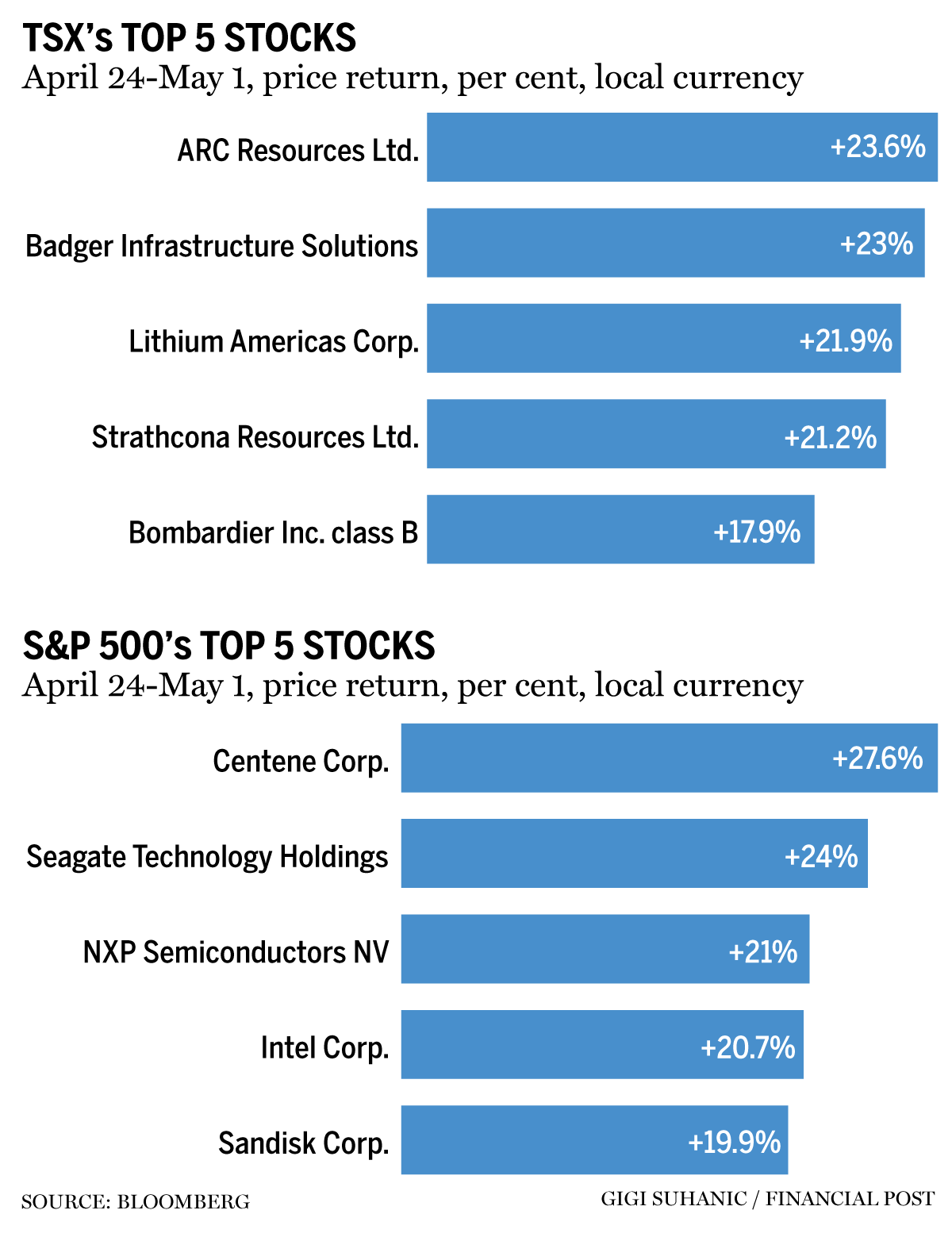
Why GFL Environmental deserves better from investors, TD Cowen says
Markets gave a thumbs down to GFL Environmental Inc. ‘s (GFL:TSX) purchase of Secure Waste Infrastructure Corp. (SES:TSX), driving shares down about 13 per cent. But sentiment could be shifting. TD Cowen analyst James Schumm said he was “warming up” to the deal. “Critical and difficult-to-replace disposal assets deserve to trade at premium valuations and we think GFL is paying an attractive price despite commodity risk,” he said in a note on May 1. He said the stock is being “unduly punished,” with valuations slumping to near all-time lows. He reiterated his buy rating on GFL and price target of $90. Shares closed Friday at $52.36. GFL has a 12-month price target of $72.35 based on 19 analyst calls, according to Bloomberg.
Rosenberg Research on preparing for a weaker U.S. dollar
Investors seeking shelter from the U.S.-Israel-led war on Iran have fled to the safe haven of the greenback. But in a post-war world, the U.S. dollar is expected to weaken due to worries over the U.S. Federal Reserve’s independence , elevated government deficits and possibly narrowing interest rate differentials, David Rosenberg, president of Rosenberg Research & Associates, Inc., said in a note on April 24. The currency’s impending weakness opens the door for gold and international assets such as emerging market bonds. “The resumption of the dollar’s downtrend reinforces our bullish view on these two asset classes, as their structural trends are set to normalize post-conflict,” he said. Gold gained 22 per cent prior to the start of the war on Feb. 28, though year-to-date bullion is now up about six per cent. Nonetheless, Rosenberg said the fundamentals that drove the price of the precious metal up 65 per cent in 2025 are still in place and that the recent pullback has more to do with “speculative outflows.” The World Gold Council this week said central banks took the opportunity to load up on gold in the first quarter on the price pullback. Rosenberg is counting on a slumping U.S. dollar to boost total returns on emerging market bonds because it will shrink the “local currency debt burden.” He said other international equities excluding Japan will benefit in a weaker U.S. dollar environment, as will commodities such as uranium and copper .
Why utilities are looking good to Raymond James
The utility stocks that Raymond James Financial Inc. covers did well in the first quarter and associate analyst Theo Genzebu thinks the pieces are in place for shares of Algonquin Power & Utilities Corp. (AQN:TSX), Emera Inc. (EMA:TSX), Fortis Inc. (FTS:TSX) and Hydro One Ltd. (H:TSX) to continue performing well after they collectively pocketed gains of approximately five per cent and six per cent in the first quarter and year to date, respectively. “We believe that the utilities’ share price performance within our coverage continues to hold up well versus other rate-sensitive/cyclical names during this inflationary environment,” he said in a note on April 28. The power needs of artificial intelligence data centres drove shares last quarter and will continue to do so this year, he said, adding that investors should look at the speed at which utilities can roll out their capital investments while maintaining affordability for rate payers. Genzebu has become increasingly constructive on Algonquin, thinks the recent share pullback was “overdone” and maintained his price target of $7.25. Shares of Algonquin closed Friday at $8.58. The consensus 12-month price target for the company is $9.30 based on 11 analyst calls, according to Bloomberg. He hiked his price target on the other three utilities as well: Emera to $75.25 from $74.50, with shares closing Friday at $72.10; Fortis to $80.50 from $78.50, with shares closing Friday at $77.74; and Hydro One to $58 from $57, with shares closing Friday at $58.41. The utilities all pay a dividend yield, ranging from 2.3 per cent at Hydro One to a high of 4.1 per cent at Algonquin and Emera. Fortis shares have a dividend yield of 3.3 per cent.
Price target hikes, cuts and holds and more
- BMO Capital Markets analyst Fadi Chamoun hiked his price on Bombardier Inc. (BBD/B:TSX) to $320 from $300 after the airplane manufacturer reported earnings that beat expectations and featured “solid orders momentum.” Shares closed Friday at $285.83.
- Raymond James analyst Steven Hansen hiked his price target on Chemtrade Logistics Income Fund (CHE/UN:TSX) to $21 from $15 on “increased confidence in the long-term viability of the company’s North Vancouver chlor-alkali facility.” Shares closed Friday at $17.30.
- BMO Capital Markets analyst Stephen MacLeod is resuming coverage of Groupe Dynamite Inc. (GRGD:TSX), with a price target of $106 on a $251-million sell-down of shares by chief executive and controlling shareholder Andrew Lutfy and a $51-million share buyback. Shares closed Friday at $90.05.
- TD Cowen analyst Vince Valentini hiked his price target on Telus Inc. (T:TSX) to $20 from $19 and changed his rating to buy from hold due to emerging price discipline and potential capital expenditure reductions. Shares closed Friday at $17.04.
- Raymond James analyst Craig Stanley hiked his price target on K92 Mining Inc. to $33 from $30 on expected production growth and net financial assets, with the company set to report earnings on May 11. Shares closed Friday at $24.53.
- Scotia Capital Markets analyst Phil Hardie cut his price target on Goeasy Ltd. (GSY:TSX) to $35 from $55 as “investor sentiment remains unforgiving amid lingering uncertainty and what we view as stacked risks.” Shares closed Friday at $32.54.
- TD Cowen analyst Brian Morrison hiked price target for Magna International Inc. (MG:TSX) to $103 from $102 and said the shares presented an “opportunity” given the poor reaction to earnings released on May 1. Shares closed Friday at $82.68.
Please note: The Week in Stocks is taking a short break next week.
Every week, the Financial Post breaks down the most interesting developments in the week’s world of investing, from top performers to surprising analyst calls and stocks to have on your radar.
Are you an investor looking for stock ideas and market insight? Sign up for the weekly FP Investor Newsletter here to get the best of the Financial Post’s investing news, analysis and expert commentary straight to your inbox.
• Email: gmvsuhanic@postmedia.com
]]>Shares of airplane manufacturer Bombardier Inc. (BBD/B:TSX) have slumped 15 per cent since mid-April, increasing the stock’s appeal, though caution is warranted due to ongoing economic headwinds, a TD Cowen analyst said in an April 28 note.
The Montreal-based company reports earnings on April 30 and TD analyst Tim James maintained his price target on the shares of $275 and his hold rating. Bombardier was trading on the S&P/TSX composite index at $237.50 as of 3 p.m. in Toronto. Bombardier has a 12-month price target of $275.92 based on the calls of 13 analysts, according to Bloomberg.
“The recent share pullback may have set the threshold lower for a positive reaction to the results,” James said in a note. “We think environment, not fundamentals, supports caution for the time being.”
The approaching review of the Canada-United States-Mexico Agreement ( CUSMA ) and a potential poor outcome or a further deterioration in the economic relationship between Canada and the U.S. pose risks to the share price, he said.
With first quarter earnings waiting in the wings, TD is looking for Bombardier to report a 13 per cent year-over-year increase in revenues to $1.72 billion on “flat” deliveries, which are the same as the year before, a 14 per cent increase in services revenues and a “significant” increase from last year in the company’s defence segment.
James is expecting executives’ earnings commentary to focus on demand or orders, supply chains, defence and return on capital.
Bombardier is well positioned to benefit from the federal government’s new “buy Canadian” defence strategy , the company’s chief executive Éric Martel told reporters in late February at a conference in Montreal.
The company is already partnering with SAAB to produce GlobalEye aircraft, using Bombardier’s Global 6500 jets as the platform on which surveillance and radar systems are installed. The project is called the airborne early warning and control system in Canada.
Earlier in February, Bombardier announced that Vista Global Holding Ltd. had ordered 40 Bombardier Challenger 3500 business jets, with an option for a further 120 aircraft. TD said the deal should support free cash flow in the first quarter, though James warned that confidence in the first quarter cash flow outlook is typically low due to other working capital challenges.
Guidance for 2026 remains intact and James is “bullish on the fundamentals,” which call for revenue growth of greater than five per cent and adjusted earnings before taxes, depreciation and amortization growth greater than four per cent, or 12 per cent excluding input tax credits.
“We look forward to more information on defence opportunities to determine if the pipeline is supporting existing growth expectations or could provide incremental upside,” James said. “Either way, its expansion could diversify revenue, reduce risk profile and attract investor interest.”
—With a file from Rene Bruemmer, Montreal Gazette
• Email: gmvsuhanic@postmedia.com
]]>Why analysts see upside to Enbridge stock though not for the reasons you might think, what Rosenberg Research sees as an Iran-war winner and more from The Week in Stocks.
Stock of the week: Rogers Communications Inc.
Shares of Rogers Communications Inc. (RCI/B:TSX) have been on a rollercoaster over the past few weeks falling 15 per cent as investors bailed from the stock, spooked by a telecom wireless price war, only for the shares to regain some lost ground as earnings matched estimates. In the wake of all that drama, TD Cowen analyst Vince Valentini hiked his price target for Rogers post-earnings to $60 from $56 and upgraded his rating to a buy from a hold, calling the negative sentiment around the stock “excessive” and adding in a note on Wednesday that “we believe that the market continues to underestimate both the value of the company’s sports assets and the potential timing of their monetization. Shares closed Friday at $49.26. Valentini expects a deal to go ahead to buy a 25 per cent stake of Maple Leaf Sports and Entertainment (MLSE) from Kilmer Sports Inc., though he said the transaction could take place later than expected. On the wireless front, the TD analyst said the telcos have received the message that the price wars were “destructive and unacceptable.” The analyst highlighted four catalysts for the Rogers shares, including ongoing debt reduction to bring levels to those of peers, more savings from the purchase of Shaw Communications Inc., further “non-core” asset sales and more information on monetizing MLSE. Desjardins Capital Markets analyst Jerome Dubreuil also hiked his price target to $59 from $54.50, citing as a “clear positive” the significant reduction in capital spending. However, Desjardins thought markets would react more positively than they did to the spending cuts, he said. Rogers’ 12-month target price, based on the calls of 17 analysts, is $59.25, according to Bloomberg.
Keeping score


Rosenberg Research on what may be a ‘big winner’ from the Iran war
“Alternative energy will be a big winner of the U.S.-Israel-Iran war,” David Rosenberg , president of Rosenberg Research and Associates Inc., said in note, adding that the backlash against the clean-energy sector is starting to unwind as the conflict reconfirms energy security as a top global priority. “Investors should continue to manage geopolitical risk at the portfolio level, rather than trading too quickly,” Rosenberg said. Investing opportunities in the renewables space go beyond energy generation to include batteries, grid modernization and energy storage, while commodities linked to alternative energy run from copper , uranium , lithium and nickel to rare earth metals . Here is a list of exchange-traded funds (ETFs) Rosenberg is suggesting investors can tap to get into the sector: iShares Energy Storage and Materials ETF (IBAT), iShares Global Clean Energy ETF (ICLN), Global X Copper Miners ETF (COPX), Evolve Global Materials and Mining Enhanced Yield ETF (BASE), Global X Copper Producer Equity Covered Call ETF (CPCC), VanEck Rare Earth and Strategic Metals ETF (REMX) and Global X Uranium ETF (URA). Since the start of the war, the ICLN ETF is up nearly 10 per cent. “For investors, renewable energy will increasingly be both a source of diversified return and a hedge in portfolio construction,” Rosenberg said.
Enbridge upside seen on U.S. permits, natural gas infrastructure development
Shares of Enbridge Inc. (ENB:TSX) got a boost on Friday when the federal government announced it had approved the $4 billion expansion of the company’s west coast pipeline system, adding up to 300 million cubic feet per day of additional transportation capacity on B.C.’s major natural gas transmission system. Construction is slated to begin this summer, subject to addressing environmental, safety and Indigenous engagement concerns. Shares of Enbridge have slumped through April, but are up 10 per cent year to date and rose slightly on the news, closing Friday at $72.86. The 12-month consensus price target on the shares based on 23 analysts is $76.15, according to Bloomberg. Shares hit that level late last month. Some analysts see more upside, though their calls don’t relate to the announced expansion. UBS Research analyst Manav Gupta has a price target of $85 on the shares, due to permits recently approved by the U.S. that Gupta said are critical to Enbridge’s Main Line Optimization plan. Enbridge’s Main Line moves crude oil from western Canada into the U.S. Veritas Investment Research analyst Darryl McCoubrey has a price target of $82 “largely due to favourable market conditions for North American natural gas infrastructure development ,” he said in a note on Friday.
Price target hikes, cuts and holds
- BMO Capital Markets analyst John Gibson hiked his price target for Mullen Group Ltd. (MTL:TSX) to $23 from $20 on earnings that met expectations and strong freight demand. Shares closed Friday at $19.95.
- CIBC Capital Markets analyst Robert Catellier hiked his price target for TC Energy Corp. (TRP:TSX) to $89 from $85 on higher-than-expected returns for “key” projects that have started operating or have approval. Shares closed Friday at $84.79.
- TD Cowen analyst Michael Van Aelst cut his price target for Metro Inc. (MRU:TSX) to $106 from $113 on “noisy” quarterly results with the disturbance likely to continue due to a distribution centre strike in Quebec. Shares closed Friday at $91.09.
- National Bank of Canada Capital Markets analyst Gabriel Dechaine hiked his price target for Sun Life Financial Inc. (SLF:TSX) to $109 from $99 and boosted its rating to outperform from perform on a turnaround in its U.S. business. Shares closed Friday at $97.74.
- Raymond James analyst Steve Hansen hiked his price target for Canadian National Railway Co. (CNR:TSX) to $170 from $162 on better-than-expected traffic growth in grains and potash and an improving freight outlook in the U.S. Shares closed Friday at $156.71.
- Raymond James analyst Craig Stanley hiked his price target for Torex Gold Resources Inc. (TXG:TSX) to $88 from $85 on updated estimates for the company’s Morelos Complex in Guerrero, Mexico. Shares closed Friday at $61.15.
Every week, the Financial Post breaks down the most interesting developments in the week’s world of investing, from top performers to surprising analyst calls and stocks to have on your radar.
Are you an investor looking for stock ideas and market insight? Sign up for the weekly FP Investor Newsletter here to get the best of the Financial Post’s investing news, analysis and expert commentary straight to your inbox.
• Email: gmvsuhanic@postmedia.com
]]>Where tech giant earnings may be headed, RBC Capital Markets’ top energy picks to navigate an eventual less volatile Strait of Hormuz and more from The Week in Stocks.
Stock of the week: Xanadu Quantum Technologies Inc.
Shares of Xanadu Quantum Technologies Inc. (XNDU:TSX) more than hit their stride this week, rising about 486 per cent from their lowest intraday trading price of $9.75 on April 2. The stock listing, created through a merger with a special purpose acquisition company, had a rocky start as its shares mostly traded below its opening price on the S&P/TSX composite index of $12.62 on March 27. On April 13, the picture changed when one of the world’s most valuable companies, Nvidia Corp. (NVDA:Nasdaq), unveiled an open-source artificial intelligence model meant to help speed up progress in the quantum computing sector by reducing errors. With Nvidia in the nascent sector’s corner, shares of Xanadu took off, rising to an intraday high on Friday of $57.13. Christian Weedbrook, the chief executive of Xanadu, reached billionaire status via his shares in Xanadu, according to Bloomberg. The Toronto-based company is looking to build a quantum data centre by 2030. Shares of the company retreated about 6.7 per cent on Friday to close at $41.52.
Keeping score


Mark April 29 in your calendar with these Big Tech earnings queued up
Four U.S. tech giants are slated to unveil first quarter earnings on April 29 and may turn the page on a tough period for the shares. Earlier this year they fell out of favour on concerns about artificial intelligence spending. In anticipation of those earnings, analysts have reviewed price targets and ratings for some of the world’s largest companies. TD Cowen analyst Derrick Wood cut his price target for Microsoft Corp. (MSFT:TSX) to US$540 from US$610 on rising capital expenditures and muted returns from cloud-computing platform Azure. Wood said he expects the shares to be “range bound” unless Microsoft AI assistant Copilot provides a bump. Shares closed Friday at US$422.79. TD Cowen analyst John Blackledge has a price target of US$820 for Meta Platforms Inc. (META:Nasdaq) and has a buy rating on the shares. Blackledge is forecasting a 32 per cent year-over-year increase in revenue and 16 per cent jump in operating income in the first quarter of 2026. TD Cowen “views Meta as the premier social media advertising platform” and that it “consistently demonstrates a high return on investment,” Blackledge said in a note. Shares of Meta closed Friday at US$688.55. Blackledge stuck with his price target of US$300 and his buy rating for Amazon.com Inc. (AMZN:Nasqad) on “several drivers that should yield robust global revenue growth and rising margins,” including online retail market share gains and growth in international markets such as India, Mexico and Australia. Amazon closed Friday at US$250.56. Blackledge hiked his price target for web behemoth Alphabet Inc. (GOOG:Nasdaq) to US$375 from US$365 on accelerating Google Search spending and “robust” growth in search and cloud services revenue of 16 per cent year over year and 50 per cent year over year. Shares of Alphabet closed Friday at US$339.40.
With a volatile Strait of Hormuz, how should energy investors respond?
“It is not lost on us that energy producers are being heavily used as a temporary financial hedge against sectors which are being battered and bruised by elevated oil prices,” RBC Capital Markets analyst Greg Pardy, head of global energy research, said in a report released on April 16, referring to the war in the Middle East. The conflict resulted in the closure of the Strait of Hormuz , the transportation route for 20 per cent of the world’s energy needs. Just a day later, Iran announced the strait was “completely open.” A day after that, it was shut again. With hopes that eventually the energy picture will become less chaotic, Pardy and his team on April 16 had some suggestions for how investors could position themselves. In the intermediate energy and utilities space RBC likes PrairieSky Royalty Ltd. (PSK:TSX). RBC hiked its price target for PrairieSky this week to $36 from $35 for the largest royalty owner in the Western Canada Sedimentary Basin. Shares closed Friday at $30.85. “We believe a premium multiple is warranted by the company’s perpetual resource exposure and strong balance sheet. Our price target supports our outperform rating,” RBC said. In the Canadian oilfield services sector, analyst Keith Mackey likes Enerflex Ltd. (EFX:TSX), CES Energy Solutions Corp. (CEU:TSX) and Precision Drilling Corp. (PD:TSX) based on the expectation that strong free-cash flow will continue in 2026. Mackey hiked his price targets for Enerflex, CES and Precision this week to $35.78 from $27.40, $22 from $20 and $150 from $140, respectively. Shares closed Friday at $31.37, $17.17 and $114.36, respectively.
Price target hikes, cuts and holds
- CIBC Capital Markets analyst Todd Coupland hiked his price target for Celestica Inc. (CLS:TSX) to $586.40 from $488.50 on the expectation that when the company reports earning on April 27 it will beat estimates soundly as it did in 2025. The stock closed Friday at $542.89.
- National Bank of Canada Capital Markets analyst Mohamed Sidibe hiked his price target for Montage Gold Corp. (MAU:TSX) to $19 from $16 after it expanded its exploration footprint into Mauritania. Shares closed Friday at $17.03.
- TD Cowen analyst Cherilyn Radbourne maintained her price target of $77.84 for Brookfield Infrastructure Partners LP (BIP/U:TSX) based on a five per cent yield and “highly resilient cash flows.” Shares closed Friday at $50.70.
- CIBC Capital Markets analyst Mark Jarvi hiked his price target for Capital Power Corp. (CPX:TSX) to $81 from $80 on the expectation the energy prices will rise in Alberta on increased demand from data centres. Shares closed Friday at $66.47.
- Desjardins Capital Markets analyst Benoit Poirier maintained his price target of $14 for Kraken Robotics Inc. (PNG:TSX) on $222 million worth of orders so far in 2026 — “a great start.” Shares closed Friday at $8.80.
- Raymond James analyst Michael Glen cut his price target for Linamar Corp. (LNR:TSX) to $90 from $100 on the effects on its industrial segment on changes to Section 232 U.S. tariffs. Shares closed Friday at $82.51.
- TD Cowen analyst Vince Valentini hiked his price target for Quebecor Inc. (QBR/B:TSX) to $63 from $60 on the assessment that Quebecor faces less risk if wireless pricing competition heats up. Shares closed Friday at $56.44.
Every week, the Financial Post breaks down the most interesting developments in the week’s world of investing, from top performers to surprising analyst calls and stocks to have on your radar.
Are you an investor looking for stock ideas and market insight? Sign up for the weekly FP Investor Newsletter here to get the best of the Financial Post’s investing news, analysis and expert commentary straight to your inbox.
• Email: gmvsuhanic@postmedia.com
]]>RBC Capital Markets updates its Top 30 global stock ideas for the second quarter, the strange case of falling valuations and rising earnings outlooks and more from The Week in Stocks.
Stock of the week: Imperial Oil Ltd.
Imperial Oil Ltd. (IMO:TSX) closed Friday at $178.93, well above its 12-month price target of $139.71 based on the forecasts of 17 analysts tracked by Bloomberg. That didn’t stop some analysts from hiking their price targets for the oilsands major. UBS Global Research analyst Manav Gupta hiked his target on April 9 to $206 from $185 after increasing his estimates for refining and extraction results. Gupta said he is modelling capital investment spending of $475 million in the first quarter and post-dividend free cash flow of $825 million and expects that to translate into share buybacks at the end of 2026. At National Bank of Canada Capital Markets, analyst Travis Wood hiked his price target for Imperial to $212 from $139 on the expectation that the disruption in the flow of oil through the Strait of Hormuz sets Imperial up as among the names best positioned to benefit from the risks to global refining markets. BMO Capital Markets analyst Randy Ollenberger raised his price target to $185 from $129 on April 7. However, some analysts have a different view. RBC Capital Markets analyst Greg Pardy has a price target on Imperial of $126 and an underperform rating based on the belief that the value of shares have “disconnected” from company fundamentals and on a worry that the major reorganization of the company, which will involve layoffs and the transfer of work to overseas centres, could hurt the company’s operating performance.
Keeping score


Here are selected names RBC added, and dropped, from its best global ideas
RBC Capital Markets’ basket of 30 top investing ideas had a rough ride in the first quarter, with only nine of the companies, including Loblaw Cos. Ltd. (L:TSX), posting gains as names such as Airbnb Inc. (ABNB:US), Amazon.com Inc. (AMZN:US), Shopify Inc. (SHOP:US) and Microsoft Corp. (MSFT:US) posted losses. For the first three months of the year, the Top 30 list was down 4.6 per cent compared with a loss of 3.7 per cent on the S&P 500 index and a gain of 3.2 per cent on the S&P/TSX composite index. With the second quarter fresh out of the starting gate, RBC has revised its list. Graeme Pearson and Mark Odendahl, co-heads of global research, dropped L’Oreal SA (OR:FP) in favour of Diageo PLC (DGE:LN) as their top consumer pick in Europe. In the health-care sector, they added Merck & Co. Inc. (MRK:US) on the expectation that the company will direct its free cash flow to research and development and acquisitions. In information technology, they added Applied Materials Inc. (AMAT:US) as they believe it is benefiting from strong generative AI spending, and dropped a few companies, among them Shopify. In utilities, they added AltaGas Ltd. (ALA:TSX), backed by the company’s liquid petroleum gas export terminals and high energy prices. They dropped Engie SA (ENG:FP), feeling it has topped out following a 24 per cent increase in the shares in the first quarter.
Stranger things: valuations are falling, while earnings estimates rise, says Purpose
As another earnings season nears, something strange is happening: Stock valuations are falling while earnings estimates are climbing, Craig Basinger, chief market strategist of Purpose Investment Inc., said in a note on April 6. “That’s not supposed to happen,” he said, adding he expects the dynamic to right itself with rising stocks prices. To be sure, the Middle East conflict is a complication and the inflationary forces it has unleashed on energy and commodity prices could end up eating into margins, he said. “For now, the base case remains intact, just with a slimmer margin for error than we had in January,” Basinger said. Where should investors be looking? TSX energy stocks’ forward earning have risen more than 10 per cent in the past month, while S&P 500 index energy stocks posted a one-month forward earnings increase of more than 20 per cent, he said. Basinger thinks energy is at “peak momentum” and Purpose has been trimming back. The TSX’s materials sector has posted a 20 per cent earnings revision over the past three months on a commodity “tailwind.” Even though gold has pulled back, the bigger picture looks good, Basinger said. “Industrials, meanwhile, are steady, with recent momentum intact. Nothing flashy, but nothing to worry about, either. Sometimes boring is good,” he said.
Price target hikes, cuts and holds
- BMO Capital Markets analyst David Dodge hiked his price target for Toromont Industries Ltd. (TIH:TSX) to $215 from $210. Shares closed Friday at $210.88.
- TD Cowen analyst Jonathan Kelcher stuck with his price target of $85 for Boardwalk REIT (BEI/U:TSX), which remains TD’s top pick in the apartment REIT sector on occupancy levels that have met expectations. Shares closed Friday at $65.
- BMO Capital Markets analyst Tariq Saad hiked his price target for International Petroleum Corp. (IPCO:TSX) to $43 from $27 on belief that the rally in oil prices has improved IPCO’s otherwise rich valuation. Shares closed Friday at $36.60.
- RBC Capital Markets analyst Andrew Wong hiked his price target for Nutrien Ltd. (NTR:TSX) to $118 from $109 on the expectation that the fertilizer company will benefit from rising nitrogen prices due to the Iran war. Shares closed Friday at $102.13.
- TD Cowen analyst Jonathan Kelcher hiked his price target for Extendicare Inc. (EXE:TSX) to $32 to $19 after resuming coverage of the company following the closure of its purchase of CBI Home Health for $570 million. Shares closed Friday at $29.63.
- BMO Capital Markets analyst Brian Quast confirmed a price target of $41 for Aris Mining Corp. on the belief that gold production will meet guidance for 2026. Shares closed Friday at $28.60.
Every week, the Financial Post breaks down the most interesting developments in the week’s world of investing, from top performers to surprising analyst calls and stocks to have on your radar.
Are you an investor looking for stock ideas and market insight? Sign up for the weekly FP Investor Newsletter here to get the best of the Financial Post’s investing news, analysis and expert commentary straight to your inbox.
• Email: gmvsuhanic@postmedia.com
]]>Why RBC Capital Markets is revising its price targets for the Big Banks, the case for a 35% dividend cut at Telus and more from The Week in Stocks.
Stock of the week: BRP Inc.
Shares of BRP Inc. (DOO:TSX) closed out the week up just over nine per cent after the maker of the Sea-Doo and Ski-Doo reported earnings that featured “good progress across the board” on areas including new products, market share gains in the outdoor recreational vehicle segment and inventory sitting in a “healthy spot,” RBC Capital Markets analyst Sabahat Khan said in a note on March 26. Khan has a price target of $131 for shares of BRP, well above the 12-month consensus price target for 18 analysts of $119.84, based on Bloomberg data. Shares closed Friday at $91.83. BRP expanded its share of the North American market by approximately 12 per cent year over year and TD Cowen analyst Brian Morrison said he sees the “trend continuing based upon innovative and higher-end offerings.” Yet, “The macro environment clearly contains substantial uncertainty, but BRP is executing on its plans and we believe is well-positioned to outperform the industry, with levers to pull to achieve guidance even in a slower demand environment,” Mark Petrie, a CIBC Capital Markets analyst, said. Morrison has a price target of $119 and Petrie has a target of $118. However, Raymond James analyst Joseph Altobello trimmed back his price target for BRP to $115 from $117 on macroeconomic concerns, though he maintained a strong buy rating for the shares on earnings that “easily” beat estimates.
Keeping score


RBC revisits its take on the Big Banks
RBC Capital Markets analyst Darko Mihelic cuts his price target for five of Canada’s Big Banks — excluding RBC, which they don’t cover — on broader risks. These include smouldering private credit risks, trade negotiations and geopolitics, and their effect on interest rates and the overall quality of credit. “We still see potential upside (but more modest upside) to current stock prices,” Mihelic said in a note on March 26. RBC’s price target changes are as follows: Bank of Montreal (BMO:TSX) cut to $205 from $219. It closed Friday at $183.03; Bank of Nova Scotia (BNS:TSX) was cut to $98 from $106. It closed at $94.09; Canadian Imperial Bank of Commerce (CM:TSX) was cut to $147 from $158. It closed at $128.90; National Bank of Canada (NA:TSX) was cut to $180 from $193. It closed at $177.49; Toronto-Dominion Bank (TD:TSX) was cut to $138 from $148. It closed at $126.87. The S&P/TSX Canadian bank index is trading above historical averages for forward price to earnings (P/E) and price to book ratios, but Mihelic said his reduced median forward P/E of 14X is “defensible and reasonable” based on returns from previous comparable periods.
Desjardins makes the case for a 35% dividend cut at Telus
“Telus does not have to cut its dividend … but it should.” That’s the assessment of Desjardins Group analyst Jerome Dubreuil, who said in a note on March 26 that with a new chief executive in place the timing is right to rewire how capital is allocated. Telus Corp. ‘s (T:TSX) balance sheet isn’t in trouble but the dividend payout ratio is slated to remain above 100 per cent for several years, Desjardins estimated. Dubreuil said a 35 per cent cut to the dividend and ending the discounted dividend reinvestment program (DDRIP), which he described as unpopular with investors, would help boost confidence in the company. The DDRIP program allows investors to purchase shares at a discounted price. “Share dilution has in fact been a persistent issue for T over the past decade,” Dubreuil said. The analyst also said Telus should sell its Telus Health unit and focus on core telecom operations. The funds generated from these moves would put Telus in a better debt position compared with BCE Inc. and Rogers Communications Inc., he said. Ultimately, Telus could start share buybacks to “directly address investor frustration around dilution,” Dubreuil said. Desjardins has a price target on Telus of $23 and a buy rating. Shares closed Friday at $17.73.
Price target hikes and cuts
- CIBC Capital Markets analyst Jamie Kubik hiked his price target for Precision Drilling Corp. (PD:TSX) to $150 from $140 based on the company’s dominance in Canada and expanding operations in the U.S. Among risks to the shares are sharply declining commodity prices or an increase in the Canadian dollar. Shares closed Friday at $140.09.
- National Bank of Canada Capital Markets analyst Baltej Sidhu hiked his price target for Northland Power Inc. (NPI:TSX) to $27 from $25 given that it is one of few remaining independent renewable power producers in Canada following this week’s move by the Caisse de dépôt et placement du Québec and Brookfield Asset Management Ltd. to take Boralex Inc. private. Shares of Northland closed Friday at $23.26.
- RBC Capital Markets analyst Maurice Choy hiked his price target for Tidewater Renewables Ltd. (LCFS:TSX) to $7.50 from $6.00 on better than expected guidance for 2026, lower debt due to improved cash flow and “a seemingly supportive Canadian policy landscape.” Shares closed Friday at $6.97.
- ATB Cormark Capital Markets analyst Patrick O’Rourke hiked his price target for Suncor Energy Inc. (SU:TSX) to $95 from $71 based on an “improved view of future capital efficiency and higher for longer downstream margin forecasts.” Shares closed Friday at $92.44.
- BMO Capital Markets analyst John Gibson hiked his price target for Bird Construction Inc. (BDT:TSX) to $52 from $38 on “embedded margins in its backlog,” and more business in defence, data centres, nuclear and healthcare projects. Shares closed Friday at $39.44.
- ATB Cormark Capital Markets analyst Amir Arif hiked his price target for Vermilion Energy Inc. (VET:TSX) to $24 from $16 calling the stock a “value name.” Shares closed Friday at $19.28.
Every week, the Financial Post breaks down the most interesting developments in the week’s world of investing, from top performers to surprising analyst calls and stocks to have on your radar.
Are you an investor looking for stock ideas and market insight? Sign up for the weekly FP Investor Newsletter here to get the best of the Financial Post’s investing news, analysis and expert commentary straight to your inbox.
The Week in Stocks is taking a break next week on Good Friday. Look out for it on the Friday following, April 10.
• Email: gmvsuhanic@postmedia.com
]]>How to play the Iran war-driven energy volatility, a rethink of Power Corp.’s Thursday selloff, price target hikes and cuts and more from The Week in Stocks.
Stock of the week: MDA Space Ltd.
The S&P/TSX composite index has returned all its gains for the year and then some, but there are still winners out there. Space and defence technology company MDA Space Ltd. (MDA:TSX) is up just over 61 per cent year to date and Desjardins Capital Markets analyst Benoit Poirier said in a report on March 19 that several catalysts should propel shares higher in 2026. Poirier hiked his price target to $53 from $51, the second increase this year, as “visibility” has increased on Canada’s space program. Shares closed Friday just under $43. Among the government projects MDA is expected to benefit from are a $32 million ground-based space surveillance system and a strategic partnership with Canada’s Department of National Defence and Telesat Corp. (TSAT:TSX) to build satellites to enhance communication over Canada’s North. Following, the launch of MDA’s U.S.-listed shares on March 12, Poirier calculated the Brampton, Ont.-based company reaped $444 million in net proceeds and will likely end 2026 with net cash of $94 million, potentially allowing for acquisitions. Eight analysts tracked by Bloomberg have a 12-month average price target for MDA of $54.25.
Keeping score


Scotia’s top energy picks to navigate oil and natural gas volatility
Though the Iran conflict sent oil and natural gas prices soaring, their future trajectory in unclear. Scotia Capital Markets analysts led by Kevin Fisk think they have a way to negotiate this uncertainty, producing a list of several top picks in the Canadian energy space. “Given the commodity price uncertainty, our preference is for stocks with above average yields in all our commodity cases, and are baking in reasonable commodity prices,” the Scotia team said, Oil weighted companies are, on average, pricing oil at US$71 per barrel, with West Texas Intermediate (WTI) trading on Friday around US$95. Scotia’s top picks in the oil category are Cenovus Energy Inc. (CVE:TSX), Whitecap Resources Inc. (WCP:TSX) and Ovintin Inc. (OVV:TSX) based on outlooks built on lower WTI prices compared with peers and “solid exposure to stronger oil prices.” On the defensive side of the oil play, Scotia likes Freehold Royalties Ltd. (TSX:FRU) and PrairieSky Royalty Ltd. (PSK:TSX). Scotia’s top picks in the natural gas space include Topaz Energy Corp. (TPZ:TSX), Spartan Delta Corp. (SDE:TSX), Peyto Exploration and Development Corp. (PEY:TSX) and Expand Energy Corp. (EXE:NYSE). Each name boasts a distinct advantage. Topaz offers “ultra-high margin exposure” to the top assets in the Western Canada Sedimentary Basin and Spartan, which operates in the Duvernay region, is a “top-growth name,” Scotia said. Expand is Scotia’s best name in the U.S. gas space for its “upside torque and downside protection.” Vermilion Energy Inc. (VET:TSX) provides exposure to the European gas market, Fisk said.
Was Power Corp.’s selloff overdone?
Investors reacted to Power Corp. of Canada ‘s (POW:TSX) earnings on Thursday by driving shares down four per cent. A day later, shares rebounded, while several analysts hiked their price target for the Montreal-based conglomerate. This included RBC Capital Markets analyst Bart Dziarski, who increased his target for Power Corp. to $73 from $69 after the company reported earnings were hit by “one-time sizable items.” Shares closed at $64.88. Year to date, shares are down just over 10 per cent, but rose 62 per cent in 2025. Dziarski thinks Thursday’s selloff was overdone given the shares are trading at a 21 per cent discount to the net asset value, and Power pays an “attractive” dividend of approximately four per cent. The company raised its dividend nine per cent and is in a “solid position” to continue repurchasing shares, he said.
Price target hikes and cuts
- TD Cowen analyst Vince Valentini hiked his price target for BCE Inc. to $41 from $40 after the telco announced its joint data centre project with CoreWeave Inc. and Cerebras Cerebras Systems Inc. has a capacity of 800 megawatts, up from 500. Shares closed Friday at $35.43.
- Raymond James analyst Stephen Li hiked his price target for Kraken Robotics Inc. (PNG:TSX) to $11 from $6.25 after it acquired Covelya Group, a supplier of subsea technology. Shares closed Friday at $8.93.
- BMO Capital Markets analyst Joel Jackson hiked his price target for Nutrien Ltd. (NTR:TSX) to $123.22 from $116.49 on the belief that a closed Strait of Hormuz is stressing fertilizer supplies. He sees Nutrien as among the cleanest avenues for gains “considering methanol and nitrogen supply risks.” Shares closed Friday at $102.56.
- Veritas Investment Research analyst Kathleen Wong hiked her price target for Loblaw Cos. Ltd. (L:TSX) to $70 from $67 on the belief that the chain’s “discount and drug flywheel should drive sustained share gains,” with Shoppers Drug Mart playing a key role. Shares closed Friday at $61.86.
- National Bank of Canada Capital Markets analyst Shane Nagle hiked his price target for Wheaton Precious Metals Corp. (WPM:TSX) to $245 from $240 on an improved outlook with several projects — purchased when gold prices were much lower — slated to start production over the next few years. Shares closed Friday at $157.08.
- CIBC Capital Markets analyst Ty Collin cut his price target for AutoCanada Inc. (ACQ:TSX) to $20 from $34 on earnings that missed estimates “by a wide margin.” Shares closed Friday at $17.15.
- National Bank of Canada Capital Markets analyst Alex Terentiew hiked his price target for Highlander Silver Corp. (HSLV:TSX) to $14 from $11 on its recently acquired Corani silver project and Mercedes gold mine. Shares closed Friday at $6.76.
Every week, the Financial Post breaks down the most interesting developments in the week’s world of investing, from top performers to surprising analyst calls and stocks to have on your radar.
Are you an investor looking for stock ideas and market insight? Sign up for the weekly FP Investor Newsletter here to get the best of the Financial Post’s investing news, analysis and expert commentary straight to your inbox.
• Email: gmvsuhanic@postmedia.com
]]>Why analysts are slashing stock price targets on Goeasy, how to play the Canada-India reconciliation and more from The Week in Stocks.
Stock of the week: Bird Construction Inc.
Shares of Bird Construction Inc. (BDT:TSX) rose seven per cent this week after the company beat estimates for adjusted earnings before interest, taxes and depreciation and amortization and “delivered a strong quarter and an even stronger outlook,” Raymond James analyst Frederic Bastien said in a March 12 note, hiking his price target nearly 30 per cent to $44 from $34. Shares closed Friday at $34.08. The Ontario-based general contractor has a backlog of projects worth $11.1 billion and a “healthy” balance sheet of $560 million, which Bastien said will afford management flexibility. “A renewed ‘Build Canada’ mandate bodes particularly well for BDT’s infrastructure and industrial businesses,” Bastien said, adding that Bird is also branching out into defence — a key focus for the government — in the areas of hangar and bunker developments. Bird is also in the mix when it comes to the construction of nuclear reactors. “With this much work coming, management can bid selectively with a view to enhancing the healthy margins already embedded in (the) backlog,” Bastien said. The eight analysts who track Bird have a 12-month price target of $40.25, according to Bloomberg.
Keeping score


There was nothing easy about Goeasy’s week on the markets
It was a terrible week for Goeasy Ltd. (GSY:TSX) with shares of the sub-prime lender tanking 57 per cent on Monday, falling to $49.69 from $115.55, and continuing to crater thereafter. This was after it announced it was suspending its dividend and buybacks and withdrew its fourth quarter and three-year guidance on mounting losses in the company’s auto loan unit. The news left analysts scrambling to drop price targets. Raymond James analyst Stephen Boland lowered his price target to $77 from $153, while TD Cowen analyst Graham Ryding stripped his target to $44 from $135. RBC Capital Markets reduced theirs to $56 from $152 and said that the “path forward won’t be easy” given that Goeasy is expected to breach several covenants (violate the terms and conditions of loans). RBC’s Bart Dziarski also said it’s likely that rating agencies will downgrade Goeasy’s debt, while earnings could easily worsen, he said. Scotia Capital Markets analysts Phil Hardie and Rhave Shah said “investors’ worst fears had come to pass” in the wake of a short-seller report on Goeasy released last fall, which alleged that the company was putting off declaring rising delinquencies and loan losses. However, the pair now think the worst is behind the lender and that shares might be oversold. Scotia has a price target of $68, down from $210. Shares closed Friday at $35.72.
RBC looks at ways to play Canada’s rapprochement with India
Given all the turmoil in the Middle East, it’s easy to forget that Prime Minister Mark Carney only a few weeks ago travelled to India to reset political and trade relations with one of the world’s major economies. RBC Capital Markets thinks the trip, which also included members of Canada’s business community, yielded some “tangible results” for companies it covers. “With the sheer size of the Indian market, we believe the groundwork for a meaningful improvement in what had been a frosty relationship between Canada and India is a positive for Canadian companies,” analyst Walter Spracklin and his team said in a report on March 11. Among the companies RBC highlighted are Cameco Corp. (CCO:TSX), AltaGas Ltd. (ALA:TSX), Brookfield Infrastructure Partners LP (BIP:NYSE), Canadian National Railway Co. (CNR:TSX), and Bombardier Inc. (BBD.B:TSX). Cameco’s agreement to supply India with nearly 22 million pounds of uranium over the next nine years provides “another reason to like Cameco,” RBC said. Also in the energy space, AltaGas looks like the “logical way” to approach an impending deal between Canada and India to ship liquefied petroleum gas. Meetings between Canada and India also produced several memorandums of understanding covering critical minerals and coal. Canadian National Railway “is best placed” to benefit from transporting commodities to the British Columbia coast for transport, RBC said. In aerospace and defence, Bombardier could come out ahead as India looks to establish a strategic partnerships in defence procurement, space development, and civil aviation, RBC analyst James McGarragle said.
Price target hikes and cuts
- TD Cowen analyst Craig Hutchison hiked his price target for Altius Minerals Corp. (ALS:TSX) to $52 from $39 and resumed coverage on the purchase of Lithium Royalty Corp., which Hutchsion said gives Altius “a healthy blend of near and long-term projects.” Shares closed Friday at $43.05.
- Scotia Capital Markets analyst Cameron Bean hiked his price target for Peyto Exploration and Development Corp. (PEY:TSX) to $29 from $27 on “solid” fourth-quarter earnings that signalled the company is off to a strong start in 2026. Shares closed Friday at $28.98.
- Raymond James analyst Stephen Boland hiked his price target for Fairfax Financial Holdings Ltd. (FFH:TSX) to $3,000 from $2,900 on an estimated $6.9 billion in “excess capital” that should lead to more share buybacks or purchasing minority stock positions. Shares closed Friday at $2,279.55.
- TD Cowen analyst Michael Tupholme hiked his price target for Aecon Group Inc. (ARE:TSX) to $47 from $39 on a “near-record backlog.” Shares closed Friday at $40.24.
- CIBC Capital Markets analyst Todd Coupland cut his price target for Celestica Inc. (CLS:TSX) to $488 from $540 “reflecting a lower-multiple environment rather than any deterioration in fundamentals.” Shares closed Friday at $362.26.
- RBC Capital Markets analyst Keith Mackey hiked his price target for CES Energy Solutions Corp. (CEU:TSX) to $20 from $14. “CEU maintains top honours for highest growth metrics in our coverage group,” Mackey said. Shares closed Friday at $18.27.
Every week, the Financial Post breaks down the most interesting developments in the week’s world of investing, from top performers to surprising analyst calls and stocks to have on your radar.
Are you an investor looking for stock ideas and market insight? Sign up for the weekly FP Investor Newsletter here to get the best of the Financial Post’s investing news, analysis and expert commentary straight to your inbox.
• Email: gmvsuhanic@postmedia.com
]]>Why Shopify is rebounding, how to dig for value behind ‘headline’ stock plays and more from The Week in Stocks.
Stock of the week: Shopify Inc.
Shopfiy Inc. (SHOP:TSX) closed out the week up 10 per cent and among the top five gainers on the S&P/TSX composite index as investors continued to reevaluate their initial reactions to the e-commerce company’s earnings, which came out on Feb. 11. Despite delivering its highest quarterly revenue in 20 years, investors were spooked by an adjusted earnings per share miss and overall trepidation regarding AI, at one point pushing shares of Shopify down as much as 27 per cent intraday. That led a few analysts to jump to the shares’ defence. CIBC Capital Markets analysts Todd Coupland and Dylan Ridout said in a note that Shopify remained among their top picks with a price target of $250, trimmed back from $271. “We see upside from durable profitable growth with optionality from agentic e-commerce,” Coupland and Ridout said, arguing Shopify’s integration with OpenAI, Google’s Gemini and Microsoft’s Co-pilot positioned the company to benefit from those platforms rather than suffer displacement. Jefferies Equity Research analysts Samad Samana and Jeremy Sahler said the “negative stock price has surprised us” in a note following the earnings release. Since the earnings, several other investing houses also reaffirmed their price targets for Shopify, and this week’s market action seemed to bear that out, with the stock closing Friday at $172.89. The average 12-month price target based on 46 analysts tracked by Bloomberg is $215.02.
Keeping score


Some possible winners from Canada’s new defence industrial strategy
The numbers in Canada’s just-announced defence industrial strategy are big: $180 billion in procurement and $290 billion in defence capital investment, spread out over 10 years, with Prime Minister Mark Carney pledging the strategy will prioritize the awarding of contracts to Canadian companies. “Our initial reaction is that the announced initiatives are highly constructive for our coverage, given the strong ‘Buy Canada’ focus, the targeted sectors/capabilities (in our coverage’s wheelhouse), the scale of planned investment and the decision to designate private sector firms as strategic partners,” Desjardins Group Capital Markets analysts Benoit Poirier and Michael Kypreos said in a note. Off the mark, Poirier and Kypreos believe companies that will benefit from the policy include Bombardier Inc. (BBD:TSX), CAE Inc. (CAE:TSX), Calian Group Ltd. (CGY:TSX), MDA Space Ltd. (MDA:TSX) and Kraken Robotics Inc. (PNG:TSX). Desjardins estimates that the plan to dedicate approximately 70 per cent of defence spending to Canadian companies will provide a $5.1 billion annual boost that could translate to roughly 300 defence contracts per year. The new policy targets 10 priority sectors including aerospace, a positive for Bombardier. Poirier and Kypreos expect MDA to benefit from a push in the areas of space-based intelligence, surveillance and reconnaissance, space domain awareness and satellite communications. On Thursday, MDA launched a wholly owned defence company, 49North Ltd. CAE and Calian are placed to benefit from specialized manufacturing, training and simulation, they said, while Kraken could win in the area of autonomous systems. Ottawa also plans to create a drone innovation hub, spending $105 million over three years. Company selections are expected to be announced this summer, Poirier and Kpyreos said.
How to find value in ‘behind the headline’ stocks
Sometimes there are gains to be made on the road less travelled. That’s the idea behind a theme-based stock screening system that Mehmet Beceren at Rosenberg Research & Associates Inc. said takes investors past the “headline names” to second- and third-tier companies that “may be less crowded, (have) less already priced in, and (are) better positioned to benefit as a market theme matures.” Beceren highlighted copper as one such investing theme. The price of copper has soared last year and into this year on fears of supply constraints, a lower U.S. dollar and geopolitical risk and miners have risen in tandem. The idea behind the stock screen is to find companies positioned to offer key technologies, materials, or services but that are playing catch-up to the copper theme trade. Based on that, Rosenberg Research created a global copper miner supply chain basket of 24 names. Among the TSX-listed names are Finning International Inc. (FTT:TSX), Fortis Inc. (FTS:TSX), Mattr Corp. (MATR:TSX), Major Drilling Group International (MDI:TSX) and Orbit Garant Drilling Inc. (OGD:TSX). There are also names on the list from Australia, the U.S., Mexico, Japan, Sweden and Germany. “Year-to-date, the upstream miners supply-chain basket has outperformed a generic copper miners portfolio, as second- and third-order effects start to play out — and as investors look for more diversified, better-priced ways to express exposure to a popular theme,” Becerent said.
Price target hikes and a cut
- Raymond James analyst Brian MacArthur hiked his price target for Wheaton Precious Metals Corp. (WPM:TSX) to $259 from $242. The company beat its production guidance for 2025 and raised it for 2026 on added output from current projects and additional production from new operations. Wheaton reports earnings on March 12. Shares closed Friday at $205.65.
- Scotia Capital Markets analysts Phil Hardie and Rhave Shah hiked their price target for Power Corp. of Canada (POW:TSX) to $78 from $76 after company veteran James O’Sullivan was named chief executive, taking over from Jeffrey Orr. Shares closed Friday at $65.99.
- Raymond James Ltd. analysts James Boland and Tomer Levitin analysts raised their price target for EQB Inc. (EQB:TSX) to $124.50 from $91 on three expectations: rising insured commercial loans increased share buybacks and an improved efficiency ratio. Shares closed Friday at $118.80.
- TD Cowen analysts Brian Morrison and Andrew Lopez raised their price target for Canadian Tire Corp. Ltd. (CTC/A:TSX) to $205 from $194 on earnings per share that beat TD’s estimate by nine per cent. Shares closed Friday at $188.48.
- Scotia Capital Markets analyst Mike Rizvanovic cut his price target for iA Financial Corp. Inc. (IAG:TSX) to $174 from $188 on a “big” EPS miss in the fourth quarter though he thinks the subsequent maket selloff is overdone. Shares closed Friday at $155.45.
- TD Cowen analyst Michael Van Aelst hiked his price target for Loblaw Cos. Ltd. (L:TSX) to $75 from $65 in the lead-up to fourth-quarter earnings on the expectation that the grocery giant will hit “the upper end of its financial framework of eight to 10 per cent EPS growth in Q4 and 2026.” Shares closed Friday at $67.26.
Every week, the Financial Post breaks down the most interesting developments in the week’s world of investing, from top performers to surprising analyst calls and stocks to have on your radar.
Are you an investor looking for stock ideas and market insight? Sign up for the weekly FP Investor Newsletter here to get the best of the Financial Post’s investing news, analysis and expert commentary straight to your inbox.
• Email: gmvsuhanic@postmedia.com
]]>Why now is not the time to buy the dips from the war in Iran, how projects of national interest could help Canada’s freight stocks and more from The Week in Stocks.
Stock of the week: Thomson Reuters Corp.
Thomson Reuters Corp. (TRI:TSX) added this week to its nearly 35 per cent rebound from early February, more than gaining back the losses it suffered when it got caught in the recent artificial intelligence -related software rout. TD Cowen analysts led by Vince Valentini reconfirmed the company as a top pick and had a price target of $175 in a March 3 note based on the results of a survey of 100 U.S.-based law firms to assess their use of generative AI services. Shares closed Friday at $151.44. Thomson Reuters got swept up in a software stock selloff after AI company Anthropic released a set of tools markets believed would erode the business of legal software and publishing companies. However, based on the survey results, TD thinks Toronto-based Thomson Reuters can benefit more from AI than be hurt by it and that “new AI players are not disrupting its legal service.” TD said, “We believe the selloff in Thomson Reuters is overdone,” adding, “We believe TRI displays many attributes … to maintain a sustainable moat and strong growth prospects.” The 12-month consensus price target of $177.97 is based on 17 analysts, according to Bloomberg.
Now is not the time to buy the dips, says David Rosenberg
The price of West Texas Intermediate, the North American crude oil benchmark, is up more than 22 per cent since the war in Iran started, positioning rising energy prices as the top risk. “As is usually the case in military conflicts, as we saw early on after Russia waged war on Ukraine, it comes down to energy prices in terms of the shock waves to all corners of the financial markets,” David Rosenberg , president of Rosenberg Research & Associates Inc., said in a note. And those “shock waves” are being felt. Liquefied natural gas ( LNG ) prices in Europe soared 50 per cent after Qatar was forced to shutter its LNG plant, while the Strait of Hormuz, a critical “chokepoint” for oil transportation, is essentially closed. Further, investors seeking safety are flocking to the U.S. dollar, boosting its value and making it tougher for the economy and the “risk-on” — or higher tolerance for risk — trade. “For the global economy and capital markets, the timeline here cannot last much longer than the four weeks that has been bandied about by the (U.S.) administration,” Rosenberg said. However, investors who are thinking of buying the dips with the S&P/TSX composite index and the S&P 500 index down two per cent and just under one per cent this week, respectively, could get be getting ahead of themselves. Rosenberg said the VIX — the volatility or fear index index — needs to rise to 50 to signal “capitulation.” It’s currently sitting at around 24. “This typically is the most ideal time to start putting cash to work … unless this war with Iran is resolved first,” Rosenberg said.
11 major projects could help these Canadian freight stocks, says CIBC
There could be a light at the end of the tunnel for Canada’s freight carriers, which have suffered through four years of recession-like conditions due to sluggish volumes, according to CIBC Capital Markets. Analysts led by Kevin Chiang think freight volumes can ride the “tailwind” that will be created by Canada’s 11 projects of national interest. They assume $84 billion will be spent on the major projects over a 10-year period starting from 2025 that could lift freight volumes by 1.8 per cent year over year. CIBC covers four companies in Canada’s freight space — Canadian National Railway Co. (CN:TSX), Canadian Pacific Kansas City Ltd. (CP:TSX), Mullen Group Ltd. (MTL:TSX) and TFI International Inc. (TFII:TSX). CN and Mullen Group are their top picks because they say these are situated to benefit the most from the group of projects. For example, CN operates in many of the areas where projects will be built including the North Coast transmission line and the Ksi Lisims LNG project in British Columbia, Canada Nickel’s Crawford Project in Ontario, and Nouveau Monde’s Matawinie Mine in Quebec. For Mullen Group, CIBC thinks its strong western presence sets it up to benefit from the Red Chris Mine and LNG Canada phase II, both in B.C., the McIlvenna Bay Copper Mine in Saskatchewan, and the other B.C. projects. “We would also make the case that these infrastructure projects are not being priced into Canadian freight equities today,” they said.
Price target hikes and a cut
- CIBC Capital Markets analyst Anita Soni hiked her price target for Agnico Eagle Mines Ltd. (AEM:TSX) to $427 from $404 on year-end reserve and resource updates that added additional ounces to projects in the Canadian Malartic region, at Detour Lake, and at Hope Bay. Shares closed Friday at $300.11.
- Analysts from several investments houses cut their price targets for Pet Valu Holdings Ltd. (PET:TSX) after it reduced its EPS for 2026. National Bank Capital Markets analyst Vishal Shreedhar reduced his target to $27 from $37, while TD Cowen analyst Michael Van Aelst cut his to $34 from $40. Shares closed Friday at $24.33.
- UBS Group analyst Josh Spector hiked his price target for Methanex Corp. (MX:TSX) to $82 from $73 on a “tighter” global methanol market. Shares closed Friday at $24.33.
- TD Cowen analyst Menno Hulshof hiked his price target for Canadian Natural Resources Ltd. (CNQ:TSX) to $64 from $51 on his belief that the company is a “core energy holding.” Shares closed Friday at $62.96.
- BMO Capital Markets analyst Thanos Moschopoulos raised his price target for MDA Space Ltd. (MDA:TSX) to $50 from $45 on “solid” fourth-quarter earnings and a possible pipeline of several low-Earth orbit constellation satellites. Shares closed Friday at $40.43.
Editor’s note: The Keeping Score charts will return in next week’s The Week in Stocks column.
Every week, the Financial Post breaks down the most interesting developments in the week’s world of investing, from top performers to surprising analyst calls and stocks to have on your radar.
Are you an investor looking for stock ideas and market insight? Sign up for the weekly FP Investor Newsletter here to get the best of the Financial Post’s investing news, analysis and expert commentary straight to your inbox.
• Email: gmvsuhanic@postmedia.com
]]>Canada’s S&P/TSX composite index and the Dow Jones industrial average have pared their steep losses from early Tuesday, but remain down at least 300 points as conflict in the Middle East roils markets.
As of mid-day Tuesday, the TSX had fallen 713 points and the Dow had tumbled by 332 points.
The war in Iran has entered its fourth day, and it remains unclear when it might end as U.S. President Donald Trump has vowed to do “whatever it takes.”
European and Asian stock markets headed for their worst two-day drop since April and South Korean markets fell 7.2 per cent.
Meanwhile, Brent crude climbed more than 4.5 per cent to US$81.22, briefly surpassing US$85 for the first time since July 2024. West Texas Intermediate climbed 4.8 per cent to US$74.50.
Energy prices could remain elevated for the foreseeable future as Middle East refineries, including the world’s largest liquified natural gas plant in Qatar, shut down operations. The conflict is also blocking the Strait of Hormuz, a crucial passageway for about a fifth of the world’s oil shipments.
With files from Bloomberg News
]]>Which Big Bank price targets moved the most post-earnings, why National Bank says it’s time to lean into dividend payers and more from The Week in Stocks.
Stock of the week: Enerflex Ltd.
Shares of Enerflex Ltd. (EFX:TSX) surged nearly 18 per cent on Thursday, placing it among the top 10 gainers on the S&P/TSX composite index this week after the company beat analysts’ estimates for earnings before interest, taxes, depreciation and amortization (EBITDA) by 15 per cent, TD Cowen analyst Aaron MacNeil said. As a result, he “meaningfully” hiked his price target for Enerflex to $39 from $28 while reconfirming it as his top pick in the energy services sector. Shares closed Friday at $30.61, with the stock up nearly 48 per cent this year. MacNeil said he raised his EBITDA estimates for 2026 and 2027 by seven per cent and 10 per cent, respectively. He also said he believes the shares are undervalued compared with peers and merit a “premium valuation” based on the “growing power demand opportunity and to reflect broader energy sector multiple expansion.” Enerflex will likely hold an investor day in the spring and the analyst thinks that will act as a “catalyst” for the stock. The average 12-month price target based on nine analysts tracked by Bloomberg is $34.35.
Keeping score

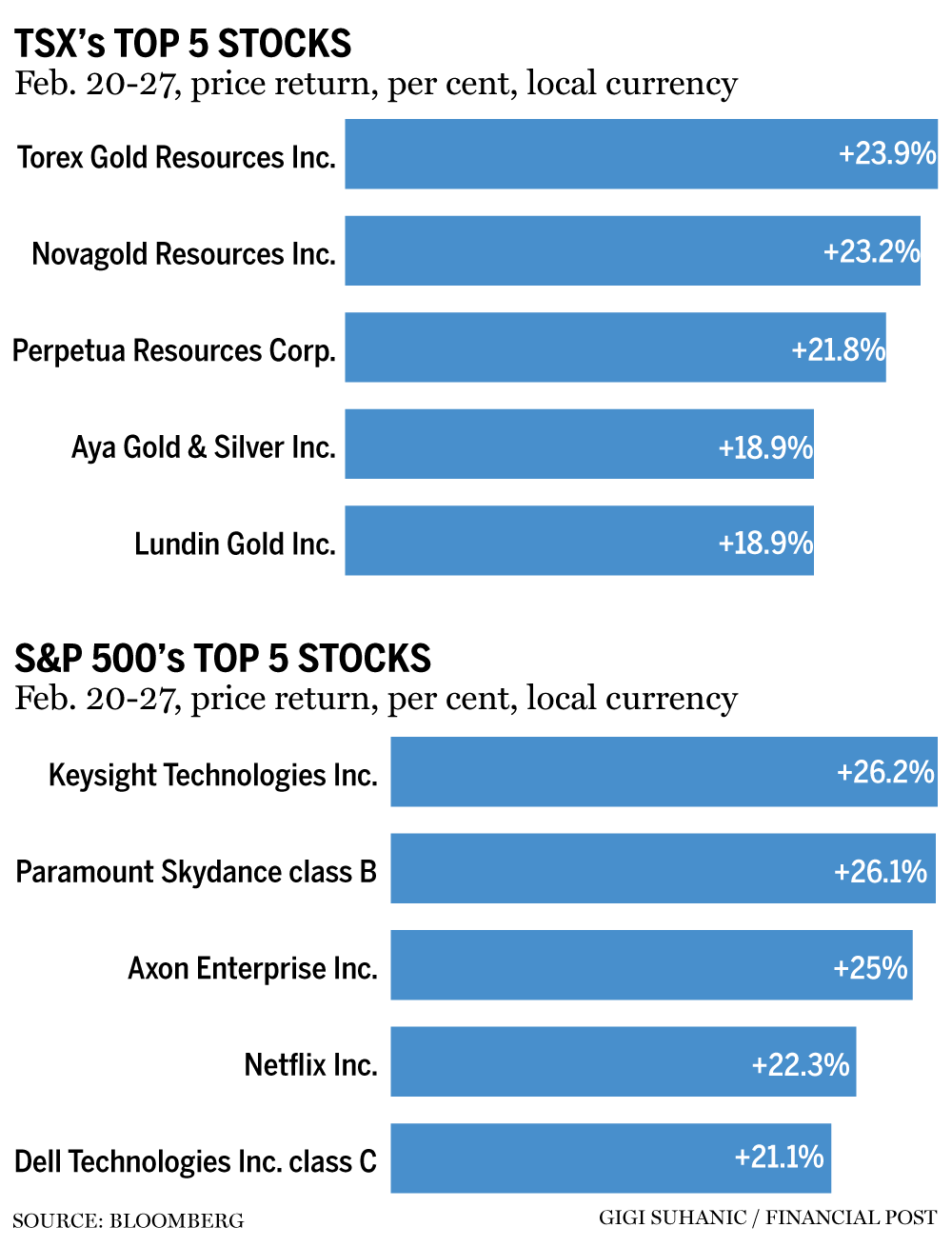
Big 6 bank price targets get a rethink post-earnings
Canada’s Big Six banks just closed out a fourth-quarter earnings season that was generally well received by Bay Street. The next question for investors is where do the stocks, which helped propel the S&P/TSX composite to a robust gain in 2025, go from here? In a note to investors, RBC Capital Markets analyst Darko Mihelic raised his price estimate for Toronto-Dominion Bank (TD:TSX) to $148 from $133 on a “solid” quarter after results came in stronger than expected across multiple sectors. TD shares closed Friday at $132.88. In this low loan-growth environment, Mihelic, in a separate note, said he likes Canadian Imperial Bank of Commerce (CM:TSX), which he described as “better positioned” to manage those challenges. He increased earnings estimates for CIBC and hiked his price target to $158 from $134. CIBC shares closed Friday at $137.79. At the Bank of Montreal (BMO:TSX), pre-provision (or before setting aside funds for loan losses), pre-tax earnings were better than expected on “solid revenues and cost discipline,” Mihelic said. Signs of slight worsening in Canadians’ credit quality “have been seen at all banks so far, but outlooks remain positive,” he said. The analyst raised his price for BMO to $219 from $178. BMO shares closed Friday at $196.31. Mike Rizvanoic, an analyst at Scotia Capital Markets, “modestly” moved up his price target for Royal Bank of Canada (RY:TSX) to $247 from $242. He said RBC’s lagging share performance compared with its peers on earnings day likely reflected lower increase in earnings per share compared with the whole group and a “tepid approach” to share buybacks. RBC closed Friday at $228.07. On National Bank of Canada (NA:TSX), “w e believe NA put out a very good set of results this quarter,” Rizvanovic said, pointing to a slew of reasons, including a “big beat” in the Canadian personal and commercial loans sector. He raised his price target for National to $202 from $188. Shares closed Friday at $190.37. Finally, TD Cowen analyst Mario Mendonca maintained his price target of $112 for Bank of Nova Scotia (BNS:TSX). Shares closed Friday at $103.44. He said the challenge for Scotiabank is to improve loan growth, especially corporate and commercial and investment banking.
National Bank’s dividend payer picks could take the sting out of volatility
National Bank Capital Markets said investors might be in the mood for a break from the ongoing market volatility, and it has updated its list of preferred dividend payers for the first half of 2026. “With continued macroeconomic uncertainty and elevated market volatility, dividend stocks could regain favour with investors,” National Bank Research said in a note. To be included on the list, companies need a yield of five per cent or greater, a decent chance of the payout growing and a positive outlook. For the first half, the portfolio of 23 companies has an average yield of 4.8 per cent — lower due to rising share prices — and an average payout ratio of 62.8 per cent. The top five companies based on dividend yield are Automotive Properties REIT (APRU:TSX) with a yield of 7.2 per cent, Alaris Equity Partners Income Trust (AD/U:TSX) at 6.6 per cent, Gibson Energy Inc. (GEI:TSX) at 6.1 per cent, RioCan REIT (REI/U:TSX) at 5.9 per cent and Crombie REIT (CRR:TSX) at 5.6 per cent. In the second half of last year, National’s list returned 25.4 per cent — 2.1 per cent income and 23.3 per cent share price appreciation — while the S&P/TSX composite returned 1.4 per cent in income and 15.8 per cent in price over the same period.
Price target hikes
- National Bank Capital Markets analyst Dan Payne hiked his price target for Trican Well Services Ltd. (TCW:TSX) to $8 from $6.50 on the outlook for this year, which includes “ample” free cash flow, declining debt and continued dividends and share buybacks. Shares closed Friday at $6.51.
- CIBC Capital Markets analysts led by Anita Soni hiked their price target for Equinox Gold Corp. to $32 from $26.50 after the company hiked several multiples, including free cash flow per share, based on the mine life of four sites. Shares closed Friday at $25.60.
- BMO Capital Markets analyst Stephen MacLeod hiked his price target for Aritzia Inc. (ATZ:TSX) to $163 from $160 on the belief that the clothing retailer can continue to capitalize on rising growth in the United States. Shares closed Friday at $120.78.
- Raymond James analyst Michael Glen hiked his price target for 5N Plus Inc. (VNP:TSX) to $35 from $29 on “strong growth and success as a critical supplier of niche materials and compounds outside of China.” Shares closed Friday at $29.66.
- RBC Capital Markets analyst Darko Mihelic hiked his price target for EQB Inc. (EQB:TSX) to $131 from $111. “We continue to view the PC Financial acquisition as … the main reason for owning the stock,” he said. Shares closed Friday at $115.32.
Every week, the Financial Post breaks down the most interesting developments in the week’s world of investing, from top performers to surprising analyst calls and stocks to have on your radar.
Are you an investor looking for stock ideas and market insight? Sign up for the weekly FP Investor Newsletter here to get the best of the Financial Post’s investing news, analysis and expert commentary straight to your inbox.
• Email: gmvsuhanic@postmedia.com
]]>How to play Canada’s Big Six banks with earnings around the corner, Veritas’s dividend growth stock picks and more in The Week in Stocks.
Stock of the week: Magna International Inc.
Magna International Inc. (MG:TSX) was the top gainer on the S&P/TSX composite index with shares rising 24.5 per cent after the auto parts manufacturer reported surprise earnings that beat expectations on Friday. This prompted TD Cowen analyst Brian Morrison to hike his price target for the Aurora, Ont.-based company to $102.03 from $79.30. Shares of Magna closed Friday at $93.52. Morrison attributed the earnings beat to operating margins that topped forecasts. Magna also said it benefited from the recovery of tariffs and beneficial currency rates. The company is forecasting 2026 performance above the current consensus outlook, including quarterly free cash flow, with Morrison predicting Magna will undertake “material” share buybacks this year. “This should support upward financial revisions,” he said. The average 12-month price target for Magna based on the estimates of 16 analysts is $77.11, according to Bloomberg.
Keeping score


TD’s Big Bank top picks and a caution before earnings are out
Canada’s Big Banks will round out earnings season when they report fourth-quarter results at the end of this month. Last year, the Big Six took the stock market by storm, outperforming their U.S. mega-bank peers and domestic life insurers despite a weaker outlook for the Canadian economy and a looming trade pact review. In a note on Feb. 9, analysts at TD Cowen led by Mario Mendonca struck a note of caution regarding the Big Six, arguing that “stock valuations appear stretched on virtually every metric we look at.” The TD team found that the group is trading at an 18 per cent premium and “approaching full value territory.” The stocks are also trading at a one-year forward earnings per share of 14.3 times based on 2026 consensus, well above the 25-year trend of 10 to 12 times, TD said, and the equity risk premium (ERP) is currently sitting at a level last seen during the great financial crisis. Despite valuations that look stretched to TD, the analysts still think “strong fundamentals should support the sector in the near term” including net interest income, improving U.S. loan growth, and strong trading revenue. TD hiked its price targets for four of five of the Big Six. It doesn’t cover its own shares. Bank of Montreal ‘s (BMO:TSX) target rose from $219 to $209, Bank of Nova Scotia (BNS:TSX) rose to $112 from $104, Canadian Imperial Bank of Commerce (CM:TSX) rose from $134 to $142, National Bank of Canada was cut to $175 from $181 and Royal Bank of Canada (RY:TSX) rose from to $260 from $246. TD’s top bank picks are BMO and RBC for their extensive U.S. capital markets operations. BMO closed at $92.17, Scotiabank at $103.16, CIBC at $130. 51, National Bank at $174.78 and RBC at $230.98.
Veritas picks for likely dividend growth companies
There is no shortage of macroeconomic uncertainty in 2026. It’s through this lens that Veritas Investment Research recently updated its twice yearly report on companies it thinks can deliver reliable dividend growth. For 2026, Veritas is favouring organizations with “reasonable balance sheets, manageable payout ratios and solid capital deployment strategies” that will allow them to navigate any economic shocks. To qualify for inclusion on Veritas’s list of stocks, shares need to be rated a buy and yield a dividend of three per cent, with some exceptions. “We favour names with long histories of dividend growth, such as grocers, or names that emphasize total shareholder returns (dividends + buybacks),” Veritas said. Here are a few examples of preferred dividend stocks by sector. Communication services: Veritas likes Quebecor Inc. (QBR/B:TSX), which it expects will increase its dividend, currently 2.9 per cent, by five to 10 per cent this year .Banks: Royal Bank of Canada (RY:TSX) is among the recommended Big Bank picks that offers “the highest potential of high single-digit to low double-digit dividend growth within our coverage.” Pipelines: Enbrige Inc. (EN:TSX) has a dividend yield of 5.9 per cent, a dividend growth outlook of four per cent and is among Veritas’s top picks, given its business is supported by “risk-reducing regulation.” Utilities: Veritas recommended Fortis Inc. (FTS:TSX) for its “reliable” 3.5 per cent yield and an approximately five per cent dividend growth outlook. Telus Corp. (T:TSX) was named as a company to be “cautious about” due to an elevated payout ratio in relation to its 8.9 per cent yield.
Price target hikes
- RBC Capital Markets analyst Irene Nattel boosted her price target for Saputo Inc. (SAP:T) to $50 from $47 on better than expected earnings. Shares closed Friday at $42.38.
- CIBC Capital Markets analyst Stephanie Price hiked her price target for Calian Group Ltd. (CGY:TSX) to $76 from $65 after its defence and space segment rose 10 per cent in the first quarter. Shares closed Friday at $70.60.
- BMO Capital Markets analyst Jeremy McCrea hiked his price target PrairieSky Royalty Ltd. (PSK:TSX) to $34 from $32 on another “strong quarter” as the company appears to be “defying the trend” of slower oil and gas activity in North America. Shares closed Friday at $29.82.
- Raymond James Ltd. analysts Michael Barth and Luke Konschuh hiked their price target for Precision Drilling Corp. (PD:TSX) to $143 from $131 on a bet the company could buy back as much as eight per cent of outstanding shares in 2026. Shares closed Friday at $119.04.
- RBC Capital Markets analyst Andrew Wong hiked his price target for Cameco Corp. (CCO:TSX) to $160 from $150 on increasing momentum in nuclear plant construction. Shares closed Friday at $153.94.
- TD Cowen analyst Vince Valentini hiked his price target for BCE Inc. to $40 from $38 following presentations by CEO Mirko Bibic. Shares closed Friday at $35.01.
Every week, the Financial Post breaks down the most interesting developments in the week’s world of investing, from top performers to surprising analyst calls and stocks to have on your radar.
Are you an investor looking for stock ideas and market insight? Sign up for the weekly FP Investor Newsletter here to get the best of the Financial Post’s investing news, analysis and expert commentary straight to your inbox.
• Email: gmvsuhanic@postmedia.com
]]>With the price of gold still trading at stratospheric levels, Iamgold Corp. was identified as a top candidate for takeover in 2026, a new TD Cowen survey says.
Nearly 20 per cent of respondents to TD’s survey of 58 institutional investors and mining executives, released on Feb. 10, flagged Toronto-based Iamgold (IMG:TSX) as a leading target, followed by Artemis Gold Inc. (ARTG:TSX) at 11 per cent and Arizona Sonoran Copper Co. Inc. at seven per cent.
“There is strong alignment among respondents on M&A expectations with the majority expecting more corporate M&A activity in gold, silver and copper in 2026 versus 2025,” a note from analysts led by Derick Ma said.
Nearly 100 per cent of respondents expect more gold and silver M&A in 2026 compared with 2025, while just under 80 per cent of institutional investors said they expect M&A activity in the copper sector to increase. A slightly larger share of mining executives expect the same.
Gold miner M&As from last year include Coeur Mining Inc.’s acquisition of New Gold Inc. and the merger of Equinox Gold Corp. and Calibre Mining Corp.
Just last week, Eldorado Gold Corp. announced a deal to acquire Foran Mining Corp.
The majority of investors and executives are calling for spot gold prices to remain elevated for 2026.
Just under 45 per cent of mining executives, the largest share of C-suite respondents, think gold prices will range between US$5,501 and US$6,000, while 35 per cent of corporate investors called for gold to range between US$5,001 and US$5,500.
During the period the survey was conducted — Jan. 12 to 30 — the price of gold flirted with US$5,600 an ounce. Wednesday it was trading just above US$5,000.
In a further sign that investors have bought into the gold rush, nearly eight in 10 respondents said they were “overweight” gold compared with 2025 when half reported the same.
Many investors also indicated they are expecting excess cash to come their way this year as 44 per cent favoured capital returns to shareholders.
Nearly a third said they favoured capital being directed to production, while 19 per cent said it should be allocated to mergers and acquisitions.
Operational worries were identified as the biggest sector concern by 44 per cent of investors.
TD also found that investors underestimated inflation pressures, pegging them at three per cent to seven per cent. TD recently estimated it at approximately 15 per cent.
One of the biggest threats to a miner’s success can be the countries or country they operate in.
Survey respondents named Mexico the most improved jurisdiction, overtaking Argentina. This occurred prior to the January abduction of 10 employees of Vizsla Silver Corp. (VZLA:TSX) in the Mexican state of Sinaloa. Three were confirmed dead , according to Mexican authorities.
Canadian miners with the most exposure to Mexico include Torex Gold Resources Inc., (TXG:TSX) at just under 100 per cent, First Majestic Silver Corp. (AG:TSX) at just over 90 per cent and Endeavour Silver Corp. (EDR:TSX) at just over 70 per cent.
• Email: gmvsuhanic@postmedia.com
]]>Silver and gold drop on Trump’s Fed pick, Raymond James update their Canadian energy company picks and more from The Week in Stocks.
Stock of the week: Meta Platforms Inc.
Meta Platforms Inc. (META:Nasdaq) found favour with investors this week after it reported a jump in ad revenue and issued a strong forecast for the next period that went some way to convincing investors that the company’s mega-investments and capital expenditures in artificial intelligence are paying off. Shares of Meta jumped 10 per cent following the release of earnings on Jan. 29 and were up about seven per cent on the week though they relinquished some of those gains on Friday. Meta fell out of favour late last year as investors questioned the company’s AI spending spree, estimated at US$72 billion for 2025. From October to late November, shares of Meta fell nearly 22 per cent. BMO Capital Markets analyst Brian Pitz hiked his price target for Meta to US$730 from US$710 noting a “strong” fourth quarter result as revenue and operating income beat consensus by 2.5 per cent and 2.9 per cent, respectively. For the first quarter of 2026, Meta said it expects revenue to come in seven per cent above consensus. “Importantly, META is seeing green shoots from its massive AI investments (US$132 billion in 2026 capital expenditure), which are improving its recommendation models, leading to increased user engagement and monetization,” Pitz said. The 12-month price target for Mega based on 67 analysts is US$852.16, according to Bloomberg. Meta closed at US$716.50.
Keeping score


What does the drop in gold and silver have to do with Trump’s Fed pick?
Gold and silver plummeted Friday with bullion falling nearly 10 per cent to take it below US$5,000 an ounce and silver nosediving 26 per cent as the so-called debasement trade unwound. This is where investors hedge against currencies losing value with assets such as precious metals. The moves came after Donald Trump named Kevin Warsh as his pick to replace Jerome Powell as chair of the United States Federal Reserve. “The market reaction so far points to … independence fears regarding the Fed easing,” David Rosenberg, chief executive of Rosenberg Research & Associates Inc., said in a note on Friday. Markets had feared Trump would name a successor who would act in lockstep with his desire for more rate cuts, jeopardizing the Fed’s independence, which is a cornerstone of stock market activity. However, several notes on Warsh’s nomination described him as hawkish, which could make him more resistant to slashing interest rates. The U.S. dollar rebounded. Still, Rosenberg doesn’t think the fundamentals behind the price increases in gold and silver have changed that much. “The core issue is rising worries about fragmentation in the global market: the U.S. and China appear to be warehousing inventories rather than letting metal flow through global exchanges, stoking anxiety and speculative positioning.”
Raymond James’s best picks as Canada’s energy companies start to report Q4 earnings
Analysts at Raymond James Global Research updated their outlooks for the Canadian oil and gas companies based on revised commodity prices. The team of Michael Barth, Luke Davis, Justin Jenkins, Luke Konschuch and Brett Keller lowered their prices targets for West Texas Intermediate and Western Canadian Select by eight and 10 per cent for the fourth quarter of 2025, “which is a big driver of negative estimate revisions for producers this quarter,” the analysts said. Their “pecking order” for shares remained the same, with Cenovus Energy Inc. (CVE:TSX) their top pick followed by Suncor Energy Inc. (SU:TSX), Canadian Natural Resources Ltd. (CNQ:TSX). Imperial Oil Ltd. brought up the rear. “While we like CVE best longer term, we do note that SU has the most exciting story du jour, with a positive rate of change in the in situ business heading into the March Investor Day,” they said. Raymond James has a price target of $30 on Cenovus and a strong buy rating but expects most of the year to be more about the company digesting MEG Energy after its takeover. Cenvous closed Friday at $26.87. The team has a price target of $73 on Suncor and $53 on Canadian Natural on volume performance for the former and whether that results in lower unit costs and capital allocation for the latter. Shares closed Friday at $71.97 and $50.63, respectively. Raymond James has an underperform rating on Imperial and a price target of $106 with the analysts viewing the stock as “relatively expensive.” The stock closed Friday at $137.57.
Price target hikes and cuts
- TD Cowen analyst Brian Morrison cut his price target for Spin Master Corp. (TOY:TSX) to $26 from $30 as “economic headwinds” continued to weigh on consumer demand in North America, especially during the holiday season. Spin Master closed at $18.61.
- RBC Capital Markets analyst Josh Wolfson maintained his price target of $19 for Centerra Gold Ltd. following an explosion at its Langeloth metallurgical facilities near Pittsburgh, which shut down operations. Wolfson described the impact to the shares as “slightly negative” and estimated a corporate hit to EBITDA of three per cent for every quarter of downtime at the facility. Shares closed Friday at $22.81.
- BMO Capital Markets analyst Matthew Murphy raised his price target for Barrick Mining Corp. (ABX:TSX) to $80 from $63, meanwhile JPMorgan Chase & Co. analyst Bennett Moore initiated coverage of the shares with a price target of $92 and an overweight recommendation. Barrick closed Friday at $62.24.
- National Bank of Canada Capital Markets analyst Shane Nagle hiked his price target for Hudbay Minerals Inc. (HBM:TSX) to $40 from $28 on a study related to the miner’s Copper World project in Arizona, which should “serve as a significant catalyst later in 2026 outlining longer-term copper growth pipeline.” Hudbay closed Friday at $32.25.
- CIBC Capital Markets analyst Erin Kyle hiked her price target for real estate services company Information Services Corp. (ISC:TSX) to $49 from $37 after the company received four non-binding takeover offers. Shares closed Friday at $43.60.
Every week, the Financial Post breaks down the most interesting developments in the week’s world of investing, from top performers to surprising analyst calls and stocks to have on your radar.
Are you an investor looking for stock ideas and market insight? Sign up for the weekly FP Investor Newsletter here to get the best of the Financial Post’s investing news, analysis and expert commentary straight to your inbox.
• Email: gmvsuhanic@postmedia.com
]]>Ed Devlin, founder and chief executive of Devlin Capital Inc., talks to Financial Post’s Larysa Harapyn about the biggest risks for investors in the year ahead, including “illegal” actions by the United States against Canada and where interest rates could be headed at the end of 2026.
• Email: lharapyn@postmedia.com
]]>RBC updates its Canadian small-cap conviction list, Purpose tackles the pros and cons of U.S. small caps and more from The Week in Stocks.
Stock of the week: Sprott Inc.
Precious metals have had another record-setting week as gold closed in on US$5,000 an ounce, placing shares of Sprott Inc. (SII:TSX) among the winners on the S&P/TSX composite index. The stock was up 122 per cent in 2025 and is surging again in January. TD Cowen analyst Graham Ryding hiked his price target for Sprott to $176 from $130. Shares closed Friday at $180.84. Ryding also revised earnings estimates for the company’s assets under management (AUM) by 21 per cent quarter over quarter and 20 per cent year to date on “precious metals performance and critical minerals year to date and solid flows momentum.” He also increased earnings per share estimates for 2026 and 2027 by 42 per cent and 45 per cent, respectively, for the Toronto-based asset manager, which specializes in precious metals and critical minerals investments and operates several funds. Currently, 81 per cent of Sprott’s AUM are tied to precious metals, while the remaining 19 per cent are directed to critical minerals and uranium. Five analysts who track Sprott have an average 12-month price target on the shares of $147.00, according to Bloomberg.
Keeping score


Here’s what RBC added and dropped from its Canadian small-cap list
RBC Capital Markets recalibrated its small-cap convictions list for the first quarter of 2026 of 21 names with a market capitalization of about $2 billion each. RBC analysts have added StorageVault Canada Inc. (SVI:TSX), Osisko Development Corp. (ODV:TSX) and Cascades Inc. (CAS:TSX). On StorageVault, the RBC team thinks “storage fundamentals troughed a few quarters ago and have normalized at a reasonably healthy level.” On Osisko, analysts said “they hold strong conviction” based on the prospects for the Cariboo gold project in British Columbia. On paper products manufacturer Cascades, RBC thinks growing containerboard and tissue demand will support the stock. There were two deletions from the list: Killam Apartment REIT (KMP.UT:TSX) and MDA Space Ltd. (MDA:TSX). Names on the “maintain” list include Cineplex Inc. , (CGX:TSX), DRI Healthcare Trust (DHT.UT:TSX), Jameison Wellness Inc. (JWEL:TSX) and Torex Gold Resources Inc. (TXG:TSX). In the final quarter of last year, RBC’s small-cap list lost 0.9 per cent, compared with a 10.2 per cent gain on the TSX composite’s small-cap index. Resource-based names outpaced non-resource ones 15 per cent versus 7.8 per cent. Since the list’s inception in 2013, RBC said it has had total returns of 580 per cent as of the end of last year, while the TSX composite’s small-cap index gained 224 per cent and the main index, 286 per cent. RBC updated its list on Jan. 7.
Purpose sees pros and cons of U.S. small caps
“On balance, we’re a bit more constructive on smaller caps relative to past years,” Craig Basinger, chief market strategist at Purpose Investments Inc., said in an note out on Jan. 19, detailing what he thinks are the pros and the cons of the U.S. small-cap space, with the S&P 600 Small Cap index up 7.3 per cent through to the middle of January versus 5.1 per cent for the S&P 500 index. On the plus side, valuations favour small caps, given they are trading at a “more reasonable” 15.3 times versus against 22 times for the S&P 500, Basinger said. Plus, “valuations certainly favour small caps, and with earnings growth forecasts much improved, the fundamentals are encouraging, with the caveat that revisions are a bit troubling,” he said, pointing to S&P 600 Small Cap consensus earnings that have declined by two per cent in 2026. Falling interest rates also typically favour smaller companies as do mergers and acquisitions, which started to reaccelerate in 2025, he said. On the negative side, small-cap companies aren’t in a “sweet spot for the U.S. economy” given their higher exposure to “under pressure” consumers. Further, tariffs could also affect these companies’ financials. And finally, small business optimism has slumped in the U.S., a measure that tends to “correlate” with small-cap performance, he said.
Price target hikes and cuts
- TD Cowen analyst Aaron MacNeil cut his price target slightly for shares of Kyera Corp. (KEY:TSX) to $52 from $54 but maintained a buy rating after the announcement of an unplanned outage at its Alberta Envirofuels facility. Shares closed Friday at $44.23.
- CIBC Capital Markets analysts Luke Bertozzi and Will Ebisuzaki-Mackay hiked their price target for Centerra Gold Inc. (CG:TSX) to $30 from $21 on the release of a preliminary economic assessment that supports the long-term potential for the miner’s Kemess project in British Columbia. Shares closed Friday at $25.19.
- Raymond James analysts Steve Hansen and Robert Murphy increased their price target for Cargojet Inc. (CJT:TSX) to $120 from $95 on “a tightening North American freight market” due to the grounding of all MD-11 freight aircraft in the U.S. following a crash in early November. The pair said it is unclear whether that “healthy slice of capacity” will return. Shares closed Friday at $93.74.
- TD Cowen analyst Graham Ryding significantly cut his price target for Goeasy Ltd. (GSY:TSX) to $135 from $160, while also downgrading the shares to a hold from a buy. The average price estimate of 10 analysts is $200.90, according to Bloomberg. “We believe consensus is too high, given our lower forecast of consumer loan yield in 2026,” Ryding said in a note. Shares closed Friday at $129.16.
- BMO Capital Markets analyst Brian Quast hiked his price target for Aris Mining Corp. (ARIS:TSX) to $32 from $28 on stepped up guidance for 2026 gold production to 300,000 to 350,000 ounces, though that was slightly below BMO’s expectations. Shares closed Friday at $27.74.
- BMO analyst Tom MacKinnon cut his price target for Fairfax Financial Holdings Ltd. (FFH:TSX) to $2,500 from $2,600 and downgraded the shares to market perform from outperform on a “more muted operating income outlook” due to “softening global insurance/reinsurance markets, declining underwriting income, moderating investment income growth, muted investment gains outlook.” Shares closed Friday at $2,286.04.
Every week, the Financial Post breaks down the most interesting developments in the week’s world of investing, from top performers to surprising analyst calls and stocks to have on your radar.
Are you an investor looking for stock ideas and market insight? Sign up for the weekly FP Investor Newsletter here to get the best of the Financial Post’s investing news, analysis and expert commentary straight to your inbox.
• Email: gmvsuhanic@postmedia.com
]]>Why TD prefers Canada’s big insurers over its big banks in 2026, top picks for how to play the soaring price of copper, and price target hikes and cuts. The Financial Post explores those stories and more in The Week in Stocks.
Stock of the week: Bombardier Inc.
Shares of Bombardier Inc. (BBD/B:TSX) jumped just over seven per cent on Thursday and continued to climb Friday to a multidecade high closing at $275.37 after the Quebec company announced it is building a new factory near Montreal. The factory is scheduled to open at the end of 2027 to meet increased demand for its business jets. RBC Capital Markets analyst James McGarragle had hiked his price target for shares of the planemaker to $287 from $263 on Jan. 12 in a wider review of Canada’s aerospace sector and reconfirmed it on Jan. 15 following the announcement. In his note from earlier in the week, McGarragle “flagged Bombardier as our top idea into next year,” despite a 138 per cent increase in the price of the shares during 2025. RBC anticipates the planemaker may benefit from increased defence spending by the federal government and a general shift toward Bombardier’s Challenger and Global business jets that may spur services growth. “We see runway for Bombardier to compound free-cash flow at greater than a low-teen compound annual growth rate well into the 2030s — a compelling investment opportunity for shares trading at a six per cent free cash flow yield,” McGarragle said. National Bank of Canada Capital Markets analyst Cameron Doerksen hiked his price target for the company to $290 from $263 in the wake of news of the factory. The 12-month average price target for the shares based on the estimates of 14 analysts is $236.57, according to Bloomberg. Bombardier shares gained 11.6 per cent this week placing it among the S&P/TSX composite index’s top 10 gainers.
Keeping score


Insurers a better bet than the banks, TD says
TD Cowen analysts are choosing Canadian insurance companies over the banks in 2026. The team at TD, led by analyst Mario Mendonca, thinks this year is the lifecos’ year after badly underperforming their financial sector counterparts last year with the group currently trading at a 17 per cent discount to the banks on a forward price to earnings basis, they said in a note. The TD team noted a slowdown in the growth of net investment income in the group, but said that a lower number of shares should help improve earnings per share and return on equity metrics. “Relative valuation, greater capital flexibility, slowing capital markets activity, and lower downside risk to earnings support favouring the insurers,” Mendonca said in a note. TD has a buy rating on all the big insurers and hiked the price targets for all of them. Sun Life Financial Inc. ‘s (SLF:TSX) price target rose to $104 from $99. It closed Friday at $87.47. Manulife Financial Corp. ‘s (MFC:TSX) price target rose to $60 from $57. It closed Friday at $52.04. Great-West Lifeco Inc. ‘s (GWO:TSX) price target rose to $73 from $70. It closed at $66.75 on Friday. And iA Financial Corp. Inc.’s (IAG:TSX) price target was hiked to $192 from $178. It closed Friday at $174.34. Sun Life and Manulife are TD’s top picks. The lifecos report fourth quarter earnings on Feb. 11 and 17.
Copper prices make these miners an attractive play, Scotia says
Copper was golden in 2025 as the price rose 41 per cent last year. The trend has so far continued in 2026 with the metal setting a new record of US$13,238 per tonne on Jan. 6. Analysts at Scotia Capital Inc. expect the price of the copper, which is critical for electricity, to continue rising this year due to “ongoing supply side challenges and an … inventory squeeze,” Orest Wowkodaw and his team said in a note. As such, the team reviewed its outlooks for several miners in the leadup to the release of 2026 operating guidance — which has since started — hiking price targets by an average of 17 per cent for the group of shares. “We forecast 2026 to be a relatively solid year for most of our coverage, driven by improved operating performance and robust commodity prices,” Wowkodaw said. Among Scotia’s three top picks are Cameco Corp. (CCO:TSX), Capstone Copper Corp. (CS:TSX) and Freeport-McMoRan Inc. (FCX:NYSE). Wowkodaw has a price target of $155, up from $150, on Cameco. Shares closed Friday at $162.06. He hiked his price target for Capstone to $18 from $16. Capstone closed Friday at $14.48. He hiked Freeport-McMoRan’s price target to US$63 from US$47. Shares closed Friday at US$58.71. The team also “highly recommend” Champion Iron Ltd. (CIA:TSX), Ero Copper Corp. (ERO:TSX), Foran Mining Corp. (FOM:TSX), Hudbay Minerals Inc. (HBM:TSX), Ivanhoe Mines Ltd. (IVN:TSX) and Lundin Mining Corp. (LUN:TSX).
Price target hikes and cuts
- RBC Capital Markets analyst Irene Nattel hiked her price target for Groupe Dynamite Inc. (GRGD:TSX) to $100 from $95 on holiday period sales that hit the high end of expectations. Shares closed Friday at $77.70.
- BMO Capital Markets analyst Tim Casey hiked his price target for Cogeco Communications Inc. (CCA:TSX) to $75 from $70 after it maintained guidance for 2026. Cogeco closed Friday at $73.17.
- National Bank of Canada Capital Markets analyst Don DeMarco hiked his price target for Alamos Gold Inc. (AGI:TSX) to $75 from $68 to incorporate the upcoming release of a study on the expansion of the miners’ Island Gold district in Ontario. Alamos closed Friday at $54.14.
- Analysts at CIBC Capital Markets cut their price target for Tourmaline Oil Corp. (TOU:TSX) to $66 from $71 on expectations that its special dividend will come in at 20 cents per share in the fourth quarter, down from 25 cents per share in the third quarter. Tourmaline closed Friday at $59.04.
Every week, the Financial Post breaks down the most interesting developments in the week’s world of investing, from top performers to surprising analyst calls and stocks to have on your radar.
Are you an investor looking for stock ideas and market insight? Sign up for the weekly FP Investor Newsletter here to get the best of the Financial Post’s investing news, analysis and expert commentary straight to your inbox.
• Email: gmvsuhanic@postmedia.com
]]>RBC’s Top 30 investment ideas list gets a makeover, why Canada’s Big Banks are a stabilizer if tech euphoria fades and why Canadian lifecos may not be getting enough credit for return on equity expansion. The Financial Post explores those stories and more in The Week in Stocks.
Stock of the week: Artizia Inc.
Analysts were busy hiking their price targets for Aritizia Inc. (ATZ:TSX) after the retail darling, whose stock rose 120 per cent in 2025, reported revenue of $1.04 billion for the third quarter on Thursday on growing same-store sales, more new stores and a new mobile app. Stephen MacLeod, a retail and consumer analyst at BMO Capital Markets, hiked his price target to $155 from $136 citing the quarter’s “strong beat” and increase to margin guidance for 2026 in the face of headwinds from tariffs and the end of the de minimis rule, which allowed for parcels worth less than US$800 to be shipped into the United States duty-free. “Aritzia appears well-positioned to execute on its significant U.S. growth opportunity, reflecting its strong momentum, growing brand affinity and everyday luxury positioning,” MacLeod said in a note. Irene Nattel, an analyst at RBC Capital Markets hiked her price target for Aritizia on Friday to $150 from $116 after increasing it four times in 2025. Shares of Aritizia traded at $131.47 and were up just over 12 per cent on the week. Raymond James Inc. analysts Michael Glen and Fred Gatali hiked their price target twice this week, first to $130 from $110 pre-earnings and then to $155 on Friday. The average 12-month target is $150.38 based on the estimates of 13 analysts, according to Bloomberg.
Keeping score


RBC swaps some names in its ‘high conviction’ list
RBC Capital Markets has refreshed its Top 30 ideas list of “high-conviction” investing names from around the world. Graeme Pearson and Mark Odendahl, co-heads of global research at RBC, swapped in 11 new names. Among the additions are Airbnb Inc. (ABNB:Nasdaq), Amazon.com Inc. (AMZN/Nasdaq), Shopify Inc. (SHOP:Nasdaq) and Visa Inc. (V:NYSE). The pair like Airbnb for its move into hotels and that it is a defensive play against artificial intelligence . Amazon made the grade because it offers leading “visibility” on return on invested capital in AI infrastructure. Investors have recently grown wary of capital spending among some of the big tech players in the AI space without any signs yet that investment will pay off. Pearson and Odendahl added Shopify on expectations the Ottawa company will continue to record strong growth in market share in its enterprise and international segments due to the adoption of new products. Some of the names that were dropped included Alimentation Couche Tard Inc. (ATD/TSX), Barrick Mining Corp. (B/NYSE), and Pembina Pipeline (PPL:TSX). Companies remaining on the list include Loblaw Cos. Ltd. (L/TSX), Brookfield Corp. (BN/NYSE), Constellation Software Inc. (CSU:TSX) and Microsoft Corp. (MSFT:Nasdaq). For 2025, the top 30 list returned 14.4 per cent, Pearson and Odendahl said.
Are Canada’s Big Banks the counterweight to Big Tech?
Canada’s Big Six banks — Royal Bank of Canada, Toronto-Dominion Bank, Canadian Imperial Bank of Commerce, Bank of Montreal, Bank of Nova Scotia and National Bank of Canada — are “considered boring” stocks to own, said David Rosenberg, founder of Rosenberg Research and Associates. But it’s a good kind of boring, he said, as bank stocks have provided reliable dividends without much volatility. Over the past six months, the TSX Canadian banks composite index has outpaced the Nasdaq composite by about 20 per cent, Rosenberg said, meaning investors can position the bank stocks “as a stabilizer if tech euphoria fades or policy shocks hit risk assets.” The banks are coming off a very strong year and there have been concerns about valuations. “We see limited reason for alarm at this stage of the cycle, when investors increasingly want a mix of low volatility, stable profitability, and income,” Rosenberg said in a note.
Price target hikes
- Analysts at CIBC Capital Markets hiked the price targets on the major Canadian insurance companies, including Great-West Lifeco Inc. (GWO:TSX), Sun Life Financial Inc. (SLF:TSX), Manulife Financial Corp. (MFC:TSX) and iA Financial Corp. Inc (IAG:TSX). Great-West’s price target rose to $73 from $67. It closed Friday at $67.26. Sun Life’s went to $95 from $93 and closed Friday at $87.40. Manulife’s rose to $58 from $50. It closed Friday at $52. And iA’s price target went to $184 from $175, closing Friday at $179.67. “Despite achieving strong ROE (return on equity) expansion, we believe lifecos are not getting full credit for future ROE expansion, which we see as a reason to remain positive on the sector,” CIBC’s Paul Holden said in a note.
- BMO Capital Markets oil and gas analyst Jeremy McCrea hiked his price target on energy company Spartan Delta Corp. (SDE:TSX) to $9 from $7.50 on the expectation that shares will maintain their momentum in 2026 after rising 116 per cent last year. Spartan closed Friday at $7.55.
- Analysts at Raymond James Ltd. hiked their price target for Act Energy Technologies Ltd. (ACX/TSX) to $10 from $8.75 on the premise that the Calgary-based oilfield services company can “profitably consolidate the directional drilling market in the U.S.” Act also just completed the purchase of Stryker Energy Directional Services LLC, though Raymond James analysts said in a note they were surprised by the “muted” market response to the deal. “As such, we reiterate our outperform rating, and believe an attractive entry point exists at these levels,” they said. Act closed Friday at $5.05.
- TD Cowen hiked its price target for CAE Inc. (CAE/TSX) to $53 from $46 on an expected increase in defence spending by the federal government. CAE closed Friday at $45.97.
Every week, the Financial Post breaks down the most interesting developments in the week’s world of investing, from top performers to surprising analyst calls and stocks to have on your radar.
Are you an investor looking for stock ideas and market insight? Sign up for the weekly FP Investor Newsletter here to get the best of the Financial Post’s investing news, analysis and expert commentary straight to your inbox.
• Email: gmvsuhanic@postmedia.com
]]>
Hard for Canadian investors to beat last year, when the S&P/TSX Composite Index powered through to a 28 per cent gain.
That amounted to the second strongest performance this century and beat the S&P 500 which ended the year up 17 per cent.
Somehow this managed to happen against a backdrop of trade turmoil unleashed by U.S. President Donald Trump , fears the economy would sink into recession and political turmoil of our own.
“The key question for investors now is whether stock markets can deliver positive gains for a fourth year,” said investing firm Edward Jones in their market outlook out this week.
Strategists are optimistic, with both Edward Jones and CIBC Capital Markets predicting upside for equity markets again this year.
“Equity valuation in Canada is above its longer-term average but nowhere near bubble territory,” wrote Christopher Harvey, CIBC’s head of equity and portfolio strategy.
“Importantly, tight investment-grade credit spreads are a positive sign for EPS growth. When combined with capex tailwinds from data centre buildout and government infrastructure priorities, we see double-digit EPS growth supporting an above-average market multiple.”
CIBC is predicting the TSX will hit 35,200 in 2026, up 11 per cent from its close on Dec. 31. Its target range for the S&P 500 goes as high as 7,790, up from 6,846 at year-end.
Valuations soared in 2025, but this year “earnings growth will be in the driver’s seat,” said Edward Jones.
They too expect double-digit earnings growth in all 11 sectors of Canadian and U.S. stocks, with a 15 per cent growth rate in Canada.
Improving economic conditions will play a role. Edward Jones expects GDP growth to rebound to about 2 per cent by year end as trade tensions ease, employment rises and interest rates stay supportive.
“After struggling through trade disputes in 2025, the Canadian economy is positioned for recovery as fiscal stimulus measures take effect,” said the report.
Though the Bank of Canada is expected to hold its rate at 2.25 per cent, the Federal Reserve should continue gradual cuts toward a 3 to 3.5 per cent rate, which will support equity markets, they predict.
Edward Jones’ base case is for markets to be supported by steady economic growth, stable interest rates and rising corporate profits.
But at this stage in the cycle, diversification becomes even more important, said the strategists. It favours U.S. large-cap stocks exposed to AI and mid-cap stocks weighted toward cyclical sectors. It also recommends going global into emerging markets which could benefit from Fed rate cuts and small and mid-cap stocks in developed markets overseas.
In Canadian equities, Edward Jones is overweight in materials, industrials and energy sectors.
CIBC puts financials on top with a 33.2 per cent weight. Its top picks for this sector are Bank of Montreal, Great-West Lifeco Inc, Toronto Dominion Bank and Brookfield Asset Management.
Materials come next with a weight on 17.7 per cent. Gold, silver and copper feature prominently in top picks which include Capstone Copper Corp., IAMGOLD Corp., Kinross Gold Corp., Franco-Nevada Corp., Pan American Silver Corp. and Nutrien Ltd.
Energy’s top picks weighing in at 14.9 per cent are Suncor Energy Inc., Kelt Exploration Ltd., Keyera Corp. and Williams Companies Inc.
Industrials at 10.6 per cent include TFI International Inc., AtkinsRealis Group Inc and CAE Inc.
Shopify Inc, Constellation Software Inc., and Docebo Inc. are the top picks for information technology which gets a weight of 9.8 per cent.
Sign up here to get Posthaste delivered straight to your inbox.

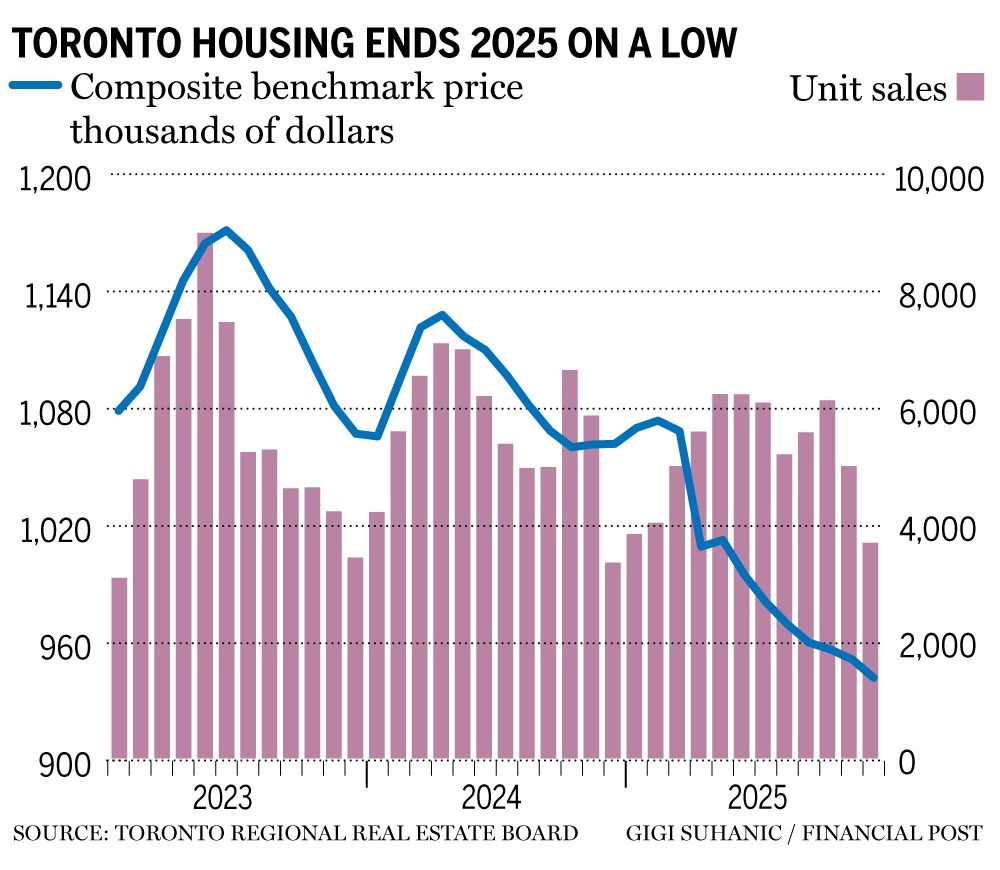
Toronto home sales ended the year much like they started — with a whimper.
The number of homes sold in Canada’s largest city fell 0.4 per cent in December from the month before, while the benchmark price slipped 0.7 per cent to $962,000, seasonally adjusted data from the Toronto Regional Real Estate Board (TRREB) showed Wednesday.
The declines were part of a trend seen throughout the year. Total sales for 2025 were down more than 11 per cent, and benchmark prices fell more than 6 per cent.
Last February TRREB forecast that sales would rise 12 per cent in 2025. Instead activity was the lowest seen in the Greater Toronto Area since 2000.
Only sellers were out in force. Active listings rose by 10.5 per cent during the year, with new listings hitting their highest level since 1980.

- Today’s Data: Canada international merchandise trade, United States wholesale trade, consumer credit, non-farm productivity and trade balance
- Earnings: Aritzia Inc., Tilray Brands Inc.

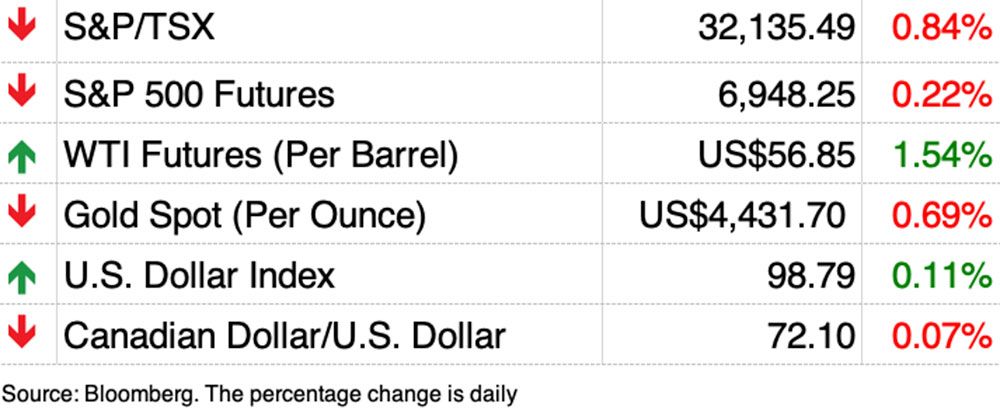

- Canada has problems: Here are the tech startups worth watching that are trying to tackle them
- Howard Levitt: 7 survival tips for employers in 2026
- How to make a million a year playing disc golf

The Wealthy Barber author David Chilton is back and this time he has updated his best-selling personal finance guide for today’s young Canadians, more than 30 years after he first published it.
Gen Z and millennial Canadians face different financial issues than previous generations, including out-of-reach home ownership and income uncertainty, making money management seem impossible for some.
In an interview for the Financial Post, Chilton talks about how younger Canadians can get a handle on their finances and set themselves up for successful saving strategies in 2026 and beyond, despite the financial circumstances they may face. Read more
 Interested in energy? The subscriber-only FP West: Energy Insider newsletter brings you exclusive reporting and in-depth analysis on one of the country’s most important sectors. Sign up here.
Are you worried about having enough for retirement? Do you need to adjust your portfolio? Are you starting out or making a change and wondering how to build wealth? Are you trying to make ends meet? Drop us a line at wealth@postmedia.com with your contact info and the gist of your problem and we’ll find some experts to help you out while writing a Family Finance story about it (we’ll keep your name out of it, of course).
McLister on mortgages
Want to learn more about mortgages? Mortgage strategist Robert McLister’s Financial Post column can help navigate the complex sector, from the latest trends to financing opportunities you won’t want to miss. Plus check his mortgage rate page for Canada’s lowest national mortgage rates, updated daily.
Financial Post on YouTube
Visit the Financial Post’s YouTube channel for interviews with Canada’s leading experts in business, economics, housing, the energy sector and more.
Today’s Posthaste was written by Pamela Heaven with additional reporting from Financial Post staff, The Canadian Press and Bloomberg.
Have a story idea, pitch, embargoed report, or a suggestion for this newsletter? Email us at posthaste@postmedia.com .
Bookmark our website and support our journalism: Don’t miss the business news you need to know — add financialpost.com to your bookmarks and sign up for our newsletters here
]]>Soaring stock markets helped boost the solvency of Canadian defined-benefit (DB) pension plans to a record high at the end of 2025, according to a new report by Mercer (Canada) Ltd.
The median solvency ratio of 471 DB pension plans was 132 per cent on Dec. 31, 2025, a record high based on data going back to 2008, when the Mercer Pension Health Pulse first started tracking the data.
“The vast majority of the increase has been due to the strong equity returns in the year,” Brad Duce, a principal at Mercer in Toronto, said, attributing the “vast majority” of the increase to supersized stock performance in 2025.
For example, the S&P/TSX composite index closed 2025 up 28 per cent, beating the S&P 500 index , which was up almost 17 per cent. Stock markets in Europe also recorded blockbuster returns, with the Stoxx 600 index rising 16 per cent, its largest gain since 2021.
The DB pension plans’ median solvency ratio rose seven per cent during the year, with almost half of that increase coming in the final quarter of 2025. The current median solvency ratio indicates that for every dollar promised to date, the plan holds an extra 32 cents.
There was more good news for DB pension plan holders.
Mercer said 68 per cent of such plans had a solvency ratio above 120 per cent, up from 55 per cent at the start of the year, and the share of plans with a solvency ratio above 100 per cent rose to 92 per cent from 88 per cent over the same time period. Those shares were also the highest on record since 2008.
The plans’ solvency ratios also improved on rising interest rates on long-term government bonds, which helped to bring down liabilities “slightly,” Duce said.
The DB pension plans included in Mercer’s index come from the public, private and non-profit sectors. A pproximately 80 per cent of the plans Mercer tracks are in the private sector.
“Fuelled by tariffs, trade disruptions and geopolitical risks, the Canadian economy experienced a turbulent year,” Duce said. “Thanks to diversification and strong risk management frameworks, the overall financial health of DB pension plans continues to be generally secure from a solvency perspective for Canadian workers and retirees.”
According to Statistics Canada data released in June 2025, 7.2 million Canadians had either a DB pension plan, a defined-contribution plan or some type of hybrid plan. DB plans accounted for about two-thirds of employer- and union-sponsored pensions in Canada.
Mercer said pension plan funding has steadily improved over the past five years and that the “significant surpluses” they have amassed will “serve as security margins as they head into the new year.”
But it said pension plan managers shouldn’t take these surpluses for granted and that surpluses have been known to evaporate faster than expected.
“The current cushions allow plan sponsors to prepare for potential unfavourable scenarios and adapt their risk-management frameworks accordingly ,” Duce said.
Still, surpluses do give pension plan operators room to manoeuvre and they can be used for contribution holidays and to undertake strategic redesigns.
Canadian pension plans have been under pressure to increase their investments in domestic infrastructure, something that could continue given that the federal government, through its Major Projects Office, is looking to accelerate the construction of infrastructure projects that have been earmarked as being of national importance.
But Mercer said pension plan managers should remain focused on the needs of the plan members, not the government’s needs.
“Pension plan sponsors need to ensure that they’re following their fiduciary duty, and that is to ensure the security and long-term sustainability of providing the pensions that have been earned,” Duce said.
• Email: gmvsuhanic@postmedia.com
]]>Investors are expecting the S&P/TSX composite index to deliver more muted returns of five per cent to nearly 10 per cent in 2026 after two consecutive years of double-digit gains.
The index started 2025 at 24,727.94 and finished the year up 28.3 per cent at 31,712.76, breaking 63 closing records along the way, according to Bloomberg data.
Forecasts for year-end 2026 range from a low of 33,500 to a high of 35,200 by Canadian Imperial Bank of Commerce.
Brent Joyce, chief investment strategist at BMO Private Wealth, said BMO predicts the S&P/TSX composite to end 2026 at 34,000 and is recommending investors be overweight on equities to take advantage of government spending, as well as defence spending, tax cuts in the United States and China opening its coffers.
But he said investors will need to stay focused on earnings.
“Earnings are what matters because nothing is cheap,” Joyce said, adding that the current macroeconomic landscape is configured to support businesses.
For example, the Bank of Canada has cut interest rates to 2.25 per cent, a level he called “quite accommodative,” though it sits at the bottom of the central bank’s neutral range of 2.25 per cent to 3.25 per cent.
Meanwhile, billions of dollars in stimulus spending are coming from the federal government to get infrastructure projects off the ground and companies investing again.
“That’s a good backdrop for earnings to deliver,” he said.
Neil Linsdell, vice-president and head of investment strategy at Raymond James Investment Counsel Ltd., also expects the S&P/TSX composite to end 2026 at 34,000.
He said in a report that the breadth of stocks trading above their 50-day moving average has increased and “we expect this momentum to carry into 2026.”
His forecast for the S&P/TSX composite is based on three assumptions: the Bank of Canada could cut interest rates one more time, possibly early in the new year, to take rates to two per cent and into stimulative territory; the successful renewal of the Canada-United States-Mexico Agreement ( CUSMA ); and the “rollout” of federal spending by Ottawa.
“We expect Canadian equities to benefit ahead of the broader economy, given the investment-heavy nature of budget 2025,” Linsdell said.
But some investors said those gains might be harder to nail down since bank and gold stocks are trading at higher premiums.
“To be really bullish on the TSX in the next year, you have to believe, one, either gold is going to continue to run, which I think is a challenge,” Craig Basinger, chief market strategist at Purpose Investments Inc., said. “And then financials would have to perform.”
Purpose hasn’t made a call on where the S&P/TSX composite will land in 2026, but Basinger said the year ahead appears challenging.
“The TSX probably has a higher risk of a pullback than some of the other markets,” he said. “Because we’re now at the point where the valuations aren’t cheap anymore. We were much more positive on Canada at the beginning of this year than we are now.”
Basinger said the S&P/TSX composite is trading at 16.5 times forward earnings, which he called pretty stretched.
He also said the market’s gains over the past year have been concentrated in materials and financials. He estimated that approximately two-thirds of the S&P/TSX composite’s gains came from those two sectors, with gold accounting for around 11 per cent of the uptick in materials.
“Gold is a tricky one because it can give and take away just as quickly,” Basinger said.
The price of gold has risen 64 per cent this year, as of Dec. 30. All of the top 10 gainers on the S&P/TSX composite in 2025 were stocks in materials, except Celestica Inc.
But the financials sector, which includes the Big Six banks , still accounts for 32 per cent of the index.
“So, where the banks go, often the TSX goes,” Basinger said.
He said the banks are already “really expensive” and carrying valuations that are well above their longer-term averages.
He also said investors would have to have a pretty optimistic take on the Canadian economy for the banks to continue supporting the market.
“Gold doesn’t care what the Canadian economy is doing. Energy doesn’t care, but the banks do,” he said. “The question then becomes, what else could lift the TSX?”
But Joyce said investors should “not look for a repeat of the returns we’ve seen in gold and gold stocks in 2025.”
He said the Big Six have more to give and that Royal Bank of Canada , Toronto-Dominion Bank and Bank of Montreal are huge companies whose operations touch many parts of the Canadian economy, but are also global in scope. The same goes for insurers such as Sun Life Financial Inc. and Great-West Lifeco Inc.
BMO also pegged the energy sector as a possible “dark horse” in 2026 on expectations that oil prices will remain stable despite a global glut as demand improves in China, Europe and North America.
He said adding US$10 to US$15 to the price of a barrel of oil could make a big difference to energy companies, which have been improving profit margins.
“Should earnings deliver, we are going to be fine, and stock markets will continue to move higher,” Joyce said. “If earnings disappoint, then we’ve got an entirely different story, because our expectations are high.”
• Email: gmvsuhanic@postmedia.com
An earlier version of this story said that the TSX composite set 39 new closing records in 2025. The correct number is 63.
]]>The rise of artificial intelligence drove bubble fears in stock markets around the world in 2025, but investors who stuck it out were well rewarded. Despite turmoil from the trade war, most global markets approached the end of the year in the black. When it came to individual stocks and commodities, however, some had it better than others. Here, the Financial Post’s Gigi Suhanic takes a look at five winners and five losers from the year in investing.
Winners
Aritzia
The Vancouver-based clothing retailer known for its Super Puff jackets and Effortless Pant was one of the top performers on the TSX in 2025. By late December, Aritzia Inc. shares (TSX:ATZ) had more than doubled to about $112 as it continued to make headway in the U.S., which accounted for 58 per cent of its revenue for the fiscal 2025 year. Analyst Stephen MacLeod at BMO Capital Markets recently hiked his price target to $130 from $110 based on continued U.S. expansion plans; the company is also attracting attention from the investment community south of the border, with Goldman Sachs analyst Jonathan Keypour initiating coverage on Dec. 11 with a buy rating and a price target of $130, citing Aritzia’s “large untapped U.S. opportunity.”
The TSX
The S&P/TSX composite index turned the tables on the major U.S. stock markets this year, defying Donald Trump ‘s trade war to outperform its southern brethren. With just a few trading days left in the year, the TSX is up approximately 27 per cent, double the Dow Jones Industrial Average’s 13.5 per cent gain, and well ahead of both the S&P 500 index at 16 per cent and the NASDAQ at 20 per cent. The trend of U.S. outperformance was upended as investors flocked to metals miners to cash in on big gains in gold and silver, while financials, specifically Canada’s Big Six banks , also helped power the TSX. This year’s stellar gain comes on the heels of a 19 per cent gain in 2024, leaving investors asking if a third big year is ahead in 2026.
Silver
The price of silver more than doubled in 2025, surpassing its flashier counterpart, gold, which jumped a meagre 63 per cent. The silver and gold duo were market darlings as investors sought to surf the trends of “rising levels of sovereign debt, persistent inflation, a weaker (U.S. dollar), continued pressure for lower rates and strong physical demand from central banks/stablecoins,” National Bank Capital Markets said in a note. Analysts think those driving forces will remain in play in 2026. Silver, which traded above US$67 as of Dec. 19, also benefited from its importance as a material in industrial uses, with the U.S. also adding it to its list of critical metals. It’s rise helped make Discovery Silver Corp. (TSX:DSV) the TSX’s top gainer for the year by a wide margin, up 1,083 per cent.
Celestica
Celectica Inc. (TSX:CLS) stood out among the top 10 gainers on the TSX as the only non-metals name of 2025, up more than 200 per cent as of late December. The Toronto-based electronics component manufacturer has transformed into an artificial intelligence infrastructure play and been swept up in the exuberance that powered U.S. markets. The AI theme has suffered of late as markets worry about the sector on several fronts, including massive debt issuances and spending delays at some big U.S. companies. But JPMorgan Chase and Co. still sees Celestica as one of the companies that will benefit from capital spending of AI “hyperscalers” such as Google, Meta Platforms Inc. and Amazon.com Inc. Shares of Celestica were trading above $407 in late December.
Alphabet
OpenAI’s ChatGPT was the first artificial intelligence chatbot to capture the public’s imagination, but it looks like Google parent Alphabet Inc. (Nasdaq/GOOG) is rapidly closing the gap. Alphabet lapped the rest of the Magnificent Seven stocks in 2025, rising 62 per cent by late December with the closest competition coming from Nvidia Corp., up 32 per cent. A survey from TD Cowen showed that a growing share of ChatGPT users were also using Google’s Gemini 3 chatbot and that people are increasingly using AI in search. Alphabet also got a major boost in November when it was revealed that tech-wary Berkshire Hathaway Inc. had taken a stake. Alphabet shares were trading at nearly US$310 in late December.
Losers
Lululemon
Aritzia may have soared in 2025, but Lululemon Athletica Inc. (Nasdaq/LULU) stumbled. Shares of the athleisure maker were languishing down more than 55 per cent through late November, but staged a mini comeback in December on news that chief executive Calvin McDonald would step down and that an activist investor was taking a stake. A shrinking U.S. market and revelations that pricey yoga tights were landing in discount bins were among Lululemon’s troubles. The death of the U.S. de minimis rule didn’t help either, as much of Lulu’s online distribution came from outside that country. Then came the attack ad against McDonald from Lululemon founder Chip Wilson, which urged for a leadership change. Jefferies analyst Randal Konik called McDonald’s departure the “most constructive development for shareholders in years.” Some analysts have since hiked their outlooks, though the 12-month average price target of US$205 sits around where the stock was trading in late December.
Constellation Software
Long-time TSX darling Constellation Software Inc. (TSX:CSU) fell out of favour in 2025, as investors worried about the impact of AI and the departure of founder Mark Leonard, who stepped down as president in September, citing health concerns. Overall, shares were down 25 per cent as of mid-December, landing it on the list the top 10 losers for the year. Software providers suffered in general in 2025, CIBC Capital Markets said in a note, as investment dollars felt the gravitational pull of AI infrastructure. CIBC analyst Stephanie Price cited “company specific headwinds and AI concerns” for the shares’ losses, but she thinks the outlook will improve in 2026 as some of that AI money starts to benefit software companies. Constellation was trading at $3,336 in Toronto on Dec. 19.
West Fraser Timber
West Fraser Timber Co. Ltd. (TSX:WFG) was felled in 2025 by Donald Trump’s lumber tariffs, with shares of the company down just under 35 per cent, making it the biggest loser on the TSX in 2025. In mid-October, a 10 per cent duty on global timber imports to the U.S. came into effect. That was on top of already existing American tariffs of 35 per cent on Canadian lumber. In addition to the 10 per cent tariff, Trump also imposed a 25 per cent levy on wooden cabinet and vanity imports, which is set to rise to 50 per cent in the new year. Despite the tough year, some analysts have hiked their 2026 price targets for West Fraser. They include Matthew McKellar at RBC Capital Markets, who thinks the company’s stock price looks attractive and has West Fraser as one of his top picks for 2026.
Orange juice
It’s been a sour year for orange juice with futures contracts for frozen concentrate down 66 per cent. The breakfast staple was the target of retaliatory tariffs in Canada in the initial aftermath of Donald Trump’s trade war, with the U.S. Census Bureau reporting in August that orange juice shipments to Canada had sunk by 20 per cent. But the removal of Canada’s duties didn’t seem to juice the outlook for OJ, which more generally has been suffering from sagging demand as dietary habits change. This year’s decline marked a major turn of fortunes for the futures, which soared at the end of 2024 as drought, disease, flooding and storms hit crops around the world including in the U.S.
Chipotle
Chipotle Mexican Grill Inc. (NYSE/CMG) went on a major run after U.S. hedge fund titan Bill Ackman bought into the fast food juggernaut in the wake of a tainted food scandal in 2015. But things caught up with Chipotle this year, with shares down 40 per cent as investors mulled over the effects of inflation and a more cautious consumer. Even Ackman decided he had had enough, selling his remaining stake in the Mexican fast-casual chain. Since hitting an all-time high in 2024 of US$68.55, Chipotle shares are down 48 per cent and were trading at around US$38 in late December.
• Email: gmvsuhanic@postmedia.com
]]>Desjardins’s 2026 top picks, food inflation winners and more stories from The Week in Stocks.
Stock of the week: NFI Group Inc.
Transit bus maker NFI Group Inc. (TSX:NFI) rose 17 per cent this week , reversing a recent decline in shares after the Winnipeg-based company announced a new chief executive and a settlement regarding a battery recall. Shares closed up 12 per cent on the news and continued to climb from there, though they gave back some gains on Friday. It has been a year of split fortunes on the S&P/TSX composite index for NFI. Shares had risen nearly 47 per cent through July before retracing most of those gains — until Monday’s rebound. Analysts believe there is more potential upside to come. CIBC Capital Markets’ Krista Friesen said in a note in early November that despite the recall, the company has “solid fundamentals.” With a backlog of $13.2 billion in orders, “we maintain confidence in NFI’s ability to deliver growth and margin improvement heading into 2026.” CIBC has a price target of $20 on shares of NFI. The average 12-month price target is $20.83, according to six analysts tracked by Bloomberg. Shares closed Friday at $15.37.
Keeping score
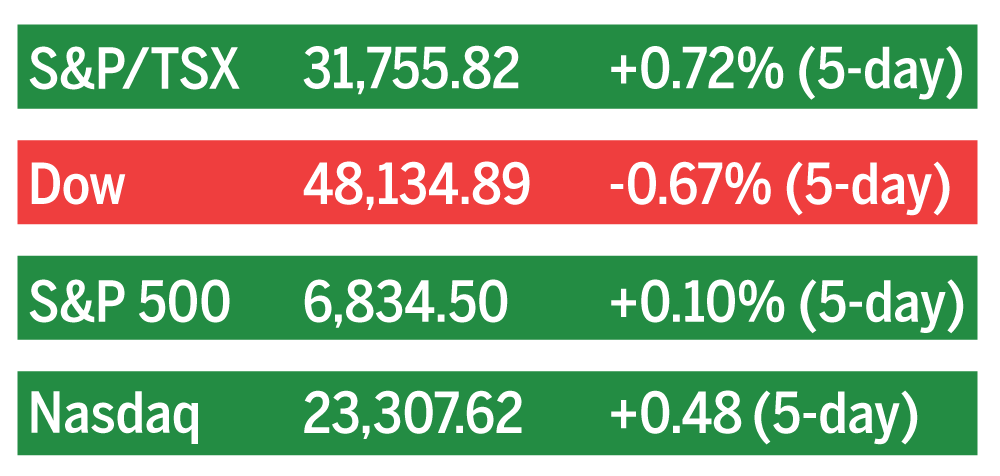

Carney major projects winner garners bank coverage interest
Nouveau Monde Graphite Inc. (TSX:NOU) just landed on a second major bank’s coverage list after the miner of the critical mineral graphite was referred to Mark Carney’s Major Projects Office (MPO). The company will help accelerate the construction in Quebec of a graphite mine to be paired with a battery material plant. BMO Capital Markets started covering Nouveau Monde this week, with metal and mining analyst Raj Ray setting a price target on the shares of $6 and an outperform rating. Nouveau Monde is currently trading around $3.50. In a note, Ray noted offtake agreements for approximately 100 per cent of production and 80 per cent of production subject to a floor price. Graphite is used in defence, battery storage and electric vehicle applications. National Bank Capital Markets started covering Nouveau Monde in November and has a price target of $5.25. National is projecting construction of the mine and possibly the plant to begin in mid-2026. “Overall, we view this update (referral to the MPO) as a positive for (Nouveau Monde) with government support improving odds of the project becoming reality,” analyst Mohamed Sidibe said in a note.
The food inflation winner
Statistics Canada confirmed what Canadians already know — that the cost of food continues to rise — as November inflation numbers for food purchased at stores rose 4.7 per cent year over year compared with a 2.2 per cent increase in the overall consumer price index (CPI). That can benefit grocers, with some better placed than others. “The food CPI backdrop continues to favour grocers with (a) strong value proposition and (is) likely to keep shaping consumer shopping patterns,” Irene Nattel, RBC Capital Markets retail analyst, said in a note. With consumers in permanent deal-hunting mode, Loblaw Cos. Ltd. (TSX:L), which was one of RBC’s best ideas for 2026, is best placed to come out on top, Nattel said. RBC has a price target for the shares of $68. Loblaw traded Friday near $62. Among the chain’s “key levers” are its ability to expand its “hard discount” square footage, she said.
Some top picks for 2026 from Desjardins
Desjardins Research put out a fresh list of top picks for the new year. Here’s a look at a few, by sector, and why analysts think they will perform for investors. Consumer staples/discretionary: Desjardins’s top idea is Gildan Activewear Inc. (TSX:GIL). It has a price target on the Montreal company of $95. Shares traded Friday at $87.48. Gildan is on Desjardins’s radar due to the possibility of a greater than 20 per cent compound annual growth rate in the earnings per shares (EPS) over three years, plus “controllable” EPS and the expected sale of HBI Australia, which would allow for share buybacks sooner than later. Financial Services: Canadian Imperial Bank of Commerce (TSX:CM) is the top pick in this sector. Desjardins has a price target on CIBC of $135. It closed Friday at $130.70. CIBC “has been rebranded as the bank of ‘no surprises.’ As we look forward, we do not expect any material change to CM’s strategy under its new CEO,” Desjardins said in its report, adding it thinks the Big Six player deserves a “premium multiple” on expectations that it will deliver next year on net interest margin, expenses, credit and buybacks. Metals and mining: Torex Gold Resources Inc. (TSX:TXG) is the top pick in this hot sector that was responsible for a good chunk of the TSX’s gains in 2025. Desjardins has a price target of $90. Shares closed Friday at $66.77. Torex made the cut based on the recent on-time and “nearly” on-budget completion of a new mine in Mexico, the purchase of Reyna Silver and the miner’s expected debt-free status in the first quarter of 2026, Desjardins said.
Price target hikes
- TD Cowen hiked its price target for Premium Brand Holdings Corp. (TSX:PBH) to $160 from $145 on the company’s deal to acquire Stampede Culinary Partners. Analyst Derek Lessard said the deal is “positive” on several fronts including lower leverage and the belief that Premium paid a “fair price” for Stampede. Premium closed Friday at $100.90.
- CIBC Capital Markets hiked its price target for Skeena Resources Ltd. (TSX:SKE) to $40 from $36. Shares closed at $32.59 on Friday. Skeena got a boost after the B.C. Tahltan Nation voted in support of Skeena’s Eskay Creek gold-silver mine Impact Benefit Agreement.
- BMO Capital Markets hiked its price target for Amazon.com Inc. (Nasdaq/AMZN) to US$304 from US$300 on “accelerating cloud commitments.” Shares closed Friday at US$227.35.
Every week, the Financial Post breaks down the most interesting developments in the week’s world of investing, from top performers to surprising analyst calls and stocks to have on your radar.
Are you an investor looking for stock ideas and market insight? Sign up for the weekly FP Investor Newsletter here to get the best of the Financial Post’s investing news, analysis and expert commentary straight to your inbox.
• Email: gmvsuhanic@postmedia.com
]]>Rosenberg’s 2026 picks, why some oilsands majors may be vulnerable and more stories from The Week in Stocks.
Stock of the week: Groupe Dynamite Inc.
Fashion retailer Groupe Dynamite Inc. (TSX:GRGD) has experienced explosive share price growth over 2025 with the stock up just over 300 per cent as the company expands, especially in the United States. The Montreal fashion retailer released earnings this week that met or exceeded 2025 guidance sending shares up seven per cent, though the stock gave back those gains later in the week. Several analysts see more upside ahead, with RBC Capital Markets’ Irene Nattel raising her price target for the shares to $95 from $77, citing this week’s results and “strong momentum.” Groupe Dynamite closed Friday at $79. BMO Capital Markets analyst Stephen Macleod also hiked his price target for Groupe Dynamite to $97 from $76, while TD Cowen’s Brian Morrison hiked his to $97 from $68, on “results that surpassed elevated expectations for Q3/F25.”
Keeping score


Carney-Smith deal could spell trouble for these oilsands majors
“Our take is currently mixed” on the memorandum of understanding (MOU) signed by Prime Minister Mark Carney and Alberta Premier Danielle Smith , analysts at Scotia Capital Markets said in a note. Based on what is known about the agreement, which aims to clear the way for a new oil pipeline, the team at Scotia Capital said they believe it will be positive for power and energy infrastructure and slightly negative for the oilsands, due to higher carbon taxes. If a pipeline is built, analysts pegged major oilsands players, including Athabasca Oil Corp. (TSX:ATH), Cenovus Energy Inc. (TSX:CVE), Canadian Natural Resources Ltd. (TSX:CNQ), Imperial Oil Ltd. (TSX:IMO), International Petroleum Corp. (TSX:IPCO), Strathcona Resources Ltd. (TSX:SCR) and Suncor Energy Inc. (TSX:SU), as vulnerable. However, the Scotia team named Capital Power Corp. (TSX:CPX), TransAlta Corp. (TSX:TA) and Pembina Pipeline Corp. (TSX:PPL) among the companies that could benefit from the MOU’s push for Alberta to build out its energy infrastructure. But the analysts also warned of the damage suffered by proponents of such ill-fated projects as Northern Gateway, Keystone XL and Energy East. “Recent large-scale pipeline projects were very negative outcomes for investors and negatively affected share prices,” they said.
What Rosenberg likes for 2026
Utilities, uranium , gold and gold miners are a few of 13 sectors that David Rosenberg continues to favour in 2026 in the hunt for “growth at a reasonable price.” Here’s a look at what the founder of Rosenberg Research & Associated Inc., had to say about the prospects for these sectors in a recent note to investors. Utilities: Rosenberg expects U.S. power demand to soar in the coming years and utilities as the best way to position for that trend. “The sector commands attractive valuations benchmarked against strong earnings visibility, ultimately making it a long-term holding with an attractive risk/reward profile,” he said. Uranium: A nuclear renaissance is underway to feed the growing need for power and uranium is well placed to win given demand currently outstrips supply. Aerospace and defence:Defence spending budgets are exploding around the world. “This remains one of our highest-conviction investment themes — led by Europe,” he said. Asian equities: The stock markets of countries including India, Japan, South Korea, Taiwan and China are “under owned” and offer better valuations, he said. Gold and miners : Rosenberg thinks gold at US$6,000 an ounce is possible based on ongoing central bank buying, retail demand and global political uncertainty. He also likes mining stocks, which he said are “incredibly underpriced.” Bank preferreds : They are the ticket for investors looking for “safety and income at a reasonable price” as they include “attractive yields that come with capital appreciation potential as rates fall.”
But 2025 isn’t over yet, and CIBC has Top 10 picks
Historical trends for equity market gains in the last half of December, coupled with a U.S. Federal Reserve rate cut and increase in the breadth of stock market winners , has CIBC Capital Markets analysts Sid Mokhtari and associate Michael Petipas betting on a year-end rally. Here are their Top 10 picks, spread out of five year sectors: Equinox Gold Corp. (TSX:EQX), Orla Mining Ltd. (TSX:OLA), Americas Gold and Silver Corp. (TSX:USA) , Suncor Energy Inc. (TSX:SU), Whitecap Resources Inc. (TSX:WCP), IA Financial Corp. Inc. (TSX:IAG), Manulife Financial Corp. (TSX:MFC), Aecon Group Inc., (TSX:ARE), Exchange Income Corp. (TSX:EIF), Celestica Inc., (TSX:CLS).
Price target hikes
- CIBC Capital Markets hiked its price target for Endeavour Silver Corp. (TSX:EDR) to $18 from $16 after it completed a debt offering that analyst Cosmos Chiu estimates will save the miner on interest payments. Endeavour closed Friday at $12.35.
- BMO Capital Markets hiked its price target for Lundin Gold Inc. (TSX:LUG) to $115 from $108 on better-than-expected production in 2028. Shares closed Friday at $111.41.
- Josh Wolfson at RBC Capital Markets hiked his price target for Barrick Mining Corp. (TSX:ABX) to $70.60 from $55.93. “Our outperform rating is predicated on our view that Barrick’s valuation provides greater upside potential relative to peers given the company’s growth and resource upside,” RBC said in a note. Shares closed Friday at $59.26.
- Patrick Kenny at National Bank Capital Markets hiked his price target for TransAlta Corp. (TSX:TA) to $22 from $18 after it announced a deal to supply power to the U.S. Pacific Northwest. TransAlta closed Friday at $19.08.
- Irene Nattel at RBC Capital Markets hiked her price target for Dollarama Inc. (TSX:DOL) to $225 from $220. Consumer traffic and the size of purchases at the discount retailer grew, the latest earnings report showed. Shares traded Friday at $202.23.
Every week, the Financial Post breaks down the most interesting developments in the week’s world of investing, from top performers to surprising analyst calls and stocks to have on your radar.
Are you an investor looking for stock ideas and market insight? Sign up for the weekly FP Investor Newsletter here to get the best of the Financial Post’s investing news, analysis and expert commentary straight to your inbox.
• Email: gmvsuhanic@postmedia.com
]]>The Canadian Big Banks with increased price targets, why tax loss selling will be trickier this year and some top picks for 2026 from RBC Capital Markets. The Financial Post explores those stories and more in The Week in Stocks.
Stock of the week: Curaleaf Holdings Inc.
Investors might think their eyes are deceiving them to see a cannabis name from the beaten down sector at the top the S&P/TSX composite index gainers list. But that’s what happened this week as Curaleaf Holding Inc. gained 17 per cent. The gain came on news that the company purchased several medical marijuana dispensaries and a growing facility in Virginia. The state, which previously legalized the use of marijuana, is expected to clear the way for a regulated retail system, possibly in the first half of 2026 when a new governor takes office. “Virginia is one of the key catalyst states for the industry through our forecast window,” Kenric S. Tyghe, director of special situations in equity research at Canaccord Genuity, said in a note. Analysts believe Curaleaf has the potential to rise another 36 per cent based on the average price target of $5.17 of nine analysts that cover the shares and have price targets, according to Bloomberg. Their price targets ranged from a low of $4.40 from Morningstar Investment Service to a high of $7.03 from Seaport Research Partners. Canaccord has a price target for Curaleaf of $5.00. Analyst Frederico Gomes at ATB Capital Markets hiked his price target for Curaleaf to $4.50 from $4.00. “Curaleaf distinguishes itself through large domestic scale and unique leading presence in high-growth international markets,” Gomes said in a note to investors. Shares of Curaleaf closed Friday at $3.79.
Keeping score


Tax loss selling ideas among slim pickings as deadline nears
Tax-loss selling will be more a matter of stock picking than sector-based, with the S&P/TSX composite index up just over 26 per cent year to date and gains spread across different industries, according to analysts at Scotia Capital Markets. “Overall, investors do not have a large choice for tax loss purposes this year,” they said in a note. Scotia recommends swapping West Fraser Timber Co. Ltd. (TSX:WFG) and Methanex Corp. (TSX:MX), down 31 per cent and 27 per cent respectively year to date, for Nutrien Ltd. (TSX:NTR) and then repurchasing the pair in the new year. Scotia has a price target on Methanex of $67.33. Shares traded Friday near $53. Analysts have a price target of $126.27 on West Fraser, which traded Friday at $86. They also suggested selling TFI International Inc. (TSX:TFII) and Lightspeed Commerce Inc. (TSX:LSPD) and purchasing CAE Inc. (TSX:CAE) and Shopify Inc. (TSX:SHOP) to get similar sector exposure while not letting cash sit idle. Constellation Software Inc. (TSX:CSU) and CGI Inc. (TSX:GIB/A) are among names that Scotia doesn’t cover but that have lost big so far in 2025 — down 27 and 23 per cent respectively. Analysts recommend selling the pair and picking up Descartes Systems Group Inc. (TSX:DSG).
Price targets soar after blockbuster Big Bank earnings
Canada’s Big Six banks reported earnings that led to price target upgrades across the board. TD Cowen hiked its target for Bank of Nova Scotia (TSX:BNS) to $104 from $99 on expansion of net interest margin, buybacks and an improving credit outlook. Shares traded Friday at $98. Analyst Mario Mendonca has a buy rating on the shares, but said he will have an eye out for improvement in commercial loans in 2026. Gabriel Dechaine at National Bank of Canada Capital Markets hiked his price target for Royal Bank of Canada (TSX:RY) to $235 from $231, as Canada’s largest company by market capitalization posted quarterly profits that beat expectations by 29 per cent. Shares of RBC traded Friday at nearly $225. CIBC Capital Markets analyst Paul Holden increased his price target for National Bank of Canada to $174 from $166 based on an increased earnings-per-share estimate that assumes higher loan growth and interest income. National traded Friday at $170. Darko Mihelic at RBC Capital Markets hiked his price target for Toronto-Dominion Bank (TSX:TD) to $128 from $120 as it looks like TD is “well on its way” to meeting its U.S. anti-money laundering targets. He also hiked his price target for Bank of Montreal to $178 from $163 on lower corporate losses and higher capital markets earnings. TD and BMO were trading at $121 and nearly $178, respectively.
Select names from RBC’s top picks for 2026
RBC Capital Markets’ recalibrated its Canadian convictions list of stocks for 2026. Among the 27 names, RBC added Manulife Financial Corp. (TSX:MFC) and Toronto-Dominion Bank (TSX:TD), and deleted Telus Corp. (TSX:T). RBC analyst Darko Mihelic has a price target on Manulife of $52 based on “solid” growth in Asia and reinsurance deals in long-term care. Manulife traded Friday near $48. Among risks to the shares are low interest rates, a prolonged economic downturn, deteriorating equity markets and appreciation in the Canadian dollar . For TD, Mihelic has a 12-month price target of $120 based on pledges to buy back approximately $6 billion to $7 billion worth of shares and cut costs by $2 billion to $2.5 billion by 2029.
Price target hikes
- TD Cowen analyst Wayne Lam hiked his price target for Equinox Gold Corp.(TSX:EQX) to $22 from $20 on the ramp-up of two Canadian projects. Shares traded Friday around $19.
- Patrick Kenny, an analyst at National Bank of Canada Capital Markets, hiked his price target for Gibson Energy Inc. (TSX:GEI) to $29 from $24 and upgraded the shares to outperform from sector perform, “highlighting an attractive entry point.” Shares traded Friday around the $25.50 level.
- BMO Capital Markets analyst Tom Callaghan upgraded Extendicare Inc. to outperfrom and hiked the price target to $24 from $21 on the company’s deal to purchase CBI Home Health, which “enhances (its) footprint in a space that we see as a structural winner in the coming years.” Extendicare traded Friday at the $22 level.
Every week, the Financial Post breaks down the most interesting developments in the week’s world of investing, from top performers to surprising analyst calls and stocks to have on your radar.
Are you an investor looking for stock ideas and market insight? Sign up for the weekly FP Investor Newsletter here to get the best of the Financial Post’s investing news, analysis and expert commentary straight to your inbox.
• Email: gmvsuhanic@postmedia.com
]]>What’s next for Nvidia and how to grab opportunities from a possible oil pipeline bottleneck. Plus, TSX stock price target hikes. The Financial Post explores those stories and more in The Week in Stocks.
Stock of the week: Alphabet Inc.
Google parent Alphabet Inc. (Nasdaq:GOOG) defied the selloff mood stalking markets this week, which are partly based on fears the artificial intelligence trade is overdone. The tech giant gained nearly nine per cent on news its AI offering could be gaining on ChatGPT after Google launched Gemini 3, a new version of its large language model, in mid-November. “We expect the updates to drive higher engagement of GOOG’s AI offerings, extending trends from our October ’25 U.S. consumer survey which suggest steadily rising Gemini and AI Mode MAU (monthly active user) penetration since July ’25 versus more stable user trends at ChatGPT,” John Blackledge, an analyst at TD Cowen, said in a note. Shares of Alphabet also got a boost on news that legendary investor Warren Buffett , known to be tech-wary, took a position in the stock, Bloomberg said. Analysts appear to have mostly stuck with price targets, hiked when Alphabet reported earnings at the end of October. The company has a 12-month price target of US$322.68. Shares traded Friday at the the US$302 level.
Keeping score


More ways to play Round 2 of projects of national interest
Analysts at the Bank of Nova Scotia dug further into the second set of major infrastructure projects announced last week and beefed up their initial list of 12 stock recommendations. Prime Minister Mark Carney announced six new projects of national interest, adding to the initial five proposals set out in mid-September. The new projects include the construction of an electricity transmission corridor and the completion of a floating liquefied natural gas (LNG) terminal in northern British Columbia, as well as a critical mineral mine in New Brunswick, a nickel mine in Ontario, a graphite mine in Quebec and a hydro line to the Arctic. Yukon-based Snowline Gold Corp. (TSX:SGD) could benefit from a lower energy supplied by the from B.C. electricity project, Scotiabank analysts said. Enbridge Inc. (TSX:ENB) could be a player in the LNG terminal, possibly helping build a pipeline to supply the project, they said. Benefits from the terminal could also spill over to Alberta gas companies, including AltaGas Ltd. (TSX:ALA), Keyera Corp. (TSX:KEY) and Pembina Pipeline Corp. (TSX: PPL), while TC Energy Corp. (TSX:TCL) could get pulled in on “further large-scale pipeline investments in the region,” Scotiabank’s analyst team said. The analysts also singled out several engineering and construction stocks, such as AtkinsRealis Group Inc. (TSX:ATRL), Stantec Inc. (TSX:STN), WSP Global Inc. (TSX:WSP), and equipment dealers including Finning International Inc. (TSX:FTT) and Toromont Industries Ltd. (TSX:TIH). There could be upside for transportation companies, such as Canadian National Railway Co. (TSX:CNR) and Canadian Pacific Kansas City Ltd. (TSX:CP), they said.
Click here to review the list of companies from Scotiabank’s initial note on the projects of national interest.
What’s next for Nvidia?
Nvidia Corp. (Nasdaq:NVDA) was the black sheep of the Magnificent Seven megacap tech companies for a spell this week, falling the most of the group of stocks after it gave up gains from better than expected earnings. Fears of a market bubble in artificial intelligence returned quickly and investors worried that further rate cuts by the United States Federal Reserve might be on hold. Shares of Nivdia soared five per cent after it released earnings that showed it was on track to beat sales estimates by more than US$3 billion. However, those gains evaporated and the stock was down just over four per cent on the week and nearly 14 per cent from its October high. Despite market jitters, 26 analysts raised their price targets for Nvidia by an average of 11 per cent, Bloomberg said. The average 12-month price target for the world’s most valuable company is US$250.26 versus US$240.76 prior to the release of the earnings. Shares of Nvidia traded Friday at the US$180 level.
Opportunities may flow from a looming oil pipeline bottleneck
Canada could face an oil pipeline bottleneck as early as the third quarter of 2028. That is the base case scenario laid out by a team of analysts at TD Cowen. “Expedited pipeline expansions could push this into the mid-2030s, but timelines already feel tight and visibility remains low,” analysts said in a research paper that also looked at three other scenarios for oil transportation. These included a “plausible” 820,000 million barrels per day (b/d) pipeline and a blue-sky scenario for a new one million b/d conduit. For the moment, TD analysts are sticking with their baseline scenario for a late-decade bottleneck and ranked Athabasca Oil Corp. (TSX:ATH), Strathcona Resources Ltd. (TSX:SCR) and Imperial Oil Ltd. (TSX:IMO), in that order, as being the most positively free-cash flow sensitive as long as the price differential between Western Canada Select (WCS) and West Texas Intermediate (WTI) remains around the US$14 per barrel level until the third quarter of 2028. However, if either upside scenario comes to pass, TD envisions a pricing “tailwind” that will shrink the differential and lift the boats “for all western Canadian producers well into the next decade.” In that case, TD’s top three picks are Cenovus Energy Inc. (TSX:CVE), Canadian Natural Resources Inc. (TSX:CNQ) and Suncor Energy Inc. (TSX:SU). TD also downgraded some stocks, including South Bow Corp. (TSX:SOBO) and Gibson Energy Inc. (TSX:GEI) on the idea that oil storage companies benefit more from wider differentials between WCS and WTI.
Analyst upgrades
- CIBC Capital Markets upgraded the price targets for all of Canada’s major banks excluding their own, which they can’t cover, in the lead-up to earnings reports by the Big Six financial institutions in a few weeks. The price target for Royal Bank of Canada (TSX:RY) rose to $220 from $208 with shares currently trading at the $210 level. Meanwhile, Bank of Montreal’s (TSX:BMO) target went from $180 to $192; BMO was trading Friday at the $170 level. Toronto-Dominion Bank’s (TSX:TD) price target jumped to $122 from $112 and shares were trading Friday at $115. Bank of Nova Scotia’s (TSX:BNS) price target rose to $100 from $93 and shares were trading Friday at nearly $94. CIBC hiked the price target for National Bank of Canada (TSX:NA) to $166 from $154; National was trading Friday near the $162 level.
- BMO Capital Markets analyst Jeremy McCrea hiked his price target for oil and natural gas explorer Tamarack Valley Energy (TSX:TVE) to $11 from $9 on the premise that “Tamarack has been one of the better performing names as investors embrace the high-return nature of the Clearwater.” Clearwater is an oil project in Alberta. Tamarack shares traded Friday near the $8 level.
- National Bank of Canada Capital Markets hiked its price target for CES Energy Solutions Corp. (TSX:CEU) to $13.00 from $10.50 on “deleveraging and return of capital,” analyst Dan Payne said in a note. CES traded Friday at the $11.50 level.
- BMO raised its price target for Metro Inc. (TSX:MRU) to $115 from $110 on the grocer’s strength in the discount sector. Shares of Metro traded Friday around the $100 level. The latest earnings from Metro and Loblaw Cos. Ltd. indicated that shoppers continue to hunt for deals in the grocery aisles.
Every week, the Financial Post breaks down the most interesting developments in the week’s world of investing, from top performers to surprising analyst calls and stocks to have on your radar.
Are you an investor looking for stock ideas and market insight? Sign up for the weekly FP Investor Newsletter here to get the best of the Financial Post’s investing news, analysis and expert commentary straight to your inbox.
• Email: gmvsuhanic@postmedia.com
]]>TSX winners and losers from this week’s earnings bonanza, one idea to play the volatile artificial intelligence sector, and surprising changes in price targets on three big TSX names. The Financial Post explores those stories and more in The Week in Stocks.
Stock of the week: Algonquin Power & Utilities Corp.
In an overall tough week for equities, Algonquin Power & Utilities Corp. (TSX:AQN) came out ahead of the game as shares rose more than 12 per cent. Algonquin reported earnings per share that beat estimates, while the company, which operates across North America, got a leg up from increased rates at several utilities, John Mould, an analyst at TD Cowen, said in a note. “The company also benefited from lower operating expenses and lower interest expense,” Mould said. The analyst maintained his price target of $8.43. Analysts at BMO Capital Markets, RBC Capital Markets and Scotiabank Capital Markets all raised their price targets to $9.14 post-earnings on the heels of previous continuous hikes in the second half of the year. Shares are currently trading at the $8.80 level. Baltej Sidhu, an analyst at National Bank of Canada Capital Markets, maintained his price target of $9.25, noting Algonquin has made progress on several cases in the United States regarding utility rate increases.
Keeping score


Winners and losers from this week’s earnings bonanza
The earnings from S&P/TSX composite listed companies flowed fast and furious this week across a wide swath of sectors from the oilpatch to telcos and retail giants. We track how their stocks performed post-reporting, picking out 3 winners and 3 losers and highlighting 3 large-cap players.
3 winners
- Shares of Quebecor Inc. (TSX:QBR/B) gained just over seven per cent this week on signs that the Montreal company’s “wireless approach is working well outside of its cable footprint,” Jerome Dubreuil, an analyst at Desjardins Capital Markets, said in a note, raising his price target for the telco to $51 from $47. Quebecor is trading at the $47 level.
- Vermilion Energy Inc. (TSX:VET) rose just under 10 per cent this week on better than expected cash flow, improved guidance and company plans to increase its dividend by four per cent in early 2026. Kevin Fisk, at Scotiabank Capital Markets, has a price target of $14. Shares are currently trading at the $11.50 level.
- Shares of Lightspeed Commerce Ltd. (TSX:LSPD) jumped 16 per cent after reporting earnings that showed “solid progress” on improving its financials, Daniel Chan, an analyst at TD Cowen, said in a note. Chan has a price target on Lightspeed of $21.08, up from $18.35. Shares are currently trading at the $18.30 level.
3 losers
- Shares of Cargojet Inc. (TSX:CJT) came in for a hard landing post-earnings, falling nearly 20 per cent as its business suffered from challenging trade conditions, “highlighting the macro-sensitive nature of the industry,” Fadi Chamoun, an analyst at BMO Capital Markets said in a note. BMO cut its price target to $75 from $98. Cargojet is currently trading at the $66 level.
- Goeasy Ltd. (TSX:GSY) fell 24 per cent this week after it reported higher provisions for loan losses, resulting in an 11 per cent miss on earnings, though the fintech’s loan balances and originations hit a quarterly record. Phil Hardie at Scotiabank Capital Markets maintained his price target of $225. “We continue to expect investor sentiment will remain the near term driver for the stock but believe the risk-reward of owning the shares remains favourable with big upside potential over the next twelve months,” he said. Goeasy is currently trading near the $130 level.
- Scotiabank analyst Cameron Bean cut his price target for energy company Arc Resources Ltd. (TSX:ARC) to $30 from $36. Bean reduced free cash flow forecasts for the company due to lower condensate volumes and higher cash costs than were set out in the company’s 2026 guidance. Shares of Arc are trading at the $21.65 level.
And 3 big names
- Shares of BCE Inc. (TSX:BCE) rose slightly this week “muted subscriber growth” in Canada and the U.S. Analyst Vince Valentini at TD Cowen trimmed his price target to $38 from $39. Shares were trading around the $32 level. “Investors who hold BCE for stability and dividend income do not need to worry about the minutia in our forecasts, and our new (price target) still supports a buy rating. However, investors looking for some growth or exciting catalysts are still likely to have a show me attitude with this name,” Valentini said.
- Maurice Choy at RBC Capital Markets significantly hiked his price target for TC Energy Corp. (TSX:TRP) to $84 from $74 on the belief that policy shifts across North America will clear the way for more energy infrastructure. Shares of TC Energy were up nearly four per cent on the week and were trading at the $73 level.
- CIBC Capital Markets analyst Mark Petrie hiked his price target for Canadian Tire Corp. Ltd. (TSX:CTC) to $189 from $181 on better than expected earnings boosted by rising market share and better shopper traffic, though he said consumer resiliency remains a worry. Canadian Tire is currently trading at $172.
Artificial intelligence bulls, bears and ‘choke points’
Michael Burry, the investor who bet against mortgage-backed securities before the 2008 financial crisis, and won, revealed in a Sept. 30 filing he bet against Nvidia Corp. and Palantir Technologies Inc. through put options of US$187 million and US$912 million, respectively. As fears grow that the U.S. equities boom in AI is ripe for a major pullback, John Higgins, chief markets economist at Capital Economics Ltd., said, “I think it’s not unusual to see some sort of correction in an extremely strong bull market,” on a podcast. But, his view is that the AI play still has legs and “valuations are not unsustainably high.” Shares of Palantir were down nearly 13 per cent this week, while shares of Nvidia fell nearly nine per cent.
Meanwhile, David Rosenberg at Rosenberg Research and Associates Inc., said instead of being an AI fan or naysayer, investors should look for “choke points.” For example, data centre construction is moving ahead at light speed, but, at some point, that growth will run headlong into physical limits, he said in a note. “The real leverage sits in scarce inputs such as equipment and energy infrastructure,” he said, and demand for power is already outpacing capacity. He is recommending investors look at upstream energy suppliers of materials, equipment and financing as an AI play.
Every week, the Financial Post breaks down the most interesting developments in the week’s world of investing, from top performers to surprising analyst calls and stocks to have on your radar.
Are you an investor looking for stock ideas and market insight? Sign up for the weekly FP Investor Newsletter here to get the best of the Financial Post’s investing news, analysis and expert commentary straight to your inbox.
]]>