 It’s a three-hour drive from Edmonton to Calgary – maybe less with Alberta Transportation Minister Devin Dreeshen’s new higher speed limits. So does it really make sense to spend $38 billion or more to build a high-speed passenger-only rail system between the two cities? Of course it doesn’t. But – what the hell? – Canadians […]]]>
It’s a three-hour drive from Edmonton to Calgary – maybe less with Alberta Transportation Minister Devin Dreeshen’s new higher speed limits. So does it really make sense to spend $38 billion or more to build a high-speed passenger-only rail system between the two cities?

Of course it doesn’t.
But – what the hell? – Canadians love trains! Trains are just so romantic. In the 19th Century they tied the country together – never mind for a moment that the country in question was Canada, which Alberta Premier Danielle Smith is making us all vote whether or not we want to leave on Oct. 19.
Ms. Smith really loves trains, especially when talking about them provides an opportunity for a nice distraction from the fine mess she’s gotten herself into with the separation referendum that everybody hates almost as much as we all love trains.
Apparently Mr. Dreeshen loves trains too – even though he’s working hard to let us all drive faster on even more of the Queen Elizabeth II Highway, which is how plain old Alberta Highway 2 is now known since Ms. Smith’s UCP predecessor, Jason Kenney, renamed it in 2005 in a fit royalist enthusiasm. (Not sure what the Alberta separatists he invited into the UCP, who want to set up a republic, think of that. They’d probably rename it the Donald J. Trump MAGAway if they could.)
Plus, of course, Ms. Smith’s best-known rail advisor, David Moretta, also happens to be her husband. Indeed, the two of them used to run a restaurant in an old railcar in High River, although it sure sounds as if that didn’t work out all that well, what with the pandemic and everything.

Anyway, now it even turns out that those formerly hated Liberals in Ottawa – still despised by the separatist base of Ms. Smith’s United Conservative Party, of course – also want to build high-speed passenger trains. After all, they’re what Prime Minister Mark Carney calls big nation-building projects, especially when they cost a fortune. (Environmental assessments? There’s a plan for that, so you can stop worrying about ’em!)
So Ms. Smith and a phalanx of Alberta and federal officials got together at Heritage Park in Calgary Monday to pose for pictures and announce that “Alberta’s government is preparing to launch a formal Request for Proposal (RFP) process this fall, inviting private-sector proponents to submit proposals for a downtown Calgary-Red Deer-downtown Edmonton high-speed rail project that also includes service to Alberta’s two largest airports and the City of Airdrie.”
Which, when you think about it, is a wordy way of announcing that nothing much at all is happening, but … Look over there! High-speed train!
Continuing with the grand-sounding but not-really-all-that-impactful announcement, Ms. Smith said that a proponent will be named by next spring and the feds have promised the putative project will be referred to Ottawa’s Major Projects Office.
“We are taking the next steps toward a project that could strengthen one of Canada’s fastest-growing economic corridors and support Alberta’s growth for decades to come,” the premier enthused in her canned quote in the press release.

Just for toots and giggles, let’s think about this idea.
If the train stops at Edmonton International Airport in Leduc, Red Deer for refreshments at the Donut Mill, Airdrie for reasons no one has thought up yet, Calgary International Airport, and maybe somewhere in downtown Calgary, there’s just no way you’ll be able to get from one terminus city to the other faster on the train than you could in your car. And that doesn’t count the time you’ll need to spend going through airport-style security.
Plus, you’ll still have to rent a car when you get where you’re going, because there’s not going to be a public transit system that works in either city for a very, very long time. (This is true notwithstanding the government’s claim in its news release that the fast trains will “be integrated into existing passenger rail systems in Calgary and Edmonton.”)
So it’s unlikely the train can succeed commercially without billions of dollars of infrastructure at either end. A big parking lot in Edmonton and Calgary isn’t going to do the trick.

And, remember, you can’t carry freight on a super-fast passenger train, and you can’t have slow freight trains using the same tracks.
Moreover, and a fossil fuel enthusiast like Ms. Smith may want to think about this too, modern high-speed trains run on electricity. Isn’t all the electricity we can generate from Alberta natural gas going to be used to run AI data centres that’ll be busy sending out swarms of AI-powered killer drones to help destroy humanity?
Modern high-speed trains are almost unimaginably fast. The older ones run at about 250 kilometres per hour. There are deer in Alberta. They can jump high fences. Can you imagine what happens when a train hits a deer – let alone a moose, or a pickup truck – at that speed? So forget about level crossings anywhere between Calgary and Edmonton – and add that to the cost. Expect significant impacts on animal migration, surface roads and existing rail lines.
Now, about that $38-billion cost estimate, what you hear from the government now will be much lower, of course. At Monday’s newser, responding to a reporter’s question, Mr. Dreeshen refused to estimate what the true cost would be, insisting funding from the province would be “minimal.” But it’s ludicrous to believe the private sector will agree to finance such a project on its own.
In 2008 – 18 inflationary years ago – a proposal for a similar line in California between San Francisco and Los Angeles, 614 kilometres, put the cost at $33 billion US. By 2014, that had soared to $68.4 billion. By last spring, projected costs were up to $231 billion!

Of course, whenever you start talking mega-projects, you’re entering the kingdom of the cost overrun. If it ever gets built, we can expect it to be a massive boondoggle and a commercial failure.
Think of all the schools and hospitals that could be built with the money it would take to build a high-speed rail link. Or we could spend a few billions on public transit in cities and a government-run bus system for rural areas, both of which would offer huge environmental and financial benefits at a much more modest cost, with less risk they’d fail commercially.
Which brings us to the Hon. Member for Battle River-Crowfoot. Pierre Poilievre, who also happens to be the leader of the federal Conservative Party, last spring assailed Ottawa’s proposed high-speed rail project between Toronto and Quebec City as a “monstrosity” and a “boondoggle.” Somebody ought to ask him what he thinks of the Calgary-to-Edmonton idea.
After all, while he may be right the eastern project is a boondoggle, with 1,000 kilometres of track and a population through the corridor of about 14 million people, it’s got to make more economic sense than a 300-kilometre megaproject that would serve a population of about 3.2 million.
Well, if no other good comes from this, Alberta is now a world leader in high-speed passenger rail feasibility studies. There have been at least six major studies done since the 1970s, five of them in the past 25 years.
So far, none of them have resulted in a high-speed rail line.
]]> One of the most disgraceful episodes of the COVID-19 pandemic in Alberta took place on April 18, 2020, when Devin Dreeshen, Jason Copping and Deena Hinshaw assured employees of Cargill Inc.’s meat packing plant in High River during a telephone town hall that their workplace was safe. At the time, Mr. Dreeshen was the minister […]]]>
One of the most disgraceful episodes of the COVID-19 pandemic in Alberta took place on April 18, 2020, when Devin Dreeshen, Jason Copping and Deena Hinshaw assured employees of Cargill Inc.’s meat packing plant in High River during a telephone town hall that their workplace was safe.

At the time, Mr. Dreeshen was the minister of agriculture and Mr. Copping was the minister of labour in the United Conservative Party Government of then-premier Jason Kenney. Dr. Hinshaw was Alberta’s supposedly independent chief medical officer of health, although as would later become clear she was under heavy pressure to be team player with the UCP government, which from the get-go had been ambivalent about how to respond to the worldwide pandemic as it swept into Alberta. Many of the workers in the plant were recent immigrants to Canada or temporary foreign workers. Some didn’t speak English.
Don’t be “distracted by misleading noise or inflammatory rhetoric,” Mr. Dreeshen told the workers. A government talking point at the time said, “the Cargill plant is completely safe” as far as Alberta Health Services and the government’s Occupational Health and Safety regulators were concerned.
The previous April Fool’s Day, appropriately enough, he had informed the Alberta Legislature that “under the advice of our chief medical officer, food processing facilities have implemented additional sanitation procedures to ensure that the safety of their workers and their inspectors is paramount.”
As if to add it was actually OK if the workers got sick, as long as the meat could pass inspection, Mr. Dreeshen responded to a friendly question from the UCP backbenches by adding, “COVID-19 is not a food borne illness.”
The first positive COVID case among the Cargill workforce was recorded on April 3. On April 6 there were several more. The same day the workers’ union, United Food and Commercial Workers Local 401, wrote the plant manager demanding more information and additional protections for workers.

By April 9 the virus was spreading rapidly with approximately 300 known cases at the large meatpacking plant about 60 kilometres south of Calgary.
On April 12, UFCW Local 401 President Tom Hesse demanded the company suspend operations until effective safety measures were put in place at the plant. Nothing happened.
Then came the April 18 telephone town hall with its dangerously reassuring messaging. Hours later, though, Dr. Hinshaw asked her officials to try to find out how many cases actually originated in the plant.
Within weeks, the infections had turned into what would become the largest outbreak in North America of the then-new respiratory illness. Nearly 1,000 Cargill employees at the plant would test positive for COVID, almost half the workforce.
Many became seriously ill. Two line workers from the plant would die – Bui Thi Hiep, 67, a 23-year Cargill veteran, and Benito Quesada, 51, a UFCW shop steward.
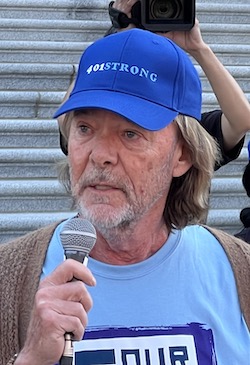
Many more among the workers’ families, friends and communities were infected – at least four more of whom died. About 25 had to be hospitalized. Epidemiologists would later link at least 22 other outbreaks — some in care homes where contacts of Cargill employees worked – to the outbreak.
A new report released this morning by the Edmonton-based Parkland Institute concludes that Alberta’s OHS regulator abdicated its mandate and deferred to AHS while AHS made recommendations without trying to ensure Cargill followed them, and that neither OHS nor AHS tried to enforce the company’s compliance.
“The response to the crisis was defined by a lack of preparedness, inaction, overconfidence, cultural stereotypes and racism, incompetence, and deliberate aversion to using available enforcement measures,” said the report, which is based on the first independent investigation of the situation.

The 199-page study by researchers Sean Tucker and Jason Foster – Essential and Expendable, How Alberta’s COVID-19 Response Failed Cargill Workers – shows how the outbreak spread thanks to “a political environment that openly and enthusiastically prioritized economic growth over the health and safety of a largely invisible and vulnerable group of workers, most of whom were immigrants and temporary foreign workers.”
Drawing on hundreds of pages of records obtained through freedom of information requests, the evidence shows there was nothing inevitable about the massive scale of the outbreak of the disease, concluded Dr. Tucker, a human management resource professor at the University of Regina, and Dr. Foster, a labour relations professor at Athabasca University and director of the Parkland Institute.
Even before the outbreak, it was obvious both the industry and the UCP government were determined to keep the plant operating, they said. “On March 17, Alberta’s minister of agriculture and forestry, Devin Dreeshen, gave assurances that the entire industry would be declared an ‘essential service,’” the researchers wrote. This designation had no basis in law
and Mr. Dreeshen’s department had no mandate to be involved in worker health and safety, yet it was so declared, “making these ‘essential industries’ exempt from any public health measures related to gathering sizes, physical distancing and, importantly, temporary closure orders.”

Meanwhile, resolved to keep the plant operating, Cargill offered $500 attendance bonuses and a temporary $2-per-hour pay increase. The report suggests this may have encouraged some employees who were sick to work anyway. It notes that many of the workers lacked alternative income sources, and that, as essential workers, they were ineligible for Ottawa’s Emergency Response Benefit.
Assuming that most transmission was taking place outside the plant, AHS and Alberta Government OHS staff “stood back waiting for positive cases or formal complaints from workers or the workers’ union before inspecting facilities,” the report said.
“Despite their inexperience and lack of expertise, and in absence of an epidemiological analysis, Hinshaw and other health leaders made public comments that projected confidence in their knowledge of where the virus was (and was not) spreading among Cargill workers,” it also said.
“At Cargill’s invitation, on April 7, AHS inspected the plant and made non-binding recommendations related to carpooling, masking, use of barriers, and other items.”
When Mr. Hesse made his April 12 call, the report recounted, “Cargill said that it was complying with all public health guidance, and closure was unnecessary. The next day, though, the company cut one of the plant’s two shifts due to staffing shortages.”

On April 15, the notorious 30-minute “virtual inspection” of the plant by a provincial OHS officer took place in response to a UFCW demand. “The officer did not evaluate all areas of the plant or assess compliance in terms of OHS regulations relevant to biological hazards, nor did they speak directly with front-line workers,” says a summary document published this morning along with the full report. “Even though several hundred workers were ill, the inspection resulted in no compliance orders.”
The report’s authors concluded: “OHS performed reactive, substandard inspections, failing to enforce sections of the Act and Code that were obviously relevant to preventing worker exposure to an infectious disease.”
On April 19, the union held its own town hall with 600 worried Cargill workers. “At this meeting, the union reiterated its concerns about the plant’s safety and informed workers of their rights under the Occupational Health and Safety Act, including the right to refuse dangerous work,” the summary said. The same day, Bui Thi Hiep passed away in hospital.
Finally, on April 20, Cargill temporarily shut down the plant. It would reopen on May 3.
“We cannot fully explain why Alberta OHS abdicated its important responsibilities in response to the largest outbreak of COVID-19 in Canada,” Dr. Tucker and Dr. Foster wrote. “We can say that political pressure, deference to public health (authorities), negligence, and incompetence all contributed to the tragedy. Further evidence suggests that government officials prioritized the interests of the meat-processing industry over the health and safety of meat-packing workers. Whatever the causes, their inaction represents a clear case of industry capture and regulatory failure.”
Of the report’s 36 recommendations, five are highlighted by the authors, abbreviated below by me:
- AHS, OHS, and the government should all acknowledge and publicly apologize to Cargill’s workers and their families for the grave shortcomings of their response
- Alberta’s health agencies and OHS must adopt the precautionary principle when responding to new respiratory illnesses
- The government should amend the Public Health Act and the Occupational Health and Safety Act to make it clear that during a public health emergency OHS is responsible for leading the response in workplaces
- The Auditor General should undertake a comprehensive review of the internal processes, policies, and practices of OHS to determine what contributed to the regulatory failure before and during the outbreak
- The government should instruct the Alberta Labour Relations Board to create a standing list of essential services to clarify the rights of essential workers in future public health emergencies.
 The $64,000 Question, as they used to say, is whether urban voters in Alberta are growing disaffected with Alberta’s United Conservative Party Government because of Danielle Smith’s divisive separation referendum or with Danielle Smith herself. I say it’s the referendum and predict that if the Remain side wins decisively on Oct. 19, many of Premier […]]]>
The $64,000 Question, as they used to say, is whether urban voters in Alberta are growing disaffected with Alberta’s United Conservative Party Government because of Danielle Smith’s divisive separation referendum or with Danielle Smith herself.

I say it’s the referendum and predict that if the Remain side wins decisively on Oct. 19, many of Premier Smith’s troubles in Calgary will quickly go away. Some things that ought to bother voters in Alberta’s largest city – and for that matter the UCP’s currently rock solid base in rural Alberta – don’t seem to trouble them that much.
For example, the UCP’s sustained effort to dismantle and privatize public health care and its cavalier attitude about human rights when it comes to whomever the party considers the wrong kind of humans – i.e., unionized schoolteachers.
Now, it’s important to note that the evidence that the UCP has slipped so far that it’s tied with the NDP province wide, and that the Opposition party has a bigger lead in voter preference in the city of Calgary, is one poll, albeit by an Alberta pollster with a solid record of getting these things right. The polling industry is in agreement, by the way, that the NDP holds a strong lead in the Orange redoubt of Edmonton.
Every pollster, as even the estimable Janet Brown sometimes admits, gets it wrong occasionally, so angry supporters of the separatist-dominated UCP should wait along with the rest of us to see if anyone else can confirm the findings of Ms. Brown’s latest poll that the Opposition party is now ahead in Calgary at 46 per cent to the UCP’s 38 per cent.
The Janet Brown Opinion Research poll thus put the two parties in a dead heat at 41 per cent each province wide, with the NDP leading 44 per cent to 37 per cent in Edmonton and the UCP ahead 48 per cent to 31 per cent outside the two major cities.

Anyway, what the secessionist crowd really had its collective knickers in a twist about was another finding of Ms. Smith’s poll, which was done for the CBC, which showed support for the separation side of the Smith-Government-composed separation question slipping.
In this most recent Janet Brown poll, 23 per cent of the 1,200 respondents said they supported commencing the legal process to bring about a binding separation referendum, as the UCP’s deceptive referendum wording put it, down from 27 per cent in a survey by the same pollster in April. Seventy-two per cent of the respondents said they would vote to remain in Canada.
That was enough to unleash a huge swarm of infuriated bots on the Internet attacking Ms. Brown, her poll, anyone who talked about its results, and of course the CBC. Realistically, though, that was always likely to happen as soon as secession-curious voters began to think about the costs of leaving Canada and cotton on to the deceptive nature of the pitch by some of the movement’s rather unsavoury leaders, who claim that Albertans voting to break up Canada merely “sends a message” to Ottawa.
Just sayin’, but operators of the separatist bot farms in the United States would be better off not asking who the hell Ms. Brown is in their posts, since that’s an excellent way to tell folks that you’re not from Alberta without telling them that you’re not from Alberta.
Another interesting finding of the poll was that Mark Carney’s popularity in Alberta continues to rise, with voters “very impressed” with the prime minister up six points to 52 per cent since Ms. Brown’s previous poll in April. That compares to 30 per cent for Premier Smith and 25 per cent for Opposition Leader Naheed Nenshi. Mr. Carney also towered over federal Conservative Leader Pierre Poilievre in the poll, at 26 per cent in the same category.

So, the memorandum of agreement between Ottawa and Alberta seems to be “working well for Mark Carney and his popularity, but Danielle Smith doesn’t seem to be benefitting from her part in creating the MoU,” Ms. Brown told the CBC.
This is probably because Mr. Carney is delivering essentially the kind of Progressive Conservative government that Albertans chose in their own province 12 times between 1971 to 2015, when Rachel Notley’s NDP finally broke their hold on power. It was the longest uninterrupted dynasty in Canadian political history. So it’s quite possibly less likely that he will lose popularity in Alberta any time soon than in other parts of Canada.
Other than that, Ms. Brown’s poll also shows that the UCP’s mad rush to make Alberta North America’s dumping ground for AI data centres does not seem to be paying dividends for the premier or her party.
Over-enthusiastic NDP supporters need to remember that Premier Smith’s effective strategy has been and will continue to be that all the UCP really needs to do to remain in power is to hold onto a few Calgary seats and keep its rural Alberta base happy.
So despite the NDP’s favourable numbers and encouraging recent win in the traditionally Conservative-voting Calgary-Shaw riding, overcoming the UCP’s structural edge in Alberta is always going to be an uphill fight for the party that requires an engaged, energetic and popular NDP leader. The UCP’s planned Texas-style gerrymandering will make the road even steeper.
]]> Lorne Gibson has served both as Alberta’s chief electoral officer and its election commissioner. The latter position was created by the NDP Government of premier Rachel Notley in the spring of 2018 to enforce election legislation. It was eliminated by Alberta’s first United Conservative Party Premier, Jason Kenney, at the end of 2019. Mr. Gibson […]]]>
Lorne Gibson has served both as Alberta’s chief electoral officer and its election commissioner. The latter position was created by the NDP Government of premier Rachel Notley in the spring of 2018 to enforce election legislation. It was eliminated by Alberta’s first United Conservative Party Premier, Jason Kenney, at the end of 2019. Mr. Gibson was also deputy chief electoral officer of the province of Manitoba from 1998 to 2006. After the UCP eliminated his job – almost certainly because he enforced the law when it was broken by political allies of Mr. Kenney during the UCP’s first leadership campaign – he returned to Manitoba, where today he runs an election management consultancy in Winnipeg. All of which is to say that Mr. Gibson knows what he’s talking about when it comes to running elections. In this guest post, he has some thoughtful and useful suggestions for Elections Alberta and the Alberta Government on how to deal with the security issues raised by providing lists of electors containing voters’ personal information to election scrutineers in a time when questions of trust rightly raise serious concerns both for voters and policy makers. DJC
By Lorne Gibson
When I first learned that Alberta’s Premier had issued an order effectively prohibiting registered political parties and scrutineers from using voters lists during the upcoming October referendum, I was dumbfounded.
A voters list is a fundamental tool in the administration of an election or referendum. Political parties and scrutineers rely on it to determine which supporters have already voted, identify those who have not yet cast a ballot, and scrutinize the eligibility of individuals who arrive at a voting place but do not appear on the list.
My initial reaction was that the government may have fundamentally misunderstood the role of scrutineers. How, after all, can a scrutineer effectively examine whether voters meet the legal requirements to cast a ballot without access to a list identifying those whose eligibility has already been established? And how can party or proponent scrutineers determine which of their supporters have yet to vote without repeatedly asking election officials to announce voters’ names, addresses and 16-digit identification numbers?
If the government’s intention was to eliminate the practical role of scrutineers, it might have been more straightforward to say so.
With more time to consider the government’s Order in Council announcing the change, however, another interpretation has emerged. The government is now referring to a statistical summary of the number of voters within municipalities and voting areas as a “voters list.” While it is certainly not a voters list, the distinction suggests the Premier may have come to recognize a more fundamental problem: whether political parties, third-party advertisers and referendum proponents can be trusted with an actual voters list containing Albertans’ personal information.
If so, this represents a belated recognition of a serious risk.
Alberta experienced a massive and unprecedented data breach last April when a voters list provided to a political party ultimately appeared on the Internet. That incident demonstrated that information distributed to political parties for legitimate electoral purposes can nevertheless escape the safeguards that are supposed to protect it.
Against that backdrop, there is a reasonable basis for asking what might happen if thousands of electronic and paper copies of voter lists were distributed across the province to a wide range of individuals serving as political party, third-party or referendum scrutineers. Not every person entrusted with such information will necessarily have the same understanding of, or commitment to, the privacy obligations that accompany it.
This leaves the government facing a genuine dilemma.
Scrutineers serve an important function in elections and referenda. Their presence provides an additional check on election officials and helps ensure that established procedures are followed, that voters meet the prescribed qualifications and that each eligible person casts only one ballot. Their role contributes to the integrity, transparency and security of the voting process.
But effective scrutiny requires information.
A scrutineer needs some means of determining whether an individual appearing at a polling place has already been verified as eligible to vote. The voters list provides that mechanism. It is not merely an administrative convenience; it is one of the tools used to help prevent fraud and double-voting.
At the same time, voters should not have to surrender control over highly personal information simply because they are exercising their democratic right to vote. Names, addresses, postal codes and other identifying information can have value well beyond the electoral process, particularly when combined with other databases. The state therefore has an obligation to protect that information from unauthorized use or disclosure.
There may be ways to reconcile these competing interests.
One option would be to provide scrutineers with a physical copy of the voters list only when they arrive at the voting place, with strict requirements that the document remain there and not be photographed, copied or removed. Scrutineers and others are already prohibited from using cellphones to take photographs inside voting places. Additional safeguards could reinforce those restrictions.
Another, more cumbersome and imperfect, approach would be to provide party-affiliated scrutineers only with the unique identifiers assigned to voters, without names, addresses or postal codes. Such a list would be of little practical use to independent scrutineers or referendum proponents. Registered political parties, however, might be able to cross-reference those identifiers against voter information retained from previous elections.
That approach would also have significant limitations. There would be no guarantee of a one-to-one match between the identifiers supplied for the referendum and the information contained in a political party’s existing database. Electoral populations change. Some voters die, new residents arrive, citizens become newly enfranchised and first-time voters enter the system. Party databases can therefore never be assumed to be perfectly synchronized with the official voters list.
The challenge, then, is not simply whether scrutineers should have access to a voters list. It is how to preserve the legitimate oversight function of scrutineers while ensuring that the personal information of Alberta voters is not treated as an unrestricted political resource.
The government’s decision to restrict access may therefore reflect a legitimate concern, particularly in light of the recent data breach. But restricting access to voter information also risks undermining one of the mechanisms designed to provide transparency and accountability at the ballot box.
The answer cannot simply be to choose privacy over electoral oversight, or oversight over privacy. Both are legitimate public interests. The real test is whether the government can devise safeguards that protect Albertans’ personal information without depriving scrutineers of the information they need to perform their statutory role effectively.
That is ultimately a question of trust: trust in the electoral system, trust in those charged with administering it, and trust in the political actors who are given access to the information that makes democratic participation possible.
]]> Say what you will about the big strategic brains behind Alberta’s United Conservative Party Government, at least they didn’t repeat their midsummer “energy rebate” bungle. Mind you, they’re bringing in so much money thanks to U.S. President Donald Trump’s war of choice on Iran, which was only supposed to last a week or two, that […]]]>
Say what you will about the big strategic brains behind Alberta’s United Conservative Party Government, at least they didn’t repeat their midsummer “energy rebate” bungle.

Mind you, they’re bringing in so much money thanks to U.S. President Donald Trump’s war of choice on Iran, which was only supposed to last a week or two, that they don’t need to.
So, starting on Oct. 1, the Alberta government said on Tuesday with a great deal of fanfare, it’ll stop collecting its 13-cent-per-litre fuel tax on gasoline and diesel until the end of the year, trotting out several of the usual suspects to crow about how this is going to make a meaningful difference in Alberta families’ budgets in a press release.
Well, fair dinkum as they say Down Under, gas will cost 13 cents a litre less at the pump, so it will only cost you about $140 to fill up your Ford F-150 or Dodge Ram pickup truck instead of about $153 – assuming you were running on fumes and you have the model with the small 87-litre tank, that is.
So you might save about $183 between now and New Year’s Day if you gas up every week, less if you drive a more efficient vehicle or can squeeze two weeks out of a fill-up. Challenge my arithmetic if you like – math is hard, after all – but readers will get the idea.
That’s still a lot to pay every week or two just to get around, and $13.05 less per fill-up is insignificant enough to make some of you dream of driving a nice EV from China no matter what the premier and her finance minister think about that.

“This will save hard-working Albertans hundreds of dollars over the next few months and save millions for people and businesses across the province,” Premier Danielle Smith said in the government’s news release. This is pretty hyperbolic, but we’re used to hyperbole, not to mention outright balderdash, from her now.
“This is the right move by Finance Minister Jason Nixon – lowering the cost of fuel makes things more affordable and that’s exactly what people need right now,” the premier’s canned quote piously concluded.
As a general rule, performative tax cuts are a bad idea no matter what the taxpayers’ federation or even the Opposition have to say about them, but in this case the government’s bringing in so much extra dough thanks how long it’s taking President Trump to admit he’s lost his illegal war that it’s hardly worth an argument.
“If the 13 cents fuel tax was lifted today, Albertans would see average pump prices in the province drop to around 162.5 cents/litre, almost 20 cents less than the next-lowest province,” the news release said Tuesday. (Go figure, I paid 1.6 cents less than that in Stony Plain yesterday.)
Anyway, this takes us back to last June when the same Alberta government announced that under its fuel-tax quarterly review program, which is supposed to take into account North American benchmark oil prices over the previous three months, instead of cutting taxes at the pump as they were supposed to they’d give everyone 18 and older who’d filed a tax return the in 2025 and had household income under $225,000 a measly $100 payment.

Alas, the intensively bureaucratic application process was so complex that many eligible Albertans simply threw up their hands and didn’t bother to ask for the insignificant payment.
Quite a few also didn’t trust putting more their personal information in the hands of a government that they’d learned just the month before had allowed the entire provincial voters list with the personal information of 2.9 million voters to leak to ne’er-do-well operators associated with the Alberta separatist movement.
The “Alberta Energy Rebate” was almost universally reviled, even by the government’s closest allies. Right-wing columnists dumped all over it. Cynics suspected the government was making it hard to get the money in order to shave a few dollars off the $9.4-billion deficit the UCP was expecting at the time. Phone lines to UCP MLAs’ constituency offices were burning up with angry calls. No doubt UCP MLAs who have been stoking the grievance fires literally for years were shocked, just shocked by what was being said to them.
Only about 40 per cent of the eligible taxpayers applied for the rebate – although there are still seven more days to apply.
Well that was then. With its war lotto winnings, the UCP now expects to post a $2-billion surplus – an $11.4-billion turnaround since last April that, unfortunately, is unlikely to do much to improve the lives of working Albertans.
Officials may also have warned the Smith Government that oil prices could rise fast enough that the savings would never appear at the pumps, so they’d never get the credit for the revenue sacrifice. And that was before The Peace President’s Pearl Harbor negotiating strategy was revealed.
That’s basically what happened to the federal government decision in April to suspend its 10-cent-per-litre fuel tax until Labour Day. Ottawa announced the day after the Sept. 7 national holiday that it was extending its fuel-tax holiday to Jan. 31, 2027, and only applying half that rate from Feb. 1 to March 31, 2027.
When the 5-per-cent rate cuts in, if the Carney Government doesn’t delay it again, the Smith Government can distract us from its own incompetence by screaming about Ottawa’s perfidy.
]]> Whatever happens on Oct. 19, the United Conservative Party of Premier Danielle Smith will have left Alberta a worse place than it was before the 10 referenda scheduled to be voted on that day. After the ballots have been counted, Alberta will be angrier, more divided, more radicalized, and not incidentally a worse place to […]]]>
Whatever happens on Oct. 19, the United Conservative Party of Premier Danielle Smith will have left Alberta a worse place than it was before the 10 referenda scheduled to be voted on that day.

After the ballots have been counted, Alberta will be angrier, more divided, more radicalized, and not incidentally a worse place to invest money than it was before.
A “yes” vote in the separation referendum will set the stage for another, supposedly legally binding separation vote – in 2027, before a provincial election, according to the premier. So the anger, division and uncertainty will continue and intensify if that happens.
But since no one can be confident that a “no” vote will not be followed by the separatist-dominated UCP imposing another separation referendum anyway, the anger, division and uncertainty is also likely to continue no matter what transpires.
Regardless of which side actually wins the Oct. 19 separation referendum, the other side will distrust the process that led to it and furiously doubt the result – and not without sound reasons.
At the heart of this still unfolding disaster wrought by Premier Smith and her political advisors is Elections Alberta, the agency that oversees Alberta elections, by-elections and referenda. The supposedly “independent, non-partisan office of the Legislative Assembly” is in a state of near-collapse, barely capable of overseeing a normal election let alone Premier Smith’s chaotic experiment in stage-managed sham “citizen initiative” referenda.

Elections Alberta is underfunded, understaffed, and having difficulty finding sufficient election day employees. It is internally divided and beset by rapid legislative and regulatory flip-flops enacted by the UCP Government seemingly to enable the separation campaign or keep the secession pot boiling as a negotiation tactic with Ottawa. It is further burdened by the UCP’s MAGA-influenced policy that all 10 wordy and complicated ballots must be counted by hand within 48 hours.
As a result, the agency can no longer be trusted by citizens, regardless of their views on separation, to be able to run the vote in ways that electors can feel confident is fair and neutral.
In a column published the Sept. 17, Postmedia political columnist Don Braid labelled Elections Alberta “the agency that can’t count straight.” Now it’s about to be “swamped with millions of referendum votes,” he observed, in what may turn out to be the biggest election turnout in Alberta history.
“The government has a right to pose a question, but none whatever to claim this is ‘direct democracy.,’” Mr. Braid wrote in that column. “The result is a vast UCP opinion poll that will cost taxpayers up to $130 million.”
The same day, Edmonton-based author and national security scholar Patrick Lennox published a Substack column stating bluntly that Elections Alberta “is no longer serving the public, but has rather been captured by the far right UCP government and is doing its bidding regardless of the rules.”
Mr. Lennox – author of On Treason: Alberta Separatism, Foreign Interference and Canada’s Survival in a Revolutionary Age, which is scheduled to be released next week – makes a convincing case, cataloguing the series of “head-scratching snafus” that illustrate the disordered state of Elections Alberta as the referenda, now less than a month away, nears.
- Changes in Citizen Initiative laws by the government to make it easier for a separatist referendum petition to be approved, followed by more changes to make it harder for anyone else to get a petition approved.
- Changes to the law by the UCP to get around a court ruling that declared the wording of a separatist group’s petition to be unconstitutional.
- Special-ballot packages sent to voters with out-of-date information threatening $50,000 fines and two years in prison for citizens who use the ballots in accordance with current law. Whoops, just scratch that part out, says Elections Alberta. Many will not take the chance and won’t vote.
- The largest data breach in Canadian history, the notorious leak of a voters list containing the personal information of all 2.9 million Alberta registered voters.
- Defiant separatist groups that refuse to hand over financial records to the agency as required by law, and will likely to get away with it.
- Allegations from within the agency that suggest government intervention kept Corb Lund’s Water Not Coal petition from being approved.
- Resignations and firings of long-time Elections Alberta employees, some of them attacking the validity of the petition-validation process.
More recently, there has been that bizarre cabinet order that lists of electors must now list no electors, presumably to make it impossible for election scrutineers to do their jobs.
Plus, of course, there is the $4 million poured by the UCP into a taxpayer-funded advertising campaign to get voters to support the “noxious nine” referenda designed to incite division and subvert Confederation.
“It is clear that conducting this unprecedented plebiscitary experiment is so far beyond the capacity of Elections Alberta that it would be misfeasance to carry on with the vote,” Mr. Lennox wrote, citing the agency’s own admission in its previous annual report that it lacked the resources to conduct the complicated balloting properly.

As Alberta journalist Jody MacPherson summarized the state of affairs at Elections Alberta succinctly on her Substack: “Alberta’s October referendum is an absolute train wreck, a dumpster fire, a dog’s breakfast, a political juggernaut, a recipe for disaster — choose your favourite expression. It’s bad.”
Ms. MacPherson wrote that on Sept. 3. Nothing has gotten any better since.
This mess leaves Alberta’s separatist minority with no confidence. Steeped in MAGA paranoia and conspiracy theories as their movement is, Premier Smith’s obvious effort to play both ends against the middle, so that she can emerge as the winner no matter what happens, leaves them convinced that despite the evidence the system is stacked against them.
There’s no comfort for the rest of us either. The UCP has obviously had its thumb on the scale to benefit the separatist campaign since the beginning of this saga. It would be naïve to assume that they’ll start to behave themselves now.
Together, this clearly ads up to a sound reason to postpone or scrap this referendum.
Mr. Lennox called on Chief Electoral Officer Gordon McClure to take the bull by the horns. “Elections Alberta must admit to being compromised both in terms of basic matters of HR, and facilities, and oversight and governance, but now due to this recent set of revelations, that its integrity has been compromised in a very serious way which puts our democracy at risk.”
“Elections Alberta must take a step back and admit it needs time to repair itself and its reputation, and to prepare for this unprecedented and unwanted democratic experiment it is being forced to conduct by the far right government in power,” he concluded.
The UCP, obviously, will allow no such thing.
Albertans and Canadians are going to have to live with this disaster for a long time after Oct. 19.
CORRECTION: My apology to Ms. MacPherson for spelling her first name incorrectly. It’s been fixed. DJC
]]> The United Conservative Party decision to provide Alberta political parties with a “list of electors” with no electors listed in it for the Oct. 19 referendum vote either “demonstrates a fundamental misunderstanding of the role of election scrutineers or disdain for the role that they play,” says former Alberta election commissioner Lorne Gibson. Mr. Gibson, […]]]>
The United Conservative Party decision to provide Alberta political parties with a “list of electors” with no electors listed in it for the Oct. 19 referendum vote either “demonstrates a fundamental misunderstanding of the role of election scrutineers or disdain for the role that they play,” says former Alberta election commissioner Lorne Gibson.

Mr. Gibson, the official responsible for enforcing Alberta’s election laws from May 2018 to December 2019, described his reaction to the new format voters list described in a cabinet order last Thursday as “confusion and disbelief.”
“In the 28 years I have been involved in organizing and administering elections both domestically and internationally I have never seen a voters list that only contains only the number of registered voters in each municipality and voting area,” Mr. Gibson said in an email in response to my query. Mr. Gibson’s past experience also includes nine years as Manitoba’s deputy chief electoral officer and just under three years as chief electoral officer in Alberta, from 2006 to 2009.
What Order-in-Council 314/2026 calls a “list of electors,” Mr. Gibson explained, “is not a voters list but rather a statistical summary of the number of individuals eligible to vote.”
I guess we could call it Schrödinger’s voters list. Whatever it is, because it lacks essential information, it interferes with the ability of party scrutineers to observe that only qualified voters are able to vote, and that no one votes more than once.
If an individual voter is not on a normal voters list, Mr. Gibson explained, “the scrutineer ensures that the election official follows the proper procedure to register the voter before they are issued a ballot.”

“This will not be possible during Alberta’s upcoming referendum because the scrutinizer will not know which individuals have been pre-qualified to vote through the more rigorous voter registration process that Elections Alberta will have followed to determine eligibility,” he said.
Because it is a temporary measure, there is suspicion it is intended specifically to help the separatist side on Oct. 19. That was the accusation made by Opposition House Leader Christina Gray on Friday, who called the idea of a voters list with no names, addresses, or other identifying information an effort by the UCP “to help their separatist friends.”
“We are worried the UCP is opening the door for voter fraud,” Ms. Gray stated Friday. “Parties like ours scrutineering the vote won’t have enough information to know who those voters are.” If parties don’t know who hasn’t voted, it also hinders their efforts to get out the vote.
Mr. Gibson, who now runs an election management business in Winnipeg, said he understands the concern about voter data security in light of the unprecedented recent leak of 2.9 million Alberta voters’ personal information – the justification provided by Justice Minister Mickey Amery’s office for the cabinet order.
“However, denying registered political parties … access to a list containing the names and addresses of eligible voters nullifies the important role that party scrutineers play in helping to ensure the integrity of the voting process,” he said. “There will be no way to ensure that individuals who present themselves to receive a ballot are, in fact, eligible to vote.”
At a minimum, Mr. Gibson said, “the identification required to vote only needs to show the residential address of a given voter. It lets election officials know if an individual is voting in the right voting area.”
“With the unfortunate but legitimate concerns over whether some political party operatives preforming the role of scrutineer will breach confidentiality of the personal information contained on the voters list, the Alberta government could have least seen fit to list voters by their unique identification number rather than by name and address,” he added.
“It would be possible, albeit cumbersome, for scrutineers to cross reference the numbers on the voters list with the names and addresses of voters gleaned from earlier versions of the voters list,” he said, describing this as an imperfect solution because of population growth. Nevertheless, he continued, “this would make the job of the scrutineer much more difficult but would still protect the privacy of voter’s personal information.”
Mr. Gibson ended his email with some questions: “If the rationale for this change in the composition of the voters list is out of concern for voter privacy, why is the change only temporary? With the knowledge that some of Alberta’s registered political parties cannot be trusted to maintain the confidentiality of voters’ personal information, why not make this a permanent feature of elections in Alberta? Why does this change only apply to the October referendum?”
Mr. Gibson concluded: “I have not been able to solve this riddle.”
Mr. Gibson was fired as election commissioner by former UCP premier Jason Kenney in November 2019, supposedly to save money but obviously because he had too effectively enforced the law when he investigated campaign financing violations by some of Mr. Kenney’s supporters in the party’s first leadership race.
]]> According to a news account by The Canadian Press that will be read across the Dominion, Alberta Premier Danielle Smith delivered an emotional appeal to Albertans to remain in Canada yesterday as “Conservative elder statesman” Preston Manning benevolently looked on. I’ll concede this much about Premier Smith’s performance as the warm-up act for Mr. Manning’s […]]]>
According to a news account by The Canadian Press that will be read across the Dominion, Alberta Premier Danielle Smith delivered an emotional appeal to Albertans to remain in Canada yesterday as “Conservative elder statesman” Preston Manning benevolently looked on.

I’ll concede this much about Premier Smith’s performance as the warm-up act for Mr. Manning’s online “Alberta and the West Assembly,” she was emotional. The jury remains out about what she was blubbering about, though, if indeed it was anything other than the kind of ham acting we have seen from her before. The quality of the video isn’t good enough to see if she was really “holding back tears.”
As for urging Albertans to vote to remain in Canada on Oct. 19, that would be in the deceptively worded and highly unpopular referendum question that she herself and her separatist-dominated party insist we must vote on. Ms. Smith claims she will be voting to remain in Canada.
At any rate, the premier’s defence of Canada before Mr. Manning’s online audience wasn’t much of a defence. It was a long list of complaints about what the credulous news report described as “historic indignities Albertans have suffered at the hands of the federal government.”
Her remarks were larded with spin and occasional outright falsehoods, clearly intended to leave the impression that Canada has treated Albertans so badly they would be insane not to set up their own landlocked petro-republic and get the statehood train rolling into Union Station in Washington D.C. as quickly as possible.
“A lot of Albertans are angry and some are more than angry,” she said as she moved into the tearful part of her performance.

“They’re hurt. I hear it at town halls, in coffee shops, at hockey rinks and in my email inbox,” Ms. Smith continued, confabulating about events that may or may not have happened, that may or may not have involved real people, behaviour that anyone who is familiar with the Alberta premier’s political career has observed time and again.
This could have happened, of course, as long as she and her aides were careful to curate the people she meets, and ensure she only talked to folks she agrees with. And she could really believe it when she says it – as the late Ronald Reagan, another right-wing ham actor although a considerably better one, is said to have believed his own made-up stories. At least president Reagan had the excuse of having read some of his tall tales in scripts he’d memorized.
The premier rambled on: “… Some came to ask (pause) a painful question (long pause), does this country (pause) actually want (pause) us? (really long pause; sniff) – so (pause) that question (pause) is what 700,000 signatures (pause) represent.”
Again, as anyone who follows politics in Canada’s richest province understands clearly, some 400,000 of those signatures, those on former deputy premier Thomas Lukaszuk’s Forever Canadian petition, were intended to prevent there being a referendum and to be a powerful statement of faith in and loyalty to Canada. When the premier says otherwise, as she does repeatedly, she is lying.
Indeed, the whole premise of her performance yesterday was hogwash. What she described is not the view of the majority of Albertans, as poll after poll illustrates, and as the Oct. 19 referendum will prove – unless there is some serious electoral jiggery-pokery, which is all too possible given the history of separatist scheming by Ms. Smith’s government.

“The fight to make Canada work for Alberta is working,” she declared, coming to the climax of her performance and what appears to have been her key point. “When Alberta stood up and refused to back down, the country started listening. … Your anger was not wasted. … Why walk away from the table when we’re finally winning at it?” (Emphasis added.)
This isn’t an appeal to Albertans to remain in Canada. It’s an appeal to the separatists who dominate her party not to send her packing for not being separatist enough – which is starting to sound like a very real possibility.
Putting a little shine on the increasingly unpopular referendum campaign also seems to have been a key point of Mr. Manning’s two-day online improv festival.
As for Mr. Manning, while at 84 he is certainly an elder, he is no statesman, and journalists need to stop repeating this nonsensical trope.
He is the superannuated godfather of the Canadian right who has played a role in Ms. Smith’s schemes before, including her controversial 2014 effort to persuade her fellow Wildrose Party MLAs to cross the floor of the Legislature and join the Progressive Conservative Party led by Jim Prentice. For a time, that seemed to have laid waste to her political career.
The purpose of Mr. Manning’s “assembly” – co-chaired by another elderly political has-been, former B.C. premier Gordon Campbell – seems mainly to be to polish up the UCP separation referendum and maybe find a way to make the Conservative Party of Canada relevant again as it withers in the bright glow of a popular (though not populist) Liberal prime minister.
Canadian Conservatives, who can’t seem to find a leader Canadians like, may be feeling a bit emotional about Mark Carney’s success as well.
]]> As Alberta careens toward a chaotic and divisive vote on separation seemingly drafted to discourage the United Conservative Party’s dominant separatist faction from trying to force Premier Danielle Smith out as party leader, her cabinet on Thursday approved a temporary policy the Opposition NDP says is intended to help separatists. The cabinet order – Order-in-Council […]]]>
As Alberta careens toward a chaotic and divisive vote on separation seemingly drafted to discourage the United Conservative Party’s dominant separatist faction from trying to force Premier Danielle Smith out as party leader, her cabinet on Thursday approved a temporary policy the Opposition NDP says is intended to help separatists.

The cabinet order – Order-in-Council 314/2026 – says copies of the list of electors now given to political parties will include only the number of voters in each municipality and voting area. No names, addresses, phone numbers or the like.
The problem with this from the perspective of the NDP Opposition and presumably that of every other political party is that the new list will make it impossible for scrutineers to check if the right person is voting.
Ergo, said NDP House Leader Christina Gray in a news release yesterday afternoon, “once again, the UCP changes the rules in an unprecedented way, at the last minute, to help their separatist friends.”
“We are worried the UCP is opening the door for voter fraud,” she explained. “Parties like ours scrutineering the vote won’t have enough information to know who those voters are. We won’t even know if there were 24 voters claiming the same address.”
“We won’t be able to tell if the same name is voting dozens of times,” she added during a conversation with reporters yesterday.

According to a statement the office of Justice Minister Mickey Amery gave to The Canadian Press yesterday, but which was not published on the government’s website where citizens can read the explanation for themselves, the point of this sudden policy change is because “Albertans must have confidence that their personal information is being protected.”
“We take the privacy and security of Albertans’ information very seriously, and protecting that information remains our top priority,” the statement said.
The irony in this being introduced only 32 days before the referendum is that the government didn’t seem to be taking voters’ privacy all that seriously last spring, when a copy of the entire voters list given to the separatist Republican Party of Alberta found its way onto the Internet.
While a judge ordered it removed from the Internet, the information remains in the wind, effectively doxxing 2.9 million adult Albertans, including almost everyone in Alberta reading this post. The RPA claims it did nothing wrong. Until Thursday, the government has had very little to say about what is thought to have been the largest data breach in Canadian history.
So blocking scrutineers from using the list now to do their job, which is essential to citizen confidence in democracy, presumably protects no one’s personal information but may, as the NDP argues, makes fraud easier.
Mr. Amery and his office had nothing to say about the NDP’s concern, or why the cabinet order says the policy the government claims is necessary now will expire at the end of the year.
As for Elections Alberta, which appears to be in a state of near collapse, it will still be working from the old list of electors, the one with all their private information.
Meanwhile, Elections Alberta admitted in a news release yesterday that it is still roughly 35,000 human beings short of the number of electoral officers it needs to conduct voting on Oct. 19!
Thirty days from now, the government will not only present Albertans with the divisive separation referendum it never campaigned on but with nine additional confusing and dishonest referendum questions designed to drum up support for MAGA-influenced immigration policies and constitutional changes.
Ballots will all have to be counted by hand because the UCP apparently didn’t understand the difference between voting machines, featured in many MAGA conspiracy claims about Donald Trump’s lack of success in the 2020 U.S. presidential election, and the vote tabulators used in Alberta.
]]> At the end of their exertions, even the reliable team of neoliberal apparatchiks assembled by Premier Danielle Smith’s favourite economist last June couldn’t come up with a “scenario” in which Alberta separation could be made to look like a good idea. The final report on the cost of Alberta separating from Canada by the “independent […]]]>
At the end of their exertions, even the reliable team of neoliberal apparatchiks assembled by Premier Danielle Smith’s favourite economist last June couldn’t come up with a “scenario” in which Alberta separation could be made to look like a good idea.

The final report on the cost of Alberta separating from Canada by the “independent advisory panel” hand-picked for the government by economist Jack Mintz of the University of Calgary’s School of Public Policy, The Economic and Fiscal Implications of Alberta Separation, was handed yesterday to a friendly journalist to spin as a “bombshell report,” and published on the government’s website.
Well, at least that got most of the talk about the significance of the NDP by-election victory in the Conservatives’ traditional Calgary-Shaw stronghold off the metaphorical front page.
It turns out that short of smoking banana peels it’s nigh on impossible to come up with a projection of how separation could be anything but an expensive disaster. This turned out to be true even for a group of people ideologically predisposed to thinking the best economic course forward for Canada would be to become as much as possible as the United States short of actually becoming the 51st state.
“These numbers are real ugly,” was the way Postmedia political columnist Rick Bell put it in his report yesterday, which sort of doubled as the government’s real press release.
“Up to five years after separation the GDP, the overall economy, would be down by about 10 per cent compared to no separation,” Mr. Bell wrote. “In the short term, a typical worker would earn almost $5,500 a year less than if Alberta had not separated. The government deficit could be … gulp … almost $26 billion in a year.” (Translation: Sorry, friends and allies in the separatist movement, but we just can’t make this work.)

And never mind the deficits. Debt would balloon as well – possibly soaring more than $400 billion as the new landlocked statelet took on its share of Canada’s debt.
The Gang of Five – long-time UCP advisor Dr. Mintz; U.S. resident and former Alberta Finance Minister Ted Morton; Business Council of Alberta President Adam Legge; Cenovus Energy Inc. Board Chair Alex Pourbaix; and former UCP “Blue Ribbon Panel” chair Janice MacKinnon* – tried two approaches.
Their report proffered what they called “a ‘smooth’ scenario in which negotiations with Canada are quick and favourable to Alberta,” and “a ‘difficult’ scenario in which negotiations are protracted and unfavourable to Alberta.”
Said the government’s press release: “In both scenarios, the independent report shows the short-term impacts of potential separation would result in significant economic disruption and costs for Albertans. The report outlines that the cost of establishing a new country could range from $50 billion to $170 billion in the first five years following separation. These costs are in addition to impacts on economic growth and Alberta’s fiscal position…”
It’s appropriate that the panel chose a term derived from the theatre to describe its two projections, both surely far too optimistic.

The “smooth” scenario is pure political science fiction, a pipedream that sounds as if it were written by the same screenwriter who came up with separatist leader Keith Wilson’s naïve and utterly unserious “transition plan” for an independent Alberta.
The “difficult” scenario is unlikely to be as difficult as real life would turn out to be if Alberta set about breaking up Canada with a predatory United States salivating on the sidelines.
The panel provided no “realistic” scenario, such as the estimates by economist Jim Stanford and former Alberta Government finance official Lennie Kaplan, both of whom concluded separately that Alberta separation would cost something more in the order of $300 billion, followed by years of multi-billion-dollar costs.
Nor is there a “catastrophic” scenario – and, remember, that $400-billion transition cost estimate Premier Smith herself blurted out last spring came from somewhere too.
“There is certainly a scenario where Alberta’s economy and finances could be better after separation, once a transition period is over,” the report said. Perhaps that was a face-saver for Dr. Mintz, in case anyone remembered that back in 2018 he wrote in The Financial Post about how “Alberta has better reasons to Albexit than Britain did for Brexit.”

However, the report goes on to admit, “there is also a scenario where Alberta’s economy could be weaker and its finances much worse, not just immediately but for many years to come.”
“The panel concurs that separation results in short run economic costs for Alberta for uncertain net benefits in the longer run,” Dr. Mintz was quoted saying in the government press release. “However, we also stress that Canadians should be aware that Alberta’s separation will undoubtedly harm Canada as well.” Canadians are well aware of that, of course, one reason why the possibility of a “smooth scenario” is zero.
Meanwhile, whatever Premier Smith had hoped to do, it sounds as if her cabinet has decided for her.
“The panel’s assessment emphasizes that both the scenarios outlined in the report highlight how costly it would be for Alberta to separate from Canada in the short term and also highlight the substantial amount of uncertainty Alberta would face in the long term,” Finance Minister Jason Nixon said yesterday in a terse response to the panel’s report. “Alberta’s government has always been clear: we support a strong and sovereign Alberta within a united Canada, and that is what we will continue fighting for each day.”
If this indicates the cabinet’s true direction, it will not improve how Premier Smith is perceived by the UCP’s separatist base.
Nevertheless, Albertans will still have to vote in Ms. Smith’s divisive separation referendum on Oct. 19, as well as the nine noxious referenda described recently by Canadian Senator Paula Simons as “disingenuous, malicious referendum questions, push-poll riddles, designed to incite social division and undermine confidence in the courts and the country.”
Should Ms. Smith decide to move on for any reason, Mr. Nixon would presumably be a strong contender to replace her.
A new poll released yesterday by the Angus Reid Institute shows that Premier Smith is strongly disapproved of by more voters than any other Canadian premier.
While Ms. Smith’s overall approval rating is unchanged from the last quarter, the pollster said in a news release, “a majority of Albertans (56%) say they disapprove of her performance, including 43 per cent who strongly do so, the highest such level of strong disapproval in the country.”
*More background information on the panel is found in this June 13 AlbertaPolitics.ca post.
]]>