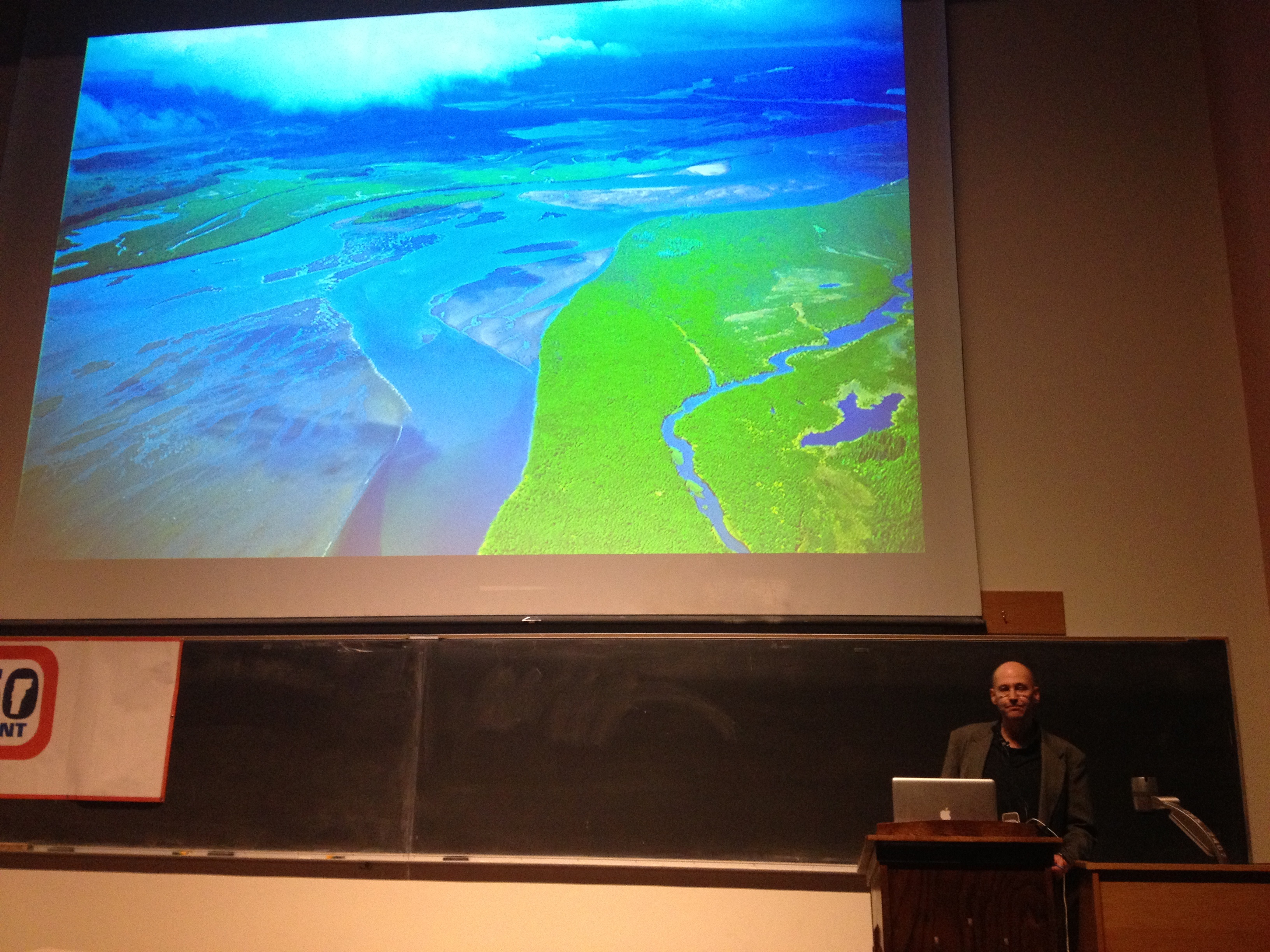
Such are the images and stories of an eye-opening tour sweeping through the Northeast that opened Friday night in Burlington, Vermont entitled “Tar Sands Exposed.” The tour features the acclaimed photographer Garth Lenz as well as eloquent representatives of the First Nations’ Peoples facing the direct devastation of tar sands, Crystal Lameman of the Beaver Lake Cree and Eriel Deranger of the Athabasca Chipewyan. The tour is being organized by 350.org state groups in the region along with help from organizations like Sierra Club and National Wildlife Federation. It continues through New England and Quebec until February 1.
Images of Beauty and Destruction
Garth Lenz’s stunning photographs highlight the tour. He begins with images of the wild beauty of Canada’s boreal forest, known as the lungs of the Earth for its massive oxygen production. It is one of the most productive wildlife habitats in the world and is known as North America’s bird nursery.
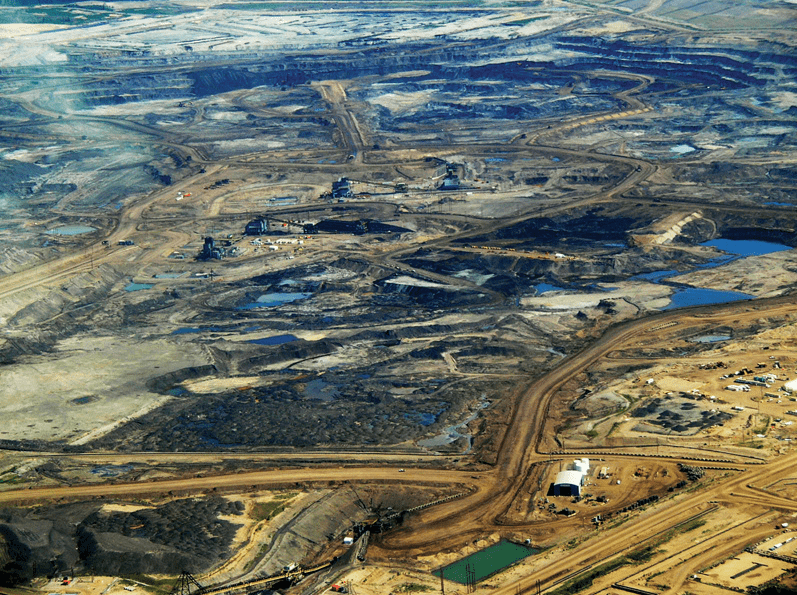
Then he shows what tar sands development—the massive strip mining and water intensive drilling—is doing to the boreal forest, turning it into a toxic moonscape littered with poisonous waste ponds visible from space. Tar sands—a peanut butter like substance from which extremely carbon polluting gasoline is derived—development threatens to destroy an area of the size Florida.
Tales of a Land Ruined
Crystal Lameman followed with a deeply moving account of how her people’s traditional land –land that has sustained them for millennium – is being poisoned. She told accounts of green deer meat, sickened moose, water that burns the skin, fish riddled with tumors, summer nights bereft of singing frogs, and the cancers and illnesses of her people who must live off a land being ruined. She told of treaties to protect the land and her people and how the oil companies and the Canadian Government were trampling on those treaties.
I have been working on tar sands for several years now. I have read the statistics, studied the documents, written on the impacts. But seeing the images and hearing the stories Garth and Crystal put forth brought home a simple point: the tar sands region is a crime scene. It is a temple of greed, sacrificing our children’s future.
The Northeast Can Lead the Way to a Better Future
The Northeast has a tremendous opportunity to stand up to this outrage. A likely proposal to bring tar sands through Northern New England can be stopped, and the region is mobilizing to block any such effort. We must be steadfast. The region can also say no to tar sands derived gasoline, and stop this dirty fuel from entering our market if we act now.
The oil industry is telling us that tar sands extraction is inevitable, that it can’t be stopped, that we should do their bidding and approve massive boondoggle pipelines like the Keystone XL because they’ll develop this nasty product one way or another.
They’re wrong.
We can stand up for wildlife and for our children’s future and choose a wiser path. If we want to pass along a sustainable world to our children we can be proud of, the Tar Sands Exposed tour makes clear that is the only real choice we have.
 Tell President Obama to deny the Keystone XL pipeline >>

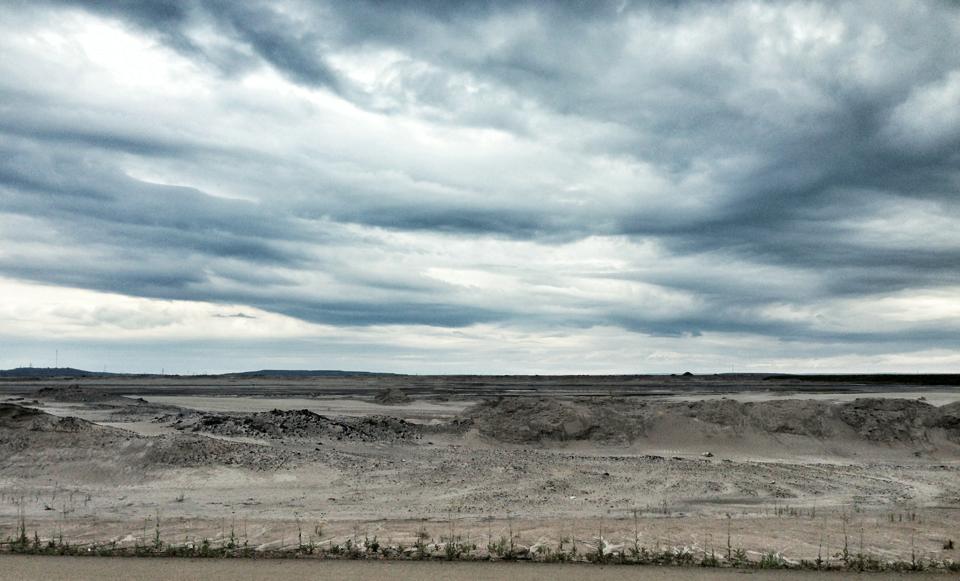
In 2008, 1,600 ducks died after landing in the tarry goo and more recently, in 2010 over 550 ducks died after landing in the pond. Biologist Colleen Cassady St. Clair from the University of Alberta noted in her report about mass duck deaths that these fatal bird landings will only increase because of increased tar sands mining in a region that is home to more than a million migratory birds each year and an increase in severe storms caused by climate change. These lakes don’t contain water in any form we as know it. They are a mixture of clay, leftover bitumen, hydrocarbons with known carcinogens and toxic heavy metals. If tar sands expansion plans are realized, it will forever undermine the ecological health of 140,000 square kilometres of boreal forest, an area the size of Florida and 20 per cent of Alberta’s land base.

During the walk, people covered their mouth with respiratory masks, handkerchiefs and shirts. For some people, the hydrocarbon fumes were so overwhelming they started vomiting. Some had to leave the walk to get away from the fumes. One First Nations elder silenced the crowd with her sobs of grief as she looked over destruction.
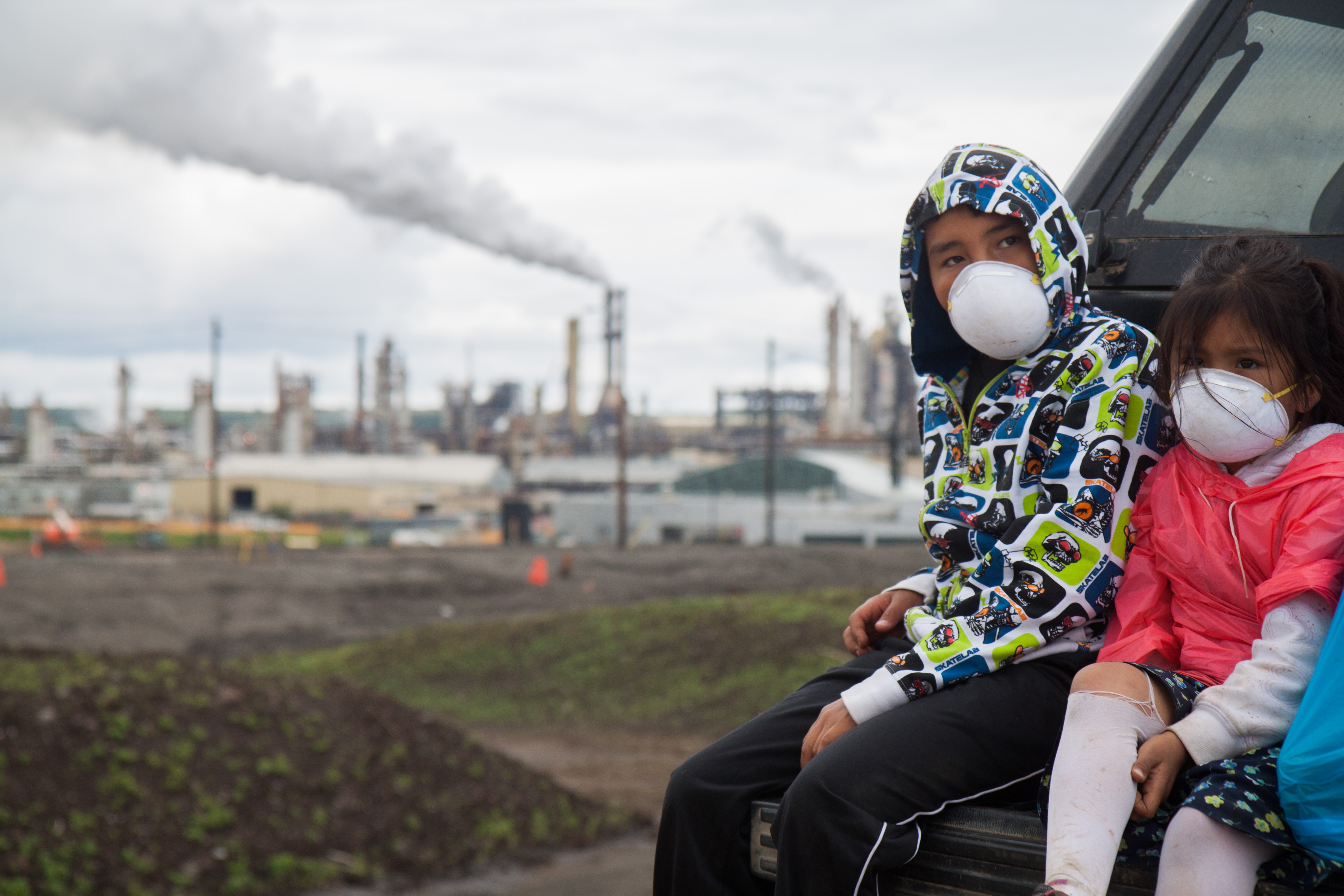
Each and every one of the politicians pushing for this pipeline should have to walk that 14 km Syncrude “Interpretive” Loop, breath the toxic air, see the toxic tailing lakes, look out at the barren wasteland and see for themselves what our addiction to dirty fuel is doing to wildlife, people and communities in the region.
Oil spills happen frequently around the tar sands operations. When I was there, a spill was discovered the same day as the Healing Walk on the Athabasca River. And although we had pictures of it, the government and industry denied there was one, saying they couldn’t find evidence of a spill. Fish in the river are deformed from the regular oil spills and the toxic chemicals from the tar sands.
TransCanada’s proposed Keystone XL pipeline is a needed piece of infrastructure for this industry to continue destroying habitat and poisoning water in Canada. Scientists know that tar sands development is a climate disaster. And industry says that it needs the Keystone XL Pipeline to undertake a major expansion of the tar sands mining operation.
Everyone one of us in the United States can help our Canadian allies in stopping the expansion of tar sands mining in Canada by telling President Obama to deny the Keystone XL Permit.
For a full gallery of the images from the walk, you can go to the Healing Walk Flickr Page to see more amazing photographs.
To watch a short video of the march, please click here or watch below.
[vimeo]http://vimeo.com/69882514[/vimeo]

Birds so heavily oiled that they can’t take flight, and then dying from exhaustion or suffocation. First Nations rivers, once teeming with fish, now running lifeless. And the latest: wolves being intentionally poisoned because the caribou population is shrinking…whose habitats are being destroyed by oil mines.
 All are victims of tar sands mining in the Boreal Forest of Alberta, Canada. And we are the largest importers.
Kids Want to Protect Wildlife
Last Saturday morning, my daughter noticed I was on my Blackberry communicating with someone from work. “What are you doing,” she asked me, in that familiar impatient tone. I turned to her, and without hesitation I said: “How do we get more people to care about the fact that wolves are being poisoned in Canada because of tar sands?”
She then turned to me, and immediately announced that she will donate $7.00 to our cause—seven weeks of allowance.
She was motivated because she, like most young children, have an uncluttered sense of what’s morally right and wrong. There’s nothing that clouds their judgment. What a contrast to what we are facing every day in Congress these days. Elected officials of both party persuasions are wringing their hands on what to do about the White House’s decision to halt the permitting of Keystone XL, which, if built, would’ve been the largest tar sands oil pipeline snaking through the nation’s Heartland. Allies of the oil industry are teaming the halls of Congress to find any lever to pull to reverse the decision.
 My 9-year-old daughter doesn’t understand why people who are in government aren’t standing up for the wolves. I wonder why are they not standing up to Big Oil’s insatiable greed and indifference.
She also wonders, understandably, whether a $7.00 donation will make a difference, knowing that we are up against a multi-billion dollar oil industry.
Join & Make a Difference
Motivating others to join her, that’s the difference $7 can make. Imagine if just one percent of the children in the U.S. between the ages of 10-14 donated $7.00? One percent is about 200,000 children…you can do the math.
The point is that if we stand together, unpolluted by politics and oil profits, united about what’s morally right, we can shift the political debate. And our legacy will be that we stood up for those who don’t have a voice.
Please join Ava, and thousands of others, in NWF’s fight to stop tar sands and help protect wildlife.
Spread the word. Your voice matters.

Learn more about tar sands>>
Learn more about the threat to wolves and caribou>>
Take Action to help wolves and other wildlife>>
A Nightmare that will haunt us all
For those who do not live close enough to the tar sands to see the immediate impacts, the tar sands still have an effect on you. How? The tar sands present a major source of pollution that will only further exacerbate global warming. Being such an ‘unconventional’ and ‘unique’ oil (aka: dirty oil), the tar sands emit three to five times more greenhouse gases than conventional oil. A recent study by the Carbon Dioxide Information Analysis Center revealed that the tar sands project has higher emissions than 97 nations combined.
This is not a sustainable project and the Canadian government is merely turning a blind eye to the consequences its actions. Sadly, the US is the largest consumer of the tar sands oil as 60% of tar sands oil is sent to the US.
The U.S. Department of State is currently going through the permitting process for the latest and largest tar sands pipeline. TransCanada’s proposed Keystone XL pipeline would move up to 900,000 barrels of tar sands oil daily from Alberta, Canada to refineries along the U.S. Gulf Coast, traversing 2,000 miles through rivers, farmland and forests from Montana to Texas. Unless we stop it, this pipeline would effectively open the entire U.S. market and international markets to this environmentally damaging and costly high-carbon fuel.
Hard-hitting impacts on local communities
What has this done to the local communities? With all boom & bust situations like this, local communities are hit hard with social ills from the sudden influx of miners and workers inundating the area. The tar sands are no different. Alberta has the highest school dropout and divorce rates in Canada. Sadly, Alberta women suffer the highest level of spousal abuse in Canada. Drug use has also risen exponentially since before the project began. Approximately $7 million worth of cocaine now travels up Highway 63 to the tar sands region every week. In fact, roughly 40% of all tar sands workers test positive for cocaine and marijuana use. Local drug stores can’t keep enough urine cleansing products on their shelves due to workers fearing a random drug test. As a result, a black market for clean urine has developed.
The social ills, cultural consequences and environmental impacts are having an irreparable effect on the land and the indigenous way of life. The tar sands project is a living curse that grows larger and larger every day.
Monstrous Machinery
Such a monstrous project requires monstrous machinery. Being so grand in scale, the project requires massive machines like those that are seen in the movie Avatar. In fact, the trucks from the tar sands have to be specifically designed for the project. They are the largest power shovels and dump trucks in the world, capable of hauling 400 ton loads. Each truck burns roughly 50 gallons of diesel fuel an hour.

Tar sands machinery has been manufactured in Korea, shipped across the Ocean, shipped through the Columbia River (Washington & Oregon) and is now traveling from Port Lewiston, Idaho through Montana and eventually shipments will travel all the way to northern Alberta. Paid for by ExxonMobil’s subsidiary, Imperial Oil, these shipments will cross through some of America’s most beautiful and scenic highways, national historic trails, tribal reservations and other places with both historic and current value.
These are no ordinary shipments. These are behemoth-sized loads. To give you an idea, some of these loads will roughly be the size of the Statue of Liberty on its side. For Howard Hughes fans out there, the shipments will be 9 feet longer than the Spruce Goose airplane. They will weigh up to 300 tons and require 90 tires, 24 axles and two trucks attached to the rear to help push it along. American roads have never seen loads this big. There is no classification for shipments like this and it has forced agencies to look at ‘special permits.’ Roads have been modified, turnouts have been created and the loads are now traveling from 5 to 30 mph in the middle of the night to avoid affecting traffic. Traffic has been affected and cars have been stuck sitting behind these trucks for hours at a time. Traveling down these mountains and narrow roads, one of the loads even scraped up against the side of a mountain and skidded against the rocks. These loads are a disaster waiting to happen and Governor Otter of Idaho thinks so too. In fact, Otter is demanding $10 million in bonds from Imperial Oil in case an accident does occur.
Sign the petition at All Against the Haul protesting the shipments.
Stand up for the Nez Perce peoples
The Nez Perce peoples pray the $10 million is not necessary. Crossing over nearly 70 miles of the Nez Perce reservation, tribal members have been working to stop the loads. After seeing through a number of candy-coated lies presented by Imperial Oil, the tribe has passed a resolution against the shipments in July 2010. Unfortunately, Imperial Oil is pushing through anyway. Working to protect their land, health and safety, the Nez Perce are seeking a number of venues to safeguard its people from the hazards presented by these loads .
Beginning with tarry mud in Northern Alberta, the destruction of First Nations homelands, the contamination of the Boreal forest and the transportation of loads of unheard sizes, the tar sands are pure destruction. The First Nations of Alberta deserve better. The Nez Perce deserve better. We all deserve better.
Don’t stand by. Take action now.
People around the globe value the Boreal forest in Alberta, Canada for a number of reasons. For one, the forest represents ¼ of the earth’s remaining intact forest, and it makes up 11% of the planet’s terrestrial carbon storehouses. It’s known for its wildlife habitat, which is home to moose, bear, and endangered species such as the woodland caribou and the whooping crane. However, to indigenous peoples of the region, the Boreal forest is important because it is home. It has been their home for generations, the ancestral site of their hunting, fishing and gathering.

Unfortunately, nearly every big oil company in the world has targeted the Boreal forest as a hot spot for oil, even if it is some of the dirtiest and most difficult oil to extract. The oil derived from the Boreal Forest comes from tar sands, a claylike, tar-infested mud that spans an area roughly the size of Florida.
Oil companies start by clear-cutting the forest before beginning extraction through open pit mining and leaching, which requires that high temperatures and chemical solvents be applied beneath the earth’s crust. Because tar sands oil is not liquid like conventional oil, it requires tremendous upgrading before use. In fact, the tarry substance has to be dug up, sucked up, squeezed, heated, steamed, and processed through many other resource-intensive methods even to be retrieved from below the earth’s surface. The tar sands are so unique in their makeup that it requires special refineries to turn it into an ‘useful’ oil.
“The Most Destructive Project on the Planet”
The tar sands have become the world’s largest industrial project, dubbed as the most destructive project on the planet by the Environmental Defense Fund. Local First Nations feel the impact first and foremost because it is their homeland that is being destroyed.
[youtube]http://www.youtube.com/watch?v=icvyckgYx5s[/youtube]
Watch as Chief Francois Paulette of the Smith’s Landing Treat 8 First Nation in northern Alberta discusses the impacts of Tar Sands on Alberta natives and calls on lawmakers to put a stop on the pipeline and tar sands extraction.
The tailings (the leftover toxic waste) from the tar sands cover an area roughly 50 square miles and are growing by 80 Olympic Sized swimming pools every day. With every barrel of oil that is created from the tar sands, two barrels of toxic waste are also made. Over the course of a year, these tailings ponds leak over a billion gallons of toxic contaminated water into the environment.
It should come as no surprise that the local First Nations who survive on subsistence living are now experiencing overwhelming rates of rare cancers and various illnesses. This project has changed their entire way of life.
It is no wonder that they are standing up and taking action as part of the Dirty Oil Sands Action Network, an international network of citizen and indigenous groups that oppose the expansion of the Canadian tar sands and advocate for its cleanup. (Editor’s note: Honor the Earth and NWF are both active members of this important coalition. You can learn more about NWF’s campaign against tar sands here.)
The most destructive project on the planet is not cheap. Over $200 billion has been invested in the tar sands and American investors have forked over almost 60% of that. Instead of investing in solutions for a clean energy future, America is investing in one of the world’s dirties and most toxic fuel sources.
Unfortunately, it is the First Nations peoples who are being forced to pay the biggest price as their homelands are destroyed, contaminated and transformed into sacrifice zones for oil consumers in the US, Canada, and other oil-addicted countries across the world. The social ills, cultural consequences and environmental impacts are having an irreparable effect on the land and the indigenous way of life.
Don’t stand for it. Take action now.
Stay tuned for Part 2 of this story next week.