My responsibilities have taught me something important: the quality of an experience rarely hinges on one big moment. More often, it depends on whether dozens of small details work together the way they should.
Consider an airport shuttle scheduled an hour too late. A session room that’s too small and stuffy. Facilitation materials that don’t arrive until the morning of. None of these sound like a crisis. But at an annual gathering where consultants have flown in from across the country to share what they know, one overlooked detail can unravel everything around it. Shuttle delays mean the team arrives tired. The wrong room leads to a crowded, distracted session. A session without the right handouts and supplies means the insights don’t land. And when the group’s tired, distracted and the insights don’t land, the whole reason people made the trip is diminished.
That’s why detail orientation isn’t a nice-to-have in my profession—it’s the key to success. I’m not just coordinating logistics, I’m creating the conditions for our team to do their best thinking together. And the longer I’ve worked alongside our organizational design team, the more I’ve realized that’s exactly what they’re doing too, just at an organizational level.

When One Detail Changes Everything
There are hundreds of closely connected details that go into planning a multi-day event.
Let’s say I forget to order a gluten-free meal for someone on the team. The caterer scrambles to make something for them at the last minute. Lunch is delayed, and the post-lunch presenter misses their prep window. The next few sessions feel rushed and unorganized.
The same holds true for organizations. Make changes in one area, and no matter how big or small, you’ll see shifts throughout the system.
At AlignOrg, we see organizations as a six-sided cube. Each of the sides represents a different aspect of the organization, with strategy at the center.
- Work processes: what work gets done and how
- Structure and governance: who owns what and who decides
- Information and metrics: how you know you’re succeeding
- People and rewards: the skills you hire and the behaviors you reward
- Continuous improvement: how you adjust as things change
- Leadership and culture: the behaviors leaders model every day
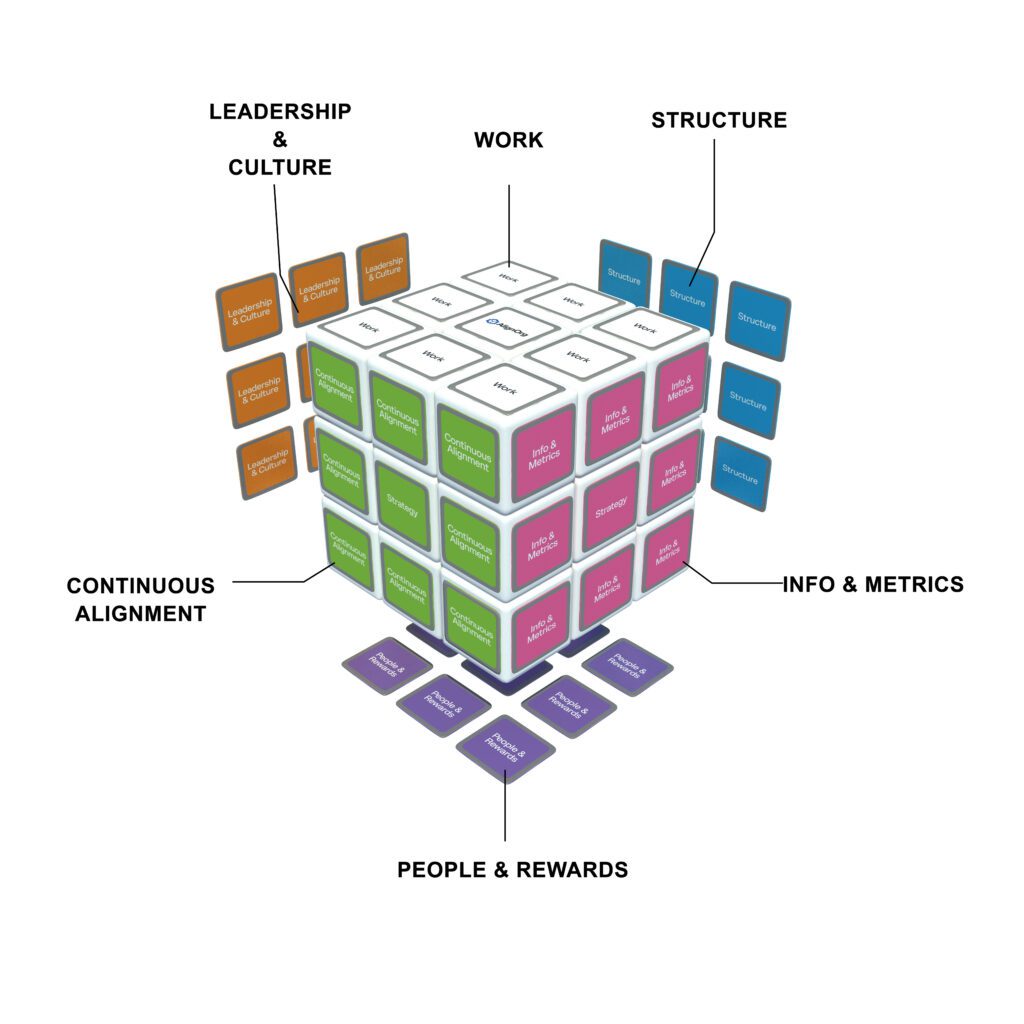
Like a cube, solving one side can scramble the others. That’s where detail-oriented leaders thrive—by ensuring that every aspect of the organization remains aligned to strategy as changes are made. Consider a company that shifts from a regional structure to a centralized one to improve consistency. On paper, the structural change looks clean. But without updating how work flows between teams, how success is measured, or how leaders are expected to make decisions in the new model, the change stalls. People default to the old ways—not out of resistance, but because every other signal in the system still points in the old direction.
Careful Communication
The details of communication are also critical. When I send out the event agenda, I don’t just share the schedule—I explain the why behind every session, who needs to be in the room, what people should come prepared to discuss, and what we’re hoping to walk away with. If I skip that context, people show up uncertain, disengaged or in the wrong headspace entirely. At AlignOrg, we accomplish this using a format called PME. It’s a concept our CEO and Principal Ken Thompson learned during his time in the U.S. Army and shared with the team.

Purpose—Why we are doing something?
Method—How we will do it?
End State—What does success look like?
These concepts are just as critical for communication that happens during organizational transformation. Leaders often invest enormous energy in the design itself—the structure, the roles, the new ways of working—and then communicate it in a single all-hands announcement and assume people will follow. They won’t. Employees don’t just need to know what is changing. They need to understand why it’s happening, what it means for their work specifically, and what to expect next.
Without a detailed, thoughtful communication plan woven into the transformation from the start, even the most well-designed change will stall. People fill silence with uncertainty. Uncertainty breeds resistance. And resistance is far more expensive to overcome than a thoughtful communication plan ever would have been.
Continuous Alignment Is a Practice, Not a Finish Line
After every gathering I host, I review the event using another military concept, the After-Action Review, or AAR. I review four central questions:
- What was supposed to happen?
- What actually happened?
- What were the causes of success or failure?
- How can we improve next time?
I try to think beyond the big moments to the small friction points. A session that ran long. A transition that felt rushed. A room setup that didn’t quite work. I document those details because I know the next event will only be as good as the adjustments I make today. Rather than overhauling the entire event every year, I focus on making small adjustments that make each annual gathering a bit more enjoyable and productive than the one before.
The same discipline applies to organizational design. Continuous improvement isn’t a once-a-year review. It’s an ongoing habit of noticing, adjusting, and staying close to what’s actually happening on the ground.
AOS methodology is clear on this point: alignment is not a destination you reach at the end of a redesign, it’s a practice. Markets shift. Strategies evolve. People move in and out of roles. Any one of those changes can quietly nudge the organization out of alignment—and leaders who aren’t paying close attention won’t notice until the misalignment has already done damage. The detail-oriented leader doesn’t wait for a full reorganization to correct course. They build in regular checkpoints, ask the same questions they asked at the start of the design, and treat small misalignments as early signals rather than minor nuisances to be ignored. That kind of ongoing attentiveness is what keeps an organization aligned and performing over time.
A Planner’s Checklist for Leaders
Before your next design decision, borrow a page from my run-of-show:
- What’s our goal? Define our PME (purpose, method and end state).
- What’s connected? Map every side of the organization this choice touches.
- Who needs to know? Bring the right people in early, not after the fact.
- When do we check in? Schedule your alignment reviews like you’d schedule a walkthrough.
- What were the results? Evaluate opportunities for improvement using the After-Action Review format.
The Bottom Line
Great events don’t happen by luck. Neither do great organizations.
Both come from leaders who respect the details: people who understand that every choice connects to every other choice, and who take ownership of making them fit.
Treat your organization like the most important event you’ll ever plan. Walk the room. Check the connections. Then check them again.
Your people will feel the difference, even if they never see the work behind it.
Photos in this post were taken during AlignOrg’s annual retreat in January 2025. Some individuals pictured are no longer with AlignOrg Solutions.
]]>Designing an organization is a lot like building a house. Both have interconnected systems that must work together to deliver a successful outcome. Build a beautiful kitchen but fail to connect the plumbing or electricity properly, and suddenly your renovation becomes the stuff of HGTV nightmares. Create a winning strategy, but if your work, structure, metrics, and culture aren’t aligned to support it, you’ll fall far short of your goal.
The same principle applies to AI. A new layer of technology promises to make life easier but reveals the cracks instead—think a robot vacuum that catches a loose thread and unravels the entire rug. Simply put, AI amplifies whatever’s already in place or missing from your operating model. It increases the speed, reach and efficiency of successful systems, but pulls at the “loose threads” of those that are misaligned or absent. If decision rights are unclear, AI accelerates confusion. If metrics don’t reflect strategic priorities, AI optimizes for the wrong outcomes faster. If AI is integrated only as a task optimizer without redesigning work processes, roles, structure, governance, linkages, etc., it is unlikely to deliver its intended ROI.
Some experts estimate that 80 percent of AI projects fail to deliver their intended value—so how can you make yours part of the slim minority that succeeds? It starts with understanding the role alignment plays in turning strategy into results.
The Hidden Cracks in Your AI Implementation
At AlignOrg, we see organizations as systems of interrelated choices—work processes, structure and governance, information and metrics, people and rewards, continuous alignment, and culture and leadership. Picture these as the six sides of a cube, with strategy sitting at the center. Turn one side of a cube, and every other side shifts with it.
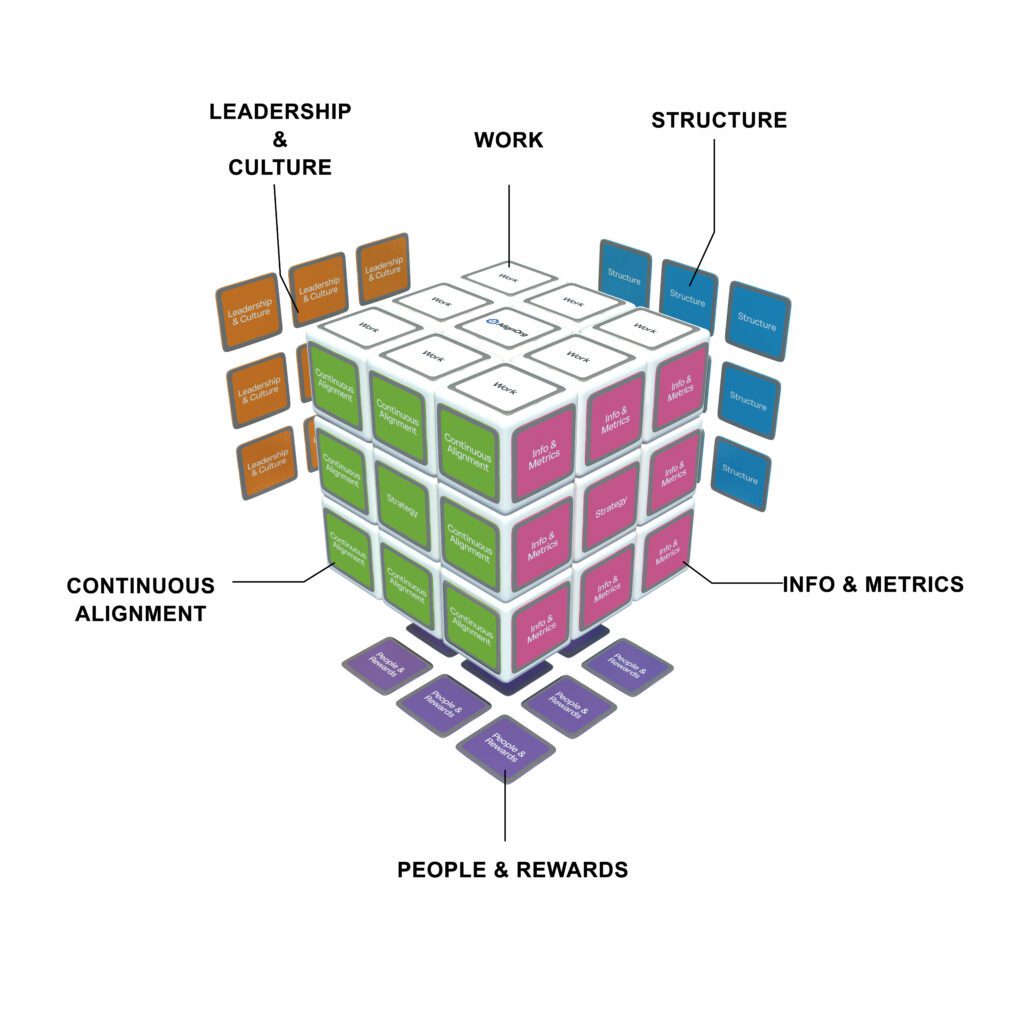
Misalignment occurs when one system (or side of the cube) changes while another part of the organization fails to evolve or adapt. Individually, these changes may seem manageable, but over time, they create organizational friction and quietly erode performance. To see how AI amplifies these misalignments, consider the scenario below.
The organization: A mid-sized commercial insurer with a strong book of business and a growing problem. Faster, tech-forward competitors were winning deals before its underwriters even finished their reviews.
The strategy: Cut policy turnaround from 12 days to 3 and reclaim market share.
The proposal: Implement an AI-driven underwriting platform that could assess risk in seconds rather than days.
The result: Eighteen months and a seven-figure investment later, turnaround times had barely budged, and loss ratios were creeping upward. The technology worked as planned. So, what went wrong?
The Organizational Misalignments AI Exposed:
- Info & Metrics: Underwriters were still compensated on risk accuracy and loss-ratio performance, not speed. They manually re-checked every data point the AI produced, protecting their bonuses while negating the time advantage.
- Leadership & Culture: Leadership failed to communicate a compelling need for a strategy change. With no clear reason to change, employees reverted to the familiar instead of embracing new ways of working.
- Continuous Alignment: Leaders adopted a “one and done” mindset. Once the AI training rollout wrapped, no one went back to evaluate how well the shift was progressing. The misalignments went unnoticed until the business results forced the issue.
Had the organization realigned incentives (Information and Metrics and People and Rewards sides of the cube), engaged its people, and built in regular checkpoints (Continuous Alignment and Leadership and Culture sides of the cube), the AI platform could have delivered the speed it promised. The lesson is simple: systems alignment isn’t a follow-up to AI adoption. It’s the precondition for its ultimate success.
Who Owns Alignment?
Navigating these complexities requires leaders whose role is to keep the organization’s architecture (operating model) aligned with its strategy. We call these people Alignment Leaders®. To do their work effectively, Alignment Leaders must draw on four core competencies:
- They make deliberate trade-offs and choices. Rather than trying to do everything at once, they decide what the organization will say yes to—and, just as importantly, what it will direct resources away from to accomplish those goals. With AI, this means deciding which use cases best support strategy, and which existing investments must be scaled back to fund them.
- They ensure alignment across every system, or side of the cube. Alignment Leaders look across work, metrics, structure and governance, people and rewards, and leadership and culture to ensure every aspect of the organization is working together to accomplish its strategy. As we saw in the example above, AI impacts are rarely contained to one area of an organization. They ripple across the system, requiring a leader with a holistic view to spot the changes needed to maintain alignment.
- They drive change effectively. Alignment Leaders move beyond announcements and slide decks, embodying new behaviors and ensuring stakeholders understand the rationale and tradeoffs behind the decisions. When introducing AI, this includes helping teams understand not just what is changing, but why the shift matters and what it means for their day-to-day work.
- They build these capabilities in others. They ensure alignment doesn’t depend on one individual, so the organization can maintain it long after any single project ends. As AI continues to evolve, organizations need leaders at every level who can keep strategy and architecture in step with ongoing technological change.
Leaders who skip this groundwork often make the same mistake: they rush to deploy AI tools and hope the organization’s architecture will somehow catch up. It never does. The cracks simply widen and the investment stalls. Systems alignment must lead, and technology must follow, not the other way around.
Fix the Organization, Not Just the Tech
AI will expose what’s misaligned in your organization, whether you’re ready for that visibility or not. The executives who benefit most from AI aren’t the ones with the biggest technology budgets; they’re the ones who treat systems alignment (sides of the cube) as critical, ongoing work.
Before your next AI investment decision, ask: Is our organization already aligned to the outcome we want? If the honest answer is no, that’s the work to prioritize first. Reviewing your organization’s alignment against its strategic goals is a faster path to AI ROI than any new tool on the market.
To learn more about incorporating AI into your organization with strategic intent, read our new Executive Guide, Designing AI Into Your Operating Model.
]]>I’ve spent more than 20 years coaching people toward better health, earning certifications across CrossFit, Pilates and beyond. Today, I help run operations at AlignOrg Solutions. The parallels between the two worlds still surprise me. Below, I’ll share four fitness principles that map directly onto organizational alignment and explore what they mean for the choices you make as a leader.
Whole-Body Wellness Mirrors Systemic Choices
In fitness, you can’t isolate your way to health. We’ve all seen that person at the gym who spends all his time on bicep curls, with zero thought for legs, core or balance. The body is a system. Every choice ripples outward.
Organizations work the same way. At AlignOrg, we think of your organization as an interconnected cube with six sides: work, structure, metrics, people and rewards, continuous alignment and culture. Adjust one side, and the others shift, whether you planned for it or not.
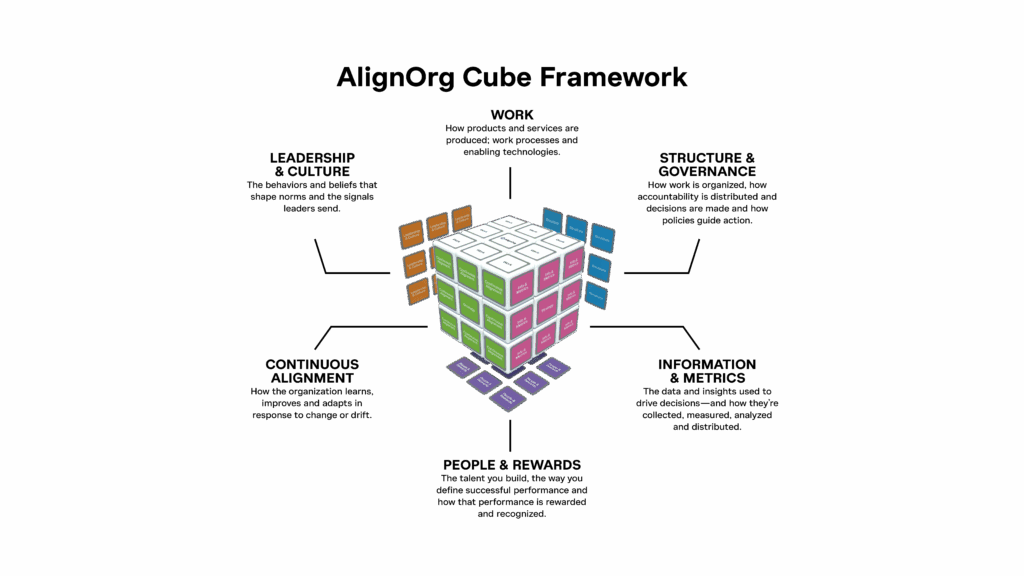
For example, a company changes its structure to help teams work together faster. But it keeps the old goals and rewards in place, so managers are still judged on their own team’s results, not shared outcomes. Even though leaders say, “Collaborate more,” the system is still encouraging people to protect their own turf. The structure changed, but the incentives didn’t. A few months later, leadership is frustrated that people are slipping back into old habits.
Takeaway: Before changing any one aspect of your organization, consider what else will be impacted. Treat structure, work, metrics, people, culture and continuous alignment as one connected design, not a series of isolated fixes.
Consistency Beats Intensity Every Time
As a trainer, I saw two types of clients. The first came to class every day for a few weeks, burned out or got injured and I never saw them again. The clients who experienced lasting change weren’t the ones who trained hardest for two weeks. They were the ones who showed up, week after week, long after their initial enthusiasm faded.
Alignment demands the same discipline. A one-time reorganization feels productive, but markets shift—more frequently now than ever before. If you treat alignment as “one and done,” your organization won’t be able to keep pace with changing factors.
Smart leaders treat alignment as ongoing work, not a project with an end date. They make small, aligned adjustments continuously, so they rarely need a painful, full-scale overhaul.
Takeaway: Build a rhythm of regular alignment checks rather than betting on a single, dramatic transformation.
Trade-Offs Are Where Real Strength Comes From
Every athlete makes trade-offs. You can’t max out strength, endurance and flexibility all at once. You choose what matters most for your goal, then commit.
Leaders face the same reality. Resources are finite, and you simply can’t direct equal resources to every initiative. One of the core responsibilities of an Alignment Leader® is exactly this: making the trade-offs and championing the choices that best enable performance.
The smartest leaders I work with identify their strategic capabilities, invest heavily in those and trim what no longer serves the goal. They get comfortable saying no—because every no protects a more important yes.
Takeaway: Decide what your organization must be exceptional at, then resource it accordingly and let go of the rest.
Recovery Is Not Optional
It’s a common mistake: more is always better. More training, more hours and more effort. But we must remember that muscle grows during recovery, not during the workout.
Transformation fatigue is real in organizations too. Teams push through change for months, then momentum collapses. The realization and sustainability phase of any transformation is where most efforts stall—not because the plan was wrong, but because people ran out of fuel.
Great leaders protect momentum. They resource their teams properly, keep stakeholders engaged in the transformation and remind their teams how their work supports strategic initiatives.
Takeaway: Plan for sustainability from day one and treat your people’s capacity as a strategic asset.
The Common Thread: People First
Across fitness and operations, one principle holds above all others. A trainer can design the perfect workout program—ideal split, smart progression, every rep mapped out. But that program only delivers results when the client is engaged and understands how the actions contribute to their ultimate goal. The same is true for your org chart. The structure can be flawless on paper, yet nothing moves without engaged people who grasp the “why” behind the plan.
Leaders who simply tell people to change rarely see results. Change sticks when people help shape it. Great trainers co-create goals with their clients, help them own the process and model proper form. Leaders who do the same—who involve people in the design, help them see the vision and embody change behaviors—build organizations that achieve successful transformations.
Your Next Move
Strong organizations, like strong bodies, are built through consistent, whole-system choices, not quick fixes. If your teams feel misaligned, your metrics contradict your strategy or your last reorganization didn’t deliver, the problem is rarely one broken part. It’s the system.
At AlignOrg Solutions, we help leaders diagnose where their organization is out of alignment and build a practical path toward lasting, differentiated performance.
Ready to see where your alignment stands? Start a conversation with our team, and let’s map your transformation journey together.
]]>It’s a common problem—in fact, research shows that only about 30 percent of organizational change efforts are successfully sustained over time. The reasons are largely internal: fatigue, drift, ambiguity and a slow slide back to old habits.
Let’s examine what causes successful transformations to stall, what warning signs to watch for and how to create a practical framework for building resilience.
Why Early Wins Don’t Guarantee Lasting Change
Momentum is difficult to maintain without sustained focus. Just ask anyone who’s ever kicked off a diet and workout plan. You’re eating right and going to the gym daily, then life happens. Work picks up and you skip a few runs. The pounds aren’t melting off as quickly as you hoped. You don’t make time to meal plan and end up grabbing fast food for dinner. Pretty soon, you’re right back where you started.
The same holds true for organizations. Even with aligned leaders and functioning workstreams, transformations can lose steam. The subtle causes that undermine our personal goals are largely the same ones that impact organizational change:
- Change fatigue: Employees tire of constant updates and shifting expectations.
- Drift: Teams move on to the next priority too soon and leaders lose focus.
- Reversion to old habits: People default to familiar routines when new behaviors aren’t consistently reinforced.
It’s easy to dismiss these as minor issues, but left unchecked they can erode a transformation’s sticking power.
The Price of Drift
To see this in action, let’s examine this hypothetical case. Marcus is a senior leader at a mid-sized logistics firm that is rolling out a new regional operating model. The first quarter went well. Cross-functional teams delivered visible wins and adoption looked strong.
Then the signals shifted. Two executives who had initially sponsored the change were distracted when they became involved in an acquisition. A few managers slipped back to legacy metrics because they were easier to report. Key contributors were reassigned to “urgent” projects, thinning the teams driving the change. There was no open resistance, just a growing sense of disengagement.
Marcus recognized the danger early. He convened a focused “transformation pulse” session with his core team. They reviewed momentum indicators, surfaced frustrations and reconnected the effort to its strategic stakes.
The outcome: a renewed 90-day plan that rebalanced workloads and pulled leadership back into visible engagement. The transformation didn’t just survive—it regained speed.
The lesson to be learned? Transformations usually don’t fail in dramatic fashion. More common is the slow fade of priorities and resurfacing of old habits. This is where it becomes critical to have a leader who is charged with continuous alignment—someone who can recognize the signs and right the ship before it strays too far off course.
Three Warning Signs of Transformation Failure
Most stalls give off signals before they become setbacks. Train yourself and your leadership team to spot them:
- Resource strain: Too many workstreams competing for too little bandwidth.
- Leadership drift: Fewer check-ins and visible messages of support.
- Passive resistance: Quiet skepticism from teams who aren’t yet seeing the value.
It’s not a question of if challenges will emerge, but when. That’s where the Alignment Leader® plays a critical role: keeping the organization aligned to strategy, spotting warning signs early and taking action before momentum slips.
How to Build a Resilient Transformation
Sustainable transformations can’t rely on strong starts and good intentions. They must be engineered to absorb friction, handle setbacks and adapt in real time. Here are four ways to build that resilience.
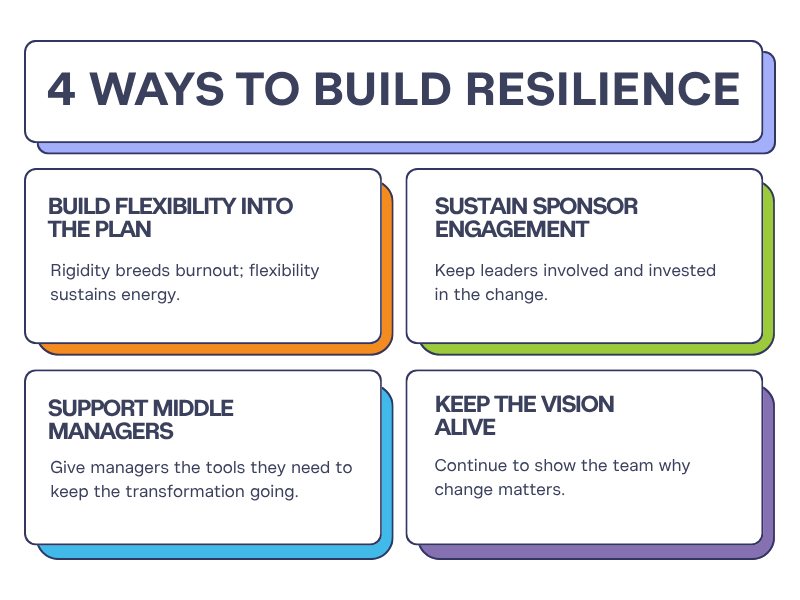
1. Build Flexibility into the Plan
Give teams room to adjust scope, timelines or resources when conditions change. Rigidity breeds frustration and burnout; flexibility sustains energy. A plan that bends is far more durable than one that breaks under pressure.
2. Sustain Sponsor Engagement
Keep leaders visibly involved well past the early wins. A quiet leadership team sends an unmistakable message: this is no longer a priority. The regular, genuine presence of leaders keeps confidence high and reminds the organization the effort still matters.
3. Support Your Middle Managers
Middle managers are the linchpin between design and daily behavior. They translate strategy into what happens on the floor. Equip them with the tools, authority and talking points to keep progress alive. When they feel supported, adoption sticks. When they feel stranded, it unravels.
4. Keep the Vision Alive
People lose steam when they can’t connect daily work to the bigger picture. Reconnect the two by showing why the change still matters and how each contribution moves the organization forward. Purpose is what carries teams through the long middle of any transformation.
Remember, transformation isn’t a single event—it’s a discipline of alignment, execution and adaptation. The leaders who treat it that way don’t just manage change. They build lasting capacity for it.
To learn more about implementing the changes needed to move strategy from design to results, download our Activating Transformation Executive Guide.
]]>Now for the harder question: once you’ve defined the benefits and mapped the roadmap, how do you make sure your HRBPs can consistently perform strategic work? How do you protect that work from risks that can erode it?
Let’s explore six best practices that can enable strategic HRBP work, followed by the five risks most likely to derail it, and how to mitigate them.
Six Best Practices for Enabling Strategic HRBP Work
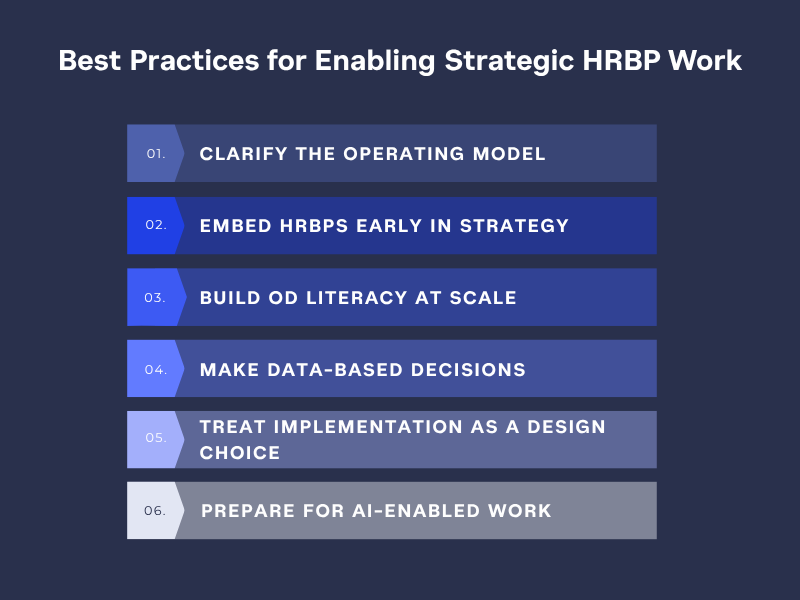
1. Clarify the HR operating model
Strategic work needs room to breathe. Segment your HR function—shared services, centers of excellence (COEs) and HRBPs—so transactional demands don’t crowd out design and activation work. The key is to clearly define the interfaces, not just the boxes. Who owns what and how handoffs happen matter far more than the org chart itself.
2. Embed HRBPs early in strategy
The value of a strategic HRBP shows up in problem framing, not just problem solving. Pull them into the conversation before the solution is chosen. HRBPs who help shape the strategic problem can pressure-test possible solutions from the start, rather than reacting to decisions already made.
3. Build OD literacy at scale
Reclassifying someone as an HRBP does not make them one. Equip your partners with practical, repeatable organization design (OD) tools:
- Operating model design
- Decision rights mapping
- Spans and layers analysis
- Process and work redesign
Then accelerate quality with playbooks, templates and worked examples.
4. Make data the lingua franca
Design by opinion loses to design by evidence every time. Equip HRBPs with talent, organizational and performance insights. Then, train them to translate that data into a diagnostic story leaders can act on. The goal isn’t more dashboards, its sharper decisions made faster.
5. Treat implementation as a design choice
Most transformations don’t fail at strategy, they fail at activation. Design defines the destination; activation is what gets the organization there. Momentum is perishable and a delayed decision or unclear role can quietly drain it.
Invest deliberately in:
- Governance that keeps decisions moving
- Communications that build confidence through consistency
- Staged role phasing that gives people clarity as their work evolves
HRBPs are pivotal to sustainment. They keep momentum going long after the workshops end.
6. Prepare for AI-enabled work
Value pools are shifting fastest where humans and machines now work together. Position your HRBPs as advisors on human-machine collaboration, reskilling and role redesign. Gartner points to this as one of the defining frontiers for the role. HRBPs who can help leaders redraw roles around what AI changes—and what it doesn’t—become indispensable to competitive advantage.
Risks—and How to Mitigate Them
Even a well-designed HRBP function faces threats, but with proper planning, these risks can be minimized or avoided.
Risk: HRBPs overloaded with transactions, starving strategic work.
Mitigation: Clarify HRBP scope explicitly. Route transactional demands to shared services. Set a minimum weekly allocation for strategic activities so design and activation work never become the first casualty of a busy week.
Risk: Design without activation.
Mitigation: Treat activation as a full workstream with named owners, milestones and measures. Equip HRBPs to lead leader enablement and staged role phasing, so a strong blueprint doesn’t stall on the drawing board.
Risk: Data-poor decisions and “design by opinion.”
Mitigation: Standardize a diagnostic pack that grounds every design debate in evidence:
- Capability heat map
- Spans and layers analysis
- Decision latency measures
When the facts are on the table, debates get shorter and choices get better.
Risk: Misaligned incentives.
Mitigation: Align metrics and rewards with collaboration and end-to-end outcomes, not functional sub-optimization. If your talent systems quietly reward siloed wins, no amount of design will produce enterprise results.
Risk: HRBP as “messenger,” not advisor.
Mitigation: Build business acumen and influencing skills and sponsor HRBPs into early-stage strategy conversations. An advisor shapes the decision; a messenger only carries it.
Closing the Loop: From Capability to Competitive Edge
Across this series, the arc has been deliberate. We started with why HRBPs matter as the strategic muscle behind Alignment Leadership. We moved to how you build that muscle through a structured capability roadmap. And here, in this final installment, we’ve focused on what it takes to sustain it—the practices that enable strategic work and the risks that threaten to undermine it.
The through-line is simple: HRBPs don’t become indispensable change partners by accident. They get there when they are:
- Structured correctly—with a clear operating model that frees them for strategic work
- Equipped properly—with OD literacy, data fluency and readiness for AI-enabled change
- Sponsored intentionally—embedded early, given influence and rewarded for enterprise outcomes
Do that, and your HRBPs stop administering HR process and start architecting alignment. They translate strategic intent into operating reality, protect momentum through activation and keep the organization healthy long after the design phase closes.
This concludes our three-part series on HRBPs and Alignment Leadership. Follow us on LinkedIn for more insights on turning strategy into results.
]]>Most organizations already have HRBPs. Far fewer are realizing the benefits of HRBPs that serve as strategic advisors, shaping the design and orchestrating activation. The gap between the two isn’t a mystery of talent—it’s a matter of capability, structure and intent. Let’s explore a practical path to close it.
What Does the Transition from Transactional Partner to Enterprise Architect Look Like?
Before you invest in development, you need a clear picture of where your HRBPs stand today. This maturity model below gives leadership a shared language for that conversation—and a target to aim at.
The Four Levels of HRBP Capability
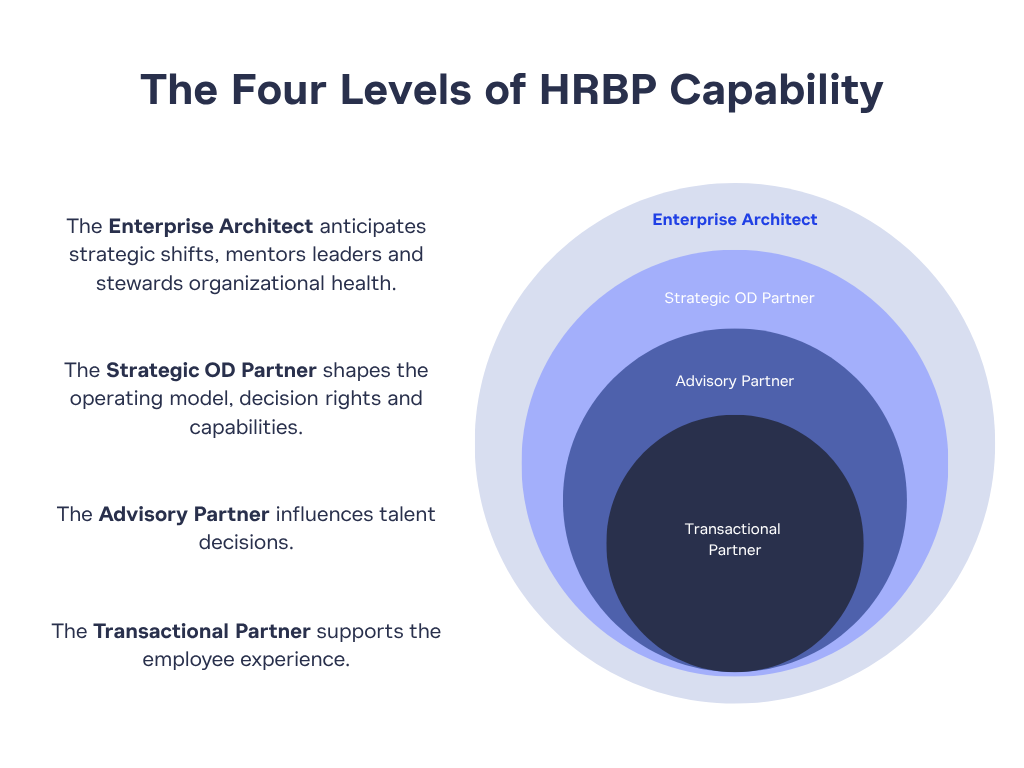
- Level 1: Transactional Partner
Focused on employee relations, compliance and administrative support. Strategic influence is minimal, and most time is spent reacting to day-to-day demands.
- Level 2: Advisory Partner
Participates in planning conversations, uses basic analytics and influences talent decisions. Organization design (OD) contributions happen, but only on an ad hoc basis.
- Level 3: Strategic OD Partner
Co-leads operating model discussions, designs decision rights and shapes capability and workforce strategies. Leads change activation plans that make new designs stick.
- Level 4: Enterprise Architect
Anticipates strategic shifts before they surface, integrates AI and analytics into workforce design, mentors leaders and stewards the organizational health portfolio over time.
Many HRBPs function at Levels 1 and 2, but the strategic value lives at Levels 3 and 4. The roadmap that follows is designed to move your function up that ladder on a predictable timeline.
A Practical Roadmap to Build HRBP Capability
Capability doesn’t develop by accident, and it relies on a solid structure. This 90/180/365-day roadmap sequences the work so momentum builds rather than stalls.
The First 90 Days
The opening quarter is about giving HRBPs the role clarity and practical skills they need to succeed in their strategic positions.
- Role reset. Publish clear HRBP role outcomes and define interfaces with your centers of expertise (COEs) and shared services. Ambiguity about who owns what is one of the fastest ways to stall progress, so remove it early.
- Skill sprint. Conduct OD workshops on operating model design, decision rights and spans and layers—using live business cases, not hypotheticals. Practical repetition builds real capability.
- Strategic embed. Assign HRBPs “design seats” in two to three priority initiatives. Being in the room when trade-offs get made is where influence starts.
The Halfway Point: 180 Days
This is the inflection point where HRBPs shift from observing to shaping how work gets done.
- Partnership rituals. Establish monthly alignment forums with business leaders to review design health and unblock decisions. Consistency here builds the trust that makes partnership durable.
- Analytics uplift. Create a lightweight organizational health dashboard that tracks decision latency, role clarity, handoffs and attrition risk. Keep it simple and visible.
- Shadow-to-lead. Move HRBPs from co-facilitating design sessions to leading them, with coaching alongside. This is where capability converts into visible contribution.
The Finish Line: Day 365
At the one-year mark, the goal is turning individual skill into institutional capability that survives promotions and turnover.
- Certification and community. Formalize an internal OD cohort with practice clinics, playbooks and retrospectives. A peer community accelerates learning across the whole function.
- Scale through playbooks. Institutionalize simple templates—design criteria, decision rights maps and linkage charters—so good practice becomes repeatable.
- Tie to talent systems. Align rewards and development to reinforce new decision rights, collaboration and capability building. If your talent systems don’t reward strategic behavior, you’ll quietly signal that it doesn’t matter.
How Should Leaders Measure HRBP Impact on Organizational Health?
A roadmap is only worth implementing if you can prove it’s working. That calls for a short, disciplined set of metrics in two categories: lagging outcomes help you prove ROI, and leading indicators to help you determine if the transformation is on track.
Outcomes
- Strategy execution. Time-to-decision, time-to-market and throughput on priority initiatives.
- Performance and growth. Productivity, quality and customer impact—plus revenue and profit where the contribution is attributable.
- Engagement and retention. Improved leader and employee sentiment in the areas touched by redesign.
Indicators
- Decision rights clarity. Percentage of your top 10 decisions with a named decide/approve/recommend owner and a clear escalation path.
- Design integrity. Percentage of linkages with defined cadence, inputs and owners, plus measurable reductions in rework and handoff errors.
- Capability readiness. Fill rate of critical roles and demonstrable skill uplift in your differentiating capabilities.
- Adoption. Leader behavior audits, participation in governance forums and completion of role transitions.
These measurements should provide you with a clear look at whether your HRBPs are fulfilling their strategic purpose and helping your organization achieve its strategic goals.
Turning the Roadmap into Reality
A well-designed HRBP model and a well-built HRBP function are not the same thing. This roadmap exists to close that gap—the same gap that separates a strategy on paper from an organization that genuinely operates differently.
The organizations that get this right share three habits. They use the 90/180/365 roadmap deliberately rather than hoping capability appears on its own. They watch leading indicators as closely as lagging ones. And they hold leaders accountable for the handoffs between phases, because that’s precisely where momentum tends to leak.
Do that, and your HRBPs stop being administrators of HR process and become architects of alignment—turning strategic intent into measurable impact, at speed and at scale.
This is Part 2 of our three-part series on HRBPs and Alignment Leadership. Follow us here or on LinkedIn for the next installment.
]]>HRBPs: From Support to Strategy
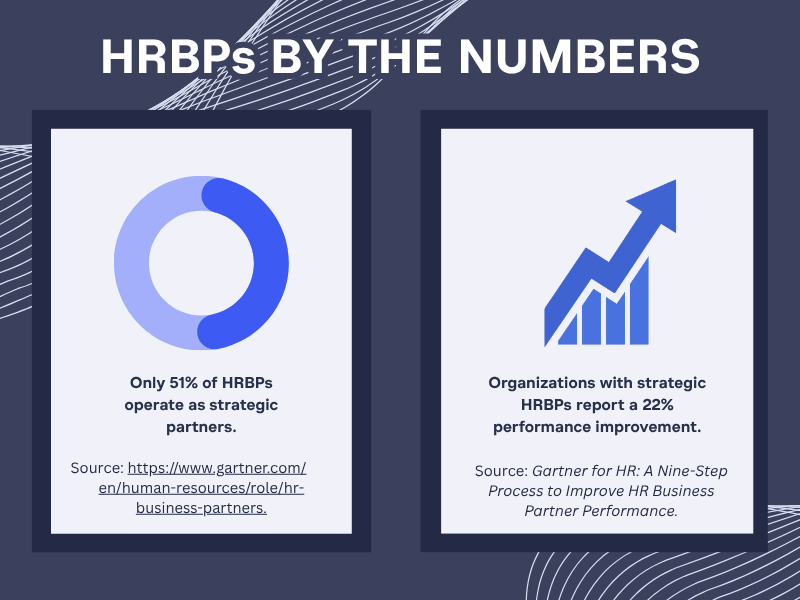
Research shows the HRBP role is at an inflection point. Only about half of stakeholders perceive HRBPs as truly strategic, with many HRBPs consumed by transactional demands. Yet, when HRBPs function as strategic advisors—using data, organization design (OD) tools and change leadership, the gains are tangible: stronger performance, healthier organizations and faster execution of strategic priorities.
The opportunity to use your HRBPs as a stronger asset is clear: shift them from support to strategy, build OD capability and formalize a partnership model where HRBPs help Alignment Leaders win across design and activation.
One of the best ways HRBPs can support Alignment Leaders is by helping translate strategy into an operating system. This means:
- Clarifying the strategic problem to solve
- Identifying differentiating capabilities
- Making structural and governance choices
- Activating change so behaviors, roles and decisions reflect the new design
To deliver this, Alignment Leaders need HRBPs who can:
- Read the systems: detect misalignment across strategy, work, structure, metrics and culture.
- Shape design: use OD tools to connect strategic intent to operating model choices.
- Orchestrate activation: coach leaders, sequence role changes and guide communications so the design sticks.
The Value of a Strategic Partnership
Engaging HRBPs as a strategic partner seems like an obvious solution, but the reality is more complicated. Most HRBPs find themselves devoting the majority of their time to handling personnel issues and daily operations.
Despite the challenges, organizations that can make the shift from generalist support to strategic talent advisor see tangible benefits:
- Improved organizational health: Organizations with capable, strategic HRBPs report higher employee performance and improved financial outcomes — a 2020 Gartner guide reported that businesses with strategically effective HRBPs improved employee retention by 24%, performance by 22%, profitability by 9% and revenue growth by 7%.1 These outcomes show up when HRBPs are embedded early in strategy planning and design—not just involved post-decision.
- Maintained momentum: Experience has shown that HRBPs can serve as a “secret weapon” during and after design, sustaining momentum during implementation, where most transformations falter.
The evidence is clear. When HRBPs and Alignment Leaders work closely together, they play a critical role in keeping an organization healthy and ensuring it meets its strategic goals.
HRBPs in Action
The role of Alignment Leaders is to make choices. HRBPs are then responsible for converting those choices into human systems that perform. We’ve outlined six concrete contributions HRBPs can provide to support Alignment Leaders:
1. Create clear design criteria and tradeoffs
- Work with leaders to set clear rules for design that support strategy, considering factors like speed vs. specialization and customer proximity vs. scale.
- Make tradeoffs clear so structure and decision rights reinforce, rather than dilute, the strategic bet.
2. Apply the design to the operating model and structure
- Translate strategy into work by determining what differentiates the organization and what should be done as efficiently as possible.
- Inform organizing rationale, spans/layers and linkage mechanisms; pressure-test where centralization/decentralization supports capability flow.
3. Determine decision rights and governance
- Map critical decisions and decide who makes the call. Set up simple, transparent decision-making mechanisms to prevent bottlenecks.
- Build leader routines (cadence, forums, metrics) that maintain alignment without adding bureaucracy.
4. Define capabilities and set workforce strategy
- Define mission-critical capabilities; shape staffing, decide whether to build talent internally, hire it or bring it in temporarily, and create focused training.
- Partner with COEs to align rewards, career paths and mobility with the new operating model.
5. Set metrics and track organizational health
- Construct a small, visible scorecard linking design intent to outcomes (cycle time, quality, customer impact, cost).
- Track adoption and health markers such as how fast decisions get made, how clear people are on their roles, and how often work must be redone. Use these signals to make quick adjustments.
6. Help leaders support the change
- Prepare leaders to “live the design” through active support, clear messaging and the small everyday behaviors that reinforce strategy.
- Plan the timing of role changes and communications. Create an environment where people feel safe asking questions and can raise issues quickly.
Putting It Into Practice: A Partnership Model That Works
Alignment Leaders also have an important role to play when it comes to supporting HRBPs in their strategic role. They can catalyze HRBP impact by:
- Treating their HRBP like the chief organizational strategist. This means asking for an explicit point of view on structure, decision flows and capability bets before approving designs.
- Investing in HRBP capability. By funding OD training and providing access to playbooks, they create a safe space for HRBPs to facilitate design debates and challenge assumptions.
Equipped HRBPs do not just “support” change; they architect alignment. They ensure the operating model reinforces the strategic bet, leaders live the design and the organization sustains the change long after workshops end. In a world where strategy cycles shorten and talent markets tighten, that capability is not a luxury—it is a competitive advantage.
If you want alignment that lasts, elevate your HRBP function. Clarify the operating model, build OD capability, embed HRBPs early in strategy and measure design health with discipline. Do that and your HRBPs will become the strategic muscle behind your Alignment Leadership—turning intent into impact, at speed and at scale.
Check back here or follow us at linkedin.com/company/alignorg-solutions for part 2 of this three-part blog series.
1. Gartner. Gartner for HR: A Nine-Step Process to Improve HR Business Partner Performance. 2020.
]]>Across the life sciences sector, common questions are emerging as organizations navigate growth, complexity and changing capabilities.
Our experience spans biopharma, biotech, medtech, medical devices, diagnostics and life sciences, with organizations at very different points in their evolution. Some are expanding into new parts of the value chain. Others are managing increasingly complex portfolios, integrating acquisitions, building enterprise platforms or exploring how AI may reshape work.
The specific organizational challenges vary. What is striking, however, is how often the underlying questions are similar:
- What capabilities should we own?
- Where should they sit?
- What should be shared across the enterprise?
- Where does business-unit autonomy create value?
- How should functions come together around products or assets?
- How does AI change the way decisions are organized?
- And, perhaps most fundamentally, who should make which decisions?
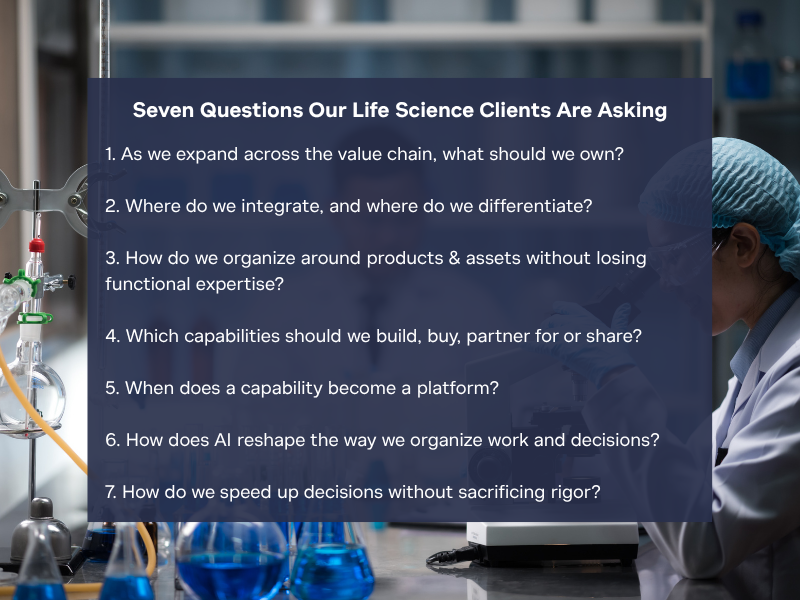
Let’s explore these seven common questions in more detail.
1. As we expand across the value chain, what should we own?
Life sciences organizations are moving beyond their historical areas of focus. Depending on the organization, that can mean adding manufacturing capabilities, diagnostics, clinical support, patient services, data and analytics, digital capabilities or other adjacent offerings.
The strategic rationale can vary, but the organizational implications are often similar.
Adding a capability is not simply a matter of adding people or creating a new function. It can introduce new interfaces, new expertise, new decision rights and new dependencies across the organization.
This creates an important question:
Which capabilities are becoming strategically important enough to differentiate, and which can be delivered effectively through partners or the broader ecosystem?
Organizations often find that the answer is not binary. Some capabilities may need to be deeply owned internally, while others may be accessed through partnerships, outsourcing, acquisitions or shared platforms.
The operating-model challenge is determining where ownership creates meaningful strategic value and where it simply creates additional organizational complexity. That distinction carries real consequences: owning the right capabilities can sharpen differentiation and accelerate speed to market, while owning the wrong ones drains resources, slows execution and delivers little in return. Getting this call right, and revisiting it as the business evolves, is where much of the value is won or lost.
2. As our portfolio matures, where should we integrate and where should we differentiate?
Many large life sciences organizations have already evolved into portfolio models through acquisitions, therapeutic areas, franchises, platforms, business units or geographic expansion.
Once that portfolio is established, another question emerges:
How much should the enterprise operate as one company, and where should individual businesses retain autonomy?
We see organizations navigating a familiar set of tensions:
- Enterprise scale and business-unit autonomy
- Standardization and flexibility
- Shared capabilities and differentiated capabilities
- Enterprise governance and speed of decision-making
- Common platforms and business-specific requirements
There is no universal answer. What makes sense depends on where value is created, where expertise resides, where scale matters and where differences between businesses are strategically meaningful.
The right balance can change as a portfolio matures. The organizational choices that make sense during acquisition or rapid expansion may look very different once businesses, capabilities and platforms become more established. Organizations that design fluidly can adjust as the market shifts. They’re better able to absorb new capabilities and new technologies without triggering a disruptive, top-to-bottom reorganization every few years. That agility protects speed to market and preserves momentum when conditions change quickly.
3. How do we organize around products and assets without losing functional expertise?
We are seeing increasing interest in bringing technical, scientific, medical, commercial, manufacturing and operational capabilities together around products, assets, programs or therapeutic areas.
The intent is straightforward: create greater end-to-end accountability, improve alignment and reduce the friction that can occur when important decisions cross functional boundaries.
But bringing people together around an asset does not eliminate the need for deep functional expertise.
It raises a different question:
What should be organized around the product or asset, and what should remain organized around the function?
This creates a balance between functional depth and end-to-end accountability.
The organizational structure is only part of the equation. The more consequential questions often involve who owns the outcome, who owns the expertise, who makes tradeoffs and how disagreements are resolved when functional and product priorities diverge.
In that sense, cross-functional operating models are as much about decision rights and interfaces as they are about reporting relationships.
4. Which capabilities should we build, buy, partner for, or share?
“Make vs. buy” has traditionally been framed as a sourcing or cost question.
Increasingly, it is also an operating-model question.
As capabilities become more specialized, organizations are considering not only whether they can perform the work internally, but how much organizational capability they actually need to own.
The choices can span a broader spectrum:
Build internally → acquire → partner → outsource →divest →access through an enterprise platform
The answer can also change over time.
A capability that begins as an outsourced service may become strategically important enough to develop internally. Conversely, an internally developed capability may eventually become something the organization can access more efficiently through a partner or shared platform.
The recurring question is therefore less about whether something is “make” or “buy” and more about:
Where do we need to own the expertise, decisions and organizational muscle ourselves?
That distinction becomes particularly important when a capability has implications for differentiation, intellectual property, speed, risk or long-term strategic flexibility.
5. When does a capability become a platform?
We’re also seeing movement away from repeatedly building capabilities around individual programs or businesses. Instead, organizations are creating reusable enterprise capabilities and platforms.
This can occur across areas such as manufacturing, clinical operations, data, technology, analytics and scientific capabilities.
The underlying idea is compelling: build something once, establish scale and expertise and allow multiple parts of the organization to benefit.
But platform models introduce a different set of operating-model questions:
- Who owns the platform?
- Who funds it?
- Who determines priorities?
- How do businesses influence the roadmap?
- Who establishes standards?
- What happens when the needs of one business conflict with the needs of the broader enterprise?
A platform therefore changes more than where a capability sits.
Once multiple businesses depend on a shared capability, the organization needs mechanisms for making enterprise-level decisions about that capability.
In this sense, platformization is as much an operating-model decision as it is a technology or capability decision.
6. How does AI change the way work and decisions are organized?
AI is generating significant discussion across life sciences, but one key question extends beyond the technology itself.
If AI changes how work gets done, what happens to the way that work is organized?
The implications could extend across several dimensions:
Work: What activities change, accelerate, or become automated?
Capabilities: What new expertise becomes important?
Structure: Where do those capabilities reside?
Decision-making: Which decisions can be augmented by AI, and which require human judgment and accountability?
Governance: What new controls, oversight and risk-management mechanisms are required?
One possibility is that AI’s organizational impact will not come primarily from eliminating entire functions. Instead, it may change the boundaries between roles, functions and capabilities.
That could make existing operating-model choices more visible.
Where work currently moves through multiple handoffs, where decisions are fragmented, or where expertise is difficult to access, AI may create opportunities to rethink how those connections work.
7. How do we increase decision speed while maintaining rigor?
For life sciences organizations, organizational agility has a particular constraint: speed matters, but so do quality, safety, scientific rigor, regulatory requirements and risk management.
That makes governance an especially important operating-model question.
The challenge is not simply to reduce governance.
It is to understand:
Which decisions need enterprise oversight? Which can be made closer to the work? Who has the authority to decide? And when does a decision need to be escalated?
We are seeing organizations revisit decision rights, governance forums, approval processes and escalation paths with this in mind.
One observation is that greater agility does not necessarily require fewer controls.
It can instead come from clearer decision rights, fewer unnecessary handoffs and greater clarity about which decisions require escalation.
For organizations operating in highly regulated environments, that distinction can be particularly important.
What connects these questions?
While these seven questions appear different on the surface, they point toward a common challenge.
Life sciences organizations are increasingly designing around capabilities and the connections between them, rather than simply around functions or organizational boxes.
As capabilities expand, portfolios mature, platforms emerge, partnerships increase and technology changes the nature of work, organizations must continually make choices about four things:
Integration: Where does bringing capabilities together create value?
Differentiation: Where does the organization need specialized capabilities or autonomy?
Ownership: What should be built and maintained internally versus accessed through the ecosystem?
Decision rights: Who needs to make which decisions, and at what level?
There’s no single operating model that works across biopharma, biotech, medtech, medical devices, diagnostics and life sciences. Even organizations within the same sector can have very different strategic priorities and organizational needs.
What appears more consistent are the questions leaders are having to navigate.
The answers will vary. But increasingly, the ability to make those choices deliberately, and to evolve them as the organization changes, may be as important as the organizational structure itself.
The operating model is ultimately not just a question of where capabilities sit, but how those capabilities, accountabilities and decisions work together to create value.
]]>The results? Mixed. Operational costs drop. But guest satisfaction scores—the hotel’s defining metric for decades—begin to slide. Long-time guests feel processed, not welcomed. The brand’s hallmark sense of personal connection has quietly eroded.
Nobody made a reckless decision. But somewhere between the technology roadmap and the rollout, a critical question went unasked: Which of our capabilities actually make us who we are, and which ones just keep the lights on?
The Real Challenge Isn’t Adopting AI. It’s Knowing Where to Apply It.
Across industries, executives are under real pressure to move quickly on AI. The tools are increasingly accessible, use cases are multiplying and competitors are experimenting broadly. The instinct is to act.
But, as we note in our Executive Guide, Designing AI Into Your Operating Model, “Without clarity, it’s easy to apply AI generically—standardizing what should be distinctive or optimizing what should be reimagined.”
The executives who generate sustained competitive advantage from AI aren’t just moving fastest. They’re moving deliberately to focus AI on the capabilities that reinforce their unique value proposition, not just the areas where automation is easiest.
Start with the Work: Distinguishing Differentiating from Foundational Capabilities
This process starts with understanding the two types of organizational capabilities:
Differentiating capabilities are those that directly shape how customers perceive your value. They reinforce your strategic identity and are the reason clients choose you over alternatives. For the luxury hotel, that’s the personalized guest experience. It means knowing a guest’s preferences before they ask and making them feel recognized rather than processed.
Foundational capabilities are necessary but non-distinctive. Compliance management, billing, inventory tracking and standard reporting all keep the organization running, but they don’t win customers. They’re table stakes.
This distinction matters enormously because it determines where and how AI investments create the highest return:
- Applied to differentiating capabilities, AI should amplify by deepening personalization, enabling real-time responsiveness and extending what your best people can do.
- Applied to foundational capabilities, AI should drive efficiency by reducing cost, increasing consistency and freeing human talent for higher-value work.
Let’s return again to our luxury hotel. AI-powered demand forecasting, automated check-in and housekeeping all belong in the foundational tier. But the personalized guest experience—knowing that a returning guest prefers extra pillows, a quiet room and a late checkout—that’s differentiating. AI here should support and extend human judgment, not replace the warmth that defines the brand.
Match AI Depth to Strategic Intent
Once capabilities are classified, the next step is defining how deeply AI should be integrated. In our guide, we identify three distinct levels of strategic intent:
- Optimize: Automate and streamline existing processes to drive efficiency. Best applied to foundational work.
- Transform: Rethink how work is performed, restructuring workflows and roles to create meaningful differentiation. Suited to high-value, customer-facing capabilities.
- Expand: Unlock entirely new capabilities, insights or value offerings that open new market opportunities.
Each level demands a different investment profile, governance model and organizational design. Mismatching them is where many AI initiatives lose traction. Over-engineering a transactional process with transformative-level AI investments dilutes strategy. Under-investing in differentiating capabilities with basic automation misses the competitive opportunity entirely.
Strategic intent also shapes accountability. When AI is driving transformation in a customer-facing capability, who owns the outcomes? Who decides when AI recommendations are acted on, and when human judgment overrides them? These aren’t IT questions. They’re leadership questions, and they need answers before deployment, not after.
AI Isn’t a Strategy—It’s an Enabler
There’s a pattern in organizations that struggle with AI: they treat it as a strategy in itself. They set adoption targets, track tool deployment metrics and measure success by the number of functions touched. But none of that creates competitive advantage.
AI amplifies what’s already in your system, good or bad. A coherent strategy gets amplified. A fragmented operating model gets more fragmented. An organization with clear differentiating capabilities deepens them. One without strategic clarity standardizes everything, including the things that made it distinctive.
Where to Start
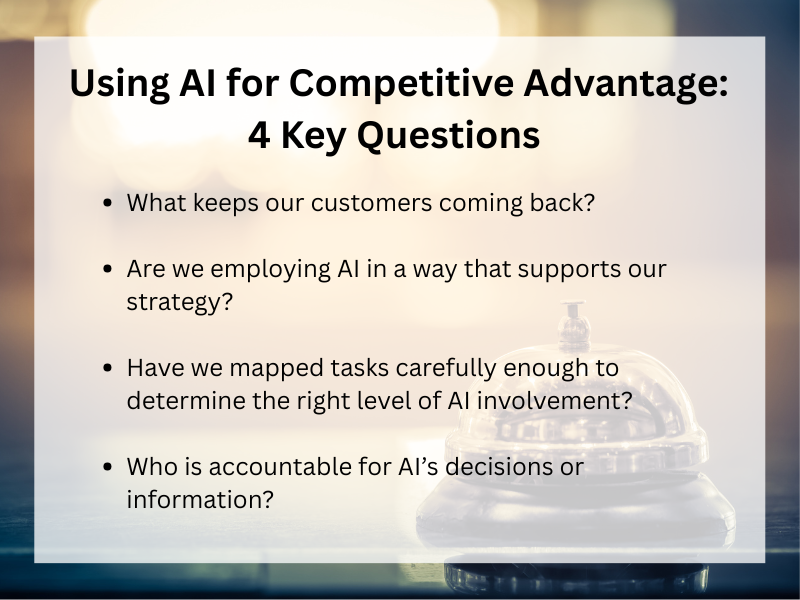
If you’re evaluating or scaling AI integration across your organization, these are the questions worth prioritizing:
- What are our differentiating capabilities? Where does customer perception of our value actually come from?
- Where are we applying AI—and does that match our strategic intent? Are we optimizing foundational work and amplifying differentiation, or accidentally standardizing what should be distinctive?
- What does each type of work demand? Have we mapped tasks carefully enough to determine the right level of AI involvement?
- Who is accountable when AI informs or executes decisions? Are decision rights clear before deployment?
Getting these answers right before scaling AI investment is the difference between building a competitive advantage and building an automated version of the status quo.
]]>Dive deeper into the insights from our executive guide, Designing AI Into Your Operating Model, with this live webinar. Learn how to align AI with your strategy and workforce, and gain practical strategies to lead your organization into the future.
What You’ll Learn:
- Aligning AI with your strategy for maximum impact
- Preparing your workforce for AI-enabled roles
- Real-world case studies and actionable takeaways