The post Ask an Expert: Advice for counseling students appeared first on Counseling, Leadership and Special Education Blog.
]]>The 2023 Mental Health America report noted Missouri’s overall ranking as 39th place in the United States.
Dr. Karrie Swan, graduate counseling program director at Missouri State University, spoke with CounselingSchools.com about becoming a counselor.
The post Ask an Expert: Advice for counseling students appeared first on Counseling, Leadership and Special Education Blog.
]]>The post Accessible language for all appeared first on Counseling, Leadership and Special Education Blog.
]]>Many hearing people are not aware of the depth of deaf culture and how they can make language more accessible.
Dr. Karen Engler, clinical professor and graduate program director of special education-education of the deaf and hard of hearing, provides insight on deaf awareness.
September is National Deaf Awareness Month.
The post Accessible language for all appeared first on Counseling, Leadership and Special Education Blog.
]]>The post What if your child struggles in a classroom? appeared first on Counseling, Leadership and Special Education Blog.
]]>When a child has an emotional or behavioral disorder, educators must work with parents and students to develop goals, a beneficial plan and appropriate structure.
Dr. Reesha Adamson, associate professor of special education at Missouri State University, shares about developing positive learning environments and implementing inclusive instruction.
In 2021, she and Dr. John William McKenna from the University of Massachusetts – Lowell wrote the book “Inclusive Instruction for Students with Emotional and Behavioral Disorders: Pulling Back the Curtain.”
Making school more fluid for kids with behavioral disorders
Getting the structure in place
When a student will be moving between a special education and general education classroom, there is a lot of necessary coordination, said Adamson, and it begins before the student ever enters the inclusive classroom.
A general educator and special educator have to meet and work together regularly to set goals, build supports and determine accommodations needed to help students in an individualized manner.
The book includes tips and strategies for educators, but Adamson says it all comes down to flexibility and assessing the question: What is best for this student in this time and in this place?
When a peer is in a crisis
Between 20-40% of students will experience a behavioral or emotional disorder during their lifetime, according to Adamson. This underscores the importance for empathy and understanding among peers, parents and educators.
Read the transcript
The post What if your child struggles in a classroom? appeared first on Counseling, Leadership and Special Education Blog.
]]>The post Effective assessments in an era of accountability appeared first on Counseling, Leadership and Special Education Blog.
]]>Professionals in the field of student affairs in higher education (SAHE) partner with academic affairs units on different campuses to create holistic collegiate experiences that support undergraduate student success that results in degree attainment.
Since 2015, the Division of Student Affairs (DOSA) and the SAHE Program have partnered to hold a campus wide assessment symposium which features academic work completed by SAHE students at MSU.
“Students in our master’s program learn about the different assessment evaluation tools they can use to assess the effectiveness of campus units and how they contribute to undergraduate student success,” explained Dr. Gilbert Brown, SAHE program director.
“The symposium helps our new professionals gain skills that are needed in the workplace, and it contributes to the office of student affairs here at MSU.”
The assessment symposium
Graduate students in the SAHE program present their research at the assessment symposium as part of their academic requirements.
“Our first-year students develop an assessment protocol for trying to determine the effectiveness of a unit and our second-year students have completed their project,” Brown said.
“When our students graduate from MSU, they’re ready to hit the ground running when they are hired by another university.”

Skills for success
Brown knows both the ropes and the challenges that new SAHE professionals face as they enter the field.
“We have to improve our understanding of how to use social media to make sure undergraduate students have good experiences on campus,” Brown explained.
“Universities often have limited resources, so having evidence of effectiveness is necessary to point to what is working.”
The skills SAHE students gain through the assessment symposium allow them to contribute to undergraduate student success on the MSU campus and wherever their future career takes them.
The success of the assessment symposium points to the preparedness of the students within the program, as well as the professional collaboration that takes place at MSU.
“The Division of Student Affairs here on campus and our academic program work well together to prepare the next generation of student affairs professionals,” Brown said. “I’m pleased with the professional partnership we have with our colleagues.”
The post Effective assessments in an era of accountability appeared first on Counseling, Leadership and Special Education Blog.
]]>The post Learning the administrative side of education appeared first on Counseling, Leadership and Special Education Blog.
]]>The College of Education’s department of counseling, leadership and special education collaborates with local school districts to create cohorts of educators who earn their master’s in educational administration.
“If a district can foresee that there are going to be job openings within the community, they can encourage people with good leadership skills in their district toward that role,” explained Dr. Kim Finch, director of the educational administration program.
“Our program is also good for the classroom teacher. The coursework gives an awareness of what takes place in the office and why things may be handled the way they are.”
The cohort model
One of the benefits of the cohort model for educational administration is that districts can personalize the curriculum for their faculty.
Twelve hours of the degree are earned as credit-by-assessment and are taught by the district.
“We send them our syllabus along with our assignments. This allows them to tweak it so that it can better align with their district,” Finch explained. “Sometimes those assignments might be projects that the school board requested.”
Students within the cohorts save money on tuition since they earn 12 credit hours through their district.
Nixa Public Schools (NPS) currently participates in the program.
“This partnership with MSU is mutually beneficial for our students and district alike,” said Josh Chastain, executive director of curriculum, instruction and assessment at NPS. “Students benefit financially, and our district gains dedicated, highly trained and NPS-focused administrative candidates.
“MSU wants to support our teachers in their graduate endeavors and make sure our students are able to receive necessary professional learning.”
Contact Dr. Kim Finch about forming a cohort
Encouraging educators
A master’s in educational administration allows teachers to earn a salary increase in addition to their certification to become an administrator.
“Sometimes people who go through our program just want a master’s degree,” Finch said. “But we encourage everyone to get certified. Down the road, you may want to apply for an opening, and you will already have obtained the right classes and assessments.”
Missouri needs more teachers and administrators right now, so Finch said it’s important to have professional development accessible to educators and future educators.
She emphasized the necessity for building positive relationships with students in the program and highlighting the positive things happening across the field of education.
“Education is the background for everything, whether you want to be a doctor, a banker or whatever. If we don’t have a good education system, then all other professions will be affected.”
Explore a master’s in educational administration
The post Learning the administrative side of education appeared first on Counseling, Leadership and Special Education Blog.
]]>The post Reduce negative classroom behaviors with de-escalation strategies appeared first on Counseling, Leadership and Special Education Blog.
]]>“Restraint restricts a child’s movement, while seclusion involves removing a child from the academic context,” said Dr. Reesha Adamson, a special education expert at Missouri State University. “Historically, our schools have underreported these incidents.”
While kids misbehaving in the classrooms isn’t unusual, it has been happening a lot more. One contributing factor is COVID-19 and the move to virtual instruction.
According to Adamson, an associate professor in the department of counseling, leadership and special education at Missouri State, schools often act as first responders, connecting kids with additional supports and services beyond educational needs.
During the pandemic, students lost that support system due to less time spent in the school environment.
“For kids already having issues, COVID provided a level of trauma to their lives that we haven’t experienced before,” Adamson said. “And when you think about trauma and how that manifests, it manifests sometimes in kids as that acting-out behavior.”
Preventing acting out in classrooms
Preventing outbursts
The key to minimizing and preventing negative classroom behaviors is de-escalation.
“It’s trying to make sure a student never gets to that point where he or she is out of control and requires additional supports and interventions,” Adamson said.
De-escalation involves using the seven phases of a crisis cycle – calm, triggers, agitation, acceleration, peak, de-escalation and recovery – to individualize prevention and recovery strategies.
Understanding a child’s curve
While it’s common to think of the cycle as a bell curve – a student starts out calm, moves up to a peak phase and then gets back to recovery – the curve will look different for each child.
So, using techniques specific to each of the seven phases in the crisis cycle can help students minimize or avoid disruptive behaviors.
Adamson and her team have mapped out specific strategies at each phase within that cycle for teachers and school personnel to consider.
“For example, if a kid is calm, what should you be doing? You should be teaching because when kids are calm, they’re ready to learn,” Adamson said.
“You should be teaching not only academic pieces, but also practicing for what happens if. What happens if you do get upset? How could we try something different or go someplace different that maybe will limit getting higher on that escalation curve?”
Adamson adds it’s also important to help kids know their spot on the curve in moments of crisis.
“It involves getting them to think about physiological changes they may feel to know they’re getting escalated,” Adamson said. “So, it’s not only on the teacher’s part to say, ‘What can I be doing to support this kid,’ but also for that kid to know what I can be doing to support myself.”
The post Reduce negative classroom behaviors with de-escalation strategies appeared first on Counseling, Leadership and Special Education Blog.
]]>The post The rise and return of a phoenix in education appeared first on Counseling, Leadership and Special Education Blog.
]]>He acknowledges that his own experience enables him to relate to the students.
“I was once a student who was considered at risk. I was the product of a broken home, a child in the foster system, and a student who had always struggled academically. I relate to the students in more ways than one. I believe representation matters,” Mark said.
Fittingly, his school’s mascot at SOS is the phoenix.
“Seeing students succeed brings me the most joy. I love watching the transition. The analogy between the phoenix and our students is that of a ‘rebirth’ once they leave the facility. We hope our efforts have made a difference in these students’ success moving forward,” he said.
Teachers were a major influence in his early life
When Mark was a senior in high school, he chose to work in the Special Education classroom for his work study class because he knew a few of the students in the program. Once he began, he fell in love with the work and became passionate about pursuing his career in special education.
“Several educators over time encouraged me to become a teacher. In high school, I had a math teacher who was the sweetest lady. She would go over every problem that was assigned for homework from the previous night as there was someone who did not get the answers correct. She did this with the biggest smile,” Mark said.
Discovering the teacher’s school
To become a teacher, Mark needed a plan. While he began his studies in a community college, he knew that Missouri State University would be his top transfer choice for completing his bachelor’s degree in education. After visiting several other campuses across Missouri, Mark was also attracted to MSU’s reputation and legacy for teaching educators. The school also offered him the most scholarship opportunities.
“Both of my academic advisors (Stephanie and Judy) were also very helpful. My transition to MSU from OTC was met with several challenges. Those ladies worked so hard to get things in order so I could continue with the Special Education program.”
Pathways for Paras
During his time as a college student, Mark also worked as a paraprofessional, where he assisted the teachers at Springfield Option Site. “The experience I gained as a para most definitely prepared me for the reality of the classroom,” he said. “When I worked as a paraprofessional and a student, I learned so much about myself and my endurance.”
Missouri State University recognizes the opportunity that paraprofessionals gain from their experience working in classrooms and has developed a partnership with Missouri State Public Schools. The program is called Pathways for Paras and works with paraprofessionals to help them finish their degrees to become special education teachers. Since special education teachers are in high demand in the state of Missouri, this program was designed to work around the schedule of those who are already working in the classroom environment.
“If any person is interested in teaching in any capacity, I would highly encourage becoming a paraprofessional during your time,” Mark said. “I was more prepared for student teaching as a result and even more prepared when I became a classroom teacher. I was able to get experiences I would have otherwise not been able to receive had I not become a paraprofessional first.”
Mark gained confidence working in the classroom while he studied at MSU. Little did he know that years later he would return to become principal of the same school he worked in as a paraprofessional.
Learn more about Pathways for Paras
Returning to SOS
After Mark graduated and completed his Masters of Science in Special Education with an Emphasis in Autism Spectrum Disorders, he applied for a position at a high school district program. This is where he started as a special education teacher. His first classroom was similar in nature to the classroom he had worked in as a paraprofessional. After working in the teaching profession for several years, he also worked his way up in administration.
When he was offered the principal position at SOS, Mark reminisced about his early days as a paraprofessional during college. “Coming back to SOS reminded me of why I started in education in the first place,” he said. “My passion is to really make a difference in these students’, lives and shift the narrative on residential treatment facilities.”
“The career of teaching is rewarding yet tedious and is often overlooked. When you add Special Education to the mix, multiply that statement by a thousand. The greater reward though is watching some of the most challenged students persevere and transition into adulthood knowing that at some point in their lives, I played a role in their success. Being a Special Educator was one of the greatest decisions I made in my adult life.”
Story by: Brenna Davis
The post The rise and return of a phoenix in education appeared first on Counseling, Leadership and Special Education Blog.
]]>The post Responding to mental health trends appeared first on Counseling, Leadership and Special Education Blog.
]]>This is a trend that Robin Farris, licensed counselor and director of Missouri State University’s Center City Counseling Clinic (CCCC), observed over the past decade.
“We used to tell students ‘You might see suicidal issues in a semester,’” Farris said. “Now, we tell students ‘You WILL see clients with suicidal ideation every week.’” This has increased so much that students now take a mandatory training in suicide prevention before they even start working with clients.
The clinic is a community outreach of the department of counseling leadership and special education at MSU.
Missouri State master’s level students obtain direct client contact experience by providing counseling sessions to adults, teens, children and couples at the clinic under the supervision of licensed instructors.
“We are proud of our ability to assist between 80-90 people per week with their emotional struggles and mental health issues,” said Farris. “For many of our clients, it’s a service they just couldn’t afford if not for the clinic’s sliding scale policy. We won’t turn away anyone because of an inability to pay.”
Learn more about the Center City Counseling Clinic
Mental health concerns
Mental health is a complex issue, specifically when considering the recent uptick in anxiety, depression and suicidal ideation
“There is so much rapid change with technology and so much crisis with the whole world – environmentally, economically and politically,” Farris said. “So much of that stress is felt by people in their day to day without them being consciously aware of it.”
While the recent pandemic has brought these issues to the forefront, the trend existed before quarantine and social distancing protocols.
“People are so frantic for life, meaning and connection,” Farris said. “They don’t know which way to go, so they’re just crashing.”
Negative stigmas around mental health care still exist, but attitudes are becoming more compassionate thanks to better education about mental health.
“It’s not just about physical and spiritual health. There’s also mental and emotional health,” Farris said. “To be a healthy, well-rounded person, we need to be as balanced and healthy as we can across these categories.”
Making a difference
The Council for the Accreditation of Counseling and Related Educational Programs (CACREP) accredits the counseling program. This gives students a leg up in their job search after graduation.
In addition to receiving training through an accredited program, MSU students learn to navigate a variety of intense concerns that shape the role of counselors.
Farris said the Center City Counseling Clinic is known for its warm, inclusive environment and receives positive feedback each semester in their anonymous surveys of clients.
“I’m always proud to pass positive feedback on to students,” she said. “They may be in their early stages as counselors, but they are making a difference.”
Access campus mental health resources
The post Responding to mental health trends appeared first on Counseling, Leadership and Special Education Blog.
]]>The post Gaining access to the world appeared first on Counseling, Leadership and Special Education Blog.
]]>Now imagine accomplishing them without sight.
Missouri State University’s orientation and mobility (O&M) program trains students how to assist individuals with visual impairments. This includes providing individuals with the tools and experience they need to navigate the world independently.
Missouri State also offers the blindness and low vision teacher education (B&LV) program. The program ensures that teachers can provide the accommodations necessary for students with visual impairments to excel in the classroom.
“Blindness and low vision are low incidence disabilities, so they can get pushed aside,” Dr. Shari Scott, B&LV program coordinator, said.
“Even if you have just one person who needs Braille or access to large print, it’s worth providing that support.”
The O&M and the B&LV programs at MSU recently received national accreditation from the Association for Education and Rehabilitation of the Blind and Visually Impaired (AERBVI).
The difference access can make
Providing visually impaired students with accommodations in the classroom is crucial to allowing them to participate in everyday life.
Dr. Christopher Craig, deputy provost at MSU, learned this at a young age when attending the Missouri School for the Blind. He credits the school with much of his success in discovering how to navigate his environment despite his visual impairment.
“Part of what I’ve been able to do in my life, including being deputy provost, is because I had a strong skill base for learning how to cope and communicate,” Craig said. “Every kid deserves to be taught reading by a qualified teacher.”
The blind and low vision certification ensures that students with visual impairments can manage classroom materials like textbooks, course websites and other media that is consumed visually.
As the skills needed for success go beyond the classroom, the orientation and mobility program covers everything from cane skills to public transportation and metro travel.
To get an O&M certification, students spend more than 20 hours under a blindfold learning the skills they will be teaching to individuals with visual impairments.
“Even if someone can read Braille and access the world digitally, they may not feel comfortable hopping on a plane and going to Brazil,” Scott said. “Learning orientation and mobility opens up the world.”
A broader vision
Craig began developing these programs at MSU with the hope that they would produce the specialized instructors needed to better serve people with visual impairments.
“I started this program in Missouri because there were children with visual impairments who needed greater care. They weren’t learning Braille, communication skills or how to use assistive technologies,” Craig said.
“There also was nothing in Missouri to help these children learn how to physically get around.”
With proper accommodations, people with visual impairments can meet their full potential alongside their sighted peers.
“Having a job brings self-fulfillment and self-actualization,” Scott said. “If you have a sensory deprivation, such as hard of hearing or blindness, you can benefit from a specialized instructor to help you navigate functional skills.
“One of my former students was the first blind student to go to Columbia University in New York. The things he is doing in journalism today are totally amazing.”
MSU is bringing these necessities to students who need them, providing opportunities for them that would otherwise be inaccessible.
“This is bigger than just the university,” Scott said. “The K-12 kids in Missouri who don’t have instructors are front and center for us, but preparing specialized instructors goes beyond that. We are part of a global endeavor to improve accessibility.”
About the accreditation
While the B&LV program receives its teacher-certifying credentials from the Missouri Department of Elementary and Secondary Education (DESE), the AERBVI accreditation endorses the program as effective preparation.
For the O&M program, the AERBVI is the certifying body. The accreditation allows for students in MSU’s O&M program to graduate fully licensed.
MSU is one of just 12 universities with an accredited O&M program across the United States.
Learn more about the accreditation
The post Gaining access to the world appeared first on Counseling, Leadership and Special Education Blog.
]]>The post Serving individuals with autism appeared first on Counseling, Leadership and Special Education Blog.
]]>As a freshman at Missouri State University, Taylor Janota worked as a nanny for a young boy who had autism. In this role, she watched as a speech therapist, physical therapist and behavioral analyst worked with the boy to improve all parts of his life.
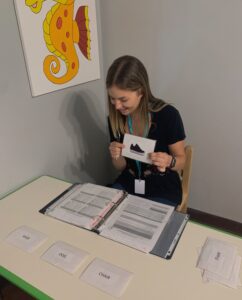
“This little boy didn’t have any way of communicating with others, but we were able to work with him to build that skill set,” Janota, now a board-certified behavior analyst for Emergent Learning Center in St. Louis, Missouri said. “It was cool to see the collaborative process and the critical thinking that had to happen in order to set this child up for success.”
With a passion for autism and language, Janota pursued her bachelor’s in speech language pathology and started in a graduate program.
She soon discovered that she missed the behavioral side of working in therapy, so she refocused her graduate path to a master’s in special education with an autism emphasis.
She also set her sights on applied behavior analyst (ABA) credentials, which she could prepare for with the experiences from her graduate program.
Professional experiences
As a graduate student, Janota worked closely with her professors, collaborated across departments and did practicums in school and clinical settings.
“I was able to conduct research and do a lot of different things within the realm of autism,” Janota said. “I got experience working with kids, practicing intakes and data collection – all the skills that I use now in my career.”
The ABA credentials are acquired after passing a national certification exam, which is taken separately from the typical classwork.
“The exam is known as ‘the beast,’ and it is a little nerve-racking,” Janota laughed. “It definitely took some studying, but I was very surprised with how well prepared I felt for it.”
Celebrating little victories
In her career, Janota has learned to appreciate growing with her clients.
“When you’re going into this field, you are going to learn a lot about these individuals who you’re serving and you’re going to learn a lot about yourself,” Janota said. “I’m someone who likes to see progress quickly, but I’ve realized that’s not life.”
Janota works consistently with the same clients in a clinical setting, so she gets to see her clients in each step of their journey.
“This work has given me a new lens for looking at progress,” Janota said. “Even if it’s just a little bit of progress, that’s progress, and that’s something to be celebrated.”
Explore autism spectrum disorder graduate programs
The post Serving individuals with autism appeared first on Counseling, Leadership and Special Education Blog.
]]>