The post Flame Gun Warning: You Be The Judge appeared first on Abnormal Use.
]]>
Now this thing looks useful! After all, it’s “the gun of 1000-and-1 uses!” Perfect for, um, well, I guess when your gas stove won’t light, this could do the trick! Apparently, it’s so easy to use that “Even your wife can use it.” Wasn’t 1972 a little late for those kinds of statements? Actually, the helpful ad suggests a few other uses, including destroying insects, anthills, and old wasp nests from a “safe distance.” But the real kicker, in our opinion, is that this unit is advertised as being of use BOTH indoors and outdoors. Are we the only ones who think this is a BAD IDEA? The copyright on the bottom of the helpful ad shows that the project is registered to Bevis Industries, which apparently no longer exists. We can’t imagine why!
The post Flame Gun Warning: You Be The Judge appeared first on Abnormal Use.
]]>The post On warning labels and remote control helicopters appeared first on Abnormal Use.
]]>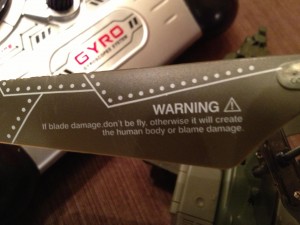
This picture was forwarded to me by a friend after he purchased a remote control helicopter. Maybe Santa brought you one of these in your stocking as well. In case you can’t see the warning printed on the blade, it reads as follows:
WARNING. If blade damage, don’t be fly. otherwise it will create the human body or blame damage.
Clearly, this warning label has some problems, but we thought that it would be a great time to review warnings standards, and discuss specifically what the drafter could have done better (at least under South Carolina law). First, when is a warning required in the first place? Basically, if it is foreseeable that users might need to be warned about the precise risk involved with using a product, it will be required. See, e.g. Madden v. Cox, 284 S.C. 574, 328 S.E.2d 108 (Ct. App. 1995). Warnings are not required when the danger is open and obvious to the user. Moore v. Barony House Rest., LLC, 382 S.C. 35, 41, 674 S.E.2d 500, 504 (Ct. App. 2009). The issue of foreseeability has been the subject of litigation as well–how broadly should a manufacturer foresee that the product will be used, either appropriately (intended use) or inappropriately (non-intended use)? One case provides a good guide:
“Intended use” is but a convenient adaptation of the basic test of “reasonable foreseeability” framed to more specifically fit the factual situations out of which arise questions of a manufacturer’s liability for negligence. “Intended use” is not an inflexible formula to be apodictically applied to every case. Normally a seller or manufacturer is entitled to anticipate that the product he deals in will be used only for the purposes for which it is manufactured and sold; thus he is expected to reasonably foresee only injuries arising in the course of such use.
However, he must also be expected to anticipate the environment which is normal for the use of his product and where, as here, that environment is the home, he must anticipate the reasonably foreseeable risks of the use of his product in such an environment. These are risks which are inherent in the proper use for which his product is manufactured.
The warning must be appropriate; implicit in the duty to warn is the duty to warn with a degree of intensity that would cause a reasonable man to exercise for his own safety the caution commensurate with the potential danger. From this it follows that the likelihood of an accident taking place and the seriousness of the consequences are always pertinent matters to be considered with respect to the duty to provide a sufficient warning label, and that there is a particular need for a sufficient warning where there is a representation that the product in question is not dangerous.
In the case of our remote control helicopter, I think it’s a safe bet to say that there would be enough evidence to get to a jury on the issue of the adequacy of this warning. If anyone has any arguments, please let me know.
The post On warning labels and remote control helicopters appeared first on Abnormal Use.
]]>The post The Wackiest Warning Labels of 2012 appeared first on Abnormal Use.
]]>Well, 2012 was no different for the Center for America. Once again, its loyal devotees submitted warning labels for the contest, and the “wackiest” have now been chosen. Here is the winner of the 2012 contest:

Well, I suppose I must remove my globe from my car’s dashboard! A complete list of the Wacky Warning Labels contest is here.
In other navigation news, several news outlets have reported that Australian police are warning users of Apple Maps, a feature of the newest iPhone, that following its directions can be life-threatening. Really? Yes. Apparently, people using the feature to find Midura, Australia are directed not to the small town, but 40 miles away to a remote part of Murray-Sunset National Park in the Australian Outback. This is no small sort of error. Temperatures can reach more than 100 degrees, and there is no water source in the park. Several travelers were rescued by the police. On the bright side, it appears that the iPhone gets great cell service in the Outback.
Perhaps while Apple is scrambling to fix its widely criticized maps application, we can come up with an adequate warning to help in the case of an unanticipated detour: “Warning: Use of This Maps Application Can Be Life Threatening.” “Objects on Map are Further Than They Appear.” “Make Sure to Carry Plenty of Food and Water When Using Navigation System.” “Beware of Crocodiles.”
Maybe we’ll see some of those in next year’s contest.
The post The Wackiest Warning Labels of 2012 appeared first on Abnormal Use.
]]>The post On Blog Posts and Bumbo Baby Seats appeared first on Abnormal Use.
]]>Case in point. Recently, I received a notice by email and in the mail that there has been a recall on Bumbo Baby Seats. If you have no idea what I’m talking about, here’s a picture of one of these contraptions before the recall:
 Now, I know it looks like a medieval torture device. It’s not. It’s one of the best baby products ever invented. You put your not-quite-sitting-up-infant in the seat and WHAMO! He can sit up! The seat is light, and babies love it. One important thing about this seat, or at least I thought, is that the baby is so wedged into the chair that he can’t tip it over, or tip himself out of it. Both my sons have used the Bumbo, and neither one has ever tipped out of it.
Even before the recall, there were warnings. Users are told not to use it in the bathtub or on raised surfaces, and there is also a warning to always watch your baby when he’s in it. Well, it appears that wasn’t enough. Apparently, some babies more determined than mine did, in fact, succeed in tipping themselves out of the Bumbo. So, the company has issued a recall, and this is what the seat looks like since the company added a seatbelt:

And, of course, there is a new warning label to be affixed over the old one, something called “repair kit instructions,” and a video about how to properly use the Bumbo.
I know I’m being flippant. Many infants and children are injured every year when products made for them are misused, or even when they are used properly (thus the recalls). I’m not trying to trivialize those cases. I do, however, see this as an example of the common sense filter I talked about in that prior post.
A quick comparison of the warnings included with the Bumbo prove my point. The warning not to use the Bumbo in the bathtub is quite helpful–the seat resembles another product that is used to help a child sit up in the bathtub, and I can see how someone might confuse the two. But an instruction not to leave the child unattended? And a warning not to put a baby in the seat on a raised surface? Come on folks. That’s parenting/child care 101. Those types of warnings are the worst, because they give us an excuse not to think for ourselves. We get lazy, and believe that we need to be spoon-fed our own common sense. We should expect–and want–better for ourselves.
The post On Blog Posts and Bumbo Baby Seats appeared first on Abnormal Use.
]]>The post Of Pro Se Plaintiffs and Drug Warnings appeared first on Abnormal Use.
]]>What does this have to do with products liability? Warnings, people. Warnings. I just admitted to the blogosphere to never having read the fine print on a drug before, and I have vowed to never do so again. Products liability law, however, knows this and has adapted – as illustrated by the case of Rice v. Genentech, Inc., No. 1:10-CV-3631-TWT, 2012 WL 205886 (N.D. Ga. Jan. 24, 2012).
This case is nothing special: an extremely short decision outlining the reasons that the defendant, drug maker Genentech, was granted summary judgment against a pro se plaintiff who alleged that Genentech’s eye drug, Lucentis, exacerbated the plaintiff’s glaucoma and sight loss. Basically, the plaintiff failed to name an expert, despite several deadline extensions to do so.
In this unremarkable decision, however, is a reminder about the law regarding warnings and prescription drugs: “Prescription drug manufacturers have a duty to warn the patient’s doctor of the dangers involved with their product rather than warn the patient directly.” (emphasis added). The decision also cites the rule of thumb regarding experts in drug cases like this one – “in cases of pharmaceuticals, since the warning is directed to physicians, only they or someone with similar expertise concerning pharmaceuticals would be qualified to determine whether or not the warning was adequate” (internal quotations and citations omitted).
Well, there you go.
The post Of Pro Se Plaintiffs and Drug Warnings appeared first on Abnormal Use.
]]>