The post Día de Muertos in Mexico City lit up with axolotls, zombies, and a giant Catrina appeared first on 48 hills.
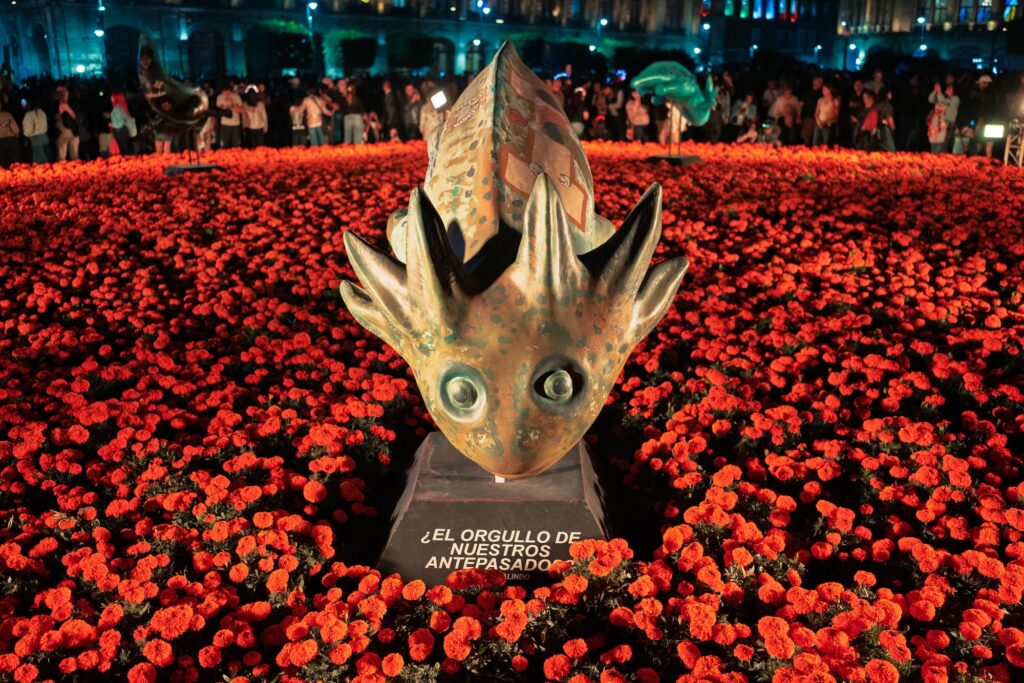
]]>Traditional ofrendas gradually appeared in public and private spaces reflecting the aesthetic vision and personalities of the creators and honorees. The huge ofrenda in the Zocalo set a world record with a 33+ meter (~108 feet) Catrina—a tribute to Jose Guadalupe Posada, whose artwork inspired what is now one of the most iconic symbols of Mexico. The giant Catrina was surrounded by beds of marigolds peppered with colorfully decorated axolotl figurines. The amphibian from Lake Xochimilco symbolizes regeneration, an apt representation of the cycle of life surrounding Dia de Muertos.
The Giant Alebrijes Parade organized by the Museum of Popular Art on October 17 highlighted the clever, whimsical mixed-species alebrijes, another Mexican folk art tradition. A nod to Halloween, the Zombie March on October 18, was a family affair as people gathered at the Monument to the Revolution for face painting, photos, and food. The zombies were joined by cadres of clowns with chain saws, sinister jokers, traditional Aztec dancers, and so many more costumed folks.

Zombie March, Mexico City, Oct. 18, 2026. Photo by Jon Bauer 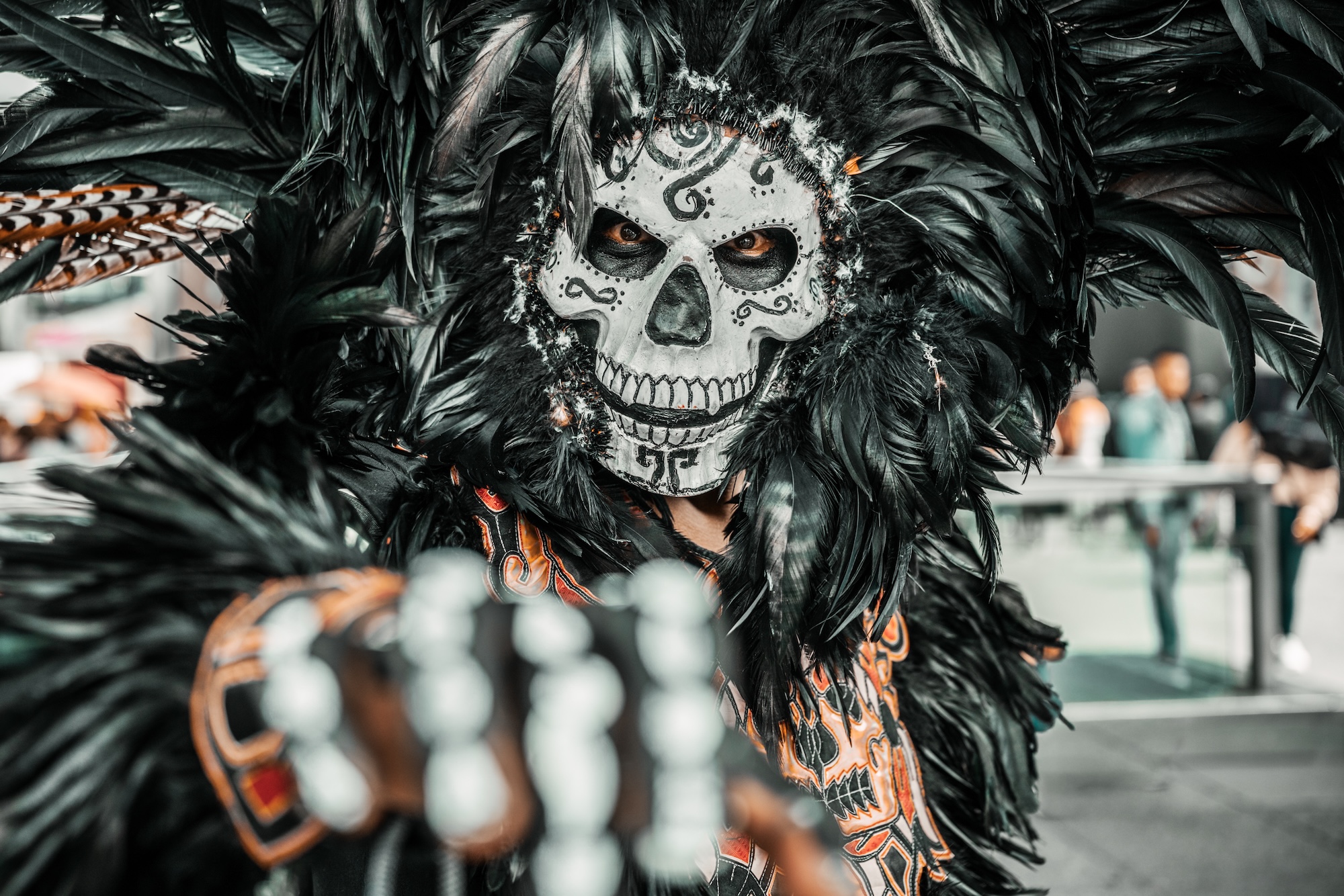
Zombie March, Mexico City, Oct. 18, 2026. Photo by Jon Bauer 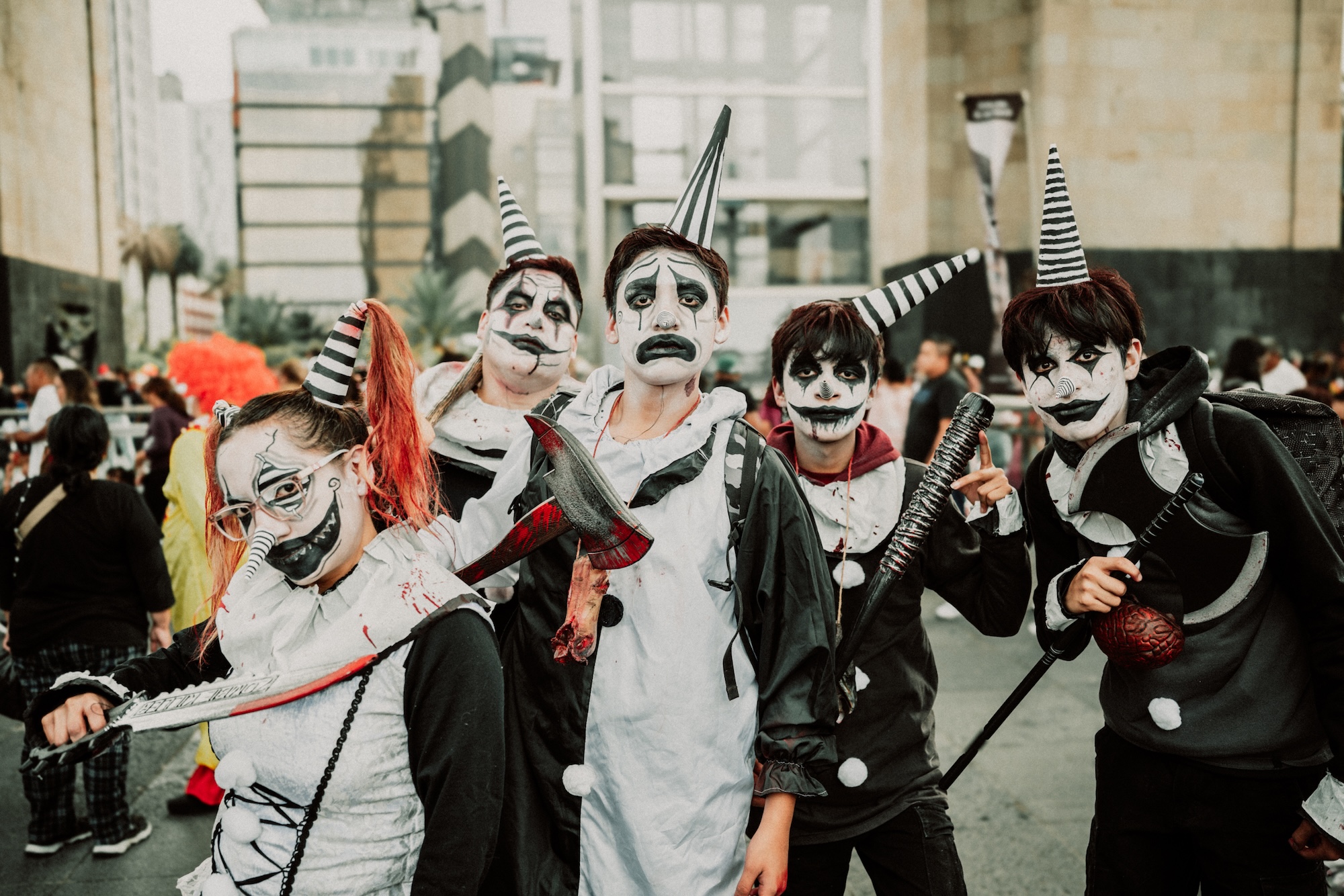
Zombie March, Mexico City, Oct. 18, 2026. Photo by Jon Bauer 
Zombie March, Mexico City, Oct. 18, 2026. Photo by Jon Bauer 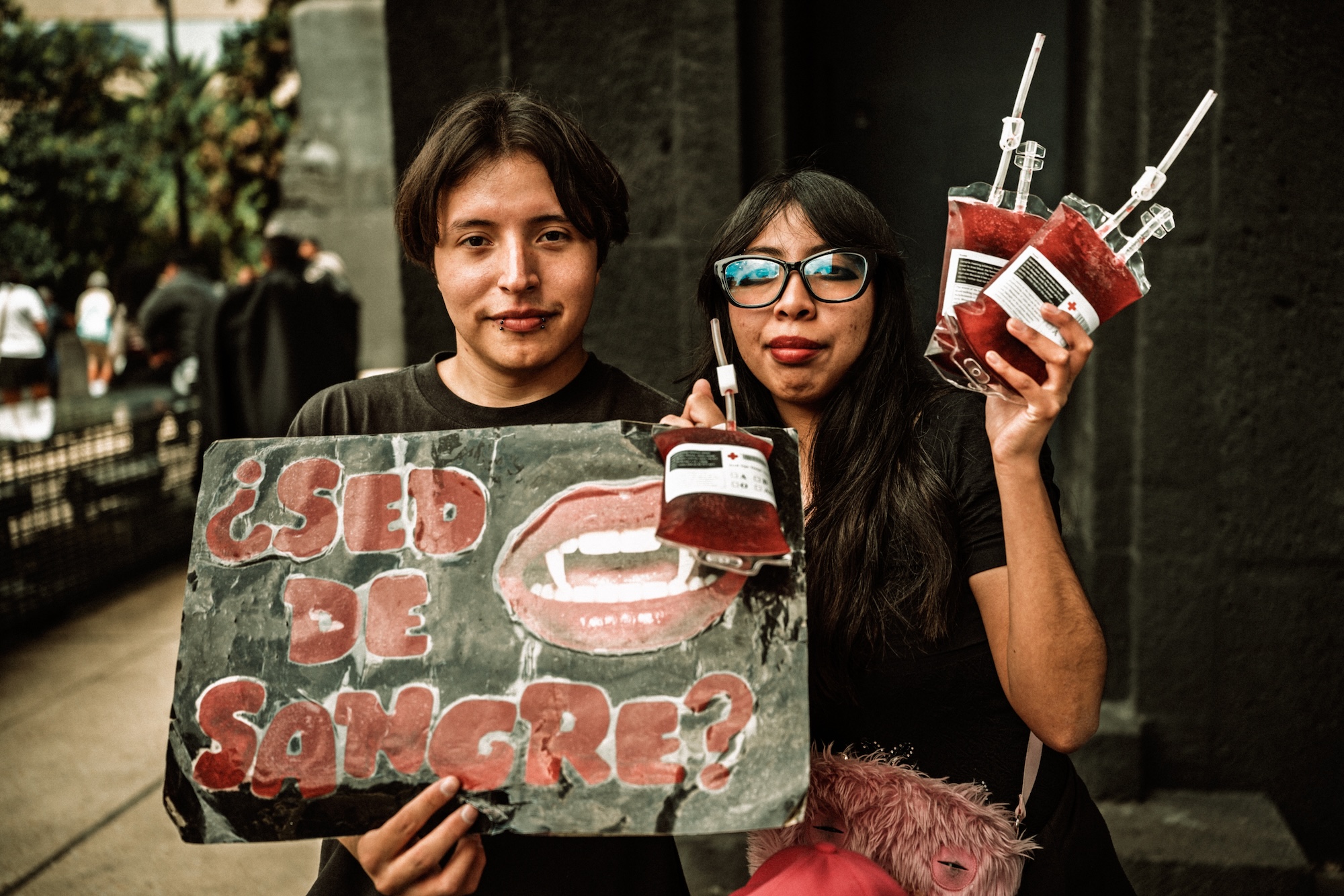
Zombie March, Mexico City, Oct. 18, 2026. Photo by Jon Bauer 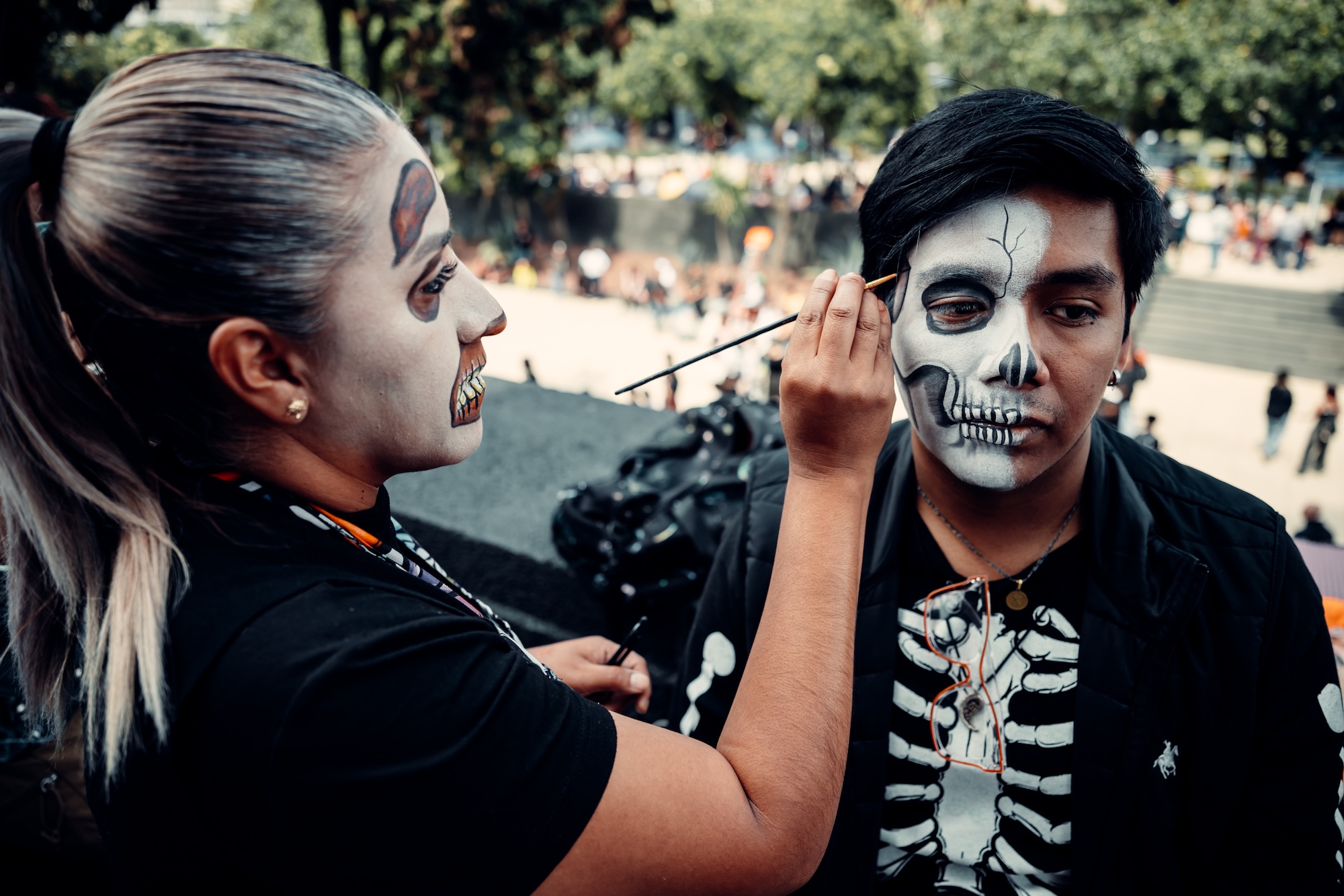
Zombie March, Mexico City, Oct. 18, 2026. Photo by Jon Bauer
The marigold festival painted the Reforma vibrant oranges and yellows. The city illuminated giant sculptures of Catrinas, calaveras (skulls), and xoloitzcuintles, the Mexican hairless dogs believed to guide souls through the underworld.
The Mega Catrinas Procession on October 25 was indeed a mega event! Thousands of Catrinas danced their way down Paseo de la Reforma: Catrinas in black dresses, Catrinas in colorful garb, Catrinas in corn husk outfits, Catrinas with lucha libre-themed clothes, young Catrinas, a 79-year-old Catrina, pre-Hispanic Catrinas, revolutionary Catrinas, drag Catrinas, dog Catrinas, cartonería Catrinas on tricked out cars, Catrinas with intricate hats that are works of art in their own right. (The Royal Ascot crew could learn from these milliners). Most poignant of all was the Contingent of the Catrinas of Remembrance. Adorned in white with marigold accents, each carried one or more photos of loved ones lost—parents, children, pets, lovers.
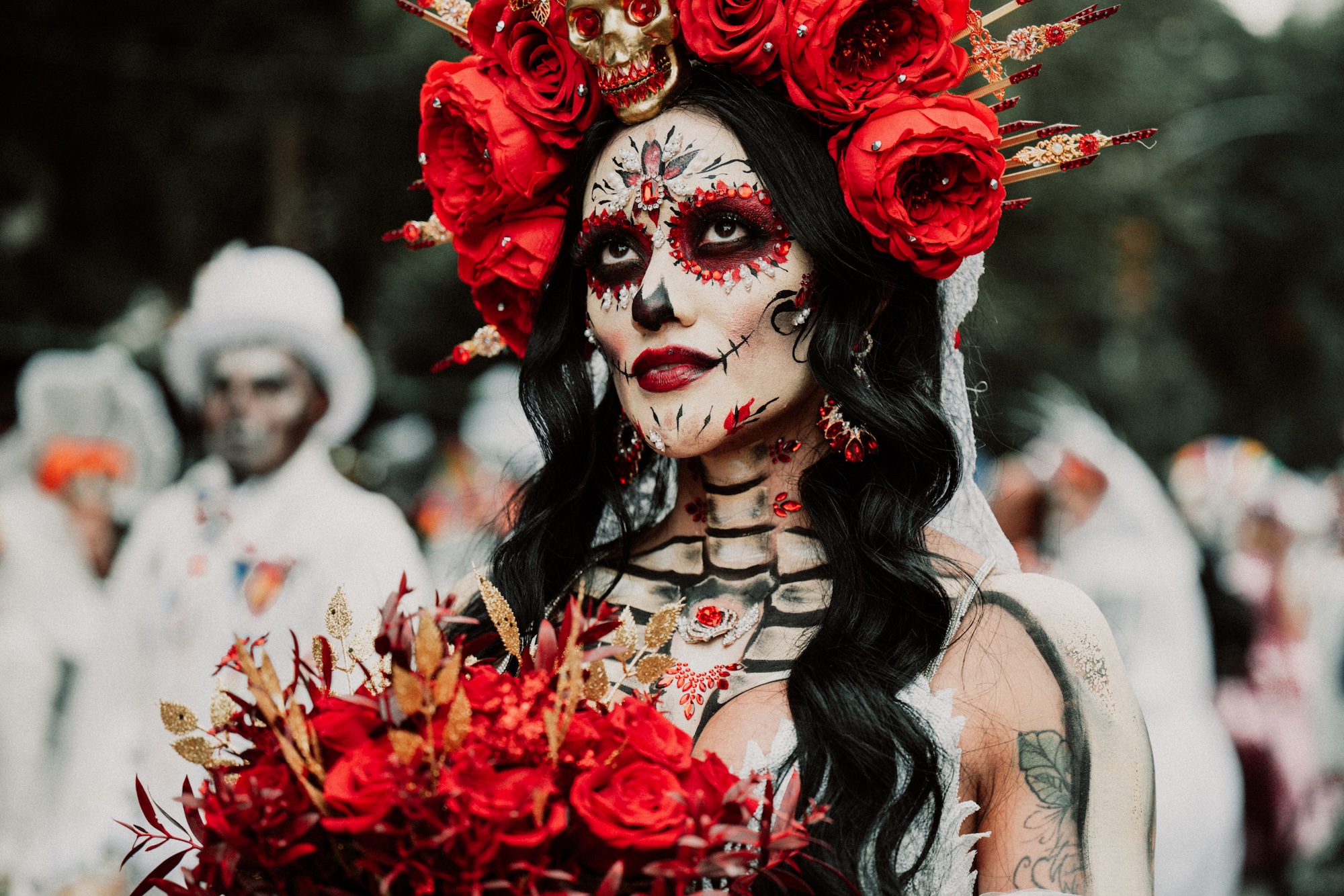
Mega Procesion de las Catrinas, Oct. 25, 2026. Photo by Jon Bauer 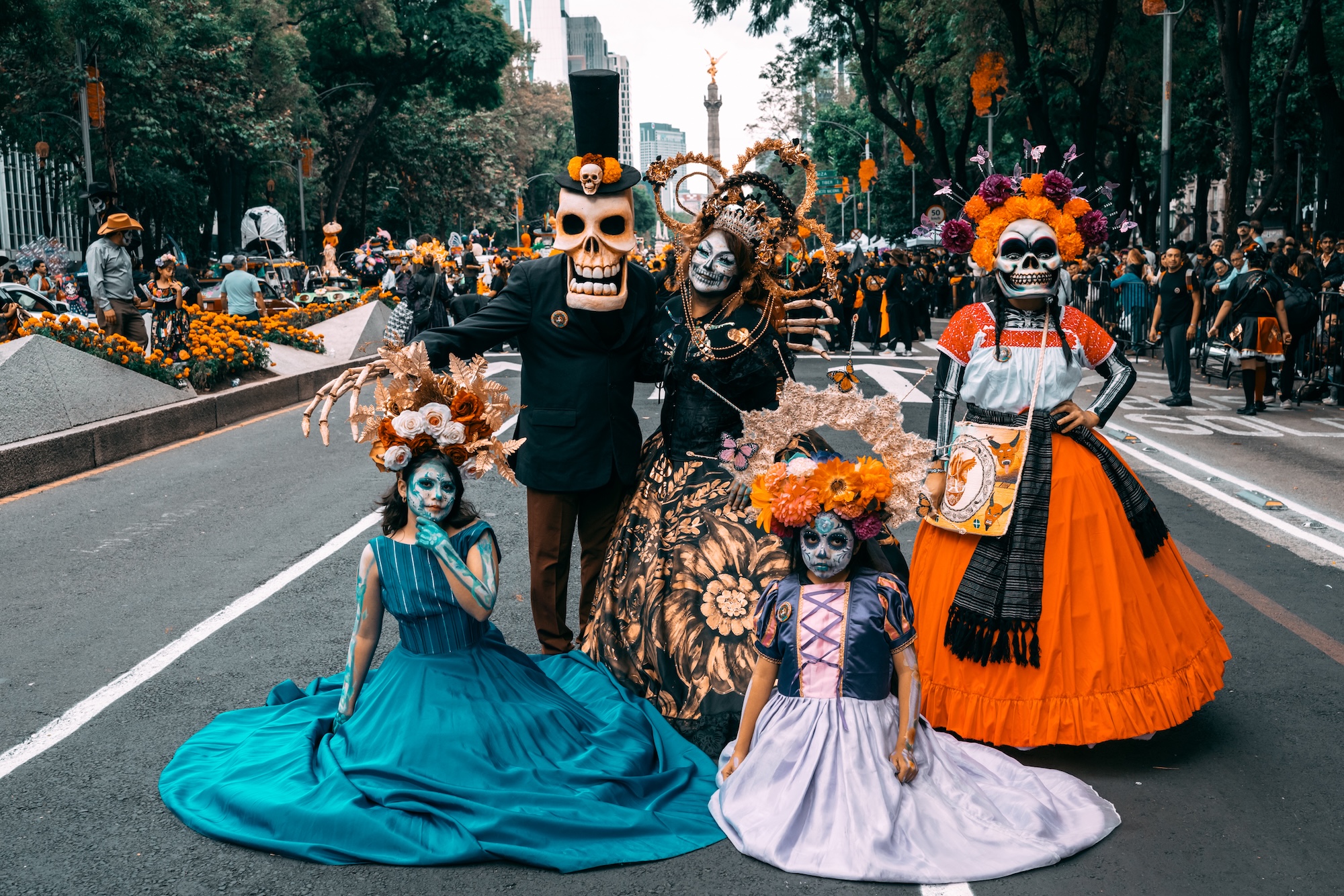
Mega Procesion de las Catrinas, Oct. 25, 2026. Photo by Jon Bauer 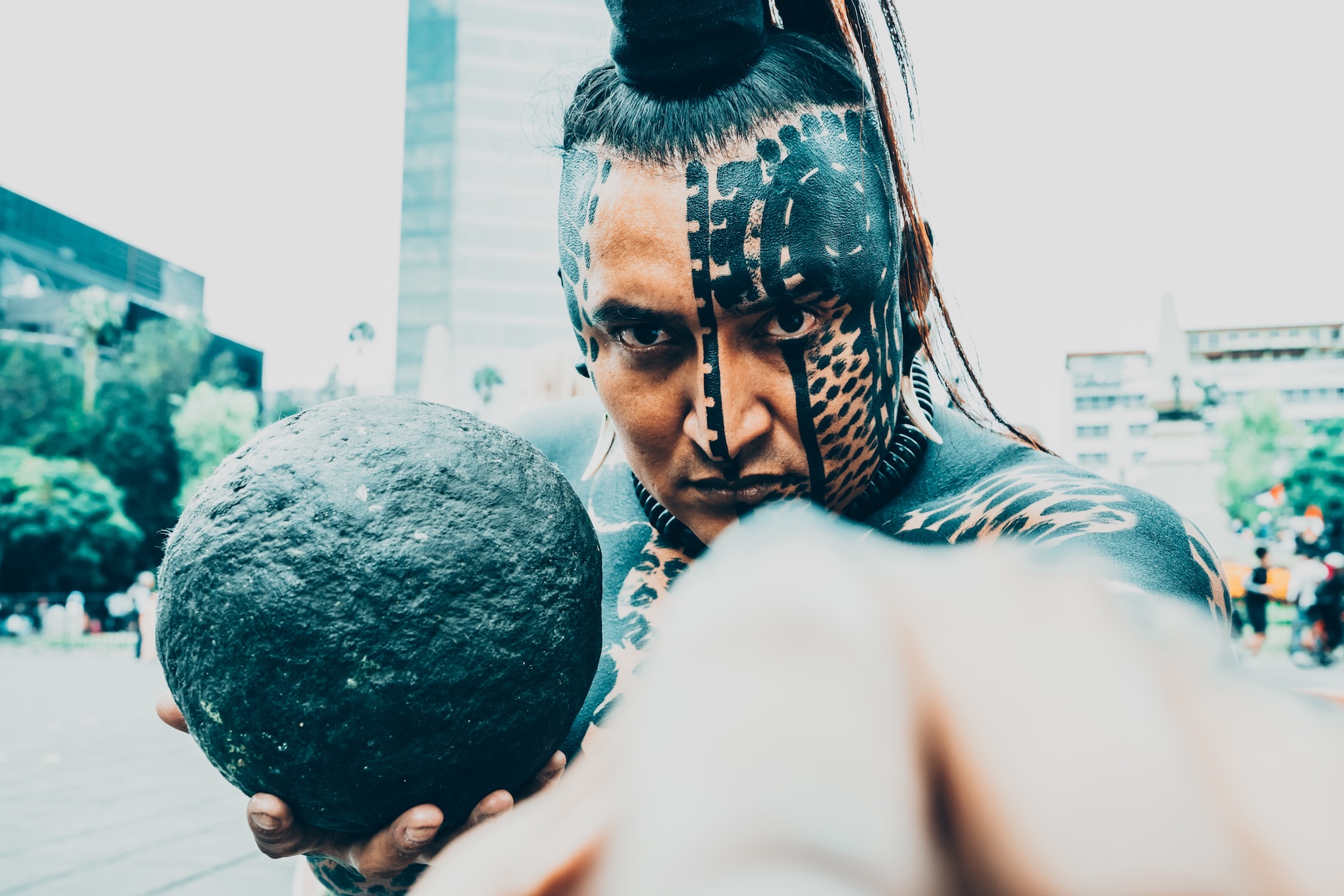
Mega Procesion de las Catrinas, Oct. 25, 2026. Photo by Jon Bauer 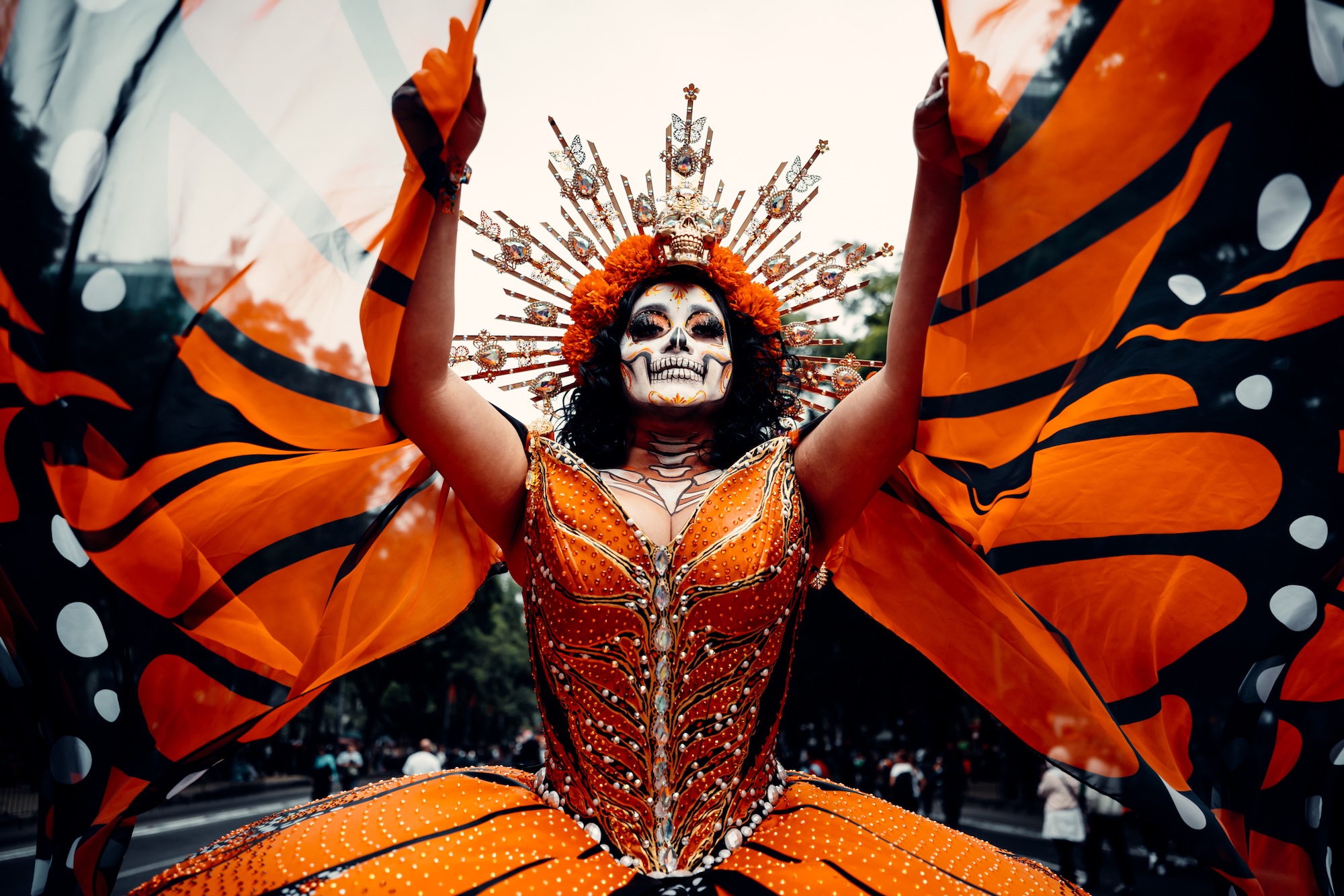
Mega Procesion de las Catrinas, Oct. 25, 2026. Photo by Jon Bauer 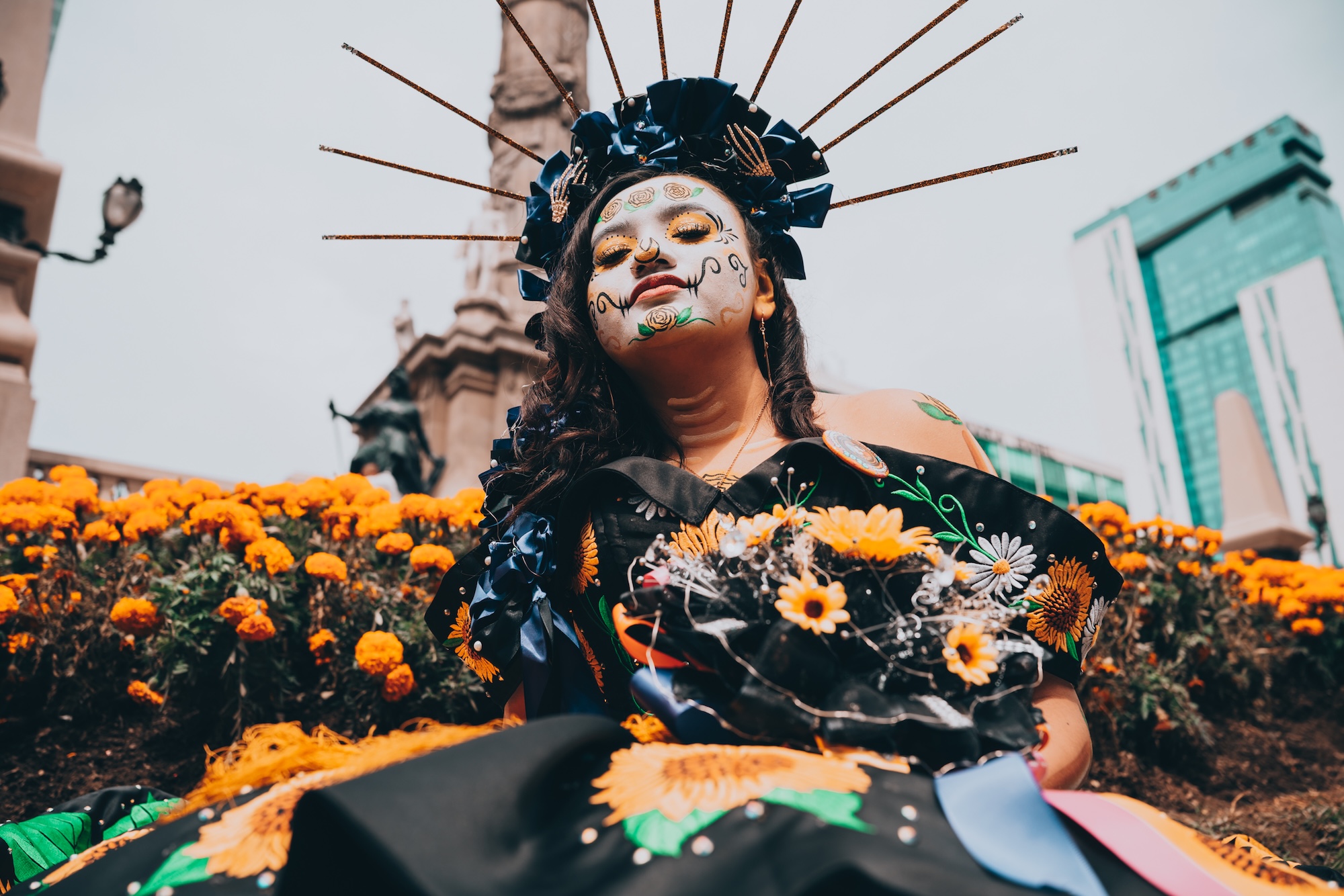
Mega Procesion de las Catrinas, Oct. 25, 2026. Photo by Jon Bauer 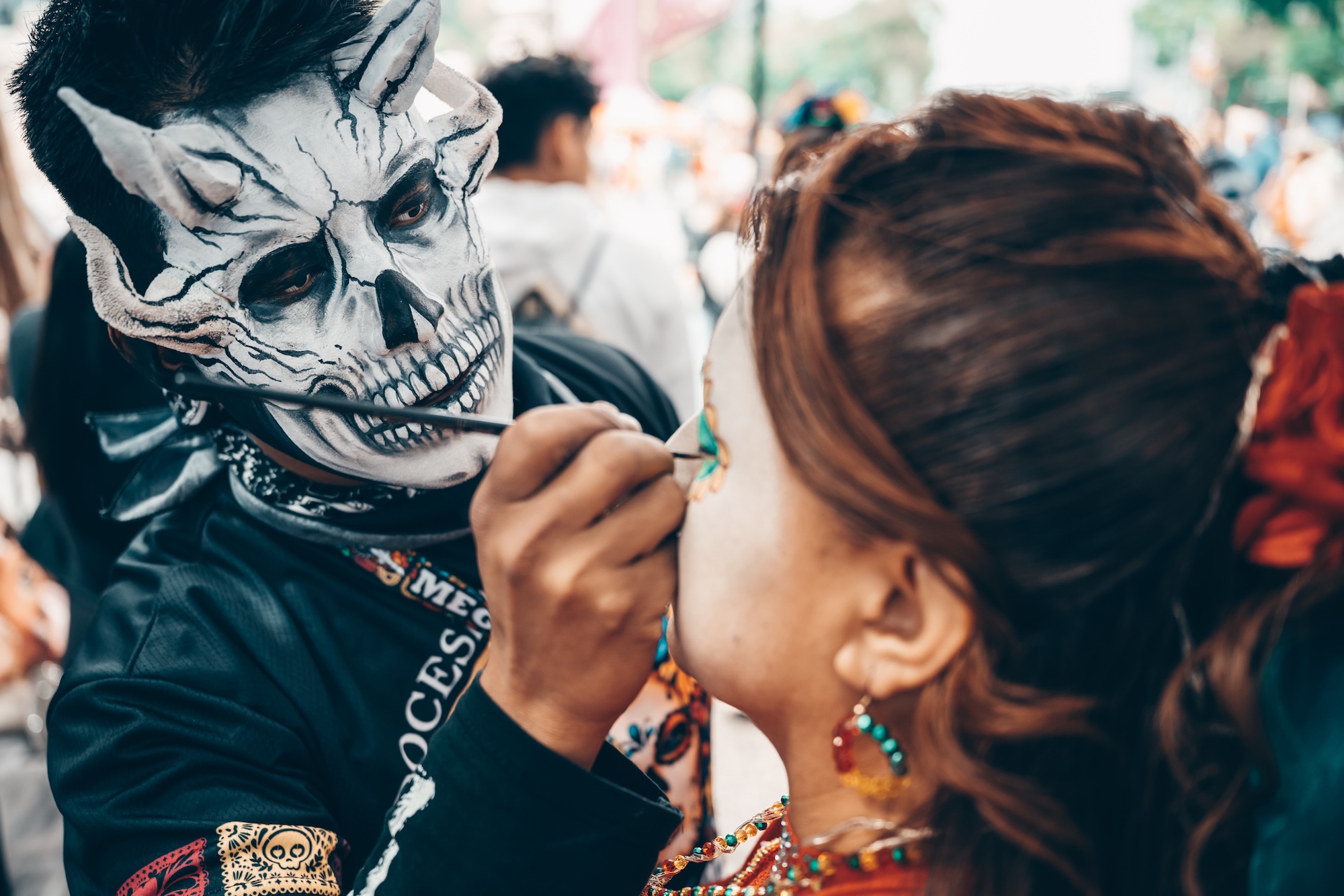
Mega Procesion de las Catrinas, Oct. 25, 2026. Photo by Jon Bauer 
Mega Procesion de las Catrinas, Oct. 25, 2026. Photo by Jon Bauer 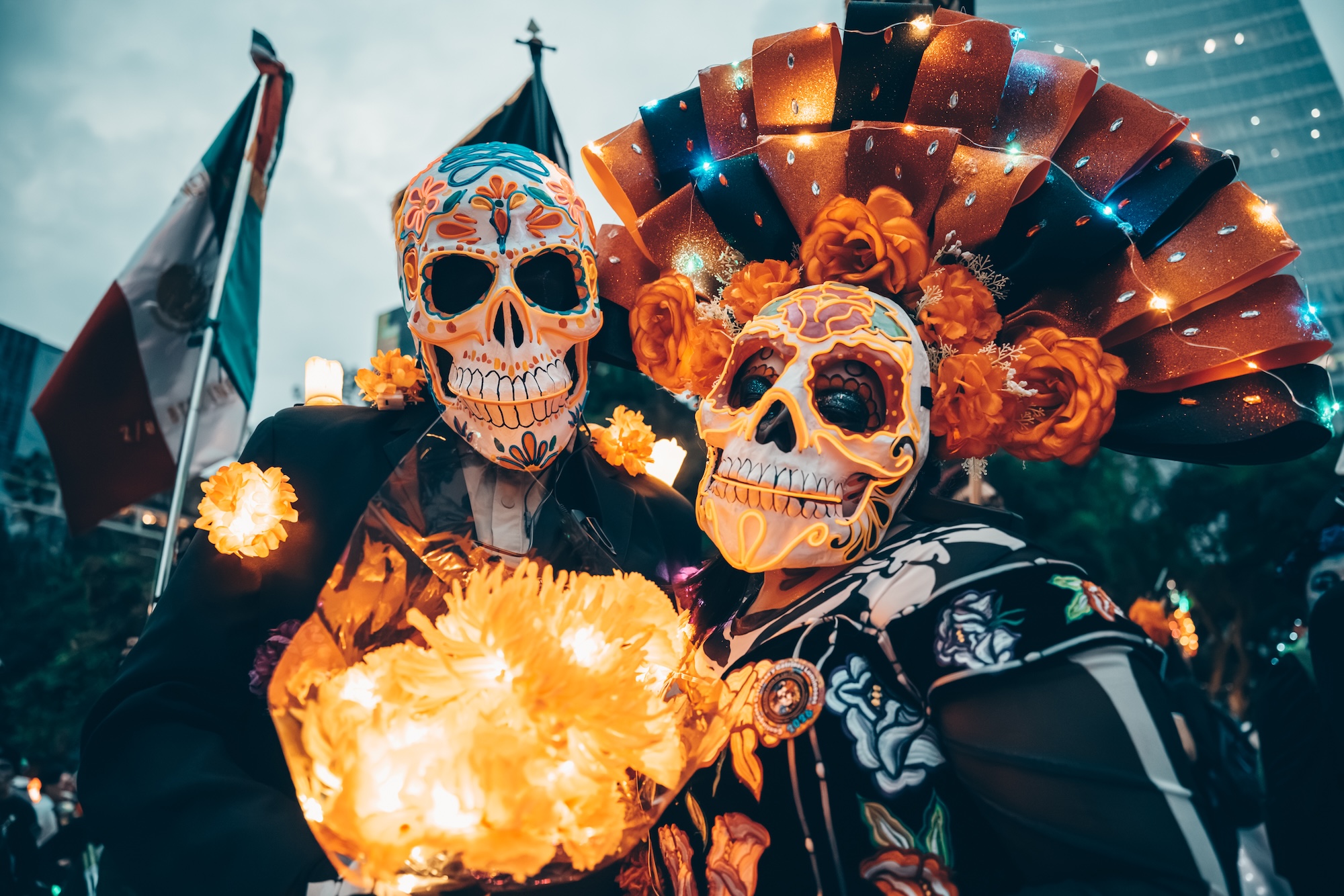
Mega Procesion de las Catrinas, Oct. 25, 2026. Photo by Jon Bauer 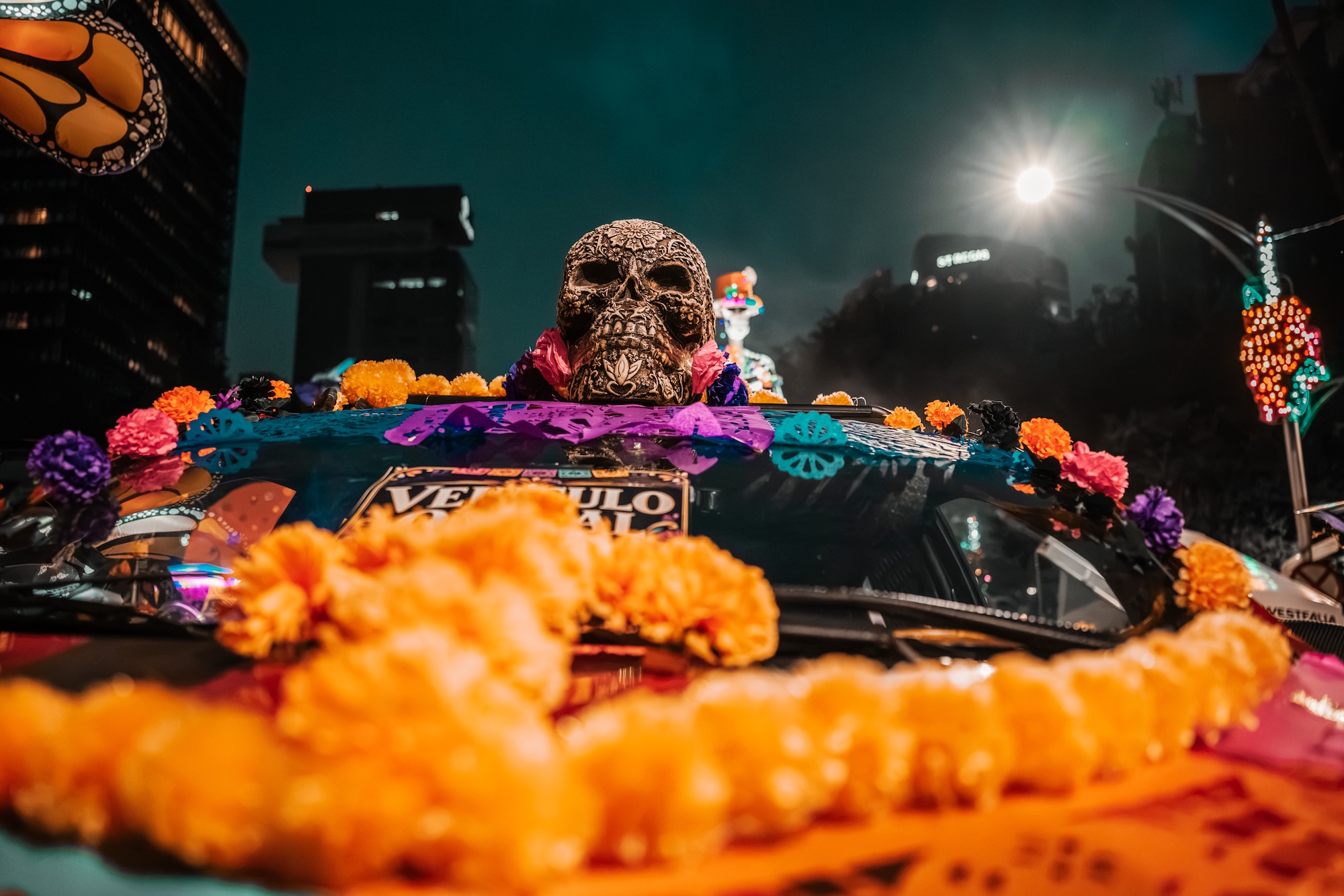
Mega Procesion de las Catrinas, Oct. 25, 2026. Photo by Jon Bauer
The procession was an endurance event. The start time was 6pm, but participants gathered early in the day decorating cars and applying elaborate make-up. Despite hours of prep and waiting, a festive vibe permeated. The car contingent blasted music generating impromptu conga lines. Once the sun set, the millions of lights festooned on cars and clothes erupted, adding to the glow of the nearly full moon as the procession began.
The crowning modern event was the Grand Parade, held on October 31. While the parade started in 2016 (yes, in response to the opening scene of the James Bond movie Spectre), the “floats” employ traditional Mexican papier-mache, cartoneria. Like any great event, preparation is all. Colectivo: Ultima Hora began crafting their design months ago. A visit to their workshop at FARO Oriente on October 24 was a chance to see their project El Panadero con el Pan (an homage to the Tin Tan short) in progress. As the artisans brought the giant figures to life, the dancers rehearsed their parade routine to a cumbia remix of the 1950s song.
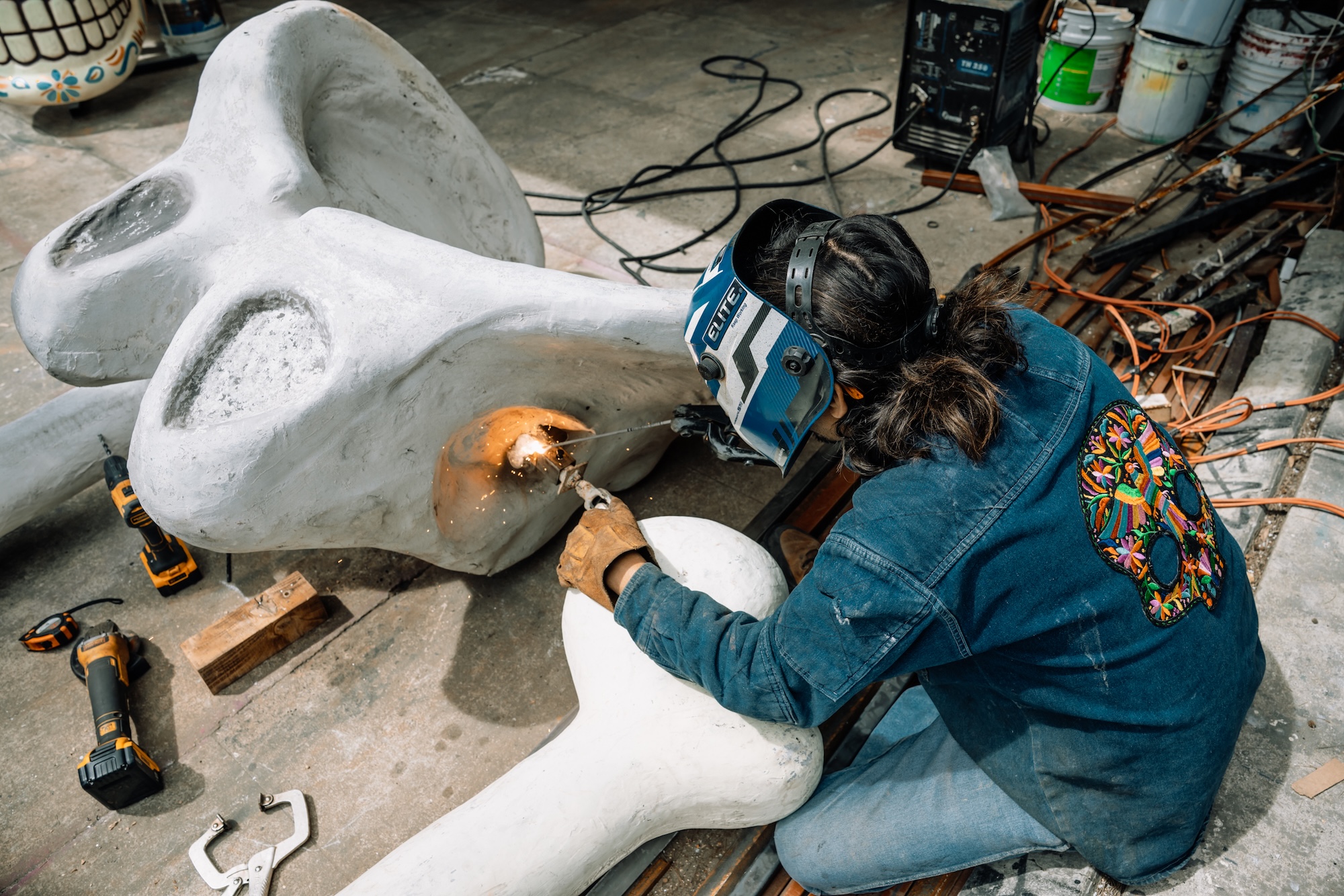
A visit to Fabrica de Artes y Oficios Oriente, Oct. 24, 2026. Photo by Jon Bauer 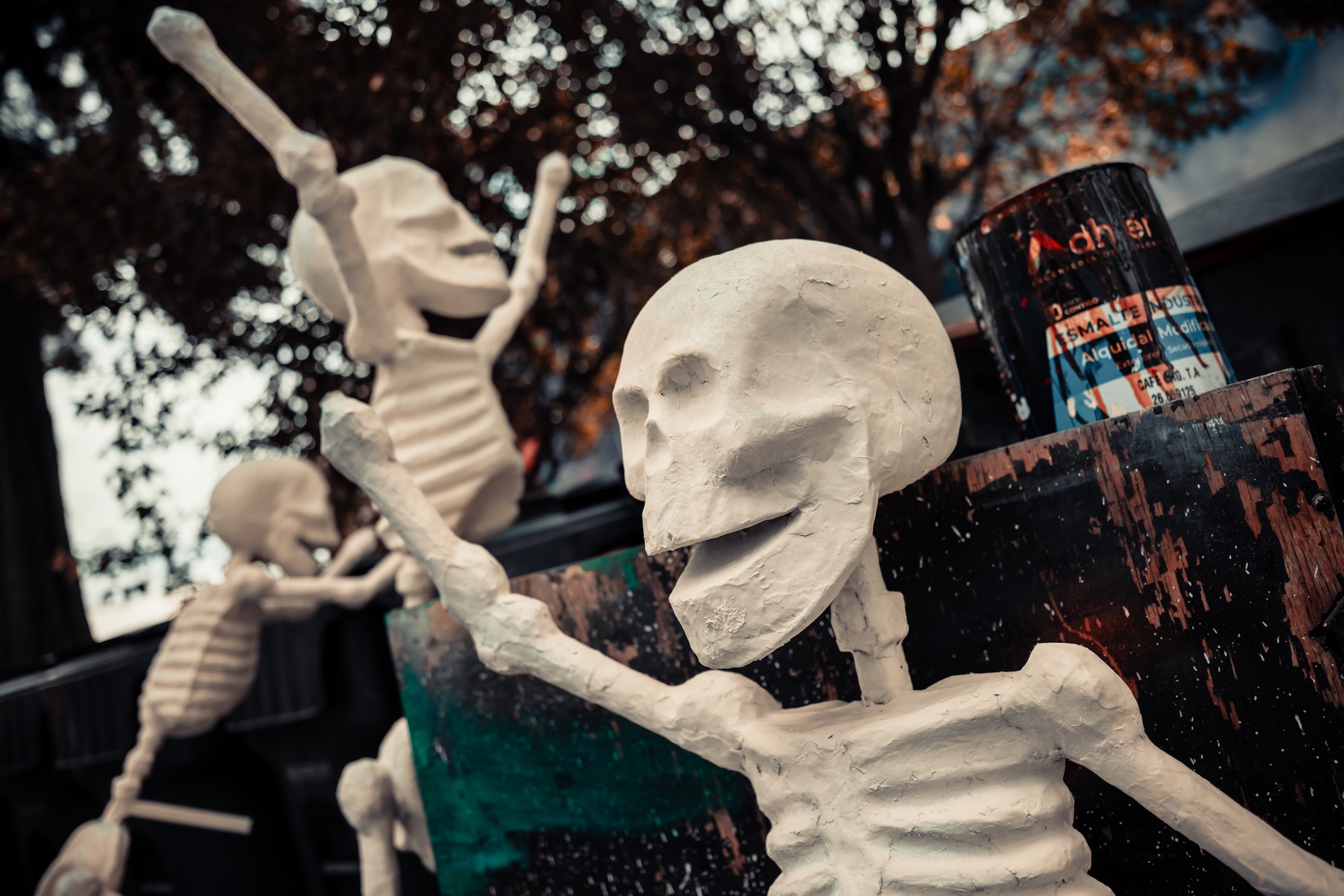
A visit to Fabrica de Artes y Oficios Oriente, Oct. 24, 2026. Photo by Jon Bauer 
A visit to Fabrica de Artes y Oficios Oriente, Oct. 24, 2026. Photo by Jon Bauer 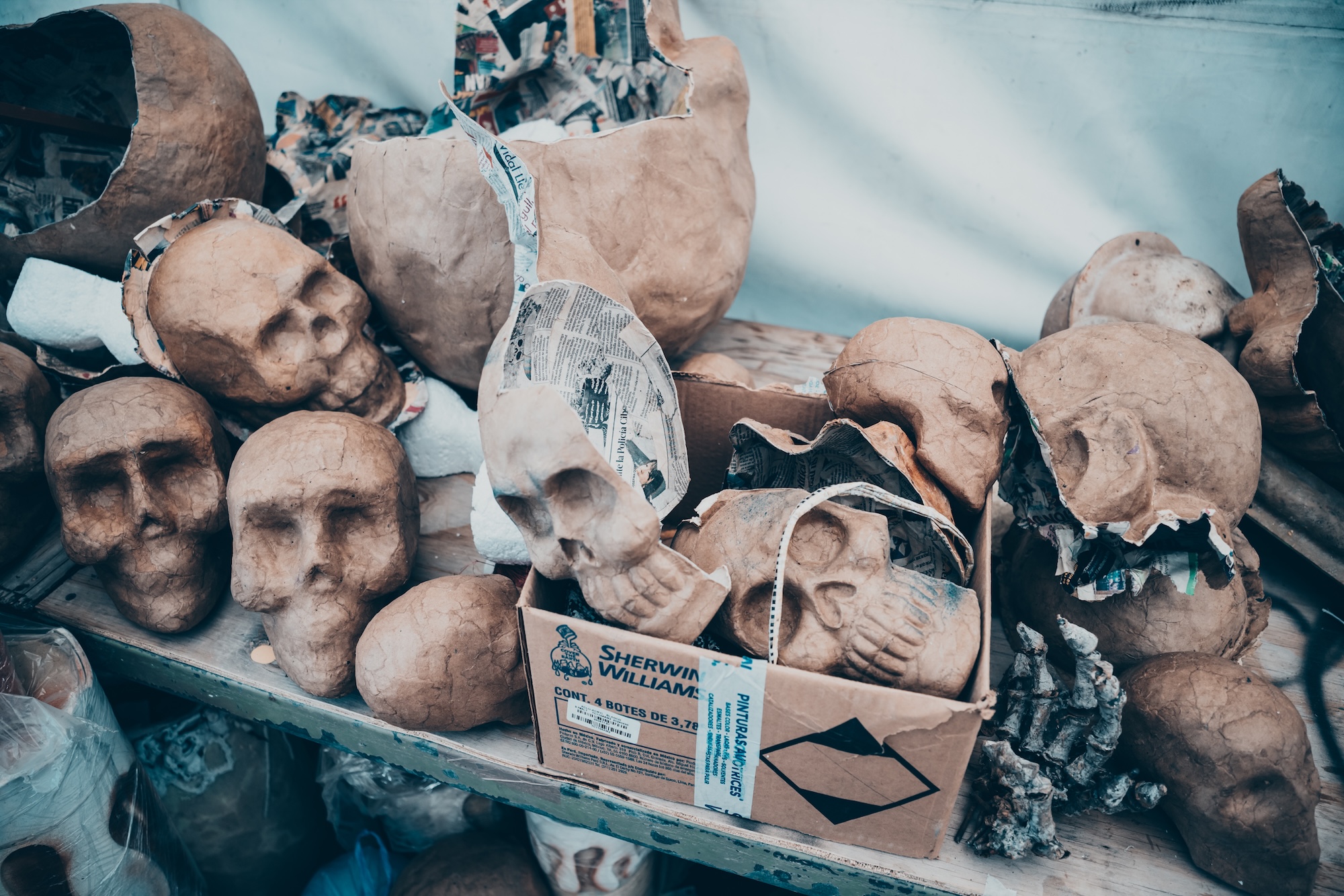
A visit to Fabrica de Artes y Oficios Oriente, Oct. 24, 2026. Photo by Jon Bauer
On parade day, colored smoke and lively music sparked excitement as spectators lined Paseo de la Reforma, many of whom had been waiting under the sunny skies for hours to secure a prime viewing spot. One of the first groups was the colorful Ajolote: Guardian of Memory contingent. An appropriate beginning as the holiday is about remembering loved ones; the focus of this year’s parade was to honor Mexican cultural icons.
In addition to the Tin Tan offering, other standouts included a float celebrating the film María Candelaria by Emilio Fernandez which was the first Latin American film to win top honors at Cannes. The elaborate float included a sculpted boat with the main characters rowing forward amid a sea of flowers. The back of the float depicted a somber scene as a man shepherds his lover’s body through the canals of Xochmilco.
The Regional Catrinas represented the different Mexican areas through their traditional dresses. A somber Puebla contingent wore massive sombreros with images of The Virgin of Guadalupe on the inside of their brims. The Memories of Childhood floats displayed skeletons on a seesaw, a swing, and a hobby horse acknowledging both departed children and our own past childhoods.
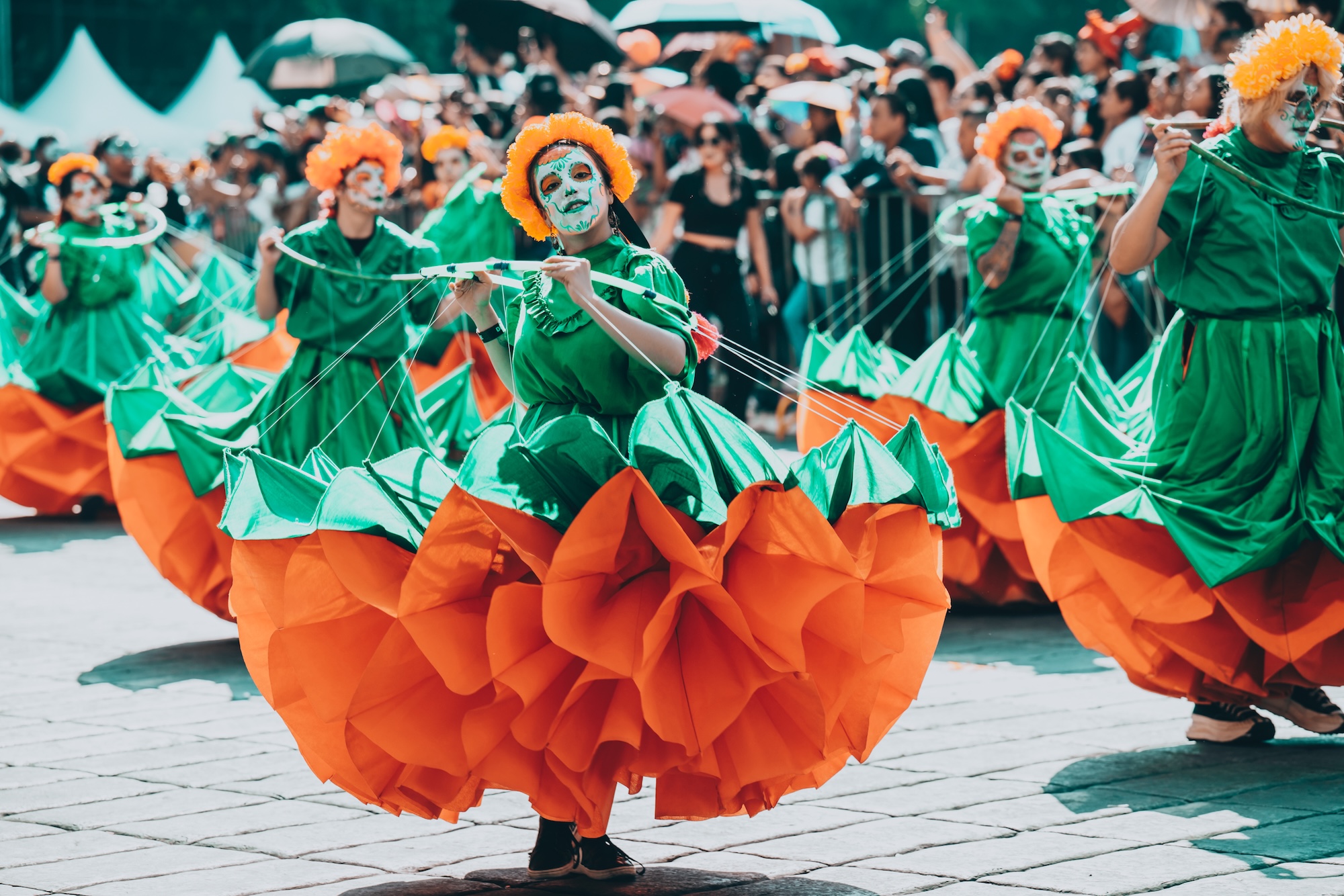
Mexico City Día de Muertos grand parade, Oct. 31, 2026. Photo by Jon Bauer 
Mexico City Día de Muertos grand parade, Oct. 31, 2026. Photo by Jon Bauer 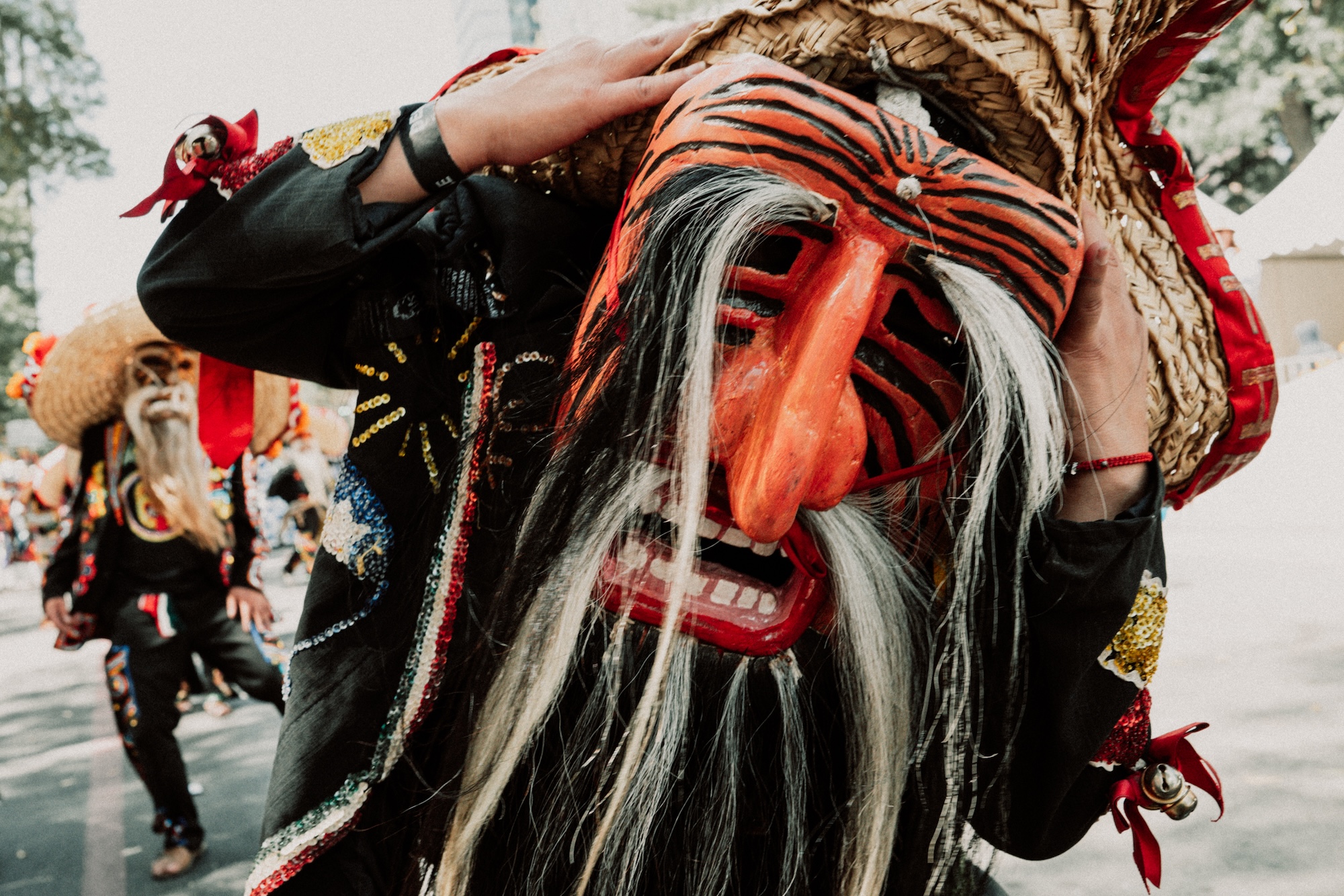
Mexico City Día de Muertos grand parade, Oct. 31, 2026. Photo by Jon Bauer 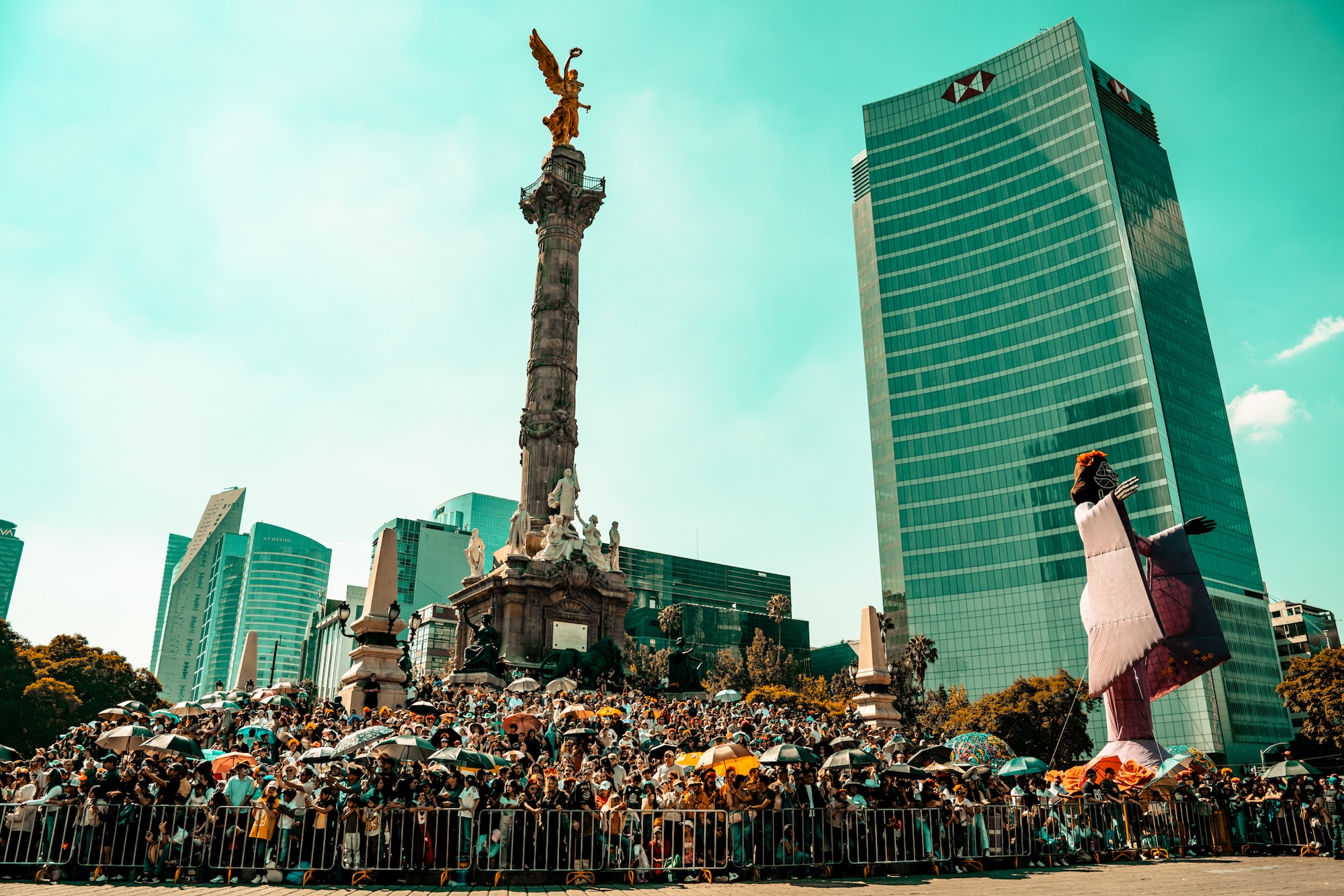
Mexico City Día de Muertos grand parade, Oct. 31, 2026. Photo by Jon Bauer 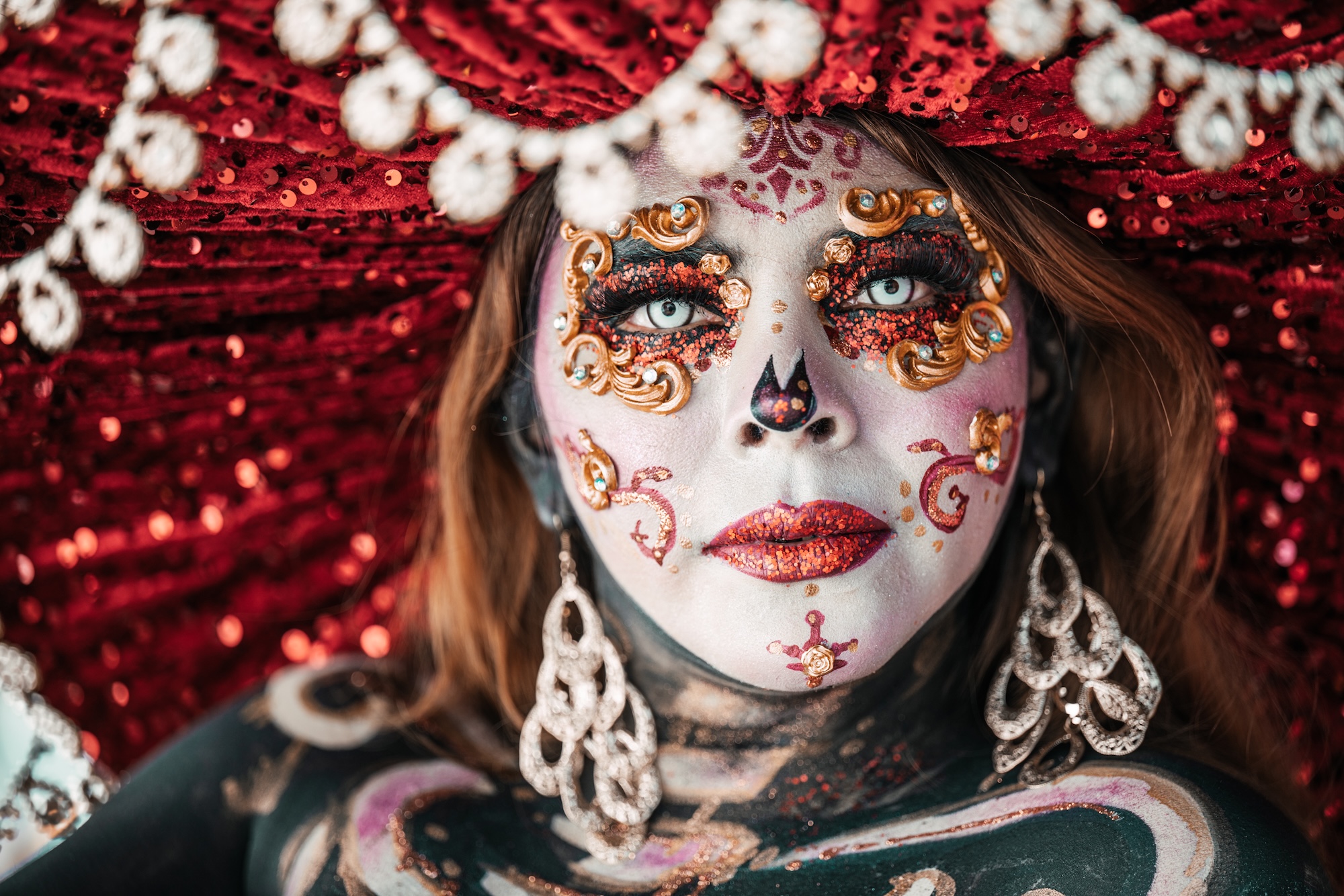
Mexico City Día de Muertos grand parade, Oct. 31, 2026. Photo by Jon Bauer 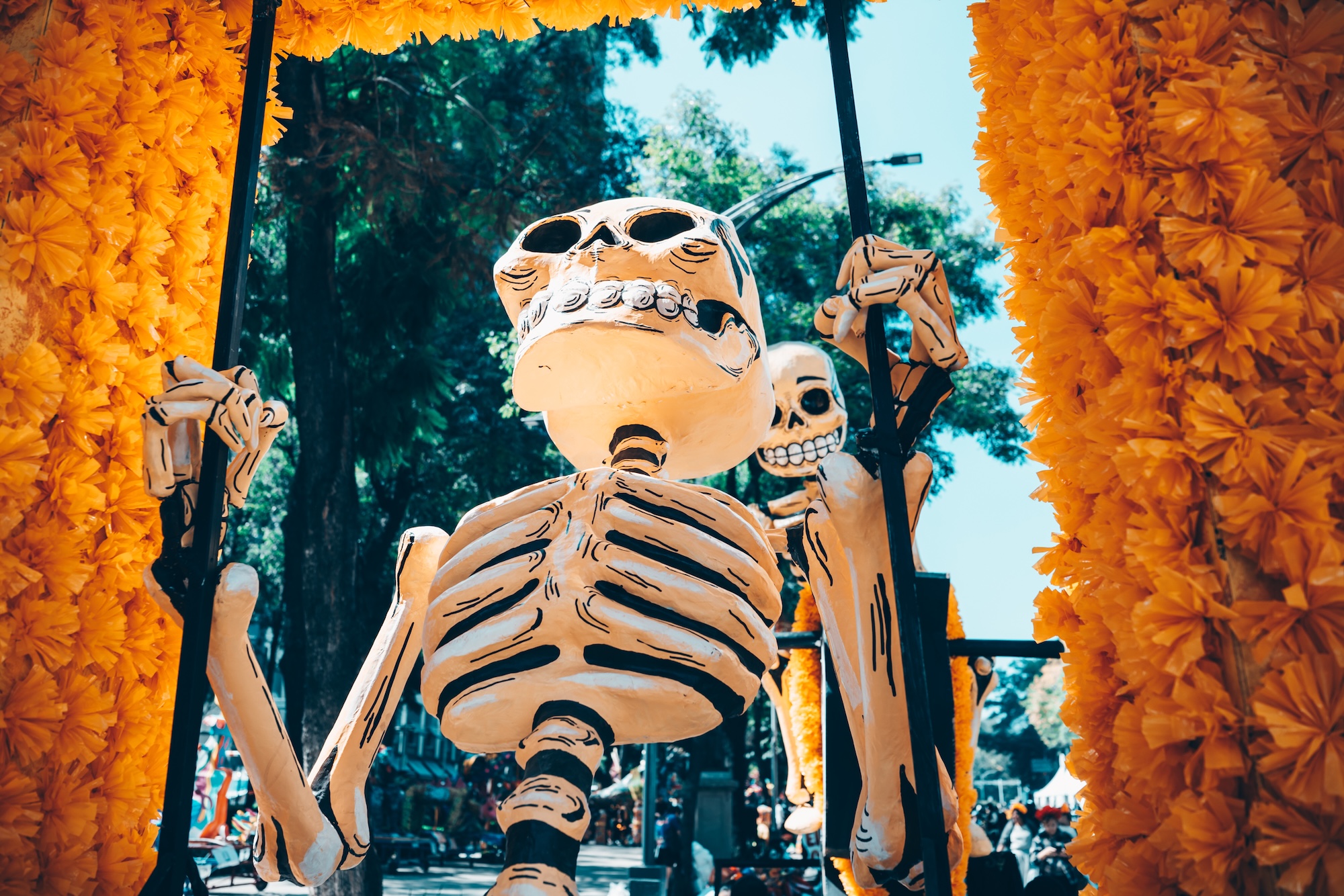
Mexico City Día de Muertos grand parade, Oct. 31, 2026. Photo by Jon Bauer 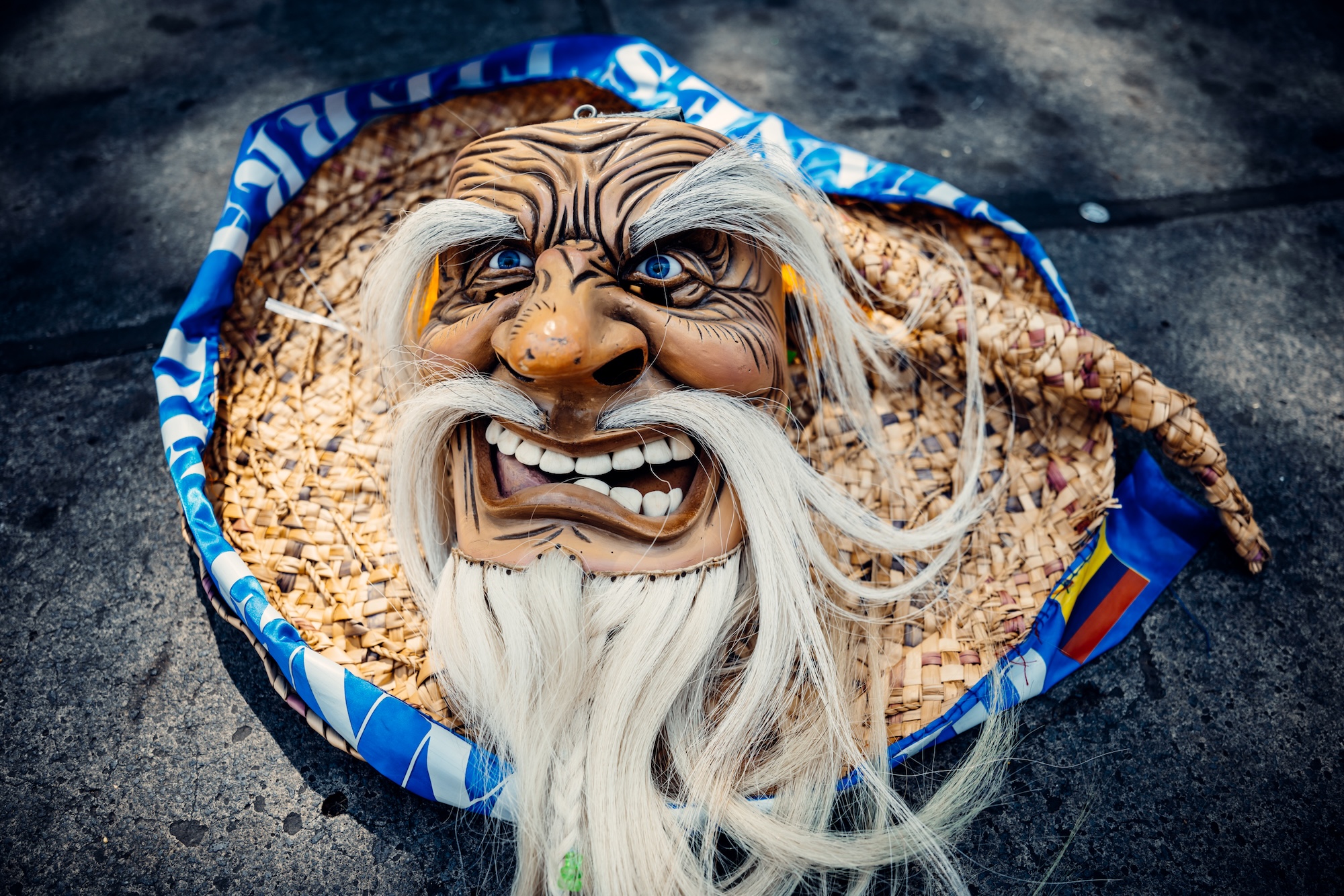
Mexico City Día de Muertos grand parade, Oct. 31, 2026. Photo by Jon Bauer 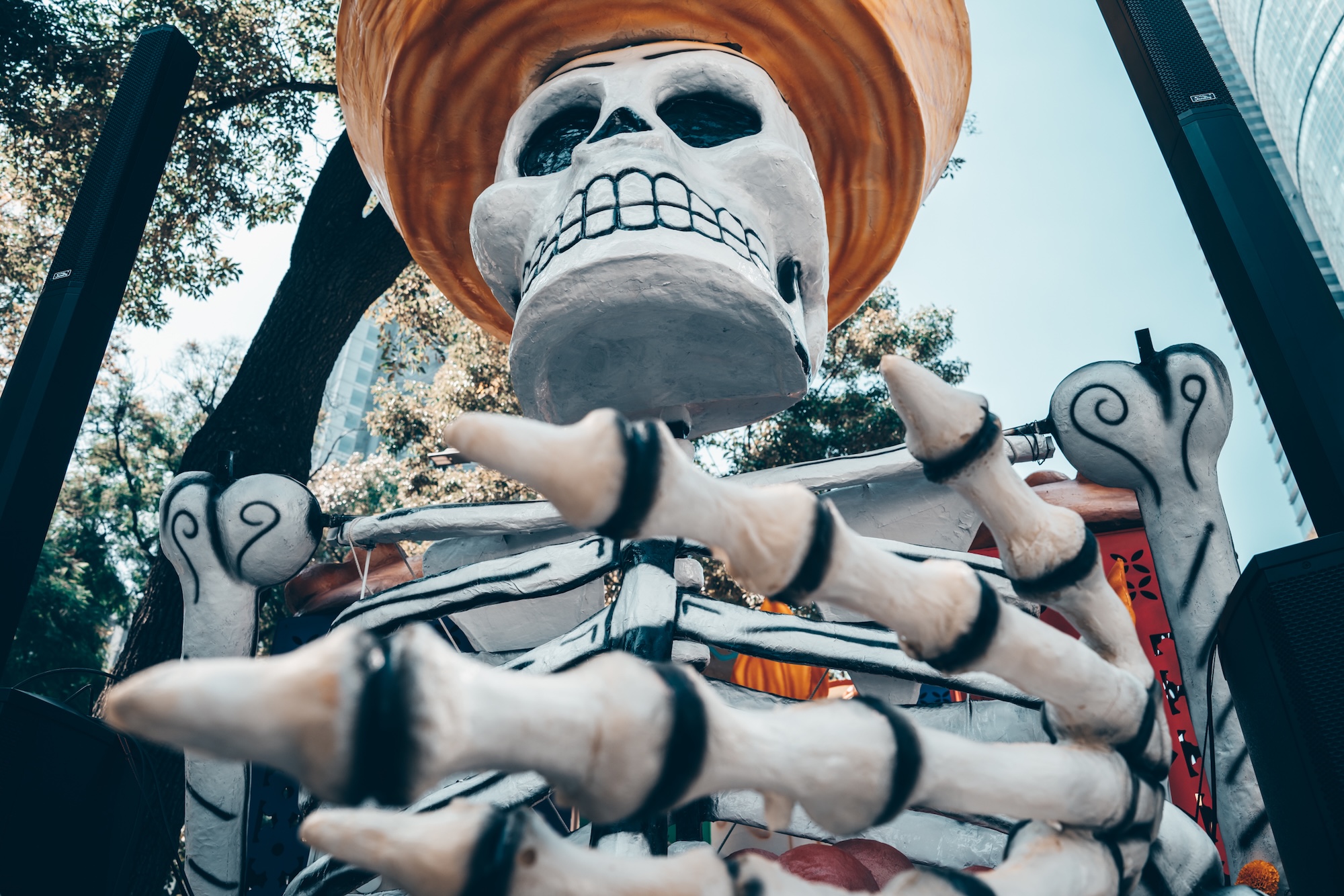
Mexico City Día de Muertos grand parade, Oct. 31, 2026. Photo by Jon Bauer 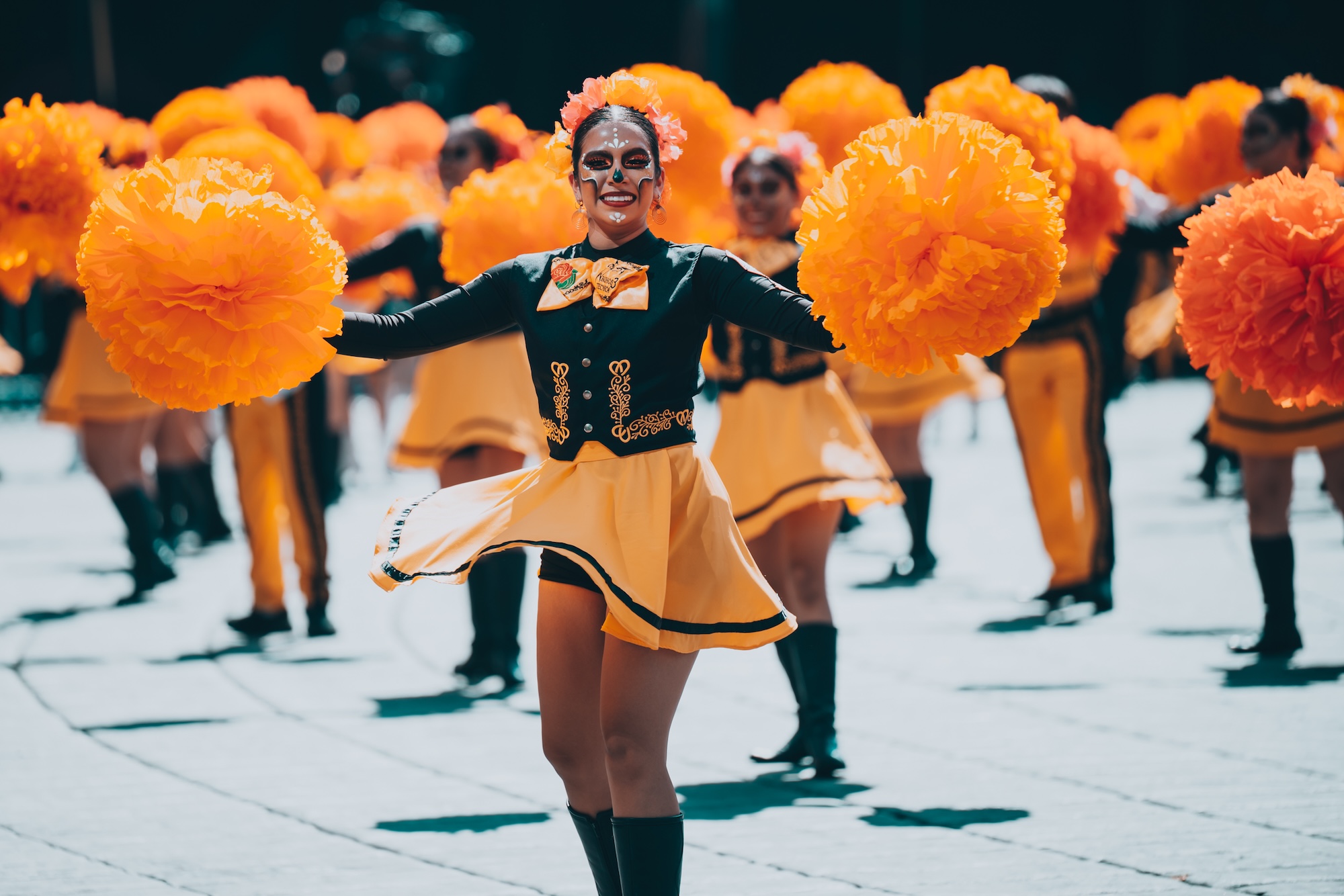
Mexico City Día de Muertos grand parade, Oct. 31, 2026. Photo by Jon Bauer 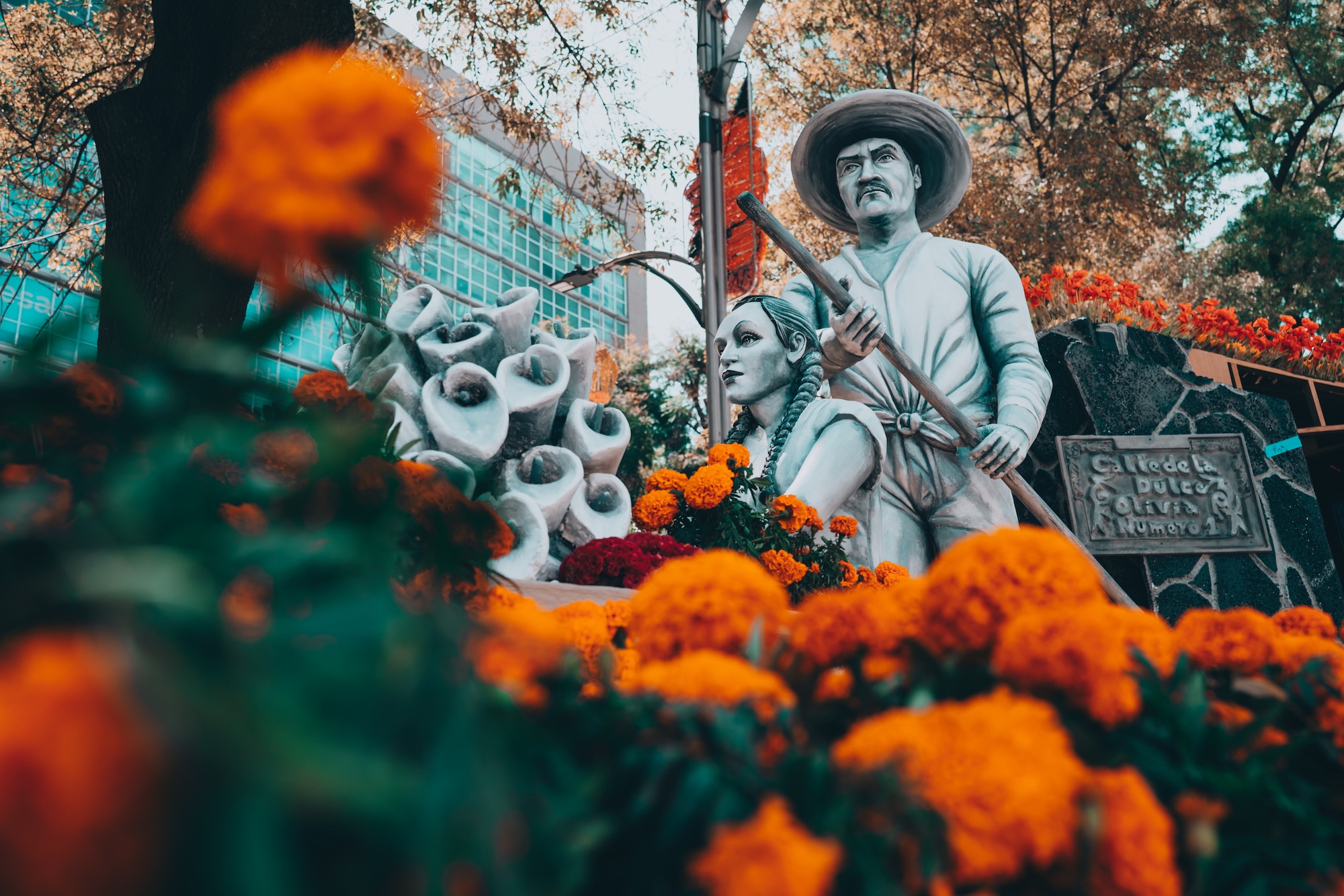
Mexico City Día de Muertos grand parade, Oct. 31, 2026. Photo by Jon Bauer 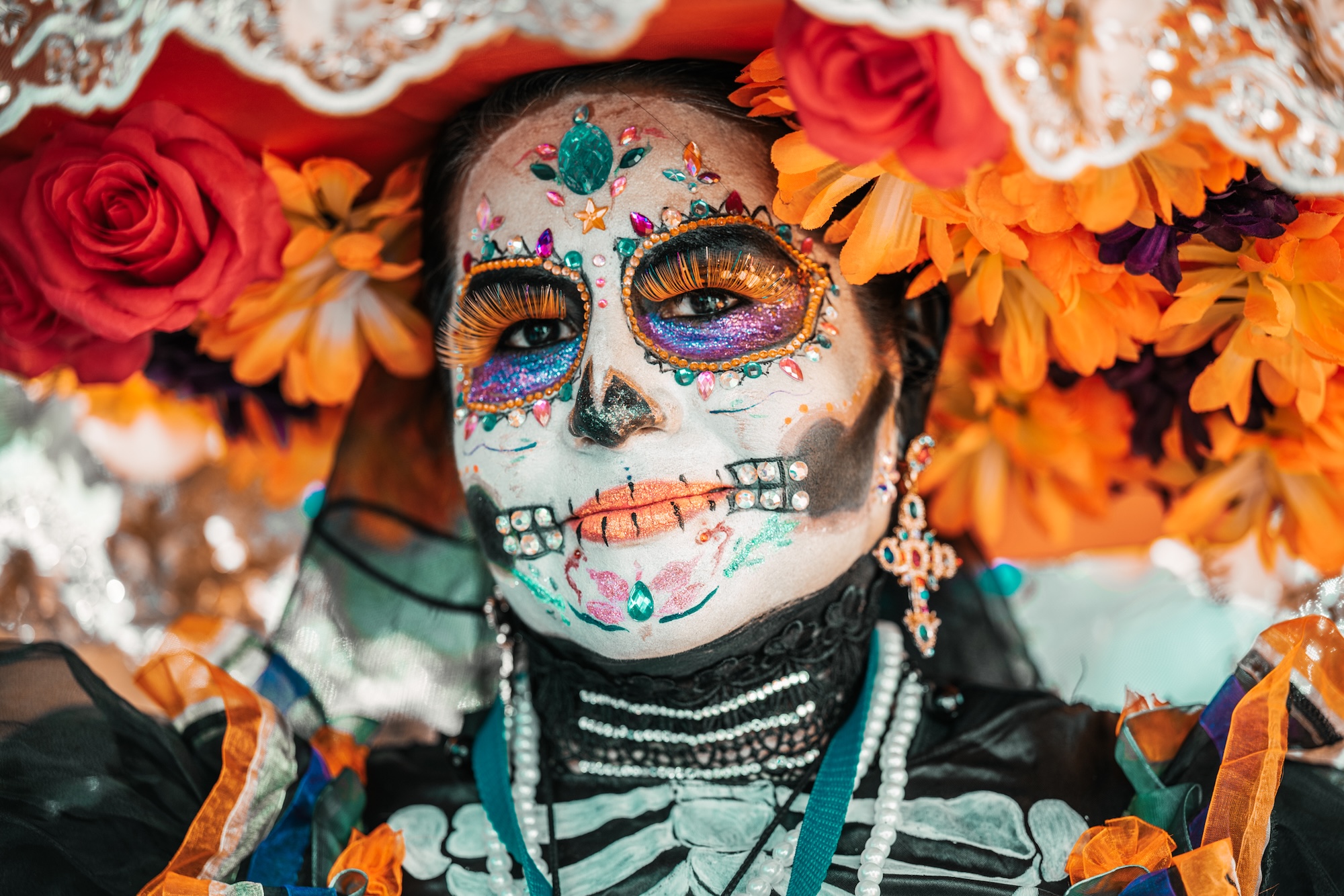
Mexico City Día de Muertos grand parade, Oct. 31, 2026. Photo by Jon Bauer 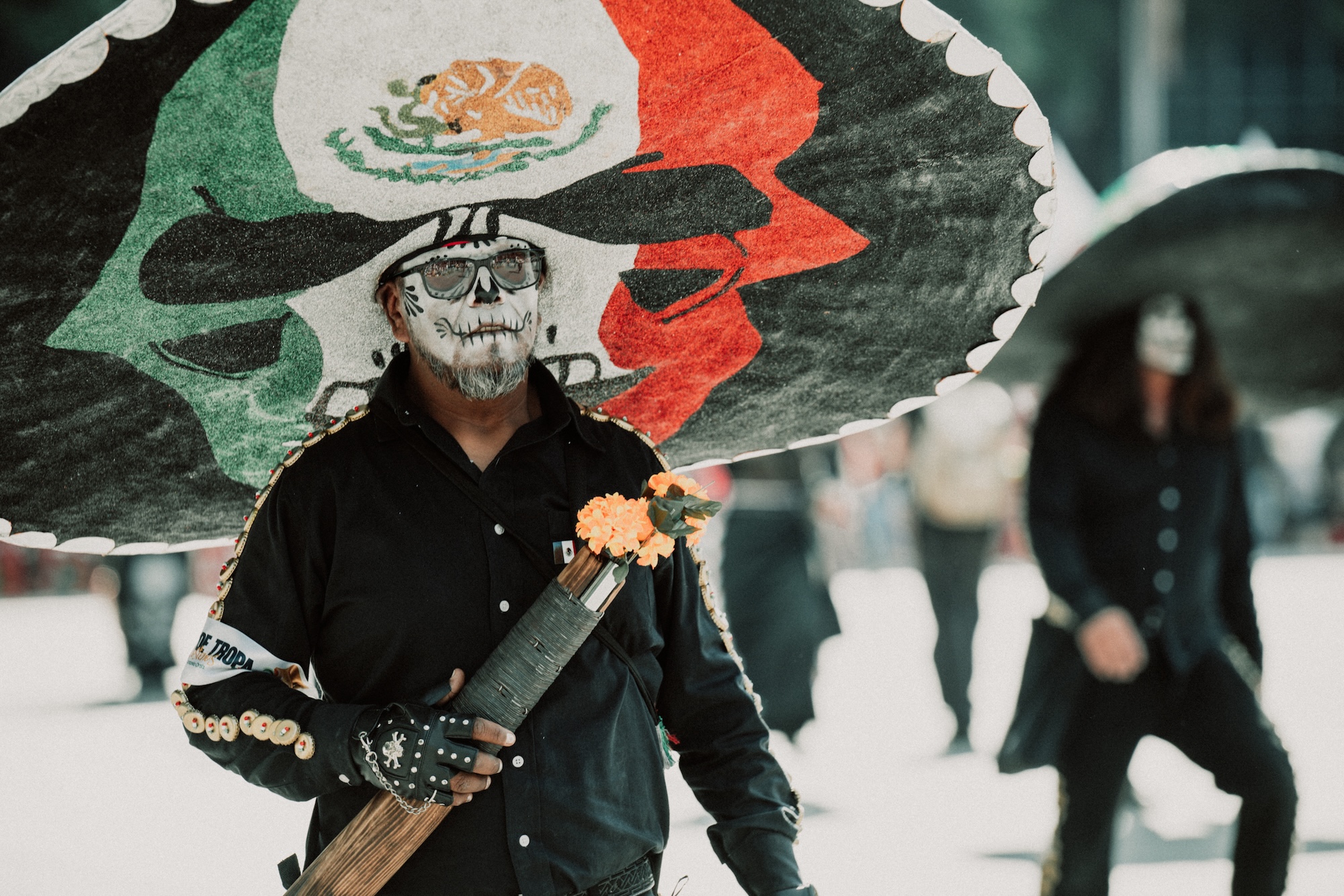
Mexico City Día de Muertos grand parade, Oct. 31, 2026. Photo by Jon Bauer 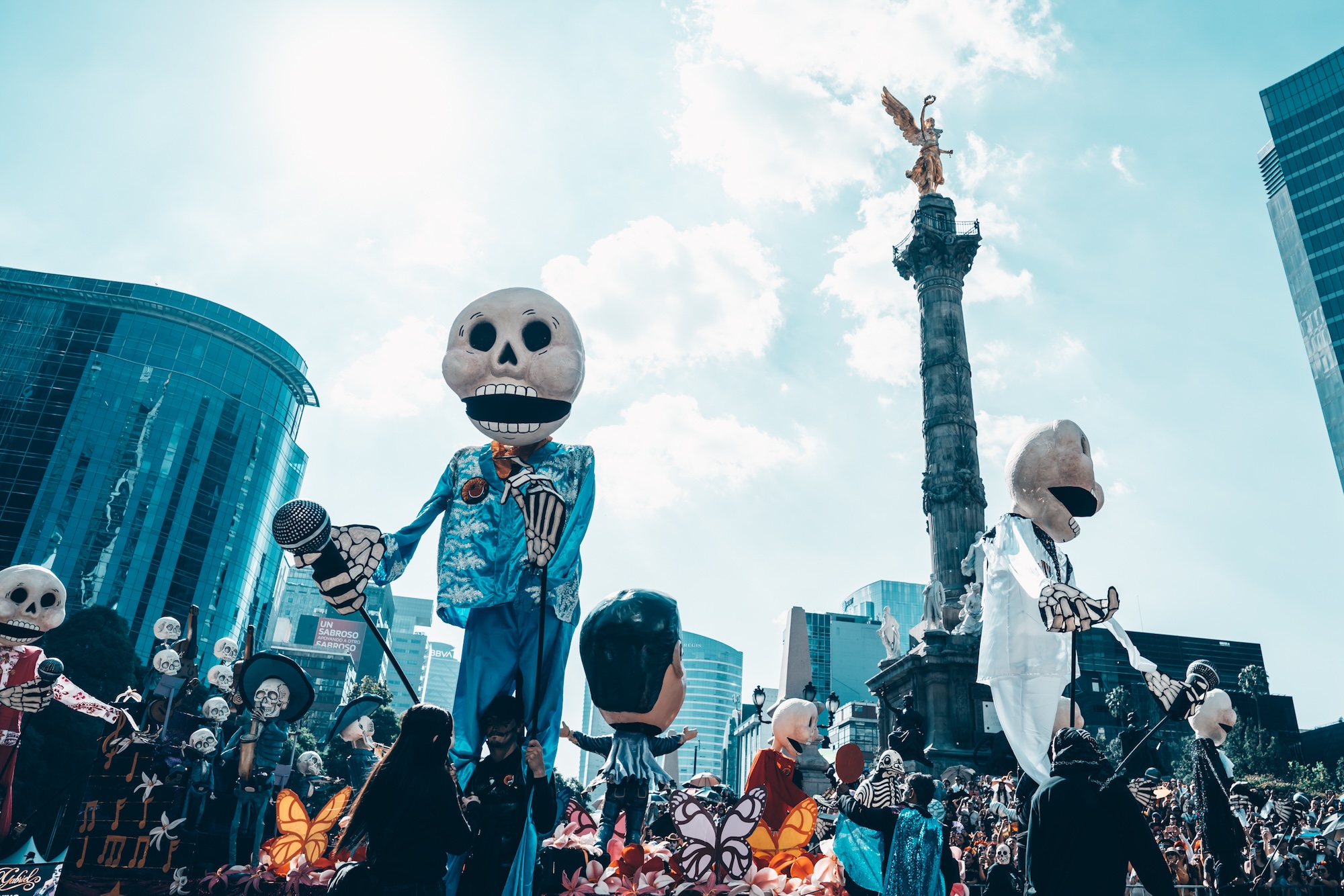
Mexico City Día de Muertos grand parade, Oct. 31, 2026. Photo by Jon Bauer
Women in blooming marigold dresses, crowd sing-alongs, cheerleaders with orange pompoms, marching bands, stilt walkers, and folkloric dancers—including the stunning Danza de Tecuanes Azules (“dance of the jaguar”), which originated in the state of Guerrero—rounded out the parade.
When a giant Mexican flag passed, the crowd chanted, ME-XI-CO! And, Mexico, especially the La Secretaría de Cultura de la Ciudad de México, should be proud. The parade was a stunning representation of the rich Mexican culture (and way more organized than the parade in the Bond film).
The season culminated with family cemetery visits. Panteon Xoco hosted a variety of families. Some memorials included modest flower displays, some with intricate floral designs, others with large papier-mache Catrinas or skeletons. One family prepared an elaborate feast for their departed, others feasted themselves, some families hired mariachi bands to honor loved ones.
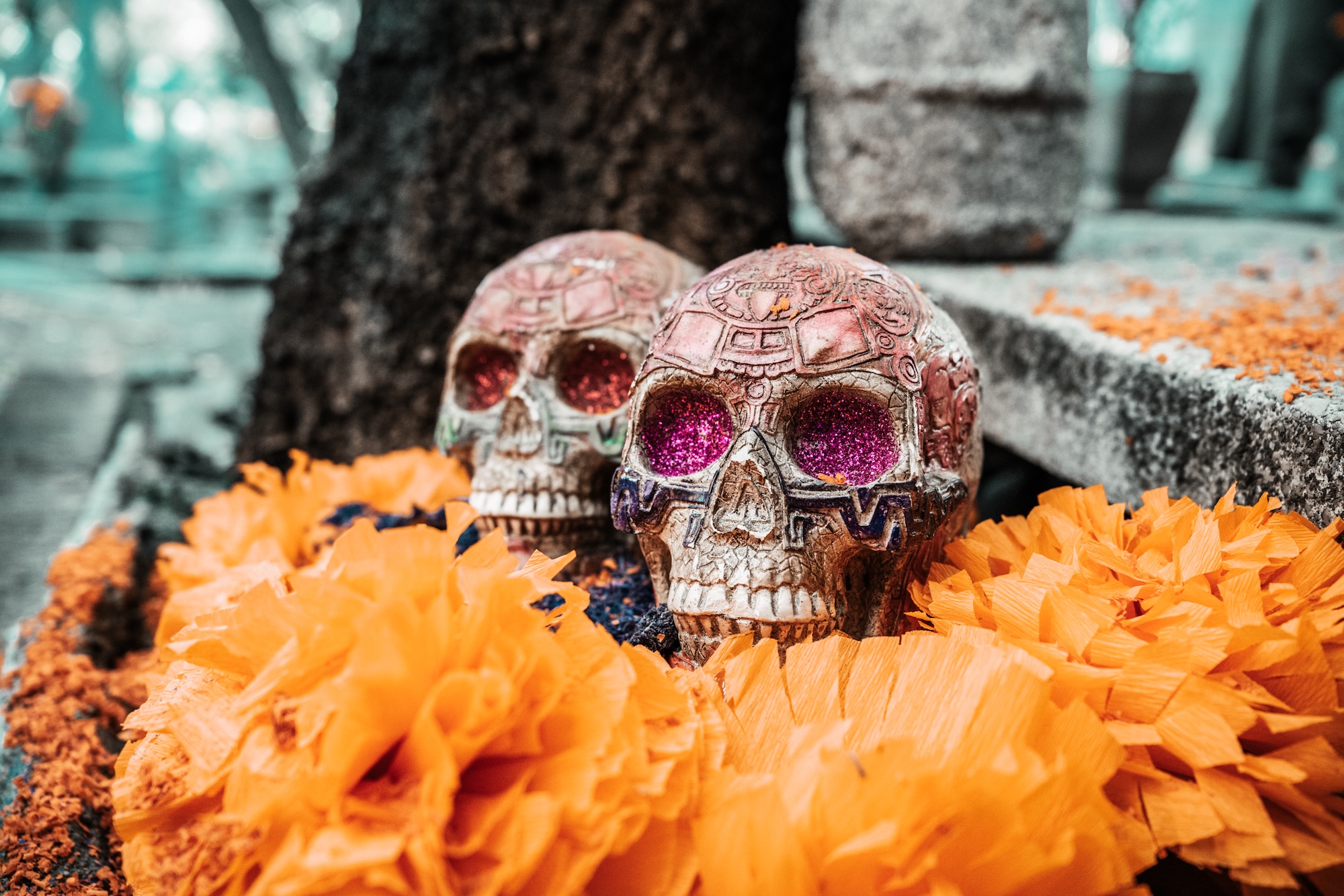
At Panteon Xoco cemetary, Nov. 1, 2026. Photo by Jon Bauer 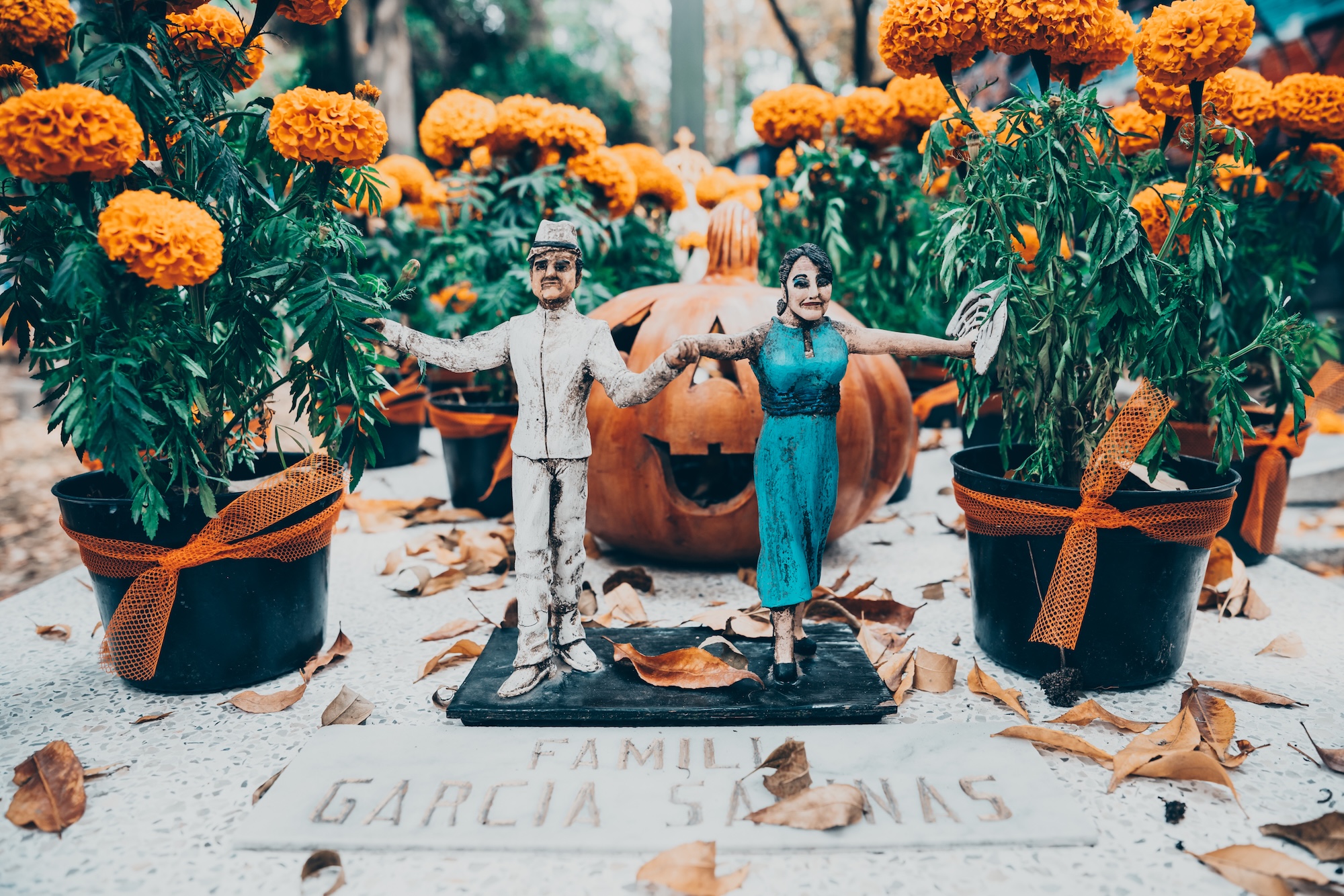
At Panteon Xoco cemetary, Nov. 1, 2026. Photo by Jon Bauer 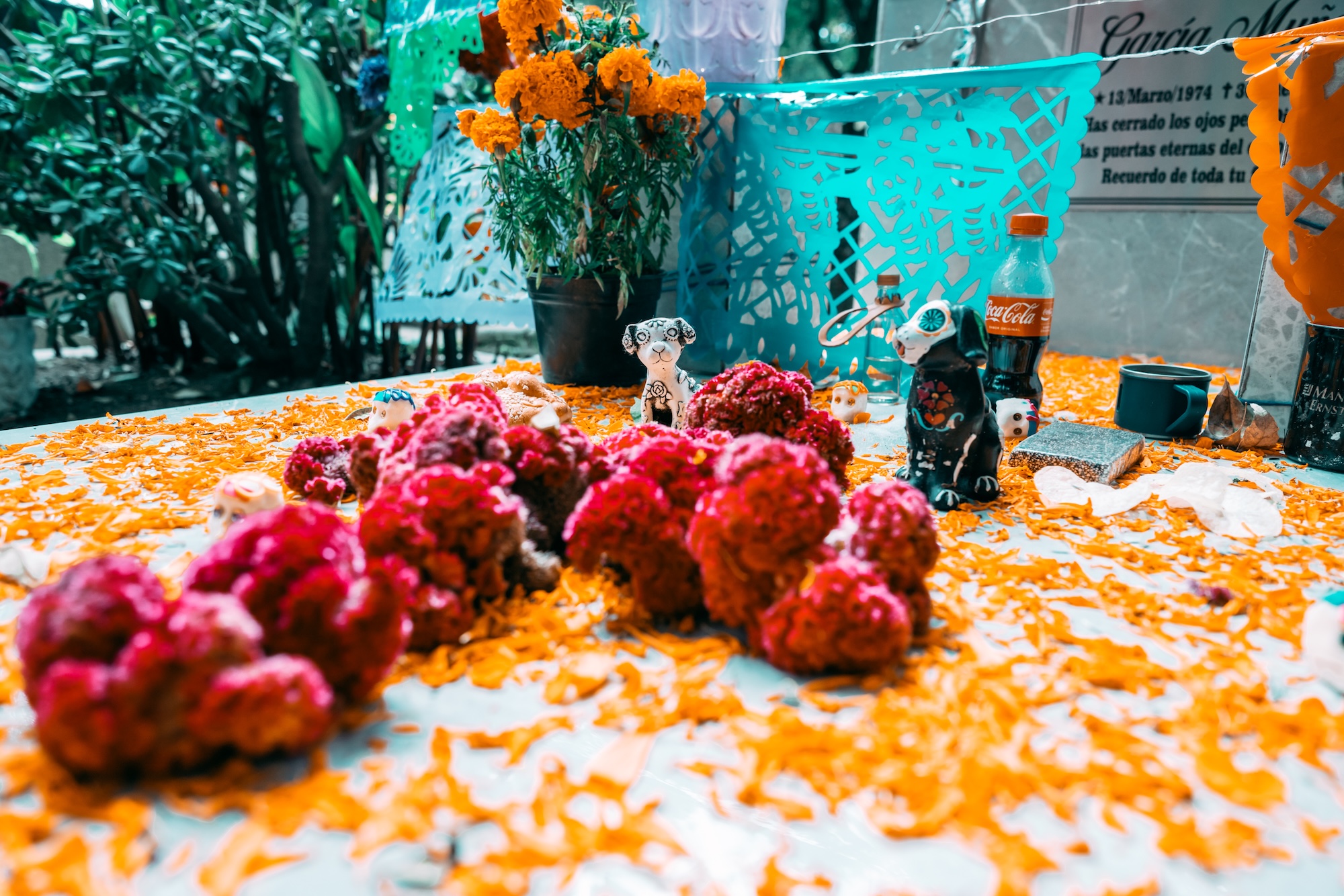
At Panteon Xoco cemetary, Nov. 1, 2026. Photo by Jon Bauer 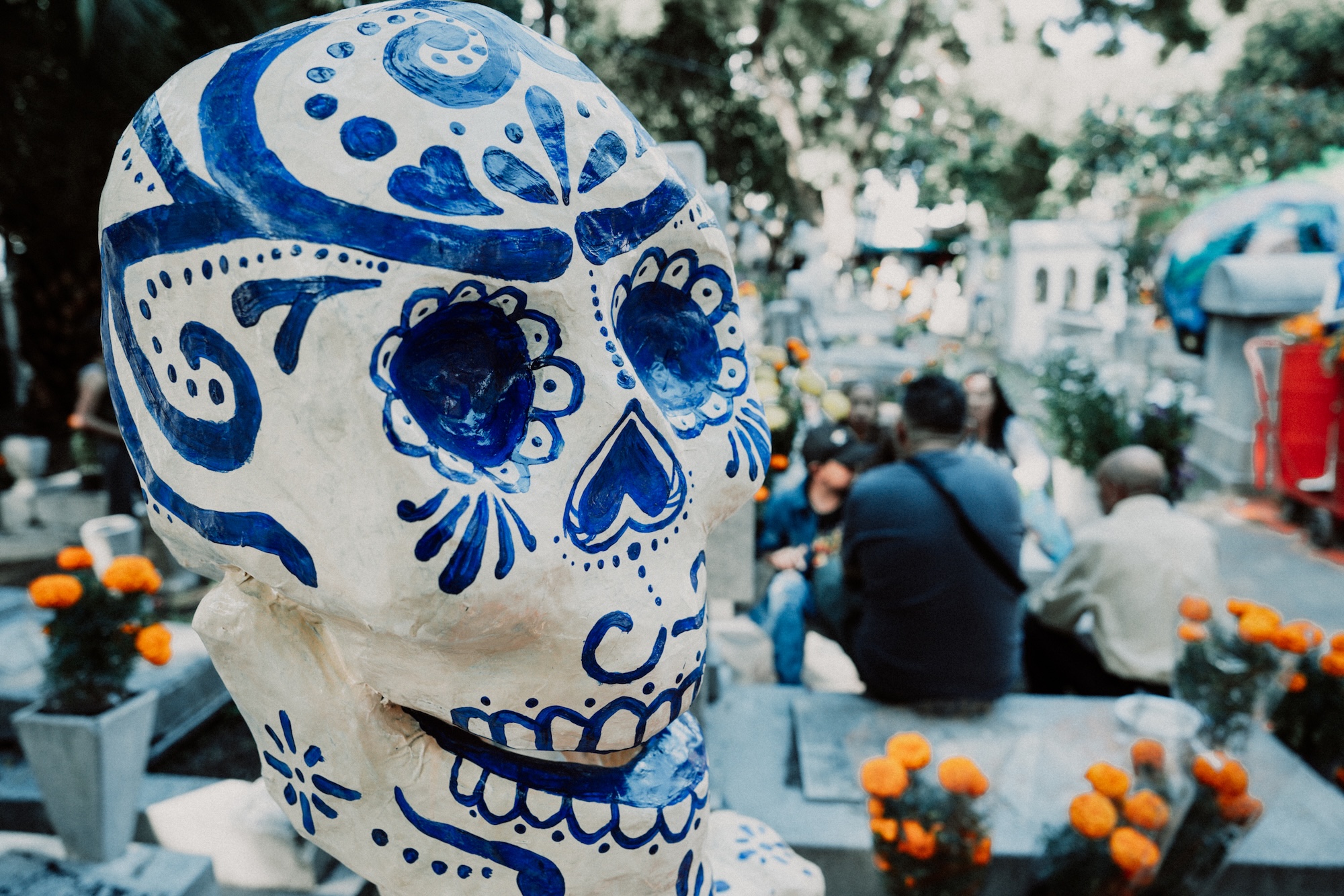
At Panteon Xoco cemetary, Nov. 1, 2026. Photo by Jon Bauer 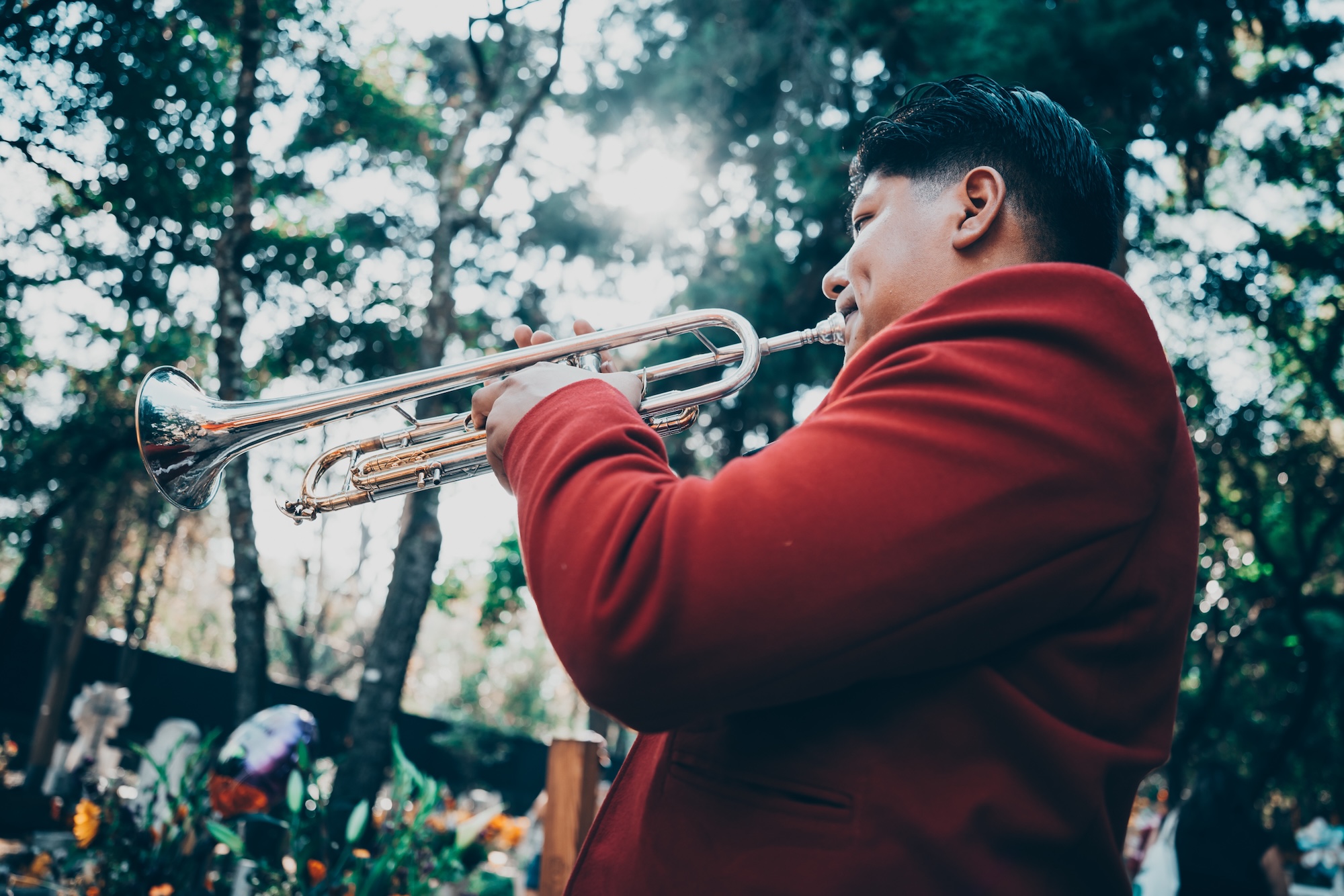
At Panteon Xoco cemetary, Nov. 1, 2026. Photo by Jon Bauer 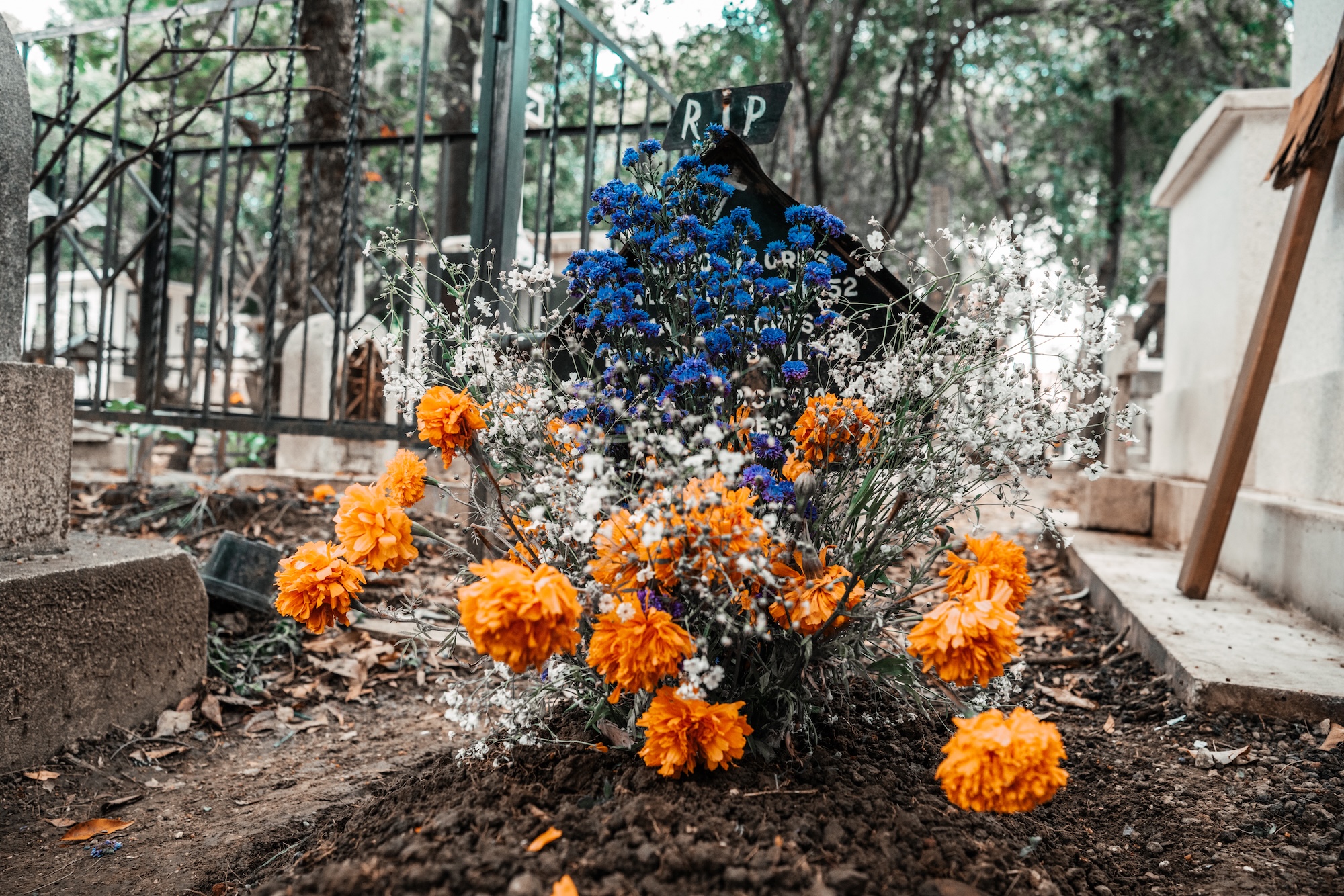
At Panteon Xoco cemetary, Nov. 1, 2026. Photo by Jon Bauer
Someone left a touching message: “Congratulations! You are going to be a great-grandma. We miss you a lot.” Even the telecom company advertising with photos of Catrinas giving out paper marigolds didn’t dampen the evening.
Leaving the cemetery, one vendor had a few poinsettias nestled amongst the marigolds. Life does go on; Dia de Muertos season gives us the time and space to remember those we’ve lost and treasure the time we all have. —Patty Riek
The post Día de Muertos in Mexico City lit up with axolotls, zombies, and a giant Catrina appeared first on 48 hills.
]]>The post Watch: Día de los Muertos brought a deep message to the Mission appeared first on 48 hills.
]]>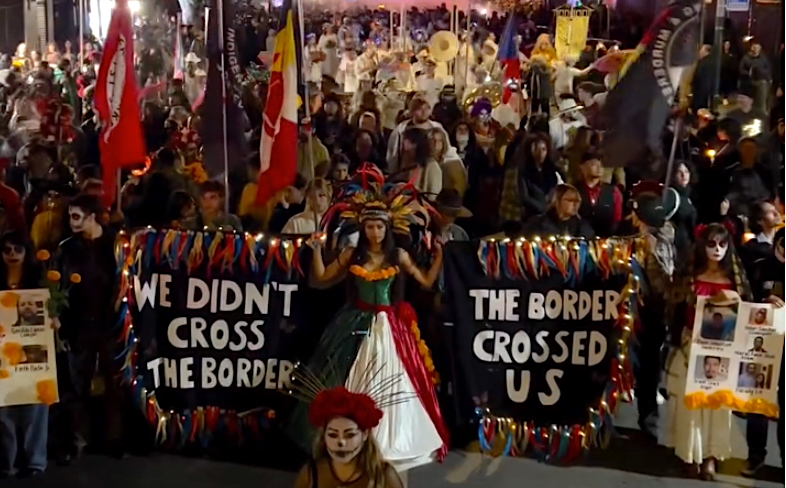
Thousands of people gathered to watch and participate. But what makes this procession unique is that it’s truly a grassroots, community effort, with the message “Our Dead Are Not for Sale.” “That saying is a slogan all year long in terms of gentrification and changes in the Mission,” said Michelle Cerrato of event organizers El Colectivo del Rescate Cultural (Culture Rescue Collective). “We don’t collect government assistance or external funding for this event. It’s by the community, for the community, and therefore you cannot buy us.”
Watch our live report, and subscribe to our YouTube channel and follow us on Instagram for more:
The post Watch: Día de los Muertos brought a deep message to the Mission appeared first on 48 hills.
]]>The post Under the Stars: Sun Ra rises—with a cosmic wink—on Jimetta Rose’s ‘Mettasun’ appeared first on 48 hills.
]]>Oh, one more thing: We Break News Every Week! Let’s Go!
JIMETTA ROSE, METTASUN (NIGHT DREAMER)
Such a funny thing. In this year, 2026, marking the 100th birth anniversary of both Miles Davis and John Coltrane, which inspired global centennial celebrations, tribute concerts, and reissues, I consumed more Sun Ra music than ever before. Between attending both Sun Ra Arkestra’s two sold-out concerts at The Chapel on February 28 and March 1 as part of the 33rd annual Noise Pop Festival, and taking in the American Masters, Sun Ra: Do The Impossible documentary that originally aired in February on PBS—it was a Sun Ra-heavy year. But actually? Right on time.
Ra, forever the poet, philosopher, and music visionary, probably foresaw the political climate we are inhabiting right now.
So to have the LA-based vocalist and musician Jimetta Rose reimagine Sun Ra on ‘MettaSun,’ full of the cosmic jazz pioneer’s iconic recordings through Jimetta’s unique lens, delivers clarity, hope, and just a bit of humor, desperately needed in these mostly unfunny times. As always, full of those tones and frequencies, bearing witness, exquisite Black voices performing upliftment in a choir setting, MettaSun speaks to 2026 a bit more directly than Coltrane and Miles ever could, through that avant-garde meets melodic, graceful, conversational way.
This slipped by me at the end of September; don’t let it slip by you. Pick it up here.
MILD UNIVERSE, JOEL ROBINOW, PATEKA AT BOTTOM OF THE HILL, NOVEMBER 18
This is the type of show we call a three-fer… Actually no. It’s a throwback to a time when three incredibly talented Bay Area bands somehow got the luck, the sweat, or pristine timing to share one bill. It used to be more commonplace when there were local venues that could invest, strictly, in local talent.
I digress. Mild Universe continues in that certain historical sonic formula that some Bay Area bands adhere to; it’s the combo amalgam. That smattering of rock, funk, trippy-dippy shit, disco, jazz, and a chef’s kiss of foggy collectivism—a combined calling amongst adverse thinkers in song. San Francisco’s Mild Universe, the six-to-seven-piece combo outfit that formed in 2019, is comprised of musicians who opine with shine.
Joel Robinow, formerly of Once & Future Band—damn, I loved that group—is an accomplished performer, multi-instrumentalist, composer, and still has that voice that speaks to anyone inquisitive. Pateka, the Richmond-based fusion quartet, praised by Jazz Times, brings serious chops and auditory unexpectedness, if not downright silliness, to the experimental art-rock milieu.
In total, all three acts hold their own weight and show promoters and venues how you build an impressive night of LOCAL music. Get here early; you don’t want to miss anybody. Grab tickets here.
WENDY EISENBERG
It’s that time of the year when Noise Pop announces the first phase and release dates, and we, SF music writing people, make assumptions about who we think is playing the festival but just have not as of yet been announced. If you notice in the mantra of this column, we’ve added the tagline: “We break music news every week.”
I’ve just recently started listening to Wendy Eisenberg, who describes herself in her Bandcamp profile as “an improviser and songwriter who uses guitar, pedals, the tenor banjo, the computer, the synthesizer, and the voice.” Her recent companion album, Wweennddyy Eeiisseennbbeerrgg, takes two previously released songs and stretches them into about 46 minutes of beautiful, lush, ambient folk arrangements, meant for immersive listening.
With a date at our Four Star Theater on Tuesday, February 23, 2027, you can assume she’s performing as part of Noise Pop, and it seems it’s already sold out. So call your buddy Sketchy Jay, who always has an in to the show, because you’re going to need him. But keep your eyes peeled here just in case.
WHITNEY’S PLAYLAND, BOTTLED LIGHTNING (DANDY BOY RECORDS)
Bay Area quartet Whitney’s Playland returns with a 7-song EP that was recorded and mixed by the band across their home studios, packing some self-described “swirly power pop, deconstructed lullabies, and buzzing ballads with a bone to pick.” The lead single “Bottled Lightning” rolls around with garage-fuzz textures and smooth, steady, and effective rhythm.
The new EP is out November 20 on Dandy Boy Records. Pre-order it here off the sampler, which pays tribute to Little Hill Saloon.
NABIHAH IQBAL, “HEAVEN CAN WAIT” (GHOSTLY INTERNATIONAL)
Brit Nabihah Iqbal took a couple of years to follow up on her 2023 album DREAMER, but she’s returning with a new single, label, and country of residence, here in the US. The new single “Heaven Can Wait” continues with the post-punk New Wave textures she’s known for. Her SF debut at Cafe du Nord in the summer of 2023 merged those sonics with indie-rock and house.
About the new work, Iqbal said in a press statement, “It’s a song about the happiness of friendship. It’s about loving life, feeling good, and appreciating all the positive things that this world has to offer. The song is inspired by summers in London and New York City: it’s about having fun with your friends and really, truly feeling alive. I wrote the song in a small, quirky basement studio in the East Village, Manhattan, and I wanted to channel the energy and freedom of this iconic New York neighborhood.”
Iqbal is currently a resident DJ at New York’s Public Records. Pick up the single here.
THUNDERCAT AT FOX THEATER, NOV 17
Thundercat is a consistent live act: If you care about contemporary pop music and have a hankering for the weird and wonderful out-jazz multiverse—Old Thundie is for you. It’s difficult to name a peer or contemporary who can serve up his type of hits but also supply context and access points for a young and budding jazz fan.
Currently out on tour in support of the new album Distracted, which gives this Grammy-winning artist and producer bandwidth to play big-sounding jazz arrangements, making tributes to jazz heavyweights McCoy Tyner, Wayne Shorter, and Chick Corea alongside crooning ballads about his ‘Dragonball Durag.” That’s range, baby! Grab tickets here.
The post Under the Stars: Sun Ra rises—with a cosmic wink—on Jimetta Rose’s ‘Mettasun’ appeared first on 48 hills.
]]>The post Why the billionaires won appeared first on 48 hills.
]]>It’s going to take months to fully analyze the San Francisco returns and figure out why the progressives lost almost everything. But there’s no way to understand this election without looking at the massive, unprecedented, sums of money a handful of very rich people poured into the key races to elect candidates and pass measures that support the Big Tech and Real Estate agenda.
Between his own campaign and the IE money, state Sen. Scott Wiener had $17 million on his side, far, far more than Sup. Connie Chan. Mayor Daniel Lurie had $13 million to pass his ballot measures. The opponents of those measures had a few hundred thousand.
Money alone doesn’t explain political outcomes: Elon Musk spent more than $250 million to keep the Democrats from winning in Texas, and he lost. But that was part of a national rebellion against Donald Trump, and none of the races in San Francisco had anything to do with Trump. Not directly: Everyone involved is a Democrat.
The progressives never had the resources to explain to the voters what, say, Prop. D really meant. I got at least five mailers talking about “cleaning up City Hall.” None of them said that the voters would be in effect giving up the right to place initiatives on the ballot.
We had no serious race for US Senate or governor to get the young, progressive voters excited about taking on Trump. It was hard to run against the mayor, who remains popular although a majority of San Franciscans think the city’s economy is going in the wrong direction.
We also have a daily newspaper that remains among the top sources of information for residents that largely ignored the real issues in the Congressional race, never fully reported on the impacts of the mayor’s measures, has long bought into and promoted the idea that the private market will solve our housing crisis—and offered an entirely reactionary set of endorsements that Wiener and the mayor’s allies freely used as campaign mailers
The demographics of the city have changed in the past decade as more wealthier people move here for tech jobs. Some are millionaires already; some expect that they’ll be millionaires soon. The idea of a billionaire agenda isn’t at all alarming to them.
But that’s not a majority of San Francisco. A majority of San Francisco, including a lot of people who would have voted for Chan, didn’t cast ballots. When all the votes are counted, turnout will be about 60 percent. In some part of town, including D9 and D10, it could be below 50 percent.
Here are some reports from Election Night that give some sense of how people were feeling:
From our correspondent Frida De La O:
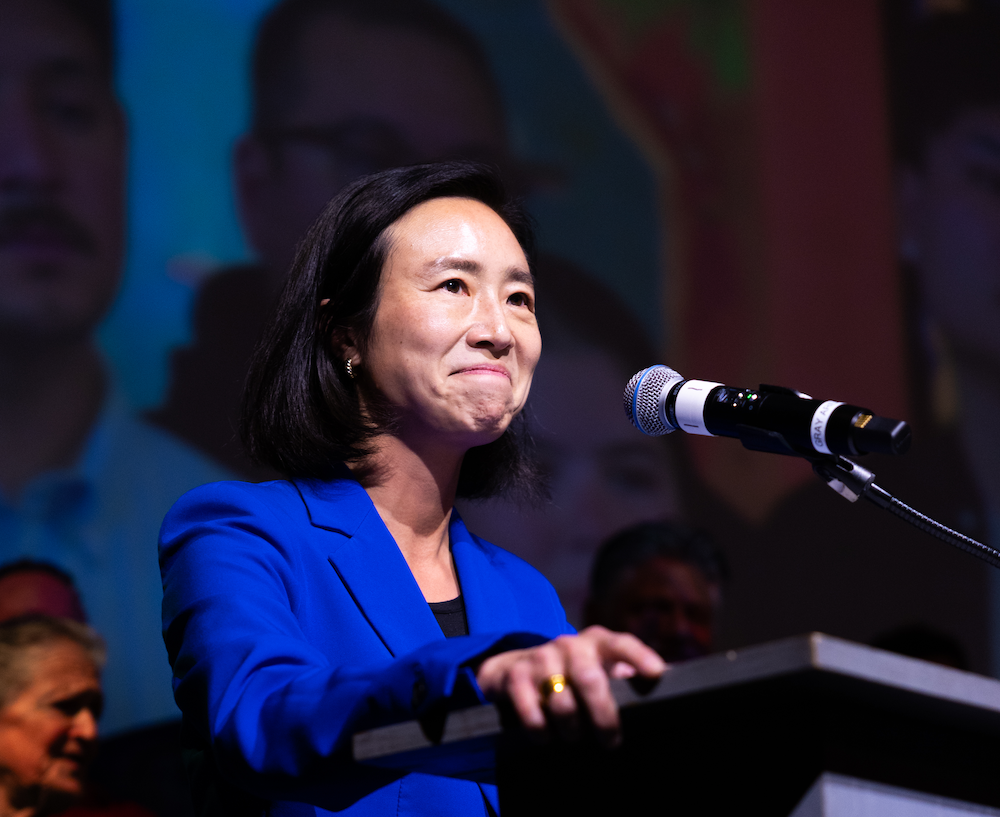
A large crowd of San Franciscans in support of Connie Chan gathered at Gray Area on Mission St. Chan merch being sold at the entrance, buttons reading ‘Connie Chan for congress’ and navy blue shirts with “CONNIE” written across the chest. The crowd buzzed with hope and excitement, with boxes of pizza stacked to the left of the room, and a photo background reading phrases “The future is ours to build” and “we are here to change what comes next.”
Attendee Osha Ashworth said “being someone who comes from a working family, and understanding the struggles of working people is really important to bring into congress”
Videos of Chan greeting community members projected on a main screen and attendees mingled. Many were grabbing a drink at the bar and bustling at tables chatting all things Chan. Attendee Brady Fell said, “I’m hopeful, I think she had a lot of headwinds because of name recognition and because of all the money that Scott Wiener had, but I mean, I’m hopeful” Speaker Emerita Nancy Pelosi endorsed Chan earlier this year.
Chan’s popularity stems from a working-class background and an inspiring story. Fell continued “It would be great for the city to see someone who’s immigrated to the United States and now could be in the house”
When early results showed Wiener at 57 percent and Chan at 43 percent, the crowd remains hopeful. It’s theoretically possible that as the final votes are counted, Chan could pull ahead, but she would need 56 percent remaining ballots.
Olivia Morris said “we are up against crazy PAC funding, this is a really grass roots movement, no matter what it’s going to be an uphill battle” Matt Richardson added “I’m committed to the end. I want to get the final count”
Rudy Gonzalez took the stage to introduce supporters of Chan. Kim Tavaglioni, the head of the SF Labor Council, said “this is the beginning of our movement…to fight for the working men and women.”
Speakers mentioned countless policies that Chan supports, from housing, something Chan’s campaign didn’t focus on too much, to the support of limitations on AI.
The lead labor representative the California Nurses Association, Dominic Chan, pointed at his shirt with Wiener’s face, with text at the bottom reading ‘There is no anthropic money in this race…’
“He is a liar,” Chan said, reading it out loud the crowd cheered, then began a chant “Yes, we Chan” that roared through the room of the Gray Area.
Connie Chan, introduced by Gonzalez, kept her speech upbeat. “We all want an answer tonight, but every voter deserves to have their ballots counted. We owe it to them, to be patient, to get this right” she continued “You gave this campaign courage, your time and your belief that working people, all working people, can shape our future” she thanked her canvassers, her family and Pelosi for paving the way of public service in the city and before leaving she thanked the crowd of supporters. Chan left swiftly as the crowd began to chant “Yes we Chan.”
From our correspondent Philippe Bienick:
I entered the Mission Rock Resort a little after 9pm to a raucous atmosphere. By the time I arrived, District 10 Supervisor candidate Theo Ellington had wrapped up a speech in front of a crowd of friends and family. Everybody had a drink in their hand and carried a lighthearted mood, all before any result was even announced. As I made my way through his family and friends, the DJ cut the track as Ellington grabbed the microphone. At this moment, he announced his victory. A chant saying “Theo! Theo!” followed.
I got a chance to interview Ellington after a decent wait; the candidate took time to celebrate with his closest family, friends, and partners. Finally, he graciously got back to me. I asked him about his plans for his first 30 days in office, as well as concerns about his pro-housing agenda at all income levels. I also questioned him on his support from crypto billionaire Chris Larsen and his support on the moratorium for AI data centers. Finally, I wrapped up with his plans for the Hunter’s Point shipyard cleanup.
His answers consist mainly of his grounded campaign talking points. He emphasized the need to improve the transit corridors and its surrounding infrastructure in the Bayview, and how dense housing needed to accommodate for that. As for how he would gain political and fiscal support for affordable housing, he mentioned how the market and state legislation would force him to “have to get creative.” For improving the transit corridor, he could not give specifics on improving transit times.
Chris Larsen was not present at the event. Daniel Lurie briefly came by, and left in a matter of minutes. Supervisor Matt Dorsey was present.
From our correspondent Olyvia Manor:
People are hesitant to comment on their position on Proposition G, the Great Highway measure, whose supporters shared a party with Connie Chan. They often mention that it has been on ballot before and in that regard it’s a sign that the people do not feel like their voices are heard.
However, when I was able to have a conversation with Otto Pippinger, the face of the Yes on G campaign, he said that he was not surprised by the outcome, but still though he had succeeded. He shared that it was less about the electoral results, since he knew that he could only offer the proposition a “25-40 percent chance” of passing, but rather that he was able to give voice to the people who had been drowned out the first time around. For him, it was a small defeat in a larger movement of bringing together the people who continue suffering these smaller loses and will eventually grow into a greater power against the mainstream.
From our correspondent Leonardo Lluberes:
As soon as you enter the front door at El Rio,, you have to push through crowds of all sorts of folks. You can see the old and young, people of every race and creed, and of course people on the left. The progressive wing of San Francisco politics is hosting an election watch party. Members of organizations like the Harvey Milk Club, the Democratic Socialists of America, and the Working Families Party are all over the bar. Drinks and pizza boxes litter every table and chair, with everyone drinking beers and cheering as they hear another Democratic victory in the Senate.
Friends and families are meeting up with signs and campaign merch, with even some candidates like Bunny McFadden present at the party. McFadden, a candidate for the City College board, talks about progressive organizing in this election for Props I and B. She says, “We’ve shown that we have the infrastructure to push forward things that are way outside of our weight class, and that we’re really good at keeping our values intact when we move through electoral politics.”
With every update on the results, you’d either hear groans or cheers, with everyone openly discussing and debating what those results mean for the total.
It was a Who’s Who in the bar with local progressive leaders like Dean Preston and Sup. Jackie Fielder. Jane Kim, the leader in the race for state insurance commissioner, even made an appearance, giving a rousing speech about the need for organizing a progressive movement across the state, and the importance of coalition building.
I was able to get a hold of her for an interview where we talked about what other progressive candidates can emulate in their campaigns. She said “We showed that you can have an unapologetic populist campaign taking on corporate billionaires and win in the state of California. But you have to win with the message, and we came with a message. A policy platform, about how we were gonna fight for everyday California and working families, and it resonated across the state.”
There is good news for progressives: It looks as if Proposition B, the Public Bank Initiative, could pass. As of the latest results, it’s down by just 300 votes, and the later votes are breaking more progressive. And Kim has a 52-48 percent lead over Ben Allen for insurance commissioner.
To nobody’s surprise, Prop. C, the affordable housing trust fund measure, passed; the mayor and his cronies supported it. They opposed Prop. I, which would have allocated tax money from high-end property sales to social housing; it went down to defeat.
The post Why the billionaires won appeared first on 48 hills.
]]>The post Drama Masks: ‘Liberation’ sweeps the stage at Berkeley Rep appeared first on 48 hills.
]]>I write these words on Election Day 2026, and the country’s in such a shitty state of affairs that even the White House (what hasn’t been destroyed to make the Epstein Ballroom) anticipates massive voter backlash. I voted two weeks ago with progressive righteous indignation. I’m far too realistic for that to think everyone voted the same, so here’s what this arts journalist has his eye on, some of which will be still too close to call on November 4.
There’s Berkeley’s Measure Y, which would directly fund the arts communities. The measure’s been most strongly promoted by Shotgun Players, which has been pushing for votes for months now.
Richies are sweating California’s Prop 40 billionaire tax, even the current governor of California. They’re so terrified of this one-time tax that they’ve spent no less than $1million-per-day trying to defeat it. They even wrote three other Props (41-43) to deliberately sabotage Prop 40 if it does win.
Mayor Bluejeans continues his Trump cosplay by attempting a similar power-grab with SF Props D, E, and F. Mind you, he and his acolytes are the same “geniuses” whose last prop may have opened the door for Aaron Peskin to re-run for Supervisor.
Then there’s the fight for Pelosi’s seat. One candidate hates the homeless, loves cops, plays queer whilst erasing queer history, fetishizes gentrification, used racist AI propaganda against his Asian-American opponent (not the first time), and once faked an endorsement from the SF Bay Guardian, to name but a few skullduggeries.
The other candidate is Connie Chan. ‘Nuff said.
Our own Tim Redmond has already pushed back against one potential ending for this story. It’s far too soon to say how it ends. But I echo Tim’s sentiment that it’s not too late to write our happy ending. Besides, an activist’s story never ends on Election Day.
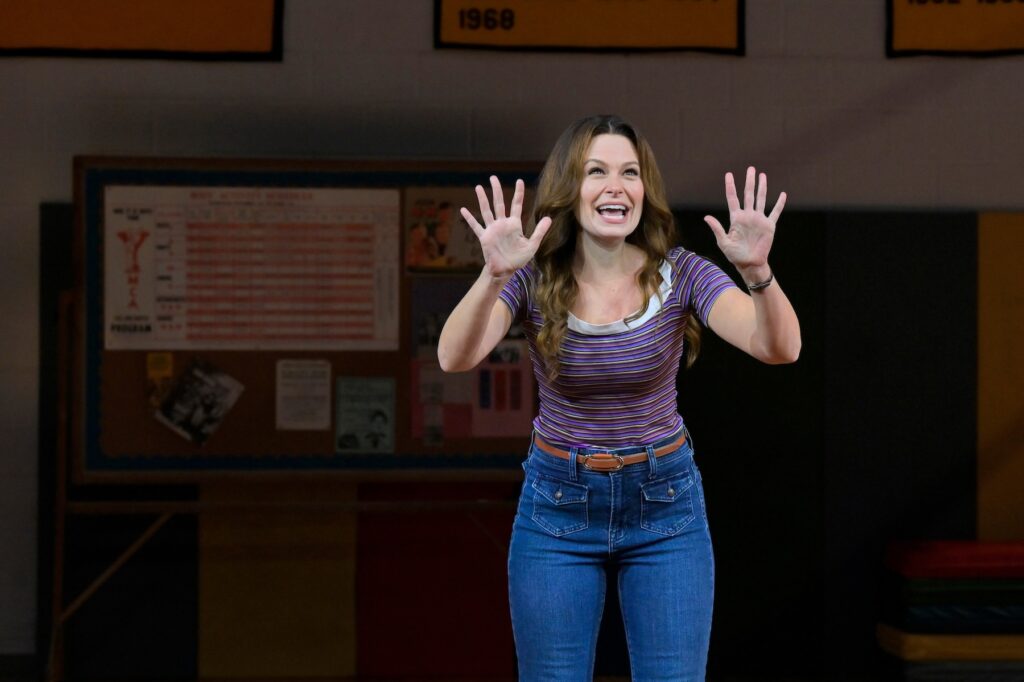
Liberation West Coast premiere at Berkeley Rep
With public funding in mind, I nearly missed opening night of this show because of an incident on the BART tracks, forcing me and other passengers to run back-and-forth to the Salesforce Dildo in the hopes of getting a bus across the Bridge. If you wonder what improvements a billionaire tax could improve, there ya go.
Paradoxically, awkwardly walking in five minutes late to Bess Wohl’s Pulitzer-winning Liberation (West Coast premiere through November 29 at the Berkeley Rep) was probably appropriate. After all, when the members of the show’s second-wave-feminist Consciousness Raising Group introduce themselves, one of them lashes out at the idea that a group of women gathered must automatically be a knitting circle.
The kicker is that one of them actually did attend the group thinking it was a knitting circle. (That joke reminded me of the first episode of Vag Magazine, the short-lived web series that introduced the world to Kate McKinnon.)
This particular CRG meeting, set in an Ohio gymnasium in the 1970s, has been arranged by Lizzie (Katie Lowes). Its attendees include the Afrocentric Celeste (Felicia Curry), Jewish radical Susan (Evelyn Spahr), housewife Margie (Mary Gordan Murray), liberated Italian Isidora (Irene Sofia Lucio), and office worker “the other Dora” (Britt Faulkner). Through the memories of Lizzie’s daughter (also Lowes), the younger woman strives to find out how complex the Women’s Movement was and whether her journalist mother compromised her own beliefs by adopting the family life.
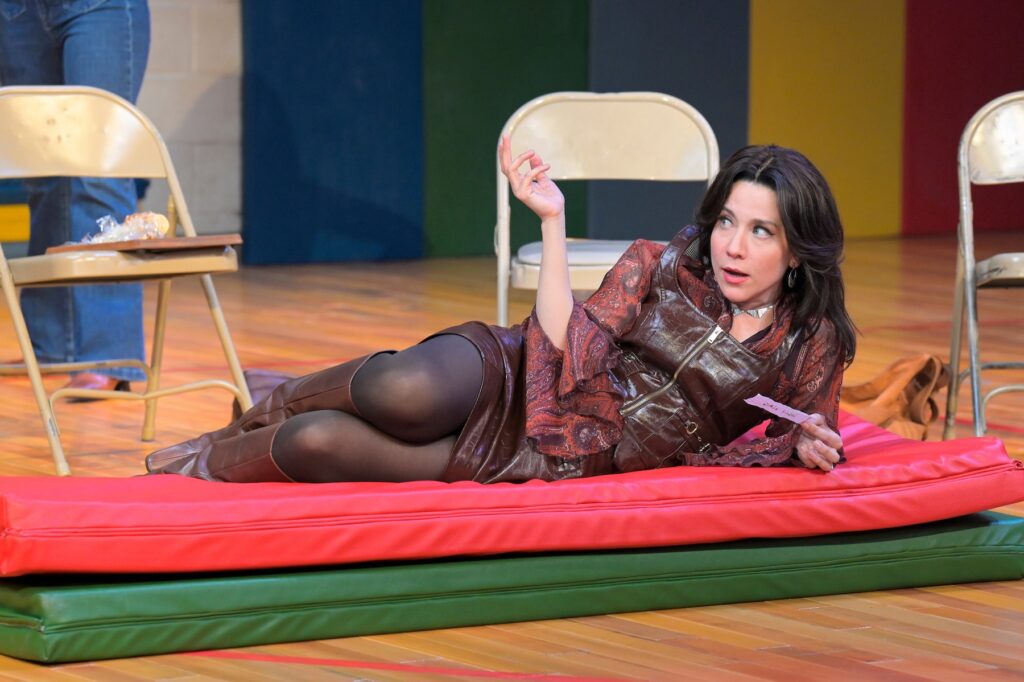
Wohl’s dramedy script is strongest when emphasizing that not every decision is as clear-cut as a manifesto tenet. One of the best scenes has one of the women reveal she voted for Nixon. Why? Because “McGovern sold us out!” You could swap out those respective names for “Trump” and “Biden” without losing the statement’s impact. Where the script wavers is in trying to balance to comedy and drama (both of which are good) without the two having a head-on collision. The script is also pretty self-congratulatory in its inclusion of Black women, but they’re the kind of Black women white writers always include, so as to not be accused of not including them.
Director Whitney White gets a surprising amount of mileage from a play that’s just six women in folding chairs. But if Mamet got a Pulitzer for writing six guys in chairs, why not the all-femme equivalent?
It should come as no surprise that the Rep’s Roda Theatre kept a steady flow of air throughout the night. CO² levels on my Aranet4 peaked around 870ppm in the second act, before dropping down to 839ppm by the final bow. (The final mask-required performance will be the November 8th matinee.)
At times, Liberation seems as confounded as its narrator as to what story it wants to tell. The parts it does tell can be fascinating, but the self-conflict can be frustrating. Oddly enough, that may be the point.
LIBERATION’s West Coast premiere runs through November 29 at the Berkeley Rep. Tickets and further info here.
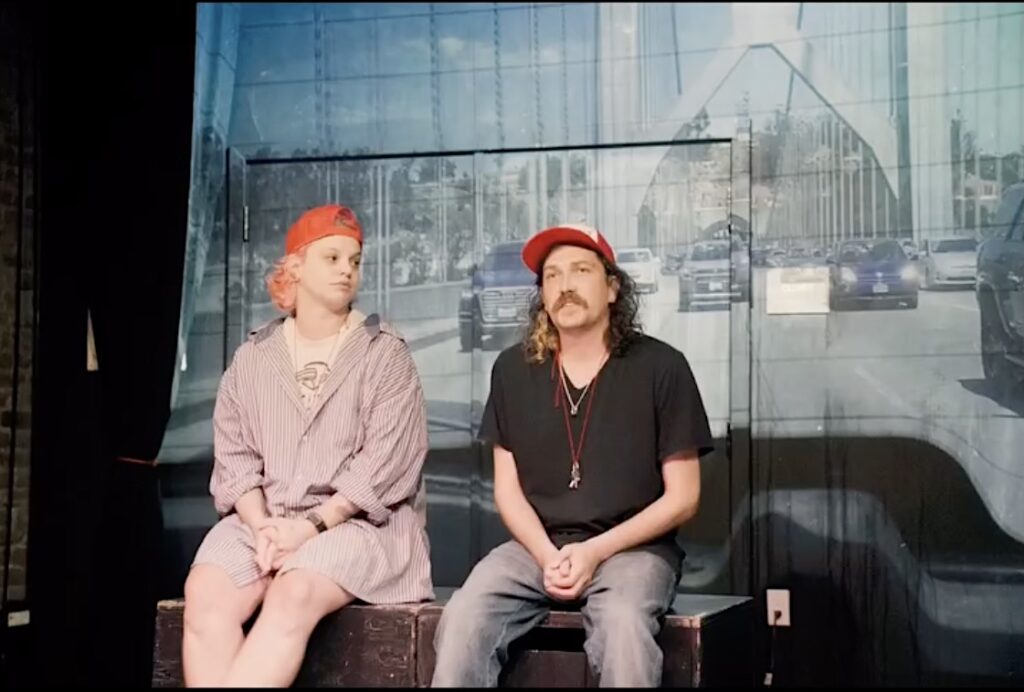
SF Neo-Futurists present We Bought a Gun world premiere
“I don’t like it.”
An audience member said that during the opening-day performance of the SF Neo’s latest full-length. It was when writer-performers Jeb and Willie Caldwell used their titular firearm to discuss Shoot, Chris Burden’s infamous 1971 performance art piece in which he was intentionally shot with a live round. One also thinks of the near-shot three years later at Marina Abramović’s Rhythm 0. Jeb and Willie similarly put their trust in one another for the sake of performance art. The tool–nay, weapon–they use is no less dangerous now that it was 50-plus years ago.
The difference between We Bought a Gun (world premiere through November 22 at 447 Minna, SF) and the aforementioned pieces is that no live ammo is ever placed in this gun. Nevertheless, it’s treated as an object of affection (it’s placed in a baby’s crib), an avatar of debate (legislation is discussed at length), and an indisputable symbol of power. They detail the hilarious story of purchasing it at gun shop in Pacifica and whether it conflicts with or supports the couple’s left-leaning politics.
In SF Neo fashion, the audience is not there to casually observe. Again: the gun is never loaded, but we’re invited (under supervision) to take active vocal and physical part in the power the weapon represents. It says a lot that almost no one wanted to at that first performance.
It had been a while since last I visited 447 Minna, but I think the HVAC was working better than last time? Granted, the opening-day audience was about half-full, at best. Still, CO² levels peaked around 885ppm by the end of the hourlong show.
We Bought a Gun has no illusions about ending the country’s firearms debate anymore than EM Lewis’ The Gun Show did. Ending it isn’t the point of the show; understanding it is. The US is the most heavily-armed nation in the world. The point is that we’re all affected by guns, even if we never touch them.
WE BOUGHT A GUN’s world premiere runs through November 22 at 447 Minna, SF. Tickets and further info here.
The post Drama Masks: ‘Liberation’ sweeps the stage at Berkeley Rep appeared first on 48 hills.
]]>The post From Schwarzenegger to Sex Pistols, Babeth Mondini-VanLoo has seen—and filmed—it all appeared first on 48 hills.
]]>“I don’t believe in a division between high art and low art,” she told 48 Hills. “Both were my world.”
That world comes into view at the third annual Studio 8 Film Festival. Running Fri/6–Sun/8 at the 4-Star and Roxie theaters, the fest celebrates filmmakers connected to the San Francisco Art Institute. The festival is named for the school’s former film production studio on Chestnut Street, where George Kuchar and generations of students made movies.
The weekend opens at the 4-Star with experimental and personal documentary shorts by this year’s open-call jurors, Ed Jones, Michael LaRocco, and Jacalyn White. Among them is Jones’ Nine Years Behind the Wheel, a visual diary of his late-’70s adventures driving a San Francisco night-shift taxi. A conversation moderated by V. Vale of RE/Search and a reception follow.
The next afternoon, the 4-Star hosts Personal Visions, a selection of 18 shorts featuring work by Susan Weiss, Colette Standish, Kavena Hambira, Irene Carvajal, and the WE DA PEPO collective.
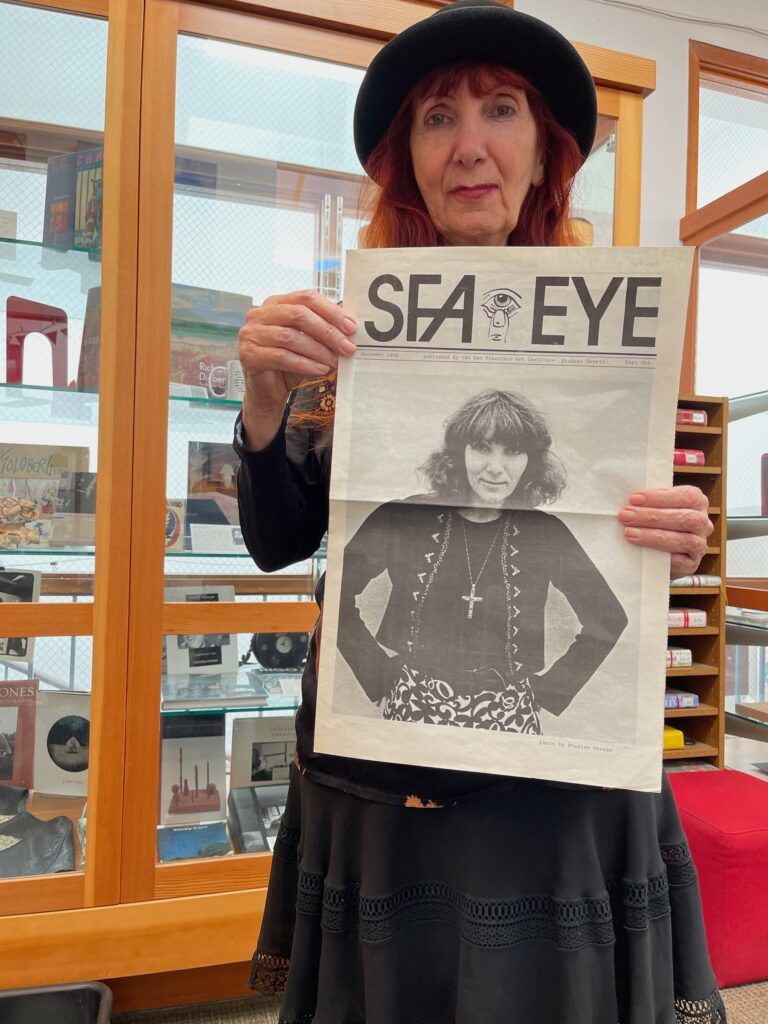
On Sunday, the festival moves to the Roxie, where Mondini-VanLoo will receive the Legacy Award and present four films on Sun/8. The program ranges from the Sex Pistols’ final concert at Winterland to Arnold Schwarzenegger posing as a living sculpture, with stops for Keith Richards and the European art movement Nouveau Réalisme along the way. A conversation follows with San Francisco curator Tanya Zimbardo.
Outside the festival, Mondini-VanLoo, who earned her MFA in film at the Art Institute, will also screen her recent documentary, Dalai Lama: My Religion Is Kindness, at the Roxie on Nov. 7 and at the Rafael Film Center on Nov. 15.
Born in the Netherlands, she studied performance and sculpture with Beuys in Düsseldorf before coming to the US. His idea of “social sculpture,” which held that art and life were inseparable, influenced her.
In New York, she met Andy Warhol through Beuys and spent time at the Factory. But she found the city overwhelming. “It was a heavy time,” says Mondini-VanLoo. “I was young, and it seemed like almost every week somebody was dying or overdosing.”
Looking for a place where art and life could meet, she traveled across the country and found the San Francisco Art Institute. There, she met teachers and artists, including Kuchar and filmmaker Gunvor Nelson, as music and cinema fed each other.
“Many students were musicians, and the punk scene was vital,” Mondini-VanLoo says. “You could find me at Mabuhay Gardens almost every evening, documenting what was happening.”
Mondini-VanLoo contributed to the punk publication Search and Destroy. Through that circle, she attended the Sex Pistols’ final concert at Winterland in Jan. 1978. She recalls the room’s energy was “alive.”

Her 1978 film Berlin Wall & Sex Pistols pairs that concert with footage she shot of the wall in Germany. For Mondini-VanLoo, the connection was political: she saw the band’s lyrics and its resistance to the music industry as part of an engaged punk movement.
The meaning emerged in the editing room. Using an optical printer, she made images move from stillness into motion, a gesture she associated with the band’s power to spark change. The film ends with a message calling for the wall to come down.
“Nobody dreamed the Berlin Wall would fall,” says Mondini-VanLoo. “Every time I see that image, I’m happy it happened.”
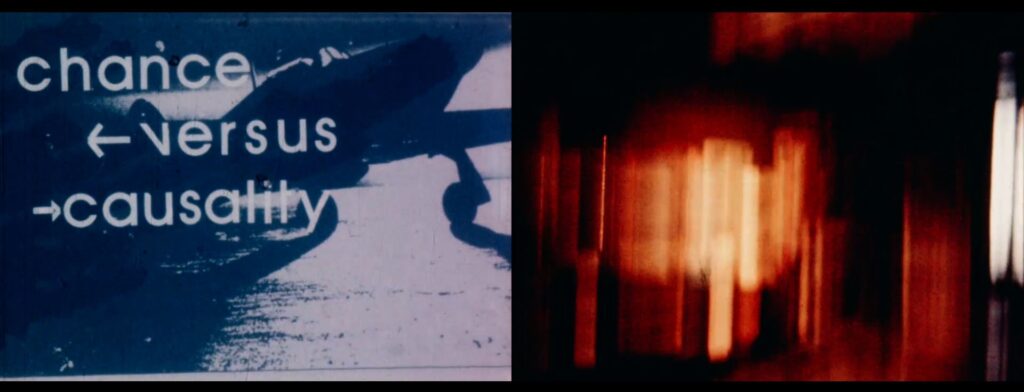
The Studio 8 program also revisits 1979’s Chance Versus Causality, her two-screen film following artist Daniel Spoerri through San Francisco, Paris, and Cologne. One screen provides art-historical context and conversation; the other moves through associative images and found footage. The film includes Christo’s Running Fence and encounters with artists Jean Tinguely and Niki de Saint Phalle.
Mondini-VanLoo asked Cabaret Voltaire to create the soundtrack. Because chance was central to the project, the band saw some of the material but did not score a completed film in a conventional way. The group even recorded one version with their eyes closed, she says, and she mixed the recordings together.
Her 1977 short Not Guilty: For Keith Richards, made with friend and visiting Art Institute artist Abel Ferrara, responds to Richards’ 1977 drug bust. Mondini-VanLoo says she and Ferrara were angry at what they saw as the media’s role in portraying the musician as a trafficker.
“That little film was about media manipulation,” she says.
It also captured a gathering of people from the period, including late German filmmaker Rosa von Praunheim in the background. “It’s a short film,” adds Mondini-VanLoo, but I think it shows the energy of the time.”
For Arnold Schwarzenegger: The Art of Bodybuilding, Mondini-VanLoo approached the future actor and politician with a different proposition: Would he pose as a living sculpture?
He liked the idea, so she filmed him around the 1976 Mr. Olympia competition and followed him on tour. Her later film, from 2020, combines that footage with an interview her former husband, Raymond Mondini, conducted.
The experience challenged her assumptions. “I had a preconceived idea that bodybuilders weren’t intellectually developed,” says Mondini-VanLoo. “I was wrong.”
Schwarzenegger, she recalls, immediately understood her interest in the body as performance and sculpture.
Mondini-VanLoo’s connections at the Art Institute extended beyond filmmaking. She and photographer Pamela Moser, known as Camera Z, organized a performance art series and invited visiting artists. They worked with Tuxedomoon performer Winston Tong; Bruce Geduldig, her former student, later created the band’s stage projections.
She also recalls helping bring Angela Davis to teach at the school, an accomplishment she remains proud of. And she carried work from San Francisco to Europe, traveling with experimental films and programs by gay and lesbian filmmakers. Only later, while teaching in Berlin, did she recognize that exchange as part of an emerging transatlantic network.
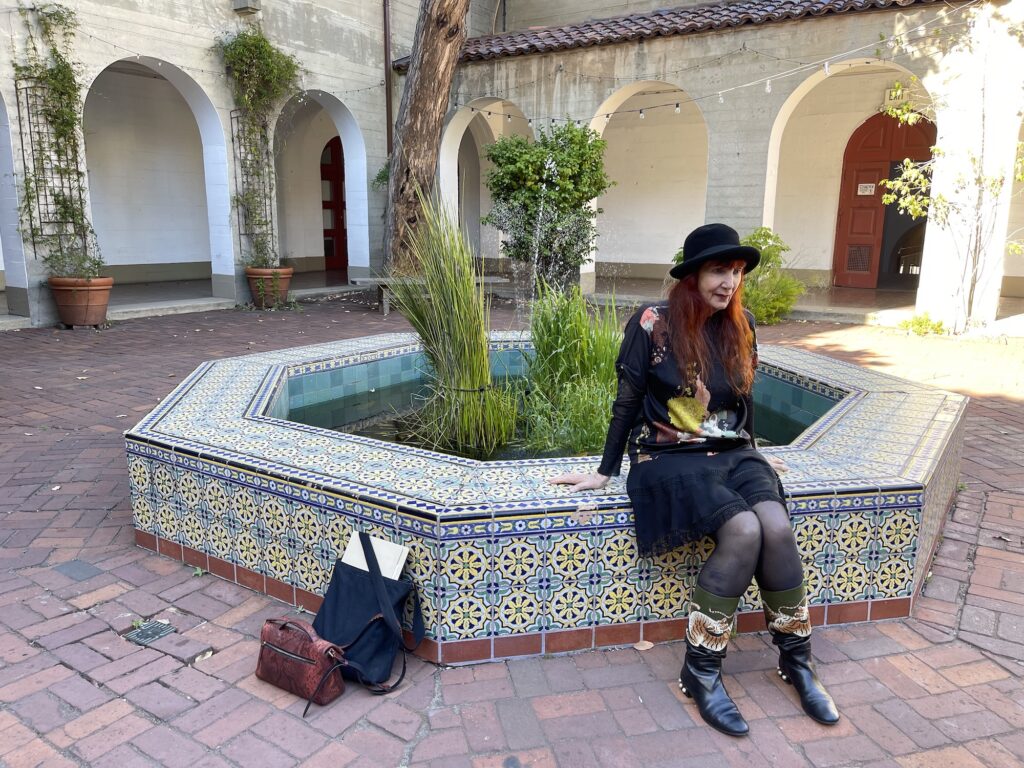
The Art Institute’s closure in 2022 still hurts. She hopes its 151-year legacy survives in a place where people can meet and make work together.
“Making art is one of the greatest resources we have as human beings,” says Mondini-VanLoo. “It’s where we can develop and realize our potential.”
That belief also connects her early work to her later exploration of Buddhism. Mondini-VanLoo began making Buddhist films in the late ‘80s and eventually co-founded BOS, a Buddhist television station in the Netherlands, where she served as programming director for 13 years. She also founded the International Buddhist Film Festival Europe.
For her, Beuys’ assertion that everyone is an artist parallels the Buddhist idea that everyone has Buddha potential. She says both offer ways to develop as a person.
Her new Dalai Lama documentary continues that interest in putting ideas into practice.
“My Religion Is Kindness is also an activist film,” says Mondini-VanLoo. “It offers a medicine against war and hatred.”
STUDIO 8 FILM FESTIVAL Nov. 6-8, 4-Star Theater and Roxie Theater, SF. More info here.
DALAI LAMA: MY RELIGION IS KINDNESS Nov. 7, Roxie Theater, SF. More info here. The film also screens Nov. 15 at the Rafael Film Center in San Rafael. More info here.
The post From Schwarzenegger to Sex Pistols, Babeth Mondini-VanLoo has seen—and filmed—it all appeared first on 48 hills.
]]>The post Democrats—and the progressive movement—win big nationally. SF votes with the billionaires appeared first on 48 hills.
]]>The national results are a massive rout for the Trump agenda. A Trump-backed candidate who dislodged a more independent candidate in Texas is losing, badly. Abdul El-Sayed, who has run on an economic populist platform, is winning in Michigan. In a stunning move, South Carolina has elected a Democratic Senate candidate.
The voters in conservative areas are clearly sick of the idea of a handful of billionaires, linked to a corrupt and out-of-touch chief executive, are setting policy for the country.
The El-Sayed race is critical: His victory will demonstrate that a platform based not on fear of Trump or a Clinton-style move to the center but on a progressive message that includes taking on the rich and changing US foreign policy in the Middle East works in a swing state.
That could encourage the likes of Reps. Ro Khanna and AOC to look at the White House. It could force the remaining old-guard Democrats who still control the party to recognize that their approach has failed.
Plus: The first openly gay senator. The first Native American and Black woman governors. First Black speaker of the House.
It’s a pretty dramatic outcome on a pretty dramatic night.
And then there’s San Francisco.
No elected leaders in this city support Trump or would want any connection to his agenda. But the mayor has encouraged a small number of very rich people to seek dominance over city policy in a way that favors the very, very rich over everyone else. State Sen. Scott Wiener is supported by Big Tech and Real Estate, and he’s looking to prevent a labor-back candidate, Sup. Connie Chan, from replacing Speaker Emerita Nancy Pelosi in Congress.
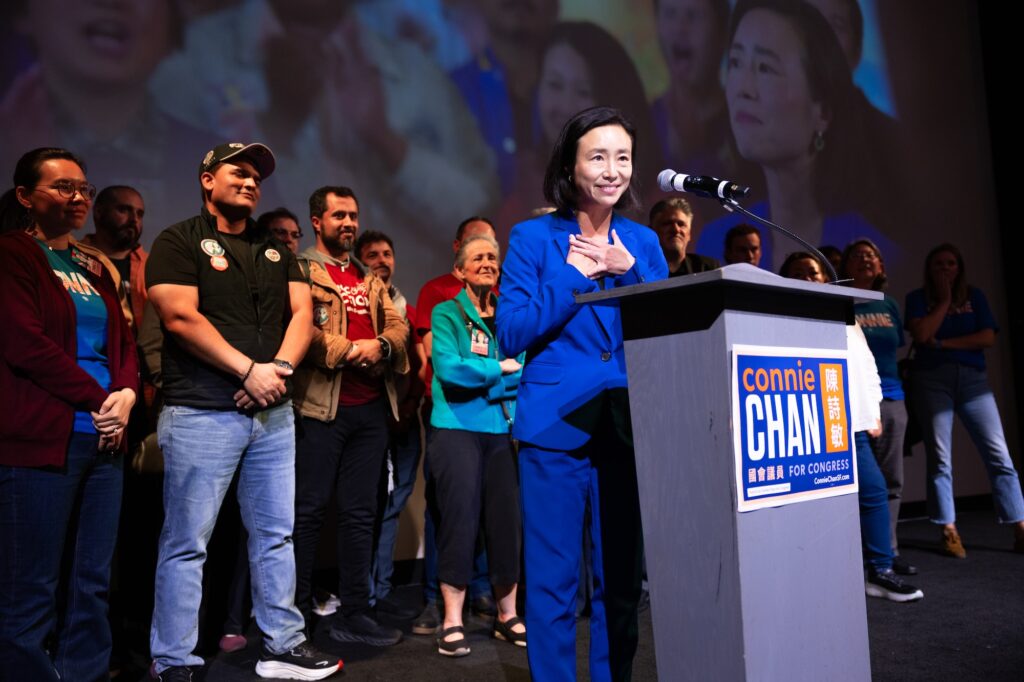
Wiener is far ahead in the first round of results, after $17 million in spending. The mayor’s $13 million campaign is clearly winning the day on ballot measures. That’s no surprise: It’s almost impossible for grassroots campaigns that have no money to go up against that kind of blunt force.
Chan’s party is still lively. From our correspondent Frida Ruiz Del la O:
A large crowd of San Franciscans in support of Congressional candidate Connie Chan gathered at Gray Area on Mission Street. Chan merch being sold at the entrance, buttons reading ‘Connie Chan for Congress’ and navy blue shirts with “CONNIE” written across the chest. The crowd buzzed with hope and excitement, with boxes of pizza stacked to the left of the room, and a photo background reading “The future is ours to build” and “we are here to change what comes next” to the right of the room.
Attendee Osha Ashworth said “being someone who comes from a working family, and understanding the struggles of working people is really important to bring into congress”
Videos of Chan greeting community members projected on a main screen and attendees mingled. Many grabbing a drink at the bar and bustling at tables chatting all things Chan. Attendee Brady Fell said “I’m hopeful, I think she had a lot of headwinds because of name recognition and because of all the money that Scott Wiener had, but I mean, I’m hopeful” Speaker of the house, Nancy Pelosi endorsed Chan earlier this year.
Chan’s popularity amongst the crowd stems from a working class background and an inspiring story. Fell continued, “It would be great for the city to see someones whos immigrated to the united states and now could be in the house”
The crowd at Chan’s event continues to grow. the current lead Wiener at 57% and Chan at 43%, the crowd remains hopeful with only 29% of votes being accounted for.
Olivia Morris said “we are up against crazy pac fund, this is a really grass roots movement, no matter what it’s going to be an uphill battle.” Matt Richardson added “I’m committed to the end. I want to get the
final count”
From our correspondent Sophia Weinberg:
Tim Yankowski, who canvassed for Chan, said that he’s really proud of her “because of her stand not to take corporate money. I think that’s the difference for me in candidate choices from now on.”
Wiener’s celebration, and perhaps his career in the House, starts off with a very bad sign: The campaign rejected a reporter from Mission Local, which has been very fair to both candidates, from covering his election night party, saying the outlet is biased. The campaign also declined to allow 48 Hills access. So our new member of Congress is both arrogant and vindictive.
From our correspondent Julian Myers:
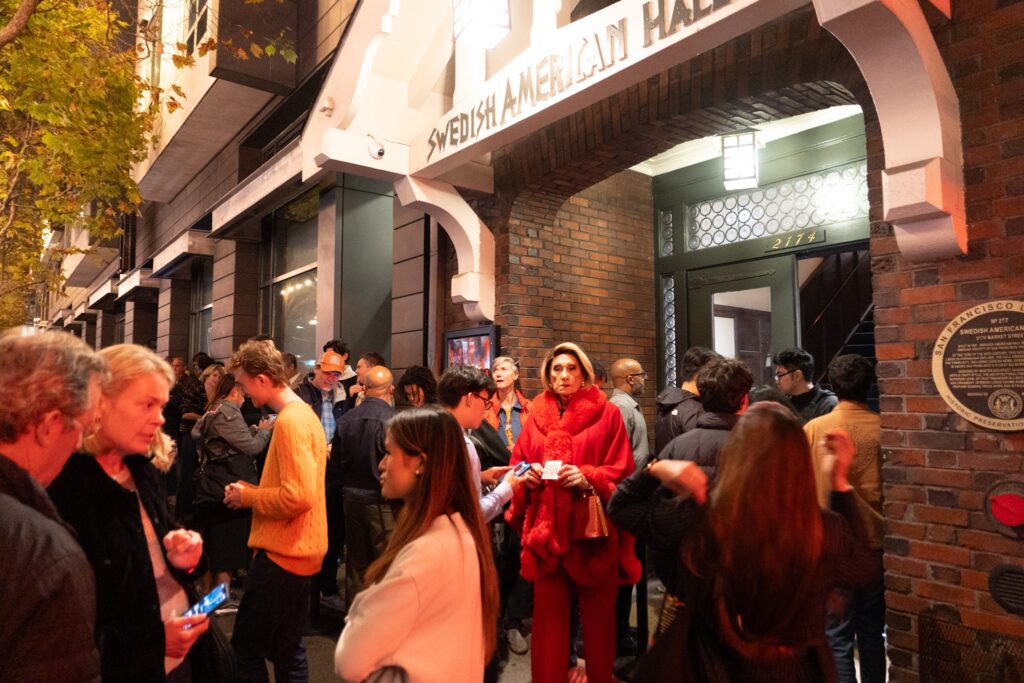
My experience at the Swedish America Hall was very interesting yet short lived. I walked up to entrance and flashed my press pass to the person at the front. No older than 24, the man asked me which outlet I represented. I told him that I report for 48 hills. The man told me to “wait one second, I need to check if we can let you in.” He claimed that the place was at capacity. However, even as I waited for a response, I watched a small cluster of people walk past me and up the stairs. Then, someone came back, seemingly with higher authority than the man at the front, and whispered to him “No 48 Hills.” The man proceeded to turn his head towards me, Not knowing I had heard this, and told me that he was “Sorry. We’re currently at capacity.”
In District 8, Gary McCoy is headed to a clear victory. From our correspondent Audrey Jonas:
The atmosphere of McCoy’s election night party is casual, featuring streamers hanging from the doorways and a balloon arch center stage. The room is brightly lit. Before the room fills up, a band plays while guests eat pizza from a large stack of boxes. Immediate cheers and chants ensue as the projected screen of election results reloads at 8:45 p.m. McCoy stands to give a speech and asks his team to come and stand behind him. He calls out the younger people on his team. He makes the crowd laugh several times. Another chant of “Gary” ensues shortly after he says, “this is not about the moderate/progressive divide, it’s about unity and recovery.” He adds on at the end that anyone in labor should raise their hand, and shouts them out as being an enormous part of his campaign. Two of his youngest looking team members embrace him after his speech with proud smiles on their faces. Twenty minutes or so after McCoy’s speech, his opponents have been eliminated and the room begins to somewhat clear out.
McCoy’s victory will challenge the mayor’s approach to housing and harm reduction. But he’s not a progressive.
Prop. G, the move to reopen the Great Highway, is clearly failing. From our correspondent Olyvia Manor:
Otto Pippenger, the face of the “Yes on G” campaign, said he said that he was not surprised by the outcome, but still feels he has succeeded. He said it was less about the electoral results, since he knew that he could only offer the proposition a “25-40%” of passing, but rather that he was able to give voice to the people who had been drowned out the first time around. For him, it was a small defeat in a larger movement of bringing together the people who continue suffering these smaller losses and will eventually grow into a greater power against the mainstream. He said that he never claimed himself to be a part of the Democratic or Republican parties, he instead sees himself as a radical who serves the mission of his own moral code and beliefs. However, he still recognizes that San Francisco is descending down an unfortunate path after this recent results and claims that while the rest of America is moving forward, we remain stagnant if not regressing.
So the results from San Francisco are a bitter disappointment to progressives—and a sign that the billionaire money and its agenda are dominating the city. For now.
The post Democrats—and the progressive movement—win big nationally. SF votes with the billionaires appeared first on 48 hills.
]]>The post Screen Grabs: Arab Film Fest blossoms with legendary divas and political intrigue appeared first on 48 hills.
]]>The latter portrait of US physicians volunteering at desperately understaffed, frequently-bombed Gaza hospitals (which 48 Hills previously covered here) is getting another local showing as part of the festival’s 30th edition. It begins this Thu/5 at the AMC Kabuki 8 with Marwan Hamed’s El Sett, a nearly three-hour biopic of the late Umm Kulthum (played by Mona Zak)—the hugely popular singer whose stature as “The Voice of Egypt” has scarcely been challenged in the half-century since her death. Attendees are encouraged to “dress as if you were attending [her] legendary 1967 performance at Paris’ Olympia.” The film will be preceded by presentation of the Arab Film & Media Institute’s inaugural Luminary Award for Cultural Impact to veteran Egyptian producer Mohamed Hefzy, then followed by a live tribute to Kulthum’s musical repertoire by Aswat Ensemble.
Founded by AFMI in 1996, the festival has striven to diversify its representation of the Arab diaspora in many ways—this year’s program encompasses 40+ features and shorts from twenty-six countries, a majority of those titles directed by women. Among the most impressive full-length narratives is Zain Duraie’s Jordanian debut feature Sink, whose subject matter is a universal one: It depicts a middle-class family thrown into crisis when the mother (Clara Khoury, most recently seen in the Tunisian Voice of Hind Rajab) realizes her teenage eldest son (Mohammed Nizar) is succumbing to serious mental health troubles that may not be “fixable.”
In contrast to that tightly focused drama, which takes place over just a few days’ course, there’s Abu Bakr Shawky’s The Stories, which sprawls over decades. Initially almost farcical in tone, it gradually shades into more serious terrain as war, politics, and corruption perennially hobble the path of Cairo native Ahmad (Amir El-Masry). A classical pianist, he marries the Austrian penpal (Valerie Pachner) he finally meets while studying abroad on scholarship. But their life together must constantly battle against the inequities of the society he’s perhaps unwisely returned to.
The Palestinian actress Hiam Abbass, who recently appeared in Palestine ’36 (which opened last year’s AFF) and Atonement, reinforces her international career bona fides by appearing in no less than three AFF30 features: The Tunisian drama In a Whisper, Lebanese May-December romance Only Rebels Win, and French-Algerian comedy Spices and Lies (a free outdoor screening on Thu/12). Another notable attraction is a revival screening of festival alum Elia Suleiman’s 1996 debut feature Chronicle of a Disappearance, which encapsulates the everyday oddities of Palestinian society under occupation in a series of absurdist vignettes. It’s a plotless gem whose deadpan comedic minimalism might remind you of Jarmusch or Kaurismaki; among the great musical choices are a couple oldies by “Inca princess” Yma Sumac.
The state of being stateless also very much occupied the subject of Maiken Baird’s Edward Said: Between Worlds, the documentary that is year’s Centerpiece presentation at the Castro Theatre on Sun/8. Sent to the US to be educated after his family lost their Jerusalem home and was forced into exile with the 1947 onset of the “Palestine War,” he wound up up staying—in 1963 becoming a professor of comparative literature at Columbia University, where he remained for 40 years. But despite his professional focus on Western literature, this “modern renaissance man” was also a musical prodigy, critic, and belatedly politicized major voice for Arabic (and in particular Palestinian) peoples.
His 1978 book Orientalism exposed the cultural stereotypes that allowed colonization—painting Arabs as ‘exotic,’ hedonistic, bloodthirsty, migratory, without true culture or homelands… so how could their territory be “stolen”? A frequent TV guest rebutting the parroting of Zionist talking points, Said wearily pointed out things like the calculated replacement of the very word “Palestinian” with “terrorist” in public discourse. As much a history of “the Palestinian question” as of his career and life (Said passed away in 2003), Between Worlds offers sharp insights into the last eighty years of Middle Eastern politics and perception.
Offering different angles on the same central topic are fellow documentary features Uncommitted and Citizen Osama, while Zahraa Ghandour’s artfully crafted Flana probes the often drastic disfavor accorded girls in Iraqi society. As she tries to find out what happened to a childhood friend who vanished in 2001, she hears accounts of parental abandonment, hellish orphanages, even murder of unwanted daughters—all perfectly legal.
AFF30 also has shorts programs, Q&A’s with select filmmaker guests, a “Documenting Democracy” workshop, and more. It runs Thu/5-Sat/14 at several SF locations, plus limited dates at the Alamo Drafthouse Valley Fair in San Jose and Oakland’s New Parkway. Some selections will also be available for online streaming during the same timespan. For full schedule, venue and ticket info, go here.
New releases also arriving this week:
Wild Horse Nine
When Berkeley Rep produced a series of Martin McDonaugh plays some years back, they seemed consistently brilliant, if also on the brink of ghoulish gimmickry. But his second career as a filmmaker has been uneven. I very much enjoyed the admittedly self-conscious criminal hijinks of In Bruges, then walked out on insufferably Tarantino-esque Seven Psychopaths. Three Billboards Outside Ebbing, Missouri felt like a classic case of a foreign filmmaker thinking his twaddlesome stereotypes about “America” were revelatory insights. Then The Banshees of Inisherin was just as good as those early plays, in the same idiom: Cruel, macabre black comedies of Irish rural life, seemingly pitiless until they produce a lump in your throat. It was one of the best movies of 2022, with performances that Colin Farrell and Barry Keoghan may never top.
So now there’s Wild Horse Nine—is the title an in-joke reference to Banshees’ nine Oscar nominations (and zero wins)?—which arrives with the heavy expectations inevitable to following a major success. Perhaps the most surprising thing about it is that, given McDonaugh generally seems to hit or miss, here he lands right in the middle. This is a droll, low-key, reasonably clever meditation on some very big themes that it deflates a bit. It’s good… not great. Solid… but not particularly memorable, given the talent and ideas involved.
In 1973 Santiago, Chile, Chris (John Malkovich) and much younger Lee (Sam Rockwell) are genially combative coworkers, CIA agents whose current task of undermining the nation’s democratically elected Marxist President is just another job in the loyal service of U.S. imperialism. But 72-year-old Chris, who’s succumbing to terminal cancer as well as possible dementia, no longer seems capable of keeping his lips suitably zippered. In fact, he blurts out Uncle Sam’s plan to “destabilize your democracy” to two horrified young female students in an airport lounge, to Lee’s mortification. The two men are heading to Easter Island, which Lee has always wanted to visit, and where it appears he’d now like to end his days. But political intrigue—as well as those two young women—follow them there. As does, eventually, their disgruntled boss (Steve Buscemi), plus various would-be assassins.
For all its blatant indictment of American governmental skullduggery around the globe (not excluding a certain Dallas shooting in November 1963), Wild Horse Nine is mostly a relaxed buddy picture, indulgent of well-cast actors that also include Ema’s Mariana di Girolamo, Parker Posey in a couple scenes, and Tom Waits in exactly one. McDonaugh writes dialogue such people can and do make the most of; Ben Davis’ widescreen location photography is also a pleasure. This is intelligent entertainment whose politics are served up with such offhand snark, you almost forget how bold they are in our current climate. Yet it’s also a movie you might reasonably hope would be a home run. Instead, it’s a reasonably satisfying trot to second base.
Abnormal Behaviors: ‘Littermates,’ ’New Group’
That sneaking suspicion that society is going crazy gets taken rather literally in two offbeat new films. They might sound in description like sci-fi and horror, respectively, but their mixed results land closer to social commentary in the guise of macabre comedy.
Scott Tinkham and Michael Woloson’s Littermates, which opens at Alamo Drafthouses this Fri/6, opens with a traumatized young man (Joey Bader) fleeing gunfire in the countryside. Stumbling into an open field, he’s rescued by the slightly older Chester (Oliver Woolf), who fortunately has a helicopter nearby. At Chester’s comfy A-frame retreat, complete with tennis court and hot tub, the disoriented guest begins to recover—though he’s so far gone, he must be given a name (Liam is chosen), taught to speak again, and so forth. Soon a young woman (Kahylee McGregor as Mel) shows up, similarly addled, and is put on the same rehabilitative regime.
This is a lot like childrearing, never mind that everyone here is an adult in physical terms. But the refugees have had their mental slates blanked—something to do with reaction to chemical weapons in an ongoing war, we eventually learn. Despite the title, they are not treated like puppies, and while some of Chester’s “parental” methods are a little peculiar, there is nothing sinister or kinky going on here. Indeed, until combat gets dangerously close at a late point, the main conflict here is sibling rivalry: Mel and particularly Liam act like bratty preschoolers competing for “daddy’s” attention.
Littermates is an intriguing idea that for me stayed underdeveloped—while their antics are mildly amusing, not enough happens in the bubble these three characters isolate themselves in. (It’s like a more comedic spin on Jim McBride’s equally plotless 1971 Glen and Randa, whose post-apocalyptic protagonists were likewise hapless children in adult bodies.) Once something does finally happen, the stakes do rise. But then the film abruptly jerks to a stop, leaving you with the sense of having watched sketch material stretched too thin at feature length. It’s a colorful, idiosyncratic doodle of a movie, not quite original enough to get away with so little substance.
Also presenting an eccentric surface without much depth is New Group, the second feature from Japanese writer-director Yuta Shimotsu. His first, 2023’s Best Wishes to All (which only reached the US last year), was a very striking, blackly comedic horror parable in which a young heroine visiting relatives gradually realizes that nearly all society’s well-being is predicated on a grotesque Faustian bargain. This latest endeavor starts out as if a direct sequel, with another young female protagonist waking from a nightmare in which belligerently cheerful strangers wreak violence on anyone who doesn’t conform. But bigger isn’t better, and Group finds Shimotsu losing that debut’s creepy weirdness in the quest for more elaborate effects that end up just silly.
Here, schoolgirl Ai (Anna Yamada) and newly arrived transfer student Yu (Yuzu Aoki) are among the few to resist what increasingly looks like some kind of surreal epidemic—their classmates begin assuming “gymnastic formations” (often human pyramids) for no apparent reason, encouraged by adults who themselves soon join in. These “groups” become like monstrous single organisms, wreaking violence on any “rebellious individuals” refusing to participate.
This cartoonish variation on Invasion of the Body Snatchers offers no real explication or inner logic, so it fast turns into a diverting if awfully blunt indictment of enforced uniformity. Best Wishes was unsettling because it was so suggestive—here, the metaphor is at once vague and all too visually specific. While not dull, New Group is disappointing enough that let’s hope it ends up just a fresh talent’s sophomore slump. It begins streaming on genre platform Shudder Fri/6.
The post Screen Grabs: Arab Film Fest blossoms with legendary divas and political intrigue appeared first on 48 hills.
]]>The post Billionaires are trying to buy San Francisco’s election. It’s not too late to vote appeared first on 48 hills.
]]>But the progressives are always outspent in San Francisco, and big money has, at least for the past 30 years, made sure that the city’s mayors are friendly with big business. When I started in this business in the early 1980s, it was downtown developers like Walter Shorenstein, and corporations like Chevron, PG&E, Wells Fargo and Bank of America. Now it’s Big Tech and a handful of billionaires. (In the old days Eskenazi talks about, the hippie era, the town was run largely by Republicans and right-wing law-and-order Democrats.)
The names have changed, and the amounts of money have escalated, but it’s never been easy for the left in this supposedly liberal town. And yet, we have won some huge victories—rent control, office development limits, affordable housing mandates, district elections, free City College, and so much more.

The level of economic inequality has exploded during three tech booms; when I was a young reporter making $17,500 a year in 1984, the young MBAs who went into finance were making $50,000. Big money for that period, but nothing compared to the vast sums the tech industry has offered.
The displacement of those tech booms has, indeed, changed the demographics of the city. As my old friend Calvin Welch says, “who lives here, votes here.” Drive away all the working-class folks and you get a gilded city of the rich, who tend to vote with their economic interests (and tend to believe in deregulation and free-market capitalism, thus the rise of the Yimbys; hey, it worked for them).
And yet, you can read Joe’s piece and get the impression that there’s nothing anyone can do. The billionaires have won. The progressives have no agenda except
proposing revenue measures to soak big business, and using that money to fund programs and nonprofits that can barely patch the hole that the rising cost of housing (and everything else ) has torn in the city fabric.
For the record: There is no such thing as a legitimate progressive agenda that doesn’t start with taxing the rich. Even if all the money we get from those taxes isn’t used productively, reducing the wealth at the top is critical to our survival as a society. If Mayors London Breed and Daniel Lurie hadn’t sidelined the Prop. I money. Add another thousand from Prop. C, and that’s 20,000 affordable units over ten years, maybe 40,000 people who aren’t forced out of the city. That’s more than a patch.
But I don’t think a majority of the voters in San Francisco today are purely rich and greedy. We have more rich and greedy folks than we did a decade ago (the Anthropic leaders and many of their workers are clearly willing to risk the future of humanity for the chance to cash in on an IPO. That’s about the worst greed I’ve seen here in my adult life.) But I still think a majority of the residents of this city are, in general, progressive folks. Tom Steyer won the primary for governor in June by an overwhelming margin in San Francisco.
The late Rev. Jesse Jackson got it in 1984: The people who could have defeated Ronald Reagan and changed the direction of the country forever didn’t bother to vote.
As of 5pm on the day before Election Day, the Department of Elections has received about 25 percent of the ballots that were mailed out. District 8, which has a contested supervisor race (and a lot of Wiener voters) is at 30 percent. District 10, which also has a contested supervisor race, is at 20 percent. District 4, which has no contested supe race but has a lot of folks who want to open the Great Highway, is at 25 percent. Connie Chan’s home district, D1, is at 27 percent.
In other words, a whole lot of people haven’t voted. If the city gets turned even further over to the billionaires, it won’t just be the result of gentrification; it will be the result of a lot of voters staying home.
Everyone who is registered in San Francisco got a ballot in the mail. It takes ten minutes to vote. You can drop it at any one of more than 500 voting places, or in any of the city’s drop boxes, or at City Hall. If you are new to town, you can still register and vote on Election Day.
It looks like rain tomorrow. That’s never good news on an Election Day. But the billionaire takeover and the Gilded City is not a done deal. It’s all about who votes.
It’s your city. You don’t have to let the big men take it away from you.
Polls open at 8am. We will be doing live election-night coverage when the first results come in, starting about 8:45 pm.
The post Billionaires are trying to buy San Francisco’s election. It’s not too late to vote appeared first on 48 hills.
]]>The post OPINION: Why an AIDS doctor is voting Yes on 40 appeared first on 48 hills.
]]>In the late 1980s, while practicing medicine in Los Angeles, I had a patient I will call Jim. He had been unemployed for some time, and a longtime friend had taken him in, giving him a corner in a cramped studio apartment. Jim had AIDS, and purple lesions of Kaposi’s sarcoma had spread across his face, and as they multiplied, he seldom went outside. He made an exception only for late-night movies, when there would be few people around to see him.

Jim had lost his health insurance for reasons I no longer remember, and my medical group cared for him without charge. I arranged for him to see a social worker, but she had been unable to find him a place of his own. His world contracted until it held little more than that studio apartment and our examining room. His friends repeatedly assured him that caring for him was no burden and that he could stay as long as he needed. They meant it, but Jim felt he had imposed enough. His illness and lack of means left him unable to see a tolerable way forward.
At the end of an appointment, as Jim was leaving, he thanked me and called me “Andrew.” My patients generally called me Dr. Faulk, and Jim always had. Only afterward did I hear in that unexpected intimacy a goodbye. Three days later, he died by suicide.
I could not restore Jim’s insurance, find him a less confining place to live, or erase the lesions that announced his illness whenever he stepped outside. His friends could offer him shelter and devotion, but they could not persuade him that accepting their care was different from burdening them.
In the nearly four decades since Jim died, HIV treatment has changed almost beyond recognition. But access to it remains fragile. Sustained treatment can now control the virus, often for a lifetime, and prevent its sexual transmission. Interrupt that treatment, and the virus rebounds, endangering both the patient and others.
In 2024, 143,918 Californians were living with diagnosed HIV. A 2023 analysis by the California Department of Public Health found that 67,428 adults living with HIV were enrolled in Medi-Cal, nearly 47 percent of the state’s adult HIV population.
That system is about to come under considerable strain. Beginning in 2027, many adults covered through the Affordable Care Act expansion will have to document work, school, or community service and renew their eligibility every six months rather than once a year. The nonpartisan Legislative Analyst’s Office estimates these changes could reduce Medi-Cal enrollment among childless adults by 1.6 million by 2029–30. We do not yet know how many Californians living with HIV will be among them. Anyone who has practiced medicine among people with complicated lives knows that additional paperwork can cost eligible patients their coverage when illness or unstable conditions prevent them from answering the right notice by the right date.
To a budget analyst, 67,428 is an enrollment figure. To a physician, it represents patients who need prescriptions renewed, laboratory results explained, and some assurance that the care on which their lives depend will still be there next month.
Jim had devoted friends, a social worker trying to find him housing and physicians willing to care for him without payment. Effective treatment for HIV did not yet exist in Jim’s time. Today it does, and keeping patients alive depends upon their uninterrupted access to the healthcare system that provides it. Goodwill can rescue an individual patient for a time, but California cannot build a healthcare system out of borrowed rooms, unpaid bills and private acts of generosity.
Proposition 40 would give California substantial resources to protect care as federal support recedes. The measure, the 2026 Billionaire Tax Act, would impose a one-time tax of 5 percent on the worldwide net worth of billionaires who were California residents on January 1, 2026. Despite predictions of an exodus, there is no evidence so far of a significant departure of billionaires, and the nonpartisan Legislative Analyst’s Office estimates the measure would raise tens of billions of dollars over several years.
Of those net proceeds, 90 percent would be reserved for healthcare, with the remaining 10 percent supporting public education and food assistance. That revenue could help California bridge federal funding shortfalls, preserve Medi-Cal coverage and protect community hospitals and clinics. For Californians with HIV, it could help maintain continuity of care as new eligibility requirements put their coverage at risk. We have the medical tools to keep HIV suppressed and patients healthy; what we are deciding now is whether we will fund the safety net required to sustain them.
When Californians cast their ballots on November 3, they will decide whether those who have prospered most in our state should help preserve care for those who can least afford to lose it. For a fairer tax system and healthcare that does not abandon people when they become poor or ill, I will be voting yes on Proposition 40 and no on Propositions 41 and 42.
Andrew Faulk, M.D., is a retired physician who treated people with HIV/AIDS in Los Angeles during the first decade of the AIDS epidemic. He is the author of My Epidemic, an AIDS memoir, and lives in San Francisco with his husband.
The post OPINION: Why an AIDS doctor is voting Yes on 40 appeared first on 48 hills.
]]>