 Well, that was exciting and perhaps the beginning of a whole new era. The results are in and the happy winners will be taking their seats after Monday’s vote. Monday? Yes, of course. The municipal elections in Prince Edward Island were Monday… what you talking about? Oh, that. Sure. Fine. Well, yes it was fun. Halloween was fun, too. Got dressed up in orange and black and sat out on the front step. Just to be clear, that is a Mandavilla still alive outside with two months left to go in the year. Viva global warming… for now. Like the new concrete pour? Two or three inches were added this fall to cap the stash. Viva that, too.
Turning to the real news, Ron has an interesting new feature, “Beers I Really Miss” and his post this week neatly captures a time in Prague:
I was lucky enough to visit Prague a few times in the mid-1980s. Before capitalism returned and fucked everything up. The pubs were wonderful. Multi-roomed and very atmospheric. There was only one negative feature: most only sold one draught beer. Every now and then, I’d come across a pub with Staropramen 10º and 12º on tap. But that was about it as far as multi-tap pubs went… Other than in brewpub U Fleku, draught Dark Lager was pretty rare in Prague. But there was one little place, in the Old Town close to Charles Bridge, that had Branik 12º Dark Lager on draught. What a great place to find by chance. Because that beer was wonderful. The classic Prague Dark Lager. Not too sweet, full and well-balanced. In short, a great drinking beer. Inviting gulp after gulp, pint after pint. Then back came capitalism. All the Prague breweries were sold off as a job lot.
And racing forward to the now, Alistair had a good work trip to Denver recently, though it started out poorly:
I was working at the annual meeting of the Geological Society of America, in Denver, where the organisation I work for was exhibiting. While I had attended the Sunday session of the Great American Beer Festival, I had given it up as not my kind of thing, decided to wander off, and find a brewery to sit in for a few hours on a beautiful sunny afternoon. Thus it was, after the saddest pint of cask brown ale I have ever had in my life, I found myself in an Uber on my way to the one brewery in Denver that I regretted not getting to on my last trip to the city, in 2022, Hogshead Brewery.
What follows that ditching of whatever shadow is left of the GABF is pure reverie: “I reveled in the interplay of biscuity malt, with a touch of toffee, and lovely earthy, spicy, English hops…” He even uses the word “dreich”! Top points for anyone who pronounces it correctly.
Alistair was on a road trip. And I do enjoy following those we read who write about beer when they also write about their jobs and other interests. Contextualizes their skill sets and also allows for a familiar entry into new territories. For example is this neatly written comment by my old pal Jess about how thoughts in A.I. has shifted from the perspective of their work in finance:
If AI is the thing that gets people asking the question and investigating how they can finally use a computer to automate the bits of their work that ought to be then… hooray! I’ve been on a cycle with AI of initial excitement three years ago to deep disappointment, to anger at all the hype and am now coming round to “oh, that surprised me, that actually was quite good”. We are at the stage where someone who doesn’t have that great knowledge of Excel could ask Copilot or other tools for help and get a reasonable and fairly safe answer.
That is heartening and a realistic view of where we are at. I am taking a mini course from my tiny undergrad college that’s run by one of my undergrad classmates and finally finding Google’s A.I. summaries of dark ages shifts in history helpful entry points.* Anyway, if A.I. helps with structuring such understandings for B sudents like me at an initial stage of problem solving, maybe populating Mars with A.I. driven autonomous robots driving Telsas powered with solar panels as a counterweight to human existance won’t be so bad. Right? Right???
Speaking of brainy things, there was some good geolocating going on over at A London Inheritance in the photo and mapping essay on the demolition of the Lion Brewery on the South Bank of London in the years after WWII:
The tall buildings in the background to the left all remain to this day. The church is St. Johns at Waterloo, the building to the left of the tall office block is the old Royal Waterloo Hospital for Women and Children. I featured the following photo in my post on Sutton Walk. This was taken outside the pub with Sutton Walk running off to the right and part of the Lion Brewery directly opposite. I have repeated this photo as the following photo was taken from roughly the same position after the brewery buildings had been demolished. The bollards confirm the location. This is looking from point 2 on the 1940 map.
I love me some annotated mapping. Ron has discussed the importance of the Lion Brewery here and here. My main interest in the Lion is whether deep down in the foundations there would have been something left of the local Lambeth Ale that faded over 300 years ago I believe right around that spot. Maybe I am thinking of another bend in the river but that is one itch that won’t go away. Maybe I will ask A.I. because AL can’t figure it out.
Fermenting raspberries?!? Who can resist a story about fermenting raspberries? Not Pellicle which has pubslished this piece by Claire Bullen herself:
The raspberries are gurgling. All 600 kilograms of them, packed into the plastic fermenter that’s been sitting outside under a carport for the last two-and-a-half weeks. When the lid is sucked clean of its water seal, the fruit is revealed: a tight mass, faded pink and stippled with drupelets. It’s only when the cap is punched down with a shovel that they hiss and seethe. The raspberries are possessed by wild fermentation, carbonation racing through the bloody juice they’ve let. Their aroma billows promiscuously across the lawn, heady with carbon dioxide.
Reminds me that, care of global warming, I still have raspberries on the vine out back. Some getting a little tangy. I will be right back.
Speaking of the wonderful, David wrote about restaurants with touring sporting clientel for Vittles including Tharavadu, a Keralan restaurant in the Mill Hill area of Leeds and how it became a stop for some of the world’s great cricketers:
Samson’s guest was Virat Kohli, soon-to-be-captain of the Indian team. Mendonca quickly ushered them to a corner table so the other customers wouldn’t disturb them, although one member of staff was so nervous she could barely hold the tray without shaking. Kohli, then in his pre-vegetarian days, dined on chicken, fish and egg dishes, with a particular liking for the curries paired with appams and a side of masala dosa – an order Mendonca reels off without having to think. At the end of the meal, Kohli presented the restaurant with a signed bat. By Kohli’s next meal at Tharavadu, during the 2019 World Cup, it had become a must-visit restaurant for cricketing royalty, with guests like Ravi Shastri, Michael Holding and Mike Atherton.
Now I want dinner. Here’s some notes!
Note #1: Which came first? The Green Man or The Green Man?
Note #2: BuzzBall’s owners kill off legacy Oregon brewer Full Sale.
Note #3: The Wally Dug needs an upgrade.
Have you ever sent a trepedacous big toe stretching out into the waters to find out if we’ve finally close to hitting rock bottom? Well, there could be a connection to that question with what pleasure trade conglomerates Tilray and Sam Adams are up to in terms of their beer production? Are they any sort of bellwether for something or other? Let’s see. BMI says Tilray is:
…reshuffling: it’s aiming for ~$20 mil in annualized cost savings by end of fiscal ’28 (May 2028); since Jan 2025, Tilray reduced its US distributor network by “approximately 9%” while reducing its SKU count by about 28% over the same timeframe…
Motley Fool says US investors are missing big profits in Europe yet the stock is down a stunning 98% over five years and one drinks commentator is rationally pessimilistic. The larger organization by a factor of about eight, Boston Beer stocks sees its shares down 57% over five years. Also at BMI, we see that beer is not being considered either the main problem or a solution it seems:
…hard seltzer and craft beer [are] the softest spots in Boston Beer’s craft portfolio, Q3 earnings call showed. Truly remains the biggest drag, leading ceo Jim Koch and co to put “everything on the table” to figure out how to fix it. Message on craft wasn’t nearly as drastic, plugging away with various tweaks and additions.
Motley Fool has indicated some optimism for Bostom Beer too but “consumer demand continues to shift away from traditional beer.” So both firms coping, consolidating, rolling out more plans. But not sure how either is doing something to make folk to just want more of their beer. Relatedly perhaps, the head of AB, the NAm division of AB Inbev, just quit.
Never the quitter, over at Facebook Laura has undertaken a solid bit of critical thinking about certain limits some would impose on beer and politics in the UK:
The Morning Advertiser reports that the founder of ART Hospitality (no… me neither), Dorian Kirk, has called for Westminster City Council to investigate the circumstances around the Chancellor downing a pint in the Two Chairman on Wednesday after the Budget. He says that licensing conditions prohibit irresponsible promotions and encouraging customers to drink a quantity of alcohol within a certain time or in excess qualities.Talk about a cheap shot to grab headlines. There’s a lot that you can pick the Chancellor up on without such pointless gripes. I saw that the Chancellor had downed a pint and thought ‘so what?’ and moved on with my life. Obviously, this press stunt wasn’t a promotion organised by the pub. It was his choice, and probably his team’s idea.
We need more critical thinking like that.** In a same or similar situation, and as I have noted on many occassions, a Canadian politician must be seen with a beer if they have any hope of election. The idea that a pub should suffer for a candidate’s or elected official’s decision to drain a pint is nutso. But we are we and not necessarily ye. See Paul Theroux on Canada:***
Theroux’s father spoke French and his ancestors have lived in the village of Yamaska, north of Montreal, since the early 18th century. But temperamentally, Theroux feels American. “Politically, culturally, I was raised differently. I don’t feel aggrieved the way they do. I couldn’t make it through a Canadian winter.” The isolation would get to him. “They live in little bubbles. One of the great things about driving through the States is that every mile is different. Sometimes, in Canada, you’re a whole afternoon in the prairie and it’s unvarying.”
I really really wish he had said tiny bubbles instead… which would have, you know, captured the mood of a kitchen party in late January a bit better. Doncha know.
Checking in around the world, for The Baffler Peer Schouten reports on a corner of the planet we don’t hear from very much, the DRC:
There is a saying in the Democratic Republic of the Congo: “You can bomb a hospital, but not Bralima.” Short for Brasseries, Limonaderies et Malteries S.A., Bralima is the DRC’s oldest brewery and one of the largest beer producers in Central Africa, and, until recently, a subsidiary of the Dutch beer giant Heineken. Every day, countless bottles of Primus lager roll off Bralima production lines in major cities across the country, and by year’s end, they are converted into hundreds of millions of dollars’ worth of revenue. Dozens of armed groups may roam the DRC countryside conquering mining sites, looting health clinics, and committing atrocities against civilians, but even to them Bralima is sacred.
It’s the story about the trekking of cases of beer taken overland to mining sites and distant village watering holes called ngand. For five days in from the road. By foot. Wow.
In health news, I was reminded of my yuff in Nova Scotia by this policy piece on combatting alcohol dependency and homelessness in the UK:
…the relationship works both ways. Living without a safe, stable home can make alcohol-related harm worse and make it much harder for someone to improve their health or reduce their drinking. People find themselves trapped in a catch 22. There are an estimated 650,000 people who are alcohol dependent in England and Wales. Around 70,000 of those are homeless or at immediate risk of homelessness. Yet people with the most complex needs can find themselves with the fewest accommodation options.
Those are rational numbers. About 1% are alcohol dependent and about 10% of that have associated homelessness risk or reality. I say I am reminded of my Nova Scotia of the 1980s as every case of beer said “includes health tax” on the box. Which we all knew meant “if you want this now, you’ll want funded health services later.” Connecting tax to need is good policy.
Finally, in response to Jeff‘s post confirming he is moving away from freelancing while keep writing on beer, Boak and Bailey shared this thought with their Bluesky footnote merged in at the end for completeness:
…there’s no shortage of great beer writing in 2026. As we expressed it on BlueSky, part of the problem is too much competition for too little paying work. It’s like when a second specialist cheese shop opened in Bristol and immediately put the original cheese shop out of business. How much cheese do people need? BlueSky: It’s always felt to us as if there’s a living to be had for about, say, 8 beer writers. And there are about 150 competing for that work.
First, many cheese shops please. [Ed.: isn’t that why one travels the day trip to Montreal roundtrip twice a year without staying overnight?] Why yes it is, voice from off stage left. But to the point, I looked back through the archives as I am pretty sure I have also maintained reasonableness of the eight to ten beer pro writer limit, too. And by this I mean primary household income. Most writers only writing on the topic of beer and brewing do not make enough to keep the lights on and never will. It’s the nature of the beast But a few will. And additional consulting, a bit of PR, working behind the scenes at beer judging events, teaching classes, publishing ads are all good ways to make the money that by-the-word rates do not. Fourteen years ago Stan and I shared emails on that tough road, me sharing my line from back then “…for all the money in beer, there’s no money in beer…” which led me back to his 2009 post “The End of Beer Writing as We Know It?”:****
In commenting on the demise of the British-based magazine Beers of the World writer Adrian Tierney-Jones has written such a lovely headline that I have to find an excuse to repeat it: “Beers Of The World finito: the end of beerwriting as we know it?” If you live in the U.S. you likely never read this magazine, which could be found occasionally at the random Barnes & Noble… Adrian concludes that magazines devoted to beer have no future in the U.K. and that “makes me think that maybe this is the end of beer-writing as we have known it since the 1970s. We are all beer bloggers now.”
Yup, it comes in waves. Stan went on to quote from Alice Feiring, the wine writer:
As I’ve been saying for a while now: blogs didn’t kill journalism. blogs killed writing. The art of writing is now essentially fully devalued. It’s a hobby.
That’s seventeen years ago. An earlier wave. And that was a thing in 2009: “beer bloggers ruin everything!” [Note: bloggers ruined movies about beer, too, apparently by noting they were not very interesting. Frigging bloggers.] Writing doesn’t give a crap about the medium. And, well, most of the few paid pro writers around now got where they are through blogging so not sure that Feiring’s logic has held up well. There’s always been other troubles. Folk feeling free to take content in 2011. In around 2018 there was still a problem for folk wanting to write about beer as well as Mr. Beeson noted:
Casual observation: there’s a lot of beer writers/ photographers/ communicators out of or looking for work at the moment. If you’re in the industry and looking to improve your communications/ marketing you should really consider hiring some of these very talented individuals… A lot of people see what people like us do for a living and think it’s all press trips, freebies and getting drunk for a living. I can assure you the reality is more living in constant fear about making enough money to pay the rent and stay afloat. Hardly living the dream.
It is definitely a tough row to hoe even if writing is a pleasure and will remain so. Many I have watched and read have packed in their beer writing over the near quarter century (Ed.: “yikes!!”) that I have wasted as I have scribbled about beer here and in magazine articles and in books – and in all that time it’s not the writing itself that has turned people off. It’s as much or more the lack of decent money, the unwelcome surplus of the alcohol of obligation, the offer of a better job that frowns upon independent expression. Like doing squats in your 60s, writing is a good thing in itself. So write. It’s lovely.
That is it for now. A bit of a beast. Plenty to chew on. Until we meet again, please check out Boak and Bailey’s postings on each and every Saturday along with their fabulously entertaining footnotes week after week at Patreon. And do look out for more of Stan’s “One Link, One Paragraph” format. Then it’s your turn. Read and recommend, please. Scour the world for news tips – then let me know. Then hunt out something in someone’s archives! Leave oblique comments on someone’s post from 2009!! Listen to a few of Lew’s podcasts and get your emailed issue of Episodes of my Pub Life by David Jesudason on certain Fridays. And Phil Mellows is at the BritishBeerBreaks. Once a month, Will Hawkes issues his London Beer City newsletter. Do sign up for Katie’s wonderful self-governing totes autonomous website featuring The Gulp, too. Ben’s Beer and Badword remains on pause but there is reading at The Glass which is going back to being a blog. Any more? We have Ontario’s own A Quick Beer and All About Beer is still offering a range of podcasts – and there’s also Mike Seay’s The Perfect Pour. Plus follow the venerable Full Pint podcast! And there’s the Craft Beer Channel on Youtube as well as the archives of the Beer Ladies Podcast. What else?
*My old pal Neil with the fabulous voice … But I also have Bertrand Russell’s book in a pile of books, too, backing up Neil’s info. Who knew the Pope wiped out the Cathars in the Albigensian Crusade of the early 1200s? Must have slept in back at the dorms through that discussion when I took Foundation Year the first time around in 1981-82. Must have.
**Also see this from Ray of B+B on LinkedIn: “Content designers: invite engineers, business analysts and product owners to your crits! Engineers, BAs and POs: go along if you’re invited! A crit (or critique session) is how designers quickly test their logic and iterate their designs. We put our work so far on a board (virtual or physical) and invite everyone to tell us what they like, what doesn’t work, where they’ve got ideas, and where they’ve got questions. I love having technical and product colleagues in the room for content crits because they have fresh eyes and different perspectives.“
** and 1/2. See also this from Laura Wednesday morning on the function of both received assumptions and challenging received assumptions: “In the past, we’ve had the big brewers (bad), the regional family brewers (good) and small independents (good but only available locally). That simple model is hopelessly out of date now, but I can’t recall having seen anyone attempt to classify breweries with a little more nuance. The industry is also a lot bigger and there are a lot more companies of different sizes who are aiming for different outcomes – passion, people, product, profit… The problem I’m having is that I can’t quite put my finger on why it might be important or useful to do this (incredibly complicated) exercise, beyond the fact that it might help to challenge people’s assumptions. But is that useful in itself? I put myself at your mercy on the way to York.“
***And on travel writing: “Most travel writers are wimps. They don’t take risks. They’re writing about ‘I met my relatives in Italy’ or ‘I got a divorce. I fell in love.’ I’m interested in someone whose yacht sank.” Who writes about the sunk yachts in beer?
****Scroll down to the comments where the discussion between Stan and the late Jack Curtain (along with the others who join in) are a real treat.
]]>

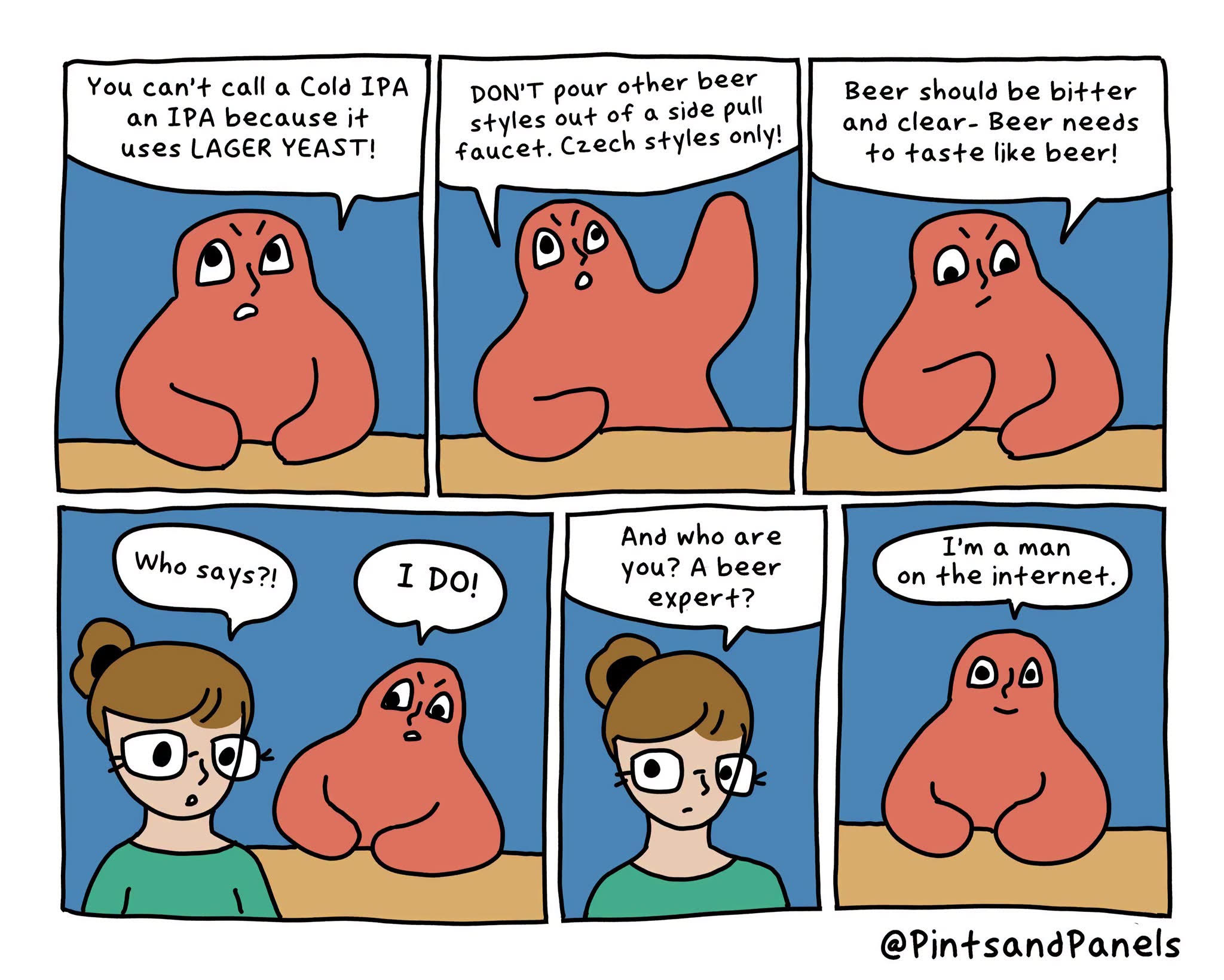
What a week! Voting seems to be the trend these days. There was Alberta’s referendum, then British Columbians gave the boot, Brazil didn’t, Serbia did, Ontario’s municipals were a bootfest and the tie of some sort in Israel in the books with the world waiting for the results of the US mid-terms before next Thursday. Change or at least progress seems to be a theme so far. Progress is a handy phrase given its meaninglessness. Sorta like IPA. On the bigger picture, the other theme might be the failure of social media influencer expertise. Which, as a web scribbler, is very disconcerting. We have needs, too! But everyone else might sigh “finally… know your place!” [As my late mother would often say. Especially to me.] But getting back to the point, as shown above Bulgaria also had the first round of its national elections last Sunday, with at least one beer related incident:
The chairman of a section election commission in the village of Izgrev, Tsarevo municipality, was removed after an investigation following a report that he had shown up for work in an intoxicated state. The report was filed by phone. According to him, the man was under the influence of alcohol while transporting the commission members to the section. During the inspection, the Burgas Regional Election Commission found that the chairman was behaving relatively inadequately and showing disinterest in the election process. The inspectors also found that he had brought alcohol into the section’s premises – a two-liter beer in his luggage. During the conversation with him, a characteristically slurred speech was noticed. As a result, the chairman was dismissed, and a new chairman was appointed in his place.
Whew! No need of that. What else is going on? Well, care of Nigel we read that there has been an advance in the understanding of hops out of New Zealand:
Complementary sensory analysis was conducted using a sorting task with descriptors to evaluate similarities and differences in aroma perception. Hop samples from different farms exhibited distinct volatile profiles, demonstrating chemical differences among growing locations and highlighting the potential for origin authentication. Variable identification analysis identified compounds strongly correlated with specific farm origins, with patterns differing between cultivars, highlighting the significant influence of genetics. Sensory results showed that panellists perceived differences and described hops of the same cultivar differently depending on farm origin.
I wonder if Stan has more on the implications? He does! Right there in his latest edition of Hop Queries:
One of the premises behind this recently published research article…is something I haven’t seen suggested before. The authors write, “Given rising prevalence of food fraud, particularly geographic origin fraud, the NZ hop industry may be a target for fraud” (because New Zealand cultivars are highly prized).
Holy hop fraud fears!!! Makes sense. If something is definitively from there, it can’t be from here.. or over there. Speaking of Stan, is there a correllation between bad parents in pubs and objections to identifiying NA beer as… NA beer? Perhaps the wailings of the immature? Not sure.
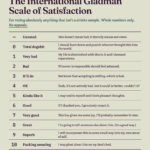 Speaking of taking control of one’s environment*, Anthony Gladman has written about the usefulness of scoring guides in judging contexts. That’s his own version there to the right which he describes thusly:
Ladies and gentlemen, here it is, my gift to you to take away and use in your own life: the International Gladman Scale of Satisfaction — or IGSS for short. Unlike the tier lists of this world, which claim or imply objectivity, the IGSS doesn’t pretend to tell you how good something is. Instead it is based entirely on how the thing made you feel. Yet it’s precise about the difference between, say, merely nodding to yourself and feeling inspired to tell someone else about the experience you’ve just had. To me, that’s the most honest way to go about it.
I like it. I would recommend you adopt this sort of thing in combination with the AGBB certified personal tasting form as well as your own graphical representation of brewing history. For, as we all know and Epictetus taught:
If you want to improve, be content to be thought foolish and stupid.
 Some sad news. The foundational Vermont Brew Pub is closing after 38 years as reported by WCAX:
Vermont’s oldest craft brewery announced its closure on Monday. “Since 2020, we’ve struggled to get back to the level of business that is necessary to sustain our operation, and unfortunately we just don’t have the resources to hold out any longer for that day to come,” they said in a post on Instagram. It comes as downtown Burlington businesses battle with declining visitors. This summer, The Vermont Pub & Brewery told WCAX that foot traffic was down 20% from last year. The brewery first opened in 1988. They say their last full day of service will be Saturday, November 14.
That up there a picture of me in younger and certainly prettier days back in 1992 where I am sporting the brewery’s t-shirt a day or two after a stop at the place. I remember having a bottle of Brazilian black lager there a couple of years before that. It was always a very handy landmark on the map for trips between Ontario and the old homeland of Nova Scotia back when, you know, one cut the corner across New England. Sad to see it go even if that trip isn’t made so much these days.
Similarly speaking, Gary shared his keen-eyed recollections of his visit to the Coach and Horses, Greek Street, Soho in London in remembrance of pubman Norman Balon who passed on at 99 in June this year:
He was best known for his persona of the rude and braying landlord, although many have said it was not the real man, but a pose. I think years ago here I mentioned my Balon story, but if I did I’ll say it again. I first went in, probably in the late 1980s, when the saloon bar was set up for lunch (main floor, not upstairs where the Private Eye gang met). He would sit in the corner, at the saloon end, and I spoke to him. He was gracious enough, my story was I had read about him in journalism by the great beer writer Michael Jackson. He seemed aware of the publicity, and said something about Americans coming in who also read Jackson. I think I said too I really liked the Burton Ale at the bar, and he smiled at that, knowing its quality of course.
I have avoided all the Halloween hoopla so far but Pellicle, like Gary above, has published a piece by Millie Milliken which starts a remembrance of a landlord who has left us then opens into a consideration of wakes in pubs:
…their role in the act of remembrance goes further than the ghosts that are said to haunt them. The Coroners Act of 1846 decreed that dead bodies were to be taken to the nearest public house and stored until an inquest could be held or a funeral arranged. This seemingly bizarre practice came at a particularly devastating time in Ireland, which was seeing an increase in deaths from the Great Hunger. When mortuaries were overwhelmed, the cooling beer cellars of a pub were the next best thing. “Irish wakes have gone through lots of changes,” explains Cliona Purcell, head of curation at Waterford Treasures, which counts the Irish Wake Museum as one of its kookier offerings. “One of them was the use of the pub.” While more traditional wake customs revolved around the home—customs which still exist, to some extent, in the countryside today—the pub’s role eventually extended beyond housing the bodies. They started hosting the wakes, too.
Interesting! On the topic of mortality, here’s a new booze and health study** that’s going to make every beer trade friendly commentator become an instant expert in anatomical pathology and other medical specialities:
Even low beer/cider consumption was associated with elevated cancer mortality. Alcohol intake from spirits at low or combined moderate-to-high levels was linked to greater all-cause and cause-specific mortality. Lower all-cause and cause-specific mortality were noted with low wine intake; meanwhile, high wine intake was associated with increased cancer mortality. Moderate or low red wine intake was associated with lower all-cause, CVD, and other-cause mortality, but high red wine intake was linked to higher all-cause and cancer mortality.
Beer? No thanks! Pass the Bordeaux, buddy! Now… here’s some notes!
Note #1: Hadn’t known I’ve occasionally “ligged” until now.
Note #2: flashback to brewery and maltster fires of yore.
Note #3: Jeff talks about the weather – and it ain’t right.
Note #4: When Teds Roamed The Earth.
BREAKING! Ray (he a B of B+B) had that Allsopp IPA all the cool kids were talking about last week:
…the real star of the afternoon was Allsopp’s IPA on cask at The Kings Head. It’s very like Bass – clearly a cousin or sibling. But, perhaps because of the excellent condition in which it was served, or that controversial ‘inspired by’ historic recipe, had more marmalade and more zing altogether. We hope to see it around again. (Although someone in the pub was grumbling that “it’s not really, technically, what I’d consider an IPA…”.)
Zing! We approve. Yet… IPAs. Again. Is there a more wasted term in beer? Elsewhere… is David OK? I think he’s OK. But he’s wondering if he’s OK:
I come to consciousness. I can barely breathe. The room is dark but loud. There’s no dog. No family. I begin to panic. I’m in a hotel in Belgium, I think. The space is filled with the clinking of crystalline Church bells which are rung every 15 minutes – I have a flashback to buying a drink whenever I heard them yesterday. I eat breakfast. I drink coffee. I pretend to be normal among the elderly guests at the hotel. No one speaks English around me which is helpful because they could be speaking about me. Or is that the hangxiety? I can walk to the brewery from here. It’s OK. I can style it out when I’m there – after all I’m here for three days and this is my only real obligation.
A bit further to the east, I think Barry is OK. Probably. At least he’s been busy. First he helped identify the trees in an unorganized orchard:
Ok, doing something nice and useful. Last year, an old chap near Waldürn asked me to help identify the pears in a collection that was planted about 20 years ago. They never mapped what they planted  I’ve assembled info on all the varieties I know they had available to plant, so making a folder.
Then he realized that he may have forgotten his own implicit access to another patch of pears:
…I thought it was just for one year, a year they didn’t have time to harvest apples to make their own juice. So for years I’ve been walking by these trees, which includes a magnificent Perry pear tree at the back, wishing I could still take some of that fruit. For years, I have been bringing a case of cider to the owners during harvest time, as we harvest from trees right beside their house. Trees that don’t belong to them, but used to, so it felt right. Now I realise they probably thought I was bringing the cider as a thank you for these other trees…
How many times have I said it: clarify your orcharding rights!! Speaking of clarifications, history fans should take note that tomorrow Friday at lunchtime UK time there is a Zoom by actual expert Dr. Amy Burnett on her PhD thesis that’s bound to be well worth watching:
On Friday 30th October at 12:15pm UK time, I’m giving an overview of my PhD thesis (on women’s work in 17th century English alehouses) for the @drinkingstudies.bsky.social Women and Alcohol cluster! All welcome.
Here’s the link to the event and here is the contact for the Drinking Studies group. And remember the aysmetrical North Atlantic clock changing reality of this week! I encourage such things as I have recently done the same sort of thing no doubt at a lesser level. Here’s the PowerPoint presentation for my recent dog and pony show to five paying audience members on the topic “Brewing and Drinking: Kingston 1790-1867“. AKA “spruce Beer Yuk!” Let me know if you can make that link work. I can’t. Hang on… so, if you click here and click again on that page… it appears to download.*** I trust the link provided by Dr. Burnett will be simpler!
More health news! In The Telegraph we read that Heineken has developed a strategy to cope with the effect of the adoption weigh loss medicines like Ozempic and Wegov amongst the drinking public:
Heineken has urged pubs to serve more half-pints as the growing popularity of weight-loss jabs threatens beer sales. The Dutch brewing giant has warned landlords that traditional drinking sessions where people enjoy several pints could become rarer as millions turn to appetite-suppressing medication. It has advised pubs and bars to prioritise smaller drinks, low-alcohol beers and smaller portions to avoid losing customers. According to a presentation seen by Reuters, Heineken warned hospitality businesses that medicines such as Ozempic and Wegovy could reduce demand for beer and cider by making drinkers feel fuller and less inclined to order food and drink.
Other maco brewers are not necessarily following in step. I am not sure that selling less is a means to increase sales but, yes, one must do what one must do. Speaking of which, ATJ has been down the pub and, speaking of sales, seems to have encountered something between a pawn shop and a hoarder’s home:
I was at the Peyton Arms in the North Oxfordshire village of Stoke Lyne, where the barroom was a feng shui nightmare, a clutter of photos, books, signs, beer mats and whatever took the landlord’s fancy. He was called Mick the Hat, grey mutton chop whiskers framing a kindly face, and yes he wore a hat, and all this jumble seemed to fit. ‘All the bric a brac here is my own work,’ he told me, ‘I like it because it is like there is something you will see and something you will miss. It is like coming into your own front room and I like people to feel homely. It works and when we came here there was nothing, but it is now chockablock. I also like cobwebs and Boris the spider, so everything is here as it should be.’
Sounds… hard to dust. And finally, out in the wider world of clinky drinky scribbling, results have been released by the org that defies acronym, NagBwah. It was heartening to see a wider range of entrants including (i) actual academics submitting for the academics category and (ii) even the venerable The New York Times column Wirecutter winning a second in the best review competition – even though only one of the two authors of the column was named. Hmm. Results still indicate the limitations of a self-nomination process, a fact which recommends in itself at least one category of open nominations from readership. And one wonders how a third was offered for a pleasant enough article which consists of 41% direct quote sentences from the single source mentioned, a trade association comms officer who called in from another drinking culture. But all in all a good representation of where the hobby or habit or handicraft stands at the moment.
There you are. That’s good for now. On my end, a very multi-media tech trick sort of exercise this week. My first use of A.I. in fact. Can you spot it? As you think on that and until we meet again, please check out Boak and Bailey’s postings on each and every Saturday along with their fabulously entertaining footnotes week after week at Patreon. And do look out for more of Stan’s “One Link, One Paragraph” format. Then it’s your turn. Read and recommend, please. Scour the world for news tips – then let me know. Then hunt out something in someone’s archives! Leave oblique comments on someone’s post from 2009!! Listen to a few of Lew’s podcasts and get your emailed issue of Episodes of my Pub Life by David Jesudason on certain Fridays. And Phil Mellows is at the BritishBeerBreaks. Once a month, Will Hawkes issues his London Beer City newsletter. Do sign up for Katie’s wonderful self-governing totes autonomous website featuring The Gulp, too. Ben’s Beer and Badword remains on pause but there is reading at The Glass which is going back to being a blog. Any more? We have Ontario’s own A Quick Beer and All About Beer is still offering a range of podcasts – and there’s also Mike Seay’s The Perfect Pour. Plus follow the venerable Full Pint podcast! And there’s the Craft Beer Channel on Youtube as well as the archives of the Beer Ladies Podcast. What else?
*[Ed.: Were you? Really??]
**Li, Z., Tan, B., Desjardins, C. et al. “Total and beverage-specific alcohol use at mid-life and all-cause and cause-specific mortality: a prospective cohort study.” Nutr J 25, 114 (2026). https://doi.org/10.1186/s12937-026-01361-3. Here is the cited academic report on the study’s results in which there was a mean term of 13.4 years and 22,381 studied deaths.
***Any technical advice on sharing a PowerPoint file that you may have is most welcome.
 It’s a big week around here. I have that presenation I mentioned. Plus I have my mini-university lecture and turorial on the Stoics. Plus… the third referendum on separation in my time on this earth. Up there? In the moody light and the sweet way both the faces and the foam are highlighted by CP’s Jeff McIntyre, proof that when the political moment looms more than anything else Canadian politicians need to be seen holding a pint of beer:
Albertans are being asked whether the province should remain in Canada or hold a second, binding referendum on separation. Smith has said it’s time for Albertans to decide on the issue and that she prefers a sovereign Alberta in a united Canada. She said earlier this week that she voted at an advance poll for Alberta to stay. At the brewery, she and Carney praised each other as sharp-eyed, flinty negotiators who fight for their positions but want the best for Canada. They said they’re making progress, including with a proposed fast-tracked oil pipeline from Alberta to the B.C. coast.
Polls closed at 10 pm my local time on Tuesday. I went to bed at 1 am, before the first results were announced. The losing cause didn’t hit 25% support even with social media support from the Kremlin.* I had a wee well placed tot of Crown Royal in celebration.
What else is going on? Well, speaking of disinformation campaigns that may have failed, there was an interesting anecdote from the recent and apparently mini-GABF shared in BMI this week:
At annual brunch hosted by Boston Beer, BA prexy/CEO Bart Watson, Boston founder/CEO Jim Koch and Dogfish Head founder Sam Calagione all expressed hope that the afternoon’s first GABF session would be a success after the festival was literally turned inside out, from 3 days inside the city’s convention center to 2 days outdoors. And while there was an extensive menu of food and drink to be had, mincing words wasn’t on it. Last yr, the trio paced the same stage, outwardly confident that craft culture was making a comeback, borne of observations from the previous night’s session. This yr, seated behind a table, the three instead offered cautious optimism about the new format while acknowledging straightaway that “the status quo sucks,” in Sam’s pointed telling.
“A comeback“! That’s a good one. It’d be nice if there was ever a debrief on why even these gents have lost the blind faith. Or the merest analysis. “Craft culture” selling out to every fad that came along perhaps? The repeated ditching of the elements of the definition of “craft” itself? Nevermind. But on that note, The Beer Nut provided perhaps an example of his writing if he was ever retained on such an analytical report:
…the flavour doesn’t taste like any of the advertised fruit. Instead it’s pure candyshop. I’m getting Jelly Babies, with overtones of Fruit Pastilles and the saccharine tang again, here calling to mind some weird off-brand chew sweets from the more disreputable sort of convenience store. Ghastly business. It’s honkingly sweet, messily flavoured and utterly artificial. I defy anyone but the most hardened Kopparberg drinker to get through more than one of these. Ack. I’ve honestly tried to give all of these a fair assessment, and point out their positive sides. This has none. I take back any suggestion that going “all in with the syrup” is a good idea.
Did the Peter Pans lead us all to this and then take off? No, nevermind. Still, it’d be nice if the who thing got back to the real. You know, like when we lived in Poland in 1991-92 and were offered the opportunity to meet a great boar hunter who only used a lance when stalking in the nation’s dense eastern forests. Really real. Really. Even though it was explained that the man would be the equivalent to a hockey star in Canada, we declined and I’ve sorta regretted it ever since. While I do not hunt myself, I find foody hunting cultures very compelling. Like this tale in Everyday Drinking:
In those days, Olivier often waxed nostalgic for the elemental, primal roots of the cooking he knew back in hardscrabble Picardy — rustic and earthy, based on things like beets, turnips, endives, leeks, foraged mushrooms, stinky Maroilles cheese, so-called “pre-salted” lamb (“they graze on salt marshes”), and lots of game, particularly boar. Olivier was convinced people would love a cookbook about this cuisine, and so one autumn he invited me to go on a wild boar hunt with his uncle. On the morning of the hunt, when Olivier and Uncle Jean showed up at the hotel before dawn, Jean wore his brimmed hat cocked to one side, and with his trimmed mustache looked a little like Ernest Hemingway. “I’ve been up early salting the lamb for lunch!” Olivier said. I was still full of horse and hungover from all the Champagne. “I thought the lamb was pre-salted,” I said.
Yum. Fair bit of real right there, too. And on a role after the announcement of his new book, Lars shares a bit about the itches that drive his curiosity** to figure out what is real:
I started looking into farmhouse ale back in 2010, and one of the first things that struck me was that so many brewers were using juniper branches. By 2014 I had gotten more seriously interested, and had even visited brewers to see their brewdays, and started digging into what little literature there was on spice use. To my surprise, the literature was mostly focused on gale, and gave little attention to juniper, even though by now it was very clear to me that juniper was very important in traditional brewing. Then, also in 2014, I got hold of the answers to the Norwegian ethnographic questionnaire on farmhouse brewing, and again I was struck by how just about everyone seemed to be using juniper in the beer. And by how few of the answers mentioned gale, in contradiction to the existing literature.
Speaking of the wrong flavour, Mike Seay on the truth about the limits of flavour adjuncts:
Urban Roots makes excellent IPAs and then you add a cool label and name, I am all about that. It was as good as I thought it would be. And no, there is no guacamole flavor, just one of those deceptive beer names. Usually I don’t like when a beer uses a food flavor in its name but doesn’t have it in the beer, but this one is an exception. There has got to be an IPA out there that has guacamole in it somehow, yeah? Maybe I’ll check Untappd.
Guacamole Yukamole. You heard me! So… why is the whiff of misinformation so prevalent? Maybe meaninglessness is just part of the culture! Is it or isn’t it? Apparently it can be both at the same time. To wit, BeerToday has shared a number of statements by Jamie Allsopp on a project to create a beer “brewed to a recipe inspired by the very first viable IPA, a beer devised by us in 1822 in Burton-on-Trent… [w]e did not want to produce a museum piece…” Allsopp also said his team took “the defining characteristics of the original Allsopp’s IPA and brewing them for today’s drinker.” On this, B+B stated “…inspired (yes, we know…)” and Liam observed:
Between the ‘yes, we know’ here and the name-check in the footnotes ye know me too well. And yes, ye are correct, especially after reading some of the comments in your link to the beer! Sheesh… If they said a ‘modern take’ on the IPA I’d say fair enough but they are leaning too hard into their history maybe? Are they guilty of degrading variants of the original beer, or dumbing it down to what they think customers want? If that’s the case hazify it! Also, Golden Promise and Challenger? …
But outside the beery bubble, the BBC sets out the claim made in broader terms with perhaps suprising statements in support:
More than two centuries on, the ledger containing over 100 handwritten recipes, including IPA, Pale Ale, Double Diamond, Stout, Arctic Ale and dozens of forgotten brews, was found in an attic in Leeds. Jamie added: “Without the recipes I wasn’t interested in producing guesswork.” He said he was not looking for “historical interpretations of IPA”. “It had to be the real deal – with the right malts, hops, and style that could make our beer revered once again,” he said.
It’s the “real deal“, is it? Doesn’t producing the “real deal” seems to contradict the “not a museum piece” statement? Can the two claims coexist? Why not? It’s beer! Seriously, this sort of thing, for me, is not helpful. Here’s some notes:
Note #1: interesting local initiative on alcohol misuse in nearby NNY.
Note #2: Braciaca… god or goddess of malt?
Note #3: Police station pubs of the Caribbean.
Note #4: Does ramen have a flavour?
Speaking of “is it or isn’t it?” we see, for The Grocer, that James Beeson has noted one way economic conditions are affecting breweries:
Adnams CEO Jenny Hanlon is understood to have told staff the brewer needed to find a more cost-effective way to produce and package its small-pack beers. Adnams is exploring outsourcing the production and packaging of its bottled and canned beers, as the Ghost Ship brewer seeks to navigate increasingly choppy trading conditions in ale.
That’s quite real isn’t it. But no need for the cutsy maritime pun. And this piece in The Times has a bit of a chin trembly vingette at the window of a closed pub in the Scottish Highlands, parts of which are becoming pub deserts:
Squinting through the glass, his nose almost touching the panes, Reed, a 62-year-old retiree, could see the Victorian bar, its pumps still marked up with brands like Tennent’s, Scotland’s ubiquitous lager; Belgian Heverlee, Irish Guinness and Caledonian Best. “It was really an old man’s pub, just a nice wee country pub,” the former senior BBC TV journalist said. “It is so sad to see it shut. It feels like the heart has been pulled out of the village.” His partner Anne McLean, 60, joined him at the window. She pointed out a stool at the bar. “There was one guy who always sat there,” she said. “If he came in and anybody else was in his seat, they would move. Because it was his spot. It was that kind of place.”
More optimistic was the tone from Knut who took part in a recent new product tasting at the government store, Vinmonoplet, where an obvious truth or two is observed:
Twice a year we are invited to taste special releases. The room is bright and airy. The view is to one of the most iconic landmarks of boomtown Oslo – the roof of the Opera House. Unbeknown to the tourists taking their selfies on the marble slabs, we are presented with a row of glasses and a sink for spitting and rinsing… A long line of vintages of the Bourbon County Brand Stout, ranging from 2018 to 2023. To top it up, we get Reserve Bourbon from 2018, Vanilla Rye Stout and Night Cap Cuvee. Three samples at a time. Sip. Taste, spit. Rinse glass, rinse mouth. Of course, it is interesting to try such a long list of variations on the same beer. These bottles are well suited for aging; there are no off flavors or other flaws. But it is extremely hard to tell them apart.
Is this a brewing success but a procurement manager’s scheduling failure? There is, however, perhaps another way to tell them apart as the organisers of Gloucester‘s Sheriff’s Assize of Ale very well know:
The Sheriff, Councillor Anne Radley, pours a small amount of ale onto a wooden stool, which the ale conner then sits on while wearing a pair of leather breeches. After three minutes, the ale conner stands up. If their shorts do not stick to the stool, the ale passes the test and is of acceptable quality. If the shorts do stick to the stool, it means that not enough of the sugar has turned into alcohol and the ale is dubbed “inferior”.
And on the topic of government administration of booze, I listened to an interview on CBC’s Ontario Morning*** about the economics of expanded liquor sales in Ontario through an additional 6,700 retailers and how that decision has lost the government hundreds of millions of dollars. The interviewee was Prof Brock University who recently reported his findings for The Conversation:
The decline follows the Ontario government’s 2023 decision to expand alcohol sales to grocery stores, convenience stores and other retailers. The LCBO also incurred an estimated $33.4 million in costs associated with holding unsold American alcohol. The provincially owned LCBO consequently generated $1.2 billion less for taxpayers over the past two years than its 2023-2024 results might have suggested. That shortfall is five times larger than the $229 million previously forecast by Ontario’s Financial Accountability Office. Meanwhile, private retailers have added $911 million in annual sales, whereas some LCBO stores may close.
The report also confirmed that pulling US booze off the shelf has led to that inventory write-downs of $20.4 million due to stuff like coolers going out of date, warehousing costs approaching $10 million to hold on to the remaining US bottles and cans as well as an implied interest cost nearing $3 million to hold the stock but not make money off of it.
Finally, for Pellicle Imran Rahman-Jones tells the story of the other other national drink of my peeps, 80/- ale:
The Athletic Arms—better known as The Diggers, because gravediggers from the two nearby cemeteries would drink there—is a beautiful Victorian corner pub near Edinburgh city centre, with stained-glass windows and a white-marble-topped bar dominating the room. Despite the opulence, it’s a real local’s local, where prices have been kept low. It’s the kind of place where landlord Kev McGhee knows his regulars by name, often pouring their drinks before they’ve even asked. Many of these drinkers are served 80 shilling, commonly written as “80/-”. It’s a rich, slightly sweet and malty pint. Nathan uses words such as “raisin,” “fruit loaf,” and “toffee” to describe it, and notes its “slight smoky roastiness on the edge of the palate.”
There you are! Another busy week with a bit of the positive woven into these troubld times. Until we meet again, please check out Boak and Bailey’s postings on each and every Saturday along with their fabulously entertaining footnotes week after week at Patreon. And do look out for more of Stan’s “One Link, One Paragraph” format. Then it’s your turn. Read and recommend, please. Scour the world for news tips – then let me know. Then hunt out something in someone’s archives! Leave oblique comments on someone’s post from 2009!! Listen to a few of Lew’s podcasts and get your emailed issue of Episodes of my Pub Life by David Jesudason on certain Fridays. And Phil Mellows is at the BritishBeerBreaks. Once a month, Will Hawkes issues his London Beer City newsletter. Do sign up for Katie’s wonderful self-governing totes autonomous website featuring The Gulp, too. Ben’s Beer and Badword remains on pause but there is reading at The Glass which is going back to being a blog. Any more? We have Ontario’s own A Quick Beer and All About Beer is still offering a range of podcasts – and there’s also Mike Seay’s The Perfect Pour. Plus follow the venerable Full Pint podcast! And there’s the Craft Beer Channel on Youtube as well as the archives of the Beer Ladies Podcast. What else?
*Here are some observations by one of Canada’s more trustworthy observers.
**In refreshing controdiction to the booze bleg phrases of the week: “…wine-media elite…“, “…do more than learn sensory vocabulary…“, “…complex and strong, often like wine…” or a definite favourite “… debunk a beer myth!” when it’s not any sort of myth, just an error, a misunderstanding or sometimes only a different point of view. What would Martyn have said!?!
***Meaning I was wide awake at 7:40 am even though I am retired!
 It’s now full on autumn here. “True” Thanksgiving last weekend* was great, thanks for asking. Had a gravy juice.** We’ve already taken drives to have a look at the multi-coloured leaves in the forests. And the walks down to the shore now need a bit of tweed instead of the linen shorts of a few weeks ago. Chilly. But it’s all going to be OK. Winter is coming. That’s all. by the way, I might be a bit short this week. Been busy, working on a PowerPoint presentation for a community group on the history of brewing and drinking in my fair city from the 1780s to 1860s. There are 55 minutes to fill, 37 slides to show… and (so far) four signed up attendees. Should be very exciting. Me. A former elementary school classroom. And that uncomfortable echo.
At the far more elevated all-pro level of a similar thing, Knut paid a visit to the museum in Oslo to speak with Ingebjørg Kopperud Eidhammer, Senior Curator on her dissertation There Is Great Care Behind a Glass of Beer: The Role of Knowledge in the Establishment of Modern Beer in Christiania, 1840-1890:
The starting point is one of the museum’s real treasures: the Ringnes Brewery Archive. The scale is impressive, around 150 shelf meters… There are brewing logs meticulously filled out by brewmasters. An accounting ledger from Schous Brewery dating from 1838. Collections of labels. Advertising material. Diplomas, drawings and photographs. The oldest book on the table dates from before lager beer made its breakthrough in Norway. The ledger offers small glimpses into a society where breweries maintained connections far beyond their own gates. Among the customers we find Christiania Tukthus, a workhouse which purchased malt and brewed beer for its own use.
Conversely, the race to meaninglessness has found another gear as drinks branders have embraced “clean” according to TDB:
… the market has a strong desire for “clean” food and drinks. More than half (52%) of all US consumers are willing to pay more for beverages that support health and wellness goals, and 58% are paying attention to ingredients, according to the recent Consumer Beverage Survey from EY. Wellness is no longer niche, and it’s not relegated to wheatgrass shots and green juice either. As ingredient awareness increasingly shapes what people want to put in their bodies, even at happy hour, the Clean Alcohol Collective (CAC), a coalition of like-minded wine, spirits, beer and ready-to-drink brands, is offering what it believes is a transparent solution to a complex problem.
Lordy. What else is going on? Well, near the end of last week, news broke about the closing of Marston Brewery in Burton, England with some less than reassuring comment from the owners as reported in The Times by their excellently titled Leisure Industries Correspondent Jessica Newman:
Paul Davies, chief executive of Carlsberg Britvic, said the decision was made to ensure the company’s portfolio caters to today’s customer demand. “The stark reality is that UK cask ale volumes have more than halved in less than a decade and this trend looks set to continue across the UK,” he said. “That said, smaller ale brands are much-loved by select consumers and we will do everything we can to ensure they thrive under more specialist or local ownership in the future.”
Others closer on the ground have shared more. The Tand shared his thoughts on the consequences for the Bass Ale brand:
… it seems that Carlsberg will consider transferring the brands it will no longer brew to others. I suppose these brands will be at a guess, Banks’s, Courage, Brakspear, Ringwood, Eagle (Waggledance etc.), Tetley and I suppose the Marstons brands such as Pedigree. The big questions is who would want them and who has the capacity to brew them? Is there really much appeal when the brands are twice or more removed from their former heartlands? Even if they are sold, handed over, contracted out or whatever, that’s more difficult than you might think. There aren’t many large ale breweries left. And then there is the question of what happens to Draught Bass which accounts for around 40,000 UK barrels of the current output of the estimated 240,000 barrels being currently produced at Shobnall Road.
Speaking of deep and abiding heritage, Jordan gave well deserved praise to the timely and well-placed can of Moosehead Lager brewed by Canada’s oldest independent brewery:
Moosehead became can-dominant in the last five years and the beer is now immeasurably better. I get a room full of people to tell me about Moosehead about once a semester and they use words like, “floral” and “berry-like” and “raspberry-cane” and “moussy” and “flinty” and sometimes even “mossy” to describe Moosehead Lager. I ask them, at the end of this exercise, “Desert Island, gun to your head, you can only drink one of these beers for the rest of your life. By a show of hands, what are you choosing?” The last three to four years, the answer has been Moosehead Lager.
And Lars wrote a blog post about his new book, The Power of Beer, on the unifying theory behind it “explaining why I wrote it, and what I’m trying to do with it” and here it is:
What power am I talking about? Well, archaeology shows us that chieftains and rulers used opulent drinkware and costly drinks to impress subjects, warriors, and rivals. To take just one example, some Danish warlord apparently served drink from two drinking horns made of pure gold, and today the gold alone is valued at about 1 million USD. In the Iron Age even iron was precious, so the gold value back then must have been enough to make people’s heads spin. And this was all done for political purposes, as you’ll see. That is just one example in a very long list from prehistory.
Perhaps less definitive of cultural heritage, thanks to Liam, I saw this article about a new wobbly Japanese beer glass:
A craft beer producer in central Japan is hoping that its U-shaped “wobbly” glass will encourage people to drink water along with their beer, in a bid to prevent excessive alcohol consumption and dehydration. The “Wobbly Beer Glass by Yona Yona Ale,” produced by Yoho Brewing based in Nagano prefecture has been on sale since August amid growing awareness of the need for responsible drinking. The idea is that the glass, divided into two sections, will tilt if a balance between beer and water is not maintained.
Thoughts? First, for an Atlantic Canadian with a certain shanty singing tavern dwelling past, the name Yoho Brewing is simply excellent. Second, this idea makes zebra striping seem very very sensible by comparison. As you think on that, here’s some notes:
Note #1: “Self-Portrait with Beer Glass”, Siegfried Shalom Sebba, 1928.
Note #2: “It’s a green bottle of Stella Unfiltered. I like Stella Unfiltered.”
Note #3: “… nobody outside of Georgia really cares about qvevri wine…”
Note #4: a photographic exhibit on Bank’s Brewery of Wolverhampton.
Business news time. You may not care but I found an actually interesting BrewDog related story over at BMI:
Tilray’s 23% gain to $257 mil in “record first quarter revenue,” as well as huge 82% boost to $101.5 mil in bev revs all driven by BrewDog, execs shared during co’s fiscal 1st qtr last Thur. BrewDog added an incremental $55.9 mil to co’s revs during the qtr, CFO Carl Merton noted. Without it, co’s existing biz dipped about 4%, off around $8.3 mil. But its US-centric craft bev biz fell 18%, by over $10 mil to $45.6 mil.So BrewDog “transformed our beverage business”…
Would I ever buy the stuff? Why would I need to? Still, a good Canadian success story in challenging times. Conversely, me I like a clubby spot. There was a second story pub in St. John’s Newfoundland that had a sofa room. And my undergrad pub was full of sofas. Sofas, however, are not universally loved as B+B argue:
We’re not fans of sofas in pubs. We sink into them, they make us drowsy, and they make us feel as if we’re at home. Not in the sense of homeliness; as in, why did we bother coming out? It’s not even as if they’re usually especially comfortable. You’ll see people perched on the edge of the cushions, leaning forward, as if they’re not stopping for long. Most frequently, people sitting on the sofa in a pub are using it as a sort of waiting area, hoping that a proper table becomes available soon. What we’re wondering is, were they always there, these great lumps of useless soft furniture?
Perhaps it’s because I am a great useless lump myself that I love a sofa. I find many sorts of pub furnative uncomfortable. The unergonomic bar stool. The evil tall legged chair at the wobbly tall table.
Now, perhaps getting all a bit meta on you, this week’s interesting feature on the pubs of Great Yarmouth by Anthony Bennett in Pellicle included a passage that I really appreciate – a simple and even subtle explanation of the point:
Great Yarmouth reportedly has more pubs per capita than any other town in Britain. “We have lost a lot of pubs in the past 25 years, but I’m pleased to say very few in the last 10,” says the Red Herring’s landlord, Darren Grice. “There are still many, and the reason for their survival is they all cater for a different type of customer. There are four categories: pint drinkers, in particular real ale; food pubs; sports pubs; and the vodka-and-coke karaoke bars. All these pubs all sort of get along, and are still here by staying open and being aware of their limitations. Today, my focus is on four of those real ale pubs.”
Semi-keener readers of Hobbes’ Leviathan (when a miserable student in some decade past) will recall that all you need to read is chapter 13 where he summarizes everything else. Jesus did the same sorta thing with the Sermon from the Mount, right? This is not that. This is the most subtle guidance. The smiling host guiding you to your table. The helpful sign upon the path. We are someetimes told that the best do not tell what they are writing, they just write… but who are the best? Really? Just not sure? A little nod in the right direction is appreciated.
Even more expository was Will Hawkes this week on the potential limits of the lyrical:
“When I drink London Black, I can almost hear the chimes of Big Ben,” Adrian Tierney-Jones tells a sizeable crowd at Tottenham’s Big Penny Social. Crikey. This is the Brewers Congress, an annual jamboree of brewery-industry drinking and talks, and Tierney-Jones, as lyrical as ever, is treating a selection of brewers and fellow travellers to his thoughts on the importance of “a sense of place”… It’s an interesting point, and ‘a sense of place’ has long powered wine sales, but one wonders how it applies to modern London. The truth is that locally-produced beer has rarely been less popular here – and certainly not in the past 15 years. Most Londoners, it seems, have increasingly little interest in London-brewed beer.
Lordly Lordy!*** Not quite fingerpointing and handbaggery but a rug may well have been pull. Aaaaannnnnd… that’s it for now. As I said, a shorter list due to distraction but also a bit of a quieter set of offerings too. For for another hit of beer news, please check out Boak and Bailey’s postings on each and every Saturday along with the coincidenal and fabulously entertaining footnotes week after week at Patreon. Such an effort! And do look out for more of Stan’s “One Link, One Paragraph” format. There was a good link to a nano brewery this week. Then it’s your turn. Read and recommend, please. Scour the world for news tips – then let me know. Then hunt out something in someone’s archives! Leave oblique comments on someone’s post from 2009!! Listen to a few of Lew’s podcasts and get your emailed issue of Episodes of my Pub Life by David Jesudason on certain Fridays. And Phil Mellows is at the BritishBeerBreaks. Once a month, Will Hawkes issues his London Beer City newsletter. Do sign up for Katie’s wonderful self-governing totes autonomous website featuring The Gulp, too. Ben’s Beer and Badword remains on pause but there is reading at The Glass which is going back to being a blog. Any more? We have Ontario’s own A Quick Beer and All About Beer is still offering a range of podcasts – and there’s also Mike Seay’s The Perfect Pour. Plus follow the venerable Full Pint podcast! And there’s the Craft Beer Channel on Youtube as well as the archives of the Beer Ladies Podcast. What else?
*Here’s an excellent description of how we do it.
**Slug of Crown Royal, half a can of cider, half a can of ginger beer on ice. You’re welcome. ***Yes, I said it!
 Well, it was +2C at dawn on Tuesday morning which encouraged a return to bed* and then a first firing up of the furnace. Even though it warmed up as the sun popped out, one needs to listen for clangs and sniff for smells on a day when the heating isn’t a necessity. All’s well but probably should get it serviced. Clangs and smells are not the height of mechanical engineering testing. Right after someone looks into that new loud rumble from the dryer. It’s enough to drive one to drink. Which I did.
It’s also the time of year for the return to the tavern instead of the patio, I suppose. Though I always find October unsettling, especially as the American obsession with Halloween is creeping into everything earlier and earlier. And I am not just talking the noxious pumpkin spice this and that. Ghosts. Everywhere a ghost. Including at breweries like the Lemps of St. Louis:
The most famous spirit is the Lavender Lady, believed to be Lillian Handlan, Billy Lemp’s glamorous first wife. Her love of lavender clothing earned her the nickname, and visitors still claim to smell lavender perfume in empty rooms. Then there is the darkest tale on the tour: the legend of a hidden Lemp child with a disability, kept out of sight in the attic and given a cruel nickname by storytellers. Historians have never found records proving he existed, but guests swear they see a small face peering from the attic windows. The brewery has its own ghost stories. Paranormal teams lead visitors into the dark basements of the old Bottle Works, where the cave system once chilled Lemp lager. Investigators tell of shadow figures, cold spots and the echo of tragedies that unfolded in those damp stone rooms.
Lordy. We Canadians are still resisting and partially immune from these things, spending October instead by caulking, patching and sealing in anticipation of the blizzards to come. Regularly checking in on the attic insulation also, you know, helps ensure children are not lost up there. Duh.
News? News about beer?? Fine. Well, Guinness is retreating further from the US market, closing the Guinness Baltimore Open Gate on November 1, 2026 – which is all a bit strange given the recent boom in the brand’s fortunes. Jacob in DC pointed out one thing that may have been indicative:
Here’s a take: the beers coming off Guinness’ 10 bbl system didn’t make it to DC, which is flabbergasting. Diageo is a giant company and they never put their cans or kegs into DC distro beyond Baltimore Blonde and a milk stout in 2019! It’s malpractice! There’s a giant market just south of you!
Jeff on the other coast has more info – including his own loss of a sponsor – that ties to the broader situation owner Diageo faces according to the 2026 annual report:
Overall, spirits were down 5% and beer was up 9%. These results have spurred Diageo, under its new CEO Dave Lewis, to make cuts—none of them delicate. This is apparently characteristic of “Drastic Dave,” a former Tesco CEO who built a reputation for “cost-cutting.” (Corporations believe that euphemism softens the blow, but I wonder how it feels to workers to be called a mere, dispensable “cost”?) Diageo has eliminated nearly 2,000 jobs this year (6.4% of its total workforce). The company plans to cut more than $1 billion more, and the U.S. has been hit especially hard: 36% of the staff at Diageo’s North America headquarters were recently fired as a part of the effort.
I suppose I am doing my bit for Diago with my now established taste for a Guinness 0 beside a shot of Crown Royal but I appear to be one of a shrinking cohort. It’s too bad. It’s both very tasty and points a pointy finger in a meaningful direction.
On the theme of international booze trade restructuring, Evan Rail has investigated the expansion of the wine bar for VinePair and reported on a few themes:
… the global “restaurant as wine bar” trend has another quirk, often putting much more emphasis on natural, skin-contact, and low-intervention bottles. “It’s a particular kind of direction of wine bars, rather than ‘wine’ in general,” he says. Beyond the list, de Vries says that the global “wine bar” trend has a few particular characteristics that include high quality food in smaller portions that are designed around sharing, as well as a special approach at the front of house. “What we see in this trend in these types of bars, even though they’re restaurants as well, is a different type of service,” he says. “It signals a social experience. It’s just more casual and more open.” The design and atmosphere is often different, too, with a greater focus on conversation and conviviality. In short, the trend is not just about nomenclature. It’s an entire worldview.
I don’t think I have willingly gone into anything labled a wine bar. I’ve checked the price lists. And the stash is so helpful in these matters at an actual fraction of the price. That’s a key factor for development of wine in fact, bars as one of Evan’s sources noted: “…it’s probably more efficient to serve glasses — multiple glasses — than have people buy bottles. You’re going to get a better markup on your glasses of wine.” I am not unsympathetic but I am also fond of my sofa at such moments, too. Time for some notes!
Note #1: Pellicle interviewed Mirella Amato.
Note #2: An obituary for a soon-to-depart Brussels favourite.
Note #3: We called them the yips… or the itch.
Note #4: More Guinness cocktails!
Note #5: Gary on Irn-Bru.
Out and about, NPR had a very good article this week on how to go about eating in a Munich tavern, preferably well before noon:
…Weissbier — or wheat beer — helps wash down a breakfast of boiled veal sausages, sweet mustard and a giant pretzel. Four pale, cylindrical Weisswurst arrive in a big tureen. There’s two ways of eating them. One is zuzeln, which involves cutting the head off of the sausage and then just sucking the meat out. The other is the old-fashioned knife and fork. Both involve removing the sausage skin, which you are not supposed to eat… Master butcher Andreas Gassner… makes about 1,200 sausages a day. Even more during Oktoberfest, when they deliver 18,000 Weisswurschtl — as Bavarians call the sausages — for breakfast in the beer tents on the first weekend alone… The trick, he says, is to try it without mustard first to get the unadulterated, full flavor profile of the sausage. He advises giving it a good sniff, too.
As the old saying goes, furnaces and sausages. I am now better educated. But I am not sure I could perform a zuzeln with any grace were sitting at one of those tables facing down the Weisswurst. More seriously and viewing the other side of the bar where the work is done, David J. has written for CAMRA about the losses workers suffer when breweries and bars shut, starting with this portrait:
A few years ago, a neighbour was telling me about her new job in a local bar a bus ride away. Despite a tough childhood marked by the transient nature of care homes and foster parents, kindness was her default setting and I found her bluntness – which jarred with some of the other people in the street – easy to read. I rectified my mistake and took the 171 to Catford only to discover that I was not the only person to enjoy her company and she was firmly embedded in the community, woven into the tapestry of this pub’s framework. I’d never seen her laughing so much. A few months later, I was awoken late at night by loud music from her flat and had to knock at the door. When she answered she apologised, turned the music down and revealed she had been blowing off steam as the pub was now closed leaving her unemployed. Eventually, I saw her again at her new place of work but this job of delivering leaflets caused her no merriment and her downcast appearance was a stark contrast to when I saw her behind the bar that time.
It’s a very compelling thought on how extended the idea of “community” can be – and one that I’ve not considered given all the talk of how tough it can be working in the trade. On another element that draws the drinker, The Beer Nut raised an interesting question on nationalism and international beer styles:
Though a full 5% ABV it’s a bit thin, and the carbonation is lacking. The flavour is clean, however, with the coriander taking the lead. The fruity esters are minimal, which is good, though the orange peel element is relegated to the finish, and it would be better if that were more prominent. It’s a bit simple, overall, though I guess that’s the nature of the style: had it been brimming with complexity, it wouldn’t be a proper witbier. This is a proper witbier, and if you are looking for an Irish-brewed Hoegaarden substitute, it’s well suited. I don’t think it’s an improvement on the original, though.
I compare this to a post at LinkedIn from Mr. B in which he draws upon the current trade climate to make a related point:
… there are a whole lot of great local brands that I simply don’t see getting support from local bars and restaurants, especially those that claim to be community-minded independents. I understand that small production brands often cost a bit more than do the big brands, and that they’re not positioned to offer the same sort of incentives. I even get that there is an educational aspect to stocking local brands, since a lot of customers won’t be familiar with them. But I also know that when a customer at a bar discovers something new and exciting, they will frequently return to that bar or restaurant with friends and colleagues to show off their new find and/or see what else there is to discover…
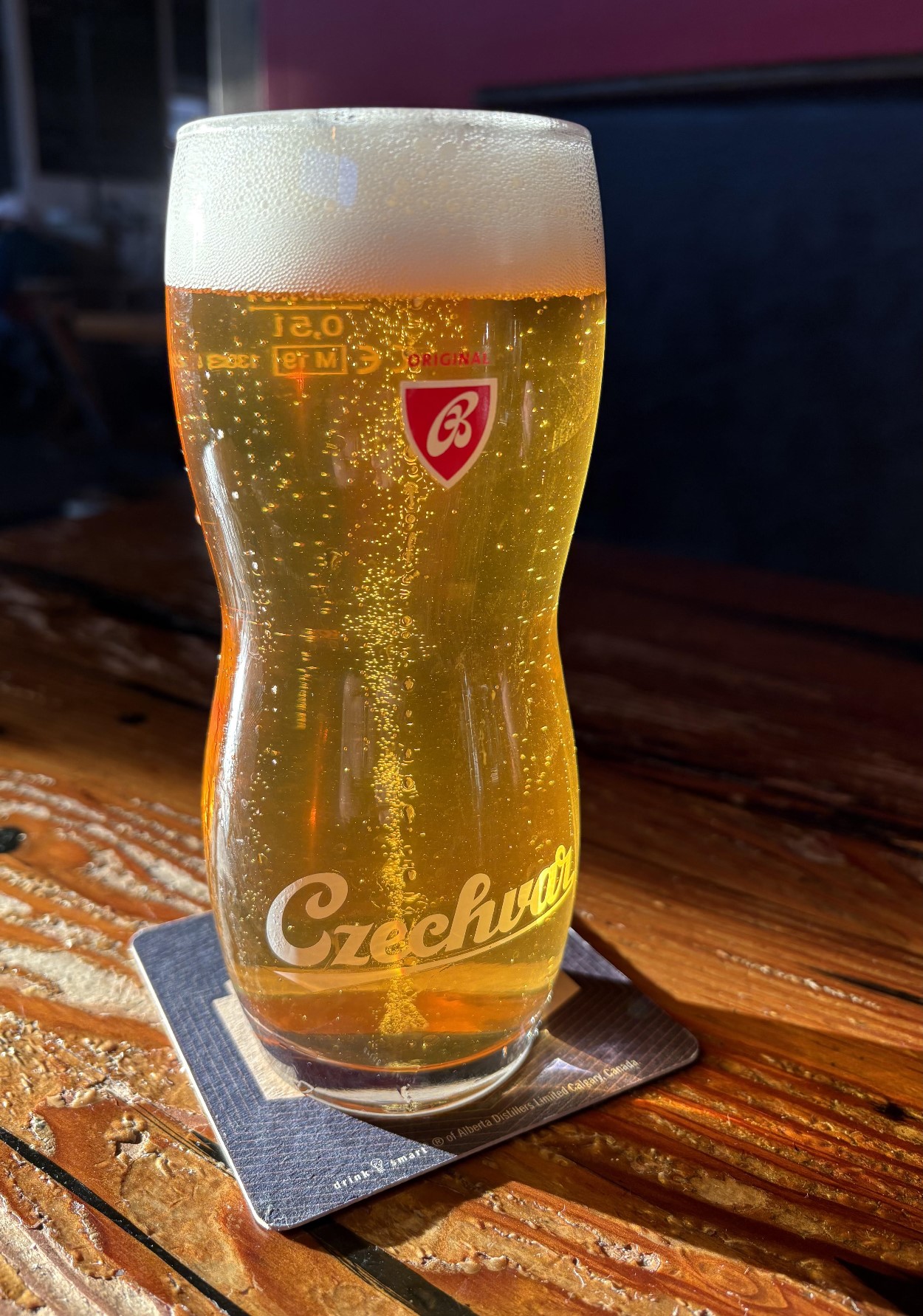
My initial thought was this when I thought of the two observations: was the Irish witbeer “new and exciting“? I am very much compelled by the current Buy Canadian efforts and, to be clear, both TBN and Mr. B have a vastly greater experience with a wide range of the clinky and the drinky. But I am not sure how often I have had a beer very often that was both “new and exciting“.** That Czechvar up there? Pretty tasty, for sure. I liked the glass, the momentary beam of autumn light, the rich pale malt… but was I excited? Interested, for sure. But to what degree? Then… would I have been more interested if it was brewed locally? I am not criticizing their language so much examining my own response. Frankly, its the veal saltibocco at Red House West that I’ve now ordered the last three times was the showstopper that will bring me back again. But that was a really good beer, too.
Imran Rahman-Jones has a handy reminder about the decisions that go into creating what attracts the particularly desired crowd:
A bar set in an old church should feel exciting and conjure some sort of cosy nostalgia. Unfortunately, any reminders of this building’ history have been covered up by a series of design choices made by – presumably – the same designer who has decorated every chain pub in the country. A number of generic neon signs adorn the walls in between a few large screens showing sport, while the booths around the outside feel impersonal. The decision to hang plastic pot plants upside down from the ceiling is interesting. However, I am keenly aware this is not built for me. In more self-reflective moments, I think myself fairly conservative when it comes to pubs. I say I want a “timeless” feel, but what I actually mean is that I want to pretend I’ve come to some point in the past when I enter a pub. I want to feel a sense of history. Cold Town House does not give me that, and that’s fine.
On the point of local, however, I am very compelled by the idea of small patch and urban vinyards. My 65 x 100 foot patch includes two Pinot Noir vines as well as a number of unproductive Voigniers. So this piece in Pellicle by Urvashi Roe is very much my thing:
Will Davenport, winemaker at Davenport Vineyard, has been with the project since the beginning. His role is to transform the grapes into wine at his winery in Kent. “Forty Hall’s vines grow on a south-facing site in dry, sandy, and flinty soil over London clay,” Will says. “This means the grapes don’t typically dry out with that deep-rooted water source. Being in London means it’s generally a few degrees warmer than other vineyards in England, helping the grapes to ripen while retaining that acidity which gives the wine its freshness. They’ve also chosen Ortega and Bacchus, which are varieties that perform well.”
And perhaps Katie has also shared something that I would find “new and exciting” after her visit to manage a bout of pre-flight jitters given its proximity to the bizarre:
The Sussex Arms is a pub completely devoted to the Concorde. For some reason. And I’ve come here for a pint to try a bit of immersion therapy. The tables are chrome and purple-ish glass. The décor is airport-themed, with a live updating LED board showing which aircraft are preparing to land right now in London’s four airports—incredibly addictive viewing. There’s fuselage on the wall and on the ceiling, and arrivals boards behind the bar. The “Business Class Lounge” sign looks remarkably real. Most spectacularly, though, is the central seating area, a conversation pit made from seats from the Concorde. Pet Shop Boys plays on the jukebox nobody has pumped money into since I got here. They look less plush than I expected them to.
Wonderful. Consider, too, what draws Ron to judging around the world:
After pottering around in my room for a while, and fiddling with my new phone, I flop downstairs for breakfast at 9:00. Without a great deal of enthusiasm. A standard buffet is so much better. Letting me pretend to be healthy while eating bacon by adding a dash of fruit. I get an egg and bacon sandwich again. And a milky coffee. Most of the judges are already downstairs judging. I sit by John Palmer and Noelle. We have a pleasant chat. Which is why I do these trips. The social aspects. Meeting people whose eyes don’t glaze over when I blab about 19th-century UK beer taxes. Or are at least polite enough to feign interest.
Finally but still speaking of the interesting versus the disconcerting, returning to David made a good observation on one of the perils of NA beer – especially the craft manufactured offerings:
As a side issue to AF, I have to avoid high sugar drinks as I’m prone to diabetes. Usually the macro ones have zero sugar but craft ones (in general) or top fermented ones can be high. Erdinger Alkoholfrei has 18 grams of sugar per 500ml bottle.
He was responding to B+B’s stated grounds for their use of the NA brews:
The first AF beer that we recall finding pleasant to drink – as in, we occasionally crave it – is Bristol Beer Factory’s Clear Head. It still has some of the typical flaws but, crucially, nothing that reads to us an off-flavour, and its hop aroma is actually pleasing. On the right occasion, it can be quite refreshing. We still find most AF beers unsatisfying or even unpleasant. We’re baffled, for example, by the lie that Schneider alcohol-free Weizen is any good when it is, in fact, like drinking Cup-a-Soup. In recent months, however, as perhaps our alcohol tolerance has taken yet another turn for the worse – we’re both now in our late forties – there have been occasions when AF beer has been a vital part of our tactical approach to a session.
[Cup-a-Soup! Lovely.] It’s all a very reasonably rational argument. But if I am not drinking alcohol – which is by far most of the time – I find other things to drink. I am perfectly happy with a pint of water between pints, too. Or along side even. I had one with that Czechvar. Tipping accordingly of course. Plus I had a Guinness 0 at the pre-tav dump of a bar the other week and was pretty shocked to see it cost four times retail.***
That’s a lot this week. Indicative of a man putting off chores because it’s no longer shorts and t-shirt weather out there. Maybe tomorrow. You bet. Until I make up my mind and for more fabulous observations of the Cup-a-Soup sort and so much more, please check out Boak and Bailey’s postings on each and every Saturday along with the coincidenal and fabulously entertaining footnotes week after week at Patreon. They do put in the effort. And do look out for more of Stan’s “One Link, One Paragraph” format. Then it’s your turn. Read and recommend, please. Scour the world for news tips – then let me know. Then hunt out something in someone’s archives! Leave oblique comments on someone’s post from 2009!! Listen to a few of Lew’s podcasts and get your emailed issue of Episodes of my Pub Life by David Jesudason on certain Fridays. And Phil Mellows is at the BritishBeerBreaks. Once a month, Will Hawkes issues his London Beer City newsletter. Do sign up for Katie’s wonderful self-governing totes autonomous website featuring The Gulp, too. Ben’s Beer and Badword remains on pause but there is reading at The Glass which is going back to being a blog. Any more? We have Ontario’s own A Quick Beer and All About Beer is still offering a range of podcasts – and there’s also Mike Seay’s The Perfect Pour. Plus follow the venerable Full Pint podcast! And there’s the Craft Beer Channel on Youtube as well as the archives of the Beer Ladies Podcast. What else?
*Look, I was in the work force for 47 years so I am not having any of that sort of response.
**I stared at the belly and butt of a flycatcher this week. There are many. Which was it? The little notch in the tail. That slight yellow to the chest’s edge by the wing. I am not sure a beer has taken my focus. Sure, the sauce of that veal saltimbocco does but, you know, that’s pretty much a given.
***You may have noticed a theme this week – I am cheap. Am I? Maybe. But I simply can’t see how my life is improved by significantly increasing my outlay by increasing heading out to an establishment everytime I want a sip. Which is honestly not all that often anymore. How do you all do it? And have you ever tried flycatcher spotting instead?
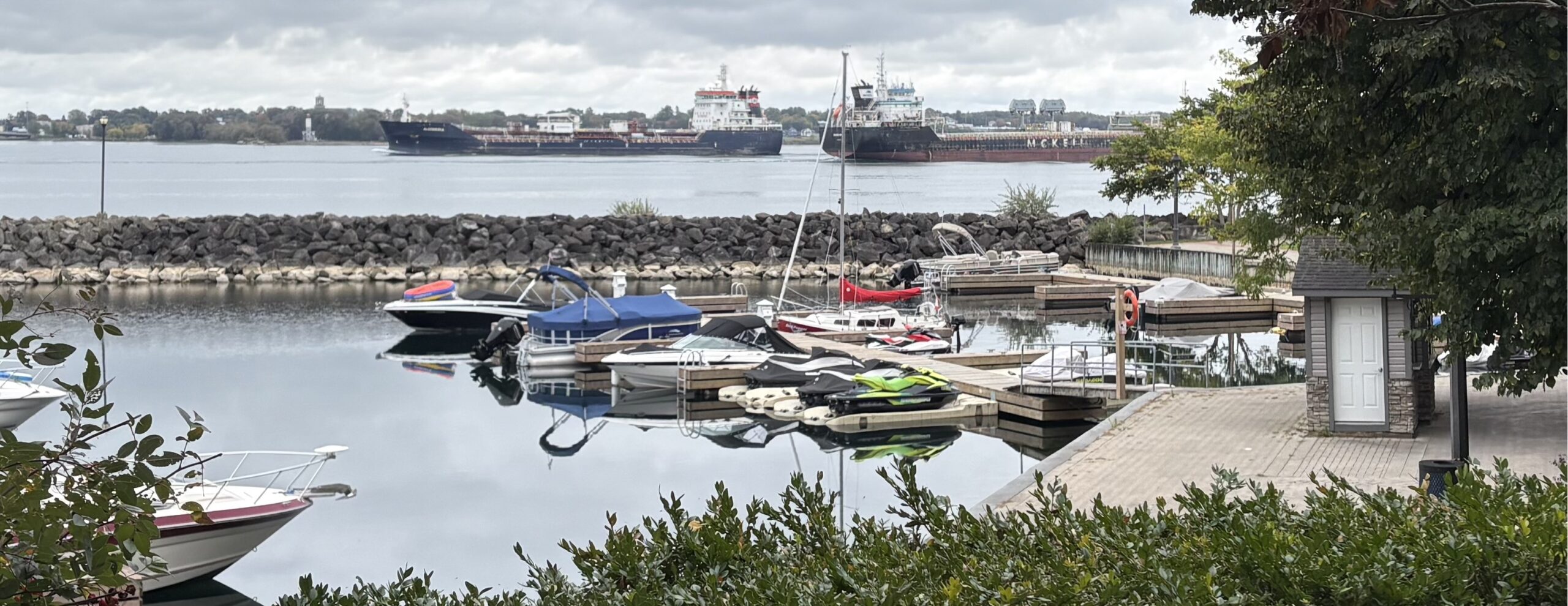
Now that I am six months (yikes!) into retirement, I am moving into a bit of a more organized approach to doing nothing. My plan is to really really achieve a state of active non-achievement and, so, on Tuesday I spent the morning an hour and a half to my east to meet up with an old pal who drove an hour and a half to his southwest. He retired on the same day I did by pure co-inky-dink. We had coffee in Prescott, Ontario and looked across the big river at downtown Ogdensburg, NY as we talked about not being employed and the related turning off many mental light switches. These two ships above did the decent thing and passed each other right in front of us just before we jumped back in our cars to make the way home for lunch. We also noticed the leftovers of crayfish strewn along the waterside path. Happy are the gulls. And at 11 am, the bells of the Ogdensburg City Hall clocktower rang clear across the water, taunting me with thoughts of the now forbidden delights of upstate NY such as white hots and top level NCAA hockey at the beautiful Appleton Arena a bit further inland. Once the current tariff war is settled, I will be back.
On a similar theme, first up in the beer news… more tariff time. This week, the US took the next retaliatory steps against Canadian booze:
President Donald Trump’s ban on Canadian booze kicked in on Tuesday, an unprecedented move that underscores the breakdown in one of the closest trading relationships in the world… President Donald Trump’s ban on Canadian booze kicked in on Tuesday, an unprecedented move that underscores the breakdown in one of the closest trading relationships in the world… For beer, though, the ban is virtually impossible to get around without an American bottling arm because it covers the bottles, cans and kegs that consumers typically buy. A Canadian business could technically ship beer to the US in a tanker, but that’s hardly practical.
Apparently 50% of Canadian spirits are exported and 93% of that goes to the US. But many brands like Crown Royal heading to the US market are already bottled in the States. And I think years ago I read that Unibroue in Quebec was supplying bulk beer (or maybe wort) for finishing and packaging in the USA so it might be something that can be worked out. Also, brewing brands under license occurs. But only to a point. So we shall see how this plays out.
And my very own* North Country Public Radio has made the update this week with the story of how tarrifs in the other direction have imposed on one cidery that focuses on the local as much as possible:
The problem is that most people drink Nine Pin’s ciders in cans — around 2.4 million cans each year. And while those cans are manufactured by Ball Co. in Saratoga, about 25 miles away, they’re made from imported aluminum sheets. Nine Pin co-founder Sonya del Peral said that a local business relying on a nearby harvest should be insulated from the trade war. But it isn’t. “It feels like that’s some global thing, and it is, but the aluminum sheets that Ball uses to make the cans come from Canada,” Nine Pin cofounder Sonya del Peral said. “Otherwise, we’re such a hyperlocal business.”
Elsewhere, over on Facebook Laura has shared some information about Sam Smith’s dealings with their pub assets:
Two weeks after publishing the story about the sale of the Wellington Inn at Knaresborough with a “non-pub use only” covenant on it, which we discussed here at length, the York Press has realised that the covenant is actually the real news here and got comment from CAMRA. I’m wondering whether Tom Gordon MP is being kept apprised of the situation and what his thoughts are on Sam Smiths taking a number of local pubs out of circulation without any proper recourse to the change of use procedures built into the planning system. It’s clear that a number of the SS pubs currently up for sale (21 it seems), though not all, have this restriction on them. It would prevent the local community for applying for Asset of Community Value status, for example… The Oldham Times is reporting on the same situation in their patch, relating to the Commercial Inn on Smallbrook Road in Shaw… Another “non-pub use only” sale.
A more vibrant scene was described in The Guardian which published a story by Scott Antcliffe on the search for the true kölsch in Cologne and provided a portrait of a number of fine establishments, including this on Brauhaus Sünner im Walfisch:
Down a cobbled alley in the old town, Sünner im Walfisch is pure historical theatre. Housed in a striking 17th-century step-gabled building, dismantled and rebuilt brick by brick on its current site, it serves as the old town outpost for Sünner, Cologne’s oldest operating kölsch brewery. Inside, narrow timber-framed rooms and low ceilings transport you back to medieval Rhineland. The beer is fantastic – crisp and dry with a peppery hop finish that makes it dangerously easy to drink – and it’s quieter and more intimate than the echoing halls near the station, its köbesse still delivering drinks with a wink of humour. A favourite for decor and character, if not quite for atmosphere.
Decor also was the question I hereby poach from Boak and Bailey’s Saturday update last week where the comments had some very interesting views of the origin of the long bar and queuing in UK pubs, including this:
When the Great Western Railway opened to Bristol in 1841, all express trains made a stop at Swindon so that passengers could stock up in the refreshment rooms (there were no on-board catering facilities in those days). Those refreshment rooms were fitted with exceptionally long counters so that the rush of passengers could be dealt with quickly and efficiently. Indeed, there was much comment in the press about the length of the counters.
Contrary-wise, as reported at ProBrewer.com, White Labs have announced a significant downsize:
White Labs, the well-known yeast supplier to the homebrewing and craft brewing industry has sold its San Diego facility and will be moving operations into a smaller location at the nearby Home Brew Mart. No changes will be made to its product availability or services, but the company will auction off its brewery, cellar and taproom equipment from its old location… The company will now run most of its yeast production and storage out of its Asheville, North Carolina location which it opened in 2017. The West Coast operations will be moved to a smaller facility and contain mostly administrative personnel and laboratory operations.
“This is infrastructure loss,” said Drew. Jason shared a link to the auction. Speaking of loss, in his latest edition of Hop Queries Stan has listed the effects of climate change on the European hop crop this year:
The Association of German Hop Growers estimates they will harvest 33,779 metric tons (about 75 million pounds), compared to 43,141 in 2025. The Czech Hop Growers Union estimates production will be down about 25% from 5,207 metric tons in 2025. The official results from alpha screening by the Czech Chmelarsky Institut show historically low alpha values of 1.8% for Saaz. In Slovenia, in addition to the heat repeated hailstorms damaged about half 4,000 acres strung for harvest, with losses in yield between 10% and 100%. In Poland, frost damaged hops in some fields at the beginning of the season and the area suffered through the same high heat and low moisture conditions as the rest of Europe.
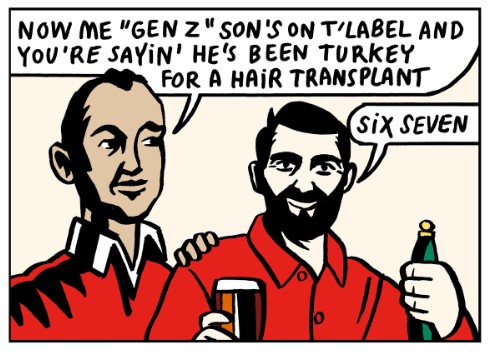 Happier thoughts next as I quite enjoyed last Friday’s cartoon in Pellicle by Dave Bailey (no relation) who took on the plight of the rejected Landlord logo lads and told the tale of how logo lads get on with their lot in life. And, showing me the way, Retired Martin shared the moment he faces every year when the Good Beer Guide comes out and he gets his marching orders to investigate the new entries:
The new Good Beer Guide has dropped (ugh); it would have been poetic to blame my injury on the descent of this massive brick of a book (forgot to mention that last post), but it arrived while I was in Dewsbury and flattened Mrs RM instead. Having made every effort to limit the walk to and from the football (even took the metro to Piccadilly) the only sensible option was to get home and rest. But “sensible” isn’t a criticism often directed at me, and when the internet returned somewhere near Dore I started planning a “cheeky” (ugh) pint at a closest GBG new entry…
Viva cheeky pints!! Viva!!! Here are some notes:
Note #1: A massive personal wine collection.
Note #2: The first “news photo” from 1853.
Note #3: “Health beer”!?!?
About a month ago, I posted a short post on a tavern in my fair town and, on their next Patreon footnotes page, Boak and Bailey commented this way:
It’s always cook when a theme emerges in the post we’ve gathered together in the round up. This week, it’s obviously about what makes pubs feel relaxed, informal comunity spaces. Alan McLeod’s “tavs” are alien to us, although he does a great job evoking their atmosphere and vibe: “When I paid my bill on the way out, I got called “hon’” by someone less than half my age. “We good” she said with a thumbs up. The beer was a buck cheaper too. We good.”
Happy then was I as I came across an incredibly good set of short videos on Facebook called “Every Dive Bar in New Brunswick” where the documentarian (whose name I can’t spot) goes into tavs and describes what she sees. This one for me is a “tavern” or a “tav” more often as not. This one as well. Notice the really informal but bright busy vibe. Folks are “buddies” too. Plus very little attention to the finishings of the place that needs to be respected for the punishment they can take. And this bar recorded (on another Facebook page) in Iowa also appears to be a “tav” to me. But this one is not a “tav” so much as a true “dive” to my mind. Looks a notch harder with darker interior and maybe more male oriented. Yet, there is much overlap… and the man who calls Keglers Bar in Moncton “our drinking home” nails it.
Observing another more rarified snack bracket, Eoghan shared the hallmarks of summer’s end he has spotted in Brussels inlcuding this ceremony:
I know summer is over when I see men in grey smocks amassing at the entrance to Brussels’ town hall on the Grand Place, on the first Friday in September. Usually I arrive too late to see the portly men in their traditional brewer’s outfits, some carrying wooden brewer’s mash paddles and others shouldering in quartets mock wooden barrels, arriving at the end of their ceremonial parade down the hill from Brussels’ cathedral cathedral. The parade, and the official church service that precedes it and features a priest dousing the beer barrel in holy water as an official blessing, is the starting shot for the Belgian Beer Weekend, a festival which occupies the whole of the Grand Place across the first weekend in September, and which is very committed to its pageantry.
Some holy moly archeological news care of Merryn from a few weeks ago in The Smithsonian. A 13,000 year old burial site on Mount Carmel shows evidence of brewing by a pre-ag hunter-gatherer culture:
The evidence of brewing comes from “boulder mortars”: a stick can gouge out a hole in limestone, widening or exploiting existing water-formed low places. Inside these holes were found ‘phytoliths’: microscopic fragments of silica from inside plant cells & starch granules with evidence of malting. Together, these tell the story of a process: Someone gathered seeds by hand, stored them in fiber bags, placed them in a bedrock mortar & smashed them up, then transferred them to a hole where they soaked, germinated & malted. The mash was heated & left to ferment with windborne yeast.
So… lambic in terms of airborne yeast but using malted field grass seeds? Very cool.
And finally, Boak and Bailey have given further consideration to the crap that A.I. is foisting upon us via PR crap sent out the beer scribbling set and how it conflicts with their thoughts about how good digital communications products and services are designed and delivered:
One key principle is that you start by putting a lot of effort into researching and identifying something people need, or at least want; and then you build it. But most of these AI-generated websites and apps seem to start from the other end: think of something you can easily make with AI to boost your limited coding and writing skills; then see if anyone is interested. AI makes this feasible because there’s so little effort involved in making something that you might as well take the ‘throw enough mud and some of it will stick’ approach. Except – except! – you’re then creating a bloody big tidal wave of mud for everyone else to wade through on your behalf.
They wisely advise “ignoring emails which have obviously been written with AI.” On a similar theme, apparently the US is going to remain A.I. as “Super Intelligence” which seems to be a throwback to the Information Super Highway era. Quite appropriate as cousin Wee Donnie wants to have us all living in the past. And seeing as everyone, like me, called “AL” are being blamed for everything that AI does or doesn’t do, I completely support the idea of a new term. But I have a modest proposal for a better alternative. “Shitelligence” which, if you can’t immediately see the beauty of the idea is a combination of Intelligence with an honest acknowlegement that it is… shit. The same “S.I.” acronym can be used. Plus it is mellifluous. Trips off the tongue: “…shi-telly-gents…” You are welcome.
That is it for now. Until next week, please look tothis week’s doublist due Boak and Bailey’s postings on each and every Saturday along with the coincidenal and fabulously entertaining footnotes week after week at Patreon. They do put in the effort. And do look out for more of Stan’s “One Link, One Paragraph” format. Then it’s your turn. Read and recommend, please. Scour the world for news tips – then let me know. Then hunt out something in someone’s archives! Leave oblique comments on someone’s post from 2009!! Listen to a few of Lew’s podcasts and get your emailed issue of Episodes of my Pub Life by David Jesudason on certain Fridays. And Phil Mellows is at the BritishBeerBreaks. Once a month, Will Hawkes issues his London Beer City newsletter. Do sign up for Katie’s wonderful self-governing totes autonomous website featuring The Gulp, too. Ben’s Beer and Badword remains on pause but there is reading at The Glass which is going back to being a blog. Any more? We have Ontario’s own A Quick Beer and All About Beer is still offering a range of podcasts – and there’s also Mike Seay’s The Perfect Pour. Plus follow the venerable Full Pint podcast! And there’s the Craft Beer Channel on Youtube as well as the archives of the Beer Ladies Podcast. What else?
*Scroll down!
]]> “Bud By The Bay“
Welcome to autumn. The burning of fossil fuels within my home has already begun. And the wearing of more layers. It’s madness all this circling of the sun. A few days ago, it was too hot. Now… I wonder if it will be too hot ever again. I think deep thoughts like that from time to time because, as the poet wrote, I am a sensitive man. So sensitive that I took a photo of the scene above when I came upon a can of Bud sitting quite upright by a familar path, looking out upon the waters. I am also, apparently, a student these days. Forty five years after starting the FYP program at Kings College (aka Bings Bollege), I signed up for the new mini version. So I must be extra clever this week having studied Ajax for minutes on end. Right? Well, we and the gods shall now have to see if anything actually sinks in.
What’s up in beer news? First up: when did the copper age end and the bronze age begin… in Bulgaria? What ever the label, apparently there was wheat ale brewing 6,500 years ago in that corner of Europe:
Bulgarian archaeologists found evidence that beer was produced at “Provadia-Solnitsata” (5600–4350 BC)-Europe’s oldest salt-production and urban center. This was announced by the leader of the archaeological works, Academician Vasil Nikolov, who presented the team’s summer findings to journalists, BTA reported. According to Nikolov, this likely represents the earliest production of the beverage in the region and possibly in all of Europe. He noted that botanist Elena Marinova contributed to the discovery. A broken vessel was found containing wheat that had sprouted in the manner required to produce malt. The vessel was discovered in a house that had burned down.
I know that Merryn will be pleased with that sort of residual organics analysis. I like that the house burned down. Breweries were always burning down around here 240 years ago. Good sign.
Perhaps another good sign is how, as Jessica Mason reports, it seems that the Canadian and US administations’ mutual tariffs on aluminum products are having an important effect… though likely not the one the White House intended:
Southern Ontario’s Caravan Bev Co’s owner Shane Vear had also admitted that he also imports and distributes Chinese cans and since then his business has risen 30% since last year. Vancouver Island’s Strait & Narrow president Yuri Akeroyd told the publication that his company moved most of its can purchases to China over the past eight months and insisted that the decision was about “survival”. Akeroyd also stated that “cost” was not the only reason for the shift and added that following nearly two years of policy swings that buying from overseas felt “less volatile”.
Import… get it? Fine. Well, there is someone out there seeking to promote stability. You know the guy working on the creation of cybermen or some other sort of robot army.
Speaking of laying waste, VinePair published a great article by Aaron Goldfarb on the regret and shame and bad feelings and waste of one’s life you can feel when you have a cellar full of beer that was promised to age:
I was saving these beers for some special occasion. But plenty of special occasions came and went and I never drank them. And there they sit: too worthless now to sell, too heavy to haul upstairs on a whim, too fraught to simply throw away because tossing them would mean admitting my wife was right a decade ago, when she kept asking why I needed to buy more beer when I already had so much. I only had one choice, and Leslie’s advice kept ringing in my head: “They’ve all passed their prime, and at this point you might as well just crack them.”
I think it was about ten years ago the I gave away most of the “important” beers I started aging about twent years ago. I probably have more down there in the cellar like my two panic bottles of Girardin Gueuze. I don’t even want to think what they are like given I bought them in the first term of the Obama administration. Another more serious sort of crime against booze was discussed by Jason Wilson this week with a seriously hefty fine on the line:
On September 10th, the federal government announced that Southern Glazer’s Wine & Spirits—which controls about one third of all U.S. wine and spirits distribution—agreed to pay $12.5 million in fines over bribery and false invoicing practices. Southern Glazer’s entered into a “non-prosecution agreement” with federal prosecutors for “executives and employees funding and concealing improper payments and benefits to employees of alcohol retailers, including chain grocery stores in California and elsewhere.”
Wilson shares the opinon that the fine is a “rounding error” for the firm that takes in $26 billion USD a year and especially insufficient for an eight year long pattern of infraction. He calls for drinkers to rise up! As you think on that call to action, here’s some notes! Here’s some notes as you plan the revolution.
Note #1: Matty C on some hop parlance.
Note #2: “…3.5% more than in the same period last year…”
Note #3: part beer shop, part radio station.
Note #4: Lars has a new book – The Power of Beer!
What else is going on? Well, David Nilsen in CB&B has provided us with a helpful primer on the French hop industry:
When we think of French hops, we typically think of Strisselspalt, a delicate Noble-adjacent hop with fine herbal-floral aromas and restrained bittering. That classic variety took up most of the Alsace’s 400 hectares under trellis until nearly 20 years ago, and most of that crop was contracted to Anheuser Busch. When InBev purchased the company in 2008, it also abruptly terminated the Strisselspalt contract. That not only meant an immediate loss of sales, but it also left the French hop industry with a visibility problem. Few brewers were familiar with French hops because Anheuser Busch had been using most of them. Yet the rhizomes for a possible future had already been planted. Hop France had begun a hop-breeding program in 2001 with the primary purpose of improving—or replacing—the bittering performance of Strisselspalt…
Frikkin Strisselspalt…. just… don’t ask. And from New Zealand, Kieran Haslett-Moore has shared the idyllic story of a beer fest by a southern sea:
The sun is setting over the alps and is catching the clouds, setting them alight with glorious flaming reds set against the over ripe blue of the heavens. The spectacle is a Salvador Dali painting animated to reality. Beneath the spectacle of the natural world sits one from the realm of human endeavour. Cobbled streets of ornate Victorian white stone have weathered 150 years of southern ocean storms and Kiwi lust for the wrecking ball. Within two of the old buildings Bruxelles Oamaru is in full swing. It is like there is a portal from the sleepy southern town straight into the back streets of Brussels. Goblets of oaky spontaneous ale, various tart, fruited concoctions, lemon-flavoured blonde ales, saison and even a Belgian stout are drunk, discussed and enjoyed.
What a scene. It’s like good beer was starting fresh all over again. Similar too was the report from Imran Rahman-Jones who has been slumming by the Mediterranean:
I am writing this from the heel of Italy’s boot, otherwise known as Puglia, where it’s still shorts weather and the Nivea factor 50 continues to be sprayed every few hours. The Italian beer here has generally ranged from “not to my taste” to “objectively poor”, with a couple falling into the “very nice served ice-cold but make sure you get it finished before it starts tasting of anything” category. The supermarkets here seem to have as many German and Belgian beers on the shelves as Italian ones. It seems Italy has, like France, decided it should stick to doing what it does better than anyone else (wine), and happily imports the good beer from its European friends.
Blunt but now doubt accurate. And, to be fair, there is a place for the utility of a well placed “very nice served ice-cold but make sure you get it finished before it starts tasting of anything” beer. Similarly, there were some refreshingly simple business truths this week from at Breweries in Pennsylvania:
If you’re walking into an industry with a high failure rate, you should probably be ready to face that day when it comes. The data is telling you that you will most likely close… it shouldn’t then come as a surprise. The craft beer boom of 2017/2018 in PA had a lot of different impacts. While most of them were positive (more locally made beer on the market, more jobs added to communities), we are seeing a fair share of negatives as well. One of the biggest downsides of the rise in craft beer are people who probably should have never entered the world of small business ownership. From cutting costs, employee mistreatment (*cough* Bald Birds/ Tired Hands *cough*) and just closing with no notice the industry is still riddled with poorly run businesses.
Naming names and pointing fingures?!?! How refreshing. And professor and historian Dr. Dan Malleck has posted some thoughts on the relatively low risk of harm caused by moderate alcohol intake over at LinkedIn:
For many people, drinking does have value. I don’t need to re-litigate this, but from socialization, to creativity, to relaxation, alcohol brings value to many people’s lives. Even if you just really like the taste, there is a value. (Is there a risk? Yes, just like a risk in driving excessive speeds, eating way too much beef, chronic sun exposure, or … getting really into cutting wood (I guess) there is a harm of excess.) The difference here is when we talk about alcohol we always need to frame it harm-forward. We can’t just say it’s ok to drink without saying something like “but know your limit” or “if you are worried about your drinking, seek help.” That’s an interesting social convention that we don’t have to use when offering people a ride, cooking them a steak, inviting them to go for a walk, or asking them to help you cut some wood.
It’s a lucid argument but it does invite my mind to wander towards the consideration of the other non-intoxicating pursuits in life that also may enhance socialization, creativity and to relaxation. Are there such medical studies on the risks associated with birdwatching? Doubt it. On napping? Not so much. And if we are being honest, I would worry if socialization, creativity and relaxation were mainly enjoyed by someone after a drink or two. We need to, yes, think of relative risk but really be thinking of relative risk/benefit.
Finally and for the double, David Nilsen has the feature in Pellicle this week, a portrait of Off Color Brewing in Chicago:
Off Color opened in 2013 with two beers: Troublesome—a classic, unfruited gose—and Scurry, a kottbusser. Launching with two obscure German styles was less a statement of defiance than an indication of intent: They were going to brew delicious, approachable beer, but it wasn’t going to be everyone else’s delicious, approachable beer. As unorthodox as Off Color’s beer was, it was matched by the quirky, black-and-white label art. Craft beer branding at the time was rarely subtle, and John and Dave opted for contrast from the prismatic norm rather than competing with a cornucopia of colorful labels. “We ended up on black-and-white just because it really stands out on liquor store shelves,” John says.
Well, that is it for now. It’s been a bit of a quiet week or at least one that had distraction. For me the main one being the arrival of a team of masons who responded to the call and spent a couple of days parging, capping and rebuilding the front step which (in accordance with the Ontario’s Building Code circa 1964) houses the cold room that houses my stash. As with the furnace and the roof, I know enough about concrete to avoid my own advice and certainly my skills. And it always amazes me when capable folk arrive at the house, totally fix problems that visit one’s mind in the hours before dawn night after night – and only want money. Isn’t money great? Now I can get back to just worrying if I have enough for the next crisis.
As you think on that, please look to Boak and Bailey’s postings on each and every Saturday along with the coincidenal and fabulously entertaining footnotes week after week at Patreon. They do put in the effort. And do look out for more of Stan’s “One Link, One Paragraph” format. Then it’s your turn. Read and recommend, please. Scour the world for news tips – then let me know. Then hunt out something in someone’s archives! Leave oblique comments on someone’s post from 2009!! Listen to a few of Lew’s podcasts and get your emailed issue of Episodes of my Pub Life by David Jesudason on certain Fridays. And Phil Mellows is at the BritishBeerBreaks. Once a month, Will Hawkes issues his London Beer City newsletter. Do sign up for Katie’s wonderful self-governing totes autonomous website featuring The Gulp, too. Ben’s Beer and Badword remains on pause but there is reading at The Glass which is going back to being a blog. Any more? We have Ontario’s own A Quick Beer and All About Beer is still offering a range of podcasts – and there’s also Mike Seay’s The Perfect Pour. Plus follow the venerable Full Pint podcast! And there’s the Craft Beer Channel on Youtube as well as the archives of the Beer Ladies Podcast. What else?
*No footnotes this week. Not one.
]]>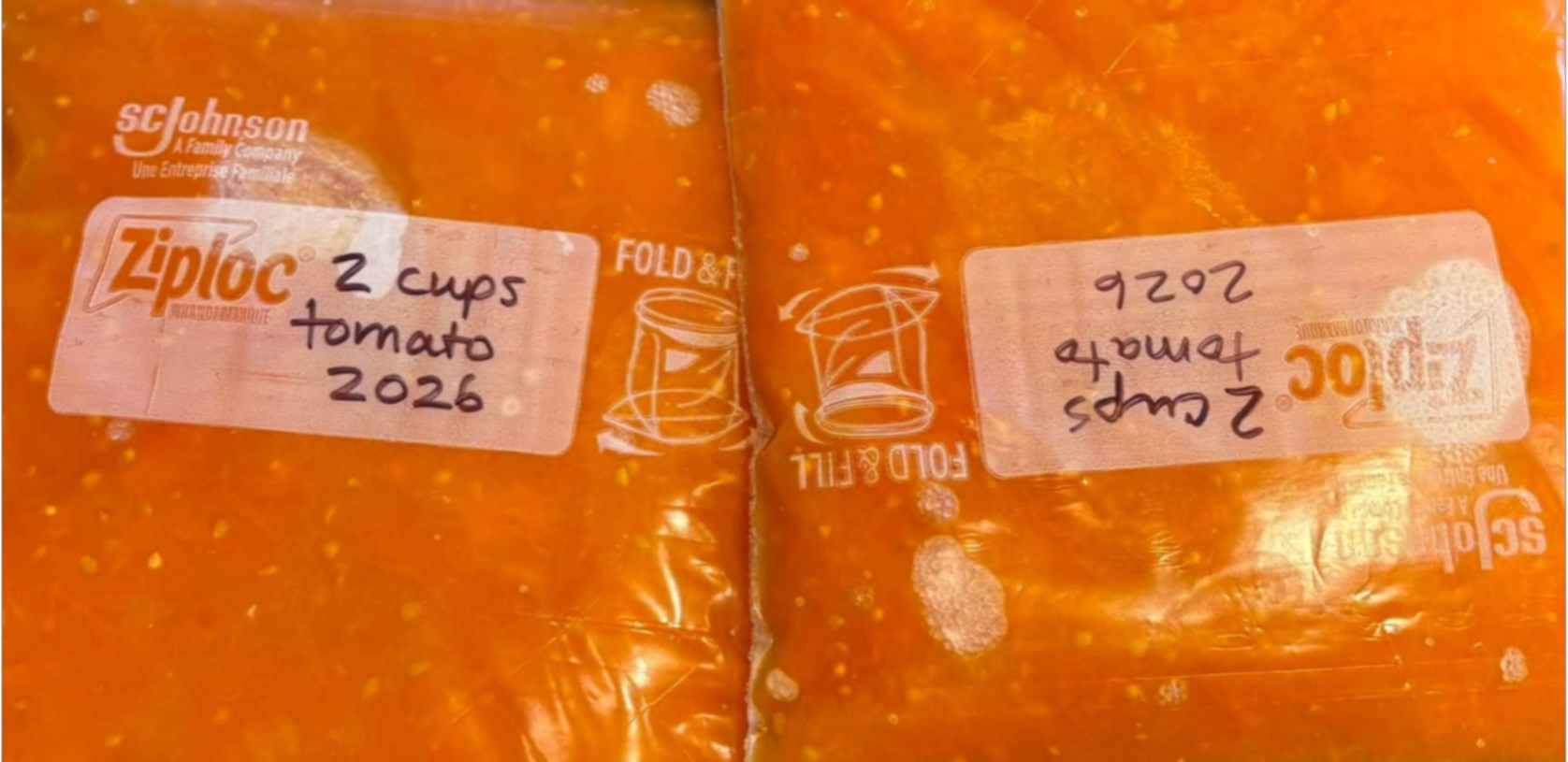 The end of summer. The last stragglers back from holidays. Yellowjackets everywhere. Tired sweetpeas starting to show their age. Tomatoes ripening faster on the vine, some going soft before I get to them in the sauce pot, then into ziplock bags destined for a spot deep into the freezer. I’m even starting to think about getting the garlic ready to plant before the first frost. It all starts to move pretty fast right around now.
Speaking of fast, as Canada is suddenly accused of nuzzling up to the EU, asking if we can spend the weekend – or is it the other way around – it’s funny to see a politician in France castigated for doing the one thing even a t-total conservative candidate here must always do if they hope to have a hope:
A French presidential hopeful has been accused by leftwingers of encouraging alcoholism after he released a campaign video showing him with a beer. In the video, Gabriel Attal, 37, who was President Macron’s prime minister in 2024, announced plans to hold debates with voters in bistrots across the country. He said he wanted to revive tradition: Enlightenment philosophy had emerged in France’s small dining establishments in the 18th century, he said, as had the call to storm the Bastille in 1789…. The launch of Attal’s “1,000 Bistrots” initiative, as he is calling it, seems unlikely to boost his standing among voters, according to commentators. They noted that it had been widely mocked on social media, with one user saying that the candidate looked more like a spritz than a beer drinker.
Not to worry. He’s way behind in the polls. Speaking of not doing so well, let’s get these interesting numbers from BMI out of the way early this week:
Close to $120 mil in craft $$ tracked by NielsenIQ thru Aug 8 came from 138 craft brands with at least $150K in sales this yr and no sales this time last yr. But it’s top heavy, natch. The top 25 new craft brands generated about 2/3 of that total, each racking up around $1 mil in retail sales. With total craft $$, including craft non-alc, down 4.2% yr to date, existing brands are off over 6% as a group.
Yikes. So has US craft beer – which told us it came into being to defeat the monoglot of macro – become what it abhored? Fewer and fewer brands, limited in difference hogging more and more of the shelf space? Apparently, not only have fruit flavoured beers chased the tail of coolers but apparently New Belgium’s 11% ABV Voodoo Ranger is the top new beer. Taking on the “electric soup” RTD competition. As Knut notes:
Most Norwegians buy their beer at a supermarket, but the range available has dwindled over the years, with fake cider, hard seltzer and ready mixed drinks taking over much of the shelves.
Tomorrow belong to the gak. Not everyone has noticed. Ontario’s Peterborough Examiner published an opinion piece by apparently self-published author Bruce Gravel that reads like it was defrosted from a glacier that formed around the good beer conversation around 2006 to 2012:
He finally took a sip. He didn’t swallow. Instead, he held the beer in his mouth, churning it around his gums like mouthwash. He made a loud, wet aerating sound — slurrrrp — that caused people at the next table to look over in disgust. He swallowed, closed his eyes, and performed a full 60 seconds of silent contemplation to measure the “finish.” The ultimate annoyance of the beer snob is their complete inability to let anyone else enjoy their drink. When our friend Sarah arrived and ordered a cider, Sebastian spent 10 minutes explaining why her choice was a sugary insult to fermented beverages.
You know, that New Yorker cover is now twelve years old. I thought news editors by definition were up to date on the booze scene, you know, from personal experience. Speaking of which, here’s some notes with the first one on the better approach in such matters.
Note #1: Advice to journalists.
Note #2: Don’t most people at cricket matches drink beer?
Note #3: Belgium… “if it isn’t poison, it goes into the beer.”
Note #4: All you need to know… twenty something words…

Speaking of simplification, here’s a central European leaning timeline of brewing history. It’s a pretty good effort but, again, pale malt was not first made upon the adoption of coke. Straw fired pale malt drying was common well before coke. Conversely, Katie Mather won a writing prize. And she wrote about winning a prize. And thanked her editor:
Last year, Claire Bullen edited a story I wrote for Pellicle about wine in Tenerife and the Orotava region. It started as an off-the-cuff idea borne from sheer enthusiasm—I had just visited the island and fallen in love with Mount Teide. I have a thing for tall, brooding guys. Most of my best stories come from a small, sharp inkling that I’ve seen or tasted something life changing, and that little feeling gets worked into every thought. Working out the story is part of the fun. Why do I want to tell this tale? How would I even begin? Editors get the hardest job and the least credit. I worked away on my story, did the research, painstakingly rewrote the drafts, but were it not for the editorial process, it wouldn’t be half as good as I think it is now. And I happen to think it’s the best thing I’ve ever written, still, over a year later.
You know what’s not the best thing? The price of beer at Oktoberfest according to German broadcaster Deutsche Welle:
A Mass, the traditional 1-liter (2.1-pint) serving at Oktoberfest, will cost an average of €15.61 ($18.50) this year. In 1985, it cost about 6.25 Deutschmarks, equivalent to €3.20 after conversion at the fixed euro exchange rate. The figures were analyzed by UniCredit economist Andreas Rees ahead of the opening of the world’s largest beer festival on Saturday. Beer prices at Oktoberfest have increased by around 400% since 1985, according to Rees, using data from Munich’s statistical office. Consumer prices across Germany, by comparison, have risen by around 120% over the same period.
Next, we were off to New Zealand this week with Pellicle‘s feature by Martin Bridges on the Garage Project:
…the plain white box—adorned with nothing but the word “BEER” in a bold, black font—stands out. This classic pale lager, which has been a mainstay of Garage Project’s core range since 2014, is an ode to the power of subtlety and simplicity. Pilsner malt, Saaz hops, Czech yeast. No more, no less. Does exactly what it says on the tin… “It was a bit of a ‘screw you!’ to the big breweries to show that yes, we can do a lot of progressive beers with a lot of adjuncts and flavours and spice and unusual techniques—like hot rocks and making our own cryo hops from liquid nitrogen—but we can also do a fantastic, straight, Czech-inspired lager,” he says.
And, once we’ve had all that, there are the consequnces to be endured. Joan Fitzpatrick at The Conversation wrote aabout the ancient, medieval and early modern ethics and cures for over drinking:
Classical authorities were regularly cited as recommending the consumption of certain foods before a drinking session, with almonds, cabbage, baked quinces, wormwood (absinthe) and even the lungs of a goat being thought beneficial. They had tips on how to feel better after a surfeit of food and drink. Dietary authors recommended the benefits of moderate exercise, specifically walking, and sleep, with purging by vomit as a last resort. The medieval dietary authors had praised cloves as restorative and good for stomach trouble. But perhaps any notion of a “cure” for a hangover is based upon the questionable premise that one can undo the self-induced damage to body and mind caused by a bout of heavy drinking.
Perhaps some Korean hangover soup would suit you better. David Jesudason shared another sort of tough story in The Greenwich Wire this week, one about Stacey Ayeh of the Bouldr Bar taproom in southeast London and the struggle to get the doors open… and keep them open:
Bouldr Bar’s launch faced delays with wrangling over planning issues, such as increasing the number of toilets. The biggest headache was finding a way for a bar, planned brewery and food offering to meet Bexley Council’s requirements, because it is housed at ground level under new-build flats… The unit next door to Bouldr Bar remains empty. Stacey believes this was going to be occupied by Starbucks. Stacey believes that to create more food options, Peabody needs to build a tower vent system to keep the council happy. Bouldr Bar is in a state of flux until it can be installed – a new wall has been built but not painted.
At the other end of the economic scale, Heineken is making a claim to an “A.I.” powered beer tap… which might be the fibberfibberony of the year so far:
According to a statement from the brewer, the technology uses “a combination of tastes, moods, and occasions to create more than 100 tailored beers”. Most intriguingly, the new technology means that, from a single tap, drinkers can now choose from 135 different Heineken expressions, each shaped by a combination of traditional brewing characteristics, such as strength, intensity, with options ranging from 0.0% to 5% ABV. Consumers simply need to scan a QR code, customise your taste preferences on their phones, and then the kit blends their perfect brew using its “integrated barrels”.
Who buys into this sorta guff? Drunk computer sci frosh? The falsification of beer continues with the rise of “protein beer” as reviewed by Adam Campbell-Schmitt at The Food Network:
The protein drink is actually a nonalcoholic beer boasting 10 grams of plant protein (sourced from pea and rice) per 16-ounce can. That’s about five to ten times as much protein as a regular, alcoholic brew. (If you’re counting carbs and calories, each can of ChampionSips contains 90 calories and 11 grams of carbohydrates.) However, like many NA beers, it should be noted that ChampionSips “contains less than 0.5% ABV.”… As someone who has tried a lot of protein products, I could detect a bit of the pea protein. But largely what I tasted was a very malty pilsner, heavy on the caramel and toasted notes. While it may not pass as your favorite beer, it does its job of swapping some pretty palatable protein into a pleasant beer drinking experience.
Grim. What would the Senators of New York State circa 1835 who gathered in committee to respond to public alarm about the adulteration of beer think about such things. Me, I find that a rib steak or a smash burger injects some pretty palatable protein into my beer drinking experience.
Finally and speaking of falsification, Boak and Bailey took a comment on A.I. writing that I made last week and then, at their Patreon newsletter, made more of it:
… we think we can see the tell-tale signs. For example, a sudden change in writing style, with entire paragraphs adopting a strangely flowery, elaborate tone of voice while, at the same time, being devoid of any real substance. While both of us broadly subscribe to the idea that “if you can’t be bothered to write it, I can’t be bothered to read it” we’re not going to take a totally hard line. It’s also difficult for us to know for sure whether someone has used AI to write some or all of a blog post, even if we suspect it. We don’t want to write people off because we get a vibe. (This unfortunate ambiguity is, of course, how AI ends up worming its way into our lives.) It’s especially tricky with writers who are new to us and whom we haven’t been following for years. We don’t know how they usually write and so can’t spot when their style changes.
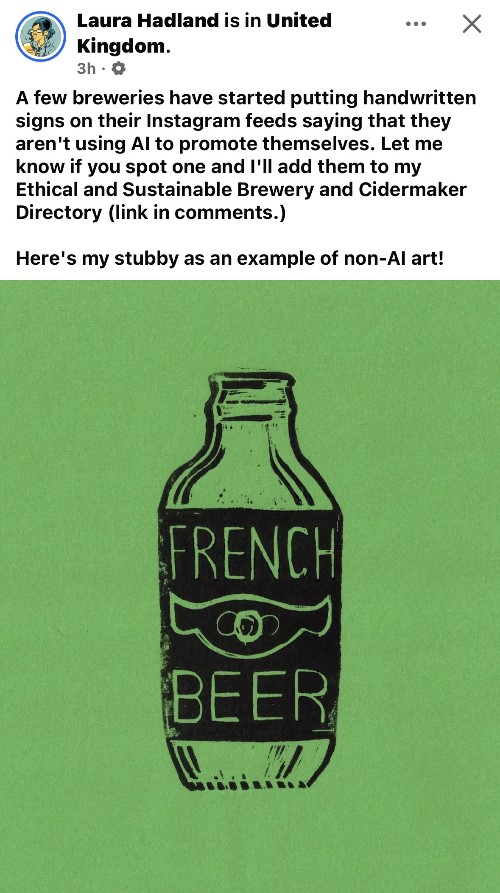 I commented* but… but… what I didn’t mention is related to what they wrote: “if you can’t be bothered to write…” I know someone who has found a niche that may make him a bit of side cash that relies almost entirely on innoquous A.I. use. It’s a form of design creativity that results in absolutely throw away content. So who cares? It’s just about the extra cash for him. But look at what Laura wrote over on FB. Because it’s good to care. So if you really do care, if you want to put your name on something? Well, you are drinking out of the dog’s water dish if what you put out relies on crap A.I. tech. “Relies” carries a lot of work in that sentence for sure… but if that’s what you’ve done your name bears the shame.
That’s it for now. I gotta get back out to the garden. While I do, please look to Boak and Bailey’s postings on each and every Saturday along with the coincidenal and fabulously entertaining footnotes week after week at Patreon. They do put in the effort. And do look out for more of Stan’s “One Link, One Paragraph” format. Then it’s your turn. Read and recommend, please. Scour the world for news tips – then let me know. Then hunt out something in someone’s archives! Leave oblique comments on someone’s post from 2009!! Listen to a few of Lew’s podcasts and get your emailed issue of Episodes of my Pub Life by David Jesudason on certain Fridays. And Phil Mellows is at the BritishBeerBreaks. Once a month, Will Hawkes issues his London Beer City newsletter. Do sign up for Katie’s wonderful self-governing totes autonomous website featuring The Gulp, too. Ben’s Beer and Badword remains on pause but there is reading at The Glass which is going back to being a blog. Any more? We have Ontario’s own A Quick Beer and All About Beer is still offering a range of podcasts – and there’s also Mike Seay’s The Perfect Pour. Plus follow the venerable Full Pint podcast! And there’s the Craft Beer Channel on Youtube as well as the archives of the Beer Ladies Podcast. What else?
*Fine, this was my comment: “I am afraid that A.I. is a bit like men’s cologne. You think you will just use a little, no one will really notice but it makes someone feel better about oneself. To the contrary, it’s like wearing some bit of orange clothing. It does stand out, it never really works and it usually ruins whatever effect you were going for. It’s also lazy because it’s unnecessary. If you are going to pretend you are a writer then do the frigging writing. Put in the time. Like any effort, you improve by error and succeed through the individual quirk of personal expression. A.I. editing is like claiming you cooked the meal when you got take away.”
]]>
The author in his natural state…
Here we are again. Me, I am semi-bachelor boy this week as the last two kids moved into their own places across town over the summer and the Euro-eldest is hosting herself and an aunt. So… here I am and, obviously, I have, you know… chores. Winter, after all, is coming. Which more obviously means I am pulling out and inspecting the state of my sweater vests and cardigans, rearranging the coffee mug shelf, writing about 1820s taverns, preparing a powerpoint for a late October presentation on beer related newspaper notices 1790s to 1840 from my fair City – and doing anything or nothing else I can think of to avoid being useful like putting my hand on a caulking gun or emptying out the eavestroughs. All as I scratch at the mosquito bites from just crawling through the tomato patch out in the yard earlier this week. Best to stay inside. Winter is, after all, coming.
Before moving on the news, a note from the editorial staff. I was reading in The New Yorker by Jill Lepore oddly titled “Bot or Not” in the physical magazine but “Are You A Human?” online. Two things stuck out bluntly in the article. First, the function of reCAPTCHA gatekeeping online isn’t about you clicking the botton to tell them you are a human but to watch you as you click to determine how your cursor movement proves you are. Plus the moment taken to do so allows the bot to scour your activity to back up your claim to humanity.* The other thing noted is this:
…at this point there are more bots online than people. To deal with this problem, businesses retain bot-detection and bot-management firms, a specialty within the field of cybersecurity. Their task used to be to block bots, but, with the rise of agentic A.I., that has changed. Now the problem is how to let in the good bots (like the avatar you send to the Gap to buy you a new pair of pants) and keep out the bad bots (like the thief trying to scrape the data of every Gap customer). **
All of which is to say that it is becoming a bit harder to find actual real stories online to read and share with you. Thankfully, a number of you message me one way or another with tips. In the comments, via BlueSky, by email and via DMs, too. Tips are fabulous. Always appreciated. Unless you are a bot. Unless you are that Vietnamese A.I. slop farm that’s just layering digital shit upon shit. You suck.
 Now with the beery news. Let’s start with the bigger picture, the Canadian-US tariff battles continue and have already had a serious effect on Ontario’s brewing industry:
Japanese brewer Sapporo says it will move some beer production from Canada to the US after new tariffs on Canadian beer took effect on Tuesday. The move follows the introduction of a 50% tariff on beer imported from Canada. For companies shipping beer across the border, that means significantly higher costs. Chief strategy officer Rieko Shofu described tariffs as “something out of our control,” telling Bloomberg that the beer giant would “move ahead with local production.” Sapporo did not immediately respond to the BBC’s request for comment. The company plans to shift production of its non-alcoholic beer, currently made in Canada for US customers, to the US by the first half of 2027.
Sapporo’s Unibroue operations in Quebec remain unaffected for now. Late in the evening on Tuesday, the Wizened Orange Fuzz announced that not only are there going to be tariffs but complete import bans:
The White House posted five new executive orders Tuesday evening that exclude certain Canadian products from being imported into the U.S., alcohol among them. The administration is also adding more Canadian goods to the list of those that are subject to 50 per cent tariffs. A sweeping ban on Canadian booze is set to take effect on Sept. 29. “The following products of Canada are excluded from importation into the United States,” says Trump’s ban on Canadian alcohol, going on to list beer, wine, cider, whiskies, vodka and other spirits.
Interestingly, however, they also announced the lifting of tariffs on other Canadian goods of equal value. Things we sell that Americans actually need like toilet paper and concrete. I live by the border as you know and that last item is a relief locally as limestone is made into cement around here from quarried stone that is burned in a massive kiln. The resulting powder is then sailed by cargo ship the few miles south to Oswego NY across the lake where the cement is used to make city sidewalks and skyscrapers. Another thing we will think about tomorrow as we remember the twenty-fifth.
Elsewhere and more happily, Knut has written about three breweries who were showing their wares when he visited the Trondheim Brewery Festival including the northernmost brewery in the world:
Svalbard Bryggeri, the northernmost in the world, was present for the first time. The founder of the brewery, Robert, has had an uphill battle to get it all started. The first obstacle was the legislation – the production of alcohol was banned in Svalbard. The bureaucracy was bewildered and not particularly eager to do something about it, but years of lobbying finally gave fruit. The first brew was made in 2015. There are more challenges in running a brewery under arctic conditions – water supply is one of them. But the water treatment for the brewery has a side effect – they also supply clean drinking water to the local community. They have their own brewery tap in Longyearbyen, Vinmonopolet and pubs and bars on the Norwegian mainland also offer their beers. Norwegian airlines have Svalbard beer on some of their routes…
Coming up on twenty years ago (!) when this was a multi-author beer blog, Knut wrote about traveling to find Kroa, what was then the most northerly bar in the world, back when Svalbard was known as Spitzbergen. Svalbard Bryggeri appears to be about a kilometre north of Kroa.
To the south, Boak and Bailey have begun their reports on their vacation to the Czech Republic including thoughts from… err… sorry… impressions of Prague as well as from Brno. Other than them needing to take tips from Ron on insightful breakfast buffet reportage, these are fabuous descriptions with this caveat from their BlueSky account:
We landed on this ‘impressions of’ format a few years ago because we dread anyone thinking that we’re daring to offer a ‘definitive guide’ to somewhere we’ve only visited on holiday. Our very first blog post back in 2007 was carefully titled ‘Nice places to drink in…’ for the same reason.
Bravissimo! And always a great reminder that it is wise to first listen to the person’s views from there… wherever “there” is. Then… go wander around there (or anywhere) yourself and report back on that, too.
Reporting back himself is Will Hawkes. His monthly London Beer City newsletter features the history of The Pembroke of Earl’s Court – previously The Coleherne – probably London’s most famous gay pub:
It appeared in Armistead Maupin’s Babycakes (“He walked several blocks past high-windowed brick buildings to a gay pub called the Coleherne … He ordered a gin and tonic and stood at the bulletin board reading announcements about Gay Tory meetings and ‘jumble sales’ to benefit deaf lesbians.”) and the Stranglers’ 1977 tune Hanging Around (‘I’m moving in the Coleherne/ With the leather all around me /And the sweat is getting steamy /But their eyes are on the ground /They’re just hanging around’). Freddie Mercury and Kenny Everett were regulars… The Coleherne was well-established by the 1970s; it had first attracted gay customers in the 1950s, at a time when it was becoming a centre for jazz, too. Trinidadian pianist Russell Henderson first played here in 1962, launching its golden era. Sunday lunchtimes in the 60s and 70s brought together a diverse range of musicians, from British R&B pioneer Graham Bond to “Philly Joe” Jones, who played with Miles Davies. The likes of Mick Jagger and Georgie Fame came to enjoy the music.
Somewhat related but perhaps for another snack bracket is The Telegraph‘s weekly question on cultural matters asked what is the perfect quantity of beer? The responses were largely identical:
Jim Henny wrote: “As a nearly 50-year-old male, I can’t think of any scenario where I might order a half. Might as well not bother.” I also enjoyed this, from Ron Giddnes: “My wife’s plain-speaking Geordie uncle, when asked whether he wanted a pint or a half, replied that he had tried a half once but didn’t like it.” Malcolm Monaghan, meanwhile, identified a genuine hazard of smaller measures: “A friend went through a short phase of switching to halves, in an attempt to reduce his alcohol consumption. It was a disaster. He’d scoop the wee measures, and ended up drinking about 50 per cent more than the rest of us who were on the pints.”
Halfs are for boozers! Who knew? Who can afford such self-subterfuge? As we consider that in these tightening times, here are some notes:
Note #1: product placement tie-in alert!
Note #2: BREAKING!! “….you’ll be rewarded with a mild ranch dressing flavor…”
Note #3: London’s Mayor loves the nightlife.
I haven’t visited the fam in Scotland to hit the pubs for some years now as Euro-daughter has been playing that role BUT I have some sympathy to this opinion from Alcohol Focus Scotland as set out in The Times:
Carolyn Lochhead, chief executive of the charity Alcohol Focus Scotland, took a dim view of the Tartan Army chanting “no Scotland, no party” while boozing in Boston’s bars. Lochhead, in a new blog, expressed concern that alcohol consumption is what makes Scots fun and that it had been woven into the public consciousness… Hamish Husband, from the Association of Tartan Army Clubs, said Lochhead was not wrong to suggest football fans took great delight in drinking exploits. However, he noted that the fans had given $10,000 to Hasbro Children’s hospital cancer unit and about $5,000 to the Rhode Island Pipers, and other good causes had also benefited.
The article also notes that Scottish overall consumption as measured in pure alcohol is down about 20% since just 2017. Which is good. (By comparison, however, the percentage reduction for party without Scotland remains at 100%.) Not so good, however, for the clinky PR folk seemingly writing for influencers and, you know, bots who seem to have landed, for now, on lumping together the concept that the young have “increased spending on travel, hospitality and alcohol in the past year” to fudge the drop in spending on drink. I hear young people today are spending more on [rent+drinking] as well.
Conversely and speaking from a more reality based reality, BMI continues to trace the drop in US craft beer sales with a fabulously named expert in the field, Bump Williams:
Retailers “already making some early ‘calls’ on shelf space for 2027 and unfortunately, craft once again seems to be on the block for losing more space,” Bump wrote. But Bump also took “closer look” at total craft to “hopefully persuade some retailers NOT to toss ALL craft into the beer-grinder of lost causes because roughly 1/3 of all craft brand families are enjoying some growth.” In aggregate, craft declining at steeper pace than total beer. Segment $$ sales down 4.6% while total biz down 3.6% in NIQ yr-to-date thru Aug 15. Tho that’s less of a gap than last yr when total beer $$ were down 3.2%, craft -5.2%.
Another sort of shift has been discussed by Eric Asimov, who regrets the move away from cabernet sauvignon – as it’s been tagged as something of your aged parents’ wine:
A lot of bad, unbalanced, over-the-top cabernet wines have shaped these attitudes. In the heyday of American cabernet sauvignon and Bordeaux, say, from 1985 to 2010, which coincides with the most influential period of those wine publications, the prevailing style of Napa cabernet increasingly became the high alcohol, sweetly fruity oak bomb. Many Bordeaux were so highly polished that any distinguishing features had been eliminated. These wines have rightly receded in popularity, though they still have their fans. Yet I fear their legacy has been to turn people off from the grape rather than the style. This is a shame, but it is not unusual.
As we see in craft beer, we might have been oversold the idea of the obscure or even the obscured as the new and improved. And Jeff may be describing a similar shift of sorts when it comes to the fresh hop beers of Oregon this year:
I noticed this trend last year, and it seems even more prominent this year: breweries using fresh hops as an accent in beers with high loads of conventional hops. The effect is a diminished or absent fresh hop note (in what may otherwise be great beers). During fresh hop season, I don’t merely want great beer, though; I want beers that glow green. As breweries begin to downplay the fresh hops, this worries me… brewers, use MAOR fresh hops! Make them glow green!
Green! Speaking of which and finally, did you know that Nottingham was originally called Snotengaham?*** This is not a fact I picked up from this week’s feature in Pellicle by Pete Blackburn which, otherwise, provides a very interesting view into the revivial of Nottingham’s beer scene:
The famous Shipstones “Star,” and the Robin Hood silhouette of Home Brewery, proudly adorned those buildings. Streets hummed with the pungent scents of malt and hops, and hundreds of pubs carried their names. These breweries sponsored Nottingham’s two football clubs. You chose your team: Nottingham Forest or Notts County. And then, you pledged loyalty to “Shippo’s” or Home Ales. Those legendary local breweries are now long gone, joined in their demise by the much-loved Mansfield and Hardy & Hansons breweries. But while their landmark buildings, still standing, now serve other purposes, a new cast of beer and brewing advocates are putting Nottingham firmly back on the map.
Fabulous. And that is it for now. A goodly selection this week. Until we meet again, please look to Boak and Bailey’s postings on each and every Saturday along with the coincidenal and fabulously entertaining footnotes week after week at Patreon. They do put in the effort. And do look out for more of Stan’s “One Link, One Paragraph” format. Scour the world for tips then let me know. Then hunt out something in someone’s archives! Leave oblique comments on someone’s post from 2009!! Listen to a few of Lew’s podcasts and get your emailed issue of Episodes of my Pub Life by David Jesudason on certain Fridays. And Phil Mellows is at the BritishBeerBreaks. Once a month, Will Hawkes issues his London Beer City newsletter. Do sign up for Katie’s wonderful self-governing totes autonomous website featuring The Gulp, too. Ben’s Beer and Badword remains on pause but there is reading at The Glass which is going back to being a blog. Any more? We have Ontario’s own A Quick Beer and All About Beer is still offering a range of podcasts – and there’s also Mike Seay’s The Perfect Pour. Plus follow the venerable Full Pint podcast! And there’s the Craft Beer Channel on Youtube as well as the archives of the Beer Ladies Podcast.
*The article also explains that the “which images have a bicycle?” test is really used to train the borg behind the internets to read images like a human. And the “what letters and numbers are these?” test actual is used to correct errors in scans of books. The borg doesn’t give a shit about you and your identity confirmations. You are already on lists.
**The New Yorker, Aug 17 edition, page 20.
***Snottingham!! How mah-chur of me. What’s that? Well, sure, I don’t disagree. It could well be beneath you to be reading this sort of stuff.
 A few years ago – fourteen if you are counting – I posted a short post on about the “houses of entertainment” as described in Western and Eastern Rambles: Travel Sketches of Nova Scotia.* These sketches were originally published in The Nova Scotian in 1828-31 by newspaper owner Joseph Howe (and edited by my undergrad CanLit prof.) I was reminded of that 2012 post of mine when I was researching and decided to add something clever (and original) to this post I was writing about the description of Nova Scotia’s “houses of entertainment” of Pictou County’s as described in 1821‘s Letters of Mephibosheth Stepsure to the Editors of the Acadian Recorder by Thomas McCulloch.** (That’s an old and largely gratuitous photo of Lorrain’s Hotel of Pictou built in the 1820s for dubious context.) But when I went to search for online discussions of the book by Howe I was presented with that old forgotten post of mine via Lord Goog. Shortcut achieved, thanks very much to Mr. 49 Year Old Me.
So…there are a few things to mention about the two texts. They are both columns in colonial newspapers. They are also by date pre-Victorian and in tone pre-temperance, practically speaking. By this I mean that they are Georgian and as such frame personal failure due to alcohol misuse as a matter of individual character flaw as opposed to larger societal ill. By way of example certainly at the frontier, we can witness the events of 12 and, I suppose, 13 August 1827 at Guelph on the celebration by the local great and good of the King’s birthday:
…all sat down and enjoyed a hearty meal. “After the cloth was removed,” toasts were drunk to everybody and every conceivable thing, the liquors, of all imaginable descriptions, being passed round in buckets, from which each man helped himself by means of tin cups, about two hundred of which had been supplied for the occasion… those who remained continued to celebrate the day in an exceedingly hilarious manner, most of them, who had not succumbed to an overpowering somnolency, celebrating the night too, many of them being found next morning reposing on the ground in the market place, in loving proximity to the liquor pails, in which conveniently floated the tin cups…
Dead drunk they were – but all for a good cause on a special occassion. Howe, just a couple of years later, avoided that sort of liquor soaking when he saw the madcap night life offered to the stage coach traveller who arrived in what was and is now still Kentville, NS:
…hardly do you get into the village before some long-legged Merchant pops you into a gig and gallops you away to church – or some other sinner of the same stamp gets you into his house, from which it is no easy matter to escape. You may run about, like Blair‘s soul, knocking at every outlet but in vain – Port stands sentry in one place – Madeira in another, while Claret, at the head of Bacchus’s light infantry, fairly cuts you off from every retreat…***
Kentville then was apparently as awash as Guelph had been – but was so on any given day. “Not for me!” says Howe. Still, McCulloch in his Stepsure Letters takes the question of boozing to another level of piety or at least ridicule. His fictional essays are a satire on the rise and fall of various sorts of leading men in rural Pictou County, leaning apparently on the message in Proverbs 12:11:
He who works his land will have abundant food, but he who chases fantasies lacks judgment.
For McCulloch, it is not booze that ruins a life so much as an avaricious ambition that takes someone off the farm. That leads inevitably to ruinous financial decisions and, then, recourse to the bottle. Take for example the formerly sober and prosperous farmer Caleb Castup who, through his taking on new political ambitions, became the local commissioner of roads leading work crews to open up the forest…
… he was a man of some consequence… [and] … his respectability required himself to lodge in Mr. Soakem’s tavern. Here… he would spend his evenings with Mr. Soakem, and those who frequented his house. To make a long tale short, from being a sober, industrious man, he became a mere sot, and his boys are getting on after him as fast as they can. The farm, from neglect, became of no use to his family. The sudden decrease of our revenue, also, made his profit by the roads a mere song, when one day, as he was passing the sheriffs, that gentleman invited him to walk in…****
The joke about the sheriff inviting him “to walk in” is the same joke in many of the letters. Castup is incarcerated for his debts. But not after bringing ruin upon his family:
…home had no charms. At first, when he would come home to Mrs. Castup, intoxicated, she considered it merely as a state in which all are occasionally are, and it gave her no uneasiness, “But frequent repetitions. produced weeping and entreaties, and at last reproaches, And it was even said, though I cannot affirm it, that they proceeded as far as a battle. Certain it is, that, between poverty and quarrelling, home was a torment to them both. His family, also, and a fine family they were, are fit for nothing else but strolling about and drinking; and poor Mrs. Castup curses the day which made her husband a commissioner of roads…*****
Hardy har har. Note: she cursed not the day he took up drink but the day he obtained the position of a government official. Occasional intoxication gave no uneasiness. Note also: one of the fellow jailed inmates of Mr. Castup was Mr. Soakem the tavernkeeper himself. His story began similarly:
Like the rest of us, he began the world by settling upon a farm. At first, he was a hard working man, and soon made himself comfortable. But he was very eager to be rich, and he would frequently compare his hard labor with his little gains, as he called them.******
Greed, you see, is the curse of the farmer and as a result the cause of disaster for the farmer’s family. Ambition also makes you uppity:
…when Mr. Soakem was abroad, in order to maintain his reputation, he would stop at every tavern on the road, and show how a gentleman ought to behave. In the mean time, the young people were left to manage both the farm and the house of entertainment. This was more than they could well do; and, besides, not very consistent with sober and industrious habits… travellers, understanding how things stood, passed on to the New Inn about half a mile distant. In short Mr. Soakem’s gradually became like the habitation of the wicked, he was rarely in it himself; his children were always strolling about ; and no traveller came near it; when, at last, one day the sheriff calling and finding him at home, remarked, that he must now be very lonely, and insisted upon introducing him to the company…*******
There are others in that company held at the Sheriff Holdfast’s house. The farmer turned logger. The farmer who becomes a merchant. The farmer turned gypsum exporter. All go broke and end up jailed for debt. Much to the chuckles of the agricultural readers of the Acadian Recorder who knew their place is at home on the land – and who knew how to mind their manners. And who didn’t stroll about! Another thing about that company of those jailed by the sheriff indicates to me that the key vice in all this isn’t the drinking. Consider this:
when I arrived at the sheriffs, I found Mr. Soakem, with eyes like collops, poring upon the cards, and the grog before him.********
…and also this passage when the author of these letters responds to the newspaper’s readers who are upset with him:
I am reviled at home as well as discredited abroad. Sheriffs lodgers, in particular, are very angry at what I have written about their grog drinking and Mr. Holdfast’s kindly treatment. So far from being sensible of this gentleman’s good offices, Mr. Pat O’Rafferty declares that he is a perfect Polyphemus; only he does not eat them, when ho has got them into his den.*********
The sheriff serves grog to the inmates! And lets them read the newspaper. And then write letters to the editor. How civil. One last thing. Both the Howe and McCulloch texts use the phrase “house of entertainment” in parallel with “tavern”, the latter being the descriptor last mentioned in my post on The Ports. It appears both are the accepted and even legal language of the time as this passage about the application process and an objection at the hearing from the local parson Mr Drone suggests:
…he applied to the magistrates. He told them that taverns are at best but necessary nuisances, and ought not to be multiplied. He bid them look round the township, and see how many had been ruined by living in their neighbourhood. And as he got on, becoming gradually more earnest, he said they had received his Majesty’s commission for better purposes, than to grant a license to every fool who chose to ruin himself and his family; that they were the guardians of good order; and, that, if they placed temptations in the way of the unwary, they were the partakers of other men’s sins; and might assure themselves that the gall and wormwood would be shared between them. Our magistrates have always been in the practice of giving licenses to all who request them. The town, they say, needs the license money; and, if the taverns increase too much, those who keep them will get tired of the business, They were, therefore, not well pleased that Parson Drone should interfere, and pretend to instruct them in their official duties, They never meddled with his preaching, and he had no right to interfere with them. Hence, partly at the solicitation of Mr. Soakem, and partly from opposition to the parson, the license was granted.**********
Hah! So the magistrates are mocked. The parson is mocked and certainly the greedy are mocked. That is the humour of the colonial Georgians of the 1820s. Thus endeth the sermon. Both for Parson Drone and, for today, myself.
*My physical copy is Howe, J, Ed.:Parks M.G.(1973) Western and Eastern Rambles: Travel Sketches of Nova Scotia, (U of Toronto Press, Toronto). I took Canadian Literature from Professor Parks of Dalhousie University in 1982-83.
**My physical copy is McCulloch, T. (1960) The Stepsure Letters, (McClelland and Stewart, Toronto). McCulloch founded Pictou Academy in 1816. It’s still the town’s high school and in the fall of 1979, my Truro soccer team of C.E.C. played them only for the game to be called when our striker, sick and tired of being hacked by one of the brave Pictonians, applied his black belt in judo to flip and hammer the thug. I played centre back and had a fabulous view of the incident. Mayhem ensued. Don’t asked me about the later Truro Town v. Pictou Town men’s league game from around the summer of 1984. Don’t!!
***Howe, p.78.
****McCulloch, p.36.
*****Ibid., pp.36-37.
******Ibid., p.29.
*******IbiddityIb, p.31.
********Idib, p.32.
*********IbbyDibbyDooo, pp.40-41.
**********(!!!)IbbyDibbyDone, pp.29-30. Drone had previously dealt directly with Soakem only to be told “Mr. Soakem em. was not convinced. Houses of entertainment were necessary, and might be very decently kept by religious people.” Please refer to Lamentations 3:19 on the whole “gall and wormwood” thing.