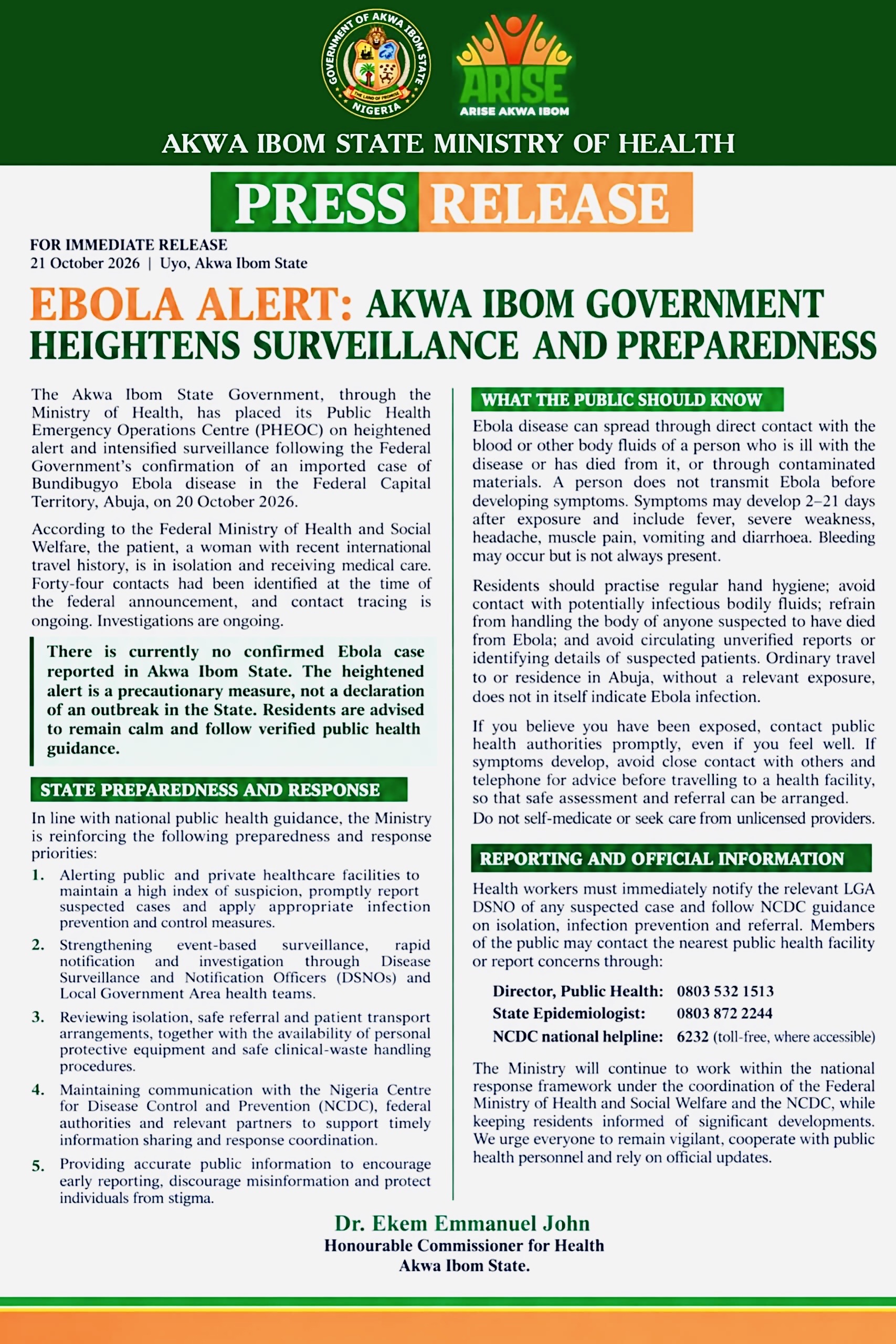
In a statement dated October 21, 2026, the Commissioner for Health, Dr Ekem Emmanuel John, said no confirmed Ebola case had been reported in Akwa Ibom State. He explained that the heightened alert was a precautionary measure, not a declaration of an outbreak in the state.
The ministry urged residents to remain calm, follow verified public health guidance and cooperate with health personnel.
The alert followed the Federal Government’s announcement on October 20 that a woman with recent international travel history had tested positive for Ebola in the Federal Capital Territory. The patient was in isolation and receiving medical care, while 44 close contacts had been identified at the time of the federal announcement.
State strengthens preparedness
According to the state health ministry, public and private healthcare facilities are being alerted to promptly identify and report suspected cases and apply appropriate infection prevention and control measures.
The government is also strengthening surveillance, rapid notification and investigation through Disease Surveillance and Notification Officers and local government health teams.
Other measures include reviewing isolation facilities, safe referral and patient transport arrangements, the availability of personal protective equipment and procedures for handling clinical waste safely.
The ministry said it would maintain communication with the Nigeria Centre for Disease Control and Prevention (NCDC), federal authorities and relevant partners to support timely information sharing and a coordinated response.
It also pledged to provide accurate public information, encourage early reporting, discourage misinformation and protect individuals from stigma.
What residents should know
The advisory explained that Ebola can spread through direct contact with the blood or other body fluids of a person who is ill with the disease or has died from it, as well as through contaminated materials. People do not transmit Ebola before developing symptoms.
Symptoms may appear between two and 21 days after exposure and include fever, severe weakness, headache, muscle pain, vomiting and diarrhoea. Bleeding may occur but is not always present.
Residents were advised to practise regular hand hygiene, avoid contact with potentially infectious body fluids and refrain from handling the body of anyone suspected to have died from Ebola.
The ministry also cautioned against circulating unverified reports or identifying details of suspected patients. It stressed that ordinary travel to, or residence in, Abuja without a relevant exposure does not itself indicate Ebola infection.
Report exposure and seek advice early
Anyone who believes they may have been exposed should contact public health authorities promptly, even if they feel well, the ministry advised.
If symptoms develop, affected persons should avoid close contact with others and telephone for advice before travelling to a health facility so that safe assessment and referral can be arranged. Residents were urged not to self-medicate or seek care from unlicensed providers.
Health workers were directed to immediately notify the relevant Local Government Area Disease Surveillance and Notification Officer of suspected cases and follow NCDC guidance on isolation, infection prevention and referral.
Official reporting contacts
The ministry listed the following contacts for concerns and reporting:
- Director, Public Health: 0803 532 1513
- State Epidemiologist: 0803 872 2244
- NCDC national helpline: 6232 (toll-free, where accessible)
The ministry said it would continue working within the national response framework and keep residents informed of significant developments.
Source: Akwa Ibom State Ministry of Health press release, October 21, 2026. See also the Federal Ministry of Health and Social Welfare announcement.
]]>
By Uwakmfon Jacobson
The re-election bid of Akwa Ibom State Governor, Pastor Umo Eno, has received a boost following his endorsement for a second term by stakeholders and residents of Ikono Ibom Clan in Uyo Local Government Area.
The endorsement was made on Wednesday at Ikot Ibom Civic Centre during a youth sensitisation and educational empowerment programme organised by the Commissioner for Culture and Tourism, Dr Anieti Udofia, who disbursed ₦10 million to more than 150 students and youths from communities across the clan.
Speaking at the event, Udofia said the initiative was designed to sensitise young people on their responsibilities while easing the financial burden on students struggling to meet their educational needs. He described the programme as an opportunity to give back to his community, encourage support for Governor Eno’s administration and appreciate the Governor for appointing him to serve in the State Executive Council.
The commissioner described his appointment as a significant milestone for Ikono Ibom, noting that, to the best of his knowledge, Governor Eno was the first governor to appoint an indigene of the area into the State Executive Council.
Beyond the empowerment initiative, Udofia highlighted government interventions in the community, including the construction of more than 19 kilometres of roads, renovation of schools and provision of ARISE Compassionate Homes. He added that more than 10 indigenes of the area were serving in government at various levels.

In his remarks, the Secretary to the State Government, Prince Enobong Uwah, commended Governor Eno for supporting Udofia, noting that the appointment had enabled the commissioner to make a positive impact on his community.
Speaking through his wife, Dr Inemesit Uwah, the SSG praised the commissioner for investing in the education of young people and expressed optimism that Ikono Ibom would benefit from more dividends of democracy under the Eno administration.
Also speaking, the Dean of the College of Commissioners and Special Advisers, Mkpisong Frank Archibong, thanked the Governor and the tourism commissioner for the educational intervention. He commended the administration’s development efforts and urged residents to obtain their Permanent Voter Cards (PVCs), stressing that active electoral participation was essential to sustaining development and supporting the ARISE Agenda.
Similarly, the Chairman of Uyo Local Government Area, Dr Uwemedimo Udo, congratulated Udofia on the initiative and praised Governor Eno for ongoing development projects across the state.
The ALGON Chairman pledged support for the completion of the Ikono Ibom Civic Centre, while citing road construction and other infrastructure projects as evidence of the administration’s commitment to improving residents’ living conditions.
In a goodwill message, the Commissioner for Education, Professor Ubong Umoh, commended Udofia for the initiative and highlighted government investments in schools, healthcare facilities and other infrastructure in Ikono Ibom. He urged the beneficiaries to take their education seriously and utilise the financial assistance judiciously to advance their academic pursuits.

Reinforcing the focus on young people, the Commissioner for Youth Development, Dr Ekerette Ekanem, described the programme as a milestone and a demonstration of the government’s commitment to youth development under the ARISE Agenda.
He cited the establishment of youth development centres in all 31 local government areas, payment of students’ examination fees, an increase in bursary payments from ₦20,000 to ₦50,000, and the upward review of monthly allowances for National Youth Service Corps members from ₦5,000 to ₦20,000 as evidence of the administration’s support for young people.
On the political front, the APC Uyo Senatorial District Chairman, Mr Isua Archibong, called for increased voter registration and participation ahead of the 2027 general elections.
Giving figures for Wards 8 and 9, he disclosed that Ward 8 had 29 polling units and 14,000 registered voters, while Ward 9 had 16 polling units and 8,000 registered voters. The two wards account for 45 polling units and approximately 22,000 registered voters.
He urged eligible residents who were yet to register to do so and encouraged all qualified voters to obtain their PVCs and participate actively in the electoral process.
The programme attracted government officials, political leaders, community stakeholders, students and youths from across Ikono Ibom Clan. Speakers at the event underscored the importance of educational empowerment, youth development and infrastructure delivery in advancing community progress, while rallying support for Governor Eno’s administration and its ARISE Agenda.

A visit by Nnémé ARISE to the Dakada Skills Acquisition Centre (DASAC) in Akwa Ibom State has highlighted the state government’s investment in vocational education as part of His Excellency, Pastor Umo Eno, Ph.D.’s efforts to improve the economic prospects of young people through practical skills, entrepreneurship and self-reliance. The centre’s Rector, Professor Enoidem Usoro, disclosed that students receive training, feeding and learning materials free of charge.
During conversations with students, instructors and the Rector, Nnémé ARISE explored how the centre equips trainees with practical skills that can create pathways to employment and business ownership. Professor Usoro explained that the initiative is intended to improve the economic circumstances of young people across the state, adding that older people are also welcome to acquire skills. The programme forms part of a broader approach to economic empowerment under the Umo Eno administration, which also promotes small businesses owned by women and young people and supports agricultural development through grants to cooperative groups.
The visit covered several departments, including animal science, carpentry, building, mechanical trades, catering and fashion, demonstrating the range of vocational disciplines available at the centre. The team also visited the ranch where cattle are kept, gaining insight into the practical side of agricultural training. By combining skills acquisition with free access to training and essential learning resources, DASAC seeks to reduce barriers to vocational education and help trainees develop capabilities they can apply in employment, enterprise and productive economic activities.
Beyond the workshops, classrooms and ranch, the visit raises an important question about the role of practical education in expanding economic opportunities for people across Akwa Ibom State. What do the students and instructors have to say about their experiences, and what does the centre offer those seeking a new path to economic independence?
The Nnémé ARISE visit offers a closer look at DASAC, its facilities and the people pursuing skills that could shape their future.
Photos from DASAC


By Ernest Akpan
The Akwa Ibom State Government has initiated moves to resolve labour-related complaints involving Sterling Global, including alleged disparities in workers’ wages, working hours, employment practices and compliance with labour laws.
The Special Adviser to Governor Umo Eno on Labour, Sir Udo Kierian Akpan, disclosed this during a ministerial media briefing on the achievements of the Ministry of Labour and Manpower since the inception of the administration.
Akpan, who cohosted the media briefing with the Hon. Commissioner for Labour and Manpower Planning, Elder Ikoedem Ekong, said Governor Eno had intervened in the matter by convening a meeting with Sterling Global’s Managing Director and management team, alongside relevant government officials and stakeholders, to address the concerns and establish a framework for resolving them.
He said a joint committee comprising representatives of the state government and Sterling Global had been established to document the complaints and engage the company on measures to address them.
According to him, the issues under consideration include workers’ safety, working hours, remuneration, alleged discrimination in wage regimes and the employment of indigenes.
The labour adviser said the government was particularly concerned about reported disparities between workers performing similar jobs in Lagos and those working in Akwa Ibom, adding that the matter had been tabled for discussion with the company.
“We are discussing with them on the issue of complying with labour laws and regulations on employment, hours of work and pay,” he said.
Akpan expressed optimism that the outstanding issues would be substantially addressed before the end of December, noting that the governor was committed to protecting workers’ rights and ensuring that multinational companies operating in the state complied with applicable labour standards.
He also raised concerns about land acquisition by companies operating in the state, urging community leaders and residents to exercise greater responsibility in transactions involving their ancestral lands.
According to him, the government is working towards a framework that would provide clearer guidelines for land transactions and help prevent disputes between host communities and investors.

Sterling Global to train 93 youths
Also speaking at the briefing, a government representative announced that Sterling Global would sponsor underwater welding training for 93 indigenes of Akwa Ibom State.
He said each of the state’s 31 local government areas had been directed to nominate three candidates for the six-month training programme in Port Harcourt, Rivers State.
The initiative, he said, was part of efforts to improve the technical skills of indigenes and expand their access to employment opportunities in specialised industrial operations.
The government expressed optimism that the training would enhance local participation in the oil and gas sector, particularly in technical areas requiring specialised expertise.
Akwa Ibom pays ₦80,000 minimum wage
On workers’ remuneration, the government representative said Akwa Ibom had raised its minimum wage to ₦80,000, exceeding the ₦70,000 national minimum wage approved by the Federal Government.
He explained that the state government increased the amount by ₦10,000 above the national benchmark, adding that further decisions would depend on the outcome of subsequent national wage negotiations and the position adopted by the state.
Government reviews salaries in tertiary institutions
The briefing also highlighted salary reviews and other welfare measures introduced for workers in the state’s tertiary institutions.
Akpan said the government had approved salary adjustments for academic and non-academic staff in selected institutions following recommendations by the Ministry of Labour and Manpower.
According to him, academic staff in the institutions benefited from increases of 25 per cent, while non-academic staff received 20 per cent increases. Professors were granted a 30 per cent increase under the reviewed remuneration arrangements.
He said the adjustments covered the Akwa Ibom State University, the state’s College of Education, the polytechnic and the School of Health Technology, among other institutions mentioned during the briefing.
The labour adviser said the measures were intended to improve staff welfare and complement the administration’s interventions in the education and health sectors.
He added that the government had also reviewed the allowances of heads of local government services to strengthen their remuneration and ensure that their responsibilities were appropriately reflected in their earnings.
Health workers benefit from salary increases
Akpan further disclosed that the Ministry of Labour and Manpower collaborated with the Ministry of Health on salary adjustments for medical personnel.
He said doctors received a 40 per cent salary increase, while other categories of medical workers benefited from a 30 per cent increase.
The measures, he explained, were part of the administration’s broader efforts to improve working conditions, strengthen public services and retain skilled personnel in critical sectors.
Government addresses oil spill concerns
On complaints relating to oil spills in communities affected by industrial activities, the government representative said relevant regulatory agencies and the state Ministry of Environment were responsible for investigating incidents, identifying the companies involved and coordinating clean-up operations.
He cited reported oil spill incidents in communities around Ibeno, including areas mentioned at the briefing, saying the Ministry of Environment had assessed the affected locations and that relevant agencies were taking action.
He said further interventions would be considered as the investigations and response efforts progressed.
The government reaffirmed its commitment to strengthening industrial relations, improving workers’ welfare and ensuring that host communities benefit more meaningfully from economic activities within Akwa Ibom State.
]]>Concerns about the quality of education and the sector's future have remained among the most topical conversations in Nigeria. From the good old days, people have spared no energy berating what has long been considered a steep, multi-layered decline in educational fortunes.
For government, institutions, and communities, efforts to address the rot in this sector can only be as adequate and far-reaching as the search for sustainability. This is where Akwa Ibom State Governor Pastor Umo Eno stands out, with a breastplate that holds everything together.
Declaring a state of emergency in education for a state already ranked as “educationally advantaged” must have been Governor Eno’s befitting and well-thought-out gift to teachers and stakeholders in the sector, as the global community, on October 5, 2026, marked World Teachers' Day.
As with every journey, the first step to seeing education through to better days must begin with the will to squarely confront the hydra-headed monster of policy dearth, poor funding, inadequate infrastructure, under-motivated teachers, and under-utilised learning modules.
Beyond the history of physically joining teachers in the state for the commemoration, since the return of democracy, the Governor, whose leadership blueprint makes education a major pillar, arrived at Uyo Township Stadium with a long list of achievements his administration has recorded in the sector.
From the construction of Model Primary Schools, to investing almost 15 billion Naira in Universal Basic Education Matching Grants, over 1 billion Naira in school consumables, sustenance of the free and compulsory education policy, payment of over 7 billion Naira as WASSCE and NABTEB exam fees, construction of a model secondary school in each of the 3 senatorial districts, the event summarily explained the priority education has enjoyed since 2023.
Walking on all fours, education as a critical pillar of the ARISE Agenda has really been given a definitive touch. This is evident in the sporadic rise in school enrollment at basic and post-basic levels, as well as improved welfare for teachers through regular remuneration and other novel gestures like the wardrobe allowance.
As with primary and post-primary education, the fortunes of tertiary education have been greatly enhanced through notable achievements by tertiary institutions in the State, and educational support through scholarships, awards, and grants running into several billion Naira.
For instance, the Akwa Ibom State University has not only secured accreditation for 84 programmes, up from an initial 43, but has also since 2023, taken its number of convocations from 5 to 12, marking an impressive rise in student population, and academic ratings that currently place it as the best State University in the South-South region and 26th in Nigeria.
The upgrade of the State College of Education, Afaha Nsit, to University of Education, and subsequent readiness for full take-off with the appointment of Prof. Phillip Afaha, as pioneer Vice Chancellor, clearly signals an administration’s unpretentious commitment to reinventing the wheels.
Numbers alone may not fully capture the impact of Governor Eno’s investment in education, nor would testimonials. But beyond statistics, Akwa Ibom teachers have witnessed a change in the age-long refrain that condemned a teacher’s reward to when they get to heaven, through the magnitude of positive turnarounds they have envisaged.
Dreaming of ascension to level 17 in the state civil service was until the advent of the Eno administration, a very tall dream. At the turn of the 2026 World Teachers Day commemoration, not only have they attained heights they previously were never humoured, but are among the few to do so in the country.
A certain teacher would recount how she is expecting another promotion by November, 2026, in addition to the two she has gotten since 2023, having before then waited for 10 excruciating years without any. Others alternated between gratitude for the 13th month pay and other incentives, including refund of the 7.5% contributory pensions fund, long after all hopes were lost.
These imprints justify the affirmation of confidence thundered by over 30,000 teachers from both public and private schools, when the State Chairman of the Nigerian Union of Teachers, Comrade Edet Emenyi declared their resolve to support Governor Eno in 2027.
Teachers are no isolated beneficiaries of good and responsive governance in Akwa Ibom State. The State Chairman of the Nigerian Labour Congress, Comrade Sunny James went beyond speaking glowingly of the Governor’s labour-friendly dispositions, when he noted that 21 out of the 25 charter of demand labour presented the Governor in the build-up to his 2023 elections have been resolved.
Emphasizing measurable increase in productivity recorded in the sector, the Commissioner for Education, Prof Ubong Umoh, who crisscrossed numbers and impact in highlighting strategic breakthroughs the state has since 2023 headlined, submitted that it is truly a golden era in every ramification.
If, in Prof Umoh’s estimation, things would continue to look up for the sector if the current tempo is maintained, one is then enthused to inquire what lies ahead with the “State of Emergency” declared by the Governor. A reflection of how rapidly the state's health sector has been repositioned offers a sneak peek into where education is headed.
For starters, the emergency proclaimed would, among other considerations, see the employment of another 2000 teachers, in addition to the 1000 recently engaged by the state government, as a long-term approach to sustaining the administration’s transformative strides in the sector.
Not just jobs, infrastructure and policy reforms, but an investment whose dividend would span generations. The emergency in education is already engaging the gas pedals that would prioritise funding for teacher deployment; provide ring-fenced funding for specific disciplines and baseline teaching materials, including libraries and laboratories; and build inclusion for vulnerable demographics.
Transitioning education from conventional learning to modules that go far beyond the classroom, Governor Umo Eno is switching things up for an already robust sector to deliver smart, solution-driven schools the government, industry stakeholders, and communities will be proud to own.
Samuel Ayara writes from Ibong Otoro in Abak LGA.
]]>