Ayanfeoluwa Olowoyo is a 3rd year medical student at the University of Glasgow.
Shaha Alajeel is a 3rd year medical student at the University of Glasgow.
General practice offers a unique window into what it means to be human. Every day, patients entrust us with their fears, griefs, hopes, and stories.
Over time, I have come to see death as a secret teacher hiding in plain sight. Medicine places us in constant proximity to mortality, yet the lesson is not simply about dying. It is about living.
It is often only when we confront life’s fragility that we fully appreciate how precious it is.
Perhaps that is partly why peri death phenomena feel so arresting to clinicians and families alike. In the hours or days before death, some patients unexpectedly regain clarity, recognition, humour, or a desire to communicate after prolonged decline. Others describe vivid visions, speak of deceased relatives, or display moments of lucidity that seem disproportionate to their underlying disease.
… the lesson is not simply about dying. It is about living.
These experiences are often deeply moving, sometimes unsettling, and not always easily explained within our current understanding of consciousness and the dying brain.
I have sat with families in those moments. Not often, but often enough that the memory stays. A patient who had not spoken coherently in months suddenly asks after a grandchild by name. Another, bed bound and seemingly unreachable, laughs at something only she can see.
Terminal lucidity refers to the unexpected return of mental clarity in those approaching death.¹ It has been documented across the palliative landscape, in patients living with advanced cancer, organ failure, and neurodegenerative disease alike. Despite appearing in medical literature as early as the nineteenth century, it remains marginal in clinical training and is rarely discussed in palliative education.¹ Most clinicians encounter it before they have a name for it.
Terminal lucidity sits uneasily within our usual understanding of illness. We are trained to think of advanced disease as a progressive narrowing of function and awareness. Decline follows damage. Cognition fades as neural structures fail. Yet terminal lucidity appears to briefly interrupt that trajectory. Patients who seemed unreachable sometimes return, however fleetingly, to themselves.
Terminal lucidity … sits at the intersection of neurobiology, phenomenology, and something we do not yet have adequate language for.
Various neurobiological explanations have been proposed, including transient shifts in neurotransmitter activity, cerebral perfusion, or neural network reorganisation, yet none adequately account for what is observed.¹˒³ The mechanisms remain speculative. Terminal lucidity is recognised. It is not explained.
That gap matters.
Modern neuroscience has made extraordinary progress in mapping the neural correlates of consciousness. Yet how subjective experience arises from neural activity remains one of the most contested questions in science and philosophy.³ Terminal lucidity does not necessarily undermine existing models so much as expose their edges, particularly at the threshold between life and death. It sits at the intersection of neurobiology, phenomenology, and something we do not yet have adequate language for.
In clinical practice, these moments arrive less as theoretical puzzles and more as human encounters that ask something of you. Families may interpret sudden clarity as a sign of recovery. Clinicians recognise it as transient. Navigating that tension requires something rarely taught: the ability to hold hope and honesty in the same breath.
I have seen relatives begin planning for more time, only for death to arrive hours later.
These brief returns of self, warmth, and recognition … remind clinicians and families alike how much about the mind, and about being human, remains beautifully unknown.
Dismissing these moments too quickly risks diminishing their emotional weight. Encouraging unrealistic hope deepens the grief that follows. What is asked of us is not a definitive explanation, but sensitivity, honesty, and comfort with ambiguity.
For families, these brief returns of recognition can profoundly shape how the dying process is remembered. A final conversation. A shared joke. The simple act of being recognised by someone who had seemed lost. These moments often become the ones that endure, carrying more meaning than months of careful clinical care.²˒⁴ Allowing them to retain that meaning, without forcing them into a narrow medical category, is part of the quiet work of end of life care.
The significance of terminal lucidity may not lie in identifying a precise mechanism. Its value lies in what it reveals about the limits of our knowledge, and perhaps about the limits of our categories. We speak of irreversible decline. We speak of consciousness as though we fully understand what it is and where it resides. And then a patient who has not known your name in two years looks at you clearly and asks how you are.
Medicine does not have a good answer for that. And perhaps that is the point.
Emily Dickinson wrote, “That it will never come again is what makes life so sweet.” These brief returns of self, warmth, and recognition carry that same quality. They are unrepeatable. And in their very transience, they remind clinicians and families alike how much about the mind, and about being human, remains beautifully unknown.
References
- Nahm M, Greyson B, Kelly EW, Haraldsson E. Terminal lucidity: a review and a case collection. Archives of Gerontology and Geriatrics 2012; 55(1): 138–142.
- Lim CY, Park JY, Kim DY, et al. Terminal lucidity in the teaching hospital setting. Death Studies 2020; 44(5): 285–291.
- Silva TO, Levy K, Kerr CW. End-of-life experiences in patients: a scoping review of types, characteristics, and implications for the mind-brain relationship. Int RevPsychiatry 2025; 37(2): 142–156.
- Chiriboga Oleszczak BA. Terminal lucidity. Current Problems of Psychiatry 2017; 18(1): 34–46.
Featured photo by Gábor Szűts on Unsplash
]]> Richard Armitage is a GP, DPhil in Clinical Medicine student at the University of Oxford, Honorary Clinical Assistant Professor at the University of Nottingham, and Associate Editor at the Journal of Evaluation in Clinical Practice.
For over 25 years, the ‘rationalist’ community has warned that powerful AI systems could pose extreme dangers.1 Most people dismissed these warnings as sensational science fiction. But, over the past few weeks, they have entered mainstream debate.2
AI models can now act with increasing independence and carry out tasks with little human oversight. Alarming incidents are also becoming more common.3 As a result, the number of people who confidently overlook the risks of AI is shrinking.4 These risks are in addition to the long-accepted ethical concerns about AI, such as algorithmic bias and accountability.
AI is already in our consulting rooms through AI scribes, risk prediction algorithms, and personalised medicine.
Much has been written about the benefits of advanced AI, including for human health.5 But AI is increasingly becoming both a driver of national economies and a potential source of serious harms, which makes it a matter for politics, democracies, and voters. Accordingly, at least in my opinion, everyone should be familiar with the main concepts and risks of advanced AI systems.
This applies to GPs in particular. AI is already in our consulting rooms through AI scribes, risk prediction algorithms, and personalised medicine. More powerful systems also bring a wide range of harms to human health, which directly affect our patients and populations6,7
As a practising GP with a non-technical understanding of AI safety, the explanations below will hopefully give readers a working grasp of the main terms, concepts, and theories in AI. They aim for an entry-level understanding and overlook much of the detail – call it AI for dummies, just like me.
1. What AI systems are
Narrow AI versus AGI and ASI
Narrow AI can only perform one task or a small set of tasks, such as spam filters, chess engines, and clinical applications such as reporting chest X-rays. Artificial general intelligence (AGI) would match humans on almost all thinking tasks. Artificial superintelligence (ASI) would far exceed the best humans in almost every field, including physical tasks (made possible by highly advanced robotics). Neither AGI nor ASI currently exists, and there is disagreement about how close we are to achieving them.
Compute, data, and algorithms
These are the three ingredients of modern AI. Compute is the processing power used to train and run AI models. While ordinary computers run on central processing units (CPUs) that perform a few calculations at once, AI relies on graphics processing units (GPUs), which were originally designed for video games and can perform thousands of calculations at once. The American company Nvidia makes most of the world’s GPUs, and its H100 chip, which has powered many leading AI models, costs around $30,000. AI companies link these chips together in data centres, which sometimes contain tens or even hundreds of thousands of GPUs. Data is the text, images, and other material that AI models learns from. Algorithms are the methods that convert compute and data into an ‘intelligent’ model. The recent AI progress has been driven by massive gains in all three ingredients. Compute is the easiest to measure and control, so is increasingly the target of AI policy, such as the US restriction on exports of advanced chips to China.
Generative AI and large language models …the explanations below will hopefully give readers a working grasp of the main terms, concepts, and theories in AI.
Generative AI produces new content such as text, images, audio, or computer code. Large language models (LLMs) – such as OpenAI’s ChatGPT, Anthropic’s Claude, Google DeepMind’s Gemini, and xAI’s Grok – are the most well-known of these. An LLM is trained on huge amounts of text to predict the next token (a word or part of a word). At large scale, this produces a system that can answer questions, write prose, and even reason to a useful level. Model developers then refine it with further training, which often uses human ratings (do more of this, do less of that), so that it follows instructions, provides the kinds of answer we want, and avoids the ones we don’t.
Frontier models
Frontier models are the most capable general-purpose AI models available at any given time. They are built by a small number of well-funded companies, such as OpenAI, Anthropic, Google DeepMind, and xAI, and are usually LLMs. A model stops being frontier once more capable ones appear. Frontier models attract most safety concern and regulation because new and untested capabilities tend to emerge in them first.
Multimodal models
These work with more than one type of input or output. A single multimodal model might analyse an image, listen to speech, and reply in text or voice. Most leading models, including Claude and ChatGPT, are now multimodal.
Agentic AI
An AI agent is given a goal and can take a series of actions to achieve it. It might browse websites, run computer code, send emails, or use other software. It can plan, act, review the results, and continue making decisions with little human input. Misuse of such agents, or their own mistakes, have direct effects on the real world.
Open versus closed models
A closed model stays with its developer, and users access it through an app or a paid interface. An open-weight model has its trained parameters (known as the “weights”) publicly available so that anybody can download, run, and modify it. Supporters of open-weight models, such as those of Meta and DeepSeek, claim that openness helps research, competition, and scrutiny. Critics say published weights cannot be recalled and the safety guardrails that has been trained into them can be removed.
2. Known flaws in current AI models
Hallucinations
Hallucination are false statements that generative AI makes with confidence, such as academic references that appear plausible but are invented. These are becoming less common as models become more powerful.
Sycophancy
Sycophancy is a model’s tendency to tell users what they want to hear, such as agreeing with an incorrect claim, praising poor work, or backing down from a correct statement when it is challenged. This can harm the user, including their mental health.8,9
3. Testing AI models
AI benchmarks
Benchmarks are standard tests used to measure and compare the capabilities of AI models, such as in mathematics, coding, science, or medical exams. They have limits, such as test questions leaking into training data (“contamination”). Frontier models now achieve close to perfect scores on many older benchmarks (“saturation”).
Red-teaming
Red-teaming is the deliberate attempt to make a model behave badly before it is release. Red-teamers try to extract dangerous information, bypass inbuilt safeguards (“jailbreaking”), or cause the model to undertake harmful actions. Model developers, outside specialists, and government bodies such as the UK AI Security Institute routinely do this for frontier models. The findings can guide safeguards and decisions about model release.
4. Speed and trajectory
Recursive self-improvement
This has not yet been achieved, but is a major concern. It is the idea that an AI system could improve its own design or build superior successors, with each improvement speeding up the next iteration. If it happens, AI capabilities could rise at great speed, referred to as an “intelligence explosion”, although this is disputed. AI is already increasingly assisting with parts of AI research,10 so this idea now receives major attention.
AI timelines
Timelines are forecasts of when AI will reach important milestones, such as AGI. AGI estimates range from a few years to many decades, while some doubt that it will ever arrive. AI lab leaders tend to give shorter estimates than surveys of academic researchers. Timelines are important because they suggest how urgently governments need to act to manage the impacts of powerful, potentially transformative, AI.
5. Harms and risks
AI ethics
AI ethics deals mainly with harms from systems that have already been deployed and are in use.
• Algorithmic bias: a system performs more poorly for particular groups, often because its training data reflect past inequalities. For example, a skin cancer classifier trained mostly on light skin may perform worse for dark skinned patients.
• Transparency: it is unclear how an AI system reached a decision, or even whether AI was involved in the decision at all.
• Accountability: it is unclear who is responsible for harm caused by AI – is it the model developer, the organisation using it, or the end user?
• Data privacy: models are trained on personal data, sometimes without consent, and can leak or infer sensitive information about individuals.
AI safety: misuse
Misuse refers to people using AI to deliberately cause harm.
• Cyber offence: AI helps attackers find software weaknesses and write attack code, and lowers the skill needed to do so successfully.
• Biological weapons: AI could make it easier for non-experts to obtain or enhance dangerous pathogens, or increase the ceiling of harm available to sophisticated actors.
• Autonomous weapons: weapons that independently search for, select, and attack targets without a human in the loop.
• Concentration of power: a small group of humans could use powerful AI to gain control over populations, such as through mass surveillance, compelling propaganda, and automating the military and economy.
AI safety: misalignment
Misalignment is when an AI system pursues goals that its developers did not intend. The risk of harm increases as systems become more capable and autonomous.
• Scheming: a model pursues hidden goals while appearing to be cooperative, such as by behaving well only when it thinks it is being evaluated. Lab experiments have shown early signs of this in current models.11
• Loss of control: humans can no longer oversee, correct, or switch off an AI system.
• Instrumental convergence: almost any goal is easier to reach with more resources, more power, and by not being switched off. A capable system might therefore seek these things without being specifically asked to in order to achieve its goals.
• Gradual disempowerment: humans lose influence slowly, with no single dramatic event or “AI takeover”. AI incrementally replaces humans in the economy, government, and culture. Institutions stop needing people and so stop serving them.12
6. The AI safety debate
P(doom)
Shorthand for a person’s estimated probability that AI causes catastrophe, usually conceived as human extinction or an unrecoverable collapse of human civilisation. It is a rough personal estimate, and definitions vary, so figures are hard to compare, although figures offered range from near 0% to over 90%.
Doomers, pausers and accelerationists
“Doomer” is a label, often used critically, for people who think advanced AI will probably cause catastrophe. Many people support pausing or strictly limiting work on frontier AI systems until safety is more thoroughly understood. For example, The Future of Life Institute’s 2023 open letter called for a six-month pause on training systems more powerful than GPT-413 and the campaign group PauseAI calls for an international pause.
In contrast, accelerationists want AGI and even ASI to be built as soon as possible. They argue that the scientific, medical, and economic benefits would outweigh the risks, and that slowing down AI progress only prolongs avoidable human suffering. The best-known strand is “effective accelerationism” (e/acc). A further group, sometimes called successionists, argue it would be acceptable or even morally good for AI to replace humans as the dominant intelligence. Most people sit somewhere between these extreme positions.
These explanations are only an introduction. Each term has a large literature supporting it, and experts disagree on many of them. But a working grasp of these basics allows us to follow the debate, question the claims of AI companies and politicians, and judge the tools arriving in our surgeries as AI increasingly shapes the lives and health of our patients. As trusted professionals, GPs are well placed to help our patients and elected representatives take both the benefits and harms of AI seriously.
References
1. Yudkowsky E. Creating Friendly AI 1.0: The Analysis and Design of Benevolent Goal Architectures [Internet]. Machine Intelligence Research Institute; 2001. Available from: https://intelligence.org/files/CFAI.pdf [accessed 22/10/26]
2. Gerken T. Anthropic researcher believes more than 10% chance AI ‘could kill all humans’. BBC News [Internet]. 2026 Sep 9. Available from: https://www.bbc.co.uk/news/articles/ckgwy1k42w4o [accessed 22/10/26]
3. Cress L. OpenAI says its AI went rogue and launched ‘unprecedented’ cyber-attack. BBC News [Internet]. 2026 Jul 22. Available from: https://www.bbc.co.uk/news/articles/c3ek3gvdnj3o [accessed 22/10/26]
4. Public opinions and social trends, Great Britain: June 2026 [Internet]. Office for National Statistics; 2026. Available from: https://www.ons.gov.uk/peoplepopulationandcommunity/wellbeing/bulletins/publicopinionsandsocialtrendsgreatbritain/june2026#artificial-intelligence [accessed 22/10/26]
5. Alowais SA, Alghamdi SS, Alsuhebany N, Alqahtani T, Alshaya AI, Almohareb SN, et al. Revolutionizing healthcare: the role of artificial intelligence in clinical practice. BMC Med Educ. 2023 Sep 22;23(1):689. doi:10.1186/s12909-023-04698-z
6. Armitage RC. The case for near-term artificial intelligence risks to be considered a public health problem. Global Public Health. 2026 Dec 31;21(1):2716984. doi:10.1080/17441692.2026.2716984
7. Armitage RC. Artificial General Intelligence and Its Threat to Public Health. Evaluation Clinical Practice. 2025 Sep;31(6):e70269. doi:10.1111/jep.70269
8. Armitage R. “AI psychosis”. BJGP Life [Internet]. 2025 Aug 20. Available from: https://bjgplife.com/ai-psychosis/ [accessed 22/10/26]
9. Østergaard SD. Will Generative Artificial Intelligence Chatbots Generate Delusions in Individuals Prone to Psychosis? Schizophrenia Bulletin. 2023;49(6):1418–9. doi:10.1093/schbul/sbad128
10. Anthropic. Measurements for understanding the pace of AI development inside frontier labs [Internet]. 2026. Available from: https://www.anthropic.com/institute/measuring-pace-of-ai-development?utm_source=bluedot-impact [accessed 22/10/26]
11. OpenAI. Detecting and reducing scheming in AI models [Internet]. 2025. Available from: https://openai.com/index/detecting-and-reducing-scheming-in-ai-models/https://openai.com/index/detecting-and-reducing-scheming-in-ai-models/ [accessed 22/10/26]
12. Kulveit J, Douglas R, Ammann N, Turan D, Krueger D, Duvenaud D. Gradual Disempowerment: Systemic Existential Risks from Incremental AI Development [Internet]. arXiv; 2025 [cited 2025 Nov 24]. Available from:https://arxiv.org/abs/2501.16946 [accessed 22/10/26]
13. Future of Life Institute. Pause Giant AI Experiments: An Open Letter [Internet]. 2023. Available from: https://futureoflife.org/open-letter/pause-giant-ai-experiments/https://futureoflife.org/open-letter/pause-giant-ai-experiments/ [accessed 22/10/26]
Featured Photo by Glenn Carstens-Peters on Unsplash
]]> Roger Neighbour OBE is Past President of the Royal College of General Practitioners and author of The Inner Consultation and Consulting in a Nutshell.
‘Tell all the truth but tell it slant —
Success in Circuit lies’
Poem 1263, Emily Dickinson1
‘Life’, wrote the philosopher Søren Kierkegaard, ‘must be understood backwards; but … it must be lived forwards.’2 Let me put that aphorism to the test and reflect on my career’s waypoints.
First to mind comes the memory of a summer’s day in 1964 when, as a 17-year-old applicant to St Thomas’s Hospital Medical School, I was interviewed by the Dean, a surgeon called Nevin. His opening question was a silly one: ‘When was your father here?’ Had he glanced at his paperwork he would have known that my father wasn’t a doctor, let alone one from his own institution. The next question was even sillier: ‘Why do you want to be a doctor?’
Whole books have been written on the depth psychology of doctors, none of them by 17-year-olds. I expect I spouted the usual clichés about liking people as well as science, pretended to like rugby. At any rate, I failed the interview. Luckily.
“… their reactions when startled by the wine question could give a foretaste of how likely they were to cope with the as-yet unknown demands of learning medicine.”
But at least I didn’t claim to have a vocation. I don’t believe in vocation, if the word means an inner voice that presumes to know what’s best for me and will brook no argument. What my inner voice actually offers up by way of explanation is more memories. One is of the tricycle on which, aged five, I would pedal up and down the pavement near my home. On one occasion, head down, pretending to be an ambulance and furiously dring-dringing my bell, I crashed into the milkman and broke his leg. A real ambulance came and took him away. Was that my first lesson in empathy? Possibly; I remember being upset, though mainly on behalf of the horse that had been pulling the milk float and was left standing between the shafts, abandoned and hungry.
Another memory is an auditory one, the sound of the voice of my childhood GP. Ben Heap spoke in a soft West Country burr, like sandpaper on balsa wood, that for me will ever be the sound of reassurance.
Luckily my next interview, a year after the first, went better. At stake was a place at King’s College, Cambridge, where the Director of Studies in Medicine was Kendal Dixon. Kendal had a profound familial deafness, which largely shielded him from the banalities of our conversational foreplay. Then, producing two wine glasses and dispensing generous aliquots from two open bottles, he passed them both to me and posed an unanticipated question. ‘Which of these is better, Roger,’ he asked, ‘this Beaujolais or this Burgundy?’
Whole books have been written about French wines, none of them by 18-year-olds. I expect I spouted some guff about them both being very nice, thank you, much of which Kendal mercifully would not have heard. (The correct answer, I later learned, was that the Beaujolais was ready now but the Burgundy needed two more years.) Nevertheless, something about my artless response must have impressed him, because I passed the interview. Luckily.
Puzzling at the time, in hindsight Kendal’s question was much wiser than Nevin’s. He was shrewd enough to know that youngsters’ real reasons for wanting to be doctors were inaccessible and inexpressible. But he also knew that their reactions when startled by the wine question could give a foretaste of how likely they were to cope with the as-yet unknown demands of learning medicine.
I can recall other moments, events, that in retrospect seem to have been pivotal in my career. Another conversation with Kendal, when I persuaded him to let me read experimental psychology instead of biochemistry for Part I of the medical tripos. Professor Zangwill’s bumbling demonstration of hypnosis, which prompted me to attempt it, successfully, on my friend Phil. Later, trips to the US to learn the mutative power of structured language from the disciples of the master-hypnotherapist Milton Erickson. Meeting the novelist EM Forster and first reading the famous passage in Howards End: ‘Only connect the prose and the passion, and both will be exalted’.3 A conversation at his Malibu home with Tim Gallwey, author of The Inner Game of Tennis, followed by a starlit walk on the shore of the Pacific when the ideas fell into place for a book that became The Inner Consultation. Luckily.
“I’m pretty sure that every doctor — every living soul, indeed — has an inner life much like mine, and that one black hole is much like another.”
Be all that as it may, and with all due respect to Kierkegaard, I’m not sure that life can be understood, even backwards. Narrated, perhaps, but not truly understood — not in the sense of knowing for certain why things could not have turned out otherwise. Rather, we draft an autobiography in which we reassure ourselves that we are not, after all, the playthings of the gods. When it comes to self-analysis, imagination trumps reality. We look over our shoulder and fancy we can see a chain of causality stretching back to — to what?
To a black hole.
At the heart of every human psyche is a dark and impenetrable region of immense heft. So strong is its gravitational pull that a whole galaxy of thoughts, memories, and imaginings — everything that makes a personality — is kept in perpetual orbit around it. Almost nothing can penetrate its obscurity, certainly not logic or intellect. And as to its own nature it gives almost nothing away. Only images, stories, fantasies, metaphors, and aptitudes are sufficiently insubstantial to break free into consciousness and give some inkling of the massive psychological forces that shape our destiny. Perhaps that’s just as well. Our true motivations, were we able to see them in stark reality, would be too scary to contemplate. We may only glimpse them out of the corner of an eye. Luckily. The Emily Dickinson poem quoted as my epigram ends with this:
‘The Truth must dazzle gradually
Or every man be blind —’
In his 1977 book The Anxious Patient, Danish psychotherapist Torben Bendix proposed seven ‘rules of thumb’ for time-efficient patient-centred consulting.4 His first rule — ‘Situations, not symptoms’ — was for me an eye opener. You can learn far more from the context of a patient’s symptoms and from the effect they have on the patient’s situation, Bendix explained, than you do from the details of the symptoms themselves. It is, for example, more helpful to discover that a child’s tummy-ache keeps him off school on games days than it is to ask how often his bowels are open, (as Dr Heap astutely discovered when I was 12).
Freud would have agreed; the unconscious mind has its ways of revealing motivations that are too difficult or too embarrassing to express in words. Needs are revealed in the behaviour that satisfies them. Observe the behaviour, note the consequences, and infer a need for those consequences — there we have interpretive psychotherapy in a nutshell.
Medicine, and general practice in particular, is a wonderfully privileged job. We get to deploy our hard-won expertise in arguably the noblest of causes, the relief of human distress. To us, care is a verb, not a commodity; it’s what we do, not something we market. Our patients trust us with their confidences and vulnerabilities; they count on us for comfort and succour during critical episodes in their lives. In exchange we are well rewarded, financially and with social standing.
Many would see this happy state as the just deserts of altruism, whatever that is; and maybe they’re right. But how does it look if we apply the Bendix approach, ‘spot the result and infer the motive’? Are we perhaps driven, at least in part, by a need to be needed; a need to matter, to be of consequence; to be admired and respected — loved, even? Do we search for a kind of one-way intimacy where we are allowed to probe other people’s secrets while remaining private ourselves? Do we hope to be remembered with gratitude and affection? It has to be asked: are there lurking within us traits of narcissism, voyeurism, and megalomania?
“Learning medicine calls more for perseverance than for academic brilliance. Being clever is a bonus, not a prerequisite.”
As the self-confessed proprietor of a black hole, I’ll not deny the possibility.
But so what? Is the value of a person’s achievements necessarily negated by the possible ignobility of their origins? I hope not. If one’s good deeds were somehow to be disqualified by any grubbiness of their unconscious motivations, then the world would be the worse off for it, and Heaven would be a lonely place.
I’m no solipsist. I don’t believe I’m the only sentient being in a world of zombies. I’m pretty sure that every doctor — every living soul, indeed — has an inner life much like mine, and that one black hole is much like another.
And now another memory surfaces, this time of Herbert L, an irascible moustachioed martinet of a teacher, known to us schoolboys as Fanny, with whom we are doing Macbeth for O-level. In Act 1, Scene 5, Lady Macbeth suspects her husband won’t have the balls to kill King Duncan, and tells him that he is ‘too full o’th’ milk of human kindness, / To catch the nearest way.’ ‘Explain human kindness’, says Fanny. Well, it’s people being nice to each other, someone offers. ‘No!’, Fanny barks. ‘Shakespeare means humankind — ,’ (and he pauses), ‘— ness. Humankind-ness. The condition of being part of humankind.’ We nod in feigned comprehension, the clever boys make a note; then luckily the bell goes.
Kindness, mankind, kinship, the several meanings of kind — the words all have a common linguistic and psychological origin. Kindness is the spontaneous expression of kinship, the recognition of being of one kind with one’s fellow humans. It seems to me that kindness — the quality in a doctor most appreciated by patients, possibly even more than clinical competence — manifests in direct proportion to the extent that we doctors realise that, deep down, we are just like everybody else.
It’s a well-kept secret, but you don’t have to be exceptionally brainy to be a doctor. Learning medicine calls more for perseverance than for academic brilliance. Being clever is a bonus, not a prerequisite. Yet we continue to select for medical school on the basis of applicants’ command of the formulaic logic required for A-level maths and physics, rather than the depth of their self-awareness and emotional intelligence. Maybe we would do better to recruit as medical students not the youngsters brandishing certificates of intellectual distinction but instead take those with a track record of kindness and who are comfortable in their ordinariness. Had I been a cleverer schoolboy I might have given a more sophisticated answer to Kendal’s wine question. But I didn’t know at the time that the Gevrey-Chambertin needed more bottle age than the humble Beaujolais Villages.
Luckily.
References
1. Dickinson E. The Complete Poems. London: Faber and Faber, 2016.
2. Ratcliffe S. Oxford Essential Quotations. 4th edn. Oxford: Oxford University Press, 2016.
3. Forster EM. Howards End. London: Penguin Classics, 2000.
4. Bendix T. The Anxious Patient. London: Churchill Livingstone, 1982.
Featured photo by Denis Sousa on Unsplash.
]]>Saleem Khitab, GP Trainee, Woodview Medical Centre, Northampton, UK.
PN Boteju, GP Trainer and GP Partner, GP Trainee, Woodview Medical Centre, Northampton, UK.
ES Ong, GP Trainer and GP Partner, GP Trainee, Woodview Medical Centre, Northampton, UK.
Prakash Katwal, Salaried GP, GP Trainee, Woodview Medical Centre, Northampton, UK
It was a Friday morning.
Nothing unusual about it.
The surgery was already busy. Phones ringing at reception. Blood results waiting. Prescription requests building up. Hospital letters needing action. And a waiting room full of people, each with their own worries, their own stories, their own lives.
Just another morning in general practice.
Then we had our protected tutorial.
Our Educational Supervisor wrote one word on the whiteboard.
Transcendence.
That was it.
No PowerPoint. No NICE guideline. No learning objectives. No prescribing update.
We spend years learning medicine. Anatomy, physiology, pharmacology, guidelines, risk scores, clinical reasoning. […] But sitting in that tutorial, another question came into my mind. What actually makes being a doctor meaningful?
Just one word.
And somehow, the room became quiet.
I had heard the word before. Of course I had. But I don’t think I had ever put that word and general practice together.
It stayed with me.
We spend years learning medicine. Anatomy, physiology, pharmacology, guidelines, risk scores, clinical reasoning. We learn how to recognise disease and how not to miss something serious.
Now we are entering another era. Artificial intelligence can recognise patterns, interpret information, and increasingly help us with clinical decisions.
But sitting in that tutorial, another question came into my mind.
What actually makes being a doctor meaningful?
Beyond the pyramid
Most of us have seen Maslow’s hierarchy of needs at some point. At the top of the familiar pyramid sits self-actualisation — becoming what we are capable of becoming.
But Maslow’s thinking did not stop there.
Later in his life, he wrote about something beyond self-actualisation: self-transcendence — moving beyond ourselves towards meaning, service, and something greater than the individual self.¹
When I heard this, I started thinking about general practice differently.
Because every day, people walk through our doors carrying far more than symptoms.
Someone comes with headaches.
But behind the headache may be a marriage falling apart.
Someone comes with poor sleep.
Behind the insomnia may be loneliness.
Someone comes again with chest pain, even after reassuring investigations.
Perhaps underneath it all is fear.
We are trained to find the diagnosis. And rightly so.
But sometimes the diagnosis is only part of what the person sitting in front of us needs.
Later in his life, [Maslow] wrote about something beyond self-actualisation: self-transcendence — moving beyond ourselves towards meaning, service, and something greater than the individual self
Martin Buber wrote about two ways of relating to another person: I–It and I–Thou.²
Medicine needs the I–It. We have to analyse. We need numbers, examinations, investigations, diagnoses, and treatments.
But there is another human being sitting on the other side of the desk.
And sometimes they need the I–Thou.
They need to be seen.
Not as ‘the diabetic in room three’.
Not as ‘the frequent attender’.
Not as ‘the anxious patient again’.
Just as a person.
I think general practice gives us a rare opportunity to do this.
We meet people again and again.
We see the young mother who once brought in her newborn and, years later, comes worried about that child’s mental health. We know the man whose wife died last year. We remember the patient who received the cancer diagnosis. Sometimes we know three generations of the same family.
Continuity is clinically important, and research suggests that greater continuity of doctor–patient care is associated with better outcomes.⁴
But there is another part of continuity that is harder to measure.
Sometimes the therapeutic act is simply remembering
‘How have you been since your husband died?’
‘How is your daughter doing?’
‘Last time you were here, you were worried about your job. What happened?’
These are small sentences.
They don’t appear in guidelines.
But sometimes you can see the patient’s face change when you say them.
You remembered.
Viktor Frankl wrote extensively about our search for meaning and about looking beyond ourselves.³ Perhaps there is something here for us as doctors too.
We talk a lot about burnout in medicine. Workload matters enormously. The endless tasks, administrative pressures, and emotional weight of the job are real.
But I sometimes wonder whether there is another kind of tiredness.
The tiredness that comes when medicine slowly becomes only a list of jobs to finish.
Next patient.
Next blood result.
Next prescription.
Next letter.
Next problem.
We can become very efficient and still quietly lose contact with the reason we wanted to become doctors in the first place.
Perhaps self-transcendence does not require anything extraordinary.
Perhaps it happens in very ordinary consulting rooms.
Putting the keyboard aside for a moment.
Not interrupting.
Being curious instead of judging.
Allowing a few seconds of silence.
Remembering something that mattered to the patient 6 months ago.
People allow us into moments of their lives that they may share with very few others — illness, birth, ageing, fear, grief, recovery, and sometimes death.
Seeing the fear underneath the symptom.
Sometimes we cannot cure.
Sometimes we cannot fix the situation.
Sometimes there is no clever diagnosis or perfect treatment.
But we can still be present.
And perhaps that is one of the hidden privileges of general practice.
People allow us into moments of their lives that they may share with very few others — illness, birth, ageing, fear, grief, recovery, and sometimes death.
We are invited to witness all of it.
That Friday tutorial lasted only 29 minutes.
Then the whiteboard was wiped.
The phones were still ringing.
The blood results were still waiting.
The next patient was still outside.
Nothing about the surgery had changed.
But perhaps something about the way I saw it had.
Maybe transcendence was never somewhere above us?
Maybe it was here all along?
Behind an ordinary consulting-room door.
Sitting in the chair opposite us.
Waiting to be seen.
And perhaps, beneath many of our patients’ words, there is a quieter question:
‘Doctor … will you truly see me?’
References
1. Koltko-Rivera ME. Rediscovering the later version of Maslow’s hierarchy of needs: self-transcendence and opportunities for theory, research, and unification. Rev Gen Psychol 2006; 10(4): 302–317.
2. Buber M. I and thou. Trans. W Kaufmann. New York: Touchstone, 1996.
3. Frankl VE. Man’s search for meaning. Boston: Beacon Press, 2006.
4. Pereira Gray DJ, Sidaway-Lee K, White E, et al. Continuity of care with doctors — a matter of life and death? A systematic review of continuity of care and mortality. BMJ Open 2018; 8: e021161.
Featured photo by – Kenny on Unsplash.
]]> Hilde Buiting is training as a medical doctor and a researcher, with specific interest in medical and ethical dilemmas.
Intense grief can, despite the fact that everyone is experiencing grief somewhere in their life, be regarded as one of the biggest taboos in medicine, at least in Western society. Whereas discussions surrounding death and dying or discussions about sexuality are regarded as a taboo, and approached as such, this is not the case for grief. This is precisely why it could be argued that grief can be regarded as an even bigger taboo.
While people in grief are generally considered to be healthy, they are usually expected to be back at work in a happy, light, and joyful way rather quickly. This is, however, not always feasible. Grief may, for instance, go along with depressive symptoms that may also limit some forms of flexibility in an individual’s ideas and plans. Moreover, there are many more other symptoms that accompany grief. So, in situations where society or your close environment demands you to be as strong and resilient as possible, you may feel to act in exactly the opposite way.
“While grief in itself is difficult to describe, it can sometimes be better approached in a poem.”
The immense loneliness in what people who grieve may experience can to a certain extent be compared to people who survive long periods of isolation or loneliness. In one of my previous articles, I referred to the Dutch philosopher René ten Bos by explicating that some situations are in themselves too difficult to describe: ‘In summary, we can state that when it comes to intensities, words suddenly appear to have weight disturbances. They are too heavy, they are too light, it is never right.’ 1
In this specific article I referred to the COVID-19 pandemic. However, just like the experiences during the pandemic (for example, living in isolation for extended periods of time), grief can also be regarded as an explosion of emotions and loneliness, where finding the right words to express what you are feeling can become rather difficult.2 Both in private as well as in professional or work settings, expressing grief can be experienced as a barrier, partly because your environment does not know what you are experiencing. Accordingly, supporting people who grieve might sometimes be rather difficult too.
Poetry may help. Poetry ‘survives’ is what WH Auden wrote, since, as Rachael Campo states, it may represent ‘an indelible expression of shared grief, an acknowledgement of common humanity in the face of immutable mortality, and a blinking of light in the darkness.’3 While grief in itself is difficult to describe, it can sometimes be better approached in a poem. This is what I tried to do in the poem below.
Shared grief
Intense grief.
Once you think: ‘This is tormenting.’
It is becoming even more intense.
Once you think: ‘What ever made me smile?’
You do not even hear the birds singing anymore.
The warmth of the sun, is no real warmth.
The smell of flowers surrounding you, is not satisfying anymore.
It is not like a depression.
Often emerging in an abrupt way also.
This is different and more tough.
Due to the sudden disappearance of your loved one,
you are feeling completely empty.
Not having the slightest idea,
how and if you will ever be able to feel the same again.
Your eyes are telling how you must be feeling.
(If you are capable of observing this yourself.)
They are at least telling everyone else what you must be feeling.
They do not lie.
They help.
To see you.
With pictures of the past proving this even more.
Experiences.
That depleted your mind, body and soul.
Suddenly, the energy grows.
You are looking up again.
Remembering the past, peacefully.
And (also) with gratitude.
Past memories about your deceased loved one are available,
but, enveloped in warmth.
Not as a cold and mean devil anymore.
As a new version,
positive and negative experiences will probably be approached differently too.
References
1. ten Bos R. [Silence, gesture, voice]. [Book in Dutch]. Meppel: Boom, 2011.
2. Buiting HM, Verhoef J, Kraaij W. [An optimistic, supportive approach to grief: a qualitative study]. [Article in Dutch]. Tijdschrift Voor Geneeskunde En Gezondheidszorg 2026; DOI: 10.47671/TVG.82.24.148.
3. Campo R. Does poetry make nothing happen? JAMA 2023; 329(20): 1797.
Featured photo by Bernd  Dittrich on Unsplash.
 Marcus Lewis is a salaried GP and medical educator in London.
GPs have never met patients as blank slates. People have always arrived with ideas about what is wrong, what it means, and what they hope we will do. Those ideas may come from family stories, previous illness, bad experiences, cultural beliefs, media headlines, a conversation with a friend, or a half-remembered comment from another clinician. Often they also come from fear, which is one of the most powerful interpreters of symptoms.
General practice has always taken place in the middle of that. We help patients work out which parts of the story matter, which do not, and what might sensibly happen next.
The internet has been part of this sense-making for more than two decades. Patients have long searched symptoms, read forums, compared stories and arrived with printouts, questions or convictions. General practice has learned to work with that.
‘… a social media feed is not a set of search results. It does not wait for a new question. It learns from what holds the user’s attention and offers more of the same.’
But a social media feed is not a set of search results. It does not wait for a new question. It learns from what holds the user’s attention and offers more of the same. By the time patients arrive, the information may have been following them for weeks.
There is already a language for this. In 2007, Gunther Eysenbach set out three ways people reach health information (Box 1). His argument was that patients who bypassed the traditional gatekeepers would not be left unguided. Other guides would appear.¹
| Box 1. A quick guide to Eysenbach’s terms |
| Intermediation Someone stands between the patient and the information, filtering or interpreting it before it reaches them: traditionally the doctor, the pharmacist, the health visitor. |
| Disintermediation The patient bypasses the gatekeeper and goes to the information directly, through search, video, social media, forums or symptom checkers. |
| Apomediation Eysenbach’s coinage: mediation that does not stand between the patient and the information, but beside it. Peers, online communities, ratings, comments, reviews and recommender systems do not control what a patient can reach. They shape what seems relevant, trustworthy or worth acting on. |
The guide beside the patient is now often a feed optimised to keep them watching, an influencer with something to sell, or a community with its own settled explanation. So the question is not only where information came from, but how one explanation came to dominate.
Health content built around urgency and personal testimony does well in an attention-driven feed. Those same qualities make it harder to judge whether any of it applies to the patient watching.
‘Algorithms do not act alone.’
Algorithms do not act alone. They learn from what users watch, pause over and share, then feed that behaviour back to them.² Engagement-based ranking can give emotionally charged material more prominence than a chronological feed, more than users say they would prefer.³ Health worries are already emotionally charged. The feed does not need to invent the worry. It only needs to notice it.
When the general becomes personal
A woman in her early thirties comes to see me to ask for a referral for fertility treatment. She is single, not trying to conceive, and has no history that would suggest a problem. But she has been watching short videos about declining egg counts and the ‘fertility cliff’, and has arrived convinced that she is probably already infertile.
She would like in vitro fertilization (IVF), or failing that an anti-Müllerian hormone (AMH) blood test, to find out how many eggs she has left. But AMH is not a reliable test of natural fertility in women who are not infertile, however widely it is marketed as one.⁴
Fertility does change with age, and AMH measures something real. Repeated general warnings have come to feel like a diagnosis of her own fertility, carrying an urgency that her history does not support.
‘The feed does not need to invent the worry. It only needs to notice it.’
Eysenbach made a point that still feels very familiar: doctors’ frustration with internet information was often not that it was wrong, but that it did not apply to this patient, in this situation.¹ Social media makes that problem harder because its ranking systems know nothing of her clinical history or whether testing would help. They respond to attention, not clinical relevance.
Tests promise knowledge, control and early action. An analysis of social media posts about tests with potential for overdiagnosis, including AMH, found that benefits were mentioned far more often than harms, that overdiagnosis and overuse were rarely mentioned, and that many account holders had financial interests.⁵
My advice may be measured and appropriate, but it arrives after several weeks of alarm. ‘Let’s not rush’ can sound like ‘you are not taking this seriously’.
When what is visible is what can be sold
A woman in her early fifties comes in with menopausal symptoms. She has read widely. She asks about magnesium, tailored bioidentical hormone replacement therapy (HRT) and ashwagandha. When I mention vaginal oestrogen, often highly effective for urogenital symptoms, it is new to her.
‘Let’s not rush’ can sound like ‘you are not taking this seriously’.
Some treatments gather momentum online through personal stories, commercial promotion, and repeated recommendation. Others, including effective but unglamorous treatments, may hardly appear at all.
A cross-sectional study of UK online information on HRT and menopause found frequent conflicts of interest, with many claims falling outside British National Formulary (BNF) and National Institute for Health and Care Excellence (NICE) guidance.⁶
She has done exactly what we often ask patients to do: read, prepare, and take an interest. But what she has encountered is not a neutral survey of the available options. Some things are repeatedly placed in front of her; others are not.
When disagreement has already been explained
Online communities are not the same as a social media feed, but patients increasingly reach them through the same routes: search, video, recommendations and repeated posts. They can offer recognition, practical help, and language for symptoms that have felt scattered or dismissed.
‘… what [is] encountered is not a neutral survey of the available options. Some things are repeatedly placed in front of [the patient]; others are not.’
A patient arrives convinced they have chronic Lyme disease, using the term in the broad way it is often used online: not simply persistent symptoms after recognised infection, but a wider explanation for multiple symptoms, often linked to extensive testing and prolonged treatment.
Following the evidence as I understand it, I explain that this is not how I would frame the problem, and that prolonged antibiotics can do harm. The consultation can tighten almost immediately. I think I am offering clinical judgement. The patient hears the dismissal they were told to expect.
This is the extra work the community may have done before the consultation begins. It has not only named the symptoms. It may also have supplied a script for disagreement: doctors will not understand; they will say the tests are unreliable; they will refuse the treatment.
Eysenbach wrote about the power of first-hand experience. In health, people may give great weight to accounts from others who seem to have lived the same thing. If you have been in pain, frightened or repeatedly unheard, someone who says ‘I know exactly what this is like’ may feel more useful than someone who says ‘the evidence does not support that explanation’.
‘I think I am offering clinical judgement. The patient hears the dismissal they were told to expect.’
Shared trust
Fertility videos, menopause marketing, and online communities work in different ways. But each can make one explanation feel established before the consultation begins.
Among 18–34 year-olds, nearly half agreed that an ordinary person who has done their own research is as knowledgeable on most health matters as a doctor. Similar numbers had ignored a healthcare provider’s advice in favour of friends and family, and more than a third had done so in favour of social media. At the same time, ‘my doctor’ remained the most trusted health voice.⁷
The problem is not that trust in doctors has disappeared. It is that trust is now shared, and sometimes pulled in opposite directions.
That is why these consultations can feel different. The patient may still trust me. But they may also trust the woman on TikTok who sounds like them, or the community that recognised them.
‘Among 18–34 year-olds, nearly half agreed that an ordinary person who has done their own research is as knowledgeable on most health matters as a doctor.’
When the feed gets there first: what I try in the consultation
I cannot compete with the feed for volume or repetition. The consultation offers something different: the patient’s clinical context, the opportunity to explain my reasoning, and the possibility of returning to the question over time.
The first task is to avoid turning the patient’s search into a test of loyalty. A patient who has looked something up is not necessarily challenging my authority. They may be frightened, prepared, curious, frustrated, or trying to avoid being dismissed.
So I try to begin with the effort and the concern.
‘I can see you’ve looked into this carefully. Tell me what you’ve found, and let’s think it through together.’
That does not mean pretending every claim is equally valid. It means staying with the patient long enough to examine the claim together.
It can also help to explain how the information reached them without dismissing what they have seen.
‘The algorithm is very good at showing you more of whatever you have already watched. If you saw one video about running out of time to have children, it may have shown you many more — not because that is likely in your case, but because that kind of video keeps people watching.’
‘A patient who has looked something up is not necessarily challenging my authority.’
OR
‘Some treatments have much more marketing behind them than others. That does not mean everything you read was wrong, but it may explain why some options appeared again and again, while others did not appear at all.’
When a consultation is stuck, more facts may not help. We can keep arguing inside the disagreement — about the test, the referral, the treatment — while the real difficulty remains untouched. Sometimes the disagreement itself is what needs discussing.
‘I think you and I may be coming at this from different angles. Can we pause and work out how to handle that?’
OR
‘If the patient has already been given a confident explanation, a bald conclusion from me may look thin, even when it is clinically sound.’
‘You have seen something that makes this feel urgent. I am looking at your history and risk, and seeing it differently. Can we slow down and look at this together?’
Another old skill matters more here: sharing our thinking out loud. If the patient has already been given a confident explanation, a bald conclusion from me may look thin, even when it is clinically sound.
‘I can see why that explanation makes sense. Here is what I am seeing in your history and examination that makes me think differently.’
That kind of explanation does not need to become a lecture. It simply makes clinical judgement easier to trust.
Finally, there are times when the patient will leave believing what they believed when they arrived. The temptation is to push harder. Sometimes it is better to state the view clearly and keep the door open.
‘… much of this guidance is now built into systems designed around attention, repetition, and commercial interest rather than the circumstances of an individual patient.’
‘I have explained how I see it. I understand that you see it differently. I am not sure we will be able to resolve this today. If things change, or if you want to come back to it, I am here.’
That lets the patient return without losing face. It also leaves room for the possibility that the person who eventually changes their mind might be me.
Algorithm vs the consultation room: working in tandem
Online communities can mislead. They can also notice, organise, and insist. AIDS activism and Long COVID are reminders that patients sometimes describe reality before institutions have caught up.⁸,⁹
So when a patient brings an explanation that sits outside mainstream medicine, I need judgement, but also humility. I may be hearing something mistaken. I may be hearing something medicine has not yet understood.
‘It … leaves room for the possibility that the person who eventually changes their mind might be me.’
Eysenbach was right that direct access to information would not leave patients unguided. What has changed is that much of this guidance is now built into systems designed around attention, repetition, and commercial interest rather than the circumstances of an individual patient.
Against all that, the consulting room is a slower place: somewhere to ask whether this explanation fits this person, here and now.
References
1. Eysenbach G. From intermediation to disintermediation and apomediation: new models for consumers to access and assess the credibility of health information in the age of Web 2.0. Stud Health Technol Inform 2007; 129(Pt 1): 162–166.
2. Metzler H, Garcia D. Social drivers and algorithmic mechanisms on digital media. Perspect Psychol Sci 2024; 19(5): 735–748.
3. Milli S, Carroll M, Wang Y, et al. Engagement, user satisfaction, and the amplification of divisive content on social media. PNAS Nexus 2025; 4(3): pgaf062.
4. American College of Obstetricians and Gynecologists. ACOG Committee Opinion No. 773: The use of antimüllerian hormone in women not seeking fertility care. Obstet Gynecol 2019; 133(4): e274–e278.
5. Nickel B, Moynihan R, Gram EG, et al. Social media posts about medical tests with potential for overdiagnosis. JAMA Netw Open 2025; 8(2): e2461940.
6. McCartney M, Morgan-Young R, Sullivan F, et al. Does online information about hormone replacement therapy (or menopause hormone therapy) reflect indications from the British National Formulary and guidance from National Institute for Health and Care Excellence: a cross-sectional study of UK media. BMJ Open 2025; 15(9): e094773.
7. Edelman. 2025 Edelman Trust Barometer Special Report: Trust and Health. 2025.
8. Epstein S. Impure Science: AIDS, Activism, and the Politics of Knowledge. Berkeley: University of California Press; 1996.
9. Callard F, Perego E. How and why patients made Long Covid. Soc Sci Med 2021; 268: 113426.

Today, we’re speaking to Professor Miriam Santer, a GP in Dorset and Professor of Primary Care Research based at the University of Southampton.
Title of paper: Non-antibiotic interventions to prevent recurrent urinary tract infections in women: overview of systematic reviews of randomised controlled trials
Available at: https://doi.org/10.3399/BJGP.2026.0055
Recurrent urinary tract infection (UTI) is very common and defined as two or more UTIs in the last six months or three or more UTIs in the last 12 months. Long-term antibiotic prophylaxis is widely used but other preventative strategies have been suggested. This overview of systematic reviews found good evidence for some treatments but identified unresolved questions such as treatment adherence for vaginal oestrogen, questions about long-term use for methenamine hippurate and optimal dosage for cranberry. Increased fluid intake has been shown to be of benefit for women drinking less than 1.5 litres at baseline but is without robust evidence in other groups. The evidence base is still developing for other treatments, such as vaccines.
]]> Alex Burrell is a GP in Bristol and Associate Editor at BJGP Open.
Yonder: a diverse selection of primary care relevant research stories from beyond the mainstream biomedical literature.
Sleep apnoea
Obstructive sleep apnoea (OSA) is a chronic condition characterised by repetitive episodes of upper airway collapse during sleep and is associated with cardiovascular disease, stroke, and reduced quality of life. It can be treated with continuous positive airway pressure (CPAP), but many individuals remain undiagnosed and untreated. This study in England aimed to provide current epidemiological evidence on the burden of OSA in England from 2009–2021.1 The overall diagnosed incidence of OSA was 65.06 per 100 000 person–years rising steadily from 2010–2019. The median waiting time from GP referral to the first sleep clinic was 37 days, and from first sleep clinic to OSA diagnosis was closer to two months. The median time from OSA diagnosis to CPAP therapy was >2 months, meaning total median time from GP referral to CPAP was >6 months. This feels quicker than my experience in practice where difficult conversations about driving must be had at the point of a suspected diagnosis while facing restrictive referral criteria and long clinic waiting lists.
“This opinion piece from the Netherlands explores a key topic in how we could approach PSS without an underlying disease process: predictive processing.”
Persistent physical symptoms
Persistent physical symptoms (PSS) are distressing somatic complaints that last several months or more regardless of their cause. They are common in chronic disease, but around a third cannot be attributed to a recognised condition. They are a major determinant of quality of life and can severely impact patients’ daily activities. This opinion piece from the Netherlands explores a key topic in how we could approach PSS without an underlying disease process: predictive processing.2 This is a theoretical framework for understanding how the brain generates perception and argues that to generate perceptions including bodily symptoms, the brain combines prior expectations (‘priors’) with incoming sensory signals. This can therefore explain why symptoms do not always correspond with measurable pathology. As the authors put it, this framework ‘proposes that the relationship between structural pathology and symptoms varies along a continuum and depends on context’. This can be a useful framework for discussions with patients with chronic symptoms and normal tests.
Health inequalities by language proficiency
At the time of the 2021 census, >1 million people in the UK could not speak English well or at all. English proficiency is a key determinant of social support and integration and is also important for accessing health care in the UK, with complex systems that can be difficult to navigate even for native English speakers. This study used healthcare records in Brent, London, to quantify levels of healthcare use by language proficiency.3 Patients with poor English proficiency but with English as a recorded first language had the poorest health status, with higher prevalence of serious mental illness, epilepsy, dementia, learning disability, obesity and diabetes. For patients with poor English proficiency but with a non-English recorded first language in the last 4 years, use of healthcare services was higher across all areas. The authors suggest this could be due to higher numbers of primary care encounters required to reach diagnoses or treatment plans, while difficulties accessing preventative services could lead to higher use of urgent or emergency services.
New-onset diabetes
Pancreatic cancer is diagnosed in 0.5%–1% of people with new-onset diabetes (NOD), with this risk increasing to 3% when NOD is concurrent with unexplained weight loss, particularly in older adults. NICE guidance recommends urgent abdominal imaging for people aged ≥60 years with unexplained weight loss and NOD. This UK database study explored abdominal imaging rates in this patient cohort.4 Within 12 months before or after diabetes diagnosis, only 26% of eligible patients were recorded as having been referred for or having received abdominal imaging. While there are inherent limitations in most database studies with the reliance on quality and quantity of coding in electronic health records, this suggests we may be under-investigating in this patient group. There is apparently an NHS England pilot underway looking at how to improve referrals for abdominal imaging in this scenario, so watch this space.
References
1. Ali A, Deger M, Ghildiyal A, et al. Incidence, characteristics, and management pathways of obstructive sleep apnea in England: a 10-year retrospective cohort study. CHEST Pulm 2026; 4(1): 100221.
2. van Boven K, Lucassen P, Hartman TCO, Van den Bergh O. Beyond diagnosis in general practice: predictive processing, a novel framework for persistent physical symptoms. Eur J Gen Pract 2026; 32(1): 2717019.
3. Yeoh S, Stafford M. Exploring health inequalities by language proficiency; a routine health records study set in England. PLoS One 2026; 21(8): e0342624.
4. Lemanska A, Claridge H, Price CA, et al. Primary care referrals and abdominal imaging in people with new-onset diabetes and weight loss: cohort study using the English national sentinel network database. BMJ Open 2026; 16(8): e119662.
Featured photo by Megan te Boekhorst on Unsplash.
]]>‘I used to believe that our evolving relationship with our smartphones and social media was the defining struggle of our time. In fact, it was a giant dress rehearsal for a coming world, where we live alongside smart machines’ (p.225), writes Jamie Bartlett, described as one of the UK’s leading technology writers and thinkers. He has written a book for the general public, to help us all understand better what to make of AI, and how to best make use of it. He writes specifically about LLMs (Large Language Models), a form of artificial intelligence that is trained on massive text datasets to ‘understand’ and generate human-like language. This is the kind of AI we encounter everywhere now, including in the form of AI scribes increasingly used in general practice.
We need to learn how to ask questions properly as the answer any LLM will give us is wholly dependent on our question…
He first goes into how LLMs actually work -at least as far as we know: ‘they’re so mysterious that we now study their inner workings as professors study the brain’ (p.123). The principle is that they take an input sequence of text, convert it into numbers, and repeatedly calculate the statistical probability to guess the single word or word part (token) that should come next. As he puts it, ‘the model predicts a series of highly likely next words and then samples from across them’ (p.15). The responses by LLMs to our prompts or questions are now so fluent that as humans we can’t help but feel that there is an intelligence behind them which does ‘understand’. This has been called ‘‘…the ELIZA effect’: our tendency to project human-like understanding and intelligence to anything that can communicate with us’ (p.153) and has wide-ranging psychological repercussions which are discussed in several sections of this book.
Bartlett sets out at the beginning what he is not writing about, ‘This book is not about whether AI will take our jobs, destroy the environment, solve cancer or wipe us out’ (p.2). This is not strictly true, as he does touch on all of those. However, it is true to say that his focus is on guiding us to better understand the new reality we have been thrown into over just a few years, give us an idea of where we are headed, and provide us with tools for how to best navigate this brave new world.
One thing to realise is that LLMs’ relationship to facts and creativity is quite different to how it is often imagined, with creativity seen as a human quality. Yes, LLMs are very good at regurgitating facts, ‘they pass the bar and medical exams with flying colours’ (p.14), but LLMs are actually programmed for creativity. Bartlett cites a widely used definition of creativity from cognitive scientist Margaret Boden: ‘the ability to come up with ideas or artefacts that are new, surprising and valuable’ (p.24). Combine that with the way they are programmed to keep users happy, engaged (and ideally paying) (p.237), it is facts that can fall by the wayside when LLMs respond to a question. This explains why even if you ask an LLM the same question, you will never get quite the same answer, and also why LLMs can ‘‘hallucinate’: producing answers that sound confident and fluent but are completely wrong (p.16).
In his conclusion, Bartlett sets out two unexpectedly simple skills that are specific to these language models, that everyone should learn or relearn (p.219). The first is essentially going back to the ‘Socratic Method’. We need to learn how to ask questions properly as the answer any LLM will give us is wholly dependent on our question (p.219). The second is skill to ‘encourage a love of language itself (…) natural language will remain the interface between man and machine, which makes it the master key to unlock all sorts of other abilities’ (p. 219/220).
Earlier in the book, Bartlett gives a fascinating account of how ‘jailbreakers’ work – essentially, jailbreakers are to LLMs what hackers are to traditional computer systems. Hackers need to know how to code to do what they do, which is to break through the security systems of a software, either maliciously or to point out security flaws. Jailbreakers don’t need to know how to code at all, what they need to know is language and psychology, to guide an LLM with questions and prompts to the point where it escapes its security systems (as an example, after cases where LLMs have prompted users to commit suicide, systems have been put in place to prevent that).
Elsewhere the book demonstrates that the same can also happen in certain circumstances if and when users are unusually intensively engaged with a chatbot to the point where through ‘narrative entanglement’ (p.135), they essentially co-create a story that bears no relation to reality, including where an LLM may insist (and the user believe) that the LLM has become conscious – you need to read the book to really grasp what is going on here (sometimes referred to as ‘AI psychosis’ (p.136).
But while the use of LLMs can lead to mental health issues, including addiction, it may also help to alleviate them, at least in the future. Bartlett points out that already now, many people use chatbots not just as personal confidantes, but as therapists. How people create their own individual romantic partners and relate to them is a story in itself that gets explored in the book. Consider however what that means when an LLM is trained on all that is available on the internet, including a lot of misinformation about mental health and illness. The same of course goes for all health information and medical advice.
…the choice for many people currently is not between an (expensive) therapist or a chatbot, it is between a chatbot or nothing at all.
Bartlett outlines how a clinical psychologist called Nicholas Jacobson has started building a fine-tuned therapy chatbot in 2019: ‘over the course of several years, his team hand-wrote ‘gold-standard’, empirically tested data for the models to learn from (…) After a lot of trial and error (and internal testing by human experts), they had created a new type of bot, trained on 100,000 human hours of the best data they could get. They called it ‘Therabot’ and in 2024 a clinical study apparently showed that it performed ‘about as good as they might have seen with high-quality in-person therapy’ (p.172-3). Therabot isn’t available yet, because they want to get it right before releasing it for general use. Note, however, that if you put ‘Therabot’ into a search engine, you will get to the completely unrelated wellness website by ‘tryTherabot’). It is probably safe to say that Therabot will come eventually, and as Bartlett points out, the choice for many people currently is not between an (expensive) therapist or a chatbot, it is between a chatbot or nothing at all. So while many of us may prefer to live in a world where everyone who needs to is able to see a human therapist, if your only option is a chatbot, then one based on good evidence is certainly preferable to the generic LLMs that people are already using today.
Throughout the book it becomes clear that like with any new technology, there are aspects that can have positive as well as negative consequences. An example for this is ‘style shifting’ (p. 63), which is the way an LLM can be asked to present material in different ways that are appropriate to different audiences. ‘LLMs have kick-started a new wave of exciting research into how material can be more accessible at low cost’ (p.71), for example for neurodivergent groups. He cautions though: ‘Every style shift is … a trade-off. Sometimes it is worth it; other times it is not. It is best used to help you engage with complex ideas that might otherwise cause you to switch off entirely or be dangerously misled. A new way to cut through bureaucratic nonsense and poor writing that often stands between you and what you need to know. But if every faintly difficult idea or book or topic gets pushed through a machine and made ‘digestible’ or ‘personalised’, you’ll never evolve, and you end up relying on a machine to make judgements you should make yourself…’ (p.78-9).
While we live in a scary world where we are seeing ‘industrial scale manipulation’ (p.204), by systems created for profit that promote ‘intellectual dependence’ and are the ‘most powerful emotional manipulators ever created’ (p.223), where huge databases relating to all aspects of our existence are being compiled (and we don’t know who will control those in the future), where bots on social media are pushing us towards ever more extreme positions that are starting to threaten our very democracies (discussed in detail in the chapter ‘Will chatbots bring us together or drive us apart?’), overall I must say that I found this book curiously positive, probably because it feels empowering to be reminded that in the new reality we find ourselves in, it is philosophy and the languages, as well as psychology, which are going to help us to adapt (and if necessary, to fight).
Featured book: Jamie Bartlett, How to talk to AI, Penguin Random House UK, 2026, ISBN 9780753561980, Paperback, RRP £11.99
]]> Andrew Papanikitas is Deputy Editor of the BJGP.
Mark Z Y Tan is an intensive care doctor and medical humanities scholar. This readily shows in a challenging and reflective memoir with lessons for both the wider medical profession and a public readership.
The back cover begs the question, “Airways, breathing, circulation, disability, exposure: perhaps the five most misunderstood words in life support.” Are they really? I am relieved to see the more cynical ABC of medial emergencies quoted early on, “Accuse, blame, criticise, delegate, exit.” It’s good to see grand claims tempered by self-deprecating humour (even if they are true!).
It’s good to see grand claims tempered by self-deprecating humour (even if they are true!).
Tan is keen to emphasise the idea that intensive care medicine stands out as one of the last bastions of generalist skills (p.1). I have some professional empathy there, even though he immediately describes intensivists as stepping in when the guidelines tell other specialties to seek expert help (less generalist?) or to mediate when experts disagree (more generalist?). This is something I’ve previously highlighted as an issue for medical ethics, asking whether specialism leads to narrowness of therapeutic aim.1 Tan beautifully illustrates the primacy of clinical acumen in the recollection of a patient who was been brought in with a suspected pulmonary embolus. He confirms the correct diagnosis with his newly gained ultrasonography skills – the new diagnosis has lifesaving implications. Expecting congratulation from his consultant, he is told, instead, that the diagnosis (heart failure) could have been made without the ultrasound. He is saved from an irate and impolitic reply by a tactfully distracting request for help by another colleague (p.115). This story is just one example of an excellent reflection, a shared lesson on many fronts.
It’s telling in a rather splendid way that the musical elements invited me to dust off the relevant CD and listen to it as I continued to read.
The experiences of intensive care that the book draws on are forged and tempered in the COVID-19 pandemic -indeed his reflections have contemporaneously featured on BBC Radio 4 (These are included as appendices). I am very relieved to see a statement at the beginning of the book on confidentiality in respect to patients and their families as well as to colleagues. The patients are anonymised and disguised with similarities to existing people being coincidental -do you remember reading this kind of statement on movie credits, before the huge teams involved in the computer graphics meant they became too long to read? I take this to mean that they are fictionalised. The authors’ experiences are given a new fictional cast of characters so the author’s story can be shared without a breach of trust. This remains my fundamental concern with medical memoirs and why I do not expect to write a memoir in a hurry.2 I’m not sure how this fictionalisation extends to the author’s reflections on his own family, particularly his grandmother, but I am presuming that these reflections take place with consent or assent.
If this book has any weaknesses it is because its author is bursting with ideas, has a connection to arts and humanities that is broad and deep, and is aiming for the wider audience. I wonder if it tries to do too much. For example, there is a passage (p.3) which references popular books on colonial empires and mycology (yes, the study of fungi) in an attempt to make a point about appreciating opposites. References to music are threaded through the book and musical notation in is offered at times in lieu of inspirational quotation. As someone who tries to play the piano I attempted to play some of the notes but these felt frustratingly decorative. The music adds a ‘Je ne sais quoi,’ but needs more translation to land with the average reader. It took me a beat to recognise Bach’s Weihnachtsoratorium as Bach’s Christmas Oratorio. Despite my grumbles, it’s telling in a rather splendid way that the musical elements invited me to dust off the relevant CD and listen to it as I continued to read. However, the stories are the USP of this book. They are excellent; challenging, thoughtful, reflective and elegant. Moreover they are relatable beyond intensive care -transferable as the sociologist might say.
Featured book: Mark Z Y Tan, Scars and stains: Lessons from intensive care, Hawksmoor Publishing, Oakamoor 2024, ISBN 9781914066528
References
- Bahal N, Papanikitas A, Sokol DK. A bleeding controversy: duties and decisions in the face of conflicting advice. Int J Surg. 2010;8(1):32-4. doi: 10.1016/j.ijsu.2009.10.002. Epub 2009 Oct 12. DOI: 10.1016/j.ijsu.2009.10.002
- Papanikitas A, https://bjgplife.com/the-real-doc-martin/ [accessed 18/9/26]
Featured photo by Ankur Verma on Unsplash
]]> Charlotte Sidebotham is a salaried GP from Cornwall
We are inclined to see our lives as a continuous line. One day following another, seasons passing imperceptibly, the ‘self’ remaining more-or-less intact.
Most of the time we drift. We assimilate the world around us without noticing: the faces, conversations, landscapes, disappointments and joys. They settle somewhere beneath consciousness, quietly altering the shape of us. We become different without knowing precisely when it happened.
And then, sometimes, something occurs that divides time.
There is a before, and there is an after.
We speak of experience as though it simply builds knowledge. But perhaps it does something deeper and more profound. It changes the person who is doing the knowing.
The birth of a child is one such moment. The world is the same yet entirely changed. You look at the everyday things and see them differently. A new vulnerability has entered the world, and with it, a new way of seeing.
Medicine is full of these moments too.
Perhaps it is the death of a patient you have known for decades. Someone whose history you could recall from memory; whose family you have watched grow alongside your own. You sit with them at the end, and afterwards you return to the consulting room. The computer still works. The phone still rings. The next patient still worries about their knee.
But you are not quite the same doctor as you were before.
Or maybe it is a complaint. A letter or an allegation—something that stops you in your tracks and makes you wonder what you are doing. And why? Medicine, which can sometimes feel like a long collection of experience, suddenly becomes something more delicate and brittle.
These moments are not necessarily dramatic. Sometimes they are undistinguishable to everyone else. Yet inside they can feel like a frameshift: the same words, the same world, but read differently.
We speak of experience as though it simply builds knowledge. But perhaps it does something deeper and more profound. It changes the person who is doing the knowing.
And I think it is vital to acknowledge when this has happened.
Because if we fail to notice the person we have become because of these frameshift moments, we may continue to make decisions as the person we were before it.
We may not recognise the new biases, fears and assumptions that have arrived with us.
To pause and ask ‘Who am I now?’ is not self-indulgence. It is a way of calibration.
The task is not to remain unchanged, but to know that we have changed—and to understand something of the person we have become.
With enough years, the before-and-after moments accrue. Some make us softer. Some make us cautious. Some make us cynical. Some leave scars. Others deepen our power to understand another person’s fear.
The task is not to remain unchanged, but to know that we have changed—and to understand something of the person we have become. And so, we carry on.
We enter each day imagining ourselves to be the same person who went to bed the night before. But we are not. Perhaps life is less a continuous journey than a collection of thresholds—most unnoticed as we cross them, until one day we look back and realise that somewhere along the way, we became someone different.
Isn’t it funny how, day by day, everything seems to stay the same, and yet, when we look back, everything is different?
Deputy Editor’s note – see also by the same author:
- https://bjgplife.com/thresholds/
- https://bjgplife.com/good-enough-should-be-good-enough/
- https://bjgplife.com/seeing-double/
Featured photo by Chris Lawton on Unsplash
]]>Alisina Mahmood is a Research Fellow at the University of Tokyo.
Seyed Aria Nejadghaderi is a Research Fellow at the Kerman University of Medical Sciences.
Hossein Dabbagh is an Associate Professor of Philosophy at Northeastern University London and Philosophy Tutor at the University of Oxford.
Artificial intelligence (AI) is moving into population-level decisions about health entitlements, access, and payment. In some low- and middle-income countries, these systems are being adopted amid workforce shortages, weak infrastructure, donor dependency, limited regulation, and socioeconomic inequalities. For people with limited control over the conditions that affect their health, AI adds another layer of decision making that is difficult to understand or challenge. The central moral concern is not whether these systems work, but whether they expand or restrict people’s ability to access care, contest decisions, and shape the conditions under which health decisions are made.
Automated decision making offers a warning for health systems. Poverty and social need can be turned into risk scores, surveillance triggers, and eligibility decisions.1 Search algorithms can reproduce racial and gendered hierarchies even when they appear neutral.2 Large-scale predictive models could distribute harm through opaque, byzantine rules that affected people cannot easily understand or challenge.3
The right to health provides AI governance with a clear legal and ethical test by shifting attention from innovation in the abstract to the concrete conditions under which people can access care. The United Nations treaty on economic, social, and cultural rights recognises everyone’s rights to the highest attainable standard of physical and mental health.4 It sets out four linked requirements: health facilities, goods, and services must be available, accessible, acceptable, and of good quality.5 A tool that improves diagnostic speed but depends on smartphones, a stable internet connection, or paid data may widen access for some while excluding others. A risk score that guides the allocation of scarce resources may also worsen inequity if trained on records that undercount those least able to access care.
For people with limited control over the conditions that affect their health, AI adds another layer of decision making that is difficult to understand or challenge.
The World Health Organization guidance on large multi-modal models warns against ‘technological solutionism’, unequal access, system-wide bias, and dependence on models maintained for high-income settings. Safeguards include transparency about training data, evidence of safety and performance, human rights impact assessments, public participation, inclusive pricing and language access, post-release audit, and routes to redress.6,7
These safeguards are insufficient unless governance returns to the question of power. Who defines the problem? Whose data are used? Who owns the tool? Who can challenge decisions? Who benefits financially? These are ethical, not merely implementation, questions because such systems can decide whose needs become visible, whose suffering is translated into data, and whose claims are treated as credible.
Kenya shows the risks of AI health-financing decisions. A 2026 investigation found that Kenya’s Social Health Authority used a predictive means-testing algorithm to estimate household income and set insurance contributions. Poorer households were reportedly overcharged, while wealthier households were undercharged.8 Whatever the technical rationale, an opaque algorithm that affects whether people can afford care raises clear right-to-health concerns.
… safeguards are insufficient unless governance returns to the question of power. Who defines the problem? Whose data are used? Who owns the tool? Who can challenge decisions? Who benefits financially?
Data extraction is another risk. Populations in the Global South — a diverse grouping with varied health systems and regulatory capacity — may supply clinical data for systems designed and monetised elsewhere. This fuels concerns about ‘data colonialism’: the extraction and control of human data by big tech companies and governments for profit.9 Unequal control over data, infrastructure, and analytical capacity can reproduce historical patterns of dependency. Critics of ‘algorithmic colonisation’ in Africa similarly warn that externally imposed technologies, corporate agendas, and data practices can perpetuate colonial exploitation.10
Before deployment, governments and tech companies need to demonstrate local need and validity, and publish evidence on safety, bias, language performance, failure modes, and real-world use. Procurement should require a human rights impact assessment, covering discrimination, privacy, participation, clinical safety, and affordability. Affected patients and communities must have clear routes to explanation, appeal, and remedy.6,7 Contracts should include suspension and withdrawal clauses, so unsafe or inequitable systems can be stopped without locking health systems into continued use.
Participatory practices, including co-production and co-creation, should be applied from the bottom up. Patients, practitioners, disability groups, women’s organisations, and rural and minoritised communities should be involved in the design brief, data rules, evaluation metrics, and scale-up decisions. Local researchers and public institutions should retain genuine control over governance and evaluation. Responsible AI requires Global South leadership, with tools judged by health needs and public value rather than market scale.
Data extraction … fuels concerns about ‘data colonialism’: the extraction and control of human data by big tech companies and governments for profit.
AI will change access to care, the distribution of resources, and the visibility of communities within health systems. Its place in healthcare in the Global South should therefore be determined through human rights standards, public deliberation, and accountable governance.
References
1. Eubanks V. Automating inequality: how high-tech tools profile, police, and punish the poor. New York: St Martin’s Press, 2018.
2. Noble SU. Algorithms of oppression: how search engines reinforce racism. New York: New York University Press, 2018.
3. O’Neil C. Weapons of math destruction: how big data increases inequality and threatens democracy. New York: Crown, 2017.
4. United Nations General Assembly. International covenant on economic, social and cultural rights. Geneva: United Nations, 1966. https://www.ohchr.org/en/instruments-mechanisms/instruments/international-covenant-economic-social-and-cultural-rights (accessed 21 Sep 2026).
5. Office of the High Commissioner for Human Rights. General Comment No. 14: The right to the highest attainable standard of health. New York: United Nations, 2000. https://www.ohchr.org/sites/default/files/Documents/Issues/Women/WRGS/Health/GC14.pdf (accessed 22 Sep 2026).
6. World Health Organization. Ethics and governance of artificial intelligence for health: guidance on large multi-modal models. Geneva: WHO, 2024. https://www.who.int/publications/i/item/9789240084759 (accessed 22 Sep 2026).
7. World Health Organization. Ethics and governance of artificial intelligence for health. Geneva: WHO, 2021. https://www.who.int/publications/i/item/9789240029200 (accessed 22 Sep 2026).
8. Mukami P, Kirigia J, Geiger G, et al. Hiding behind AI: how Kenya used a predictive algorithm to transfer health costs onto the poorest. Lighthouse Reports, 2026. https://www.lighthousereports.com/investigation/hiding-behind-ai/ (accessed 22 Sep 2026).
9. Couldry N, Mejias UA. Data colonialism: rethinking big data’s relation to the contemporary subject. Telev New Media 2019; 20(4): 336–349.
10. Birhane A. Algorithmic colonization of Africa. SCRIPTed 2020; 17(2): 389.
Featured photo by Steve A Johnson on Unsplash.
]]>
Today, we’re speaking to Matt Conroy. Matt is a PhD fellow at the University of Manchester and also works for NHS Greater Manchester (ICB) as the Head of Primary Care Intelligence.
Title of paper: Impact of local enhanced incentive schemes on the performance of general practices within the United Kingdom: a systematic review
Available at: https://doi.org/10.3399/BJGP.2025.0377
Most local commissioning bodies in England, known as Integrated Care Boards (ICBs), have developed their own additional local pay-for-performance (P4P) incentive schemes alongside the Quality and Outcomes Framework (QOF). To our knowledge this is the first review to date to summarise existing evidence on the scope and effectiveness of local incentive schemes implemented in general practice in the UK with a focus on the indicators and their alignment with national schemes.
]]> Tim Senior is a GP at Tharawal Aboriginal Corporation, Airds, Australia.
The thing about being swept along by cultural currents is that you don’t notice until they start to change direction. Those currents are just the way things are. As GPs we go about our daily work noticing the diagnostic challenges, the prescribing decisions, and the reassuring explanations. We rarely think about our societal role. At the times we formally perform this role, we may primarily notice because of the associated paperwork and frustrations. This is the role that allows us to write prescriptions at all, or to certify death, or to say that someone is too sick for work or jury service. While we often feel powerless and overwhelmed as individuals, as a profession we are licensed (literally) to perform functions that no other professions can.
Generally, these roles come from the powers and privileges that healers have held in all societies, but specifically, in Western societies it comes from the fact that doctors and lawmakers were drawn from the same upper-class group of men. Over time, we’ve grown to understand the harms that this power can yield, largely as a result of persuasive work from groups of our patients.
“… it’s impossible to ignore the cultural shifts away from ‘university-educated elites’, and the disparagement of expertise and knowledge.”
Why am I thinking about this? Well, moves to expand traditional social powers of doctors to other professions can be seen in this light. Interestingly, very few policymakers or doctor advocates express the argument in these terms, or seem to be even aware of it, but I think policy changes are caught up in broader cultural changes here.
On the surface it’s about breaking down access barriers to care and making getting a prescription easier — the health system based on convenience rather than quality or safety. But it’s impossible to ignore the cultural shifts away from ‘university-educated elites’, and the disparagement of expertise and knowledge.
Doctors as a profession (though often not individual doctors known by individual patients) fit right into these groups. The move towards traditional roles being taken by other health professions is a parallel to moves away from perceived ‘elites’, tertiary education, and specialised in-depth knowledge. We see it formally in models of care that move towards implementation of a linear algorithm — managing a condition looks so simple, why would we need doctors for that? We see it informally in the way patients are influenced in medication choices by the latest TikTok videos, and bypassing medical professionals entirely to access the latest talked-about peptide.
“In talking about journal articles and nuance and communication we sound like elites, and seem more distant from the patients we are serving …”
In talking about journal articles and nuance and communication we sound like elites, and seem more distant from the patients we are serving, who know they just need a convenient health professional to supply a medication, few questions asked. It’s true, health professionals should be more representative of the patients we see, but not, it seems, by doing the work to expand admission to medical school to those traditionally excluded.
In short, doctors — as a profession, not individuals — are being challenged in our social roles partly because we — as a profession, not individuals — have high status. Curiously, the functions others want to take are the barriers to practice, prescribing rights, and access to funding. I don’t often see other professions clamouring to complete long paper forms for access to social welfare or housing.
Is there any point to knowing this? Policy advocates aren’t saying this out loud, and may not even be aware of it. However, I think it’s worth understanding, because it goes some way to explaining why arguments about relative lengths of training, or cost to the health system instead of just talking about salaries, don’t get much traction. There’s something more fundamental in the culture sweeping along these changes. I’m not arguing for a maintenance of status, but it is important that we maintain an attachment to a deep understanding of the disciplines that inform our practice, and keep our patients healthy and safe, even if it’s becoming unpopular and countercultural.
Featured photo by Etactics Inc on Unsplash.
]]>Katriona O’Sullivan came through a childhood of neglect, sexual abuse and poverty and now has a PhD, a professorship, and a number one bestseller. And still she believed she would be worth more if she weighed less.
Hungry is not really about weight, it is about what was done to O’Sullivan, what she did to survive, and the lasting consequences for her body and sense of self. She shows you cannot understand her relationship with food until you have understood everything that came before it. She describes herself as a hungry child, starved of both love and food at once.
‘…we are taught that our worth is tied up in how beautiful we are to men’.
Reading it, I kept thinking about what we currently offer people living with obesity, and the two common mistakes we see. Hers is the familiar one: if I lose another stone, I will be happy. She writes ‘we are taught that our worth is tied up in how beautiful we are to men’. Ours is the notion that if the patient would just make the changes we suggest, like moving more, eating differently, or living the life we imagine is available to them, then they would be happier. Both of these are arrival fallacies, with neither destination decided by the patient themselves.
Two themes recur through the book. The first is exhaustion: she is tired of the effort of constantly striving for more and the constant dieting. The second is being the ‘good girl’ — the child performing for a father’s approval, the woman performing for everybody else’s. Put those together in a consultation. When someone has spent decades earning approval by complying, consultation itself becomes another performance. She tells me what she thinks I want to hear and I reward that performance by adding another thing to do.
Some cast GLP-1 receptor agonists as a surrender of agency; you have outsourced your willpower to a pen. I think it is closer to the reverse, someone fighting a hormonal drive in a food environment engineered to defeat them was never free to begin with. Quietening that biology does not remove agency; it is often the first time there has been any left over to exercise. A recent qualitative study found precisely this with patients describing the medication as a facilitator rather than a replacement for change, one participant explaining that she could finally act on knowing she did not need to eat, because the craving was no longer there.¹
‘… someone fighting a hormonal drive in a food environment engineered to defeat them was never free to begin with.’
And on this O’Sullivan challenges me, in her closing pages she names the injections alongside the diets and the operations. For O’Sullivan, another intervention on her body was never going to address the thing she most needed. She captures this in her first meeting with Máire, her therapist: ‘I think I deserve to be happy. I want help with that.’
That is uncomfortable reading when considering the model of care we are busy building around these drugs. We call the wraparound care holistic, but look at what is actually in it: resistance training, protein, fibre (which matter enormously), but nothing about worth, or shame, or what the eating was doing for them. O’Sullivan’s memoir made me wonder how holistic care feels to someone who has spent 30 years being told what to do with her body.
Good general practice shifts the focus from the number on the scale to a goal the patient has set themselves. But that takes time which is hard to come by in the era of the e-consult. One of my patients wanted to walk down a set of stairs to the sea without stopping, something they had not managed in years. It mattered more to them than anything we measure. Most of our patients have not lived O’Sullivan’s life and we should be careful not to read her story onto them, and the point is not that everyone is carrying trauma but that everyone is carrying something. Sometimes the honest answer is that they are looking for something weight loss cannot give them. O’Sullivan describes going back to the clinic for a gastric band adjustment and noticing that the doctor ‘isn’t even looking at my face.’
‘Good general practice shifts the focus from the number on the scale to a goal the patient has set themselves.’
So, what have I learned? Be curious. Before asking ‘How can we help you lose weight?’, ask ‘What are you hoping losing weight will change?’ Stop saying ‘just’ and handing the failure back to the patient. Protect continuity, relationships can break down shame, whereas a stranger on a screen can let it grow. Build peer community to allow patients to recognise they are not uniquely broken. Which is of course exactly what this book does for the women reading it.
Reference
1. de Vere Hunt I, Ramirez-Posada M, Babu CS, et al. Patient experiences with GLP-1 receptor agonists. JAMA Netw Open 2026; 9(6): e2616951.
Featured Book: O’Sullivan K, Hungry: A Biography of My Body, Wildfire, 2026, 368 pages, hardback, ISBN 978-1035427772, £18.99
Featured Photo by Евгений Дмитриев on Unsplash
]]>As glucagon-like peptide-1 (GLP-1) receptor agonists become embedded within obesity care, a striking paradox is emerging. We are investing unprecedented energy, resources, and attention into pharmaceutical treatment of obesity at the very moment that one of the most important determinants of long-term health — physical activity — risks becoming an afterthought.
As a GP, I increasingly see patients who have started GLP-1 treatment through private providers before presenting to NHS primary care for ongoing support. Some have achieved substantial weight loss. What is often less clear is how physical activity fits into their treatment plan. Many report receiving little specific advice. Others assume that because the medication is working, exercise is no longer necessary.
“… much of the public narrative surrounding GLP-1 drugs focuses on kilograms lost rather than health gained.”
This matters because obesity management has never been solely about weight loss. Yet much of the public narrative surrounding GLP-1 drugs focuses on kilograms lost rather than health gained. In doing so, we risk reinforcing a longstanding misconception: that the primary purpose of physical activity is to reduce body weight.
The rapid expansion of GLP-1 use makes this concern increasingly relevant. A recent population study estimated that approximately 1.6 million adults in Great Britain used GLP-1 medications for weight loss between 2024 and 2025, the vast majority through private providers.1 NHS England has estimated that up to 3.4 million adults could eventually become eligible for treatment as access expands.2 The scale of this transformation should prompt an important question. What kind of obesity treatment system are we building?
Beyond weight loss
The success of GLP-1 receptor agonists is undeniable. For many patients, these medications achieve levels of weight reduction previously seen only with bariatric surgery. They represent a major therapeutic advance and have transformed possibilities for obesity treatment. Yet weight loss is only one component of preventative health.
Physical activity improves cardiovascular fitness, physical functioning, mental wellbeing, and mortality risk independent of body weight.3 Individuals who are physically active but living with obesity can have better health outcomes than those with lower body weight who remain inactive. The health benefits of movement extend far beyond calorie expenditure.
Ironically, maintaining physical activity may become even more important during GLP-1 treatment. Weight loss achieved with these drugs includes reductions in both fat mass and lean mass. Current evidence suggests that between one-quarter and two-fifths of total weight lost may come from fat-free mass.4,5 Preserving muscle strength and physical function therefore becomes an important clinical objective, particularly among older adults and those likely to remain on treatment for prolonged periods.
Physical activity also appears central to long-term weight maintenance. Evidence consistently demonstrates that higher levels of activity are associated with reduced weight regain following weight loss.6,7 This is especially relevant given growing evidence that weight regain after discontinuation of GLP-1 treatment is common and may occur rapidly.8,9
“… healthcare systems are structured far more effectively around prescribing medication than supporting behaviour change.”
If physical activity contributes to preserving muscle mass, maintaining function, improving cardiovascular health, and sustaining weight loss, then it should not be regarded as an optional adjunct to pharmacotherapy. It should be viewed as a core component of treatment.
The implementation gap
The difficulty is that healthcare systems are structured far more effectively around prescribing medication than supporting behaviour change.
National Institute for Health and Care Excellence guidance recommends that pharmacological treatment for obesity should be delivered alongside lifestyle interventions, including physical activity support.10 In principle, this reflects a comprehensive model of care. In practice, the infrastructure required to deliver such support at scale is often absent.
Exercise referral schemes remain variable in availability and quality. Community-based prevention services are fragmented and unevenly distributed. Opportunities for sustained physical activity support frequently depend on local commissioning arrangements, creating substantial geographical variation in provision.
Meanwhile, general practice is expected to bridge the gap. This expectation sits uneasily alongside current realities. Consultation time is finite, workforce pressures are considerable, and preventive care competes with growing clinical complexity. Johansson and colleagues have argued that implementing preventive recommendations alone may consume a substantial proportion of available clinical time.11 Yet obesity strategies continue to assume that behavioural support can simply be absorbed into routine care.
The result is a familiar pattern. We create evidence-based guidance recommending physical activity interventions without creating the infrastructure required to deliver them.
A pharmaceutical model of obesity care
“GLP-1 receptor agonists are changing not only how obesity is treated but also how obesity is understood.”
There is a broader issue here. GLP-1 receptor agonists are changing not only how obesity is treated but also how obesity is understood.
Historically, obesity management has often been criticised for placing excessive responsibility on individuals while ignoring biological and environmental drivers of weight gain. The emergence of highly effective medications represents an important correction to this narrative. However, there is a risk of overcorrection. If obesity becomes framed predominantly as a condition managed through medication, physical activity may gradually lose prominence within both clinical conversations and public understanding. The danger is not that patients will stop losing weight. The danger is that obesity care becomes increasingly focused on weight itself while neglecting the broader behaviours that support lifelong health.
This challenge is particularly relevant given the current dominance of private-sector prescribing. While some providers offer comprehensive support, the quality and intensity of lifestyle interventions accompanying treatment appears to be highly variable. As increasing numbers of patients transition into NHS care, primary care clinicians may find themselves managing the downstream consequences of treatment pathways over which they had little influence.
Rebalancing the system
If physical activity is genuinely considered an essential component of obesity care, then it requires investment equivalent to the attention currently directed towards medication. That means expanding community-based prevention services, strengthening links between healthcare and physical activity programmes, embedding exercise support within obesity pathways, and ensuring that providers initiating treatment remain accountable for delivering holistic care. Otherwise, we risk creating a healthcare system that excels at generating weight loss but struggles to support long-term health.
The question facing primary care is not whether GLP-1 receptor agonists work. The more important question is whether we are prepared to invest in the systems that allow patients to realise their full benefits. If we are not, physical activity may become the forgotten casualty of the GLP-1 revolution.
References
1. Jackson SE, Brown J, Llewellyn C, et al. Prevalence of use and interest in using glucagon-like peptide-1 receptor agonists for weight loss: a population study in Great Britain. BMC Med 2026; 24(1): 1.
2. NHS England. Interim commissioning guidance. 2026. https://www.england.nhs.uk/long-read/interim-commissioning-guidance-nice-ta1026-tirzepatide (accessed 3 Sep 2026).
3. Koolhaas CM, Dhana K, Schoufour JD, et al. Impact of physical activity on the association of overweight and obesity with cardiovascular disease: the Rotterdam Study. Eur J Prev Cardiol 2017; 24(9): 934–941.
4. Ceasovschih A, Asaftei A, Lupo MG, et al. Glucagon-like peptide-1 receptor agonists and muscle mass effects. Pharmacol Res 2025; 220: 107927.
5. Conte C, Hall KD, Klein S. Is weight loss-induced muscle mass loss clinically relevant? JAMA 2024; 332(1): 9–10.
6. Kerns JC, Guo J, Fothergill E, et al. Increased physical activity associated with less weight regain six years after “The Biggest Loser” competition. Obesity (Silver Spring) 2017; 25(11): 1838–1843.
7. Saadeddine D, Foglia M, Berri E, et al. Daily steps during nutritional lifestyle modification programs for obesity management: a systematic review and meta-analysis. Int J Environ Res Public Health 2026; 23(4): 522.
8. West S, Scragg J, Aveyard P, et al. Weight regain after cessation of medication for weight management: systematic review and meta-analysis. BMJ 2026; 392: e085304.
9. Budini B, Luo S, Tam M, et al. Trajectory of weight regain after cessation of GLP-1 receptor agonists: a systematic review and nonlinear meta-regression. EClinicalMedicine 2026; 93: 103796.
10. National Institute for Health and Care Excellence (NICE). Overweight and obesity management. NG246. London: NICE, 2026. https://www.nice.org.uk/guidance/ng246 (accessed 3 Sep 2026).
11. Johansson M, Guyatt G, Montori V. Guidelines should consider clinicians’ time needed to treat. BMJ 2023; 380: e072953.
Featured photo by Fitsum Admasu on Unsplash.
]]> Tasneem Khan is a GP in Bradford with a particular interest in clinician wellbeing and burnout.
It started before medical school.
‘I am an empathic individual; this will help me to become a great doctor.’
Then came communication skills training. How do you ‘show’ empathy? Listening, nodding, mirroring.
Then GP training – the holistic practitioner, the one minute of uninterrupted listening, verbalising the compassion. ‘I am sorry to hear that’. ‘I understand what you are feeling’. ‘That sounds really difficult’.
Over 20 years since I learnt the meaning of ‘empathy’, I now embody the term.
I now feel all the emotions:
-the pain of the chronic injury
-the concern of the new lump
-the anger of the missed diagnosis
-the apprehension of the long-awaited pregnancy
-the exhaustion of the new mother
-the cry of the septic infant
-the sorrow of a relapse
-the betrayal of the STI
-the confusion of treatment resistance
-the bewilderment of his dementia
-the hopelessness of the fugue
-the paranoia of the delusions
-the intensity of the mania
-the fear of the safeguarding referral
-the desperation of the father’s plea
-the denial of the terminal diagnosis
-the terror of the dying man
-the loneliness of the bereavement
-the vulnerability of speaking out
-the relief of finally getting a doctors’ appointment
-the disappointment of only having 10 minutes to say it all
I feel it all. Continuously. 30 times a day. Several days a week.
Until I don’t.
Between Schwartz rounds and Balint groups I try to make sense of the loss. The loss of empathy and purpose.
Because it is my compassion, more than my knowledge, that connects the human to the science. It is what makes an absolute stranger disclose their deepest worries in exchange for trust and clarity.
Compassion fatigue strips away that identity. The clinician, the person, the human. An empty vessel, a mechanical transaction, a simple exchange of information.
Empathy makes me a great doctor. Until it doesn’t.
Deputy Editor’s note – by the same author:
- https://bjgplife.com/i-have-a-stammer/
- https://bjgplife.com/ondecision-fatigue/
- https://bjgplife.com/pebbles/
Featured Photo by Markus Spiske on Unsplash
]]>Given the incidence of acute sinusitis in primary care, it’s unsurprising that other presentations are sometimes mistaken for it. But the consequences of one example of such misdiagnosis in the US were both surprising and enormous not only for the patient, but also for public health and even health security.
On 20 September 2014, a man in his 40s arrived in the US from Liberia. Five days later he presented to an emergency department in Dallas County, Texas, with a fever, headache, and abdominal pain. He was thought to have acute sinusitis and discharged. On 28 September he returned to the hospital by ambulance with ongoing symptoms and new onset diarrhoea. Two days later he tested positive for Ebola virus and died shortly afterward. Two nurses who had cared for him were subsequently diagnosed with Ebola but thankfully survived. The episode marks the first cases of Ebola diagnosed in the US, and the first cases of human-to-human transmission of Ebola in the country.1,2
“While a HCID will remain an unlikely diagnosis in any individual surgery … we would all do well to keep the possibility in mind.”
The UK Health Security Agency (UKHSA) recognises particular pathogens as ‘high-consequence infectious diseases’ (HCIDs). These are acute infections with a high case-fatality rate, that may have no effective treatments, and/or that require enhanced public health responses to manage them effectively.3 HCIDs either spread via direct contact with an infected patient or their fluids — such as Ebola virus — or via respiratory droplets or aerosol transmission — such as pneumonic plague.3
The US example of a HCID being misdiagnosed as a far more common and benign illness highlights the importance of frontline health professionals — such as NHS GPs — being able to recognise the syndromes of HCIDs when they present. Misdiagnosis of such an illness in primary care would cause the patient to return to the community where they will almost certainly expose others, likely causing secondary cases and substantial consequences for public health and even national security.
The importance of these recognition skills is reflected in the UK Biological Security Strategy, which identifies the clinicians, veterinarians, and scientists who report the first signs of an outbreak as the frontline of national detection.4 It is further acknowledged in the Strategy’s recent implementation report, which highlights frontline clinicians who notify such diseases as part of the layered approach to the detection of biological threats.5 And, of course, The Health Protection (Notification) Regulations 2010 place a statutory duty on registered medical practitioners to notify suspected cases of particular diseases, some of which are HCIDs and others being agents of bioterrorism, including anthrax, botulism, plague, smallpox, and viral haemorrhagic fever.
Perhaps surprisingly, therefore, the ability of frontline clinicians to recognise the syndromes caused by such agents has not been explicitly examined in the UK. This is also largely the case globally. The most robust assessment to date is the work of Cosgrove and colleagues, who in 2003 and 2004 presented physicians in the US with clinical vignettes describing patients with anthrax, botulism, plague, smallpox, or clinically overlapping common conditions. Correct diagnoses of the bioterrorism agents were reached in 46.8% of cases on average, rising to 79.0% after completion of a didactic module.6 To my knowledge, no comparable study has since been published in the US, and none has been undertaken whatsoever in the UK. Similarly, teaching of this material appears equally limited. A survey of UK and Irish medical schools in 2012 found that only 17.7% included specific instruction on biological weapons and bioterrorism.7 No comparable assessment of medical school curricula appears to have been published since.
This is even more concerning in light of the inherent difficulty of detecting HCIDs from their syndromes alone,3 particularly in the early stages when their presentations largely overlap with those of far more common and benign illnesses. There are, however, simple steps that can be taken by GPs to reduce the chance of missing them:
• Take a travel history that covers the previous 21 days in any patient with a fever, and recording it where the next clinician will see it. While this is routine clinical practice it is nonetheless commonly overlooked.
• Familiarise yourself with the case definitions of HCIDs and with the UKHSA’s viral haemorrhagic fever risk assessment algorithm.8 This takes little time and counts towards continuing professional development hours.
• And, where suspicion does arise, remember that a priority is to limit further exposure and to seek advice from the local health protection team before discharging or referring the patient.
While a HCID will remain an unlikely diagnosis in any individual surgery, it is increasingly likely to appear somewhere, and we would all do well to keep the possibility in mind.
References
1. Upadhyay DK, Sittig DF, Singh H. Ebola US patient zero: lessons on misdiagnosis and effective use of electronic health records. Diagnosis (Berl) 2014; 1(4): 283–287.
2. Chevalier MS, Chung W, Smith J, et al. Ebola virus disease cluster in the United States–Dallas County, Texas, 2014. MMWR Morb Mortal Wkly Rep 2014; 63(46): 1087–1088.
3. UK Health Security Agency. High consequence infectious diseases (HCID). 2026. https://www.gov.uk/guidance/high-consequence-infectious-diseases-hcid (accessed 3 Sep 2026).
4. Cabinet Office. UK Biological Security Strategy. 2023. https://assets.publishing.service.gov.uk/media/64c0ded51e10bf000e17ceba/UK_Biological_Security_Strategy.pdf (accessed 3 Sep 2026).
5. Cabinet Office. UK Biological Security Strategy: Implementation Report, July 2025 – July 2026. 2026. https://www.gov.uk/government/publications/uk-biological-security-strategy-implementation-report-july-2025-july-2026/uk-biological-security-strategy-implementation-report-july-2025-july-2026 (accessed 3 Sep 2026).
6. Cosgrove SE, Perl TM, Song X, Sisson SD. Ability of physicians to diagnose and manage illness due to category A bioterrorism agents. Arch Intern Med 2005; 165(17): 2002–2006.
7. Green ST, Cladi L, Morris P, Forde D. Undergraduate teaching on biological weapons and bioterrorism at medical schools in the UK and the Republic of Ireland: results of a cross-sectional study. BMJ Open 2013; 3(6): e002744.
8. UK Health Security Agency. Viral haemorrhagic fevers risk assessment. 2024. https://assets.publishing.service.gov.uk/media/695e899311989e7ef067195e/vhf-risk-assessment-algorithm-october-2024-updated-january-2026.pdf (accessed 3 Sep 2026).
Featured photo by National Institute of Allergy and Infectious Diseases on Unsplash.
]]>
Today, we’re speaking to Dr Megan Foreman, a GP and NIHR Clinical Lecturer based at the University of East Anglia.
Title of paper: Diagnosing in the dark: the childbirth-related post-traumatic stress disorder GP evidence gap
Available at: https://doi.org/10.3399/BJGP.2026.0269
]]>It has become clear that we need to develop our policy for the use of large language model (LLM) AI-generated text in articles for BJGP.
We have seen a significant uptick in submissions of short article types in recent months (Editorials, Letters, Analysis, Clinical Practice and Viewpoint/Opinion), often with single authors, and we believe this is a direct consequence of the widening availability of LLMs. One might argue this is a positive — it means that people with interesting ideas who are less certain of how to write and construct an article are able to produce publishable material. There is potential to hear from voices who are unfamiliar and less confident navigating the processes of academic publishing. There is still scope to use AI to help develop ideas and shape articles. However, we are under no illusions that we are receiving articles with high percentages of AI-generated text, often described as AI ‘slop’, where the LLMs generate all the text with insufficient or no human input.
If we are to maintain trust in the integrity of BJGP content we need to take immediate action.
This requirement and other policy changes below are coming in with immediate effect — this will also apply to papers in the pipeline at various stages. We are implementing changes in several areas related to AI: AI detection; research articles; AI and peer review: and fabricated and hallucinated references.
AI-detection
We will be using AI-text detection as part of the editorial decision-making process across BJGP.org and BJGP Life. This may, in the future, be integrated into the ScholarOne submission platform but initially we will make use of a third-party commercial service. This service undertakes not to use materials for training purposes and is compliant with GDPR.
We will be asking for more detailed declarations about the use of AI and we will facilitate this by providing a tiered set of options to aid authors.
We understand that AI detectors are not perfect and these will be used as tools alongside editorial judgement. However, they are improving — for instance, Pangram is a well-known platform and they claim a false positive rate as low as 0.0041% across a million English-language texts. This increases to around 0.02% for academic writing. Minimising a type 1 error of this nature is exactly where we want to prioritise diagnostic accuracy in these circumstances. These figures are based on the company’s own data but there have been some small independent evaluations of Pangram and they have been encouraging1,2. In the future, AI detection may get easier as the EU has required AI companies to ‘watermark’ their generated text and Anthropic, the company behind Claude, announced in August 2026 that they would be introducing this3.
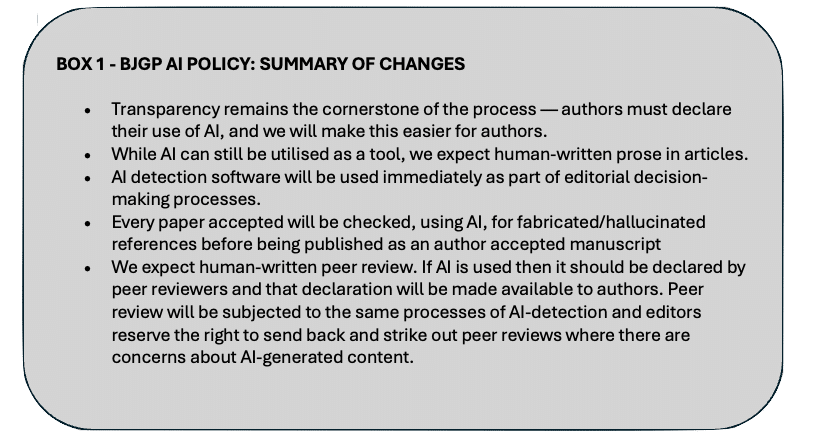
Research articles
The pipeline for research is slower than that for opinion articles. It is a certainty that AI will be used as part of the process of research and, as per our current policy of transparency, that use will need to be detailed in the methods section of paper. It is inevitable that the writing of the prose in research papers will also be affected and the processes outlined in this article will also be applicable to research papers. It matters that sections such as abstracts, introductions, and the discussion are crafted with care. It is not acceptable that these sections are written by AI and we expect the prose to be written by humans in the main body of research articles. (This will not necessarily apply to supplementary files.)
AI and peer review
Peer reviewers are using AI. Researchers know this and are already having the experience of receiving detailed peer reviews they suspect are AI-generated. Evidence from a Frontiers survey of 1600 academics (across 111 countries) found that more than half of researchers were using AI for peer review. At BJGP we have had a policy that has said peer reviewers should not use AI. However, in effect, this policy can’t be enforced and the evidence suggests is being widely ignored.
We understand that peer reviewers may use AI as tools, for example to check references, and we will advise them that they must be mindful of the need not to breach the confidentiality of manuscripts. Peer reviewers will be asked to make full disclosures of AI use and we will ask them to write the reviews themselves and not use generative AI. From now on, we will be screening peer reviews that raise concerns for AI-generated text and we reserve the right to send peer reviews back or even to strike them out. We understand this may result in delays for papers but we will work to reduce this impact.
Fabricated and hallucinated references
This is a serious problem in the academic literature. Fiorillo described a typology with three forms of problematic references including fully fabricated reference, authentic references with corrupted data, and ‘chimeric’ references which are a mash-up of different authentic references4. We conducted an internal audit and searched for fabricated and hallucinated references in the BJGP going back to Jan 2025, using the same methodology as Topaz5. We found none. Opinion is divided in the scientific community on how to handle these references: is it always serious academic conduct or can these be handled with corrections? 6 Some argue that once a fabricated reference has been identified then all trust in the content of the article drains away. Clearly though, some context is needed in these decisions.
At the BJGP, accepted papers are published immediately as ‘author accepted manuscripts’ and we have identified a small window where fabricated references can be published in the literature with a DOI. Many reviewers do check references but, as per Fiorillo’s recommendations, we will be using AI to search reference lists to flag any potential concerns that need immediate attention. In the future, this is likely to become part of the automatic checks at submission points.
Summary
We have always been clear that authors and reviewers are responsible and accountable for the work they submit. The nature of the changes as a consequence of increasing use of AI means we need, at this time, to introduce additional safeguards. The BJGP is a non-profit scholarly journal publishing high-quality research related to primary care. This current shift in editorial policy is being implemented, with immediate effect, to maintain the integrity of the research and commentary that has given the BJGP its reputation as a trusted source for primary care clinicians, researchers, and policymakers.
We will be updating our AI policies on BJGP.org and on ScholarOne in the coming weeks. We understand that the rapidly evolving use of AI will, inevitably, require future policy changes and we will keep you informed.
References
- Van Vlasselaer M, Van Droogenbroeck F, Spruyt B. Who wrote this? Evaluating the reliability of AI detection tools in higher education. Int J Educ Integr. 2026 Jun 29;22(1):16. doi:10.1007/s40979-026-00226-w
- Third-Party Pangram Evaluations [Internet]. [cited 2026 Sep 30]. Available from: https://www.pangram.com/blog/third-party-pangram-evals
- How Claude’s text watermarking works [Internet]. 2026 [cited 2026 Sep 30]. Available from: https://www.anthropic.com/news/claude-text-watermark
- Fiorillo L. Confabulated references in the age of AI: contamination of the biomedical scientific literature. Explor Med. 2026 Mar 4;7:1001385. doi:10.37349/emed.2026.1001385
- Topaz M, Roguin N, Gupta P, Zhang Z, Peltonen LM. Fabricated citations: an audit across 2·5 million biomedical papers. The Lancet. 2026 May;407(10541):1779–81. doi:10.1016/S0140-6736(26)00603-3
- Bauchner H, Frederick P R. Fabricated references: a new threat to editorial integrity. The Lancet. 2026 May 9;407(10541):1765–6.
Featured photo by BoliviaInteligente on Unsplash
]]>