The post Backcountry Magazine Barn Bash 2026 appeared first on Backcountry Magazine.
]]>
Buy Tickets | Donate | Details | Prices | Schedule
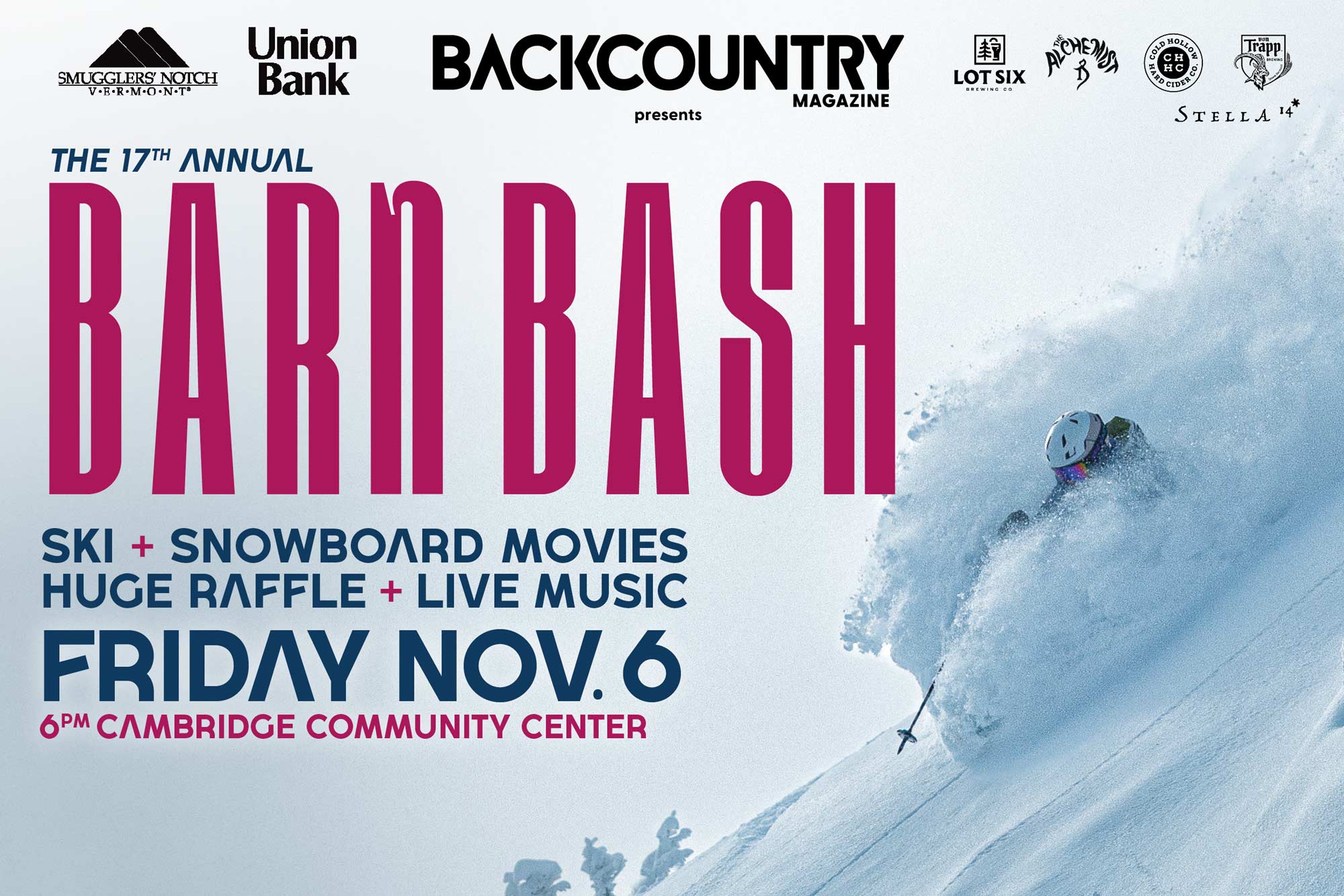
Join Union Bank and Smugglers’ Notch Resort for the 17th Annual Backcountry Magazine BARN BASH at the Cambridge Community Center on Friday, November 6. Grab your mountain buddies for great ski films, live music, the legendary Backcountry Magazine raffle, food from Poorhouse Pies, and beverages from The Alchemist, von Trapp Brewing, Lot Six Brewing Co, Cold Hollow Hard Cider and Stella 14 Wines.
This year, Barn Bash is also a food drive for the Cambridge Food Shelf. For every non-perishable food item you bring you’ll get an extra raffle ticket. With current SNAP benefits reduced or eliminated, this is a great way for the ski community to help.
All proceeds benefit the Cambridge Area Rotary Winter Wellness Days program which gives local kids the chance to ski and ride for free, regardless of income. For many of these groms, their five full days at Smuggs (and not at school) are their first introduction to snow sports.
Buy tickets
$30 in advance, $35 at the door *
*All tickets include one free Smuggs midweek lift ticket good until 12/25/26, one raffle ticket, one meal ticket and one beverage ticket. Kids tickets only available at the door, 13-20 $20, 12 and under by donation.
If you are purchasing additional guest tickets, you will have the option to transfer tickets via email to each person once the order is complete.This year at Will Call/Advance Ticket check in, we will scan your ticket from your Backcountry Magazine Barn Bash 2026 email, printed PDF ticket or your ticket saved in Apple or Google Wallet.
Can’t make it to the event but still want to help kids ski for free this winter?
Please consider donating. One hundred percent of your donation will go to the Winter Wellness Days program that gives local kids the chance to ski and ride for free, regardless of income. For many of these groms, their five full days at Smuggs (and not at school) are their first introduction to snow sports.
DETAILS:
WHEN: Friday, November 6, 2026
WHERE: Cambridge Community Center, 22 Old Main Street, Jeffersonville, VT 05464
LIVE MUSIC: Bar Brides
FOOD: Poorhouse Pies
DRINK: The Alchemist, von Trapp Brewing, Lot Six Brewing Co, Cold Hollow Hard Cider and Stella 14 Wine
SKI and SNOWBOARD MOVIES
HUGE RAFFLE: Thousands of dollars in ski & snowboard gear!
GRAND PRIZE: A weekend getaway at Smugglers’ Notch Resort for BrewFest weekend with lodging, lift tickets and BrewFest tickets!
PRICES:
$30 in advance, $35 at the door *
*All tickets include one free Smuggs midweek lift ticket good until 12/25/26, one raffle ticket, one meal ticket and one beverage ticket. Kids tickets only available at the door, 13-20 $20, 12 and under by donation.
BARN BASH SCHEDULE:
6:00 p.m. Doors Open
6:30 p.m. Live Music First Set
7:00 p.m. Film Screenings
8:00 p.m. Live Music Second Set
9:30 p.m. Raffle
Contact Meg@holpublications.com with any questions
The post Backcountry Magazine Barn Bash 2026 appeared first on Backcountry Magazine.
]]>The post How the 2027 Gear Guide sausage gets made 🌭 appeared first on Backcountry Magazine.
]]>
 Katie Cooney
Wherever your home mountain lies, we’re of the firm belief that the season is what you make of it. Having the right gear certainly helps, too. That’s why the 2027 Gear Guide is designed to be the best possible resource for skiers and riders looking to build, expand or replace their setups, or simply curious about the current gear lineup. Informed by over 30 years of experience independently testing and covering gear, the 2027 Gear Guide is packed with thorough research, unbiased feedback and digestible reviews.
And it all starts with Gear Test Week at Utah’s Powder Mountain.
◢ HOW DO WE TEST?
It depends on the gear. Hardgoods are the primary focus of Gear Test Week. Each ski, split, boot and binding is tested by roughly seven testers, each of whom takes the product out for at least three lift-access runs and/or a tour. Powder Mountain offers a rich variety of terrain and minimal lift lines which foster quick, diverse laps best for discerning skiability. Easy-to-access, tourable sidecountry allows our testers to get out on short tours for uphill testing. Apparel and accessories go home with individuals and receive a minimum of four weeks on the skintrack.
◢ Why do we test what we test?
In early January, we invite any brand making gear applicable to backcountry skiing and riding to submit their products to our annual Gear Test Week. To cover our costs, brands must pay a handling fee for each model of gear submitted. They may submit as many sizes as they’d like at no extra cost, but the fee does not guarantee coverage. While we work to have as many brands and products included as possible, what we test is a reflection of what brands choose to submit.
◢ How do you become a tester?
Gear Test Week is not for the faint of heart. We ski hard, play hard and take our forms seriously. We aim to select testers who reflect our audience—diverse touring preferences and home mountains, various ski/snowboard backgrounds and abilities, a balance of genders and a range of ages.
◢ How do we select gear?
After testers get out on skis, boots and splitboards, they score the product out of seven on a digital form, then they do an in-depth review on paper. This gives us editors an understanding of how each model performed. All other gear selections—bindings, apparel and accessories—are based on tester feedback. An item that performs well in its intended category is a Gear Guide Select. A product that performs well beyond its intended category earns an Editors’ Choice (EC).
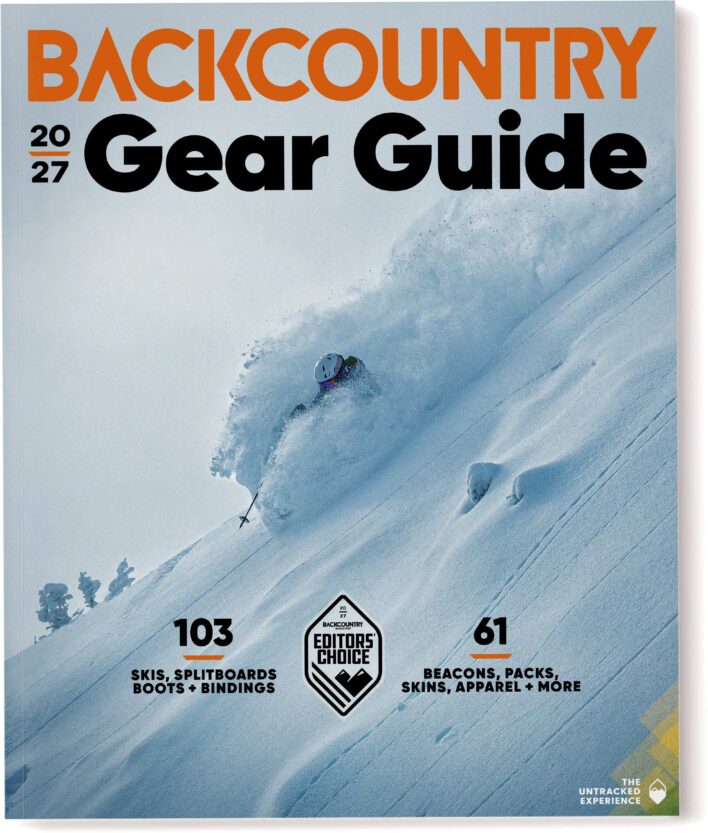
Get the 2027 Gear Guide
For the last 34 years, Backcountry Magazine’s Gear Guide has informed skiers and riders in their prep for the upcoming season. That means we don’t just have decades of experience, but years of refining our review process. While our values—thorough testing, diligent research, honest feedback and well-written reviews—haven’t changed, the way we assemble and design the Gear Guide constantly evolves with our readers’ needs. That’s why the 2027 Gear Guide is different.
The post How the 2027 Gear Guide sausage gets made 🌭 appeared first on Backcountry Magazine.
]]>The post Roadless, Not Useless appeared first on Backcountry Magazine.
]]>
On August 18, the U.S. Department of Agriculture (USDA) announced a plan to rescind the 2001 Roadless Rule, which “prohibits road construction, reconstruction, and timber harvest in inventoried roadless areas because they have the greatest likelihood of altering and fragmenting landscapes, resulting in immediate, long-term loss of roadless area values and characteristics,” as stated in the Federal Register. The change would endanger more than 25,000 miles of trails, 10,000 climbing routes, nearly 1,000 miles of whitewater and more than 10,000 miles of mountain biking, according to Outdoor Alliance.
According to the U.S. Forest Service, one-third, or 58.5 million acres, of our National Forest System lands are inventoried roadless areas. This categorization began in 1964 when the Wilderness Act was created. Since then, these lands have been effectively preserved from the logging and development that can happen on non-roadless Forest Service land. They protect some of the last undeveloped backcountry as well as wildlife habitats and clean water.
The first attempt to rescind the Roadless Rule came in 2025 when USDA Secretary Brooke Rollins announced, “President Trump is removing absurd obstacles to common sense management of our natural resources by rescinding the overly restrictive Roadless Rule.” The USDA press release later stated, “This action aligns with President Trump’s Executive Order 14192, Unleashing Prosperity Through Deregulation, to get rid of overcomplicated, burdensome barriers that hamper American business and innovation.” The government’s main critique of the Roadless Rule is that it prevents wildfire management.
However, the Roadless Rule specifically allows for construction in the case of fire prevention or management. “You still have roads and trails. You can still do fuel removal work for wildfires. They’re really not that restrictive, but the benefits are outsized,” says Dani Poirier, the director of Wasatch Backcountry Alliance (WBA).
According to Tom Hallberg, the Idaho conservation associate for the Greater Yellowstone Coalition (GYC), increasing access through road development may actually increase fire risk, not decrease it. “The vast majority of fires are human caused, and 90% of them happen within a half a mile of a road,” says Hallberg.
Idaho, where Hallberg resides, and Colorado have their own roadless rule, which together protect 13.5 million acres. Despite the local protection, Hallberg is still concerned about the national recession of the Roadless Rule. For one, GYC serves the greater Yellowstone area, with 10 million acres of the Yellowstone ecosystem that extends into Montana and Wyoming protected under the current federal Roadless Rule. And while rescinding the Roadless Rule might not affect Idaho now, Hallberg is worried it could set a dangerous precedent. “There’s no proposal right now to take it away, but I could see a future in which that happens,” he says.
In a future without the Roadless Rule, the western U.S. would lose huge amounts of large, connected spaces that are crucial for wildlife. “The impacts on individual species are different, but roads in general have been shown to basically cause animals to avoid certain habitats,” says Hallberg. “They don’t like crossing roads, even rural dirt forest roads.” Not only do these roadless areas protect wildlife, but they also protect the water. “More than 60 million people in the West get their drinking water from roadless areas,” he notes.
As we talk on the phone Hallberg looks out his window at a roadless area in the Tetons. The west slope of the Tetons, almost entirely inventoried as roadless, is a place Hallberg counts as special. “A lot of the places I go backcountry skiing currently don’t have roads,” he says. “They don’t have a lot of access other than human power in the winter, and that’s kind of important for what I want to do as a recreator.”
Poirier is an avid backcountry skier in the central Wasatch, where WBA makes it their mission to protect the balance between undeveloped and developed terrain while protecting access to backcountry trailheads. According to a WBA press release, over 300,000 acres of the Wasatch are inventoried roadless areas. “If we start cutting roads through those, you’re going to lose the backcountry characteristic,” Poirier says. She later adds, “We know there are tons of users out there, but it’s really hard to quantify just how important it is to have access to these wild spaces. You know, there’s so many people who choose to move to Utah over other areas because of our access here, and that’s a really hard dollar value to pinpoint.”
Vermont is my home, and as I hiked through a new-to-me part of the state’s wilderness this past weekend, I wondered if I would feel the same peace if the Green Mountains were no longer green and abundantly filled with a thriving forest. In the early 1900s, only 20% of Vermont’s landscape was forested. Since then, the numbers have reversed, with forests now covering 80%, according to the Vermont Natural Resources Council.
“Rarely do you have the public access like we do here in America. It would really change the character, especially of the Mountain West, if we lost our public lands,” Poirier emphasizes.
“People’s feelings about their community and how they view their own community is intrinsically tied to those public lands that are around them, and without the public lands and without the protections that they currently have, I think that people’s understanding of the places that they live and their connection to the wildlife and the lands and the people around them would change,” Hallberg reiterates.
A public comment period opened on August 18, 2026, and close for comments on September 21, 2026, at midnight. Learn more or make a comment here.
The post Roadless, Not Useless appeared first on Backcountry Magazine.
]]>The post In the Deep appeared first on Backcountry Magazine.
]]>A decade into DPS’s relationship with the American military and NATO allies, making skis has never carried more weight for the ski brand. Leading up the operation is Mike Cannon, who gets a point of view into a world which few civilians ever see when he travels to mountainous and arctic regions around the globe. The experiences have given him a unique understanding of what soldiers demand from their skis and how DPS can meet those demands through innovation, design and in-house manufacturing.
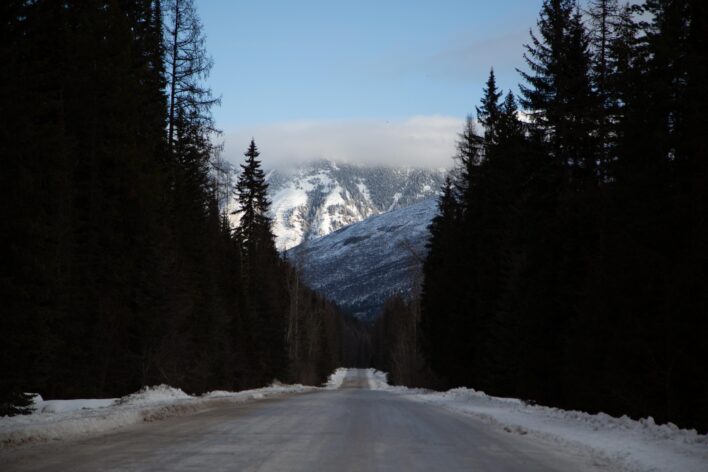
In the deep, dark recesses of January winter in the northwest-Montana backcountry, Mike Cannon, Senior Vice President at DPS Skis, drives his stellar-blue Audi to an undisclosed destination on an arctic road befitting an episode of “Ice Road Truckers.” Slate-colored ice glaciates the road from bank to bank, and where the mountains end and sky begins is impossible to tell. Cannon tests the grip of his new snow tires, rally driving like the surface is tacky as pavement. I peer out the passenger window. In between breaks in the clouds, the steep relief of the Northern Rockies can be seen.
We turn a corner and the scale and remoteness, far above and beyond the valley floor upon which we are traveling, comes into perspective for the first time. In the foreground, skeletal remains of long-dead snags litter the river’s floodplain. Uphill slopes are charred by wildfire. It’s a sharp contrast to the caricature-like mountains—impossibly white and full of wonder amidst the darkness—that fill out the back of the frame and are still dozens of miles away.
Nearly 700 miles south of our undisclosed location, DPS has been designing and manufacturing skis for the Army’s 10th Special Forces Group and 11th Airborne Division, the Swedish Armed Forces and other NATO allies out of their Salt Lake City factory. Cannon now leads this Defense Solutions side of the business after starting with the company in 2002. Over the past five decades, his passion for mountains, snow and the cold has taken him around the world, but it all started in Pennsylvania’s Poconos when he was 10 years old.
“I got to the top of the lift and just skied off; I didn’t stop at all,” he says, laughing about his first ski run. “The instructor tried to chase me down, but I kept on skiing and never looked back. I knew right then that I wanted to do it for the rest of my life.”
Now 63, Cannon has worked as a guide, patroller, instructor and ski model, hunting for unique lines and deep powder from Vermont to Utah and beyond. And with this DPS Defense project, he’s taken those decades of experience and used it to develop innovative products and provide consulting and training services that support soldiers operating in winter and arctic climates around the world.
The Special Forces have trained in Montana since 1942, when the First Special Service Force was formed at Fort Harrison, located just outside of Helena. They were drilled in unconventional mountain warfare and cold weather survival in support of important, high-threat missions during World War II. The First Special Service Force became the foundation upon which the modern special forces were built. Montana continues to be 10th Group’s preferred destination for training, as its climate is more consistent with what might be faced in the European areas of operation (where the 10th Special Forces Group operates).
These troops need to not just survive but to thrive while operating in all conditions, from the jungle to the desert to the mountains and the arctic. Winter has its own playbook, and their tactics change dramatically in a snowy environment. Like when it’s best to move, say, in a blizzard, because you don’t leave any visible tracks, infrared or otherwise. How to stay hydrated and take in enough calories to compensate for being consumed by the cold. Or how to survive if you fall through the ice on a remote, frozen lake.
I’m feeling a little gripped, and not just because of the perilous driving conditions or the thought of doing the aforementioned “Lone Wolf” polar plunge. This is unfamiliar territory in more ways than one. Cannon and I are heading deep into the Montana backcountry with the 10th Special Forces Group (SFG), an elite group of Green Berets based in Fort Carson, Colorado, who came here to conduct nine-week Cold Weather Training (CWT) courses.
We’ll be shadowing instructors and students as they teach and learn essential skills, including the basics like traveling on skis. Some of these soldiers have never skied a turn in their life, never mind traveling in the backcountry and through avalanche terrain with weighty packs and pulks. They also undergo avalanche training, learn rope hauling and rescue techniques, get proficient in snowmobiling and practice general winter warfare and cold-weather survival skills.
Dark, impenetrable fir and pine forest wall in the road and further obscure any views of the mountains and terrain that lie beyond. Cell service is long gone, and GPS is giving us nothing. Are we lost? Have we gone too far or not far enough? Eventually Cannon finds a familiar landmark, slows down, turns into a driveway on the left and parks in front of a rustic log cabin with a couple of newer dually trucks parked out front. This is where the 10th Special Forces CWT instructors stay when they’re not out at the backcountry camp, which lies some 25 miles from here via snowmobile. That camp’s where we’re headed tomorrow. Today, we’re meeting the team we’ll be embedded with over the upcoming days and learning more about the CWT program and how they train to thrive in winter environments.
I do my best to fade into the darkly lit background. A dusty buffalo pelt is pinned to the back wall, and a rifle hangs over the front door. Everything is made of wood, from the rough-hewn structural timbers to the wide-planked floor, bookcases and most of the other furniture. An antique wall phone calls to yesterday just outside the kitchen. While sitting around a massive woodstove, we talk about the history of the 10th SFG in Montana, CWT techniques and unique challenges presented by the cold and winter environments, as well as more personal stories about how these soldiers came to enlist and why they felt called to serve.
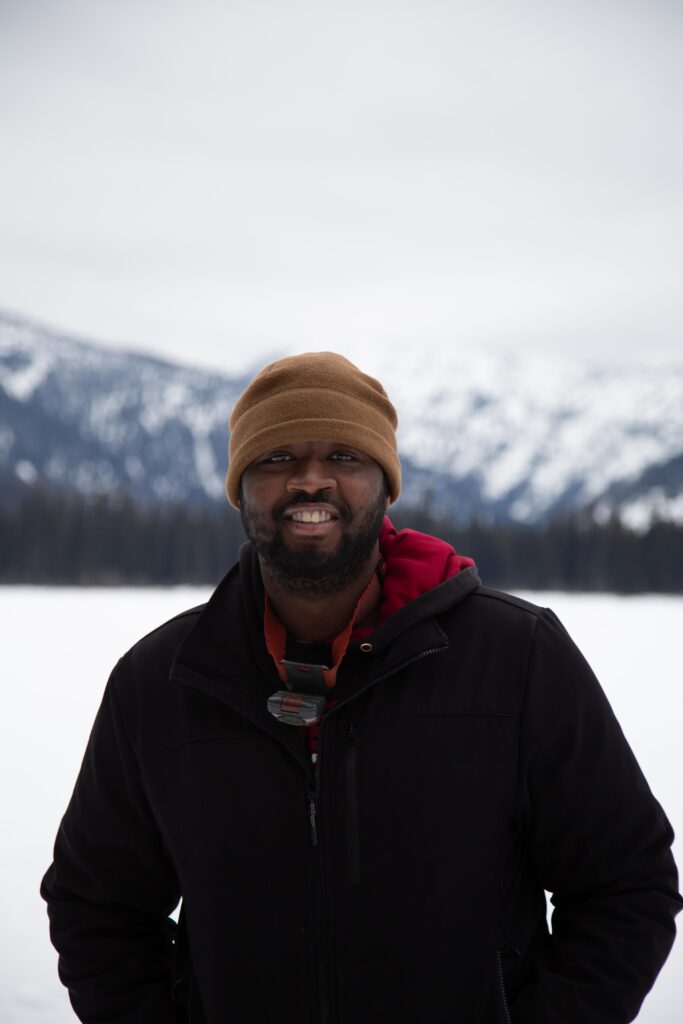
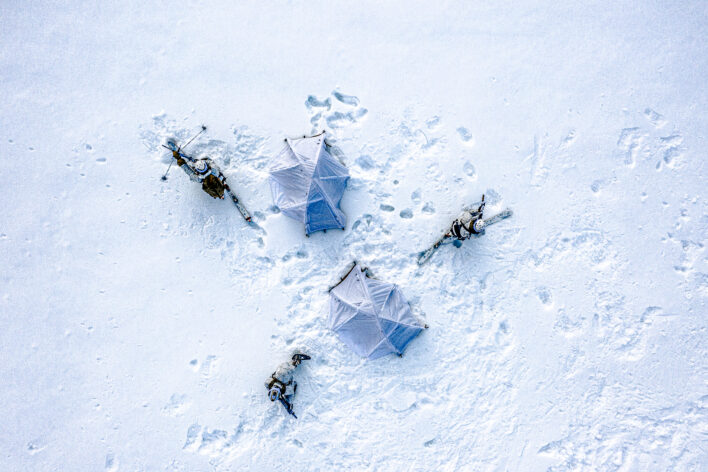
The LogPack Team, including Specialist Rodriguez (top right), keeps the backcountry camp running while soldiers train. Mike Horn
“Journalist” is a dirty word in some circles these days, and I’m unsure if they’ll feel comfortable talking with me. Since they’re often crossing back and forth over enemy lines—the most dangerous battlefield role, known as “in the deep”—Green Berets’ identities can’t be disclosed through attributions or photos that reveal their facial profile. Instead, the conversations flow freely, and I leave several hours later thinking about service and sacrifice and how, in this case, they go hand in hand. Every one of these guys has layers of depth to them, a knowing look in their eyes and a cautiousness that comes with balancing a high-risk job with a high-value civilian life.
Instructor N, around 6 feet tall with an athletic build, dark complexion and even darker, serious eyes, enlisted when he was 17 years old. “I didn’t know what I wanted to do with my life. But the things I’ve gotten to do, see, places I’ve traveled … I’ve been all over the world. It never gets stagnant. There’s always something new,” he says. After 20 years, he’s considering retirement from the military, eyeing a job at a friend’s construction company. But whatever he does next, he says, “It needs to be flexible. I just want to be a dad. I care about spending time with my family way more than how much money I make.”
Cannon doesn’t come from a military background, but I can see now why he is drawn to these people and this work, maybe even more so than the outdoor industry he’s been part of for so long. There is a higher sense of purpose here. Loyalty that runs deeper than business relationships and the occasional ski date. During our time together, he speaks often of his newfound military “family” that has stood by him through challenging times and become some of the more important people in his life.
“It’s not just about making skis for rich people,” he says, talking about how, when DPS is working on a project like making skis for the 10th, the energy around the factory is tangible. There’s a renewed sense of pride and urgency. The design and development process is very collaborative, and DPS is provided with a near-constant stream of feedback on product design, performance and durability.
Sergeant Major Fred Flink of the Swedish Armed Forces is one of Cannon’s key partners and friends overseas, and a renowned expert on winter warfare and cold-weather survival. The 10th Group has also trained with and alongside Flink here in the States and abroad.
“If you’re going to be efficient, you need to train where you’re going to fight,” says Flink on a call from the Swedish Subarctic Warfare Center in the northern part of the country. “You need special equipment to operate in this environment. Our terrain looks like what you’d find in Michigan. Skis will always be a personal preference, but we need to be objective when we’re providing feedback. DPS is all about gathering feedback, trying new things and testing them. They’re one of the few companies that is open to feedback and doesn’t get butt-hurt when we provide critiques. And sometimes we need a reality check. Mike [Cannon] wants to learn, and he’s very humble about it.”
Currently, DPS builds seven combat-specific skis for soldiers worldwide. The same way recreational skis are designed for different environments and conditions, these DPS designs have the same—and additional—considerations. A ski that’s optimized for maneuverability, say for patrols in the woods covering short distances, will be quite different from a ski that’s designed for traveling long distances in a mountainous environment. Likewise, a ski designed for travel in arctic regions needs to be specifically suited to the terrain and snow conditions.
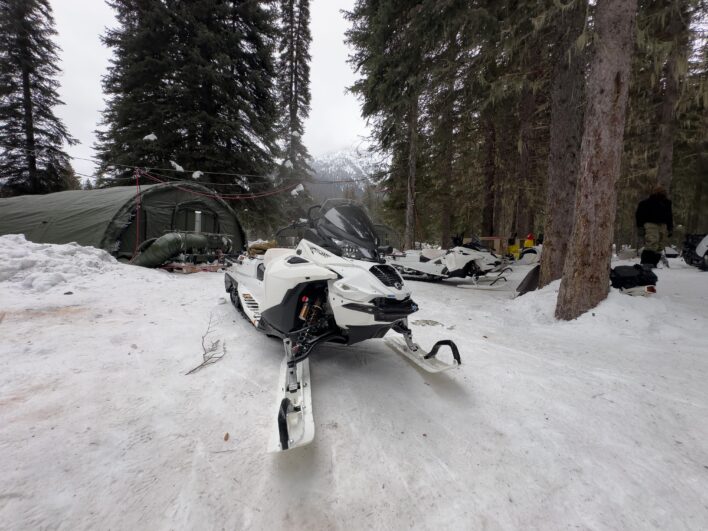
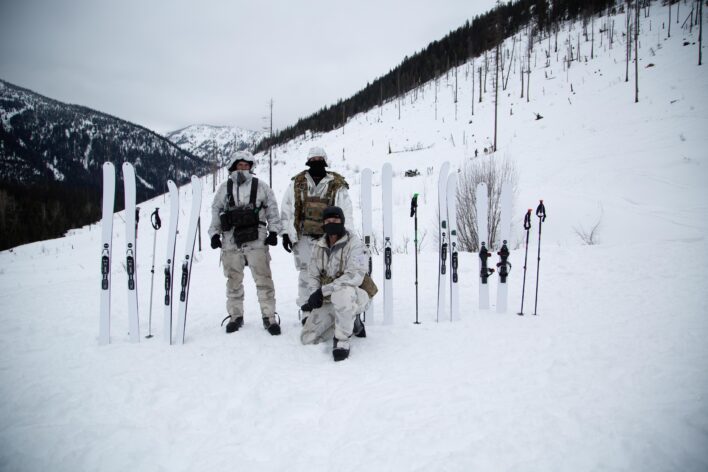
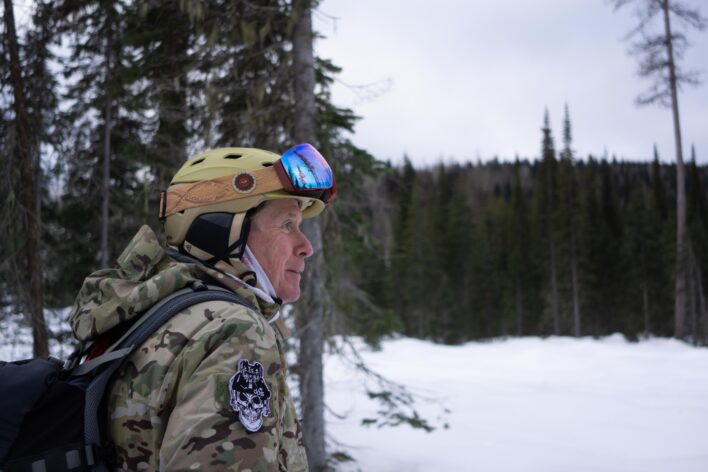
[Top] Camp Bjorn sits camouflaged under an evergreen tree canopy. [Left] Green Berets learn the ways of winter while blending into the snow. [Right] After dedicating his life to skiing, Cannon is now using that knowledge to head up the DPS Defense project. Mike Horn
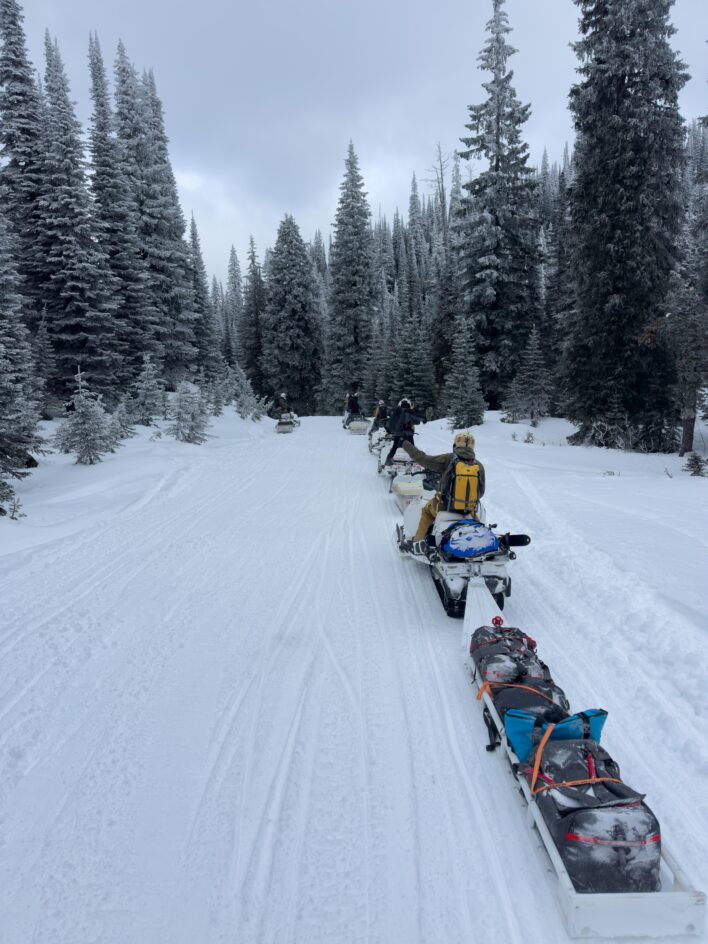
It’s roughly a 25-mile sled ride into camp, and everything we bring in needs to fit on our backs, the sled or in a pulk. Two instructors are waiting for us when we pull up to the cache, and we load up white-out, military-issue sleds for the journey to what the 10th SFG calls Camp Bjorn.
Camp Bjorn is named in honor of 10th Group Master Sergeant Evan Bjorn, a fallen 10th Group soldier. Our route mostly contours along a groomed path that’s warped by wave-like whoops and the occasional fallen tree; they run a snowcat out here periodically to make the riding conditions a little more tolerable, but, like most of the west, it’s been a low-snow year and unseasonably warm. LogPack, the supply and logistics team, travels in and out nearly every day, often towing heavy loads of fuel and equipment. It’s a serious pull on a sled and hammers the access road.
As we approach a sidehill that undercuts a steep slope above, the lead rider stops and advises that we’ll be crossing this one at a time. He informs us that it slides at least once a winter and covers the road more than 10 feet deep in debris. Judging by the diameter of the mangled tree trunks and debris piles already littering the slope, he’s not exaggerating. Cannon crosses first, pulk bouncing and sliding behind him, and, once he’s out of sight, I thumb the throttle, and we carry on toward camp.
The group slows as we cross a bridge over a frozen lake. Dense stands of Douglas fir spun with wispy witch’s-hair lichen flank the ice. We ride past the lake, into the forest on a narrow track and arrive at a camp abuzz with activity. Heaters and other equipment are being wrenched, snow gathered to melt for water, generators refueled and wood restocked.
This is the role of the LogPack Team—they run logistics and support for the camp. Most of them are between 18 and 22 years old, although a few are a little older. Some, like Specialist Jorge Luis Rodriguez Jr., stay at camp for weeks at a time. Others go in and out daily. Cannon and Specialist Rodriguez met last year and greet each other like old friends.
“We do what we do so that they can train better and have more time to focus on the task at hand,” Rodriguez tells me of his role supporting the 10th Group instructors and students. “Only in this unit are you going to see this type of training and use everything you’ve learned to adapt to the environment. There’s no handholding. They encourage us to use our heads to solve problems.”
Like all of these soldiers, Rodriguez spends extended time away from home. “It’s hard. It’s definitely hard,” he says. “I have a 3-year-old daughter and a wife. The good thing is everyone is going through it, so you always have someone to talk to.”
“They sacrifice so much, so we can smoke weed and ski powder,” Cannon says after Specialist Rodriguez leaves us and goes back to wrangling the LogPack Team. “It’s so hard on them, on their families.”
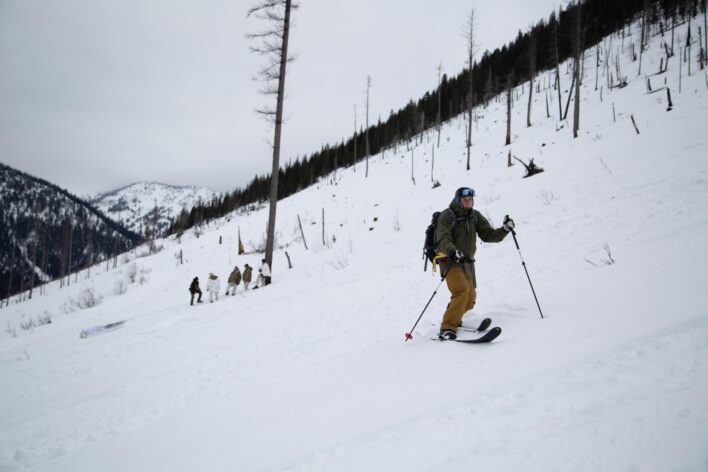
There is a higher sense of purpose here. Loyalty that runs deeper than business relationships and the occasional ski date.
Cannon and I unstrap our bags and skis from the pulk and drop the gear off in one of the green half-dome-shaped tents that house the instructors, students and support personnel. It’s mostly empty other than a couple dozen cases of MREs and some scattered spare equipment. Then we head out to meet a group of students and instructors on patrol. Dressed mainly in white camouflage, the students are hunkered down in excavated tree wells with their skis plush-down on scavenged boughs to keep the snow from sticking.
As Instructor C explains, “When you’re just out backcountry skiing, you can stand your skis up vertically to keep the skins out of the snow.” When your mission is to go undetected, the skis have to stay flat on the ground.
Touring on the same skis as the soldiers, I shuffle along their tracks and catch up with the group as they exit the woods and spread out across the open valley floor before beginning their ascent of a nearby knoll. They take turns hauling heavy pulks, skinning and switchbacking on slick, milled facets and barely breakable crust. Some of them have little to no skiing—let alone touring—experience at all.
When it comes to skiing downhill, loaded pulks and all, Instructor L says, “At a certain point, whether you know how to ski or not, you just have to be an athlete. Don’t overthink it.”
So, send it more or less. And that’s what they do, barreling downhill one by one in snow conditions that would be perilous on an alpine setup, never mind this light-touring-oriented gear. They thrash and crash and keep pushing on; they still have to trek all the way back to camp.
Dusk is approaching as Cannon and I ski to the sleds, load up and let our headlights guide the way back to camp. We fill thermoses with water from the melt station and rehydrate MREs for dinner before joining the instructors gathered at the far end of their tent. They live in close quarters, not more than a few feet in between cots, and piles of gear and goods fill every corner and hang haphazardly from the tent’s wooden frame.
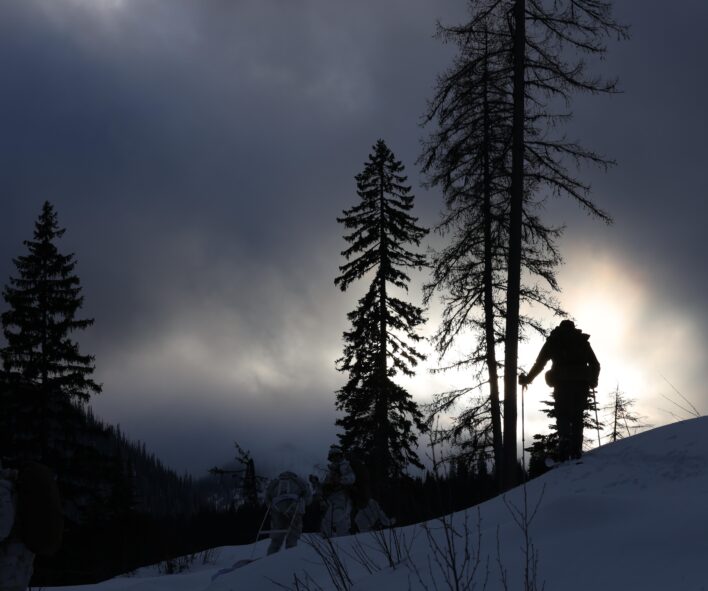
The 10th SFG have a reputation for being the warrior scholars. In the back corner, two instructors play chess while listening to the Kingdom of Ice audiobook. Another strums AC/DC’s “Back in Black” on electric guitar and shows me how his night vision NODs work. As I take a close-up photo of him strumming along, I’m reminded—not that I need a reminder—not to fuck around with these guys.
“You know you need to get that photo cleared by the PAO [Public Affairs Officer], right?” he says, looking me straight in the eyes.
“One-hundred percent,” I reply. I’ll tangle with the Five Families before crossing this dude.
We sit back and settle into their world for a while, sharing mountain stories and seeing the life of Green Berets play out in real time. Starlight spills through the fog like milky headlights as we head back to our quarters and hunker down for a restless night of sleep on army-issue cots.
Tired but stoked for the day, Cannon and I spend the first phase of the next morning hammering down multiple cups of coffee before rolling out on our sleds to join the training session. The students and instructors are already a few miles from camp doing rope work and learning team rescue techniques for hauling and lowering heavy loads.
They’re broken up into two teams; both practice using trees as anchors and hauling and lowering a heavy pulk that sometimes has an instructor in it to add more weight. Every once in a while, an instructor jumps in the pulk and takes a joyride downhill, bailing right at the roadcut. That was one of the eye-opening things about this trip. One might expect these guys to be cold-blooded machines, robots, but at the end of the day they are people, too, who want to laugh, have fun and bust each other’s chops, just like any other group of friends goofing off in the skintrack.
The Special Forces motto, “De Oppresso Liber,” translates to, “From oppression we will liberate them.”
On our way out of camp, I can’t drop the feeling that I just had a once-in-a-lifetime experience, something money can’t buy. I feel humbled. Liberated from some of my preconceived notions of who these people would be, how they might think or act. I’ve spent much of my career penning fluffy destination stories and profiles about the pursuit of wild experiences, fresh tracks and that perfect turn. Things largely focused on fulfilling the self. This embedding felt more powerful, perspective changing and real than all of that.
I’m left inspired, but also contemplative. What interests have I served other than my own? What have I given up compared to what I’ve been given? I think to myself. I know Cannon contemplates these same questions. Why would a ski bum and a company of ski bums have it any other way? This is why he’s here and why DPS has been serving the armed forces for the last decade. It’s more than just the turn. Cannon has made this his life’s work, the pinnacle chapter in a life spent in the deep.
“If you think what you do is good, keep doing it,” Specialist Rodriguez said to Cannon and I just before we left Camp Bjorn. “If you believe in something, keep believing.” ❆
Editor’s Note: The U.S. Army’s utilization of the specified brand of skis by the 10th Special Forces Group does not constitute or imply an endorsement of the brand or its products by the U.S. Army.
This article was originally published in Issue 167, The Hidden Issue. To read, grab a copy, or subscribe to read our stories when they’re first published.
The post In the Deep appeared first on Backcountry Magazine.
]]>The post Guillaume “Gee” Pierrel is Killed in Avalanche on K6 appeared first on Backcountry Magazine.
]]>
Guillaume “Gee” Pierrel, a Chamonix-based French ski mountaineer, was killed June 24 by an avalanche in the Hushe Valley of the Ghanche District in Pakistan’s Karakoram range. He was 42.
Pierrel was part of a three-member international climbing expedition attempting to summit and ski one of the most technically demanding peaks in the region, the 23,891-foot K6.
Ishaq Ali, head of the Pakistani expedition operator North Pakistan Adventure, told the Dawn newspaper the avalanche occurred at about 16,400 feet on K6, while the team was ascending. There remain conflicting reports that the avalanche occurred on nearby Kapura Peak, a 21,469-foot mountain. Pierrel was climbing with French guide Boris Langenstein and Canadian skier Christina Lustenberger when a slide of mixed snow and rock swept over him. Pierrel was killed on the spot, while both teammates survived without injury.
Ali confirmed that Lustenberger and Langenstein contacted relatives through satellite communications to inform them they were unharmed. Meanwhile, porters brought Pierrel’s body to Camp 1, and a helicopter is slated to finish the recovery when weather permits.
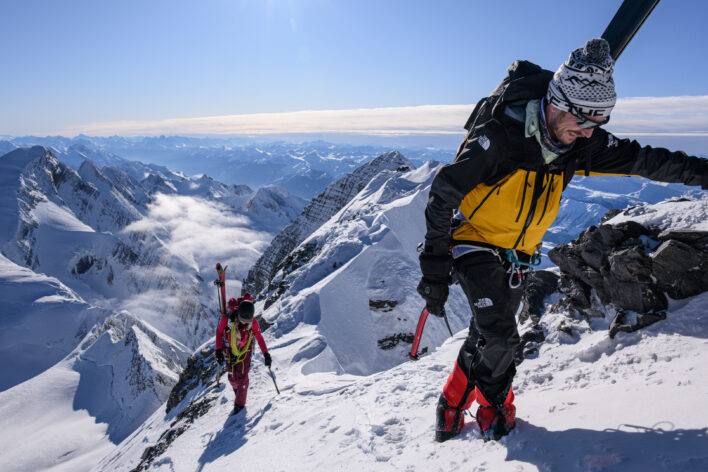
Pierrel was an accomplished ski mountaineer and mountain guide, spending his life in the mountains from an early age. Growing up in France’s mountainous Vosges region, he began skiing at age 2, climbed his first peak in the Swiss Alps at age 4 and went on to be a highly successful Nordic ski racer and internationally certified mountain guide working in Chamonix. His tick list of mountain achievements is lengthy, including ultra-running races and first descents on several continents. In 2021, Pierrel skied Gasherbrum II, a 26,000-foot peak in the Himalaya. In 2025, he skied the Great Couloir on Canada’s Mount Robson with Lustenberger.
Pierrel’s passing marks an indescribable loss for the ski mountaineering community. In a tribute post on Instagram, Sherpa Cinema cinematographer and editor Phillip Forsey wrote, “Gee had a drive for life like nobody else I know, and brought his witty French humor with him (no matter how serious the situation) to remind everyone that this life is special, fun, and that it’s exciting to be living. His energy was truly contagious.” In his own tribute, big mountain skier and The North Face teammate Ian McIntosh wrote, “Your energy and light will live on in everyone who was lucky enough to have known you.”
This story will be updated as more information becomes available about the accident.
The post Guillaume “Gee” Pierrel is Killed in Avalanche on K6 appeared first on Backcountry Magazine.
]]>The post Lessons from Alaska: A Photo Diary appeared first on Backcountry Magazine.
]]>Mind Surfing

Glacier flights don’t deliver you to the adventure. They are the adventure. Moving low through the range, mind surfing spines and shadowed faces. You drop cliffs and make imaginary turns down steep couloirs you’ll probably never ride.
Then you land.
After days of weather holds, we were just grateful to fly in. Our trip to Glacier One would happen, even just that felt like a blessing. Everything before and after that… well, that’s what this diary is about.
What’s the Plan Fran?
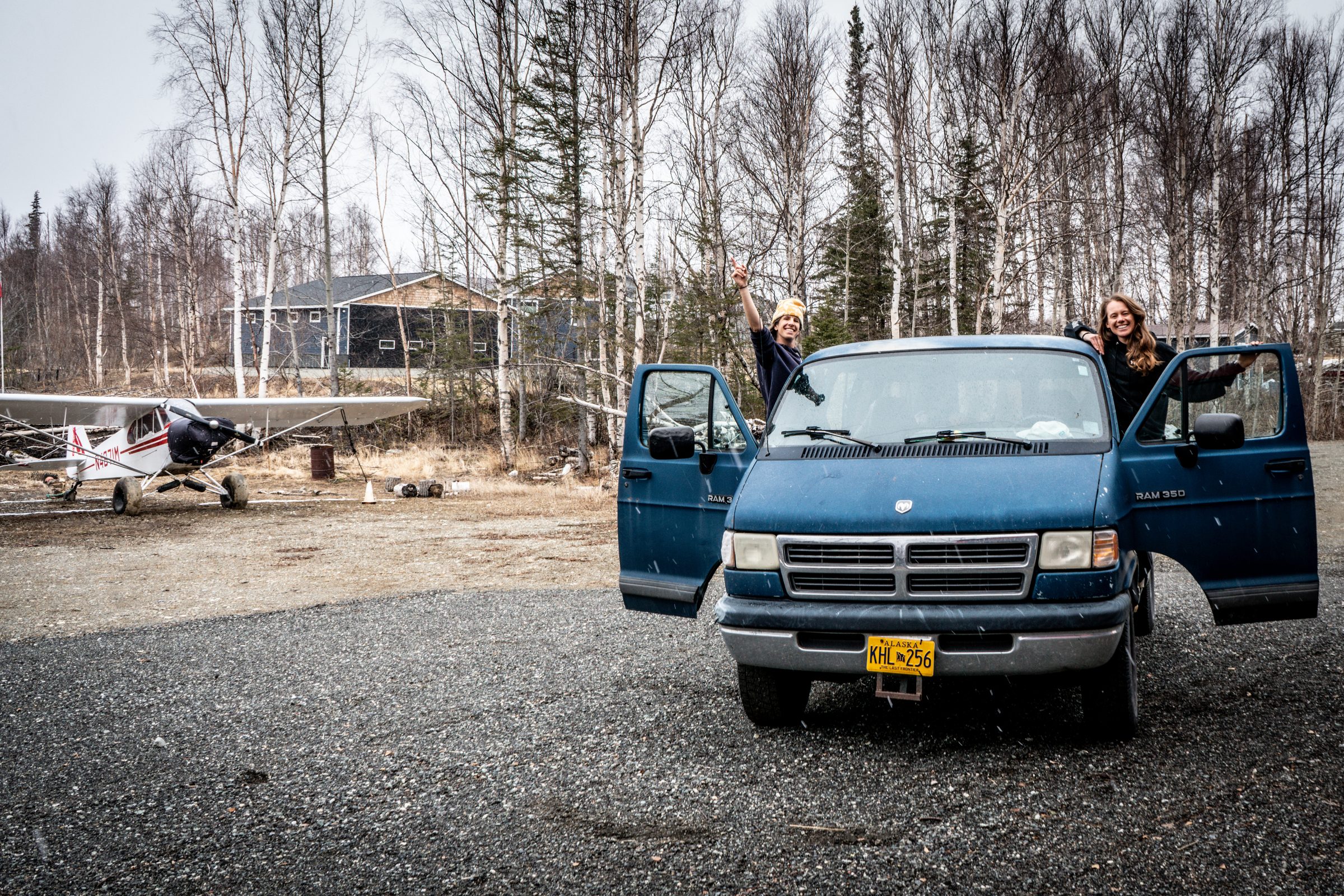
Hospitality might be the best part of traveling in Alaska. Helen’s friend Jamie not only welcomed us in, she handed over the keys to her beloved 1994 Dodge Ram 350 named Fran. Duct tape included.
When we learned you had to hold the lever to keep the lights on and that only the brights worked, we said, “Well, maybe, we just don’t drive at night….”
During the initial fluid change, I had a moment of pure overwhelm. I looked at Helen and said, “I don’t do cars.” I fled into the gas station, bought a bag of chips for stress eating and did my mindfulness practice in the bathroom while Helen held it down adding coolant, oil and other fluids, FaceTiming her dad.
Somewhere along the drive north, Fran became less of a vehicle and more of a team member. By the time we registered our trip with the National Park Service, our permit name had already been decided: Team Fran.
Ode to Skis
Spoiler alert: it snowed. A lot. More on that to come.
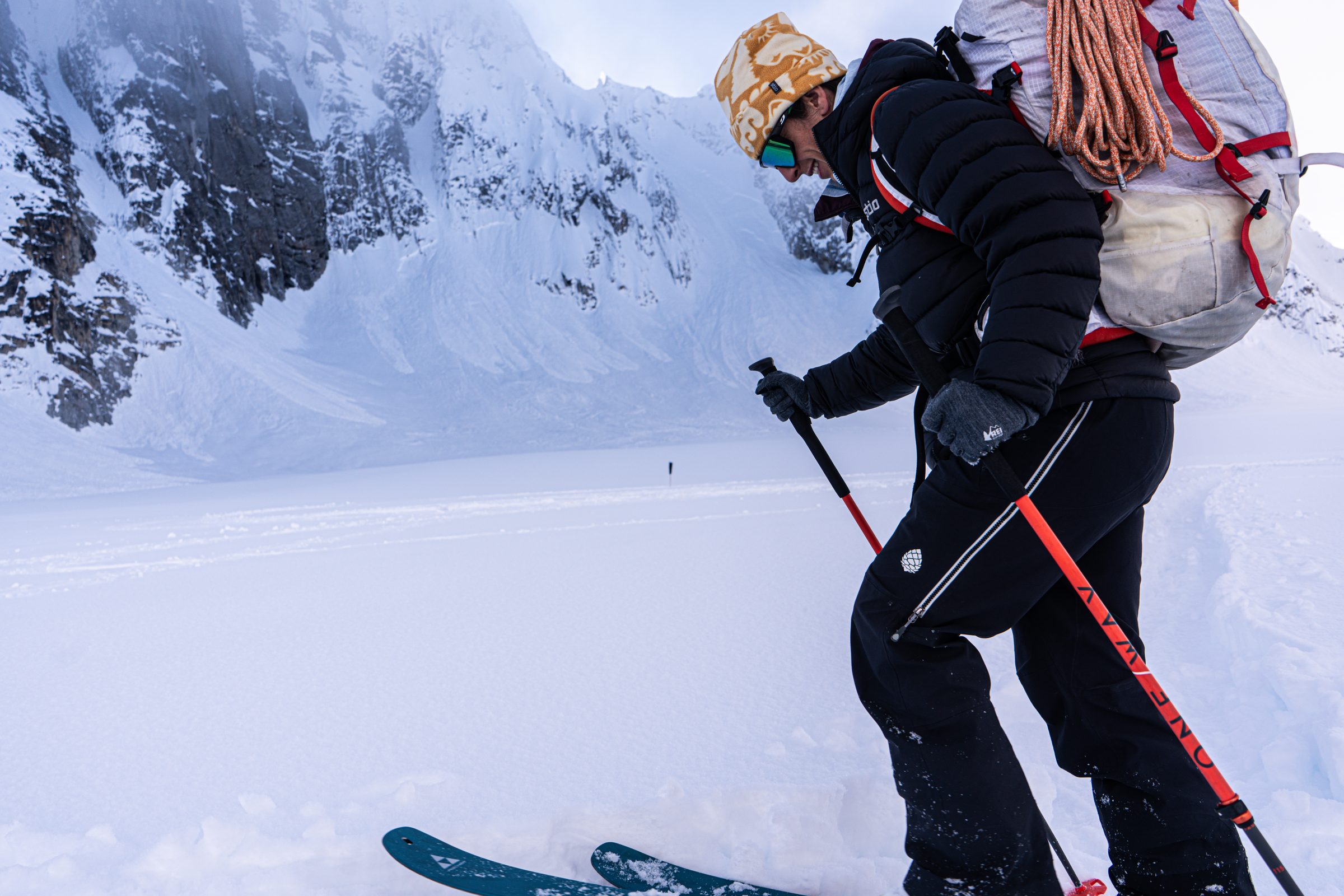
Postholing through 6 feet of snow around camp is a good reminder that skis might be the greatest transportation tool ever invented. They turn slow, exhausting wallowing into an easy glide across the surface.
On many of my trips, skis are what connect camp to camp to camp. I’ve done a lot of traversing adventures. This was my first base-camp trip. I was pretty excited to just ski straight from camp and use my skis for their more fun purpose: going down. Little did I know there’d be very little skiing, as those feet of snow created wildly dangerous avalanche conditions. But even just getting around base camp, I found myself opting for frozen ski boots. Knowing the effort of clicking in was still better than sinking to my waist again.
The Piggyback Solution
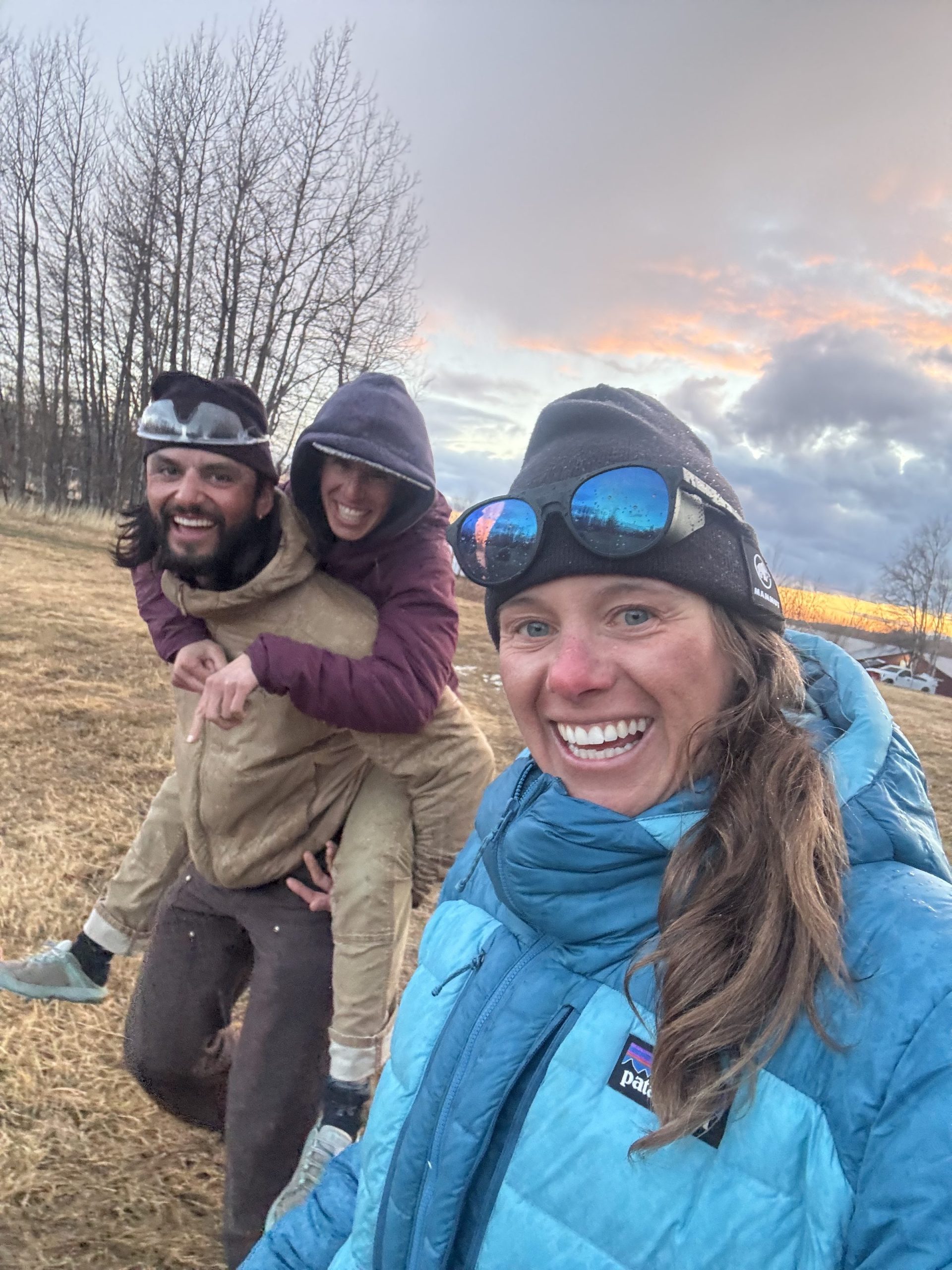
On my way to Alaska, I flew with most of my gear in a checked bag. I did not fly with an extra pair of shoes. Just ski boots and down booties. Every time I’ve gone to Alaska, five trips in total now, I think about buying proper boots for the mud. Every time, I somehow convince myself it won’t be that bad. Every time, I’m wrong.
The CFS was a mesh running shoe made by Stio and completely, wildly inappropriate for Alaska’s spring thaw, known as “break-up” by the locals.
Enter the piggyback. When you need to cross a muddy field and your footwear is a distant memory of better decisions, your friends become your transportation. Iván didn’t hesitate. Neither did Helen. Which is how I ended up here: being carried across the mud grass field, grinning like a fool. Best part? This was the last day of the trip, and they still liked me after being trapped in a tent for 8 days. Thank goodness.
Chapter 2: Tent Clearing Techniques
We landed on the glacier under clear skies, soaking in the beautiful surroundings. Then the storms came. Over eight days, we got hammered by two major systems, each dropping more than 3 feet of snow. Tent clearing went from a nice way to move your body to absolutely necessary work. Collapse was not an option.
The Tent Shake
Grab the pole, brace your feet and give’r a good shake. Best done with conviction, but not so strong that you rip the tent. Yes, you will absolutely wake up your tent mates at two in the morning. But they’re grateful you took this shift.
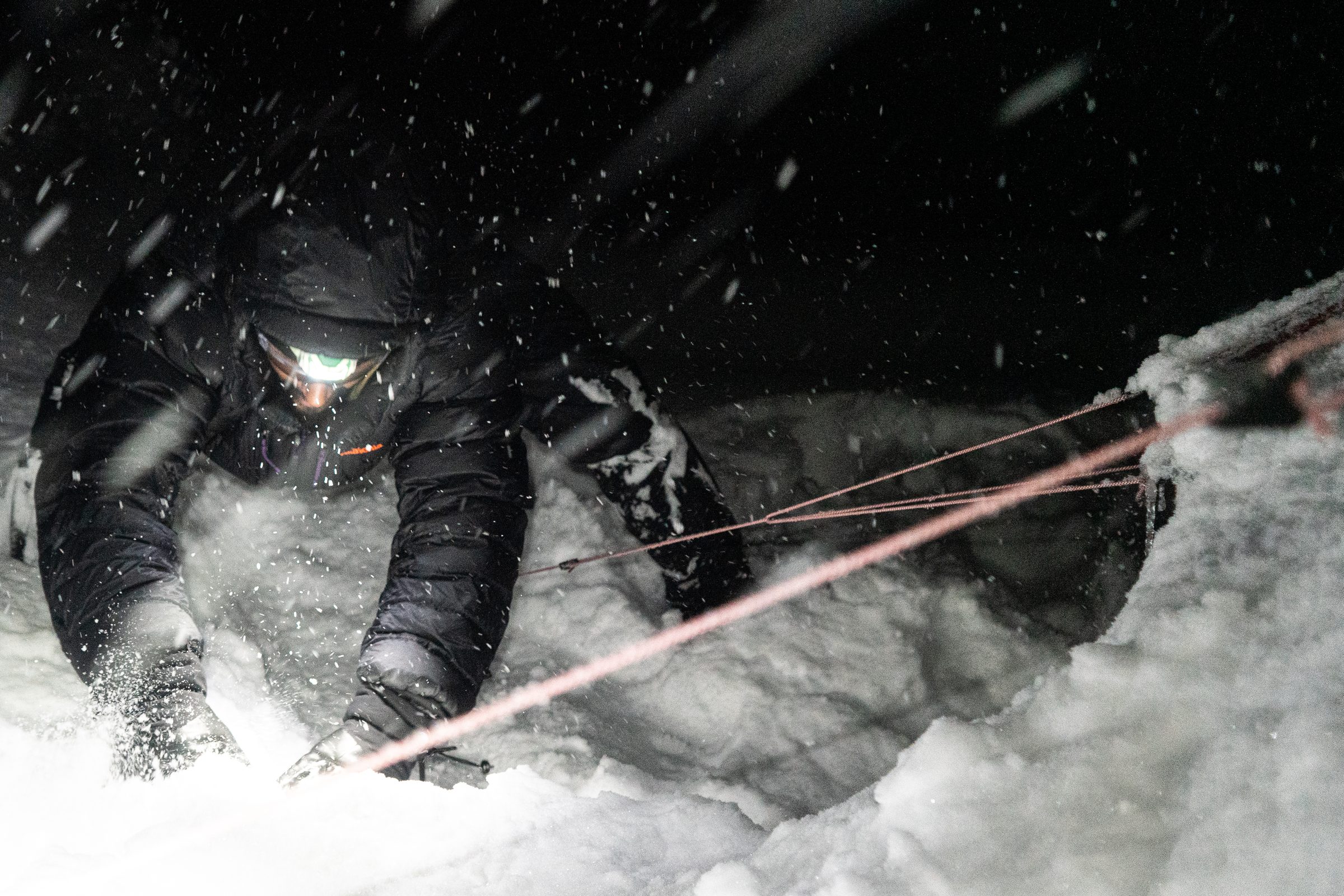
The Puppy Dog
No shovels near the tent. That’s a firm rule because sharp edges can nick or cut both the tent wall and the guy lines. Get low, get humble, crawl around the perimeter pulling guy lines and batting snow off the sides. You will look ridiculous. The tent will thank you.
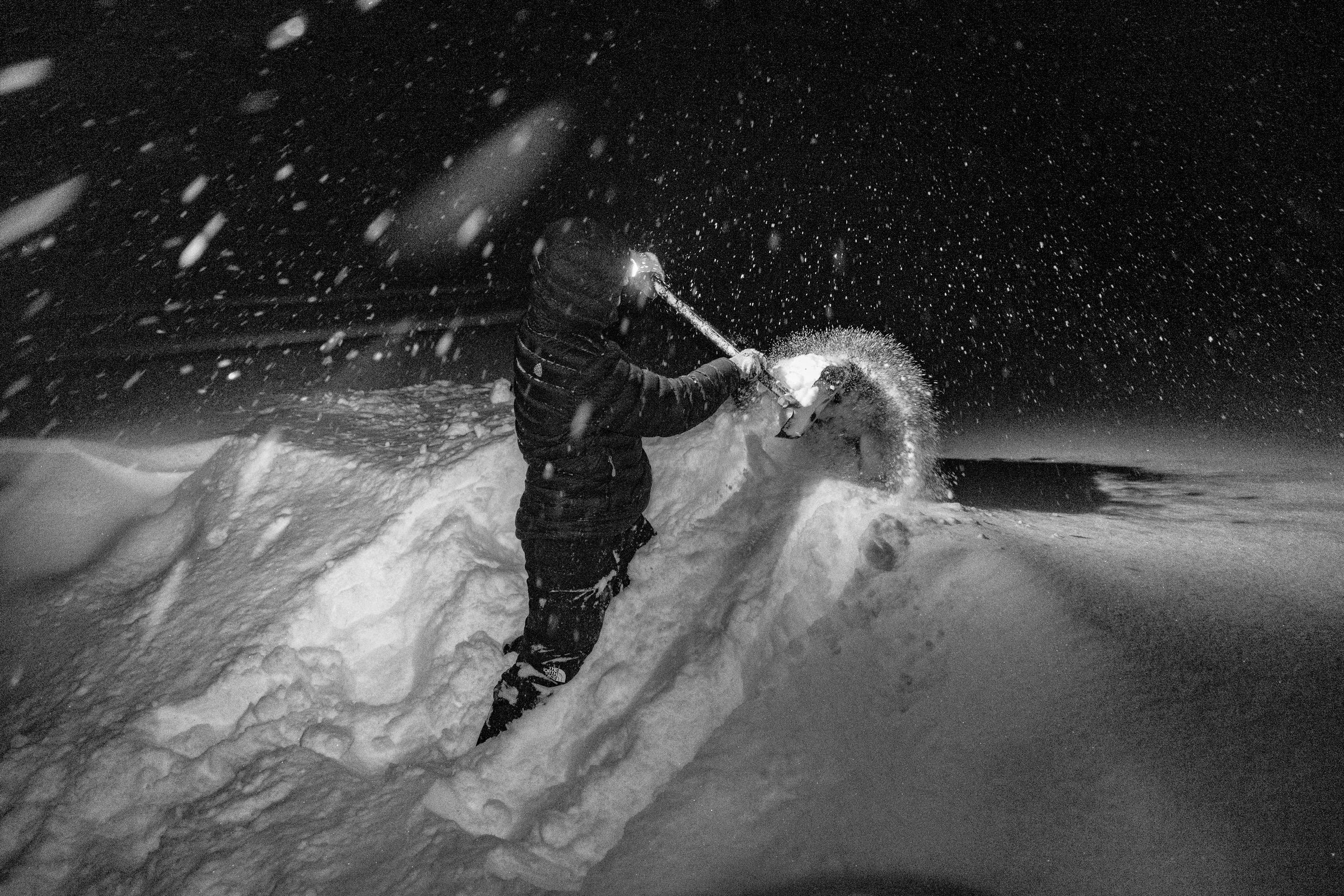
The Perimeter
This is where you switch from simply clearing snow off the tent to creating space for all the snow that’s falling off it. This will save you on your next round. More and more snow falls. The walls around the tent start to creep taller than your head. This ain’t just a few snowflakes.
“Maintain the perimeter!”
Yes, coach.
Chapter 3: Moments Of Awe
Low Angle and Overcoming Low Spirits

Iván Jiménez straight lines to maintain speed, proving the low angle of the slope. Note the avalanche crown and debris in the background. Photo by Sophia Schwartz
We probably skied fewer than 50 turns on this trip. For our snowboarder friend, Iván, even less. On our one clear day between storms, the avalanche hazard was astronomical; a persistent weak layer from March lived under all that new snow. We listened to avalanches rumble down during the storm, and once the sun came out, we counted roughly one per minute as the mountains shed. They were not small.
So we went for a flat walkabout instead, and just watched.
There’s something clarifying about being that small in a place that large. The objectives we came to ski were right there—gorgeous, loaded, completely off limits.
Coffee Glacier
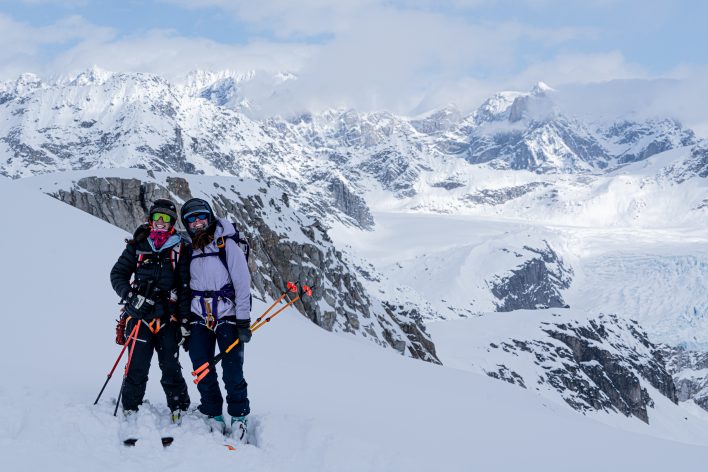
We had dreamed about skiing down to explore Coffee Glacier, traversing over and poking around beyond base camp. On day one, we hiked up to look over the edge, watching it break apart and tumble over the cliff below. It was stunning. With overhead hazards and unstable conditions, that walk never happened. So we soaked in the view from where we safely could.
Looking out over a glacier is a reminder of time itself. These massive bodies of ice move imperceptibly, shift constantly and change in ways you can’t see day to day, but are always happening. Helen and I first became friends while preparing for separate trips to Alaska. Over the last few years, our friendship has grown and we formed this trip together. It’s cool to see our own forward progress and our own growth in our mountain skills. And sometimes you get to come back and look at what’s shifted.
A New and Same Old Me
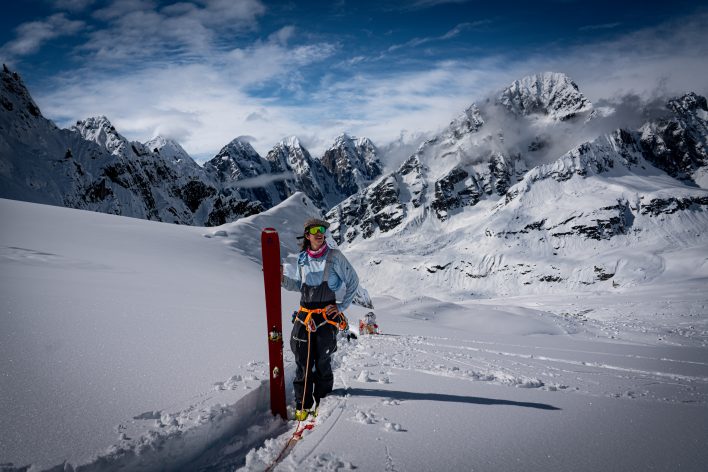
Each time I come to Alaska, I’ve been both the same and a different person. This time, I came back with a different identity: working professional. Time off feels different now that I’m not skiing as my main career. The PTO feels more precious. The need to actually rest might supersede the need to send it.
On the storm days, I slept 13 hours. I stayed in my sleeping bag until noon. I didn’t know how much I needed it, but I came back shocked to see fewer bags under my eyes.
Alaska has a way of giving you exactly what you need, even when it’s not what you planned. We came for the skiing, of course. We got the rest, the friendship, and the range in all its uncontrollable, humbling beauty. Iván gained his first glacier living experience. Helen got to introduce friends across different aspects of her life. And I got to come back again, which for me is always the goal.
The lines will be there when the mountains are ready, and I guess we’ll just need to keep showing up.
The post Lessons from Alaska: A Photo Diary appeared first on Backcountry Magazine.
]]>The post Mount Hood Summer Solstice appeared first on Backcountry Magazine.
]]>
Summers in Portland, Oregon, had always been about driving fast, smoking cigars, shooting guns and drinking whiskey. But, in 2010, I had the itch for some turns, even deep into summer. So, I reached out to a few of my closest friends, Luke Bradford and Carlos Martinez. We rallied up to Mount Hood to have a BroPicnic at Illumination Saddle and watch the sunset on the longest day of the year. We brought what any proper gentlemen would bring: whiskey, cigars, wine from Luke’s winery; cheese, bread and chocolates; music; Kool Aid to make snowball targets and shotguns with lots of shells. And, of course, skis for the long-awaited turns down.
Our only agenda was to tell stories, eat, drink, shoot naked and ski. And that’s exactly what happened. We danced, laughed, drank, smoked and acted like the kids from Lord of the Flies. Well, without the murder.

As sunset approached, the music went off. We sat in silence watching the light fade over the Oregon Coast Range. Hugging while exchanging high fives and “I love you b,” we clipped in and began skiing the most perfect summer corn. Couldn’t make a bad turn if you tried. I was so lost in the moment I don’t remember arriving back at Timberline or how we got home. We knew how special of a day we had experienced. A tradition was born.
Last year was the 15th year of a celebration that started with three brothers with nothing more in our hearts than having fun. Every year, as I watch the sun set and share deep laughs on Mount Hood, I ask myself the question: How do traditions begin? No one has ever thought, “I’m going to do this to start an epic tradition!” I think traditions simply start without caring about anything but experiencing a moment.

The following year, 2011, we invited a few more friends, and the day accelerated from there. Almost a decade of tradition later, I was told the event was going to get shut down. At first, I was angry, then bewildered and then ready to fight. Having been in a fair bit of legal trouble in this life, I knew it was best to get in front of this issue. I called the sheriff’s department and was directed to talk to the National Forest Ranger Ross Gamboa.
As we started chatting, he seemed distant as a typical cop would sound. He explained clearly that if anyone was hurt, they would be coming for me personally. I’ve always had an outlaw spirit so fear of legal or financial consequences didn’t scare me. What I didn’t like was the idea that someone could get hurt. That the event I loved could ruin the mountain experience for others. Organized events in National Forest Land have to get permits not just for safety but to preserve the nature of the land. It is for all to enjoy without the interruption of large groups taking from the beauty of this land. I never wanted to take from anyone’s experience on Mount Hood.
Gamboa explained why the National Forest Department has these laws, something I had never considered. As the conversation progressed, we turned from opposing sides to chatting like friends. I made the choice on that phone call to cancel the event. Kind of.
That night, I went home and typed up an email laying out why I love the solstice Hood gathering, but also passing on some of the lessons I learned from Gamboa. I sent it out to the community: “8TH Annual Illumination Saddle Summer Solstice is Officially CANCELLED!!”
Enjoying the summer solstice on Mount Hood was never intended to be an organized event. The reason we enter the mountains is for the beauty of adventure. Adventure can never be organized. So, I put together suggestions for folks who still wanted to enjoy the solstice on Mount Hood. Fill out and carry a permit, leave fireworks and firearms at home, respect the Timberline Ski Area boundary and don’t just pick up your own trash, make sure the site is left better than you found it. “Most importantly, check the ‘common sense’ box. If you can’t honestly check this box, you should consider calling a friend for a ride home,” I wrote of the permit process.

After officially canceling the event, I realized that this was not actually my event at all. It never had been. The summer solstice had been happening for thousands of years before me and will for years after. My statement was my humble attempt to articulate how to enjoy these places responsibly: The rules of the land exist to protect the experience for everyone. The mountains don’t belong to any one person; they belong to all of us. Respecting that is what keeps these places wild and beautiful for generations to come.
We still made our annual trek to Illumination Saddle that summer. Since then, I’ve shied away from the gathering crowds. But each year, the sun still casts a golden glow on the land, the people and the family we all love. Raucous laughter permeates the atmosphere. Magic is the only way I can explain what Illumination Saddle is on the summer solstice.

Sixteen years on, what started as three brothers with a picnic and a pair of skis has grown into something far bigger than any of us imagined. Hundreds of people now make the trek to Illumination Saddle on the longest day of the year. That’s families, skiers, hikers and strangers who become friends on the mountain.
By talking to Gamboa and changing the nature of the event, something unexpected happened. It became more inclusive, not less. It’s no longer a BroPicnic. It’s a gathering for anyone who loves the mountains and wants to celebrate the longest day of the year in the most spectacular setting on the planet.
Read more about Asit Rathod in the article “The Art of Detachment” published in Issue 156. Subscribe to read stories when they first go to print.
The post Mount Hood Summer Solstice appeared first on Backcountry Magazine.
]]>The post Mountain Skills: Mountain Rescue appeared first on Backcountry Magazine.
]]>
A thin layer of early-season snow painted Washington’s Snoqualmie Pass in opalescent white when the call came in: A solo skier had dropped into the basin behind the pass’s ruggedly iconic Chair Peak and broken their leg. Luckily, 15 members of King County’s Ski Patrol and Rescue Team (SPART) were just 10 minutes into their preseason rescue training at the ski resort and were in the best position possible to initiate a rescue.
The injured skier had enjoyed over a thousand feet of pre-season powder before he fell, heard a snap and felt a searing pain. He hit the SOS button on his satellite device immediately. Brad Hefta-Gaub, now the President of King County SPART, was the search and rescue (SAR) hasty team lead at the time. His crew was at the trailhead and hiking out before the sheriff’s deputy had even arrived. It still took SAR over three hours to get to him.
After 10 hours of grueling work and with the help of 58 total responders, the skier made it to an ambulance. “His hitting the SOS button immediately, that was definitely a lifesaver in his case,” reflects Hefta-Gaub.
On that day in the Cascades, solo and immobile, the skier only had one option: call SAR. Fast. But backcountry injuries span the gamut, from broken legs and ribs to dislocated shoulders. While being prepared will always be step one, two and three, the reality is that accidents happen. When they do, SAR teams can be an invaluable resource. If a ski day does go ass over teakettle, differentiating between a self-rescue and a call for help, and knowing what to communicate, is crucial for a successful winter.
Know your ABCs
When someone gets injured, take a moment to assess the situation.
“The first thing on that list is scene safety,” says Skyler Herbert, the Commander of Sawtooth Search and Rescue. It’s the same principle as avalanche rescue—make sure you’re not in a place where there is risk of additional injury. Get to a safe place, out of any avalanche hazard, and focus on the ABCs: airway, breathing and circulation. Then, get your patient stable and comfortable.
Once the scene is safe, it’s time to think about the long haul. Any rescue operation in the backcountry will take hours and staying warm and dry is paramount. Hypothermia can easily set in within a few hours of being out in the cold. Hefta-Gaub emphasizes that you need to make the call to hunker down or self-rescue quickly. If you choose to hunker down, a Therm-a-Rest pad and the skills and tools to build a shelter go a long way.
“Getting somebody warm, having those extra layers, even in the springtime, is really key,” Herbert stresses. A tarp or rescue sled can keep people off the snow, which will sap critical heat from a patient. Snow is also insulating, so digging down into the snow and protecting yourself from the environment can be helpful for a long wait.
Call for Help Early
“You could argue that if you can get a call out first, that’s the thing to do,” explains Herbert. “If your scene is safe and you can give it 10 minutes, place a call to 911. You want to get help coming as quick as possible.”
Which step comes first—getting warm and dry or a call for help— is ultimately down to the specific scenario. If two people are uninjured, both steps can happen simultaneously.
Don’t be scared to call for minor injuries either. If you’re uncertain that you’ll need a rescue, it’s better to err on the side of caution. If you end up self-rescuing, that’s a win. If you end up needing help, the team is already on the way. Even the most experienced travelers need help on occasion, and delaying the call, for whatever reason, doesn’t help anyone involved. When you do make the call, take a deep breath and be sure to communicate as clearly as possible.
“The first communication that goes out is some of the most important,” Herbert says. “One of the things we see is people not conveying to the dispatch center where you are, what your situation is.”
Being clear that you are in the backcountry and need an over-snow rescue is critical so the right personnel can prepare. GPS coordinates are generally the most accurate way to describe your location. If you don’t have GPS available, describe your location with as much detail as possible. The name of the trailhead, how far up you are, any local points of interest or obvious mountains and lakes, and even the colloquial names of backcountry runs are helpful.
“As the reporting party, get an initial call out, get situated, get your patients stable and then call back and they’re gonna have some follow-up questions for you,” explains Herbert. In that follow-up call, you’ll know more about the type of rescue needed and can provide better information about whether you can self-rescue or need assistance.
What Kind of Rescue?
The nature of a rescue depends on three key factors: timing, injury severity and your human resources. While those may seem simple, all three factors are easy to overestimate.
“Mobility is the first thing. Are your injuries functional?” asks Hefta-Gaub. A broken leg, like that of the solo skier who dropped into the basin behind Chair Peak, means calling for rescue. A full team of trained professionals took over nine hours of packaging the patient, rigging pulley systems and eventually pulling a rigid plastic sled like you see on ski resorts, to get the injured skier to the trailhead. Upper body injuries, on the other hand, could mean a painful, slow-but-possible self-rescue. “If you dislocated your shoulder, it’s going to suck to self-rescue, but you’re going to be able to travel,” Hefta-Gaub explains. You’ll move slower and need frequent stops, but you can still ski out.
Time is also a critical consideration. Rescue sleds are great, but they require a full team to pull effectively, especially in any sort of undulating terrain or deep snow. The longer you delay getting to definitive care, the higher the chances your injury becomes worse or hypothermia sets in.
If you do have the capability to move, communicating with the SAR team is critical. “Whether you’re going to start moving towards us and helping us out, or if you’re going to stay put, should really depend on what your communications are,” says Herbert. If you have reliable
communication—the ability to update in real time through good cell service or a steady satellite connection—and are capable of moving out, that’s great, just make sure to update the SAR team as you go.
If you don’t have reliable communication, or if you’re lost or simply unfamiliar with an area, stay put. “A very common mistake is people who genuinely are lost don’t know where they are and keep traveling in the direction they thought was the right direction,” warns Hefta- Gaub. He recalls a mission where two first-time backcountry skiers got lost at dusk in deteriorating weather. They could see lights in all directions, but some of those lights would have led them straight off cliffs. Moving off course when lost can drastically increase rescue time and put you in far greater danger.
For severe injuries, some backcountry rescue teams can call in heli- copters, but the ability and reliability of a heli rescue varies greatly by location and weather. Specialized operations can fly in storms, have hoist abilities and thermal imaging for night rescues, but those aren’t often nearby. General medical helicopters are usually more readily available but operate under stricter regulations and don’t have the same training. They most often need to be able to land and can’t fly in severe weather.
“Being able to get your rescue sled out and just moving your patient off the hill or into that meadow or onto that frozen lakebed gives your rescuers a lot more options,” says Herbert.
As a rule of thumb, most helicopters want to land on a slope of less than 12 degrees. If you can’t move a patient to a flat area, you can create a landing zone by kicking snow downhill and stomping it with your skis to make a flat surface. Life Flight recommends a 75-square-foot area.
Prepare, Prepare, Prepare
Even with resources available for rescue, it’s important not to be complacent. SAR teams are an invaluable resource, but bringing rescue gear, having a plan and skiing conservatively is always in your best interest. Route planning should include contingency plans from the start and ideally, tell someone else your plan before you head out for the day. Not only does being prepared lower your risk of injury, but it also alleviates stress on SAR teams.
“Most search and rescue members are volunteers. They all have day jobs,” Hefta-Gaub reminds. “They do it because they really, genuinely love the mountains, and they want to provide access to everybody. But remember that when you hit that emergency button, they’re stopping their day, they’re traveling to come get you, and then they’re coming to get you from the trailhead.”
The best way to support them? Make sure that you’re prepared to not need help. But when you do, having the knowledge, wherewithal and confidence to call for help early can make all the difference. Even a perfect rescue can take hours, which should inform every decision you make in the backcountry, from your gear choices to your terrain selection to how quickly you call for help. ❆
This article was originally published in Issue 165, The Photo Annual. To read, grab a copy, or subscribe to read our stories when they’re first published.
The post Mountain Skills: Mountain Rescue appeared first on Backcountry Magazine.
]]>The post A Quiet Place appeared first on Backcountry Magazine.
]]>
Frozen dirt and shale cascade down into the gully below with each step. A line of boot tracks and pole plants meanders along the sidehill toward a patchwork of frozen snow and persevering green moss. Shoots of yellowed grass sprout up like odd heads of hair. If there were snow, we might be in avalanche terrain. I lay off white knuckling my poles as the hill flattens. A hundred or so feet of quilted snow clings to the otherwise wind-worn shoulder before rolling down into a thick forest of bushy lenga trees. Mud sticks to the soles of our boots. Wind whips over the exposed valleys around us. With some hop turns and careful planning, one could probably link four or five turns on actual snow.
“Let’s just ski from here, no? That moss looks soft enough,“ says Julian Lopez, our guide today. His penchant for sarcasm belies the fact that he’s very much serious.
An enthusiastic nod dissolves any hesitancy. We click into pins and pilot from the backseat, edges rattling off ice before sinking into the soft embrace of lush moss. Our turns resemble the inflatable tube people in front of car dealerships more than any self-respecting skier. Hoots of laughter and ironic shouts of stoke fight against the battering wind. We’re left laughing at the bottom.
Our grass-skiing escapade marks our third day of bushwhacking in the untrammeled environs outside of Cerro Castillo in the Chilean Patagonia. Morale remains at an all-time high, despite potentially the worst snow year in the past three decades. You wouldn’t guess it from our overland excursions, but the vast and almost entirely untapped ski potential of the Aysén region, and Villa Cerro Castillo specifically, inspired the trip I’m currently on with Alpenglow Expeditions.

Just two years ago, Gaspar Navarrete and Diego Saez pitched Alpenglow the trip to this sparsely inhabited corner of the world. While we’ve been bushwhacking to snow this year, Saez and Chilean locals have been able to tick off a smorgasbord of delectable lines straight from the road in previous seasons.
Saez moved to Villa Cerro Castillo three years ago, after guiding in the area since 2015. Originally from Punta Arenas, further south in Chile, he was drawn north by the increasingly rare ability to explore a winter snowscape and an abundance of high-quality rock climbing. By his best estimate, he’s still only one of 12 skiers local to the area, most of whom have moved to Cerro Castillo from larger cities for the potential for roadside exploration that’s rare in this part of the world.
Even over the phone, his excitement for this zone is tangible. The Cerro Castillo massif rises to 8,700 feet, its castle-like spires of granite and ice giving the range its name. The peaks are adorned with glaciers and split by couloirs that funnel corn in the spring.
“We have a lot of steep lines and first descents waiting to be skied, and a little bit further south, we have the Northern Ice Fields, which is like a whole new world,“ Saez explains. “It’s full of challenge and of remote mountain expeditions to do there. It’s hard to see at some times, but if you travel a little bit along the region, the potential is massive.“
In theory, plenty of Patagonia offers similarly unexplored potential on snow. What sets this sleepy village apart is access.
Built in the 1980s, the Carretera Austral, also known as Chile’s Ruta 7, cuts a lone figure through impenetrable rainforests to the west and stepped, rolling hills in the rain shadow to the east. The 770-mile highway was the first modern throughway connecting Chile’s rugged, southern frontier over land.
When Navarrete pitched this trip, he imagined an off-the-beaten-path location with roadside access to steep, rowdy lines in powder or spring corn. It was the dream location that he’d been searching for across South America since he became one of the first Ecuadorian internationally certified mountain guides.

Our Toyota Hilux trundles to a stop on a gravel shoulder. The pull-off is marked only by a sign for the protected huemul deer and a shin-high wooden stake with a kilometer marker, the red paint sun-faded to pink. Usually, that stake would be buried by snow.
Lopez, an internationally certified mountain guide who hails from Bariloche, Argentina, laughs and tells us this is typical Patagonia. Apparently, skiing from the road is a treat, not an expectation. Cerro Castillo usually serves dessert; that’s part of what sets it apart from other zones in the area. This year, however, the snowline taunts us from 1,000 feet above the road. We attach skis to packs and shoulder our gear for a rather technical scramble through lenga trees and over frozen scree and patches of icy snow.
Eventually, the basin opens its maw, and we transition to skins, picking our way through jumbled rocks and spurts of tundra. Alpine bowls rise up in every direction. A condor circles above. Contrasted against the endless peaks, its 10-foot wingspan looks remarkably unremarkable.
I skin alongside Alpenglow Expeditions owner, internationally certified mountain guide and renowned mountaineer Adrian Ballinger as we wend our way upwards, following the refrozen track of an unknown predator. His lanky frame glides across the frozen snowscape, taking one step for every three of mine.
Ballinger moved from England to the U.S. at age 6 and almost immediately picked up skiing at the rolling, local hill of Massachusetts’ Mount Wachusset. He took up rock climbing a few years later, mentored by a family friend.
At 17, Ballinger was brought to Ecuador’s volcanoes by Chris Warner, another renowned alpinist and founder of guide company Earth Treks. The trip cemented Ballinger’s path in mountaineering, eventually leading to his 2004 founding of Alpenglow Expeditions.
“One of the reasons I started Alpenglow instead of working for another company was that I never wanted to just drag people to summits,“ says Ballinger when we’re both back in the U.S., patiently waiting for snow to fall on the northern side of the globe. “That’s never been mountain guiding for me. For me, it’s been educating people so they could be confident in the mountains themselves.“
Guiding for his own company, Ballinger slowly built a name for himself and Alpenglow. Sponsorships followed, and he’s now summited Everest over a dozen times, once without oxygen, and skied off of three 24,000-foot peaks.

Despite the pages-long resume and decades of experience, Ballinger is still just as stoked as we are to thwack through shrubbery and shoulder skis for a long slog of an approach to predictably meh skiing.
In fact, that suffering and the lack of given success is why he still does it.
“Being in the mountains doing hard things is one of the easiest places that I’ve found to experience awe, to experience that true feeling of being overwhelmed by what we’re experiencing,“ says Ballinger. “It happens so frequently out there. And in so much of our lives today, I think we don’t experience that. We’re so sheltered from all the extremes—pain and pleasure. The humility or humbleness that comes from that really has the potential to change us.“
Ballinger effortlessly swings skis back onto his pack and transitions to crampons for the final booter to the top. On the ridgeline, waves of peaks amass into the far stretches of Cerro Castillo National Park. Even the lack of quality snow conditions doesn’t hinder the awe-inspiring vista.
Relentless wind hurls frozen shards of snow at any unprotected skin as we transition. Our guides claim it’s a calm Patagonian day. One by one, our group of almost a dozen skiers drops down a 20-degree slope, making the most of a few inches of windblown Dippin’ Dots on edgeable rain crust.
The wind agrees to a temporary ceasefire on an icy, midslope shoulder, and Ballinger and I pause to chat, our conversation wandering from summer climbing objectives to wilderness ethics and access. We’re in no particular rush to ski.
“Anytime we travel in the backcountry, go into the wilderness, visit remote places, we are having an effect on those places from a pure conservation standpoint,“ Ballinger says. “If humans never stepped foot in places, they would be more pristine. But with that said, I don’t think all of our backcountry or all of our environment should be untouchable.“
It’s a tension that feels particularly relevant here in Cerro Castillo, where protecting wilderness and increasing access seem perpetually at odds. The Carretera Austral opened these mountains to the outside world. My writing might do the same. It’s a thought process Ballinger shares, but he’s not worried about it, per se.
“I think we actually protect things better as a society when we actually interact with them and develop true relationships with them and care for them,“ Ballinger says.
The words hang in the wind for a moment before a radio crackle lets us know it’s time to drop. We follow the command, scraping our way down to the valley floor.

The following day, we return to the same valley. As we break into the alpine, I glance over my shoulder at a plunging, northeast-facing couloir. It’s a prize line with a sketchy entrance leading into a pristine face and a steep, high-walled exit chute. Massive blocks of refrozen snow and chunks of rock litter the apron all the way down to the valley bottom.
The overnight freeze was minimal, even at elevation, and we race the clock toward a cloudy summit. From the top of our objective, Custodio, Navarrete points through holes in the cloud cover to various landmarks, spires and couloirs. In the distance, a bolt of white rips thousands of feet down an otherwise impervious face. “The locals are thinking about skiing it,“ he says. “It’s probably a first descent.“
The line would be an instant classic anywhere else despite the bushwhacking debauchery required to access it. We take a second to plot how one would cross the wandering mass of the Ibañez River to get there. The waterway turns a corner and meanders out of sight. In the distance, Lago General Carrera spreads over the border into Argentina, eventually feeding the opaque turquoise, glacier-nutrient-enriched Baker River.
If it weren’t for a group of gauchos and local Aysén communities, the expansive wilderness below our feet might have looked very different. From 2004 to 2014, hydro-electric company HidroAysén proposed five dams on the Baker and Pascua rivers that would have flooded nearly 15,000 acres. The project was the biggest attempt to industrialize the Aysén, an area the size of Pennsylvania where only around 100,000 people reside. Local communities rallied behind a campaign called Patagonia Sin Represas—Patagonia Without Dams. After 10 years of protest, then-President Michelle Bachelet withdrew state support, shelving the project.
From my vantage point atop the peak, I think of what it would look like if a dam flooded the valleys like these below—transmission lines and hydroelectric equipment whirring, population expanding with a necessary workforce. It’s hard to imagine given the utter lack of infrastructure I’ve seen so far, but the possibility was very real. Instead, glacial-fed water still runs unimpeded from under our skis, down rugged mountains and, eventually, into the Pacific.

The next day, our plans for exploration are scuppered by verglas-covered rocks, overhead hazard and sun-brittled fixed lines. Given the foreboding name of our objective—Diablito, the little devil—our chances of a successful mission probably weren’t great from the start. We retreat to treeline and pick our way through mud and between low-hanging lenga branches draped in old man’s beard. A fairytale light fills the interstitial space between snaking trees and the faintest signs of a beaten-in footpath.
Lenga forests like the one we hike through stretch to the farthest points north and south in Patagonia. But some of these groves almost disappeared decades ago. In the 1990s, the U.S.-based Trillium Corporation proposed a 990,000-acre forestry project to harvest lenga forests in northern Patagonia. Despite Trillium acquiring the necessary permits and funding, indigenous Mapuche people joined arms with environmental activists and united behind their concern over the sustainability of the proposed industrial logging. The project was tied up in courts, mired with doubt and eventually drained of financial resources until Trillium backed out. It remains one of the most successful conservation campaigns in Patagonia. Thanks to that work, Seuss-looking ecosystems like the one we’re trekking through still exist in droves.
A dreary, frozen drizzle keeps us inside the following day. After a morning detour to a somewhat nearby climbing gym, we return to Villa Cerro Castillo and a traditional asado. A lamb is crucified over a smoldering fire, and the clouds have parted to let in brave stabs of sunlight. Two locals tend to the embers, chatting and sipping mate.
We break bread and sip wine and talk with the asado makers in ragged Spanish. They hail from Coyhaique, and one has started an ecotourism business in the summer where tourists help maintain cabin upkeep as part of their stay. After hours of watching the coals, the asado is ready. One of the two locals flips open a knife and carves lamb straight off the stake, piling teetering strips of meat onto small plates. We feast and share stories about almosts and what-ifs and previous adventures. As the night goes on, I stuff sopapillas, delectable fried balls of bread, into a plastic bag for future skintrack snacking.

On the last day of the trip, we finally wake to a deep frost and truly bluebird skies. Sunrise is marked by a pink hue cast across the many east-facing snow panels that speckle the horizon line.
For the fifth time this week, we boot up on the roadside and teeter over frost-covered rocks, across streams and through lenga dressed in more bearded lichen. Within minutes of the first light filtering through the canopy, petite, green parrots called cachañas explode into melody. Surely, it’s a good omen for corn skiing to come.
I take a second to drink in the surroundings and munch on two-day-old sopapilla. To the south, glaciers form waves on the horizon. Somewhere in the overexposed glare between ice and sky, the Northern Icefields that Saez mentioned and the San Lorenzo massif in Patagonia National Park offer up hundreds of unexplored lines. The scope is hard to imagine, even with a viewpoint of it all. And all of it is protected, in large part, thanks to late climber and The North Face founder Doug Tompkins and his wife Kris.
In the ’90s, the couple started assembling what would become the largest private land donation in history. After founding The North Face, as well as fast-fashion company Esprit, Doug sold his shares and moved to Patagonia. Driven by a resolve to protect the places he loved, he and Kris bought approximately a million acres of land in Chilean Patagonia, plus more in Argentina, and offered to donate it back to the government in the form of national parks. They leveraged their donation with the Chilean government to upgrade protection on existing government land totalling over 9 million acres.
It was a bold move, and one that faced fierce resistance. Right-wing politicians and think tanks accused the Tompkins of locking up natural resources. Patagonia National Park became the flashpoint for this tension. But Doug and Kris pressed on. Over three decades, they rewilded degraded ranchland, reintroduced species and built infrastructure for ecotourism. In 2017, the Chilean government signed the Parklands Protocol with Tompkins Conservation, accepting the keyhole parcel of donated land and matching it with public holdings to create Patagonia National Park, the 17th park in the Chilean Patagonia alone.

Cerro Castillo National Park, where we’ve spent the past seven days skiing, was originally designated a national reserve in 1970. In 2017, as part of the Parklands Protocol between the Chilean government and Tompkins Conservation, it was upgraded to national park status. The shift means stricter protections against extractive industries and increased funding for infrastructure and management.
“A lot of people in conservation say it’s a green lung for the world, and I do think that Chileans are already really proud of having this place that is exceptionally, relatively intact. Especially as places become more destroyed by our consumption of them,“ says Carolyn McCarthy, Director of Global Communications at Tompkins Conservation, in an interview.
Also a backcountry skier, she sees the vast potential of Patagonia. Tompkins Conservation has spawned two independent rewilding organizations, and McCarthy tells me there are plans for an 18th park in the works, one she says, “where I’m sure skis have never touched down on most of those mountains.“
The parks are still a work in progress, and the goal for Patagonia to help the world breathe is likely only feasible with tourism dollars from recreation.
“There was confusion about permits, about where we could actually ski,“ says Saez about the region when he first arrived. “The park infrastructure feels half-finished.“ Specifically, it’s unprepared for growing winter recreation. But he believes it’s possible to establish improved management.
“When this gets massive, when there are more people here, we just need to be proactive about how we develop new routes,“ Saez says.


Eventually, I pull my gaze away from the expansive wilderness and rip skins. A set of ski tracks snakes down the cold south face, the first sign of other skiers all week. Saez may see a future of winter tourism, but it’s clear there aren’t many people here yet.
We turn east, away from the tracks and toward the couloir I’ve been dreaming of since we first arrived. The entrance, only a touch wider than my ski length, is an unappetizing mix of terrifyingly slick ice and sticky mank split down the middle. I sling an ice axe over a shoulder strap and wedge it between my back and pack for easy access.
We pause on a precarious ledge halfway down and switch to crampons, given the slide-for-life potential, to downclimb the final hundred feet of the entrance chute. Sharps stowed and skis on, the proper headwall opens up below, illuminated by the last weak rays of the sun. A mellow wind swirls and the top few inches of snow slide away like marbles under our edges. We rip 1,000 feet of GS turns in the last light of day. At the bottom, I’m met with full-face grins and hoots of laughter.
“You don’t go to South America for good snow,“ Ballinger reflects on our call. “When we go to these places, it’s for the whole experience. The adventure, the unknowns, the fact that you might nail it. And when you do nail it, it’s so spectacularly special.“
Despite a week of decidedly bad skiing, Alpenglow will be back. Saez continues to espouse the brilliance of this little-known tract of the world, too. He’s currently working on a guidebook slated for publication next winter. When I question both on the idea of oversharing one of the last largely protected regions of this planet, neither are too concerned.
“I think sharing wilderness is more likely good than bad,“ says Ballinger. “But the how matters.“
For Ballinger, and by extension Alpenglow, that how is dining in local restaurants and developing connections with folks like Saez. And, as McCarthy says, “Have a light touch.“ If done right, sharing wilderness can cultivate advocates for a protected planet, as well as an appreciation for life with less—fewer amenities and less infrastructure—giving space to more wild places.
For now, Cerro Castillo is characterized by what doesn’t exist: dams and infrastructure, logging projects and ski lifts. It remains a quiet place. A conserved place. That won’t change. Anyways, even the quietest places are full of sound. The rivers and wind and mountains, the cacophony of cachañas, all of which existed long before anyone set foot, or skis, in Patagonia.
This article was originally published in Issue 166, The Quiet Issue. To read in print, grab a copy, or subscribe to see our stories when they’re first published.
The post A Quiet Place appeared first on Backcountry Magazine.
]]>The post Mountain Skills: International Inquiries appeared first on Backcountry Magazine.
]]>
Armed with a mix of trip planning and local knowledge, Mo Rasiah points out the next objective. Iz La Motte
As clouds roll in outside Japan’s Hakuba Goryu Snow Resort, the visibility drops to just a few feet in front of my face, and the rest of our group comes in and out of view. I point my skis toward a distant tree where our guide, Mo Rasiah, has stopped and walk straight until the wind lifts the haze for a minute. Due to the weather, we’re at our high point of the day with a plan to ski out to the valley floor, a different route than how we ascended. As the rest of our group rips skins, Rasiah is on his phone, referencing maps and his notes from a morning planning session.
I have no idea how we’re getting down, but, as Rasiah told me on an earlier day, he does his homework. He’s a certified ski guide through the Association of Canadian Mountain Guides, and, over the past 20 years, he’s worked in Norway, Iceland, Chile, Argentina and, of course, Japan. Sometimes, like now, he’s working for international guide service PowderQuest. Other times, he’s running his own program through his company Crystalline Backcountry Guides. No matter where he goes, he takes extra time to research his destination’s snowpack, terrain and local resources.
Snow Tracking
In the U.S. and Canada, we navigate to avalanche.org or avalanche.ca, but, elsewhere around the world, similar resources might not exist or might be in another language. “I found that that can be really challenging in foreign countries as one, maybe they don’t have a system for that. Or two, you don’t know where to find that system,” says Steve Banks, an American internationally certified mountain guide. His work has taken him all over the world, to places like Canada, Japan, New Zealand, Iceland, France, Italy, Switzerland and Austria, just to name a few. When the forecast isn’t available, he has to make his own.
“We can make the generalizations about the different types of snowpack climate, whether it’s continental, intermountain or coastal,” says Banks. “Depending on where I’m going and if I know what type of snowpack climate I’m going into, that already lets me start thinking about what sort of problems I might see.” From there, Banks tracks weather, especially snowfall and temperature, to create his own avalanche forecast.
For Rasiah, prep starts a year before he works in a new country. “Ideally, I have lots of time to do my prep, as in, I can actually start following the country’s weather a winter before I actually get there, get my head around what the typical weather patterns are for the area,” he says. When available, he finds weather stations in the same area where he’s planning to go. While these are plentiful in North America, they can be harder to find in other parts of the world. In South America, Rasiah says there are very few, and while he can find them in Japan, all the data is in Japanese. Google Translate can give a decent English version, but it isn’t always accurate.
Banks says he’s also had success reaching out to the national weather forecasting system and asking for data. The HTML files they send him might be more granular than what the average backcountry skier needs, though. He and Rasiah both point to apps like Windy, which offer global point forecasts.

On a rare high-visibility day on Hokkaido, Ian Morrison splits time between making mental notes on terrain and skiing powder outside of Rusutsu. Grant Gunderson
Terrain Mapping
A decade ago, making a trip plan for a remote destination involved tracking down paper maps, which sometimes wouldn’t be available until you landed in the country. Today, mapping apps mean you can start trip planning as soon as you book your plane tickets.
“I like to do it online, and my go-to applications for that are Gaia and Cal Topo,” says Rasiah. Other digital mapping platforms include OnX Backcountry and Whympr. With mapping sites like these, you can create uptracks, descents and waypoints, plus add additional layers like slope-angle shading and sun exposure. Programs like Google Earth offer satellite imagery that can show the snowpack in different seasons. After you’ve built your trip catalog, you can even print your map as a PDF or export it to the accompanying app on your phone.
Rasiah adds that, because forecasting in remote locations is often partly guesswork, his route catalog is more robust and offers options for a variety of scenarios. “Every day it’s important for me to go out with a plan A, plan B and plan C,” he says. “Then you go out. You get into the mountains, and you confirm the efficacy of your forecast and then make your decisions from there.”
To get an idea of where to start mapping, Rasiah suggests reading online trip reports or even looking at social media to find photos of your destination. “People love to write about where they ski and post photos,” he says. “You can use those photos and start creating your terrain atlas, which will be used alongside the mapping products that you use for your planning.”
Rescue Response
When touring 30 minutes from home, rescue response is usually a call to your local search and rescue team or sheriff’s office. But, on the other side of the world, what do you do when the emergency phone operator doesn’t speak your language? Or if there isn’t a local rescue team?
When Rasiah’s working with PowderQuest, he always has a local tail guide who can facilitate rescue. But, in other locales, Rasiah asks himself, “Who can help if something goes wrong? Is there helicopter assistance? Are there good pilots that run those helicopters? Are there snowmobiles, search and rescue teams? What are the skills those teams have, and where are the nearest hospitals of critical care? How remote is your trip going to be in relation to help getting to you?” The answers vary wildly depending on the location and might change how much risk you’re willing to take.
Satellite communication devices like a Garmin or Spot offer global rescue, but it’s important not to blindly rely on them. Some countries, like India, don’t allow satellite communication devices. Others lack compatible rescue services. It’s also important to know who Garmin or Spot will call as it might not be the most effective search and rescue team. “In Iceland, I know that rescues come from the Coast Guard, and the Coast Guard helicopter is a giant llama that comes up from Reykjavik, so it’s several hours away, and it’s not going to be able to long line me off of the side of the mountain,” says Banks. “Maybe I want to have the local search and rescue phone number instead.”
Another tip Banks shares is to carry a laminated sheet with basic medical information and an emergency contact written in the local language. “Even if it’s just a basic Google Translate,” he says, “have that in your pocket or someplace handy where, if you were incapacitated and somebody came to rescue you, it would be readily available for them.”

After a full day of powder skiing, KC Deane and Mattias Evangelista head for the other half
of an international ski trip: the après scene.

Grant Gunderson, both photos
Local Beta
“Even when you do have favorable avalanche conditions, the locals will know that there’s still always certain places that you avoid,” says Banks. Just like in your local range, the challenge is weeding out the expert information from the over-enthusiastic novice. Banks and Rasiah both suggest starting by looking at internationally recognized certifications. This includes internationally certified mountain guides, like Banks, or those certified by their national governing guiding organizations, like Rasiah.
“Make sure that that guide that you’re hiring is certified from a reputable body, and that country’s guiding association has a good program in place for the way that that guide is going to guide,” says Rasiah. He adds that he’s worked with very talented non-certified guides as well but has had to vet them more before hiring them. “There’s lots of guides that either haven’t had the opportunity to get certified because of where they live or what country they’re from, and they really know their stuff.”
Even for experienced backcountry skiers, sometimes hiring a guide is the best way to learn about a new place. “I very much do not hesitate to hire guides, even as a guide, when I go to a new location to have them show me around,” says Banks. While hiring a local professional for your whole trip will give you the best chance of finding the best skiing, just having someone show you around for a day or two at the start of your trip is still beneficial.
“I think a lot of people don’t understand that, when you hire a guide, you can really specify what it is that you want to get out of that guided day,” explains Banks. Local, knowledgeable guides can share snowpack history, pieces of terrain to avoid and local etiquette. When booking your day out, make sure to communicate that you want an educational day out to prepare you for the rest of your trip. As Banks points out, “Depending on who your guide is, they may or may not be willing to share that information, but oftentimes they’re definitely willing to share snowpack information.”
If the extra steps of tracking down snow and weather data, making a robust run catalog and researching local search and rescue in a foreign language sounds like more than you signed up for, then follow Banks and Rasiah’s lead when planning your next international ski trip. Hire a professional guide familiar with the area. They’ll do all the trip planning for you, bring you to the best terrain and find the best snow.
This article was originally published in Issue 167, The Hidden Issue. To read, grab a copy, or subscribe to read our stories when they’re first published.
The post Mountain Skills: International Inquiries appeared first on Backcountry Magazine.
]]>