Opening the 27th conference, MEDB President and CEO Leslie Wilkins spoke about the opportunities the space sector can bring to Hawaii, from STEM education and workforce development to new career pathways and growth of the state’s aerospace industry. “Today, space is increasingly congested and more essential to daily life than ever before,” said Wilkins. “The conversations taking place this week are not just about technology, they’re about how we work together to maintain a safe, secure, and sustainable space environment for our future generations. That combination of technical excellence and policy dialogue is central to the AMOS conference.”
The conference program featured keynote addresses, policy forum discussions, technical and poster sessions, exhibits, short courses, and networking receptions. A virtual conference platform connected in-person and online participants, providing additional opportunities to engage and continue conversations beyond the conference.
Congratulations to the 2026 AMOS Award Winners
Best Paper Award
Moriba Jah, University of Texas Austin
The Epistemic Support-Point Filter (ESPF): Possibilistic Space Object State Estimation Under Ignorance
Best Student Paper Award
Ryan Menges, University of Colorado Boulder
Constellation Design for Autonomous Cislunar Navigation and Target Tracking Using Relative Measurements.
Poster Awards
GOLDEN TICKET (Best Overall Poster, Winner of 2027 Oral Presentation Slot)
Nicolas San Miguel, MIT Lincoln Laboratory
Concurrent Frame-based and Event-based Optics as a Tool for Pattern-of-Life Characterization
MOST CREATIVE (Top poster with the most ambitious goal and/or most unexpected methodology to solve)
Geoff Lake, Icebox Engineering
Infrared Dim-Object Detection Training Data from NASA Archival Imagery: A Multi-Domain Framework with Initial SSA Results
NEWCOMER (Top poster by a person presenting at AMOS for the first time)
August Berne, Massachusetts Institute of Technology
DreamSat-Bench: Development and Initial Testing of a Testbed for AI-Based Pose Estimation from 3D Reconstruction
BEST POSTER LIGHTNING PITCH (Top 30-sec pitch presented during plenary sessions)
Anthony Zara, Advanced Space
In-Situ Low-Lunar Orbit Optical Observation and Cataloging Feasibility

Wes Faber, Chair AAS SSC presented the awards to Moriba Jah (Best Paper) and Ryan Menges (Best Student Paper)

Award winners from L to R: Anthony Zara, Nicolas San Miguel, Josiane Uwumukiza (accepting on behalf of August Berne) and Geoff Lake
45 young professionals and students participated in the 9th annual EMER-GEN® program for an immersive experience requiring innovation, teamwork, and leadership. A joint initiative of the AMOS Conference and the Space Generation Advisory Council (SGAC), the program presented by the Maui Economic Development Board (MEDB), continues to cultivate and equip the next generation of space leaders.

AMOS 2026 Conference Photos & Videos


Watch AMOS 2026 Playlist
Technical Chairs
Paul Kervin, AFRL/RDSM (Ret.)
Daron Nishimoto, EO Solutions
2026 Session Chairs
AI FOR SDA APPLICATIONS
Justin Fletcher, USSF SSC/BCB
Heather James, Kitware, Inc.
ASTRODYNAMICS
Laura Pirovano, Northstar Earth & Space
Paul Schumacher, AFRL (Retired)
ATMOSPHERICS/SPACE WEATHER
Piyush Mehta, West Virginia University
Shaylah Mutschler, Space Environment Technologies
CISLUNAR SDA
Mark Bolden, Trusted Space
Jaime Stearns, Space RCO
CONJUNCTION/RPO
Zach Funke, University of Colorado Boulder
Jonathan Kadan, SSC/SYD 85/BI Odyssey Systems
SATELLITE CHARACTERIZATION
Heather Cowardin, NASA
Marcus Holzinger, University of Colorado Boulder
SDA SYSTEMS & INSTRUMENTATION
Brett Hokr, EO Solutions
Jim Shell, Novarum Tech, LLC
SPACE-BASED ASSETS
BT Cesul, Umbra
Neil Dhingra, BlackSky
SPACE DEBRIS
Chris Kunstadter, Triton Space LLC
Darren McKnight, LeoLabs
SPACE DOMAIN AWARENESS
Jeremy Raley, AFRL (Retired)
Ayla Reed, 15th Space Surveillance Squadron (MD2)
POSTER CHAIRS
Pat Patterson, Space Dynamics Laboratory, Utah State University
Matthew Stevenson, LeoLabs
Mahalo to our 2026 Sponsors

The post 2026 AMOS Conference Archive appeared first on AMOS Conference.
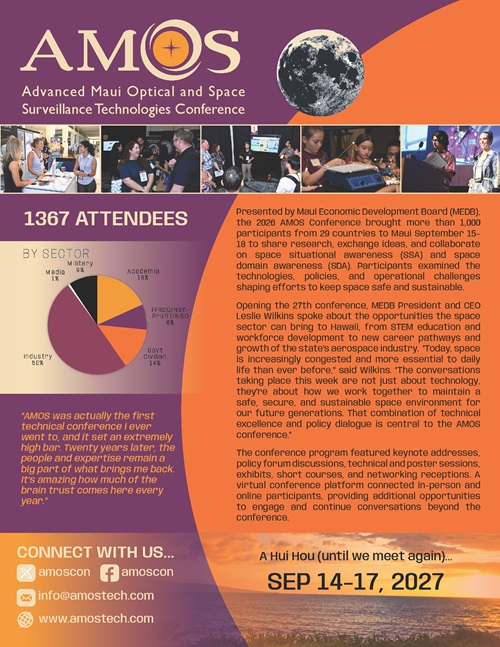
]]>Presented by Maui Economic Development Board (MEDB), the 2026 AMOS Conference brought more than 1,000 participants from 29 countries to Maui September 15–18 to share research, exchange ideas, and collaborate on space situational awareness (SSA) and space domain awareness (SDA). Participants examined the technologies, policies, and operational challenges shaping efforts to keep space safe and sustainable.
Opening the 27th conference, MEDB President and CEO Leslie Wilkins spoke about the opportunities the space sector can bring to Hawaii, from STEM education and workforce development to new career pathways. “Today, space is increasingly congested and more essential to daily life than ever before,” said Wilkins. “The conversations taking place this week are not just about technology, they’re about how we work together to maintain a safe, secure, and sustainable space environment for our future generations. That combination of technical excellence and policy dialogue is central to the AMOS conference.”
The conference program featured keynote addresses, policy forum discussions, technical and poster sessions, exhibits, short courses, and networking receptions. A virtual conference platform connected in-person and online participants, providing additional opportunities to engage and continue conversations beyond the conference.
The AMOS Conference Call for Papers attracted more than 350 abstracts representing over 20 countries. Conference co-chairs Paul Kervin and Daron Nishimoto, together with the technical committee and session chairs, shaped a robust technical program with guidance from the American Astronautical Society’s Space Surveillance Committee (AAS-SSC). Sessions addressed topics including Astrodynamics, Atmospherics & Space weather, Cislunar SDA, Conjunction/RPO, AI in SDA Applications, Satellite Characterization, Space-based Assets, Space Debris, SDA Systems and Instrumentation, and Space Domain Awareness.
In addition to oral presentations, technical posters were available digitally through the virtual conference platform and on interactive touchscreen monitors. During evening poster sessions, selected authors presented their work in 10-minute time slots and engaged directly with attendees.
In-person poster presenters were further invited to showcase their work on the main stage for 30-second lightning pitches during the general session. They were able to introduce their research and encourage attendees to view their posters and continue the conversation during the poster sessions.

Most Creative poster winner Geoffey Lake, Icebox Engineering
Awards and Journal Publication
The conference recognized outstanding technical papers and poster presentations, with select papers to be invited for peer review and consideration for publication in the 2026 Journal of Astronautical Sciences.
Moriba Jah of the University of Texas at Austin received the 2026 AMOS Conference Best Paper Award for The Epistemic Support-Point Filter (ESPF): Possibilistic Space Object State Estimation Under Ignorance. The award recognized the paper’s innovative approach to a fundamental challenge in space object state estimation. “This was groundbreaking work,” said Wes Faber, Chairman of the AAS Space Surveillance Committee. “They addressed a fundamental issue with Bayesian filtering, developing a new non-Bayesian estimation technique.”
The Best Student Paper Award went to Ryan Menges of the University of Colorado Boulder for Constellation Design for Autonomous Cislunar Navigation and Target Tracking Using Relative Measurements.
Four awards gave recognition to outstanding poster presentations. Nicolas San Miguel of MIT Lincoln Laboratory received the Golden Ticket Award for Concurrent Frame-based and Event-based Optics as a Tool for Pattern-of-Life Characterization, earning an invitation to deliver an oral presentation at the 2027 conference.
Poster Session Chairs Matthew Stevenson of LeoLabs and Pat Patterson of Space Dynamics Laboratory at Utah State University joined Valerie Skarupa of DarkStar Space in judging the lightning pitches. Anthony Zara of Advanced Space received the Best Poster Lightning Pitch Award for In-Situ Low-Lunar Orbit Optical Observation and Cataloging Feasibility.
The Most Creative Poster Award went to Geoff Lake of Icebox Engineering for Infrared Dim-Object Detection Training Data from NASA Archival Imagery: A Multi-Domain Framework with Initial SSA Results. Stevenson said, “Geoff’s poster was well-organized and clear, and his project solves a real problem in a non-obvious and non-trivial, very creative way.”
August Berne of the Massachusetts Institute of Technology received the Newcomer Award for DreamSat-Bench: Development and Initial Testing of a Testbed for AI-Based Pose Estimation from 3D Reconstruction.

Wes Faber (left) presented 2026 Best Paper Award winner – Moriba Jah (middle), University of Texas at Austin; and Best Student Paper Award Winner – Ryan Menges (right), University of Colorado at Boulder
Poster prize winners from L to R: Anthony Zara, Advanced Space; Nicolas San Miguel, MIT Lincoln Laboratory; Josiane Uwumukiza, Massachusetts Institute of Technology (accepting on behalf of August Berne, Massachusetts Institute of Technology); and Geoffrey Lake, Icebox Engineering
Keynotes and Policy Forum
Day 1
General Stephen N. Whiting, Commander of U.S. Space Command, opened the conference with a keynote on the critical role of space domain awareness in maintaining space control and protecting national security in an increasingly congested and contested environment.
“At the heart of our ability to maintain space control lies the indispensable foundation of comprehensive space domain awareness. Without it, we’re navigating blind in an environment where opponents can strike from above, disrupt communications, and attack our satellites in an instant,” Whiting said.
Calling SDA the “bedrock of space control,” Whiting urged greater coordination among government, allied, and commercial partners. He also discussed the use of artificial intelligence and machine learning for threat detection and faster decision-making, as well as the need for more resilient space architecture and SDA capabilities extending into cislunar space and beyond.

General Stephen N. Whiting presented the opening keynote at AMOS 2026
The Day 1 Policy Forum, Much Ado About Tracking: Navigating Dual-Use SSA, examined the growing overlap between civilian and national security uses of commercial SSA and SDA capabilities. Moderated by Victoria Samson, Chief Director, Space Security and Stability of Secure World Foundation, the discussion highlighted the importance of transparency, communication, and clearer policies as commercial capabilities increasingly support national security missions.
“Technologies are in most cases neutral. And as such, the solution can’t simply be about identifying a satellite or sensor as military or civilian. It’s how they’re used that are the critical issue,” said Jessica Tok, Space Policy Analyst with DoW OSW(P) Space Policy.
Panelists emphasized that clear expectations and responsible behavior will be essential to reducing uncertainty and the risk of misunderstanding or escalation as these capabilities evolve.

L to R. Victoria Samson, Secure World Foundation; Jessica Tok, DoW OSW(P) Space Policy; Hilary Cohen, HEO USA; Krista Langeland, RAND Corporation; and Colonel Jonathan Whitaker, CFSpCC and NATO
Day 2
Jonathan Herman, Senior Director of Starlink Constellation Engineering at SpaceX, opened Day 2 with a look at Starlink’s global connectivity and the challenges of safely operating a growing satellite network.
Herman shared examples of Starlink supporting emergency communications, including during the 2023 Maui wildfires and other response efforts in Hawaiʻi, as well as connecting remote clinics, schools, and communities around the world.
Turning to space safety, Herman discussed Starlink’s collision avoidance efforts, the Stargaze space tracking system, and the company’s move toward lower satellite operating altitudes. He stressed the importance of satellite operators sharing accurate information about the location and planned movement of their spacecraft, particularly as low Earth orbit becomes more crowded.

Day 2 Keynote Jonathan Herman, SpaceX
That theme continued during the Day 2 Policy Forum, Where Does Basic SSA Service Begin and End? Moderated by Ian Christensen, Senior Director of Private Sector Programs at Secure World Foundation, the forum considered what constitutes basic SSA services, who should provide them, and how those services should evolve as activity in space grows.

L to R. Ian Christensen, Secure World Foundation; Gabriel Swiney, Office of Space Commerce, NOAA; Andrew D’Uva, Providence Access, Co.; Audrey Schaffer, Slingshot Aerospace; and Chris Binz, Umbra
Panelists focused on the information operators need to make safe decisions, including spacecraft location, planned maneuvers, potential collision risks, and timely operator-to-operator communication. “You don’t need lots of CDMs. You need decision-quality information, ideally one common operating picture you can act from,” said Andrew D’Uva, Founder and Principal Advisor at Providence Access Company and advisor to the Space Data Association.
The discussion also explored how government, industry, and international partners can work together to provide reliable safety information while supporting the continued development of commercial SSA services.
Day 3
Opening the final day, Dr. Gay Jane Perez, Director General of the Philippine Space Agency, delivered a virtual keynote offering the perspective of an emerging space nation on the challenges of operating safely in an increasingly active space environment. Perez discussed the Philippines’ efforts to strengthen space situational awareness, satellite and launch monitoring, and space debris response as its space capabilities grow.
“Despite ongoing efforts of each member state in SSA and space traffic management, the issue is too big in terms of scope and the cost to be handled alone,” Perez said, emphasizing the importance of regional cooperation. Through the ASEAN Space Situational Awareness and Space Traffic Management (SSA-STM) project, member states are working to strengthen capacity building, information sharing, joint research, and regional coordination. Perez also called for greater knowledge exchange and access to SSA information and technology to support a safe, peaceful, responsible, and sustainable space environment.

Alex Shi, Secure World Foundation introduced Day 3 Keynote Dr. Gay Jane Perez, Philippine Space Agency
The final AMOS Policy Forum, Mind the Gap: Coordinating Launch Tracking and Re-entry, turned to the intersection of launch and re-entry operations, SSA, and aviation. Moderated by Alex Shi, Senior Program Analyst, Space Safety with Secure World Foundation, the discussion addressed gaps in tracking newly deployed spacecraft and predicting uncontrolled re-entries, along with the need for timely information sharing and better integration of space data into aviation systems.
“We will be developing better detection tools, better prediction tools, but if they are not integrated into the information system where it is needed for the airspace operators, then we have only solved a piece of the problem,” said Ruth Stilwell, Executive Director of Aerospace Policy Solutions.
Panelists also addressed airspace management, international coordination, safety reporting, and regulatory challenges, pointing to closer cooperation between the space and aviation communities as launch and re-entry activity grows.

L to R. Alex Shi, Secure World Foundation; Andrew Abraham, The Aerospace Corporation; Matthew Archer, UK Space Agency; Adam Marsh, LeoLabs, Inc.; Steph Earle, Federal Aviation Administration; and Ruth Stilwell, Aerospace Policy Solutions, LLC
Featured Presentations
Five featured presentations over the three-day technical program explored emerging challenges, technologies, and partnerships shaping the future of space domain awareness and space operations.
Day 1 opened with Brian Weeden, Director of Civil and Commercial Policy for the Center for Space Policy and Strategy at The Aerospace Corporation, who presented Evolution of SSA Capabilities to Support SDA and STM. Weeden examined whether traditional approaches to tracking and cataloging space objects can keep pace with growing satellite populations, increased launch activity, spacecraft autonomy, and expanding operations beyond geostationary orbit.
Russell Teehan, Technical Director with the Space Development Agency, presented MW-SDA Tech Roadmap Synergies, exploring the growing convergence between missile warning and space domain awareness. He emphasized integrated architectures, advanced sensing, data fusion, resilient communications, and greater autonomy, along with the importance of connecting government, commercial, allied, and international capabilities into a secure “network of networks.”
Day 2 featured Jeremy Andrews, Director of Science, Technology, and Engineering in the Office of the Assistant Secretary of the Air Force for Space Acquisition and Integration, who presented Strategic Orchestration of the S&T Enterprise: A Framework for Accelerating Technology into Capability. Andrews outlined efforts to move emerging technologies more rapidly from research into operational use, highlighting the newly established Technology Portfolio Executive (TPE) as a key mechanism for bridging the gap between technology development and acquisition, maturing promising technologies, and aligning investments with operational needs.
Colonel Max Yates, DTEO for Space and Commander of the Phillips Research Site, Air Force Research Laboratory, joined Enrico Jeantete, Innovation and Prototyping Division Director with SSC/SYD 89/SD, to present Forging United States Space Superiority: A Collaborative Framework Securing Space from vLEO Thru Cislunar. Together, they highlighted efforts to advance resilient space capabilities across orbital regimes, including spacecraft maneuverability, on-orbit refueling and servicing, autonomous operations, artificial intelligence, space domain awareness, and prototyping efforts such as Tetra 5 and the Rooster series.
Day 3 closed the featured presentations with Barbara Golf, U.S. Space Force Strategic Advisor for SDA at Space Systems Command, who presented Commercial Space Operations. Golf discussed advances in Joint Commercial Operations and the growing use of commercial data, analytics, and services to support U.S. and allied space operations.

Russell Teehan, Space Development Agency presented at the 2026 AMOS Conference

Colonel Max Yates, Philips Research Site/Air Force Research Laboratory and Enrico Jeantete, SSC/SYD 89/SD

Barbara Golf, USSF/SSC presents on Day 3 of the 2026 AMOS Conference
Networking
Beyond the formal program, AMOS offered plenty of opportunities to connect through receptions, meals, and refreshment breaks. Highlights included Tuesday’s sunset welcome reception, featuring the U.S. Air Force Band of the Pacific, and Wednesday’s fifth annual Women and Allies in Space Domain Awareness (WASDA) reception.
“I think the networking opportunities at AMOS, where it’s relaxed, there’s birds chirping, the surf is coming, you get a chance to get to know people,” said Darren McKnight, Senior Technical Fellow with LeoLabs. “And then when you get to know people, then you really get the opportunity to talk about what they really need and what can you really do for them.”
The exhibit venue offered another gathering place, where attendees could meet with sponsors and see technologies, products, and services supporting the SSA and SDA communities. This year’s exhibiting sponsors includeda.i. solutions, Advanced Scientific Concepts, AFRL, Astro Haven Enterprises, ATIK Cameras, BAE Systems, Celestron, COMSPOC, Diffraction Limited, EO Solutions, General Atomics Electromagnetic Systems, GMV, Green Optics, Hart Scientific Consulting International, JHU Applied Physics Laboratory, Kayhan Space, KBR, Kratos, Līpoa – Maui’s Innovation Community, LSAS Tec, Mitre, Nokomis, Observable Space, Office of Space Commerce, Rocket Lab, Sea West Observatories, SEAKR, Slingshot Aerospace, SpaceFlux, SpaceMap, SpaceNav, Teledyne, Terran Orbital, TOPTICA Photonics, Turion Space.
Sponsoring, but not exhibiting, were Advanced Space, Aerospace Corporation, Amazon Leo, Amazon Leo for Government, Amentum, Anduril, Astroscale, AV, Blue Canyon Technologies, Boeing, CACI, Ciena, Hawai’i Technology Development Corporation, L3Harris, LeoLabs, Lockheed Martin, Mantis Space, Northrop Grumman, Orion Space Solutions, Parsons, Peraton, Privateer, Raptor Dynamix, SAIC, Sedaro, Space Foundation, Secure World Foundation, Telesat Government Solutions, True Anomaly, Trusted Space, Ultra – For All Mankind, and Voyager.

Welcome Reception AMOS 2026

Exhibit Venue AMOS 2026

Stacie Williams, HQ USSF, speaks at the Women & Allies in SDA reception at AMOS 2026
Technical Short Courses
Twelve technical short courses, nine in person and three virtual, covered topics including optical sensing and object characterization, space debris, multi-sensor fusion, artificial intelligence and machine learning, sensor scheduling, uncertainty propagation, cislunar operations, and space mission analysis. Learn more about 2026 courses here
EMER-GEN® Program
The ninth annual EMER-GEN® program preceded AMOS, bringing together 45 young professionals and students with mentors from around the world for two days of space sustainability, professional development, and collaboration. A joint initiative of the AMOS Conference and Space Generation Advisory Council (SGAC), the program included the Great Policy Game, speed mentoring, and an Innovation Challenge.
“The mentoring felt super personal and tailored to each participant’s goals and needs,” said Srikant Sahoo of the RAND Corporation. “Getting to meet fellow young professionals and learn about the exciting work they’re doing across the space industry was one of my favorite parts.”
The members of the EMER-GEN Planning Committee reported out to the AMOS audience on Day 3 sharing the outcomes and experience of the program.
Student Space Exploration Day
The conference concluded Friday with Student Space Exploration Day, bringing approximately 150 Maui County students and teachers to AMOS for hands-on learning and exposure to careers in space and STEM. Students met pilot and astronaut Scott “Scooter” Altman and visited exhibits where they could interact with space industry professionals.
“Seeing real people here that do STEMWorks, as a student that does STEMWorks myself, I think it’s pretty inspiring seeing all these people doing their jobs and inspiring me to become like one of them,” said Maui Waena eighth grader Jaysen Acoba. “I think I’m going to continue doing robotics and probably become an engineer.”
“Student Space Exploration Day really opens the students up to different opportunities they never even thought of,” said Lāhainā Intermediate School teacher, Lori Ann Koyama. “It is vital to get exposure like this for them. STEMworks makes it all happen!”
For Maui students, the day brought the possibilities of space a little closer to home.

Middle school students view exhibits at Student Space Exploration Day at AMOS 2026
Summary
The 2026 AMOS Conference brought the global space community together on Maui to share research, exchange ideas, and strengthen the relationships needed to help keep space safe and sustainable.
For James Frith of the Air Force Research Laboratory, 2026 marked his 20th year attending AMOS. Reflecting on his first conference, Frith said, “It was actually the first technical conference I ever went to, and it set an extremely high bar.” Twenty years later, the people and expertise remain a big part of what brings him back. “It’s amazing how much of the brain trust comes here every year,” he said.
The AMOS Conference and EMER-GEN® are presented by Maui Economic Development Board, Inc., a nonprofit organization working to strengthen and diversify Maui’s economy and create new opportunities for its future.
Plans are already underway for 2027. EMER-GEN® returns to Maui September 12–14, followed by the AMOS Conference September 14–17.
The post Inside AMOS 2026: Advancing Space Awareness, Safety and Sustainability appeared first on AMOS Conference.
]]>45 young professionals and students participated in the 9th annual EMER-GEN® program for an immersive experience requiring innovation, teamwork, and leadership. A joint initiative of the AMOS Conference and the Space Generation Advisory Council (SGAC), the program presented by the Maui Economic Development Board (MEDB), continues to cultivate and equip the next generation of space leaders.
Through a variety of activities – flash mentoring, policy game, innovation challenge, interactive presentations – the cohort were engaged in lively discussions and brainstorming sessions. They were also exposed to networking opportunities to foster connections to help nurture their careers. Designed for young professionals and students enthusiastic about careers in space, the cohort included nineteen Hawaii-based participants.
“We are grateful for the many space industry leaders that contributed their time and expertise to the program,” said Annette Lynch, Program Director, Conference Services with MEDB and manager of the EMER-GEN Program. “Whether it is delivering a presentation, mentoring the delegates, or helping us in the months prior to shape the program, it’s a valuable contribution making an impact on the next generation.”
The three young professionals on the planning committee helped to shape the specific challenges and topics within the program. Two representatives were nominated by SGAC – Vatasta Koul is a student at the Kyushu Institute of Technology and The Institute of Statistical Mathematics in Fukuoka, Japan; and Nate McCoun is a Senior Space Systems Engineer with a.i. solutions. They were joined by Maui resident, Liliana Royer, an Application Engineer at the Maui High Performance Computing Center.
Challenge to Secure the Lunar Frontier
A series of three pre-webinars were presented to introduce participants to its central themes and prepare them before they met on Maui, Hawaii for the two-and-a-half-day immersive program. Webinar one introduced this year’s Innovation Challenge – centered on designing an integrated architecture for securing the lunar frontier, encompassing autonomous operations, defense, commercial viability, and international policy. The challenge was designed by planning committee member Nate McCoun with the assistance of long-time supporter of the program, Tom Kubancik of Trusted Space.
McCoun stated the core challenge question: ” How can we develop an integrated architecture for “Securing the Lunar Frontier” that enables persistent, autonomous operations through the lunar night while simultaneously establishing a resilient defense posture, a profitable commercial marketplace, and a policy framework that ensures long-term sustainability and cooperation for all of humanity? “
Keynote speaker Jerry Krassner provided a historical overview of cislunar studies over the past five years (including domain awareness, national security, and economic studies.) On securing the lunar frontier he emphasized the need for safe, predictable operating environments for both manned and robotic operations; highlighted the importance of accepted norms of behavior as foundational to investor confidence and conflict reduction.
A second webinar brought together a panel of experts to discuss the challenge from different perspectives. — Kyle Charles, Sr Director, Space Operations and Training, Trusted Space; Dr. Diane Davis, Associate Professor, Texas A&M University: Justin Kugler, Sr Director of Business Development, Intuitive Machines; and Victoria Samson, Chief Director, Space Security and Stability, Secure World Foundation.
Key themes included the rapid growth of cislunar traffic, the need for updated governance and debris disposal policies, the importance of domain awareness, and the blurring of civil and military space roles. A recurring warning across all speakers — the cislunar environment is consistently and significantly underestimated in complexity.
Teams for the challenge were announced once onsite, and they had just 3 hours on the final day of EMER-GEN to brainstorm and formulate their ideas and solutions to come up with a 6-minute pitch for a panel of judges. The three judges were: Paul Kervin, AFRL, retired and AMOS Technical Chair; Arthur Grijalva, SpaceWERX; and Kawai Hall, KBR.
“What was really impressive was the range of ideas,” said McCoun. “We had concepts ranging from autonomous lunar navigation, multiple approaches to surviving the lunar night by using deployable mirrors and assets in space to redirect sunlight, atomic clocks distributed across the lunar surface and intelligent infrastructure for operating throughout the lunar domain. But more importantly, the teams didn’t just focus on the technology. They really bought into the intent of the challenge and considered the business case, the security implications, and the long-term sustainability of what they were proposing.”
The winner of the 2026 EMER-GEN Innovation Challenge was Ahi O Mahina, which translates to ‘fire of the moon’. The judges thought that their solution, to provide sunlight on demand for the lunar night, was innovative and possible. Engraved bamboo surfboard trophies were awarded to all team members — Carter Franz, Trusted Space; Jaxson Pahukula, KBR; Justin Kellum, LaunchDetect; Matthew Madayag, University of Hawaii Manoa; Xela Makanani Burke, Hawaii Space Flight Laboratory.
“Teamwork was the main takeaway that allowed us to enhance our innovation process,” said Kellum. “When we first started we all had ideas and as a team voted through them until we settled on a consensus and focused on creating the most innovative pitch possible.”

Teams work on their project during the EMER-GEN Innovation Challenge

Arthur Grijalva, Kawaii Halland Paul Kervin, judges of EMER-GEN 2026

Winning team of the EMER-GEN 2026 Innovation Challenge – Ahi O Mahina

Teams collaborate and negotiate during the Great Policy Game at EMER-GEN 2026

Jeff Schloemer (left) assisted presenter Tahara Dawkins (right) to facilitate and guide the cohort during the Great Policy Game
The Great Policy Game
A third pre-webinar set up the Great Policy Game, designed and presented by Tahara Dawkins of Astroscale. This year’s game was an interactive real-life scenario titled, ‘Shadow Constellation — Registration, Responsibility, and the Race for Orbit.’ Dawkins was joined on the webinar by Diane Howard, Principal, sur l’espace PLLC who delivered a comprehensive overview of the international space law framework, covering the five UN space treaties, key articles of the Outer Space Treaty, the Liability Convention, and the Registration Convention.
During the game at EMER-GEN, the cohort was split into 12 Actors/roles that made up four teams. Specific instructions and objectives were provided for each role and to each team as to what they knew and how they would respond to an incident occurring in orbit. Jeff Schloemer of Astroscale was also present to assist Dawkins and the cohort with the game.
“This wasn’t a purely hypothetical exercise,” said Vatasta Koul, who’s role on the planning committee was to help with the policy game. “Commercial space activity today is genuinely multinational and modular, yet the governing frameworks were potentially built for a simpler world. Over the course of the session, the delegates worked through several difficult questions together.”
“Questions mattered more than answers,” continued Koul. “The cohort raised a substantial number of questions throughout the session. In a domain where technology has outpaced the law, asking the right question is often as important as arriving at a confident answer.”
Local Culture Introduction
The cohort met in-person on Maui on Sunday, September 13 with an Aloha Reception at the Wailea Beach Resort, providing the opportunity to connect over dinner and ice-breaking activities.
The following morning, the program opened with a cultural keynote by Devin Chu, the Resident Astronomer at the ‘Imiloa Astronomy Center, who spoke of how the Native Hawaiian science of voyaging and wayfinding was an impressive, and well-crafted practice, propelling migration and exploration across thousands of miles, without any western instrumentation.
“We wanted our diverse cohort to gain a sense of appreciation for what it means to be here, having this conference, in Hawai’i.” said planning committee member Liliana Royer. “Native Hawaiians were excellent astronomers, using star compasses, star lines, and other mental constructs to enable them to make the necessary precise decisions to bring them home to the islands in the middle of the Pacific.”
Royer concluded, “The cohort were left with the understanding of what it means to acknowledge the space that we occupy. That underneath the stories of science discovery and cultural revitalization, is the greater message of consistently driving change and innovation.”

Devin Chu of ‘Imiloa Astronomy Center introduced the EMER-GEN cohort to Native Hawaiian science of voyaging and wayfinding
The morning session continued with a presentation by Doug Loverro titled “Can Space Traffic Management make it to Adulthood?” He listed the challenges of operating within the rules that currently exist, agreeing upon new rules to enforce, legislating/enforcing those rules and then how to balance between regulation and innovation.
Loverro was joined by two guest speakers, Mike Hoot of Space X and Amber Charlesworth of Amazon LEO, to provide perspectives on the solutions being driven by current industry leaders. Delegates were then challenged to draft their own new rules for space traffic management, taking after the industry practices of ephemeris sharing, while also adding provisions about ensuring 24/hr hotlines and environmental regulations regarding planned demise.
The exercise gave delegates an understanding of the complexity of centralization, information sharing, and how customary practices fall short in the absence of space law.

Doug Loverro instructs EMER-GEN 2026 delegates
Career Mentoring
Every year the EMER-GEN program draws upon the broad AMOS Conference community to mentor and guide the young professionals and students. The flash mentoring session was preceded by a brief panel of EMER-GEN alum to share their tips and insights for making the most out of attending big events as a young professional. Thirteen mentors then took their seats for the main event where they would spend short, focused rounds with a group of 3-4 delegates to answer their questions and share their own career transitions and pathways – from academia into industry, from research into policy, and more.
Mentors participating this year were: Michael Barton, a.i. solutions; Amber Charlesworth, Amazon Leo; Heather Cowardin, NASA Johnson Space Center; Steph Earle, DOT/FAA Office of Commercial Space Transportation; Eric Felt, University of Texas El Paso; Chris Grant, Hyperion Vector Systems; Jacqui Hoover, Hawaii Economic Development Board; Moriba Jah, GaiaVerse; Ron Lopez, Astroscale; Doug Loverro, Loverro Consulting, LLC; Jeff Sherk, The Aerospace Corporation; Alex Shi, Secure World Foundation; and Valerie Skarupa, Darkstar Space, LLC.
Justin Kellum said about the mentoring, “My biggest takeaway was that we need to get everyone all across the world into the same room together to talk about what’s important to them and what’s important to us and figure out how can we come to solutions together.”
Mentors joined the cohort in a more informal and relaxing setting at the Pau Hana reception that followed.

EMER-GEN Alum Panel 2026 L to R: Emily Gerber, Ten One Solutions; Matthew Lugo, Privateer; Kristin Shahady, Intuitive Machines; Michael Barton, a.i. solutions; Zack Stein, HiFocus; and moderator Yosef Onodera, MEDB.

Steph Earle, FAA (left) mentors a group at EMER-GEN 2026

Alex Shi, Secure World Foundation, shares career advice during EMER-GEN 2026
Technical Short Course
As part of EMER-GEN, delegates could enroll in an AMOS Conference Technical Short Course led by experts in space situational awareness (SSA). These focused sessions strengthened practical knowledge and provided insight into emerging work across a range of specialties. This year’s offerings explored machine learning, uncertainty propagation, sensor scheduling, cislunar education and hands-on space mission analysis.
Summary
This year’s EMER-GEN offered opportunities for the cohort to network with peers and industry leaders through the interactive sessions, breakfasts, lunches, and social receptions. It concluded with a closing session announcing the winners of the Innovation Challenge and reflecting on the cohort’s achievements.
“EMER-GEN was really fun with a great mix of young professionals and industry people that have the opportunity to learn from each other,” said Matthew Madayag, a student at University of Hawaii Manoa.
“EMER-GEN was an incredible experience that combined learning, mentorship, and networking in a very meaningful way,” offered Srikant Sahoo of Rand Corporation. “The mentoring felt super personal and tailored to each participant’s goals and needs. Getting to meet fellow young professionals and learn about the exciting work they’re doing across the space industry was one of my favorite parts. Overall, it was a great opportunity to learn, connect, and grow.”
Jasper Hudson from Australian Astronomical Optics shared, “It’s been really great to meet a lot of people that I wouldn’t meet outside of my normal work and be able to develop relationships with them. I think international collaboration is hugely important because not only does space belong to everyone, but we want to work with it together as we’re able to do much more than we would just by ourselves.”
“EMER-GEN is a great place for young professionals and aspiring professionals to connect and collaborate in a creative space,” concluded Xela Makanani-Burke, Hawaii Space Flight Laboratory.
EMER-GEN and the AMOS Conference are presented by the Maui Economic Development Board, Inc. (MEDB), a 501(c)(3) not-for-profit corporation established in 1982 with a mission to diversify Maui County’s economy, building pathways to innovation, jobs and opportunity for our residents. Through partnerships with the public and private sector, MEDB undertakes projects that assist growth industries with navigating and thriving in our county, educates and trains residents for new careers, and engages our community in forums that determine future economic directions.
Mahalo to Geo sponsors Privateer and Trusted Space for their support of EMER-GEN, along with LEO supporters Astroscale and Advanced Space.
Save the dates for 2027—EMER-GEN Program on September 12-14 followed by the AMOS Conference September 14-17.

Networking at EMER-GEN 2026

Mentors join the Networking at EMER-GEN 2026

Networking at EMER-GEN 2025
The post EMER-GEN Inspires the Next Generation of Space Leaders appeared first on AMOS Conference.
]]>Read up on news from the 27th Annual AMOS Conference held at the Wailea Beach Resort September 15-18, 2026.
Sept 16, 2026 – Breaking Defense
https://breakingdefense.com/2026/09/spacecom-needs-more-capabilities-to-target-space-adversaries-whiting/
Sept 17, 2026 – SpaceNews
Space Command says satellite tracking must evolve for combat in orbit
Sept 17, 2026 – CNet
https://www.cnet.com/science/space/the-us-military-cant-stop-talking-about-space-weapons/
Sept 18, 2026 – Breaking Defense
https://breakingdefense.com/2026/09/space-force-to-prototype-new-software-to-fuse-commercial-military-space-tracking-data/
Sept 18, 2026 – Breaking Defense
https://breakingdefense.com/2026/09/europes-space-tracking-program-sees-growing-support-interest/
Sept 20, 2026 – SpaceNews
Space Force expands use of commercial satellites to track electronic interference
Sept 23, 2026 – Breaking Defense
https://breakingdefense.com/2026/09/exclusive-spacex-given-unique-access-to-classified-dod-space-tracking-data-sources-say/
The post News on the 2026 AMOS Conference appeared first on AMOS Conference.
]]>The 27th Annual AMOS Conference returns to Maui September 15-18, bringing together leaders and experts from government, industry, academia, and the military to foster important dialogue and international collaboration on Space Situational Awareness.
The conference will open with a keynote address by General Stephen N. Whiting, Commander, U.S. Space Command. General Whiting has held leadership roles across the U.S. Air Force, U.S. Strategic Command, the Department of Defense, and the U.S. Space Force, overseeing military space operations and national security initiatives. Read more here.
Each morning’s AMOS Policy Forum, presented in partnership with the Secure World Foundation, will bring together operators, technology developers, and policymakers to discuss the technical, operational, and policy challenges influencing space domain awareness and spaceflight safety.
Following General Whiting’s keynote, the forum will address the growing role of dual-use space situational awareness capabilities in a discussion titled “Much Ado About Tracking: Navigating Dual-Use SSA”. Moderated by Victoria Samson, Chief Director of Space Security and Stability at Secure World Foundation, the panel will feature Hilary Cohen, Director of Operations, HEO USA; Krista Langeland, Senior Physical Scientist, RAND Corporation; Jessica Tok, Space Policy Analyst, DoW OSW(P) Space Policy; and Colonel Jonathan Whitaker, Chief of Staff for NATO’s Combined Force Space Component Command and Director of the NATO Space Operations Centre.
The technologies used for civilian SSA can also be used to monitor military satellites or space assets of adversarial nations. This is especially true for some of the new in-space SSA constellations. Also, there is an increasingly blurred line between inspector satellites and SSA satellites. Finally, as the U.S. Government continues to turn to space as a service model, this makes the line between what is and what is not a military space capability amorphous.

Victoria Samson, Secure World Foundation

Hilary Cohen, HEO USA

Krista Langeland, RAND Corporation

Jessica Tok, DoW OSW(P) Space Policy

Col. Jonathan Whitaker, NATO Combined Force Space Component and NATO Space Operations Centre
This panel will discuss considerations for SSA operators and providers and what the current state is of policies and governance mechanisms, with the goal of providing clarity to both sides for how to allow this evolution to continue while also ensuring a stable, predictable space environment for all.
DAY 2
The day begins with a keynote address by Jonathan Herman, Director of Starlink Constellation Engineering at SpaceX. Herman oversees the engineering teams responsible for guidance, navigation, and control (GNC), constellation design and operations, collision avoidance, and other systems that enable the operation of the Starlink constellation, including the Stargaze space situational awareness system.
The morning Policy Forum, “Where Does Basic SSA Service Begin and End?”, will be moderated by Ian Christensen, Senior Director of Private Sector Programs at Secure World Foundation. Joining the panel are Chris Binz, Chief Architect of Mission Solutions at Umbra; Andrew D’Uva, Founder and Principal Advisor of Providence Access Co.; Audrey Schaffer, Senior Vice President of Global Policy and Government Strategy at Slingshot Aerospace; and Gabriel Swiney, Director of the Policy, Advocacy, and International Division at the Office of Space Commerce, U.S. Department of Commerce.

Jonathan Herman, Director of Starlink Constellation Engineering at SpaceX
Government space safety systems are in the process of defining and operationalizing basic SSA and space safety services. Programs such as TraCSS and EU-SST have been working jointly to research and map alignment between offerings as the baseline services are defined. At the same time, a United Nations Expert Group is seeking to establish basic space traffic coordination principles at the international level; and a leading satellite operator has announced a system to provide free of charge certain public SSA services based on information collected through operations. Throughout all of these, a still-emerging commercial SSA industry is working to build out value-added services and products based on SSA information and analysis.
This discussion will center on the question of what is the basic minimum SSA information or service that should be provided as free or public good and the models for doing so, while at the same time enabling commercial or fee-based services to develop.

Ian Christenson, Secure World Foundation

Chris Binz, Umbra

Andrew D’Uva, Providence Access Co.

Audrey Schaffer, Slingshot Aerospace

Gabriel Swiney, Office of Space Commerce, U.S. Department of Commerce
DAY 3
Joining remotely from the Philippines, Dr. Gay Jane P. Perez will deliver the conference’s final keynote address. Dr. Perez has helped advance the Philippines’ space and remote sensing programs through her work in Earth observation research and national space initiatives.
The final Policy Forum, “Mind the Gap: Coordinating Launch, Tracking, and Re-entry,” will be moderated by Alex Shi, Senior Program Analyst at Secure World Foundation. Panelists include Steph Earle, Space Policy and Outreach Branch Manager, Federal Aviation Administration’s Office of Commercial Space Transportation; Adam Marsh, Vice President of Technical Solutions at LeoLabs; and Ruth Stilwell, Executive Director, Aerospace Policy Solutions, LLC.

Dr. Gay Jane P. Perez, Director General, Philippine Space Agency
As launch operations increase in tempo and become more routine occurrences, the need to address a number of operational challenges in the integration of SSA information into launch operations become more acute. These issues include addressing and reducing the “COLA gap;” clarifying the respective roles of satellite and launch operators in identification and tracking immediately after separation; improving SSA information related to re-entry of space objects and launch vehicles; and addressing growing questions around the integration of launch activities into air traffic operations.
This panel will discuss current policy and operational efforts to address these issues and examine where progress has been made to date. It will also look at how best to improve integration of launch operations into national and international space traffic coordination systems.

Alex Shi, Secure World Foundation

Steph Earle, Federal Aviation Administration’s Office of Commercial Space Transportation

Adam Marsh, LeoLabs

Ruth Stilwell, Aerospace Policy Solutions, LLC
In addition to keynote presentations and Policy Forum discussions, the conference will feature technical sessions, exhibits, poster presentations, networking events, and 12 technical short courses covering current challenges and innovations across the space sector.
Featured presentations include:
- Evolution of SSA Capabilities to Support SDA and STM presented by Brian Weeden, Director of Civil and Commercial Policy at The Aerospace Corporation
- SDA’s Tech Roadmap and the Space Domain Awareness Mission Areas presented by Russell Teehan, Technical Director at the Space Development Agency
- Strategic Orchestration of the S&T Enterprise: A Framework for Accelerating Technology into Capability presented by Jeremy C. Andrews, Director of Science, Technology and Engineering at the Office of the Assistant Secretary of the Air Force for Space Acquisition and Integration
- Forging United States Space Superiority: A Collaborative Framework Securing Space from vLEO Through Cislunar presented by Colonel Max Yates, Chief of the Space Electro-Optics Division at AFRL/RDS, and Enrico Jeantete, Director of the Innovation and Prototyping Division at SSC/SYD
- Commercial Space Updates presented by Barbara Golf, Strategic Advisor for Space Domain Awareness with the Space Systems Command, U.S. Space Force
The conference will conclude with the AMOS Closing and Awards Ceremony, followed by a Pau Hana Reception where attendees can connect with colleagues and reflect on the week’s discussions and achievements.
View the full program
Presented by Maui Economic Development Board (MEDB), the AMOS Conference brings together the global space community through both in-person and virtual participation, with livestream access to all presentations. In-person registration sold out months in advance, reflecting continued demand for the conference’s technical program and networking opportunities. Conference programming will also be available through the event’s virtual platform and mobile app, providing attendees worldwide access to presentations, networking opportunities, and the exhibit hall experience.
The 2026 AMOS Conference is sponsored by: a.i. solutions, Advanced Scientific Concepts, Advanced Space, Aerospace Corporation, Amazon Leo, Amazon Leo for Government, Amentum, Anduril, Astro Haven Enterprises, Astroscale, ATIK Cameras, AV, BAE Systems, Blue Canyon Technologies, CACI, Celestron, Ciena, COMSPOC, Diffraction Limited, EO Solutions, General Atomics Electromagnetic Systems, GMV, Green Optics, Hart Scientific Consulting International, Hawaii Technology Development Corporation, JHU Applied Physics Laboratory, Kayhan Space, KBR, Kratos, L3 Harris, LeoLabs, Līpoa – Maui’s Innovation Community, Lockheed Martin, LSAS Tec, Mantis Space, Mitre Corporation, Nokomis, Northrop Grumman, Observable Space, Orion Space Solutions, Parsons, Peraton, Privateer, Raptor Dynamix, Rocket Lab, SAIC, Sea West Observatories, SEAKR, Sedaro, Slingshot Aerospace, SpaceFlux, SpaceMap, SpaceNav, Teledyne, Telesat Government Solutions, Terran Orbital, The Boeing Company, TOPTICA Photonics, True Anomaly, Trusted Space, Turion Space, Ultra – For All Mankind, and Voyager Technologies.
The post Space Policy Takes Center Stage at AMOS appeared first on AMOS Conference.
]]>The Commander of U.S. Space Command, General Stephen N. Whiting, will keynote the 27th annual AMOS Conference to be held on Maui September 15-18. Presented by Maui Economic Development Board (MEDB), the AMOS Conference is the premier technical conference in the nation devoted to space situational/domain awareness.
As the Commander of U.S. Space Command, General Whiting is responsible for defending U.S. and Allied interests in the space domain while providing space-enabled combat effects to joint warfighters around the globe. He exercises combatant command authority over Soldiers, Marines, Sailors, Airmen, and Guardians operating ground and space-based systems around the world.
A 1989 distinguished graduate of the U.S. Air Force Academy with a degree in aeronautical engineering, General Whiting is a space operations officer and has commanded the 13th Space Warning Squadron; the 614th Air and Space Operations Center and Joint Space Operations Center; the 21st Space Wing; and the Combined Force Space Component Command and 14th Air Force. Read full bio
“We’re honored to welcome General Whiting back to Maui in September,” said Annette Lynch, Program Director Conference Services with MEDB. “He inspired the audience in 2018, and then again during our all-virtual AMOS in 2020, and it’s especially meaningful to host him now as a four-star general.”

General Stephen N. Whiting, Commander, U.S. Space Command will give the opening Keynote for the 2026 AMOS Conference
Bringing together policymakers and experts from the private sector, academia, the military, and government agencies, the conference attracts papers and presentations from the world’s foremost scientists and leaders working in /SDA. The AMOS program features keynote speakers, policy forum topics, featured presentations, technical sessions, technical short courses and an exhibit venue.
AMOS Policy Forum
The AMOS Policy Forum is a series of paired keynotes and panel discussions that lead each of the three days of the conference and focus on specific policy topics relevant to the AMOS community. A collaboration with Secure World Foundation, the Policy Forum brings together the developers and implementers of SSA capabilities and the thought-leaders of SSA policy to discuss a landscape that is rapidly evolving.
The Day 1 keynote with General Whiting will be followed by a Policy Forum panel on “Much Ado About Tracking: Navigating Dual-Use SSA.” The technologies used for civilian SSA can also be used to monitor military satellites or space assets of adversarial nations. This is especially true for some of the new in-space SSA constellations. There is an increasingly blurred line between inspector satellites and SSA satellites and as the U.S. government continues to turn to space as a service model, this makes the line between what is/not a military space capability amorphous.
The panel will discuss considerations for SSA operators and providers and what the current state is of policies and governance mechanisms, with the goal of providing clarity to both sides for how to allow this evolution to continue while also ensuring a stable, predictable space environment for all.
On Day 2 of AMOS, Mike Nicholls, SVP, Starlink, SpaceX will deliver a keynote address before a panel discussion on “Where Does Basic SSA Service Begin and End?” Government space safety systems are in the process of defining and operationalizing basic SSA and space safety services. Programs such as TraCSS and EU-SST have been working jointly to research and map alignment between offerings as the baseline services are defined. At the same time, a United Nations Expert Group is seeking to establish basic space traffic coordination principles at the international level; and a leading satellite operator has announced a system to provide free of charge certain public SSA services based on information collected through operations. Throughout all of these, a still-emerging commercial SSA industry is working to build out value-added services and products based on SSA information and analysis.
This discussion will center on the question of what is the basic minimum SSA information or service that should be provided as free or public good and the models for doing so, while at the same time enabling commercial or fee-based services to develop.

Mike Nicolls will give the keynote on Day 2 of AMOS 2026
The Policy Forum on Friday will focus on “Mind the Gap: Coordinating Launch, Tracking, and Re-entry.” As launch operations increase in tempo and become more routine occurrences, the need to address a number of operational challenges in the integration of SSA information into launch operations become more acute. These issues including addressing and reducing the “COLA gap;” clarifying the respective roles of satellite and launch operators in identification and tracking immediately after separation; improving SSA information related to re-entry of space objects and launch vehicles; and addressing growing questions around the integration of launch activities into air traffic operations.
This panel will discuss current policy and operational efforts to address these issues and examine where progress has been made to date. It will also look at how best to improve integration of launch operations into national and international space traffic coordination systems.
Featured Presentations
Featured presentations are sprinkled through the program including Brian Weeden, Director of Civil and Commercial Policy, The Aerospace Corporation; Colonel Russell Teehan, Portfolio Architect, Air Force Space and Missiles System Center; Jeremy Andrews, Director, Science, Technology, & Engineering, SAF/SQT; and Barbara Golf, U.S. Space Force, Strategic Advisor for SDA, Space Systems Command.
There will once again be a featured presentation by leaders of Air Force Research Laboratory (AFRL) and Space Systems Command (SSC) that will highlight the collaborative framework between the two organizations securing space from vLEO through to CisLunar.
The AMOS conference is hybrid with livestreaming of all oral presentations for those unable to travel to Maui. The high demand to attend led to the early closing of in-person registration and start of a waitlist. Virtual attendees have access to all presentations as well as online networking.

Barb Golf will return to Maui to present at AMOS 2026
The AMOS Conference is preceded by the 9th Annual EMER-GEN® program, a professional development opportunity for young professionals and students enthusiastic about careers in space. A joint initiative with the Space Generation Advisory Council (SGAC) EMER-GEN puts the focus on fostering innovation and entrepreneurship. The program features mentoring sessions with renowned space specialists; networking; technical short courses; and interactive professional development sessions designed to enhance the young professionals’ effectiveness in a global environment.
The post Gen. Whiting to Keynote AMOS 2026 appeared first on AMOS Conference.
]]>The Aerospace Corporation and the Maui Economic Development Board (MEDB) led the annual International SSA/STM Policy Exchange on 13 April 2026. This invitation-only event was held in conjunction with the Space Symposium in Colorado Springs, Colorado, USA. The session was cohosted by the Centre National d’Etudes Spatiales (CNES), and the Space Agency of the Deutsches Zentrum für Luftund Raumfahrt (DLR).
The six desired outcomes were to; 1) Strengthen international cooperation and information exchange regarding space traffic by providing the status and plans for TraCSS, EU SST, and other commercial and international initiatives that have the potential to support spaceflight safety and sustainability; 2) Identify persistent policy barriers to closer international spaceflight safety coordination and information sharing, categorize recurring policy issues, (e.g., security/cultural, technical, bureaucratic, educational) and begin to collectively prioritizing and strategizing ways to overcome or bypass such barriers; 3) Identify where more-or-less equivalent space safety-related legal requirements, regulations, and obligatory standards exist or are emerging, and identify areas where together the most progress can be made quickly in overcoming complex issues that emerge from different approaches and areas of emphasis; 4) Discuss international policy solutions for bringing into the fold inexperienced and nonexpert satellite owners and operators; 5) Provide updates on current activities and progress by international, governmental SSA/STC/STM stakeholders.
The enduring goal of the annual International SSA/STM Policy Exchange is to provide an opportunity to develop and advance relationships and promote transparency among a community of key international SSA/STM policymakers and industrial actors as well as to share and explore relevant opportunities and challenges among domestic agencies/ministries and transnational entities. The exchange built upon the key findings from the 2025 SSA Data Operator Exchange workshop held in September 2025 during the AMOS Conference.

The post 2026 SSA/STM Policy Exchange – April appeared first on AMOS Conference.
]]>EMER-GEN® 2026 will launch on August 26 with a new series of challenges, presentations, and tabletop exercises designed to help shape the careers of emerging space professionals and students. Now in its ninth year, the program begins with three preparatory webinars before culminating in an in-person event on Maui, Hawaii, September 13–15.
Founded in 2018 by the Maui Economic Development Board (MEDB), host of the AMOS Conference, in affiliation with the Space Generation Advisory Council (SGAC), EMER-GEN brings together industry experts and rising talent for workshops, interactive tabletop exercises, and flash mentoring sessions. The program offers participants valuable insight into career pathways, leadership development, policy, and entrepreneurship across the space sector.
Tom Kubancik of Trusted Space has provided his expertise to the program since its inception as both a mentor and a program coordinator of the Innovation Challenge. “The EMER-GEN Innovation Challenge is my fountain of youth,” said Kubancik, when asked why he keeps coming back to support the program. “Working alongside wonderful program contributors and a cohort of brilliant minds inspires me and brings me both excitement and respect. This experience keeps me energized and positive about humanity and our future in space.”
“The specific challenges and topics within the program are shaped each year with the help of three young professionals,” said Annette Lynch, Program Director of MEDB. “Two representatives nominated by Space Generation Advisory Council (SGAC) are joined by one based in Hawaii to help keep the program fresh and relevant to our target audience.”

Tom Kubancik, Trusted Space, mentors the cohort during EMER-GEN 2025
SGAC representative, Nate McCoun is a Senior Space Systems Engineer with a.i. solutions and has attended EMER-GEN the past two years. He commented, “EMER-GEN gives young professionals and students a unique opportunity to engage with parts of the space industry they may not encounter early in their careers. From the Innovation Challenge to the policy game and cultural programming, the experience encourages delegates to think collaboratively, strategically, and with a broader sense of responsibility.”
The other SGAC representative, Vatasta Koul is a student at the Kyushu Institute of Technology and The Institute of Statistical Mathematics in Fukuoka, Japan. Koul will be presenting a paper at the AMOS Conference in addition to participating in EMER-GEN.
“Being on the Program Committee for my first EMER-GEN has been an amazing experience as I get to help build an environment where different disciplines of SSA naturally intersect,” said Koul. “For students and young professionals, EMER-GEN is a rare opportunity to step out of the classroom, test our ideas against actual industry challenges, learn from the professionals doing the work, and build a network that truly matters.”
Maui resident, Liliana Royer, an Application Engineer at Maui High Performance Computing Center, is building on her experience from EMER-GEN 2025. “By participating in the Program Committee, I’m hoping to become further immersed in the Maui research and space community,” shared Royer. “The community is tight knit and intimate, and I would love to become acquainted with everyone in it and the work that they do. I also get to familiarize myself with what it takes to plan an important professional event on a scale larger than anything I’ve done previously. It is a rare opportunity to get to contribute to something so impactful right at my front door.”
NETWORKING
One of the most valued features of EMER-GEN is the networking with opportunities to build lasting connections with peers and professionals in the space community.
“Personally, the networking opportunities have had a real impact on the direction of my career,” commented McCoun. “Having the chance to ask candid questions of experienced professionals from diverse backgrounds in an intimate setting is something I found incredibly valuable.”
Royer added, “Tackling problems with large teams of entirely new likeminded individuals, exercising creativity and innovation, and connecting with established mentors and peers are opportunities that aren’t always available. These opportunities cultivate the self-development that sets you apart and inspires you.”

EMER-GEN Delegates benefit from networking in social events as well as in structured sessions.

Liliana Royer (standing right) participating in Policy Game at EMER-GEN 2025

Nate McCoun (left) asks the question during the flash mentoring session, with mentor Heather Cowardin, NASA Johnson Space Center.
Learn more about the program and schedule at http://www.emer-gen.com.
The Space Generation Advisory Council is a global non-governmental, non-profit (US 501(c)3) organization and network which aims to represent university students and young space professionals ages 18 to 35 to the United Nations, space agencies, industry, and academia. Headquartered in Vienna, Austria, the SGAC network of members, volunteers and alumni has grown to more than 13,000 members representing more than 150 countries.
The annual Advanced Maui Optical and Space Surveillance Technologies (AMOS) Conference, a program of the Maui Economic Development Board, is the premier technical conference in the nation devoted to space domain awareness. The cross section of military, contractor, and academic participation fuels important dialogue and collaboration on a national and international scale.
The post Shaping Tomorrow’s Space Leaders: EMER-GEN® 2026 appeared first on AMOS Conference.
]]>The post 2026 AMOS Conference program taking shape appeared first on AMOS Conference.
]]>
The continued evolution and advancements in field of space domain awareness is reflected in the number and content of the submissions – this year a record number of abstracts were received from 23 countries with over 250 selected to present their research in September. All submissions are subject to rigorous evaluation by a panel of reviewers for quality, innovation and relevance to the SDA community.
“With the high interest in presenting at AMOS each year, the hardest challenge is saying no to authors,” explained Annette Lynch, MEDB Program Director, Conference Services. “Not everyone can get stage time, whether through an oral or in-person poster presentation, and so to present a greater body of work, we offer the option of pre-recorded virtual-only poster presentations.”
Technical Sessions
Ten technical sessions cover topics related to SDA — AI for SDA Applications, Astrodynamics, Cislunar SDA, Conjunction/RPO, Satellite Characterization, SDA Systems & Instrumentation, Space-based Assets, Space Debris, Space Domain Awareness and Space Weather.
Posters will be displayed on digital touch screen monitors in the Exhibit and Poster Venue and available for all attendees to view on demand. A select number of presenters have been invited to give a 10-minute overview of their poster during one of the two poster sessions scheduled for Wednesday and Thursday of the conference.
A record forty-seven students have been accepted to present this year and are eligible for the 9th annual AMOS Student Paper Award. The award is presented in collaboration with the American Astronautical Society, along with the Best Paper Award. Students are required to submit their research paper by August 14 to vie for the award which includes an honorarium, complimentary registration to the AMOS Conference and to EMER-GEN® (September 13-15), the program for young professionals enthusiastic about careers in space.
The AMOS Conference attracts a cross section of private sector, government, and academic participation participate in important dialogue and international collaboration. In addition to the technical sessions, the program includes keynote speakers, policy forum, special interest topics, exhibit venue, networking receptions and short courses.
Technical Short Courses
Technical short courses are selected through a call for proposals and provide an opportunity for participants to upgrade technical job skills and remain abreast of recent developments in fields of interest within SDA. To accommodate more courses, short courses are offered virtually and in-person.
Ten short courses will be presented in-person on Tuesday, September 15 at the AMOS Conference venue over two sessions. All participation will be in-person with no live streaming available, and no recording. The interactive courses, and the presenters are:
- Panchromatic, Multi-spectral, Spectroscopy and Polarimetry Data Collection and Image Processing for Non-resolved Space Object Characterization – Presented by Francis Chun, U.S. Air Force Academy; Benjamin Roth, U.S. Air Force Academy; Timothy Strong, i2 Strategic Services LLC; David Strong, Strong EO Imaging, Inc.; Anil Chaudhary, Applied Optimization; Phillip Fishbein, Applied Optimization
- Observing and Characterizing Space Debris – Presented by Thomas Schildknecht, Space Analytics
- Telescopes and Optics: An Introduction to Optical SSA – Presented by Peter Zimmer, COMSPOC/JTMA
- Applied Multi‑Sensor Fusion for Enterprise‑Level SDA: Deriving Coherent, Time‑Relevant Operational Insight from EO, Passive RF and Heterogeneous Data Sources – Presented by Harris Mohamed, KRATOS; Kyle Overton, COMSPOC; Jason Ruggieri, COMSPOC; Steve Williams, KRATOS
- Architecting the Future of SDA: Implementing MOSA for Rapid Innovation – Presented by Yvette Rodriguez, Warfighting Acquisition University; Nicholas LeGrand, Office of the Assistant Secretary of War for Mission Capabilities; Monique Ofori, Office of the Assistant Secretary of War for Mission Capabilities
- Deep Learning & Large Language Methods for Space Domain Awareness – Presented by Roberto Furfaro, University of Arizona; Richard Linares, Massachusetts Institute of Technology; Weston , L3Harris
- Resource-Constrained Sensor Scheduling for Space Domain Awareness: A Scenario-Based Interactive Workshop – Presented by Brenton Smith, Zendir; Christopher Capon, Zendir
- Uncertainty Propagation for Space Situational Awareness – Presented by Brandon Jones, University of Texas at Austin
- Foundational Cislunar Education – Presented by Jonathan Smith, Parsons
- Hands-On Space Mission Analysis: Building Voice-Controlled AI Agents for GMAT, SatSim, and SDA Image Processing – Presented by Christopher Grant, Hyperion Vector Systems; Jon Terry, Hyperion Vector Systems
Four courses will be held virtually on Monday September 14. The presentations are “live,” (no recording) and participants will have the ability to interact with the instructor and attendees in real-time.
- The Probability of Collision Controversy – Presented by Alinda Mashiku, NASA; Dolan Highsmith, The Aerospace Corporation; Hunter Toumey, The Aerospace Corporation; Eliot Toumey, Omitron, Inc.
- Optical Modeling and Simulation for SSA/SDA – Presented by Patrick North, AGI
- Introduction to Data Driven Analytics and Applications to SSA – Presented by Jeff Cornelius, Parsons
- Real‑Time Conjunction Assessment and Optimal Collision Avoidance: Theory, Algorithms, and Implementation of Own SSA/STM Software – Presented by Douglas Deok-Soo Kim, SPACEMAP Inc.; Peter (Joonghyun) Ryu, SPACEMAP Inc.; Shawn Seunghwan , SPACEMAP Inc.
Full descriptions of all the short courses are available here. Places are limited due to space and to ensure an interactive experience for all.

Digital Posters at AMOS Conference

Session Chairs Shaylah Mutschlar & Piyush Mehta kick-off the 2025 Atmospherics/Space Weather Session

Greg Cohen presenting during Short Course at AMOS 2025
Registration for the AMOS Conference is open with conference organizers expecting another sold-out conference. Virtual tickets are available and all registrants will have access to a virtual platform to enable networking and collaboration. A separate registration fee is required for each technical short course, and courses can be added to new or existing registrations.
The 9th Annual EMER-GEN program precedes the AMOS Conference fostering innovation and entrepreneurship amongst young professionals enthusiastic about careers in space. The program features challenges, tabletop exercise, professional development sessions and popular mentoring sessions with renowned space specialists. Registration for EMER-GEN is also open, with scholarships available for Hawaii-based participants.
Host of the AMOS Conference and EMER-GEN, Maui Economic Development Board (MEDB) is a 501(c)(3) not-for-profit corporation established in 1982 with a mission to diversify Maui County’s economy, building pathways to innovation, jobs and opportunities for our residents. Through partnerships with the public and private sector, MEDB undertakes projects that assist growth industries with navigating and thriving in our county, educates and trains residents for new careers, and engages our community in forums that determine future economic directions.
Learn more at https://amostech.com / and EMER-GEN at http://www.emer-gen.com.
The post 2026 AMOS Conference program taking shape appeared first on AMOS Conference.
]]>The 2026 AMOS Conference has launched its Call for Papers and is now accepting submissions for technical papers related to space domain awareness. All submissions are due March 2. The 27th annual AMOS Conference, presented by Maui Economic Development Board, is scheduled to take place September 15-18, 2026.
Recognized as the preeminent scientific conference in the field of space situational/domain awareness (SSA/SDA), the AMOS Conference is attended by over 1,000 scientists, engineers and space experts from around the globe and across industry, government, military, and academic sectors.
Featuring technical short courses and more than 150 presentations, the four-day event includes work in astrodynamics, cislunar SDA, satellite characterization, space weather, artificial intelligence and more. The conference also features high-level presentations and panel discussions by key stakeholders in space policy.
The annual conference is an in-person event with virtual attendance options. All presenters must be available to present in-person. To accommodate a greater technical body of work for the SSA/SDA community, select poster presentations are designated as pre-recorded virtual-only presentations.

The AMOS Technical Committee reviews all submissions from the annual Call for Papers and selects those that best meet the scientific and technical standards of the conference. Submissions are encouraged from international, undergraduate and graduate students pursuing a STEM degree at an accredited college or university. International and student participants receive a reduced conference fee.
Please visit https://amostech.com/cfp/ for all the details on submitting an abstract. Proposals for special sessions, such as panels and featured oral presentations are also considered.
Publication in the Journal of Astronautical Sciences
The AMOS Conference, in conjunction with the American Astronautical Society (AAS), is delighted to provide participating authors the opportunity to be published in a peer-reviewed journal. The Journal of the Astronautical Sciences is an archival publication devoted to the sciences and technology of astronautics. Invitations to be peer-reviewed and considered for publication in a special AMOS Conference issue of the Journal of Astronautical Sciences will be extended upon conclusion of the Conference.
Awards
In collaboration with the Space Surveillance Committee of the American Astronautical Society (AAS), the AMOS Conference recognizes outstanding efforts in the field of Space Situational Awareness by presenting a series of awards at the close of the annual conference. Award criteria and details are available online at https://amostech.com/awards.
The Student Best Paper Award provides funding assistance in the form of a stipend. Once accepted into the conference, the deadline for submission of the completed manuscript is August 15.
Posters are also judged for design and creativity with awards given for Golden Ticket (Best Overall Poster), Most Creative (Top poster with the most ambitious goal and/or most unexpected methodology to solve), Newcomer (Top poster by a person presenting at AMOS for the first time) and Best Poster Lightening Pitch. The last award is given to the best 30-sec pitch– an opportunity given to poster presenters to share their work on the main stage.

Short Course proposals
Proposals are also being solicited for half-day Short Courses. Short courses are schedule for in-person instruction on Tuesday, September 15, and for virtual instruction and participation on Monday, September 14.
The short courses offer opportunities for participants to acquire an introductory knowledge on conference topics and are always well attended. Focus topics of broad interest from excellent instructors are encouraged. Short courses are solicited from all technical areas within SSA/SDA subject areas.
The deadline for all submissions to be included in the 2026 AMOS Conference program is March 2. A full list of key dates as we countdown to September can be found at https://amostech.com/amos-speakers/
The AMOS Conference is presented by the Maui Economic Development Board, a 501(c)(3) not-for-profit corporation established in 1982 with a mission to diversify Maui County’s economy, building pathways to innovation, jobs and opportunity for our residents. Through partnerships with the public and private sector, MEDB undertakes projects that assists growth industries with navigating and thriving in our county, educates and trains residents for new careers, and engages our community in forums that determine future economic directions.
The post Submissions sought for AMOS 2026 – Abstracts and Short Course Proposals appeared first on AMOS Conference.
]]>