Kazakhstan’s AI ecosystem is moving from infrastructure plans to deployment.
The shift is visible across the full AI stack — from infrastructure to models to applications.
The announcements below — coinciding with a visit to Astana by NVIDIA founder and CEO Jensen Huang — point to the nation’s increasing supply of accelerated computing, along with its growing demand for what comes next.
On Friday, Oct. 23, NVIDIA founder and CEO Jensen Huang visited Astana, meeting with President Kassym-Jomart Tokayev at the Akorda Presidential Palace and joining Deputy Prime Minister Zhaslan Madiyev — Kazakhstan’s minister of AI and digital development — for a public fireside chat at the Alem.AI program.
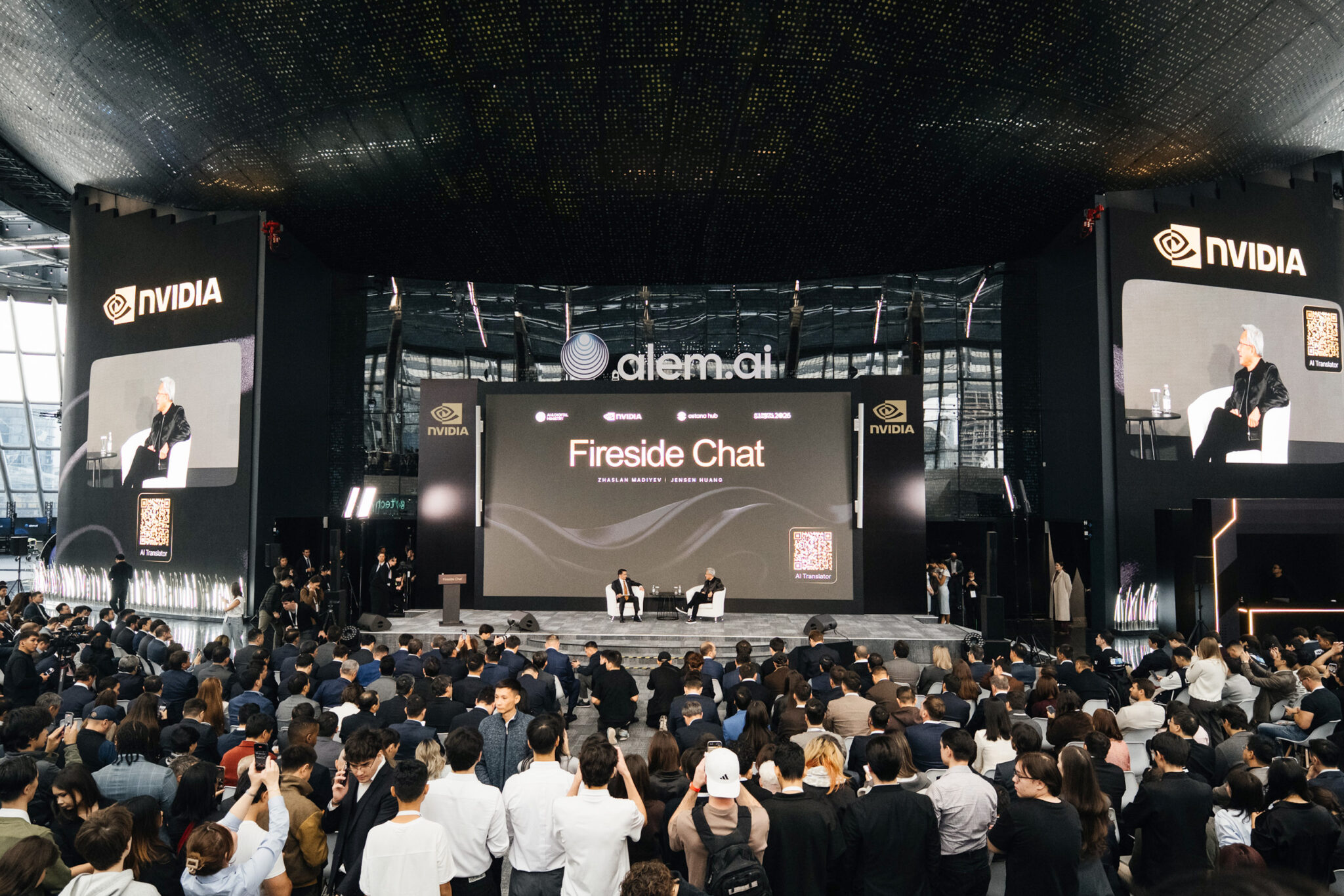
Jensen Huang and Kazakhstan’s AI Minister Speak at Alem.AI
In their fireside chat at Alem.AI, Kazakhstan’s international center for artificial intelligence, Madiyev and Huang discussed the country’s push to become an AI nation — building the energy and computing infrastructure to support homegrown AI and applying it across the economy.
Madiyev said Kazakhstan wants AI that reflects its language and culture. “We want AI that understands and speaks Kazakh and captures cultural contexts and cultural specifics,” he said, describing the country’s work on Kazakh-language models.
Huang said Kazakhstan could turn its energy resources into a foundation for AI production — and a new kind of export. “Instead of just exporting energy, in the future, you could transform energy into intelligence and export intelligence,” he said.
He also argued that local data is central to that ambition: it embodies a country’s culture, history and values. “Your country’s data is your natural resource. It belongs to you.”
The conversation also turned to physical AI. Madiyev pointed to Kazakhstan’s factories, mines, agriculture, transport and logistics as potential areas for development, asking how the country could become a hub for training models for robots and other physical systems.
Huang called the idea “fantastic,” saying physical AI could transform industries from mining and mineral processing to agriculture.
Huang said AI and robotics can help people do more, but ambition will shape how fully they seize that opportunity. He applied the idea to Kazakhstan, saying AI could help lift the country and its people.
“If you have ambition, and I believe you do, AI will lift your nation,” Huang said. “AI will lift your people.”
Huang also praised the founders of Higgsfield AI, the Kazakhstan-founded startup, and it was announced NVIDIA is making an investment into the startup during the event. “The first thing and the last thing is you invest in people, not companies,” he said, describing the founders as visionary and pointing to their effort to compete globally.
Asked about AI security, Huang said the technology must be developed and deployed responsibly. He described NVIDIA’s OpenShell as a way to contain AI agents by limiting their access to files and tools and monitoring their activity.
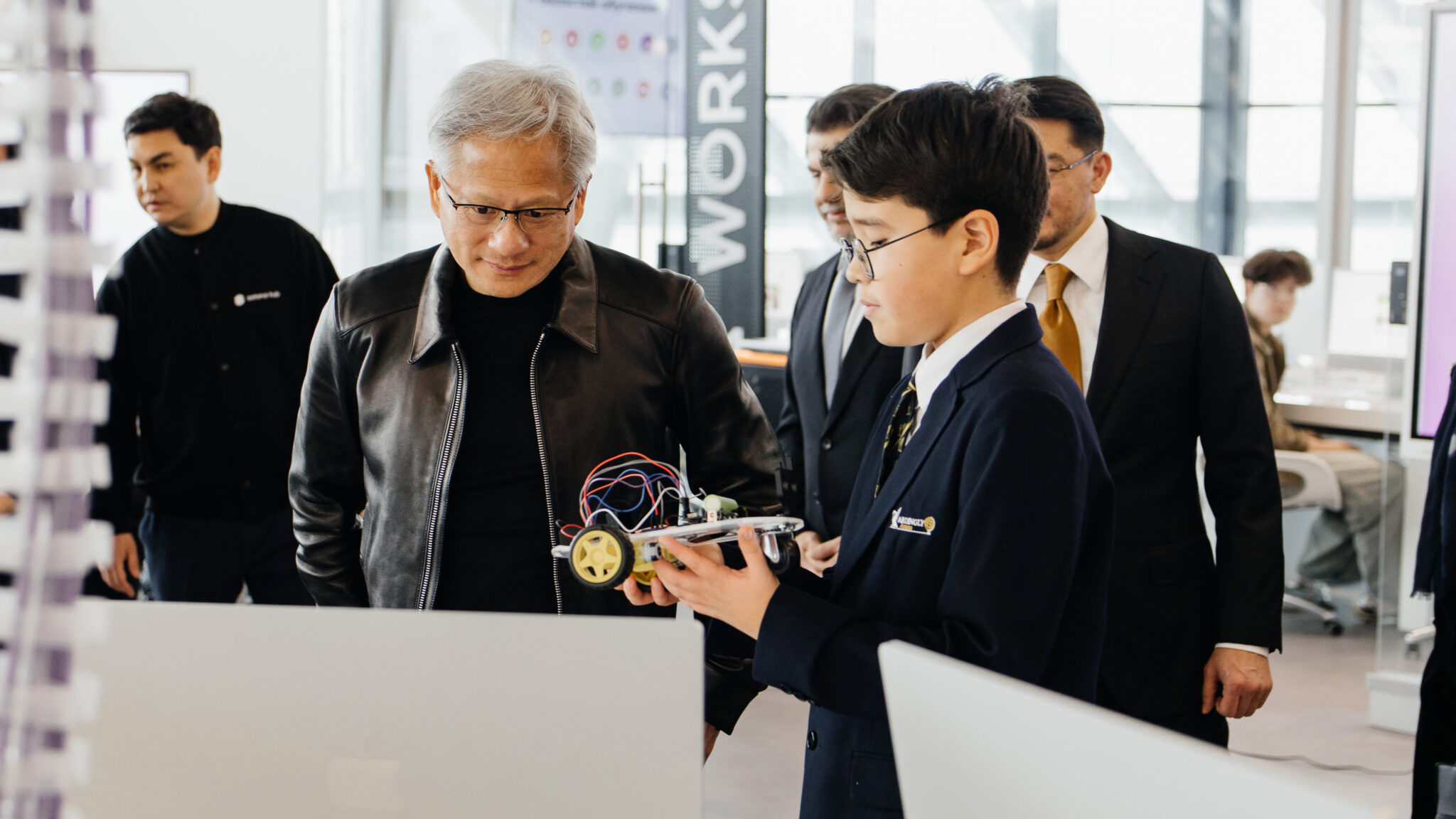
For young people entering a fast-changing field, Huang recommended learning how AI works — not just how to use it. He said aspiring AI programmers should understand the technology’s principles, strengths and weaknesses, combining technical knowledge with the ability to work effectively with AI.
“I envy being 18 years old today… because the world is changing so rapidly, and there’s a complete reset because of technology.”
The Infrastructure Layer Is Scaling
The visits coincided with a signing ceremony marking Firebird’s investment agreement with the government of Kazakhstan, held at the presidential palace.
Building on its first AI factory in Armenia, Firebird is expanding into Kazakhstan, where it has secured a U.S. export license for 45,000 NVIDIA Grace Blackwell GPUs. The first phase is under construction with Kazakhtelecom at Data Center Valley, targeting commercial launch in the third quarter of 2027.
A planned second phase would bring Firebird’s total potential AI infrastructure capacity in Kazakhstan to approximately 500 megawatts. Firebird also plans to establish Firebird Labs Kazakhstan to support local AI startups, research and talent development through funding, access to compute and research partnerships.
Firebird cofounder and CEO Razmig Hovaghimian attended the signing ceremony at the Akorda Presidential Palace alongside government officials.
“What began as a seed of an idea 180 days ago has grown into a major investment in Kazakhstan’s AI future,” said Razmig Hovaghimian, co-Founder and CEO of Firebird. “President Tokayev’s vision gave us the confidence to think bigger about what we can build together. With Jensen Huang here today, that ambition feels more tangible than ever. We’re building the infrastructure for Kazakhstan’s talent and ideas to reach the world.”
Kazakhtelecom, the nation’s largest telecommunications company, has already deployed 400 NVIDIA H200 and 480 NVIDIA B300 GPUs in Astana and Almaty.
Next year, the company plans to deploy more than 1,000 GPUs in the Data Center Valley, along with more than 1,000 NVIDIA Vera Rubin GPUs in the Ekibastuz region, serving diverse workloads with infrastructure that enterprises, developers and institutions can use at scale.
An Honorary Black Belt for Huang
At the end of their meeting, President Tokayev presented Huang with the Order of Dostyk, First Class, for his contribution to the development of artificial intelligence in Kazakhstan. Dostyk means friendship and the Order honors peace, friendship and cooperation.
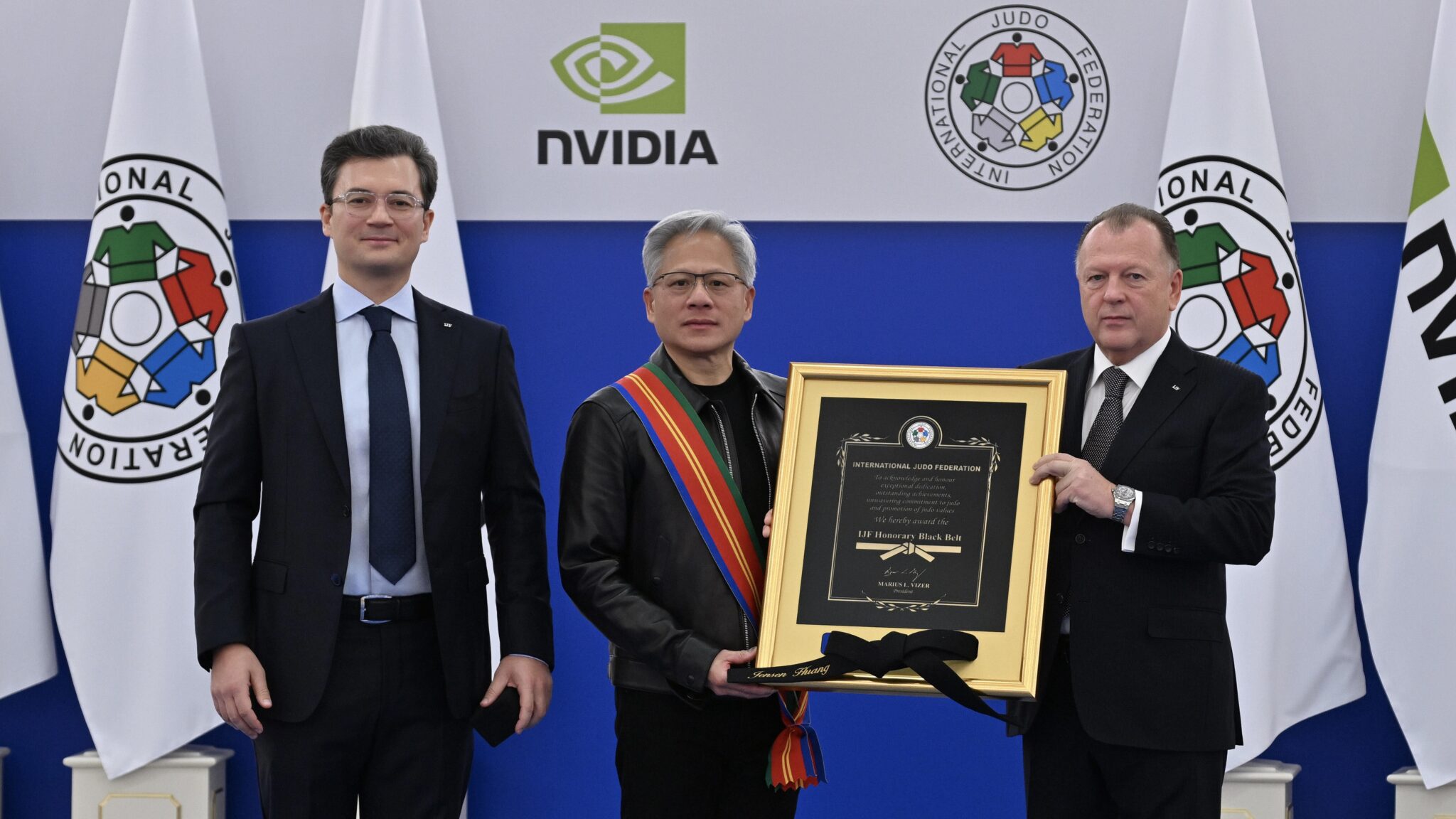
Later that day, President of the International Judo Federation (IJF) Marius Vizer and Timur Kemell, IJF director of promotion and development and a member of the IJF Executive Committee, presented Huang with an honorary black belt in Judo. The belt, embroidered in gold stitching, was a special thanks for Huang’s support of Kazakhstan’s AI ambition and for leadership aligned with the spirit and rigor of the martial art.
AI-Native Companies Scale With Compute
And that development is accelerating. The nation’s AI-native companies are also building out their compute capacity — and the applications that run atop them.
Higgsfield is expanding its AI infrastructure with NVIDIA Vera Rubin running on cloud service providers, giving the company additional capacity as models, products and customer demand for its generative media applications grow.
inDrive and Pony.ai are also collaborating to explore robotaxi services in Kazakhstan, with Astana as the first deployment city. The companies will assess the feasibility of bringing Pony.ai’s seventh-generation robotaxis to the inDrive app, supported by NVIDIA AI infrastructure, built on the NVIDIA Hyperion sensor and compute platform with the NVIDIA Halos safety system.
More local capacity gives developers and companies room to train, fine-tune and serve increasingly capable models. Successful applications, in turn, create demand for more compute.
Kazakhstan’s AI opportunity isn’t defined by GPU counts alone. Connecting that infrastructure with developers, universities, startups and industries can turn accelerated computing into useful applications.
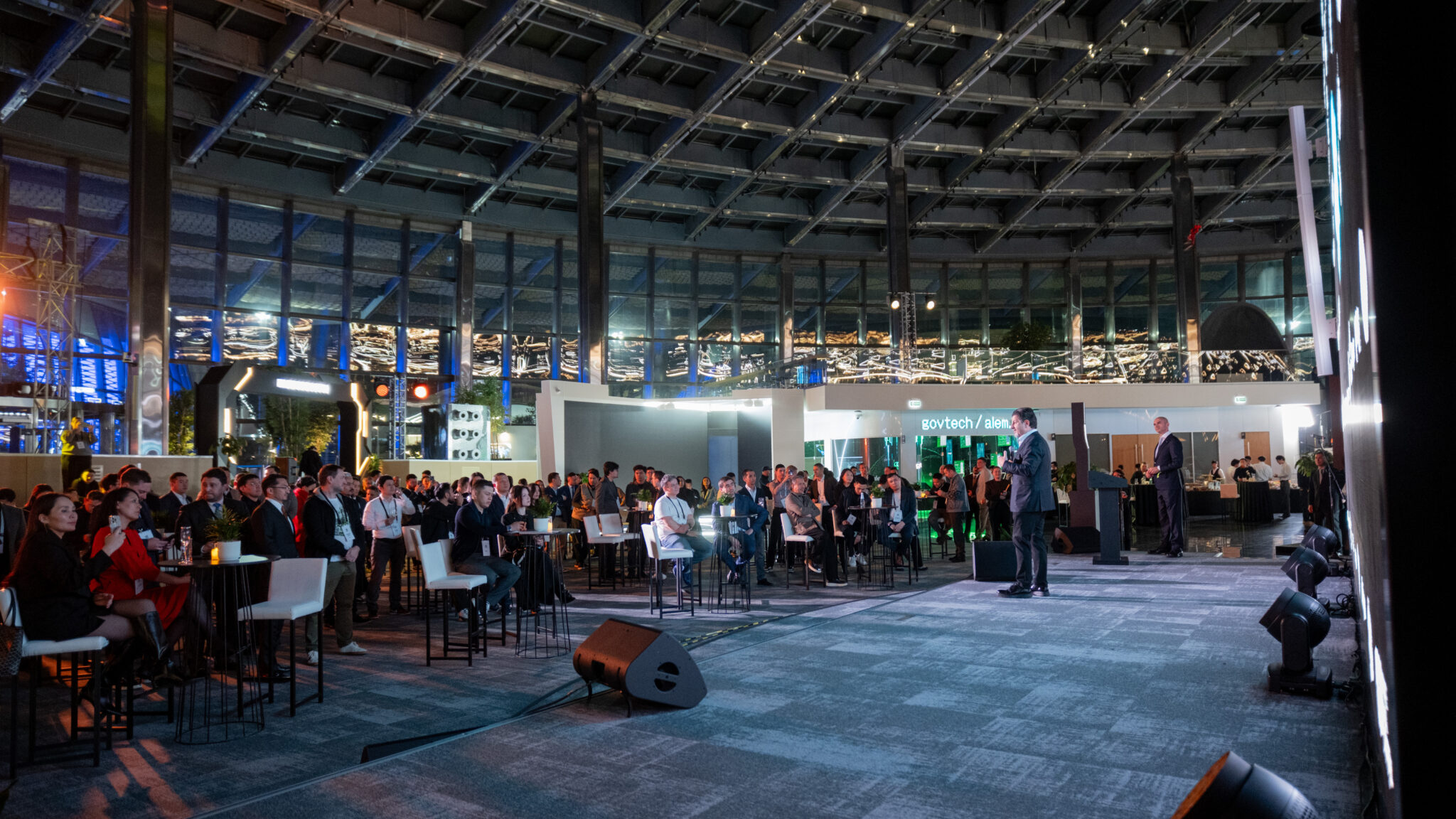
That was at the core of the discussion the NVIDIA team had with hundreds of developers from across Kazakhstan during a reception later in the evening. The gathering in this self-proclaimed AI nation was inspiring because of the ideas shared, the clear drive to build and a collective ambition to share it with the world.
Today’s announcements represent different layers of the AI stack in Kazakhstan— infrastructure deployment, access to compute and AI-native product development — where the AI foundation is reaching new scale.
Watch the fireside chat between Jensen Huang and Deputy Prime Minister Zhaslan Madiyev, streamed live from Alem.AI in Astana.

Watch NVIDIA founder and CEO Jensen Huang’s GTC Berlin keynote in replay.
]]>
Launched today, NVIDIA Minerva is an AIOps platform built to help teams find problems earlier and keep AI factories productive. It brings together telemetry from infrastructure and AI workloads, then applies purpose-built AI models to turn that data into timely, actionable insight.
AI factories are among the most complex operations in the world, with vast numbers of GPUs working across high-speed networks to train models and serve AI applications. At that scale, a single degraded component can slow an entire job. The warning signs may be easy to miss, such as a GPU running hotter than its peers or an NVMe drive losing performance under load.
The platform focuses on AI factory yield, a measure of the useful work infrastructure produces through GPU hours, goodput, cluster uptime and token production.
Delivering a Dynamic View of an AI Factory
Traditional monitoring tools often divide the data center into separate views. Networking, compute, site reliability and machine learning teams each see a different part of the operation. Minerva connects those signals across NVIDIA GPUs, networking, storage, schedulers and workloads.
With these signals, Minerva builds a dynamic knowledge graph that logically maps the infrastructure — GPUs, SuperNICs, switches and cables — and the jobs running on it. This context helps operators trace a slow training job to the component affecting it, even across a factory with hundreds of thousands of GPUs.
It analyzes billions of data points per hour using supervised and unsupervised machine learning. It learns normal behavior, detects previously unseen anomalies, predicts emerging failures and correlates related events based on the factory’s topology. Instead of sending every symptom to an operator, it can group an event storm into a focused incident with a likely root cause.
Minerva comes with a native AI assistant and connects to external agentic AI tools. This adds a natural-language interface grounded in live telemetry. Operators can investigate cluster health and receive recommended remediation through conversation. Teams can keep a person in the loop to manually implement fixes or connect Minerva to automation through infrastructure application programming interfaces and external systems.
Results That Maximize AI Factory Yield
The ability to correlate workload and infrastructure issues along with its agentic AI capabilities help simplify AI factory operations. Instead of dealing with a blizzard of alerts, Minerva aggregates related problems into a single actionable item. This allows AIOps teams to move from reactive to proactive maintenance. And all of this helps AI factories maximize GPU uptime.
Minerva delivers value for the key metrics AI factories focus on:
- Longer time between interruptions: Minerva spots trouble before it happens, so jobs run longer without incident.
- Faster time to repair: When an incident does happen, Minerva pinpoints the problem, leading to a significantly quicker resolution.
- Greater insight: Modern AI infrastructure generates a flood of data; Minerva filters it out, leaving only the handful of alerts that actually matter.
IREN is among the NVIDIA partners using Minerva to optimize its AI factories.
“As we scale our AI factories, the key to providing the best service for our customers is maximizing the productivity of our GPUs,” said Denis Skrinnikoff, chief technology officer of IREN. “NVIDIA Minerva gives our operations team one view across the network, the GPUs and the jobs running on them, so we focus more on proactive maintenance rather than troubleshooting. That visibility strengthens our operating model for the infrastructure we’re building next.”
Joining IREN, Aolani, Bitdeer AI, IBM, Jio, Lambda, Quake AI and Tesla plan to deploy Minerva.
In addition to Dell Technologies, Lenovo and Supermicro will offer Minerva as part of their AI factory operations portfolios.
Learn more about NVIDIA Minerva.
See notice regarding software product information.
]]>
Lock in and load out this GFN Thursday. Call of Duty: Modern Warfare 4 arrives on GeForce NOW at launch, bringing a new campaign, multiplayer action and DMZ, high-stakes extraction mode to supported devices. The campaign also gets an enhanced look: GeForce RTX 5080-class performance arrives for Ultimate members, bringing support for ray-tracing features in the cloud.
There’s a new way to join the cloud, too: Existing supported Fire TV Stick users can now purchase one-month Performance or Ultimate memberships directly through Amazon, making it easier to sign up and start streaming on the big screen.
Plus, Square Enix’s FINAL FANTASY RESONANCE brings cinematic pixel art and strategic battles to the cloud, and The Elder Scrolls Online’s Echoes of Skyrim Season adds the entire Greymoor Chapter free for all ESO Standard Edition owners.
It’s all part of six games joining the GeForce NOW library this week.
Deployment Without the Downloads
Squad up and answer the call on the cloud.
Activision and Infinity Ward’s Call of Duty: Modern Warfare 4 launches today on GeForce NOW. Members can drop into the trenches in Korea, close-quarter combat in New York, high-octane chases through Paris, night raids in Mumbai and city-wide engagements to reclaim occupied territory.
Fight as Private Park, a young South Korean soldier facing live combat for the first time alongside his squad as a routine patrol turns into a desperate fight for survival. Beyond the front lines, operator-turned-outlaw Captain Price is operating outside the system he once served, pursuing revenge through covert missions as the conflict spreads.
Multiplayer pairs precise combat with fluid movement, a dozen core 6v6 maps from around the world and battlegrounds that are shaped by the campaign’s global conflict. The DMZ extraction mode sends players into contested territory to recover valuable technology, weigh objectives and decide when to get out. Loot, fight, negotiate, betray and extract — it’s all fair in the cloud and battleground.
Ultimate members can now experience the campaign with ray tracing, powered by newly added GeForce RTX 5080-class performance across PCs, Macs, handhelds, mobile devices, browsers, supported TVs and more. With game downloads and installs handled by GeForce NOW, members can spend less time preparing a local rig and more time preparing the next loadout.
A New Way to Play

GeForce NOW in-app purchase is rolling out to existing supported Fire TV Stick users, making it possible to purchase a membership directly through Amazon using an existing account. Transactions are processed through Amazon’s billing system, creating a more seamless path from setup to gameplay.
GeForce NOW transforms Fire TV into a powerful PC gaming rig in the cloud. Members can stream supported PC games they already own or purchase new titles from digital stores including Steam, Epic Games Store, Ubisoft Connect, Xbox PC Game Pass, GOG and EA.
The library includes thousands of ready-to-play games, including many of the world’s most-played titles and more than 100 free-to-play games. No downloads, installs, patches or updates stand between a new game and playtime. An Amazon Fire TV Stick, the GeForce NOW app and an Ultimate membership are all it takes to level up the living room with GeForce RTX 5080-powered gaming.
A Pixel-Perfect Fantasy
Classic roots. A new adventure.
Square Enix’s FINAL FANTASY RESONANCE launches today on GeForce NOW, bringing the series’ classic roots into a cinematic pixel-art world.
Travel with companions bound by fate and uncover the truth behind a force threatening to bring everything to ruin. Strengthen the party with Visions of beloved FINAL FANTASY characters, each bringing unique skills and abilities to battle. Dynamic camera angles and pixelized 3D models give familiar fantasy a fresh perspective.
Exploit enemy weaknesses to stagger foes, break their defenses and seize extra turns before finishing the bonus phase with powerful Resonance attacks. Airships, crystals, espers and moogles bring familiar series favorites to a world filled with secrets to discover.
GeForce NOW handles the game’s downloads and storage in the cloud, leaving more space on supported devices for everyday essentials. Save the inventory management for potions and Phoenix Downs.
Step Into a New Season in Tamriel
Familiar lands. Fresh reasons to return.
The Elder Scrolls Online’s second season, Echoes of Skyrim, launched Wednesday, Oct. 21, free for all ESO players and ready to stream through GeForce NOW.
Season Two gives everyone who owns ESO Standard Edition access to its Skyrim content and the Antiquities treasure-hunting system. The Markarth downloadable content follows Monday, Nov. 9, rounding out the additions with two classic zones to explore.
The Season also introduces Solo Dungeons, reimagining challenges previously designed for groups. Moon Hunter Keep and March of Sacrifices have been redesigned and rebalanced for players ready to tackle their dangers alone. Earn new rewards and take on new challenges at your own pace without needing to find a group.
A new Tamriel Tome also launched Oct. 21, offering both free and premium battle pass reward tracks.
In addition, members can look for the following titles joining the GeForce NOW library this week:
- We Were Here Tomorrow (New release on Steam, Oct. 20)
- FINAL FANTASY RESONANCE (New release on Steam, Oct. 22)
- Call of Duty: Modern Warfare 4 (New release on Oct 23, available in the Call of Duty app)
- CONTROL Resonant (Epic Game Store)
- Crimson Desert (Epic Games Store)
- Planet Zoo 2 (Xbox app, supports XBOX Play Anywhere)
Dates listed above reflect when games are released on their respective stores. GeForce NOW availability may vary, as games are onboarded after release and added throughout the week. Keep an eye on GeForce NOW channels and GFN Thursdays for availability updates on announced titles.
Gamers who want to test out high-performance GeForce NOW cloud gaming can start with a day pass to try premium cloud gaming before committing to a membership. Better yet, the cost of the day pass can be applied toward a first monthly membership — making it easy to try GeForce RTX-powered cloud gaming with the latest releases, then level up for more.
What’s on the mission board this weekend? Let us know on X or in the comments below.
]]>At GTC Berlin, banks, payment companies and financial data providers are showing what production-scale intelligence looks like — built on NVIDIA accelerated computing, powered by open weight models and running on their own infrastructure.
Revolut is rebuilding its technology stack on a single foundation model PRAGMA, powered by NVIDIA accelerated computing. Using the NVIDIA cuDF toolkit and Dynamo-Triton software on NVIDIA Blackwell Ultra GPUs, Revolut is scaling PRAGMA in production, servicing an initial 80 million customers and engineered to scale 3x.
“Revolut processes billions of transactions — the opportunity was always there, but the question was whether foundation models could operate at that scale and across domains. PRAGMA answers that,” said Pavel Nesterov, head of AI at Revolut. “Built in collaboration with NVIDIA, it’s the clearest proof yet that the gap between a research breakthrough and a production banking system can be closed.”
Training on Accelerated Infrastructure
Starling Bank, the first bank to train an agentic model on U.K. sovereign cloud infrastructure, has developed “Starling Intelligence” — the intelligence layer that underpins its AI capability — on Civo’s U.K. cloud using the bank’s own transaction data.
Lloyds Banking Group built ATUM, a transaction foundation model that converts billions of banking transactions into reusable intelligence — accelerated with NVIDIA RTX PRO 6000 Blackwell GPUs and improving efficiency across bank-wide use cases.
SBS launched a banking sovereign intelligence platform so banks can run generative and agentic models without their data leaving their own walls.
Open Models at a Fraction of the Cost
Open weight models give European financial institutions proprietary intelligence built on data they own, at costs they control. NVIDIA’s accelerated computing platform is the engine running beneath them.
Neobank bunq’s agentic assistant Finn now runs on open weight models. Powered by NVIDIA accelerated computing, deploying on Nebius matches the quality of leading closed models at 60% of the cost per answer.
NatWest is building technology designed to recognize the full range of British accents, dialects and financial terminology, developed with NVIDIA’s speech models, including Nemotron 3.5 ASR.
Modulr is building specialized models for distinct parts of payment operations, based on the NVIDIA Nemotron-3-Ultra-550B open model.
Santander is an early adopter of the new NVIDIA Kumo family of open weight foundation models for structured financial data, using them to build specialized intelligence for core banking workloads.
Accelerated Computing Transforms Financial Research
LSEG is working with NVIDIA to help financial institutions analyze large volumes of historical tick data up to 10x faster with the Polars GPU engine, accelerated by NVIDIA cuDF on NVIDIA RTX PRO 6000 Blackwell GPUs.
RavenPack built a dataset generation pipeline on Bigdata.com that takes a plain-language research hypothesis and returns a labeled, backtest-ready dataset — running on a fine-tuned NVIDIA Nemotron model. Investors can use these datasets to identify, analyze and visualize market trends.
Speeding Data Pipelines to Improve Fraud Detection
RTX PRO 6000 Blackwell Server Edition GPUs and NVIDIA cuDF help accelerate data processing across multi-terabyte-scale, siloed, regulated sources, compressing the time from data to decision for fraud and other scenarios.
HSBC provides near-real-time client insights that support customer processes and on-demand decision-making while minimizing risk and fraud, powered by 5x faster data processing on Starburst Enterprise’s GPU Engine.
Stripe, a global provider of programmable financial services, sees 42x faster data pipelines and 92% cost savings for its Stripe Radar fraud-detection platform with NVIDIA GPU-accelerated Ray Data in offline testing. This enables Stripe Radar’s machine learning pipelines to continuously optimize model training and improve fraud detection.
Learn more about NVIDIA accelerated computing in financial services.
See notice regarding software product information.
]]>
To help developers rapidly build world models, which help physical AI systems understand and simulate the real world, NVIDIA has expanded the Cosmos platform with new training tools, simulation checkpoints and Cosmos Data Factory blueprints.
Ranking top five on six different open models leaderboards, the NVIDIA Cosmos platform gives world model builders the frontier open models — as well as data, training and optimization tools and recipes — to scale training data, adapt models, test behavior and optimize for performance before deployment.
Build Better Training Data
Building world models begins with multimodal, multisensory data.
NVIDIA Cosmos Data Factory brings together the tools and skills for labeling, curating, augmenting and evaluating data at scale for training physical AI. Cosmos Curator, a GPU-accelerated solution for curating video training datasets, has now added support for multimodal multisensory inputs and processing blocks.
Cosmos Data Factory now offers the following five cloud-native blueprints and is available through GitHub, Microsoft Azure, Nebius and CoreWeave:
- Autonomous Vehicle Dataset Generation: Curates and labels driving data, then adds synthetic examples of hard-to-capture scenarios to expand training coverage.
- Image Attribute Augmentation: Varies object appearance to improve image search.
- Event Video Generation: Turns still images into synthetic videos of rare or unsafe events.
- Defect Image Generation: Generates printed circuit board, metal and glass defect images for inspection models.
- Video Data Augmentation: Changes weather and lighting in existing footage while preserving scene structure.
Cosmos Data Factory accelerates data curation, processing and synthetic data generation with agentic skills.
Companies are already putting Cosmos Data Factory blueprints to work to speed their physical AI development workflows.
Porsche is leading the development of a shared AV data flywheel across Volkswagen Group brands, using Cosmos Data Factory through Voxel51 on Microsoft Azure. This is expected to reduce repeated physical test drives by up to 90% and shorten development cycle times by up to 85%.
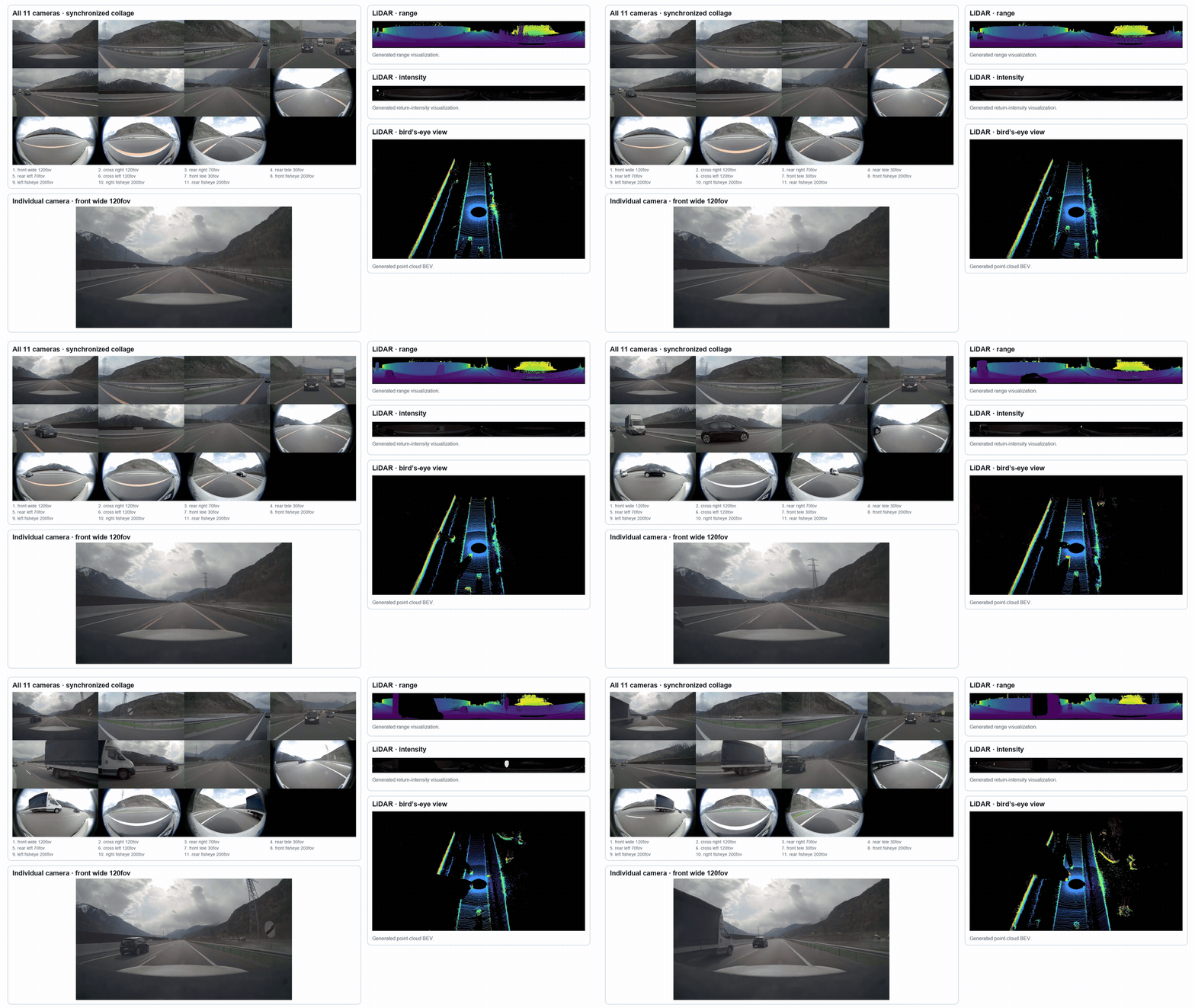
Porsche searching and augmenting autonomous vehicle data footage in Voxel51, powered by Cosmos Data Factory.
ANYbotics generated over 1,500 synthetic video clips with Cosmos Data Factory blueprints, curating real-world data and validating outputs with Encord’s platform, to train its industrial-inspection robots to recognize liquid spills and other changes between facility visits.
ANYbotics generating anomaly clips with Encord powered by NVIDIA Cosmos Data Factory.
Ultralytics, a computer vision company, retrained its YOLO model with real images and targeted synthetic defects generated using Cosmos Data Factory, improving defect localization and recall.
Train, Adapt and Optimize Models
With training data prepared, developers may train their own architecture or start with a pretrained model.
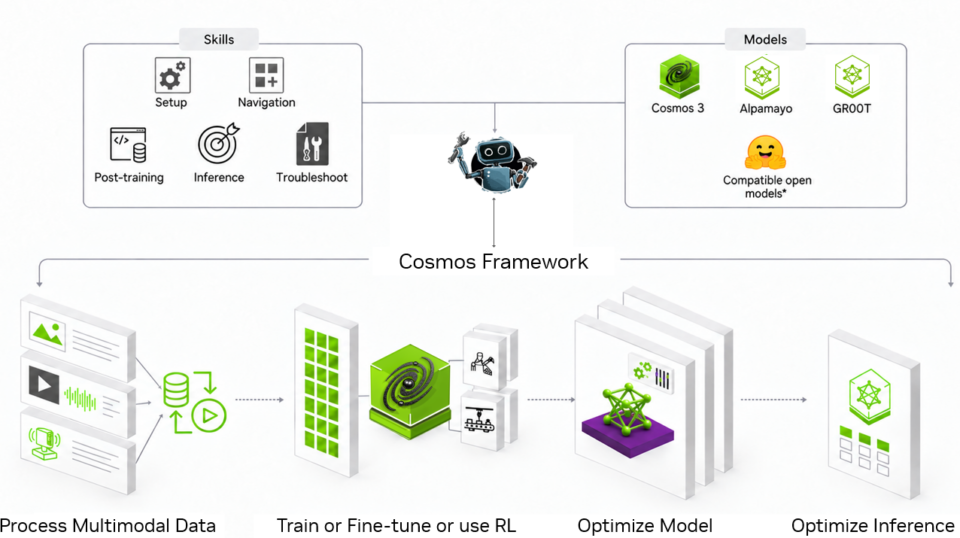
At GTC Berlin, NVIDIA extended Cosmos Framework training, optimization and deployment tools and recipes as agent skills to more open models, along with Cosmos 3, giving world model builders a faster path from experimentation to deployment.
Developers and agents can now adapt open models like GR00T, Alpamayo, QWEN, Pi0.5 and other compatible Hugging Face models through fine-tuning and reinforcement learning, optimize the model with distillation and quantization, and deploy with high-performing inference.
To develop a world model specialized for egocentric manipulation, robotics research lab MicroAGI post-trained Cosmos 3 on videos of humans manipulating objects and distilled its 32-billion-parameter reasoner down to an 8-billion-parameter Nano model with no loss in accuracy.
Developers can label data and post-train Cosmos 3 on Roboflow for their specific environments and tasks, then deploy those models to RoboFlow hosted or on-premises NVIDIA GPUs to bring video reasoning into factories and warehouses.
Test Policies and Run Models Faster
Alongside these tools, NVIDIA continues advancing foundational technology through its work on Cosmos models.
New Cosmos 3 Nano model variants for simulation enable developers to test autonomous policies in repeatable, hard-to-capture, multiview multisensor scenarios. Accompanying code allows developers to adapt the models to train and evaluate their own policies for autonomous vehicles and bimanual robots in interactive simulations before real-world testing.
Developers can deploy core Cosmos models using updated NVIDIA Cosmos 3 NIM microservices, which deliver up to 2x faster inference with no quality loss in validated configurations, while continuous video analysis enables sub-second alerts.
For vision AI developers, the new NVIDIA Metropolis Blueprint for video search and summarization (VSS) 3.3, built on Cosmos NIM microservices, turns one prompt into an efficient video AI application and helps teams monitor 40% more video streams with the same GPU.
ADNOC uses Fogsphere’s MistIQ agentic platform, built with Cosmos and the NVIDIA Metropolis VSS Blueprint, to detect safety hazards in real time across 65 sites. For rare events, Fogsphere also uses the Cosmos Data Factory to generate synthetic training data, improving detection without needing to physically stage dangerous situations.
The Cosmos platform is fully modular and open. Developers can use Cosmos Data Factory to generate training datasets, Cosmos Framework to train and adapt world models, then deploy supported Cosmos models through NIM microservices.
]]>
Companies around the world are building on the NVIDIA DSX AI Factory Platform to plan, simulate and run the grid and the AI factory as one system, from the substation to the rack. Their adoption of the platform responds to an acute problem.
Power is now the biggest bottleneck in infrastructure. More than $300 billion in equipment is backlogged, and over 200 gigawatts of projects are waiting in U.S. interconnection queues.
One root cause of the bottleneck is siloed systems. The grid, the facility and the compute inside have long been designed independently from one another, creating the conditions for delays, risk and stranded capacity.
To help address this, NVIDIA DSX brings these systems together:
- NVIDIA DSX Sim and SimReady assets from leading energy manufacturers let engineers simulate the grid, substation and AI factory together, validating generators, switchgear, power systems and cooling before breaking ground.
- NVIDIA DSX Flex syncs AI factory demand with grid conditions and onsite generation, turning AI factories from static loads into flexible grid assets.
- NVIDIA DSX MaxLPS and DSX Exchange squeeze more compute from every watt and securely share signals across compute, networking, energy, cooling and operations.
GE Vernova is deploying its grid-to-facility and rack power expertise to complement NVIDIA DSX systems, enabling customers to transform power constraints into competitive advantages while maximizing compute and token output, sustainability and grid reliability.
Hitachi Energy’s battery energy storage system has qualified as NVIDIA DSX Ready, helping customers identify power infrastructure that meets applicable NVIDIA DSX reference architecture design requirements for resilient, reliable and scalable AI factories.
Schneider Electric, together with AVEVA and ETAP, is advancing NVIDIA DSX with validated NVIDIA Vera Rubin power and cooling reference architectures and an NVIDIA Omniverse-powered AI factory digital twin.
Combining AVEVA’s engineering software expertise with NVIDIA SimReady assets, OpenUSD and Omniverse enables connecting simulations, real-time operational data and AI-driven optimization across AVEVA, Schneider Electric and third-party solutions. Together, these capabilities help organizations design, simulate, operate and optimize data centers across their lifecycle, improving energy efficiency and workload performance while accelerating time to token.
Siemens Energy is expanding its collaboration with NVIDIA by developing a reference design for resilient, scalable and grid-aware power infrastructure across power generation, transmission and distribution. This design is aligned with the requirements of the NVIDIA DSX Vera Rubin AI factory design. The company is also exploring usingNVIDIA technologies such as RAPIDS, Metropolis and Isaac Sim for its Noedra digital twin platform, evaluating how the technologies could enhance grid infrastructure monitoring, identify emerging risks and support unplanned outage prevention.
Phaidra integrated DSX Flex, DSX Max-Q and DSX Exchange into its self-learning agents, optimizing cooling and power allocation to maximize tokens per watt, improve grid flexibility and deliver about 10% more compute within the same power envelope.
Emerald AI integrated its Conductor platform into DSX Flex to help utilities tap underused grid capacity, an approach modeled to unlock up to 100 gigawatts on the existing U.S. grid.
Explore the NVIDIA Omniverse DSX Blueprint and the Vera Rubin DSX AI Factory Reference Design. Learn more from NVIDIA and energy leaders who are accelerating power-flexible AI factories to strengthen the grid at GTC Berlin.
Visit Hitachi Energy (booth 7004, hall 7), Schneider Electric (booth 3041, hall 3) and Siemens Energy (booth 3048, hall 3) and tune into sessions with Schneider Electric on Wednesday, Oct. 21: From Grid to AI: Engineering the Future of AI Factories and Energy Intelligence: Powering the AI Era.
]]>
European retailers are using open models and physical intelligence across use cases — from a commerce platform cutting inference costs by 90% to to a fulfillment center where collaboration of different robotic fleets is simulated inside a digital twin.
Frontier Results With Open Models
Retail leaders and technology companies across Europe are using NVIDIA-accelerated open and frontier models to advance agentic commerce, digital product discovery and retail R&D.
Shopify post-trains open models to reach frontier-level accuracy at a fraction of the cost. Its engineers use the NVIDIA Megatron Bridge library for faster fine-tuning and NVIDIA NeMo RL for reinforcement learning. Shopify has post-trained NVIDIA Nemotron 3.5 Lightning for the GraphQL subagent integrated into Sidekick, Shopify’s AI assistant for merchants. The subagent retrieves store data for several Sidekick features, including Sidekick Pulse, which researches a merchant’s store and recommends ways to improve it.
On Shopify’s internal benchmark, the post-trained model surpasses a leading frontier model in accuracy while cutting serving costs by 90% and delivering responses 7x faster. Beyond Sidekick, NVIDIA CCluster vLLM inference optimization software helped Shopify achieve 4.5x faster performance and up to 12x lower inference cost across five additional use cases: catalog enrichment, merchant assistant, e-commerce shopping simulation, product taxonomy classification, and merchant and buyer recommendations.
Zooplus, Europe’s leading online pet retailer, with Infosys and NVIDIA technologies rebuilt its product discovery stack for the agentic era. A production ready prototype deployed inside Zooplus’ Amazon Web Services (AWS) environment achieved 86% search accuracy using the NVIDIA Nemotron Retriever library for semantic search and the NVIDIA Blueprint for retail catalog enrichment for generated, search-ready product attributes.
Photoroom results from its deployment with Vestiaire Collective, where its Image Editing API now standardizes every primary image, about 40,000 a day across 70 countries, at the point of listing. Listings processed by Photoroom sold at a 5% higher rate of liquidity, with 3% to 7% more unique views per product page. The pipeline runs on NVIDIA GPUs with TensorRT and Triton Inference Server, and NVIDIA Dynamo Snapshot can help users quickly respond to demand spikes.
Omi launched ProductDrop, a workflow that anchors every generated image to an approved digital twin, letting brands scale creative output across entire catalogs without introducing product errors. L’Oréal is using this approach, combining Omi’s digital twins with generated brand environments within its CreAItech program. Omi runs TRELLIS 3D asset generation on NVIDIA RTX PRO 6000 Blackwell Server Edition GPUs, speeding up inference by 10x and reducing pipeline latency by 4x.
In addition, L’Oréal is accelerating the discovery of the best ingredient combinations, moving from months of experimentation to hours of computational screening, with the integration of NVIDIA ALCHEMI into its research workflow.
L’Oréal is also testing this approach with CurieOS, Orbital Industries‘ operating system for science and engineering, using OrbMol-v2, its open source molecular simulation model. Integrated with the NVIDIA ALCHEMI Toolkit and powered by NVIDIA accelerated computing, OrbMol-v2 is five times faster than comparable models and delivers 21% lower error than the next-best model of its kind. This AI-based workflow enables researchers to identify the most promising ingredient combinations for solubilizing UV filters and optimizing performance before committing to laboratory testing.
Mirakl, a software company for intelligent commerce, runs open models on NVIDIA GPUs, both on its own infrastructure and through European cloud providers like Scaleway. This keeps its technology sovereign, avoids vendor lock-in and delivers the speed and scale its customers expect. Mirakl’s Catalog Transformer pairs fine-tuned open models with proprietary services and has onboarded more than 70 million products, turning messy vendor data into accurate, well-organized catalogs.
Physical Intelligence Enables Training in Simulation
NVIDIA physical AI, digital twins and open models help simulate retail environments, automate warehouse operations and deliver virtual try-on experiences for European retailers and fashion brands.
Otto Group advanced its autonomous warehouse under human supervision initiative — built with Reply on NVIDIA Omniverse libraries and running on Google Cloud — to the group’s largest fulfillment center in Haldensleben, Germany. New capabilities let logistics teams design, test and optimize warehouse operations entirely in simulation before any physical implementation.
ALLSIDES launched its 3D Digital Twin Factory: an automated pipeline that transforms physical objects into SimReady 3D digital twins in minutes, capturing sub-millimeter geometric accuracy, measured physical properties and fully relightable materials that maintain accuracy under any lighting condition. Those digital twins serve as the foundation for simulating entire store layouts in 3D, as well as for tracking products reliably throughout the shopping journey and at checkout regardless of ambient light. Built on NVIDIA CUDA, OptiX and TensorRT, the platform already serves brands including adidas, Amazon, Nike, Zalando and Zara.
CATCHES achieved production results from its RealFit deployment with AMIRI of conversion up 55%, add-to-cart up 80% and gross sales up 56%, all after seasonal adjustment against like-for-like styles. The company launched PredictiveFit, extending physics-based virtual try-on to retailers, as well as CASI, a personal fashion agent that shops, styles and sizes for customers over WhatsApp, powered by open weight models including NVIDIA Nemotron 3, built on NVIDIA Omniverse and the Newton Physics Engine.
Explore New NVIDIA Retail Blueprints at the Nebius Booth
At GTC Berlin, Nebius is showcasing three NVIDIA Blueprints for retail, all available in early access and running on Nebius infrastructure, accelerated by NVIDIA:
- Agent Harness for Employee Productivity: An agentic assistant that consolidates scheduling, task management, inventory alerts and operational insights for store managers.
- Inventory Simulation and Optimization: A blueprint that can help retailers reduce overstock and stockouts by modeling demand scenarios, testing replenishment strategies and optimizing stock levels before users need to commit in the real world.
- Agentic Finetuning Flywheel: A self-improving loop that uses agentic workflows to continuously generate training data, fine-tune open source models and feed real-world performance back into the next training cycle.
Request early access to the blueprints and learn more about NVIDIA technologies for retail and consumer packaged goods.
See notice regarding software product information.
]]>
Weather forecasts shape more than daily plans; timely weather information is crucial for energy producers, insurers and transport operators to plan around changing conditions. A global forecast can show a storm taking shape, but decisions about solar farms, shipping routes or insured property depend on what happens locally.
NVIDIA Earth-2 gives developers and researchers a family of open AI models and tools they can customize with their own data. Running on NVIDIA computing, these technologies support global weather prediction, detailed regional forecasts and environmental research.
StormScope EU is the latest model to join Earth-2 — a regional version of the StormScope model for short-term forecasting, trained over Europe weather and climate data. It uses EUMETSAT satellite observations to predict evolving cloud conditions across 16 Meteosat channels at 10-minute intervals.
At GTC Berlin, NVIDIA is showcasing a live StormScope EU pipeline in an interactive weather demo built in partnership with Earthmover. The demo uses Earth2Studio to run forecasts and Earthmover’s data platform to manage and serve the real-time results, which are updated as soon as new satellite observations come in, every 10 minutes. Earthmover serves these results as map tiles, letting visitors explore predictions across Europe without downloading entire datasets.
Developers can combine Earth-2 models in workflows tailored to regional needs, using StormScope for short-term forecasting and CorrDiff to add local detail to coarser weather data. Developers can also pick up these model architectures and train them for new environmental applications such as air-quality modeling. The open source NVIDIA PhysicsNeMo framework provides training and customization tools so teams can build applications that incorporate proprietary data and domain expertise to meet regional needs.
Organizations building on Earth-2 capabilities include:
AXA is using NVIDIA Earth-2’s FourCastNet 3 to study regional cyclone risk beyond the historical record across more than 1,000 simulated seasons, generating insights that can inform risk assessments and help customers target prevention efforts.
Vaisala Xweather is combining Earth-2 with its proprietary observations, lightning data and forecasting expertise to enhance its weather intelligence platforms for government, energy, maritime, transportation and insurance customers. Its work includes adapting StormScope with lightning data to advance short-term forecasting lead time and make these warnings accessible through Vaisala Xweather’s software-as-a-service offerings and AI-assistant integrations.
Video courtesy of Vaisala Xweather.
University of Manchester researchers adapted the Earth-2 CorrDiff model for U.K. air-quality modeling. It trained the model on the NVIDIA-powered Isambard-AI supercomputer and ran it locally on NVIDIA DGX Spark systems, bringing environmental modeling from a national supercomputer to the desktop.
TotalEnergies is exploring NVIDIA Earth-2 for solar-energy forecasting, evaluating StormScope-based solar-radiation nowcasts at two photovoltaic sites and developing models to provide weather information at subhourly intervals. The work explores how more detailed forecasts could help anticipate changes in solar-power generation.
Space42 developed SARDiff4Height using CorrDiff and NVIDIA PhysicsNeMo. The research estimates surface heights from a single radar image and produces uncertainty maps, helping analysts understand where estimates need closer scrutiny.
Explore NVIDIA Earth-2 open models and tools, and explore with Earth2Studio’s forecasting examples. Read AXA’s hurricane-risk case study and Manchester’s air-quality story to learn how teams are adapting weather AI to specialized challenges.
]]>
Governments need modern solutions to serve the public while keeping sensitive information under their control.
Open models provide a path forward, letting governments evaluate them, adapt them to local languages and public services, run them on infrastructure they control, apply their own safeguards and keep sensitive data within controlled environments. Some open models go further, with the datasets they were trained on published so governments can verify if training data was licensed, biased or compliant.
NVIDIA partners and European governments are teaming to bring advanced models to boost the efficiency of public administration while retaining control of data and infrastructure.
Several are also building editions of the NVIDIA Nemotron-Personas collection, the partner-grounded datasets behind NeMo User Sim, NVIDIA’s open source library for population-scale user simulation that dynamically evaluates and trains models and agents in local languages.
European Commission: Scaling Governed AI Applications
Berlin-based software company deepset is expanding its Haystack Enterprise Platform, the foundation of AI@EC, the European Commission’s shared platform for building and running AI applications on commission-managed infrastructure.
The update connects agent development, execution, optimization and governance for all customers, adding capabilities to compare operating costs, evaluate answer quality and trace problems.
NVIDIA Triton Inference Server supports the shared services used to find and rank relevant information. The expansion builds on operating requirements demonstrated by deployments such as AI@EC, where reusable components, role-based access, audit trails and guardrails support applications including document summarization, knowledge management and multilingual policy analysis.
Poland: Advanced Computing for Healthcare and Employment
Deloitte is helping Poland build agentic systems for healthcare and employment services using open models.
Poland’s eHealth Centre is building its Intelligent Services Platform for medical imaging with NVIDIA DGX BasePOD and the MONAI framework. The tool will help physicians analyze X-rays, CT scans and MRI images, detect abnormalities and prioritize urgent cases, reducing the time patients wait for results.
With Deloitte’s support, Poland’s Ministry of Family, Labour and Social Policy is developing an agentic factory on NVIDIA accelerated computing infrastructure. Designed to support more than 400 labor offices, it will run models including PLLuM, GPT OSS and Inkling for document search, summarization and digital assistants, helping staff more efficiently assist job seekers.
NVIDIA is also working with SpeakLeash in Poland and the University of Ljubljana in Slovenia on country-specific additions to its synthetic personas program, with localized datasets planned to follow.
UK: Data for Locally Relevant Advanced Modeling
London-based Locai Labs released Nemotron-Personas-UK, a dataset of 1 million synthetic personas reflecting the U.K.’s demographic and geographic diversity while reducing privacy risk. Potential uses include healthcare evaluation and bias testing across age groups, education levels and rural and urban populations. For developers building public-service models, it offers a way to test whether models work consistently across different communities.
Germany: Digital Assistants and AI for Classified Work
In Germany, Materna is introducing Sinfonie, an on-premises platform combining generative AI, voice interaction and 3D avatars, with NVIDIA Audio2Face available for animation. Built on a project for a German state administration, it helps employees access institutional knowledge through spoken questions while keeping data on their organization’s infrastructure.
For organizations handling classified information, secunet, NVIDIA, Red Hat and deepset are going a step further. The four companies are developing a sovereign cloud offering built on secunet’s proven SINA Cloud foundation, which includes security components that have been authorized for use with classified information. The planned offering combines four components: NVIDIA accelerated computing and NVIDIA Nemotron open models; Red Hat OpenShift AI for deploying and managing AI workloads; deepset’s Haystack AI agent orchestration; and infrastructure operated by secunet in German data centers.
To support local development, the Sovereign Open Source Foundation Models research initiative (Soofi) is developing a family of AI models for German industry and the public sector. That includes Nemotron-Personas-Germany, an open dataset of 1 million records, each with six synthetic personas, grounded in the 2022 census across all 16 federal states and 400 districts. Created with NVIDIA NeMo Data Designer without real people’s private data, the dataset helps developers test whether public-service models work consistently across regions, age groups and communities. Like the U.K. edition, it can be used with NeMo User Sim so developers can evaluate and train models against simulated users based on synthetic German personas.
France: Advanced Open Models in the Public Sector Workspace
CANUT, France’s public purchasing body for digital services, selected LINAGORA and Docaposte to provide a sovereign collaborative workspace built on Twake.ai.
More than 2,500 eligible organizations, including municipalities, schools and healthcare institutions, can access the framework without running their own tender. The workspace offers public employees email, document sharing and collaboration tools, with NVIDIA technology supporting speech transcription and infrastructure hosted in France. Région Occitanie is the preferred partner for scaling deployment.
Greece: A Local Agentic Ecosystem
Greek AI and energy company KIEFER is developing an agentic factory built on NVIDIA DGX SuperPOD with DGX GB200 alongside Sophea open weight models and Greek-language tools for knowledge retrieval, speech and digital assistants. These capabilities stand to make institutional information easier to find and use for Greek-speaking public sector teams, while giving organizations control over where agents run and how data is handled.
Codefest: Building the Next Applications
In an effort to support public sector organizations in integrating agentic AI in Europe and beyond, NVIDIA Open Models Codefest brings together startups, software providers and labs across the region to turn open models into locally controlled solutions for public sector challenges, including medical reasoning, AI tutoring and model governance. The top five teams are Pleias, Zehnlab.ai, Disseqt, Algoritmica GmbH and ABA Technology. Deutsche Telekom and T-Systems have provided the compute infrastructure for teams to train and deploy large language models.
Learn how NVIDIA helps governments and communities accelerate secure advanced modeling and agent creation.
See notice regarding software product information.
]]>
At GTC Berlin, NVIDIA is showcasing its full lineup of local AI hardware. RTX Spark, which launched last week, powers personal agents on Windows PCs; DGX Spark supports developers building and scaling applications on Linux; and DGX Station serves enterprise teams running frontier workloads on Linux, with a Windows version arriving in December.
Announcements include:
- Underdog Desktop Agent now available for RTX Spark
- DGX Spark 64GB available on Friday, Oct. 23
- NVIDIA Sync to support eight DGX Sparks and add Model Launcher this month
- October DGX Spark software update adds Wi-Fi Assistant and updates DGX Spark Skills
- DGX Station improves manageability with seven new integrations
- DGX Station for Windows launches in December with support for many manufacturing apps and agent harnesses
- Three new open source reference workflows for robotics on DGX Station
- NVIDIA Cloud Functions is coming in early access to DGX Station
- Recursive Flint, a new local coding model, is now available for NVIDIA local hardware
- Day-0 support for new Nemotron, GLM, DeepSeek, Qwen, MiniMax and FLUX.3 AI models
- New accelerations for llama.cpp and vLLM inference engines and a new collection of checkpoints optimized for local AI hardware.
Learn more about these local AI announcements below, and check out the demos and sessions at GTC Berlin.
RTX Spark Brings Personal Agents to the Windows PC
RTX Spark is a new beginning for the PC — running personal agents, accelerated content creation and 1440p 100 frames-per-second gaming with up to 128GB of unified memory and 1 petaflop of AI compute.
Here’s what early reviewers are saying about the platform since its October 16 release:
“A dream machine for serious creators … ” — CGMag
“Designed for the future of AI … ” — The Verge
“An extremely capable, surprisingly portable and efficient machine … ” — PCMag
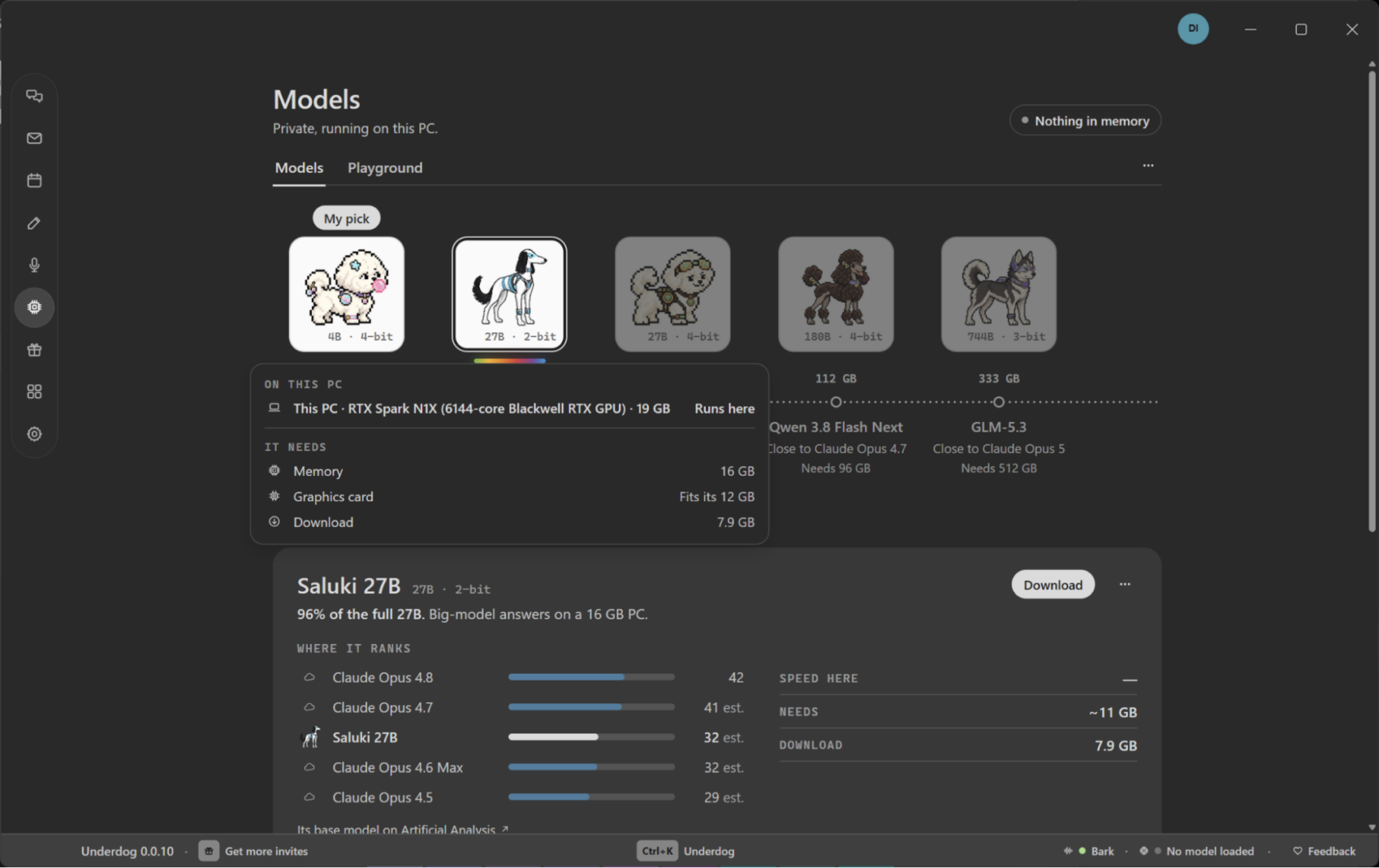
Underdog, a new desktop agent app built for fully local, private AI, is also bringing its experience to RTX Spark. Powered by its Husky model-specific inference engine, Underdog runs models entirely on device, so personal agents can get work done without user data ever leaving the PC. Underdog is available now for download.
To better enable developers and enthusiasts to build and customize local agents, many RTX Spark laptops come with an unlocked bootloader.
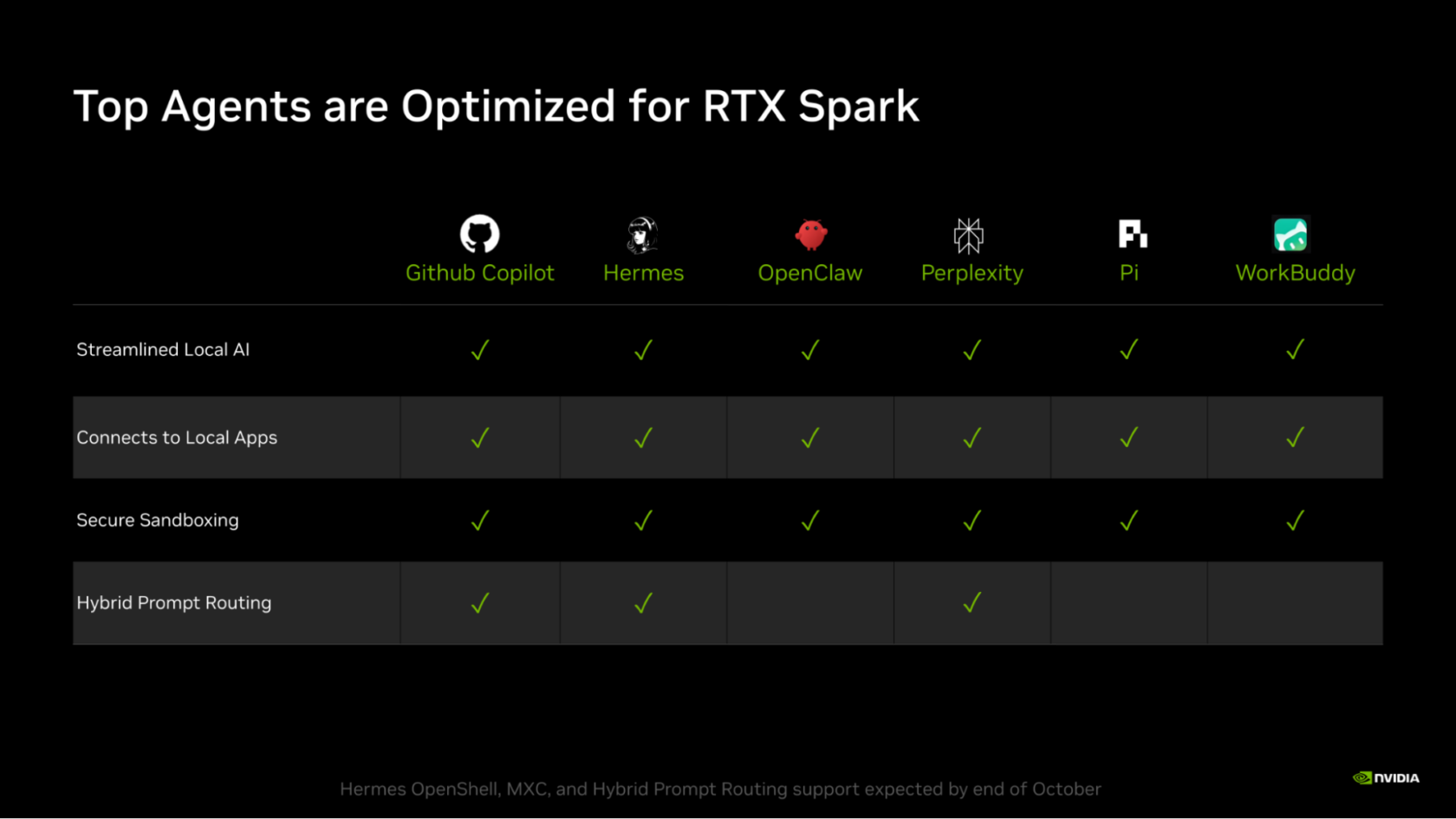
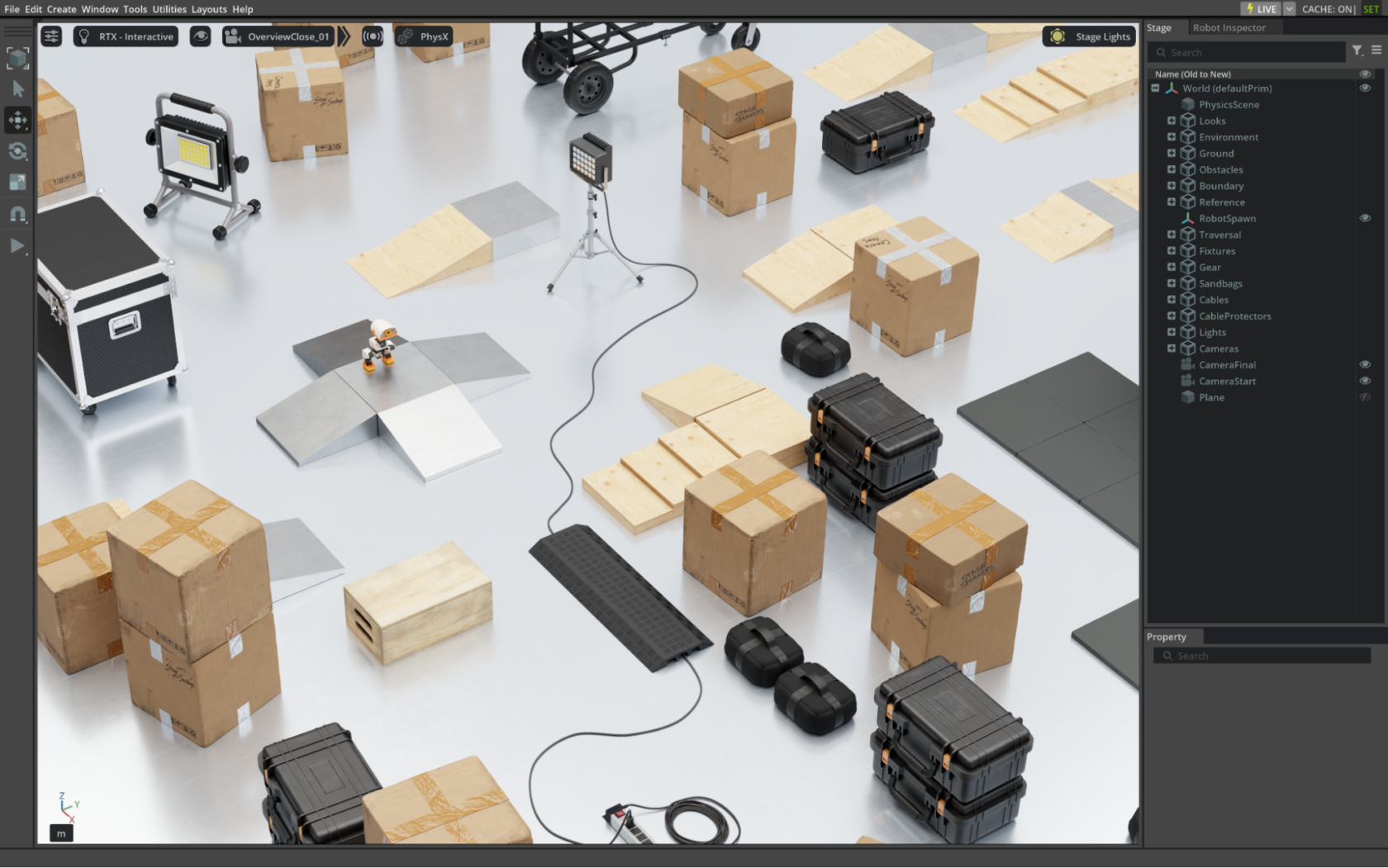
During the GTC keynote, NVIDIA founder and CEO Jensen Huang showed off how AI agents running on RTX Spark can be used to train Hugging Face’s Microduck robot using NVIDIA Isaac Lab, Hermes Agent and Nemotron 3.5 Bolt 74B.
ASUS, Dell Technologies, HP, Lenovo, Microsoft and MSI laptops are available today, with Acer coming soon.
Learn more about RTX Spark, and get started with the latest RTX Spark playbooks.
DGX Spark Gives Developers Room to Build
New DGX Spark 64GB systems — that can run models including Nemotron 3.5 Bolt 74B 24GB, Qwen3.8 27B and Gemma 4 26B-A4B — start rolling out from partners on Friday, Oct. 23.
When workloads require more capacity, developers can connect multiple DGX Spark systems via built-in NVIDIA ConnectX-7 networking and NVIDIA Sync Cluster Assistant. This allows users to run advanced coding models like Qwen 3.8 Flash Next, DeepSeek v4 Flash 0731 and GLM 5.3 Flash.
Now, DGX Spark supports clusters of up to eight units in manual configuration, enabling larger models, longer contexts, concurrent agents and distributed development. Ideal for small teams sharing a single cluster as a backend, with each developer running concurrent sessions against the same model, it delivers 1TB of unified memory — enough to run frontier-class models like GLM 5.3.
Get started with the DGX Spark cluster playbook.
NVIDIA Sync Model Launcher will also be available later this month. It simplifies access to local AI on a single DGX Spark or a cluster. With a few clicks, Model Launcher downloads a model and container suited to the configuration and connects the model to OpenCode. It automatically loads DGX Spark Skills for troubleshooting, device maintenance, access to official documentation and other workflow guidance.
The October DGX Spark software update brings a new Wi-Fi Assistant that lets users switch networks when DGX Spark is running in appliance mode. Plus, DGX Spark Skills provide workflow-focused guidance in troubleshooting and device maintenance directly into NVIDIA Sync via OpenCode.
DGX Spark systems are available directly from Acer, ASUS, Dell Technologies, GIGABYTE, HP, Lenovo, MSI and NVIDIA.
DGX Station Puts Frontier Intelligence at the Desk
For larger teams, DGX Station offers 748GB of coherent memory and up to 20 petaflops of AI performance, enabling developers to run advanced models like GLM 5.3 and serve 30+ users at speeds comparable to those provided by cloud models. Adding scale, NVIDIA Sync now supports DGX Station, simplifying connections between two Linux-based systems.
New integrations with Absolute Security, Splunk by Cisco, Fleet Device Management, Microsoft Intune, Perforce Puppet, Progress Software Chef and Tanium let IT teams manage DGX Station systems through enterprise setup, management and conformity processes, helping accelerate approvals and reduce deployment risk while minimizing time to first token.
With the upcoming Windows-based systems, developers can build workflows that harness professional applications, run on NVIDIA RTX PRO GPUs and operate from agents that run their large language models (LLMs) on NVIDIA GB300 systems — all in one machine.
DGX Station for Windows, expected from system manufacturer partners in December, extends local AI into the applications and operating environment enterprises already use. Engineers can run local models and agents in Windows-native software with access to AI models, tools and agents on the same system.
DGX Station for Windows will feature support for manufacturing applications from nTop, Dassault Systèmes, Keysight Technologies, MathWorks, Rockwell Automation, Siemens, Synopsys, Unity and Altera for AI-guided design, simulation, validation and engineering automation. Users will be able to run agents using Hermes Agent, Perplexity or Aible on premises for agentic control in enterprise environments.
The same local, controlled computing model extends to robotics. DGX Station gives robotics teams dedicated compute for post-training, simulation and evaluation, shortening iteration cycles without waiting for shared infrastructure.
NVIDIA released three open source reference workflows that bring GPT-6 Astra, NVIDIA Isaac Lab, Isaac Lab-Arena and Cosmos to NVIDIA DGX Station. Developers can use them to refine GR00T 1.7 models with reinforcement learning, train dexterous manipulation skills and post-train Cosmos world models for synthetic data generation.
NVIDIA Cloud Functions is coming in early access to Linux-based DGX Station. Teams can register local model endpoints in a shared catalog and access them through one OpenAI-compatible entry point.
Developers can upgrade the model behind an endpoint without changing application code, while teammates can use shared models without direct machine access. This turns a DGX Station into a locally controlled inference service for a team.
DGX Station brings local iteration to AI factory development. On the show floor at GTC Berlin, NVIDIA is previewing DSX OS running on DGX Station to simulate AI factory operations before full infrastructure is available. Another demo will showcase DGX Station systems powering a local token factory for more than 30 software developers.
DGX Station systems are shipping today from ASUS, Dell Technologies, GIGABYTE, HP, MSI, Supermicro and Exxact. DGX Station for Windows systems are expected to begin shipping later this year from ASUS, Dell Technologies, GIGABYTE, HP, MSI and Supermicro.
Introducing Recursive Flint — A New Local Coding Model Optimized for RTX Spark
Today, frontier AI lab Recursive Superintelligence released Recursive Flint, a local LLM built for fast, accurate coding. A 40-billion-parameter mixture-of-experts model with 2.5 billion active parameters, Recursive Flint delivers fast inference and performs well in agentic coding benchmarks like SWE-Bench Pro v2, Terminal-Bench 2.1 and SWE-bench verified.
Recursive Flint was built using Recursive’s Eureka Machine, a system for large-scale automated AI research. It automates the full research loop: proposes ideas, implements them, runs experiments to validate ideas and uses the results to decide what to try next — creating specialized kernels that boosted Flint’s generation speed on RTX Spark by 55% without changing the model’s weights.
Developers can download the open weights on Hugging Face under the Apache 2.0 license and run the model on RTX Spark and DGX Spark systems, as well as GeForce RTX and RTX PRO GPUs. Developers can also post-train the model with NeMo Automodel for supervised fine-tuning and low-rank adaptation, or LoRa, as well as NeMo RL for group relative policy optimization.
New Models With Day-Zero Support
NVIDIA is also adding day-zero model support for NVIDIA Nemotron Bolt E4B 4B, GLM, DeepSeek, Qwen, MiniMax, Liquid AI’s LFM2.5-24B-A2B, plus the FLUX.3 Klein diffusion model.
Nemotron Bolt E4B 4GB packs natural conversation and multi-turn agentic skills into as little as 4GB of memory, powering fast local voice assistants, interactive game characters and embedded interfaces on NVIDIA GeForce RTX GPUs, NVIDIA Jetson devices, and RTX and DGX Spark. Bolt E4B 4GB releases on Friday, Oct. 23.
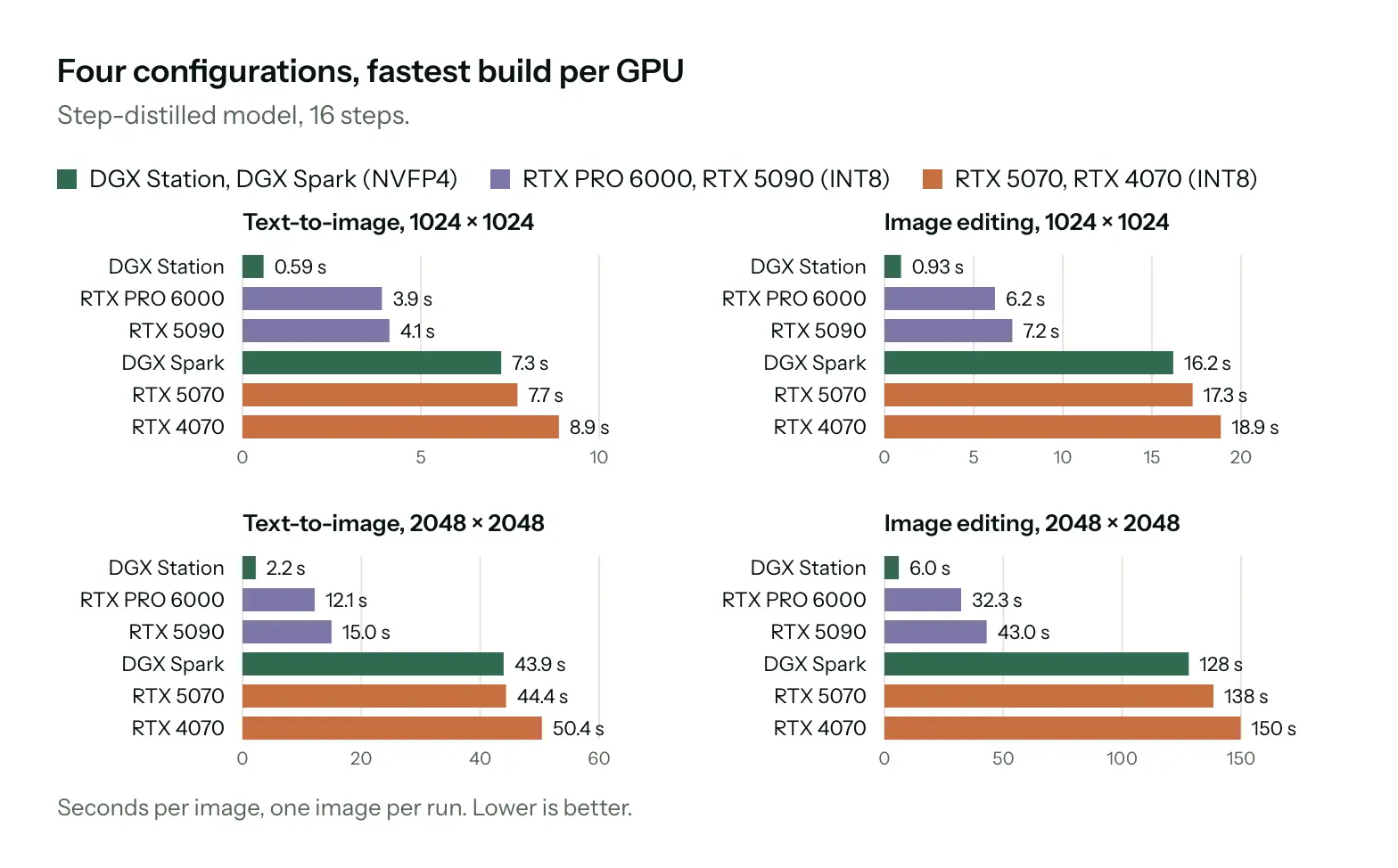
Black Forest Labs’ FLUX 3 Image Klein is a 5.6-billion-parameter open weights image model for generation and editing. NVIDIA-optimized builds let it run on GeForce RTX GPUs with as little as 8GB of VRAM and create a 1-megapixel image in about four seconds on an RTX 5090 GPU.
 MiniMax M3.1 Flash is a new open model built for NVIDIA DGX Station and DGX Spark, bringing long-context AI to the desktop. Liquid AI’s LFM2.5-24B-A2B is an open weights reasoning model that activates just 2 billion of its 24 billion parameters per token, making it fast enough to run private, tool-calling AI agents directly on PCs.
Plus, NVIDIA has released a new collection of model checkpoints optimized for RAM efficiency on local AI hardware, enabling frontier-class open models to run with sufficient memory left over for KV cache. Each checkpoint is quantized while staying close to full-precision accuracy, starting with Qwen3.8-Flash-Next-FP4-Local on a single DGX Spark 128GB or RTX PRO 6000 and GLM-5.3-Flash-FP4-Local on two systems.
Developers can post-train on day zero with NeMo AutoModel on both DGX Spark and RTX Spark, with example recipes for Nemotron Bolt E4B, Flux 3 Image Klein and more.
Accelerated AI Inference
NVIDIA continues to work with the llama.cpp and vLLM open source communities to accelerate agentic workloads on local hardware.
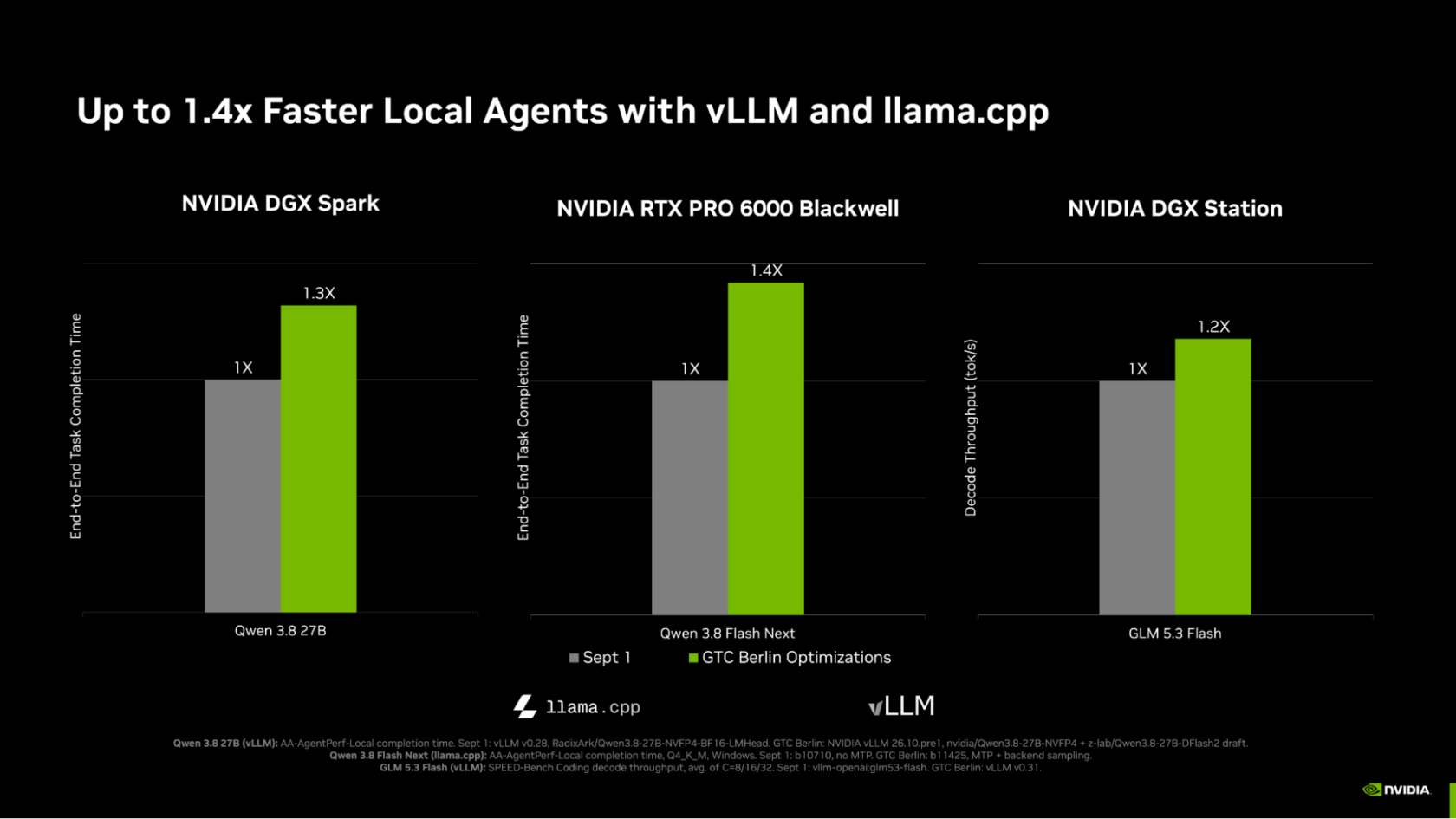
In llama.cpp, new speculative decoding support with MTP for Qwen 3.8 Flash Next makes end-to-end agentic tasks up to 1.4x faster on NVIDIA RTX PRO 6000 Blackwell.
In vLLM, faster speculative decoding and new FlashInfer prefill kernels for Qwen’s linear-attention layers make agentic tasks with Qwen3.8 27B up to 1.3x faster on DGX Spark. On DGX Station, GLM 5.3 Flash gets up to 1.2x higher throughput.
Check out NVIDIA’s local AI inference recipes to try these latest optimizations.
Follow NVIDIA RTX Spark on X, Instagram, TikTok and Facebook — and stay informed by subscribing to the NVIDIA Local AI newsletter. Follow NVIDIA Workstation on LinkedIn and X.
See notice regarding software product information.
]]>
General availability of the instances is coming next month, with planned expansion of availability to Europe — bringing an integrated platform for training, inference and large-scale reinforcement learning to cloud customers.
A5X instances bring together NVIDIA Vera Rubin NVL72, NVIDIA ConnectX-9 SuperNICs, Google Cloud Virgo Network and Google Cloud’s fourth-generation advanced liquid-cooling technology for demanding agentic inference and reinforcement learning workloads at scale. Google Cloud plans to scale its Vera Rubin-based infrastructure to as many as 960,000 Rubin GPUs across multiple sites.
Ineffable Intelligence, a London-based technology company founded by AlphaGo creator David Silver, was the first customer to access A5X. Ineffable is using the platform to advance large-scale reinforcement learning and shape “superlearner” systems that learn continuously from experience.
Learning through interaction requires a continuous cycle of generating experience, evaluating outcomes and updating models, requiring infrastructure that can support the entire process at scale. A5X brings Vera Rubin into Google Cloud’s AI Hypercomputer as an integrated system, combining compute, networking and storage to support experience-driven learning at scale.
“We’re building superlearners that continually improve through their own experience,” said David Silver, founder and CEO of Ineffable Intelligence. “That demands both substantial compute and a tight connection between generating experience and training on it, so each improvement in the agent can quickly shape its next experience. Vera Rubin’s combination of compute performance and high-bandwidth connectivity, between the Vera CPU and Rubin GPUs and between the Rubin GPUs within the rack, allow us to push the scale and ambition of our reinforcement learning research further.”
WPP, a London-based marketing and communications company, has also demonstrated its creative agent reference architecture on NVIDIA Vera Rubin-based A5X instances using NVIDIA Nemotron models and NVIDIA OpenShell, part of the NVIDIA OpenShell Reference Architecture for safe AI agents.
The agents turn conversational requests into multistep creative workflows, such as video generation, upscaling and restyling, with human approval before execution. OpenShell provides governed sandboxes for agent execution, helping control access to sensitive brand assets and creative tools. In WPP’s initial tests, workloads that typically required a multi-node cluster ran on a single A5X instance.
As organizations deploy agentic systems, they need to protect the proprietary models and sensitive data that power these systems — even when running on infrastructure they don’t own.
Google Cloud will be among the first cloud providers to offer NVIDIA Confidential Computing at rack scale on bare metal instances such as A4X Max instances powered by NVIDIA GB300 NVL72. Additionally, Google Cloud is making Confidential Computing generally available on G4 VMs powered by NVIDIA RTX PRO 6000 Blackwell Server Edition GPUs, offering a flexible platform for confidential inference and fine-tuning. Customers including Vertebrae, Polaris Cloud and Confidential Core AI are using Confidential G4 for conversational privacy, verifiable agent execution and policy-governed enterprise intelligence.
To support energy-efficient deployment at scale, Google Cloud and NVIDIA are exploring NVIDIA DSX MaxLPS capabilities for Vera Rubin-based infrastructure to help optimize performance per watt and expand capacity within available data-center power budgets.
Learn more about NVIDIA Vera Rubin and Google Cloud A5X instances.
]]>
Demand from AI-natives is pulling the European AI cloud ecosystem forward faster than ever. Developers need compute closer to their data, open models they can customize and serve at scale, and full-stack infrastructure that is secure by design.
NVIDIA Cloud Partners across Europe, the Nordics, Africa, and Central Asia are expanding regional compute capacity for model training and inference, helping developers build agentic and physical AI applications, and establishing boundaries around what agents can access and do.
Together, they’re turning Europe’s energy, data, research and industrial expertise into productive intelligence — supporting new models, applications, organizations and jobs while giving people more control over where and how they develop and deploy AI.
Sovereign: AI Clouds Building European AI Infrastructure
Europe is home to world-class research, engineering talent, industrial expertise, data, the next generation of models and applications that requires large-scale computing close to where that knowledge resides. Regional AI clouds provide the infrastructure foundation on which model builders, enterprises and entire industries can grow.
As AI factories scale, power becomes a constraint which makes it critical for every watt to produce more intelligence. Nscale is using the NVIDIA DSX Platform to coordinate power allocation with workload requirements. In tests using NVIDIA GB300 NVL72 systems, Nscale demonstrated that NVIDIA DSX MaxLPS enabled 37% more GPUs and nearly 50% higher aggregate inference throughput within the same provisioned power budget.
Nscale also plans to deploy NVIDIA Vera Rubin infrastructure for frontier-model training and production workloads to support leading model and application builders using its full-stack, vertically integrated platform with expansion across five European markets.
Crusoe is developing Spark, its liquid-cooled modular AI factories designed for the NVIDIA Vera Rubin platform, to bring Crusoe Cloud capacity closer to users for low-latency AI inference. Crusoe Cloud serves leading model and application builders across EMEA, including Base44, Gradium, LTX and Wonderful.
Aleria, Cassava Technologies, Firebird, G42, Radiant, SWI Compute and Vultr are also developing and expanding NVIDIA-powered AI infrastructure across Europe, the Nordics, Africa and Central Asia.
Regional capacity from AI clouds combines the full-stack NVIDIA DSX AI Factory platform, including NVIDIA Vera Rubin, NVIDIA BlueField and NVIDIA Spectrum-X Ethernet networking, giving customers greater choice and control over where workloads and data reside while advancing sovereign computing services and economic growth.
Open: Models and Libraries, From Training to Inference
Across the ecosystem, AI clouds are expanding NVIDIA-powered infrastructure and services for developers to build applications with open models and libraries. This new capacity supports model training, fine-tuning for specialized tasks and inference at scale, including applications deployed at the edge.
For production inference, Nebius has adopted NVIDIA Groq 3 LPX, using Spectrum-X Ethernet networking to integrate it with Vera Rubin NVL72 on Nebius Token Factory. The combination will bring faster token generation to latency-sensitive applications and agentic systems through the platform’s managed serverless and dedicated endpoints and familiar application programming interfaces.
For robotics and physical AI, Nebius offers a purpose-built AI cloud solution that includes its full-stack Physical AI Workbench. Robotics companies including Rhoda AI, RoboForce and Sereact are building on the platform. The company also launched three NVIDIA retail agent blueprints — covering inventory, store operations, and fine-tuning —- into early access on Nebius infrastructure.
Nebius is expanding its cloud services widely across the continent with its Physical AI Living Lab, and in Germany as a computer supplier for the Next Frontier Challenge of SPRIND, the Federal Agency for Breakthrough Innovation.
Baseten has developed a specialized model for code-review routing with Nemotron 3.5 Lightning used by CodeRabbit. Through supervised fine-tuning and reinforcement learning, CodeRabbit improved routing agreement from 75.8% to 80.7% while reducing estimated inference costs by 50% for the evaluated workload. The results demonstrate how AI developers can customize NVIDIA open models for specialized tasks while improving accuracy and inference efficiency.
Fireworks and Era4 are partnering to bring open models to enterprises across the U.K. and Europe. The collaboration combines Fireworks’ model training and inference platform with direct liquid-cooled capacity powered by NVIDIA Blackwell Ultra GPUs at Era4’s Chesterfield facility, supporting plans for enterprise AI solutions in financial services, insurance and life sciences.
Mistral is expanding its NVIDIA accelerated computing infrastructure to support model training, customization and inference. The expansion includes NVIDIA Vera Rubin infrastructure planned for delivery in 2027. Trained on 3,800 NVIDIA Grace Blackwell GPUs in Mistral-operated European data centers, Mistral Large 4 is the company’s latest frontier multimodal model, advancing capabilities across coding, agentic workflows and multimodal understanding.
Verda plans to deploy NVIDIA Vera Rubin, continuing to promote open weight models with NVIDIA Nemotron and NVIDIA Cosmos already in production, and using the NVIDIA Dynamo open source framework for inference optimization.
Safe: Secure Boundaries for AI Agents, From Silicon to Software
As developers connect models to tools and business systems, they also need controls over what agents can access and do.
Announced at GTC Berlin, the NVIDIA OpenShell Reference Architecture with support from AI cloud ecosystem partners. Built on the foundation of NVIDIA OpenShell secure runtime software, the architecture is designed to give organizations full-stack control to deploy AI agents with clear boundaries around what agents can access and do.
NVIDIA Vera Rubin NVL72 for model inference, NVIDIA Vera CPUs with OpenShell for agent harnesses and tool use, and NVIDIA BlueField-4 DPUs running NVIDIA Sentry for in-silicon enforcement. Each play a distinct role in delivering that control, working together so agents can achieve what they’re meant to do without moving beyond the boundaries people set for them.
Partners including Aleria, Baseten, Cassava, CoreWeave, Crusoe, DigitalOcean, Firebird, Fireworks, Firmus, G42, GMI Cloud, IREN, Lambda, Lightning AI, Nebius, Nscale, Radiant Verda and Vultr are supporting the OpenShell Reference Architecture to enable secure agentic deployments for their customers.
Together, European AI clouds are connecting regional infrastructure investment with the work of building and deploying AI. Expanded capacity gives builders more places to run workloads. Model and inference services help them put that capacity to use. Agent controls address what applications are allowed to do as they move into production.
Explore NVIDIA Cloud Partners for infrastructure and services, and the OpenShell Reference Architecture for agent deployment controls.
]]>
To increase productivity, accelerate innovation and create new opportunities for economic growth, Europe’s industrial leaders are tapping NVIDIA CUDA-X and Omniverse libraries, as well as NVIDIA Cosmos and Nemotron open models, across the engineering and manufacturing lifecycle.
Bringing those capabilities together on the factory floor, the NVIDIA Factory Operations Blueprint (FOX) is now available in early access on GitHub, providing a path for developers to build and deploy always-on factory manager agents that coordinate work across machines, and specialist agents focused on use cases such as visual inspection, root cause analysis, report generation and fleet management.
These agents can connect to frontier models, including NVIDIA Cosmos and Nemotron, and foundational knowledge including computer-aided design, product lifecycle management, simulation software, and IT and operational technology systems.
Building on the FOX blueprint enables the ecosystem to build industrial agents that monitor factory operations in real time, correlate visual findings and machine logs to investigate problems, and coordinate responses. With Cosmos in-context learning, these agents can adapt using examples and documentation, without fine-tuning.
Siemens is integrating agents built using FOX into Intelligence Center X, its agentic enterprise system, to help identify root causes and coordinate factory operations, for estimated cost savings of 20%. Siemens’ Process Preparation X agents use NVIDIA Cosmos Data Factory tools and skills to generate defect images for circuit-board inspection. At its Erlangen electronics factory, Siemens used this approach to reduce calibration time of inspection processes by 40%.
Accelerating Engineering From the First Design
NVIDIA CUDA-X libraries accelerate simulation, giving engineers faster feedback to explore design alternatives before committing to physical prototypes. At GTC Berlin, NVIDIA is releasing cuDSS for general availability, accelerating the demanding calculations behind the complex simulations of structural stress, fluid flow, electromagnetic fields and semiconductor device behavior.
Mercedes-Benz uses Siemens’ Simcenter STAR-CCM+ running on NVIDIA GPUs to compare vehicle designs through faster aerodynamic simulations. In factories, the company applies NVIDIA Cosmos 3 and the Metropolis VSS blueprint to build agents for vehicle inspection and windshield assembly verification, detecting deviations and ensuring consistently high quality.
Cadence is benchmarking automotive fluid-dynamics workloads on NVIDIA GPUs to assess opportunities for faster design iteration, while Autodesk brings the NVIDIA PhysicsNeMo and Warp frameworks into NavPack, integrated with Autodesk Alias, to help designers like those at Bentley’s predict vehicle performance and iterate faster using simulation-trained AI.
imec and Infineon are accelerating semiconductor simulation with Synopsys software and NVIDIA accelerated computing. Benchmarks of S-Litho on imec’s model show up to 40x speedup, while Infineon uses Sentaurus Device with NVIDIA CUDA libraries to achieve a 12x speedup in 3D breakdown simulation for next-generation power devices.
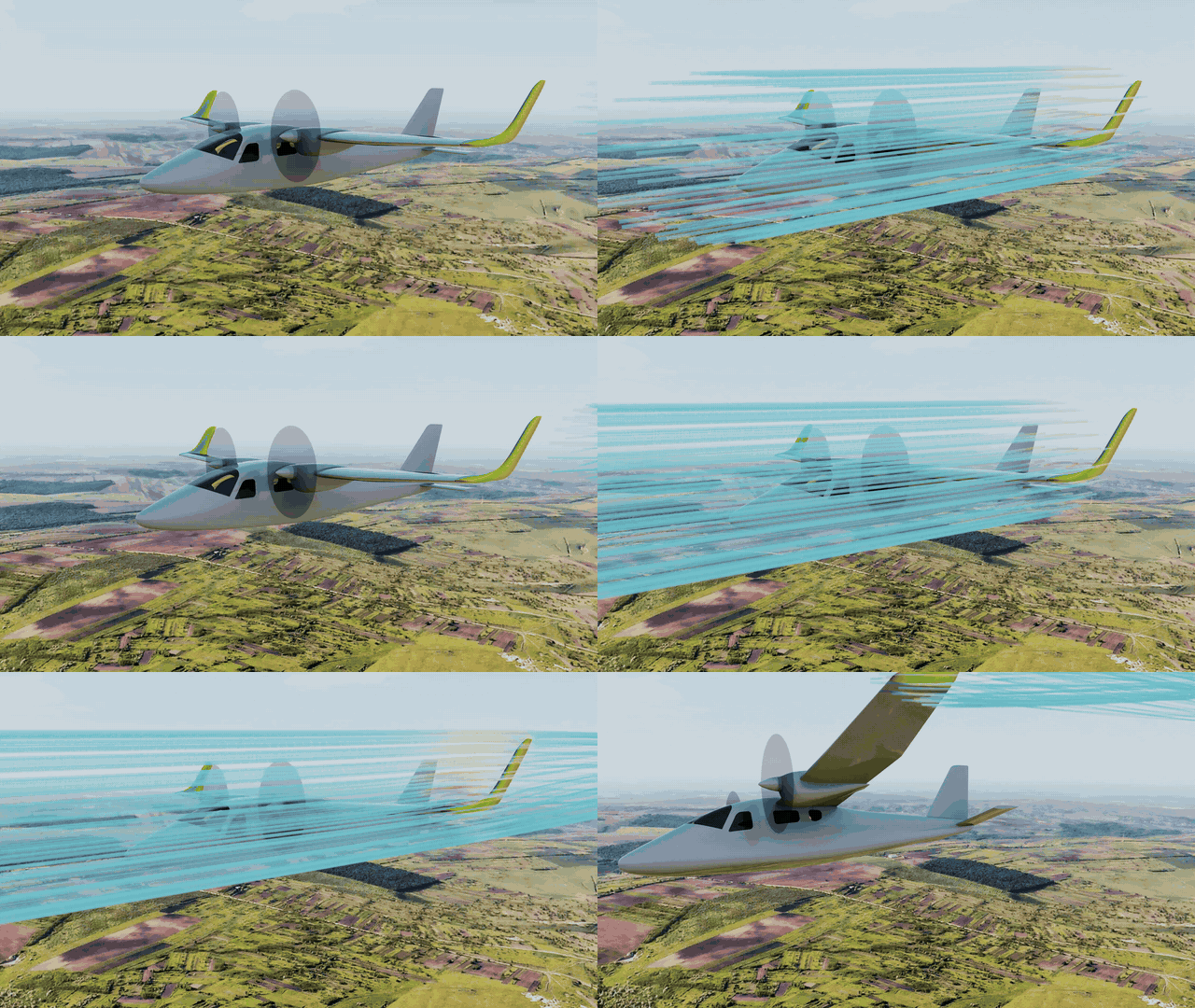
Leonardo is working with Neural Concept on AI-driven aircraft design, tapping NVIDIA Omniverse libraries to bring aircraft geometry and aerodynamic simulation results together.
Car manufacturers use Dassault Systèmes’ LEO & AURA Virtual Companions, powered by NVIDIA Nemotron, and orchestrating CATIA AI Agents & SIMULIA AI Agents with SIMULIA solvers, accelerated by NVIDIA CUDA-X libraries, to rapidly design and virtually test vehicle doors before building physical prototypes.
UniversalAGI is working with Saab to protect sailors from life-threatending wave impacts at sea, using UniversalAGI’s Latent Interaction Field Transformer physics AI foundation models with accelerated processing by NVIDIA Warp to evaluate thousands of wave conditions and headings in real time instead of days. These capabilities enable vessels to anticipate dangerous motion and autonomously select safer routes to avoid putting sailors at risk, while NVIDIA Omniverse libraries help visualize vessel behavior at sea.
PhysicsX is working with GB1, Britain’s America’s Cup team, on AI-powered yacht design, using NVIDIA Omniverse libraries to visualize hull geometry and pressure fields, while Fermioniq’s Sofia agent helps Deltares and Dutch ministries model river flow by translating natural-language requests into simulation solvers built on NVIDIA Warp.
Mistral plans to use CUDA-X, Warp and Omniverse libraries to accelerate physics simulation and generate training data for engineering AI models.
Testing Factories and Robots Virtually
NVIDIA Omniverse and Isaac libraries enable digital twins and robotics simulation, helping manufacturers evaluate production systems and robot behavior before making changes on the factory floor.
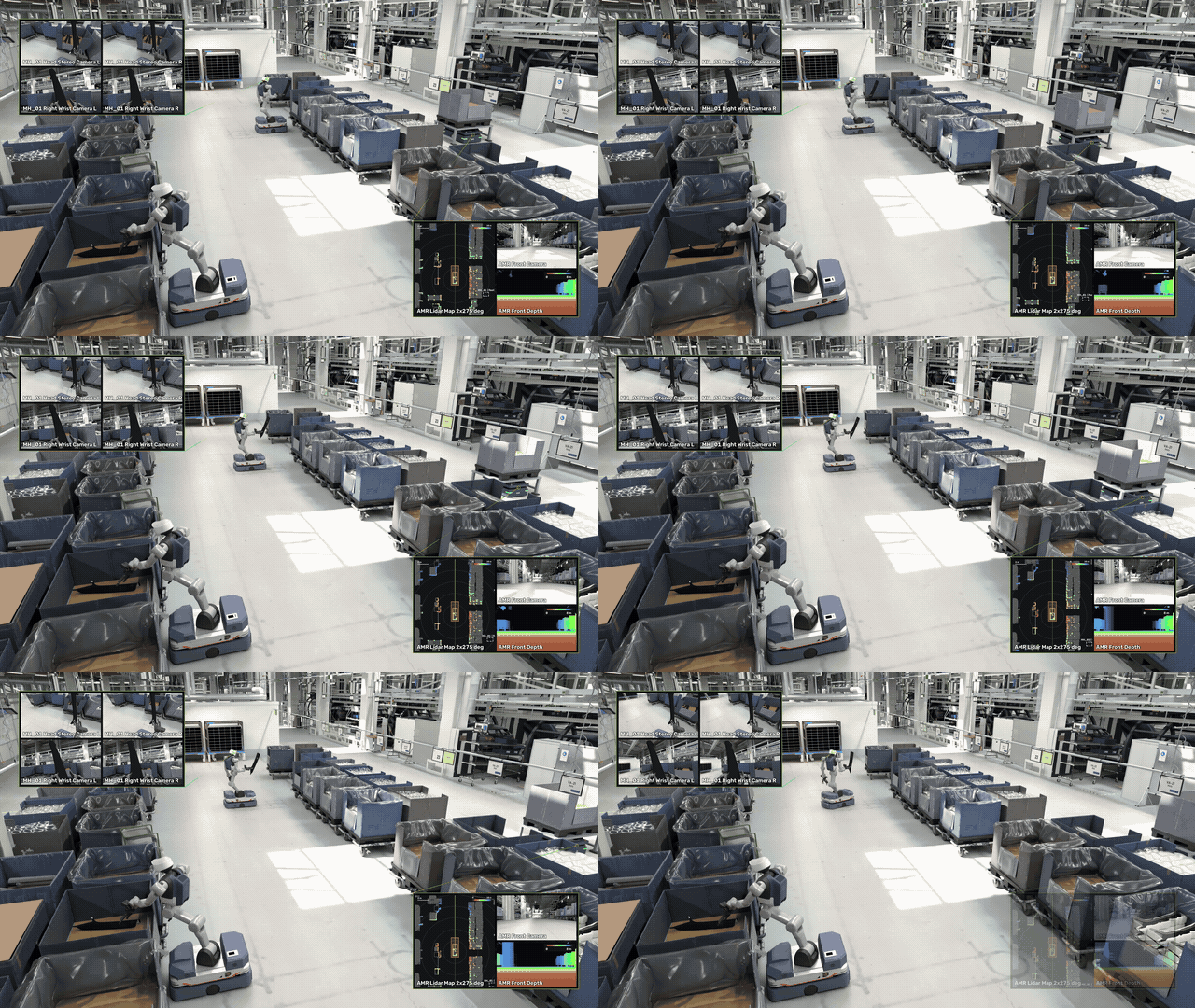
Audi uses a battery-production digital twin built with NVIDIA Omniverse libraries to test production concepts before physical equipment is available. The company is also working with Dassault Systèmes and Agile Robots to simulate and validate mobile humanoid robots and logistics processes in DELMIA virtual twins built with Omniverse libraries.
Schaeffler is integrating digital twins of its humanoid actuators — components that move robot joints — with NVIDIA Isaac simulation frameworks, helping its robotics partners evaluate component behavior in simulation and reduce physical testing.
At Volkswagen Sachsen’s Transparent Factory, Wandelbots uses NOVA with Isaac Sim, built on Omniverse and OpenUSD, to validate assembly workflows digitally and prepare applications for physical robots.
Falkor, a KONGSBERG company, is integrating agents and NVIDIA Omniverse libraries into its platform. With Microsoft Azure NCv6 virtual machines powered by NVIDIA RTX PRO 6000 Blackwell Server Edition GPUs, agents with spatial intelligence combine engineering data, operating information and 3D equipment geometry to see, simulate and reason over industrial facilities, supporting inspection and maintenance use cases across the process and energy industries.
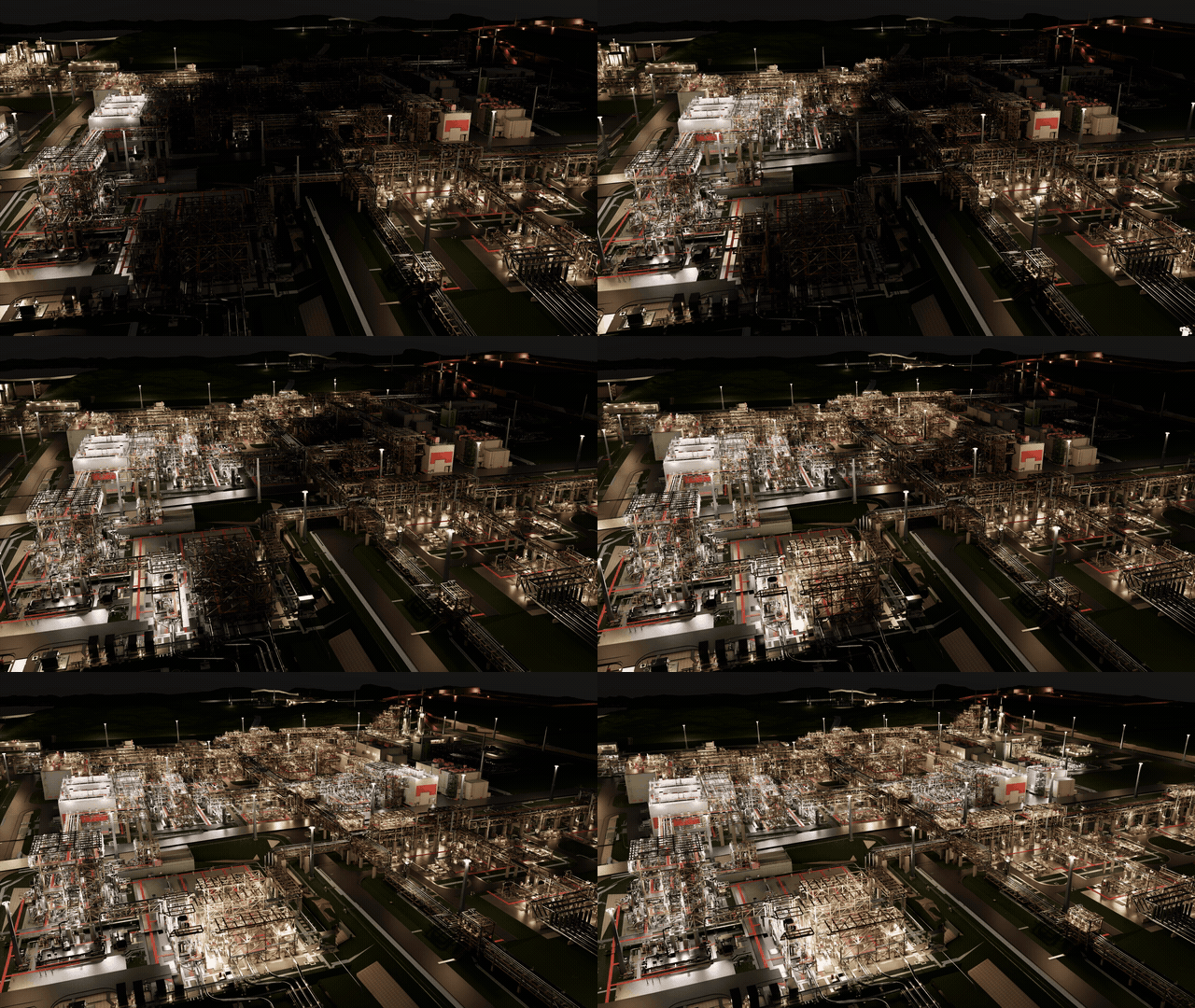
The same simulation approach extends to AI infrastructure. Schneider Electric, together with AVEVA, is developing an AI factory digital twin built for Nscale with Omniverse libraries to help engineers compare power, cooling and equipment configurations before making physical changes.
]]>NVIDIA cuDSS, launched today in general availability, is an NVIDIA CUDA-X library that shifts a critical part of engineering and scientific simulations onto GPUs.
Complex engineering feats — from advanced chips to aircraft to industrial systems —– depend on simulation to predict how designs will perform before they’re built. As designs become more complex, simulations take longer to run, increasing computing demands and limiting the number of ideas teams can test.
NVIDIA cuDSS accelerates solving large sparse systems — the math-heavy step that repeats throughout engineering and scientific simulations and often limits how many designs a team can test — by tapping into GPUs. This lets applications reduce time to results and increase simulation throughput, enabling end users to explore larger more realistic models, more accurate representations and a wider design space at a reduced cost.
Industry leaders are already integrating NVIDIA cuDSS into their tools to transform workflows for their end customers:
- Applied Materials: With cuDSS, Applied Materials accelerated sparse solves in Ginestra, its physics-based, defect-centric simulation platform, by up to 10x versus CPU-only approaches, speeding exploration of semiconductor materials and device reliability.
- COMSOL: Using COMSOL Multiphysics with NVIDIA cuDSS on NVIDIA accelerated computing, ZEISS SMT achieved a measured 4x speedup in an EUV lithography plasma simulation benchmark, completing the full simulation in six days and 14 hours.
- Cadence: Uses cuDSS in its Celsius software to accelerate simulations of heat, structural stress and warpage in advanced chips and 3D chip designs, helping customers including Nokia analyze complex designs faster.
- Dassault Systèmes: Dassault Systèmes reports an 8-10x speedup using cuDSS within its Abaqus structural and computer simulation technology electromagnetic solvers for performance-critical simulations across industries.
- Siemens: Siemens uses cuDSS in Simcenter STAR-CCM+ to accelerate simulations of structures in fluid-structure interaction workflows.
- Synopsys: Synopsys uses cuDSS in its Sentaurus Device simulator tool to accelerate simulations of advanced logic, memory and power chips, helping Infineon model increasingly complex devices faster.
Accelerated Simulation at Scale
As simulation workloads grow in size and complexity, cuDSS can scale out of the box from individual workstations to large computing clusters.
Developers can integrate cuDSS into existing engineering, scientific and optimization software offerings, bringing GPU acceleration to tools already used by engineers and researchers. They can use cuDSS through C, C++, Python and Fortran interfaces.
Learn more about cuDSS by visiting the NVIDIA demo booth and Dassault Systèmes booth at GTC Berlin.
Featured image courtesy of Dassault Systèmes.
]]>
NVIDIA builds tools to enable safe agents across the stack. The NVIDIA OpenShell Reference Architecture, announced today, is part of NVIDIA’s growing portfolio of technologies that enables organizations to safely deploy agents at scale. NVIDIA Confidential Computing is the infrastructure layer that protects the models and data those agents depend on while running.
Today, NVIDIA is expanding that layer with Confidential Bare Metal, a new deployment option with NVIDIA Confidential Computing that enables frontier model builders to run sensitive workloads on dedicated third-party infrastructure while retaining control of their models and data.
NVIDIA is introducing new platform security controls that protect data in transit, measure platform integrity and enforce hardware-level access restrictions. These new controls let frontier model builders use bare-metal instances to own and operate their bespoke software stack, including host and platform infrastructure software, when operating on NVIDIA accelerated computing infrastructure across third-party cloud, neocloud and enterprise infrastructure.
NVIDIA Confidential Computing now offers a converged security architecture with three deployment options:
- Confidential Bare Metal for bare-metal infrastructure
- Confidential Containers for Kubernetes environments
- Confidential Virtual Machines for virtualized environments
Organizations can match the right model to their trust boundaries and operating requirements.
NVIDIA Confidential Computing is also expanding across NVIDIA Grace Blackwell and Rubin systems and will integrate with NVIDIA DSX OS as a reference architecture for cloud providers building AI factories.
Model Builders Tap Global Capacity
Confidential Bare Metal gives supported providers a path to serve high-value workloads that require strong model and data privacy protections. For model builders, the expanding ecosystem offers more geographic, sovereign and operational options for scaling training and inference worldwide.
Cohere plans to integrate Confidential Bare Metal into Cohere Model Vault, using NVIDIA Confidential Computing trusted execution environments to extend hardware-rooted security directly to the GPU — protecting models and data in memory and across interconnects during execution.
“Enterprises trust Cohere to provide a secure and confidential platform for inference,” said Phil Blunsom, chief technology officer at Cohere. “With NVIDIA Confidential Computing in Cohere Model Vault, we’re extending hardware-rooted security directly to the GPU, protecting customer data in memory and across interconnects during execution.”
Google Cloud is extending support for Confidential Bare Metal to A4X Max instances powered by NVIDIA GB300 NVL72 systems. These will combine non-virtualized NVIDIA accelerated computing with cryptographic protection for training data and model intellectual property.
“Google Cloud introduces Confidential Bare Metal to provide AI labs with hardware-isolated, non-virtualized compute environments and end-to-end cryptographic protection. Our A4X instances, built using NVIDIA Confidential Computing, preserve the privacy of user data, protect model IP, provide top-line serving performance,” said Andrés Lagar-Cavilla, distinguished engineer and AI infrastructure security lead at Google Cloud.
Confidential Computing Expands Across the NVIDIA Platform
NVIDIA Confidential Computing uses hardware-rooted isolation and cryptographic attestation to help protect models and data during execution.
Support now extends to NVIDIA Grace Blackwell NVL72 — bringing Confidential Computing to NVL72 rack-scale systems — as well as x86-based NVIDIA HGX Rubin NVL8 and NVIDIA DGX Rubin NVL8 systems.
CoreWeave, Firmus, GMI Cloud, Google Cloud, IREN, Lambda, Microsoft Azure Infrastructure, Nebius, Nscale and Vultr support NVIDIA Confidential Computing deployments. Global systems partners including Cisco, Dell Technologies, HPE, Lenovo, Supermicro and Bull will support these capabilities with NVIDIA-Certified Systems.
NVIDIA DSX OS will support all NVIDIA Confidential Computing modes, giving cloud providers a software foundation for building and operating AI factories that support confidential workloads.
Learn more about NVIDIA Confidential Computing.
]]>
Agents are only as useful as what they know, and only as trustworthy as the boundaries they run within.
Leading enterprises are using the open source NVIDIA Agent Toolkit — now expanded with new tools — to customize and control agents, use company data to inform their answers and actions, monitor what they do and govern how they operate.
NVIDIA Agent Toolkit comprises:
- The new NVIDIA Agent Knowledge Foundation with NVIDIA CUDA-X libraries
- NVIDIA open models including Nemotron Retriever and the new Kumo family
- NVIDIA OpenShell secure agent runtime
- NVIDIA NemoClaw secure agent blueprints
- Tools and skills, like NeMo Relay and NeMo Compass
To develop agents that accomplish real work and are trustworthy from development to deployment, builders need an open agent stack that brings together the models, harness, runtime, data and tools.
NVIDIA Agent Knowledge Foundation helps enterprises turn data into company intelligence agents can use. Agents can find relevant information, understand what it means for the business and use it to make predictions and help people decide what to do next. Companies can use Agent Knowledge Foundation without moving data, rebuilding existing workflows or changing governance controls.
The foundation features NVIDIA CUDA-X libraries, including cuDF, cuGraph, cuML, cuOpt and cuVS, and the new Auto-Ontology library, which translates raw company data into familiar business concepts — like customers, products and orders — and maps how they relate.
It also includes NVIDIA Nemotron Retriever and Kumo Structured open models — Kumo Tabular, Kumo Relational, Kumo Time Series and Kumo Forecast — which help agents find relevant company information to answer questions and make predictions.
OpenShell provides the secure runtime boundary, giving enterprises control over what agents can access and do. NVIDIA NemoClaw blueprints provide reference designs for building secure, specialized agents. The newest NemoClaw blueprint for agent optimization provides a step-by-step starting point for improving agent intelligence — making them better at their jobs over time.
Enterprises Adopt NVIDIA Agent Knowledge Foundation
The new NVIDIA Agent Knowledge Foundation is already at work across enterprises.
With Palantir, NVIDIA’s supply chain organization is using Agent Knowledge Foundation through Palantir Foundry, Ontology and AIP to deploy specialized agents, create actionable intelligence from proprietary data, predict outcomes and optimize decision-making.
Databricks pairs NVIDIA Kumo Anomaly with Databricks Genie Ontology to power context-aware agents.
Snowflake is enabling customers to use the NVIDIA Kumo Engine and Kumo Relational open models in their Snowflake Notebook environments to unlock more predictive capabilities.
NVIDIA Nemotron Retriever models make search faster and more accurate. Using the embedding model, Amazon OpenSearch Service improved relevance with fewer search steps and virtually no added latency. SAP’s fine-tuned reranker ran nearly 3x faster. ServiceNow improved reranking quality while cutting latency by nearly a quarter. Zoom is using Nemotron Retriever models to improve document understanding, search relevance and context retrieval for Zoom AI Services.
Amazon Web Services (AWS), ClickHouse, Cloudera, Cohesity, Dassault Systèmes, Dell, Elastic, Exa, IBM, NetApp, Oracle, Perplexity, Starburst and VAST Data are also among those building on Agent Knowledge Foundation.
Learn more by joining this GTC Berlin session on building, deploying and optimizing specialized agents in production.
]]>
NVIDIA is expanding its family of open models across language, robotics, biology, and quantum computing, giving developers, researchers and enterprises what they need to build applications tailored to local languages and industries
The portfolio includes the new NVIDIA Nemotron 3.5 Super VL and Nemotron 3.5 Bolt models; new NVIDIA Nemotron Retriever models for embedding, reranking and document parsing; the new NVIDIA Kumo family open weight foundation models and libraries for structured business data; NVIDIA Cosmos 3.5 world models; NVIDIA Alpamayo 2 Edge for autonomous vehicles; NVIDIA BioNeMo for healthcare and scientific discovery; and NVIDIA Ising for quantum computing.
The open models give organizations a foundation they can customize with local data and deploy on infrastructure they control.
NVIDIA Nemotron Powers Post-Training Across Industries
NVIDIA Nemotron brings open language models, datasets and recipes to developers building agents. The models support text and images, helping agents orchestrate workflows, reason through complex problems and complete specialized tasks at a lower cost. Nemotron models are built with data, research and expertise from the NVIDIA Nemotron Coalition, including European partners Black Forest Labs, H-Company and Mistral.
Nemotron provides a foundation for enterprises to build applications based on their own knowledge and expertise. Dassault Systèmes, Domyn, Dream, Palantir’s customers, Salesforce, SAP, Shopify, Synopsys and WPP, as well as professional services providers like Accenture and EY, are working with Nemotron models and datasets to create custom models and build domain-specific agents.
A broad ecosystem of post-training partners, including AfterQuery, AgileRL, AI21, Alice, Applied Compute, Baseten, CoreWeave, Distil Labs, EON, Fastino, Fireworks, Google Cloud, Mercor, Multiverse Computing, Nebius, Handshake AI, Plurai, Prime Intellect, River.AI, Scale AI, Trajectory and TNG, is helping enterprises customize Nemotron for domain-specific workloads.
NVIDIA Kumo Speeds Agents’ Work With Structured Enterprise Data
NVIDIA Kumo open foundation models, libraries and tools help agents and applications forecast outcomes, score fraud risk and recommend actions from structured business data. Part of NVIDIA Agent Knowledge Foundation, Kumo shortens time to prediction and reduces the cost and complexity of building a separate machine learning pipeline for every task.
Developers can use pretrained Kumo models to bring predictions to more applications quickly, then fine-tune them using proprietary data when higher performance is critical. The portfolio includes NVIDIA Kumo Structured, with models for relational and tabular prediction, forecasting and anomaly detection, and NVIDIA Kumo Engine, an open library stack for developing and deploying structured data foundation models.
Cognite, Coinbase, Databricks, DoorDash, Revolut and Tubi are among the first to work with Kumo models to accelerate development. Snowflake customers are already using Kumo models to accelerate AI development in industries including advertising, energy, financial services and retail.
NVIDIA Cosmos Accelerates Robotics Training and Simulation
NVIDIA Cosmos is a family of open world foundation models that helps developers build robots, autonomous vehicles and vision agents that understand and interact with the physical world.
NVIDIA is introducing new Cosmos post-training and optimization tools to help developers improve world models using less compute, along with simulation checkpoints for evaluating behavior in interactive driving and robotic manipulation scenarios before real-world testing.
NVIDIA is also introducing Cosmos Data Factory — comprising blueprints and core agent skills — to help developers curate, label, generate and evaluate training data for driving scenarios, product defects, image augmentation and event generation. Developers can use complete workflows or individual capabilities with agents coordinating the process.
Porsche with Voxel51, ANYbotics with Encord, Zalando and CEVA Logistics with Sereact, and Siemens are using Cosmos Data Factory to create high-quality, diverse training datasets and improve model precision.
NVIDIA Alpamayo 2 Brings Real-Time Reasoning to Autonomous Vehicles
NVIDIA Alpamayo 2 Edge is a compact reasoning model that brings real-time scene understanding and motion planning directly into autonomous vehicles. Built on NVIDIA Cosmos and optimized for the NVIDIA DRIVE AGX Thor platform, it helps developers bring advanced driving capabilities into vehicles with lower computing requirements.
NVIDIA BioNeMo RFD4-Proteina Advances Protein Design
NVIDIA BioNeMo RFD4-Proteina is an open protein design model from NVIDIA and the Baker Lab at the University of Washington’s Institute for Protein Design.
The model generates protein sequences and 3D structures to help researchers design proteins that bind to difficult targets, assemble into complex structures and bind to small molecules.
NVIDIA BioNeMo RFD4-Proteina delivers leading performance across more than 10 protein design tasks and generates designs about 13x faster than RFdiffusion3 in a benchmark of 200 amino acid proteins. Researchers can use the model through agents to generate and evaluate candidates against design goals and molecular constraints, then choose which designs to test in the lab.
NVIDIA Ising Accelerates Quantum Development
The NVIDIA Ising family of open models provides a common, extensible foundation to speed the breakthroughs needed to develop useful quantum supercomputers, from real-time hardware calibration to error correction, across different qubit modalities and tailored to individual hardware needs.
IQM Quantum Computers is using Ising to calibrate its quantum processors, showcasing how specialized open calibration models outperform large general-purpose models. SEEQC is combining the NVIDIA NVQLink platform and Ising with its unique Digital Link to meet the low-latency requirements needed for real-time quantum error correction.
AWS is making NVIDIA Ising readily available to researchers by integrating the model family into AWS Parallel Computing Service (AWS PCS). While decoding is typically performed on classical hardware colocated with the quantum processor due to latency requirements, the AWS PCS integration lets researchers build on Ising prior to deployment.
Availability
- NVIDIA Nemotron 3.5 Super VL is available on Hugging Face, ModelScope, OpenRouter and build.nvidia.com as an NVIDIA NIM microservice, as well as through NVIDIA cloud, post-training and inference partners. Nemotron 3.5 Bolt E4B 4GB is expected to be available on Friday, Oct. 23.
- NVIDIA Nemotron Retriever open models are available on Hugging Face, various partner platforms, and as an NVIDIA NIM microservice on build.nvidia.com.
- NVIDIA Kumo open models are available on Hugging Face and optimized and packaged as an NVIDIA NIM microservice for production inference on build.nvidia.com.
- NVIDIA Cosmos is now openly available on Hugging Face and GitHub, and through select inference partners.
- NVIDIA Alpamayo 2 Edge will be available for download on GitHub and Hugging Face later this month.
- The NVIDIA BioNeMo open model RFD4-Proteina is available on build.nvidia.com and as an NVIDIA NIM microservice, as well as on GitHub, Hugging Face and through select inference partners.
- NVIDIA Ising is available on GitHub, Hugging Face and build.nvidia.com.
See notice regarding software product information.
]]>
Founded in a tent near the Berlin Wall in 1980, the Tempodrom moved several times before settling near Anhalter Bahnhof in 2001. Its permanent home has since hosted concerts, galas and political events.
Today, it hosts a different kind of spectacle.
GTC Berlin runs three days, with more than 100 sessions on agentic AI, robotics, physical AI, open models and accelerated computing underway at STATION-Berlin down the road. Here, journalists, analysts and partners have gathered for the main event: NVIDIA founder and CEO Jensen Huang’s keynote.
Huang Takes the Stage
Huang opened with a question: What do L’Oréal, Revolut, Spotify, Merck, Vodafone, Zara, Porsche, Nestlé and HSBC have in common? They’re all European companies and they’re all working with NVIDIA on AI, he said.
The keynote comes on the heels of NVIDIA’s weeklong road across Europe — Paris, London, Stockholm, Dublin — with the company committing nearly $10 billion to the technology ecosystem across Europe and working with 12,000+ partners. “After decades of advancement in the computer industry, we are now at the beginnings of a new industrial revolution,” Huang said.
AI is a five-layer cake, Huang explained. Energy powers advanced computers that are part of an AI factory, which generates tokens and digital intelligence from the models that run on it, which are then integrated into every application.
“Long before the AI models emerge, the infrastructure has to exist,” he said, highlighting how, similarly, the internet first needed networking, and electricity first required the grid.
“To be part of this AI economy, you don’t want to just be consuming the AI; you want to be producing the AI,” Huang said. “We could do all of that here in Europe, and in fact, we’ve already started.”
The AI Factory Gets a New Form Factor
Huang framed NVIDIA’s full-stack AI factory — spanning hardware, system software, CUDA-X libraries and models — as a broad platform for building and operating AI infrastructure.
“This now represents the breadth of technology necessary to create the AI factory,” Huang said. “This is what NVIDIA builds today, and this is the foundation by which we can enable Europe to be part of the AI ecosystem, the AI economy.”
He said Vera Rubin, in full production, extends NVIDIA’s computing platform beyond models and large language models to process the entire AI agent. He also showed several of NVIDIA’s latest rack-scale hardware offerings.
Next, Huang announced NVIDIA DSX POD, a reference design for complete NVIDIA Vera Rubin AI factories built by partners inside modular containers, integrated and validated before delivery. With DSX POD, onsite deployment can shrink from six months to just 14 days once site utilities are ready.
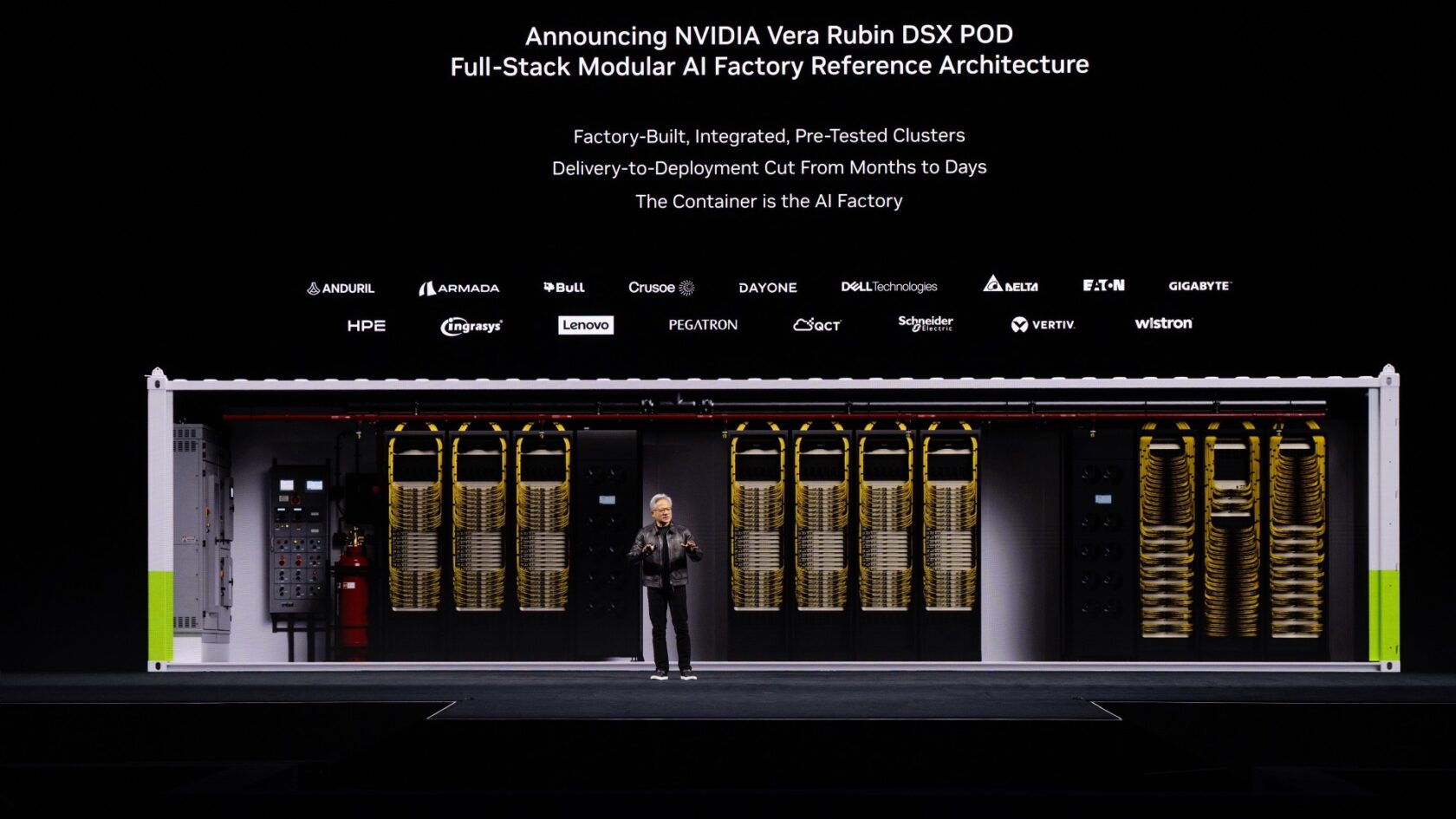
“This is a complete transformation of the world supply chain,” Huang said. “This will change the way that people install and build data centers, and hopefully, as a result, velocity goes up.”
The NVIDIA DSX AI Factory Platform enables companies to reduce water consumption for cooling by up to 100% and generate the same AI output with up to 30% less power.
Agents Are the New Computing Platform — and Safety Is an Engineering Problem
Huang said agents think, reason, iterate and use tools, driving token consumption as they become more useful.
He described an agent as comprising five elements: a model, a harness that orchestrates its work and memory, a sandbox that isolates the harness, knowledge and tools. In that framing, an agent is more than a model answering questions; it can draw on knowledge and act through tools.
“The most important thing is to make sure the agent is secure,” Huang said. The autonomous agent can access files, resources, networks and tools, so its privileges should be minimal and it should be monitored.
NVIDIA’s answer is the new NVIDIA OpenShell Reference Architecture for Safe AI Agents, a full-stack design built on NVIDIA OpenShell — an open source, policy-controlled runtime with kernel-level sandboxing that sits between an agent and the systems it can affect.
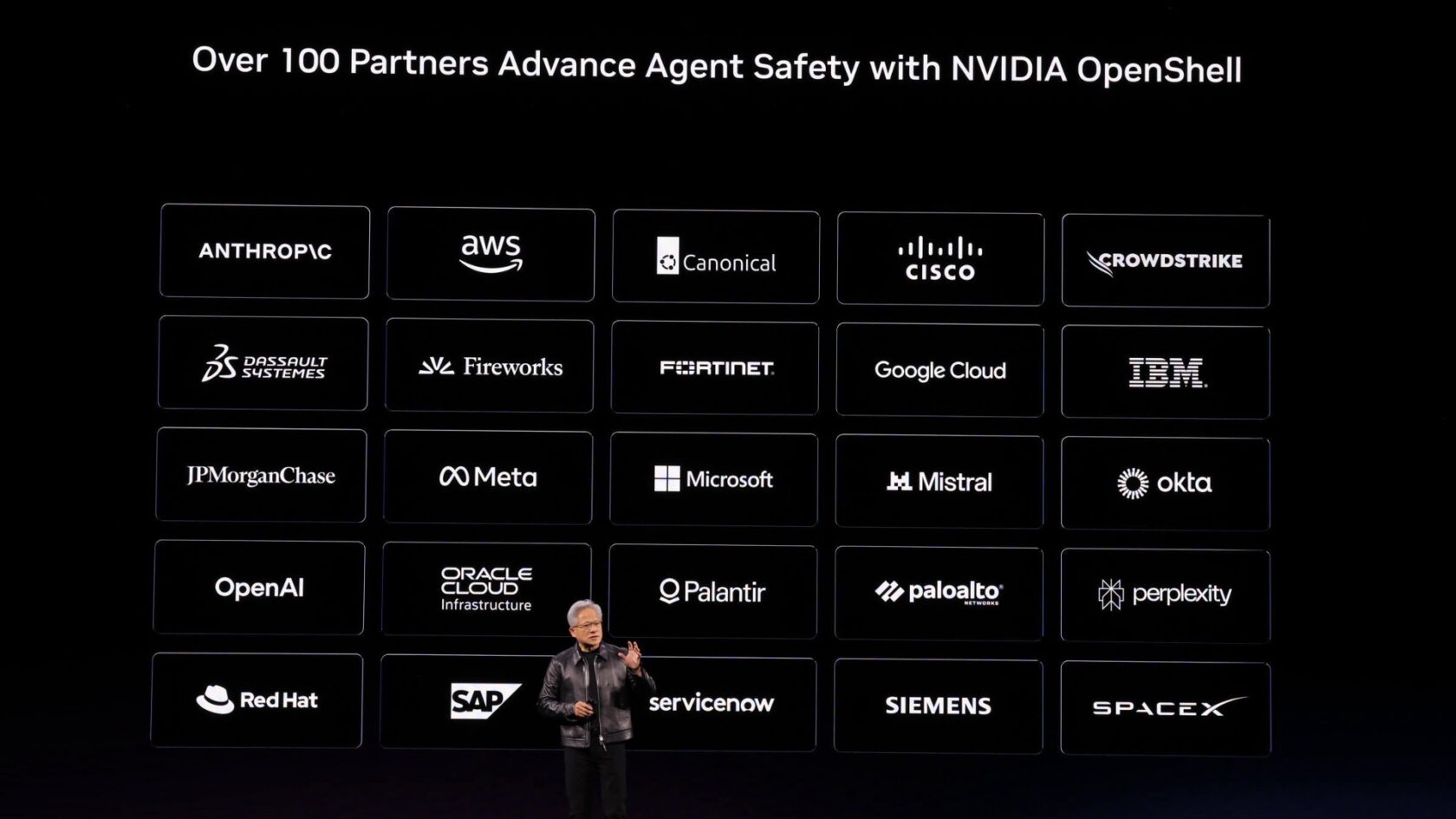
That means privileges, policy enforcement and monitoring must adapt dynamically. “Every single time an agent is launched, the privileges are different,” Huang said.
Open Models Turn Expertise Into an Advantage
Huang presented NVIDIA’s open models as a starting point for building AI tailored to specific needs.
NVIDIA’s frontier, open models are available for use across industries: Nemotron for language, Cosmos for world foundation models, GR00T for humanoid robotics, Alpamayo for autonomous vehicles, Ising for quantum-classical computing and Earth-2 for physics AI.
“We are the frontier,” Huang said. “So in all of these different areas, we offer you all of the models, and we’re continuously working on it. We’ve been working on it for a decade, and we’ll continue to work on this forever.”
NVIDIA provides the models, data and scripts to reproduce them, and companies can post-train a model on their own data for a particular use case — turning proprietary data into what he called “sovereign intelligence.”
“You could start with an open model, something that’s incredibly good like Nemotron, and with your own data, post-train it for your use case and achieve, of course, super intelligence,” Huang said. “That is a very sensible thing to do, and all the technology exists today.”
NVIDIA Gives Agents a Knowledge Layer
Huang then introduced the NVIDIA Agent Knowledge Foundation as a set of models and libraries for connecting agents to enterprise data, whether it’s unstructured information in documents or structured data in databases.
He highlighted Nemotron tools for parsing documents, embedding queries and reranking relevant information, along with new NVIDIA Kumo models for making predictions from structured data.
“Ultimately, what turns these super agents, these agents into super agents, is that you give them access to your company’s knowledge,” Huang said.
NVIDIA CUDA-X — Accelerated Tools for Agents
Huang then described NVIDIA CUDA-X as a collection of accelerated libraries used across science, engineering, research and creative work.
NVIDIA’s accelerated computing platform has more than 11 million developers building on it.
Huang said those libraries can accelerate simulators, solvers and data-processing engines — the kinds of tools agents may draw on to do useful work.
“CUDA-X tools are what gives agents the tools of the trade,” Huang said.
Agents Go to Work in Labs, Factories and Engineering
A video showcased NVIDIA Agent Toolkit bringing company knowledge, models and tools together in three industry examples:
At Lila Sciences, agents help design a potential B-cell lymphoma therapy, using virtual experiments to guide work in an automated lab.
At Siemens’ Erlangen factory, agents help prepare new products for production, testing plans in a digital twin before changes reach the factory floor.
And at Dassault Systèmes, engineering agents adapt vehicle design, using simulation to identify a problem and refine the design.
“And [all this] knowledge and tools belong to you,” Huang said after the video rolled. “That’s your expertise, and so all of this is now possible to do.”
Telcos as Distributed AI Infrastructure
Huang said AI is transforming telecommunications, improving spectrum efficiency and turning cell towers into distributed AI infrastructure.
He cited 100,000 sites and about 100 gigawatts of distributed data centers, and said NVIDIA has made its first commercial phone call on T-Mobile’s network with Nokia after nearly eight years of work.
“Now CUDA makes phone calls,” Huang said. “AI will revolutionize the way we do telecommunications. It will enhance our spectrum efficiency tremendously.”
AI Moves Into the Treatment Room
Healthcare and life sciences leaders are building on NVIDIA technologies to advance drug discovery and expand patient care.
For example, NVIDIA and Siemens Healthineers are developing AI-enabled radiation therapy.
Nemotron agents coordinate treatment planning, the Isaac for Healthcare platform and Omniverse libraries create a digital twin of the device and patient anatomy to simulate tumor targeting. Holoscan with IGX Thor connects live imaging and sensor data to enable real-time adaptive delivery as the patient moves.
Huang described adaptive radiotherapy as a physical-AI application: as the patient’s body and tumor change during treatment, the system must track the changes and adjust the radiation targeting.
“The tumor is changing in shape. The physical body is changing while you’re in therapy,” Huang said. “The robot, this radio adaptive radiotherapy system, has to perceive the changing environment, understand where the tumor is, segment it just perfectly and direct the radiotherapy accordingly.”
The Road Ahead: Mobility Leaders Join NVIDIA’s Automotive Ecosystem
Huang said the NVIDIA Hyperion computing platform is being designed into more vehicle fleets, with autonomous-driving software connecting robotaxis to ride-hailing services.
Bolt with Lucid, Mercedes-Benz, Volkswagen Commercial Vehicles and Einride are showcasing selected autonomous-mobility use cases on the NVIDIA Hyperion computing platform, demonstrating potential applications for level 3 and level 4 vehicles as well as future robotaxi fleets.
In addition, Volvo Cars is adopting Hyperion and NVIDIA Alpamayo Stack software for safe automated driving. NVIDIA also introduced new AI and safety technologies to help developers build, validate and deploy autonomous vehicles at scale.
Volkswagen’s van, JLR, Volvo and Mercedes-Benz’s next-generation vehicles will be Hyperion-compatible, Huang announced, saying, “Welcome to Hyperion.”
A Reference Humanoid for Robotics Researchers
Huang then announced Agile ONE SN, a reference humanoid built on Isaac GR00T — a 31-degree-of-freedom body, expected to be available next year, designed to cut researcher setup time from weeks to days.
The platform is modular: researchers can use the full workflow or pull in selected components.
“This is a great starting point,” Huang said.
It builds on NVIDIA’s open physical AI stack — Isaac Capture for data collection, GR00T models for robot intelligence, Isaac Lab for simulation-based training, Isaac OS for runtime — and NVIDIA’s open physical AI dataset. Partners including Agility Robotics, Figure, KUKA and NEURA Robotics are already building on the same platform.
Personal AI Gets a New Machine
Huang closed by discussing RTX Spark laptops, which launched last week, bringing together RTX graphics and NVIDIA’s full-stack AI platform in slim, premium Windows PCs for accelerated creation, immersive gaming and powerful local AI.
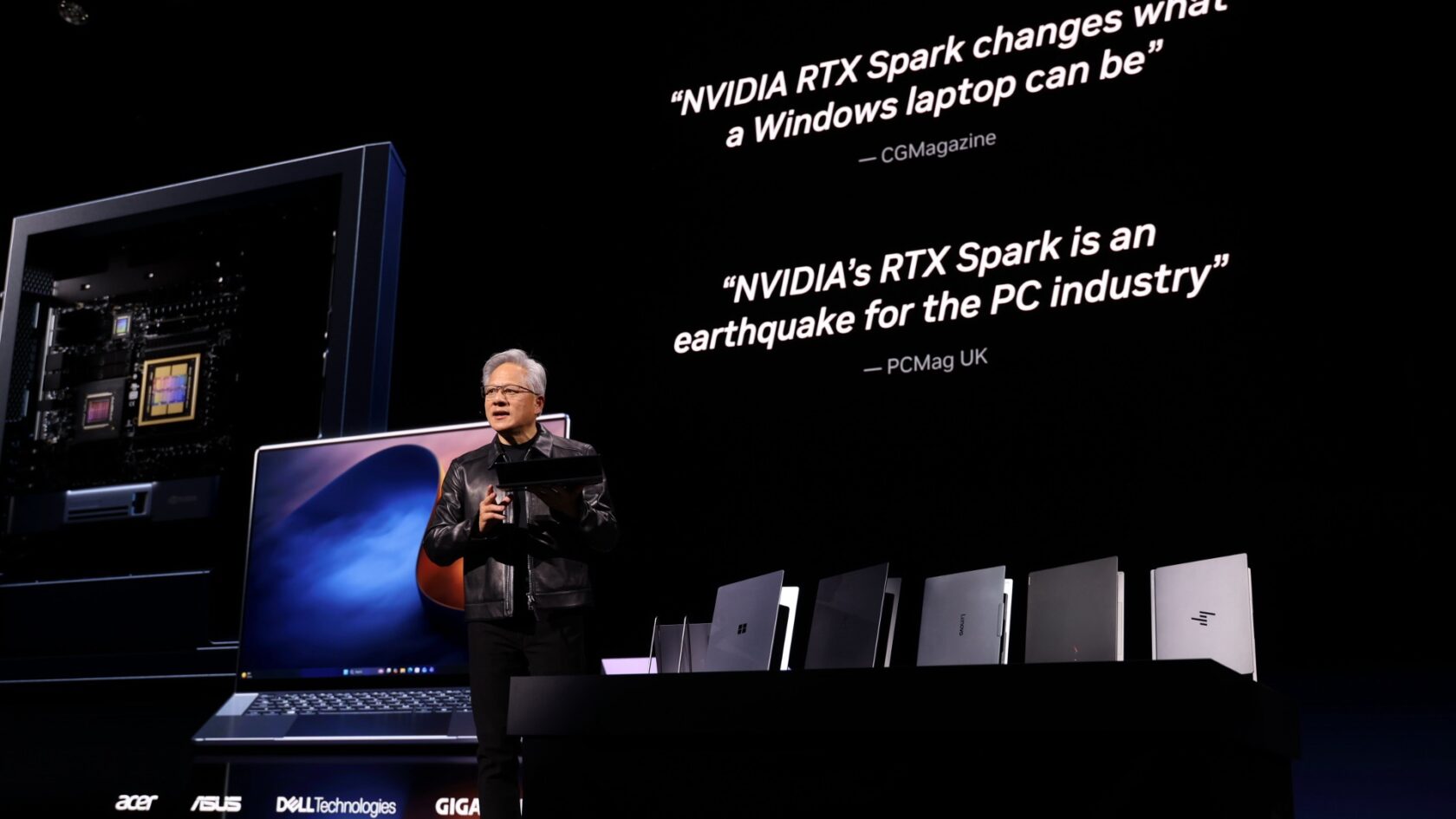
He compared its 1 petaflop of performance and 128GB of memory with the DGX-1 he delivered to OpenAI in 2016 — then made the difference in size the punchline:
“In the year 2016, I delivered 1 petaflop and 128GB … to a small company called OpenAI,” Huang said, holding up the compact machine in front of the audience. “This is 1 petaflop and 128GB. The only difference, of course, is that I can hold this like this, and DGX-1 took two people to carry upstairs.”
Huang then showed a video of an agent helping train Hugging Face’s Microduck: it set up a course and simulated the robot in Isaac Sim, sent training jobs to the cloud, then brought the learned policy back to RTX Spark for evaluation before deploying it to the physical robot.
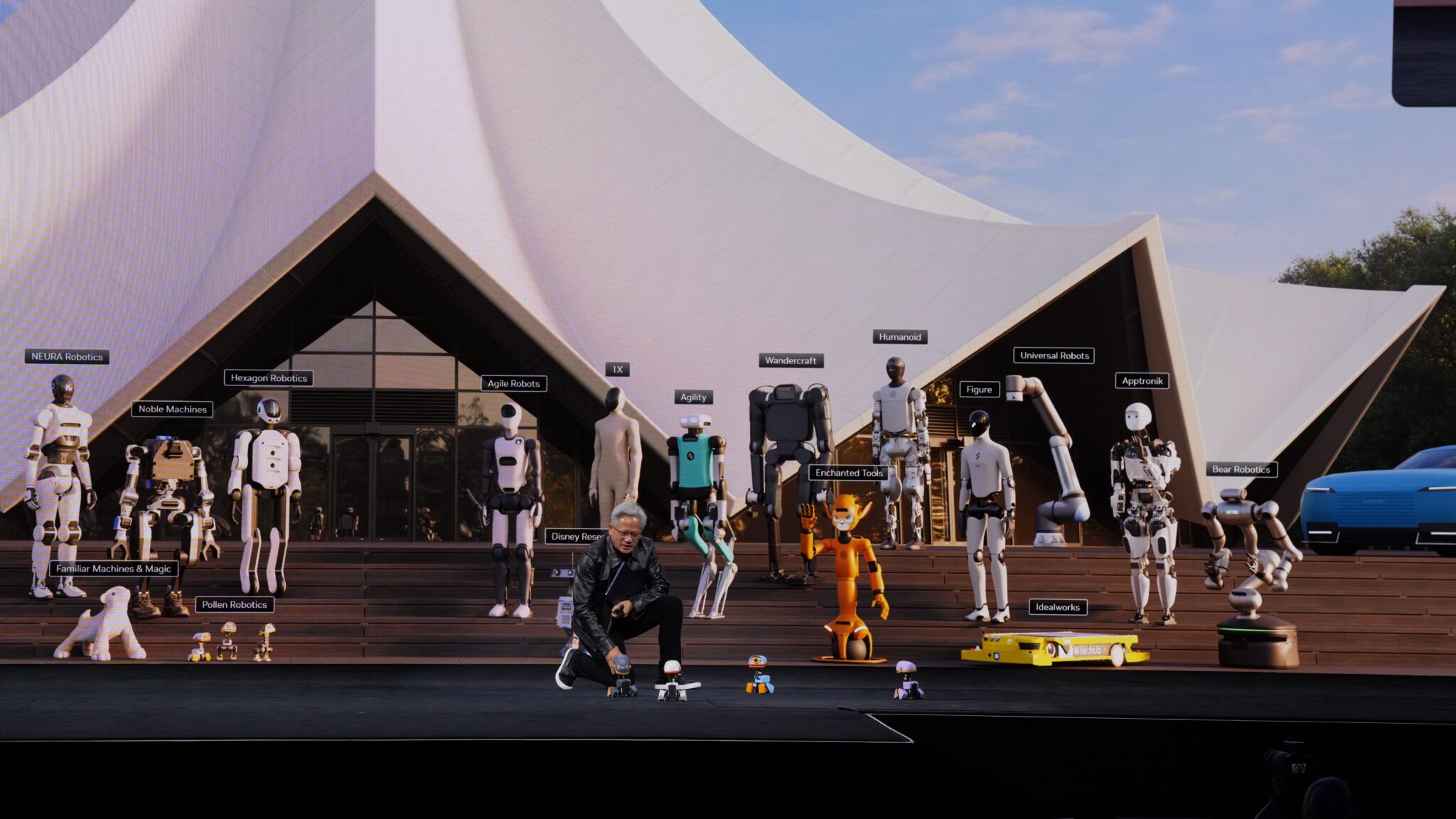
A flock of four Microducks joined Huang onstage, sitting down, standing up and even taking a nap on cue. He explained that they were created on RTX Spark, trained in the cloud and learned their skills in simulation.
“You were created on RTX Spark … [we] trained you in the cloud on a whole bunch of NVIDIA supercomputers, and you learned your skills right here on RTX Spark and the digital twin,” Huang told them.
The Full Lineup
With the Microducks gathered around him, Huang recapped the keynote: Europe is building its AI economy, AI factories are evolving to run agents and physical AI is the next frontier.
“So that’s it,” Huang said. “Everybody can build agents. Every company in Europe will become an AI company … and we’re going to have a thriving AI economy here in Europe.”
To close, Huang had one more surprise: a Eurovision-style musical send-off that turned the keynote’s themes into a comic recap.
The lyrics raced from OpenShell’s guardrails — “No credentials. Access dismissed” and “Sentry on BlueField never clocks off” — to physical AI, where robot training was likened to “college for robots without student loans.”
The punchline: “You can’t spell fungible without fun.” A saxophone solo led into a rousing “We are Europa” chorus.
“Let’s work together to build Europe’s AI economy and put AI to work,” Huang said, closing out his talk. “Have a great GTC.”
Explore NVIDIA GTC Berlin blogs and press releases in the online press kit.
]]>