The post How East Bay Landlords Can Talk With Tenants About Safety Without Promising More Than the Law Requires appeared first on All East Bay Properties.
]]>Share this post
Quick Answer
When you talk with tenants about safety, describe the features the building actually has and the way problems get reported. Don’t describe how safe the building or the neighborhood is. Words like “secure building” or “safe neighborhood” are a promise you can’t keep. A California court has allowed a tenant to sue a landlord who called a complex safe and patrolled while knowing about earlier assaults there. Put three things in writing for every tenant: how to report a broken lock, light or door; your city’s non-emergency police number; and the house rules on packages and entry doors. Then acknowledge every security report quickly, assess it and keep a record. A report of a broken lock or other deficiency covered by Civil Code §1941.3 can put you on notice, and the statute allows a reasonable time to fix it. Other security reports can raise duties under other law, so assess and document each one.
Key Facts: Talking With Tenants About Safety
| What | The fact | Source |
|---|---|---|
| Safety claims can create liability | In O’Hara v. Western Seven Trees (1977), the landlord had told a prospective tenant the complex was safe and patrolled by guards at all times, while knowing about earlier rapes there. The court let both negligence and deceit claims go forward. It called the patrol claim a statement of fact. | O’Hara v. Western Seven Trees Corp. (1977) 75 Cal.App.3d 798 · Case law (ruling on the pleadings, not a final verdict) |
| A tenant report is notice | For a broken required lock, you can be liable if you don’t fix it within a reasonable time after you have actual notice or receive notice. | Civil Code §1941.3(b) · Required by law |
| Protected calls for police or emergency help | Civil Code §1946.8 protects calls made by or on behalf of someone facing abuse, a crime or an emergency who believes help is needed. A lease can’t restrict those calls, and a landlord can’t penalize a tenant or resident for them (fees, eviction, non-renewal or worse terms). No documentation is required to show that belief. | Civil Code §1946.8 · Required by law |
| Required safety-related lease notice | Every covered residential lease must include the Megan’s Law notice pointing tenants to the state’s registered sex offender website. Once it’s given, the landlord doesn’t have to provide more information about where offenders live. | Civil Code §2079.10a · Required by law |
| No automatic duty to provide guards | Hiring guards requires a high degree of foreseeability, which usually means prior similar incidents the owner knew about. | Ann M. v. Pacific Plaza (1993) 6 Cal.4th 666 · Case law |
| Non-emergency police lines | Oakland 510-777-3333 · Berkeley 510-981-5900 · Emeryville 510-596-3700 | Alameda County DA, non-emergency numbers (June 2026); City of Oakland; City of Emeryville |
Prefer video? Watch the 2-minute companion video below, or visit the video page with chapter timestamps and a full transcript.
Video Transcript
What you say about safety can matter as much as what you fix. Here’s how East Bay landlords can talk with tenants about it without promising more than the law requires.
First, describe features, not outcomes. “Locked lobby with a self-closing door” is a fact. “Secure building” or “safe neighborhood” is a promise nobody can keep. In one California case, a landlord told a prospective tenant the complex was safe and patrolled, while knowing about earlier assaults there. The court let her claims for negligence and deceit go forward.
Second, put the basics in writing. Every tenant should know how to report a broken lock, light or door, when to call nine one one, and their city’s non-emergency police line.
Third, don’t discourage calls for help. California Civil Code section 1946.8 protects calls about abuse, crime or an emergency when the caller believes help is needed. A lease can’t restrict those calls, and a landlord can’t penalize a tenant or resident for them.
Fourth, as a best practice, acknowledge security reports promptly, assess the urgency, arrange needed repairs and keep a record. A report about a required lock can give notice under California’s lock statute; other reports may raise different duties.
At AEBP, every new tenant gets a welcome sheet with our 24/7 maintenance line, and a broken entry lock is an emergency, with a vendor sent the same day. Our lease asks tenants to research the neighborhood themselves. We describe the building, and how to reach us.
The full guide, with a words-to-avoid table and five common questions, is linked below.
The Short Answer: Describe Features, Not Outcomes
The safest way to talk about safety is to stick to facts a tenant can check. “The lobby door has a self-closing hinge and a lock” is a feature. “This is a secure building” is an outcome, and no landlord can guarantee it.
This matters because of how California courts look at landlord liability for crime. Our landlord security duties guide covers it in detail. The short version: you aren’t an insurer of tenant safety. But what you knew, what you said, and what you did after you were told about a problem all count. Of the three, what you say is the one most fully in your control.
Words to Avoid, and What to Say Instead
Best practice, based on O’Hara and common fair housing advertising guidance. This is not a legal list of banned words.
Two problems come with outcome words. The first is liability: in O’Hara, the court treated “patrolled at all times” as a statement of fact and “safe” as “at least an opinion made by one with presumed expert knowledge.” Both could support a deceit claim when the landlord knew otherwise. The second is fair housing. Industry advertising word lists flag “safe neighborhood” as language to avoid, because describing a neighborhood’s character can read as a statement about who lives there.
| Instead of | Say | Why |
|---|---|---|
| “Secure building” | “Locked lobby entry with a self-closing door” | Describes hardware a tenant can see, not a result |
| “Safe neighborhood” / “safe area” | Describe the unit and the building. Point to public sources if asked (for example, your city’s crime map). | Avoids an implied guarantee and fair housing risk |
| “24/7 security” / “patrolled” | Say only what exists: “Camera at the main entry” or “On-site manager weekdays” | O’Hara treated “patrolled at all times” as a factual claim |
| “Cameras protect your packages” | “There’s a camera at the mail area” | A camera records; it doesn’t prevent theft |
| “You’ll never have a problem here” | “Here’s how to report a problem, and how fast we respond to lock reports” | Points to a process you control |
| “Don’t call the police for every little thing” | “For emergencies call 911. For anything else, your city’s non-emergency line. Please let us know too.” | Civil Code §1946.8 protects calls for help about abuse, a crime or an emergency |
The same rule applies to listings, leases, showings, emails and texts. Leasing conversations are where people slip most, because “it’s a really safe building” feels like a friendly thing to say.
What to Put in a Move-In Packet
A short written safety section does two jobs. It tells tenants exactly how to reach you when something breaks, and it creates a record that you told them. Keep it to one page.
| Item | What to include | Label |
|---|---|---|
| How to report a broken lock, door or light | The maintenance line, the portal, and a plain statement that lock and entry-door problems should be reported right away | Best practice; supports the notice process in §1941.3 |
| Emergency vs. non-emergency | 911 for emergencies and crimes in progress; your city’s non-emergency line for everything else | Best practice |
| Local non-emergency numbers | Oakland 510-777-3333, Berkeley 510-981-5900, Emeryville 510-596-3700 | Verified 2026-10-18 |
| Entry-door rules | Don’t prop secured doors or gates; don’t buzz in people you don’t know | Best practice |
| Package guidance | Pick up promptly, use pickup lockers or delivery instructions for valuables. Be careful with “I have a delivery” at the buzzer. | Best practice; see our package theft guide |
| Megan’s Law notice | The statutory notice language | Required by law (Civil Code §2079.10a), usually in the lease itself |
| Lock-change rights for protected tenants | That tenants who qualify under Civil Code §1941.5/§1941.6 can request a lock change | Best practice to mention; the 24-hour duty itself is required by law |
What to leave out: unsupported safety ratings, crime statistics you’ve pulled together yourself, and promises about outcomes. That doesn’t mean holding back known safety information. When you know about a specific incident or hazard, get legal advice about whether to warn or disclose. The standard California Association of REALTORS® lease already advises tenants to research neighborhood conditions themselves, including crime statistics and law enforcement. Your packet doesn’t need to do that research for them.
How to Handle a Tenant’s Security Complaint
Treat every security report the same way, whether it’s a broken lock, a dark walkway or a stranger in the hallway. Best practice, built around the notice rule in §1941.3(b) and the foreseeability cases:
| Step | What to do | What to record |
|---|---|---|
| 1. Acknowledge | Reply the same day, even if it’s just “Got it, we’re sending someone” | Date and time of the report and of your reply |
| 2. Triage | Treat entry locks and doors that won’t latch as urgent. Treat lighting in entries, walkways and mail areas as next. | The priority you assigned |
| 3. Fix | Send a vendor; photograph before and after | Vendor, date fixed, photos |
| 4. Close the loop | Tell the tenant it’s fixed | The message |
| 5. Watch for a pattern | Several reports of the same kind (strangers inside, repeated break-ins at one door) need a closer look | Running log by property |
Step 5 is the one owners skip. Don’t wait for a second incident before assessing a known hazard. The duty depends on how foreseeable the risk is and how burdensome the precaution would be, and hiring guards takes a higher level of foreseeability than simpler fixes. A pattern you’ve been told about is the kind of record that, in a case like Kwaitkowski v. Superior Trading Co. (1981), helped create a duty: the landlord had a broken lobby lock, complaints about strangers getting in, and an earlier attack.
Should you tell other tenants about an incident at the building? Whether an incident calls for a warning depends on the facts and the duties that apply, so ask an attorney about a specific incident or known hazard. O’Hara rested partly on a landlord who knew about repeated assaults and said nothing to a prospective tenant. Professional opinion: a short factual notice after an incident in a common area (what happened, where, what you’re doing about it, and how to report anything else) is usually the better choice. Leave out names or details that would identify a victim. Ask an attorney about anything involving a specific person.
When to Upgrade, and When It’s the Tenant’s Part
Not every complaint calls for new equipment. A general guide, not legal advice for a specific property:
| Situation | Usually your job | Usually the tenant’s part | Worth a closer look |
|---|---|---|---|
| Broken entry lock or lobby door | Fix it fast (§1941.3) | Reporting it | Repeat failures of the same door |
| Dark walkway or entry | Replace the bulb, reset the timer | Reporting it | Incidents already reported in that spot |
| Doors propped open | Keep closers working, remind tenants in writing | Not propping secured doors | Repeated propping at one door, which may mean the door is hard to use |
| Package theft | Honor written commitments, and assess reasonable measures for known risks in common areas you control | Picking up promptly, using lockers or delivery options | Repeated thefts from an area you control |
| Unit-door lock change request | Change it if they qualify under §1941.5/§1941.6 | Paying for a convenience change otherwise, if your lease says so | Any request mentioning abuse or a restraining order: take it seriously right away |
| “Can you add cameras or a guard?” | Explain what exists today | — | Prior similar incidents you know about (Ann M.) |
What We See at AEBP
AEBP practice: every new AEBP tenant gets a short welcome sheet on top of the lease documents. It explains how to report problems: routine repairs go through the tenant portal as a work order, and urgent problems go to our 24/7 maintenance line at (510) 450-3815, with a note to save the number. Company policy: a broken entry or lobby lock counts as urgent, and we send a vendor the same day.
The lease itself is the California Association of REALTORS® residential lease form. Its “Neighborhood Conditions” paragraph advises tenants to satisfy themselves about the area, including crime statistics, the proximity and adequacy of law enforcement, and the proximity of registered offenders. The lease also carries the Megan’s Law notice that Civil Code §2079.10a requires. The package includes C.A.R.’s Fair Housing and Discrimination Advisory too, which lists steering and “blockbusting” based on fears of rising crime as examples of unlawful conduct. Together they set the division we try to follow in conversation as well: tenants research the neighborhood, and we describe the building and how to reach us. Professional opinion: that lease paragraph doesn’t cancel anything said out loud at a showing. It’s a reason not to fill the silence with “it’s a safe area.”
Between leases, we use the tenant newsletter. Our October issue went to every resident. It asked them to report lights that are out and doors that won’t latch, because “we can only fix what we know about.” It listed the Oakland, Berkeley and Emeryville non-emergency police numbers and asked residents to “let us know too so we can follow up on the property side.”
Bottom Line
Talk about safety the way you’d want it read back to you in a deposition: specific features, a clear way to report problems, and a record that you responded. Skip the adjectives. With Halloween here and the holiday shipping rush starting, now is a good time to check your listings for “safe” and “secure,” add a one-page safety section to your move-in packet, and confirm every tenant knows how to report a broken lock.
Before You Talk With Tenants About Safety
- Check that every security feature you mention exists and works
- Replace “safe” and “secure” in listings, leases and scripts with factual descriptions
- Give tenants current maintenance and police contact information in writing
- Log every security report, assess its urgency and document the follow-up
- Ask an attorney about known hazards, incident warnings and protected lock-change requests
Frequently Asked Questions
Can a landlord be liable for failing to warn tenants about known crime?
In some circumstances, yes. In O’Hara v. Western Seven Trees (1977), a California appeals court allowed a tenant’s negligence and deceit claims to proceed against a landlord who knew about repeated sexual assaults at the complex, didn’t warn her, and told her the property was safe and patrolled. The court said this liability rested on the landlord’s “position of superior knowledge” and its misrepresentations. It was a ruling on the pleadings, not a final verdict, and how it applies to any specific property is a question for an attorney.
Can I describe my building as “secure” in a rental listing?
It’s better not to. Describe the actual features instead: a locked lobby, a self-closing gate, lighting at the entry. In O’Hara, the court treated a claim that the complex was patrolled as a statement of fact and “safe” as an expert-style opinion, and both could support a deceit claim. “Safe neighborhood” also shows up on fair housing advertising word lists as language to avoid.
Do I have to tell tenants about registered sex offenders nearby?
You have to include the Megan’s Law notice in the lease. Civil Code §2079.10a requires it in covered residential leases and rental agreements, and the notice points tenants to the California Department of Justice’s public website. Once the notice is given, the statute says the landlord isn’t required to provide more information about where registered offenders live. Other duties under other laws aren’t changed.
Can my lease limit tenants’ calls to the police?
Not for protected calls. Under Civil Code §1946.8, a lease term that limits the right to call law enforcement or emergency help is void when the call is made by or on behalf of someone facing abuse, a crime or an emergency who believes help is needed. A landlord can’t fine, evict, refuse to renew or otherwise penalize a tenant or resident for those calls, and no documentation is required to show that belief.
What should go in a tenant safety sheet?
How to report a broken lock, door or light, and a note that those reports are urgent. Then 911 for emergencies, the city non-emergency line for everything else (Oakland 510-777-3333, Berkeley 510-981-5900, Emeryville 510-596-3700), and the house rules on propped doors, buzzing in strangers and package pickup. Leave out descriptions of the neighborhood and any claim about how safe the building is.
Sources
- Safety misrepresentations and failure to warn: O’Hara v. Western Seven Trees Corp. (1977) 75 Cal.App.3d 798
- Required locks and notice: Civil Code §1941.3
- Lock changes for protected tenants: Civil Code §1941.5; §1941.6
- Right to summon police and emergency help: Civil Code §1946.8
- Megan’s Law lease notice: Civil Code §2079.10a
- Foreseeability and guards: Ann M. v. Pacific Plaza Shopping Center (1993) 6 Cal.4th 666
- Broken lobby lock and prior complaints: Kwaitkowski v. Superior Trading Co. (1981) 123 Cal.App.3d 324
- Non-emergency numbers: Alameda County District Attorney (June 2026); City of Oakland; City of Emeryville
- Fair housing advertising word list: Fair Housing Institute (best-practice guidance, not law)
- AEBP lock-report handling and tenant communication: AEBP company policy and the October 2026 AEBP tenant newsletter
Want Tenant Communication That Doesn’t Overpromise?
We manage 600+ East Bay rental units with a 24/7 bilingual maintenance line. Let’s talk about how your building handles safety questions, security reports and the paperwork behind them.
More In This Series


The post How East Bay Landlords Can Talk With Tenants About Safety Without Promising More Than the Law Requires appeared first on All East Bay Properties.
]]>The post Thursday Tip: Walk Your Property After Dark Before the Clocks Change appeared first on All East Bay Properties.
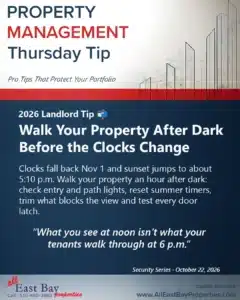
]]>💡 Noon Inspections Miss What Tenants See at 6 P.M.
Most owners see their buildings in daylight: a repair visit, a showing, a quick drive-by. Your tenants see the same building after dark, every night. A burned-out walkway light, a shrub covering the entry or a gate that no longer latches can look like nothing at noon and feel very different at 6 p.m.
This is the month it matters most. Clocks fall back on Sunday, November 1, and Oakland’s sunset moves from about 6:11 p.m. on October 31 to about 5:10 p.m. the next day (sunrise-sunset.org). Exterior lights on a basic timer set for summer evenings can leave entries and paths dark right when tenants are coming home.
What We See at AEBP
Our tenants see the property after dark every night; we mostly see it in daylight. So we rely on them to tell us what’s wrong. Our October tenant newsletter asked residents to submit a maintenance request whenever an exterior light is out, flickering or on a timer that’s no longer set right, and to report any door or gate that isn’t latching on its own. We can only fix what we know about.
Once a tenant reports it, though, we do know about it, and the clock is running. That’s why we treat a broken entry or lobby lock as an emergency, with a vendor sent the same day (company policy). If you self-manage, you’re in the same position: unless someone tells you or you go look, a dark walkway stays invisible. Here’s what to look for when you go (best practice and professional opinion, not a code inspection):
| Spot | What it can look like at noon | What to check after dark |
|---|---|---|
| Main entry | A working door and a fixture on the wall | Is the door, lock and keypad lit? Can you see the entry from the sidewalk? |
| Walkways and stairs | A clear path | Dark gaps between lights, or branches covering a fixture |
| Mail and package area | An ordinary alcove | Is it lit when tenants pick up mail after work? |
| Parking and side gates | Gates that are closed | Dark corners; gates and doors that don’t close and latch on their own |
What you see at noon isn’t what your tenants walk through at 6 p.m.
Your After-Dark Walk Before November 1
- Pick an evening this week: go about an hour after sunset and start from the sidewalk, the way a tenant comes home. Can you see the entry and read the address numbers?
- Check every light: entries, walkways, exterior stairs, the mail area and parking. Note burned-out bulbs, failed fixtures and dark gaps between lights.
- Check the controls: reset any basic timer still on summer settings, and again after the clock change. Best practice: for entries and main paths, consider a photocell or astronomic timer, which adjusts for the season on its own.
- Look for what blocks the view: Oakland’s residential CPTED checklist uses about 2 feet for landscaping and about 6 feet of clear space beneath tree canopies. We use it as a voluntary self-audit.
- Try every door and gate: California’s lock law (Civil Code §1941.3) addresses locks on exterior doors into common areas of multifamily buildings. Best practice: also confirm doors and gates close and latch on their own.
- Make reporting easy, and log it: remind tenants how to report a light that’s out or a door that won’t latch, then record each report with the date reported and the date fixed.
💡 This week’s takeaway
Walk your property once after dark before the clocks change on November 1. It takes about half an hour, most of what you’ll find is a bulb, a timer or a pair of pruning shears, and every fix is one your tenants would otherwise have had to report.
📘 Learn more
This tip comes from Monday’s full guide to lighting, sightlines and access:
→ Lighting, Sightlines and Access: Crime Prevention Through Environmental Design for East Bay Rentals — the full after-dark checklist, photocells vs. timers, and what the research says about lighting
→ Landlord Security Duties in California — the §1941.3 lock list and how a known problem affects liability
→ How to Stop Package Theft in an Apartment Building — mail and package areas in older East Bay buildings
This tip is part of our ongoing education series for Bay Area landlords focused on compliance, risk reduction, and smarter property management. 📋 Browse all Thursday Landlord Tips →
The post Thursday Tip: Walk Your Property After Dark Before the Clocks Change appeared first on All East Bay Properties.
]]>The post Lighting, Sightlines and Access: Crime Prevention Through Environmental Design for East Bay Rentals appeared first on All East Bay Properties.
]]>Share this post
Quick Answer
Crime prevention through environmental design (CPTED) means arranging a property so people can see and be seen, entry points are clear and controlled, and the place looks cared for. For an existing East Bay rental, the lowest-cost steps are usually: exterior lights at entries, walkways, mail areas and parking that come on automatically at dusk; landscaping trimmed so it doesn’t block views or create hiding spots (Oakland’s residential CPTED checklist uses 2 feet for shrubs and 6 feet of clearance under tree canopies); and entry doors and gates that close and latch on their own. Check it before clocks fall back on Sunday, November 1, when Oakland’s sunset moves from about 6:11 p.m. to about 5:10 p.m. Civil Code §1941.3 covers locks, not lighting. But a lighting problem you know about and don’t fix can matter if something happens there.
Key Facts: Lighting, Sightlines and Access
| What | The fact | Source |
|---|---|---|
| What CPTED is | A design approach built on three ideas: natural surveillance (lighting and sightlines), access control, and territorial reinforcement (clear boundaries and visible upkeep). | City of Oakland, Guidelines for CPTED |
| Oakland’s landscaping guideline | Landscaping trimmed up to 2 feet off the ground; trees with 6 feet of clearance below the canopy. | Oakland CPTED checklist, multifamily residential · Local guideline; used here as a voluntary self-audit |
| Oakland’s lighting items | Exterior doorways, walkways, building numbers, entries, recesses and corners lit; lights kept clear of trees; porch lights controlled by the owner or manager, not the apartment occupant. | Oakland CPTED checklist |
| Lighting research | In a randomized New York City experiment, added lighting in public housing developments cut nighttime outdoor index crimes by at least 36%. A review of 13 street-lighting studies found an average 21% drop in crime, including in daytime; how the effect works is still unknown. | Chalfin et al., NBER w25798 (2019); College of Policing summary of Welsh & Farrington (2008) |
| When clocks fall back | Sunday, November 1, 2026. Oakland sunset: 6:26 p.m. on Oct 19, 6:11 p.m. on Oct 31, 5:10 p.m. on Nov 1, about 4:50 p.m. on Nov 30. | 15 U.S.C. §260a; sunrise-sunset.org (Oct), (Nov) |
| What state law says | Civil Code §1941.3 requires specified locks, not lighting. The habitability statute lists “electrical lighting… maintained in good working order” among a dwelling’s standard characteristics. | Civil Code §1941.3; §1941.1(a)(5) · Required by law; how §1941.1 applies to particular exterior fixtures is a question for an attorney |
Prefer video? Watch the 2-minute companion video below, or visit the video page with chapter timestamps and a full transcript.
Video Transcript
Want one of the lowest-cost ways to make a rental feel safer after dark? Look at the lights.
Security planners call this CPTED: crime prevention through environmental design. For an existing East Bay building it comes down to three questions. Can people see and be seen? Is it clear where the entrances are, and do the doors close and latch? Does the place look cared for?
Start with lighting. As a best practice, we recommend steady dusk-to-dawn lighting at entries, walkways, mail areas and parking. Oakland’s own CPTED checklist also says to trim shrubs to about two feet and keep tree canopies at least six feet off the ground, so nobody has a place to wait out of view.
Timing matters this month. Clocks fall back on Sunday, November first, and sunset in Oakland jumps from about six ten to about five ten. Lights on a basic timer set for summer can be off when tenants are coming home. A photocell or an astronomic timer can adjust for the season automatically.
At AEBP, our tenants see the property after dark every night. We mostly see it in daylight. So we ask them to report any light that’s out or a door that won’t latch. We can only fix what we know about. And once someone reports it, we do know about it.
The full guide, with a walk-through checklist and five common questions, is linked below.
What CPTED Means for a Building You Already Own
CPTED (crime prevention through environmental design) is the idea that the physical layout of a place affects how easy it is to commit a crime there without being seen. For a new project, that shapes the design. For an existing East Bay rental, it mostly comes down to maintenance and a few targeted fixes: lights that work when it’s dark, landscaping that doesn’t hide anyone, and entrances that are obvious and close behind people.
This guide is the practical, owner’s-side checklist. For what California law requires of landlords on locks and when a landlord can be liable for crime, see our landlord security duties guide. For package rooms and mail areas, see our package theft guide.
The Three CPTED Principles, Applied to East Bay Rentals
1. Natural surveillance: lighting and sightlines
People are less likely to try something where they can be seen. For a rental, that means lit entries, paths, mail areas and parking, and nothing blocking the view of them. Oakland’s residential checklist asks whether the main entrance is at least partly visible from the street, whether ground-floor windows are clear of vegetation, and whether walkways are lit well enough to “distinguish form and movement.” It also asks that porch lights be controlled by the owner or manager rather than by the occupant, so an entry doesn’t go dark because one resident flipped a switch.
2. Access control: doors, gates and entries
Make it clear where people are supposed to enter, and make the entries close behind them. In older Oakland and Berkeley buildings, the common failures are small: a lobby door closer that no longer pulls the door shut, a side gate that doesn’t latch, a garage gate that stays open long enough for someone to walk in. Civil Code §1941.3 requires locking mechanisms on common-area exterior doors in covered multifamily buildings, subject to the section’s scope and exceptions. Required by law. Keeping the closers working so those locks actually engage is strongly recommended best practice.
3. Territorial reinforcement and maintenance
A property that looks cared for signals that someone is paying attention. Defined edges (plantings, paving changes, low walls or fences) show where public space ends. Prompt repair of broken fixtures and quick removal of graffiti and trash keep that signal intact. This is also the principle that costs the least, because most of it is ordinary upkeep.
After-Dark Walk-Through Checklist
Strongly recommended best practice and professional opinion, not a code inspection. Walk the property about an hour after sunset, the way a tenant comes home. Costs vary widely by building, so they’re shown as relative tiers. Get quotes before deciding.
| Area | What to look for after dark | Typical fix | Relative cost |
|---|---|---|---|
| Main entry and lobby door | Are the door, lock and keypad lit? Can you see the entry from the sidewalk? | Replace failed bulbs or fixtures; put the entry light on a dusk-to-dawn control; trim anything blocking the view | Low |
| Address numbers | Can a visitor or responder read them from the street at night? | Lit or reflective numbers. Oakland’s checklist calls for 5-inch reflective numbers. | Lowest |
| Walkways, side paths and exterior stairs | Dark gaps between fixtures? Can you “distinguish form and movement” (Oakland’s wording)? | Add or move fixtures; clear branches off existing lights | Low to moderate |
| Mail and package area | Is it lit when tenants pick up mail after work? | Dusk-to-dawn fixture; see our package theft guide for the rest | Low |
| Parking, carports and garage | Dark corners? Does the garage gate close behind each car? | Brighter fixtures; light-colored paint on garage walls and ceilings (an Oakland checklist item); service gate closers and sensors | Moderate to higher |
| Side and rear doors, gates | Lit? Closing and latching on their own? Propped open? | Fixture or motion light; adjust closers; self-closing gate hardware | Low to moderate |
| Landscaping | Shrubs above about 2 feet by paths and windows; low tree branches; plants covering light fixtures | Trim to Oakland’s 2-foot / 6-foot guideline and keep it on the gardener’s schedule | Low, recurring |
| Lighting controls | Lights coming on well after dark, or going off before dawn? Timers still on summer settings? | Reset timers after Nov 1; consider replacing basic timers with photocells or astronomic timers | Low |
| Fences and property edges | Solid fences or walls that create blind spots? Unclear where public space ends? | When replacing, consider see-through fencing; define private areas with plantings, paving or low walls | Moderate to higher |
| General upkeep | Broken fixtures, graffiti, trash, abandoned items | Prompt repair and cleanup | Low, ongoing |
Before adding fixtures, changing doors or altering exit paths, have a licensed electrician or other qualified professional check applicable building, fire and accessibility requirements. Point new lights down and away from neighbors’ windows; glare can make it harder to see, not easier.
Why Lights Go Wrong Every Fall, and Which Controls Fix It
The answer first: lights on basic clock timers drift out of sync with sunset every fall, and the November clock change makes it worse. Oakland’s sunset is about 6:26 p.m. on October 19 and 6:11 p.m. on October 31. On Sunday, November 1, clocks fall back and sunset arrives at about 5:10 p.m. By the end of November it’s about 4:50 p.m. (sunrise-sunset.org). A timer set for long summer evenings can leave a walkway dark for an hour or more while tenants are coming home.
| Control | How it decides | Fall and clock-change behavior | Best for |
|---|---|---|---|
| Basic timer (mechanical or simple digital) | Turns on and off at set clock times | Doesn’t follow sunset. Needs resetting as days shorten and after the clock change; a power outage can throw it off. | Rarely the best choice for entries and paths |
| Photocell (dusk-to-dawn sensor) | Turns on when it gets dark | Adjusts on its own | Entries, walkways, mail areas. A dirty or shaded sensor, or one sitting under another light, can misfire. |
| Astronomic timer | Calculates sunset and sunrise from the date and location | Adjusts on its own; confirm the location and daylight-saving settings at install | Controlling several fixtures from one place |
| Motion sensor | Turns on when it detects movement | Not affected | Side yards, rear doors, trash areas. Not a replacement for steady light along main paths. |
Professional opinion: for entries, main paths and mail areas, a photocell or astronomic timer is usually worth the small upgrade over a basic timer, because it removes a twice-a-year reset that’s easy to forget.
Does Better Lighting Actually Reduce Crime?
The evidence says it can help, with limits. In a randomized experiment across New York City public housing developments, temporary lighting towers reduced nighttime outdoor index crimes by at least 36% (Chalfin, Hansen, Lerner and Parker, NBER Working Paper 25798, 2019). A review of 13 street-lighting studies found crime fell by an average of 21% in areas with improved lighting, and in several studies it fell in daytime too, which suggests visible investment in a place may matter as well as visibility itself. The researchers say exactly how the effect works is still unknown (College of Policing summary of Welsh and Farrington, 2008).
For an owner, that supports lighting as a reasonable, low-cost layer. It doesn’t support promising tenants a “safe” or “secure” building because the lights are on.
How Lighting Connects to Liability
A burned-out light is a small repair. It becomes a bigger issue when someone knows about it and it sits. As our landlord security duties guide explains, California courts weigh how foreseeable a harm was against the burden of preventing it. Replacing a bulb or a failed fixture is a small burden. A light that has been reported out, in an area where incidents have already happened, is the kind of gray area that guide’s comparison table flags. Case law; how it applies to a specific property is a question for an attorney.
Strongly recommended best practice: log lighting reports the same way you log lock reports, with the date reported and the date fixed, and fix them promptly. A record that shows quick repairs is useful whatever happens next. Our habitability guide covers repair timelines more broadly.
Oakland’s CPTED Checklist: A Free Audit Tool
The City of Oakland publishes Guidelines for Crime Prevention Through Environmental Design as three checklists: residential, commercial and civic. The multifamily residential checklist is a one-page list of yes/no questions, where every “no” marks something to improve. It’s written for development projects, but it works well as a self-audit for an existing building anywhere in the East Bay. Items most relevant to an existing rental:
- Doorways that open to the outside are well lit, and the main entrance is at least partly visible from the street
- Sidewalks, yards and walkways are lit well enough to distinguish form and movement, with lights kept clear of trees and landscaping
- Landscaping trimmed up to 2 feet off the ground; trees with 6 feet of clearance below the canopy
- Building numbers, entries, recesses and corners are lit; the address is visible from the street with 5-inch reflective numbers
- Porch lights are controlled by the owner or manager, not the apartment occupant
- The parking garage is well lit, with light-colored walls and ceilings, and garage-to-building entries require a key or electronic access
What We See at AEBP
Our tenants see the property after dark every night; we mostly see it in daylight. So we rely on them to tell us what’s wrong. Our October tenant newsletter asks residents to submit a maintenance request whenever an exterior light is out, flickering or on a timer that’s no longer set right, and to report any front door, gate or lobby door that isn’t latching on its own. The line we use with tenants: we can only fix what we know about.
Two things follow from that. First, a tenant report is notice. Once someone tells us an entry light is out or a lobby door won’t latch, we know about it, and the clock is running. That’s why we treat a broken entry or lobby lock as an emergency, with a vendor sent the same day. Company policy. Second, making it easy for tenants to report is part of the security plan, not just customer service. If tenants don’t know how to report a dark walkway, or don’t think anyone will act on it, the problem stays invisible to the owner.
Owner Checklist Before Clocks Fall Back on November 1
- Walk the property about an hour after sunset, starting from the sidewalk
- Replace failed bulbs and fixtures at entries, walkways, mail areas and parking
- Reset basic timers, or replace them with photocells or astronomic timers
- Keep shrubs near paths and windows about 2 feet high, and maintain about 6 feet of clear space beneath tree canopies, following Oakland’s CPTED guideline
- Check that lobby doors, side doors and gates close and latch on their own
- Make sure address numbers are visible from the street at night
- Remind tenants how to report a light that’s out or a door that won’t latch
- Log every lighting and door report with the date reported and the date fixed
Bottom Line
CPTED for an existing rental isn’t a construction project. It’s lights that come on when it’s actually dark, landscaping that doesn’t hide anyone, entries that close behind people, and a property that looks watched. Most of it is low-cost, and the best time to check is before clocks fall back on November 1. Use Oakland’s checklist as a voluntary maintenance self-audit. If you plan alterations or permit work, ask the city whether project-specific CPTED review or other conditions apply. Either way, a lighting or door problem you’ve been told about and haven’t fixed is the kind of thing that can matter later.
Frequently Asked Questions
What’s the most cost-effective security upgrade for a multifamily rental?
It depends on the building, but in our professional opinion, working exterior lighting on automatic controls is often among the lowest-cost, highest-value steps, along with entry doors that close and latch. The research supports lighting as one useful layer: a randomized New York City experiment found at least a 36% drop in nighttime outdoor index crimes where lighting was added (NBER w25798). Those studies looked at public housing grounds and streets, not individual small buildings, so treat lighting as a deterrent layer, not a guarantee.
Are California landlords required to light common areas?
Civil Code §1941.3, the main building-security statute, covers locks, not lighting. California’s habitability statute lists electrical lighting maintained in good working order among a dwelling’s standard characteristics (Civil Code §1941.1(a)(5)); how that applies to particular exterior and common-area fixtures is a question for an attorney. Building and fire codes can separately require lighting along exit paths, so check with a licensed electrician or your local building department before changing them. And a lighting problem you know about can matter to liability, as our landlord security duties guide explains.
Why do exterior lights seem to fail in the fall?
Often they haven’t failed. Days get shorter through October, and when clocks fall back on November 1, sunset in Oakland moves about an hour earlier, to around 5:10 p.m. A basic timer set for long summer evenings can leave entries and paths dark while tenants are coming home. Photocells and astronomic timers adjust automatically. A basic timer has to be reset.
Are motion-sensor lights or always-on lights better for a rental?
Best practice: use both, in different places. Steady dusk-to-dawn lighting works best at entries, main walkways, mail areas and parking, where tenants need to see where they’re going. Motion-sensor lights suit side yards, rear doors and trash areas, where a sudden light draws attention. Oakland’s CPTED checklist includes both.
Does CPTED apply to an existing building, or only to new construction?
Oakland’s CPTED checklists are written for development projects; here, we use the residential checklist as a voluntary maintenance self-audit for an existing rental. If you plan alterations or permit work, ask the city whether project-specific CPTED review or other conditions apply. Most of what it asks about (lighting, trimmed landscaping, visible entries, clear address numbers) can be fixed in an existing building without construction.
Sources
- Oakland CPTED guidelines: City of Oakland, Guidelines for Crime Prevention Through Environmental Design; CPTED checklist, multifamily residential (PDF)
- Lighting experiment: Chalfin, Hansen, Lerner and Parker, “Reducing Crime Through Environmental Design: Evidence from a Randomized Experiment of Street Lighting in New York City,” NBER Working Paper 25798, May 2019
- Street-lighting review: College of Policing, Crime Reduction Toolkit: Street lighting (summarizing Welsh and Farrington, Campbell Collaboration, 2008)
- Required locks: Required by law. California Civil Code §1941.3
- Habitability standards: California Civil Code §1941.1
- Clock change: 15 U.S.C. §260a (daylight saving time ends the first Sunday in November)
- Oakland sunset times: sunrise-sunset.org, October 2026 and November 2026
- Tenant reporting practice, lock-repair policy and portfolio size: AEBP company practice and data
Want Help Keeping Your Building Lit and Latched?
We manage 600+ rental units across Oakland, Berkeley, Emeryville and the wider East Bay, with a 24/7 bilingual maintenance line for tenants to report problems. Let’s talk about how your building handles lighting, doors and repair reports.
More In This Series
The post Lighting, Sightlines and Access: Crime Prevention Through Environmental Design for East Bay Rentals appeared first on All East Bay Properties.
]]>The post Thursday Tip: Before You Add Another Camera, Check Where Packages Land appeared first on All East Bay Properties.
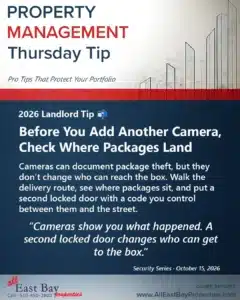
]]>💡 Cameras Don’t Decide Who Can Reach the Box
When packages start disappearing, the first instinct is usually another camera. Cameras can document an incident and may deter some theft. But they don’t change where packages sit or who can get to them.
That matters most in older East Bay apartment buildings, where deliveries often end up on a lobby floor, in a mail alcove near the street, or on the front steps. Apartment and condo residents are more than three times as likely as single-family residents to have had a package stolen, according to Security.org’s October 2025 survey. And the holiday shipping season is about to add volume to whatever spot packages land in now.
What We See at AEBP
Package theft is a common complaint we hear from tenants across the 600+ East Bay units we manage. When we asked our local post office what building owners can do about it, the best advice they had was to get a PO box. They didn’t have a better solution, and they told us mail carriers are being robbed for their master keys.
Our takeaway: the fix isn’t coming from the carriers. It has to happen inside the building, and it starts with knowing where packages actually land. Here’s a quick way to size up what you find (general guidance and professional opinion, not legal advice for a specific property):
| Where packages land | Who can reach them | A reasonable first step |
|---|---|---|
| Front steps or an open vestibule | Anyone on the sidewalk | Get deliveries inside a locked door; a carrier access program may help |
| Lobby floor or mail alcove behind the entry door | Anyone who gets in: tenants, guests, tailgaters, someone with a stolen postal key | Add a second locked door with a code you can change, where the layout allows |
| Locked package room or lockers | People with the code | Change the code on a schedule and after any theft |
Cameras show you what happened. A second locked door changes who can get to the box.
What to Do Before the Holiday Shipping Rush
- Walk the delivery route: on a weekday afternoon, follow the path a driver takes. Note how they get in, where boxes end up, and how long they sit there.
- Check the entry door: California’s lock law (Civil Code §1941.3) addresses locks on exterior doors into common areas of multifamily buildings. Best practice: also confirm the door closer works so the door latches reliably.
- Close the gap: where the layout allows, move packages behind a second locked door with a code you can change, such as a storage closet or part of the mailroom. Have fire, egress and accessibility requirements checked before converting space.
- Send tenants a written package policy: where packages go, whether management accepts them, and how to report a theft. Mention off-site options like carrier pickup points or a PO box for valuable items.
- Remind tenants about the door: don’t buzz in unexpected or unverified visitors, even if they claim to have a delivery, and don’t prop entry doors.
💡 This week’s takeaway
Before you add another camera, check where packages land. Cameras can help document an incident, but controlling who can reach delivered packages is where reducing theft starts. Walk the route, fix the entry door, and put a second locked door between the street and the boxes where your building allows it.
📘 Learn more
This tip comes from Monday’s full guide to package theft in older East Bay buildings:
→ How to Stop Package Theft in an Apartment Building: What Actually Works in Older East Bay Buildings — package rooms vs. lockers vs. cameras, the postal key problem, and an owner checklist
→ Package Theft in California Apartments: Landlord Liability & Prevention — when a landlord can be responsible for a stolen package
→ Landlord Security Duties in California — the §1941.3 lock list and what you don’t automatically owe
This tip is part of our ongoing education series for Bay Area landlords focused on compliance, risk reduction, and smarter property management. 📋 Browse all Thursday Landlord Tips →
The post Thursday Tip: Before You Add Another Camera, Check Where Packages Land appeared first on All East Bay Properties.
]]>The post How to Stop Package Theft in an Apartment Building: What Actually Works in Older East Bay Buildings appeared first on All East Bay Properties.
]]>Share this post
Quick Answer
To reduce package theft in an apartment building, start with where deliveries are left and who can reach them. Cameras can document incidents and may deter theft; controlled access can reduce opportunities to take packages. No option eliminates the risk. In most older East Bay buildings, a practical order is: (1) find where carriers actually leave packages, (2) move them behind a locked door with a code you can change, or into lockers if you have the space, (3) give tenants a written package policy, and (4) don’t rely on a postal key alone to protect a package area, because Bay Area mail carriers have been robbed for those keys. Civil Code §1941.3 does not itself require a package room or lockers; separate property-specific requirements and commitments, including what you promise tenants and any packages your staff agree to hold, may still matter.
Key Facts: Apartment Package Theft
| What | The fact | Source |
|---|---|---|
| Apartment vs. house risk | Apartment and condo residents are more than three times as likely as single-family residents to have had a package stolen. In the three-month period covered by the October 2025 survey, apartment residents were victimized 3.5 times as often as homeowners. | Security.org, Oct 2025 survey of 3,307 U.S. adults |
| How common it is | About 1 in 4 Americans have had a package stolen. The average stolen package was worth $222. | Security.org, Oct 2025 |
| Is a package room or locker required? | Not under Civil Code §1941.3 itself. That section addresses specified locks, not package storage. | Civil Code §1941.3 · Required by law (and its limits) |
| If your staff accept packages | Agreeing to hold someone’s property can create a deposit and a duty of care. A free (gratuitous) depositary must use at least slight care; a depositary for hire must use at least ordinary care. | Civil Code §1846 / §1852 · Required by law; how it applies to a building is a question for an attorney |
| Postal keys | An Oakland carrier’s postal keys were stolen in May 2024. In a separate Berkeley incident reported in October 2022, thieves entered with a key that the building manager believed was a carrier master key. | NBC Bay Area, May 2024; NBC Bay Area, Oct 2022 |
| Reporting mail theft | U.S. Postal Inspection Service: 877-876-2455 or uspis.gov/report. Call 911 first if a crime is in progress. | USPS |
Prefer video? Watch the 2-minute companion video below, or visit the video page with chapter links and a full transcript.
Video Transcript
How can you reduce package theft in an apartment building? Start with where deliveries are left and who can reach them. Cameras can document incidents and may deter theft, but they work best alongside a controlled delivery area.
First, walk the route a delivery driver takes. Where do packages actually end up? In a lot of older Oakland and Berkeley buildings, that’s an open lobby or a mail alcove near the street.
Then close that gap. In our view, a locked package room with a code you can change is often the most practical fix for an older building, where the layout allows. Lockers can work too, if you have the floor space and power. If most of your packages come from Amazon, ask about its building-access program.
Put a written package policy in front of tenants, and remind them not to buzz in unexpected or unverified visitors, even if they claim to have a delivery.
One more East Bay reality. When we asked our local post office what owners can do, the best advice they had was a PO box. Mail carriers here have been robbed for the keys that open apartment mailboxes and building key boxes. So don’t let a postal key be the only thing protecting your package room.
At AEBP, package theft is a common complaint we hear from tenants. The full guide, with an options table and five common questions, is linked below.
The Short Answer: Control Where Packages Land
Much package theft in apartment buildings isn’t sophisticated. A box sits somewhere anyone can reach, for long enough that someone takes it. So a good place to start is narrowing who can reach the spot where packages wait. Every option below is a version of that.
This guide is the owner’s side: what to change in the building. If you’re asking whether a landlord is legally responsible for a stolen package, or you’re a tenant whose package disappeared, our package theft liability guide covers that. For the broader picture of what California requires for building locks and when a landlord is liable for crime, see our guide to landlord security duties.
Step One: Find Out Where Packages Actually Land
Before buying anything, walk the route a driver takes, ideally on a weekday afternoon when deliveries peak. Strongly recommended best practice. Note four things:
- How drivers get in. Through a buzzer, a code, a key box, or by waiting for a tenant to open the door?
- Where boxes end up. The lobby floor, a mail alcove, a stairwell, outside a unit door, or on the front steps?
- Who else can reach that spot. Is it behind the building’s locked entry door, or reachable from the sidewalk?
- How long packages sit there. Ask tenants. A few hours behind a locked door is a different risk than overnight in an open vestibule.
Required by law: for covered multifamily buildings, Civil Code §1941.3(a)(3) addresses locking mechanisms on exterior doors serving common areas with access to dwelling units, subject to the section’s scope and exceptions. Strongly recommended best practice: keep existing closers working so doors latch reliably. Before changing doors or converting a closet into package storage, have a qualified professional check applicable fire, egress and accessibility requirements. See our landlord security duties guide for the broader rules.

Package Theft Options Compared for Older East Bay Buildings
Professional opinion and general guidance, not a vendor endorsement. Costs vary widely by building, so they’re shown as relative tiers. Get written quotes before deciding. “Older layout fit” refers to the small lobbies, narrow halls and street-facing mail alcoves common in pre-1960 Oakland and Berkeley apartment buildings.
| Option | What it does | Older layout fit | Upkeep | What it doesn’t solve | Relative cost |
|---|---|---|---|---|---|
| Written package policy | Tells tenants where packages go, who handles them and what to do about a theft | Works anywhere | Update yearly and before the holidays | Doesn’t physically protect anything | Lowest |
| Locked package room or closet with a keypad | Moves packages behind a second locked door, with a code you can change | Often the best fit. Can reuse a storage closet or part of a mailroom. | Change the code on a schedule and after any theft; keep the door closer working | Codes spread over time; anyone with the code can still take a box | Low to moderate |
| Smart package lockers | Each package goes in its own compartment; the tenant gets a pickup code | Needs wall or floor space, usually power, and sometimes network access. Must not narrow an exit path. | Vendor service contract; oversized items still need a backup spot | Large boxes, carriers that won’t use the lockers, outages | Highest; usually hardware plus an ongoing fee |
| Carrier access programs (for example, Amazon Key for Business) | Lets verified drivers open the entry door during a delivery, so boxes don’t pile up outside | Works with many existing buzzers and fob systems | Device on your entry system; review who has access | Covers one carrier; gets boxes inside, not into a locked room | Confirm current U.S. property eligibility, installation costs and ongoing fees directly with the provider |
| Security cameras | Records what happened; visible cameras may deter some thieves | Works anywhere with power | Keep it working and retain footage; don’t advertise more than it does | Does not physically secure packages; deterrence and recovery are not guaranteed | Low to moderate |
| Off-site delivery (PO box, carrier pickup points, delivery to work) | Tenant routes packages away from the building | Works anywhere; it’s the tenant’s choice | None for the owner; worth listing in your package policy | Costs the tenant time and sometimes money; some shippers won’t deliver to a PO box | None to owner |
Professional opinion: for many older East Bay buildings, a strong starting combination is a locked package room or closet plus a written policy, where the layout and fire, egress and accessibility requirements allow. Lockers are a good fit when there’s space and enough package volume to justify an ongoing fee. A carrier access program helps most where packages currently pile up outside a locked front door.
The Postal Key Problem
Many apartment buildings give the mail carrier access through a postal lock: a key box by the front door, or the master door on a bank of mailboxes. That works only as long as the keys stay with carriers, and in the Bay Area they haven’t always.
- In May 2024, two suspects took a mail carrier’s postal keys on Euclid Avenue in Oakland. A U.S. Postal Inspector told NBC Bay Area, “The keys only have one use if you’re not a letter carrier and that’s to steal mail.”
- In October 2022, surveillance video at a Berkeley apartment building on Le Conte Avenue showed someone open the building’s key box with a key, let a second person in, open several mailboxes and take a package. The building manager believed it was a carrier master key (NBC Bay Area).
- Nationally, USPS reported 412 letter carrier robberies in fiscal 2022 and announced plans to replace 49,000 older arrow locks with electronic locks (USPS, May 2023). In May 2026, the USPS Office of Inspector General still found many of the same arrow key accountability problems it had identified before (report 25-137-R26).
What that means for an owner. Strongly recommended best practice: don’t let a postal lock be the only barrier between the street and your package area. Put packages behind a second door with its own code. If the building’s postal key box or mailbox panel is damaged or appears to have been opened, report it to your local post office and the Postal Inspection Service, and repair any building hardware that’s yours to maintain. Mail theft is a federal crime, so the Postal Inspection Service is the right agency, alongside the police.
What Doesn’t Work on Its Own
- Relying on cameras alone. Camera footage can help document an incident. Strongly recommended best practice: use cameras alongside controlled access and prompt pickup, rather than relying on footage alone.
- Informally accepting packages for tenants. A manager or neighbor who starts signing for packages “as a favor” may have created a deposit, which comes with a duty of care. Under Civil Code §1846, even a free depositary must use at least slight care. Best practice: if you accept packages, do it under a written policy, or don’t do it.
- Calling the building “secure.” If your listing or lease promises a secure package room, keep it secure. A promise you can’t keep is where liability tends to start. Describe the actual feature instead (“a locked package room with a keypad”).
- A code nobody changes. A keypad code shared with every carrier and every past tenant slowly turns back into an open door.
What to Tell Tenants: A Written Package Policy
A one-page package policy costs nothing and sets expectations on both sides. Strongly recommended best practice. Cover:
- Where packages go (the package room, lockers, or the lobby) and how to get in
- Whether management accepts packages (and if so, which ones and for how long)
- Pick up packages promptly, and use delivery alerts (USPS Informed Delivery is free)
- Don’t buzz in anyone you aren’t expecting, even if they say they have a delivery, and don’t prop doors
- Alternatives for valuable items: carrier pickup points, signature-required delivery, delivery to work, or a PO box
- How to report a theft: to the carrier and retailer, to the police, to the Postal Inspection Service for mail, and to management so you can spot a pattern
Send a reminder before the holiday shipping season, when package volume and theft both climb. And keep a simple log of the thefts tenants report. A pattern in one spot tells you where to spend money next.
What We See at AEBP
Package theft is a common complaint we hear from tenants across the 600+ East Bay units we manage.
When we asked our local post office what building owners can do about it, the answer was blunt: the best advice they had was to get a PO box. They didn’t have a better solution to offer for package theft. They also told us mail carriers are being robbed for their master keys, which matches the Bay Area reports above. We took two lessons from that conversation. First, owners shouldn’t wait for the carriers to solve this; the fix has to happen inside the building. Second, a PO box is a reasonable option to mention in a tenant package policy, but it’s the tenant’s call, and it isn’t a building-level fix.
None of the buildings we currently manage use smart package lockers, so the locker row in the table above comes from vendor information and general industry practice, not our own track record.
Owner Checklist Before the Holiday Shipping Season
- Walk the delivery route and note where packages land and who can reach them
- Check required common-area entry locks. Strongly recommended best practice: test any existing door closer and confirm the door latches reliably.
- Move packages behind a second locked door with a changeable code, or price out lockers if space allows
- Change package-room codes now and set a schedule for changing them again
- Check common-area lighting at the entry, mail area and package area
- Send tenants the written package policy and a holiday reminder
- Make sure listings and the lease describe package features accurately
- Report damaged postal key boxes or mailbox panels to the post office and the Postal Inspection Service
Bottom Line
No setup eliminates every theft, and Civil Code §1941.3 does not itself require a package room. But you can start by checking existing doors and delivery arrangements before pricing improvements: a lobby door that latches, a second locked door with a code you control, and a clear written policy. Add lockers or carrier access if the building and the package volume justify it, and treat cameras as one layer that documents incidents and may deter some theft, not as the whole answer.
Frequently Asked Questions
What’s the cheapest way to reduce package theft in an apartment building?
Start by checking that the entry door latches reliably and giving tenants a written package policy. Then consider moving packages behind a second locked door, such as a storage closet or part of the mailroom with a keypad lock, where the layout and fire, egress and accessibility requirements allow. A written policy and repairs to existing hardware may be lower-cost starting points; a new package room needs a property-specific quote.
Are California landlords required to provide package lockers or a package room?
Civil Code §1941.3 does not itself require either. That does not settle every building’s obligations: check applicable local requirements, approvals and lease commitments. Obligations around packages usually come from what you promise in a lease or listing, from packages your staff agree to hold, and from known, repeated problems in areas you control. Our package theft liability guide covers when a landlord can be responsible for a stolen package.
Should management accept packages for tenants?
Best practice: only under a written policy. Agreeing to hold a tenant’s package can make you a depositary with a duty of care under California law: at least slight care if you do it free (Civil Code §1846), and at least ordinary care if you’re paid for it (§1852). Whether a particular arrangement counts as a deposit, and which standard applies, is a question for an attorney. A written policy should say which packages you accept, where they’re stored, how long you’ll hold them, and how tenants pick them up. If you can’t commit to that, it’s safer not to accept packages at all and say so in the policy.
Does a PO box solve package theft?
For an individual tenant, it can take the building out of the equation for mail and USPS packages. It’s what our local post office recommended when we asked. The limits: it’s the tenant’s cost and time, and many private carriers won’t deliver to a standard PO box. Some post offices offer a street-style address for PO boxes that lets UPS, FedEx and Amazon deliver there, but only at participating locations. It’s a good option to mention in your package policy, not a substitute for fixing the building.
What should happen when mail or packages are stolen from the building?
The tenant should contact the carrier and retailer and file a police report. Stolen mail, or a mailbox or postal key box that’s been opened or damaged, should also go to the U.S. Postal Inspection Service at 877-876-2455 or uspis.gov/report. Ask tenants to tell management too. As the owner, log each report, check the door and lock involved, and look for a pattern. Repeated thefts from the same spot are a signal to change how that spot is controlled.
Sources
- Package theft rates and values: Security.org, 2025 Package Theft Report (survey of 3,307 U.S. adults, October 2025)
- Required locks: Required by law. California Civil Code §1941.3
- Duty of care when holding property: Civil Code §1846 and §1852
- Oakland carrier key robbery: NBC Bay Area, May 2, 2024
- Berkeley apartment mail theft with a key: NBC Bay Area, October 11, 2022
- Carrier robberies, arrow lock replacement and reporting: USPS and U.S. Postal Inspection Service, May 12, 2023
- Arrow key accountability: USPS OIG, report 25-137-R26, May 19, 2026
- PO box street addressing: USPS PostalPro, Premium PO Box Service Street Addressing
- Amazon Key delivery-access mechanism: Amazon’s explanation of verified, time-limited building access. Confirm current local availability and terms directly with Amazon.
- Post office conversation, tenant complaint frequency and portfolio size: AEBP direct experience and company data
Tired of Package Complaints?
We manage 600+ rental units across Oakland, Berkeley, Emeryville and the wider East Bay. Let’s talk about where packages land at your property and what it would take to fix it.
More In This Series
The post How to Stop Package Theft in an Apartment Building: What Actually Works in Older East Bay Buildings appeared first on All East Bay Properties.
]]>The post Thursday Tip: A Broken Lock Report Isn’t Just a Complaint. It’s Notice. appeared first on All East Bay Properties.
]]>💡 The Report Starts the Clock
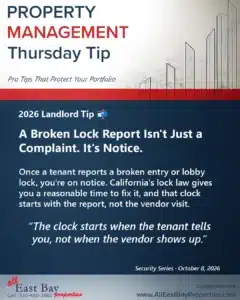
A tenant texts that the lobby door won’t lock. It’s easy to file that next to the dripping faucet and the squeaky cabinet. It doesn’t belong there.
Under Civil Code §1941.3(b), a landlord can be liable for a lock violation if it isn’t corrected within a reasonable time after the landlord has actual notice of it or receives notice of it. That tenant text is notice. From that moment, the property is on the clock, and “we were planning to get to it” is a weak position if someone gets in through that door before the repair.
Courts have treated this exact situation seriously. In Kwaitkowski v. Superior Trading Co. (1981), a tenant was assaulted in a building lobby with a defective front-door lock, after tenants had complained about strangers getting in and another tenant had been attacked in a common area about two months earlier. The court found a duty. A known broken entry lock is the clearest picture of what “on notice” looks like.
What We Do at AEBP
Company policy: when a tenant reports a broken entry door lock or a lobby door that won’t lock, we treat it as an emergency on our 24/7 maintenance line, not a routine work order, and we send a vendor the same day. The work order goes into AppFolio the day the report comes in, so the record shows when we were told and when it was fixed.
Why same day? The statute says “reasonable time,” not a number of hours. We don’t try to find out where the edge of “reasonable” is on a door that lets strangers into the building. Our view is that a lock repair is one of the cheapest risks an owner will ever close, so there’s no reason to let it sit.
Not every report is a door lock, though. Here’s a quick way to sort what comes in (general guidance, not legal advice for a specific property):
| The tenant reports… | Listed in §1941.3? | Why it matters |
|---|---|---|
| Deadbolt on a unit’s main entry door won’t lock | Yes, §1941.3(a)(1) | A required lock on the door into someone’s home |
| Lobby or common-area exterior door won’t lock | Yes, §1941.3(a)(3) | Affects every unit with access from that common area |
| Lock on a window that opens is broken | Yes, §1941.3(a)(2), with exceptions | Louvered, casement and high windows are exempt |
| Entry door doesn’t close and latch on its own | Not by name | A door that won’t latch quietly undoes the common-area lock (professional opinion) |
The clock starts when the tenant tells you, not when the vendor shows up.
What to Do When a Lock Report Comes In
- Classify it as urgent, not routine: make sure whoever answers your calls, texts and email knows that entry and lobby lock reports skip the regular repair queue.
- Log the date reported and the date fixed: open the work order the day the report arrives, not after the repair. That timestamp is your record of when you acted on notice.
- Photograph the repair: a dated photo of the working lock, plus the vendor invoice, filed by property address.
- Close the loop in writing: a short message to the tenant who reported it, confirming the fix and the date.
- Recheck entry and garage doors monthly: try each lock and watch each door close. Worn closers and latches fail gradually, so you want to find them before a tenant does.
💡 This week’s takeaway
A broken lock report isn’t just a complaint. It’s notice. California gives you a reasonable time to fix a required lock, and that time starts when you’re told. Treat entry and lobby lock reports as urgent, log the dates, and keep proof of the fix.
📘 Learn more
This tip comes from Monday’s full guide to building security duties:
→ Landlord Security Duties in California: What You’re Liable For (and What You’re Not) — the §1941.3 lock list, how foreseeability works, and what you don’t automatically owe
→ California Landlord Repair Timelines — how fast California expects other repairs to be handled
→ Thursday Tip: Your Repairs Are Only as Good as Your Documentation — the paper trail that proves you acted
This tip is part of our ongoing education series for Bay Area landlords focused on compliance, risk reduction, and smarter property management. 📋 Browse all Thursday Landlord Tips →
The post Thursday Tip: A Broken Lock Report Isn’t Just a Complaint. It’s Notice. appeared first on All East Bay Properties.
]]>The post Landlord Security Duties in California: What You’re Liable For (and What You’re Not) appeared first on All East Bay Properties.
]]>Share this post
Quick Answer
A crime alone doesn’t make a California landlord liable. Landlords are not insurers of their tenants’ safety. Subject to statutory exceptions, Civil Code §1941.3 requires deadbolts on main swinging unit-entry doors, locking devices on covered windows that open, and code-compliant locks on exterior doors into common areas of multifamily buildings. Liability for a crime committed by someone else turns on foreseeability (what risk you knew about or should have known about, such as a defective lock or earlier similar crimes), whether a reasonable precaution was skipped, and whether that failure contributed to the harm. A duty to hire security guards generally requires heightened foreseeability, which can come from prior similar incidents or other serious warning signs.
Key Facts: California Landlord Security Duties
| What | The rule | Source |
|---|---|---|
| Deadbolt on each main swinging entry door to a unit | Bolt must extend at least 13/16 inch when locked. Horizontal sliding doors are exempt; some existing locks and government-approved alternatives also qualify. | Civil Code §1941.3(a)(1) · Required by law |
| Locks on windows designed to be opened | Louvered and casement windows are exempt, as are windows more than 12 ft vertically or 6 ft horizontally from the ground, a roof or another platform | §1941.3(a)(2) · Required by law |
| Exterior doors into common areas (multifamily) | Doors that provide entry to common areas with access to units must have locks that comply with fire and safety codes | §1941.3(a)(3) · Required by law |
| When a defective lock becomes your problem | You can be liable for a violation if you don’t correct it within a reasonable time after you either have actual notice of it or receive notice. A tenant report is one way you get notice; seeing it yourself is another. | §1941.3(b) · Required by law |
| Lock change for a tenant protected from abuse | Within 24 hours of a written request with the documentation the applicable section requires, at your expense. If the restrained person is a co-tenant (§1941.6), a qualifying court order excluding them is required. | §1941.5 / §1941.6 · Required by law |
| When security guards can be required | Only with a “high degree of foreseeability,” which can come from prior similar incidents or other serious warning signs | Ann M. v. Pacific Plaza (1993) · Case law |
| Security cameras | Not on the §1941.3 list. Promises you make, other rules and property-specific risk need separate assessment. | §1941.3 · Not required by §1941.3 |
Video Transcript
Are you liable when a tenant is the victim of a crime at your rental? A crime alone doesn’t make a California landlord liable. But a few things change the picture fast.
First, the basics the law requires. With some exceptions, Civil Code section 1941.3 requires deadbolts on main entry doors, locks on windows that open, and code-compliant locks on exterior doors into the common areas of a multifamily building.
Second, knowledge. Once you know a required lock is defective, whether a tenant told you or you saw it yourself, act promptly and document the repair. Courts look at what you knew and what you did about it. A broken lobby lock, earlier break-ins, or complaints about strangers in the hallway can make the next incident more foreseeable.
What you don’t automatically owe: security guards, or protection from crime nobody could have predicted. California’s Supreme Court has said landlords aren’t insurers of public safety.
At AEBP, we treat a broken entry or lobby lock as an emergency, with a vendor sent the same day. In our view, working locks, good lighting and secure mail can help reduce risk and support tenant retention.
The full guide, with the comparison table and five common questions, is linked below.
The Short Answer: A Duty, Not a Guarantee
A California landlord’s security duty is real but limited. You have to provide and maintain specific locking hardware, keep common areas in reasonable repair, and act on problems once you know about them. You do not have to guarantee that no crime ever happens on the property. The California Supreme Court put it plainly in Ann M. v. Pacific Plaza Shopping Center (1993): going further would force landlords “to become the insurers of public safety, contrary to well-established policy.”
Most liability cases don’t turn on whether a crime happened. They turn on two questions. Did the landlord know, or should they have known, about a specific risk? And was there a reasonable step they didn’t take? Everything below is a version of those two questions.
What California Law Requires: The §1941.3 Lock List
Since July 1, 1998, Civil Code §1941.3 has required landlords of residential buildings to install and maintain three things. Required by law:
- An operable deadbolt on each main swinging entry door of a unit. The bolt must extend at least 13/16 inch beyond the strike edge when locked. Horizontal sliding doors are exempt. An older lock that met earlier standards can stay until it needs repair or replacement, and then it must be replaced with a compliant one. Locks and devices that a state or local agency has inspected and approved also satisfy the requirement.
- Operable security or locking devices on windows designed to be opened. Louvered windows, casement windows, and windows more than 12 feet vertically or 6 feet horizontally from the ground, a roof or another platform are exempt.
- Locking mechanisms on exterior doors that provide entry to common areas with access to units in multifamily buildings. These must comply with fire and life safety codes, so a lobby lock still has to let people out in an emergency.
Three parts of the statute matter just as much as the list. First, the tenant is responsible for telling you when a lock doesn’t work. Second, you’re liable for a violation if you don’t correct it within a reasonable time after you either have actual notice of the problem or receive notice of it. A tenant’s email, text or maintenance request is the most common way that happens, but a broken lock you notice on a walk-through counts too. If you don’t fix it, the tenant can use the repair remedies in Civil Code §1942 and related sections, and can raise it as a defense in an eviction case. Third, the statute says a violation doesn’t broaden or limit your general duty of care. Liability for a crime still depends on the usual questions, including whether the defect actually contributed to the harm. Some historic buildings have narrow exemptions, so check before assuming one applies.
For how fast California expects other repairs to be handled, see our guide to landlord repair timelines.
Where Liability Comes From: Foreseeability
Outside the lock statute, landlord liability for crime by a third party comes from ordinary negligence law. California courts use a sliding scale. The more foreseeable the harm, the more a landlord can be expected to do about it. The less foreseeable, the lighter the expected precaution. The cases below show where the lines usually fall. Case law; how it applies to a specific property is a question for an attorney.
| Case | What happened | What it means for you |
|---|---|---|
| Kwaitkowski v. Superior Trading Co. (1981) | A tenant was assaulted in a building lobby with a defective front-door lock, in a building where tenants had complained about strangers getting in and another tenant had been attacked in a common area about two months earlier. | A known broken entry lock plus prior incidents can create a duty. This is the clearest picture of what “on notice” looks like. |
| Ann M. v. Pacific Plaza (1993) | An employee was assaulted at a shopping center. The record included some earlier crimes on the premises, but no evidence the owner knew about them, and they weren’t similar to the assault. | Hiring guards requires a high degree of foreseeability. The court said that rarely exists without prior similar incidents on the property that the owner knew about. |
| Castaneda v. Olsher (2007) | A mobilehome park resident was hit by a stray bullet during a gang confrontation. | No duty to refuse to rent to suspected gang members; the court said that would invite housing discrimination. Burdensome measures need a high degree of foreseeability. |
| O’Hara v. Western Seven Trees (1977) | Management knew about earlier assaults on the property and told a prospective tenant the complex was safe and patrolled. | What you say about security can create liability on its own. Don’t overstate it. |
The practical lesson from all four: courts weigh how foreseeable the harm was against the burden of preventing it. A repaired lobby lock or a replaced light is a small burden, so a court is far more likely to expect it than a guard service. That’s why the speed of your response to a security repair matters more than the size of your security budget.
What Landlords Generally Aren’t Responsible For
Case law and statute, stated generally: a crime doesn’t automatically make a landlord liable. Whether a duty exists depends on how foreseeable the risk was and how burdensome the proposed precaution would be. Liability also requires a breach of that duty and a causal link to the injury. A working lock, no prior incident on the property, or an incident inside a unit does not by itself decide liability; the relevant risk, available precautions and causal connection still matter.
Some things courts have specifically declined to require. There’s no automatic duty to hire guards. And in Castaneda, the California Supreme Court refused to make a landlord screen out applicants based on suspected gang membership, partly because that would invite housing discrimination.
None of that is a reason to do the minimum. It’s a reason to put your effort where the law actually puts the weight: required hardware, quick repairs, and accurate communication.
Your Responsibility vs. Not Your Responsibility vs. Gray Area
A general guide, not legal advice for a specific property:
| Area | Your responsibility | Generally not your responsibility | Gray area |
|---|---|---|---|
| Door and window locks | Install the §1941.3 devices and fix them within a reasonable time after you know or are told | Paying for damage the tenant caused (check your lease). That affects who pays, not whether it gets fixed. | How fast is “reasonable” for an entry lock (we treat it as same-day) |
| Common-area entry doors | Locking mechanism on exterior doors into common areas | Tenants propping doors or buzzing in strangers | Worn closers and latches that leave a door unlatched after you’ve been told |
| Lighting | Keeping common areas in reasonable repair | Street lighting the city controls | A burned-out light in an area where incidents have already been reported |
| Packages | Whatever you’ve promised in the lease or advertising (for example, a locked package room) | Carrier-left packages with no promise of storage | Package areas you control and know are being hit (see our package theft guide) |
| Cameras | §1941.3 doesn’t require them. Maintain any system you’ve told tenants about. | Installing cameras just because §1941.3 lists other devices | Cameras that are advertised as working but aren’t |
| Security guards | No automatic duty. Depends on heightened foreseeability and the burden of the precaution. | Patrols on a property with no history or warning signs pointing to that risk | A property with a documented pattern of violent crime |
| What you say about safety | Being accurate | General neighborhood crime you don’t know specifics about | Calling the building “secure” or “safe” when you know of on-site incidents |
East Bay Specifics
Oakland publishes its own Guidelines for Crime Prevention Through Environmental Design (CPTED), including a residential checklist. CPTED is the planning approach behind most practical building security: lighting and sightlines, controlled entry points, and a property that looks cared for. The checklist is written for new projects, but it works as a free audit tool for an existing building.
Older East Bay buildings tend to be where the gray areas live. Many Oakland and Berkeley apartment buildings predate modern access control, with original lobby doors, aging closers and mailbox alcoves near the street. Professional opinion: on those buildings, an entry door that doesn’t close and latch on its own is the single most important thing to check, because it quietly undoes the common-area lock that §1941.3 requires.
Package theft is its own topic. Liability there depends heavily on what you’ve promised and what you control. Our package theft guide for California apartments covers it.
What We See at AEBP
Company policy: when a tenant reports a broken entry door lock or a lobby door that won’t lock, we treat it as an emergency on our 24/7 maintenance line, not a routine work order, and send a vendor the same day. The reason is the statute. Once a tenant tells us a lock is broken, the property is on notice, and every hour that lock stays broken is an hour the owner is exposed.
Professional opinion, from managing 600+ East Bay units: the security features that do the most to reduce an owner’s risk are the same ones that help keep good tenants. Working locks, good lighting and secure mail are what residents notice and talk about. They’re also, for the most part, the inexpensive fixes. A building that handles these basics well rarely needs the expensive measures, and it gives renters fewer reasons to move out.
Bottom Line
California doesn’t make you responsible for every crime near your rental. It makes you responsible for the required locks, for reasonable upkeep of the places you control, and for acting quickly on what you know. Treat lock and door reports as urgent, document the fix, and describe your building’s security accurately. That covers the core of what §1941.3 asks of you, and it puts you in a far stronger position if something does happen. Our repair documentation tip explains how to keep the paper trail that proves it.
Quick Self-Audit: Building Security Basics
Required by §1941.3 (subject to its exceptions):
- Check each main swinging unit-entry door for a compliant deadbolt (13/16-inch throw) or an approved alternative. Apply the existing-hardware rule before requiring replacement.
- Every covered window that opens has a working lock (louvered, casement and high windows are exempt).
- Every exterior door into a common area with access to units has a working lock that meets fire and safety codes.
Required by §1941.5/§1941.6:
- When the applicable written request and documentation requirements are met, change covered locks at landlord expense within 24 hours and provide the tenant a key.
Additional safety and operating checks (other legal or code duties may also apply):
- Common-area entry doors close and latch on their own.
- Lock and door reports are treated as urgent, with the report date and fix date logged.
- Common-area lights are working, including walkways, entries and mail areas.
- Your listings and lease describe security features without words like “secure” or “safe.”
- Keep a written procedure for identifying qualifying lock-change requests and meeting the 24-hour deadline.
Frequently Asked Questions
Is a landlord liable if a tenant’s apartment is burglarized?
Not automatically. Liability generally requires that the crime was reasonably foreseeable, that a reasonable precaution was skipped, and that the failure contributed to the harm. The classic example is a lock or door the landlord was told was broken and didn’t fix, or a known pattern of similar break-ins that went unaddressed. A working, properly maintained lock does not by itself resolve liability; the claim still depends on the relevant duty, breach and causal connection.
Do I have to install security cameras on my rental property?
Civil Code §1941.3 doesn’t require them. It lists deadbolts, window locks and common-area door locks, not cameras. Promises you’ve made, other rules and the specific risks at your property still need their own assessment. If you do install cameras, keep them working and don’t advertise them as more than they are. Also avoid pointing cameras into private areas of a unit.
Who pays when a lock breaks?
Generally the landlord, because §1941.3 requires the landlord to install and maintain operable locks. The exception is damage caused by the tenant or a guest. Many leases make the tenant responsible for that, so check your lease. Either way, fix an entry lock first and sort out who pays afterward.
Can a tenant change the locks?
Most leases require the landlord’s permission and a copy of the new key. The big exception: special lock-change rights cover eligible victims of abuse or violence and, under §1941.5, certain tenants whose household or immediate family member is a victim. On a written request with qualifying documentation, you must change the locks at your expense within 24 hours. Civil Code §1941.5 applies when the person alleged to have committed abuse or violence is not a tenant of the same unit. It accepts several forms of qualifying documentation, including a signed statement from the eligible tenant; a restraining order is not required in every case. §1941.6 covers a co-tenant and requires a qualifying court order excluding that person. Under §1941.5, for leases executed on or after January 1, 2011, if you miss the deadline, the tenant may change the locks in a workmanlike manner using locks of similar or better quality, must notify you within 24 hours and provide a key by an agreed reasonable method, and must be reimbursed within 21 days after the change. §1941.6 has a similar self-change remedy.
Do I have to warn tenants about crime in the area?
There’s no general statutory duty to brief tenants on neighborhood crime. The risk is in what you say. In O’Hara v. Western Seven Trees (1977), a landlord who knew about earlier assaults on the property and told a prospective tenant the complex was safe and patrolled could be held liable. Don’t describe a building as “secure” or “safe” in listings or conversations. Describe the actual features instead.
Sources
- Required locks, tenant notice and remedies: Required by law. California Civil Code §1941.3
- Lock changes for protected tenants: Required by law. Civil Code §1941.5; Civil Code §1941.6
- Foreseeability and security guards: Ann M. v. Pacific Plaza Shopping Center (1993) 6 Cal.4th 666
- Sliding-scale duty and gang-related violence: Castaneda v. Olsher (2007) 41 Cal.4th 1205
- Defective lobby lock and prior incidents: Kwaitkowski v. Superior Trading Co. (1981) 123 Cal.App.3d 324
- Safety misrepresentations: O’Hara v. Western Seven Trees Corp. (1977) 75 Cal.App.3d 798
- Oakland CPTED checklists: City of Oakland, Guidelines for Crime Prevention Through Environmental Design
- AEBP lock-report handling and portfolio size: AEBP company policy and company data
Want Security Repairs Handled Like Emergencies?
We manage 600+ East Bay rental units with a 24/7 bilingual maintenance line. Let’s talk about how your building handles lock, door and lighting problems before they become liability problems.
More In This Series
The post Landlord Security Duties in California: What You’re Liable For (and What You’re Not) appeared first on All East Bay Properties.
]]>The post Thursday Tip: Two Weeks, No Applications? Your Price Is Talking appeared first on All East Bay Properties.
]]>💡 Two Weeks of Silence Is an Answer
Most landlords treat the first price cut as a last resort. They give the listing a third week, then a fourth, hoping the right renter will turn up at the asking price.
But the first 7–14 days of a listing tell you the most. If a unit has had showings and no qualified applications by the end of week two, renters have usually already compared it with everything else on the market and picked something else. That isn’t a slow start. It’s an answer. And on a $2,500-a-month unit, every extra week of waiting costs about $575 in rent.
What We See at AEBP
In one turnover we handled, the owner wanted to list well above what comparable units nearby were renting for. That’s an understandable instinct for a well-kept property. The unit went through several price reductions over a period of months, and it finally leased at about the level the comparables had suggested from the start. The market price wasn’t found by waiting. It was found by adjusting.
That’s why we look at the numbers at the two-week mark rather than at the calendar. Here’s how we read them (professional opinion, not a legal requirement):
| At day 14, you’re seeing… | It usually means… |
|---|---|
| Few inquiries, almost no showings | Renters are ruling it out at a glance, often on price or photos |
| Plenty of showings, no applications | Renters are comparing it and choosing something else, often on price relative to condition |
| Applications, but none that qualify | The price is reaching renters who can’t meet your screening standards |
| Several qualified applications | You’re at or near market. Screen carefully and lease. |
Every week of “let’s give it a little longer” costs a full week of rent.
What to Do at the Two-Week Mark
- Count, don’t guess: inquiries, showings, applications and qualified applications since launch.
- Rule out non-price causes: photos, showing availability, listing details and how fast inquiries get a reply.
- Check what renters are comparing you to right now: current listings and recent signed leases for similar units nearby, not what the unit rented for last time.
- Adjust once, meaningfully: if price is the likely cause, move it far enough to change which listings renters see yours alongside.
- Set the next check-in: seven days out, same numbers.
💡 This week’s takeaway
Two weeks of showings with no qualified applications is usually the market’s answer, not a slow start. Check the numbers at the two-week mark and adjust, instead of waiting. On a $2,500 unit, each extra week of hoping costs about $575, and in fall there are fewer renters to wait for.
📘 Learn more
This tip comes from Monday’s full guide on pricing and vacancy:
→ What Overpricing a Rental Really Costs: The Vacancy Math East Bay Landlords Miss — the week-by-week math, showing signals, and a before-you-list checklist
→ Thursday Tip: The Vacancy Gap You’re Not Tracking — how vacancy adds up across a full turnover
This tip is part of our ongoing education series for Bay Area landlords focused on compliance, risk reduction, and smarter property management. 📋 Browse all Thursday Landlord Tips →
The post Thursday Tip: Two Weeks, No Applications? Your Price Is Talking appeared first on All East Bay Properties.
]]>The post What Overpricing a Rental Really Costs: The Vacancy Math East Bay Landlords Miss appeared first on All East Bay Properties.
]]>Quick Answer
Pricing a rental above market usually costs more than it earns. On a unit worth $2,500 a month, each vacant week costs about $575, which is more than two months of a $250-a-month premium. If testing a higher price adds six weeks of vacancy, that costs roughly $3,450, more than a full year of the premium would bring in. The goal of pricing isn’t to hold out for the highest possible number. It’s to find the market quickly. That matters most in fall and winter, when fewer renters are moving.
Key Facts: Rental Pricing and Vacancy Cost
| Fact | Figure | Source |
|---|---|---|
| Cost of one vacant week, $2,500/month unit | About $575 ($82/day) | Simple math: $2,500 × 12 ÷ 365 |
| AEBP average days to lease (listing live to signed lease) | 25–30 days | AEBP company data |
| AEBP average full turnover cycle (move-out to move-in) | 37.8 days across 79 completed turnovers | AEBP AppFolio data, Aug 2025–Jul 2026 |
| National median days on market (ShowMojo platform data, 2025) | 5.1 weeks. Owners surveyed estimated about 3 weeks, but that’s a different measure, not a like-for-like comparison. | PM Trends Report 2026 |
| When rental demand slows | Move-ins concentrate in summer and slow through winter. Recent national rent-growth peaks have shifted earlier, toward March. | Apartment List research, Jan 2026 |
| Starting rent on a rent-controlled unit | Owners can generally set the rent freely for a new tenancy, with some exceptions. After that, covered units follow the city’s annual adjustment rules. | Costa-Hawkins, Civil Code §1954.53 (required by law) |
Video Transcript
Here’s how testing a high rental price can cost thousands in lost rent.
Say a unit is worth $2,500 a month. The owner lists it at $2,750, hoping for an extra $250. Every week it sits empty costs about $575. That’s more than two months of the premium they were hoping for.
Then the price comes down in steps. $2,750. Then $2,625. Then $2,500. Each step costs another few weeks. In this example, say those steps add six extra vacant weeks and the unit leases at $2,500 anyway. That’s about $3,450 in lost rent, more than a full year of the $250 premium the owner was chasing.
We’ve watched this happen. In one turnover we handled, the unit went through several price cuts over a period of months and leased close to where comparable units had been renting all along. The asking price was simply above what renters were paying.
Fall makes it worse. Fewer renters are moving, so a high price tends to sit longer. In our view, the goal of pricing isn’t the highest number. It’s finding the market fast. The full guide, with the math and the showing signals to watch, is linked below.
Why Pricing High “to See What Happens” Usually Backfires
A higher asking rent only pays off if a qualified tenant actually signs at that price. And it has to happen fast enough that the extra rent covers the extra vacant time. Usually neither happens. Renters compare your listing with every similar unit on the market that week. If yours is priced above the others, most renters skip it before they ever book a showing.
The instinct makes sense. You can always lower a price, but you can’t raise it once a lease is signed. So starting high feels like the safe move. The problem is what “lowering it later” means in practice. Each price step usually takes a few weeks to test, and every one of those weeks has no rent coming in. The cost of starting high isn’t the price cut. It’s the time the cut takes.
The Math: An Illustrative Example
This is a hypothetical example with round numbers, built to show how the math works. It is not a specific client’s property. “Days vacant” here means rent-free days from the day the unit is ready to list until rent starts, with the same make-ready and move-in timing assumed in both cases.
Picture a unit where comparable rentals nearby lease for about $2,500 a month. One owner prices it at market. Another lists it at $2,750, then cuts the price in steps when applications don’t come in:
| Priced at market | Tested high, then cut | |
|---|---|---|
| Starting price | $2,500 | $2,750 |
| Price changes | None | $2,750 → $2,625 → $2,500 (about 3 weeks at each of the first two prices) |
| Days vacant | About 28 | About 70 |
| Rent lost to vacancy | About $2,300 | About $5,750 |
| Rent it finally leased at | $2,500 | $2,500 |
| Extra cost of testing high | None | About $3,450 |
Now take the best case for the high price: the unit really does lease at $2,750, but it takes six weeks longer. The extra $250 a month would need almost 14 months to earn back $3,450 in lost rent. That’s longer than a standard one-year lease. And it assumes the tenant renews. The pricing mistake that costs more than any vacancy is the one that makes the vacancy longer.
For how vacancy time adds up across a full turnover, not just the listing period, see our Thursday Tip on the vacancy gap most landlords don’t track. For the same trade-off at renewal time, see Should You Raise Rent at Renewal or Keep This Tenant?
Why Fall and Winter Make Overpricing More Expensive
Rental demand is seasonal. Apartment List’s January 2026 research found that the largest share of units turn over in summer, which has historically been when rent growth peaks. In winter the pattern reverses: fewer people move, and landlords cut prices to compete for them. The research also found that the summer peak has been getting smaller and arriving earlier since 2023. The basic direction hasn’t changed, though. A listing that goes live in October or November is competing for a smaller pool of renters than the same listing in June.
That makes testing a high price more expensive in the fall. Each price step takes longer to get a real answer, because there are fewer showings to learn from. And a unit that misses the fall window can end up sitting into the holidays, when even fewer people are looking. Professional opinion: if a unit comes available between October and January, price it at market from day one. Don’t plan to “start high and adjust.” There’s less time to adjust in, and each adjustment costs more.
What Your Showing Data Is Telling You
The first one to two weeks of a listing tell you whether the price is right, if you know what to look for. Professional opinion, not a legal requirement:
| What you’re seeing (first 7–14 days) | What it usually means | What to do |
|---|---|---|
| Few inquiries, almost no showings | Renters may be ruling it out at a glance, often on price or photos | Check current comparable listings. If the photos, showing access and listing details all check out, price is the most likely cause. |
| Plenty of showings, no applications | Renters are seeing it and choosing something else. This is often price relative to condition. | Adjust the price, or fix whatever condition issue keeps coming up in feedback |
| Applications, but none that qualify | The listing is reaching renters who can’t meet your income or screening standards at this price | Review your screening criteria against the price |
| Several qualified applications within days | Priced at or near market | Screen carefully and lease |
The mistake isn’t a quiet first week. It’s a quiet third week that’s met with patience instead of a price change. Every week of “let’s give it a little longer” costs a full week of rent.
The Rent-Control Wrinkle in Oakland and Berkeley
On a rent-controlled unit, the starting rent matters more than usual, and that’s a real reason owners resist pricing low. Under California’s Costa-Hawkins Rental Housing Act (Civil Code §1954.53), owners can generally set the rent freely when a new tenancy begins. There are some statutory exceptions. After that, covered units follow each city’s annual adjustment rules. The current standard adjustments are 2.3% in Oakland (August 2026 through July 2027) and 1.0% in Berkeley (2026), subject to eligibility rules, banked increases and other exceptions. Required by law and local ordinance. Whatever rent you start at is the base you’ll live with for as long as that tenant stays.
That’s a good argument against underpricing. It isn’t an argument for overpricing. The base you actually get is the rent a qualified tenant agrees to pay, and a unit that sits empty for two extra months doesn’t end up with a higher base. It ends up with the same market rent, minus the lost weeks. The right target on a rent-controlled unit is the top of the real market, set carefully from current comparables. It is not a number above the market that you hope to talk someone into. For each city’s current caps and coverage rules, see our East Bay rent control comparison.
What We See at AEBP
In one turnover we handled, the owner wanted to list well above what comparable units nearby were renting for. That’s an understandable instinct for a well-kept property. The unit went through several price reductions over a period of months. It finally leased at about the level the comparables had suggested from the start. Nothing was unreasonable about wanting top dollar for it. The market simply had a number, and every week spent above it was a week with no rent coming in.
It’s also worth being clear about how we’re paid, because it shapes the advice. Our management fee is a percentage of rent collected, so a vacant unit earns us nothing. Our placement fee is a percentage of one month’s rent, so a higher achieved rent would technically pay us a little more. We still push for market pricing. A unit that leases in four weeks earns everyone more than one that sits for ten. (Full details are on our East Bay property management fees page.)
Price to Market vs. Test High: Side by Side
| Price to market | Test high and cut later | |
|---|---|---|
| How the price is set | From current comparable listings and recent leases | From what the owner hopes to get, or what the unit rented for at peak |
| First two weeks | Showings and applications to screen | Few showings, and no clear signal about why |
| When interest is slow | Adjusts quickly, based on real showing data | Waits “a little longer” before each cut |
| Typical vacancy | Weeks | Often months |
| Final rent | Market | Usually market, reached later |
| Fall/winter listing | Same approach, with even less room to wait | Higher risk of sitting into the holidays |
Bottom Line
Every week a rental sits above market usually costs more than a month of the premium the higher price was chasing. In our example, it cost more than two months. Price from current comparables, read the showing data in the first two weeks, and adjust quickly when it tells you to. That discipline matters most in fall and winter, when there are fewer renters and each extra week is harder to recover. If you have a unit coming available this fall, getting the price right before the listing goes live is the cheapest decision you’ll make all year. And before the old tenant leaves, run through our California move-out checklist so the turnover itself doesn’t add days.
Before You List
Run through this before your listing goes live:
- Compare current listings and recent signed leases for similar units nearby. Asking prices alone run high.
- Check whether the unit is covered by local rent control or AB 1482, and confirm any rules on the starting rent.
- Confirm the unit is market-ready: make-ready work finished, good photos, and easy showing access.
- Work out your weekly cost of vacancy (annual rent ÷ 52) so you know what each extra week costs.
- Put a price-review date on the calendar 7–14 days after launch, and decide in advance what showing and application numbers would trigger an adjustment.
Frequently Asked Questions
How do I know if my rental is priced too high?
Watch the first one to two weeks. Few inquiries and almost no showings usually means renters are ruling it out on price at a glance. Steady showings with no applications usually means renters are comparing it and picking something else. Either pattern after two weeks is a pricing signal. Several qualified applications within the first few days suggests you’re at or near market.
How much does one week of vacancy cost?
Divide your annual rent by 52. On a $2,500-a-month unit, that’s about $575 a week, or about $82 a day. Utilities, insurance, and your mortgage keep running while the unit is empty, so the real cost is higher than lost rent alone.
Isn’t it smarter to start high, since I can always lower the price?
Only if the higher price actually leases quickly. Each price step usually takes a few weeks to test, and each of those weeks costs a full week of rent. In our illustrative example, starting $250 high and cutting in steps cost about $3,450 more than pricing at market. That’s more than a full year of the $250 premium, and the unit still leased at the market price.
Is fall a bad time to list a rental in the East Bay?
No, but there’s less room for error. Move-ins peak in summer and slow through winter (Apartment List, 2026), so fewer renters are looking in October through January. Units still lease in fall. They just give you less time to recover from a price that’s too high, so pricing at market from day one matters more.
Does rent control change how I should price a vacant unit in Oakland or Berkeley?
It raises the stakes on the starting rent, because Costa-Hawkins (Civil Code §1954.53) generally lets you set the rent freely at a new tenancy, with some statutory exceptions. After that, covered units are limited by each city’s annual adjustment rules. That’s a reason to aim for the top of the real market rather than underprice. It isn’t a reason to list above market. The base you end up with is whatever a qualified tenant actually agrees to pay.
Sources
- Seasonal rental demand and turnover patterns: Apartment List, “The Rental Market’s Peak Season Is Becoming Less Pronounced” (January 2026)
- Setting the starting rent on a new tenancy: Required by law. California Civil Code §1954.53 (Costa-Hawkins Rental Housing Act)
- Oakland 2.3% (Aug 2026–Jul 2027) and Berkeley 1.0% (2026) standard annual adjustments: Required by local ordinance. City of Oakland: Allowable Rent Increases; Berkeley Rent Board: Annual General Adjustment
- National median days on market (5.1 weeks, 2025, ShowMojo platform data) and owner estimate (3 weeks, survey): PM Trends Report 2026
- AEBP days-to-lease (25–30) and turnover cycle (37.8 days, 79 turnovers): AEBP company data and AppFolio portfolio records, August 2025–July 2026
Have a Unit Coming Available This Fall?
Our listings lease in 25–30 days on average across 600+ managed East Bay units. Let’s talk about the right number before your listing goes live.
More In This Series
The post What Overpricing a Rental Really Costs: The Vacancy Math East Bay Landlords Miss appeared first on All East Bay Properties.
]]>The post Thursday Tip: Emeryville’s Website Still Hasn’t Posted This Year’s Rent Cap appeared first on All East Bay Properties.
]]>💡 The Page Most Landlords Check First Hasn’t Been Updated
Emeryville has no rent-control ordinance of its own, so the cap on covered units comes from the state’s AB 1482 — recalculated every August 1st from the prior April’s regional CPI. This year it moved: 5% plus 3.8% CPI works out to 8.8% for August 1, 2026 through July 31, 2027, up from 6.3% the cycle before.
If you went looking for that number on the City of Emeryville’s own Tenant Protection Resources page — the page most Emeryville landlords check first — you wouldn’t find it. As of September 19, its rent-cap list still stopped at 6.3%, labeled for August 2025 through July 2026 — a period that had already expired. Nothing was posted yet for the cycle that started August 1.
What We See at AEBP
We’ve been headquartered in Emeryville since 2005, and we checked the City’s own Tenant Protection Resources page ourselves while researching this week’s full guide — not because we doubted the number, but because that page is exactly where an Emeryville landlord goes first. Its list hasn’t caught up: the newest entry is still 6.3%, for August 2025 through July 2026, with an older 8.8% entry from two cycles back sitting just below it. Neither is labeled current, and nothing is posted for the cycle that started this August. Emeryville has no rent board or registry sending a reminder when the state number updates the way Oakland, Berkeley, and Richmond each do — so there’s no local page built to track it, and nothing catches a stale listing except checking it yourself.
A rent cap is a number to confirm against its effective date — not one to copy from a page.
What to Confirm Before Your Next Emeryville Rent Increase
- Confirm the AB 1482 cap directly against Civil Code §1947.12’s formula (5% plus regional CPI, capped at 10%) — not whatever a city page currently shows.
- Use 8.8% for any increase effective August 1, 2026 through July 31, 2027. Emeryville’s own tenant-resources page doesn’t have this cycle’s number posted yet, so don’t wait for it to show up there.
- Check the effective date range on any source before relying on it. A page can look current and still be listing a cycle that already expired.
- Set your own reminder for next August 1. Emeryville has no rent board of its own, so no local notice — and possibly no updated page — will tell you the number changed.
💡 This Week’s Takeaway
The safest place to confirm your Emeryville rent cap isn’t the city’s own website — it’s the statute’s effective date. Recalculate directly from Civil Code §1947.12 each August, and don’t assume a government page is current just because nothing newer is posted.
Current rule at a glance
📘 Learn More
This is one piece of the full Emeryville breakdown in this week’s cornerstone guide:
→ Emeryville Rental Laws 2026: What Landlords Need to Know — the full guide this tip is drawn from
→ Property Management in Emeryville — how we handle Emeryville compliance day to day
This tip is part of our ongoing education series for Bay Area landlords focused on compliance, risk reduction, and smarter property management. 📋 Browse all Thursday Landlord Tips →
The post Thursday Tip: Emeryville’s Website Still Hasn’t Posted This Year’s Rent Cap appeared first on All East Bay Properties.
]]>