
Key Takeaways:
- A truly well-rounded MMA gym must train all three ranges of combat: striking, clinch, and ground grappling together, not just one discipline under an MMA label.
- Before joining any gym in Arizona, evaluate the curriculum structure, the gym’s tenure in the community, and the training culture among current members.
- Arizona Combat Sports has operated in the Arizona MMA community for over two decades, offering cross-range MMA classes built for members at different experience levels.
Here’s a question worth sitting with before you sign anything: does the gym you’re considering actually teach mixed martial arts, or does it teach one discipline with “MMA” printed on the sign?
It’s a fair thing to ask. Plenty of people join a gym expecting to learn the complete game and spend their first year almost exclusively on the feet or almost entirely on the mat. The gap between what a gym markets and what it actually drills on a Tuesday night can be wide. If you’re serious about developing as a fighter, or even just becoming a more capable, well-rounded athlete, that gap costs you.
This article walks through exactly what a well-rounded MMA training gym in Arizona should offer, how to check whether a program actually delivers it, and why choosing based on curriculum breadth and gym tenure protects your time and money.
Why Most MMA Gyms Actually Specialize in Only One Range of Combat
The Single-Discipline Pattern Is More Common Than You’d Think
Walk into ten gyms advertising MMA in Arizona. You’ll notice a pattern. Some gyms grew out of a striking background: Muay Thai or kickboxing was the founder’s sport, the head coach’s specialty, and the bulk of the class schedule reflects that. Other gyms built their identity around Brazilian Jiu-Jitsu or wrestling, and the MMA program is grappling with some boxing drills tacked on.
Neither of those is inherently wrong as a gym. But they’re not genuinely mixed martial arts programs. They’re single-discipline gyms with a broader label applied.
Why This Happens and Why It Matters to You
This pattern emerges because gyms are usually built around a founder’s strongest skill. A Muay Thai champion opens a gym that teaches Muay Thai well. Over time, demand for “MMA classes” grows, so an MMA slot gets added to the schedule. But the coaching depth, the class design, and the culture still center on what the gym was originally built for.
For a prospective member, this means you need to look past the marketing language and ask a direct question: what does a typical class actually cover? If the answer is mostly one range with occasional exposure to the others, that’s a specialized gym, not a complete one. In a real fight, whether competitive or otherwise, you don’t get to choose which range the encounter happens in.
The Three Ranges Every Complete Mixed Martial Artist Must Train
Striking: What Happens on the Outside
Striking range covers everything that happens when two fighters are far enough apart to throw punches, kicks, elbows at longer distance, and knees from the outside. Training in this range develops footwork, hand speed, power generation, timing, and the ability to both land strikes and avoid them. A gap in striking means a fighter either keeps too much distance out of discomfort or gets picked apart whenever a stronger striker decides to stay on the feet.
Effective striking instruction for MMA is different from boxing or pure Muay Thai. The defensive posture, the level changes, and the willingness to set up takedowns all change the way striking gets trained in a real MMA context.
Clinch Work: The Range Most Gyms Skip
Clinch range is where fighters tie up: over-under positions, the Thai plum, collar ties, body locks. It’s where knees and short elbows land, where takedowns get initiated or defended, and where a dominant clinch position can control the entire pace of a round.
This is the range that gets skipped most often. Striking-heavy gyms treat clinch as a transition point and break it quickly. Grappling-heavy gyms skip to the ground. But clinch work is its own technical world, and fighters who ignore it get controlled against the cage, eat knees, or get taken down when they’d rather stay standing. A complete curriculum gives clinch work its own dedicated attention.
Ground Grappling: Positional Control and Submission Defense
Ground grappling covers positional control, guard passing, sweeps, takedown chains, and submissions. Even fighters who prefer to stay on their feet need enough ground competence to get back up when taken down, to survive bad positions, and to avoid being finished by an opponent who can work submissions.
Training all three ranges together, in the same class structure, is what separates a mixed martial arts program from a collection of separate classes. The transitions between ranges, and the tactical thinking about when to stay where, only develop when you train them as one connected system.
What a True Cross-Range Curriculum Looks Like at Arizona Combat Sports
Building Confidence Across Every Position
Arizona Combat Sports structures its MMA classes to cover striking, clinch work, and ground grappling together, so members develop real confidence standing, in the clinch, and on the mat. Classes aren’t siloed by range. The program is built around how MMA actually unfolds: engagements that move through all three ranges in a single exchange.
That design matters because it trains the transitions, not just the individual techniques. Knowing how to throw a good combination is one skill. Knowing what to do when that combination leads to a clinch, and what to do when the clinch gets taken to the mat, is a different, more complete kind of training.
A Program That Works Across Experience Levels
A common concern for people new to combat sports is whether a legitimate MMA gym will meet them where they are. At Arizona Combat Sports, classes are structured to work with members training across different experience levels. You don’t need a background in any single discipline to start. The striking, clinch, and ground fundamentals are taught as part of the same curriculum, so a newer member builds all three simultaneously rather than arriving with one skill set and struggling to patch in the others later.
For the cost side of the question: MMA gym membership costs in Arizona vary based on program depth, facility quality, and coaching experience. A gym offering a genuinely comprehensive cross-range program, backed by decades of operation, typically prices so . The right comparison isn’t just monthly fee against monthly fee; it’s the value of actually developing the complete skill set versus paying less for a partial one.
How to Evaluate Any MMA Gym’s Curriculum Before You Join
The Questions to Ask Before You Sign
When visiting any gym, these are the questions that cut through marketing language quickly:
- Does a typical MMA class cover striking, clinch, and ground grappling in the same session, or does each class focus on only one range?
- How long has this gym operated continuously in its community? A gym that has run for years, through different market conditions, has proven something a newly opened program hasn’t.
- What is the sparring culture? Ask current members whether drilling and controlled sparring are emphasized over reckless hard sparring. High injury rates from a reckless sparring environment are one of the clearest red flags a gym can show you.
- What credentials do the coaches hold? Look for coaches with documented competition or coaching experience across multiple disciplines, not just one.
- Can you observe a class before committing? Any gym worth joining should allow a prospective member to watch a session. What you see in that hour, the coaching style, member interaction, and actual class content, tells you more than any sales conversation.
Red Flags Worth Knowing Before You Walk In
Some warning signs are easy to spot once you know what to look for. A gym that refuses to let you observe a class before joining is hiding something. A gym where only advanced members get attention, and newer members are left to figure things out on their own, has a culture problem. A gym where “rolling” or “sparring” means going as hard as possible every session tends to produce injuries faster than it produces skilled fighters.
Effective training should be challenging, technically honest, and safe enough to maintain over years. Longevity in training is how improvement compounds. A gym that burns people out or gets them hurt in the first month fails its members before they’ve had a chance to develop anything.
Training MMA at home or through online-only coaching is not a substitute for a gym environment. Live drilling and sparring with real partners, under coaches who can see and correct your positioning in real time, build skills that no video library can replicate. Online resources supplement gym training; they don’t replace it.
What to Look for in Facilities and Mat Space
A quality MMA gym should have adequate mat space for the class sizes it runs, heavy bags and striking equipment in usable condition, and a cage or wall space for clinch and fence work. Classes that feel dangerously crowded, or where equipment is in poor repair, indicate a gym that isn’t investing in its own program. These aren’t vanity issues; they’re safety and training-quality issues.
Why Tenure and Culture Matter as Much as Curriculum
What Two Decades of Continuous Operation Actually Signals
Arizona Combat Sports has operated in the Arizona MMA community for over two decades. That kind of tenure is not incidental. It means the gym has maintained a coaching team, a curriculum, and a member base through the full arc of MMA’s evolution as a sport and a training discipline. Programs that opened recently may have talented coaches, but they haven’t had to sustain anything yet.
Tenure signals stability. When you join a gym that has been running for over twenty years in Arizona, you’re joining something with institutional knowledge: coaches who have trained members through every phase of development, a culture that has been refined over time, and a community that has reasons to keep coming back.
Culture Is the Multiplier
Curriculum breadth and gym tenure mean little if the training culture is hostile, cliquish, or ego-driven. The culture at Arizona Combat Sports is built around a zero-ego, family-like environment where members at different levels train together without the hierarchy and intimidation that pushes newcomers away at less established programs.
That culture matters practically. Sustainable improvement in any combat sport requires consistent training over months and years. A culture that makes training something you look forward to, where teammates help each other get better rather than trying to prove something every session, is what keeps members on the mat long enough to actually develop.
In 2026, there are more gyms with MMA signage than ever before. The market is crowded. The only meaningful filter is the combination of genuine curriculum breadth, proven tenure, and a community worth training in. Arizona Combat Sports offers all three.
If you’re ready to train in a gym where the curriculum actually matches the label, come try an MMA class at Arizona Combat Sports. See what cross-range training feels like in a gym that has been doing this for over two decades.
Frequently Asked Questions About Well-Rounded MMA Training Gym
Sources
- Three ranges of combat in MMA (striking, clinch, ground): “Mixed martial arts” – Wikipedia. https://en.wikipedia.org/wiki/Mixed_martial_arts
- Overview of Muay Thai as a striking discipline: “Muay Thai” – Wikipedia. https://en.wikipedia.org/wiki/Muay_Thai
- Overview of Brazilian Jiu-Jitsu as a grappling discipline: “Brazilian jiu-jitsu” – Wikipedia. https://en.wikipedia.org/wiki/Brazilian_jiu-jitsu
- Clinch fighting as a distinct combat range: “Clinch fighting” – Wikipedia. https://en.wikipedia.org/wiki/Clinch_fighting
- Ground grappling and positional control: “Ground fighting” – Wikipedia. https://en.wikipedia.org/wiki/Ground_fighting
25+ Years in Tempe
Why Trust AZ Combat Sports
For more than 25 years, Arizona Combat Sports has trained complete beginners, kids, ASU students, first responders and professional fighters at one location: 1425 West 14th Street in Tempe. Here's what has kept the East Valley coming back.
-
Founded & Run by Fighters
Founded by Trevor Lally and led today by partners who have competed at a high level, including former pro fighter and MMA head coach Trevor Smith.
-
Black Belt Instruction
BJJ head coach Steve Rosenberg is a second-degree black belt under Nova União and has coached at ACS for more than 15 years.
-
Proven With Competitors
An active fight team of amateur and pro athletes, with students competing in IBJJF tournaments, submission-only events and MMA.
-
Safety First, Always
Every class is supervised, sparring is always optional, mats are sanitized multiple times a day, and youth instructors are background-checked.
-
Zero-Ego Culture
Beginners train next to experienced fighters in a team-first room. Most members walk in with no martial arts background at all.
-
No Contracts, No Surprises
Month-to-month memberships with no sign-up fees. Try one free class per discipline before you commit to anything.
"I've trained at this gym for four years doing BJJ and I can't recommend it enough."
Anthony, Google review of Arizona Combat Sports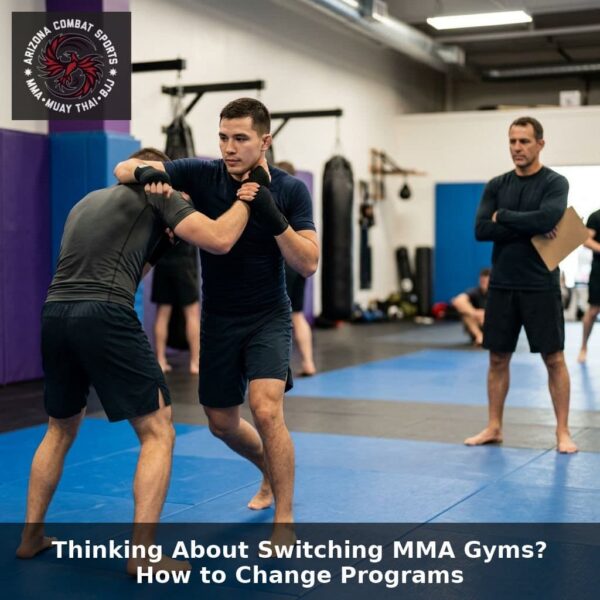 Key Takeaways:
- If your gym only trains striking or only trains grappling with no clinch connection, you’re likely plateauing in a single-discipline program rather than building complete MMA skills.
- Switching gyms doesn’t erase your progress; prior striking or grappling training transfers directly into a cross-range MMA curriculum and gives you a real foundation to build on.
- Visiting a class at Arizona Combat Sports is a low-commitment way to see how striking, clinch, and ground training work together before you make any final decision.
You show up. You train hard. You tap people. You get tapped. Months pass, and somewhere in the back of your mind a quiet question forms: “Am I actually getting better at MMA, or just better at this one thing?”
That question is worth taking seriously. Most athletes who feel stuck aren’t slacking. They’re training in a program that was built for a single discipline, and they’re hitting the ceiling of what that structure can teach them. If that sounds familiar, you’re not alone, and you’re not starting over. You’re just ready for the next layer.
Here’s how to think clearly about switching MMA gyms in Arizona, what you risk, what you don’t risk, and how to take a first step that doesn’t require burning any bridges.
Signs Your Current Gym Isn’t Building a Complete Mixed Martial Artist
Your Classes Live in Only One Range
Mixed martial arts happens across three connected ranges: standing, clinch, and ground. A striking gym will develop your punches, kicks, elbows, and knees. A grappling gym will sharpen your takedowns, submissions, and positional control. Both of those are genuinely valuable. But if your weekly schedule never bridges those two worlds through clinch work, and if you never practice transitioning from a punch combination into a takedown or from a scramble back to your feet, you’re training disciplines, not MMA.
Watch a full week of your current classes. Ask yourself: does anything we drill today connect what I learned last week on the ground to what I worked the week before on the feet? If the answer is almost never, the curriculum is likely structured around a single martial art that happens to be housed inside a gym with “MMA” on the sign.
You’re Improving Inside the Gym but Stalling Everywhere Else
There’s a specific kind of plateau that feels fine on the surface. You’re winning rounds against the same training partners, your technique within your gym’s system looks clean, and your coaches seem satisfied. But when you spar with someone from a different program, or when you think about competing, you notice gaps you can’t explain. You don’t know what to do when the fight moves to the clinch. Your ground game and your striking feel like separate toolboxes with no connection between them.
That gap isn’t a sign of personal failure. It’s usually a sign that the program never taught the transitions. A well-structured MMA curriculum, like the one Arizona Combat Sports has built around covering every range of combat, spends significant time on exactly those connective moments: the moment a punch combination creates a takedown opportunity, or the moment a clinch position determines whether the fight stays standing or goes to the floor. If you’re not seeing those lessons regularly, you’re missing a core part of what MMA actually is.
What You Risk (and Don’t Risk) by Trying a New MMA Gym
The Emotional Side of Leaving a Familiar Gym
Gyms aren’t just buildings. They’re communities. You know the schedule, you know the people, you’ve built trust with training partners over months or years. The idea of walking into a new facility as the person who doesn’t know anyone, who has to learn the culture from scratch, can feel disproportionately uncomfortable given that all you really want is better training.
That discomfort is real and worth acknowledging. But it’s also worth separating from the actual decision you’re making. Visiting a class is not the same as quitting your gym. You don’t need to end your current training before attending a class at Arizona Combat Sports. Many people use a first visit specifically to compare how a cross-range MMA curriculum feels against the single-discipline program they’re already familiar with. No ultimatum required.
What You Actually Risk vs. What You Don’t
What you don’t risk: your current skills, your training history, your rank, or your relationships with the people you’ve trained with. None of those disappear because you walked into a different building.
What you might risk, if you’re mid-training camp or preparing for a scheduled fight in the next few weeks, is disrupting the specific game plan your current coaching staff has built around that event. In that narrow window, consistency with your existing team is usually the better tactical call. But outside of that situation, the adjustment timeline for a new gym is shorter than most people expect. Athletes typically find their footing in a new training environment within a few weeks, particularly when the new program is designed to build on existing skills rather than replace them.
If you’re weighing online coaching as an alternative, that’s also a legitimate short-term option, especially during a fight camp. But online programs rarely replicate the live reps and real-time feedback that in-person training delivers, particularly for the clinch range, which requires another human body to train properly.
How Your Existing Striking or Grappling Skills Transfer to an All-Ranges Program
Your Prior Training Is a Foundation, Not a Liability
A common fear when switching gyms is that you’ll be treated like a beginner. In a well-designed MMA program, the opposite is true. If you’ve spent a year or more in a striking gym, you’re bringing developed range management, timing, and combinations that most raw beginners don’t have. If you’ve trained grappling, you’re bringing positional awareness and submission literacy that goes directly into the ground-and-pound and scramble portions of MMA training.
Arizona Combat Sports’ MMA classes are structured specifically to connect those existing skills to the clinch and to the range you haven’t trained yet. You’re not starting from zero. You’re learning how the tools you already own talk to each other.
The Clinch as the Missing Link
Most single-discipline programs either ignore the clinch entirely or treat it as a brief transition drill. But the clinch is where strikes become takedowns, where takedowns are defended, and where the real decision about whether a fight stays standing or goes to the ground gets made. Athletes who arrive with strong striking or grappling backgrounds often find the clinch work to be the single most immediately productive area of improvement, because it gives context to everything they already know.
Regarding formal rank transfer: most reputable MMA programs evaluate where you actually are through live training rather than asking for documentation from another school. Your first few sessions will tell a good coaching staff everything they need to know about your current level. You won’t be penalized for coming from a different system.
What a Low-Risk First Step at Arizona Combat Sports Looks Like
Observing vs. Committing
The lowest-pressure way to evaluate any new gym is to watch or participate in a single class before making any long-term decision. When you visit Arizona Combat Sports, pay attention to how the session is structured: does the warm-up connect to the technical work? Does the technical work connect to the sparring or drilling at the end? Are the three ranges addressed in a way that shows a coherent curriculum, or does one range dominate every session?
You’ll also be able to feel the culture. Is the environment competitive in a way that pushes people, or is it the kind of competitive that makes newer athletes feel unwelcome? How coaches and senior training partners treat someone new in the room tells you a lot about what training there long-term would actually look like.
No Pressure, No Contracts, No Awkward Conversations Required
You don’t need to talk to your current coach before visiting another gym. That conversation, if you decide to have it, can happen after you’ve made a decision, not before. Many athletes feel an obligation to announce their intentions in advance, and that sense of obligation is what makes the first step feel heavier than it actually is. A visit is just a visit. It becomes more than that only if you decide it should.
On the practical side, Arizona Combat Sports has been operating in the East Valley since 2005. That tenure matters when you’re evaluating a gym’s long-term stability and whether the coaching culture has had time to develop real depth.
Questions to Ask Before You Commit to a New Gym
The Curriculum Checklist
Before signing anything or making a final decision, get clear answers to these questions:
- Does the curriculum explicitly cover striking, clinch, and ground, and are those ranges trained together in the same sessions or kept completely separate?
- How do current members describe the gym’s culture when they’re not being prompted by a coach or owner?
- How long has the gym been operating, and has the coaching staff been consistent over that time?
- Are there contracts involved, and what are the cancellation terms? In 2026, many gyms offer flexible month-to-month arrangements, while others still require multi-month commitments. Know what you’re signing before you sign it.
- What does a typical week of classes look like, and does the schedule fit your life realistically?
How to Read the Culture Before You Join
The questions current members give you matter more than what any promotional material says. Ask someone who’s been training there for six months or more what they’d tell a friend considering joining. Ask what they wish they’d known before their first class. Listen for specifics. Vague enthusiasm (“it’s great, everyone’s super nice”) is less informative than concrete details (“we do a lot of clinch-to-ground transition work on Tuesdays and the coaches actually break down why, not just how”).
If you can’t get a straight answer about curriculum structure, cancellation policies, or training culture from the staff or the members, that’s information too.
Frequently Asked Questions About Switching MMA Gyms
Sources
- MMA (Mixed Martial arts) as a sport encompassing multiple combat ranges (striking, clinch, grappling), Wikipedia: https://en.wikipedia.org/wiki/Mixed_martial_arts
- Fighter development and training camp considerations, U.S. Anti-Doping Agency (USADA) Athlete Resources
25+ Years in Tempe
Why Trust AZ Combat Sports
For more than 25 years, Arizona Combat Sports has trained complete beginners, kids, ASU students, first responders and professional fighters at one location: 1425 West 14th Street in Tempe. Here's what has kept the East Valley coming back.
-
Founded & Run by Fighters
Founded by Trevor Lally and led today by partners who have competed at a high level, including former pro fighter and MMA head coach Trevor Smith.
-
Black Belt Instruction
BJJ head coach Steve Rosenberg is a second-degree black belt under Nova União and has coached at ACS for more than 15 years.
-
Proven With Competitors
An active fight team of amateur and pro athletes, with students competing in IBJJF tournaments, submission-only events and MMA.
-
Safety First, Always
Every class is supervised, sparring is always optional, mats are sanitized multiple times a day, and youth instructors are background-checked.
-
Zero-Ego Culture
Beginners train next to experienced fighters in a team-first room. Most members walk in with no martial arts background at all.
-
No Contracts, No Surprises
Month-to-month memberships with no sign-up fees. Try one free class per discipline before you commit to anything.
"I've trained at this gym for four years doing BJJ and I can't recommend it enough."
Anthony, Google review of Arizona Combat Sports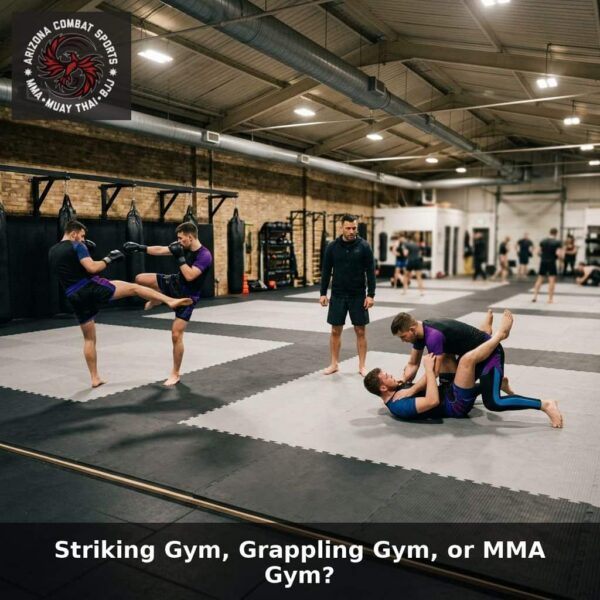
Key Takeaways:
- A striking-only gym builds standup skills but leaves clinch control and ground grappling uncovered; a grappling-only gym fills the ground game but skips striking and clinch entries entirely.
- An integrated MMA curriculum teaches all three ranges (striking, clinch, and ground) inside the same class, so you’re never assembling training from multiple gyms to get complete coverage.
- Arizona Combat Sports structures its MMA classes to cover every range of combat, making it a practical single-stop training path for anyone in Arizona whose goal is well-rounded mixed martial arts.
Most people walk into their first martial arts search with a simple question: “Which gym should I join?” What they don’t realize is that question hides a much bigger one, which is whether the gym they pick will actually train them for the full picture of combat or just one piece of it.
In 2026, Arizona has more martial arts options than ever: standalone Muay Thai academies, dedicated Brazilian jiu-jitsu schools, wrestling clubs, boxing gyms, and full MMA programs. Each has real value. But if your goal is well-rounded mixed martial arts or practical self-defense confidence, the type of gym matters as much as the quality of coaching inside it. This guide breaks down exactly what each training environment covers, what it skips, and how to match your choice to your actual goals.
Striking-Only, Grappling-Only, or Complete MMA: Understanding Your Options
Three Distinct Training Categories, Three Different Skill Sets
Arizona’s martial arts scene broadly splits into three categories. Striking-focused gyms teach disciplines like boxing, Muay Thai, and kickboxing, all of which develop skills from standing range. Grappling-focused gyms teach Brazilian jiu-jitsu, wrestling, or submission grappling, where the goal is controlling and submitting an opponent on the ground. Integrated MMA gyms teach all three combat ranges, including standing, clinch, and ground, as a unified system rather than separate sports stacked on top of each other.
The core difference is not which gym has better coaches. It’s whether the curriculum treats combat as one continuous problem or as isolated skill sets.
Should Beginners Start With Striking or Grappling Before MMA?
This is one of the most common questions beginners ask. The honest answer: you don’t have to pick one first. Many instructors say that starting with a specialist background builds a sharper foundation in one area, and that’s true. But the tradeoff is time. Spending a year at a boxing gym and then a year at a BJJ school before you start mixing them means you’re spending two years developing habits that eventually need to be re-wired for transitions between ranges.
If your target is MMA or general self-defense readiness, starting in an integrated program from day one means your striking, clinch, and ground skills develop simultaneously, and your nervous system learns to connect them from the beginning rather than re-learn that connection later.
What a Striking-Focused Gym Actually Teaches (And What It Leaves Out)
What You Learn: Standup Range, Footwork, and Striking Combinations
Striking gyms, whether they focus on boxing, Muay Thai, or kickboxing, build real, meaningful skills. You’ll develop hand combinations, head movement, footwork, timing, and defensive technique at standing range. Muay Thai schools add elbows, knees, and basic clinch striking. Boxing gyms drill punching accuracy and ring generalship. These are legitimate, battle-tested disciplines with deep competitive histories.
For fitness, coordination, and standup confidence, a striking gym delivers. Many people train at them for years and become genuinely dangerous at standing range.
The Gap: Clinch Control and Ground Grappling
Here’s what striking-only programs typically don’t teach: what to do when the fight closes to clinch range and neither person wants to stand and trade, and what to do if the fight goes to the ground. Clinch control, takedown defense, takedown offense, positional grappling, and submission defense are all skills that require dedicated mat time, and most striking-focused gyms don’t include them systematically.
In a real self-defense situation or an MMA competition, a striker who has never trained clinch work or ground grappling is in unfamiliar territory the moment an opponent closes distance. That gap isn’t theoretical. It’s one of the most documented patterns in early MMA competition: skilled strikers struggling the moment fights hit the mat.
Injury risk also shifts at striking gyms. Sparring involves real impact to the head and body, so concussion risk and cumulative head trauma are legitimate concerns to ask any striking gym about before you sign up. Ask how frequently contact sparring happens, whether protective gear is mandatory, and how coaches manage intensity for beginners.
What a Grappling-Focused Gym Actually Teaches (And What It Leaves Out)
What You Learn: Ground Control, Submissions, and Takedowns
Grappling gyms, particularly those focused on Brazilian jiu-jitsu or wrestling, teach a completely different skill set. You’ll learn how to take an opponent to the ground, control their body, defend submissions, and apply your own. BJJ programs typically cover positional hierarchy, guard play, sweeps, and a wide variety of chokes and joint locks. Wrestling programs emphasize explosive takedowns, top pressure, and scramble defense.
These skills translate directly into MMA and self-defense. Someone with a solid grappling base can control where a fight happens, which is a genuine tactical advantage.
The Gap: Standup Striking and Clinch Entry
What grappling-only programs typically skip is everything that happens before the clinch. You won’t develop boxing defense, striking counters, or the ability to read and time a punching exchange. More practically, you won’t drill how to close the distance safely from striking range, because pure grappling programs start from clinch or ground by default.
In an MMA context, a grappler who can’t safely enter the clinch against a striker has a problem. They know exactly what to do once they get there, but getting there safely requires standup skills the grappling gym didn’t develop.
Injury patterns at grappling gyms skew toward joint and orthopedic issues: shoulder, knee, and elbow injuries are common with heavy live rolling. Before joining any grappling gym, ask how coaches manage rolling intensity for new members and what the culture looks like around tapping early and respecting joint locks.
How an Integrated MMA Curriculum Closes the Gaps Between Disciplines
Teaching All Three Ranges as One Connected System
An integrated MMA program teaches striking, clinch work, and ground grappling as parts of one continuous skill set rather than three separate sports. A well-designed MMA class doesn’t spend 20 minutes on boxing, then stop and restart with a BJJ drill. It builds transitions: how your striking position sets up a clinch entry, how clinch work leads to takedowns or walls, how takedowns connect to ground control and finish attempts.
Arizona Combat Sports structures its MMA classes to cover every range of combat, so members build confidence standing, in the clinch, and on the ground inside the same training environment. That continuity matters. When your body learns the transitions repeatedly, range-switching under pressure becomes instinct rather than a deliberate choice.
What Switching to an All-Ranges Gym Actually Costs You (And Doesn’t)
A common concern for people coming from a specialist background is that switching to an integrated program means starting over. It doesn’t. Existing striking or grappling experience carries directly into MMA training. Someone with three years of boxing brings real head movement, footwork, and timing. Someone with a wrestling background brings genuine takedown ability and top control. An integrated program adds the ranges they haven’t developed yet, it doesn’t erase what they already have.
Cost is another practical factor. Monthly rates at martial arts gyms in Arizona vary widely depending on facility, location, and program depth. A specialist gym might seem more affordable on paper, but if your goal is all-ranges training, you may end up paying for two or three separate memberships to cover striking, grappling, and clinch. A single integrated MMA membership often costs less in total than multiple specialist memberships combined.
Timeline expectations are also worth setting honestly. Most coaches will tell you that 6 to 12 months of consistent training in an integrated MMA program is enough for a beginner to feel functional across all three ranges. That doesn’t mean competitive-ready; it means you’re no longer a complete beginner in any single range.
Choosing the Right Training Path for Your Goals in Arizona
Matching Your Training Goal to the Right Gym Type
If you want to compete in a specific combat sport, a specialist gym often makes sense. A boxer preparing for amateur boxing does not need BJJ. A competitive jiu-jitsu athlete focused on IBJJF competition doesn’t need striking. Specialist training for specialist competition is a logical match.
If your goals are broader, including MMA competition, general self-defense preparedness, or simply becoming a well-rounded martial artist, an integrated program is the more efficient path. You’re not sacrificing depth for breadth. A good MMA program goes deep in all three ranges; it just doesn’t treat them as independent sports.
Arizona has a strong martial arts community across Phoenix, Scottsdale, Tucson, and the surrounding areas. That means real options exist. The question to ask any gym is not just “do you teach MMA?” but whether that MMA curriculum genuinely integrates striking, clinch, and ground work inside the same class structure.
Questions to Ask Any Gym Before You Join
Before signing up anywhere, use these questions to test whether an MMA program is truly integrated:
- Are striking, clinch, and ground grappling taught together within the MMA class itself, or are they separate classes you have to stack?
- Does the curriculum include transitions between ranges, or does each class focus on one range at a time?
- How does the program handle beginners who come in with a striking background? With a grappling background? With no background at all?
- What’s the sparring culture? Is contact intensity managed by coaches, or is it primarily student-driven?
- Is there a clear progression structure, so you know how your skill set is supposed to develop over the first 6-12 months?
A gym that can answer all five questions with specifics is a gym that has actually thought through its curriculum rather than just marketing the MMA label.
Frequently Asked Questions About Striking vs Grappling MMA Gym
Sources
- Overview of combat sports disciplines and training methodologies: Wikipedia, “Mixed Martial Arts”, https://en.wikipedia.org/wiki/Mixed_martial_arts
- Brazilian jiu-jitsu background and competition structure: Wikipedia, “Brazilian jiu-jitsu”, https://en.wikipedia.org/wiki/Brazilian_jiu-jitsu
- Muay Thai training and standup striking tradition: Wikipedia, “Muay Thai”, https://en.wikipedia.org/wiki/Muay_Thai
- General concussion and head impact risk in combat sports: Centers for Disease Control and Prevention (CDC), “Concussion in Sports”, https://www.cdc.gov/headsup/sports/index.html
25+ Years in Tempe
Why Trust AZ Combat Sports
For more than 25 years, Arizona Combat Sports has trained complete beginners, kids, ASU students, first responders and professional fighters at one location: 1425 West 14th Street in Tempe. Here's what has kept the East Valley coming back.
-
Founded & Run by Fighters
Founded by Trevor Lally and led today by partners who have competed at a high level, including former pro fighter and MMA head coach Trevor Smith.
-
Black Belt Instruction
BJJ head coach Steve Rosenberg is a second-degree black belt under Nova União and has coached at ACS for more than 15 years.
-
Proven With Competitors
An active fight team of amateur and pro athletes, with students competing in IBJJF tournaments, submission-only events and MMA.
-
Safety First, Always
Every class is supervised, sparring is always optional, mats are sanitized multiple times a day, and youth instructors are background-checked.
-
Zero-Ego Culture
Beginners train next to experienced fighters in a team-first room. Most members walk in with no martial arts background at all.
-
No Contracts, No Surprises
Month-to-month memberships with no sign-up fees. Try one free class per discipline before you commit to anything.
"I've trained at this gym for four years doing BJJ and I can't recommend it enough."
Anthony, Google review of Arizona Combat Sports
Key Takeaways:
- Arizona Combat Sports trains students and residents within the Tempe/East Valley corridor, covering striking, clinch, and ground work in a single integrated MMA program.
- Competing gyms like The MMA Lab (Glendale/west side) and TNT MMA Training Center (North Phoenix) operate in different Valley corridors, making location a real factor in training consistency for ASU-area residents.
- East Valley residents in Tempe, Mesa, Gilbert, and Scottsdale can start training at ACS regardless of whether they’re an ASU student or compete.
Finding a gym that fits your life isn’t just about quality instruction. If the drive alone costs you 40 minutes each way, you’ll skip sessions. For students and residents near Arizona State University, the question “which MMA gym should I join?” often comes down to which gym you can actually get to consistently, and what happens once you walk through the door.
The Tempe/East Valley corridor has real options for MMA training in 2026. This article lays out what to look for, how geographic position across the Valley affects your choices, and why a gym that covers striking, clinch, and ground work together delivers a fundamentally different experience than a single-discipline school with a few add-on classes.
Why Location Shapes Your MMA Training Options in the Valley
The Hidden Cost of a Long Commute to the Gym
MMA training requires consistency above everything else. Missing two sessions per week because of a commute doesn’t just slow your progress; it often ends memberships entirely. For an ASU student balancing a course load, or a working professional living in Tempe or Mesa, each extra mile between your home and your gym is friction that compounds over months.
The Phoenix metro is sprawling, and gyms that are well-regarded in one corridor aren’t always practical for someone on the other side of the Valley. A gym in Glendale or Deer Valley may offer excellent coaching, but a Tempe-based student is looking at a cross-Valley commute each time training is scheduled.
What the East Valley Training Landscape Actually Looks Like
The East Valley includes Tempe, Mesa, Gilbert, Scottsdale, and surrounding communities. Arizona State University’s main campus sits in Tempe, making it a central point for a large population of potential trainees: current students, faculty, recent graduates who stayed in the area, and the broader residential community that surrounds campus.
Gyms anchored in this corridor serve that population directly. Gyms on the west side or in North Phoenix serve a different geography. That distinction isn’t a judgment on quality; it’s a practical reality that should factor into your decision when you’re comparing options.
Arizona Combat Sports and the Tempe/East Valley Training Corridor
A Program Built Around Complete MMA, Not One Range
Arizona Combat Sports trains within the Tempe/East Valley corridor, giving students and residents near ASU a full cross-range MMA program without needing to travel to the West Valley or North Phoenix. The program structure reflects what MMA actually demands: proficiency across the full range of combat, including stand-up striking, the clinch where fights are often decided, and ground work through grappling and submissions.
That integration matters. A gym that lists boxing, wrestling, and BJJ as three separate departments may be excellent at each individually, but a dedicated MMA program treats those ranges as a single connected system. When you learn a takedown at ACS, you’re also learning how it connects to the clinch entries and the striking sequences that create it.
Community Culture and the Zero-Ego Standard
The community at Arizona Combat Sports operates on a straightforward principle: train hard, check your ego at the door. That culture has a practical effect for beginners. Students who are new to martial arts can ask questions, drill at appropriate intensity, and build foundational skills without the social friction that appears in more competitive or status-driven gym environments.
For ASU-area residents, many of whom may be trying MMA for the first time, that environment lowers the barrier to entry. You don’t need a background in wrestling or Muay Thai to start. The program is designed to bring beginners up through the same framework experienced students use, covering striking mechanics, clinch control, and ground positioning from your first class.
How an East Valley Gym Compares to West Valley and North Phoenix Options
Geographic Positioning of Known Valley Gyms
The Phoenix metro has several well-known MMA gyms. The MMA Lab is anchored on the west side of the Valley in the Glendale area. TNT MMA Training Center is based in North Phoenix near Deer Valley. Both are legitimate training facilities, and neither serves the Tempe/East Valley corridor as a primary catchment area.
Arizona Combat Sports trains students within that corridor, closer to ASU and the surrounding East Valley communities. The comparison isn’t about which gym has better coaching in an abstract sense. It’s about which gym fits where you actually live and study. For someone at ASU or living in Tempe, Mesa, Gilbert, or Scottsdale, a west-side or north Phoenix gym creates a commute that most people won’t sustain across a semester, let alone a year.
Single-Discipline Schools vs. Integrated MMA Programs
Beyond geography, the distinction between a single-discipline martial arts school and an integrated MMA gym matters enormously for your development. A BJJ academy may be exceptional at ground work. A Muay Thai school may produce skilled strikers. But if MMA is your goal, you need to train transitions between ranges, not just excellence within one.
An integrated program teaches you to use your striking to create takedown opportunities, your clinch to control position and set up finishes, and your ground work to survive or submit. A school that treats one discipline as primary with others added on won’t replicate that. When comparing options near ASU, ask specifically whether the MMA curriculum treats all three ranges as equal components of a unified system.
What ASU-Area Students and Residents Should Look For in a Gym
Credentials, Curriculum, and Cross-Range Integration
The most important evaluative criterion for an MMA gym isn’t its reputation on social media or how many competitive fighters train there. It’s whether the curriculum is structurally sound. A legitimate MMA program near ASU should cover striking (hands, kicks, elbows, knees), clinch work (ties, dirty boxing, takedown defense and offense), and ground work (positional control, submissions, guard passing) as interconnected skills.
Arizona Combat Sports structures its MMA classes around exactly that framework. Students don’t graduate from striking before touching clinch or ground. Each session reinforces how the ranges connect, which reflects how fights and sparring actually unfold. That’s the credentials-based differentiator worth asking about when you tour any gym.
Practical Factors: Schedules, Pricing, and Beginner Access
For ASU students and East Valley residents with real schedules, a few practical questions matter alongside curriculum:
- Does the gym offer class times that work around a university or work schedule?
- Is membership flexible, or does it require a long-term contract?
- Are there beginner-friendly entry points that don’t assume prior martial arts experience?
- What does membership cost relative to the instruction quality and program depth?
Membership pricing for MMA gyms in the Tempe/East Valley area varies. Contact Arizona Combat Sports directly for current pricing, since rates and any student options can change. The honest answer on cost is that an MMA gym offering genuine cross-range instruction from qualified coaches represents a different value proposition than a budget fitness class, and the comparison should reflect that.
Timeline and Managing Training as a Busy Student
A common question from new trainees is how long it takes to become competent at MMA. The honest answer: foundational striking mechanics, clinch awareness, and basic ground positioning become usable within a few months of consistent training, typically two to three sessions per week. Genuine competence across all ranges usually develops over one to two years of regular attendance.
Training MMA with a busy student schedule carries real considerations. The physical demands are meaningful. Recovery matters. Two quality sessions per week will produce progress without overwhelming a student dealing with coursework, part-time work, and other commitments. Trying to train five days per week while carrying 18 credit hours usually leads to burnout or injury. Starting at a sustainable frequency and building from there is the smarter path.
Getting Started With MMA Training in the Tempe/East Valley Area
If you’re based in Tempe, Mesa, Gilbert, or Scottsdale, Arizona Combat Sports offers a practical, geographically accessible starting point for MMA training. The program doesn’t require you to be an ASU student. The surrounding East Valley community trains alongside students, creating a broader and more diverse training environment than a campus-only facility would offer.
ASU’s campus recreation program offers general fitness and some martial arts options, but it isn’t a dedicated MMA gym in the way a standalone facility is. If your goal is structured, cross-range MMA development, a dedicated facility covering striking, clinch, and ground work as an integrated system is the right environment.
The decision to start is usually the hardest part. Most beginners spend more time researching gyms than they do comparing the experience of actually training. Show up, take a class, and evaluate the environment, the instruction quality, and whether the culture fits how you want to train. Arizona Combat Sports makes that first step accessible for anyone in the East Valley corridor who’s ready to get on the mat.
Frequently Asked Questions About MMA Gym Near ASU
Sources
- Geographic and training consistency factors in athletic performance – general sports science literature on adherence and commute as barriers to exercise. No fabricated URL; widely documented in exercise adherence research.
- MMA as an integrated combat system covering striking, clinch, and ground – Wikipedia: Mixed Martial Arts
- Exercise adherence and schedule fit as predictors of sustained training – American College of Sports Medicine position on physical activity adherence. No specific URL fabricated; refer to acsm.org for research.
25+ Years in Tempe
Why Trust AZ Combat Sports
For more than 25 years, Arizona Combat Sports has trained complete beginners, kids, ASU students, first responders and professional fighters at one location: 1425 West 14th Street in Tempe. Here's what has kept the East Valley coming back.
-
Founded & Run by Fighters
Founded by Trevor Lally and led today by partners who have competed at a high level, including former pro fighter and MMA head coach Trevor Smith.
-
Black Belt Instruction
BJJ head coach Steve Rosenberg is a second-degree black belt under Nova União and has coached at ACS for more than 15 years.
-
Proven With Competitors
An active fight team of amateur and pro athletes, with students competing in IBJJF tournaments, submission-only events and MMA.
-
Safety First, Always
Every class is supervised, sparring is always optional, mats are sanitized multiple times a day, and youth instructors are background-checked.
-
Zero-Ego Culture
Beginners train next to experienced fighters in a team-first room. Most members walk in with no martial arts background at all.
-
No Contracts, No Surprises
Month-to-month memberships with no sign-up fees. Try one free class per discipline before you commit to anything.
"I've trained at this gym for four years doing BJJ and I can't recommend it enough."
Anthony, Google review of Arizona Combat Sports
Key Takeaways:
- A gym’s operating history reveals whether its coaching methods, culture, and curriculum have been genuinely tested over time, not just assembled recently.
- Arizona Combat Sports has operated in the Arizona MMA community for over two decades, offering a cross-range curriculum (striking, clinch, ground) and a zero-ego, family-like culture that members consistently describe.
- Before signing up anywhere, ask about operating tenure, coaching continuity, and whether current members can describe the culture firsthand.
What does it actually mean when a gym says it’s been around for a long time? Is it just a marketing line, or does it signal something real about the quality of training you’ll receive? For anyone shopping Arizona’s MMA scene in 2026, that question deserves a straight answer. A gym’s age doesn’t guarantee excellence, but it does leave a paper trail you can check: stable schedules, consistent coaching, a culture that members talk about the same way year after year. That paper trail matters, and it’s worth knowing how to read it.
How the Arizona MMA Training Scene Has Changed Over the Years
From Single-Discipline Classes to Integrated MMA Programs
Twenty-plus years ago, most Arizona martial arts gyms ran one art per room. A student wanting to learn to strike went to one place. A student wanting ground skills went somewhere else. The concept of a truly integrated MMA class, one that moves fluidly between striking range, the clinch, and the ground inside a single session, was rare. The gyms that figured out how to teach that integration early had to build their curriculum from the ground up, experimenting with class structure, coaching ratios, and progression systems until something reliable took shape.
That kind of structural learning takes years. Coaches who lived through it carry a working understanding of how adult students move between ranges, where they stall, and what corrections actually hold. That knowledge isn’t in a manual. It lives in the gym.
What “Matured” Training Actually Looks Like Today
A mature MMA program looks different from a beginner-friendly fitness class with a combat sports label on it. The schedule runs daily and doesn’t shrink when enrollment dips. The coaching approach stays consistent across classes, so what you work on Tuesday builds on what you learned Monday. Sparring is structured, not optional chaos. And the culture has enough history that long-term members can describe it without coaching.
Arizona’s market now includes everything from weekend warrior fitness concepts to serious competitive gyms. The gap between them is widest in exactly these structural details: curriculum depth, schedule reliability, and whether the people running the room have been doing so for months or for decades.
Why Gym Tenure Is a Signal Worth Checking Before You Join
Operating Continuity as a Screening Criterion
Gym tenure is one of the few things a prospect can verify before ever stepping on the mat. A gym that has operated from a single, stable location for over two decades has already passed a series of tests that shorter-lived programs haven’t: economic downturns, shifting neighborhood demographics, changes in what the public thinks MMA is. Surviving all of that without relocating or rebranding suggests the program itself has value that members keep paying for.
Arizona Combat Sports has operated in the Arizona MMA community for over two decades. That continuity means the coaching team and curriculum were not assembled recently in response to a market trend. The class schedule, the training approach, and the facility have been present long enough for members to build multi-year training arcs inside the same program.
When you’re evaluating any gym, check for this: one stable location, a daily schedule that has run consistently, and a coaching staff that hasn’t turned over repeatedly. Large brand-backed facilities sometimes offer MMA as one module inside a broad fitness menu. That’s a different category from a dedicated combat sports gym where MMA, Muay Thai, and BJJ are the entire program, not an upsell.
The Cost Question: What You’re Actually Paying For
Prospects often compare membership costs between established local gyms and budget or franchise options. The honest framing is this: cost per session means very little if the sessions aren’t consistent. A cheaper membership at a gym where class schedules drift, instructors rotate frequently, or the program doesn’t connect striking to ground work will cost you more in wasted time than a slightly higher monthly rate at a gym where those things are stable. Two decades of operation is partly evidence that the program has been worth the price long enough for members to keep renewing.
What Long-Term Coaching Continuity Means for Your Progress
Predictable Progression Across the Full Range
A cross-range MMA curriculum only works when the coaches teaching it share a coherent system. If striking, clinch, and ground instruction are siloed across coaches who don’t communicate a unified methodology, a student’s development fractures. They learn to strike one way and grapple with a completely disconnected set of principles. The transitions between ranges, which are where most fights are actually decided, never get properly addressed.
Coaching continuity fixes this. When the same instructors have been developing and refining the same curriculum for years, the connections between ranges are built into how they teach, not added as an afterthought. Arizona Combat Sports structures its curriculum around striking, clinch, and ground work together. That’s not a recent addition. It reflects the way the coaching team has approached MMA training across the gym’s multi-decade history.
How Long It Actually Takes to Build Elite Coaching Staff
Developing a coaching staff capable of teaching integrated MMA credibly takes years at minimum, and more realistically the better part of a decade. Coaches need not just personal competition or training experience but the ability to diagnose and correct problems in students whose bodies and backgrounds differ from their own. That diagnostic skill only comes from reps, which means time on the mat in front of a rotating student population. A gym that opened recently, even one with credentialed coaches, is still working through that learning curve. A gym that’s been doing it for over twenty years has a coaching team that has seen a much larger volume and variety of student development problems and has built its corrections so .
Risks of Training Without Proven Coaching Experience
Training at a gym without a proven coaching track record carries real costs. Technique errors that go uncorrected early become habits that are difficult to unlearn later. Sparring environments without experienced oversight can produce unnecessary injuries. And without a coherent curriculum, students often plateau because they’ve accumulated isolated skills without the connective tissue of a unified fighting system. The safest environment for a new student, and for an experienced one, is a room where the coaches have spent years learning what works and what doesn’t before you ever walked in.
Community Culture: The Difference Between a Class and a Training Home
What a Zero-Ego Culture Actually Produces
Culture is one of the hardest things to fake long-term. A gym can run a polished intro class and a professional front desk. But if the actual training environment is competitive in a damaging way, where ego drives sparring and newer students get dismissed, it shows up in member retention and in the way people talk about the gym. Reviewers describing a gym the same way across multiple years are telling you something that marketing can’t replicate.
Reviews of Arizona Combat Sports repeatedly describe a zero-ego, family-like training environment. That consistency across reviewers is the signal. It means the culture isn’t an accident or a front-desk talking point. It’s what people actually experience when they come back for the second class, the twentieth, and the hundredth.
Why Culture Matters as Much as Curriculum for Long-Term Progress
A student in a high-ego environment trains defensively. They protect themselves socially, avoid drilling unfamiliar techniques where they might look bad, and often quit before they’ve reached any meaningful proficiency. A student in a family-like environment does the opposite. They try things, fail visibly, get coached, and come back. Over months and years, that difference in training behavior produces a dramatic gap in development. The curriculum at a zero-ego gym is effectively more accessible because students actually engage with it honestly.
What to Ask Any Arizona MMA Gym About Its History and Culture
A Practical Checklist for Evaluating Any Program
Before signing up anywhere, run through these questions:
- How long has the gym operated from its current location, without a major rebrand or ownership change?
- Has the coaching staff and core curriculum stayed consistent over that time, or does the program change year to year?
- Can you talk to current members, not just read curated testimonials, and do they describe the culture the same way?
- Is the MMA program the gym’s primary focus, or one class type among dozens?
- Does the class schedule run daily and consistently, even in off-peak months?
No single answer disqualifies a gym, but the pattern of answers tells you whether the program has the structural stability that produces long-term member progress.
How Arizona Combat Sports Already Answers These Questions
Arizona Combat Sports points to its over two decades of continuous operation, its cross-range MMA, Muay Thai, and BJJ curriculum, and its member-reported culture as concrete answers to every question on that list. The gym isn’t a recently assembled program or a combat sports module inside a broader fitness brand. It’s a dedicated combat sports facility with a history that members and prospects can check.
If you want to see how that translates to an actual training experience, the most direct step is to visit. Contact Arizona Combat Sports to schedule a visit, ask your questions in person, and see the environment for yourself. A gym that’s been building its reputation for over twenty years welcomes that kind of scrutiny.
Frequently Asked Questions About MMA Gym in Arizona
Sources
- General evolution of MMA training methodology and curriculum integration: Wikipedia, Mixed Martial Arts, https://en.wikipedia.org/wiki/Mixed_martial_arts
- Muay Thai as a striking discipline within MMA training: Wikipedia, Muay Thai, https://en.wikipedia.org/wiki/Muay_thai
- Brazilian Jiu-Jitsu and its role in ground-range MMA training: Wikipedia, Brazilian jiu-jitsu, https://en.wikipedia.org/wiki/Brazilian_jiu-jitsu
25+ Years in Tempe
Why Trust AZ Combat Sports
For more than 25 years, Arizona Combat Sports has trained complete beginners, kids, ASU students, first responders and professional fighters at one location: 1425 West 14th Street in Tempe. Here's what has kept the East Valley coming back.
-
Founded & Run by Fighters
Founded by Trevor Lally and led today by partners who have competed at a high level, including former pro fighter and MMA head coach Trevor Smith.
-
Black Belt Instruction
BJJ head coach Steve Rosenberg is a second-degree black belt under Nova União and has coached at ACS for more than 15 years.
-
Proven With Competitors
An active fight team of amateur and pro athletes, with students competing in IBJJF tournaments, submission-only events and MMA.
-
Safety First, Always
Every class is supervised, sparring is always optional, mats are sanitized multiple times a day, and youth instructors are background-checked.
-
Zero-Ego Culture
Beginners train next to experienced fighters in a team-first room. Most members walk in with no martial arts background at all.
-
No Contracts, No Surprises
Month-to-month memberships with no sign-up fees. Try one free class per discipline before you commit to anything.
"I've trained at this gym for four years doing BJJ and I can't recommend it enough."
Anthony, Google review of Arizona Combat Sports
Women’s BJJ in Tempe: Why More Women Are Choosing Jiu Jitsu Over Traditional Fitness
Key Takeaways:
- BJJ is uniquely effective for women because it relies on leverage and technique, not size or strength — a skilled woman can control a significantly larger attacker using position alone.
- No-gi BJJ translates directly to real-world self-defense scenarios, while gi training builds the technical foundation that makes both systems work.
- Arizona Combat Sports offers a women-friendly training environment in the East Valley where beginners are integrated without ego pressure and coached toward real skill, fast.
Is BJJ good for women? Yes — Brazilian jiu-jitsu is arguably the most effective martial art for women because its entire system is built on leverage rather than raw strength. A technically sound woman can control, redirect, or escape a much larger opponent using body position, weight distribution, and mechanical advantage. No other fitness activity trains that skill set.
That answer matters if you’ve been circling this question for months. You’ve probably heard of BJJ, maybe watched a clip, and thought: “I don’t know if someone like me could actually do this.” You can. Here’s why the art fits you specifically — and what training at Arizona Combat Sports in Tempe looks like before you ever step on the mat.
Why Leverage Makes BJJ Uniquely Effective for Women
Most fitness classes make you stronger. BJJ makes you more capable of applying the strength you already have, plus leverage that doesn’t require strength at all.
The physics is straightforward. Mechanical advantage — the principle behind a lever — means that force applied at the right angle and the right moment produces disproportionate results. In jiu-jitsu, this shows up in sweeps, guard passes, submissions, and escapes. A woman who weighs 140 pounds and understands body mechanics can off-balance, pin, and submit a training partner who outweighs her by 80 pounds, because she’s controlling his center of gravity, not trying to out-muscle him.
This is not a motivational claim. It is the documented foundation of how Brazilian jiu-jitsu was developed — specifically to neutralize size advantages for smaller practitioners. The Gracie family built the entire system around that principle. Everything you learn in class serves it.
What this means practically: your progress is not capped by your bodyweight or your bench press. Technique compounds. A woman who trains consistently for one year will consistently outperform a larger, untrained person. That trajectory does not exist in a kickboxing class or a yoga studio.
Real-World Self-Defense: No-Gi vs. Gi Training
There are two formats you’ll encounter: gi (with a traditional uniform) and no-gi (shorts and a rash guard). Both matter. They train in different things.
Gi BJJ uses the uniform as a gripping surface. You learn collar chokes, lapel controls, and sleeve grips. This format builds precise, detailed technique because every movement has more feedback — the fabric slows things down enough to feel exactly where your base is off. Most beginners develop their technical vocabulary faster in the gi.
No-gi BJJ removes the uniform and trains with body-to-body friction. Underhooks, over-under clinches, leg entanglements, neck ties. This format maps directly onto real-world scenarios because real situations don’t come with handles. If someone grabs you in a parking lot, they’re wearing a t-shirt, not a judogi. No-gi training means you’re practicing the actual mechanics of controlling a resisting person in street clothes.
For women thinking about self-defense specifically, the ground is where most dangerous situations end up. Statistics on assault consistently show that attacks escalate to the ground, and most people have zero training for what happens there. BJJ is the only martial art that treats the ground as its primary classroom. You’ll learn how to create space and escape from the bottom, how to control someone from a position of disadvantage, and how to buy enough time to get up and get out.
That’s not theoretical. It’s the curriculum you’ll practice every single class.
What Women’s BJJ Training at Arizona Combat Sports Actually Looks Like
Classes at Arizona Combat Sports are structured around progressive skill-building, not chaos. A typical session runs through a warm-up, technique instruction, drilling, and then live rolling — supervised sparring at whatever intensity makes sense for where you are.
Beginners are not thrown to the wolves. The culture at ACS reflects what actually produces long-term athletes: patient coaching, ego-checked training partners, and a floor where asking questions is normal. Women who train here regularly describe the environment as the first gym where they didn’t feel like an outsider watching an in-group.
Who trains? Women from across the East Valley — Tempe, Chandler, Mesa, Gilbert, Scottsdale. Some come with zero athletic background. Some are former collegiate athletes. Most are somewhere in between. Age range skews wide. What they share is curiosity and consistency.
The women-specific dynamic matters here. Women who’ve trained longer tend to actively invest in the progress of newer women. That culture of women helping women improve is not accidental — it’s the direct result of an environment where ego pressure is low and technical development is the actual goal.
You will train with men in co-ed sessions; most BJJ academies are co-ed for most classes, and that’s a feature, not a bug. Training with a wider range of body types and movement patterns accelerates your learning. What you won’t encounter at ACS is the environment where size-based bullying passes as coaching or where a new woman is ignored because she doesn’t fit a preconceived idea of who should train. ACS builds its training community differently.
Fitness and Conditioning: What Grappling Does to Your Body
BJJ is a full-body conditioning system disguised as a skill sport. Here’s what consistent training delivers:
- Core strength that transfers to everything — every movement in grappling originates from your hips and midline
- Full-body muscular endurance from sustained position-holding and explosive transitions
- Grip strength and forearm development that most gym programs never touch
- Flexibility and hip mobility, particularly from guard work and movement patterns
- Significant calorie burn — grappling rounds are metabolically intense; live rolling for six minutes at moderate effort rivals a sprint interval session
The fitness results compound with the skill results, which is why women who train BJJ tend to stay far longer than women who join conventional fitness programs. The progress has a dimension that a treadmill can’t replicate. You’re getting stronger and more capable simultaneously.
In 2026, as wellness culture increasingly pushes toward measurable functional capacity — not just aesthetic outcomes — jiu-jitsu fits the moment precisely. You’re building a body that can do things, not just look a certain way.
Ready to get started? Book your free trial class and experience Arizona Combat Sports for yourself.
Frequently Asked Questions About Women’s BJJ in Tempe
Ready to find out what one year of real training feels like? Arizona Combat Sports offers a free introductory women’s class — no experience, no equipment, no commitment required. One year here equals five years anywhere else. Come see why women across Tempe, Chandler, Mesa, and the East Valley are choosing the mat over the treadmill. View our schedule and class times to find a session that fits your routine.
Sources
- Leverage and mechanical advantage in Brazilian jiu-jitsu — Wikipedia, Brazilian jiu-jitsu: https://en.wikipedia.org/wiki/Brazilian_jiu-jitsu
- Ground fighting prevalence in real-world altercations — research context available via the National Criminal Justice Reference Service (see violent assault dynamics research) https://www.ojp.gov/ncjrs/virtual-library/abstracts/street-survival-tactics-combat
25+ Years in Tempe
Why Trust AZ Combat Sports
For more than 25 years, Arizona Combat Sports has trained complete beginners, kids, ASU students, first responders and professional fighters at one location: 1425 West 14th Street in Tempe. Here's what has kept the East Valley coming back.
-
Founded & Run by Fighters
Founded by Trevor Lally and led today by partners who have competed at a high level, including former pro fighter and MMA head coach Trevor Smith.
-
Black Belt Instruction
BJJ head coach Steve Rosenberg is a second-degree black belt under Nova União and has coached at ACS for more than 15 years.
-
Proven With Competitors
An active fight team of amateur and pro athletes, with students competing in IBJJF tournaments, submission-only events and MMA.
-
Safety First, Always
Every class is supervised, sparring is always optional, mats are sanitized multiple times a day, and youth instructors are background-checked.
-
Zero-Ego Culture
Beginners train next to experienced fighters in a team-first room. Most members walk in with no martial arts background at all.
-
No Contracts, No Surprises
Month-to-month memberships with no sign-up fees. Try one free class per discipline before you commit to anything.
"I've trained at this gym for four years doing BJJ and I can't recommend it enough."
Anthony, Google review of Arizona Combat Sports

Training Martial Arts in Arizona Summer Heat: Hydration, Recovery, and Performance
Key Takeaways:
- Training martial arts during Arizona’s summer heat is safe when done indoors with proper hydration and recovery protocols — but outdoor or uncontrolled environments carry real physiological risks.
- Arizona’s extreme heat demands more aggressive hydration than most states, including pre-training electrolyte loading and careful water intake before, during, and after every session.
- Arizona Combat Sports trains in a climate-controlled facility, so your performance, technique, and progress stay consistent whether it’s June or January.
Yes, training martial arts in Arizona’s summer heat is safe — provided you train indoors in a climate-controlled environment, arrive well-hydrated, and follow a deliberate recovery plan. The risk is real but manageable. Ignore the heat, and your performance drops fast. Respect it, and you can train hard through July, August, and September without missing a beat.
Arizona’s summer is not a metaphor. From late June through mid-September, the Phoenix metro regularly sees temperatures above 110°F outdoors. In 2026, the region will have already recorded multiple consecutive days above 112°F. For grapplers, strikers, and martial arts students across Tempe, Phoenix, Chandler, Mesa, and Gilbert, this creates a specific set of challenges that generic fitness advice does not address.
This guide breaks down exactly what heat does to your body during martial arts training and what you can do about it. Check out our martial arts schedule to find a class time that works for you and start training today.
How Extreme Heat Affects Martial Arts Performance
Heat does not just make you uncomfortable. It changes how your body functions during training, directly affecting combat sports performance.
Your resting heart rate rises when ambient temperature climbs. That baseline increase means you hit higher heart rate zones faster during drilling, sparring, or grappling. A round of wrestling that feels moderate in January can push you to your aerobic ceiling in August, and recovery between rounds slows significantly. You fatigue earlier, and the fatigue compounds across a session.
Sweat loss creates specific problems for martial artists that do not apply to, say, cyclists. In gi training, excessive sweat saturates the collar and sleeves, changing how grips break and how the fabric moves. In no-gi, sweat on the skin reduces friction and alters takedown entries, underhook control, and clinch positions. Slippery conditions are not just annoying — they change the technique required and introduce technique errors that can become habits.
There is also a cognitive component that gets overlooked. Heat impairs reaction time and decision-making. Research published in the International Journal of Hyperthermia has documented reduced cognitive processing speed under thermal stress. In combat sports, timing and pattern recognition are skill sets, not reflexes. A slight delay in reading a shot, anticipating a sweep, or processing a feint is the difference between defending and getting caught. That cognitive slowdown is real, and it happens before you notice you are hot.
Dehydration compounds every one of those effects — and it carries over to the next day. A student who trains on Tuesday afternoon loses two to three liters of sweat without fully replacing fluids and electrolytes, sleeps poorly because of the heat, and walks into Wednesday’s session already behind. That cycle, repeated throughout a summer training week, leads to chronic underperformance and an elevated risk of injury.
Hydration Protocol for Arizona Martial Artists
Most hydration advice is written for temperate climates. Arizona’s summer heat profile is more aggressive, and your approach needs to match.
Here is a practical framework:
- Before training: Drink 20–24 oz of water two hours before your session. In the 30 minutes before you step on the mat, add another 8–12 oz. If you have been sweating during your commute or working outdoors, add electrolytes to that pre-session drink — not just water.
- During training: Aim for 6–8 oz every 15–20 minutes of activity. During hard sparring or grappling, your sweat rate can exceed one liter per hour. Waiting until you feel thirsty means you are already behind.
- After training: Weigh yourself before and after a session if you want a precise target. Every pound of body weight lost equals approximately 16 oz of fluid that needs to be replaced. For a 90-minute grappling session in summer, losing two to three pounds is common.
Electrolyte balance matters more in Arizona than in most states for a specific reason: prolonged sweating depletes sodium, potassium, and magnesium at a rate that plain water cannot address. Replacing fluid volume without replacing electrolytes leads to hyponatremia — dangerously low sodium — which produces symptoms that mimic dehydration: headache, nausea, and muscle cramping. Use an electrolyte supplement or electrolyte-containing drink as part of your post-training recovery, especially after sessions longer than 60 minutes.
Common Summer Training Mistakes
These are the patterns that derail Arizona martial artists during the summer. Recognizing them is the first step to avoiding them.
- Training dehydrated: Skipping water in the hours before class because you “forgot” or were busy creates a deficit you cannot recover from mid-session.
- Relying on energy drinks: Pre-workout stimulants and caffeinated energy drinks have diuretic effects. Drinking them without matching water intake accelerates fluid loss during training.
- Outdoor or unshaded training at midday: Drilling, running, or doing conditioning work outside between 10 a.m. and 4 p.m. in Arizona summer is genuinely dangerous. The heat index in direct sun can reach 120°F or higher. Reserve outdoor activity for early morning or evening.
- Ignoring warning signs: Dizziness, nausea, stopping sweating when you should be sweating, and sudden chills during exercise are signs of heat exhaustion progressing toward heat stroke. Stop training immediately, move to a cool environment, and drink fluids if symptoms are in the early stages.
If you are looking for a productive summer activity? Explore our kids martial arts Arizona program and book a free trial today.
Recovery in Extreme Heat
Recovery is where summer gains or loses its value. Heat adds a recovery tax on top of normal training stress, and managing that tax is what separates students who improve through summer from those who stall or get hurt.
Sleep quality drops when ambient temperatures stay high overnight. Arizona summer nights rarely cool below 90°F, and a warm bedroom environment reduces deep sleep quality even if total sleep hours look adequate. Prioritize a cool sleep environment — air conditioning set to a temperature that allows genuine rest, not just tolerable discomfort.
Shade and passive cooling between sessions matter more than most students expect. Spending the hours between morning and evening training in direct sun or in a hot vehicle raises your pre-session core temperature before you ever step on the mat.
Managing training intensity across the week is critical. A training week with five hard sessions is appropriate in January. The same volume in August, with compounding heat stress and impaired recovery, can push the body into overtraining faster than you expect. Consider structuring summer weeks with two to three high-intensity sessions and one to two technique-focused or lighter drilling sessions. Consistency across twelve weeks of summer beats two weeks of hard training followed by two weeks of forced rest. Escape the heat and experience the difference—book your free trial class today.
Why Indoor Training at ACS Protects Your Progress
The cleanest solution to Arizona’s summer heat in martial arts training is simple: remove the heat variable entirely.
Arizona Combat Sports trains in an indoor, climate-controlled facility. The mat temperature is consistent regardless of what the Phoenix metro is doing outdoors. Your heart rate baseline stays where it should be. Grip conditions stay predictable. Your cognitive function stays sharp. The physiological effects described above — elevated heart rate, accelerated fatigue, cognitive slowdown — apply to training in uncontrolled heat environments, not to a properly air-conditioned gym.
That consistency matters for skill development. Technique builds on repetition, and repetition requires controlled conditions. A student who trains at ACS through July, August, and September accumulates real skill. A student training in a sweltering garage gym or pushing through outdoor conditioning in midday heat is fighting the environment more than they are training.
The summer heat is part of living in Arizona. It does not have to be part of your training experience.
Come in, escape the heat, and train. Your technique does not take a summer off — and with the right environment and the right protocol, neither do you. Train consistently in any season with our BJJ classes in Tempe and keep progressing year-round.
Frequently Asked Questions About Martial Arts Training in Summer
Sources
- Cognitive performance and heat stress — “Effects of heat stress on cognitive performance,” International Journal of Hyperthermia, PubMed: https://pubmed.ncbi.nlm.nih.gov/23668783/
- Hyponatremia and exercise-related fluid replacement — National Institutes of Health / MedlinePlus: https://medlineplus.gov/ency/article/000394.htm
- Heat-related illness overview and warning signs — Centers for Disease Control and Prevention (CDC): https://www.cdc.gov/niosh/topics/heatstress/heatrelillness.html
- General hydration guidelines for exercise — American College of Sports Medicine Position Stand on Exercise and Fluid Replacement: https://www.acsm.org/docs/default-source/files-for-resource-library/fluid-replacement-and-heat-stress.pdf
25+ Years in Tempe
Why Trust AZ Combat Sports
For more than 25 years, Arizona Combat Sports has trained complete beginners, kids, ASU students, first responders and professional fighters at one location: 1425 West 14th Street in Tempe. Here's what has kept the East Valley coming back.
-
Founded & Run by Fighters
Founded by Trevor Lally and led today by partners who have competed at a high level, including former pro fighter and MMA head coach Trevor Smith.
-
Black Belt Instruction
BJJ head coach Steve Rosenberg is a second-degree black belt under Nova União and has coached at ACS for more than 15 years.
-
Proven With Competitors
An active fight team of amateur and pro athletes, with students competing in IBJJF tournaments, submission-only events and MMA.
-
Safety First, Always
Every class is supervised, sparring is always optional, mats are sanitized multiple times a day, and youth instructors are background-checked.
-
Zero-Ego Culture
Beginners train next to experienced fighters in a team-first room. Most members walk in with no martial arts background at all.
-
No Contracts, No Surprises
Month-to-month memberships with no sign-up fees. Try one free class per discipline before you commit to anything.
"I've trained at this gym for four years doing BJJ and I can't recommend it enough."
Anthony, Google review of Arizona Combat Sports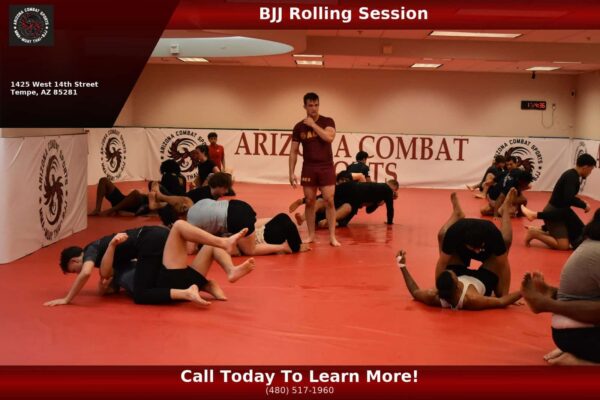
Sparring 101: When to Start, What to Expect, and How to Stay Safe
Key Takeaways:
- Most beginners in MMA, Muay Thai, and BJJ are ready for some form of light partner work within 2–4 months of consistent training, but the timeline varies by discipline and individual readiness.
- Sparring at Arizona Combat Sports is structured, coached, and gear-mandatory — it is not the chaotic free-for-all that keeps many beginners up at night.
- You are never required to spar before you feel ready; talk to your coach, and read this guide to understand exactly what the progression looks like.
Most beginners are ready for some form of light partner work within 2–4 months of consistent training. The exact timeline depends on the discipline: BJJ rolling typically comes first, Muay Thai partner drills follow, and structured MMA sparring rounds come last. No reputable gym — including Arizona Combat Sports — throws a brand-new student into the deep end unprepared.
That said, the anxiety is real. You have been drilling, watching, and sweating through fundamentals for weeks, and somewhere in the back of your head is a nagging question: “When are they going to make me fight someone?” This guide answers that honestly — discipline by discipline, step by step.
What Sparring Actually Is (and What It Isn’t)
Sparring is a controlled training exercise, not a fight. Both partners are trying to learn, not win. The moment it becomes a competition of egos, the training value drops for everyone involved.
The word means different things depending on what you are training:
- In BJJ, it is called “rolling” — live grappling from a standing or ground position, with tapping to signal submission.
- In Muay Thai and kickboxing, it ranges from technical partner drilling to light-contact rounds with gloves and shin guards.
- In MMA, it combines both grappling and striking in structured rounds with full protective gear.
None of these are secret rites of passage. They are teaching tools, and they work best when intensity is managed deliberately.
BJJ Rolling for Beginners: The Most Approachable Starting Point
BJJ rolling often starts earlier than striking-based sparring, and there is a structural reason for that. When a technique fails in grappling, the consequence is usually just a bad position, not a shot to the face. The tap is your emergency brake, and at Arizona Combat Sports, the culture around tapping is direct: tap early, tap often, tap before anything hurts.
New grapplers typically begin rolling in a very specific sequence:
- Positional rolling — both partners start from a defined position (guard, side control, mount) and work to improve or escape it.
- Flow rolling — continuous movement at low intensity, more like a slow-motion conversation than a contest.
- Full rolling — live grappling from the feet or knees with no predetermined starting position.
Most students reach some version of positional rolling within 6–8 weeks. You will be matched with training partners of similar size and experience, and a coach will typically supervise or be available nearby. The point is to make your techniques work under resistance, not to submit everyone in the room. If you’re just starting, our BJJ classes for beginners provide a structured path to build confidence before live rolling.
Muay Thai Partner Work: Technique Before Contact
Muay Thai sparring follows a longer runway than BJJ rolling because the consequences of sloppy technique are more immediate. A poorly timed teep or a dropped guard during a combination can result in real contact, so Arizona Combat Sports builds toward sparring in stages.
Here is how the progression typically looks:
- Bag and pad work — the foundation. You drill combinations against pads held by a training partner or coach, building muscle memory without live resistance.
- Shadowboxing with a partner — moving in and out of range together, practicing timing and distance without making contact.
- Technical partner drills — feeding specific attacks for a partner to block, parry, or counter, then switching.
- Light-contact sparring — controlled rounds, 20–30 percent power, focused on landing clean technique rather than power.
The jump to light-contact sparring usually happens somewhere between three and six months, depending on how consistently you are training and how your fundamentals look. Your coach will tell you when they think you are ready, and you can ask.
MMA Sparring: Structured Rounds, Full Gear, Coach Supervision
Structured MMA sparring brings striking and grappling together, which means the gear list grows and the timeline extends accordingly. Expect to have solid fundamentals in at least one base discipline before your first MMA round.
Protective gear at Arizona Combat Sports for MMA sparring typically includes boxing gloves (16 oz for sparring), headgear, a mouthguard, shin guards, and a groin/chest protector where appropriate. This is non-negotiable. No gear, no sparring — and that rule protects everyone in the room.
Rounds are short and coached. A typical beginner MMA sparring session might consist of three two-minute rounds, with active feedback between each round. Your coach is not watching from across the gym; they are close, calling out adjustments, and ready to pause the round if intensity climbs past where it should be.
Partner matching by size and experience is standard practice. You will not be handed off to a seasoned competitor for your first round.
How to Tell When You Are Ready
Readiness is partly about technique and partly about mindset. A few honest indicators:
- You can execute your basic combinations or positions without having to think through every step.
- You understand what “light contact” means and you can match your partner’s intensity level.
- You have a tap reflex in grappling — you tap before discomfort becomes pain.
- You can reset mentally after a mistake without panicking or overcorrecting.
The most direct path to an answer is just to ask your coach. Say something like: “I feel like my fundamentals are coming together — when do you think I should be thinking about sparring?” A good coach will give you an honest timeline and a specific thing to work on before that conversation happens again.
Sparring Etiquette and Safety at Arizona Combat Sports
The culture in the room matters as much as the rules on paper. Here are a few practices that keep sparring productive for everyone:
- Signal your intensity at the start of every round. A simple “let’s keep it light today” before you tap gloves sets the tone without awkwardness.
- Reset when things heat up. If a round starts escalating — both partners swinging harder, tension rising — either person can call “reset” and return to the start position. No explanation needed.
- If a training partner is consistently too rough, you stop the round and tell a coach immediately. You do not grit through it, nor do you retaliate by going harder yourself.
- You are never required to spar with a partner who makes you uncomfortable. Partner selection is a conversation, not a mandate.
The tap-early culture extends beyond grappling. In striking work, if something feels off — a partner’s calibration is wrong, gear slips, you feel dizzy — you can stop a round at any point. Sparring in 2026 at a well-run gym like Arizona Combat Sports is genuinely safer than it has ever been, largely because coaches take this stuff seriously.
Ready to Train? Come Find Out Where You Are
Sparring is one part of a full curriculum, not the finish line that everything else is pointing toward. You might train for months and find that pad work and drilling are where you get the most value. That is a legitimate choice.
If you are in Tempe, Chandler, Mesa, or Scottsdale and wondering where you fit in all of this, the best first step is getting on the mat. Arizona Combat Sports offers beginner-friendly programs in BJJ, Muay Thai, and MMA with coaches who have guided hundreds of adults through exactly the anxiety you are feeling right now.
Come in, take a class, and have that conversation about sparring readiness when you feel the time is right. There is no pressure, no hazing, and no one is going to throw you into a round before you are prepared.
Ready to get started? Explore our beginner martial arts programs and find the class that’s right for you.
Frequently Asked Questions About MMA Training
Sources
- Sparring definitions and training methodology in combat sports — Wikipedia, “Sparring”: https://en.wikipedia.org/wiki/Sparring
- Injury rates in Brazilian jiu-jitsu training and competition — National Institutes of Health / PubMed overview of combat sports injury literature: https://pubmed.ncbi.nlm.nih.gov/
- Protective equipment standards for amateur combat sports — USA Boxing equipment guidelines: https://www.usaboxing.org
25+ Years in Tempe
Why Trust AZ Combat Sports
For more than 25 years, Arizona Combat Sports has trained complete beginners, kids, ASU students, first responders and professional fighters at one location: 1425 West 14th Street in Tempe. Here's what has kept the East Valley coming back.
-
Founded & Run by Fighters
Founded by Trevor Lally and led today by partners who have competed at a high level, including former pro fighter and MMA head coach Trevor Smith.
-
Black Belt Instruction
BJJ head coach Steve Rosenberg is a second-degree black belt under Nova União and has coached at ACS for more than 15 years.
-
Proven With Competitors
An active fight team of amateur and pro athletes, with students competing in IBJJF tournaments, submission-only events and MMA.
-
Safety First, Always
Every class is supervised, sparring is always optional, mats are sanitized multiple times a day, and youth instructors are background-checked.
-
Zero-Ego Culture
Beginners train next to experienced fighters in a team-first room. Most members walk in with no martial arts background at all.
-
No Contracts, No Surprises
Month-to-month memberships with no sign-up fees. Try one free class per discipline before you commit to anything.
"I've trained at this gym for four years doing BJJ and I can't recommend it enough."
Anthony, Google review of Arizona Combat Sports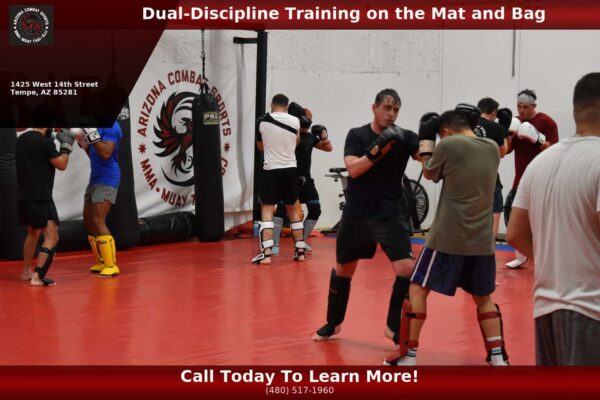
Should You Train BJJ and Muay Thai at the Same Time? A Coach’s Answer
Key Takeaways:
- Cross-training in BJJ and Muay Thai produces more complete martial artists than specializing in one discipline alone, because each art covers the ranges the other cannot.
- A 3-to-5-day weekly schedule makes dual training genuinely sustainable for adults — recovery and smart programming matter more than raw hours on the mat.
- If you are training one discipline now and considering adding another, the fastest path is to try a single class in your weaker range and see how your body responds.
Yes — for most adults, training BJJ and Muay Thai simultaneously is the single fastest way to become a capable martial artist. Each discipline closes a gap the other leaves wide open, and a well-built schedule keeps the workload manageable without burning you out.
That is the short answer. Here is the full picture.
How BJJ and Muay Thai Fill Each Other’s Gaps
Most people who train in one discipline eventually run into the same wall. Grapplers with no striking background get picked apart at range before they can touch their opponent. Strikers without grappling get taken down once and have no answer for what happens next.
This is not a talent problem. It is a coverage problem.
Muay Thai trains you to control distance, generate power from the clinch, and manage an opponent who wants to keep the fight standing. BJJ trains you to close distance safely, control a resisting opponent on the ground, and create submissions from bad positions. Together, they cover every range a real fight — or a competitive match — moves through.
Consider what happens when a pure Muay Thai practitioner pressures a pure BJJ player. The striker sets the range, lands clean shots, and the grappler either takes damage getting in or shoots blindly without a setup. Now flip it. A grappler with no striking defense gives up the outside game entirely, offering nothing but the threat of a single-leg from twelve feet away. Neither specialist poses a danger to a dual-trained opponent. Learn more about our Muay Thai program and how it can improve your stand-up game.
The coverage argument is not theoretical. Every UFC champion on the active roster trains both disciplines as a baseline — not because they all started there, but because they learned through competition what the gaps cost them.
Range Management: The Real Skill Cross-Training Builds
The outcome people rarely talk about is range management. This is the ability to read where the fight is, decide which range benefits you, and deliberately move the fight there.
A striker knows when to stay long and pick shots. A grappler knows when to close distance and tie up. A cross-trained athlete knows both and, more importantly, knows how to transition between them under pressure. That meta-skill — reading range and choosing the right tool — is what separates reactive fighters from strategic ones.
Training both disciplines simultaneously accelerates this skill because you are constantly exposed to problems that demand different tools. You drill a double-leg entry in BJJ class and then feel a Muay Thai practitioner’s knee in a clinch during sparring. Suddenly, the theoretical connection becomes visceral. Your double-leg setup improves because now you understand what the striker is trying to do to stop it.
This feedback loop is the core argument that Arizona Combat coaches make to students considering adding a second discipline: cross-training in BJJ and Muay Thai.
What a Dual-Training Week Looks Like at ACS
Scheduling is where most people’s plans fall apart. The solution is treating the two disciplines as complementary loads, not additive stress.
A sustainable 3-day week might look like this:
- Monday: BJJ technique and drilling (60 min)
- Wednesday: Muay Thai technique and bag work (60 min)
- Friday: BJJ or Muay Thai live sparring — rotate weekly
At this volume, you are getting genuine exposure to both arts, with enough recovery between sessions to absorb what you practiced. Progress is real; the risk of overuse injury is low.
A 5-day week, appropriate for someone past the first three months:
- Monday: BJJ technique
- Tuesday: Muay Thai technique
- Wednesday: Active recovery — light stretching, mobility work, or a walk
- Thursday: BJJ with sparring
- Friday: Muay Thai with sparring
Saturday is optional. If you add it, make it a single session focused entirely on your weaker discipline.
The key principle is alternating the primary demands. BJJ sessions are mostly anaerobic, grip-intensive, and neurologically complex. Muay Thai conditions the cardiovascular system differently and taxes the shoulders, shins, and hip flexors. Structuring your week to alternate these demands means each session’s fatigue does not compound the previous one.
Arizona Combat Sports builds its class schedule specifically to support this kind of programming. Classes in both disciplines run on days that allow alternating sessions without forcing athletes to choose between back-to-back high-intensity days.
How to Balance Without Burning Out
Two technical disciplines mean two learning curves running in parallel. That sounds demanding, and at high volume, it can be. The fix is honest prioritization in the first six months.
If you are new to both arts, start with one for six to eight weeks. Build a movement baseline — hip escapes, bridging, shrimping on the BJJ side; stance, guard, teep mechanics on the Muay Thai side. Then add the second. You will retain the new material faster because your body already understands how to learn a physical skill.
A few practical guidelines to protect recovery:
- Sleep is the primary adaptation tool. Seven to nine hours matter more than an extra session.
- Hydration in Arizona’s climate is not optional. Training in Phoenix-area heat amplifies sweat loss, and dehydrated muscles absorb technique poorly.
- Soreness from technique drilling is normal; joint pain or sharp muscle pain is a signal to rest, not push through.
- Sparring intensity should scale with your experience level. New students in both arts should prioritize drilling over live rounds until the fundamental movements are automatic.
The athletes who burn out typically do so because they add volume before adding consistency. Three sessions per week attended reliably for six months produce more skill than six sessions per week attended for six weeks before dropping off.
What Cross-Training Looks Like at the Elite Level
In 2026, the conversation about specialization versus cross-training is essentially settled at the professional level. Most elite MMA athletes did not start as generalists — they came up through one discipline and spent years filling in the gaps. The lesson is not that everyone needs to become an MMA competitor; it is that the gaps eventually show up, and the earlier you address them, the less they cost you. Explore our MMA training in Arizona and take your skills to the next level.
You do not need to be a professional to apply this logic. Adult recreational practitioners benefit from range coverage for the same reason competitors do: it makes every session richer, every drill more meaningful, and the overall practice more sustainable. When you understand how the stand-up game and ground game connect, each discipline becomes more interesting, not less.
One year here equals five years anywhere else — and that edge comes directly from training in an environment where both disciplines inform each other every week.
Ready to try the discipline you have been putting off? Come in for a single class in your weaker range. The schedule is built to make it easy to show up. The work is yours to do.
Ready to improve your weaker discipline? Book a free trial class today and experience expert coaching in a supportive training environment.
Frequently Asked Questions About BJJ and Muay Thai Training
Sources
- Elite-level dual-discipline training baseline — UFC Athletes roster, UFC official site: https://www.ufc.com/athletes
25+ Years in Tempe
Why Trust AZ Combat Sports
For more than 25 years, Arizona Combat Sports has trained complete beginners, kids, ASU students, first responders and professional fighters at one location: 1425 West 14th Street in Tempe. Here's what has kept the East Valley coming back.
-
Founded & Run by Fighters
Founded by Trevor Lally and led today by partners who have competed at a high level, including former pro fighter and MMA head coach Trevor Smith.
-
Black Belt Instruction
BJJ head coach Steve Rosenberg is a second-degree black belt under Nova União and has coached at ACS for more than 15 years.
-
Proven With Competitors
An active fight team of amateur and pro athletes, with students competing in IBJJF tournaments, submission-only events and MMA.
-
Safety First, Always
Every class is supervised, sparring is always optional, mats are sanitized multiple times a day, and youth instructors are background-checked.
-
Zero-Ego Culture
Beginners train next to experienced fighters in a team-first room. Most members walk in with no martial arts background at all.
-
No Contracts, No Surprises
Month-to-month memberships with no sign-up fees. Try one free class per discipline before you commit to anything.
"I've trained at this gym for four years doing BJJ and I can't recommend it enough."
Anthony, Google review of Arizona Combat Sports

How Long Does It Take to Get a BJJ Blue Belt? What to Expect on the Path
Key Takeaways:
- Most consistent adult BJJ students earn their blue belt within 12–24 months, training roughly three times per week — but frequency and mat quality matter far more than calendar time.
- Coaches evaluate attitude, positional understanding, and behavior under pressure — not just how many taps you collect or how long you’ve been on the mat.
- The blue belt means more when it comes from a credible gym with honest standards; earning it at Arizona Combat Sports is a genuine skill threshold, not a participation milestone.
Most consistent adult students earn a BJJ blue belt after 12 to 24 months of training. If you’re training three times per week with genuine effort, the lower end of that range is realistic. If you’re showing up once a week and treating it casually, two years may not be enough. That’s the honest answer.
Now let’s talk about what actually determines where you land on that spectrum — and what your coaches are really watching.
What the Blue Belt Actually Represents
The blue belt is not a reward for time served. A lot of people misunderstand this, especially those who come from other martial arts where advancement feels more automatic. In Brazilian jiu-jitsu, the blue belt signals a specific skill threshold: you can survive, you can escape, and you understand enough about the game to do damage.
More precisely, a blue belt practitioner should be able to:
- Escape bad positions reliably (side control, mount, back mount)
- Attack with two or three high-percentage submissions
- Submit other white belts with reasonable consistency
- Demonstrate an understanding of pressure, posture, and base — not just brute force
- Show that their game has a structure, even a simple one
Notice that the list says nothing about how many months you’ve been training. It describes a person, not a calendar date.
The distinction matters because it shapes how you should approach every training session. You’re not counting down days — you’re building capabilities.
The Realistic Timeline for Consistent Adult Training
Here is where the “it depends” answer becomes something more useful.
Training frequency is the single biggest variable in how long to get a BJJ blue belt. A student who trains three times per week accumulates roughly 150 sessions per year. At that pace, most people have enough mat time to develop the foundational game needed for a blue belt inside 18 months. Some athletes with prior grappling experience, strong body awareness, or competitive drive get there sooner. Most dedicated adult students without a grappling background land somewhere between 12 and 24 months.
A student training once per week accumulates around 50 sessions per year. The math is straightforward — but frequency also affects retention. Skills built three days apart get reinforced. Skills revisited eight days later often have to be partially relearned. Consistency compounds in BJJ the same way it does in any complex physical skill.
A few other factors that shift the timeline:
- Prior wrestling, judo, or submission wrestling experience
- Whether you drill outside of live rounds
- Whether you compete — competition accelerates exposure to pressure situations
- Whether you train at a gym that gives honest, direct feedback
That last point connects to something worth addressing directly.
Why the Gym You Train At Shapes the Belt’s Meaning
Not every blue belt represents the same thing. In a recreational gym with relaxed standards, students may receive a blue belt after 10 months simply to retain membership or boost morale. In a serious academy, that same timeline might not be enough.
This is worth understanding because your blue belt is only as credible as the gym that gives it. A blue belt from a gym known for competitive grapplers and honest evaluations is a legitimate credential in the jiu-jitsu community. A belt from a program that awards them freely carries less weight — and won’t hold up the first time you roll with someone from a credible school.
At Arizona Combat Sports here in Tempe, the belt standards reflect the broader Phoenix BJJ community, where credible practitioners and legitimate competitive programs keep the curve honest. Earning a blue belt in this environment means something real.
If you’re looking for expert coaching and a clear path to advancement, explore the BJJ program at Arizona Combat Sports to see how our structured training and belt progression system helps students build skills and confidence at every level.
What Coaches Are Actually Evaluating
When your instructor watches your rolls, the evaluation goes well beyond whether you tapped someone. Here is what coaches are genuinely paying attention to:
Mat time and attitude. Are you showing up regularly? Are you coachable? Do you drill with focus or drift through the motions?
Understanding, not just execution. Can you explain why a technique works? Do you recognize opportunities in real time, or only replicate moves when the setup is handed to you?
Behavior when things go wrong. This is one of the most revealing signals. How do you respond when a newer student catches you? Do you muscle out of technical positions? Do you get frustrated and become reckless? The blue belt represents a mental threshold as much as a physical one.
Consistency under fatigue. Technique collapses when people are tired. Coaches watch the last ten minutes of a round as much as the first — that’s where real readiness shows.
Students who check every technical box but bulldoze positions with athleticism rather than structure, or who shut down emotionally when they struggle, often wait longer than peers who show less raw athleticism but more genuine grappling intelligence.
Why White to Blue Is the Most Important Journey in BJJ
Every belt transition matters, but none reshapes a practitioner as much as white-to-blue does.
The white belt phase is where the fundamental question gets answered: will this person actually learn jiu-jitsu? Many people start. A meaningful portion ends within the first six months, often right when the initial novelty fades and real difficulty sets in. Getting through that friction and arriving at the blue belt means you’ve built something durable.
In 2026, retention data across martial arts academies consistently show that the students who earn a blue belt almost always continue training. The blue belt is the loyalty threshold — not because the belt itself is magical, but because the person who earns it has already proven they can sit with difficulty and keep moving.
That’s the real milestone: not the belt, but the identity shift that comes with it.
If you’re curious about where you stand in your progression or want structured guidance through this process, the BJJ program at Arizona Combat Sports offers honest, coach-led development for adult students at every level. Talk to a coach, describe where you are, and get a direct read on what you’re working toward.
If you’re unsure where you stand in your Brazilian Jiu-Jitsu journey or want personalized guidance on your next steps, talk to a coach today. Our experienced instructors can assess your current skill level, answer your questions, and help you create a clear path toward your next belt.
Frequently Asked Questions About BJJ Blue Belt
Sources
- BJJ belt progression and adult belt age requirements — International Brazilian Jiu-Jitsu Federation (IBJJF): https://ibjjf.com/graduation-system
- Brazilian jiu-jitsu — overview and belt system: https://en.wikipedia.org/wiki/Brazilian_jiu-jitsu
25+ Years in Tempe
Why Trust AZ Combat Sports
For more than 25 years, Arizona Combat Sports has trained complete beginners, kids, ASU students, first responders and professional fighters at one location: 1425 West 14th Street in Tempe. Here's what has kept the East Valley coming back.
-
Founded & Run by Fighters
Founded by Trevor Lally and led today by partners who have competed at a high level, including former pro fighter and MMA head coach Trevor Smith.
-
Black Belt Instruction
BJJ head coach Steve Rosenberg is a second-degree black belt under Nova União and has coached at ACS for more than 15 years.
-
Proven With Competitors
An active fight team of amateur and pro athletes, with students competing in IBJJF tournaments, submission-only events and MMA.
-
Safety First, Always
Every class is supervised, sparring is always optional, mats are sanitized multiple times a day, and youth instructors are background-checked.
-
Zero-Ego Culture
Beginners train next to experienced fighters in a team-first room. Most members walk in with no martial arts background at all.
-
No Contracts, No Surprises
Month-to-month memberships with no sign-up fees. Try one free class per discipline before you commit to anything.
"I've trained at this gym for four years doing BJJ and I can't recommend it enough."
Anthony, Google review of Arizona Combat Sports