NAfME Eastern Division Research Poster
I had an opportunity to share my dissertation and preliminary findings this spring in a research poster at the 2023 Research in Music Education and the NAfME Eastern Division Conference.

Dissertation prospectus
After 2 years of coursework and successfully passing my qualifying exams, I am ABD in my doctorate program in Music Education at Boston University. Here is the slide deck for my dissertation prospectus with my committee on September 1, 2022.
]]>
ambient experiment/s
My first foray into ambient music – I heard the thunderstorm sample on a Disquiet junto project, found the .wav file on freesound.org and added some sounds and additional samples from freesound in Soundtrap to arrange this piece. I don’t think you’ll find a better field recording of a thunderstorm with accompanying rain fall than this track (credit: Jillis Molenaar).
When I listen back, it sounds like scene when they introduce the 2nd machine portal in Japan that was built for Jodie Foster’s character Dr. Arroway in the 1997 sci-fi film Contact. It’s the sound of those three, rapidly spinning gimbaled rings make as Dr. Arroway walks to the device that will transport her through a series of wormholes to Vega.
I had no intention of this result, it’s what I’m reminded of when I listen to the track.
sample credit/s
Jillis Molenaar (thunderstorm):
https://freesound.org/people/Jillismolenaar/sounds/353810
Erokia/Jordon Powell:
https://freesound.org/people/Erokia/sounds/583393
https://freesound.org/people/Erokia/sounds/558231
Pop & Rock Course Reflection
A nice reflection on my experiences at Boston University, Music Education CFA Summer Rock and Pop course in August 2021.
]]>
Songwriting Project #2
Our group gathered the first week of class and grouped ourselves as the doc student rock band. We started a group text message over Facebook (Rockin in August) messenger and began brainstorming ideas about song lyrics and who would play instruments on the track. Although the group may have had an idea about instrumentation, it wasn’t the primary focus for those first couple of meetings. Interestingly, we didn’t talk about styles or genres. Some lyrical and humorous ideas bubbled to the surface that were related to our experiences in courses throughout our DMA program. Specific terms stood out in classes we had taken up until this point, such as a failure to reject the null hypothesis from our quantitative methods class (is that a Type 2 error?).
During the asynchronous week of the class, we scheduled 3-4 Zoom sessions for us to collaborate on our song. Our first zoom session, we talked through some of the lyrical ideas first and when Alyssa spoke about frustrations with particular aspects of the program, I riffed a chord progression a cappella over that meeting, went back to my residence and came up with the material for the verse. I was thinking of some sort of angst driven type of progression, perhaps in the style of Green Day. It’s the distorted, rhythm guitar playing bar chords in the song. During that meeting, I had suggested a pop song structure with verse, bridge, chorus, repeat, instrumental, and then an outro verse. The very first sound on the track is a fog horn. During the call, I met the group on my iPhone and a ship blew its horn during the zoom call. The fog horn sound became symbolic for unintended background noises during any live class or one-on-one meeting with a professor this past year. For the 2019 cohort, the entirety of our second year in the DMA program took place during COVID-19.
We used Soundtrap in a variety of ways during the making of our song. After our initial brainstorming Zoom session, we opened a Soundtrap project and used it like a scratchpad to generate ideas for musical material. I recorded those verses, bridge chords, and harmonies into that Soundtrap project. At our next zoom call, I mentioned to Alyssa her arpeggiated keyboard riff was really neat and thought we should stitch together the verse and chorus with this bridge material. Alyssa’s contribution eventually became the chorus music, in which I recorded some more guitar parts. After the scratchpad project became too cluttered with ideas, we had to create a new Soundtrap project and arrange our musical decisions in a new place. Based on our conversations, Leah created the sections for us on a guide track.
We met a couple more times over Zoom discussing our work and thinking about what direction to go next together on the song. It was nice to discuss, laugh, and plan together our next steps. I provided some additional music material when we decided to include an instrumental section after the second chorus. I hooked my guitar back up to the project and came up with an 8-measure guitar solo. I worked out this solo on the guitar directly in the project file for time constraint reasons. Again, I used the cycle feature in Soundtrap to work out a solo over the harmonic progression; that’s such a great tool. Since this was not quite the lyrical guitar solo described in my individual song, I chose to consider more of a riff oriented solo. The first 4 measures are more or less like that, building over a pentatonic scale in E minor. The second half of the solo reminds me of Steve Howe of Yes with the syncopated descending, sequential riff. To finish out the solo, I again go to an Alex Lifeson sus4 chord on D with a shimmery, semi-distorted guitar tone. I recorded three versions and let the group decide which version they liked the best.
Each time I would reopen the project, new material would inspire me to contribute more or arrange existing material in a new way. Before I recorded the guitar solo, Tim had recorded his lyrics. When I heard the quirkiness of the vocals about experiences I had lived through with my classmates these past two years, I was impressed as well as left laughing because of Tim’s performance. He recorded a primary vocal track, as well as perform the call and responses in the performance. It was hilarious! This songwriting experience was a delightful way to work on a song with others. In fact, this experience is how I would envision my students collaborating on a song project in Soundtrap.
Songwriting Project #1
Our first assignment in ME 638 was to create a song following one of three approaches described by Kat Reinhert (2019) in her article Lyric approaches to songwriting in the classroom.
I chose to use a piggy-back to modelling approach for the melody and lyrics in my song. I searched popular songs that were written in a minor key and scrolled through the possibilities to substitute original lyrics with a melody to many of my favorite existing songs. Eventually, I settled on Phil Collins, In the Air Tonight and started to think about how I might piggy-back new lyrics to this melody. The tempo is a bit faster in my song, but I noticed the melodic elements began informing harmonic and musical choices as I built out the song in Soundtrap. As I was developing the music, I noticed my song had a similar sentiment to Jackson Brown’s Stay as it reminisces on similar feelings describing the process of being in a touring band, performing night-after-night in different cities along the tour. I found myself writing about similar themes since I have been genuinely excited at the prospect of participating in the class. The lyrics, I suppose, are an expression of anticipation about the experiences we’re about to embark on together next week.
From the beginning, I knew I wanted to write and record actual guitar parts. Capturing an analog instrument connected to a digital/audio converter isn’t the most efficient way to record to a cloud-based digital audio workstation (DAW) such as Soundtrap. I connected my computer with an ethernet cable directly to the cable modem router to help minimize the latency over a wifi connection. After this connection was made, recording guitar parts was seamless. I tracked the rhythm guitar parts to the verse section first and recorded to the click track of the metronome set around 122bpm. After the rhythm guitar parts were in, I added several MIDI instruments to fill out the song. After playing the bass part on the qwerty keyboard, I opened the piano roll, quantized the part to an eighth note value and aligned the pitches to the grid. Listening back, the guitar part seemed to groove better against a steady and solid bass part. I used the drum kit Explorer (typical rock drum kit) on a continuous loop through most of the song.
There are many references in this song to bands, artists, and styles that have influenced me over the years. That clean, shimmery guitar arpeggiation in the beginning has a very Queensrÿche feel from their Operation Mindcrime album, as does that material of the verse. I’m not sure if this is a result of being a guitar player from the 80s, but I love the different types of chord voicings over a pedal bass line, which you can hear a lot of in this song. Bass players aren’t typically a fan of this. That short bridge section before the guitar solo is influenced by one of my favorite bands Dream Theater and their song Blind Faith off of the album Six Degrees of Inner Turbulence.
The guitar solo is full of references that have had a profound influence on my style as a guitarist. Some are obvious (literal call outs/references to other famous solos) and others are found in the style of my playing. There is a literal reference to the guitar solo from Who’s Crying Now off of the Escape album, as well as the chord progression at the end of my solo is based on Send Her My Love from the Frontiers album. Most of that solo was conceived as sung lines at random times during the course of my day. Actually, most of the material was written on walks with my dog Isabelle. There are a few guitarists that come to the forefront as lyrical guitarists, and Neal Schon of Journey is at the top of that list for me. Some of Schon’s solos are counter-melodies to the Steve Perry lines (see Anyway you Want it, Separate Ways, Don’t Stop Believin). What I mean by lyrical is that Schon’s phrasing, use of vibrato, and tone sounds about as close to a sung melody as any vocalist I’ve heard. Steve Lukather is another brilliant lyrical guitarist, in my opinion because he is also a talented singer (see the solos in I won’t Hold you Back Now and I’ll be Over You. Not only does he deliver beautiful guitar solos, he is the main vocalist on those tracks as well). For me, they are amazing musicians and songwriters more than just a guitarist. They’ve made an impact on how I approach songwriting and how the guitar fits into the fabric of a song.
In addition, other parts of that solo were written noodling on the guitar to see where the lines I wrote in my head would land on the fretboard. And then, it was stitched together during the recording process. I used the cycle feature of Soundtrap to practice tricky passages and then would hit record after a few practice takes. Capturing a solo, from accounts of the greats and now my own experience, is an ambiguous process. For me, it seems as though I get my best takes when the little red record button is turned off. From what I hear/know, this is typically the case. I also think, and now have experienced, hearing the solo and performing it takes time and repetition. This is also true of the voice. Learning a song, the voice needs time and repetition to learn vowel shapes and establish in its muscle memory. I was learning the lyrics and melody of my song on those walks with Isabelle too. Although I can hear/sing this solo, I found that the fingers simply needed more time to execute. I tried recording the solo after I had conceived it but found I was making too many mistakes because my fingers could not catch up to where my brain was with it.
There are a couple of chord voicings in the end of the song after the guitar solo. These are clearly related to Alex Lifeson of Rush on my tonal palette of guitar tones. It always amazed me how three musicians could make such big, dense textures when I had the opportunity to see them live, as well as the soundscapes of their catalogue.
Pump 13
Details and description of this almost 30yr project are coming soon! For now, enjoy (yes, that is me on guitar)

UPDATE 7/18/21
This is the first post with the CFA ME638 tag. These recordings represent the last time I was in a rock band (and Pump 13 was more than a rock band) playing guitar. Until the summer of 2021…

Pop and Rock Pedagogy, ME 638 is a graduate elective course in my doctoral program at Boston University offered during the summer term in 2021. Nearly 25 years after these recordings, I will have the opportunity to join a popular/rock ensemble, write/arrange songs, and perform for an audience at the Midway Cafe in Boston on Saturday, August 7, 2021.
Am fairly certain, organizing and converting the mixed-down, 25 year-old tape to .wav files is a result of preparing for this experience that awaits me in the next couple of weeks. Am going to use the CFA ME638 tag to blog about the journey – follow along, it should be interesting!
This blog post is part of the Recording Studio category and is an ongoing story of my interest in writing, arranging, and recording music. The arc is an interesting one…
In the late 80s, I had an electric guitar, a small practice amplifier, a consumer grade keyboard (maybe a Casio) and the use of a friend’s Tascam 4-track to cut my cassette “demos.” With the family Windows 3.1 licensed PC, I tracked all of the MIDI synth parts in Cakewalk leaving me three channels on the 4-track for analogue instruments. Back then, one track was needed for the SMPTE time code to sync the Tascam with Cakewalk (sounded like a dial-tone).
In 2000, I owned a Marantz 4-Track recorder and a Korg X5 and brought them with me to my first teaching job at Capuchino High School in San Bruno, CA. It was here that I began facilitating student-centered learning activities in technology-based music classrooms. Students in the popular music class I started could write, arrange, and record original music in student-formed bands. Here are a couple of examples from that class: a) song #1 b) song #2
In my position at St. Ignatius College Preparatory, I designed and built a professional grade recording studio (those stories and chronology are shared here). Based on these experiences, I want to share what I’m using as of this blog post at home to continue and write, arrange, and record music.
There are some interesting components here » check them out!
Home Studio Gear
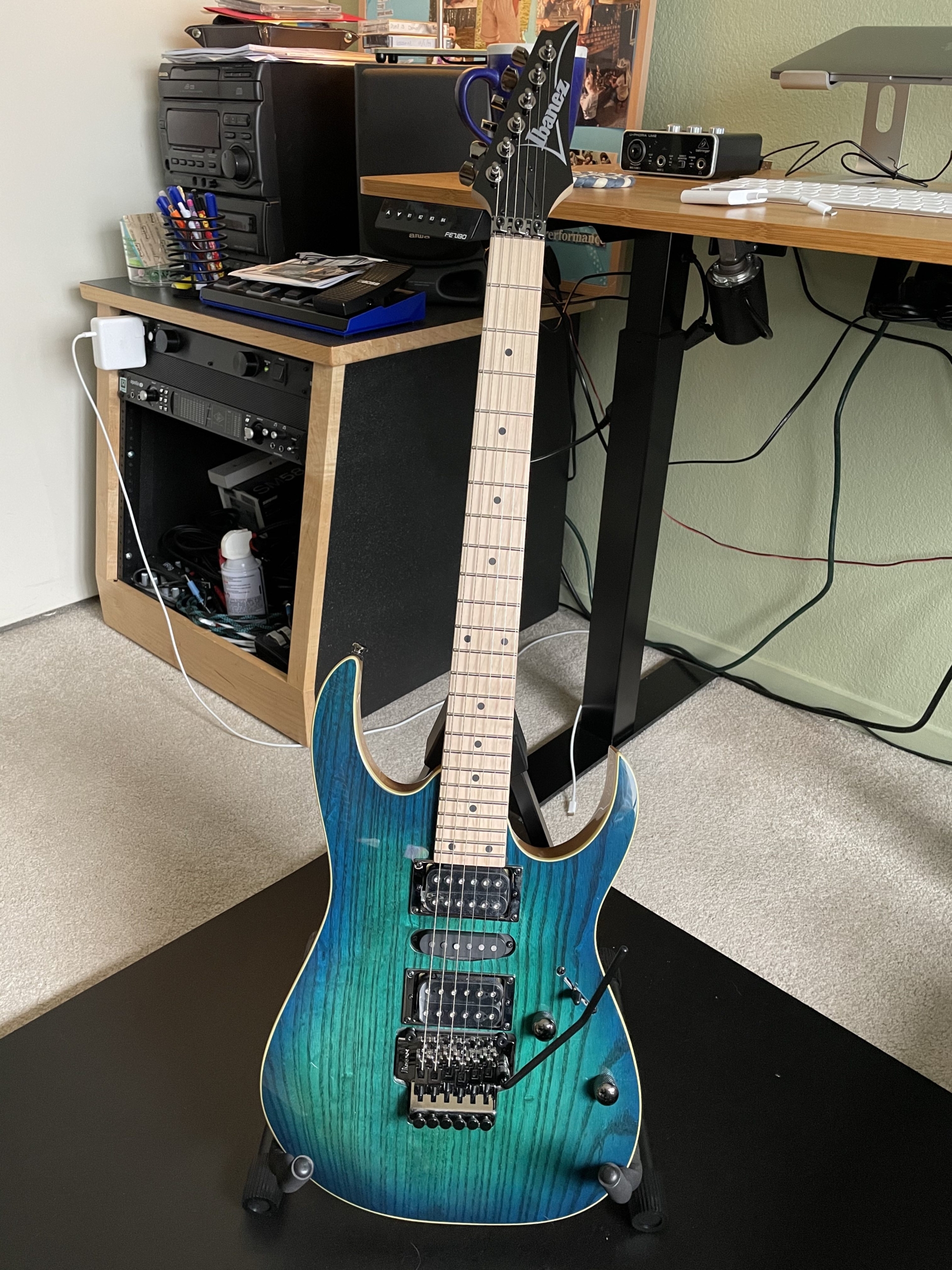
I just picked this Ibanez RG470AHM (May 2021) up as my main electric guitar. This is my first electric guitar purchase since my Steinberger GM4T back in the early 1990s. I’ve always loved the Ibanez necks; low and fast! I use the tremolo bar for expressive purposes so I needed guitar that would stay in tune when I use it.
My personal mic collection is modest at this point, but I own a requisite pair of Shure SM58s. I use this as my go to podcasting mic:
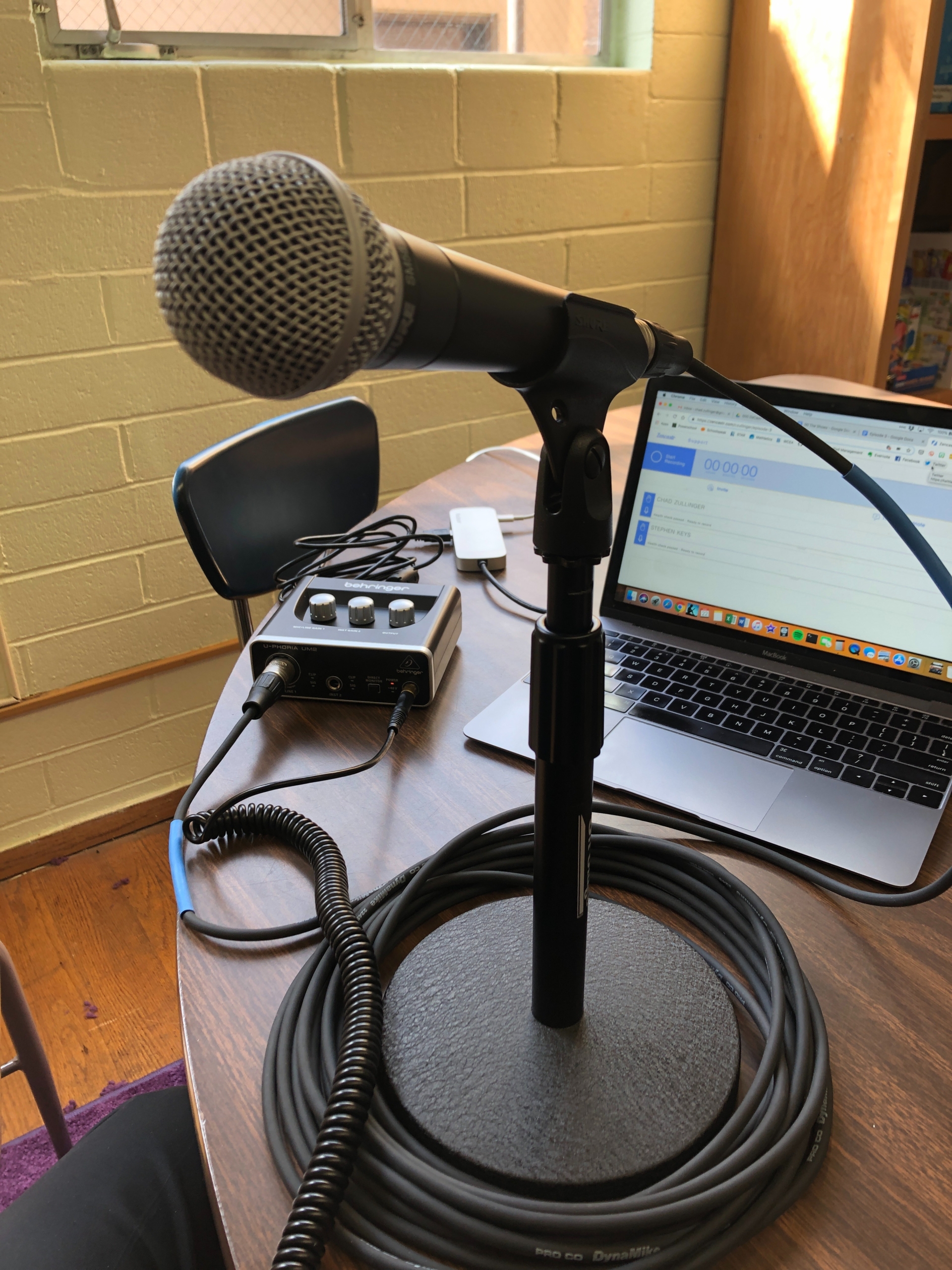
The Behringer UM2 audio interface is nothing spectacular, but gets the job done for my podcast work.

2017, 13-inch, Macbook Pro 2.3 GHz Dual-Core Intel Core i5
(48×24, FEZIBO adjustable standing desk)

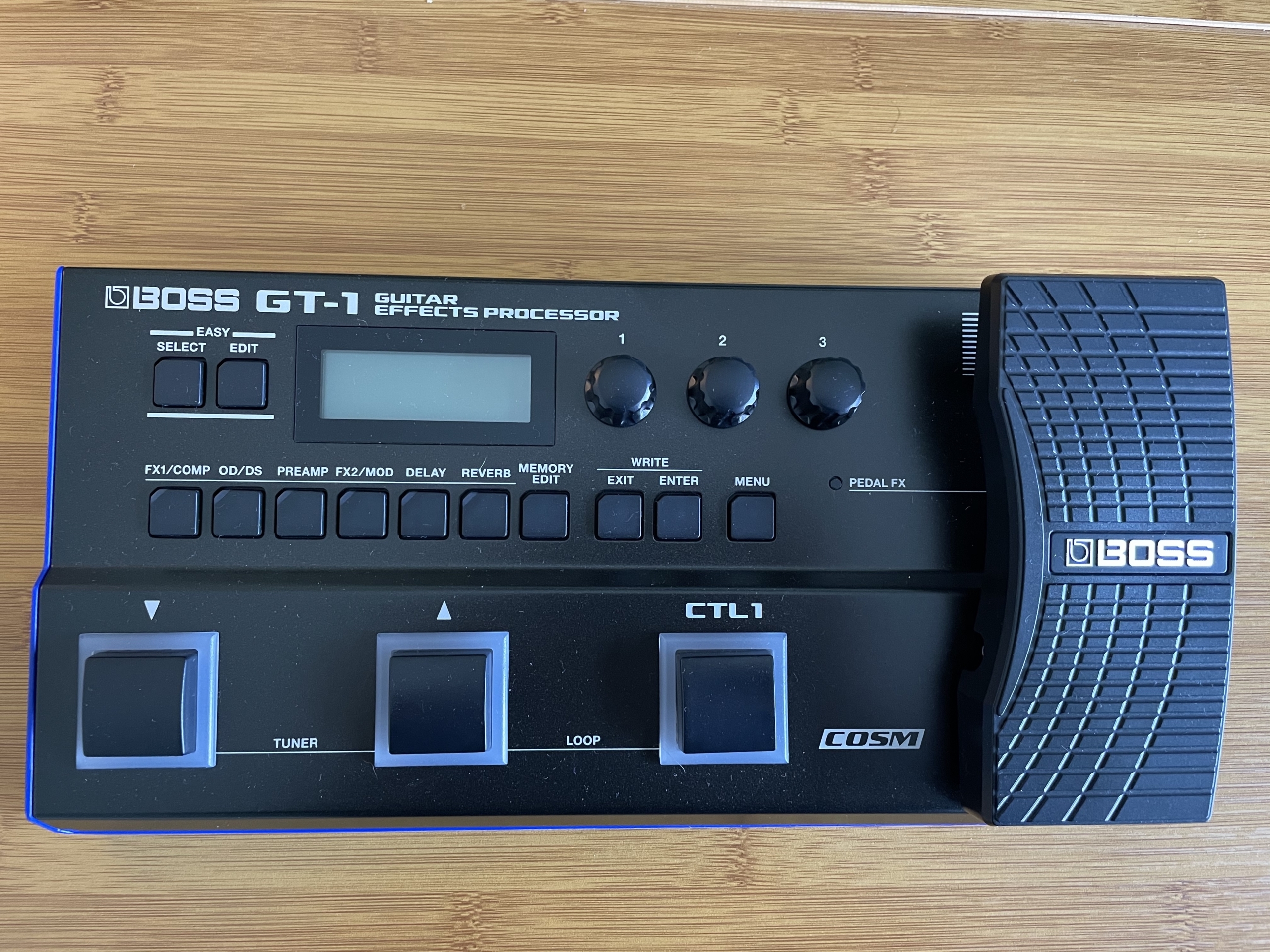
I used to own a Boss SE-70 over 20yrs ago (running through a Marshall JMP-1) and when I saw the Boss GT-1 for a fraction of the price here in 2021, I had to pick up this effects unit.
I was the guitarist with effects pedals strung together in a series effects chain, culminating in a weak, mushy signal at the preamp stage. These parallel effects units encapsulated all of my favorite pedals and sounds into one, programmable effects module. “Deep Chorus” was my favorite patch in the SE-70.
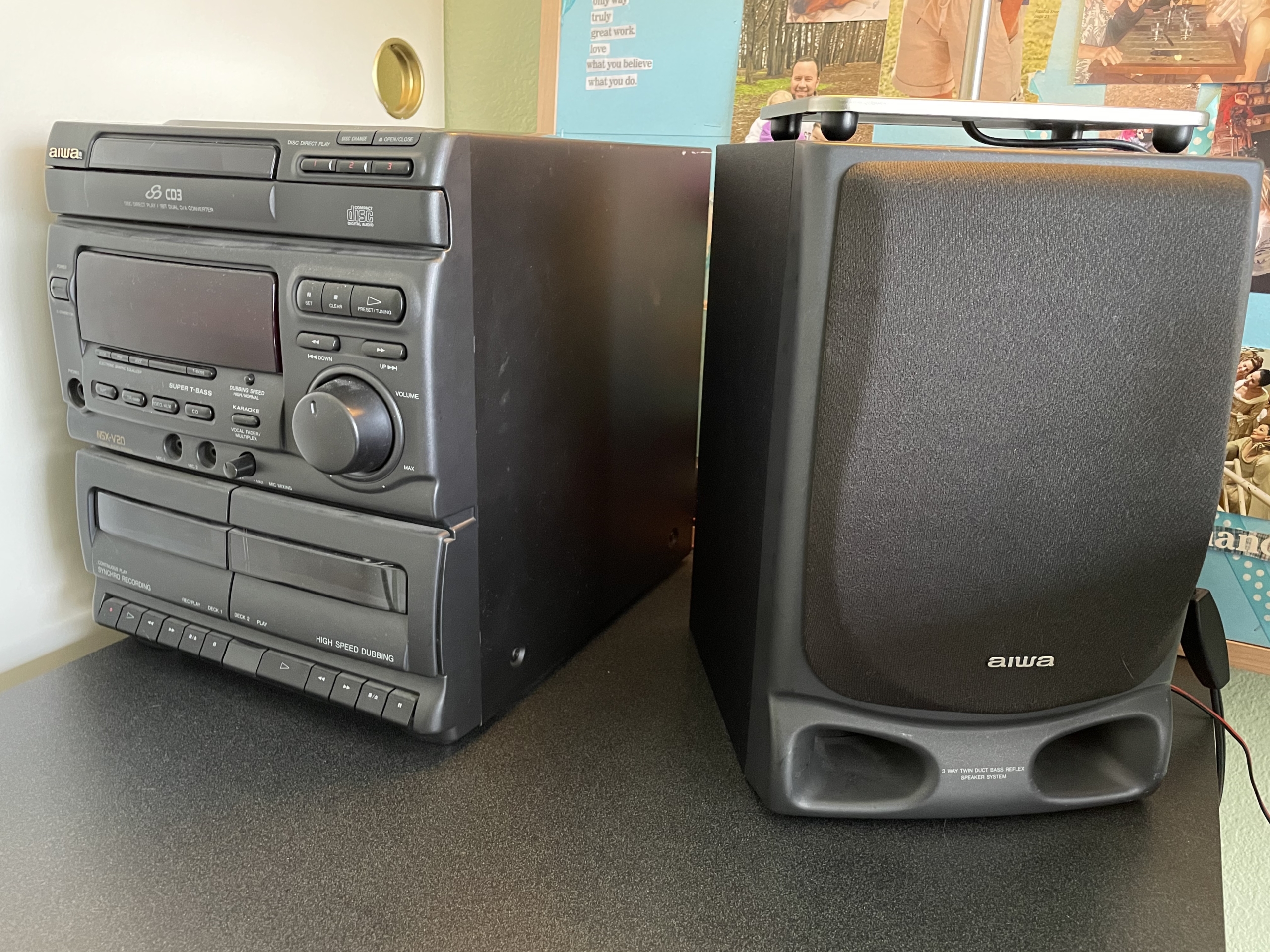
Ok. This might look like a (very old…) consumer grade, all-in-one Aiwa CD, dual-cassette, and tuner amplifier, but I’m telling you, these speakers still sound amazing! I know I should have a reputable pair of reference monitors, but I really do love the way this system sounds after 25 years of multiple moves across the country and a handful of offices it’s sat in of past jobs.
Digital Audio Workstation (DAW)
There so many options available for home studio users! In Studio 2001, I became somewhat proficient in Logic, although friends of mine were urging me to take a look at this new, interactive DAW called Ableton (I wish I had!).
I don’t really see much of my work in a home studio environment as professional, so cloud-based DAWs such as Soundtrap and Bandlab work reasonably well for my current needs. Also, cloud-based DAWs allow others to collaborate on tracks and projects and are particularly appropriate for my work with preservice music educators. As of this post, I spend most of my time in BandLab (@chad_z). The more tunes I come up with, I hope to post them here at my Bandcamp page.
CMEA Urban Music Podcast
I served as editor of this inaugural episode assisting my colleague California Music Educators Association (CMEA) Urban Schools Representative Zach Pitt-Smith in what will hopefully become a regular podcast focusing on teaching music in urban spaces. In a conversation among music teachers in the Oakland Unified School District (OUSD), they discuss their work in the context of racism, gentrification, and the need for awareness of different perspectives as CMEA music educators in the Bay Area, California. My idea for this episode came as a response to a comment thread of a CMEA Facebook post during the 2021 All State Music Educator Conference (view the post/thread here). Zack was the first to reply to his colleague in OUSD, which is when I reached out to Zack and proposed this podcast idea for his next CMEA magazine article. Rather than mildly participate in a social media comment/reply as a replacement for the important conversations that need to be had in our organization, I felt in this instance I wanted to know more about David’s perspective and provide a space for others to hear about these lived experiences as well. From what I have heard, participants in the podcast were pleased with the work, yet realize there is much work to do. I reside in the Bay Section region of CMEA. I could imagine continuing in my role as editor, technology facilitator, and my form of allyship so that we are not simply featuring voices of music educators in other spaces, rather, these narratives are strands in the fabric that are all encompassing, not some experiences by a handful of music educators in CMEA.
Am facilitating my Teaching and Learning with Technology for Music Educators workshop at CSU Eastbay in the summer of 2021. This experience will be an opportunity to try out new ideas and organize resources in preparation for the music education course version of the class that I teach in the Fall of 2021.

I made that promotional graphic on Canva.