The post Bitcoin Price Rebound Faces a Fresh $82K Test: Will It Survive the Weekend? appeared first on 99Bitcoins.
]]>That level is doing more work than its round number suggests. Avinash Shekhar, co-founder and CEO of Pi42, notes that $82,000 has acted as both support and resistance for close to 50 days, which makes a weekend close on either side of it genuinely informative.
BTC USD Back Above $80K: What the Rebound Was Actually Built On
Thursday’s drop to roughly $79,800 wiped out about $930 million in leveraged positions, with around $780 million of that in longs. On the way back up, roughly $53 million in shorts were liquidated.
That second figure is the one worth noting. Short covering can lift price quickly, but it closes existing positions rather than creating new demand, so part of this week’s recovery came from mechanics rather than buyers.
The order book tells a similar story. Glassnode’s heatmap showed a thick wall of bids resting at $80,000 for much of last week. Those orders were consumed during Thursday’s slide, and the replacement stack that appeared below the level was smaller than the one it replaced.
Not everything points the same way. CryptoQuant’s measure of total whale holdings, which excludes exchange and mining pool addresses, has climbed steeply since September and now sits close to three million BTC, near its highest of 2026. Those wallets were adding while price fell.
New Whales Now Account for 1/3 of Bitcoin’s Whale Realized Cap
“At $82,134, Bitcoin trades about 6.7% above new whales’ cost basis.” – By @MorenoDV_ pic.twitter.com/B7SREdQdTU
— CryptoQuant.com (@cryptoquant_com) October 16, 2026
One detail argues for patience. Volume fell 23.87% to $30.98 billion while price recovered, so the bounce is arriving on lighter participation than the decline that caused it.
DISCOVER: Best Meme Coin ICOs to Invest in 2026
BTC Levels Into the Weekend: Can Bitcoin Price Hold The Line?
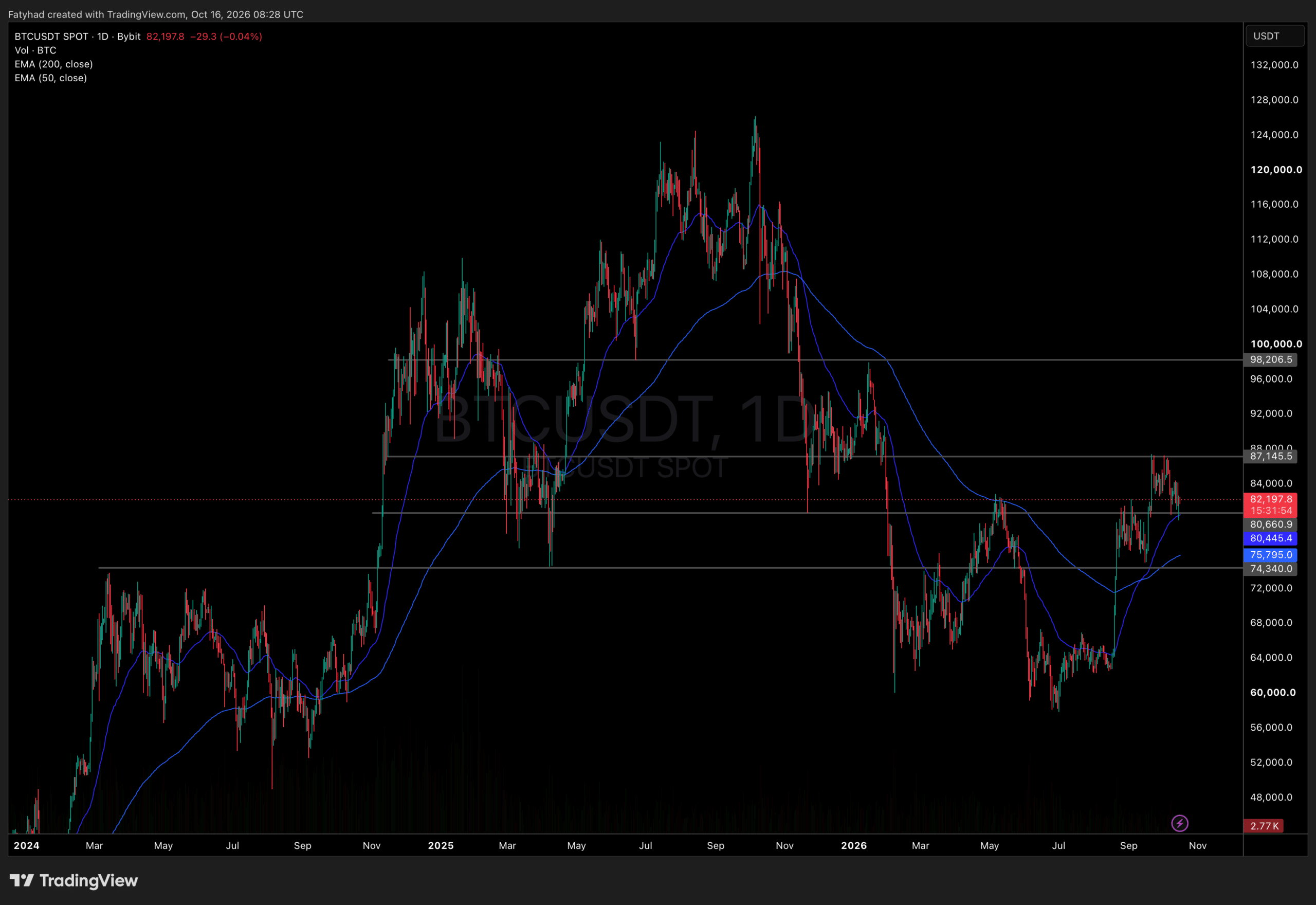
Delta Exchange research analyst Riya Sehgal puts the critical support region at $80,000 to $80,700. A sustained break beneath it would expose $78,000 to $79,500, while reclaiming $82,000 to $83,200 is what would improve the short term structure.
BTC USD will be decided at these levels:
- The floor: $80,000 to $80,700. Defended twice this week. Glassnode’s data suggests the bids below it are thinner than they were, so a third test would meet less depth.
- The pivot: $82,000. Support and resistance for nearly 50 days. Friday’s fade back below it leaves the weekend open.
- The recovery zone: $82,000 to $83,200. Holding above this band is what would turn a bounce into a trend change.
Volatility rose about 7% toward 39 as the market repriced, and weekend sessions carry thinner liquidity by default. That combination tends to produce larger moves on smaller volume, in either direction.
The macro backdrop has not improved either. September CPI came in at 3.7% and producer prices at 6.3%, both above forecast, and the Federal Reserve meets on October 29 with a rate increase still on the table.
Watch the close rather than the wick. Bitcoin has spent a week moving between two levels, and the weekend is the first stretch where neither equity markets nor US data will be setting the direction.
DISCOVER: 15+ Upcoming Coinbase Listings to Watch in 2026
Follow 99Bitcoins on X For the Latest Market Updates and Subscribe on YouTube For Daily Expert Market Analysis.
The post Bitcoin Price Rebound Faces a Fresh $82K Test: Will It Survive the Weekend? appeared first on 99Bitcoins.
]]>The post Toncoin Sends Delayed on Coinbase: Is the TON Network Down? appeared first on 99Bitcoins.
]]>The distinction matters: a delay in one exchange’s withdrawal service can affect access to funds without stopping transactions across the underlying network. Now the question is whether this is a Coinbase transfer bottleneck or evidence of a wider network problem; current reporting supports the former, while leaving the technical cause unknown.
$COIN FLAGS DELAYED SENDS ON TON
Users may face delays sending on the TON network
— CHItrader (@CHItrader) October 16, 2026
Coinbase’s status page lists delayed TON sends under investigation since 05:29 UTC on October 16, while receives, buys, sells and fiat transfers are unaffected. That limits the problem to one Coinbase function. It does not show that Toncoin has stopped processing transactions, and no protocol failure, validator outage or exploit has been identified.
Coinbase-specific incidents should be evaluated on their own terms, rather than treated as evidence of wider market stress; recent Coinbase coverage offers broader context on the company’s operations.
EXCLUSIVE: Unlock High leverage Options of Up to 100x On MargexWhat Should Toncoin Users Do Next?
An exchange send involves more than the blockchain. Coinbase must process a withdrawal request and route the transfer to the network, while the TON blockchain provides the settlement layer that records transactions. A problem in the exchange’s processing or connection can delay a customer’s withdrawal even if other wallets, validators, and platforms can still use TON.
Coinbase had announced no resolution, so the cause and duration remain unknown. Users should check the incident page before retrying, avoid submitting the same transfer twice and keep the withdrawal record. If Coinbase confirms a transaction was broadcast, a TON block explorer can show whether it reached the chain. The next signal is a status update moving the incident from investigation to resolution.
DISCOVER: 10+ Next Crypto to 100X In 2026
Follow 99Bitcoins on X For the Latest Market Updates and Subscribe on YouTube For Daily Expert Market Analysis.
The post Toncoin Sends Delayed on Coinbase: Is the TON Network Down? appeared first on 99Bitcoins.
]]>The post Ten Validators Put KR1’s Ethereum Staking Plan Into Practice appeared first on 99Bitcoins.
]]>The initial validators run through a dedicated Lido stVault operated by P2P.org. KR1 plans to expand beyond 100 validators, but that is a future target, not the scale live at launch, and the company says full deployment depends on Ethereum’s validator entry queue.
The central question is whether KR1 can convert greater control over its staking operation into meaningful income before queue delays and operating costs shape the economics.
EXCLUSIVE: Unlock AI Trading Strategies and Best Crypto AI Trading Bots With BloFinRNS: Launch of Dedicated Ethereum Validators
KR1 plc today announces the launch of its own dedicated Ethereum validators on @LidoFinance stVaults, in collaboration with @P2Pvalidator.
This further delivers on the broader operational strategy and reinforces KR1 as the only… pic.twitter.com/1mGHW2iC6e
— KR1 plc (@KR1plc) October 15, 2026
How Does KR1’s Dedicated Lido stVault Work?

Ethereum validators are computers that help check transactions and secure the network. In return, they can earn staking rewards and network fees. Rather than simply depositing ETH into a shared staking arrangement, KR1 has placed its validators in a dedicated Lido stVault, with P2P.org operating the validator infrastructure and Lido providing the liquid-staking middleware.
KR1 says it retains control over the vault’s settings, including deposits and withdrawals, validator fee arrangements, optional stETH minting, and roles and permissions. That control is intended to give the company more oversight of its staking operations and the income it retains after fees.
Optional stETH minting could provide liquidity while ETH is staked. In broad terms, stETH represents staked ETH and can be used in supported on-chain applications; minting it is an option in KR1’s arrangement, not a claim that the company has already done so.
For a general explanation of how Ethereum staking can generate rewards, the key distinction is that yield comes with operational and market risks as well as potential returns.
Ethereum News: What Has KR1 Launched And What Remains A Plan?
KR1’s announcement sets out a clear gap between the live deployment and its intended end state. Ten validators have launched; the company aims to scale beyond 100 and stake a large majority of its 6,200 ETH position over time.
The company said the initiative follows an operational strategy first outlined in its October 2025 prospectus.
A target of more than 100 validators is not evidence that KR1 already operates that many, and a plan to stake most of its treasury does not establish that the full 6,200 ETH is being deployed now. The RNS announcement also does not quantify expected rewards, fees, operating costs or net income, so investors cannot yet assess the economics from the disclosed figures alone.
In practice, expanding the validator set means more than moving a balance into a staking interface. Validator operations require ongoing uptime and involve risks such as downtime and slashing penalties; KR1’s announcement does not quantify those exposures.
Ethereum’s validator capacity and operating demands are part of the wider context for any expansion, but they do not establish a specific delay for KR1.
DISCOVER: 16+ New and Upcoming Binance Listings in 2026
Can 6,200 ETH Become Infrastructure Income At Scale?
KR1 presents the arrangement as a way for public-market investors to gain exposure to on-chain infrastructure income through the company. P2P.org’s Ethereum Senior Product Manager Amir Kahoori described the dedicated setup as allowing per-validator accountability without commingling funds in a shared pool. That is the operator’s characterization of the structure, not a guarantee of higher returns or zero operational risk.
Lido’s Head of Institutional Relations Kean Gilbert characterized KR1 as the first publicly listed company to launch its own branded validators on Lido stVaults. The RNS also describes P2P.org as having more than $10 billion in assets secured. They operate across more than 40 proof-of-stake networks and serving over 190 institutional clients, while reporting a zero-slashing track record.
These are company-provided background figures, not independently verified performance measures in the announcement.
The launch confirms that KR1 has started its operating model, but it does not settle how quickly the company can scale or what the treasury will earn. Broader Ethereum news may shape the environment for validator operators, but it does not substitute for KR1’s own deployment data or financial disclosures.
The next material evidence will be the pace of entry into the validator set, progress beyond the initial 10, and any figures the company provides on realized rewards and retained income.
DISCOVER: 15+ Upcoming Coinbase Listings to Watch in 2026
Follow 99Bitcoins on X For the Latest Market Updates and Subscribe on YouTube For Daily Expert Market Analysis.
The post Ten Validators Put KR1’s Ethereum Staking Plan Into Practice appeared first on 99Bitcoins.
]]>The post STRK Holders Weigh Starknet’s Post-Quantum Future appeared first on 99Bitcoins.
]]>The case for exploring a change is that parts of Starknet’s security model still depend on Ethereum. The forum proposal says Starknet-controlled components can become quantum-resistant soon, while Ethereum-linked elements-including the bridge and data availability-remain tied to Ethereum’s timeline.
The central trade-off is greater cryptographic autonomy against the security, liquidity, bridge and ecosystem advantages of staying connected to Ethereum.
Trade Securely With 0% Trading Fees on MEXCShould Starknet become an independent L1?
It's time for the community to have its say.
STRK stakers and delegaters can now participate in the first, non-binding governance vote on this potential transition
https://t.co/R71MnnJLcg pic.twitter.com/6pCFSlK1VU
— StarkWare (@StarkWareLtd) October 15, 2026
How Would An Independent Post-Quantum L1 Change Starknet?
As a Layer 2 (L2), Starknet operates in connection with Ethereum rather than running every part of its own security and data infrastructure. Data availability means the information needed to check and reconstruct network activity is accessible; an L2 that relies on Ethereum for this function is affected by Ethereum’s choices and upgrade schedule.
An independent L1 could give Starknet more direct control over its own security, consensus and data availability. Consensus is the process by which a network agrees on which transactions and blocks are valid. That control could help Starknet address components that the forum proposal says remain dependent on Ethereum, but independence would also mean taking responsibility for those functions itself.
The proposal points to Starknet’s existing use of hash-based STARK proofs and native account abstraction as parts of its quantum-security starting point. Account abstraction means accounts can be governed by smart-contract logic rather than relying on one signature scheme built into the protocol; the post says user accounts can adopt post-quantum signatures without a protocol upgrade. That is a meaningful design advantage, not proof that every component is already quantum-resistant. The broader threat to blockchain signatures is explained in this overview of post-quantum cryptography.
Why Does the Ethereum Connection Matter?
The security rationale is about control over timing: the proposal says Starknet’s Ethereum-dependent bridge and data-availability components follow Ethereum’s timeline, while an independent chain could control more of its own stack. But control does not come free. A standalone network would need to make its own arrangements for consensus, economic security, data availability and bridges-and prove those arrangements can work safely.
For STRK holders, the trade-off is between more autonomy and the risks of building and maintaining more infrastructure. Execution challenges, liquidity fragmentation, bridge security, tooling and the wider ecosystem could all shape how an L1 transition affects users.
Other blockchain migration proposals also show why governance approval and execution are separate hurdles; a comparable Layer 1 migration proposal offers context for the practical risks of changing a network’s direction. It does not establish what Starknet’s own transition would involve.
DISCOVER: 10+ Next Crypto to 100X In 2026
Can Starknet Actually Leave Ethereum?
Starknet is exploring a path towards becoming an independent post-quantum L1.
A governance post is now live with a non-binding poll for STRK holders to share their views.https://t.co/89bUM2zTR2
— Starknet (@Starknet) October 15, 2026
The confirmed step is an exploratory, non-binding poll-not an approved Ethereum exit. If holders choose Yes, the proposal says research would begin, with more detailed proposals and polls to follow. The design and operation of independent security, consensus and data availability would remain central questions, alongside implications for liquidity, bridges and the broader ecosystem.
For now, the proposal keeps two points clear: STRK remains the token, and Ethereum bridges stay open. The poll closes after seven days, when its result will show whether holders support further research, prefer continued L2 work, or want the discussion to remain open pending answers.
DISCOVER: 15+ Upcoming Coinbase Listings to Watch in 2026
Follow 99Bitcoins on X For the Latest Market Updates and Subscribe on YouTube For Daily Expert Market Analysis.
The post STRK Holders Weigh Starknet’s Post-Quantum Future appeared first on 99Bitcoins.
]]>The post Will a Fed Hold Ease Bitcoin Pressure as Hike Bets Rise Toward December? appeared first on 99Bitcoins.
]]>The odds come from Polymarket’s October contract, which has traded more than $41.5 million in volume. They are a market-implied probability, not a poll or an official Fed forecast, and they have moved quickly. An earlier snapshot taken at 07:53 UTC on October 15 showed a 75.5% chance of a hold, and hotter inflation data has arrived since.
The Kobeissi Letter reported that September PPI inflation rose to 6.3% against expectations of 5.3%, with core PPI at 5.0% against 4.4%, and that rate-hike odds were climbing on the news.
For Bitcoin traders, the odds put a number on one near-term macro risk: whether the next Federal Open Market Committee (FOMC) decision changes borrowing costs.
Rates shape Treasury yields, the dollar and appetite for risk assets, but the contract does not show who is trading it or how BTC will react.

What Do the FOMC Polymarket Betting Odds Measure?
The contract tracks the change in the upper bound of the target federal funds rate compared with its level before the October meeting. Besides a hold and a 25-basis-point hike, the listed outcomes include a hike of 50 basis points or more and cuts of 25 or 50 basis points or more, all of which are priced below 1%. A basis point is one-hundredth of a percentage point. If a decision does not match a listed outcome, the market rules round the change up to the nearest 25 basis points.
The market is scheduled to close on October 29, and its resolution is tied to the FOMC statement and Federal Reserve rate information. Because prices respond to every new data release, the odds should always be read with their timestamp.
Understanding the difference between prediction-market prices and conventional rate expectations matters when comparing signals. The distinction is explained in this guide to CME FedWatch and Polymarket rate odds.
Could a Fed Hold Ease Pressure on Bitcoin?
JUST IN: Bitcoin falls under $80,000 pic.twitter.com/W98z2SlrdI
— Watcher.Guru (@WatcherGuru) October 15, 2026
An October hold could remove an immediate policy-change catalyst, but that is not the same as a bullish Bitcoin signal. A pause might bring near-term relief if it reduces concern about a sudden rate increase. Traders could also read it as tightening delayed rather than abandoned, and the December contract points that way: Polymarket prices an 80% chance of a 25-basis-point hike on December 9, against 19% for no change. A separate Polymarket market prices a 97% chance of zero Fed rate cuts in 2026.
The Federal Reserve’s September minutes describe market pricing and surveys that assigned considerable probability to at least 25 basis points of firming by year-end. They also describe persistent inflation, a resilient economy and uncertainty about the outlook. That is a description of market expectations, not a promise by the committee to raise rates in October or December.
For BTC, the practical distinction is between the immediate decision and the path markets anticipate afterward. A hold with language that keeps further increases in play could leave yields and the dollar sensitive to new inflation or economic data. A clearer pause in the expected path could ease that pressure, though the Polymarket contract itself does not predict Bitcoin’s price.
Bitcoin traders assessing October’s Bitcoin performance and macro risks still need to distinguish a single meeting’s outcome from the rate path beyond it.
DISCOVER: 10+ Next Crypto to 100X In 2026
When Is the Next Fed Decision?
The Federal Reserve’s calendar lists the October 27–28 meeting, followed by a December 8–9 meeting. The October contract names the post-meeting FOMC statement as its resolution source, so the published decision, not the odds displayed beforehand, will determine the result.
Until then, the FOMC Polymarket betting odds are a changeable snapshot of market pricing. A hold would mean no adjustment to the target range at this meeting, but it would not tell Bitcoin traders whether the Federal Reserve considers its tightening cycle finished.
DISCOVER: 15+ Upcoming Coinbase Listings to Watch in 2026
Follow 99Bitcoins on X For the Latest Market Updates and Subscribe on YouTube For Daily Expert Market Analysis.
The post Will a Fed Hold Ease Bitcoin Pressure as Hike Bets Rise Toward December? appeared first on 99Bitcoins.
]]>The post SEC Approves Binary Options on Coinbase and MARA Metrics, but Not a Bet on Bitcoin’s Price appeared first on 99Bitcoins.
]]>They turn on whether a reported business metric meets a set condition. The Commission voted on October 13, and Chairman Paul Atkins described the order as a step toward harmonization, innovation and investor choice. Approval of a framework is not the same as a live, liquid market, so launch dates and trading depth remain open questions.
Eligible references include Coinbase trading volume and MARA’s Bitcoin production, which gives traders a regulated way to take a view on how crypto businesses perform.
EXCLUSIVE: Earn $50 With EdgeX and Enter $300K Prize Draw
NEW: The SEC has approved @Cboe to list binary options tied to KPIs (key performance indicators) reported by public companies, including @coinbase, @RobinhoodApp and @MARA.
The contracts let traders take yes/no positions on metrics like Coinbase trading volume, Marathon’s BTC… pic.twitter.com/7dOQVbICtV
— Eleanor Terrett (@EleanorTerrett) October 14, 2026
How Do KPI Binary Options Differ from BTC USD Exposure?
Ordinary stock options derive their value from a company’s share price. These contracts reference reported performance data instead. Coinbase indicators include total trading volume, transaction revenue, total revenue, subscription and services revenue, and diluted net income per share.
Coinbase reported second-quarter 2026 revenue of $1.22 billion, down 18.5% year over year, and a net loss of $359.5 million. Its share of global crypto trading rose to 10.3% from 9.1% in the previous quarter.
For MARA, the relevant measure is Bitcoin production, which links the contract to mining operations rather than the market price of BTC. MARA produced 2,422 BTC, reported $174.9 million in revenue and a $611.3 million net loss, and held 35,577 BTC at the end of June. Its energized hashrate was 70.3 EH/s, and it sold 2,213 BTC.
A trader takes a position on whether a specified target will be met during a reporting period. A winning contract pays a fixed $1, while a losing one expires worthless. The options are cash-settled and European-style, so they can be exercised only at expiration.
They are classified as National Market System securities and fall under standardized-options rules covering margin, trading halts and market-maker obligations.
DISCOVER: 10+ Next Crypto to 100X In 2026
What Remains Unclear After the SEC Approval?
The order speaks solely to these binary options on a securities exchange. It does not address similar products structured in other ways, and Atkins said it does not foreclose CFTC jurisdiction over KPI contracts built to fall under commodities law. The wider jurisdictional question between the two regulators is therefore still open.
The market details are also missing. No contract size, position limits, open interest, spreads or confirmed launch date have been published, and even a launch would not guarantee tight spreads or easy exits.
Until those details emerge, these binary options offer no direct ownership or price exposure to BTC USD, Coinbase equity or MARA equity.
DISCOVER: 15+ Upcoming Coinbase Listings to Watch in 2026
Follow 99Bitcoins on X For the Latest Market Updates and Subscribe on YouTube For Daily Expert Market Analysis.
The post SEC Approves Binary Options on Coinbase and MARA Metrics, but Not a Bet on Bitcoin’s Price appeared first on 99Bitcoins.
]]>The post Miners Must Find New Pools Before Binance’s November Cutoff appeared first on 99Bitcoins.
]]>The Binance Pool shutdown comes as the exchange broadens its financial products: on June 1, it opened access to more than 7,000 U.S. stocks and ETFs for customers outside the United States and previewed bStocks.
The juxtaposition is clear, but Binance has not said the equities expansion caused its Bitcoin mining exit.
EXCLUSIVE: Earn $50 With EdgeX and Enter $300K Prize DrawBinance to Discontinue Binance Pool and Related Services on November 10, 2026
Binance will discontinue Binance Pool and related services on November 10, 2026, at 07:00, including Binance Pool, Pool Savings, Cloud Mining, Transaction Accelerator, and Pool APIs. At that time,… pic.twitter.com/a0wLCtTHhb
— Wu Blockchain (@WuBlockchain) October 13, 2026
What Do Binance Pool Miners Have to Do by November 10?
A mining pool combines the computing power of many miners, then distributes block rewards according to the work each miner contributes. It lets individual operators share in rewards more regularly than mining alone does, while each payout reflects their contribution.
Binance’s closure covers Binance Pool, Pool Savings, Cloud Mining, and Transaction Accelerator. They are also shutting down Telegram hashrate alerts, email notifications, and the pool’s application programming interface (API). Cloud Mining let users buy a share of mining power, known as hashrate, without owning hardware; Transaction Accelerator helped push through Bitcoin transactions delayed by low fees or network congestion.
At 07:00 UTC on November 10, Binance will start disconnecting mining connections and disable its Stratum URLs-the server addresses. Shares submitted after the cutoff will not be accepted, processed, or credited; eligible shares submitted earlier will count toward final rewards.
Another blow to competition in bitcoin mining in 2026.
• SBI closed its pool
• Poolin filed for bankruptcy
• Now Binance Pool is closingWe’re sad to see another pool close. More competition is good for bitcoin.
If your fleet is looking for a new home, we’re happy to help. pic.twitter.com/HNKVFw7t6E
— Braiins (@Braiins) October 13, 2026
Binance says eligible outstanding rewards, balances and refunds will be processed afterward, subject to product rules, account status and compliance checks. Users who need to complete identity verification for a final payout have until 23:59 UTC on November 10.
Pool pages will remain viewable until 07:00 UTC on November 24, after which they will no longer be accessible. The Bitcoin mining pool landscape is relevant context for miners assessing where to point their machines next.
DISCOVER: Best Meme Coin ICOs to Invest in 2026
Does Binance Pool’s Exit Matter for BTC USD?
Binance Pool launched in April 2020. At the end of 2025, it ranked ninth among Bitcoin pools, with about 26 exahashes per second (EH/s), or 2.3% of the network, based on Hashrate Index data. Hashrate Index called it the last remaining pool from the period when exchanges expanded into mining.
Its exit follows other closures this year: SBI shut its pool, and Poolin filed for bankruptcy, as rival pool operator Braiins pointed out while offering to host displaced miners. TAP Protocol warned that fewer alternatives risks a greater concentration of control if hashrate flows toward the largest remaining pools.
The exit comes as Binance pushes into traditional finance. On June 1, it opened access to more than 7,000 U.S. stocks and ETFs for customers outside the United States and previewed bStocks, tokenized shares on the BNB blockchain. It also closed its centralized NFT service on July 3.
Binance has not linked any of these moves to the pool closure, and a 2.3% share does not by itself threaten the Bitcoin network. The next test for BTC USD watchers is whether more exchange-run infrastructure follows.
DISCOVER: 15+ Upcoming Coinbase Listings to Watch in 2026
Follow 99Bitcoins on X For the Latest Market Updates and Subscribe on YouTube For Daily Expert Market Analysis.
The post Miners Must Find New Pools Before Binance’s November Cutoff appeared first on 99Bitcoins.
]]>The post AI Predicts XRP: Stripe’s Privy Hits the Ledger and Every New Wallet Locks 1 XRP appeared first on 99Bitcoins.
]]>XRP trades at $1.3675, giving it a market cap of $86.269 billion. The 24-hour range is unusually narrow at $1.35 to $1.38, which reads as a market waiting rather than reacting.
EXCLUSIVE: Unlock AI Trading Strategies and Best Crypto AI Trading Bots With BloFinJUST IN: Ripple and Stripe-owned Privy partner to bring embedded wallets to $XRP Ledger. pic.twitter.com/mbrY1Ao2AS
— Whale Insider (@WhaleInsider) October 13, 2026
What Ripple and Privy Actually Shipped
Developers can now build wallets directly inside their products. Those wallets authorize transfers in XRP, Ripple’s dollar-pegged RLUSD stablecoin, and other assets issued on the network. Privy handles the infrastructure, so the app builder writes far less of it, and users never touch a secret key.
It is not a closed system. Privy supports exporting keys or a recovery phrase, so a wallet can be moved elsewhere.
The more consequential part is what it enables for software. Companies can hand AI agents a set of funded wallets hosted on their own servers, allowing the agents to pay for online services on their own.
That runs through x402, a standard for buying access to data. An agent asks for paid data, receives a payment request, authorizes it, and gets the data once payment clears. No checkout page, no human at the keyboard.
Ripple has been building toward this all year. It released agent payment tools in June, then expanded the kit in September to support the standard developed by Stripe and Tempo. Tuesday’s release says policy controls and fee-covering tools are still to come.
Stripe’s ownership of Privy is the quiet detail. Distribution to payment developers is the hard part of this business, and Stripe already has it.
EXPLORE: BTC USD Survives an $820M Liquidation Bloodbath: Can Bulls Handle CPI Next?
Run the Numbers on 14 Million Agent Payments
The activity figures look enormous until you check what moved. RippleX Head of Engineering J. Ayo Akinyele said the network has processed more than 13 million agent payments through x402, roughly 25% of all ledger activity. The XRPL AI Hub, run by payments developer t54, counts over 14.3 million cumulative transactions across 169 registered merchants.
Now the other column. Those transactions carried about 6,991 XRP and 12,752 RLUSD in total. At current prices, that is roughly $22,000 moved across 14.3 million payments. The average transaction is worth about a sixth of a cent.
That is not a criticism of the technology, because machine payments are supposed to be tiny. It does mean transaction counts are the wrong way to value this.
Here is the metric that matters instead. Privy’s documentation notes that a new XRP Ledger account must first receive the network’s minimum reserve, currently 1 XRP, before it can transact at all.
Someone has to supply that XRP even if the customer only ever sends dollar stablecoins. Every agent wallet created locks one XRP, and it stays locked while the account exists.
Payment volume creates no lasting XRP demand. Account creation does.
Discover: Best Meme Coin ICOs to Invest in 2026
AI Predicts XRP Levels: Where the Range Breaks

Positioning is unusually clean here, which is worth noting. Perpetual open interest sits at $4.022 billion against an $86.269 billion market cap, under 5%. Compared with most mid caps, XRP is carrying very little leverage into this.
AI predicts XRP will be decided at these levels:
- The floor: $1.30. The low from last week’s selloff, and the base this consolidation is built on.
- The level to reclaim: $1.47. It capped XRP through early October and turned back every attempt since.
- The ceiling: $1.62. The barrier that has rejected XRP repeatedly this year.
Watch $1.47-$1.50 first. XRP has spent two weeks beneath it, and reclaiming it would turn this range into a recovery.
Agent wallets will not move the price this quarter. If the reserve mechanic scales, it becomes the first genuine supply sink XRP has had.
DISCOVER: 15+ Upcoming Coinbase Listings to Watch in 2026
Follow 99Bitcoins on X For the Latest Market Updates, and Subscribe on YouTube For Daily Expert Market Analysis
The post AI Predicts XRP: Stripe’s Privy Hits the Ledger and Every New Wallet Locks 1 XRP appeared first on 99Bitcoins.
]]>The post AI Predicts SUI as Sui Buys a Whole Blockchain for $30M appeared first on 99Bitcoins.
]]>SUI trades at $1.0539, giving it a market cap of $4.344 billion. The 24 hour range tells the more useful story, running from $0.9966 to $1.09, which means the dollar handle has already broken once today and been reclaimed within the session.
EXCLUSIVE: Earn $50 With EdgeX and Enter $300K Prize Draw
With Walrus providing storage, the network will help track and verify the data used to train AI.@SuiNetwork is positioning itself as critical… pic.twitter.com/ifZUqG6hQ3
— ALLINCRYPTO (@RealAllinCrypto) October 13, 2026
DATA Network Is Shutting Down: This Is an Absorption, Not a Partnership
DATA is coming to @SuiNetwork.
The DATA Network and Trace are joining the Sui stack, bringing a live supply of rights-cleared AI training data to infrastructure built for AI workloads.
With 250M+ receipts already recorded by Trace, AI labs will be able to source real-world data… pic.twitter.com/gTVY4ksyVl
— The DATA Foundation (@datafdn) October 12, 2026
DATA Network is shutting down its own blockchain. Its applications move to Sui and its tokens migrate one to one. The Sui Foundation becomes its largest institutional investor in the process.
What comes with it is measurable. The protocol tracks provenance for AI training data and arrives carrying more than 250 million registered contributions.
The detail that matters most sits at the end of the announcement. Walrus Protocol becomes the default storage layer.
Provenance records are not a one time upload. Every new contribution writes data that has to be stored and retrieved, which means recurring demand rather than a single integration event.
That is the difference between a chain gaining a user and a chain gaining a workload.
Whether it moves SUI is a separate question. The migration is built to raise activity over quarters, and the market prices tokens over days.
DISCOVER: Best Meme Coin ICOs to Invest in 2026
The Supply Overhang the News Cannot Fix
Here is why good news keeps failing to stick. SUI has 4.118 billion tokens circulating against a maximum supply of 10 billion. Market cap is $4.344 billion while fully diluted valuation reaches $10.548 billion.
More than half the eventual supply has not reached the market yet. Every rally is priced against tokens that do not exist today but will. The performance table shows the same strain. SUI is up 47.2% over 30 days but down 11.7% over seven and 10% over 14. The September advance is unwinding faster than it built.
Over twelve months the token is down 63%.
Leverage adds to it. Perpetual open interest stands at $1.373 billion against a $4.344 billion market cap, close to a third. That ratio turns ordinary selling into sharp moves, which is how a token touches $0.9966 on a day with genuinely positive news.
Spot turnover reached $670.189 million, healthy enough that this is participation rather than a thin market drifting.
DISCOVER: Aptos Makes Encrypted Mempool Optional on Mainnet
Claude AI Predicts SUI Levels: Where the Dollar Line Actually Sits

The round number is close to a real level, which is rare. AI predicts SUI will be decided at these levels:
- The floor: $1.0017. Support through most of 2026 and already tested today at $0.9966. Daily closes above it keep the September structure alive.
- The ceiling: $1.4180. The level that capped the May rally and stopped the September push. Roughly 35% above spot.
- The downside case: $0.6759. The summer base. Losing $1.0017 removes the next real support until here.
Watch the daily close rather than the wick. SUI dipped under a dollar and recovered within the session, which is a test rather than a break.
A confirmed close below $1.0017 would put the entire 47% monthly gain at risk, since nothing structural sits between there and $0.6759.
The $30 million buys Sui a workload and a storage customer. It does not buy the token a floor, and this week the token is being traded on supply and macro rather than on what is being built.
DISCOVER: 15+ Upcoming Coinbase Listings to Watch in 2026
Follow 99Bitcoins on X For the Latest Market Updates and Subscribe on YouTube For Daily Expert Market Analysis.
The post AI Predicts SUI as Sui Buys a Whole Blockchain for $30M appeared first on 99Bitcoins.
]]>The post Aptos Makes Encrypted Mempool Optional on Mainnet appeared first on 99Bitcoins.
]]>When you send a transaction on any major chain today, anyone watching the network can see the details before it executes, the function you’re calling, the assets and amounts involved, and the contracts you’re interacting with.
The network announced the mainnet feature on Monday, October 12, describing it as an option for institutions submitting large transactions, traders seeking to limit MEV exposure, AI agents and builders.
I think we underestimate how much traders lose because transactions are visible before execution.@Aptos finally launched an optional Encrypted Mempool on mainnet.
The idea is simple: transactions stay encrypted until validators finalize their order, making it much harder for… pic.twitter.com/8Mit9Cv8Vo
— Rain (@raintures) October 13, 2026
Discover: Best Meme Coin ICOs to Invest in 2026
How the Encrypted Mempool Works
A compatible wallet or app encrypts the transaction contents on the user’s device before submitting it to Aptos. The transaction then waits in the mempool-the queue for transactions awaiting inclusion in a block-while validators agree on its order without seeing its contents.
Once ordering is finalized, validators collectively decrypt the transaction, which is then executed and recorded onchain. No individual validator can decrypt a pending transaction alone. Aptos said the feature is designed to prevent bots from reading pending orders and inserting trades ahead of or around them; in its words, “Bots use that visibility to trade against you or copy your strategy.”
In tests involving 50 nodes, Aptos reported that the process added about 20 milliseconds per block compared with its existing consensus implementation. That is a modest reported delay, but the higher minimum gas price means traders must weigh the added protection against the extra transaction cost.
Have a Gut Feeling? It Pays on PolymarketProtection Without Full Transaction Anonymity
The encrypted payload hides the instructions, assets, amounts and contract interactions while a transaction is pending. It does not hide the sender’s address or gas-fee information, so the feature protects transaction contents rather than making users anonymous.
That distinction matters for anyone assessing what the feature can-and cannot-shield. The design aims to prevent bots from exploiting visible orders through frontrunning or sandwich attacks that profit from price movements around user transactions. Aptos’s reported two-times-base-minimum gas price and roughly 20-millisecond per-block test impact are the concrete costs attached to that protection.
The change is a protocol infrastructure update, in the same broad category as work on validator performance and network design, such as Ethereum’s Glamsterdam test on Sepolia. On Aptos, however, use remains optional and requires a compatible wallet or application.
EXPLORE: BTC USD Survives an $820M Liquidation Bloodbath: Can Bulls Handle CPI Next?
Aptos Crypto Joins Existing MEV Defenses
mev bots are getting blinded. @Aptos just flipped the script on sandwich attacks with its encrypted mempool.
how it works:
your transaction details (assets, amounts) are encrypted on your device. validators order the block *blindly*, then jointly decrypt it only after the… https://t.co/tgd2YXWxEW— cryptonow (@manhhuynh2310) October 13, 2026
The launch responds to a recorded trading risk across networks. Ethereum traders experienced sandwich-attack losses of roughly $60 million during the 12 months ending October 2025. Bitquery noted nearly 6.9 million sandwich attacks on Solana over 11 months, affecting about 2.2 million wallets and producing $29.7 million for bots.
Gnosis Chain introduced an encrypted mempool with Shutter in July 2024, whereas Ethereum’s Flashbots Protect directs transactions privately to block builders. Aptos crypto claims its method differs because current validators manage both ordering and decryption, avoiding a separate committee or trusted builders. Users can access this protection by opting in via a compatible wallet or app, and a gas-price floor applies to encrypted submissions.
DISCOVER: 15+ Upcoming Coinbase Listings to Watch in 2026
Follow 99Bitcoins on X For the Latest Market Updates and Subscribe on YouTube For Daily Expert Market Analysis.
The post Aptos Makes Encrypted Mempool Optional on Mainnet appeared first on 99Bitcoins.
]]>The post BTC USD Survives an $820M Liquidation Bloodbath: Can Bulls Handle CPI Next? appeared first on 99Bitcoins.
]]>Liquidations happen when a leveraged trader’s collateral can no longer cover their losses and the exchange closes the position automatically. Each forced sale pushes the price lower, which can trigger the next one, turning an ordinary dip into a much sharper drop.
The mechanics behind futures leverage and margin exposure help explain why the liquidation total matters beyond the headline dollar figure.
Longs got flushed.
$811.8M liquidated in 24h, 84.5% longs,the largest observed liquidation order was on Binance – BTCUSDT,valued at $9.65M. pic.twitter.com/xdVTihns37
— CoinGlass (@coinglass_com) October 13, 2026

DISCOVER: Best Meme Coin ICOs to Invest in 2026
CoinGlass Snapshot Shows a Long-Heavy Unwind: What Does it Mean for Bulls?

Bitcoin led the liquidations with $194.28 million, 73.8% of it from longs, followed by Ethereum at $183.55 million. The largest single liquidation was a $9.65 million BTCUSDT long on Binance, closed out at $81,772.75, and Binance alone handled 50.6% of all liquidations. Altcoins took heavier damage: Ethereum trades at $2,528, down 6.3% over the past week, while XRP sits at $1.37, down 2.25% in 24 hours.
The pressure has since flipped. In the last four hours, shorts made up $66.39 million of the $73.37 million liquidated, suggesting part of Bitcoin’s bounce came from a short squeeze rather than fresh buying. Trading volume also jumped 92% to $30.52 billion. Still, a large liquidation total only shows how much leverage has already been cleared, not how much remains, so it is not a reliable sign that the market has bottomed.
Have a Gut Feeling? It Pays on PolymarketBTC USD Levels to Watch Before CPI: Macro Pressure And Technical Weakness Add to The Strain
The sell-off came against a weak macro backdrop. U.S. spot Bitcoin ETFs saw about $679 million in net outflows between October 5 and October 9, nearly 8,000 BTC, with the worst day on October 7, when 5,670 BTC left the funds. Another $65.40 million flowed out on October 12, all of it from BlackRock’s IBIT. Outflows point to softer demand for the products, though they don’t mean every holder is selling Bitcoin directly.
Inflation is the other concern. Oil trades near $93.50 a barrel, August CPI came in at 3.4% year over year, and higher Treasury yields make non-yielding assets like Bitcoin less attractive. Polymarket traders expect the Fed to hold rates in October, but still see a 76% chance of a hike in December.

On the chart, the dip held above support at $80,660. A daily close below that level would expose $74,340, the next major support. On the upside, $84,000 is the first hurdle, and $87,145 is the key resistance that rejected Bitcoin twice in late September. Reclaiming it would be the first real sign of recovery.
The next tests come with the U.S. Consumer Price Index (CPI) on Wednesday, October 14, and the Producer Price Index (PPI) on Thursday, October 15. Softer inflation data could give BTC USD room to push back toward $87,145, while a hotter print could strengthen the case for tighter policy and trigger fresh liquidations below $80,660. Until one of those levels breaks, the bounce is a pause, not a reversal.
The latest Bitcoin price and ETF-outflow pressure belongs in that context, without treating the factors as a settled causal chain.
DISCOVER: 15+ Upcoming Coinbase Listings to Watch in 2026
Follow 99Bitcoins on X For the Latest Market Updates and Subscribe on YouTube For Daily Expert Market Analysis.
The post BTC USD Survives an $820M Liquidation Bloodbath: Can Bulls Handle CPI Next? appeared first on 99Bitcoins.
]]>The post Patented Equilibrium Architecture Takes the Stage at Korea Blockchain Week as Whisper Unveils Veria, Targeting Q1 2027 Mainnet Launch appeared first on 99Bitcoins.
]]>The talk was delivered on KBW’s BitGo Stage to an audience of several hundred attendees. Earlier on the same stage, there were many different sessions, including a fireside chat, panels, and keynote speeches.

One highlight was Byoungdeok Min, a member of South Korea’s National Assembly, who delivered a keynote on “Korea’s Digital Asset Policy Moment.” Another was a Fireside Chat with SungGuan Yun, the Director General of the Office of Digital Currency at the Bank of Korea, discussing “Digital Currency and the Future Monetary System: Korea’s Next Architecture.”
Veria is built around the same architecture covered by Lee’s patent: a non-competitive consensus model paired with a micro-chain design that lets different kinds of activity (payments, messaging, gaming, exchange) run on separate chains rather than compete for space on one. The team has previously piloted the underlying technology in real-time, on-chain payments at the Jeju Food & Wine Festival and tested consensus participation on low-power hardware, including a Raspberry Pi.

Commenting on the presentation, Lee said:
“Presenting a commercially viable blockchain use case at Korea Blockchain Week was genuinely exciting for us. Satoshi’s dream doesn’t have to stay a dream. We hope to build an all-new Web3 ecosystem together, one that’s widely accepted by the public, not just by the industry.”
On the current market backdrop, he added:
“This is the right moment to help break the current deadlock in the market. The timing to bring real, commercially viable infrastructure forward couldn’t be better.”
About Whisper & Veria
Whisper is a consumer super app — messaging, wallet, swap, and dApp discovery in one — built on Veria, a public blockchain ecosystem using a patented, non-competitive consensus and micro-chain architecture (US Patent No. 12,586,064 B2). Veria’s mainnet is targeted to launch in Q1 2027. Whisper and Veria are led by Founder & Chairman Paulus J. Lee.
The post Patented Equilibrium Architecture Takes the Stage at Korea Blockchain Week as Whisper Unveils Veria, Targeting Q1 2027 Mainnet Launch appeared first on 99Bitcoins.
]]>The post A Decade-Old Ripple XRP Ledger Flaw Was Patched Before Disclosure appeared first on 99Bitcoins.
]]>Ripple says the fix shipped in xrpld 3.4.1 on September 25, before public disclosure, and investigators found no evidence that the vulnerability was exploited on a public network or that unauthorized XRP was issued.
The recent XRP Ledger security fix raised a lot of questions and some misconceptions. Let's clear them up.
1. Was any XRP created?
No. XRP's supply was fixed at 100 billion when the XRP Ledger launched, and no transaction is allowed to create more. This bug was a way around…
— XRP Ledger Foundation (@XRPLF) October 11, 2026
That distinction matters: the bug threatened the ledger’s supply rules, but the available evidence does not show that XRP’s cap was actually breached.
J. Ayo Akinyele, RippleX’s senior director of engineering, said, “The bug had existed in the codebase for over a decade and could have allowed XRP to be created beyond its fixed supply.”
How Could a Payment Bug Threaten the Ripple XRP Supply?
The flaw sat in the payment engine, which calculates amounts when a transaction trades through offers on the XRP Ledger’s built-in exchange. Under specially constructed conditions, arithmetic could overflow: instead of returning the true total owed across the offers, the calculation could wrap around and produce a much smaller number.
That mismatch created the potential for sellers to receive more XRP than the buyer paid. The ledger’s supply limit was set when all 100 billion XRP were created at inception; unlike proof-of-work networks, validators don’t mine new XRP as they process transactions. A flaw that could make extra XRP spendable therefore struck at a basic monetary rule, not simply at an individual account.
RippleX said developers tested the patch and coordinated upgrades with operators before publicly disclosing it. The fix was included in xrpld 3.4.1, the server software that processes transactions and maintains ledger records. The XRP Ledger Foundation’s vulnerability disclosure report details the payment-engine overflow and its remediation.
That rapid software rollout is distinct from the ledger’s amendment process, which validators use to activate changes to protocol rules. Earlier XRPL amendment activation illustrates how validator support can determine when a protocol change takes effect; the supply-flaw fix instead took effect as servers upgraded to the patched release.
EXCLUSIVE: Earn $50 With EdgeX and Enter $300K Prize DrawWhat Does the Incident Mean for XRP Holders?
Security remains our top priority for preserving trust in the XRP Ledger (XRPL). Sharing a few thoughts following yesterday's disclosure of the critical payments engine vulnerability reported by Veria AI.
First, this was a serious vulnerability, and we don't take that lightly.…
— J. Ayo Akinyele (@ja_akinyele) October 10, 2026
The documented risk was the possible creation of unauthorized, spendable XRP-not a confirmed loss of user funds. Investigators found no evidence of public-network exploitation, and the primary disclosure does not establish that funds were lost. The correct reading is a serious vulnerability that was patched, not a confirmed supply breach.
The bug’s age is still significant. A defect in a core payment path remained in the codebase for more than a decade, while a safety check intended to guard against XRP creation failed to catch the same arithmetic problem. In trading terms, the vulnerability exposed a blind spot in a rule that should have acted like a circuit breaker.
XRP-related security incidents can involve very different systems: a wallet or service compromise, for example, is not the same as a flaw in the ledger’s transaction rules, as the distinction around an XRP-related healthcare hack makes clear.
RippleX executive J. Ayo Akinyele outlined the response on X on October 10, after disclosure on Friday, October 9. Veria AI helped uncover the issue through the XRPL bug bounty program. Akinyele said, “AI is fundamentally changing how quickly vulnerabilities can be discovered.”
DISCOVER: 15+ Upcoming Coinbase Listings to Watch in 2026
Follow 99Bitcoins on X For the Latest Market Updates and Subscribe on YouTube For Daily Expert Market Analysis.
The post A Decade-Old Ripple XRP Ledger Flaw Was Patched Before Disclosure appeared first on 99Bitcoins.
]]>The post Jeonbuk’s BTC USD Loan Terms Remain Unclear as Banks Test Collateral appeared first on 99Bitcoins.
]]>Edaily reported the launch on October 12, 2026; Bitcoin is currently the only eligible digital asset, and the bank has not disclosed the interest rate, loan-to-value ratio, or lending volume.
The limited launch is an institutional Bitcoin adoption signal: a regulated lender is applying familiar credit and collateral processes to Bitcoin without taking direct custody of the asset. The terms that would show how much financing companies can actually obtain remain unknown.
Businesses can now use Bitcoin as collateral to access financing without selling their holdings.
Another major step towards integrating crypto into… pic.twitter.com/VWw6Lj9Gj0
— ALLINCRYPTO (@RealAllinCrypto) October 12, 2026
How Does Korea’s Jeonbuk Bank BTC USD-Backed Loans Work?
Corporate borrowers pledge BTC USD held by a specialist custodian registered under South Korean financial transaction reporting rules. Jeonbuk Bank provides the loan in won but does not directly own or control the pledged coins; proceeds are restricted to business operations.
The report does not identify the custodian or specify loan limits, maturities, collateral haircuts, margin-call thresholds, or liquidation triggers. Without those details, borrowers and market observers cannot assess how much a Bitcoin price drop could reduce available credit or prompt additional collateral requirements.
Custody is central to the structure: the bank lends against Bitcoin without operating the wallet that holds it. The Bitcoin custody model helps explain why signing controls and asset segregation matter when a lender relies on a third party to safeguard collateral.
Valuation, Regulation and Recovery Risks
Chainalysis: South Korea Leads East Asia Crypto Economy With $449.1B in Activity
Chainalysis reported that South Korea led East Asia’s crypto economy with approximately $449.1 billion in activity between July 2025 and June 2026, followed by Japan at $228.3 billion, Hong Kong at… pic.twitter.com/yK92BCYa25
— Wu Blockchain (@WuBlockchain) October 5, 2026
Jeonbuk Bank has developed a valuation system that combines a weighted index from various global exchanges with a measure of market volatility to reduce reliance on any single exchange.
The bank chose Bitcoin for its market size, liquidity, and trading volume, and it conducts stress tests to assess its risk as collateral. These tests do not eliminate the risk that a rapid sell-off could reduce the collateral’s value.
Eligible custodians must comply with security certifications and the Travel Rule, which requires sharing sender and recipient information for certain transfers. Under South Korea’s Virtual Asset User Protection Act, custodians must also segregate customer assets and meet cold-storage requirements.
Revised civil-enforcement rules effective October 1, 2026, allow the bank to seek court approval to sell Bitcoin collateral if a borrower defaults, providing a potential recovery method, although the report doesn’t specify the timeline for sales in volatile markets.
Have a Gut Feeling? It Pays on PolymarketA Cautious Step in South Korea’s Digital-Asset Banking
Jeonbuk Bank is a subsidiary of JB Financial Group. The report says it provides real-name deposit and withdrawal accounts to cryptocurrency exchanges, and describes it as the only regional bank in South Korea offering that arrangement.
The bank also has a team examining payment, remittance and stablecoin services, has conducted proof-of-concept work and is working with outside technology firms on an integrated wallet.
It plans to review other eligible assets and lending services as regulation, customer demand and operating experience develop. That broader infrastructure push reflects the banking sector’s focus on digital assets discussed during South Korea’s institutional crypto discussions.
The report places Jeonbuk’s move alongside digital-asset financing initiatives from JPMorgan Chase, Sygnum and BitGo, without establishing that their products use identical terms.
For now, the defining feature of Jeonbuk’s Bitcoin-backed loans is their narrow scope: corporate use, Bitcoin collateral, third-party custody and recovery through a court-supervised sale. Whether the product expands will depend on the bank’s experience and the direction of South Korea’s crypto regulation.
DISCOVER: 15+ Upcoming Coinbase Listings to Watch in 2026
Follow 99Bitcoins on X For the Latest Market Updates and Subscribe on YouTube For Daily Expert Market Analysis.
The post Jeonbuk’s BTC USD Loan Terms Remain Unclear as Banks Test Collateral appeared first on 99Bitcoins.
]]>The post BTC USD Outlook: Thailand Opens Bitcoin ETF Route on Oct 16 appeared first on 99Bitcoins.
]]>The first phase covers only Bitcoin (BTC) and Ether (ETH). Each fund must be passive, track a single crypto asset, and keep an average net exposure of at least 80% to that asset across each fiscal year.
It is designed to follow one coin’s price, not to actively trade a basket. The underlying coins must be held with digital-asset custodians supervised by the SEC, and the funds can trade only on the SET.
Each asset manager still needs approval for its own fund before anything can be listed on the Stock Exchange of Thailand (SET).
Discover 800+ Trading Pairs You Can Trust With KrakenJUST IN:
Thailand’s SEC approves $BTC and $ETH ETFs with trading starting October 16. pic.twitter.com/hKLGvgdrAM
— Whale Insider (@WhaleInsider) October 9, 2026
What Must Thailand’s Bitcoin and Ether ETFs Do, and Who Can Buy Them?
The first phase covers only Bitcoin (BTC) and Ether (ETH). Each fund must be passive and track a single coin, keeping at least 80% average net exposure to it across each fiscal year. The coins must sit with SEC-supervised digital-asset custodians, and the funds can trade only on the SET.
The framework names no second exchange and no over-the-counter route. Domestic mutual funds and private funds can also invest in locally established crypto ETFs, within existing investment limits.
Investor protections narrow retail access. Brokers cannot provide margin for these purchases. Before trading, buyers must receive an explanation of the fund’s structure and risks and confirm they understand it.
Access to foreign products is restricted too: Thai securities firms cannot help customers buy overseas crypto ETFs unless they are institutional or ultra-high-net-worth investors, and depositary receipts linked to foreign crypto ETFs are prohibited for now.
That distinction also applies to other crypto fund filings, including a Zcash ETF filing; in Thailand, individual funds require SEC approval. The SEC’s earlier consultation on locally listed Bitcoin and Ether ETFs preceded the finalized notifications.
DISCOVER: 10+ Next Crypto to 100X In 2026
Can Thailand’s ETF Rules Move BTC USD While Local Trading Shrinks?
The framework arrives as Thai crypto activity weakens. SEC data show active exchange accounts at 121,000 in July 2026, down from about 265,000 in 2024 and 21.82% lower than the previous month. Daily trading value fell 27.13% month over month to 1,378 million baht. Stablecoins made up 66% of trading volume, compared with 16% for Bitcoin. These figures describe local exchange activity, not demand for the new ETFs.
The rules also don’t explain the latest BTC USD moves. Bitcoin dipped below $81,000 on October 8 as liquidations topped $1.1 billion, and U.S. spot Bitcoin ETFs saw $244 million in outflows that day, after a heavier session the day before. BTC USD has since recovered to about $82,593.
The support level indicated held, but following the excellent gains of the past few days, I preferred not to take any risks.$BTC now needs to recover the 84,500 level on the 12-hour chart: a break above this level would pave the way for a continued uptrend. If not, I expect… https://t.co/zvXNF8VBJD pic.twitter.com/JXEha90r1Y
— EliZ (@eliz883) October 9, 2026
For now, the practical milestone is permission to bring qualifying funds to market. A first trading session still depends on an asset manager securing product approval and completing the SET listing process. Until a fund is named, the effect on BTC USD is a story for later, not today.
DISCOVER: 15+ Upcoming Coinbase Listings to Watch in 2026
Follow 99Bitcoins on X For the Latest Market Updates and Subscribe on YouTube For Daily Expert Market Analysis.
The post BTC USD Outlook: Thailand Opens Bitcoin ETF Route on Oct 16 appeared first on 99Bitcoins.
]]>The post AI Crypto Tokens Take South Korea by Storm, Overtaking Ripple XRP appeared first on 99Bitcoins.
]]>Chainalysis examined crypto activity from July 2025 through June 2026, measuring thematic categories by their share of Korean won-denominated trading volume.
East Asia's $1.2T+ crypto economy shows remarkable diversity: South Korea ($449B) leads with an AI-crypto pivot, Hong Kong sees 87% institutional growth, Japan's retail market expands 36% on DEXs, and China's stablecoin P2P wallets grew 43x. Read our new chapter from the 2026…
— Chainalysis (@chainalysis) October 5, 2026
Against that retail rotation, reports describe an exploratory Ripple–Meritz review of custody and tokenization infrastructure. The key distinction is between changing market narratives and a product actually operating.
That distinction matters for anyone tracking the difference between Ripple’s institutional relationships and confirmed XRP use. The Chainalysis data establish that AI led the defined thematic categories; they do not show that XRP has disappeared from Korean trading or that Ripple’s corporate expansion is translating into token demand.
AI Tokens Lead the Crypto Rotation in South Korea
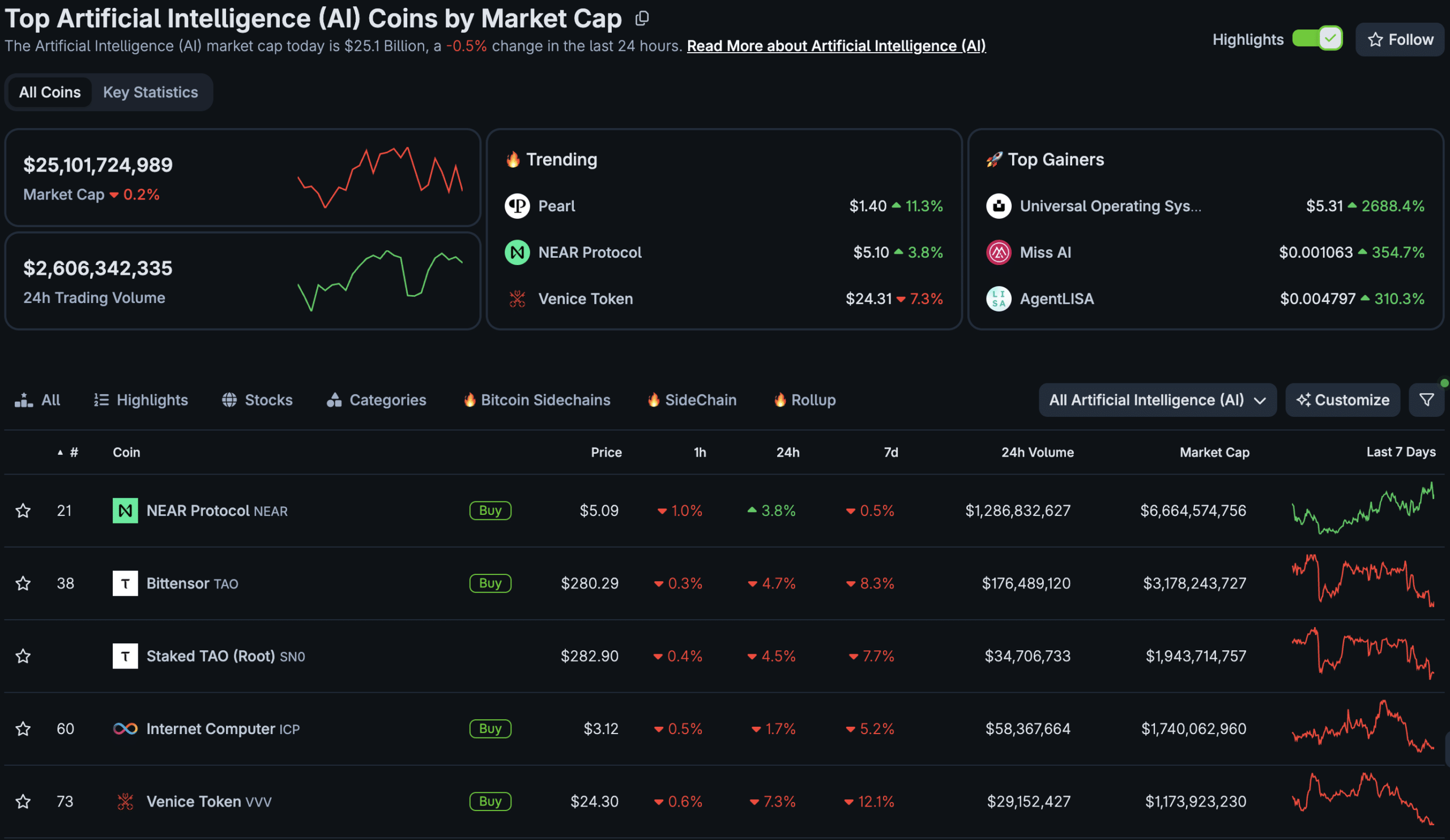
Chainalysis identified AI cryptocurrencies as South Korea’s most popular thematically defined investment category by June 2026. The report defines this group as assets linked to AI-focused projects or AI infrastructure, and compares categories using their share of won-denominated trading-not a measure of all Korean crypto activity.
The leading AI-linked tokens by reported trading volume were Worldcoin (WLD) at $7.41Bn, SAHARA at $3.2Bn, VIRTUAL at $2.7Bn, BIO at $2Bn, and NEAR at $1.7Bn. The leaderboard has also shifted: VIRTUAL and KAITO led AI-related tokens in 2025 before Worldcoin and SAHARA moved ahead.
Chainalysis said Korean retail traders moved through the AI category faster and more intensely than traders in the other markets it covered. That turnover shows thematic leadership can shift quickly. It describes activity over the report’s measurement period, not a guarantee that any token will retain attention or that every trade represents a long-term investment.
The wider South Korea crypto market also grew during the period. Chainalysis recorded about $449Bn in crypto activity, up 12.3%, while the country’s exchange ecosystem grew 16.3%. Those figures describe overall market expansion; they do not identify XRP as the cause or show that the token shared equally in that growth.
Why the AI Rotation Matters for Ripple XRP
And there is two ecosystems already have serious Korean connections…
Hanwha Investment & Securities has built a HUGE tokenised securities… pic.twitter.com/DO2Y5C1DLr
— ALLINCRYPTO (@RealAllinCrypto) October 3, 2026
In June 2026, South Korea’s AI crypto trading outperformed other currencies, with the won’s share at 19.5 times that of the yen. AI cryptocurrencies accounted for 0.91% of yen-denominated trading, compared with 1.02% for euros, 0.20% for the Brazilian real, and 0.03% for British pounds.
This trend is attributed to South Korea’s involvement in the AI investment cycle, particularly due to SK Hynix, a key memory-chip manufacturer. Retail investors largely drive the market, indicating strong interest in AI tokens.
While AI assets surpassed payment tokens, this does not necessarily mean Ripple XRP has lost significance in South Korea. The ongoing Ripple–Meritz review is still exploratory, lacking confirmation of XRP’s usage or transaction volumes.
Future developments, such as a disclosed product or commercial deployment, will clarify Ripple’s position, while AI-linked assets currently dominate the retail market.
DISCOVER: 15+ Upcoming Coinbase Listings to Watch in 2026
Follow 99Bitcoins on X For the Latest Market Updates and Subscribe on YouTube For Daily Expert Market Analysis.
The post AI Crypto Tokens Take South Korea by Storm, Overtaking Ripple XRP appeared first on 99Bitcoins.
]]>The post Ethereum News: Glamsterdam Test Leaves Validator Strain Unresolved appeared first on 99Bitcoins.
]]>But this is a public-testnet rehearsal, not a mainnet upgrade, and gas measures computational work rather than a fixed number of transactions. The key question is whether Ethereum can expand capacity without placing unacceptable demands on the computers that validate it.
According to official reports, the change was activated on Sepolia on Tuesday, October 6, and blocks were produced under the higher limit by Thursday, October 8.
Ethereum’s mainnet has no activation date for Glamsterdam. The Glamsterdam Sepolia rollout, therefore, reflects testing progress, not a confirmed change to the live network.
Ethereum News: Why 200 Million Gas Does Not Mean Three Times the Transactions
Gas is the unit Ethereum uses to measure the computing work required to process transactions. A larger block allowance can accommodate more transactions, which may ease competition for space during periods of high demand, though it doesn’t guarantee lower fees, as users still compete for capacity.
The Glamsterdam upgrade changes gas consumption for various tasks, so increasing the block budget doesn’t necessarily mean processing more transactions.
Simple transfers and complex smart contracts require different computational resources, and raw transactions per second don’t equate to gas per block.
This upgrade modifies how Ethereum handles block production and data access by integrating the roles of transaction assemblers and validators, giving validators more time to verify transactions.
Blocks will now include a list of affected accounts and stored data, allowing for more efficient data fetching and transaction validation.
Additionally, Glamsterdam changes the costs of creating and accessing stored data, which could require developers to retest their contracts and tools in light of the new gas costs. These adjustments are part of Ethereum’s broader strategy to enhance capacity while maintaining practical network operation.
EXCLUSIVE: Trade Ethereum and Earn $10 USDC Via Binance Sign-UpEarly Blocks Show Headroom, Not a Full-Capacity Stress Test
Ethereum’s Glamsterdam Test Hits a Massive Capacity Boost
Ethereum’s (@ethereum) ethereum:native Glamsterdam upgrade is now running on Sepolia with a processing limit near 200 million gas.
This is more than three times the previous limit of roughly 60 million. The higher budget… pic.twitter.com/jQuaqeJCPu
— BSCN (@BSCNews) October 8, 2026
CoinDesk analyzed over 25 consecutive Sepolia blocks, each using 52 million to 92 million gas, which is 26% to 46% of the allowance. None approached the maximum capacity, which could strain network computers.
During a separate six-minute voting period, Sepolia produced all 32 scheduled blocks, with 99.97% of eligible stake voting for finality.
While these results indicate successful block production and voting, they do not confirm that validators can sustain near-200 million gas blocks or that this would be safe on the mainnet.
Glamsterdam aims not only to increase the block budget but also to improve transaction processing efficiency and adjust data-handling costs.
Ethereum’s Scaling Race With Solana, BSC, and Avalanche Heats Up
In other Ethereum news, the test feeds into a broader Layer-1 scaling competition that includes Solana, BNB Chain, and Avalanche. But those networks use different designs and capacity measures, so you can’t directly compare their headline throughput claims to Ethereum’s gas per block.
The Solana slot-time approach shows why latency and Ethereum’s computational gas budget describe different things. For Ethereum, the immediate goal is more room for payments and trades while testing changes to how transactions are processed, and data is accessed.
The Sepolia blocks sampled so far used less than half their allowance. That makes the result a demonstration of headroom, not proof that the network is already processing near-200-million-gas blocks at full load.
The next evidence point is Hoodi, which is tentatively planned for October 27 pending the Sepolia results. Developers have not set a mainnet activation date, and the Sepolia figures do not establish a specific increase in transactions per second or prove safe, sustained operation at the new limit.
DISCOVER: 15+ Upcoming Coinbase Listings to Watch in 2026
Follow 99Bitcoins on X For the Latest Market Updates and Subscribe on YouTube For Daily Expert Market Analysis.
The post Ethereum News: Glamsterdam Test Leaves Validator Strain Unresolved appeared first on 99Bitcoins.
]]>The post Oil and Treasury Yields Put the BTC USD Recovery Narrative to Test appeared first on 99Bitcoins.
]]>The decline came as rising oil prices, Middle East tensions, and surging Treasury yields weakened appetite for risk assets, underscoring that a recovery narrative does not insulate crypto from macroeconomic shocks.
Bitcoin’s slide tests the claim without proving it wrong: improving adoption can coexist with a market still highly sensitive to inflation fears and interest rates. The latest crypto-winter recovery narrative therefore sits beside a clear short-term warning from price action.
Here is the central tension: longer-term developments may support the sector, while immediate macro pressure continues to set the direction of Bitcoin and other tokens.
BTC USD Decline Comes Amid Saylor’s Strategy Resuming Its Buys
Bitcoin extended recent losses after a rally through the September quarter. The pullback also came despite fresh buying by Strategy Inc., a major corporate holder of Bitcoin.
Michael Saylor’s Strategy now holds 847,999 BTC USD, worth just over $70Bn, making the firm the largest Bitcoin holder in the world.
More orange than ever. pic.twitter.com/on52TtcFO1
— Michael Saylor (@saylor) October 4, 2026
That buying did not stop the asset from falling during the week, reminding investors that one company’s demand can be outweighed by a broader shift in risk appetite.
The losses followed an extended rally through the September quarter, leaving the market vulnerable to profit-taking. In practical terms, profit-taking means traders sell some holdings to lock in gains; it can add pressure when prices are already retreating, even without a separate negative development specific to each token.
DISCOVER: 9+ Best High-Risk, High-Reward Crypto to Buy in 2026
Oil, Geopolitical Risk, and Yields are Driving the Pressure
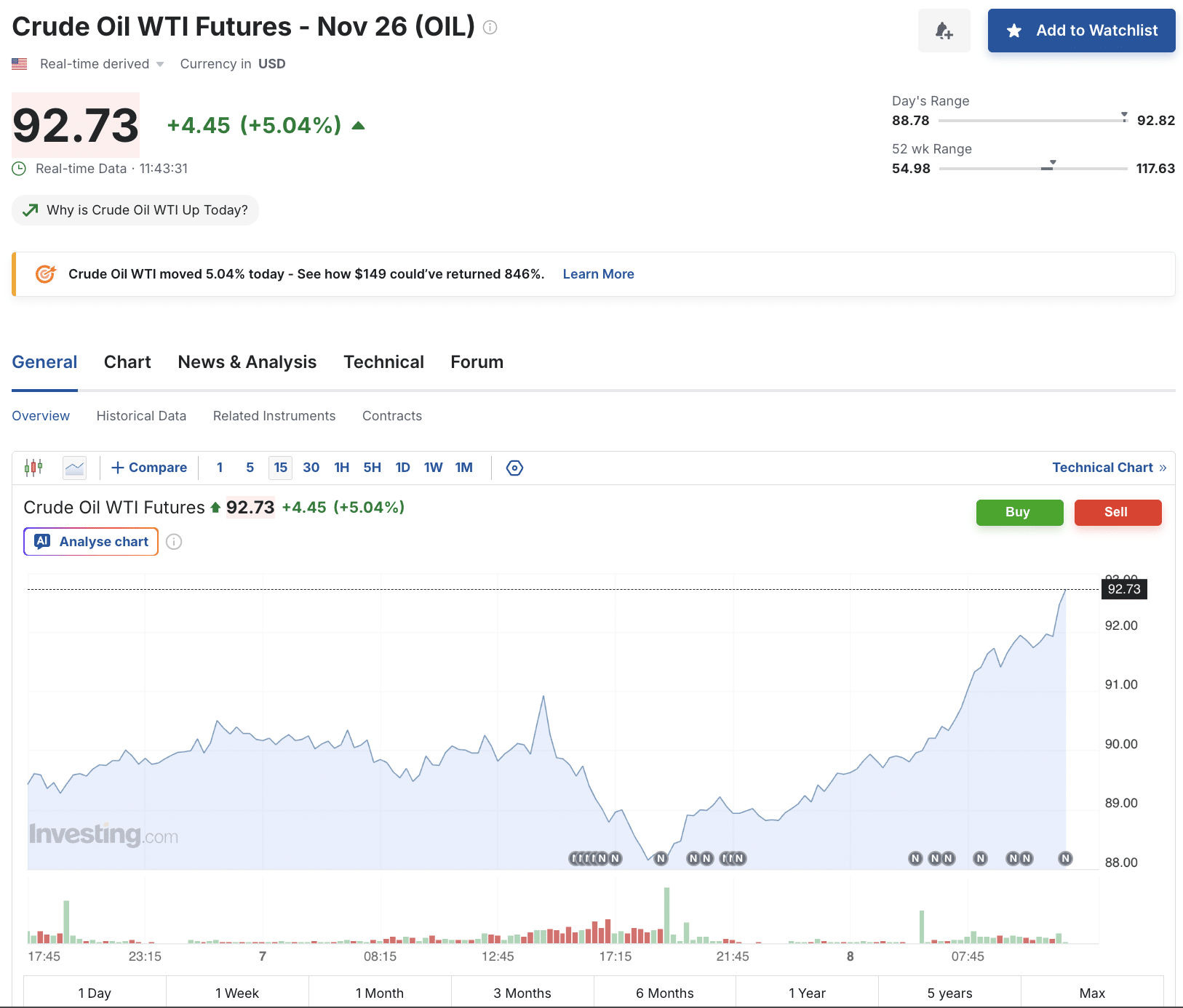
The macroeconomic backdrop ties energy prices to inflation and subsequently higher yields. Oil prices surged amid reports of potential US military action against Iran and increased Iranian attacks on shipping, causing traffic in the Strait of Hormuz to drop to a two-month low.
Disruptions in this key shipping route can lead to unpredictable energy supplies and higher oil prices, which may raise transport and production costs and risk persistent inflation.
This scenario complicates interest-rate cuts for central banks. Minutes from the Federal Reserve’s September meeting revealed a hawkish stance in response to rising inflation, with the US 10-year Treasury yield hitting a 24-year high at 5.333%. Higher yields reduce the appeal of speculative assets like Bitcoin, which offers no yield, making it less attractive as debt returns rise.
While not every Bitcoin move is linked to Treasury yields, the interaction between oil prices, Federal Reserve policy, and crypto volatility reflects a macro channel in which rising energy costs can affect inflation expectations and the attractiveness of risk assets.
This broader market pressure also hit equities, with global stocks declining as Brent crude surpassed $102 a barrel and Treasuries fell, contributing to Bitcoin’s drop in value.
DISCOVER: 15+ Upcoming Coinbase Listings to Watch in 2026
Follow 99Bitcoins on X For the Latest Market Updates and Subscribe on YouTube For Daily Expert Market Analysis.
The post Oil and Treasury Yields Put the BTC USD Recovery Narrative to Test appeared first on 99Bitcoins.
]]>The post Bitcoin Privacy Faces New Questions Over HMRC Crypto Powers appeared first on 99Bitcoins.
]]>These broader powers are still proposals. The consultation closed on September 7, 2026, and ministers had not made a decision by October 8.
EXCLUSIVE: Earn $50 With EdgeX and Enter $300K Prize DrawHMRC wants more power over financial data. The problem is that Bitcoin is not a bank account.
Once names, home addresses and tax IDs are linked to a Bitcoin address, that information can stay connected to a public ledger indefinitely.
Europe is already seeing the consequences… pic.twitter.com/bh5Qrl8LWf
— Decentra Suze (@DecentraSuze) October 8, 2026
Why Can a Blockchain Record Reveal More Than a Bank Statement?
A bank statement stays inside a financial institution’s records. Bitcoin transactions sit on a public blockchain that anyone can inspect. Once a wallet address is tied to a person’s identity, their activity becomes much easier to trace.
Records showing addresses and holdings can be checked against public data, which can reveal more than the disposal history needed to work out a tax position. An address also stays visible after an information request ends, so it can help link later movements to earlier ones.
A separate regime is already in force. The Reporting Cryptoasset Service Providers Regulations 2025 took effect on January 1, 2026. They put due diligence and reporting rules based on the OECD’s Crypto-Asset Reporting Framework (CARF) into UK law. HMRC’s proposed information powers are not in force.
Together, the two measures mean more identifying and transactional data flowing into tax systems, which is the core of the UK crypto privacy debate.
Have a Gut Feeling? It Pays on PolymarketUK Crypto: What Could HMRC Ask For, and What Is Still Unresolved?
The proposals would extend Financial Institution Notices to cryptoasset service providers and update HMRC’s powers over computer records and software. Recap, a UK crypto tax software provider, warns that the draft definition could reach firms that don’t hold customer funds. That could include tax and wallet software developers, block explorers, data vendors, and hardware-wallet makers.
Recap also says its system is designed so the company cannot access customers’ portfolio data. A business that can’t read information may have nothing to hand over, but whether the rules could force a provider to change how its systems work is an open question.
HMRC was asked whether a provider could be required to make hidden information readable, whether requests could cover wallet addresses or current balances, and what safeguards would apply. It said it couldn’t answer while consultation responses were still being analyzed.
HMRC says the reforms would help it collect the correct amount of tax, with proportionate safeguards for taxpayers and third parties. The draft would also remove the statutory annual report to Parliament on these notices.
As government efforts to trace and recover digital assets develop, the use of crypto tracing and recovery tools illustrates why clear boundaries around information access matter.

Is the Security Risk Bigger Than Tax Compliance?
Linking identity to a wallet address can become a security risk if the data is misused or exposed. The concern is not that every system will be breached. Is a database of names, addresses, and crypto holdings valuable to criminals? The stakes are sharper for self-custodied Bitcoin, which a holder controls directly, with no intermediary able to freeze or reverse a transfer.
Forbes reported 19 verified crypto-related attacks in France in 2025. It also said 11 of 14 known globally tracked cases in the opening weeks of 2026 occurred there. It further reported that a French tax official was charged with using government tax software to look up crypto investors’ addresses and assets, then selling the information to organized crime networks. That is a warning about misuse, not evidence of similar conduct in the UK.
Physical attacks linked to perceived crypto wealth have also been reported in the UK, including a reported wrench attack in Solihull and a case involving threats against an investor’s family.
For UK crypto, the reporting rules have been in force since January 1, 2026, while the proposed expansion of HMRC’s powers remains undecided. The outcome will depend on which businesses can be compelled, what providers may be required to do, and how safeguards limit access. Once identity is linked to a Bitcoin address, the privacy and security implications can outlast the original tax inquiry.
DISCOVER: 15+ Upcoming Coinbase Listings to Watch in 2026
Follow 99Bitcoins on X For the Latest Market Updates and Subscribe on YouTube For Daily Expert Market Analysis.
The post Bitcoin Privacy Faces New Questions Over HMRC Crypto Powers appeared first on 99Bitcoins.
]]>The post Proposed WINK Fund Would Bring Zcash ETF Exposure to Brokerage Accounts appeared first on 99Bitcoins.
]]>The fund’s proposed annual sponsor fee is 0.25%, and its brokerage-based structure could give investors Zcash exposure without requiring them to buy or hold the cryptocurrency themselves.
The filing is not SEC approval, and it does not confirm that WINK has launched or begun trading. No trading date is confirmed, so the proposed ticker and listing should not be mistaken for an available investment.
The Winklevoss Zcash ETF will work with @cypherpunk on all Zcash ecosystem matters.
https://t.co/7nOrHFMRhq
— Tyler Winklevoss (@tyler) October 7, 2026
How Will the Proposed WINK Zcash ETF Fund Work?
Winklevoss Asset Services would sponsor the fund, while Gemini Trust Company, identified in the filing coverage as a Winklevoss affiliate, would custody its ZEC holdings. The ETF would hold the cryptocurrency directly and would not use leverage or derivatives to pursue its investment objective.
That structure is intended to track Zcash’s price through a traditional brokerage account. Investors would not need to set up a crypto wallet or manage ZEC themselves, although fund shares would still be tied to the price of the underlying cryptocurrency.
Winklevoss Capital Fund, through one or more affiliates, has indicated interest in buying up to $100 million in shares. That indication is nonbinding: it is not a commitment to invest, and it does not guarantee demand for the fund if it eventually becomes available.
The proposed 0.25% annual sponsor fee is a recurring fund cost, not a one-time trading charge. A brokerage-based product can simplify access, but it does not remove the price risks associated with ZEC or guarantee that an ETF’s share price will match the value of its holdings at every moment.
EXCLUSIVE: Earn $50 With EdgeX and Enter $300K Prize DrawZEC Privacy Features and the Existing ETF Landscape
Zcash uses zero-knowledge proofs to enable shielded transactions. In plain terms, this cryptographic method can let the network verify a transaction while concealing its amount and the identities of the sender and recipient. That feature is central to Zcash’s privacy design; it does not mean every ZEC transaction is shielded.
WINK would enter a US market where Grayscale’s Zcash ETF, trading under the ticker ZCSH, is already available, according to the October 6 report. Grayscale recently announced a 3-for-1 share split for ZCSH. The products are separate funds, and the existence of a trading Zcash ETF does not establish that WINK has cleared its own registration process.
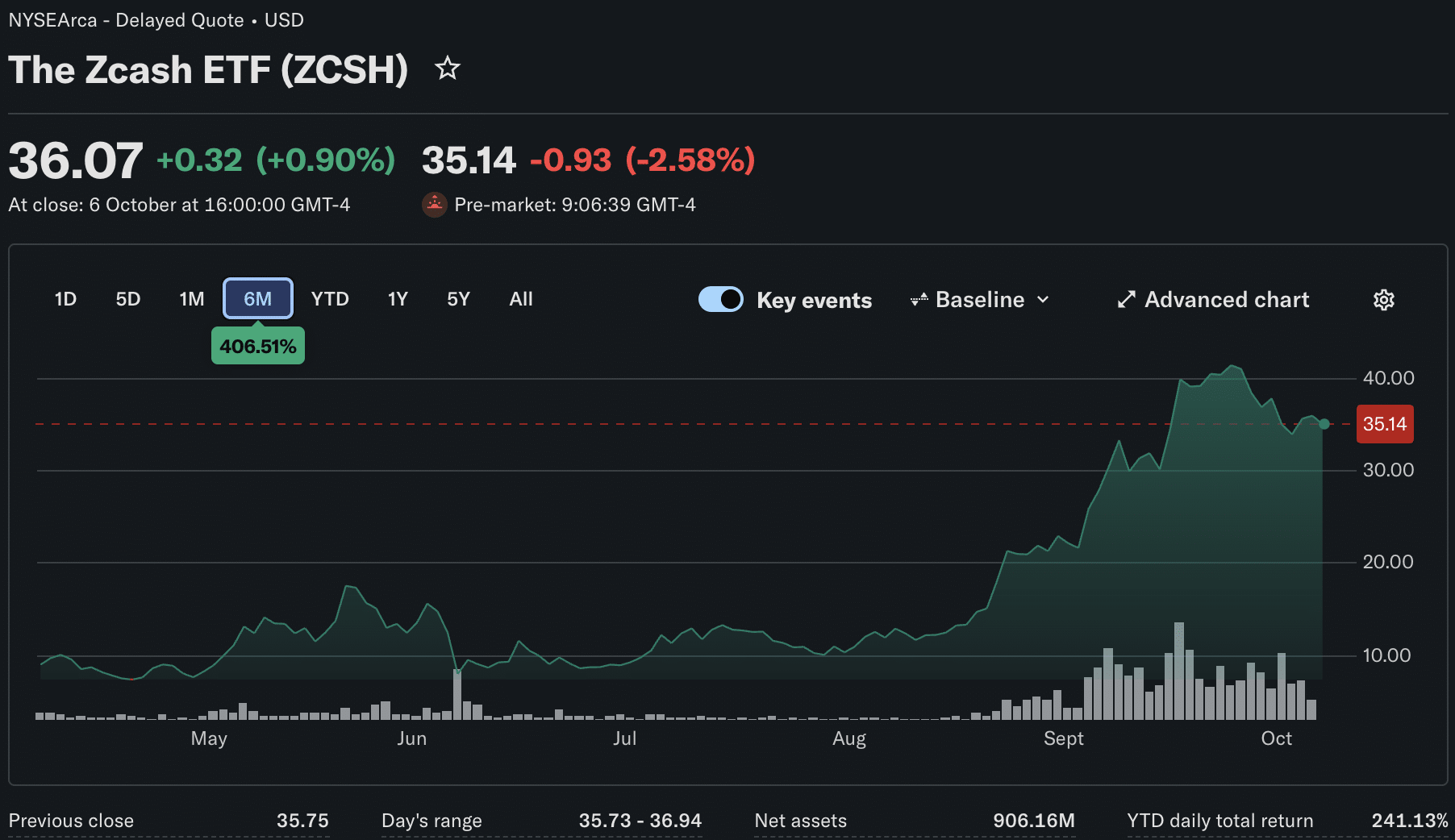
CoinGecko data cited in the report put ZEC at roughly $1,354 on Tuesday, October 6, 2026, with a market capitalization of about $23 billion. The same data showed a gain of more than 735% over the preceding year. Those are a dated snapshot, not a current quote or a forecast.
WINK’s key milestone isn’t the proposed Nasdaq ticker; it’s whether the registration process progresses and the fund becomes eligible to trade. Until then, investors have a filing describing a proposed product-not a launched Zcash ETF. The distinction between an ETF filing and actual trading matters for any crypto fund: a planned brokerage route is not yet an available one.
DISCOVER: 15+ Upcoming Coinbase Listings to Watch in 2026
Follow 99Bitcoins on X For the Latest Market Updates and Subscribe on YouTube For Daily Expert Market Analysis.
The post Proposed WINK Fund Would Bring Zcash ETF Exposure to Brokerage Accounts appeared first on 99Bitcoins.
]]>