Tatum Rodgers is director of dance and drill team at South Oak Cliff High School. She said even when there were in-person school matinees, only 40 of her students could be bused there. Now all 150 can watch online.
“It’s very important for my students to see that level of performance and know that it exists here in our community,” Rodgers said. A performance like DBDT’s “Odetta,” she said, allows them “to see how the music, the movement, the spoken word, how they’re all married into this kind of performance.”
The DBDT video was filmed last year, shot in various locations around Dallas, including White Rock Lake, the Meyerson Symphony Center, Trinity Groves and Bonton Farms. “Odetta” was originally choreographed for the Alvin Ailey company by Matthew Rushing. The video features ten songs performed by Odetta, including “Motherless Child” and Bob Dylan’s “Masters of War.” Odetta was called ‘the Voice of the Civil Rights movement’ in the ’60s, having sung at the March on Washington and in protests.
Rodgers said this is the first time many of her students will hear these spirituals and protest songs.
“One of the things that I always try to share with them and get them to understand,” she said, “is that dance is more than just movement. It is culture. It is art. It is science. It is history. It’s all of those things that they study in what we call the core classes. But we do it all in dance as well.”
The full release:
Dallas Black Dance Theatre and Dallas Summer Musicals Partner With Dallas Independent School District In An Arts Education Initiative During February 2022
Dallas, TX – Dallas Black Dance Theatre (DBDT) and Dallas Summer Musicals (DSM) are launching a new initiative to advance arts education accessibility during the pandemic. Between February 1-18, 2022, Dallas Black Dance Theatre will make available a virtual matinee performance of the highly acclaimed work ODETTA to every student and grade level in the Dallas Independent School District during Black History Month 2022.
This arts education initiative is in keeping with the mission of the National Endowment for the Arts, to support arts learning, affirm and celebrate America’s rich and diverse cultural heritage, and extend its work to promote equal access to the arts in every community across America.
Matthew Rushing, Associate Artistic Director of the Alvin Ailey American Dance Theatre choreographed the work ODETTA which DBDT performed on stage in 2019. The virtual matinee is made possible at no charge by Dallas Summer Musicals in partnership with Dallas Black Dance Theatre and Dallas Independent School District.
Dallas Black Dance Theatre (DBDT) presents a dramatic lesson on the emotional and spiritual struggle of the American Civil Rights Era through the virtual Cultural Awareness performance of ODETTA. Odetta Holmes, known as Odetta, often referred to as “The Voice of the Civil Rights Movement,” was a singer, actress, guitarist, lyricist, and civil and human rights activist. In 1963, Odetta sang on the steps of the Lincoln Memorial at the historic March on Washington. In 1965, Odetta sang for Civil Rights marchers who walked from Selma to Montgomery in Alabama.
While DBDT has performed ODETTA on the concert stage, Dallas ISD students will view a reinvented version that takes the dance from the stage to unique locations across Dallas. DBDT filmed the dance in 2021 during the pandemic at White Rock Lake, the Meyerson Symphony Center, the Trinity Groves area, the Dallas Design District, Bishop Arts District, and Bonton Farms to make for a robust cinematic experience.
For information on how Dallas ISD teachers can access this virtual student matinee performance, please contact Allison Bret at abret@dallassummermusicals.org.
]]>Nationwide (including Puerto Rico and the U.S. Virgin Islands), 567 arts groups received nearly $58 million. In Dallas, the Bishop Arts Theatre Center and the Dallas Symphony both garnered $150,000, while Dallas Black Dance Theatre received $100,000 and Cara Mia Theatre received $50,000.
The money is from the third installment of the $1.3 trillion dollar American Rescue Plan. The stimulus bill was designed by the Biden administration to provide emergency relief from the pandemic for small businesses.The money is to be used for specific purposes, such as unemployment insurance, educational programs, but especially to preserve or provide jobs.
Zenetta S. Drew is executive director of Dallas Black Dance. She said the grant was vital for the company to continue through the pandemic.
“Specifically, our grant was to help support 10 dancers in our second professional company over the next two years,” Drew said.
The 10 dancers in Dallas Black Dance’s Encore Company work five days a week, six hours a day — but they’re not salaried. The grant will help pay them a stipend so they can continue working in educational programs and performances.
In Texas, a total of $2.55 million went to 25 arts groups, including such outfits as the San Antonio Museum of Art, the Alley Theatre, the Austin Film Society and Glasstire, the journalism website covering Texas visual art.
But there’s long been a pattern in federal arts money flowing to Texas: All of North Texas lags behind other areas in the state — usually Houston but often Austin as well. With these latest grants, Houston groups dominated with 12 receiving grant money. No other Texas city came close (there were four each for Austin, Dallas and San Antonio, none for Fort Worth or other North Texas communities).
In 2017, for example, 15 arts groups across North Texas received NEA grants. In Houston alone (not including its suburbs), there were 31, more than twice North Texas’ total. In Austin, there were 26.
The release from the DSO:
DALLAS SYMPHONY ORCHESTRA RECEIVES GRANT FROM THE NATIONAL ENDOWMENT FOR THE ARTS AS PART OF THE AMERICAN RESCUE PLAN
Dallas, Texas (January 27, 2022) – The Dallas Symphony Orchestra is pleased to announce it has been approved for an American Rescue Plan grant from the National Endowment for the Arts (NEA), designed to help the arts and cultural sector recover from the pandemic. The DSO has been recommended to receive $150,000 and this funding will be used to support the organization’s education team as they work to meet the needs of the students served in Southern Dallas.
“We are incredibly appreciative of the NEA for their support and quick rollout of this funding opportunity,” said Kim Noltemy, Ross Perot President & CEO of the Dallas Symphony. “We are grateful for all who advocated for this bill and prioritized funding for the arts, especially Congresswoman Eddie Bernice Johnson for her advocacy and strong support for the arts. This funding makes a significant difference in our ability to continue reaching out to the students and families who need music now more than ever.”
In total, the NEA will award grants totaling $57,750,000 to 567 arts organizations in all 50 states, Puerto Rico, the U.S. Virgin Islands, and Washington, DC.
“Our nation’s arts sector has been among the hardest hit by the COVID-19 pandemic. The National Endowment for the Arts’ American Rescue Plan funding will help arts organizations, such as the DSO, rebuild and reopen,” said Dr. Maria Rosario Jackson, chair of the NEA. “The arts are crucial in helping America’s communities heal, unite, and inspire, as well as essential to our nation’s economic recovery.”
The American Rescue Plan was signed into law in March 2021 when the NEA was provided $135 million for the arts sector. The funding for organizations is the third installment providing more than $57.7 million for arts organizations. In April 2021, the NEA announced $52 million (40 percent) in ARP funding would be allocated to 62 state, jurisdictional and regional arts organizations for regranting through their respective programs. The second installment in November 2021 allocated $20.2 million to 66 local arts agencies for subgranting to local artists and art organizations.
]]>“Drifting on a Memory” is the artist’s first mural project, created with help from Dallas artist Lokey Calderon and Fort Worth artist Sarah Ayala, but Rosales is no stranger to cruising.
Her Instagram projects, “Veteranas and Rucas” and “Map Pointz,” archive photos and stories from Latino and Chicano communities in Southern California, especially young people. She’s collaborated with “New Yorker Magazine” and the Los Angeles County Museum of Art, and she was just named as one of the participating artists in this year’s Whitney Biennial in New York.
Rosales spoke to KERA about capturing the joys of cruising in her Dallas installation, which will be up through July 10, 2022.

Rosales incorporated ephemera like this mirrored lightbox into her installation to create a sensory experience beyond the mural. Photo by Miguel Perez.
On the cruising scene in 90’s Los Angeles
I grew up in East L.A., and my house faced Whittier Boulevard, which, that’s like our spot to go cruising, to socialize, to meet with people and just have a good time. Cruising didn’t start for me until I was about 13 or 14, and that’s when my friends or relatives started fixing up their own cars. This is in the ’90s when I was exposed to lowriders and all that stuff. You know, the teenagers were really interested in the new cars like the Hondas, the sports cars, the Acura. So, it wasn’t just classic cars cruising. There were also other parts of L.A., like South L.A. and Hollywood, where other communities were also embracing lowriding and cruising. In some ways, it became a very diverse community.
On collaborating with local artists
When I was invited to paint a mural in the space and after visiting the site, I loved how it’s like this long hallway. It’s 153 feet long. It kind of made me think of how memory works almost like this void. It was really important for me to work with a local artist, Lokey Calderon. He brought in his skills because he does pinstriping on lowriders, and he brought in Sarah Ayala, who assisted us in this project. We brought in the same energy that I like to bring when I’m posting or when I talk to the community through Instagram. We start to share stories and we connect. It almost felt like a ritual.

Rosales tapped Fort Worth artist Sarah Ayala to help paint the precise lines on the mural. Photo by Miguel Perez.
On the criminalization of cruising in L.A.
The city started putting signs on Whittier Boulevard, and you can still see them now. They say “no cruising.” That was one way of criminalizing the community. You know, this archive project, us sharing stories, what it’s doing is we begin to unlearn that and make connections. Like, a friend of mine was killed by the police by ‘98 or so. On Instagram, maybe a year ago, I posted a photo of him and talked about police brutality. A lot of his friends stepped forward and started to share. They shared their stories and their memories of that day. It’s almost like empowering us and giving us strength to speak out and to share our stories.
On sisterhood in the cruising scene
My memory is going out with all girls and also with my sister because we’re only like 10 months apart. She and I would sneak out of the house and go cruising. It wasn’t always safe. This is why we had to roll really heavy with five or six girls or probably more at a time. We just had each other’s backs. I thought we were just hanging out with friends. But then we realized, we were creating something new and different in the midst of chaos.
Got a tip? Email Miguel Perez at mperez@kera.org. You can follow him on Twitter @quillindie.KERA News is made possible through the generosity of our members. If you find this reporting valuable, consider making a tax-deductible gift today. Thank you.
]]>As one might expect, Lee — who was interviewed for the book — is pleased with it: “I was just delighted to get it. I was thrilled. ”
And the portraits of her – painted for the book? “I thought they were really neat. I really did!”

The book from Thomas Nelson Publishing is called Opal Lee and What It Means to Be Free. Alice Faye Duncan wrote the book, and Keturah A. Bobo illustrated it. She’s a New York Times bestselling book illustrator.
Opal Lee and What It Means to Be Free uses a picnic celebration to recount the history of Juneteenth — as well as the painful history that inspired Lee’s civil rights activism. A white mob burned her family home in Fort Worth in 1939.
But the 95-year-old Lee says what’s most exciting to her are the people who created the book.
“I just want more young people who have ideas to bring them out,” she said. “Share them with us.”
Lee says she is ‘humbled’ by what such young people are capable of doing for civil rights.
Got a tip? Email Jerome Weeks at jweeks@kera.org. You can follow him on Twitter @dazeandweex.
Art&Seek is made possible through the generosity of our members. If you find this reporting valuable, consider making a tax-deductible gift today. Thank you.
]]>
That’s because the hulking, red-brick building has been an embodiment of hatred and fear since Texas Ku Klux Klan Klavern #101 put it up in 1924. Its purchase by a collective of eight North Texas non-profit groups is the start of the hall’s conversion into a center that’ll give back to the same communities the Klan targeted: Black, Latino, immigrant, LGBTQ. The aim is “reparative justice.”
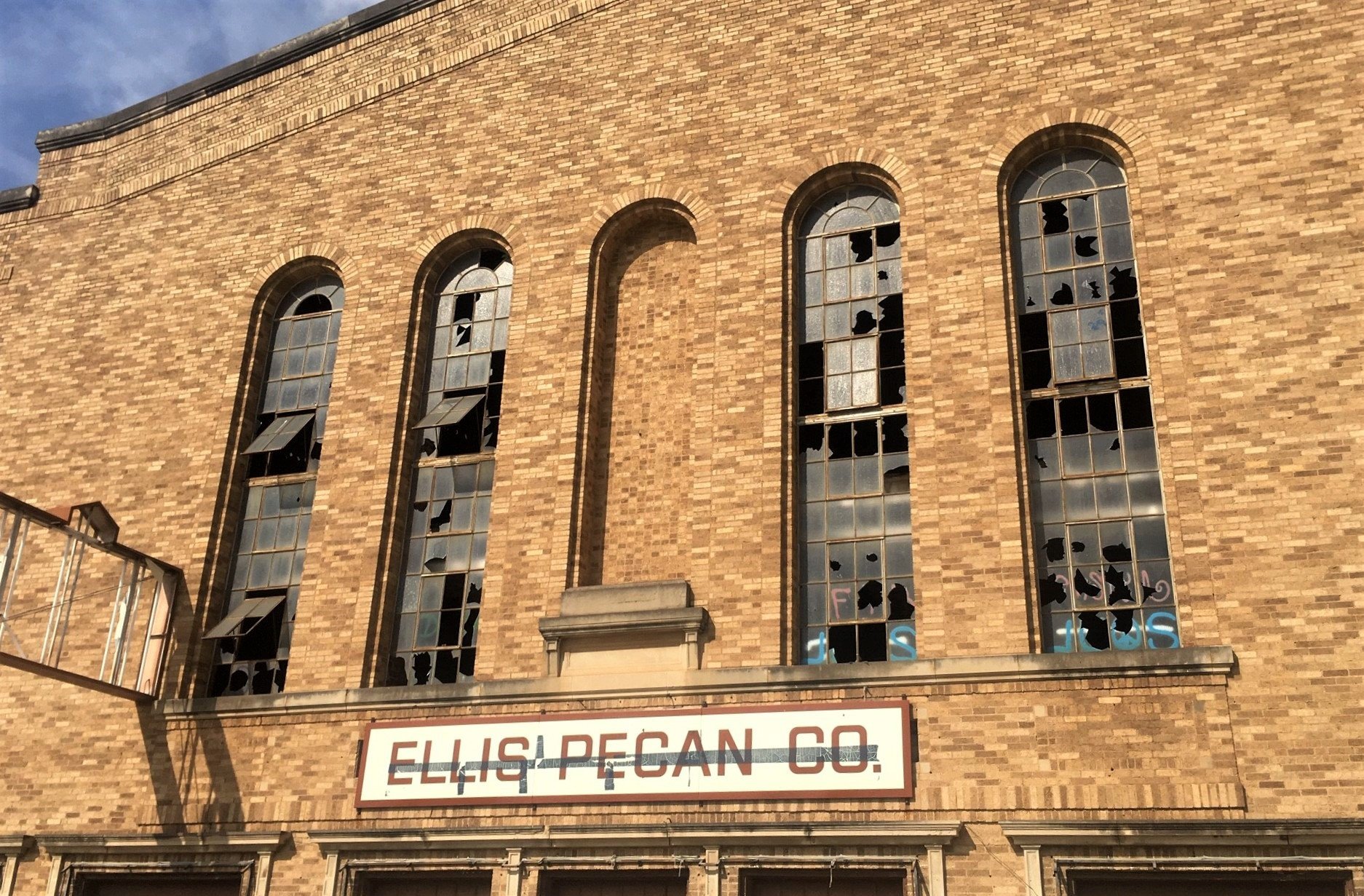
The KKK owned the building for only three years. Then it became a civic auditorium. And the Ellis Pecan company owned it until 2004, when Sugarplum Holdings bought it. Photo: Jerome Weeks
Daniel Banks is chair of Transform 1012 North Main Street — the collective that worked for two years to purchase the hall. He says their ideas for the project evolved. They initially thought they would include a history museum, for example. But they dropped that because the National Juneteenth Museum will be built in Fort Worth. There’s also a new African-American museum and cultural center being developed in town.
“When we got together with some of the other projects and realized what they’re going to do,” Banks said, “we knew we didn’t need to fill that role.”
The building’s now The Fred Rouse Center for the Arts and Community Healing. Rouse was a Black butcher who was lynched in Fort Worth in 1921.
The new center will, in fact, contain a performance space – like most cultural centers – as well as meeting rooms for coalition groups, including SOL Ballet Folklorico, The Welman Project (specialists in re-use) and the Tarrant County Coalition for Peace and Justice.
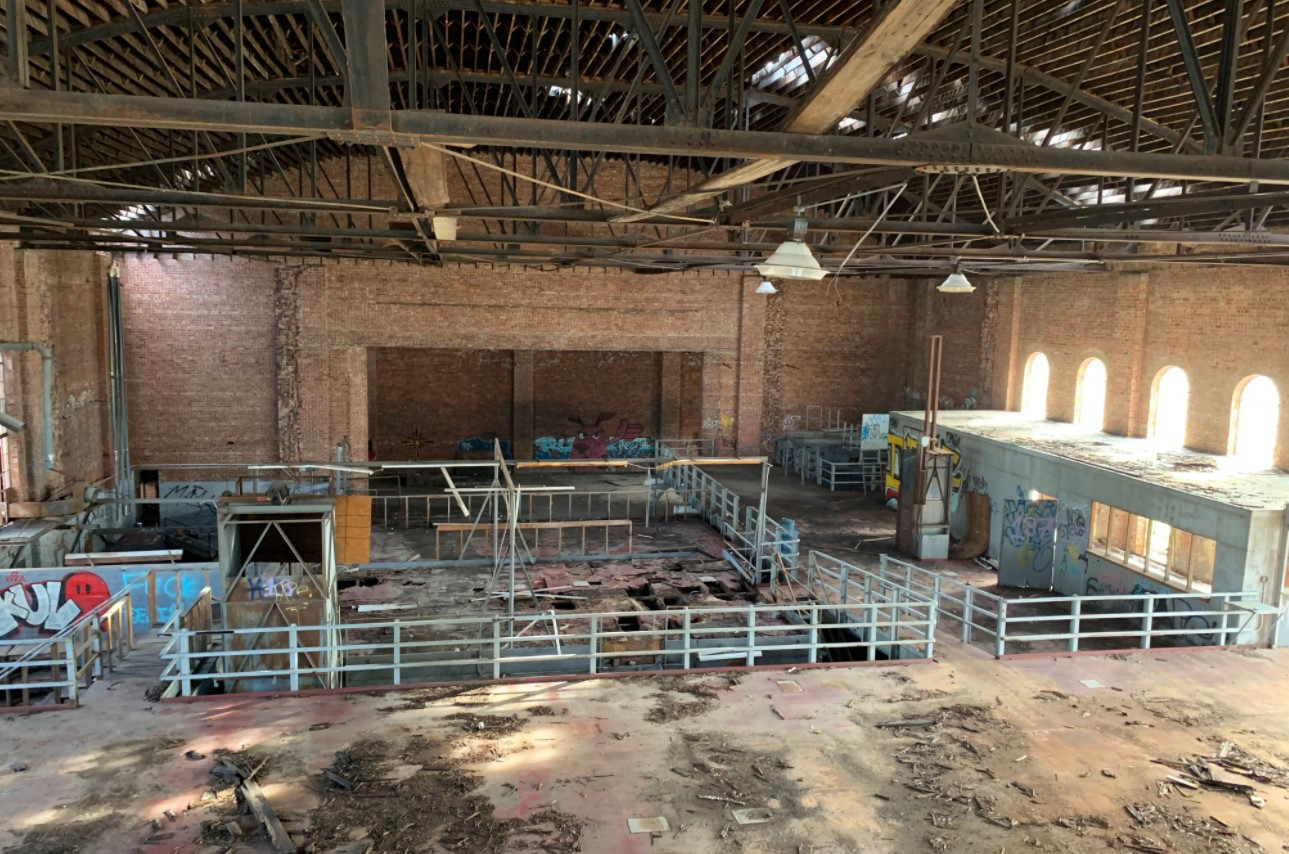
Looking towards the stage (the ‘back’ of the building). The hall follows a common design for red-brick warehouses from the period, modified to accommodate performances. This photo is taken from essentially “the balcony.” There is very little backstage space or ‘wing space’ on either side of what is an almost solid concrete stage. This is where the St. Louis Symphony performed and Harry Houdini lectured. Photo: Daniel Banks
But the collective also plans to offer a safe space for LGBTQ youth. It’ll establish a tool library for DIY classes, an artisan marketplace, affordable live/work spaces for artists-in-residence, a farmers’ market – and more.
That sounds like a lot of activities going on in a single building. But the Klan auditorium is cavernous. It’s believed it once held seats for 2,000 people. The building is approximately three stories tall and covers 22,000 square feet. The entire plot of land it stands on is 1.3 acres.
Said Banks: “We’ve already had some organizations ask us when the building will be open that they can rent out for their own uses. ”
The current timeline has the Fred Rouse Center opening in three years. The building is in poor shape. Parts of the rusted roof have collapsed with pieces littering the floor. Wooden stairs have deteriorated. The hall needs to be stabilized first.
To purchase the hall and get started upgrading and adapting it, Transform 1012 has already received funding from a range of sources, including Atmos Energy, the Rainwater Charitable Foundation and the National Endowment for the Arts.
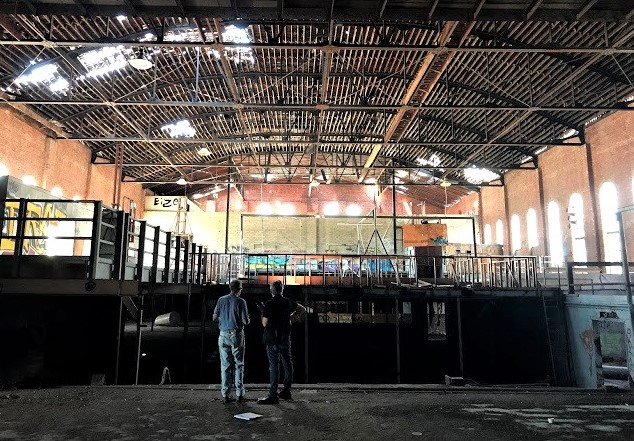
Reverse shot: This is looking back towards where the first photo was taken — the front of the building along Main Street. The tall arched windows facing the street can be seen just above the faded brick wall. Fort Worth historian Richard Selcer and KERA’s Jerome Weeks stand on the stage of the auditorium. Photo: Christopher Connelly, 2018
But Banks said, one outstanding feature of the center is not just what it aims to do. It’s the way this project of adaptive re-use is being created and run. There aren’t many cultural centers that have been established by a coalition of non-profit groups that set out to buy, transform and program a building with this kind of history.
“We created this model ourselves,” said Banks. “Because we wanted to be a model of what this would look like for others.”
One member of Transform 1012 is the Opal Lee Foundation. The 95-year-old Lee is known as the “grandmother of Juneteenth” because, as a Black activist, she led the successful push to establish that day as a national holiday, celebrating African-Americans’ freedom from slavery.
“Lord knows we go through enough obstacles just trying to live,” Lee said. “Here, with a building that was used for evil, we can turn it into something that’s extremely good.”
Opal Lee is ready for her foundation to use this former Ku Klux Klan hall — to hold its own board meetings.
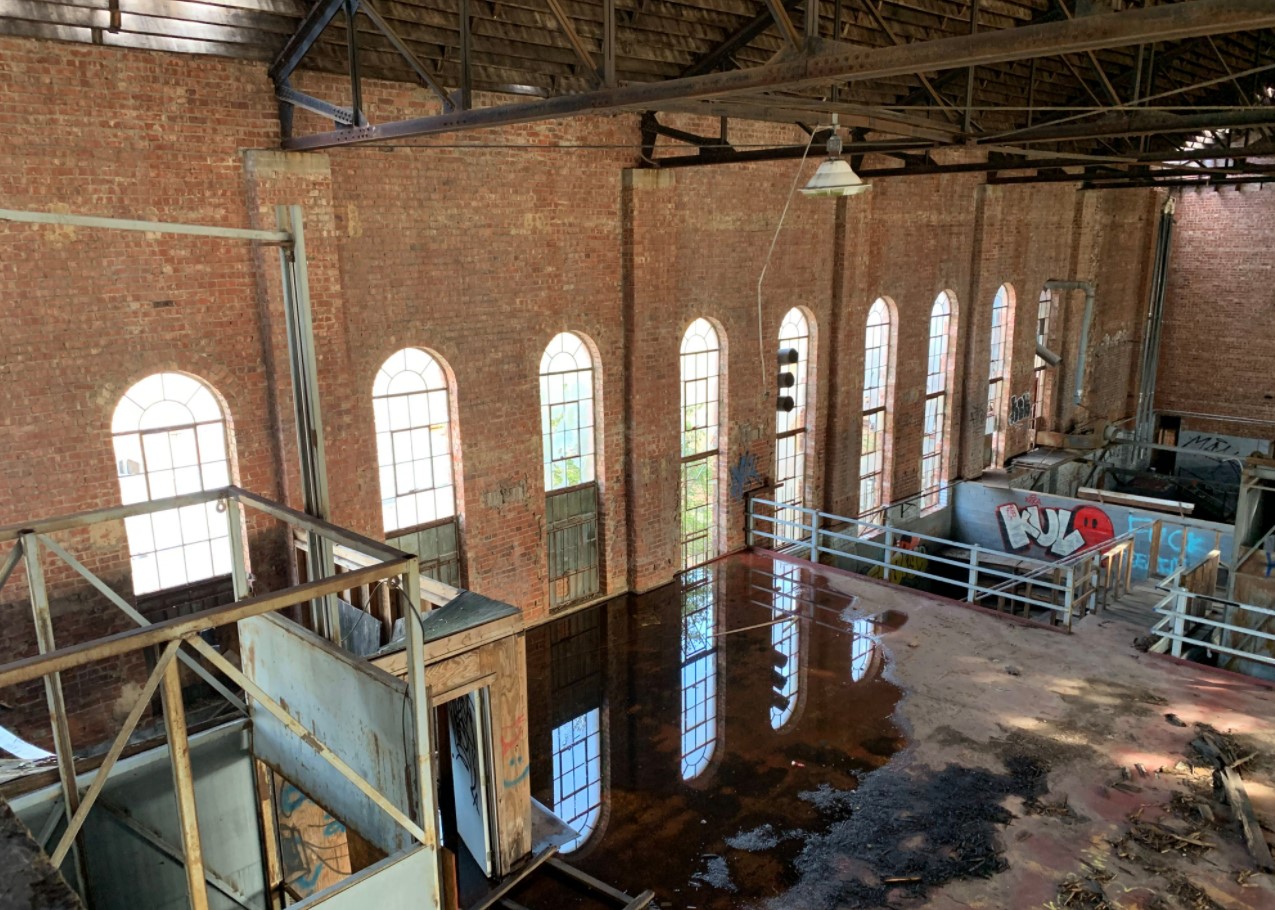
The tall windows, along the sides and the front, were the building’s primary mode of ventilation and lighting. Rainwater has puddled on the floor because of holes in the corrugated roof. Graffiti covers many walls. The light blue portions are stairwells, platforms and lifts presumably added by the Ellis Pecan company, which owned the building until 2004. Photo: Daniel Banks
Composer Héctor Armienta — founder of the San Jose company, Opera Cultura — wants his adaptation to be like Puccini’s operas in the 19th century, operas with disguises, duels, doomed love affairs.
And, of course, crowd-pleasing music.
As a character, Zorro has all of the necessary swash and buckle: He’s a masked swordsman fighting for justice and the woman he loves — in early 19th-century California, when it was a Spanish colony.
What’s more, Armienta is intent on creating tonal, melodic, accessible music. He sees his Zorro as very much like himself, both Mexican and American (“zorro” is Spanish for “fox.” Hence, he is “El Zorro”).
“So – people will hear Spanish music,” Armienta said. “They’ll hear flamenco music. And they’ll hear Mexican music. In fact, the opening starts with a guitar and you can almost imagine that you are sitting around a campfire in a village in Mexico.”
This version of Armienta’s opera will employ only guitar and piano, no chorus, and will be performed at the Rose Marine Theater on Fort Worth’s North Side. It’s a much smaller auditorium than Bass Hall, but Fort Worth Opera’s aim is to reach people — both English-speakers and Spanish-speakers — who don’t normally attend grand operas at the Bass. (Zorro was originally scheduled to premiere two years ago, but — COVID).
Armienta said a fuller version of this Zorro — with orchestra and chorus — will make its debut next season at Opera Southwest in New Mexico.
Zorro himself originated in a 1919 novel that was a worldwide hit. With an estimated 55 million copies sold, it ranks as one of the most popular novels, ever.
Little wonder it lead to multiple Hollywood sword-and-cape epics over the years, including the long-running Walt Disney television series starring Guy Williams as well as films with Douglas Fairbank, Tyrone Powers and, most recently, Antonio Banderas. The masked avenger even inspired such figures as Batman and the Lone Ranger. There’s actually a statue of him in his supposed “birthplace,” El Fuerte in Sinaloa, Mexico.
So yes – at the Rose Marine, there will be swordplay.
You can watch fight choreographer Jeffrey Colangelo rehearse with César Delgado, who plays the title role in Fort Worth Opera’s Zorro, in the video above.
]]>But most people have no idea what those journeys are really like – spending weeks traveling by foot, getting attacked by gangs or collapsing from heat exhaustion.
Acclaimed Mexican film director Alejándro G. Iñárritu wants to bring the public closer to these kinds of experiences. So, in the exhibition Carne y Arena (Virtually present, Physically invisible) now open in Fair Park, Iñárritu uses virtual reality technology to put participants in the shoes of migrants.

Participants in the Carne y Arena experience walk through a virtual reality desert, alongside migrants making the journey to the U.S. Photo Emmanuel Lubezki.
As he explains it, virtual reality is exactly what cinema is not.
“It offers you a three-dimensional experience and the freedom for you or for the audience not to be [sitting] and passively just observing the director and the … two-dimensional frame,” he said. “That’s basically the reality of the film experience.”
The Nasher Sculpture Center and the George W. Bush Presidential Center partnered to bring the exhibit to Fair Park. It’s on view at the Food & Fiber Pavilion through April 18. The work premiered at the 2017 Cannes Film Festival, but this is its first time in Texas.
In Carne y Arena, which means flesh and sand in this context, the audience is placed in a desert where Central American and Mexican migrants traverse the terrain. As part of the VR experience, audience members follow a group of 8 or 9 weary individuals as a helicopter flies above, shining a spotlight below. VR participants hear Border Patrol officers shout and they see them turn flashlights and guns at the migrants.
“¿Quién es el pollero?” “Who is the smuggler?” one of the officers yells.
A woman responds in Spanish that they can’t say because they’ll be killed.

Luis, a lawyer, rehearses in a motion capture suit. Legendary/Chaci Ramirez.
Although the 6-minute virtual reality experience is harrowing and chaotic, it wasn’t enough for Iñárritu. He said that as he put the project together, he realized the VR portion didn’t completely capture the complexity and reality of migration. So, he added other components.
Before beginning the journey, participants actually wait inside a sterile, cold room littered with shoes and water jugs, real items found in the desert.
That was intentional, he said.
“I reverse the narrative, you know, basically start with the cold room, because I was thinking that maybe the cold room should be at the end of the experience after they are caught, as it happens,” he said. “But I thought it would be interesting to invert the process and to start where they end up – normally in this cold room – and [the participant] can really see physically in reality all those shoes are from these people who lost their lives.”
The exhibit ends with the photos and stories of the people who embarked on these treacherous journeys. Iñárritu said he felt strongly about including them.
“I had the opportunity to interview, to talk with more than hundreds of immigrants that were struggling with their situation here, their status,” he said. “Some of these kids that you see there, you know, they have two or even three jobs and they sleep four hours a day. They have to send all this money to the family.”
Initially, some people were afraid to participate, he said, because they didn’t want to relive those difficult memories. But, for others, taking part in this project was cathartic, a chance to go through a sort of healing process.
“You know, when you go back to a trauma and then when you dig into the pain and the wound, it can be healed, even if it’s painful,” he said. “It was a beautiful process.”
Iñarritu said he doesn’t have the answer to fix a broken immigration system and he doesn’t want his exhibit to become a political prop. But he does feel strongly that the narrative of immigration has been distorted.
“Politics and politicians have kidnapped the world and the media and have basically reduced our world to black and white,” he said. “Ideologies and political views in a way are limited and blind to the much more complex reality that we are living every day.”

Alejandro González Iñárritu directing a motion capture shoot. Legendary/Chachi Ramirez.
Carne y Arena is on view now through April 18, 2022 at Fair Park Food & Fiber Pavilion. Tickets are available here.
KERA News is made possible through the generosity of our members. If you find this reporting valuable, consider making a tax-deductible gift today. Thank you.
Got a tip? Email Stella M. Chávez at schavez@kera.org. You can follow Stella on Twitter @stellamchavez.
]]>SUSAN STAMBERG: I bet there’s no tally of how many times Milton Avery painted his daughter, March – she’s tall, slim, with a row of straight bangs and pointed chin, unmistakable – on paper canvases, even paper napkins.
MARCH AVERY CAVANAUGH: I never posed for him.
STAMBERG: Because he knew just what his only child looked like, he could draw her from memory, and he wasn’t making portraits. An Avery retrospective at the Modern Art Museum of Fort Worth shows that Milton was working on shapes, defining them with his subtle, calm colors – the curve of a wave, the upended triangle of March’s face. Her son, Sean Cavanaugh, an artist like his mother and grandfather, was born after Milton died, but Sean’s heard the stories.
SEAN CAVANAUGH: He’s a very quiet guy. He’s at the party, but he’s in the corner. He’s drawing.
STAMBERG: Always looking, drawing, painting – no shadows, no perspective, flat, simple shapes – at a time in the 1950s when the abstract expressionists were roping paint onto canvases in nervous jabs. Not Milton.
MARLA PRICE: It’s very much his own way of working.
STAMBERG: Marla Price is the director of the Fort Worth Museum. She thinks one of the Marches in the show, “March In Brown” from 1954, is a masterpiece. It’s a study in browns – March, at age 20, sitting on a putty-colored floor in a chocolate-colored dress, hugging her yellow-brownish knees up to her triangular, tanned face.
PRICE: Young people sit like that. Old people don’t sit like that (laughter).
STAMBERG: It’s his colors that stop your eye and slow down the day’s rush. Curator Edith Devaney says Avery thinned out his paint with loads of solvent that harmonized the colors and made them interact.
AVERY CAVANAUGH: I would never think of putting that color with that color. And, you know, he just did it.
STAMBERG: His daughter uses similar colors, but March Avery Cavanaugh modestly says…
AVERY CAVANAUGH: I do the best I can, but it’s not that good.
STAMBERG: Curator Devaney says you can tell Milton Avery had great affection for what he’s seeing and paints it with quiet joy. His work got more and more abstract over the years. In “Black Sea” from 1959, the sea is indeed black, with white, scalloped edges of breaking waves marking yellow sand. Perfect Avery – pared down, clear, tranquil, irresistible.
EDITH DEVANEY: We gravitate toward something harmonious.
STAMBERG: And Milton Avery does harmony better than the Mormon Tabernacle Choir. His grandson wraps up this little encomium by reminding how prolific Milton was – 150 watercolors in just a few months.
CAVANAUGH: Being very prolific gives you freedom to try things and make mistakes.
STAMBERG: If you just do one painting a month, Sean Cavanaugh says, you may be too careful not to mess up. But Milton Avery did several paintings every week. And so…
CAVANAUGH: You’re much more willing to try something crazy in the next canvas that could be amazing.
STAMBERG: Milton Avery created many amazements before his death in 1965. Some now go from the Modern Art Museum of Fort Worth to the Wadsworth Athenaeum in Hartford, then to the Royal Academy of Arts in London.
In Washington, going nowhere, I’m Susan Stamberg, NPR News.
(SOUNDBITE OF CHARLES MINGUS’ “MOOD INDIGO”)
Copyright © 2022 NPR. To see more, visit https://www.npr.org.
All rights reserved. Visit our website terms of use and permissions pages at www.npr.org for further information.
NPR transcripts are created on a rush deadline by Verb8tm, Inc., an NPR contractor, and produced using a proprietary transcription process developed with NPR. This text may not be in its final form and may be updated or revised in the future. Accuracy and availability may vary. The authoritative record of NPR’s programming is the audio record.
]]>Another first: a major museum survey on contemporary Indigenous photography. That show, Speaking with Light, opens in October.
Texas collector Finis Welch bequeathed 240 works to the museum, and 48 of them will be displayed in February. They include photos by Ansel Adams, Marco Breuer, Dorothea Lange, Edward Steichen and Edward Weston.
Also announced is a new outdoor sculpture program. The Carter will make full use of its outdoor campus to extend the opportunity for visitors to interact with art.
Read more about the museum’s 2022 lineup in the press release below:

Fort Worth, TX, January 13, 2022—The Amon Carter Museum of American Art (the Carter) announces its 2022 exhibition schedule, featuring major surveys organized by the Carter as well as nationally touring exhibitions. The 2022 lineup showcases a broad presentation of work from the Carter’s collections, site-specific commissions, and traveling exhibitions from notable institutions. The schedule includes the first ever exhibition to focus on the history of printmaking and social activism by Chicanx artists, as well as other exhibitions dedicated to the Carter’s strong holdings of photography and works on paper. Also included in the program is one of the first major museum surveys, organized by the Carter, on contemporary Indigenous photography.
Additionally, the Carter is launching a multiyear experimental outdoor sculpture program developed to expand opportunities for visitors to interact with art on the Museum’s grounds. Activating the Carter’s outdoor campus with art extends the experience for visitors to access the highest caliber of American art while celebrating both local and national artists of significance. Throughout the year, the Carter will present both existing and new work by North Texas-based artists Justin Ginsberg and Darryl Lauster, together with work by New York–based artist Jean Shin, that engage the Carter’s grounds in new ways.
Exhibitions premiering in 2022 include:
Stephanie Syjuco: Double Vision
January 15, 2022–January 2023
Stephanie Syjuco: Double Vision presents a commissioned, site-specific installation by the artist that uses digital editing and excavation of the Museum’s archives to transform images of renowned works from the Carter’s collection to reconsider mythologies of the American West. Reframing iconic works by American artists, including Albert Bierstadt and Frederic Remington, Syjuco’s work highlights the constructed nature of historical narratives and reveals how these works and their presentation can perpetuate colonial lore.
¡Printing the Revolution!: The Rise and Impact of Chicano Graphics, 1965 to Now
February 20–May 8, 2022
In the 1960s, activist Chicano artists forged a remarkable history of printmaking that remains vital today. ¡Printing the Revolution!, organized by the Smithsonian American Art Museum, explores the rise of Chicano graphics within these early social movements and the ways in which artists since then have advanced innovative printmaking practices attuned to social justice. The exhibition includes 119 works, ranging from traditional screenprints and digital graphics to augmented reality works and site-specific installations, by more than 74 artists of Mexican descent and other artists who were active in Chicanx networks.
Beauty and Life: The Finis Welch Collection
February 20–May 8, 2022
This exhibition features newly acquired photographs by Ansel Adams, Marco Breuer, Dorothea Lange, Edward Steichen, Edward Weston, and more, on view for the first time at the Carter. Beauty and Life showcases 48 artworks from a collection of over 240 photographs and works on paper bequeathed to the Carter by Texas collector Finis Welch. The gift significantly expands the Museum’s already renowned collection of photography and enhances its ability to tell the story of early photographic modernism in America.
Art Making as Life Making: Kinji Akagawa at Tamarind
April 23–October 30, 2022
Art Making as Life Making: Kinjia Akagawa at Tamarind offers a behind-the-scenes glimpse of life in a 1960s print workshop. At the age of twenty-five, Akagawa embarked on a fellowship to train as a printer at the Tamarind Lithography Workshop in Los Angeles. While there, Akagawa collaborated with more than a dozen leading artists, including Ruth Asawa, Herbert Bayer, and Jose Luis Cuevas, printing their lithographs and creating his own editions of prints. The communal environment at Tamarind had a profound impact on his philosophies of art, in which he embraced dialogue, collaboration, and co-creation as pillars of a democratic vision of art. The exhibition features more than 40 works from the Carter’s collection of more than 2,500 Tamarind Workshop prints.
Darryl Lauster: Testament
May 7, 2022–May 2023
North Texas–based artist Darryl Lauster’s Testament (2018– 20) will inaugurate a series of outdoor creative projects implemented by the Carter. Through the examination of America’s past and present, Lauster’s bronze obelisk calls for the viewer to be a critical reader of information and to look at the function of text in different contexts. Testament combines pop culture references with quotes from primarily U.S. foundational documents bringing to question what we know about our nation’s history and promises.
Justin Ginsberg: Shaking the Shadow
June 11–September 25, 2022
Over the course of the summer, Texas-based artist Justin Ginsberg will create a glass sculptural work inspired in part by the Sargent, Whistler, and Venetian Glass exhibition (see below). Ginsberg will work with a glass kiln set up on the Museum’s lawn each weekend, pulling glass threads measuring up to 30 feet in length. At the end of each glassmaking session, Ginsberg will install the threads he has created in the Carter’s Main Gallery, resulting in a large-scale glass “waterfall” sculpture. The public will be able to watch Ginsberg at work during his weekend sessions as well as witness the multi-month realization of his site-specific installation.
Black Every Day: Photographs from the Carter Collection
June 11–September 11, 2022
Exploring more than 100 years of photographic representations of Black American experiences, Black Every Day: Photographs from the Carter Collection includes over fifty historical and contemporary art photographs and over 100 vernacular images. Works by iconic artists including Henri Cartier-Bresson, Roy DeCarava, Dorothea Lange, Deana Lawson, Gordon Parks, and Garry Winogrand, as well as unidentified community members, showcase the everyday moments of Black life, addressing themes of community, excellence, family, and labor.
Sargent, Whistler, and Venetian Glass: American Artists and the Magic of Murano
June 26–September 11, 2022
This exhibition features more than 140 artworks by 19th-century American artists, including John Singer Sargent and James McNeill Whistler, presented alongside rarely seen Venetian glass mosaic portraits and glass cups, vases, and urns by the leading glassmakers of Murano, including members of the legendary Seguso, Barovier, and Moretti families. Organized by the Smithsonian American Art Museum, Sargent, Whistler, and Venetian Glass: American Artists and the Magic of Murano brings to life the Venetian glass revival between 1860 and 1915 and the artistic experimentation the city inspired for visiting artists.
Faces from the Interior: The Native American Portraits of Karl Bodmer
October 30, 2022–January 22, 2023
Organized by and drawn exclusively from the collection of the Joslyn Art Museum (Omaha, Nebraska), Faces from the Interior features over 60 recently conserved watercolors including portraits of individuals from the Omaha, Ponca, Yankton, Lakota, Mandan, Hidatsa, Assiniboine, and Blackfoot nations. Contemporary Indigenous knowledge bearers, artists, and scholars from the nations that Bodmer and his companion, German prince Maximilian zu Wied-Neuwied, visited between 1832 and 1834 have contributed texts and four short films for this exhibition, which together highlight the diverse histories, beliefs, and practices embodied in the portraits.
Speaking with Light: Contemporary Indigenous Photography
October 30, 2022–January 22, 2023
Speaking with Light: Contemporary Indigenous Photography highlights the dynamic ways that Indigenous artists have leveraged their lenses over the past three decades to reclaim representation and affirm their existence, perspectives, and trauma. The exhibition, organized by the Carter, is one of the first major museum surveys to explore this important transition, featuring works by more than 30 Indigenous artists. Through approximately 80 photographs, videos, three-dimensional works, and digital activations, the exhibition forges a mosaic investigation into identity, resistance, and belonging.
Charles Truett Williams: The Art of the Scene
November 5, 2022–May 7, 2023
This exhibition examines the Fort Worth mid-century art scene through the presentation of more than 30 works by Fort Worth artist Charles Truett Williams and the artistic community drawn to his studio salon. Accompanying the works on paper and sculptures are ephemera from the recently acquired archives of Williams, enhancing the Carter’s strong holding of artist archives. Charles Truett Williams: The Art of the Scene is the continuation of the Museum’s research into the artistic legacy of underrepresented artists as part of the Gentling Study Center’s mission.
Jean Shin
November 2022–November 2023
Known for her signature artistic practice of creating monumental sculpture created from natural or discarded materials, Shin will be creating a site-specific work on the Carter grounds that examines the Museum’s history and landscape. Nationally recognized for her sculptures that transform large accumulations of singular objects frequently sourced through donations, such as computer keyboard parts, glass bottles, and clothing items, Shin will develop a functional artwork that reflects the Museum’s past and present through an elegant expression of identity and community.
Images (left to right): Leonard Castellanos, RIFA, from Méchicano 1977 Calendario, 1976, screenprint on paperboard, Smithsonian American Art Museum, Museum purchase through the Luisita L. and Franz H. Denghausen Endowment, 2012.53.1, © 1976 Leonard Castellanos; John Singer Sargent (1856-1925), A Venetian Woman, 1882, oil on canvas, Cincinnati Art Museum, The Edwin and Virginia Irwin Memorial, 1972.37; Wendy Red Star (b. 1981), Catalogue Number 1941.30.1, 2019, inkjet print, Amon Carter Museum of American Art, Fort Worth, Texas, P2020.166.5, © Wendy Red Star; Stephanie Syjuco (b. 1974), Set-up (The Broncho Buster), 2021, inkjet print, courtesy of the artist, RYAN LEE Gallery, and Catharine Clark Gallery; Ansel Adams (1902–1984), Monolith, the Face of Half Dome, 1927, gelatin silver print Amon Carter Museum of American Art, Fort Worth, Texas, Bequest of Finis Welch, P2021.46.8, © The Ansel Adams Publishing Rights Trust; Kinji Akagawa (b. 1940), Play the Piano, 1965, lithograph. Amon Carter Museum of American Art, Fort Worth, Texas, Gift of Ruth Carter Stevenson, 1970.296, © 1965 Kinji Akagawa; Gordon Parks (1912-2006), Red Jackson with His Mother and Brother, Harlem, New York, 1948, gelatin silver print, Amon Carter Museum of American Art, Fort Worth, Texas, P1998.33, © The Gordon Parks Foundation
About the Amon Carter Museum of American Art
Located in the heart of Fort Worth’s Cultural District, the Amon Carter Museum of American Art (the Carter) is a dynamic cultural resource that provides unique access and insight into the history and future of American creativity through its expansive exhibitions and programming. The Carter’s preeminent collection includes masterworks by legendary American artists such as Ruth Asawa, Alexander Calder, Frederic Church, Stuart Davis, Robert Duncanson, Thomas Eakins, Georgia O’Keeffe, Jacob Lawrence, and John Singer Sargent, as well as one of the country’s foremost repositories of American photography. In addition to its innovative exhibition program and engagement with artists working today, the Museum’s premier primary research collection and leading conservation program make it a must-see destination for art lovers and scholars of all ages nationwide. Admission is always free. To learn more about the Carter, visit cartermuseum.org.
“I got chased by an elephant in Zambia. I got chased by a giraffe in Kenya,” the Austin filmmaker said. “But, I think it’s more demanding to film bees in Texas in the summertime.”
Davison spent three years working on a National Geographic documentary about population decline among giraffes across Africa, but his latest project is closer to home. “Charlie Bee Company,” a new show airing nationwide on PBS this spring, features New Braunfels beekeeper and removal specialist Charlie Agar as he rescues wild bees from San Antonio to Austin in the sweltering Lone Star sun.

Through his production company Iniosante Inc., Austin filmmaker Ashley Scott Davison has produced multiple documentaries on giraffes, but filming Texas honeybees brought its own unique set of challenges. Photo courtesy of Iniosante Inc.
Just imagine trying to keep a camera steady underneath the crawl space of a mobile home when it’s 105 degrees outside.
“We all probably lost 10, 15, 20 pounds just in water weight that summer shooting it,” Davison said.
Unlike giraffes, bees can get all up in your business, squeezing into the crevices of a big camera or buzzing right into your frame.
“There’s no eyepiece because you’re wearing a veil over your head. There’s no tripods because you have to be moving all the time,” he said. “We had to make sure the cameras had in-body image stabilization. We had to be really close to these bees to get a sense of what was going on.”
But for Agar, it was all in good fun.
“We were having a ball making it,” he said. “I’m having a ball playing with the bees. I think that’s our story, and I hope it comes across in the show”
“Charlie Bee Company” focuses on Agar’s business of the same name, following him as he fields nervous calls for bee removals from inside walls, boats, hot tubs and old oak trees.
Once Agar rescues the bees, he puts them to work by harvesting and selling their honey. The first step is reintroducing a queen bee to the feral colony. Agar still remembers learning the biology behind that process at a beekeeping presentation.
“I had no background in it and no interest per se,” he said. “But this presentation was captivating. I’d never thought about how a queen lays 2,000 eggs a day in the high season and can live up to 4 or 5 years. How they requeen, colonize and pass on their genes as a superorganism.”
Agar also leases bees out to Texans with rural land. Raising bees on their property lets landowners qualify for an agricultural valuation, which can reduce property taxes. The beekeeper places hives on people’s property and manages the insects himself.
“I always invite the property owners to join me,” Agar said. “Sharing beekeeping is one of the big joys for me, and I’m a bit of a show-off.”
A former journalist, Agar tags along with other bee lovers on the show to explore the different aspects of beekeeping. He visits a local brewery that makes honey ale and gets a look inside Texas A&M’s Honey Bee Lab.
Agar and Davison both wanted the show to maintain a lighthearted tone, rather than focusing on the “doom and gloom” behind the health of the honeybee. U.S. beekeepers lost about 45.5% of their managed colonies from 2020 to 2021, according to a survey from the nonprofit Bee Informed Partnership. Habitat loss, pesticides and unstable weather patterns are all major concerns.
Agar doesn’t shy away from those truths. He said he lost a lot of hives during the winter storm in Texas, and an extremely wet May resulted in one of the worst honey production years in decades.
Still, he believes fueling the public’s curiosity and appreciation for the insect opens up conversations.
“It’s going to make a big impact on how people see their source of food or what they’re supplying at home to pollinators,” Agar said.

Agar has always considered himself a nature lover, but it wasn’t until he was “dragged” to a honeybee presentation that he became enthralled with the insect. Photo courtesy of Iniosante Inc.
That’s certainly what Davison hopes people walk away with after seeing the program.
“Literally, every third bite of food we have, you can thank a honeybee for,” he said. “I just want them to appreciate this amazing little pollinator.”
“Charlie Bee Company” premiered on KLRU, Austin’s PBS affiliate, in January. It’s set to air on PBS nationwide this spring.
Got a tip? Email Miguel Perez at mperez@kera.org. You can follow him on Twitter @quillindie.
Art&Seek is made possible through the generosity of our members. If you find this reporting valuable, consider making a tax-deductible gift today. Thank you.
]]>“My main job is to attract people to this great city,” he said during a recent chat at Hotel Dryce.
Standing 6’3″ with impeccable style and a mighty laugh, Green is pretty hard to miss. Ten minutes into our conversation, and he’s already been spotted by a friend.
“I gotta say hello,” he says with a beaming smile on his face as the hotel’s owner Jonathan Morris walks up.
These chance encounters are pretty typical for Green.
“I think it happens literally everywhere he goes when he walks into a room,” Morris said. “He commands it, but at the same time, is always welcome in those spaces.”

From podcast to talk shows, Tony Green uses his charisma to uplift Fort Worth’s cultural community. Photo by Walt Burns, courtesy of Tony Green.
The man Fort Worth Weekly once dubbed the city’s “Coolest Local Celebrity” has never had trouble finding the spotlight. As a kid, Green would squeeze theater rehearsals in between high school football practice.
“My first role? Oh my god, it was My Fair Lady, and I was Mr. Higgins who is like the professor sidekick,” Green said.
The stage might have ignited his penchant for entertainment, but it was his reputation as a bartender that connected him to the who’s who in Fort Worth.
“I was always trying to make sure people were having a great experience,” he said. “That transitioned over to me being offered hosting gigs. That’s all the things I do. I could host, sing and throw a party. So, we’re going to do that.”
Green could’ve taken that charisma elsewhere, but after stints in New York and Dallas, he came back home.
“Fort Worth was like this place that was just like growing so much and the culture was just really expanding,” he said. “Then, they latched on to me too. So, it was a mutual understanding. This is best for all parties involved.”
The city agreed. NBC 5 nabbed him for a lifestyle segment on “Texas Today,” and in 2019, he launched his own online talk show.
A big crowd gathered at Shipping & Receiving Bar for the live pilot episode of “Hello, I’m Tony Green.” He says the bar’s co-owner Eddie Vanston pitched him the idea.
“I really think that we did it for the city,” Green said. “It was like a night out on the town. You can come to a live taping of a talk show. Nobody has a party like that that we’ve seen an example of locally.”
Shipping & Receiving has since shut down, but there’s no shortage of backdrops in Fort Worth for Green. He teamed up with the Modern for a holiday show with a wild, over-the-top entrance. Clad in red velvet, he rode in on a small pontoon boat floating on the water surrounding the art museum.
“It was really cool for all of us to have that experience together, the production team and just my friends,” he said. “My mom got to come to that one. She got to see, I think two shows before she had passed. That one was really important to me.”
And his brand keeps growing. Last year, Green launched a podcast with his friend Henry Abuto, who owns the local catering company byWasonga. The pair covers local art, culture, politics, business and more. Like his TV projects, Green says “On The Same Page” is another way to tell Fort Worth’s story.
“We just get in there and start talking and it just works,” he said. “That is it. It’s still about the city a lot of times, but we try to always speak in a way that gives you, like this story about a place that you don’t know.”
His focus on Fort Worth has made him a unifier of sorts. Artists, business owners, journalists, musicians, drag queens, bartenders, everyone has a seat when Tony Green hosts the show. It’s his charm and that infectious laugh that makes us tune in.
“You don’t really turn it off, and I love that Fort Worth has attracted itself to it. I love using it for the city,” he said.
Whatever Green does next, the culture in Cowtown is better for it.
Got a tip? Email Miguel Perez at mperez@kera.org. You can follow him on Twitter @quillindie.
Art&Seek is made possible through the generosity of our members. If you find this reporting valuable, consider making a tax-deductible gift today. Thank you.
]]>Transform 1012 N. Main Street announced on Tuesday that the group had purchased the building. The plan is to turn it into a performance space with resources for those the Klan worked to oppress. The group envisions arts training, services for LGBTQ+ youth, civil rights exhibits and affordable workspaces for artists.
Today, the Klan hall sits empty and dilapidated on N. Main Street, with a clear view of the Tarrant County Courthouse. It was built in the 1920s as an auditorium for Fort Worth Klavern 101. But for much of its history, the hall was known as the Ellis Pecan Building.
DNAWORKS, a local arts group, is one of the organizations that makes up Transform 1012 N. Main Street. DNAWORKS’ co-founder Daniel Banks said in a press release that this purchase is a step toward making a space for racial reconciliation in Fort Worth.
“I envision a crossroads where all of Fort Worth can gather; where every cultural group feels a sense of belonging, of being seen, represented, and listened to; where we celebrate the richness of our individual cultures freely and openly; and where repairing past harm and damage leads to greater respect and appreciation, creativity, and love—of self and one another,” Banks said.
The building will be renamed The Fred Rouse Center for Arts and Community Healing. Fred Rouse was a Black packinghouse butcher lynched in Fort Worth in 1921.
Funding for the building purchase came from the Rainwater Charitable Foundation. Other project funders include Atmos Energy, the Ford Foundation, MASS Design Group, the National Endowment for the Arts, and Tecovas Foundation, according to a press release.
Got a tip? Email Miranda Suarez at msuarez@kera.org. You can follow Miranda on Twitter @MirandaRSuarez.
KERA News is made possible through the generosity of our members. If you find this reporting valuable, consider making a tax-deductible gift today. Thank you.
]]>Co-written by Gene Fowler and William Williams, Metro Music: Celebrating a Century of the Trinity River Groove compiles the cross-pollinations that happened across North Texas, all the way up into the 1970s. The new history is a scrapbook or a dive into period posters, press clippings, album covers, business cards and photos.
 “I wanted to make it a book that would reveal the broader scope of the music history of Dallas-Fort Worth,” said Fowler. “It had never been done before. There’d been books simply about Deep Ellum or Western swing, but there’d never been one that looked at the entire soup of musical heritage.”
The blues legend and electric-guitar pioneer T-Bone Walker debuted in 1929 with “Trinity River Blues.” It’s not just the name of his song but the musician himself who represents some of what Metro Music is all about. Walker recorded the song under the name Oak Cliff T-Bone — that’s where he’s from.
But Walker established himself as a promising musical artist, not in Dallas, but in Fort Worth. In his early 20s, he headed west to lead the house band in the Jim Hotel, one of Fort Worth’s leading venues for both blues and jazz (and a Black-only clientele).
In short, musical influences and talents traveled every-which-way across the Trinity. To give some sense of the diversity, the influences and some of the famous and the overlooked artists captured in Metro Music, here are three moments and/or musicians.
The Fort Worth Beat: Western swing gets jump-started.
Arguably, North Texas was the birthplace of Western swing – back in 1929 when singer Milton Brown met Bob Wills and guitarist Herman Armspringer playing at a dance in Fort Worth.
“Bob Wills brought an old-time fiddle tradition when he came to Fort Worth,” Fowler said. “And Milton Brown was interested in the jazz and big-band sounds of the day. And they started this group called the Light Crust Doughboys” in 1929. “And that’s what really kicked off the beginnings of Western swing. People referred to it as the Fort Worth beat.”

The Light Crust Doughboys in assorted costumes with their tour bus in 1933. W. Lee O’Daniel is at the mic. Courtesy of Kevin Coffey.
It was the first of several nicknames attached to the music scene in Fort Worth including “Cowtown Cool” and, of course, “Funkytown.”
The Doughboys’ “hot-jazz hillbilly sound” survived Brown’s split with the band in 1932; he went on to create the popular, jazzier Musical Brownies. Brown died in 1936, but by then, Wills had formed his own group, the most famous Western swing band of all, Bob Wills and his Texas Playboys.
To give an idea of just how huge a deal Western swing was: The Light Crust Doughboys were sponsored by the Burris Mill and Elevator Company, and the band’s immediate radio success helped launch the political career of the flour company’s autocratic general manager, W. Lee “Pappy” O’Daniel. He eventually became a controversial governor of Texas (1939-1941) and a U. S. senator (1941-1949).
The music’s impact still lingers. Both the Light Crust Doughboys and the Texas Playboys continue to tour as nostalgia acts today. Even the huge nightclub built for Bob Wills in Dallas back in 1950 — originally Bob Wills Ranch House — still stands.
It became the legendary Longhorn Ballroom. And Kessler Theater owner Edwin Cabaniss hopes to restore it.

Edwin Cabaniss, who restored the Kessler Theater, hopes to do the same with the cavernous Longhorn Ballroom – where Ray Charles, Willie Nelson and the Sex Pistols performed. Photo: Jerome Weeks
A Mexican fiddle-player could excel in more than one musical format.
Not surprisingly Western swing crossed into almost every other form of music in North Texas — including conjunto, which is basically traditional Mexican musical styles mixed with German polkas.
Musicians plucked inspiration from different creative streams, but this blending also happened for purely work-related reasons: Musicians needed to work. So talented ones would get gigs with several bands at once — like violinist Alfredo Casares, who managed to pursue careers with both Anglo bands and his own native ensembles.
“Alfredo came to Texas from Mexico in the 1920s,” Fowler said, “and he became a very accomplished breakdown fiddler. He got jobs with a lot of Anglo Western swing bands. He was with the Light Crust Doughboys for a time. I like to say that he was multi-cultural before multi-culturalism was cool — because he branched out into lots of different fields.”

Alfredo Casares on violin, leading the orchestra in the 1950s for the WFAA-TV program, Mexican Jamboree. Courtesy of the Dallas Mexican American Historical League.
In addition to working with such groups as the Doughboys, Casares led a series of Mexican musical bands over the years, including Professor Casares and His Boys and the Mexican Serenaders on WFAA radio. In the ’50s, he even served as emcee on the WFAA-TV program, Mexican Jamboree, fronting the Fred Casares Orchestra.
Casares led a long and successful career. In his 90s, he was feted in 1991 with a tribute concert by other Latin bandleaders and musicians at the Cruz Ballroom in Dallas.
The business side of music often gets overlooked in histories. But North Texas has had influential recording studios and musical entrepreneurs.
The Dallas-Fort Worth area has produced a long line of major sax players: Ornette Coleman, King Curtis, David “Fathead” Newman. But one that’s been mostly forgotten was a big deal in the ’60s: Big Bo Thomas.

Big Bo Thomas wasn’t just a bandleader. He ran three Dallas nightclubs and a record label. R. L. Griffin (far right) continues that tradition – as a singer, bandleader and the owner of the Blues Palace No. 2 near Fair Park. Photo: Courtesy William Williams.
“He was a very popular and busy entrepreneur,” said Fowler. “He eventually branched out into owning three clubs in Dallas and then he had his own record label. And he was a popular recording artist. He had a tune in the ’60s called ‘Big Bo’s Twist’ that reportedly sold tens of thousands of copies in a few weeks.”
In addition to busy entrepreneurs like Thomas, North Texas was home to historically important recording studios – like 508 Park, where blues great Robert Johnson recorded in the late ’30s. We also had influential audio engineers, notably Jim Beck, whose recording skills and smart marketing ideas were instrumental in creating Texas country music’s “honky tonk” sound, which combined clean, old-fashioned studio techniques with raucous roadhouse piano.
Fowler said some music scholars have even argued that Beck’s sound was so influential, if he hadn’t died in 1956 at 39, Dallas could have developed into ‘the next Nashville.’ Columbia and Decca had already been planning to move their country music outfits here.
As a sampler-history of North Texas music, Metro Music draws to a close in the ’70s because, Fowler explained, he and Williams felt they couldn’t find enough material to do justice to the whole mix of stuff that happened here in the past 30-40 years.
So is he planning to do a second volume?
“Well,” Fowler said, “I’m hoping some younger person who’s hooked into the more recent scene will take that up and do a book from, say, ’81 to the present ‘cuz I think it could be a really interesting book.”
Here’s hoping.
More musical samples from Metro Music:
The classic Dallas song, “Deep Ellum Blues,” has long been associated with Leadbelly, but it’s not known for certain that he wrote it. The first known recording was actually by the Lone Star Cowboys in 1933 – later covers include ones by the Grateful Dead, Hot Tuna, Jimmie Dale Gilmore and Levon Helm.
Ernest Tubb, the Texas Troubador, recorded his biggest hit, “Walking the Floor Over You,” in 1941 — launching the “honky tonk” style of country music. Tubb wrote it during his two years in Fort Worth, but it was recorded at Biggs Studio in Dallas:
In the late ’60s, the Novas were one of the more popular bands in Dallas. It’s easy to hear why — the harmonies and musical influences from the Beatles, the Hollies and the Byrds. If told “William Junior” was a lost outtake from the Monkees, you might believe it, the song is such a perfect time capsule of pop music from the period:
Got a tip? Email Jerome Weeks at jweeks@kera.org. You can follow him on Twitter @dazeandweex.
Art&Seek is made possible through the generosity of our members. If you find this reporting valuable, consider making a tax-deductible gift today. Thank you.
]]>
The rapid tests the DSO provides will be free. But if the result is positive, they’ll return your ticket price and you’ll be asked to return home.
This tightening of precautions had already been planned — then two DSO musicians tested positive this past weekend which led to their absence and the abridgement of two performances. As before, patrons are still required to wear masks and ticket sales will be limited to provide social distancing in the seats. The DSO is also asking, if you plan to attend, please arrive an hour prior to the concert. The extra time is needed to accommodate check-ins and tests.
If you’re already vaccinated, you can download the free Bindle app ahead of time. The app displays a green check mark when it validates your vaccination status — and the app keeps your medical information secure. The negative result can be shown before your tickets are scanned.
In 2020, the DSO was the first major North Texas arts organization and one of the first American orchestras to return to live performances. Its guidelines – with audiences, performers and staff — became a model for other classical music organizations.
The press release:
UPDATE TO DALLAS SYMPHONY ORCHESTRA COVID-19 SAFETY PROTOCOLS
Due to the significant increase of COVID-19 cases in Dallas, the Dallas Symphony Orchestra is taking action to improve the safety of our audiences, musicians and staff. These additional efforts will make it possible for the DSO to continue to perform for our patrons and the community.
Beginning with the January 13, 2022 concert, DSO audience members age 12 and up must either show proof of vaccination, have proof of a negative PCR test within 48 hours or take a rapid antigen test at the Morton H. Meyerson Symphony Center prior to the performance.
For vaccinated patrons: Prior to attending a concert, patrons should download the free Bindle app at the App Store or Google Play Store. The app will display a green check mark which validates vaccination information, and the patron will present the app screen prior to scanning their tickets.
For patrons who need to test: A negative, rapid antigen test taken on site will be required prior to seating. Rapid tests will be provided at no cost to patrons, and DSO staff will direct audience members to the testing area. Patrons should arrive 60 minutes prior to concert start time to make allowances for the testing. If a patron tests positive, they will be refunded the cost of their ticket and asked to return home.
The DSO will continue its policy of required masking at all performances and limited attendance to accommodate social distancing. Complete details on the updated safety protocols are available at https://www.dallassymphony.org/updated-covid-19-protocols.
Again this season, the DSO offers select performances on its Next Stage Digital Concert Series for on-demand viewing in the comfort of your home. Subscribers have free access to all available performances, and guests are able to purchase a digital ticket for $10/concert or $125/year. Information on digital concerts is available at watch.dallassymphony.org.
]]>The two groups receiving the money are Art Tooth, the scrappy, project-oriented, artist-support collaboration, and Arts Fort Worth, formerly the Arts Council of Fort Worth — the city’s long-established, arts-funding non-profit.

Fabiola Valenzuela, one of the Fort Worth artists who’ve been helped by Art Tooth. Image: from the Art Tooth video.
Art Tooth will award three grants for artists to create new works and exhibit them with Fort Worth businesses. Partnering with artists, helping them connect with galleries, finding new ways to market their work: Art Tooth provides multiple services. Meanwhile, Arts Fort Worth, which has created striking public art projects (like “Collective Transitions,” above, at the Meacham International Airport), will set up a work residency. It’ll give one artist 24-hour access to a studio space and a monthly stipend.
Rose Bradshaw is CEO of the North Texas Community Foundation, which administers the grant money. She said the two groups’ approaches are different but the target’s the same: directly encouraging local artists and new works.
“While small, Art Tooth has a mighty impact – through pop-ups and in some ways some guerilla movement work, which is really exciting. And then Arts Fort Worth — they have those mainline relationships, but they really also wanted to get better connected to local artists.”
The money comes from the Donny Wiley Memorial Fund, which was established in 2017 and has awarded nearly $80,000 to Fort Worth non-profits. Bradshaw says Wiley was herself a Fort Worth artist who knew how hard it can be to get recognition and support.
The press release:
North Texas Community Foundation Announces Grants in Local Arts Initiatives
Over $32,000 granted to two Fort Worth-based organizations
FORT WORTH, TX (January 4, 2022) – North Texas Community Foundation announces awards totaling more than $32,000 to two Fort Worth nonprofit organizations through the Donny Wiley Memorial Fund.
The 2021 grant recipients include:
Art Tooth: to support the Visual Artist Grant Program that will award three local artists funding to create new artwork for exhibition in Fort Worth businesses.
Arts Fort Worth: to support the new Artist Residency Program which will provide an emerging, local visual artist with 24/7 studio access and a monthly stipend to produce artwork over twelve months and then host a solo exhibition.
Established in 2017, the Donny Wiley Memorial Fund celebrates and honors the life and legacy of Ms. Donny Wiley. Ms. Wiley was a graduate of Paschal High School and attended Texas Christian University. During her lifetime, she was passionate about the arts and creative expression. When Ms. Wiley passed away her sister, Ethel Dodge, translated that interest into a legacy gift that she hoped would benefit the arts community in Ms. Wiley’s hometown.
“Arts and culture organizations are critical to the economic success of our region and contribute immeasurably to our sense of community and well-being,” says Rose Bradshaw, president and CEO of North Texas Community Foundation. “We are proud to support organizations that enrich our community and carry on Donny Wiley’s legacy.”
Since the Donny Wiley Memorial Fund was established in 2017, it has awarded more than $78,500 to nonprofit organizations in Fort Worth that encourage artistic expression in adults, support emerging artists or increase appreciation and enjoyment of the arts.
]]>
Top row, l to r: “Butter Mouth” and “Gold-Toothed Jaguar.” Bottom row: “Pink Dinosaur with Lemon Cake” and “Alligator with Chocolate Teeth.” Photo: Jerome Weeks
Yet Jones’ paintings don’t look nightmarish at all. They’re colorful, geometric shapes. There’s a simple, naive feel to these abstractions. In fact, they can look like cheerful designs for game boards or infant toys — especially with titles like “Marshmallow Fur” and “Pink Dinosaur with Lemon Cake.”
In many, the entire painting is a simple square, and inside the square are three short, vertical stripes.
This repeated design, Jones said, represents the open mouth of a monster. The monster has no eyes, no ears. It’s just a square mouth with bared teeth.
Meanwhile, the quick, ‘dashed’ brushstrokes that sometimes frame the mouths represent the monsters’ fur or hair.
And the scribbly, finger-painted bit that often appears? That, she said, is “the chaos within.” These monsters, “they’re all noise.”

Katie McKay Jones. Photo courtesy of the artist.
The painter started creating this series in response to her two children — Ruby and Finn, now 8 and 5 — who had nightmares about monsters under the bed.
“I just kept trying to convince them,” Jones said, “‘You’re safe! I’m here! There’s no such thing as monsters!’ Really, the more I tried to convince them, the more I had to grapple with my own idea of what a monster is in the world.
“I’m thinking of the pandemic, oppression. These things that we all work through: loss and grief, disease and trauma.”
The series is now on display at the Pencil on Paper Gallery, which recently moved from Farmers Branch to Dallas’ Design District. The gallery opened its new space with Jones’ show.
To create these monsters, Jones regularly painted in her home studio with her children present. They would talk about the monsters while she painted.
That’s because there are monsters in the world, Jones said. And some day, she won’t be there to protect or comfort her children.
But they’ll have witnessed one way their fears can be transformed.

Opening reception December 11th for ‘Little Monsters Everywhere’ at the new Pencil on Paper Gallery in Dallas’ Design District. Photo: Jerome Weeks
Got a tip? Email Jerome Weeks at jweeks@kera.org. You can follow him on Twitter @dazeandweex.
Art&Seek is made possible through the generosity of our members. If you find this reporting valuable, consider making a tax-deductible gift today. Thank you.
]]>
The range of artists and locations in the nearly 200 Tiny Desk (home) concerts published this year, as well as the sneak peak of life back in the office with Tiny Desk Contest winner Neffy, gives the series as a whole a new life, a new meaning and new outlook on the world of music. No one understands this more than the staff at NPR Music: Here are just a handful of some of their favorite Tiny Desk (home) performances of 2021.
Jazmine Sullivan
Jazmine Sullivan’s Heaux Tales is NPR Music’s album of the year and her Tiny Desk is one of our favorites as well. Four songs illustrating the album’s narrative — women’s stories and struggles around sex, our bodies, relationships and more — are featured here. What makes this concert so special is Jazmine’s impressive vocal performance — oh, how she can sing — and the band’s exquisite musicianship, the high production quality of the audio mix, the videography and beautiful lighting softly focused on Jazmine. —Suraya Mohamed
Lous and the Yakuza
Lous and the Yakuza’s Tiny Desk (home) concert is a favorite of mine because it’s everything I miss about live music: a storyteller behind the mic, prominent bass and effortless harmonies in a location that is as captivating as Lous herself. —Kara Frame
Rae Khalil
The combination of Rae Khalil’s epic bellbottoms with the location she chose for her Tiny Desk (home) concert — a bright and colorful coffee shop — really keeps me coming back to this show. This Tiny Desk (home) concert felt like the perfect introduction to her music. It’s a colorful mood lifter for sure. —Maia Stern
Kirk Franklin
My time as a choir kid in the ’90s and ’00s meant I immediately pressed play on Kirk Franklin’s Tiny Desk, which served as the final performance in Tiny Desk’s celebration of Black History Month. One of the joys of this performance (a brief sampling of Franklin’s 30-year career) is the warmth and infectious enthusiasm that overflows, even if you aren’t familiar with gospel music. It’s absolutely fitting that Franklin and his talented group of singers and musicians end the performance encouraging us to smile. Every time I play this (and it’s been a number of times), I can’t help but smile. —Mitra I. Arthur
Steady Holiday
It was challenging to make a Tiny Desk (home) concert intimate, safe and fun in 2021, but Steady Holiday did it best for me. This concert epitomized the obstacles musicians faced this year. Normally I’d be seeing this creative soul at a bustling SXSW venue in Austin along with throngs of others. But Dre Babinski, aka Steady Holiday, put this together for our Tiny Desk Meets SXSW showcase in her living room with her pooch on the floor and her band safely on the porch. It’s heartfelt music from her 2021 album Take The Corners Gently, an absolute gem of a record. —Bob Boilen
clipping.
It doesn’t take long to get the joke: Either rapper Daveed Diggs became a giant or he’s holding the tiniest mic. His bandmates in clipping. — Jonathan Snipes and William Hutson — hunch over the tiniest desks to click laptops, swipe iPads and smash harsh-noise pedals… all to scale for a DIY show dollhouse. And you know what? They commit to the bit. Snipes and Hutson stare at their equipment stone-faced, miming their horror soundtrack-worthy beat production, right down the contact mic’d glass in a bowl for “Bout That.” For the first actual “Tiny” Desk in 13 years, I salute. —Lars Gotrich
C. Tangana
From the moment the C. Tangana Tiny Desk (home) concert faded up from black, my mouth was literally open in astonishment. The way his video producers arranged the musicians and singers around the table made the video look like a Renaissance painting. The faces and voices are gorgeous, straight out of central casting. And that scene change to the string orchestra with just the slightest camera movement? Astonishing!! Of course, the music was the icing on a very memorable cake. —Felix Contreras
Mdou Moctar
Who said that the Tiny Desk needed to be inside? Mahamadou Souleymane, better known as Mdou Moctar, takes his performance outdoors, as if sharing his passionate music with the world. Whether singing about someone who’s always on his mind in “Tala Tannam” or questioning inequalities in the psychedelic masterpiece of the live version of “Afrique Victime,” Mdou Moctar is an expert in performing about the people and places he loves most. —Sofie Hernandez-Simeonidis
Fat Joe
In the pantheon of chart-topping Latino rappers, there aren’t many that could hold a candle to Fat Joe – so when someone like him jumps through five all-timer hits with ease in a Tiny Desk, you can’t help but smile. He adds a salsa breakdown to the 2001 classic “What’s Luv?,” raps “Sunshine (The Light)” with the style of your goofy uncle at the barbecue and ends with the eternal summer soundtrack “All The Way Up.” My personal favorite moment is the performance of his third song, “Lean Back,” a grimy New York classic that never in my life would I have thought had a place in a Tiny Desk. Whoever booked Fat Joe, I owe you a drink – as a thank you for giving me my favorite fifteen minutes of 2021. It’s, as he says, “legendary culture s***.” —Reanna Cruz
Mahani Teave
It’s not only the fine performances, but also the fairytale-like backstory which clinches this as my favorite Tiny Desk (home) concert of the year. In 1992, in the faraway land called Rapa Nui – better known as Easter Island, located some 2000 miles off the coast of Chile – the first ever piano finally arrives. A 9-year-old girl named Mahani Teave falls in love with the instrument, leaves her homeland and studies to become a concert pianist. Instead of launching her international career, Teave moves back to Rapa Nui to build a school out of recycled materials to teach children not only the classics but the music of the island. In this concert from the school, which opened in 2016, we get a tour of the building, lovely performances of Handel and Chopin and an encore featuring the voices of two young girls singing a traditional song. Shout-outs to runner up performances by Max Richter, Joseph Keckler and Arooj Aftab. —Tom Huizenga
Lucy Dacus
Brimming with nostalgia, Lucy Dacus’ third album, Home Video, is a masterclass in revisiting the past with newfound compassion. In her Tiny Desk (home) concert — which is aptly set in her alma mater, Maggie L. Walker Governor’s School in Richmond, Va. — Dacus and her bandmates perform a four-track set with grace and humor, each song a poetic vignette. The second track is “VBS,” which “means vacation bible school … for any of you heathen folks,” Dacus says with a laugh. Dacus’ calm, cool and casual demeanor comforts viewers during the first three tracks; whereas her sobering solo delivery of the last song, “Thumbs,” nurtures an almost unsettling intimacy. “It might be tough to hear,” Dacus warns before she takes a deep breath and begins. —Elle Mannion
Vince Staples
Vince’s Tiny Desk (home) concert was bittersweet for me. On one hand, I was over the moon that we finally made it to this point, given that just a few years back we rarely saw him perform with a DJ, much less a full band. But this is the (home) concert I wish we were able to experience behind Bob’s desk the most. I think it was the way Staples effortlessly coasted through the entire set and never fell off that stool. Maybe it was the fact that he was performing his best material to date. Maybe it was the way Kenny Beats, Dutchboi, Reske and David Meyers Jr. filled every single space in the room with sound with flawless precision. Then Fousheé comes in like an old pro to add the cherry on top. This is what you call perfection. —Bobby Carter
Hiatus Kaiyote
The Hiatus Kaiyote Tiny Desk (home) concert got me excited to eventually record the eclectic band at Bob’s desk. The show provided the escape I’ve been craving during this crazy time working for home for months on end. I can only imagine how the band will one-up itself when it visits NPR HQ in person. —Josh Rogosin
Little Simz
Little Simz delivered an intimate performance that was incredibly smooth and precise. Her chill vocals were a perfect match with her band, and you could tell everyone there was having a good time. Outside of the music, her video crew’s production value and her stage presence only enhanced the entire experience. She’s grown as an artist since her first Tiny Desk performance, and this concert proves it. —Josh Bryant
Rico Nasty
More than anything, watching Rico Nasty perform is exciting. In her Tiny Desk, the queen of sugar-trap oscillates between tender croons and firecracker howls with relentless energy. Watching Rico dance across the space, it’s cathartic to see a woman so delighted by her own rage, particularly one backed by an impossibly cool all-woman rock band. But more than that, Rico’s expansive blend of sound and genre creates a space for all of us to be loud, frivolous, amorous, and vengeful all at once, offering a blueprint for embracing all the ungovernable emotions inside of us with glee. —Fi O’Reilly
Silvana Estrada
The stories of generations are revived in the vibrant layers of Silvana Estrada’s unwavering vibrato. All I could think about the first time I laid misty eyes on her El Tiny concert is the story of my two abuelitas — one a violinist and the other a singer — whose big musical dreams felt alive in this meticulously produced musical elysium. I couldn’t help but imagine both their faces — closing their eyes and gripping their chests, stunned by the power and command of a Mexican woman singing to the world, pulling from generations of Mexicana voices that could never have dreamed of reaching so far. Her performance is a wonder in every way. It is visually captivating and sonically unmatched, making it an easy delight for most. But for me, it is all of that and generations more. It is the sound of her corazón and mine and my abuelas’ all keeping tempo with a cuatro venezolano and the voice of an angel. —Anamaria Sayre
Yasmin Williams
Survey the many intimate stages that formed the year in Tiny Desk (home) concerts and you’ll find bigger names than Yasmin Williams, whose album Urban Driftwood made her a sleeper rather than a star. But the Virginia guitarist’s set turned heads with what can only be described as flashy understatement: Watch her calmly graceful performance of “Juvenescence” and you’ll see her fingers dance with virtuosity that never noodles for noodling’s sake.
It’s not that Williams eschews whistles and bells. She’s not above adhering a kalimba to her instrument, wielding a tiny mallet, or donning tap shoes to give her lively compositions more propulsive energy. But every move — every note, every tap, every flourish — serves a clear and crucial purpose, in a set that’s as emotionally rich as it is technically dazzling. —Stephen Thompson
Circuit des Yeux
Haley Fohr of Circuit des Yeux has a gorgeous, howling voice, so thunderous in its depth and power that it sounds like it could shatter glass. And while no windows were broken in the beautiful cathedral that serves as the backdrop to Fohr’s Tiny Desk concert, the gloomy setting is the perfect spot to watch her perform songs from 2021’s incredible –io. —Hazel Cills
Ed Sheeran
What made this Tiny Desk (home) concert so special to me was the deviation from Ed Sheeran’s usual live performances. I saw him in concert in 2015 for his × tour and in 2017 for his ÷ tour, and both times it was just Sheeran, his guitar and his loop pedal. For his Tiny Desk (home) concert, he was joined by world-class musicians, which only added to his signature vocals and guitar that usually fill up a stadium. True to Tiny Desk style, it was both intimate and stripped-down, but with the brass instruments and choir behind him, this concert was like no other Ed Sheeran performance. —Jill Britton
Tems
Though Tems enjoyed hard-earned recognition in 2021 for her part in the summer’s runaway hit, “Essence” by Wizkid, for her Tiny Desk concert debut, the Nigerian singer stuck strictly to her own discography and dazzled with deep, luscious live vocals — some of which sounded even better than her recordings. —Sidney Madden
Olivia Rodrigo
Pulling in at the very last second before the buzzer on 2021 is up, Olivia Rodrigo’s Tiny Desk (home) concert is simply the absolute best of the year in my eyes. She did a Tiny Desk (home) concert exactly as it should be done: stripped down acoustics, funky and weird location (shoutout to the California DMV decked out in purple office supplies) — and played her biggest songs in a brand-new way. This felt like Rodrigo at her absolutely, heart wrenchingly best. Her performance of “deja vu” here is the stuff that Tiny Desk dreams are made of. —Cat Sposato

“It’s so delicate,” said Anila Quayyam Agha. “Yet it weighs about 450 pounds.”
Agha was speaking of a large, intricately cut, lacquered metal cube suspended in mid-air at the Amon Carter Museum in Fort Worth. It’s a daunting presence like a giant, steel spider’s web — looming but also porous and glowing (with two light bulbs transforming the entire gallery space into so many lacy shadows). The Amon Carter commissioned the work, titled “A Beautiful Despair” — which is also the name of the 15-artwork exhibition. Agha spoke at a press preview in September.
Agha earned her master’s degree in art at UNT, having come from her native Pakistan. In 2016, she became the first artist, ever, to receive both the juried and the public award at the Art Prize in Michigan – winning $300,000 total.

Anila Quayyum Agha, “A Beautiful Despair,” 2021 laser cut lacquered steel turquoise.
Agha’s earlier works — some of which are included in “A Beautiful Despair” — use drawings or paper cut-outs of traditional Islamic geometric patterns to which she’s embroidered bright, metallic threads (she studied textile design at the National College of Arts in Pakistan). In these works, she’s tying together — literally — the religious and the domestic, the traditional and the modern, Middle East and West.
“It’s sewing elevated from a craft or handiwork,” said Amon Carter curator Shirley Reece-Hughes.
But it’s Agha’s large-scale, sculptural installations that have brought her international acclaim: They’re like giant, illuminated manuscripts turned into machined steel. Agha said she does not see the use of shadows in these works as a form of ‘darkness’ dividing the light but as another color forming shapes and patterns.
But she also noted the contrasting funeral attire in the two cultures: In the West, mourners traditionally wear black. In Muslim countries, they wear white. So “A Beautiful Despair” weaves the two together. Even her title, “A Beautiful Despair,” is meant to bring together what are typically viewed as opposites.
“That’s the life I live now,” she said. “Living on the border of both cultures, looking in.”

“Captive Shadow 1,” 2020, mixed media on paper
Noting the way the cube’s patterns contain shapes within shapes, crosses inside of squares inside of circles inside of diamonds, she said, “Light can look so simple and yet it’s so complicated. The more you look, the more you see.”
As visually stunning as these artworks are, they are also rigorous feats of geometry and engineering — to situate the right-sized cube the precise distance from the light source and from the walls surrounding it ensuring the different facets will cast just these kinds of clear-cut, overlapping shadows that line up where the walls meet the ceiling. Agha credited her partner, Steve Parchyl, with doing the necessary math.
Ultimately, though, Agha said she is in pursuit of the beautiful. In graduate school, she said, the beautiful in visual art was seen as obvious, overused, sentimental. But to her, the beautiful can still be a tremendous power an artist can wield.
“What if I made it so beautiful,” she asked, “it can make you cry?”
Got a tip? Email Jerome Weeks at jweeks@kera.org. You can follow him on Twitter @dazeandweex. Art&Seek is made possible through the generosity of our members. If you find this reporting valuable, consider making a tax-deductible gift today. Thank you.
]]>