This is an upscale-restaurants spin-off of our broader guide to where to eat in Tirana — for readers specifically looking for a special-occasion dinner, a tasting menu, or a night out that goes beyond the (excellent) grilled meat and byrek scene. I’ve eaten in most of these rooms myself over the years; where I haven’t, I’ve been careful to say so.
Key Takeaways
- The scene is young but real: Tirana has a handful of genuinely chef-driven, tasting-menu restaurants — it’s not a deep bench yet, but the quality is legitimate.
- Verified top tables: Mullixhiu (Chef Bledar Kola, Albanian farm-to-table, tasting menu ~€30) and Padam (Chef Fundim Gjepali, Mediterranean fine dining) are the two most consistently recommended.
- It’s still a bargain: Even the most ambitious tasting menus in Tirana run roughly €25–€45 per person — a fraction of equivalent experiences in Western Europe.
- “Fine dining” is used loosely: Some restaurants that market themselves as fine dining (like Salt) are better described as upscale-casual — worth knowing before you set expectations.
- Book ahead: These rooms are small. Weekend dinners at the best-known spots fill up days in advance.
- Dress code is relaxed by Western standards: Smart-casual covers you almost everywhere; nowhere in this guide requires a jacket.
Table of Contents
By Elvis Plaku — lifelong Tirana native, blogging about Albania since 2004.
Prices and listings in this guide were last verified in August 2026. Tirana moves fast — confirm current prices and opening hours before you go.
Tirana’s emerging fine-dining scene
Be honest with yourself about what you’re walking into: Tirana does not have a Michelin-starred restaurant, and it isn’t trying to be Copenhagen or Barcelona. What it has is a small, sincere wave of chefs — several trained abroad, at serious kitchens — who came home and started cooking Albanian and Mediterranean ingredients with real technique. The result is a scene that’s more interesting than its size suggests, concentrated mostly around a few addresses near the Blloku district and the edge of Grand Park.
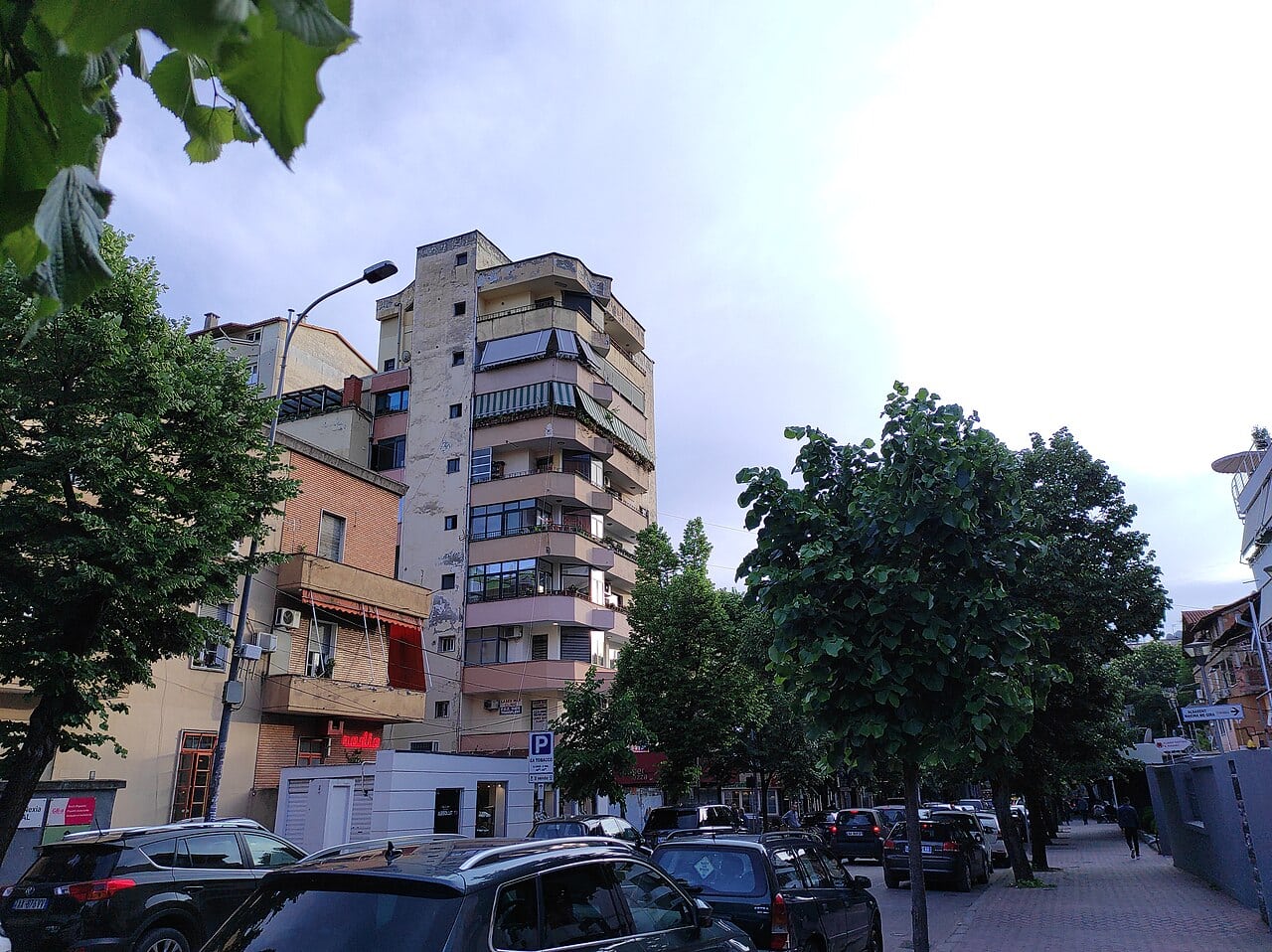
Come expecting a young, ambitious scene with two or three genuinely excellent kitchens and a supporting cast of good upscale-casual spots, and you’ll have a great time. Come expecting a Western European tasting-menu circuit with a dozen options, and you’ll be disappointed by hour two.
The top tables (verified)
These are the restaurants that consistently come up — from local recommendations, international food press, and my own visits — when people ask where to go for a genuine upscale meal in Tirana. I’ve checked each one is currently open and confirmed what it actually serves before including it.
Chef Bledar Kola trained at Noma and Fäviken before returning to Albania, and it shows: Mullixhiu takes traditional Albanian recipes — often rustic, peasant-kitchen dishes — and rebuilds them with modern technique and locally sourced, largely organic ingredients. Set beside Grand Park in a room built to feel like a farmhouse, it’s the closest thing Tirana has to an internationally recognized destination restaurant, having appeared on the World’s 50 Best Discovery list. The signature offering is a multi-course tasting menu (branded “Metamorphosis”) priced at roughly €30 per person — extraordinary value for the ambition on the plate.
Padam
Padam Boutique Hotel & Restaurant is genuinely Mediterranean fine dining — not the Thai or pan-Asian kitchen some older write-ups mistakenly suggest. Chef Fundim Gjepali trained in France, Spain and Italy and is chef-partner at a well-known restaurant in Rome; at Padam he builds a menu of Mediterranean flavors and modern reinterpretations of traditional recipes (his grandmother’s egg-and-truffle dish is the signature plate), backed by a wine list running to hundreds of labels. It occupies a villa with a garden and doubles as a boutique hotel, giving it a more formal, occasion-dinner feel than most of the competition.
Salt
Salt, in Blloku, opened in 2016 and markets itself as a fine-dining address, blending Mediterranean cuisine, seafood and a sushi bar in a large, open-kitchen space that seats around 250. Worth knowing honestly: most diners describe the atmosphere and menu as closer to polished, upscale-casual than strict fine dining — a stylish, all-purpose spot for day-to-night dining rather than a tasting-menu experience. That’s not a knock; it’s simply useful to know before you book expecting something more formal.
Gzona
A newer addition worth watching: Gzona, led by Head Chef Bleri Dervishi, takes a modern approach to Albanian and Mediterranean cooking — quail with juniper berries, fish ragout with hazelnuts and mountain herbs, and a widely praised seafood risotto. It’s well reviewed for food and atmosphere alike. I haven’t confirmed a fixed tasting menu here, so treat it as an excellent à la carte option rather than a formal tasting-menu destination until you check the current offering directly.
What strikes me most about this list isn’t any single dish — it’s how recent all of it is. A decade ago none of these kitchens existed in this form. Tirana’s fine-dining scene isn’t inherited from anywhere; it’s being built in real time, by chefs who mostly trained abroad and chose to come back.
Tasting menus: what to expect
Where a fixed tasting menu exists — Mullixhiu is the clearest example — expect somewhere between six and eight small, deliberate courses built around Albanian ingredients rather than imported luxury products. You won’t see foie gras or caviar chasing a Western template; you’ll see reworked versions of things Albanian grandmothers have cooked for generations — curd, corn, wild greens, cured meats, lamb — plated with real technique and restraint. It’s a genuinely different tasting-menu experience from Paris or Milan, and that’s the appeal: it’s specific to this place, not a copy of somewhere else.
Pacing tends to be more relaxed than the rapid-fire tasting menus common in Western fine dining — plan on roughly two hours at the table. Wine pairings aren’t always formalized the way they would be in Western Europe; ask what’s available by the glass rather than assuming a structured pairing menu exists.
Did you know?
Several of Tirana’s leading chefs — including Mullixhiu’s Bledar Kola — trained at some of the most influential restaurants in the world before returning to Albania. That international pedigree, applied to ingredients and recipes most Albanians grew up with, is what gives the city’s best tables their distinct identity rather than making them feel like imitations of a foreign scene.
For a broader sense of what Albanian food actually is — beyond the tasting-menu reinterpretations — our complete guide to Albanian food covers the traditional dishes these chefs are drawing from and reworking.
Price expectations
This is the section that surprises most visitors, so let’s be direct about it: Tirana’s fine dining is still a genuine bargain compared to Western Europe. These are approximate ranges based on current menus and should be treated as a guide, not a guarantee — prices move, and exchange rates shift.
| Experience | Approx. Price (EUR) |
|---|---|
| Mullixhiu tasting menu (per person) | ~€30 |
| À la carte main course, upscale restaurant | ~€10–€20 |
| Full dinner with wine, Padam or similar | ~€40–€70 per person |
| Upscale-casual dinner (Salt, Gzona-type) | ~€20–€40 per person |
Put another way: a full tasting-menu dinner with wine in Tirana will often cost less than a single main course at an equivalent restaurant in London, Paris, or Rome. That gap is closing slowly as the scene matures, but for now it remains one of the strongest reasons to build a special dinner into a Tirana trip.
Reservations and dress code
Book ahead — these are small rooms by design, and the best-known kitchens (Mullixhiu and Padam especially) fill up on weekend evenings, sometimes days in advance. A phone call or a message through the restaurant’s Instagram or Facebook page is usually the most reliable way to reserve, more so than a website booking form, which isn’t always kept current.
Dress code is relaxed by Western standards. Smart-casual — a collared shirt, decent shoes, nothing beach-worn — covers you everywhere in this guide. Nobody will turn you away for skipping a jacket, though Padam’s villa setting leans a little more polished, so it’s worth dressing up slightly for a special occasion.
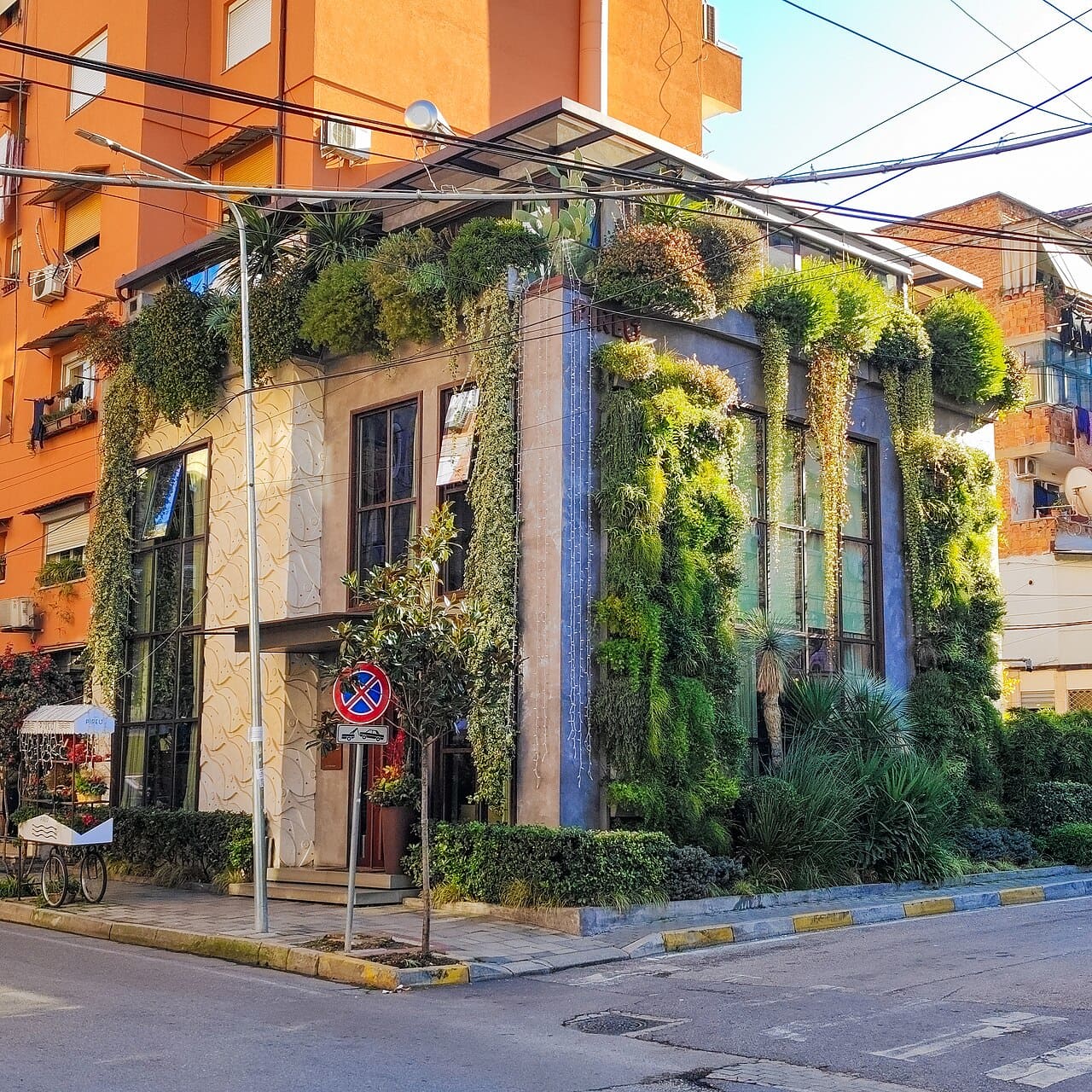
The farm-to-table angle
Farm-to-table isn’t a marketing slogan in this scene so much as a practical reality — Albania’s agricultural economy means fresh, small-farm produce, dairy and meat are genuinely close at hand, and the better kitchens lean into that instead of importing. Mullixhiu is the clearest expression of this within Tirana itself, but if you want the fuller countryside version, pair a night at one of these city restaurants with a trip to Farm 88, a chic farm-to-table restaurant just outside the city with its own garden and produce — the same philosophy, in a more relaxed, garden-restaurant setting.
Practical tips
- Book by phone or Instagram DM where possible — it’s often more reliable than a website form.
- Weekends fill fastest. If your trip includes a Friday or Saturday night, reserve as early as you can.
- Cash and card both work at every restaurant in this guide, but it’s still worth carrying some Lek as backup.
- Ask before assuming a set tasting menu exists. Some restaurants (Salt, Gzona) run primarily à la carte; confirm current offerings when booking.
- Pair it with a walk through Blloku — most of these restaurants sit within a short walk of the neighborhood’s bars and cafés, so you can easily turn dinner into a full evening out. See our guide to things to do in Tirana for how to build the rest of the day around it.
- Menus and hours change. Confirm details directly with the restaurant before a special-occasion visit — this is a young, fast-moving scene, and details in any guide, including this one, can go out of date.
Frequently asked questions about fine dining in Tirana
What is the best fine-dining restaurant in Tirana?
Mullixhiu and Padam are the two most consistently recommended. Mullixhiu offers a modern Albanian tasting menu from Chef Bledar Kola and has appeared on the World’s 50 Best Discovery list; Padam offers Mediterranean fine dining from Chef Fundim Gjepali in a villa setting.
How much does a tasting menu cost in Tirana?
Mullixhiu’s multi-course tasting menu runs roughly €30 per person — a fraction of comparable tasting menus in Western European cities. A full dinner with wine at a more formal restaurant like Padam runs approximately €40–€70 per person.
Do I need to book in advance for fine-dining restaurants in Tirana?
Yes, especially for weekend dinners. These are small, chef-driven rooms, and the best-known ones fill up days in advance. Booking by phone or through the restaurant’s Instagram page is usually the most reliable method.
What should I wear to a nice restaurant in Tirana?
Smart-casual is appropriate everywhere in this guide. No restaurant here requires a jacket, though a villa-style venue like Padam leans a bit more polished if you’re marking a special occasion.
Is Tirana’s fine-dining scene comparable to Western Europe?
Not in scale — Tirana has no Michelin-starred restaurant and only a handful of genuinely chef-driven tasting-menu kitchens. But the quality at the top is legitimate, chefs are internationally trained, and prices remain far below Western European equivalents.
Is Salt in Tirana actually fine dining?
Salt markets itself as fine dining, but most diners describe the experience as upscale-casual rather than strict fine dining — a large, stylish space blending Mediterranean food, seafood and sushi. It’s worth knowing that distinction before you book expecting a formal tasting-menu evening.
Been to any of these tables — or found another Tirana restaurant worth a special-occasion visit?
Tell me in the comments. This scene is still small and moving fast, and I’d rather keep this guide current than let it go stale.
Elvis Plaku has lived in Tirana his entire life and has been writing about Albania since 2004. Albanian Blogger is powered by Sfida.PRO.
]]>Pogradec sits on the shore of Lake Ohrid, one of the oldest and deepest lakes in Europe, shared with North Macedonia. It is a low-key lakeside town known for its waterfront promenade, the famous koran trout, and the Drilon springs nearby. People come to slow down — to walk the lake, eat fish, and watch the light change over the water. Here are the spots worth knowing in and around Pogradec, mapped.
Some place links are affiliate links — if you book through them we may earn a small commission at no extra cost to you.
Tap any place to zoom to it, then “Open in Google Maps” for directions and reviews. Exploring more of the country? See the full interactive map of Albania.
By Elvis Plaku — Tirana-based blogger since 2004
Pogradec doesn’t try very hard to impress you, and that’s exactly the point. While Ksamil gets the Instagram crowds and Sarandë gets the package tours, Pogradec has stayed what it’s always been: a working lake town where families walk the promenade after dinner, fishermen still bring in koran at dawn, and the pace of life is set by the water, not the calendar. It’s the kind of place Albanians go to relax rather than to be seen.
This guide covers what’s actually worth your time in and around Pogradec — the promenade, the Drilon springs, the mosaics at Lin, where to eat the fish the lake is famous for, and how to get here whether you’re coming from Tirana or from Korçë. If you’re building out a longer loop through the southeast, this pairs naturally with a stop in Albania’s best day trips from Tirana or a fuller push across the border to Ohrid town on the North Macedonian side of the same lake.
Key Takeaways
- Pogradec sits on the Albanian shore of Lake Ohrid, part of a UNESCO World Heritage site shared with North Macedonia and extended in 2019 to cover this side of the lake.
- It’s about 122 km (roughly 2.5 hours by car) from Tirana via Elbasan and Librazhd, and around 38 km (about 45 minutes) from Korçë.
- The must-do stops are the lakeshore promenade, the Drilon karst springs 5 km outside town, and the 6th-century early-Christian mosaics in Lin village, about 20 km away.
- Koran, the lake’s endemic trout, is the local specialty — but it’s a protected species with a winter fishing ban, so ask before assuming what’s on your plate was caught that morning.
- June, July, and September are the best months for swimming and mild crowds; July–August is warmest but busiest.
Table of Contents
How Do You Get to Pogradec?
Pogradec sits in the southeast of Albania, in Korçë County, right on the border area with North Macedonia. There are two realistic approaches depending on where you’re coming from.
From Tirana: the drive is about 122 km and takes roughly 2.5 hours on the SH3, heading southeast through Elbasan and Librazhd before climbing over the Qafë e Thanë pass and dropping down to the lake. The road is in good condition and the last stretch along the water is genuinely scenic. If you’re not driving, buses (furgons) run from Tirana’s regional bus terminal roughly hourly through the day, take about 2.5–3 hours depending on stops, and cost around 700–800 ALL. For the full rundown on how furgons, buses, and rental cars work in Albania, see our complete guide to getting around Albania.
From Korçë: Pogradec is much closer, about 38 km and 40–45 minutes away, with frequent minibuses running throughout the day for a couple of euros. This makes Pogradec an easy add-on if you’re already exploring Korçë, Voskopojë, or the southeast, rather than a destination that needs its own dedicated trip from the capital.
There’s no airport in Pogradec, and the nearest one, Tirana International, is the same 2.5-hour drive away. Once you’re in town, Pogradec itself is small and walkable — you won’t need a car to reach the promenade, the center, or most restaurants, though you’ll want wheels (or a taxi) for Drilon and Lin.
Things to Do in Pogradec: At a Glance
The 5 things worth your time in and around Pogradec, in the order I would do them. Jump straight to any of them:
The Lakeshore Promenade
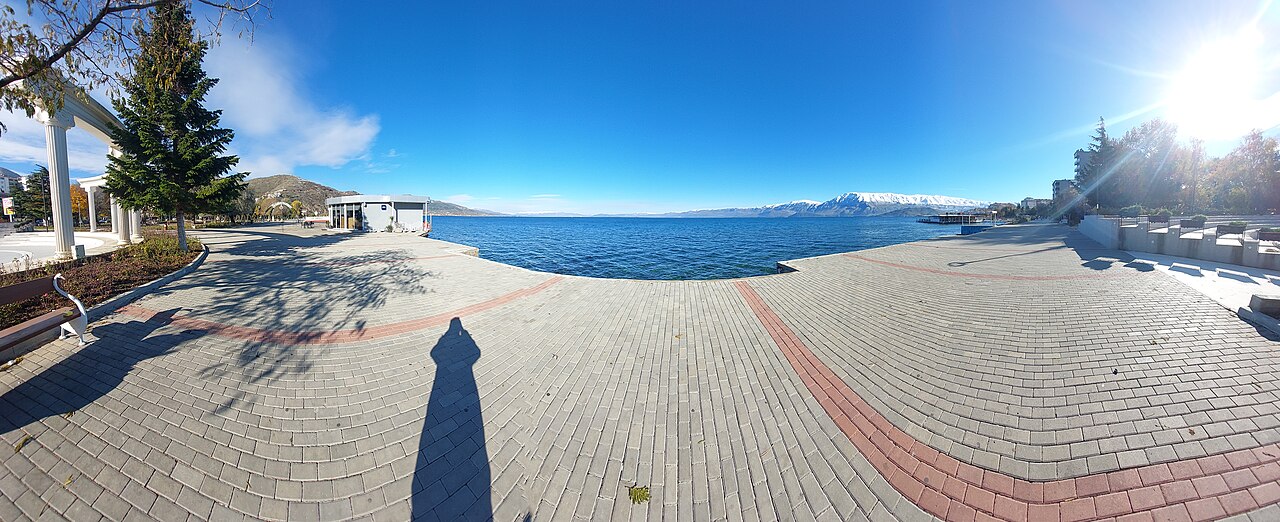
This is where Pogradec actually happens. A tree-lined boulevard runs along the water for roughly 5 km, lined with cafés, bars, hotels, and restaurants, and it’s where the whole town shows up in the evening for the xhiro — the slow, social walk that’s a fixture of Albanian daily life in every town, not just here. Locals stroll it after dinner, kids ride bikes along it, and older men sit at the same café tables they’ve probably sat at for decades.
Along the promenade you’ll pass a bronze statue of Lasgush Poradeci (1899–1987), one of Albania’s most important lyric poets, who was born in Pogradec and whose adopted pen name literally means “of Pogradec.” His poetry is soaked in the lake and the town — reading even a translated stanza or two before you visit adds a layer most tourists miss entirely.
The promenade is also simply the best vantage point in town for the lake itself. Lake Ohrid is estimated to be somewhere between 2 and 4 million years old, making it one of the oldest lakes in Europe, and one of a small handful of “ancient lakes” on the planet old enough to have evolved genuinely unique species found nowhere else. UNESCO inscribed the North Macedonian side of the lake as a World Heritage Site in 1979 and extended that protection to the Albanian shore, including Pogradec, in 2019 — recognizing it as one shared natural and cultural landscape rather than two separate lakes divided by a border.
Drilon & Tushemisht Springs
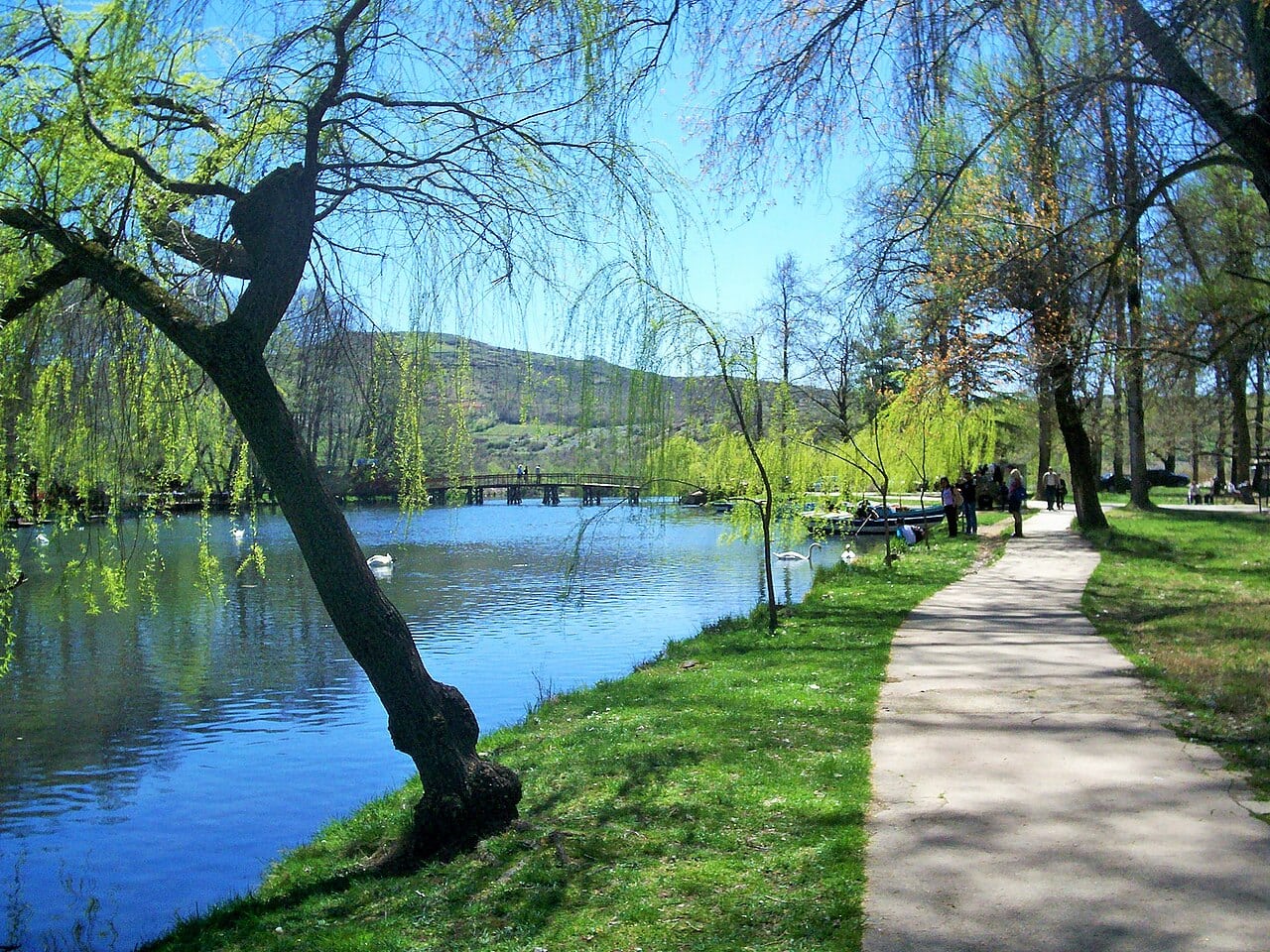
About 5 km east of the town center, near the village of Tushemisht, the ground itself turns into a small wonderland. Drilon is a cluster of karst springs — water that has traveled underground, some of it reportedly originating from Lake Prespa on the other side of the mountains — surfacing through the earth in a handful of channels and forming a network of impossibly clear canals lined with willow trees before flowing straight into Lake Ohrid.
The site has been developed into a park (Drilon National Park) with walking paths, small footbridges over the water, and a scattering of lakeside restaurants serving fresh fish practically over the springs themselves. Rowboats are available for hire on the calmer channels, and even on a hot August day the water here stays cool because it’s coming almost straight out of the mountain.
It’s an easy half-hour to an hour visit, best combined with lunch, and it works well as a stop on the way to or from Lin village, since both sit along the same eastern shoreline route out of Pogradec.
Lin Village & the Early-Christian Mosaics
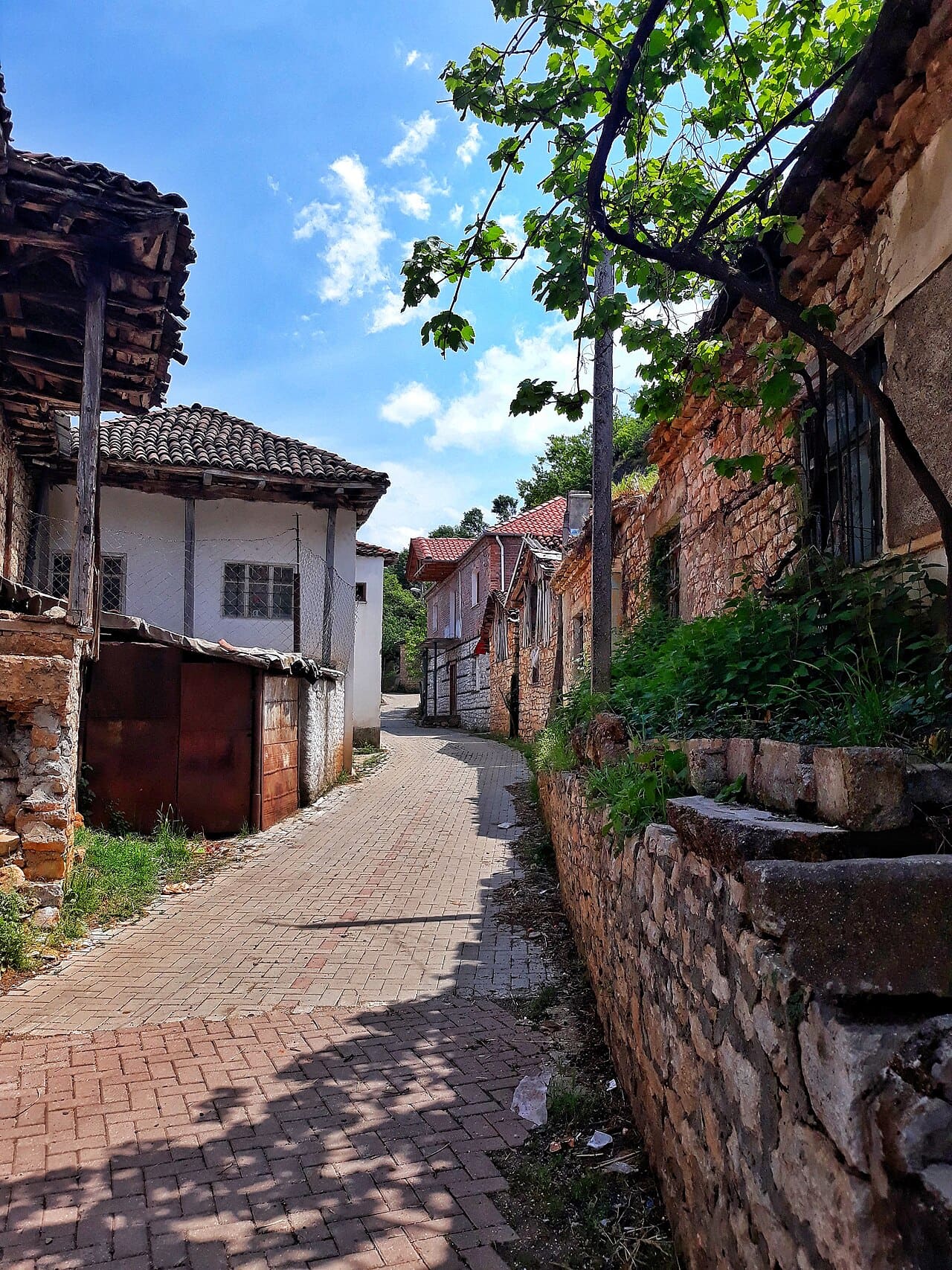
Lin is a small lakeside village about 20 km from Pogradec, sitting on a peninsula that juts into Lake Ohrid, and it holds one of the most significant archaeological finds on the Albanian side of the lake: the mosaics of an early-Christian basilica dating to the 6th century.
The basilica complex was discovered in 1967 by an expedition from the Pogradec Museum and includes a nave, two side chapels with apses, a baptistery, an atrium, and a tetraconch chapel — with almost the entire floor covered in mosaic work. The patterns are geometric, floral, and Eucharistic, mixed with stylized birds and vines, and they’re considered among the most important early-Christian mosaics found anywhere in the Balkans, both for their age and for how much of the original detail survives.
Did you know?
The Lin basilica mosaics sat largely out of sight for decades after their 1967 discovery. It’s only in recent years that the site has been developed with proper walkways and protective covering to make it consistently accessible to visitors, rather than a stop you needed local knowledge and a bit of luck to actually see.
Beyond the basilica, Lin itself is worth the detour simply for what it is: a slow, half-forgotten fishing village with narrow lanes, lake views from almost every angle, and none of the tourist infrastructure of Pogradec proper. Combine it with Drilon on the same drive and you’ve got a full, unhurried half-day out of town.
Koran Trout & Where to Eat
Koran (Salmo letnica), often called Ohrid trout in English, is the fish Pogradec is known for — and it’s genuinely different from the trout you’ll find elsewhere in Albania. It’s endemic to Lake Ohrid, meaning it exists naturally nowhere else on earth, and it appears on nearly every restaurant menu in town, usually grilled whole or oven-baked with lemon and herbs.
Here’s the part most travel write-ups skip: koran is also a species under real conservation pressure. Decades of overfishing and habitat pressure pushed the population down, and Albania now enforces a seasonal fishing ban (typically December–January, the spawning period) along with ongoing restocking programs that release well over a million hatchlings into the lake each year. In practice, that means supply of genuinely wild-caught koran can run short, and some restaurants serve farmed trout or lake fish from elsewhere under the same “koran” label. It’s worth simply asking your server whether the fish is wild-caught Lake Ohrid koran or farmed — most will tell you honestly, and it doesn’t make the meal any less good either way.
Koran isn’t just a menu item in Pogradec — it’s a small barometer of the lake’s health. Ask where it came from, and you’ll usually get an honest answer.
For where to actually eat it: restaurants along the promenade and lakeside boulevard are your best bet, with a concentration of well-regarded spots serving koran alongside other Lake Ohrid fish, grilled vegetables, and Albanian mezes. If you want the fuller picture of what Albanian food looks like beyond the lake — the byrek, the qofte, the regional variations — our complete guide to Albanian food covers the dishes you’ll meet everywhere else in the country.
Beaches & Swimming
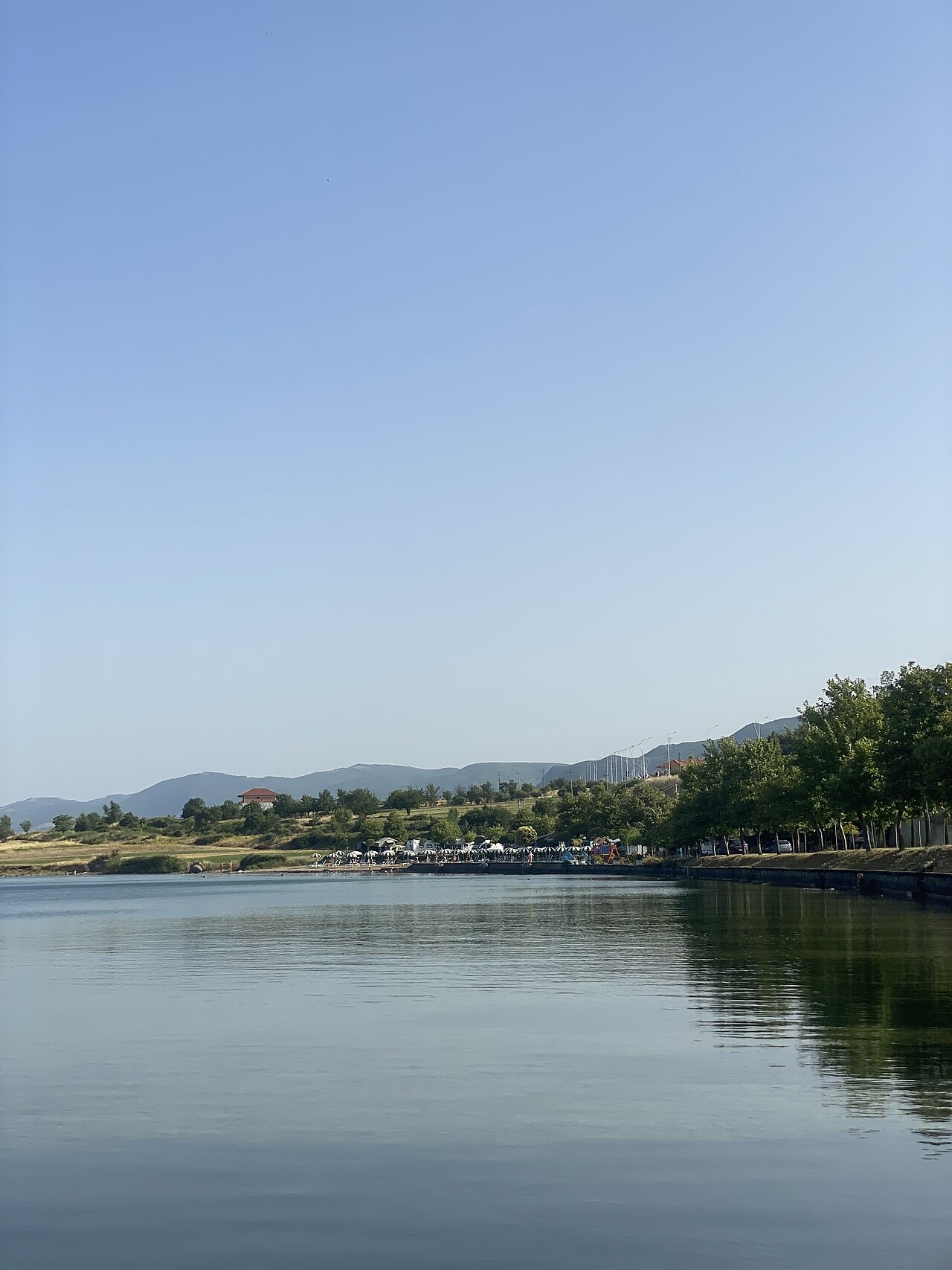
Lake Ohrid’s water is famously clear — a byproduct of its age and the karst springs that continually feed it — and Pogradec has swimmable shoreline right in town, particularly at the eastern end near the promenade, plus quieter pebble and sand stretches out toward Udenisht and along the road toward Lin.
This is a freshwater lake, not the sea, so don’t expect waves or salt — what you get instead is calm, cold-to-cool, very clean water and mountain views on every side. Kayaking, paddleboarding, and casual boat rental are available around the busier parts of town in season. Compared to the Albanian Riviera, the lake here is quieter and considerably less crowded, even at the height of summer.
When Is the Best Time to Visit Pogradec?
June, July, and September are the sweet spots. The water is warm enough to swim comfortably from June through September, with July and August being the warmest but also the busiest and most expensive, since this is when Albanian families take their own summer holidays. September is arguably the best month if you want both warm water (still around 22–23°C) and noticeably thinner crowds.
Spring (April–May) and early autumn (October) are better suited to sightseeing than swimming — cooler water, fewer visitors, and the promenade and Drilon are pleasant without the summer heat. Winter is quiet and cold, with the koran fishing ban in effect, but the town doesn’t shut down entirely; it’s simply a different, slower version of Pogradec.
Practical Tips for Visiting Pogradec
- Day trip or overnight? Pogradec works as a long day trip from Tirana if you leave early, but an overnight lets you actually enjoy the promenade in the evening and fit in both Drilon and Lin without rushing.
- Currency: Albanian Lek (ALL) is standard; euros are often accepted in tourist-facing businesses but expect a less favorable exchange rate than paying in Lek.
- Language: Albanian is the local language, but there’s a meaningful Macedonian-speaking minority in and around Pogradec given the border proximity, and English is spoken at most restaurants and hotels catering to visitors.
- Getting around locally: the town center and promenade are entirely walkable. For Drilon and Lin, you’ll want a car, a taxi, or a local tour, since public transport to both is sparse.
- Combine it with Ohrid town: the border crossing at Qafë e Thanë is close by, and many visitors pair Pogradec with a crossing into North Macedonia to see Ohrid town itself — plan for passport checks and keep your passport (not just an ID card) on hand.
For broader planning — money, SIM cards, safety, and the logistics of moving around the country — our Albania travel tips guide covers what you need before you go, wherever else your trip takes you.
Frequently Asked Questions
How do I get to Pogradec from Tirana?
By car, it’s about 122 km and roughly 2.5 hours via the SH3 through Elbasan and Librazhd, over the Qafë e Thanë pass. By bus, furgons leave Tirana’s regional terminal roughly hourly and take 2.5–3 hours, costing around 700–800 ALL. There’s no direct rail option, and Pogradec has no airport of its own.
Is Pogradec worth visiting as a day trip, or should I stay overnight?
Both work, but an overnight is more rewarding. A long day trip from Tirana lets you see the promenade, Drilon, and maybe Lin if you move efficiently. Staying a night means you can actually enjoy the evening xhiro along the lake, eat dinner without watching the clock, and take Drilon and Lin at a relaxed pace on separate outings.
Can I swim in Lake Ohrid at Pogradec?
Yes. Pogradec has swimmable shoreline right in town and quieter beach areas toward Udenisht and along the road to Lin. The water is clean, cold-to-cool freshwater rather than sea water, best from June through September and warmest in July–August.
What is koran fish, and can I always order it in Pogradec?
Koran (Salmo letnica) is a trout species found only in Lake Ohrid, and it’s the signature dish of every restaurant in town. It’s also a protected species with a seasonal fishing ban (typically December–January) and ongoing restocking efforts, so genuinely wild-caught koran isn’t guaranteed year-round — some restaurants serve farmed trout under the same name. Ask your server if you want to know which you’re getting.
Is Pogradec connected to Ohrid town in North Macedonia?
They sit on the same lake but are separate towns in separate countries. Pogradec is on the Albanian (southwestern) shore; Ohrid town is on the North Macedonian side. The Qafë e Thanë border crossing connects the two, and many visitors combine a stop in Pogradec with a day trip across the border to Ohrid town, which has a different, more historically layered old-town character.
What is the best time of year to visit Pogradec?
June, July, and September. July–August is warmest for swimming but also the busiest and most expensive, since it coincides with Albanian domestic summer travel. September offers nearly the same water temperature with noticeably fewer people. Spring and early autumn suit sightseeing over swimming.
Pogradec isn’t trying to be the next Ksamil, and that’s what makes it worth the detour. It’s a town that has kept its own rhythm — the evening walk, the fish, the springs, the quiet drive out to Lin — regardless of whether anyone outside Albania has heard of it. If you make the trip, give it more than a few rushed hours. The lake rewards slowness.
Have you been to Pogradec, or are you planning a trip to Lake Ohrid’s Albanian shore? I’d love to hear about it — drop a comment below or find me on the Albanian Blogger community.
Read Next
Valbona is the jewel of the Albanian Alps — a glacial valley of pale riverbed, pine forest, and jagged peaks deep in the Accursed Mountains, reached by a spectacular ferry across Lake Koman. It is the other end of the country’s most famous hike, the day-long trail over the pass from Theth, and a place to stay in family-run guesthouses and simply breathe. Here is what to find in and around Valbona, mapped.
Some place links are affiliate links — if you book through them we may earn a small commission at no extra cost to you.
Tap any place to zoom to it, then “Open in Google Maps” for directions and reviews. Exploring more of the country? See the full interactive map of Albania.
Key Takeaways
- Getting there: most visitors reach Valbona via the Koman Lake ferry from Shkodër (about 2.5 hours across the lake) plus a furgon from Fierzë, though a paved road via Bajram Curri now exists too.
- The hike: the famous Theth–Valbona crossing goes over Qafa e Valbonës (Valbona Pass, 1,797 m) and takes most hikers roughly 6–9 hours — no guide required if you stay on the marked trail and carry water.
- Where to stay: family-run guesthouses (bujtina) with half-board, cash only — there is no ATM in Valbona itself.
- Best time: the pass is realistically hikeable late May through early October; the ferry itself only runs roughly April to early November.
- Bring cash and an offline map — mobile signal is patchy in the valley and gone entirely on the high trail.
Table of Contents
How to Get to Valbona
There are two real ways in, and they feel completely different. Most people arrive the scenic way — over Lake Koman — and a smaller but growing number now drive in on a paved road via Bajram Curri.
The Koman Lake ferry route is the classic approach and the reason half the photos of this trip exist. From Shkodër, it’s roughly an hour by car or minibus to the Koman dock. From there, the passenger ferry crosses Lake Koman to Fierzë, a trip of around two and a half hours through a flooded canyon of the Drin River, hemmed in by cliffs on both sides. According to the main ferry operator’s own schedule, boats leave Koman around 09:00 and the return leaves Fierzë’s around 13:00, with the season running roughly from mid-April to early November — but treat those as a starting point, not gospel, since more than one operator runs boats on this lake and schedules shift. A one-way passenger ticket runs somewhere around €9–10 depending on where and how you book; vehicles are priced by size. At Fierzë, a connecting furgon (shared minibus) typically continues on to Valbona, roughly an hour’s drive, timed loosely to meet the boat — confirm the connection locally rather than assuming it will always be there. For the fuller logistics of buses, furgons, and ferries around the country, our complete guide to getting around Albania is worth reading before you go.
The direct road route skips the ferry entirely. From Tirana, the fastest way to Bajram Curri (the district town nearest Valbona) usually runs north via the Kukës highway and then briefly through Kosovo — crossing at Qafa e Morinës, which means you’ll want a passport, not just an ID card. A route that avoids Kosovo altogether, via Krumë, exists too and is typically a little longer. Either way, budget more than four hours from Tirana. From Bajram Curri, the last stretch into Valbona is now a paved road and takes about half an hour — a genuine change from a few years ago, when this final leg was rough dirt track.
Most travelers doing a loop through the north base themselves in Shkodër first. If that’s you, our piece on spending one night in Shkodër covers the town itself before you head up toward the lake.
Did you know?
In 2022, Valbona Valley National Park was merged with neighboring Theth National Park into one larger protected area, officially called the Albanian Alps (Bjeshkët e Nemuna) National Park — which is fitting, since most visitors treat Theth and Valbona as two halves of the same trip anyway.
The Theth–Valbona Hike
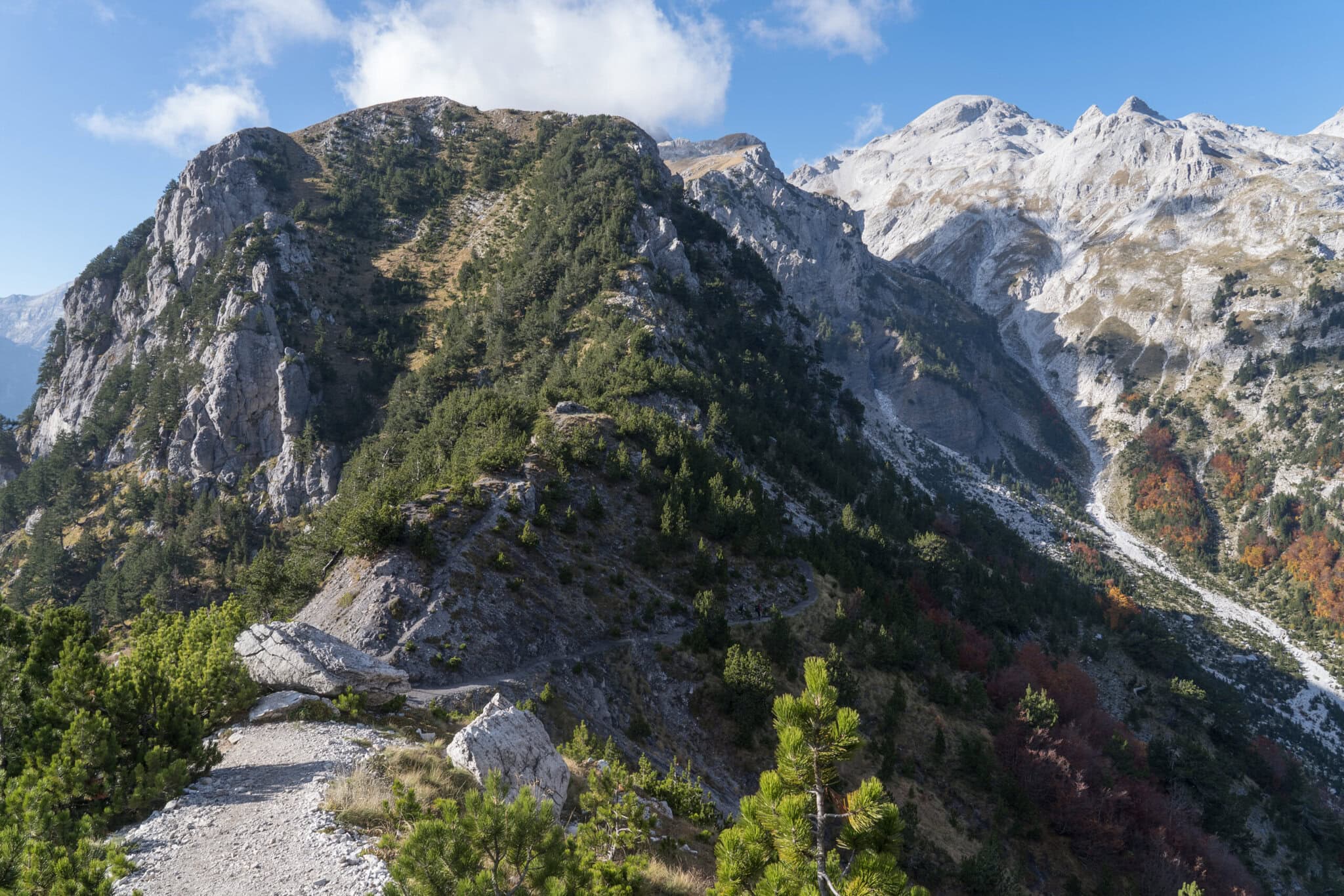
This is the reason most people come. The trail crosses Qafa e Valbonës (Valbona Pass), sitting at roughly 1,797 meters, and connects the two valleys on foot in a single long day. Distance estimates vary by source — you’ll see anywhere from about 14 to 18 kilometers depending on exactly where the measurement starts — and most hikers report the crossing taking somewhere between six and nine hours, breaks included. It is not a technical climb; there’s no scrambling or rope work involved. It is, however, a long day with sustained elevation gain, so treat it as moderate-to-strenuous rather than a casual walk.
People hike it in both directions, and there isn’t an official “correct” way. That said, a lot of hikers and guesthouse owners lean toward starting in Valbona and finishing in Theth: you tackle the steeper climb early in the day while you’re fresh, the descent into Theth has more shade in the afternoon, and Theth generally has faster onward transport back toward Shkodër once you arrive. Going the other way — Theth to Valbona — gives you a gentler opening climb, but the final descent into Valbona tends to be more exposed to the afternoon sun. Either direction works; pick based on your schedule and how you handle heat.
The trail is generally described as marked the whole way and safe to hike without a guide, provided you’re reasonably fit, stick to the main path, and carry enough water — trailside sources can run dry in peak summer. Still, download an offline map (Maps.me, Organic Maps, or Gaia GPS all work) before you set out, since paint blazes are not a substitute for a real map if weather closes in or you lose the trail. Mobile signal disappears well before the pass. Wolves, bears, and lynx do live in these mountains, but encounters with hikers are rare and not something to plan your trip around.
If you’d rather do this as a shorter, guided outing from the Theth side rather than the full point-to-point crossing, our Theth day trip guide covers that approach and what a single day in Theth itself looks like.
Where to Stay: Guesthouses in Valbona
Valbona runs on family-run guesthouses — locally called bujtina — almost all of them offering half-board (dinner and breakfast included), because there is nowhere else nearby to eat. A few names come up repeatedly with strong, genuine review histories: Guesthouse Kol Gjoni, consistently one of the highest-rated stays in the valley for hospitality and home cooking; Rilindja, a larger operation with a dozen rooms across a main house and an annex (note it sits a few kilometers from the main Theth-Valbona trailhead, so factor in a short taxi ride or a walk of an hour or more to reach the start of the trail); and smaller places like Bujtina Arturi and Bujtina Valbonë.
Expect to pay roughly €20–40 per person per night with half-board as a rough planning figure — this varies by guesthouse and season, so confirm the actual rate directly or through a booking platform before you arrive. Bring cash. Euros are usually accepted at the host’s own exchange rate, but don’t assume a card machine will be sitting on the counter.
Best Time to Visit
The realistic hiking window for Qafa e Valbonës runs roughly late May through early October, with June through September considered the reliable core of the season. July and August are the busiest months — warmest weather, the most hikers on the trail, and the least rain, but also the most crowded guesthouses. May and October are quieter shoulder months, though weather is less predictable and some trailside water sources or facilities may not be fully up and running yet.
Outside that window, the pass is generally snowbound and effectively closed to casual hikers from roughly November through April, and most guesthouses close for the winter. It’s also worth noting that the Koman ferry itself only operates roughly from mid-April to early November — so if you’re planning to arrive by boat, the ferry’s own season is often the real constraint on when you can visit at all.
What to Do in Valbona
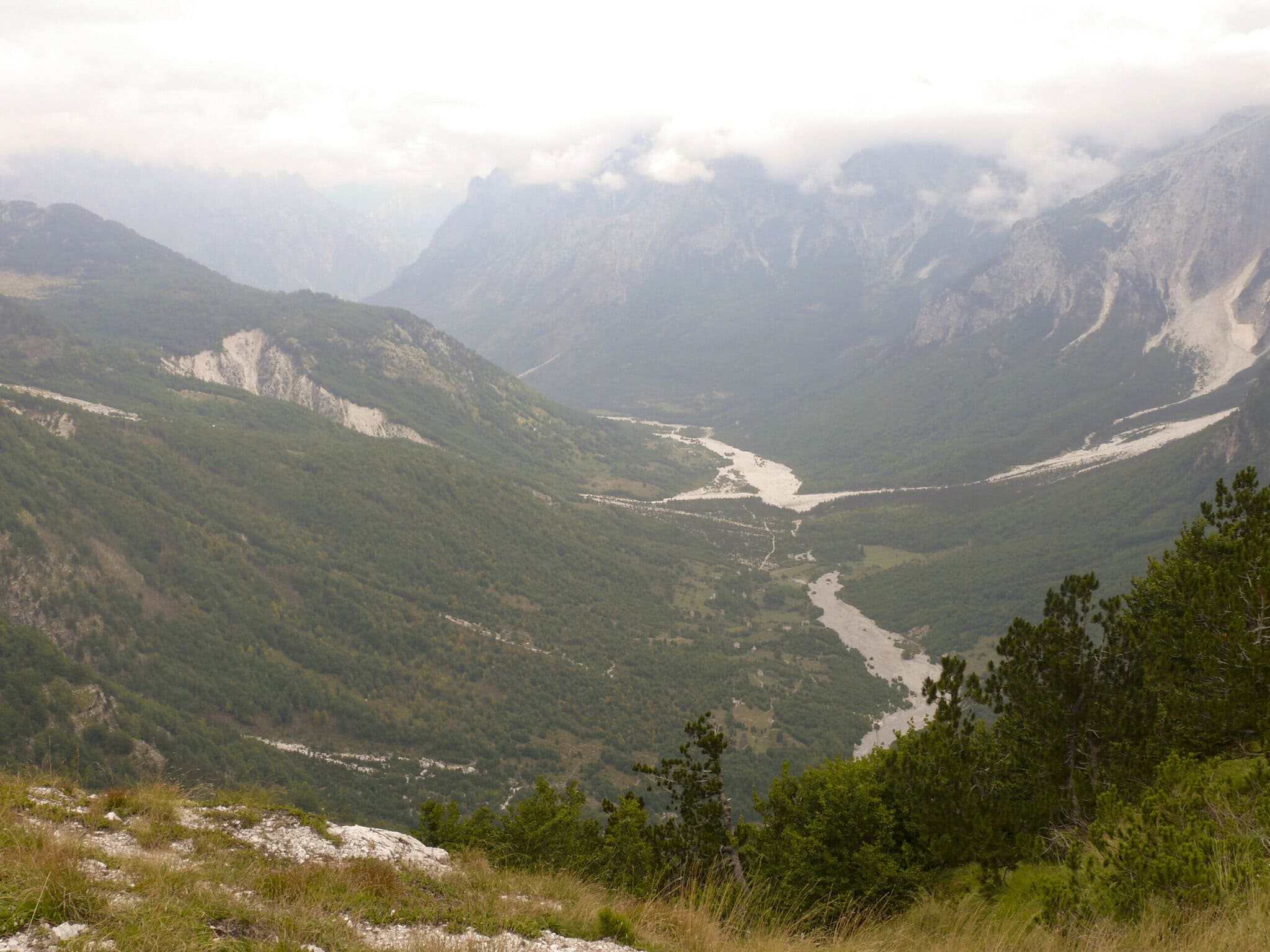
The pass hike is the headline, but it isn’t the only thing here. The valley itself — a wide, pale riverbed threading through pine forest with jagged limestone peaks on both sides — is worth simply spending a day in if you’re not in a rush to move on. The Valbona River and the meadows around Dragobi are a good place to slow down, and the peaks framing the valley (Maja e Kollatës, Maja Boshit, Maja e Hekurave among them) make for a dramatic backdrop from pretty much anywhere you’re standing.
For more serious hikers, Maja Jezercë (2,694 m) — the highest peak in the Albanian Alps, though not the highest point in Albania overall — is a separate, harder undertaking from the pass crossing: figure roughly six and a half to seven and a half hours for experienced hikers, and this is not something to add on casually to a pass-crossing day.
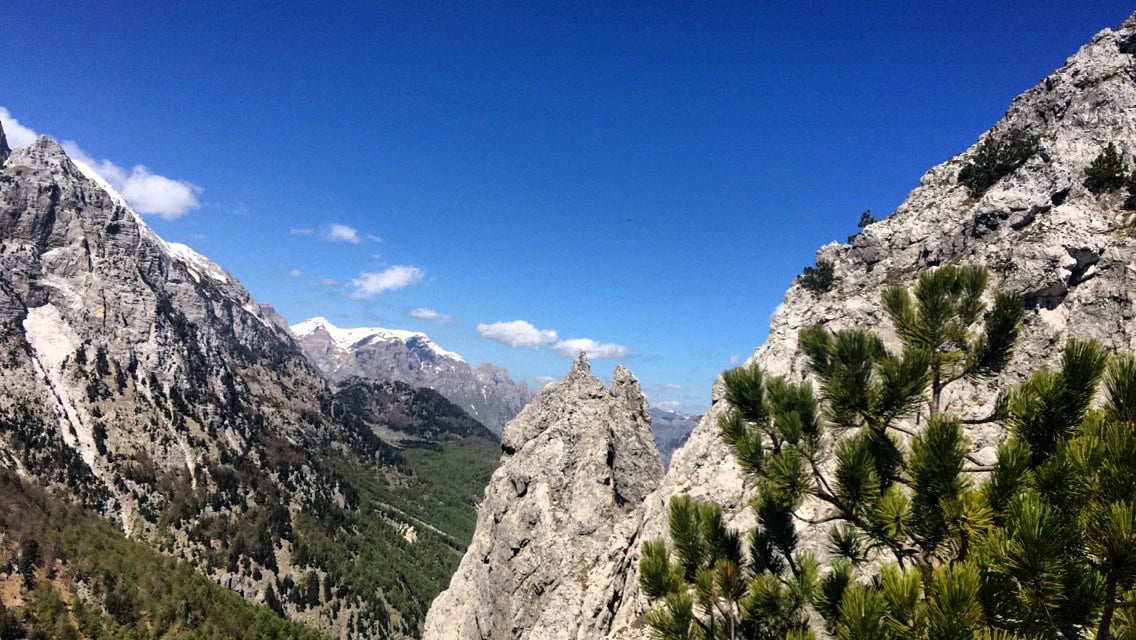
Valbona isn’t a place with a checklist of sights. It’s a valley you walk into, and the point of being there is mostly just to be there — slower, further from a signal, further from anything that needs your attention.
If Valbona is one stop on a longer itinerary out of the capital, our roundup of the best day trips from Tirana is a useful companion for planning what comes before or after.
Practical Tips
- Bring cash, and bring enough of it. There is no ATM in Valbona itself. Withdraw what you’ll need in Shkodër, Tirana, or Bajram Curri before you head up. Euros are generally fine at guesthouses, but Albanian Lek is the practical local currency.
- Don’t count on your phone. Signal is intermittent at best in the valley and disappears entirely on the higher sections of the trail. Download offline maps before you leave a town with a connection.
- Pack for altitude and a long day. Even in summer, layers matter at 1,797 meters — mornings and the pass itself can be genuinely cold even when the valley floor is warm. Good boots, sun protection, and more water than you think you need.
- Tell someone your plan. Given the patchy signal, let your guesthouse know roughly when you’re setting out and when you expect to arrive on the other side — standard mountain-safety practice here as anywhere.
- Budget roughly €40–60 a day for guesthouse half-board, the ferry or furgon, and incidentals — treat this as a starting estimate, not a fixed number, since prices vary by season and by exactly where you stay.
For more general advice that applies across the country — not just the north — see our complete Albania travel tips guide.
Frequently Asked Questions
How do I get to Valbona from Tirana?
Most travelers go via Shkodër, then the Koman Lake ferry to Fierzë, then a furgon (shared minibus) on to Valbona — a half-day journey in total. A paved road via Bajram Curri also exists, usually routed through Kosovo, and takes over four hours by car or bus from Tirana.
Do I need a guide to hike from Theth to Valbona?
No — the trail over Qafa e Valbonës is generally described as clearly marked and safe to hike solo if you’re reasonably fit, carry enough water, and download an offline map beforehand. A guide isn’t required, though hiring one is always an option if you’d prefer company or local knowledge.
Which direction should I hike — Theth to Valbona, or Valbona to Theth?
Both directions are common. Many hikers and guesthouse owners lean toward starting in Valbona, since the steep climb comes early in the day and the Theth-side descent has more afternoon shade — but there’s no official recommendation, and either direction is a reasonable choice.
When is the best time to visit Valbona?
Roughly late May through early October for hiking, with June through September as the reliable core season. July and August are busiest; May and October are quieter but less predictable. The Koman ferry itself typically only runs from around mid-April to early November.
Is there an ATM or card payment in Valbona?
No ATM in the valley itself. Bring cash — withdraw what you need in Shkodër, Tirana, or Bajram Curri beforehand. Most guesthouses will accept Euros at their own exchange rate, but plan on cash for everything.
How long does the Theth–Valbona hike take?
Most hikers report somewhere between six and nine hours including breaks, depending on fitness, pace, and exactly which direction and trailhead you start from.
What do you think?
Have you made the Theth-Valbona crossing? Which direction did you go, and would you recommend it — or was the ferry across Lake Koman the real highlight of the trip?
Key Takeaways
- Tirana is landlocked and about 35-40 km (roughly 40 minutes on the A2 highway) from the port of Durres, so every fillet on a Tirana menu has already made a short truck ride before it reaches your plate.
- A handful of Tirana restaurants, including Kripe Dhe Piper and SeaSoul, source daily from Durres and consistently earn 4.8-4.9 star ratings on TripAdvisor for their fish.
- Koran (Ohrid trout, Salmo letnica) is a separate category from sea fish entirely — an endemic freshwater species from Lake Ohrid, not something delivered from the coast.
- A seafood meal in central Tirana runs roughly EUR 10-20 per person; the same fish an hour closer to where it was caught, on the coast, is usually cheaper and fresher.
- If fresh-off-the-boat seafood is the actual goal, a day trip to Durres, Currila, or the Albanian Riviera beats anything served in the capital — and this guide tells you honestly when that’s worth the drive.
Table of Contents
By Elvis Plaku — lifelong Tirana native, blogging about Albania since 2004.
Prices and listings in this guide were last verified in August 2026. Tirana moves fast — confirm current prices and opening hours before you go.
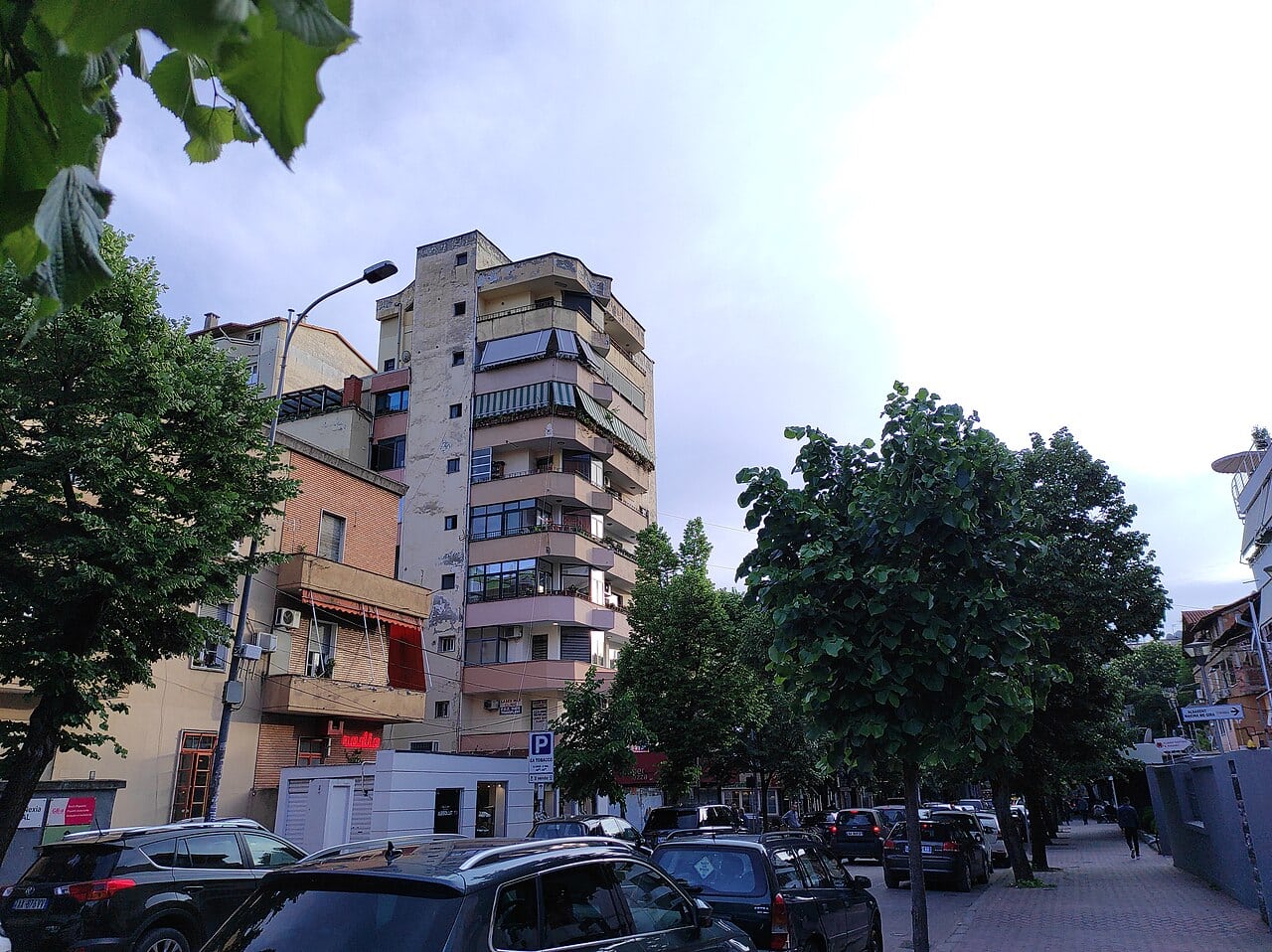
Tirana sits roughly 35-40 km inland, which means it has no fishing fleet of its own and no fish market pulling boats in at dawn. Every piece of fish on a Tirana restaurant table arrived by refrigerated van from Durres, the Adriatic port city that has supplied the capital’s kitchens for decades. That’s not a knock on the food — some of it is genuinely very good — but it’s the honest starting point. If you came here expecting a coastal-town experience, know what you’re actually getting before you sit down.
This guide covers where the seafood is worth ordering, what to expect on the bill, and when the right answer is simply to drive to the coast instead. For the fuller picture of eating well in the capital, our restaurant guide to Tirana covers everything from byrek stands to fine dining, seafood included.
Is Tirana Really a Seafood Destination?
No — and any guide that tells you otherwise is selling something. Tirana is a capital built on a plain between mountains, not a harbor town. Albania has roughly 470 km of coastline between the Adriatic and Ionian seas, and none of it touches Tirana. The closest saltwater is the Adriatic at Durres, about 35-40 km and a 40-minute drive away on the A2 highway.
What Tirana does have is proximity. Because Durres is so close, a well-run kitchen in the capital can realistically serve fish caught that morning and delivered by early afternoon — a genuinely different situation from a capital hundreds of kilometers from the nearest coast. The catch is that “realistically can” and “actually does” are two different things, and a lot of menus in the city center lean on the word “fresh” more than they earn it.
Think of Tirana’s seafood scene less as a destination in its own right and more as a convenience — a decent one, if you pick carefully, but not a substitute for eating on the coast. The restaurants below have earned a reputation for taking the sourcing seriously.
The Best Seafood Restaurants in Tirana
These four are consistently the names that come up among both locals and reviewers when the subject is fish in the capital. All were checked as currently operating at the time of writing.
Kripe Dhe Piper — Rruga Sami Frasheri, near Blloku
Rated 4.9 out of 5 from over 1,450 reviews on TripAdvisor and ranked among the top restaurants in the city, Kripe Dhe Piper is the closest thing Tirana has to a seafood institution. The menu covers grilled meats and pasta too, but the grilled fish and seafood platters are what regulars order first.
What to order: Grilled fish of the day or the mixed seafood platter. Price range: approximately EUR 8-14 per person. Tip: Ask the waiter what came in that morning rather than picking blind from the menu.
SeaSoul — central Tirana
An Italian-leaning seafood restaurant rated 4.9 out of 5 from over 200 TripAdvisor reviews, SeaSoul has built its reputation specifically around fish quality rather than atmosphere. Reviewers consistently single out how fresh the fish tastes — for a landlocked city, that’s the whole point.
What to order: Whatever the day’s fresh catch is, or the seafood pasta. Price range: approximately EUR 12-20 per person, on the higher end for Tirana. Tip: This is a smaller room — reserve ahead on weekends.
Fish House — Bulevardi Gjergj Fishta, near Rruga Reshit Collaku
Fish House does one thing — fish and shellfish, prepared simply — with several hundred reviews across TripAdvisor and Facebook. Reviews are mixed on portion size and value some days, but the grilled octopus and seafood linguine are the dishes people come back for. Complimentary olives, beetroot, and bread arrive before you’ve even ordered.
What to order: Grilled octopus or seafood linguine. Price range: approximately EUR 8-14 per person. Tip: Go for lunch when the kitchen is calmer and portions are more consistent.
Era Blloku — Blloku
Era isn’t marketed as a seafood restaurant first — it’s a busy Albanian-Mediterranean spot with a terrace built for people-watching — but its seafood pasta is a signature dish, mentioned constantly across its 1,800+ TripAdvisor reviews (4.8 stars). Good if the rest of your table wants Albanian classics and only one or two want fish.
What to order: Seafood pasta. Price range: approximately EUR 6-12 per person. Tip: Expect a wait at peak dinner hours; the terrace fills up fast.
What to Order: Sea Fish, Koran, and Shellfish
Menus in Tirana lump two very different categories under “fish,” and knowing the difference saves a confused conversation with the waiter. The first is peshk deti (sea fish) — bream, sea bass, mullet, and similar species trucked in from Durres. The second is koran, and it has nothing to do with the sea at all.
Koran is the Albanian name for the Ohrid trout (Salmo letnica), a freshwater species found only in Lake Ohrid on the Albania-North Macedonia border, hundreds of kilometers from Tirana in the opposite direction from the coast. It’s a prized fish — listed as Endangered on the IUCN Red List since March 2024 — that shows up as a specialty rather than a daily staple, and it’s typically farmed or carefully sourced rather than wild-caught given conservation pressure on the natural population.
Did you know?
Koran (Ohrid trout) is found naturally nowhere else on Earth except Lake Ohrid and its outlet river. Overfishing and habitat pressure have pushed wild populations low enough that the stock is now sustained largely by artificial spawning: the hatchery on the lake releases around 700,000 fingerlings a year. That is part of why it’s treated as a delicacy rather than an everyday order.
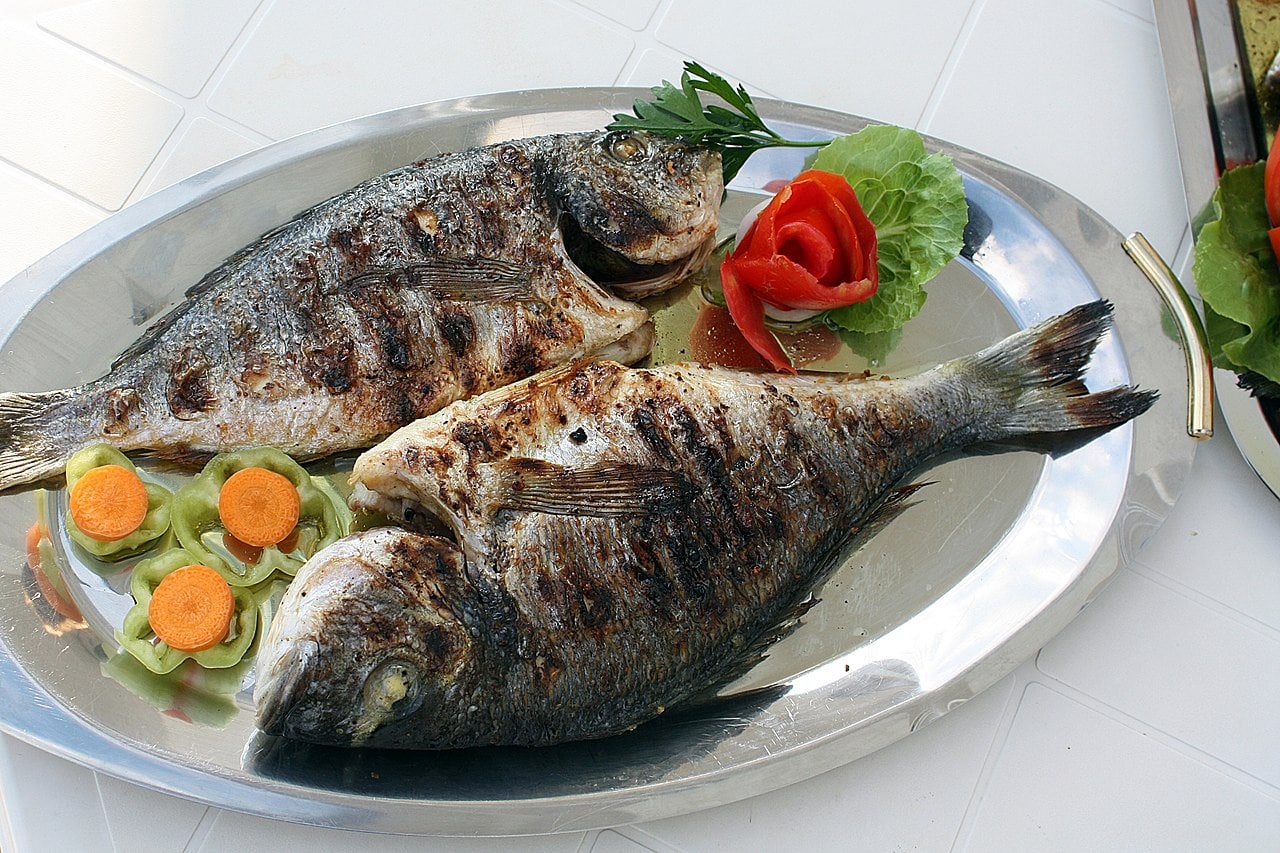
For sea fish, simply grilled options are usually the safest bet: whole grilled bream or bass (peshk i pjekur), grilled octopus (oktapod i pjekur), fried calamari (kallamar i skuqur), and seafood pasta or linguine, which nearly every seafood-adjacent restaurant does a version of. Shellfish selection is thinner than on the coast — don’t expect the mussel and clam variety you’d find in Durres or Vlore.
Our complete guide to Albanian food covers the wider cuisine if seafood is just one stop on a bigger culinary tour of the country.
What Does Seafood in Tirana Cost?
Expect to pay roughly EUR 8-20 per person for a seafood meal in Tirana — noticeably more than a typical Albanian meal of grilled meat or byrek, since fish is imported daily rather than locally abundant. Whole grilled fish is usually priced by weight, so ask before ordering; it’s the one place in an otherwise affordable city where the bill can surprise you.
| Dish | Approx. Price (EUR) |
|---|---|
| Seafood pasta or linguine | 6-10 |
| Grilled octopus | 8-14 |
| Whole grilled sea fish (priced by weight) | 10-20+ |
| Mixed seafood platter (for two) | 25-40 |
Approximate prices per dish based on menus at the restaurants listed above; exact figures vary by season and by weight for whole fish.
The Real Move: A Day Trip to the Coast
“Here’s something most guides won’t tell you: if you really want the best seafood near Tirana, drive 40 minutes to Currila, the rocky beach area north of Durres port. The restaurants there serve fish that was swimming a few hours before you sat down. I’d take Currila over any seafood restaurant in central Tirana, every time.” — from our Tirana restaurant guide
That’s the honest bottom line here. Tirana’s better seafood restaurants are genuinely good for what they are — a capital-city kitchen doing right by imported fish — but they’re still, by definition, one step removed from the source. If freshness is the actual priority, not just convenience, the coast is where it happens.
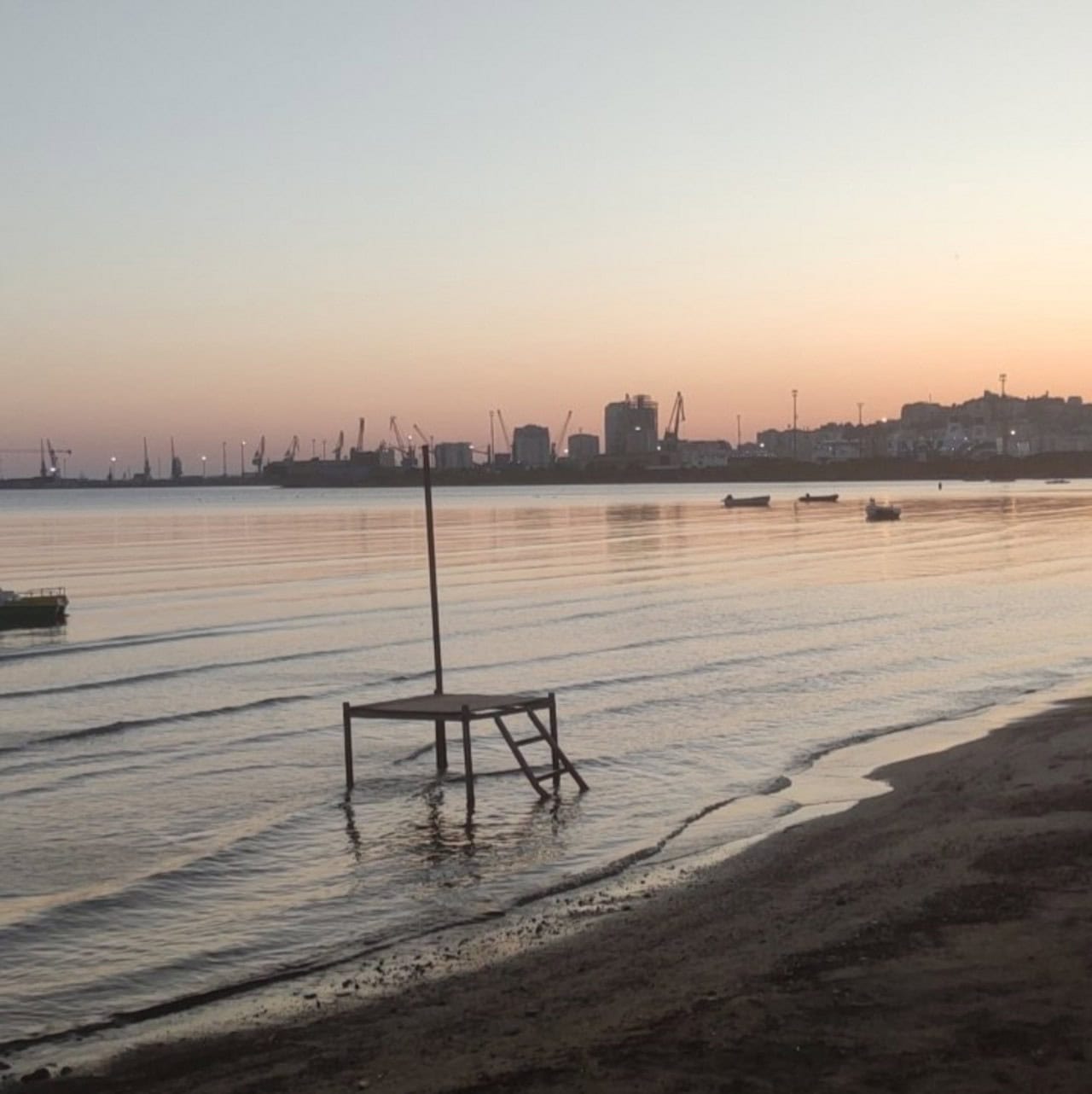
Durres is the closest option: about 40 minutes via the A2 highway, with a working fishing harbor and restaurants in the Currila area serving fish caught that same day. Charlie Max Marina, on Rruga Currila, is one of the better-known names there, with a seaside setting away from the port’s crowds. It’s an easy half-day trip — our Durres beach guide covers the city and its beaches in full, and pairs well with the Roman Amphitheatre and a seafood lunch.
If you have more time, the Albanian Riviera — Vlore, Himare, Dhermi, Saranda — is about 2 to 2.5 hours south, and its restaurants are built entirely around fresh Ionian and Adriatic catch, with a longer coastline and clearer water than Durres. It’s a bigger commitment, but if seafood is genuinely the point of your visit, it’s worth the drive. See our guide to day trips from Tirana for logistics on getting there without a rental car.
Practical Tips for Eating Seafood in Tirana
- Ask what came in that morning. Honest kitchens will tell you straight and steer you away from whatever’s been sitting longest.
- Go early in the week if you can. Delivery cycles from Durres tend to be freshest before weekend demand thins out the day’s stock.
- Whole fish is priced by weight. Confirm the per-kilo price before ordering to avoid a surprise total.
- Reserve ahead for SeaSoul and weekend dinners at Kripe Dhe Piper. Both are small enough that walk-ins can mean a wait.
- Don’t expect coastal-town shellfish variety. Mussels and clams are more reliably available in Durres and further south.
- If seafood matters and you only have one day, prioritize Durres over a Tirana restaurant. A 40-minute drive each way still leaves time for the Roman Amphitheatre and a beach walk.
Combine a seafood-focused day with our broader guide to things to do in Tirana if you’re building out a longer itinerary around the capital.
Frequently Asked Questions
Is Tirana a good place to eat seafood, or should I wait for the coast?
Tirana is fine for a good seafood meal, not a great one. A handful of restaurants source daily from Durres and do it well, but since Tirana is landlocked, nothing served there matches fish eaten within sight of the water. If freshness genuinely matters, treat Tirana’s restaurants as a solid option and a coast day trip as the upgrade.
Where does the fish served in Tirana restaurants come from?
Almost all of it comes from Durres, about 35-40 km (roughly 40 minutes by road) from Tirana. Restaurants that take sourcing seriously receive daily deliveries; the difference between them and average tourist-facing spots comes down to how consistently they actually do that.
What’s the difference between koran and regular sea fish on Tirana menus?
Koran (Ohrid trout, Salmo letnica) is a freshwater species endemic to Lake Ohrid, hundreds of kilometers from the coast in the opposite direction. Sea fish like bream, bass, and mullet come from Durres. They’re unrelated categories that both get called “fish” on the same menu — don’t expect koran to be a coastal delicacy, because it isn’t.
How much does a seafood meal cost in Tirana?
Roughly EUR 8-20 per person depending on the dish, with whole grilled fish priced by weight and usually landing at the higher end. A seafood pasta or linguine is the most budget-friendly way to try it, typically EUR 6-10.
Do I need a reservation at Tirana’s seafood restaurants?
Not usually for casual spots like Fish House, but SeaSoul and Kripe Dhe Piper are small and popular enough that weekend walk-ins can mean a wait. A WhatsApp message or phone call ahead is a safe bet for either on a Friday or Saturday night.
Is Durres or the Albanian Riviera better for fresh seafood?
Durres wins on convenience — a 40-minute drive and an easy half-day trip that pairs with the Roman Amphitheatre. The Riviera (Vlore, Himare, Dhermi, Saranda) wins on quality and variety if you have the extra 2-2.5 hours each way, with restaurants built around fresh Ionian and Adriatic catch and a longer coastline to draw on.
Some place links are affiliate links — if you book through them we may earn a small commission at no extra cost to you.
Tap any place to zoom to it, then “Open in Google Maps” for directions and reviews. Exploring more of the country? See the full interactive map of Albania.
Key Takeaways
- Korçë sits about 165 km southeast of Tirana — roughly 2.5 to 3 hours by car or hourly bus over the Qafë Thanë pass.
- The restored Old Bazaar, the Resurrection Cathedral, and the Mirahori Mosque (one of Albania’s oldest, built in 1494–95) all sit within walking distance of each other in the center.
- Korçë opened the first Albanian-language school in 1887 and is home to Birra Korça, the country’s first brewery, founded in 1928.
- Nicknamed the “City of Serenades,” Korçë has a beloved winter Christmas market that lights up the boulevard from early December.
- Voskopojë, a mountain village 21 km away with seven surviving 17th–18th century painted churches, makes an easy half-day trip from Korçë.
Table of Contents
Getting to Korçë from Tirana
Korçë sits about 165 km southeast of the capital, and the drive is one of the most scenic in the country. You leave Tirana on the A3 motorway, pass through the Krraba Tunnel toward Elbasan, then follow the SH3 up the Shkumbin valley through Librazhd before climbing to Qafë Thanë — the highest point on the route — and dropping into the Korçë plain. Door to door, it’s usually 2 hours 40 minutes to 3 hours by car, depending on traffic and how many photo stops you make along the way.
If you’re not driving, hourly buses (furgons and coaches) leave from Tirana’s eastern bus terminal and take roughly 2.5 to 3 hours, which makes Korçë an easy day trip or an overnight add-on if you’re already working through our guide to getting around Albania. It’s a different kind of city than the capital — cooler, greener, and built around wide 19th-century boulevards rather than the dense, fast-changing streets you’ll find if you’re spending time on things to do in Tirana first.
Things to Do in Korçë: At a Glance
The 8 things worth your time in and around Korçë, in the order I would do them. Jump straight to any of them:
The Old Bazaar
Korçë’s Old Bazaar is the reason most people come here in the first place. It dates back roughly 500 years, when the city was a trading post linking the Adriatic and Aegean routes, and by the 19th and early 20th centuries it had grown into the biggest marketplace in Albania — more than a thousand shops and two well-known inns, the Old Elbasan and the Old Monastery. Like a lot of Albania’s Ottoman-era heritage, it fell into disrepair after the 1990s. A $4 million restoration project, financed by the Albanian Development Fund and the Albanian-American Development Foundation and announced in 2015, brought the stone buildings, arched passages, and cobblestone lanes back to life. Today the bazaar’s 138 protected monuments house cafés, restaurants, and artisan shops rather than the wholesale trade of a century ago, but the bones of the old market town are unmistakable.
Give yourself at least an hour to wander without a plan — it’s a small enough area that you won’t get lost, and the side alleys are where the good photos are anyway. If you want to sit down, this is also one of the best places in the city to try lakror, grilled meats, or homemade cheese; if you haven’t already, our complete guide to Albanian food is worth a look before you order.
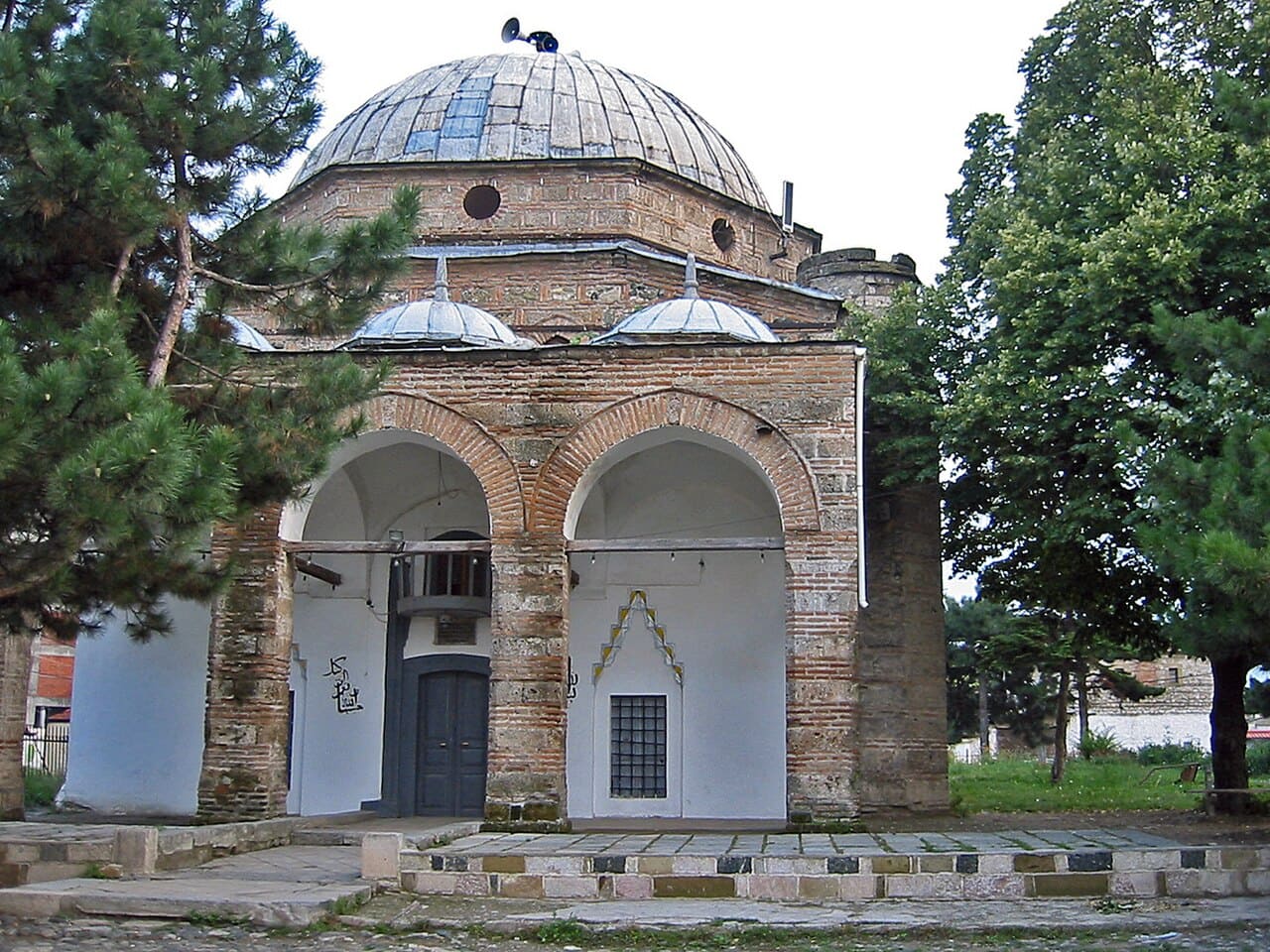
Don’t miss nearby: the Mirahori Mosque. A short walk from the bazaar stands one of Albania’s oldest mosques, built in 1494–95 by Iljaz Bej Mirahori, the Ottoman military commander who effectively founded Korçë as a town. It’s a modest, single-domed structure with a three-domed entrance porch and finely worked stonework — the minaret, lost in an earthquake in the early 1960s, was rebuilt after 2006. Mirahori endowed five villages to fund it and the surrounding complex, which once included a bakery, a hamam, and a school.
Resurrection Cathedral
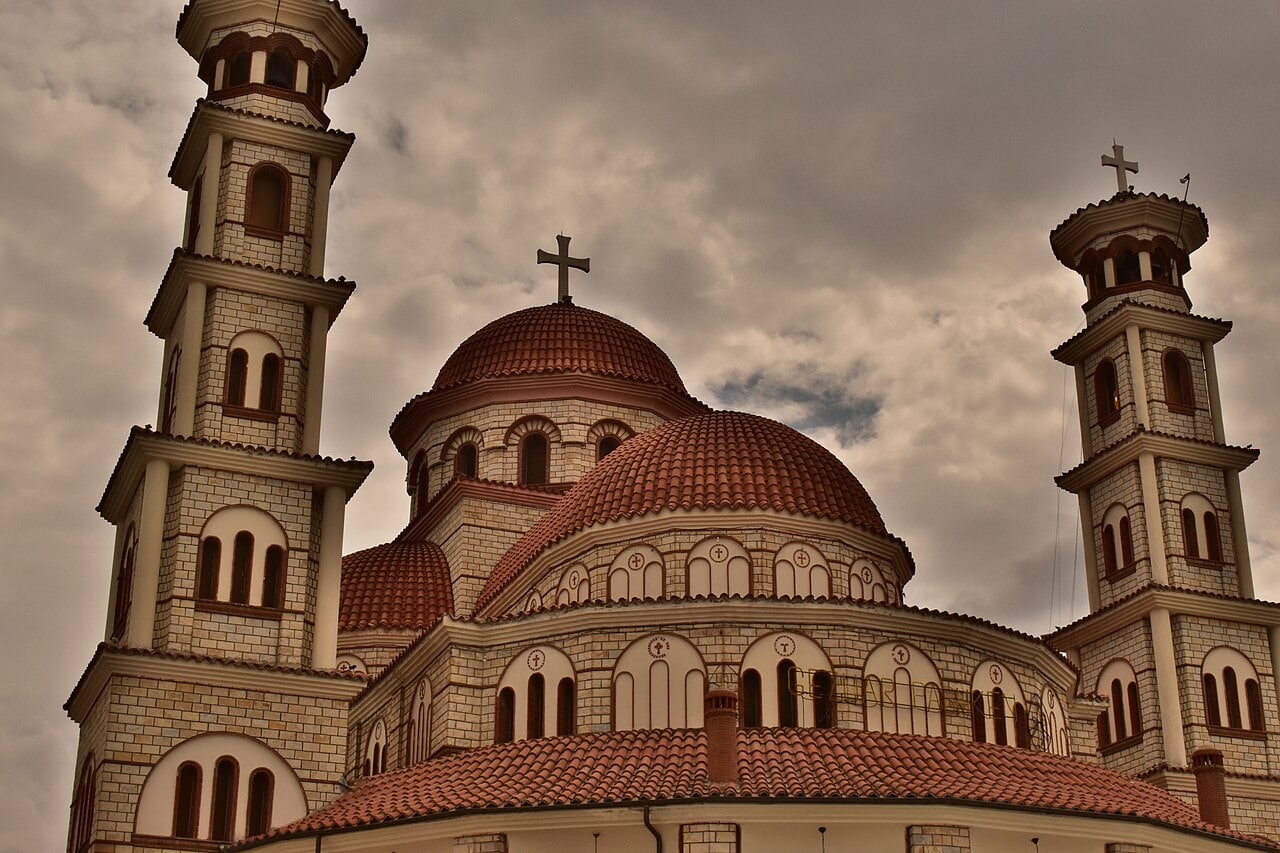
You’ll see the Resurrection Cathedral’s pink-and-blue facade before you reach it. This is the main Orthodox church in Korçë, and its story is tied to one of the harder chapters of the city’s recent past — the original cathedral, dedicated to St. George, was demolished by the communist regime in 1968 as part of Albania’s declared status as the world’s first atheist state. Construction of the current cathedral began in 1994, once religious worship was legal again, and finished in 2002, funded largely by Orthodox Albanians at home and in the diaspora, with support from Greece.
Inside, the interior is simple and white, dominated by a large carved wooden iconostasis. The square in front of the cathedral is also where the city’s Christmas Market sets up every winter, so if you’re visiting in December, this is the spot everything else in town radiates out from.
The First Albanian School & Education Museum
Korçë has a genuinely important place in Albanian history that has nothing to do with architecture or beer. On March 7, 1887, the patriotic teacher Pandeli Sotiri opened the first secular school to teach in the Albanian language, in a house donated by the local patriot Diamanti Terpo. This was still Ottoman Albania, where teaching in Albanian was effectively banned, so the opening of the school — known simply as Mësonjëtorja, “the teaching place” — was as much a political act as an educational one. March 7 is still marked as Teachers’ Day in Albania because of it.
The building was converted into the National Museum of Education in 1967 and still holds the first and second Albanian alphabets — one devised by Naum Veqilharxhi, the other by Kostandin Kristoforidhi — along with photographs of the school’s founders, teachers, and early pupils. It’s a small museum, but if you care at all about how Albanian identity survived centuries of outside rule, it’s one of the more moving stops in the country.
National Museum of Medieval Art
This is the museum most visitors underestimate. Established in 1980 and rebuilt in 2016, the National Museum of Medieval Art holds more than 7,000 icons, fresco fragments, liturgical objects, and textiles dating from the 13th to the 18th centuries — one of the most significant collections of Orthodox religious art in the Balkans. The star names are the iconographers Onufri, Konstandin Shpataraku, David Selenica, and the Zografi brothers, whose work also decorates the churches of Voskopojë (more on that below).
Did you know?
Onufri, the 16th-century painter whose icons anchor the museum’s collection, is known for a specific, almost impossible-to-replicate shade of red he mixed into his pigments — art historians still argue about exactly how he made it.
Korça’s Beer Culture
Albania’s first brewery opened here in 1928, and the name stuck to the whole country’s drinking habits. Birra Korça was founded by the Italian investor Umberto Umberti and Selim Mborja, a local businessman from the nearby village of Mborje, with an initial capacity of about 20,000 hectoliters a year. It was nationalized after the communist takeover in 1946, went through several rounds of Soviet-style renovation in the 1950s and 60s, and was privatized in 1994 during Albania’s rocky transition to a market economy. Since 2004, under businessman Irfan Hysenbelliu, the brewery has had roughly €15 million invested into it — and Birra Korça remains the country’s best-known domestic beer, sold nationwide but still carrying the city’s name with real pride locally.
You don’t need a brewery tour to feel this — just sit at any bar around the Old Bazaar or the boulevard, order a Korça, and you’ll notice it’s usually the house default rather than an imported lager.
A city that survived having its cathedral torn down, its language banned for a century, and a market rebuilt from ruin isn’t going to let a good beer brand disappear either. That’s Korçë in one sentence.
The City of Serenades
Korçë’s nickname, “the city of serenades,” comes from a very specific, very romantic habit. Sometime in the last couple of centuries, inspired by Spanish and Italian traditions that filtered in through trade and travel, men in Korçë began performing love ballads — serenatas — from balconies and courtyards, usually with guitar, violin, or a small ensemble. It’s a gentler, more theatrical cousin of Albania’s older iso-polyphonic singing traditions (themselves recognized by UNESCO as intangible cultural heritage), and it became such a defining part of local identity that Korçë still leans into the nickname today, with cafés, festivals, and even street signage nodding to it.
You’re most likely to run into serenades — organized or spontaneous — around cultural festivals and during the winter season, when the city’s boulevards are already full of people out walking in the evening air.
A Day Trip to Voskopojë
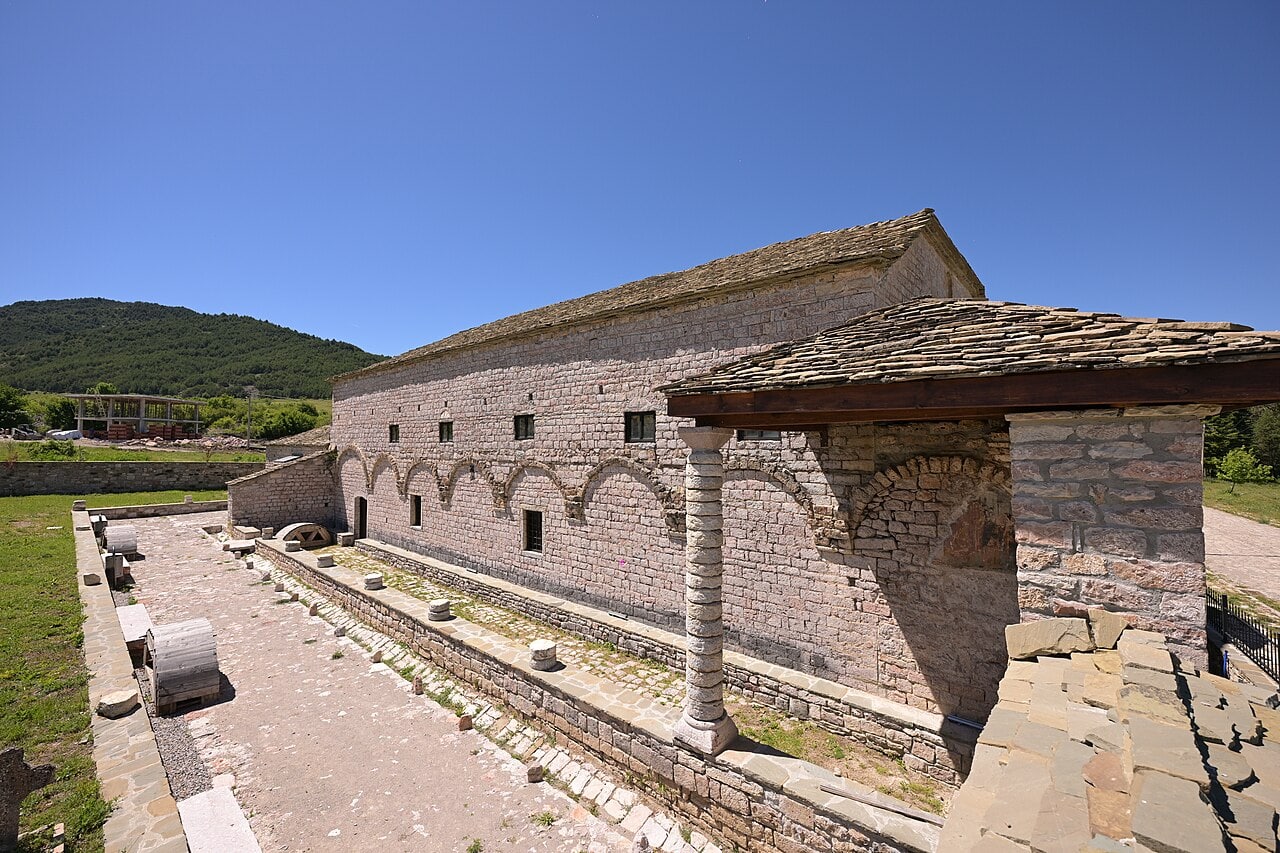
Twenty-one kilometers west of Korçë, up in the Morava mountains, sits one of the more sobering places in Albania. Voskopojë (also spelled Voskopoja) was, in the 17th and 18th centuries, one of the most important cultural centers in southeastern Europe — a town with its own printing press (the first in the Ottoman Balkans outside Constantinople), schools, libraries, and, by some estimates, dozens of churches. Trade routes shifted, conflict and decline followed, and what’s left today is a quiet mountain village with seven surviving churches from that golden age, decorated with roughly 43,000 square feet of frescoes.
The churches were neglected and used as storage during the communist era, but they’ve since been designated Cultural Monuments, and in 2020 the historic center where most of them stand was recognized as a Historic Ensemble. St. Michael’s (Kolli) is generally considered the finest example of the post-Byzantine basilica style here. If you enjoyed the icons in the Medieval Art Museum, seeing frescoes by some of the same artists in the churches they were painted for is worth the detour — it pairs well with a broader itinerary if you’re working through our guide to the best day trips from Tirana and want to extend south.
Best Time to Visit
Most of Albania empties out from the coast by October, but Korçë’s best season is just getting started. With an official lighting ceremony on December 6, the city turns itself into what’s become known as the country’s unofficial “capital of year-end celebrations” — Republika Boulevard and the square in front of the Resurrection Cathedral fill with a Christmas Market, artisan stalls, roasted chestnuts, baklava, and local pastries, plus concerts and choir performances running through the season. It has the feel of a Central European Christmas market with a distinctly Albanian character, and because it draws mostly domestic and regional visitors rather than international tourist crowds, it still feels unpolished in the best way.
Outside the holidays, spring and early autumn are the most comfortable for walking the bazaar and day-tripping to Voskopojë — Korçë sits higher and cooler than the coast, so summers are more pleasant here than almost anywhere else in the country, but winters are genuinely cold and can bring snow.
Practical Tips
- Base yourself in the center. Anywhere within a few blocks of the bazaar or the boulevard puts the cathedral, the museums, and most restaurants within walking distance.
- Pack for cooler weather than the coast. Korçë sits at altitude, so evenings are noticeably cooler than Tirana or Vlora even in summer, and winters are properly cold.
- Set aside a full day, or two if you want Voskopojë too. The center is compact, but the museums deserve real time rather than a rushed walk-through.
- Check hours before museum visits. Smaller museums like the Education Museum keep limited hours and sometimes close for lunch — worth confirming locally rather than assuming.
- December books up. If you want to see the Christmas Market, plan accommodation early — this is now Korçë’s busiest season by far.
For broader planning — visas, money, safety, what to pack — our Albania travel tips guide covers the basics that apply everywhere in the country, Korçë included.
Frequently Asked Questions
How far is Korçë from Tirana, and how do I get there?
About 165 km. Driving takes roughly 2 hours 40 minutes to 3 hours via the A3 to Elbasan and the SH3 over Qafë Thanë. Hourly buses from Tirana’s eastern terminal take about 2.5 to 3 hours.
How many days do you need in Korçë?
One full day covers the Old Bazaar, the cathedral, and one museum comfortably. Add a second day if you want to visit both museums unhurried and take the half-day trip to Voskopojë.
Is Korçë worth visiting if I’ve already seen Gjirokastra or Berat?
Yes — it’s a different kind of historic town. Gjirokastra and Berat are Ottoman hillside cities; Korçë is flatter, greener, and shaped more by its 19th- and 20th-century identity as an educational and cultural center, plus the beer and serenade traditions you won’t find elsewhere.
What is Korçë known for?
The restored Old Bazaar, the first Albanian-language school (1887), Birra Korça (Albania’s first brewery, 1928), its nickname as the “city of serenades,” and its increasingly famous winter Christmas Market.
When is the Korçë Christmas Market open?
The lighting ceremony is typically held on December 6, and the market runs through the holiday season around the cathedral square and Republika Boulevard.
Is Voskopojë easy to visit from Korçë without a car?
It’s only 21 km, but public transport is limited and irregular. Most visitors go by rental car, taxi, or an organized local tour — check availability locally rather than assuming a fixed bus schedule.
What do you think?
Have you been to Korçë, or is it on your list? What pulled you there — the bazaar, the beer, or the Christmas Market?
Himarë is the Riviera with a slower pulse — a string of pebble coves and a hillside old town along the coast between the Llogara pass and Sarandë. It has a distinct character (Greek is spoken here alongside Albanian) and some of the clearest water on the coast, without the full crush of the bigger resorts. Here are the spots worth your time in Himarë, mapped.
Some place links are affiliate links — if you book through them we may earn a small commission at no extra cost to you.
Tap any place to zoom to it, then “Open in Google Maps” for directions and reviews. Exploring more of the country? See the full interactive map of Albania.
Key Takeaways
- Himarë is the quieter half of the Riviera — the same clear Ionian water as Ksamil and Sarandë, spread across half a dozen separate coves instead of one crowded strip.
- The Old Town (Kastro) sits above the modern town — a hillside castle district with roots going back roughly 2,500 years and a living Greek-speaking community.
- You need wheels to see it properly — the best beaches (Jalë, Gjipe, Filikuri) are 10–60 minutes from the center by car, boat, or hiking trail, not walking distance.
- Porto Palermo Castle is a worthwhile detour — a 19th-century coastal fortress a few kilometers south, sitting in one of the prettiest bays on this stretch of coast.
- Go in June or September if you can — July–August brings the heat, the crowds, and the highest prices; shoulder season keeps the water warm without the crush.
Table of Contents
Ask most foreign visitors to name a beach town on the Albanian Riviera and they’ll say Ksamil or Sarandë. Ask an Albanian, and Himarë usually comes up first — not because it’s the flashiest stop on the coast, but because it isn’t trying to be. The town is really a scatter of separate settlements strung along a single stretch of shoreline: a modern seafront center, a hillside Old Town above it, and a series of coves and villages reaching south toward Porto Palermo and beyond.
What makes Himarë distinct on a coastline that can start to blur together after a few stops is its layering. You get the pebble-and-turquoise formula that defines the whole Riviera, but also a genuinely old hilltop settlement with its own Greek-speaking community, a 19th-century coastal fortress a short drive south, and beaches that range from a five-minute walk from your hotel to a boat ride or a rope-assisted scramble down a cliff. It rewards people who are willing to move around rather than plant a towel and stay put.
This guide covers how to get there, which beaches are worth the effort (and how to reach each one), the Old Town and its castle, the Porto Palermo detour, where to eat, and when to go.
Getting to Himarë
Himarë sits on the SH8 coastal road, roughly 70 km south of Vlorë and around 60 km north of Sarandë — on paper a short hop, but the road hugs the coastline and climbs over a mountain pass, so allow one and a half to two hours from either direction rather than judging it purely on distance.
Coming from the north, the route out of Vlorë climbs over the Llogara Pass, a winding mountain road through Llogara National Park that tops out at around 1,000 meters before dropping back down toward the coast at Palasë and Dhërmi. It’s one of the more dramatic drives in the country — hairpin turns, pine forest, and sudden views straight down to the Ionian Sea — and it’s also the main reason the Vlorë–Himarë leg takes longer than the map distance suggests. If you’re driving, take it slowly and expect summer traffic to bunch up on the switchbacks.
By Bus and Furgon
Regional buses run the full Vlorë–Sarandë coastal route through Palasë, Dhërmi, Himarë, Qeparo, Borsh, and Lukovë, typically several times a day in summer with fares in the €5–10 range per leg; frequency drops sharply outside the June–September season. Seasonal minivan shuttle services also connect Tirana directly to Riviera towns including Himarë a few days a week during peak summer. Alongside the scheduled buses, informal furgons (shared minibuses that leave when full rather than on a fixed timetable) run the coastal route too — they’re cash-only, paid in Albanian lek, and worth having as a backup plan since printed schedules on this coast are more of a guideline than a guarantee.
For a broader primer on buses, furgons, and how public transport actually works country-wide, our guide to getting around Albania is worth reading before you commit to a route.
By Car
Driving is by far the most practical option once you’re in Himarë itself, since the beaches worth seeing are spread out along several kilometers of coast and public transport between them is thin. If you’re coming from Sarandë, the drive is shorter and flatter than the Vlorë approach, and it also puts you within range of Ksamil and Butrint on the same trip — see our Sarandë and Albanian Riviera guide for how to sequence a longer coastal itinerary.
If you’re based in Tirana and weighing whether Himarë fits into a shorter visit, be realistic about the distance: it’s closer to a three-hour drive from the capital each way, which makes it a stretch as a single day trip. For genuinely quick out-and-back options from Tirana, our best day trips from Tirana guide covers closer alternatives; Himarë works better as an overnight stop or a stage on a longer Riviera loop.
Things to Do in Himarë: At a Glance
The 4 things worth your time in and around Himarë, in the order I would do them. Jump straight to any of them:
The Best Beaches in Himarë
Himarë’s beaches aren’t one continuous strip — they’re a series of separate coves along several kilometers of coastline, each with its own character and its own logistics. Some are a walk from the center; others need a car, a boat, or a proper hike.
Spile Beach (In Town)
Spile is Himarë’s town beach, running along the Lungomare Spile promenade right below the modern center — the obvious choice if you don’t want to travel at all. It’s pebble, backed by cafés and restaurants (several with decks extending over the water), and it gets busy in summer precisely because it’s so convenient. Good for a first swim after arriving, less good if you’re chasing solitude.
Livadhi Beach
A five-to-ten-minute drive south of the center, or a 30–60 minute walk if you’d rather hike it. Livadhi is quieter than Spile without requiring serious effort to reach, which makes it a reasonable middle option.
Llaman Beach
Further along the road toward Sarandë, Llaman has a handful of beach bars and restaurants and a slightly more local, less touristed feel than the beaches directly in town.
Jalë (Jala) Beach
About a 20-minute drive from Himarë center, Jalë is one of the more scenic coves on this stretch, backed by steep hillsides and known for clear water. Paid parking (around 500 lek for the day) is available near the beach in summer.
Gjipe Beach
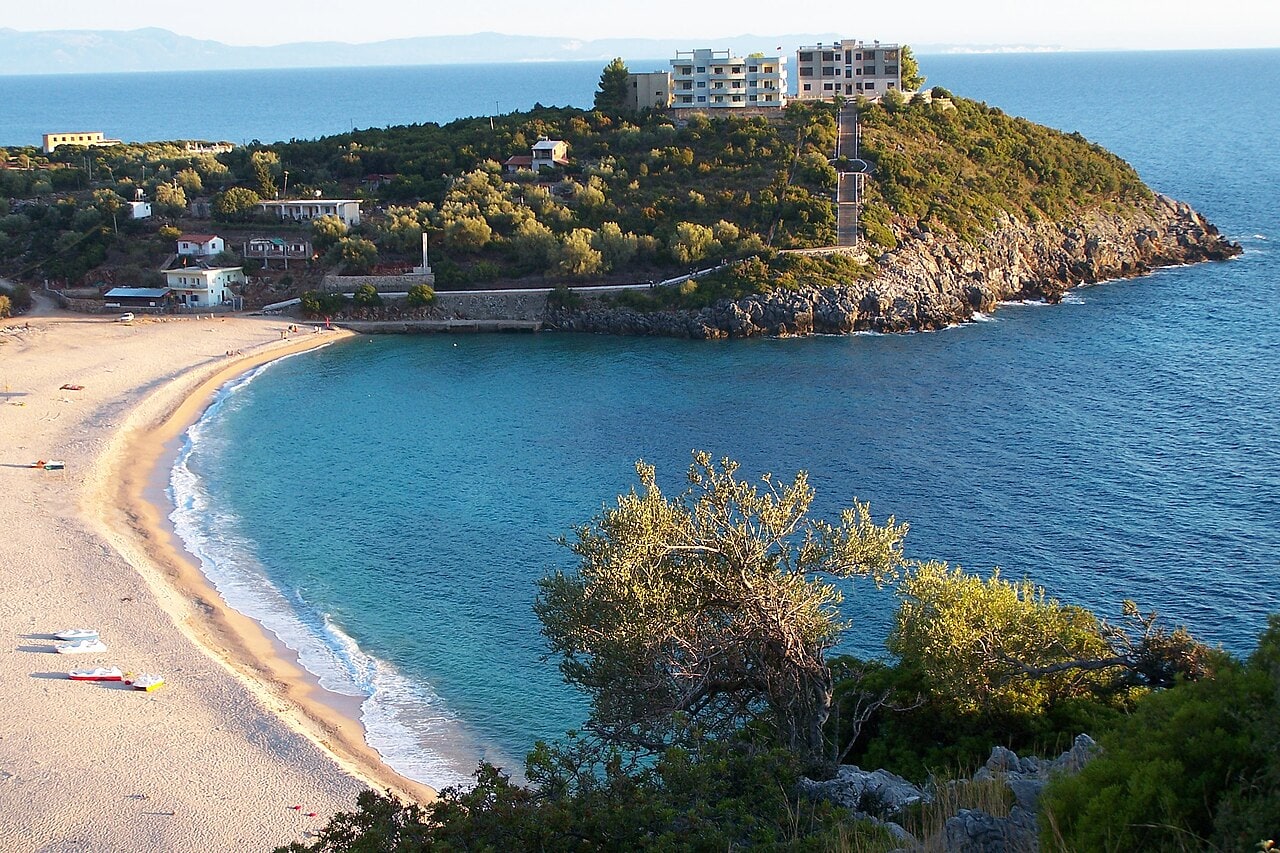
The one everyone photographs. Gjipe sits at the mouth of a dramatic limestone canyon between Himarë and the village of Vuno, and getting there takes some commitment: either a boat taxi from Himarë’s docks (running regularly in summer) or a hike — roughly 30 minutes down from the Gjipe parking area on a steep path, or the longer canyon trail from Vuno for those who want the full walk. There’s no easy road access, which is exactly why it’s stayed as beautiful as it has.
Filikuri Beach
A genuinely hidden cove south of town: walk along the bay past Potami toward the Oniro/Iliria Palace area, pick up a dirt trail through the scrub, and then descend a steep, rocky final stretch (a fixed rope helps on the last section) to reach the water. Figure on about an hour on foot from Himarë, or arrange a boat if the scramble doesn’t appeal. It’s not a beach for flip-flops or small children, but it’s one of the quietest patches of water in the area precisely because of that.
Himarë Old Town & Castle
Above the modern seafront town, a steep road climbs to Himarë’s Old Town — known locally as Kastro — a hillside settlement built around a castle whose walls have stood, in one form or another, for roughly 2,500 years. The earliest fortifications on this hill are attributed to the Chaonians, an ancient Greek tribe that controlled much of the surrounding Epirus coast, with the settlement later mentioned in Roman-era writing.
Did you know?
Himarë’s hilltop is believed to have been first fortified as early as the 5th century BC. Walking the walls today, you can see the layering of that history in the stonework itself — rough, megalithic blocks at the base give way to more refined Byzantine masonry higher up, with the ruined Church of Saint Michael, built in the 13th century, still standing inside the walls.
The Old Town declined during the communist period (1944–1991), as families moved down the hill into the newly built seafront town and the state pushed modernization over preservation. Restoration has been slow but steady since, and today Kastro is a genuine, if quiet, place to wander — narrow stone lanes, old houses in varying states of repair, and views back down over the roofs of modern Himarë to the sea.
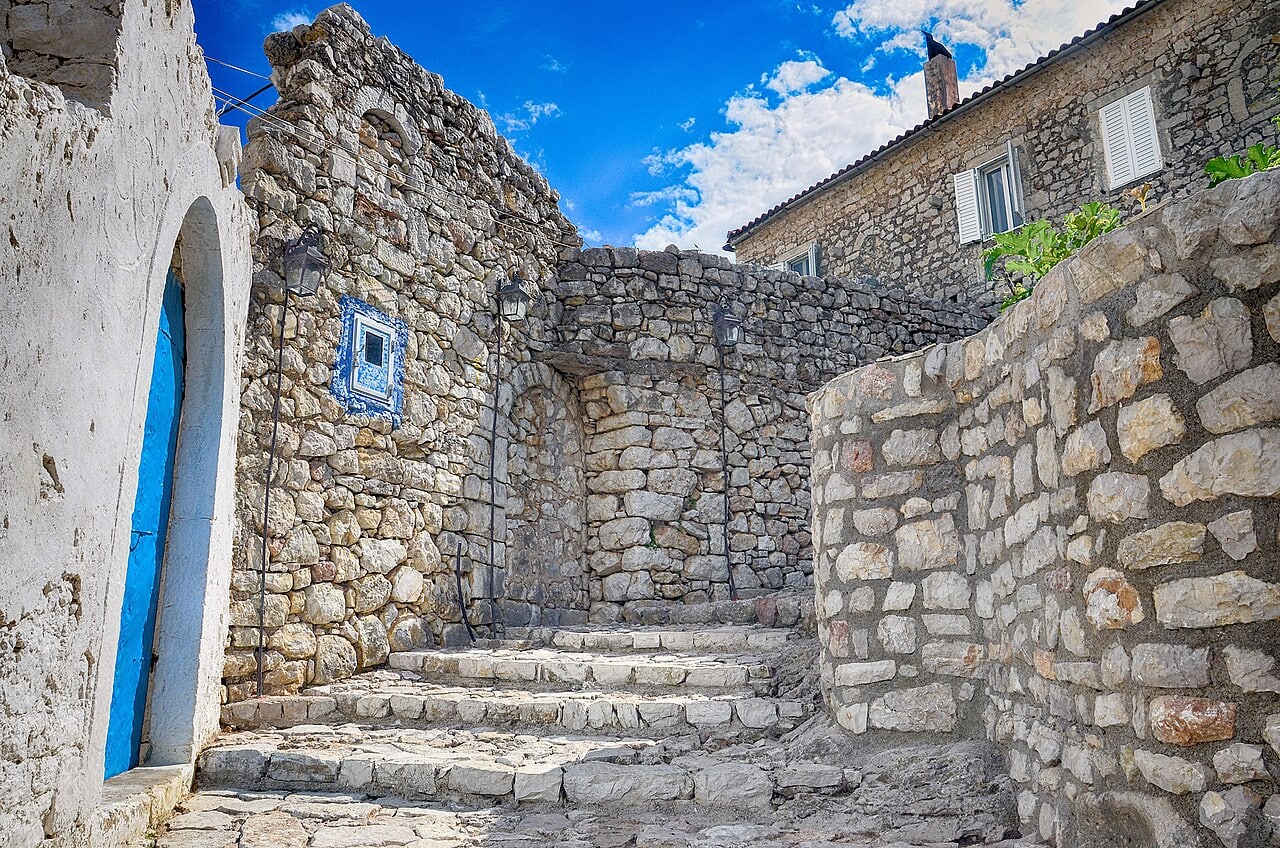
This is also the historic heart of Himarë’s Greek-speaking community. The coastal Himarë area has long been home to an ethnic Greek population alongside ethnic Albanians — the most recent census put the municipality’s population at around 60% self-identified Albanian and roughly a quarter self-identified Greek, though the exact proportions are genuinely disputed between local and national counts, and it’s not our place to adjudicate that here. What’s not in dispute is that the local Greek dialect, known as Himariote Greek, has been spoken in this pocket of the coast for centuries, shaped by the region’s relative isolation and preserving older forms of the language. For several hundred years under Ottoman rule, Himarë also held a degree of local autonomy rare on this coast, with residents known for maritime trade and a fiercely independent streak. Albanian and Greek are both spoken here today, church signage and place names reflect that dual heritage, and it’s part of what makes the Old Town feel distinct from other Riviera towns rather than a footnote to it.
Porto Palermo Castle & Bay
A few kilometers south of Himarë, the road passes one of the Riviera’s more striking detours: Porto Palermo Castle, sitting on a small promontory in a bay that’s easily one of the prettiest on this stretch of coast. The castle was built in 1804 under Ali Pasha of Ioannina, the semi-autonomous Ottoman-era ruler whose territory once stretched along much of this coastline — some accounts suggest he rebuilt an earlier, possibly Venetian-era fortification rather than starting from nothing, though the structure standing today is very much his.
It’s a compact, three-sided fortress with gun bastions at each corner, originally built on what was a small island before landfill connected it to the mainland. Its purpose was practical rather than decorative: garrisoning troops to keep watch over a local population that had repeatedly resisted Ottoman authority. The castle was declared a protected cultural monument in 1948 and now functions as a small museum you can walk through, with the bay itself — deep blue, ringed by hills, usually far calmer than the open beaches nearby — arguably the bigger draw.
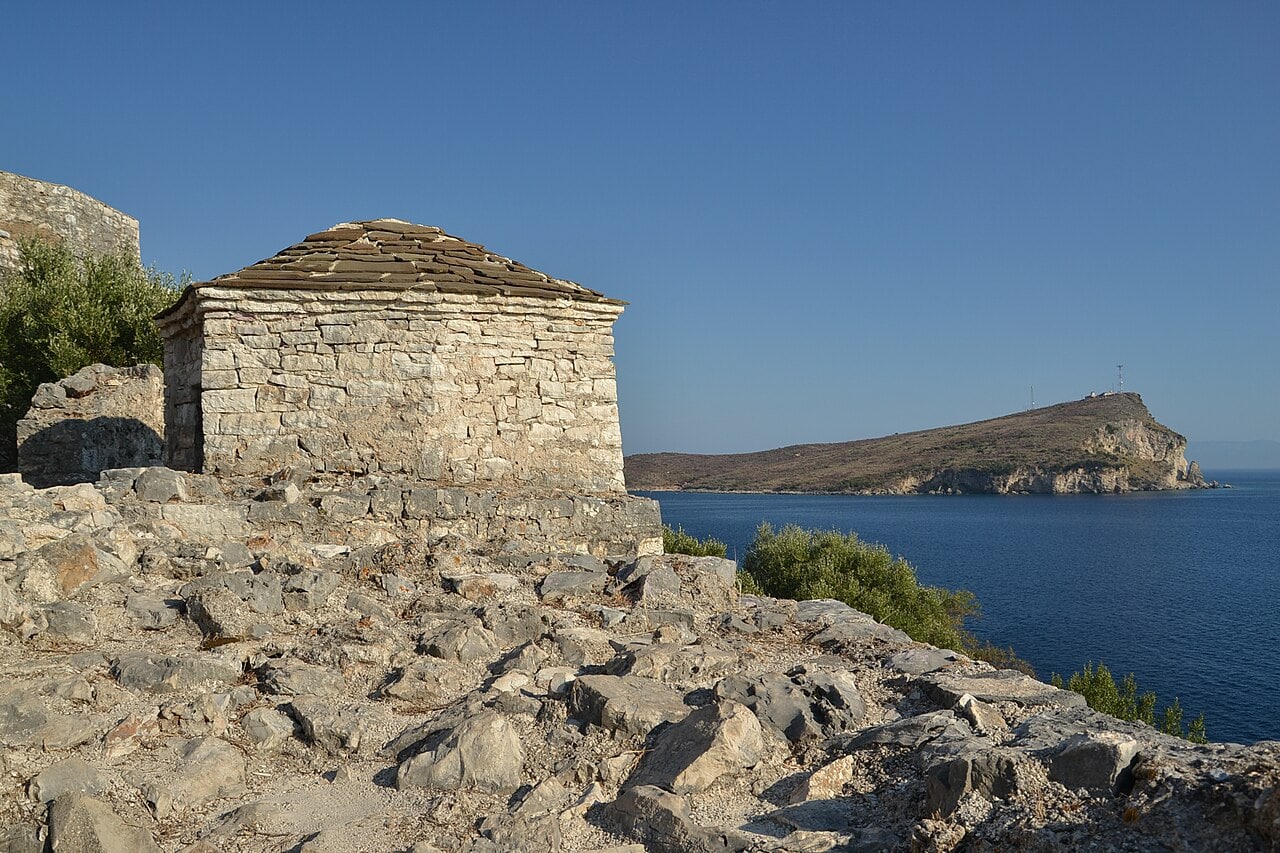
“The Riviera is full of ruins that look better in photographs than they do up close. Porto Palermo is the opposite — a modest little fortress that punches well above its size because of the bay it sits in.”
Pair it with a swim: there’s a beach right beside the castle, and the water inside the sheltered bay tends to be calmer than the more exposed coves further north, which makes it a reasonable stop for families or anyone who’d rather not deal with waves.
Food & Where to Eat
Himarë’s food scene runs on fresh seafood, simply prepared — this is a fishing coast before it’s anything else, and the better restaurants lean into that rather than overcomplicating it. Grilled fish, octopus, and mixed seafood platters are the standard order; along the Spile promenade, tavernas with decks extending out over the water are the classic setting, and octopus in particular comes recommended at several of the long-standing seafront spots.
The town center also has a more varied dining scene than you might expect for its size — Italian-leaning restaurants doing wood-fired pizza and handmade pasta alongside the seafood-focused tavernas, plus a couple of more upscale promenade restaurants offering a step up from the standard beach-bar menu for anyone wanting a proper sit-down dinner.
As with most of the Riviera, prices rise the closer you sit to the water and the higher the season gets. Walking one street back from the seafront, or eating in Llaman or Livadhi rather than directly on Spile, tends to get you the same quality of fish for less.
Best Time to Visit
May–June and September are the sweet spots for Himarë, the same as the rest of the Albanian Riviera: warm enough to swim comfortably, without the peak-July crush or the highest prices. The climate here is Mediterranean — mild winters, hot summers — and July and August regularly push daytime temperatures toward 30°C (86°F), with the beaches, restaurants, and roads to match in terms of crowding.
If your schedule is flexible, shoulder season also makes the drive itself more pleasant — less traffic on the Llogara Pass switchbacks, and no scramble for parking at Jalë or a boat slot to Gjipe. Winter is genuinely quiet; some seasonal businesses close entirely, and it’s more of a fishing-village atmosphere than a resort one.
Practical Tips
- Rent a car if you can. Himarë’s best beaches are spread across several kilometers, and public transport between them is thin outside the main SH8 route. A car turns a frustrating logistics puzzle into an easy day of beach-hopping.
- Carry cash in lek. Furgons, beach parking, and many smaller tavernas outside the main season are cash-only.
- Pack water shoes. Like most of the Riviera, Himarë’s beaches are pebble rather than sand — comfortable water shoes make a real difference.
- Book ahead in July–August. Accommodation in and around Himarë fills up fast in peak summer; shoulder-season travelers have far more flexibility.
- Drive the Llogara Pass carefully, especially after dark or in poor weather — it’s scenic but narrow, with tight switchbacks.
- For a wider set of Albania-specific logistics — SIM cards, tipping, safety, road rules — our general Albania travel tips guide covers the basics that apply beyond just the Riviera.
Frequently Asked Questions
Is Himarë worth visiting?
Yes — it offers the same clear Ionian water as the more famous Riviera stops, spread across several distinct beaches, plus a genuinely old hillside castle town and an easy detour to Porto Palermo, with noticeably fewer crowds than Ksamil or central Sarandë in peak season.
How do I get from Vlorë or Sarandë to Himarë?
By car it’s roughly 70 km (1.5–2 hours) from Vlorë over the Llogara Pass, or around 60 km (about 1.5 hours) from Sarandë. Regional coastal buses and furgons also run the route several times a day in summer, with service dropping off outside the June–September season.
What is the best beach in Himarë?
It depends on what you want: Spile is the easiest (walkable from the center), Jalë and Livadhi are a short drive with more space, and Gjipe and Filikuri are the most dramatic but require a boat or a proper hike to reach.
Is Himarë Greek or Albanian?
Both, in different ways — Himarë is part of Albania, with a population that includes both ethnic Albanians and an ethnic Greek community (the Himariotes) that has lived in the area for centuries and still speaks a local Greek dialect alongside Albanian, particularly in the Old Town.
How many days do you need in Himarë?
Two to three days lets you see the Old Town, work through several beaches, and take the Porto Palermo detour without rushing. It also works well as a one- or two-night stop on a longer Riviera route between Vlorë and Sarandë.
Is Himarë cheaper than Ksamil or Sarandë?
Generally yes, especially away from the main Spile promenade — Himarë sees fewer international tourists than Ksamil, which tends to translate into more reasonable prices for food and accommodation outside the absolute peak weeks of summer.
What do you think?
Have you spent time in Himarë, or is it on your list for a Riviera trip? Which beach would you rate above the rest — Gjipe, Jalë, or somewhere quieter? Drop a comment below.
This guide reflects information available at the time of writing. Bus and furgon schedules, parking fees, and boat-taxi availability to beaches like Gjipe can change season to season — always confirm locally before planning your day around a specific departure time or price.
]]>Key Takeaways
- Tirana’s pizza scene splits into two lanes: wood-fired Neapolitan-style pizzerias run by Italian-trained pizzaioli, and local “piceri” that serve pizza as one dish among many Albanian classics.
- Blloku and the streets around Pazari i Ri (the New Bazaar) hold the highest concentration of sit-down pizzerias in the city.
- A whole pizza at a mid-range sit-down spot runs roughly 700–1,600 Lek (about €7–16), depending on toppings and how central the location is — always treat these as approximate.
- Restaurants in Tirana open and close often, so every name below has been checked against current listings, delivery platforms, and reviews rather than assumed.
- This is a “local favourites” guide, not a ranked “best of” — Tirana has dozens of pizzerias, and taste in crust and toppings is genuinely personal.
Table of Contents
By Elvis Plaku — lifelong Tirana native, blogging about Albania since 2004.
Prices and listings in this guide were last verified in August 2026. Tirana moves fast — confirm current prices and opening hours before you go.
Tirana takes its pizza seriously, and once you’ve eaten your way around the city for a while, you start to understand why. Italy is a short flight — or on a clear day, practically a horizon — away, and generations of Albanians grew up watching Italian television before Albanian TV had much to offer. Naples-style pizza culture didn’t need to be imported here so much as absorbed. What you get today is a genuine range: wood-fired Neapolitan pies from pizzaioli trained in Italy, and an older, homegrown “piceri” tradition where pizza sits on the same menu as tavë kosi and grilled meat, made to Albanian taste rather than strict Neapolitan rules.
This guide is a companion piece to our restaurant guide to Tirana and our broader guide to Albanian food — a narrower, pizza-only version of the same idea: real places, checked for whether they’re still open, with honest notes on what you’re actually getting for your money.
Tirana’s Pizza Scene: Why It’s Everywhere
Walk down almost any commercial street in Tirana and you’ll pass at least one pizzeria within a few blocks. Part of that is simple proximity — Albania sits directly across the Adriatic from Italy, close enough that Italian radio and TV signals reached the coast even during the isolationist communist decades. When the country opened up in the early 1990s, Italian food culture and investment moved in fast, and pizza was one of the easiest things to plant a flag with.
The result is a split personality in how pizza gets made here. A newer wave of pizzerias — several opened in just the last five to ten years — chase the Neapolitan standard: 00 flour, long-fermented dough, a wood-fired oven hot enough to cook a pizza in about 90 seconds, and a soft, slightly charred crust. The older Albanian habit, by contrast, treats pizza as just another item on a full restaurant menu — thicker, more heavily topped, served alongside grilled meat and salads, in places that would never call themselves a “pizzeria” first. Neither style is more “correct” — one is a specific craving, the other is a family dinner where pizza happens to be what someone in the group wants.
Wood-Fired Neapolitan Pizzerias Worth a Trip
These are the sit-down spots built specifically around Neapolitan technique — a genuine wood-fired oven, imported flour, and menus that read like they belong in Naples rather than Tirana.
PizzArte (Rruga Luigj Gurakuqi, near Pazari i Ri)
Started small and has built a strong local reputation for genuinely Neapolitan pizza out of a proper wood-fired oven — the kind of place regulars mention by name rather than “that pizza place.” Reviewers consistently point to the crust and the char. Individual pizzas are moderately priced; other menu items like salads run roughly 550–700 Lek, which gives a sense of the bracket.
Artigiano (two locations — the original near the entrance to Blloku, and a second at Vila)
Open since 2013, one of the more established names on this list. Wood-fired pizza sits alongside handmade pasta and seafood, and it’s consistently named by locals as one of the more reliable “best pizza in Tirana” answers. Expect a moderate sit-down bill — roughly 1,500–2,000 Lek per person once you add a drink and a starter.
L’Antica Pizzeria Da Michele Tirana (Rruga Brigada e VIII, in Blloku)
The Tirana outpost of the famous Naples pizzeria chain — the same name behind branches in cities like Tokyo and New York — opened in Blloku on 9 May 2025. It’s a genuine licensed branch rather than a copycat, with a large dining room — around 90 seats, 65 inside and 25 on the terrace. If you want the closest thing to an authentic Neapolitan import without leaving Tirana, this is the most direct answer.
Bella Napoli (Rruga Liman Kaba, near the National Arena)
Founded by a Neapolitan owner and built around the same wood-fired, thin-and-soft-crust approach. It’s a bit further from the Blloku cluster, which makes it a good option if you’re already near the stadium and don’t want to cross town for pizza.
Did you know?
A proper Neapolitan wood-fired oven can reach around 430–480°C (800–900°F) at the floor — hot enough that a pizza is fully baked in roughly 60–90 seconds. That’s the whole reason the crust comes out soft in the middle with dark leopard-spotting on the edge, rather than uniformly crisp the way a slower oven bakes it.
The Local “Piceri” Style
Not every good pizza in Tirana comes out of a wood-fired oven with a Neapolitan pedigree. Albanian-style “piceri” — restaurants that serve pizza as part of a broader menu — have been part of the city’s food scene for far longer than the current wave of Italian imports, and they’re worth knowing about specifically because they don’t try to be Naples.
Era Blloku (Rruga Ismail Qemali, in Blloku)
Running since 1999, which in a city where restaurants often don’t last five years makes it something of an institution. It’s a pizzeria in name, but the real draw is the full Albanian menu around it — tavë kosi, fërgesë, grilled meat, flija — served in generous portions at reasonable prices, daily from around 11:00 to midnight. This is less “go for the perfect pizza” and more “go because everyone in the group wants something different.”
This is the style you’re more likely to find outside the tourist-heavy streets — neighborhood restaurants that keep a pizza oven going without building the place’s whole identity around it. If you’re staying outside Blloku or the center, ask locally whether the nearest neighborhood restaurant does pizza; it usually does, and it’s usually fine, even if it’s not on any list like this one.
Budget Slices vs. Sit-Down Pizza
One thing Tirana genuinely lacks, compared to a city like Rome or New York, is a real “grab a slice and go” culture. Pizza-by-the-slice counters exist but aren’t the norm — most pizza here is ordered whole, either to eat in or delivered through apps like Wolt, a genuinely active market. If you want something quick and cheap, delivery or a casual sit-down spot is more realistic than hunting for a slice window.
Proper Pizza (Rruga Gjin Bue Shpata, near Stadiumi Dinamo)
Leans New York-style — bigger, foldable slices rather than the thin Neapolitan disc — aimed squarely at casual, filling meals over craft.
La Fortuna
A smaller, stone-oven spot that comes up repeatedly in local reviews for fair prices and generous portions rather than flash. Less known to visitors, which usually means less of a markup.
Forno Calabrese (Rruga Skënder Luarasi)
A newer wood-fired spot leaning southern Italian rather than strictly Neapolitan, with imported ingredients — a step up from the casual counters but below the higher-end Blloku sit-downs.
Where to Find Good Pizza by Area
If you’re trying to decide where to eat based on where you already are, here’s roughly how the city breaks down. It’s worth reading alongside our full Tirana neighborhoods guide if you’re still deciding where to base yourself.
Blloku: The densest cluster of sit-down pizzerias in the city — Neapolitan wood-fired spots (Artigiano, L’Antica Pizzeria Da Michele) and long-running local institutions (Era Blloku) within a short walk of each other. Also the most expensive part of town, so expect Blloku prices at the higher end of any range quoted here.
Pazari i Ri (New Bazaar) and the center: PizzArte and a scattering of smaller pizzerias, generally a notch cheaper than Blloku while still central and walkable from most hotels.
Around the National Arena / Stadium: A slightly less touristy pocket with its own pizzerias (Bella Napoli, Proper Pizza), generally more casual and better value than the Blloku core.
Outside these three clusters, pizza tends to be attached to neighborhood restaurants rather than standalone pizzerias — reliable, rarely remarkable, priced for locals rather than visitors.
Pizza in Tirana is less an imported trend than a naturalized one — close enough to Italy, and old enough in the local diet, that arguing over whether a place is “authentic” Neapolitan or just a good Albanian pizzeria mostly misses the point. People here have strong, specific opinions about their favorite pizzeria the same way they do about their favorite byrek stand.
Pizza Prices in Tirana: What to Expect
Prices below are approximate, gathered from menus and delivery listings rather than a single verified source — treat them as a general sense of budget, not a quote.
| Type of Pizzeria | Whole Pizza (approx.) | Examples |
|---|---|---|
| Casual / budget sit-down | ~500–800 Lek (€5–8) | Proper Pizza, La Fortuna |
| Mid-range wood-fired Neapolitan | ~700–1,200 Lek (€7–12) | PizzArte, Forno Calabrese, Bella Napoli |
| Blloku sit-down / higher-end | ~1,000–1,600 Lek (€10–16) | Artigiano, L’Antica Pizzeria Da Michele |
| Traditional Albanian piceri | ~500–900 Lek (€5–9) | Era Blloku |
A useful rule of thumb: the closer you are to the middle of Blloku, the more you’ll pay for the same size pizza — it’s a rent story more than a quality story.
Frequently Asked Questions
Is pizza in Tirana actually Italian-style, or more of an Albanian version?
Both, side by side. A newer wave of wood-fired pizzerias sticks closely to Neapolitan technique: 00 flour, long fermentation, a soft and slightly charred crust. Older neighborhood restaurants serve a thicker, more heavily topped pizza as one item on a broader Albanian menu, made to local taste rather than a strict standard.
What does a pizza cost in Tirana?
Roughly 500–1,600 Lek (about €5–16) for a whole pizza, depending on the place and how central it is. Casual and neighborhood spots sit at the low end; Blloku’s wood-fired pizzerias sit at the high end. Always check the current menu, since prices move.
Where is the best area in Tirana to find pizza?
Blloku has the highest concentration of sit-down pizzerias, including several wood-fired Neapolitan-style options within a short walk of each other. Pazari i Ri and the center are a notch cheaper and still central. Outside these areas, pizza is more often one dish on a neighborhood restaurant’s menu than a dedicated pizzeria.
Is there real Neapolitan pizza in Tirana?
Yes — several spots use genuine wood-fired ovens, and L’Antica Pizzeria Da Michele Tirana is a licensed branch of the well-known Naples chain, which opened in Blloku in 2025. PizzArte and Artigiano are also consistently mentioned by locals for a proper Neapolitan-style bake.
Can I get pizza delivered in Tirana?
Yes — most pizzerias on this list, and many more, deliver through apps like Wolt. Whole-pizza delivery is more common in Tirana than pizza-by-the-slice counters, which are relatively rare here.
Do restaurants in Tirana close often — should I double-check before I go?
Yes. Tirana’s restaurant scene moves fast, and places open, change hands, or close within a few years more often than in most Western European cities. Every pizzeria named in this guide was checked against current listings and reviews before publishing, but it’s still worth a quick look at social media or a map app before you head out, especially if you’re going out of your way.
Pizza is one of those foods where everyone thinks they know what they like, and Tirana has enough range now — from strict Neapolitan wood-fired pies to the old-school piceri down the street — that most people can find their version of “the best” without much trouble. For a longer stay, our guide to things to do in Tirana fills the hours between meals, and our guide to Blloku covers the rest of the neighborhood with the highest concentration of pizzerias in the city.
What do you think?
Have you found a pizza place in Tirana that deserves a spot on this list? Or one on here that’s changed since we last checked? Tell us in the comments — this guide gets updated as the city’s restaurant scene shifts.
Elvis Plaku has lived in Tirana his entire life and has been writing about Albania since 2004. Albanian Blogger is powered by Sfida.PRO.
]]>Key Takeaways
- Ahmet Zogu made himself king from nothing — a tribal chief’s son from Mati who became Prime Minister, then President, then, on 1 September 1928, was enthroned by Albania’s Constituent Assembly as Zog I.
- His formal title was “King of the Albanians,” not “King of Albania” — a deliberate distinction claiming all ethnic Albanians, including those living outside the country’s borders.
- He reputedly survived dozens of assassination attempts — most famously outside the Vienna State Opera in 1931 — though the exact number is popular legend, not documented fact.
- He married Countess Geraldine Apponyi in 1938, and their son, Crown Prince Leka, was born two days before Italy invaded Albania on 7 April 1939.
- Zog fled into exile and never returned, living out his life in Britain, Egypt, and France before dying in 1961.
- His remains came home in November 2012, more than seven decades after he left, reburied in a rebuilt royal mausoleum in Tirana.
Table of Contents
- Introduction
- The Mati Chief Who Refused to Stay Small
- King of the Albanians, Not King of Albania
- Building a Kingdom Out of Almost Nothing
- The Night Outside the Vienna Opera
- A Queen for Albania
- April 1939: The Crown Runs Out of Time
- A King Without a Country
- The Long Road Home
- What Zog Means to Albanians Today
- Frequently Asked Questions
- Closing
Introduction
Every country has a founding myth it tells proudly. Albania has one it tells with a raised eyebrow.
Ask most Albanians about King Zog and you won’t get a straightforward answer. You’ll get a smirk, maybe a joke about how many cigarettes the man supposedly smoked, definitely a mention of the assassination attempts, and then — if the conversation runs long enough — something more complicated. Because whatever else he was, Ahmet Zogu is the only Albanian in history to actually become a king. Not born into it. Not married into it. Built it himself, out of tribal politics, a private army, and sheer nerve — then lost it all in eleven years.
I grew up in Tirana hearing pieces of this story long before I understood how strange it really is. A local chieftain’s son who ends up styled “His Majesty,” dodging bullets outside a Vienna opera house, marrying a Hungarian countess, and dying in a French hospital having never seen his country again. It sounds invented. It happened here, in living memory of people whose grandparents could still tell you about it.
For me this is not quite history. Zog came from Mat, the highland region in the north-centre of the country — the same ground that produced Gjon Kastrioti, Skanderbeg’s father, which tells you something about how that part of Albania has long seen itself. It sits where the north meets the centre, and people from there carry a particular sense of having been the ones who held the line, whether against the Ottomans, the Slavs or the Greeks.
But his court was in Tirana, and that is where my father comes in. He is still alive, and he grew up in a Tirana that has nothing to do with the city you will walk through today — not a metropolis but something closer to open field, a handful of buildings and old houses, almost everybody poor and living a more or less rural life even after the place became the capital. He roamed it as a boy. What he remembers, and still tells me, is standing with his own mother watching the king’s sisters ride out on horseback. That is the Tirana Zog ruled: a place where a woman could take her son to the edge of a field and watch the royal family go by.
So let’s do this one properly — not the tabloid version, and not the dry textbook version either. The real story, with legend clearly marked as legend, and fact treated with the seriousness it deserves.
The Mati Chief Who Refused to Stay Small
Ahmet Zogu was born in 1895 in the highlands of Mati, into a family that led one of the region’s tribal clans — the kind of hereditary authority that meant something in the mountains but nothing in Europe’s chancelleries. Albania itself was barely a country yet, having declared independence from the Ottomans only in 1912. For the next decade it was less a functioning state than contested territory that Italy, Serbia, and Greece all had opinions about.
Into that vacuum stepped Zogu — young, ambitious, willing to build and lead an armed following and out-maneuver rival strongmen one by one. By 1922 he was Minister of the Interior, then Prime Minister. A 1924 uprising briefly forced him into exile in Yugoslavia, but he returned the same year at the head of a force that retook the capital. In January 1925 he had himself elected President of the new Albanian Republic.
A republic whose president commands his own militia rarely stays a republic. On 1 September 1928, Albania’s Constituent Assembly formally enthroned him as King Zog I. He was thirty-two, and he had gone from mountain chieftain to monarch without a drop of royal blood — through political nerve and control of force alone. Albania has produced its share of unlikely figures who reached far beyond their origins, but none quite like this.
Did you know?
Zog is one of the few people in modern history to go from a small nation’s tribal aristocracy to reigning monarch purely through his own political and military maneuvering — no dynastic marriage, no inherited throne, no foreign crown handed to him at the start.
King of the Albanians, Not King of Albania
Here’s a detail most quick summaries flatten, and it matters more than it looks: Zog’s formal royal style was “King of the Albanians” (Mbret i Shqiptarëve), not “King of Albania.”
That’s not a translation quirk. It was a deliberate choice, read as a deliberate provocation by Albania’s neighbors — especially Yugoslavia, which had a large ethnic Albanian population within its own borders, particularly in Kosovo. A king “of Albania” reigns over territory. A king “of the Albanians” claims a people, wherever they live. It planted a flag, rhetorically, well beyond Albania’s actual borders.
Whether Zog fully intended that geopolitical weight or simply reached for the grander title, it stuck. For a country barely sixteen years past its own declaration of independence, that was an audacious thing to put on the letterhead.
What strikes me about the title is less the geography than what it bought. Europe in the 1930s still ran largely on kings and princes, and for a country as new and as poorly regarded as Albania then was, having a king at all was a way of being spoken to as an equal rather than as a problem to be managed. The marriage served the same end: he married Countess Geraldine Apponyi, of a Hungarian noble family, in Tirana in April 1938, and that was taken seriously at the time in a way that is easy to underrate now. It placed Albania, briefly, inside the same club as everybody else.
Building a Kingdom Out of Almost Nothing
Once crowned, Zog governed the way he’d fought his way to the throne: firmly, personally, with little patience for institutions that might check him. Albania under Zog was, in practice, an authoritarian monarchy — opposition suppressed, the press controlled, power radiating outward from the king far more than from parliament.
But he also did things the old tribal chiefs of his own class had never bothered with. He pushed a legal code modeled partly on European civil law to replace the patchwork of customary tribal law, including the ancient Kanun, that had governed the highlands for centuries. He tried, with mixed success, to build roads, schools, and a functioning central administration in a country that had almost none of it.
He also leaned heavily — too heavily, it turned out — on Fascist Italy for loans, military training, and political backing, a dependency that quietly mortgaged the independence his crown was supposed to guarantee. That tension between sovereignty and survival runs through much of Albania’s twentieth century, and Zog’s reign is where the pattern really takes hold.
The Night Outside the Vienna Opera
No part of the Zog story gets more retelling than the assassination attempts. Popular Albanian lore puts the number at around fifty-five over his political and royal career — a figure repeated so often it’s practically folklore, though it isn’t a documented, verified statistic. What is documented is that Zog survived a genuinely extraordinary number of plots and attacks, consistent with the blood-feud politics of the era and the enemies a self-made monarch accumulates on the way up.
The most famous incident happened far from home. On 20 February 1931, Zog was leaving the Vienna State Opera after a performance of Leoncavallo’s Pagliacci when gunmen opened fire. An aide was killed, and his companion, diplomat Ekrem Libohova, was wounded. His later biographers describe Zog drawing his own pistol and returning fire — a dramatic detail that’s become part of the legend — though contemporary reporting, including TIME magazine, described him ducking back inside the opera house instead. The two accounts don’t fully agree, a good reminder of how quickly a near-miss becomes legend once enough decades pass.
I cannot settle which account is true, but I can tell you which one rings right to me, and why. Albanians have never been especially good at organising, and we have always been too few to push back the powers that came for us, particularly once those powers had a superpower behind them. What we did have, as far back as the ancient accounts, was a reputation for courage — front-line men, praised for something close to indifference about dying. In Zog’s Albania that was not a sentiment, it was a survival mechanism: if you showed fear, people sensed it, and your enemies acted on it. A man who had made himself king out of a Mat chieftaincy, with almost none of the apparatus a real monarchy would have given him, had got there by never once letting that show. So of the two versions, the one where he draws his own pistol on a Vienna pavement is the one that fits the man and the moment. Take that as my read, though, not as my evidence.
He reputedly survived more assassination attempts than any other head of state in modern history — a claim repeated so often across Albania that it has become as much a part of his legend as any verified fact of his reign.
A Queen for Albania
For most of his reign Zog stayed unmarried, a bachelor king in his late thirties. That changed in 1938, when he married Countess Geraldine Apponyi, a young Hungarian aristocrat, on 27 April in Tirana — a genuinely lavish affair for a country that rarely got the chance to stage one.
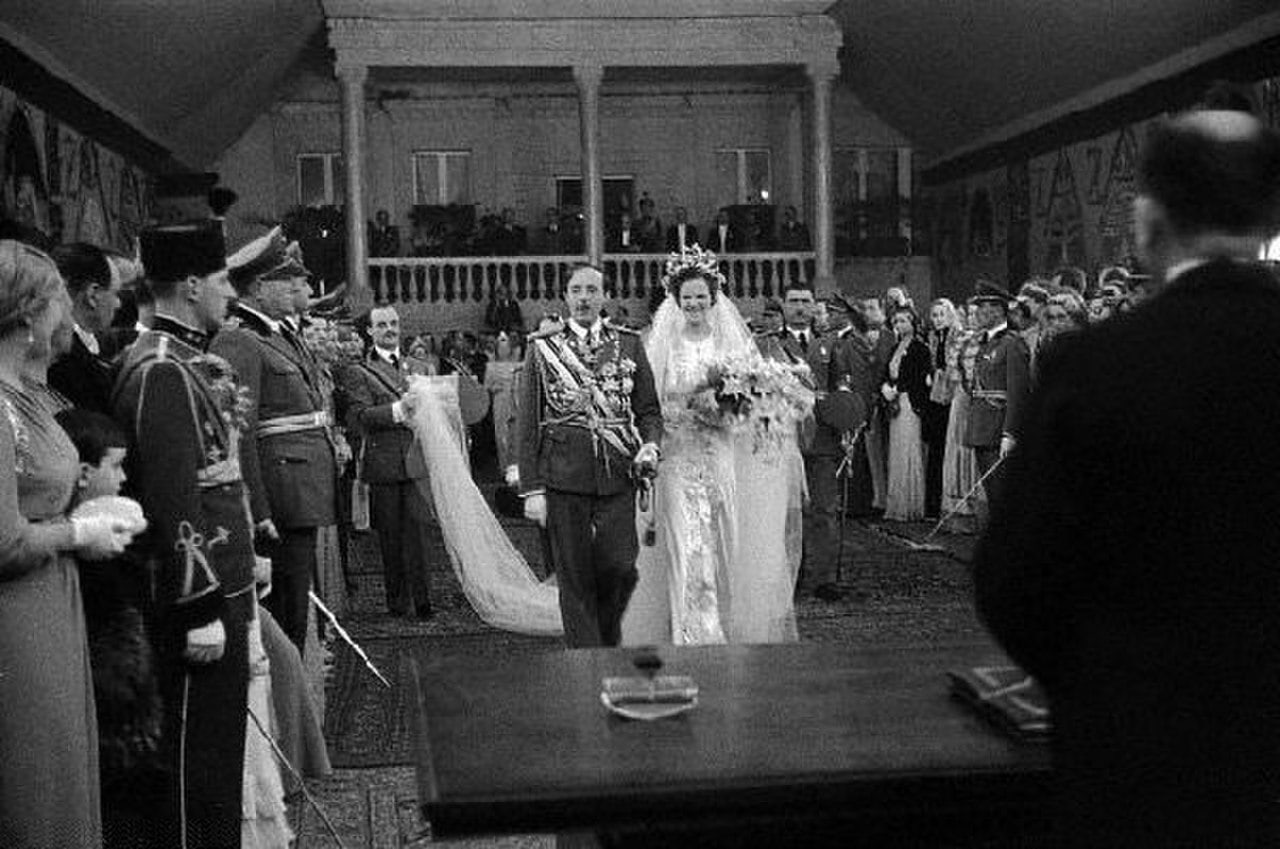
Geraldine became Queen of the Albanians, and less than a year later, on 5 April 1939, gave birth to their son and heir, Crown Prince Leka. It should have secured the dynasty. Instead it was the opening act of the end — Leka was two days old when Mussolini’s forces landed on Albania’s coast.
April 1939: The Crown Runs Out of Time
On 7 April 1939, Good Friday, Fascist Italy invaded. Zog’s small, poorly equipped forces put up scattered resistance, but there was never a realistic prospect of holding off a modern army. Within a day, the royal family made the decision that would define the rest of Zog’s life: rather than negotiate a puppet arrangement with Rome, they fled.
Zog, Geraldine, and their infant son crossed into Greece on 7–8 April 1939, carrying little in terms of a settled future. The formal transfer of power in Tirana followed on 12 April, when an Albanian assembly under Italian pressure offered the crown to Victor Emmanuel III of Italy, uniting the two crowns and ending Zog’s reign after not quite eleven years.
He would never set foot in Albania again.
A King Without a Country
What followed was two decades of exile through Greece, Turkey, Romania, France, Britain, and eventually Egypt, where the family lived for a time as guests of King Farouk. Zog kept a government-in-exile fiction alive for a while and kept issuing statements, but the substance of a kingdom was gone.
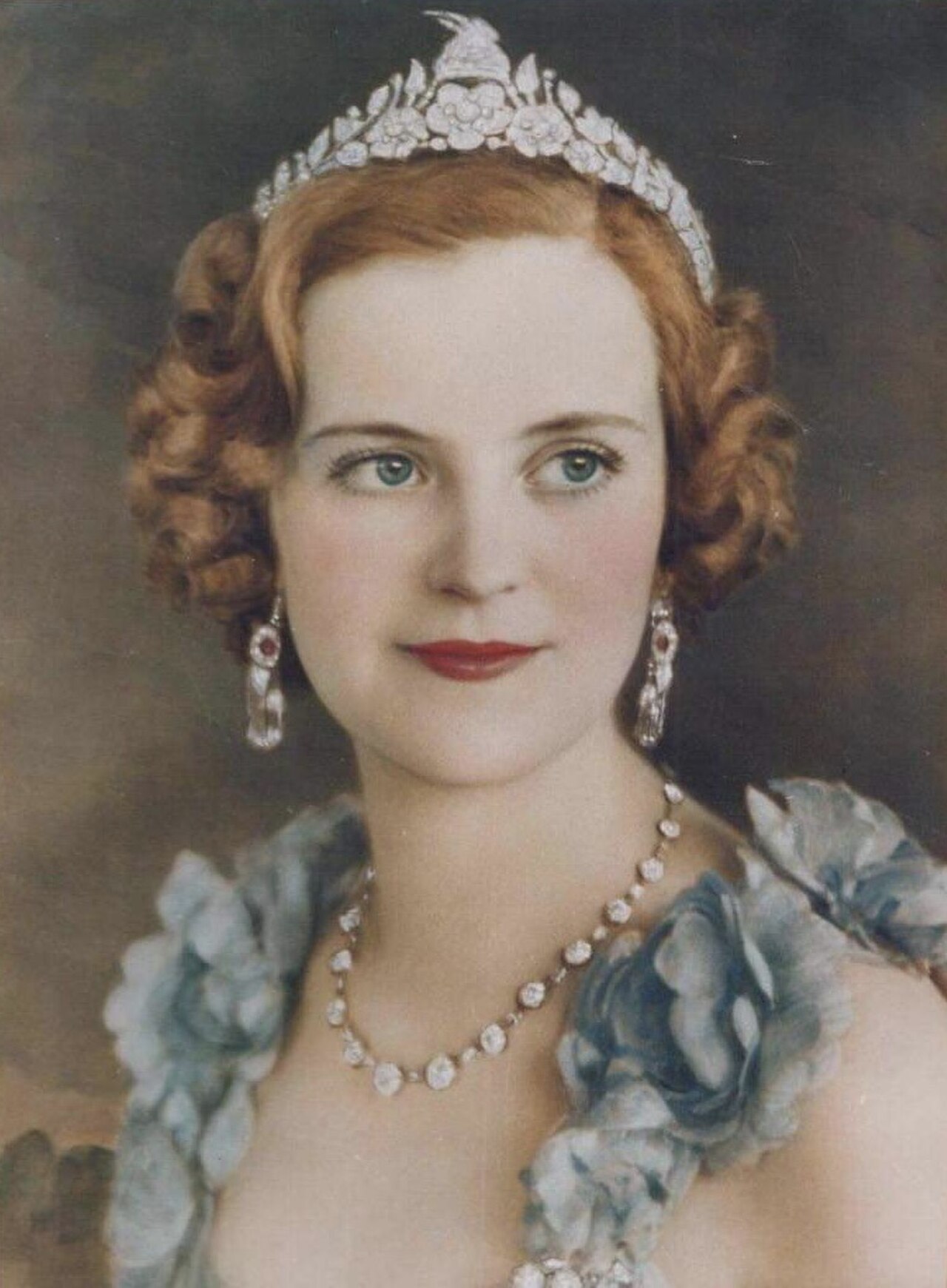
One detail still argued over, in Albania and among historians alike, is the gold. According to contemporary and later reports, Zog left in 1939 with a substantial quantity of state and treasury gold, reportedly loaded onto the royal train as Italian forces closed in. The exact amount, and whether it was a legitimate evacuation of reserves or a personal fortune, remains disputed — the answer tends to depend on who in Albania you ask.
Whatever the truth of the gold, it bought a comfortable exile. The family eventually settled in France. Zog reputedly smoked heavily — legend puts the figure at 150 to 200 cigarettes a day, almost certainly exaggerated folklore rather than verified fact, but fitting the outsized way Albanians still talk about him.
Back home, the Albania he’d ruled went from Italian occupation to German occupation to communist takeover, closing any realistic path back to the throne. The decades that followed under Enver Hoxha erased almost every physical trace of the monarchy, and for nearly fifty years, mentioning King Zog favorably in Albania could be dangerous.
The Long Road Home
Zog never returned. He died on 9 April 1961 at the Foch Hospital in Suresnes, just outside Paris, still formally a king with no kingdom to govern. His son Leka carried the claim forward as a pretender for decades, but the practical story of King Zog I ends in that Paris suburb in 1961.
For more than fifty years that’s where it stayed — a grave in France, a chapter closed by communism. Then in November 2012, as Albania marked the centenary of its 1912 independence, the state arranged for Zog’s remains to be repatriated and reburied in a rebuilt royal mausoleum in Tirana, more than seventy years after he left as a fleeing king with an infant son and a train full of gold.
What Zog Means to Albanians Today
So what do Albanians actually make of him now?
Honestly, it depends who you ask, and that ambivalence is the most honest answer there is. To some, he’s a significant figure: the man who gave Albania its first real taste of centralized statehood and kept it nominally independent through volatile interwar years longer than many expected. To others, he’s remembered as an authoritarian who suppressed dissent, leaned on foreign powers for survival, and left the moment the fighting got serious — taking a fortune with him.
Where I land is probably where most Albanians land, which is somewhere less argumentative than either position above. Nobody elected him. He took power and he held it. And yet he is accepted — ask around and you will find people perfectly comfortable saying that Albania had a king, and meaning it without irony. He represented us at a point when being represented at all was not guaranteed, and that has outlasted the argument about how he governed.
What’s not in dispute is the scale of the story itself. A tribal chief’s son who made himself king, gave that kingship a name bold enough to unsettle his neighbors, dodged an opera-house ambush, married a countess, and lost everything to a fascist invasion before his infant son had opened his eyes properly. That’s not a story Albania needed to invent. It happened, largely within one eventful decade, and its echoes are still walked past every day in Tirana.
The echo easiest to miss is the city itself. The Tirana my father roamed was barely built; what gave it the shape of a capital was the Italian involvement that began as cooperation under Zog’s own agreements and then continued, far more heavily, once cooperation had turned into occupation. So the ceremonial centre you walk through is partly his doing and partly the doing of the people who removed him — an uncomfortable thing to say about a capital, and true all the same.
If you want to see where those echoes still sit in the modern city, Tirana rewards the kind of visitor willing to look past the surface. And if the monarchy period leaves you curious about what actually outlasted it, Albania’s older cultural threads run deeper and stranger than most outsiders expect.
Frequently Asked Questions
Who was King Zog of Albania?
Ahmet Zogu (1895–1961) was an Albanian tribal leader from Mati who rose through Albanian politics to become Prime Minister in 1922, President in 1925, and finally King Zog I on 1 September 1928, when Albania’s Constituent Assembly enthroned him as monarch. He ruled until Italy’s invasion forced him into exile in April 1939.
Why was he called “King of the Albanians” instead of “King of Albania”?
His formal royal style, “King of the Albanians” (Mbret i Shqiptarëve), deliberately referred to the Albanian people rather than the territory alone — a claim extending to ethnic Albanians beyond the country’s borders, particularly in Kosovo, which alarmed neighboring Yugoslavia at the time.
Did King Zog really survive around 55 assassination attempts?
That figure is widely repeated in Albanian popular lore and by some counts in secondary sources, but it isn’t a rigorously documented statistic. Understand it as legend built around a genuinely high number of real threats, not a verified historical count.
What happened in the 1931 Vienna assassination attempt?
On 20 February 1931, gunmen attacked Zog as he left the Vienna State Opera after a performance of Pagliacci. His aide was killed and his companion Ekrem Libohova was wounded. Biographers describe Zog returning fire, though contemporary reports, including TIME magazine, described him retreating back inside instead.
Did King Zog take Albania’s gold reserves when he fled in 1939?
According to contemporary and later reports, Zog left with a substantial amount of state and treasury gold as Italian forces invaded. The exact amount and the legitimacy of taking it remain disputed among historians and within Albania itself.
Is King Zog buried in Albania today?
Yes. Zog died on 9 April 1961 in Suresnes, France, and was buried there for over fifty years. In November 2012, his remains were repatriated and reburied in a rebuilt royal mausoleum in Tirana, alongside Queen Geraldine and other family members.
Closing
King Zog isn’t a comfortable figure to sum up in a tidy sentence, and I don’t think he should be. A self-made monarch in a century that had mostly stopped producing those, an authoritarian moderniser, a survivor of real danger wrapped in exaggerated legend, and a man who left carrying his country’s gold and never came back to answer for any of it — until his bones did, seventy-three years later.
That’s Albania’s relationship with its own history in miniature: complicated, argued-over, not fully settled, and more interesting for it.
What do you think?
Had you heard of King Zog before reading this? Does a self-made king who fled with the treasury deserve more credit or more criticism than history usually gives him? I’d love to hear your take in the comments.
Key Takeaways
- Shkodër is northern Albania’s cultural capital — flat, low-rise and genuinely cyclable, with bike lanes on most main streets and a café culture that runs from morning to late.
- It is not a day trip. Two nights is the minimum that does it justice: Rozafa Castle, the Marubi photography archive, the old bazaar, the lake and the pedestrian boulevard each want real time.
- The Marubi National Museum of Photography holds the first photograph ever taken in Albania (1858) and around half a million negatives — the most important historical photographic archive in the country.
- From Tirana it is roughly 1.5–2 hours by car on the SH1, or a furgon from the Zogu i Zi terminal.
- It is the natural base for the Albanian Alps — Theth, Komani Lake and the Valbona valley all start from here — and two Montenegro border crossings sit within easy reach.
Table of Contents
- Why Shkodër Deserves More Than a Day
- Getting to Shkodër from Tirana
- Rozafa Castle
- The Old Bazaar and Rruga Kolë Idromeno
- Marubi: The Archive That Explains the North
- The North’s Under-Told Literary Heritage
- Lake Shkodra and the Mesi Bridge
- A City That Runs on Bicycles
- The Thing Nobody Warns You About: Shkodran Humour
- Where to Eat, Drink and Stay
- Using Shkodër as a Base for the North
- When to Go
- Practical Tips
- Frequently Asked Questions
By Elvis Plaku — Tirana native, blogging about Albania since 2004.
Written from repeated visits through 2026. Opening hours, prices and transport details change — confirm anything time-sensitive before you travel.
Let me be straight about my own position here: I am from Tirana, not Shkodër. I have been coming to this city for years — not as often as I would have liked — and I have never once left feeling I was finished with it. That is the honest starting point for this guide, and it is also the single most useful thing I can tell you about Shkodër. It is a city that does not give itself up on a first pass.
Most itineraries treat it as a stop: a castle photographed on the way to Montenegro, or a night before a bus into the mountains. That is a mistake, and this guide is my case for why. If you want the shorter, more atmospheric version — one evening, a theatre, a boulevard and a bazaar after dark — I have written that separately as One Night in Shkodra. What follows is the full guide: what to see, how to get there, and how to use the city as a base.
Why Shkodër Deserves More Than a Day
Shkodër is an ancient city, and that is not a tourist-brochure adjective — it is the reason the place feels different from anywhere else in Albania. Its history is a long record of a population working to hold on to its own character, and you can still feel that independence in how people carry themselves. Shkodrans are, to put it plainly, a fiercely independent lot.
Physically, it is the opposite of Tirana. Shkodër is relatively flat, the streets are wide rather than pinched, and the buildings are mostly low. A few taller ones have started going up, but nothing like the skyline my own city has grown. The practical consequence is that you actually get to see the older city: the nineteenth-century facades, the bazaar streets, the proportions the place was built with. In Tirana you look up at new towers. In Shkodër you look along old streets.
There is also a demographic shift worth understanding, because it changes the texture of a visit. The city has absorbed a lot of people from the surrounding region over recent decades. Some older residents will tell you, with feeling, that this has changed the town. Whatever you make of that, it means the Shkodër you walk into is a mix of people from across the north — and if you talk to them, you get a far richer picture of the whole region than any single town could give you.
Getting to Shkodër from Tirana
It is an easy trip, which is part of why so many people underrate the city — it is simple to pass through.
| Option | What to Know |
|---|---|
| By car | Roughly 1.5–2 hours north on the SH1. The most flexible option, and the one that makes the lake, the Mesi Bridge and the mountain valleys realistic in the same trip. |
| Furgon / minibus | Shared minibuses run regularly from Tirana’s Zogu i Zi terminal. No advance booking; they leave on a loose schedule or once full. See our complete guide to getting around Albania. |
| From Montenegro | The two crossings that matter for Shkodër are Hani i Hotit (Božaj) and Muriqan–Sukobin. Both put you in the city within the hour. |
On my last visit, locals were talking about an additional crossing into Montenegro opening up and what it would do for overland traffic through the north. I want to be careful here, because I have seen that story told as though it were settled: a further crossing at Qafë Vranicë, inland towards Tropojë, is on the books as planned, but I have not seen a confirmed opening date. Treat it as something to watch, not something to plan around.
What is unmistakably real is the camper-van traffic. Someone who has been running camper tours in Albania for four or five years told me his competition has multiplied, simply because everyone has worked out that this country suits slow overland travel. Shkodër sits where the lake, the Alps, the Adriatic and the Montenegrin border all meet, which makes it a natural stop for exactly that kind of trip.
Rozafa Castle
The castle is the one thing nearly every visitor does, and it earns its reputation. It sits on a hill southwest of the centre, and the view is the point: the Drin and Buna rivers below, the lake spreading north, and Montenegro beyond it. Give it two to three hours rather than the twenty minutes a tour bus allows — the site is bigger than it looks from the road, and the walk up is part of it.
Go late in the afternoon if you can. The light is better, the heat has gone out of the day, and you get the lake at its best.
The Old Bazaar and Rruga Kolë Idromeno
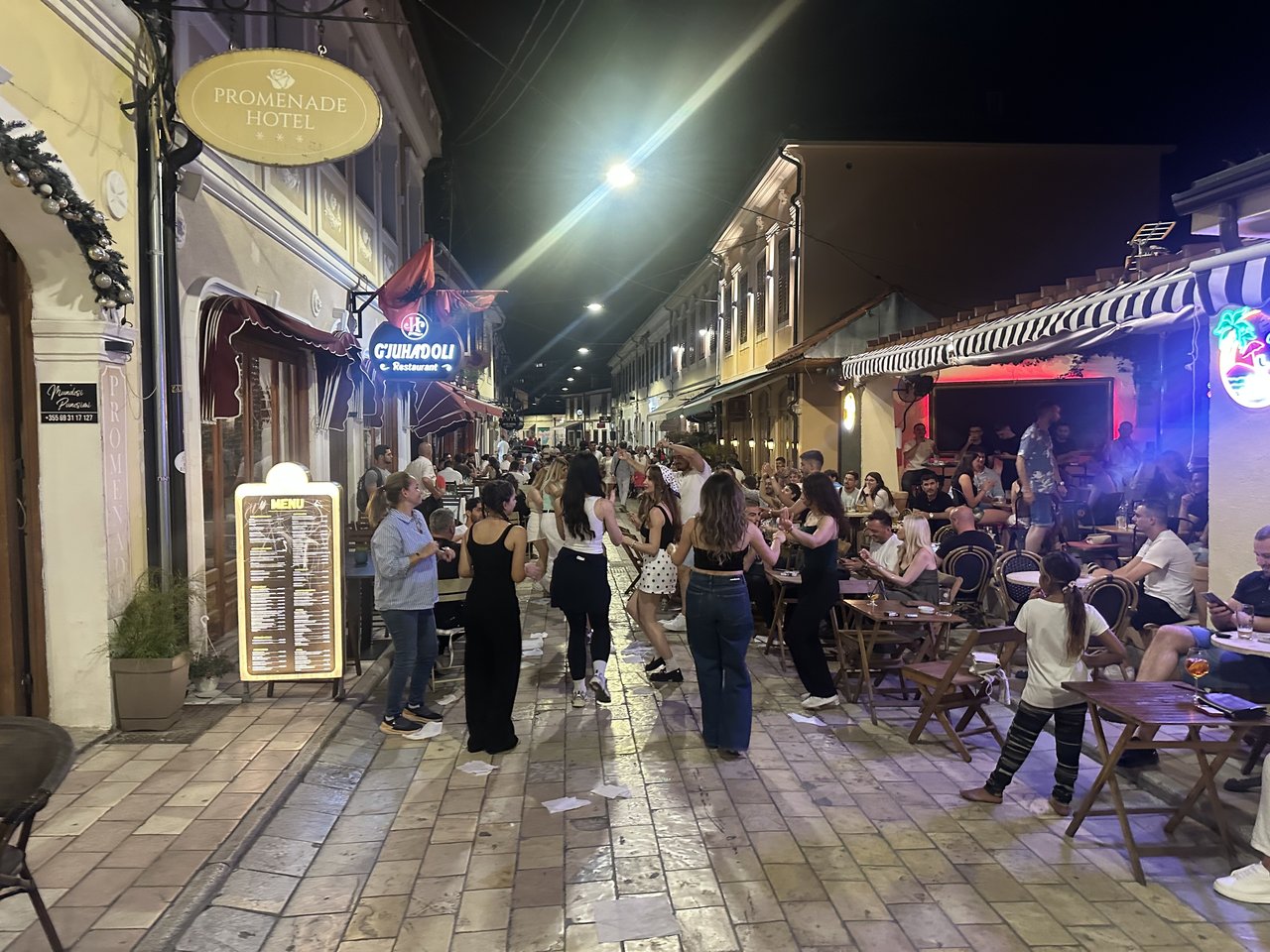
Rruga Kolë Idromeno is the pedestrian spine of the city, and the restored bazaar streets run off it. This is where you understand the scale of old Shkodër: shopfronts at human height, stone and shutters, and a width that was designed for people rather than cars.
Walk it twice — once in daylight to actually look at the buildings, and once in the evening when the whole city comes out. The evening version is a genuine social institution rather than a tourist event, and it is the subject of the companion piece to this guide.
Marubi: The Archive That Explains the North
If you do one indoor thing in Shkodër, do this. The Marubi National Museum of Photography is not a provincial collection of old prints. It is the most important historical photographic archive in Albania and one of the most significant in the Balkans.
The studio was founded in Shkodër in 1856 by Pietro Marubbi, an Italian painter and photographer who settled here. Over three generations, into the 1950s, the Marubi family photographed Albanians — their faces, clothes, towns, weddings, funerals and politics — at a time when almost nobody else was. The archive runs to hundreds of thousands of negatives, including glass plates, and takes in roughly half a million more from other Albanian photographers. The museum in its current form opened in 2016.
Did you know?
The first photograph ever taken in Albania was made by Pjetër Marubi in 1858 — and it is held here, in Shkodër. The same studio photographed the delegation of the Sanjak of Shkodra at the League of Prizren in 1878. When people say the north is central to Albanian history rather than peripheral to it, this archive is the evidence.
The North’s Under-Told Literary Heritage
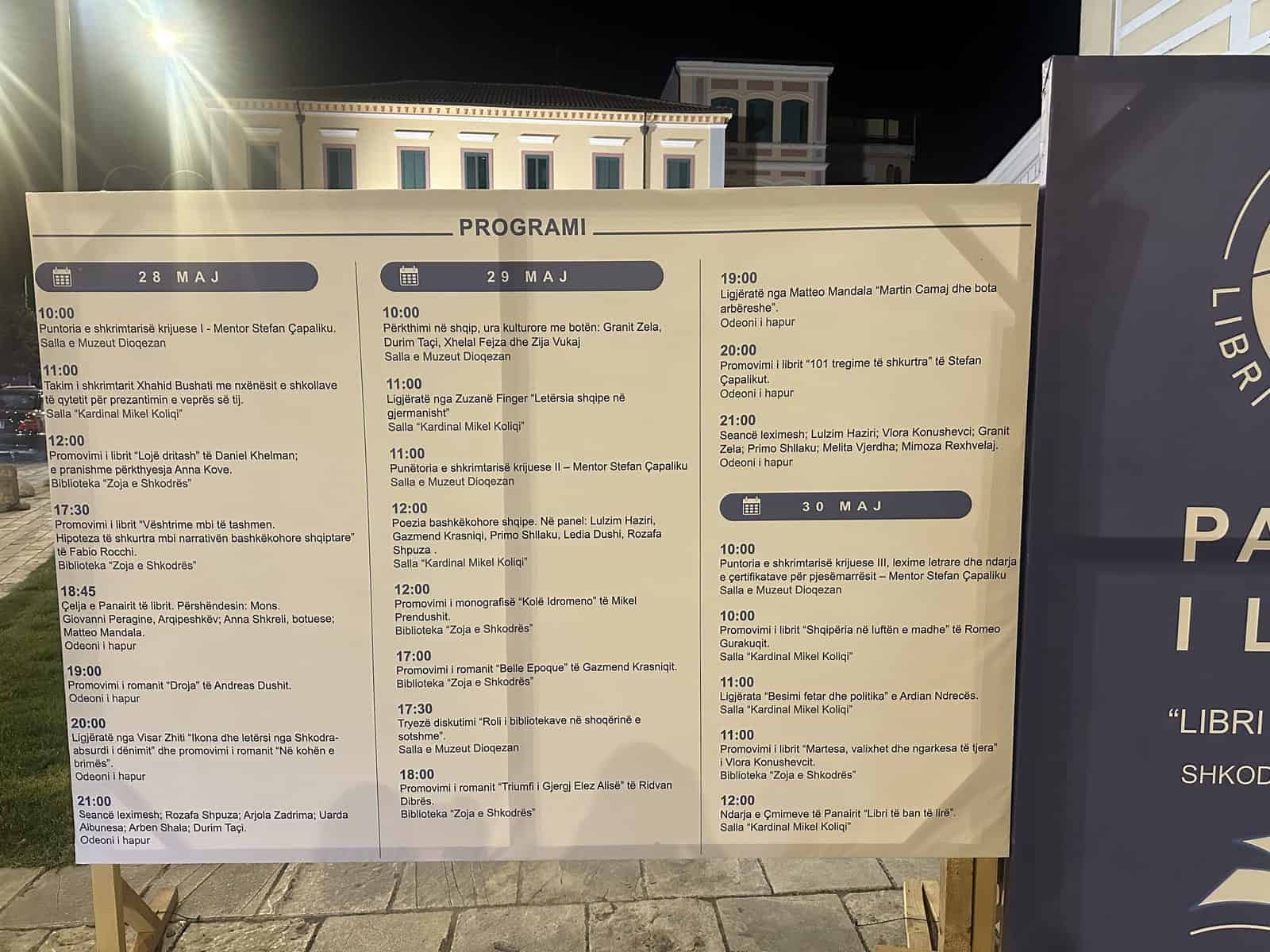
Here is the moment that changed how I think about this city. I was walking past the cathedral with no particular plan when I saw the programme for Shkodër’s book fair posted up outside. I stopped and read the whole thing — and it was dense with names, dates and contributions from this city and the towns around it. Writers, scholars, clergy, printers. A literary and intellectual record stretching back generations.
Almost none of it is known outside Albania, and a fair amount of it is not well known inside Albania either. The contribution of Shkodër and the wider north to Albanian letters is one of the genuinely under-told parts of our history. If that interests you, the story of how much of this material survived at all is worth reading: see the Canadian who gave us back our own books.
This is also the clearest argument against a day trip. You cannot read a city’s intellectual history off a castle wall. You have to be here long enough to notice a poster.
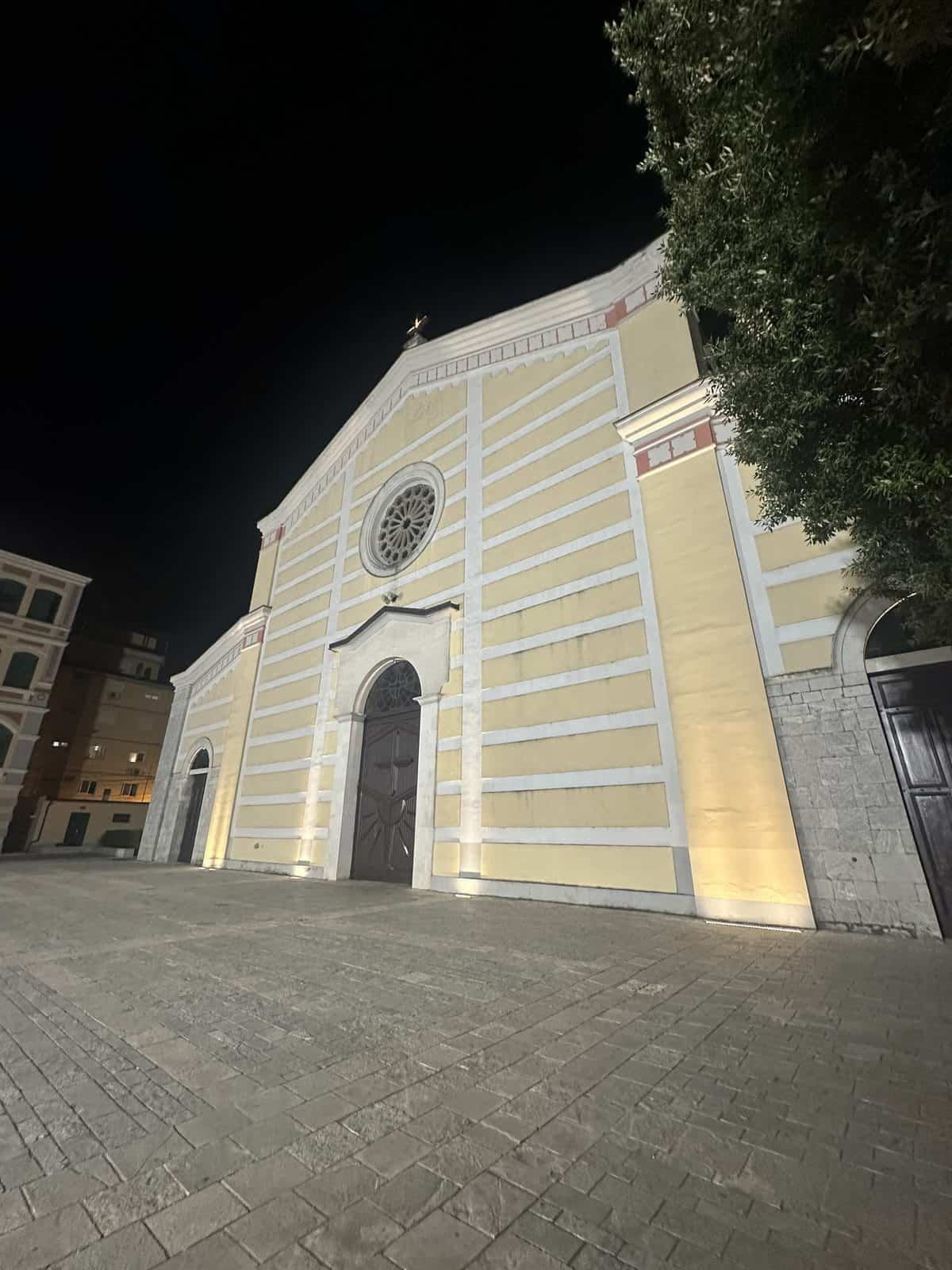
Shkodër is unusual in Albania for how plainly its religious history is written into the cityscape — the cathedral, the Orthodox Cathedral of the Nativity and the Ebu Beker Mosque all within a short walk. For the wider context, our guide to UNESCO sites in Albania covers how this heritage is formally recognised.
Lake Shkodra and the Mesi Bridge
Lake Shkodra — Skadar, on the Montenegrin side — is the largest lake in Southern Europe, and the border runs through it. The Albanian shore around Shiroka is calm and noticeably undervisited: good for a swim, a slow lunch, a cycle, or doing nothing at all. Boat trips run from the Albanian side in season.
A short way out of town, the Mesi Bridge (Ura e Mesit) is an Ottoman-era stone bridge over the Kir river and one of the most photographed structures in the north for good reason. It takes under half an hour to reach and pairs naturally with a drive towards the mountains. Further up that road, Boga and its waterfall mark where the Alps properly begin.
A City That Runs on Bicycles
Shkodrans are known across Albania for riding bicycles, and it is not a cliché. Practically everyone rides. The city is flat, the main streets are wide, and there are bike lanes almost everywhere — a combination that exists nowhere else in the country at this scale.
Rent one. It is the correct way to see the city, and it puts the lake shore within comfortable reach. One honest caveat: plenty of people have switched to cars in recent years, and traffic at peak times can get hectic in a way the bicycle reputation does not prepare you for. Ride confidently and assume you have not been seen.
The Thing Nobody Warns You About: Shkodran Humour
This city is funny. Shkodrans have a long-standing reputation as the wits of Albania — a number of the country’s best-known comedians came out of this town and the area around it — and the humour is still there in ordinary conversation, dry and fast and often at their own expense.
I got the clearest demonstration of it at the theatre. My brother-in-law, who works in Albanian theatre, was in a comedic production here, and what struck me was how thoroughly he wove specifically local humour — Shkodran jokes, regional references — through the piece. The audience was completely with it. You could hear that the city recognised itself.
The everyday version of this is that people still know each other. Despite being a sizeable city, Shkodër behaves like a much smaller one: neighbours greet each other by name, cyclists wave as they pass, conversations happen across the street. That extends to visitors with real warmth. It is, more than any single monument, what makes the place worth two nights.
Where to Eat, Drink and Stay
Shkodër’s café culture is the main event, running from early morning to late at night, and sitting in it is a legitimate way to spend an afternoon. A few places that come up consistently and appear on our map of the city — check current hours before setting out, because this is a city where places change hands:
- Tradita G&T — the best-known traditional option in town, in a restored historic building, and the usual answer when someone asks where to eat northern Albanian food.
- San Francisco Restaurant — a long-running local favourite rather than a visitor-facing one.
- Café Amsterdam — a reliable spot to sit for an hour and watch the bicycles go past.
- Hotel Colosseo — the established central hotel, convenient to the boulevard.
- Mi Casa es Tu Casa — the hostel most backpackers heading into the Alps end up in, and a good place to find others going the same way.
For what northern Albanian cooking actually consists of, and how it differs from the south, our Tirana restaurant guide covers the national picture.
Using Shkodër as a Base for the North
This is the strategic case for the city, and it is the one most itineraries miss. Shkodër is the gateway to the Albanian Alps. Almost every serious trip into the north starts here:
- Komani Lake — the ferry through the gorge, one of the most spectacular journeys in the Balkans. Shkodër is the practical launch point.
- Theth — the classic Alps village. Our honest assessment of whether it works as a day trip is worth reading before you commit.
- The Valbona valley — usually reached via Komani, and more rewarding with a night at each end.
- Boga and the Kir valley — the easiest taste of the mountains, close enough for a half day.
Doing any of these from Tirana means long days and a lot of driving. Doing them from Shkodër means you are already there. For how these fit a wider itinerary, see our guide to the best day trips from Tirana.
When to Go
Late spring and early autumn are the sweet spot: comfortable daytime temperatures, the lake still warm enough in September, and the mountain roads open. High summer is hot, though the evenings stay genuinely pleasant and the boulevard is at its liveliest. The cultural calendar — theatre, the book fair, concerts — runs strongest in the shoulder seasons, which is another argument for May, June, September or early October.
Winter is quiet and often wet. The city still works, the cafés are still full, but the mountains largely close to casual visitors.
Practical Tips
- Two nights minimum. One day gets you the castle and a walk. It does not get you the city.
- Rent a bicycle on your first morning. It changes the scale of everything, including the lake.
- Carry cash. Cards work in the larger places, but the bazaar, small cafés and furgons run on lek.
- Check what is on at the Migjeni Theatre. It is a real theatre with a real local audience, not a tourist attraction.
- Talk to people. This is the single highest-return thing you can do here, and the city makes it easy.
- If you are driving to Montenegro, confirm your rental’s cross-border paperwork in advance. Our honest take on whether Albania is safe covers driving conditions too.
Frequently Asked Questions
Is Shkodër worth visiting?
Yes — and worth more time than most itineraries give it. It has the country’s most important photographic archive, a serious theatre and literary culture, an Ottoman-era bazaar quarter, the largest lake in Southern Europe on its doorstep and the Albanian Alps an hour away. The common mistake is treating it as a stop rather than a destination.
How many days do you need in Shkodër?
Two nights is the realistic minimum: one day for the city itself — castle, bazaar, Marubi, the boulevard in the evening — and one for the lake, the Mesi Bridge or a push towards the mountains. If you are using it as a base for Komani or Theth, add a night for each.
How do you get from Tirana to Shkodër?
Roughly 1.5–2 hours north by car on the SH1, or a furgon from Tirana’s Zogu i Zi terminal, which runs regularly without advance booking. Driving gives you the lake, the Mesi Bridge and the mountain valleys in the same trip.
Is Shkodër good for cycling?
It is the best city in Albania for it. Flat, wide streets, bike lanes on most main roads, and a genuine local cycling culture. Rent one. Be aware that car traffic has grown and can be assertive at peak hours.
What is the Marubi museum?
The Marubi National Museum of Photography holds the archive of the Marubi family, who photographed Albania across three generations from 1856. It includes the first photograph ever taken in Albania, from 1858, and hundreds of thousands of negatives. It is the most important historical photographic collection in the country.
Can you visit Shkodër from Montenegro?
Easily. Hani i Hotit (Božaj) and Muriqan–Sukobin both put you in the city within about an hour, which is why Shkodër works well as a first or last stop on a Balkans overland trip. A further crossing at Qafë Vranicë is planned but has no confirmed opening date.
Is Shkodër a good base for the Albanian Alps?
It is the natural one. Komani Lake, Theth, the Valbona valley and the Kir valley are all materially easier from Shkodër than from Tirana, and staying here turns punishing day trips into reasonable ones.
Some place links are affiliate links — if you book through them we may earn a small commission at no extra cost to you.
Tap any place to zoom to it, then “Open in Google Maps” for directions and reviews. Exploring more of the country? See the full interactive map of Albania.
What do you think?
Have you been to Shkodër — or do you live there? What would you send a first-time visitor to that is not in this guide? Drop a comment below.
Elvis Plaku has lived in Tirana his entire life and has been writing about Albania since 2004. Albanian Blogger is powered by Sfida.PRO.
]]>Vlorë is where Albania declared its independence in 1912 — a big coastal city that marks the meeting of the Adriatic and Ionian seas and the start of the Riviera road south over the Llogara pass. It pairs a long city beach and seafront with easy access to wilder coves just out of town. Here is what is worth seeing in and around Vlorë, mapped.
Some place links are affiliate links — if you book through them we may earn a small commission at no extra cost to you.
Tap any place to zoom to it, then “Open in Google Maps” for directions and reviews. Exploring more of the country? See the full interactive map of Albania.
Key Takeaways
- Vlorë is the city where Albania declared independence on 28 November 1912 — Flag Square (Sheshi i Flamurit) and its 17-metre Independence Monument mark the spot.
- It’s about 150–155 km from Tirana, roughly a 2.5-hour drive or bus ride — long for a single day trip, better as an overnight or a stop en route to the Riviera.
- Highlights beyond the monument: the 16th-century Muradie Mosque (Albania’s only known building by Ottoman master architect Mimar Sinan), Kanina Castle above the bay, and Zvërnec Monastery on its own island in the Narta Lagoon.
- Vlorë is the gateway to the Karaburun-Sazan Marine Park, Albania’s only marine national park, and to the Llogara Pass road that opens onto the Riviera.
- The long-awaited Vlora International Airport is still not operating commercial flights as of this writing — Tirana’s Rinas remains the entry point for now.
- Best months: May, June, and September, when the weather is warm, the sea is swimmable, and Vlorë hasn’t filled up with the July–August summer crowd.
Table of Contents
- Getting to Vlorë from Tirana
- Flag Square and the Birth of Independent Albania
- Muradie Mosque and the Old Town
- Zvërnec Monastery and Its Island
- Kanina Castle and the View Over the Bay
- The Lungomare and Vlorë’s Beaches
- Karaburun-Sazan Marine Park
- Gateway to the Riviera: The Llogara Pass
- Best Time to Visit
- Practical Tips
- FAQ
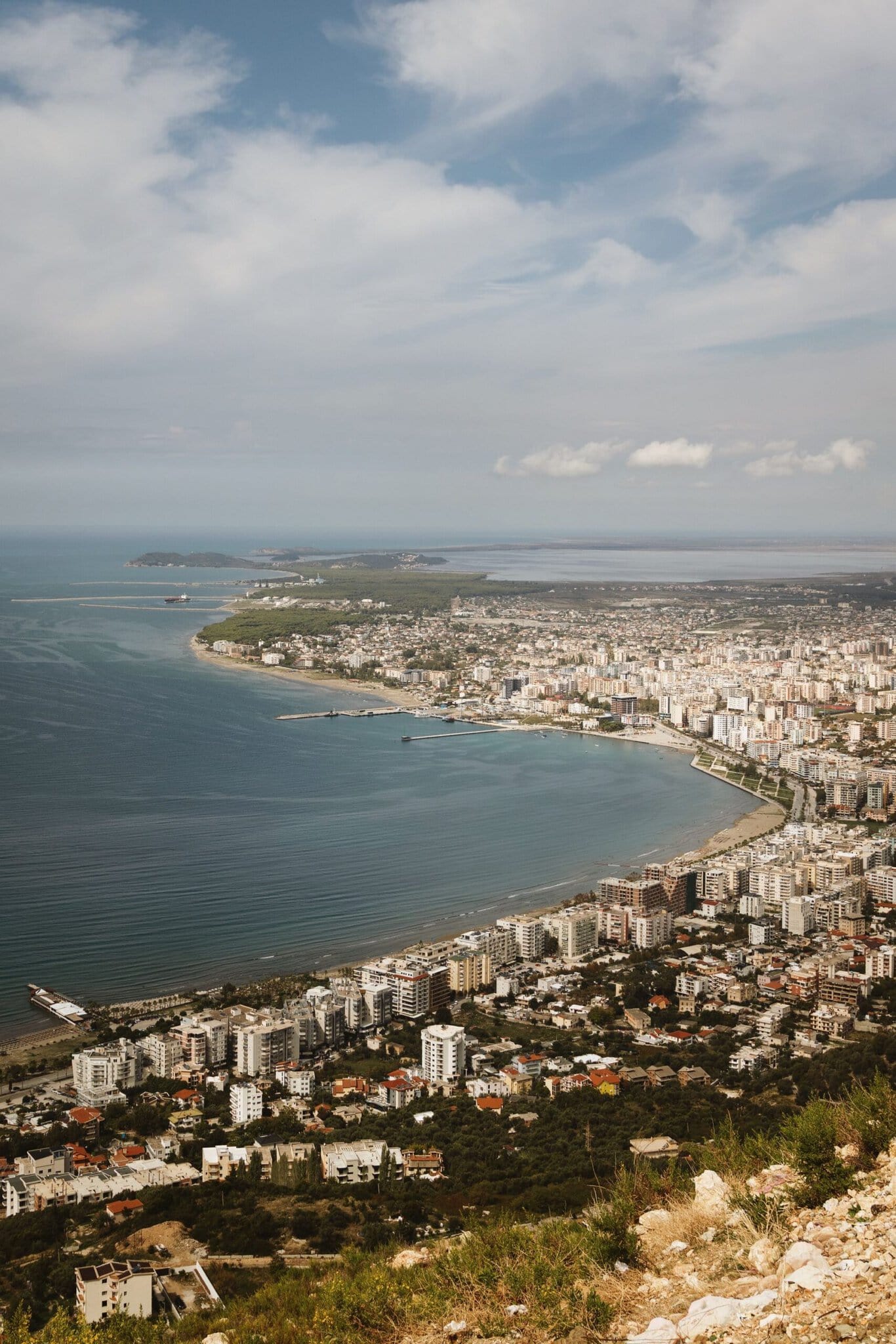
Getting to Vlorë from Tirana
Vlorë sits about 150–155 kilometers south of Tirana, and the trip takes roughly 2 to 2.5 hours by road. That makes it a longer haul than a typical Tirana day trip — doable there-and-back if you start early, but more comfortable as an overnight, or as your first stop heading further south. For shorter outings closer to the capital, our guide to the best day trips from Tirana covers places you can see without committing a whole day to driving.
By bus or furgon. Regular buses and furgons (shared minivans) run from Tirana’s South Terminal throughout the day, with dozens of departures — the route is one of the busiest in the country. A one-way ticket runs around 400–500 lek (roughly €4–5), and the ride takes about 2 to 2.5 hours depending on stops and traffic. For the full picture on buses, furgons, and driving rules across the country, see our guide to getting around Albania.
By car. The SH4 highway from Tirana connects to the SH8 coastal road into Vlorë, and the drive is straightforward and well-paved for most of the way. Having your own car pays off once you’re in Vlorë, since Kanina, Zvërnec, and the Karaburun boat departure points are all easier to reach with wheels than on foot or by local bus.
The Vlora Airport factor. Albania has been building a new international airport just outside Vlorë for several years, and it has repeatedly slipped its opening date — as of mid-2026, it still has no scheduled commercial passenger flights, despite a completed runway and terminal and an assigned IATA code (VLO). Charter flights planned for summer 2026 were cancelled after the airport failed to secure its international operating permits in time. Until that changes, Tirana’s Rinas Airport remains the practical entry point for anyone flying in.
There are three ways to do this and they sort themselves neatly by price. The bus is the cheapest, the furgons — the small private vans — sit in the middle, and a taxi the whole way is by far the most expensive. The vans are what locals actually use: they run all day, with the first ones pulling out around five in the morning, which is the move if you want to arrive fresh with the day still ahead of you. People who go to Vlorë every weekend keep their driver’s number saved and message ahead to check there is space, and I mention that only so you know what you are not getting as a visitor — it is far too much to manage on a first trip.
If you would rather not think about any of it, take a cheap local taxi to the terminal and start there. Green Taxi and Lux Taxi are both fine, or use Patoko, the Albanian ride-hailing app — Uber and Bolt do not operate in Albania, so Patoko is the closest equivalent we have. It will collect you from wherever you happen to be standing without you needing to know the name of the street, which here is genuinely useful. Almost everywhere I would send you is findable on Google Maps.
Things to Do in Vlorë: At a Glance
The 7 things worth your time in and around Vlorë, in the order I would do them. Jump straight to any of them:
Flag Square and the Birth of Independent Albania
Every Albanian schoolchild learns this date: 28 November 1912. That’s when Ismail Qemali stood in Vlorë and declared Albania’s independence from the Ottoman Empire, ending nearly five centuries of Ottoman rule and making Vlorë, briefly, the capital of the new state. The square where it happened, Sheshi i Flamurit (Flag Square), is still the city’s symbolic heart.
The square’s centerpiece is the Independence Monument, a bronze sculpture erected in 1972 for the 60th anniversary of the declaration. It stands 17 meters tall, built around a figure of Ismail Qemali, and was created by sculptors Muntaz Dhrami and Kristaq Rama. The plaza around it is planted with palms and pines, and on weekend evenings it fills with Vlorë families out for a walk, much like Skanderbeg Square does in Tirana. Just off the square, the Museum of National Independence occupies the building where the first Albanian government convened in 1913, and it’s worth the short visit if you want more than the monument’s silhouette — exhibits cover the declaration itself and the fragile first years of the new state.
Muradie Mosque and the Old Town
A short walk from Flag Square is a building with an outsized architectural pedigree. The Muradie Mosque was built between 1537 and 1542 under Sultan Suleiman the Magnificent, and it’s attributed to Mimar Sinan — the same imperial architect behind the Süleymaniye Mosque in Istanbul and Selimiye Mosque in Edirne. It’s the only building in Albania linked to Sinan’s name, which is a remarkable thing for a fairly modest-sized mosque to carry.
The building blends Byzantine and Ottoman elements — thick stone walls, a slender minaret roughly 18 meters tall, and carved geometric and floral decoration around the entrance. It’s also known locally as the Xhamia e Plumbit (“Lead Mosque”), for the lead sheeting historically used on its dome. The mosque sits at the edge of Vlorë’s old town, where narrow streets and a handful of older Ottoman-era houses give a sense of the city before the 20th century reshaped most of it.
I have been to the Muradie many times, though I have not gone inside on every visit — mostly I have walked past it, which in Vlorë you do constantly. What I would want you to understand is that it is not a monument. Friends of mine are Muslim and pray there five times a day, and the building is in use accordingly: ordinary and busy on a normal weekday, and noticeably fuller at the Friday prayer. Go in if it is open and you are respectful about it, but go in knowing it is somebody’s working neighbourhood mosque rather than an exhibit.
Zvërnec Monastery and Its Island
About 13 kilometers from central Vlorë, in the middle of the Narta Lagoon, sits one of the more atmospheric small sights in southern Albania. St. Mary’s Monastery, Zvërnec, dates back to somewhere between the 11th and 14th centuries and is dedicated to the Dormition of Mary. It sits on a tiny pine-covered island, and a wooden footbridge roughly 270 meters long is the only way across — no cars, just a walk over shallow lagoon water with birds working the shallows on either side.
Inside, the church still holds partial Byzantine-era frescoes and older religious objects, and the whole complex has been a protected cultural monument since 1963. It’s a genuinely peaceful stop, more about the setting than any single feature — pine trees, still lagoon water, and a church that has quietly survived here for the better part of a millennium.
Did you know?
The Narta Lagoon around Zvërnec is home to an estimated 3,000 flamingos, along with pelicans and other migratory birds that pass through on their way between Africa and northern Europe. Bring binoculars if birdwatching is your thing — the lagoon is one of the better spots on the Albanian coast for it.
Kanina Castle and the View Over the Bay
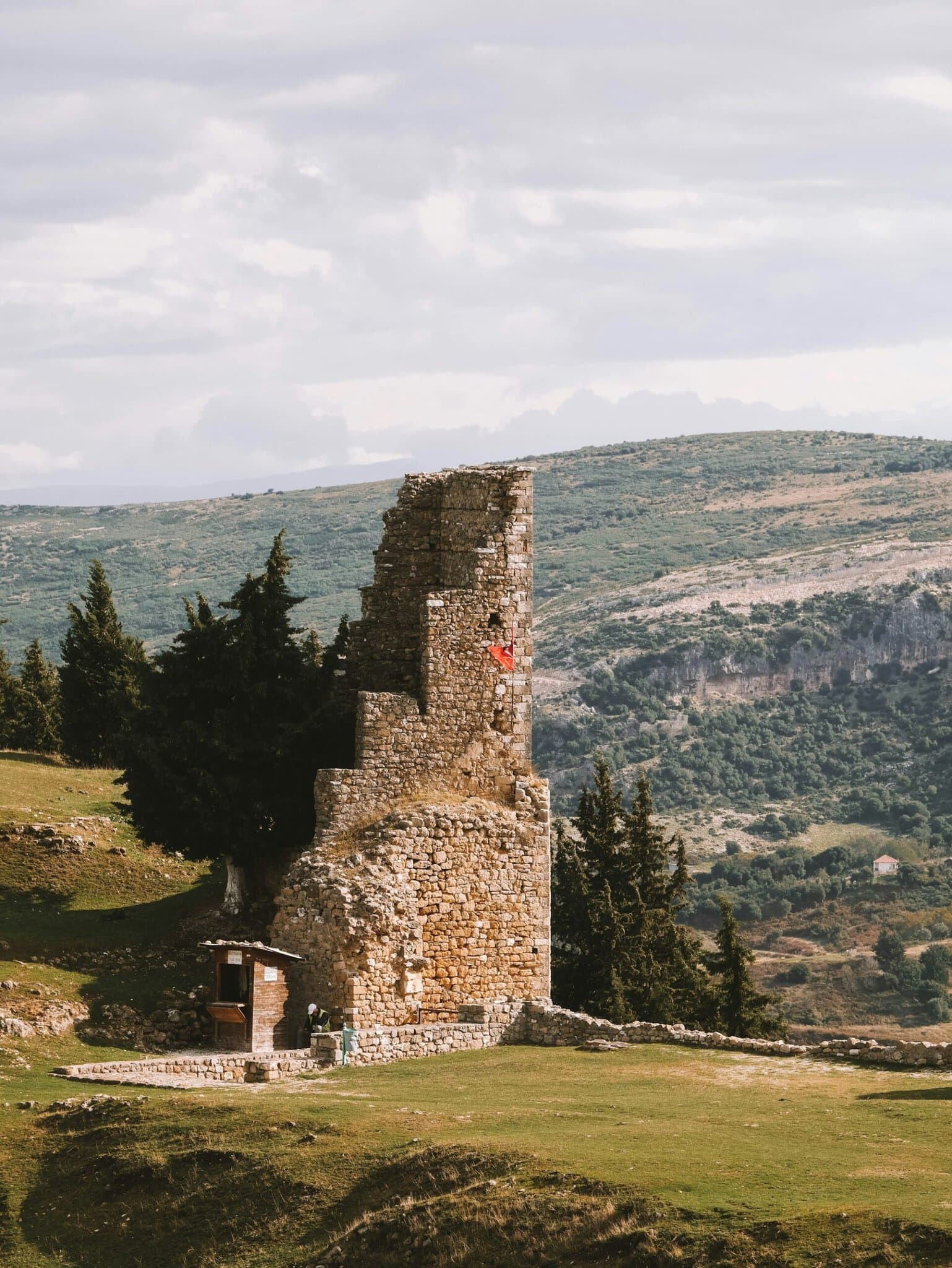
Above the village of Kaninë, about 20 minutes from central Vlorë, a hilltop fortress has been watching over the bay for roughly two and a half thousand years. The site began as an Illyrian settlement, was rebuilt by the Byzantine emperor Justinian I in the 6th century, served as the seat of the medieval Principality of Vlorë in the 14th century, and was later absorbed into the Ottoman defensive network — though it lost most of its strategic importance once the Ottomans built the newer castle down in Vlorë itself in 1537.
Historically, Kanina Castle has one especially notable claim: it’s where Gjergj Kastrioti Skanderbeg, Albania’s national hero, was crowned prince of Arbëria in 1451. Today the ruins are mostly walls and towers rather than an intact fortress, but the reason to make the climb is the same reason it was built here in the first place — the view. From the top, the whole sweep of the Bay of Vlorë opens up, with the city below, the Adriatic and Ionian meeting offshore, and on a clear day, Sazan Island out in the water.
One piece of advice if you are heading up to Kanina: leave it until late in the day. Anything after four or five in the afternoon and you catch the evening light coming across the bay, which is the whole reason to make the climb.
The Lungomare and Vlorë’s Beaches
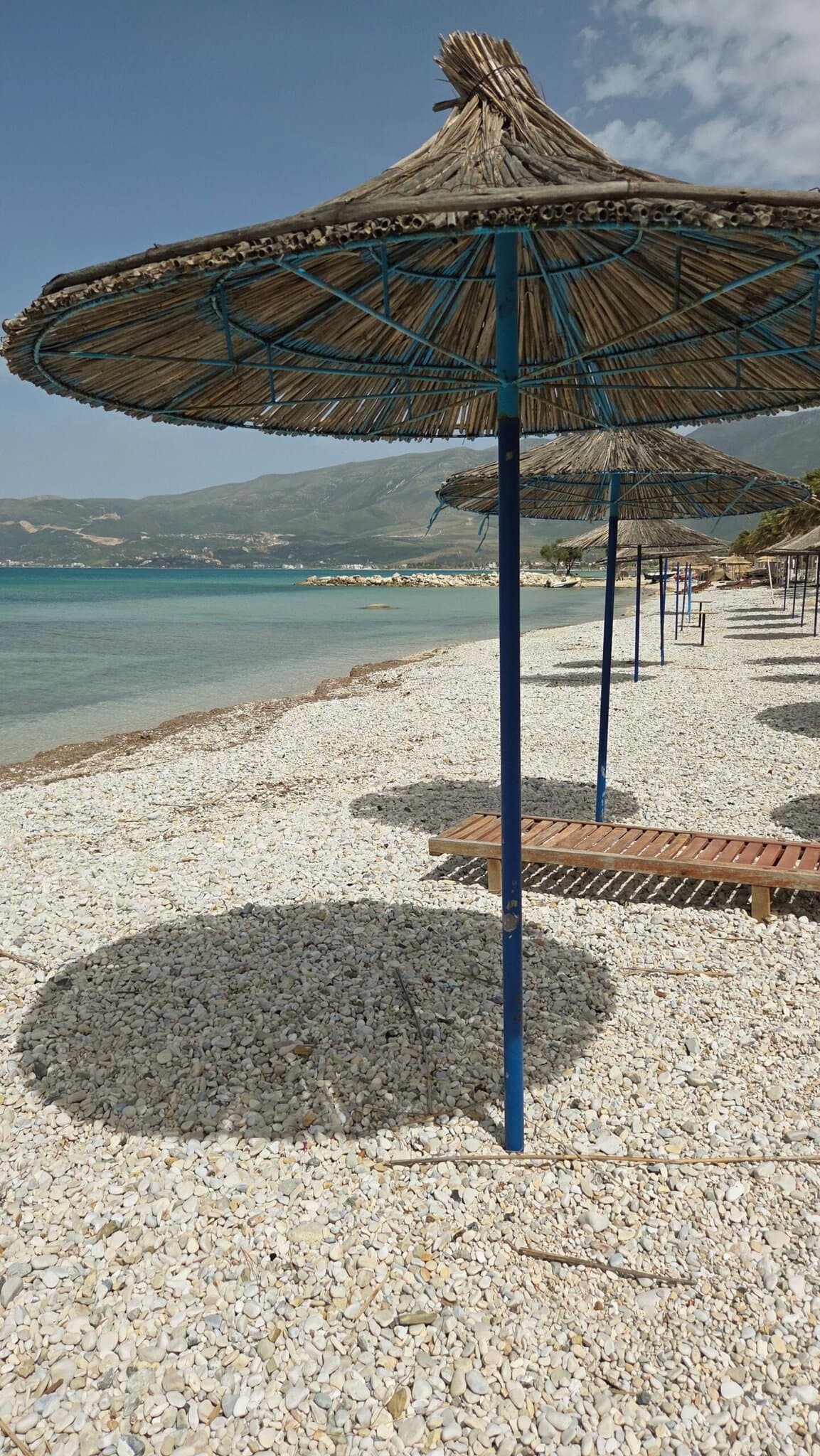
Back down at sea level, Vlorë’s main waterfront is the Lungomare — a long, palm-lined promenade that runs along the city’s beach and functions as Vlorë’s evening living room much the way Tirana’s Blloku does after dark, just with sand instead of bars. The beach itself is shallow for a good distance out, which makes it a popular, low-stress choice for families, and the promenade is lined with cafes, ice cream stands, and seafood restaurants that fill up as the sun drops.
Vlorë doesn’t try to be the Riviera’s showpiece beach — that role belongs to the coves further south. What it offers instead is a proper city on the water: a bay you can watch the sun set into from a promenade table, with history a short walk in every direction.
Vlorë isn’t really competing with the postcard coves further down the coast for water clarity — that’s not really its job. What it does well is give you an easy, walkable seafront attached to an actual city, with restaurants, a working port, and views out toward the Karaburun peninsula and Sazan Island. If you want the more dramatic turquoise-water beaches, they start once you’re past the city and heading toward the Riviera proper.
Karaburun-Sazan Marine Park
Just offshore and across the bay from Vlorë lies Albania’s only national marine park. The Karaburun-Sazan Marine Park, established in 2010, covers both the rugged Karaburun Peninsula and Sazan Island, spanning over 12,000 hectares of coastline and open water. For decades this whole area was a closed military zone — Sazan Island in particular was off-limits — and that isolation is exactly why it stayed so untouched: no overfishing, no coastal development, just cliffs, sea caves, and clear water.
The way most visitors experience it is by speedboat tour, departing from Vlorë’s waterfront. A typical full-day trip runs out to Grama Bay, with stops at sea caves like Haxhi Ali and smaller coves along the peninsula for swimming and snorkeling — the water inside some of these caves has a genuinely striking blue glow where sunlight filters in from underwater openings. Multiple operators run these tours from Vlorë in summer, typically full-day and including snorkeling gear.
Gateway to the Riviera: The Llogara Pass
South of Vlorë, the coastal highway (SH8) begins its climb toward the Llogara Pass — the mountain crossing that carries the road over 1,000 meters before dropping in switchbacks down to the Ionian coast and the start of the Albanian Riviera proper: Dhërmi, Himarë, and eventually Saranda. This is one of the most scenic stretches of road in the Balkans, and Vlorë is where it begins. If you’re continuing south, our full Saranda and Albanian Riviera guide covers what’s waiting on the other side of the pass — the beaches, the drive itself, and where to base yourself.
Even if you’re not continuing all the way to Saranda, it’s worth knowing that Vlorë functions as the practical hinge point of any Riviera trip — the last real city before the coast turns rural and dramatic. Stock up, fuel up, and eat a proper meal here before heading over the pass, especially if you’re driving.
Best Time to Visit
May, June, and September are Vlorë’s best months, without much competition. Temperatures sit in the mid-to-high 20s°C, the sea is warm enough to swim by June (22–24°C), and the city hasn’t filled up with the peak-summer crowd yet. September holds onto warm sea temperatures from a full summer of heating while the heat itself eases off.
July and August are Vlorë’s hottest and busiest months, with daytime temperatures regularly hitting 31–33°C and a real summer-holiday energy along the Lungomare — but also the highest accommodation prices and the biggest crowds at the beach. Winter (November through March) is mild by Northern European standards but rainy, with November averaging the most precipitation of any month; most seasonal beach businesses close, and it’s a quieter, more local Vlorë than the one most visitors picture.
Practical Tips
- Currency: Pay in Albanian Lek (ALL), not euros — tourist-facing places that accept euros usually give a worse exchange rate than an ATM withdrawal. See our broader Albania travel tips for money, SIM cards, and other practical basics before you go.
- A car helps. Kanina, Zvërnec, and the Karaburun boat departure points are all easier with your own wheels, though the Lungomare, Flag Square, and Muradie Mosque are all walkable from the city center.
- Safety: Vlorë is a large, ordinary Albanian city with normal city-sense precautions — nothing unusual for visitors. For the country-wide picture, our guide to safety in Albania covers what to actually watch for versus what’s overblown.
- Book boat tours in advance during summer. Karaburun and Grama Bay speedboat tours fill up on short notice in July and August.
A word on when to come. Arriving in Vlorë in high summer can be genuinely chaotic — the city is crowded and August is the worst of it for traffic. September and October are a different experience entirely, and if you have any flexibility at all, that is when I would go.
One thing that tends to surprise people: there are a lot of Italians living in Vlorë now, and across the south generally. You will sit down for a coffee and realise the table next to you is speaking Italian rather than Albanian. And wherever you end up, the Lungomare is the easy answer — anywhere along that seafront you can stop, sit, and take the view.
Vlorë: FAQ
Why is Vlorë historically important?
Vlorë is where Ismail Qemali declared Albania’s independence from the Ottoman Empire on 28 November 1912, briefly making it the country’s first capital. Flag Square and the Independence Monument mark the spot, and the nearby Museum of National Independence covers the events in detail.
How do I get from Tirana to Vlorë?
By bus or furgon from Tirana’s South Terminal (about 2–2.5 hours, roughly €4–5) or by car via the SH4 and SH8 highways. Vlora International Airport is not yet operating scheduled commercial flights, so Tirana’s Rinas Airport remains the entry point.
Is Vlorë worth visiting, or should I go straight to the Riviera?
Vlorë is worth at least a day on its own — the independence history, Muradie Mosque, Kanina Castle, and Zvërnec Monastery are all real sights, not just a stopover. It also makes a practical base for a Karaburun-Sazan boat trip before continuing south over the Llogara Pass.
Can I visit Zvërnec Monastery without a car?
It’s easiest with a car or taxi, since it’s about 13 km from the city center and public transport options are limited. Some local tours and taxis include it as a stop alongside Kanina Castle.
Is Vlorë safe for tourists?
Yes — Vlorë is a large, ordinary Albanian coastal city, and the usual common-sense precautions apply rather than anything specific to the city. See our full guide to safety in Albania for the broader picture.
What’s the best time of year to visit Vlorë?
May, June, and September, when temperatures are warm, the sea is swimmable, and the city hasn’t reached its July–August peak-season crowds and prices.
What do you think?
Been to Vlorë, Kanina, or Zvërnec? Drop a comment with what stood out to you — or what we should add to this guide.
Continuing south? See our guides to the Albanian Riviera and Saranda, day trips from Tirana, and getting around Albania.
]]>