 Large dark shadows patrol the depths of Tremblay Sound waiting for something to feast on. ]]>
 Nigel Hussey of University of Windsor. © Tom Arnbom / WWF
Large dark shadows patrol the depths of Tremblay Sound waiting for something to feast on. Equipped with hundreds of razor-sharp teeth, the Greenland shark is the most common large predator of the Arctic. Nigel Hussey from Windsor University is the leading world expert on these sharks that live life in the “slow lane”.
 Greenland shark, Lancaster Sound, Nunavut, Northwest Territories, Canada. © National Geographic Stock / Paul Nicklen / WWF
Greenland sharks continuously surprise us as we learn more about them. These fantastic fish are the grandfathers of the Arctic, reaching over 400 years old. They are about the same size as white sharks. Almost all Greenland sharks are partially blind because of a parasite that infests their eyes. Exactly how they find and catch their prey is still a mystery but it is most likely by smell.
An important part of the research in Tremblay is to find out how Greenland sharks and narwhals interact with each other and the Tremblay Sound ecosystem. Sharks are equipped with electronic tags so Nigel and his team can follow their daily lives and uncover more about these enigmatic and fascinating predators.
]]>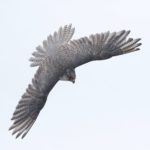 The gyrfalcon, known by the Inuit as kilgavikpak, is among the toughest birds in the world.]]>
 A gyrfalcon from Scandinavia – almost identical to the Tremblay sighting. Photo: Tom Arnbom / WWF
As Inuit researcher Jobie Atagootak gives Tom Arnbom from WWF a lesson on edible Arctic plants, suddenly they hear a chorus of alarm calls from a group of common ringed plovers nearby. Looking up, they see it. A gyrfalcon zooms by above them, quick as a flash.
The gyrfalcon, known by the Inuit as kilgavikpak, is among the toughest birds in the world and one of only a few species that thrives in the harsh Arctic winter. This far north, many have almost white plumage but this one was darker brown.
Normally gyrfalcons feed on ptarmigans – similar to grouse and a bit like the “chicken” of the Arctic. But here in Tremblay, there are not many ptarmigans around so the gyrfalcons go for any bird they can catch. This includes common ringed plovers, which explains the loud distress peeps heard by Tom and Jobie just before this fantastic aerial predator appeared. This rare gyrfalcon sighting is added to the data log of seabirds being collected as part of the science program at Tremblay.
]]>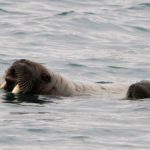 Much to our delight we are paid a visit by two walruses – a mother and her young.]]>
 WWF / Tom Arnbom
One of the Arctic’s big five is the walrus. At least five times bigger than all other Arctic seals, its tusks and bristly moustache make it instantly recognisable. As the ice in Tremblay starts to open up, much to our delight we are paid a visit by two walruses – a mother and her young.
It is the first time since this science program started that walruses have been spotted at Tremblay – a very rare treat for us all. At the call of “Walrus!”, all tents are emptied in seconds and there is much excited chatter and dashing about for cameras and binoculars as they cruise past camp, obviously checking us out.
Walruses were commercially hunted to near extinction historically but have been slowly bouncing back in recent times. Now there are about 25,000 in the north Atlantic. These fin-footed giants dine in shallow waters and can eat several thousand clams per day. Superbly adapted, they have sensitive moustaches to find their prey and they use their tongues and lips to suck the meat from the shells like powerful vacuum cleaners. As the pair take a last breath before they dive under the water, we catch a glimpse of their enormous bodies – a truly awesome sight!
]]> Suddenly, there they are. A few hundred meters from the camp, a mother polar bear and her two-year old cub. ]]>
Two white animals that were not present a few minutes ago, and inland rather than along the icy shore, as we expected. The sea ice is breaking up and some polar bears move to shore in summer, looking for something to eat. It’s hard to catch seals without sea ice. The mother bear smells our camp and immediately urges her cub into a run to move away from us as quickly as possible.
Tremblay Sound is part of Tallurutiup Imanga, or Lancaster Sound, Canada’s largest and newly declared Marine Conservation Area. It’s teeming with Arctic wildlife, home to around 2,500 polar bears, most of the world’s narwhals during summer, bowhead and beluga whales, and walrus and Greenland sharks, to name just a few.
Today’s polar bear sighting has made it real to many of us that we are in polar bear country. The importance of the polar bear watch has really hit home, even when it means crawling out of our warm sleeping bags in the middle of the night!
]]> Suddenly out of the blue, we hear a blow from a whale. ]]>
Click here to view the embedded video.
Bowheads are one of three “ice whales” that live in the Arctic – the other two are narwhals and beluga whales. They have all adapted to the Arctic Ocean’s harsh environment. Bowheads can break through ice up to one metre thick with their immense heads to get a breath or two. Despite their size, they feed on small shrimp by skimming the icy water.
Scientists estimate that the summer sea ice will almost be gone by 2030. This will create opportunities for new shipping lanes through the Arctic. It’s therefore urgent to understand more about whales’ natural migrations to avoid disturbance, including of these slow-moving giants.
]]> Deploying equipment. Photo: Melanie Lancaster / WWF
In summer, the sun never sets in the Arctic. The midnight sun makes the ocean very productive and teeming with life. Today we were lucky enough to see both narwhals and bowhead whales just off the camp among the ice floes.
The sea ice that moved in yesterday has stayed with us and is even more packed, ranging from bright white to light blue. We’re told that this blue ice is older and hasn’t melted for many years. We used the sea ice as a platform to get out over the deeper waters of Tremblay and deploy equipment that measures life in the ocean. We are continuing this every hour throughout the day and night to get an idea of the ocean’s daily rhythm.
As we get busier with the scientific program, cooperation and high spirits among team members make for inspired work with plenty of laughs.
]]>
We’re iced in! This morning we woke to Tremblay Sound covered in ice as far as the eye could see. Because the weather is not cooperating, some of the bug lovers in camp have temporarily turned their focus from narwhals to one of the lesser known, but no less hardy, members of the Arctic tundra.
Bumblebees in the Arctic help the tundra to bloom every spring and summer. Too cold for bees, you ask? As soon as the sun comes out, the bees warm up by “buzzing” for some time – not unlike a miniature helicopter starting its engines. On sunny days like today, hundreds of polar bumble bees can be seen searching for nectar and pollinating Arctic wildflowers.
The biggest threat to the polar bumble bee is its larger cousin, Bombus hyperboreus. This larger bee kills the polar bee queen and takes over the colony, turning the workers into her slaves. Even the toughest little critters have many surprising challenges in the Arctic!
]]> Joasi ice fishing
Today we woke up to glorious sunshine…but the sea ice is still coming thick and fast into Tremblay Sound. It was also the kick-off for fish expert Lars Hammer´s char study.
 Anders Gravbrøt Finstad / CC / flickr
Char is an Arctic fish related to the salmon family. The fish is beautifully colored in red, silver and white and for many people living in the North is one of the most important foods. The Inuit researchers in camp know exactly when and where to catch char; another example of their traditional knowledge which is vital for the project’s success. Believe it or not, the largest char weighed almost eight kilograms!
 Joasi with net
 Lars Hammer
]]>
 The glaucous gull is the most common bird patrolling Tremblay Sound in search of a feast.]]>

The glaucous gull is the most common bird patrolling Tremblay Sound in search of a feast. It is one of the largest gulls in the world and it breeds here in the Arctic. Today we visited the colony at the end of the bay to begin a study of the birds in this area. It’s part of the research program EAT (Ecosystem Approach Tremblay), led by by Fisheries and Oceans Canada.

The colony is very busy as parents tend to their young – the most gorgeous spotted chicks. Andréanne Beardsell and Francis Beaudet at the University of Quebec at Rimouski conducted field work on glaucous gull behavior and feeding preference.
]]> Collared lemming
In the midst of an Arctic rainstorm, a new team member joins us. The cutest in camp, this tiny lemming, or avinngaq in Inuktitut, has taken shelter from the howling winds and horizontal rain – in our tent vestibule! At the time of her discovery she was so engrossed in voraciously eating Arctic flowers and leaves that she ignored us big two-footed animals!
There are several species of lemming in the Arctic and they are one of the most important foods for predators. They are so numerous because they can breed under the snow in the dark Arctic winter. During lemming peaks, the number of Arctic foxes and snowy owls soar. Even the caribou benefit from lemming droppings, which help to fertilise the Arctic tundra where they graze. This delightful little fur ball has been welcomed by all into camp.
]]>