
The Festa del Redentore, or Feast of the Redeemer, is one of Venice’s most meaningful and beloved celebrations. Held every year on the third weekend of July, it commemorates the end of the terrible plague that devastated Venice between 1575 and 1577, claiming tens of thousands of lives.
During the epidemic, the Venetian Senate vowed to build a church dedicated to Christ the Redeemer if the city were delivered from the disease. When the plague finally ended, the magnificent Church of Il Redentore was built on the island of Giudecca. Designed by the celebrated architect Andrea Palladio, it remains a powerful symbol of gratitude, remembrance and renewal.
For Venetians, Redentore is much more than a historical festival. Families and friends decorate boats with flowers, lanterns and colorful garlands before gathering on the lagoon for an evening picnic. Tables are filled with traditional Venetian dishes, wine and summer treats as boats crowd the waters near St. Mark’s Basin and the Giudecca Canal.
Late on Saturday night, a spectacular fireworks display illuminates the lagoon, with bursts of color reflected across the water and the facades of Venice. The celebration continues into Sunday with religious services, processions and traditional rowing regattas.
Despite swoltering temperatures, the kind you could fry an egg on Strata Nuova (the main street in Cannaregio) with just a short sprinkle of rain in the afternoon, the fireworks and festivities were not to be missed.
My favorite is this photo showing all the small boats in the lagoon in front of Piazza San Marco. Each boat loaded with friends and family and delicious foods they have been preparing for days with such local delicacies as Baccalà Mantecato (whipped salt cod), Sarde in Saor (marinated sardines with onions, raisins, and pine nuts) and a variation with Shrimp in Saor. Of course you bring your favorite Veneto wines, a good Prosecco is a must. You have to arrive early to get your favorite spot to be near your friends. Once there you can cool off a bit, enjoy the hum of the conversations across the water and join in with the singing of traditional Venetian songs. And then you settle in to wait for the fireworks to begin.

This year there was an unwelcome visitor, the American Ambassador. The locals protested. First it is a uniquely Venetian celebration. Then he showed up in his 117-meter (384-foot) superyacht, the Boardwalk. Venetians did not welcome him, the 300 demonstrators were pushed back by a brief, limited police charge after attempting to approach the yacht.


A temporary pontoon bridge is also constructed across the Giudecca Canal, allowing people to walk from the Zattere to the Church of Il Redentore. Crossing this bridge remains an important act of pilgrimage and remembrance.

Redentore captures the spirit of Venice: faith born from tragedy, gratitude for survival and the joy of sharing food, music and companionship on the lagoon. It is a celebration created by Venetians, cherished by local families and deeply connected to the history and heart of the city.


The exhibition “Monet and Venice” at the de Young Museum is a major international showcase devoted to Claude Monet’s luminous and atmospheric paintings of Venice, created during his only visit to the city in 1908. Bringing together more than 100 works, including over 20 of his Venetian canvases, the exhibition places these paintings within the broader arc of his career, alongside earlier works and later masterpieces such as his iconic water lilies of Giverny. It is the first exhibition in over a century dedicated specifically to Monet’s Venice series, highlighting how this brief but transformative trip reshaped his artistic vision.
What makes the exhibition especially compelling is its exploration of how Monet interpreted Venice—not as a bustling city, but as a quiet, almost dreamlike place where architecture dissolves into light and color. Painted often from a gondola, his views of landmarks like the Grand Canal and the Doge’s Palace emphasize shifting reflections, atmosphere, and fleeting moments rather than precise detail. The show also situates Monet within a larger artistic tradition, presenting works by other artists who painted Venice, and concludes by demonstrating how the experience reinvigorated his later work, particularly the water lilies. The result is an immersive journey into Monet’s evolving perception of light, water, and beauty at the height of his career.
Alongside the shimmering color of Monet and Venice, the exhibition introduces a striking counterpoint: monumental black-and-white photographs that immerse visitors in the Venice Monet. These large-scale images—many enlarged far beyond their original size—strip the city down to its essential forms: arches, facades, waterways, and reflections rendered in stark tonal contrast. Without color, the viewer becomes acutely aware of structure, light, and shadow, echoing the very elements Monet was chasing in paint. The dramatic scale of these photographs transforms them from simple documentation into an almost architectural presence, surrounding the viewer and placing them inside the visual world of early 20th-century Venice.
What makes these photographs especially compelling is how they deepen the understanding of Monet’s work. By presenting Venice in monochrome, they reveal the underlying geometry and atmospheric conditions that Monet translated into color and brushstroke. In many ways, they act as a visual bridge—showing the “reality” of Venice while highlighting just how radically Monet reinterpreted it. The contrast between the crisp photographic detail and Monet’s dissolving, luminous surfaces underscores his genius: he was not recording Venice, but transforming it into a meditation on light, time, and perception.
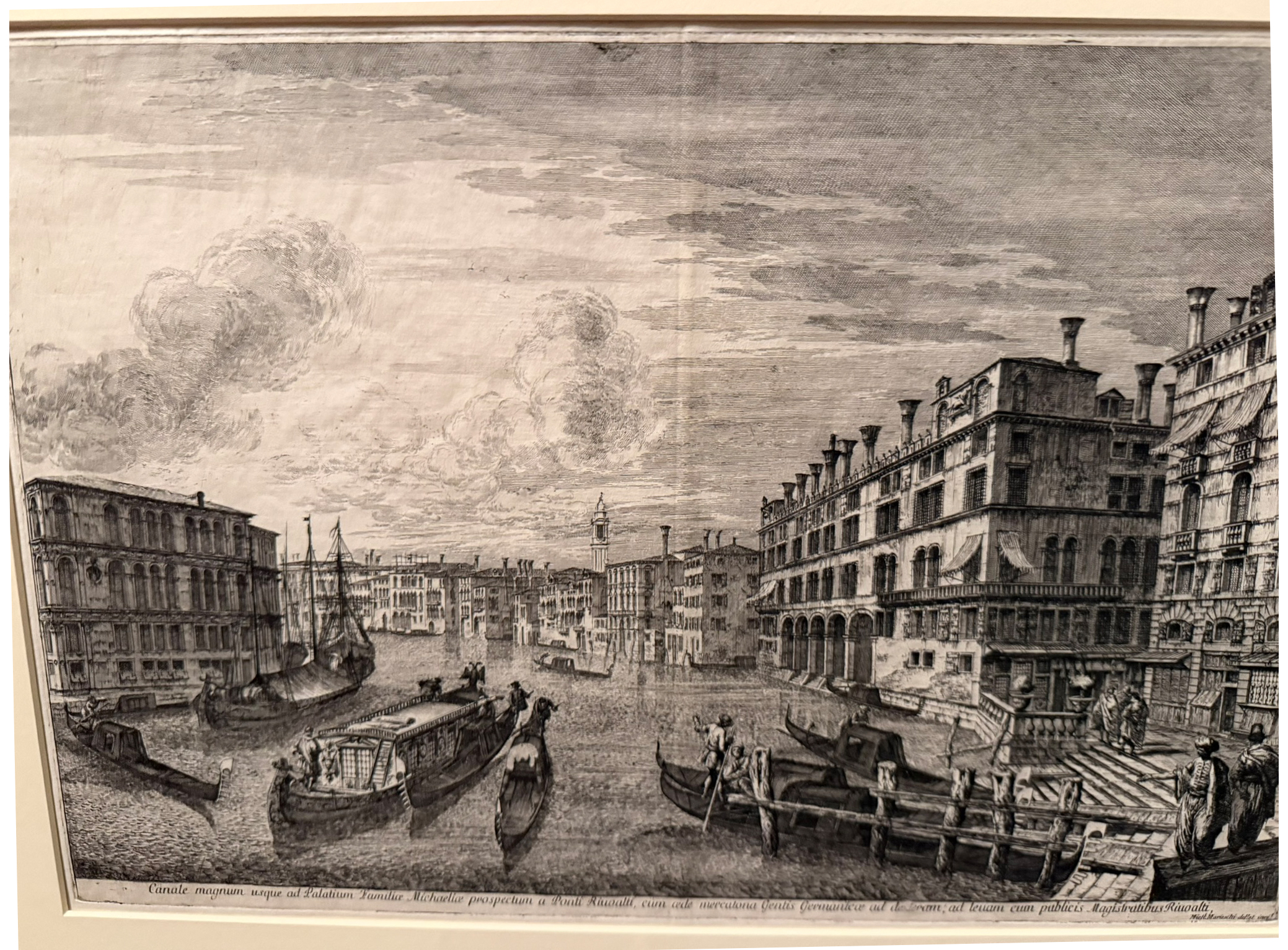
In Monet and Venice, Monet’s paintings are placed in dialogue with a rich lineage of artists who were equally captivated by Venice. The exhibition includes works by earlier masters such as Canaletto and Francesco Guardi, whose precise vedute (city views) defined Venice in the 18th century. Their detailed architectural renderings provide a fascinating contrast to Monet’s softer, more atmospheric interpretations.
The show also features later artists who, like Monet, explored mood and light over strict realism. These include J. M. W. Turner, whose luminous, almost abstract visions of Venice prefigure Impressionism, and John Singer Sargent, known for his fluid, light-filled Venetian scenes. Together, these artists create a broader narrative—showing how Venice has continuously inspired painters to reinterpret the city through their own evolving styles, with Monet’s work representing a turning point toward modern, perception-driven art.
Black and White Video
Within Monet and Venice, the inclusion of black-and-white film introduces yet another dimension to the experience—one that feels surprisingly modern despite its historical roots. It gives you an idea of how Venice was during this period. The footage, often shown at a large scale, captures everyday life in Venice, particularly scenes of crowds moving through Piazza San Marco. Visitors drift across the square, pigeons scatter, and the rhythms of daily life unfold in a continuous flow. Unlike the still photographs, the moving image brings time into the equation, allowing viewers to witness Venice as a living, breathing place rather than a static subject.
Below Palazzo Dario along the Grand Canal shown in his pallet of pastels. It is just as enchanting today as it was then.

What makes these films so powerful is how it bridges past and present while expanding the exhibition beyond painting. As an early visual medium, black-and-white cinema emphasizes motion, gesture, and human presence—elements largely absent from Monet’s quiet, almost emptied scenes. The contrast is striking: where Monet dissolves the city into light and atmosphere, the film grounds it in reality, full of energy and human activity. Seen together, they reveal two truths at once—Venice as it was experienced moment by moment, and Venice as it was transformed through the artist’s eye into something timeless and poetic.
After his 1908 trip to Venice, Claude Monet spoke with unusual intensity about the experience—and it clearly shifted how he felt about his own work. In letters to his wife and friends, he admitted that Venice overwhelmed him at first, even making him hesitate to paint because of its beauty. But once he began, he became deeply absorbed, later describing the Venetian canvases as something special among his works. He delayed exhibiting them for several years, refining them back in his studio at Giverny, which suggests how important he considered them.
Most tellingly, Monet suggested that what he achieved in Venice surpassed much of what he had done before. He referred to the series as capturing effects of light and atmosphere unlike anything he had previously painted, and he treated them as a culmination rather than just another subject. In essence, Venice reawakened his artistic vision—leading him to see his earlier work as less complete in comparison to the new possibilities he discovered there, particularly in the way form could dissolve entirely into light, color, and reflection.
]]>
 Back to the Dolomites: Cortina d’Ampezzo and the 2026 Winter Olympics
Italy is once again in the spotlight of the winter sports world as the 2026 Winter Olympics — officially the Milano Cortina 2026 Olympic Winter Games — unfold from February 6–22, 2026. These Games mark a historic moment: Italy will host the Winter Olympics for the first time in two decades (Turin 2006), and the alpine resort of Cortina d’Ampezzo, nestled in the stunning Dolomites, plays a central role.
 A Grand Return — 70 Years After 1956
Cortina last hosted the Winter Olympics 70 years ago, in 1956. Back then, the town welcomed athletes and spectators to the VII Olympic Winter Games from January 26–February 5, 1956 — a milestone event in Olympic history. It was the first Winter Games to be televised internationally, and featured thrilling performances from alpine legends like Austria’s Toni Sailer and groundbreaking moments such as the outdoor figure skating competitions that would never again be seen in future Winter Games.
The spirit of those Games lives on, and the 2026 Winter Olympics bring a long-awaited homecoming to the “Queen of the Dolomites.”
 What’s Happening in Cortina for 2026
While Milano and Cortina co-host the 2026 Games — a first for Italy — Cortina remains a key hub for mountain sports and celebrates its Olympic legacy with pride and flair.
 Competition Venues and Sports
In Cortina d’Ampezzo itself, athletes will compete across several winter sports including:
- Alpine skiing on legendary slopes like Tofane
- Curling at historical arenas
- Bobsleigh, luge, and skeleton on the modern Sliding Centre
- Other Nordic disciplines and snow events spanning the Dolomite peaks
The town’s longstanding winter sports tradition and epic mountain backdrop situated in the Dolomites make it a highlight of the Olympic schedule.
 Festivities, Torch Relay & Celebrations
The build-up and celebration of the Games in Cortina included events that honor both past and present:
 Torch Arrival & 1956 Anniversary Tribute — The Olympic flame’s Italian journey reached Cortina on January 26, 2026, timed to commemorate the 70th anniversary of the 1956 Opening Ceremony.
 Olympic Flame Events — Local ceremonies around the Olympic flame in Cortina connect community celebrations with the global Olympic spirit throughout late January and early February.
 Opening Ceremony in Cortina — Special Olympic festivities occurred in Cortina alongside the main ceremony in Milano, enlivening the town with cultural and sporting pride.
 A Legacy of Culture and Sport
Cortina’s celebration of the 2026 Games is not just about competition — it’s about heritage. From Una Montagna di Libri (a cultural literature event) to Cortinametraggio (a film festival), the town’s calendar reflects winter culture beyond athletics, including the apres ski jetset.
Italy’s own Alberto Tomba Golden Collar of Sports Merit – Army Gold Cross of Merit and former World Cup alpine ski racer from Italy served as a final torchbearer, helping to light one of the two Olympic cauldrons during the opening ceremony on February 6, 2026, in Milan. Tomba is legendary having first competited in Lillehammer 1994 as the first Alpine skier to win medals in three different Olympic Games with his silver in the giant slalom.
The three-time Olympic world champion and fellow Italian alpine skiing icon Compagnoni were raised towards the cauldron at Arco della Pace to light the flame. Compagnoni had an equally impressive pedigree, winning gold in Albertville 1992, Lillehammer and Nagano 1998 as well as silver in Nagano.

 Athletes, Officials and Spectators descend on Cortina
During the 2026 Milano-Cortina Winter Olympics, the number of people in Cortina d’Ampezzo won’t be limited to just athletes — there will be a large influx of visitors, support teams, media, officials, and spectators from around the world.
- About 3,500 athletes from over 90 countries are expected to compete across all venues in the Milano-Cortina 2026 Games.
- In Cortina itself, one of the Olympic Villages will house around 1,400 athletes and team members (including competitors, coaches, and support staff) in a temporary accommodation setup close to key alpine venues.
 Spectators and Visitors
- Organizers estimate that the entire Olympic period could attract around 2 million visitors to Italy’s host cities and surrounding areas — including Cortina d’Ampezzo, Milan, and other competition clusters — between February 6 and 22, 2026.
- This figure includes fans attending events, traveling supporters, media personnel, and other tourists drawn to the Olympics.
 What That Means for Cortina
Cortina’s local population in normal times is relatively small (around 6,000–7,000 residents normally), but during the Olympics:
- The town and surrounding mountains will see a significant boost in people, with thousands of visitors arriving for alpine events like skiing, snowboarding, bobsleigh, skeleton, and curling.
- Alongside the 1,400 athletes and officials staying in the Cortina Olympic Village, spectators and support staff are expected to fill local hotels, lodges, and transport, making the effective daytime population many times larger than usual.
These festivities, running before, during, and after the Olympics, blend local tradition with global celebration, inviting visitors and locals alike to engage with history, sport, and Italian culture.
 Beyond Cortina — The Wider Milano-Cortina Experience
While Cortina dazzles against the Dolomites, Milano brings urban glamour, with the Opening Ceremony at the iconic San Siro Stadium and high-profile global performances that set the stage for an unforgettable Games.
Together, Milano and Cortina capture the spectrum of Italy’s warmth — from fashion and art to alpine adventure and Olympic legacy.
 Cortina 7 decades later
Cortina d’Ampezzo’s role in the 2026 Winter Olympics is both historic and forward-looking. From its first Winter Games in 1956 to hosting championships seven decades later, the town celebrates tradition and innovation — all against a backdrop of snow-clad peaks and world-class competition. Cortina was originally slated to host the Winter Olympics in 1944 but due to World War II, the games were canceled.
Whether you’re a fan of winter sports, Italian culture, or Olympic history, Cortina’s celebration of Milano-Cortina 2026 is a story of heritage, excitement, and global unity. 

There are few places in the world where New Year’s Eve feels as theatrical as Venice. On December 31st, the city becomes a stage set of candlelit palazzi, glittering chandeliers, rooftop toasts, and fireworks reflected across the lagoon. For travelers willing to indulge, Venice offers some of Europe’s most extravagant ways to welcome the new year.
From historic cafés and Michelin-starred dining rooms to palatial hotels and fireworks seen directly from the water, New Year’s Eve here is less a single night and more a carefully choreographed experience.
A Palace Celebration on the Grand Canal
At Aman Venice, housed inside the 16th-century Palazzo Papadopoli, New Year’s Eve unfolds amid frescoed ceilings, Murano glass chandeliers, and original wood paneling. The evening centers on an elegant multi-course dinner featuring the hallmarks of celebratory luxury — caviar, truffles, fine meats, and a classic Mont Blanc finale.
This experience is typically offered as part of a multi-night stay, reinforcing the idea that New Year’s Eve in Venice isn’t rushed. It’s meant to be savored, slowly, over several days in one of the city’s most storied palaces.

Toasting History at Harry’s Bar
Few Venetian addresses carry the weight of legend quite like Harry’s Bar. On New Year’s Eve, guests don’t just come to dine — they come to step into history.
The evening begins with the bar’s iconic pink cocktail, the Bellini, prepared according to the original recipe created by Giuseppe Cipriani in 1948. From there, the menu leans into refined simplicity: handmade pasta with white truffles, classic Cipriani dishes, delicate desserts, and the house panettone.

Part of the allure is knowing that the tables once welcomed Ernest Hemingway, Charlie Chaplin, Gary Cooper, and Peggy Guggenheim. Here, the price reflects not only the meal, but the privilege of spending the final hours of the year in one of Venice’s most enduring cultural landmarks.
Dining Above St. Mark’s Square
High above St. Mark’s Square, the Michelin-starred restaurant at Gran Caffè Quadri offers a New Year’s Eve experience defined by views, music, and culinary precision and priced at 675 Euro. The evening unfolds as an extended tasting journey — 18 courses designed to carry guests across the threshold from one year into the next.
Below, the more relaxed Quadri Bistrot offers a festive alternative: a refined but approachable dinner paired with music and dancing, all framed by one of the most iconic squares in the world and priced at only 300 Euro.

The Marathon Feast: Forty-Five Courses and Counting
For those who believe abundance is the truest New Year’s tradition, Venice delivers in spectacular fashion. At Do Forni, the evening becomes a culinary marathon — a seemingly endless sequence of 45 courses that may include oysters, international caviar, traditional Venetian pasta dishes, and celebratory comfort foods served after midnight. Two orchestras complete the festivities at only 320 Euro.
Music fills the dining rooms, dancing continues late into the night, and the atmosphere is less formal gala and more joyful excess — a reminder that Venice knows how to celebrate without restraint.
Fireworks from the Water or the Rooftop
For front-row views of the midnight fireworks, few settings rival Hotel Danieli. Guests dining or staying here watch the lagoon light up directly in front of them, a rare perspective that feels suspended between sky and sea. Nothing compares to the view from the rooftop, it requires a reservation (at 3,600 Euro for a hotel room and the dinner is 650 Euro.

Those who prefer to experience the spectacle from the water itself can opt for a New Year’s Eve dinner cruise. Gliding through the Giudecca Canal, St. Mark’s Basin, and the Arsenale, guests dine as fireworks burst overhead — Venice reflected in rippling water, champagne glasses catching the light.
A City That Turns Midnight into Theater
What makes New Year’s Eve in Venice extraordinary isn’t only the luxury — it’s the setting. Few cities can combine centuries-old architecture, culinary tradition, music, and fireworks into a single, seamless moment. Whether seated beneath gilded ceilings, dancing near St. Mark’s Square, or drifting across the lagoon at midnight, the experience feels unmistakably Venetian: elegant, indulgent, and unforgettable.
How Venetians Really Welcome the New Year

It’s worth knowing that these glittering galas and grand hotel celebrations are largely the Venice of visitors. For most Venetians and families on Murano, New Year’s Eve is something far more intimate. Friends and relatives gather in one another’s homes, each guest arriving with a dish to share, the table filling slowly with food, wine, and conversation. The evening is lively in the most Italian sense of the word — voices overlapping, hands in motion, laughter spilling from room to room, embraces exchanged often and without hesitation. Stories are told, jokes are repeated year after year, and midnight arrives almost unnoticed, wrapped in warmth and familiarity. It’s loud, affectionate, and deeply personal — a way of welcoming the new year that feels less like a performance and more like a privilege.
And my favorite part of this intimate, loud, loving party is the long walk home on the empty streets. And knowing that the next morning there will be fritelle at my favorite Pasticcere, Dal Mas.

The ticket is required for those entering the city between 8:30 a.m. until 4:00 p.m. It is a bit confusing even to me who comes to Venice multiple times each year. So it is best to review any new information on the website before visiting.
Basically, the days that tickets are required are as follows:

For more information and especially to review before you leave for Venice, visit the website: https://cdamedia.veneziaunica.it/en/
]]>
In Italy, International Women’s Day is celebrated on March 8th as La Festa della Donna. It is a day dedicated to honoring women, their achievements, and their contributions to society while also raising awareness of gender equality issues.
Origins of Women’s Day in Italy
The origins of La Festa della Donna in Italy date back to March 8, 1946, when it was first officially celebrated after World War II. However, the global movement began earlier. The first International Women’s Day was observed in 1909 in the United States, inspired by labor movements advocating for women’s rights.
In Italy, the holiday was strongly promoted by Unione Donne Italiane (UDI), a feminist organization, to recognize women’s struggles for equality, especially after gaining the right to vote in 1945. The symbol of the celebration, the mimosa flower, was chosen in 1946 by two Italian feminists, Teresa Mattei and Rita Montagnana, because it was affordable, bright, and resilient, just like the strength of women.

How Women’s Day is Celebrated in Italy
- Mimosa Flowers: The most iconic tradition is the giving of mimosa flowers (Acacia dealbata). Men give them to women—mothers, wives, sisters, colleagues—as a sign of appreciation and respect. Women also exchange them among themselves as a symbol of solidarity.
- Events & Gatherings: Throughout Italy, there are cultural events, concerts, and feminist marches highlighting women’s rights and achievements. Museums and cultural sites often offer free entry or special exhibitions dedicated to women.
- Women’s Night Out: Many women celebrate by going out with their friends, often to special dinners, parties, or even all-female events in restaurants and clubs. This is one of my favorite ways to celebrate, going out to dinner with our bead making friends (no need to drive….we just take the vaporetto).
A Venetian Woman who Paved the Way:

The first woman to graduate in Italy was Elena Lucrezia Cornaro Piscopia, who earned her degree in 1678. She was also the first woman in the world to receive a university degree.
Who Was Elena Cornaro Piscopia?
- Born: June 5, 1646, in Venice, Italy
- Died: July 26, 1684, in Padua, Italy
- Field of Study: Philosophy and Mathematics
- University: University of Padua
Elena was a child prodigy, fluent in Latin, Greek, Hebrew, Spanish, French, and Arabic, and highly skilled in philosophy, mathematics, and music. She was a member of various intellectual circles and became well-known for her intelligence and academic contributions.
Her Historic Graduation
Initially, her goal was to obtain a degree in Theology, but the Catholic Church opposed the idea of a woman studying theology at the time. As a result, she pursued a degree in Philosophy instead. On June 25, 1678, she successfully defended her thesis at the University of Padua and was awarded a Doctorate in Philosophy, making her the first woman in history to earn a university degree.
Legacy and Impact
Elena Cornaro Piscopia’s achievement was groundbreaking, paving the way for women in higher education. However, it took centuries before women were allowed to attend universities freely. Today, she is remembered as a symbol of intellectual perseverance and gender equality in education.
]]>
To wrap up 2025 Carnevale, I chose to highlight some of the better costumes and stages I have seen there in some 20 years. Some of my favorite scenes and costumes over the years:

My all time favorite costume. While the classic designs of the 17th Century are beautiful, I love the costumes with creativity. And this young lady, a student, spent months creating this design. She won “costume of the year”.


One of my favorite designs in Piazza San Marco made in classic wood and featuring exhibits of the typical crafts of Venice: glass furnaces, crafting a gondola, fabric design,


This is the flag of La Serenissima the traditional name for the Republic of Venice, which was a maritime republic and sovereign state. At the end of Carnevale, the crowd of locals sing the anthem while the flag is being hoisted to the bell tower. It is one of my favorite parts of Carnevale.
And since today is the last chance to taste those luscious frittelle, here is the recipe to make them and what they should look like.
Frittell Recipe (Shown in both metric and the standard US) Click Here for the Recipe
Origins of the Frittelle:
- The frittella’s exact origins are uncertain, but some say they date back to ancient Rome
- The first written recipe for Venetian frittelle dates to the 14th century
- In the 17th century, frittelle were sold by street vendors called fritoleri
- In 1600, fritoleri formed a corporation to protect their craft
Popularity
- In the 18th century, frittelle became the official dessert of Carnival in Venice
- They are now the official symbol of Carnival in the Veneto region
- Frittelle are also known as zeppole in other parts of Italy
Variations by Region:
- Classic Venetian frittelle are made with raisins and covered in sugar
- Other fillings include chantilly cream, chocolate cream, or they can be empty
- In Naples, frittelle are made with custard crema and called Frittole di San Giuseppe

A little good news: The work on the Canal, Rio Cannaregio which necessitated the blocking of the the canal to through vaporetto traffic has officially finished. During the closure, it required a lengthy detour to take the 4.2 to Murano. You either needed to walk to Fondamenta Nove or take the path (shown in red) from Piazzale Roma or the Train Station to the boat stop San Giobbe where you could access the vaporetti to Murano. And the Diretto #3 was only from Piazzale Roma. The heavily used 5.1 and 5.2 which go in opposite directions around Venice to Lido and Giudecca will once again use the canal as a thoroughfare. Work began in May of 24 and though it seems a long time, much of the work is done and once again, you can catch the vaporetto at Pointe della Guglie, Tre Archi or Crea which is much easier on locals and tourist alike. Personally, I was seriously missing my easy Guglie stop just steps away from my apartment.

Work will continue on the walls of the canal, but will be done at night so as not to impact vaporetto travel. But for locals the noise levels at night may be an issue. Thank heavens for the foot thick walls on these beautiful old buildings. For more information you can visit ACTV website (this page is translated to English) and get more updates on changes to a schedule

And with the completion of this work, you’ll get to Fondamenta Nove and Murano faster – well as fast as the vaporetto goes! But this is part of the charm of Venice, the slowing down of our daily lives, a chance to chat with acquaintances on the vaporetto, gaze out the window as the ever changing shades of Venice.
]]>
Why is Venice Charging an Entry Fee?
Venice is one of the world’s most delicate urban ecosystems, facing constant threats from mass tourism, rising sea levels, and an aging infrastructure. The decision to introduce an entry fee, which applies to day-trippers. The fee is reduced by half if you stay 4+ days. Additionally, if you are merely transiting through Piazzale Roma on to Lido, Murano or Tronchetto or Stazione Marittima (the city center port) then you are excluded from the fee. The goal of the fee is to address these concerns in several key ways (though as of yet we do not know how much of the 2.4 Million Euro which were collected actually went to these efforts:
- Managing Overcrowding
Venice receives millions of visitors each year, with peak seasons bringing overwhelming crowds that strain the city’s narrow streets, bridges, and public services. By introducing a fee, the city hopes to encourage more responsible tourism and spread visitor numbers more evenly throughout the year. And more importantly, discourage “day-trippers” who come into the city for a few hours. - Funding Preservation Efforts
The revenue from the entry fee will be used to maintain and restore the city’s historical sites, fragile architecture, and essential infrastructure. From the preservation of centuries-old buildings to maintaining the iconic canals, these funds will help sustain Venice’s cultural heritage. - Improving the Quality of Life for Locals
Venetians have long struggled with the impacts of mass tourism—crowded streets, rising costs, and environmental damage. The residents have no way to escape the hoards, who often have no respect for the city, nor the elderly residents whose only mode of transportation is by foot or the vaporetto to go to the doctor, the hospital, the cemetery or just grocery shopping. The entry fee serves as a step toward protecting the daily lives of residents, ensuring that their city remains livable and not just a tourist attraction.
What are the Fee Days for 2025?

Who Benefits from the Entry Fee?
The fee’s benefits extend beyond just the city government:
- Venetian Residents – By regulating visitor numbers and funding preservation projects, the city hopes to make daily life more manageable for locals who navigate the same streets as tourists.
- Cultural Institutions – Museums, historic landmarks, and restoration projects will receive much-needed financial support. Within Venice there are more than 26 Museums housing history and art from the founding of Venice in March of 421AD.
- Future Visitors – Ensuring Venice remains a breathtaking and well-maintained destination means that future travelers can still experience its magic.
The Fragility of Venice
Venice isn’t just a beautiful city—it’s a delicate masterpiece built on wooden stilts in a lagoon. Rising sea levels and frequent flooding have become serious threats, with events like acqua alta (high water) regularly submerging the streets and damaging buildings. The city is constantly battling erosion, pollution, and the effects of climate change. Without proactive measures, Venice risks becoming uninhabitable.
The entry fee is just one of many steps needed to protect this UNESCO World Heritage site. Sustainable tourism, responsible travel behavior, and global environmental initiatives must work in tandem to ensure Venice’s survival.

A Small Price to Pay for Timeless Beauty
While some travelers may be disappointed by the added cost and complain about paying 5 or 10 Euro to be surrounded by the magic that is Venice, the reality is that protecting Venice is a shared responsibility. Every visitor who sets foot in this remarkable city should contribute to its preservation. By supporting sustainable tourism initiatives, respecting local customs, and minimizing environmental impact, we can help Venice remain the floating jewel of the Adriatic for centuries to come.
Would you pay an entry fee to visit Venice? Let us know your thoughts in the comments!
]]>
In the soft glow of a Venetian winter evening, the canals reflected the warm lights of festive decorations. The sounds of children anxiously awaiting and sweets from the pastry shops wafted through the air as the city prepared for La Befana, the beloved witch of Italian folklore.
The story of La Befana dates back to the biblical tale of the Magi, the three wise men, on their journey to present gifts to the Christ Child. According to legend, the Magi stopped at the house of a kind old woman as they searched for directions. They asked her to join their quest, but she declined, claiming she was too busy with her household chores. Later, she regretted her decision and set out to find them, carrying a bag filled with sweets and gifts for the baby Jesus. Sadly, she never found the Magi, and so, to this day, La Befana roams the earth on the night of January 5th, delivering treats to good children and leaving lumps of coal for the naughty ones.

Venetian Traditions
In Venice, the celebration of La Befana is steeped in charm and tradition. The Piazza San Marco comes alive with festive markets and performers. Local artisans sell Venetian masks and handmade glass trinkets, while puppeteers reenact the story of the Magi and the kind old witch.
Children hang colorful stockings by their windows or fireplaces, awaiting the arrival of La Befana. In true Venetian fashion, the witch often appears in gondolas or boats, gliding along the canals. Her arrival is sometimes marked by processions, complete with music and lantern-lit boats.

The Origin of the Name
The name La Befana is thought to derive from the Greek word “Epiphaneia,” meaning “manifestation” or “appearance,” reflecting the Christian feast of the Epiphany, which celebrates the Magi’s visit to baby Jesus. Over centuries, this solemn feast blended with local folklore, transforming La Befana into the endearing and whimsical figure Italians know today.
Celebratory Feasts
Venetian families gather for elaborate feasts, indulging in traditional dishes like risotto and frittelle—sweet, fried pastries dusted with powdered sugar. Children eagerly open their stockings, hoping to find chocolate, candies, or small toys instead of coal.
And on to Carnevale!
And on the 7th, its back to work and on to the next big festival: Carnevale 2025 which will be celebrated February 22 until the closure on March 4. The theme for 2025 is “In the time of Casanova”.
]]>