By Severo Avila
Rome’s homeless population battles many things, not the least of which is…obviously homelessness. They battle transportation issues, employment issues and the stigma of being homeless.
Those are the the things we see. But like everyone else, homeless people also face mental health issues and oftentimes those can be as much of a setback as the other problems they face.
But in its efforts to reach and care for the entire individual, the Davies Homeless Shelters have implemented a new counseling program, offering free, confidential counseling sessions to its guests.
The shelters offer now offer professional individual and group counseling weekly for guests at both the Men’s Shelter and Women’s Shelter, thanks to grants from the Community Foundation for Greater Rome and the Junior Service League of Rome.
“This started about a year ago when our director of operations, Brian Harris, became a licensed associate professional counselor,” said Blake Dean, Communications & Community Outreach Manager for the shelters. “In the simplest terms it’s a way for us to meet the needs of the guests that come into the shelter. Our guests have a variety of needs, not just homlesseness. Some have past trauma or a number of issues they’re facing and need support with their mental health struggles.”
Over the last year, Harris, has provided weekly individual counseling to more than 40 guests at the shelters entirely free of charge. Additionally, he and lead case manager, Alex Callahan, have facilitated weekly group counseling sessions every week.
For many guests at the shelters, mental health is a huge obstacle to success.
“We don’t just get to respond and react to the needs of our neighbors, but we get to move constructively and proactively toward success,” Dean said. “We’re not just waiting for a crisis to happen. We help them grow and rebuild. This is a great way for us to do that.”
The group sessions take place in either shelter and individual counseling happens on the property of the women’s house. It’s completely confidential. Dean said many of their guests simply don’t have the resources to afford professional counseling or the transportation needed to attend counseling. This is their way of combating that.
Harris holds a Master of Arts Degree in Psychology from the University of West Georgia and earned state licensure last year to begin meeting with clients as an Associate Professional Counselor. Callahan holds a Master of Arts Degree in Psychology from the University of West Georgia.
The counseling sessions offer guests the opportunity to process not just homelessness but past trauma, interpersonal relationships, disability, financial and food insecurity and substance abuse struggles among other things.
Harris said as with the population at large, the guests at the Davies Shelters share the same eagerness to reluctance ratio when it comes to therapy.
“Some are very eager to get into therapy and do some work while others are resistant,” he said. “The case managers will make recommendations or referrals that someone come to see me. Once we actually get into the sessions many of them start to feel better about it. Some people have never been to therapy before and just have no idea what it’s about.”
He said it’s important to note that many who have been resistant at the outside, have let their guard down and embraced the sessions.
What he’s seeing, generally, is that there are aspects of homelessness that tie in with mental health.
“Typically we think of depression as an internal set of symptoms,” he said. “Homelessness is coming from the outside. It can affect someone’s confidence and their self esteem. Homelessness is a tough thing to bounce back from. It can amplify issues that are already there.”
Overall, Harris said, it’s safe to say that the counseling program has seen some success stories. He’s especially encouraged when shelter guests who have taken advantage of the therapy opportunities have moved on to more independent living and still return to therapy, finding value in the experience.
“This is all sort of working to a holistic approach to people getting back on their feet in one way or another,” he said. “Instead of just getting a job or a house which doesn’t necessarily solve the problem. For some people there’s more missing. We’re asking ourselves how can we be more helpful in a longer lasting way. One way is if we can work through some of these patterns.”
The most important thing about the program, Harris said, is accessibility.
“It feels important to me to bring professional counseling to people who may not have access to it,” he said. “This might be their first exposure to what counseling is. That’s the reward part for me. There’s a need for it and we get it to offer it to them.”
]]>Earlier this year, a guest arrived at our Women’s Shelter directly from prison. Upon entry into the shelter, she was, understandably, timid and displaying external signs of anxiety.
To help alleviate a small part of these fears, our case managers meet new guests at the front door and offer them a cup of coffee or a shower or a glass of water.
After the guest has settled in, the case managers will walk them through our intake process. They share what they can expect from us and in turn, what we expect from the guests.
Then, the guest meets with a case manager once a week to navigate their immediate needs, goals and barriers.
For this guest, her work with our case managers resulted in safe, secure housing. She was able to slowly save up enough money to secure a vehicle.
She successfully completed her required probation class as well as the 26-week Bridges Out of Poverty program!
This is what it looks like to grow something better with our guests.
Partnering with our guests as they move towards stability is root of what we do, and you are a part of that work. In your donations, volunteering, and advocacy you are helping us slowly weed out the root causes of homelessness in our community, and grow something better.
Would you consider making a gift this winter so that we can grow into the new year?
]]>Originally from Kansas, my family and I moved to Georgia in 2015. My wife and I, our two daughters, a cat, a dog, a ball python, and four bunnies all live in Paulding County, where my wife is a Library Manager.
For the first few years, I was able to be a stay at home dad during the day and work delivering newspapers in the evening. While on the paper route I would stop at various 24 hour gas stations for coffee or gas. There, I would encounter many individuals experiencing homelessness. I got to know a few of them. Those relationships challenged my preconceived notions about homelessness and opened my heart toward the issue more broadly.
I decided I wanted to do more. With the limited time I had, I started meeting with various individuals and organizations to see how I could be a part of helping meet needs. I participated in community organizing, focusing on building connections within neighborhoods. My goal was to not only connect those neighborhoods to organizations and resources, but to foster those connections and build resilient communities as a form of prevention.
There was a point where it became clear that I was out of my depth and needed training. I went back to school to study Psychology at the University of West Georgia, with a focus on Community Psychology. There, I met Alex Callahan, Lead Case Manager for the Davies Shelters. He let me know a position was opening up for a Weekend Manager at the Men’s House. I saw was an opportunity to move from knowing people experiencing homelessness, to working directly with them in overcoming barriers to finding stability.
During my time serving as Weekend Manager, I had the fortune of meeting a lot of amazing guests. A few stand out. Many of our guests at the shelter have unmet mental health needs, rooted either before their homelessness or as a produce of the trauma of the homelessness itself. One man I remember was completely silent when he arrived at the shelter. I remember that he would just sit there, not saying a word. Over the next few weeks he completely transformed. Between the safety and hospitality of the Shelter and working with Brian Harris, a therapist in our counseling program, I began to notice his demeanor change. He made friends with the other guests. He talked and laughed and always wanted to know what was for dinner. It was a real joy to see him come alive.
There is one other guest I want to share about. He was an older man I will call Alfred. This fellow was stubbornly set in his ways and incredibly grouchy. After I got to know him for a couple weeks, he started coming into the office just to sit and chat. At first it was mostly complaints and frank opinions, or sharing facts about something we had discussed or was currently happening in the news. Eventually he would regale me with stories from his past. He would even start into a limerick or break into a song. These were often the same limericks and songs each time. One day he began a song and I joined him on the chorus. I could tell it flustered him for a moment, but, as I continued to sing, so did he. A big grin started on his face as we went through the final verse. When we finished, he chuckled a little, clapped me on the shoulder, and told me I was “just alright”.
As I move into a new position at The Davies Shelters as the new Development Manager, I think of these stories. What I am most proud of is that we never lose sight of why we care about those things to begin with. We begin our work with our principles: sacred worth, restorative journey, and welcome community. For me, these principles are about building community and connection. They are about saying “I see you” to a new friend through a song. They are about a man’s journey to reconnect with his family. They are about providing a place for a person to find rest and a welcoming community. So many of neighbors experiencing homelessness come against so many barriers. Not just with stability, but also to those things that make stability worth having.
I have so much hope in what I see in what we do here are the Davies Shelters and I am excited to be a part of a future that is focused on growing something better.
]]>Imagine a river. As it bends and curves and ebbs along, there are breaking points along the water’s surface – turbulence that disrupts the otherwise tranquil waterflow. Although we can’t be certain exactly what’s beneath the surface causing the turbulence, we are right to suspect something is down there. Case managers and counselors both employ an ongoing and dynamic process of assessment (to sit beside and weigh) to understand what’s causing the “turbulence” in a guest’s life; but the interventions engendered by our assessment differs for each role.
What is case management?
Case Managers work to facilitate change from outside – how the external world is met. How can we slow or redirect the flow of water such that it does not rush so fast over the debris? How might we direct guests to resources and alternative directions such that the flow of their life is more manageable, and they experience less turbulent moments. These include practical things like finding a better person-job fit, for example. Coming to know and understand the individual’s personality along continuums like openness, conscientiousness, extraversion, introversion, and neuroticism is helpful in the process of finding the right person-job fit.
Case Management seems most effective when it is directive and didactic. This approach is designed to help guests learn more about themselves and others through their encounters in and with the world. The work often involves other organizations, resources, and people and thus relies on mutual timelines. This means that there is a unique sense of urgency to the work. There are deadlines, due dates, open-enrollment periods, and other people’s watches – things that we all have to deal with yet seem to be more challenging for some than others. The psychological interventions employed in case management are psychoeducational in nature. We’re teachers and timekeepers. The goal here is to help the guest to understand themselves and navigate the world they live in better so they can love and appreciate themselves more.
How is this different from counseling?
Counselors work to facilitate a change from within – the internal experience of the self. How can we remove or erode or come to understand differently the rocks and debris lodged beneath the surface of the water causing the turbulence? Were they once helpful, but no longer so? What keeps them buried, and how might we facilitate a loosening up of that which causes the water to break? Is this through letting go or integration? What’s the difference, if any, between the two? How might we help facilitate in the client a new contentedness and acceptance of self that opens up the opportunity for change?
Counseling seems most effective when it is non-directive and facilitates the clients own internal learning process through insight. The change comes from within. This work takes time, and the only calendar is the whole of the life the guest has lived before, and the whole of the life to come. This work calls for patience, the time needed for the exploration and gentle challenging of historical patterns and learned heuristics – an openness and trust between the counselor and client that facilitates insight and change in optimally challenging but non-threatening ways so that the client can love and appreciate themselves and their role in and with the world in more healthy and rewarding ways.
At The Davies Shelters, we have robust counseling and case management programs. These programs work with guests, moving towards wholeness from different directions. Your support makes both of these programs possible — thank you.
]]>“In my tenure as executive director, I have been privileged to see the program grow in ways I could not have dreamt when I began in 2017,” Smyth said. She was the nonprofit’s sole employee when she was hired in 2017 to open the newly-built men’s shelter on East 18th Street. Under Smyth’s leadership, the organization has opened a women’s shelter, launched a food program and counseling program, and expanded to 15 employees with a budget that has grown over five-fold in six years. Smyth has also been a major presence in the community, putting the Davies Shelters front and center through her leadership at community events, volunteer opportunities, and other service to the community such as the Homelessness Task Force and Hope Alliance.
“Devon leads with tremendous grace and compassion, and the Davies Shelter has thrived and grown so much under her leadership,” said Board Chair Julie Smith. She added, “While the board is clearly sad to see her time with us come to an end, we know she has helped prepare the Davies Shelter for future success and will continue to do amazing work for this community in her new role.”
Smyth will join ESP as the Rome leadership annual gift officer at the end of August. Based out of Athens, ESP provides transformative experiences for people with disabilities and is best known locally for their Java Joy program.
The board of directors will be forming a search committee to begin the search for Smyth’s replacement in the coming month. The Davies Shelter’s director of operations, Brian Harris, and director of development, Bobby Jones, will be handling day-to-day operations of the organization until a permanent replacement is hired.
“I am so thankful to the staff, board members, volunteers, donors, and community partners I have had the opportunity to work alongside during my time at the Davies Shelters,” said Smyth, adding, “My hope and prayer for the Davies Shelters is that it will continue serving alongside the most vulnerable in our community, truly modeling what it means to be a good neighbor.”
Began in 2003, the William S. Davies Homeless Shelters provides shelter and compassionate care to those experiencing homelessness in Rome. To learn more or make a donation, visit www.daviesshelter.com or call 706-512-1152.
]]>Overall, the work of case management, for me, can be broken down into two categories — assessment and intervention — with subcategories under each.
Assessment is an ongoing, dynamic process. Some “tools” I may employ are creating a sense of felt safety with me – listening in a non-judgmental way can be helpful with this. To be clear, I don’t intend to imply that I am not using my judgement as I’m listening, but rather steering clear of value judgements. I may also create a sense of urgency to help me cleave beneath the surface, “this is your 90-days..if we end up working in the wrong direction, at the cost of doing the type of work we should be doing, then it’s you who suffers in the end.”
As I am listening, I am mindful of several markers of resilience:
- “I am” (self-image): most importantly who does this person think they are;
- “I can” (self-efficacy) – how has this person’s efforts toward goal accomplishment gone in the past … are they generally successful or not;
- “I have” (resources) who is this person working with, what social service agencies are they aware of, who should they also be connected with.
I want to work with both strengths and weaknesses – how can we leverage what’s worked well for them and how can we bolster the areas that have been lacking?
As a part of the ongoing dynamic assessment process, I am always using my best judgement to determine what is within a person’s grasp and what’s outside their reach. I want to facilitate the conditions (carrot or stick) that precipitate a person reaching for the things that are within their grasp. Also, I want to advocate to others on behalf of our guest for the things that are outside of their reach. We can only become self-sufficient (or anything else for that matter) by practicing self-sufficiency.
Furthermore, I only serve to destroy someone’s self-efficacy (one of those key markers of resilience – I Can) by doing things for them that they could do for themselves or by requiring they do something that’s far beyond their reach. I am fond of saying I have unlimited patience for “can’t” and zero patience for “won’t”.
Intervention is a more difficult process to nail down, but in a word, (in terms of demeanor) I’d like to be exceptional … as often as I am able. When I say exceptional, I don’t mean top 10% – I mean the exception to their norm.
For example, if I get the sense that this person feels overlooked and unappreciated, then I’d like to do the opposite – see this person and prize them for who they are (not necessarily what they do or have done). If I get the sense that this person has hustled everyone they’ve encountered, then I’d like to shut that down as quickly as possible – be frank/upfront make this person aware that their game will not work with me.
Further, when possible, I am a fan of the “Swiss Cheese” model of intervention. Like a piece of Swiss Cheese, the services I am able to provide a client cover-up some problematic areas and have holes that allow the problems to continue. Like a block of Swiss Cheese, however, if we can stack enough single pieces together – i.e. financial support, medical assistance, substance misuse support, peer support, mental health support, foster a sense of community and so on, then together we can plug up all the holes.
It is necessary to discover and categorize the needs of the person according to level of urgency. This person’s most immediate needs and what processes take the longest are prioritized. Additionally, knowing the “order of operations” helps in triaging a case plan. i.e. medical/mental health needs, legal needs, substance misuse needs, etc. are a priority – we need to address those issues first. Second, process that are time consuming like applying for the housing authority, disability benefits, etc. are a priority. Third, knowledge of the “order of operations” helps triage a case plan. EX: I need a social security card and birth certificate to get a state id – in this case we start with what’s foundational and work our way up. All the while we are assessing and reassessing our triage plan as things come up … in other words, life happens while we are busy planning for it. So, the plan should be a helpful guide, not a shackle.
]]>Because of your generosity, this guest was able to secure housing and sustainable employment. This post is an excerpt from an interview from our podcast, “Neighbors of Rome,” scroll to the bottom to hear the full episode.
The first time I got to see The Women’s House, they were still remodeling. I got to volunteer, help[ing] set up the beds. I had no idea a few years later I would be a guest there.
When I walked in the door for the first time, they made me feel like a guest. All the women were just wonderful, all the way from the top down to the bottom. I wouldn’t be here today if, you know, if they hadn’t stepped in and helped me. It really was like a family.
There were days I would come in from work late at night and they would have my dinner ready for me. There’s nothing they wouldn’t do for a guest, and I can’t even really begin to list all the wonderful things.
[Being in the Women’s House] turned my life around where, now I can give back to others.
Everyone has shared all their gifts and talents so that I have found mine. And because of them now I can share mine.
Hear full interview below:
]]>South Rome Alliance is dedicated to revitalizing the South neighborhood, and work with local partners, leaders, and residents to improve the quality of life in a healthy, equitable and vibrant community.
How would you describe the work that South Rome Alliance does?
South Rome Alliance is a place-based community development organization that seeks to enact change in the South Rome Community through cradle-to-career education, affordable housing options, and community advancement regarding economic development and health and wellness initiatives.
Jake Hager, Executive Director of South Rome Alliance
How do The Davies Shelters and South Rome Alliance work together to help serve our most vulnerable neighbors?
The Davies Shelters provides immediate housing assistance to some of our most vulnerable neighbors but goes beyond immediate needs to help provide locally grown affordable produce to the South Rome community. We are proud partners with The Davies Shelter South Meadows Farm, Farm Bus, and Healthy Cooking Program.
Jake Hager
Could you talk briefly about why partnership across our community is crucial for the flourishing of all in our community?
South Rome Alliance thrives on Partnerships, it’s in our name! We appreciate that The Davies Shelter is a fellow partnership organization that we can come alongside to align resources nationally, state-wide, and locally for our community. True community work is done with the community and we appreciate The Davies Shelter and all they do to encourage more alliances/partnerships.
Jake Hager
This Friday they will be breaking ground to inagurate the construction on South Meadows Apartments, 80 new mixed-income affordable apartments in South Rome. This an exciting advancement in affordable housing in our community, and our farm is on the South Meadows property, a result of our partnership. In the coming years, we are excited to be able to continue and reimagine what addressing food insecurity and access will look like with the creation of South Meadows Apartments.
YOU’RE INVITED to celebrate the groundbreaking on January 28 at 11:30am! Click here to learn more.
]]>Unfortunately, maintaining a job and independent housing remains near impossible until other basic needs can be met.
People experiencing homelessness may need a safe and secure environment, mental health treatment, physical healthcare, substance misuse treatment, and a safety net in order to achieve long-term employment and housing stability.
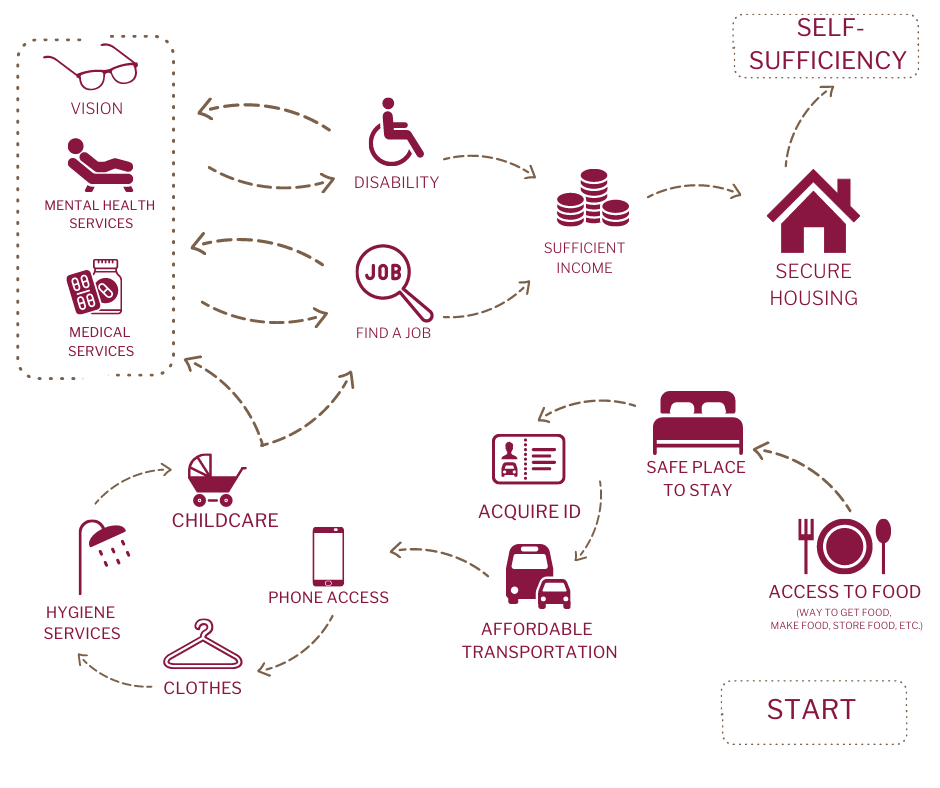
Another reality of homelessness is that our neighbors nearest the bottom of the economic ladder are still greatly impacted by larger macroeconomic trends.
When the job market is tight, someone working to overcome homelessness will have a much harder time finding a job – especially with big gaps in their employment history or a criminal record. When the housing market is tight, someone working to overcome homelessness will have a much harder time finding affordable housing – especially with no rental history or a criminal record.
These trends are usually correlated. When everyone is hiring and guests can find good employment easily (like in 2021), it is virtually impossible to secure an affordable rental. When rental prices are down and affordable housing is readily available (like in the early 2010’s), employers are much more selective and guests have a difficult time finding work.
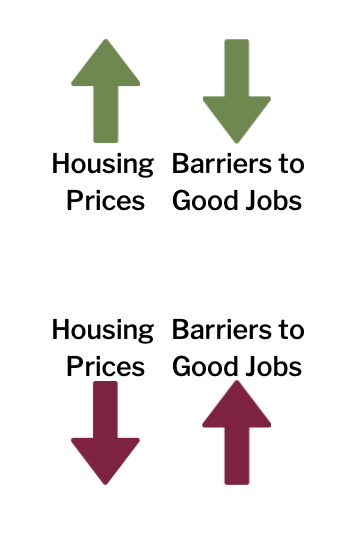
When the job market is tight, someone working to overcome homelessness will have a much harder time finding a job – especially with big gaps in their employment history or a criminal record. When the housing market is tight, someone working to overcome homelessness will have a much harder time finding affordable housing – especially with no rental history or a criminal record.
These trends are usually correlated. When everyone is hiring and guests can find good employment easily (like in 2021), it is virtually impossible to secure an affordable rental. When rental prices are down and affordable housing is readily available (like in the early 2010’s), employers are much more selective and guests have a difficult time finding work.
This is why at The Davies Shelters, we utilize our housing first model to journey with our guests through the complexities of their need, knowing that their restoration to wholeness is not a linear process. We seek to cultivate programs and community partnerships in order to holistically address the needs of our guests.
]]>Those experiencing the trauma of homelessness lack the resources to adequately meet those mental health needs, creating a vicious cycle that perpetuates homelessness. Unmet mental health needs are often both a symptom and cause of homelessness.
Within 72 hours of arriving at a shelter, all guests have a mental health assessment with Highland Rivers Health. Case managers help resource each guests’ particular needs, which might range from medication to peer support to in-patient stabilization. We partner with organizations across our community to meet the complexity of mental health needs of our guests.
Over 60% of our guests arrive with a mental health diagnosis – meeting those unmet mental health needs is often the first and most critical task.
Providing counseling services in-house allows The Davies Shelters to meet those unmet mental health needs more effectively and help our guests reach stability sooner.
Weekly group counseling and individual counseling sessions are provided by our Director of Operations, Brian Harris, LAPC. In addition, our Lead Case Manager, Alex Callahan, will complete his MA in psychology at the University of West Georgia in December 2021 and apply for licensure as an LAPC in 2022.
To hear more about the intersection of poverty and mental health as well as our in-house counseling program, listen to our podcast with Brian Harris.
Additionally, we able to offer counseling to a limited number of outside clients to help fund a session for a guest free of charge. If interested visit daviesshelter.com/counseling to learn more.
]]>