At DogingtonPost, we’ve compiled the latest updates and practical insights to help you understand what’s happening in the world of canine care. Whether you’re a current dog owner or considering adoption, this guide covers the trends and changes that matter most.
What Dog Owners Need to Know About New Welfare Laws
International Policy Shifts Shape Dog Care Standards
Global policy shifts are reshaping dog welfare standards, and owners who understand these changes make better decisions about breeding, adoption, and care. Indonesia banned elephant rides on January 27, 2026, and Bali Zoo stopped elephant rides on January 19, 2026, signaling a decisive shift away from animal exploitation in tourism. Korea’s bear bile farming ban takes effect in 2026, marking another major policy move to end cruel wildlife practices. These international trends reflect growing momentum for stronger animal protections, and dog ownership standards are tightening alongside them.
Breeding Regulations Now Prioritize Health Transparency
New breeding regulations focus on health transparency and genetic screening rather than appearance alone. Responsible breeders now provide full health records, genetic testing results, and written contracts covering spay/neuter terms, health guarantees, and what happens if the match fails. When you purchase a dog, verify that your breeder complies with these standards and avoid any breeder unwilling to share comprehensive health documentation or answer screening questions about your home and lifestyle.
Microchipping and Registration Become Mandatory
Pet ownership requirements shift toward accountability and microchipping mandates. Smart dog tags with unique IDs support quicker identification and reunification when a dog is lost, and many jurisdictions now require microchipping rather than treat it as optional. Automated lost-dog alerts notify shelters, vets, and nearby dog owners, creating multiple touchpoints for rapid reunification. Licensing and registration systems are becoming more automated to reduce administrative burden on shelters while improving data quality on dog intake, capacity, and outcomes.

What You Should Do Today
You should microchip your dog immediately, keep registration information current with your local agency, and maintain up-to-date contact details. Some communities now offer community rewards programs with annual reward cards and local deals for licensed dog owners, making compliance more attractive. The shift toward data-driven pathways supports humane adoption and foster coordination by analyzing patterns over time to improve outcomes.
Finding Shelters and Rescues Committed to Transparency
When you consider adoption, look for shelters and rescue organizations that use transparent dashboards to share welfare metrics and financial data. This openness reflects genuine commitment to dog welfare rather than hidden practices, and it helps you understand how your adoption supports the broader mission of animal care. These organizations often partner with local agencies to streamline reunification efforts and improve outcomes for dogs in their care.
How Dog Owners Can Navigate Modern Health and Behavior Care
Pet Health Insurance Protects Against Rising Veterinary Costs
Pet health insurance adoption has accelerated significantly, with owners recognizing that veterinary costs demand financial planning. The global pet care market reached $273.42 billion in 2025 and is projected to grow to $427.75 billion by 2032, reflecting increased spending on health services. US pet ownership hit 94 million households in 2025, up from 82 million in 2023, and average annual pet spending per household is expected to reach $1,445 by 2026. This spending surge reflects a fundamental shift: dog owners now prioritize preventative care and early intervention rather than reactive treatment. When selecting insurance, verify coverage for breed-specific health risks, preventative screenings, and behavioral consultations.

Many policies now include dental care and orthopedic coverage, which matters significantly for larger breeds prone to joint problems.
Behavioral Health Requires Professional Assessment, Not Punishment
Behavioral health has moved from optional to essential in responsible dog ownership. The rise in mental health awareness extends to dogs, with owners increasingly recognizing that stress, fear, and anxiety directly impact quality of life and long-term health outcomes. Separation anxiety, destructive behavior, and excessive barking often signal underlying medical or emotional issues that require assessment from a qualified veterinary behaviorist, not punishment. Early intervention prevents escalation and suffering. A qualified trainer or behaviorist can identify whether your dog’s actions stem from fear, pain, or learned behavior-information that shapes the right response.
Wearable Technology Detects Health Changes Before They Worsen
Wearable technology now supports behavioral and health monitoring: the pet wearables market grew from $4.16 billion in 2025 to a projected $10.43 billion by 2032, with GPS tracking and health monitoring devices allowing owners to detect behavioral changes linked to pain or illness. Activity monitors track steps and distance to establish a personal baseline and flag meaningful changes early. These data points help your veterinarian recommend targeted interventions-whether dietary adjustments, exercise modifications, or behavioral training-based on concrete information rather than guesswork. Schedule regular vet visits, but also invest in monitoring tools that help you spot problems before they worsen.
Preventative Care Shifts From Annual Checkups to Continuous Monitoring
Preventative veterinary medicine increasingly relies on wearable data and behavioral observation rather than annual checkups alone. Your veterinarian can then recommend specific actions based on what the data reveals about your dog’s activity level, rest patterns, and behavioral shifts. This approach catches joint problems, metabolic changes, and anxiety disorders at earlier stages when treatment proves more effective and less costly. The combination of regular veterinary care and continuous monitoring creates a comprehensive picture of your dog’s health trajectory, enabling you to make informed decisions about nutrition, exercise, and behavioral support before issues become serious.
Dog Adoption and Rescue Initiatives
Regional Networks Transform Reunification Outcomes
Shelter partnerships have fundamentally transformed dog adoption outcomes over the past two years. Organizations now share intake data, capacity metrics, and reunification success rates across networks, meaning a dog lost in one county triggers alerts across three neighboring jurisdictions within hours. This interconnected approach reduces the time dogs spend in shelters and increases return-to-owner rates dramatically. When you search for a dog to adopt, prioritize shelters that participate in these regional networks and openly share their reunification data.
Finding the Right Rescue Organization
The AKC Rescue Network connects you directly to breed-specific rescue groups, and many now use automated systems to match your lifestyle with available dogs rather than forcing you into generic browsing. Ask any rescue organization how many dogs they reunite with original owners each month-transparent shelters will provide this number without hesitation. If they deflect or claim they don’t track it, that’s a red flag. The best rescues measure outcomes because outcomes drive their mission, not just adoptions.

Honest Self-Assessment Before Adoption
Adoption success depends entirely on honest self-assessment before you contact any rescue. Evaluate your actual activity level, living space, work schedule, and financial capacity-not the dog you wish you could own. Rescue organizations screen applicants rigorously because they’ve learned that failed matches harm dogs and waste resources. Expect detailed questions about your home setup, your experience with dogs, and what happens if the adoption doesn’t work out.
What Reputable Rescues Provide
Written contracts from reputable rescues cover spay/neuter terms, health guarantees, and return policies, protecting both you and the dog. Adopting from a rescue rather than a breeder directly supports data-driven welfare improvements, shelter operations, and foster networks. If you’re considering a specific breed, start with breed-specific rescues through the AKC Rescue Network rather than purchasing from unknown breeders.
Older Dogs and Mixed Breeds Offer Advantages
Older dogs and mixed breeds from shelters often come with behavioral assessments and medical screening already completed, reducing uncertainty and startup costs. Many rescues now use wearable activity data and behavioral notes from shelter time to help match dogs with compatible owners, making the adoption process far more precise than it was three years ago.
Final Thoughts
Responsible dog ownership means acting on what you learn from dog welfare news and updates. Microchip your dog immediately, keep registration current, and select veterinarians and trainers who use reward-based methods rather than punishment. When you adopt, work with shelters that share reunification data and use transparent matching systems, and if you consider a puppy, verify that breeders provide health records, genetic testing results, and written contracts covering health guarantees and return policies.
Staying informed requires consistent effort, so follow organizations that publish concrete welfare metrics and policy updates rather than generic advice. We at DogingtonPost publish the latest updates on dog health, adoption, and welfare standards to help you make informed decisions, and you can visit DogingtonPost for ongoing insights on canine care and advocacy. Read dog welfare news from sources committed to facts and practical guidance that shape your choices.
Supporting the future of canine welfare means backing shelters and rescues that measure outcomes, adopting rather than purchasing from unknown breeders, and opposing practices that exploit dogs for entertainment or profit. Your choices influence which breeders and services thrive and which fade away. The momentum toward humane standards is real, and responsible owners drive it forward.
]]>This guide covers high-protein options, common feeding mistakes, and top brands so you can feed your pup with confidence.
How Much Protein Does Your Dog Really Need
Understanding Your Dog’s Protein Requirements
Protein forms the foundation of your dog’s diet, but most owners feed either too much or too little without understanding what their individual dog actually requires. The Association of American Feed Control Officials sets the minimum at 18 percent protein for adult dogs, yet this baseline doesn’t account for age, activity level, or health status. A senior dog living indoors needs far less protein than a working dog or a young pup in growth phase. The obsession with high-protein kibble has created confusion about what dogs truly need. The reality is straightforward: protein requirements range from 18 to 25 percent for most adult dogs, with puppies and active dogs potentially benefiting from the upper end.

If your dog isn’t exercising intensely or building muscle, excess protein just becomes calories your pup doesn’t need.
Choosing Quality Protein Sources
The best protein sources come from identifiable, whole ingredients rather than vague protein meals. Chicken, beef, turkey, fish, and eggs are your gold standard because you know exactly what you’re feeding. Avoid products listing generic meat-by-products or meals you can’t recognize on the ingredient label. Fish provides omega-3 fatty acids that support coat and joint health, making it particularly valuable for aging dogs. Eggs from pastured sources offer complete amino acid profiles, and a large dog can safely consume up to one whole egg daily without disrupting their nutritional balance.
Introducing New Proteins Safely
When you introduce new protein sources, do it gradually over seven to ten days to prevent digestive upset. If you add fresh protein as a topper or supplement, it shouldn’t exceed 10 percent of your dog’s total daily calories. Your veterinarian should guide protein choices if your dog has kidney disease, liver problems, or pancreatitis, as these conditions sometimes require restricted protein intake despite common misconceptions about high-protein diets being universally beneficial.
These protein fundamentals set the stage for understanding how other nutrients work alongside protein to create a complete, balanced diet that supports your dog’s specific life stage and health profile.
Common Diet Mistakes That Cost Dog Owners Money and Health
Table Scraps Destroy Nutritional Balance
Most dog owners sabotage their feeding efforts without realizing it, and the damage compounds over months. The American Pet Products Association reports that dog owners spend roughly $287 per year on pet food, yet many waste that investment through preventable mistakes. Feeding table scraps ranks first on this list, and it’s more destructive than owners think. Table scraps introduce inconsistent calories, excessive sodium, and fats that destabilize your dog’s digestive system. A single chicken wing with skin contains around 100 calories and 7 grams of fat, which represents 20-40 percent of a small dog’s daily fat allowance depending on their size and activity level. Worse, feeding scraps trains your dog to beg and creates nutritional chaos because you lose track of total daily intake. Your dog’s balanced kibble becomes meaningless when you add random protein, fat, and sodium throughout the day.
If you want to add variety, do it intentionally with measured portions of safe foods like cooked carrots, green beans, or plain cooked chicken that you’ve calculated into their daily calorie budget, not whatever sits on your plate.
Portion Control Determines Weight and Longevity
Portion control represents the second major failure point, and it’s where obesity begins. Most owners eyeball kibble amounts rather than weighing portions, typically overfeeding by 20-30 percent without noticing. A medium dog needing 1.5 cups daily often receives 2 cups because owners fill bowls by habit rather than measurement. The 10 percent rule for treats and toppers gets ignored entirely, meaning treats that should constitute 50-100 calories become 200+ calories. Your veterinarian should guide portion sizes based on your dog’s weight, age, and activity level, and the label recommendations serve as a starting point that requires adjustment.
Health Conditions Demand Specialized Nutrition
Ignoring your dog’s individual health needs creates long-term problems that expensive vet bills later won’t fully fix. A senior dog living indoors doesn’t need the same protein and calorie load as a working breed in their prime, yet owners feed them identically. Dogs with kidney disease, liver problems, or metabolic issues require specialized diets that most owners either don’t pursue or pursue too late. These conditions demand restricted protein or phosphorus, not the high-protein trends dominating social media. Consulting your veterinarian before switching diets or when your dog reaches senior years prevents most preventable diet-related health decline and positions you to select the right food for your pup’s specific stage of life.
What Dog Food Actually Works in 2027
Premium Kibble Dominates the Market for Good Reason
The dog food market exploded into a multi-billion dollar space, with organic and natural pet food segments projected to reach about 215 billion dollars by 2027 according to Mordor Intelligence. This growth created both opportunity and confusion for owners trying to separate marketing hype from actual nutrition. Premium dry kibble dominates the market because it offers convenience, affordability for multiple-pet households, and shelf stability that fresh alternatives can’t match. However, premium doesn’t automatically mean better. Quality kibble formulations work fine if they meet AAFCO standards, contain identifiable protein sources, and match your dog’s life stage and activity level.

The trend toward premium kibble reflects owner willingness to pay more, with about 30 percent of price-agnostic dog owners already purchasing premium pet foods according to MarketPlace research.
What separates mediocre kibble from genuinely good kibble comes down to ingredient transparency and whether the formula addresses your specific dog’s needs rather than flashy marketing claims about superfoods or trending ingredients. Fixed-formula options with protein levels at 21, 25, and 27 percent tailored across life stages represent the premium kibble approach. These diets use poultry by-product meal as a protein source alongside plant-based options to balance essential amino acids, high-quality animal fats for concentrated energy and skin health, and extrusion processing that breaks down starches for improved digestibility.
Fresh Food Gains Veterinary Credibility
Wet food and fresh alternatives gained significant traction because they address real owner concerns about ingredient quality and digestibility. Fresh frozen and pantry-ready options now dominate the wellness conversation, with veterinarians increasingly recommending fresh food for dogs with digestive sensitivities or those who won’t drink adequate water. An independent national survey of 16,000 veterinarians found vet support diets to be the number one veterinary-recommended fresh food, signaling that fresh doesn’t mean unproven or trendy.
These diets typically use human-grade ingredients prepared in small batches and include specialized formulations for health conditions like kidney support with restricted protein and phosphorus or metabolic support with controlled carbohydrates and increased fiber. Specialized vet diets address specific health needs that standard kibble cannot match, making them essential for dogs with chronic conditions.
Budget-Friendly Options Require Smart Shopping
Budget-friendly options exist at every price point without sacrificing quality, though owners often confuse cheap with budget-friendly. A dog eating lower-cost kibble with questionable protein sources and excessive fillers will develop health problems that cost far more in veterinary bills than paying slightly more upfront for better nutrition. The Nextin Dog Trends 2027 report surveyed 1,201 U.S. dog owners and revealed that roughly two-thirds of premium-diet buyers are willing to pay more for sustainable dog products, suggesting that sustainability and ingredient sourcing matter more to engaged owners than pure price.
Your actual choice depends on your dog’s age, health status, and your household’s capacity to handle storage and feeding logistics rather than following whatever trend dominates social media that month.
Final Thoughts
Your veterinarian should guide your feeding decisions, especially when your dog reaches senior years, develops health conditions, or shows signs of digestive sensitivity. Don’t wait for problems to escalate before seeking professional input. A vet can recommend specialized diets for kidney support, liver health, metabolic management, or other conditions that standard kibble cannot address, and they can also calculate precise portion sizes based on your dog’s weight and activity level to prevent the overfeeding that leads to obesity.
Transitioning to a new diet requires patience and consistency. Introduce the new food gradually over seven to ten days, mixing increasing amounts of the new diet with the old one to prevent digestive upset (start by replacing 25 percent of the old food for two days, then increase to 50 percent for another two days, followed by 75 percent before switching completely).

Monitor your dog’s stool quality, energy levels, and coat condition during this transition, and consult your veterinarian if digestive issues persist beyond ten days.
Feeding your dog right comes down to understanding your individual dog’s nutritional needs, avoiding common mistakes that sabotage your efforts, and knowing when professional guidance matters. The best dog diets 2027 aren’t determined by trends or marketing claims but by what actually supports your pup’s age, activity level, and health status. Visit DogingtonPost for practical care tips and expert advice on dog nutrition and health to continue supporting your pup’s wellbeing throughout their life.
]]>From dogs pulled from dangerous situations to those overcoming behavioral challenges, these journeys show the real impact of rescue work. Whether through donations, volunteering, or adoption, you can be part of these incredible stories.
How Rescue Teams Save Dogs and Transform Lives
Extraction and Initial Assessment
Rescue operations span everything from extracting dogs in life-threatening conditions to nursing animals back to health after months of neglect. When rescue organizations coordinate with local shelters and volunteers, they pull dogs from dangerous environments-whether that means hoarding situations, abusive homes, or areas affected by natural disasters. The process isn’t glamorous. It requires veterinary assessments, behavioral evaluations, and sometimes weeks of medical treatment before a dog is ready for adoption. A dog pulled from a meat-trade rescue operation needs immediate health screening to catch hidden infections and parasites that developed during transport or confinement.
Matching Dogs with the Right Families
Rescue organizations don’t rush dogs into homes; they match each animal with families equipped to handle specific needs, whether that’s a dog recovering from physical trauma or one with behavioral issues stemming from past mistreatment. This careful pairing process determines whether an adoption succeeds or fails. A family with young children needs a different dog than a single person living in an apartment.

Preparation matters because mismatches lead to returns, and returns send dogs back into the shelter system.
Training as a Non-Negotiable Step
Health and behavioral challenges often go hand in hand in rescue cases. A dog with a traumatic past may show fear aggression, resource guarding, or severe anxiety that requires professional training and patience. Large-breed dogs-like Great Danes with serious health complications-transform into well-behaved family companions through consistent training and appropriate care. Training after adoption isn’t optional; it’s essential for integration and dramatically reduces the chance a dog gets returned to the shelter.
The Community Effort Behind Every Rescue
Volunteers and foster families play a critical role in this phase. Fostering creates space in shelters and allows dogs to decompress in a home environment while learning basic routines. If 6 percent more households chose adoption, the impact on shelter capacity could be significant. That statistic underscores how rescue organizations depend on community participation-donations fund operations, but volunteers and foster families provide the hands-on care that actually saves lives. The next chapter explores how families experience these transformations firsthand.
What Happens When a Rescued Dog Finally Comes Home
Physical Recovery and Medical Rehabilitation
Physical recovery from neglect or abuse follows a predictable timeline, but every dog moves at their own pace. A dog arriving at a rescue with untreated infections, malnutrition, or injuries requires immediate veterinary care-bloodwork, imaging, dental extractions, and sometimes surgery. These medical interventions cost between $1,500 and $5,000 per dog, which is why rescue organizations prioritize funding for medical treatment. Once initial health concerns stabilize, rehabilitation begins. This phase involves controlled exercise, proper nutrition tailored to the dog’s condition, and monitoring for complications. A Great Dane recovering from severe health issues doesn’t suddenly become athletic; handlers gradually increase activity levels over weeks or months while watching for signs of pain or relapse. The dog’s weight, coat condition, and energy levels shift noticeably during this period-these are concrete markers that rehabilitation works.
Building Trust Through Consistent Routines
Emotional healing operates differently than physical recovery and takes longer to measure. A dog that spent months in a hoarding situation or survived a meat-trade rescue doesn’t instantly trust humans, even kind ones. Building trust through consistent routines: the same person feeds the dog at the same time, quiet spaces allow the dog to retreat without pressure, and zero forced interactions protect the dog’s emotional boundaries. Handlers working with previously abused dogs report that consistent, intentional communication creates stronger bonds because the dog experiences clear direction without confusion.
Addressing Behavioral Challenges

Families adopting rescued dogs should expect behavioral training to take three to six months minimum before noticeable shifts in confidence occur. A dog showing resource guarding or fear aggression won’t transform in weeks; these behaviors reflect survival mechanisms that require patient redirection, not punishment. When families witness their rescue dog finally play without freezing, make eye contact voluntarily, or initiate physical contact, they’re seeing genuine emotional progress-not just compliance.
The Mutual Bond That Forms
Rescue dogs frequently display tangible gratitude after traumatic experiences, visible in behavioral changes like following their adopter from room to room, sleeping near them instead of hiding, or greeting them at the door with genuine excitement. This bond strengthens when families establish shared activities: regular walks build routine and exercise, training sessions create communication patterns, and outdoor adventures become consistent experiences that the dog anticipates. Families with multiple dogs report that rescue dogs integrate faster when living alongside stable, well-adjusted dogs that model calm behavior. The adopter-rescue dog relationship becomes genuinely mutual-the dog provides emotional support during stressful days while the family provides security and structure. This reciprocal bond, often summarized in rescue communities as who rescued whom, reflects the actual neurological reality that dogs form attachments that reduce stress hormones in both animal and human. These transformed dogs now stand ready to take on new roles within their families and communities.
How to Support Rescue Dogs Right Now
The Financial Reality of Rescue Operations
Rescue organizations operate on thin margins, and the gap between dogs saved and dogs still waiting for homes hinges entirely on financial resources and community participation. The math is straightforward: if just 6 percent more households chose adoption over buying from breeders or pet stores, shelter killing could end nationwide. Donations fund the medical interventions that cost between $1,500 and $5,000 per dog, covering bloodwork, imaging, dental work, and sometimes surgery. A $500 donation covers initial veterinary assessment and parasite treatment for one dog. A $2,000 donation funds behavioral training that determines whether a dog stays adopted or cycles back into the shelter system.

Where Your Money Actually Goes
Rescue organizations like Best Friends publish their spending publicly-you can see exactly where money goes. Transparency matters because donors need confidence that their contributions directly help animals. Medical care consumes the largest portion of rescue budgets, followed by staff salaries, facility maintenance, and behavioral training programs. When you donate to an established rescue organization, you’re not funding overhead; you’re funding the specific interventions that transform a dog’s life.
Fostering: The Highest-Leverage Intervention
Foster families take dogs into their homes for weeks or months, freeing shelter space while allowing the dog to decompress in a normal household environment. That foster dog learns basic routines, becomes socialized to home living, and arrives at their permanent family already accustomed to indoor life instead of kennel stress. The foster family doesn’t need experience; rescue organizations provide training, veterinary care, and support. This intervention costs less than full shelter care while producing better outcomes for the dog’s eventual adoption.
Adoption as Permanent Support
Around 7 million U.S. households will add a pet this year, according to industry projections. If even a fraction of those households choose shelter dogs over pet store puppies, the entire rescue ecosystem shifts. Adoption isn’t charity toward the dog-it’s a transaction that benefits both parties equally. The adopter gains a companion that’s often more loyal and emotionally connected than a puppy from a breeder, while the shelter frees resources to help the next dog waiting in a cage.
Final Thoughts
Dog rescue success stories demonstrate something fundamental: transformation happens when communities commit to action. Rescue organizations invest resources, volunteers donate time, and families open their homes-that chain of decisions creates outcomes that benefit everyone involved. The impact extends far beyond individual dogs and families, as each adoption strengthens the entire rescue ecosystem and moves shelters closer to the no-kill future that Best Friends targets for 2025.
Around 7 million U.S. households will add a pet this year, and if a meaningful portion of those households choose shelter dogs over breeders, the mathematical reality shifts dramatically. The 6 percent threshold that could end shelter killing nationwide remains achievable through ordinary people making deliberate choices. Adoption provides the most direct path, but fostering offers flexibility for people with temporary capacity, and donations fund the medical interventions that determine whether dogs stay adopted.
We at DogingtonPost believe every dog deserves a second chance, and we’re committed to sharing the stories that prove transformation is real. Visit our platform for practical adoption guidance and inspiring rescue narratives that show what’s possible when communities prioritize rescue dogs.
]]>At DogingtonPost, we’ve tracked the biggest stories and emerging trends that are changing dog ownership right now. Here’s what you need to know.
What’s Changing in Dog Welfare and Health Right Now
Westminster Sets the Standard for Breed Excellence
Westminster’s 2026 show delivered more than championship glory. Penny, a Doberman pinscher, claimed Best in Show with a coat so sleek and markings so precise that she embodied the AKC breed standard perfectly. The real story isn’t just about ring success-Westminster continues to set the standard for how we evaluate and celebrate dogs across all breeds. Breed standards drive everything from responsible breeding to health expectations. When judges reward dogs that match their breed’s defined traits, they reinforce what responsible ownership looks like.
The American Kennel Club hosts over 22,000 annual events across conformation and performance disciplines in 2026, showing that dog competitions have expanded far beyond traditional shows. Agility now ranks as the fastest-growing dog sport in the United States, testing speed and accuracy on timed obstacle courses. This shift reflects what dog owners actually want: active, engaged dogs that work alongside their handlers rather than just standing still in a ring.
Adoption Trends Reveal What Dog Owners Really Need
Adoption data from the ASPCA reveals that small dog adoptions rose 6 percent in the first half of 2025, while large-dog adoptions declined about 9 percent. Urban living drives this trend, with over 58 percent of pet parents prioritizing size when selecting a dog. This data matters because it tells shelters and rescue organizations exactly what breeds and sizes will move faster, letting them focus resources on matching dogs with homes rather than warehousing animals.

Puppies and juvenile dogs saw a 6 percent adoption boost in 2025, but adult and senior dogs experienced declines. This gap exposes a real problem: older dogs need specialized care options including mobility aids, medication tracking, and calm enrichment. The good news is that mixed-breed dogs often show fewer genetic health issues than purebreds, and research increasingly supports adopting mixed breeds for their genetic diversity.
Breed-Specific Care Demands Attention and Planning
Meeting potential dogs in person to gauge temperament remains essential because no study can predict whether a specific dog will fit your household. Breed-specific care matters significantly-French Bulldogs and Pugs need heat-sensitive monitoring, Doodles and Poodles require regular grooming schedules, and German Shepherds benefit from structured routines and enrichment. Training and early socialization across all breeds promote good behavior and long-term well-being far more effectively than any medication or supplement.
These shifts in adoption patterns and breed preferences are reshaping how rescue organizations, breeders, and pet-care businesses operate. The next section explores how these developments directly impact the resources and support systems available to dog owners navigating 2026.
What Dog Owners Need From Pet Care in 2026
Small Dogs Drive Operational Changes in Pet Care
The shift toward smaller dog adoptions and increased puppy interest forces pet-care businesses to rethink their entire operation. Wellness services now command premium pricing because owners of urban dogs demand specialized support. French Bulldogs and Pugs require temperature-controlled facilities and heat-monitoring protocols during daycare and boarding, which means pet-care providers must maintain climate systems at 65-72°F consistently. Doodles and Poodles need grooming appointments every 6-8 weeks to prevent matting and skin infections, creating recurring revenue streams for grooming facilities willing to invest in proper equipment.

Training Expands Beyond Basic Classes
The AKC’s expansion to over 22,000 annual events means handlers increasingly enter dogs in agility, obedience, and scent work trials, which demands training services that go far beyond basic puppy classes. Pet-care software systems that track breed-specific health needs, medication schedules, and grooming calendars are no longer optional-they’re essential infrastructure for scaling operations while maintaining quality. Facilities that ignore these breed-specific demands lose clients to competitors offering tailored care plans.
Mental Health Support Moves Into Mainstream Practice
Mental health support for dogs has moved from fringe wellness into mainstream practice, particularly for anxious and reactive dogs entering high-stress environments. Structured routines, enrichment activities, and calm spaces reduce cortisol levels in dogs experiencing separation anxiety or noise sensitivity, which translates directly into fewer behavioral incidents and higher client retention. Workplace dog policies expand rapidly, with companies recognizing that pet-friendly offices reduce employee stress, but this creates a secondary demand: dogs arriving at offices need socialization skills, reliable recall, and the ability to settle calmly around unfamiliar people and environments.
Behavioral Assessment Determines Real Success
Training providers who specialize in workplace readiness and behavioral assessment capture this market segment. Owners should prioritize meeting potential dogs in person before adoption or boarding to assess temperament fit, rather than relying on breed generalizations alone, because individual personality variation within breeds is substantial and determines real-world success far more than pedigree. This hands-on evaluation reveals whether a dog’s actual temperament aligns with your household needs and lifestyle demands.
As pet-care businesses adapt to these shifting demands, the resources available to dog owners continue to expand-creating new opportunities for those willing to invest in quality care and training that matches your dog’s specific needs.
What Resources Actually Help Dog Owners Right Now
Pet Health Software Transforms Daily Care
Pet health software platforms now track breed-specific vulnerabilities, medication schedules, and grooming timelines automatically, eliminating the paper-based systems that fail when life gets hectic. Services like temperature-monitoring apps for brachycephalic breeds such as French Bulldogs and Pugs alert owners when conditions exceed safe ranges, which matters because heat stress kills more dogs than most owners realize. Veterinary nutritionists increasingly offer telehealth consultations, making specialized dietary guidance accessible without driving across town or paying premium emergency clinic rates.

Structured Pathways for Dogs and Handlers
The AKC’s 22,000 annual events across conformation, agility, obedience, and scent work trials create structured pathways for owners to develop their dogs’ abilities while building community with handlers facing identical challenges. Training programs specifically designed for workplace readiness have emerged because companies expanding dog-friendly office policies need assurance that arriving dogs won’t create behavioral incidents. These programs address real gaps in the market where generic training classes fail to prepare dogs for office environments.
Data-Driven Adoption Matches Dogs to Lifestyles
Responsible pet ownership has shifted from following generic rules toward data-driven decision-making tailored to your specific dog’s breed, age, and temperament. Adoption agencies now provide detailed behavioral profiles and health histories that go beyond basic descriptions, letting adopters match dogs to their actual lifestyle rather than guessing. Mixed-breed dogs live on average about 1.2 years longer than similarly-sized purebred dogs, offering genetic diversity advantages that reduce inherited health problems.
Advocacy Drives Protective Legislation
Canine advocacy organizations have expanded their focus beyond shelter operations into legislative change, with groups pushing for breed-specific heat regulations in pet transport and mandatory climate controls in boarding facilities. Owners who support these initiatives directly through donations or volunteer work accelerate progress toward standards that protect vulnerable breeds. Individual engagement matters because local ordinances often lag behind best practices until enough owners demand change at city council meetings.
Final Thoughts
The dog world in 2026 moves faster than ever, and dog news roundups matter more than they did five years ago. Westminster’s emphasis on breed standards, the shift toward smaller dog adoptions, and the expansion of specialized pet-care services all point to one clear reality: responsible dog ownership now demands active engagement with current information and tailored solutions rather than generic advice. Monitor how pet-care businesses in your area respond to breed-specific demands, particularly heat management for brachycephalic breeds and grooming schedules for Doodles and Poodles.
Track local legislation around dog-friendly workplace policies and heat regulations in pet transport, because these standards directly affect what services become available to you. Pay attention to adoption data in your region, since the national trend toward smaller dogs and puppies may shift which dogs need homes most urgently in your community. The AKC’s 22,000 annual events provide real-world opportunities to learn from handlers and trainers working with dogs similar to yours, while veterinary nutritionists offering telehealth consultations give you access to specialized guidance without premium pricing.
We at DogingtonPost remain committed to delivering practical care tips, expert advice, and the latest dog-related news that actually matters for your household. Visit DogingtonPost regularly to stay connected with stories, resources, and insights that help you make informed decisions about your dog’s health, training, and lifestyle. The dogs in your life deserve owners who stay informed and adapt as the world around them changes.
]]>Dog enrichment toys solve this problem. At DogingtonPost, we’ve seen firsthand how the right toys transform a restless pup into a happy, engaged companion. These aren’t just playthings-they’re tools that build confidence, strengthen your bond, and keep your dog’s mind sharp.
What Types of Enrichment Toys Work Best
Puzzle Toys for Mental Stimulation
Puzzle toys sit at the top of the enrichment hierarchy because they force your dog to work for their reward. Treat-dispensing toys like the Toppl, Qwizl, and Kong Wobbler require dogs to manipulate, roll, or paw at the toy to release kibble or treats. The Kong Wobbler is self-righting, meaning it returns upright after your dog nudges it, extending the engagement time significantly. These toys slow down fast eaters, which reduces bloating and gives your dog’s brain time to register fullness. Start with easy puzzles where treats are partially visible, then gradually increase difficulty by adding the Toppl Stopper or hiding treats deeper inside. Puzzle toys work especially well for adolescent dogs that need outlets for their big feelings and energy, and for senior dogs that benefit from cognitive stimulation to maintain mental sharpness.
Fetch and Chase Toys for Physical Exercise
Fetch and chase toys address the physical exercise side of enrichment, but not all are created equal. The Kong Ring ranks as exceptionally durable and serves multiple purposes: dogs carry it, fetch it, and it withstands power chewing better than most fabric toys. The Kong Goodie Bone offers openings at both ends for treats while remaining heavy enough to throw accurately, making it ideal for dogs that love both fetch and problem-solving. Rope toys like the Tug of War Donkey work best for supervised interactive play rather than unsupervised chewing, since the tug rope can fray if left alone too long.

Chew Toys for Dental Health and Stress Relief
Chew toys serve dual purposes: they satisfy your dog’s natural urge to chew while promoting dental health and stress relief. Hard chews like antlers are controversial due to potential tooth fractures, but rounded base sections from deer antlers last longer and may cost less over time. The Benebone Wishbone and Tree Root Chew by Wildfang offer flavored alternatives that hold dogs’ interest longer than plain chews. Rotate your toy collection every few days to maintain novelty and prevent boredom, keeping three to five toys in active rotation while storing the rest. This rotation strategy keeps your dog engaged without overwhelming them with too many options at once, setting the stage for selecting toys that match your individual dog’s needs and personality.
Matching Toys to Your Individual Dog
Assess Your Dog’s Preferences First
Choosing the right enrichment toy isn’t about picking whatever looks fun on a shelf. Match specific toys to your dog’s age, size, breed tendencies, and problem-solving ability instead. A Kong Ring works brilliantly for a 70-pound Labrador but will frustrate a 10-pound Chihuahua that can’t grip it properly. Similarly, a puzzle toy designed for moderate chewers won’t survive a power chewer, and a toy meant for an adult dog may be too complex for a puppy still learning impulse control. Start by honestly assessing what your dog actually enjoys. Does your terrier mix obsess over shredding cardboard, or does your herding dog prefer chasing and collecting toys? Observe these patterns before you buy anything new.
Tailor Toys to Your Dog’s Life Stage
Adolescent dogs need outlets for their intensity and big emotions, so they benefit from toys that require sustained problem-solving like the Kong Wobbler or Toppl with the Toppl Stopper added for extra challenge. Senior dogs, on the other hand, need cognitive stimulation without physical strain, making slower-paced puzzle toys ideal for keeping their minds sharp without exhausting their joints. Age shapes what your dog can handle and what will hold their attention longest.
Progress Difficulty Gradually
Difficulty progression matters far more than most dog owners realize. Start with easy puzzles where treats are clearly visible or partially exposed, then increase complexity only after your dog consistently solves the simpler version. This prevents frustration and maintains motivation, which keeps engagement alive long-term. A dog that can’t figure out a toy in five minutes will abandon it, defeating the entire purpose.

Your dog learns faster when you build success into each step.
Rotate Toys to Maintain Novelty
Rotating your toy collection every three to five days maintains interest and improves your dog’s welfare. Keep only three to five toys accessible at any given time while rotating the others away. This creates novelty without overwhelming your dog’s attention, and it extends the lifespan of your toys because they’re not being chewed constantly. Power chewers destroy toys faster, so they need rotation cycles measured in days rather than weeks.
Match Durability to Chewing Intensity
Match toy durability to your dog’s chewing intensity, and always supervise DIY enrichment or newer toys for the first few sessions to catch any safety issues before they become problems. A toy that works for one dog may fail for another, so your dog’s individual chewing strength determines what will last. Once you’ve matched toys to your dog’s personality and needs, the next step involves knowing which specific products deliver real results and stand up to real dogs.
Products That Actually Work for Real Dogs
Top Treat-Dispensing and Puzzle Toys
The Kong Wobbler sits at the top of treat-dispensing recommendations because it’s self-righting and holds a substantial amount of food, extending mealtime enrichment sessions significantly. The Toppl and Qwizl families offer adjustable difficulty through the Toppl Stopper, allowing you to progress from easy to challenging as your dog improves. These three toys cost between $20 and $28, placing them in the mid-range market where durability meets affordability. The Feast Mat slows fast eaters while stimulating nose work, addressing both behavioral and digestive issues simultaneously.
Rope, Tug, and Fetch Toys
For rope and tug toys, the Kong Ring outperforms most competitors due to its extreme durability and multi-purpose functionality. The Tug of War Donkey includes crinkly material and a squeaker, but requires supervision since the tug rope can fray during unsupervised play. Kong Goodie Bones come in three sizes with openings at both ends, making them suitable for both treat dispensing and fetch.
Hard Chews and Flavored Alternatives
Hard chews like deer antlers can cause painful slab fractures, though rounded base sections may prove more cost-effective over time. The Benebone Wishbone and Tree Root Chew by Wildfang offer flavored alternatives that hold dogs’ interest longer than plain options.
Rotation Strategies for Maximum Engagement
Rotate your active toy collection every three to five days to maintain engagement without overwhelming your dog’s attention. Keep only three to five toys accessible while storing the rest-a strategy that extends toy lifespan by reducing constant chewing pressure. Power chewers need rotation cycles measured in days rather than weeks, requiring you to assess your individual dog’s destruction rate before purchasing in bulk.
Safety and Selection Based on Real Testing
Start with toys rated for moderate chewers if your dog is new to enrichment, then upgrade to tougher options only after observing actual chewing intensity. Supervise all new toys during the first few sessions to identify safety issues before they cause problems. Always inspect toys regularly for damage, loose threads, or detachable parts that could become choking hazards. A toy that works brilliantly for one dog may fail for another, so your dog’s individual chewing strength and play style determine what will actually survive in your home.

Final Thoughts
Dog enrichment toys prevent destructive behavior, build confidence, and keep your dog’s mind sharp throughout their life. Dogs with access to proper enrichment experience less anxiety, maintain better dental health, and develop stronger bonds with you through shared play and problem-solving. The best toy for your dog depends on matching it to their age and chewing intensity, starting with appropriate difficulty levels, and rotating toys consistently to maintain novelty.
Regular play and mental stimulation shape your dog’s behavior, emotional stability, and long-term health. Dogs that receive consistent enrichment develop better impulse control, sleep more soundly, and exhibit fewer destructive behaviors than dogs left to their own devices. Your individual dog’s preferences matter far more than marketing hype or bestseller lists-a Kong Ring works brilliantly for a power chewer, but a puzzle toy like the Toppl serves an anxious adolescent better.
We at DogingtonPost believe every dog deserves enrichment that matches their personality and needs. Watch how your dog responds to different toys, adjust difficulty as they improve, and rotate your collection to keep engagement alive. Visit DogingtonPost for expert advice on canine care and enrichment strategies to discover more practical guidance on keeping your dog healthy and happy.
]]>At DogingtonPost, we’ve seen firsthand how the right preparation transforms those critical early weeks. This guide walks you through everything you need to know.
Preparing Your Home for Your New Dog
Your home needs preparation before your new dog steps through the door, and this isn’t about making things look nice-it’s about preventing injury and stress. Start by removing toxic substances that pose serious risks. Chocolate, xylitol found in sugar-free products, grapes, raisins, onions, and garlic are poisonous and should be locked away. Medications, cleaning supplies, pesticides, and antifreeze belong in cabinets your dog cannot access. The ASPCA Animal Poison Control Center handles over 250,000 cases annually, and many involve household items pet owners didn’t realize were dangerous.

Check under sinks, in pantries, and on counters where your dog might jump. Secure electrical cords with cord protectors or tape them down, and remove or cover any sharp objects like nails, broken glass, or exposed wires. Small items like coins, rubber bands, and toy parts become choking hazards-a dog’s curiosity doesn’t distinguish between safe and dangerous.
Create a Decompression Zone
Your new dog needs a designated safe space for the first few days, not the entire house. Choose a quiet room away from high traffic-a bedroom, bathroom, or laundry room works better than a living room. Place a crate with the door open, a bed or blanket, water and food bowls in separate corners, and a few toys. This confined space reduces overwhelm and helps your dog feel secure during those first 3 days of adjustment. Keep the room temperature comfortable and dim the lights if possible. When your dog arrives, take them directly to this space on a leash and give them time to explore without pressure. Introduce other family members in this room, one person at a time, speaking softly and calmly. If you have other pets, keep them completely separate during these initial days-your new dog needs to decompress without additional social demands.
Feeding, Water, and Bathroom Logistics
Establish bathroom and feeding areas before day one arrives. Take your dog to the designated elimination spot immediately upon arrival, on a leash, and reward successful results with treats and praise. This teaches location and builds positive associations fast. Feed your dog in a quiet area away from other pets if you have them, using the same food and feeding schedule the dog had previously. If you must switch foods, transition gradually over 1–2 weeks by mixing the old food with the new to prevent digestive upset. Place water bowls in easily accessible locations but separate from food bowls. If you have multiple dogs, keep all feeding stations completely separate to eliminate competition and resource guarding. Establish a consistent daily routine for meals, walks, and potty breaks-dogs thrive on predictability and routine helps reduce stress.
With your home prepared and your spaces organized, the real work of building trust and routine begins during that critical first week.
The First Week: Building Trust Through Routine and Controlled Introductions
The first week makes or breaks your dog’s confidence in their new home. Your job is establishing predictability, not cramming in social experiences. Most dogs need 3 days just to decompress before they’re ready for anything beyond basic care, according to the 3-3-3 rule used by adoption specialists. During those initial 72 hours, keep interactions minimal. Your dog’s nervous system is in overdrive processing new sights, sounds, and smells.

Introduce Family Members Gradually
Introduce family members one at a time in the decompression room, keeping voices low and movements calm. Let your dog approach people on their own terms rather than forcing interaction. If you have children, this is non-negotiable-supervise every interaction and teach kids that the new dog needs space. A frightened dog can snap or hide, and your child’s safety depends on you managing these encounters carefully. Once your dog shows signs of settling after day 3 or 4, you can gradually expand their world to other rooms, but do this slowly over the following weeks. Controlled introductions to different people and environments help your dog learn to respond calmly to new situations.
Create a Consistent Schedule for Feeding and Walks
Stick to your established feeding and walking schedule religiously. Dogs thrive on predictability, and consistent mealtimes at the same location help them relax and trust that their needs will be met. Walk your dog at the same times each day, ideally in quiet areas with minimal distractions during week one. Exercise followed by calm, quiet time prevents over-arousal and gives your dog time to process everything.
Use Positive Reinforcement and Patience During Adjustment
Positive reinforcement during this week matters far more than corrections. Reward calm behavior with treats and praise-sitting quietly, approaching you gently, eating without anxiety. Avoid punishing accidents or mistakes. Your dog is learning the rules of an entirely new world, and punishment creates fear that sets back trust by weeks.
Managing Multiple Dogs in Your Home
If you have a resident dog at home, the timeline extends significantly. Introduce them on neutral ground like a nearby park before any in-home meetings, with both dogs on leash and a second person present if possible. Keep these first meetings short, 10 to 15 minutes maximum, and watch for stress signals like stiff posture, lip licking, or panting. Separate the dogs completely for the first week, feeding them in different rooms and using baby gates to maintain distance. Gradually increase supervised time together only if both dogs remain calm. Many multi-dog households fail because owners rush integration. The new dog needs to feel secure in their own space before sharing territory. Separate feeding bowls, water stations, and sleeping areas reduce competition and resource guarding, which is the leading cause of conflict between newly introduced dogs. If your resident dog shows discomfort or the new dog displays fearful behavior around them, slow down further. Some dogs take 6 to 8 weeks to coexist peacefully indoors. This isn’t failure-it’s patience paying off.
As your dog settles into their new routine and family dynamics stabilize, you’ll encounter unexpected challenges that test your commitment to a stress-free transition.
Common Challenges and How to Address Them
The first few weeks expose real problems that didn’t exist before. Your dog isn’t being difficult-they’re communicating that something in their environment feels unsafe. Separation anxiety ranks as one of the most common issues, and it manifests differently depending on your dog’s history. A dog that barks, whines, or scratches at doors when you leave is in genuine distress, not testing boundaries. The American Veterinary Society of Animal Behavior emphasizes that punishment worsens anxiety significantly, so you should depart and return calmly without fanfare. Practice leaving for short intervals, starting with just 30 seconds, and gradually extend the time as your dog remains settled.

If your dog has severe separation anxiety that causes destructive behavior or excessive vocalization, consult a veterinary behaviorist rather than attempting fixes on your own.
Managing Separation Anxiety and Stress Responses
Some dogs benefit from anti-anxiety medication prescribed by a vet, combined with behavioral training. Crate training helps tremendously because dogs naturally view a properly conditioned crate as a safe den, not a prison. Place the crate in your bedroom during the first few weeks so your dog feels your presence at night. Accidents during this period aren’t housetraining failures-they’re stress responses. Your dog’s bladder control weakens under anxiety, so take them outside more frequently than you think necessary, every 2 to 3 hours during week one, and reward outdoor elimination heavily with treats and genuine praise.
Reading Body Language and Recognizing Stress Signals
Fear and behavioral issues require you to read your dog’s body language accurately. Stiff posture, tucked tail, lip licking, yawning, and panting signal stress before your dog escalates to barking or aggression. A dog showing these signals needs space and time, not encouragement to interact. If your new dog hides under furniture or refuses to eat for the first day or two, this is normal decompression, not an emergency. However, if hiding persists beyond 3 days or your dog refuses water, contact your veterinarian to rule out medical issues.
Addressing Destructive Behavior and Anxiety-Driven Issues
Behavioral issues like inappropriate chewing or digging almost always stem from anxiety or insufficient exercise, not spite. Increase daily walks to tire your dog physically, then provide quiet time for mental recovery. Chewing is self-soothing, so you should provide appropriate outlets like long-lasting chews rather than removing all chewing opportunities. If your dog exhibits resource guarding around food or toys, feed them separately from other pets and remove high-value items temporarily. Never hand-feed a resource-guarding dog or reach toward their food bowl-these actions escalate tension.
Managing Fear Responses and Trauma-Related Reactions
Some dogs carry trauma from previous living situations, and their reactions might seem extreme to minor stimuli. A dog terrified of vacuum cleaners or thunderstorms needs gradual desensitization paired with positive associations, not forced exposure. Train an alternative behavior like going to their bed when the trigger appears, then reward heavily. Your dog’s nervous system needs time to recalibrate, and rushing this process creates setbacks lasting weeks.
Final Thoughts
A successful home acclimation plan for dogs rests on three foundations: preparation, patience, and consistency. You removed hazards, established routines, introduced family members carefully, and addressed challenges as they arose. These steps determine whether your dog settles confidently or struggles for months.
Dogs that experience a calm, structured transition develop stronger bonds with their owners and show fewer behavioral problems down the road. Research consistently shows that dogs introduced slowly to their new environment display lower stress levels, better housetraining success, and fewer anxiety-related issues compared to dogs overwhelmed during arrival. Your commitment to a stress-free transition reflects genuine care, and that foundation will serve your dog well for life.
Training classes, veterinary check-ins, and behavioral guidance help you navigate questions that arise after the critical first weeks. Visit DogingtonPost for additional resources on dog health, training, and lifestyle to continue learning as your dog settles in.
]]>From heatstroke risks to shifting parasite seasons, climate change poses real challenges to dog health. This guide covers the threats your dog faces and the practical steps you can take right now.
How Heat and Climate Threaten Your Dog’s Health
Heatstroke kills dogs during ordinary activities
Heatstroke kills dogs in the UK at alarming rates. VetCompass data from 2016 analyzed over 900,000 dogs in primary veterinary care. July alone accounted for a significant portion of heat-related illness events. Most heatstroke occurs during everyday activities. Walking triggered the majority of exertional heat-related illness cases, meaning your normal daily routine puts your dog at risk when temperatures climb.
Certain breeds face much higher odds. Bulldogs, French Bulldogs, Chow Chows, and Greyhounds show significantly elevated risk compared to Labradors. If you own a brachycephalic breed with a flat face, their impaired cooling through panting makes them especially vulnerable. Younger dogs under two years and overweight dogs also face greater danger.
Car interiors reach dangerous temperatures in UK summers. Never leave your dog unattended in a vehicle, even briefly.
Parasites thrive as seasons shift
Warmer temperatures expand flea and tick seasons, extending their activity window and pushing them into regions where they previously couldn’t survive. Fleas cause itching and dermatitis that signal trouble. Ticks transmit Lyme disease and other serious illnesses, though early antibiotic treatment works well if caught quickly.
Watch for excessive scratching, erratic behavior, or lethargy as warning signs your dog needs a vet check. The practical move here is preventive treatment year-round rather than seasonal coverage-your vet can recommend options suited to your dog’s age and health status.
Air quality directly impacts your dog’s health
Air quality directly impacts your dog’s health. Dogs exposed to wildfire smoke and pollution develop conditions like asthma and pneumonia, with rapid breathing and blue gums signaling distress.
On bad air days, keep your dog indoors. For homes near busy roads with vehicle exhaust pollution, indoor plants like peace lilies and ZZ plants can reduce nitrogen dioxide levels by roughly 20 percent in sealed spaces, offering a low-cost air-quality boost. Combined with proper ventilation and air filtration systems, this approach protects your dog’s respiratory health without expensive equipment.

These health threats demand immediate attention from dog owners. The next section covers the behavioral shifts your dog experiences as climate patterns change, helping you adjust your care routine accordingly.
How Climate Change Shifts Your Dog’s Daily Routine
Exercise timing becomes non-negotiable
Warming temperatures force you to restructure your dog’s entire activity schedule around cooler hours. Dogs that once thrived on afternoon walks now need early morning or evening outings to avoid peak heat. Limit activity to the cooler times of the day-this isn’t optional advice in warming climates, it’s a necessity. Younger, more active dogs feel the shift most acutely because they demand regular exercise, yet prolonged heat exposure becomes dangerous during traditional activity times.

Brachycephalic breeds require even stricter timing since their inability to cool efficiently means any midday activity risks serious illness. This schedule compression creates real challenges for working owners and families with set routines, but ignoring it puts your dog at genuine risk. The practical reality demands that you adjust your daily life around your dog’s heat tolerance, not the other way around.
Shedding cycles shift earlier and last longer
Seasonal behaviors like shedding cycles are shifting earlier as temperatures fluctuate unpredictably. Warmer temperatures in spring and summer prompt the shedding of thicker winter fur, and these extended shedding periods mean you’ll brush your dog more frequently throughout the year than previous generations of dog owners did.
Sleep patterns shift too-dogs rest more during peak heat hours and become more active during cooler periods, essentially reversing their natural rhythms. This adaptation happens automatically, but you need to recognize it and adjust your expectations about when your dog wants to play or rest.
Breeding cycles respond to extended warm seasons
Intact dogs experience altered reproductive timing as warm seasons extend across regions. Some breeds show shifted breeding cycles that affect population dynamics, though this change matters most to breeders rather than pet owners. For most dog owners, the key takeaway is that your dog’s behavioral changes aren’t random-they’re adaptive responses to a warming world.
Comfort needs demand year-round attention
Provide consistent access to cool, shaded resting areas throughout the year rather than assuming seasonal norms still apply. Invest in cooling mats or elevated beds that improve airflow, allowing your dog to regulate body temperature more effectively. Monitor your dog’s comfort level multiple times daily-panting, restlessness, or reluctance to move all signal that your dog needs cooler conditions.
These behavioral shifts set the stage for the practical strategies you’ll implement next. The following section covers specific actions you can take right now to protect your dog from climate-driven health risks and lifestyle disruptions.
Restructure Your Dog’s Activity Schedule Right Now
Anchor walks to cooler hours, not your schedule
Heat exposure during walks causes more heatstroke deaths than any other trigger in UK dogs. Your daily walk-the most routine part of dog ownership-becomes dangerous during warm months. Stop scheduling walks around your convenience and anchor them to cooler hours instead. Early morning walks before 9 AM and evening walks after 7 PM work best, though you’ll need to adjust these windows based on your specific region and current temperatures.
For dogs under two years or overweight dogs, this shift matters even more since both groups face significantly higher heatstroke risk. Test your dog’s tolerance by starting with shorter distances at cooler times, then gradually extend duration as your dog adapts. Brachycephalic breeds like Bulldogs and French Bulldogs have the highest risk for heat exhaustion and heat stroke-their flat faces prevent efficient cooling, making even brief afternoon outings genuinely dangerous.
If you work traditional hours and can’t walk your dog early or late, hire a dog walker or arrange midday breaks specifically for cooler walks. This isn’t a minor preference; it’s essential to preventing serious illness.
Keep water accessible at all times
Hydration becomes non-negotiable during any outdoor time. Carry fresh water on every walk and offer it frequently, not just at the end. Dogs don’t always drink enough on their own during activity, so encourage them to drink at regular intervals. At home, maintain multiple water bowls in different areas so your dog always has access regardless of where they rest.
During peak heat hours, move your dog’s water bowl to a shaded spot where they spend most of their time. This simple action ensures your dog can hydrate without searching for water during uncomfortable heat.
Use cooling products strategically
Cooling mats and elevated beds improve airflow around your dog’s body, allowing heat to dissipate more effectively than resting on standard bedding. These products work because they prevent heat from trapping between your dog’s body and the floor. Position cooling mats in the shadiest areas of your home and refresh them as needed throughout the day.
Some dogs benefit from cool water baths or wet towels draped across their backs during extreme heat, though not all dogs tolerate this approach. Test your dog’s reaction before relying on this method during emergencies.
Spot heat stress signals before they escalate
Excessive panting that continues even after activity stops, drooling, glazed eyes, or reluctance to move all indicate your dog needs immediate cooling. Move your dog to shade, offer water, and apply cool (not cold) water to their paws and belly where blood vessels sit close to the skin. If symptoms persist beyond ten minutes or include vomiting, blue gums, or seizures, contact your veterinarian immediately.
These signs demand urgent care since heat-related illness progresses quickly. Check your dog’s condition multiple times daily during warm weather-don’t assume one morning walk keeps them safe for the entire day. Monitor their behavior, breathing, and willingness to engage throughout afternoon and evening hours.

Final Thoughts
Climate change reshapes canine health in measurable, immediate ways that affect your dog today. Heat-related illness kills dogs during ordinary walks, parasites extend their seasons into new regions, and air quality deteriorates to trigger respiratory problems. These threats demand your attention now because they’re happening across the UK and beyond, and canine climate impact news continues to reveal new risks that previous dog owners never faced.
You control your dog’s protection through the practical steps outlined here. Restructure exercise timing around cooler hours, maintain constant hydration, monitor heat stress signals, and invest in year-round parasite prevention. These actions directly reduce your dog’s risk because they address the physiological vulnerabilities that warming temperatures expose. Brachycephalic breeds need stricter heat management, younger and overweight dogs require closer monitoring, and your home environment must provide consistent cooling and clean air.
Dog ownership in a warming world demands more attention and flexibility than previous generations required. Visit DogingtonPost for ongoing guidance on dog health and climate adaptation to help you navigate these changes and adjust your care practices accordingly.
]]>This guide covers practical dog friendly apartment tips that work in tight quarters, including flooring choices, exercise routines, and neighbor relations. You’ll find actionable strategies to keep your dog content while maintaining a harmonious living situation.
Making Your Apartment Safe and Comfortable for Your Dog
Your apartment’s physical setup determines whether your dog thrives or struggles with city living. Hard flooring like tile or laminate works better than carpet for apartment dogs because it’s easier to clean accidents and reduces odors. Carpet holds onto urine scent even after cleaning, which signals to your dog that the spot is an acceptable potty area-a problem when you’re trying to establish outdoor-only bathroom habits. If you have carpeted areas, use washable rugs that you can replace quickly, and consider baby gates to restrict your dog’s access to carpeted zones until potty training is solid. For puppies or dogs with accidents, spill-proof bowls and non-slip mats prevent water from spreading across floors and create safer footing for both you and your dog.
Create a Quiet Retreat Space
Your dog needs a designated area away from foot traffic and noise where they can decompress. A dog bed, crate, or quiet corner signals safety and reduces stress-related behaviors like excessive barking or destructive chewing. Position this space in a low-traffic zone-not near the main entrance or next to thin walls shared with neighbors. Keep it away from windows that face busy streets, as constant visual stimulation from passing cars and pedestrians keeps dogs in a heightened state of alertness. Children and guests should understand this is your dog’s private zone and not be allowed to disturb them there. Mental stimulation through puzzle toys and rotating chew items prevents boredom, which matters especially when your dog spends hours alone during work days.
Protect Your Dog from Heat and Light
Window treatments matter more than most apartment dog owners realize. Direct sunlight heats your apartment quickly, and dogs can’t regulate body temperature like humans do-they only cool through panting and sweating through their paws. Thermal-blocking curtains or cellular shades reduce heat buildup and UV exposure, which can damage your dog’s eyes and skin over time. If your apartment receives afternoon sun, close these treatments during the hottest hours, typically between 11 a.m. and 4 p.m. This simple step keeps your dog’s resting area comfortable and prevents heat stress, which poses particular danger for brachycephalic breeds like French Bulldogs that already struggle with temperature regulation.
Control Indoor Climate and Air Quality
Beyond window treatments, you can manage your apartment’s overall environment to support your dog’s comfort. Soft background noise-a fan or calm music-helps acclimate your dog to apartment sounds and reduces reactions to hallway activity or neighboring units. Maintain consistent room temperature, as dogs experience discomfort in spaces that fluctuate between hot and cold. Fresh water bowls placed in multiple locations (especially near their retreat space) encourage hydration, which supports their ability to cool themselves naturally. These environmental adjustments work together to transform your apartment into a space where your dog feels secure rather than stressed by urban living.
With your apartment’s physical environment optimized, the next step involves establishing routines that keep your dog active and mentally engaged throughout the day-a challenge that requires strategic planning in city living.
How Much Exercise Does Your Apartment Dog Actually Need
Urban dogs spend significantly more time indoors than suburban counterparts, which means exercise becomes your primary tool for preventing destructive behavior and managing excess energy. Most apartment dogs need at least two structured walks daily, but this baseline misses a critical reality: consistency matters far more than duration. A dog receiving two reliable walks at the same times each day will behave better than one receiving sporadic outings.

Set your walks for early morning before work and evening after returning home, as this rhythm helps regulate your dog’s bathroom schedule and reduces anxiety during the long workday hours.
Tailor Walking Frequency to Your Dog’s Energy Level
High-energy breeds like Whippets or younger dogs under three years old benefit from three shorter walks instead of two longer ones, preventing the afternoon energy crash that leads to excessive barking or destructive chewing. During walks, prioritize exposure to different routes, surfaces, and environments rather than simply covering distance. Your dog’s brain processes new sights, sounds, and smells as mental exercise, which exhausts them as effectively as physical exertion. If your apartment sits in a busy urban area with multiple nearby parks, rotate between them weekly to provide environmental variety that keeps your dog engaged.
Fill Workday Hours with Mental Stimulation
The reality of apartment living means you cannot rely on walks alone to manage your dog’s exercise needs, especially during workdays when your dog sits confined for eight hours or more. Interactive toys address this gap by converting idle time into mental stimulation that genuinely tires dogs out. Rotate three to five different puzzle toys weekly rather than leaving the same toy available constantly, as novelty drives engagement. Kongs stuffed with frozen peanut butter or wet food occupy dogs for extended periods, while snuffle mats and hide-and-seek games with treats scattered in blankets work effectively.
Consider Professional Support for Midday Care
For dogs spending more than six hours alone daily, professional dog walkers or daycare services become practical investments rather than luxuries. A midday walk from a professional walker breaks up the monotony and prevents the behavioral problems that emerge when dogs hold their bladder and bowels for extended periods. Dog daycare facilities provide socialization with other dogs alongside structured play. This matters because apartment dogs miss the casual social interactions that yard-based dogs experience naturally. If daycare feels financially out of reach, trading walking duties with neighbors who own dogs creates similar benefits at no cost.
Apartment living requires deliberate intervention to meet your dog’s exercise and mental stimulation needs-a commitment that extends beyond physical activity into how your dog interacts with the people and animals around them. The next section explores how training and community connections transform your dog into a considerate neighbor while strengthening their social bonds.
Managing Neighbors and Building Community
Barking complaints trigger more lease violations than any other pet-related issue in apartment buildings, which means you must address noise early to prevent the conflict that leads to eviction notices. The reality is that most barking stems from anxiety, boredom, or lack of training-not from a fundamentally problematic dog. Start by identifying your dog’s specific barking triggers: does your dog bark when you leave, during hallway activity, at outside sounds, or when bored indoors? The trigger determines your solution. Separation anxiety barking requires gradual desensitization to your departure routine and extended alone time, starting with leaving for just five minutes and returning before anxiety peaks. Environmental barking from hallway noise or street activity responds to soft background sound like a fan or classical music that masks triggering noises. Boredom barking points back to insufficient mental stimulation-the puzzle toys and rotating enrichment covered in the previous section address this directly.
Train Your Dog for Shared Spaces
Training your dog to wait calmly in elevators and walk past other residents without lunging or excessive noise matters equally to managing barking. Use a six-foot leash in shared spaces and reward calm behavior with treats immediately when your dog ignores distractions, gradually building their ability to focus on you rather than neighbors. This training prevents the escalating tension that turns minor behavioral quirks into serious neighbor conflicts.
Understand Your Lease and Local Regulations
Your lease agreement contains specific pet restrictions you must understand before problems emerge. Check whether your building caps dog weight, limits the number of pets, requires breed approval, or specifies pet deposit amounts and monthly pet rent. Many buildings cap dogs at 45 to 50 pounds, which eliminates larger breeds entirely. Reading these details before adopting prevents the devastating situation where you fall in love with a dog your lease prohibits.
Beyond lease compliance, know your local regulations-New York City leash laws require dogs on leash in public spaces, while other cities have different rules about off-leash parks and designated dog areas.
Connect with Other Dog Owners
Connecting with other dog owners in your building creates informal support networks that benefit everyone. Ask your building management for contact information of other dog owners, or post a note on the community board suggesting a monthly dog owner meetup. These connections lead to practical arrangements like trading dog-walking duties when someone travels, sharing recommendations for local veterinarians and trainers, and building the social pressure that keeps everyone accountable to responsible pet ownership standards. When neighbors know your dog and see you actively manage their behavior and exercise, they become allies rather than adversaries in your apartment community.
Final Thoughts
Apartment living with a dog succeeds when you commit to three core practices: creating a physically comfortable space, maintaining consistent exercise and mental stimulation, and building positive relationships with neighbors. Your dog’s behavior improves when flooring supports potty training, daily walks happen at predictable times, puzzle toys occupy idle hours, and barking triggers receive targeted training. Skip any single element and the others become less effective.
The reality of city living means your dog depends entirely on the routines and environment you establish. Unlike suburban dogs with yard access, apartment dogs cannot self-regulate their exercise or find mental stimulation independently. This responsibility falls completely on you, which actually simplifies decision-making because every choice about your apartment setup, walking schedule, and neighbor communication directly impacts your dog’s wellbeing and your lease security.
Start with the highest-impact changes first, then implement dog friendly apartment tips in stages to prevent overwhelm. If your dog barks excessively, prioritize identifying the trigger and implementing the corresponding solution before adding other improvements. We at DogingtonPost offer practical care tips and expert advice that help you navigate the specific challenges of apartment dog ownership, and your success depends on consistent implementation of these strategies rather than perfection.
]]>At DogingtonPost, we believe fostering is one of the most rewarding ways to help. This guide walks you through how to foster dogs, from preparing your space to managing the emotional journey of saying goodbye.
What Dog Fostering Really Means
Dog fostering is straightforward: you provide temporary housing, care, and attention to a shelter or rescue dog for weeks or months until they’re adopted. This isn’t volunteering at a facility or donating supplies-it’s opening your home as an active part of the rescue pipeline. According to Shelter Animals Count data, the median length of stay for dogs in shelters has increased across all sizes, with large dogs staying about 20 days, medium dogs around 18 days, and small dogs roughly 14 days. These numbers matter because longer stays mean shelters fill to capacity faster, forcing them to turn away incoming rescues.

When you foster, you directly address this bottleneck.
Government shelters increased their use of foster care significantly between January 2023 and December 2024, signaling a shift in how public facilities handle overcrowding. Your foster dog occupies a home instead of a kennel, freeing shelter staff to focus on medical care, behavioral assessment, and adoption matching for the animals still in-house. The work itself involves basic care-you feed your foster dog, provide exercise, handle house-training and socialization, and document the dog’s personality and behavior so shelters can match them with suitable families. Many foster programs ask foster parents to spend about two hours daily on exercise and play, adjusted for the dog’s energy level. You’ll also transport your foster dog to veterinary appointments and sometimes attend adoption events to help market them.

Some programs track foster outcomes rigorously, using data on intake numbers, waitlists, and weekly adoptions to show fosters the direct impact of their work. This transparency matters because it transforms fostering from an abstract good deed into measurable rescue work.
The Crisis Shelters Face Right Now
The numbers tell an urgent story. 5.8 million dogs and cats entered shelters and rescues in 2024, and capacity constraints force difficult decisions about which animals receive space and resources. Shelter Animals Count’s 2024 Year-End Report shows that longer stays compound the problem-dogs sitting in kennels longer means fewer new arrivals can be accommodated. This creates a cascade effect: rescues reject intakes, dogs end up in worse situations, and shelters operate in permanent crisis mode.
Foster-based rescues experience declining foster counts while private shelters remain steady or trend downward, indicating that community engagement patterns are shifting and supply isn’t matching demand. The solution isn’t building more shelters; it’s moving dogs into homes faster. Data-driven foster programs that track placement types, length of stay, and outreach outcomes show measurable improvement in adoption timelines. Community-based and short-term foster strategies are effective pressure-relievers for shelters. This is why fostering matters operationally, not just emotionally-you solve a logistics problem that affects thousands of dogs.
How Fostering Changes Outcomes for Dogs and Shelters
A foster home provides something kennels cannot: one-on-one attention in a normal living environment where dogs learn household routines, experience human interaction, and receive behavioral feedback. Dogs recover faster from trauma or surgery in homes than in facilities. Puppies under eight weeks need safe socialization and care that experienced foster families provide before they reach adoption age.
Shelters gain critical information from foster reports-which dogs are food-aggressive, which ones need quiet homes, which ones thrive with kids or other pets. This data directly improves adoption matching and reduces returns. When fostering programs include short-term options like Dog Day Out or weekend programs, agencies cycle long-stay dogs through temporary homes, giving them breaks from kennel stress and exposure to potential adopters.
Targeted approaches work because they remove barriers and acknowledge that fostering fits different lifestyles. For shelters, foster programs mean reduced medical costs (dogs in homes need less preventive intervention), faster turnover (freeing kennel space), and better adoption rates because foster dogs arrive at adoption events socialized and trained.

What Fostering Offers You
For you, fostering means testing whether dog ownership fits your life before permanent commitment, while directly saving a life and creating space for another rescue to survive. The experience transforms how you understand shelter work and the dogs waiting for homes. As you prepare your space and family for a foster dog, you’ll discover what this commitment actually requires-and why so many foster families find themselves unable to say goodbye.
Getting Your Home Ready for a Foster Dog
Securing Your Space Against Hidden Dangers
Before your foster dog arrives, your home needs to be genuinely prepared-not just emotionally, but physically. You must secure hazards that could kill or injure a stressed animal in an unfamiliar space. Remove access to trash, chemicals, medications, wires, and small objects that a dog can swallow. Keep foods and plants out of reach, especially chocolate, grapes, raisins, onions, and xylitol-containing products, all of which are toxic to dogs. You should house foster dogs indoors with a dedicated space and crate to help them adjust to home life safely. Establish a feeding station away from high-traffic areas and set up a crate in a quiet corner where your foster dog can retreat without feeling trapped.
Many shelters provide a foster starter kit with essentials like a collar, bowls, and leashes, but you should confirm this upfront. If your shelter doesn’t supply basics, budget for a quality collar, multiple food and water bowls, a crate sized appropriately for your dog’s adult size, and bedding. Ask your shelter whether they cover veterinary expenses or reimburse routine care and emergencies; this directly affects your financial commitment and peace of mind.
Feeding, Exercise, and Daily Documentation
You need to plan for about two hours daily on exercise and play, adjusted for your dog’s energy level-this isn’t negotiable if you want your foster dog adoption-ready. Feed high-quality dry dog food like Natural Balance or better, provide fresh water at all times, and establish whether your foster dog needs one or two meals daily. Document everything: appetite, energy, bathroom habits, and any behavioral observations. This data helps shelters place your foster dog with families that match their actual needs, not assumptions.
Managing Multiple Pets and Children Safely
Introducing your foster dog to existing pets and children requires deliberate structure, not hope. If you have resident dogs, introduce them one-on-one with supervision in neutral territory, remove high-value items like toys and chews during interactions, and feed them separately to prevent resource guarding. Cat introductions demand patience: keep your foster dog and resident cats in separate rooms initially, allow scent exchanges through closed doors for one to two weeks, then progress to face-to-face meetings on a leash. Never leave a foster dog unsupervised with cats, regardless of how calm they seem.
For children, supervise all interactions without exception. Teach them not to disturb your foster dog during meals or sleep, never to chase the dog or take toys away, and to let the dog approach them rather than the reverse. Establish a daily routine immediately: feed at the same times, schedule bathroom breaks at consistent intervals (try for three to six per day for house-training), and maintain predictable walk times. Dogs arriving from shelters are disoriented; routine transforms chaos into safety.
House-Training, Crate Training, and Mental Stimulation
Expect house-training accidents and use enzymatic cleaners to eliminate odor completely-regular cleaners fail because dogs smell lingering scent markers. Crate training should be positive and gradual: use high-value treats to encourage crate entry, never punish your dog with the crate, and leave the door open initially so the dog views it as a refuge. Provide substantial mental stimulation beyond walks: rotate toys, use food-dispensing toys or Kongs, and consider puzzle feeders. A bored foster dog develops destructive habits that damage their adoptability.
Medical Care and Emergency Readiness
Your shelter should provide a Foster Goal Sheet listing vaccine due dates and medical requirements; schedule appointments with approved veterinarians and use provided medical vouchers. Know the emergency signs that demand immediate action: inability to breathe, severe dehydration, parvovirus symptoms, or major trauma. Contact your foster coordinator immediately rather than waiting to see if symptoms resolve. Once your foster dog settles into this structure and routine, you’ll begin to see their true personality emerge-and that’s when the real work of training and socialization begins.
Building the Bond During Foster Care
Transform Disorientation Into Trust
Your foster dog’s first week will feel chaotic to them, and your job is to transform that disorientation into trust through consistent structure and deliberate training. The adjustment period isn’t about being nice-it’s about being predictable. A dog arriving from shelter stress needs to learn that meals happen at 7 a.m. and 6 p.m., walks occur at fixed times, and their crate is a safe space, not a punishment. Within two to three weeks of this consistency, most foster dogs stop testing boundaries and begin showing their actual personality. This is when training becomes effective because your foster dog has moved past survival mode.
Teach Commands That Increase Adoptability
Start with foundational commands like sit, stay, and drop it using positive reinforcement-treats, praise, and play. A dog that knows basic commands becomes significantly more adoptable because potential families see a trainable animal, not a rescue project. Document what works: does your foster dog respond better to high-value treats like chicken, or do they work for toys? Does leash pulling respond to stopping and waiting, or do they need a front-clip harness? Shelters use this information to guide adopters toward success, which directly reduces returns and failed placements.
Expose Your Foster Dog to Real-World Situations
Socialization during foster care matters operationally, not philosophically. Expose your foster dog to different environments, sounds, and people at a pace they tolerate without panic-this isn’t about making them fearless, it’s about preventing shelter trauma from translating into phobia. A dog that has walked busy streets, heard traffic noise, and met children in your home arrives at their adoptive family less likely to develop behavioral problems. Foster programs that require visits to shelters or rescue centers serve dual purposes: your foster dog stays connected to staff who know their history, and potential adopters see the dog in a familiar, confident state.
Navigate the Emotional Attachment Phase
The emotional attachment phase arrives around week four or five, when your foster dog stops flinching at sudden movements and actively seeks your attention. This is the hardest part. You must maintain emotional distance while providing excellent care-a contradiction that feels impossible but is essential. Your job is to prepare this dog for someone else’s family, not to keep them. The transition eases when you meet the adoptive family before placement, ask them specific questions about your foster dog’s quirks and needs, and trust that your training and documentation set them up for success.
Process Grief and Celebrate Success
After your foster dog leaves, the grief is real and valid. Many foster families report missing their dogs acutely for weeks. Some shelters facilitate post-adoption check-ins or allow foster families to follow their dogs’ progress on social media, which helps closure without undermining the adoption bond. The truth is that letting go proves you’re doing this right-your foster dog leaves because you prepared them well enough for someone else to love them permanently.
Final Thoughts
Every foster dog that leaves your home carries forward the impact of your care. They arrive at their adoptive family house-trained, socialized, and confident because you invested time in their transformation. Shelters measure this impact through data: reduced length of stay, lower return rates, and faster adoption cycles. When you foster, you create space for the next rescue to survive, and the one after that.
Contact your local shelter or rescue to learn about their foster program, as requirements and support vary significantly. Ask whether they provide a starter kit, cover veterinary expenses, and offer training guidance. Programs like Best Friends in Utah and Lucky Dog Animal Rescue demonstrate how structured foster support increases success rates, and many shelters now offer short-term options like Dog Day Out or weekend fostering if you’re uncertain about longer commitments.
Foster dogs become the most effective ambassadors for adoption because they prove rescue works. A dog that arrives at an adoption event calm, trained, and visibly bonded to their foster family shows potential adopters what’s possible. When you share photos and updates of your foster dog’s progress on social media, you market rescue itself-showing your community that opening your home saves lives. Visit DogingtonPost for practical guidance on dog care, adoption, and advocacy, then reach out to your local shelter to start how to foster dogs today.
]]>Regular checkups catch diseases early, when they’re easier and cheaper to treat. Your vet becomes your partner in keeping your dog healthy for years to come.
Why Regular Health Checks Actually Save Money
Early disease in dogs develops quietly, often without obvious symptoms until serious damage has occurred. According to IDEXX data, 1 in 7 dogs aged 1–4 and 1 in 5 cats aged 1–7 have clinically relevant abnormalities on bloodwork-yet most owners have no idea their pets are affected. Catching kidney disease, diabetes, or liver problems at this stage means slower progression, dietary adjustments, and medications that preserve quality of life. Waiting until your dog shows symptoms like weight loss or increased thirst means the disease has already advanced, requiring more intensive treatment and higher costs. The American Veterinary Medical Association confirms that prevention costs only a fraction of treating advanced disease, making regular checkups the smartest financial move any dog owner can make.
Hidden problems that wellness bloodwork reveals
Routine bloodwork at age six months establishes a baseline for your dog’s normal values. Future tests reveal subtle changes before they become emergencies. CAPC recommends four parasite tests in the first year and twice yearly thereafter to track exposure and protect against heartworm prevention reported in all 50 states. Fecal antigen testing detects parasites up to 2x more sensitively than traditional methods, catching infections earlier when treatment is simpler and cheaper.
For breed-specific risks, thyroid screening between ages 4–10 helps Golden Retrievers, Labradors, and Dobermans avoid the slow progression of hypothyroidism that owners often mistake for normal aging. Cancer blood tests reveal lymphoma biomarkers in high-risk breeds like Boxers and German Shepherds around age 4, enabling earlier intervention before tumors become inoperable.
How your veterinarian prevents emergencies
A veterinarian who knows your dog’s baseline health spots subtle changes immediately-a slight weight gain, a coat becoming duller, or drinking patterns shifting-and investigates before these become crises requiring emergency visits that cost thousands. Dogs with established preventive care relationships experience fewer emergencies because problems get caught and managed proactively rather than reactively.
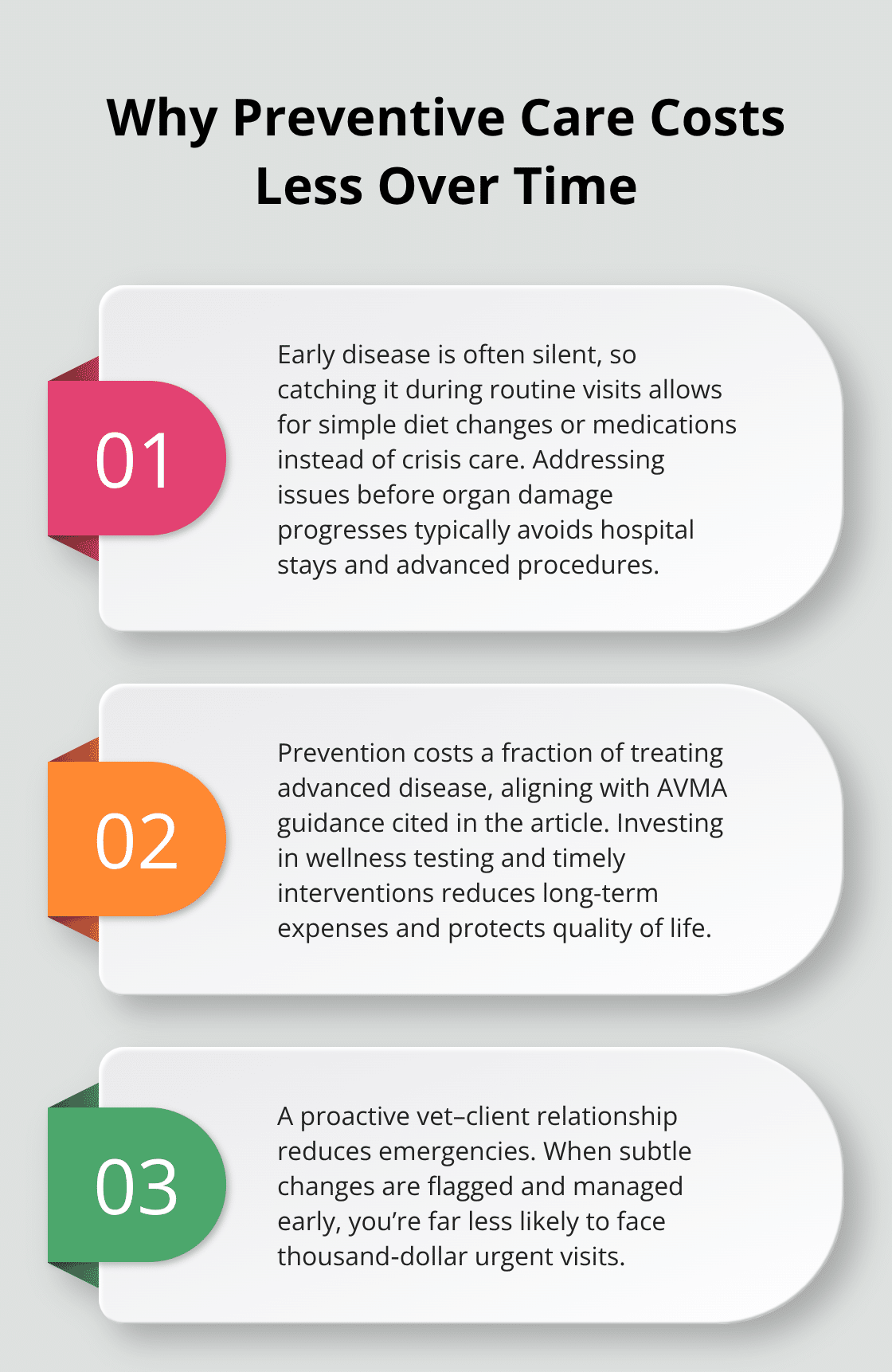
Your vet tailors screening to your dog’s age, breed, and lifestyle, recommending tick-borne disease screening based on geography and heartworm testing appropriate to your region. This partnership transforms your vet from someone you call in panic into someone actively protecting your dog’s health month after month. With this foundation in place, understanding what actually happens during a preventive examination helps you prepare for your dog’s next visit.
What Happens During Your Dog’s Health Examination
Your vet starts with a full physical examination, checking your dog’s weight, body condition, heart rate, and temperature. They palpate the abdomen to feel for organ enlargement, lumps, or pain, inspect the ears and eyes for infection or discharge, and listen to the lungs and heart with a stethoscope. This hands-on assessment takes just minutes but catches problems you’d never notice at home. The vet compares current findings to previous visits, so establishing that baseline early matters tremendously.

A dog showing a two-pound weight gain since last year might seem insignificant, but paired with elevated kidney values on bloodwork, it signals a real problem requiring dietary changes.
Blood Tests and Urinalysis Reveal Hidden Problems
Blood tests and urinalysis form the backbone of preventive screening. Routine wellness bloodwork at six months establishes normal baseline values for your dog’s kidney function, liver enzymes, glucose levels, and blood cell counts. When your vet repeats these tests annually or semi-annually, they spot subtle shifts before symptoms appear. A slightly elevated creatinine level today means your vet can recommend dietary adjustments and monitoring now, preventing the kidney disease crisis that would otherwise hit you in two years.
Fecal antigen testing detects parasites up to twice as effectively as traditional flotation methods, catching heartworm exposure and intestinal infections when treatment is straightforward. CAPC recommends four parasite tests in the first year and twice yearly thereafter to establish whether your dog faces genuine exposure risk in your region.
Breed-Specific Screening Catches Silent Killers Early
Thyroid disease progresses quietly in predisposed breeds. Golden Retrievers, Labradors, Irish Setters, and Dobermans should have thyroid screening between ages four and ten, testing both T4 and TSH levels. Catching hypothyroidism early means a simple daily medication prevents the weight gain, lethargy, and skin problems owners often mistake for aging.
For high-risk breeds like Boxers, German Shepherds, and Bernese Mountain Dogs, cancer blood tests detect lymphoma biomarkers and should start around age four. These tests identify lymphoma type and stage, guiding treatment decisions before visible tumors develop. Scottish Terriers and Shetland Sheepdogs face elevated bladder cancer risk, making bladder ultrasounds at age six part of responsible preventive care.
Dental Evaluation Protects Overall Health
Dental evaluation during the exam reveals tartar buildup, gum recession, and tooth fractures that lead to infections affecting the heart and kidneys if left untreated. Your vet performs digital dental radiographs to check for root disease invisible to the naked eye, recommending professional cleanings when necessary rather than waiting until your dog’s breath becomes noticeably foul. These preventive measures form the foundation of your dog’s health plan, but the real power emerges when your vet tailors screening to your dog’s specific age, breed, and lifestyle-a customization that transforms generic checkups into targeted protection against the diseases most likely to threaten your individual dog.
Creating a Health Check Schedule for Your Dog
Puppies demand far more veterinary attention than adult dogs, and we at DogingtonPost strongly believe skipping early visits is a false economy that costs you later. IDEXX data shows that establishing wellness baselines at six months of age catches abnormalities in 1 in 7 young dogs before symptoms appear. Schedule your puppy for four parasite tests during the first year according to CAPC recommendations, spacing them roughly quarterly to monitor exposure patterns in your area. These early visits do more than vaccinate-they establish your dog’s normal bloodwork values, dental health baseline, and growth trajectory, creating the reference point your vet uses for every future comparison. Many puppies visit the vet during spay or neuter procedures around four to six months, making that appointment the ideal moment for initial bloodwork and urinalysis rather than waiting until adulthood. Skip these early screens and you lose years of trend data that would reveal kidney issues or thyroid problems before they become emergencies.
Puppies and Young Dogs Need More Frequent Visits
Early veterinary visits create the foundation for your dog’s entire health history. Your vet establishes baseline values during these appointments that matter far more than any single test result. Quarterly parasite testing in the first year tracks whether your prevention strategy actually matches your dog’s real exposure risk in your region. These frequent visits also allow your vet to monitor growth, catch developmental orthopedic problems, and ensure vaccinations protect against preventable diseases.

Adult Dogs Benefit from Annual Checkups
Adult dogs aged one to seven need annual wellness exams without exception, though twice yearly is better if your budget allows. Dogs follow similar patterns to cats-problems develop silently while annual visits alone might miss subtle shifts that semi-annual exams would catch. CAPC recommends parasite testing twice yearly in adults to track whether your prevention strategy actually matches your dog’s real exposure risk. Annual exams establish the rhythm your vet needs to spot changes in weight, coat quality, energy levels, and behavior that signal hidden disease.
Senior Dogs Should Have Twice-Yearly Examinations
Senior dogs at age seven and beyond require twice yearly examinations because disease progression accelerates dramatically in older animals. A senior dog’s kidney values can shift significantly between annual visits, and waiting twelve months means missing the window for dietary intervention that slows decline. Thyroid screening for predisposed breeds like Golden Retrievers should start between ages four and ten, with cancer blood testing for high-risk breeds starting around age four-timelines that only work if your vet sees your dog frequently enough to establish baselines and spot changes. Twice-yearly visits catch weight loss, appetite changes, and behavioral shifts before they become crises requiring emergency care.
Tailoring the Schedule to Your Dog’s Individual Risks
Your veterinarian tailors the exact schedule to your dog’s breed predispositions, lifestyle exposure to parasites and tick-borne diseases, and individual health history, so the generic recommendation matters less than the conversation you have with your vet about your specific dog’s risks. A young outdoor dog may need more parasite checks and disease testing, while a senior Labrador may benefit from annual cancer screening and thyroid testing. Geography influences tick-borne disease screening recommendations, and breed history shapes decisions about thyroid and cancer screening timelines. Work with your vet to create a preventive care plan that matches your dog’s actual exposure and genetic predispositions rather than following a one-size-fits-all approach.
Final Thoughts
Preventive health checks for dogs aren’t optional extras or luxuries for owners with unlimited budgets-they form the foundation of keeping your dog healthy and catching diseases before they become emergencies that drain your finances and devastate your family. Dogs with established preventive care relationships experience fewer crises, live longer, and maintain better quality of life than those seen only when problems become obvious. Starting early matters tremendously because a puppy’s first wellness visit establishes baseline values your vet will reference for the next decade, and that six-month bloodwork catches abnormalities in 1 in 7 young dogs before symptoms appear.
Your adult dog’s annual checkup isn’t just a formality-it’s the moment your vet spots subtle weight shifts, coat changes, or behavioral differences that signal hidden problems. Twice-yearly visits for senior dogs catch disease progression before it accelerates into crisis territory, and a slightly elevated kidney value today means dietary adjustments now rather than emergency surgery next year. The partnership you build with your veterinarian transforms preventive care from a generic checklist into targeted protection against the specific diseases most likely to threaten your individual dog.
Schedule that preventive health check for your dog today and work with your veterinarian to create a plan that matches your dog’s actual needs. Your dog’s healthier, longer life depends on the decisions you make right now. We at DogingtonPost encourage you to take action and protect your dog’s future in ways that waiting never can.
]]>Dog enrichment toys change that equation entirely. At DogingtonPost, we’ve seen firsthand how the right toys transform a restless pup into a focused, engaged learner. These aren’t just playthings-they’re tools that build confidence, burn energy, and strengthen your bond with your dog.
Why Enrichment Toys Matter for Your Dog’s Health
Enrichment toys aren’t optional extras-they’re essential tools that directly impact your dog’s physical and mental health. While enrichment toys may not burn as many calories as a vigorous run, sniffing is an excellent way to incorporate mental exercise into their daily routine. This matters because obesity affects approximately 56% of dogs in the United States, leading to joint problems, diabetes, and shortened lifespans. Puzzle toys and treat-dispensing options force your dog to work for food, slowing eating speed and improving digestion while simultaneously engaging their brain.

Mental stimulation through enrichment also releases dopamine, which promotes calm behavior across all ages-from puppies to seniors.
Mental Stimulation Stops Destructive Behavior Before It Starts
A bored dog doesn’t simply sit quietly. Dogs left without cognitive engagement develop destructive habits like excessive chewing, digging, and barking. Enrichment toys provide legitimate outlets for these natural instincts. When you introduce puzzle feeders like KONG Gyro or treat-dispensing balls, your dog’s brain activates problem-solving pathways instead of fixating on your furniture. Research shows that dogs using enrichment toys consistently display fewer behavioral problems and lower anxiety levels. The key is matching the toy’s difficulty to your dog’s skill level-start with simpler options like KONG Gyro for beginners, then progress to advanced puzzles like Nina Ottosson’s Dog Casino as your dog masters each challenge. Rotating toys weekly prevents habituation, keeping your dog mentally engaged without requiring constant new purchases.

Building Stronger Bonds Through Interactive Play
Enrichment isn’t just about solo play. Interactive toys like tug ropes, fetch toys with handles, and puzzle toys designed for two-player engagement strengthen the relationship between you and your dog. These shared activities teach responsiveness, improve bite control, and create positive associations with your presence. Dogs that regularly engage in interactive play with their owners show measurably better obedience and reduced separation anxiety. Whether you’re using a simple rope toy for tugging or rotating through treat-dispensing options during mealtimes, these moments build trust and communication that extend far beyond playtime.
Selecting the Right Toy Makes All the Difference
Your dog’s age, size, and chewing strength determine which enrichment toys will work best. Puppies need softer, lighter toys that won’t damage developing teeth, while senior dogs benefit from gentler options that protect aging jaws. Power chewers require durable materials like those found in Bob-A-Lot or K9 Connectables Pro range, whereas moderate chewers can enjoy a wider variety of textures and difficulty levels. The wrong toy choice leads to frustration or injury, so understanding your dog’s play style before you purchase prevents wasted money and keeps your dog safe. With hundreds of options available, the next section helps you navigate this landscape and find toys that match your dog’s unique needs.
The Best Enrichment Toys That Actually Work
Puzzle Feeders and Treat-Dispensing Toys Build Problem-Solving Skills
Puzzle feeders and treat-dispensing toys dominate the enrichment market for good reason. KONG Gyro stands out as the beginner’s sweet spot, with its spinning center orb that releases treats as your dog rolls and nudges it, naturally slowing eating speed while triggering hunting instincts. For dogs that master KONG Gyro within weeks, Nina Ottosson’s Dog Casino jumps difficulty significantly with sliding drawers and lockable bone handles, forcing sequential problem-solving rather than simple trial-and-error. Bob-A-Lot by Starmark functions as both puzzle and slow feeder with adjustable openings you can tighten as your dog improves, though its one weakness is the sealed design that makes cleaning tedious.
K9 Connectables offer modular flexibility, letting you stack and reconfigure pieces so the same toy grows more challenging without purchasing replacements. Earth Rated’s treat dispenser works beautifully for dogs that prefer compact toys, and it’s dishwasher-safe, which matters when you’re cleaning these things multiple times weekly. Start simple, progress gradually, and match difficulty to your dog’s current skill level rather than guessing.
Rotating Puzzles Prevents Habituation and Maintains Engagement
The critical mistake most dog owners make is buying one puzzle toy and expecting it to maintain engagement forever. Rotating three to five different puzzles weekly prevents habituation and keeps your dog’s brain activated. This strategy costs far less than constantly purchasing new toys, yet delivers superior results because novelty itself becomes the reward. Your dog’s brain stays sharp when familiar toys reappear after weeks away, triggering renewed interest and problem-solving effort.
Interactive Balls and Fetch Toys Encourage Active Learning
Interactive balls and fetch toys serve a different enrichment purpose than puzzles. Niblomia’s Crazy Bouncing Ball moves erratically with dual modes and USB-C recharge, creating unpredictable play that forces dogs to adjust strategy mid-chase rather than memorizing a toy’s movement pattern. ZestPulse Soccer Ball with nylon straps works for tug and fetch simultaneously, and the water-friendly design means beach or pool sessions double as enrichment rather than exercise alone. NUZZLENOOK’s Indestructible Ring floats for water play and can be stuffed with peanut butter, combining texture variety with treat motivation.
Sniff Mats and Hide-and-Seek Games Activate Natural Foraging Instincts
Sniff mats represent the underrated enrichment category that many owners overlook entirely. Unlike puzzle toys requiring active manipulation, sniff mats engage scent work and foraging instincts by hiding kibble or treats within fabric layers. Dogs naturally slow eating to near-meditation speeds when using sniff mats, and the mental engagement from scent tracking burns calories comparable to a short walk.
Hide-and-seek games using household items cost nothing yet provide substantial enrichment when you rotate hiding spots around your home and vary treat visibility. Cereal boxes filled with crumpled paper and treats, muffin tins with tennis balls covering treat compartments, and rolled towels with kibble inside all function as effective hide-and-seek games. These DIY options work because they tap into your dog’s natural hunting and problem-solving behaviors without requiring expensive equipment.
Safety and Supervision Keep Enrichment Sessions Productive
Matching toy complexity to your dog’s experience level prevents frustration and injury. Supervise play until you’re certain your dog won’t destroy or choke on materials, and inspect toys regularly for damage or loose pieces. Replace any toy showing signs of wear before it becomes a choking hazard. This foundation of safe, supervised enrichment sets the stage for introducing more advanced training techniques that build on the confidence and focus your dog develops through play.
Choosing the Right Toy for Your Dog’s Abilities
Match Toy Difficulty to Your Dog’s Age and Chewing Strength
Start with your dog’s age and chewing strength, not toy popularity. Puppies need soft, flexible options like KONG Puppy toys that won’t damage developing teeth, while seniors benefit from gentler materials that protect aging jaws. Power chewers destroy most standard toys within days, so Bob-A-Lot or K9 Connectables Pro range are the only realistic choices if your dog has serious gnawing stamina. Moderate chewers have far more options, but matching toy difficulty to your dog’s current problem-solving level matters more than toy variety.
Progress From Simple to Complex Puzzles
Start with KONG Gyro for beginners because the spinning center orb releases treats quickly, building confidence before you progress to Nina Ottosson’s Dog Casino, which requires sequential thinking. If you buy advanced puzzles for a dog that hasn’t mastered basics, frustration sets in and your dog abandons the toy entirely. Size matters too-small dogs struggle with oversized puzzle toys, while large dogs can accidentally destroy toys designed for medium breeds. Earth Rated’s compact treat dispenser works for toy breeds, whereas Loobani’s bamboo feeder with adjustable heights suits larger dogs better. The wrong toy choice wastes money and teaches your dog that enrichment is frustrating rather than rewarding.
Rotate Toys Every Seven Days for Sustained Engagement
Rotating toys every seven days is non-negotiable if you want sustained engagement. Keeping three to five different puzzles in active rotation costs far less than constantly buying new toys, yet delivers superior mental stimulation because your dog’s brain reactivates when a familiar toy reappears after weeks away. This strategy works because dogs don’t experience boredom the way humans do-novelty itself becomes the reward. Hide toys your dog has mastered in a closet for three weeks, then reintroduce them as fresh discoveries.
Supervise Play and Inspect Toys for Safety
Supervise all enrichment sessions until you’re confident your dog won’t destroy or choke on materials, and inspect toys weekly for loose stitching, cracks, or damaged pieces. Replace any toy showing wear before it becomes a hazard. Dogs that destroy toys aggressively need sturdier options from the start rather than constant replacement cycles.

This foundation of safe, supervised enrichment prevents injuries while building the confidence and focus that makes advanced training techniques more effective.
Final Thoughts
Dog enrichment toys aren’t luxuries-they’re investments in your dog’s long-term health and happiness. Dogs that engage regularly with puzzle feeders, interactive balls, and sniff mats develop sharper problem-solving skills, maintain healthier weights, and display fewer behavioral problems. Mental stimulation through these toys releases dopamine, creating calm, confident dogs that respond better to training and handle life changes with resilience.
Starting your enrichment journey doesn’t require buying dozens of toys or spending hundreds of dollars. You can begin with one beginner-friendly puzzle like KONG Gyro, observe how your dog interacts with it, then add a second toy within a few weeks. Rotate these toys weekly so your dog stays engaged without habituation setting in, and add a sniff mat or DIY hide-and-seek game using household items to vary the experience.
Creating a stimulating environment means matching toy difficulty to your dog’s current skill level, supervising play until you’re confident about safety, and replacing damaged toys before they become hazards. Visit DogingtonPost for expert advice on selecting the right dog enrichment toys and training techniques that complement enrichment play.
]]>At DogingtonPost, we’ve seen how simplification transforms both dogs and their owners. Less clutter means less stress, better behavior, and a stronger bond between you and your pet.
What Minimalist Dog Ownership Actually Means
A minimalist dog lifestyle isn’t about deprivation or neglect. It’s about intentional choices that prioritize your dog’s genuine needs over marketing-driven desires. The core difference lies in distinguishing between what your dog requires to thrive and what manufacturers convince you to buy. Over 250,000 dogs are registered with the Royal Kennel Club annually, and many of these owners maintain healthy, happy dogs without excess gear.

Your dog needs consistent care, proper nutrition, safe housing, and your attention-not a closet full of toys or complicated equipment. The minimalist approach cuts through the noise and focuses on what actually improves your dog’s life.
Quality Over Quantity
Quality matters far more than quantity. A single durable chew toy serves your dog better than twenty cheaply-made alternatives that end up in landfills. Similarly, high-quality dog food supports long-term health and prevents costly vet visits later, while budget treats often contain fillers that add expense without nutrition. This isn’t frugality for its own sake; it’s smart investment in your dog’s wellbeing.
Breaking Common Myths
Many people believe minimalist dog ownership means a sad, deprived pet. The reality is opposite. Dogs thrive on routine and consistency, not clutter. A calm, organized home actually reduces anxiety and behavioral problems. The first 1-2 months with a puppy do require adjustment, but a simplified routine accelerates learning and makes potty training and basic commands stick faster. Your dog doesn’t experience joy from owning thirty toys; it experiences joy from walks, training sessions, and your presence.
Practical Decluttering Strategies
Another misconception is that minimalism requires perfection or constant decluttering. Apply the two-year rule honestly: if you haven’t used a dog item in two years, let it go. That’s it. Multi-functional gear works better than specialized equipment anyway. A washable dog bed with a spare for rotation costs less and works better than five decorative beds scattered around your home.
Your Essential Dog Kit
Essential items include a collar, harness, leash, grooming supplies, medications, waste bags, food and water bowls, and one or two durable toys. This foundation is genuinely sufficient. Starting small and adding only what your specific dog needs creates a sustainable system rather than an overwhelming burden. With these essentials in place, you’re ready to streamline the next critical area: your dog’s daily routine and environment.
Streamlining Your Dog’s Essentials
The Truth About Toys and Play
Toy clutter destroys the minimalist vision faster than anything else. Most dog owners accumulate toys without strategy, then watch their dogs ignore ninety percent of them. One durable rope toy and one chew toy satisfy your dog’s play needs completely. Rotation matters more than quantity-keep two toys accessible and swap them weekly so novelty maintains interest without requiring constant purchases.
This approach costs far less and prevents the behavioral problem of toy obsession, where dogs fixate on acquiring items rather than engaging meaningfully with what they have. A single training clicker streamlines the entire learning process and replaces the need for multiple tools or gadgets that clutter your training sessions. Mental stimulation comes from structured walks, training repetition, and exploration, not from a closet full of squeaky toys.
Feeding Your Dog Right
High-quality dog food makes an enormous difference in long-term health outcomes. Premium brands with named meat sources and minimal fillers cost more upfront but reduce vet bills significantly. Budget dog foods often contain fillers that provide calories without nutrition, meaning your dog eats more to feel satisfied and you spend more overall. Focus your food budget on quality rather than supplementing with treats.
Most commercial dog treats serve no purpose beyond satisfying owner guilt. A few high-value training treats work better for behavioral reinforcement than endless snacking options. Treats should comprise no more than ten percent of daily caloric intake according to veterinary guidelines, yet many minimalist owners find they eliminate treats entirely and use kibble pieces during training instead, cutting expenses and reducing unnecessary consumption.

Building a Simple Grooming Routine
Grooming routines simplify dramatically when you commit to consistency rather than sporadic attempts. Brush your dog according to coat type on a fixed schedule rather than waiting until mats develop. Short-coated breeds need brushing once or twice weekly; long-coated breeds need more frequent attention. Start grooming sessions in short five-minute intervals so your dog accepts handling without stress.
Nail trimming happens every four to six weeks, not whenever they become problematic. Dental health requires regular brushing with canine toothpaste using a rubber thimble, ideally three times weekly. Bathe your dog only when necessary, often just every few months, using a non-slip mat to prevent injury during washing. For lighter-coated breeds, apply dog-safe sunscreen to ears and exposed areas during hot months to prevent sunburn.
Organizing Your Grooming Supplies
Store all grooming supplies in a single accessible container rather than scattered throughout your home. A basic kit includes one brush appropriate to your dog’s coat, nail clippers, canine toothpaste, dog shampoo, and an old towel for drying. This focused approach eliminates decision fatigue and creates predictable routines that your dog learns to expect, reducing anxiety during grooming sessions. With your dog’s physical needs streamlined, the next critical step involves creating the right environment where your dog can thrive-one that reduces stress through calm spaces and consistent daily schedules.
Creating a Calm Environment for Your Dog
How Your Home’s Layout Affects Your Dog’s Stress
Your home’s physical layout directly affects your dog’s stress levels and behavior. A minimalist environment removes the visual noise that overstimulates dogs and triggers anxiety. Dogs with constant visual stimulation struggle to relax, leading to destructive behavior, excessive barking, and difficulty settling during work hours. Start by designating a quiet space in your home where your dog spends most time. This space should contain only essentials: a washable dog bed with a spare for rotation, water bowl, and one accessible toy. Keep this area away from high-traffic zones and windows facing busy streets. The goal isn’t isolation but rather creating a predictable, low-stimulation space where your dog naturally calms down.
Reducing Noise and Visual Distractions
Noise matters significantly. Dogs exposed to constant background noise develop elevated cortisol levels, the stress hormone. Minimize unnecessary sounds by avoiding loud television, music, or household clutter that creates acoustic chaos. If you work from home, establish quiet periods where your dog learns that certain times mean settling time. This consistent pattern teaches your dog to anticipate calm moments rather than remaining in a state of alert readiness.
Physical clutter directly translates to mental chaos for dogs. When your home contains excess items, your dog struggles to focus on you during training and becomes overstimulated by environmental changes. A clean, organized space with minimal visual distractions creates the foundation for better behavior and faster learning.
Building a Consistent Daily Schedule
Your daily schedule functions as your dog’s primary stress regulator. Dogs thrive on predictability, and consistency in timing creates security that no toy or treat can replicate. Structure your day around three fixed anchor points: morning walk, midday break, and evening activity.

Morning walks should happen at the same time daily, ideally before you begin work, so your dog releases energy and establishes a potty routine. A 20 to 30-minute walk provides sufficient physical exercise for most dogs, though this varies by age and breed. Midday care is essential when you work full-time; either return home, hire a dog walker, or arrange family support for a quick potty break and five minutes of interaction. This prevents accidents that damage house training progress and reduces separation anxiety significantly.
Evening Routines That Promote Calm
Evening routines should combine physical exercise with mental stimulation through training sessions or puzzle feeders rather than passive toy access. Spend 15 to 20 minutes on training using kibble pieces as rewards, which satisfies your dog’s need for engagement while maintaining your minimalist approach. The consistency matters more than duration; a dog that knows walks happen at 7 AM, noon, and 6 PM develops calm behavior around these predictable events.
Inconsistent schedules create anxiety because your dog cannot anticipate care, leading to destructive behavior and house soiling. Track your routine using simple phone reminders or a calendar to maintain consistency even on busy days. This structured approach eliminates the need for constant entertainment and allows your dog to settle confidently between scheduled activities, transforming your home into a genuinely calm space.
Final Thoughts
A minimalist dog lifestyle transforms how you live with your dog through intentional choices rather than overnight overhauls. Your dog measures happiness through predictable walks at the same time each day, consistent training sessions that build confidence, and a home environment free from overwhelming noise and visual chaos-not through toy quantity or gadget sophistication. The foundation you’ve built throughout this guide creates the conditions where your dog genuinely thrives.
Starting your minimalist journey requires one simple action: identify what your dog actually uses and what sits unused. That washable bed, the collar that fits properly, the high-quality food that keeps your dog healthy-these form your foundation, and everything else is negotiable. Many owners find that removing excess gear actually strengthens their relationship with their dog because less clutter means more attention directed toward meaningful interaction rather than managing possessions.
The transition typically takes one to two months as your dog adjusts to new routines and your household settles into simplified patterns. A minimalist approach reduces your household expenses significantly, eliminates decision fatigue around purchasing, and creates a living space that feels calm and organized. Visit DogingtonPost to explore more practical strategies for building a sustainable, intentional life with your dog.
]]>